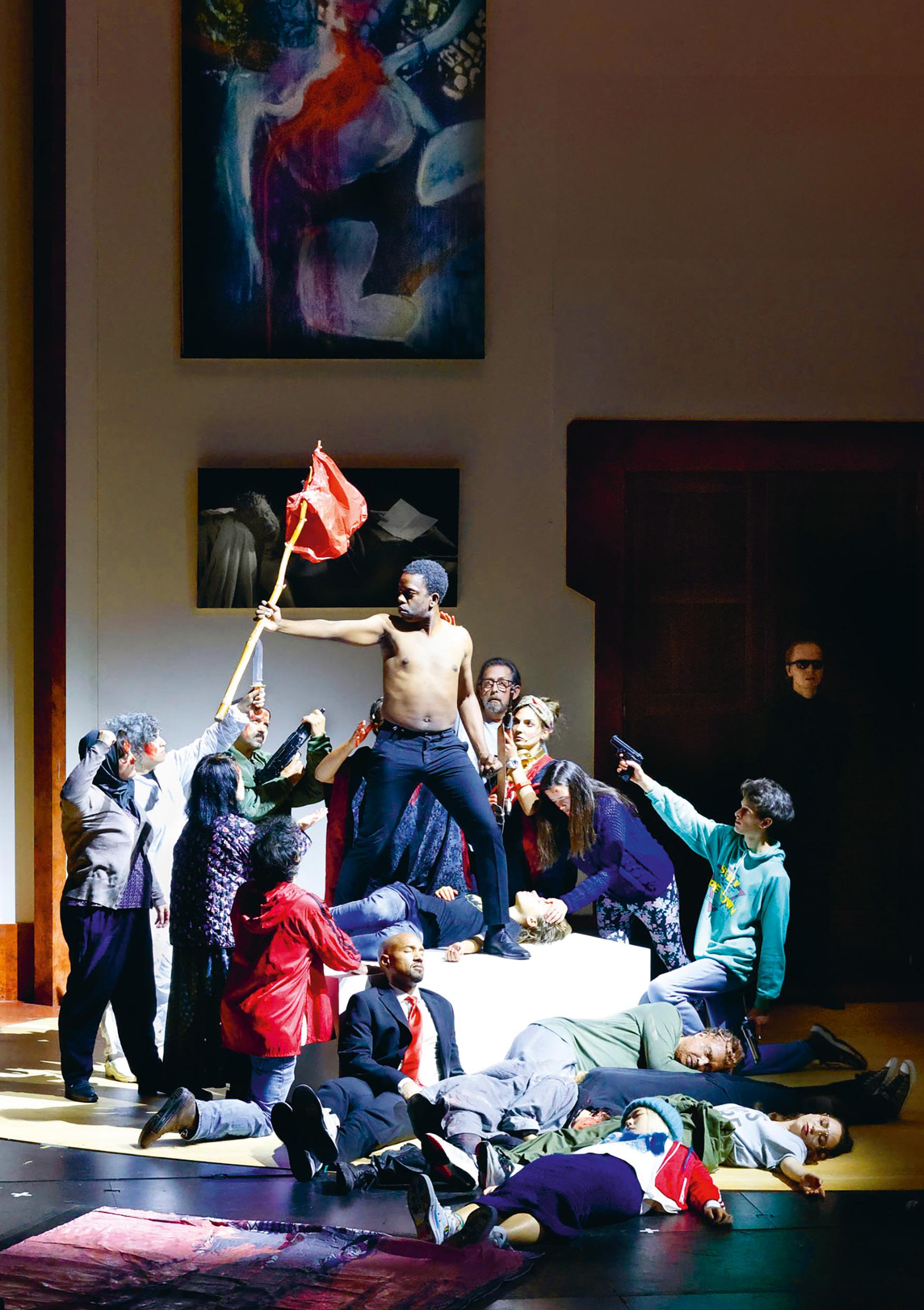


In Milo Rau’s first opera treatment, Emperor Tito’s well-wishing commitment degenerates into a strategy of sheer self-preservation, an empty revolutionary platitude. Together with eighteen people who live in Vienna and have partly themselves experienced repressive regimes, the Camerata Salzburg and the Arnold Schoenberg Choir, Rau undertakes an actualisation of Mozart’s last opera. While crowds of displaced persons are eking out their existence in a trailer park ghetto outside of the palace walls, the social elite are celebrating their own benevolence. Is it possible for political art to change the world? Or does it, in fact, only reinforce the status quo?
The Festwochen artistic director’s controversial Mozart interpretation calls convenient social commitment into question while at the same time paying homage to the people of Vienna.
De Standaard


21 / 22 / 24 / 25 May, 7.30 pm
Halle E im MuseumsQuartier
Italian
German and English surtitles
3 hrs., 1 interval
Q&A
22 May, following the performance
Introduction to the music with Thomas Hengelbrock, 24 May, 6.30 pm
Direction Milo Rau Musical direction Thomas Hengelbrock Choir Arnold Schoenberg Chor Choir direction Erwin Ortner Choir rehearsing Viktor Mitrevski Orchestra Camerata Salzburg Scenography Anton Lukas
Costume design Ottavia Castellotti Video design Moritz von Dungern Light design Jürgen Kolb Dramaturgy
Giacomo Bisordi, Clara Pons Revival Director Giacomo Bisordi With Anna Goryachova (Sesto), Justin Hopkins (Publio), Anna Malesza-Kutny (Vitellia), Jeremy Ovenden (Tito), Maria Warenberg (Annio), Sarah Yang (Servilia) Extras Richi August-Chi, Naima Viktoria Bouakline, Marcel von Brasche, Agnes Bakuz Canáriò, Daniela Chen-Trifonov, Maximilian Chen, Fábio Coutinho-Altenberg, Clara Fischer, Marko Jovanovic, Nika Korenjak, Willfried Kovárnik, Lina Lottes, Mary-Ann Mestanek, Alexander Nefedyev, Marco Otoya, Olga Shapovalova, Aaron Nora Scherer, Halyna Shcherbak, Michael Wachelhofer
Production Grand Théâtre de Genève Coproduction Wiener Festwochen | Freie Republik Wien, Théâtres de la Ville de Luxembourg, Opera Ballet Vlaanderen Thanks to Eisbazar, Michael Bart (Die gesengte Sau / Prater), MA 59, Flughafen Wien AG, Universitätsbibliothek der Universität Wien, Schloß Schönbrunn Kultur- u. Betriebsges.m.b.H., Prater Wien GmbH, Burgkino, MuseumsQuartier E+B GesmbH, Vienna Film Commission
executed by the team of the Wiener Festwochen | Free Republic of Vienna
Premiere February 2021, Grand Théâtre Genève
GETTING REALITY INTO ART
Milo Rau on the power that comes from opera and the challenges that await the age-old genre
I WANTED TO TAKE THE WORK OUT OF ITS OPERATIC UTOPIA AND MAKE IT REAL AGAIN, TO GET REALITY BACK INTO ART. THAT IS THE TASK OF THE ARTIST, THAT IS HOW ART CAN CHANGE THE WORLD.
When I became artistic director of NTGent in 2018, I wrote a manifesto with ten rules that the city theatre of the future should uphold. The manifesto offers a summary of how I see the role of art in society and can serve as a basis for transforming the apparatus of a large city theatre like NTGent so as to bear out that vision. By doing away with the permanent ensemble, we have noticed that we can include more different, unheard voices in our programming. We consciously choose to give non-professional players space on stage, because professionalism is linked to training that not everyone has access to. We are committed to multilingualism. We limit the literal adaptation of classics on stage to a minimum. Through these interventions we have been able to break free from the predictability and selfevidence of what comes onto our stage. The impact of the new voices on the house is leading to a cross-pollination that continues to reverberate. But we are not there yet: the next step is to diversify the structure in the house itself, as well as the audience.
In many ways it seems difficult to reconcile the manifesto with the opera genre. Historically, opera composers have often been the lackeys of the ruling class and their work creates safe spaces for the cultural elite. The genre is inextricably linked to the professional qualities of singers and musicians. The complexity of the medium and the compelling music leave little scope for adapting a work. The strongly embedded
traditions surrounding the standard repertoire entail the risk that classics will be re-enacted in discriminately and new voices will be difficult to introduce. Opera is seen as the ultimate bourgeois art form, while my aim through the manifesto is to get rid of artistic gentility. The genre suffers from a negative image in that regard. Admittedly, that idea stems from the many prejudices surrounding opera, including my own. When I was asked by the Geneva Opera to direct Mozart’s La Clemenza di Tito, I knew that a confrontation with my artistic vision would be inevitable.
THE MAKING OF MOZART
Although I almost always start from a blank page for a new production, the reverse logic in which I had to work with existing material really appealed to me. Working with the existing opera material makes you think as a maker. Two years after the French Revolution, why does Mozart write a “coronation opera” about the enlightened and forgiving Roman emperor Titus, in honour of the investiture of the king of Bohemia? Why does La Clemenza di Tito take as its theme the tolerance of power? What does that say about us today? What is there to expose that is still true today? The opera genre invites us to work in an interpretative and deconstructive way, which I find very interesting. I decided to expose “the making of” of Mozart’s last opera by disassembling the work. This is consistent with the manifesto I wrote for NTGent: I wanted to take the work out of its operatic utopia and make it real again, to get reality back into art. That is the task of the artist, that is how art can change the world
Artists tend to dramatise and aestheticise violent reality in their work, so that the authenticity of
that reality is weakened and kept at bay. In La Clemenza di Tito the same thing happens: the opera tells the story of power games among the elite that can lead to coups d’état, while the citizens of Rome suffer under the violence and their city burns. Translate that to Mozart’s time and you get a story that, through the tolerance of the enlightened Titus, domesticates and aestheticises the violent French Revolution. In my staging I investigate how this phenomenon occurs today and add a meta-critical layer by connecting the utopian and the real world. On the one hand, you see a museum on stage, the utopian and aestheticised space of the ruling elite. On the other hand, I show the real space of the subject in the form of a refugee camp. Not actors, but people who are stranded in the real world around the opera house in search of a better future, populate the place.
The addition of that actual space destroys the safe space of Titus and his elite friends. In this way, La Clemenza di Tito becomes a form of self-criticism by the engaged artist: As a maker, am I not a bit of a Titus myself, a blowhard who depicts the cold world in a comfortable space, aestheticises it and also lives off it? I therefore regard my version of Mozart’s opera as a manifesto. I see the deconstructive thought process I have gone through as the way to go for dealing with operas and creating space for polyphony. We must rise to the challenge of connecting opera – the art form par excellence for utopian lies –with reality. By making cuts in the music and adjusting the text, for example. Or by giving non-professionals, in this case refugees, a place alongside professional singers and musicians. The manifesto I drew up for NTGent seems to fit in better with the opera genre than I originally thought, but that has drastic consequences for
the final product: my Clemenza is anything but in keeping with the operatic tradition as we know it.
POST-OPERA?
In puncturing the opera utopia and disassembling Mozart’s work, many opera connoisseurs and critics experience my La Clemenza di Tito as destructive. They regard my staging as the end of the opera, a post-opera that disrespectfully transgresses the rules of the genre. However, compared to what I do in the theatre, I have held back out of respect for the music, the singers and the musicians. During the rehearsal process, they made me discover a new logic behind training and professionalism in the performing arts. Just as top football players rise from the favelas, the daughter of a cleaning lady can emerge as a top singer, due to the great attention for talent within the opera world. On and around an opera stage, there springs up a collection of people with talent and passion, who took years to develop their expertise, a fresh form of collectivity that is simply a prerequisite to arrive at an end product and one which I can only admire. For example, I can’t read music at all, but there are plenty of others present who are happy to respectfully help me there.
The openness to everyone’s talent touched me and led to a reconciliation with the gentility of professionalism, the opera audience and the genre itself. Working on La Clemenza di Tito made me fall in love with opera. The rapid and systematic method of working that forces you as a maker to reflect in advance, appeals to me enormously. The collectivity around an opera production is heartwarming. I regard the factory
of people working on a performance with great humility. I am intrigued by the convergence of different facets, the parallelism of music and action, and the tension that arises when you present old works in a new way. I have learned to approach the manifesto I wrote for NTGent in a different, more nuanced way. There is a future in opera, provided we dare to disassemble classics and place them alongside new work. Thus, opera can be polyphonic and tell stories that are less self-evident. In this way we can work on other forms of representation, change the visual politics of what can be seen on stage and integrate the real world into the arts. That is the essence of my artistic vision and practice, the spirit of my manifesto.
This text was written for the Antwerp production of Milo Rau’s interpretation of Mozart’s La Clemenza di Tito in September 2023. The world premiere in Geneva in February 2021 took place as a TV broadcast due to the Covid pandemic. Rau has created a new version for Vienna with 19 residents of the city and the singers from both casts. PUBLICATION DETAILS Owner, Editor and Publisher Wiener Festwochen GesmbH, Lehárgasse 11/1/6, 1060 Wien P + 43 1 589 22 0, festwochen@festwochen.at | www.festwochen.at General Management Milo Rau, Artemis Vakianis Artistic Direction (responsible for content) Milo Rau (Artistic Director) Text credits Essay by Milo Rau as part of the Antwerp production of La Clemenza di Tito, September 2023 Picture Credit Cover: © Annemie Augustijns Produced by Print Alliance HAV Produktions GmbH (Bad Vöslau)
Milo Rau, born 1977 in Bern, was director, writer and artist in residence at NTGent. Rau studied sociology, German and Romance languages and literature in Paris, Berlin and Zurich with Pierre Bourdieu and Tzvetan Todorov, among others. Critics call him the “most influential” (Die Zeit), “most awarded” (Le Soir), “most interesting” (De Standaard), “most controversial” (La Repubblica), “most scandalous” (New York Times) or “most ambitious” (The Guardian) artist of our time. Since 2002, he has published over 50 plays, films, books and actions.
Rau’s theatre productions have been shown at all major international festivals, including the Berlin Theatertreffen, the Festival d’Avignon, the Venice Biennale, the Wiener Festwochen and the Kunstenfestivaldesarts in Brussels, and have been touring in over 30 countries worldwide. Milo Rau has received many awards, including the 3sat Prize and as the youngest artist after Frank Castorf and Pina Bausch, the renowned ITI Prize of the World Theatre Day in 2016. In 2017, Milo Rau was voted Director of the Year in a survey conducted by Deutsche Bühne, in 2018 he received the European Theatre Prize for his life’s work and in 2019 he was the first artist ever to be appointed Associated Artist of the European Association of Theatre and Performance – EASTAP. In 2020, he received the renowned Münster Poetry Lectureship for his complete artistic oeuvre. His plays were voted “Best of the Year” in critics’ surveys in over 10 countries. In 2019, he received an honorary doctorate from Lund University in Sweden, in 2020 he was awarded an honorary doctorate from Ghent University.
Milo Rau has been artistic director of the Wiener Festwochen since 1 July 2023.
Thomas Hengelbrock is an exceptional talent in many respects: as a violinist, conductor, scholar and music mediator, he has been inspiring an international audience for many years. The profound examination of the musical text, meaning and content of works forms the focus of his work across epochs and genres and at the same time the basis for his international career. Thomas Hengelbrock regularly unearths works that have been forgotten or thought lost and offers a refreshing new look at the standard repertoire. In addition to historically informed performances of works such as Mendelssohn’s Elijah, Haydn’s Creation, Beethoven’s Missa solemnis, Wagner’s Parsifal on original instruments and Mascagni’s Cavalleria rusticana in the present original version, he also devotes himself in particular to the music of the immediate present.
For over 25 years, Thomas Hengelbrock, as founder and artistic director, has celebrated great successes with his Balthasar Neumann ensembles at international festivals and at renowned concert halls and opera houses. In 2017 he conducted the opening concert of the Elbphilharmonie in Hamburg. In diverse academy programmes he promotes young musicians and shares his extensive knowledge and experience. Thomas Hengelbrock is also a sought-after partner for orchestras such as the Vienna and Munich Philharmonic Orchestras, the Royal Concertgebouw Orchestra, the Orchestre de Paris, the Orchestre National de France and the Tonhalle Orchestra Zurich.
In addition to his work as a conductor, Thomas Hengelbrock has also been involved as a director in numerous productions such as Purcell’s Dido and Aeneas or Mozart’s Don Giovanni and works on interdisciplinary projects with actors
such as Klaus Maria Brandauer, Johanna Wokalek and Graham Valentine. He is particularly concerned with opening up access to art and culture for young people and exciting their curiosity for music. During the Corona pandemic, he was particularly committed to the continuation of culture and creating opportunities for freelance musicians in Europe. In 2016, Thomas Hengelbrock was awarded the Herbert von Karajan Music Prize for his services.
At home in Salzburg and around the world for over 70 years: CAMERATA Salzburg has shaped the city of music with its own concert series and as a regular ensemble at the Salzburg Festival and Mozart Week. As its cultural ambassador, it is also a guest on the major international concert stages. Founded in 1952 by conductor and musicologist Bernhard Paumgartner, the orchestra’s sound is particularly representative of Viennese classical music, in particular the music of its hometown’s famous son, Wolfgang Amadeus Mozart. Sándor Végh had the greatest influence on the development of CAMERATA as chief conductor from 1978 to 1997.
Since 2016, CAMERATA has been playing under its own leadership and democratic self-image with its concertmasters and artistic directors Gregory Ahss and Giovanni Guzzo and, depending on the repertoire, in collaboration with guest conductors. CAMERATA has a profound collaboration with its artistic partners, the pianist Hélène Grimaud and the violinist Janine Jansen.


Main sponsors Public funding body

Sponsor Partner hotel