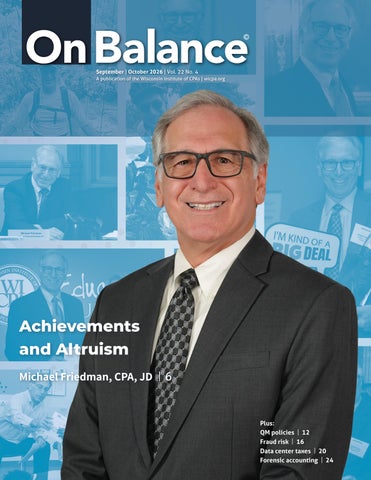
September | October 2026 | Vol. 22 No. 4 A publication of the Wisconsin Institute of CPAs | wicpa.org
Achievements and Altruism Michael Friedman, CPA, JD | 6
Plus: QM policies | 12 Fraud risk | 16 Data center taxes | 20 Forensic accounting | 24
SAVE THE DATE! UPCOMING WICPA CONFERENCES & SPECIAL EVENTS
CONFERENCES
SPECIAL EVENTS
WICPA conferences are your source for key updates and insights on timely issues. As a WICPA member, you can save up to $150 on registration!
WICPA special events are unique opportunities to connect with fellow members and provide a great way to socialize and have fun!
Not-for-Profit Accounting Conference
Golf Outing
Wednesday, Sept. 16 WICPA CPE Livestream
Friday, Sept. 18 Ironwood Golf Course
Accounting & Auditing Conference
Bowling Night
Tuesday, Nov. 10 WICPA Office & WICPA CPE Livestream
Thursday, April 29, 2027 New Berlin Ale House
Tax Conference
Member Recognition Banquet & Annual Business Meeting
Monday, Nov. 16 - Tuesday, Nov. 17 Brookfield Conference Center & WICPA CPE Livestream
Friday, May 7, 2027 Brookfield Conference Center
Accounting Technology Conference Thursday, Dec. 17 WICPA Office & WICPA CPE Livestream
Business & Industry Spring Conference Tuesday, March 23, 2027 Brookfield Conference Center & WICPA CPE Livestream
Conveniently attend WICPA conferences from anywhere with an internet connection! wicpa.org/Livestream wicpa.org/OnDemand
Registration opens approximately eight weeks prior. For more details about each and to register, visit wicpa.org/conferences and wicpa.org/events.
A publication of the Wisconsin Institute of CPAs | wicpa.org
September | October 2026 Vol. 22 No. 4
6 Features
Columns
6
24 FORENSIC ACCOUNTING Forensic accounting in criminal court: What CPAs need to know In criminal matters, a forensic accountant’s job is to explain the truth hidden in ledgers, bank statements and digital transactions. By Robert Nordlander, CPA, CFE
Achievements and altruism Michael Friedman, CPA, JD, has enjoyed an amazing career and is making sure others can, too. As a young man beginning his journey at Indiana University, Michael Friedman never envisioned a career in accounting, but looking back over 40-plus years in the profession, he can’t imagine having done anything else. By Brent Roberts
12 From the page to real life: Putting quality management into practice Nearly a year post-implementation, firms are now challenged with putting their new policies into real-life practice. By Heather Lindquist, CPA 16 How small and medium businesses root out fraud People running smaller organizations will admit that the effects of fraud can be painful, but there are so many other aspects of operations that seem to need more attention. By Karl Egnatoff, CPA.CITP 20 Beyond the servers: Tax considerations for data center investments For CPAs advising clients who are developing, converting or investing in these facilities, the tax planning opportunities are substantial. By Dannielle Lewis, CPA, MBT wicpa.org
26 UNIFORM GUIDANCE Proposed changes to Uniform Guidance could mean greater oversight for federal award recipients For CPAs and finance professionals, the proposed revisions place greater emphasis on oversight, documentation and accountability. By Jolene Giese, CPA 30 PROFESSION-READY INITIATIVE Building a profession-ready CPA workforce The next generation of talent needs to be equipped to meet the evolving demands of the profession and the marketplace. By Carl Mayes, CPA, CAE 32 ARTIFICIAL INTELLIGENCE Risk management in the AI era Effective risk management is not about avoiding innovation. Rather, it is about enabling innovation in a thoughtful and sustainable manner. By JT Schlembach
12
26
Departments 3
Outlook | chair’s letter
4
In Touch | president & CEO’s message
11 Welcome | new members 18 Kudos | members in the news 23 Memorials | departed members
On Balance
September | October 2026
1
On Balance is published five times a year by the Wisconsin Institute of Certified Public Accountants (WICPA). Change of address should be sent to: Membership, W233N2080 Ridgeview Pkwy, Suite 201, Waukesha, WI 53188; Phone: 262-785-0445 or 800-772-6939; Fax: 262-785-0838; email: comments@wicpa.org. Statements and opinions expressed are those of the authors and not necessarily those of the WICPA. Publication of an advertisement does not constitute an endorsement of the product or service by On Balance or the WICPA. Articles may be reproduced with permission. © Copyright 2026 On Balance.
Join us online!
2026-2027 WICPA OFFICERS/BOARD MEMBERS
INSIDE STAFF
Chair Neil R. Keller, CPA
President & CEO Tammy J. Hofstede
Chair-elect Michael D. Donahue, CPA
Design & Layout Brett Stallman
Past Chair Stacy A. Stinson, CPA, MBA
Advertising Johnathan Dorsey
Secretary/Treasurer Christopher M. Cholka, CPA, CGMA
Editor Brent Roberts
Directors Jessica B. Gatzke, CPA, MST Jeffrey T. Lemmermann, CPA, CITP, CISA, CEH Kale Post, CPA, MPA Sali L. Sheafor, CPA Angela Storm, CPA
Printing Special Editions
AICPA Council Benjamin J. Hauser, CPA Wendi M. Unger, CPA
Join the WICPA Board of Directors! The WICPA is seeking members to serve on its board of directors. Opportunities include: • Staying up to date on professional issues
• Providing strategic • Acquiring new governance in accordance leadership and with the WICPA strategic plan, training skills mission and vision
Applicants must be WICPA CPA members in good standing. A “CPA member” is defined as a WICPA member who has obtained a certificate as a CPA from the Accounting Examining Board of the State of Wisconsin, or from a similar legally constituted authority in any other state, possession or territory of the United States or the District of Columbia.
2
On Balance
September | October 2026
To apply, visit wicpa.org/BoardApplication through Nov. 13, 2026. Questions? Contact tammy@wicpa.org.
wicpa.org
OUTLOOK | CHAIR’S LETTER “Our willingness to change, our ability to accentuate the human element and our constant vigilance will help ensure that we take ownership of our profession while embracing the power of AI to help make the profession better.”
AI Is Here to Help Accountants … Really By Neil Keller, CPA
I
t seems like no matter where I go, I hear the same question: Will AI take my job? My consistent and unwavering answer is always the same. AI will not take your job; the person who embraces and masters AI will take your job! While this answer typically doesn’t give a lot of comfort, it does give me the opportunity to discuss what we as a profession need to do to make sure we have control over our own destiny. Technological advancements are moving at an extremely rapid pace. Where in the past a product could take years to get to market, that time frame continues to shrink, and a long-term horizon is now closer to six months. That means we — as a profession, as a company and as individuals — need to be on board, or we will quickly fall behind. We have to be comfortable with change and expect that the technology that we have today likely won’t be the technology we are using a year from now. For years, the AICPA has been promoting the importance of being able to “learn, unlearn, relearn” as a crucial skill for successful CPAs. While a lot of CPAs entering the profession today have lived this reality most of their lives, it is equally important that the more experienced levels of the organization are also committed. AI is requiring us to be better communicators and relationship builders. Back when I was a tax staff, I was asked by a partner to draft a tax plan for a large and wealthy family. This was a long-standing client of the firm, so getting this opportunity was quite special. I put together what I now jokingly refer to as the World’s Best Tax Plan! It was technically sound, tax efficient, elegantly laid out … pure brilliance — until I presented my plan to the tax partner and he started asking follow-up questions about whether I had considered all the family dynamics. The conversation quickly changed to “Did you know they have a son getting a divorce, a daughter who is bad with money and even a son who has been disowned?” While quite the helping of humble pie at the time, it does a great job of showing how important the human
wicpa.org
relationship is to our roles as trusted advisers. In this example I was AI. I gave the best technical answer for an undefined situation. Fortunately, there was a human in the loop to review and refine the information and take that generic situation and revise it to fit the specifics. While AI can help to make our lives easier by eliminating a substantial amount of low-value work, it also raises the bar for us as a profession. We will have to understand the law and accounting rules even better because the client probably ran it through Chat GPT before they called you. This will be the new “My friend at the club said his accountant lets him (insert tax fraud here).” We will be forced to up our analytical game. AI is great at lying to you convincingly. We have to be knowledgeable enough to know when AI goes off the rails. We also have to make sure we are never outsourcing judgment. We still need to take responsibility for the work performed and the advice we give. When something goes wrong, your client probably isn’t going to sue AI. Our willingness to change, our ability to accentuate the human element and our constant vigilance will help ensure that we take ownership of our profession while embracing the power of AI to help make the profession better. Neil Keller, CPA, is a principal at Sikich and the WICPA board of directors chair. Contact him at neil.keller@sikich.com or 262-317-8578.
On Balance
September | October 2026
3
IN TOUCH | PRESIDENT & CEO’s MESSAGE “The public is looking for expertise. Make sure they can find yours.”
Find a CPA: A New Opportunity to Showcase Your Professional Expertise By Tammy Hofstede
O
ne of the goals of the WICPA’s new website is to create more opportunities for members to showcase their expertise and connect with those seeking trusted professional guidance. That’s why I’m excited to highlight an enhanced benefit that many members may not yet be taking advantage of: Find a CPA. For years, Find a CPA served primarily as a directory of CPA firms. While that provided value, it didn’t fully reflect the individual professionals who make up Wisconsin’s CPA community. With our new website, that’s changed. Today, Find a CPA is designed to spotlight individual WICPA members, giving you the opportunity to showcase your professional experience, areas of expertise and the value you bring to clients, employers and communities across Wisconsin. This enhancement represents more than a directory update. It’s an opportunity to increase your professional visibility and strengthen public awareness of the CPA credential.
Making it easier to connect with trusted professionals When individuals and businesses need financial guidance, they often begin their search online. They’re looking for someone they can trust to help them navigate important decisions, whether in tax planning, business growth, succession planning, financial reporting or a host of other challenges. The enhanced Find a CPA directory helps connect individuals with qualified CPA professionals who are members of Wisconsin’s leading accounting association. Rather than simply searching for a firm, users can now discover the professionals behind the expertise. This creates
4
On Balance
September | October 2026
a more personalized experience for the public while providing greater visibility for WICPA members.
Your profile is your professional showcase The new directory allows members to highlight what makes them unique. By completing your profile, you can help prospective clients, referral sources and others learn more about: • Your professional specialties and service areas, • Which industries you serve,
• Your geographic location, and • Your contact information.
Whether you’re in public practice, provide specialized consulting services or are looking to strengthen your professional presence within the business community, Find a CPA offers another avenue to showcase your expertise.
Strengthening the CPA profession This enhancement benefits not only individual members but also the profession. Every completed profile helps demonstrate the depth, diversity and talent of Wisconsin’s CPA community. The more comprehensive the directory becomes, the more valuable it is for individuals and organizations seeking trusted financial professionals. It also reinforces an important message: CPAs are highly trained, ethical professionals who provide expertise that helps businesses, nonprofits and individuals make informed decisions. When the public can easily find and connect with CPAs, it strengthens awareness and appreciation of the credential we all proudly hold.
wicpa.org
Take a few minutes to update your profile The new Find a CPA directory pulls information directly from your WICPA member profile, making it easier than ever to showcase your expertise and professional background. To participate, you’ll first need to review and update your member profile to ensure your information is accurate and complete. Once your profile is updated, you can choose to enroll in the Find a CPA directory and make your professional information visible to individuals and organizations searching for CPA expertise. As you review your profile, ask yourself: • Are my specialties and areas of expertise clearly identified? • Is my contact information current? • Have I included the industries and services I want to highlight? • Does my profile accurately represent my professional experience? After updating your profile, be sure to take the final step and enroll in the Find a CPA directory. Enrollment is not automatic, and members must opt in to be included in public search results.
A few minutes spent updating your information and enrolling could help increase your visibility and make it easier for prospective clients, referral sources and community members to find you when they need trusted CPA expertise.
Be part of Wisconsin’s CPA community As we continue to enhance the value of WICPA membership, Find a CPA is another way we’re helping members elevate their professional presence while promoting the CPA profession. I encourage every eligible member to take two simple steps: 1. Update your WICPA member profile. 2. Enroll in the Find a CPA directory. Together, we can build a robust directory that showcases the exceptional talent within Wisconsin’s CPA community while making it easier for businesses and individuals to connect with trusted CPA professionals. The public is looking for expertise. Make sure they can find yours. Update your profile and enroll in the Find a CPA directory today.
Tammy J. Hofstede is president & CEO of the WICPA. Contact her at 262-785-0445, ext. 4518, or tammy@wicpa.org.
TAKE ADVANTAGE OF A VALUABLE MEMBER BENEFIT!
4 Update your WICPA
member profile 4 Enroll in the Find a CPA
directory 4 Increase your
professional visibility
4 Highlight your expertise
and specialties 4 Connect with prospective
clients and referral sources 4 Strengthen awareness of
the CPA profession
Update your profile today at wicpa.org/my-wicpa/profile and then Enroll in Find a CPA Directory.
wicpa.org
On Balance
September | October 2026
5
Achievements and Altruism — Michael Friedman, CPA, JD
6
On Balance
September | October 2026
wicpa.org
Michael Friedman, CPA, JD, has enjoyed an amazing career and is making sure others can, too.
A
By Brent Roberts
s a young man beginning his journey at Indiana University, Michael Friedman, CPA, JD, never envisioned a career in accounting, but looking back over 40-plus years in the profession, he can’t imagine having done anything else.
Friedman grew up in Indiana and attended the state’s flagship university. He recalled, “When I was a freshman, my brother was majoring in business, and he recommended to me that instead of going into business, I should go into accounting. I didn’t really know much about it at the time, but I figured, OK, let’s give it a shot. “There were a lot of people who were friends of mine who were also in accounting, so we were all together like one big team. It was really positive. I would think of things; they would think of things; and as soon as I got into it, I really enjoyed it. There were no second thoughts as far as turning around and doing something different. It progressed from there, and I had an internship at the university. Not really knowing much about accounting early on, I ended up really enjoying it, and it was a great match.”
A life-changing journey north After earning his bachelor’s, Friedman went to law school at Indiana, took a lot of business and tax classes, did another internship and then had to decide whether to pursue law or accounting. After interviewing with both accounting and law firms, he ultimately chose accounting. Friedman recalled that at the time, the compensation was fairly comparable, so he weighed all the pros and cons. So, what put accounting over the top? Friedman credited Don Grande, who was heading up the Milwaukee office of what at that time was Arthur Young (now EY) and came down to Indiana to recruit and created a really good opportunity for the future accountant. Friedman started in the Tax department at that firm and got promoted, and that’s where he spent most of his career. At the end, he was a senior tax partner in charge of the Milwaukee office supervising about 60 tax professionals; then he retired from there and went to Scribner Cohen and Company S.C.
wicpa.org
“
The idea was to get more out of the profession, and I was so intrigued with what the organization (WICPA) and all of its committees did, so I became involved in those very early on, including the Federal Tax Committee and the Public Policy Committee. He describes his current situation at Scribner Cohen as “perfect.” It’s a small, local CPA firm that, Friedman said, is very good at individuals, partnerships, estates and trusts and has really great people. “For me, I’m phasing down my career, so when I came from EY, I was able to bring a lot of middle-market clients with me. The idea was to work on those and then phase down into retirement. “At a large firm, there isn’t really a phase-down, so what I’ve done over the last 10 years is transition a lot of these clients to other people at the firm and still stay involved, and at this point, I’m working on only a few clients. I’m able to stay mentally stimulated, and it’s the best of all worlds. At the same time, it hasn’t been just flipping a switch; it’s been a gradual process where I’m working less and less but still involved, so from a Scribner Cohen standpoint, it’s just been great.”
Decades of dedication Friedman became a member of the WICPA in 1979. “The idea was to get more out of the profession, and I was so intrigued with what the organization and all of its committees did, so I became involved in those very early on, including the Federal Tax Committee and the Public Policy Committee,” he shared, “along with going to a lot of social events and meeting a lot of people. It was a better way to get involved in the profession than just through an employer. I had the chance to meet a number of people who I wouldn’t have met otherwise and became friends with many of them over the years, so clearly, I’ve benefitted tremendously by joining.”
On Balance
September | October 2026
7
“
I would highly recommend that young people get involved earlier rather than later because being involved over the years adds to the benefits of the WICPA experience. Interest and dividends Based on Friedman’s many years of positive experiences with the WICPA, he’s a strong advocate for the next generation of accountants to do the same. “I would highly recommend that young people get involved earlier rather than later because being involved over the years adds to the benefits of the WICPA experience. “You may want to start out by joining a committee so you can sit in the room and participate, and by being in the room with more senior-level people, you’ll learn a lot from that and pick things up on a gradual basis, which is what I did. From there, you can work your way up to committee leadership roles; then you can transition to other committees and gain a totally different skill set. For example, when I was on the Public Policy Committee, I had the opportunity to learn about legislation that impacts CPAs, which was incredibly important.
Committee. Also, about seven years ago, he was looking for a new challenge and was recommended by the governor to be appointed to the Accounting Examining Board for the state of Wisconsin, which regulates 10,000 CPAs in the state. Friedman was confirmed by the Senate, and after a few years serving on the committee, he served as chair for four years. When the legislature was looking at the pathways bill, Friedman was able to wear his hats from both the WICPA and the Accounting Examining Board to share perspective on the legislation, which helped them see a united front.
Photo provided by the WICPA
“All of those experiences not only help you with knowledge; they also help you when working with your clients and peers,” he said.
Legislative leadership When the legislation passed earlier this year creating a third pathway to CPA licensure in Wisconsin, Friedman was a key member of the team who made that happen. He credited several factors, including being involved with the legislative process, which he learned as chair of the Public Policy
WICPA President & CEO Tammy Hofstede and outgoing WICPA Board Chair Stacy Stinson present Friedman with the 2026 Distinguished Career Excellence Award.
Recognition of a lifetime
Photo provided by Michael Friedman
During the WICPA Member Recognition Banquet & Annual Business Meeting in May, Friedman was honored with the 2026 Distinguished Career Excellence Award.
Friedman with Wisconsin Governor Tony Evers after the 2025 Wisconsin Act 166 bill signing.
8
On Balance
September | October 2026
“Receiving the award was both humbling and truly rewarding,” he said. “I’d like to think that I made a small contribution to the accounting profession. With my various roles, especially during the past few years, I’ve spent hundreds of hours promoting the profession, which is way more than I planned on, but all of these issues impacting the accounting profession are very significant. I didn’t spend all of that time trying to get an award, but being recognized by the WICPA and my peers was quite meaningful and probably the highlight of my career.”
wicpa.org
Photo provided by the WICPA
Friedman presents WICPA President & CEO Tammy Hofstede with a generous check donation to the WICPA Educational Foundation to establish new high school scholarships.
Paving a path After Friedman’s many years of professional accomplishments and service to the WICPA and the accounting profession, helping set up the next generation for success became a top priority. Friedman shared, “Early in 2026, I made a substantial contribution to the WICPA Educational Foundation that essentially created an endowment fund, and the idea was to have scholarships for high school students, which never existed before. So, this spring, we distributed our first set of scholarships to five students, most of whom were seniors at schools in Southeast Wisconsin. “The reason for this is that when I was president of the Educational Foundation, I saw that there were significant scholarships for college students but none for high school students. At that time, I thought it would be a really good idea to offer scholarships to those students; the purpose of that was really to allow students to become more knowledgeable about the profession. The intent is that there’s enough money to endow these scholarships for a couple of decades.” Friedman has high hopes and sees a very bright future for these students. “The thought is that maybe they’ll think about business or accounting if they haven’t before and that they’ll go to a college that has an accounting program. The profession wants to attract the best and brightest, and maybe we can get more people who will upgrade the profession,” he stated. Knowing how different the profession is likely to be in the future, Friedman encouraged aspiring accountants to pursue the CPA Exam.
wicpa.org
“
The profession wants to attract the best and brightest, and maybe we can get more people who will upgrade the profession. “The accounting profession is probably changing more today than it has in my entire career, so the business in the future is going to be totally different than it is today for a number of reasons. Whether it’s AI or private equity, there are going to be a number of changes, and they’re going to happen very quickly,” he remarked. He further noted, “By passing the CPA Exam and getting the certificate, it really creates tremendous opportunities, and not knowing what’s going to happen in the future, you want as much flexibility as possible. “For people who want to stay in public accounting, you have great opportunities. A number of people won’t stay in public accounting. They’ll go into business or be entrepreneurs. It’s going to help them and provide much greater flexibility in their careers not knowing where they’re going to be five, 10 or 20 years down the road.”
Wheels around the world While Friedman still enjoys working in his lifelong profession, his interests go beyond accounting.
On Balance
September | October 2026
9
Beyond the fun on two wheels, Friedman added, “The last two or three years, I really got into pickleball, so I usually play two or three times a week — I haven’t gotten injured so far, which is good. In addition to that, I play bridge online once a week and just started playing duplicate bridge. My wife and I do a lot of traveling, and the most recent trip was a cruise down the Rhine River in August. We also took one earlier in the summer to Costa Rica with our two sons, their wives and our five grandchildren.” Does he have any thoughts about his alma mater winning the 2026 College Football Playoff National Championship? “It was very interesting. I was playing pickleball with some friends from Michigan, and they said, ‘Nobody would have ever guessed that Indiana University would win the NCAA in football and the University of Michigan would win the NCAA in basketball,’ where 10 or 15 years ago, you’d say, ‘That’s not possible!’” he exclaimed.
Photo provided by Michael Friedman
“A passion of mine is bicycling, and I have a couple of really good road bikes. My wife and I have taken some exciting bicycling trips, including in the Canadian Rockies, Vermont, a week in Italy, along with Vietnam and New Zealand. I also have a Harley Davidson, which is really nice in the summer, and I like to take it out on a Sunday afternoon and put on a few miles,” he shared.
Friedman has taken some exciting bicycle trips with his wife. This one was to Vietnam.
When pondering his four-plus decades in accounting, Friedman reflected, “I looked back on my career, and some people regret certain things, but I don’t have any. There have been some twists and turns, but overall, I love doing what I’m doing.” Brent Roberts is the WICPA communications director. Contact him at 262-785-0445, ext. 4515, or brent@wicpa.org.
CELE
B R AT E
ACCOUNTING CAREERS MONTH NOVEMBER 2026
To help raise awareness of the accounting profession, we’re looking for volunteers to go into high schools to talk about accounting as a career. To learn more, visit wicpa.org/CareersMonth
Wisconsin Institute of Certified Public Accountants
10
On Balance
September | October 2026
wicpa.org
WELCOME NEW MEMBERS! Get to know the newest members of the WICPA. April 1, 2026 – July 31, 2026
Tania Aggarwal
Wipfli Financial Advisors LLC
Nathan E. Ammerman
Emma DeCleene
Hawkins Ash CPAs LLP
Bailey Devore
CLA
Manitowoc Lincoln High School
Malik J. Andrews
Devon DiChristopher
Wausau West High School
Paul Augustian
Baker Tilly
Travis R. Doying
Megan Balestrieri
Valuation Research Corporation
Alison J. Berry
McCain J. Duckett
Acuity A Mutual Insurance Company
Jessica Bissett
Continental Properties Company Inc.
Evan M. Blievernicht
Tierney P. Kamine
Brian Nguyen
Kyle E. Smith
Zoe Kershek
Kellen O’Malley
Matthew Stangl
Karter A. Kindschy
Krishi K. Patel
Matan Steigmann
Kyle W. Kmiec
Robert R. Paul Jr.
Joseph X. Swietlik
Laura Podolske
Tess Thompson
Abby Pohodich
Alexander S. Tornio
UW–Oshkosh Blair Taylor High School SVA Certified Public Accountants
Kai D. Knoot
Cambridge High School
BayCare Health Systems
Sarah D. Kobs
Jill K. Dunbar
Danyelle L. Kottke
Grant Thornton Advisors LLC
Nilsa Y. Feliz Lauren Fergerson
Heather Kraeuter
Southern Door County School District
Forvis Mazars
Isaiah M. Laitinen
Bryce Flemming
Alexus J. Lamonte
Wegner CPAs
Quad/Graphics Inc.
UW–Oshkosh
Nicholas Gabrie
Allison K. Leder
Noah C. Campbell
Benjamin J. Grant
Carrie D. Boettcher UW–Green Bay
Hannah Bott
Chamberlain | Otte CPAs LLP
Spencer Carlson KPMG LLP
Tony Chau MSA
Wishely L. Chen
Cambridge High School
Lanise Y. Crawl Sikich
Lucas W. Csida
Big Foot High School
Ashton Guderyon UW–Green Bay
Daniel P. Hanlon
Vrakas CPAs + Advisors
Amy Hanson CESA 11
Seth Harper
Beaver Dam High School
Jeremy Lenth
Morrison & Associates, S.C.
Tyson T. Lonigro BDO USA, P.C.
Robert Losic
Hawkins Ash CPAs LLP
Leah Madi
Marquette University
Wegner CPAs
Igor Marjanovic
Stacey Haynes Jr.
Samantha Micele Barilleaux
Kimberly High School
John R. Hecht
Emma A. Cunningham
Bryce D. Mischler
Southwest High School
Rebecca L. Heidke Kwiatkowski
Cole Dakovich
Celeste Higgins
Hayden I. Mitchell
SVA Certified Public Accountants
Poppy CPA
Timothy D. Daley
Cambridge High School
Timothy D. Daley, CPA
Dominic N. Dambruch II
Jett D. Horton Alieu Jallow
Parker T. Janssen
Kimberly High School
wicpa.org
CLA
Kimberly High School Kimberly High School
Jacob C. Moore
Catalyst Consulting Group LLC
Elizabeth Neubauer
Johnson Block & Co. Inc.
Sikich
Kimberly High School Delavan-Darien High School
Nicolet High School UW–Milwaukee Chortek LLP
BDO USA, P.C.
Hawkins Ash CPAs LLP
Kevin Rasmussen Organic Valley
Lea M. Ratzkewitsch
Fatou Touray
ATI Forged Products
Cooper Tsoris
Catalyst Consulting Group LLC
Caden R. Van Buren
Abby Regenfuss
Alexander J. Van Ess
Chortek LLP
WEC Energy Group
John A. Reinders
Niran C. Vang
Reinders Tax
UW–Oshkosh
Benedict Roxas
Matthew T. Voigt
Middleton High School
WEC Energy Group
Everett Saeger
St. Norbert College
Hayden Waala
Kennedy Sage
Jennifer A. Wilke
RitzHolman CPAs
Mitz & Rozansky, S.C.
Garrett D. Saunders
Kalise Williams
Beaver Dam High School
Hamilton High School
Eric K. Schmidt
Sophia L. Winget
Creative Planning Inc.
Chloe L. Wisniewski
Delavan-Darien High School
Jack Schowalter
Port Washington High School
Jason Wobig
Evan Schroeder
Kiefer J. Wolf
UW–Whitewater
KerberRose S.C. Delavan-Darien High School
Jazlyn Sebastian
Heavenly A. Woods
CLA
Xia Wu
Tyler D. Seehafer
Hoover Financial LLC
Collin P. Zander
Patrick Sheehy
Miranda Zeller
Lisa M. Skoyen
Peterson Metz Ltd.
Osseo-Fairchild High School
On Balance
September | October 2026
11
From the Page to Real Life: Putting Quality Management Into Practice Nearly a year post-implementation, firms are now challenged with putting their new policies into real-life practice. Here are some strategies for making them work.
L
ast year, firms were busy developing and implementing systems of quality management (QM) to meet the December 15, 2025, implementation date of AICPA’s Statements on Quality Management Standards. This meant that on top of already heavy By Heather workloads and hectic schedules, Lindquist, CPA firms performing engagements under Statements on Auditing Standards, Statements on Standards for Accounting and Review Services, and Statements on Standards for Attestation Engagements had to:
12
On Balance
September | October 2026
• Assess and document risk for all quality objectives related to relevant components (e.g., governance and leadership, ethics, acceptance and continuance, engagement performance, resources, and information and communication). • Develop and document responses to address these quality risks. • Determine the firm’s plan on how to approach monitoring and remediation. During the design process, firms focused on identifying, assessing and responding to risk across the QM components. These risk responses formed the bones of the firm’s documented QM policies and procedures. Now, with the
wicpa.org
heavy lifting of QM system design in the rearview mirror, the real challenge for firms is making their systems work for them by connecting their policies to their daily actions, performing monitoring procedures and finally concluding on the effectiveness of their QM systems. After a decade of serving as a technical reviewer for the Peer Review Alliance (an administrator of the AICPA’s Peer Review Program), I’ve noticed that having a well-functioning system — one that consistently produces engagements in accordance with professional standards — has less to do with memorizing standard terminology or drafting a QM document that consists of loosely defined policies (i.e., responses to risk). Instead, it has far more to do with whether firm personnel understand why these policies exist and if they can articulate how their firm puts these policies into practice. Developing this common understanding of what living out policy means builds more consistent, effective QM systems with the added bonus of making these systems easier to monitor, evaluate and remediate when necessary. In the past year, I had the opportunity to interact with leaders from firms of varying sizes across six states to discuss how their firms translate policy into practice. Based on those discussions, here are several commonly identified risks in three QM components and strategies for responding to them.
1. Governance and leadership One of firm leadership’s most critical roles is securing the resources necessary to perform engagements in accordance with professional standards. With that in mind, a firm’s QM documentation may include the following as one of its quality risks and responses: Quality risk:
Risk response (policy):
The firm doesn’t realistically assess the availability of resources (e.g., time, appropriately capable personnel, etc.) or ensure allocation of such resources.
The firm considers and provides sufficient and appropriate time and personnel for each engagement.
While this policy may “sound” great, the question it fails to answer is “What does this look like in real life?” When discussing this concept with practitioners, I wanted to know more about how firms plan to approach the next three, six or 12 months of engagements. Regardless of firm size, most practitioners described a process of laying out upcoming engagements, estimating time requirements, hammering out preliminary scheduling and determining personnel availability (including their own).
wicpa.org
Believe it or not, this planning exercise is risk response in action. Making the effort to improve the quality of that planning directly impacts the effectiveness of the QM system. By moving beyond simple scheduling considerations, firm leaders suggested the following methods to transform this process into an effective risk response: • Forecast potential issues: Client growth that leads to increased engagement complexity, new standards or client personnel turnover has significant impacts on engagement resource needs. Identifying and proactively adjusting resource allocation in these areas can go a long way in creating the right conditions to support quality work. Such adjustments may include building a scheduling cushion for engagements exhibiting these characteristics, considering the use of consultants, cutting resource-heavy or low-realization clients or blocking off engagement partner time to supervise new or inexperienced staff. • Adapt on the fly: Forward-looking planning is important, but mechanisms that force firm leadership to confront engagement challenges in real time, like a quick biweekly review of open engagements, are essential in allocating sufficient and appropriate resources that live up to a firm’s policy commitment.
On Balance
September | October 2026
13
2. Engagement performance Responsibility and accountability are foundational QM concepts. In particular, the concept of supervision and review of engagements are critical elements of standards. Therefore, a firm’s QM documentation may include the following as one of its quality risks and responses. Quality risk:
Risk response (policy):
The nature, timing and extent of engagement team direction, supervision and review are inadequate for the circumstances, leading to insufficient support for work performed on attestation engagements.
The engagement team documents an assignment and supervision plan. Firm methodology requires review of specific segments of engagements by the engagement partner.
While planning and review assignments are important steps, it’s the depth and quality of both that matter. Of course, this may mean something different to everyone on the team. That’s why it’s critical to develop a collective understanding of the expectations for, and characteristics of, good supervision and review in varying circumstances to ensure firm personnel are effectively living out supervision and review policies. In my discussions with practitioners, several strategies for effective supervision and review for accounting and audit engagements emerged: • Adjusting the engagement partner’s time spent with the engagement team “in the field” based on personnel experience • Discussing what matters in various engagement areas and the rationale behind procedures or analysis with the engagement team before field work • Before performing supervisory review, requesting personnel describe the procedures carried out to ensure these align with the documentation created and that they meet necessary objectives • Expanding the depth and time spent on supervisory review based on staff experience and requiring personnel to clear their own review comments
3. Resources Attending relevant continuing professional education (CPE) is key to ensuring a firm develops its most significant resource — its people. However, this is only one piece of the puzzle. Firms must also find ways of ensuring the lessons learned make it into practice. With this in mind, a firm’s
14
On Balance
September | October 2026
“
Responsibility and accountability are foundational QM concepts. QM risk assessment documentation may include the following as one of its quality risks and responses: Quality risk:
Risk response (policy):
The firm’s personnel don’t apply knowledge regarding professional standards gained during CPE courses at the engagement level.
The firm identifies pertinent CPE content and incorporates it into relevant client engagements.
While CPE is easier than ever to find and attend, the real challenge for firms is incorporating that learning into engagements. Notably, it can be difficult to hone in on relevant course content and make sure learning flows through to relevant engagements. In discussing with firms how they plan to tackle this challenge, firm leaders cited: • Attending recorded, on-demand CPE as a group and pausing to discuss various sections. • Conducting a short meeting after significant CPE courses to discuss and note which firm engagements are impacted by changes to professional standards.
wicpa.org
“
Without a shared understanding amongst personnel of how to enact policies, even the most well-documented QM system runs the risk of becoming little more than words on a page, and a firm’s monitoring procedures are sure to uncover issues. • Appointing a team “champion” to lead the charge regarding learning and implementation of a significant new accounting standard. Much of the above may seem intuitive, but many of these steps often get overlooked. That’s why as firms move out of the design phase of QM and into the action phase, it’s essential for all firm personnel to understand what policies should look like in real life. Developing this common understanding becomes even more important as firm leaders look to satisfy their annual responsibility to conclude on whether a firm’s QM system is effective. Essentially, standards require managing partners and their teams to answer the following question on an annual basis: Did the firm operate a system that provides confidence that its
engagements meet professional standards and that related reports are appropriate in the circumstances? This means developing and documenting procedures to stress test and monitor the system, supporting the basis for concluding that the firm’s QM system provides reasonable assurance its objectives are achieved. Without a shared understanding amongst personnel of how to enact policies, even the most well-documented QM system runs the risk of becoming little more than words on a page, and a firm’s monitoring procedures are sure to uncover issues. Heather Lindquist, CPA, is the Illinois CPA Society’s director of Peer Review and Professional Standards. She is also a frequent contributor to the Illinois CPA Society’s Insight magazine. Reprinted from Insight magazine with permission from the Illinois CPA Society.
SPOTLIGHT ON QUALITY MANAGEMENT Build it. Monitor it. Prove it works. The AICPA Quality Management (QM) Standards have changed the way firms approach quality. To help your firm with QM implementation, the WICPA is offering two interactive one-day seminars this fall. u QUALITY MANAGEMENT: A PRACTICAL APPROACH Tuesday, Oct. 20 – 8.0 CPE Credits For firms early in the QM process, this seminar helps build a strong foundation to put QM into practice. u QUALITY MANAGEMENT: THE NEXT STEPS Wednesday, Oct. 21 – 8.0 CPE Credits For firms with a QM system in place, learn how to monitor it, address concerns and demonstrate its effectiveness.
WICPA Office W233N2080 Ridgeview Pkwy. Ste 201 Waukesha, WI
wicpa.org
Learn More & Register
On Balance
September | October 2026
15
How Small and Medium Businesses Root Out Fraud
F
or a lot of people running smaller businesses or even organizations that are categorized as medium sized, making an effort to assess fraud risk is just not viewed as time well spent. While most will admit that the effects of fraud can be painful, there are so many other By Karl Egnatoff, aspects of operations that seem CPA.CITP to need more attention. Those working for entities that are just starting out or those that are experiencing notable growth feel like they don’t have time to focus on something that “could” happen and instead worry about work aspects that appear to be more tangible.
easy one, and everyone will come to the same conclusion: There are multiple risks, such as damage to the company, damage to the clients served, legal and regulatory issues and irreversible reputation issues.
It is important to remember that the business organizations out there are not the only parties undertaking fraud risk assessment activities. Those seeking to commit fraud are doing so as well. This means if a business does not work to find and fix control weaknesses that allow for fraud — a fraudster will work to find and exploit them.
It is not realistic to believe that a business owner or a controller or even a small control team of two to four people could carry out a thorough assessment of an entity. So, how does it get done? There are a couple of avenues. Something I have found to be true as I have worked with smaller companies is that the ones that are successful have quality people in key roles. It’s time for another example. Consider a 70- to 75-employee machine shop that manufactures steel parts for the customers it serves. There will be numerous people on the shop floor who have a tremendous amount of well-rounded expertise. These workers can be very helpful in efforts to conduct fraud (and other) risk assessments. Just a moment ago I discussed knowledge available from shop floor workers, but there also will be people in other departments, such as sales and marketing, accounting, shipping and administration who can provide insight so risk can be more accurately gaged. Organizations
I don’t want to get too technical, but the first foundational component of the COSO Internal Control Framework is risk assessment. By making it “foundational” the authors of the framework are communicating that it is an imperative step that needs to be taken when creating measures. Let us consider another authoritative source of information, the Association of Certified Fraud Examiners (ACFE). This organization publishes a biennial report called the Report to Nations on Occupational Fraud. It (the report), which by the way is free to download in PDF form, presents a wide range of very helpful statistical data about occupational (internal) fraud. One important bit of information that appears in just about every report is that businesses with fewer than 100 employees, small businesses, are attacked more frequently and suffer a greater percentages of loss. Medium-sized organizations are also targeted heavily and suffer notably as well.
The next thing to consider is the chance that a fraud could be carried out successfully. Let’s do an example for this one: risk that someone will be able to skim from monies received as accounts are collected. If the organization is using an accounting or receivables application with resident fraud deterrent features, fraud risk will probably be reduced. Finally, it is important to properly assess the value of entity assets. Small and medium-sized organizations sometimes don’t realize where a perpetrator might find value.
Carrying out the assessment process
How to assess fraud risk A simple way to break the assessment process down is to look at every aspect of operations (that sounds simple, right?) and consider consequences that might occur if a fraud is perpetrated. As an example, a party with ill intent gains access to a cloud storage site that houses sensitive data belonging to both the company the customers or clients it serves. This is an
16
On Balance
September | October 2026
wicpa.org
“
Any way you look at it, small and medium-sized organizations are often not financially strong enough to recover from a successful fraud event. This means that fighting fraud should be a priority.
generally have a lot of talent that is not being fully utilized, and they should tap into it to the greatest extent possible. Another way to go is to contract with an outside party. CPA firms and organizations that specialize in fraud reduction can provide the expertise a company needs to mitigate fraud risk. Unfortunately, the idea of spending money to assess fraud risk and then spending more money to have controls established in order to alleviate this risk is a tough pill for small and mediumsized businesses to swallow. In fact, it has been said that the only small companies willing to spend money to thwart fraud are those that have suffered through a fraud event. That being said, one of the positives that is coming from the technological upheaval that is currently occurring is that business organizations, no matter their size, are feeling overwhelmed and therefore vulnerable, which is leading them to look more closely at issues like fraud exposure.
Let’s wrap up If we cut to the chase, people in top-level accounting and controllership roles have regularly struggled to convince those in ownership or top-level management that significant resources are required to recognize fraud risk. This is exacerbated by the fact that even more effort is then needed to create security protocols to reduce exposure. This may sound like a silly approach it, but employing an oft used sales technique, “create pain,” may be one way to motivate organization leaders to act against fraud. If you are not familiar with this sales method, it is fairly straightforward. Establish a problem (the pain point), and then sell your product to solve it. When my father was in his 80s he was afraid someone was going to take his driver’s license (because he couldn’t drive
wicpa.org
very well anymore). He had dings and scratches all over his car because his fine motor skills had waned. A local car salesman was able to sell him a new car because he harped on my dad’s fear of losing his license. The newer model had an array of sensors and warning alarms to help him drive without incident. He created pain and then sold a car to alleviate it. Unfortunately, my father still scraped and bumped things with the same regularity, but now a little bell rang in his car as he did so. We, as controller creators, can create pain. It can be done by finding examples of other organizations that suffered greatly from fraud and presenting them to decision makers. The next step is to show how strong assessment followed by control measure creation can make our company more secure. Any way you look at it, small and medium-sized organizations are often not financially strong enough to recover from a successful fraud event. This means that fighting fraud should be a priority. A little pain now is better than a lot in the future! Karl Egnatoff, CPA.CITP, is a Certified Public Accountant. During the past 33 years he has worked as a consultant, trainer, and software engineer while engaged on projects for business organizations of all types. Prior to this, Karl worked in public accounting as well as in the private accounting sector. Since 2009, he has been presenting and creating material in association with numerous continuing education organizations. In addition to being a CPA, he is also a Certified Information Technology Professional (CITP). Follow up your reading with Karl’s course, How Fraud Can Affect Smaller Organizations. Mr. Egnatoff has written training material, numerous articles and the book Stories to Build a Business On, which is available from Amazon by clicking here. This article was first published in the CPA Crossings (CPAx) Insights blog and LinkedIn Insights newsletter and is used with CPAx permission. It was provided to CPA Crossings as a complimentary resource by Karl Egnatoff.
On Balance
September | October 2026
17
kudos Heather Acker
Brad Baumann
David Carbajal
Lisa Cribben
Christine Dahlhauser
Michael Donahue
Jessica Gatzke
Heather Acker, CPA, managing principal at Baker Tilly in Madison, has been named to Forbes magazine’s 2026 list of Best-in-State CPAs.
Michael Ahrndt, CPA, has joined Novii CPA in Madison as senior accountant.
Brad Baumann, CPA, managing principal at CliftonLarsonAllen (CLA) in Wauwatosa, has been named to Forbes magazine’s 2026 list of Best-in-State CPAs. Renae Beyer, CPA, has been promoted to director of payroll at J.H. Findorff & Son Inc. in Madison. Willie Boucher, CPA, JD, has been named a shareholder at Neider & Boucher, S.C. in Madison.
David Carbajal, CPA, founder and president of Squash CPA in Brookfield, has been named to Forbes magazine’s 2026 list of Best-in-State CPAs.
Andrew Cordova, CPA, CMA, has been promoted to shareholder at KerberRose in Rhinelander. Lisa Cribben, CPA, ABV, ASA, CMA, partner at Hawkins Ash CPAs in Green Bay, has been named to Forbes magazine’s 2026 list of Best-in-State CPAs. Christine Dahlhauser, CPA, managing partner at Baker Tilly in Madison, has been named to Forbes magazine’s 2026 list of Best-in-State CPAs. Michael Donahue, CPA, president of Donahue & Associates in Grafton, has been named to Forbes magazine’s 2026 list of Best-in-State CPAs.
Lynn Gardinier, CPA, CMA, principal at Baker Tilly in Janesville, has joined the UW–Whitewater Foundation board of directors.
Jessica Gatzke, CPA, MST, shareholder at Scribner, Cohen & Company S.C. in Milwaukee, has been named to Forbes magazine’s 2026 list of Best-in-State CPAs. David Gay, CPA, managing partner at EY in Milwaukee, has been recognized on the Milwaukee Business Journal’s 2026 Power Players list.
Linda Gorens-Levey, CPA, CFA, partner at General Capital Group in Fox Point, has been recognized on the Milwaukee Business Journal’s 2026 Power Players list. Kurt Gresens, CPA, CGMA, CEO of Wipfli LLP in Green Bay, has been named to Forbes magazine’s 2026 list of Best-in-State CPAs. Ben Hauser, CPA, president of Northland CPAs in Rhinelander, has been named to Forbes magazine’s 2026 list of Best-in-State CPAs. He has also been elected to serve as AICPA chair on the WICPA board of directors.
Stephen Heberer, CPA, has joined Waukesha State Bank as controller. Patrick Hoffert, CPA, managing partner at Reilly, Penner & Benton LLP in Milwaukee, has been named to Forbes magazine’s 2026 list of Best-in-State CPAs. 18
On Balance
September | October 2026
Linda Gorens-Levey
Ben Hauser
Stephen Heberer
Patrick Hoffert
Robert Keebler
Neil Keller
Dale Kooyenga
Jason Kadow, CPA, CVA, CGMA, regional managing partner at Sorren Inc. in Madison, has been named to Forbes magazine’s 2026 list of Best-in-State CPAs. Robert Keebler, CPA, PFS, MST, AEP (Distinguished), partner at Keebler & Associates LLP in Green Bay, has been named to Forbes magazine’s 2026 list of Best-in-State CPAs.
Neil Keller, CPA, principal at Sikich in Brookfield, has been named to Forbes magazine’s 2026 list of Best-in-State CPAs. He has also been elected to serve as 2026-2027 chair of the WICPA board of directors. Dale Kooyenga, CPA, president and CEO of the Metropolitan Milwaukee Association of Commerce, has been recognized on the Milwaukee Business Journal’s 2026 Power Players list. Lukas Kreger, CPA, has been promoted to CFO at First Federal Bank of Wisconsin in Waukesha.
Andrew Lato, CPA, has been promoted to partner at Kerber, Eck & Braeckel LLP in the Milwaukee office.
Abraham Leis, CPA, managing partner at Hawkins Ash CPAs in La Crosse, has been named to Forbes magazine’s 2026 list of Best-in-State CPAs.
Joseph Liethen, CPA, has joined UW Credit Union, headquartered in Madison, as executive vice president and CFO. Daniel Lightfuss, CPA, has been named vice president of finance and administration at the Greater Green Bay Chamber. Carl Marzolf, CPA, MST, CVA, president at Lucida in Brookfield, has been named to Forbes magazine’s 2026 list of Best-in-State CPAs.
Glenn Miller, CPA, CGMA, managing partner at Wegner CPAs in Madison, has been named to Forbes magazine’s 2026 list of Best-in-State CPAs. Timothy Moy, CPA, CGMA, managing partner at MBE CPAs in Baraboo, has been named to Forbes magazine’s 2026 list of Best-in-State CPAs.
Kayla Nabbefeld, CPA, partner at Wipfli LLP, has been named to the 2026 class of 40 Under 40 professionals in the Appleton area by Insight on Business magazine. Eric Neuman, CPA, partner at Chortek LLP in Waukesha, has been named to Forbes magazine’s 2026 list of Best-in-State CPAs. Dominic Ortiz, CPA, CGMA, CEO of Potawatomi Casino Hotel in Milwaukee, has been recognized on the Milwaukee Business Journal’s 2026 Power Players list.
Krista Pankop, CPA, principal at Baker Tilly in Milwaukee, has been named the new assurance leader for Wisconsin.
Danielle Parker, CPA, MSA, has joined J.H. Findorff & Son Inc. in Madison as director of financial planning and analysis. Isaac Patterson, CPA, has joined the City of Shawano as its new finance director. wicpa.org
Lukas Kreger
Joseph Liethen
Glenn Miller
Kayla Nabbefeld
Dominic Ortiz
Isaac Patterson
Joseph Peikert
Dawn Peterson
Joseph Peikert, CPA, CEO of Wolf River Community Bank in Hortonville, has been named the 2026–2027 board chair of the Wisconsin Bankers Association. Dawn Peterson, CPA, MST, has been promoted to president and CEO at Cushman & Wakefield | Boerke in Milwaukee.
Dirk Prindle, CPA, partner at CarlsonSV CPAs and Advisors in Amery, has been named to Forbes magazine’s 2026 list of Best-in-State CPAs.
Rhett Reuter, CPA, principal at SVA Certified Public Accountants in Madison, has been named to In Business Madison’s 2026 Forty Under 40 list.
Rhett Reuter
Garrett Schey
Miranda Schultz
Victoria Thayer
Angela Thomas
Wendi Unger
Carrie Sukup, CPA, has been promoted to executive vice president, chief accounting and operations officer at IncredibleBank in Wausau.
Victoria Thayer, CPA, CEO and founder of Novii CPA LLC in Madison, was one of five CPAs from across the U.S. to receive the AICPA’s 2026 Visionary Award and has been named to Forbes magazine’s 2026 list of Best-in-State CPAs.
Angela Thomas, CPA, state controller at the Wisconsin Department of Administration, has been elected to the executive committee of the National Association of State Auditors, Comptrollers and Treasurers.
Garrett Schey, CPA, has joined Edgerton Contractors Inc. in Oak Creek as controller.
Wendi Unger, CPA, principal at Baker Tilly in Milwaukee, has been named to Forbes magazine’s 2026 list of Best-in-State CPAs.
Peggy Stebbins, CPA, has been promoted to president at PremierBank in Fort Atkinson.
Nathan Volkomener, CPA, managing shareholder and CEO at Vesta in Sheboygan, has been named to Forbes magazine’s 2026 list of Best-in-State CPAs.
Miranda Schultz, CPA, executive vice president, CFO and COO of Wolf River Community Bank in Hortonville, has been named to the 2026 class of 40 Under 40 professionals by Insight on Business magazine.
Matt Vanderloo, CPA, CGMA, CEO and principal at SVA Certified Public Accountants in Madison, has been named to Forbes magazine’s 2026 list of Best-in-State CPAs.
Want your new job, promotion or award mentioned in Kudos? H Email your announcement and photo in JPG format to john@wicpa.org. H
Check out our featured member benefit providers Wolters Kluwer Tax & Accounting Wolters Kluwer Tax & Accounting provides software, research tools, and expert solutions for tax, accounting, and audit professionals. Its cloud-based platforms and services help firms improve efficiency, ensure compliance, and deliver advisory insights to businesses and individuals.
Pearl Insurance
B2E Solutions Inc.
Pearl Insurance has provided professional liability insurance to accountants for more than 70 years with comprehensive and competitively-priced coverage. By continuously evolving insurance plans, we stay ahead of the curve with coverage that is responsive to the needs of accounting professionals.
B2E Solutions is a Wisconsin-based provider of human capital management solutions that help businesses connect with their employees to foster healthy, trusting and engaged relationships. B2E Solutions pairs one-to-one, personalized service and expertise with industry-leading, cloud-based payroll, time and labor, HR and talent management software.
These affinity partners and more can be found at wicpa.org/discounts. wicpa.org
On Balance
September | October 2026
19
Beyond the Servers: Tax Considerations for Data Center Investments
B
y now everyone has heard of AI, data centers, cloud computing and the digital transformation that is happening across our industry and the rest of the world. For CPAs advising clients who are developing, converting or investing in these facilities, the tax planning By Dannielle opportunities are substantial. Lewis, CPA, MBT Depreciation, energy incentives, state-level exemptions and potential long-term structuring all play a role in shaping investor returns and after-tax cash flow.
What is a data center? A data center is a specialized facility that houses computers, servers and other equipment to store, process and eventually distribute digital information. While the classic image may be rows of mainframes in a large room, today’s data centers are far leaner and more complex. Additionally, data centers can be used in a variety of ways. Some companies will have their own data centers, while other businesses offer their managed data centers to companies who do not need or have their own. Today these centers can be small or quite large, and their energy use has grown
20
On Balance
September | October 2026
“
For CPAs advising clients who are developing, converting or investing in these facilities, the tax planning opportunities are substantial. exponentially in the last few years with the increased use of AI to the point the energy usage can exceed that of a small town.
Building depreciation and cost segregation study Whether your client is creating their own data center or building a data center to lease out to third parties, there are significant opportunities for cost segregation since the enactment of the One Big Beautiful Bill Act (OBBBA). If we look at the building itself, we would generally treat it as a commercial building that is depreciable over 39 years. However, a cost segregation study, which is typically performed by an engineer, can determine the different
wicpa.org
to offset future income streams, depending on how the company is structured and the investors are allowed to take losses. This is also relevant in that the cost of the equipment, particularly anything that is memory or GPUs, has increased in price significantly, making it more capital intensive. However, it is also important to navigate the overall benefit of the accelerated depreciation. Depending on the long-term hold strategy and investor-level limitations, such as passive activity rules, at-risk rules or basis, electing out-of-bonus depreciation for certain asset classes may deliver a better time-value-of-money result than deducting everything up front. Modeling out the deduction curve alongside projected income helps clients see which approach maximizes value for their situation.
Energy incentives Clean-energy design choices can generate meaningful long-term returns. Pairing onsite clean energy with buildingefficiency measures can reduce both development and operating costs. For property that began construction after December 31, 2024, IRC §48E investment credit is available for qualifying clean-energy improvements. The credit generally equals 6% of qualified investment and potentially increases to 30% of the cost if prevailing wage and apprenticeship requirements are satisfied, with possible bonus credits for domestic content or energy-community projects.
components of the building, thereby breaking them out into shorter depreciable lives. Consider a taxpayer who invests in a $10 million data center. Generally, they would be allowed around $256,410 of depreciation per year using a straight-line method. If a cost segregation study is done, and 20% of the building is reallocated to 5/7/15-year property, then with bonus depreciation the first-year depreciation could be as high as $2,205,128. When structured properly, that additional deduction may reduce current tax liability and free up cash for investments. If a data center is placed into service in prior years without a cost segregation study done, the opportunity is not lost. Performing a look-back cost segregation study may allow the taxpayer to move the depreciation lives from an improper class (all 39-year property) to a proper class (shorter useful life – 5/7/15year property). This can be done through using Form 3115 to request an automatic change in accounting method. The resulting §481(a) adjustment allows the taxpayer to catch up on missed depreciation in a single year without amending prior returns.
Data center equipment Aside from the building itself, the computers, servers and other digital equipment inside the data center will generally be eligible for bonus depreciation, as well, which will only further increase the deductions in the initial year to offset other sources of income or potentially creating a net operating loss
wicpa.org
Eligible clean-energy projects as part of the data center would include facilities that generate electricity with zero greenhouse gas emissions, along with the equipment that is necessary for those facilities to operate. The credit may also apply to qualifying energy storage technology, including battery storage, hydrogen storage and certain thermal energy storage systems that are directly connected to an HVAC system and shift heating or cooling for later use. For qualified clean-electricity generation facilities with maximum net output of 5 MW AC or less, certain capitalized interconnection costs may also be included. While the idea of adding these clean-energy improvements may be beneficial for the credit, it is still important to weigh the benefits of the additional cost of such improvements with the overall energy savings over time along with the upfront cost because the data center itself would not qualify; just the
“
Pairing onsite clean energy with building-efficiency measures can reduce both development and operating costs. On Balance
September | October 2026
21
qualifying energy portion would. Documentation of prevailing wage compliance, apprenticeship hours and sourcing of domestic content should also be built into the project plan from day one, since the increased credit rate hinges on it.
State incentives Many states offer data-center-specific sales and use tax exemptions for servers, storage equipment, networking equipment, software, cooling systems, power infrastructure, backup generators, replacement parts and, sometimes, electricity or utilities. Additionally, some states offer property tax exemptions or abatements for data center real property, buildings and IT equipment. Because incentives vary widely from state to state, site selection should include a comparison of not only the headline exemption but also the compliance obligations that come with it.
Opportunity Zone fund A data center may be an attractive investment for a Qualified Opportunity Fund if the project and fund structure satisfy the Opportunity Zone (OZ) rules. With the increased demand for cloud computing, AI and digital infrastructure, some rural OZ locations may offer lower land costs, power availability and local economic development support. Many
22
On Balance
September | October 2026
OZ tracts are in rural areas where land costs are lower, power availability may be more abundant and local governments desire to attract high-quality jobs and capital investment. For post-2026 investments, rural OZ projects may also offer increased federal OZ benefits if the fund qualifies as a qualified rural opportunity fund, including a 30% basis increase in the originally deferred gain after a five-year holding period (compared to 10% of a non-rural fund) and a reduced 50% substantial-improvement threshold for qualifying rural OZ property.
Conclusion Data centers present a significant opportunity to combine strong market demand for something and meaningful tax benefits. Through cost segregation studies, bonus depreciation and energy and state incentives, there are plenty of opportunities to maximize the tax benefits of a data center. If one can also strategically place it in an OZ tract, that could open up even more opportunities. Dannielle Lewis, CPA, MBT, is a Partner at Wipfli LLP in Minneapolis, Minnesota. She focuses on tax planning for real estate, partnerships and Opportunity Zone investments. Contact her at dannielle.lewis@wipfli.com.
wicpa.org
memorials John William McKegney, CPA (1947–2026)
Thomas Gregory Schober, CPA, JD (1948–2026)
John William McKegney, CPA, age 78, passed away on April 7. McKegney was born and raised in New Lisbon and graduated from New Lisbon High School. He went on to earn an accounting degree from the University of Wisconsin–Whitewater and received his CPA license in 1973. He worked in public accounting for Grant Thornton before joining the Don Miller Auto Group as their CFO, a position he held for 26 years before his retirement in 2013. McKegney was a member of the WICPA for 54 years. He is survived by his wife of 52 years, Linda; one daughter and two granddaughters; a brother and a sister; and many other relatives and friends.
Thomas Gregory Schober, CPA, JD, age 77, passed away on May 31. Schober was born and raised in New Berlin. After graduating from New Berlin High School in 1966, he earned his bachelor’s degree in accounting from Marquette University and continued his education at Marquette University Law School. Schober served in the National Guard for six years after graduating from law school. Schober received his CPA license in 1976 and later joined the WICPA in 2020. Schober served his community as a CPA and attorney for 53 years, most of which was spent as the managing partner of Schober, Schober & Mitchell, SC. In his later years, Schober taught accounting at the University of Wisconsin–Milwaukee at Waukesha and tax law at Marquette University Law School. He is survived by his wife, Patty; six children; 10 grandchildren; and many other relatives and friends.
If you are aware of a member obituary and believe it should be included in Memorials, please send a copy of the obituary or contact John Rasche at john@wicpa.org.
FOR WISCONSIN CPAS & THEIR SMALL-BUSINESS CLIENTS
Secure, low-cost checks your clients can trust Give your small-business clients a lower-cost, high-security alternative Save your clients money with every check. High-security features that help reduce check fraud risk. Compatible with leading accounting and payroll platforms. Optional variable-data printing and mailing for statements, invoices, and account notices.
Scan to get your exclusive 10% CPA savings code
wicpa.org
bank-a-count.com | 1-866-385-6316 Serving financial professionals since 1956 4.9 rating from business customers.
On Balance
September | October 2026
23
{ Forensic Accounting | CPA’s Role }
Forensic Accounting in Criminal Court: What CPAs Need to Know
W
By Robert Nordlander, CPA, CFE
hen financial crimes make their way into the courtroom, forensic accountants often take center stage. In criminal matters, a forensic accountant’s job is to explain the truth hidden in ledgers, bank statements and digital transactions. Understanding how forensic accounting operates in criminal court can open new career paths for CPAs and strengthen their advisory role.
The role of forensic accountants in criminal cases CPAs by default are considered to have expertise in reviewing and analyzing financial records. Because of this skill set, they are often asked by attorneys to help their clients when there are allegations of fraud, embezzlement, tax evasion and money laundering. Unlike traditional accounting, which
24
On Balance
September | October 2026
“
Understanding how forensic accounting operates in criminal court can open new career paths for CPAs and strengthen their advisory role. focuses on compliance and reporting, forensic work is investigative and adversarial. A good forensic accountant understands that an analysis of criminal activity is different than a civil proceeding. CPAs acting as forensic accountants can be hired as litigation consultants or expert witnesses. Litigation consultants work as part of the defense team trying to weigh the government’s
wicpa.org
evidence and any possible defenses to the government’s assertions. An expert witness is an independent party who has an opinion on a set of facts. In this article, the assumption is that the CPA is hired by the defense team for litigation support. When CPAs are hired to be part of the defense team to review financial records in criminal matters, there are four main areas that they must consider: Burden of proof: In most consulting engagements, the CPA will be tasked with reviewing the government’s documents to ensure that the government has met their burden of proof, which is beyond a reasonable doubt. In most criminal cases, not every transaction will be scrutinized because there are more transactions than what the government is scrutinizing. Beyond a trial, at the sentencing phase (at least in federal court), the burden of proof becomes preponderance of the evidence, which is lower than reasonable doubt. Assumptions by the government: Because there is typically a multitude of transactions to review and analyze, the government will make assumptions in their analysis, including whether the transaction should be counted toward the case as part of the criminal intent. However, those assumptions must be consistent with case law. For example, can the government assume that all cash deposits into a checking account are from criminal proceeds? A good forensic accountant assisting their client in a criminal matter understands the underlying assumptions and any possible defenses. Accuracy is very important. Every calculation and conclusion must withstand scrutiny from opposing counsel, the judge and possibly the jury when the defense makes its argument. Clear workpapers and the ability to trace those transactions to source documents is vital.
“
For those who are ready for a challenge that combines technical skill with investigative insight, forensic accounting may be the next step. prosecution team that will have unlimited resources to put investigators and attorneys on the case and in the room. CPAs must remain calm, objective and precise under pressure. Forensic accounting in criminal court is where numbers meet the law. For CPAs, understanding this intersection not only broadens professional horizons but also reinforces the value they bring to clients and the justice system. For those who are ready for a challenge that combines technical skill with investigative insight, forensic accounting may be the next step. Robert Nordlander, CPA, CFE, is managing shareholder of Nordlander CPA, PLLC, and a former IRS criminal investigator, author and speaker. He can be reached at robert@nordlandercpa.com. From the Spring 2026 issue of New Jersey CPA magazine (njcpa.org/newjerseycpa)
Different audience: While assisting in a criminal matter, the CPA must also understand his or her audience. There are three different audiences in a criminal courtroom: the attorneys, the judge and the jury. A good forensic accountant understands each party’s role and can simplify their analysis for each party to understand. Hardly anyone in that courtroom will have a formal education in accounting, so the forensic accountant must be able to simplify how they are measuring, analyzing and summarizing financial transactions. All parties must be able to follow the CPA’s logic that the defense counsel will use in court. High-pressure stakes: When a CPA is part of the defense team, they may be asked to assist in providing expertise in negotiations with the prosecution. Many times, I am either creating a document that articulates my position, or I am directly speaking with the prosecution as part of the defense team’s negotiations. These negotiations are not for the faint of heart because it can be intense, with both sides having their own priorities. Many times, the CPA will be dealing with the
wicpa.org
On Balance
September | October 2026
25
{ Uniform Guidance | Proposed Changes }
Proposed Changes to Uniform Guidance Could Mean Greater Oversight for Federal Award Recipients
F
26
“
ederal funding has become increasingly important for nonprofits, educational institutions, healthcare organizations, local governments and many businesses. As federal financial assistance programs have expanded in size and complexity, the Office of By Jolene Giese, Management and Budget (OMB) CPA has proposed significant revisions to 2 CFR Part 200, commonly known as Uniform Guidance.
A move toward a Uniform Grants Regulation
Although the changes have not yet been finalized, they signal a notable shift in how federal awards may be administered and monitored in the future. For CPAs and finance professionals, the proposed revisions place greater emphasis on oversight, documentation and accountability.
One of the most significant proposals is the transition from Uniform Guidance to a Uniform Grants Regulation (UGR). Historically, federal agencies adopted OMB guidance through their own regulations, which sometimes led to inconsistent implementation and varying interpretations among agencies.
On Balance
September | October 2026
For CPAs and finance professionals, the proposed revisions place greater emphasis on oversight, documentation and accountability.
wicpa.org
For CPAs, the practical implication is clear: Documentation matters. Organizations should be prepared to demonstrate not only that they complied with requirements but also how they determined compliance.
Expanded termination authority Another significant proposal would expand the authority of federal agencies to suspend or terminate awards. Historically, terminations generally resulted from recipient noncompliance. Under the proposal, agencies could terminate discretionary awards if they determine that doing so is in the federal interest or if priorities change. This introduces additional uncertainty for organizations that rely heavily on federal funding. Finance professionals may need to revisit budgeting assumptions, cash flow projections and revenue concentration risks. Organizations with substantial dependence on federal awards should also consider whether funding uncertainty could affect long-term financial planning.
Greater responsibilities for pass-through entities The proposed revisions would also increase responsibilities for pass-through entities, including state agencies, universities and nonprofit organizations that issue subawards. Under the proposal, OMB would issue a government-wide regulation with a common effective date for all federal agencies. Similar to the way the FASB Accounting Standards Codification created a single authoritative source for U.S. GAAP, the proposed UGR is intended to provide one centralized framework for federal financial assistance requirements. For organizations receiving federal funds, this could result in greater consistency and fewer agency-specific differences. It may also allow future changes to be implemented more quickly across all agencies.
Increased federal oversight The proposal significantly expands federal oversight throughout the award life cycle. Federal agencies would have broader authority to review awards before issuance and monitor recipient performance after awards are made. Proposed changes to Sections 200.205 and 200.206 would require additional review of factors such as an organization’s financial stability, management systems, prior audit findings and overall ability to administer federal funds. Organizations with repeat Single Audit findings or weak internal controls may face increased scrutiny.
wicpa.org
Pass-through entities would be required to perform additional monitoring and ensure that subrecipients maintain the capacity and integrity necessary to administer federal funds appropriately. New reporting requirements would also require confirmation that subaward information has been reported to SAM.gov. Because subrecipient monitoring remains one of the most common areas of Single Audit findings, organizations should prepare for increased expectations regarding documentation of risk assessments, monitoring activities and follow-up procedures.
Internal controls remain a central focus The proposal continues to emphasize the importance of internal controls over compliance. While the proposed rule removes specific references to the COSO Internal Control-Integrated Framework and the Green Book, it does not reduce expectations regarding internal controls. Rather, it provides organizations with greater flexibility in selecting an appropriate framework while maintaining the expectation that effective controls be designed, implemented and documented. Organizations should evaluate whether existing controls adequately address federal compliance requirements and whether sufficient evidence exists to demonstrate that controls are operating effectively.
On Balance
September | October 2026
27
{ Uniform Guidance | Proposed Changes }
For many organizations, the greatest challenge may not be performing controls but documenting them.
Cost principles and administrative requirements The proposed revisions do not significantly alter the overall structure of the cost principles contained in Subpart E. However, several targeted clarifications and revisions are proposed. Organizations should closely monitor final rulemaking to determine whether changes affect cost allowability, indirect cost methodologies or documentation requirements. The proposal also reinforces the importance of sound financial management systems capable of tracking expenditures by award, maintaining adequate supporting documentation and producing accurate financial reports. Organizations that rely heavily on spreadsheets or decentralized grant administration processes may wish to evaluate whether current systems are sufficient to meet future expectations.
Potential implications for Single Audits Although the proposal does not establish a new Single Audit framework, it is likely to influence future audit procedures and OMB Compliance Supplements. Areas that may receive greater auditor scrutiny include: • Internal controls over compliance • Subrecipient monitoring activities • Documentation supporting management decisions • Corrective actions related to prior findings • Procurement documentation • Financial management systems and reporting processes • Record retention and closeout procedures Organizations should anticipate increased requests for documentation supporting both compliance activities and internal control performance.
Preparing for implementation While the proposed rule remains subject to change, organizations should begin preparing now. Practical steps include: • Reviewing grant policies and procedures • Performing a gap assessment of internal controls over compliance • Evaluating subrecipient monitoring processes • Assessing whether accounting and grant management systems can support expanded documentation requirements • Training finance, grants and program personnel on potential changes
28
On Balance
September | October 2026
“
For many organizations, the greatest challenge may not be performing controls but documenting them. Organizations that begin evaluating their processes early will likely be better positioned when the final rule becomes effective.
Looking ahead The proposed revisions to 2 CFR Part 200 represent one of the most significant developments in federal grants management since Uniform Guidance became effective in 2014. Although many of the underlying compliance requirements remain unchanged, the proposals indicate a clear movement toward increased oversight, greater accountability and stronger documentation expectations. For CPAs serving governmental entities, nonprofit organizations, educational institutions and other recipients of federal financial assistance, now is an appropriate time to begin assessing whether existing policies, controls and systems will be sufficient in a more oversight-driven regulatory environment. Jolene Giese, CPA, is a senior manager at Wegner CPAs specializing in Single Audits and Single Audit advisory services. With 25 years of public accounting experience, she helps nonprofit organizations strengthen internal controls and better understand federal compliance requirements. Contact her at Jolene.Giese@wegnercpas.com.
wicpa.org
WE’RE WITH YOU FOR LIFE
Over 50 Accounting & Tax Practices Sold Here’s what you can expect when you work with us: Confidential process to protect client relationships and staff continuity.
FROM YOUR
Complimentary valuations. Confidential marketing proven to generate multiple offers from qualified buyers.
FIRST HIRE TO
GROWING
YOUR TEAM
Contact for a Confidential Conversation
At Payroll Complete, we don’t think in terms of accounts or employee numbers. We know your business and your team. We manage the details of payroll and human resources processes so that you can manage the details of your business. • Payroll & Tax Management • Time & Attendance • HR Support • Hiring & Onboarding • And More!
Matt Sobieski, CPA
Accounting Practice Sales 612-964-8884 msobieski@sunbeltmidwest.com
Scan to learn more about our industry insights.
Request a free quote today at PayrollCompleteWaukesha.com
sunbeltmidwest.com/accounting
ATTRACT CLIENTS WITH OUR NEW FIND A CPA DIRECTORY WICPA Member Benefit! As one of the first online search results for Wisconsin CPAs, our Find a CPA Directory offers you prime advertising visibility and makes it easy for your next client to find you! Listings in the Find a CPA Directory are exclusive to WICPA Members. Your listing allows you to: Publicize your contact information
Post your availability to accept new clients
Highlight the industries and cities you serve
Personalize your listing by adding
Detail your specific services
your photo
Your free listing awaits! Enroll today at wicpa.org/find-a-cpa. wicpa.org
On Balance
September | October 2026
29
{ AICPA | Profession-Ready Initiative }
Building a Profession-Ready CPA Workforce
T
By Carl Mayes, CPA, CAE
he accounting profession is evolving rapidly, and the learning path for today’s early talent is evolving with it. Automation tools can vouch, trace, draw a sample and read a contract. Today’s research tools can provide answers to complex accounting, tax or audit questions almost instantaneously.
Many of the tasks that once helped professionals in my generation build experience and judgment early in our careers are now increasingly being handled through automation, AI and offshoring. That doesn’t mean entry-level roles are going away. It means that employer expectations and roles for aspiring CPAs have changed. The entry-level experience is different now than it was even a few years ago. And the path to building practical experience, developing professional judgment and strengthening critical thinking and communication skills looks different than it did for many of us. The bottom line: We need to ensure the next generation of talent is equipped to meet the evolving demands of the profession and the marketplace.
A response to a changing profession The AICPA’s Rise2040 initiative and other research have made it clear that workforce transformation is essential as AI and other environmental forces reshape the CPA profession. That is why the AICPA launched the Profession Ready Initiative, a research-driven effort to identify and address early career skills needs among CPAs. The initiative will deliver a skills and competency framework and new learning tools and practical resources that employers, educators and early-career professionals can use to address identified skills gaps, enhance workforce readiness and set early-career talent up for success. The Profession Ready Initiative team has conducted a robust foundational research effort to examine the roles that early-career and aspiring CPAs take on, the skills required to fill those roles, the gaps the profession is identifying and the skills expected to be needed in 2030. Over the past several months, the Profession Ready Initiative team has engaged more than 1,000 AICPA members and stakeholders through discussion groups and surveys. In addition,
30
On Balance
September | October 2026
“
We need to ensure the next generation of talent is equipped to meet the evolving demands of the profession and the marketplace. the Initiative’s research team also reviewed academic and industry research, competency frameworks, job postings, O*NET data and curricula.
Skills early-career CPAs need to succeed While technical accounting knowledge remains essential, success in today’s profession requires a broader combination of skills that enable early-career professionals to navigate complex business environments, leverage technology effectively and contribute with confidence. Feedback from employers and practitioners consistently highlights the following competencies as critical for early-career success: • Applying accounting fundamentals – Translating academic concepts into real world application, such as understanding transaction flows and how they influence results, preparing journal entries and conceptualizing the “why” behind accounting processes • Understanding business context – Connecting accounting work to broader business operations, industries and client environments to better interpret results and add value • Practical research skills – Locating authoritative guidance, interpreting standards and applying them effectively in real scenarios • Communication – Demonstrating strong written and verbal communication, including email etiquette, documentation quality and delivering clear, client-ready outputs • Critical thinking and professional adaptability – Identifying missing information, questioning results and working through problems in ambiguous or less structured situations
wicpa.org
• Excel and basic technology skills – Using foundational tools like Excel, including formulas and functionality like pivot tables, while deploying firm software applications efficiently and effectively • Professionalism – Demonstrating attention to detail, accountability and ownership in delivering high-quality work products • Using AI and technology with appropriate judgment – Leveraging AI and other tools with a “human in the lead” mindset, applying professional judgment and appropriate skepticism and recognizing when results require further review • Confidence and initiative – Demonstrating intellectual curiosity, proactively asking questions, taking ownership of work and working through problems independently A clear and consistent picture of where early-career professionals are excelling and where additional development opportunities exist is taking shape. Importantly, the findings are not a critique of new professionals; rather, they provide a road map for how educators, employers and other key stakeholders can better support the development of futureready CPAs. Taken together, these findings point to a single conclusion: Workforce readiness is multidimensional. The next generation of CPAs must combine technical understanding with skills like critical thinking, communication and the ability to learn and adapt to be successful.
wicpa.org
What to expect next With the foundational research complete, the team is now conducting validation activities, testing the findings to ensure that the skills and capabilities outlined in the AICPA Skills and Competency Framework reflect the profession’s current and future needs. In early 2027, the AICPA will issue a draft skills and competency framework for public comment. That draft will translate the research into a practical “north star” for the profession, defining the skills early career CPAs need and the behaviors that demonstrate them. The exposure period will be a crucial opportunity for employers, educators, state societies, regulators and other key stakeholders to shape the final product.
How you can get involved The Profession Ready Initiative is by and for the profession. Everyone has a role to play. The Wisconsin Institute of CPAs members are encouraged to complete this form to express interest in participating in a focus group, upskilling and training resources or reviewing the exposure draft. In spring 2027, please consider reviewing the exposure draft and providing your feedback. For the latest information on the Profession Ready Initiative, visit aicpa-cima.com/professionready. Carl Mayes, CPA, CAE, is vice president – Ethics and Firm Quality at the AICPA. He leads the Professional Ethics and Peer Review teams and oversees the Profession Ready Initiative. Contact him at Carl.Mayes@aicpa-cima.com.
On Balance
September | October 2026
31
{ Artificial Intelligence | Risk Management }
Risk Management in the AI Era
A
rtificial intelligence (AI) is everywhere. It seems nearly impossible to get through a day without hearing about it in the news, seeing it integrated into technology we use at home or encountering it in the workplace. Our children are using AI-powered tools for education By JT and entertainment, businesses are Schlembach leveraging it to increase efficiency, and software providers continue to build AI capabilities into the products we rely on every day. Despite the frequency with which AI is discussed, one of the greatest challenges surrounding it is that people often mean very different things when they use the term. For one person, AI may mean a chatbot that can answer questions. For another, it may refer to advanced analytics, machine learning
32
On Balance
September | October 2026
“
As AI continues to mature, it is becoming increasingly important for businesses to understand both its capabilities and its limitations. models, automated workflows or tools that generate content. Because AI is such a broad and evolving field, conversations about it can sometimes create more confusion than clarity. At its core, however, AI is relatively straightforward. AI is a technology that is trained to recognize patterns within information and use those patterns to make predictions,
wicpa.org
answer questions, generate content, identify anomalies or recommend actions. While the technology behind AI can be highly complex, understanding its purpose helps demystify what it is and what it is designed to accomplish. As AI continues to mature, it is becoming increasingly important for businesses to understand both its capabilities and its limitations. Organizations across nearly every industry are evaluating how AI can help improve productivity, enhance client experiences and streamline operations. From automating routine tasks to analyzing large data sets in seconds, AI has the potential to create efficiencies that would have been difficult to imagine just a few years ago. The accounting profession and CPA firms are no exception. Many firms are exploring AI-powered solutions that can assist with data analysis, document review, audit procedures, research, workflow management and client communications. By reducing the amount of time professionals spend on repetitive administrative work, AI can allow accountants and advisors to focus more of their attention on strategic thinking, client service and business growth. At the same time, AI should be viewed as a tool rather than a replacement for professional judgment. The expertise, experience and ethical responsibilities that professionals bring to their work remain critical. AI can assist with gathering and processing information, but humans are still responsible for evaluating outputs, making decisions and ensuring accuracy. In many ways, the greatest value of AI may come from augmenting human capabilities rather than replacing them. With all of the opportunities AI presents, it is equally important to acknowledge the risks that accompany its adoption. Like any new technology, AI introduces considerations that organizations must carefully evaluate before implementation. One of the most significant concerns is data privacy. Many AI systems rely on large amounts of information to function effectively. As organizations use AI tools, they must understand what data is being entered into those systems, where that data is stored, how it is used and whether it could be accessed by unauthorized parties. Sensitive client information, financial records, proprietary business data and personally identifiable information all require thoughtful handling and appropriate safeguards. In addition to privacy concerns, organizations should also consider risks associated with data accuracy, regulatory compliance, intellectual property and cybersecurity. AI-generated content may appear highly credible while containing inaccuracies or incomplete information. Decisions based on incorrect outputs can create operational, financial and
wicpa.org
“
Effective risk management is not about avoiding innovation. Rather, it is about enabling innovation in a thoughtful and sustainable manner. reputational consequences. As a result, organizations should establish governance frameworks, training programs and review processes to ensure AI is being used responsibly and effectively. This is where risk management becomes increasingly important. As businesses integrate AI into their operations, they should evaluate their existing controls and determine whether additional safeguards are needed. Effective risk management is not about avoiding innovation. Rather, it is about enabling innovation in a thoughtful and sustainable manner. Organizations should consider developing formal AI usage policies, employee training programs, data classification standards and vendor evaluation procedures. Understanding which AI tools are approved for business use, who can access them and what information can be shared with them are all important steps in reducing potential exposures. Leadership teams should also regularly assess how AI is being used throughout the organization to ensure practices remain aligned with business objectives and risk tolerance. In addition to proactive risk management, risk transfer mechanisms such as cyber insurance can play an important
On Balance
September | October 2026
33
{ Artificial Intelligence | Risk Management }
role. While cyber insurance is not a substitute for strong security practices, it can serve as a valuable component of a broader risk management strategy. As AI-related exposures continue to evolve, organizations should work closely with their brokers, carriers and advisors to understand how their insurance programs respond to emerging technology risks and whether coverage enhancements may be appropriate. Ultimately, organizations should not view AI with fear, nor should they adopt it blindly. The goal should be balance. Understanding how AI works, identifying where it can provide meaningful value and recognizing the risks it introduces are all critical components of making informed decisions. If there is one key takeaway, it is this: Lean into AI. That does not necessarily mean every organization must immediately implement every available AI tool. Rather, it means taking the time to become educated, ask questions, understand the technology and thoughtfully evaluate its potential impact. AI is here to stay, and the pace of innovation is unlikely to slow. Organizations that invest time in understanding AI today will be better positioned to make informed decisions tomorrow.
“
Organizations that invest time in understanding AI today will be better positioned to make informed decisions tomorrow. By balancing innovation with security, efficiency with oversight and opportunity with responsibility, we can help create stronger businesses, more resilient industries and a more secure digital ecosystem. In doing so, we not only position ourselves for future success but also positively impact our clients, colleagues, communities and the generations to come. JT Schlembach is director of Cyber Liability at M3, specializing in property and casualty insurance with a focus on technology-related risk and complex cyber challenges. Contact him at jt.schlembach@m3ins.com.
Let’s Work Together. Jamie B. Barwin, J.D., CPA
Nancy M. Bonniwell, J.D.
Terri S. Boxer, J.D.
Thomas P. Guszkowski, J.D., LL.M.
Cindy L. Hangartner, J.D., LL.M.
Kenneth A. Hoogstra, J.D.
Megan L.W. Jerabek, J.D.
Thomas J. Kammerait, J.D., CPA
Sumeeta A. Krishnaney, J.D., MBA
Marcus S. Loden, J.D., LL.M.
von Briesen’s Tax Section offers a wide range of legal services to CPAs. We are known as a trusted partner when handling the thorniest legal aspects of tax law. From tax controversies, audits, administrative appeals, professional liability, tax litigation to sometimes even changing the law – we get results. Have a grey issue you’d like some perspective on? Give us a call. To learn more about how we can work together, please contact Dan Welytok at daniel.welytok@vonbriesen.
Tax Section Chair Daniel S. Welytok, J.D., LL.M.
34
Thomas A. Myers, J.D.
Randy S. Nelson, J.D., CPA
Thomas J. Phillips, J.D., LL.M.
David J. Roettgers, J.D., CPA
Adam N. Skarie, J.D.
Steven M. Szymanski, J.D., MBA
Robert B. Teuber, J.D.
Peter J. Walsh, J.D., LL.M.
On Balance
September | October 2026
John A. Sikora, J.D.
vonbriesen.com/tax
wicpa.org
YOUR NEXT OPPORTUNITY IS WAITING Advance your career or find top talent within Wisconsin’s CPA community Whether you’re growing your team or advancing your career, the WICPA Career Center connects you to what’s next.
What’s New in the Career Center? • Advanced job search tools • Resume visibility to top employers • Direct connections with hiring firms • Career advancement resources • Streamlined job posting tools
Get in on the Action Find or fill your next role. Scan to Explore Opportunities
• Post Job Openings • Upload Your Resume • Find Your Next Role
• Search jobs instantly • Apply in minutes • Connect with employers
Start your search today: wicpa.org/CareerCenter. On Balance September | October 2026
wicpa.org
35
{ WICPA | Society in Action }
Neil Keller, CPA, principal, Sikich LLC, was the keynote speaker at the 2026 New CPA Banquet.
Nearly 300 WICPA members and their guests attended the 2026 Member Recognition Banquet & Annual Business Meeting.
Congratulations to the four scholarship award winners at the 2026 Young Entrepreneurial Scholars Awards held at the Wisconsin Club in Milwaukee.
DOR training on the audit process was held at the WICPA training center.
The annual WICPA New CPA Banquet honored Wisconsin’s newly licensed CPAs and celebrated their hard work, dedication and accomplishment of achieving the CPA designation.
36
On Balance
From left: Kale Post, Emily Green, Tammy Hofstede, Rep. Tyler August and Matt Schaefer at the Republican Assembly Committee Golf Outing in July.
2026 WICPA Educational Foundation scholarship recipients were in attendance at the 2026 New CPA Banquet. Congratulations to all 15 recipients.
September | October 2026
From left: Jim Brandenburg, Matt Schaefer and Mike Donohue at the CERS Golf Outing.
The Spectrum Investment Advisors bowling team had a great time at this year’s WICPA Bowling Night.
wicpa.org
STAND WITH US. HELP SHAPE THE FUTURE BY SUPPORTING WICPA ADVOCACY. Decisions made in Madison every year directly impact the accounting profession and Wisconsin businesses — from tax policy and licensing standards to regulatory requirements and workforce initiatives. Ensuring those decisions reflect the realities of our profession requires a strong and consistent voice. That’s where WICPA advocacy makes a difference. We work on your behalf to protect the CPA credential, engage with lawmakers and ensure policies support a strong business climate and uphold public trust.
Recent WICPA advocacy successes include: • Passing legislation to create a third pathway to CPA licensure, helping strengthen the CPA pipeline while maintaining high professional standards. • Significantly improving the experience for practitioners and taxpayers during the Wisconsin Department of Revenue’s QCD billing project. • Identifying inconsistencies with federal law and recommending updates that streamline compliance and conform state tax laws to relevant federal provisions. • Introducing legislation to bring Wisconsin’s interest rates on tax overpayments and underpayments into alignment with surrounding states, promoting fairness for taxpayers and creating a more competitive and consistent tax environment.
As we approach an important election cycle, legislative contributions are key to maintaining influence. Your support allows us to: • Provide lawmakers with trusted, real-world expertise before decisions are made. • Respond quickly to proposals that could impact your work or your clients. • Maintain a strong, credible presence in key policy discussions. • Proactively shape policies rather than react to them. Simply put, your contribution ensures that WICPA has a seat at the table — and that seat leads to better-informed decisions and stronger laws for Wisconsin.
Contribute to CPAC and/or LIF today! WICPA Political Action Committee (CPAC) Informed decisions are made by the WICPA about which candidates to support by monitoring the political climate, candidates’ platforms and their track records. (Best suited for smaller contributions.) WICPA Legislative Involvement Fund (LIF) Contributions are used with consent. You will be contacted for permission to use your funds for a particular State candidate, or you may designate your funds to a specific State candidate. (Best suited for larger contributions.)
To contribute, visit wicpa.org/cpac-lif. wicpa.org
On Balance
September | October 2026
37
{ 2026-2027 CPE Calendar }
FREE TO MEMBERS PROGRAMS DATE
On-Demand On-Demand On-Demand Oct. 23 Dec. 4
TITLE
Resolving Ethical Conflicts (Free to Members) In the Crosshairs: Accountant Liability Issues (Free to Members) GASB Update (Free to Members) CalCPA Workplace Wellness 2026 – The Art of Meaningful Choices CalCPA Workplace Wellness 2026 – Emotional Intelligence
ACRONYM
CR
ACRONYM
CR
BP1028LS BP1118LS BP1120LS BP1201LS VMO1208 BP1209LS BP1218LS BP0108LS BP0112LS BP0127LS BP0129LS BP0212LS BP0217LS
2 2 2 1 0 2 2 4 1 2 2 2 2
ACRONYM
CR
BISCOD3 FICOD3 SDAOD3 CWWMC CWWEI
1.2 1.5 1.8 1 1
BREAKFAST PROGRAM LIVESTREAMS DATE
Sept. 11 Sept. 30 Oct. 8 Oct. 16 Oct. 28 Nov. 18 Nov. 20 Dec. 1 Dec. 8 Dec. 9 Dec. 18 Jan. 8, 2027 Jan. 12, 2027 Jan. 27, 2027 Jan. 29, 2027 Feb. 12, 2027 Feb. 17, 2027
TITLE
Limited Partner Exception to Self-Employment Taxes: Where Things Stand After a Half-Century of Fighting GenAI & Agentic AI: How These Technology Trends Are Reshaping the Profession Deferred Compensation Planning for Management Retention & Business Owner Transition Trending Analysis – What Insights a Business Owner Can See by Looking at the Trends in Their Operating Results & Comparing to Industry Metrics The Most Common Planning Gaps CPAs See Too Late The Changing 401(k) Landscape: Pooled Plans, Plan Design & Tax Incentives Employment Law Update Charitable Contributions of Property Virtual Member Orientation Federal Tax Update & Detailed Review of OBBBA AI Won’t Replace CPAs, but Stagnant Thinking Might Individual Income Tax Update Exchange Transactions Under Section 1031 Turning Employee Voices Into Actionable Results: The Power of Stay Conversations AI & Excel: Practice Examples to Realize the Value Money, Mindset & Decision Making: The Hidden Forces Behind Financial Behavior Ransomware, AI & the Cost of Doing Nothing: A Cyber Risk Masterclass for Finance Leaders
BP0911LS BP0930LS BP1008LS BP1016LS
2 2 1 2
LIVESTREAM PROGRAMS DATE
Sept. 10 Sept. 10 Sept. 14 Sept. 16 Sept. 16 Sept. 16 Sept. 17 Sept. 17 Sept. 18 Sept. 22 Sept. 22 Sept. 22 Sept. 24 Sept. 24 Sept. 25 Sept. 25 Sept. 29 Sept. 29 Oct. 5 Oct. 19 Oct. 19 Oct. 20 Oct. 21 Oct. 21
38
TITLE
Trump Accounts Created by OBBBA: A Comprehensive Guide for Accounting & Finance Professionals Taxation of Tips & Overtime Under OBBBA CFO Series: Decision Making in an Irrational World (Live Replay) Introduction to Compilation Engagements Introduction to Preparation Engagements Introduction to Review Engagements Understanding Partnership Taxation: Debt Allocations Understanding Partnership Taxation: Types of Basis, Contributions & Distributions Section 754 Step-Up in Basis: Understanding the Tax Issues for Partnerships & LLCs Small-Business Accounting, Audit & Attest Update Understanding the Form 990 & Its Preparation Prerequisites Simply Auditing Not-for-Profits Efficiently AI-Driven Ethics & Data Analytics: A Roadmap for Accountants What Tax Practitioners Need to Know About Medicare Generative AI & Cybersecurity: Opportunities & Threats Social Security: Dispelling Common Myths With Essential Truths Advanced Audits of 401(k) Plans: Best Practices & Current Developments Understanding the “Most Common” Form 990 Schedules: A, B & O CFO Series: AI in the Digital World (Live Replay) Tax Planning for Rental Real Estate CFO Series: Decision Making in an Irrational World (Live Replay) Construction Contractors: Accounting & Financial Reporting Issues Surgent’s Individual Tax Planning Ideas Key Partnership & S Corporation Tax Planning Strategies
On Balance
September | October 2026
TAC2 TTO2 CFOA1 ICM2 IPE2 IRE2 PTA2 PTB4 S754 SMP4 990PPW2 SAN4 AIE4 MEDC CYG2 SMT2 AAFP 990ABOW2 CFOA2 RRE4 CFOA1 CST4 ITP4 BTS4
2 2 8 2 2 2 2 4 2 4 2.5 4 4 2 2 2 8 2.5 8 4 8 4 4 4
wicpa.org
LIVESTREAM PROGRAMS, CONT. DATE
Oct. 22 Oct. 22 Oct. 23 Oct. 27 Oct. 27 Nov. 4-5 Nov. 9 Nov. 10 Nov. 10 Nov. 13 Nov. 17 Nov. 17 Nov. 18 Nov. 18 Nov. 19 Nov. 20 Nov. 23 Nov. 24 Nov. 24 Dec. 1 Dec. 7 Dec. 8 Dec. 8 Dec. 9 Dec. 11 Dec. 11 Dec. 15-16 Dec. 17 Dec. 17 Dec. 17 Dec. 17 Dec. 17 Dec. 17 Dec. 18 Dec. 18 Dec. 18 Dec. 18 Dec. 18 Dec. 18 Dec. 21 Jan. 6-7, 2027 Jan. 11, 2027 Jan. 12, 2027 Jan. 18, 2027 Feb. 8, 2027
TITLE
Fraud Case Studies: Schemes & Controls Fraud in Single Audits Buying & Selling a Business: Tax & Structuring Overview Interpreting the New Revenue Recognition Standard The Bottom Line on the Lease Accounting Requirements Federal Tax Update With Ron Roberson, CPA CFO Series: AI in the Digital World (Live Replay) Introduction to Forensic Accounting Ethical Considerations for CPAs Adapting to OBBBA Changes: A Strategic Review Accounting for Revenue Under ASC 606 & Final PIR Report Findings Mastering Accounting for Income Taxes Multistate Income Tax Issues Tax Research – Intermediate Concepts Select Estate & Life Planning Issues for the Middle-Income Client Guide to Payroll Taxes & 1099 Issues CFO Series: Driving Efficiency (Live Replay) Best Practices in Not-for-Profit Accounting & Reporting The Most Critical Challenges in Not-for-Profit Accounting Today Construction Contractors: Accounting, Auditing & Tax CFO Series: Indispensable Skills (Live Replay) The Road Ahead: Critical OBBBA Changes Impacting Accounting & Finance Professionals Top Individual Tax Planning Strategies Forms 7217 & 7203 This Year’s Top Tax & Financial-Planning Ideas Virtual Currency: Keeping Up With the Tax Code Federal Tax Update With Ron Roberson, CPA Current Issues in Accounting & Auditing: An Annual Update Financial Statement Disclosures: A Guide for Small – & Medium-Sized Businesses Surgent’s S Corporation, Partnership & LLC Tax Update Preparation, Compilation & Review Engagements: Update & Review IRS Tax Examinations & Hot Issues Maximizing Your Social Security Benefits Annual FASB Update & Review Non-GAAP Financial Statement Options: Cash, Modified Cash & Tax Basis Securing a Comfortable Retirement Ethical Considerations for CPAs Surgent’s Individual Income Tax Update The Essential Multistate Tax Update CFO Series: Driving Efficiency (Live Replay) Federal Tax Update With Ron Roberson, CPA CFO Series: Indispensable Skills (Live Replay) Getting Ready for Busy Season: Review Individual Tax Form Changes CFO Series: Essential Cost Containment (Live Replay) CFO Series: Essential Cost Containment (Live Replay)
ACRONYM
CR
ACRONYM
CR
FRD4 FSA4 SEL4 CL4INRR CL4LEAS FTU1 CFOA2 ITFA ETH4 ADO2 ARV2 AIT4 MIT4 TRS2 PMI4 GPT4 CFOA3 BPN4 CNA4 CAAT CFOA4 RAO2 ITPS F722 IEF4 VCR2 FTU2V AAU4 GSM4 BCP4 CL4COMP EXI4 SSR4 FUR4 CMT4 SCR4 ETH4 BIT4 MST4 CFOA3 FTU3V CFOA4 ITFC CFOA5 CFOA5
4 4 4 4 4 16 8 4 4 2 2 4 4 2 4 4 8 4 4 8 8 2 2 2 4 2 16 4 4 4 4 4 4 4 4 4 4 4 4 8 16 8 2 8 8
IN-PERSON PROGRAMS DATE
Oct. 20 Oct. 21 Nov. 6 Dec. 4
wicpa.org
TITLE
Quality Management: A Practical Approach – WICPA Lower Level Conference Center, Waukesha Quality Management: The Next Steps – WICPA Lower Level Conference Center, Waukesha High School Symposium Individual Income Tax Update – Stoney Creek Hotel, Onalaska
On Balance
QMAPA QMTNS HSEAS LCBP12
September | October 2026
8 8 TBD 4
39
{ 2026-2027 CPE Calendar }
IN-PERSON PROGRAMS, CONT. DATE
Dec. 11 Jan. 8, 2027 Jan. 13, 2027 Jan. 15, 2027
TITLE
ACRONYM
CR
TITLE
ACRONYM
CR
ACRONYM
CR
Individual Income Tax Update – Oneida Casino Hotel, Green Bay Individual Income Tax Update – WICPA Lower Level Conference Center, Waukesha Individual Income Tax Update – WICPA Lower Level Conference Center, Waukesha Individual Income Tax Update – Sheraton Madison Hotel, Madison
NBP12 WBP01A WBP01B MBP01
4 4 4 4
CONFERENCES DATE
Sept. 16 Sept. 24 Nov. 10 Nov. 16-17 Dec. 17 March 23, 2027 May 13, 2027 May 20, 2027
Not-For-Profit Accounting Conference – WICPA CPE Livestream Only Business & Industry Fall Conference – Brookfield Conference Center, Brookfield & WICPA CPE Livestream Accounting & Auditing Conference – WICPA Office, Waukesha & WICPA CPE Livestream Tax Conference – Brookfield Conference Center, Brookfield & WICPA CPE Livestream Accounting Technology Conference – WICPA Office, Waukesha & WICPA CPE Livestream Business & Industry Spring Conference – Brookfield Conference Center, Brookfield & WICPA CPE Livestream Financial Institutions Conference – WICPA CPE Livestream Only School District Audit Conference – WICPA CPE Livestream Only
NFPA BIFC ACCAUD TAX TECH BISC FICLS SDALS
8.5 7.8 8.5 14.7 TBD TBD TBD TBD
SPECIAL EVENTS DATE
Sept. 18 April 29, 2027 May 7, 2027 June 11, 2027
TITLE
Golf Outing Bowling Night Membership Banquet New CPA Banquet
Meeting Space & Training Center Rentals Available
GOLF BOWL BANQUET NEWCPA
NA NA NA NA
Training Center
Hassle-free meeting planning Professional environment Multiple room choices and layouts Accommodations for groups up to 60 Full-day and half-day rental options Equipped with the latest A/V equipment
Executive Boardroom
Free high-speed Wi-Fi Free parking Located in Waukesha, just off I-94 Coordinated catering and refreshments For more information, visit wicpa.org/MeetingSpaces, or to schedule a tour or reserve space, contact the WICPA CPE Department at 262-785-0445.
40
On Balance
September | October 2026
wicpa.org
2027 WICPA
A
W
A
R
D
S
NOMINATE SOMEONE FOR AN EXCELLENCE AWARD! View categories and submit your nomination at wicpa.org/awards by Nov. 20, 2026. Recipients will be announced in January and honored at the Member Recognition Banquet & Annual Business Meeting on May 7, 2027.
INSPIRE FUTURE ACCOUNTANTS PROMOTE ACCOUNTING & YOUR ORGANIZATION! Step up and shape tomorrow’s accounting professionals by hosting high school students at your organization. The WICPA Educational Foundation’s Accounting Awareness Grants provide funding for high school educators to bring students to you for a presentation or activity to learn more about accounting. By volunteering to host a class, your organization will:
Spark interest in the accounting profession
Strengthen the CPA pipeline with future talent
Showcase your internships & job shadow opportunities
Don’t miss the chance to inspire and recruit the next generation of accountants. Get noticed by high school educators now! Learn more at wicpa.org/HighSchoolActivityHost.
PRSRT STD U.S. POSTAGE
The Magazine for Wisconsin CPAs
Wisconsin Institute of Certified Public Accountants W233N2080 Ridgeview Parkway, Suite 201 Waukesha, WI 53188
PAID
Milwaukee, WI Permit No. 5845