FALL 2026 | VOL. 22, NO. 1
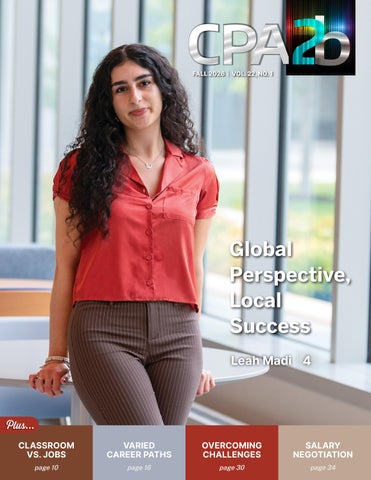
Global Perspective, Local Success Leah Madi 4
Plus... CLASSROOM VS. JOBS
VARIED CAREER PATHS
OVERCOMING CHALLENGES
page 10
page 16
page 30
SALARY NEGOTIATION
CPA2b Fall 2026 | wicpa.org page 34
1
Join the premier association for Wisconsin accounting and business professionals.
WICPA Connect:
Leadership Development:
Connect with professionals in our members-only online community and chat with other students in our exclusive student community.
Join the YP Committee, write for WICPA publications, enhance public speaking skills and more.
Networking Opportunities: Join over 7,000 professionals who represent business contacts, employers and mentors.
News & Resources:
Educational Savings:
Get tips on accounting careers, technical trends and the latest in accounting news with our awardwinning publications, e-news and online resources.
Career Center: WI CPA H ME
Put yourself in front of employers by posting your résumé.
Apply for college scholarships and save on CPA review courses and conferences.
Credibility: List WICPA membership on your résumé and LinkedIn, to demonstrate your commitment to the profession and set yourself apart from other talent.
WICPA CAN HELP YOU LEVEL UP IN ACCOUNTING! Scan this QR Code to access videos, resources and sign up for student membership.
2
CPA2b Fall 2026 | wicpa.org
Fall 2026 | Vol. 22, No. 1 A publication of the WICPA Educational Foundation, Inc. | wicpa.org
20 professional perspectives
4 Leah Madi
CONTENTS 3
membership message We’re available! While many students may have their first glimpse of the accounting profession during a course, the WICPA provides more resources to help them better understand the profession. By Lily Keller
4
member profile Global perspective, local success
Destination CPA Three young professionals share their career paths and provide insight into what it’s like to be a CPA, whether in public accounting or industry. By Mitchell Haag, CPA; Shari Knudson, CPA; and Kanika Pathela, CPA
24 career preparation: Microsoft Copilot 5 things you didn’t know you could do with Microsoft Copilot Learn about tasks you may not know you can do with Copilot and why they matter for current and future accounting and financial professionals. By Thomas G. Stephens, Jr., CPA, CITP, CGMA
28 looking back Note to self
Leah Madi takes pride in where she comes from — and where she’s going.
A seasoned professional writes a letter to her college-student self to reassure her that she’s choosing the right career.
By Brent Roberts
By Julie Duckett, CPA, CFE, CHFP
10 focus on professional knowledge College skills and real-world impact One of the most important lessons often comes after graduation: understanding that the workplace is not that different from their college experience. By Stacy A. Stinson, CPA, MBA
14 focus on CPA Exam Before you pay for your CPA Exam, read this One of the most impactful things you can do is learn what your employer or future employer is willing to pay for. By Omunazia Hicks, MBA
16 focus on career options The many paths to an accounting career
30 career preparation: overcoming challenges From CPA Exam challenges to career growth Remembering that your path is unique will help you stay focused on what works for you. By Sophia Karlovich, CPA
34 career preparation: HR insights Beyond the GPA: what hiring managers want and how to navigate your first salary negotiation While technical skills and education helped you get the interview, there are two areas that often separate candidates from the competition: how they approach compensation discussions and the intangible skills they bring to the table. By Jorie Groom, CPA
Some students think that there’s only one “correct” path to an accounting career, but there are a variety of options.
DEPARTMENT
By Abbie Daly, CPA, Ph.D.
40 Welcome new members CPA2b Fall 2026 | wicpa.org
1
2026-2027 WICPA Educational Foundation Board of Directors: President Jeff Dewane, CPA, CGMA, CMA, MBA Secretary/Treasurer Jon C. Gaines, CPA, CGMA, MBA Directors Mark Bichler Janet J. Egan, CPA Allyson Hofstede, CPA Lee Liermann, CPA Bret J. Priaulx, CPA, MBA Gina C. Skibo, CPA Victoria Thayer, CPA Angela C. Thomas, CPA WICPA Board Liaison Christopher M. Cholka, CPA, CGMA WICPA President & CEO Tammy J. Hofstede Publication Team: Editor Brent Roberts Design & Layout Brett Stallman Advertising Johnathan Dorsey Printing Special Editions Join Us Online!
ACCOUNTING SCHOLARSHIPS
Receive $3,000
in scholarship money! Apply online at wicpa.org/scholarships through March 12, 2027. Scholarships are awarded from the WICPA Educational Foundation to qualified accounting students that have completed at least 90 credits of a degree program that qualifies to sit for the CPA Exam.
CPA2b is a biannual publication of the Wisconsin Institute of Certified Public Accountants. Change of address should be sent to: Membership, W233N2080 Ridgeview Parkway, Suite 201, Waukesha, WI 53188; Phone: 262-785-0445; Fax: 262-785-0838; email: comments@wicpa.org. Statements or opinions expressed are those of the authors and not necessarily those of the WICPA. Publication of an advertisement does not constitute an endorsement of a product or service by CPA2b or the WICPA. Articles may be reproduced with permission. © Copyright 2026 CPA2b.
2
CPA2b Fall 2026 | wicpa.org
MEMBERSHIP MESSAGE
We’re Available!
W
hile many students may have their first glimpse of the accounting profession during a high school or college course, the WICPA provides more resources to help students better understand the field. By Lily Keller As the membership outreach coordinator for the WICPA, one of my favorite roles is discussing how students can best advance their accounting journeys. This article describes some of the ways I am looking forward to connecting with students and educators in the 2026–27 school year.
the CPA Exam. I enjoy connecting with students while they’re in school because the transition from college to career can be overwhelming. Many students lose some of their connections after graduation and try to seek support and resources on their own — which is where an organization like the WICPA can help.
Classroom presentations
As much information as I have about the accounting profession and the CPA Exam process, I am not actually a CPA or an accountant, and there is nothing that compares to a testimonial from an experienced professional. That is why I love to bring a CPA or other knowledgeable accounting professionals with me while presenting or visiting schools. We serve nearly 7,000 members throughout the state of Wisconsin, all with various educational backgrounds and industries, so each member provides a unique perspective. It also gives students opportunities to connect with professionals in their field and engage with the WICPA network while still in school.
As high school teachers and college professors continue to implement their lessons for the upcoming school year, I would recommend that they schedule a classroom visit with me, virtually or in person! These presentations are a great way to provide even more information about the accounting profession and possible career opportunities, how to achieve the CPA license, ways to get involved with the WICPA while in college and much more. I also love to bring in accountants to speak about their experiences. I enjoy working with educators to create a specialized presentation to help focus on the areas that will benefit their students the most.
Accounting club meetings Students who are involved in accounting groups, such as college clubs or Beta Alpha Psi, are already taking control and working hard to improve their educational experience. It is always great to work with these students and discuss how to plan their career timelines, what each of the pathways to the CPA are and sitting for
Common student questions During almost every visit to schools and events with students, I hear at least one of these questions: g What is your favorite part about being a CPA? g Is sitting for the CPA Exam as hard as it sounds? g How did you know you wanted to be an accountant?
These are just some of the ways students can gain access to professional resources, expand their knowledge of the accounting field and start building a supportive network for themselves on their accounting journeys. If you are a student leader or educator looking to brainstorm an event with the WICPA, please reach out to me at lily@wicpa.org or fill out an online form. Lily Keller is the WICPA’s membership outreach coordinator. Contact her at 262-785-0445, ext. 4511, or lily@wicpa.org.
CPA2b Fall 2026 | wicpa.org
3
Global Perspective, Local Success
Photography by Mark Hines
Leah Madi takes pride in where she comes from — and where she’s going.
4
CPA2b Fall 2026 | wicpa.org
F
or Leah Madi, life in Wisconsin has come full circle. Born in Milwaukee, she lived in Canada for about two years, then Michigan for about a year and now Mequon when she’s not on campus at By Brent Roberts Marquette University. Madi graduated with her bachelor’s in accounting and finance in May and, as a student in the accelerated degree program, is working toward receiving her master’s in accounting next May.
Accounting for a change in majors Some students enter college knowing exactly what they want to major in and never waver. For Madi, she diverged from her original path and hasn’t looked back. Madi recalled, “My summer going into freshman year, I declared to go into the Health Sciences college. I was just really interested in the healthcare profession and thought that I would want to do something in that field. I had more science classes in high school that were very intriguing, especially anatomy, physiology and biology, but I never had any accounting or finance classes because they weren’t provided at my high school. “But I learned quickly right before my freshman year started that I wasn’t really interested in any of the professional health sciences career options that were offered, so I transferred to the College of Business. Because I believe that business is used in all careers, I took the general courses that were required to graduate and took some accounting classes and really liked them.” She further noted, “I’m good with numbers, and the one thing that my freshman-year professor told us is that sometimes accounting has the wrong stereotype — that it’s all numbers, and you have to be really good with numbers. But it’s also the language of business, and in my accounting courses, I was learning a whole new language, and I was really interested in that. I also found that accounting and finance go hand in hand, which is why I double-majored.”
Internships and insights Aspiring accountants know that internships provide great knowledge and networking opportunities, but equally meaningful is the chance to use those experiences to clarify what students want — or don’t want — in their post-graduation jobs.
CPA2b Fall 2026 | wicpa.org
5
transferred to the Financial Planning and Analysis (FP&A) team, which deals more with private wealth management, and handled a lot of recurring monthly tasks. Now, she remains with FP&A on the equity capital markets side, as well as Reporting. According to Madi, “What I’ve loved about Baird so far, and I know it’s cliché to say, but the people there make it so much more fun. When you go into the office, it doesn’t feel like you’re going into work. You’re always learning new things, and they’re so welcoming to their interns and make sure we learn about many different areas of business. “I’ve also had the opportunity to dig deeper into the different teams in the Finance department and see what my preferences are and where I think I’d be a good fit. I’ve really enjoyed the work with FP&A and Reporting, which has allowed me to use both my finance and accounting skills.
Madi graduated with her bachelor’s in accounting and finance in May and, as a student in the accelerated degree program, is working toward receiving her master’s in accounting next May.
After Madi’s freshman year, she interned at Johnson Controls in accounting and finance. “It was a positive experience for a first internship. I was in the Audit department, and it was really good to meet people with more expertise; I learned a lot from them,” she said. During her sophomore and junior years, Madi worked as an on-campus intern in the Economic Engagement department in University Relations, which focused on partnerships and connecting the university with other companies and providing connection opportunities for Marquette students.
“Another thing that I love about Baird is that there aren’t any offices, and everyone is treated equally, so you could be sitting right next to the CFO, which is really important so you can do things like have coffee chats with the CFO or the director of finance. They’re all so welcoming and open to talking to an intern like me.” Based on Madi’s valuable internship experiences, she also is a strong advocate for her peers to take advantage of those opportunities. “I would say, ‘Definitely use the resources that are provided to you, and connections are a huge thing,’” she shared. “For resources, if the company allows shadowing, it would be great opportunity to know what you’re getting into for an internship or a job. For connections,
In terms of her current internship, Madi started at Baird going into her senior year. She said, “I’ve been loving it ever since.”
Madi started off with Accounts Payable, where she helped with reimbursements. From there, she 6
CPA2b Fall 2026 | wicpa.org
Photo provided by the WICPA
She began as a summer-only intern and “quickly realized that I did not want to leave, so I worked very hard to make an imprint at the company, and they offered me a year-round position. So, I’ve worked in the Finance department for over a year.”
Madi was a 2026 WICPA Educational Foundation scholarship recipient and attended the New CPA Banquet with her mother, Lucie.
I was very fortunate to be part of an amazing organization called All In Milwaukee throughout my four years of undergrad; they not only were a scholarship organization but got me connected to different companies and ultimately helped me acquire this internship at Baird.” Madi further reflected on the difference between the knowledge she obtained in the classroom and what she learned on the job. “I learned a lot in the classroom, especially the vocabulary, but it was more textbook. In my internship, it’s more application and problem-solving. There will be times when I’m working when I’ll recognize words, but it’s very different learning something versus actually applying it. “When you start working at Baird, they train you on the tasks you’re doing. What I learned in school was definitely the foundation I needed in order to get that internship, but how I’m applying those things in the internship is what’s making me grow.”
On the way to CPA As Madi looks ahead to the next several months at Baird and working toward her master’s at Marquette, taking the CPA Exam also remains one of her key goals. “One of the reasons I decided to pursue my master’s is to meet the 150-credit requirement. I know that Wisconsin now has a different option where you can do two years of experience and a bachelor’s, but I thought I might as well get another degree and at the same time start studying for the CPA Exam. I think it sets you apart from candidates who might not have it. My ultimate goal is to own an accounting firm, and I would need my CPA for that.”
Campus connections While academics and internships certainly are important parts of the college experience, so too are involvements in other on-campus activities. During Madi’s four years in undergrad, she was involved in a few clubs, including Women in Business, which provides opportunities for women in the College of Business to get together and navigate the corporate side of work. “They would bring people in for panel discussions and helping build résumés, so that was really fun,” Madi recalled. She also was part of an Arabic reading and writing club and the Minorities in Technology club, which was created by a few of her friends to bring in people of color to talk to students in the College of Business. “For me,
Although Madi is studying for her master’s at Marquette, another one of her key goals is to take the CPA Exam.
“
I think it (CPA license) sets you apart from candidates who might not have it. My ultimate goal is to own an accounting firm, and I would need my CPA for that. my culture and heritage are very important, and I carry that with me throughout my work and personal life. I loved how that club tied in both of those sides, so that was a great experience,” she said. She also was part of the Association of Latino Professionals for America in the College of Business. Outside Marquette, Madi is a member of the Lebanese Syrian American Association. She added, “It’s kind of hard being in the states and not having a big Arab population in Wisconsin, so being introduced to other people who come from the same background has been really great so far.” CPA2b Fall 2026 | wicpa.org
7
An inspiring upbringing
“Both of them are immigrants from Lebanon. They came here seeking new opportunities and were running away from religious persecution (also the economy and war) because that’s what they grew up in. Their education was interrupted at a very young age, and they had to start working to help provide for their families; they came to this country wanting to give their kids a different and better life and an opportunity at a better education.” She added, “Growing up as the oldest, I saw how much my parents struggled. They were really great role models in showing me that education takes you very far, and it opens all sorts of doors, and that really made me value my education.” Madi’s dad started his own company about 20 years ago, which she noted is her inspiration for wanting to open something of her own one day. “Just seeing his company grow and flourish and become very successful has been very inspiring to me,” she said.
CELE
Photo provided by Leah Madi
Anyone wondering about Madi’s strong focus on education or her desire to one day own a CPA firm needn’t look any further than her parents, whom she cited as her biggest mentors and inspirations.
Madi with her mother Lucie and father Abdo, after the Marquette University graduation ceremony.
She credited her mother for serving as a great role model regarding the importance of education. “At a young age, my mom went back and got her GED and then her associate’s and bachelor’s and master’s, so she’s a lifelong learner — and an inspiration to show that education can take you very far, and it’s never too late to do something you love and start over again.” Brent Roberts is the WICPA communications director. Contact him at 262-785-0445, ext. 4515, or brent@wicpa.org.
Wisconsin In Certified Pu
B R AT E
ACCOUNTING CAREERS MONTH NOVEMBER 2026
Inspire the future talent.
To help raise awareness of the accounting profession, we’re looking for volunteers to go into high schools to talk about accounting as a career.
Get involved at wicpa.org/CareersMonth 8
CPA2b Fall 2026 | wicpa.org
UPCOMING WICPA CONFERENCES YO U R S O U R C E F O R K E Y U P DAT E S & I N S I G H T S O N T I M E LY I SS U E S
IMPLEMENT
SUCCEED
LEARN
Livestream is FREE for student members! Students attending in-person pay just $30! NETWORK
SAVE THE DATE! Not-for-Profit Accounting Conference Wednesday, Sept. 16 WICPA CPE Livestream Business & Industry Fall Conference Thursday, Sept. 24 Brookfield Conference Center & WICPA CPE Livestream
Tax Conference Monday, Nov. 16 - Tuesday, Nov. 17 Brookfield Conference Center & WICPA CPE Livestream Accounting Technology Conference Thursday, Dec. 17 WICPA Office & WICPA CPE Livestream
Accounting & Auditing Conference Tuesday, Nov. 10 WICPA Office & WICPA CPE Livestream
Registration opens approximately six weeks prior to a conference. View conferences currently open for registration at wicpa.org/conferences. CPA2b Fall 2026 | wicpa.org
9
FOCUS ON PROFESSIONAL KNOWLEDGE
College Skills and Real-World Impact
T
he accounting profession is excited to welcome new, eager and talented individuals. Some of them come to us directly after earning their college degrees, while others enter the profession after serving in the military, working in another By Stacy A. Stinson, industry or pursuing a different CPA, MBA field altogether. Although we may have different paths, our new college graduates have often expressed difficulty translating their college experiences into a smooth transition to the professional workplace. One of the most important lessons often comes after graduation: understanding that the workplace is not that different from their college experience. Two of the most significant challenges for graduates are managing time without the structure of academia and measuring progress without grades. 10
CPA2b Fall 2026 | wicpa.org
“
Two of the most significant challenges for graduates are managing time without the structure of academia and measuring progress without grades. Managing your time As a student, deadlines are established months and even years in advance and usually reside in a common learning management system. You may have classes, automatic assignment reminders and friends who can keep you on track. In contrast, in a professional environment,
priorities often shift rapidly, and deadlines may be daily, monthly or annually. To stay organized, you can create a “syllabus” or project tracker to organize your priorities and deliverables. If you are entering audit, use your audit program as the structure for your weekly objectives. If you are in corporate accounting or tax, develop or use a checklist for monthly close activities or quarterly return deadlines. This will help you stay on track as you become more comfortable in your new environment. Unlike college, if you find breaks in your schedule, you cannot go back to the dorm and nap . Instead, you can use the time to find efficiencies in your work, cross-train with a colleague, ask a manager or supervisor for an additional project or study for the CPA Exam. Taking initiative will get noticed as you move through your career.
supervisor and ask for clarification. This will ensure you have the opportunity to learn and grow as your career develops, and you can demonstrate that growth during the formal review process. But what about the rest of your college experience? The skills you developed extend beyond managing time and grades, and those experiences also support your transition into the profession. Here are five areas that may have helped you grow in college and where you can find similar opportunities in the professional environment.
Getting feedback without grades Another adjustment is feedback. In college, you were measured based on assignments, exams, attendance or class participation. We have a very clear grading scale and a set timeline for giving feedback. However, workplace feedback may not be scheduled, and it may not be consistent from project to project or person to person. You will most likely be asked to “grade” yourself as part of your annual review. So, what can you do to ensure you receive helpful feedback? Be proactive and ask for it promptly and directly. You can ask specific questions such as these: • What is one thing I should continue doing? • What is one thing I could improve? • What would distinguish excellent performance from good performance? • How can I contribute more effectively to the team? Remember, the purpose of feedback is development, so if it is unclear, schedule a meeting with your
1. Athletics → workplace wellness and recreation groups If you were a student athlete, you likely benefited from camaraderie, accountability and stress relief. Those needs do not disappear after graduation. In the workplace, seek out a running club, a recreational sports league, a wellness committee or a fitness challenge. These groups provide shared experiences and can help you build a personal network with colleagues throughout your company.
2. Student organizations → employee resource groups and professional associations Students who held leadership positions in student organizations often miss the sense of purpose and community that came from involvement outside the classroom. Most companies have similar activities through employee resource groups, affinity networks, volunteer committees or external professional associations, such as the WICPA. If you are unsure where to start, check your company’s website or stop by Human Resources for information about how your company supports employees and the community. CPA2b Fall 2026 | wicpa.org
11
“
Although the goal is no longer earning a diploma, success will be measured by how well you develop professionally and create value for your clients, colleagues and organization.
3. Group projects → engagement teams Many students underestimate how well group projects prepare them for the profession. Both environments require communication, delegation, deadline management and conflict resolution. The audit engagement, tax team, consulting project or finance initiative becomes the professional version of the semester-long team assignment. The difference is that the goal of workplace teams is to serve clients and meet organizational goals rather than to earn grades.
4. Office hours → manager and mentor conversations Visiting professors and college advisors during office hours gives you a chance to build relationships with professionals outside the classroom while discussing your academic progress, professional goals and career aspirations. In the workplace, schedule regular conversations with managers. Bring questions, seek clarification and discuss challenges before they become larger issues. Mentors serve a similar purpose by helping you navigate organizational culture and identify development opportunities. While professors and advisors may be assigned in college, as a new professional, seek out opportunities to interact with experienced professionals in both formal and informal settings. If you find someone you believe would be helpful to your career development, do not hesitate to ask whether they would be willing to serve as your mentor.
5. Academic learning → professional development As a student, you had a singular focus on learning with the goal of graduation. You must keep that zest for learning and persistence when you enter the workplace. Professional development could include learning a new or advanced skill, understanding a new industry or researching a new or proposed pronouncement or tax law. It could also include taking a class on emotional intelligence, crucial conversations or cultural competency 12
CPA2b Fall 2026 | wicpa.org
before an international assignment. Selecting formal or informal learning activities that support your personal and professional development will benefit your long-term success in the profession.
Be confident in your college experience As you enter the profession, take time to reflect on what your college experience has taught you and how you can build on that foundation. While the workplace may be different from the classroom, the skills and habits required for success are much the same. As you begin your career, continue to collaborate with others, seek and embrace feedback, overcome challenges and pursue opportunities to learn and grow. Although the goal is no longer earning a diploma, success will be measured by how well you develop professionally and create value for your clients, colleagues and organization. Enjoy the journey! Stacy A. Stinson, CPA, MBA, is assistant professor of accounting at Concordia University and WICPA board of directors past chair. Contact her at 262-243-2099 or stacy.stinson@cuw.edu.
YOUR FUTURE STARTS HERE Find internships, entry-level roles and connections to launch your future Start building your career with access to opportunities and connections designed for future CPAs.
What’s New in the Career Center? • Internships and entry-level opportunities • Easy resume upload to get discovered • Connect with firms hiring emerging talent • Career tools and guidance • Smarter job search filters
Get in on the Action Take the first step. Scan to Explore Opportunities • Search jobs instantly • Apply in minutes • Connect with employers
• Find internships • Upload Your Resume • Apply for Entry-Level Roles
Start your search today: wicpa.org/CareerCenter.
CPA2b Fall 2026 | wicpa.org
13
FOCUS ON CPA EXAM
Before You Pay for Your CPA Exam,
Read This
I
f becoming a CPA is one of your goals, here’s something I wish someone had told me sooner: You don’t have to pay for everything on your own.
When people talk about the CPA Exam, they usually focus on passing it. What they forget to By Omunazia mention is everything that Hicks, MBA comes before exam day. If you’re like me, your first question will be “How much will this cost?” Between application fees, exam fees, review courses and study materials, the exam expenses add up fast. That’s why it’s important to start planning early for the associated costs instead of waiting until you are ready to sit for exams. Personally, I didn’t plan ahead for how I was going to pay for the CPA Exam, and before I knew it, my first test was around the corner. Like many other students in my shoes, I was responsible for covering my exam costs, and because I didn’t plan ahead, I panicked. One of the most impactful things you can do is learn what your employer or future employer is willing to pay for. Many accounting firms and companies offer CPA Exam reimbursement or professional development benefits, but every employer is different. Before accepting a job, take time to learn about those benefits. Read the employee handbook, ask recruiters about CPA support and don’t be afraid to bring it up during interviews. It shows you’re thinking about your future and investing in your career. During my interview with my current employer, I inquired about CPA support and discovered that my firm offers paid study and exam time, reimbursement for exam and study materials costs, as well as mileage to and from the exam. This alleviates most of the burdens that are associated with taking the exam. 14
CPA2b Fall 2026 | wicpa.org
“
One of the most impactful things you can do is learn what your employer or future employer is willing to pay for.
If you do end up paying some costs upfront, don’t get discouraged. This is common, and many students are reimbursed after passing exam sections or meeting employment requirements. The key is knowing those opportunities exist and prioritizing CPA Exam benefits during your job search. When being interviewed, be sure to ask about CPA Exam support. You can learn a lot about a company with just that one question. The next lesson I’ve learned is that you don’t have to figure everything out by yourself. There are plenty of CPA review courses and study resources available, but sometimes the best resource is another person.
“
Looking back, I realize the biggest advantage I had wasn’t knowing all the answers; it was asking the right questions early.
Professors, advisors, recent graduates and CPAs have all been where you are now. Ask questions. Find a mentor. Learning from someone else’s experience can save you both time and money.
government or another area. Then look at company size, location and the opportunities they offer. Applying is more than submitting a résumé; it’s understanding where you’re applying and why.
Internships matter more than you think
Speaking of résumés, don’t feel like your first draft has to be perfect. Use the resources around you. Visit your career center, attend résumé workshops and ask professors or classmates for feedback. Every revision makes it stronger. There was a point in time when I had a different résumé for each semester of school. Now, this may not be the case for you, but my point is that everyone’s résumé benefits from time and experience.
Landing an internship isn’t always about having the perfect résumé or attending the biggest school. A lot of it comes down to putting yourself out there and building relationships. Networking doesn’t have to be intimidating. Some of the best connections happen in classrooms, student organizations, volunteer events or conversations after a guest speaker finishes presenting. Treat every conversation as a chance to learn something new or meet someone who could help you later in your career. During college, I joined many clubs. This helped me build a network of students who were going through the same things as me and had similar questions. Now that we have all graduated and accepted jobs at different firms, my network has grown much more. As you begin applying, take time to research the companies you’re interested in. Think about whether you want to work in public accounting, private industry,
Looking back, I realize the biggest advantage I had wasn’t knowing all the answers; it was asking the right questions early. Whether you’re preparing for your first internship or thinking ahead to the CPA Exam, remember that there are people and resources ready to help. Start planning now, stay curious and don’t be afraid to ask for guidance. You might be surprised how many doors open simply because you started the conversation.
Omunazia Hicks, MBA, is a staff accountant at Wegner CPAs. Connect with her on LinkedIn or contact her at Omunazia.Hicks@wegnercpas.com.
CPA2b Fall 2026 | wicpa.org
15
FOCUS ON CAREER OPTIONS
The Many Paths to an Accounting Career
Y
ou may think there’s only one “correct” path to an accounting career. However, I have worked with many students who have taken unique paths into the profession. The stories of three such students illustrate some of these alternate paths.
Transferring schools
By Abbie Daly, CPA, Ph.D. 16
Melissa Lynn Bruhn is a current accounting major at the University of Wisconsin–Whitewater who began her college career at Bryant & Stratton College, where she earned an associate degree in business while competing on the Women’s Indoor and Beach Volleyball teams through an athletic scholarship. Although interested in accounting, she wasn’t yet sure whether she
CPA2b Fall 2026 | wicpa.org
“
Students transfer for many reasons and at different stages of their education, so don’t assume your path puts you behind. would continue toward a bachelor’s degree, so choosing business allowed her to keep her options open if accounting proved not to be the right fit. Melissa Lynn Bruhn
Bruhn explained that Bryant & Stratton’s once-a-week class schedule required more selfdirected learning. This helped her develop independent learning, time management and study skills that later prepared her to balance work and coursework after transferring. After discovering she excelled in and enjoyed accounting, she decided to pursue it as a career. After comparing transfer-credit policies at several universities, she chose UW–Whitewater because of strong recommendations from alumni she worked with, affordable tuition, a generous transfer-credit policy and its proximity to home. Although she expected transferring to be difficult, her advisors made the transition much smoother than anticipated. Bruhn’s journey illustrates the value of planning ahead while remaining open to change. If you think you’ll be transferring schools, research transfer-credit policies and meet with advisors at both institutions early to create a plan that maximizes transferable credits. Students transfer for many reasons and at different stages of their education, so don’t assume your path puts you behind.
Returning to school Alayna Kjentvet is a student completing the accounting post-baccalaureate certificate at UW–Whitewater fully online. The Alayna program, which can be completed Kjentvet online or on-campus, is designed for individuals who have already completed a bachelor’s degree in any discipline and wish to complete the coursework necessary to pursue CPA licensure in Wisconsin. After earning degrees in math and education and working in high school teaching and corporate roles, she pursued her long-term goal of becoming her own boss. After completing an online MBA at UW–Whitewater, Kjentvet decided to pursue the CPA because she felt it matched both her interests and skill set while also offering strong career
“
Kjentvet decided to pursue the CPA because she felt it matched both her interests and skill set while also offering strong career opportunities.
opportunities. Kjentvet said her online education has provided a high-quality learning experience and made it possible to return to school while working both full-time and part-time jobs. Even though her classes were asynchronous, she and I met remotely several times to discuss her career goals. Kjentvet acknowledged that returning to school has required sacrifice, describing it as a “season of life” that temporarily required setting aside some personal time in pursuit of a long-term goal. Although
CPA2b Fall 2026 | wicpa.org
17
demanding, she has found the intellectual growth worthwhile. She also discovered an unexpected passion for tax and now plans to specialize in it. She recommends taking a variety of courses, interacting with professors and embracing the experience. Kjentvet’s journey illustrates the importance of being realistic about the time you can commit to classes while balancing work, family and other responsibilities. Choosing a manageable course load can help you make steady progress without becoming overwhelmed. Reach out to your instructors, especially if you’re taking classes online. They have experience and connections that can help you achieve your goals. Advocate for yourself and take advantage of available resources. Some of my best students have been returning students who bring valuable professional experience into the classroom. Rather than worrying that you’re “behind,” recognize that your life and work experiences can become strengths as you pursue your accounting career.
Exploring career possibilities Daniel Lee, director of Fraud Operations at Robinhood, earned his bachelor’s and master’s degrees in accounting from Daniel Lee UW–Whitewater, where he began building his professional network through student organizations and a Deloitte Discovery Internship. The internship encouraged participants to explore practice areas beyond traditional audit and tax, while a forensic accounting course sparked Lee’s interest in fraud. After graduating, he joined Deloitte’s consulting practice, working in advisory, cybersecurity, litigation and fraud operations. Those experiences led him to Robinhood, where he quickly advanced from manager to senior manager and now director. He said he enjoys the fast-paced nature of fraud operations, where every day presents new challenges. Reflecting on his success, Lee explained that he doesn’t want to be the smartest person in the room; he wants to be the best communicator. He stated that communication, adaptability, persuasion and the ability to “read the room” have become even more important
18
CPA2b Fall 2026 | wicpa.org
“
He stated that communication, adaptability, persuasion and the ability to ‘read the room’ have become even more important as AI complements, rather than replaces, human judgment. as AI complements, rather than replaces, human judgment. Lee credits both his mentors and his experiences adapting to unfamiliar situations with helping him develop those skills. After immigrating to the United States at age 15 and later returning to Korea for military service before attending UW–Whitewater, he learned firsthand the value of adapting to new environments and embracing unfamiliar challenges. Lee also emphasized the value of earning his CPA license. Beyond the credibility it provides, he said the experience helped him develop the attention to detail and perseverance that gave him the confidence to pursue
additional professional certifications, including the Certified Fraud Examiner (CFE) credential. Lee’s journey illustrates the value of exploration. When you’re in school, get involved with student organizations and take a variety of courses to learn about different career paths. Seek out mentors and don’t be afraid to step outside your comfort zone. Some of the most rewarding careers are ones you may not even know exist when you begin your accounting education.
Finding your own path There is no single blueprint for success in accounting. Bruhn, Kjentvet and Lee each took a different path, yet all demonstrate that there are many paths to a successful accounting career. Together, their stories highlight the importance of taking initiative, embracing growth, exploring your options and building relationships. By doing so, you can build an accounting career that reflects your own goals, interests and strengths.
“
There is no single blueprint for success in accounting. Bruhn, Kjentvet and Lee each took a different path, yet all demonstrate that there are many paths to a successful accounting career. Abbie Daly, CPA, Ph.D., is a professor of accounting and chair of the Accounting department at the University of Wisconsin–Whitewater. Contact her at dalya@uww.edu.
Aspire. Inspire.
On campus. Online. Or even while they are still in high school, Wisconsin’s largest business school has accounting programs that meet students in the life they live, to pursue the future they want. Learn more about UW-Whitewater’s award-winning accounting department by visiting uww.edu/cobe/departments/accounting.
CPA2b Fall 2026 | wicpa.org
19
PROFESSIONAL PERSPECTIVES
DESTINATION CPA
DESTINATION CPA A regular feature profiling young professionals who provide their insights about what it’s like to work as a CPA in public accounting or industry
20
CPA2b Fall 2026 | wicpa.org
Mitchell Haag, CPA Job title: Accounting Manager Employer: Associated Bank
What influenced your decision to become a CPA? In college, my parents started a business, and I got to help in getting it set up (working with the company’s attorney, CPA and owners). This was a really cool process to see, and I decided to continue on in college with an accounting degree. How did you complete the hours necessary to take the CPA Exam? I completed my undergraduate degree in accounting, which satisfied the hours requirement. What are some dead-wrong assumptions people make about CPAs? That it is a boring profession! I think accountants get a bad rap that we live only to do taxes, audits or bookkeeping. There are so many different avenues this career can go — from those traditional accounting roles to working with the FBI, there’s so much you can do as a CPA! What’s the best part about your current job? I really enjoy research and trying to get to the bottom of complex accounting issues. I find myself really digging into US GAAP and trying to figure out the “gray” areas of guidance and their impacts for the bank. Who do you consider to be a mentor or inspiration? From my personal experience, I’d say my mom is one of my biggest inspirations! From my professional experience, Joe Paulus, CPA, was one of my greatest mentors — he taught me the ins and outs of research (as well as stock-based compensation) and really helped me progress in my career.
What was your first year like? I started my career in public accounting, so my first year consisted of preparing tax returns and working on audit engagements. I really enjoyed the mix because it exposed me to two very important areas of finance. What surprised you the most when you started your job? Just how much you see! As an accountant, you have a very unique role of being able to see how all areas of business function together and work with people from all over an organization. Not only does this allow you to learn a ton but you get to really act as an advisor to folks! What’s the best thing about being a CPA? Besides the title (which is pretty cool to have) I’d say it’s respect! People know you know business when you have the letters! What do you like most about the organization you work for? Associated is great for work/life balance, but the people are what make the job great! What do you do outside of work? Do you have any hobbies or special interests? Outside of work, I really enjoy getting outdoors and experiencing everything Wisconsin has to offer. During the summer it’s hiking, kayaking and exploring the state! What are your goals for the future? To keep learning. At the end of the day lifelong learning is an important part of the profession (especially with constant changes happening in GAAP, tax law and advancement in technology).
CPA2b Fall 2026 | wicpa.org
21
Shari Knudson, CPA Job title: Accounting Supervisor Employer: SVA Certified Public Accountants, S.C.
What influenced your decision to become a CPA? I knew accounting offered strong career opportunities and long-term stability. I also wanted a career with flexibility and room to advance, so earning my CPA gave me the freedom to pursue a wide range of career paths without limiting future advancement. How did you complete the 150 hours necessary to take the CPA Exam? I started at a technical college after receiving the Wisconsin Technical Excellence Scholarship, earned my associate degree and then transferred to Lakeland University for my bachelor’s degree. After passing the CPA Exam, I completed my remaining credits through online courses at UW–Whitewater, choosing classes that interested me. What are some dead-wrong assumptions people make about CPAs? People think accounting is all about numbers, but it’s really about people. Every business has a story, and accountants have a front-row seat. We help clients solve problems, navigate change and make decisions that shape the future of their business. What’s the best part about your current job? The best part of my job is how rewarding it is. I provide outsourced accounting and tax services for healthcare professionals such as physicians, veterinarians and dentists. Taking the accounting responsibilities off their plates allows them to focus on their passion of caring for others. Who do you consider to be a mentor or inspiration? I don’t have one specific mentor or inspiration. I’ve been fortunate to work alongside many talented professionals, each bringing unique perspectives on client relationships, problem solving and the accounting profession. Their collective influence has shaped my career and the professional I’ve become. What was your first year like? My first year out of college was in audit. I traveled frequently, met many clients and gained firsthand 22
CPA2b Fall 2026 | wicpa.org
experience with different businesses, industries and organizational cultures. It gave me a strong foundation and helped me discover what interested me most. What surprised you the most when you started your job? I was surprised by how diverse the profession is. Every business needs an accountant, which means you can work in virtually any industry. Every client has unique aspirations and challenges, and accountants play an important role in helping businesses grow, adapt and plan for the future. What’s the best thing about being a CPA? The best thing about being a CPA is that it’s much more than accounting. The profession combines business strategy, technology, problem solving and relationship building, making every day engaging. It continually challenges me to learn, grow and make a meaningful, lasting impact on the people and businesses I serve. What do you like most about the organization you work for? I appreciate SVA’s 31 Fundamentals, which guide how we work with clients and each other. Some of my favorites are Own Your Work/Life Balance, Deliver Results and Take Intelligent Risks. They create an environment that encourages curiosity, collaboration and a commitment to doing our best work for our clients. What do you do outside of work? Do you have any hobbies or special interests? Outside of work, I enjoy reading, playing indoor and sand volleyball, hiking and spending time outdoors. My husband and I love traveling, especially to warmer destinations, and our two dogs keep us active and busy year-round. What are your goals for the future? My goal is to continue evolving alongside the accounting profession by embracing AI and emerging technologies. As the industry changes, I want to continue finding new ways to create value for clients and help them navigate an increasingly complex business environment.
Kanika Pathela, CPA Job title: Senior Audit Associate Employer: Grant Thornton
What influenced your decision to become a CPA? Growing up, I was always drawn to problem -solving and working with numbers. As I learned more about accounting, I realized it combined analytical thinking with the opportunity to help organizations make informed decisions. Becoming a CPA felt like the best way to challenge myself professionally and build a career with endless opportunities for growth. How did you complete the 150 hours necessary to take the CPA Exam? Through a combination of my undergraduate and graduate coursework. While it required careful planning, I viewed it as an investment in my long-term career goals and professional development. What are some dead-wrong assumptions people make about CPAs? That CPAs spend all day preparing tax returns or working alone with spreadsheets. In reality, much of our work is collaborative. We interact with clients, work in teams, solve complex business issues and help organizations navigate challenges. What’s the best part about your current job? The variety and the opportunity to work with organizations that make a difference in our communities. I primarily work with nonprofit and insurance clients across Wisconsin, and I enjoy learning about their missions, operations and unique challenges. Who do you consider to be a mentor or inspiration? My family has been my greatest inspiration. Coming from a family of doctors, engineers and business owners, I grew up seeing the value of entrepreneurship, lifelong learning and professional excellence. Although I chose accounting instead of following a traditional path within my family, they fully supported my goals. What was your first year like? Both exciting and overwhelming. There was a steep learning curve, and I quickly realized there was so much to
learn beyond what I studied in school. Looking back, those experiences helped build my confidence and laid the foundation for my career. What surprised you the most when you started your job? How important communication is in accounting. Technical skills are essential, but being able to explain complex topics, ask the right questions and build strong relationships is just as important. What’s the best thing about being a CPA? While earning the designation was a personal achievement, I couldn’t have done it alone. My parents were always my biggest cheerleaders, and I was fortunate to have supportive friends throughout the process, including a close friend in Wisconsin who encouraged me when I needed it most. What do you like most about the organization you work for? The people make the biggest difference. I’ve been fortunate to work alongside supportive colleagues, managers and partners who have shared their knowledge and encouraged my growth. I also love that my role allows me to travel throughout Wisconsin, meet clients in person and learn about the missions and operations of nonprofit and insurance organizations. What do you do outside of work? Do you have any hobbies or special interests? Outside of work, I enjoy painting and other creative activities that allow me to unwind and express a different side of myself. I also love spending time outdoors and going for walks on sunny days — it’s one of my favorite ways to recharge, clear my mind and appreciate the beauty of Wisconsin. What are your goals for the future? I hope to continue growing into leadership roles while deepening my expertise in the nonprofit and insurance sectors. I am passionate about helping clients solve complex problems and would like to expand my experience in consulting and advisory services. I also want to maintain a well-rounded life by continuing to learn, travel, paint and enjoy the experiences that make life outside of work rewarding.
CPA2b Fall 2026 | wicpa.org
23
MICROSOFT COPILOT
UNIQUE ADVANTAGES
5 Things You Didn’t Know You Could Do With Microsoft Copilot
F
Editor’s note: Updated March 26, 2026
By Thomas G. Stephens, Jr., CPA.CITP, CGMA
or many CPAs, artificial intelligence (AI) has been somewhat abstract up to this point. They likely have heard about what AI can do but have yet to experience the productivity gains firsthand. Furthermore, they may have not explored Microsoft’s Copilot platform to determine how it differs from platforms such as ChatGPT, Google’s Gemini and others.
This article will unpack five tasks you may not know you can do with Copilot and why they matter for accounting and financial professionals. These should help you get started using Copilot more creatively, efficiently and productively.
1 Analyze data without building formulas Accounting and financial professionals often work extensively with Excel. But even seasoned professionals can spend hours cleaning data, writing formulas and building reports. Copilot can significantly reduce the time you spend analyzing data. Consider the example pictured in Figure 1. In this case, all that was necessary to generate the analysis was to enter the following prompt into Copilot: Analyze this data, looking for any unusual trends or patterns. From there, Copilot generated the results, a portion of which you see in Figure 1.
2 Create PowerPoint presentations the
easy way with Copilot
A relatively common occurrence in businesses around the world involves a team member writing a report — perhaps a lengthy one — and then being asked to convert the Word document to a PowerPoint presentation. Adding insult to injury, the presentation file often has an extremely short deadline, increasing pressure on everyone involved to ensure the task is completed on time. With Copilot, that need not be the case! If the presentation is based on a Word or PDF file, creating the PowerPoint deck can be a quick, straightforward process. To do so, follow these steps. 1. Identify the source file for the presentation, typically a Word or PDF document. 2. Either upload the source document to your OneDrive account or attach the document to your chat, as shown in Figure 2. 3. Enter a prompt such as: Create a PowerPoint slide deck from the attached document. After entering the prompt, Copilot will create a PowerPoint deck you can use as is. However, you will likely want to make some edits to the slides to ensure the content aligns with your expectations and the formatting is suitable. To do this en masse, change the design in PowerPoint. This procedure will quickly reformat all slides to the same formatting specifications.
Figure 2. Adding document to Copilot and prompting to create a PowerPoint presentation.
Figure 1. Example of using Copilot to automatically analyze data without creating formulas.
24
CPA2b Fall 2026 | wicpa.org
4
Inspect transactional data sets to identify potential instances of irregularities or fraud
Copilot’s number-crunching engine is quite adept at analyzing large volumes of data and identifying errors, irregularities and even fraud in data sets. For example, you can use Copilot to quickly and easily analyze a set of transactional data to determine whether the data aligns with the expectations in Benford’s Law.* To illustrate, consider the data extraction shown in Figure 3. The full dataset for this analysis contains approximately 2,200 rows of transactional data, and we need to review it to identify any errors, irregularities or potential fraud.
3 Prepare for meetings with Copilot Suppose you have a very important meeting with one of your best clients scheduled for this afternoon. Unfortunately, due to other issues, you have not had much time to prepare for the meeting. Relax, Copilot can help! In Copilot, you could issue a prompt similar to the following: Help me prepare for my meeting with Robbie Lopez. Please gather all emails and related documents you might find in my OneDrive account. Summarize all this information and provide me with the high points of the meeting for which I should be best prepared. When you issue the prompt above (or a similar one), Copilot will review your data and emails to identify key points from the meeting and summarize them into a concise briefing you can use to prepare. Moreover, Copilot will identify the most important issues to discuss in the meeting, ensuring you are prepared to address these issues. Here is another meeting feature to consider: If you have an upcoming meeting in Teams, you may want to consider recording it using the Teams recording feature. If you record the meeting, you can instruct Copilot to generate a meeting transcript and create a to-do list for each participant. Doing so helps ensure that all meeting participants understand which followup actions they are responsible for.
Figure 3. Data for Benford’s Law analysis
In this case, we can issue the following prompt into Copilot: Perform a first-digit, a second-digit and a first-two-digits Benford’s law test on the data in this workbook. After Copilot completes its analyses, we can ask it to summarize the key findings and anomalies. Following is an excerpt from that analysis: First-digit test • Expected: Benford’s Law predicts that lower digits (especially 1) should appear most frequently as the leading digit, with frequency decreasing for higher digits. • Observed: Your data’s first-digit distribution closely follows this pattern, with digit 1 being the most common and frequencies generally decreasing for digits 2–9. • Key finding: The dataset shows strong conformity to Benford’s Law for the first digit, suggesting the data is naturally distributed and not artificially manipulated. • Anomalies: No significant deviations detected.
CPA2b Fall 2026 | wicpa.org
25
5
Identifying audit risks with Copilot
One final example of using Copilot in a way many accountants may not realize is to use the platform to help identify audit risks. Suppose that a CPA firm has recently landed a new client in the restaurant business. The client owns and manages 10 fine-dining restaurants in the area, and the firm has little institutional knowledge of risk in fine-dining establishments. Further, the client wants the firm to audit the restaurants’ financial statements. To plan an audit program that appropriately addresses risks, the firm can use Copilot to identify them. For example, the audit manager might turn to Copilot and issue a prompt such as the following: I’m an audit manager for a public accounting firm. We have a new client who runs fine-dining establishments. What are some of the key risks for which we should account when planning our audit? Copilot’s response to the prompt included specific references to 10 categories of risk, including risks in each of the following areas: 1. Revenue recognition issues 2. Cash handling and fraud risks 3. Inventory valuation and existence 4. Cost of sales and margin risk 5. Payroll, tips and labor compliance 6. Gift cards and deferred revenues 7. Lease accounting and right-of-use assets
“
If you have access to Copilot, don’t be afraid to experiment to find the unique advantages this platform offers.
8. Fixed assets and capitalization policies 9. Going concern and liquidity risk 10. Information technology and point-of-sale system risks With this information available to the manager, along with other information Copilot can provide, the audit team will be better prepared to conduct thorough, complete audits of each restaurant.
Exploring the AI landscape No doubt, AI tools such as Copilot are here to stay and offer great promise to elevate efficiency and productivity. However, Copilot in particular seems to be gaining traction across many circles because of
its deep Microsoft 365 integration, feature set and adaptability to a wide range of use cases. If you have access to Copilot, don’t be afraid to experiment to find the unique advantages this platform offers. *Learn more about Benford’s Law and how you can use it to identify errors, irregularities and potential instances of fraud or simply ask Copilot to tell you about Benford’s Law.
Tommy Stephens is a shareholder in K2 Enterprises. At K2, Tommy focuses on creating and delivering content and is responsible for many firm management and marketing functions. You may reach him at tommy@k2e.com, and you may learn more about K2 Enterprises. This article originally appeared in Footnote, a publication of the Minnesota Society of CPAs.
26
CPA2b Fall 2026 | wicpa.org
7,000+ members. One place to
Your network is bigger than you think. You’re already a member, now get connected. Grow Your Network
Share Resources
Connect with 7,000+ members
Industry collaboration made easy by
throughout Wisconsin
sharing tools, guides and insights
Ask Questions
Customize Your Experience
Looking for advice? Get answers from real peers
Personalize your profile, control your visibility and set your notification preferences
As a WICPA member, you already have a profile on CONNECT. Log in. Join the conversation: wicpa.org/connect
CPA2b Fall 2026 | wicpa.org
27
LOOKING BACK
NOTE TO SELF
Note to Self Note to Self is a column in which CPA professionals write notes to their college-student selves to give them a glimpse into their future. In this issue, Julie Duckett, CPA, CFE, CHFP, CFO of BayCare Clinic in Green Bay, pens a letter to her younger self. Julie graduated from St. Norbert College with a bachelor’s degree in accounting in 1994.
Dear College Student Julie, Congratulations on your academic achievements and dedication! You are about to embark on a wild adventure — yes, wild. (Stay with me.) It’s an adventure where you get to help tell the story of the organizations you work for through financial statements, budgets and a deep commitment to integrity and accuracy. I know — doesn’t exactly scream “thrill ride,” but trust me, it is. As you begin, keep these notes to self in mind:
28
CPA2b Fall 2026 | wicpa.org
• Be yourself. Sounds simple, right? Not really. You’ll work hard to impress leadership, fit in and build your network — and somewhere along the way, it can feel easier to blend in than stand out. Don’t. Stay true to your values. Turns out, being yourself is not only less exhausting, it’s also your greatest competitive advantage. • Figure out what motivates you. At some point (probably when caffeine alone stops working),
you’ll realize you need something deeper driving you. You’ll discover that supporting and advocating for mental health lights a fire in you. Lean into that. Mental health is core to overall well-being — even for high-performing accountants who pretend they’re fine during busy season. • Get comfortable being uncomfortable. Not every day — but most days. Growth lives just outside your comfort zone. Ask questions, even when you’re worried they sound basic (they’re not). Explore what sparks your curiosity. Do the things that make you slightly nervous — like speaking on a panel or sharing your story. Future you will look back and say, “Well, that was terrifying — and totally worth it.” • Remember: Accounting is a people profession. Yes, really. It may feel safer to stay at your desk perfecting journal entries (and you will love a good reconciliation), but your greatest impact comes from connecting with people. Learn what excites your co-workers and leaders. Get curious about the mission of your organization. Build your career around purpose — not just spreadsheets. The spreadsheets get better when the purpose is clear.
everyone. Appreciate the small moments. And remember — you won’t always be the leader in the room, and that’s a good thing. There’s just as much growth in following as there is in leading. So, go ahead — start dreaming about your wild adventure. Find what motivates you, stay curious and keep pushing forward. Also, one last thing: Save your files often. Trust me on this. You’ve got this. Sincerely,
Julie
• Embrace technology. You’ll think Excel is peak excitement — and it is pretty great — but just wait. Technology (hello, artificial intelligence) will change how you work in ways you can’t fully imagine yet. Don’t resist it. Learn it, use it and let it handle the repetitive stuff so you can focus on thinking, leading and storytelling. • Enjoy the ride. The best part of your career won’t be a perfectly balanced spreadsheet (although, let’s be honest, that does feel amazing). It will be the people. You’ll work with incredible teammates and leaders who will shape how you think, lead and live. Learn from
CPA2b Fall 2026 | wicpa.org
29
CAREER PREPARATION
30
CPA2b Fall 2026 | wicpa.org
OVERCOMING CHALLENGES
From CPA Exam Challenges to Career Growth
I
want to start by saying congratulations! Wherever you are in the CPA Exam process —whether you are thinking about taking the exams, just received your first prep textbook, sat for your first exam yesterday, finished your By Sophia last one or are somewhere in Karlovich, CPA between — it is worth taking time to acknowledge your progress. I hope you have someone cheering you on, just as I was blessed with plenty of support during my experience. If not, I will happily be your cheerleader. You’ve got this!
My advice Along with cheering you on, I can share advice from my own experience and from supporting friends through theirs that I hope you find useful. My biggest piece of advice is to do your best to not compare your path with the person next to you. There will always be someone getting better scores, moving faster or using a different study method. We are all different, and that means our CPA Exam experiences will look different, too. Comparison is not only the thief of joy, but it can also cause you to be discouraged. Remembering that your path is unique will help you stay focused on what works for you. My second piece of advice is to build your study strategy around how you learn best. You can ask ChatGPT how to study for the CPA Exam, and it would likely give you several strategies, but the best one is the strategy tailored to you. Some people learn best by reading, some by practicing questions, others by listening and still others by writing. At this point, you have made it through years of school and, hopefully, know what helps you study for an exam. I used several approaches, but the one that helped me most was taking notes on questions I got wrong, specifically what the correct answer was and why it was right. That may not work for everyone, so choose the approach that will prepare you best for exam day.
“
Comparison is not only the thief of joy, but it can also cause you to be discouraged. Remembering that your path is unique will help you stay focused on what works for you. My third piece of advice is to celebrate the wins. Ordering your first prep textbook, getting through your first week of studying, scheduling an exam and receiving a passing score are all milestones that deserve recognition. The celebration can be as small as telling yourself, “Good job,” as simple as treating yourself to ice cream or as big as booking a vacation once you finish. Taking time to celebrate during the struggle can be what helps propel you forward. I would also be remiss if I did not include one last piece of advice: Prioritize passing as many exams as possible CPA2b Fall 2026 | wicpa.org
31
before starting full-time work. While this was particularly helpful for me going into public accounting with busy season ahead, I believe it applies to any field within accounting. Very few people want to wake up early, study after a full workday or use valuable PTO for exam prep. Additionally, while you are in school, you are already in study mode, which can make the process easier. Finishing my CPA exams before I started work was a game changer because I could focus on my job without also worrying about studying.
Perseverance through the hurdles While this advice can be helpful, becoming an “aspiring CPA” (as so many people say in their LinkedIn profile headlines) requires a lot of perseverance. For some of you, there will be days when you cannot bear to look at your textbook, answer another multiple-choice question or listen to one more Peter Olinto lecture, even though he is pretty entertaining. For others, it may be the day you get a 74 on FAR and wonder if you can bring yourself to open the textbook again. Still others may walk into the testing center with little confidence that they will earn a passing score, or they may feel the pressure of an exam score nearing expiration. Everyone faces different hurdles, whether they look like the examples I mentioned or something entirely different. However, the obstacles you overcome make the final passing score and walking across the stage at the WICPA New CPA Banquet as a licensed CPA even more meaningful.
Impact on your early career You may be wondering whether earning your CPA license will help you in the early stages of your career. For me, the answer is yes. Being hardworking, quick to pivot, willing to learn from mistakes and able to push through adversity helped me tremendously as I transitioned from college student to professional. Last year, I was responsible for auditing a complex business process I had little prior experience with. The task felt daunting, and at times I was overwhelmed and unsure of what to do next. There were moments when I had to take a deep breath and quiet the doubts in my head. Other times, I took a short break, cleared my mind, put in my AirPods and kept going. I learned from my mistakes and from my team each day. With their help, I completed the audit, but there were many moments when I was unsure of myself and still chose not to give up. I had to show up every day with motivation and perseverance, just as I had throughout the CPA Exam process.
32
CPA2b Fall 2026 | wicpa.org
“
I am grateful I pursued my license because I know it will create more opportunities in the future and has already helped prepare me for the start of my career. Closing remarks In this article, I used words like “pressure,” “hurdle” and “obstacle,” but I also used words like “career” and “celebration.” That feels fitting because the CPA Exam process includes both. I am grateful I pursued my license because I know it will create more opportunities in the future and has already helped prepare me for the start of my career. I know it can feel intimidating at times no matter where you are in the process, but the most rewarding things often require the greatest effort. In my experience, it was worth it, and I hope you find the same to be true.
Sophia Karlovich, CPA, is a senior associate at KPMG LLP, Milwaukee. She has three years of experience in auditing private companies within the insurance, higher education, consumer goods and healthcare industries. Contact her at skarlovich@kpmg.com or 414-451-8189.
Accounting Resources
Get the tools, ideas and resources you need to enhance the classroom experience to help students learn more about the exciting career opportunities in accounting.
1.
CPA2b Magazine For Students & Educators
6.
Educator Membership
2.
Explore Accounting Videos
7.
High School Educator Accounting Symposium
3.
Accounting FAQs & Worksheets
8.
High School Educator Grants
4.
Level Up Guide & Career Planning Brochure
9.
Free High School & College Student Membership
5.
Request a Guest Speaker
10.
College Directory
ACCESS RESOURCES AND LEARN MORE AT WICPA.ORG/EDUCATORS CPA2b Fall 2026 | wicpa.org
33
CAREER PREPARATION
HR INSIGHTS
Beyond the GPA: What Hiring Managers Want and How to Navigate Your First Salary Negotiation
34
CPA2b Fall 2026 | wicpa.org
L
anding your first professional job is exciting. After years of classes, exams, internships and part-time work, you’re finally stepping into your career. While technical skills and education helped you get the interview, there are two areas By Jorie Groom, that often separate candidates CPA from the competition: how they approach compensation discussions and the intangible skills they bring to the table.
Salary negotiation: Be strategic, not demanding For many new graduates, salary negotiations can feel uncomfortable. Some candidates worry they’ll lose the opportunity if they ask for more, while others feel they should negotiate simply because they’ve been told they should. The strongest negotiations are based on logic, not emotion. Hiring managers are generally more receptive when candidates can explain why they’re asking for additional compensation. As a new graduate, you may not have years of experience or a current salary to use as a benchmark, but you can still have a thoughtful conversation: • “I recently completed an internship where I earned $X per hour, and based on my research and experience, I was hoping to be closer to $Y.” • “I’m fortunate to be considering another opportunity in a similar salary range and wanted to discuss whether there is flexibility in the compensation package.” • “After reviewing the benefits and overall package, I was hoping to be closer to $X based on comparable entry-level opportunities.” The key is having a reason behind the request rather than simply asking for more money. A good rule of thumb: Confidence is attractive; arrogance is not. If you decide to negotiate, make your best request once and be prepared to accept if the employer meets it. Most importantly, remember that your first job is often as much about building skills, relationships and experience as it is about maximizing salary.
“
Most importantly, remember that your first job is often as much about building skills, relationships and experience as it is about maximizing salary.
Look beyond the salary One of the biggest mistakes new graduates make is focusing exclusively on base salary. Compensation matters because of the world we live in, but it is only one part of the package. I’d urge new grads to consider questions such as these: • What opportunities exist for growth and promotion? • Is there a strong mentor or manager who will help develop your career? • What is the team culture like? • How much flexibility does the role offer? • How much vacation time is offered? • Perhaps most importantly, will you gain experience that increases your marketability in the future? The highest-paying opportunity today may not necessarily be the best long-term career move.
CPA2b Fall 2026 | wicpa.org
35
“
One of the most underrated qualities employers look for is curiosity.
What hiring managers are really looking for Many graduates assume employers are primarily evaluating their GPA or technical knowledge. While those things matter, most hiring managers are equally focused on how you’ll fit within the team. Simply put, people want to work with people they enjoy working with. They are looking for candidates who: • Communicate clearly and professionally. • Ask thoughtful questions. • Stay engaged and present during conversations. • Show curiosity and a willingness to learn. • Demonstrate a team-first mentality. No one wants to hire the smartest person in the room if that person is difficult to work with. During interviews, don’t just say you’re a strong communicator or a team player; share examples. Whether the story comes from a group project, internship, part-time job, volunteer activity or previous work experience, hiring managers want evidence that you’ve demonstrated these skills in real situations.
Curiosity is a career accelerator One of the most underrated qualities employers look for is curiosity. The best candidates are rarely the ones who know everything. Instead, they’re the people who ask questions, seek feedback and make a genuine effort to 36
CPA2b Fall 2026 | wicpa.org
learn. Curiosity shows initiative and demonstrates that you’re engaged and interested in understanding the “why” behind the work, not just completing a task. This doesn’t stop after you’re hired. The professionals who advance the fastest are often the ones who continuously learn, ask thoughtful questions and look for opportunities to grow beyond their job description.
Technical skills get interviews; interpersonal skills get offers Many new accounting graduates will have similar technical qualifications through their coursework. What often differentiates candidates is their ability to build relationships, communicate effectively and contribute positively to a team environment.
Don’t underestimate the value of any work experience you may have, even if it’s unrelated to accounting or finance. Whether you worked as a server, retail associate, camp counselor or intern, those experiences often provide some of the best examples of teamwork, communication, problem-solving and professionalism. Maybe you worked with co-workers to manage a busy shift, resolved a difficult customer situation, trained a new employee or balanced multiple priorities under tight deadlines. Those are all real-world examples that demonstrate skills employers value. As automation and artificial intelligence continue to change the workplace, employers are increasingly valuing analytical thinking, problem-solving ability, adaptability and the capacity to think beyond processdriven tasks. In many cases, those qualities matter more than whether your GPA was 3.6 or 3.8.
Three common interview mistakes new graduates make 1. Not researching the company Hiring managers don’t expect you to know everything about their organization, but they do expect you to have done some homework. Understanding the company’s products, services, culture and recent news demonstrates initiative and genuine interest. 2. Showing up without questions At the end of almost every interview, you’ll be asked if you have any questions. Don’t waste the opportunity by saying “No, I think you covered everything.” You can always ask more about team culture, training opportunities, career progression, leadership style or what success looks like in the role during the first year. 3. Focusing only on compensation Salary is important, but early in your career, the right mentor, training, culture and growth opportunities can have a significantly greater impact later on rather than an extra few thousand dollars in those first couple of years.
My final thoughts Your first job won’t define your entire career, and no one said your first job has to be your last. What matters most is building the habits, relationships and reputation that will follow you throughout your career. As you evaluate opportunities, remember that salary is only one piece of the equation. The right mentor, a strong team, meaningful learning opportunities and a culture
“
The candidates who experience the most long-term success are rarely the ones focused solely on the next promotion, title or paycheck. that supports your growth can have a lasting impact long after you’ve forgotten what your starting salary was. Your reputation starts earlier than you think. Networking events, internships, professors, classmates, part-time jobs and even the people you interview with today may become future colleagues, managers, clients or referral sources tomorrow. The candidates who experience the most long-term success are rarely the ones focused solely on the next promotion, title or paycheck. More often, they’re the ones who stay curious, continue learning, build strong relationships and consistently make the people around them better. Jorie Groom, CPA, began her career in public accounting before pivoting into the fitness and retail industries. She now serves as a manager with Truity Partners, specializing in accounting and finance recruitment and connecting talent with organizations across Wisconsin. Connect with her on LinkedIn or contact her at Jorie.Groom@TruityPartners.com
CPA2b Fall 2026 | wicpa.org
37
FOCUS ON SCHOLARSHIPS
Congratulations to all of the scholarship recipients! The five present at the New CPA Banquet (from left): Katie Kysely, Brittany Larson, Shaylin Stemper, Leah Madi and Sonia Stafeil.
Paving the Way to CPA
F
or future accountants planning to take the CPA Exam, that path presents many opportunities, and earning a scholarship could help make the journey easier.
Through member donations By Brent Roberts and memorial funds, the WICPA Educational Foundation supports a college scholarship program that awards several $3,000 college scholarships. Scholarships are awarded based on academic achievement, volunteering activities, a personal statement and letters of
38
CPA2b Fall 2026 | wicpa.org
recommendation. The foundation plays a pivotal role in supporting programs that improve awareness and perceptions by educating Wisconsin students and educators about exciting opportunities available in the accounting profession. The foundation awarded 15 scholarships to the following recipients at the 2026 New CPA Banquet on June 12: Roger Buchholz Memorial Scholarships Anna Lakomiak, Benedictine University Brittany Larson, Western Governors University Sonia Stafeil, University of Wisconsin–Madison Shaylin Stemper, University of Wisconsin–Stevens Point
Von Haden Memorial Scholarship
• Be a resident of Wisconsin and a U.S. citizen
Tanika Davis, University of Wisconsin–Milwaukee Elizabeth Peters Memorial Scholarship Hannah Bott, University of Wisconsin–Oshkosh Leroy C. Schmidt 150-Hour Scholarships Brianna Boegel, Concordia University–Wisconsin Ashton Guderyon, University of Wisconsin–Green Bay Zoe Kershek, University of Wisconsin–Oshkosh Katie Kysely, University of Wisconsin–Madison Gabriela Larson, University of Wisconsin–Whitewater Leah Madi, Marquette University Everett Saeger, St. Norbert College Patrick Totzke, Creighton University Michael Westbrook, University of Wisconsin–Whitewater
Eligibility requirements Interested applicants must have the following qualifications:
• Have full-time student status with a cumulative GPA of 3.0 or higher at a college or university that has an accounting program that qualifies to sit for the CPA Exam • Have completed the first financial accounting course within the accounting major (beyond the courses required for all business majors) with an A or B grade • Have completed at least 90 credit hours of a degree program that qualifies to sit for the CPA Exam Applications for the 2027–2028 academic year are open and must be submitted by Friday, March 12, 2027. Learn more about each of the scholarships at wicpa.org/students/scholarships. Brent Roberts is the WICPA’s communications director. Contact him at 262-785-0445, ext. 4515, or brent@wicpa.org.
ACCOUNTING SCHOLARSHIPS
Receive $3,000 in scholarship money!
Apply online at wicpa.org/scholarships through March 12, 2027. Scholarships are awarded from the WICPA Educational Foundation to qualified accounting students that have completed at least 90 credits of a degree program that qualifies to sit for the CPA Exam.
CPA2b Fall 2026 | wicpa.org
39
WELCOME NEW STUDENT MEMBERS Nicholas J. Alburg Menomonee Falls High School
Carson W. Fox Menomonee Falls High School
Malik J. Andrews Wausau West High School Paul Augustian Janis Barnett Connor J. Beckard Carrie D. Boettcher UW–Green Bay
Leah Madi Marquette University
Evan Schroeder UW–Whitewater
Nicholas Gabriel
Bryce D. Mischler Kimberly High School
Matthew Stangl Johnson Block & Co., Inc.
Benjamin J. Grant Big Foot High School
Hayden I. Mitchell Kimberly High School
Matan Steigmann Nicolet High School
Ashton Guderyon UW–Green Bay
Ethan J. Mueller Menomonee Falls High School
Cooper Stengel
Daniel P. Hanlon Vrakas CPAs + Advisors
Matthew B. Nemec Menomonee Falls High School
Hannah Bott UW–Oshkosh
Elizabeth G. Herrmann Menomonee Falls High School
Hayden L. Bradley UW–Whitewater
John A. Holmes
Brian Nguyen
Jett D. Horton Cambridge High School
Hilton Oswald Menomonee Falls High School
Wishely L. Chen Cambridge High School Traiden B. Clary Lauren H. Corazzari Menomonee Falls High School Olivia Crabtree UW–Stevens Point Lucas W. Csida Kimberly High School Emma A. Cunningham Southwest High School Dominic N. Dambruch II Mason E. Dettmers Menomonee Falls High School Bailey Devore Manitowoc Lincoln High School McCain J. Duckett BayCare Health Systems Mason A. Everts
Parker T. Janssen Kimberly High School Nainil M. Jariwala Zoe Kershek UW–Oshkosh Karter A. Kindschy Blair Taylor High School Kai D. Knoot Cambridge High School
Elizabeth Neubauer
Braden J. Overholser Menomonee Falls High School Krishi K. Patel Kimberly High School Robert R. Paul Jr. Delavan-Darien High School
Sarah H. Kohler
Adysen L. Pennings Menomonee Falls High School
Cade S. Kosnick Menomonee Falls High School
Michael Rank Sales Tax Advisory Network LLC
Isaiah M. Laitinen
Benedict Roxas
Anna Lakomiak
Everett Saeger St. Norbert College
Allison K. Leder Beaver Dam High School Nicholas A. Lopez Leon Menomonee Falls High School
Joseph X. Swietlik UW–Milwaukee Alexander S. Tornio Fatou Touray ATI Forged Products Cooper Tsoris Caden R. Van Buren Middleton High School Logan Q. Vande Zande Menomonee Falls High School Ethan T. Vanden Boom Menomonee Falls High School Niran C. Vang UW–Oshkosh Tieler C. Vang Menomonee Falls High School Isabella Vardon UW–Stevens Point Hayden Waala Kalise Williams Hamilton High School Sophia L. Winget
Garrett D. Saunders Beaver Dam High School
Chloe L. Wisniewski Delavan-Darien High School
Jack Schowalter Port Washington High School
Kiefer J. Wolf Delavan-Darien High School Heavenly A. Woods
40
CPA2b Fall 2026 | wicpa.org
THIS IS NOT SVA
THIS IS SVA (DISCLAIMER: ACTUAL RESULTS MAY VARY)
SCAN ME TO FIND OUT WHAT MAKES SVA DIFFERENT
Ditch the Boredom, Embrace the Extraordinary Join our not-so-typical CPA firm, and together, we’ll reshape the landscape of accounting and redefine what it means to be a CPA. Your journey towards extraordinary starts here.
Together We Serve People Better Measurable Results. | SVAaccountants.com ®
CPA2b Fall 2026 | wicpa.org
41
PRSRT STD U.S. POSTAGE
PAID
Milwaukee, WI Permit No. 5845
W233N2080 Ridgeview Parkway, Suite 201 Waukesha, WI 53188
2027 WICPA
A
W
A
R
D
S
NOMINATE AN EDUCATOR OR STUDENT FOR AN EXCELLENCE AWARD! Show your support for an accounting educator or accounting student by submitting a nomination at wicpa.org/awards by Nov. 20, 2026. Recipients will be announced in January and honored at the Member Recognition Banquet & Annual Business Meeting on May 7, 2027. The individual nominated must be a WICPA member.