VOL. 2, NO. 2
MAR 2016
BLACK WOMEN MAKING HISTORY
Web : http://washingtoninformer.com/news/wi-bridge/
Facebook : www.facebook.com/wibridgecommunity
Email : wibridge@washingtoninformer.com
Twitter : @InformerBridge www.twitter.com/informerbridge Instagram : WashInformerBridge www.instagram.com/washinformerbridge
CONTENTS
EDITOR’S LETTER
PUBLISHER
Dynamic Business Duo Exhibits Sisterhood 3
Peace and blessings WI Bridge readers,
Denise Rolark Barnes
As another (Black) Women’s History Month comes to a close, may we continue to remember the past sacrifices of our Black heroines and honor the work that African women across the Diaspora continue to carry out in their communities.
EDITOR-IN-CHIEF
Black Women Still Face Challenges in the 21st Century 4-5 A Tribute to Nina Simone 6 Sa-Roc Receives a Hometown Hero’s Welcome 7
Despite our many victories in dismantling the patriarchal forces that impede Black women’s progress and stability, we as a community, particularly the men, still have a ways to go in ensuring that our sisters are protected just as the late, great Malcolm X called on us to do many decades ago. In this issue of WI Bridge, we strive to heed those wise words by featuring sisters locally, nationally, and internationally who have something of substance to say. We give honor to D.C.-born conscious hip-hop artist Sa-Roc and storied singer/ songwriter/activist Nina Simone in two riveting pieces. We also feature a dynamic duo of entrepreneurs who took their friendship to the next level when they opened a salon in Northeast. In this edition, you will also find a global overview of black female political involvement.
ON THE COVER
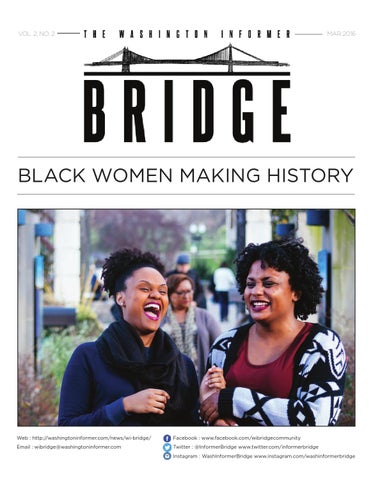
(L-R) Carmen Walters and Shanai Browne, longtime friends from Bowie, Maryland and college students, enjoy a good laugh. Walters studies biology at Bowie State University and Browne, a biochemistry major, attends the University of Maryland College Park./ Photo by Dejah Greene
In the year 2016, Black women count among one of the most educated groups in our society, dominating almost every industry under the sun. In carrying out our responsibility to celebrate those triumphs, we must also give an accurate assessment of the hurdles that the contemporary Black woman faces professionally and in other facets of their life. This edition of WI Bridge does just that and a lot more. We look forward to you reading this issue and joining us in April for our big celebration at a location to be determined very soon. Many thanks for your support for a movement that has no end in sight. Yours in the Struggle, Sam P.K. Collins Editor-in-Chief WI Bridge
Dejah Greene
LAYOUT Kelcey Abney
Adolf Alzuphar Brianna Rhodes Sam P.K. Collins Sifiso Ngobeni
The WI Bridge sets out to highlight contemporary issues through the experiences of youth and capture the progressive, entrepreneurial spirit of the Millennial generation other publications gloss over. Writers will take to streets and feature people, programs, initiatives, and movements that uniquely address prominent youth issues. This hard-hitting coverage will lay to rest misconceptions of Generation Y and bring all to an understanding of diverse youth experiences.
Chance to win 200K for your business. www.mltapthefuture.com.
VOL 2, NO. 2
PHOTOGRAPHER
CONTRIBUTERS
MISSION STATEMENT
2| WI BRIDGE
Sam P.K. Collins
DYNAMIC BUSINESS DUO EXHIBITS BLACK SISTERHOOD By Brianna Rhodes WI Bridge Contributing Writer @Bri_Rhodes24 D.C. is a city known for its many thriving businesses. While it’s often thought that successful black women can’t work together in professional spaces, two friends have beaten the odds and built a beauty empire in the process. After working together at a day spa and maintaining a close friendship for more than 13 years, hair stylists and native Washingtonians Markina Bailey and Camille London launched London Bailey Studio. Since 2011, they, along with a team of five stylists, have provided a host of services -- including hair extensions, colors, and cuts – from the confines of their Northeast storefront. “We worked for someone and you know the way things were run weren’t really ideal for stylists,” London, 31, said. “We both had ideas that one day we’d open up a place where this would be a good idea to do that and not this.” After working at the now shuttered Soul Day Spa for a couple of years, the pair opened a spa of their own with their own money, deciding they wouldn’t take out loans or tap into other funding streams. Obstacles along the way included securing a license and keeping the business up to code with the D.C. Department of Health. But London emphasized that success meant going through trial and error and conducting lots of research. She and Bailey also reached out to London’s aunt, an owner of a group home for girls, for advice and help in developing a business plan. “I was in my early twenties when I first decided to jump out there,” London said. “I suggest to anyone to do some extensive research on the requirements of maintaining a business, salon, whatever you might want to open and have a mentor; someone you know that’s been there, that’s done that. That’ll be a great help.” Both women said they knew from a very young age that they wanted to have their own business. Now they’re living out their dreams. For Bailey, who lived two blocks away from the salon’s current location, it’s an especially monumental feat. “Well I’ve always known that I wanted to help make women beautiful and be
Business partners and longtime friends Camille London and Markina Bailey opened London Bailey Studio in Northeast nearly five years ago. / Courtesy photo
my own boss and entrepreneur,” said Bailey. “I come from a family of barbers, so it was just in me to just always want to, be my own boss and make my own hours, and help people look nice in the community, because my salon is located in a residential area.” London said she was inspired by hair entrepreneur, Madam C.J. Walker to own her own salon. “As a child when we learned about Black History Month or we would do some type of report for someone, I became interested in Madame C.J. Walker,” said London. “I thought it was so amazing for a black woman then to become a successful business woman in the beauty industry. So just doing research on her as a child really instilled in me that, ‘okay you can have fun with your work and you know still become successful and be happy at the same time.’” Both owners said they believe their friendly and personable manner makes them stand out among the salons in the city. Their venue has also become the
place for other women to offer their services to the community. “We’re not getting mega rich off of this. A lot of our clients have been coming to us for over 20 years,” Bailey said. “I’ve been doing hair for 24 years. Our customers are able to boost up their businesses. One lady may sell Avon. Or we have another young lady who sells perfumes and candles. It’s just everybody helping each other. That’s a good thing too. Anything that’s going to help you, you know as far as your business we don’t mind at all.” Sukera Cooper, 28, one of Bailey’s longtime customers, said she has always been satisfied with her services.
offerings have gone beyond salon services, expanding to hair care products. Both owners urge individuals, especially black women to not give up on their dreams, highlighting the importance of Women’s History Month in reminding them about those who came before them and persevered. “Oh well you know Women’s History Month is very important to me,” London said. It shows you that anything is possible you have to just you know, put in hard work and dedication and have the passion for whatever you do. But it’s very important just to always look back at our history and it helps you move forward.”
“Kina never fails to make my hair look wonderful, ever. It has been 11 years I have been going to her,” said Cooper. “Every single time I wanted to do something different with my hair, she has been on point. There was even an occasion when she was out of town and her business partner did my hair and I was still satisfied.” In recent years, London and Bailey’s VOL 2, NO. 2 WI BRIDGE | 3
BLACK WOMEN STILL FACE CHALLENGES By Sifiso Ngobeni
WI Bridge Contributing Writer @The Real_Sifiso March 8th, marked as International Women’s Day, has been a time to celebrate the economic, political and social contributions of women globally. In general, the entire month of March allows an opportunity to highlight the role that women of the African diaspora have played in shaping various societies and helping to usher a new breed of politicians who can abolish patriarchy and make African countries more egalitarian.
more than half of respondents against women in leadership positions. Many African countries have struggled to find political stability due to the prevalence of their colonial past that contributes to the economic challenges faced today. An often argued idea is that the inclusion of women in politics would help make democracy a reality. Such was the thought when Liberian President Ellen Johnson Sirleaf became the first head of state in Africa in 2006. In recognition of her work to further women’s rights, she received a joint
uses her talents to engage young people not only through her blog but other social media networks, on issues of race, ethnicity, identity and self-preservation. She said that women still suffer micro aggressions fueled by respectability politics that shame those of various experiences, identities, sexualities and disabilities. “Women’s Day means nothing to me with all the structural exclusion and dispossession that cisgender women, transgender and gender-fluid folk still battle with. It’s a painful reminder of how suffocating this world is for anyone
are not a monolith and our experiences are not altogether the same,” Mashiane added. “We can link our struggles and acknowledge the intersections of various systems of power but trying to find a universal narrative for all those struggles is tricky.” This has especially been the case in the United States. Throughout the history of women’s liberation movements, non-whites have faced even harsher discrimination based not only on their gender, but also their race. In 1913, African-American journalist
This realization challenges the predominant classification of women as mere objects only concerned with fashion and totally incapable of authoritative decision making. Even with significant changes, cultural and traditional practices have contributed immensely to the lack of representation of women in politics worldwide, even in the western world. For many, running for positions of power has resulted in harassment, violent and intimidation, an example being Italy’s first black cabinet minister, Cecile Kyenge, at whom hecklers hurled bananas and maligned with racial slurs nearly three years ago. “I do not believe the problem lies with me. There are some people who are not happy, who are showing their discontent, and it is my job to listen to that discontent,” Kyenge told BBC reporters shortly after the widely publicized incident in April 2013. Pan-African research group Afrobarometer recently conducted research on African woman political participation in 34 countries, measuring public perception of socioeconomic and political issues. Findings showed that Swaziland, Nigeria, and Benin had some of the continent’s lowest proportion of women in government (6.2, 6.7, and 8.4 percent respectively) compared to Rwanda and South Africa, each of which had more than 50 percent. Not all countries share this progressive outlook on the inclusion and representation of women in leadership roles. In Northern Africa, only half of the people living in that region agree that men and women should have equal opportunity to take positions of leadership. Sudan and Egypt have been reported to have 4 | WI BRIDGE VOL 2, NO. 2
A young student holds up a sign during a protest. / Photo by Wits PYA
Nobel Peace Prize with Leywmah Gbowee, also from Liberia, and Tawakel Karma of Yemen five years later. But work remains to be done. For South African political science student Minkie Mashiane, the persistence of issues faced by women across generations is a painful reminder of how much things haven’t changed and how far women still need to go. As a feminist and blogger, Mashiane
who is not white and male,” Mashiane, who studies at the University of the Witwatersrand in Johannesburg, said. She contends that attempting to rally women behind a singular voice would be difficult, primarily because each person’s oppression is particular to their circumstance and position. Mashiane said addressing these issues with a definite voice would only erase the struggles of the most marginalized. “It’s important that we come to collectively understand that women
Ida B. Wells-Barnett organized the Alpha Suffrage Club, one of the first black organizations of its kind, in Chicago with plans to participate in a parade in D.C. to protest gender-based segregation. Unfortunately, white organizers of the event asked that black women walk toward the end of the procession. Due to inadequate support from Illinois delegates, Wells ultimately refused to comply with the instructions given to her, eventually making her way to the
IN THE 21ST CENTURY front of the line and marching between two white women. The black woman’s struggle for equity continues to this day, especially when it comes to the workplace. Even after the introduction of the Equal Pay Act in 1970, wage disparities persist. White men are still at the top of the pay scale. For every dollar a white man makes, a black woman makes 78 cents, according to data collected by the Center of American Progress last year. It’s even worse when it comes to representation in the government. According to the recent Women in Parliaments: World Classification study, the U.S. ranks 95th among more than 180 countries around the world in representation of women in parliament. Nicole Barreto Hindert, a Brazilianborn professor of sociology at Northern Virginia Community College said she’s critical of what she describes as the loose use of “representation.” While she acknowledges and agrees that women are not fairly represented in any aspect of society, she says that doesn’t mean that any woman is able to represent the group’s universal interests. She uses the example of former senator and secretary of state Hilary Clinton to illustrate how far women have come hitherto, saying that Clinton’s gender does not equate to representation. As much as she is a woman, she also represents a specific group of women, usually with similar experiences. “My identity is multi-faceted, like anyone else’s. Does Hilary Clinton represent me? No, not at all. Her positions of racial, class, and global issues fundamentally differ from many of mine,” Hindert said. “Sharing the same genitalia does not equal representation. At the same time, the more women of different races, ages, sexualities, nationalities, religions are represented, the more society can see and hopefully accept that there isn’t one way of being a woman, or that all women think the same way, or that all women care about the same things,” she added. For Hindert, the fight against biological essentialism has remained one of the biggest issues that women have had to continually combat. Through her analysis of social sciences, she believes that sexism is firmly more
A group of young women at the University of the Witwatersand in Johannesburg protested sexual violence in August 2014. / Photo by Wits PYA
embedded than racism. This does not by any means mean that one is worse than the other, but rather that the consensus that racism is constructed, means that attitudes surrounding racism are “interrogated” as compared to those surrounding biological essentialism and the biological role of women being rooted in ‘nature’ and something that should not be changed. “Being a woman is about constantly being reminded that I am a woman. It’s about always having to prove myself capable, about having my thoughts and feelings consistently tied to my sex; as if I can’t cry or take care of my son without someone attributing it to my hormones,” Hindert said. Hindert compares her experiences with that of her 96-year-old grandmother who was the first woman to graduate from engineering at her university. She and her husband later separated in the 1950s, a time of intense stigma against divorce. Hindert said her grandmother held a career her whole life and after speaking to her, she realizes just how many issues they have in common even with a wide generational gap. For Mashiane and others with similar
perspectives, equality and representation is more than just the inclusion of women in the workplace. It is the reform of attitudes about women and their social capital in a society that has proven to be slanted to favor a certain group of people. Without this shift in paradigm, women will never arrive at equality. “We have the artificial freedom to get jobs, to speak as ‘equals’ amongst men/ chiefs, et cetera, but the systems of power that place us right at the bottom have not changed or fragmented and neither has our status or image,” she said. She describes being a woman as something that means ‘so much and so little’ at the same time. Having agency and self-governance to navigate through society with a clear sense of who she is, but on the other hand, it means living in a perpetual state of resistance, interrogation, policing and shaming by both men and women. Blogger Wandile Mathe said he envisions a world where people can exist without feeling inadequate because of their biological makeup. He believes that equality is a fair way of life and every single person should strive to enforce this ideal.
“Men should begin in their homes [by building] the character of young women and girls around them, their daughters, [and] sisters. They should know that anything less than equal treatment is unacceptable and should not be tolerated. In the same breath young boys should be groomed at an early age to see women as equals in all aspects of life,” said Mathe, 24, who hails from South Africa. Mathe further highlighted the importance of recognizing that gender inequality exists and remains a huge problem in the global society and the only way to really address it is by men becoming more aware of their actions, especially the actions that continue to perpetuate and contribute to inequality. “Every action must be accounted for. Patriarchy is a system that is perpetuated by all the little nuances that occur in the behaviors of men toward women and feminine principles. By constantly being aware of how we treat women in all aspects of life we can slowly mend the relationship in gender dynamics and slowly bring equality to women,” he said.
VOL 2, NO. 2 WI BRIDGE | 5
A TRIBUTE TO NINA SIMONE By Adolf Alzuphar
WI Bridge Contributing Writer More than a decade after her death, Nina Simone has made headlines once again, whether it’s because Kanye West sampled her song in “Famous” or due to the Zoe Saldana blackface debacle that riled up black millennials. Point blank, she spent the end of 2015 and beginning of this year as an object of our concern. So who’s Nina Simone, this woman who has proven to be better than anyone else at singing beautifully melancholic songs? What’s the truth about the images and myths that are constantly presented to us about this woman? What made her special? What were her convictions? How is she important to the lives that we lead now? Throughout her adult life, Nina Simone not only counted among the most popular jazz musicians of her time but also the R&B and soul greats. She was great at it all, though, it must be said, without being one of the best at any of them. Simone, born Eunice Waymone, started her journey in North Carolina. Unlike Miles Davis, the jazz great and son of a dentist who dropped out of Julliard to pursue his music career, Simone couldn’t afford such a “high-class” education. It might be hard to conceive of today but at that time black music was split into art and entertainment, both well esteemed subgenres. Because she couldn’t attend Julliard and didn’t get accepted to the Curtis Institute of Music in Philadelphia, Simone began her career in entertainment music as a jazz vocalist, striving to be taken seriously as a musician. To a large extent, she succeeded.
Nina Simone, a songwriter, pianist, arranger, and civil rights activist worked in a broad range of musical styles including classical, jazz, blues, folk, R&B, gospel, and pop./ Courtesy photo
Simone’s career and luster show what can happen if someone who doesn’t have classical training takes their craft seriously. Nina spent her entire life studying music, something today’s commercial artists rarely do. Her artistic projects in which she ruminates about political and ambitious black power reflect the highest standards of art.
songs; their lyrics could be complex poems. Nina Simone took poetic singing a step further. She sang songs written by black poets such as Langston Hughes. She even explored singing the poetic songs of other cultural traditions; namely the French. Her song “Ne Me Quittes Pas,” a simple love song written by Jacques Brel, supports this fact. Simone sang it in French, as if to say that, yes, a black person can appreciate and interpret poetic song, regardless of its origin.
Few black musicians has displayed a love for the art of poetic song since Nina Simone; not even hip-hop artists. The art of song puts wording and phrasing to instrumentation. Famous black folk songs such as “Sweet Low, Sweet Chariot” are examples of poetic black
Contemporary music would be better off if today’s commercial artists took their artistry as seriously as Miss Simone. Most singers and rappers don’t practice their singing or further their education in music, opting instead to become repetitive. The same goes for political
6 | WI BRIDGE VOL 2, NO. 2
involvement. Unlike Beyonce, Nina Simone went out of her way to support the Civil Rights movement, singing “Brown Baby” and “Old Jim” and a bevy of other protest songs. That’s why most Americans know about her political convictions, especially after hearing “Mississippi Goddamn,” a response to Medgar Evers’ assassination. Most people can sing to this song while respecting Simone’s politics. Nina Simone often said that a great musician should express the conditions of the times in which they’re living and she did just that. However, she may have been wrong in believing that and she should have aimed at making music great first and foremost at melody, rhythm, and harmony. It has made most of her albums hard to listen to these days though all are classics of
black culture. As heard in her music, she was a cosmopolitan urbanite and was great if not best friends with Lorraine Hansberry, the writer of “A Raisin in the Sun”, but in the end, who cares? She should have strived to make timeless music more along the lines of “Mississippi Goddamn.” Few people know most of the other songs from her 19 studio albums. However, the way that she comported herself, in terms of her values, her politics and her artistry, are timeless. She is, because of them, a shining example of excellence.
SA-ROC RECEIVES A HOMETOWN HERO’S WELCOME
Conscious hip-hop artist Sa-Roc, who hails from Southeast D.C., visited Sankofa Video Books & Café earlier this month to meet fans and spread the word about her performance at Liv Nightclub. / Courtesy photo
By Sam P.K. Collins
WI Bridge Editor-in-Chief @SamPKCollins Earlier this month, conscious hip-hop artist and native Washingtonian SaRoc the MC performed in a packed Liv Nightclub in Northwest. More than 24 hours before gracing the stage however, a small audience that included fans, family members, and friends got to know the lyricist more intimately. On the evening of Tuesday, March 1, nearly 40 people converged on Sankofa Video Books & Café on Georgia Avenue to chat with Sa-Roc and vibe to her music during a two-hour meet-andgreet event. During this function, she addressed visitors with short remarks, passed out copies of her work, and chopped it up with admirers. “It feels good to be in D.C. I wasn’t doing much of my music here so it feels good to display my work in my hometown,” Sa-Roc, a former Howard University student and alumna of the NationHouse School who hails from Southeast, told AllEyesOnDC during the meet-and-greet. “It’s formative. I’ve been living in Atlanta for so long that people don’t see me as a D.C. artist. Being in the D.C. music scene solidifies things in my mind.”
Since leaving the District in 2002 to pursue her music career, Sa-Roc hasn’t come back home, other than to perform every once so often. Even so, her lyrics, arguably the most conspicuous sign of an Afrocentric upbringing, reflect a life and absorption of culture indigenous to those living in what was once known as “Chocolate City.” Sa-Roc’s vast discography includes “SA-ROC: Journey of the Starseed,” “Supernova,” and most recently “Gift of Magi.”
brother strolled into Sankofa eager to chat with Sa-Roc during the meet-andgreet. “Sa-Roc’s classy and operates on divine energy. I first checked her out on ‘Spittin In Da Wip,’” Lewis said. “She gets her point across without taking off her clothes. That’s scarce in this generation. Listening to her music makes me feel like Chocolate City never died.”
In her music, one can hear remnants of go-go, old-school hip-hop, indie rock, and other musical genres. Sa-roc’s influences include Jimi Hendrix, Earth Wind & Fire, and Gil Scott Heron, perhaps a testament to the rebellious nature of her craft and rebellious lyricism. These days, she counts among the handful of prominent black female emcees that don’t bare it all for the screen or rap about their sexual exploits. Such a dedication to being the “other” has led to collaborations with Jay Electronica, Nappy Roots, Afrika Bambataa, David Banner, and Stic.man of Dead Prez.
Southern Illinois University professor Najjar Abdul-Musawwir echoed Lewis’ sentiments, saying the entertainment industry has slowly pivoted toward a more conservative, wholesome look in recent years mainly due to an oversaturation of sexually explicit content. Musawwir, who’s currently conducting research about the African origins of the Banjo at the Smithsonian Institute, came to the event with a friend. That evening, he too talked extensively with Sa-Roc and even pledged to attend her show at Liv, stressing that black people must support art that uplift the race.
Nich Lewis, mother of two young women and community member who lives in Northeast, told AllEyesOnDC that she respects Sa-Roc, so much so that she wants her daughters to look to her as an example of black womanhood. On Tuesday evening, Lewis and her
“I’m putting my money where my mouth is. I’m really glad that Sa-Roc is putting this music out,” Musawwir told AllEyesOnDC. “Some artists throw out sloppy singles. She’s top grade. All of her stuff is of the highest quality. In this society, we have downgraded ourselves
so much that people are thirsty for this type of music. Sa-Roc is of the people and for the people. She dresses up her music with knowledge.” If Sa-Roc left a mark on anyone that evening, it was Ja-Dor Stewart, a middle schooler and aspiring R&B singer who attended the Sankofa meet-and-greet with her mother. Ja-Dor, who’s currently applying to the Duke Ellington School of the Arts in Northwest, said SaRoc showed her what’s possibly for a young artist growing in her African consciousness. “Sa-Roc came out of the African culture to make music,” Ja-Dor told AllEyesOnDC. “She’s standing up as a positive influence for a lot of youth at a time when the music industry is trying to take down a lot of good artists. She’s blazing a trail to show us that we don’t have to be status quo.” This article originally appeared on AllEyesOnDC.com.
VOL 2, NO. 2 WI BRIDGE | 7
8 | WI BRIDGE VOL 2, NO. 2