VOL. 2, NO. 5
JUNE 2016
LET’S TALK ABOUT POLITICS
Web : http://washingtoninformer.com/news/wi-bridge/
Facebook : www.facebook.com/wibridgecommunity
Email : wibridge@washingtoninformer.com
Twitter : @InformerBridge www.twitter.com/informerbridge Instagram : WashInformerBridge www.instagram.com/washinformerbridge
CONTENTS
EDITOR’S LETTER
PUBLISHER
Millennials Divided Over Hillary and Bernie 3
Peace and blessings faithful WI Bridge readers,
Denise Rolark Barnes
Batchelor Eyes State Board of Education Seat 4-5 How Pro Sports Exploit the Black Community 6 WI Bridge Message to the Grassroots 7
ON THE COVER
This issue of WI Bridge, perhaps the most politically charged of its kind, comes more than a week after a D.C. Democratic primary election during which two millennial challengers ousted D.C. Council incumbents thought to have been aligned with a mayor who has drawn the ire of residents worried about displacement, violent crime, transportation costs, and other issues relevant to a city undergoing rampant demographic shifts. Those transitions, along with the change in power in Ward 7, signify a growing frustration with the status quo among millennials, a group that showed up to the polls in great numbers as first-time voters on June 14, especially in races that took place east of the Anacostia River. Though victory may be sweet for them, there’s seldom time for celebration, especially given the challenges ahead for young people in the upcoming months and years. In this issue of WI Bridge, we highlight our grassroots change agents, redefine politics, and outline the problems plaguing our disenfranchised and disillusioned. Our cover story centers on young Ward 8 politico and D.C. State Board of Education hopeful Markus Batchelor as he gives his blueprint to boost parent engagement and improve the quality of D.C. public schools in Ward 8. Millennials weigh in on who they would like to see as the Democratic presidential nominee, a topic that’s surprisingly still up for debate. Finally, our two op-eds debunk perceptions of Black youth and athletic stardom.
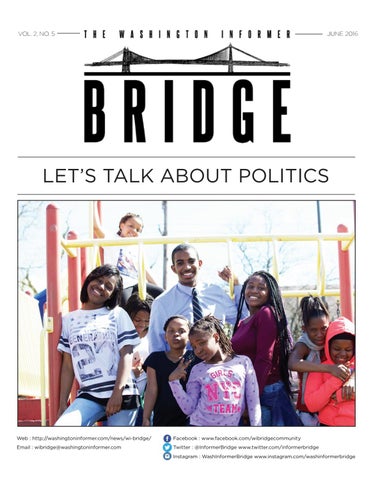
Ward 8 State Board Education Representative hopeful Markus Batchelor takes time with some youngsters during an outing in Congress Park. Earlier this year, Batchelor, a lifelong Ward 8 resident and community staple, launched his campaign to be the conduit between the government and concerned parents and community members. More on Page 4. / Photo by Jamal Holtz
MISSION STATEMENT The WI Bridge sets out to highlight contemporary issues through the experiences of youth and capture the progressive, entrepreneurial spirit of the Millennial generation other publications gloss over. Writers will take to streets and feature people, programs, initiatives, and movements that uniquely address prominent youth issues. This hard-hitting coverage will lay to rest misconceptions of Generation Y and bring all to an understanding of diverse youth experiences.
2| WI BRIDGE
VOL 2, NO. 5
As always, we appreciate your support and encourage you to spread the word about our movement. Please read this issue in its entirety and send your thoughts to washinformerbridge@gmail.com. You might see your letter in a future issue. Yours in the Struggle, Sam P.K. Collins Editor-in-Chief WI Bridge
EDITOR-IN-CHIEF Sam P.K. Collins
PHOTOGRAPHER Dejah Greene
LAYOUT Kelcey Abney
CONTRIBUTERS Sam P.K. Collins William Langford Brianna Rhodes Austin Weatherington
MILLENNIALS DIVIDED OVER HILLARY AND BERNIE By Brianna Rhodes
WI Bridge Contributing Writer @Bri_Rhodes24
It’s hard to believe that then Sen. Barack H. Obama was running against then Sen. Hillary Clinton for the Democratic nomination for president of the United States eight years ago. As President Obama prepares to end a historic presidency, Clinton hopes to finish the race she started nearly a decade ago to become the first woman head of state. The 2016 U.S. presidential election has spurred controversy for a number of reasons. Many voters, political analysts, and party elites didn’t expect Donald Trump, the millionaire businessman and reality television star who has emboldened the racist and nativist spirt of the electorate with his inflammatory messaging, to run on the Republican ticket and become that party’s presumptive presidential nominee. The Democratic Party on the other hand hasn’t quite agreed on their nominee: though Clinton has enough delegate votes, Sanders, an Independent who switched to the Democratic Party, hasn’t explicitly conceded just yet, prolonging the nomination process as we get closer to the general election. Millennials too are very divided on the issue. The following are the thoughts of two young people who weigh in on the election and proclaim their support for one of the Democratic primary candidates. Though they differ in opinion, they share the belief that Black millennials must make their voices heard at the ballot box in November to shape America’s future.
Aubrey Davis, 23, Charlotte, North Carolina Bernie Sanders Supporter “I think I’m team Bernie just because he sees the struggles that us as millennials go through and he sort of empathizes with us. You know, things like education. You’re coming out of school and [try to] get the job you dreamt of having, but instead dealing with debt and student loans. A lot of women like Hillary because they want a woman president but it just seems like controversy follows her. [For example], the whole thing about some scandal from emails. Also, it’s about how she’s answering questions and how she says whatever she thinks people want her to say. I feel like Bernie has genuine concerns and can really identify with our concerns as millennials.” “Black millennials aren’t really a population that votes all that much but we have the numbers. We’re a huge group. Whether you’re in school, working, or in the military, we have a voice and we need to make it count. You make your vote matter and put it toward something you care about. I think we could really make some changes if we just educate ourselves. We must realize that this does affects us in some form or fashion so we can make more educated decisions.”
Osi Osman, 26, Silver Spring, Maryland Hillary Clinton Supporter “I’m Team Hillary because, for one, I support Democrats. I also know that she’ll be the Democratic presidential nominee and so in turn I’m going to vote for her because Donald Trump can’t be president. I think we took it as a joke when we heard Trump was running. Now we have this extremely racist individual who publicly denounces same-sex marriage and talks rudely about people with disabilities. Trump has a lot of followers and people are saying, ‘they’re not going to let him win,’ but who is ‘they’? You know it just seems like a ticking time bomb. I don’t’ think I’ve ever witnessed an election in which I was worried about the future of the United States of America because if it falls into the wrong hands of this racist, sexist person, this means we’re in trouble.” “The reason why young, Black millennials need to vote is because most Americans don’t deal with many of the issues we face. We have to hold leaders accountable and understand what they’re doing. We also have to realize how Black people weren’t able to do many things. Voting is something our ancestors fought for so if we have the ability to vote, we should. Historically we weren’t able to and now we can so we should pick the officials who we think will look out for us.” VOL 2, NO. 5 WI BRIDGE | 3
BATCHELOR EYES STATE BOARD OF EDUCATION SEAT
Photo by Jamal Holtz
By Sam P.K. Collins
WI Bridge Editor-in-Chief @SamPKCollins At the age of 23, Markus Batchelor is far from a political novice. Since taking on the mantle of leadership in his adolescence, he has risen in prominence as president of the Ward 8 Democrats, ANC Commissioner for Single Member District 8C04, and most recently Ward 8 liaison in the D.C. Mayor’s Office of Community Affairs (MOCA). As he gears up to challenge Tierra Jolly for the Ward 8 representative seat on the D.C. State Board of Education (SBOE), Batchelor reflects heavily on the experiences, elders and community programs that have enriched his short but fruitful life, pledging to do his part in creating a similar environment for thousands of youth if elected in November. “Making sure children are successful is a community effort,” Batchelor, now the family and community liaison at the Far Southeast Collaborative said. “My mother read to me at night and made sure to be involved at school. But she didn’t do it on her own. I 4 | WI BRIDGE VOL 2, NO. 5
had a neighbor who gave me chapter books to read. I had a deacon who took kids to vacation bible school for four weeks and that’s how he enriched the community. There was always someone on every block who looked out for me,” added Batchelor, a lifelong resident of Congress Heights in Southeast and an alumnus of the Marion Barry Youth Leadership Institute (MBYLI). Earlier this year, Batchelor declared his candidacy for the Ward 8 State Board of Education seat, resigning from MOCA nearly 13 months into D.C. Mayor Muriel Bowser’s term. Since then, it has been business as usual for the young politico who’s often found out and about at community gatherings, including ANC meetings and graduations. During the D.C. Democratic primaries, he, along with members of his small campaign team, combed the main corridors, side streets, meeting spaces, and polling stations of Ward 8 with large blue, yellow and white signs in hand. Along the way, Batchelor cleared up any confusion about him running against D.C. Council member LaRuby May (D) and Trayon White for the Ward 8 Council seat. He also listened as parents and students vented about
unresponsive administrators, culturally incompetent teachers, and unengaging school curricula. For Batchelor, all aforementioned problems speak to what he described as the sitting Ward 8 representative’s lack of visibility and engagement with constituents. This week, Batchelor started collecting signatures needed to place his name on the November general election ballot, affirming his commitment to challenging the status quo and getting parents more involved in shaping school policy. Plans if elected include restoring confidence in Ward 8 D.C. public schools, spurring parental grassroots organizing, pushing for allocation of additional resources, and the transformation of schools to centers that provide wrap-around services for families. “I want to push for more PTAs and parent involvement. We need to empower both students and parents to advocate for themselves,” Batchelor said. “The State Board of Education members have to play that role as advocates for students and parents and galvanize them. No one is engaging our community. Our school board members have to get back to the
basics and be community organizers, showing people that they have power. The schools don’t belong to the system or government. They belong to the community,” he added. With the highest concentration of people under the age of 18, improving the quality of education in Ward 8 could cause a ripple effect for other facets of life for thousands of residents. The effects of high unemployment, a dearth of full-service grocery stores and amenities, drug abuse, mental illness, spikes in violent crime often follow youth into school, impeding learning and making parents feel powerless. Even worse, punitive measures taken against students maintain the school-toprison pipeline. Overall, D.C. Public Schools have a graduation rate of 58 percent, with the rates of Anacostia and Ballou High Schools, the only two of their kind in Ward 8, falling below 50 percent. Such conditions have compelled Ward 8 parents to look outside of the D.C. public school system, a trend that keeps Anacostia and Ballou underenrolled. Additionally, charter schools and private institutions outnumber public schools in Ward 8, a tell-tale sign of a national school privatization movement that has gained traction in recent years.
Photo by Jamal Holtz
While some education experts have extolled these changes, some Ward 8 parents said they’re getting locked out of important conversations about their children’s education. For instance, Latiya Loring, a mother of two, said administrators at the D.C. Prep Benning Elementary Campus, formerly D.C. public school, don’t take her concerns about the Common Core standards and draconian disciplinary rules seriously. “There are folks [in these schools] who are teaching just to pay their student loans. They go into poverty-stricken neighborhoods not knowing what these kids go through,” Loring said, citing examples of when teachers punished her daughters for absences related to her bodily changes. “The kids get suspended for small things that could’ve gotten handled differently. It’s hard enough getting them through the door and we can’t keep discouraging them.” Loring, an MBYLI alumna, said while she has never spoken to Batchelor extensively, she feels confident that he could bring a fresh perspective in the SBOE and ensure that administrators understand the complexities of life
in Ward 8. “I’ve had a chance to see [Markus] in action and be that voice that gives us insight on the conversations young people are having. He sees what’s going on out there and he has access to certain areas because of his age.” Jamal Holtz, a student who considers Batchelor his mentor, said he can attest to the young community leader’s ability to connect with residents and put his life on the line for D.C. youngsters. Since meeting Batchelor in MBYLI, Holtz has followed him around the city, learning the tricks of the trade and growing in his love for public service. “I think Markus would make a great representative. He has been in the community his entire life,” said Holtz, a Bellevue resident and recent graduate of Friendship Collegiate Academy Public Charter School in Northeast. “Long before he launched this campaign, he had visibility, going to graduations and talking to parents. He goes out in front of schools after hours. I know he’ll be very connected to parents and getting them involved. My entire family knows Markus. They look at him as a son and
my mother [considers him] her son,” said Holtz, who’ll attend the University of Rochester on the POSSE Scholarship. In late April, Batchelor took his outreach a step further when he accompanied a group of D.C. students to Flint, Michigan on their mission to supply those affected by the lead crisis with fresh bottles of water and connect with community leaders. The trip, organized by Black Millennials 4 Flint, a grassroots environmental justice movement, allowed the youngsters to better understand the effects of lead poisoning – and see Batchelor’s leadership firsthand. “We didn’t have a lot of men present and the work we did was pretty tedious, requiring a lot of brawn to get things accomplished so we were grateful to have him,” Tricey Adams, founder of Black Millennials 4 Flint, said. “He really encouraged some of the students on trip to be an intern for his campaign. It was powerful that all of the kids on the trip were from Ward 8. He inspired one of the young ladies on the trip to apply. That’s a testament to his commitment to the community and youth.”
oriented culture he knew as a child, admits that demographic changes and adult adverseness to interacting with rowdy youth impede that goal. However, he remains confident that he can do his part in helping parents and students to take charge of their school and communities. For him, that’s the first of many steps in turning around a community that receives a bad rap for circumstances out of the control of those affected. “We need someone on the school board who’s focused on quality of education and quality of life,” Batchelor said. “If they aren’t willing to talk about how poverty affects community and trauma and how home environment affects youth’s academic success, we’re doing them a disservice. Once young people get a better education, it’ll be easier for them to stand up for themselves. They can believe they can change things in their society,” he added.
Batchelor, who said he’s eager to revive elements of the Ward 8 communityVOL 2, NO. 5 WI BRIDGE | 5
HOW PRO SPORTS EXPLOIT THE BLACK COMMUNITY
Members of Dematha Catholic High School’s basketball team during the 2015 WCAC Tournament at American University in Northwest. / Courtesy photo
By William Langford
WI Bridge Contributing Writer With the NBA Finals behind us, we comb through the endless conjecture and adulation regarding some of basketball’s brightest stars. From league MVPs LeBron James and Steph Curry to up-and-coming stars such as Klay Thompson and Kyrie Irving, these athletes took different paths but had similar starts – somewhere with a ball, a bunch of kids, and a dream. Youth basketball is the breeding ground for the professional athletes of tomorrow. The explosion of income at that level just cannot be ignored. Success has more than trickled down to the collegiate and amateur levels as Nike, Under Armor and other brands lead a youth basketball revolution, bringing exposure that has never before been seen. With nearly three in four NBA players being of African or African American descent as of 2015, it’s clear that professional basketball has become as much a part of the fabric of the Black community as the Black community has become its major consumer base. So why has that overwhelming success on the court not translated off of it? Astonishingly, the numbers are almost exactly reversed for head coaches in the NBA with 8 of the 30 being Black. 6 | WI BRIDGE VOL 2, NO. 5
Even worse are the number of higherlevel jobs, including operations and general manager positions, held by that demographic, which currently stand at four. Until Bob Johnson’s purchase of what was once known as the Charlotte Bobcats, the NBA had never had a Black owner. Black people haven’t fared much better in attaining executive positions since then. Out of a total of 120 available higher-level jobs, including head coach, general manager, president, and owner of one of 30 teams, only 13 are occupied by a Black person. This staggering statistic speaks to why the $24 billion annually accrued by ESPN and Turner alone hasn’t translated into more progress in the Black community. This dynamic has been at the heart of inequality throughout human history, magnified in the struggle in this country for racial equality. While many individuals have gone above and beyond to affect change, such as the Washington Wizards’ John Wall and members of the University of Missouri’s basketball team who stood up against on-campus racism at the risk of losing their academic and athletic standings, there’s a system in place that funnels former players into seats of acquiescence rather than into positions that will allow them to have major decision-making ability in the
game they have built largely on their backs. It is a double-edged sword that cuts young African-American men off from their community and undercuts veterans who should be the pillars of the game in and out of the boardroom. The Black community spends so much time looking outside of itself for help because we have been taught in our systematic schools that history cast us as outcast, that we once didn’t belong and only by struggle and reluctant concession that we’re equal. This manipulation has played itself out in professional team sports where young Black men at every level are looking for guidance and direction from figures who look nothing like them. Instead of aspiring to become leaders of their own on and off the court or field, they put their trust in a person through which they have no reflection of self. Selfconfidence is one of the foundations of success and being able to see those like you, who look like you, who walk and talk like you, who live and work in your community allows you to truly visualize yourself in those shoes. Now assume that instead of those jobs and incomes going to those not in or from the community, that they go to Black people in far more proportionate
numbers. Now businesses directly feel that influence and quality of life improves locally. Soon after, neighborhoods are no longer run down, the pride in our neighborhoods rises to a level where accountability is expected, people are more willing to bond together around shared positive experiences instead of the steady grind of menial livings. Everything gets better simply from allowing a natural dynamic to have its place within the Black community. No longer can we sit aside quietly and listen to criticism from those who turn around and poach our youth to uplift their lives while we scratch our collective heads wondering why the answer seems to continually evade us. We must be accountable to ourselves and to our communities regardless of personal convictions. A rising tide lifts all ships and the success of our countless professional sports stars has given them a platform to lift our people in ways that have been widely ignored or suppressed for so long. If we make up 74 percent of the athletes in a sport that has become so economically profound, then we should see a far more of the direct residual effects. It’s only natural.
WI BRIDGE MESSAGE TO THE GRASSROOTS
A screenshot of Kendrick Lamar’s “To Pimp a Butterfly”/ Courtesy Photo
By Austin Weatherington
WI Bridge Contributing Writer @a4aus It echoes casually on crowded street corners where testosterone sways back and forth like a yo-yo. It buzzes through branded headphones atop maze-like locks which calmly await the Green Line train. It crackles through the worn speakers of storefront church sound systems, jumps off the pages of higher education applications, and confidently slides off of stained fingertips connected to delicate tattooed hands. This “it” I speak of is none other than the charismatically confident, and often times confusing political desires of our youth—or more accurately put, our future. Today, many issues affect our youth. Be it the result of systematic oppression or unhealthy culture, illiteracy, incarceration, unemployment, and violence have become widespread. According to the U.S. Centers for Disease Control and Prevention, Black youth homicides quadruple that of young people in the U.S. as a whole. The idea of the challenges Black youth face, and the politics needed to solve those issues can be a difficult one to conjure up—Insert rapper/poet Kendrick Lamar.
No image better juxtaposes the concepts of Black youth realities and politics than the cover art for Kendrick Lamar’s most recent album “To Pimp a Butterfly”. The cover art shows Kendrick with friends and family of all ages, many of them youth, as they pose shirtless on the White House lawn. At its worst, the cover art is seen as disrespectful. At its best, it’s cool and avant garde. I consider it poetic justice; a group consisting of America’s most targeted profile in their rawest colloquial element, standing smack dab in the middle of the country’s crown jewel. In many ways, it’s fitting for the men to return to the house their enslaved ancestors built. Although modern technology helped bring the picture to life, just imagining the photo’s realness provokes a unique jealousy in the purest parts of me. Thoughts snake through my head, and my fingers tingle at the idea of me being there. Seeing that I don’t make a habit of being shirtless, or parading around with money and alcohol, I contemplate my role in that moment. I immediately reflect on the ancestral knowledge that has enhanced me. What would I, or could even do in that moment? As a talker, I envision myself sharing words with the youthful group huddled around me. The first point I would share
is the process of being alive; the concept of self-preservation. I’d begin with the celebration of their lives and applauding their ability to survive. However, I’d explain that the concept of self-preservation extends beyond the physical and into the mental, spiritual and communal realms. I’d then directly follow up that point with telling them that this country has a long history of attacking all of those realms and the youth should be aware of that. However, despite the societal attacks, one must be cautious not go into survival mode. For there’s a damaging consequence attached that, the aftereffect being a decrease in knowledge of self. For it’s knowledge, not survival that’s meant to be shared with the men, women, and children around you. Knowledge of self is too valuable and survival mode is too exhausting to be housed together. In the era of Trayvon Martin, Sandra Bland, Mike Brown and countless others; the American justice system has more than proven itself to be indifferent to the Black body’s existence. Seeing this fact, I’d celebrate and expound on their freedom. Studies show an unfortunate magnetism between both poverty and crime that exists not only in the United States, but around the world. We live in a country that champions equality yet has a justice system that hands out prison sentences to Black men up to 20
percent longer than that of white men who commit similar crimes, according to the U.S. Sentencing Commission. The youth must understand that freedom is not something that some nation grants you, rather inherent. Freedom is a divine right, not to be limited or increased by outside forces. My hope would be to move the freedom paradigm from a controlled space, to an empowered one—one over which they, as individuals, have authority. Lastly, if I had an opportunity to share ancestral knowledge with my fellow brothas on the White House lawn, I’d try my best to depart from the American awareness of my first two points. I’d also challenge myself to not only omit the word America from my point-making, but simultaneously speak from a place of power. I’d end by informing them of a resource that has proven to be sufficient time and time again. A resource which meets you where you are. A resource which when used correctly is the greatest organizing tool this world has ever seen. That resource is love. I would inform them that love is their number one political priority that they should put into action.
VOL 2, NO. 5 WI BRIDGE | 7
8 | WI BRIDGE VOL 2, NO. 5