VOL. 1, NO. 7
AUG. 2015
THINKING ABOUT TODAY, PREPARING FOR TOMORROW
Web : http://washingtoninformer.com/news/wi-bridge/
Facebook : www.facebook.com/wibridgecommunity
Email : wibridge@washingtoninformer.com
Twitter : @InformerBridge www.twitter.com/informerbridge Instagram : WashInformerBridge www.instagram.com/washinformerbridge
CONTENTS
EDITOR’S LETTER
PUBLISHER Denise Rolark Barnes
Nicki Minaj Wax Figure Sparks Questions 3 ThinkProgress: Ferguson One Year Later 4 Gary Clark, Jr.: Contemporary Musical Revolutionary 5 Thursday Network: Empowering Communities, Changing Lives 6-7 WI Bridge Viewpoints 8
ON THE COVER
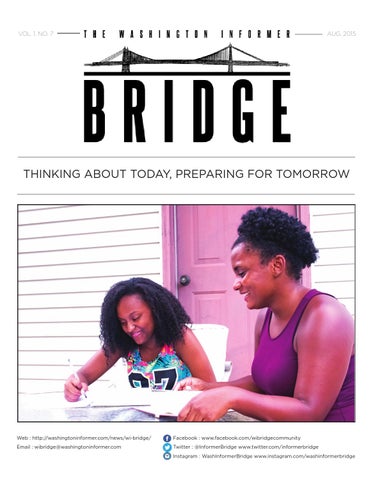
University of Maryland (UMD) student and America Reads member Shanai Browne read aloud to a student during Career Day at Cool Springs Elementary School in Adelphi, Maryland in June. That day, pre-kindergarteners drew pictures answering the question of “Where would you fly to if you were a pilot for a day?” Each semester, America Reads, created in the 1990s as part of the Clinton administration’s national literacy campaign, places UMD students in more than 60 Prince George’s County public schools. Mentors work one-on-one with three students, helping them sharpen their reading and writing skills. Browne, a biochemistry major at the College Park campus, has been involved with the program since 2011. / Photo by Dejah Greene
2| WI BRIDGE
Dear WI Bridge readers, Our last issue, themed “A Dream Unfulfilled,” took a pulse of Millennial attitudes toward government, and let’s just say that there’s work to be done. Some may describe that edition, and anything we do as a publication, a warped and overzealous indictment of those in position of power. It’s far from it. We consider our work nothing but community journalism in its purest form. Young people in the United States and abroad are frustrated with the status quo. Contrary to the belief of some, we want to right wrongs and advance our society the way our ancestors would have intended. The events of the last couple years have shown that. As a community media organization, we’re giving young reporters and writers a chance to document history and make a statement. The saga continues with the latest issue of WI Bridge, themed “Thinking about Today, Preparing for Tomorrow.”
members of the Thursday Network look back on the help they’ve given residents of different ages this summer. Our national article, courtesy of ThinkProgress justice reporter Carimah Townes, features the young people on the frontlines of the Ferguson movement a year after Mike Brown’s death. Our two culture pieces delve into blue’s place as a mode of social commentary and the politics of female sexuality. WI Bridge staff photographer Dejah Greene also asks Millennials how they give back to their communities in the “Viewpoints” section. Their responses are very interesting.
STAFF Sam P.K. Collins Editor-in-Chief
Chelsea Fuller Editor
REPORTERS
We hope that you enjoy our assortment of think pieces and news. It’s our pleasure serving the community and we look forward to do more work in highlighting the positivity in D.C. and shedding light on issues that need our attention.
Melvin Graham
Loren B. Coleman, Ph.D.
Yours in the Struggle, Sam P.K. Collins Editor-in-Chief WI Bridge
If you’re a proponent of kujichagulia (Swahili for self-determination), then you will surely love this issue. In it,
Ambre Tomlinson
PHOTOGRAPHER MISSION STATEMENT The WI Bridge sets out to highlight contemporary issues through the experiences of youth and capture the progressive, entrepreneurial spirit of the Millennial generation other publications gloss over. Writers will take to streets and feature people, programs, initiatives, and movements that uniquely address prominent youth issues. This hard-hitting coverage will lay to rest misconceptions of Generation Y and bring all to an understanding of diverse youth experiences.
Dejah Greene
LAYOUT Kelcey Abney
“The controversy points to a paradox. Black women are often blamed for their objectification, while also made to feel they do not control their bodies.”
NICKI MINAJ WAX FIGURE SPARKS QUESTIONS By Daria-Ann Martineau WI Bridge Guest Columnist @carbibeancurly In the summer of 2014, revered artist Kara Walker unveiled her much discussed piece “A Subtlety, or the Marvelous Sugar Baby.” The sculpture, a nude “Mammy” sugar statue in a provocative, sphinx-like pose, was mostly praised by critics. However, it was also subject to crude gestures and “selfies” from viewers. Roughly a year later, rapper and singer Nicki Minaj’s image was unveiled at Madame Tussauds Wax Museum. The likeness is taken from her recordbreaking “Anaconda” video in which Minaj brags about her sexual conquests as her male rap counterparts often do. It also displays her slicing phallic foods like bananas, and swatting a crestfallen Drake’s hands away from her behind. The video sexualizes Nicki Minaj, but with a clear message-- she celebrates her sexuality for her own enjoyment, not that of a man’s. Many have been disappointed with the museum’s positioning of her on all fours, and with the ensuing lewd gestures from museum-goers. With this public reaction, the female rap artist’s image has renewed the conversation around the sexualization of black female bodies. However, many fail to answer or even ask the question: who is in control of this sexualization? Some critics, such as rapper Azealia Banks blame Madame Tussauds, allegedly tweeting “Wow, they finally give Nicki Minaj a wax figure and it’s a statue of her bent over on all fours…… White people yo….” The tweet, widely quoted online, appears to have been
deleted. While blogger Rhapsodani writes, “The saddest thing about this is Nicki’s approval. I’m only assuming she had some type of approval and if she did, that’s what’s wrong here. We’ve gotten so used to our image being abused as black women that we mindlessly abuse it ourselves.” Both Banks and Rhapsodani agree in their distaste for the image, but place the blame on different parties. The controversy points to a paradox: Black women are often blamed for their objectification, while also made to feel they do not control their bodies. Nicki Minaj has expressed appreciation for her statue. “I love it and I can’t wait to see it” she posted on Instagram, but has since also expressed disappointment at patrons’ lewd behaviour. While she may have been in creative control of her video, she cannot exercise this same control over her image’s reception on camera or in wax. This same problem was presented in Walker’s “Subtlety.” The sculpture, much like Nicki Minaj’s video, is meant to challenge the public’s discomfort with black female bodies, particularly those that are full-figured and thus deemed more provocative. Though one can posture that Minaj wanted the same effect when she approved the use of that image for her statue, one cannot know. Madame Tussaud’s statues are meant to be interactive. However, Minaj seems genuinely surprised at visitors’ behavior: “Why must y’all b this way (pensive emoji)...” she tweets. Walker, on the other hand, is fully aware of people’s crass tendencies when she reveals months later that she has secretly filmed her audience, and has turned their
reactions into a movie. “I put a giant 10-foot vagina in the world and people respond to giant 10-foot vaginas in the way that they do. It’s not unexpected… Sometimes I get a sort of kick out of... that there’s gotta be this way to sort of control human behavior….I’ve got a lot of footage of that [behavior]. I was spying” Walker tells the Los Angeles Times. While Walker’s actions seem far more intentional, both her and Nicki Minaj’s statues serve as challenges to their audiences to confront their views on black female sexuality. Both audiences have members who meet this challenge with disappointing results. But the problem is certainly not exclusive to black women. In 2002, Madame Tussauds unveiled a similar statue of Australian popstar, Kylie Minogue, which also received obscene treatment from visitors. However, blackness further complicates the narrative when you consider the history of slave rape, medical experimentation, and other forms of misogynoir. Nobody blamed Minogue for the crass interactions with her statue. However, many feel that the historical devaluing of black, female bodies makes Nicki Minaj’s objectification that much worse: an attempt to literally bring a powerful black woman to her knees. She is thus burdened with a greater responsibility to avoid such reduction. While Minaj and Walker have race and gender in common, there are two major differences that make Minaj more vulnerable: First, Walker’s image is of an archetype while Minaj’s is of herself. Secondly, the divide between “high” and “low” art complicates things. Undoubtedly, someone is reading
this piece wondering how I can even compare Minaj to Walker. Walker is praised in academic circles and funded by institutions like the MacArthur Foundation, Nicki Minaj is a rapper, purveyor of a 40-year-old artform that still struggles for mainstream acceptance. Minaj’s stance within the “lower” art form-- one with a deeprooted history of misogyny-- for many, further lowers our perception of her, and hinders us from acknowledging her agency regarding her sexuality and image. Is Nicki Minaj ultimately controlling her sexuality and its perception? The answer is more complex than the issues of racism and gender combined. She undoubtedly makes choices that influence viewers, but those choices cannot excuse others’ inappropriate behaviour. Sexuality, like art, is as much interactive as it is personal. Though Minaj is a public figure, she is, in the end, the only one who needs to be comfortable with how she is portrayed regarding either art or sex. Daria-Ann Martineau was born and raised in Trinidad and Tobago. She received an MFA in poetry writing from NYU. She is an alumna of the Callaloo Creative Writing Workshop, The Saltonstall Arts Colony and the Bread Loaf Writers Conference. Her work has been published in The Collagist, Narrative Magazine and Kinfolks Quarterly, among others. In 2014, she was named one of Narrative’s “30 below 30” and her poem, “Mine” was chosen as one of their “Top Five Poems of the Week” for 2013-14. She lives in Washington, D.C.
3 | WI BRIDGE
THINKPROGRESS: FERGUSON ONE YEAR LATER By Carimah Townes
Justice Reporter, ThinkProgress @carimahwheat Sunday marks the one-year anniversary of Michael Brown’s death at Officer Darren Wilson’s hands in Ferguson — the spark that ignited a national movement of protest against police violence and racial inequality. One year later, that movement is nowhere
indictment, the coalition started the Books and Breakfast program to feed the stomachs — and minds — of Ferguson residents, aged 13 to 30. According to co-founder Tory Russell, the monthly program brought a newfound political energy to the community. “We pick political themes that directly affect [them]. Two months ago, we did Patrice Lumumba, a community organizer who became the first
HUU also provides space for male and female conversation circles where people — however they identify — can gather once a month to discuss community affairs. “We talk about everything: education, economics, inter-community crime. We’ve actually tried to do all things — not just a police brutality banner but a more holistic look at how we solve systemic racism, and how that intersects with class and gender,” Russell said.
reduce grocery costs. “These programs are ways for neighbors to meet and have peaceful communities and show that police don’t have to be called. We can solve our own problems. And hopefully when police come, people are politicized in a way that they know their rights,” Russell said. “It’s a long road, so a lot of legislation and concessions that we would want are just not being met on the state, local, or
“It’s part of a continuum of struggle that black people have been a part of since the inception of this nation. I think that what Ferguson did was wake consciousness in a way that provoked action in other cities with similar landscapes.” near finished. The cameras may have left, but dynamic grassroots programs are changing Ferguson while no one is watching. Since last August, four separate Department of Justice (DOJ) reports have been released, detailing raciallydiscriminatory and exploitative policing, officer misconduct and mismanagement during the unrest that followed Brown’s death, and a troubled Family Court system. Members of law enforcement have been ousted, a new interim police chief has stepped in, and the Ferguson City Council has diversified. But the bulk of the changes have happened because of community organizations that focus on the specific needs of Ferguson residents. Take Hands Up United (HUU), a coalition that first banded together to demand a special prosecutor to review Brown’s death and has since launched several educational programs for adults and youth. Before Wilson’s non4 | WI BRIDGE
independently-elected president of the Congo. We take historical and current issues to connect to every day lives, and we do that around a healthy breakfast,” he said. “We have breakouts with the kids and parents. That leads to informal political education and community organizing, so these conversations continue for weeks. By the end of the year we will see over 1,000 families.” The same coalition launched the Roy Clay Sr. Tech Impact Initiative to teach students web programming skills and prepare them for tech-industry jobs. The initiative, named after the co-creator of the Hewlett-Packard laptop who was raised in Ferguson, came to fruition when youth in Ferguson tried to support black businesses in the area and noticed a dearth of media and promotional materials. The businesses were there — there was just no way to find them. Tech Impact was devised to teach youth how to use the internet to uplift those businesses and strengthen local networks to keep the movement alive.
Freedom Schools run by the American Friends Service Committee (AFSC) have also popped up in Ferguson and other St. Louis communities, where youth aged 15 to 23 meet to discuss “poverty, race & racism, and internalized racial oppression,” according to Peace Education Program Director Joshua Saleem. Three school sessions have convened since the fall, allowing young people to grapple with systemic oppression and develop ways to stay engaged in the struggle. Community gardens are springing up as well. By contributing to them, Saleem told ThinkProgress, “youth and community members gain the skills and capacity to build community, critically analyze issues, implement community action projects that address health inequities (regarding food justice and urban gardening), build long-term community assets, and advance policies and practices that support the health of their communities.” Along the same lines, HHU is currently setting up a food pantry supplied by local growers to
federal level.” However, the progress that has been made in Ferguson is considered a victory for local residents and has inspired the Black Lives Matter movement over the past year. “It’s part of a continuum of struggle that black people have been a part of since the inception of this nation. I think that what Ferguson did was wake consciousness in a way that provoked action in other cities with similar landscapes,” Kayla Reed of the Organization for Black Struggle (OBS) explained to ThinkProgress. “A lot of people look to Ferguson and the leadership that has emerged out of that space for guidance and support.” This piece can be viewed in its entirety at http://thinkprogress.org/ justice/2015/08/05/3687679/whatferguson-looks-like-one-year-later/.
GARY CLARK, JR.: CONTEMPORARY MUSICAL REVOLUTIONARY
Gary Clark, Jr. / Courtesy photo, © Sweet Alize https://www.flickr.com/photos/alizetranphoto/9681428056/sizes/l
By Adolf Alzuphar WI Bridge Guest Columnist @alzuphar For the last five years, black guitarist and actor Gary Clark Jr. has offered a unique explanation of human and American conditions through the blues, a traditional but relatively unpopular genre. On September 11th, the journey continues on his second studio album, The Story of Sonny Boy Slim. This work follows his 2012 album, Blak and Blu, a modern testament to the black experience that uses blues, rhythm and metaphorical lyrics rooted in dated language. The album’s name uses modern deformations with “Blak” meaning black and “Blu” meaning blue. One of Clark’s songs, ‘When My Train Pulls In” calls to mind images of the 1950s -- “every day nothing seems to change… sometimes I feel like I was born to lose”. He later said he will “be ready when [his] train comes in.” This song gives hope for a better future, serving as an anthem for modern black aspiration, through blues rhythm and language. Clark’s music, a cultural project by which he makes modern traditional American rhythms and language, should
be seriously debated. It presents us with a difficult to understand past. He has taken a plunge that will enrich American culture. A great example of his presenting, or representing, the American past is the first song on Blak and Blu, “Ain’t Messin’ ‘Round.” In it, Clark plays concert blues, a subgenre of blues made for the concert stage. Except in the case of Jimi Hendrix, concert guitar has generally been a “thing for white bands.” In this song, Clark brings back the concert guitar to the blues, where it originated, the soul of the black experience according to Amiri Baraka, and the origins of modern rock and roll music. He, again metaphorically, sings that he “don’t wanna be your exhibition.” Clark combines traditional fight and the origins of concert guitar. We can only guess to what he’s alluding. No society’s concept is a fixed entity as some members of it want it to be. This goes for music. Newly conceived musical genres should not merit all of our attention. In Clark, we find musician that can mean to the lives that we lead in the 21st century. But he’s not the only one to do so. Wynton Marsalis too makes traditions
present with an understanding of American society, an intellectually poor descendant of the enlightenment and individualism that accompanies democracy and revolution because of the irresponsibility of certain local elites. We’re surrounded by entities musicians criticize today. The National Endowment of the Arts, for instance, has less than $200 million at its disposal. Public broadcasting is a shame. It’s the defense budget and American diplomacy however, point to a couple things: the existence of C. Wright Mills’ revolving door elite and a need among that group to create a global economy in accordance with American ideologies. Though many artists do it, stepping back to understand this method will lead us to Clark’s profound social thought. Black music has always been a complex enterprise, and a way to break away, rebel, and to help others fight against a society that doesn’t have their interests in mind. As philosopher Edouard Glissant said, the black cultures of the Western Hemisphere were born on the slave ship. Slavery had existed before the slave ship. It was not slavery that founded a new culture, as much as it had a
massive impact. It was what I like to call “a mind at sea.” It was a mind lost in its own thought about a profoundly scarring situation. This “mind at sea” led to a mentality that produced family, tradition, political thought, business thought and, most importantly, music. This “mind at sea” through deep thought plunges into one’s personal condition and the world around one’s self to come out with a solution, as most humans do. This “mind at sea” led to Rosa Park’s refusal to get up from her seat on the bus to the subsequent moments of the Civil Rights movement leading to the signing of the Voting Rights Act. getting from her seat’s founding the most popular moments in the civil rights. Decades later, the “mind at sea” mentality has led to new plunges. This plunge is, for example, the Afro-vegan movement of today. It is blacks actively seeking a solution that will change life. In Clark’s case, this plunge has enriched the black tradition, identity, and ultimately contemporary life. The music must sell, cultural or not. It’s a sophisticated plunge. While some will call Clark a sell-out for not being indie, he has taken a noble route. 5 | WI BRIDGE
THURSDAY NETWORK: EMPOWERING COMMUNITIES, CHANGING LIVES
Thursday Network members host a Luau for residents of the Victory Heights Senior Center in Columbia Heights. /Photo courtesy of Lenzy Ruffin
literacy, college readiness, leadership and advocacy in the Empowerment Academy. Students at Roots Public Learning Center in Northwest, whose grade levels ranged from 2nd to 8th, kicked off the program by learning about vision boards. Each week we presented a different subject through various interactive lessons. Students then added images and words to their vision boards, conceptualizing what they learned and displaying their thoughts about the future.
By Shanelle C. Patterson
Community Service Programs Chair , Thursday Network @thursdayntwk Many people are critical of Millennials, calling us selfish, out of touch, and unknowing of the struggles previous generations endured. Thursday Network (TN), the young professionals’ auxiliary of the Greater Washington Urban League (GWUL), the local chapter of the National Urban League Young Professionals (NULYP), and 2015 recipient of the National Chapter of Excellence award, challenges these critics with our moves within the community. We aspire to foster an environment in which young adults between the ages of 21 and 40 can focus their energy on service, civic engagement and professional development. This year was paramount for Thursday Network. Our community faced complex issues with few resources. Our elected officials and figureheads proposed farfetched solutions. We, as an organization feeling a sense of urgency, took the opportunity to let the people know we were here. But not in the metaphorical or spiritual sense. We took 6 | WI BRIDGE
As young professionals, we understand the importance of financing and attaining an education. Since 1992, we have awarded $150,000 in tuition assistance to high school seniors through the I EMPOWER Scholarship program. This year, Thursday Network will cut checks totaling $3,000 for two deserving young women starting their freshman year of college.
We also chimed in on current events, particularly those focused on policecommunity tensions, holding town hall meetings addressing the issues of police brutality and most recently handing out “Know Your Right Cards” to residents. We stood in solidarity with our neighbors in Baltimore, assisting in whatever way we could. Thursday Network has also been on the forefront of the DCFerguson rallies. Most notably, we led a “Save our City” panel discussion at Howard University that explored the state of black life in the D.C. metropolitan area, identified the issues, brainstormed solutions, and developed actions plans to save our city.
We also mentored our young ones this summer, exposing them to financial
Thursday Network has also partnered with homeless shelters and organizations
Community members participate in a Zumba class at TN’s Family Health Fair, a Young Blacks Give Back Month event at Kennedy Recreation Center. /Photo courtesy of Lenzy Ruffin
to the streets and got our hands dirty. Identified by our bold red or grey shirts displaying the equal sign, our symbol of justice, Thursday Network addressed matters of education, housing, employment, and health concerning D.C. residents and those living in surrounding Prince George’s and Montgomery counties in Maryland. We built upon signature programs and events like the I EMPOWER Scholarship and Empowerment Academy, a seven-week TN volunteer-ran mentoring program.
in addressing the prevalence of homelessness and poverty through food and clothing drives. While it’s important to tend to people’s needs, it’s even more crucial that we equip them with the skills they need to change their lives. That’s why we lead presentations and workshops about financial literacy with a focus on budgeting, and job readiness , targeting interviewing skills and resume building within this same community. A high point of our year was a month of volunteerism called Young Blacks Give Back (YBGB) that kicked off at the beginning of May. To reinforce the importance of giving back, Thursday Network performed a community service “blitz” with a focus on health. People of color overwhelmingly succumb to health issues, including heart disease, depression, high blood cholesterol and blood pressure, and diabetes. This was our opportunity to engage our people in a conversation about proactive steps we all should be taking to live healthier lives.
Thursday Network Empowerment Academy Coordinator Stephanie Hargrove leads the mentees in the lesson of the day. /Photo courtesy of Lenzy Ruffin
We started out the month with a barber shop crawl, in which TN members talked to men across the D.C. metropolitan area as they waited for their haircut and sat in the barber’s chair. Next, we challenged the youth to be different with an interactive scavenger hunt that engaged them in a conversation about bullying, its effects, and methods of prevention. We also held a social fundraiser to support mental health awareness, donating all the funds to a local organization. At the end of the month, Thursday Network organized a family health fair in Northwest that featured free fitness classes, healthy meals, and workshops. We culminated YBGB with a Sports Jam that helped raise money for our scholarship fund and got young professionals active by competing in various sports games. As a service oriented organization, TN can always be found doing something within and for the community. This past year was very active for us, but D.C. metropolitan area residents can expect this upcoming year to be even more engaging as we tackle voter registration, educational gaps, poverty, health, and many more problems our community faces. We are in a very unique time in history, we understand the issues of today, and we are the leaders who are passionate about making changes. To find out more information about Thursday Network, join the movement, or support our efforts, visit www. thursdaynetwork.org.
Thursday Network Board Member James Jeter and Coordinator Chris Austin at a service event at Capital Area Food Bank. /Photo courtesy of Lenzy Ruffin
Nearly 300 volunteers gathered at the Greater Washington Urban League for TN’s Annual Martin Luther King Jr. Blanket & Toiletries Drive. /Photo courtesy of Lenzy Ruffin
7 | WI BRIDGE
WI BRIDGE VIEWPOINTS
Each month, a WI Bridge reporter hits the streets, asks the questions that matter, and compiles the best responses for readers to see. Do you have a suggestion for a Viewpoints question? Email wibridge@ washingtoninformer.com and you might see your inquiry in a future issue.
HOW DOES SERVICE CONNECT YOU TO YOUR COMMUNITY? Working as a substitute teacher in D.C. public schools helps me to feel connected to my community. In our city, having an education is only one option children have to make money and many kids are aware of the other options before they think of their education as a financial asset. It is the safest option and the one that pays off the most in the long run, but it is also the one that takes the longest time to yield results. Working in the schools reminds me that progress does not happen overnight and if you want to build last forever, you can’t rush the process. Education cannot be taken away once you have it and there is always more to gain. This is an important lesson I see teachers imparting on their students every day and I’m happy to be a part of that experience.
Answers Compiled by Dejah Greene @greeneuphorias
I try to help younger people and even people my own age see their potential. I used to be obese as a kid and teenager. That experience can really take a toll on your mental health. Since losing my weight through sports, I realized that physical activity helped me focus on myself and improve my physical and mental well-being. I want help young people who may feel down about their appearance realize that they are not defined by their size.
Darryl Felton, 23, Bowie, Maryland
Kesia Alexandra, 25, Northeast
Through my website Twenties Unscripted and events I curate, including the annual “See. Speak. Feel.” showcase at the Anacostia Arts Center, I make an effort to push young women to connect to the best, bravest and boldest parts of themselves. Creativity and outlets that give women a chance to find their unique voices are paramount to the work I do.
Tyece Wilkins, 25, Baltimore
YOUR BUSINESS COULD BE ADVERTISED ON THIS PAGE. For more information, send inquiries to WIBridge@washingtoninformer.com
8 | WI BRIDGE