VOL. 1, NO. 10
NOV. 2015
EXODUS
Web : http://washingtoninformer.com/news/wi-bridge/
Facebook : www.facebook.com/wibridgecommunity
Email : wibridge@washingtoninformer.com
Twitter : @InformerBridge www.twitter.com/informerbridge Instagram : WashInformerBridge www.instagram.com/washinformerbridge
CONTENTS
EDITOR’S LETTER
PUBLISHER
Young People Boycott Black Friday 3
Denise Rolark Barnes
Visitors Share Their Take on Artworks in Dialogue 6
Uh! Open your eyes and look within: Are you satisfied (with the life you’re living)? Uh! We know where we’re going, uh! We know where we’re from. We’re leaving Babylon, We’re going to our Fatherland.
Kelela Pushes R&B in New Direction 7
An Excerpt of Exodus by Bob Marley ________
WI Bridge Viewpoints 8
Peace and blessings faithful WI Bridge readers,
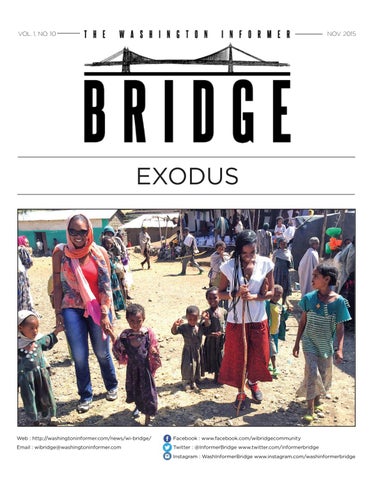
ON THE COVER
Living as a black person in the United States without any connection to the Motherland is to be like an orphaned child. Though scholars and activists have expressed this notion for centuries, I now know it for myself, especially after visiting what’s known as the Cradle of Civilization myself.
D.C. Youth Connect with Young Ethopians 4-5
My recent trip to Ethiopia with fellow members of the D.C. chapter of the National Black United Front opened my eyes to commonalities African Americans have with our continental brethren. In the fight for liberation, it’s important that we understand the significance of that connection and find ways to nation build across the Atlantic Ocean. I explore the nuances of that Pan-African relationship in this issue, appropriately themed “Exodus.” Kristina Jacobs and Tyisha Jones, members of the National Black United Front’s international affairs committee, counted among a small group of African-American millennials who visited Ethiopia earlier this month as part of a multigenerational biblical and cultural tour named The Third International Conference on Ethiopia and Its Biblical, Historical and Cultural Roots. In this photo, they walk with a group of youngsters in the historic city of Lalibela. You can find a recap of the trip in this edition of WI Bridge./ Photo by Sam P.K. Collins
Other articles in this edition of WI Bridge take on themes of Pan-Africanism and cooperative economics in a similar fashion. Learn about how youth are mulling over the decision to boycott “Black Friday,” arguably the most lucrative shopping season of the year for major corporations. Readers can also glean an overview of a Smithsonian exhibit that bridges the cultural gaps between Africans in the West and Africans on the continent. Additionally, our music article features an EthiopianAmerican artist making strides in the industry. Please take time to read these gems over the Thanksgiving holiday and feel free to give your take. We’re always eager to hear varying perspectives on this issue. All in all, it’s important that we start looking at our fight in an international light. Despite what the mainstream media tries to tell us, we’re more alike than we think. Yours in the struggle, Sam P.K. Collins Editor in Chief WI Bridge
MISSION STATEMENT The WI Bridge sets out to highlight contemporary issues through the experiences of youth and capture the progressive, entrepreneurial spirit of the Millennial generation other publications gloss over. Writers will take to streets and feature people, programs, initiatives, and movements that uniquely address prominent youth issues. This hard-hitting coverage will lay to rest misconceptions of Generation Y and bring all to an understanding of diverse youth experiences.
2| WI BRIDGE
STAFF Sam P.K. Collins Editor-in-Chief
REPORTERS Loren B. Coleman, Ph.D.
PHOTOGRAPHER Dejah Greene
LAYOUT Kelcey Abney
YOUNG PEOPLE BOYCOTT BLACK FRIDAY Briana Thomas WI Bridge Contributing Writer For youngsters consumed with school, work and social media, Thanksgiving stands as one of few days available to spend time with loved ones and get started on some holiday shopping. This season however, some youth will not participate in Black Friday activities as part of an effort to revive the holiday tradition of giving thanks and devoting time to friends and family. The economic boycott also strives to promote racial equality by challenging major corporations who do not support black consumers. “It’s kind of ironic that we celebrate Thanksgiving, but then we trample each other to buy stuff the next day,” Kwame Kumah, 19, a student at University of Maryland said. Kumah told WI Bridge that he expects to dine with family at home this Thanksgiving. He then expressed what he believes are holiday principles: spending time with family and being thankful for what you have. “I don’t go out of my way to get a deal right after Thanksgiving. It just seems kind of foolish to me,” Kumah added. “I don’t think you should prioritize Black Friday over Thanksgiving.” Last year, millennials extended a call to “Boycott Black Friday”in the wake of mega retail chains Target, Walmart, Best Buy and Macy’s demanding employees to skip holiday meals and work extended hours throughout the holiday weekend to meet consumer demand. Earlier this year, Justice or Else campaigners, led by the Honorable Minister Louis Farrakhan, encouraged African Americans to boycott Black Friday in response to the U.S. government not caring enough about black lives. “We have in the neighborhood of $1.1 to $1.5 trillion in consumer power, which makes black people a carcass where all the vultures gather to suck the life out of us,” Farrakhan told News One earlier this year. “You’re either going to treat us right or we are going to withdraw our economic support.” Thanksgiving weekend sales dropped 11 percent last year after a nationwide
Trinette Barclift and her one-year-old child./ Courtesy photo
protest pushed people to not contribute to holiday shopping in response to racial injustices specifically, the Ferguson case, white police officer shot and killed Black unarmed teenager, Michael Brown.
young shoppers bought items over the Thanksgiving weekend in 2013. In addition, African Americans saw the largest increase in time spent browsing coupons and rewards sites on Black Friday, Nielsen reported.
Now, Facebook ralliers are posting “Naughty and Nice Lists” of retailers who decide to stay closed this year on Thanksgiving Day (nice) and retailers who choose to open on Thanksgiving Day (naughty).
The shopping statistics don’t show reasons for the increased amount of shopping, but young people of color like Trinette Barclift, 22, say the ideal Thanksgiving Day consists of indulging in collard greens, ham, turkey and cornbread with family. However, she said she may have to give into the discounted Black Friday merchandise to provide for her one-year-old child.
“On November 26th, boycott any retailer that chooses to extend massive Black Friday sales into Thanksgiving Day. Protect the employees, protect the family,” announced the Boycott Black Thursday Facebook group. But some people aren’t sitting out of Black Friday shopping this year. Over the years, there has been an increase in holiday shopping among young consumers. According to the National Retail Federation, 43 percent of millennials said they shopped on Thanksgiving Day and 83 percent of
“Some stores should be open, because people might need last minute things, but I know people don’t like to work on holidays, but sometimes it’s necessary for people to work,” said Barclift who lives in Northeast. Some bold retailers granted the request of boycotters to close stores on Thanksgiving Day, including H&M and T.J. Maxx, while others will close stores on Thanksgiving Day and Black Friday.
REI, the outdoor and sporting goods market, will close down stores on both Nov. 26 and 27 in a push to encourage employees to embrace the holiday spirit outside of the hectic seasonal crowds. In addition, employees will be paid to take the days off. “We’re a different kind of company— and while the rest of the world is fighting it out in the aisles, we’ll be spending our day a little differently. We’re choosing to opt outside, and want you to come with us,” REI CEO Jerry Stritzke told Forbes. People work at these retailers over the holiday weekend, but they aren’t the only group of people coerced into joining the Black Friday mobs. Millennials like, Keona Holden from Baltimore, often participate in Black Friday shopping against their will because of parents who want to wait in long lines for holiday deals. “I hate it. It’s just so many people and I just hate being bum-rushed,” said Holden, 20. She said going shopping 3 | WI BRIDGE
D.C. YOUTH CONNECT WITH YOUNG ETHIOPIANS By Sam P.K. Collins
WI Bridge Editor-in-Chief @SamPKCollins In the centuries after the end of Maafa – the worldwide separation of African people via the Transatlantic Slave Trade – people of African descent have struggled to foster a collective consciousness under a global system that favors everything European. Brainwashed by the Western world’s portrayal of the African continent as a land devoid of history and culture, many African Americans continue to shun their stolen past. Meanwhile, Africans on the Motherland, many of whom suffer under conditions brought on by former colonizers, clamor to enjoy the trappings of the so-called First World at any cost. Earlier this month, I found a common understanding of the “black struggle” with my Ethiopian brethren during the Third International Conference on Ethiopia and Its Biblical, Historical, and Cultural Roots. During this trip, I along with five other African-American youth from the D.C. chapter of the National Black United Front (NBUF) joined a group of elders on a journey to unearth the African origins of Biblical history and highlight a history of congenial relations between Ethiopians and African Americans. “We’re the continuation of a strong legacy. On this trip, we wanted to pick up the pieces and build on the foundation our ancestors left for the 21st century” said Kamau Grimes, chair of NBUF’s international affairs committee and key organizer of the trip. “Understanding our history allows us to transcend our petty differences. We have an unprecedented opportunity to travel, communicate and have the shared experience of our ancestors.” In the months leading up to the trip, Grimes recruited members of our group and hosted Ethiopia study sessions. We prepared heavily for this excursion, meeting weekly in Sankofa Video Books & Café on Georgia Avenue in D.C. and reading scores of books about the origins of Christianity in Ethiopia and the achievements of Menelik II and His Imperial Majesty Haile Selassie I. In Ethiopia, Grimes hosted a lecture about the early beginnings of the AfricanAmerican-Ethiopian relationship at the height of the Italo-Ethiopian conflict. Much of that information came to life as 4 | WI BRIDGE
The tour group gathered on the steps of The Church of St. George in Lalibela, Ethiopia./ Photo by Sam P.K. Collins
we walked through the bustling streets of Addis Ababa, trekked through the hills and valleys of Lalibela, laid our sights on the Obelisks in Axum, and affirmed our commitment to total repatriation during a visit to Shashamene.
However, nothing proved more important to me than learning about contemporary Ethiopia through the experiences of the people I had the pleasure of meeting. Our two-day stay in Lalibela would provide me with ample opportunity to see how folks
really lived. During that time, our group visited the Church of Saint George and St. Mary’s Church of Zion – a location of the Ark of the Covenant. Getting to these sites required driving in a van along a meandering dirt path up hills and valleys before taking a walk
up high altitudes – a feat that ultimately strengthened my American lungs. Our tour guide likened our journey to that often taken by priests. The more I interacted with the people along the way, the more I believed him. Often time, men, women and children either had their hands out for change or tried to sell custom wares. I quickly learned that making eye contact would be a mistake, especially if you had no intention of purchasing their items. The persistence of the young boys in Lalibela could put the wealthiest American business executive to shame. When it came to making money, these fellas proved to be relentless, continuously making pleas for attention and walking with their newfound friends for miles at a time. Though many of the Ethiopians I encountered were “impoverished” by Western standards, they didn’t have poverty of the soul. Unlike most of the homeless folk I came across the in the states, the brothers of Lalibela – many of whom called me “rasta” because of my freeform locs -- had a genuine interest in my life. They also had a thirst for knowledge and educational advancement.
The hills and valleys of Lalibela, Ethiopia/ Photo by Sam P.K. Collins
peace. My spiritual journey culminated on this stretch of the journey.
Take Abrhams, a 16-year-old captain of the St. George Football Team, for instance. Back-to-back championships meant nothing to him without a college degree. He spoke of his plans to pursue engineering as a career before asking to have a pen – a request students commonly make of their foreign visitors. Since my return to the states, we’ve exchanged emails a couple times. The young brother proved to be more gracious than I initially thought, often wishing many blessings for my family and friends.
In learning about my Ethiopian brothers and sisters’ experiences, I gained a deeper appreciation for entrepreneurship, crafting, and a life without an attachment to material things. Allured by my hosts’ calm demeanor, I became more enamored with what the Motherland had to offer. I know now more than ever that African Americans – regardless of how far removed genealogically from the Motherland – should take similar steps to reconcile those differences. For me, there are several ways to go from here. I plan to travel to the West Africa and connect with my Liberian brethren. I also have visions of revisiting Ethiopia and taking up Amharic.
I would forge a similar relationship with a young brother by the name of Ras Robin while touring Axum. Like other Ethiopians I met, he called me Rasta but his reverence for the Rasta lifestyle intrigued me. Robin, who recently turned 20, too had dreams of attaining an advanced degree, so much so that he cut his locs before entering school. That decision, he said, didn’t diminish his adherence to its ethical code. Robin always contended that Rasta was in his heart. That type of mindset extended to his studies, He revealed that he hoped to become one of Ethiopia’s best engineers. For the time being, however, he would become an informal AllEyesOnDC ambassador and lifelong friend. On the last evening of my stay in Axum, I gave him a fresh AllEyesOnDC shirt upon his request for clothing. Soon after, we took a photo together holding up the diamondlike hand sign known as a salutation of
As a member of the Diaspora, the possibilities are endless so why wait? The collective future of the African race very well depends on this commitment to nation building. This article originally appeared on AllEyesOnDC.com.
A priest at The Church of St. George in Addis Ababa, Ethiopia./ Photo by Sam P.K. Collins
5 | WI BRIDGE
VISITORS SHARE THEIR TAKE ON ARTWORKS IN DIALOGUE SMITHSONIAN EXHIBIT CONNECTS AFRICAN AND AFRICAN-AMERICAN CULTURE THROUGH ART By Brianna Rhodes
WI Bridge Contributing Writer @Bri_Rhodes24 For more than a year, visitors at the Smithsonian National Museum of Art have had the opportunity to talk about the connection between African and African American history.
Upon entering this section of the exhibit, visitors are able to view the artwork within a circle. In the middle of the space stands a circular structure named Nexus by Martin Puryear.
participate. Boy and the Candle shows a little boy lighting a single candle in the dark. “To me, the piece [The Thankful Poor] means that you may not have everything
They’ve done so through “Conversations: African and African American Artworks in Dialogue,” an exhibit that highlights various interpretations of African and African-American culture. Spirituality counts among those topics that bridges the gap between the two groups.
Moffatt, a sales representative for Miller Coors Brewing Company, visited the District earlier this month to attend the Thurgood Marshall College Fund Annual Leadership Institute, where he could recruit potential employees.
Nelson counted among the hundreds people who have visited the exhibit since it opened nearly a year ago. Conversations, on display until next January, honors the Smithsonian National Museum of African Art’s 50th anniversary. It recognizes the history and contributions of the African diaspora. More than 160 of the works come from the National Museum of African Art and the Camille O. and William H. Cosby Jr. Collection.
“This section makes me feel like in my church,” said Moffatt “I came to the exhibit to kind of hone in on the African roots, of which I am an AfricanAmerican male so I just wanted to look at it and get my feel in an atmosphere of African-American art.” The curators said they took the time to look at the objects first and see what themes struck them. There were a number of pieces that could have been placed in more than one theme.
Curators include David C. Driskell, Adrienne L. Childs, Christine Mullen Kreamer, and Bryna Freyer.
The pieces of art within the Spiritualities theme give an overview of how this concept is interpreted within African and African-American cultures. Often times, spirituality and religion are translated by word, but the artwork gives a visual outline with which visitors can identify . 6 | WI BRIDGE
The Last Bar-B-Que piece by AfricanAmerican artist Margo Humphrey also piqued the interest of visitors who entered the Spiritualities section. The piece is an African-American rendition of The Last Supper, with black figures and cuisine. “Its an artwork [The Last Bar-B-Que] that’s similar to Jesus’ Last Supper. It has African-American known food, some more kind of speculative like watermelon, it’s not really proven that we like watermelon but it’s more of a speculation that our culture loves watermelon,” said Donyai Moffatt, who lives in Iowa City, Iowa.
“This section seems very important and meaningful,” said Chase Nelson, a resident of Asheville, N.C. “I’m not super religious, but I am very spiritual and I feel the sense of spirituality here.”
“We didn’t necessarily have a message [for the exhibit] in view,” said Freyer, an employee of the Smithsonian Institute. “ We wanted the idea of a conversation that people could have. [They] could look at an object and think ‘this object is beautiful, this object is interesting, this object gets me thinking, and then I’m going to compare it, and how does it compare to the object that’s next to it.’”
that this is a poignant moment,” said Kanon.
Gerard Sekoto, 1913–1993, South Africa, Boy and the Candle 1943, National Museum of African Art, Smithsonian Institution/ Photograph courtesy of Franko Khoury
Other popular portraits within the Spiritualities theme of the exhibit include South African artist Gerard Sekoto’s piece Boy and the Candle and The Thankful Poor by Henry Owassa Tanner.
you want, but you have everything you need” said Lauren Nelson, a native South Carolinian who moved to D.C.in August. She brought some out-of-town family members to the Smithsonian for a weekly visit.
Both portraits visualize an intimate moment. The Thankful Poor shows a young boy and an older man praying at a table before eating a meal, an intimate custom in which black families
Rachel Kanon, Nelson’s cousin, also said that The Thankful Poor was her favorite. “I minored in African studies and I think
“I wasn’t expecting American pieces. The incorporation surprised me in a good way,” said Aimee Hooper, who lives in Newport News, Virginia. Hooper visited the museum with a family member. She said that she was interested in how the exhibit combined incorporated traditional Christian artwork. She also noted the cultural combinations included in the pieces. “I think it’s important to have it [the African and African-American pieces] together. It provides a cultural shift from Africa and America” said Hooper.
KELELA PUSHES R&B IN NEW DIRECTION
R&B artist Kelela/ courtesy photo
By Adolf Alzuphar
WI Bridge Contributing Writer @alzuphar Singer and songwriter Kelela is one of R&B’s new rising stars. Two years after releasing her critically acclaimed EP Cut 4 Me, she’s back with Hallucinogen. In half a dozen tracks, she lets her personal tastes and that of her collaborators distance herself from the mainstream contemporary R&B pack all the while rooting herself in the tradition. In an interview with Rolling Stone magazine, she said that she focuses more on “resonance then on sound [unlike others]” to balance out her own individuality with that of the feature artists. Her rhythms, melodies, and lyrics cause us to hallucinate, as great R&B has always done. Most songs on Hallucinogen are atmospheric and have well-researched and sophisticated grooves. None of them sound spontaneous in the least
bit. Though not great for dancing by contemporary standards, this musical compilation is the ideal background music for socializing. “The only way to sum it up,” as Kelela sings in “All The Way Down” counts as a great contribution to black culture. This love song shows how the emotion can be an irrational and passive plunge. It has the ability to thrill a listener because it’s ambient and chic all the while being very cynical and sober. On the other hand, “Rewind” gives us an honest look into the life of a girl in the crowd. In general, all of Kelela’s songs offer a glimpse into how members of the African-American community feel at this moment in history. Hallucinogen belongs to a group of what we can call “the new mature black music” that includes J Cole’s newest album 2014 Forest Hills Drive and Kendrick Lamar’s To Pimp A Butterfly. It’s the sound of a very ambitious generation raised on pop culture that has produced musicians and activists
that value individualism and other progressive ideals. These musicians root themselves in melodies and rhythms that the black community loves all the while calling it to advance in the same fashion as their music. Hallucinogen belongs to the R&B wing of this new wave along with sounds created by Frank Ocean. Unlike in Hip Hop, they are not very political lyrically but they offer a sense of beauty through melody and Kelela’s resonance that does it a lot of good. Kelela was part of of a collective album Saint Heron released by Solange Knowles’s Saint Records that wanted to present the new wave of independent R&B. The album, , though it didn’t have a significant impact on the genre, remains fragmented. Kelela’s project, making traditional R&B with new grooves, is much more ambitious than most the projects of her fellow musicians on Saint Heron, including Jhene Aiko, at a time when the norm is to have a hit on Top 40 radio.
Alas, Kelela has a long way to go before she produces songs of the same grandeur as Whitney Houston’s. Falsely represented as happy go lucky people, the black community has always been very, very, serious about music and civilization in general. Whitney’s voice and mastery of melody is the product of years of hard work. R&B is very special to the black community. Not only are its sounds and lyrics loved, but its visuals are also often what African Americans associate with coolness in a land of sin and of strife. Today’s sound is dominated by megastars like Beyonce, Chris Brown and Charlie Wilson. With hard work, Kelela will become an important asset to the genre. Wanting to balance out one’s individualities with that of one’s collaborators in order to make musical masterpieces sounds closer to Jazz than it does to R&B. Shame on this critic, however, for thinking so lowly of R&B and Kelela’s project is exactly what black followers of the genre deserve. 7 | WI BRIDGE
WI BRIDGE VIEWPOINTS
Each month, a WI Bridge reporter hits the streets, asks the questions that matter, and compiles the best responses for readers to see. Do you have a suggestion for a Viewpoints question? Email wibridge@ washingtoninformer.com and you might see your inquiry in a future issue.
In light of the recent situation at the University of Missouri, what can be done to create a safer environment for black students on college campuses across the country? College campuses across the country can create a safer environment for black students by giving them a voice. By allowing the students to voice their concerns they can feel that the school actually has a concern for their safety. Also providing people to talk with the students such as a therapist or counselor which can help ease their mind and feel at least slightly safer. Also professors should be working with the students to come up with better solutions if they do not feel safe coming to class.
I feel as though you can create a safe environment for black students by giving it time. People of my generation and those that are under me are more accepting and open minded toward all people. I believe that although racism is rampant, we will start to see it deteriorate with the generations to follow.
Answers Compiled by Dejah Greene
College campuses (mainly predominately white institutions) can make campuses safer for African-American students by providing more forms of advocacy and spaces to voice concerns. It’s not an easy process and it won’t happen overnight but it’s something that needs to happen.
Jeff Melvin, 23, Washington, D.C.
Bryant Poindexter, 25, Washington, D.C.
Brittni Perkins, 22, Bowie, Maryland
I think college campuses should have more open and positive discussions about race. Black students probably do not feel safe on campus because there are still negative stereotypes the general public continues to attach to them. Creating positive conversations about how to tackle racism seems like a good start. Dziko Greene, 24, Bowie, Maryland
What is most important is the recognition that there is a problem. If the schools don’t believe there is a race problem on campus, this issue will always fall on deaf ears.After this recognition, there needs to be the creation of safe spaces. These safe spaces can include the counseling center and office of the dean of students where students can feel that their grievances are valid. Eyek Ntekim, 21, Washington, DC
SAM P.K. COLLINS & ALLEYESONDC PRESENT: A Night of News & Music Tuesday, Dec. 1st, 2015, 8pm - 10pm Sankofa Video Books & Cafe 2714 Georgia Ave. NW Washington, D.C. 20001 8 | WI BRIDGE