VOL. 1, NO. 2
MARCH 2015
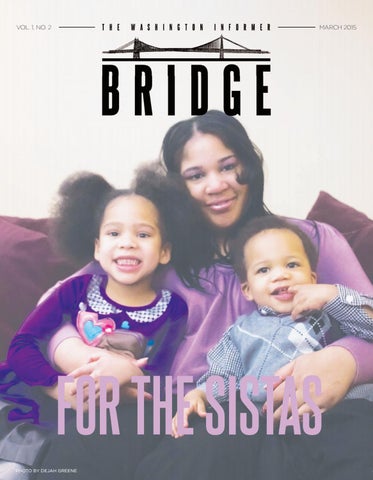
FOR THE SISTAS PHOTO BY DEJAH GREENE
CONTENTS
EDITOR’S LETTER
PUBLISHER Denise Rolark Barnes
N.O.B.E.L. Women Exposes Local Girls To STEM Field 2 Finding Collegiate Love in The District 3 Reesa Renee’s Melodic Vocals Provide More Than Music 4 Cookie Lyons 5 Yeezy Season Is Over 6 WI Viewpoints 7
ON THE COVER
Hi WI Bridge reader, Black novelist Toni Morrison once said that if the soul of a nation is to be saved, then women must become its soul. No quote, in my opinion, demonstrates the importance of the black woman to our long-lasting struggle for human rights and black self-determination than that of this award-winning author. Since the beginning of time, the black woman has served as the consciousness and spiritual leader of the black family, supporting her mate and nurturing her children. As a man of color with a loving mother and girlfriend, I too can attest to the power that the sista holds – whether she’s selling goods at a market somewhere in the Motherland or making ends meet for her family in the big city. In short, our women have done more for progress of the black diaspora than the history books, and many of our brother honestly, would like to disclose. However, fear not millennial readers! This issue of the WI Bridge, themed “For the Sistas” shows love to our black women of all ages by shedding light on how they’re
advancing in many spaces while showing the work that’s left to be done in uniting members of this demographic and addressing the pertinent issues that affect them. In this edition, we look back on a recent STEM conference for girls between the ages of 8 and 18 that took place in the Congress Heights neighborhood of Southeast. We also look at hurdles that women face in finding their perfect mate in college. Readers can also check out our writers’ musings about Empire’s own Cookie Lyons and Kanye West’s treatment of black women.
STAFF Sam P.K. Collins Editor-in-Chief
Chelsea Fuller Editor
REPORTERS
As you can clearly see, we cover a lot of ground in this issue. Please read and enjoy. If any thoughts come to your mind about what you saw, please send an email to wibridge@washingtoninformer.com. You might see your letter in the next edition.
Melvin Graham
Sean Hoggard
Until next time, Sam P.K. Collins Editor-in-Chief WI Bridge
Loren Saxton
MISSION STATEMENT The WI Bridge sets out to highlight contemporary issues through the experiences of youth and capture the progressive, entrepreneurial spirit of the Millennial generation other publications gloss over. Writers will take to streets and feature people, programs, initiatives, and movements that uniquely address prominent youth issues. This hardhitting coverage will lay to rest misconceptions of Generation Y and bring all to an understanding of diverse youth experiences. Cand’ace Burrell, youth minister at New Creations Christian Church and Ministries in Bowie, Maryland and mother of two, graces the cover of this month’s issue of WI Bridge. Burrell, 23, takes care of her children and congregation members while serving as a medical assistant at J. Richard Lilly MD ABFP and Associates in Hyattsville, Maryland. She said she considers motherhood to be rewarding and hopes to spread her love to others as head of a child care center in the future./ Photo by Dejah Greene
1 | WI BRIDGE
Ambre Tomlinson
PHOTOGRAPHER Dejah Greene
LAYOUT Kelcey Abney
N.O.B.E.L. WOMEN EXPOSES LOCAL GIRLS TO STEM FIELD By Sam P.K. Collins WI Bridge Editor-in-Chief @SamPKCollins A crash course in web development, conversations with movers and shakers in the tech industry, and computer games made for a fun-filled and informative morning at a local community center during the latter part of last month.
color, particularly those from lowincome communities. Locations of other gatherings included Louisiana, Alabama, and Georgia. Clanton said plans for “Girls, Gigabytes, * Gadgets” gelled in December 2014.
More than 100 young women explored the STEM industry and chatted those who work in various career fields during “Girls, Gigabytes, & Gadgets,” an event that exposed girls of color between the ages of 8-18 to careers in science, technology, engineering and mathematics.
“Our national chaplain and national president [hosted] one event,” said Clanton. “We wanted to show the girls something new and inspire them to be creators in this space. The older girls and making apps and the younger girls are learning coding. Our concentration has been in the District of Columbia and getting the girls exposed.”
“These young ladies use social media and technology but many of them don’t understand the back end,” said Waikinya Clanton, national executive director of the National Organization of Black Elected Legislative Women (NOBEL Women), the sponsor of the five-hour gathering at the R.I.S.E. Demonstration Center in Southeast.
how to handle themselves in a maledominated environment,” said Whitney Parker, a media specialist. Parker, 27, attended “Girls, Gigabytes, & Gadgets” with a student who attends a local high school that has a technology-focused curriculum. “I hope that my mentee becomes informed of how important it is as a woman go be involved in the STEM field. I also want
Since 1987, NOBEL Women, a coalition of more than 200 black women legislators, has worked to increase the presence of women in public policy and other career fields by addressing policy issues in the field of health, telecommunications, education, economic development and financial policies. Laura Hall, an Alabama legislator and NOBEL Women’s president, said “Girls, Gadgets, & Gigabytes” served as part of that mission.
While women’s presence in the STEM field has increased since the 1970s, this demographic remains largely underrepresented, particularly in engineering and computer science. Men gain employment in the industry two times the rate of their female counterparts, according to data recently collected by the U.S. Census Bureau.
More than 100 girls attended “Girls, Gadgets, & Gigabytes” at the RISE Demonstration Center in February. / Photo courtesy of Garrett James of www.CMediaUSA.com
(L-R) Alabama State Rep. Laura Hall and Waikinya Clanton, national executive director of N.O.B.E.L. Women, presented a young woman with a laptop during “Girls, Gadgets, & Gigabytes” at the RISE Demonstration Center in February. /Photo courtesy of Garrett James of www.CMediaUSA.com
Guests spent much of the morning attending workshops that touched on responsible use of social media and app development. During the event, youngsters took to social media and wrote about their experiences, using the hashtags #GirlsinTechnology, #GirlsShould, and #techmatters. The girls also frolicked through the venue, played video games and chatted with members of information technology organizations. The Feb. 28 session counted among four events that took place across the country as part of NOBEL Women’s effort to spark interest in science and technology among young women of
In recent years, the Obama administration and other leaders have tried to spur interest in the STEM field in marginalized populations, citing that members of this demographic need the skills to compete in an increasingly globalized, informationbased economy. Hurdles to breaking into the industry remain, however. According to the National Science Foundation, less than 10 percent of college educated black women who declared a STEM major obtained a bachelor’s degree in that field. “We need to empower our young ladies at a young age so as they move up in their careers, they’re able to comfortably hold leadership positions and know
her to network and figure what she needs to do to become more involved in the industry, in terms of what she needs to do and who she needs to know,” said Parker who lives in Silver Spring, Maryland. For Leila Khademian, “Girls, Gadgets, & Gigbabytes” provided an opportunity to break out of her shell and make new friends. Leila said she spent much of the morning playing computer games with other children and learning the basics of coding. “The group of girls I was with made me feel like I belonged,” said Leila, 8. “We taught our robot how to make a peanut butter and jelly sandwich and we later played a game where we had to come up with the right things to bring on a trip. I liked that game because when we got the answers right, we learned a lot about technology,’ said Leila, a Germantown, Maryland resident.
“The idea is to create an environment that positions women to become leaders whether they’re at a corporation, in the political world, or in the classroom,” said Hall (D-Dist. 19), who also attended the event. “We want to help them explore areas that could spark an interest. This event was a wonderful opportunity. The majority of people in the STEM field don’t look like us so it’s important that we look at this at an early age and help the young girls understand that if a man can do it, they can do it too.”
WI BRIDGE | 2
FINDING COLLEGIATE LOVE IN THE DISTRICT By Brianna Williams WI Bridge Contributing Writer @BriannaMone
Washington, D.C. is the second best city for single young professionals looking for love, according to the U.S. Census Bureau, ranking below Boston. However, the love life of many black women -particularly those studying and living on the city’s college campuses-- may not have a fairytale ending. Just ask Kenya Barnes*, a young woman who says she has been single her entire college career. “It’s hard [to date in D.C.] because there are a lot of these white, preppy, Georgetown-y couples and everyone thinks they’re cute” said Barnes, a senior at American University in Northwest. “You never see a black girl in a relationship like that, so it feels like it’s so easy for [white women] to find boyfriends.” Barnes -- who counts among the 44.4 percent of black women older than the age of 15 who are single in the District -- said that she often hears criticism of single black women’s focus on career and their high standards for men similar to those given to characters of popular shows like BET’s “Being Mary Jane.
said that her relationship allowed her to discover what she desired in a mate. “Being single is much easier now than during freshman year,” said Jones, a junior who studies film and tv production at Howard University in Northwest. “Initially, you want to get a college sweetheart, then you get a feel for the guys. There aren’t that many guys at Howard who have that potential that I’m looking for. I still want a relationship but not with any of the guys at my school.” Low enrollment numbers among black men might play a part in dating issues for women of color. According to The Journal of Blacks in Higher Education, black women account for more than 60 percent of black students in colleges across the country, which often causes problems for women who want to date black men exclusively and feel they have few choices.
she prefers old-fashioned, casual dating. “I don’t want to be in a relationship; it’s a lot of commitment that I’m not ready for, emotional commitment,” said Noel. Noel’s not alone. Heather Fishel, a writer at Campus Explorer says that many college students seek short-term relationships that allow them to focus on their career and academic goals. This sentiment has become the norm in the D.C. yuppie culture, becoming the aesthetic of the “typical” D.C. college student.
Laing said she finds it easier to stay focused on academic and career goals because she has someone there to support and motivate her. Ud Nnamdi, a junior political science major at Howard University, shares Laing’s sentiments.
Local college students Tatiana Laing and Daniel Nnaji have been in a committed relationship for a year. / Courtesy photo
Madeleine Noel*, a single sophomore broadcast journalism student at American University (AU) said she’s not looking for a relationship at the moment, believing that college men are informal with their intentions, shy from commitment and lack any sense of chivalry. She said that’s why she decided to take a step back from dating and better herself.
Another reason that some college-aged women remain single centers on previous experiences they say show that the men on campus don’t fulfill their needs. Aliya Jones, a student who broke up with her significant more than five months ago, 3 | WI BRIDGE
“I think it’s interesting to be in a relationship as a 21-year-old because it’s expected that you’re not,” said Tatiana Laing, a junior who studies Communications, Legal Institutions, Economics and Government at American University. She has been in a committed relationship for one year. “When you go out into a social setting, guys will still come up to you. I think it’s weird, actually. I enjoy it but in terms of being a young woman in a city, it is confusing for other people. It’s not very common,” said Laing.
But some people like J.J. Smith, BlackNews.com’s dating and relationship expert, supports this point, saying that many young women of color are making a conscious decision to be single, preferring to work on themselves.
“I feel like college is where you really explore who you are,” said Noel, who has gone on numerous dates while in college, recounted an instance when a young man offered her food stamps in exchange for her paying for their meal. “I don’t want to be in a relationship. I think I won’t find love here because this is the time for me to fall in love with myself.”
On the other side, college women in the District who enjoy committed relationships are far and few between. Finding “the one,” let alone finding love in college may be a thing of the past for some but those who are in a relationship still believe there is still hope for marrying their current significant other.
Farah Saunders, a student at American University in Northwest/ Courtesy photo
“I feel like most the guys here are gay,” said Farah Saunders, a junior broadcast journalism major at AU. “Two, I don’t find white boys attractive. I like my black men and I think there’s nothing wrong with that. The black men at AU don’t like the black women at AU.” Regardless of campus limitations, some women say they are open to exploring alternatives,such as hooking up and situationships -- relationships with unresolved conflicts which students may confuse as legitimate dating. But Noel said
“When you’re in a relationship, you have to make time to commit to those other responsibilities that you have [outside of your relationship],” said Noel. “I feel like being in a relationship will take away from the time that I have to focus on me. I don’t want to say I’m not the relationship type but just not right now.” It may seem as though being single, without anything else, isn’t enough for college women in D.C. but most see this time as a time for exploration and living life. “Being single is not a bad thing,” said Jones. “It’s actually beautiful. Once you fully embrace it, it can really be something great and one of the greatest moments in your life. You don’t start living once you get in a relationship, you’re living now in your singleness and you should learn to live in your singleness.”
Nnamdi, who had been in three relationships in college, prior to her current boyfriend believes that she has finally found the one. “I know we’re going to get married,” said Nnamdi. “We complement each other. In the areas I’m weak, he’s strong and vice versa.” Contrary to Fishel’s observation about causal relationships, Laing believes the purpose of dating someone is that you see yourself with them in the future, not just for hookups and romantic gestures. “I wouldn’t have gotten into a relationship unless I thought [marriage] was a possibility,” said Laing. “The way I look at life in mind, then the answer would be ‘yes.’ Is there a date and time on that, ‘no.’ It’s not an absolute but that’s my point of dating someone because you assume that it is possible.” *This name is a pseudonym.
REESA RENEE’S MELODIC VOCALS PROVIDE MORE THAN MUSIC By Ambre Tomlinson WI Bridge Contributing Writer @Missgreeneyez
Every now and then, an artist comes with a voice of a sultry siren that soothes like a balm, the face of an angel and a warm personality that connects with supporters. Prince George’s County, Maryland’s own Reesa Renee fits the profile and with a sophomore album in the works, she has chosen to share the highs and lows of her life and musical journey. “There is no cookie cutter plan to achieving your dreams, but one strong key to success is being comfortable with yourself,” said Reesa Renee, who says she’s no stranger to discomfort. Her life hit a low point in 2008 when two friends died in a car accident. She said depression loomed over her like a gray cloud, leaving her feeling empty, without purpose, and in need of an emotional outlet. Reesa didn’t always sing to ease her pain. She fondly recalled spending countless hours journaling in her younger days: “I would go through the house writing down everything I saw and how I felt about it”, Reesa said, noting that the practice often brought her peace. While she loved music, Reesa said she enjoyed it as a listener more than an artist. But some friends and family who heard Reesa’s voice encouraged her to put it to use. . Reesa’s brother, PKay the Producer, created several ballads that would help her create songs of her own and pull herself through dark periods in her life. “Bringing the pain to the surface while writing lyrics made me truly look at myself,” Reesa said. Reesa realized she needed help. Removing herself from the darkness she’d fallen into became increasingly difficult. Though she battled with these feelings privately, her music started to gain positive attention from listeners in the D.C. metropolitan area, many of whom grew inspired by her lyrics. As her popularity grew, Reesa knew she had to close old chapters in her proverbial book of life before opening new ones.
While recording her first album, Reelease, Reesa discovered that she had bipolar disorder. All of a sudden, the tribulations she struggled with most of her life began to make sense. She finally gained control of the emotions that had held her captive for so long.
“Controversial” on WPGC 95.5 FM. Reesa’s independent success has encouraged her to break into the entertainment industry in other ways, one of which being a flourishing modeling career. She recently finalized
In 2011, the Sam Bone Group discovered Reesa during her performance at a small North Carolina club. Sam Bone began an official artist launch for her shortly after. “Unlike many overbearing managers, Sam teaches me while still giving me the freedom and encouragement to be myself and develop naturally,” Reesa stated.
In addition to her community service efforts, Reesa wants her music to serve as an escape for those who feel trapped by negative energy. She often includes a “breakdown” section in her songs which she affectionately calls “The Jam-Out Section.” Reesa said she wants her audience to get lost in this section, and feel a small sense of freedom in it. “I want my music to embody what the feeling of discovering my voice did for me.” Reesa added, “I want my audience to feel that empowerment and that peace of mind.” Photo courtesy of Brian James
a sponsorship deal with SportsZone Elite, retaining full creative control over monthly photo shoots for the brand showcasing her favorite items. Reesa
In April 2014, Reesa Renee performed before hundreds of people on the grounds of St. Elizabeths East Campus in Congress Heights during the Broccoli City Festival. / Photo courtesy of Mogul Malik
Now Reesa Renee is busy learning the rules of the music business. She is quite eager to share the new songs she has been diligently working on. Her music has taken a funky, eclectic turn while still retaining its original soulful sound. “Recording this second album has challenged me vocally,” Reesa said. She then added, “I am now taking chances I would not have previously and that is helping me discover what qualities resonate best.” Fans who can’t wait for her new album to drop in the late summer can hear her singles “Invisible” -- a tribute to her deceased friends -- and
she often advises her mentees to “work hard as if no one is watching and carry yourself like everyone is [watching you].” Reesa strives to inform them of all the opportunities available to them. She inspires her mentees with the faith and fortification to overcome prior circumstance and persevere.
had a photo shoot and studio session at Converse-owned Rubber Tracks studio in Brooklyn, New York. Identifying with those who struggle, Reesa says she feels a personal responsibility to her listeners, especially those who suffer from an undiagnosed mental illness . She also expressed her hopes to connect with the people dealing with societal pressures and expectations and expectations of others through The Reelease Foundation, a support system that provides help for those suffering from mental illness similar to what she endured. Reesa also works with the East of the River Police Community Partnership in its effort to mentor formerly incarcerated youth who live in group homes. She said
Each accomplishment pushes her further toward her dream of being an internationally recognized recording artist, but she remains humble and patient. Reesa Renee reminds herself of a quote by one of her inspirations, famed drummer Travis Barker, “Nobody cares, go harder.” The irony is while she continuously improves herself the fans continue to care every step of the way. They always have.
WI BRIDGE | 4
COOKIE LYONS: CONVERSATIONS AND CRITIQUES OF REPRESENTATIONS OF BLACK WOMEN ON PRIMETIME TELEVISION Loren B. Saxton, Ph.D. WI Bridge Contributing Writer @Ms_LorenS For all the reasons I should hate Fox’s Empire, I absolutely love it, and I specifically love Cookie Lyons, Empire’s leading black female character. Cookie, played by Taraji P. Henson, captivates audiences with her slick words, sharp wardrobe and unwavering love for her family and family’s hustle. As Empire’s ratings increase each week, so does the bewilderment of how a primetime television show with a predominantly black cast and leading black female character continue to break viewership records.
Enterprise, Luscious’ music production business. After her release from prison, Cookie is fighting to regain trust from her and Luscious’ three sons, and also claim economic and political power as part owner of Empire Enterprise. Cookie owns her vulnerabilities and flaws. She is unapologetic about her disdain for Luscious’ new fiancé, as she willingly shares details about her sexual affairs with Luscious. Cookie is not bashful about demanding respect from her ill-mannered youngest son, as she whoops him with a broom handle. Photo courtesy of Slate
indeed conditioned, not wholly liberating. As her fans on Twitter recognize, Cookie is not one-dimensional, and neither are black women, which is why I argue black households, specifically black women, tune in to Fox each Wednesday to watch Empire. I identify with Cookie. I identify with her sometimes, inappropriate outward display of raw emotion, and the simultaneous innovative, creative and strategic black female music producer. “Cookie is flawed but embodies many of the characteristics that we know to be true of black women: she’s a hustler, she’s driven, she’s loyal, and she’s willing to do whatever necessary for her family. That speaks to black women on so many levels,” said Dr. Harris.
Photo courtesy of Essence
While Fox’s Empire taps into the strength of the black audience, the power of black Twitter and the popularity of Hip-Hop on television, Cookie’s character speaks to a particular demographic that has historically been absent from primetime television—black women. Kerry Washington, as Olivia Pope on ABC’s Scandal, is the first show on primetime television in thirty years with a leading black female character. Since Scandal, Viola Davis, as Annalise Keating on ABC’s How to Get Away with Murder, and now Taraji P. Henson as Cookie Lyons on Fox’s Empire, contribute to the current representations of black women on primetime television. In Empire’s premiere, Cookie Lyons, the ex-wife of Luscious Lyons, played by Terrence Howard, served 17 years in prison for drug charges. We later learn that it was Cookie and Luscious’ drug sales that helped build Empire 5 | WI BRIDGE
She is street smart and business savvy. Cookie’s character seamlessly exists and thrives in her old neighborhoods of Philadelphia and in the boardroom of Empire Enterprise. “I appreciate Cookie as one representation of black women, and it is one that I love,” said Dr. Felicia Harris, 26, a cultural and media studies scholar at The University of Georgia. Cookie is located in what feminist scholar and activist bell hooks, identifies as the margins. In the margins, hooks argues that black women have a unique position and vantage point that enable us to critique discriminatory and hegemonic practices, and help create practices of resistance. Empire’s Cookie portrays some of the simultaneous struggles and advantages of living in these margins, and also conveys how counter-hegemonic practices or practices of resistance are
Empire is not without its critics. Some criticize Cookie for her perpetuation of stereotypes of black women, and struggle with making the decision to support the show. Cookie is overly aggressive and fits into many of the stereotypes perpetuated by other Black female characters, such as Mary Jane and Olivia Pope, said Ka’Lyn Banks, who is 24, of Sacramento, Ca., and an assistant teacher in primary education in KIPP schools in Washington, D.C. While Empire features a black-owned music company, built on drug money and sustained by violence and deceit, the show also grapples with and critiques various aspects of black culture, specifically black women. And, cultural critiques should be embraced in pop culture and black communities. “Cookie is what you expect from a black mother. There are some Cookies in my family, but I am not Cookie,” said Banks, co-host of The Link Up podcast, which
focuses on social, cultural, political and economic issues from an unapologetic black female millennial perspective. “I feel like black women are boxed in, and I guess I need to just accept that.” However, if viewed as a cultural critique, Empire challenges us to engage in more critical conversations about black cultures and representations of black cultures on television. It creates space for discourse on how Cookie both limits and empowers black women. Many polarized and uni-dimensional critiques of television shows that depict Black cultures call into question damaging stereotypes, and fail to explore how characters on primetime television are just a representation, not the representation of black cultures, or black women on television. As a critique, we can appreciate Empire and Cookie as both entertaining and intellectual texts that serve as call-toactions for black women, and black communities. As television networks finally recognize and begin to take advantage of the power in black television audiences, we must continue to the fight for more diverse representations of black women and black cultures on primetime television.
YEEZY SEASON IS OVER By Tia Dolet WI Bridge Contributing Columnist @TiatheDiva
With a new album in the works and the release of an exclusive ADIDAS urban sportswear line, “Yeezy season” is approaching. However, I will not be taking part in any of the seasonal festivities. Hailing from Chicago’s south side, and the son of an English professor, Kanye West was once categorized as one of the more socially conscious rappers of our generation. But lately, the visions of this self-proclaimed visionary no longer seem to support black people—and especially not black women. My teetering relationship with Kanye has reached a morbid ending. As a teenager, I fell in love with West’s artistry. College Dropout helped me understand how the world still viewed black people and yet made me feel immensely proud of my heritage. Late Registration ironically eased me through the college application process and Graduation kept my head held high during my freshman year at a predominately white institution. Four years ago, when I became an educator, “We Don’t Care” quickly became the most played song in my iTunes. The lyrics served as a daily affirmation of our children’s brilliance and tenacity. Then came Kim Kardashian. This should have been a complete deal breaker, but after all the heartbreak he had endured after his mother’s passing, I tried to find the silver lining in his newfound love interest. Upon the arrival of the couple’s first child, Kim shared a blog post alleging that she didn’t know racism still existed. “To be honest, before I had North, I never really gave racism or discrimination a lot of thought,” Kardashian stated in the essay. To me, Kim’s statement proved that she had looked at black men as novelties— these stereotypical hyper-masculine and hypersexual beings—rather than focused on their rich history and resilience, which, to me, is the essence of their beauty. I could not believe that Kanye would choose a life partner who knew nothing about the key messages of his life’s work. Now week after week we are bombarded with photos of them portraying this modern day interracial Barbie & Ken power couple, dragging poor baby North along for the ride as an accessory. But I am not buying it. And from many conversations I have had with my black
peers, they aren’t either. So we let him be. We let him keep up with the Kardashians. I was starting to accept that the Kanye West, who said what so many of us had been thinking on live television after the Hurricane Katrina devastation, was gone. In 2014, rallied, marched, protested, and spoke out against the injustices of our slain unarmed brothers and sisters…where was Kanye?
“broke Black men.” I don’t know how they do it in the Chi, but the broke black men in my neighborhood don’t seem to have a problem finding these “rare” equal-opportunity-brother-dating white women. Then, given the context of Kim’s 2013
I waited for him to release a statement, make an outburst at an awards ceremony, write a verse— but nothing. Nevertheless, after blatantly turning his back on the black community he once stood by through literal hell and high waters, it now seems like he is on a national campaign to get us to accept his white wife. First came his Breakfast Club interview, which got worse as it progressed, but started with a gunsblazing attack on his exgirlfriend Amber Rose. West said he had to take “thirty showers”, having been with Rose, before he could get with Kardashian. Now, I am not one for slut-shaming, but I felt like it was an insult to our Photo courtesy of PopSugar intelligence to hold Kim up as this high-standard of purity when “wow, life sucks for black people” none of us have forgotten the fact that her dissertation, Kanye’s address took yet career, and her family’s, stems from her another weird turn. He retold a story he sex tape. claimed Kim shared with him where her father, Robert Kardashian, had “nigger Kanye’s crusade for Kim Acceptance lover” written on his Bentley after was just getting started. The first topic of defending O.J. Simpson in the infamous his BET Honors speech was not about his 1995 murder trial. The late Kardashian creative process, or his inspiration/s of was quoted saying to young Kimberly all the many visions he so freely shares, that “one day, you may have a black but rather about how thrilled he was that child—a beautiful, beautiful, beautiful Minister Louis Farrakhan did not shun black child. And it’s gonna be hard. him for not marrying a woman of color. You’re gonna see how hard it is.” And The statement felt a little out of place what do you know—now she has a Black for the occasion, but the awkwardness baby and has seen the light! did not stop there. He went on to say that people used to tell him that when Now, if I were to believe that story he got famous, he would start dating was true, what was Kanye’s purpose white women because white women of retelling it a Black Entertainment love rich black men. Kanye wanted to Television program? I think he honestly make it clear that his wife was not one of believes that the opposition some people those women because she has also dated in the black community have towards
their Kimye union is because she is white—I disagree. It is because she is Kim Kardashian. I don’t know Kim personally, but having seen enough of her extensive catalog of reality show footage, and the fact that she has an actual published book of Instagram selfies, so I feel confident in making this conclusion—Kim Kardashian is the very “corporation” Kanye once warned people about. She does not stand for social justice and in fact, knew nothing of it. Her industry is built on materialism, vanity and exploitation. We all know Kanye loves himself, so I can understand that aspect of their relationship, but he also used to love his people. My departed Kanye, never forget that it was a black woman who held you down when you were trying to get discovered, a black woman who helped nursed you back to health after a neardeath car accident, and a black woman who comforted you in your time of grief after losing the beautiful black woman you sang an ode to on every album. We have been here--even the black women like me who felt uplifted and valued in your (non-mainstream) songs. And now, you have a black daughter. She is no less immune from the systemic racism that fuels this country. A husband should put his wife on a pedestal, but to hear this conscious black man continuously make statements to elevate the race of his non-black wife is unsettling to my black womanist spirit. In numerous interviews and songs, he states the frustrations he experiences while pitching new ideas and having companies not take him seriously ---looking at him as “the black guy”. But now, he so often makes references to being a black man with “a white woman” . Kanye has always been an offbeat and unapologetic guy, which to me, used to be some of his best qualities. So now after all these proclamations glorifying his white wife, why is he seeking out black approval to validate their relationship? It’s 2015—we don’t care that you have a white wife, Kanye. We care that you have an oblivious and superficial wife. We care that you are no longer defending our rights and our communities. We care that you called a predator “smart”… but that’s a whole different topic. I am tired and can no longer “Stan” for an artist who does not stand for me. WI BRIDGE | 6
WI BRIDGE VIEWPOINTS
Each month, a WI Bridge reporter hits the streets, asks the questions that matter, and compiles the best responses for readers to see. Do you have a suggestion for a Viewpoint question? Email wibridge@washingtoninformer.com and you might see your inquiry in a future issue.
Answers compiled by Brianna Williams
What’s one life lesson that you would pass down to your daughter? How do you feel about women in the entertainment industry negatively speaking about each other? How does this affect women’s morale in society?
“God loves you; His love is all you’ll ever need. Do everything in your power to make sure you never forget that.”
Jamella Vanegas, 31, Northeast
“This affects women in society negatively, especially women of color, because it makes them feel like they aren’t worth anything. It’s like in order for them to be worth something, they have to be white.”
Zuliana Burnett, 19, Northwest
“If it’s one thing you can guarantee, it’s your honor and your name. Always be mindful of that and always remember your values because those are the things that stick with you when people don’t.”
Mariatu Santiago, 21, Northwest
“I think it’s reductive, especially that certain situation. Entertainment and media feeds off that. [When it comes to the Amber Rose/Kim Kardashian issue], you don’t have any blame being put on Kanye who said some degrading things about Amber Rose. It’s degrading and We should support each other.” Elisha Brown, 19, Northwest
“The bad things that happen to you as a child may shape who you are, but they are nothing compared to who you will become.”
Janicia Moore, 24, Northwest
“I think that it needs to stop especially when it comes to women. We have to be supporters of each other. We need to be helping each other to get to where we need to be to fulfill our potential and own who we are.”
Ashley Williams, 26, Tyson’s Corner, Virginia
YOUR BUSINESS COULD BE ADVERTISED ON THIS PAGE. For more information, send inquiries to WIBridge@washingtoninformer.com