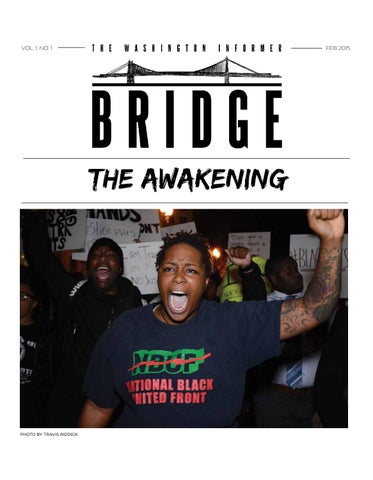
VOL. 1, NO. 1
PHOTO BY TRAVIS RIDDICK
FEB 2015
CONTENTS
EDITOR’S LETTER
PUBLISHER Denise Rolark Barnes
WI Bridge Viewpoints 2
Hi WI Bridge reader,
Local Students Explore District’s History 3
Mass movements never occur by happenstance. They often come about with time, a boiling frustration about unaddressed wrongs, a burst of confidence within each individual about the change they can affect, and intense behind-thescenes planning.
Hashtag LunchBag DC 4 Ward 8 Candidates Continue Barry’s Legacy 5 The Complex Simplicty of Change 7 Local Artists Grab the Reins of Hip Hop and Spread Positivity 9
That’s how the WI Bridge came into fruition. For nearly a year, I along with a team of journalists and photographers, grinded our fingers to the bone to put together a publication for young people in the D.C. metropolitan area, in the country, and around the world. This magazine would follow in the tradition of black publications that preceded it by highlighting the positive aspects of the black Millennial experience and tackling issues specific to our demographic. Along the way, I watched as brothers and sisters in the struggle took to the streets of Ferguson, Missouri, New York City, Washington D.C., and other cities around the country to rail against white privilege and a criminal justice system bent on eradicating black lives. During that time, I grew more disappointed, angry, but unsurprised by the non-indictments of the police officers who took the lives of Mike Brown, Eric Garner, and countless other people of color. I also engaged in conversations with my fellow millennials, wrote articles about youth forums, engaged in heated online debates with people who held antiquated views about race, all while building the foundation of this project. The experiences of the last 12 months have given me a greater resolve to put our youths’ words to paper for the entire world
to see. In this issue of the WI Bridge, themed “The Awakening,” our all-star staff of millennial reporters explore the waning popularity of President Barack Obama among young people, chat with a duo of local college students who learned about D.C. history through the stories of longtime residents, and highlight a nonprofit’s attempt to mobilize young professionals and raise awareness about homelessness through social media. This issue also explores the field of millennial candidates vying for the late, great Marion S. Barry’s Ward 8 Council seat and takes a close look at an artistic movement that promises to take the local and national hip-hop scene by storm. It’s my sincerest hope that you enjoy reading this publication as much as we enjoyed putting it together. Nothing gives me more joy than conversing with my fellow young people about things that matter and showing our elders that the ongoing movement for human rights is in the right hands. Before I sign off, I would like to give a shout out to the Washington Informer for the continuous support. I would also like to acknowledge Denise W. Barnes, the paper’s fearless editor and my mentor to whom I dedicate the inaugural issue of WI Bridge. May the world believe in our vision and take part in the journey of what’s destined to become one of the greatest millennial publications of the 21st century.
STAFF Sam P.K. Collins Editor-in-Chief
Chelsea Fuller Editor
REPORTERS Melvin Graham
Sean Hoggard
Loren Saxton
Ambre Tomlinson
PHOTOGRAPHER Travis Riddick
MISSION STATEMENT The WI Bridge sets out to highlight contemporary issues through the experiences of youth and capture the progressive, entrepreneurial spirit of the Millennial generation other publications gloss over. Writers will take to streets and feature people, programs, initiatives, and movements that uniquely address prominent youth issues. This hard-hitting coverage will lay to rest misconceptions of Generation Y and bring all to an understanding of diverse youth experiences. 1 | WI BRIDGE
WI BRIDGE VIEWPOINTS “What part can you play in fighting institutional racism against people of color?” Answers compiled by Merdie Nzanga
“As a college student, I can play a role in fighting institutional racism on both a “macro” and “micro” level, whether by going and actively protesting racism and policies that perpetuate hatred or by actively talking about race with my friends and their friends on campus. I think the micro level is important to me because, if we can put names and faces to people of different races, we are slowly but surely educating ourselves about the complexities of people as a whole and eventually rejecting the stereotypes that have been ingrained in our minds by the same institutions set on creating a divide within the American people.” Ron Jordan, 20, undergraduate student at American University in Northwest Washington, D.C
“As a white person, I think it’s important to examine my own privilege and actions so I can challenge racist things I observe and hear whenever possible.” Bjorn Harlson, 20, a student at Western Washington University
“Institutional racism is an issue that will never go away, unfortunately. The intuitive method to fight institutional racism is being the best person you can be. As an African-American, if I were to encounter a racist, I’d treat them civilly.” Shaheed M. Morris, 25, undergraduate student at South Dakota State University
“I am currently organizing a faith, race, and law event to be held in my dorm. I will invite scholars, local officers, students, and members of our surrounding community to have an open forum that facilitates a greater understanding between the different factions affected by the issue of police brutality. In the future, I hope to help combat institutional racism on a broader scale by restructuring institutions such as the international criminal court so that international justice is not unfairly levied against African nations.” U. D Nnamdi, 20, undergraduate student at Howard University in Northwest Washington, D.C
“The most important thing any individual can do, is to personally reject racism in his or her own life. While anyone may mentally slip up occasionally, people need to make an active effort to first start with themselves when combating the problem.” Ford Fischer, 20, undergraduate student at American University in Northwest Washington, D.C
“How do you feel about the representation, or lack thereof, of black artists at this year’s Grammy Awards?/ Should black artists look to the Grammy’s for validation?” Answers compiled by Brianna Williams “The Grammys are supposed to be this awards show where artists get accolades but we keep seeing Beyonce and Kanye West. As an organization, the Grammy’s aren’t making much of an effort to find new black artists that are actually well in their artistry.”
“They didn’t hand out any hip-hop awards on stage, so those people didn’t even get their chance to say a few words and be represented physically. I think that was disrespectful to the black community because that’s part of the reason why we watch the Grammys; to see our people get awards and be celebrated. All we got was the fine print.”
Justice Mirzakhani, 20, Houston Tatiana Laing, 21, Piscataway, N.J.
“If you want your music to be on the Grammys, you have to make music that is uplifting to people, in order to reach another population or set of people. Most music out now, the rappers, half of them I don’t understand what they’re saying. If I’m the director of the Grammys, I’m not going to put you on if I don’t know what you’re saying.” Jonathan McCray, 21, Southeast
“You should feel proud if you have it [validation]. But I don’t feel like that should be the goal. I hear a lot of artists say, ‘It’s every artists’ dream to win a Grammy,’ which is cool but what about the Soul Train Awards, the BET Awards? Why don’t we value our own? Why do we value theirs?” Nicholas Pierce, 20, West Chester, Penn.
“Unfortunately, the Grammys are more of an elite awards show, so it’s understandable why artists feel like they can go and receive high esteems there. The BET Awards is different. People want to be recognized nationally, on a higher scale, beyond anything having to just do black entertainment.” Tiffanie Yakum, 19, Brookville, Maryland
WI BRIDGE | 2
LOCAL STUDENTS EXPLORE DISTRICT’S HISTORY Sean Hoggard WI Bridge Contributing Writer @lyrikal_202
For two University of the District of Columbia (UDC) students, learning about the history of the city they were born and raised in served as an exciting and informative experience. The duo – Francies Stephenson and Jacqueline Harris – spent a semester interviewing longtime District residents and understanding how much the city has changed in recent decades. The activity counted as part of a final project for their D.C. History class last spring.
Francies Stephenson/ Photo courtesy of BGuthriePhotos
“Initially, I dreaded doing this assignment because I thought I would be invading someone’s space,” said Harris. For her project, Harris interviewed Eleanor Banks, retired federal government employee and local volunteer. “As I went through the process, I got excited as my subject became more relaxed and really opened up about her life experiences. It was very educational,” said Harris. For a semester, Stephenson, Harris, and other students in Amanda Huron’s D.C. History course brainstormed who they would interview for their final project, drafted proposals, conducted hours of research, met with their professor in the library during the weekends, and practiced their presentation before their fellow students. In the fall of 2014, Stephenson and Harris summarized their findings before dozens of people at the annual D.C. Historical Studies Conference. Harris reflected about her meeting with Banks and Stephenson
3 | WI BRIDGE
touched on what she learned about local poet and activist Luci Murphy.
“I wanted students to get a new perspective about D.C. and notice how it has changed,” said Huron, assistant professor of interdisciplinary social studies at UDC. “I could tell that the students were excited to present their work in public after I announced that they would have a chance to present at the conference,” In the course of completing the project, Harris learned about how Banks moved to the District from Cleveland during World War II with just a high school diploma and membership in the National Honor Society. Eventually, Banks gained employment with the federal government as a GS-2 clerk typist, rising in the ranks until she retired as a deputy director of contractors and compliance equal opportunity officer at the General Service Administration. Harris said she enjoyed learning about the 92-year-old elder’s wealth of experience and service as an elementary school volunteer for D.C. Public Schools. “When I was first given this assignment, three people came to mind as possible subjects but I decided to go with Ms. Banks because of her age,” said Harris. “It did not take long to complete the project. There were two interviewing session that lasted an hour each. It took about two days, one day for each session to type the interviews out,” said Harris. During her interview with Murphy, Stephenson learned about the poet’s experiences as president of the D.C. League of Women Voters, and a member of the steering committees of the People’s Music Network and Washington Innercity Self Help, an affordable housing organization.
Stephenson said that Murphy’s tenure as a convener of the Gray Panthers of Metro D.C., an associate producer of Sophie’s Parlor Women’s Radio Collective at WPFW 89.3 FM and a member of the Community Coalition for Peace and Justice particularly intrigued her.
“A couple months passed before I decided to interview Ms. Murphy, who I affectionately call Auntie Luci,” Stephenson said. “I wanted to talk to her because I liked her personality, and I could sense that she’d have interesting stories to tell. It took me about two months to complete my part. I was very excited to work on this project but also nervous because I wanted it to be perfect. I’m from D.C. and I wanted to represent my hometown in the best way possible,” said Stephenson. After the student presentations, members of the audience asked questions. Derrick Musgrove, an associate professor of history at the University of Maryland, Baltimore County and a panelist, critiqued the students’ presentations and noted that D.C. has made a transformation from the “Murder Capital” to “Boomtown.” That’s a lesson that Stephenson said she took with her at the end of the project, a journey she said made her love her hometown more than ever. “I didn’t appreciate D.C. when I was growing up,” said Stephenson. “It took me having to stay home for college to really get sense of the city’s true essence and its people. I feel a greater responsibility to give back and to affect change in the city.”
HASHTAG LUNCHBAG D.C.: Millennials, Social Media, and Activism Loren Saxton, Ph.D. WI Bridge Contributing Writer @Ms_LorenS
More than 100 slices of bread cover a 10foot table, surrounded by nearly fifteen volunteers wearing plastic gloves. A few people squirt one line of mayonnaise, and then two dots of mustard on each slice, while others follow behind layering lettuce, tomato and bologna. The second slice of bread is added, topped with a cookie and put in a plastic baggie. Just before each sandwich is placed in the lunch bag, a sticky note of encouragement is stuck to it. One reads, “I believe in you.” Hashtag LunchBag D.C. meets the last Sunday of each month at Bar Louie to pack and distribute lunches. Last month, more than 80 volunteers packed and distributed 600 plus lunches at Franklin Square and the Community for Creativity NonViolence (CCNV) Shelter in Northwest Washington, D.C. Volunteers followed, liked and shared the hashtag, and most importantly, showed up to work. Hashtag LunchBag D.C. is one concrete example of how local Black millennials are using social media to raise awareness of homelessness and hunger, organize and enact change in the local D.C. community.
“It’s a rewarding experience in several ways. It’s an opportunity to serve and really see that you’ve made a difference even in a small way,” said Deandra Duggans, 30, of Washington D.C., who has volunteered with Hashtag LunchBag D.C. since August 2014. “It means a lot to be able to put a smile on someone’s face who may not be in the best situation, but they’re making the best of it.” Figures released in May 2014 detailed that the homeless populations in D.C. increased by 13 percent in just one year. The report attributes this increase to growing poverty
rates, rising costs for rental properties, and lack of affordable housing in the city. Hashtag Lunchbag D.C. distributes lunches to those in need who are sheltered and unsheltered.
A group of volunteers work together to make more than 600 sandwiches at Bar Louie NW. / Photo courtesy of Loren Saxton
Hashtag LunchBag D.C. couples its social media strategies with word-of-mouth strategies to brand itself, raise awareness and donations and organize monthly volunteer events. And it’s the combination of these efforts that contributes to the ongoing success of digital and online activism, said Allissa Richardson, professor in the Department of Communications at Bowie State University. Millennials are digital natives, and the most avid users of the Internet, according to Pew Research Center reports. While millenials are using social media to help build personal networks, Brookings Institute found that millennials are also using social media platforms in a political capacity, engaging in nontraditional forms of activism. When an organization’s primary method of solicitation of donations and volunteers is social media, an increased and effective social media presence is essential.
“Millennials can use social media to brand their ideology,” said Richardson, who is also the coordinator for the Emerging Media track at BSU. “Social media builds awareness and consensus, but millennials must remember the importance of physical presence. Boots on the ground paired with social media creates more power.” As Hashtag LunchBag D.C.’s followers on Facebook and Instagram increased, more volunteers joined the movement, said Jenee Cannady, 32 of Upper Marlboro, Md., and social media coordinator for Hashtag Lunchbag D.C. In March 2014, 20 volunteers packed and distributed 160
lunches. Almost a year later, the number of volunteers and packed lunches has grown significantly. “We started very small, but we wanted to expand our reach,” said Raven Stroman, coordinator of Hashtag LunchBag D.C. “We use Instagram to showcase the actual event because there is power in images. We share pictures taken by volunteers at our event and there is power in authenticity.” Hashtag LunchBag was founded three years ago in Los Angeles when a group of friends wanted to distribute well-balanced meals to those in need in their local community. After sharing their experience via social media, people in cities across the nation requested to participate in the movement to help end hunger. While the organization’s efforts point to social media as not just technology, but a platform for action and community organization, it also points to an ongoing issue in major metropolitan cities across the country— growing homeless and extreme poverty populations. “I’m a native Washingtonian and am always excited to give back to my hometown. It’s my responsibility,” said Duggans. “What’s also been awesome to witness is the growth of the group each month, the amount of young people who are getting involved and the power of social media.”
WI BRIDGE | 4
WARD 8 CANDIDATES CONTINUE BARRY’S LEGACY By Melvin Graham WI Bridge Contributing Writer @_MelG_
Not anyone can be granted the moniker of “Mayor for Life.” It must be earned by someone who has gained the high regard of the people after years of public service. So when the former, while ceremoniously perennial, D.C. Mayor Marion Barry passed away last November and left his Ward 8 Council member seat vacant, the civil rights icon received an outpouring of love from hundreds of thousands of Washingtonians. The vivid stories about Barry’s impact on residents’ lives during his half century of service foreshadowed discussions about who will follow in his footsteps and win the Ward 8 D.C. Council during a special election on Apr. 28. “Twenty-five people picked up petitions to run in the Ward 8 race and 16 people returned to submit those petitions with signatures,” said Denise Tolliver, spokesperson for the D.C. Board of Elections in Northwest. “I agree that Barry’s history and community ties were reflected in his political decisions. It may be interesting to see how the past of each special election candidate affects how they seek to affect Ward 8’s future.” The Ward 8 special election will give constituents an opportunity to decide who’s best equipped to fix the dismal conditions in the region. As of Dec. 2014, Ward 8 has an unemployment rate of 17 percent, the highest of any area in D.C. according to data from the District’s Department of Employment Services in Northeast. The Metropolitan Police Department reports that more than 120 violent crimes have been reported in the ward thus far in 2015. Sometimes, those facts can be hard to swallow for some people like Cynthia Simms, In January, Kevin Owens, 22, and Phillip Jones, 17, were gunned down by men just as young as them weeks after Simms became advisory neighborhood commissioner for Single Member District 8A03. 5 | WI BRIDGE
“We can’t be scared of the young people in our community. We need to find out what they want and make it their community too,” said Simms, 62. Simms said she believes that giving children hope for the future through vocational schooling and a recreation center will simultaneously drive economics and stave off violence in the ward.
build bridges for the people,” said Trayon White, 30, a community organizer and one of the youngest candidates for Barry’s old seat. White, who lives in Washington Highlands in Southeast, said he can be an effective council member because he has worked in the interest of Ward 8 residents for more than a decade.
For Ward 8 residents, change may be on the horizon. The once deteriorating St. Elizabeths East Campus now serves as a homeless shelter and the location of the RISE Demonstration Center, which houses a lecture hall, computer lab, and classroom spaces. Last August, Barry counted among the local officials and community leaders present at the ribbon cutting ceremony for the community center in Congress Heights. Barry, then 78, had spent most of his life as a civic leader. His involvement in D.C. politics started in 1965 when he moved to the District - then a majority-black city with no representative local government - to head the local Student Nonviolent Coordinating Committee office. In that role, Barry made measurable progress in addressing key issues, including public transit fare increases and a lack of job training programs for black men - without holding an elected position. Barry’s grassroots involvement informed his decisions as a board member of D.C.’s State Board of Education and later one of the city’s first council members. In those roles, he tackled internal discord and wasteful spending. Barry’s concern for fiscal efficiency carried over to his first term in the Mayor’s office, during which his administration generated a budget surplus which paved the way for city offerings including Barry’s flagship summer youth employment program, posthumously named after the politician. “[Community activist] William Lockridge and Marion Barry showed me how important it is to be at the table to help
Trayon White, 30, said he wants to be the change his community needs. / Photo courtesy of Trayonforward8.com
As vice president of Frank W. Ballou Senior High School’s student government association, White organized the Ballou Soldiers program, which allowed community leaders to speak to students about their experiences and give advice that would help them better their lives and community. As a student at University of Maryland Eastern Shore (UMES) in Princess Anne, Maryland, White found time to return to his stomping grounds. During those years, he coached football on the weekends and served as a counselor in the Woodland Tigers Youth Sports and Educational Program during the summer. White cites the experience of losing five young men enrolled in the Woodland Tigers Sports and Educational Program to street violence during his years at UMES as a reason to return to Ward 8. After graduating from college, he served on the
State Board of Education and later as a supervisor in the Department of Parks and Recreation Youth Development Division/ Roving Leaders Program where he worked closely with at-risk youth. “I want to be the change that my community needs,” said White. “In order to make the city safe, we need to increase our employment rate because lack of employment is connected to crime. Education is important for youth to gain employment. A lot of people are talking about what they are going to do. I am running on what I have been doing.” Steve Zanders, executive director of the Woodland Tigers Youth Sports and Educational Program, said he became aware of White’s passion for helping the youth when he saw him chaperone the group during camping trips and go beyond the responsibilities of his role in the program.
to this area three years ago because it has such a strong sense of community,” said Reed, a management analyst with the U.S. Agency for International Development. “Neighborly concern for the well-being of others is a feeling that I did not experience as I considered other parts of the District for residence.”
candidate who can effectively communicate with both advisory neighborhood commissioners to discover community issues and city council members to solve those issues, including the lack of jobs year round for the young men living in Ward 8. While Marion Christopher Barry, son of the late mayor and a candidate for the Ward 8 council seat, said he has provided employment for others, he contends that civic engagement is a new experience. But that hasn’t deterred him for competing for his father’s old seat. “I want to change the definition of a politician,” said Barry, 34. “I saw the negative parts of politics while growing up watching my father’s experiences and felt as though being an entrepreneur provided an opportunity for me to serve in my own way.”
“Trayon was a big influence on the young guys,” Zanders said.“He kept the kids out of trouble, encouraged them to go to school, and talked to the young men about the facts of life,” said Zanders, 53 from Southeast.
Genora Reed, 35, said she will continue to improve the welfare of others without an elected position/ Photo courtesy of Linkedin.com
For Genora Reed, building healthy communities and families stands as a top priority and part of her platform for the special election. Reed, who has a track record of political involvement that includes serving as a field organizer for President Barack Obama’s campaign, now launches government programs that aim to end poverty.
Ward 8’s geographic location, east of the Anacostia River, physically separates it from other parts in the District. This often leaves some Ward 8 residents feeling like they’re neglected by lawmakers who meet in the John A Wilson Building in Northwest. Many feel that they only have each other.
Reed, however, will not have a chance to do that as the next Ward 8 council member. Her candidacy ended when she did not submit the adequate number of signatures required to appear on the ballot for the Apr. 28 election. Reed, 35 from Congress Heights, said she will continue to improve the welfare of others without the help of an elected position for the time being. “I chose to live in Ward 8 when I moved
“Ward 8 is not prioritized like other wards when solving issues and that has a significant impact on how deep issues become,” said Paul Trantham, Advisory Neighborhood Commissioner for Single Member District 8B02. “Issues include employment, homelessness, and hunger which contribute to crime and tension.” Trantham, 47 from the Skyland neighborhood, said he wants to see a
Marion Christopher Barry , 34, is vying for his father’s old seat in the ward special election. / AP
In 2007, Barry started Efficiency Contractors named in honor of his mother Effi Barry who passed from leukemia that year. He said that since its inception, the organization has created hundreds of construction jobs for young men. Barry recalled discovering his passion for the career field during a summer job working
with an older black man who owned a painting company. “I appreciated the camaraderie and [learning] a trade because it brings the best out of people,” Barry said. “Giving young men an alternative to sharing guns and drugs now has them teaming up to share tools and trucks.” Barry said that he often sees his impact on Ward 8 during drives past construction sites where he used to work. He said people stop him if he’s hiring for contracts awarded by the District’s Department of General Services. “For Barry to be from Ward 8 and uplift the appearance of his community while working with the people of his community must be a tremendous feeling,” said Darrell Pressley, spokesperson for the District’s Department of General Services, who touched on the younger Barry’s involvement in the development of Ballou Senior High School facility and the renovated Bald Eagle Recreation Center and Dr. Arnold W. McKnight Boxing Annex. “Barry has certainly had an impact on his community in that regard.” Barry feels that the experience which best exemplifies his ability to affect others is when he helped inmates at Oak Hill Youth Center in Fort Meade, Maryland dispose of nearly three miles of barb wire fence around the detention center. “As we were tearing down the barb wire, I found out that about twenty of the men working on the job had been sentenced to Oak Hill as juveniles,” said Barry. “Tearing down the barb wire that used to surround them is symbolic of what can happen when people are given opportunity.” “One man can not help everybody, but I want to leverage government to help people help themselves,” said Barry.
WI BRIDGE | 6
THE COMPLEX SIMPLICITY OF CHANGE The Black Community’s Expectations and the Obama Reality Chelsea G. Fuller WI Bridge Editor @Fulloffaith22
To some, the election of the nation’s 44th president fulfilled the long-awaited prophecy of “The Chosen Brotha,” who through unyielding presidential power and influence would liberate and protect the oppressed people of this country. But for others, the purpose-driven man from Illinois, clothed in “hope” and promises of “change,” seemed to emerge quietly from the heavy fog of a history of inequality, racism and oppression.
especially in the wake of tragedies like the deaths of Trayvon Martin, Mike Brown and Eric Garner, generated public debate about a very dichotomous issue: Black people’s expectations of Obama versus the president’s unmasked reluctance to address institutionalized societal issues that overwhelmingly affect black people. By creating jobs, revitalizing schools, supporting historically black colleges and universities and giving all Americans affordable access to health care, the president has undoubtedly bettered the lives of Black citizens. However, there is a vast range of responses in regard to whether or not the president has effectively supported the needs of black citizens particularly around injustices like voter disenfranchisement and police brutality. One group particularly invested in this conversation is black millennials. In recent presidential elections, black millennials between the ages 18 and 29 had the highest voter turnout rates of any racial or ethnic group, with 58.2 percent in 2008 and 53.7 percent in 2012, according to a report from the Center for Information & Research on Civic Learning & Engagement at Tufts University in Medford, Mass.
President Barack Obama delivers the commencment address at Morehouse College in Atlanta in 2013. / Photo courtesy of Whitehouse.gov
Through all the ups and downs of his 2008 campaign, Obama achieved the impossible: He brought an unprecedented number of black voters to the polls and broke through generations of political distrust. He ensured black people that real change was possible and on the horizon.
7 | WI BRIDGE
Nearly seven years later, what seemed a simple concept has proven to be one of the most complex and controversial issues Obama has faced to date. The notion that the president did not deliver the kind of change and advocacy he promised has,
When Obama took office, it was like the sealing of an unofficial agreement between himself and the black community. There was an understanding - some might call it an assumption - that he would break down barriers to access and other institutionalized systems of oppression(i.e. poverty and equal access to education), that keep staggering numbers of minorities vulnerable. In the same assumptive spirit, Obama could have believed he would always have the unwavering support of the community that in large part got him elected. In this case, the phrase about assumptions might have proven true on both ends; leaving one interesting question unanswered: Were black people’s
expectations unrealistic? Or did the president simply fail to “be the change” he said we would see? In his Reuter’s article entitled “Barack Obama and Ferguson: The cost of being the reluctant black president,” Peniel Joseph said Obama’s campaign mantra of hope and change “offered both whites and blacks a new hope for political transcendence,” and that while Obama was overwhelmingly supported by the black community early on, he showed premature signs of what would become an indirect approach to addressing issues affecting black citizens. Joseph points out Obama’s “A More Perfect Union” speech as one of the first warning signs. The speech came after Pastor Jeremiah Wright’s infamous racerelated comments in 2008. During the speech, Obama equated black people’s anger related to slavery, Jim Crow and contemporary racism with white people’s fears and anger about Affirmative Action, reverse racism and black protest. To some the comments were insignificant, as many were still basking in his presidential glory. However, others saw this as a missed opportunity to talk to white America about why black citizens feel the way they do about their status and treatment in this country. Since that day, Obama has publicly ridiculed and chastised the black community on several occasions. A prime example of this occurred in 2013 when he told the graduating class at Morehouse College that there was no time for excuses, and that in today’s society no one was going to give them anything they didn’t earn. But scholars and analysts have questioned why Obama has yet to criticize or address white America about established systems of oppression and racial inequality. “Obama criticizes black people for white people...to show he can be critical of us,”
said world-renowned scholar, minister and civil rights advocate Michael Eric Dyson. “ He can’t criticize white America and I know he can’t. But if he can’t say anything to white people then why does he publicly criticize Negroes without addressing the context in which things occur?” Due to obstructions imposed by a noncooperative Congress and other strategic attacks by his opposition, including the disenfranchisement of minority voters during recent elections, one could understand how reprimanding white America from his presidential platform could be difficult and dangerous. But Dyson, who was a surrogate for Obama during both presidential campaigns, asserts that the president’s out of context criticisms of black people are equivalent to what his white foes do to him all the time. “When President Obama gives expression to the criticism of black people out of context, it makes us look as if we are [t]he only party responsible for the racial reality in America [and] the only group that has problems internal to our culture that need to be addressed. He lets white America off the hook for the systemic injuries of black people and does to us what they do to him, which is un-Americanize our citizenry,” Dyson said. The sentiment around Obama’s lack of public advocacy for black Americans is that it’s problematic and somewhat divisive. Many black people are angered that after two terms, Obama has yet to remedy some of the ailments afflicting citizens of color, while others are just as concerned that members of the black community aren’t more appreciative of what Obama has accomplished through his policies. D.C.-based black youth activist and male achievement expert Deon T. Jones, an avid supporter of the Obama administration, said he feels that some black people were unrealistic in their expectations of the president, and that many of the policy
decisions he’s made tremendously affect Americans of color, whether they realize it or not. “The President’s domestic policies have benefitted African Americans significantly. For example, millions of people who never had health care now have access to it. With My Brother’s Keeper, young men of color are getting the great attention they need in order for them to be competitive in the future. The Affordable Care Act and My Brother’s Keeper are literally helping to break the cycle of poverty,” Jones said. Preston Mitchum, legal writing professor at Georgetown University and well-known social justice advocate, said he believes the relationship between black people’s expectations and the actual realities of what is going on with the president and the state of the nation don’t align, which is causing frustration on both sides. “When Obama came into office, at first, I felt people were energized, but not so much anymore. There has been so much obstructionism with a Republican Congress that I believe many people just became frustrated,” MItchum said. “But we have to hold President Obama more accountable. For example, there have been many problems with drone attacks and international development that many of us in the community have stayed silent about out of fear of being demeaned for being ‘against our community.’ I think this is malarkey, particularly because we elected him. While he is black, he is also an elected official.” Personally identifying with the interests of black people and being the leader of the
free world has been a visible challenge for President Obama, particularly now that the value of black lives has become such a prominent issue. Effectively representing the interests of those still fighting for equal access to their rights and protection under the law, and those participating in the oppression and disenfranchisement of those responsible, is a heavy and complicated burden to bare. However, Dyson urges people to remember an important point:
A group of protestors holds signs in Ferguson,Missouri, after the shooting death of Michael Brown in 2013. / Photo courtesy of GatewayPundit.com
“For the president, just showing up as a black man everyday to do his job is unavoidably symbolic of the plight and predicament of black people. Barak Obama is an extraordinary human being; unfairly and unjustly victimized by forces of the dominant culture that make us protect him and love him. We are not saying that is not true or real, we are saying that should be reciprocated. Holding a president accountable does not mean that we hate him, but that we love the truth, and our people even more.”
WI BRIDGE | 8
LOCAL ARTISTS GRAB THE REINS OF HIP-HOP AND SPREAD POSITIVITY By Ambre Tomlinson WI Bridge Contributing Writer @Missgreeneyez
Washington D.C. is a breeding ground for some of the most influential AfricanAmerican artists in the United States. However, the evolution of Hip-Hop music throughout history has, in several instances, transformed into a new beast many cannot comfortably identify with. The pride people once derived from the music is waning. . Despite media, pop culture and societal pressure, there are some young artists drawing inspiration from powerful hiphop pioneers who are refusing to give in to the proverbial dying of the light. “My music has to reflect the times, but also speak to a solution on how to change the issues that plague us,” Maguyver, president of music label G&D New Sinatra LLC said. “It’s all of our responsibility to be an example for the younger generation, not just musically, but in all our actions day to day.” Lately, the celebration of one’s natural appearance and cultural pride have become more popular than in years past. Avid listeners and supporters of hip-hop want more than recent mainstream music is offering; people are thirsty for knowledge and empowerment through music. Three movements: Pinky Killacorn, G&D New Sinatra and E.A.L.U are sharing some positive messages with the hip-hop community through music. These entertainers, all natives of the D.C. metropolitan area, provide an unmatched service to the local entertainment industry by refusing to compromise their integrity for mainstream appeal. Each artist has contributed a style and sound that is unique, yet well received by local and national music scenes. They are increasing
9 | WI BRIDGE
their audience’s hip-hop nutritional value through strong, thought-provoking lyrics, all while realizing their responsibility to young African Americans, their target audience.
to myself and not be afraid to expose the dark and the light aspects of myself and my life so that people are inspired to look at themselves in a holistic way, and truly be on a path to self-awareness.”
Born I Music says he fulfills this responsibility everyday while mentoring students. Aside from being an artist, Born I Music is also a practicing Buddhist and teacher of meditation. Originating from D.C., Hip-Hop duo (Shambhala), a group whose messages relate to spiritual awareness, black culture and black empowerment, is a part of his past that will always be close to his heart. As a solo artist crossing over to mainstream music, staying relevant for new fans and remaining true to himself was no easy task. How appropriate that the name of his company, Guns & Doves New Sinatra, includes symbolism pertaining to the polarity of human impulses: war and peace, love and hate and success and failure.
It is his belief that he must represent the excellence of Black culture by creating music that acknowledges the greatness of black history while also shining a light on the current state of the community.
Where his career was concerned, Born found himself battling his conscience. Opportunities with major record labels were unfolding, but with that came the demand for a new genre of hip-hop that did not mirror the ideals of the traditional music and artists he admired. After extensive reflection, he realized that the best thing to do was to stay true to himself, which included blending Buddhist ideals and clever historical references with lyrics about wealth, power and luxury. As Born put it “Meditating in a Lamborghini is just as effective when in the right state of consciousness.” When asked about his personal responsibility to the Hip-Hop music scene, Born said, “As a black man and an artist, my responsibility is to be true
“My responsibility isn’t necessarily to tell people how to think or what to do, but rather to use my life has an example. I am someone searching for the truth, searching for the best way to live, searching for the best way to represent myself and my culture in this era while remembering where we came from, and looking forward,” he said. Uptown XO and AB the Producer have created the acronym E.A.L.U (“Everyone Ain’t Like Us” or “Everyone Ain’t Love Us”). The group promotes having pride in one’s individuality, faith in their craft and knowledge of the history from whence they came. E.A.LU. provides their audience with the trap beats they crave as well as intellectually stimulating content. When questioned about the worst part of music today, Hip-Hop in particular, Uptown XO said, “A major downfall is capitalism and people trying to capitalize off of the culture.” He further explained “The positive aspect is that through capitalism it (Hip-Hop) was spread around the world and now it is contagious.” D.C. is widely-known for utilizing a conga drum beat and powerful lead vocals to create a genre of music many can only find in this area. Go-go music originated in
the late 1970s and has been an inspiration to musicians in the area ever since. Wale introduced go-go music to mainstream, modern-day hip-hop by remixing a UCB song titled “Pretty Girls.” This gave the world a sample of a sound characteristic to the D.C. area, and opened a door for other artists from this area to showcase a genre they are are proud of and familiar with. Pinky Killacorn received her first recognition singing on stage with local go-go bands such as Backyard Band and Critical Condition Band. Now a wellknown artist in the city, she still uses go-gos beats and instruments in her production.
Pinky Killacorn and Born I music at Born’s single release party at RoseBar./ Photo courtesy Ambre Tomlinson
Pinky Killacorn and Uptown XO at the Titan Awards. / Photo courtesy Ambre Tomlinson
Pinky said, “I will always be grateful for those first opportunities to sing on stage and be respected by the musicians I grew up listening to. Go-go music has been an inspiration to me and my career.” The joy people in this area feel when they hear a go-go beat is more than just a feeling of hearing good music. Go-go music has given its listeners a sense of home and togetherness. Pinky Killacorn attributes her rich lyrical content and provocative individuality to the “Uptown” D.C. streets that raised her. She supports the same after school advocacy programs that nurtured her early talents and creativity. She continues to teach and mentor youth at Coolidge Senior High school in D.C. Recently named one of Hip-Hop Weekly’s top unsigned female MCs and currently working on her sophomore album, Pinky has an individual fashion sense, an engaging stage presence and an eagerness to give back to the community that raised her.
Willie Waze outside of Ben’s Chili Bowl./ Photo courtesy Ambre Tomlinson
Her sound retains its grit and shock-factor in some cases, but refuses to be a catalyst of degradation. She remains a positive role model empowering people through her strength without the baggage of commercial conformity. The message she relays to her listeners is “Love yourself, believe in yourself and stay true to yourself.” The late 1980’s through the 1990’s were very influential years for hip-hop music. Toward the end of a crack-cocaine epidemic, many families had been broken apart and many lives had been changed forever. Assassination of black leaders, Reaganomics and everyday life in the concrete jungle of the inner city provided the aspiring rapper with an abundance of thought-provoking subject matter.
AB The Producer and Uptown XO (E.A.L.U) performing at The Rock & Roll Hotel. / Photo courtesy Ambre Tomlinson
Macguyver and Willie Waze of G&D New Sinatra being filmed for a documentary outside of Ben’s Chili Bowl./ Photo courtesy Ambre Tomlinson
Hip-Hop became a way to vent and heal. It opened the world’s eyes to the plight of the common man, struggling to survive despite the odds against him. Artists such as KRS One, Big L and Wu-tang Clan highlighted the struggle as well as their survival techniques. These are the artists
that influenced rapper, engineer, Hip-Hop enthusiast and president of G&D New Sinatra, Macguyver. Macguyver said, “It’s important as a black man in this era to speak to the younger generation without speaking down to them. We have a responsibility to educate our youth, but at the same time make them aware that we understand and know where they are coming from. I speak a lot about the darkness of growing up in a less fortunate environment, but also make sure I let my listener know that you don’t have to stay in that darkness.” Waze, another member of the G&D New Sinatra family, is a rapper whose content and versatility have made his presence synonymous with a maturity beyond his years. In an era of young rappers perpetuating notions of promiscuity and the ever-popular “money-over-everything” frame of mind, Waze’s lyrics are prolific, politically controversial and laden with black history. Waze said, “My responsibility to the young black generation is to inspire them to pursue their dreams no matter what is in their way. They have to know and feel that nothing is cooler than being yourself and following your heart, because that is where the true blessings sprout from.” Waze also spoke to the emphasis this generation of hip-hop music places on money. “At the moment, there is an emphasis placed on money due to corporate interest, but people have to be aware that it is the experiences and creation of your art that is really the most important part of the journey.” Hip-Hop seems to have undergone a reconstruction. More frequently, the deeper messages are being lost. History has proven if there is no one left to tell the original version, the story starts to disappear. An artist who holds on to their conviction and pride while spreading messages that convey Hip-Hop as an outlet for reality, emotion and creativity is a historian as well. Artists like these along with many others who pound the pavement here in the D.C. metropolitan area provide much-needed reassurance that music is love, knowledge is power and they both live in the soul.
WI BRIDGE | 10
YOUR BUSINESS COULD BE ADVERTISED ON THIS PAGE. For more information, email Sam P.K. Collins at sam.collins.89@gmail.com or call 202-3066294