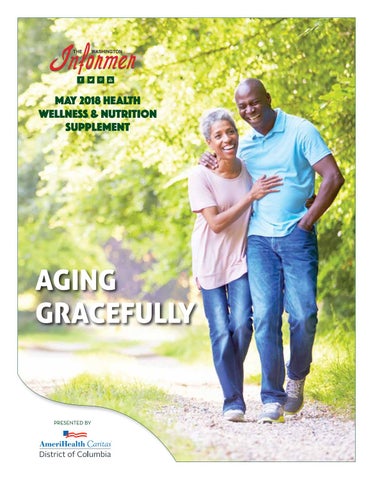
MAY 2018 HEALTH WELLNESS & NUTRITION SUPPLEMENT
AGING GRACEFULLY
PRESENTED BY
FROM THE EDITOR
NEWSPAPER READING IS A HABIT DON’T BREAK THE HABIT!
Aging Gracefully
READ THE WASHINGTON INFORMER YOUR WAY: In Print – feel the ink between your fingers of our Award Winning Print Edition
n
On the Web – www.washingtoninformer.com updated throughout the day, every day
n
n
On your tablet
n
On your smartphone
n
n
n
Weekly Email Blast – sign up at www.washingtoninformer.com
202-561-4100 For advertising contact Ron Burke at rburke@washingtoninformer.com
Dr. Shantella Sherman Special Editions Editor
...Informing you everyday in every way
In Memoriam Dr. Calvin W. Rolark, Sr. Wilhelmina J. Rolark THE WASHINGTON INFORMER NEWSPAPER (ISSN#0741-9414) is published weekly on each Thursday. Periodicals postage paid at Washington, D.C. and additional mailing offices. News and advertising deadline is Monday prior to publication. Announcements must be received two weeks prior to event. Copyright 2016 by The Washington Informer. All rights reserved. POSTMASTER: Send change of addresses to The Washington Informer, 3117 Martin Luther King, Jr. Ave., S.E. Washington, D.C. 20032. No part of this publication may be reproduced without written permission from the publisher. The Informer Newspaper cannot guarantee the return of photographs. Subscription rates are $45 per year, two years $60. Papers will be received not more than a week after publication. Make checks payable to: THE WASHINGTON INFORMER 3117 Martin Luther King, Jr. Ave., S.E Washington, D.C. 20032 Phone: 202 561-4100 Fax: 202 574-3785 news@washingtoninformer.com www.washingtoninformer.com
PUBLISHER Denise Rolark Barnes STAFF D. Kevin McNeir, Editor Ron Burke, Advertising/ Marketing Director Shevry Lassiter, Photo Editor Lafayette Barnes, IV, Assistant Photo Editor John E. De Freitas, Sports Photo Editor Dorothy Rowley, Online Editor ZebraDesigns.net, Design & Layout Mable Neville, Bookkeeper Dr. Charles Vincent, Social Sightings columnist Tatiana Moten, Social Media Specialist Angie Johnson, Circulation REPORTERS Stacy Brown (Senior Writer), Sam P.K. Collins, Timothy Cox, Will Ford (Prince George’s County Writer), Eve M. Ferguson, Hamil Harris, Tatyana Hopkins, Jade James-Gist, Daniel Kucin, Jr., D. Kevin McNeir, Lauren Poteat, Dorothy Rowley, Brenda Siler, Sarafina Wright (General Assignment Writer) PHOTOGRAPHERS John E. DeFreitas, Shevry Lassiter, Roy Lewis, Demetrious Kinney, Daniel Kucin, Jr., Mark Mahonny, Lateef Mangum
Aging has a wonderful beauty and we should have respect for that. – Eartha Kitt As recent as 1971, African-American social scientists pondered how shifts in economic and social ascension among middle-class Blacks impacted centuries-old beliefs related to their own aging and the aged within their families. In one research study, conducted by Floyd M. Wylie at Wayne State University, respondents viewed aging as a gift and interaction with elders, “spiritual nourishment.” In Attitudes Toward Aging and the Aged Among Black Americans: Some Historical Perspectives, Wylie said that it was generally accepted that Black Americans were more inclined than whites to include the elderly in the family structure and to regard the elderly with respect, if not veneration. Citing studies of African-American sociologists and anthropologists, including E. Franklin Frazier, Wylie documented a wider acceptance of persons of older generations, as well as immense respect among Blacks for aging and the rewards of advanced years. “Many of the cultural values and attitudes regarding the elderly have apparently changed little over
the several centuries since Africans were snatched from their home continent. Studies of the Ibo and Igbo people, and observations of the Hausa, probably reflect in most important respects the West African view toward continuity of life, the importance of ancestors, and especially the inculcation of these values into the lives of younger people,” Wylie concluded. “These are strikingly different attitudes [from traditional American attitudes] about the aging process and the role and place of the older person within the culture.” Informer supplement writers, Stacy M. Brown, Ronda Smith and Dorothy Rowley each found, like Wylie, 47 years ago, that as African Americans move from being seniors to elders – a distinction
that separates 50-to 70-year-olds from their 80-100-year-old contemporaries – many do so with the same enthusiasm as they did turning 21. “At some point you realize that things and situations that meant the world to you in your 20s or 40s, are laughable now; you learn to take yourself less seriously and focus on important things like family, helping others, and living comfortably,” Arlillian McGruder, 91, told the Informer. “There is nothing new under the sun and so you have a bucket list or two that you work your way through. Most importantly, you become graceful in your aging by loving yourself and sharing your life’s experiences with others.” Informer writers also found through informal interviews with seniors and elders a belief in spiritual markers (blessings, if you will) that allow the weak to strengthen, the whimsical to become wise, and as Mrs. McGruder said, “some young fools to gradually become old fools.” To put it plain, growing older numerically only tells one portion of the story. Our team has gathered the facts, figures, insights, and advice from some of the regions most vibrant seniors and elders to offer our readers additional information on aging, gracefully. Read, Enjoy, Grow. Dr. S
Informer writers also found through informal interviews with seniors and elders a belief in spiritual markers (blessings, if you will) that allow the weak to strengthen, the whimsical to become wise, and as Mrs. McGruder said, “some young fools to gradually become old fools.”
www.washingtoninformer.com / MAY 2018 HEALTH WELLNESS & NUTRITION SUPPLEMENT
H-2
The Science of it All
Senior Diversity Means Rethinking Platforms for Aging
Ronda Smith Special to the Informer The United States is growing older and more ethnically diverse, causing many government agencies to reformulate how programs that support health, education, housing, and transportation can strengthen to meet increased demands. The number of residents age 65 and older grew from 35 million to 49.2 million between 2000 and 2016; a significant increase that according to the Kaiser Family Foundation also increased federal spending on senior-related health care to $1 of every $7 spent towards seniors. Additionally, by 2027, net Medicare spending is expected to nearly double from $592 billion to $1.2 trillion. “Our nation now faces a situation where the proverbial chickens have come home to roost with regard to African American and other non-white seniors who will become largely reliant upon federal spending for sustainability,” Roanoke-based financial advisor Christian Moxley told the Informer. “These were the same young people who were denied social equity – livable wages, access to retirement plans because of their blue-collar or hourly jobs, and little to no access to health care preventions.” Moxley said that like their parents and grandparents before them who were systematically omitted from social security if they worked as domestics or farmers (sharecroppers), planning for retirement and life beyond 70, required family rather than government support. “Aging also has become a business where some industries – like pharmaceuticals – literally hold seniors hostage by raising the cost of life-saving and sustaining medication to exorbitant rates. This leaves some seniors in a veritable quandary determining whether to take medications, pay other bills, or even eat,” Moxley said.
H-3
The Social Security Act of 1935 excluded from coverage about half the workers in the American economy. Among the excluded groups were agricultural and domestic workers—a large percentage of whom were African Americans. This has led some scholars to conclude that policymakers in 1935 deliberately excluded African Americans from the Social Security system because of prevailing racial biases during that period. Moxley believes the government knew that these people would need help the most and become increasingly reliant upon younger family members – effectively decreasing the wealth potential of successive generations. But all, said Lolita Mercado, is not lost. One of the benefits to a diverse senior population, the senior living specialist told the Informer, is a return by many Black and brown seniors to traditional, holistic lifestyles that honor and protect age. “So many of the abuelos (grandparents) of various communities are reaching back and reconnecting with family traditions regarding lifestyle – rest, types of foods, natural medicines – that eliminate the need for any officials to hold their hands,” Mercado said. “My grandmother is 101 – she has outlived every doctor she has ever had. She tells me that listening to her God and her body determines how she will use her days. She eats for sustenance, not taste, and she takes a healthy shot of whiskey every night.” Mercado said that it is often a blessing within Black and immigrant communities to support elders. “So long as we take our responsibility as caregivers of our most cherished loved ones, we can fight to champion senior equity, but also fill in those gaps and voids where officials fail. This is the only way to honor our elders and teach our children how best to prepare to care for us.” WI
Rewards Program
I got a gift card for getting an eye exam. You can too. You can get a $25 gift card if you: • Are 18 – 75 years old • Are an AmeriHealth Caritas District of Columbia member • Have type 1 or 2 diabetes • See your eye doctor for a retinal eye exam
Visit www.amerihealthcaritasdc.com/giftcard to learn more. Note: A member cannot get more than $50 in incentives each year. AmeriHealth Caritas District of Columbia complies with applicable federal civil rights laws and does not discriminate on the basis of race, color, national origin, age, disability, or sex.
English: ATTENTION: If you speak English, language assistance services, at no cost, are available to you. Call 1-800-408-7511 (TTY/TDD: 202-216-9885 or 1-800-570-1190). Spanish: ATENCIÓN: si habla español, tiene a su disposición servicios gratuitos de asistencia lingüística. Llame al 1-800-408-7511 (TTY/TDD: 202-216-9885 o 1-800-570-1190). Amharic: ማሳሰቢያ፡ አማርኛ መናገር የሚችሉ ከሆነ፣ ከከፍያ ነጻ የሆነ የቋንቋ ድጋፍ አገልግሎት ይቀርብልዎታል፡፡ በስልክ ቁጥር 1-800-408-7511 (TTY/TDD: 202-216-9885 ወይም 1-800-570-1190) ይደውሉ. 1-800-408-7511 اﺗﺼﻞ ﺑﺮﻗﻢ.ﺎن ﻓﺈن ﺧﺪﻣﺎت اﳌﺴﺎﻋﺪة اﻟﻠﻐﻮﻳﺔ ﺗﺘﻮاﻓﺮ ﻟﻚ ﺑﺎ، إذا ﻛﻨﺖ ﺗﺘﺤﺪث اﻟﻠﻐﺔ اﻟﻌﺮﺑﻴﺔ: ﻣﻠﺤﻮﻇﺔ: Arabic .(1-800-570-1190 أوTTY/TDD: 202-216-9885 )رﻗﻢ ﻫﺎﺗﻒ اﻟﺼﻢ واﻟﺒﻜﻢ ACDC-1777796
www.amerihealthcaritasdc.com
MAY 2018 HEALTH WELLNESS & NUTRITION SUPPLEMENT / www.washingtoninformer.com
Break the Cycle: Overcoming Opioid and Substance Use
Submitted by AmeriHealth Caritas District of Columbia The United States is in the middle of an opioid crisis. Although some opioids can help people, they are highly addictive and can be misused. Misuse of opioids can be unsafe for both people and communities. For instance, opioid overdoses caused about 33,000 deaths in 2015. That’s about 91 people each day. People all over the country are taking a stand and working to end opioid misuse.
OPIOID BASICS
Opioids, also known as painkillers, can be used to relieve pain when prescribed by a doctor. But some people misuse opioids by using them for non-medical reasons. Opioids can be prescription drugs or street drugs. Prescription opioids can include oxycodone (ox-ee-koh-dohn) or morphine. Heroin, a street drug, is also an opioid. Using heroin or taking opioids differently than prescribed can be fatal. Substance and opioid use problems can be felt in the District of Columbia today. The
Centers for Disease Control and Prevention reports that 11.3 percent of people in the District over age 11 use or are dependent upon drugs or alcohol. This is higher than the U.S. average of 8.9 percent and is the highest rate in the country. Opioid side effects can include: • Drowsiness • Constipation • Fast, slow, or irregular heartbeat • Nausea and vomiting • Itchiness • Sweating • Addiction • Overdose • Death Someone with a substance use disorder may want to quit their drug use, but it can be hard to ask for help. A person using opioids may not know where to go or might be afraid of judgment. The good news is that you can recover from opioid and substance misuse. The first step is to learn about the signs of misuse and the help options available.
PRESCRIPTION MEDICINES
Many opioids are used as med-
icine. A doctor or hospital may give a person a painkiller to manage pain or a long-term illness. These drugs often come in a pill or liquid form. Some common prescription opioids include: • Morphine • Oxycodone (OxyContin® and Percoset®) • Hydrocodone (Vicodin®) • Fentanyl • Codeine • Meperidine (Demerol®) When used as directed, these drugs can help people with serious health issues. But when they are misused, they can lead to problems like addiction. Opioid misuse happens when a person takes drugs in the wrong way. This includes using street drugs or taking medicines not prescribed for you or differently than prescribed. If a family member gives you one of his or her pills, or if you take more pills than directed, then you are misusing the medicine. Misuse is a concern with opioids because of their strength. Up to 1 in 4 people taking prescription opioids for a longterm illness will struggle with addiction. And the chance of addiction is greater when a person misuses the medicine. More than 4 million Americans were using medicines for non-medical reasons in 2014. Almost 2 million of those users were dependent on pain relievers. There are several risk factors that can lead to opioid misuse, such as:
• Having a mental illness • Having a history of other substance use, including drugs and alcohol • Taking high daily doses of pain relievers Not everyone with the above risk factors will misuse opioids. Many people use prescription opioids to manage long-term pain and health conditions. If you receive a prescription opioid for a health condition, you should not stop taking it unless directed by your doctor. Since opioids are so strong, it can be difficult to stop taking them. Stopping suddenly can be dangerous. People quitting opioids can suffer from withdrawal symptoms, like sweating, bone and joint pain, tremors, and vomiting or diarrhea. Your doctor can help you to stop taking opioids safely.
HEROIN
Heroin is an illegal opioid that appears as a white or brown powder. It can also appear as a black, sticky substance, known as “black tar heroin.” Nicknames for heroin are horse, H, and smack. Heroin is usually injected with a needle, smoked, or sniffed up the nose. Heroin is a fast-acting drug, which makes it highly addictive. Almost 23 percent of heroin users are dependent on the drug. There were more than 430,000 regular heroin users in the United States in 2014 — about 10 percent of all opioid users.
Most heroin users also use other substances. About 3 out of 4 new heroin users first used prescription opioids before trying heroin. Many of those users take both heroin and prescription opioids at the same time. People addicted to prescription opioids are nearly 40 times more likely to also be addicted to heroin. Unlike prescription drugs, heroin is not made in a laboratory. Because of this, the strength of heroin can vary. The drug is often mixed with other materials like sugar and starch. Sometimes it is mixed with other drugs, or with toxic or harmful chemicals. Someone using heroin never knows what is in the drug, which can be dangerous and even fatal. In 2015, nearly 13,000 people died because of the drug. Heroin may have more side effects than other opioids. For example, people who inject the drug are at risk for diseases like HIV or hepatitis C. These diseases spread through the blood or other bodily fluids. People sharing needles could get the diseases from another user. Overdoses are also a greater threat for heroin users. Although heroin users make up only 10 percent of all opioid users, they account for nearly half of all opioid overdose deaths. If you or someone you know is using heroin, or is at risk for
CONTINUED ON PAGE H-5
www.washingtoninformer.com / MAY 2018 HEALTH WELLNESS & NUTRITION SUPPLEMENT
H-4
CONTINUED FROM PAGE H-4 using heroin, help is available. Speak with your doctor or call one of our Care Coaches to learn more about your health options.
OTHER SUBSTANCES
There are many substances besides opioids that can be dangerous. Some of these are illegal drugs, while others are legal but may be unsafe when used in excess. • Cigarettes and tobacco products: Tobacco can be found in cigarettes, cigars, snuff, and chewing tobacco. It contains nicotine, an addictive substance. The use of tobacco causes many serious health problems, including lung cancer, oral cancer, bronchitis (bron-ki-tis), and emphysema (em-fa-ze-ma). It also increases the risk of heart disease, heart attack, and stroke. • Marijuana: Marijuana is a drug that can be inhaled or eaten. It is illegal in much of the United States, and its use is governed by law where it is allowed. In the District, marijuana use is legal on private property. It is not legal to sell the drug or to use it in a public place. Health effects of marijuana use include changes in mood, slow thinking
and movement, breathing problems, and paranoia. • Cocaine: Cocaine is an illegal drug that looks like a fine, white powder. It can also appear as rock crystals known as crack. Cocaine is snorted through the nose, rubbed into the gums, injected, or smoked as crack. Side effects of cocaine use include changes in blood pressure, faster heartbeat, the loss of the sense of smell, and addiction. People who inject cocaine are also at risk for HIV and hepatitis C. It is possible to overdose on the drug, which can lead to death. Many opioid users first start by using drugs like marijuana and cocaine. Some of those users will continue using multiple drugs at the same time. This can cause harmful drug interactions. The chance of dangerous side effects including death increases when taking several drugs at once.
FINDING HELP
Although prescription opioids can help some people, there are many risks if opioids are misused. If you or someone you know is using drugs, there is treatment available that can help. There are resources in the District of Columbia to help Medicaid members with their substance use problems. The DC
Heroin may have more side effects than other opioids. For example, people who inject the drug are at risk for diseases like HIV or hepatitis C.
Department of Health Addiction, Prevention, and Recovery Administration (APRA) can aid you to recover and improve your health. You can contact APRA at 202-727-8473. The DC Department of Behavioral Health may also be able to help and is available 24 hours a day, 7 days a week, at 1-888-793-4357. The National Suicide Prevention Lifeline is available 24 hours a day, 7 days a week. They do more than suicide prevention and can help with issues
like drug and alcohol use. They can also connect you to a nearby professional to assist you. Call them anytime at 1-800-273TALK (8255). For people who want to quit taking drugs, there may be medicines that can help cope with withdrawal. Ask your primary care provider (PCP) about what treatments would be best for your condition. AmeriHealth Caritas District of Columbia members can call us to be connected with a Care
Coach. Our Care Coaches can help you make sense of your health care options. Call us at 1-800-408-7511 to learn more about how you can break the cycle of opioid misuse. Sources: Centers for Disease Control and Prevention; Substance Abuse and Mental Health Services Administration; National Institute on Drug Abuse; National Institute on Alcohol Abuse and Alcoholism All images are used under license for illustrative purposes only. Any individual depicted is a model WI
I got a gift card for taking care of my health. You can too. You can get a $25 gift card if you: • Are an AmeriHealth Caritas District of Columbia member
Rewards Program
• Are 12 – 21 years old • Get an annual physical exam
Visit www.amerihealthcaritasdc.com/giftcard to learn more. Note: A member cannot get more than $50 in incentives each year.
AmeriHealth Caritas District of Columbia complies with applicable federal civil rights laws and does not discriminate on the basis of race, color, national origin, age, disability, or sex. ACDC-17100158
English: ATTENTION: If you speak English, language assistance services, at no cost, are available to you. Call 1-800-408-7511 (TTY/TDD: 202-216-9885 or 1-800-570-1190). Spanish: ATENCIÓN: si habla español, tiene a su disposición servicios gratuitos de asistencia lingüística. Llame al 1-800-408-7511 (TTY/TDD: 202-216-9885 o 1-800-570-1190). Amharic: ማሳሰቢያ፡ አማርኛ መናገር የሚችሉ ከሆነ፣ ከከፍያ ነጻ የሆነ የቋንቋ ድጋፍ አገልግሎት ይቀርብልዎታል፡፡ በስልክ ቁጥር 1-800-408-7511 (TTY/TDD: 202-216-9885 ወይም 1-800-570-1190) ይደውሉ. 1-800-408-7511 اﺗﺼﻞ ﺑﺮﻗﻢ.ﺎن ﻓﺈن ﺧﺪﻣﺎت اﳌﺴﺎﻋﺪة اﻟﻠﻐﻮﻳﺔ ﺗﺘﻮاﻓﺮ ﻟﻚ ﺑﺎ، إذا ﻛﻨﺖ ﺗﺘﺤﺪث اﻟﻠﻐﺔ اﻟﻌﺮﺑﻴﺔ: ﻣﻠﺤﻮﻇﺔ: Arabic .(1-800-570-1190 أوTTY/TDD: 202-216-9885 )رﻗﻢ ﻫﺎﺗﻒ اﻟﺼﻢ واﻟﺒﻜﻢ
H-5
MAY 2018 HEALTH WELLNESS & NUTRITION SUPPLEMENT / www.washingtoninformer.com
www.amerihealthcaritasdc.com
What Seniors Should Know about Directives, Wills and Wishes By Stacy M. Brown WI Senior Writer Nearly two-thirds of Americans don’t have living wills, or an advanced medical directive stating their care wishes if they’re unable, according to a 2014 study by the American Journal of Preventive Medicine. A lack of awareness was the top reason for why the majority do not, the report noted. Experts said there are too many seniors who live without their express wishes known to lovedones in cases of emergency or death. Still, many, like officials at the American Association for Retired Persons (AARP) in Northwest, D.C., work daily to make a little easier the business of final wishes and directives to avoid conflicts among relatives. And, that’s not easy, said Julia Alexis, vice president at AARP.
SUPPORT ORGAN, EYE AND TISSUE DONATION IT’S A DECISION EVERYONE CAN LIVE WITH
Register online or at the MVA when you obtain your license. DonateLifeMaryland.org
“We know that the more planning you do ahead of time, the less difficult it will be for you and your loved ones later. Some start by streamlining their finances or creating a living will,” Alexis said. AARP offers several books on the topic, including the “ABA/AARP Checklist for My Family: A Guide to My History,” and “Financial Plans and Finals Wishes,” by Sally Hurme and others. Further, AARP’s website provides expert resources – tools like the AARP Retirement Calculator and the Prepare to Care: Caregiving Planning Guide for Seniors – that may help families struggling with having that important conversation, Alexis said. The American College of Emergency Physicians notes that an advance directive would include a power of attorney and living will. It states to an individual’s doctor and, or any healthcare worker what type of care the senior would want if they were too ill to tell someone. For example, if the individual is in a coma and never wanted to have a feeding tube placed. A feeding tube would not be placed if this was documented in the living will advance directive. The senior should know that they’re also able to change the documents at any time, experts said. The directive is written when the senior is deemed competent and able to understand what their decisions mean and how it will affect them. Directive prove vital when seniors live alone and are not in regular contact with other family members who may not know or have conflicting views about care. “Older adults need to let their loved ones know their wishes for their final days,” said Dr. Sara Zeff Geber, author of “Essential Retirement Planning for Solo Agers.” “This can be facilitated by a senior living coach, a financial advisor, or simply holding a family meeting. Also, attending group meetings to discuss feelings about death and final days … is a good place to start,” Geber said. Alexandra Allred, the author of the book, “Operation Caregivers: #LifewithDementia,” said the second half of her work provides lists of what individuals should do about a power of attorney, wills, taking care of property, pets, cars, and other be-
longings; and how family members can contact neighbors and friends. The book also details how to close accounts and manage the affairs of the senior, including memory care facilities and long-term health care solutions. “Why did I write this book? I had two fully functional parents in 2012. By 2014, something was up with my mom. In 2016, my father fell – face plant on the kitchen floor – complete frontal cortex damage and was forever incapacitated. This set my mother’s Alzheimer’s into a frenzy and in one day I had no idea where, or if, a power of attorney and will existed, how to access banks, how to pay bills, what to do about the house, cars, and so forth,” Allred said. Before being deployed overseas for the Iraq War in 2003, Army reservist Don Morrison filled out military forms that gave instructions about where to send his body and possessions if he were killed. “I thought, wow, this is mortality right in your face,” Morrison, now 70, told Kaiser Health News in 2017. With his attention keenly focused on how things might end badly, Morrison asked his lawyer to draw up an advance directive to describe what medical care he did and did not want if he were unable to make his own decisions. One document, typically called a living will, spelled out Morrison’s preferences for life-sustaining medical treatment, such as ventilators and feeding tubes. The other, called a health care proxy or health care power of attorney, named a friend to make treatment decisions for him if he were to become incapacitated. “At the moment, I’m very healthy,” Morrison said. If he were to become ill or have a serious accident, he said, he’d want to weigh life-saving interventions against the quality of life he could expect afterward. “If it were an end-of-life scenario, I don’t want to be resuscitated,” he said. Morrison said he’s glad he’s put his wishes down on paper. “I think that’s very important to have,” he said. “It may not be a disease that I get, it may be a terrible accident. And that’s when [not knowing someone’s wishes] becomes a crisis.” HS
www.washingtoninformer.com / MAY 2018 HEALTH WELLNESS & NUTRITION SUPPLEMENT
H-6
Do You Know a Hardhead Diabetic™?
By Rica Rich How does a Hardhead Diabetic™ (HHD™) age gracefully? The knee-jerk reaction is – they won’t! This article’s goal is to submit reasons for HOPE to the contrary. The reigning belief is diabetics displaying “hardheaded” tendencies are destined to succumb to the worst sect of diabetic complications – dialysis, blindness and limb loss. Most HHDs™ can age gracefully; devoid of significant complications. How is this possible if they stubbornly refuse to do right? The image of an HHD must first be corrected. We (including me – a self-professed HHD for 25 years) are not “hardheaded” in the traditional sense. Our perceived hardheadedness about diabetes is a societal misinterpretation of our information processing procedure. Comprehension of this fact by the diabetic’s support system engages successful conversation with the diabetic, advancing tighter diabetes control. There are several factors that drive the Hardhead personality type in general. Here we will touch on the top two. First, Hardheads rarely respond to insistence. If they do, it will be temporary. The more you force on us, the faster we recoil. Time is needed to analyze and draw our own conclusions. Unfortunately, concerned loved-ones rarely extend us the opportunity to arrive at concrete decisions. Second, fear does not motivate us. That does not translate “fearless.” It means our internal compass for change is guided by reasonable, information driven suppositions. Hyperbolic statements roll off us like water from a duck. Quantitative, demonstrative information to be
H-7
pondered and examined allows space to evaluate and arrive at permanent change. Protocols for diabetes management have been steeped in fearbased instruction since inception. You are risking a foot amputation if you keep eating candy! This approach is understandable. Rationale says why wouldn’t you stop eating something if it means the loss of a body part? Quadrupled incidence of diabetes over the last 40 years, coupled with increased medical expenditure for diabetic complications treatment, say otherwise. HHDs can be convinced to maintain good diabetes control, if the message is delivered correctly. The time to change the narrative to this personality type has arrived?
EXAMPLE:
Linda drinks 16 ounces of orange juice every morning. Her doctor scolds, “Your sugars are too high. Keep this up, your future holds dialysis.” Linda’s internal response, “Everything I like spikes my sugar. At least orange juice has vitamins and is healthy. It’s been five years; my kidneys are fine.”
EFFECTIVE APPROACH:
“Orange juice is a liquid; a concentrated form of fruit. 1. Fruit has a high density of natural sugar; 2. Concentrated, you multiply your intake; and 3. Liquid does not have to break down in your body. It goes directly to your bloodstream; immediately spiking your sugar. Which is why during a sugar low, orange juice is often given to diabetics. Within minutes you feel better.” One and two are quantitative. Three is demonstrative. The entirety can be evaluated for accuracy and is not directed by disconcerting claims. Linda’s final step, evaluate and verify. Her most likely conclusion - no more orange juice. Diabetic Food Combing™ (DFC™), eating different food groups together to prevent rapid, prolonged blood sugar spikes, is a
road map back to the carefree days of eating, minus the constant worry of diabetic complications. Much of today’s food is made with processed corn. Additionally, uncontrolled blood sugars create sugar cravings. Result: a struggle with diabetes control. Learning DFC™ restores lost freedom, removes ambiguity and solidifies the joy of eating. Eating low glucose producing foods with high glucose producing foods is essentially Diabetic Food Combing™. There are no recipes, numbers to record, portions to weigh or selected menu items. Consistently eat foods together in eyeball portions using the guidelines of DFC and be amazed at your sugar levels. After a 16-ounce bowl of high glucose producing mixed fresh fruit DFC with foods like low glucose producing celery and cabbage, my sugar reads in the 90’s mg/dl! My HbA1C decreased 1.5 points the first 3 months I used
DFC. With energy, great blood sugar control and sustained joy when eating, it’s inevitable you will AGE GRACEFULLY! Rica Rich, Founder, President & CEO Hardhead Diabetic, Inc Rica Rich has 29 years of experience in business management and sales. While owning and operating her own organization in the financial services field; she oversaw the critical medical care of multiple family members for 15 years. This provided her
"
with an extensive background and understanding of medicine and medical procedures. Ms. Rich could not resist adding this cause to her demanding schedule in order to answer her calling — to serve the diabetic community and help overcome diabetic complications. HS
Was this article helpful? Let us know. Your positive feedback means future articles. Detailed information on everything discussed is available in our book Hardhead Diabetic In A Nutshell. Visit us at Hardheaddiabetic.com
Put a smile on the face of the Diabe3c in your life! Order some
HHD Premium Crunch today. A Diabetic Food Combined™ snack that brings back the joy of eating sweets while preventing prolonged blood sugar spikes. You don’t have to be diabetic to enjoy this great snack. It’s beneficial for the diabetic, delicious to the entire family! Available in Chocolate, Peanut Butter and Caliente (Hot). "
. Visit us at Hardheaddiabetic.com or call 240-547-0611 for pricing, size options and to place your order "
MAY 2018 HEALTH WELLNESS & NUTRITION SUPPLEMENT / www.washingtoninformer.com
ROBERT’S STORY A behavior detection officer for the TSA, Robert enjoyed good health with the
exception of a heart attack suffered more than a decade ago. Still, it was a surprise
when he experienced a grave heart attack— known in the medical community as the “widow-maker”—without any advance symptoms or warning.
Robert with his wife, Adriene.
After his discharge from the hospital, Robert’s primary care provider—who participates in CareFirst’s Patient-Centered Medical Home (PCMH) program—referred him to chronic care coordination services through which registered nurses provide one-on-one support to members with complex chronic conditions. Shortly after meeting his nurse, Krystal, Robert suffered two more heart attacks within a week of each other. While recovering at the hospital, he learned his vascular system was collapsing and there wasn’t anything they could do for him.
ROBERT’S CARE COORDINATION EXPERIENCE
“Krystal held my hand through the crisis. I looked at her as a friend, someone who understood and who I could trust,” Robert remembers. Because he didn’t experience chest pain or any “typical” symptoms with any of his heart attacks, Robert was particularly nervous about recognizing future warning signs. Krystal provided reassurance to Robert that he would get better and also coordinated important resources. She set him up with in-home enhanced monitoring for him to check his blood pressure and
heart rate daily, with results sent to Krystal and his doctors. Having easy access to real-time readings helped Robert recognize when his symptoms would occur and helped his doctors make necessary adjustments to his medications. “Enhanced monitoring helps patients become more independent because these are important activities the member feels accountable for—they know we’re reviewing their data,” Krystal adds. Krystal also coordinated cardiac rehabilitation services and helped Robert learn about his heart condition. He says, “She educated me on eating habits; oxygen levels; things to stay away from—like salt; my optimum blood pressure levels and really monitored everything during that time span.” Additionally, Krystal noted Robert was experiencing severe irregular heartbeat, or bradycardia. Robert knew he could call Krystal when he had troubling symptoms, “She would give me advice, have me rest or take nitroglycerin and it always helped,” but the root of the problem was unclear. Krystal shared all of Robert’s symptoms, concerns and actions directly with his treating physicians. Robert remembers, “If there was anything that needed to be shared with the doctor,
Krystal got it to her ASAP.” As a result, Robert’s doctors had him wear a heart monitor for two weeks, during which it recorded alarming variations in his heartbeat ranging from 38 to 164 beats per minute. When changes to his medications weren’t producing desired results, Krystal recommended a second opinion through CareFirst’s Expert Consult program. Through this program, a member’s case is thoroughly reviewed by a team of industry- leading medical experts who provide the member and their treating doctors with a detailed medical report outlining their diagnosis, recommendations and treatment plans. Robert’s report listed several recommended changes to his medication. After his doctor adjusted his medications, Robert’s symptoms subsided and he felt better. Robert declares, “Two to three weeks after, I was a brand new man.” Around this time, Krystal left for maternity leave and Robert was assigned to a new nurse, Alex. In reviewing Robert’s case, Alex noted Krystal had registered him for a sleep study because his oxygen levels were dropping too low during sleep. His results indicated the need for a CPAP machine, which he had yet to receive even though the request was
submitted months prior. Alex recalls, “The CPAP vendor wasn’t following through delivering this important device. Within my first week working with Robert, I called them constantly, filled out additional paperwork and finally got him the machine.”
ROBERT’S OUTLOOK
Today, Robert is preparing to return to work. He feels lucky to have had not one, but two wonderful nurses help him on the road to recovery. He says, “The program is so valuable…you have a sincere, professional team and they are
all about making you healthy. Very rarely do you have this kind of interaction between the PCP and the patient. This program has improved the relationship I have with my doctor.” Alex enjoys her role too. She notes, “Patients can feel completely overwhelmed by their health issues and they don’t know how it got this bad or how it’s going to get better. I can help them organize and prioritize their health and get them to a better place by connecting them to the right resources, providing reassurance and support.”
“The program is so valuable… you have a sincere, professional team and they are all about making you healthy.”
www.washingtoninformer.com / MAY 2018 HEALTH WELLNESS & NUTRITION SUPPLEMENT
H-8
CareFirst Contributions In The District Directly Addressing Health Care Needs By Maria Harris Tildon, CareFirst Senior Vice President, Public Policy & Community Affairs As the region’s largest notfor-profit health insurer, CareFirst BlueCross BlueShield is driven by its mission to expand access to affordable health care services to vulnerable and medically underserved populations throughout the region. Over the years, CareFirst has worked closely with nonprofit partners to invest in programs that improve health care delivery systems, promote change on broad initiatives, and ultimately progress the long-term health of the communities it serves.
In Washington, D.C., CareFirst is proud to partner with organizations including Breast Care for Washington, Children’s National Hospital, Community of Hope, D.C. Central Kitchen, Food & Friends, Girls on the Run, La Clinica del Pueblo, Latin American Youth Center, Mary’s Center, Metro Health, N Street Village, Safe Shores, Samaritan Inns, Unity Health Care, Washington AIDS Partnership, Whitman Walker Health, and many others. Through these community partners, CareFirst is investing in areas such as maternal and child health, safety net health centers expanding patient-cen-
tered care and behavioral health services. The company’s ongoing commitment to addressing the region’s health care needs also has contributed to its reputation as a leading corporate philanthropist, consistently ranking among the National Capital Area’s top 10 givers each year. CareFirst has also gone beyond the scope of its health-related mission to give back to the people of the community, through a partnership with C.W. Harris Elementary School in Ward 7 as part of D.C. Public School’s Adopt-A-School Program. Over the course of a three-year partnership, Car-
eFirst and its employees have supported school beautification, student enrichment and teacher appreciation efforts. Through its contributions of volunteer time and money, CareFirst has helped the school obtain the resources necessary to create a positive learning environment for its students. In addition to its contributions to the community, CareFirst has adopted a corporate social responsibility philosophy that embraces employee volunteerism, diversity and inclusion practices in the workplace, and conducting business in an ethical and environmentally sustainable manner. The company adheres to the highest stan-
dards of conduct, promotes a rich culture of employee engagement in the community, engages in fair procurement and inclusive hiring practices, and strives to improve its environmental footprint. In 2017, CareFirst employees logged more than 25,000 volunteer hours for organizations throughout the region and served on nearly 250 area nonprofit boards. The company was also named “Best Place to Work for LGBTQ Equality” by the Human Rights Campaign and earlier this year earned the designation of “World’s Most Ethical Company” by the Ethisphere Institute for the sixth consecutive year.
carefirst.com/community
H-9
MAY 2018 HEALTH WELLNESS & NUTRITION SUPPLEMENT / www.washingtoninformer.com
Older Adults Making Healthy Aging a Priority Kathleen Brooks and her husband Harry include movie dates among their healthy living activities. / Photo by Dorothy Rowley By Dorothy Rowley WI Staff Writer When Mayor Muriel Bowser paid tribute April 30 to 48 of the District’s centenarian residents, she noted the city’s focus on providing affordable housing as well as vamped-up modes of public transportation and improved utility services for a sector of the D.C. population that’s not only increasing in numbers, but also in longevity. According to Bowser and pages of documented research on aging, the number of people age 65 and older has increased tenfold over the past century, with many among them graced with better health, and living more comfortably now than ever before. “It seems we have a bigger group here today than we did last year,” Bowser – referring to the huge cadre of elderly residents -- told the luncheon audience at Gallaudet University’s Kellogg Conference Hotel. “But you know what that means -- it means our seniors are getting older,” she said, adding however, that because D.C. can’t build enough housing fast enough for its growing number of older denizens, programs like her administration’s two-year-old “Safe at Home” initiative ensures more of them can continue getting “around [more] independently as long as possible.” Noted children’s book author and Northeast resident Eloise Greenfield who celebrates her 89th birthday on May 17, lists among them. She said that while she no longer ventures away from home as often as before, she adheres to a regular regimen for maintaining
both her health and stamina. “I go up and down the stairs a lot every day, as a way for getting in my exercise,” said Greenfield, who has remained living on her own. Overall, “I make an effort to keep up with all the information available [for the elderly] so that I can always make the best decisions for myself.” Half-joking that she’s “an almost-vegetarian,” Greenfield said she’s a stickler for eating three healthy meals a day. “Because good nutrition is important to me,” she said. “I eat plenty of vegetables, fruits and fish. I also take my vitamins,” she said, stressing she generally refrains from advising how her peers might manage their health. Instead, “I concentrate on the things that are best for me,” Greenfield said. While doctors and fitness experts embrace exercise as a sort of miracle drug that can extend one’s life span by as much as five years, they also note how a regular routine of healthy food choices along with positive attitudes and strong family ties can help boost the brain, ward off disease and keep senior and elderly people in their primes longer. Kathleen Brooks, a retired Christian Methodist Episcopal church pastor, concurred. At age 72, she cherishes the love of family, which includes her husband Harry, recognizing them as vital components to maintaining her health. Having previously embraced a much healthier lifestyle that included daily walks and water aerobics, Brooks said with a hearty chuckle that she makes up for the inactivity by doing various tasks around her home and keeping up
with her young grandchildren. “They keep me going. They are the joys of my life,” said Brooks, who also looks forward to movie dates with her husband. However, “for most people [my age] it’s extremely important to take our health seriously because of issues such as health insurance” said the Takoma Park, Md., resident, who alluded to lawmakers’ attempts at dismantling affordable healthcare programs. “Things can get so crazy at times with that, so you have to take care of yourself. You know, keeping alert with what’s going on, exercising and eating the right foods.” Brooks, who used to walk three or four miles a day, suffers occasionally with knee pain. She places some of the blame on not always following her doctor’s instructions. “I didn’t always take care of my health, and now I’m paying for
it. I was too busy getting other things done and didn’t do what my doctor asked me to do,” she lamented. Nevertheless, Brooks wants to see more senior-oriented health and fitness programs in her community. “There are plenty available in Maryland, but you have to pay, and if you’re on a fixed income -- as a lot of seniors are -- that can limit participation,” said Brooks. Eddie Radden, 65, of Midlothian, Va., a frequent visitor to D.C., also chimed in, sharing that he underwent radiation treatments a year ago for prostate cancer. Now cancer-free, Radden said that in addition to keeping all doctor’s appointments, he sticks to a strict monotony of exercise and healthy meals that includes daily consumptions of fruit and vegetable smoothies and green tea. “I take my medicine every day
Eloise Greenfield, who has written more than 40 children’s books, is a stickler for eating three healthy meals a day. / Photo courtesy The Brown Book Shelf
Kathleen Brooks (blue dress) wants to see more senior-oriented health and fitness programs in her community. / Photo by Dorothy Rowley
on schedule. I walk first thing in the mornings for 45 minutes and sometimes I’ll do 25 more minutes at the gym in strength training,” said the divorced grandfather of seven. “I also have to get in my half-hour nap during the day,” he said, adding that while he drinks occasionally, it’s been a struggle to quit smoking. “I’m working on that, but it’s been easier said than done,” said Radden, noting that he stays on top of his healthcare insurance. “I have just what I need for prescriptions, doctors’ visits and hospitalization if it comes to that,” he said. “As a senior citizen and retiree, I continue to have a zest for life. I love taking road trips and singing lead vocals with my church choir. My father is about to celebrate his 90th birthday soon, and he’s in pretty good health. I intend on doing the same thing -- and living even longer.” HS
www.washingtoninformer.com / MAY 2018 HEALTH WELLNESS & NUTRITION SUPPLEMENT
H-10
Tips for a Healthy Aging By Dorothy Rowley WI Staff Writer For a more healthy, productive and happier life, Cigna-HealthSpring – one of the nation’s largest providers of Medicare plans -- encourages adults in their golden years to consider the following:
ANNUAL EXAMS.
Annual visits are critical for identifying potential health issues early, as well as maintaining
a relationship with your primary care physician. During this visit, your doctor can establish a plan based on your age, gender and health status for the vaccinations and health screenings you need, such as mammograms, cholesterol screenings and colorectal cancer screenings.
TAKING MEDICATIONS AS PRESCRIBED.
Your drugs were prescribed for a reason. It is important to adhere to your medication regime and
take medications as prescribed. Some drugs can cause harmful interactions, so make sure your doctor knows everything you take, including over-the-counter drugs.
STOP SMOKING.
Smoking is the leading cause of preventable disease and death in the U.S. It’s never too late to quit, and the benefits of doing so are almost immediate, according to the American Cancer Society. Keep in mind that parts of
Medicare cover smoking cessation counseling and prescription medications.
EXERCISE.
Regular exercise can help older adults stay independent and prevent many health problems that come with age. Many Medicare Advantage plans offer exercise programs designed specifically for older adults at no extra cost. If your plan has a program like this, make sure to take advantage of it.
HAVE FUN!
Be sure to make time for activities you enjoy and seek out others who also enjoy them. The social interaction is good for you. For instance, exercise, which some physicians and scientists say works like a miracle drug and can extend life span by as much as five years, sharpens the brain, wards off disease and keeps seniors in their prime longer. HS
DCHealthLink.com (855) 532-5465 TTY 711
HEALTH INSURANCE FOR SMALL BUSINESS By offering employees multiple health plan choices, a small business:
• SAVES money • PROVIDES better employee benefits • PAYS only one monthly bill
Just ask a broker for details!
ENROLLED SINCE 2017
H-11
MAY 2018 HEALTH WELLNESS & NUTRITION SUPPLEMENT / www.washingtoninformer.com
By the Numbers Ronda Smith Special to the Informer According to a 2016 Pew Social Trends study, nearly half -45 percent of adults ages 75 and older say their life has turned out better than they expected, while just 5 percent say it has turned out worse (the remainder say things have turned out the way they expected or have no opinion). All other age groups also tilt positive, but considerably less so, when asked to assess their lives so far against their own expectations. When asked about a wide
range of potential benefits of old age, seven-in-ten respondents ages 65 and older say they are enjoying more time with their family. About two-thirds cite more time for hobbies, more financial security and not having to work; and roughly six-in-ten say they get more respect and feel less stress than when they were younger. Older adults account for record shares of the populations of the United States and most developed countries. Some 39 million Americans, or 13 percent of the U.S. population, are 65 and older–up from 4 percent in 1900.
The century-long expansion in the share of the world’s population that is 65 and older is the product of dramatic advances in medical science and public health as well as steep declines in fertility rates. In this country, the increase has leveled off since 1990, but it will start rising again when the first wave of the nation’s 76 million baby boomers turned 65
in 2011. By 2050, according to Pew Research projections, about onein-five Americans will be over age 65, and about 5 percent will be ages 85 and older, up from 2 percent now. These ratios will put the U.S. at mid-century roughly where Japan, Italy and Germany–the three “oldest” large countries in the world–are today.
When Does Old Age Begin? According to respondents of the same Pew study, 68. That’s the average of all answers from the 2,969 survey respondents. Women, on average, say a person becomes old at age 70. Men, on average, put the number at 66. Among respondents ages 6574, 80 percent reported feeling younger than their years. HS
SEX IS...
TRUST Talk to your kids openly and honestly about sex.
Visit SexIsDC.org
LEARN. SHARE. BE.
@SexIsDC www.washingtoninformer.com / MAY 2018 HEALTH WELLNESS & NUTRITION SUPPLEMENT
H-12
Prince George’s Community College Culinary Arts Student Dishes on Love for Food and Value of New Culinary Arts Center PGCC Ribbon Cutting - PGCC President Charlene Dukes, Board of Trustees, faculty, staff, and county officials gather for the new Culinary Arts Center ribbon-cutting on April 19. By Tabresha B. Langham, Prince George’s Community College Seven years ago Juan Obando Jimenez moved to Prince George’s County with a lifelong dream to become a chef. Jimenez comes from a family where everyone cooks, and because of that, he learned about cooking at a young age. His
fondest memories involve his mother, who is the most influential cook from his childhood. “I remember my mom would make me chicken soup and how special it would make me feel,” recalled Jimenez on his childhood growing up in Costa Rica. It’s those memories that left a lasting impression on Jimenez and strengthened his passion to “enhance memories with fla-
PGCC Culinary student Juan Obando Jimenez is happy about the new space and better equipment available in the new Culinary Arts Center.
H-13
vors.” He explained, “It’s those moments, like your birthday, or having a special dish that you crave, that people remember most.” When he arrived in Prince George’s County, he met other chefs who told him to take the path of pursuing a degree in culinary arts at a community college if he was seriously interested in culinary. He took their advice and is set to graduate this May from the culinary arts program at Prince George’s Community College (PGCC). The college recently opened a state-of-the-art Culinary Arts Center to make wellness, culinary arts, and hospitality classes more conducive for training students to enter and maintain jobs in the food service and hospitality industries. Though the center opened on the tail end of Jimenez’s time in the program, he is excited to be part of the first class to learn and train in the facility. When he was deciding whether to enroll in a culinary arts program, he made the choice to attend the program at PGCC because of its affordability. He visited other colleges and was able to tour many facilities before making his decision. Now that the center is open, “Prince’s George’s Culinary Arts Center is the best,” he said. The center features more than 21,000 square feet of industry-style kitchens and a lec-
MAY 2018 HEALTH WELLNESS & NUTRITION SUPPLEMENT / www.washingtoninformer.com
ture area. Of all the new areas to learn and train, it is the baking kitchen that Jimenez loves the most. But it’s the entire experience that really makes Jimenez feel like he made the right choice to enroll in the program. He believes that the program at PGCC has provided him the knowledge and mindset to be a chef. “Being a chef is not just about how many recipes you have,” Jimenez explained. “As a chef you have to think about nutrition. At PGCC, they make you think about important things like that.” Nutrition is another thing that Jimenez loves about the culinary arts program. He says that those who desire to cook for other people may not learn proper techniques, such as how to cook vegetables that maintain their nutritional value, or what suppliers are best for purchasing meat if they do not attend a quality culinary arts program. He says that if students want real knowledge and hands-on training, they should consider enrolling in the culinary arts program at Prince George’s Community College. The curriculum is thorough and students learn to think about all aspects regarding food, including nutrition. Jimenez said the program requires students to take the same nutrition class that the nursing students must take.
Other PGCC culinary offerings include classes like Introduction to Culinary Arts, Food Production I and II, and Bar and Beverage Management. But the facility will feature more than just culinary classes. In addition to wellness and hospitality classes, the center will also offer classes that teach community members to prepare nutritious meals for their families. The new center is what makes it possible to serve both students, professionals, and community members. Because of its size and amenities, simultaneous training is possible. The design and construction also make spaces, including the banquet room, the lounge area, and the outside grilling area, ideal for hosting events. What’s most important of course, is the center’s capabilities to train students to fill the gap in the demand for jobs in industries like culinary arts. As the food service and hospitality industries continue to grow, the new Culinary Arts Center will be a unique resource for talent needed in and around Prince George’s County. Once his final semester is over, Jimenez plans to gain employment in a new facility where he can continue to improve his skills. He wants to create memories and serve the freshest ingredients to people, which he says is really what its all about. HS
Living Longer and Better through Nutrition, Exercise and Rest By Stacy M. Brown WI Senior Writer Like just about every age group, seniors should understand that giving their bodies the right nutrients and maintaining a healthy weight can help them stay active and independent, according to the National Council on Aging in Alexandria, Virginia. Elderly individuals who follow such course would spend less time and money at the doctor and, that’s especially true if a chronic condition
like diabetes or heart disease is present. The definition of healthy eating does change a little as an individual gets older. For example, as people age, their metabolism slows down, so there’s a need for fewer calories and for the body to have certain nutrients, experts said. “To maintain optimal health, seniors should aim to get at least 150 minutes of moderate activity each week and should strength train at least twice a week, per the Centers
for Disease Control and Prevention,” said Dr. Jasmine Marcus, a doctor of physical therapy. “This can be done alone, with a trainer or physical therapist, or in group classes. Additionally, seniors should work on improving and maintaining their balance to prevent falls. This can include activities such as standing on one foot and standing on uneven surfaces,” Marcus said. Officials at the American Association of Retired Persons (AARP) in Northwest, D.C., recommend that
\
..
Prevention Center
"
��� -::,�/
0
u '-'0
..., u ...., .::: (/')
0
Wards 7&8
-
8At
'
RI
/At.st<•
.,. _____ ·"' C·1V\of1 '
:,:.
_,,.h,--,f,r/1,-•",l1>�•
Bridging Resources in Communitiies, Inc. and tihe Wards 7 b 8 DC Preventiion Centier is glad tio be a part; of tihe Washingtion Informer's Healtih, Wellness b Nutiritiion Issue
as adults age they strive to walk at least three times a week for 30 minutes per day, eat a balanced diet of healthy fats, lean meats and fresh fruit and veggies and sleep for about seven to eight hours every night for optimal health. “We also recommend that older adults maintain their social networks,” said Julia Alexis, vice president at AARP. A recent study in conjunction with the Stanford Longevity Center demonstrates that keeping up with one’s social network can help reduce incidence of chronic disease and depression, Alexis said. “On AARP.org, we provide a number of resources that make staying health easier including fitness videos from Wellness Ambassador Denise Austin and the Staying Sharp digital platform that provides healthy living tips that may help maintain brain health,” she said. Neema Patel, a certified Dementia Practitioner and Memory Care Director, said it’s also important to be aware of changes in food preferences. “The type of quality and quantity of food dramatically affect seniors,” Patel said. “Consult your doctor or a nutritionist to help you incorporate a healthy and nutritious diet and incorporate an active lifestyle by engaging with your support group for motivation and support,” said Patel, noting also that studies have indicated that daily activity boosts sleep patterns, increases mental stimulation, and encourages social interaction. Kim Kane, author of the book, “Sparkle On… Women Aging in Gratitude,” said she interviewed more than 200 women between 50 and 93-years-old. It helped her gain more information about the aging process. “One of the questions I asked was, ‘What are things you do to engage in staying healthy?’ The re-
sponses I received were everything from gentle exercise, such as meditation and yoga, all the way to continuing to run marathons and prepping for that year long,” Kane said. “Most women reported that if they made the effort to walk daily and couple that with doing quiet things each day, their moods stayed consistent and manageable. In addition, many women reported their mental health is directly related to their physical health. If they were able to move and stay active in some way, it allowed their minds to stay fresh and out of the fog that sometimes sets in at the end of the day,” she said. Another area women commented on during Kane’s study was the importance of having friendships and companionship. Talking about girl friendships and the importance of having them always took center stage in terms of what is important to having a sense of well-being, Kane said. “Companionship, whether with a spouse or a partner also was listed as important, including having a healthy sexual relationship. Some women reported the intimacy shared with their significant others came in a variety of ways and the appreciation grew stronger when both were doing things together as well as with others,” she said. The key components that seemed to stand out for creating better health was humor, being grateful for the small things, finding clarity on what is important, staying active, not personalizing everything that happens, remaining in contact with important people; including family, and feeling relevant by contributing to society in some way, Kane continued. “Having these things seemed not only to help with staying healthy, but also helped with coping when faced with adversities,” she said. HS
www.washingtoninformer.com / MAY 2018 HEALTH WELLNESS & NUTRITION SUPPLEMENT
H-14
At AmeriHealth Caritas District of Columbia (DC), we are committed to providing our members with access to quality health care and outstanding member services. We serve thousands of people a year — 1 person at a time — and create opportunities for people to experience health and wellness. We have a 30-year history of serving Medicaid communities and utilize our long-standing community ties to deliver the best in Medicaid managed care for the District of Columbia. We are the largest Medicaid managed care organization (MCO) in the District with more than 100,000 members. We are a part of the AmeriHealth Caritas Family of Companies, a national leader in providing health care solutions in managed care. COMMUNITY RESOURCES
There are resources right in your community that can help you live a healthy lifestyle. AmeriHealth District of Columbia is dedicated to caring for the whole person. Use the resources below and contact Member Services at 1-800-4087511 (Medicaid members) or 1-866-842-2810 (Alliance members) if you need additional resources.
• • • • • • • •
District of Columbia Public Library District of Columbia Housing Authority District Department of the Environment DC Department of Parks and Recreation YMCA of Metropolitan Washington Virginia Mary Merrick Center Boys & Girls Clubs of Greater Washington Greater Washington Urban League
For more information on any of these resources, call Medicaid Member Services at 1-202-408-4720 or toll-free at 1-800-408-7511, or Alliance Member Services at 1-202842-2810 or toll-free at 1-866-842-2810, 24 hours a day, 7 days a week.
H-15
Rewards Program
I got a gift card for getting my postpartum checkup. You can too. You can get a $25 gift card if you: • Are an AmeriHealth Caritas District of Columbia member • See a midwife or OB/GYN within three to eight weeks (21 – 56 days) after giving birth
After your exam, you can sign up for a gift card to one of these retailers: • Walmart • Chipotle
• Downtown Locker Room (DTLR)
• H&M
Visit www.amerihealthcaritasdc.com/giftcard to learn more. Note: A member cannot get more than $50 in incentives each year. AmeriHealth Caritas District of Columbia complies with applicable federal civil rights laws and does not discriminate on the basis of race, color, national origin, age, disability, or sex.
English: ATTENTION: If you speak English, language assistance services, at no cost, are available to you. Call 1-800-408-7511 (TTY/TDD: 202-216-9885 or 1-800-570-1190). Spanish: ATENCIÓN: si habla español, tiene a su disposición servicios gratuitos de asistencia lingüística. Llame al 1-800-408-7511 (TTY/TDD: 202-216-9885 o 1-800-570-1190). Amharic: ማሳሰቢያ፡ አማርኛ መናገር የሚችሉ ከሆነ፣ ከከፍያ ነጻ የሆነ የቋንቋ ድጋፍ አገልግሎት ይቀርብልዎታል፡፡ በስልክ ቁጥር 1-800-408-7511 (TTY/TDD: 202-216-9885 ወይም 1-800-570-1190) ይደውሉ. 1-800-408-7511 اﺗﺼﻞ ﺑﺮﻗﻢ.ﺎن ﻓﺈن ﺧﺪﻣﺎت اﳌﺴﺎﻋﺪة اﻟﻠﻐﻮﻳﺔ ﺗﺘﻮاﻓﺮ ﻟﻚ ﺑﺎ، إذا ﻛﻨﺖ ﺗﺘﺤﺪث اﻟﻠﻐﺔ اﻟﻌﺮﺑﻴﺔ: ﻣﻠﺤﻮﻇﺔ: Arabic .(1-800-570-1190 أوTTY/TDD: 202-216-9885 )رﻗﻢ ﻫﺎﺗﻒ اﻟﺼﻢ واﻟﺒﻜﻢ ACDC-17124963
www.amerihealthcaritasdc.com
MAY 2018 HEALTH WELLNESS & NUTRITION SUPPLEMENT / www.washingtoninformer.com
carefirst.com/community www.washingtoninformer.com / MAY 2018 HEALTH WELLNESS & NUTRITION SUPPLEMENT
H-16