2 December 2014
Marion S.Barry, Jr. Special Edition
www.washingtoninformer.com
D
Keith Tate |
layout by
Publisher
Brian Young
and Lafayfette
Barnes
Anita Bonds
At-Large Council member
It has been an honor for me to sit next to Mayor-for-Life Marion Barry on the dais and serve with him on the education committee for the past two years. I learned a lot about my beloved city from him and a lot about him. I will forever respect what he has done for this city in spite of his many challenges over a 40-year career.
David Grosso
At-Large Council member
www.washingtoninformer.com
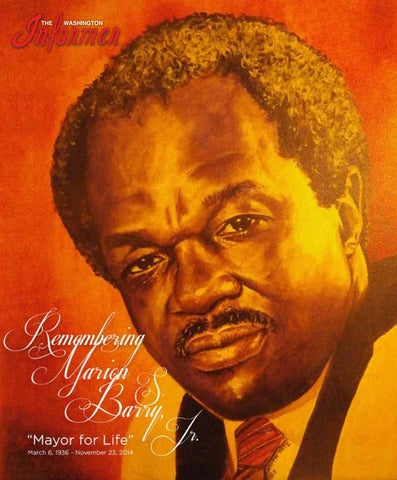
art courtesy
Denise Rolark Barnes
Marion was a political genius, community outreach expert, champion of the over-looked and the left out while emphasizing the inclusion of everyone. He was a warm compassionate human being and proud public servant who was the only DC politician with coattails. He remains the city’s favorite politician and truly loved by many across the nation. I’ll remember him for his capacity to turn the cheek, forgive, and move forward no matter the adversity. He was a remarkable, powerful, proud leader.
Marion S.Barry, Jr. Special Edition
Cover
there are hundreds, were often his greatest critics for failing to pass the torch. Now, many years later, I am able to say I can take advantage of the many programs and services Marion Barry initiated for seniors because…well, I’m now a senior, too. Still, it’s difficult to accept the fact that Marion Barry is gone. What an honor it was for me to conduct one of the earliest interviews with Marion Barry following the release of his book, The Incredible Life of Marion Barry, released last June. We had talked about it for several years and he was clearly determined to find someone who would help him to tell his story. I am grateful that he left us with a personal tome and I would encourage everyone reading this right special section right now to purchase a copy of the book for your home library. He may be gone, but his story lives on. Since November 23, when Marion Barry died after collapsing outside of his home in Southeast, so many have suggested ways to keep his spirit alive by naming buildings, schools, streets, and programs after him. So, let me suggest my idea, which is to establish the Marion S. Barry, Jr. Institute for Leadership and Public Policy at UDC to provide leadership training, public policy research and publications focusing on civil rights and economic justice. This way we can pass the torch to those future leaders that want to be social change agents like Marion Barry. Marion Barry may be gone, but his spirit, his legacy and his call for us to keep on fighting for freedom, justice, economic empowerment, better health and safety for all must live on.
Council Chairman
Phil Mendelson
3 December 2014
espite the extraordinary three-day home going services that included a 24-hour public viewing at the John H. Wilson Building, an official motorcade through the city and ending in his beloved Ward 8, another public viewing followed by a three-hour memorial service in Southeast at one of his favorite places of worship, and then finally a four-hour civil rights star-studded funeral service at the Washington Convention Center…it still does not seem real. Marion Barry is gone. His death comes while the nation watches thousands of young people, of all races, all across the country, who are waking up and speaking out against the injustices targeted towards young Black men. It appears to be the dawn of a new civil rights movement, and as Barry’s son, Christopher, noted, there are many young Marion Barry’s on the streets confronting police while calling for justice for all. I was a lot like many of them when I first met Marion Barry in the late ‘60s. He wore a dashiki; I donned a huge Afro, bell-bottom jeans and Earth shoes. He edified what my dad, Calvin Rolark, preached to me about how to confront racism even though I didn’t know exactly what racism was. But, I knew it existed because he told me so. When I met Marion Barry at the grand opening of Pride, Inc., he confirmed it. He talked about the same things my dad talked about – self-help, having pride in your community, standing up for what you believed in and being proud of being Black. Barry’s leadership made it easy for my dad to publish a newspaper that focused on positive news because Blacks in this city were doing so many positive things. Thanks to Marion Barry, we wrote about the fight to end discrimination in the metropolitan police department which led to the appointment of Owen Davis, the District’s first black deputy police chief in 1969, and Burtell Jefferson who became the first black police chief in 1978. When Marion Barry became mayor, the hirings, promotions and appointments of hundreds of very qualified blacks continued and we wrote about them. I never got a chance to get one of Marion Barry’s summer jobs because my dad owned a business that guaranteed me a job (albeit at very low wages); but most of my friends got jobs. And, I found it ironic that graduates of Marion Barry’s Youth Leadership Institute, of which
Marion Barry’s Legacy Must Live On
Marion Barry is gone. It still hasn’t sunk in.
There isn’t a member of the Council who has not benefited from knowing and working with Mr. Barry -- whether it was his skill to connect personally with residents, his persistence, his political acumen, or his ability to go from opponent to ally depending on the issue. Mr. Barry taught us about fighting for justice and fighting for the poor. It now becomes our responsibility to keep his legacy alive.
Vincent Orange
At-Large Council member
4 December 2014 Marion S.Barry, Jr. Special Edition
Marion Barry touched so many lives, including my own. As a teenager, I benefited from his summer jobs program, especially his Mayor’s Youth Leadership Institute. I appreciated his generosity of time and spirit, and am honored to have served alongside him on the Council. I have an abundance of respect for Mr. Barry and will remember him for, and continue to be inspired by, his fierce activism, bold leadership, and sincere compassion for others.
Kenyan McDuffie
Ward 5 Council member
www.washingtoninformer.com
Marion S. Barry Jr. touched the lives of many people. He was the people’s champion and embodied the principles of the civil rights era from which he emerged. A strong advocate for home rule, his imprint in District politics is evident through the vigorous development the District has seen over the years and policies he helped put in place to secure a quality of life in which all District residents could benefit.
Yvette Alexander
Ward 7 Council member
Barry Served a Broad Constituency
Mayor Barry and I shared more than just a working relationship and friendship. We shared a brotherhood, as fellow members of Alpha Phi Alpha Fraternity, Inc. Barry remained steadfast in his devotion to the aims of our fraternity. My brother, colleague, and friend fought his entire life for what was right, for what was just. He never wavered in his dedication or his commitment. He has finished the race. Marion S. Barry, Jr. is and will always be, the “Mayor for Life.”
B y
B a r r i n g t o n
WI Staff Writer@bsalmondc
O
n the early morning of Nov. 23, Marion S. Barry collapsed shortly after a three-day stay at Howard University Hospital and was rushed to the United Medical Center in Southeast. Since his death, residents of Washington, D.C. have mourned the four-time mayor and three-term Ward 8 councilmember. Three days of observances and ceremonies honoring the four-time mayor culminated in a celebration of life on Sat. Dec. 6, where several thousand people bid Barry farewell. Speakers at the service in the Great Hall of the Walter E. Washington Convention Center included local and national politicians, civil rights icons, business leaders, the clergy and people from all walks of life. A succession of friends, colleagues and former employees at several events, including at the funeral, illuminated Barry’s impact on the growth and development of the District of Columbia. Common threads talked about in pulpits and on the street were Barry’s seminal role in bringing women into local government, his work for seniors and his unequivocal support for ex-offenders. WOMEN’S ROLES EXPANDED When Barry became mayor in 1979, he tossed the status quo on its head. He brought in blacks and placed them in prominent roles throughout the city, seeking to bring parity to the nation’s capital where blacks had long dominated numerically. Barry brought the best and the brightest people into his administration and he put African Americans into a slew of positions in the District government’s middle- and upper-level management. Few women were in the upper reaches of government but all that changed with Barry. Customarily, women were hired as secretaries, relegated to support staff positions and were rarely able to crack the glass ceiling. Yet throughout his four terms, Barry hired women and didn’t hesitate to appoint them to non-traditional leadership positions across District agencies, including running agencies and serving as administrators, chiefs of staff and deputy chiefs of staff. Barry hired people not because of their color but because he thought they could do the job. Barry chose more than a dozen women for high-level municipal positions including Gladys Mack, who served as Barry’s budget chief in 1979 and worked in similar roles in subsequent Barry administrations. Carol Thompson Cole was also one of Barry’s early appointees. Among her positions with DC city government: city administrator and deputy mayor for operations; deputy mayor for economic development; chief of staff in the Executive Office of the
M .
Mayor; and director of the D.C.Department of Consumer and Regulatory Affairs. “Growing up in Washington, D.C., I always wanted to work in D.C. government,” said Thompson Cole, the youngest department head in the city’s history. “Women and young professionals had opportunities, especially if they were smart and bold. I was acting director of the Department of Licenses, Investigations and Inspections in my 20s and was appointed City Administrator in my 30s. I was the only woman ever appointed. It was rare then and doesn’t happen much now.” “Over four terms, many positions were held by multiple women … Marion Barry appointed competent, committed and compassionate professionals. All of us are eternally grateful to him.” EX-OFFENDERS Returning citizens were another constituency close to Barry’s heart. At a Dec. 1 rally in remembrance of Barry and his varied contributions to ex-offenders, several of Barry’s friends, employees and associates who had served time in prison, lauded the late mayor. “We’re doing this because we know as ex-prisoners we have to honor this man,” said Al Malil Farrakhan, founder and executive director of Ceasefire, Don’t Smoke the Brothers and Sisters. “He was in the forefront in the attempt to get us justice, fairness and equality. It’s only fitting to honor him.” Farrakhan said Barry had never abandoned the ex-offender community and made it easier for their re-assimilation into the D.C. community. Several speakers at the rally – a number of them returning citizens – spoke of the full-bodied support Barry extended to the ex-offender community when he became mayor in 1979. Rhozier “Roach” Brown, a longtime friend and supporter of the fourterm mayor, said the two met in the 1960s while Brown was serving a life sentence at the Lorton Correctional Facility in Lorton, Va. “He defeated Mayor Walter Washington and six months later, he submitted a bill for incarcerated people to vote. He was the first mayor to hire ex-offenders.” Brown, a motivational speaker and criminal justice consultant, said when the president of the United States signed a pardon for him, Barry hired him as a special assistant and appointed him as the first director of the city’s ex-offender office. “He quarterbacked the ex-offender movement from the mayor’s office. He didn’t forget us or turn his back on us,” said Brown, who wore a green and white 1994 Barry campaign T-shirt. “The ex-offender community played an important role to get him reelected. He did so many things, he scared me. He could walk into a bank without a gun and walk out with the money. He
S a l m o n was hope, he gave us hope.” “He sought the authority to grant pardons and did things that would make the devil step back.” Barry appointed returning citizens to the D.C. Parole Board, championed legislation to “ban the box,” meaning that they wouldn’t have to check the box on applications saying they were ex-offenders and the four-time mayor also sought the authority to pardon those incarcerated. SENIORS E. Veronica Pace served the Barry administration as director of the DC Office on Aging for most of Barry’s time in office. During a memorial service for Barry at The Temple of Praise on Southern Avenue, S.E., Pace remembered Barry as a champion of the elderly. “Justice cannot be done to this destiny-driven life. Not in a minute, hour or day,” said Pace. “With D.C. Law 1-24, he created the D.C. Office on Aging. One hundred thousand seniors are able to benefit. He created it with partners and collaborators like the United Planning Organization, the Greater Washington Urban League and others.” “Very little happened in D.C. or Ward 8 – about D.C. – without going through Marion Barry. I was the director of aging for three of his administrations. He built group homes and public housing apartments for seniors. If you received home-delivered meals, line danced in class or went to the Washington Senior Wellness Center, you can thank Marion Barry. If you received blood pressure checks or nutrition, thank Marion Barry.” Many of those who worked for Barry, the self-described Barry Army, look back at their time in the working for Barry with great affection. “Without question, he’s one of the smartest leaders about government that has led a city in this country. He thoroughly understood how a city ran and policies that made a difference in people’s lives, especially the least among us,” said Michael C. Rogers, who first met Barry in 1976 and served for 30 months as Barry’s city administrator. “But he also understood business, and knew how to engage the business community to achieve the city’s objectives. He did not“He standpaved in thethe wayway of business.” for modern Washington. He cared about the city and its people. I worked closely with him and met most mayors – black and white – since the ‘70s. He is in the top five of the most charismatic public officials ever elected in this country. He was a man of substance, was caring and really was about doing the right thing.” Rogers, vice president of university advancement at the University of the District of Columbia, said Barry’s legacy, after 52 years of public service, is unparalleled. MB
B y WI Staff Writer
I
R o w l e y
I like others thought Marion Barry was invincible. We were dear friends and there for each other over the years. Marion personified DC and his passing is a great loss to all of us, especially those most in need whom he served so well. He loved DC and us. In spite of his foibles and having run against him, I loved and appreciated Marion Barry Jr. and will miss him greatly.
Carol Schwartz
We celebrate his many contributions to our city and to the lives he made better through his half-century of dedicated leadership. In particular, we highlight his commitment to the cause of self-determination for the people of the District, both in Barry’s struggle as a community activist for home rule and, subsequently, in his fight as a public official for statehood for the people of the city he loved.
Jerry Clark
Chair, DC Statehood Coalition
www.washingtoninformer.com
resounding cheers and applause. “Now let somebody try to mess with that,” said Gray, who went on to share that he and Barry had a close and long-lasting friendship as well as loyal political and community-service oriented relationship. “I looked forward to [engaging in] debates with Marion,” said Gray. “He was such a champion for poor and disadvantaged people, and our job was try to get people to understand that folks deserve not to live a segregated life, but to live a life just like everybody else.” At that point, Gray brought up an incident where a resident opposed the placement of a group home in the resident’s neighborhood. Gray said the neighbor attended a D.C. Council meeting with about 200 people in tow and where Barry made a presentation on behalf of the home. He said Barry was confronted by the man who repeatedly questioned him on the matter. Gray said that after a while, Barry responded, “you don’t want us here [in your neighborhood] do you? If you want to stay here and talk about how to make this work, I’ll stay here with you all night. But otherwise, I don’t have anything else to say to you.” Gray paused momentarily before continuing. “Now wasn’t that just like Marion Barry,” he said. “Marion was standing up for what was right. Standing up for people who otherwise couldn’t speak for themselves.” MB
Marion S.Barry, Jr. Special Edition
who stepped to the podium to share their sentiments of the iconic leader who was “mayor for life.” Daniels, who’s also served as a youth mayor, added that for the past 35 years, MYLI has not only “nurtured young women and men to be at the vanguard in the District,” but all over the world.” Ward 5 Council member Kenyan McDuffie and former Council Chair Kwame Brown came through the program as well. So did Mayor Vincent C. Gray’s son Carlos, and other alumni that include Markus Batchelor, who recently assumed an Advisory Neighborhood Commissioner post, Sheila Bunn, a member of Gray’s administration, Darrell Sabbs, prevention outreach manager for the Phoebe Putney Memorial Health System in Americus, Georgia, and April Watts, 102.3radio personality. Those alumni who appeared on the program recalling Barry’s dedication to MYLI and his far-reaching efforts of community service, also vowed to keep his legacy alive. While Batchelor admitted that had it not been for Barry’s vision, “none of [MYLI alumni] would be where we are today,” Watts joined Sabbs in acknowledging that Barry made the “District’ government move over and let the people in.” However, Mayor Gray seemed to speak for all the alumni when he took to the podium to declare that although his term in office ends soon, he will make sure MYLI becomes known as the Marion Barry Youth Leadership Institute. Upon the announcement the sanctuary erupted in
Charles Allen
Ward 6 Council member-Elect
5 December 2014
n a late evening service on Sunday that culminated four days of home going celebrations honoring the life and work of Ward 8 Council member Marion S. Barry Jr., a crowd packed the sanctuary at McKendree Methodist Church in Northeast, carrying on as if as jubilant morning worship service was still in progress. As the choir an invigorating melody of traditional gospel tunes, members of the audience instinctively rose to their feet, clapping and singing along during what evolved into a fourhour program that the alumni association of the Mayor’s Youth Leadership Institute (MYLI) sponsored as their tribute to Barry, who died on Nov. 23 at age 78. Barry, who also served as a four-term mayor, founded MYLI in 1979 as a leadership development initiative for the District’s youth. Since then, the program has groomed more than 15,000 young people between the ages of 14 and 17 to serve s leaders in areas that include civil service, politics, education, religion and business. “Sunday morning is gone, but it’s still Sunday,” Bishop John Daniels, a 1981 MYLI alumni, who also served as a youth minister for the organization, said to the audible rounds of Amen that resonated all over the church. “We’ve come to serve a life that was well-lived . . . now he is taking his physical rest [but] his spirit lives on. We pause, reflect, remember and recommit to the ideals Marion Barry imparted to us,” said Daniels, who listed among several MYLI alumni
D o r o t h y
Youth Leaders Vow to Keep Barry’s Legacy Alive
From left to right, former youth mayors who attended the Sunday, Dec. 7 tribute to Marion S. Barry Jr. at McKendree Methodist Church in Northeast, included the Rev. John Daniels, April York, Aushann Burroughs Vasquez, Sean Mack, Kemry M. Hughes, Barry Picture, Darrell Sabbs, Sr. (Former Director), Former Youth Mayor’s Tyrell Holcomb, Markus Batchelor, Ebony Johnson, Shannon Foster, Joseph Goings./Photo by Roy Lewis
As a student, I learned about Marion Barry’s leadership of SNCC and legacy in the civil rights movement. As a Council staffer, I worked with him on several efforts, for Ward 8 and the city. And as a Councilmember-Elect, I was looking forward to joining him on the dais to continue the work needed for all residents of the District. Mr. Barry will forever be an icon in DC for his deep commitment to social justice and bold political leadership, as well as his personal generosity and compassion.
The city of Washington, DC mourns the loss of ‘Mayor for Life’ Marion Barry. A hero of the civil rights movement and a longtime leader in the District of Columbia, Barry’s personal demons could not obscure his deep and abiding love for the city and its people. His voice and constant presence will be missed by the people of Ward 8 and residents across the District. Ward 6 Council member-Elect Rep. Debbie Wasserman Schult
6 December 2014 Marion S.Barry, Jr. Special Edition
He rose to become one of the most influential politicians in District of Columbia history. Mayor Barry will always be remembered for the most expansive youth jobs program in the United States, where summer employment was guaranteed for every school-age resident. I will always fondly remember beating Marion handedly on the tennis court, and our many warm interactions over the years. Congresswoman Maxine Waters (D-CA)
www.washingtoninformer.com
Mayor Barry was a tireless fighter for the people of Washington, D.C. and the African American community. As Mayor, he worked to achieve equal representation for the city, to grow the city’s economy and to ensure public safety. As the first chairman of SNCC, he played a critical role in organizing the grassroots efforts that would make the Civil Rights Movement a success. He continued to be a tireless champion for equality and justice throughout his life.
Congresswoman Barbara Lee (D-CA)
Town Hall Education, Arts, Recreation Campus (THEARC)
D.C. Commission on the Arts and Humanities
Lionel Thomas, Executive Director
www.washingtoninformer.com
Marion Barry was a professed lover of the arts and humanities. He knew the value of the arts in improving the quality of life for District residents and visitors. The arts community is grateful for his years of leadership and support of arts and culture.
Marion S.Barry, Jr. Special Edition
Edmund Fleet, Executive Director
7 December 2014
Marion Barry was a fixture of Washington, DC politics for decades. As mayor and as a member of the council, he had a significant impact on the growth of the arts in this city.
Sandra “S.S.” Seegers
8 December 2014 Marion S.Barry, Jr. Special Edition
A friend of educators, Councilmember Barry was an advocate for strong public schools and a fierce fighter for social and economic justice. As president of the DC Board of Education, councilmember and mayor, Barry remained a staunch supporter of public education, the Washington Teachers’ Union, and labor unions in general. He understood the importance of advocating and caring for the working class, the disadvantaged, senior citizens, our youth and the DC community at-large. He will be dearly missed..
Elizabeth Davis, President Washington Teachers’ Union
www.washingtoninformer.com
Barry had a significant and lasting impact on the entire metropolitan region through his work with COG. He helped put in place the agreement between several jurisdictions that resulted in the construction of the Blue Plains Advanced Water Treatment Facility, and enabled the construction of the COG building near Capitol Hill. Throughout his life, he was a champion for civil rights and the economic empowerment of the city’s poor.
Metropolitan Washington Council of Government
SNCC and the Rise of Marion S. Barry, Jr.
His contribution to the city and humanity is unyielding. His reign began when the Charter gave the city a new face and him the opportunity to set the tone for the District. We all cannot forget his contributions regardless of what position he held. He will be forever in our hearts and on our minds.
SNCC member Courtland Cox (above) worked with the late Marion S. Barry in the Civil Rights Movement and shared his experiences at a SNCC reunion in honor of Barry Dec. 5 at the African American Civil War Museum in the District. /Photo by Roy Lewis
B y
A v i s
WI Editor-at-Large
T
hey gathered as they had all those years ago when they were young and determined to forge change. He was a leader among them—a Mississippi-born titan who was so disturbed by the injustice he experienced as a child of the Jim Crow South that he pledged to work to end it. They understood his commitment and felt confidence in his ability to lead them. They took the name Student Nonviolent Coordinating Committee—“SNCC”— and stood up for voting rights and against discrimination. He was elected their first chairman. And, according to the scions of SNCC who attended a special reunion in his honor Dec. 5, the late Marion Barry continued to lead his people in the same tradition until he drew his last breath on Nov. 23. “To me, as his friend, his death is a great loss. To the city, and particularly for people who are not privileged, a tremendous advocate has been lost,” said Courtland Cox, a SNCC member who later served as Barry’s director of minority business affairs in Washington, D.C. Frank Smith, a SNCC member who later served on the D.C. Council, organized the reunion. He currently directs the African American Civil War Museum in Northwest, Washington, where the
T h o m a s - L e s t e r
event was held. Participants said it was fitting that the heroes of the Civil Rights Movement came together at a place that honors heroes to celebrate the life of a hero of the people. Smith, who was born on an old peach plantation, said he met Barry, who grew up on an old cotton plantation, in 1962, when they were two “good-looking, debonair and fearless young men” registering voters in Mississippi while dodging klansmen and corrupt cops. He said he held the Barry event to “highlight the special role that Barry played” in the nation’s civil rights revolution from serving as SNCC’s first chairman to becoming the highest ranking local official in the world’s most influential city. “I wanted the SNCC people to be able to pay tribute to him in their own special way,” said Smith, 72. “It was historic. We recorded it and at some point will have a 30-minute version to show the public.” The attendance list included names, like Barry’s, that have become part of history. Charles McDew, SNCC’s second chairman, talked about leadership. The Rev. Reginald Green, who was a member of the Freedom Riders, did the prayer and benediction. Reggie Robinson, who joined the student movement in Baltimore and later worked in McComb, Mississippi,
with activists such as Rep. John Lewis (D-Georgia); Mississippi Freedom Summer Project creator Robert “Bob” Moses; political activist Tom Hayden; Barry, McDew and others, spoke about organizing tactics back in the day. They told stories about Barry serving time in jail for his activism. They talked about the disappointment he felt when he witnessed so much discrimination after moving to the nation’s capital in 1965 to open a SNCC office. They talked about Barry’s foray into helping D.C. residents get jobs by co-founding Pride, Inc., in 1967. They spoke about his ascension from the school board to the D.C. Council to the mayor’s suite. “He was the first one to tell the white people of the District of Columbia that the black people of the District of Columbia couldn’t breathe,” said Tim Jenkins, a Howard University and Yale Law School graduate, who was asked to work on SNCC’s executive committee after serving as vice president of the National Student Association, which recruited northern students to support southern students in the struggle. Larry Rubin, a union organizer in the South in the 1960s, who later worked as Smith’s executive director when he served on the D.C. Council, said Barry and others moved to Washington, D.C.
See SNCC on Page 9
While there will never be another Marion Barry, we will ensure city leaders of today and tomorrow serve with the dedication and passion that was on display throughout Barry’s many decades of service. His legacy will live on in the many he helped over the years and we honor him through the commitment and professionalism we display running our businesses, shaping our communities and raising our families.
D.C. Contractor’s Guild
SNCC member Timothy Jenkins talks about the contributions the late Marion S. Barry made to civil rights as other panelists look on at a special program honoring Barry Dec. 5 at the African American Civil War Museum in the District. /Photo by Marco Esparza.
The D.C. Department of Employment Services His legislative support for the work of the Health Benefit Exchange Authority was indicative of his commitment to improving access to quality health care for the people of this city. He understood that healthy residents build healthy communities. We pay tribute to his life’s work and legacy.
D.C. Health Benefit Exchange Authority Marion Barry Jr. was the epitome of the peoples Mayor, as the city’s most beloved Mayor and a civil rights leader Barry fought tirelessly to promote economic, educational and social equality for African-Americans and underserved communities. His 43 years in leadership and service to the people advocating on behalf of the less fortunate and the voiceless is unsurpassed, he will be greatly missed. Those of us that knew him are richer for having done so, and are very proud to have known him..
NAACP DC
www.washingtoninformer.com
knew, and it is clear today, is that Marion never cared about money,” Cox said as several people nodded in agreement. “He had other issues…”—several people laughed loudly—“but not money.” He said Barry’s good works are the reason why he is being mourned so widely. “[His] will be the largest funeral and memorial service ever seen in the District of Columbia. I think at the end of the day it will be because, as King said, he tried to help somebody.” Smith said it is ironic that as Barry’s life was celebrated, young people across the nation have taken to the streets to demand justice for African American males who are disproportionately injured or killed by police. The struggle continues, he said. “I was at the funerals for Medgar Evers, Malcolm X, Martin Luther King, Jr. and now Marion Barry,” Smith said. “These funerals are a reminder that we will all someday pass and hopefully we will have done something with our lives that makes us worthy of being remembered. Barry’s life reminds us that you can come from very humble beginnings and make a big difference in the world.” MB
Marion S.Barry, Jr. Special Edition
to help build a home rule movement after SNCC wound down. He credited Barry with bridging the divide between blacks and unions. He credited Barry in recent years for being the “go to” councilmember on issues related to low-wage earning workers and construction workers. “I’m here to tell you, Marion will be sorely missed by every organization of working people in the District,” Rubin said. Cox started his presentation by asking members of SNCC to stand to be recognized. Several men and women rose. “I will tell you that Marion would probably enjoy all of this and probably expected it,” he said, drawing laughter from the audience. “And, in fact, the community would be very displeased if we didn’t give him the kind of honor that he deserves.” “Yes!” shouted several people. “I always think about, on these occasions where one is asked to sum up someone’s life, about King’s statement the night before he was killed when he said, ‘Don’t tell about a Ph.D. Don’t them I won the Nobel Prize. Just tell them I tried to help somebody.’ And at the end of the day, if we’re to summarize Marion Barry’s life, that’s what we’re to say—that he tried to
help somebody.” Cox told the audience that the District where Barry relocated after fighting for rights in the South had no black bus drivers because transit authorities felt that African Americans were likely to steal the fares. Many black police officers were barred from riding in patrol cars. Black patrons at downtown stores were often hassled about trying on clothes. Blacks were also generally barred from law firms, accounting agencies and other businesses. Barry witnessed an environment where open discrimination was practiced because of a “policy of affirmative action for white males,” he said. When Barry “moved from a position of protest to a position of power” and was able to effect change, he helped not only the young and old, but the disenfranchised and even the wealthy in between, Cox said. His actions angered those who saw their piece of the pie whittled away as Barry spurred others to demand that the pie be divided evenly. Cox said those efforts led to Barry being unfairly scrutinized by a white press corps that insinuated that the changes he forged were wrought of corruption and legal officials eager to find a flaw in a warrior fighting for equality for all of D.C.’s citizens. “One of the things we always
9 December 2014
SNCC continued from Page 8
Marion Barry’s lasting legacy at DOES and on the city he loved is his creation of the District’s Summer Youth Employment Program (SYEP). Barry can be credited with having the vision to help generations of District residents develop the skills, attitudes, and commitment necessary to succeed in the workforce as well as to learn life skills and responsibility that lay the foundation for how to succeed in life. He will be missed.
National Coalition on Black Civic Participation
I
B y
www.washingtoninformer.com
met Marion Barry when I was a 21-year-old cub reporter on my first assignment for what was then The Evening Star, the District of Columbia’s family-owned afternoon daily newspaper. I had come to the job, new to the city, through the Ford Foundation-Columbia University special master’s program designed to increase diversity in the nation’s print and broadcast newsrooms. The night before I was sent out to check out the state of affairs on 14th Street. The area had experienced a seriously delayed aftershock from the riots of two years before on the night of Dr. Martin Luther King, Jr.’s murder. I had been a sophomore in college in Atlanta in 1968, so I knew very little about the players in D.C. in September 1970. But the Columbia program had given me confidence that I could quickly gather information and submit illuminating background for the story that was being written in the newsroom about the mini-riot. Holding my slim, spiral notebook, I was nearing the end of scribbling quotes from the proprietor of a clothing store called “The House of Jerry’s” when a tall man in a dashiki strolled in with an entourage of ‘brothers’ behind him. “Who are you?” he demanded in a gruff voice. “I’m Lurma Rackley, a reporter with the Evening Star,” I answered, extending my hand in my most professional manner, ready to get quotes from this new batch of people if they proved to be good sources. I was not expecting what came next. “You’re not a reporter. The Evening Star doesn’t have any black reporters. You must be a spy with the FBI.” The slightest breeze could have knocked me over. As a young teen, I’d been in the thick of protests as part of the Orangeburg, South Carolina civil rights movement. A spy? FBI? I earnestly sought to defend myself AND the newspaper, saying, “Oh, the Star does have black reporters. We have Corrie Anders and Warren Howard … and …” “Let me see your press pass,” he demanded, as I wracked my brain
Marion Barry
10 December 2014 Marion S.Barry, Jr. Special Edition
He loved us and we loved him back: A remembrance of
Marion Barry truly epitomized what public service is all about. He was a visionary leader who changed the lives of thousands of young people, opened contracting opportunities for minority and women-owned businesses, worked to ensure seniors could retire with dignity, and so much more. Marion also devoted his life to civil rights and social justice for all people. The spiritual, ‘May the Works I’ve Done Speak For Me’ exemplifies the life of Marion Barry, Jr. Marion maximized his life’s dash as a servant leader from birth to death.
L u r m a
R a c k l e y
to come up with more names. By this time, I was near tears. I didn’t have a press pass yet. I offered to show my building ID, but he said, “You could be the janitor at the paper and have a building ID.” Flustered and embarrassed beyond measure, I thanked Jerry and hurriedly excused myself. But before I could get halfway down the block on my way to a nearby phone booth to call in my notes, one of the men who had stood watching the exchange caught up to me. “Hey, don’t take that seriously. He was just playing with you. Do you know who he is?” “No,” I answered, struggling to regain my confident footing. “That’s Marion Barry. He’s head of Pride, Incorporated. He told me to invite you to join us for drinks at the Pitts [Motor Hotel] tonight. My name is Hank Wilson, and we’re happy to see black reporters at the Star.” Over the next two decades, from covering Marion Barry and John Wilson in the first home rule election, to leaving the Star and working in Mayor Barry’s Office of Communications and Office of the Press Secretary, I came to know Marion to be a man with a razor-sharp mind, easy laugh, incredible ability to commit names and data to memory, and an abiding sense of responsibility to uplift the downtrodden, to create opportunity for the least of these. He was also, like the rest of us, a human being with strengths and weaknesses. All of us don’t have our failings paraded on a global stage, however; and I daresay that if we did, we might not have the amazing strength and fortitude to fight back, as Marion did. In the summer of 1990, the Washington Post Style section did a feature story about me as the mayor’s press secretary managing the media during his infamous trail. Some reporters had tried to paint all of the mayor’s defenders as people who “drank the Kool-Aid,” and willy-nilly excused his behavior instead of kicking him to the curb. The reporter, Megan Rosenfeld, sought to put my loyalty to the mayor in context. She wrote about my early years in the civil rights movement, and she noted that I
was engaged to Gil Scott-Heron, whose commitment to social activism was clear through his poetry and music. She and I also talked about my belief that drug addiction and alcoholism were health issues that should be addressed as such, not reasons to criminalize a person. The Post subsequently published a Letter to the Editor from me on the subject then wrote their own editorial denigrating that argument as a reason to have compassion for the mayor. But the people knew better. Although my office in the District Building received its share of hateful messages during the trial, most of them came from outside the city. Compassion for the mayor was a much more likely response from D.C. residents. Like I, most of the black people in the city (and a fair amount of white people) knew that Marion Barry had worked smartly and tirelessly to level the playing field for black professionals and entrepreneurs; to ignite a “Living Downtown” with day and nighttime activity; to launch jobs programs for young people; and to make sure senior citizens were honored and served throughout the city’s neighborhoods. So, he stumbled. But he’d earned enough high regard and goodwill for us not to see those challenges as the measure of the man. He deserved our prayers, our support, and our talent to help him get back on his feet and resume the life of contribution he was born to lead. We the people did it. He did it. MB Lurma Rackley worked at the Washington (Evening) Star from late 1970 through late 1979. She joined the Barry Administration in December 1979 and left government in December 1990, having served in the city government’s Office of Planning, in the Mayor’s Office of Communications, and as Barry’s Press Secretary. She lives in the Atlanta, Georgia, area and works at Habitat for Humanity International.
T y r e e
in that hotel room?” Nothing else mattered to many people outside of the District. They didn’t know or have access to the hundreds of stories about the work that Barry had done that made him so beloved. The rest of America had no idea what he had done for the city, for youth, for the needy, and even for the black middle class in a public service career that spanned more than 50 years. Barry spoke candidly about that night at the Vista Hotel and the importance of people knowing what had really happened. The FBI sting was the biggest personal, political and spiritual mistake of his life. And the 10-second video clip of him smoking crack, shot by the FBI during the infamous sting, aired thousands of times and came to define his years in public service, despite all the good that he had done. We agreed that we would introduce the horror right up front so that readers could digest it and move on with the rest of his story, which played out over 78 years. That’s what makes a real book and a real legacy, not just one night. Barry maintained the right to delete any section of his life story that he did not feel comfortable documenting in print. We argued over some details. His response to my demand to include a detail that I thought was important was, “I still have to live here, Omar. I can’t put that in a book.” So I agreed to uphold my journalistic responsibilities and withhold from the book and any other writings the details that he wanted kept secret.
Release of the book on June 17, 2014 gave those interested in learning his story an appropriate tool to learn the intricate details of his life: born on a Mississippi farm; raised in Memphis, Tennessee; a scholar who earned an undergrad degree and a master’s degree in chemistry; selected as a leader in the youth freedom movement. He was a teacher, an organizer, a rebel, a husband, a father and a political revolutionary. Would you be willing to publish the truth and nothing but the truth about your life, as Barry did in his autobiography? Many of us would not. The things that happen in real life are often too complicated to allow us to feel comfortable enough to reveal the full details of our stories. That is one of the reasons why Marion Barry was so exceptional and he was exceptional in many ways. I was honored to help him set the record straight about his life. I hope that when his story is told, the details will come from his words as told in his autobiography, not the decades old 10-second video clip or the malicious rumors from people who didn’t know or appreciate everything that he did. MB Omar Tyree is the co-author of “Mayor for Life: The Incredible Story of Marion Barry, Jr.”
Councilman Barry recognized that economic development was a catalyst to bring along the less fortunate and to close economic gaps. He believed in the power of redemption and had a special affection for our most vulnerable, including seniors, youth and limited-income residents. He was committed to advancing policies to help cure societal ills that affected those groups including social and economic inequality. The people of the District of Columbia lost a tireless champion.
PEPCO Mr. Barry was a tireless advocate for expanding economic opportunity to small businesses, youth and low-income families. His tenure as Mayor of the District of Columbia greatly contributed to the growth of the middle class in Prince George’s County.
Prince George’s County Council
www.washingtoninformer.com
n September 2012, the late Marion Barry, Jr. and I met for the first of what became dozens of meetings to pull together information for his autobiography, “Mayor for Life: The Incredible Story of Marion Barry, Jr.” Barry was 76 years old at the time, and, despite suffering from a number of ailments, he was still representing the people of the District of Columbia’s Ward 8. He was visiting Charlotte, North Carolina, while attending the 2012 Democratic National Convention. I had relocated to Charlotte and was eager to talk to him. I showed up to meet with the iconic former Washington, D.C., mayor with a tape recorder, a pair of fresh batteries and a notepad, not knowing how much he would say or if he would be as open as he needed to be to tell his true life story. He shocked me by starting with the one story that he said he did not want to become his legacy—the incident in the Vista International Hotel in January 1990. I remember thinking that we hadn’t even signed a contract to write his book yet. It was a dream come true to work with him. I had lived in the D.C. area for five years, writing articles about everything from local business to health to politics. I found that Barry was much loved and appreciated in the region. However, outside of the District-Maryland-Virginia area, people asked the same question over and over? “Why would they continue to vote for that man after he was caught smoking crack on TV with a woman
O m a r
D.C. Office on Aging
11 December 2014 Marion S.Barry, Jr. Special Edition
I
B y
The Real Story of Marion S. Barry, Jr.
Omar Tyree, left, who co-authored Marion Barry’s autobiography: Mayor for Life: The Incredible Story of Marion Barry, Jr., released in June, joined Barry at many of the book signings held across the country. / Courtesy Photo
The Honorable Marion Barry was an extraordinary public servant who dedicated his life to fight for justice and equality for underprivileged citizens. Mr. Barry continued his advocacy for seniors as a Council member by ensuring there access to meals, transportation, and health and human services. His advocacy for the District’s most vulnerable residents will be missed, but will never be forgotten as his legacy lives on in the hearts of so many public servants working to truly improve the lives of District citizens.
Thank You Mayor Marion Barry for Decades of Dedicated Service to the Residents of the District of Columbia
“From his days as a leader in the civil rights movement to fighting for D.C. Home Rule to raising his voice for the voiceless in Ward 8, Marion Barry leaves behind an unforgettable
and inspirational legacy.” – Mayor Vincent C. Gray
Government GOVERNMENT OF THE of the District of Colum Office of Planning DISTRICT OF COLUMBIA Vincent C. Gray, Mayor VINCENT C. GRAY, MAYOR