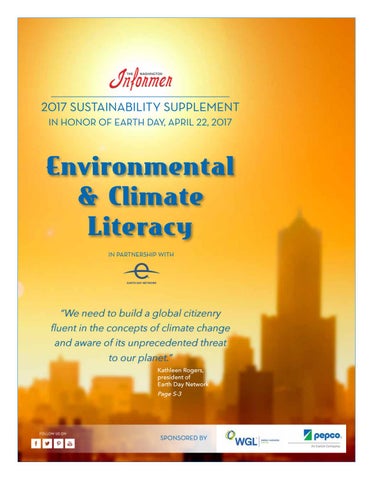
2017 SUSTAINABILITY SUPPLEMENT IN HONOR OF EARTH DAY, APRIL 22, 2017
Environmental & Climate Literacy IN PARTNERSHIP WITH
®
EARTH DAY NETWORK
“We need to build a global citizenry fluent in the concepts of climate change and aware of its unprecedented threat to our planet.” Kathleen Rogers, president of Earth Day Network
Page S-3
FOLLOW US ON
SPONSORED BY
2017 SUSTAINABILITY SUPPLEMENT / APRIL 2017 / www.washingtoninformer.com ®
EARTH DAY NETWORK
WORDS FROM THE EDITOR
NEWSPAPER READING IS A HABIT DON’T BREAK THE HABIT!
READ THE WASHINGTON INFORMER YOUR WAY: In Print – feel the ink between your fingers of our Award Winning Print Edition
n
On the Web – www.washingtoninformer.com updated throughout the day, every day
n
n
On your tablet
n
On your smartphone
n
n
n
Weekly Email Blast – sign up at www.washingtoninformer.com
202-561-4100 For advertising contact Ron Burke at rburke@washingtoninformer.com
...Informing you everyday in every way
In Memoriam Dr. Calvin W. Rolark, Sr. Wilhelmina J. Rolark THE WASHINGTON INFORMER NEWSPAPER (ISSN#0741-9414) is published weekly on each Thursday. Periodicals postage paid at Washington, D.C. and additional mailing offices. News and advertising deadline is Monday prior to publication. Announcements must be received two weeks prior to event. Copyright 2016 by The Washington Informer. All rights reserved. POSTMASTER: Send change of addresses to The Washington Informer, 3117 Martin Luther King, Jr. Ave., S.E. Washington, D.C. 20032. No part of this publication may be reproduced without written permission from the publisher. The Informer Newspaper cannot guarantee the return of photographs. Subscription rates are $45 per year, two years $60. Papers will be received not more than a week after publication. Make checks payable to: THE WASHINGTON INFORMER 3117 Martin Luther King, Jr. Ave., S.E Washington, D.C. 20032 Phone: 202 561-4100 Fax: 202 574-3785 news@washingtoninformer.com www.washingtoninformer.com
PUBLISHER Denise Rolark Barnes STAFF D. Kevin McNeir, Editor Ron Burke, Advertising/ Marketing Director Shevry Lassiter, Photo Editor Lafayette Barnes, IV, Assistant Photo Editor John E. De Freitas, Sports Photo Editor Dorothy Rowley, Online Editor ZebraDesigns.net, Design & Layout Mable Neville, Bookkeeper Dr. Charles Vincent, Social Sightings columnist Tatiana Moten, Social Media Specialist Angie Johnson, Circulation REPORTERS Stacy Brown (Senior Writer), Will Ford (Prince George’s County Writer), Hamil Harris, Tatyana Hopkins, Jade JamesGist, D. Kevin McNeir, Lauren Poteat, Dorothy Rowley, Sarafina Wright (General Assignment Writer) PHOTOGRAPHERS John E. DeFreitas, Shevry Lassiter, Roy Lewis, Demetrious McKinney, Mark Mahonny, Lateef Mangum, Travis Riddick
®
EARTH DAY NETWORK
We Have Only One Planet – We Must Protect Her for Tomorrow By D. Kevin McNeir WI Editor When I was a junior high school student in the mid-70s in my hometown of Detroit, I received an assignment in which I was directed to examine pollution and its impact on the U.S. At the time, our careless and consistent mistreatment of the planet had just begun to endanger our lakes and rivers as well as our fish and wildlife. Litter and landfills were quickly becoming both eyesores and dangers to our health. Meanwhile, automobile, steel and other factories were pumping all kinds of toxic waste into the air and our waters with little regard for the harm those toxins were having on our plants, animals and the human race. But I am no longer a junior high youth. I am a father and a grandfather, concerned about the future. Actually, I am afraid – fearful about tomorrow. This supplement focuses on sustainability, illustrating the contributions of community advocates who have decided that caring for the health of our planet serves as one of the world’s most crucial tasks. The air has become poisoned impacting breathing and increasing respiratory diseases. Many waterways can no longer sustain fish or other wildlife because they’ve been destroyed by chemicals and other pollutants. New diseases have burst on the scene, becoming more prevalent and with no cures in sight. As much as we may want to turn a blind eye to these and other indisputable facts, we can ill-afford to act as if the conclusions and recommendations of the world’s leading scientists have no merit. We can’t place an order for another Earth. This is the only one we have and if you listen carefully, you’ll probably hear our planet crying out, asking us to take better care of her, pleading for us to protect her and all of her inhabitants. This land is my land, this land is your land. This land needs our help. We must step up to the plate no matter what the cost. The future of those who will carry our names and keep our memories and stories alive depends on our actions today. SS
Earth Day & Science: More than a Symbolic Relationship By Melissa E. Adams Chief Corporate Social Responsibility Officer WGL/Washington Gas On Earth Day many people will be participating in science marches, to highlight the relationship between our Earth and the sciences that help us understand the world around us (and beyond). The Earth remains the only planet, among all that we have found, that has and can sustain life. And that means, aside from its natural beauty which we all celebrate and enjoy, we must do our part, as stewards of this unique place we call home so that it can meet the needs of this generation while ensuring it can continue to meet the needs for future generations. In order to do that we more than just an appreciation, we need to seek to understand the world around us and our symbiotic relationship with the environment. That is where science comes in. The sciences help us to understand everything from how life began (biology) to how it changes (evolution) to how to best protect ourselves (medicine) and preserve it (climatology). Science helps us heat our homes, power transportation, design buildings, roads, and bridges – and also tackles some of our most urgent challenges of transportation, global warming, health, longevity and wellbeing, etc. And the need is only going to grow. The current world population of 7.3 billion is expected to reach 8.5 billion by 2030 according to the United Nations, and 9.7 billion by 2050. That’s a lot of people. And meeting their needs is going to be a challenge. And that’s why science – and all STEM (science, technology, engineering and math) careers – are some of the most in demand (and best paying) today and for the foreseeable future. The crucial role that energy plays in sustainable development was recognized by the United Nations – and that is why ensuring access to affordable, reliable, sustainable and modern energy is one of the UN Sustainable Development Goals. Indeed the vital importance of energy in improving health, industrialization and combating climate change cannot be overstated. And tremendous progress has been made. But, paradoxically, the number of people around the world who rely on polluting fuels and technologies for cooking such as solid fuels and kerosene has actually increased. Experts estimate that the Earth is likewise capable of providing enough energy; through a combination of renewables like wind and solar as well as continuing use of fossil fuels including natural gas. In fact, through a combination of increasing efficiency as well as shifting some of the energy use from natural gas to those renewable electricity sources, there is abundant natural gas for decades to come. That’s great news since it remains the most efficient and least polluting energy for thermal applications like heating, cooking, laundry and hot water. We can be proud that our company is doing its part. Over the last seven years, WGL and Washington Gas have reduced the absolute emissions from our fleet and facilities by 74 percent; as well as the emissions per therm of the gas we supply by 20 percent. Those reductions are substantial and demonstrate how our company is working to address climate change. And we will continue to do so. At the same time, a major focus of our charitable giving, as a company, is in the area of education. And we’re focusing on STEM for two main reasons. First, those are growing areas for employment and opportunity offering great careers. And second, we know that as our company’s continued success depends upon educated employees well versed in science, technology, engineering and math. SS
www.washingtoninformer.com / 2017 SUSTAINABILITY SUPPLEMENT / APRIL 2017
S-2
Three-year Campaign Highlights Importance of Climate Literacy By Stacy M. Brown WI Senior Writer The Earth Day Network plans to launch a global initiative on April 22 that officials say kicks off a three-year campaign for environmental and climate literacy. The campaign’s focus will be on promoting mandatory environmental and climate literacy along with civic engagement and sustainable economic development, organizers said. “We need to build a global citizenry fluent in the concepts of climate change and aware of its unprecedented threat to our planet,” Kathleen Rogers, president of Earth Day Network, said in a statement. This year, Earth Day will see teach-ins around the world and a march for science rally on the National Mall that will bring together scientists and supporters to demand that leaders recognize the scientific truths across all disciplines, including climate change and other environmental issues, Rogers said. “Environmental and climate literacy is the engine not only for creating green voters and advancing environmental and climate laws and policies
but also for accelerating green technologies and jobs,” she said. Climate science literacy counts as an understanding of society’s influence on climate and vice versa, according to officials at the National Oceanic and Atmospheric Administration. A climate-literate individual understands the essential principles of earth’s climate system; knows how to access scientifically credible information about climate; communicates about climate and climate change in a meaningful way; and has the ability to make informed and responsible decisions in regard to actions that may affect climate, NOAA officials said. Using the teach-in concept deployed at the first Earth Day in 1970, this year’s observance will build an international movement with goals that organizers say include educating citizens about the environmental and climate issues they face and creating a world that both internalizes environmental values and develops sustainable communities. “As we face the realities of climate change – unpredictable temperatures, endangered species and an increasing number of severe weather
events – ensuring that our children are prepared to become environmentally literate citizens is more essential than ever,” said Earth Day Director Dan Abrams. Further, officials noted that Earth Day Network, the largest recruiter to the environment movement which works year-round to support civic action, plans to launch a campaign for global environmental and climate literacy by Earth Day 2020. Rogers said they’re dedicated to ensuring that every student around the world graduates from high school as an environmental and climate literate citizen – ready to take action and be a voice for change. “2017 is an historic year for activists all over the world who are uniting to promote climate and environmental literacy and activism with more than 1 billion people participating each year,” she said. “This year’s D.C. rally and teach-in, along with activities across the world, will kick off a week of action throughout local communities to support science across all disciplines,” she said. To learn more about Earth Day Network and the march for science, visit www.earthday.org. SS
Singer Mary J. Blige performs on National Mall During Earth Day 2015. / Courtesy photo
Earth Day Network – Dedicated Warriors Fight
By D. Kevin McNeir WI Editor @dkevinmcneir
Leaders, members and supporters of the environmental movement will gather on the National Mall on Saturday, April 22 for Earth Day 2017, joining millions around the globe in their collective efforts to promote climate literacy, mobilize a global citizenry to proclaim the truth about climate change and provide the public with the skills needed to act on behalf of the environment when they return to their own communities. Earth Day Network [EDN], the global coordinator for Earth Day, has been working with added fervor as the annual day draws near, preparing for activities that will include teach-ins and a March for Science rally that will feature some of the world’s leading scientists and environmental advocates. And given the stance that President Trump has taken, EDN President Kathleen Rogers says it’s imperative that more people become involved in the international movement who can accurately refute the Administration’s denials about climate change and foster greater
H-3 S-3
awareness of climate change’s unprecedented threat to the planet. “We’ve already seen the warning signs from the EPA’s budget being slashed by 30 percent to the removal of climate change from government websites – it hits you on the head like a 2 x 4 – all under Trump – and for the life of me I just don’t understand,” Rogers said. “The handwriting is on the wall. Last year on Earth Day, the U.S. signed the climate [Paris] agreement but now the president has proposed a budget that undermines our credibility if we’re to meet the goals to which we agreed.” Rogers words do not exist in a vacuum as more than one billion people worldwide make up the environmental movement – a movement whose modern roots can be traced back to the first Earth Day held in 1970. She says what’s needed are “more people who care about people.” “No one wants dirty water, climate-related diseases and the host of additional environmental problems that continue to rise, but what seems to matter more in this climate of surging populism is the almighty dollar,” she said. “It’s not
about the health of the poor or children. It’s not about promoting the U.S. as a world leader. It’s about the flow of money. “ “The polls show that people want clean air and water but that doesn’t seem to matter to our country’s leaders. Even the new head of the EPA argues that climate change isn’t science based. That’s why Earth Day is so important. It’s more than just discussing the environment – it’s about changing people’s perceptions, educating people and promoting the truth with integrity,” Rogers added. Rogers says that while it may seem that the steps backward that Trump and others propose will have minimal impact that’s simply not the case. “We put massive numbers of greenhouse gases into the air – each day is not just 24 hours but more like years of damage,” she said. “The impact of a day without adequate controls is equivalent to months if not years of damage. Adding chemicals that accelerate the process and it becomes even more difficult to remove them and clean up the environment.” Rogers notes that EDN has oth-
er initiatives among its list of priorities, besides the more obvious environmental and climate literacy, including creating green voters and picking up the pace in developing green technologies and jobs. “We could be the leaders in this and treat it like we did the moon shot or computer technology,” she said. “Consider the Industrial Revolution where some countries dominated for years, including the U.S. We have the same kind of potential now but it will be countries not individuals like Carnegie, Ford or Rockefeller – one or more countries will take the lead in manufacturing a billion-dollar system that creates clean energy practically free. It’ll take a lot of time to do but it will be astounding.” “The country that gets the green tech industry will have unlimited opportunities. Four hundred million people in India don’t have any power at all. That could be accomplished either with coal or with a distributed solar industry. This fake narrative about how great fossil fuels are is old and washed up. Sure, they’ll be around for a while but then so were the horse and buggy. Going solar is a no brainer – we
should be more enlightened. Coal pollutes rivers, cuts lives short and requires us to blow up mountains.” Rogers points to the importance and need of clean water as a talking point for greater focus on environmental issues. “Concerns are mounting in California about the state’s ongoing drought crisis. We take clean water and it being easily available for granted in America but in some parts of the world, like several nations in Africa for example, people are suffering and dying. Some experts even predict that the next world war could be about water.” Rogers says that if Earth Day 2017 accomplishes nothing else, she’s hopeful that more people will realize that “Earth Day is every day.” “I wonder what will be said two generations into the future about the decisions our country made in terms of protecting the environment and the planet,” she pondered. “I hope they won’t have to say that what we did was barbaric and destructive even though we had the technology to turn the tide.” SS
2017 SUSTAINABILITY SUPPLEMENT / APRIL 2017 / www.washingtoninformer.com ®
EARTH DAY NETWORK
The national capital region is a living, breathing showcase for our country’s finest institutions and ideals. Our monuments and museums are living history. Our government buildings are where visitors can witness the world’s most celebrated democracy in action. We are home to a bevy of professional sports and world-class entertainment. And nature thrives along our rivers and
Growing with the Capital
streams, our walkways and trails – in Kenilworth Gardens, the National Zoo, the National Arboretum, and a host of other local parks and recreation areas. But this has not always been the case. Back in 1848, the year that the Washington Gas Light Company was granted its charter by the United States Congress, the capital was a far different place. It was said that, “citizens preferred to stay home at night rather than walk along the un-
lighted and unpaved streets which were obstructed with mud holes.” During the first session of the Thirtieth Congress, the Senate, House of Representatives and President James K. Polk signed the bill to pass the Washington Gas Light Company. That was just four days after the cornerstone of the Washington Monument was laid and, like that familiar symbol of Washington, D.C., we have also grown and reached impressive heights. Our company has been in business for nearly 170 years; and we have evolved through that time as our communities’ energy needs and sources have changed. WGL Energy was the first supplier in the Mid-Atlantic region to offer wind power options to our customers. In 2010, WGL Energy began offering WGES CleanSteps® carbon offsets, a first-of-its-kind initiative, to provide customers with the option of matching carbon offsets to their natural gas consumption. Today, we continue our efforts to reduce our environmental footprint and to help our customers do the same, while also saving
money. Having already reduced carbon emissions from our fleet and facilities by 74 percent since 2008, we are now setting a new, similarly aggressive target for 2025. Likewise, we continue to reduce the carbon intensity of the gas we deliver to our customers. Since 2008, we have been able to reduce carbon equivalent emissions associated with each unit of natural gas delivered to our customers by 20 percent. This was, in large part, thanks to our accelerated efforts to update our pipelines with new, modern materials that enhance the reliability of our delivery, as well as resilience in the event of bad weather, flooding or other crises. Going forward, we plan to continue these efforts. We have recently established new sustainability targets for 2025. We propose to achieve carbon neutral fleet and facilities operations; reduce fugitive emission intensity of our natural gas distribution system by 38% from our 2008 baseline; and help our customers avoid 18 million tons of GHG emissions. A visible demonstration of this
effort is our 200-plus natural gas powered vehicles deployed throughout our service area. These cars and trucks use clean burning natural gas and produce 20 to 29 percent fewer carbon equivalent greenhouse gas (GHG) emissions when compared with conventional gasoline or diesel powered vehicles. These clean burning engines virtually eliminate the emissions of particulate matter into the air, thereby reducing the air pollution and ‘ozone alert’ days that cause serious health issues, such as asthma and respiratory distress. WGL Energy empowers commercial and residential customers by offering ways to improve their energy efficiency, as well as choose clean, renewable energy such as wind and solar generated electricity, highly efficient combined heat and power installations, and carbon offsets. We Continued on Page 6
ENERGY ANSWERS TO PRESERVE THE ENVIRONMENT. WGL PROVIDES AFFORDABLE, RELIABLE, SUSTAINABLE AND MODERN ENERGY ANSWERS Our energy answers help us, and our customers to reduce our environmental footprints. Since 2008 we have reduced emissions from our fleet and facilities by 74% and reduced fugitive emission intensity by 20% - both ahead of our 2020 target. In addition, our clean, efficient energy solutions help customers reduce energy use and costs as well as their own environmental footprints. To learn more about how, visit WGL.com.
®
EARTH DAY NETWORK
www.washingtoninformer.com / 2017 SUSTAINABILITY SUPPLEMENT / APRIL 2017
S-4
ENERGY ANSWERS TO PLAN FOR A BETTER TOMORROW.
WGL is the preferred source for clean and efficient energy solutions across the nation. But we also know that our responsibilities do not end there. We’ve made a commitment to help enhance the quality of life throughout the entire community. That’s why we’re proud to work with local organizations that improve people’s health, promote a cleaner environment, support efforts to better educate our youth and as a result, enrich lives today and for generations to come. To learn more about how WGL is helping create a healthier, more vibrant community, visit WGL.com.
H-5 S-5
2017 SUSTAINABILITY SUPPLEMENT / APRIL 2017 / www.washingtoninformer.com ®
EARTH DAY NETWORK
Building a Strong and Healthy Community
WGL and Washington Gas are connected to more than a million homes, offices, schools and other buildings in the Washington, D.C. area and surrounding states through a series of pipelines. But we are also connected to the region through our 1,500-plus employees. Our corporate philanthropy and employee volunteerism efforts align with our strategic business to support strong and healthy communities, in which WGL can continue to expand our services. We have chosen to focus our philanthropy efforts on organizations and initiatives related to three specific areas—health, education and the environment. Last year, the company contributed more than $1.2 million in donations and in-kind support, and logged more than 12,000 volunteer hours with more than 600 employees actively volunteering. Some of our programs combine all three of our focus areas, working to educate the public on ways to improve public health and the environment by reducing air pollution. For example, we work with Clean Air Partners, a public-private partnership of the Washington Metropolitan Council of Governments and the Baltimore Metropolitan Council, to provide a wide range of resources, from daily alerts forecasting air quality information to air quality curriculums for regional schools. WGL has co-sponsored two
recent Breathe Easy call-to-action concerts by Clean Air Partners, encouraging people to share their sustainability actions for clean air. Participants who submitted an idea were automatically entered into a contest to win tickets to concerts that featured Bruce Springsteen & the E Street Band, and Earth, Wind & Fire and Chicago, respectively. These programs raised region-wide awareness of practices that improve air quality, through considerable local media and social media engagement. Another educational program includes our partnership with the Girl Scouts of the Nation’s Capital. Each year, we sponsor the WGL Air Quality Environmental Learning Patch Program that integrates experiential STEM lessons to teach girls in grades K-8 to use energy efficiently. Since 2007, more than 16,500 girls in the Washington, D.C., area have each spent five hours earning air quality environmental patches during summer camps. Our signature philanthropic program is the Washington Area Fuel Fund (WAFF). WAFF provides heating assistance to low-income energy consumers no matter what type of fuel they use to heat their home. Washington Gas pays WAFF’s administrative fees while The Salvation Army administers the fund, so that 100 percent of all donations go directly to families in need. WAFF was founded in 1983 and has distributed more than $25 million, helping more than 280,000 area residents. Last year, WAFF disbursed approximately $765,000, contributed by our employees and customers, which helped more than 6,100 area residents stay warm. As part of this strategic community
partnership, Washington Gas continues to develop ways to increase WAFF’s ability to help low-income customers. In addition to our fundraising and media activities, the number of employees who engage with the community through WGL’s Community Service Team is growing each year. This growth includes dozens of employees who have chosen to become program leaders, working directly with charitable organizations to coordinate and staff these events. Each year, WGL employees donate about $150,000 to support local area non-profit organizations through our annual employee giving campaign. WAFF remains the most frequently selected charity, with 131 employee donors contributing nearly $38,000 this year. One of our most popular volunteer programs is the annual Day of Weatherization, where WGL employees, friends and family members weatherize the homes of low-income and elderly residents, also providing energy efficiency tips that can increase comfort and lower heating bills. Last year, 105 homes were weatherized by more than 200 volunteers and, for the second year in a row, the program installed solar panels across the District of Columbia. In partnership with GRID Alternatives, a national non-profit, volunteers helped to install panels on one of nine buildings at the Park Chester Apartment complex, located in D.C.’s Ward 8. Energy savings from the solar installation are being used to help provide energy efficient appliances for residents living in all 94 units in
the building. Our corporate philanthropy also extends to the health sector, where WGL has recently reached a momentous milestone. WGL is the first corporate sponsor in the region to surpass $1 million in total contributions to The Leukemia & Lymphoma Society (LLS). Employees, friends and families raised a record $211,000 for LLS’s Light The Night Walk campaign that supports blood cancer research and education. Our company’s total donation came from a combination of ef-
Continued from Page 4
Two WGL employees seal a drafty window as part of WGL’s annual Day of Weatherization
®
EARTH DAY NETWORK
understand there are a lot of choices, so our experts work closely with large and small customers to customize energy plans that meet their objectives and needs. The crucial role that energy plays in sustainable development was recognized by the United Nations. This is why ensuring access to affordable, reliable, sustainable and modern energy is one of the United Nations Sustainable Development Goals (SDG#7). Indeed, the vital importance of energy in improving health,
forts, including—a corporate golf tournament that raised $124,000; employee fundraising that garnered $72,000; and corporate funding of $15,000. Supporting our communities is at the heart of what makes WGL the company it is – it is central to what has kept us in business for almost 170 years. We are looking forward to further improving the health, education and environment of our communities and to deepening our connection to the Washington, D.C. area. SS
industrialization and combating climate change cannot be overstated. And while tremendous progress has been made, we have never rested on our laurels. Today, we are exploring new ideas, like biogas (renewable natural gas) for our fleet, as well as other fleets in the area, and expanded use of clean, distributed energy projects. We hope that our efforts to provide safe, reliable, sustainable energy will continue undiminished for another 170 years – when we will undoubtedly be serving a very different Washington, D.C. region yet again. SS
www.washingtoninformer.com / 2017 SUSTAINABILITY SUPPLEMENT / APRIL 2017
S-6
ENERGY ANSWERS TO PRESERVE THE ENVIRONMENT.
WGL is the preferred source for clean and efficient energy solutions across the nation. But when it comes to the planet that we all call home, we also do more. By partnering with organizations that work to keep our air and water clean, we are playing a vital role in what needs to be done to keep our communities, and our planet, green. To learn more about how WGL is helping create a healthier, more vibrant community, visit WGL.com.
H-7 S-7
2017 SUSTAINABILITY SUPPLEMENT / APRIL 2017 / www.washingtoninformer.com ®
EARTH DAY NETWORK
Know What’s Below – Always Call 811 Before You Dig
DCPSC Chairman Betty Ann Kane
®
EARTH DAY NETWORK
This April, the Public Service Commission of the District of Columbia is celebrating the tenth anniversary of National Safe Digging Month by reminding District residents to always call 811 two working days before any digging project. Mayor Muriel Bowser has proclaimed April as Safe Digging Month in the District, and our Commission staff has produced a public service announcement encouraging everyone to dial 811 before digging. Why is it so important to spread the message of calling 811 before you dig? Every six minutes an underground utility line is damaged because someone decided to dig without first calling 811. Also, according to a recent Common
Ground Alliance survey 45 percent of people who plan to dig this year will not call 811 first, despite there being 100 billion feet of utility lines buried underground in the United States. These buried facilities, including natural gas, water, sewer, cable TV, high-speed Internet, landline telephone and electric, provide the services District residents depend on for their basic everyday needs. If you are planning a job that requires digging, even if you plan to hire a professional, a call to 811 is required before you begin working. 811 is a free, FCC-designated national one call number that connects a caller from anywhere in the country to the appropriate local one call center. The one call
center will then alert the appropriate underground facility owners so they can dispatch locators to mark the approximate location of their lines with paint or flags. Unintentionally striking a line can result in inconvenient outages for entire neighborhoods, harm to yourself or your neighbors, and repair costs. Every digging project, no matter how large or small, warrants a call to 811. Installing a mailbox, building a deck and planting a tree or garden are all examples of digging projects that should only begin a few days after making a call to 811.
HERE’S HOW IT WORKS:
1. One free, simple phone call to 811 makes it easy for your local one-call center to notify all appropriate utility companies of your intent to dig. 2. Call at least two working days prior to digging to ensure enough time for utility lines will be properly marked. 3. When you call 811, a rep-
resentative from the District One-Call Center will ask for the location and description of your digging project. 4. The District One-Call Center will notify affected utility companies, and each will send a professional locator to the proposed dig site to mark the approximate location of your lines. 5. Once lines have been properly marked, roll up those sleeves and carefully dig around the marked areas. Keep your project safe for you and your community. Call 811 Before You Dig. Watch videos and learn more about 811 at www.dcpsc.org/ Dial811. The mission of the Public Service Commission of the District of Columbia is to serve the public interest by ensuring that financially healthy electric, natural gas and telecommunications companies provide safe, reliable and quality utility services at reasonable rates for District of Columbia residential, business and government customers. SS
www.washingtoninformer.com / 2017 SUSTAINABILITY SUPPLEMENT / APRIL 2017
S-8
By Sandra Mattavous-Frye People’s Counsel for the District of Columbia
What’s the Value of Solar for the District of Columbia?
The Office of the People’s Counsel for the District of Columbia is pleased to join the Washington Informer 2017 Sustainability Supplement in Honor of Earth Day. Highlighting Environmental and Climate Literacy is in keeping with OPC’s mandate to raise awareness about energy efficiency, the conservation of natural resources and the preservation of environmental quality for the benefit of consumers in all eight wards. In support of our mandate, and in response to a DC Council legislative directive, in 2016 the Office of the People’s Counsel commissioned two studies to determine the value to DC residents that investments in solar technology may provide. The studies are the first of their kind Value of Solar (VoS) studies produced in the District based on DC specific data. This article addresses findings contained in the VoS Study: “Distributed Solar in the District of Columbia, Policy Options, Potential Value of Solar and Cost-Shifting District of Columbia,” by Synapse Energy Economics, Inc. The second OPC Study is entitled: “Solar Generation Potential and of Distributed Energy Resources in Low-and Moderate-Income Communities in Washington,
DC,” by Jerome S. Paige & Associates, LLC. The findings from these studies are intended to assist District policymakers in their quest to deliver the benefits of solar to all DC consumers and to lay the groundwork for the District’s energy future. Solar in DC: Solar power is sunlight that is converted into usable electricity using panels or Photovoltaic (PV) cells. The District averages 4.23 hours of sunshine per day that is freely available throughout the year. Generating electricity from this sunlight could contribute to meeting up to 20 percent of the power demands of local homes and businesses, while reducing the air and water pollution impacts of other fuels such as coal, oil or nuclear energy otherwise used to generate electricity. Installation of solar panels requires major financial investment. The VoS Study indicates solar generation is the least cost option to produce local energy compared with the cost of purchasing electricity generated from other energy sources. The declining costs of installation and policies to expand solar programs bring solar within reach of many more residents. Our experts forecast that solar will grow to over 200 MW (megawatts) over the next decade, and if existing barriers are removed or reduced, the District could achieve its goal of 5 percent of all electricity coming from sites in the District so-
Solar panels on the roof of Florida Avenue Baptist Church, the first African American church to go solar in the Washington area. lar by 2032, by producing 550 MW. Barriers: Solar adoption faces both financial and nonfinancial barriers and challenges. Critical to consumers are the up-front costs of a solar system and how quickly that system will pay for itself. Since 2006, the cost of installing a typical 4-kW (kilowatt) system has dropped from about $36,000 to about $13,000. The payback period for a new residential system averages 5 years. In the past, the time required for the electric company to process and approve interconnection of solar systems created extended installation delays. Reductions in connection times have greatly improved the process. The timeline to move from application for a residential solar system, to operation of that system, is currently about 80 days. Other barriers include adequate rooftop structure, and useable space availability, permitting, and consumer education. OPC continues to seek ways to further educate consumers
Rev. Dr. Earl D. Trent Jr, Senior Pastor of Florida Avenue Baptist Church in Northwest, shows Deputy People’s Counsel Karen Sistrunk and People’s Counsel Sandra-Mattavous-Frye (center) solar panels on the church’s roof.
H-9 S-9
and streamline the process. Potential: The VoS Study concluded the technical potential for rooftop solar is large. The Study compared solar, combined heat and power, biogas, wind turbines, biomass and municipal solid waste, and fuel cells as potential technologies to contribute to the District’s renewable energy mix. Solar PV showed the most growth, largely due to feasibility factors and local policy initiatives. Solar photovoltaic was clearly the most accessible and abundant renewable resource in the District. The analysis found approximately 85,000 suitable small residential buildings currently without existing PV systems, which represents significant unrealized potential. The Study found that the District has a maximum solar generation potential of 1700 GWh (gigawatt). Of this potential, 21percent can be generated from small residential rooftops. In contrast, 79 percent of the solar PV potential can be generated from rooftops on large multi-family-buildings, government, commercial and industrial buildings due to the larger available footage. Solar Investment Return: Under existing Renewable Procurement
Standards (RPS), the District is mandated to supply 5 percent of its electricity from solar by 2032. If current incentives remain in effect or increase, investment in all solar generation systems could be recovered within five years. Non-Solar Customers CostShifting: The Study found that non-solar consumers could potentially see costs rise by 7-cents per month should solar adoption expand rapidly. A key concern is that higher costs may be imposed on non-solar electric customers as those with solar systems gradually contribute less to the maintenance and operation of the existing distribution system. The Study suggests, however, that changes to current electricity tariff may result in non-solar consumers saving about 2-cents per month. OPC remains firmly committed to pursuing only those initiatives that will provide sustainable environmental and economic benefits to all District consumers across all wards and income levels. OPC also intends to ensure that low- and fixed- income consumers realize the substantial savings that solar can render. Copies of the studies are available at: www.opc-dc.gov. Contact OPC at: 202-727-3071. Happy Earth Day! SS
2017 SUSTAINABILITY SUPPLEMENT / APRIL 2017 / www.washingtoninformer.com ®
EARTH DAY NETWORK
Pepco’s Environmental Commitments PROTECT THE ENVIRONMENT
pepco.com
n Environmental stewardship is one of Pepco’s central values and it guides our approach to business operations, regulatory compliance and resource conservation. Our environmental strategy also accounts for the risks and opportunities of climate change, and is focused on meeting the challenges of rising energy costs, concerns about environmental sustainability and government energy reduction goals.
ADDRESSING CLIMATE CHANGE
ENERGIZED TO
MAKE A DIFFERENCE.
Mentoring the next generation of energy professionals to help meet the challenges of a sustainable future is a commitment that energizes us all. We’re always working to make a difference for our communities – today and for years to come. From sponsoring District of Columbia robotics teams in national competitions to partnering with the Boys & Girls Club of Greater Washington to inspire interest in 21st century STEM technologies, the efforts we make today will have a profound effect on the future of the communities we serve. We are proud to help educate, inform and inspire the future of our industry – on Earth Day, and every day.
© Pepco, 2017
®
EARTH DAY NETWORK
n We recognize the benefits of reducing global greenhouse gas emissions and are taking action to reduce our own carbon footprint through solutions that seek to protect the environment while minimizing the economic impact to families and businesses. Climate change has influenced our strategy through its potential impacts to the financial condition, operations and cash flows of each of our subsidiaries. Our repositioning as primarily a transmission and distribution company minimizes our exposure to government regulations. Climate change also has influenced us because of the potential damage to electrical infrastructure resulting from physical risks such as extreme weather. This requires us to create new strategies to help avoid these issues. An important part of our approach is partnering with state regulators to advance state energy reduction and renewable energy goals, as well as, to develop effective environmental policies.
PROTECTING NATURAL RESOURCES
n We are committed to maintaining the health of our environment by conserving, protecting and enhancing our natural resources. We fulfill this commitment by conducting our business with respect and care for the environment. We use a proactive approach both to help avoid the impacts on cultural and natural resource. We have developed a plan that balances our responsibility to provide reliable, safe electricity with natural resource
protection. Whether it’s enhancing, conserving, restoring or managing natural resources, we perform the work while keeping potential environmental impacts on our radar. Learn more in our Vegetation Management fact sheet. It is important to us to sustain the animal, bird and plant life throughout the areas we work in. We recognize the importance of trees to communities and are committed to protecting the beauty of tree canopies. Our avian protection program is designed to limit the potential for bird electrocution or collision with the company’s overhead towers, poles and wires infrastructure. Learn more in our Avian Protection fact sheet. Our environmental and engineering teams work together to design new, or redesign existing, electric facilities to protect sensitive habitats. We work with regulatory agencies and engage with landowners, public agencies, nonprofit and community organizations, and other stakeholders who share our commitment to protect and preserve the natural environment. Learn more in our Wetlands Protection fact sheet. We are also committed to remediating, restoring and renewing ecosystems and habitats through careful planning and collaboration with the community and the regulators. Our goal is to limit the impacts from our operations and transform previous industrial property into clean, productive assets. Learn more in our Wildlife Protection fact sheet.
RECYCLING ACTIVITIES
n Company Recycling Initiatives We demonstrate our strong commitment to environmental protection by employing innovative waste prevention, recycling and reuse methods. We partner with state and local governments, suppliers and waste vendors who share our strong level of commitment to pollution prevention and consistently provide us with new waste management alternatives. These partnerships have helped us to reduce the amount of waste Pepco Holdings generates and sends to landfills each year. For more information visit: http://www.pepco.com/ SS
www.washingtoninformer.com / 2017 SUSTAINABILITY SUPPLEMENT / APRIL 2017
S-10
pepco.com
ENERGIZED TO
MAKE A DIFFERENCE.
Improving access to renewable, affordable energy is our commitment to the individuals, families and businesses we serve in the District of Columbia. Today we support thousands of our customers generating their own solar power to ensure safe and reliable interconnection of renewable energy into the electric grid. It’s all part of Green Power Connection™, our process and team of professionals that are making it easier for customers to learn about their options and get assistance every step of the way with online tools available at pepco.com/gpc. We work closely with groups like the District of Columbia Department of Energy & Environment to make renewable energy more accessible for District residents, and have established a Solar Advisory Council so that we can gather feedback from stakeholders to enhance our processes. Our merger with Exelon is also bringing the funding for the District to use for pilot projects for grid modernization, energy efficiency and energy conservation initiatives that will make a difference – on Earth Day, and every day.
© Pepco, 2017
H-11 S-11
2017 SUSTAINABILITY SUPPLEMENT / APRIL 2017 / www.washingtoninformer.com ®
EARTH DAY NETWORK
Anacostia Waterfront Trust Providing Solutions Through RainPay By Stacy M. Brown WI Senior Writer
The Anacostia Waterfront Trust is providing sustainable solutions through its RainPay program. /Courtesy photo
®
EARTH DAY NETWORK
The Anacostia Waterfront Trust has partnered with the Progressive National Baptist Convention [PNBC] at its Nannie Helen Burroughs property in Northeast where a rain garden has been erected to capture water that can be used as credits and sold to developers to apply to their rain pay tax. “The significance of this partnership between the Anacostia Waterfront Trust and the Progressive National Baptist Convention to protect and improve the environment in the nation’s capital cannot be overstated,” said Doug Siglin, the executive director of the Anacostia Waterfront Trust (AWT), whose mission includes creating a vibrant and inclusive public waterfront and adjacent communities on a healthy Anacostia River for all residents. It’s believed that the partnership between PNBC and AWT counts as the first pact where a Black church organization has participated in such a venture. “The PNBC must be celebrated for its outstanding foresight and world-class leadership,” Siglin said. “The rain garden that has been installed at PNBC headquarters will not only protect and improve God’s earth consistent with the PNBC’s mission but will bring a modest but important income stream to the Convention to use in its other good works,” he said. Siglin noted that there’s a long pipeline of other churches in Wards 7 and 8, as well as affordable housing sites, waiting for similar raingardens through the Anacostia Waterfront Trust’s program. “Many of the churches are affiliated with the Progressive National Baptist Convention, but other denominations are also lining up,” he said. “For churches and other nonprofits that qualify, it’s a one-time chance to use surplus property to do good works for God’s earth and, at the same time, bring in extra income,” Siglin said. The AWT RainPay program takes advantage of D.C.’s storm water retention credit program to simultaneously provide additional income to local landowners, particularly those in Wards 7 and 8, while improving water quality and beautifying neighborhoods with green infrastructures like rain gardens. Established in 2013, AWT’s RainPay program has served a crucial role in the District’s credit trading market providing a tre-
mendous opportunity for landowners in the Anacostia watershed to install storm water projects on their property and generate an income stream by selling credits to the marketplace. RainPay counts as a way for both sides to meet their objectives. As an intermediary in the credit trading market, the RainPay program has two complementary components: RainPay Gardens and RainPay Credits. RainPay Gardens provides landowners in the most critical areas of the Anacostia drainage area with an experienced partner in developing storm water retention that will reduce monthly water fees and create an ongoing income stream. RainPay Credits provides developers and building owners a simple, easy way to achieve compliance and know that those efforts make a difference by, among other things, driving value around the river. “We hope that this is just the beginning and we are looking to install similar projects throughout the watershed,” said Chris Karakul, AWT’s water program manager. “Faith-based institutions will be a key partner as we work to achieve better water quality for the Anacostia River,” he said. With former D.C. Mayor Anthony Williams serving as board chair, the AWT promotes ambitious ideas to create a world-class Anacostia waterfront where residents come together and collaborate with public and private partners to coordinate and implement efforts to improve the water, land and communities of the Anacostia River corridor. The Trust ensures that changes within the river corridor contribute toward a unified vision that achieves more than the sum of its individual part, officials said. In addition to PNBC, the Trust has partnered with Casey Trees, the DOEE, Anacostia Riverkeeper and Green Scheme for different aspects of the project. Casey Trees has donated two river birch trees for the rain garden while the Anacostia Riverkeeper and Green Scheme will conduct a series of educational workshops at the site. The Trust promises more announcements soon. “The PNBC project has been substantially completed. The construction work is done and the plants are in the ground,” Siglin said. “It isn’t beautiful yet, but the plants will be growing and blooming in the coming weeks.” SS
www.washingtoninformer.com / 2017 SUSTAINABILITY SUPPLEMENT / APRIL 2017
S-12
2017-4-6-INFORMER-FULLPAGE.pdf 1 4/6/2017 4:54:59 PM
Each Year an estimated 1.2 million lbs of trash enters the Anacostia River. C
M
Y
CM
MY
CY
CMY
K
CLEAN RIVERS BEGIN WITH YOU. doee.dc.gov H-13 S-13
2017 SUSTAINABILITY SUPPLEMENT / APRIL 2017 / www.washingtoninformer.com ®
EARTH DAY NETWORK
We Can Have It All: A Prosperous, Clean and Healthy Energy Future more likely to be disconnected from electricity service. FACT: Wind and solar energy can be used to create electricity without air pollution or radioactive waste, which can allow us to live more sustainably with our natural environment. And it is currently cheaper than ever to create energy from the sun and wind. Many people have installed rooftop solar panels – and even if you don’t own your roof, innovations like community solar can enable you to generate your own clean, renewable energy.
By Lyn Griffith Taylor Coordinator Marylanders for Energy Democracy and Affordability (MEDA) Spring has sprung, at last! Yet even now, many dread the record-setting temperatures to come, given the unseasonable warmth of this past winter and the sweltering heat of last summer. Extremes in temperature – be it a blistering day in July or sub-zero temperatures in January – pose challenges to healthy human living. We must increasingly rely on heating and air conditioning to provide comfortable and productive indoor environments, sometimes far removed from the temperatures outdoors. The availability of energy is what makes modern lifestyle possible. Environmental literacy – this year’s Earth Day campaign -- is about understanding that human activities impact our natural environment, and vice versa. But what does air conditioning have to do with storms like the Derecho? Let’s review the facts. FACT: Electricity is traditionally created by burning fossil-fuels like coal, and from nuclear reactors. This creates air pollution (carbon dioxide) and nuclear waste, which reduces air quality, poisons the environment, and decreases public health. Air pollution prevents the Earth from naturally regulating its temperature, which can lead to extreme weather events such as intense heat/ cold, prolonged droughts, and massive hurricanes and floods.
®
EARTH DAY NETWORK
ELECTRICITY IS TRADITIONALLY CREATED BY BURNING FOSSIL-FUELS LIKE COAL, AND FROM NUCLEAR REACTORS. THIS CREATES AIR POLLUTION (CARBON DIOXIDE) AND NUCLEAR WASTE, WHICH REDUCES AIR QUALITY, POISONS THE ENVIRONMENT, AND DECREASES PUBLIC HEALTH. FACT: Energy is still unaffordable for many. Energy takes up a larger portion of low-income households’ budgets than it does for the average household. Due to energy unaffordability, extreme weather puts poorer households at greater risk because they are
FACT: This is a crucial time for energy consumers in DC and Maryland. Both Public Service Commissions (PSCs - the agencies that regulate utilities) have started investigating grid modernization: upgrades to the electric system to improve sustainability and resilience. This is an opportunity to transform energy from a necessary burden in people’s lives into an engine of equity, prosperity, and empowerment. Marylanders for Energy Democracy and Affordability (MEDA) is a network of consumer advocates, ‘green’ jobs, clean energy, and environmental action groups, working to advance the transition to a just, affordable, and clean energy economy. MEDA works to empower consumers; protect low-income residents; strengthen communities; achieve environmental and economic justice; and live more sustainably with the Earth. We are actively engaged with the Maryland PSC, and if successful in our policy recommendations, all Marylanders will benefit. FACT: Affordable and sustainable energy is within reach! Contact your local representatives to voice your support for clean energy, energy democracy and energy affordability. Visit www.mdenergyforall.org to find out more about MEDA’s policy objectives and to stay up-to-date with news, events, and opportunities for action from our network. W W W. M D E N E R G Y FORALL.ORG | 6930 Carroll Avenue, Suite 340, Takoma Park, MD 20912 | T. (301) 270- 6477 SS
www.washingtoninformer.com / 2017 SUSTAINABILITY SUPPLEMENT / APRIL 2017
S-14
Pepco Earns ENERGY STAR® Partner of the Year Sustained Excellence Award
The U.S. Environmental Protection Agency (EPA) and the U.S. Department of Energy (DOE) has named Pepco a 2017 ENERGY STAR® Partner of the Year – Sustained Excellence Award winner for the fourth consecutive year for its continued success in helping customers save energy and money through a variety of energy efficiency programs. Pepco along with sister Exelon utilities Delmarva Power in Wilmington, Del., ComEd in Chicago, and BGE in Baltimore, will be honored at an awards ceremony in Washington, D.C. on April 26, 2017, for their continued leadership in protecting the
environment through superior energy efficiency achievements. This year, the U.S. Environmental Protection Agency (EPA) and the U.S. Department of Energy (DOE) are honoring 143 businesses and organizations in 34 states and the District of Columbia for their commitment to saving energy, saving money, and protecting the environment through superior energy efficiency achievements. “We are very grateful to be recognized with this award four years in a row, mostly because it signifies our energy efficiency programs are benefiting our customers,” said Dave Velazquez, Pepco Holdings
president and CEO. “We are committed to continuing to provide tools and programs that help our customers save energy and money, but also help preserve and protect the environment.” The Sustained Excellence classification recognizes organizations that have received the Partner of the Year award more than three times and continue to surpass previous energy efficiency achievements. “It is truly an honor to be named a Sustained Excellence partner again this year. Creating industry leading programs to better help our customers manage and control their energy usage is key as we partner with our customer to meet their future energy needs,” said William Ellis, manager of Energy Efficiency Programs, Pepco Holdings. Pepco Maryland residential, commercial and industrial energy efficiency programs have saved 1,940,563 MWh in en-
ergy savings starting from 2009 through December 31, 2016. This is equivalent to eliminating over 1.3 million metric tons of
greenhouse gases from the atmosphere, removing 288,000 cars off the road or planting 35 million trees. SS
Thank you to these Ward 7 and 8 businesses 2016 Small Business Solar Pilot Program Participants Big D Liquor Store Bowen Discount Liquor Broughton Construction Capitol Market
DC Eagle Dollar Plus Dynamic Concepts Justina’s Hair Gallery Kraft Studio
Menick’s Market Nastos Construction Powell Manufacturing Taylormade
202-479-2222 • www.dcseu.com
H-15 S-15
2017 SUSTAINABILITY SUPPLEMENT / APRIL 2017 / www.washingtoninformer.com ®
EARTH DAY NETWORK
WE, THE PEOPLE OF COLOR, gathered together at this multinational People of Color Environmental Leadership Summit, to begin to build a national and international movement of all peoples of color to fight the destruction and taking of our lands and communities, do hereby re-establish our spiritual interdependence to the sacredness of our Mother Earth; to respect and celebrate each of our cultures, languages and beliefs about the natural world and our roles in healing ourselves; to ensure environmental justice; to promote economic alternatives which would contribute to the development of environmentally safe livelihoods; and, to secure our political, economic and cultural liberation that has been denied for over 500 years of colonization and oppression, resulting in the poisoning of our communities and land and the genocide of our peoples, do affirm and adopt these Principles of Environmental Justice:
The Principles of Environmental Justice (EJ) 1) Environmental Justice affirms the sacredness of Mother Earth, ecological unity and the interdependence of all species, and the right to be free from ecological destruction.
10) Environmental Justice considers governmental acts of environmental injustice a violation of international law, the Universal Declaration On Human Rights, and the United Nations Convention on Genocide.
2) Environmental Justice demands that public policy be based on mutual respect and justice for all peoples, free from any form of discrimination or bias.
11) Environmental Justice must recognize a special legal and natural relationship of Native Peoples to the U.S. government through treaties, agreements, compacts, and covenants affirming sovereignty and self-determination.
3) Environmental Justice mandates the right to ethical, balanced and responsible uses of land and renewable resources in the interest of a sustainable planet for humans and other living things. 4) Environmental Justice calls for universal protection from nuclear testing, extraction, production and disposal of toxic/hazardous wastes and poisons and nuclear testing that threaten the fundamental right to clean air, land, water, and food. 5) Environmental Justice affirms the fundamental right to political, economic, cultural and environmental selfdetermination of all peoples. 6) Environmental Justice demands the cessation of the production of all toxins, hazardous wastes, and radioactive materials, and that all past and current producers be held strictly accountable to the people for detoxification and the containment at the point of production. 7) Environmental Justice demands the right to participate as equal partners at every level of decisionmaking, including needs assessment, planning, implementation, enforcement and evaluation.
12) Environmental Justice affirms the need for urban and rural ecological policies to clean up and rebuild our cities and rural areas in balance with nature, honoring the cultural integrity of all our communities, and provided fair access for all to the full range of resources. 13) Environmental Justice calls for the strict enforcement of principles of informed consent, and a halt to the testing of experimental reproductive and medical procedures and vaccinations on people of color. 14) Environmental Justice opposes the destructive operations of multi-national corporations. 15) Environmental Justice opposes military occupation, repression and exploitation of lands, peoples and cultures, and other life forms. 16) Environmental Justice calls for the education of present and future generations which emphasizes social and environmental issues, based on our experience and an appreciation of our diverse cultural perspectives.
8) Environmental Justice affirms the right of all workers to a safe and healthy work environment without being forced to choose between an unsafe livelihood and unemployment. It also affirms the right of those who work at home to be free from environmental hazards.
17) Environmental Justice requires that we, as individuals, make personal and consumer choices to consume as little of Mother Earth's resources and to produce as little waste as possible; and make the conscious decision to challenge and reprioritize our lifestyles to ensure the health of the natural world for present and future generations.
9) Environmental Justice protects the right of victims of environmental injustice to receive full compensation and reparations for damages as well as quality health care.
More info on environmental justice and environmental racism can be found online at www.ejnet.org/ej/
Delegates to the First National People of Color Environmental Leadership Summit held on October 24-27, 1991, in Washington DC, drafted and adopted these 17 principles of Environmental Justice. Since then, the Principles have served as a defining document for the growing grassroots movement for environmental justice.
ÂŽ
EARTH DAY NETWORK
www.washingtoninformer.com / 2017 SUSTAINABILITY SUPPLEMENT / APRIL 2017
S-16
Environmental Racism and the Environmental Justice Movement One-on-one with Dr. Benjamin F. Chavis, Jr.
By Jade James-Gist WI Contributing Writer Dr. Benjamin F. Chavis, Jr., entrepreneur, global business leader, educator, veteran civil rights leader, NAACP Life Member, award-winning syndicated columnist and author is currently the president and CEO of the National Newspaper Publishers Association. Chavis was the first to define and coin the term “Environmental Racism” in 1983, later co-authoring the landmark national study “Toxic Waste and Race in the United States” published by the United Church of Christ Commission for Racial Justice in 1987. In addition, he’s viewed as one of the definitive founders of the Environmental Justice Movement. In light of the approaching annual Earth Day observance and the ongoing environmental injustices faced by people of color communities like Flint, New Orleans and Detroit, Chavis, the “Godfather of the Environmental Justice Movement,” sat down with the Washington Informer to share his insights on both the victories and challenges facing the movement today. What do environmental racism and environmental justice mean? I first coined and defined the term environmental racism in my 1983 work, “Toxic Wastes and Race in the United States.” Environmental racism [ER] is racial
discrimination in the deliberate targeting of communities of color for toxic waste facilities, the official sanctioning of the presence of life threatening poisons and pollutants near communities of color and the history of excluding people of color from leadership of the environmental movement.” There are different forms of racism, yet environmental racism is a particularly insidious and intentional form of racism that negatively affects millions of Black, Native Americans, Hispanics and Asian Americans, as well as people of color around the world. Environmental justice is the corrective antidote to the reality and prevalence of environmental racism and the movement continues to grow and expand throughout the world. The movement that emerged in North Carolina, Texas, New Mexico and California in the late 70s and 80s has now grown into an organized global justice movement with community activists, scholars, public-policy makers, government and United Nations officials. Why did you originally get involved in environmental justice? My long-term involvement in the civil rights movement in the U.S. and in the African Liberation Movement in Africa and the Caribbean for over five decades led me to initially become involved in the Environmental Justice Movement.
As a protester in 1983 in Warren County, NC, I was arrested and unjustly jailed for protesting what I then defined as a glaring case of environmental racism. Given my background in chemistry, I knew that the PCBs (Polychlorinated Biphenyls) were in fact dangerous, cancer-causing, chemical agents. In Warren County, these chemicals were being buried in the Warren County landfill where they’d eventually leak into the well water that African-American communities were using. All forms of racism need to be challenged and my responsibility as a freedom fighter propelled me to help lead mass protests to expose and to challenge environmental racism and eventually establish the Environmental Justice Movement. Where and who are most affected by environmental injustice? People of color communities are disproportionately exposed and affected in the U.S. by environmental injustice and racism. This leads to high levels of severe, and at times fatal, public health crises in those communities. My report detailed the existence of environmental injustice in people of color communities as a national problem. Who did you work alongside with in this movement? I worked with many talented activists and community organizers during the 80s and 90s, espe-
Dr. Benjamin F. Chavis, Jr., has earned the nickname “Godfather of the Environmental Justice Movement.” /Courtesy photo cially Charles Lee, Damu Smith, the Rev. Leon White, Hazel Johnson and Dolly Burwell in the initial stages. Damu Smith was one of the first African Americans to work as a Greenpeace executive staff organizer. Charles Lee was my co-editor of the report “Toxic Waste and Race in the U.S.” and later became the director of the Office for Environmental Justice in the Environmental Protection Agency. They were all close colleagues and fellow freedom fighters. Later, an outspoken Illinois State Senator, Barack Obama, joined us and became an advocate of the Environmental Justice Movement focusing on Chicago and other nearby cities. How has the movement evolved since your involvement? The Environmental Justice Movement continues to grow and expand throughout the world. The United Nations in particular has adopted many of the issues and principles of the movement. There are two important milestones that should be noted in the evolution of the EJ Movement:
A little girl ponders her future with hazardous chemicals in her midst. /Courtesy photo
H-17 S-17
1. In the 1980s, I worked for the United Church of Christ [UCC] Commission for Racial Justice, in their national office located in New York City. In 1987, as executive director and CEO of the UCC Commission for Racial Justice, we
funded, wrote and published the landmark national statistical study, “Toxic Wastes and Race in the United States of America.” This unprecedented national study statistically proved the direct correlation between the location of toxic wastes landfills, facilities and other hazardous wastes areas with the location of residences of African Americans and other people of color throughout the U.S. based on U.S. Census and U.S Environmental Protection Agency data. 2. In October 1991, the UCC Commission for Racial Justice and numerous other people of color national organizations convened the First National People of Color Summit on Environmental Justice in Washington, D.C. which drafted and adopted the Principles of Environmental Justice. On Earth Day 2017, we must all stand together in unbridled solidarity to demand environmental justice and equality for all people in all nations. What happened in Flint, Michigan is not an isolated incident. It is symptomatic of a much broader problem that needs urgent attention. Grassroots and community organizing can still make a big difference in helping communities achieve a better quality of life. SS
2017 SUSTAINABILITY SUPPLEMENT / APRIL 2017 / www.washingtoninformer.com ®
EARTH DAY NETWORK
Prince George’s Looks to Clean Itself Up
By William J. Ford WI Staff Writer @jabariwill
Prince George’s County has collected nearly 3½ million pounds of trash this fiscal year but it’s not enough for residents who assert that trash remains a problem in some neighborhoods – a disturbing reality that often results in decreased property values. However, thanks to the County Council, the Department of Public Works and Transportation will receive $2 million to spread equally in all nine council districts to combat litter. “Our goal is to beautify Prince George’s County as much as we can,” said Darryl Mobley, director of the county’s Public Works Department. The department will lead the “Litter Movement” to collect trash and recyclables in neighborhoods in an effort to make the county more sustainable. Announced March 30 at the Woodlawn Recreation Center in Hyattsville, the new Transforming Neighborhoods Initiative will boost economics, property values and an overall quality of life. Other county agencies will participate including the Department of Corrections where inmates will be directed to pick up trash and recyclables on various streets. In addition, high school students will be able to do their part – receiving credits or service learning hours that may be used toward graduation on various clean-up projects like Earth Day on April 22 along the Anacostia Watershed. “The importance of litter . . . is just as important as public safety,” County Executive Rushern L. Baker III said. “Not one square inch in Prince George’s County is [litter] acceptable. We needed to treat this as the most important issue that it is.” Meanwhile, the county has a “PGCLitterTRAK” smartphone app to keep track of locations where trash gets collected. Tiaa Rutherford, litter reduction program manager for the county’s Department of the Environment, recently spoke with several dozen Largo residents on how to use the app. When leaders of community groups, civic organizations and individual citizens log onto the app, they will be asked a series
®
EARTH DAY NETWORK
of questions such as the kind of clean-up work being done, the number of bags of litter or recyclables collected and what type. A picture can also be uploaded through the app. After inputting the informa-
tion, it will be received by Rutherford and others in her office and then disseminated to public works for collection. Andrew Carter, 34, said the app will let county officials know more about his Lewisdale
community in the Hyattsville area. “There’s trash that’s lined up on certain streets as well as graffiti, so inputting information to let the county know [what we’re facing] is a good thing,” said
Carter, a member of the Lewisdale Citizens Association. For more information, go to http://www.princegeorgescountymd.gov/2607/PGCLitterTRAK. SS
A flier showcases information on the “PGCLitterTRAK” smartphone app. Nearly two dozen people heard a presentation March 30 in Largo on how to log on and use the app. /Photo by William J. Ford
www.washingtoninformer.com / 2017 SUSTAINABILITY SUPPLEMENT / APRIL 2017
S-18
PROUD TO OFFER
BRIGHT FARMS LOCALLY GROWN PRODUCE
GOOD FOR YOU: • Local and sustainable greens, tomatoes, and basil • Non-GMO, pesticide-free produce all year long • Fresh, just-picked taste
GOOD FOR THE EARTH: • Low-impact farming • Uses less land and less water than traditional agriculture • Eliminates agricultural runoff
ALL GIANT BRAND
COFFEE & TEA
100% SUSTAINABLE
SUSTAINABLY SOURCED SEAFOOD ALL
SERVICE CASE ITEMS
Bringing you high-quality seafood that’s good for you and good for the planet Visit our website for more information www.giantfood.com/SustainableSeafood
H-19 S-19
2017 SUSTAINABILITY SUPPLEMENT / APRIL 2017 / www.washingtoninformer.com ®
EARTH DAY NETWORK
pepco.com
ENERGIZED TO
MAKE A DIFFERENCE.
Providing our customers with the tools and resources to save money and energy helps all of us share a role in creating a sustainable future in the District of Columbia. Customers who visit our website can easily find tips for saving, information about budget billing and video tutorials that demonstrate how a few simple changes can impact energy consumption and costs. We also now feature an online energy management course developed in partnership with the George Washington University Environmental and Energy Management Institute to help people take control of their energy use and save on monthly energy bills. All of this information is available at pepco.com/everyonesaves. Our commitment to energy efficiency is helping the communities that we serve to reduce their carbon footprint and make a difference – on Earth Day, and every day.
© Pepco, 2017 ®
EARTH DAY NETWORK
www.washingtoninformer.com / 2017 SUSTAINABILITY SUPPLEMENT / APRIL 2017
S-20