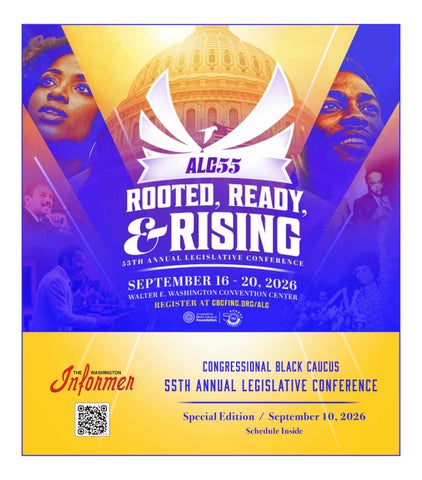
Congressional Black Caucus
55th Annual Legislative Conference Special Edition / September 10, 2026 Schedule Inside THE WASHINGTON INFORMER CONGRESSIONAL BLACK CAUCUS FOUNDATION (CBCF) 55TH ANNUAL LEGISLATIVE CONFERENCE / SEPTEMBER 2026
Rooted, Ready, and Rising: The Congressional Black Caucus Foundation Celebrates 50 Years of Action Nicole Austin-Hillery President & CEO, Congressional Black Caucus Foundation
In Memoriam Dr. Calvin W. Rolark, Sr. Wilhelmina J. Rolark
PUBLISHER Denise Rolark Barnes
THE WASHINGTON INFORMER NEWSPAPER (ISSN#0741-9414) is published weekly on each Thursday. Periodicals postage paid at Washington, D.C. and additional mailing offices. News and advertising deadline is Monday prior to publication. Announcements must be received two weeks prior to event. Copyright 2016 by The Washington Informer. All rights reserved. POSTMASTER: Send change of addresses to The Washington Informer, 3117 Martin Luther King, Jr. Ave., S.E. Washington, D.C. 20032. No part of this publication may be reproduced without written permission from the publisher. The Informer Newspaper cannot guarantee the return of photographs. Subscription rates are $96 per year, two years $168. Papers will be received not more than a week after publication. Make checks payable to:
THE WASHINGTON INFORMER 3117 Martin Luther King, Jr. Ave., S.E Washington, D.C. 20032 Phone: 202 561-4100 Fax: 202 574-3785 news@washingtoninformer.com www.washingtoninformer.com
STAFF Micha Green, Managing Editor Ron Burke, Advertising/Marketing Director Shevry Lassiter, WIN-TV Producer Ra-Jah Kelly, Digital Asset Manager Lafayette Barnes, IV, Editor, WI Bridge DC Desmond Barnes, WIN Daily Editor Anthony Tilghman, Social Media Strategist ZebraDesigns.net, Graphic Design Mable Neville, Bookkeeper Angie Johnson, Office/Circulation Manager Jada Ingleton, Content Editor REPORTERS Stacy Brown, National Reporter Sam Plo Kwia Collins, Jr., Political/Education Reporter Brenda Siler, Lifestyle Reporter Ed Hill, Sports Reporter Richard Elliott, Reporter Skylar Nelson, Sports Reporter Mya Trujillo, Multimedia Reporter PHOTOGRAPHERS Shevry Lassiter, Photo Editor Ja Mon Jackson, Asst. Photo Editor Roy Lewis, Jr. Robert R. Roberts Anthony Tilghman Abdullah Konte Cleveland Nelson
Welcome to the 55th Annual Legislative Conference (ALC), produced by the Congressional Black Caucus Foundation (CBCF). This year, CBCF also marks 50 years as the nonprofit organization behind ALC’s policy work, programs, and impact. I welcome every participant, leader, scholar, partner, and ally with pride and gratitude. For half a century, ALC has helped shape national policy by bringing people together to face hard challenges, share ideas, and turn meaningful dialogue into powerful, coordinated action. CBCF’s golden anniversary is a significant milestone. Fifty years ago, our founders built CBCF with a clear vision: equity, opportunity, and strong leadership for our communities. This year’s theme, Rooted, Ready, and Rising, helps us honor that history, prepare for today’s work, and look ahead to the future. When members of the Congressional Black Caucus established CBCF in 1976 as an independent, nonpartisan research and educational institute, they planted something built to last. We are rooted in the legacy of pioneers like Rep. Shirley Chisholm, Rep. John Conyers Jr., Rep. Charles Rangel, Rep. Louis Stokes, and Delegate Walter E. Fauntroy, along with every founder who worked to ensure all communities have a voice in shaping national policy. They built a lasting foundation for empowerment, one that opens doors for emerging leaders, scholars, and community members working toward a fairer, more inclusive society. Because of that foundation, we are ready to meet the challenges facing our communities today. For 50 years, CBCF has supported progress through various programs and major policy research. Our programs have prepared thousands of leaders now working in government, business, schools, and many other fields. Through our research and convening power, CBCF has also ensured that our communities were prepared with information and tools to help protect, strengthen, and empower our communities. This conference is more than a gathering. By attending, you are learning, connecting, and helping that critical work continue. CBCF’s golden anniversary is a year-long celebration, and we are excited to mark it in a big way throughout this year's conference. From the Sojourner Truth Legacy Awards to the Day of Healing Prayer Breakfast to the Phoenix Awards and every gathering in between, each moment honors 50 years of building leaders and shaping policy, from local communities to the halls of government. It is always important to lead with joy and remember that the celebratory aspects of this incredible week do not take anything away from the work. If anything, it sharpens our focus. Alongside the festivities, our sessions and forums will dig into the real challenges in front of us: protecting and expanding voting rights for every community, ensuring AI, technology, and the world of finance work to build wealth and opportunity for our communities rather than leave them behind, and delivering real-time solutions to harmful, and new employment gaps, affordability and the rising cost of living. These conversations are built to move past the convention center and into action. We also encourage everyone to visit our interactive exhibits this week, including a full-scale museum experience and the debut of a documentary commemorating CBCF's 50-year history, a celebration of the past, and a look at the path ahead. Looking forward to the next 50 years, we are rising to meet what is ahead. CBCF will keep building bridges, encouraging collaboration, and investing in the next generation so that opportunity and dignity reach all people, including Black Americans who have often been denied both. ROOTED in our legacy and READY for the work in front of us, we will keep RISING together. Welcome to #ALC55, and #CBCF50, #RootedReadyRising, CBCF's Golden Anniversary Year. Let's make it a powerful, inspiring week. WI
THE WASHINGTON INFORMER CONGRESSIONAL BLACK CAUCUS FOUNDATION (CBCF) 55TH ANNUAL LEGISLATIVE CONFERENCE / SEPTEMBER 2026
CBCF / 2
In Year 50, CBCF is ‘Rooted, Ready, and Rising’ CBC Foundation President Says ALC is a Launchpad for What’s Next
By Jada Ingleton WI Content Editor It’s been a historic year and a half for the nation that’s fighting levels of regression unseen since the Civil Rights Era. From efforts to suppress equal representation to attacks on votership, health care, and economic prosperity, the muse that once birthed the Congressional Black Caucus Foundation (CBCF) remains the driving force in 2026, and so is the template its founders laid out in response. “We are very clear: We are facing critically important challenges in the country right now, but what we want everybody to understand is that solving the problems, figuring out how we empower the Black community, is about all of us coming together,” CBCF President Nicole Austin-Hillery told The Washington Informer. “History has shown us that when the Black community has been challenged, our resilience comes forward…we rise to new heights and new successes at levels that we couldn't have even imagined. That's what we want to ensure is made clear to everyone who's participating in ALC this year.” As thousands take on the Walter E. Washington Convention Center Sept.
16-20, the CBCF’s 55th Annual Legislative Conference (ALC55) is simply the tip-off to fuel the work for constituents and voters alike. A dual theme-turned-ethos, this year’s vision, “Rooted, Ready, and Rising,” reflects the urgency of the moment, while nodding to the nonpartisanship tradition that began 50 years ago: to influence a democracy where the people have the tools to shape it. “I believe that everyone in this moment has an obligation to lean in, determine how they can step up, be a leader in their own right, use their own…gift to help…be a change maker,” Austin-Hillery told The Informer. “It's about number one, being rooted in our history and the resilience of our community. It's about being ready and recognizing that, regardless of the challenges we are facing, we are prepared to overcome them. And the rising is about how we are going to move forward.” From boosting generational leadership to advancing policy reform and mobilizations, the answer lies in founding principles, said the CBCF president. More than an organization, the CBC Foundation was founded by Nira Hardon Long, Albert L. Nellum, and former Congressional Rep. Yvonne Brathwaite Burke (D-CA) in 1976 to confront gaps in American progress –– a legacy maintained over five decades of impact. With a focus on research, opportunity, and collective action, it now stands as one of the nation’s premier think tanks, and what’s more, the antidote to modern political negligence, according to Congressional Rep. Yvette D. Clark (D-NY). “This is not a stagnant situation; we are witnessing some of the most horrendous policies being instituted in our communities across this nation,” Clarke, chairwoman of the Congressional Black Caucus (CBC), recently told The Informer. “Getting above that and pulling on the courage of who we are as a people to confront it is going to be a major part of what the Annual
3 House Minority Leader Hakeem Jeffries (D-NY.) at the 2024 Day of Healing (formerly Prayer Breakfast) in Washington, D.C., the culminating event of the Annual Legislative Conference. (WI File Photo/Robert R. Roberts)
CBCF / 3
Legislative Conference and [CBCF’s] 50th anniversary will be doing.”
‘Rooted, Ready, and Rising' : A Three-Point Power Play for Democracy
After Republican-led redistricting efforts put a target on the vitality of the CBC, currently the largest Caucus in Congress with 62 members, the Supreme Court dropped the Louisiana v. Callais decision that all but guaranteed voter protections would be on the ballot this November. Set against an unconstitutional war in Iran, and the domino effect of GOP-led policy violence––including the ongoing surge in food recalls due to severe cuts within the Food and Drug Administration (FDA) and U.S. Agency for International Development (USAID)––ALC55 is bringing a strategy that puts the power back in the hands of constituents. “Coming out of it, I think we'll be resolved to show up,” House Minority Leader Hakeem Jeffries (D-NY.) told The Informer, “[we’ll] stand up, push back against this assault, and make sure that America is the best version of herself.” After four days of panels and workshops, ALC attendees build coalitions around the most pressing national and global issues, from economic development and public health to civil and social justice, education, and how it all fits into the Black experience.
5 Nicole Austin-Hillery, president of the Congressional Black Caucus Foundation, during the opening press conference for the 52nd Annual Legislative Conference (ALC) in 2023, held at the Walter E. Washington Convention Center in Northwest D.C. (WI File Photo/Robert R. Roberts)
From there, the next step is for everyone to take the work back home, Austin-Hillery said, and actually implement an ecosystem of public information and awareness to drive the voting power lacking in the republic. “The power of individual presence is going to be what ensures that every voice is heard. For us, it's not a matter of who you vote for; it's a matter of that you have the right to vote, that it's protected, and that for everyone, you become [an active member] and participant in this democracy,” she continued. One way CBCF is continuing the work year-round is by hosting mini ALCs in communities nationwide, where local experts, scholars, grassroots advocates, and community activists
can gather under a shared umbrella of driving solutions on the ground. The second push comes through reinforcing another pinnacle of the foundation: creating a pipeline of opportunity for the next generation of leaders. “We want more young people prepared to go into leadership in philanthropy…leadership in tech. More young people being prepared to go into leadership in social justice and civil rights,” Austin-Hillery pleaded. She also shared a goal to see CBCF produce interns and fellows in every system that oversees operations across the country. “That's what the next 10 years is going to look like for CBCF,” she said. WI
Is proud to Partner with The Congressional Black Caucus Foundation
THE WASHINGTON INFORMER CONGRESSIONAL BLACK CAUCUS FOUNDATION (CBCF) 55TH ANNUAL LEGISLATIVE CONFERENCE / SEPTEMBER 2026
Schedule at a Glance Schedule is subject to change
Tuesday September 15, 2026
Location
10:00 am - 3:00 pm
P/CEO Stakeholder Leadership Summit
145B
12:00 pm - 4:00 pm
Registration*** – Early Badge Pick Up (Speakers, Sponsors) Recommended for early Wed entry
East Salon/204C
Wednesday September 16, 2026
Location
7:00 am - 7:00 pm
Registration (Online Ticketing, Mobile App Help)
East Salon
8:00 am - 10:30am
CBC Spouses Community Breakfast and Health Fair***
TBD
8:30 am - 4:30 pm
Professional Development Series
WCC
9:00 am - 6:00 pm
Issue Forums & Established Braintrusts check website (cbcfinc.org/alc) for full schedule
WCC
10:00 am - 11:00 am
Opening Press Conference
TBD
11:30 am - 7:00 pm
Exhibit Showcase Open & Ribbon Cutting
Hall D
12:00 pm - 2:00 pm
Exhibit Hall Block Party/Fashion Show
Hall D
12:00 pm - 1:00 pm
Verizon Corporate Lounge Opening
204AB
2:00 pm - 3:00 pm
ALC New Attendee Welcome & Information
WCC
4:00 pm - 5:00 pm
ALC Co-Chairs Reception
Hall D Concourse
5:00 pm - 7:00 pm
ALC Welcome Reception honoring the members of the CBC
Hall D Spotlight Stage
7:30 pm - 8:30 pm
Comedy Night*** (Ticketed)
Ballroom C
8:30 pm - 10:00 pm
Alumni Association Networking Reception (Ticketed)
Ballroom C
THE WASHINGTON INFORMER CONGRESSIONAL BLACK CAUCUS FOUNDATION (CBCF) 55TH ANNUAL LEGISLATIVE CONFERENCE / SEPTEMBER 2026
CBCF / 4
Thursday September 17, 2026
Location
7:00 am - 7:00 pm
Registration (Online Ticketing, Mobile App Help)
East Salon
9:00 am - 11:30 am
ALC National Townhall Meeting
Ballroom AB
9:00 am - 7:00 pm
Exhibit Showcase Open
Hall D
12:00 pm - 6:00 pm
Issue Forums & Established Braintrusts check website (cbcfinc.org/alc) for full schedule
WCC
12:00 pm - 2:00 pm
Exhibit Hall Block Party/Fashion Show
Hall D
6:00 pm - 8:00 pm
CBC Chair Leadership Reception (IO) (6:00 - 8:00 pm)
TBD
8:00 pm - 10:00 pm
Gospel Extravaganza
United House of Prayer – UHOP (601 M. St. NW)
8:00 pm - 12:00 am
The Sojourner Truth Legacy Project Reception (8pm - 12pm)
TBD
Friday September 18, 2026
Location
7:00 am - 6:00 pm
Registration (Online Ticketing, Mobile App Help)
East Salon
9:00 am - 5:00 pm
Issue Forums & Established Braintrusts check website (cbcfinc.org/alc) for full schedule
9:00 am - 6:00 pm
Exhibit Showcase Open
Hall D
10:00 am - 5:00 pm
Career Fair
Hall D Concourse
10:00 am - 5:00 pm
CBCF College Fair & Panels
Hall D Concourse
12:00 pm - 2:00 pm
Exhibit Hall Block Party/Fashion Show
Hall D
4:00 pm - 6:00 pm
CAC Reception
204 AB
Endowment Reception (IO) - TBD (Merrill Lynch)
TBD
6:00 pm - 8:00 pm
CBCF Chair & BOD Legacy Reception (IO)
TBD
9:00 pm - 1:00 am
The Black Party (Ticketed)
Hamilton Hotel (1001 14th St. NW)
Saturday September 19, 2026
Location
6:00 am - 12:00 pm
Registration (Online Ticketing, Mobile App Help)
East Salon
7:30 am - 10:00 am
Day of Healing Prayer Breakfast (doors open at 7:00 am)
Hall E
9:00 am - 12:00 pm
Exhibit Showcase
Hall D
2:00 pm - 9:00 pm
Online Phoenix Award Tickets Will Call
East Salon
5:00 pm - 6:00 pm
Phoenix Awards VIP Reception (IO)
Hall D
7:00 pm - 9:30 pm
Annual Phoenix Awards Dinner (doors open at 6:00pm)
Hall E
9:30 pm - 11:00 pm
Official Phoenix Awards After Party
Hall D
Sunday September 20, 2026
Location
10:00 am - 2:30 pm
Pier 4 - City Cruises (580 Water St. SW)
CBCF / 5
Donald M. Payne Sr. Foreign Policy Fellowship Cruise
THE WASHINGTON INFORMER CONGRESSIONAL BLACK CAUCUS FOUNDATION (CBCF) 55TH ANNUAL LEGISLATIVE CONFERENCE / SEPTEMBER 2026
James Clyburn Says the Next Generation of Black Leadership Won’t Be Built on Television It Will Be Built Person by Person By Stacy M. Brown WI Senior Writer As thousands prepare to attend the Congressional Black Caucus Foundation’s (CBCF) Annual Legislative Conference in Washington this month, Rep. James E. Clyburn (D-SC) said the future of Black political leadership will be shaped beyond the convention center. “For the last 12 years I have been running the Clyburn Program,” Clyburn told The Washington Informer. “Rep. Bennie Thompson (D) is doing the same thing in Mississippi. All things don’t have to be done in Washington, D.C. I wish we would focus on what’s real. We are doing it.” The South Carolina representative explained that he regularly meets with young people through the James E. Clyburn Political Fellowship, a leadership initiative that prepares participants for careers in political campaigns, local government, and public policy. The fellowship focuses on organizing, communications, and governance, while building a network of future public servants. “We have monthly meetings,” Clyburn said. “I meet with the youth every day.” This discussion precedes the CBCF’s 50th Annual Legislative Conference, which takes place from Sept. 16–20 at the Walter E. Washington Convention Center. The event, with the 2026 theme “Rooted, Ready, and Rising.” convenes lawmakers, advocates, and community leaders to address public policy, economic opportunity, health care, education, and voting rights. However, Clyburn believes this work extends far beyond the ALC— addressing nationwide challenges, from health care, to voting rights. “The most effective tool is direct community engagement,” he said. “I do not invest in television advertising and have not run a TV ad in 30 years. Instead, I focus on Black radio, robocalls, weekly videos, and Black newspapers. Black people do not own TV stations.”
5 Reps. James Clyburn and Yvette Clark during the Congressional Black Caucus Foundation's 50th Anniversary Honors Gala at the Omni Shoreham in Northwest, D.C. (WI File Photo/Jacques Benovil)
Now in his 17th term representing South Carolina’s 6th Congressional District, Clyburn has held several top leadership roles in the House, including Majority Whip, and is the first African American to serve multiple terms in that position. When asked about his legacy, Clyburn focused not on his leadership roles but on his latest book, “The First Eight,” which chronicles the stories of the first eight African Americans elected to Congress from South Carolina. “The book is about the first eight African Americans to serve in Congress from South Carolina,” he said. “There are 95 years between number eight and yours truly, number nine.” A District resident who worked on the Hill for more than 30 years, Lorraine C. Miller emphasized the importance of “The First Eight” after a November 2025 discussion about the book. “[Clyburn] took a slice of not just South Carolina history, but American history,” Miller told The
Washington Informer last year. “He turned it into a great story of service.” Considering the past and the nation’s current political challenges, the longtime congressman noted that history shows the nation’s direction is never fixed. “History has a rhythm to it,” he said. “A lot of people say it may not repeat itself, but it rhymes. History repeats itself.” He cited Reconstruction, the Brown v. Board of Education decision, and the elections of Barack Obama, Donald Trump, and Joe Biden as examples of the nation’s ongoing political shifts. “The country is always moving,” Clyburn said. “Sometimes to the left and sometimes to the right. The question is, are we learning lessons from that history? Or are we going to run the risk of repeating that history?”
Addressing National Challenges
As the nation navigates the second Trump administration,
the South Carolina congressman identified voting rights, housing, health care, education, and energy costs as immediate concerns. “Recent research shows the average age of first-time homebuyers is now 42,” he said. “At that age, I was paying off my first mortgage. Now, people must wait until 42 before they can afford to buy a home.” Clyburn hopes that U.S. citizens, particularly African Americans, will get more politically engaged to work toward change. He argued that excessive attention is given to celebrity voices rather than to grassroots organizing within Black communities. “We, as Black folk, can’t keep beating up on ourselves,” Clyburn said. “These celebrities, rappers, who want to support other folk, those who said dumb things like ‘Kamala isn’t really Black,’ never considered that Barack Obama has a white mother. The Black media needs to call these people out. Expose them. They are doing exactly what white folks want them.”
He also encouraged Black voters to stay engaged despite political frustration, emphasizing that election outcomes depend on voter participation. “When the white vote turned out 71% two years ago, and the Black vote turned out 59%, you tell me whose fault that is,” he said. He later added that if Black turnout “had been 69%, [former Vice President Kamala Harris] would have won.” His concerns arise as both major political parties face challenges with public perception. A CNN poll conducted from July 23 to July 27 found that 30% of Americans viewed the Democratic Party favorably, while 51% held an unfavorable opinion. The Republican Party received similar ratings, with 31% favorable and 52% unfavorable. Clyburn also said he has long warned about Trump’s intentions, arguing that “he’s not planning to leave. He’s not planning to give up his office.” He also rejected comparisons between Trump and Adolf Hitler, saying instead, “Vladimir Putin is Hitler and Trump is Mussolini.” He stated that these historical lessons should guide lawmakers if Democrats regain congressional majorities. “Our top priority must be to make this country affordable,” Clyburn said. “The cost of living has become unsustainable in too many areas.” The congressman also criticized the Supreme Court and expressed support for legislation to expand it. “I’m all for us doing legislation that will allow us to expand the Supreme Court because the Supreme Court has gone rogue,” he said. “There’s no other way to look at it.” He warned that recent court decisions on voting rights and birthright citizenship could have lasting effects on Black political representation. “If you remember, my district was targeted,” Clyburn said. “South Carolina stood up and said we’re not going to do it. The next week Georgia followed suit.” WI
THE WASHINGTON INFORMER CONGRESSIONAL BLACK CAUCUS FOUNDATION (CBCF) 55TH ANNUAL LEGISLATIVE CONFERENCE / SEPTEMBER 2026
CBCF / 6
As the official Convention and Sports Authority of Washington, DC, Events DC is the host of the Nation’s Capital. Our events entertain, employ, serve as an economic engine and elevate everyone through entertainment, sports, conventions, meetings, and cultural events.
LET US HOST YOUR NEXT EVENT! @EventsDC
CBCF / 7
@TheEventsDC
EventsDC.com
THE WASHINGTON INFORMER CONGRESSIONAL BLACK CAUCUS FOUNDATION (CBCF) 55TH ANNUAL LEGISLATIVE CONFERENCE / SEPTEMBER 2026
CBC MEMBERS OF THE 119TH CONGRESS Congressional Black Caucus (CBC) Members Since its establishment in 1971, the Congressional Black Caucus (CBC) has been committed to using the full Constitutional power, statutory authority, and financial resources of the federal government to ensure that African Americans and other marginalized communities in the United States have the opportunity to achieve the American Dream. The Caucus is Chaired by Congresswoman Yvette D. Clarke. As part of this commitment, the CBC has fought for the past 50 years to empower these citizens and address their legislative concerns by pursuing a policy agenda that includes but is not limited to the following: • reforming the criminal justice system and eliminating barriers to reentry; • combatting voter suppression; • expanding access to world-class education from pre-k through post-secondary level; • expanding access to quality, affordable health care and eliminating racial health disparities; • expanding access to 21st century technologies, including broadband; • strengthening protections for workers and expanding access to full, fairly-compensated employment; • expanding access to capital, contracts, and counseling for minority-owned businesses; and • promoting U.S. foreign policy initiatives in Africa and other countries that are consistent with the fundamental right of human dignity. For the 119th Congress, the CBC has a historic 62 members of the U.S. House of Representatives and the U.S. Senate.
Delegate Eleanor Holmes Norton (D-DC) Serving since 1991
Rep. Maxine Waters (D-CA-43) Serving since 1991
Rep. Sanford D. Bishop (D-GA-02) Serving since 1993
Rep. James E. Clyburn (D-SC-06) Serving since 1993
Rep. Bobby Scott (D-VA-03) Serving since 1993
Rep. Bennie G. Thompson (D-MS-02) Serving since 1993
Rep. Danny K. Davis (D-IL-07) Serving since 1997
Rep. Gregory W. Meeks (D-NY-05) Serving since 1998
Rep. Emanuel Cleaver, II (D-MO-05) Serving since 2005
Rep. Al Green (D-TX-09) Serving since 2005
Rep. Gwen Moore (D-WI-04) Serving since 2005
Chair: Rep. Yvette D. Clarke (D-NY-09) - Serving since 2007
Rep. Hank Johnson (D-GA-04) Serving since 2007
Rep. André Carson (D-IN-07) Serving since 2007
Rep. Kweisi Mfume (D-MD-07) Serving since 2020
Rep. Terri A. Sewell (D-AL-07) Serving since 2011
Rep. Frederica S. Wilson (D-FL-24) Serving since 2011
Rep. Joyce Beatty (D-OH-03) Serving since 2012
Rep. Hakeem Jeffries (D-NY-08) – Serving since 2013 (Democratic Leader)
Rep. Marc Veasey (D-TX-33) Serving since 2013
Rep. Robin Kelly Democratic Steering & Policy Committee Co-Chair (D-IL-02) Serving since 2013
Sen. Cory Booker Rep. Sanford D. Bishop (D-NJ) (D-GA-02) Serving since 2013 1993
Rep. AlmaE.Adams Rep. James Clyburn (D-NC-12) (D-SC-06) Serving 2014 Serving since since 1993
Rep. Rep.Stacey BobbyPlaskett Scott (D-VI) (D-VA-03) Servingsince since1993 2015 Serving
Rep. Bonnie Watson Coleman (D-NJ-12) Serving since 2015
Rep. Dwight Evans (PA-03) Serving since 2016
Sen. Lisa Blunt Rochester (D-DE) Serving since 2017
THE WASHINGTON INFORMER CONGRESSIONAL BLACK CAUCUS FOUNDATION (CBCF) 55TH ANNUAL LEGISLATIVE CONFERENCE / SEPTEMBER 2026
CBCF / 8
CBC MEMBERS OF THE 119TH CONGRESS
Rep. Steven Horsford (D-NV-04) Serving since 2018
Rep. Jahana Hayes (D-CT-05) Serving since 2018
2nd Vice Chair: Rep. Lucy McBath (D-GA-06) Serving since 2018
Rep. Joe Neguse (D-CO-02) – Serving since 2018 (Assistant Democratic Leader)
Rep. Ilhan Omar (D-MN-05) Serving since 2018
Rep. Ayanna Pressley (D-MA-07) Serving since 2018
Rep. Lauren Underwood (D-IL-14) – Serving since 2018 (DPCC Co-Chair)
Rep. Nikema Williams (D-GA-05) Serving since 2021
Rep. Ritchie Torres (D-NY-15) Serving since 2021
Secretary: Rep. Marilyn Strickland (D-WA-10) Serving since 2021
Sen. Raphael Warnock (D-GA) State of Georgia Serving since 2021
1st Vice Chair: Rep. Troy Carter (D-LA-02) Serving since 2021
Rep. Shontel Brown (D-OH-11) Serving since 2021
Rep. Don Davis (D-NC-05) Serving since 2023
Rep. Valerie Foushee (D-NC-04) Serving since 2023
Rep. Maxwell Alejandro Frost (D-FL-10) Serving since 2023
Rep. Glenn Ivey (D-MD-04) Serving since 2023
Rep. Jonathan Jackson (D-IL-01) Serving since 2023
Whip: Rep. Sydney Kamlager-Dove (D-CA-37) Serving since 2023
Rep. Summer Lee (D-PA-12) Serving since 2023
Rep. Emilia Strong Sykes (D-OH-13) Serving since 2023
Parliamentarian: Rep. Jennifer McClellan (D-VA-04) - Serving since
Member-at-Large: Rep. Gabe Amo (D-RI-01) Serving since 2023
Rep. LaMonica McIver (D-NJ-10) Serving since 2024
Sen. Angela Alsobrooks (D-MD) Serving since 2025
Rep. Wesley Bell Rep. Bennie G. Thompson (D-MO-1) (D-MS-02) Serving since since 2025 Serving 1993
Rep. Janelle Bynum (D-OR-05) Serving since 2025
Rep. Herb Conaway (D-NJ-03) Serving since 2025
Rep. Cleo Fields (D-LA-06) Serving since 2025
Rep. Shomari Figures (D-AL-02) Serving since 2025
Rep. Lateefah Simon (D-CA-12) Serving since 2025
Rep. Christian Menefee (D-TX-18) Serving since 2026
Rep. Analilia Mejia (D-NJ-11)
Rep. Everton Blair (D-GA-13)
CBCF / 9
THE WASHINGTON INFORMER CONGRESSIONAL BLACK CAUCUS FOUNDATION (CBCF) 55TH ANNUAL LEGISLATIVE CONFERENCE / SEPTEMBER 2026
Defend DC: D.C. Councilmember Robert White Takes Statehood Fight on the Road Tennessee Rep. Justin J. Pearson Stands Up for D.C. in His Own Congressional Race
By Sam P.K. Collins WI Staff Writer The Congressional Black Caucus Foundation’s (CBCF) 55th annual legislative conference takes place weeks after D.C. Council member and Democratic nominee for D.C. delegate Robert White launched a movement of his own to rally support for D.C. statehood beyond the Beltway. Through what’s dubbed Defend DC, White is dispatching District residents to other congressional districts to canvass on behalf of Democratic allies running in midterm races. Their victories, he noted, could potentially shift power in the U.S. House while strengthening the District’s defense against Republican interference in local affairs. “The reality is that Republicans right now are in a posture where they are beating up on D.C. for purely political purposes, either to appease the president or to appease their base because they are not getting things done nationally,” White told The Informer. “So if we're going to stop that, the most important thing we do is build a defense by building a Democratic majority in Congress, which is why my strategy on that is so important and vital to the future of our city.” White officially launched Defend DC on Aug. 24 during a rally at Freedom Plaza, across the street from the John A. Wilson Building, and blocks away from the U.S. Capitol. With dozens of Defend DC coalition members behind him, White also announced the DC51 Leadership PAC, which, should he win in November, would work to strengthen national partnerships, defend Home Rule, and advance the fight for D.C. statehood. These efforts come amid congressional Republicans’ introduction of more than 130 bills, amendments and riders targeting District autonomy and governance. This fall, the U.S. Senate will likely explore a bill passed by the U.S. House that mandates congressional approval for changes to the local tax code. Another House bill, introduced by Rep. Nancy Mace (R-S.C.) would restore the death penalty in the District, if passed. In the more than 60 days leading up to the Nov. 3 general election, Defend DC coalition members will make the
5 D.C. Councilmember Robert White, Democratic candidate for D.C. delegate, announces plans to dispatch District residents to other congressional districts to canvass on behalf of Democratic allies running in midterm races (Robert R. Roberts/The Washington Informer)
case for their candidates during visits to certain congressional districts. Defend DC spent Labor Day weekend in Virginia's 5th congressional district, where former U.S. Rep. Tom Periello is attempting to unseat Rep. John McGuire, a Republican whose legislation to make the Trump administration’s D.C. Safe & Beautiful Task Force permanent passed the U.S. House earlier this year. “I believe in building very strong coalitions and allies and not going it alone. We are doing it now, and I see things coming together in a really, really exciting way,” White told The Informer. “This is an incredibly important time historically. I don't believe we have ever had a window for statehood like the one we have now, and it will take a lot of work for us to seize this moment, but I'm up for it.”
From Memphis to D.C.: Tennessee Rep. Justin J. Pearson Stands Up for D.C. Statehood
Between Sept. 16 and Sept. 20, thousands of congressional representatives, staffers, activists and mavens of industry will converge on the District for CBCF’s 55th annual legisla-
tive conference. In addition to panel discussions at Walter E. Washington Convention Center, visitors are also expected to attend events across the city, including a “Welcome to D.C.” reception at the Capital Hilton hosted by White, D.C. Mayor Muriel Bowser, D.C. Council Chair Phil Mendelson and others on Sept. 16. As District officials fight to stave off Republican intrusion in local affairs, Democrats in other jurisdictions across the U.S. are reeling from court decisions that are redrawing congressional maps and diluting Black political representation In Tennessee, Black residents of Shelby County experienced such a phenomenon, White has at least one ally in Tennessee Rep. Justin J. Pearson, a Democratic candidate for Tennessee's 9th congressional district seat in the U.S. House. “We should all be concerned about what's happening to D.C. because that is becoming the place where Trump's authoritarian desires are being more actualized in the day-to-day,” Pearson told The Informer. “D.C. is both a guiding light for people who are trying to reclaim their authority and power from a system that's been designed against them, but it is also
shining a light on the worst impulses that we are seeing from this government against American citizens.” As Pearson recounted, he attempted to connect with White earlier in the summer with the help of Advisory Neighborhood Commissioner Howard Garrett. Though that meeting never materialized, Pearson continued to espouse his support for D.C. home rule, most recently in an Instagram post demanding that the National Guard leave the District and Memphis, and instead help residents of Gary, Indiana living without electricity. For Pearson, D.C. residents deserve a level of representation and legislative autonomy that’s on par with their contribution to the federal budget. “Our nation was founded, and it's on you all's license tags, on this concept of ‘no taxation without representation,’” Pearson told The Informer, “but because those people are Black or of color, folks don't feel like the community deserves representation. It's the same thing I feel about Puerto Rico. It just isn't fair.” On Aug. 6, Pearson defeated London Lamar, M. LaTroy Alexandria-Williams, and Jim Torino in the
Democratic primary for Tennessee's 9th congressional district. Pearson’s platform centers on increasing the minimum wage to $25 per hour, passing Medicare-for-All legislation, stopping the proliferation of data centers in urban and rural communities, and, above all, attacking what he calls a system designed against the working class. As Garrett, campaign consultant Rachael Payton, and others gelled plans together for a Pearson campaign phone bank party in D.C. on Sept. 2, Pearson stood opposed to those who he said are sacrificing the needs of the working class people of color to stroke President Donald J. Trump’s ego. “The capitulation of the entire political party to be subservient to the president of the United States is horrible for our Republicans,” Pearson said. “Right now, we have a unitary executive because the people in power are yielding their authority over to the president and allowing him to do whatever he wants, which is ultimately destroying the lives and the communities of already marginalized groups, particularly Black and brown folks in poor communities. I don't think that's sustainable, and I believe we deserve better than that.” Aliyah McNeely, at-large committeewoman for the D.C. Democratic Party said she's participating in the Pearson phone bank party out of regard for national unity. “It brings people together around shared values and a common purpose, even when they live in different cities or localities,” said McNeely, a phone bank party co-host. “As D.C.residents, we know that our fight for statehood and full representation is connected to the broader political landscape.” Pearson, McNeely said, could be a critical partner in advancing D.C. statehood and stemming Republican intrusion. “Supporting candidates like Rep. Justin J. Pearson, who has been vocal about D.C. statehood, helps us build relationships and coalitions beyond the District,” said McNeely, a longtime Pearson supporter. In recent days, McNeely has taken to social media to galvanize support for Sept. 2, an effort that will involve
THE WASHINGTON INFORMER CONGRESSIONAL BLACK CAUCUS FOUNDATION (CBCF) 55TH ANNUAL LEGISLATIVE CONFERENCE / SEPTEMBER 2026
DEFEND DC Page 11
CBCF / 10
DEFEND DC from Page 10 other D.C.-based organizers, all of whom McNeely said understand the importance of securing political reinforcement miles away from their locality. “As a D.C. resident, I know that our politics are never just local, they are national,” McNeely said. “What happens in elections across the country can directly impact us here at home, which is why we have to stay engaged and pay attention beyond the boundaries of the District.”
A Moment with Defend DC and Its Affiliates
White's rally came more than a month after he spoke at the DC Democrats’ unity brunch about what he called Trump's assembly of military forces to extend his stay in the Oval Office. White has since, as recounted to The Informer, spoken before the National Conference of State Legislatures
CBCF / 11
and maintained contact with House Minority Leader Hakeem Jeffries (D-NY), Rep. Steny Hoyer (D-Md.), Rep. James Walkinshaw (D-Va.) and Sen. Angela Alsobrooks (D-Md.). “What we see in D.C. is a president who tried to overthrow a democratic election the last time he was supposed to leave office,” White told The Informer. “But last time he did it, he brought up a ragtag bunch of people from around the nation. This time, he will have more than 5,000 armed troops in the District of Columbia.” On Aug. 24, those standing next to White during the launch event for Defend DC represented: Free DC; DC Democrats; DC Statehood PAC; DC Vote Action; the D.C. chapter of the NAACP; National Action Network Greater DC Chapter; DC for Democracy; Capital Stonewall Democrats; DC Latino Caucus; and DC Young Democrats. Greg Jackson, speaking on behalf of Free DC, decried McGuire’s efforts to make the D.C. Safe & Beautiful Task
Force a permanent fixture. In making his point, he evoked the name of Julian Bailey, a Black man shot and killed by a U.S. marshal in February. He also spoke about the 16,000 arrests that have taken place over the last year. “These actions are not about safety. This is about intimidating our community,” said Jackson, Free DC’s midterm action director. “We have to invest in [the] public, invest in violence prevention, invest in stronger schools, invest in employment, invest in services, hold police accountable, invest in jobs and housing, not just militarize our streets and make our city a stage of political theater.” That afternoon, White also had supporters in: D.C. Shadow Senators Ankit Jain and Paul Strauss; D.C. Shadow Representative Dr. Oye Owolewa; D.C. State Board of Education Reps. Brandon Best (Ward 6) and Eboni-Rose Thompson (Ward 7); D.C. Council Chair Phil Mendelson; and D.C. Council members Brooke Pinto (D-Ward
2); Wendell Felder (D-Ward 7); and Elissa Silverman (I-At large). Mendelson called Defend DC a matter of setting the record straight with voters in other congressional districts. “Most of the citizens of the United States of America…misunderstand what the situation is with the District of Columbia,” Mendelson said. “They think that we're fully funded by federal money. We are not…The District's budget is like 1% federal discretionary spending…They think of us as being just a federal enclave instead of 700,000 residents who are fighting to have the same rights that they have.” Even with the rights reserved to the states, Carmel Henry says that those living in other U.S. cities aren’t immune to what she described as the Trump administration’s overreach. With the D.C. branch of the NAACP gearing up for “March on Washington 2026: Defend the Vote,” Henry sought to make that message clear. “When the federal government is permitted to disregard the will of the
THE WASHINGTON INFORMER CONGRESSIONAL BLACK CAUCUS FOUNDATION (CBCF) 55TH ANNUAL LEGISLATIVE CONFERENCE / SEPTEMBER 2026
people, we all should be concerned with this dangerous, dangerous form of government,” said Henry, president of the NAACP’s D.C. branch. “Today, the power is exercised in the District. Tomorrow, it may be your community. We must act to ensure that members of Congress are held accountable.” As the DC Democrats also identify key races essential to the mission of Defend DC, DC Democrats Chair Charles Wilson gave a warning to congressional Republicans who’ve actively meddled in the District’s affairs. “We will mobilize our voters, our volunteers to make calls, to knock on doors, to raise resources and help elect Democrats who will stand with D.C. and defend our democracy,” Wilson said on Aug. 24. “Our message is very simple. If you attack D.C.'s democracy, we will organize. If you threaten D.C.'s home rule, we will mobilize. And if you refuse to stand up for D.C., we will help elect people who will.” WI
Clarke Leads CBC Under Intense Political Tensions ‘We Are Not Helpless… We Are Not Hopeless’
By Ashleigh Fields WI Contributing Author Rep. Yvette Clarke (D-N.Y.) is serving as chair of the Congressional Black Caucus (CBC) during an eerie period of time with historic implications. It resembles conditions faced 55 years ago by CBC founding member, Rep. Shirley Chisholm, who like Clarke, represented New York. Both Chisholm and Clarke experienced gender discrimination, racism and power struggles in Congress, although they served decades apart. The CBC has served as a shield both then and now as lawmakers re-evaluate conditions under the second Trump administration. “I became chair of the Congressional Black Caucus at the same time that Donald Trump was elected president,” Clarke said in an interview from May. “And he has been horrific when it comes to communities of color across this nation.” Her comments directed toward the administration were rooted in disdain for the president’s attempts to remove Black history from museums, increase
5 New York Democratic Rep. Yvette Clark is leading the Congressional Black Caucus amid threats of racial- and gender-based discrimination during the second Trump administration. (WI File Photo/Jacques Benovil)
mass deportation through immigration raids and making cuts to the federal government. Over the past year, Black lawmakers have also reckoned with Republican redistricting measures that reduce their chances of being re-elected after the Supreme Court ruled in favor of restructuring the Voting Rights Act making it harder to account for racial discrimination. They’ve also seen the federal workforce, social services and resourc-
es for diversity, equity and inclusion (DEI) dwindle month after month. The threat of lawsuits, criminal charges and persecution remain top of mind for every member of Congress as they’ve watched their peers face the wrath of Trump, who seeks out enemies. New York Attorney General Letitia James (D), Sen. Adam Schiff (D-Calif.) and Federal Reserve Gov. Lisa Cook were subject to legal battles for months after speaking out in opposition to Trump. Law firms and schools with diversity, equity and inclusion (DEI) initiatives have also undergone court challenges. The Congressional Black Caucus Foundation (CBCF) also faces a lawsuit for equitable scholarships that help support students’ pursuit of higher education. Some within the CBC have retreated from conversations deemed too politically volatile due to “fear” of retaliation from the federal government and its aligned entities, one source familiar with the matter told The Informer. When asked to describe the challenges and the accomplishments helmed with Clarke at the leadership of the organization, her office and the CBC declined to comment. Her entire executive board, which
includes Democratic Reps. Troy Carter (La.), Lucy McBath (Ga.), Marilyn Strickland (Wash.), Sydney Kamagler Dove (Calif.), Jennifer McClellan (Va.) and Gabe Amo (R.I.), also declined or did not respond to The Informer’s request for comment regarding a reflection on Clarke’s leadership. Rep. Glenn Ivey (D-Md.) said under the current political climate the “stakes of Black political engagement have never been higher.” However, the Maryland legislator noted that the CBCF Annual Legislative Conference is “both sanctuary and staging ground, a place to recharge, reconnect, and recommit to the work that has defined this organization for half a century.”
‘Doing the Difficult But Necessary Work’
Some of the CBC ally organizations have said Clarke is handling the heightened political climate with grace. “Representative Clarke is doing the difficult but necessary work to ensure the key issues that impact Black lives are considered in the halls of Congress,” Patrice Willoughby, NAACP vice president of policy and legislative affairs, told The Informer. Willoughby, who previously served
3 Rep. Yvette Clarke, chair of the Congressional Black Caucus (CBC), speaks at the 2025 CBC swearing in ceremony, sponsored by the Congressional Black Caucus Foundation. (WI File Photo/Robert R. Roberts)
as executive director of the CBC, said that the organizations will continue to partner to “advocate for policies that prioritize the progress of Black Americans.” Democratic strategist Antjuan Seawright said Clarke is doing an “incredible job” but noted that it’s hard to lead when you “don't have a legislative branch who believes in their own power.” He and others have implied that Washington was missing the “checks and balances” system meant to curtail executive power through congressional oversight. “The name of the game is ‘Survive in Advance for Black America,’ and as it relates to the election— which will occur under the…second Trump term— the midterm election, Black folks are casting a survival vote. The Congressional Black Caucus has always been the conscience of the Congress, the Constitution, and the country, except that under this current Washington makeup, if you will, those three things don't exist,” Seawright told The Informer. “There's no accountability to the executive branch by way of the Congress.” Seawright said some lawmakers have “ignored” the Constitution, and they “act as if they don't want a country that includes Black America, or in some cases brown America too.” “And so the CBC has tried to be an anchor for pushback, a driving force for change, and a demonstration of the simple fact that Black people still matter, Black votes still matter, and Black issues should remain top of mind issues,” he added. Clarke says those narratives are driven through the power of community. “What we've done as the Congressional Black Caucus under my leadership is stood up in architecture to reconnect to people, organizations on the ground and communities across the nation to empower people,” she said in May. “We are not hopeless or and we are not helpless in this moment.” The work continues in the vein of Chisholm and her 12 co-founders decades after she served in the legislature. “Of course laws will not eliminate prejudice from the hearts of human beings. But that is no reason to allow prejudice to continue to be enshrined in our laws—to perpetuate injustice through inaction,” Chisholm once said. WI
THE WASHINGTON INFORMER CONGRESSIONAL BLACK CAUCUS FOUNDATION (CBCF) 55TH ANNUAL LEGISLATIVE CONFERENCE / SEPTEMBER 2026
CBCF / 12
Representation in clinical trials matters. Let’s talk why at the Congressional Black Caucus Foundation’s 55th Annual Legislative Conference. Visit Merck at Booth #658 to learn more.
LetsTalkClinicalTrials.com CBCF / 13
THE WASHINGTON INFORMER CONGRESSIONAL BLACK CAUCUS FOUNDATION (CBCF) 55TH ANNUAL LEGISLATIVE CONFERENCE / SEPTEMBER 2026
A Powerful Future Is Being Built Today.
Black Opportunity Starts with AI Readiness. Learn More: BuildAmericanAI.org THE WASHINGTON INFORMER CONGRESSIONAL BLACK CAUCUS FOUNDATION (CBCF) 55TH ANNUAL LEGISLATIVE CONFERENCE / SEPTEMBER 2026
CBCF / 14
Build American AI is advancing a positive, forward-looking agenda for AI innovation across America in which no community is left behind. Our north star is to support a political environment where policymakers at the federal and state levels can tune out the extremes and engage thoughtfully on critical policy issues surrounding innovation in and access to AI. Build American AI supports Congress passing national AI regulation that reflects democratic values, protects the safety of kids, users and communities, and ensures access to opportunity for all Americans.
Our Policy Pillars Safety Protections for Children: Enact clear, thoughtful federal standards that ensure companies design systems with children’s safety in mind, explicitly protecting minors from exploitation, manipulation, and harmful online content. Baseline Safety Standards for Frontier Models: Develop consensus national safety rules in partnership with industry leaders that apply strictly to the largest, most advanced systems, ensuring serious oversight without creating compliance barriers that crush the startups and small businesses driving American innovation. A National Commitment to AI Literacy: Establish partnerships with schools, community colleges, and workforce programs so that, within the next decade, the vast majority of Americans have a basic understanding of how AI works, how they can use AI to create opportunities, and how they can solve tomorrow’s challenges. National Training and Certification Programs: Create certification programs to provide practical training for workers across health care, manufacturing, education, and other industries, ensuring historically disadvantaged communities are not left behind as technology advances.
We Are Proud to Support Leaders Committed to Building a Fair and Prosperous AI Future. CBCF / 15
THE WASHINGTON INFORMER CONGRESSIONAL BLACK CAUCUS FOUNDATION (CBCF) 55TH ANNUAL LEGISLATIVE CONFERENCE / SEPTEMBER 2026
A Generation is Leaving Congress as Black Political Leadership Marks 50 Years of Building Power By Stacy M. Brown WI Senior Writer A generation of Black political leaders is getting ready to leave Capitol Hill. Some were part of the Civil Rights Movement. Others spent years in state and city government before coming to Washington. As representatives and members of the Congressional Black Caucus (CBC), they worked on issues like voting rights, gun violence, poverty, education, reproductive freedom, racial discrimination, and political representation for Black communities. Now, several longtime members of the CBC are leaving as the Congressional Black Caucus Foundation (CBCF) celebrates its 50th anniversary in September 2026 with the theme: “Rooted, Ready and Rising.” Among those departing or not seeking another term in the House are Democratic Reps. Mark Veasey of Texas, Bonnie Watson Coleman of New Jersey, Danny Davis of Illinois, Dwight Evans of Pennsylvania, Frederica Wilson of Florida and Cleo Fields of Louisiana, along with D.C. Del. Eleanor Holmes Norton (D), the CBC dean. Their departures coincide with losses among Black lawmakers. Rep. David Scott (D) of Georgia died in April after more than 20 years in Congress. Former Houston Mayor Sylvester Turner (D), who was elected to Congress from Texas in 2024, died in March 2025 soon after taking office. The departure of lawmakers is more noticeable because of the careers that cover generations of Black political progress, from the Civil Rights Movement to state legislatures, city halls, and Congress. “For 35 years, Congresswoman Eleanor Holmes Norton has honorably served the District of Columbia and our nation,” Congressional Black Caucus Chair Yvette D. Clarke (D) of New York and members of the CBC said after Norton announced her retirement. Celebrated as a longtime “warrior on the Hill,” Norton’s departure, for many, highlights the legacy leaving the House soon. She has represented Washington since 1991 and, as the longest-serving current member of the CBC, be-
5 Democratic Reps. Mark Veasey of Texas, Frederica Wilson of Florida, Cleo Fields of Louisiana, Dwight Evans of Pennsylvania, Bonnie Watson Coleman of New Jersey and Danny Davis of Illinois, along with D.C. Del. Eleanor Holmes Norton (center) are leaving the House of Representatives at the end of this legislative season. (Courtesy Photos)
came a guide and mentor for Black lawmakers who came after her. But Norton’s political journey started long before she came to Capitol Hill. Norton, who grew up in Washington, worked with the Student Nonviolent Coordinating Committee during the Civil Rights Movement. She became an attorney and law professor and even argued successfully before the U.S. Supreme Court. In 1977, former President Jimmy Carter chose her to lead the Equal Employment Opportunity Commission, making her the first woman to chair the agency. “As the dean of the Congressional Black Caucus, Congresswoman Norton has been a guiding force for our members for decades, sharing her wisdom and expertise and helping to shape generations of leadership,” the caucus said in honoring her leadership. In Congress, Norton was Washington’s strongest advocate for D.C. statehood and greater rights for residents who pay federal taxes but lack voting representation. The CBC also credited her with helping guide federal actions that led to major redevelopment projects in Washington, such as the Wharf, Capitol Riverfront, NoMa, the
Walter Reed campus, St. Elizabeths West, and the transfer of the RFK Stadium site to the District. “The CBC is deeply grateful for her leadership, mentorship, and lasting impact on D.C. and our nation,” the caucus said.
CBCF Marks 50 Years as Veteran Leaders Exit
This transition is happening during a symbolic year for another group created to support and grow Black political leadership. The Congressional Black Caucus Foundation turned 50 on Aug. 4, marking five decades since it was founded in 1976. The nonprofit, which is separate from the Congressional Black Caucus, has spent those
years developing leaders, doing policy research, and creating programs focused on issues affecting Black communities. The 50th-anniversary theme, “Rooted, Ready, and Rising,” will also shape this year’s Congressional Black Caucus Foundation Annual Legislative Conference (ALC), which brings lawmakers, advocates, policy experts, business leaders, and others to Washington. “Fifty years ago, our founders laid
“For 35 years, Congresswoman Eleanor Holmes Norton has honorably served the District of Columbia and our nation,” Congressional Black Caucus Chair Yvette D. Clarke (D) of New York and members of the CBC said after Norton announced her retirement.
the groundwork for an institution built on an unyielding vision of equity, opportunity, and transformational leadership,” CBCF President and CEO Nicole Austin-Hillery said. The anniversary places an even brighter spotlight on the group created to support Black political leadership, which is celebrating its past while Congress prepares for a future without several lawmakers who shaped Black political power for decades. In Philadelphia, Evans has represented Pennsylvania’s 3rd Congressional District since 2016, but his career in public office goes back much further. Evans spent 35 years in the Pennsylvania House of Representatives before joining Congress. In Washington, he has pushed for federal action on gun violence, public education funding, economic mobility, and the racial wealth gap. He even proposed a multibillion-dollar federal plan to reduce gun violence across the country. Davis has an even longer electoral
GENERATION Page 17
5 Celebrated as the longtime “warrior on the Hill,” D.C. Delegate Eleanor Holmes Norton, dean of the Congressional Black Caucus, is stepping down after more than three decades of representing the District in the House of Representatives. (WI File Photo/Robert R. Roberts)
THE WASHINGTON INFORMER CONGRESSIONAL BLACK CAUCUS FOUNDATION (CBCF) 55TH ANNUAL LEGISLATIVE CONFERENCE / SEPTEMBER 2026
CBCF / 16
3 Longtime Florida Rep. Frederica Wilson (WI File Photo/Roy Lewis)
GENERATION from Page 16 history. The Chicago Democrat has represented Illinois’ 7th Congressional District since 1997, but he began his career on the Chicago City Council in 1979. He later served on the Cook County Board of Commissioners before being elected to Congress. Over the years, Davis has focused on anti-poverty programs, criminal justice, health care, and support for working families and older Americans. Watson Coleman brought almost 20 years of experience in the New Jersey Legislature to Washington in 2015, when she became the first Black woman elected to Congress from New Jersey. She became a leading advocate for civil rights and reproductive freedom and helped introduce the CROWN Act, a law meant to stop race-based discrimination based on hair texture and hairstyles. In 2022, she was one of the lawmakers arrested during an abortion-rights protest near the Supreme Court. Veasey has represented a North Texas district since 2013, after eight years in the Texas House. In Congress, he has worked on voting rights, economic opportunity, health care, and reproductive rights—issues that are especially important in a state where court battles over districts and minority voting power have gone on for years. Wilson, who is 83, was first elected to Congress in 2010. She confirmed this year that she will not run for another term. Before joining Congress, the Florida Democrat was an educator, elementary school principal, school board member, and state legislator. She also started the 5000 Role Models of Excellence Project, a mentor-
CBCF / 17
ing program to help Black boys and young men succeed through education, mentoring, and career opportunities. Wilson also urged Congress to address disparities affecting Black men and boys, including by helping create the Commission on the Social Status of Black Men and Boys. House Democratic Leader Hakeem Jeffries called Wilson “an unyielding champion of our children, a defender of the disadvantaged and a voice for the voiceless.” “For more than a decade in the United States House of Representatives, Frederica Wilson has been a relentless advocate for our young people,” Jeffries said. Fields is leaving differently. The Louisiana Democrat is not retiring from public life. He is leaving Congress to run for the Louisiana Senate, returning to the chamber where his career began at age 24, when he became the youngest person ever elected to the state Senate. Fields first joined Congress in 1993 and left after two terms. Almost 30 years later, he returned to the House in 2025 after Louisiana created a second Black-majority congressional district. His latest departure coincides with another redistricting fight that changed Louisiana’s congressional map. The CBC said this shows how closely changes in Congress are linked to the ongoing fight over Black voting power. “Congressman Fields’ career tells a story that is, unfortunately, all too familiar in the struggle for voting rights,” Clarke and CBC members said. The caucus said this was the second time changes to Louisiana’s congressional map had affected Fields’ time in Congress. “Congressman Fields’ journey, and the experiences of the communities impacted by partisan racial gerrymandering, are a powerful reminder that the work of protecting the right to vote and ensuring fair representation is never finished,” the CBC said.
Passing the Torch
The turnover is not just among Black lawmakers. By late July, 59 House members had said they would not run for their current seats in 2026. Some are retiring, while others are running for the Senate, governor, or other offices. But numbers alone do not show what the CBC is losing. Norton was active in civil rights before the Congressional Black Caucus even existed. Davis has held office since Jimmy Carter was president. Evans spent 35 years in Pennsylvania’s legislature before another decade in Washington. Watson Coleman broke barriers in New Jersey politics. Wilson went from the classroom to Congress. Veasey has fought for voting rights in a state at the heart of the national redistricting battle. Fields’ career has twice crossed paths with
fights over whether Black voters in Louisiana could elect candidates of their choice. Their departures will test how quickly a new generation can build relationships, gain committee experience, and acquire the knowledge that only comes with time. “Over my 10 years here, I think Donald Trump has helped catalyze a real toxic partisan atmosphere,” said Rep. Raja Krishnamoorthi (D-Ill.). “I have not known normal. And I think for anybody who came here expecting something different and then being served up this kind of toxic brew of partisanship and character attacks and name-calling is going to be severely disappointed,” he added. This year’s ALC makes the foundation’s anniversary more than just a ceremony. The foundation was created in
THE WASHINGTON INFORMER CONGRESSIONAL BLACK CAUCUS FOUNDATION (CBCF) 55TH ANNUAL LEGISLATIVE CONFERENCE / SEPTEMBER 2026
1976 as Black political representation in Washington was growing. Fifty years later, its anniversary comes as a new generation gets ready to take on more responsibility for what earlier leaders built. Austin-Hillery said the foundation is using the anniversary to honor its history and get ready for what comes next. “Today, as we celebrate the 50th anniversary of the founding of the Congressional Black Caucus Foundation, we proudly embrace this significant achievement under the banner of Rooted, Ready, and Rising,” she said. “We honor our enduring legacy and commitment to advancing the well-being of the global Black community and all people throughout our nation and worldwide.” WI
CBCF Fellows Program Celebrates 40 Years of Opening Pathways to Lengthy Legislative Careers By Ashleigh Fields WI Contributing Writer A pipeline of early career professionals has emerged from the Congressional Fellows Program, started by the the Congressional Black Caucus Foundation (CBCF) in 1986 to increase opportunities for young leaders eager to get their start on the Hill. Over the past 40 years, the network of skilled legislative interns— incubated during the nine-month program for emerging Hill staffers— has grown into a talent pool of more than 8,000 who are working from the U.S. Capitol to the White House, as well as making waves across the nation and world. Alumni roles after the program range from policy analysts to lobbyists and leaders within local and congressional offices, in addition to the State Department and other critical areas tied to the legislative branch. “The fellowship was designed to put brilliant Black people committed to policy in the rooms where decisions about our lives get made, so that all of us, including Black same-gender loving people, can get free,” said former CBCF fellow David Johns, who now serves as executive director of the National Black Justice Collective (NBJC). “I am evidence that it works.” The former CBCF fellow, who was appointed the first executive director of the White House Initiative on Educational Excellence for African Americans by President Barack Obama— a role he held from 20132017– said his internship opened his eyes to opportunities through exposure and distinct expertise. “I came to Washington in 2006 as a Congressional Black Caucus Foundation Fellow, placed in the office of the late Rep. Charles B. Rangel (D-N.Y.), a founding member of the Congressional Black Caucus,” Johns told The Informer. “That year taught me how policy actually gets made and who it gets made for, and everything since has been built on it—the Senate HELP [Health, Education, Labor and Pension] Committee, the White House Initiative on Educational Excellence for African Americans, and now the National Black Justice Collective.”
5The Congressional Black Caucus Foundation is celebrating 40 years of its fellows programming, which offers opportunities for young professionals eager to get their start on the Hill. (Courtesy Photo/Congressional Black Caucus Foundation)
‘The Responsibility That Comes with Having a Seat at the Policy Table’
Twenty years since Johns was a fellow, young professionals coming through the program have shared the same outlook on the program as one that fosters excellence through experience. Since its inception, the Congressional Fellows Program has expanded to include the John R. Lewis Social Justice Fellowships, which allows two select interns to work as legislative aides before conducting research on behalf of the Center for Policy Analysis and Research. Desha Holden-Nelson interned with Rep. Nikema Williams (D-Ga.) this year as one of the social justice fellows and published research on how new requirements for the Supplemental Nutritional Assistance Program (SNAP), commonly known as food stamps, will impact Black families across the country. “As someone committed to advancing health equity and strengthening Black families, having the opportunity to work within the federal policy process allowed me to see firsthand how decisions made in Washington can shape the lives of families and communities across the country,” Holden-Nelson told The Informer. “My work focused on child welfare, maternal and
child health, and family policy, giving me the opportunity to contribute to legislative and policy efforts while bringing a community-centered perspective to the issues before Congress.” Although the internship is officially over, Holden-Nelson said the lessons she’s learned have been invaluable. “What I will carry with me most is the responsibility that comes with having a seat at the policy table,” she continued. “My fellowship affirmed my belief that policy is not simply about legislation— it is about people, families, and the conditions that determine whether communities can thrive.” While Holden-Nelson worked to unveil disparities in health and food legislatively, Tyler Johnson served as an intern focused on the influence of deepfake technology in Rep. Valerie Foushee’s (D-N.C.) office. Deepfake technology uses artificial intelligence to create hyper-realistic fake images, videos, and audio by superimposing or generating human likenesses and voices. It often mimics Black voices or faces online and across social media. The North Carolina congresswoman celebrated Johnson’s hard work and contributions while also highlighting the importance of the fellowship program overall. “I have been lucky enough to have the opportunity to host a member of the Congressional Black Caucus fel-
lows program, and I can wholeheartedly say that she was an incredibly impactful and critical part of my team,” Foushee told The Informer. “Their fellowships help ensure that our office is providing services and supporting legislation that are aligned with the needs of our local community, while also providing opportunities to students who may not have had the access to an internship program otherwise.”
Fighting for the Fellowship Amid Pushback
Alphonso David, president and CEO of the Global Black Economic Forum, can also testify to the value of the fellowship, having seen fellows from the program transition into the broader workforce full time. “The Congressional Black Caucus Foundation has spent decades doing something that is both simple and powerful: creating pathways for talented people to learn, lead, and gain access to institutions where Black voices have historically been underrepresented,” David said. His comments come as the CBCF faces a lawsuit from the American Alliance for Equal Rights and Defending Education, which claims that the CBCF, a non-partisan non-profit is discriminating against non-Black students by funding Black and African American students pursuing undergraduate, graduate, or doctoral degrees
through its Spouses Education Scholarship. David said the legal battle is an attempt to remove access to education while the American Alliance for Equal Rights and Defending Education says CBCF is discriminating on the basis of race in turn violating Section 1981 of the Civil Rights Act of 1866. “We are seeing a broader campaign use litigation and political pressure to make scholarships, fellowships, and other opportunities more difficult and more expensive to sustain—even when the facts do not support the claims being made,” David, who is serving as co-counsel defending CBCF, told The Informer. “The lawsuit challenging CBCF’s 2026 Spouses Education Scholarship is a clear example. The scholarship is open to qualified applicants of all races, no recipients had been selected when CBCF moved to dismiss the case, and two of the three students cited by the plaintiffs did not submit completed applications.” For David, the value of the fellowship makes the fight incredibly important. “If organizations can be forced to spend their resources defending themselves against injuries that never occurred, the lawsuit itself becomes the punishment—and ultimately it is students, fellows, and future leaders who lose opportunities,” he said. WI
THE WASHINGTON INFORMER CONGRESSIONAL BLACK CAUCUS FOUNDATION (CBCF) 55TH ANNUAL LEGISLATIVE CONFERENCE / SEPTEMBER 2026
CBCF / 18
Proud to Support the Congressional Black Caucus Foundation
CBCF / 19
THE WASHINGTON INFORMER CONGRESSIONAL BLACK CAUCUS FOUNDATION (CBCF) 55TH ANNUAL LEGISLATIVE CONFERENCE / SEPTEMBER 2026
Timeline of the Congressional Black Caucus African Americans have served in the U.S. Congress since Joseph Rainey of South Carolina was elected to the U.S. House of Representatives in 1870, and he was joined by other Black men from southern states. However, there is no historical evidence indicating these representatives organized even though they had common interests. When Black people started being elected and re-elected to Congress in the 1960s, the civil rights movement was underway and political awareness became keen among African Americans. There was a sense among the Black representatives on Capitol Hill that their concerns needed to be articulated and addressed in a more organized fashion. That sense of organization led to the founding of the Congressional Black Caucus in 1971 with 13 and continues in the present with a historic 58 members from the House and U.S. Senate, representing 82 million Americans and 25.3% of the total U.S. population. Here is a timeline of the Congressional Black Caucus.
1960s – REP. DIGGS CREATES DEMOCRACY SELECT COMMITTEE IN 1960s. Formed by a group of Black U.S. Representatives, the Democracy Select Committee was created as an ad hoc group, spearheaded by Rep. Charles Diggs (D-Michigan). The Committee was started because there was a sense of isolation among Black members, and they wanted to create a forum to address issues. “The sooner we get organized for group action, the more effective we can become,” said Diggs.
1971 – 13 BLACK MEMBERS OFFICIALLY FORM CONGRESSIONAL BLACK CAUCUS. As a result of court-ordered redistricting, the number of Black members of Congress jumped from nine to 13, spurring a move to set up a more formal group. The Congressional Black Caucus (CBC) was born with Diggs and Reps. Shirley Chisholm (DNY), William L. Clay Sr. (D-Mo.), George Collins (D-Ill.), John Conyers (D-Mich.), Ronald V. Dellums (D-Calif.), Augustus Hawkins (D-Calif.), Ralph H. Metcalf (D-Ill.), Parren Mitchell (D-Md.), Robert N.C. Nix Sr. (D-Penn.),
Charles B. Rangel (D-NY), Louis B. Stokes (D-OH) and D.C. Del. Walter Fauntroy (D). “The thrust of our elections was that many Black people around America who had formerly been unrepresented, now felt that the nine Black members of House owed them the obligation of also affording them representation in the House,” said Stokes. “In addition to representing our individual districts, we had to assume the onerous burden of acting as congressman-at-large for unrepresented people around America.”
2008 – ELECTION OF CBC MEMBER BARACK OBAMA AS PRESIDENT OF U.S.
g
1971 – CBC MEETS WITH PRESIDENT NIXON After the CBC formed, a meeting with President Richard M. Nixon was requested and turned down. As a result, the CBC boycotted Nixon’s 1971 State of the Union Address, generating national headlines. “We refuse to be part of your audience,” said Clay in a letter to Nixon. Nixon relented and met with the CBC in March 1971. The CBC presented the president 61 recommendations to eradicate racism, provide quality housing for Black families and promote full engagement of African Americans in government. g
After the CBC formed, a meeting with President Richard M. Nixon was requested and turned down. As a result, the CBC boycotted Nixon’s 1971 State of the Union Address, generating national headlines.
1986 – CBC FIGHTS APARTHEID IN SOUTH AFRICA. The CBC is considered the first group in the U.S. Congress to stand up against the apartheid regime in South Africa. Dellums authored the first anti-apartheid bill in Congress in 1972. “We want Nelson Mandela and the people of South Africa to know that we will stand shoulder to shoulder, hip to hip, until apartheid is eradicated,” said Dellums. Rep. William Gray (D-Penn.) authored a bill in 1985 prohibiting American investment in South Africa and severely restricting imports and exports from the country. Rep. George Crockett (D-Mich.) introduced legislation urging the Reagan administration to call for the freeing of political prisoners such as Nelson Mandela and recognizing the African National Congress as the political voice of South Africa’s Black majority. Both Gray and Crockett’s legislation failed but in 1986, the group helped to lead the passage of the Comprehensive Anti-Apartheid Act that imposed economic and political sanctions on the regime. Reagan vetoed the bill, but it was overridden by Congress, the first time that happened in the 20th century for a foreign relations bill.
In 2008, then U.S. Sen. Barack Obama (D-Ill.) was elected president of the United States, becoming the first African American and CBC member in that position. “On the challenges of our time…on the threats of our time… members of the CBC have been leaders moving America forward,” Obama said at the Congressional Black Caucus Foundation’s Phoenix Awards Dinner in 2015. “Whatever I’ve accomplished, the CBC has been there. I was proud to be a CBC member when I was in the Senate, and I’m proud to be your partner today.” g
2020 – SEN. KAMALA HARRIS Sen. Kamala Harris becomes the second CBC member elected to the White House as Vice-President of the United States. g
g
THE WASHINGTON INFORMER CONGRESSIONAL BLACK CAUCUS FOUNDATION (CBCF) 55TH ANNUAL LEGISLATIVE CONFERENCE / SEPTEMBER 2026
CBCF / 20
Break the Silence. Build Your Financial Future. “Black people don’t do counseling.” It’s a phrase rooted in stigma—and it’s one that keeps many of us from using powerful tools for change. But nonprofit credit counseling isn’t about shame or failure. It’s about knowledge, control, and building a stronger future. In Black communities especially, credit counseling can begin to close the wealth gap that decades of redlining, predatory lending, and inequality created.
It offers education, guidance, and a strategy to help you understand your financial standing, make wiser decisions, reduce debt, and unlock opportunities. Are you ready to rewrite your financial story? Don’t let stigma hold you back from the tools that others use to grow. Reach out to the National Foundation for Credit Counseling today.
Take control. Build confidence. Grow your financial future – today!
Visit n f cc.o rg to connect with a nonprofi fitt certifi fie ed credit counselor or call (833) 691-6299 to start a confi fid dential session today. America’s trusted financial coach for more than 70 years, the National Foundation for Credit Counseling offers education and solutions that ensure better financial futures for all.
CBCF / 21
THE WASHINGTON INFORMER CONGRESSIONAL BLACK CAUCUS FOUNDATION (CBCF) 55TH ANNUAL LEGISLATIVE CONFERENCE / SEPTEMBER 2026
House Minority Leader Jeffries Zeros in With Speakership on the Horizon By Ashleigh Fields WI Contributing Writer Balance. Poise. Purpose. These three components are staples for any career in politics and any hope for a shot at leadership in Congress. House Speaker Mike Johnson (R-La.) has managed to maintain a House divided as GOP lawmakers grapple with a demanding president. He’s also palmed legislative wins for the Republican party amid discourse in the Senate throughout two speakerships and the threat of dismissal from his colleagues. It’s a looming fate that haunts every member of the House who dares to jump into leading an entire class of lawmakers through historical ups and downs. Midterm elections can offer yet
another threat of a fatal blow to those in power. Republicans are on the chopping block and fighting to keep hold of the majority in the lower chamber while Democrats are hoping to score a series of House victories in November. If successful, House Minority Leader Hakeem Jeffries (D-N.Y.) could potentially ascend to the speakership, becoming the first Black man to hold the office and wield the quintessential gavel. “This is historic and groundbreaking, not only because he could break barriers as the first Black Speaker of the House, but because of the night and day difference in what the House will now accomplish contrasted to under Mike Johnson's leadership,” former White House communications director Robert Weiner told
The Informer. A House Speaker decides which bills reach the floor for debate, appoints members to select and conference committees and remains second in line of succession for President Donald J. Trump. “We can cut his presidency legislatively in half by winning the midterm elections, and that's incredibly important,” Jeffries said. Here are five areas the House Minority Leader said he would concentrate on as Speaker:
Affordability
Jeffries said cutting costs is a clear priority for the Democratic party citing tariffs and cuts to health care coverage as reasons for the rise in prices. “I think most importantly, everybody is focused on the notion that life is too expensive in the United States of America,” Jeffries told reporters in Atlanta at the annual National Association of Black Journalists (NABJ) conference. “This is the case in our community, in the Black community, for those who are working hard, they're playing by the rules, but they can't thrive and they can barely survive.”
Inflation has not fully cooled from the COVID-19 pandemic. Grocery costs increased by 25.1 percent while shelter and utilities costs increased 33.9 percent, and car insurance costs increased 41.2 percent between 2019 and 2025, according to the Common Sense Institute, anon-partisan think tank. “That's got to change,” he declared.
Accountability
Jeffries said he would help the economic crisis in some way by holding Trump and others in power accountable for earning profit off of their status as an elected official. However, he doubted that he’d have support from Republicans. “I don’t know that we’ll get partnership on corruption, with the few common sense Republicans that are left in Washington,” he added, “but we can hold people accountable by ourselves in the majority through gavels and subpoena power.” Lawmakers from the majority party serve as committee chairs with authority over investigations and legally binding subpoenas to request testimony from individuals related to their probe. This year, Republican lawmakers called former President Bill Clinton and his wife Hillary to testify before a commit-
“He promised to release the Epstein files, broke that promise. We forced a vote on the issue. About half the files have been released,” Jeffries said. “The other half is still being subjected to a cover-up by the Department of Justice.”
tee in regards to deceased sex offender Jeffrey Epstein. Jeffries says he plans to continue investigating the full log of the Epstein files in the majority alongside deep dives on government corruption. “He promised to release the Epstein files, broke that promise. We forced a vote on the issue. About half the files have been released,” Jeffries said. “The other half is still being subjected to a cover up by the Department of Justice,” he added.
Supreme Court Reform
Earlier this year, the Supreme Court expanded presidential authority in a case brought against Trump, further inflating debates on the restraints of the executive office. House Minority Leader Jeffries said the high court’s ruling extending presidential power over independent agency heads “eroded democracy” and argued that Democrats would push for “dramatic reform.” “You have a series of systematic decisions going on the last 15 plus years that have really decimated our democratic fabric. And we've got to unravel all of it,” Jeffries said. In April, the high court moved to restructure the Voting Rights Act to make it harder to create majority Black districts to prevent the systematic dilution of African American voting power. He noted that efforts to redraw congressional maps outside of their cycle was effectively the Supreme Court aiding and abetting “MAGA extremists” and “unleashing Jim Crow-like tactics in the South.”
Voting Rights
The Democratic leader said the party will focus on passing the John Lewis Voting Rights Act if elected to the majority in the fall. The legislation would ensure a 180 day notice ahead of changes to voter precincts and implement measures for oversight for states and local governments with a recent history of voting discrimination.
JEFFRIES Page 23 THE WASHINGTON INFORMER CONGRESSIONAL BLACK CAUCUS FOUNDATION (CBCF) 55TH ANNUAL LEGISLATIVE CONFERENCE / SEPTEMBER 2026
CBCF / 22
JEFFRIES from Page 22 Jeffries said the “initial attack”on the Voting Rights Act happened when the Supreme Court chose to “decimate” Section 5 of the Voting Rights Act, which requires specific jurisdictions with a history of racial discrimination to get federal approval before changing any voting laws. In 2013, the Supreme Court rendered Section 5 effectively inactive by declaring that the formula used to determine which states and local governments had a history of discrimination and needed federal approval called "preclearance" before changing their voting laws was unconstitutional. “Then a few years after that you had the Supreme Court declare that partisan gerrymandering is all, you know, fair in the political
sphere and that there's nothing to prohibit it in the Constitution,” Jeffries said. He noted that a recent Supreme Court ruling weakening Section 2 of the Voting rights and a separate ruling expanding Trump’s immunity as the president were the “final devastating” blows to democracy. “So you have a series of systematic decisions going on the last 15 plus years that have really decimated sort of our democratic fabric. And we've got to unravel all of it,” the House Minority Leader said. Jeffries noted that the John Lewis Voting Rights passed two times in the House under Democratic leadership with support from Rep. Terri Sewell (D-Ala.), but failed in the Senate. He blamed the loss on the filibuster. “I think we've talked about as
House Democrats, is look, we have to continue to stretch. We're in a more is more environment. And because of the unprecedented extremism being unleashed on the American people, we have to be in a position to do more, and do more differently, and do more creatively,” Jeffries said. “And that's what we've tried to do.”
Filibuster Reform
In simple terms, the filibuster is a procedural rule followed in the Senate when someone is attempting to delay or block a bill. A senator or senators can speak for an unlimited amount of debate for an unlimited period of time delaying a vote on a matter.
In order to end the debate, lawmakers must introduce cloture, which would mean securing 60 out of 100 votes in favor of passing a law. No one party can achieve the magic number alone. The procedure ensures there is balance and agreement between both the Democratic and Republican parties, rather than allowing a bill to pass with the simple majority of 51. Some lawmakers, including Jeffries and former President Barack Obama have said the procedural rule is a “relic” of the past. Others say it protects the minority regardless of party. While on stage in Atlanta, Jeffries quoted former President James Madison in saying the
5 If he becomes House Speaker, House Minority Speaker Hakeem Jeffries says he will focus on several challenges facing Americans, including affordability, Supreme Court reform and voting rights. (WI File Photo/Robert R. Roberts)
CBCF / 23
THE WASHINGTON INFORMER CONGRESSIONAL BLACK CAUCUS FOUNDATION (CBCF) 55TH ANNUAL LEGISLATIVE CONFERENCE / SEPTEMBER 2026
House should be an “intimate sympathy” with the American people. However, he noted that “in order for that to happen, I think transition, change, renewal will continue to be an important part of the story.” Democratic strategists say it’s now time for that change, arguing it could “probably” take place with Jeffries as House speaker. “Helping people with health care, housing, education, equal rights, jobs, and no endless purposeless wars are just the beginning,” Weiner added, “let alone not taking money from those programs by tariffs, war, and tax breaks for billionaires.” WI
CBCF at 50: Rooted, Ready, and Rising for the Next Generation Dr. Jonathan M. Cox Vice President, Center for Policy Analysis and Research Congressional Black Caucus Foundation This is a monumental year. The Congressional Black Caucus Foundation (CBCF) is celebrating its fiftieth anniversary, and this is the 55th Annual Legislative Conference, the nation’s premier policy convening focusing on issues that are important to Black communities. Our theme for this year’s conference—Rooted, Ready, and Rising—has been the organizing mantra for the Foundation this entire year. It encompasses at once the strength of our past, our resolve in the present, and our charge for the future. As we prepare to be edified and recharged by our gathering this September, we must take a moment to recognize and reflect on the significance of this moment and the sociopolitical background against which everything sits.
Rooted.
The work of the Foundation has deep roots. When the CBCF was established fifty years ago, part of its founding purpose was clear: to serve as a think tank in support of Congressional Black Caucus (CBC) members, providing the intellectual infrastructure to back their legislative efforts with serious, community-centered research. CBCF’s Center for Policy Analysis and Research (CPAR), the division I lead, is the living expression of that original charge — a return to and reinvigoration of the idea that policy change, to be durable and just, must be grounded in both sound evidence and the lived experiences of the people it affects. CPAR sits here at the intersection of rigorous research and real-world impact, and is the policy engine of the Foundation: the body of work that translates the CBCF's mission into data, analysis, and actionable recommendations on the issues that matter most to Black communities. Standing in the tradition of generations of scholars and policy advocates that have come before us, the evidence-based policy work we produce informs legislators, equips advocates, and gives communities the language and tools to foster positive change.
Ready.
One thing is clear: we face significant challenges in this moment—as a country, but more acutely as Black people. Over the last 18 months, Black communities have been forced to confront political, economic, and institutional upheaval that impacts not only current generations but threatens the future of those to come. Executive actions have drastically reshaped the federal government and overturned longstanding legal and political norms. Civil rights protections and policy mechanisms for ensuring diversity, equity, and inclusion have been severely weakened or outright dismantled, leading to new economic uncertainty for Black families and Black federal workers in particular. Voting rights continue to be under attack, and legal decisions
threaten Black political representation in ways that haven’t been seen since Reconstruction. Aggressive immigration enforcement is tearing apart Black immigrant communities, and shifts in U.S. foreign policy have resulted in significant negative impacts for Africa, the Caribbean, and the global African diaspora. Despite such tumultuous times, we—at the Foundation and as a people—remain ready to face these challenges head on, as our ancestors have throughout history: clear-eyed, focused, determined, and resolved. And in this moment, the work of CPAR is more important than ever as CBCF seeks to enact our mission to empower the global Black community.
Rising.
The future of CBCF’s research and policy efforts are rooted in a simple but powerful conviction: that rigorous, community-centered policy work, done in genuine partnership with the people it serves, has the power to change lives. That conviction has always animated our work, and, in the years to come, it will shape an even more deliberate and expansive vision for what CPAR can be. Central to that vision is the Foundation’s ongoing connection to the members of the Congressional Black Caucus. CBC members are on the front lines of the legislative battles that determine outcomes for Black communities — on healthcare, ed-
ucation, economic security, civil rights, and more — and the CBCF is uniquely positioned to equip them with the research, data, and policy insights they need to fight those battles effectively. We share these insights regularly through work like Forward Together: The Black Policy Playbook for an Equitable America, developed in partnership with the Joint Center for Political and Economic Studies and with insights from a host of other organizations similarly committed to the empowerment of Black communities and other marginalized groups. Equally important is our commitment to being one of the most trusted and accessible sources of information about issues affecting Black communities. In a moment when accurate, community-affirming information is both more necessary and more contested than ever, we recognize that credibility must be actively cultivated and continuously earned. That means producing work that does not simply speak about Black communities, but speaks to and with them — work written in plain language, designed to be genuinely engaging, and shaped by the real experiences and perspectives of Black people across the country. We continue these efforts through projects like our Amplifying Black Perspectives research program, where the insights we gather directly inform the policy research and recommendations we produce. Further, projects like our ongoing Executive Order
Tracker, which provides critical insights into executive actions and their impacts on Black communities, and our recently released explainer for the Louisiana v. Callais decision, provide easily digestible and shareable information to help empower our people. We are also looking beyond the federal level, working to build stronger connections between federal, state, and local policy for Black policymakers across the country. The issues that shape daily life for Black Americans do not begin and end in the nation’s capital city. They play out in state legislatures, city councils, and county commissions, and the policymakers working at those levels often lack access to the same depth of research and support available to their federal counterparts. The CBCF aims to help close that gap — bridging the federal and local in ways that give Black policymakers at every level the tools and knowledge to advocate more effectively for their communities. None of this work, however, is done in isolation. Perhaps the most defining commitment of the Foundation’s future is a deepened investment in collaboration with peer organizations, advocacy groups, researchers, and community stakeholders who share our values and our sense of urgency. The challenges facing Black communities are too significant, and the political headwinds too strong, for any single organization to address alone. By fostering unity among Black voices and building a more robust ecosystem of coordinated effort, we believe the collective impact of this work can be far greater than the sum of its parts. We will continue to convene, to listen, and to build the kinds of relationships that make ambitious, durable change possible. As we march towards the 55th Annual Legislative Conference, I am reminded that the CBCF’s strength has always been its willingness to grow — to meet the moment, adapt to new challenges, and recommit to the communities we serve. It is in this strength, not wholly of our own accord, but upon the shoulders of those who came before and hand in hand with those alongside us now, that we stand: rooted, ready, and rising— honoring a proud legacy while pressing forward with ambition, purpose, and an unshakable belief in what equitable policy can achieve. WI
THE WASHINGTON INFORMER CONGRESSIONAL BLACK CAUCUS FOUNDATION (CBCF) 55TH ANNUAL LEGISLATIVE CONFERENCE / SEPTEMBER 2026
CBCF / 24
Make Growth Happen Chef Eric Adjepong and team Elmina
For over 50 years, JPMorganChase has empowered Washington D.C.’s local businesses — like Elmina — with the tools, resources and capital they need to grow. We’ve helped back over 100,000 small businesses in Greater D.C. because small businesses are the backbone of the economy, and growing the economy is our business.
CBCF / 25
©2025 JPMorgan Chase & Co. All rights reserved. JPMorgan Chase Bank, N.A. Member FDIC.
jpmorganchase.com/dc
THE WASHINGTON INFORMER CONGRESSIONAL BLACK CAUCUS FOUNDATION (CBCF) 55TH ANNUAL LEGISLATIVE CONFERENCE / SEPTEMBER 2026
A Day of Healing, A Call to Action ALC Tradition Brings Remembrance, Refuel for DMV Faith Leaders By Hamil Harris and Jada Ingleton WI Contributing Writer and WI Content Editor In the gut-wrenching days of the Civil Rights Movement, it was the prayer rallies that confronted the growling police dogs, fire hoses, and other tools of racial intolerance. Today, a time when President Donald J. Trump is stoking the flames of racial intolerance on the eve of the midterm elections, many ministers are hoping to use the Congressional Black Caucus Foundation (CBCF)’s annual Day of Healing Prayer Breakfast to rally veterans of the era in a new way. “I believe in the power of prayer, but prayer has never been an excuse for inaction. At its best, prayer prepares us for the work; it strengthens us for the struggle. That is one reason the Day of Healing Prayer Breakfast continues to mean so much to me,” said the Rev. Delman Coates, senior pastor of Mt. Ennon Baptist Church in Clinton, Mary-
land. “We come together to pray, but we don’t stop at prayer. [It’s] a time to recommit ourselves to the work, to the ongoing struggle for social justice.” Held at the Walter E. Washington Convention Center, the breakfast culminates CBCF’s Annual Legislative Conference, centering a weeklong pursuit to advance America in a moment of spiritual resolve and resistance. Featuring clergy, policymakers, and a bevy of believers, the longtime tradition grounds the nation in the roots of revolution–– a generational tale that faith should not be confined to the four walls of the church. “[The Rev. Dr. Martin Luther King Jr.] certainly did not believe that,” Coates reminded. “Our faith sent us into the streets. It sent us to the ballot box. It sent us to jail cells. It compelled us to confront injustice, speak truth to power, and challenge this nation to live up to its highest ideals.” America was attempting to turn a new page in racial reform when the
5 The Congressional Black Caucus Foundation’s (CBCF) Annual Day of Healing Prayer Breakfast marks a moment to renew tools of resistance from the Civil Rights Movement, with some faith leaders saying it’s time to utilize different strategies. (WI File Photo/Robert R. Roberts)
Rev. Dr. Barbara Williams-Skinner and her husband, Tom Skinner, founded the Annual Prayer Breakfast, now Day of Healing, in 1981. From catastrophes like 1965's Bloody Sunday to the national outrage sparked by King’s assassination in 1968, faith leadership and sacrifice have historically met at the crossroads of civic action, making an annual convening rooted in those same principles imperative even four decades later. “Our fight has never ended, but our struggle is more directed at our well-being,” Williams-Skinner recently told The Informer. “We still have lynchings and acts of violence and questionable deaths, but things are [even] more questionable. There has never not been a time for prayer and fasting and speaking out and voting.” In other words, drawing from generational leadership demands far more than remembrance but the will to confront today’s injustices,
particularly in the spirit of living traditions like the Day of Healing Prayer Breakfast. “In that room and in that space, you will have many people who have been laboring, who have been fighting, who are doing so much to try to protect democracy, protect our vote, and protect our rights,” the Rev. Tony Lee, pastor of Community of Hope A.M.E. Church in Maryland, told The Informer. “The Day of Healing is important because [it shows] we can do more than one thing at a time. We need to be fighting, and…we need to be organizing, mobilizing, and strategizing.”
Taking a Nod from CBC’s Own Leaders in Faith
Driven by ALC55’s theme: “Rooted, Ready, and Rising,”, this year’s Day of Healing brings the gospel sounds of John P. Kee & New Life, plus keynote speaker,
3CBC Member Maxine Waters (left) with Rev. Dr. Barbara Williams-Skinner, who, along with her husband, Tom Skinner, founded the Annual Prayer Breakfast, now Day of Healing, in 1981. (WI File Photo/Robert R. Roberts)
the Rev. Dr. George L. Parks Jr., to Northeast, D.C., all the while invoking the action needed well beyond September. “We have a list of grievances, but no plan,” Coates said. “When I think about many of the proposals and ideas that I see from policymakers, thought-leaders, influencers, faith and civil rights leaders who are on platforms, promoting what we need today, from my vantage point, it amounts to S.H.-.T –– Symbols, Holidays, Images and Tokens.” The Rev. Thomas Bowen, general secretary of the Progressive National Baptist Convention, nodded to testimonies of resistance in the Civil Rights Movement. Advocacy at the hands of faith activists, and later members of the Congressional Black Caucus (CBC), saw leaders like former Georgia Rep. Andrew Young –– founding executive director of the Southern Christian Leadership Conference (SCLC) –– help draft pivotal legislation such as the Civil Rights Act of 1964 and the Voting
THE WASHINGTON INFORMER CONGRESSIONAL BLACK CAUCUS FOUNDATION (CBCF) 55TH ANNUAL LEGISLATIVE CONFERENCE / SEPTEMBER 2026
FAITH Page 27
CBCF / 26
FAITH from Page 26 Rights Act of 1965. From there, Young went on to become the state’s first Black congressional representative since the Reconstruction era and the first African-American U.N. ambassador with his appointment by former President Jimmy Carter in 1977. “There is a nonviolent tradition in the Black community that says that no matter what happens to us, we don’t hate anybody, and we work to overcome it,” Young told The Washington Informer’s Austin Cooper in February 2022. Meanwhile, in the fifth congressional district, the late Rep. John Lewis (D-Ga.) fought injustice until he died of pancreatic cancer in 2020. Highly regarded as “the conscience of Congress,” Lewis galvanized people to challenge the system in all walks of life –– from leading over 600 protesters across Edmund Pettus Bridge in Selma, Alabama, to calling for the inquiries that led to Trump’s first impeachment trials 54 years later in 2019. “When we look at the ‘traditional civil rights movement,’ there wasn't a national event like a prayer breakfast that they looked forward to, but there were other meetings at local churches and…mass meetings, and things like that took place that helped energize,” Bowen told The Informer following the 2025 Day of Healing, “and the prayer breakfast for the CBC is one.” Like Rep. Young, the District’s own former delegate, the Rev. Walter Fauntroy, served as a top aide to King and helped lay the groundwork for the 1963 March on Washington, which celebrated its 63rd anniversary to the tune of an Aug. 28 revival at Lincoln Memorial. Meanwhile, other early attendees and previous speakers of the annual prayer breakfast include: the Rev. Grainger Browning, pastor of Maryland’s Ebenezer African Methodist Episcopal Church; nationally renowned Bishops T.D. Jakes and Vashti McKenzie; and modern freedom fighters like the Rev. Dr. William Barber, co-chair of the Poor People’s Campaign and president of Repairers of the Breach –– which is currently leading a nationwide march to the polls through Election Day on Nov. 3. “We pray. We recommit ourselves. And then we go back to work,” Coates said, reiterating the Day of Healing ethos, “for the
CBCF / 27
poor, voting rights, human dignity, and building a nation in which everybody has a place.” For the senior pastor, driving human dignity through principles of faith is especially pertinent in a moment masked by the growing influence of Christian nationalism. “We need a faithful Church…a prophetic Church. We need a Church willing to speak, particularly when silence would be easier,” Coates continued. “For the poor, voting rights, human dignity, and building a nation in which everybody has a place.” Christian nationalism and white evangelicalism saw a pointed rise in tandem with Trump’s second presidency, which heavily stakes on making America “great again” and “rededicating” the country to God –– the same country that has now undergone policy violence, unconstitutional war, and what Barber called “a national moral crisis,” to The Informer in April. Why Christian nationalism is a pressing issue for faith leaders of all belief systems: it aims to marry faith to political power in exclusionary ways, Coates explains, while conflating the concept of “belonging” in America to appearances, religious beliefs and political affiliations. As such, Coates says it’s time to employ tools of resistance beyond protest. “We do not have an agenda for the Black community and American people that enables us to keep a roof over our heads, [to send] our kids to decent-funded schools, to get a college education without going into debt,” he told The Informer, “to have a healthcare [system where] people don't have to die or go bankrupt because they get sick. What we need today is substance over symbolism.” As issues from health care and cultural erasure to the prevention of voter discrimination in congressional maps line the ballot this November, ALC55 carries a call that some liken to an ancestral assignment. Where the annual prayer breakfast comes in: demonstrating how to turn coalition into movement without losing sight of the power in spiritual refuel. “In the midst of [it all], we cannot lose the fact that we all are humans in the fight,” Lee told The Informer. “And in our humanity, we can all use a day of healing.” WI
5 The Rev. Dr. Howard-John Wesley of Alfred Street Baptist Church in Alexandria, Virginia, delivers what some revered as a masterful sermon at the CBCF 54th Annual Legislative Conference Day of Healing on Saturday, Sept. 27, 2025. (WI File Photo/Robert R. Roberts)
THE WASHINGTON INFORMER CONGRESSIONAL BLACK CAUCUS FOUNDATION (CBCF) 55TH ANNUAL LEGISLATIVE CONFERENCE / SEPTEMBER 2026
Scenes from 2025 5 Members of the Congressional Black Caucus serving in the 119th U.S. Congress were honored during the 2025 ALC Phoenix Awards Dinner. 4 CBC Members Rep. Terri Sewell and Rep. Yvette Clarke share a moment with Mayor Barbara Lee during the 2025 ALC Legacy Reception. 6 The Rev. Dr. Howard-John Wesley, senior pastor at the Alfred Street Baptist Church in Alexandria, Virginia, and keynote speaker of the 2025 Day of Healing Prayer Breakfast at the Walter E. Washington Convention Center.
3 National leaders, including CBC Member Rep. Maxine Waters, gather at the National Town Hall to discuss the critical issues impacting Black Americans during the 54th Annual Legislative Conference.
THE WASHINGTON INFORMER CONGRESSIONAL BLACK CAUCUS FOUNDATION (CBCF) 55TH ANNUAL LEGISLATIVE CONFERENCE / SEPTEMBER 2026
CBCF / 28
5 CBCF brings the Annual Legislative Conference to the community during the 54th ALC Gospel Extravaganza at the United House of Prayer featuring national choirs from CBC Member districts. 4 DJ D-Nice brings the musDJ D-Nice brings the music and vibes to The Black Party as CBCF celebrates the end of sessions at the 54th Annual Legislative Conference in 2025.
5 CBCF President and CEO Nicole Austin-Hillery meets with members of the D.C. community during the 2025 CBC Spouse Community Breakfast & Health Fair, hosted at the historic Shiloh Baptist Church. 6 Mannie Fresh & B.G. at The Alumni and Friends Reception—a moment for former Leadership Institute interns and fellows to reconnect and celebrate the start of the ALC.
5 2025 ALC Co-Chairs Sen. Angela Alsobrooks and Rep. Joe Neguse kick off the 54th Annual Legislative Conference with CBC Members, local leaders, and partner organizations at the opening press conference at Sycamore & Oak in Southeast, D.C.
CBCF / 29
THE WASHINGTON INFORMER CONGRESSIONAL BLACK CAUCUS FOUNDATION (CBCF) 55TH ANNUAL LEGISLATIVE CONFERENCE / SEPTEMBER 2026
CBCF Chair Terri Sewell Says the Next Fight is Preparing Black Leaders for a Changing America By Stacy M. Brown WI Senior Writer The Congressional Black Caucus Foundation (CBCF) was born during another era of uncertainty, when Black political power was expanding even as many of the nation’s oldest barriers refused to fall. More than half a century later, the institution finds itself confronting a different set of tests, but with a familiar assignment. Develop leaders. Shape public policy. Prepare Black America for battles that rarely end after a single election or a single law. For Rep. Terri Sewell (D) of Alabama, CBCF chair, the mission has not changed, even as the political climate has. “The greatest challenge is ensuring that every generation has both the opportunity and the preparation to lead during a period of increasing polarization and growing inequities,” Sewell told The Informer. “While the issues facing Black communities continue to evolve, our mission remains the same. We are committed to developing the next generation of leaders, informing policy, and educating the public.” The foundation enters its Annual Legislative Conference under the theme “Rooted, Ready, and Rising,” at a time when debates over voting rights, diversity programs, civil rights protections, public education and the nation’s racial history have returned to the center of American politics. Princeton University professor Eddie Glaude Jr., whose new book examines how race has shaped previous national anniversaries, said recent attacks on key civil rights protections mirror earlier periods when Black Americans were pushed to the margins of the national narrative. “We’ve witnessed a simultaneous attack on two major pieces of legislation: the Voting Rights Act of 1965 and the Immigration and Nationality Act of 1965,” Glaude said in a recent interview. “Both of them fundamentally changed the trajectory of the nation. “What has to happen here in order to protect the innocence of the country? Black folks have to be disappeared. We have to be made to play minor bit parts in the story.” Sewell argues that CBCF’s answer is not to chase each political fight individually but to strengthen the peo-
ple who will eventually lead them. “The CBCF was founded on the belief that representation matters, not only in elected office, but throughout the policymaking process and in corporate America,” she said. “Today, that means strengthening the pipeline of Black leaders through internships, fellowships, scholarships, and leadership development while producing research that helps leaders make informed decisions on the issues most affecting our communities.” She points to the Foundation’s Center for Policy Analysis and Research, its Leadership Institute and the Annual Legislative Conference as places where elected officials, scholars, advocates and students meet not simply to debate problems but to prepare
the next generation of policymakers. Overall, the Congressional Black Caucus Foundation is working to celebrate the work of the past, address current challenges, and press forward toward a stronger future. “Lasting change requires institutions willing to invest consistently over decades,” Sewell said, “and that’s exactly what CBCF has done since its inception.”
‘Strengthening the Ecosystem That Makes Progress Possible’
The foundation’s critics sometimes ask difficult questions. If racial inequities remain after decades of conferences, research and leadership
programs, how much difference have institutions like CBCF really made? Sewell rejects the premise. “There is an important distinction between solving deeply rooted societal challenges and building the capacity to solve them,” she said. “This is not the work of one singular organization. Eliminating generations of inequity requires leaders, organizations, companies, and the greater community. Our role in this work is to strengthen the ecosystem that makes progress possible.” She measures success differently than those looking only for immediate legislative victories. “Success isn’t measured by a single legislative victory,” Sewell said. “It’s reflected in the thousands of alumni
who now influence public policy, the research that shapes important discussions, and the sustained investment in leadership development that continues to build long-term capacity. That long view also shapes how CBCF chooses its priorities. Black communities continue to confront persistent gaps in wealth, homeownership, health care, educational opportunity and economic mobility. Federal funding and political consensus remain uncertain. Sewell said CBCF concentrates its work where research, leadership development and public education can produce lasting results. “We intimately understand the work that needs to be done, and our priorities are guided by where we believe we can create the greatest impact,” she said. “The CBCF focuses on issues that have broad and lasting implications for Black communities while leveraging our strengths in research, policy analysis, leadership development, and public education.” Looking ahead, Sewell believes the foundation’s greatest opportunity lies in turning scholarship into public action. “Over the next year, one of our greatest opportunities is continuing to connect research with action,” she said. “We are leaning into gathering policymakers, scholars, community leaders, and emerging leaders to develop actionable solutions.” She added that leadership development remains one of the Foundation’s strongest investments. “At the same time, we’ll continue investing in leadership development because the development of the pipeline of individuals to serve in government, public policy, and civic life remains one of the most effective longterm investments we can make. This is the strategic investment in our future.”
‘Access, Opportunity, Authentic Engagement That Drives Impact’
5 Rep. Terri Sewell, chair of the Congressional Black Caucus Foundation (CBCF) says the organization remains committed to educating the public, informing policy, and uplifting the next generation of leaders. (WI File Photo/Jacques Benovil)
Perhaps no challenge receives more attention inside the Congressional Black Caucus Foundation than the next generation. Many young Black Americans have grown skeptical of institutions that promise change but often appear unable to deliver it. Sewell acknowl-
THE WASHINGTON INFORMER CONGRESSIONAL BLACK CAUCUS FOUNDATION (CBCF) 55TH ANNUAL LEGISLATIVE CONFERENCE / SEPTEMBER 2026
SEWELL Page 31
CBCF / 30
SEWELL from Page 30 edges that winning their confidence requires more than speeches. “We understand that young people today want more than inspiration and words,” she said. “They want access, opportunity, and authentic engagement that drives impact.” She said CBCF’s programs place students and fellows inside the policymaking process itself. “Participants don’t simply study public policy,” Sewell told The Informer, “they work alongside policymakers, conduct research, analyze legislation, and build the networks that prepare them for the roles and creators that will empower them to make the change they want to see.” The CBCF chair believes the larger challenge is convincing young people that institutions still deserve their confidence. “The biggest obstacle isn’t a lack of talent or passion,” she said. “It’s skepticism about whether institutions can create meaningful opportunities and produce real results. Trust is earned through transparency, relevance, and delivering on commitments. Our responsibility is to demonstrate that young leaders have a genuine seat at the table and that their ideas can influence the future of public policy and civic life.”
‘We are Living in a Unique Time with Unique Challenges’
As the CBCF prepares to welcome thousands of participants to Washington, Sewell said she thinks often about what lies ahead for Black America and for American democracy itself. “We are living in a unique time with unique challenges,” she said. “The most concerning disconnect is that young people are losing confidence in traditional institutions and leaders. Democracy is strongest when people believe their voices matter and when talented people from every community have pathways to serve.” For so many young people voting for the first time, the process is already confusing, and now some states seem insistent on making it even harder for them to participate, offered Rebekah Caruthers, president and CEO of the Fair Election Center. “It’s the exact opposite of what we should be doing, which is ensuring that future generations are active
CBCF / 31
3 Rep. Terri Sewell, participating in the August 2021 March on Washington for Voting Rights, says democracy is strongest when people believe their voices matter. (WI File Photo/Roy Lewis)
participants in our democracy. Yet when you throw up new barriers, you’re effectively telling young people that their voices don’t matter and the issues they care about don’t matter,” Caruthers stated. “What we’re seeing now is not normal. From the gutting of the Voting Rights Act to a federal government increasingly hostile to the freedom to vote, the institutions meant to enforce voting rights are instead creating a chilling effect designed to make people afraid to cast a ballot. Young voters deserve better.” However, Sewell remains convinced that the foundation’s investment in people will outlast political cycles. “This is also what gives us faith in the future,” Sewell said. “We believe that the work that the CBCF is doing and the investments we are making in the leaders of the future will prevail. The CBCF has continued its work through changing political environments because our mission isn’t tied to a particular moment or initiative. It is rooted in developing the leadership pipeline, informing policy, and educating the public.” She concluded with the reason she believes the work continues to matter. “It is so encouraging to see students, fellows, scholars, public servants, and community leaders who want to make a difference and are doing the work that is needed,” Sewell told The Informer. “We support research that informs better policymaking and prepare leaders who will serve for decades to come. Those investments will shape a stronger future. We know this, and we will continue to serve.” WI
THE WASHINGTON INFORMER CONGRESSIONAL BLACK CAUCUS FOUNDATION (CBCF) 55TH ANNUAL LEGISLATIVE CONFERENCE / SEPTEMBER 2026
DEI May Be Dead—But Equity Lives On: A Roadmap for What’s Next By Darrell Booker In the last five years, diversity, equity, and inclusion (DEI) went from boardroom buzzwords to front-page culture war targets. Once hailed as a moral and business imperative, DEI is now being declared “dead” in some circles, with companies rolling back initiatives under legal pressures, political scrutiny, or social fatigue. But let’s be clear: while the label may be under siege, the mission remains. The real work of equity has never been limited to corporate ERGs (Employee Resource Groups) or DEI reports. It has always lived in our local communities: in the nonprofits led by Black and Brown women, in mutual aid networks, and faith-based organizations. These are the spaces where equity was being fought for long before DEI entered PowerPoint slides, and they are the spaces we must now double down on. This moment isn’t about mourning the loss of DEI as we knew it. It’s about recommitting to the broader, bolder vision of equity—and being honest about what it’s going to take to get there:
1. Shift from Performative to Purposeful
DEI has too often lived as a compliance exercise—optics over outcomes. Today, the backlash is revealing what was always true: performative gestures won’t withstand political pressure. The solution? Purposeful, embedded action. Corporations must move from reactive statements to proactive partnerships. That means backing community-based organizations with multi-year, unrestricted funding— real investments in leadership, infra-
structure, and sustainability. The Congressional Black Caucus Foundation (CBCF) recently issued a call to action for businesses in their Corporate Social Responsibility (CSR) guide, urging them to "go beyond mere financial contributions" and instead adopt "a clear stance on distinct societal matters" through a genuine racial equity lens (CBCF, 2023). This shift is necessary if equity is to be treated as a strategy rooted in business and civic responsibility.
• Elevate Voices: Include these organizations not just as implementers but as co-creators in policy, program design and strategic planning. The CBCF CSR guide underscores this, asserting that racial equity efforts are best advanced when "community voices and leadership are centered, respected, and resourced." Businesses that want to play a role in systemic change must partner with—rather than speak for—those already doing the work on the ground.
2. Empower Local Organizations as Equity Architects
3. Leverage AI for Good
Local community-based organizations have always been the backbone of social progress. They understand the nuance of their communities’ needs and are trusted in ways that corporations and government often are not. To empower them, we must: • Invest in Capacity: Provide access to capital, data tools, training, and mentorship to scale their impact. • Build Bridges: Foster intentional collaborations between grassroots leaders and corporate or government decision-makers.
Technology is not neutral. AI can either exacerbate inequities or help solve them—it depends on how it is designed. Let’s harness this moment of AI transformation to serve equity goals: • Data Equity: Help local orgs access and analyze data to better target services, apply for funding, and demonstrate impact. • Language Access: Use AI tools to offer multilingual resources and communications. • Resource Matching: Build tech platforms that connect communities to services, donors to missions, and volunteers to causes. Corporations with AI expertise have a moral opportunity to support nonprofits and government partners in using these tools ethically and effectively.
4. Fly Under the Radar, But Fly High
In today’s polarized climate, even the word “equity” can trigger political backlash. But the work doesn’t need a press release to be powerful. For leaders who understand what’s at stake, now is the time for quiet courage: • Continue the Work: Don’t halt equity efforts—strategize smarter. Fund what matters without fanfare. • Be Proxies for Progress: Use your influence to direct resources, open doors, and protect the space for others to lead. • Support Elected Officials Who Get It: Partner with policymakers who understand that thriving communities are good for everyone— both morally and economically.
5. Create Accountability Through Collaboration
Equity is not a solo sport. It requires activists, corporations, governments, and community organizations working together with shared goals and mutual accountability. Let’s stop waiting for top-down mandates and start building bottom-up momentum. Host community summits, form cross-sector task forces, align around measurable outcomes. The problems we face are too complex for siloed solutions. The CBCF's CSR guide calls on “C-Suite executives, small business leaders, and organizations to explore the transformative power of responsible corporate leadership” through partnerships and transparent metrics. This isn’t charity—it’s systems redesign.
A Call to Action
If you're a corporate executive, ask yourself: are we still in this fight, or were we only here for the photo ops? If you're a government leader, ask: are we funding equity for real, or just managing public perception? If you're in community, know this: your work is more important than ever—and there are people in power who are ready to stand beside you. Let’s stop treating DEI as a political football and start treating equity as what it has always been: a human imperative, a moral responsibility, and a blueprint for a better future. The acronym may fade. The hashtags may fall silent. But the mission lives on. And so must we.
Citation:
Congressional Black Caucus Foundation. (2023). Where Do We Go from Here? A Guide to Advance Racial Equity Through Environmental, Social, and Corporate Governance. https://www.cbcfinc.org About the author - As a technology leader and Ambassador for CBCF’s NREI Taskforce for Social Justice, Darrell Booker has a profound passion for bridging innovation, culture, and community impact. From developing enterprise applications to leading Microsoft’s Nonprofit Tech Acceleration program, he’s empowered thousands of organizations with digital transformation strategies. WI
THE WASHINGTON INFORMER CONGRESSIONAL BLACK CAUCUS FOUNDATION (CBCF) 55TH ANNUAL LEGISLATIVE CONFERENCE / SEPTEMBER 2026
CBCF / 32
Washington Informer_WGAS_Sponsorship_9.85” x 10.935”.pdf
1
8/20/26
7:08 PM
HERE FOR THE DMV
Washington Gas is proud to support the 55th Congressional Black Caucus Foundation Annual Legislative Conference.
CBCF / 33
THE WASHINGTON INFORMER CONGRESSIONAL BLACK CAUCUS FOUNDATION (CBCF) 55TH ANNUAL LEGISLATIVE CONFERENCE / SEPTEMBER 2026
You Can't Fix What You Can't See: Why Eliminating Workplace Diversity Data Threatens Black Workers For more than 60 years, the Equal Employment Opportunity Commission (EEOC) has required all private sector employers with 100 or more employees, and federal contractors with 50 or more employees to report racial, ethnic, and gender demographics of their workforce through the EEO-1 form. This data — covering more than 50 million employees at 73,000 employers — enhances transparency and reveals employment trends in job categories. The collection and dissemination of detailed workforce demographic data is essential to fulfilling EEOC’s mission of fair and inclusive workplaces with equal opportunity for all. In July, the EEOC voted to issue a Notice of Proposed Rulemaking (NPRM) to repeal the requirement for private sector employers and federal contractors to file an annual report detailing employees’ race and sex. The proposed rule would eliminate the only federally collected source of business-level data on employment by race, ethnicity, sex, and job category. This data is integral to examining if Black workers are represented in specific job categories which range from service workers to Executive or Senior Level Officials and Managers. If adopted, the proposed rule would make workplace discrimination and occupational segregation harder to detect and prove. At the Joint Center for Political and Economic Studies, we know this because our organization has depended on this kind of data for over half a century. Since our founding, the Joint Center has built an extensive body of workforce research that shows why demographic data matters for contextualizing employment and workforce trends. Our State of the Dream 2026 report highlighted that 2025 was a year marked by rising Black unemployment and economic regression. Last year Black unemployment rose to 7.5 percent in December. The unemployment rate and shifts in the workforce were impacted by attacks on policies and institutions historically intended to combat racial inequality. Without detailed demographic data, occupational segregation and systemic barriers remain invisible. And what remains invisible can5 Dedrick Asante-Muhammad not be addressed. This is precisely why EEO-1 data is irreplaceable. Analyzing if Black workers are in specific job categories like executive, managerial, and other senior leadership roles is critical and provides a broader assessment of representation beyond employment. EEO-1 is one of the few sources that shows whether people of color are underrepresented at the management and leadership level — not just in the workforce overall. According to EEO-1 data submitted by large employers, workers of color make up more than 40 percent of the workforce but hold only one in five The Joint Center for Political and Economic Studies is a 501(c)(3) non-profit executive or senior-level positions. In 2023, Black organization based in Washington, D.C. that creates ideas to improve the sociowomen and men remained underrepresented in economic status and civic engagement of African Americans. senior roles. The gap between who is employed and Founded in 1970 to support newly-elected Black officials who were movwho is advancing is an example of workforce opporing from civil rights activism into governance (history here), the Joint Center tunity gap that exist for Black workers in America. Joint Center Senior Fellow Eric Morrissette wrote, quickly evolved into America’s Black think tank. It became the policy hub of 5 Dr. Gabrielle Smith Finnie "the Civil Rights Act does not require proving that government officials and public intellectuals concerned about the future of someone is personally racist. It requires proving African American communities, such as Maynard Jackson, Shirley Chisholm, that a policy creates measurable, disproportionate harm." Without the requirement for employJohn Hope Franklin, Mary Frances Berry, and William Julius Wilson. ers to file an annual report detailing workforce demographic data, including data by job category Currently, the Joint Center is focused on developing solutions to diversify and sex and race or ethnicity, fewer measurable patterns of discrimination or occupational segrecongressional staff and to equip workers with skills to succeed in the evolving gation being identified. This data collection serves as a crucial part of civil rights infrastructure as it provides essential evidence to enforce civil rights law. economy. For over 55 years, the Joint Center has believed that data is the precondition for justice. At a To connect ideas and political action, the Joint Center relies on key partners. moment when Black workers face such acute vulnerability, stripping away the tools to identify The Joint Center has close ties to the Congressional Black Caucus, the National occupational segregation and measure discrimination is unconscionable. We urge the EEOC to Organization of Black County Officials, and the African American Mayors Assowithdraw the proposed rule to rescind requirements for filing EEO demographic data collection ciation. The Joint Center also works closely with many civil rights and economic reports, including the EEO-1 form. Reliable economic workforce data helps researchers, policydevelopment organizations, social innovation and technology organizations, makers, advocates and industry leaders evaluate if our workforce systems are delivering on the promise of equal opportunity. millennial activists, community organizations, congressional staff associations,
About The Joint Center
the National Association for Latino Elected and Appointed Officials, and several think tanks. Visit at https://jointcenter.org/
Dedrick Asante-Muhammad is president of the Joint Center for Political and Economic Studies, where he leads the organization's work on the racial wealth divide and economic equity. He is co-founder of the State of the Dream report. Dr. Gabrielle Smith Finnie is senior policy analyst in the Joint Center's Workforce Policy Program, where she focuses on evidence-based practices to ensure economic mobility for Black workers.
THE WASHINGTON INFORMER CONGRESSIONAL BLACK CAUCUS FOUNDATION (CBCF) 55TH ANNUAL LEGISLATIVE CONFERENCE / SEPTEMBER 2026
CBCF / 34
FROM THE THE WORLD’S LEADING AUTHORITY ON THE ART FORM OF STEPPING
RHYTHM. RESILIENCE. REFLECTION.
NOW PLAYING
GET YOUR TICKETS!
ARENASTAGE.ORG/FRUITS | 202–488–3300 Photo by Jati Lindsay.
CBCF / 35
THE WASHINGTON INFORMER CONGRESSIONAL BLACK CAUCUS FOUNDATION (CBCF) 55TH ANNUAL LEGISLATIVE CONFERENCE / SEPTEMBER 2026
“THE BLACK PRESS OF AMERICA IS MORE RELEVANT THAN EVER” The NNPA Salutes the 2026 Congressional Black Caucus Foundation Annual Legislative Conference
The National Newspaper Publishers Association (NNPA) is a trade association representing the Black Press with 235 African American member newspapers across the nation in 40 states and the Districtof Columbia. Since NNPA's inception, more than 85 years ago, its publishers have provided excellent reporting. Black newspapers are thetrusted voice of the Black community, reporting the news from a Black perspective.
Celebrating 199 Years of The Black Press in America
THE WASHINGTON INFORMER CONGRESSIONAL BLACK CAUCUS FOUNDATION (CBCF) 55TH ANNUAL LEGISLATIVE CONFERENCE / SEPTEMBER 2026
CBCF / 36
CBCF / 37
THE WASHINGTON INFORMER CONGRESSIONAL BLACK CAUCUS FOUNDATION (CBCF) 55TH ANNUAL LEGISLATIVE CONFERENCE / SEPTEMBER 2026
THE WASHINGTON INFORMER CONGRESSIONAL BLACK CAUCUS FOUNDATION (CBCF) 55TH ANNUAL LEGISLATIVE CONFERENCE / SEPTEMBER 2026
CBCF / 38
T H E TA K E AWAY Each year the Congressional Black Caucus’ Annual Legislative Conference provides days of innovative sessions, enriching dialogue, and necessary calls to action for attendees. Most amazing events generate goals lists and provide opportunities to network that bring about real, lasting positive change. To ensure you keep track of your goals, new friends (and potential colleagues) and points of inspiration, here is a handy page for your notes. – WI
Key Things I’ve Learned…
I Will Apply this Information to Daily Life By…
Large Goals...
Small Goals to Move Towards My Large Goal Based on What I’ve Learned…
Methods to Achieving those Goals…
CBCF / 39
THE WASHINGTON INFORMER CONGRESSIONAL BLACK CAUCUS FOUNDATION (CBCF) 55TH ANNUAL LEGISLATIVE CONFERENCE / SEPTEMBER 2026
THE WASHINGTON INFORMER CONGRESSIONAL BLACK CAUCUS FOUNDATION (CBCF) 55TH ANNUAL LEGISLATIVE CONFERENCE / SEPTEMBER 2026
CBCF / 40