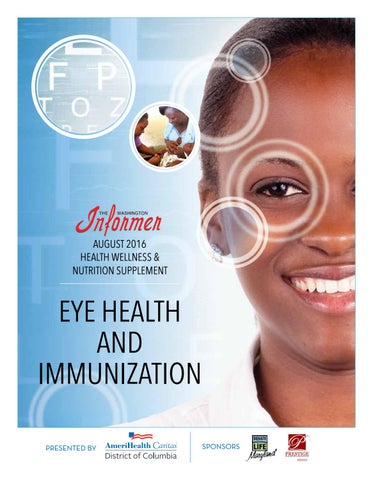
AUGUST 2016 HEALTH WELLNESS & NUTRITION SUPPLEMENT
EYE HEALTH AND IMMUNIZATION PRESENTED BY
SPONSORS
NEWSPAPER READING IS A HABIT DON’T BREAK THE HABIT!
Lifetime of Benefits Come From Childhood Exams Eye Screenings, Immunizations Essential in Preventive Care
READ THE WASHINGTON INFORMER YOUR WAY: In Print – feel the ink between your fingers of our Award Winning Print Edition
n
On the Web – www.washingtoninformer.com updated throughout the day, every day
By D. Kevin McNeir WI Editor
n
n
On your tablet
n
On your smartphone
n
n
n
Weekly Email Blast – sign up at www.washingtoninformer.com
202-561-4100 For advertising contact Ron Burke at rburke@washingtoninformer.com
...Informing you everyday in every way
In Memoriam Dr. Calvin W. Rolark, Sr. Wilhelmina J. Rolark THE WASHINGTON INFORMER NEWSPAPER (ISSN#0741-9414) is published weekly on each Thursday. Periodicals postage paid at Washington, D.C. and additional mailing offices. News and advertising deadline is Monday prior to publication. Announcements must be received two weeks prior to event. Copyright 2016 by The Washington Informer. All rights reserved. POSTMASTER: Send change of addresses to The Washington Informer, 3117 Martin Luther King, Jr. Ave., S.E. Washington, D.C. 20032. No part of this publication may be reproduced without written permission from the publisher. The Informer Newspaper cannot guarantee the return of photographs. Subscription rates are $45 per year, two years $60. Papers will be received not more than a week after publication. Make checks payable to: THE WASHINGTON INFORMER 3117 Martin Luther King, Jr. Ave., S.E Washington, D.C. 20032 Phone: 202 561-4100 Fax: 202 574-3785 news@washingtoninformer.com www.washingtoninformer.com
PUBLISHER Denise Rolark Barnes STAFF D. Kevin McNeir, Editor Ron Burke, Advertising/ Marketing Director Shevry Lassiter, Photo Editor Lafayette Barnes, IV, Assistant Photo Editor John E. De Freitas, Sports Photo Editor Dorothy Rowley, Online Editor ZebraDesigns.net, Design & Layout Mable Neville, Bookkeeper Mickey Thompson, Social Sightings columnist Stacey Palmer, Social Media Specialist Angie Johnson, Circulation REPORTERS Stacy Brown (Senior Writer), Sam P.K. Collins, Eve Ferguson, Will Ford (Prince George’s County Writer), Elton Hayes, D. Kevin McNeir, Dorothy Rowley, Kia Croom, Joya Patel, Rachel Sudduth, Sarafina Wright (General Assignment Writer) PHOTOGRAPHERS John E. DeFreitas, Shevry Lassiter, Roy Lewis, Patricia Little, Corey Parrish, Travis Riddick, Nancy Shia
Looking back over my childhood, I remember regular visits to the offices of Dr. Kovan, Dr. Arnold and Dr. Smith – three Detroit-based physicians who took care of my eyes, my general medical needs and my teeth until I had BY D. KEVIN MCNEIR graduated from college, moved out of my parEditor ents’ home and started a new chapter as an Washington Informer adult in Atlanta. And while I often balked when my mom or dad informed me that it was time to go in for a checkup, treatment or medical procedure, I eventually realized that those visits would help me remain physically fit, pain free and able to continue growing into a healthy adult. Our theme for this timely supplement, “Eye Health and Immunization,” reminded me of those many car trips with me kicking and screaming and my parents issuing their threats if I didn’t cooperate. Sadly, my somewhat hilarious memories do not resonate with a large segment of America’s youth. For them, the only doctors they see are when situations escalate to the point that they need to be taken to emergency wards. In those instances, only the immediate danger to their health is addressed. There’s no plan for preventive care – there’s no opportunity for essential, periodic examinations or immunizations. It’s tantamount to putting a bandage on a cancerous sore. More damage will inevitably occur and the pain will return. As these children mature, many will needlessly fall victim to illnesses that could have been prevented had they been given shots for the mumps, measles and other diseases. Other youth or adults will undergo problems with their sight or eye diseases that could have been detected, treated and in many cases cured if they had been part of a periodic regiment of comprehensive eye exams. That’s why we salute the efforts of well-respected physicians, sports teams and nonprofit organizations from around the Greater Washington Area who have committed themselves and their resources to helping youth whose families are unable to pay for preventive care – care that I once took for granted but for which so many youth need but never receive. The benefits to such endeavors far outweigh the costs that eventually come for medical care. In many instances, those costs are passed on to the public or to hospitals. But in the final analysis, the real cost is paid by children and adults who could have enjoyed a better quality of life and health – if only they had been able to secure immunizations, comprehensive eye exams and other related services. If we really believe in leveling the playing field, if we’re really concerned about caring for all of our children, then we must support the efforts of local benefactors like the Washington Nationals under the auspices of their Youth Baseball Academy, VSP Global, Dr. Keith Smithson and his Virginia-based team of physicians, and the corporate team of Nike Vision. Their story and their laudable efforts appear within this supplement. Let’s give our children a fighting chance to succeed, to achieve their dreams and to remain healthy along the way. HS www.washingtoninformer.com / AUGUST 2016 HEALTH, WELLNESS & NUTRITION SUPPLEMENT
H-2
Nationals Help Youth ‘See’ the World Better
Partnership Makes Difference for Children in Need By D. Kevin McNeir WI Editor
Imagine you’re a young boy or girl in the outfield and a ball’s sailing your way. You prepare yourself for the catch, moving slightly left and then right. The game’s outcome depends on your successfully pulling in the ball. Then, it drops just a few feet in front of you. But the failed attempt occurs not because you were unprepared but because you couldn’t see the ball clearly. That’s what many youth experience while participating in sports or while attempting to see the blackboard or read when in the classroom at school. But not anymore – at least for one lucky group of scholar-athletes who are members of the Washington Nationals Youth Baseball Academy in Southeast who recently received free eye care including comprehensive eye examinations and eyewear that shields them from the sun when out on the baseball field. Through a unique partnership that included VSP Global, Nike Vision, National’s eye specialist, Dr. Keith Smithson and Nationals 3B Anthony Rendon, a board member of the Academy, 150 children from the team’s Youth Baseball Academy can see the world and the baseball field better. Smithson, pediatric and sports vision specialist, Northern Virginia Doctors of Optometry, has been the Nationals’ team optometrist since their first day in the District. He and several of his colleagues who normally work in offices located in Reston, Falls Church, Alexandria and Arlington, donated their services, providing no-cost eye exams and prescription glasses. He described the event as “fantastic.” “There’s no better feeling than
H-3 H-3
knowing you’ve helped a child and after seeing the impact that this first time effort has had on children from the Academy, we’ve already started to discuss ways to hold similar programs again,” Smithson said. “Our goal was to get the word out about the importance of getting your eyes checked regularly, pointing out the differences between vision screening and a comprehensive eye exam and educating youth on the benefits of protecting their eyes from ultra violet rays by using sunglasses.” Smithson shared the story of one girl who had never received a vision exam. “She, like many of the children, had never had an eye exam,” he said. “Many of the kids were squinting so they could see. We soon determined that she had significant visual impairment. She’s a talented athlete and plays baseball and basketball and was excited to know that in just a few days she’d have glasses for school and sports glasses.” “But when she told me that
Jeff Beals, a technician with VSP Global Eyes of Hope examines Charles Robinson, 12, during the VSP Global Eyes of Hope mobile eye care clinic held at the Nationals Youth Baseball Academy in Southeast on Thursday, Aug. 4. / Photo by Shevry Lassiter
Yodit Berhane, an optical technician with Northern Virginia Doctors of Optometry, examines Caleb Smith, 9, during the VSP Global Eyes of Hope mobile eye care clinic held at the Nationals Youth Baseball Academy in Southeast on Thursday, Aug. 4. / Photo by Shevry Lassiter
from his company’s Nike Vision unit. “Dr. Smithson was really the driving force behind this initiative and we’re proud to be part of it,” he said. “We wanted to help because of the children and
“Many of the kids were squinting so they could see. We soon determined that she had significant visual impairment.” Dr. Keith Smithson
her dream was not to one day join the Mystics but rather to become a lawyer, I knew that we had made a difference in her life, for her community and perhaps even the world.” All of the children received Nike sunglasses thanks to Dan Leonardi, VP of Sport Brands Division for Marchon, Inc. who donated the protective eyewear
we’re committed to stepping up our efforts so that we can collectively help more youth get sports performance eyewear and vision care exams.” “We just finished participating in a similar program in Harlem for an AAU basketball program. So many youth are not properly diagnosed for vision or eye health. Amazingly, at
AUGUST 2016 HEALTH, WELLNESS & NUTRITION SUPPLEMENT / www.washingtoninformer.com
the AAU program, we tested 30 kids – 20 needed and received prescription glasses.” Perhaps the real lynchpin in the partnership came from VSP Global, the world’s largest insurance company that targets communities in need with their Eyes of Hope mobile eye care clinics. The initiative provides eye care, eyewear, education and disaster relief to places where they’re needed most. To date, through Eyes of Hope, VSP Global has invested more than $175 million in no-cost eye care and eyewear for one million people in need. VSP Global mobile clinic operations manager Janet Vorwerck also attended the Academy’s daylong program and said the best part was helping 90 children receive glasses. “We could have helped even more children if we had been able to reach more parents so they could fill out the pretty extensive paperwork that’s required,” she said. “But we’re still
quite happy with our efforts. VSP has driven over 470, 000 miles to deliver free eye care. One million people have received help so they can see better and we’ve invested $175 million in free eye care and eyewear.” “You help one child at a time see the world better – and it really makes a difference in their lives,” she added. Katina Lee, senior director of operations for the Nationals Youth Baseball Academy agreed. “This all began several months ago with meetings and planning. Now that we’ve seen what we can do, we’re going to expand the program next year and connect it to a larger health fair that will include dental care and diabetes screening. We’re part of this community and because of the resources at our disposal, we believe we can meet some of the needs of those who live in the Greater Washington Area. We’re here to stay and we’re help to make their lives better,” Lee said. HS
Back-to-School Basics: Annual Check-ups and Vaccines Submitted by AmeriHealth Caritas District of Columbia Summer break is coming to a close. Soon, your child will head back to school with their pencils, notebooks and a backpack. Your child’s school may have a checklist for the things students need. In addition to items on that list, your child will need to see the doctor and be vaccinated before classes start.
YOUR CHILD’S CHECK-UP AND VACCINES
Be sure to visit your child’s primary care provider (PCP) before the first day of school. The PCP will perform a check-up and give your child vaccines (shots) they need. If your child is an AmeriHealth Caritas District of Columbia (DC) member, they will be in the HealthCheck Program. This is also called Early and Periodic Screening, Diagnosis, and Treatment (EPSDT). The program starts right after your child is born and lasts until your child turns 21. The HealthCheck Program gives your child a number of important check-ups. Your child’s PCP will provide or help your child get these services. Check-ups allow the doctor to see if your child is growing and developing properly. During the check-up, the PCP will give your child the shots they need. Just like the ones your child got at birth, your child needs shots before school starts. Every child, from preschoolers to college students, needs vaccines. Attending school without being vaccinated is unsafe for your child and their classmates. Vaccines can prevent several deadly diseases, including the measles. It’s important for your child to get all necessary shots before the first day of school. In fact, it’s required by law. Ask your child’s doctor if they recommend any other vaccines to keep your child safe, like the flu shot.
YOUR CHILD’S HEALTH ACTION PLAN
If your child has asthma or other conditions, be sure to have an action plan for when they are at school. An asthma action plan shows the daily medicine that should be taken, how to control asthma and how to handle asth-
ma attacks. Your child’s doctor can help you create an asthma action plan. Share this plan and other important documents with your child’s teachers and the school nurse. Supply the nurse with enough of your child’s medicines and their medicine schedule. It is also important for them to have any emergency medicine your child uses, like a rescue inhaler. Make sure the school has everything they need to keep your child safe and healthy.
VISION AND LEARNING
It’s important to know if your child can see well before attending school. To check, visit your child’s eye doctor. Good vision can help with learning. If your child has trouble seeing up close, they may have issues learning to read. If seeing far away is hard, your child may not be able to read the blackboard. Of course, there are safety issues, too. If your child walks to school, it can be unsafe crossing the street with blurry vision. Seeing an eye doctor is the only sure way to know if your child’s eyes are healthy. Get
your child’s eyes checked every year to be aware of any changes as he or she grows.
STUDENT ENROLLMENT
If your child is attending a District of Columbia Public School (SCPS), you will need to complete Student Enrollment and Health Forms. Some of the forms include: • Student enrollment form • Residency verification • Home language survey • Health certificate and assessment New students will also need 1 proof-of-age document, which can include: • A birth certificate • Hospital records • Previous school records • A passport • A baptismal certificate To complete these forms, visit dcps.dc.gov/DCPS and type “Enrollment Checklist” in the search bar.
READY, SET, LEARN!
The classroom is an important place for children to learn and feel safe. It’s also great for social development. With the back-toschool checklists complete, your child is ready to tackle the first day of the school year. And with vaccines checked off, your child should have fewer sick days.
That’s more time to learn. AmeriHealth Caritas DC wishes your child a safe and healthy school year full of knowledge and success! HS Sources: Centers for Disease Control and Prevention and District of Columbia Public Schools All images are used under license for illustrative purposes only. Any individual depicted is a model.
Get ready for school with a dental exam, HealthCheck, and a new book bag! Bring your children to receive their dental exam by Adventure Dental! HealthCheck exams are available, too. ● Teeth cleaning
● Dental X-rays
Every child who gets their dental exam or HealthCheck will get a new book bag! ● Cavity Care
● Fluoride treatment ● Snacks & Family Fun
WHEN: Friday, August 19, 2016 from 10:00AM to 4:00PM WHERE: Adventure Dental 3946 Minnesota Avenue NE Washington, DC 20019 Call 202-216-2318 to schedule your appointment or more info.
www.washingtoninformer.com / AUGUST 2016 HEALTH, WELLNESS & NUTRITION SUPPLEMENT
H-4
Staying up to date with your health care just got easier! Join AmeriHealth Caritas District of Columbia’s text messaging program. Need a reminder about…
What about…
• Important health screenings?
• Your doctor’s phone number or address?
• Upcoming AmeriHealth Caritas
• A copy of your member ID card?
District of Columbia events?
To join, text iamhealthy to 85886*. AmeriHealth Caritas District of Columbia members only. Standard messaging and data fees may apply.
*
5400ACDC-1522-75
www.amerihealthcaritasdc.com
H-5 H-5
AUGUST 2016 HEALTH, WELLNESS & NUTRITION SUPPLEMENT / www.washingtoninformer.com
Two Recipients and Donor Families Share Their Connection to Organ, Eye and Tissue Donation.
Sonia Taylor | Cornea recipient and donor family member.
Sonia Taylor-Sewell: Cornea Recipient and Donor Family Member
SUPPORT ORGAN, EYE AND TISSUE DONATION IT’S A DECISION EVERYONE CAN LIVE WITH
Register online or at the MVA when you obtain your license. DonateLifeMaryland.org
I remember taking road trips as a young girl with my parents: my Dad and I would always play a game to see who could read the highway signs that were furthest away. Of course, I would always win because my vision was better than his. While in my teen years, I loved to read the newspaper and remember being able to stand over one’s shoulder and read along with them. In my late twenties, I noticed that I was not able to read from a distance clearly—the highway signs and the newspaper writing appeared double. My vision then began to deteriorate rapidly. I was diagnosed with a corneal abnormality called Keratoconus and was told the only cure for my condition would be a cornea transplant. In 1992, I received a cornea transplant in my right eye, which has improved my vision and given me a first-hand understanding of the value of organ and tissue donation. In 2007 I lost my nephew, Jordan, in a tragic death as a result of a senseless crime. To my surprise, he had become an organ donor at the age 21. Being a recipient of a tissue transplant, as well as a donor family member, has greatly affected me. My family and I are grateful for the legacy my nephew left behind and I am grateful for the gift of sight that I received from a very generous cornea donor.
DANETTE’S STORY – LIFE AS A RECIPIENT AND DONOR AUNT
Danette Ragin also knows both the experience of being on the transplant waiting list and having a deceased donor family member. Danette was diagnosed with end stage renal disease in 2006. At first, she was in denial. “I didn’t hear anything else that the doctor said; just the words ‘end stage renal disease.’” In 2008, Danette was given a second chance at life when she received her kidney transplant. “I prayed and asked God to let me see my kids graduate, get married and have children of their own. Now, both of my daughters are engaged. I’m so blessed.” Three years later, Danette was reconnected to donation when her 23-year-old nephew, Martez, was shot and killed. “He had a 7-monthold son, Jamari. It was devastating. My family called me to deal with the donation questions because they knew, through my own transplant experience, I understood the process.” Martez was able to be a tissue and cornea donor. In the midst of her grief, Danette wanted Martez to be able to help others. “I have an extended warranty on life, thanks to my donor. My nephew died, but it was an opportunity for our family to give someone else an extended warranty on their life too.” To register as an organ, eye and tissue donor, go to DonateLifeMaryland.org anytime or at any Motor Vehicle Administration branch. HS
www.washingtoninformer.com / AUGUST 2016 HEALTH, WELLNESS & NUTRITION SUPPLEMENT
H-6
Caregiver and Respite Care Services John S. Smith, Jr. RN, BSN, CNOR Director of Operations at Prestige Healthcare Resources, Inc. Being a caregiver for your aging loved one can be an extremely rewarding and fulfilling experience. It can also be exceptionally stressful and put a strain on the other relationships in your life. Taking the time to pay attention to those relationships and ensure that they are getting the nurturing and support that they need throughout your care relationship is important to making sure your life outside of your care efforts remains stable, well rounded, and satisfying. Not only will this ensure that you will still have your own identity and an enjoyable life after your care relationship comes to an end, but it means that you will be the healthiest, most effective caregiver possible throughout the rest of your care journey. One of the most important relationships that you must protect during your care journey is your marriage. Your partner can be one of your greatest sources of support and encouragement during the challenges of your care efforts, but they can also be the person who must sacrifice the most time with you. If you are also raising children while caring for your parent, you must first make sure that their needs and the needs of your elderly loved one are handled before you can use any time on anything else. This can result in you no longer spending valuable time connecting with your partner. Over time this can lead to greater stress, making it even harder for you to fulfill your care efforts. Utilizing respite care can be an exceptional way for you balance your demands as a caregiver and your emotional needs as well. This type of care provider steps in when you need time away from your care efforts and provides the exact type of care and assistance that your parent needs to keep them healthy, safe, and comfortable while you are away. Use these tips to help you make the most of respite care so that you can enjoy a night out with your partner:
SHARE YOUR PLANS
respite home care provider in the home with your parent. While you do not need to justify your desire to spend time with your partner to your parent or ask the for permission, telling them ahead of time is a show of respect and gives them the opportunity to get used to the idea rather than feeling like it was “sprung” on them.
Win FREE Homecare for your loved ones, on us.
HAVE SOME OVERLAP
Try to avoid leaving your parent’s home before the care provider arrives or leaving immediately upon their arrival. Have a little bit of overlap time that will allow you to introduce the care provider to your parent and answer any questions. This will give all of you more confidence that this arrangement will work out well for everyone involved.
LEAVE DETAILED INSTRUCTIONS
Your parent might feel unnerved by the thought of receiving care from someone else, especially if they are accustomed to you being their only caregiver. Take the time to write out detailed instructions for the care provider that can help them to maintain the routine that you have with your parent. This way even if your parent is reluctant to communicate with the care provider they will know important details that will enable them to give your loved one the type of care that they need. If you or an aging loved one are considering hiring professional caregiver services, contact the friendly staff at Prestige Healthcare Resources. Ask about our free In-Home Care Assessment: 240-547-0234. WI
If you care for aging parents… IfIfyou aging carecare youfor foran aging spouse/partner spouse/partner
IF YOU CARE.....FOR PEOPLE Prestige wants to remove stress & worry for you
We are giving away thirteen (13) hours of care each month for the next 3 month!!. We’ve got awesome prizes for 3 winners each month starting in September.
Prestige Healthcare Resources In Maryland Call: 240-547-0234
Grand Prize 6 hours of home care
2nd Prize 4 hours of respite care
3rd Prize
3 hours of concierge services
All you have to do is:
E-mail us your name E-mail address and a compelling story about your struggles
Visit our website: www.prestigewecare.com
Free In-home Care for Lucky winners!!!!!
In Washington DC Call: 202-759-6400
Tell your parent in advance about your intention to take a We service Maryland, Washingnight off from your care efforts ton DC and Surrounding Cities and that you are going to have a http://www.prestigewecare.com/
H-7 H-7
Win FREE Homecare for your loved ones, on us.
“Exceptional Senior Care, Stress & Worry free” Serving DC and MD • info@Prestigewecare.com • (202) 558-2448
AUGUST 2016 HEALTH, WELLNESS & NUTRITION SUPPLEMENT / www.washingtoninformer.com
Living with Sickle Cell Anemia Virginian Shares His Story of Dealing with the Pain
By D. Kevin McNeir WI Editor There’s an incorrect notion that sickle cell anemia is curable and that the genetic mutation has been essentially eliminated around the world. But one Northern Virginia man says both beliefs are far from the truth. The 29-year-old Sierra Leone native whose family immigrated to the U.S. when he was five, has been living with sickle cell anemia almost since birth. And he says it can be a painful, lonely affliction. It was his personal reality and the challenges of life that led him to found the 1091 Group, an organization that seeks to improve communication between
patients and caregivers while also leading those who live with the disease to additional resources that can improve the quality of their lives. “Living with sickle cell anemia is bitter sweet,” said Ibrahim Tejan Kargbo who said he began receiving treatment for the blood disorder after he and his family arrived in the U.S. “You have pain – for some it’s chronic pain that never goes away,” Kargbo said. “Women with sickle cell anemia have described the pain as similar to giving birth. It’s like being stabbed inside out with a sharp knife. For me, the lighter side is that you quickly learn to appreciate life because you realize that on any given day, you may have to be hospitalized. Having a sudden
stroke is common – you take life from day to day,” he said. Kargbo says moving to America was significant because the treatment he received while living in West Africa was “rudimentary at best.” “I guess I was the lucky one because none of my four siblings have sickle cell,” he said. “You have to understand that there’s no such thing as living unencumbered. Getting through high school was a challenge because I was back and forth in the hospital. College was even harder, given the stress of exams, working several jobs and facing mounting student loans. But I made it through with good grades and then went on to earn a master’s in public health. I didn’t know how long I had before the effects from sickle cell would make it im-
10 YEAR
ANNIVERSARY
10TH ANNIVERSARY STOMP OUT SICKLE CELL
5K WALK
possible to continue my studies so I didn’t stop,” said Kargbo, who received his undergraduate and graduate degrees from George Mason University. During his efforts to better understand the various kinds of treatments available and the current state of research, he said it became clear that many patients were misinformed. “I started the 1091 Group as a way of bringing patients and physicians together so they could hash out their differences – so they could talk to one another,” he said. “Since our founding in 2013, we have slowly added services that help patients develop the skills needed to be their own advocates. We’re currently registered as an LLC for-profit company and we have a total staff of three with a lot of volunteers. We’re doing what we can.” Kargbo, who has been in a longtime relationship but remains single, said passing the disease on to his children has always caused him fear, even after his girlfriend was tested. “She doesn’t have the gene but that hasn’t stopped me from worrying about bringing a child into
the world with sickle cell anemia,” he said. “But at least I know what it’s like, how to deal with it and how to live with the best quality of life possible.” This fall, Kargbo will once again participate in a local initiative, the SOS Walk, led in part by the Howard University Sickle Cell Center, whose goal is to raise funds for research and treatment. He says it’s an excellent way to educate the public. However, he believes that more education is needed. “The truth is sickle cell anemia has not been cured – that’s false,” he said. “Nonetheless, those living with it need to know that things will get better. But you have to be willing to change the way you live. Most of all, you have to take life one day at a time while embracing those changes.” “The kind of research that’s going on across the country is impressive and I know that the community of patients like me appreciate the efforts of physicians and researchers,” he said. “One estimate says about 100,000 people in the U.S. have sickle cell anemia – I think the number is significantly higher.” WI
Sidebar
August is National Immunization Awareness Month: Are You Up-to-Date?
(SPM Wire) August is National Immunization Awareness Month and the perfect opportunity to make sure everyone is up-to-date with their vaccination schedules, particularly children headed back-to-school. Different ages and communications are susceptible to different diseases. Knowing what vaccines you have received and which you need is crucial. While it’s a great idea to keep your own records up-to-date at home, you can always check in with your physician, too. To learn more about the importance of vaccines, visit cdc.gov/vaccines. Vaccinations save lives and prevent serious illness. Be sure to stay on top of this crucial aspect of your family’s health.
Washington, DC
Center for Sickle Cell Disease Celebrates 45 years of Service www.soswalk.org
----------------------
8 AM - 12 Noon Saturday, September 10, 2016
Call 202.865.8366 or 866.322.3711 www.washingtoninformer.com / AUGUST 2016 HEALTH, WELLNESS & NUTRITION SUPPLEMENT
H-8
Addressing an Important Health Disparity: Hepatitis C in the African-American Community By Alexander Geboy, MS Program Manager of Viral Hepatitis Research MedStar Health Research Institute at MedStar Washington Hospital Center In July, we celebrated the 4th annual National African American Hepatitis C Action Day (NAAHCAD) with a testing and educational event at MedStar Washington Hospital Center. In total, 29 people were tested for hepatitis C virus antibodies, and we spoke to many more in an effort to raise awareness about the public health crisis that is HepC. What does hepatitis C have to do with African Americans? First, here are some data to set the stage: chronic hepatitis C (HepC) is a liver infection caused by the hepatitis C virus (HCV). In the United States, it is estimated that between 2.5 million and 4.7 million people are living with HepC. The Centers for Disease Control and Prevention (CDC) and the U.S. Preventive Services Task Force recommend that anyone of any age with high risk behaviors such as current or past injection drug use should get HepC tested once yearly. They also recommend baby boomers or people born from 1945 to 1965 should be tested at least once for HepC due to high prevalence. Baby boomers are five times more likely to have HepC, and most of them don’t know they are infected. So what is the impact on the African-American community? Hepatitis C is more prevalent among African Americans than among persons of any other racial group in the nation. And although African Americans represent about 13 percent of the overall U.S. population, estimates suggest they represent around 22 percent of all HepC infections. Additionally, African-American baby boomers have twice the rates of HepC infection as other baby boomers. This picture is equally revealing at the hospital level. In a recently published article in the journal Public Health Reports, we found a HepC prevalence rate of nine percent among baby boomers within MedStar Washington Hospital Center’s Primary Care Clinic. This was significantly higher than the U.S. prevalence of 3.3 percent and the D.C. prevalence of 2.5 percent (among all ages). Within this group, the HepC positive rate among African-American men was
H-9 H-9
16 percent, substantially higher than the CDC rate of eight percent. Hepatitis C has been called a “silent epidemic” because most people with the disease don’t know they are infected. Over time, HepC can cause inflammation and gradual liver fibrosis or scarring, which can lead to cirrhosis. It is also a leading cause of liver failure, liver cancer, liver transplantation and liver-related death. And according to a recent CDC article, more people die each year from HepC than from 60 other infectious diseases, including HIV. Yes, HepC kills more people each year than HIV. So what does this mean and what can you do? The National Black Leadership Commission on AIDS launched the first National African American Hepatitis C Action Day four years ago, with the intention of mobilizing the community to reduce the burden of HepC on the Black community, and impact a neglected health disparity by promoting education, testing, linkage to care and treatment. So for everyone, especially people of the African-American community, it starts with a test, it’s that simple. HepC is curable. CURABLE. But one of the biggest barriers to HepC eradication is a lack of identification. More important, the Centers for Medicare and Medicaid Services (CMS) now covers the cost of a HepC antibody screening test – in a primary setting – if the following conditions are met: a) A screening test is covered for adults at high risk for HepC infection. “High risk” is defined as persons with a current or past history of illicit injection drug use; and persons who have a history of receiving a blood transfusion prior to 1992. Repeat screening for high risk persons is covered annually only for persons who have had continued illicit injection drug use since the prior negative screening test and have not been; and b) A single screening test is covered for adults who do not meet the high risk as defined above, but who were born from 1945 through 1965. So take the HepC challenge and ask your primary care provider to be tested. If you are chronically HepC infected and not currently in care with a specialist (Infectious Diseases, Hepatology, or Gastroenterology) please contact the HepC Linkage to Care Navigation program at MedStar Washington Hospital Center for assistance at 202-877-0679/3296 or by email at Alexander.g.geboy@ medstar.net or Chinyere.c.ukaegbu@medstar.net. WI
MedStar Washington Hospital Center We take care of it all. The most critically ill patients, the most challenging medical problems. Minor illnesses— and chronic disease. The birth of healthy babies—and the healthy lives of older adults.
AUGUST 2016 HEALTH, WELLNESS & NUTRITION SUPPLEMENT / www.washingtoninformer.com
MedStar Washington Hospital Center 110 Irving St NW Washington, DC 20010 855-546-1686 www.medstarwashington.org
A Smile of Confidence Submitted by Community of Hope
Margaret Benson checks out her new smile as Dr. Halima Karim, Community of Hope’s Dental Director, looks on.
Margaret Benson was ready to go back to work, but there was one thing she felt standing in the way -her smile. With missing teeth, she felt it would be hard to get a job in customer service. “A smile is very important. It is not that you have low self-esteem, you just feel better,” Benson said. Since 2014, Benson has been a medical patient at Community of Hope’s Conway Health and Resource Center, right across the street from her home. She was already getting medical care there so it made sense for her to make it the place to improve her smile. Recently Benson had her remaining teeth pulled and was fitted for dentures by Dr. Halima Karim, Community of Hope’s Dental Director. Benson says with her new smile she has more confidence. For Dr. Karim, improving
smiles is rewarding. “The best part of my job is helping patients feel more comfortable about their smile,” she said. Dr. Karim joined Community of Hope a year ago. She is a native of Washington, DC. “I chose Community of Hope because I like working with the underserved communities,” she said. Dr. Karim said she likes to talk with patients and understand what the patient’s goals are and share treatment options. But, Dr. Karim adds that there’s something more important than the look of a smile – oral health. “I try to remind patients that the mouth is what you use every day, anything you put in the mouth affects your body,” she said. “Our mouths and bodies are connected. People with gum disease may have risk factors for heart disease or diabetes.” Dr. Karim says that she stresses that routine dental check-ups can prevent a lot of oral health problems.
Many people don’t get routine check-ups due to fear of dentists or not understanding what the dentist is doing Dr. Karim makes patients feel comfortable while in the dentist chair by talking them through what she is doing. It helps both kids and adults. Benson said not only knowing exactly what was going on put her at ease, but being able to ask questions and get answers. “When you have questions, she is willing to explain everything, “she said. Benson said she likes being a patient at the Conway Health and Resource Center because of the friendly staff and easy scheduling. “If you don’t have an appointment, they call you when they have an opening,” she said. “It is real convenient.” Last year, Community of Hope provided compassionate healthcare to 9,825 patients. They have enrollment assisters available to sign up people who need insurance and offer a sliding fee scale to patients. WI
Healthy Smile, Healthy Body, Happy You! ✔ Affordable, quality dental care for the whole family
Dental Care Provided:
✔ Open Saturdays
✔ Dentures and extractions
✔ Same-day appointments
✔ Fillings, root canals, crowns and sealants
✔ Sliding fee scale
✔ Complete exam
Visit the Conway Health and Resource Center Call: 202.540.9862
This program is funded in part by the District of Columbia Department of Health.
We accept Medicaid, private insurances and uninsured patients.
www.communityofhopedc.org www.washingtoninformer.com / AUGUST 2016 HEALTH, WELLNESS & NUTRITION SUPPLEMENT
H-10
Taking a Closer Look at Black Mental Health By Patricia Maryland, Dr.PH Good physical and mental health helps drive success and enjoyment in our lives. But when it comes to overcoming some of our society’s biggest health challenges – from HIV/ AIDS to cancer to diabetes to behavioral health issues – the African-American community unfortunately shoulders a disproportionate share of the burden. As our nation increasingly deals with violence, suicide and depression, it’s important to take a close look at the state of black mental health in America. The National Institute of Mental Health estimates that one of every five adults in the U.S. — some 43 million people — will experience mental illness this year. African-Americans are far from immune; in fact, blacks are more than 20 percent more likely than whites to report having serious psychological distress. For people of color living in poverty-stricken neighborhoods, where rates of homelessness, incarceration, substance abuse and violent crime are higher, the risk of mental illness is compounded. One of the challenges African-Americans with mental health issues continue to face is an imbalance in health insurance coverage. While the Affordable Care Act has caused the uninsured rate among blacks to decline by close to 10 percentage points between 2013 and 2016, it remains almost twice as high as the uninsured rate for non-Hispanic whites. There is also a lack of African-American mental health professionals who can deliver culturally competent care for illnesses that are often deeply personal and can be the subject of stigmatization. According to a 2014 survey, less than 2 percent of American Psychological Association members are African-American. These disparities are unacceptable. It is clear that we must make mental health equity a guiding principle and an utmost priority. As Ascension’s President and CEO Anthony Tersigni recently stated: “Insurance coverage for the treatment of these disorders has long been discriminatory compared with
H-11 H-11
coverage for physical diseases. In 2008, the federal government essentially legislated that there be parity between mental health coverage and physical health coverage, but the intended changes have been problematic and slow in coming.” On the part of healthcare providers, addressing this challenge means promoting and expanding access to affordable mental and behavioral healthcare — care that recognizes the stressors that African-Americans experience and provides solutions that are culturally competent. For our part, we have established behavioral/ mental health as a dedicated priority service line across our national healthcare system. This work demands continued investment in community health centers, which are vital to serving high-need minority neighborhoods. And it requires that we go beyond the traditional scope of care by addressing the socioeconomic needs that contribute to mental health, including access to affordable housing, food security and more. Going beyond the traditional scope also means that our nation must address the care of our military veterans. Current statistics reveal that 18 to 22 veterans die by suicide each day in America because of their unique mental and behavioral health needs. Some of these veterans are African-Americans; we must do more to help all vets. That’s one reason for Ascension’s participation in the federal Veterans Choice Program, which was formed to improve the quality and access of care to veterans nationwide. All of these programs and investments are important, but real gains in this fight will not come without the support and participation of the African-American community overall. We must stop viewing mental illness in America as if it were a personal failing rather than a serious health concern. And we must help our loved ones and neighbors to stop neglecting the care they need because of stigmas that surround mental health. These stigmas must be addressed and overcome.
While communities of color are having important conversations about mental health, we can do more. Breaking down these barriers will compel us not only to recognize the necessity of mental health care, but also to marshal our support for family, friends and neighbors who are seeking the help and treatment they need. Together, we can build a healthier, stronger community, where getting support for mental health problems is not a sign of weakness, but one of strength. WI Patricia A. Maryland, Dr.PH, is the President of Healthcare Operations and Chief Operating Officer for Ascension Health, the healthcare delivery subsidiary of Ascension, the nation’s largest non-profit and largest Catholic health system.
BORN BETWEEN
1945-1965?
GET TESTED FOR HEPATITIS C
5X 75%
BABY BOOMERS ARE
MORE LIKELY TO HAVE HEPATITIS C
MORE THAN
OF ADULTS INFECTED ARE BABY BOOMERS
MILLIONS OF PEOPLE HAVE HEPATITIS C, BUT MOST DON’T KNOW IT.
Left untreated, HEPATITIS C can cause liver damage and liver failure. Get tested today. Call United Medical Center at 202.574.6141. IT COULD SAVE YOUR LIFE. Not-For-Profit Hospital Corporation 1310 Southern Avenue, SE, Washington, DC 20032
202.574.6000 www.united-medicalcenter.com
UnitedMedicalCenterDC
Working for a healthier community.
AUGUST 2016 HEALTH, WELLNESS & NUTRITION SUPPLEMENT / www.washingtoninformer.com
@UMC_DC
Staying up to date with your health care just got easier! Join AmeriHealth Caritas District of Columbia’s text messaging program. Need a reminder about…
What about…
• Important health screenings?
• Your doctor’s phone number or address?
• Upcoming AmeriHealth Caritas
• A copy of your member ID card?
District of Columbia events?
To join, text iamhealthy to 85886 . *
AmeriHealth Caritas District of Columbia members only. Standard messaging and data fees may apply.
*
5400ACDC-1522-75
www.amerihealthcaritasdc.com
www.washingtoninformer.com / AUGUST 2016 HEALTH, WELLNESS & NUTRITION SUPPLEMENT
H-12