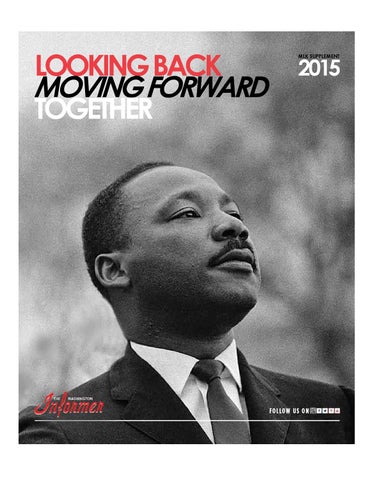
2015 MLK SUPPLEMENT
FO L LOW U S O N
NEWSPAPER READING IS A HABIT DON’T BREAK THE HABIT!
READ THE WASHINGTON INFORMER YOUR WAY: n In Print – feel the ink between your fingers of
our Award Winning Print Edition
n On the Web – www.washingtoninformer.com
updated throughout the day, every day
n On your tablet n On your smartphone n Facebook n Twitter n Weekly Email Blast – sign up at
www.washingtoninformer.com
202-561-4100 For advertising contact Ron Burke at rburke@washingtoninformer.com
...Informing you everyday in every way
In Memoriam Dr. Calvin W. Rolark, Sr. Wilhelmina J. Rolark THE WASHINGTON INFORMER NEWSPAPER (ISSN#0741-9414) is published weekly on each Thursday. Periodicals postage paid at Washington, D.C. and additional mailing offices. News and advertising deadline is Monday prior to publication. Announcements must be received two weeks prior to event. Copyright 2013 by The Washington Informer. All rights reserved. POSTMASTER: Send change of addresses to The Washington Informer, 3117 Martin Luther King, Jr. Ave., S.E. Washington, D.C. 20032. No part of this publication may be reproduced without written permission from the publisher. The Informer Newspaper cannot guarantee the return of photographs. Subscription rates are $45 per year, two years $60. Papers will be received not more than a week after publication. Make checks payable to: THE WASHINGTON INFORMER 3117 Martin Luther King, Jr. Ave., S.E Washington, D.C. 20032 Phone: 202 561-4100 Fax: 202 574-3785 news@washingtoninformer.com www.washingtoninformer.com
PUBLISHER Denise Rolark Barnes STAFF Denise W. Barnes, Editor D. Kevin McNeir, Managing Editor Ron Burke, Advertising/ Marketing Director Lafayette Barnes, IV, Assistant Photo Editor John E. De Freitas, Sports Photo Editor Dorothy Rowley, Online Editor Brian Young, Design & Layout Mable Neville, Bookkeeper Mickey Thompson, Social Sightings columnist Stacey Palmer, Social Media Specialist Angie Johnson, Circulation REPORTERS Stacy Brown, Sam P.K. Collins, Eve Ferguson, Elton Hayes, D. Kevin McNeir, Dorothy Rowley, Barrington Salmon
PHOTOGRAPHERS John E. DeFreitas, Shevry Lassiter, Roy Lewis, Travis Riddick , Nancy Shia
King’s Relevance and Legacy Live On
M
any years ago when I was a young, impressionable, first-year student at the Candler School of Theology in Atlanta, Georgia, I came across a collection of sermons by the Rev. Dr. Martin Luther King, Jr. The book was titled, “Where Do We Go From Here: Chaos or Community?” In light of recent events in the U.S., where black men and boys have been used as target practice by those sworn to protect and serve, and with terrorists murdering innocent men and women in Europe and black-on-black crime reaching epidemic proportions on the continent of Africa, King’s question haunts me once more. While I first read his challenging sermons almost 30 years ago, each word leaped from the pages – as they do so today. It does seem that we are at the precipice of destruction, looking over into that vast chasm where man’s inhumanity to man appears to be the order of the day. But King for the most part, remained the eternal optimist – from Selma and Montgomery, to Birmingham, Washington, D.C. and Chicago – even to Memphis where his life was tragically ended. Often times, we attempt to place King on a pedestal – something that we tend to do with those who have made the ultimate sacrifice. But that would be a mistake. King was a man – nothing more, nothing less. But he chose to be obedient, listening to that still small voice. He followed the examples of men and women who believed that every deed of compassion and love for mankind made a difference. Was he a prophet? I believe he was. But then again, so were others: Jeremiah, Ezekiel and Amos; Medgar, Malcolm and Maya; Fannie Lou, Sojourner and Mary McLeod Bethune. In the pages that follow, we highlight the contributions that Dr. King made to our world in general and to the black community in particular. He was our “drum major for peace.” And like the long line of prophets who came before him, other young lions and lionesses now heed the call and stand bravely on the battlefield for justice. If we allow chaos to consume us, it is only because we lack the temerity and courage to rise above our circumstances. King once talked about faith, saying that those who have it will walk on even when they cannot see the bottom of the staircase. That’s who King was and that’s the legacy he leaves behind. We have many miles to go before we sleep. And while we cannot see the ending, we have confidence that the road will end in community. Let the light of Martin Luther King, Jr. continue to shine in all of our lives. D. Kevin McNeir WI Managing Editor
M-2 /JANUARY 2015 / MARTIN LUTHER KING JR SUPPLEMENT
www.washingtoninformer.com
District residents participated in the 37th annual Martin Luther King Jr. Peace Walk and Parade./ Courtesy Photo
District Honors MLK with Peace Walk By Dorothy Rowley WI Staff Writer Hundreds of District residents, joined by supporters from nearby Northern Virginia and Prince George’s County, participated Monday in the 37th annual Martin Luther King Jr. Peace Walk and Parade in commemoration of the slain civil rights leader. The event – one of many tributes held in the District – also played out in similar memorials across the country, includng Selma, Alabama, where the cast of the movie “SELMA’ marched Sunday, across the Edmund Pettus Bridge in honor of King’s historic protest in 1965 from Selma to Montgomery. Locally, the march began in the 1970s by Calvin and Wilhelmina Rolark, co-founders of The Washington Informer, along with television and radio talkshow host Petey Greene. Several of this year’s participants, who paused for interviews as they walked along MLK Avenue in Southeast to Milwaukee Place, said the gathering served as a reminder that people of all colors and ethnic backgrounds can still come together peacefully for the sake of their beliefs. “We’re here for peace and solidarity. There’s been a lot of violence going on in this community,” said Neva Faulkner from Southeast. “It shows that we’re all her for a common cause.” Ron Thompson from Prince George’s County, concurred adding that there are many people who still believe in what King tried to accomplish through acts
of nonviolence. “It means to me personally, that the struggle for civil rights in this country [has been worthwhile],” said Thompson. “We need to pass that on to our children.” Paul Trantham, also from Southeast, said he participates every year as his way of continuously honoring King. “He marched for, walked for, went to jail and suffered for our civil rights,” said Trantham “[He did that] so that we could be treated equally and fairly in a world where we all live together.” President Barack Obama also chimed in on the memorials by calling attention to King’s courage and strength during his long battle for equality. In addition to asking the nation to pause and pay tribute to King’s “extraordinary life and legacy,” Obama said that in order to truly honor King, citizens must continue to work for a better America. “We have more to do to bring Dr. King’s dream within reach of all our daughters and sons. We must stand together for good jobs, fair wages, safe neighborhoods, and quality education,” Obama said. “With one voice, we must ensure the scales of justice work equally for all -considering not only how justice is applied, but also how it is perceived and experienced. As Dr. King told us, ‘injustice anywhere is a threat to justice everywhere,” and this remains our great unfinished business.’” WI
www.washingtoninformer.com
The cast and crew of the movie, “SELMA,” marched on Sunday, Jan. 18, 2015 across the Edmund Pettus Bridge in Selma, Alabama./ Courtesy Photo
FROM THE BACK OF THE BUS TO THE HEAD OF THE TABLE. WE CONTINUE TO STRIVE.
Real Possibilities is a trademark of AARP.
Celebrating Black Life, History and Culture
Every day people have the power to do extraordinary things. Like, the soft-spoken African American woman who refused to give up her seat on the bus, not knowing that it would someday lead to African American men and women sitting as heads of boards and running their own corporations. As we celebrate Black History, AARP honors those who believe in Real Possibilities for themselves and for the community. This is your season to do something extraordinary. Get started today at aarp.org/blackcommunity.
MARTIN LUTHER KING JR SUPPLEMENT / JANUARY 2015 / M-3
C H R O N O L O G Y
Compiled by Dorothy Rowley WI Staff Writer Jan. 15, 1929: Michael King, later known as Martin Luther King Jr., is born at 501 Auburn Ave. in Atlanta. Summer 1941: The King family – Martin Luther King Sr. (Daddy King), Alberta Williams King, Willie Christine King, Martin Luther King Jr., and Alfred Daniel Williams King (known as A. D. King) – moves from 501 Auburn Ave. to 193 Boulevard in Atlanta. Sept. 20, 1944: King begins his freshman year at Morehouse College in Atlanta. Aug. 6, 1946: The Atlanta Constitution publishes King’s letter to the editor stating that black people “are entitled to the
basic rights and opportunities of American citizens.” Feb. 25, 1948: King is ordained and appointed assistant pastor at Ebenezer Baptist Church in Atlanta. June 8: King receives his bachelor of arts degree in sociology from Morehouse College. Sept. 14: King begins his studies at Crozer Theological Seminary in Chester, Pennsylvania. May-6-8, 1951: King graduates from Crozer with a bachelor of divinity degree, delivering the valedictory address at commencement. Sept. 13: King begins his graduate studies in systematic theology at Boston University. June 18, 1953: King and Coretta Scott are married at the Scott home near Marion, Alabama.
Sept. 1, 1954: King begins his pastorate at Dexter Avenue Baptist Church in Montgomery, Alabama. June 5, 1955: King is awarded his doctorate degree in systematic theology from Boston University. Nov. 17: Yolanda Denise King, the Kings’ first child, is born. Dec. 1: Rosa Parks is arrested for refusing to vacate her seat and move to the rear of a city bus in Montgomery to make way for a white passenger. Jo Ann Robinson and other Women’s Political Council members mimeograph thousands of leaflets, calling for a one-day boycott of the city’s buses on Monday, Dec. 5. Dec. 5: At a mass meeting at Holt Street Baptist Church,
M-4 /JANUARY 2015 / MARTIN LUTHER KING JR SUPPLEMENT
the Montgomery Improvement Association is formed. King becomes its president. Jan. 27, 1956: According to King’s later account in “Stride Toward Freedom,” he receives a threatening phone call late in the evening, prompting a spiritual revelation that fills him with strength to carry on in spite of persecution. Jan. 30: At 9:15 p.m., while King speaks at a mass meeting, his home is bombed. His wife and daughter are not injured. Later, King addresses an angry crowd that gathers outside the house, pleading for nonviolence. Nov. 13: The U.S. Supreme Court affirms the lower court opinion in Browder v. Gayle, declaring Montgomery and Alabama bus segregation laws unconstitutional. Dec. 21: Montgomery City Lines resumes full service on all routes. King is among the first passengers to ride the buses in an integrated fashion. Jan. 10-11, 1957: Southern black ministers meet in Atlanta to share strategies in the fight against segregation. King is named chairman of the Southern Negro Leaders Conference on Transportation and Nonviolent Integration (later known as the Southern Christian Leadership Conference, SCLC). Feb. 18: King appears on the cover of Time magazine. March 6: King attends the independence celebrations of the new nation of Ghana in West Africa and meets with Prime Minister Kwame Nkrumah. May 17: At the Lincoln Memorial in Washington, D.C., King delivers his first national address, “Give Us the Ballot,” at the Prayer Pilgrimage for Freedom. June 13: King and Ralph D. Abernathy meet with Vice President Richard M. Nixon and issue a statement on their meeting. Oct. 23: Coretta King gives birth to their second child, Martin III. June 23, 1958: King and other civil rights leaders meet with President Dwight D. Eisenhower in Washington. Sept. 17: King’s first book, “Stride Toward Freedom: The Montgomery Story,” is published. Sept. 20: During a book signing at Blumstein’s Department Store in Harlem, New York, King is stabbed by Izola Ware Curry. He is rushed to Harlem Hospital, where a team of doc-
tors successfully remove a 7-inch letter opener from his chest. Feb. 3, 1959: King embarks on a month-long visit to India, where he meets with Prime Minister Jawaharlal Nehru and many of Gandhi’s followers. Feb, 1, 1960: King moves from Montgomery to Atlanta to devote more time to the SCLC and freedom struggle. He becomes assistant pastor to his father at Ebenezer Baptist Church. May 25-28: King is found not guilty of tax fraud by a white jury in Montgomery. June 23: King meets privately in New York with Democratic presidential candidate John F. Kennedy. Oct. 19: King is arrested during a sit-in demonstration at Rich’s department store in Atlanta. He is sentenced to four months’ hard labor for violating a suspended sentence he received for a 1956 traffic violation. He is released on $2,000 bond on Oct. 27. Jan. 30, 1961: Dexter Scott, King’s third child, is born. May 21: After the initial group of freedom riders seeking to integrate bus terminals is assaulted in Alabama, King addresses a mass rally at a mob-besieged Montgomery church. Oct. 16: King meets with President John F. Kennedy and urges him to issue a second Emancipation Proclamation to eliminate racial segregation. Dec. 16: King, Ralph Abernathy, Albany Movement president William G. Anderson, and other protesters are arrested by Laurie Pritchett during a campaign in Albany, Georgia. July 27-Aug. 10, 1962: King is arrested at an Albany, Georgia, prayer vigil and jailed. After spending two weeks in jail, King is released. Sept. 28: During the closing session of the SCLC conference in Birmingham, Alabama, a member of the American Nazi Party assaults King, striking him twice in the face. March 28, 1963: Bernice Albertine, King’s fourth child, is born. April 16: Responding to eight Jewish and Christian clergymen’s advice that African-Americans should wait patiently for justice, King pens his “Letter from Birmingham Jail.” King and Abernathy were arrested on April 12 and released on April 19. May 7: Conflict in Birmingham reaches its peak when
CHRONOLOGY Page 10
www.washingtoninformer.com
pepco.com
Working together is the ultimate source of energy. Today and every day we honor the legacy of Dr. Martin Luther King, Jr.
www.washingtoninformer.com
MARTIN LUTHER KING JR SUPPLEMENT / JANUARY 2015 / M-5
By Stacy M. Brown WI Contributing Writer
Morris Dees delivered the keynote address Jan. 9 during Johns Hopkins University’s annual celebration of the life of Martin Luther King Jr. /Photo courtesy of Johns Hopkins
The 2015 Johns Hopkins Martin Luther King Jr. Community Service Award recipients. Seated: Margaret Strong, Theresa Barberi, Janine Coy, Adi Noiman and Rochelle Mariano. Standing: Albert Chi, Harlisha Martin and Nelson Moody. /Photo courtesy of Johns Hopkins
Johns Hopkins Host Emotional
King
Commemoration M-6 /JANUARY 2015 / MARTIN LUTHER KING JR SUPPLEMENT
When it comes to celebrating and remembering Martin Luther King Jr., the Johns Hopkins University community certainly counts among those who routinely capture perfectly the legacy of the late civil rights icon. And, on Friday, Jan. 9, Hopkins officials treated a standing-room-only crowd at the Turner Auditorium to it’s 33rd annual commemoration that celebrated King’s journey, and, through song, speeches and an award ceremony, speakers and others were easily able to show the relevance of King’s famous dream and how African-Americans and other minorities still face a mountain of obstacles preventing them from realizing a system that honors the notion that all men are created equal. The two-hour event also paid tribute to the late poet Maya Angelou. “It’s pretty heavy in here right now,” said retired Levi Watkins Jr., the commemoration’s founder and a university distinguished professor at the Johns Hopkins University in Baltimore. The celebration kicked off in earnest with “Unified Voices,” a volunteer gospel choir of Baltimore community members and Johns Hopkins faculty, staff, and students, performing a bevy of civil rights-related songs, including “Oh Happy Day” and the black national anthem, “Lift Every Voice and Sing.” “The march for justice continues,” said Morris Dees, the keynote speaker of the event and the founder of the Southern Poverty Law Center. Dees, 78, spoke with fervor about tolerance and the challenges that America still faces, particularly in the aftermath of several controversial and highly charged police incidents, including the Michael Brown shooting in Ferguson, Missouri, and the Eric Garner chokehold death in New York. “This nation is great because of our diversity, not in spite of it,” Dees said. The son of cotton farmers in Alabama, Dees witnessed firsthand social and economic deprivation, along with Jim Crow laws at their worst, according to his biography provided by officials at Johns Hopkins Hospital. In 1970, he founded the Southern Poverty Law Center, and, in 1980, the center funded the Intelligence Project in response to the resurgence of organized racist activity, he said. The project monitors hate groups and develops legal strate-
gies for protecting citizens from violence-prone groups, and, with that, Dees went on to win a $7 million precedent-setting judgment against the United Klans of America on behalf of the mother of a young black man lynched by the Ku Klux Klan in Mobile, Alabama. Other victories against hate groups include a $6 million judgment that bankrupted the Aryan Nation, a $12.5 million verdict against the California-based White Aryan Resistance for the death of a black student and a $26 million verdict against the Klan for burning black churches. “Our march for justice didn’t end with the Voting Rights Act of 1965,” Dees said. “It continues today.” In introducing Dees, Watkins called the activist “one of the biggest challengers to extremism.” And Dees himself helped to underscore that as he encouraged the overflow crowd to carry on King’s commitment to human rights and social justice. “We must not stop; there’s much to be done,” he said. “We see so much division now in this nation. Mass incarceration is a major issue we must deal with, and we have the problem of how to determine how we stop racial profiling in this country.” Dees also told the crowd that health care reform remains a necessity, and one reason for that is that there’s a fear of the changing minority. He urged all to remain steadfast and to reflect and revisit King’s agenda for equality. “There are lonely pockets of poverty and injustice in America,” Dees said, quoting King. “There are those who are not finding opportunity for justice. Today that continues.” Dees’ speech was met with a standing ovation. The celebration also included addresses by Ronald J. Daniels, president of The Johns Hopkins University; Paul B. Rothman, dean of the medical faculty and CEO of Johns Hopkins Medicine; and Ronald R. Peterson, president of The Johns Hopkins Hospital and Health System and executive vice president of Johns Hopkins Medicine. Each underscored the event’s theme of tolerance. During the event, a video displayed all of those who had served as keynote speaker prior to this year, including Stevie Wonder, Dick Gregory, John Lewis, Jesse Jackson and Harry Belafonte. A special tribute to Angelou featured a poem she recited at Hopkins shortly before her death. “Maya Angelou loved Johns Hopkins,” Watkins said as the audience erupted in applause. MLK
www.washingtoninformer.com
D.C. Mayor Muriel Bowser joins Harry Johnson, president and CEO of the Martin Luther King, Jr. National Memorial Project Foundation, and other dignitaries on Monday, Jan. 19 for a wreath-laying ceremony at the MLK Memorial. /Photo by Khalid Naji-Allah
Norman Jones and Zoree Jones show off the medals they won for taking top honors at the Martin Luther King, Jr., Oratorical Contest sponsored by the Delta Sigma Theta, Inc., in Prince William County on Monday, Jan. 19. /Photo by Rob Roberts.
D.C. Mayor Muriel Bowser chats with two young men who attended a screening of the film “Selma.” /Photo by Roy Lewis
www.washingtoninformer.com
Former mayor Anthony Williams holds the trophy he was awarded for exemplary corporate community service at the United Planning Organization’s 31st annual Martin Luther King, Jr. Prayer Breakfast on Saturday, Jan. 17. /Photo by Rob Roberts
MARTIN LUTHER KING JR SUPPLEMENT / JANUARY 2015 / M-7
Comments? Opinions? Email us at:
Ideas?
We like to hear from you!
news@washingtoninformer.com
Honoring King: Photographs [pages 7 – 9] from events in Washington, D.C., Atlanta, Georgia and Prince George’s County, Maryland, on Monday, Jan. 19 and the weekend prior to the national holiday, all illustrate the impact that Dr. Martin Luther King, Jr. has had and continues to have on all Americans. /Photos by Roy Lewis, Khalid Naji-Allah, Nancy Shia and D. Kevin McNeir
“I HAVE A DREAM...”
DC Lottery is proud to honor the legacy of Martin Luther King, Jr. as we celebrate his vast contributions to American History.
M-8 /JANUARY 2015 / MARTIN LUTHER KING JR SUPPLEMENT
www.washingtoninformer.com
220 East 42nd Street | 14th Floor | NY NY 10017 www.footstepsgroup.com
5.625” x 12.375” 972-775-2510
for a bright future fueled by a rich history.
for a bright future,
5.625" x 12.375"
CLIENT: LIVE SIZE: CONTACT:
PNC
Mary Kuhn
DATE: FINAL SIZE: PHONE:
121814
Honoring King: Photographs [pages 7 – 9] from events in Washington, D.C., Atlanta, Georgia and Prince George’s County, Maryland, on Monday, Jan. 19 and the weekend prior to the national holiday, all illustrate the impact that Dr. Martin Luther King, Jr. has had and continues to have on all Americans. /Photos by Roy Lewis, Khalid Naji-Allah, Nancy Shia and D. Kevin McNeir
At PNC, we’re about community. Because community is where our past connects with initiative that helps prepare children from birth to age five for success in school and life. It’s why we’re sponsoring local events, working with local leaders and supporting job-readiness organizations. It’s why we’re fostering relationships with diverse suppliers. And it’s why
Washington Informer DCWA06
we’re building a workplace as diverse as the people we serve. We’re committed to helping our communities keep achieving for years to come. Find out more at pnc.com/diversity
for the achiever in you® JOB NOTES:
AD CODE: BLEED SIZE: PUB:
PNC_GEN_P41875
HEADLINE: TRIM SIZE: ISSUE:
what’s ahead. It’s why we created PNC Grow Up Great®, our $350 million, multi-year, bilingual
BRD-12145 ©2015 The PNC Financial Services Group, Inc. All rights reserved. PNC Bank, National Association. Member FDIC
www.washingtoninformer.com
MARTIN LUTHER KING JR SUPPLEMENT / JANUARY 2015 / M-9
C H R O N O L O G Y
CHRONOLOGY from Page 4 high-pressure fire hoses force demonstrators from the business district. In addition to hoses, Police Commissioner Eugene “Bull” Connor employs dogs, clubs, and cattle prods to
disperse 4,000 demonstrators in downtown Birmingham. June: “Strength to Love,” King’s book of sermons, is published. Aug. 28: The March on Washington for Jobs and Freedom attracts more than 200,000 dem-
onstrators to the Lincoln Memorial. Organized by A. Philip Randolph and Bayard Rustin, the march is supported by all major civil rights organizations as well as by many labor and religious groups. King delivers his “I Have a Dream” speech.
Association for the Study of African American Life and History
A Century of Black Life, History, and Culture Saturday, February 28, 2015 Washington Marriott Wardman Park Hotel 2660 Woodley Road N.W. • Washington, D.C. 20008 • 202-328-2000
Keynote Speaker Daryl Michael Scott, Ph.D. Professor of History at Howard University ASALH National President
Centennial Honorary Co-Chair Susan Taylor Author and Journalist
Emcee A'Lelia Bundles Author and Journalist
Sonia Sanchez Poet, Activist, and Scholar
Centennial Honorary Co-Chair Harry Belafonte Singer, Actor, and Civil Rights Activist
Featured Authors Event 10am-12 noon / 89th Annual Luncheon: 12:30pm
To purchase tables and tickets visit www.asalh.org For sponsorship and advertising information, please contact ASALH at 202-238-5910 or by email at aedwards@asalh.net Contributions of $100 or more will be acknowledged in our program if received by January 21.
/ASALH.BlackHistory
/ASALH
M-10 /JANUARY 2015 / MARTIN LUTHER KING JR SUPPLEMENT
After the march, King and other civil rights leaders meet with President John F. Kennedy and Vice President Lyndon B. Johnson in the White House. Sept. 18: King delivers the eulogy at the funerals of Addie Mae Collins, Carol Denise McNair and Cynthia Dianne Wesley, three of the four children who were killed during the Sept. 15 bombing of 16th Street Baptist Church in Birmingham. Carole Robertson, the fourth victim, was buried in a separate ceremony. Oct. 10: U.S. Attorney General Robert Kennedy authorizes the FBI to wiretap King’s home phone. Jan. 3, 1964: King is named “Man of the Year” by Time magazine. Jan. 18: President Lyndon B. Johnson meets with King, Roy Wilkins, Whitney Young and James Farmer and seeks support for his “War on Poverty” initiative. Feb. 9: Robert Hayling, leader of the movement in St. Augustine, Florida, invites King and the SCLC to join the struggle. March 26: King meets Malcolm X in Washington, D.C., for the first and only time. June: King’s book “Why We Can’t Wait” is published. June 11: King is arrested and jailed for demanding service at a white-only restaurant in St. Augustine, Florida. July 20: King and SCLC staff launch a “People-to-People” tour of Mississippi to assist the Student Nonviolent Coordinating Committee and the Congress of Racial Equality in the Mississippi Freedom Summer campaign. Nov. 18: After King criticizes the FBI’s failure to protect civil rights workers, the agency’s director, J. Edgar Hoover, denounces King as “the most notorious liar in the country.” A week later, he states that the SCLC is “spearheaded by communists and moral degenerates.” Dec. 1: King meets with FBI Director J. Edgar Hoover at the Justice Department. Dec. 10: King receives the Nobel Peace Prize at a ceremony in Oslo, Norway. He declares that “every penny” of the $54,000 award will be used in the ongoing civil rights struggle. 1965: The King family moves to its new home at 234 Sunset Ave. in Atlanta. March 7: In an event that will become known as “Bloody Sunday,” voting rights marchers are beaten at the Edmund Pettus Bridge in Selma, Alabama, as
they attempt to march to Montgomery. March 17-25, 1964: King, James Forman and John Lewis lead civil rights marchers from Selma to Montgomery after a U.S. District Court judge upholds the right of demonstrators to conduct an orderly march. Aug. 12: King publicly opposes the Vietnam War at a mass rally at the ninth annual Convention of the SCLC in Birmingham. Jan. 26, 1966: King and his wife move into an apartment at 1550 South Hamlin Ave. in Chicago to draw attention to the city’s poor housing conditions. Feb. 23: In Chicago, King meets Nation of Islam leader Elijah Muhammad. June 7: King, Floyd McKissick of CORE, and Stokely Carmichael of SNCC resume James Meredith’s “March Against Fear” from Memphis to Jackson, Mississippi, after Meredith was shot and wounded near Memphis. April 4, 1967: King delivers “Beyond Vietnam” to a gathering of clergy and laymen concerned about Vietnam at Riverside Church in New York City. He demands that the U.S. take new initiatives to end the war. June: King’s book “Where Do We Go from Here: Chaos or Community?” is published. Dec. 4: King publicly reveals his plans to organize a mass civil disobedience campaign, the “Poor People’s Campaign,” in Washington, D.C., to force the government to end poverty. March 28, 1968: King leads a march of 6,000 protesters in support of striking sanitation workers in Memphis. The march descends into violence and looting, and King is rushed from the scene. April 3: King returns to Memphis, determined to lead a peaceful march. During an evening rally at Mason Temple in Memphis, King delivers his final speech, “I’ve Been to the Mountaintop.” April 4: King is fatally shot while standing on the balcony of the Lorraine Motel in Memphis. April 9: King is buried in Atlanta. WI
www.washingtoninformer.com
“The Debt We Owe” Martin Luther King, Jr. Birthday Celebration
By Theodore R. Daniels, Founder and President, Society for Financial Education and Professional Development, Inc. When I think about Dr. Martin Luther King, Jr.’s famous “I Have a Dream” speech, originally entitled “Normalcy Never Again,” I am reminded of a personal financial metaphor he used. Dr. King stated: “In a sense we have come to our nation’s capital to cash a check. When the architects of our republic wrote the magnificent words of the Constitution and the Declaration of Independence, they were signing a promissory note to which every American was to fall heir. This note was a promise that all men – yes, black and white men – would be guaranteed the unalienable rights of life, liberty and the pursuit of happiness. It is obvious today that America has defaulted on this promissory note, insofar as her citizens of color are concerned. Instead of honoring this sacred obligation, America has given the Negro people a bad check, a check which has come back marked “insufficient funds.” Dr. King was talking about the moral obligation America had to its minority citizens. I would like to use Dr. King’s idea of a promissory note or moral obligation and apply it to the state of financial literacy today. In the context of Dr. King’s speech, I believe that each of us has an outstanding promissory note or moral obligation payable to Dr. King that requires us to be committed to maximizing the benefits of his work. His work gave Americans of color greater access to education, jobs, economic opportunities, public accommodations and more. There must be a commitment to gain the financial knowledge needed to utilize these opportunities and maximize the financial resources generated from his work. This is true of all Americans, especially those of color. In my mind, the recognition of Dr. Martin Luther King, Jr.’s work should not stop with the marches in which he participated or his speeches. One cannot fully enjoy the unalienable rights of life, liberty and the pursuit
www.washingtoninformer.com
of happiness as stated in the U.S. Constitution and the Declaration of Independence without increasing one’s financial literacy. Financial literacy is very important because it gives individuals the ability to understand the functions of financial transactions and products and the practical application of personal money management concepts. This is accomplished through the acquisition of information, instruction and objective advice that enable individuals to develop the skills and confidence to become more aware of financial opportunities and risks. Armed with this knowledge, they can make better-informed choices and take other effective actions to improve their financial well-being and protect their financial resources. When we look specifically at the status of African Americans, the data indicates that the need for financial literacy is crucial. Far too many African Americans lack a working knowledge of personal money management concepts. For example, many African-Americans experience: higher debt delinquencies than any other ethnic group; comparatively lower savings; a lower homeownership rate with only 45 percent owning their own homes; a higher percentage of subprime mortgage loans, once as high as 55 percent; a greater incidence of home foreclosure than other ethnic group; a greater incidence of predatory lending practices; a greater incidence of higher cost auto or consumer loans; and 55 percent either unbanked or underbanked (not having a bank account or not having the appropriate bank account). A recent survey indicates that the wealth of white households was 13 times greater than that of black households. This means that for every $13 dollars a white household has a black household has $1. Data in related surveys suggest that many African Americans lack a working knowledge of how to accumulate wealth in order to establish a financial legacy. • Nearly 30 percent of older African Americans rely on Social Security for 90 percent of their family income. • Many African Americans and Hispanics solely depend on employer-provided benefits that they may receive instead of making individual investments for retirement. • African Americans and Hispanics report having less than $10,000 in savings and investments.
• •
Many African Americans work and prepare for their current circumstances but place little emphasis on future circumstances. Many confuse having a lot of “stuff ” with being set for life.
However, the good news is that wealth disparities can be closed through financial literacy. The African-American community reflects a wide range of socio-economic backgrounds but that should not limit our ability to acquire the financial knowledge needed to grow wealth. Still, the acquisition of financial knowledge does not eliminate the invisible barriers or discrimination that exist in the market place. But it can serve as a moderator where you equip a person to be aware of the function of financial transactions and personal money management concepts so that they will not be taken advantage of and so they will understand how to efficiently utilize their financial resources. To ensure that each individual fulfills the promissory note owed to Dr. King, one must: • Know how to manage credit; • Know how to save for emergencies and/or unexpected expenses; • Know how to manage debt; • Know how to save and use investment vehicles to accumulate wealth and retirement income; • Know how to manage risk to protect current income and assets; • Know how to manage cash so that you are not living from payday to another – this will require you to develop a budget that will serve as your spending plan; • Know how to protect one’s self from fraud or predatory lending practices; and • Know how to use financial services such as checking, savings and money market accounts. If America is going to be the land of opportunity for people of color, we must gain parity in financial literacy. Only then can we can repay in full the debt we owe Dr. Martin Luther King, Jr. At the same time, it will take us into the promised land of economic prosperity. Such parity can not be dependent on chance or luck – we must gain the financial knowledge needed to realize the economic opportunities that were dear to Dr. King.
MARTIN LUTHER KING JR SUPPLEMENT / JANUARY 2015 / M-11
MGM National Harbor salutes the legacy of Dr. Martin Luther King, Jr. and is proud to honor his dream.
Building Excitement. MGMNationalHarbor.com
M-12 /JANUARY 2015 / MARTIN LUTHER KING JR SUPPLEMENT
www.washingtoninformer.com