THE WHITWORTH WIND SYMPHONY
Richard Strauch, conductor
Leigh Wilson, timpani
Richard Strauch, conductor
Leigh Wilson, timpani


Whitworth Wind Symphony
Richard Strauch, conductor
Leigh Wilson, timpani
Monday, April 27, 2026 7:30 p.m.
The Martin Woldson Theater at the Fox
George Washington Bridge William Schuman (1910-1992)
Crown Imperial William Walton (1902-1983) arr. W.J. Duthoit
Raise the Roof Michael Daugherty (b.1954)
Prof. Leigh Wilson, timpani
Svete Tikhiy from Vespers Sergei Rachmaninoff (1873-1943)
Setting for winds by Timothy Salzman
Feste Romane Ottorino Respighi (1879-1936)
Trans. by Yoshihro Kimura
1. Circenses
2. Il Giubileo
3. L’Ottobrata
4. La Brefana
William Schuman, George Washington Bridge
The two -level George Washington Bridge in New York crosses the Hudson River between upper Manhattan (West 178th Street) and Fort Lee, New Jersey and forms part of Interstate Highway 95. It is the world's only 14-lane suspension bridge. Its two 90-foot wide roadways span 4,760 feet and are suspended from twin 604-foot tall, latticed steel towers.
William Schuman set his George Washington Bridge: An Impression for Band in a bridge-like arch form comprised of three large sections (A-B-C-B-A). The formal divisions of the work aren’t intended to form a literal depiction of the bridge itself but rather to evoke several images of the bridge from different perspectives. The grand, polychordal fanfare that characterizes the first and last sections of the piece gives a sense of the majesty and grace the composer ascribed to the bridge, having driven past it every day on his way to work along the Henry Hudson Parkway on the New York shore. The second and fourth sections of the work feature sprightly bits of counterpoint among brasses, woodwinds, and percussion that suggest the bustling traffic on the bridge’s two huge decks. The serenity of the lyric middle section of the piece gives an impression of a more distant view of the Bridge set against the vast cityscape, perhaps from a boat on the Hudson or from an airplane, flying overhead.
George Washington Bridge was premiered on July 30, 1950, by the Michigan All-State Band at the National Music Camp at Interlochen, conducted by Dale C. Harris. (Program note by James Batcheller)
William Walton, Crown Imperial
Crown Imperial was commissioned by the British Broadcasting Corp. for the coronation of King George VI on May 12, 1937. The BBC Orchestra has premiered the work (with many composer recalls) six days earlier. The title is taken from the poem In Honour of the City of London by William Dunbar (14651520) and the quotation "In beauty bearing the Crown Imperial," was quoted by Walton at the head of his original score. This march has been subsequently performed at every British coronation since: Elizabeth II (1953) and Charles III (2023).
The enormous strength and sense of tonality of this brilliant coronation march come from the Tudor choral style which Walton knew so well. The first section has a quietly rhythmic opening which gradually builds to a splendid climax. A broad and stately melody, typically English in its majestic sonority, then provides the contrast to the first section, and the two themes are repeated and varied in the march to the finale.
Michael Daugherty, Raise the Roof
Raise the Roof is inspired by the construction of grand architectural wonders such as the Notre Dame Cathedral (1345) in Paris and the Empire State Building (1931) in New York City. I create a grand acoustic construction by bringing the timpani into the foreground and giving the timpanist the rare opportunity to play long expressive melodies, and a tour de force cadenza. I incorporate a wide variety of timpani performance techniques: extensive use of foot pedals for melodic tuning of the drums, placement of a cymbal upside down on the head of the lowest drum to play glissandi rolls, and striking the drums with regular mallets, wire brushes, maraca sticks and even bare hands.
Raise the Roof is in the form of a double variation. The first theme of the double variation, played initially by the tuba, is presented in various timbral and rhythmic guises such as "guaguanco". The second theme of the double variation, first heard in the flutes and then the timpani, is reminiscent of a medieval plainchant. The two themes are passed around in canons and fugues and other permutations throughout the ensemble to create elaborate patterns, as in a gothic cathedral. Raise the Roof rises toward a crescendo of urban polyrhythms and dynamic contrasts, allowing the timpani and the symphonic band to create a grand acoustic construction.
Raise the Roof for Timpani and Symphonic Band was commissioned and premiered by the University of Michigan Symphony Band. The world premiere was performed by the University of Michigan Symphony Band, conducted by Michael Haithcock, with Andre Dowell, timpani, at the National Conference of the College Band Directors National Association, at Hill Auditorium in Ann Arbor, Michigan, on March 30, 2007. (Program note by Michael Daugherty)
Choral music makes up a relatively small part of Rachmaninoff’s creative output, yet his Vespers is praised as his finest achievement. This work consists of 15 liturgical choral works for acapella choir and was composed in less than two weeks in January and February 1915. The first performance was given in Moscow on March 10th of that year. It was received warmly by critics and audiences alike and was so successful that it was performed five more times within a month. “Even in my dreams I could not have imagined that I would write such a work,” Rachmaninoff told the singers at the first performance. Vespers draws from the ancient musical tradition of the Russian Orthodox Church, with its self-effacing focus on communal worship. The work shows Rachmaninoff anticipating an alternative to modernism’s abrupt break with tradition by reclaiming early-music elements outside the mainstream classical tradition a strategy that continues to be followed by a wide spectrum of contemporary composers.
Svete Tikhiy is the fourth movement of Vespers, and the translation of the text is as follows:
Gladsome light of the holy glory of the Immortal One, the Heavenly Father, holy and blessed, O Jesus Christ. Now that we have come to the setting of the sun and behold the light of evening, we praise the Father, Son and Holy Spirit, God. Thou art worthy at every moment to be praised in hymns by reverent voices.
O Son of God, thou art the giver of life; therefore all the world glorifies thee.
Ottorino Respighi, Feste Romane (Roman Festivals) Roman Festivals fits squarely into the category of “program music.” With The Fountains of Rome and The Pines of Rome, it comprises Respighi’s Roman Triptych.
Respighi settled in Rome in 1913 when he took up an appointment as professor of composition at the Santa Cecilia academy, the city’s famous conservatory. He met and married his wife there, and the vibrant concert life in Rome spurred Respighi to action.
Unlike The Fountains of Rome, the opening of Roman Festivals is anything but gentle. Respighi hurls us into the bloody world of an imperial Roman circus with a massive brass fanfare. The condemned martyrs enter to a somber march and intone their dolorous hymn as the beasts about to devour them growl hungrily. The crowd erupts, the fanfare returns, and the movement ends with the clangorous din of Nero’s Circus Maximus.
In “The Jubilee,” medieval pilgrims make the long journey to Rome. The opening motif, marked “doloroso e stanco” (sad and tired), captures the mood of the travelers. As the pilgrims see Rome in the distance, they sing a hymn of praise, played emphatically by the brass. Respighi uses the brass, the winds, and chimes and bells to capture the peals of church bells resounding through the city.
“October Festivals” captures the kind of celebrations that would have followed a successful harvest, including dancing, serenading, and hunting.
In the finale, Respighi portrays the teeming throng of people packed into the Piazza Navona, one of Rome’s central squares, on the night before Epiphany. The effect is cinematic, with Respighi giving us close-ups of the goings-on –raucous dancing, entertaining street performers, drunken revelry, an organ grinder, and so on. Gradually, the camera pulls back from the crowd as they
unite in song before the final heady peroration. The work is like a soundtrack without a film – Respighi composed it during the first golden age of film (Fritz Lang’s Metropolis came out in 1926, the first “talkie” in 1927, and Carl Theodore Dreyer’s The Passion of Joan of Arc in 1928) – and, like all great program music, it lets the mind create the imagery. (Program note by John Mangum)
The threefold mission of the Whitworth Wind Symphony is to train and educate musicians for a lifetime of musical learning; to represent Whitworth’s mind-and-heart education though excellence in performance before audiences on campus, throughout the community and across the globe; and to advocate for and promote wind literature through the study and performance of the ensemble’s core repertoire as well as the commissioning of new works.
The Whitworth Wind Symphony has appeared in concert at state and regional conferences of the Washington Music Educators Association, the National Association for Music Education and the College Band Directors National Association, and has toured throughout the western United States and in Hawaii, Costa Rica and Thailand. The wind symphonyhas been featured on Spokane Public Radio’s Concert of the Week broadcast, and can also be heard in performance on the ensemble’s YouTube channel (youtube.com/whitworthwinds).
As the university’s select auditioned wind and percussion ensemble, the wind symphony has been active in commissioning new works and collaborating with composers around the world. Noted composers David Maslanka, Eric Ewazen, James David and Peter Van Zandt Lane have praised the wind symphony’s performances of their music, and recent performance collaborations have included saxophonist Lawrence Gwozdz, bass trombonist Douglas Yeo and the Travis Brass of the United States Air Force. The ensemble is open by audition to all Whitworth University students in any major who are woodwind, brass, percussion or string bass musicians.
The other components of the wind and percussion studies program at Whitworth include the Whitworth Chamber Winds, Whitworth Symphony Orchestra, the Whitworth Concert Band and a variety of chamber ensembles.
Richard Strauch is in his 29th year as director of the Whitworth Wind Symphony and professor of music at Whitworth University. He also conducts the Whitworth Chamber Winds, teaches courses in music history and conducting, and leads Whitworth’s Power & Politics of Art: Rome/Florence/Vienna/Berlin study program. Prior to joining the Whitworth music faculty, Strauch served as director of instrumental activities at Phillips University, acting director of the Wheaton College Wind Ensemble and assistant to the director of bands at Yale University. He has toured Europe as music director of the Oklahoma Ambassadors of Music and as conductor of the Fox Valley Youth Orchestra. An active professional trombonist, he is a member of the Spokane Symphony Orchestra, and his other performance credits include the Clarion Brass Choir, the Norfolk Chamber Music Festival, the National Orchestral Institute and the Civic Orchestra of Chicago. Strauch holds doctor of musical arts, master of musical arts and master of music degrees in trombone performance from Yale University, and a bachelor of music degree in trombone performance and music history from the Wheaton College Conservatory of Music.
Leigh Wilson is professor of percussion at Whitworth University and principal percussion in the Spokane Symphony. A Massachusetts native, he began playing percussion at age twelve. In college, he studied in the Harvard/New England Conservatory dual degree program, graduating with a degree in chemistry from Harvard College and a master’s degree from the New England Conservatory, before attending the University of Southern California for further study in music. His principal teachers include John Tanzer, Matthew McKay, Kyle Brightwell, Joseph Pereira, and Jim Babor. Since 2021, he has held a position with the South Dakota Symphony, performed with orchestras including the Los Angeles Philharmonic, National Arts Centre Orchestra, and the Portland Symphony, and held fellowships at the Music Academy of the West and the National Orchestral Institute.
The Whitworth Wind Symphony 2025-26
Piccolo
Valerie Hanes, ’27 Physics Spokane Flute
Rachelle Austin, ’28 Psychology Spokane
Alyssa Brown, ’29 Undeclared Spokane
Ellie Hobson, ’29 Elementary Education Tacoma
Elizabeth Addison, ’28 Music Education Deer Park Oboe
Samarra Salcido, ’26 Music Spokane
Isaac Ojennus, ’29 Chemistry Spokane Melody Hough, ’28 Biology Spokane Bassoon
Zoë Johnson, ‘27
Celeste Depew, ’27
Music Perf/Music Ed Spokane
Psychology/English Lynden E-flat Clarinet
Anthony Bithell Guest Artist Spokane Clarinet
Bar Rozenhaimer, ’27
James Fischer, ’28
Teresa Johnson, ’29
Kylie Mitchell, ’27
Luciano Bellissimo, ’27
Noah Wells, ’28
History/Psych/Theol West Linn, OR
Music Perf/Music Ed Spokane
French/Secondary Ed Cheney
Music Ed Cheney
Music Comp./Comp. Sci. Cashmere, WA
Music Prod & Songwriting Post Falls, ID
Ethan Evans-Ngo, ’29 Psychology Redlands, CA
Lila Gamero, ’27 Elementary Ed Spokane
Rosalind Nordberg, ’27 Environmental Sci. Bellevue Bass Clarinet
Mason Groth, ’26
Chemistry & Health Sci. Coeur d’Alene
Ivan Lepekhin, ’29 Philosophy Spokane
Soprano/Alto Saxophone
Jonathan Morris, ’28
Music Perf Blaine Alto Saxophone
Nathaniel Kurano, ’28
Tenor Saxophone
Engineering Honolulu, HI
Nicholas Kar, ‘27 Math Education Spokane
Baritone Saxophone
Christopher Rodriguez -Chen, ’28 Music Ed Yakima Horn
Isaac Crawford-Heim, ’26 Health Science Spokane
Bjorn Peterson, ’29 Engineering Missoula, MT
Kelsey Swenland, ’29
Ariana Gamero, ’29
Music Perf/Music Ed Spokane
Art/Secondary Ed Spokane
Sam Hershberger, , ’28 Biochemistry Everett
Hannah Marcoe, ’27
Math/Secondary Ed. Moscow, ID Trumpet
Julia Maher, ’26
Matthew Thornell, ’27
Alexis Hochberg, ’28
Dakota Bair, ’28
Anthony Cao, ’25
Music Education Whidbey Island
Music Kingston
Music Education Liberty Lake
Music Ministry Lake Stevens
Music Education Spokane Trombone
Will Strauch, ‘28
Music Perf Spokane
Sawyer Peterson, ’29 Engineering Spokane
Meg Zwiers, ’29
Conor Waller, ’25
Music/Psychology Gallup, NM
Music Composition Spokane Euphonium
Adonis Hartz-Upham, ’29 Engineering Spokane
Julian Crandell, ’27
Music Composition Deer Park Tuba
Michael Perry, ’27
Music Education Richland
Owen Moe, ’28 Biochemistry Spokane Micah Flint, ’29 Biochemistry Bellingham Bass
Patrick McNalley Faculty Spokane Piano
Isaac Dorcy, ’27
Music Composition Shelton
Joy Zikau Staff Percussion
Ryland Gabriel, ’26 Psychology Spokane
Luke Wagner, ’25 Computer Science Clackamas, OR
Max Bartron, ‘27
Music Performance Edmonds
Katy Brown, ’28 Undeclared Spokane
Elli Seaman, ’28 Nursing Poulsbo
EJ Preuschoff, ’29
Music Education Spokane
Loren Lehne, ’27 Biochemistry Damascus, OR
Madeleine Lyon, ’26 Biology Hockinson
Hannah Lind, ’27
Front End Design Liberty Lake Mandolin
William Farley, ’28
Banda (trumpet)
Music Performance Spokane
Eric Moe Guest Artist
Logan Pintor Faculty
Jared Hall
Faculty
Since 1890, Whitworth has held fast to its founding mission to provide “an education of mind and heart” through rigorous intellectual inquiry guided by dedicated Christian scholars. Recognized as one of the top regional colleges and universities in the West, Whitworth University has an enrollment of about 2,500 students and offers more than 100 undergraduate and graduate degree programs.
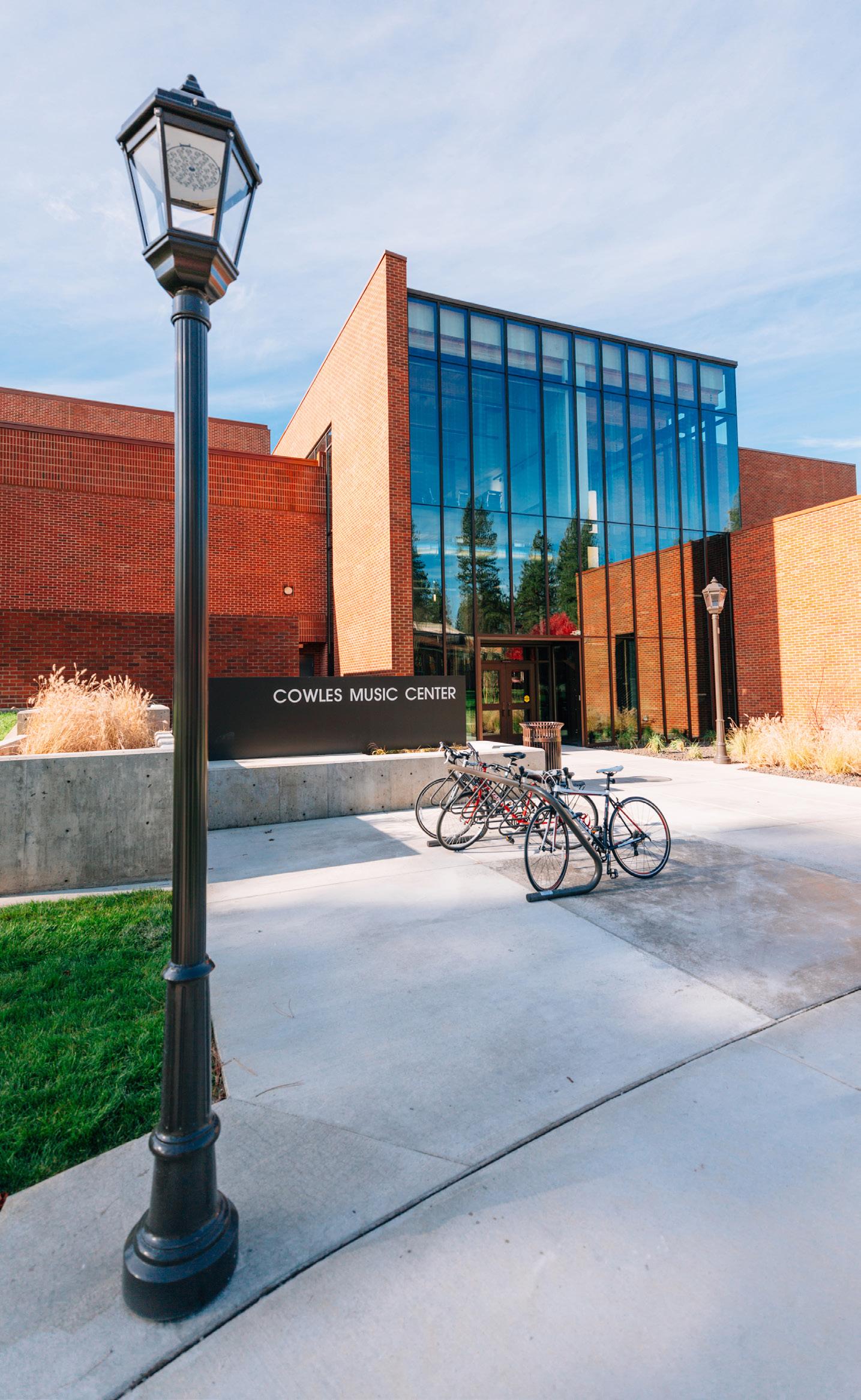
Whitworth University’s 200-acre campus of red-brick buildings and tall pines offers a beautiful, inviting and secure learning environment. More than $135 million in campus improvements have been made in recent years, including an expanded music center, a renovated auditorium stage, an expanded dining hall, a rec center, a science hall, an athletics leadership center and a graduate health sciences building.
In all of its endeavors, Whitworth seeks to advance its founder’s mission of equipping students to “honor God, follow Christ and serve humanity.”
For application information:
Office of Admissions
Whitworth University
300 W. Hawthorne Road Spokane, WA 99251
509.777.3212
admissions@whitworth.edu whitworth.edu/admissions
The Whitworth University Music Department, accredited by the National Association of Schools of Music, provides superb training in music as well as a thorough introduction to this essential element of the liberal arts. Whitworth music majors have gone on to prestigious graduate schools, fulfilling performance careers and successful teaching positions. Also, many non-music majors participate in the university’s renowned touring ensembles and enroll in private lessons through the music department. Whitworth University offers bachelor of arts degrees in composition, music production & songwriting, instrumental performance, jazz performance, string pedagogy, voice performance, and music education. Music scholarships are available to both music majors and non-majors.
facebook.com/whitworthmusic
instagram.com/whitworthmusic
youtube.com/whitworthuniversitymusicdepartment
Scan to learn about Whitworth’s music program.