A decade of the Audain Art Museum. - By Leslie Anthony
06 OPENING REMARKS When the Audain Art Museum opened a decade ago, it marked a turning point in how Whistler sees itself, writes editor Braden Dupuis.
08 LETTERS TO THE EDITOR This week’s letter-writers reflect on bombs dropping near and far, housing progress in Whistler, and tragedy in Tumbler Ridge.
16 RANGE ROVER Just when you think there’s nothing new under the sun, venerable Food & Wine magazine catches us up on industry sea changes, writes Leslie Anthony.
38 PIQUE’N YER INTEREST What should we do about AI? The only answer is to stop using it, writes Andrew Mitchell.
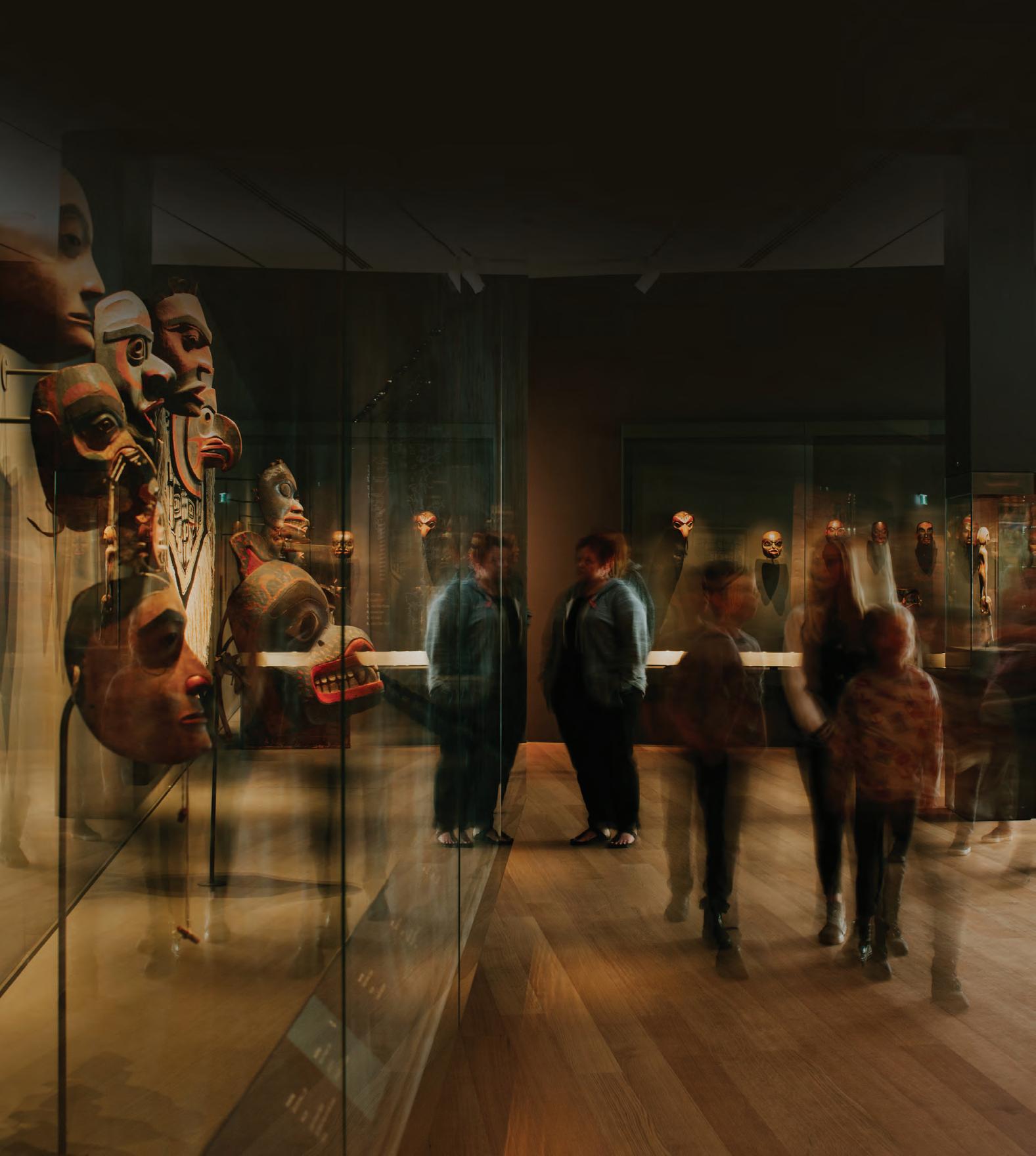
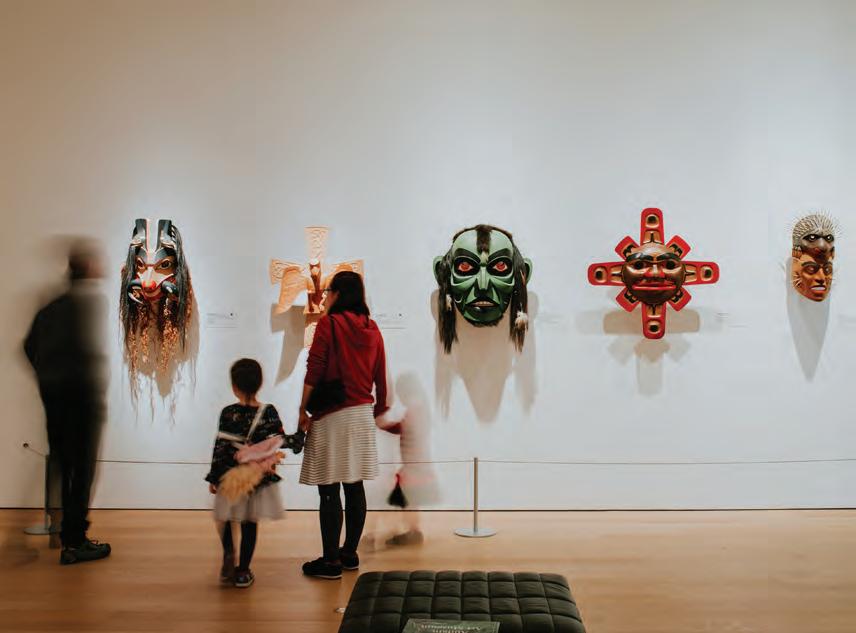
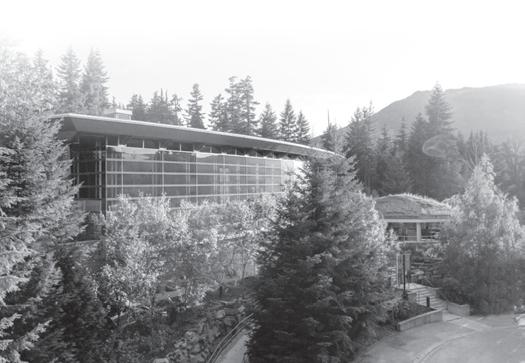
COVER - Photo by Darby Magill / Courtesy of the Audain Art Museum
Publisher SARAH STROTHER - sstrother@piquenewsmagazine.com
Production Manager AMIR SHAHRESTANI - ashahrestani@piquenewsmagazine.com
Art Director JON PARRIS - jparris@piquenewsmagazine.com
Advertising Representatives
TESSA SWEENEY - tsweeney@wplpmedia.com
ANDREW BUDRESKI - abudreski@piquenewsmagazine.com
Digital/Sales Coordinator KATIE DOUGLAS - kbechtel@wplpmedia.com
Reporters
10 GET SMART Council heard an update on Whistler’s Smart Tourism strategy last week, with plans to move from a fixed long-term vision toward a “Smart Tourism Future.”
11 BRANCH MANAGERS Whistler’s mayor and council are considering a strategy to safeguard aging trees on the Village Stroll.
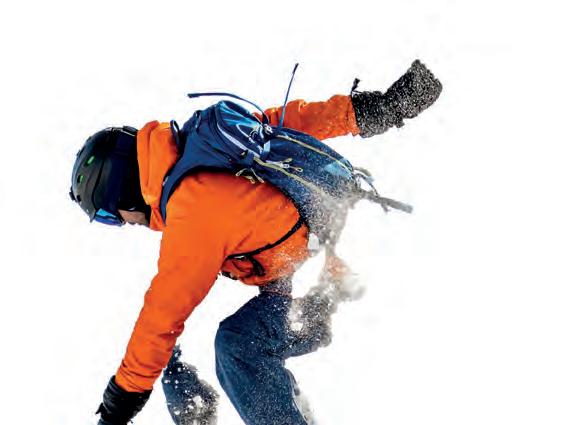
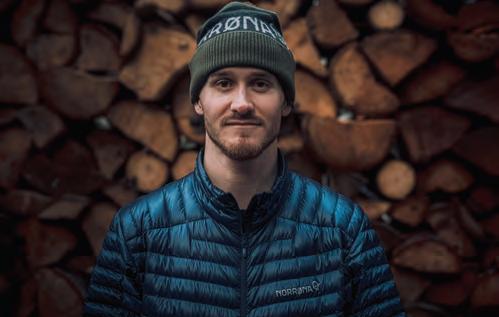
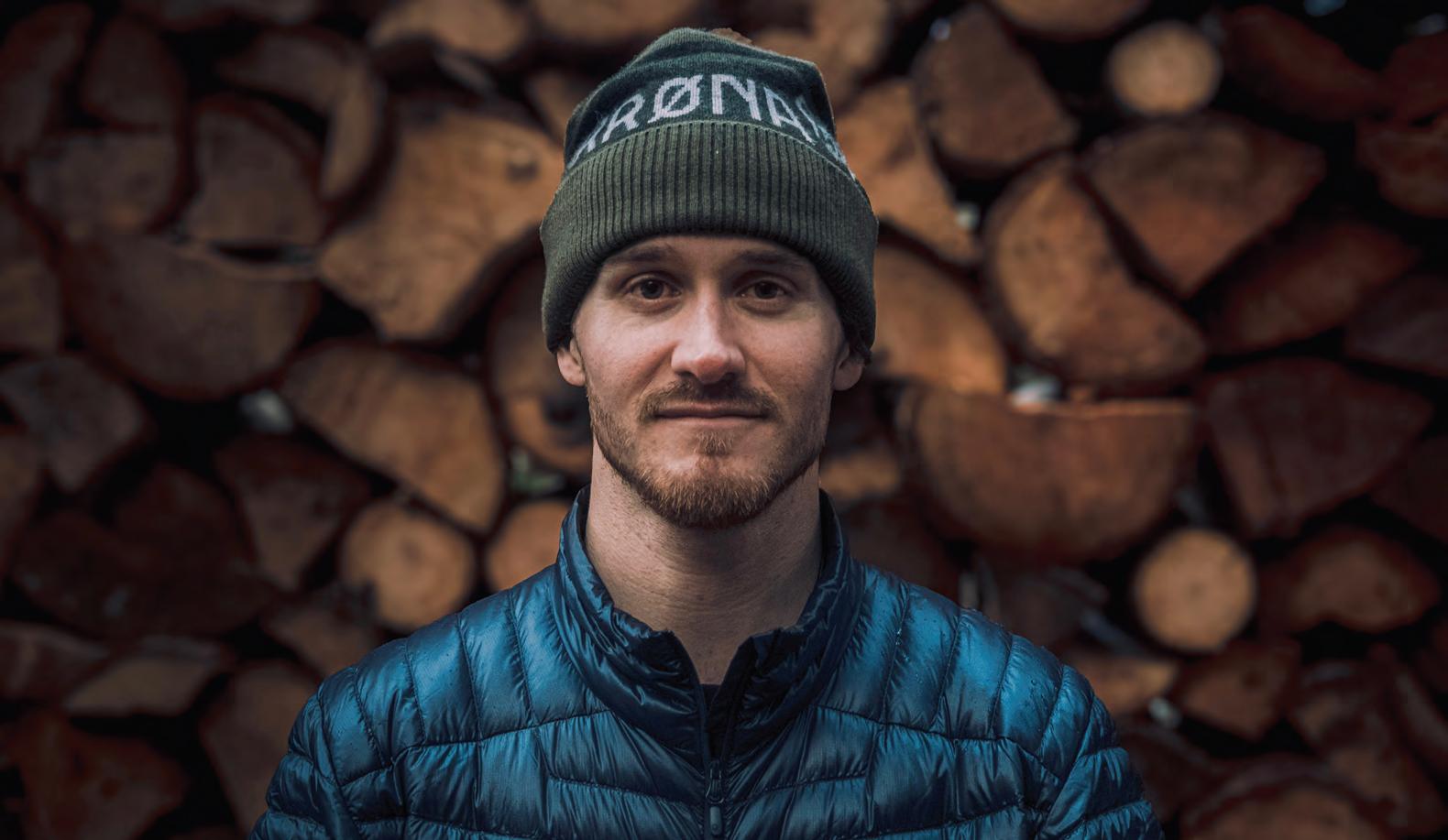
22 SUPER SESSION Former Olympian Teal Harle talks backcountry novelties and his love for filmmaking.
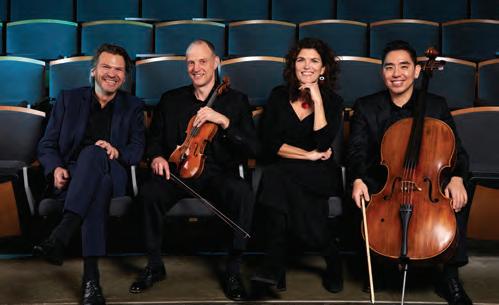
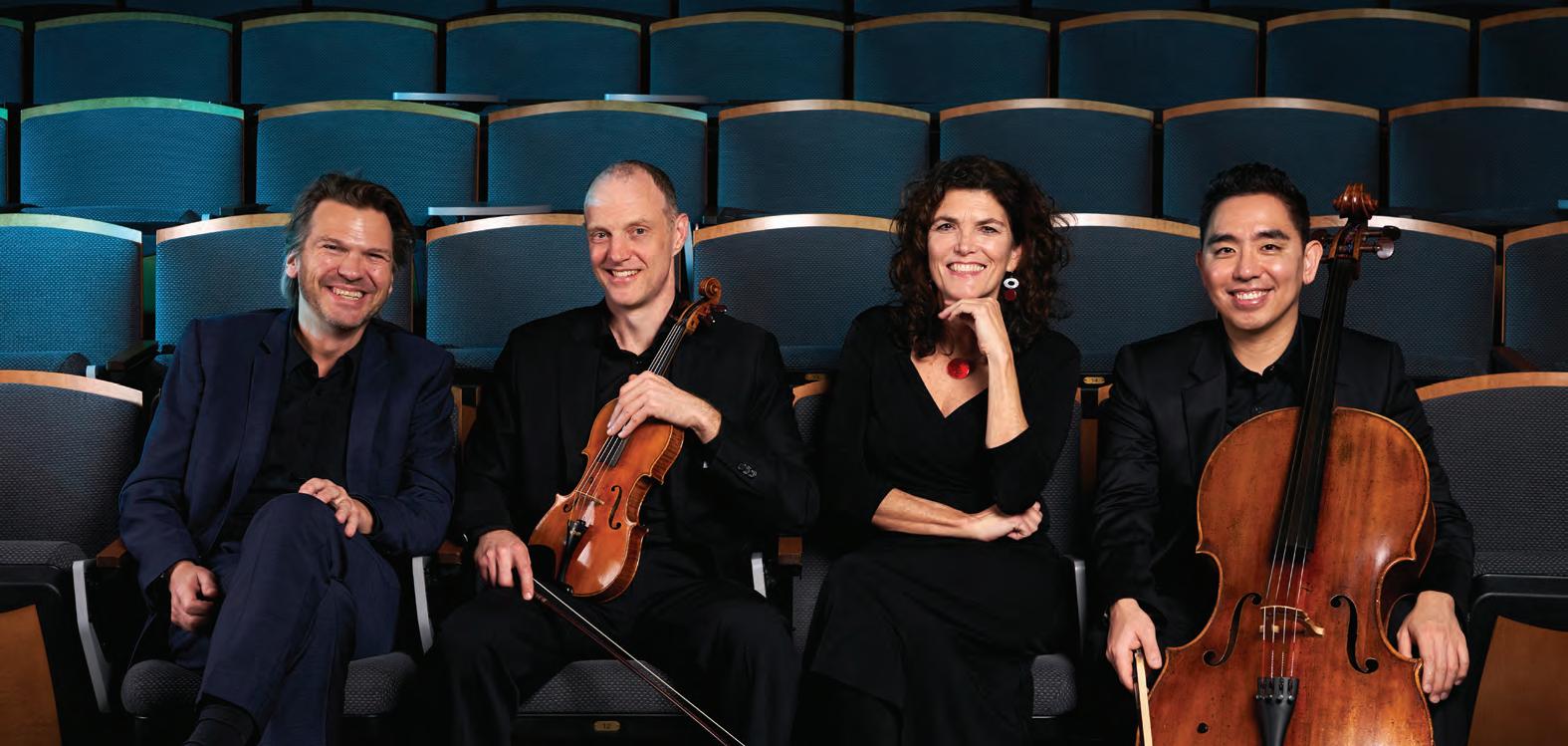
26 OUT OF POCKET The Whistler Chamber Music Society presents Pocket Symphonies at the Maury Young Arts Centre on March 8.
LUKE FAULKS - lfaulks@piquenewsmagazine.com
DAVID SONG - sports@piquenewsmagazine.com
Office Manager HEIDI RODE - hrode@wplpmedia.com
Classifieds and Reception - mail@piquenewsmagazine.com
Contributors G.D. MAXWELL, VINCE SHULEY, LESLIE ANTHONY, GLENDA BARTOSH, ANDREW MITCHELL, LISA RICHARDSON, LIZI MCLOUGHLIN, TOBIAS C. VAN VEEN
Founding Publishers KATHY & BOB BARNETT www.piquenewsmagazine.com
So much more than aprés
IT SHOULD BE no big secret or surprise that ski towns have always attracted artistic types.
Not necessarily the grant-funded, climate-controlled, curator-approved kind, mind you, but the type who drift in with a backpack, a sketchbook and a camera, or a guitar slung low on their back. It’s the liftie who paints, the
BY BRADEN DUPUIS
bartender who writes. The avy tech who screen-prints stickers on the side, or the mechanic who moonlights weekends
These are the people who have always breathed life and character into ski towns, giving them the unmistakable aura that helps attract the big-time tourism we like to brag about so much.
And for a long time, ski-town art was not about institutions. It was more about experimentation, living in cafés and basements, on bar walls, captured on grainy ski film, hand-drawn on trail maps.
Early ski-town art could be considered scrappy, even ephemeral—kind of like the towns themselves.
Then the towns grew up.
If you were to pinpoint one specific moment along that evolutionary path from scrappy, backwoods mountain art to something more institutional—a turning point or watershed moment, if you will— it might very well be 2015, when the Resort Municipality of Whistler, in its infinite bureaucratic wisdom, decided local artists running quaint homebased studios needed more government oversight (complete with permitting and hefty annual fees—go figure).
That was more than a decade ago, but to this day I remember thinking how bizarre it was our local government wanted to insert itself into the process
and oversight of local artists, employing legal language that effectively aimed to turn it into the art police, deciding what did and did not qualify as “art” that could be sold from a home-based business.
Leave it to a bunch of boring bureaucrats to anoint themselves the final arbiter of human creativity. But of course that’s not how art works.
Over the past few decades, places like Whistler professionalized. Luxury real estate replaced staff shacks. Fine dining joined fondue huts. The marketing language shifted from “ski-bum haven” to “world-class destination.”
And with global branding comes cultural expectation.
You can’t sell permanence without offering depth. You can’t claim worldclass status on snowfall and available terrain alone. If a resort town wants to be taken seriously—by investors, by governments, by the international class that buys second homes—it has to signal something beyond recreation.
That’s where institutions like the Audain Art Museum enter the story.
that houses, protects and interprets it.
Ski towns, by their nature, are adrenaline economies, thriving on adventure and risk. Art slows things down—and one might argue towns like Whistler don’t become proper communities without such cultural anchors.
Whistler is defined by motion—lift lines and staff turnover, snowfall and shoulder seasons—and an institution like the Audain represents continuity. Lifties leave. Snow melts. Real-estate cycles boom and correct. A museum, ideally, endures.
In early ski towns, art was a byproduct of freedom. Today it is also a statement of permanence.
But legitimacy cuts both ways.
When art institutionalizes, it elevates. It also formalizes. What once lived taped to café walls now hangs under precise lighting. What once felt spontaneous becomes curated. That shift can create tension— between grassroots artists and formal spaces, between dirtbag authenticity and polished cultural capital (see the homebased studio kerfuffle, above).
Ski towns have always thrived in
The better question is what kind of art culture we want.
Is it something imported and admired? Or something engaged with and lived?
Does it sit apart from the seasonal workforce? Or does it reach into schools, into community halls, into the messy reality of a place where housing is scarce and time is limited?
There is a deep philosophical overlap between mountain people and artists. Both chase moments. Both study light and shadow, obsess over line—whether carved in snow or brushed onto canvas. Both understand perception changes everything.
Maybe it’s no accident serious art has found a home in a serious mountain town.
But institutions alone don’t make culture. Communities do.
If Whistler’s artistic evolution tells us anything, it’s that we are no longer content to be defined solely by what falls from the sky. We want to be more than a playground. We want to be a place with memory and narrative, something that lasts beyond a storm cycle.
There is a deep philosophical overlap between mountain people and artists. Both chase moments. Both study light and shadow, obsess over line—whether carved in snow or brushed onto canvas. Both understand perception changes everything.
When the museum opened a decade ago, it did more than add another rainyday activity. It marked a turning point in how this community sees itself.
A formal museum brings with it curatorial standards, acquisitions, preservation, scholarship. It changes the narrative about local art—Whistler is not just a place that consumes culture imported from elsewhere, but a place
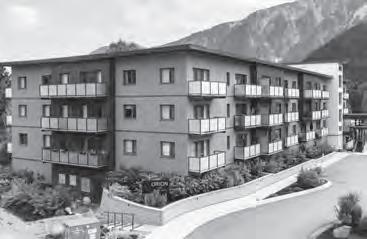
Welcome to 313 Orion—a top-floor, endunit2-bedroomhomewithMount Currie viewsandgreatnaturallight. Energy-efficient withtriple-panewindowsand central heating/ventilation. Strata feesincludeheat, hydro, andhot water, makingthisoneofthe best two-bedroom valuesinthe Sea-to-Sky. Includes carportandgardenplot. Walk to schoolsand Pember tonamenities. Askingprice$659,000 313-7350 CrabapplePlace
that tension.
We romanticize the early days—the ski bums, the cheap rent, the feeling the whole place was a bit accidental. But we also benefit from the stability that followed. Schools. Infrastructure. Health-care. And yes, museums.
So the question isn’t whether art belongs here. It always has (and art belongs everywhere).
That’s a sign of maturity, but it’s also responsibility.
The next phase isn’t about whether the museum belongs here. It clearly does. The next phase is about whether we—as a town—allow art to shape us as much as the mountain does.
Because skiing teaches a town how to move fast.
Art teaches it how to stay. n
When the bombs drop in Whistler
When the bombs drop in Whistler, there is a reverberation of joy. It echoes throughout the valley, and one knows that there’s only goodness to come.
Two weeks ago, while on the big Red Chair, the bombs were dropping one after the other. How wonderful, I thought. Tomorrow, surely, that white bundle of joy in the high alpine will await all of those powder hunters.
I know very intimately what bombs mean here. They are used for avalanche control after heavy snowfall. It’s the only place I can think of where something capable of lethal force signals happiness. When bombs are heard in Whistler, it tells all of us privileged enough to ski here that the mountain will be safe the next day.
That paradox has stayed with me since I moved here 12 years ago, when the Syrian war was in full force. I had written an op-ed piece then, struck by how bombs could mean something so different in two far places in the world.
This has never felt more true. That war is now a distant memory to so many of the others that have passed through our newsfeeds since. And yet each one, as horrific as it is, reminds us of our fragility, how as much as a conflict may seem distant, it always affects us. The irony of hoping that tomorrow the bombs will be dropped in Whistler after another winter storm, while so many people in the world right now are closing their ears, sheltering from them. Here, we listen for them.
Farha Guerrero // Whistler
‘Blown away’ by Whistler’s housing progress
It is approaching eight years since I left Whistler behind for my move to Vancouver Island. This year, I reconnected with Whistler past by buying a mountain pass. It has been awesome to slide back into this epic place!
Most notable was my recent drive around Cheakamus Crossing and the many new housing projects that have sprouted up since my departure. Wow! I was literally blown away at the depth and scope of the positive change that has occurred since I left.
Many of my working years in Whistler were spent intimately connected to the social fabric and its many challenges and vulnerabilities. On the top of this list was housing security. Let me give a huge shout-out to mayor and council, Resort Municipality of Whistler (RMOW) staff and those involved from the community. You’re doing it!
When I left, the new housing plan was a mere glint of light on the horizon of the Cheakamus Crossing landscape. Now that same landscape is filled with so much of what the vision had hoped for. And while
I’m sure there are new challenges that have inevitably arisen from this growth, it would be a tragedy to not stop, reflect and give a huge round of applause to all those who had a hand in making this very necessary, and extremely difficult task a reality.
For me, walking back into the space eight years down the road, I had the good fortune of being instantly witness to the “Then” and “Now” without the in between. A ton of meaningful change has happened in that short period of time. It provided a lovely reminder how much good can occur when you have vision, fortitude and a sense of community amongst your community leaders. Way to go Whistler! I miss and love you!
Cheryl Skribe // Comox
For the people of Tumbler Ridge
I was a second-year engineering student at McGill University in 1989 when, just before Christmas exams, on the other side of the hill from us at Ecole Polytechnique, a man chose to separate female engineers from the male engineers and shoot 14 women point blank.
We were in the middle of our exams so it couldn’t quite sink in—just do your test. Don’t listen to news. Looking back I am horrified that we were not given social services—just told to soldier on. Well, I can tell you I was 19 then and I am 56 now, and I have never, ever soldiered on. It has affected me my entire life.
Melissa McKay // Whistler
Backcountry Update
AS OF WEDNESDAY, MARCH 4
March is in like a lion. Stormy weather continues into the weekend, refreshing riding conditions, but bringing wider considerations.
March is statistically the most dangerous month of winter for avalanches. Over the past 20 years, about 30 per cent of avalanche fatalities have occurred in March. It’s often a perfect storm of factors: people + snowpack + weather.
There are simply more people in avalanche terrain. Longer days, better travel conditions, spring break, and more planned trips all increase exposure. At the same time, the snowpack often still carries winter problems like persistent weak layers. Add in the potential for big storms and strong winds, and the hazard can ramp up quickly.
Spring weather adds another layer of complexity. Sun and warming can create wet avalanche problems and cause conditions to change dramatically over a single day. A slope that feels manageable in the morning
can become reactive by afternoon.
Closer to home on the southwest coast, we aren’t necessarily dealing with a typical dense coastal snowpack. Persistent weak layers have produced large and surprising avalanches over the past week, and those layers may continue to be a concern into the coming month.
Cornices are also large after the recent series of storms. When they fail, they add a significant load to the slope below and can trigger deeper layers, resulting in unexpectedly large avalanches.
Bottom line: March does not mean “spring = safer.” Consequences can be high because serious hazard often coincides with high exposure.
There will be times to step into bigger terrain. But it’s not quite “spring go time.”
Stay up to date with the daily forecast at avalanche.ca, and keep your stoke in check when conditions are challenging.
Patience is a virtue—the mountains will always be there. n
CONDITIONS MAY VARY AND CAN CHANGE RAPIDLY Check for the most current conditions before heading out into the backcountry. Daily updates for the areas adjacent to Whistler Blackcomb are available at 604-938-7676, or surf to www.whistlerblackcomb.com/mountain-info/ snow-report#backcountry or go to www.avalanche.ca.
Tipping in a gig economy
I am writing this letter to educate customers from a driver’s standpoint delivering for DoorDash, Uber Eats and Skip the Dishes.
Recently DoorDash made changes to its payment format where you tip before ordering or choose not to tip. If you tip generously, I will prioritize your order and you will get it fast.
If no tip, say to Emerald for any order, most likely it will be awhile before a driver picks it up.
So DoorDash has made the tip option available after, and drivers are not getting tipped now since the customer waits for their picture and they have their food. So the driver gets screwed, but the customer gets their food, and the restaurant makes their money, along with DoorDash.
Yet the driver is providing a service where we bring the restaurant to you.
DoorDash does pay a bit better now because they know orders were not getting picked up for obvious reasons.
I recently heard of a $500 Uber Eats order from Earl’s for the Superbowl— and no tip to the driver. Hmmm. I know I wouldn’t have taken it, because I’m sure you would have to wait at the restaurant and time is money in this business.
And just to be clear on the government regulations with the gig economy, we make a minimum wage for active time of $21.40 an hour plus .35 cents a km. If we sit for an hour we don’t get paid, so we are not making $21.40 an hour waiting for orders.
I’m hoping customers will see this and take the time to reward the driver with a tip (that is of course if your food is on time and warm).
The other issue I find is that society doesn’t want to tip anymore, and I get it. No one is forcing you to tip at the fast-food restaurants and so on, butwhat about the service workers like servers, bartenders, taxi drivers, valets and bellmen, your hairdresser and of course the food delivery drivers like DoorDash and Uber Eats and even Instacart where they do your shopping to save you time?
And lastly, I’ve been told “maybe you should do another job,” but I enjoy the hustle, the flexibility, being my own boss and working hard and playing hard, as they say in this town.
The tips help pay for my insurance, which is $900-plus a year since I have a newer vehicle, gas, and maintenance which can get expensive.
We need these food and grocery delivery options as it helps the local businesses expand their customer reach.
So I hope people reading this understand what it’s like from a driver’s perspective.
COUNCIL HEARS UPDATE THAT REFRAMES TOURISM AS A TOOL TO MANAGE GROWTH, CLIMATE PRESSURES AND LIVABILITY RATHER THAN AN END GOAL IN ITSELF
BY LUKE FAULKS
“ARE WE LOOKING at growing tourism, or are we looking at maintaining tourism?”
That question from Councillor Cathy Jewett arose as Whistler council received an update on the municipality’s Smart Tourism program during its Feb. 24 meeting.
“I don’t think it’s necessarily about growing tourism or reducing it,” economic development officer Richard Kemble told council. “It’s more about finding the balance that supports the vast majority of the community members.”
The update outlined a shift in how the Resort Municipality of Whistler (RMOW) is approaching tourism policy, moving from a fixed long-term vision toward what staff are now calling a “Smart Tourism Future,” supported by a proposed Destination Stewardship Framework.
GETTING TO PHASE 5
Smart Tourism was formally introduced in 2023, building on destination stewardship work dating back to 2019. The initiative emerged in response to post-pandemic recovery, workforce pressures, climate uncertainty and rising visitation.
Developed to complement—not replace—existing plans like the Official Community Plan, the program aims to better align tourism decisions with long-
term priorities such as environmental protection, economic resilience and livability.
“We were really trying to understand what we want from tourism and destination stewardship,” Kemble said. “We wanted to learn from our past, but also make sure that we were approaching tourism as a forward-looking initiative.”
A Smart Tourism Committee was established in 2024, followed by public engagement on a draft vision in 2025. Feedback showed broad support for the direction but highlighted the need to
technology, positioned to support better decision-making and stewardship.
Kemble said engagement revealed “no common system to connect ambition to everyday decisions.”
To correct that gap, staff are proposing a Destination Stewardship Framework (DSF), designed to connect shared goals with operational decisions across businesses and organizations.
The DSF is intended to help organizations reflect on how their actions align with shared priorities, make existing stewardship work visible
“We were really trying to understand what we want from tourism and destination stewardship.”
- RICHARD KEMBLE
connect long-term aspirations with dayto-day decisions across the resort.
The work is now entering what staff describe as Phase 5, shifting from a fixed “vision” toward a more flexible Smart Tourism Future—intended to guide how Whistler responds to changing climate, workforce and visitor trends through to 2050.
That future is organized around four focus areas: All-Weather resort, supporting climate resilience and yearround livability; a mountain culture grounded in community identity and authentic experience; transportation, recognizing mobility as central to both resident life and visitor experience;
and identify barriers requiring collective responses—without operating as a compliance checklist. The framework is still “very much conceptual” according to Kemble.
COUNCIL DISCUSSION
Council discussion centred on how the program would address growth, climate impacts and transportation pressures.
Coun. Arthur De Jong cautioned against assuming continued growth should be a central objective, identifying the need to address visitors’ expectations in a rapidly changing climate.
“Growth unchecked is not smart tourism,” he said. “[We’ve] done an
exceptional job in terms of adaptation as a four-season resort, but frankly, we’re going to have to even move faster now. We can’t go to the lifts every fall and just hope we’re going to have another good winter. There are going to be just fewer good seasons and far more in between.”
Jewett raised transportation as a related issue, noting it accounts for approximately 51 per cent of Whistler’s greenhouse gas emissions.
“When we look at some of the things that affect the quality of life here, one of the things we keep talking about is traffic,” she said, asking whether the Smart Tourism Committee’s work could align with climate initiatives.
Kemble said the framework could help address shared challenges and inform a unified response, singling out public transportation as a win for both sides: “If we can set up regional transit, the feeling of tourism changes,” he said.
Committee chair Ralph Forsyth described the program as an attempt to address both congestion and underutilization within the resort.
“There are [insights] that I gleaned from the [committee] as well, where there’s restaurateurs who are over capacity and overwhelmed and understaffed at times, and then at other times are struggling to make rent because there’s so little,” he said. “It’s the yin and yang of overtourism and pinch points and congestion, and then [there’s] times where the Valley Trail is 99-per-cent empty.”
Forsyth said the next Smart Tourism update would come with specific policy levers council can pull to help bring their destination stewardship to fruition. n
GET SMART Staff are proposing a framework meant to help connect Whistler’s tourism vision with concrete policy steps.
Whistler council weighs new strategy to safeguard aging Village Stroll trees
‘IF I COME BACK AS A TREE, I WANT TO BE ON VILLAGE STROLL’
BY LUKE FAULKS
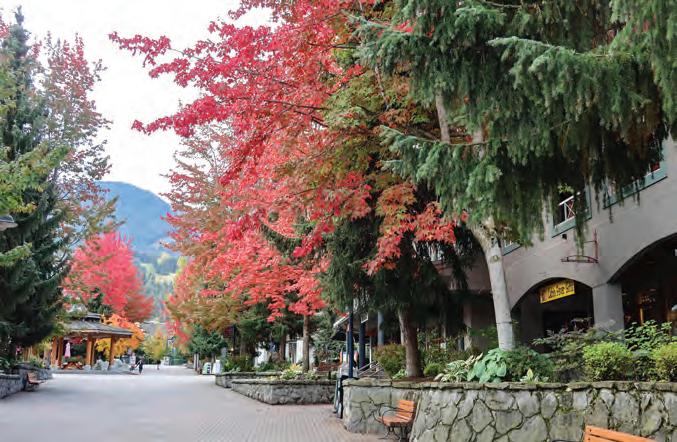
WITH MANY of the trees lining Whistler’s Village Stroll now 30 to 50 years old and growing in constrained soils atop underground parkades, municipal staff say now is the time to shift from reactive maintenance to longterm urban forest planning.
At its Feb. 24 committee of the whole meeting, council reviewed a draft Village Stroll Tree Strategy that would guide how trees are protected, replaced and integrated into future redevelopment along the pedestrian corridor from the base of Whistler Mountain to Olympic Plaza.
An inventory completed in July 2024 identified 354 trees within the study area. While most are currently in fair to good condition, staff warn many are dependent on irrigation and growing in soil volumes “well below best practices,” creating long-term vulnerability.
Without intervention, staff say, Whistler risks incremental canopy loss, declining ecosystem services and higher long-term replacement costs.
A FOREST AT THE HEART OF THE BRAND
Whistler Village was originally conceived in the 1970s as a “Village in the Forest,” a pedestrian core woven into its mountain setting. The draft strategy leans heavily into that legacy, proposing a framework to ensure trees remain central to Whistler’s identity and resort economy.
The Village Stroll’s trees provide more than ambience.
According to the strategy, shaded areas are typically five to eight degrees cooler than unshaded sections during summer heat events. The canopy also supports biodiversity, filters air pollutants, stores carbon and contributes
to festive winter lighting displays that have become a signature tourism draw.
“Trees along Whistler’s Stroll are foundational to Whistler’s sense of place,” parks planning technician Connor Eccles told council. “They create a comfortable pedestrian environment, contribute to ecological health and enhance the resort experience.”
He added climate change and redevelopment pressures mean many existing trees “will struggle to thrive over the long term” without coordinated action.
The inventory found 72 per cent of Village Stroll trees are located on private property, with the remaining 28 per cent on municipal lands. Many are planted in raised planters or above parkades, limiting rooting space—a condition staff say constrains growth and longevity.
Currently, 36 per cent of species along the Stroll are considered only marginally suited for projected future climate conditions, as Whistler is expected to see hotter, drier summers and wetter winters in coming decades. Species and structural diversity are also limited, increasing susceptibility to pests, disease and extreme weather.
The strategy proposes expanding soil volumes, trialling climate-resilient species and integrating FireSmart principles.
The new approach also suggests increasing age and species diversity using the 10-20-30 rule, which sets out three stipulations for urban forestry: no more than 10 per cent of a tree population should be the same species; no more than 20 per cent should be the same genus; and no more than 30 per cent should be the same family.
BALANCING STEWARDSHIP AND STOREFRONTS
Councillors probed how much control the municipality actually has over trees, given
CONGRATU LATION S TO AL LOFO UR2025 WHISTLERME DA LLION CLUBQUALIFIE RS
MEDALLIONCLUB •INDIVIDUAL
At Stilhavn, we believe that we allrisetogether, andour commitmenttocollaboration includes celebratingeach other’ssuccesses
We’reproudofour Whistleragents whohave been recognizedamongGreater Vancouver REALTORS’Top10%.
It ’s clearthat oursharedcommitmentto elevatingthelevelofprofessionalismwithin therealestate industryis,infact,liftingusall.
Congratulationstoalltheagentsrecognized!
CANOPY QUESTIONS With most Village Stroll trees on private property, council questions how redevelopment and permits can guide long-term canopy protection.
NARCISSUS STUDIO / ISTOCK EDITORIAL / GETTY IMAGES PLUS
WHISTLER
Josh Crane Madison Perry Nick SoldanHarriss
Whistler Cycling Club urges province to boost sweeping, signage on Highway 99
NEW ANNUAL REPORT FLAGS DEBRIS, MISSING FOG LINES AND LACK OF PASSING-DISTANCE SIGNS AS KEY SAFETY GAPS IN SEA TO SKY CORRIDOR
BY LUKE FAULKS
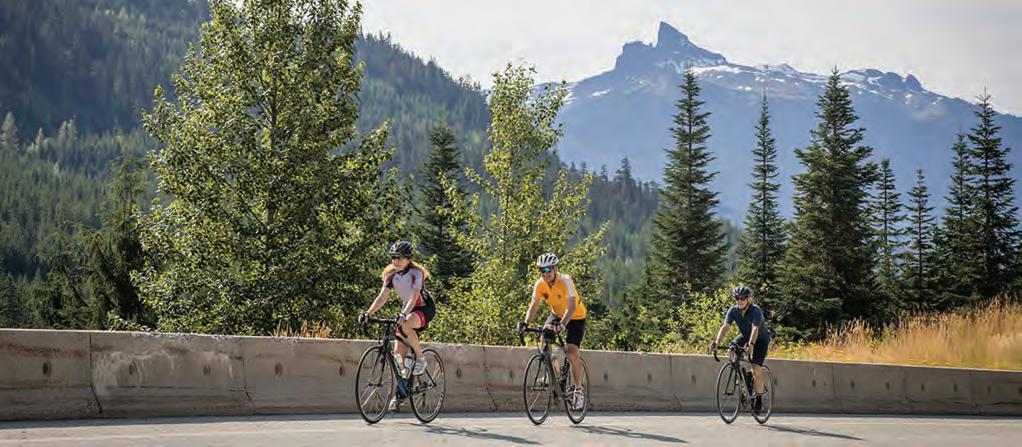
THE WHISTLER Cycling Club (WCC) is calling on the province to increase shoulder sweeping, repaint fog lines and install clearer signage along Highway 99. The local non-profit argues modest investments could significantly improve safety for both recreational riders and commuters in the Sea to Sky.
In a Jan. 23 letter to the Ministry of Transportation and Transit (MOTT), the club outlined findings from its 2025 assessment of road cycling infrastructure between Pemberton and Squamish. The report evaluates conditions observed during the April-to-October riding season.
They stress that, despite plenty of traffic and the occasional speeding car, the Sea to Sky highway can be a healthy cycling route—provided proper conditions are met.
“Cyclists can safely ride on Highway 99 in Whistler and the Sea to Sky corridor, provided that the highway shoulder is appropriately maintained, marked and signed,” the letter states, noting debris, cracks and inconsistent pavement markings can increase the risk of vehiclecyclist conflicts.
SWEEPING FREQUENCY TOP PRIORITY
The club reports initial sweeping of most highway shoulders in Whistler was completed in April 2025, but narrower sections along concrete barriers and at the Mons overpass were not cleared until June, with other tight sections left until July. Those delays, the club says, forced cyclists into live traffic lanes.
In an interview, WCC president Brenda Baker said increasing the frequency of sweeping would deliver the greatest safety benefit for the lowest cost.
“If the shoulders are clean, cyclists don’t have to go out in the car lane,” she explained. “We don’t want to be there. And I know the vehicles don’t want us there, but sometimes, if there’s debris on the road, you know you have no choice.
“Even if they swept it every six weeks,
the high percentage on private land.
“If I come back as a tree, I want to be on Village Stroll,” Councillor Arthur DeJong quipped. “But on that note, how much control do we actually have? How do we place the stewardship oversight on [private lands]?”
Eccles said the strategy would function primarily through development permit processes and planning referrals, providing staff with a consistent framework when redevelopment applications come forward.
“I think that comes through a lot of planning referral processes and
[it] really helps.”
The letter recommends completing the first sweep between Function Junction and Emerald Estates in early April each year, followed by annual fog line repainting in late spring.
While shoulder pavement between Function Junction and WedgeWoods, and south toward Squamish, is generally in good condition, the report flags deteriorating sections on Callaghan Valley Road and parts of the Pemberton corridor as ongoing concerns.
FOG LINES AND SIGNAGE GAPS
The club notes fog line painting between Function Junction and Nicklaus North was completed in May and again in October in some areas; however, there were no visible southbound fog lines in several locations north of Emerald Estates and near the Rainbow intersection.
During a Feb. 24 council meeting, Councillor Cathy Jewett expressed hope that, although the highway isn’t under municipal jurisdiction, Whistler staff could help advocate higher standards to MOTT.
“I’d really like to highlight the points they made about the fog lines and sweeping
having those referred out to staff and making our recommendations as it goes through, and using this as a framework,” he said. “Community outreach to help strengthen the need and the desire to have trees in the village is also another aspect of that.”
Coun. Cathy Jewett asked whether native species would be prioritized, noting some existing species, like Japanese maple, are not native to the region.
“Native and near-native species are prioritized and outlined in the report in a little bit more depth,” Eccles replied, adding the municipality is trialling
particularly where there is concrete barriers, because there’s a real potential for people to be squeezed there, and also to get the bike stencils back on,” she said.
Beyond pavement markings, the WCC is pressing for more “Share the Road” signage alerting drivers to B.C.’s minimum 1.5-metre passing distance law on highways, which came into effect in 2024.
“I think the only people who really are aware of it are the road cyclists,” Baker said of the passing-distance rule. “We need to have signage on the highway. We need to have it when people are leaving Vancouver. We need it in Squamish. We need it as people are leaving Whistler heading south.”
The letter states there are currently no signs in Whistler or along the Sea to Sky corridor advising drivers of the minimum safe passing distance requirement. Baker adds digital signage warning of road conditions as drivers leave from North Vancouver could be repurposed.
“We do have the overhead digital signs. They could be utilizing that,” she said. “I always notice, ‘Watch for motorcycles.’ Well, you know, watch for bicycles, too. They could be using those,
additional drought-tolerant species to broaden its planting palette
“It’s not like we’re going to be littering the entire stroll with Japanese maples,” he said.
The corridor also falls within both moderate and high wildfire risk development permit areas, requiring the strategy to balance conifer retention— part of the resort municipality’s alpine aesthetic—with FireSmart guidance.
WHAT HAPPENS NEXT?
While there are no immediate budget implications, staff note future capital
and that’s not going to eat up a budget.”
ACTIVE TRANSPORTATION AND TOURISM
The report links shoulder conditions to broader transportation goals, noting daily commutes include riders using the Highway 99 shoulder between Function Junction and Emerald Estates, including a growing number of e-bike users. Ensuring a safe shoulder, the club argues, is key to supporting active transportation and reducing emissions.
Baker said better maintenance could also position the Sea to Sky as a premier road cycling destination.
“Look at when we had Ironman here. Look at the people that come here and train for the GranFondo. This is cycling tourism,” she said. “And people should be able to look around and take in what’s around them, instead of worrying about having their head down and watching the road for all the debris that’s on the road.”
The club says it has invited local and provincial officials to meet and discuss the findings, and remains open to contributing to solutions that would improve safety along the corridor. n
investments may be required to improve soil volumes and irrigation systems as redevelopment occurs.
The document is intended as a guiding framework rather than a regulatory instrument, allowing flexibility while improving consistency across departments and property owners.
If endorsed in a subsequent council meeting, staff would incorporate its principles into updates to the Whistler Village Design Guidelines and use it to inform development permit reviews, tree removal applications and public realm projects along the Stroll. n
TURN OF THE WHEEL WCC president Brenda Baker notes a routinely maintained highway would benefit local cyclists, commuters and visiting riders, alike.
PHOTO COURTESY OF TOURISM WHISTLER
Council approves 110-unit housing project at Whistler Sport Legacies site
SIX-STOREY INFILL BUILDING AT LEGACY WAY AND CLOUDBURST DRIVE WILL DELIVER EMPLOYEE-RESTRICTED RENTAL HOMES
BY LUKE FAULKS
A NEW SIX-STOREY employee housing building proposed for Cheakamus Crossing will add 110 rental units and a community-serving space at the corner of Legacy Way and Cloudburst Drive, after council approved a development permit for the project on Feb. 24.
The project, led by Whistler Sport Legacies (WSL), will be built on a newly created infill parcel between the High Performance Centre and an existing WSL-operated building at 1315 Cloudburst Drive.
WHAT WILL THE BUILDING LOOK LIKE?
According to a staff report, the building will contain approximately 9,330 square metres of gross floor area, with units ranging from 42-square-metre studios to 99-square-metre, three-bedroom homes.
The structure will rise to 22 metres at its tallest point—six storeys adjacent to the High Performance Centre— before stepping down to five storeys along Legacy Way and two storeys at
the corner, where a community auxiliary space is proposed.
Tracy Napier, manager of development planning, told council approximately 387 square metres of the building will be dedicated to auxiliary space “proposed to be used for community-serving purposes such as a community centre or childcare facility.”
All units will be rental, 100-per-cent employee restricted and priced in line with Whistler Valley Housing Society rates. A housing agreement will return to council at a later date to formalize occupancy and rental restrictions.
All residential units will have “either balconies or at-grade access to the outdoors,” as well as in-suite storage. Additional bike storage will be located on each floor near the elevators.
At the rear, plans include a “passive open space” with play features, platforms and seating areas, while the Legacy Way frontage will feature layered landscaping and an accessible ramped entrance.
CHANGES TO PARKING
Under the current AC3 zoning, the project requires 120 parking spaces. Plans show
119 spaces on site, with one space located within the road right-of-way but designed to function as off-street parking. Staff recommended a minor variance to reduce the required on-site parking by one space.
In addition, 24 on-street parking spaces will be developed along Legacy Way in lieu of spaces previously required on site for the High Performance Centre and community auxiliary uses. The WSL will build the spaces and the resort municipality will manage them.
Parking emerged as a key discussion point, with councillors acknowledging ongoing concerns in Cheakamus Crossing about supply and traffic impacts. Councillor Jen Ford welcomed the addition of street parking, noting it may have secondary safety benefits.
“I think that street parking absolutely slows down the traffic and creates a buffer between the sidewalk and the traffic lane, and can be beneficial,” Napier agreed during the exchange.
CRITICAL MASS AND COMMUNITY AMENITIES
Several councillors raised broader questions about whether Cheakamus Crossing has reached the “critical mass”
needed to support amenities such as grocery stores, restaurants or car share.
Interim CAO Ted Battiston cautioned against a single numerical threshold.
“The critical mass to support a convenience store is much smaller than the critical mass required to support a grocery store,” he said. “There isn’t one answer. It’s not, ‘When we hit this number of doors, therefore all commercial entities work.’”
Coun. Ralph Forsyth emphasized the significance of the project itself.
“It’s so exciting to see another entity building employee housing. That’s a great message to anyone who wants to build employee housing—we’re open for business,” he said.
Mayor Jack Crompton described Whistler Sport Legacies as “a quiet giant on housing,” adding the organization continues to deliver “creative solutions for Whistlerites with unique housing requirements.”
Council voted to approve the development permit and associated parking variance, clearing the way for WSL to move toward construction once remaining covenant and housing agreement conditions are finalized. n
Naturalists, AWARE spotlight Rainbow Wildlife Corridor and Jane Lakes as key habitats for Whistler’s future
BY LUKE FAULKS
HIDDEN WITHIN Whistler’s forests lives one of the region’s most elusive birds of prey: the northern goshawk.
Bob Brett, a local biologist and co-founder of the Whistler Naturalists, says Whistler is almost uniquely positioned among southern B.C. communities to support the at-risk forest hawk because of the remaining old-growth forests scattered along the valley’s lower slopes.
“[Goshawks] hunt inside the forest, so they need wide-spaced trees, they need big branches to nest on and they need access to the forest floor for hunting,” Brett said. “Those are all characteristics of old-growth forests. Second-growth forests are bad habitat for them.
“They’re in big trouble on the coast of British Columbia because of all the logging and the lack of old-growth suitable habitat,” he added. “The fact that Whistler still has it is fantastic. And our challenge is to make sure that we continue to have habitat for them.”
Brett said that challenge extends beyond a single species to the protection of connected ecosystems—particularly the Rainbow Wildlife Corridor (RWC), identified as the 21-Mile Creek corridor in his 2024 priority habitat mapping.
“There were a few [areas] that really stuck out,” Brett said. “And the reason why it stuck out is because [it] was pretty much continuous orange and red from Rainbow Lake all the way down to the Wildlife Refuge.”
Those colours mark some of the municipality’s highest-value habitat zones, linking alpine terrain above Rainbow Lake to the wetlands, creeks and forests around Alta and Green lakes.
In Whistler, the informal RWC follows the 21-Mile Creek drainage from Rainbow Lake toward the River of Golden Dreams and the wetland network between Alta and Green lakes. Brett said the corridor’s value comes from both its landscape scale and its features on the ground.
“That wide river corridor is always important connectivity for wildlife,” he said. “It links low elevation with high elevation. And within that area there’s a large piece of forest where some of the trees are at least 900 years old.”
While riparian rules already protect 30-metre strips along either side of fishbearing streams, Brett said those buffers are designed for water protection, not full habitat connectivity. Narrow corridors can lose the cool, moist interior forest conditions many species rely on.
Although much of the corridor lies outside Whistler’s Urban Development
Containment Area—which designates where future housing and commercial development will take place—Brett said it still faces pressures from recreation growth, community forest activity and infrastructure such as water intakes.
“There’s definitely recreation and there has been some watershed pressure,” he said. “The idea of protection would be to allow low-impact recreation but keep the forest intact and let the second growth return to old-growth conditions over time.”
A formal conservation designation could help clarify what kinds of activity belong in the corridor, Brett added.
“That would help provide more active management of what happens there,” he said. “It wouldn’t be a great place to expand the mountain bike trail network, build structures or do a lot of logging.”
Environmental organization AWARE has been working with the Whistler Naturalists to raise awareness of Brett’s mapping and its implications.
For AWARE board member John Rasmussen, the RWC is one piece of a broader conservation picture.
He pointed to another standout landscape: the Jane Lakes-Black Tusk area, south of Whistler Village in the Cheakamus Community Forest tenure area, contains extensive tracts of ancient forest.
“It’s a hotspot for just about everything,”
Brett said. “It’s ancient forest, it’s yellow cedar forest, it’s Western toads—and it’s the largest patch of unlogged old forest” within the priority habitat framework.
Rasmussen said those values can be hard to convey without first-hand experience.
“Ancient forests are a slightly amorphous concept to people unless they actually see them,” he said. “When people walk into an ancient forest and feel it, that resonates much more than talking about climate change or habitat protection in the abstract.”
AWARE has begun preliminary discussions about educational initiatives and guided walks, which Rasmussen said could help build community understanding and support.
Both groups say public awareness remains the first step.
“The reason people come to live in Whistler is the natural environment that surrounds the town,” Rasmussen said. “With that ease of access comes a responsibility.”
Residents can support conservation efforts by attending educational events, joining environmental organizations or contacting municipal councillors.
“Letters to the editor, talking with councillors and staff—those things help,” Brett said. “It’s about protecting the things that brought us to Whistler in the first place.” n
‘Appalling’:
Lil’wat Chief condemns racist vandalism on Nation’s traditional territory
LIL’WAT NATION SAYS OLD-GROWTH TREES ILLEGALLY FELLED IN DECEMBER 2025
BY HILARY ANGUS
LIL’WAT NATION Chief Dean Nelson is speaking out about an alleged incident of racist vandalism that took place within Lil’wat traditional territory in late 2025.
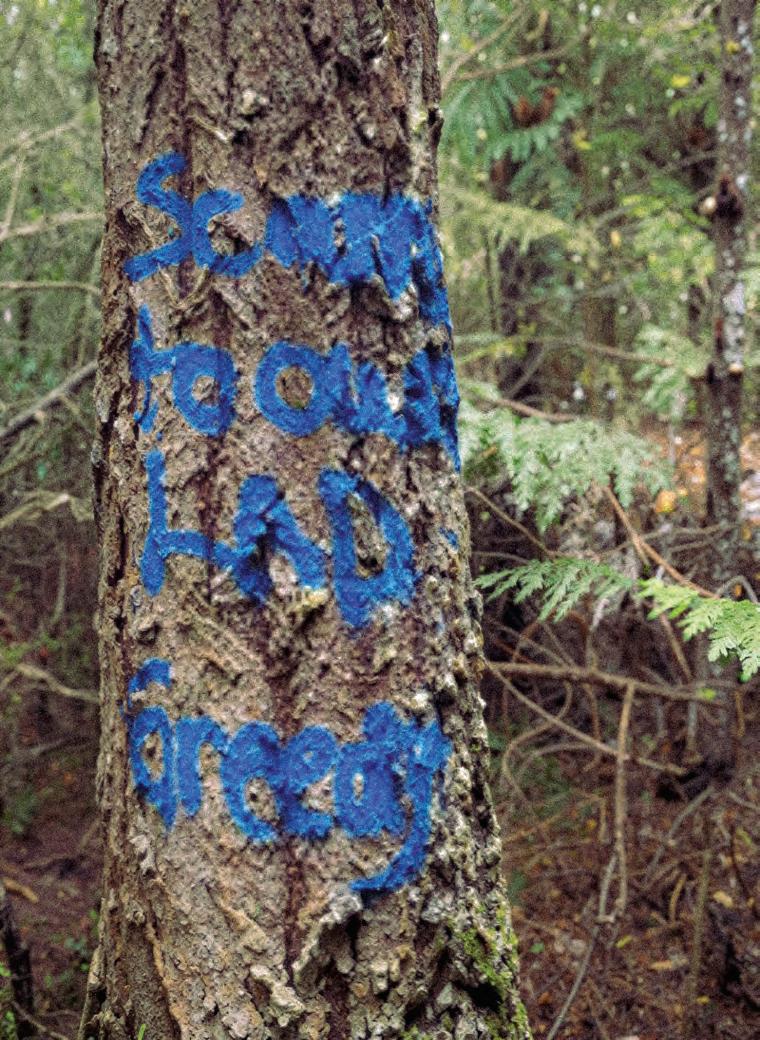
On Dec. 7, 2025, a resident of Lillooet reported to the Nation that several oldgrowth trees had been illegally felled within their territory along the Duffey Lake Road, and the area had been vandalized with racist graffiti.
Nelson said the comments left there related to whose land it is and who belongs there.
“They were intentional,” he said. “They were racist and I think it had to do with a lot of what’s happening in the province and in the country here.”
Nelson suggested many of the decisions around First Nations’ rights currently being undertaken in the province—from UNDRIP amendments to the Joffre Lake closures—are reigniting tensions between Indigenous and nonIndigenous communities.
“We still are here on the reservation, we still are under the Indian Act and fighting for our own human rights. So
anything that we do get, it seems to be scrutinized by the general public, certain sectors of it that don’t think it’s right,” Nelson said.
Nelson said he expects incidents like this to continue until there is a broader understanding of First Nations history and the ongoing impacts of colonialism.
“We have to look at the whole system, you know, and what it portrays … It hasn’t been corrected, and there doesn’t
individual, or individuals, took it upon themselves to act on their beliefs.
When the Nation learned of the vandalism in December, it notified the Lillooet RCMP and Conservation Officers, but said there has been no follow-up communication about any investigation into the incident.
Lillooet RCMP media relations Sgt. Vanessa Munn said in an email they “can confirm that a report of graffiti and
“They were intentional. They were racist and I think it had to do a lot with what’s happening in the province...”
- DEAN NELSON
seem to be any intention of doing that,” Nelson said.
“People are still allowed to make their statements, however bold they are,” Nelson said, adding that members of the public and also elected officials such as MLA Dallas Brodie face very little consequence for making racist or untrue statements about Indigenous people in public forums.
Nelson called much of the dialogue around Indigenous issues on social media “malicious,” adding he’s not surprised an
the possible removal of trees at a former recreation site along Highway 99S was received on Dec. 12, 2025.”
Munn said the timeframe for when the damage occurred is unknown, though it is believed to have taken place within the past year.
“No suspects have been identified at this time,” Munn wrote in the email. “Officers have liaised with BC Conservation Officer Service, and Natural Resource Officers have been briefed on the report. Should new information come
forward, investigators will follow up on any viable leads.”
Nelson said the lack of accountability for people expressing extremely racist comments sets a bad precedent in this day and age.
“It’s appalling,” Nelson said, referring to some of the deeply troubling comments that have been made on social media forums about the Joffre Lake closures. “They shouldn’t have the right to say any of that, but they do.”
In a media statement, the Lil’wat Nation said the tree-felling incident has caused significant distress within the community.
“This land holds deep cultural, environmental, and spiritual significance. It is a place that deserves respect, care, and protection,” the statement read.
“Unfortunately, incidents like this are not unusual. They reflect ongoing challenges that Indigenous communities, including Líl’wat Nation, continue to face and highlight that there is still important work to do when it comes to understanding, respect, and reconciliation.”
The statement said the ongoing process of reconciliation requires education, accountability, and a shared commitment to doing better.
“We believe in building bridges and in caring for the land collectively as a community,” it read. “Líl’wat Nation remains committed to stewardship, respect, and dialogue, and to working alongside our neighbours to protect the land.” n
‘APPALLING’ Several old-growth trees were cut on Lil’wat territory, and the area vandalized with spraypaint in late December.
‘His loss will be felt deeply’
SNOWBOARDER KILLED IN AVALANCHE NEAR PEMBERTON IDENTIFIED AS PRO SPLITBOARDER STRATTON MATTESON
BY BRADEN DUPUIS
FAMILY AND FRIENDS are mourning the loss of pro snowboarder Stratton Matteson, 28, who was killed in an avalanche near Pemberton on Tuesday.
In a Facebook post announcing his passing, the Central Oregon Avalanche Center referred to Stratton, from Bend, Ore., as a beloved member of the backcountry community whose loss “will be felt deeply by many.”
“If you’ve ever driven up Cascade Lakes Highway in the middle of winter and passed a biker heading out for turns, chances are it was Stratton. He was not only a passionate splitboarder, but someone who lived with intention. His love for the mountains and our planet inspired those around him,” the post read.
“You made the world and everyone around you better, Stratton, and we’re grateful for it. Our hearts are with his family, friends, and the entire community during this incredibly difficult time.”
Pemberton RCMP were notified of a missing person around 2 p.m. Tuesday in the backcountry near Joffre Peak, close to Mount Matier and the Anniversary Glacier. In an interview Wednesday morning, PSAR president David Mackenzie told Pique a report came in at approximately 2:13 p.m. on Feb. 24 that a snowboarder was missing after a large avalanche swept him away.
“The avalanche was triggered by the rider who was solo at the time,” Mackenzie said, describing the incident as a “size three”—a slide that “could bury and destroy a car, damage a truck, destroy a small building, or break a few trees,” according to Avalanche Canada.
Matteson had set out alone from Keith’s Hut while a companion remained behind. The reporting party witnessed the snowboarder get caught in the slide and initiated a search but found no transceiver signal. Unable to locate the rider, they left to get help in Pemberton.
Members of Pemberton SAR, Whistler SAR and Whistler Blackcomb ski patrol responded, along with accredited Canadian Avalanche Rescue Dog Association teams. At about 4 p.m. the same day, SAR members picked up a transceiver signal, confirmed probe strikes and dug the rider out. The snowboarder was buried approximately 1.5 metres deep near the bottom of the slide path.
In a post on the Bend subreddit, locals remembered Matteson as a “local legend” and a “huge inspiration.”
“I never even met him and I’m sitting here with tears running down my face. He just seemed like the nicest most genuine guy getting out there for the love of it,” one wrote. “Shred in peace, Stratton.”
Matteson was recently profiled by Backcountry Magazine , which republished the article following word of his passing.
“Stratton Matteson spent more days deep in the Cascades than any other splitboarder, but when he considered the impact of driving a gas-guzzling car into the mountains, he simply said no,” reads the intro. “For five years, he quietly pioneered a more environmentally sustainable path, biking every time he went out. It was a way for him to live his ideals, provide an example for those with similar ethics and expend his boundless energy.”
STAYING SAFE IN B.C.’S BACKCOUNTRY
Provincewide, this is B.C.’s fourth avalanche death of the 2025-26 season, following fatalities near Revelstoke, Fernie and Tumbler Ridge in recent weeks.
Joffre Peak sits within one of B.C.’s most visited provincial parks. While much of the traffic is concentrated on the popular summer hiking trail, the surrounding alpine terrain is a well-known backcountry ski and snowboard destination.
Mackenzie urged backcountry users to consult and understand avalanche forecasts before heading out.
“Check the conditions [on] avalanche.ca,” he said. “But it’s not just about checking the conditions. It’s about understanding the conditions. Because we know the situation in the backcountry is very dynamic. It’s always changing.”
He emphasized that terrain, wind, solar input and temperature all influence hazard levels.
“If an area you know is seen as a high hazard, don’t go there,” Mackenzie said. “Wait another day. Wait for favourable conditions.”
Mackenzie said PSAR has seen “a regular start” to the season, with a handful of calls for incidents like backcountry skiers with knee injuries, stranded motorists on forest service roads—“don’t drive on forest service roads in wintertime,” he counselled— and some ice-climbers who ended up self-rescuing.
Avalanche Canada recommends that anyone travelling in avalanche terrain carry essential rescue gear: a transceiver, probe and shovel—and know how to use them. The organization also advises travelling with partners, spreading out in avalanche terrain, identifying safe zones and taking certified avalanche skills training courses like AST 1 or AST 2.
Daily forecasts, regional danger ratings, trip planning tools and educational resources are available at avalanche.ca, which provides updates throughout the winter season.
-with files from Luke Faulks n
Lil’wat Forestry Ventures
Forest OperationsMap ID #2980
Notice of Public Review andComment
Noticeishereby giventhat Lil’wat Forestry Ventures,holder of Forest License#A19214,isseekingpublic review and comment on Forest OperationsMap(FOM)ID#2980,whichis covered by Forest Stewardship Plan#1057.The review and comment period related to FOMID#2980is available fora30-dayperiodfromMarch6th,2026, to April5th,2026.This FOM consistsof11proposed cutblockslocatedin the PerkinsCreek andErnstMainlineareasintheSea to Sky Natural ResourceDistrict.
The FOM canbeviewed athttps://fom.nrs.gov.bc.ca/public/projects, and by searchingLicensee usingthe ‘find’function. Alternatively,the information containedinthe FOM canbemade available forin-person viewingduringnormalbusinesshours at Chartwell ResourceGroup Ltd.’s office at #201–1121Commercial Place, SquamishBC
Comments canbesubmittedanytimeduringthe30-day period through https://fom.nrs.gov.bc.ca/public/projects, e-mailed to Lilwat. FOM@crgl.ca,ormailed to theaddressnotedabove.Please reference the FOMIDwhen submitting comments.
Followingthe review and comment period,this FOMmaybe relied upon to apply fora Road PermitorCutting Permit fora3-yearperiod, ending April6th,2029.
Feathering the nest
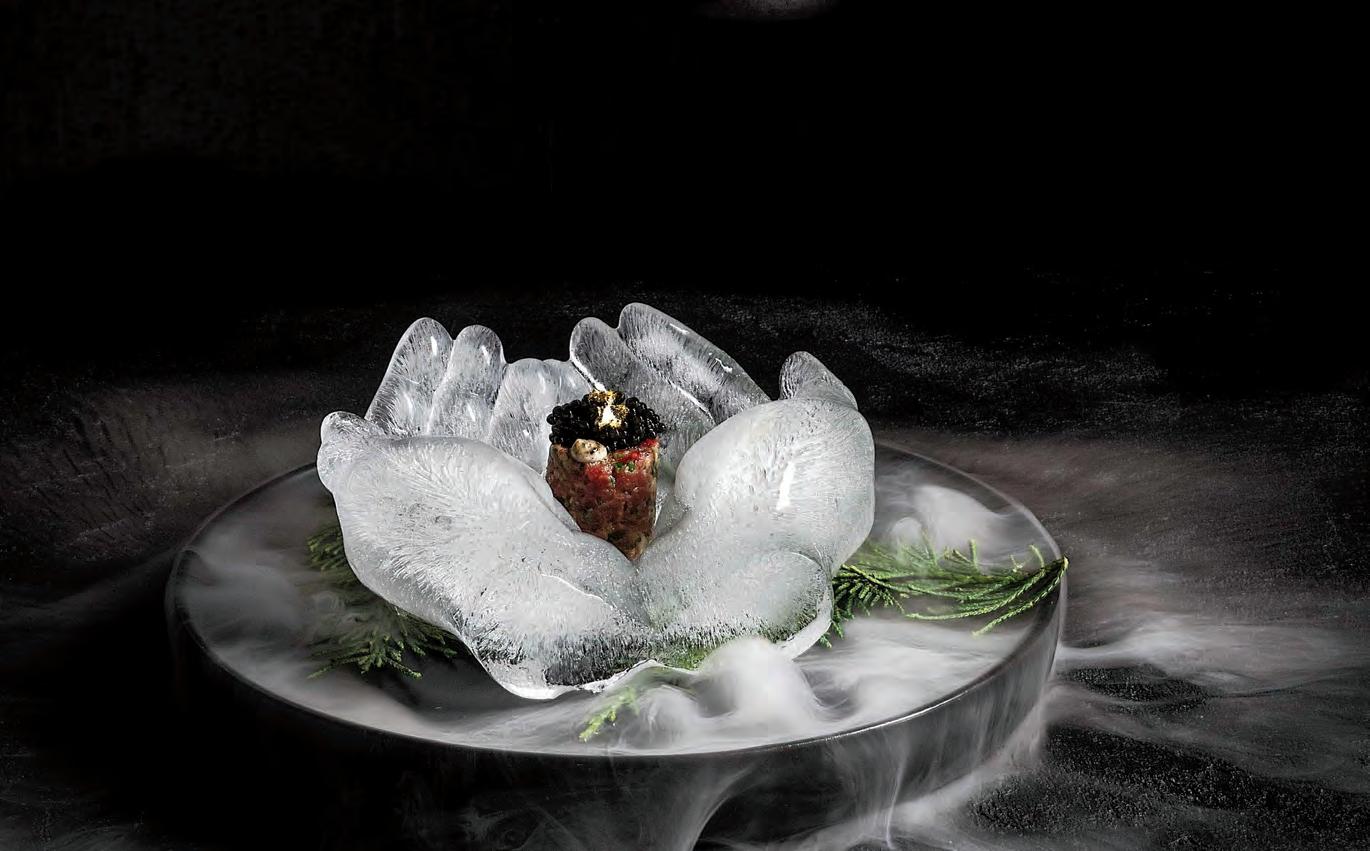
JUST WHEN YOU think there’s nothing new under the sun—or at least the table— no less an arbiter than venerable Food & Wine magazine catches us up on what it views as a sea change in the industry. An article in the September 2025 issue notes that “For decades, fine dining restaurants seemed to operate off of a shared checklist. Sommelier? Check. White linens? Check. A touch of molecular gastronomy? Double check. But in recent years, the restaurant industry has seen a shift in diners’ interests… Pop-up dinners, chef collaborations, and immersive
BY LESLIE ANTHONY
and educational dining experiences are steadily making their way into general
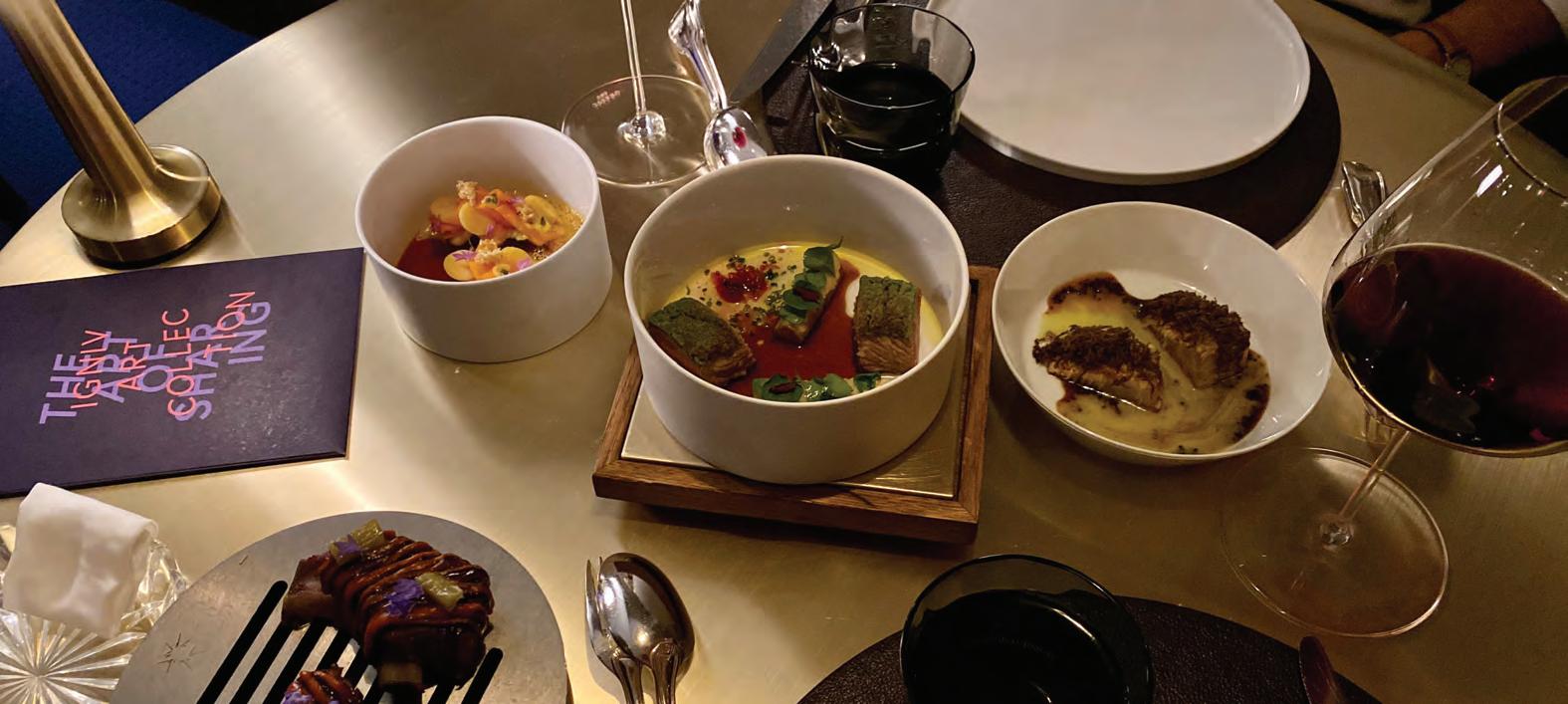
While this doesn’t necessarily land as news for anyone in Whistler or the Lower Mainland, the broader movement is worth noting. Given that, I’m surprised the list of offerings didn’t include one I’ve experienced in several European finedining scenarios: sharing. As in offering numerous dishes at the centre of the table instead of a traditional sequential menu. Lest you imagine “family-style dining” in the manner of a platter of pork chops and a bowl of potatoes with forks flying in from all sides (here, I’ll admit to channeling my own childhood home-dining experience with three brothers), I refer instead to a far more sophisticated tableau of small plates,
scintillating flavours, artistic adventurism, and minimal bites. The leader in this idea that sharing works both at the family table and in fine dining claims “the food we share with people close to us tastes particularly good” no matter where we are. Especially when combined with music, fine art, modern design and warm hospitality. And that leader is called IGNIV.
“IGNIV” derives from the RhaetoRomanic word for “nest”—reflecting a hope that guests feel as comfortable and cared for as a little bird. Cosy and warm, the spaces reflect this; unlike real nests there’s no messy bric-a-brac, and visual details are woven from modern elements. Of four restaurants in the IGNIV family, the latest is in the Swiss ski resort of
says Manuel Beer, restaurant manager and sommelier at IGNIV Zurich, of the latitude they’re afforded. “We want to be like a glass of champagne—elegant, playful, invigorating, exhilarating.”
The first Michelin two-star IGNIV I dined in was at Bad Ragaz. A friend and I worked through a 15-course phantasmagoria comprising ingredients I’d never heard of prepared in ways I couldn’t have imagined. Throughout, a sommelier administered wine pairings that perfectly paralleled a foot-tour of the Bundner-Herrschaft wine-growing region I’d made that afternoon. Bad Ragaz also turned me onto IGNIV’s large-bottle trope, which takes up the idea of sharing not just with the food, but wine as well.
A friend and I worked through a 15-course phantasmagoria comprising ingredients I’d never heard of prepared in ways I couldn’t have imagined.
Andermatt, another in Zurich, one in the Swiss über-spa Bad Ragaz, and the outlier in Bangkok. While all four are dedicated to the same culinary philosophy, each has its own character. Based on the “world of taste” by Michelin three-star celebrity Andreas Caminada, executive chefs in each location incorporate their own culinary personalities and local food traditions to create dishes that bring new meaning to the word imaginative. While food concepts are based on regional products, there’s always room for outstanding flavours from anywhere. “We can run the restaurant as if it were our own. [And] it’s obvious we do this with great pleasure and enthusiasm,”
Large wine bottles ranging from well-known Magnum size (1.5 litres) to the Melchizedek or Midas (30 litres) serve not only as visual centerpieces with aesthetic appeal in this milieu, but contribute positively to the aging process: with a lower ratio of air, the wine oxidizes slower, a longer, more graceful maturation that can yield more complex and nuanced flavours; tasting one particular vintage from a standard 750 ml bottle and its 30-litre counterpart were completely different taste experiences.
The new IGNIV in Andermatt’s showcase Reuss district deals equally in impeccable taste and modern elegance, with stunning artwork and
interiors by world-renowned designer Patricia Urquiola. Chef Valentin Sträuli, a Zürich native who trained under Caminada, maintains allegiance to the IGNIV tradition while weaving in his own culinary vision. “Serving numerous dishes to share instead of a classic menu suits me perfectly. It allows me to show many facets of cuisine, adapt with flexibility and surprise guests.” But don’t take it from him: in October 2025, the GaultMillau culinary guide honoured the dude as “Discovery of the Year.”
Dutch-born manager and sommelier Hannah van den Niewenhuizen takes pride in working with Valentin and her young team to bring guests the sharing concept and “feel their enthusiasm.” Meanwhile, Chef de Bar Marco Perego creates cocktails shaped by experiences living and working everywhere from the Colombian Amazon to the Australian Outback, the backstreets of Berlin to the skyscrapers of Dubai. Weaving flavours, stories and rhythms, he has deep respect for the classics but delights in playful interpretations.
The dishes here weren’t only universally good, but out of this world in both taste and impression; some embodied unusual pairings brought together in the informed balancing acts of modern cuisine. Detailing these would give away too much, but suffice to say the Michelin Guide gushes over “extremely intense and punchy dishes.” The fact they come and go in only a few bites makes them all the more memorable.
In many ways, the new Andermatt is being defined by the IGNIV experience— bright, sophisticated, comfortable, respecting of tradition but filled with the unexpected.
Like something new under the sun.
Leslie Anthony is a Whistler-based author, editor, biologist and bon vivant who has never met a mountain he didn’t like. n
SEA CHANGE The restaurant industry has seen a shift in diners’ interests in recent years.
PHOTO BY LESLIE ANTHONY
ONSELECT APPAREL, FOOTWEAR &ACCESSORIES
WBOUTLET STOREWHISTLER 4204VILLAGESQUARE,UNIT#203 WHISTLER BC V8E1H5
THE FACES BEHIND SOME OF THE SEA TO SKY’S MOST INSPIRING BUSINESSES
I
n a place like Whistler and the Sea to Sky, business is personal.
It’s built on relationships, reputation and showing up for your community year after year. Across industries, whether it’s real estate, retail, workplace consulting or landscape design, these local women are growing companies that reflect both their expertise and their values.
They’re stepping into ownership, leading teams and creating spaces where clients and staff feel supported. Some are bringing something entirely their own. What they share is a hands-on approach and a real connection to the area they call home.
These women aren’t just running businesses. They’re contributing to the character and resilience of the Sea to Sky in ways that will be felt for years to come.
Across Whistler and the Sea to Sky, these women are building businesses that showcase the communities they call home and the future they want to shape. Scan the QR
Carmyn Marcano
Working throughout the Sea to Sky corridor, Carmyn offers nuanced local insight into Whistler, Squamish and Pemberton, complemented by the global reach of the Engel and Völkers network. Carmyn is passionate about helping clients make thoughtful decisions that support their long term goals.
To learn more about Carmyn Marcano, scan the QR code on the these pages.
SPONSORED CONTENT
SPONSORED CONTENT
Heike Designs
Heike Designs Inc. brings a thoughtful hands-on approach to landscaping in Whistler, grounded in horticultural expertise and a genuine passion for creating gardens that thrive. Led by Red Seal Landscape Horticulturist Heike Stippler, who also holds an architecture degree from Germany, the company has been shaping award winning landscapes in the Sea to Sky since 2005.
To learn more about Heike Designs Inc., scan the QR code on the these pages.
SPONSORED CONTENT
SPONSOREDCONTEN T
LanaZayadi
Lana recently found an opportunity that aligned with both her professional ambitions and personal values by purchasing 122 West in Whistler and stepping back into business ownership. Named after Whistler’s longitude, the shop is inspired by mountain and coastalliving, curating furnishings,décor and gifts that reflect life in the Pacific Northwest.
To learn more about122 West, scan the QR code on the these pages.
Baby Face Beauty
Bright colours, thrifted mirrors and funky art set the tone at Baby Face Beauty, a retro chic studio built on the idea that self care should feel welcoming, affordable and empowering. Baby Face Beauty is for anyone who enjoys self care and wants a friendly no pressure experience.
To learn more about Baby Face Beauty, scan the QR code on the these pages.
SPONSOREDCONTEN T
KatherineTilley
Through The Workjoy Company, Katherine Tilley turns bigideas aboutpsychological safety and workplace wellbeinginto practicalleadership habits that teams can start using right away Herfacilitated workshops andlicensed programs through the Mental Health Commission of Canada focus on communication, trust, role clarity and navigating change
To learn more about The Workjoy Company, scan the QR code on the these pages.
ART BY DESIGN A DECADE OF THE AUDAIN ART MUSEUM
BY LESLIE ANTHONY
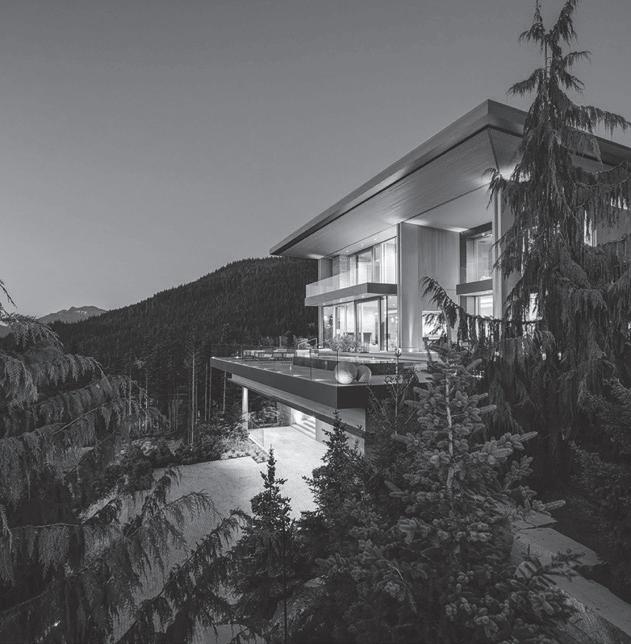
When Whistler’s Audain Art Museum danced down from the firmament of ideas, coalescing in the stardust of concept, design, dedication and largesse, many found themselves involved in the journey from table to tangible.
These represent the boilerplate stories we’ve become familiar with: the cherished art collection of developer Michael Audain and wife Yoshiko Karasawa, grown too big to self-contain and requiring a new home; a building whose sculptural design melds wood and light in understated synergy while a dark exterior draws back into forest shadow; people like Jim Moodie, whose entreat first brought Audain to Whistler, where then-mayor Nancy Wilhelm-Morden and her council embraced not just the breaking of new cultural ground for the town, but the municipal support required to backstop generous builders and founders whose endowments support the operation to this day.
The challenge for all was this: how does one take a very personal art collection— something variously influenced by taste, reference, knowledge, personal history, whimsy and zeitgeist—into an institutional setting as an experience with public appeal? Certainly, you’d aim to merge meaningful aesthetic with a presentation that was easy to digest and never overwhelming. But there would also be origin to navigate. Since most of the 225-piece donation comprising the original permanent collection came from their home, Audain and Karasawa would always regard these works as important to their lives.
“We still love to drop by and see those items that for so many years occupied our house,” Audain tells me on a recent call. “We miss them, of course, but are so happy to be able to share with the public.”
And therein lay the fortuitous formula of solution: along with the art, you put your love of it on display. The success of this resides in how the AAM comes across—not as an ivory tower of art dedicated solely to international status, but an integrated community amenity and cultural focal point. Audain and Karasawa put their love of art out there, and Whistler, over the course of a decade, learned to love it right back.
“THE AUDAIN WOULD BE A MARQUEE attraction in any big city, but it’s in Whistler,” emphasized Curtis Collins, AAM director and chief curator, when we first spoke back in 2018, the year of his arrival. At the time, he was excited to “fulfil its mandates and create pride in it among Whistlerites.” Could he now claim fait accompli?
“It’ll always be an ongoing mission, but I think our recent 10th-anniversary celebration, ‘Night at the Museum’ in January was proof,” he says of how deeply that pride has taken root. “It was packed, and so many of those people have been members for years.”
Indeed, attending any of the museum’s myriad events—from member exhibition previews to fundraising galas, art classes to book launches, morning yoga to the outdoor summer dinner series—always facilitates a local embrace. “Not only has the museum been able to generate a lot of interest in Whistler,” says Audain, “but put itself on the map as one of the leading [institutions] in the country—despite its modest size.”
Perhaps because of it. Indeed, the AAM and North Vancouver’s compact Polygon Gallery speak to a new visual-arts landscape where smaller, boutique venues are having greater impact than large, lumbering institutions, says Collins, of a trend that hadn’t quite yet materialized when the museum opened in 2016.
After the decision to build here, there was skepticism aplenty—particularly among the Vancouver cognoscenti—that Whistler could ever be a place where people wanted to look at art, let alone visit for it. “The thought was, after skiing people just want to relax and party, and there were also few of them around in summer,” recalls Audain. “But an art
museum that opened in Aspen had been quite successful, so that was the model.”
It was a model that greatly exceeded both vision and expectations for Audain. “Not only in bringing something new to the resort, but to B.C. as well,” he says. “I’m just delighted.” More so, he says, that this is occurring at a time when cultural organizations across B.C. are struggling financially. “The Audain is in good shape in that regard,” he notes, “and that’s due to the tremendous support from the people of Whistler—both permanent and temporary residents—who have done so from the beginning in quite a dramatic way.”
But while this milestone feels all warm and fuzzy for Whistler, there’s a more general question to consider: What’s 10 years in the life of an art institution?
“It’s the formative moment that determines your trajectory for another 30 years,” says Collins. “Two major international shows a year and two interesting medium-scale shows is now our signature, and that didn’t really happen until the last five years.”
Not to say there weren’t good shows before (recall “Ancestral Modern,” the must-see collection of Australian Aboriginal Art), but mounting two excellent shows instead of three moderate-to-good shows worked better. The lower-level’s four connected temporary gallery spaces allow the AAM to mount something sweeping and conversational—like the current “From Sea to Sky: The Art of British Columbia,” that draws heavily on a permanent collection now approaching 300 pieces—while the trademark upstairs space can host more focused joints like the recent Burtynsky photo exhibit, Geoffrey Farmer installation, and excellent current photo and drawing celebration “Into the Wosk Collection: Discovery & Wonder.”
Back in the day, Collins noted the AAM was working toward a new model of generosity and collaboration to keep the museum lighter on its feet—more into sharing than hoarding. “Some museums don’t change their main displays for five to 10 years, and we like to do it every quarter,” he says. “The collection is growing, and so we’re showing at least 75 per cent of what we have while others average around 10 per cent. And we’ve maintained that agility in all sectors, which is the downfall of many larger, more encumbered institutions.”
Agility has been a hallmark from the start. The original building plan wasn’t large enough to house Audain’s collection and special exhibition space, so an extra bit was
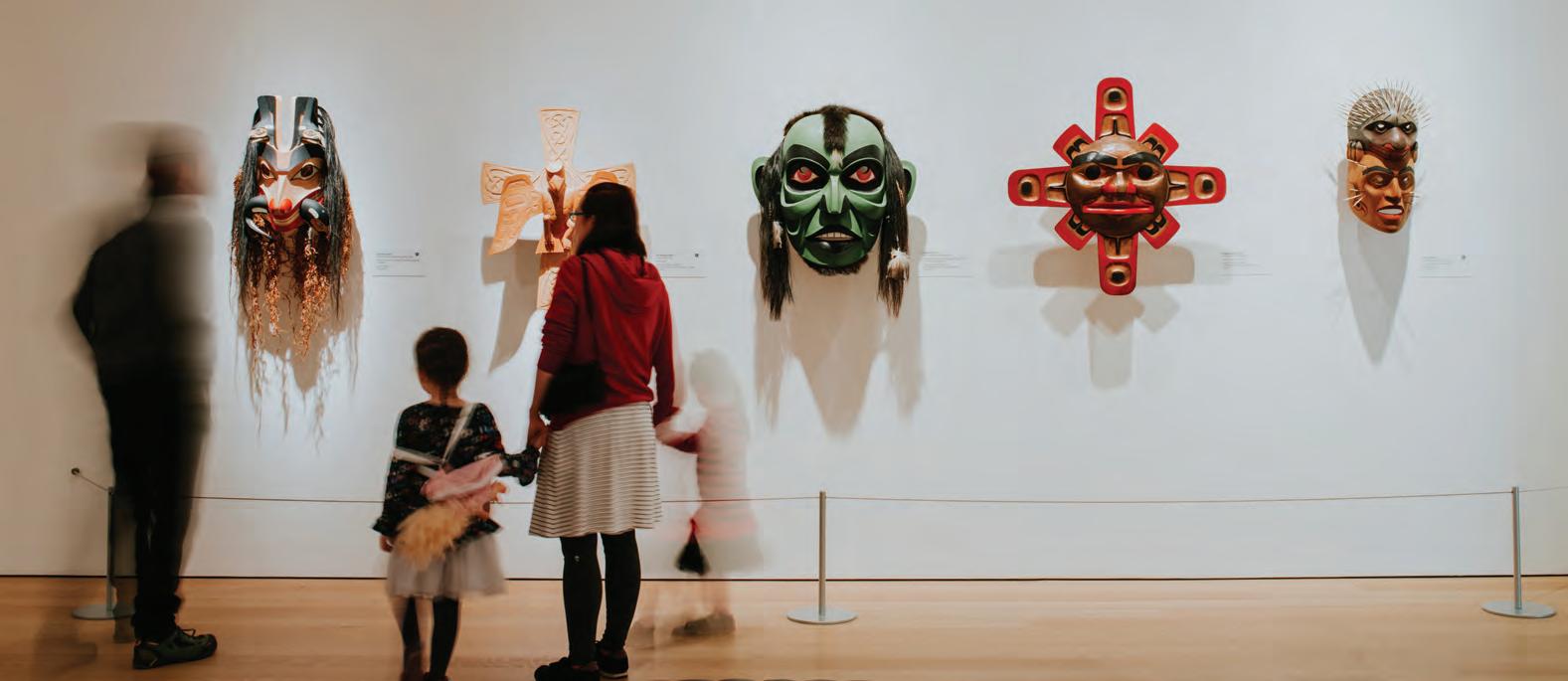
PHOTO BY DARBY MAGILL / COURTESY OF THE AUDAIN ART MUSEUM
FEATURE STORY
added on during the design phase. As Audain liked to quip in early interviews, “so the plan of the place would look like a hockey stick.”
Nevertheless, the stunning architecture by Patkau has benefitted the AAM in myriad ways. Bold in occupying its elevated space in the canopy a full story above floodplain forest floor, but minimalist enough—they call it “deliberate restraint”—to stay out of the way of the art. An aesthetic, walkable space leads up a ramp across Village North, across a flow-through outside the main entrance that one can choose to stop at or pass through into a forested enclave—though few do the latter, pausing to at least take in the cut-metal piece, “Big Flood,” by Squamish Nation artist Xwalacktun. Indeed, architectural tours spend a full 30 minutes outside the building, its snow-shedding capacity a perennial point of interest. Inside, visitors are instantly captivated by architecture highlights— the long, glazed walkway to the galleries that feels like you’re both in a forest and in a building, in the air and on the ground; the stairway to the upper gallery, into which people crowd for wedding photos. Behind the scenes, the museum’s physical plant is a work of engineering art, the pipes, ducts and conduits maintaining the flow of energy and interior climate a paean to ingenuity and ergonomics. And though many come just to stare at the roof, a lighting arrangement or wood configuration, the experience remains, as Michael Audain is quoted inside the entrance gallery, “all about the art.”
oppositional—approach that suggested a likely future vector for First Nations art.
Inspired by AAM art like Hart’s Dance Screen, Indigenous masks, and Carr’s early work capturing Indigenous communities, Merilea Creighton, a docent since the museum opened, has travelled to places like Hart’s native Haida Gwaii; Gitanyow and Gitwangak where Carr painted many of her totems; and Alert Bay, home to the late Beau Dick where she had the honour of attending a potlatch. “All incredible experiences,” she says.
LIKE ALL GOOD ART INSTITUTIONS,
CARVING, PAINTING AND PHOTOGRAPHY
are the strengths AAM is always building on. The collection’s beauty reflects the cultural differences that exist in B.C.—First Nations, Euro-Canadian, and Asian-Canadian, and into each of these it actively seeks to expand gender representations.
But just what do Whistlerites love about the AAM?
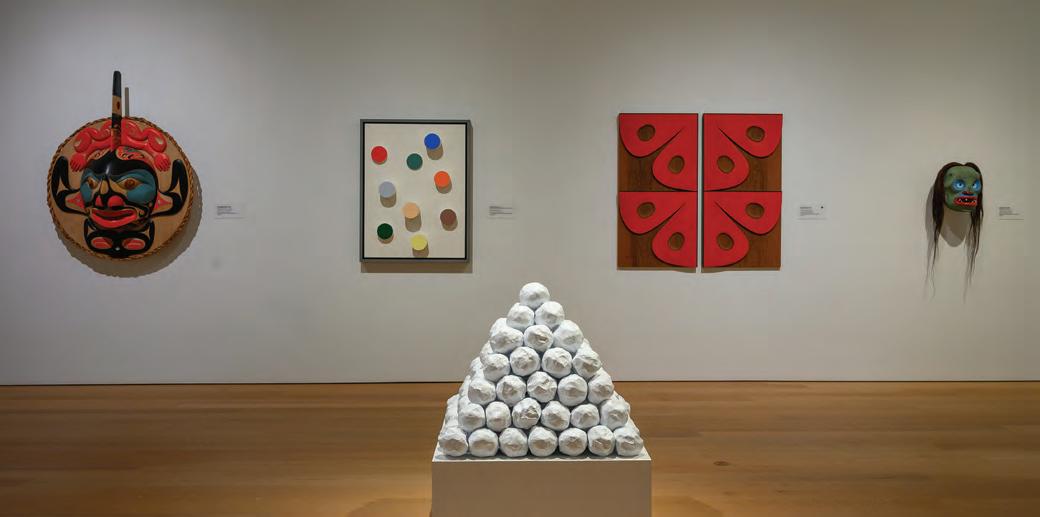
There’s a town’s gratitude for having some of Haida Chief 7IDANsuu James Hart’s greatest works sited here. For anyone who has stood before his masterpiece, “The Dance Screen (The Scream Too),” or marvelled at the stoic power of his ambassadorial outdoor icon, “The Three Watchmen,” it’s clear their presence not only puts Whistler in rarified company, but has brought appreciation for the rejuvenation of Haida art traditions both to global visitors and a generation of our own citizens. For those who attended the 2018 activation performance to “dance in” the screen, the masks arrayed in the room’s glass cases, whose creation was always to live as part of ceremony, seemed to come alive—like they understood what was going on—the transition from spirit realm to human realm.
There’s the Emily Carr collection charting her early years, sojourn in France, travels through B.C. and mastery of the moody mystic rainforest. The realist paintings of E.J. Hughes, the museum’s most nostalgic gallery and a place people often stall to reflect on the homey mix of mountains and water and beaches and trees that define B.C.
Local artisans have their own plaudits. “The Audain has greatly elevated local culture and arts in the Sea to Sky, as well as supporting my own career—for which I remain truly grateful,” says Lil’wat artist Levi Nelson. “Curtis opened the doors to me on days when the museum was closed, and I found inspiration for some of my own paintings in the solitude of the galleries. That kind of nurturing assures an artist their line of work is worth dedicating a life to.”
Collins often floats through the galleries incognito to sate his own curiosity on how people move through the space, gravitate to works, interact with each other and the art. He got an eyeful during his first show as curator: “Tales of an Empty Cabin: Somebody Nobody Was...” by Yukon-based Kaska Dene artist Joseph Tisiga, a reinterpretation of the infamous Grey Owl charade through self-identity flips and an ever-evolving title. Visitors were intrigued by the purposely nuanced—versus directly
the museum also has a life outside of its home base. Two weeks ago, Collins opened the AAM’s “Curve: Women Carvers on the Northwest Coast” at the National Gallery of Canada, positioning the AAM as a leader on the West Coast in identifying important contemporary visual arts production. “[This] was a deep contribution toward art making and histories on the northwest coast—a necessary exhibition which has provoked expanded thinking and scholarship for the future,” points out Catriona Jeffries, principal of the eponymous gallery in Vancouver.
For visitors, the show was a revelation, but AAM exports aren’t new: a retrospective on carver Dempsey Bob went to the Glenbow Museum in Calgary, the McMichael Canadian Art Collection in Toronto and the Montreal Museum of Fine Arts. “I think the depth of our curatorial efforts combined with the quality of our marketing is now at that national level,” says Collins. “And one of the things we do well is pulling Indigenous art production out of that generic anthropological frame on a constant basis.”
Like last October’s launch of an AAM-published book on Hart’s globally-distributed monumental works in conjunction with the Whistler Writers Festival—another soldout event. They’ve also benefitted from shows borrowed from other institutions (think “Gathered Leaves” from the National Gallery). “We now get the first call on the coast from institutions in Central and Eastern Canada that are touring shows,” says Collins. It wasn’t always this way. To get on the map, the AAM needed to be seen in situ. “It was funny when curators from out East came here for the first time and realized they weren’t just going to see a log cabin in the mountains,” he says. “But a category-A facility that hosts both national and international exhibitions on a regular basis.”
One question always asked of Audain is whether he has a favourite artist or piece. Naturally, he doesn’t, as that would be “like having a favourite grandchild.” But what he will tell you is that the most popular exhibitions have been Manabu Ikeda and Tom Thomson. “The former wasn’t known at all in Canada, but word-of-mouth went around that you had to see the work of this astonishing Japanese artist,” he says. “And, of course, the Thomson exhibition generated huge interest.”
Does Audain think art’s ability to “capture the moment” in a historical sense has changed in an era of instant memes and street graffiti that come and go on a rapid scale? “These different media do widen the market for art, so they’re positive in terms of increasing interest, and museums are seeing more visitation than ever before,” he says. “People know there’s a difference between looking at something on a [phone or computer] screen and being in direct communication with an artist by viewing their works—like going to the Louvre and being in communication with Da Vinci even though he created those works 500 years ago.”
Artists, indeed, continue to communicate through their art. And a decade on, that the Audain has raised awareness of the depth and breadth of British Columbian artists cannot be disputed, nor that it has gained foothold in the pantheon of important Canadian art institutions.
“To view the recent Geoffrey Farmer exhibition—perhaps the strongest ever curated at the AAM—was extremely inspiring. Knowing the Farmer works Michael Audain had donated to the museum and then witnessing the artist expand their context in both time and meaning revealed an important exhibition,” says Catriona Jeffries. “Through such curatorial work and the expanding permanent collection, the museum is growing public awareness of the complex art-making in British Columbia, both past and present.”
This scans with what Collins thinks Whistlerites should celebrate on this 10th anniversary: “That the Audain is now a Whistler cultural experience of parallel quality to its adventure and culinary experiences.” Meaning, that in the same way Whistler Blackcomb is an international brand for skiers, and the town for food and beverage, places like the AAM and the Squamish Lil’wat Cultural Centre are making Whistler an international brand for culture, as well.
“The Audain is a constant learning experience,” says Merilea Creighton. “I feel very privileged to have been a part of it these past 10 years.” n
PHOTO BY JARUSHA BROWN / COURTESY OF THE AUDAIN ART MUSEUM
PHOTO BY SCOTT BRAMMER / COURTESY OF THE AUDAIN ART MUSEUM
‘Skiing is just skiing to me’
WHISTLERITE
OLYMPIAN TEAL HARLE REFLECTS ON TRANSITION FROM FREESTYLE TO FILMMAKING
BY DAVID SONG
WHILE HIS FORMER Team Canada peers recently saw action at Milano Cortina 2026, Teal Harle is at peace with his decision to move on.
Nowadays the bulk of Harle’s attention is locked on filmmaking. He relishes delving into backcountry terrain, discovering fresh new locales and putting his exploits on camera. It appears Harle is a natural talent in this field, for he is featured in Teton Gravity Research’s (TGR) 30th-anniversary offering Pressure Drop.
A press release from TGR elaborates: “Born from a dream and forged on the edge, this isn’t just our 30th annual film, it’s a tribute to the fleeting moment when breath slows, gravity takes over, and everything else fades. Pressure Drop continues the tradition of what it means to dedicate your life to the fall line.”
Shot at a variety of eye-opening locations like Interior British Columbia, Norway’s Lofoten Islands, Valdez, Ala., Jackson Hole, Wyo., and Palisades Tahoe, Calif., Pressure Drop stars numerous top
skiers and snowboarders including 2026 Olympians Kirsty Muir of Great Britain as well as Troy Podmilsak and Grace Henderson from the United States.
“Skiing is just skiing to me,” Harle remarked. “Backcountry is fun, you get to explore new areas and everything is always different, new and fresh— whereas park skiing was kind of just the same thing: practising new tricks and
of filming is really fun, too: working with the crew, battling weather and stuff.”
A DIFFERENT VIBE
Harle grew up fully committed to freestyle skiing and his career is nothing to scoff at: two Winter X Games medals and a top-five Olympic result in Pyeongchang.
Unfortunately an ill-timed back ailment prevented him from reaching his potential
“Backcountry is fun, you get to explore new areas and everything is always different, new and fresh...”
- TEAL HARLE
stuff, but on the same kind of terrain, same kind of jumps, same kind of rails.
“Contests, you’re trying to put together a perfect run and you have to drop in at a certain time on a certain day. Filming’s kind of cool because you can pick and choose your days. You can pick and choose your conditions, build your own features, find your own lines and then add your own creative style on top of all. It’s fun to totally control the creative process … as long as it comes together the way you hope. The process
at the 2022 Beijing Olympics, where he ended up 26th in slopestyle and 31st in big air.
After clinching silver at the 2023 X Games by landing “two of the most insane tricks” he ever attempted on skis, Harle felt like it was a good time to wrap up his era in professional freestyle—yet he’s not quite done with competition because the Natural Selection Tour (NST) recently came calling.
Known more for its longer-running backcountry snowboard events, NST
introduced a ski component in 2025 that quickly gained traction. Harle is the only Canadian slated to participate in this year’s NST Ski Super Session in Palisades Tahoe. If he manages a victory, he’ll earn an automatic invite to the Finals at Valdez.
“It’s not the same vibe as any kind of FIS event or Olympic-style stuff,” the 29-year-old said. “Even the athletes they’re inviting, most are more like film skiers instead of World Tour athletes so it’s kind of a different page in the book. I’m just going to ski and see what I can do … the dream would be to win. I’ve been dreaming of going to Alaska for a film trip and trying to ski the big Alaskan spines and stuff like that, but obviously it’s going to be a difficult contest.”
No matter where he voyages, Harle considers the Sea to Sky a home base. His family moved there in 2014 and he’s bounced around between Whistler and Pemberton ever since.
“It’s a great place to be in the mountains and you’re constantly just surrounded by other amazing skiers,” said Harle. “Riding with other people who are pushing to the same calibre as you are is always a great way to get better at skiing. If you see someone else do something sick, then you want to step it up too.”
NST Ski premiers its Palisades Super Session on March 17 by way of Red Bull TV. Go to naturalselectiontour.com/nstski for more. n
SKIING FREE A headshot of two-time Olympic freestyle skier Teal Harle.
PHOTO BY SPENCER CRAIG
SPORTS THE SCORE
Mollie Jepsen named to Canadian Paralympic ski team
SPORTS BRIEFS: FIFTH FOR MARIELLE THOMPSON AT INAUGURAL KOPAONIK WORLD CUP
BY DAVID SONG
IT IS OFFICIAL: Mollie Jepsen is bound for her third career Paralympic Games.
Jepsen was unveiled on Monday as one of eight Canadians representing their nation at Milano Cortina 2026’s para alpine events.
Whistler’s ace in the ladies’ standing division will share co-captaincy honours with Alexis Guimond (men’s standing) as Michaela Gosselin (women’s standing) and Brian Rowland (men’s sitting) likewise return from the Beijing 2022 roster. Paralympic rookies Florence Carrier (women’s standing) as well as Kalle Eriksson and guide Sierra Smith (men’s visually impaired) fill out the squad.
“The last few years have been some of the most difficult I’ve ever experienced and I’m so proud of myself, and grateful for everyone who has been supporting me,” said six-time Paralympics medallist and three-time Crystal Globe winner Jepsen in a press release. “For me these Games are different. Having achieved my lifelong goal of becoming a Paralympic champion in downhill in Beijing 2022, I want to enjoy these Games and the experience. I want to be present and take everything in.
“In the past I’ve been so narrowly focused on winning I forgot to appreciate all it took to even get to the Games and the accomplishment that is in itself.”
Guimond, with two Paralympic medals and a freshly-earned Globe of his own, commented in the same release: “It’s exciting to be going to my third consecutive Paralympics, I’m enamoured by the Paralympic dream. I’m going into these Games with confidence, focus, experience and grit. I am honoured to represent my country, as well as my fellow teammates as their co-captain, and am tremendously proud of what we were able to accomplish as a team in the last four years.”
Alpine skiing has been Canada’s most fruitful Paralympic sport, with 115 medals dating back to 1976 when the Games began. Canucks won half a dozen medals in 2022 and 10 back at Pyeongchang 2018.
“I am incredibly honoured to welcome our para alpine athletes to the roster and officially round out Canada’s Paralympic team for Milano Cortina 2026,” said honourary captain Mac Marcoux, who retired two years ago. “This announcement is especially meaningful to me, as I have had the privilege of training and competing alongside many of these remarkable athletes, and I truly consider this team a second family.
“Watching this group build such strong momentum throughout the season has been so exciting, and I cannot
PHOTO BY ALEXANDRA BLUM
wait to cheer them on—loud and proud— from the finish area in Cortina in just a few short weeks.”
Italy will host para alpine competitions between March 7 and 15.
THOMPSON FIFTH AT KOPAONIK WORLD CUP
Marielle Thompson is back in the saddle after a 14th-place result at the Milano Cortina Olympic Games.
Experiencing her first taste of the brand-new ski cross World Cup in Kopaonik, Serbia, Thompson landed in fifth. Sandra Naeslund emerged victorious after dropping to bronze in Milano Cortina, and Jade Grillet Aubert bested her fellow Frenchwoman Marielle Berger Sabbatel for runner-up position.
Tiana Gairns ended up 15th, six spots behind reigning Olympic champ Daniela Maier.
Havoc abounded in the men’s final, with Florian Wilmsmann going down just seconds out of the start gate. Kevin Drury and Wilmsmann’s German compatriot Tim Hronek both crashed into him, leading to Reece Howden being the only athlete to finish.
Yet Howden received a yellow card for line deviation and Hronek was awarded gold. Drury took silver and Wilmsmann bronze because Drury placed higher during the qualification round.
The silver medal is perhaps a silver lining for Drury, who has already announced 2025-26 to be his final competitive campaign. The 37-year-old posted an image of his right leg wrapped in gauze on Instagram accompanied by text saying: “Not the way I wanted to end my career but I’ll take the podium.”
Hronek dedicated his victory to the stricken Canadian, telling reporters: “It’s very sad, man [Drury]’s such a nice skier and I know he will end his career at the end of this season.” Drury was the first man from Canada to secure a Crystal Globe, managing the feat in 2019-2020. n
PARALYMPIC PRIDE Mollie Jepsen stares down the camera during a race.
Get your daily dose of the arts
THE SCIENCE IS IN—CREATIVITY IS SUPER GOOD FOR US ALL LIFE LONG!
YOU EXERCISE pretty much every day: Meadow Park Sports Centre and the magnificent mountain trails are your best buds. You eat your veggies (at least three half-cup servings a day, just FYI.) Maybe you meditate, do yoga—or at least try not to get stressed. You sleep well, drink water, nuked cigarettes long ago, and know that socializing is so healthy for us,
BY GLENDA BARTOSH
you often hang out with pals.
Live long and prosper, as Spock and the super-agers say. And now science, once again, is delivering the goods about something else we all need in our short but glorious human lives: Creativity.
Yes! Painting, drawing, crafting. Writing poems, stories, newspaper columns or the next screenplay hit. Singing your lungs out, or making any kind of music. Dance, stand-up comedy and improv, or any kind of performance art. Even simply taking it all in as an audience member or gallery goer—no matter how you engage in the arts, the science and data confirm it: The arts aren’t just some kind of fluffy extra. (Which is basically why I started Whistler’s arts council, now Arts Whistler, back in the ’80s. Cool artsy things were already happening, but seemed a bigtent initiative might help.)
“[The arts] are one of the most diverse,
complex, and personal behaviours we can engage in. So we should all give the arts the time in our lives they deserve,” writes Daisy Fancort in New Scientist, the excellent U.K. science magazine—a favourite in our house for the way it explains complex ideas in plain language, and complements Scientific American Fancort, who led a huge study on how COVID impacted mental health, is a professor of psychobiology and epidemiology at University College London. After looking at data from nearly 100,000 people from 16 countries, she and her fellow colleagues concluded that hobbies like gardening, baking or journalling deliver loads of benefits as we age, from reduced pain levels to lower risks of some diseases, like diabetes.
Her 2026 book, Art Cure: The Science of How the Arts Transform our Health, is a smash hit. It sold out even before publication, and garnered kudos from the likes of The X-files’ Gillian Anderson. In it, Fancort draws on numerous international studies, including the one above, that prove being more creative works wonders for our health—physically and mentally.
Overall, Fancort says the arts are on par with exercise for delivering health benefits! As an epidemiologist who studies the incidence, distribution and possible control of diseases and other health-related factors, she’s examined tons of data from cohort studies on the long-term connections between everyday arts engagement and health outcomes.
The results are remarkable: People who participate more often in the arts; watch any kind of artistic performances, say a concert or improv at the Point Artist Run Centre or Arts Whistler’s events at the Maury Young Arts Centre; and visit cultural venues, like the Audain Art Museum or Squamish Lil’wat Cultural
Centre, are happier and feel more satisfied with their lives over time. For one, depression is less likely to hit kids before their teens, or adults over 50.
Now programs world-wide are starting to integrate the arts into healthcare, like playing music during surgery so you don’t need as much medication, and including dance in programs for people with Parkinson’s disease to help them walk.
See? All those folks walking around with headsets on, listening to music, have the right idea. But a warning: Fancort describes screen-based arts as “the ultraprocessed foods of the arts world.”
CHOOSE YOUR ART DOSE
So how do you get your art dose? And are you getting enough? Whether you draw or doodle, sculpt or sing, keep one thing in mind: Don’t rush it. As Fancort said, we need to give art the time it deserves.
If you’re visiting a gallery or exhibition, linger longer. The brilliant novelist Doris Lessing—another smart, talented Brit who, at age 87, was also the oldest person to receive the Nobel Prize for Literature—pointed out that we shouldn’t feel we have to start a book at the beginning and read to the end. Open it anywhere. Browse. Or start at the back, and read as much, or as little, as you like. At art school, I learned much the same goes for exhibitions. Spend more time with the pieces you like. Start where you
CURE WHAT AILS YOU
Art Cure is now on order at Squamish Public Library. You can request a copy via Whistler and Pemberton libraries, or read an e-copy at Vancouver Public Library if you’re a member. n
want. Don’t feel obliged, that you have to “see it all” or even bother with the didactic panels (those little “explanatory” signs) if you don’t feel like it. Luckily, Sea to Sky boasts a host of outlets for creativity to pique your art appetite. Besides the ones I’ve already mentioned, there’s Whistler Singers, Whistler Chamber Music Society and more, like the ones below.
I’m not embedding hot links so you don’t drop down a rabbit hole here, but they’re all easy to connect with online. Better, visit in person:
• artswhistler.com has the most comprehensive, detailed, up-to-date listing of arts and cultural events at Whistler, including the fabulous Anonymous Art Show, March 18 to May 9 at the Maury Young Arts Centre. With 300-plus pieces of original art, it’s the biggest collection of community art in one spot.
• Whistler Public Library offers lots of amazing art doses, for kids and adults. Besides all the how-to and art books you can borrow, adults can drop into Cozy Crafting in person, complete with a nice cup of tea, while kids love Storybook Studio and Creative Bug tutorials.
• Andrea Mueller’s ARTPOP shop and gallery on Lake Placid Road is a great place to visit or get your hands dirty making art.
If you still need to relax, nothing beats the yoga classes held every Thursday morning in the exquisite Audain Art Museum. To celebrate their 10th anniversary, museum admission is by donation March 7 to 13. Look for the jaw-dropping paintings by Quebec’s Jean-Paul Riopelle.
Glenda Bartosh is an award-winning journalist who won her first art prize in Grade 1 for a painting of a circus. n
BLIND AMBITION Arts Whistler’s fabulous Anonymous Art Show returns March 18 to May 9 at the Maury Young Arts Centre.
MEADOW PARK SPORTS CENTRE
SWIM • SKATE • SWEAT • SQUASH
OPEN DAILY: 6 a.m. to 9 p.m. *some exceptions apply
R REGISTERED FITNESS Registered fitness classes have a separate fee and a defined start and end date. Pre-registration is required for the entire set of classes.
I INCLUDED FITNESS These classes are included with your price of admission for no extra charge. POOL HOURS
MAR 6MAR 7MAR
Whistler to welcome Pocket Symphonies on March 8
THE CLASSICAL MUSIC GROUP IS COMPRISED OF THE BERGMANN PIANO DUO, JASPER WOOD AND SUNG YONG LIM
BY DAVID SONG
WHISTLER CHAMBER Music Society’s (WCMS) upcoming concert is advertised on its website using a rhetorical question: “we’ve heard about pocket books, pocket money and pocket watches, but what about pocket symphonies?”
That begs another question: what is a pocket symphony?
In this context it refers to a classical music collaboration between Elizabeth and Marcel Bergmann, Jasper Wood and Sung Yong Lim. All four are talented: Wood is a veteran violinist and University of British Columbia (UBC) professor with experience in both orchestral and chamber settings, while Borealis String Quartet member Lim has been a principal cellist for the German Detmold Orchestra and the Mosy Chamber Orchestra.
Elizabeth and Marcel, known as the Bergmann Duo, are a married couple with an intriguing style: they often both play on the same piano.
‘A CERTAIN AMOUNT OF CHOREOGRAPHY’
A wealth of duet repertoire exists, including but not limited to the material of Wolfgang Amadeus Mozart, Franz
Schubert, Johannes Brahms and Robert Schumann. Many composers created different transcriptions of their orchestral works, allowing others to discover these songs in their own homes and exposing said music to larger audiences before the advent of recording technology.
However: only one pianist can handle the pedals in a four-hands arrangement and it’s usually the individual playing a song’s lower portion (in this case, Marcel).
“As a pianist, you’re so used to your foot being an extension of everything and you’re in constant contact with the pedal,” Elizabeth says. “When you can’t use that, it’s like part of the instrument is not there for you. Also the challenge is, of course, you only have half the keyboard at your disposal.
“That being said, you almost have to work out a certain amount of choreography with your partner in order to be able to facilitate things technically when you’re sharing an instrument like that … but the advantage to playing and sitting so close to one another is you absolutely feel immediately what that person is feeling. You can even hear each other breathing.”
Such a degree of professional intimacy reflects the Bergmanns’ personal relationship. They met while studying at the Hochschule fuer Musik und Theater in Hanover, Germany beneath Professor Arie Vardi and have essentially lived their dream jobs, playing for 30-odd years.
“We just both feel extremely blessed to have found each other,” comments Elizabeth. “Your partner understands
all of the difficulties and challenges you’re experiencing as a performer, and we get to share all of those moments together. It’s not like I’m leaving my husband behind and then after two weeks: ‘oh here we are again, hello, who are you?’”
She laughs and continues: “The one thing I think that we sometimes have to carve out for ourselves is time alone because we’re spending so much time together. Marcel also composes and arranges on a pretty regular basis for us and for a lot of ensembles that we play with … by nature of what he has to do, he’s alone a lot. I’m dealing with other things having to do with the organization of our careers. We have our roles and we’ve divvied it up, I think, quite nicely.”
TOO MUCH FUN
The Bergmann Duo have partnered extensively with other musicians over time, including Wood and Lim. All were inspired to unite under the name Pocket Symphonies and held nearly a dozen concerts last year. Whistler represents but one stop on their 2026 touring itinerary.
“[Jasper and Sung Yong], they’re fantastic colleagues,” says Elizabeth. “They’re such a joy to work with. They’re wonderful virtuoso musicians. We have a whole lot of fun, sometimes too much fun. I would say that we each bring our own perspective: we have certain ideas, we work it out, but we have this mutual respect for one another. It’s just really wonderful to see that kind of dynamic
in play when we’re both working and on stage for the final product, so to speak.”
Pocket Symphonies is bringing premium stuff to the Sea to Sky: renowned offerings by Brahms and Felix Mendelssohn to complement an unorthodox interpretation of Ludwig van Beethoven’s 5th Symphony. That work is viewed as an all-time monument of classical canon, recognized by numerous people from all walks of life.
It’s not every day pianists like the Bergmanns get to enjoy the 5th Symphony, which was composed for an orchestra.
“When we have an opportunity to play some of this orchestral music on the piano, four hands in addition to a great violinist and cellist, it just opens up our whole understanding of the genius of the score, the writing of Beethoven. That was the cornerstone of what we wanted … and we picked Mendelssohn’s Hebrides Overture. Jasper said that’s his absolute favourite overture of all time,” Elizabeth says.
“And then Brahms is just so much fun. It’s his Hungarian Dances and of course they’re written for piano, but there’s also orchestral versions so [ours] is a mashup of both. Mendelssohn has this quiet sort of invitation, but it opens up to a certain grandeur. Brahms has this excitement and rawness, a folky kind of quality. Then you’ve got Beethoven, which is just pure energy and joy.”
Pocket Symphonies will play on March 8 at 5 p.m. in the Maury Young Arts Centre. Visit whistlerchambermusic.ca/ concert/pocket-symphonies for tickets. n
OUT OF POCKET Pocket Symphonies musicians, left to right: Marcel Bergmann, Jasper Wood, Elizabeth Bergmann and Sung Yong Lim.
PHOTO BY REI IKEDA
Danny Michel returns to the Point Artist-Run Centre on March 11
THE JUNO AND POLARIS PRIZE NOMINEE LAST VISITED WHISTLER IN 2022
BY DAVID SONG
IF ONE HEADS to Danny Michel’s professional website and clicks on his bio, one would immediately realize the man labels himself as having “musical A.D.D.”.
He has recorded songs and albums of nearly every variety under the sun, from rock and pop to world, folk, classical and beyond. The Kitchener, Ont. native was born to play music and he’s done it capably for decades, touring across Canada while riding shotgun with “pretty much every band in the country you can think of.”
Some artists are content to stay in one lane genre-wise, and some outright prefer to do that. Not Michel.
“I’m just far too fascinated and love music too much to only just do one thing my entire life,” he explains. “That would be like if someone said: you have to eat spaghetti forever. I love spaghetti, but I don’t want to eat it every day. I think that being sentenced to playing one style of music my whole life would be like a prison sentence.”
Obviously, Michel’s eclectic approach has been embraced by fans and industry stakeholders. Thrice he has garnered a Juno Award nomination, as well as one Polaris Prize nomination and inclusion in CBC’s Heart Of Gold contest. In 2017, he won the Canadian Folk Music Awards’ (CFMA) Producer of the Year and Oliver Schroder Pushing the Boundaries accolades.
Yet the 56-year-old is not a very competitive individual and doesn’t lose much sleep over how full his trophy cabinet may or may not be.
“I always joke when people say you’ve been nominated three times for the Junos. I just point out that means I lost the Junos three times,” Michel says. “They don’t mean much to me. If you win, that’s great … but it’s not like sports where there’s a winner and a loser. When you go to a music festival and see five or six bands, you don’t think: ‘which bands won and lost?’ You had a good time and all the bands were great.”
‘YOU USE THAT SUPERPOWER YOU HAVE TO DO GOOD’ What Michel does put stock in is his experiences partnering with titans of various fields.
He once recorded an album on board a Soviet Union-era icebreaker vessel during an expedition with Colonel Chris Hadfield, the first Canadian astronaut to perform a spacewalk. He performed at the late British primatologist Jane Goodall’s 85th birthday celebration, and on May 22 he’ll appear at environmentalist David Suzuki’s 90th birthday in Vancouver alongside Rick Hansen, Chantal Kreviazuk, Al Gore, Sarah McLachlan, William Prince, Bruce Cockburn, Tanya Tagaq, George
Stroumboulopoulos and Jane Fonda.
“Working and collaborating with people who I admire is worth it. That’s the win for me,” Michel says. “The fact that through music, I’ve become buddies with Chris Hadfield and we go skiing together is just insane … and now I’m doing this thing with David Suzuki. Those are the big rewards for me, doing things that have meaning. I’m an environmentalist. I care about the world.
“Either you’re a musician and you just play music and that’s all, or else you use that superpower you have to do good. I think that’s kind of a responsibility and something I enjoy doing. I’m lucky to have a platform to do things that can help out, so I feel obliged to … give back. All my heroes musically were people that stood up for stuff.”
Bob Dylan refused to stay quiet about causes that mattered to him. Likewise, Sinéad O’Connor and Bob Marley sang songs that reflected the cultural and political realities of their eras. Michel does the same.
Upon his return to the Point ArtistRun Centre (PARC) on March 11 at 7:30 p.m., Michel promises to bring two sets full of music from the last quarter-century interwoven with relevant anecdotes from his life. The Ontarian looks forward to the same “cosy, fun vibe” that greeted him in 2022 when he first played there.
“I love playing smaller shows,” Michel reveals. “I mean, I’ve done gigantic shows. My band opened for The Tragically Hip at the Air Canada Centre on the millennium and it was like 25,000 people or something. Then I can turn around and play a thing at The Point. I find smaller crowds just great because I like to connect with people. I like to look people in the eye and feel a vibe. When you’re in like some giant stadium-type thing, that’s not there.”
Visit thepointartists.com/events/ danny-michel-live-in-concert for tickets to Michel’s upcoming PARC concert. n
The Tertiary Filtrationupgradeisnecessarytoimprovethequalityoftreated wastewaterdischargedtotheCheakamusRiverandcomplywithmunicipal wastewaterregulations.
Celebrate women in the mountains with the Whistler premiere of What it Takes. Three women venture from British Columbia into the wilds of Patagonia to explore what’s possible, only to be met with harsh conditions, unexpected challenges, and their own limits. What It Takes peels back the polished image of adventure to reveal the emotional and mental reality behind expeditions. Ticketholders can enjoy a complimentary drink and chances to win awesome prizes!
> March 6, 7 to 10 p.m.
> Evo Rentals
ART OF THE COCKTAIL: CONTEMPORARY SCULPTURE
This edition of Art of the Cocktail invites guests to explore the sculptural works of Brian Jungen, featured in the From Sea to Sky exhibition, through a brief curatorial talk that sheds light on his innovative use of materials and cultural narratives before shaping a signature drink drawn from his work.
> March 6, 5:30 to 6:30 p.m.
> Audain Art Museum
WHISTLER WINETASTIC
As part of the 33rd annual two-day Whistler Blackcomb Foundation fundraiser, RE/MAX Sea to Sky Real Estate proudly presents Whistler Winetastic! Indulge in an exceptional selection of wines, beers, and spirits, paired with gourmet cheeses from Arla Foods and delicious appetizers from local restaurants. All while enjoying spectacular live entertainment from Treeline Aerial and The Hairfarmers.
> March 6, 7:30 to 10 p.m.
> Fairmont Chateau Whistler
PORTOBELLO FAMILY APRES
Inspired by Whistler’s ski culture, Family Après brings together live music, kid-friendly activities, and tasty bites for the whole family every Saturday. After a day on the slopes, it is the perfect way to celebrate and start a new tradition of mountain weekends. Highlights include complimentary maple taffy, cookie decorating kits with the purchase of a kids’ meal, and a variety of games and coloring kits.
> March 7, 3 to 5 p.m.
> Portobello
‘THE ART OF PLAY’ MOUNTAINTOP GALA
Part of the 33rd annual Whistler Blackcomb Foundation fundraiser and presented by Samsung, ignite your sense of wonder as you step into an immersive, magical world of living toys, games, and gadgets. This soirée of play atop Whistler Mountain invites imagination and nostalgia to come alive in a spectacular celebration of fun and fantasy. Sip on signature cocktails, indulge in delicious gourmet food,
and dance your heart out to live music by The Famous Players Band. Dressing in theme is highly encouraged!
> March 7, 6:45 p.m. to 12 a.m.
> Roundhouse Lodge, Whistler Mountain
ALTA LAKE BIRD WALK
Join the Whistler Naturalists on the first Saturday of the month for a walk to Rainbow Park. Open to anyone interested in learning about birds and contributing as a citizen scientist. Connect with experienced birders who are happy to share their knowledge.
> March 7, 8 a.m.
> Meet at bottom of Lorimer Road
DOG DAY WAG FUNDRAISER
A fantastic day on the trails with your four-legged friend! Dog Day at Whistler Olympic Park is the perfect winter event for both dogs and their people, featuring treats, agility games, fun skiing or snowshoeing, and a great community atmosphere, all in support of a good cause. Proceeds from Dog Day tickets support @ WhistlerWAG’s Critical Care Fund.
> March 7, 10 a.m. to 2 p.m.
> Whistler Olympic Park
TEEN ART COLLECTIVE WET FELTING WITH CLEA THOMAS
Learn the basics of wet felting and make a flat felted piece of artwork that can be framed. Cléa Thomas, originally from France and based in Pemberton, fell in love with wool and enjoys experimenting and creating fun, unique pieces. Cléa’s workshops are accessible to all skill levels (Ages 14-plus) and materials are supplied.
> March 9, 6:30 to 9 p.m.
> The Point Artist-Run Centre
WINEMAKER LUNCH SERIES
Wine and dine in the sky at this multi-course luncheon complete with wine pairings that’s guaranteed to be a feast for your senses. Presented by Ruffino. Tickets available for $150 + tax per event, and a separate lift ticket is required.
> March 11, 12:30 p.m.
> Steep’s Grill on Whistler
WHISTLER BLACKCOMB IFSA NATIONAL JUNIOR FREERIDE CHALLENGE
The national IFSA event challenges competitors to shred big mountain terrain while judges score them based on style, control,
and
> March 12 to 15
> On-Mountain
MUSEUM MUSINGS & ASTROLOGY
The Bucking Bronco of Après: Part 2 of a not-so-Dusty tale
BY BRONWYN PREECE
LAST WEEK, the adventures of Dusty—the one-time stuffed bucking bronco—from the bar that still bears his name, were chronicled. This mythic tale takes up where the last article trailed off…
The bar and barbecue joint re-branded in the late-1980s, setting Dusty off from the raunchy ranch into the “realm of mythology.” The nowbattered-up bronco hit the fundraising circuit. He was auctioned off on Timmy’s Telethon. The buyer never picked up his rodeo cocktail champ, and that’s when Ski Patrol stepped in and “rescued” him.
Dusty was set up in the volly cabin, right next to Honest Eddie: the popturned-beer machine. One dollar bought you a brew-with-a-view with the dead horse.
Only in Whistler: Tales of a Mountain Town (Harbour Publishing, 2009), the book by longtime local Stephen Vogler, relays that Dusty also became a prankster. Or perhaps, more aptly, the mascot for mayhemmakers. He showed up on top of the
lift evacuation practice tower, surely after going up the Pony Trail: a skyhigh stallion who stirred the concerns of animal-rights activists, stating it was inappropriate treatment of a dead animal. He was removed.
The bar which still bears Dusty’s moniker claims, “One of the greatest legends of our time, our namesake’s origin is as much a mystery as his whereabouts today.” Well… that is not entirely correct, nor incorrect.
The order of operations of his subsequent adventures is hazy at best: but he did transition to “the dark side.”
The missing-a-leg Dusty made his way to Blackcomb. He rode by snowmobile and then was transferred to toboggan.
The injured horse (whose head apparently may have partly fallen off in the process) was hoped to be moved to the upper alpine, but was only able to make it to the top of Chair 2, halfway up the hill. Vogler’s telling shares many more of the bumps and bruises of the journey, including the fact that in the morning, Dusty was promptly removed and sent to the dump.
But the story doesn’t end there… and as Vogler points out, “perhaps it’s best to leave names out when the
Free Will Astrology
ARIES (March 21-April 19): Many ancient cultures had myths that explained solar eclipses as celestial creatures eating the sun. In China, the devourer was a dragon. A frog did it in Vietnam, wolves in Norse lore, and bears in several Indigenous American legends. In some places, people made loud noises during the blackout, banging drums and pots, to drive away the attacker and bring back the sun. I suspect you are now in the midst of a metaphorical eclipse of your own, Aries. But don’t worry! Just as was true centuries ago, your sun won’t actually be gobbled up. Instead, here’s the likely scenario: You will rouse an appetite for transformation that will consume outdated ideas and situations. Whatever disintegrates will become fuel for new stories. You will convert old pain and decay into vital energy. Your luminous vigour will return even stronger.
TAURUS (April 20-May 20): Maybe you have been enjoying my advice for years but still haven’t become a billionaire, grown into a potent influencer, or landed the perfect job. Does that mean I’ve failed you? Should you swap me out for a more results-oriented oracle? If rewards like those are the dreams you treasure, then yes, it may be time to search for a new guide. But if what you want most is simply to cultivate the steady gratification of feeling real and whole and authentic, then stick with me. PS: The coming days are likely to offer you abundant opportunities to feel real and whole and authentic. Take advantage!
GEMINI (May 21-June 20): In 1557, a Welsh mathematician invented the equals sign (=) to avoid repeatedly writing the words “is equal to.” Over the next centuries, this helped make algebra more convenient and efficient. The moral of the story: Some breakthroughs come not from making novel discoveries but from finding better ways to render and use what’s already known. I’m pleased to say that you Geminis are primed to devise your own equivalents of the equals sign. What strengths might you
express with greater crispness and efficiency? What familiar complications could you make easier? See if you can find shortcuts that aid productivity without sacrificing precision.
CANCER (June 21-July 22): One benefit of being an astrologer is that when I need a break from being intensely myself, I can take a sabbatical. My familiarity with the zodiac frees me to escape the limits of my personal horoscope and play at being other signs. I always return from my getaway with a renewed appreciation for the unique riddle that is my identity. I think now is an excellent time for Cancerians like you and me to enjoy such a vacation. We can have maximum fun and attract inspiring educational experiences by experimenting. I plan to be like a Sagittarius and may also experiment with embodying Aries qualities.
LEO (July 23-Aug. 22): In Scandinavian folklore, there’s a phenomenon called utiseta. It involves sitting out at night in a charged place in nature, like a crossroads or border. The goal is to make oneself patiently available for visions, wisdom, or contact with spirits and ancestors. I suspect you could benefit from the equivalent of a utiseta right now, Leo. Do you dare to refrain from forcing solutions through sheer will? Are you brave enough to let answers wander into your midst instead of hunting them down? I believe your strength is your willingness to be still and wait in a threshold.
VIRGO (Aug. 23-Sept. 22): You are a devotee of the sacred particular. While others traffic in vague abstractions, you understand that vitality thrives in the details. Your attention to nuance and precision is not fussiness but a form of love. I get excited to see you honour life by noticing all of its specific textures and rhythms! Now, more than ever, the world needs this superpower of yours. I hope you will express it even stronger in the coming months. May you exult in the knowledge that your refusal to treat the world carelessly or sloppily isn’t about perfectionism but about respect.
taxidermied bronco—and more importantly, his vintage saddle—during a fundraiser
ROB BREZSNY
LIBRA (Sept. 23-Oct. 22): Architect Antoni Gaudí spent more than 40 years designing Barcelona’s Sagrada Família cathedral. He knew he wouldn’t live to see it finished. It’s still under construction today, long after his death. When he said, “My client is not in a hurry,” he meant that his client was God. I invite you to borrow this perspective, Libra. See how much fun you can have by releasing yourself from the tyranny of urgency. Grant yourself permission to concentrate on a process that might take a long time to unfold. What a generous and ultimately productive luxury it will be for you to align yourself with deep rhythms and relaxing visions! I believe your good work will require resoluteness that transcends conventional timelines.
SCORPIO (Oct. 23-Nov. 21): The ancient Chinese philosophical text known as the Tao Te Ching teaches that “the usefulness of a cup is in its emptiness.” A vessel full of itself can receive nothing. Is it possible that you are currently so crammed with opinions, strategies, and righteous certainty that you’ve lost some of your capacity to receive? I suspect there are wonders and marvels trying to reach you, Scorpio: insights, inquiries, and invitations. But they can’t get in if you’re full. Your assignment: Temporarily empty yourself. Create space by releasing cherished positions, a defensive stance, or stories about how things must be.
SAGITTARIUS (Nov. 22-Dec. 21): The Yoruba concept of ashe refers to the power to make things happen. It’s the life force that flows through all things, and can be accumulated, directed, and shared. Right now, your ashe is strong but a bit scattered, Sagittarius. You have power, but it’s diffused across too many commitments and half-pursued desires. So your assignment is to consolidate. Choose two things that matter most and fully pour your ashe into them. As you concentrate your vitality, you’ll get more done and become a conduit for blessings larger than yourself.
CAPRICORN (Dec. 22-Jan. 19): What’s holding you back?
police become involved.” And so it goes—the driver of the horse-disposing truck (again, no mention of it being a Bronco!) apparently could not bear the thought of “dumping a once-famous museum-worthy equine in the landfill” (and as far as Museum records show, no attempt to contact the archivist was made!). The truck rolled over the old log bridge and from there “Dusty made one last jump for freedom” into the Cheakamus River.
But then there was the kayaker. The kayaker who called the RCMP, who dispatched the dive team and called in a crane to remove the horse who had “clearly stumbled over the rugged banks to its death.” The cops called in the cowboy who ran the stables at Mons, whereupon seeing the horse is reputed to have said, “That’s Dusty. He’s been dead for 50 years.”
The RCMP wanted to press charges. None were ever filed.
Back into the truck Dusty went and back to Blackcomb Base II did Dusty take his last ride. With a match, and a can of gasoline, it is rumoured that Dusty saddled up to become a blazing effigy to après adventures and the legacy of rodeo-like-ski-resort town… n
What are you waiting for? A nudge from destiny? A breaking point when you’ll be compelled to act? A hidden clue that may or may not reveal itself? It’s my duty to tell you this: All that lingering and dallying, all that wishing and hoping, is wasted energy. As long as you’re sitting still, pining for a cosmic deliverance to handle the hard parts, the sweet intervention will keep its distance. The instant you claim the authority to act, you’ll see it clearly: the path forward that doesn’t need a perfect sign, a final push, or fate’s permission slip.
AQUARIUS (Jan. 20-Feb. 18): If you’re anything like me, you wince as you recall the lazy choices and careless passivity that speckle your past. You may wonder what you were thinking when you treated yourself so cavalierly, pushed away a steadfast ally, or let a dazzling invitation slip by. At times I feel as if my wrong turns carry more weight in my fate than the bright, grace-filled moments. Here’s good news for you, though. March is Amnesty Month for all Aquarians willing to own up to and graduate from their missteps. As you work diligently to unwind the unhelpful patterns that led you off course, life will release you from the heavy drag of those old failures and their leftover momentum.
PISCES (Feb. 19-March 20): In systems theory, “critical points” are moments when long periods of small changes gradually accumulate, and then suddenly erupt into a big shift. Nothing appears to happen for a while, and then everything happens at once. Ice becomes water, for instance. I suspect you’re nearing such a pivot, Pisces. You’ve been gathering strength, clarity, and nerve in subtle ways. Soon you will be visited by what we might call a graceful, manageable explosion. The slow, persistent changes you’ve been overseeing will result in a major transition.
Homework: Experiment with this principle: Take only what you need. Newsletter.FreeWillAstrology.com. n
SADDLE UP Locals Bart and Sue Ross took Dusty for a ride after winning the
at Dusty’s.
FILE PHOTO BY BRIAN HYDESMITH, COURTESY OF STEPHEN VOGLER
HeadquarteredinPemberton,theSquamish-LillooetRegionalDistrict(SLRD) serves four membermunicipalities—Squamish,Whistler,Pemberton, and Lillooet—andfour electoralareas.Located in oneofBritish Columbia’s most scenic regions, theSLRDoffersa supportive,hybridworkenvironment and anexceptionalplacetoliveandwork.
Come buildandgrow withthebestteam.
Ourteamofpeopleis whatsetsusapartfromotherbuilders.As wecontinue to growasthe leaderinluxury projectsinWhistler,ourteamneeds to expand withus. We are currentlyhiring:
Labourers ($20-$30hourly)
CarpentersHelpers/Apprentices1st to 4th year ($25-$35hourly)
We promotefrom withinandarelooking to strengthenouramazingteam.Opportunitiesfor advancementinto managementpositionsalwaysexistfortheright candidates.Don’t missout onbeingable to build withtheteamthatbuildsthe mostsignificantprojectsinWhistler.
Send your resume to careers@evrfinehomes.com. We lookforward to hearingfrom you!
I DON’T TRUST Artificial Intelligence. I don’t trust the private corporations behind it. I don’t trust the governments paving the way for data centres that guzzle water and energy without giving any thought to the environment, much less establishing guardrails to ensure the technology is used safely and responsibly.
BY ANDREW MITCHELL
I don’t trust the AI gold rush or the investors who insist the millions of jobs AI will kill will be replaced by other careers the same way whip and buggy makers shifted to building cars more than a hundred years ago. There’s no “next thing” after AI and robots, unless it’s whatever comes after society collapses—maybe making whips and buggies again.
I also don’t trust notoriously selfish billionaires claiming nobody will have to work in the future because AI will do all the work and will take care of us. We know who these guys are by now. They could do a lot of good today if they wanted to, but they clearly don’t. They don’t even pay taxes if they can avoid them, or donate all that much to charity.
I don’t trust the way a supposedly revolutionary new technology can so easily be duplicated and imitated by so many companies around the world in just a few years. I don’t like the way it’s being integrated into products and services and then forced on us by Google, Apple, Microsoft, Twitter, Facebook, Amazon and others—companies that are already too powerful and exert far too much influence over our daily lives.
I don’t trust what comes out of AI prompts is real “intelligence” as opposed to something approximating it from
all the content AI has lifted from every source imaginable.
I don’t trust the insane market valuations AI companies have relative to their meagre earnings, or that this new tech bubble won’t eventually pop and wipe out our pensions and investments. I don’t like the way it’s driving up the cost of computer components for the rest of us.
I don’t trust AI in the hands of military or governments that even now are using their face-recognition software and database tools to scrape social media and other data to identify “enemies”— which could be anyone who dares to criticize them or shows up at a protest. AI is truly an authoritarian’s wet dream, the backbone to creating an Orwellian surveillance state under the guise of making us safe.
I don’t trust AI-generated news or AI bots released onto social media to push products and politics.
I don’t trust the companies forcing their managers to use it, who cynically did the math and decided AI’s mistakes will be less expensive to fix in the long run than it costs to pay actual human beings.
I don’t even trust photos or videos anymore because AI has made it so anything can be manipulated to the point we can no longer be sure what we’re seeing is real. We don’t know if the people we meet online are real or just AI-generated bots set loose to drive engagement or push politics. How does muddying reality help anyone?
AI truly is the final boss in capitalism; quite possibly our worst, and last, invention.
People are already losing their jobs to AI—an estimated one million jobs in the United States last year. Those jobs drive the economy as workers use wages to pay for goods and services. Without their participation in the workforce, the economy will move backwards and eventually collapse. The days of the middle class are numbered.
“We shouldn’t worry about a little thing like jobs,” the AI billionaires insist. “We’re going to share the productivity gains from AI so people won’t even have
to work anymore. In 10 years we’ll all be free to pursue our dreams and hobbies full time!”
Sorry, but I call B.S. on that. Can anyone seriously imagine a guy like Elon Musk—who has done everything he can to keep Tesla workers from unionizing, who once pranced around on a stage with a chainsaw making revving noises to celebrate the elimination of government jobs—is coming to the rescue of displaced workers?
Even in the best-case scenario, AI is going to kill a lot of jobs—potentially hundreds of millions of them—which is reason alone to hit pause on the technology. Most of those jobs won’t be lost because AI is better, but because it’s cheaper.
It’s short-term thinking that may boost the next quarterly report but doesn’t add any long-term value to the economy as a whole. If nobody has jobs, who is buying their products and services?
There have also been a few network and database crashes related to flaws in AI-written code. Some believe we’re just months away from a major disaster related to an AI mistake. Of course people also make mistakes, but at least there’s some morality and accountability involved. AI is neither moral nor accountable.
We know that because people are already using AI to make fake porn, including child porn. There’s been at least one case where an AI chatbot recommended suicide. Fraudsters are using AI in their schemes enough that the BC Securities Commission is running ads on the radio and television non-stop to warn people.
We also know AIs have been tinkered with by their owners because they didn’t like the honest way they answered questions. Musk—not the only AI proponent but the one who gets the most attention—interfered with his AI platform, Grok, after it dared to contradict him and quote the government’s own statistics on right-wing versus left-wing violence. Overnight Grok turned fascist and started praising Hitler. The lesson there is AI is not objective or above
corruption.
I get that AI makes life easier for some people. It writes good emails and reports. It will show you how to write an Excel macro that does something your boss wanted yesterday. I can also see the potential—AI can help to speed up the development of new cancer drugs and eventually make better medical diagnoses.
But it’s also making us dumber, in the sense that having easy answers at our fingertips is making us lazy. Students everywhere are using AI to help with their homework and in some cases do it for them, creating a plagiarism crisis. It has cheapened labour, but it has also cheapened literature, art, music and academia. It’s robbing people of their privacy, safety, democracy and the dignity that comes with work and experience.
My daughter is graduating high school this year, and university applications are complicated because of the number of applications for jobs considered to be safe from AI. Imagine coming of age in that kind of world, knowing half of the jobs your parents and friends work won’t be jobs for much longer.
Most of us really don’t need AI and use it for fun things like inserting ourselves into famous photos or scenes from movies. It takes enough power to run a school for a day to generate a twominute funny video, but otherwise it’s mostly harmless. Our lives wouldn’t be all that affected if commercial AI just went away. That should be the goal. AI should be dedicated to helping us do things like cancer research, it shouldn’t be public facing in any way.
Which brings us to the ultimate question, which is what we should do about it. The only answer is to stop using it. Write your own emails. Do your own research. Stop training it to replace you in whatever job you’re doing. Stop using services and patronizing companies that are using it.
This column was written and edited by a human being. Any mistakes or awkward bits are my own. Sorry, not sorry. n
CHEAP PLASTIC BRAIN Write your own emails. Do your own research. Stop training AI to replace you in whatever job you’re doing.
ENGEL & VÖLKERSWHISTLER
Followyourdream,home.
2314CayleyClose, Whistler
4Bed |4 Bath |2,674 sq.ft.
$3,245,000
604-905-8285 NattyFox natty@nattyfox.ca
3826SunridgeDrive, Whistler
6Bed |8 Bath |5,330sq.ft.
$8,999,000
604-910-1103
ConnieSpear connie.spear@evrealestate.com
#401-2202Gondola Way, Whistler
2Bed |2 Bath |1,234sq.ft
$2,450,000
778-320-2426
JavierHidalgojavier.hidalgo@engelvoelkers.com
#221-2202Gondola Way, Whistler
2Bed |2 Bath |1,305 sq.ft.
$2,385,000
604-935-9172
SherryandRobBoyd boydteam@evrealestate.com Boyd Team
1710RiverRunPlace, Whistler
4Bed |5 Bath |2 Bedsuite |4,497sq.ft.
$4,599,000
604-935-0700
JanetBrown janet.brown@evrealestate.com
7325 ToniSailerLane, WhiteGold
$7,990,000
There’sa quietkindofmagicin WhiteGold— thatperfectWhistlerneighbourhoodwhere themorningsstar twithcoffeeona sun-drencheddeckandendwith astrolltothe Village for dinner. At theheart ofitallsitsa contemporarymasterpiece —a 3,522sq/fthome.
MaggiThornhillPREC*+1-604-905-8199
maggi.thornhill@evrealestate.com
Maggi& MaxThornhill Team
#12-2213MarmotPlace, Whistler
1Bed |1 Bath |516sq.ft.
$925,000
604-902-3309
PeterLalor broker@evwhistler.ca
$4,990,000
FantasticDürfeldConstructorsmasterpiece.Thefullgloryconveyedbythishomecan beenjoyedfromboththeinteriorandexteriorlivingspaceswherethemountains forma stunningbackdrop,andit feelsasifyoucouldalmostreachoutandtouchthem. MaggiThornhillPREC*+1-604-905-8199 maggi.thornhill@evrealestate.com Maggi& MaxThornhill Team