White House History Quarterly 81: Faith and White House History
WHITE HOUSE HISTORY Quarterly
the white house historical association Board of Directors
chairman
John F. W. Rogers
vice chairperson
Teresa Carlson
treasurer
Gregory W. Wendt
secretary
Anita B. McBride
president
Stewart D. McLaurin
Eula Adams, Gahl Hodges Burt, Merlynn Carson, Jean M. Case, Ashley B. Dabbiere, Wayne A. I. Frederick, Deneen C. Howell, Tham Kannalikham, Barbara A. Perry, Nicole Sexton, Benjamin C. Sutton Jr., Tina Tchen
national park service liaison: Director of the National Park Service
ex officio: Archivist of the United States, Director of the National Gallery of Art, Librarian of Congress, President of the National Trust for Historic Preservation, and Secretary of the Smithsonian Institution
directors emeriti: John T. Behrendt, John H. Dalton, Knight Kiplinger, Elise K. Kirk, Martha Joynt Kumar, James I. McDaniel, Robert M. McGee, Ann Stock, Gail Berry West
white house endowment and acquisitions trust
chairman: Frederick J. Ryan, Jr.
John T. Behrendt, Anita B. McBride, James I. McDaniel, John F. W. Rogers
white house history quarterly
founding editor
William Seale (1939–2019)
editor
Marcia Mallet Anderson
editorial and production manager
Jennifer I. Wojeck
associate vice president of publishing
Lauren McGwin
editorial director
Rebecca Durgin Kerr
consulting editor
Ann Hofstra Grogg
consulting design
Pentagram
editorial advisory
Bill Barker Jonathan Pliska
Matthew Costello Mark Ramsdell
Mac Keith Griswold
Scott Harris
Joel Kemelhor
Jessie Kratz
contributors
j. theodore anderson is the archivist and historian of the Ervin N. Chapman Memorial Archives at The National Presbyterian Church.
abigail coker is a reference archivist at the Billy Graham Archive and Research Center in Charlotte, North Carolina. She holds a master’s degree in history from Liberty University.
c.w. (”charlie”) goodyear is a biographer and writer based in Washington, D.C. His latest work is President Garfield: From Radical to Unifier, a critically acclaimed biography of America’s twentieth President.
richard grimmett is an American historian and lecturer, and a former specialist in international security at the Congressional Research Service, Library of Congress. He is the author of St. John’s Church, Lafayette Square: The History and Heritage of the Church of the Presidents.
christi harlan is a former newspaper reporter and senior public affairs specialist in Washington, D.C. She is the author of Mr. President, The Class Is Yours: Jimmy Carter’s Sunday School Lessons in Washington, D.C., and Normal Lives: President Jimmy Carter and His Church.
ann h. slattery is the author of Steeples & Domes: Early Places of Worship in Washington, D.C. Her interest in historical research led her to pursue a master’s degree in library science and subsequent service in academic, public, and special libraries.
jonathan l. stolz is a retired physician. In his retirement, he taught classes at the College of William and Mary on presidential illness and on the history of medicine. He is the author of Medicine from Cave Dwellers to Millennials and Presidential Vignettes: Stories About Those Who Have Held the Highest Office in the Land, and his writing is featured regularly in the Virginia Gazette
jennifer i. wojeck is the editorial and production manager of White House History Quarterly
Rebecca Roberts
Lydia Barker Tederick
Bruce M. White
the editor wishes to thank The Office of the Curator, The White House issn: 2639-9822
Church
Graham and the Presidents
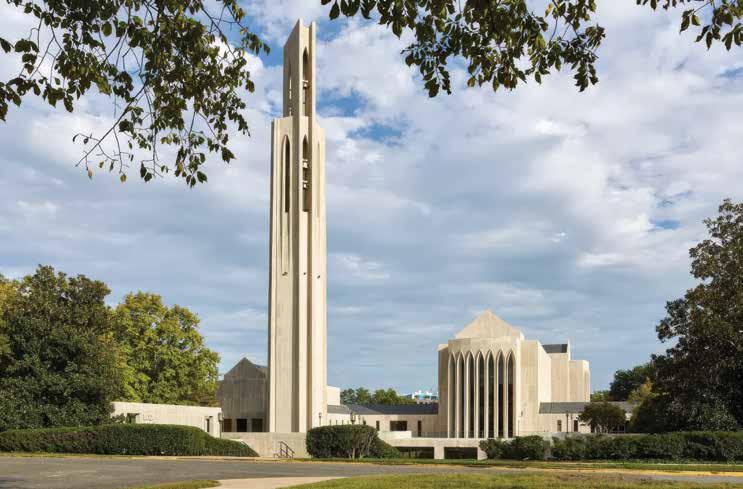
THE CHAPEL OF THE PRESIDENTS AT THE NATIONAL PRESBYTERIAN CHURCH j. theodore anderson
PRESIDENTIAL SITES FEATURE: THE WASHINGTON NATIONAL CATHEDRAL: Intended for National Purposes
jennifer i. wojeck
c.
laurin
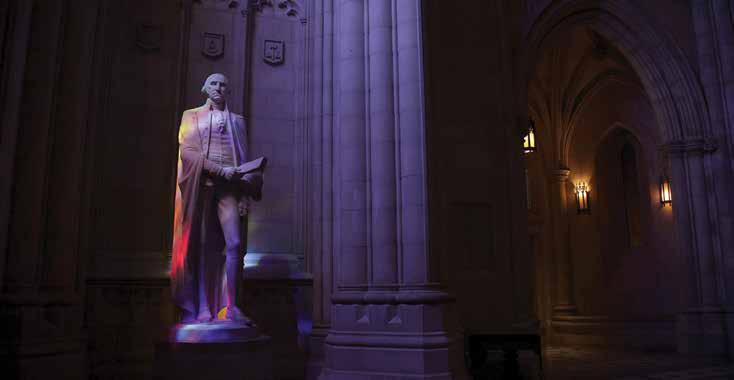
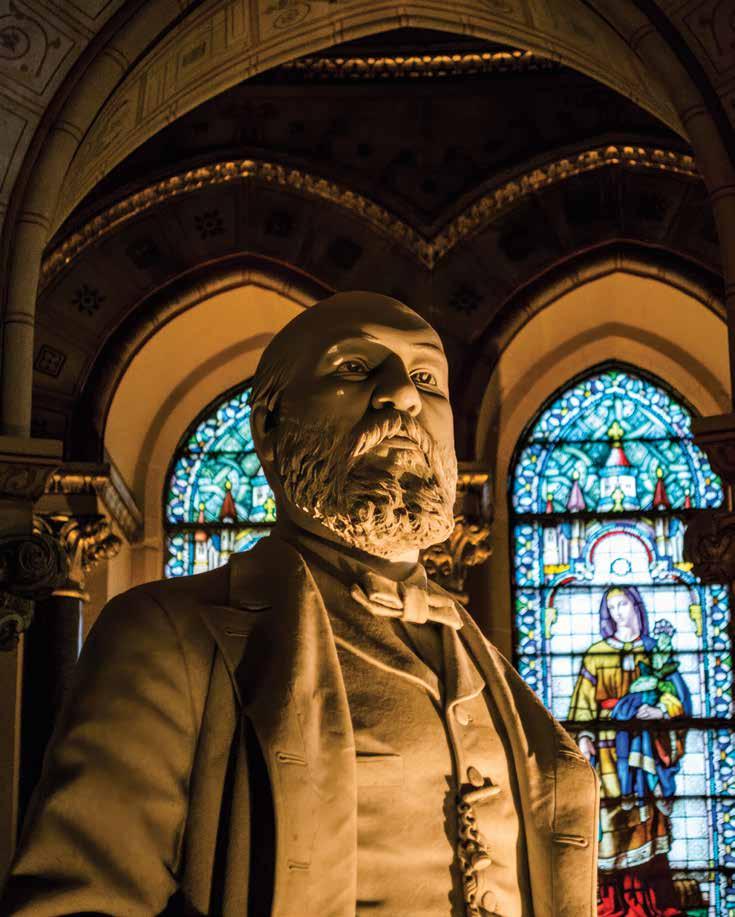
The marble statue of President George Washington by Lee Lawrie is seen in the north transcept of the Washington National Cathedral, 2015.
foreword
Keeping the Faith
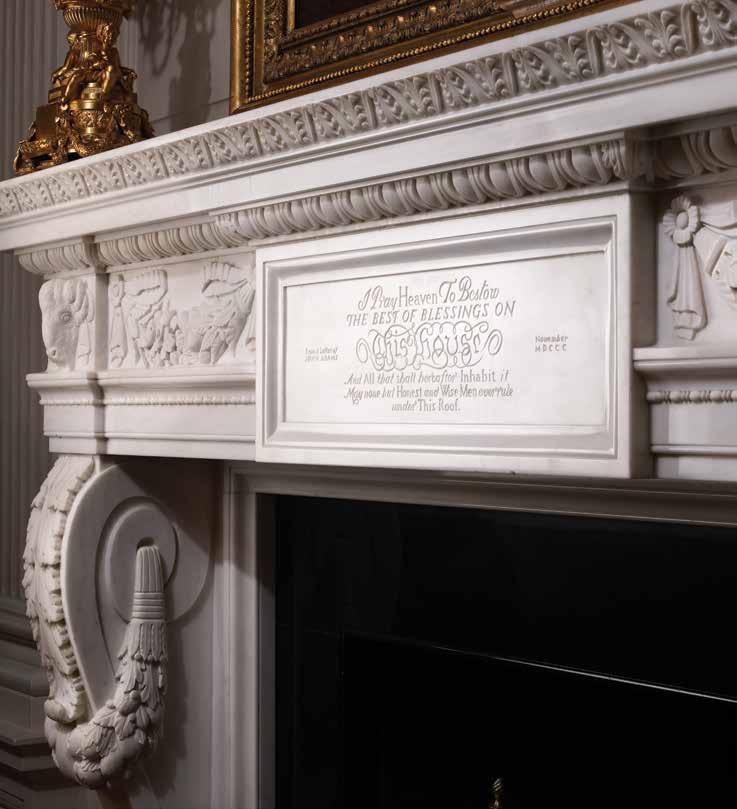
shortly after moving into the new President’s House, John Adams asked Heaven to bless the house and all who would inhabit it thereafter. The oft-quoted prayer, which now embellishes the marble mantel of the State Dining Room, has become a part of the fabric of the house. The presidents have since brought to the house their own hopes and prayers and their own traditions for practicing their faith. With this issue we visit some of the churches where presidents worshipped, preached, taught, celebrated, and mourned as active members or occasional visitors.
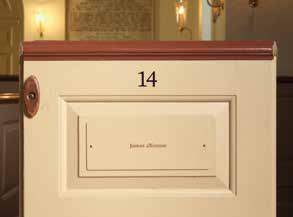
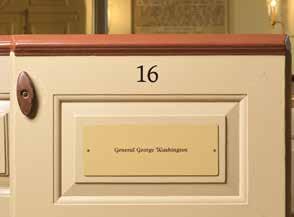
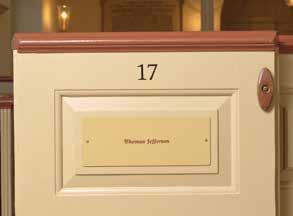
Author Jonathan Stolz opens the issue with a visit to the historic Bruton Parish Church in Williamsburg, Virginia, where early future presidents worshipped even before the United States of America was founded. Later presidents came, as Stolz explains, “to recognize its link with their founding predecessors and its place in the nation’s birth.” George Washington attended the baptism of fourteen of his godchildren here, and pew doors in memory of Thomas Jefferson, James Madison, and James Monroe remind us of the faith of the nation’s Founders.
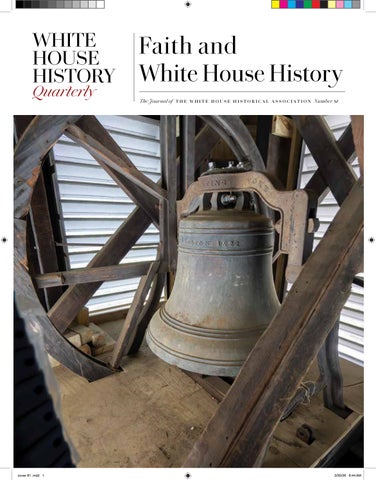
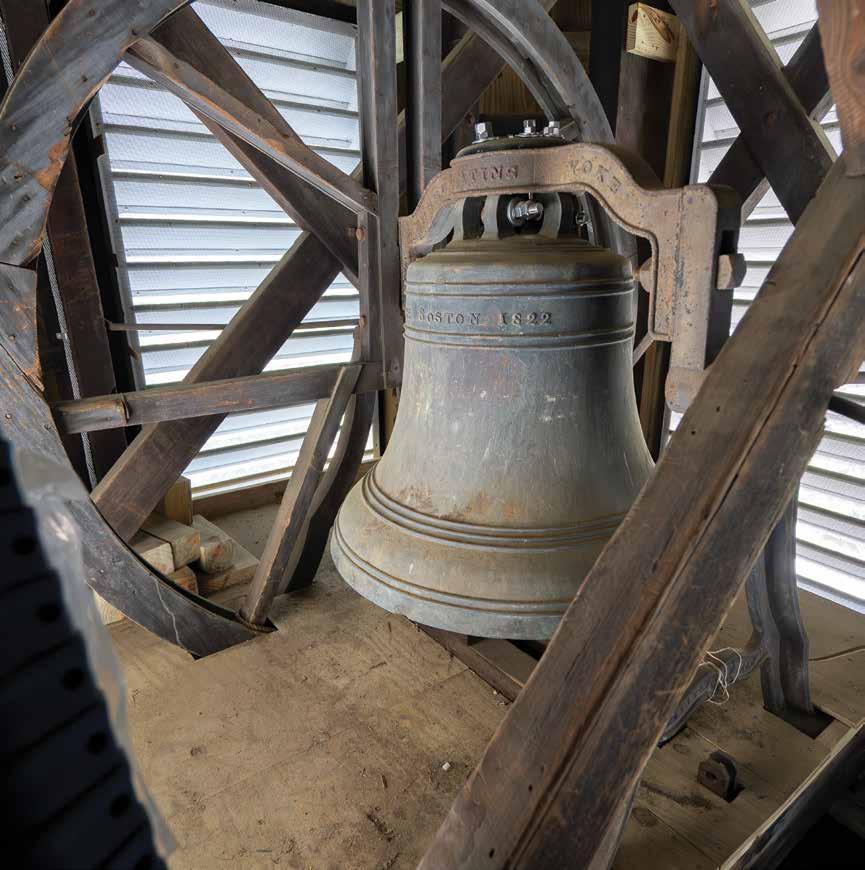
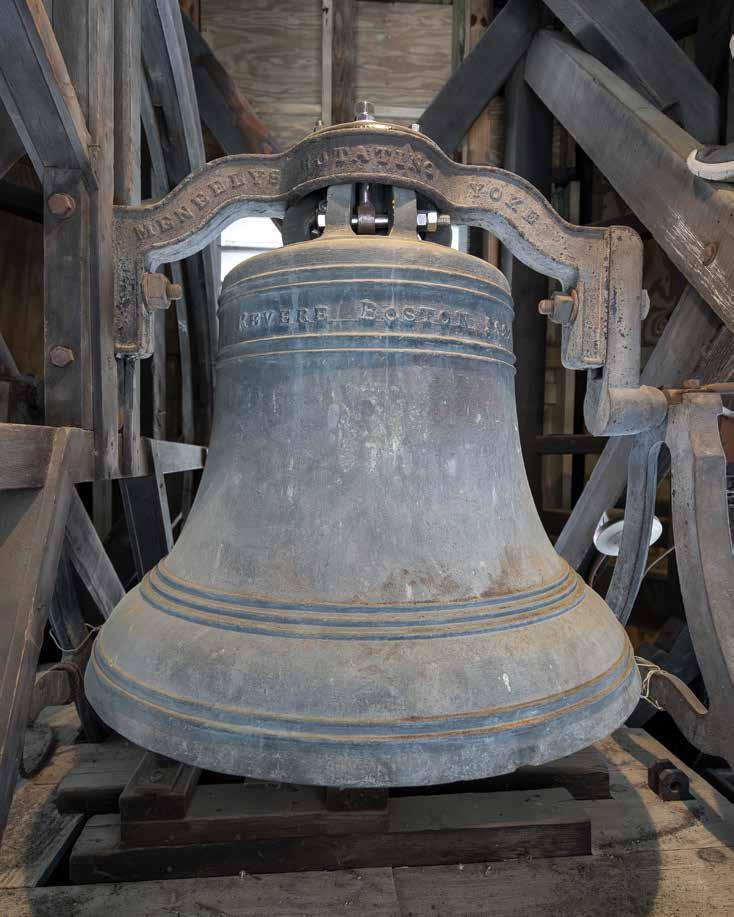
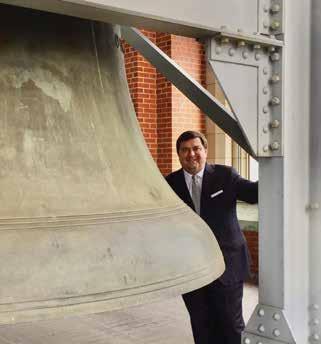
Years later as president, James Monroe supported the effort to add a bell tower to the first church in the President’s Neighborhood, St. John’s on Lafayette Square. Author Richard Grimmett takes us into the bell tower, where the 964-pound Revere bell purchased in 1822 has rung during every presidency for more than two hundred years.
As the city of Washington grew throughout the nineteenth century, more than 135 churches were established, and many welcomed the presidents. Abraham Lincoln, who often worshipped at New York Presbyterian Church or in a back pew at nearby St. John’s, also took an interest in the efforts of Black congregations to build their own houses of worship. Author Anne Slatterly follows Lincoln on commutes to and from the Soldiers’ Home and the White House that took him past the “contraband camps” where he would oftenstop and and join in the prayer and song.
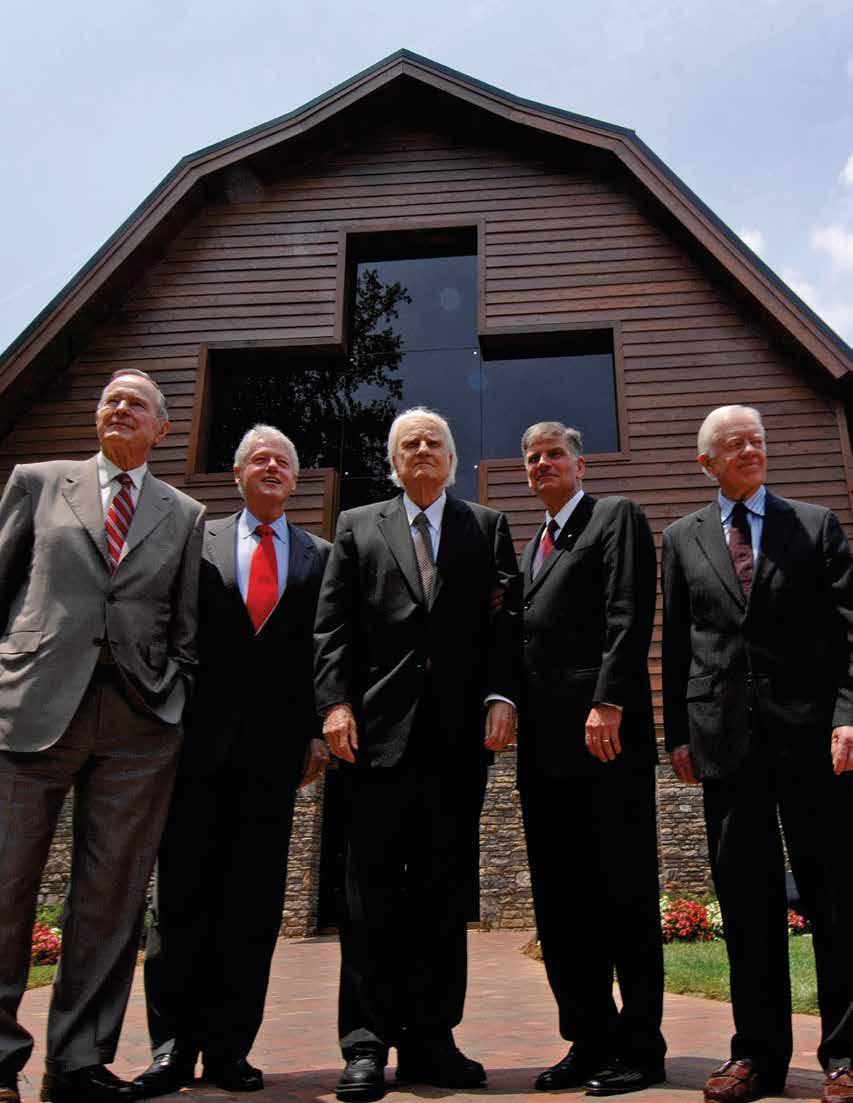
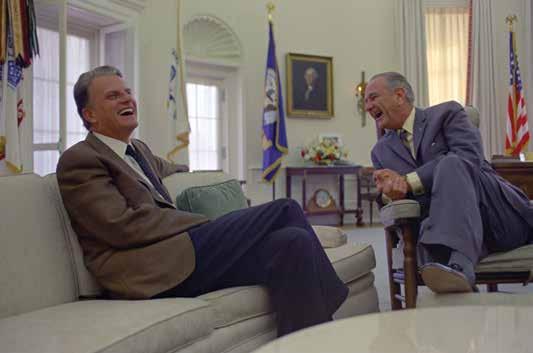
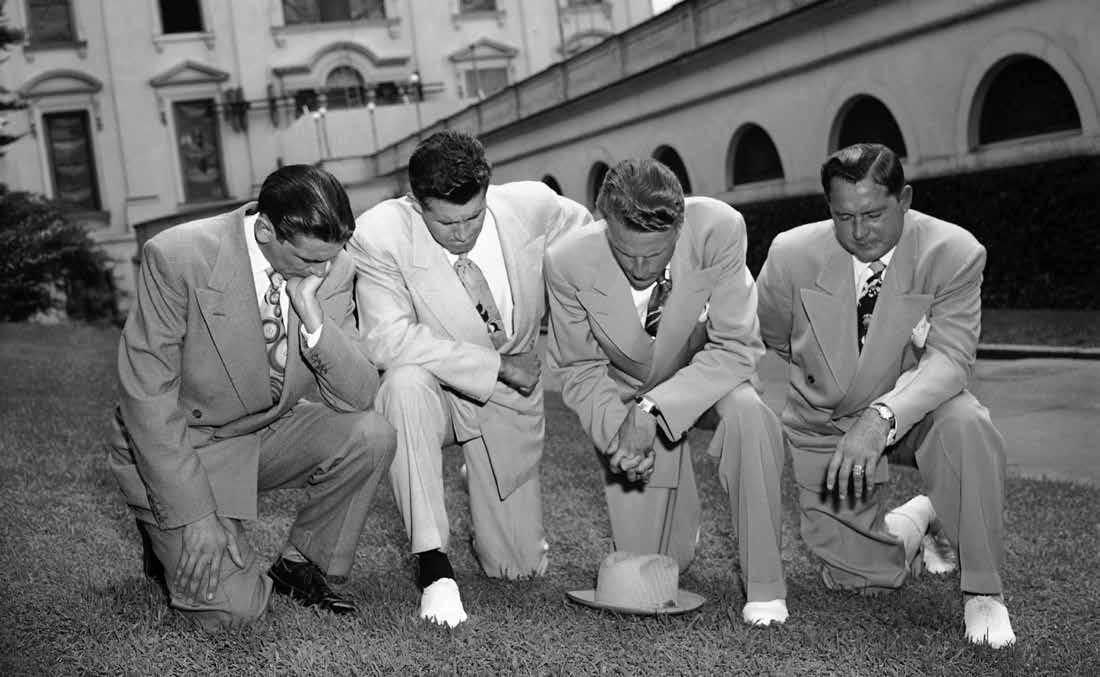
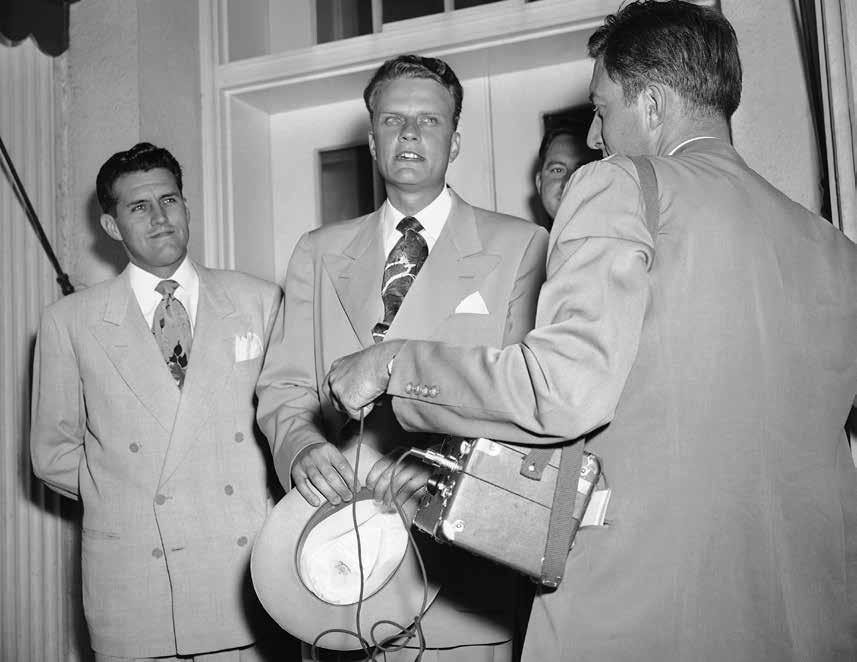
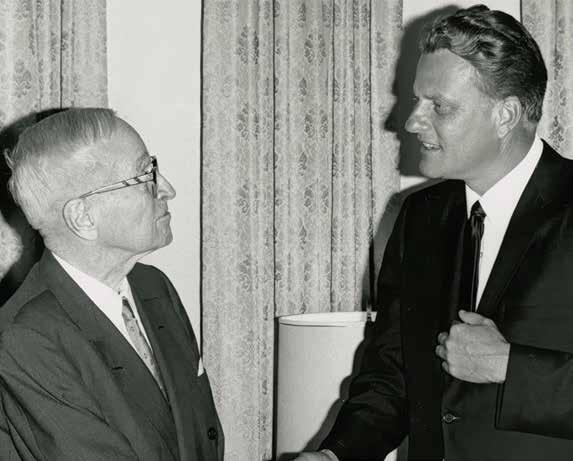
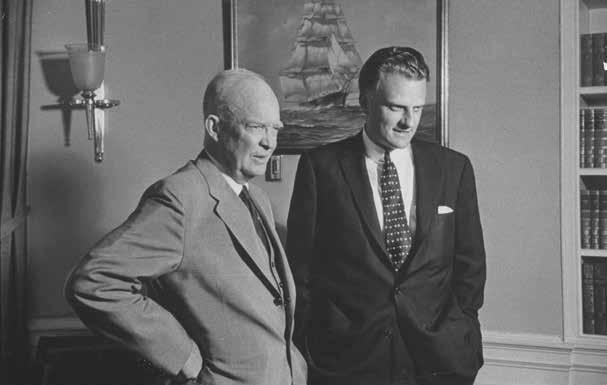
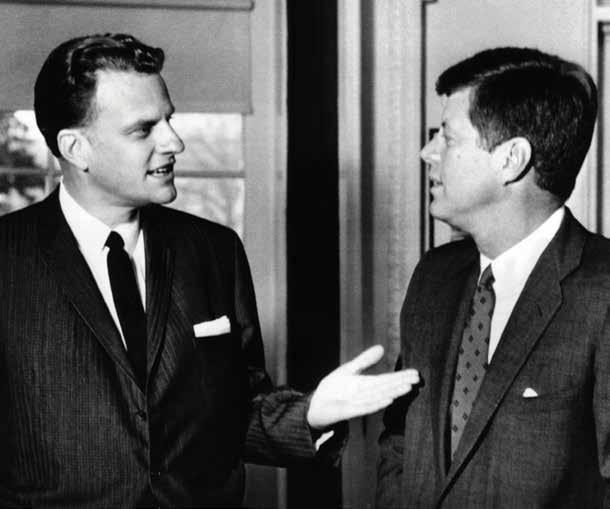
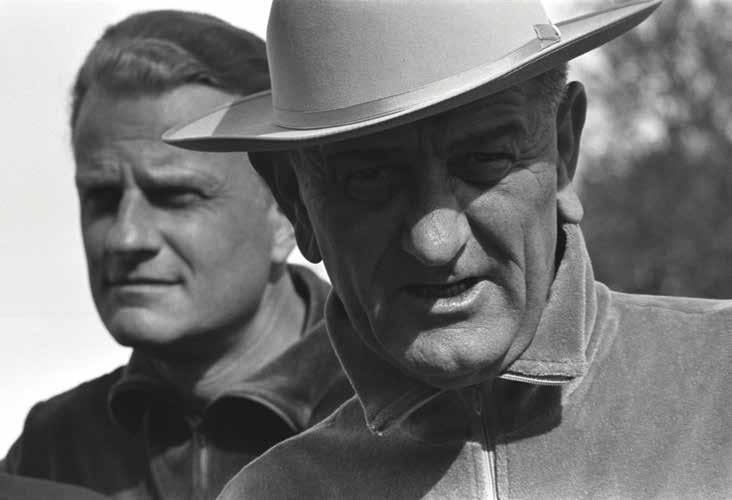
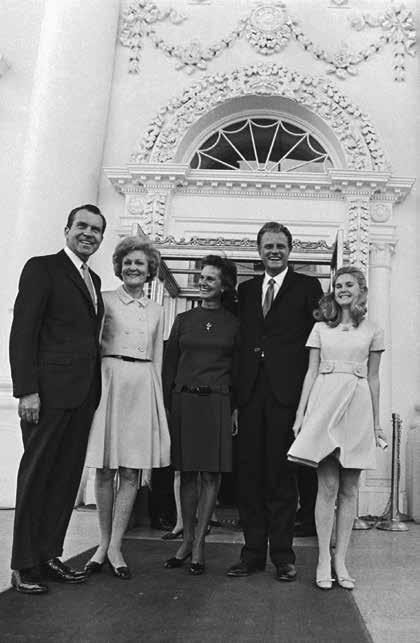
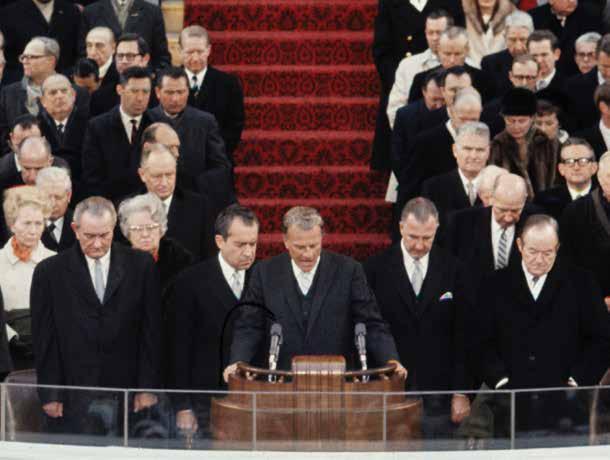
Charlie Goodyear tells the story of James A. Garfield, the only preacher to become president, while Abigail Coker tells the story of Billy Graham, a preacher who supported every president in good times and bad, for
more than half a century. “He became a frequent visitor to the White House,” she explains, “serving as a friend and spiritual adviser. His presence provided comfort and encouragement to the presidents, supporting them in the day-to-day burdens of their position as well as during times of personal and national crisis.”
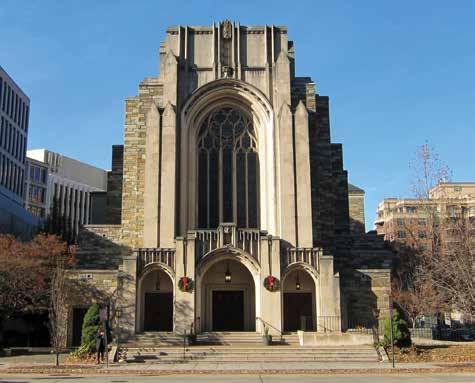
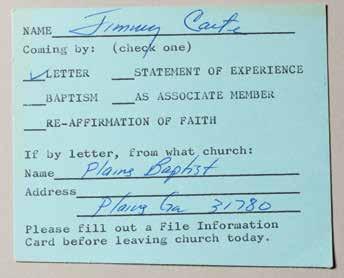
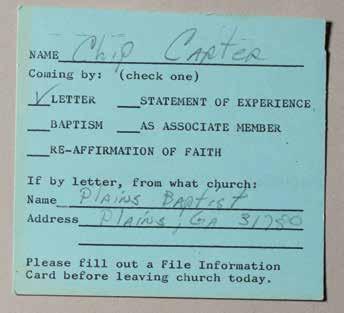
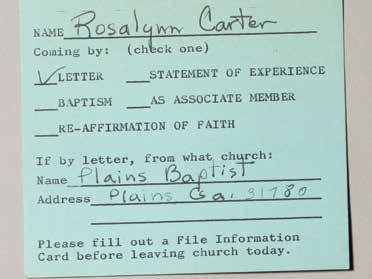
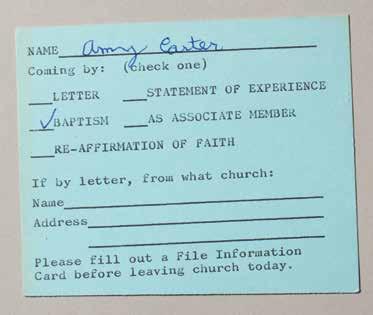
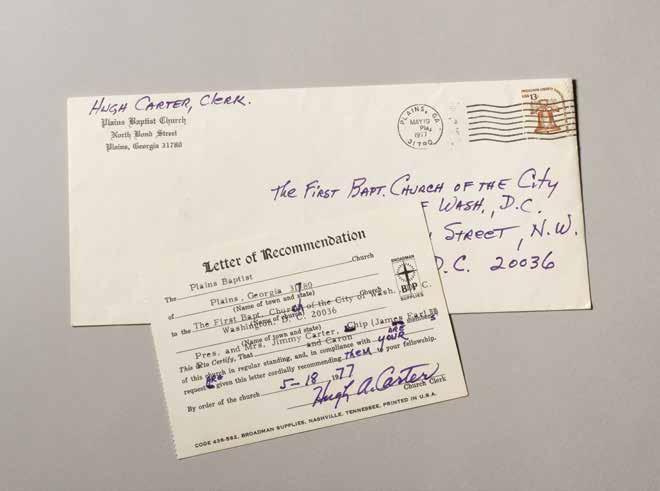
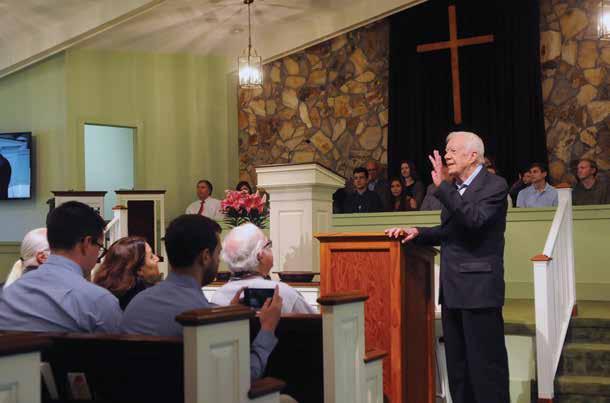
Christi Harlan takes us to First Baptist Church of the City of Washington, D.C., a half mile north of the White House, where President Jimmy Carter is remembered not only as an ordinary member but also as a teacher of the Couples Class, a Sunday school class for adults
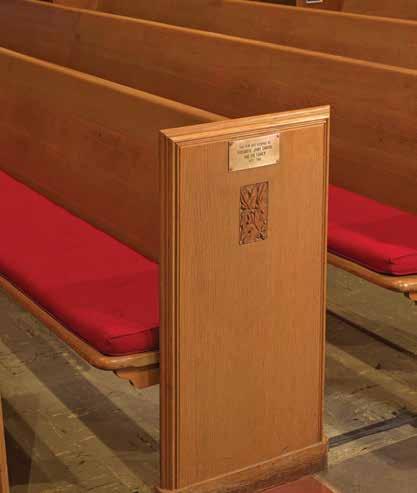
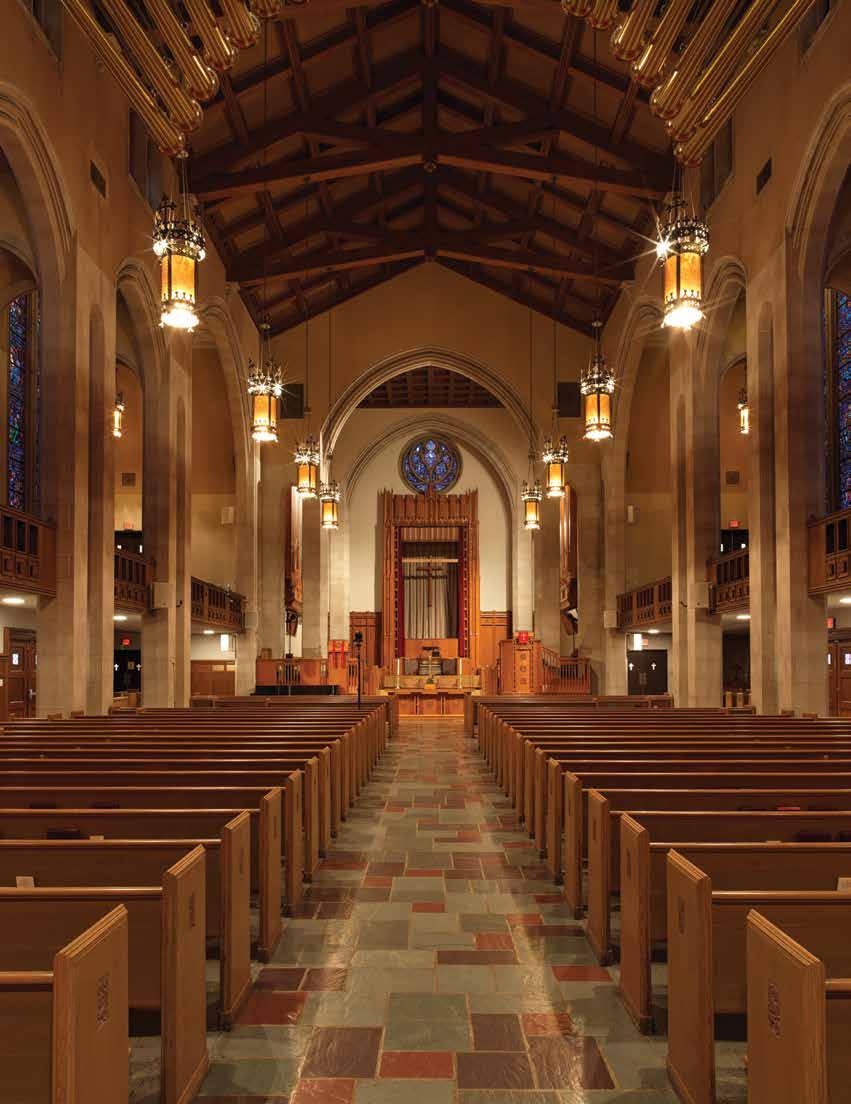
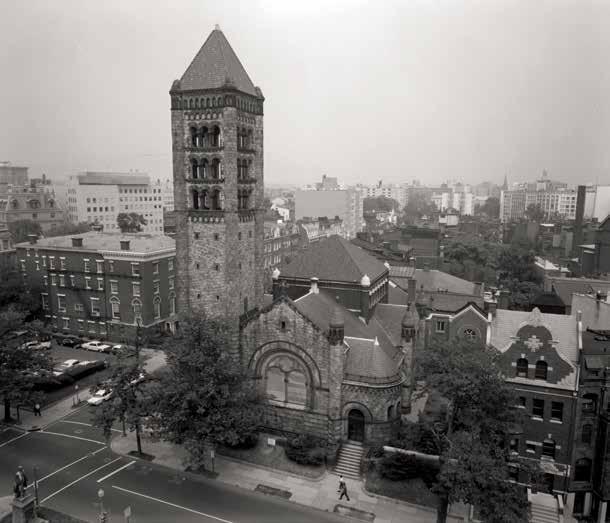
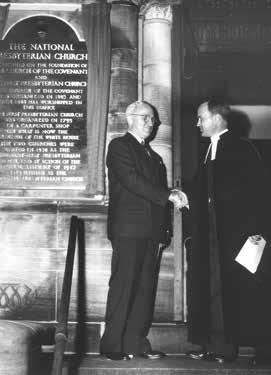
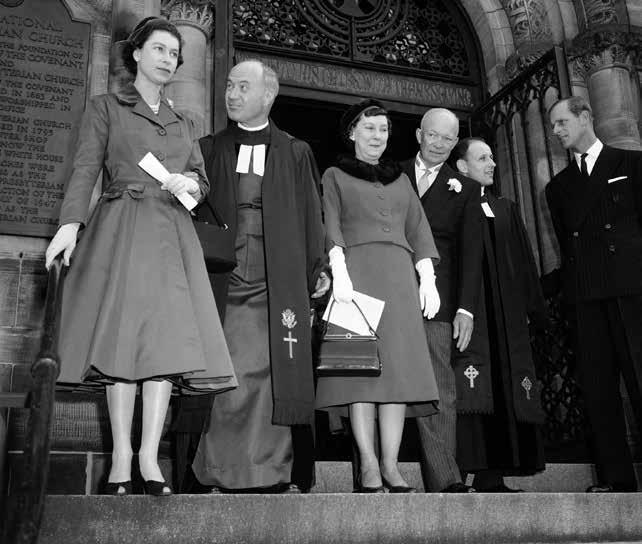
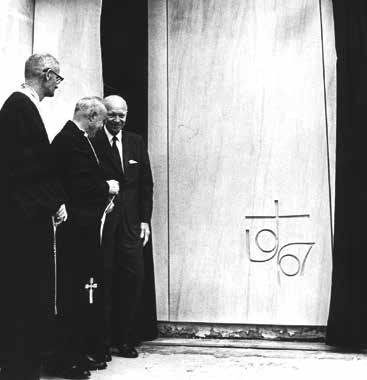
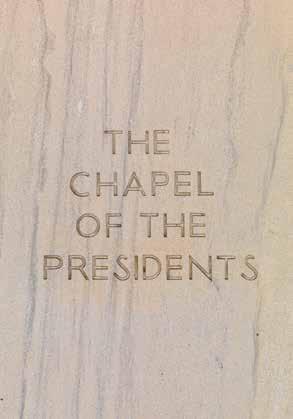
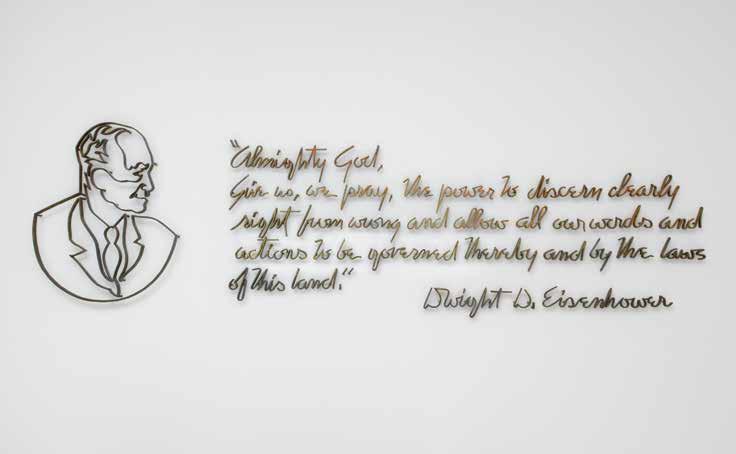
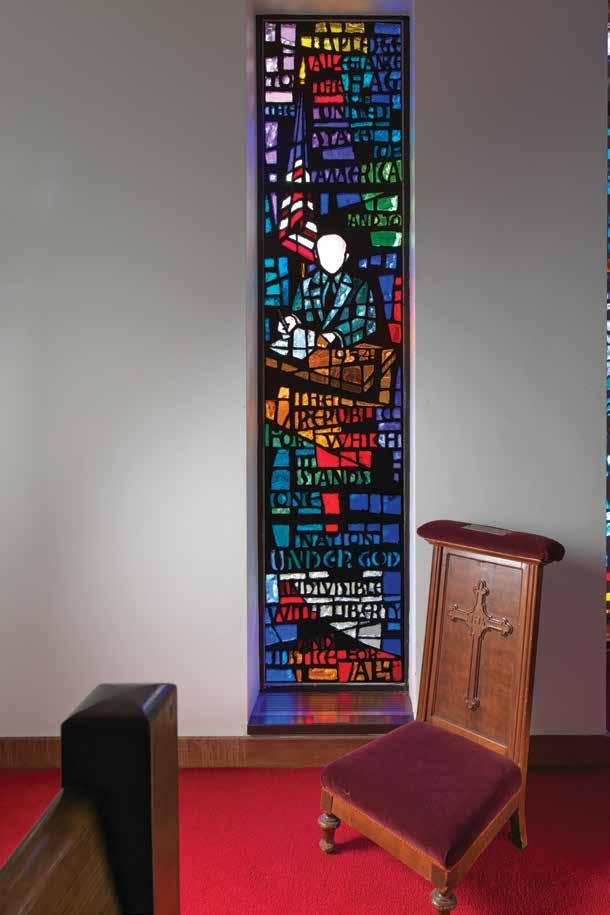
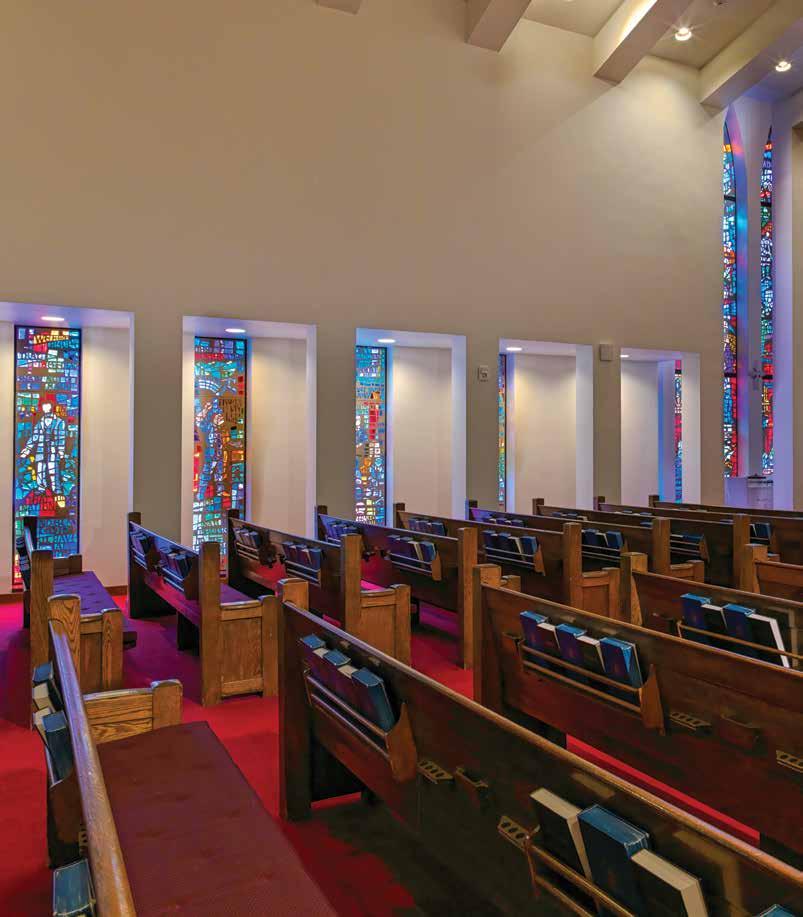
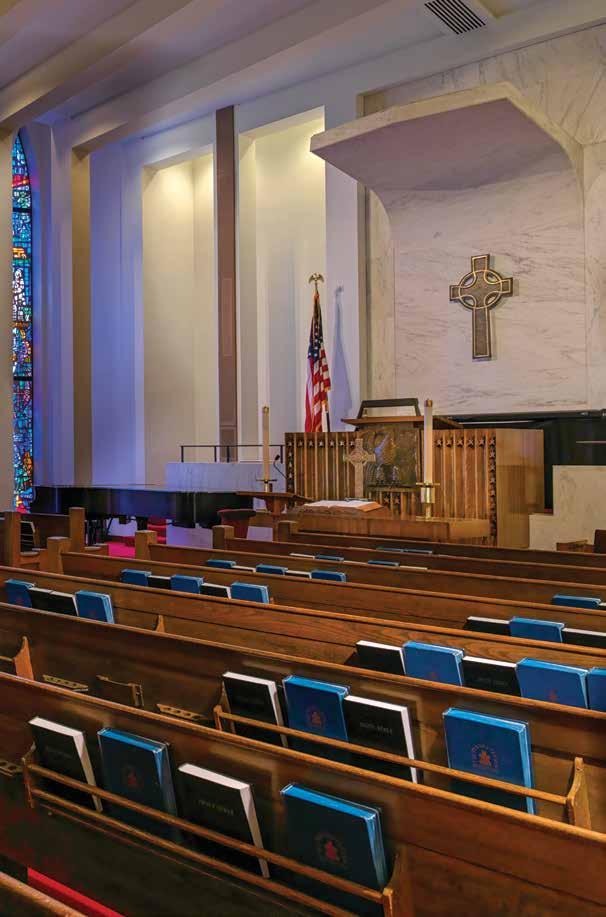
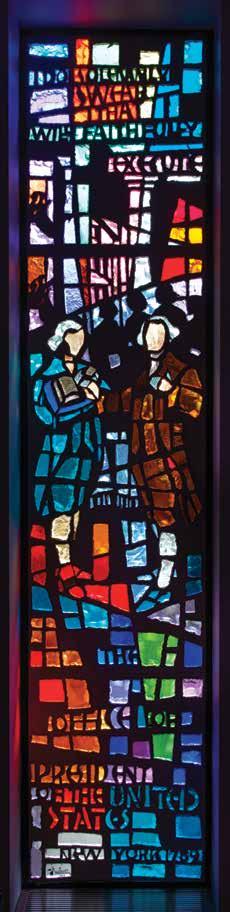
J. Theodore Anderson traces the history of the National Presbyterian Church from the 1790s Carpenter’s Hall on Lafayette Park, which served the builders of the White House, to its present 12-acre campus on Nebraska Avenue NW. He leads us on a visit to the Chapel of the Presidents, which is dedicated to all presidents at the behest of member President Dwight D. Eisenhower, who was baptized there.
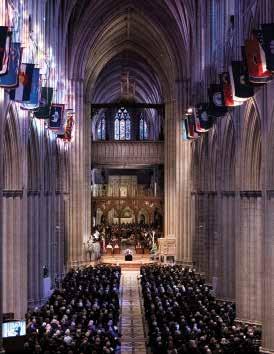
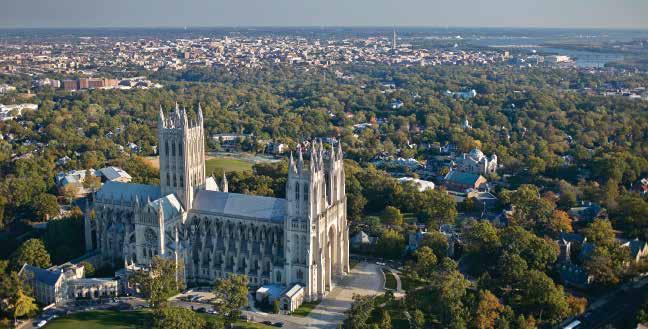
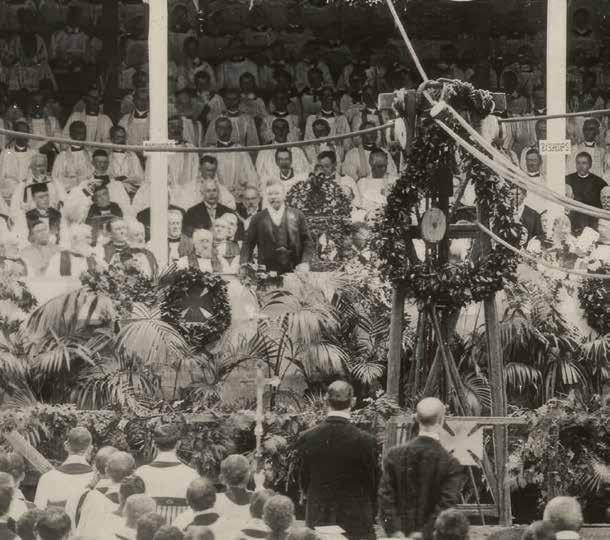
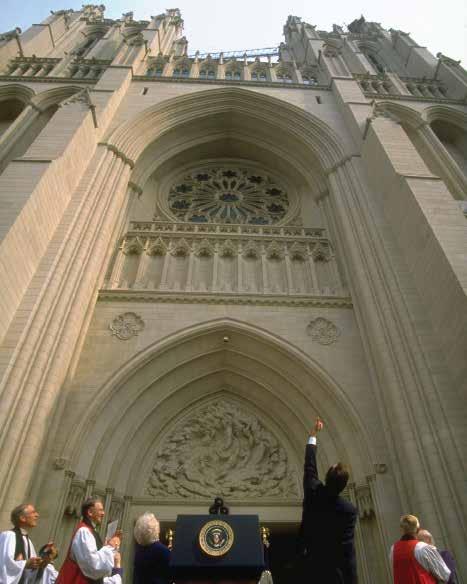
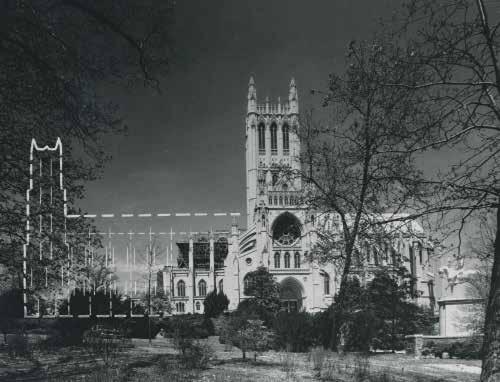
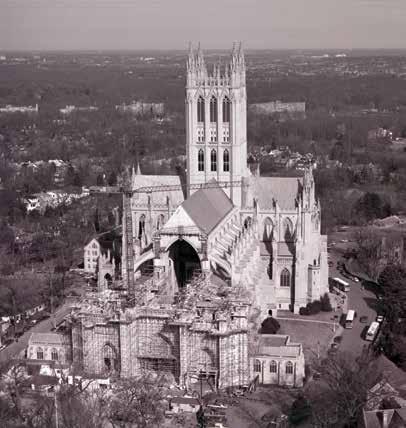
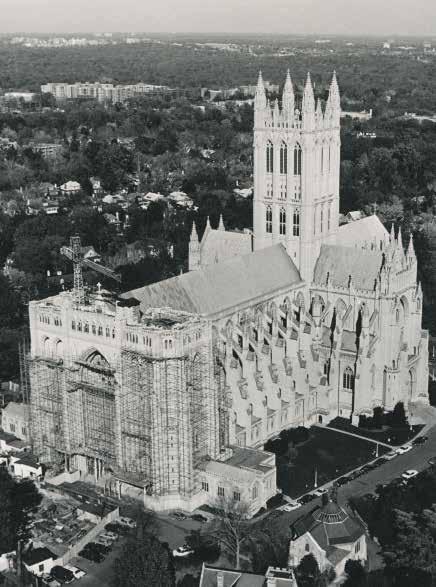
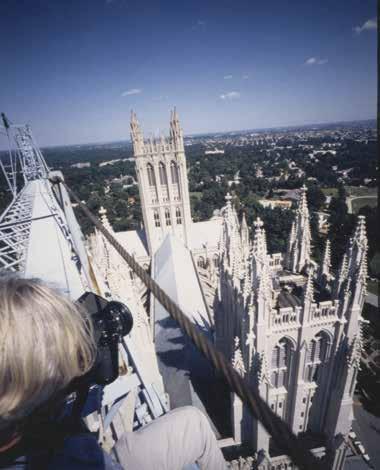
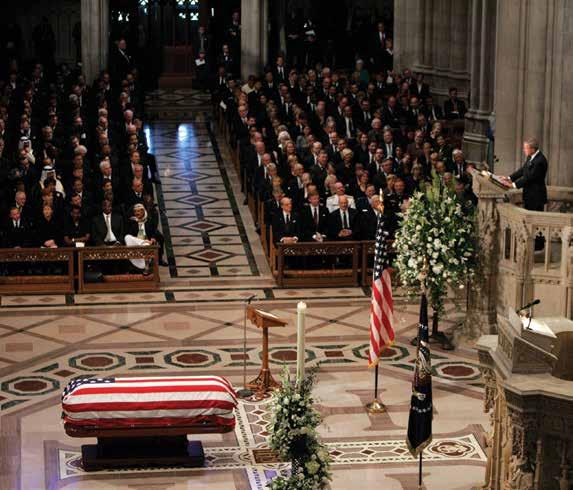
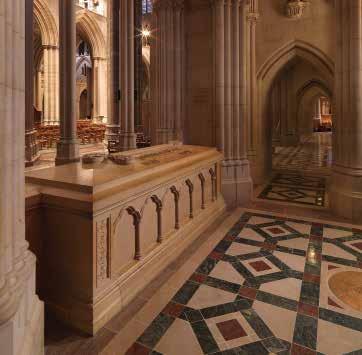
First envisioned in 1791 by city planner Pierre Charles L’Enfant as a church “intended for national purposes, such as public prayer, thanksgivings, funerational orations, &c and assigned to the special use of no particular sect or denomination, but equally open to all,” our presidential site for this issue is the Washington National Cathedral. Author Jennifer Wojeck shares the story of the sixth largest cathedral in the world, where President Woodrow Wilson lays at rest, and where for more than one hundred years presidents have been on hand for ceremonies, public prayer, and worship services.
White House History Quarterly is indexed every ten issues and so with the release of issue number 80 earlier this year an update to the cumulative index began. The new 340 page index includes about 60,000 entries and is fittingly dedicated to the late Cindy Sidey Buck (1956–2025), a member of the Association’s staff with a contagious enthusiasm for each issue of the Quarterly. Cindy delighted in carefully pairing issue themes and articles with the interests of the hundreds of customers and supporters she came to know in her years of service, first in the White House History Shop and more recently in the Development Department.
marcia mallet anderson editor, white house history quarterly
Cut into the face of the State Dining Room fireplace is the benediction of the first president to occupy the White House, John Adams.
Bruton Parish Church and the PRESIDENTS
JONATHAN L. STOLZ
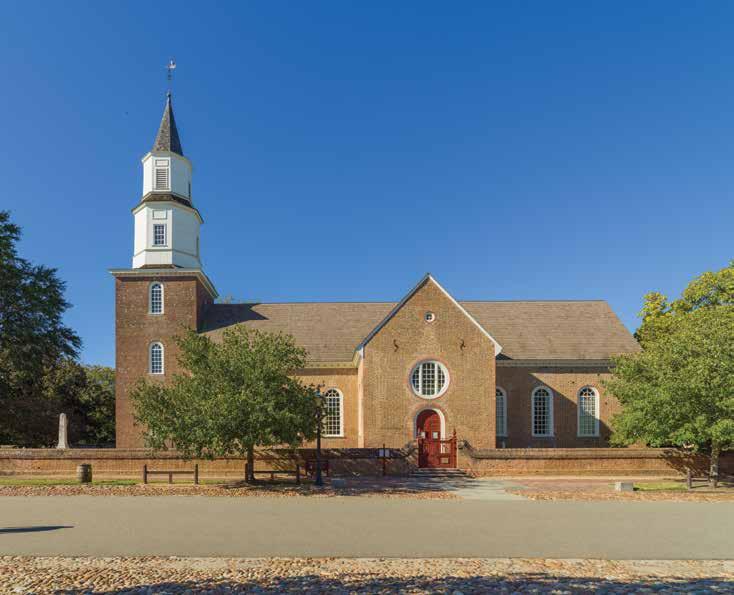
established more than a century before the Declaration of Independence was signed, Bruton Parish Church in Williamsburg, Virginia, is uniquely connected to many who were integral to the United States’ founding. As George Carrington Mason wrote in 1945, “Bruton lay at the very heart of history-in-the-making, and its records are adorned by many of the greatest names of the American Revolution and colonial era that preceded it.”1 Among those who worshipped there were five future presidents and generations of related families who played a role in the country’s formative period. The storied history of Bruton’s genesis, links with presidents, and relationships with other notable individuals who prayed, visited, or were buried in its graveyard highlight how one of America’s oldest Episcopal churches in continuous use is entwined with the nation’s dawn and beyond.
in the New World in 1607. “They brought the English Church with them so naturally that they all assumed it to be established in Virginia as it was in England,” explains Arthur Pierce Middleton.2 The formality of inducting Anglicanism as the state religion occurred with legislation passed by the Virginia Assembly in 1624. The law created various parishes throughout the colony. Each parish, defined as “a geographic unit with boundaries that often coincided with, but never exceeded, those of the county,”3 was to have a government-sanctioned Anglican church that presided over the area. The statute dictated the specifications for governance, which went beyond the expected ecclesiastical duties for the parish’s rector and oversight of the vestry to include responsibility for various civil functions such as education and welfare for the poor within the community.
By 1632 the population had expanded from the original encampment in Jamestown to an area called Middle Plantation. “It was the first major inland settlement of Virginia . . . on a ridge lying between the James and York rivers about a
activities in this locality over its first two decades, a church history reports that “in 1658, Middle Plantation and [neighboring] Harrop parish were combined by an act of the Assembly to form a new geographical parish called Middletown.”5 Two years later, a wooden Anglican chapel was completed in Middletown Parish.
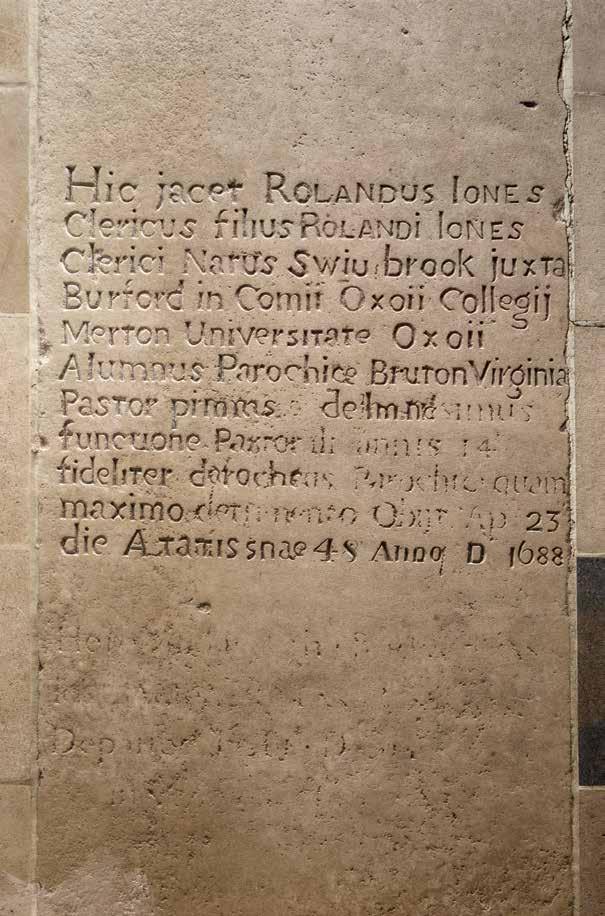
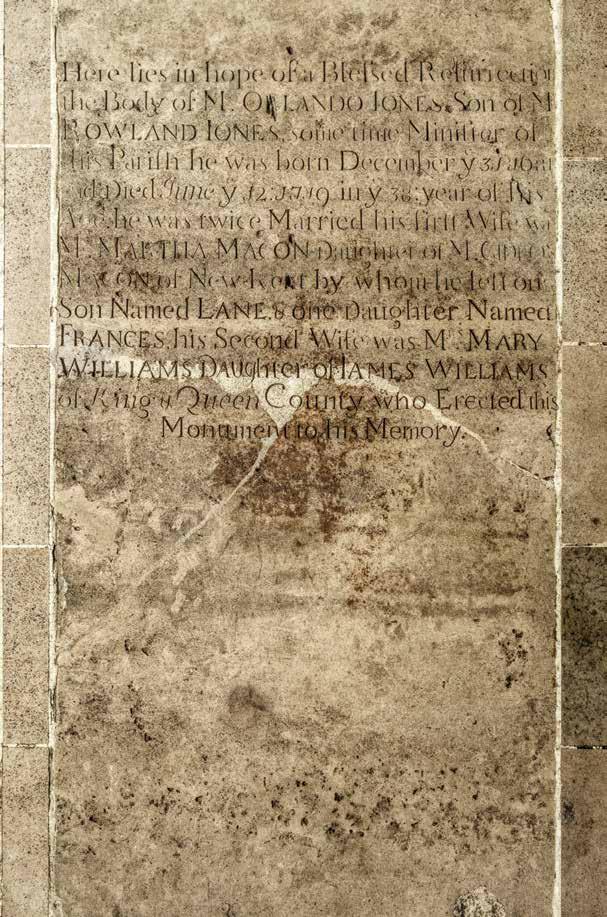
In 1674, Middletown and York County’s Marston Parish were consolidated to form a larger parish named Bruton. The appellation stemmed from Bruton, County Somerset, England, the ancestral home of the royal governor, Sir William Berkeley, and the secretary of the Virginia colony, Thomas Ludwell. 6 Bruton Parish Church’s first rector, Rowland Jones, had been born in England in 1644, attended Oxford, and was a pastor at a small English church before immigrating to Virginia. He faithfully served Bruton Parish Church from 1674 to his death in 1688. His tomb, and that of his son, Orlando, and Orlando’s wife, Martha, are located in today’s Bruton Parish’s chancel, in front of the altar.7
Because the two original churches in the former Middletown and Marston Parishes needed
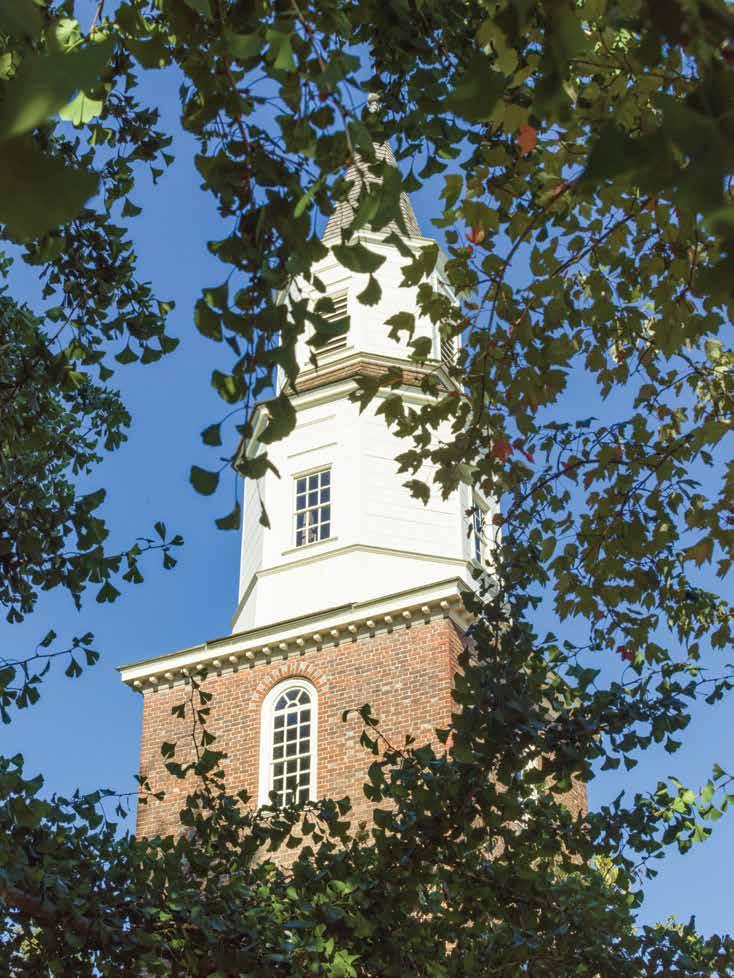
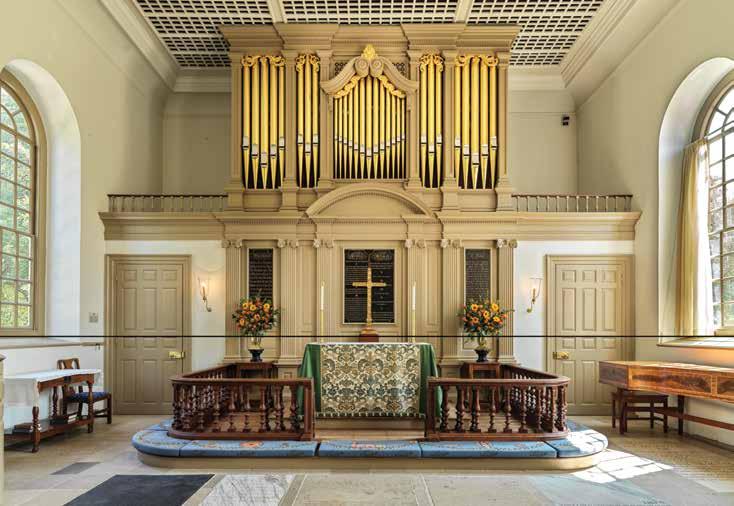
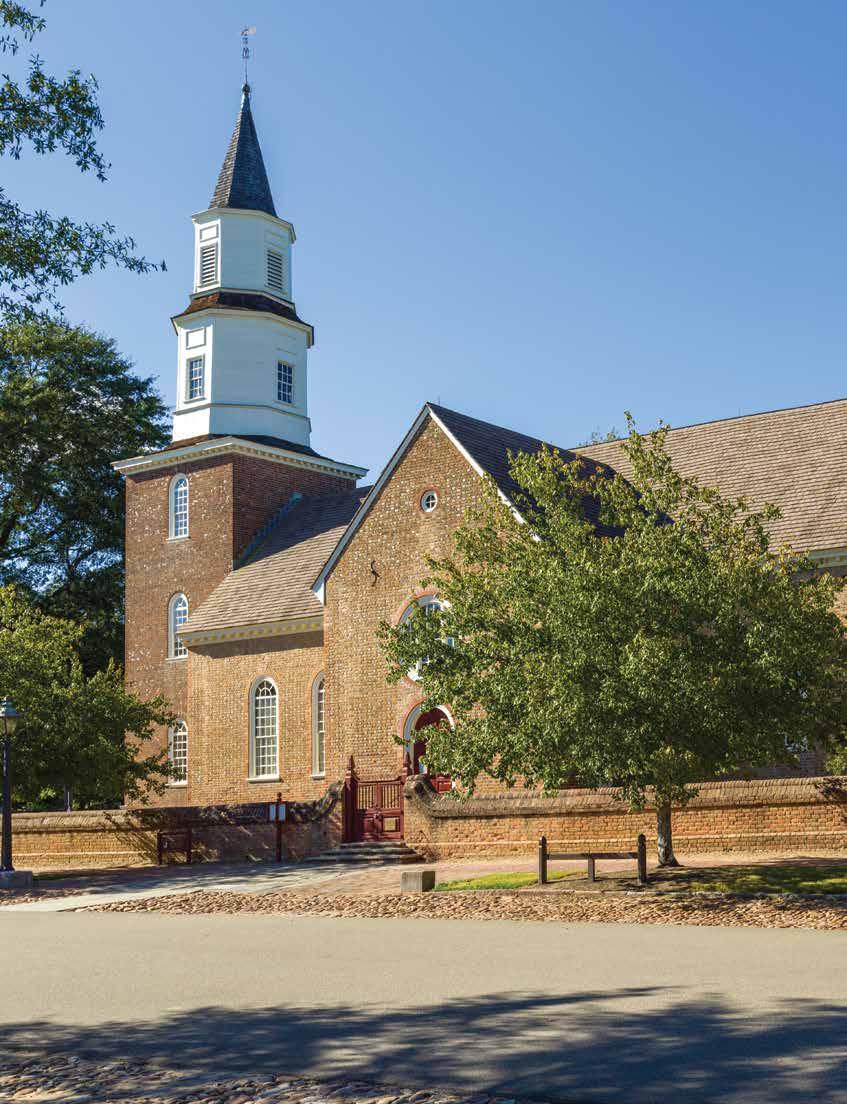
Established in 1674 in Williamsburg Virginia, Bruton Parish Church is seen as it appeared in 2024, on its 350th anniversary. The current brick building was completed in 1715. opposite A view of the altar within the sanctuary of Bruton Parish Church, 2024.
vestry “ordered that neither should be repaired, but that a new church be built with brick.”8 At its dedication in January 1684, those who attended “could justly boast of a building that had few rivals in the colony in terms of its size and ornamental magnificence,” says Lounsbury.9
In 1699, the seat of government moved from Jamestown to Middle Plantation, which was renamed Williamsburg. Thus the brick church became the “court” church of colonial Virginia. William Archer Rutherfoord Goodwin, the man who inspired the restoration of Colonial Williamsburg, reflected, “From this time there grew about the church an environment of ever-increasing interest, and about it gathered an atmosphere which the passing years has caught and reflects the light of other days.”10
The capital’s relocation greatly affected both Williamsburg and Bruton Parish Church. As the population grew,
who attended church services, particularly when the colony’s legislative body, the House of Burgesses, and the General Court were in session. “During the colonial period, those in public office were required to attend church,” explains Diana L. Bailey.11 When the College of William and Mary, which originally started as a seminary, assembled, the students and faculty also filled the pews. The swell of worshippers soon swamped the 1684 structure, and the vestry made plans to construct a larger building.
Bruton Parish’s new cruciform church opened its doors in December 1715. In the course of the eighteenth century many who prayed there led the break from England. Among the worshippers were five men who later became president of the United States: George Washington, Thomas Jefferson, James Madison, James Monroe, and John Tyler.
GEORGE AND MARTHA WASHINGTON
First Lady Martha Washington had two important connections to Bruton Parish Church. She was the great-granddaughter of its first rector, Reverend Rowland Jones. Jones’s son, Orlando, had a daughter named Frances Jones Dandridge, who was the mother of Martha. 12 Martha Dandridge had a second ancestral association with Bruton Parish Church through her first husband. In 1750, at age 18, she married 38-year-old Daniel Parke Custis, who also traced his roots to the founding of Bruton in 1674. His forebear, Daniel Parke, was a church warden alongside Reverend Rowland Jones, Martha’s great-grandfather.13
Daniel Parke Custis’s father, John Custis IV, lived in Williamsburg. He was a member of the House of Burgesses, the Governor’s Council, and the Bruton Parish vestry. Daniel’s early life was plagued by his overbearing father, who “squelched at least two of his courtships,”
according to Lynne Johnson Boller.14
After his initial resistance to his son’s marriage to Martha, she charmed him into giving his approval to the match. Their nuptials occurred shortly after John Custis IV died, and Daniel’s inheritance made him one of the wealthiest men in Virginia.
While the young couple lived in New Kent County, their connections to the Custis family in Williamsburg meant they visited often, especially for social events.15 They likely stayed at the Custis home on Francis Street during these visits. Daniel’s father described the house as being “strong and as high as any in the Government.”16 It was located close to Bruton Parish Church, so the pair, both of whom had a firm faith, likely attended services there, although no records substantiate this.
Martha and Daniel had four children in their seven years of marriage. “It was perhaps in her role as a mother that Martha Custis found the most joy as well as the most sorrow,” observes a writer for George Washington’s Mount Vernon website.17 Only her two youngest, John Parke Custis (known as “Jacky”) and Martha Parke Custis (dubbed “Patsy”) survived into adulthood. Her first two children—Daniel Parke Custis II and Frances Parke Custis II—died before age five. Then Martha’s husband Daniel passed away in 1757, a year after Patsy’s birth. The tombs of Daniel Parke Custis, his two deceased young children with Martha, and Daniel’s mother, Frances Parke Custis (wife of John Custis IV) are today in the Bruton Parish Church graveyard after being reinterred in 1895 from the Custis burial ground.18
Martha remained a widow for only a year and a half. On January 6, 1759, she married Colonel George Washington at her home in New Kent, and then the couple spent three months at Custis Square in Williamsburg. 19 Martha brought to their marriage a very large estate and two small children. The
future president embraced the youngsters as his own and became the guardian to them and to Martha’s future grandchildren.
These months in Williamsburg were one of at least fifty-five sojourns Washington made to Virginia’s colonial capital between 1752 and 1774.20 With a strong spiritual heritage of churchmen including a great-great-grandfather who was a minister in the Church of England,21 Washington likely attended Bruton Parish Church during those many stays. While there is testimony to his attendance at many churches later in life, only one direct personal reference for participating at a Bruton service exists. It occurred on June 1, 1774.
In May 1774, Washington was in Williamsburg as a member of the House of Burgesses. Shortly after the members assembled, information arrived that, by an act of Parliament, the port of Boston would be closed on June 1. On May 24, the Burgesses reacted by passing an order that the first day of June should be set apart as a “day of fasting, humiliation and prayer.”22 A brief entry in Washington’s diary at that time said: “‘June 1st, Wednesday,— went to church, and fasted all day,’ thus conforming not only to the spirit, but to the strict letter of the order,” explains historian William J. Johnson.23 opposite
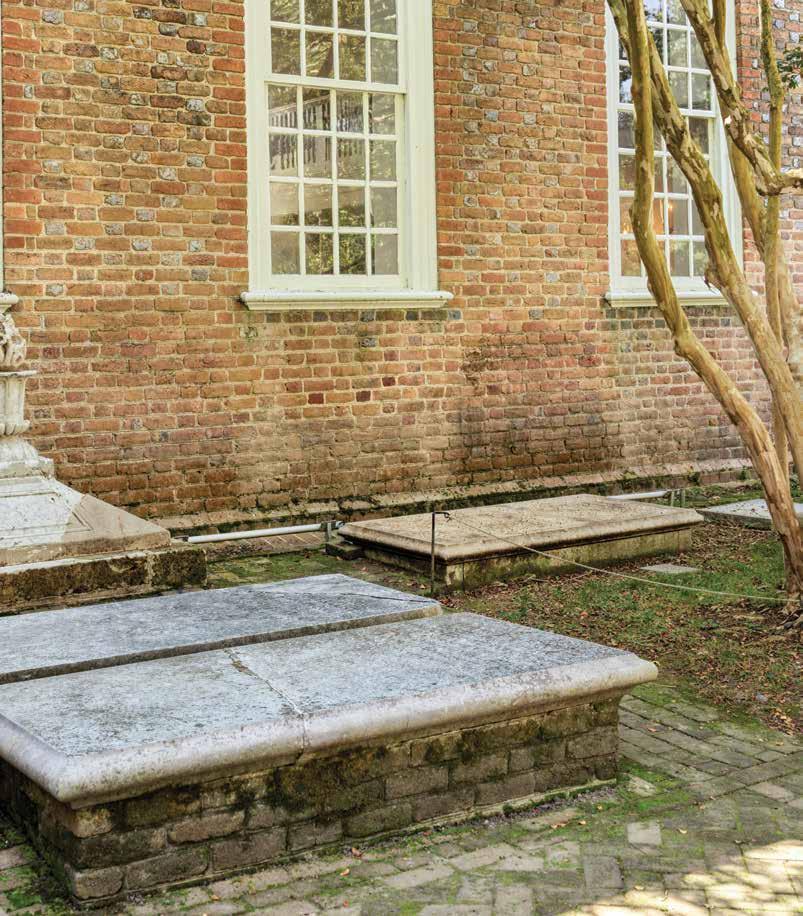
An eternal flame embellishes the tomb of Daniel Parke Custis (1711–1757), the first husband of the future first lady, Martha Dandridge Custis Washington. To the right is Daniel’s mother, Frances Parke Custis, who died in 1715 at age 29. The tomb of two of his children with Martha, Daniel (1751–1754) and Frances (1753–1757), is at center.
left
The ledger stone from the tomb of Rowland Jones, the great grandfather of First Lady Martha Washington and the first rector of Bruton Parish Church, was moved inside the church from the graveyard in 1905 to protect it from further damage from the weather. Although much of the more than three-hundred-year old Latin epitaph has worn away, the translation of the surviving text concludes, “He performed his pastoral duty for fourteen years faithfully . . . for the Parish . . . a great loss. He died on April 23 at age 48 in the year of our Lord 1688.”
right
The ledger stone of planter Orlando Jones, the son of Rowland Jones, was also moved inside the church from the graveyard in 1905. His daughter, Frances Jones Dandridge, was the mother of the first first lady, Martha Dandridge Custis Washington. The epitaph begins, “Here lies in hope of a Blessed Resurrection the Body of M. Orlando Jones.”
THOMAS AND MARTHA JEFFERSON
Unlike Washington, who was said to be “reluctant to reveal his religious convictions” publicly,24 Thomas Jefferson was “among the most eloquent and forceful of the Founders on the fraught subject of religion,” says historian Jon Meacham.25 While Jefferson disagreed with some of the fundamental theological tenets of the Church of England in which he was raised, he regularly attended services and participated in responses and prayers in many different places of worship,26 including Bruton Parish Church.
In 1760, at age 17, Jefferson enrolled at the College of William and Mary in Williamsburg.27 The school had a very close connection with Bruton Parish Church prior to the American Revolution. During this era, all but one of Bruton’s rectors also served as president of William and Mary. It is no surprise that Jefferson and his fellow classmates were compelled to take part in a Sunday service at Bruton. Goodwin explained, “The students of the College, accompanied by one of the Masters, attended Bruton Parish Church, where the gallery in the west end was assigned to them, into which, by order of the Vestry, they were securely locked, and there they carved their names, which may be
seen today, and doubtless dreamed of religious liberty.”28
After finishing his courses at William and Mary, Jefferson stayed in the capital to study law under George Wythe. He was admitted to the Virginia bar in 1767 and began his career as young country lawyer. Subsequently, in the 1770s, he was in Williamsburg as a member of the House of Burgesses, 29 and, as members were obligated to attend church, he would have worshipped at Bruton. During this time Jefferson courted a young 22-year-old widow and heiress, Martha Wayles Skelton. Following the death of her first husband, she was living at her childhood home near Williamsburg. They were married on New Year’s Day 1772.
In their first years of marriage, Martha may have traveled with Jefferson to Williamsburg when the House of Burgesses was in session and attended Bruton with him, although there is no known documentation to prove it. Later, when Jefferson was governor, she briefly left Monticello and joined him in Richmond as Virginia’s first lady after the capital was moved there from Williamsburg in 1780.30 Through much of Martha’s ten-year marriage to
below
A view of the balcony where future President Thomas Jefferson frequently sat with his classmates at the College of William and Mary.
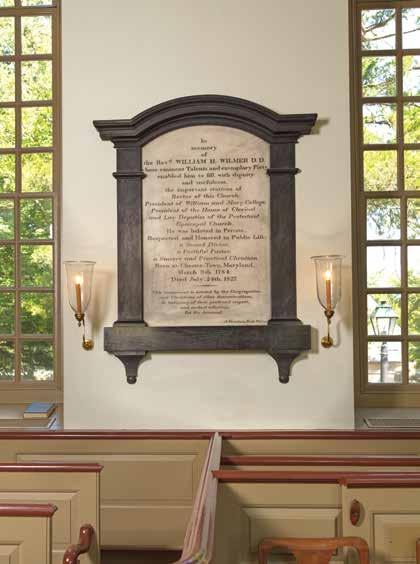
A marble memorial to Reverend William Holland Wilmer (1784–1827) is displayed on the wall of Bruton Parish Church. Before coming to Williamsburg to serve as the twelfth rector of Bruton Parish Church and the president of the College of William and Mary, Wilmer was the first rector of St. John’s Episcopal Church on Lafayette Square during the presidency of James Monroe.
Jefferson, “she was either pregnant, nursing, grieving the death of an infant or sick herself from the complications of childbirth,” writes John Hamilton Works Jr.31 She had six children, but four died in infancy. When Martha died on September 6, 1782, Jefferson suffered a deep depression.
JAMES MADISON
James Madison’s presence at Bruton Parish Church was rare compared with Thomas Jefferson’s, in large part because Madison matriculated at the College of New Jersey (now Princeton)32 rather than the College of William and Mary. He studied there due to his father’s concerns “that the tidewater of Virginia was unhealthy,” say scholars at Thomas Jefferson’s Monticello, “and because of disagreements with the Anglican establishment that controlled the Virginia college.”33
In 1776, 25-year-old Madison traveled to
Williamsburg for the first time as a newly elected member of House of Burgesses. There, his introduction to Thomas Jefferson sparked a lifelong friendship. Madison likely joined Jefferson and the other delegates in the established protocol of worshiping at Bruton during the lawmaking sessions. This may have been an unusual occurrence for Madison according to one historian, who noted, “he was not conscientious about attending church services while away from home.”34
After the Revolution, Madison tied himself to the Episcopal Church, the successor to the Church of England in America. He was married to Dolley Payne Todd by an Episcopal priest and regularly participated in Episcopal services when president. The Episcopalian liturgy was used at his funeral. Yet Madison kept his religious beliefs private. According to Darrin Grinder and Steve Shaw, he never made a public profession of faith or “identified himself as Episcopalian . . . or became a full communicant in the church.”35
JAMES MONROE
Bruton Parish Church and the Episcopal denomination were important to James Monroe throughout his life. At age 16 he enrolled in the College of William and Mary where he “was required to attend not only daily morning and evening prayer in the College chapel in what is today the Sir Christopher Wren Building,” writes historian David L. Holmes, “but also Sunday worship at neighboring Bruton Parish Church.”36 While he was an active participant in the Episcopal Church during his seventy-three years, “Monroe was silent about his personal religious beliefs, at least in the extant records,” says Holmes.37 Holmes suggests that Monroe was a cradle Episcopalian with “deistic tendencies who valued civic virtues over religious doctrine.”38
When he was president, Monroe regularly attended St. John’s Episcopal Church located just north of Lafayette Square in clear view of the White House. Today it is known as “The Church of the Presidents.” The first rector, Reverend William Holland Wilmer, had an affiliation with Bruton Parish Church. In 1826, Wilmer accepted the presidency of the College of William and Mary and the twelfth rectorship of Bruton Parish.39 He died the following year. His marble ledger tombstone is located in Bruton’s chancel.40
opposite
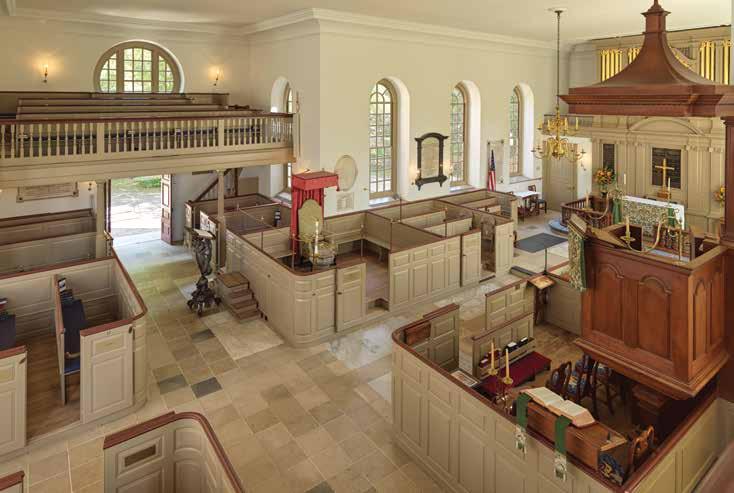
Top: A view from above the Bruton Parish Church transept captures the Rector’s Pew (far right) and Governor’s Pew (top center).
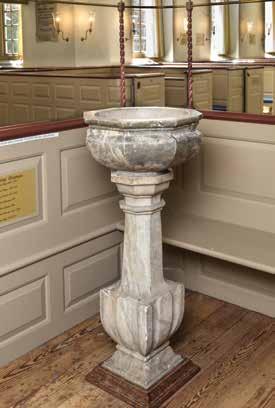
Bottom left: The baptismal font, located within the Governor’s Pew, is tentatively dated to 1675–1700. George Washington stood before this stone font as a godfather on fourteen occasions.
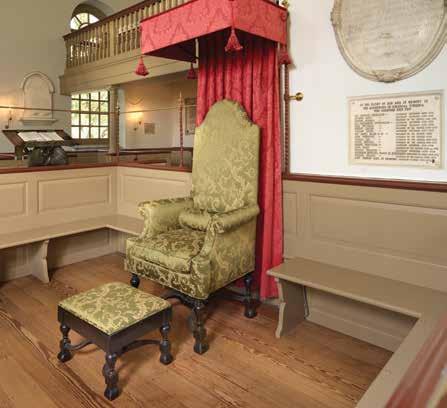
Bottom right: From 1698 to 1775, as detailed on the marble wall plaque, the throne-like chair within the Governor’s Pew was used by seventeen of Virginia’s colonial governors prior to the declaration of America’s independence. The Governor’s Palace, just two blocks north of Bruton Parish Church, was the official residence of the royal governors from 1722 until 1775.
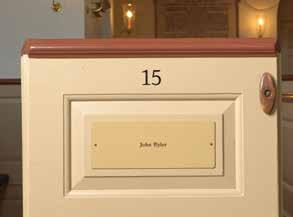
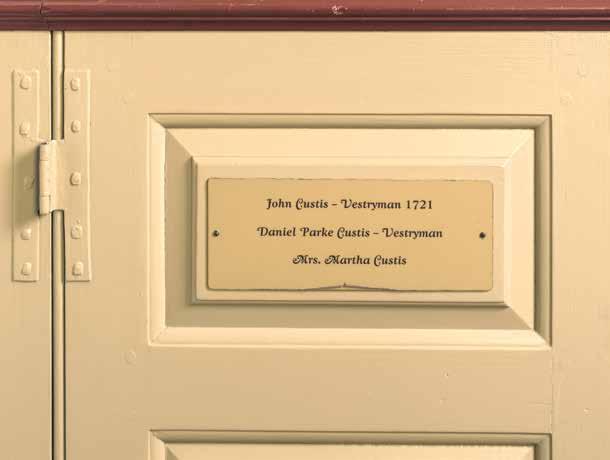
Early U.S. presidents who regularly worshipped at Bruton Parish Church are remembered today by pew doors bearing their names. Also remembered are the first first lady, Martha Dandridge Custis Washington, her father-in-law John Custis, and her first husband Daniel Parke Custis.
right
JOHN TYLER
In 1790, John Tyler, who would be the tenth U.S. president, was born into a prominent Episcopalian family whose English lineage can be traced to six teenth-century Williamsburg. An early ancestor, Henry Tyler Sr., was the original grantee of the land where the Governor’s Palace would be built. and his son were both members of Bruton Parish Church’s vestry.
At age 12, Tyler entered the preparatory depart ment of the College of William and Mary, where his father had graduated and roomed with Thomas Jefferson. As a student, young John Tyler regularly attended services at Bruton, but on one occasion, not to pray. In 1807, during college exercises held at the church, Tyler delivered his graduation address on the topic “Female Education.” Years later his son, Lyon G. Tyler, related the story about his father’s oration. It was given under the direction of William and Mary’s president, Bishop James Madison, the U.S. president’s cousin. Prior to the presentation, Madison reviewed Tyler’s draft and objected to several high-strung sentences. He told his student that he would be standing at the back of the church and would signal with his hands and cane when offensive passages should be omitted. Much to Madison’s chagrin and annoyance, Tyler ignored the gesticulations and continued his remarks without any alterations. Madison was furious with Tyler’s recalcitrance, but when the audience gave Tyler an ovation, Madison conveniently forgot his prior qualms and called it the finest student speech ever delivered within his recollection.
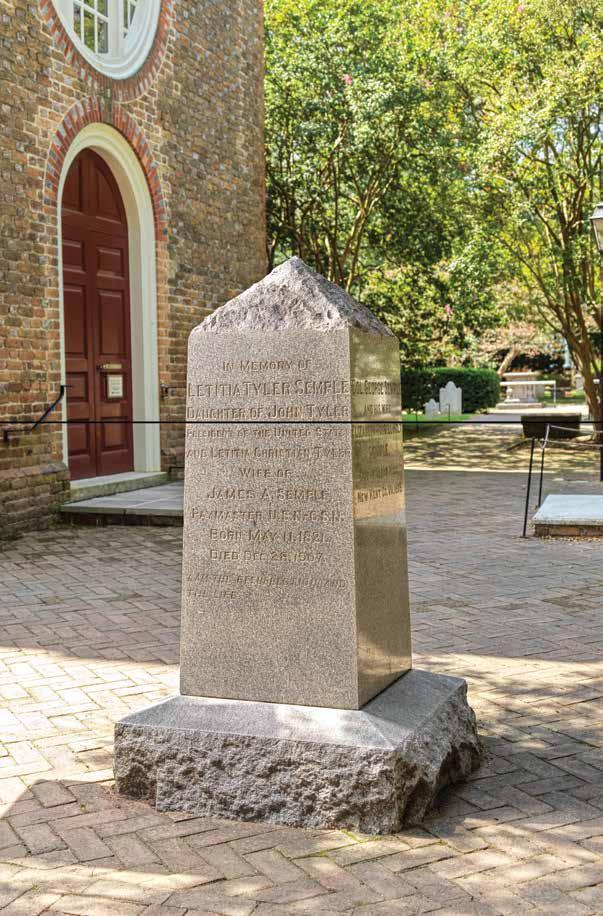
Tyler married twice and fathered fifteen chil dren. His first wife, Letitia Christian Tyler, was the first first lady to die while her husband was in office. Between that time, September 1842, and Tyler’s marriage to Julia Gardiner in June 1844, his daughter-in-law Priscilla Cooper Tyler and daugh ter Letitia (“Letty”) Tyler Semple were hostesses at the White House. Letty Semple died in poverty in 1907, evidently “blind, infirm but mentally virile,” in the Louise Home, a philanthropic institution just a few blocks from the White House. A noble obelisk marks her tomb in Bruton Parish Church’s graveyard.
opposite and right
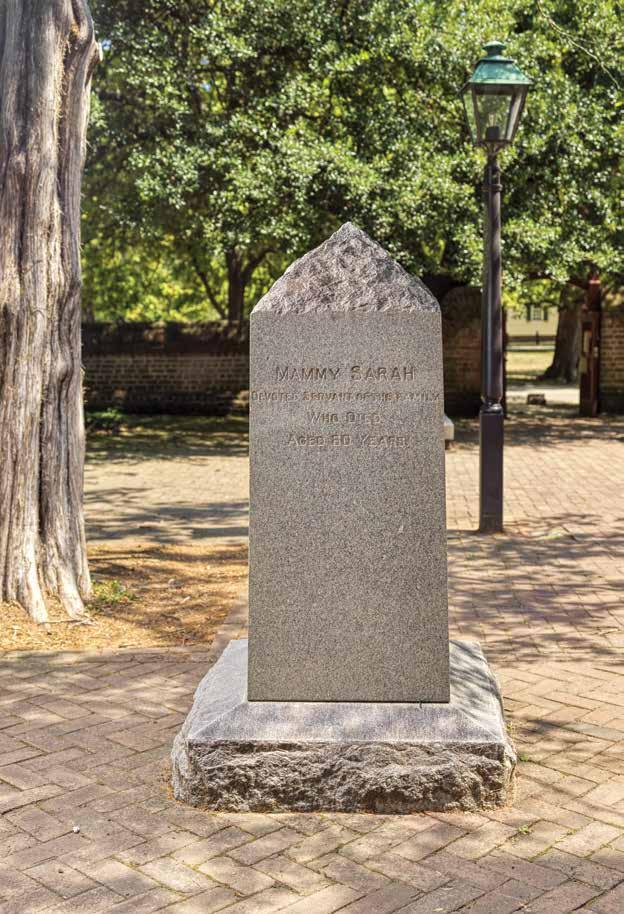
The east and west faces of the Semple family monument in the Bruton Churchyard honor Letitia Tyler Semple (1821–1907) (right), who once served as White House hostess to her father, President John Tyler, and Mammy Sarah (opposite), a “devoted servant” to the family of President Tyler. The north and south faces (not pictured) contain epitaphs honoring Letitia Semple’s husband James and her husband’s parents.
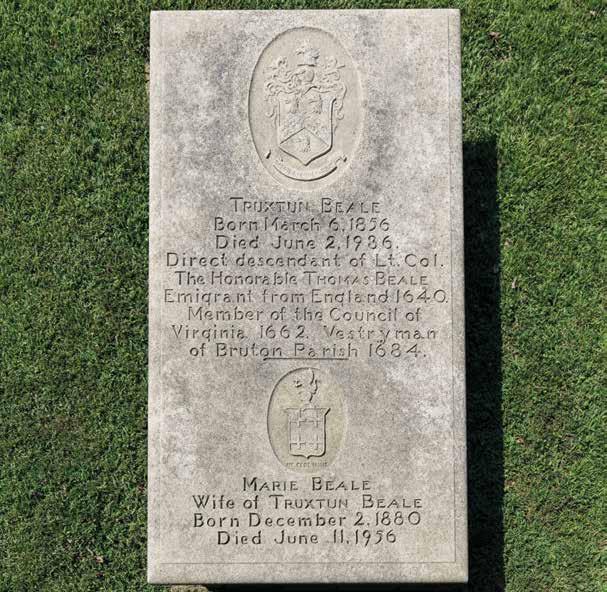
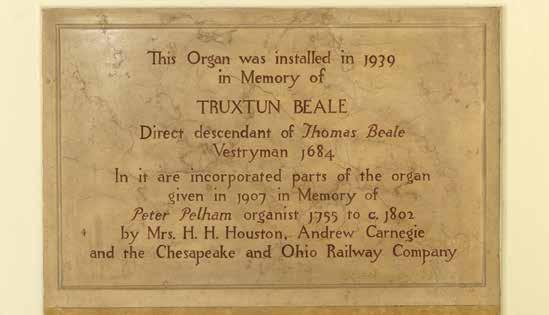
left Grave 83 in the Bruton Parish Churchyard holds the remains of two prominent one-time residents of the President’s Neighborhood in Washington, D.C.,—Truxtun Beale (1856–1936) and his wife Marie Beale (1880–1956). The Beales owned the Stephen Decatur House on Lafayette Square. The landmark residence was donated to the National Trust for Historic Preservation upon Mrs. Beale’s death and now houses the White House Historical Association’s David M. Rubenstein Center for White House History. The Bruton Parish Church organ was installed in memory of Truxtun Beale in 1939.
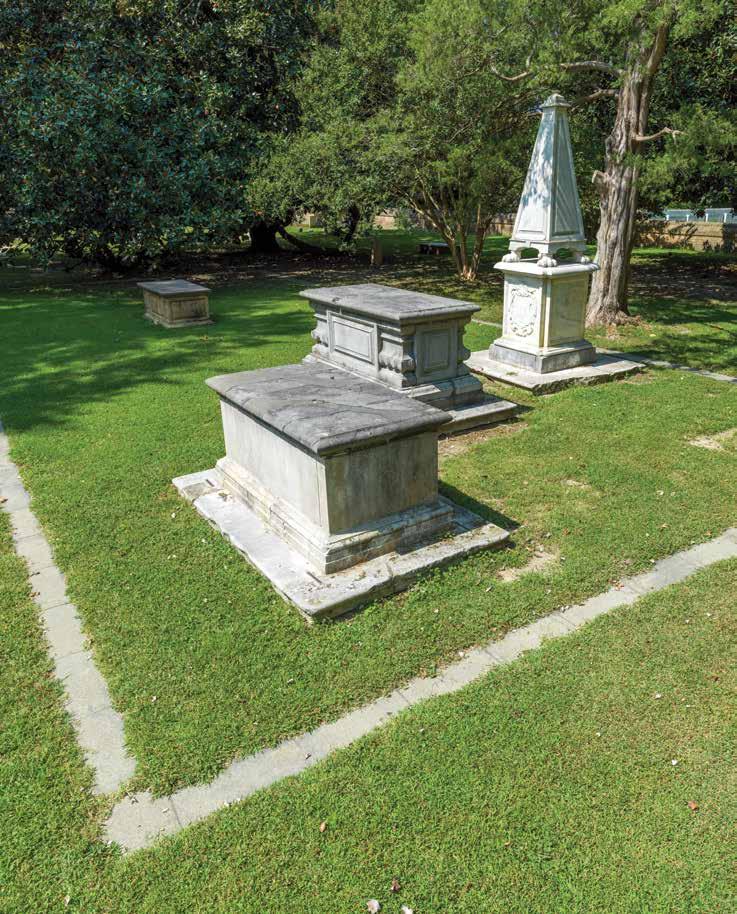
opposite Within a stone outline of the original brick Bruton Parish Church are the early eighteenthcentury tombs of the Bray family. Although the churchyard is filled to capacity today, two cineraria continue to allow space for the ashes of parishioners.
left
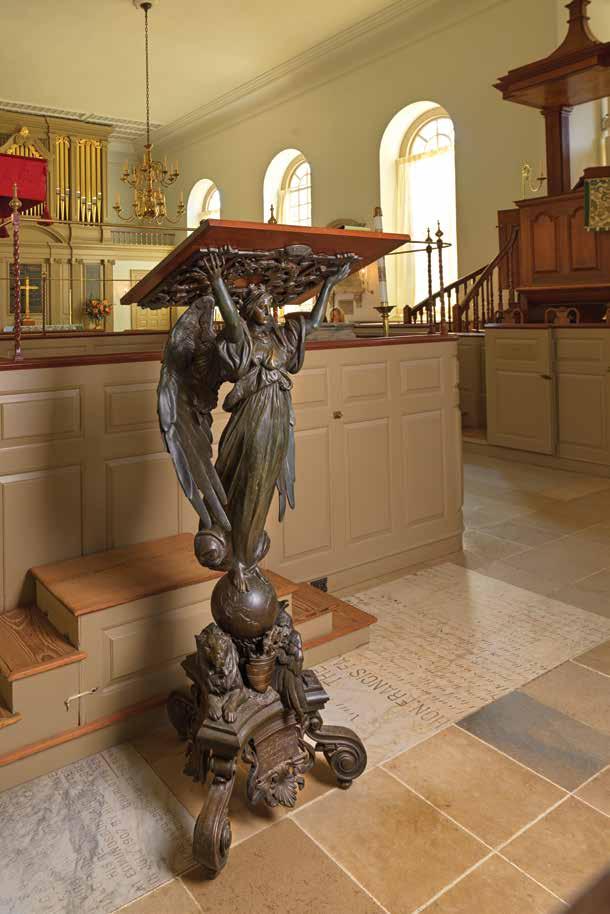
The “Angel of Peace,” a bronze lectern, was given to Bruton Parish Church in 1907 by President Theodore Roosevelt to commemorate “the three-hundredth anniversary of the permanent establishment of English Civilization in America.” In 1910, Roosevelt’s successor, William Howard Taft, made a short address to the congregation from the lectern.
below
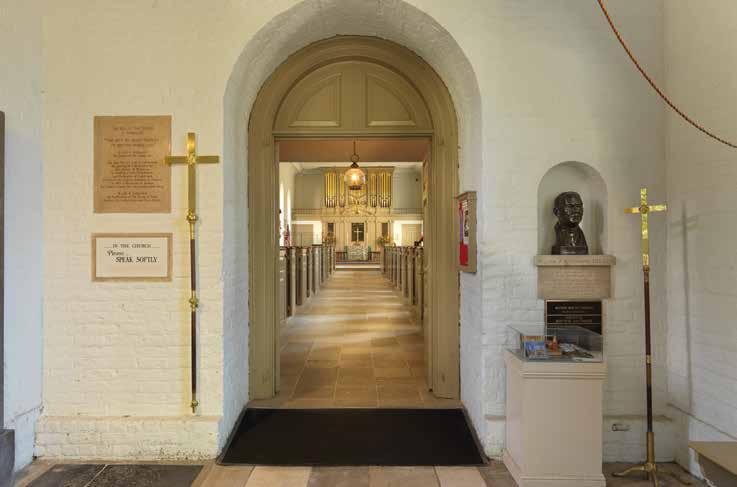
A tablet placed in the south transept by John D. Rockefeller Jr. remembers Reverend William A.R. Goodwin as a “Minister • Teacher • Man of Vision in whose Heart and Mind was conceived the Thought of restoring the Beauty of this Ancient City and was himself the Inspiration of its Fulfillment.” A few steps away, among signs asking for quiet and designating the site as historic, is a bust of Goodwin sculpted from life in 1942.
TWENTIETH-CENTURY PRESIDENTS VISIT BRUTON
After Bruton Parish lost its luster as the “court” church, it became a small-town chapel. From 1840 to 1910, no presidents entered to tour or worship. The building was in disrepair, and a mid-nineteenth-century reshuffling of the interior erased its colonial ambience. But at the start of the twentieth century the old parish church and Williamsburg underwent restoration led by Bruton’s visionary rector, William A. R. Goodwin. Soon after, presidents once again came to the historic church to recognize its link with their founding predecessors and its place in the nation’s birth.
While Theodore Roosevelt did not personally visit Bruton, his presence is felt to this day. In 1907, in commemoration of the tercentenary of Jamestown, Roosevelt gave an “Angel of Peace” lectern to Bruton.44 It supported a bible that Britain’s King Edward bestowed to the church for the celebration. The bronze podium has been in continual use since then.
On November 22, 1910, William Howard Taft became the first sitting president to tour Bruton. It was a short, unexpected stop on his route by train from Fort Monroe to Richmond. According to the Virginia Gazette, he “came expressly to see the historic church to which his predecessor, Theodore Roosevelt, presented a lectern, from which Taft made a short address to the assembled people.”45
On Sunday, May 14, 1916, Woodrow Wilson briefly stopped in Williamsburg during a cruise up the James River. Before going to the College of William and Mary, Wilson spent thirty minutes surveying Bruton Parish Church.46
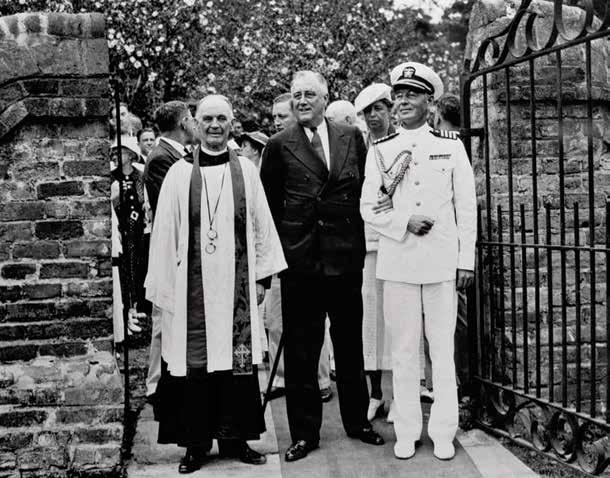
On Sunday, July 5, 1936, President and Mrs. Franklin D. Roosevelt attended a service at Bruton. They had traveled to Jamestown on the presidential yacht Potomac and then by car, the New York Times reported, “on a schedule arranged so that they arrived at Bruton Parish Church after all members of the congregations had been seated in their pews.”47 Reverend Goodwin delivered the sermon.
On Friday, March 8, 1946, future president General Dwight D. Eisenhower was escorting
left
After attending a service at Bruton Parish Church, President Franklin D. Roosevelt pauses at the gate with his aide Captain Wilson Brown and Reverend William A.R. Goodwin, 1936.
below
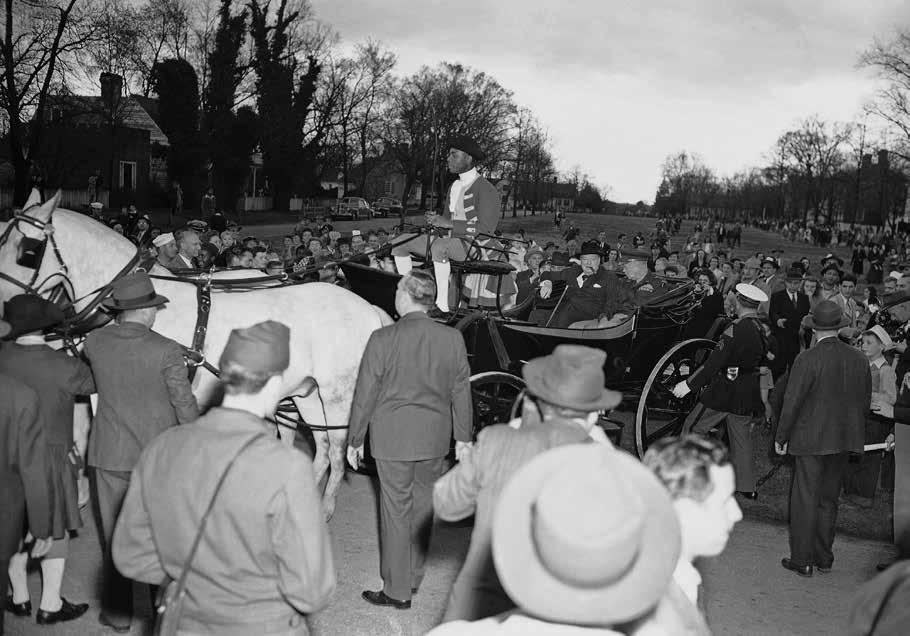
Photographers surround the horse-drawn landau carrying General Dwight D. Eisenhower and his guest Winston Churchill up Duke of Gloucester Street, 1946.
opposite
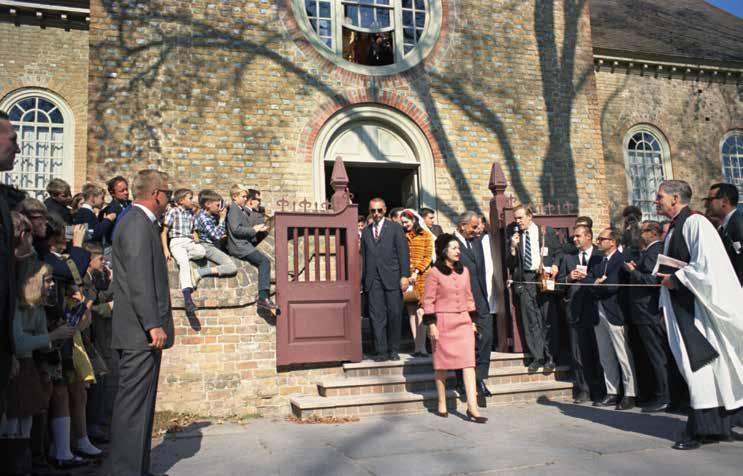
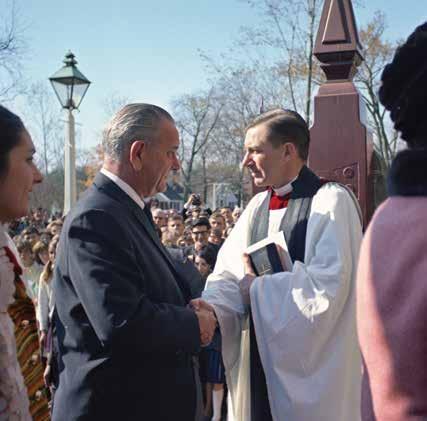
Reporters and children gather at the Bruton Parish Church gate for a glimpse of President and Mrs. Lyndon Johnson as they exit following a Sunday service. Although angered when Reverend Cotesworth Pinckney Lewis digressed from his sermon to express his opinions on the Vietnam War, the president shakes the reverend’s hand as daughter Lynda Johnson looks on, 1967.
Winston Churchill around restored Colonial Williamsburg in a landau. They narrowly escaped injury when flashbulbs “frightened [the] horses harnessed to an ancient open coach in which they were seated” and the horses “bucked and plunged and threatened to run away,” reported the New York Times. Unhurt and out of the carriage, they retreated to nearby Bruton Parish Church for a few minutes of sanctuary. “As the organ played softly, Mr. Churchill roamed through the church,” wrote the Times, before the party continued the tour, this time in a car.48
Lyndon B. Johnson had an uncomfortable encounter when he and Lady Bird Johnson attended Bruton on Sunday, November 12, 1967. As they sat in the front pew, reported the New York Times, Reverend Cotesworth Pinckney Lewis “interrupted his sermon on world problems to raise the issue of Vietnam.”49 The president was not pleased. Later, the church’s vestry apologized to the president for the rector’s discourtesy.
On May 29, 1983, Reverend Lewis was once again in the pulpit addressing another
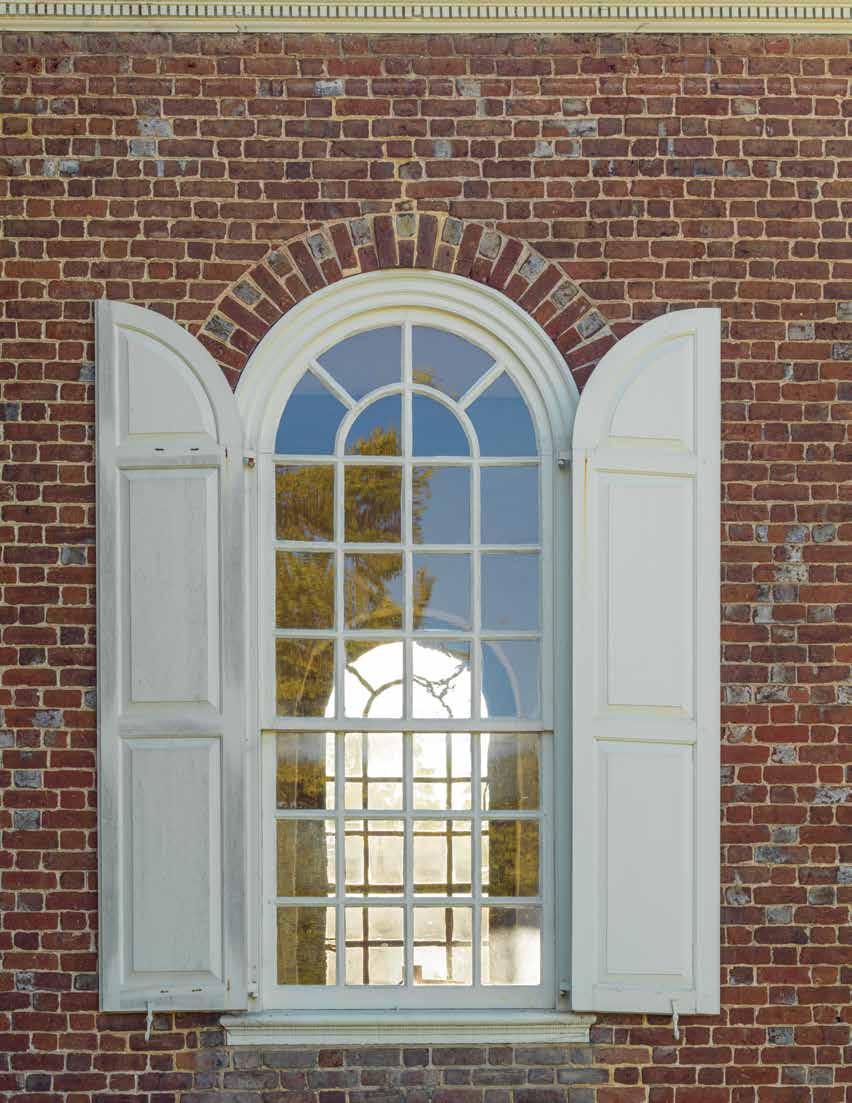
A view through the Bruton Parish windows from the churchyard to Duke of Gloucester Street.
president sitting in the front pew. Unlike in 1967, he preached a “quiet sermon for world peace” to President Ronald Reagan and foreign leaders in Williamsburg for an economic summit.50
Few American churches outside Washington, D.C., and the nation’s early capital in Philadelphia have had as many connections with Founding Fathers and presidents as Bruton Parish Church. Nearly one-quarter of all presidents have entered Williamsburg’s historic House of God. In 1906, the Episcopal bishop of Southern Virginia spoke of Bruton as “the noblest monument of religion in America,” “a link among the days to knit the generations each to each.”51
notes
1. George Carrington Mason, “Historic Parishes of America: Bruton Parish,” Historical Magazine of the Protestant Episcopal Church 14, no. 4 (1945): 276.
2. Arthur Pierce Middleton, “The Colonial Virginia Parish,” Historical Magazine of the Protestant Episcopal Church 40, no. 4 (1971): 431.
3. Dell Upton, “Anglican Parish Churches in Eighteenth-Century Virginia,” Perspectives in Vernacular Architecture 2 (1986): 90–91.
4. Carl R. Lounsbury, Bruton Parish Church: An Architectural History (Williamsburg: privately printed by Bruton Parish Church, 2011), 1–2.
5. Parke S. Rouse Jr., Bruton Parish Church: A Concise History (Williamsburg: privately printed by Bruton Parish Church, 1967), 4.
6. Mason, “Historic Parishes of America,” 4.
7. Lianne Johnson Boller, The Tombs and Memorials of Bruton Parish Church (Williamsburg: privately printed by Bruton Parish Church, 2023), 71, 79.
8. Rouse, Bruton Parish Church, 5.
9. Lounsbury, Bruton Parish Church, 9.
10. William A. R. Goodwin, Bruton Parish Church Restored and Its Historic Environment (Petersburg, Va.: Franklin Press, 1907), 45.
11. Diana L. Bailey, The Bruton Parish Story (Brookfield, Mo.: Donning Company, 2020), 13.
12. Wilson Miles Cary, “The Dandridges of Virginia,” William and Mary College Quarterly Historical Magazine 5, no. 1 (1896): 33.
13. Amanda Walli, “Custis Family,” George Washington’s Mount Vernon website, www.mountvernon.org.
20. Wilford Kale, “George Washington Once Was a Frequent Visitor to Williamsburg,” Virginia Gazette, February 22, 2023.
21. William J. Johnson, George Washington the Christian (New York: Abingdon Press, 1919), 16.
22. Ibid., 62.
23. Ibid.
24. Gary Scott Smith, “The Faith of George Washington,” in Religion and the American Presidency, ed. Mark J. Rozell and Gleaves Whitney (New York: Palgrave Macmillan, 2007), 16.
25. Jon Meacham, American Gospel: God, the Founding Fathers, and the Making of a Nation (New York: Random House, 2007), 3.
26. “The Founders’ Faith: Thomas Jefferson,” Lehrman Institute website, www.lehrmaninstitute.org.
27. Peter Onuf, “Thomas Jefferson: Life Before the Presidency,” University of Virginia Miller Center website, www.millercenter. org.
28. Goodwin, Bruton Parish Church Restored, 16.
29. Nancy Verell, “Thomas Jefferson in Williamsburg,” Thomas Jefferson’s Monticello website, www.monticello.org.
30. For a biography, see “Martha Wayles Skelton Jefferson,” Thomas Jefferson’s Monticello website.
31. John Hamilton Works Jr., “Martha Wayles Jefferson,” Thomas Jefferson Heritage Society website, www.tjheritage.org.
32. Darrin Grinder and Steve Shaw, The Presidents and Their Faith (Boise, Idaho: Elevate Publishing, 2016), 32.
33. John Ragosta et al., “James Madison,” Thomas Jefferson’s Monticello website.
34. Vincent Philip Munoz, “Religion in the Life, Thought and Presidency of James Madison,” in Religion and the American Presidency, ed. Rozell and Whitney, 52.
35. Grinder and Shaw, Presidents and Their Faith, 33.
36. David L. Holmes, “The Religion of James Monroe,” Virginia Quarterly Review 79, no. 4 (Autumn 2003): 595.
37. Ibid., 601.
38. Ibid., 606.
39. Oran E. Warder, Rebuilding Zion: William Holland Wilmer and the Rebirth of the Episcopal Church in Virginia, 1782–1827 (Alexandria, Va.: VTS Press, 2023), viii.
40. Boller, Tombs and Memorials, 80.
41. A. Lawrence Kocher, “Architectural Report: Palace of the Governors of Virginia, Block 20, Building 3, 1952,” Colonial Williamsburg Foundation Library Research Report Series, 0133 (1990), 3–4.
42. Lyon G. Tyler, “Bruton Parish,” William and Mary College Quarterly Historical Magazine 15, no. 3 (1895): 178.
43. Waldon Fawcett, “Forgotten Mistresses of the White House,” Criterion, clipping in “Letitia Tyler: From a Portrait Painted at the White House,” New York Public Library Digital Collection, www.digitalcollections.nypl.org.
44. “Roosevelt’s Gift Accepted,” New York Times, July 7, 1907, 7.
45. “President W. H. Taft Pays Us a Short Visit,” Virginia Gazette, November 24, 1910, 1.
46. Wilford Kale, From Student to Warrior: A Military History of the College of William and Mary (Williamsburg: Botetourt Press, 2017), 197.
47. Charles W. Hurd, “Roosevelt Visits Historic Church,” New York Times, July 6, 1936, 3.
48. “Churchill Escapes in Coach Accident,” New York Times, March 9, 1946, 3.
49. Robert B. Semple Jr., “With Johnson in the Front Pew, Minister Questions War Policy,” New York Times, November 13, 1967, 1, 3.
50. Helen Thomas, “Leaders Pray for Peace in 268-Year-Old Church,” May 30, 1983, UPI Archives website, www.upi.com.
51. Quoted in Goodwin, Bruton Parish Church Restored, 51.
The Revere Bell of ST. JOHN’S CHURCH
RICHARD F. GRIMMETT
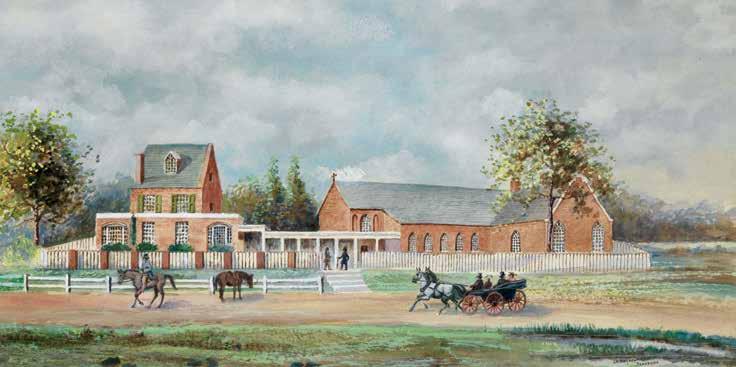
when st. john’s church, known today as the church of the presidents, first opened for worship services less than two-hundred yards north of the President’s House on October 27, 1816, there was no bell or bell tower as part of its building. But by 1820 it had become clear to the church leaders that an expansion was needed to meet the demands for seating as well as to increase the church’s income through the sale and rental of new pews.1
Construction of the bell tower began in August 1820 and continued to late 1821. Once the tower was completed, a plan was initiated to obtain a bell. Vestryman Richard Smith, St. John’s representative for this purpose, soon contacted the Paul Revere and Son company of Boston, Massachusetts, seeking price and availability information for a bell for the new bell tower.2
In anticipation of procuring a bell, St. John’s sought contributions from its parishioners and interested individuals. This approach followed the example of the First Unitarian Church of Washington, D.C., which, only a few months earlier, had sought and purchased the first church bell in the City of Washington. The Unitarian
Church had contracted with the Revere Company for a bell estimated to cost $400. To ensure that the funds needed would be raised, the Unitarian Church sought a contribution of public funds on the grounds that the bell would also serve as a fire alarm for the buildings near the church, at Sixth and D Streets NW. The need for a bell for fire alarm purposes was very real. The Post Office Building, located close to the church in the block between Seventh and Eighth Streets and E and F Streets NW, had barely escaped damage from a nearby fire the previous year. Without fire alarm bells, it was necessary to call out for firefighters, and assembling them was a continuing concern, particularly at night.3 Given these considerations, the First Unitarian Church successfully persuaded Joseph Elgar, the commissioner of public buildings for the District of Columbia, with the authorization of President James Monroe, to provide $100 toward the purchase of the church’s bell. That 883-pound Revere bell was purchased on August 1, 1822, and installed in the church on October 11, 1822.4
Having learned that the First Unitarian Church had obtained a contribution of public funds for
above
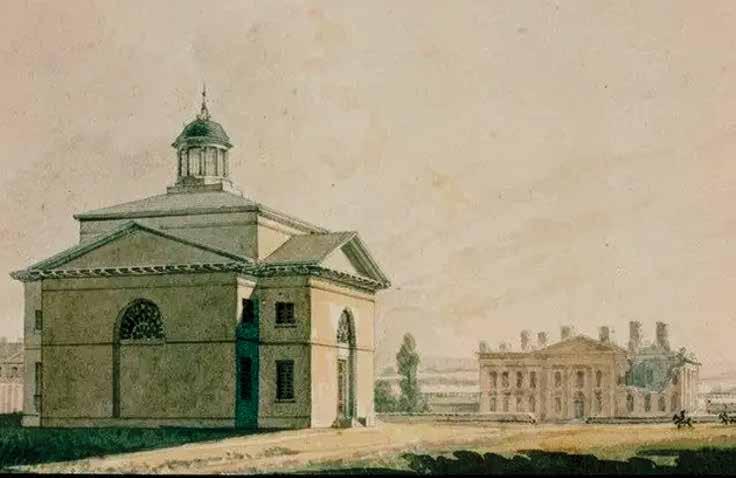
St. John’s Church was originally built in the shape of a simple Greek cross without a bell or bell tower. Architect Benjamin Latrobe’s watercolor captures the church as it appeared in 1816 following its completion a short walk from the President’s House, which still shows the damage from the fire of 1814.
above and previous spread
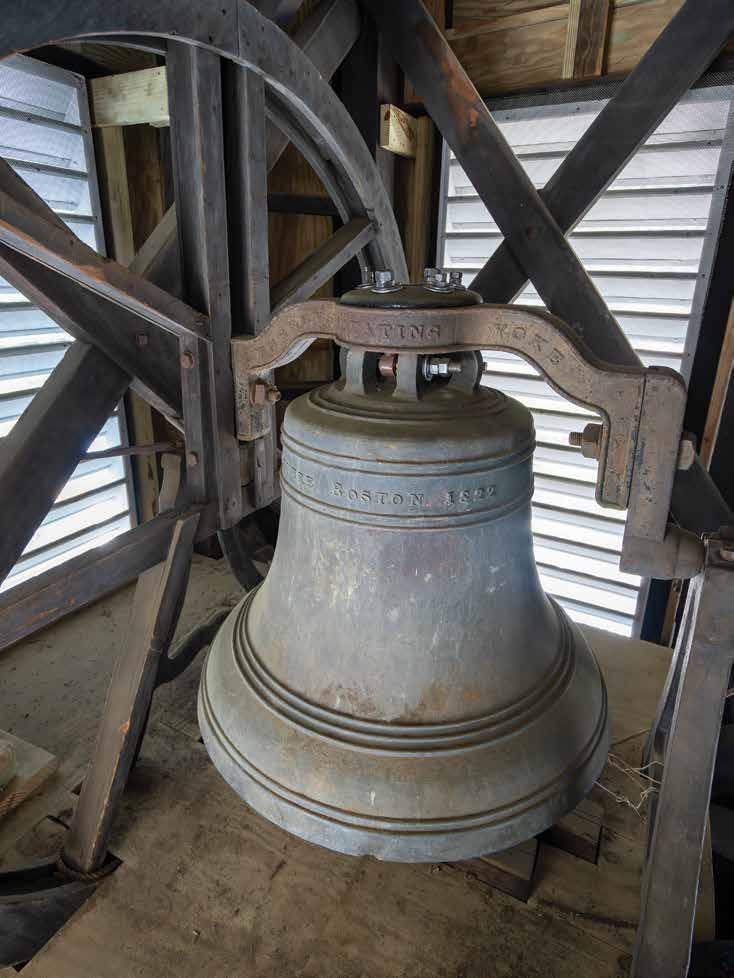
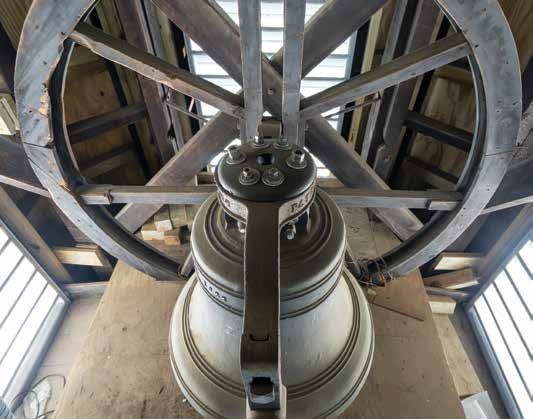
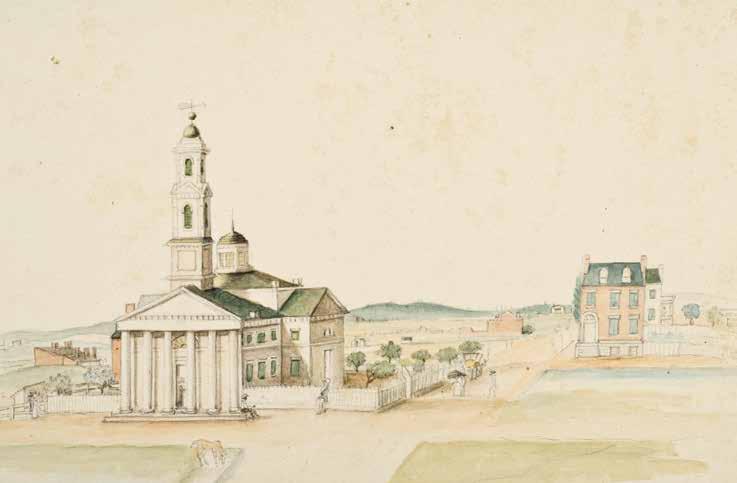
Artist Baroness Hyde de Neuville, wife of the French minister to the United States, produced a notable sketch of St. John’s Church in July 1822, showing the newly completed bell tower. The bell (pages 28–29), which bears the dated mark of its maker,“Revere Boston 1822,” was examined and found to be in fine condition in 2024 and continues to be heard in the President’s Neighborhood today.
the purchase of its church bell, Reverend William Hawley, rector of St. John’s Church, sought to gain the same financial support from the government for its bell. Reverend Hawley had been trained as a lawyer and practiced in New York City before becoming an Episcopalian priest. On August 19, 1822, Hawley and Smith wrote to President James Monroe seeking his support in obtaining public funds to help purchase the St. John’s Church bell:
Sir,
The congregation of St. John’s church has been for some time desirous of procuring a bell for the church, and as well for the purpose of an alarm bell to the 1st and 2nd Ward of the city, as for calling the congregation together, and understanding that in a similar instance you have appropriated a certain part of the funds of the city, under your control, to assist in effecting this object. We take the liberty on behalf of the Vestry of said church to enquire whether you will have it in your power to afford similar aid to the purchase of the one we want.
It may be of importance to you, in deciding on this subject, to take into consideration that as this bell will be in the immediate vicinity of the public buildings, it may be considered of even more importance than the one referred to within.5
Understanding that Monroe had authorized the commissioner of public buildings to provide $100 in public funds toward the purchase of the First Unitarian Church bell, Hawley asked that his church receive the same consideration. He carefully pointed out that providing those funds to St. John’s would secure a fire alarm bell for those “public buildings” in the “immediate vicinity” of the church. He did not name the specific public buildings that would benefit from having this fire alarm bell at the church. He did not need to. All President Monroe had to do is look across the park to see St. John’s Church from the North Door of the White House (the North Portico was not yet built). Not only would the President’s House benefit from the bell, but so would the nearby buildings of the Treasury, State, War, and Navy Departments.
Apart from the logic and fairness in supporting Hawley’s appeal, President Monroe knew St. John’s Church well, as he was one of its parishioners. While Monroe did not respond directly to Hawley’s letter, he did authorize Elgar to provide $100 from public funds to aid in the purchase of St. John’s bell. Elgar’s name and the contribution of $100 for the bell’s purchase appear on the list of donors in the records of the church. Other notable Washingtonians who also appear on the donor list are Secretary of State John Quincy Adams and Secretary of War John C. Calhoun.6
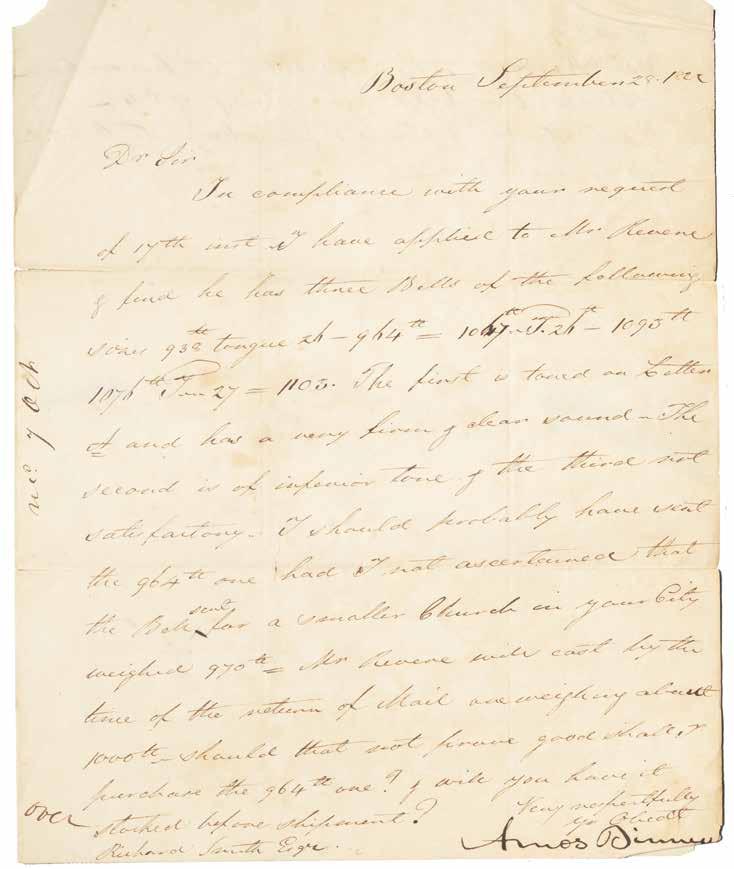
As St. John’s Church was nearing completion of its fund raising for the bell, Smith’s correspondence with Amos Binney, an agent of the Revere Company, led to a decision on its procurement. Binney told Smith that the cost of a bell was 40¢ per pound and, before shipping, a purchased bell would be tested for tone and quality. If payment was made in cash, the Revere Company would give a 6 percent discount on the bell. All bells would have a one-year warranty against defects. In the course of their correspondence, Binney advised Smith that the Revere Company had one bell in stock, “toned on the letter A” with “a very firm and clear sound.” This bell weighed 938 pounds, with a tongue, or clapper, of 26 pounds, having a total weight of 964 pounds. As an alternative, if St. John’s was willing to wait, a new bell weighing about 1,000 pounds was being cast. Smith replied to Binney that St. John’s would take the existing 964-pound bell.7
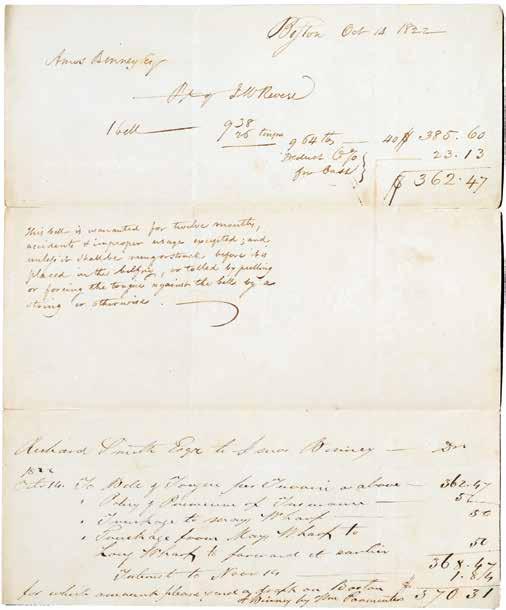
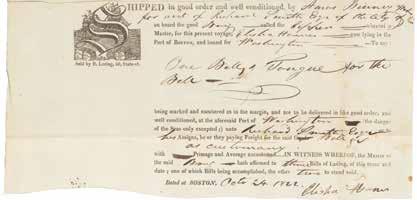
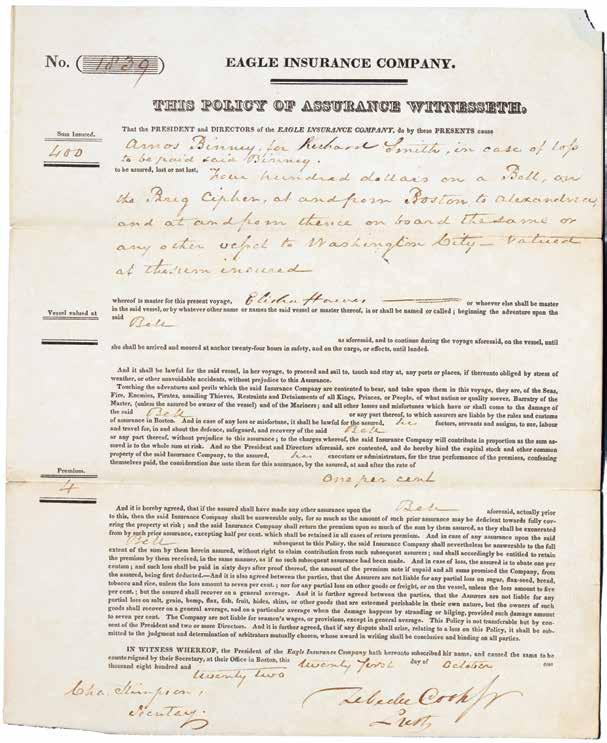
The bill of sale for the Revere bell was signed on October 14, 1822. The final cost was $362.47, as St. John’s Church received a 6 percent discount by paying in cash. On October 29, 1822, Binney sent Smith a letter containing the guarantee of Joseph Revere, Paul Revere’s son, that the bell was warranted against defects for one year after it was installed. Binney’s letter also contained a bill of lading and a $400 insurance policy covering the bell’s shipment from Boston
left
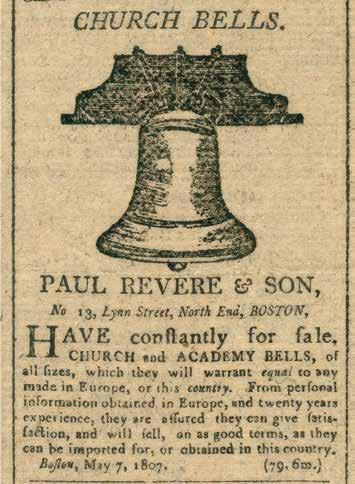
Paul Revere & Son advertised its church and academy bells of “all sizes” as “equal to any made in Europe, or this country” in the October 14, 1807, issue of the Worcester Massachusetts Spy below
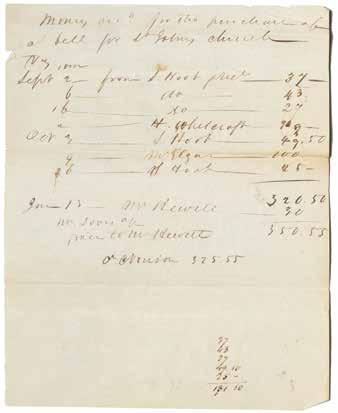
The list of donors who funded St. John’s Revere bell is preserved in the church records. The $100 in public funds donated by District of Columbia commissioner of public buildings, Joseph Elgar, is listed here on the October 9 entry.
opposite
A letter dated September 28, 1822, from Amos Binney of Revere Company to St. John’s Vestryman Richard Smith, provides the details of three bells for his consideration.
to St. John’s Church. The bell was shipped from Boston on the brig Cipher commanded by Elisha Hawes and reached Alexandria, on November 22, 1822. It was installed in the bell tower of St. John’s Church on November 30, 1822, where it began its role as part of Washington life on what would come to be called Lafayette Square.8
St. John’s Revere bell has had several notable moments over the years. It tolled for presidential funerals held in Washington, including William Henry Harrison’s in 1841 and Abraham Lincoln’s in 1865. On Saturday, November 23, 1963, the day after President John F. Kennedy was assassinated, a brief memorial service for him was held at St. John’s Church at the request of President
Lyndon Johnson. From before the service began until it ended, the Revere bell of St. John’s was rung at one-minute intervals. On the day of President Kennedy’s funeral, November 25, 1963, the Revere bell tolled as his caisson-drawn coffin proceeded from the White House to St. Matthew’s Cathedral for his funeral Mass, and so the bell was heard on national television. The bell has tolled to mark the end of two world wars and on other major national events and special occasions. More recently, it was heard on the soundtrack for Steven Spielberg’s Academy Award–winning movie Lincoln, as it marked the passage of the Thirteenth Amendment to the Constitution, ending slavery, at the movie’s climax.9
below The handwritten bill of sale itemizing the charges for the 964-pound Revere bell is preserved in the St. John’s Church records. Dated October 14, 1822, the cost of the bell itself is $362.47; with the additional cost for transferring the bell to the wharf and other fees the total came to $370.31.
top
A bill of lading dated October 29, 1822, signed by Elisha Hawes, commander of the brig Cipher, affirms that “One Bell and Tongue for the Bell” was “shipped in good order and well conditioned . . . bound for the Port of Washington.”
bottom
A policy issued by Eagle Insurance Company on October 21, 1822, insured St. John’s for $400 against the loss of the Revere bell during the voyage from Boston to Washington, D.C.
above
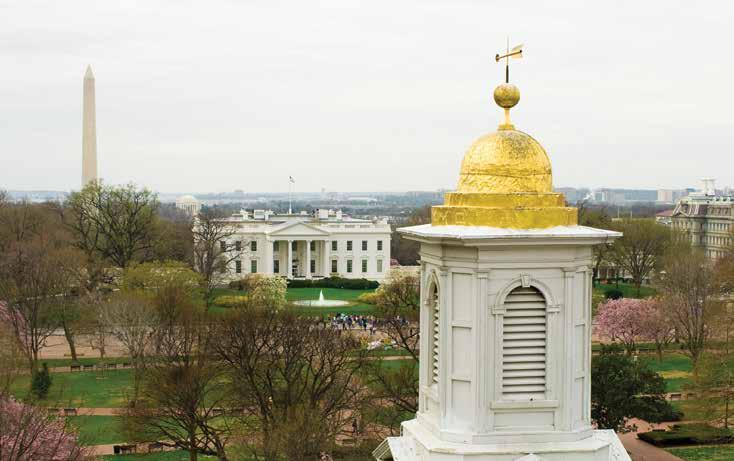
A view looking south across Lafayette Park captures the St. John’s Church bell tower, which houses the Revere bell, and the White House in the distance, 2009.
left
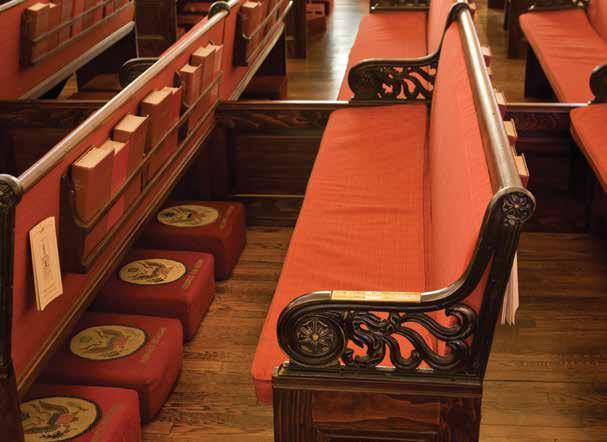
St. John’s Church has long been known as “The Church of the Presidents.” Seen here is Pew 54, designated the “President’s Pew,” with its needlepoint kneelers embellished with the Presidential Seal.
TOP: ST. JOHN’S CHURCH / BOTTOM: BRUCE M. WHITE FOR THE WHITE HOUSE
clockwise from top left
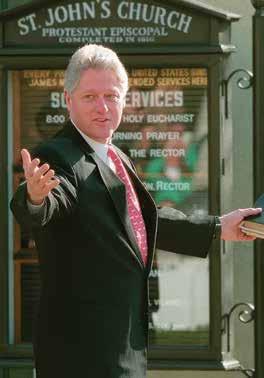
President Bill Clinton exits St. John’s Church, 1996.
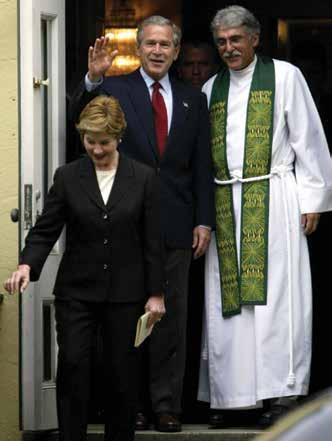
President and Mrs. George W. Bush are joined by Reverend Luis Leon as they exit the church after a Sunday service, 2004.
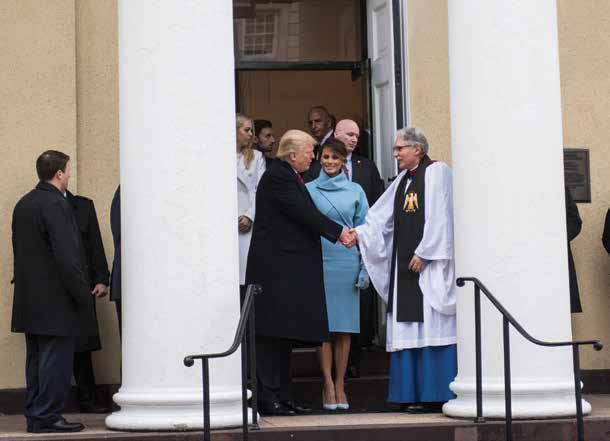
President-Elect and Mrs. Donald Trump are greeted by Reverend Leon following a preinaugural worship service, January 20, 2017.
In 2024, St. John’s historic bell tower was restored to its original appearance in coordination with District of Columbia preservation organizations. During the project the Revere bell was inspected and found to be in fine shape, despite two centuries of service.10 That service continues. Every Sunday the Revere bell is heard just before the 8:00, 9:00, and 11:00 a.m. services, and before weekday services at 12:10 p.m. This historic bell continues to ring as it has for more than two hundred years.
notes
1. Vestry minutes, St. John’s Church, April 23 and October 5, 1821, St. John’s Church Archives.
2. A February 1822 news article summarizing construction projects completed in Washington, D.C., in 1821 specifically noted “a neat and lofty steeple” that had been “erected upon St. John’s Church.” The article added that this steeple was “the first in the city.” “City of Washington,” Daily National Intelligencer and Washington Express, February 27, 1822, 2. See also Amos Binney to Richard Smith, September 4 and October 29, 1822, St. John’s Bell 1822, Purchase & Installation, Original Correspondence container (hereafter St. John’s Bell 1822 container), St. John’s Church Archives.
3. Joseph Elgar, commissioner of public buildings for the District of Columbia, made this argument to John Cocke, chairman of the House Committee on Public Buildings, who had questioned providing public money for church activities. Elgar contended that it made no sense for Congress to have provided firefighting equipment if there was no way to call out firefighters at night in case of a fire, so protecting public buildings that were “liable to accidents by fire” justified assisting churches in procuring bells that could provide this public service. Joseph Elgar to John Cocke, January 7, 1823, Record Group 42, M371, ser. 1, Letters Sent, Office of Public Buildings and Public Parks of the National Capital, Records of the District of Columbia Commissioners and Affairs Concerned with Public Buildings, 1791–1867, General Records, entry 1, Letters Sent by the Commissioner of Public Buildings, May 14, 1816–September 14, 1833, microfilm reel 5, 331–33, National Archives, Washington, D.C.; Judah Delano, Washington Directory, 1822 (Washington, D.C.: W. Duncan, 1822), 87.
4. Elgar to Cocke, January 7, 1823; waste book, August 1, 1822, reel 6, vol. 7, and stock book, reel 11, vol. 40, Revere Family Papers, Microfilm Collection, Manuscript Division, Library of
Congress, Washington, D.C.; Washington Gazette, October 12, 1822, 2; Washington Gazette, October 14, 1822, 2.
5. Vestry minutes, St. John’s Church, April 23 and October 5, 1821, St. John’s Church Archives; William Hawley and R[ichard]. O. Smith to President James Monroe, August 19, 1822, Record Group 42, M371, ser. 1, Letters Received, Office of Public Buildings and Public Parks of the National Capital, General Records, entry 1, Letters Received by the Commissioner of Public Buildings, September 28, 1819–September 20, 1830. microfilm reel 21, National Archives.
6. John Quincy Adams and John C. Calhoun each contributed $10 toward the purchase of the Revere bell. Their donations and Joseph Elgar’s $100 contribution from public funds are in the listings, with the signatures, of all contributors to the bell fund. St. John’s Bell 1822 container, St. John’s Church Archives.
7. Amos Binney to Richard Smith, September 28 and October 29, 1822, Amos Binney to Richard Smith, September 28 and October 29, 1822, St. John’s Bell 1822, container, St. John’s Church Archives.
bell had recently been placed in the bell tower of St. John’s Church. Since neither newspaper published on Sunday, December 1, 1822, their articles support the statement of Reverend George Douglas, rector of St. John’s Church, 1889–92, that the Revere bell was installed on Saturday, November 30, 1822. Yearbook of St. John’s Parish, 1891–92, 44, St. John’s Church Archives.
9. “Arrangements for the Interment of the Late President,” Washington National Intelligencer, April 6, 1841, 3; “The Funeral,” Washington National Republican, April 18, 1865, 2; Edward Stickney and Evelyn Stickney, The Bells of Paul Revere, His Sons and Grandsons, rev. ed. (Boston: Paul Revere Memorial Association, 2022), 23; William Cushman Farnum, “The Story of the President’s Pew Book,” memorandum of March 24, 1966, St. John’s Church Archives; DeNeen L. Brown, “Historical Sound Effects Captured in Spielberg’s ‘Lincoln,’” Washington Post, November 18, 2012, EZ3; John Kelly, “The Sights (and Sounds) of St. John’s, a Very Historic D.C. Church,” Washington Post, October 21, 2015, B3.
opposite and above
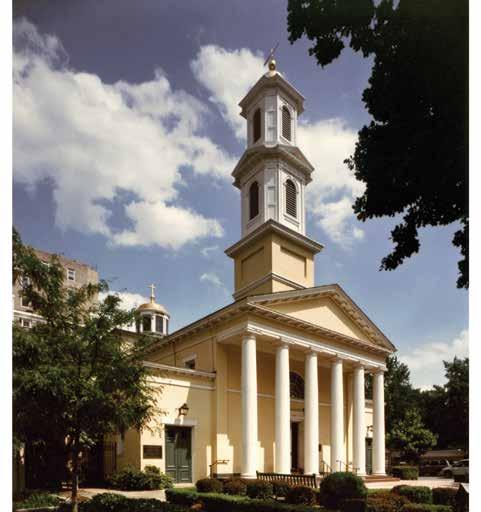
Recent photographs capture the restored Revere Bell in place in the St. John’s bell tower and St. John’s Church on Lafayette Square as they appears today.
8. Binney to Smith, October 29, 1822, St. John’s Bell 1822; Washington Gazette, November 25, 1822, 2, noted that the brig Cipher had arrived in Alexandria, from Boston on November 22. The Washington National Intelligencer of December 2, 1822, 3, and the Washington Gazette of December 2, 1822, 2, both announced that a
10. Michael Laris, “After Centuries of Decay, St. John’s Church Bell Tower Gets Major Renovation,” Washington Post, October 21, 2024, B1.
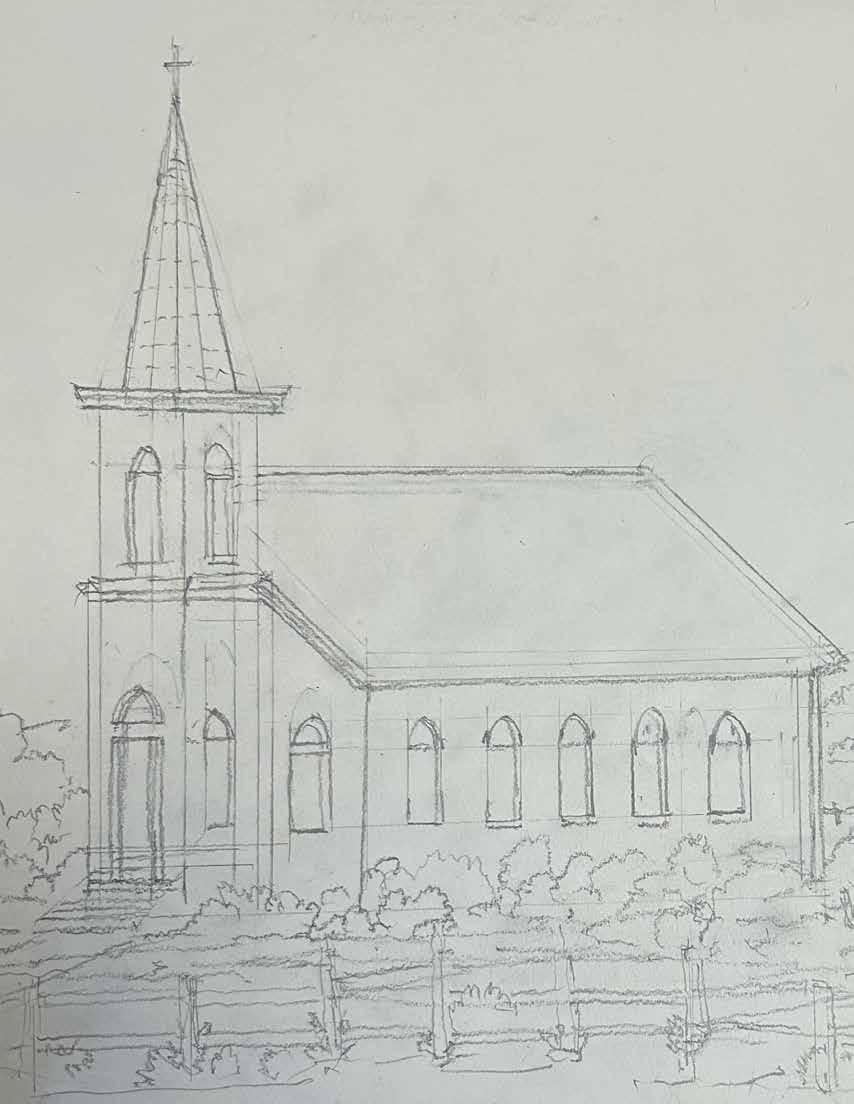
SKETCH is FPO, Painting to come
ABRAHAM LINCOLN And the Black Churches of Washington, D.C.
ANN H. SLATTERY
THE SOLDIERS’ HOME
in june 1862 president abraham lincoln agreed to his wife’s request to move his family to the Soldiers’ Home, on the hilly outskirts of the City of Washington, to escape the heat of summer.1 Located north on the road to Silver Spring, Maryland, and about 3 miles from the White House, the Soldiers’ Home had been constructed in the early 1850s to accommodate disabled Army soldiers. On the shaded grounds stood four cottages, one of which the president and his family ultimately occupied.
THE SOLDIERS’ HOME
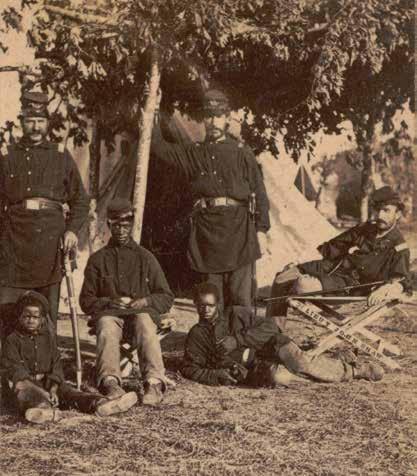
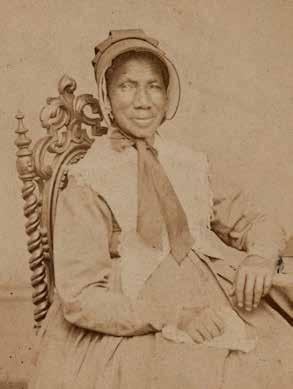
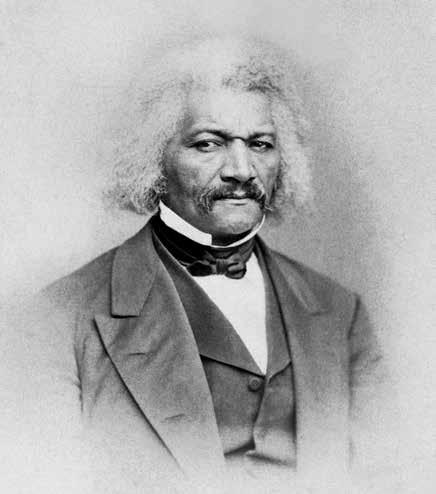
For three summers during the Civil War, Lincoln enjoyed this retreat, with its natural surroundings and opportunity for quiet reflection. Here he was able to receive visitors of radically differing views and ambitions and consult regularly with members of his cabinet, including Secretary of War Edwin Stanton and Secretary of State William Seward. He even invited the well-known abolitionist who had formerly been enslaved, Frederick Douglass, to tea at the Soldiers’ Home in 1864.2 And it was here, over the summer of 1862, [?] that he gradually developed the ideas that led to the Emancipation Proclamation. On his daily commutes to and from the cottage at the Soldiers’ Home and the White House, Lincoln regularly passed the “contraband camps” inhabited by formerly enslaved persons who had fled to Union lines and were pressed into various kinds of military or other government service.3 On such commutes he would stop and visit with Mary Dines, his cook at the Soldiers’ Home cottage who lived in one of the camps. While there he often joined in the prayer and song.4 [?]
INDEPENDENT PROTESTANT CHURCHES
The residents in the camp were not the only African Americans in Lincoln’s circle of contacts. When he was elected president in 1860, Washington already “boasted the second-largest free African American population in the nation. African American leaders labored tirelessly through their alliance of two dozen churches to build an independent community and advance the goal of emancipation,” explains Kenneth J. Winkle.5 By 1867, commentator Andrew Rothwell noted that nearly all the white Baptist churches in the city counted a small number of Blacks, “yet for the most part they prefer to connect themselves with their own organizations.”6
Many freed Blacks living in the Washington
area prior to the Civil War wanted to establish their own places of worship. By 1821, there were two such independent churches: an African Methodist Episcopal (AME) church in Georgetown, and an AME church on Capitol Hill. Israel Bethel on Capitol Hill was founded in 1820 or 1821 by Blacks who desired to leave the predominantly white Ebenezer Methodist Episcopal Church and secure their own place of worship. Israel’s pastor, Henry McNeal Turner, helped persuade President Lincoln to accept Black soldiers into the Union Army during the Civil War. After the war, Israel Bethel merged with Union Bethel to become the Metropolitan AME Church at 1518 M Street NW, the national church of African Methodism. In this building, designed by architect Samuel T. Morsell, Frederick Douglass spoke.7
Another Capitol Hill church, the “Little Ebenezer” Black Methodist Church, was a prominent place of worship that Lincoln would also certainly have been familiar with. “Little Ebenezer,” as it was called, was, like Israel Bethel, an offshoot of Ebenezer Methodist Church. By 1838 parishioners had built their own frame church building at Fourth and D Streets SE. And in 1864 the all-Black Washington Annual Conference appointed the church’s first Black pastor, Reverend Noah Jones.8
As independent organizations, these African Methodist churches, as well as the First Colored Baptist Church on Nineteenth and I Streets NW, would undoubtedly have been known to Lincoln. Since they existed well before he was inaugurated president in 1861, he likely knew of them when he represented Illinois voters in the U.S. House of Representatives in Washington from 1847 to 1849.
While president, Lincoln visited with several African American leaders to discuss matters of slavery. One was Daniel Payne, an AME bishop, educator, and abolitionist. The purpose of Payne’s visit with the president on Monday evening, April 14, 1862, was to ask him if he intended to sign the bill for the emancipation of enslaved persons in the District of Columbia, a bill that had just passed the Congress two days earlier.9 Later in the summer, a group said to have been organized by Fifteenth Street Presbyterian parishioner and White House employee William Slade met the president on Thursday afternoon, August 14, to discuss his proposal of a colony in Central America where former enslaved people could be sent.10 Finally, as pastor of Washington’s Fifteenth Street Presbyterian Church,
previous spread
Little Ebenezer, as depicted by artist Peter Waddell in 2026 (page 40), was an early Black Methodist Church built on Capitol Hill in 1838. It also housed the first public school for Black pupils in Washington, D.C. “Little” was dropped from the name of the church in 1870. In 1873, the church replaced its original wooden building with a brick structure that remains in use today.
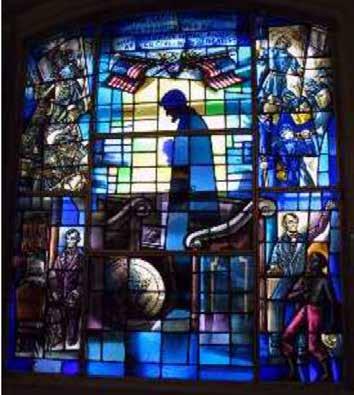
President Abraham Lincoln, who supported the desire of Washington, D.C.’s Black congregations to create their own places of worship, is remembered by the New York Avenue Presbyterian Church with a stained-glass window that pictures him standing in prayer beside the pew he rented in the church (page 41).
clockwise from top left
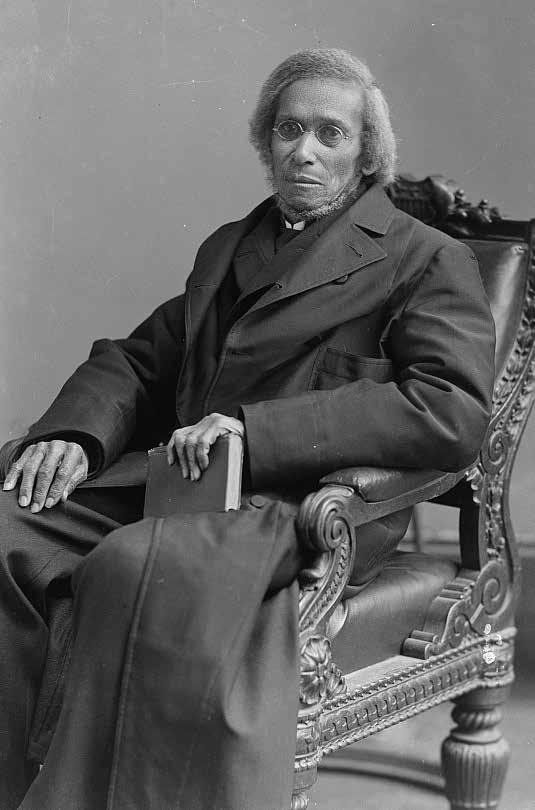
Two African American men and a boy, “contraband” residents of Camp Brightwood, are seen with members of the Second Rhode Island Infantry Regiment, near the Soldiers’ Home, c.1862; abolitionist Frederick Douglass, c. 1865; Bishop Daniel Payne, one of several African American church leaders with whom Lincoln discussed emancipation; and Mary Dines author add ID.
an all-Black congregation founded in 1841, [?] Henry Highland Garnet preached the necessity of recruiting Black soldiers into the Union Army and could well have spoken to President Lincoln directly about it or through Presbyterian parishioners who worked at the White House.
THE FIRST BLACK CATHOLIC CHURCH
Separate Catholic congregations for Blacks in the nation’s capital began forming during and after the Civil War because church leaders saw the wisdom of ministering to them in a more special way. But finding a full account of Washington’s Black Catholic Society and its interaction with President Lincoln is challenging. One story says that a strawberry festival was held on the White House lawn to raise money for building a church; another says that a tea was held there on the same day, for the same purpose.11 What can be verified from Lincoln’s daily schedule is that on June 30, 1864, he agreed to allow the St. Matthew’s Colored Sunday School, represented by Black businessman Gabriel Coakley, to hold a Fourth of July “anniversary celebration” on the grounds between the White House and the War Department.12 The year before, Father Charles I. White, pastor of St. Matthew’s Catholic Church, apparently purchased a lot on Fifteenth Street between L and M Streets NW. There, according to John W. Cromwell, he and “colored members from the various churches of the city and especially from those of St. Matthew’s” built a place of worship.13
LINCOLN’S CHARACTER
In his autobiography, Douglass wrote that “Mr. Lincoln was known to be a man of tender heart, and boundless patience: no man could tell to what length he might go, or might refrain from going, in the direction of peace and reconciliation.” Lincoln, Douglass continued, “was not only a great President, but a GREAT MAN—too great to be small in anything. In his company I was never in any way reminded of my humble origin, or of my unpopular color.”14
Another who commented on Lincoln’s character was Elizabeth Keckley, Mrs. Lincoln’s seamstress. Like William Slade, she worked in the White House and was an active member of the Fifteenth Street Presbyterian Church. In her autobiography she recorded shared conversations with President Lincoln. [?]15
Although Lincoln and his family usually attended New York Avenue Presbyterian Church,
he never registered there or with any other Washington congregation. It is interesting to speculate what his beliefs were, and it is unclear whether he ever visited one of Washington’s Black churches. But in his interactions with people of color from all backgrounds and beliefs, it is safe to say that from contraband camps to the White House to the summer cottage, Abraham Lincoln genuinely appreciated the values and creeds of all men, Black and white, and the role of divine providence in human affairs. As he fulfilled the role of U.S. president in wartime Washington, D.C., his relationships with Washington’s Black churchgoers only seemed to underscore his concern for people in general. Everyone from Mary Dines [?], his cook, to William Slade and William Johnson, his valets (the latter of whom Lincoln helped financially), to Elizabeth Keckley, his wife’s seamstress, benefited from his kindness.16 That they belonged to Black Washington’s faith communities (or, as in Johnson’s
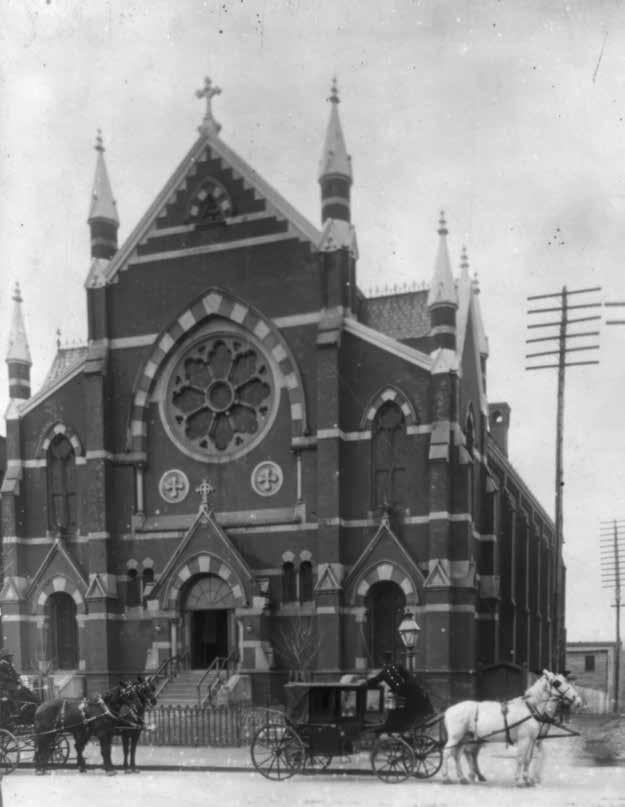
St. Augustine Catholic Church, the first Black Catholic Church in Washington, D.C., stood at Fifteenth and L Streets NW from 1876 to 1946.
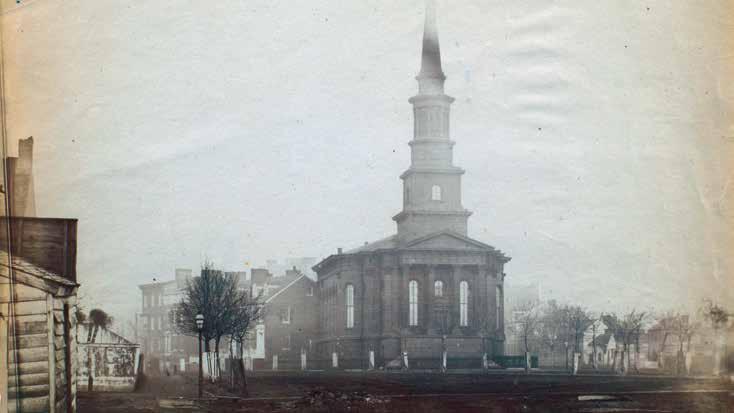
President Abraham Lincoln rented a pew at the New York Avenue Presbyterian Church a few blocks east of the White House. It is seen below c. 1862 as Lincoln would have known it. Rebuilt in the 1950s, the current structure includes a Lincoln Memorial Tower that houses the Lincoln Chimes.
case, were simply known to be faithful and honest), and that they revealed to Lincoln the troubles of their fellows, made them, in a sense, partners in the educational process leading Lincoln to announce unequivocally the need for the abolition of slavery in the United States and in the preservation of the Union.
notes
1. Matthew Pinsker, Lincoln’s Sanctuary: Abraham Lincoln and the Soldiers’ Home (New York: Oxford University Press, 2003), 4.
2. Frederick Douglass, The Life and Times of Frederick Douglass, Written by Himself [please add place: publisher, and date of the version you used] (Published 1881), 365–66. Although Douglass does not specify the invitation date, his autobiography implies it was during the time of General Ulysses S. Grant’s offensive toward Richmond, Virginia.
3. Sarah Fling, “Washington, D.C.’s ‘Contraband’ Camps,” White House Historical Association website, www.whitehousehistory. org. See also “Living Contraband: Former Slaves in the Nation’s Capital During the Civil War,” August 15, 2017, National Park Service website, www.nps.gov.
4. John E. Washington, They Knew Lincoln (New York: E. P. Dutton, 1942), 84–88.
5. Kenneth J. Winkle, “Emancipation Petitions: Historical Contexts,” in Civil War Washington website, ed. Susan C. Lawrence, Elizabeth Lorang, Kenneth M. Price, and Kenneth J. Winkle, Center for Digital Research in the Humanities at the University of Nebraska–Lincoln, www.civilwardc.org.
6. Andrew Rothwell, History of the Baptist Institutions of Washington City (Washington, D.C.: W. Ballantyne, 1867), 27.
8. John Deferrari, “Ebenezer United Methodist Church, aka ‘Little Ebenezer,’ Turns 180,” Streets of Washington website, www. streetsofwashington.substack.com.
9. Daniel Alexander Payne, Recollections of Seventy Years (New York: Arno Press, 1969), 146; Michael Burlingame, “President Lincoln’s Meetings with African Americans,” Journal of the American Lincoln Association 42, no. 1 (2021): 27–28.
10. For William Slade’s role, see John A. O’Brien, “Lincoln Hosts the ‘Coloured Gentlemen,’” August 13, 2023, Lincoln Group of the District of Columbia website, www.lincolnian.org. See also entry for August 14, 1862, in The Lincoln Log website, www. thelincolnlog.org; [add specific details of what you are citing in the collected works, including title and date] in Collected Works of Abraham Lincoln at the University of Michigan Digital Collections, 5:812 [vol. and p. no. OK?] www.quod.lib.umich. edu.
11. “Our History—Since 1858,” St. Augustine Catholic Church website, www.saintaugustine-dc.org; Cyprian Davis, The History of Black Catholics in the United States (New York: Crossroad, 1990), 126.
12. Entry for June 30, 1864, The Lincoln Log website; [add specific details of what you are citing in the collected works, including title and date] in Collected Works of Lincoln, 7:923.
13. John W. Cromwell, “First Negro Churches in the District of Columbia,” Journal of Negro History 7, no. 1 (January 1922): 103–04.
14. Douglass, Life and Times, 358, 365.
15. Elizabeth Keckley, Behind the Scenes; Or, Thirty Years a Slave and Four Years in the White House (New York: G. W. Carleton, 1868), [add page numbers of quotations]
We all shrink with horror from the effects of ambition . . . but it seems to me that it is necessary to success in every department of life. It is to the man what the fire is to the steam engine. . . . So, let it burn. Restrain it only by the laws of God.
—James Garfield to Lucretia Rudolph, January 28, 1854
America’s PREACHER PRESIDENT
James A. Garfield
C.W. GOODYEAR
when james garfield won the presidency in 1880, Americans from coast to coast (whether they voted for the man or not) acknowledged his election as the crowning achievement of an already remarkable life. Despite being raised in a log cabin on the Ohio frontier by a poor single mother, Garfield had grown up to lead large armies on bloody Civil War battlefields, win landmark legal cases before the Supreme Court, and serve as a vital congressional leader amid the tumult of Reconstruction. The other, more eclectic accomplishments on his resume were harder to summarize: Minority Leader Garfield could speak several languages, knew the works of Shakespeare essentially by heart, and had once, on a lark, published an original proof of the Pythagorean theorem. He was also a commercial farmer, a civil rights activist, and even the creator of America’s firstever federal Department of Education, expressing, while lobbying for the legislation as a representative, the hope that his new department would free the postwar South from “the darkness in which slavery had shrouded their people.”1
In other words, there was a lot for American voters in 1880 to be impressed by in their next president. But one of the past details of Garfield’s life drew particular notice after his election: for all of Garfield’s achievements pre-presidency, he also happened to be the first religious minister to be elected to the White House. This was a source of considerable public interest at the time, which led to Garfield entering future history books as America’s “Preacher President.”
A deeper review of Garfield’s career, though, reveals that faith was more than simply just another interesting factoid about a widely forgotten president. In fact, religion played a central role in Garfield’s life and legacy. It was foundational to his character, an engine behind his remarkable ascent through American society, a bedrock for his policy ambitions for the White House, and, strangely, a means through which Garfield became immortalized after his murder.
It would be underselling things to say that Garfield’s nomination for the White House came as a surprise in 1880. For many years, his reputation around Washington had been that of a politically resilient but unusually, almost naïvely, friendly congressional chieftain. “No man keeps more cordial relations with his political antagonists,” one reporter acknowledged, “and no man has warmer or more numerous personal attachments.”2
While leading Republicans on the House floor, Garfield was known to pause proceedings to ensure he had not “offended someone” on the Democratic side.3 Whenever others did not reciprocate, Garfield preferred to turn the other cheek. “I am a poor hater,” he once confessed. He had also, in private, sometimes shared drafts of his remarks with younger Democratic representatives to help them prepare for floor debates with him.4 Other Republican officials—from Ulysses Grant to Frederick Douglass—complained that Minority Leader Garfield lacked sufficient “backbone” to lead House Republicans in tough political fights, but he would counter by saying he saw little legislative benefit to partisan elbow-throwing: “I never feel that to slap a man in the face is any real gain to the truth.”5 In other words, Congressman Garfield was a discordantly pleasant, open-minded, and charitable presence in the deeply polarized Washington of the Gilded Age. Such traits were strange—if not disadvantageous—in political life, but the soon-tobe-president owed them in large part to his religious faith.
Garfield had been raised as a member of an evangelical movement on Ohio’s Western Reserve, a stubbornly wild strip of land alongside Lake Erie. Though its adherents deliberately resisted adopting a hard-and-fast name for their movement, this faction of Christians was widely known as the “Disciples of Christ,” and their theology was built with ideological inclusivity in mind. In the interest of overcoming divisions among different factions of American Christians in the antebellum era; the Disciples adhered to a singular theological tenet: “We speak where the Bible speaks, and we are silent where the Bible is silent.” They also placed a heavy emphasis on having churchgoers serve as their own pastors, preachers, and ministers, rather than rely upon a formal priesthood.6
The result was a uniquely empowering, open-minded, and theologically fluid strain of Christianity—one that, as is clear from diary entries, shaped the future president at an early age. It energized his studies (“Oh! How much the wisdom of God is shown forth, even in the flower”),7 gave him frequent opportunities to practice public speaking, and, most important, helped strike a distinctively friendly, social, and intellectually curious spark in him. As one of Garfield’s classmates at Williams College later wrote about the future president, “He never held himself aloof from the society of
previous spread
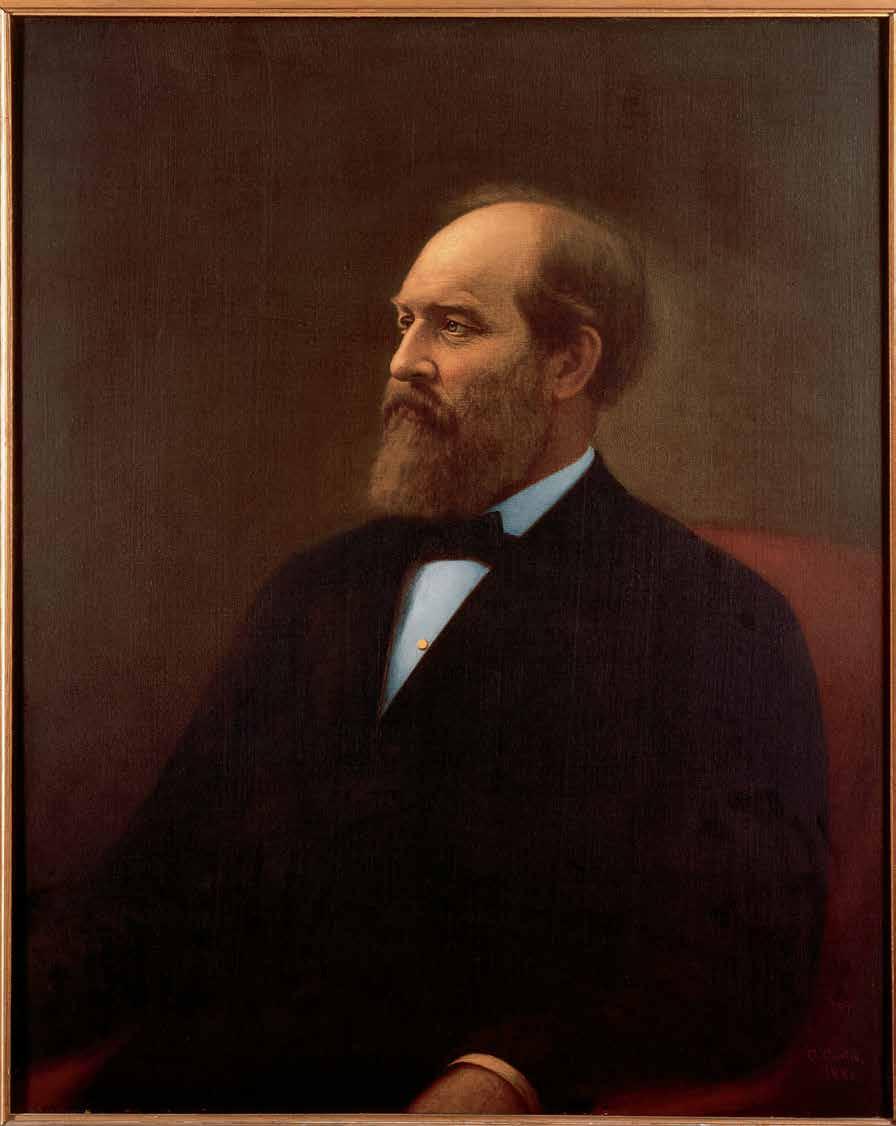
This portrait of President James A. Garfield, made by Calvin Curtis in 1881, is now a part of the White House Collection.
opposite
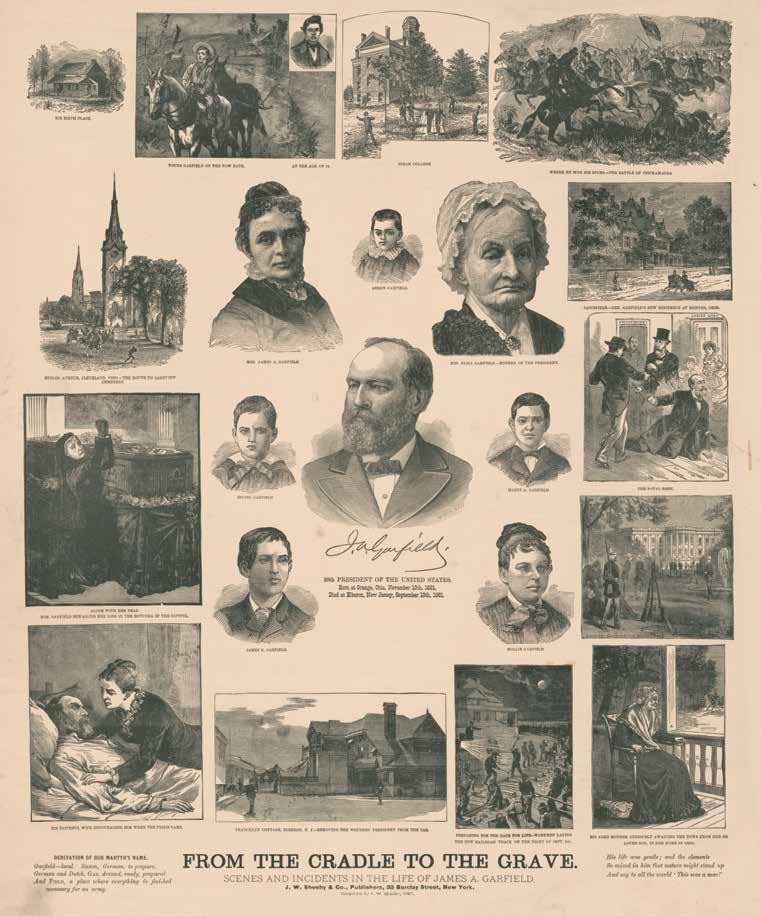
Published in 1881 and entitled From the Cradle to the Grave: Scenes and Incidents from the Life of James A. Garfield, this broadside features illustrations of President Garfield’s family, childhood on the frontier, education, service in the Union Army and the U.S. Congress, as well as his assassination and death.
intelligent and vivacious sinners, while enjoying the fellowship and communion of the saints.”8
Other, more material benefits from Garfield’s faith presented themselves as the years passed. His first leadership experience came from serving as the head of a Disciples-affiliated college, the Western Reserve Eclectic Institute of Hiram, Ohio. Garfield’s tenure running “The Eclectic,” and his concurrent preaching in the region around it, ended up serving as a good political springboard, gaining him sufficient local admiration and prominence to become Ohio’s youngest state senator. And, when the Civil War broke out, the school gave Garfield a plentiful source of young men ready to, quite literally, fight for their principal in what he considered to be a something of a holy war to slay “the monstrous injustice of human slavery.”9
Per at least one definition, Garfield enjoyed a literally perfect political career, never losing an election.10 But his style of politics evolved fundamentally over the course of his time in office, as his initial hopes for Reconstruction met tough political realities. In his early congressional terms, Garfield was a fiery radical who infused his progressive ideals with religious imagery, openly comparing former Confederates to Satan’s fallen angels and describing social equality between the races in America as a religious obligation that the government needed to fulfill. As Garfield lectured voters on July 4, 1865:
In the great crisis of the war, God brought us face to face with the mighty truth, that we must lose our freedom or grant it to the slave. In the extremity of our distress, we called upon the Black man to help us save the Republic; . . . we made a covenant with him, sealed both with his blood and ours, and witnessed by Jehovah that, when the nation was redeemed, he should be free. . . . What is freedom? . . . Is it the bare privilege of not being chained, of not being bought or sold, branded and scourged? If this is all, then freedom is a bitter mockery, a cruel delusion.11
Fast-forward a decade and a half, though, and Minority Leader Garfield had politically outlived the rise and fall of Reconstruction. His early bombast had mellowed into a quiet internal faith that time—“with justice and wisdom at work”—would, one day, lead to a more just and domestically harmonious America.12 It was this version of James
Garfield that was almost accidentally catapulted to the White House in 1880. In the heat of a bitterly divided Republican Party Convention in Chicago, he had been nominated spontaneously from the crowd, on the basis that Garfield alone had the resume, temperament, and tact to stitch a divided party (and country) back together.
After Garfield’s subsequent triumph at the polls that November, some fellow Disciples of Christ privately expressed their thrill that a practicing minister and member of their sect was heading to the White House. But the president-elect— characteristically considerate of those of different beliefs— warned that making “too much a fuss about” his faith might, in some ways, be the least Christian thing to do:
above
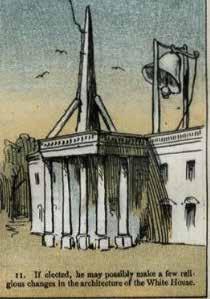
During James Garfield’s presidential campaign, an illustration published in Puck magazine speculates that Garfield, thinking like a preacher, might add a bell and a steeple to the White House.
FPO Mosaic to Scan
Our people must not use me as the promoter of the views of our brethren. . . . Let us not flaunt ourselves in the face of the American people as though we had made a special conquest, but by modesty and moderation bear our part worthily and take whatever resulting advantages may come.13
Garfield—through no fault of his own—would not serve as president for long. But his actions during his brief time on Pennsylvania Avenue reflected the charitable, conciliatory religious principles that had guided his life to that point. He gave grace to political foes who probably did not deserve it; the policies the Garfield administration endorsed seemed focused on using the power of the presidency to help the downtrodden and offer some salvation to the oppressed.
For example, it was President Garfield who worked overtime to keep mending fences in a badly divided Republican Party, noting religious parallels in his lonely attempts to play peacemaker. He wrote in his diary, “I will not abandon the New York Protestants.” It was Garfield who initiated the creation of an American chapter of the International Red Cross, extended administration jobs to prominent African Americans, and—in a presidential first—endorsed the idea of universal public education in America, hailing it, in his Inaugural Address, as “the saving influence of domestic society.”14
A different aspect of the new president’s faith was more apparent to the casual citizen. In fact, it was literally visible every Sunday morning, when Garfield would leave the White House with his family, hop into a carriage borrowed from his predecessor President Rutherford B. Hayes, and then drive to a small Disciple Church on Vermont Avenue. Unfortunately, once there, the first family would be reminded that this was a time wherein American citizens could still mix freely with their elected leaders. With Garfield’s election, the old Disciple Church of Washington, D.C., had become something of a madhouse, crammed to the brim with tourists and reporters hoping to pray with the president.
Crowds flooded the church’s entrance every Sunday, forcing bouncers to clear a path for the president to get inside. “Thousands were unable to obtain admission,” wrote a journalist trapped in such a crush one morning. Some of those visitors lucky enough to snag a seat spent more time
critiquing the style of Disciple worship than listening to the sermons. At least one guest heckled the preacher, while several others would write gossip columns describing the Vermont Avenue church as a “shanty” unworthy of a president’s attendance.15 Garfield personally found such intrusions embarrassing. But, unwilling to make a fuss about it, he tolerated public obsession with his faith while resigning himself to private complaints about the attention. As he wrote in his diary, “It gives me a sorry view of human nature to see a little church filled to double its usual attendance by the accident of one of its frequenters . . . [being] elected to a high office.”16 In fact, had Garfield glanced around the church during one morning’s service, he would have locked eyes with an especially poor specimen of human nature: the president’s future assassin, gripping a hidden pistol and waiting for the perfect moment to strike.17
Charles Guiteau finally pulled the trigger several weeks later, putting a bullet in the president’s back in a train station in downtown Washington. The shooter’s motivations were confused but centered on his frustrations in seeking a crony job in the federal bureaucracy, wherein most roles at the time were handed out based on partisan connections rather than professional competence. As soon as the murderer’s rationale became clear to the public, Christlike parallels became (among certain religious observers) too obvious to be ignored. Religious and political rhetoric suddenly muddled together: just as Jesus had died for humanity’s sins, so too had President Garfield apparently paid a mortal price for partisan corruption of the national civil service.
America’s priests leapt into action the Sunday after the president’s shooting. They mounted their pulpits to pile scorn onto the “spoils system” of job allocation in the federal bureaucracy, speaking to the nation’s political outrage in a way that elected officials (many of whom were complicit in the spoils system) could not. As one minister challenged his flock:
Is it not the commission of the crime [Garfield’s shooting] largely due to the abuse of those very institutions which we enjoy and esteem as our strength? . . . It is a sad commentary on the political condition when two-thirds of the time of officials is spent in the distribution of patronage.18
opposite President Garfield is entombed in a memorial in Lake View Cemetery in Cleveland, Ohio. Completed in 1890, the interior features stained glass windows and a monumental statue of Garfield by Alexander Doyle. A detail of his face is seen here, 2015.
The excitement of this moment was sharpened by the fact that the president survived his initial shooting, only to fall ill with infection. As Garfield’s health declined over the summer of 1881, the entire nation became locked in prayer for the president’s recovery. Religious devotion began, in the eyes of some observers, to bleed into potential political payoffs. “This worship will make him all-powerful if he lives,” wrote one political observer.19 These calculations turned out to be tragically premature. Garfield died that September of infection, having endured one of the most agonizing presidential deaths on record.
The full arc of President Garfield’s murder has been well chronicled by some wonderful writers over the years, including in a television series.20 This is for good reason: the circumstances of the president’s killing offer the ideal blend of drama, heartbreak, science, and spectacle to capture popular attention through the generations. Consequently, though ironically, the most widely known aspect of President Garfield’s life remains how he died.
But Garfield’s story did not quite end there. Instead, like any good martyr, Garfield gained considerable power after he died, becoming enshrined beyond compare in American popular memory as well as an incomparably strong political symbol. His legacy became lionized by activists seeking civil service reform. Posters bearing the martyred president’s face were plastered on newspapers, polling places, and public buildings across the country, urging America’s government to restrict partisan activity within the federal bureaucracy. The result of this canonization of Garfield was, ultimately, the Pendleton Civil Service Reform Act of 1883—a dry-sounding but revolutionary piece of legislation that depoliticized swaths of the federal civil service. Congressmen would, in hindsight, concede that Garfield’s murder “gave impulse” to the act’s passage.21
And so, the first religious minister to enter the White House exited it as an enduring figure in America’s “civic religion,” too. The reforms put into motion by Garfield’s martyrdom transformed the nation’s domestic institutions, ushering in competitive hiring processes for federal civil servants, instituting restrictions from partisan interference in their work, and regulating their own political activity. The establishment of such norms have, over the generations, yielded innumerable and unquantifiable benefits to the average American citizen.
Few typically take the time to appreciate this fact. Nevertheless, those who do sometimes pay tribute to the man whose sacrifice made it possible—James Garfield, America’s martyred “Preacher President” and patron saint of civil servants.
notes
The epigraph is from Crete and James: Personal Letters of Lucretia and James Garfield, ed. John Shaw (East Lansing: Michigan State University Press, 1994), 11.
1. Allan Peskin, “The Short, Unhappy Life of the Federal Department of Education,” Public Administration Review 33, no. 6 (December 1975): 571–75; quotation from James A. Garfield, “The National Bureau of Education,” speech given June 8, 1866, in The Works of James Abram Garfield, ed. Burke A. Hinsdale (Boston: J. R. Osgood, 1882–83), 1:142.
2. “The Candidates,” Chicago Inter Ocean, June 9, 1880.
3. Allan Peskin, Garfield: A Biography (Kent, Ohio: Kent State University Press, 1978), 440.
4. C. W. Goodyear, President Garfield: From Radical to Unifier (New York: Simon & Schuster, 2023), 9–10.
5. Ron Chernow, Grant (New York: Penguin Press, 2017), 909; quotation from Peskin, Garfield, 441.
6. Quoted in Jerry Rushford, “Political Disciple: The Relationship Between James Garfield and the Disciples of Christ,” 1997, 1–2, Pepperdine Digital Commons, www.digitalcommons. pepperdine.edu.
7. James A. Garfield diary, Harry Brown and Frederick Williams, eds., The Diary of James A. Garfield (East Lansing: Michigan State University Press, 1967), 1:39.
8. John Ingalls, A Collection of the Writings of John James Ingalls (Kansas City, Mo.: Hudson-Kimberly, 1902), 397.
9. James A. Garield to Burke Hinsdale, February 17, 1861, Garfield Papers.
10. Peskin, Garfield, 37.
11. James A. Garfield, “Suffrage and Safety,” speech given July 4, 1865, in Works of Garfield, ed. Hinsdale, 1:85.
12. James A. Garfield, diary, January 25, 1881, Garfield Papers.
13. Quoted in Rushford, “Political Disciple,” 270.
14. James A. Garfield, diary, March 20, 1881, Garfield Papers; James A. Garfield, Inaugural Address, March 4, 1881, online at American Presidency Project website, www. presidency.ucsb.edu.
15. “President Garfield’s Church,” Washington Evening Star, March 7, 1881; untitled clipping, Lincoln (Neb.) Journal Star, March 17, 1881.
16. James A. Garfield, diary, March 20, 1881, quoted in Goodyear, President Garfield, 428.
17. Candace Millard, Destiny of the Republic (New York: Doubleday, 2011), 139.
18. Quoted in Goodyear, President Garfield, 456.
19. Quoted in Peskin, Garfield, 600.
20. The most authoritative study is Millard, Destiny of the Republic, which was recently adapted into a Netflix series. The best pure Garfield biographer is Allan Peskin, while other great Garfield writers include Kenneth Ackerman, Benjamin Todd Arrington, Jerry Rushford, and Ira Rutkow.
21. Ari Hoogenboom, Outlawing the Spoils: A History of the Civil Service Reform Movement, 1865–1883 (Urbana: University of Illinois Press, 1961), 213–15; Samuel Cox, Union—Disunion— Reunion: Three Decades of Federal Legislation, 1855–1885 (Washington, D.C.: J. M. Stoddart, 1885), 676.
The Sunday School Teacher PRESIDENT JIMMY CARTER and First Baptist Church
CHRISTI HARLAN
on the third sunday of January 1977, the senior pastor of the First Baptist Church of the City of Washington, D.C., closed the 11:00 a.m. service with an invitation to prospective members. A family of six from Plains, Georgia, rose from a pew and walked to the front of the sanctuary where ushers distributed pens, pencils, and little blue cards for the applicants to fill out. The Carter family’s membership in First Baptist D.C. would not be official until a letter of recommendation arrived from Plains Baptist Church, but Sunday, January 23, 1977, was the beginning of a remarkable and little-known chapter in the life of President Jimmy Carter.
Over the four years of his presidency, Carter attended worship services at First Baptist D.C. at least seventy-five times and led Bible study at
least seventeen times for one of the church’s adult Sunday school classes. Throughout this time, the president did his best to be just one of the nine hundred regular members of the church, and the church reciprocated, with the pastors, lay leaders, and members of the congregation determined to make First Baptist a haven for the newcomers. “I hope this is the one place they can come where they don’t have to be the Presidential family, just people,” church member Millie New told the New York Times in January.1
Just nine months later, in October 1977, Carter acknowledged—and appreciated—the church’s efforts in remarks to a Sunday school class’s annual banquet. “You have made our lives normal lives,” he said. “You have given us stability in a position that is
previous spread
President and Mrs. Jimmy Carter leave the First Baptist Church of the City of Washington after Sunday services. They joined the church three days after Carter’s Inauguration as the thirty-ninth president of the United States. The church building at 1328 Sixteenth Street NW was completed in 1955.
below and opposite
President Jimmy Carter and his family followed the same process as other prospective members when they joined First Baptist. They walked to the front of the church and filled out blue cards. First Baptist D.C. then requested a letter of recommendation, which was signed by President Carter’s relative Hugh Carter, the clerk of Plains Baptist Church.
inherently sometimes unstable. A President of our country can be an isolated person. You have taken us in, and we are indebted to you.”2
For a church founded in 1802 and never located more than a mile from the White House, First Baptist D.C. has had remarkably few close encounters with presidents. The congregation was in its first building at Nineteenth and I Streets NW in October 1808 when President Thomas Jefferson penned a letter to pastor Obadiah B. Brown, apparently responding to a message of appreciation for Jefferson’s role in establishing the separation of church and state. Jefferson demurred, saying the credit should be shared.3 In 1834, the congregation built a new church on Tenth Street NW. Eleven years later, it merged with Fourth Baptist Church and moved into the latter’s building on Thirteenth Street. First Baptist sold the Tenth Street building to an impresario from Baltimore named John T. Ford, who turned the former church into the theater where Abraham Lincoln would be assassinated.4
In 1889, the congregation opened an imposing red-brick church on Sixteenth Street NW, a mile north of the White House. President Warren G. Harding was impressed with the preaching of Pastor Henry Allen Tupper and attended
Truman would sometimes walk to worship services at First Baptist. The sanctuary was on the second floor of the building, accessible by a single staircase. After an assassination attempt at Blair House in 1950, Truman stopped attending services at First Baptist, although he remained friends with Pastor Edward Hughes Pruden Sr.6
Dr. Pruden saw the single staircase as a danger to his entire congregation. For that and other reasons, he campaigned to replace the 1889 building. On Christmas Day 1955, First Baptist held its first worship service in a new sanctuary whose soaring arches resemble the Anglican and Presbyterian churches of Edinburgh, where Dr. Pruden earned his PhD. Almost eleven years later, in September 1966, the United Press International reported that “President [Lyndon] Johnson gave the surprised congregation of First Baptist Church a double attraction Sunday by bringing along evangelist Billy Graham. . . . After the hour-long 11 a.m. service, the Johnsons and Dr. Graham gathered with the congregation in a basement meeting room for handshaking and refreshments—orange punch and cookies.”7
Months before he won the 1976 presidential election, Jimmy Carter inspired a missionary
candidate Carter at a Kiwanis Club luncheon that summer and slipped him a picture postcard of First Baptist, along with a few encouraging words about the church. Two weeks after Carter secured the Democratic nomination in July 1976, Washington Post religion editor Marjorie Hyer highlighted dueling pitches to Carter from the pastors of Calvary Baptist and First Baptist, each noting that they were about a mile from the White House to the east and to the north, respectively.8 Another churchgoer responded in a letter to the editor: “I had already sinned in my heart by coveting him as a member of National [Memorial] Baptist at Sixteenth and Columbia Road NW. . . . If Jimmy Carter doesn’t give us a drop-by, I am going to brood.”9
Three months later, President-Elect Carter attended two pre-inaugural services at First Baptist D.C., including one the morning of the Inauguration. Afterward, Carter’s spokespeople insisted to the Washington Post that he had made no decision about a church.10 The following Sunday, however, President Carter presented himself for membership in First Baptist D.C. along with First Lady Rosalynn Carter, their son Chip and his wife Caron, and their daughter-in-law Annette Carter, wife of son Jeff Carter. Amy Carter, then nine years old, presented herself as a candidate for baptism.11 In the end, it was not proximity to the White House or the entreaties of the pastors that swayed Carter’s choice of a church. The president-elect had launched his own reconnaissance operation that turned out, unintentionally, to be undercover:
We decided to join the First Baptist Church, primarily because Chip and Caron, during the pre-inauguration days, had attended several of the churches and found this one to be both warm and friendly, even when the people there didn’t know who our children were. Also, Amy decided to become a member of the church and to be baptized there.12
First Baptist D.C. got more than a new family when the Carters joined—much more. Within ten days of their first Sunday, the senior pastor went to the Diaconate—the body of lay leaders known as deacons—with a request: “Dr. [Charles A.] Trentham announced that he would like to hire a professional news person for one day a week since our church is in the news every time the President is at church. Caspar Nannes has indicated that he could give us his time one day a week for $150 a
month.”13
One week later, the Hospitality Committee published a plaintive plea in the church newsletter: “Our many visitors, some 200 each week, present a problem for the Visitors’ Coffee. . . . We request that members refrain from just ‘dropping by’ for a cup of coffee as such.”14 On Sunday, February 6, 1977, between dealing with reporters and crowd control, First Baptist did what Baptists do for new members: “Amy Carter was baptized into the Christian faith by full immersion yesterday in front of her mother and father, her nurse, and more than 1,000 fellow worshippers at First Baptist Church,” Janis Johnson wrote in the Washington Post 15
The public attention to First Baptist and its high-profile members grew throughout 1977. Nannes, the church’s new part-time publicist, did not have to do much to get journalists interested in the church: For religion reporters, it was part of their beat, and for the White House press corps, it was routine for a small contingent to accompany the president everywhere.
While the presence of the press was predictable,
opposite
The baptismal pool above the altar where Amy Carter was baptized in 1977 is seen in this view of the sanctuary of First Baptist D.C., 2024.
below
Today the pew occupied by President Carter and his family from 1977 to 1981 is identified with a brass plaque, 2024.
the protesters were a surprise. On Sunday, April 24, 1977, television cameras captured a line of people with disabilities—some in wheelchairs, some with white mobility canes—on the Sixteenth Street sidewalk opposite First Baptist. They were among the group of activists who occupied federal offices in San Francisco, demanding regulations to implement Section 504 of the Rehabilitation Act of 1973. The section would prohibit discrimination against qualified individuals with disabilities in any program or activity receiving federal financial assistance. The demonstrators never got close to President Carter inside First Baptist, but four days later, on April 28, 1977, the regulations were quietly issued, and the occupation in San Francisco ended.16
News accounts describe more invasive demonstrations by antinuke protesters who blended in with the congregation before disrupting worship on at least five occasions in 1977 and 1978. Ushers— the church volunteers who typically welcome visitors and help with seating—became practiced at hustling the protesters out of the sanctuary for arrest outside.17 The demonstrations interrupted only a handful of the seventy-five or more Sundays that Carter attended First Baptist D.C. The other Sundays were as normal as they could be with a president in the pews.
Normal Sundays for Jimmy Carter meant much more than singing hymns and listening to a sermon during the worship service. He was a lifelong devotee of Sunday school, the hour or so usually preceding worship when laypeople lead discussions of specific passages from the Bible. First Baptist D.C. had several Sunday school classes for adults in January 1977; the Carters chose the Couples Class, which seemed ideal for the president and first lady.
The class had begun in late 1943 or early 1944 as young married people moved to Washington, D.C., for jobs during World War II. The war effort required long, irregular hours that left little time for working couples to be together, except in church. Mixed gender classes were discouraged by many Baptist churches even into the 1970s, so the wartime couples at First Baptist needed the pastor’s blessing to meet in one class. Dr. Pruden approved and promptly joined the class with his wife. The Couples Class formally became part of First Baptist’s Sunday school on January 5, 1945, with fourteen members.18
When the Carters arrived, the class was
integrated by gender, nationality, and race. Among the members were the Liberian ambassador to the United States; an Australian banker; the executive director of the American Public Health Association and his wife, a nurse; an architect; and a patent lawyer. The membership roll contained the names of more than fifty couples in alphabetical order; new members were listed at the top of roll with their home addresses. For one pair in 1977, the address was 1600 Pennsylvania Avenue, Washington, D.C.19
Thanks to his presidential campaign, Carter’s experience as a Sunday school teacher was well known. He had taught Sunday school since he was a midshipman at the U.S. Naval Academy and, until his election as president, he taught at Plains Baptist Church in his hometown in Georgia. He talked about his Sunday school experience in the interview with Playboy, published just before the election.20
At First Baptist D.C., the lead teacher of the Couples Class, a gregarious insurance marketing executive named Fred M. Gregg, wasted little time recruiting a substitute: “The day that I first met the President, he said, ‘I’m looking forward to hearing you teach.’ I said, ‘Well, how about you teaching?’”
This was the Sunday after the Inauguration, and President Carter said, “Well, after all, Fred, I have had a pretty busy week this week,” but then he said, “I will teach.”21
A month after his Inauguration, Carter stepped to a lectern in the balcony overlooking the sanctuary of First Baptist D.C. and faced four long pews where members of the Couples Class sat shoulder to shoulder. Carter’s back was to one of the neoGothic pillars that supported the church’s soaring ceiling—a concrete comfort to the plain-clothes Secret Service agents stationed in the balcony and throughout the sanctuary. A reporter with the United Press International described the lesson: “Smiling frequently and talking in low, warm tones, Mr. Carter quoted from the Book of Mark. . . . Mr. Carter appeared at ease with the class and held its close attention. He asked members to recite from the Bible and then asked for opinions on what the passages meant. ‘How many of you have been on your knees in the past 24 hours?’ he asked. ‘I have.’”22
Other news accounts and the White House presidential diary—the official daily record of the chief executive’s activities—document that President Carter taught Sunday school at First Baptist D.C.
Soon after President and Mrs. Carter joined the Couples Class that met in the balcony at First Baptist D.C., the president was recruited to serve as its substitute teacher. During his presidency, Carter would ultimately teach the class seventeen times.
at least seventeen times, beginning February 20, 1977. In November 1977, members of First Baptist D.C. installed a microphone on the lectern and began recording President Carter’s lessons on reelto-reel tape. In recordings of fourteen lessons, preserved in the Archives of First Baptist D.C., Carter comes across as a gifted Bible scholar and solicitous teacher. He also came to church with a good sense of humor, matching that of the lead teacher. With equally sharp wits and deadpan delivery, Gregg and Carter often opened the Couples Class trading mock insults about who was the better teacher, sparring in their native drawls of Tennessee and Georgia.
When he turned to the lesson of the day, Carter’s voice on the recordings is relaxed and calm, belying the weight of his office and the singular calamities that punctuated his term, from the partial meltdown of the Three Mile Island nuclear power plant and the deadly eruption of Mount St. Helens to the Soviet invasion of Afghanistan and the hostagetaking at the U.S. embassy in Tehran.
Carter mentioned none of those events in his Sunday school lessons at First Baptist D.C. On the rare occasions that he said something about his day job, he usually connected it to the assigned Scripture. One exception was Sunday, September 24, 1978, when an unknown speaker introduced the teacher:
For the past two weeks, a member of this class has been involved in some negotiations. And I’m sure you all appreciated seeing the three men principally involved in those negotiations on television. The smiles on their faces indicated that some accomplishment had been made. . . . It gives me great pleasure at this time to introduce to you the teacher of our class this morning, the President of the United States.23
Applause can be heard on the recording; the Associated Press reported that the class members gave Carter a standing ovation.24 He responded with humor but quickly got serious:
Well, it’s always nice to come back from a twoweek vacation at Camp David.
I think some of the most unpleasant moments of my life occurred during the last two weeks and, of course, also some of the most pleasant. One of the great things about the meeting was that I was meeting with two leaders who were deeply devout and religious men. Who spent a great portion of their time at Camp David in prayer. Who believe that they and I worship the same God.
President [Anwar] Sadat refers often to his guidance from God Almighty. The fact that he and [Israeli Prime Minister Menachem] Begin
opposite, right, and below President Carter, as seen (opposite) in 1980, led the Couples Sunday School Class while standing near the pillar at the front of the balcony. A plaque (right) now marks the spot where he stood.
are both descended from Abraham, that they’re brothers not only in religious beliefs, but also by blood. And that was one of the things that I believe gave us a kind of a clear, unshakable purpose, because we all believed that God wanted us to work toward peace. It was one of the few things on which we agreed at first.25
Carter spent no more than three minutes talking about the Camp David Peace Accords—still in effect today—before directing the class’s attention to the lesson from the New Testament book of Philippians.
A similar scene played out on Sunday, January 4, 1981—the Carters’ final Sunday at First Baptist D.C. The Couples Class hosted a reception for the departing members in the church parlor before repairing to the balcony for the lesson.26 Fred Gregg was in his usual form: “I know no one knew the President was teaching this morning, and I appreciate so many of y’all coming to hear me,” he said. “I hate to disappoint you though, but he’s going to teach.”27 Gregg went on to say some nice things about his friend, then relinquished the lectern. Carter opened with a quip, then expressed his appreciation for the Couples Class:
One of the finest things that ever happened to us, personally, was the joining of this class and
the friendship with Fred Gregg and all of you who’ve accepted us, not as a public official in some ivory tower, but as a human being, as a fellow Christian, and as a friend. We’ve never come into this class when we were treated with anything other than genuine fellowship and friendship, and on a personal basis. And it really meant a lot to us in a trying position of being President of this great country.28
The president spent another ninety seconds describing his impending return to Plains, Georgia, then, characteristically, got down to business: “We have a responsibility this morning to I think forget about goings and comings of class members and revert back to the teaching of the Bible,” he said. “And if all of you would turn to Luke 9, I’ll let you help me with the lesson.”29
Three weeks later, on Sunday, January 25, 1981, Ronald Reagan was president of the United States; the hostages in Iran were free, having been released minutes after Reagan’s Inauguration; and Jimmy and Rosalynn Carter were at Maranatha Baptist Church in Plains, Georgia, requesting to transfer their membership from the First Baptist Church of the City of Washington, D.C.
left
After his presidency
Jimmy Carter regularly taught Sunday school at Maranatha Baptist Church in his hometown of Plains, Georgia. He is seen here at age 94 ahead of starting a class on April 28, 2019.
right
Crowds line up to attend Carter’s Sunday school classes at Maranatha Baptist Church. The church was founded in early 1977 by former members of Plains Baptist Church. When he was in Plains during his presidency, Carter would attend a Sunday school class at Plains Baptist Church and worship at Maranatha. He and Rosalynn Carter joined Maranatha in January 1981.
notes
1. Quoted in Kenneth A. Briggs, “Capital Church Wants Carter to Feel at Home,” New York Times, January 20, 1977.
2. Quoted in Caspar Nannes, “Even a President Needs Love: President and Mrs. Carter Attend Church Banquet,” Capital Baptist (D.C. Baptist Convention), November 10, 1977.
3. Thomas Jefferson to Obadiah B. Brown, October 17, 1808, National Archives, Founders Online website, www.founders. archives.gov.
4. “Ford’s Theatre: Places,” National Park Service website, www. nps.gov.
5. Dorothy Clark Winchcole, The First Baptists in Washington, D.C., 1802–1952 (n.p., 1952), 4, 9.
6. Edward Hughes Pruden Sr., A Window on Washington (New York: Vantage Press, 1976), 103.
7. United Press International, “LBJ Takes Graham to Baptist Services,” Washington Post, September 12, 1966.
8. Marjorie Hyer, “The Church for Carter?” Washington Post, August 1, 1976.
9. Susan Leigh Smith, in “Rival Claims on Carter,” Letters to the Editor, Washington Post, August 12, 1976.
10. Janis Johnson, “1st Baptist Leads Race for Carter,” Washington Post, January 20, 1977.
11. William Willoughby, “Carter Presence Elates Churchgoers,” Washington Star, January 24, 1977.
12. Jimmy Carter, diary, January 23, 1977, White House Diary (New York: Farrar, Straus and Giroux, 2010), 13.
13. Diaconate meeting minutes, February 2, 1977, First Baptist Church of the City of Washington, D.C., Archives.
14. “Some Change Called For,” First Baptist Church News, February 9, 1977.
15. Janis Johnson, “Amy Carter Baptized Here: President’s Daughter Immersed in Heated Pool,” Washington Post, February 7, 1977.
16. We Shall Not Be Moved: The 504 Sit-In for Disability Civil Rights, audio documentary produced by Asata Iman, 1997, online at Disability Rights Education & Defense Fund (DREDF)
website, www.dredf.org. The original text of the Rehabilitation Act of 1973 is available on the Equal Employment Opportunity Commission website, www.eeoc.gov.
17. B. D. Colen, “Five Arrested in Protest at Carter Church,” Washington Post, October 17, 1977.
18. “History of the Couples Class,” n.d. First Baptist D.C. archives.
19. Couples Class membership roll, n.d., First Baptist D.C. archives.
20. Adelle M. Banks, “Jimmy Carter, Beloved Sunday School Teacher, Ex-President, Dead at 100,” Religion News Service, December 29, 2024. Robert Scheer’s interview with Jimmy Carter was published in the November 1976 issue of Playboy and is available on the American Presidency Project website, www.ucsb.edu.
21. Quoted in Christi Harlan, Mr. President, The Class Is Yours: Jimmy Carter’s Sunday School Lessons in Washington, D.C. (Washington, DC: Christi Harlan Media, 2024), 232.
22. United Press International, “Carter Teaches His 1st Church Class in District,” Washington Post, February 21, 1977.
23. Quoted in Harlan, Mr. President, The Class Is Yours, 71.
24. Associated Press, “Carter Takes the Day Off, Wins Bible Class Ovation,” Washington Star, September 25, 1978.
25. Quoted in Harlan, Mr. President, The Class Is Yours, 71–72.
26. Doug Porter, handwritten diary, January 4, 1981, First Baptist D.C.Archives.
27. Quoted in Harlan, Mr. President, The Class Is Yours, 231.
28. Quoted in ibid., 232.
29. Quoted in ibid., 233.
A Comforting Presence BILLY GRAHAM
And the Presidents
ABIGAIL COKER
“it was july 14, 1950, and I was about to make a fool of myself.” So opens Just as I Am, the autobiography of one of the bestknown Christian leaders of the twentieth century. Over his decades-long ministry, evangelist Billy Graham preached the Gospel of Jesus Christ through largescale evangelistic events to almost 215 million people worldwide. With characteristic humility and good humor, Billy Graham described his first encounter with President Harry Truman, recounting the trepidation, missteps, and lessons of this first meeting with a U.S. president. Nervous and inexperienced, the 31-yearold evangelist entered the White House dressed in the cream suit, rust socks, and hand-painted tie he had worn to the Bible conference he had just attended. Reflecting on his wardrobe choices with the maturity of more than four decades of public ministry, Graham later remarked: “From the look on President Truman’s face, the chief executive of the nation must have thought he was receiving a
traveling vaudeville team.”1
The young evangelist was sincere, though, in his love for the Gospel and his passion to share it with everyone he met, including the president of the United States. As their time drew to a close, he asked the president about his religious background. Truman mentioned keeping the moral teachings of Jesus. “It takes more than that, Mr. President,” Graham boldly responded. “It’s faith in Christ and His death on the Cross that you need.”2 The president then stood up, indicating that the meeting had come to a close.
As Graham and his team left the White House, reporters bombarded them with questions about their visit. Inexperienced with the nuances of White House protocol, the young evangelist relayed the contents of their conversation, adding that they had closed the meeting by praying for the president. A photographer asked them to reenact the prayer there on the lawn. Although
Graham refused to repeat the prayer just said in the Oval Office, he and his team knelt on the lawn and prayed a sincere thanks for the visit.3 Newspapers across the nation picked up the story, to Truman’s apparent annoyance.4 One columnist reported that Billy Graham was now persona non grata in the Truman White House.5
In later years, Graham acknowledged the awkward consequences of this meeting and the lessons learned from it. Although the experience taught him discretion, it did not quench his commitment to the Gospel or his desire to serve the presidents. Over the next fifty years, he became a frequent visitor to the White House, serving as a friend and spiritual adviser. His presence provided comfort and encouragement to the presidents, supporting them in the day-to-day burdens of their position as well as during times of personal and national crisis.
opposite, right, and below
Evangelist Billy Graham’s first White House meeting with a president occurred on July 14, 1950. Following a twenty minute discussion and a prayer in the Oval Office with President Harry S. Truman, Graham broke protocol by kneeling on the White House lawn (opposite) to reenact the prayer with three friends at the request of photographers (right). Years later, when Graham visited Truman at his home in Independence, Missouri (below), and apologized for his embarrassing mistake, Truman said that he realized Graham had not been properly briefed.
After annoying President Truman during his first visit to the White House, Billy Graham built strong friendships with twelve presidents over the course of the nearly seventy years to follow. He is seen in 2007 at the dedication ceremony for the Billy Graham Library in Charlotte, North Carolina, with George H. W. Bush, Bill Clinton, and Jimmy Carter (page 66) and sharing a laugh in the Oval Office with Lyndon Johnson, 1968 (page 67).
left Billy Graham meets in the Oval Office with President Dwight D. Eisenhower (top), May 1, 1957, and with President John F. Kennedy (bottom), December 2, 1961.
During the presidency of Lyndon B. Johnson, Graham’s White House meetings with the presidents became longer and less formal and often included overnight stays. He is seen here with President Johnson during a visit to the LBJ Ranch, November 17, 1965.
AN ENCOURAGING PRESENCE
Billy Graham’s initial return visits to the White House under Presidents Dwight Eisenhower and John F. Kennedy were formal Oval Office appointments, but on July 22, 1964, President Lyndon B. Johnson invited Graham and his wife, Ruth, to spend the night.6 They arrived a month later.7 After the visit Graham sent his thanks: “It was a never-to-be-forgotten experience for us. We had never had the opportunity to spend the night in the White House before, and it was an event that we shall pass on to our grandchildren and their children.” He wrote that the visit had informed his and his wife’s prayers for the president: “We deeply appreciated you sharing your confidence with us. The load that you carry so bravely and cheerfully is indeed heavy. . . . Our visit with you will cause us to redouble our prayers that God will give you strength, courage, and wisdom for the critical days in which we live.”8
This first overnight stay of the Grahams at the White House9 established a pattern that would play out again and again over the next forty years: Billy
and Ruth Graham faithfully came, listened, and prayed. As good friends, they avoided exposing the details of these visits to the public. Although the Grahams spent many nights in the White House, there is little record of what happened during these private visits beyond minute details that can be gleaned from thank-you letters, logistical memorandums, and Billy Graham’s occasional dictated notes. What the historical materials do reveal are visits filled with informal meals, lively conversation, and the Grahams’ commitment to providing spiritual encouragement and prayer.
Writing to a family member in November 1979, Ruth Graham shared details of a recent overnight visit with President Jimmy Carter and his family at the White House. She recalled that it was “both friendly and informal; totally non-political, about the family and things of the Lord.” With colorful detail, she described her impressions of the Lincoln Bedroom, where they spent the night:
At last [Bill] has found a bed long enough to
suit him! This one is a little over nine feet long. For fun, I paced off the room and it is roughly 39' × 33' with at least 15' ceilings. . . . To the right of the door leading out into the hall hangs the portrait I liked best entitled “Lincoln the Sympathetic” by Bolk [Volk]. . . . Who knows if this is actually the bed Lincoln slept in? (I think there are three such beds in existence. I know that the Johnny Cashes have one of them.)
In the morning, they were served breakfast in their room “on two beautiful silver trays each with its little silver coffee pot, cream and sugar, orange juice, scrambled eggs and crisp bacon with whole wheat toast, butter and jam.”10 Newsy descriptions such as this were rare, though. Like her husband, Ruth Graham carefully avoided exposing these informal family moments to the prying eyes of the world.
The first family sometimes invited the Grahams to join in special celebrations, such as the White House wedding of Tricia Nixon and Edward Cox on June 12, 1971. Billy Graham flew into Washington, D.C., from an ongoing evangelistic crusade to attend the wedding and returned to Chicago immediately afterward to preach that evening.11 Speaking to more than thirty thousand people, he shared a few anecdotes from the wedding, even noting that he was going to have his souvenir piece of the wedding cake “coated with a preservative” to keep it.12
After Graham’s death in 2018, staff at his home office in Montreat, North Carolina, began processing the mementos and family treasures stored by his wife in the attic of the mountain home. They found one of the wedding favor boxes from Tricia Nixon and Edward Cox’s wedding. Stored inside was a tiny piece of the wedding cake, petrified and inedible, but perfectly preserved.13
Writing to President Nixon two weeks later, Graham said that he was praying for him during this bittersweet adjustment: “I know that happiness on such an occasion is mixed with sadness. I have seen all three of my daughters married and privately I shed a tear each time. However, I found that I actually gained three sons and that I am closer to my daughters now than I was when they were single. . . . When they get married they touch your heart in a different way.”14
As Billy Graham’s global ministry grew, so did his interactions with world leaders both overseas and at the White House. On December 8, 1987,
the Grahams attended a State Dinner welcoming Mikhail and Raisa Gorbachev to the United States for the signing of the Intermediate-Range Nuclear Forces Treaty.15 In the State Dining Room, the dinner guests enjoyed a menu that included lobster medallions, caviar sauce, veal with wild mushrooms, and a tea sorbet in honey ice cream.16 Graham chatted with the other guests, later noting, “At the table, the two or three around us discussed religion and faith and I had an opportunity to tell them what it meant to be a Christian—just including about three or four people who were within easy earshot—it came up quite naturally.”17
Graham viewed such conversations as a natural
opposite
Billy Graham delivers a prayer during the first Inauguration of President Richard M. Nixon, January 20, 1968 (right), and, accompanied by his wife, Ruth, he joins the Nixon family on their first Sunday in the White House, January 26, 1969 (opposite).
below
Billy Graham meets Mikhail Gorbachev during a State Dinner hosted by President and Mrs. Ronald Reagan, December 8, 1987.
above and left Billy Graham was a regular speaker at the National Prayer Breakfast, an event that he helped to establish in 1953. He is seen giving remarks at the breakfast in 1975 as President and Mrs. Gerald R. Ford listen (above), and he joins President and Mrs. Jimmy Carter at the breakfast in 1979.
above and right
Less formal time spent with the presidents was often enjoyed on the golf course. Clockwise from top left, Graham is seen ahead of a game with President Kennedy in Palm Beach, 1961; on a New Jersey course with Vice President Richard M. Nixon, 1957; and during a round of golf with President Ford in North Carolina, 1975.
result of his faith and an extension of his evangelistic calling. He wrote in his autobiography: “I never go to see important people—or anyone else—without having the deep realization that I am—first and foremost—an ambassador of the King of kings and Lord of lords. . . . We may discuss a dozen peripheral things first, but I am always thinking of ways I can share Christ and His message of hope with them.”18
Although Graham gratefully welcomed and appreciated these White House invitations, he carefully prioritized his evangelistic ministry. On October 9, 1985, First Lady Nancy Reagan called the Grahams to personally invite them to an upcoming State Dinner in honor of Prince Charles and Princess Diana.19 Graham accepted the invitation, only to realize that he was already scheduled to speak at an evangelistic dinner that same evening. He was forced to call Mrs. Reagan back the following day and apologetically decline. This brief episode in the history of Billy Graham’s relationship with the Reagans, although undoubtedly uncomfortable for him at the time, highlighted his priorities very clearly. As he explained in the letter of apology that he wrote to the first lady the following day, “I found my heart and head in conflict. Ruth and I were so overwhelmed at your invitation and our acceptance of it, without realizing that we had this conflict. . . . I know this decision breaks all rules of protocol, and yet in my situation there is a deeper dimension . . . I have the call of God to proclaim the gospel which must take priority at all times.”20
A REASSURING PRESENCE: THE WHITE HOUSE IN CRISIS
Shortly after the close of his presidency in 1969, Lyndon B. Johnson wrote to Billy Graham: “As I read and reread your wonderful letter . . . my mind went back to those lonely occasions at the White House when your prayers and your friendship helped to sustain a President in an hour of trial. . . . No one will ever fully know how you helped to lighten my load or how much warmth you brought into our house.”21 Many presidents affirmed that they felt Graham’s comforting presence in the White House during some of the nation’s darkest days, as they responded to the social, political, and cultural turmoil of the late twentieth century. In these times of personal and national crisis, presidents and first ladies asked Graham to the White House, inviting his prayers,
encouragement, and spiritual counsel.
On December 15, 1973, Billy and Ruth Graham arrived at a White House darkened by Watergate.22 First Lady Pat Nixon invited them to spend the night at the White House and for Reverend Graham to preach at the Christmas worship service scheduled for the following day.23 Seven months earlier in a radio broadcast on May 6, 1973, Graham had spoken strongly about the “sordid Watergate affair,” stating that “anyone charged and found guilty should be punished.”24 Up to this point, though, he had avoided publicly criticizing President Richard Nixon, truly seeming to believe in his friend’s innocence.25 Now as he opened his sermon on December 16, he acknowledged the “convulsive” nature of the last year, including the “fury of Watergate.” However, he quickly turned attention to the hope found in the Gospel, outlining the basic tenets of the Christian message by focusing on the images of the cradle, the cross, and the crown.26
The Grahams’ presence at the White House that weekend deeply impacted the Nixons’ younger daughter, Julie. She wrote to Graham biographer John Pollock in July 1975, “I was feeling the strain of six months of Watergate and, more importantly, I was facing the fact that after years of searching I still did not have a deep spiritual base in my life.” She described how Ruth Graham sat with her for an hour in the sitting room next to her White House bedroom, as she asked Mrs. Graham how to study the Bible. “I remember that she encouraged me, but most of all I remember her Bible. It was incredibly worn; heavily underlined; and there were written notes in the margins on almost all the pages. I saw immediately that Ruth Graham drew strength from the word of God. And I knew already from earlier encounters that she led the kind of life I wanted to lead.”27
In 1981 another first family called on Billy Graham for comfort as they endured an assassination attempt. On March 30, John Hinckley Jr. shot President Ronald Reagan as he exited the Washington Hilton Hotel. The presidential motorcade sped to the George Washington University Hospital, where the president was rushed into surgery. Within five hours of the attack, Graham left for Washington, D.C., at the invitation of the White House.28 White House Assistant Social Secretary Linda Faulkner, who met him at the airport, wrote several weeks later: “Thank you for the opportunity of greeting you on that frightful evening and
opposite top
During a Sunday Christmastime sermon delivered White House at the invitation of President Nixon on December 16, 1973, Graham acknowledged the gravity of the Watergate affair before turning his focus to the hope found in the Gospel. Graham’s notes for the sermon, marked up with his edits, are preserved in the Billy Graham Archive and Research Center.
opposite bottom
When President Ronald Reagan was hospitalized for his wounds following an assassination attempt in 1981, Graham quickly made his way to the White House to help provide spiritual comfort. In happier times, as seen here, President Reagan awarded Graham the Presidential Medal of Freedom in recognition of his worldwide evangelism and spiritual leadership, 1983.
above and left
On the eve of the Operation Desert Storm, President George H. W. Bush asked Billy Graham to join him at the White House to pray for a short war with few casualties. He is seen above with President and Mrs. Bush in the Private Quarters, watching news coverage on television as the operation began, January 16, 1991. The friends are seen again years later (left) during a crusade in Tampa Bay in October 1998.
Following her husband’s funeral in 1973, Lady Bird Johnson wrote to Billy Graham to thank him for “coming into his life” and easing “the furrows on his brow.”
of talking to you briefly. I thought to myself on the way to the airport that there was no one I would rather meet that night than Dr. Billy Graham. You gave us all great comfort.”29 The next day Graham met at the White House with Mrs. Reagan and other family friends, including Frank and Barbara Sinatra.30 At the end of their time together, Graham led the group in prayer: “I prayed as fervently as I knew how, asking the Lord to raise up our friend. During the prayer, Frank Sinatra said amen twice.”31 Recalling the incident over a decade later, Graham chuckled slightly: “I said, ‘Frank, have you ever said “Amen” to a prayer before?’ And he said, ‘I don’t know, but I feel like it now!’”32
Ten years later, Billy Graham supported President George H. W. Bush as he made a very difficult decision. On January 16, 1991, on the eve of Operation Desert Storm, Patty Presock, President
Bush’s secretary, called Billy Graham’s office, asking if he would be available to fly to Washington, D.C., that evening to have dinner and spend the night at the White House.33 Graham accepted, aware of ongoing tensions in the Middle East but not knowing about the upcoming military operation.34 The visit began calmly. As he settled in to the Lincoln Bedroom, First Lady Barbara Bush invited him to watch television in the Private Quarters.35 Suddenly the CNN commentators in Baghdad began talking about antiaircraft fire going up. Graham later recalled, “I turned to Barbara. ‘Is this the beginning of the war?’ I asked. She did not say anything, but from the way she looked, I was certain that it was.” The president joined them, and they prayed together, “asking that it would be a short war, that few casualties would be suffered, and that the Lord would have His way.”36 As they ate dinner, President Bush made some adjustments to the speech he was preparing. Graham later wrote to a friend, “The President went over to his office to make his speech to the American people. He had an inner conviction that he had made the right decision.”37
A LEGACY OF FAITHFULNESS
When asked in 2008 why he invited Billy Graham to the White House the evening that Operation Desert Storm began, President George H. W. Bush replied: “When a President has to commit forces —somebody’s son, somebody’s daughter—into battle, it’s very traumatic. He can’t blame someone else. You don’t form a committee. The burden is the President’s. And I just welcomed the comfort given to me by Billy Graham. He was there, he was at my side.”38 Over the years, various first families echoed this appreciation for Graham’s presence during their most difficult times in the White House. Writing in January 1973, five days after her husband’s funeral, former First Lady Lady Bird Johnson explained, “I never saw a time when the prospect of your coming did not elevate Lyndon’s spirits, ease the furrows on his brow and quicken the zest of his appetite for life.”39
For more than fifty years, Billy Graham stood at the side of the presidents as a comforting presence in the White House. The young evangelist who had worn a hand-painted tie into the Oval Office and knelt on the lawn for reporters grew older and wiser, but he never grew out of his love for Jesus or his desire to minister to others. He faithfully prayed for and encouraged the presidents and those around below
them, providing comfort and stability through the turmoil of the twentieth century and the strains of their day-to-day responsibilities.
notes
1. Billy Graham, Just as I Am (New York: HarperCollins, 1999), xix–xxiii, xxi. For a biography of Billy Graham, see the Billy Graham Evangelistic Association website, www.billygraham.org.
2, Ibid., xxii.
3. Ibid., xxiii.
4. William Martin, A Prophet with Honor: The Billy Graham Story (Grand Rapids, Mich.: Zondervan, 2018), 135–37.
5. Graham, Just as I Am, xxiii.
6. Lyndon B. Johnson to Billy Graham, July 22, 1964, folder 5, box 4, CN 2—Billy Graham VIP Correspondence, Billy Graham Archive and Research Center (hereafter BGARC), Charlotte, N.C.
7. Lyndon B. Johnson, Daily Diary, August 22, 1964, LBJ Presidential Library, Austin, Tex.
8. Billy Graham to Lyndon B. Johnson, August 27, 1964, folder 5, box 4, CN 2—Billy Graham VIP Correspondence, BGARC.
9. President Johnson had invited Billy Graham to the White House several times before this visit, with several sources claiming that Billy Graham and his team member Grady Wilson spent the night at the White House within the first week of Johnson’s first Inauguration. Grady Wilson, Count It All Joy (Minneapolis: Grason, 1984), 214; Billy Graham, oral history interview by Monroe Billington, October 12, 1983, transcript, 2–3, LBJ Presidential Library. However, the August 1964 overnight visit is the first documented case of the Grahams spending the night at the White House as a couple and marks an important step in their relationship with the White House.
10. Ruth Bell Graham to family member, November 21, 1979, 6–7, Graham family personal collection.
11. Richard Philbrick, “Rev. Graham Tells of Tricia’s Wedding,” Chicago Tribune, June 13, 1971, scrapbook 226, 84, CN 39— Newspaper and Magazine Clippings, BGARC; Billy Graham to Richard Nixon, June 23, 1971, folder 26, box 8, CN 2—Billy Graham VIP Correspondence, BGARC.
12. Philbrick, “Rev. Graham Tells of Tricia’s Wedding.”
13. There is no way of knowing if this is the piece of wedding cake that Graham mentioned during the Chicago crusade service. Considering Mrs. Graham’s self-proclaimed title as a “pack rat,” and her husband’s whirlwind travel schedule, it is more likely that she was the one who kept the piece of cake.
14. Graham to Nixon, June 23, 1971.
15. Graham, Just as I Am, 531–32.
16. Menu from White House State Dinner honoring Mikhail and Raisa Gorbachev, December 8, 1987, folder 14, box 15, CN 2— Billy Graham VIP Correspondence, BGARC.
17. Billy Graham, dictated notes, December 10, 1987, 7–8, folder 14, box 15, CN 2—Billy Graham VIP Correspondence, BGARC.
18. Graham, Just as I Am, 692.
19. Stephanie Wills, note on declined invitation to November 9, 1985, State Dinner, October 10, 1985, folder 11, box 15, CN 2— Billy Graham VIP Correspondence, BGARC.
20. Billy Graham to Nancy Reagan, October 11, 1985, folder 11, box 15, CN 2—Billy Graham VIP Correspondence, BGARC.
21. Lyndon B. Johnson to Billy Graham, February 11, 1969, folder 11, box 4, CN2—Billy Graham VIP Correspondence, BGARC.
22. Richard M. Nixon, Daily Diary, December 15, 1973, Richard Nixon Presidential Library and Museum, Yorba Linda, Calif.
23. Graham, Just as I Am, 458; John Pollock, Billy Graham: Evangelist to the World (San Francisco: Harper & Row, 1979), 178.
24. Billy Graham, “Watergate—What Can We Do About It,” Hour of Decision radio broadcast, May 6, 1973, transcript, 1, CN 1—Billy Graham Manuscripts and Transcripts, BGARC.
25. William Martin quotes a letter from Graham to Nixon around the time of the Christmas service in which Graham affirmed “my personal affection for you as a man, my appreciation for our long friendship, and my complete confidence in your personal integrity.” Martin, Prophet with Honor, 435.
26. Billy Graham, “The Cradle, the Cross, and the Crown,” Hour of Decision radio broadcast, December 30, 1973, of the December 16, 1973, White House worship service, transcript, 2, CN 1—Billy Graham Manuscripts and Transcripts, BGARC. Graham used the images of the cradle, the cross, and the crown to highlight Christian beliefs regarding the birth, death, and return of Christ.
27. Julie Nixon Eisenhower to John Pollock, July 2, 1975, folder 3, box 11, CN 2—Billy Graham VIP Correspondence, BGARC.
28. Stephanie Wills, notes, April 1, 1981, folder 2, box 14, CN 2— Billy Graham VIP Correspondence, BGARC; Graham, Just as I Am, 536.
29. Linda Faulkner to Billy Graham, April 14, 1981, folder 2, box 14, CN 2—Billy Graham VIP Correspondence, BGARC.
30. Wills, notes, April 1, 1981; Graham, Just as I Am, 536–37.
31. Graham, Just as I Am, 536–37.
32. Billy Graham, interview by Whitman Production, July 31, 1996, “MED96-0118 Billy Graham Segment for Reagan Tribute 1996,” video, Whitman Production, 5:53–6:03, BGARC.
33. Stephanie Wills, notes, January 16, 1991, folder 18, box 19, CN 2—Billy Graham VIP Correspondence, BGARC.
34. Graham, Just as I Am, 584–85.
35. Billy Graham, interview by Bob Williams, WLOS-TV, Asheville, N.C., January 23, 1991, transcript, folder 18, box 19, CN 2—Billy Graham VIP Correspondence, BGARC.
36. Graham, Just as I Am, 585.
37. Billy Graham to Richard Bewes, February 12, 1991, folder 4, box 272, CN 4—Montreat Office I, BGARC.
38. George H. W. Bush, interview by Vonda Harrell, May 6, 2008, “TS08-0116,” video, McNee Productions, 4:50–5:09, BGARC.
39. Lady Bird Johnson to Billy Graham, January 30, 1973, folder 15, box 4, CN 2—Billy Graham VIP Correspondence, BGARC.
above President George W. Bush welcomes Billy Graham to the White House, 2007.
opposite Reverend Graham died on February 21, 2018, at the age of 99. President and Mrs. Donald J. Trump paid their respects in the U.S. Capitol Rotunda where Graham lay in honor from February 28 to March 1, 2018. He was the first religious leader to receive this distinction.
The Chapel of the PRESIDENTS at The National Presbyterian Church
J. THEODORE ANDERSON
located today on a 12-acre campus at 4101 Nebraska Avenue in Northwest Washington, D.C., The National Presbyterian Church traces its origins to the small building where the Scottish stonemasons worshipped during the construction of the White House. By 1795, that group of worshippers had grown to form St. Andrew’s Church, which met in several places before establishing First Presbyterian Church on Capitol Hill in 1812.
By the mid-nineteenth century several Presbyterian churches had formed in Washington, D.C., including the Church of the Covenant, which would ultimately merge with First Presbyterian Church in 1930. This merged congregation was designated The National Presbyterian Church by an act of the General Assembly of the Presbyterian Church in 1947.1 At this time, the congregation was meeting in a Romanesque Revival–style church at Eighteenth and N Streets NW, just a few blocks north of the site where the Scottish stonemasons had worshipped. Built in 1889, it was described by historian James Goode as a “dignified masterpiece in gray granite.”2 Many presidents worshipped here
including Benjamin Harrison, Harry S. Truman, and Dwight D. Eisenhower. The church was demolished in 1966.
The cornerstone of the present-day National Presbyterian Church was laid by former President Eisenhower on October 14, 1967.
previous spread, above and left
The National Presbyterian Church (exterior above, with its Chapel of the Presidents, page 82) traces its beginnings to the small Carpenter’s Hall where Scottish stonemasons worshipped during the construction of the White House (see plaque page 83). The building, which was on the site of today’s Lafayette Park, is depicted by artist Peter Waddell as a detail in his 2011 painting A Vision Takes Form (left).
right and below
The Romanesque Revival–style building at Eighteenth and N Streets NW was home to the Church of the Covenant when it merged with First Presbyterian Church in 1930. When the merged congregation was designated The National Presbyterian Church in 1947, President Harry S. Truman unveiled the new plaque at the church entrance (below). President and Mrs. Dwight D. Eisenhower, who regularly attended services here, were joined by Queen Elizabeth II and Prince Philip during their State Visit in 1957 (below right).
President Eisenhower was baptized at The National Presbyterian Church twelve days into his first term of office. He regularly worshipped with his family at the Eighteenth and N Streets NW location during his presidency and later laid the cornerstone for the new church building on Nebraska Avenue in 1967 (opposite top left). The Chapel of the Presidents in the complex was specifically dedicated to all presidents of the United States, at the request of President Eisenhower. Prominently displayed there is a sculpture of his prayer for “the power to discern clearly right from wrong,” which he delivered during his first Inauguration ceremony. The prie dieu on which Eisenhower knelt during his baptism is preserved in the chapel, where it is seen (right) positioned beneath a stained-glass window that pictures him signing Public Law 396 that added “under God” to the Pledge of Allegiance in 1954.
The oak pews in the Chapel of the Presidents were made in 1880 for the Church of the Covenant at Eighteenth and N Streets NW. Many are marked with the names of presidents who worshipped in the buildings that preceded the Nebraska Avenue location.
BRUCE M. WHITE FOR THE WHITE HOUSE HISTORICAL ASSOCIATION
In addition to the Eisenhower window pictured on page 87, five windows in the Chapel of the Presidents tell stories of individual presidents and their faith.
far left
President George Washington is depicted with his hand on the Bible during his first Inauguration in 1789. The window includes a quotation from his Oath of Office: “I do solemnly swear that I will faithfully execute the office of the president of the United States.”
left
President Abraham Lincoln is pictured with a quotation from his Gettysburg Address: “We hereby resolve that these dead shall not have died in vain—that this nation, under God, shall have a new birth of freedom.”
opposite left
President Theodore Roosevelt is pictured with words from his speech to a joint meeting of the U.S. Congress in 1907: “The conservation of natural resources is the fundamental problem.”
opposite center
President Woodrow Wilson is portrayed with a line from his speech to a joint session of Congress in 1918: “National aspirations must be respected; peoples may now be dominated and governed only by their own consent.”
opposite right
President Franklin Roosevelt’s window is embellished with his image, a globe, and the words: “In the future days, which we seek to make secure, we look forward to a world founded upon four essential human freedoms.”
notes
1. The primary source for the history of The National Presbyterian Church and the Chapel of the Presidents is Communications Committee of the Board of Elders, Facets of Faith (Washington, D.C.: National Presbyterian Church Communications Committee, 2011).
2. James Goode, Capital Losses: A Cultural History of Washington’s Destroyed Buildings, (Washington, D.C.: Smithsonian Books, 2003).
presidential sites q uarterly Feature
The Washington NATIONAL CATHEDRAL
Intended for National Purposes
JENNIFER
I. WOJECK
a church “intended for national purposes, such as public prayer, thanksgivings, funerational orations, &c and assigned to the special use of no particular sect or denomination, but equally open to all”1 was first envisioned by Pierre (“Peter”) Charles L’Enfant in his 1791 Plan of the City Intended for the Permanent Seat of the Government of the United States. 1 Although the square L’Enfant designated for the church would ultimately go to the Patent Office (today the National Portrait Gallery) and although it would be nearly two hundred years before the final stone was set 4 miles to the north, L’Enfant’s vision would become a reality in the form of the Washington National Cathedral. The site, atop a hill that rises 385 feet above sea level, allows a view of the cathedral from many miles away. It is open to all and is considered a presidential site, as for more than one hundred years presidents have been on hand for ceremonies, public prayer, thanksgivings, and funeral orations, just as L’Enfant described, and one president now lies at rest here.
In the century that followed L’Enfant’s original vision, the city matured, streets were cut, blocks filled with residences, businesses, and monuments, and so many houses of worship were built that Washington was often called a “City of Churches.” The concept for a national church was not forgotten as the years passed. Following a meeting held to discuss the matter at the Lafayette Square home of banker and philanthropist Charles C. Glover in 1891, the Protestant Episcopal Cathedral Foundation of the District of Columbia was formed by an act of Congress on January 6, 1893, establishing a “cathedral and institutions of learning for the promotion of religion and education and charity.”2 By 1898, the a site of Mount St. Alban had been selected and purchased for the erection of the Cathedral Church of St. Peter and St. Paul, best known today as the Washington National Cathedral. That same year, President William McKinley attended a ceremony dedicating a Celtic Peace Cross on the site.
Construction of the cathedral began in 1907 when the foundation stone was laid during a ceremony at which President Theodore Roosevelt spoke. By 1912, the first portion, the Bethlehem Chapel, was completed. This allowed services, which had been held outdoors since 1898, to be moved indoors.
In 1924 President Woodrow Wilson was interred temporarily in an underground vault; his tomb was moved to the nave in 1956. By 1932 approximately one-third of the cathedral was completed. In 1967 the central tower was finished, and in 1977 the nave and west front were dedicated in a ceremony attended by President Gerald Ford. It was in 1990, during the presidency of George H. W. Bush, that the final stone was placed, exactly eighty-three years after the foundation stone had been placed.3
The finished stone cathedral is essentially Gothic in style, with flying buttresses, gargoyles, and stained glass, and is said to be the sixth largest in the world.
previous spread
Washington National Cathedral, seen atop Mount St. Alban within the 57 acre Close in 2015 (page 93), has been a presidential site for more than a century. A view of the nave is seen during the funeral of President Jimmy Carter, January 9, 2025 (page 92).
left and opposite
From the beginning to the end of the construction process, U.S. presidents have been on hand to celebrate the rise of the National Cathedral.
President Theodore Roosevelt (left) speaks to a crowd of twenty thousand at the ceremony during which the foundation stone was laid, September 29, 1907. Eighty-three years later, on September 29, 1990, President George H. W. Bush gives a thumbs-up as the last stone is set, completing the finial on the south tower.
The west front and nave of the cathedral are seen during construction from c. 1964 to 1975 in this selection of images captured by architectural photographer Robert Lautman (1923–2009). Lautman documented the National Cathedral’s rise for more than forty years and was known for his willingness to climb scaffolding and shoot from precarious heights.
Lautman (seen above positioned on a crane) also photographed sculptors at work. The cathedral is embellished with more than three thousand stone carvings.
left President and Mrs. Woodrow Wilson attend a 1912 Spanish-American War Memorial service at the Celtic Peace Cross. The cross was dedicated near the site of the future cathedral on Mount St. Alban in 1898 at a ceremony attended by President William McKinley.
below Queen Elizabeth II joins President Gerald R. Ford for the dedication of the west front and completion of the nave of the National Cathedral during her Bicentennial visit to the United States, July 8, 1976.
right
President George W. Bush delivers the eulogy at the funeral service for his father, President George H. W. Bush. Four other presidential funerals were held at the cathedral, including those for Dwight D. Eisenhower, Ronald Reagan, Gerald Ford, and Jimmy Carter.
below Woodrow Wilson is the only president interred in the cathedral. His remains were originally placed in subterranean vault beneath Bethlehem Chapel in 1924. In 1956 his tomb was moved to the nave, where it remains today.
notes
1. Pierre (“Peter”) Charles L’Enfant, Plan of the City Intended for the Permanent Seat of the Government of the United States, 1791, Library of Congress, Washington, D.C. The church is described by L’Enfant in the legend for the plan he labeled the site with a “D.”
2. An Act to Incorporate the Protestant Episcopal Cathedral Foundation of the District of Columbia, Congressional Record, 52nd Congress, sess. 2, January 6, 1893, 414.
3. T. Robins Brown, “The Cathedral Church of Saint Peter and Saint Paul; The National Cathedral; Washington Cathedral,” National Register of Historic Places Inventory Nomination Form, May 3, 1974, online at National Park Service Digital Archive and Repository website, www.npgallery.nps.gov.
over the past 226 years—since John and Abigail Adams moved in in 1800— the White House has stood not only as a symbol of the American presidency but also as a testament to the enduring role of faith in the nation’s leadership and history.
From the earliest days of the republic, presidents have turned to prayer for guidance, solace, and strength amid the weighty responsibilities of office. George Washington, in his first Inaugural Address, alludes to the benediction of an Almighty Being, “It would be peculiarly improper to omit in this first official act my fervent supplications to that Almighty Being who rules over the universe, who presides in the councils of nations, and whose providential aids can supply every human defect, that His benediction may consecrate to the liberties and happiness of the people of the United States a Government instituted by themselves for these essential purposes, and may enable every instrument employed in its administration to execute with success the functions allotted to his charge.”
Abraham Lincoln, grappling with the horrors of the Civil War, proclaimed a national day of fasting and prayer in
Title
STEWART D. M C LAURIN PRESIDENT, WHITE HOUSE HISTORICAL ASSOCIATION
1863. Franklin D. Roosevelt, facing the Great Depression and World War II, broadcast a prayer on D-Day, calling on the nation to join him in seeking divine aid for the Allied forces. Jimmy Carter recalled that during the Iranian hostage crisis he prayed more than at any time in his life. Ronald Reagan spoke of America as a “shining city on a hill,” drawing from biblical imagery to articulate a vision rooted in faith.
The area surrounding the White House, particularly what we now call Lafayette Park, served as an early epicenter for the evolution of faith in the Federal City. In the late eighteenth century, as the President’s House was under construction, a humble Carpenter’s Hall became a makeshift sanctuary for Roman Catholic worship. Irish immigrants, including stonemasons and laborers building the new capital’s iconic structures, gathered there for Mass. James Hoban, the Irish-born architect of the White House, played a pivotal role in this spiritual foundation. Hoban not only designed the Executive Mansion but also helped establish St. Patrick’s Church, the oldest Catholic parish in Washington, D.C., founded in 1794. He recruited Father Anthony
Caffry from Ireland to serve as its first pastor, ensuring a spiritual home for the Catholic workers. Scottish stonemasons, many of whom were Presbyterian, also worshipped in the Carpenter’s Hall shed. This shared space in the early Federal City laid roots for prominent congregations today: both the National Presbyterian Church and the New York Avenue Presbyterian Church trace their origins to those early Presbyterian gatherings near the White House Grounds.
Amid this burgeoning religious landscape, more than two hundred enslaved workers toiled to build the President’s House. Hired out by their owners from Maryland and Virginia, these individuals performed grueling labor—quarrying stone, sawing timber, and laying foundations. Though historical records offer limited details on their specific practices, they undoubtedly expressed their faith on that same land.
All these early expressions of faith contributed to the spiritual tapestry of the site, reminding us that the White House’s foundations rest on diverse and often overlooked narratives of devotion. By the early nineteenth century, St. John’s Episcopal Church was constructed on the north side of Lafayette
below The earliest image of St. Patrick’s Church (c. 1809–14), designed and built by James Hoban, the Irishborn architect of the White House. Erected in about 1792, it was the first church built in the City of Washington outside of Georgetown.
opposite Stewart D. McLaurin visits the bell tower at Washington National Cathedral.
Park, becoming a spiritual anchor for the nation’s leaders. Dedicated in 1816, it has earned the moniker “The Church of the Presidents.” Every president from James Madison to Donald Trump has attended services there at least once, underscoring its proximity to power and its role in national life. Pew 54 is reserved for the president, a tradition begun by Madison. During the Civil War Abraham Lincoln often slipped in quietly for evening prayer, seeking quiet reflection amid turmoil. In more recent times, St. John’s has hosted prayer services for incoming presidents, most recently a nonpartisan gathering to begin Inauguration Day 2025. As America commemorates its 250th anniversary in 2026, the White House Historical Association is partnering with the Westminster Abbey Institute for our annual symposium, themed “Faith, Freedom, and Democracy.” This collaboration explores the foundations of early English influences on colonial worship—echoing institutions like Westminster Abbey—and the evolution toward religious diversity in the Federal City, the White House, and across the nation. From Anglican roots in the colonies to the pluralistic expressions of faith today, the symposium highlights how religious liberty has shaped democratic ideals. Events include discussions on diplomacy and heritage, culminating in a concert at St. John’s Church by the Choir of Westminster Abbey and featuring a work newly commissioned for this occasion.
The White House has also been the site of numerous “faith firsts,” reflecting America’s growing inclusivity. Thomas Jefferson hosted the first known iftar dinner in 1805, making adjustments to accommodate a Tunisian envoy during Ramadan and so marking an early recognition of Islamic traditions. In 1979, Jimmy Carter became the first president to participate in lighting the National Menorah in Lafayette Park, a tradition that has continued annually. Dwight D. Eisenhower was the first—and only—president to be baptized while in office, joining the Presbyterian Church in 1953 shortly after his Inauguration. James A. Garfield, a practicing minister with the Disciples of Christ, was the first clergyman to serve as president, preaching sermons before entering politics. Other milestones include John F. Kennedy as the first Catholic president in 1961, and more recently, the White House’s hosting of diverse events such as Hindu Diwali celebrations and Sikh observances, showcasing the nation’s religious mosaic.
As we are in the nation’s Semiquincentennial year, we reflect on these histories, fostering a deeper appreciation for the interplay of spirituality and governance. In Lafayette Park’s evolving story—from the Carpenter’s Hall to presidential pew—we see faith’s quiet persistence, guiding the nation toward unity and purpose from generation to generation.
ADORN YOUR TREE WITH WHITE HOUSE HISTORY
Celebrate America’s 250th milestone with the commemorative ornament designed by the White House Historical Association and licensed by America250™. This only ornament of its kind features a reproduction of the Declaration of Independence printed on linen and makes for the perfect patriotic addition to your shelves.
Support the White House Historical Association with your purchase of this collectible holiday keepsake.
Issued annually by the White House Historical Association, Official White House Christmas Ornaments are hung on millions of Christmas trees each December. This book includes the collected stories behind the design of each of the forty-five ornaments issued from 1981 to 2025. and don’t miss THE
WHITE HOUSE HISTORY Quarterly
white house history Q uarterly features articles on the historic White House, especially relating to the building itself and life as lived there through the years. The views presented by the authors are theirs and do not necessarily reflect the position or policy of the White House Historical Association.
front cover: A view of the Revere bell within the bell tower of St. John’s Church on Lafayette Square, 2025. [Photo by Bruce M. White for the White House Historical Association]
back cover: Established in 1674 in Williamsburg Virginia, the Bruton Parish Church is seen as it appeared in 2024, on its 350th anniversary. The current brick building was completed in 1715. [Photo by Bruce M. White for the White House Historical Association]
the white house historical association was chartered on November 3, 1961, to enhance understanding, appreciation, and enjoyment of the historic White House. Income from the sale of White House History Quarterly and all the Association’s books and guides is returned to the publishing program and is used as well to acquire historic furnishings and memorabilia for the White House.
address inquiries to: White House Historical Association P.O. Box 27624 Washington, D.C. 20038 books@whha.org