WHITE HOUSE



Board of Directors
chairman
John F. W. Rogers
vice chairperson
Teresa Carlson
treasurer
Gregory W. Wendt
secretary
Deneen C. Howell
president
Stewart D. McLaurin
Eula Adams, John T. Behrendt, Michael Beschloss, Gahl
Hodges Burt, Merlynn Carson, Jean Case, Ashley Dabbiere, Wayne A. I. Frederick, Tham Kannalikham, Metta Krach, Martha Joynt Kumar, Anita McBride, Barbara A. Perry, Frederick J. Ryan, Jr., Ben C. Sutton Jr., Tina Tchen
national park service liaison
Charles F. Sams III
ex officio
Lonnie G. Bunch III, Kaywin Feldman, Debra Steidel Wall (Acting Archivist of the United States), Carla Hayden, Katherine Malone-France
directors emeriti
John H. Dalton, Nancy M. Folger, Janet A. Howard, Knight Kiplinger, Elise K. Kirk, James I. McDaniel, Robert M. McGee, Ann Stock, Harry G. Robinson III, Gail Berry West
white house history quarterly
founding editor
William Seale (1939–2019)
editor
Marcia Mallet Anderson
editorial and production manager
Elizabeth Routhier
senior editorial and production director
Lauren McGwin
senior editorial and production manager
Kristen Hunter Mason
editorial coordinator
Rebecca Durgin
consulting editor
Ann Hofstra Grogg
consulting design
Pentagram
editorial advisory
Bill Barker
Matthew Costello
Mac Keith Griswold
Scott Harris
Joel Kemelhor
Jessie Kratz
Rebecca Roberts
Lydia Barker Tederick
Bruce M. White
the editor wishes to thank The Office of the Curator, The White House
mary jo binker is the author of If You Ask Me: Essential Advice from Eleanor Roosevelt and What Are We For? The Words and Ideals of Eleanor Roosevelt. She is a frequent contributor to White House History Quarterly.
kimberly chrisman-campbell, ph.d. is a fashion historian, curator, and journalist, and a two-time recipient of the LBJ Foundation’s Moody Research Grant. She is the author of many books including Red, White, and Blue on the Runway: The 1968 White House Fashion Show and the Politics of American Style.
rebecca durgin kerr is the editorial coordinator at the White House Historical Association and a regular contributor to White House History Quarterly.
christina clare ewald is a professional costume dresser for fine art museums in the United States and abroad and is first assistant to photographer Bruce M. White.
lauren m c gwin is the senior editorial and production director at the White House Historical Association and a frequent contributor to White House History Quarterly.
carson poplin is a fashion historian, archivist, and writer based in New York City.
erika cornelius smith, ph.d. is the author of Service Above Self: Women Veterans in American Politics and currently works in the Office of Advancement at Marietta College in Ohio.
elyse werling is a former editorial and production manager at the White House Historical Association.
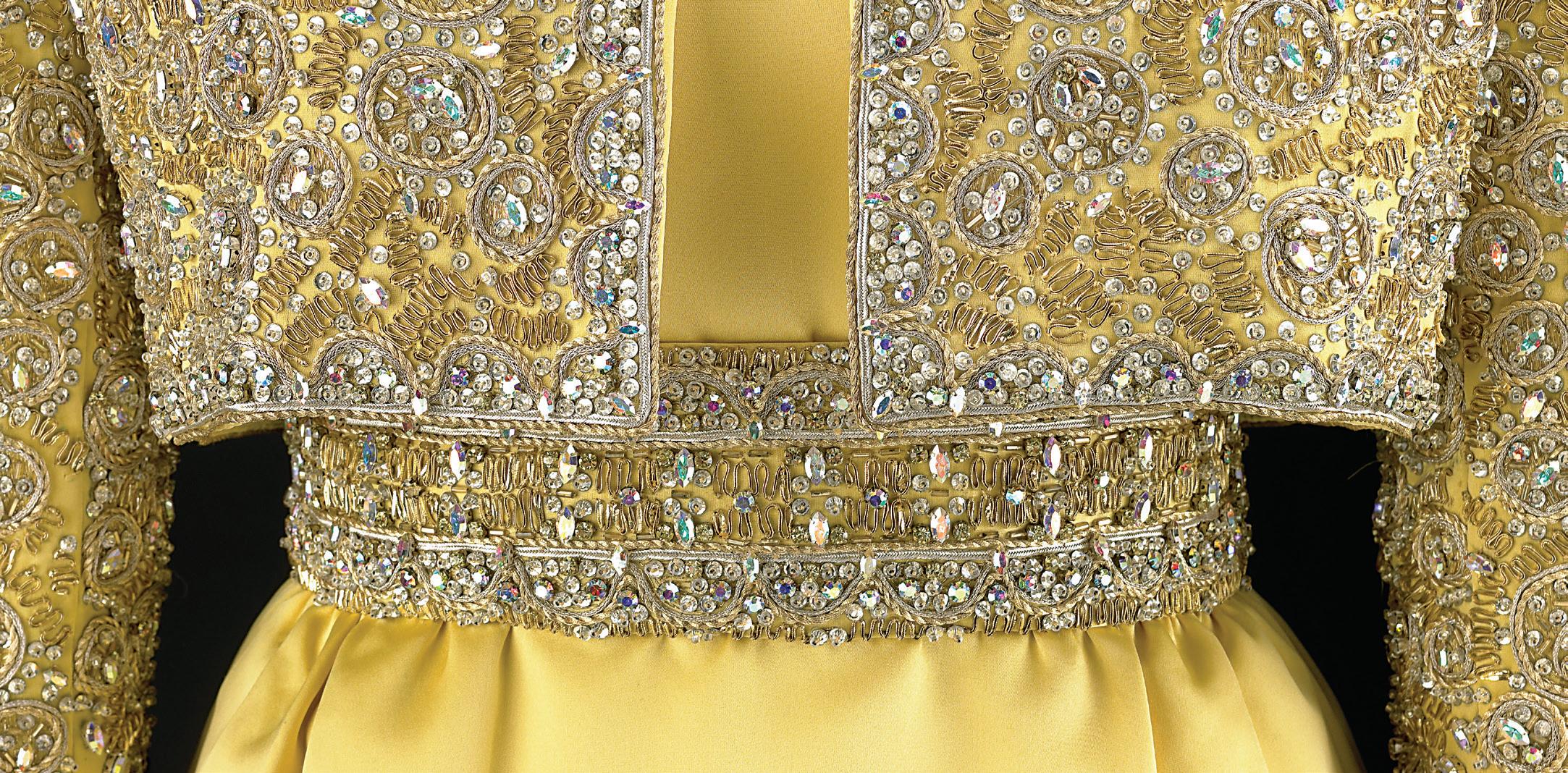
First Lady Pat Nixon wore this mimosa silk satin gown to the 1969 Inaugural Balls. Designed by Karen Stark for Harvey Berin, it was embroidered in gold and silver and encrusted with Austrian crystals. At the ball held at the Smithsonian Institution, President Nixon announced, “I like all of Pat’s dresses, particularly this one tonight, and, . . . when she gets finished with it, you’ll get it at the Smithsonian.”
marcia mallet anderson
JEAN LOUIS MAZÉAS: HAIRSTYLIST TO FIRST LADIES AND WHITE HOUSE BRIDES
lauren m c gwin
22 SEDUCED BY STYLE: LADY BIRD JOHNSON’S WHITE HOUSE FASHION
kimberly chrisman-campbell
FROM HOLLYWOOD TO THE WHITE HOUSE: NANCY REAGAN’S STYLE
The First Lady’s Lasting Collaboration with James Galanos
rebecca durgin kerr
mary jo binker
LAURA BUSH’S FASHION CHOICES AND THE HEART TRUTH INITIATIVE
erika cornelius smith
7 6 FIRST IN FASHION: MICHELLE OBAMA’S WHITE HOUSE STYLE
carson poplin
90
TWO ICONIC KENNEDY DRESSES RE - CREATED
The Exhibition of First Ladies’ Clothing and a Behind-the-Scenes Look at the Process of Re-creating Historical Fashion
christina clare ewald
104
Presidential Site Feature “THE FIRST LADIES” AT THE NATIONAL MUSEUM OF AMERICAN HISTORY
elyse werling
118
REFLECTIONS
stewart d. m c laurin
style and fashion make history at the White House, and with this issue, the Quarterly’s third to focus on fashion, we look at a transformational period of fifty years, 1960 to 2010, when America’s first ladies began to speak through their personal style as never before. Each official step made by a first lady is photographed and broadcast, interpreted and analyzed, criticized and praised; wardrobe and hair do not escape the scrutiny. The unrelenting attention brings daunting challenges, but the potential to communicate with a captivated public is a powerful tool as the following articles reflect.
this issue, to reveal.
Behind the scenes, devoted and talented stylists and designers have helped each first lady establish her “look.” Lauren McGwin opens the issue with the life and work of Jean Louis Mazéas, once dubbed the “coiffure king of the Great Society.” The creator of Jacqueline Kennedy’s “modified bouffant” an key element of the modern sophistication for which she is remembered. Jean
Jean Louis Mazéas, once dubbed the “coiffure king of the Great Society.” He was the creator of Jacqueline “modified bouffant” a key element of the modern sophistication for which she is remembered.
Behind the scenes, devoted and talented stylists and designers have helped each first lady establish her “look.” Lauren McGwin opens the issue with the life and work of Jean Louis Mazéas, once dubbed the “coiffure king of the Great Society.” The creator of Jacqueline Kennedy’s “modified bouffant” an key element of the modern sophistication for which is remembered, Jean Louis’s White House experience, preserved through a scrapbook studied by McGwin, continued through the Johnson administration and included two White House brides.
Kimberly Christman-Campbell traces the unexpected suddenly became first lady with little experience even tells
Katherine Christian Campbell traces the unexpected style journey of First Lady Lady Bird Johnson, who suddenly became first lady with little experience even choosing her own clothes. Relying heavily on NeimanMarcus and slowly overcoming a reluctance to invest in the necessary wardrobe for her public role, Mrs. Johnson survived comparisons to Mrs. Kennedy by discovering her own innate style. By the end of her husband’s presidency, Lady Bird Johnson reflected that she had become “seduced” by the world of clothes.
Rebecca Durgin Kerr tells the story of Nancy Reagan’s long collaboration with designer James Galanos. Remembered now for her elegant timeless style, Mrs. Reagan explained, “I don’t go for the latest look. I try to choose clothes that look good today but that will also look good tomorrow.” Favoring red, which she considered “a pick me upper,” Mrs. Reagan empathized with the interest in her clothes but made it known that
look. I try to choose clothes that look good today but that
Rebecca Durgin Kerr tells the story of Nancy Reagan’s long collaboration with designer James Galanos. Remembered now for her elegant timeless style, Mrs. Reagan explained, “I don’t go for the latest look. I try to choose clothes that look good today but that will also look good tomorrow.” Most comfortable in red, which she considered “a pick me upper,” Mrs. Reagan empathized with the interest in her clothes but made it known






when she wasn’t “on display” she dressed as “casually as
that when she wasn’t “on display” she dressed as “casually as possible.”
when she wasn’t “on display” she dressed as “casually as possible.”
Her Scaasi Fashions,” Mary Jo Binker relates how
Jo how the
wrinkles and white hair with humor and confidence. Mrs. Bush relied on her friend and designer Arnold Scaasi to create her signature look, explaining that when wearing his designs, “I know then that I look as good as I can.”
With her article “The Silver Fox: Barbara Bush and her Scaasi Fashions,” Mary Jo Binker relates how the savvy first lady “used her clothing to telegraph approachability, caring, and warmth.” She won the public’s affection by confronting anticipated media criticism of her wrinkles and gray hair with humor and confidence. Her relatable style became known as “Barbara glamour.” Mrs. Bush relied on her friend and designer Arnold Scaasi to create her signature look, explaining that when wearing his designs, “I know then that I look as good as I can.”
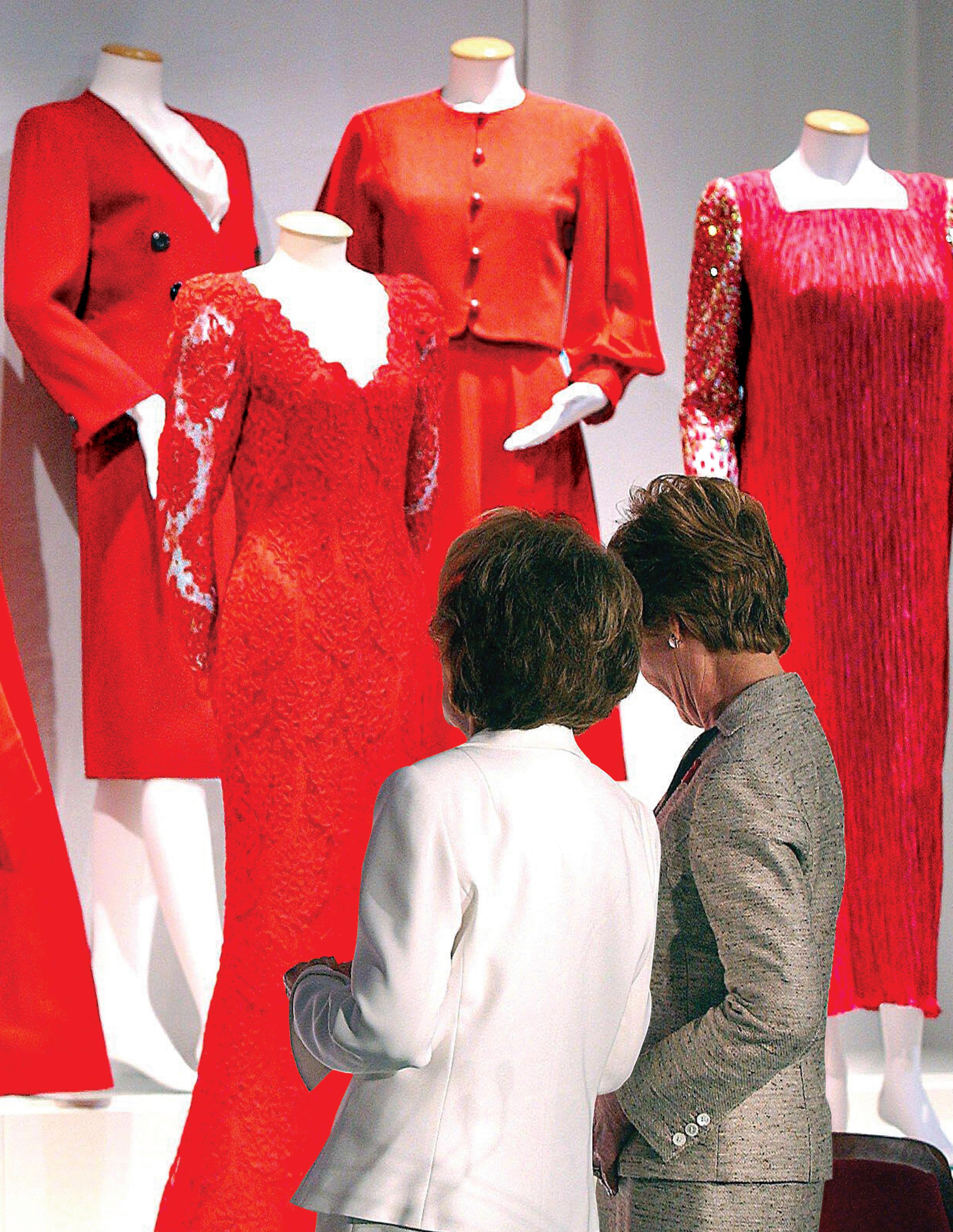
Erika Cornelius Smith recounts how First Lady Laura Bush approached her wardrobe by choosing to reserve high fashion for special events and as a tool for advocacy. With a personal commitment to women’s health, Mrs. Bush donned the Red Dress pin, became the ambassador for The Heart Truth campaign, and saved lives as a result. She later reflected, “I realized the degree to which I had a unique forum as first lady. People would pay attention to what I said.”
lives
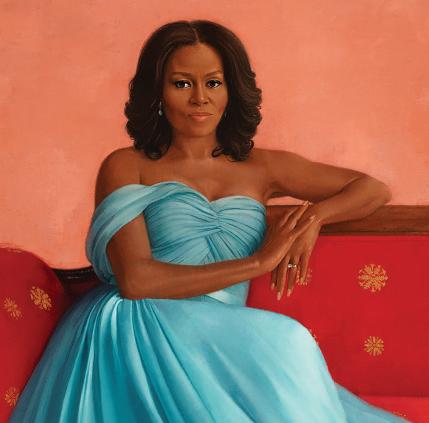
Carson Poplin writes of First Lady Michelle Obama’s wholly new approach to personal style. By mixing high and low fashion and shopping on-line and off-the rack she was admired for her “attainable” example. She dared to mix patterns and bold colors, and launched the careers of young and diverse designers. For her look, Mrs. Obama often relied on stylist Meredith Koop, who explained, “You have to celebrate fashion but also be aware of the message people are going to take away.”
low fashion and shopping on-line and off-the rack,
story of America’s in White
First Lady Jacqueline Kennedy wore on her televised tour of the White House. Elyse Werling concludes the issue with a visit to the First Ladies Hall at the Smithsonian Institution. A popular exhibit for more
While tracing the story of Americas interest in White House fashion history, Christina Ewald recounts her own experience creating a precise replica of the iconic red dress First Lady Jacqueline Kennedy on her televised tour of the White House. Elyse Werling concludes the issue with a visit to the First Ladies Hall at the Smithsonian Institution. A popular exhibit for more than a century, the hall goes beyond the lines and colors and artistry to preserve the story of each woman’s contribution to White House history.
Erika Cornelius Smith recounts how First Lady Laura sador for The Heart Truth campaign, and saved lives Obama’s wholly new approach to personal style. By mixing high of young and diverse designers. For her her televised tour of the White House. Elyse Werling contribution to White House history.





marcia mallet anderson editor, WHITE HOUSE HISTORY QUARTERLY
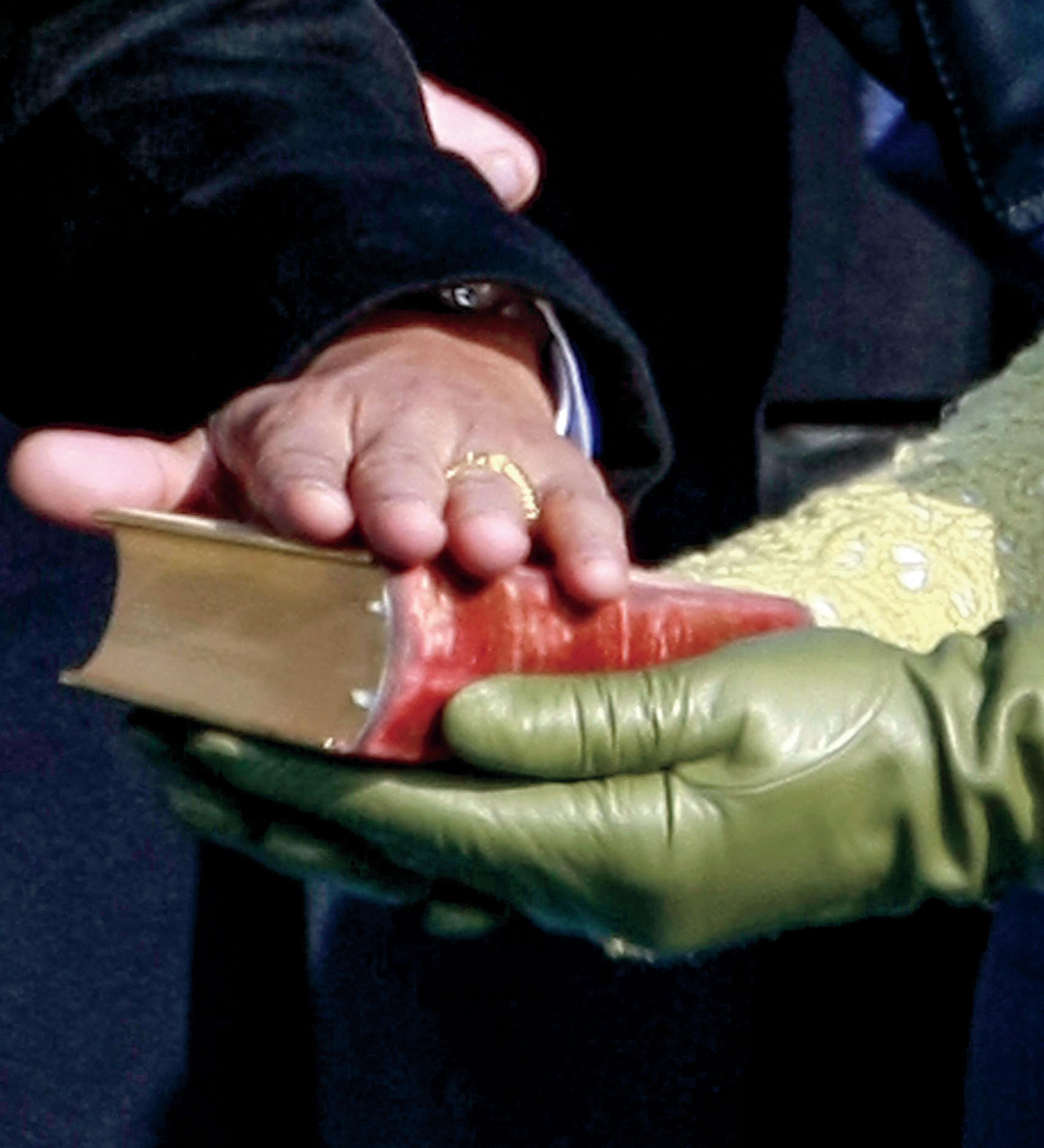
Seen here holding the Abraham Lincoln Bible for her husband as he is sworn in as the forty-fourth president of the United States, January 20, 2009, Michelle Obama chose to mix “attainable” with “aspirational” fashion for the ceremony, pairing olive green gloves from J. Crew with a lemongrass shift and matching overcoat custom-made for her by Cuban American designer Isabel Toledo. Admirers rushed on-line to buy the leather gloves quickly crashing the J. Crew website. Isabel Toledo soon became a household name.
LAUREN M C GWIN
jean louis mazéas was a “magician” with hair, says his nephew, Jean Paul Mazéas.1 A preeminent Washington, D.C., hairstylist in the 1960s, Jean Louis’s personal goal was to make every woman who left his shop feeling like a “princess—delicate, dignified, and graceful.” His clients were, in fact, often real princesses seeking his signature coiffure, a status symbol among the Washington social elite.2 His appointment book was flush with the names of the most celebrated women of his day—movie stars, wives of diplomats and politicians, royalty from around the world, White House staff, two first ladies—Jacqueline Kennedy and Lady Bird Johnson—and two White House brides—Luci and Lynda Johnson.
While often overshadowed in history by Kenneth— Kenneth Battelle, the better-known New York hairstylist who is credited with creating Mrs. Kennedy’s original signature bouffant—Jean Louis left his own mark in the fashion world, especially in Washington, D.C. From Le Faou, a small town in Brittany, France, Jean Louis journeyed to Paris at the age of 14 to receive training in hairstyling. At age 17, he established himself as a gifted hairstylist by winning the annual Parisian hairstyling competition.3 After serving several years in the French army, he returned to Paris. There he saw a newspaper advertisement placed by owner Marius N. Robert for an assistant position at Robert of Paris Inc., a Dupont Circle hair salon at 1514 Connecticut Avenue NW, Washington, D.C. The city directory lists Robert as “President, Coiffure Designer, Hairdresser and Beauty Parlor.” 4 Jean Louis remarked, “I had in my head since I was very young to come to the United States,”5 and with his background and training this position was a perfect opportunity. In 1955, at age 26 Jean Louis made his dream come true. Working for Robert for three years, he got to know the leading women of society.6 The job was a launching point for his career, and when he branched out to open his own small salon down the street at 1504 Connecticut Avenue, his elite clientele was already established.
Jean Louis became a sensation perhaps due in part to the prominence of this clients. Along with his burgeoning reputation and talent, the American fascination with French design also helped solidify his fame. Frequently newspaper coverage lauded Jean Louis: “Like all Parisians, Jean Louis knows what is chic and what is not chic.”7 The Paris connection appealed to Jacqueline Kennedy, who was well-versed in French fashion and history. While she was living on N Street in Georgetown with her husband, Senator John Kennedy, she found her way to Jean Louis’s salon. She visited twice a week until she was pregnant with John Jr., and then Jean Louis made home visits to style and set her hair.8
Even the name of her signature hairstyle, the bouffant, is of French origin, meaning to “swell,” and referred to the way curlers were used to lift and tease her hair in a puffed-out appearance.9
During the 1960 presidential campaign newspapers revealed that Mrs. Kennedy was to get a “New Look” from Jean Louis called the “modified bouffant”—slightly full in the back but with the hair closer to the head at the sides and turned upward on the cheek.10 He once said of his hair styles, “I do not copy since an artist only signs his name to that which is original.”11 Jean Louis transformed the fullness of Mrs. Kennedy’s 1950s bouffant into “smooth elegance” and set a trend in the fall of 1960, during the height of her husband’s campaign. 12
previous spread
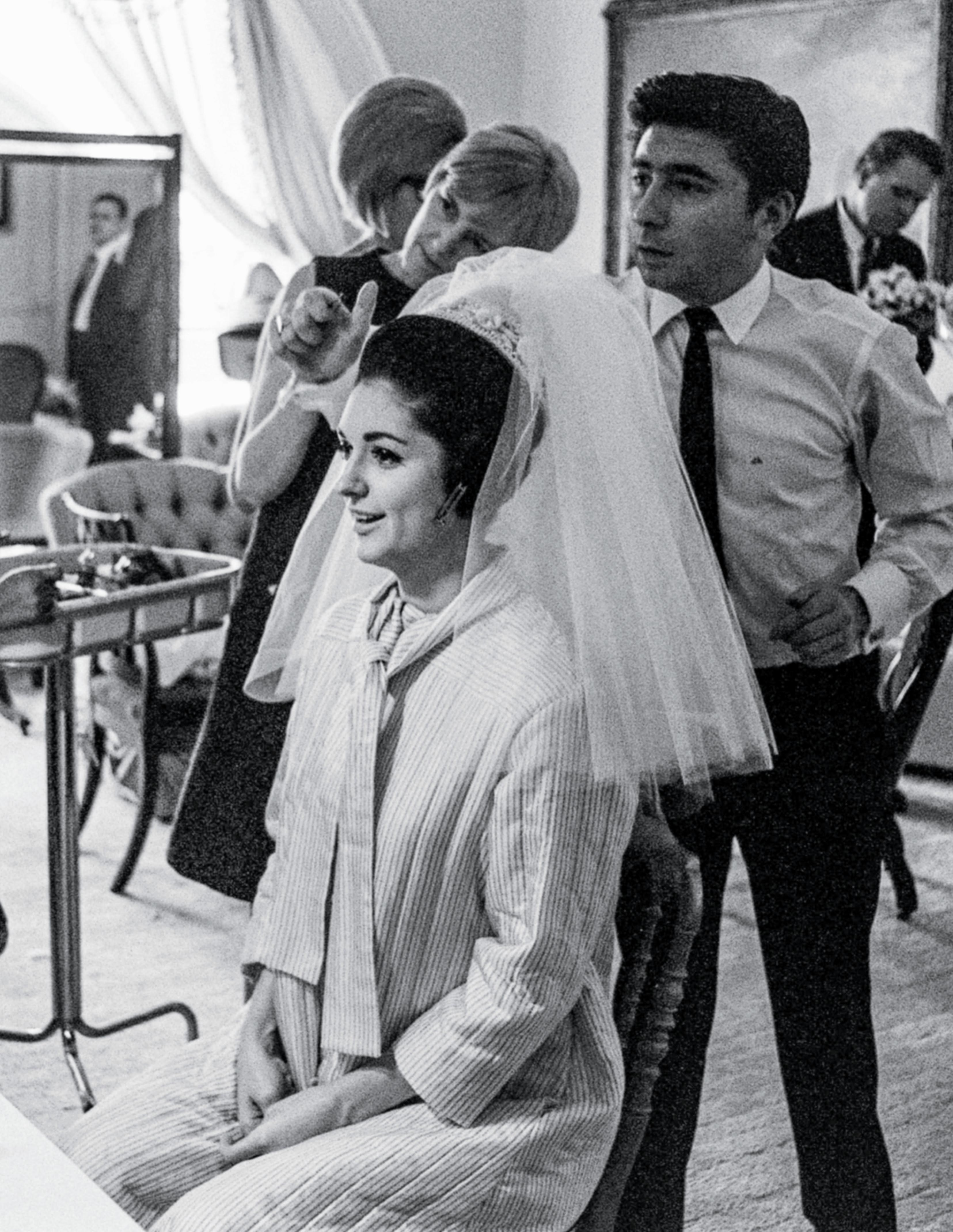
Jean Louis attaches Lynda Johnson’s wedding veil to her hair in a makeshift salon set up in the East Sitting Hall of the White House December 9, 1967.
below
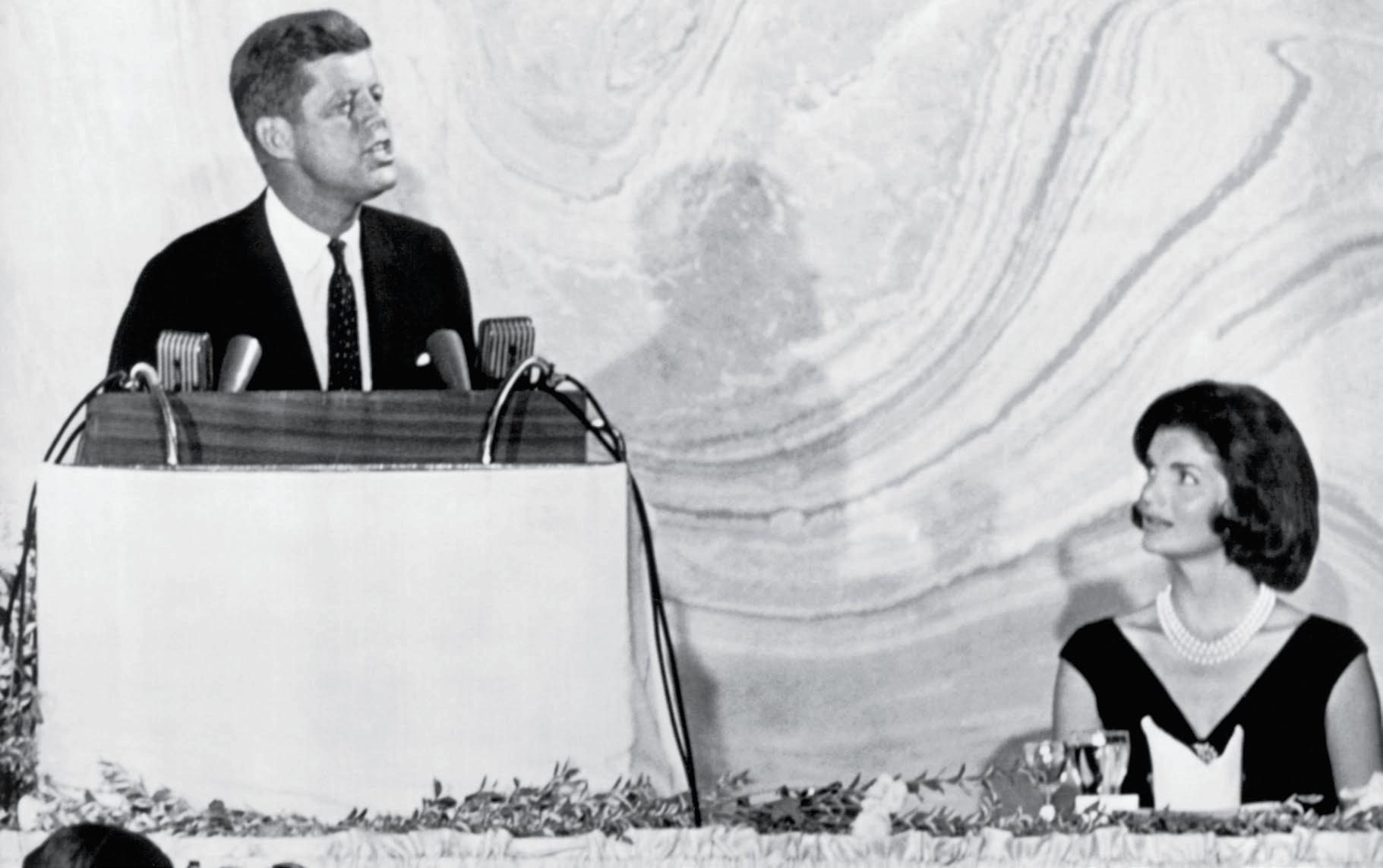
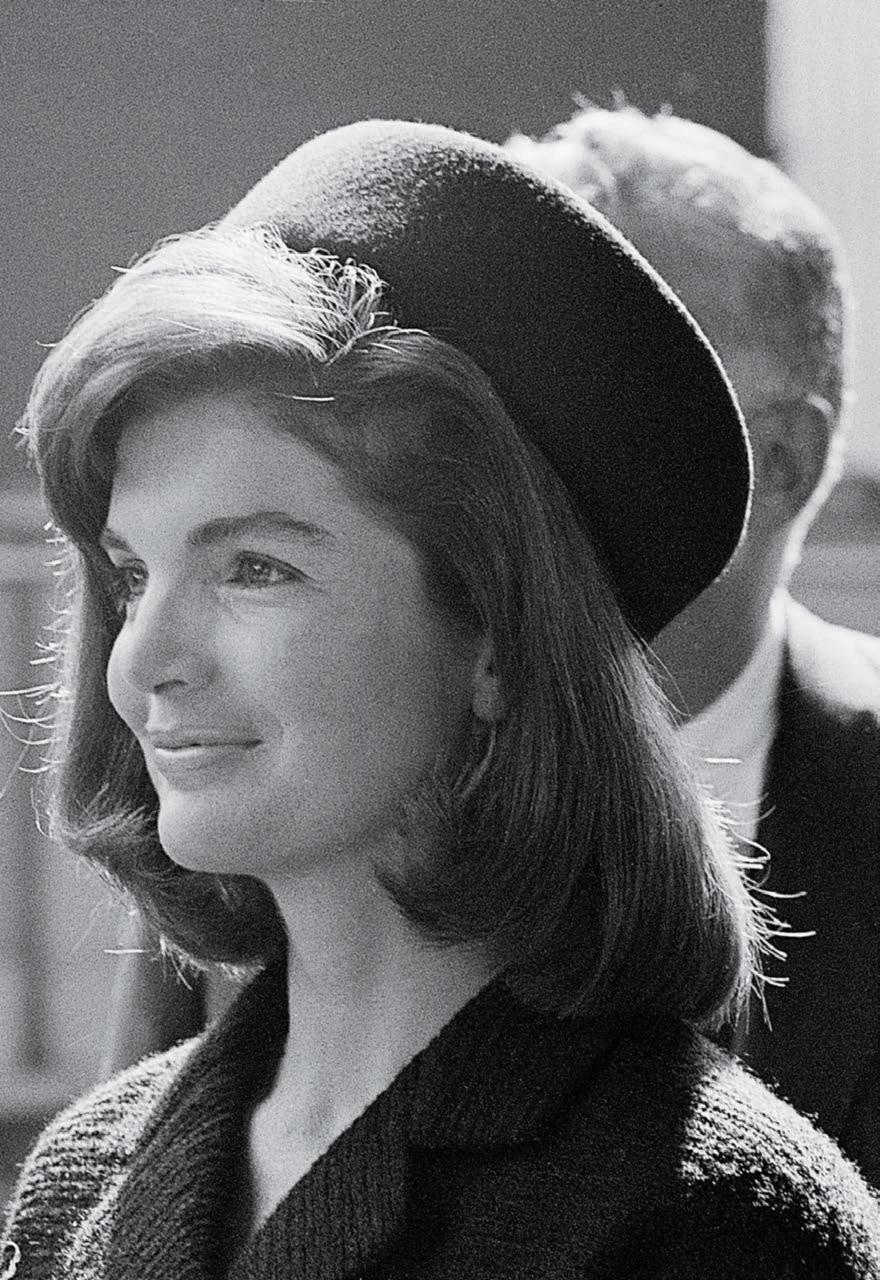
In the fall of 1960, Jean Louis introduced a “New Look” for Mrs. Kennedy, seen here during her husband’s televised campaign speech in September. Called a “modified bouffant,” the style was slightly full in the back, close to the head at the sides, and turned upward on the cheek.
left
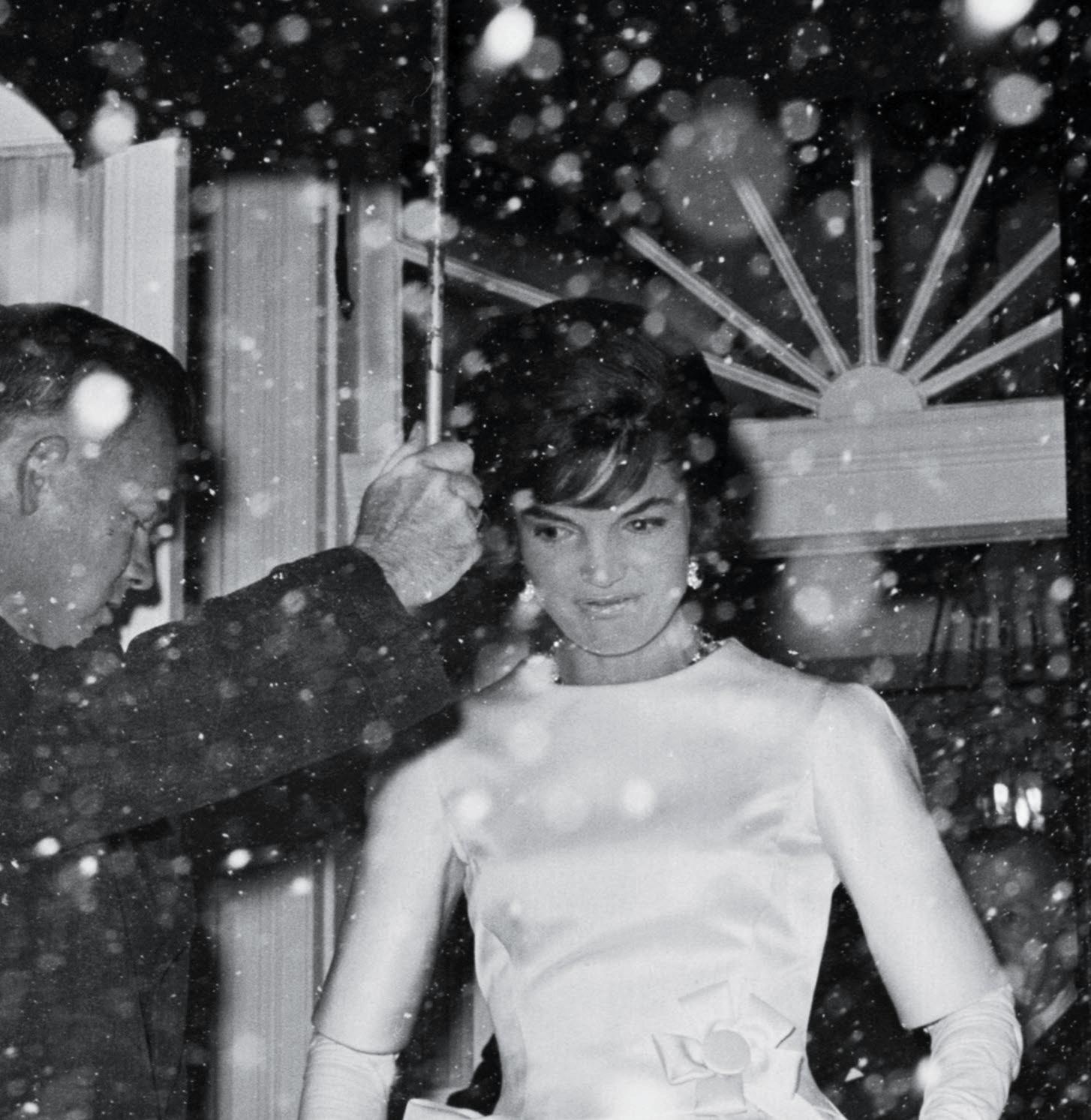
An inaugural eve blizzard prevented Jean Louis from reaching Mrs. Kennedy’s Georgetown home to assist Kenneth Battelle in styling her hair. She is seen here leaving for the evening events, her hair protected by an umbrella.
right
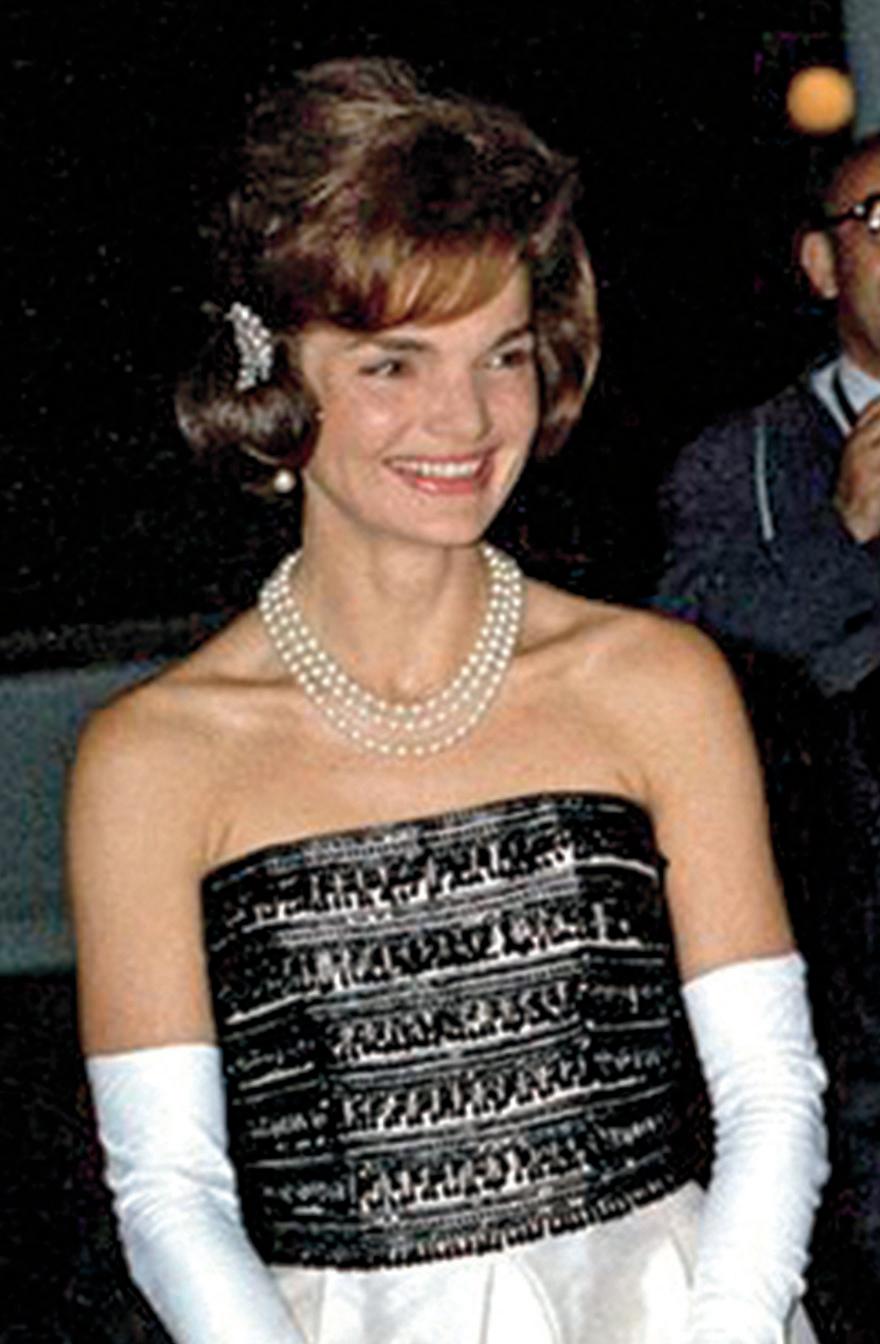
Jean Louis famously embellished Mrs. Kennedy’s hairstyle with a diamond clip for a State Dinner, November 7, 1961. The Washington Post called the look a “hairdresser’s masterpiece.”
She understood the importance of her public image and worked on creating a look that not only reflected the couple’s youthful dynamic but also conveyed modern sophistication. Her style—bouffant hair, pillbox hats, and classy suits—was being replicated by women across America. Department stores advertised clothes as “The Jackie Look,” and women styled their hair short and chic.13 Jean Louis once said, “Mrs. Kennedy’s emphasis on culture and on high fashion has led to a revival of chic taste among Washington women.”14
Jean Louis suffered a bitter disappointment when Kenneth Battelle was chosen to do Mrs. Kennedy’s hair for the inaugural events. While the two were not exactly rivals, Jean Louis’s pride was hurt. Later, when Mrs. Kennedy called his salon and asked if Jean Louis could come to her home to assist Battelle, he “politely but reluctantly” said yes. However, on the night before the Inauguration, a nor’easter, dubbed the “Kennedy Inaugural Snowstorm,” crippled Washington, D.C., traffic, and the White House limousine that was transporting Jean Louis was stuck. Kenneth completed Mrs. Kennedy’s hair unaided. Jean Louis’s talents did not go completely unused, however. On the
morning of the Inauguration, important inaugural guests who came to Jean Louis’s salon to have their hair done included Rose Kennedy, President Kennedy’s mother; Princess Lee Radziwill, Mrs. Kennedy’s sister; and Evangeline Bruce, the wife of the U.S. ambassador to England, among many others.15
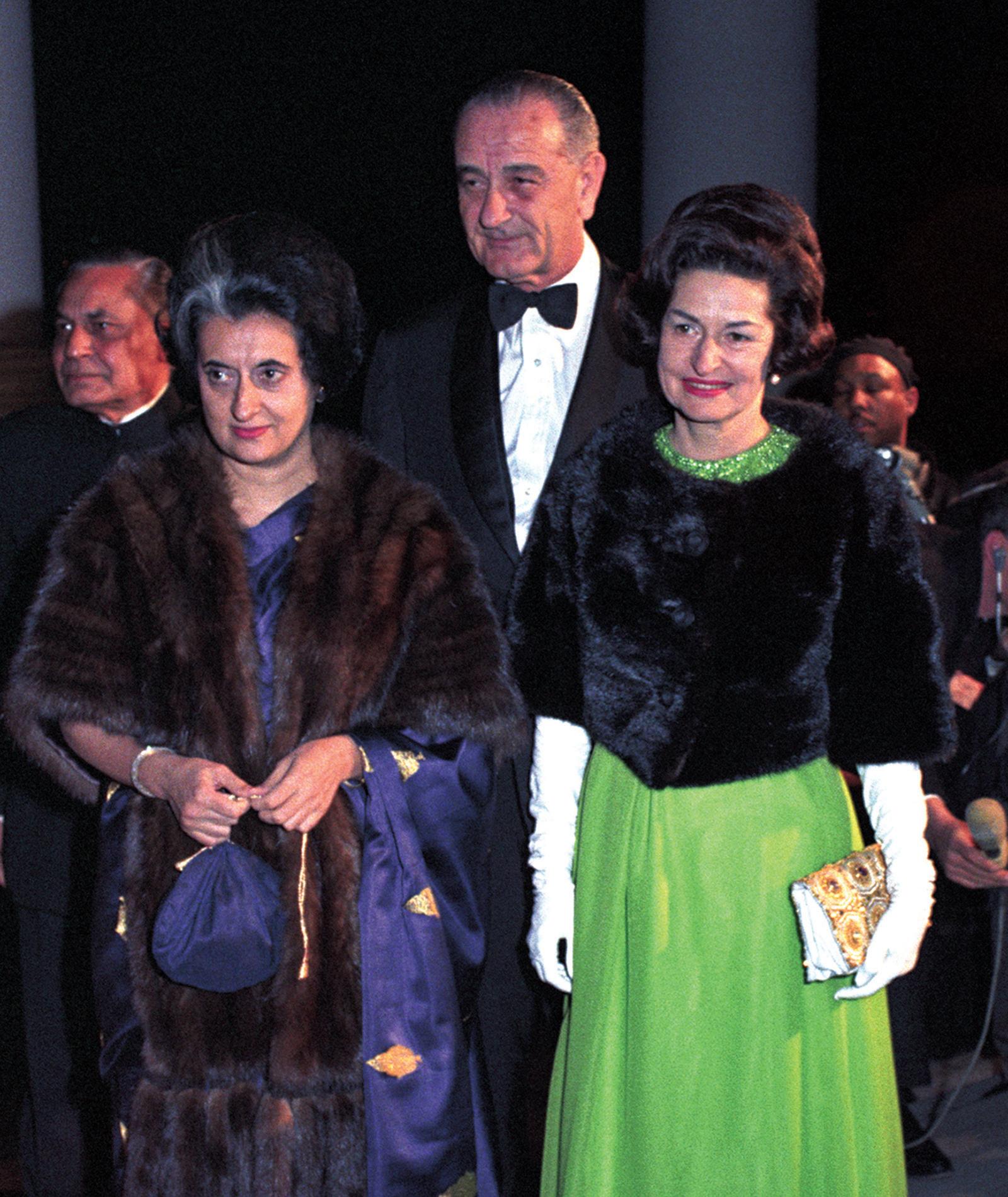
After Jacqueline Kennedy became first lady, Jean Louis was called to the White House every week to style her hair. She would already have her hair shampooed to save time when he arrived at her dressing room on the Second Floor. When Jean Louis was combing out her hair, sometimes Caroline and John Jr. would come in to say goodnight to their mother, watching her hair being styled and asking what she was going to wear that night.16 For evening events, Jean Louis often used rhinestone barrettes placed strategically low near the ear to highlight the “puffed out softness” of her bouffant or even above the bangs to create even more of a pouf.17 At the State Dinner for the prime minister of India, Jawaharlal Nehru, on November 7, 1961, Jean Louis styled Jacqueline Kennedy’s hair so that it was pushed back at the crown with a curved diamond clip at her temple.
opposite and right
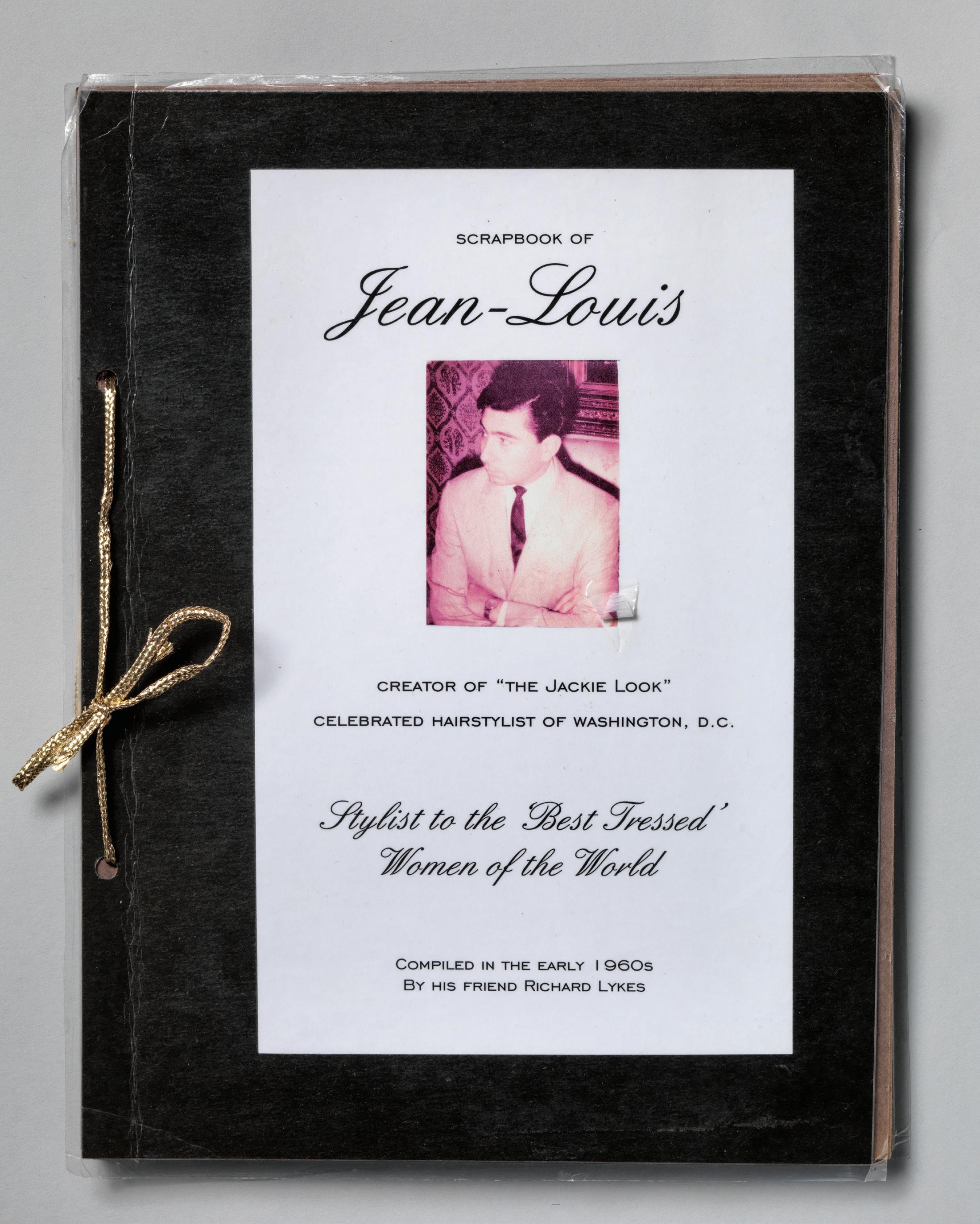
Jean Louis’s work was frequently featured in the Washington Post and other newspapers during the 1960s. His collection of clippings, notes from his clients, and other ephemera from his career is preserved in a scrapbook compiled by a friend. The scrapbook includes Judith Martin’s article on the “New Look” Jean Louis created for Mrs. Kennedy.
below
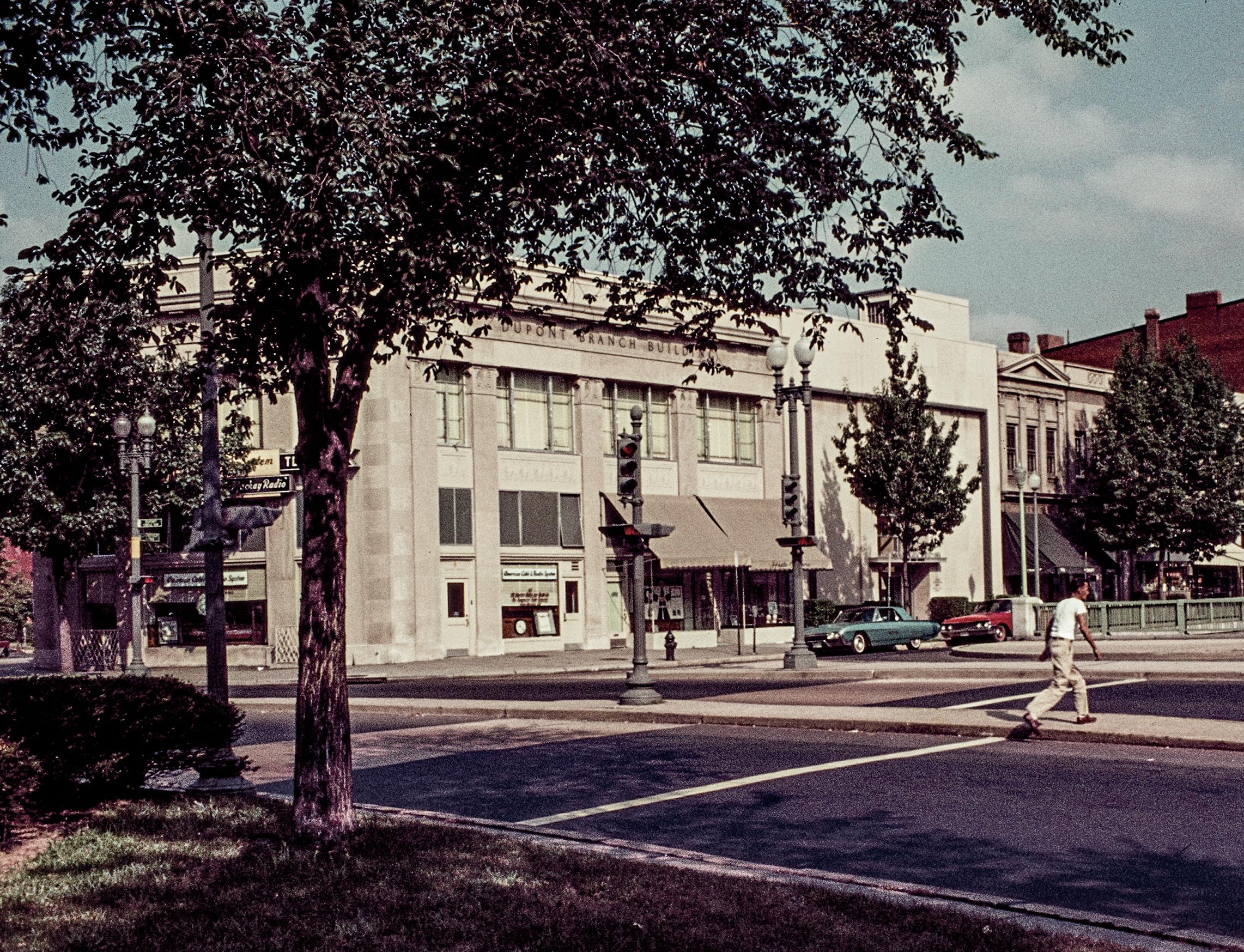
Jean Louis worked in two salons in the 1500 block of Connecticut Avenue NW, seen here July 1963. He began his Washington years at Robert of Paris Inc. at 1514, later opened his own salon at 1504, and then finally purchased the salon at 1514. The salon at 1504 Connecticut, marked by the second tan awning from the left, is the location regularly visited by Jacqueline Kennedy before she became first lady. Lady Bird Johnson visited 1514 as first lady, seen to the right of the dark awning.



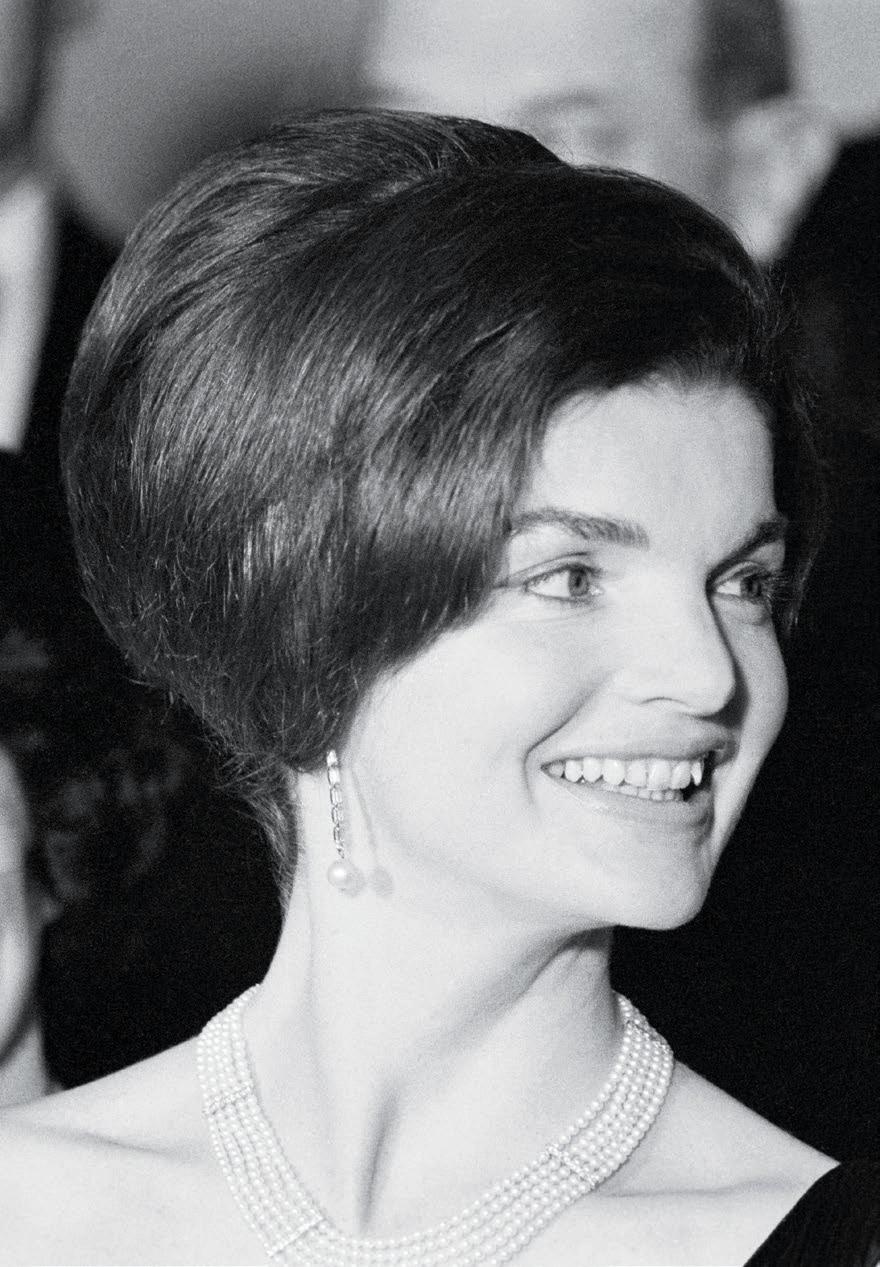
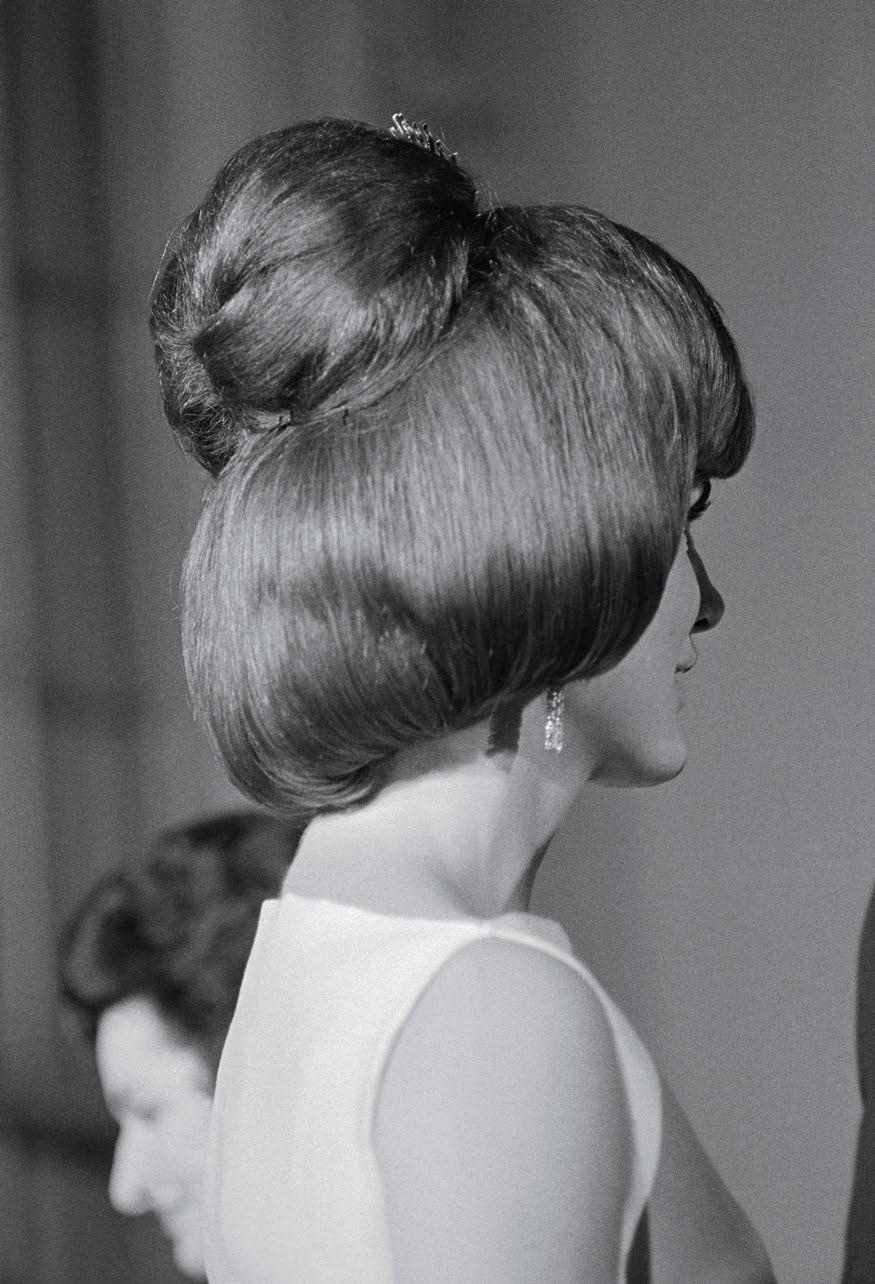
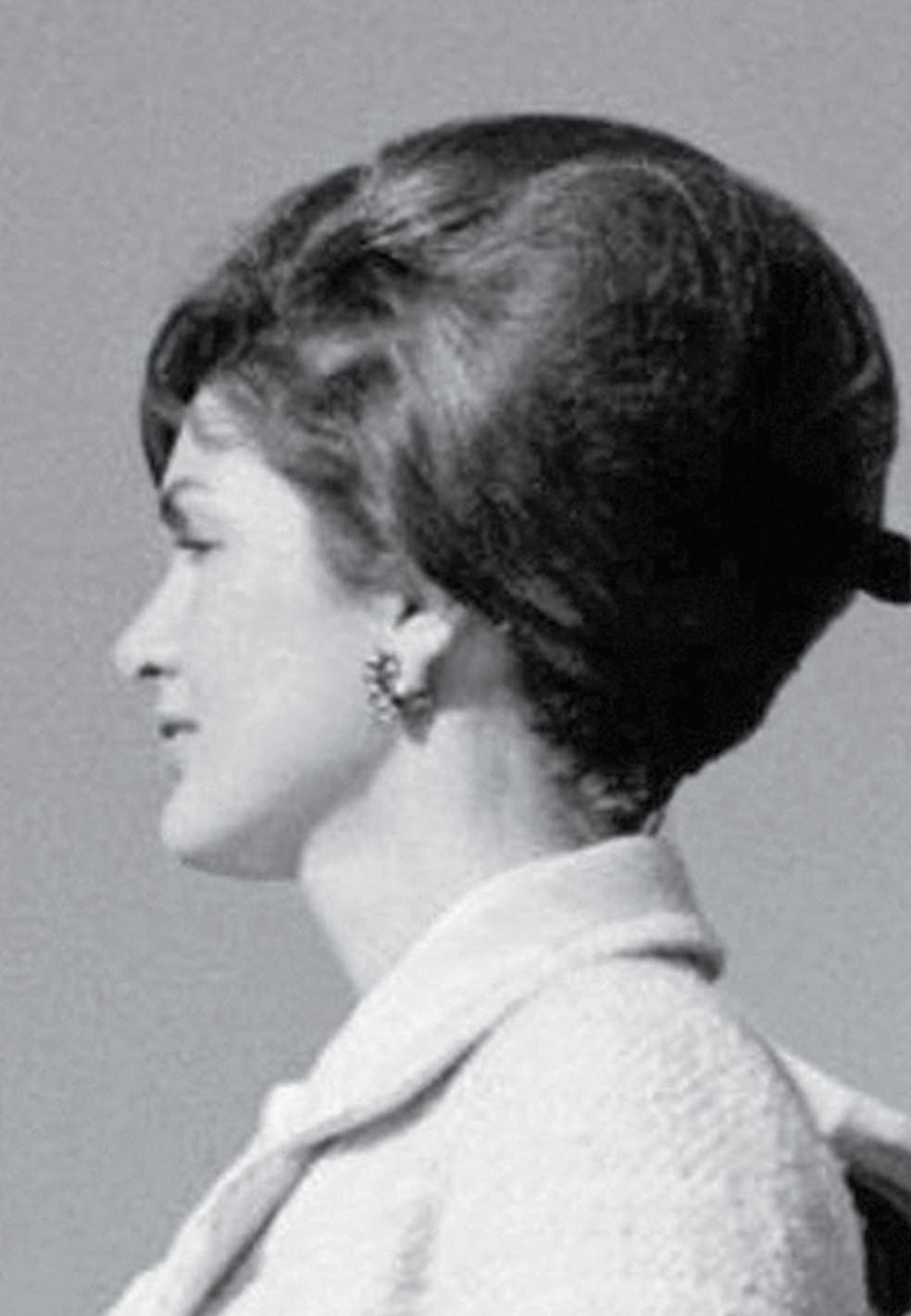
top left and right
One of Mrs. Kennedy’s especially elegant hairstyles involved the use of a hairpiece or “postiche” to add volume to the back of a coiffure, creating the illusion of longer hair worn up. The style is seen at left during a State Dinner in April 1962 and at right during an Arrival Ceremony in November 1962.
bottom left
Mrs. Jacqueline Kennedy again wore a postiche during a State Dinner in February 1963.
bottom right As shorter hair became more fashionable, Mrs. Kennedy grew her hair longer. Her shoulder-length hair is seen here when she greeted Emperor Haile Selassie of Ethiopia at Union Station, October 1, 1963.
above
In December 1958, Jean Louis advertised his new salon for the “aware woman” in the Washington Post. While her husband served in the Senate, Mrs. Kennedy would visit the salon twice a week. After Mrs. Kennedy became first lady, Jean Louis would travel to the White House to style her hair.
The Washington Post called it a “hairdresser’s masterpiece.”18 Mrs. Kennedy later started wearing a hairpiece called a postiche—real or artificial hair that added volume to the back of a coiffure. The postiche created the illusion of longer hair that was pulled up on the top of her head for an elegant evening out.19
In 1962, Jean Louis went to Paris for six weeks in search of new inspiration. The bouffant was starting to become passé, and he wanted something fresh to share with the first lady. He returned with a hairstyle that he called “the sweet lady.” It was a medium-length hairstyle that had a more natural look with less teasing and shorter in the back than in the front. Mrs. Kennedy, however, had a different vision. Known for having her own individual style, by 1963 she started ignoring Parisian trends. While France dictated that short bob hairstyles were now the fashion, the first lady wore her hair longer, to the shoulders.20 This new longer, straight hairstyle can be seen in photographs from October 1, 1963, when Mrs. Kennedy greeted Emperor Haile Selassie of Ethiopia and his granddaughter, Princess Hirut (“Ruth”) Desta, at Union Station in Washington, D.C., before the State Dinner that night. Nevertheless, Jean Louis continued to promote the shorter French hairstyle to his clients, saying it was “more useful [sic] and chic.”21
Jean Louis managed his small salon with only two employees for six years but eventually outgrew the space. Coincidentally, his former boss, Marius Robert, was selling his Dupont Circle salon, so Jean Louis returned to where he started his career as a hairdresser in America, only this time he was the owner. In October 1963, at a grand opening for his new salon, Madam Nicole Alphand, wife of French ambassador Herve Alphand and good friend to Mrs. Kennedy, cut the ceremonial ribbon. Rose and Ethel Kennedy sent notes with their well wishes to Jean Louis. But the most honored guest, who flew from France to support him at his grand opening, was his mother.22 His new salon was elegantly furnished with antique French furniture of blue velvet and gilding against white walls. Guests were welcomed into an oval drawing room with a red carpet and crystal chandelier hanging from a light blue dome.23
Jean Louis was only 34 years old, and his coiffures continued to be highly sought after by women with political connections to the Kennedy and then the Lyndon Johnson administrations. He was even dubbed the “coiffure king of the Great Society.”24 Ann Hand, wife of Lloyd Nelson Hand, chief of protocol to President Johnson, remembers that no one she has ever known had a clientele like Jean Louis. “He was ‘the man’ in those golden days” of the capital city, she said.25 His early who’s who clientele list included Pamela Turnure, press secretary to President Kennedy; Evelyn Lincoln, private secretary to President Kennedy; Madame Nicole Alphand; wives of the diplomatic corps; visiting dignitaries Princess Lalla Salma of Morocco; Princess Shahnaz Pahlavi of Iran; Princess Beatrix of the Netherlands; Marie-Madeleine Lioux, the wife of André Malraux, French minister of cultural affairs; Princess Lee Radziwill, as well as other members of the Kennedy family such as Eunice Shriver and Rose Kennedy. During the Lyndon B. Johnson presidency, notable clients included Press Secretary Liz Carpenter; the president’s secretaries, Juanita Roberts and Vicki McCammon; and Mary Valenti, wife of special assistant to the president.26 “All women in society were getting their hair done every other day by Jean Louis,” Ann Hand recalled. “You could tell just by looking at them when someone had the ‘Jean Louis hairdo’—it was a very distinctive style and he was quite the young man,” she said.27
Soon after the assassination of President John F. Kennedy, Mrs. Kennedy returned to Georgetown and later moved to New York City. It was around this time that the former first lady visited Jean Louis’s salon for the last time. Meanwhile, Jean Louis was soon attending to the new first lady, Lady Bird Johnson.
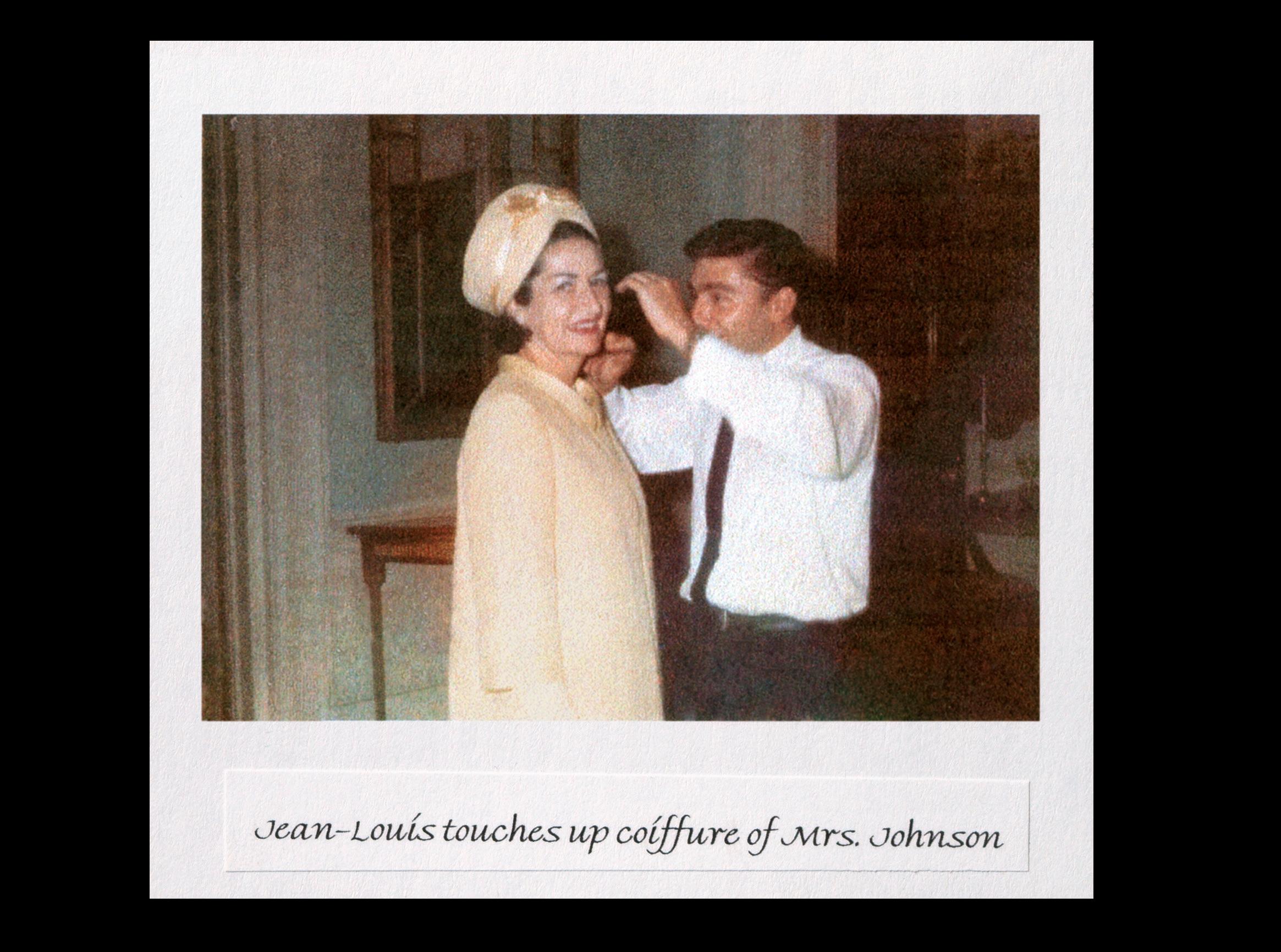
Jean Louis particularly enjoyed working with Mrs. Johnson. He once said in an interview, “Mrs. Johnson has always been a total pleasure to work with—really! She is more concerned with the individual than she is with herself. If I was particularly busy, she would come to my salon rather than have to disturb myself and go up to the White House. Or if she was going to be late, even if it was 10 minutes, she would call me. So considerate.”28 And if he was booked for the day, she would reschedule for another time, never expecting him to cancel other appointments for her. When the first lady did visit his salon, Jean Louis wanted her to have complete privacy. He discouraged questions from other clients and was known for his discretion.29 He even had two private rooms on the second floor of his salon—one dedicated solely for the first lady’s use. In homage to the White House, the wallpaper in the first lady’s room was a replica of the damask used in the Blue Room before it was replaced with Mrs. Kennedy’s striped wall coverings. Engravings of the White House and Mount Vernon hung on the walls, and personal antiques from Jean Louis’s collection, including a bust of Empress Josephine, decorated the space.30
Not only could Jean Louis arrange fashionable hairstyles perfectly, but he also did them quickly. He was known as one of the fastest stylists in Washington and could do thirty-five to forty coiffures in a day, as well as comb-outs, a method of combing and arranging hair in waves, whenever needed by the first
lady.31 Even though the hairstyles were created quickly, the quality was not diminished. Mrs. Hand explained that “Jean Louis paid attention to the details for every single woman’s hair” that he did. “He took great care of all his clients and remembered what they liked,” she said.32
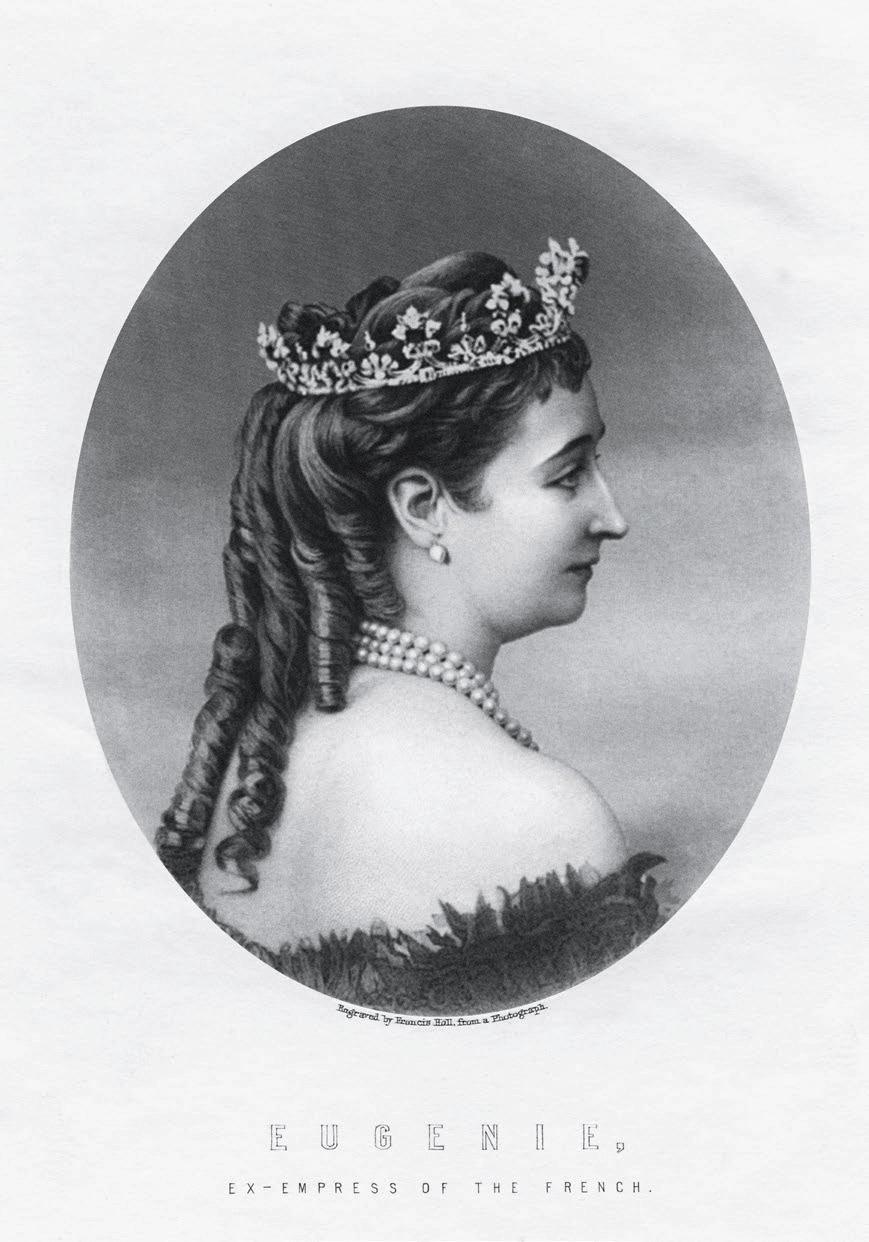
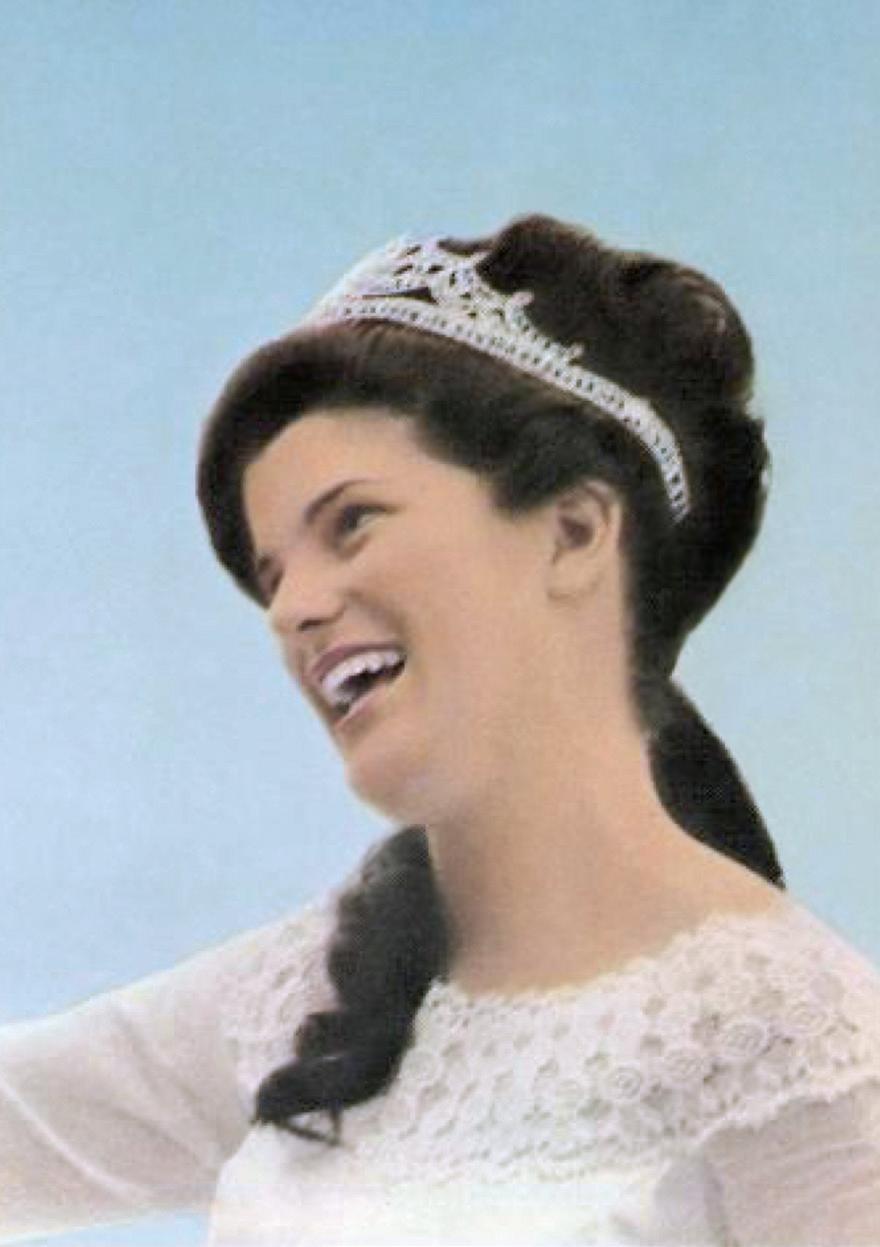
One hairstyle Jean Louis created personally was for 16-year-old first daughter, Luci Johnson, when she was crowned the Shenandoah Apple Blossom Queen in 1964. It was introduced as “the curl.” Reminiscent of Empress Eugénie, this special style was described by Jean Louis as a “modern version of the romantic coiffure of the time of Napoleon III in France.”33 above
Jean Louis described First Lady Lady Bird Johnson as “so considerate,” often traveling to his salon rather than calling on him to visit the White House for her appointments.
Jean Louis worked to ensure Mrs. Johnson’s comfort and privacy in his shop.
Jean Louis enjoyed doing Mrs. Johnson’s hair and kept a snapshot of her that is preserved in his scrapbook.
Inspired by the Empress Eugénie’s hair (below left),
Jean Louis created a style dubbed “the curl” for Luci Johnson when she was crowned the Shenandoah Apple Blossom Queen in 1964 (below right). He described the style as a “modern version of the romantic coiffure of the time of Napoleon III.”
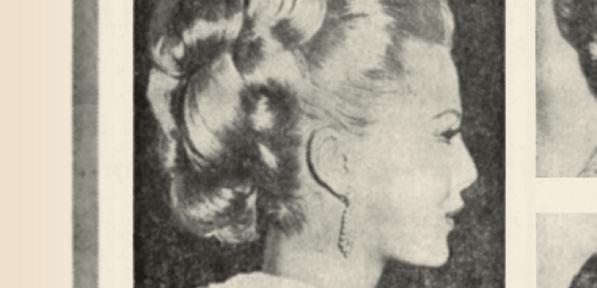
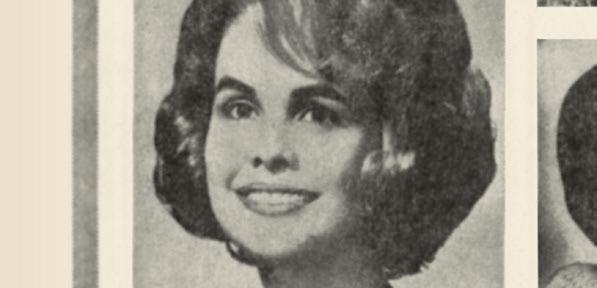




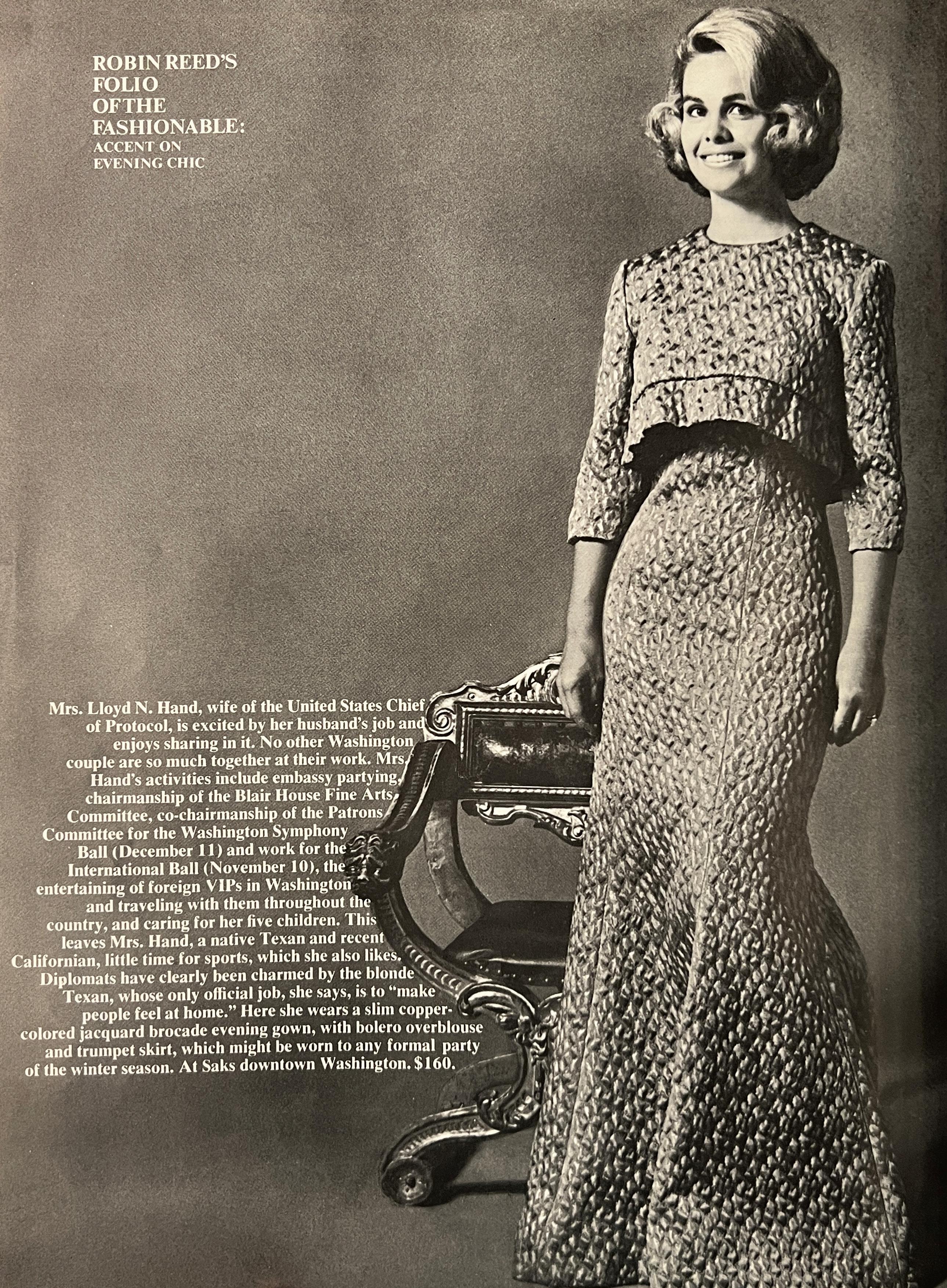
In 1965, Jean Louis won the Helene Curtis Beauty Award, named one of ten best hairdressers in the world, for styling Ann Hand’s hair with another version of “the curl.” Mrs. Hand had first heard of Jean Louis, as many others did, through word of mouth. Mrs. Johnson mentioned she should see Jean Louis, so she did. Mrs. Hand continued to visit his salon for the entire time she was in Washington. When she was named the “best tressed” woman for the Helene Curtis Beauty Award, she did not even know she had been nominated! She saw the announcement in



the newspapers the day news of the award was released, but it was a delightful surprise. Mrs. Hand believes it was the “cumulative effect of all the hairdos he [Jean Louis] had done for all the different women in the district” that led to their winning the award.34 The style featured became popular among Washington society for formal events, with guests at White House functions showing it off. Dancing at the State Dinner for Princess Margaret and her husband the Earl of Snowden on November 17, 1965, was described by newspapers as “the Night of the Hurling of the Curl.”35
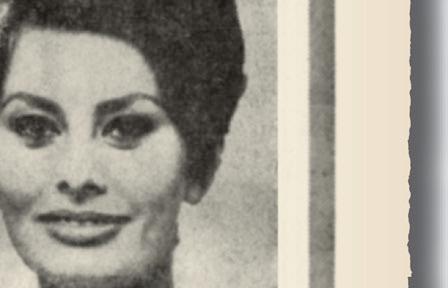
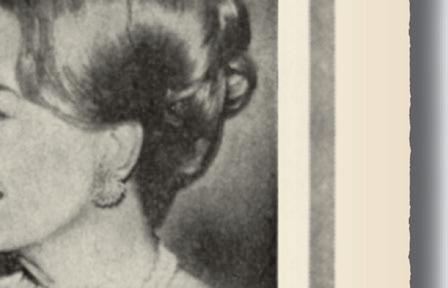
Named one of the “Ten Best Coiffured Women of 1965” by the Helene Curtis Guild of Professional Beauticians, Ann Hand appeared in Diplomat Magazine (opposite) and in a feature in the Washington Post (lower left photo in grouping at left). The wife of U.S. Chief of Protocol Lloyd Hand, Ann Hand had first visited Jean Louis at the suggestion of Mrs. Johnson. The hairstyle that Jean Louis created for Mrs. Hand became very popular with women in Washington society.
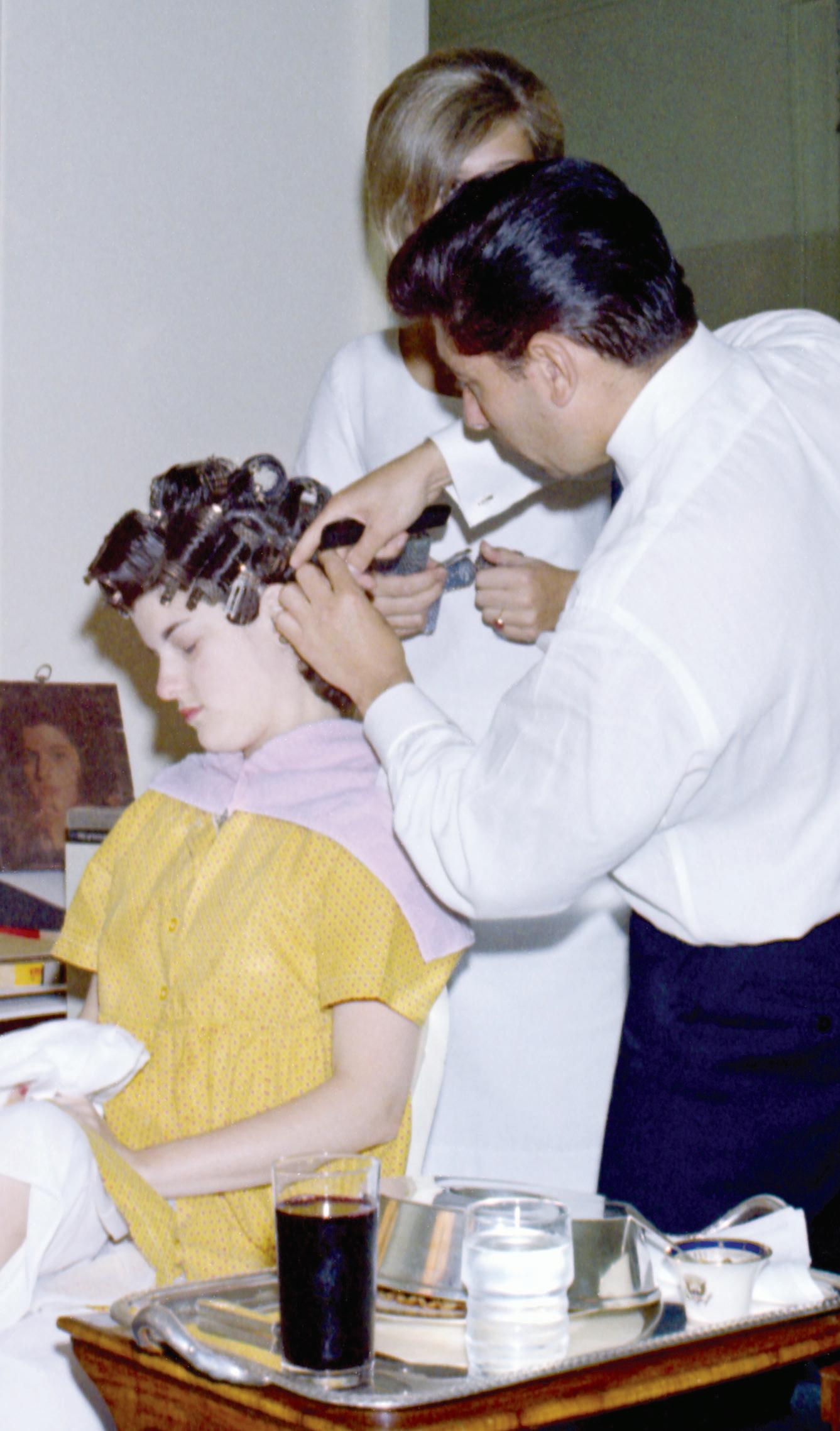
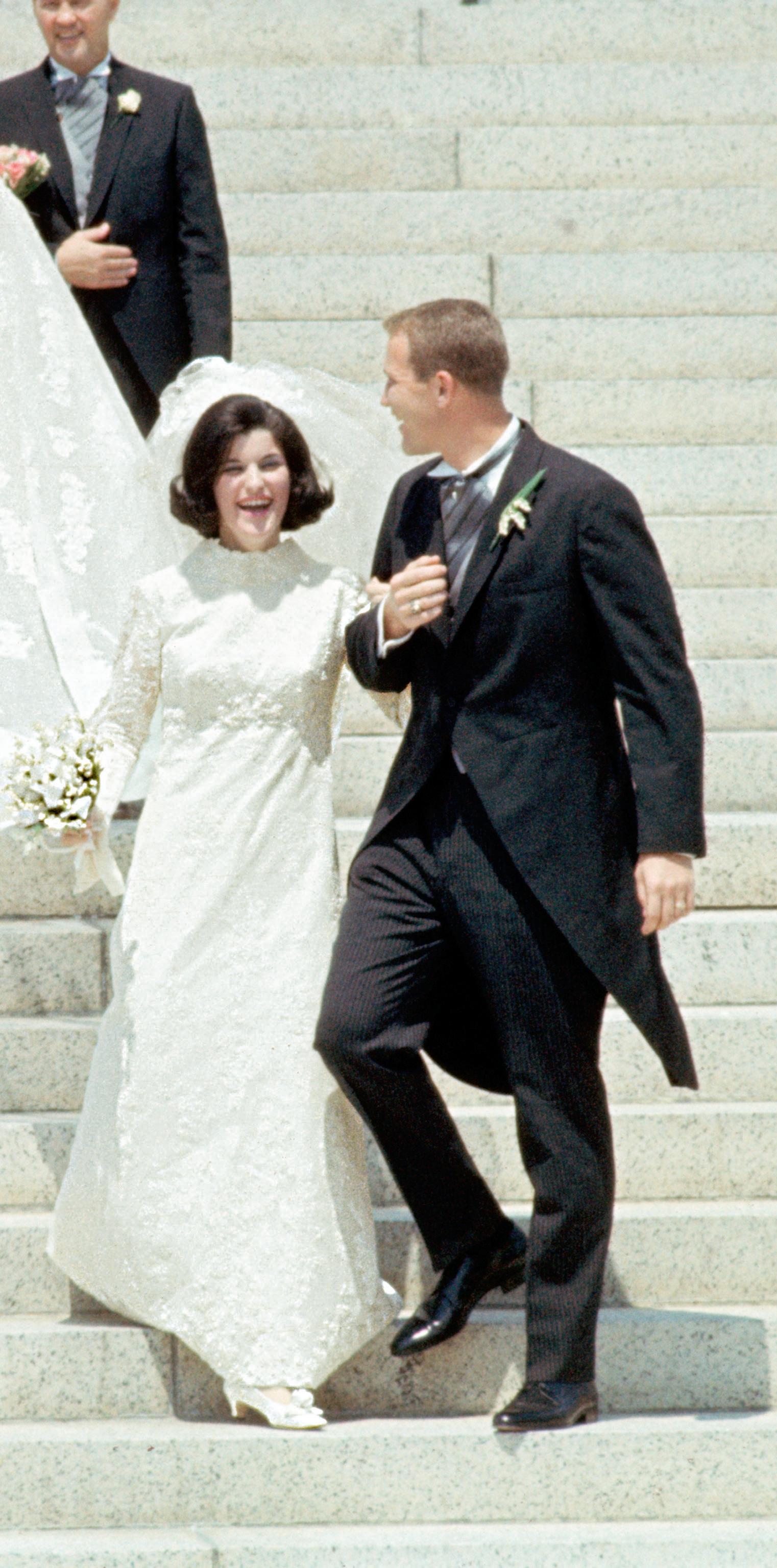
In addition to arranging hair for White House dinners, Jean Louis was asked to arrange the first daughters’ hair for their weddings. Luci, the first to marry, wed Patrick Nugent on August 6, 1966, at the Shrine of the Immaculate Conception in Washington, D.C. The couple held their reception at the White House. Luci preferred a simple, natural-looking coiffure for her wedding
day and, believing Jean Louis had a talent for “unequaled creations,” knew he could make it happen for her.36 Eighteen months later, on December 9, 1967, her sister Lynda was married to Captain Charles Robb in a large White House wedding held in the East Room. Lynda’s hair was arranged in a more formal coiffure, built-up in the back to accommodate a headpiece and a veil. Jean
Luci Johnson was confident that Jean Louis would use his talent for “unequaled creations” to style the simple, natural look she had in mind for her wedding day. Set with rollers by Jean Louis (left) ahead of the wedding, Luci’s hair suited the happy bride, seen (right) emerging from the Shrine of the Immaculate Conception with her new husband, Patrick Nugent, August 6, 1966.
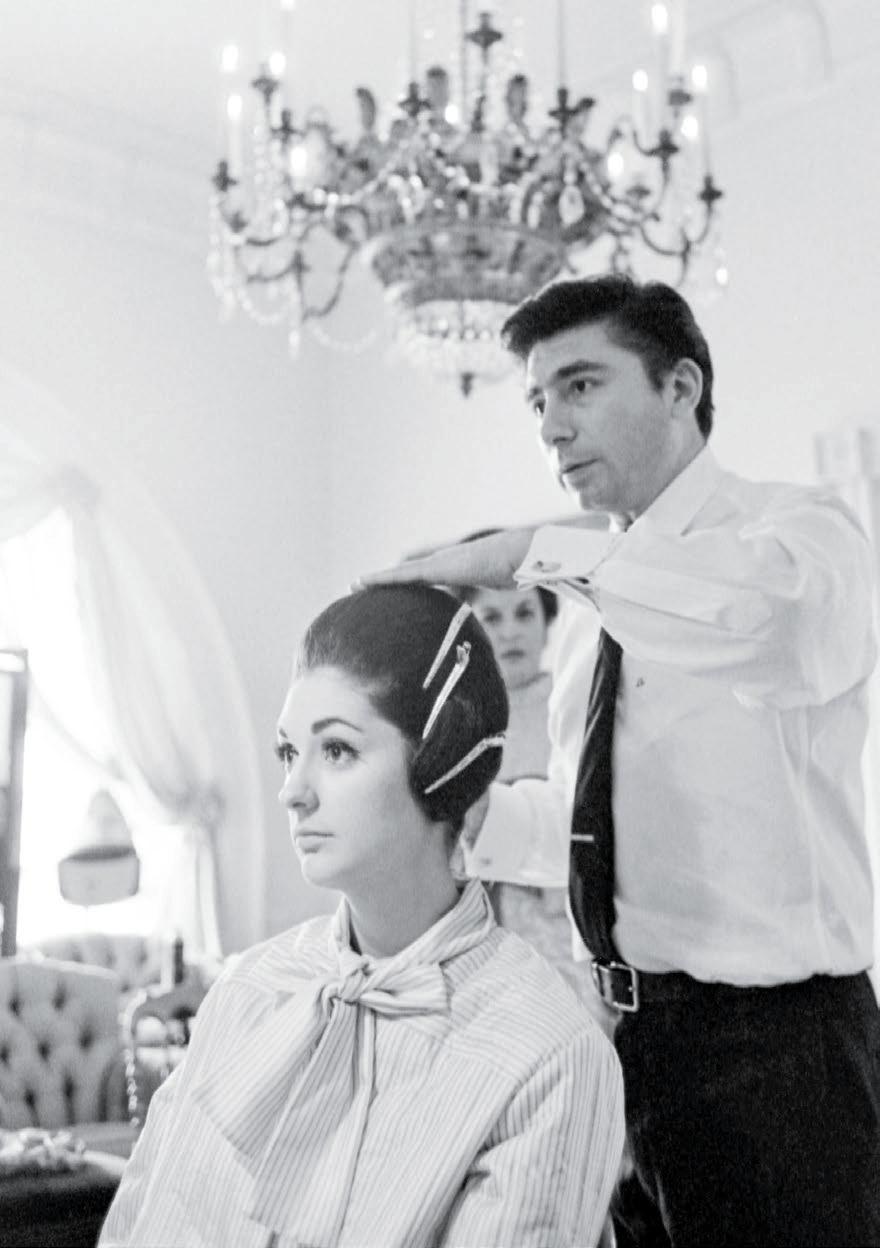
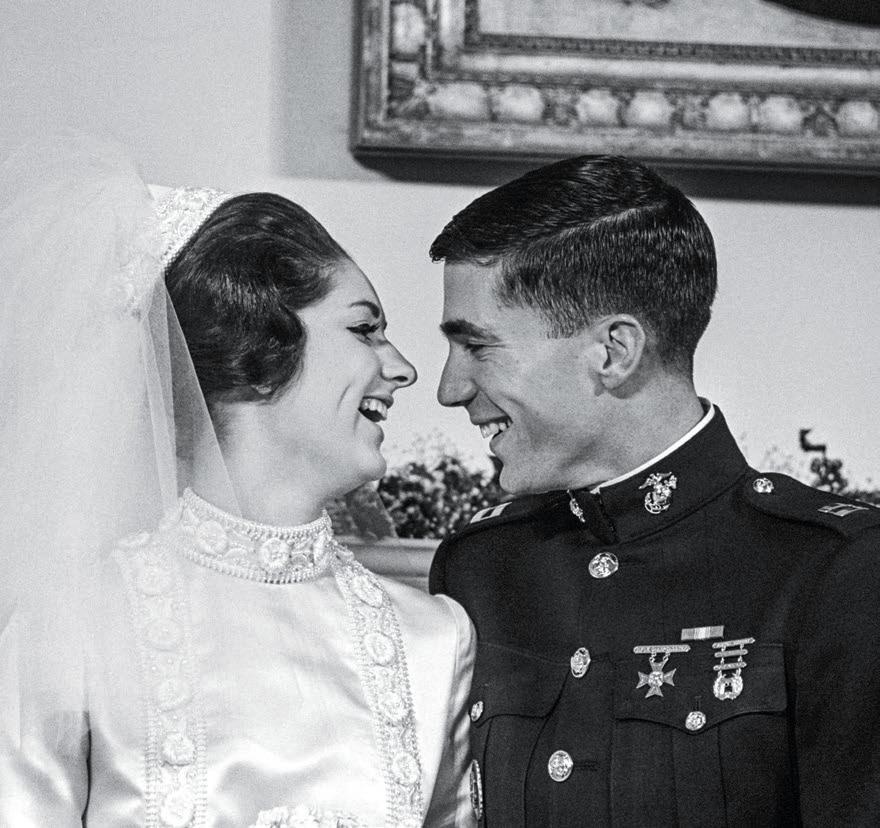
Lynda Johnson chose a more formal hairstyle for her wedding to Chuck Robb, December 9, 1967. Jean Louis built up the back of the bride’s hair (top left) to accommodate a headpiece and veil. A last-minute change to a heavier veil (right) worried the stylist, but to his relief, the style held and the veil stayed in place for the evening.
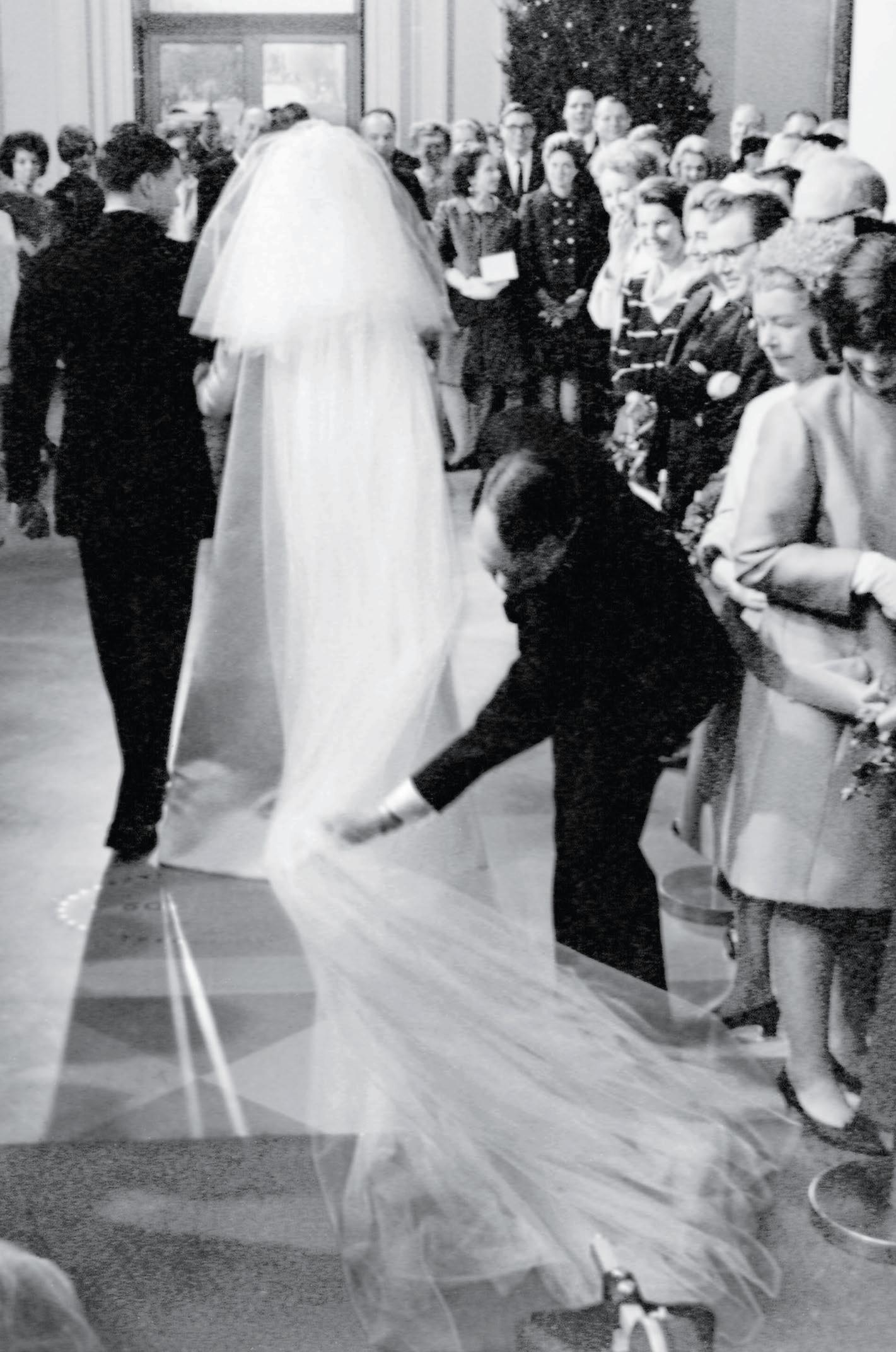
Louis conducted two test runs of the updo before the wedding to make sure it would be perfect. On the day of the wedding, he arrived at the White House, and, after he had finished arranging her hair as practiced, a different veil—much longer, cathedral length— was brought in instead. “I didn’t expect another veil, and it was so very heavy. I stuck it on with a couple of bobby pins, crossed my
fingers and prayed it wouldn’t fall off as she walked up the aisle,” he said. “I was so afraid! Imagine if the President’s daughter had lost her veil in the middle of the ceremony!”37 Fortunately, the veil lasted throughout the entire evening without any malfunction.
Jean Louis’s legacy continues through his nephew, Jean Paul, a Washington, D.C., hairstylist whose formative teenage years were spent by his uncle’s side as an apprentice in his salon. In 1967, after obtaining a green card in Paris, Jean Paul traveled to Washington, D.C., with his sister. His first week in the salon was spent learning from Jean Louis how to shampoo a customer’s hair, and shampooing became his primary job. One of his fondest memories is the first trip he made with his uncle to the White House. A driver came over to the salon to pick them up, and they were escorted to the first lady’s Private Quarters on the Second Floor to set up. Jean Paul remembers being “petrified” of shampooing the first lady’s hair. Because of his nerves, he accidentally sprayed water all over her! But he said Mrs. Johnson was very gracious and kind and only laughed and said, “Don’t tell anything to Jean Louis.” Then she gave Jean Paul a $100 bill (equivalent to $849.45 in 2022)—an incredible tip, especially considering his mishap. He was astonished, reflecting that in France his mother raised six children on that same amount a month.38
Jean Louis’s legacy continues through his nephew, Jean Paul, a Washington, D.C., hairstylist whose formative teenage years were spent by his uncle’s side as an apprentice in his salon. In 1967, after obtaining a green card in Paris, Jean Paul traveled to Washington, D.C., with his sister. His first week in the salon was spent learning from Jean Louis how to shampoo a customer’s hair, and shampooing became his primary job. One of his fondest memories is the first trip he made with his uncle to the White House. A driver came over to the salon to pick them up, and they were escorted to the first lady’s Private Quarters on the Second Floor to set up. Jean Paul remembers being “petrified” of shampooing the first lady’s hair. Because of his nerves, he accidentally sprayed water all over her! But he said Mrs. Johnson was very gracious and kind and only laughed and said, “Don’t tell anything to Jean Louis.” Then she gave Jean Paul a $100 bill (equivalent to $849.45 in 2022)—an incredible tip, especially considering his mishap. He was astonished, reflecting that in France his mother raised six children on that same amount a month.38
Jean Paul was even given a tour of the private spaces of the White House, including the kitchen and the swimming pool. He remembers walking in
Jean Paul was even given a tour of the private spaces of the White House, including the kitchen and the swimming pool. He remembers walking in
Jean Louis’s legacy continues through his nephew, Jean Paul, a Washington, D.C., hairstylist whose formative teenage years were spent by his uncle’s side as an apprentice in his salon. In 1967, after obtaining a green card in Paris, Jean Paul traveled to Washington, D.C., with his sister. His first week in the salon was spent learning from Jean Louis how to shampoo a customer’s hair, and shampooing became his primary job. One of his fondest memories is the first trip he made with his uncle to the White House. A driver came over to the salon to pick them up, and they were escorted to the first lady’s Private Quarters on the Second Floor to set up. Jean Paul remembers being “petrified” of shampooing the first lady’s hair. Because of his nerves, he accidentally sprayed water all over her! But he said Mrs. Johnson was very gracious and kind and only laughed and said, “Don’t tell anything to Jean Louis.” Then she gave Jean Paul a $100 bill (equivalent to $849.45 in 2022)—an incredible tip, especially considering his mishap. He was astonished, reflecting that in France his mother raised six children on that same amount a month.38
the hallway, and when passing by the Oval Office, President Lyndon B. Johnson called him over. Sitting on the edge of his desk, the president said, “Son, what can you do with this hair?” It was “incredible to be acknowledged by the president . . . and that someone so high in the U.S. government could be so nice to me,” he said.39 Visiting the White House with his uncle formed some of his favorite memories, and Jean Louis remained a steadfast role model for the young hairdresser just starting his career in Washington, D.C.
the hallway, and when passing by the Oval Office, President Lyndon B. Johnson called him over. Sitting on the edge of his desk, the president said, “Son, what can you do with this hair?” It was “incredible to be acknowledged by the president . . . and that someone so high in the U.S. government could be so nice to me,” he said.39 Visiting the White House with his uncle formed some of his favorite memories, and Jean Louis remained a steadfast role model for the young hairdresser just starting his career in Washington, D.C.
By the time of the Reagan administration, Jean Louis’s golden years in Washington had ended, so he decided to rent out his building on Connecticut Avenue and take a job as head of the Elizabeth Arden Salon in San Francisco. He was there for only one year before he returned to Washington, D.C., and he opened a smaller-scale salon in Georgetown. There he worked for another twenty years until he retired because of health issues.40 On June 9, 2002, Jean Louis passed away at a nursing facility in Virginia.41 As a hairstylist for fifty-three years and one of the top in his profession in the world during his time, Jean Louis Mazéas is remembered as an inspiration by his nephew and as a legend to all the women for whom he worked his magic.
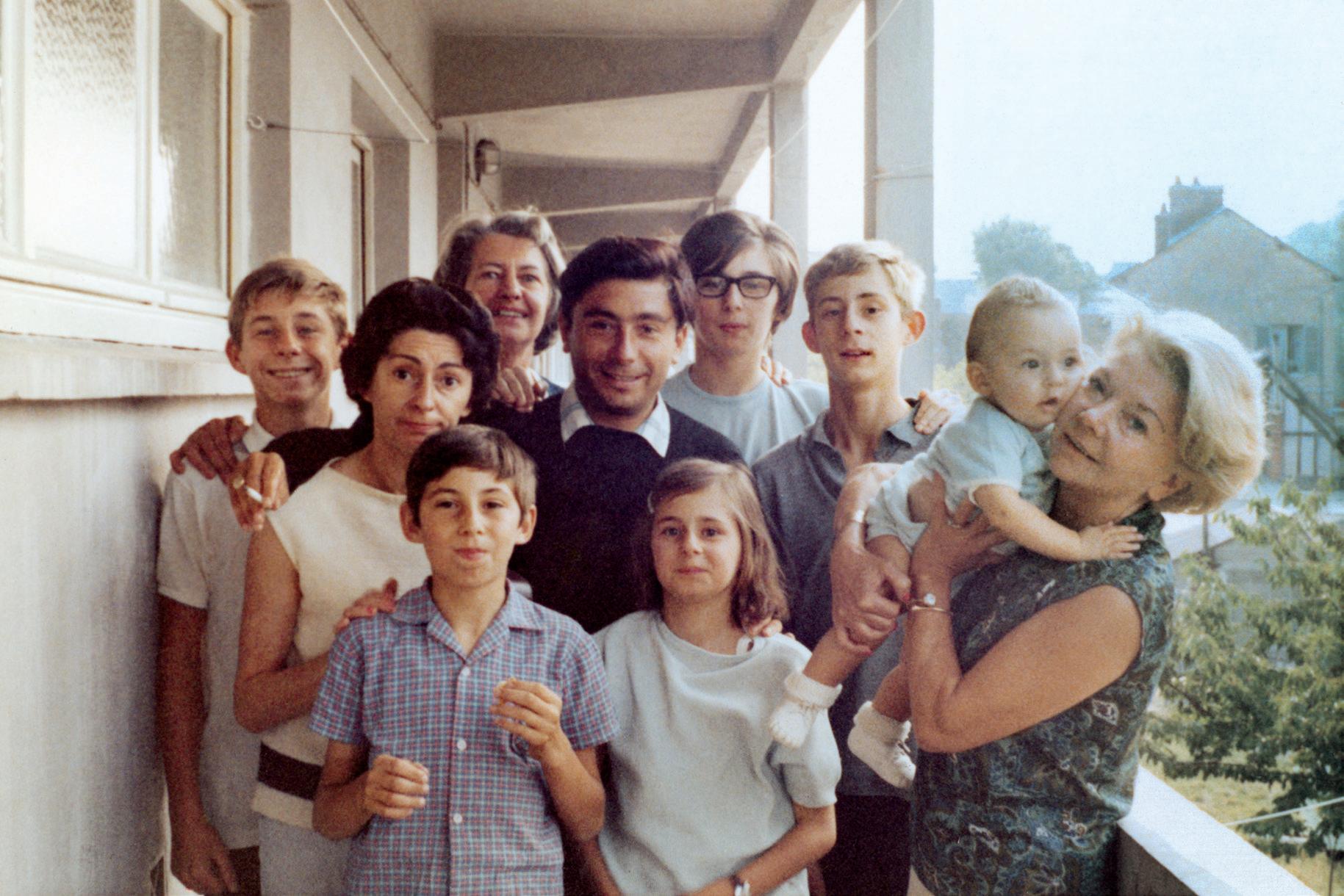
Jean Louis’s legacy continues through his nephew John Paul, who was only fourteen years old when he moved to Washington, D.C., with his sister, Martine, to apprentice at his uncle’s hair salon. Jean Paul accompanied his Uncle Jean Louis to the White House where he would shampoo First Lady Lady Bird Johnson’s hair before it was styled. Jean Paul (back, left) is pictured here with his Uncle Jean Louis (middle) and his family in France in 1966, one year before he moved to America.
Jean Louis’s legacy continues through his nephew John Paul, who was only fourteen years old when he moved to Washington, D.C., with his sister, Martine, to apprentice at his uncle’s hair salon. Jean Paul accompanied his Uncle Jean Louis to the White House where he would shampoo First Lady Lady Bird Johnson’s hair before it was styled. Jean Paul (back, left) is pictured here with his Uncle Jean Louis (middle) and his family in France in 1966, one year before he moved to America.
Jean Paul was even given a tour of the private spaces of the White House, including the kitchen and the swimming pool. He remembers walking in the hallway, and when passing by the Oval Office, President Lyndon B. Johnson called him over. Sitting on the edge of the Resolute Desk, the president said, “Son, what can you do with this hair?” It was “incredible to be acknowledged by the president . . . and that someone so high in the U.S. government could be so nice to me,” he said.39 Visiting the White House with his uncle formed some of his favorite memories, and Jean Louis remained a steadfast role model for the young hairdresser just starting his career in Washington, D.C.
By the time of the Reagan administration, Jean Louis’s golden years in Washington had ended, so he decided to rent out his building on Connecticut Avenue and take a job as head of the Elizabeth Arden Salon in San Francisco. He was there for only one year before he returned to Washington, D.C., and he opened a smaller-scale salon in Georgetown. There he worked for another twenty years until he retired because of health issues.40 On June 9, 2002, Jean Louis passed away at a nursing facility in Virginia.41 As a hairstylist for fifty-three years and one of the top in his profession in the world during his time, Jean Louis Mazéas is remembered as an inspiration by his nephew and as a legend to all the women for whom he worked his magic.
By the time of the Reagan administration, Jean Louis’s golden years in Washington had ended, so he decided to rent out his building on Connecticut Avenue and take a job as head of the Elizabeth Arden Salon in San Francisco. He was there for only one year before he returned to Washington, D.C., and he opened a smaller-scale salon in Georgetown. There he worked for another twenty years until he retired because of health issues.40 On June 9, 2002, Jean Louis passed away at a nursing facility in
notes
1. Jean Paul Mazéas, interview by author, December 16, 2020. Jean Paul Mazéas, who trained with his uncle and is currently a stylist at a Washington, D.C., salon, shared with us a copy of a scrapbook of photographs and newspaper clippings documenting his uncle’s salon and clients. The scrapbook was put together by Jean Louis’s friend, Richard Lykes, in the 1960s.
Virginia.41 As a hairstylist for fifty-three years and one of the top in his profession in the world during his time, Jean Louis Mazéas is remembered as an inspiration by his nephew and as a legend to all the women for whom he worked his magic.
2. Angele Gingras, “Jean Louis Looks Ahead: Mrs. Kennedy’s Hairdresser Is Off to Paris for New Ideas,” Louisville (Ky.) Courier-Journal, July 15, 1962, 6.
3. Barbara Morgan, “He Created History’s Most Copied Hairdo,” Tribune, n.d., clipping in scrapbook.
4. Washington, D.C., City Directory, 1954, 1035.
5. Quoted in Marian Price, “Place Where First Lady Lets Her Hair Down,” Los Angeles Times, February 19, 1966.
1. Jean Paul Mazéas, interview by author, December 16, 2020. Jean Paul Mazéas, who trained with his uncle and is currently a stylist at a Washington, D.C., salon, shared with us a copy of a scrapbook of photographs and newspaper clippings documenting his uncle’s salon and clients. The scrapbook was put together by Jean Louis’s friend, Richard Lykes, in the 1960s.
17. Martin, “Her Hairdresser Says: Jackie to Get New Look”; Ann Hand, interview by author, January 7, 2022.
18. Maxine Cheshire and Dorothy McCardle. “Men Work; Women Chat,” Washington Post, November 9, 1961, C20.
19. Phyllis Hanes, “Coiffures Fantastic Weird Little Article Takes Over,” Boston Herald, October 17, 1962, 12.
18. Maxine Cheshire and Dorothy McCardle. “Men Work; Women Chat,” Washington Post, November 9, 1961, C20.
19. Phyllis Hanes, “Coiffures Fantastic Weird Little Article Takes Over,” Boston Herald, October 17, 1962, 12.
20. Gingras, “Jean Louis Looks Ahead”; Thomas, “First Lady Is Said to Be Sold on Leather Accent”; Helen Thomas, “Jackie Bucks Paris Styles with Hairdo,” Cedar Rapids (Iowa) Gazette, October 11, 1963, 13.
20. Gingras, “Jean Louis Looks Ahead”; Thomas, “First Lady Is Said to Be Sold on Leather Accent”; Helen Thomas, “Jackie Bucks Paris Styles with Hairdo,” Cedar Rapids (Iowa) Gazette, October 11, 1963, 13.
21. “Not Influenced by Parisian Decree on Shorter Bob: Jackie Likes Long Hair,” Marietta (Ga.) Daily Journal, October 17, 1963, 7.
21. “Not Influenced by Parisian Decree on Shorter Bob: Jackie Likes Long Hair,” Marietta (Ga.) Daily Journal, October 17, 1963, 7.
22. Eleni, “Jean Louis Opens Salon.”
22. Eleni, “Jean Louis Opens Salon.”
23. Jean Paul Mazéas interview.
23. Jean Paul Mazéas interview.
24. Vera Glaser, “Luci Johnson’s Wedding: Coiffeur Has Key Role,” Baltimore Sun, June 21, 1966, B1.
2. Angele Gingras, “Jean Louis Looks Ahead: Mrs. Kennedy’s Hairdresser Is Off to Paris for New Ideas,” Louisville (Ky.) Courier-Journal, July 15, 1962, 6.
3. Barbara Morgan, “He Created History’s Most Copied Hairdo,” Tribune, n.d., clipping in scrapbook.
6. Morgan, “He Created History’s Most Copied Hairdo.” The passenger and crew list for the ship Ill de France shows that Jean Louis Mazéas immigrated to the United State from France in 1955. U.S., Arriving Passenger and Crew Lists, 1820–1957, 1955 Arrival, New York, microfilm serial: T715, p. 153, online at Ancestry.com.
4. Washington, D.C., City Directory, 1954, 1035.
24. Vera Glaser, “Luci Johnson’s Wedding: Coiffeur Has Key Role,” Baltimore Sun, June 21, 1966, B1.
25. Hand interview.
25. Hand interview.
26. Names of clients were found in several newspaper sources: Glaser, “Luci Johnson’s Wedding”; Price, “Place Where First Lady Lets Her Hair Down”; Eleni, “Jean Louis Opens Salon.”
26. Names of clients were found in several newspaper sources: Glaser, “Luci Johnson’s Wedding”; Price, “Place Where First Lady Lets Her Hair Down”; Eleni, “Jean Louis Opens Salon.”
27. Hand interview.
27. Hand interview.
5. Quoted in Marian Price, “Place Where First Lady Lets Her Hair Down,” Los Angeles Times, February 19, 1966.
7. Helen Thomas, “First Lady Is Said to Be Sold on Leather Accent: Her Hair Style Is Changing to One of Elegance,” Santa Fe (N.Mex.) New Mexican, September 23, 1962, 23.
8. Judith Martin, “Her Hairdresser Says: Jackie to Get New Look,” Washington Post, October 10, 1960, clipping in scrapbook. From 1957 to 1961 the Kennedys lived at 3307 N Street NW, Washington, D.C.
6. Morgan, “He Created History’s Most Copied Hairdo.” The passenger and crew list for the ship Ill de France shows that Jean Louis Mazéas immigrated to the United State from France in 1955. U.S., Arriving Passenger and Crew Lists, 1820–1957, 1955 Arrival, New York, microfilm serial: T715, p. 153, online at Ancestry.com.
7. Helen Thomas, “First Lady Is Said to Be Sold on Leather Accent: Her Hair Style Is Changing to One of Elegance,” Santa Fe (N.Mex.) New Mexican, September 23, 1962, 23.
9. Hamish Bowles, “Defining Style: Jacqueline Kennedy’s White House Years,” in Jacqueline Kennedy: The White House Years; Selections from the John F. Kennedy Library and Museum, ed. Hamish Bowles (New York: Metropolitan Museum of Art, 2001), 28.
10. Martin, “Her Hairdresser Says: Jackie to Get New Look.”
8. Judith Martin, “Her Hairdresser Says: Jackie to Get New Look,” Washington Post, October 10, 1960, clipping in scrapbook. From 1957 to 1961 the Kennedys lived at 3307 N Street NW, Washington, D.C.
11. Quoted in Eleni, “Jean Louis Opens Salon,” Washington Evening Star, October 8, 1963, C2.
12. Martin, “Her Hairdresser Says: Jackie to Get New Look.”
13. Bowles, “Defining Style,” 18–19.
9. Hamish Bowles, “Defining Style: Jacqueline Kennedy’s White House Years,” in Jacqueline Kennedy: The White House Years; Selections from the John F. Kennedy Library and Museum, ed. Hamish Bowles (New York: Metropolitan Museum of Art, 2001), 28.
10. Martin, “Her Hairdresser Says: Jackie to Get New Look.”
14. Quoted in Thomas, “First Lady Is Said to Be Sold on Leather Accent.”
11. Quoted in Eleni, “Jean Louis Opens Salon,” Washington Evening Star, October 8, 1963, C2.
15. Gingras, “Jean Louis Looks Ahead.”
16. Ibid.
12. Martin, “Her Hairdresser Says: Jackie to Get New Look.”
13. Bowles, “Defining Style,” 18–19.
14. Quoted in Thomas, “First Lady Is Said to Be Sold on Leather Accent.”
15. Gingras, “Jean Louis Looks Ahead.”
16. Ibid.
17. Martin, “Her Hairdresser Says: Jackie to Get New Look”; Ann Hand, interview by author, January 7, 2022.
28. Quoted in Morgan, “He Created History’s Most Copied Hairdo.”
28. Quoted in Morgan, “He Created History’s Most Copied Hairdo.”
29. Glaser, “Luci Johnson’s Wedding.” Ann Hand also remembered how Jean Louis was very discrete and would take good care not to gossip about anyone. Everything that was said to him was confidential. Hand interview.
30. Eleni, “Jean Louis Opens Salon.”
29. Glaser, “Luci Johnson’s Wedding.” Ann Hand also remembered how Jean Louis was very discrete and would take good care not to gossip about anyone. Everything that was said to him was confidential. Hand interview.
31. Glaser, “Luci Johnson’s Wedding”; Jean Paul Mazéas interview.
30. Eleni, “Jean Louis Opens Salon.”
32. Hand interview.
31. Glaser, “Luci Johnson’s Wedding”; Jean Paul Mazéas interview.
33. Angele Gingras, “Fashion News: Winning Hairdo,” Baltimore Sun, December 29, 1965, B4.
32. Hand interview.
34. Hand interview.
35. Gingras, “Fashion News: Winning Hairdo.”
33. Angele Gingras, “Fashion News: Winning Hairdo,” Baltimore Sun, December 29, 1965, B4.
34. Hand interview.
36. Glaser, “Luci Johnson’s Wedding.”
35. Gingras, “Fashion News: Winning Hairdo.”
37. Quoted in Morgan, “He Created History’s Most Copied Hairdo.”
38. Jean Paul Mazéas interview.
39. Ibid.
36. Glaser, “Luci Johnson’s Wedding.”
37. Quoted in Morgan, “He Created History’s Most Copied Hairdo.”
40. Letter from Richard Lykes pasted into scrapbook, dated January 24, 2002.
38. Jean Paul Mazéas interview.
39. Ibid.
41. Record of death in Social Security Death Index, Social Security Administration, Washington, D.C., online at Ancestry.com.
40. Letter from Richard Lykes pasted into scrapbook, dated January 24, 2002.
41. Record of death in Social Security Death Index, Social Security Administration, Washington, D.C., online at Ancestry.com.
kimberly chrisman-campbell
on february 29, 1968, the White House hosted its first—and only—fashion show. While this historic event has been largely forgotten today, it received extensive and glowing coverage in fashion press at the time. The first lady who brought Seventh Avenue to Pennsylvania Avenue was Claudia (“Lady Bird”) Johnson, who never expected or aspired to become first lady and who struggled to live up to the stylish example of her predecessor, Jacqueline Kennedy.
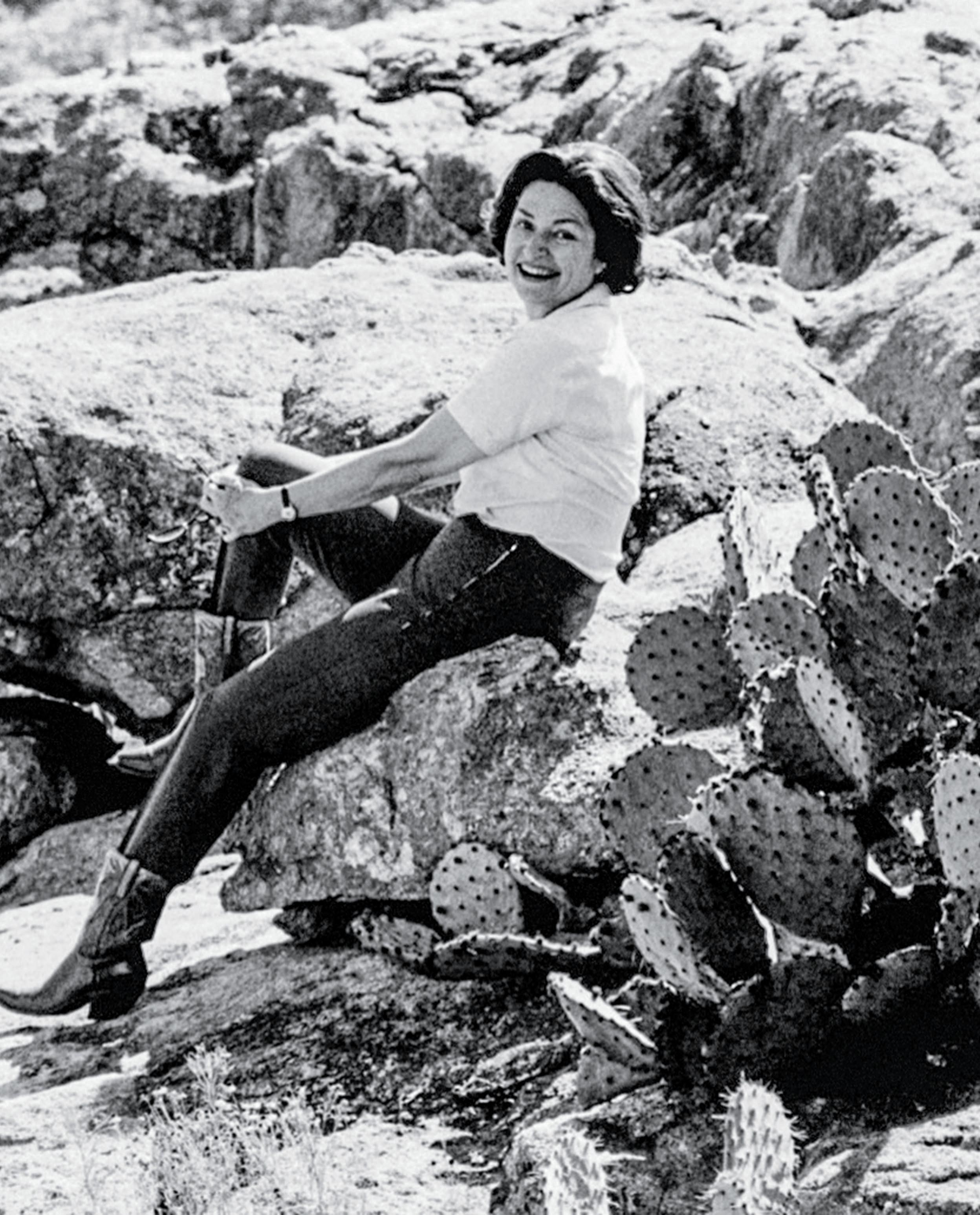
opposite Always a Texan at heart, Lady Bird Johnson was comfortable in cowboy boots, but the fashion press often ridiculed her casual looks. She is seen here on the LBJ Ranch, 1965.
right
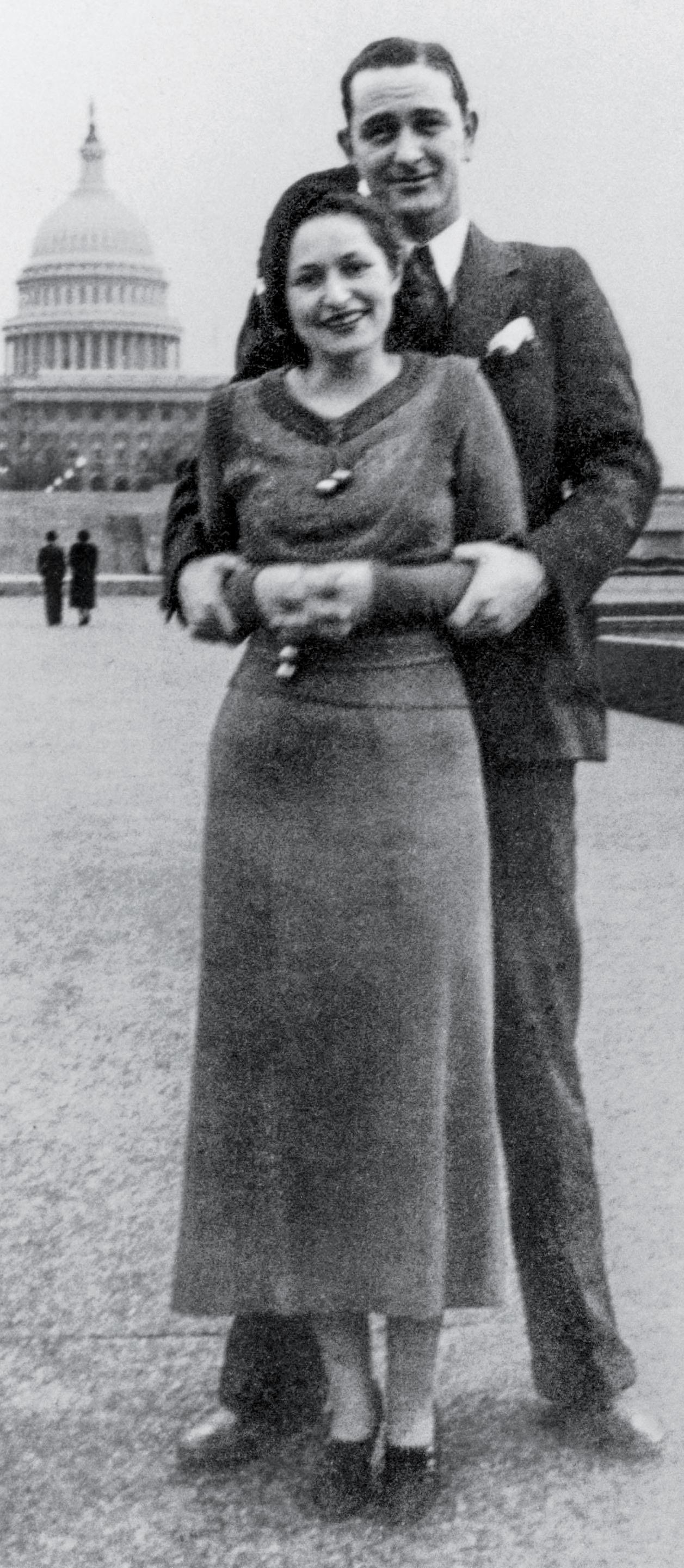
Newlyweds Lady Bird Johnson and congressional aide Lyndon Baines Johnson pose near the U.S. Capitol Building, c. 1934.
previous spread
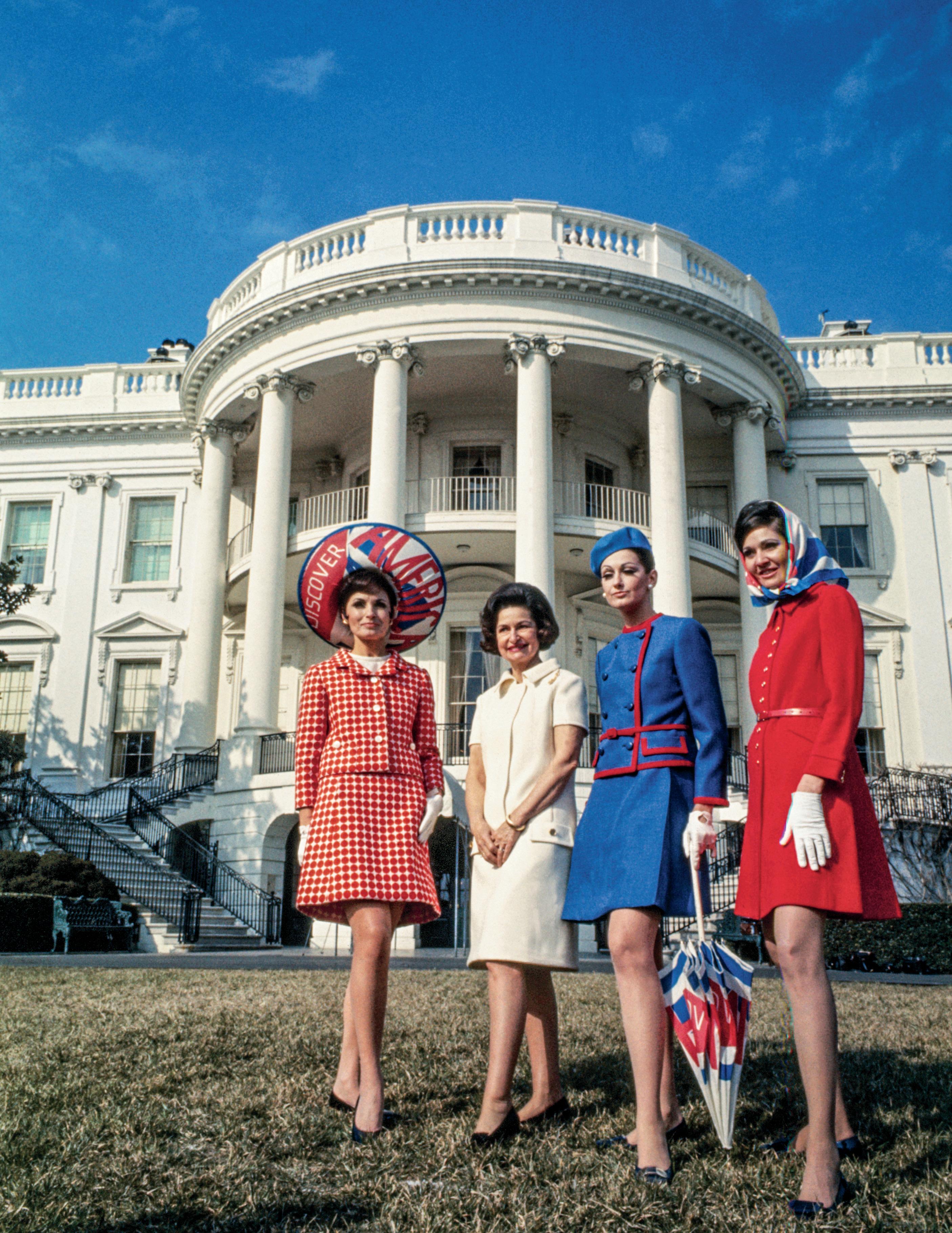
Mrs. Johnson poses on the South Lawn with models participating in “How to Discover America in Style” a lunchtime fashion show in the State Dining Room, February 1968.
Raised on an East Texas cotton plantation, Lady Bird—a childhood nickname—was thrust into politics when she married ambitious congressional aide Lyndon Baines Johnson in 1934. But she was no “suburban housewife,” as the Washington Post once described Mamie Eisenhower.1 Mrs. Johnson was a shrewd and successful businesswoman who parlayed a $67,000 inheritance into a million-dollar Austin broadcasting and real estate empire.2
Though she remained a Texan at heart, Lady Bird Johnson spent most of her adult life in Washington as her husband rose from congressional aide to vice president. When John F. Kennedy was assassinated on November 22, 1963, she suddenly found herself in the national spotlight. During her subsequent five years in the White House she wrestled with the conviction that she was an illegitimate first lady— not just in the country’s eyes, but in her own.
Although Lady Bird Johnson had honed her public image as a congressional wife and on the presidential campaign trail—where she often stood in for Jacqueline Kennedy, who was pregnant in the run-up to the 1960 election—she was a reluctant celebrity. “I have a sort of schizophrenic feeling that I’m cast in a role that I was never meant for,” she admitted.3 She was not alone in that suspicion. The press mocked the second lady’s plainspoken Texas twang, old-fashioned hairstyle, and downhome manners: she insisted on driving her own car and traveling without a maid. Photographs of the Johnsons relaxing in cowboy hats and boots on their Texas ranch did nothing to endear them to reporters enchanted by the preppy, patrician Kennedys. “She looked more like the ranch hand’s wife than the ranch owner’s,” Women’s Wear Daily sneered.4 The editors famously crowned Jacqueline Kennedy “Her Elegance” while dubbing Lady Bird Johnson “Her Efficiency.”
Lady Bird Johnson was complicit in cultivating this homespun, thrifty reputation. Even her most high-profile outfits made multiple appearances, not just at different events but on different Johnson women and their friends. She coaxed a long life out of a favorite beaded evening jacket by ordering a new dress to go under it every year.5 She rarely wore jewelry, and, when she did, she stuck to the same trusty pearls and diamond bracelet she had had for years.6 Her mortified daughters, Lynda Bird and Luci, had to beg her to buy new shoes, which she was reluctant to do until hers wore out completely.7
Meanwhile the press damned the second lady’s
wardrobe with faint praise. The editor of Diplomat magazine observed that Lady Bird Johnson “is not a trend setter but buys good clothes and wears them for some time.”8 Women’s Wear Daily, which rose to national prominence by obsessively chronicling Jacqueline Kennedy’s wardrobe, reported that Mrs. Johnson “likes the no-fuss, no-feathers look,” “prefers pretty feminine things to chic clothes,” and “never buys on impulse.”9 Instead, she put her trust in Neiman-Marcus, the Dallas department store where she had been shopping since she was a young bride.
above
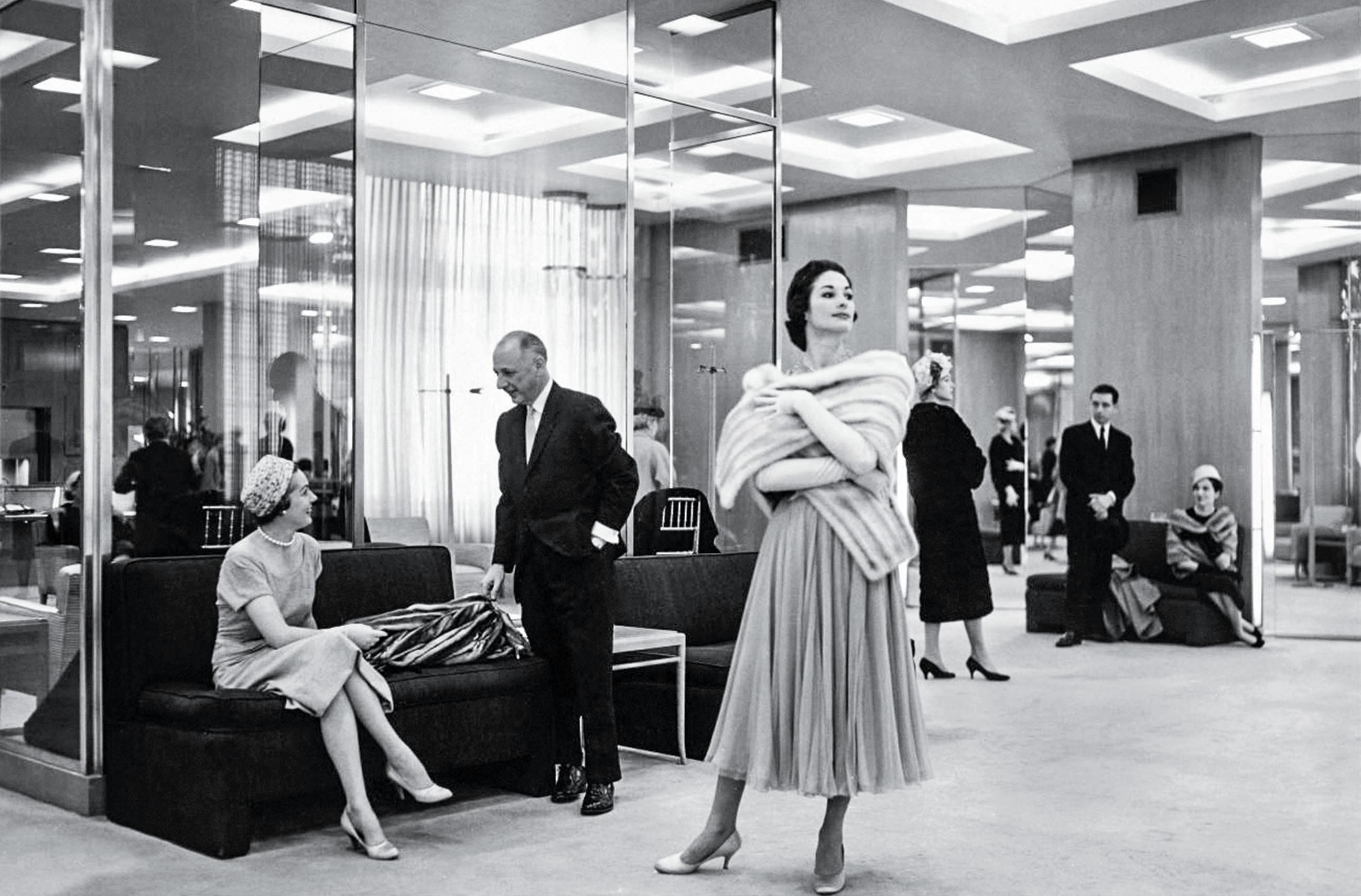
Lady Bird Johnson relied on Neiman Marcus throughout her husband’s political career, often visiting the showroom in Dallas, seen here c. 1960.
left
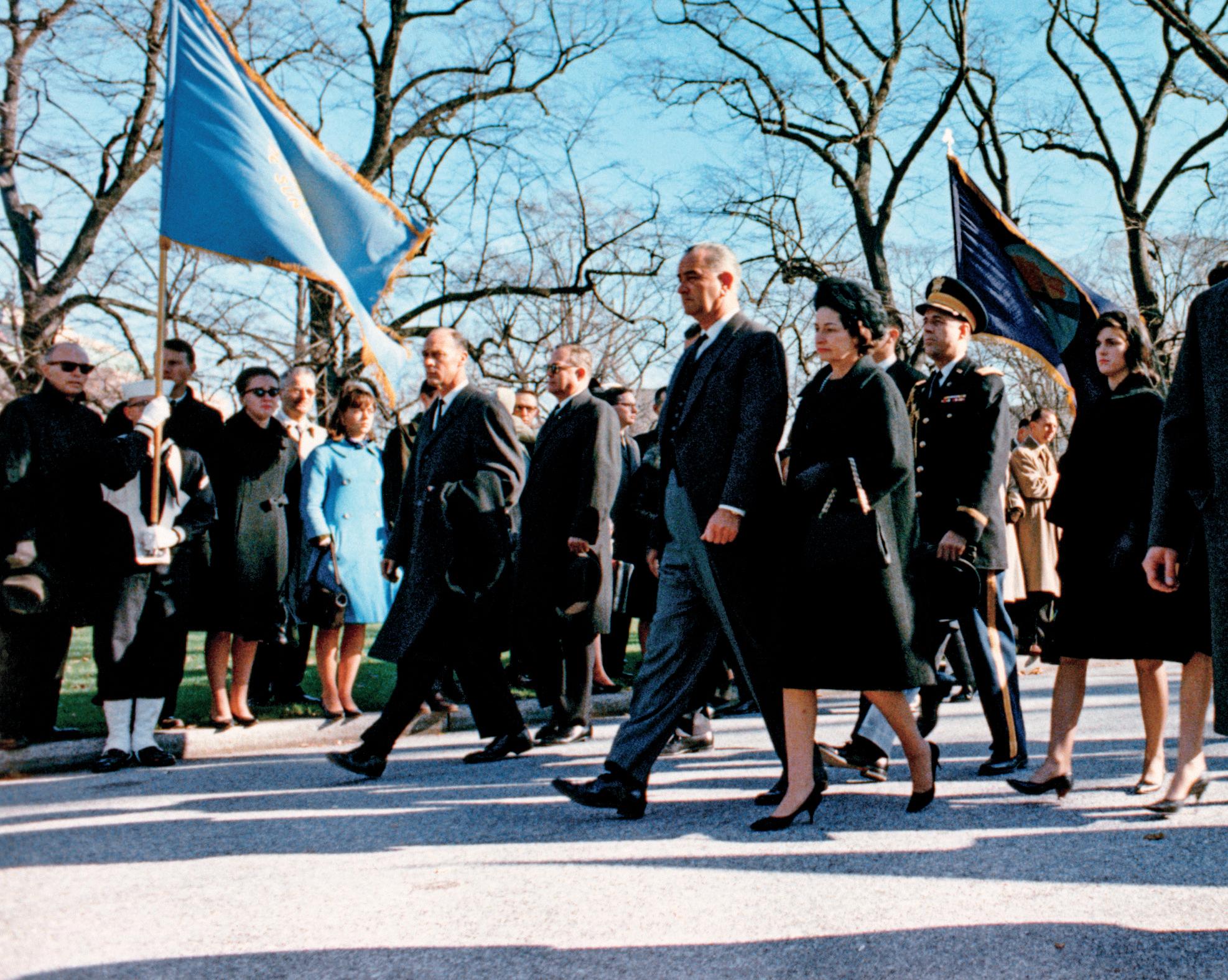
Prior to his presidency, Lyndon Johnson had strong opinions about his wife’s wardrobe and insisted on only bright colors. As a result, Lady Bird Johnson had to borrow black coats and dresses to wear to the events following the assassination of John F. Kennedy. She is seen here during the funeral procession for President Kennedy, November 1963.
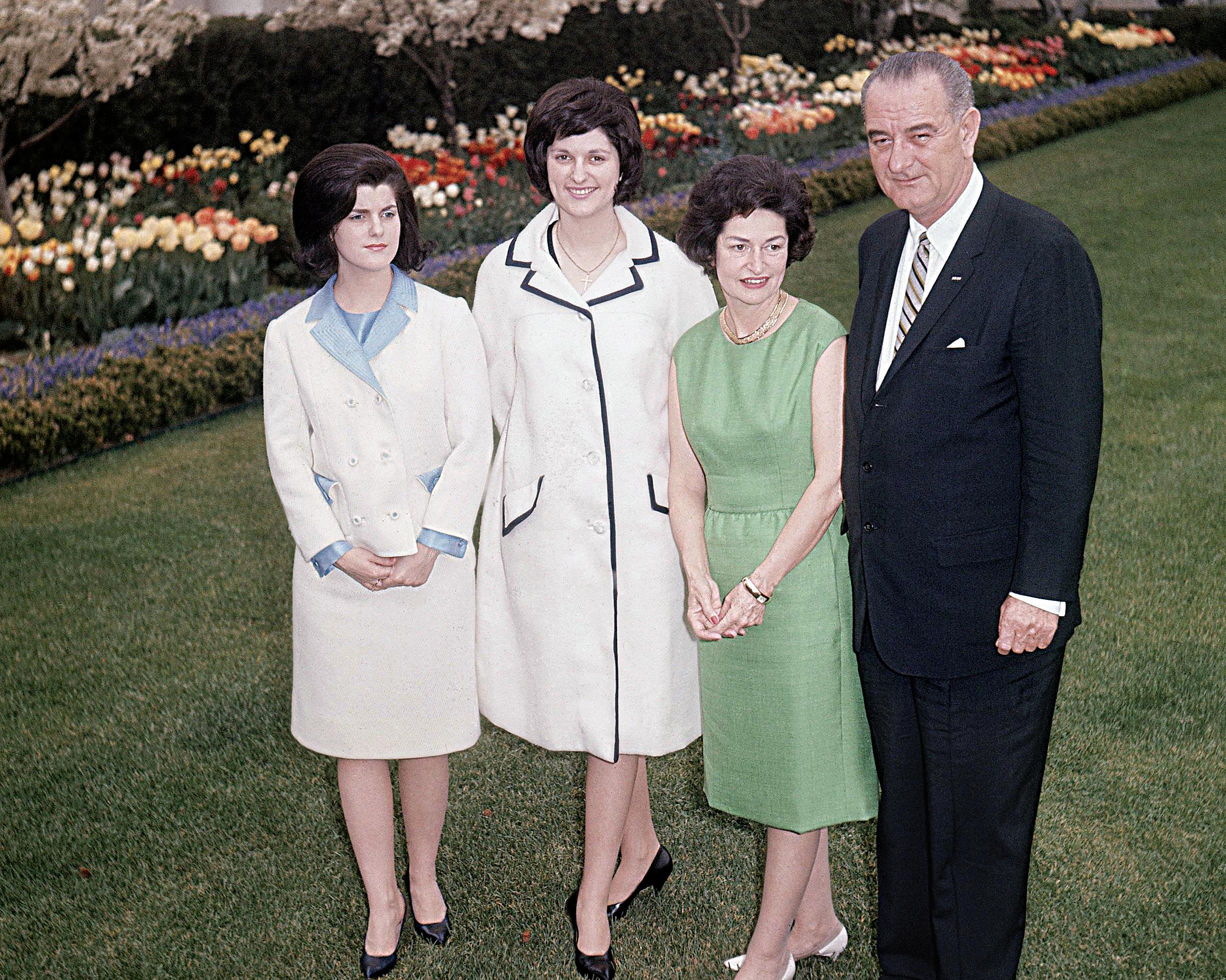
Once she became first lady, Lady Bird Johnson found it was the press, rather than her husband, that was most interested in her wardrobe. Mrs. Johnson preferred simple, practical, and classic styles. The Johnson family is seen here in the Rose Garden in the spring of 1964.
Stanley Marcus, the store’s president, remembered Lady Bird Johnson’s first visit, shortly after her husband was elected to Congress in 1937. She had “no daringness” and “not too much self-confidence in her taste,” he recalled; anything she purchased had to be approved by her husband, who “exercised a very powerful veto.”10 Lyndon Johnson “had very definite ideas of what he wanted the women around him to look like, and he had some antipathies to certain fashions that made it very difficult for us to serve him properly and at the same time dress the women properly,” as Marcus delicately put it.11 Lyndon Johnson disliked full skirts and tweeds, dubbing them “saddle blanket fabrics.”12 He preferred bright hues to what he called “muley” colors: green, purple, brown, beige, and gray. Black was completely verboten; his wife had
to borrow black coats and dresses from her friend the broadcaster Nancy Dickerson to wear in the days of mourning following President Kennedy’s assassination.13 “He likes the things that show the shape of your figure, if you have one to show,” the first lady’s social secretary, Bess Abell, commented in 1969.14 “Unfortunately, fashion didn’t always go along with him,” Marcus observed.15 After Johnson became president, however, his micromanaging ceased. For once, he “just didn’t have the time to take care of the affairs of the nation and the affairs of his feminine wardrobe,” Marcus said.16 His wife, long accustomed to having her clothes selected for her, suddenly found herself left to her own devices—a position at once liberating and terrifying. Of course, there was a surge of interest in the new first lady’s fashion choices, from the press and
the public alike. In a story headlined “The Eyes of Fashion Are upon Her,” Women’s Wear Daily canvassed industry insiders for their opinions. The replies were diplomatic, even complimentary. But many shared the sentiments of Oleg Cassini, who found Mrs. Johnson “a charming person” who “dresses well” but added, “To me, Mrs. Kennedy is still the First Lady.”17 In a separate article, Women’s Wear Daily noted charitably that Mrs. Johnson’s fashion sense had improved since her days as a congressional wife: “Now it’s more classic and citified than Plain Old Texas.”18 While “Texas taste” might signify an almost cartoonish level of luxury today, in the 1960s it meant countrified and dowdy. Dallas fashion industry veteran Christian Mann defended Mrs. Johnson’s “innate good taste, even if at the moment it may appear provincial.”19 But the press criticized her conservatism and frugality, even as Marcus defended his star client’s “classic” taste. “Women’s Wear doesn’t like classics,” he sniffed.
“They like things that make news. If she had worn pants to the inauguration, they would have been delighted.”20
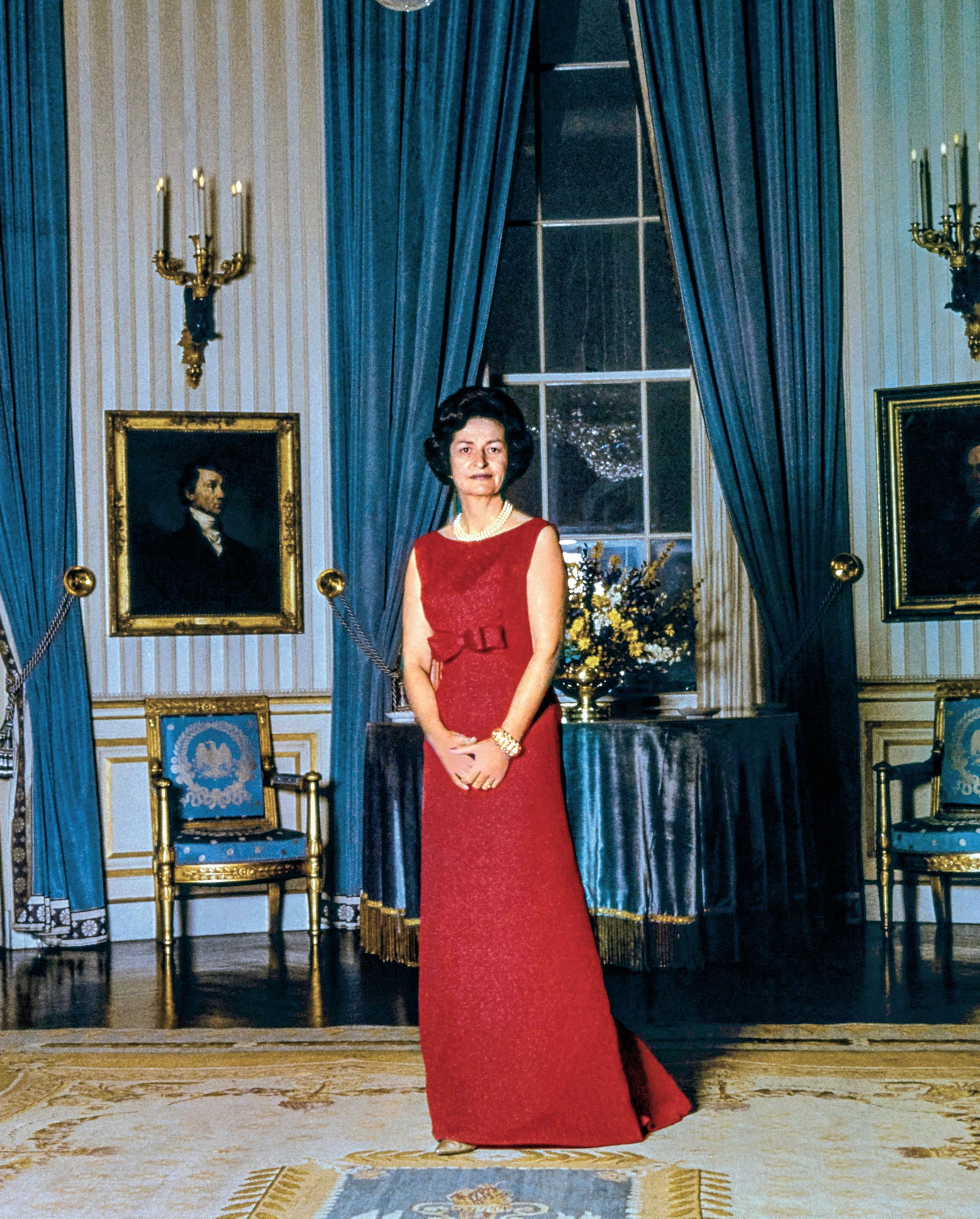
In May 1964 Lady Bird Johnson participated in what has become a hallowed rite of passage for first ladies, a Vogue interview. Horst P. Horst photographed her in the Blue Room of the White House wearing a sleeveless, high-waisted red evening sheath with a boat neck, paired with a pearl necklace, in the Camelot mold. The article praised her intelligence and dignity, describing her as “totally unlike the nation’s folksy impression of her.”21 Behind the scenes, though, the first lady found the glamorous photo-shoot a chore,22 and Vogue ultimately decided against putting her on its cover.
Shortly after Mrs. Johnson moved into the White House, her press secretary announced that—in a break with the Kennedy era—the White House would not be releasing the names of the first lady’s designers.23 The policy of secrecy may have begun as an attempt to avoid comparisons with Jacqueline Kennedy—whose wardrobe choices (and expenditures) made news—but it also suited Lady Bird Johnson, who once confessed, “I never know what designer I am wearing if I don’t look at the label.”24 The first lady even kept her designers unknown to each other, carefully scheduling fitting sessions so they would not meet in the halls of the White House.25 The secrecy did not prevent fashion reporters from speculating or from hounding those designers known to dress the first family.
Lady Bird Johnson was painfully aware of the comparisons to Jacqueline Kennedy—“that immaculate woman,” she once called her.26 Though Mrs. Kennedy was seventeen years younger, Mrs. Johnson idolized her, treating her with a reverential mix of star-struck awe and motherly protection. They first met as Senate wives. “I felt, as I expect a lot of us felt, like here is a bird of beautiful plumage among all of us little gray wrens,” Johnson remembered.27 Jacqueline Kennedy’s perfection threw Lady Bird Johnson’s own deficiencies into high relief. “She always wore gloves like she was used to them,” Mrs. Johnson marveled. “I never could.”28 Mrs. Kennedy made the pillbox hat her signature, but Mrs. Johnson preferred to go bareheaded. Privately, she referred to the pillbox as “the monkey hat—like you need an organ grinder to go with it.”29 While Mrs. Kennedy stunned in columnar floor-length evening gowns, Mrs. Johnson admitted: “A staircase in long dress and high heel
left
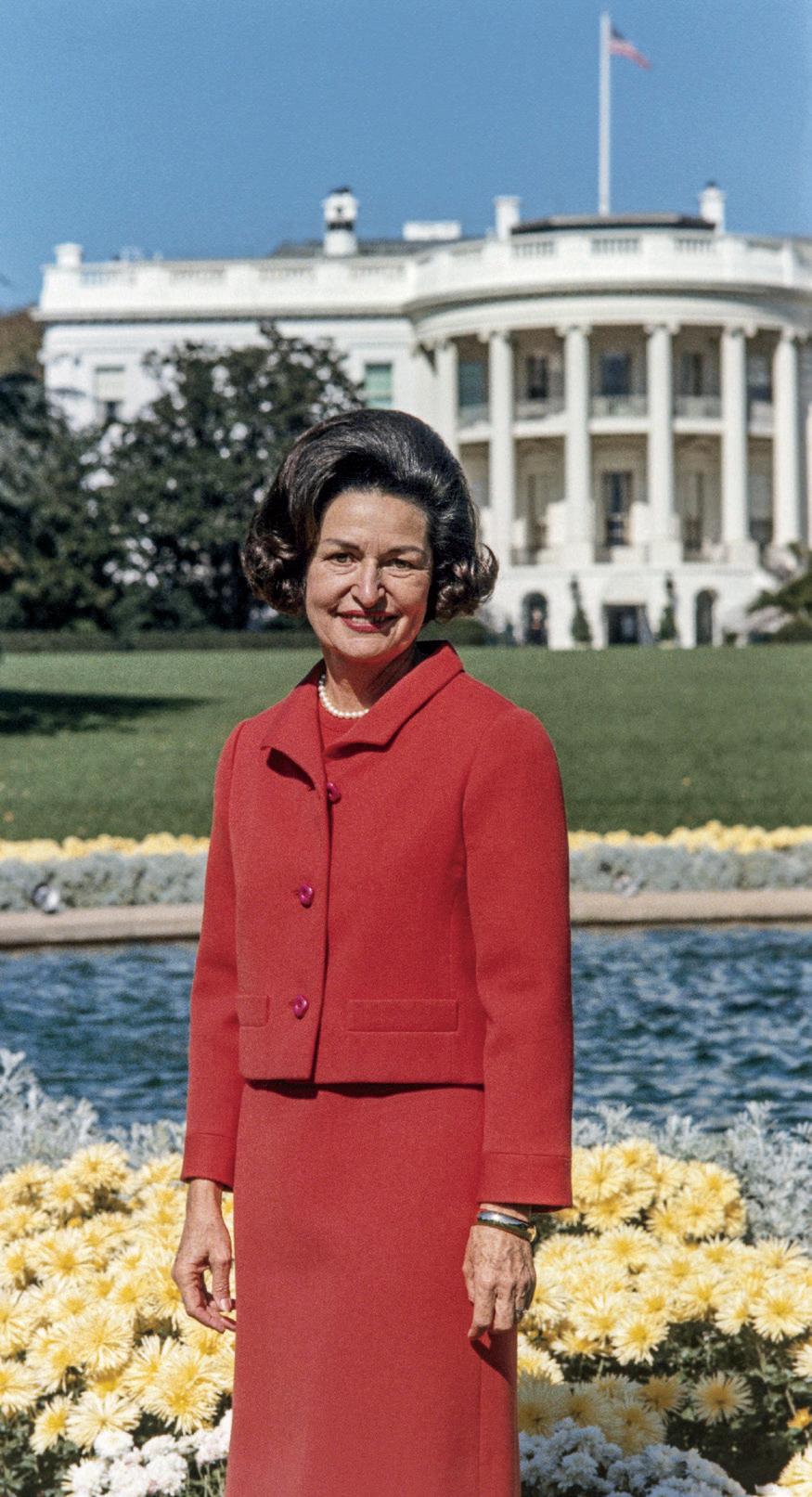
Lady Bird especially liked dresses with matching coats or jackets and paired this classically tailored suit with pearls for an official photograph in the fall of 1967.
opposite
For the traditional incoming first lady interview with Vogue magazine, Lady Bird Johnson wore a highwaisted red evening gown with pearls. Although Vogue’s editors decided against using the photograph on the cover, the article praised Mrs. Johnson’s intelligence.
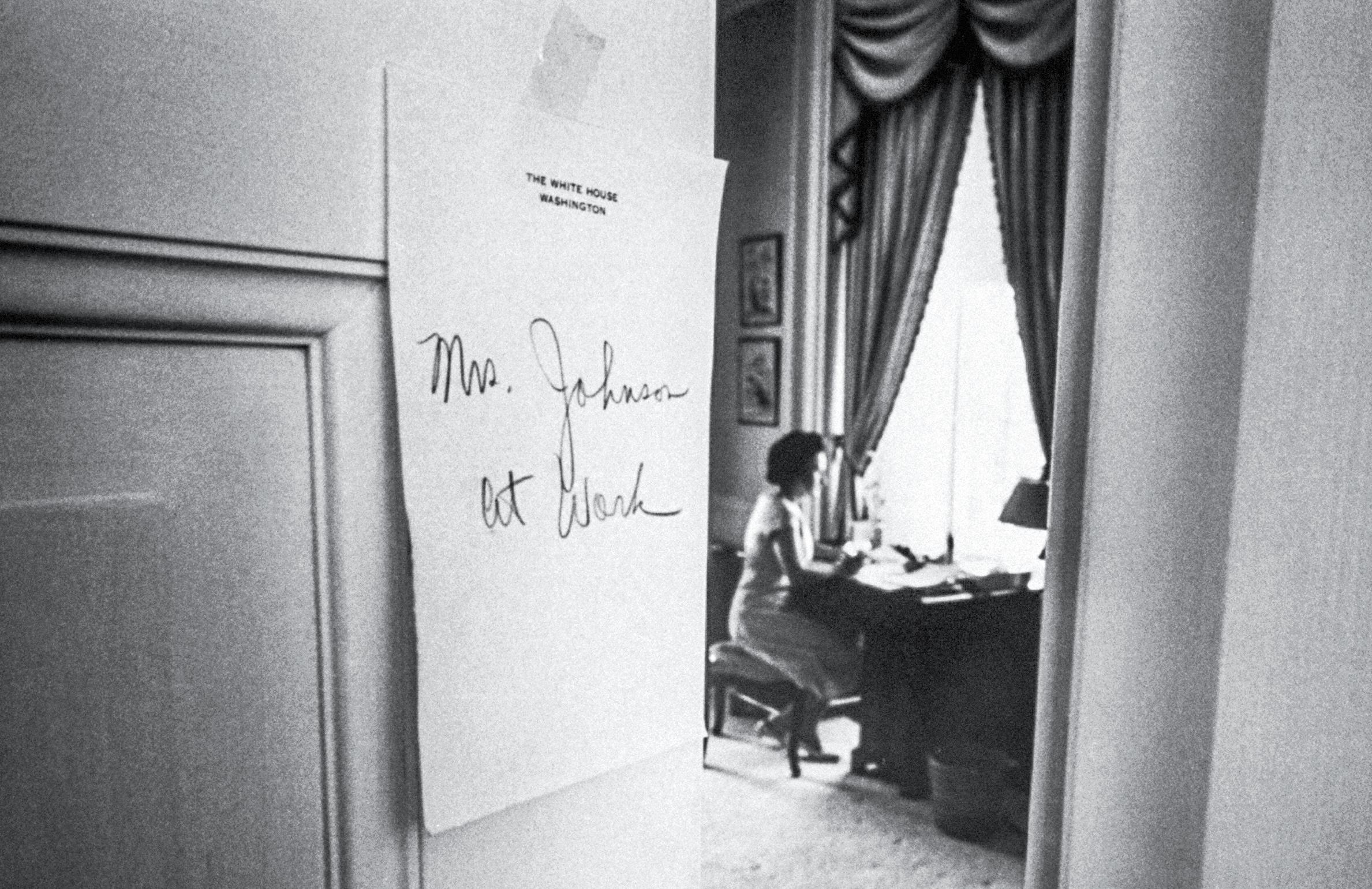
shoes is always a mental hazard to me.”30 She complained of “the harness of hairdo and corset and gloves.”31 Poignantly, when she inherited Mrs. Kennedy’s “exquisite” White House dressing room, “with the closets all covered with trompe l’oeil,” Her Efficiency turned it into an office.32 But the utter impossibility of living up to the example of Her Elegance may have been an advantage in the end. As Mollie Parnis, one of Mrs. Johnson’s favorite designers, pointed out, “It would be a big mistake if she tried to copy Mrs. Kennedy.” Another designer who dressed Mrs. Johnson, Roxane Kaminstein, noted that “she will appeal to a different type of person.”33 In other words, no-longer-young women of middle America finally had a first lady to whom they could relate.
Jacqueline Kennedy was not the only fashion plate to impress and intimidate Lady Bird Johnson. No prominent woman of the era could escape the feminine social taxonomy known as the International Best-Dressed List. Beginning in 1940, the pioneering publicist Eleanor Lambert polled fashion editors across the country each year to compile a list of a dozen or so exemplary women, usually drawn from high society and royalty but occasionally including heads of state, ambassador’s wives, media personalities, or Hollywood actresses. This brutally public expert assessment of female
fashionability was never far from Mrs. Johnson’s mind. She described Ailsa Mellon Bruce, the wife of the American ambassador to Britain, as “beautiful and young and on the Best-Dressed List always. This always makes me feel quite small.”34 When she spotted 24-year-old socialite Amanda Carter Burden at a party, she noted, “She’s the youngest woman to have ever made the Best-Dressed List. And I, like every other woman in the room, took in carefully the . . . elegance and the simplicity of her dress.”35 When a newspaper cruelly stated “that the First Lady never would compete with the best dressed,”36 it was not a casual insult; it referenced a specific, identifiable group of women, with all the privilege, breeding, and fame they represented.
In addition to Mrs. Kennedy, Mrs. Johnson spoke reverentially of Queen Sirikit of Thailand: “Every time I see her I remember that I have read she is one of the world’s best-dressed women. It is a flag that sort of precedes you once you have got the title.”37 Of the stunning Empress Farah Diba of Iran, who visited the White House, she mused: “When a visiting Chief of State has a wife as beautiful as she is, there is that hushed moment of excitement after he’s gotten out when you wait for her to emerge from the big black car, eager to see what she is wearing, how she has her hair done, what jewels. She is an ornament to her husband and to
left
Dubbed “Her Efficiency” by Women’s Wear Daily, Mrs. Johnson used First Lady Jacqueline Kennedy’s former dressing room as an office. She is seen at work in the space, 1964.
Describing Queen Sirikit of Thailand as an “ornament to her husband and to her country,” Lady Bird Johnson admired the style of many of the women she met at official events. Mrs. Johnson is seen here in a flowing gown by George Stavropoulos made of white chiffon, one of her favorite materials, ahead of a dinner at the Sala Sahathai Palace in honor of King Bhumibol and Queen Sirikit of Thailand, 1966.
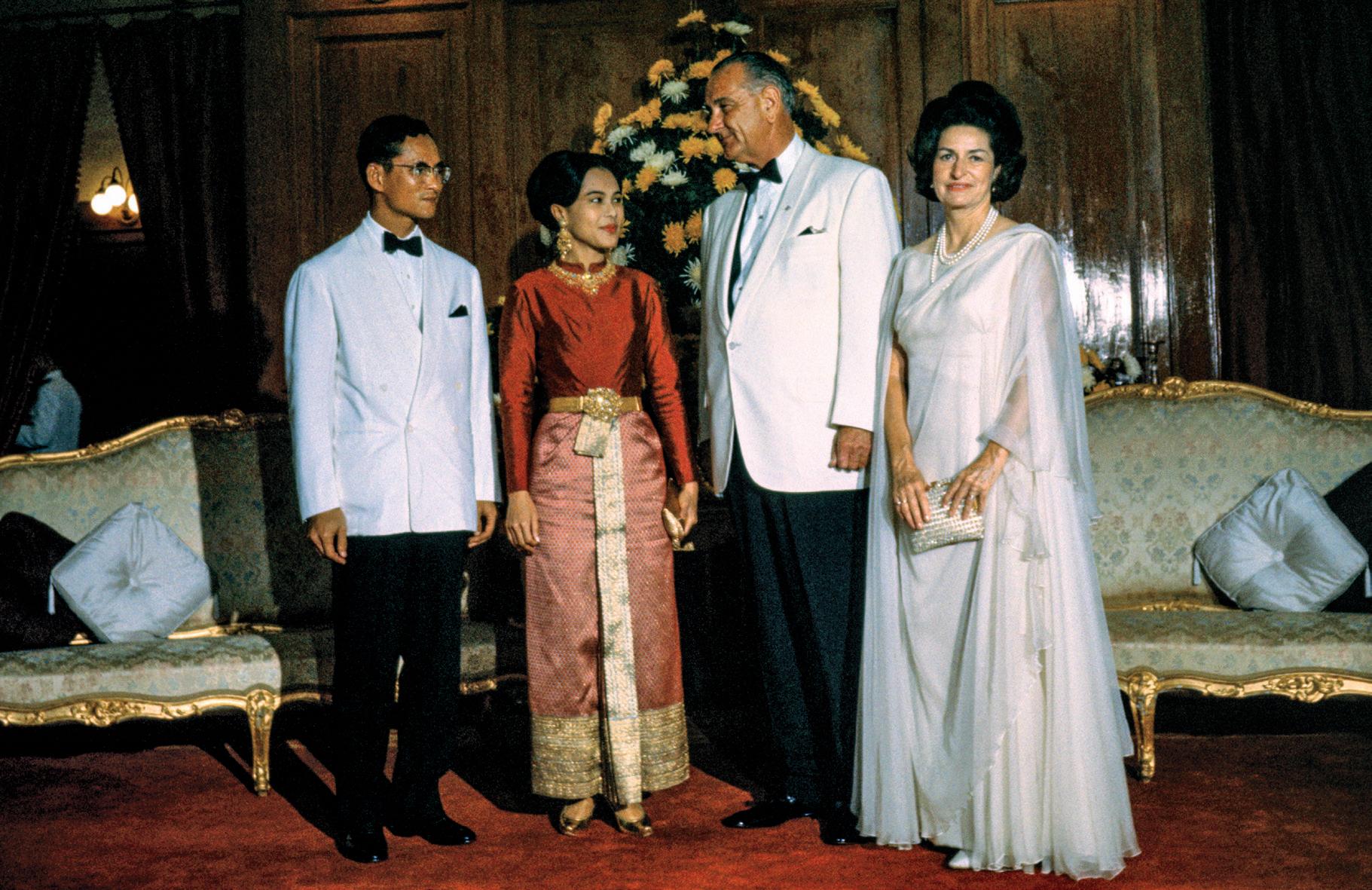
her country as is the Queen of Thailand.”38 The first lady appreciated that a political wife’s wardrobe could be a powerful instrument of diplomacy. But that did not mean she had to enjoy fashion. Indeed, Lady Bird Johnson’s antipathy to it was such that she shopped only twice a year. Accompanied by Bess Abell and sometimes her daughters or friends, the first lady holed up in a suite at the Carlyle Hotel in New York while a parade of designers came and went with racks of clothes, sketches, models, and fabric swatches. Just as she had once relied on Stanley Marcus and his staff, the first lady sought fashion advice from a small group of trusted friends and designers, including Mollie Parnis, Adele Simpson, and George Stavropoulos, all known for making feminine, flattering clothing without being in the upper echelons of style—or price. (Naturally, Mrs. Johnson patronized American designers exclusively.) After one fitting, she mused: “How funny that just trying on clothes should be so tiring.”39 The only benefit to these torture sessions? They allowed her to take her mind off clothes completely for months at a time. While she had a marked preference for flowing chiffons and the color yellow, Mrs. Johnson’s wardrobe choices were dictated by practicality and political expediency, not personal taste. She avoided gowns with trains because they got stepped
on in crowds and made it difficult to dance. She often had to get dressed in a hurry, or in less-thanideal conditions. “You have to be careful to choose which evening dress, the simplest one, when you’re changing in a lurching airplane, and transferring to a helicopter.”40 Bess Abell remembered that, during fittings, Mrs. Johnson “would always move a chair over in front of the mirror and sit down and see if she could sit down and not need to reach for a scarf or a program or an enormous handbag to cover her knees.”41 She liked knits “because they’re so packable.”42 (Even as first lady, she refused to travel with a maid.) She sought out dresses with matching coats or jackets, so she could look polished in any weather. On her shopping trips to New York, she found herself “remembering what were my favorite things of the past season, what looked best in pictures, what survived the long days freshest, and what holds the days [sic] problems, what was absolutely impossible to sit on the platform in.” 43 Above all, the first lady’s wardrobe had to stand up to intense public scrutiny. Though the fashion press found Mrs. Johnson overly cautious and conservative, the public still found things to criticize; short skirts and sleeveless dresses drew angry letters. As Mrs. Johnson told Women’s Wear Daily: “Clothes have to serve me, not I serve the clothes.”44
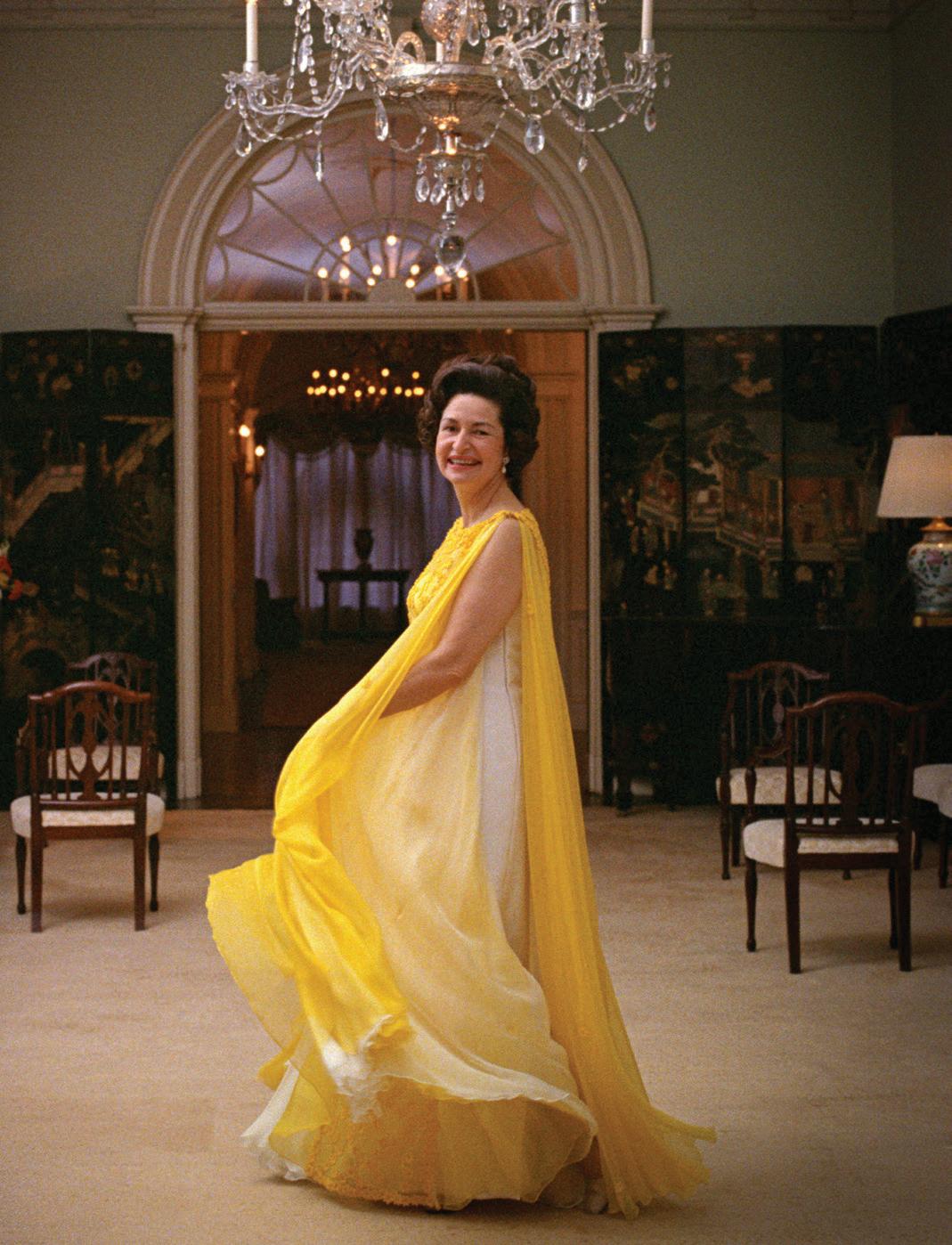
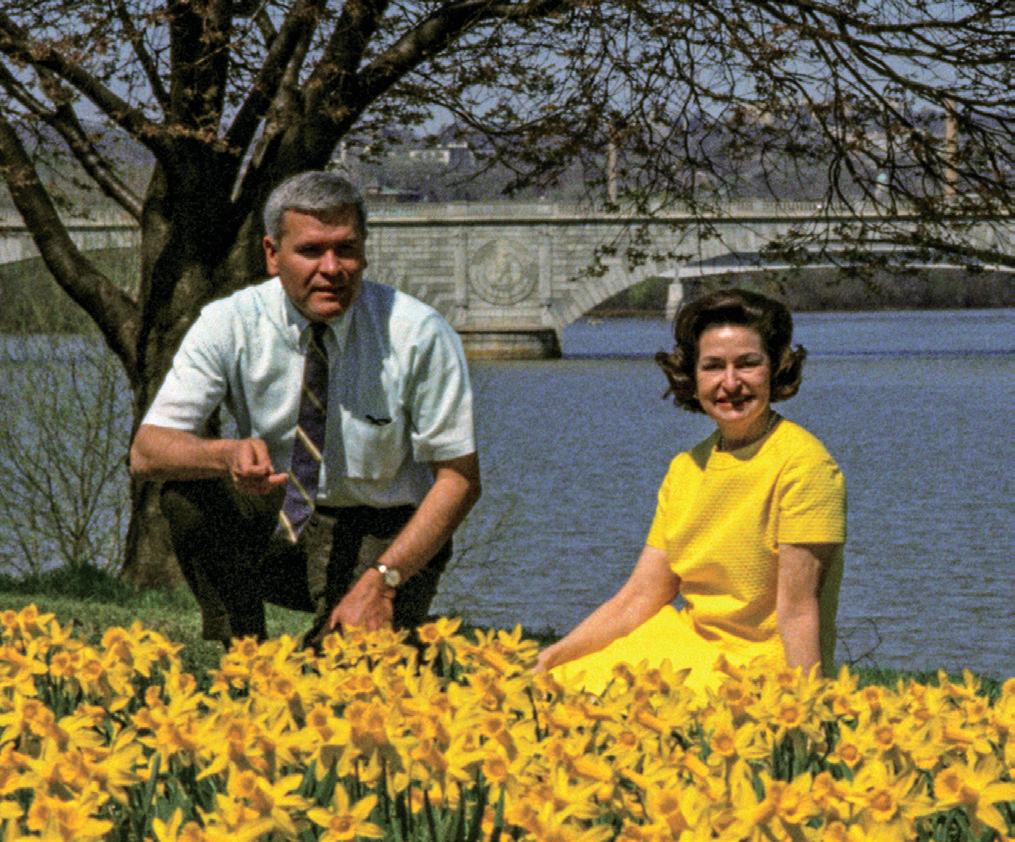
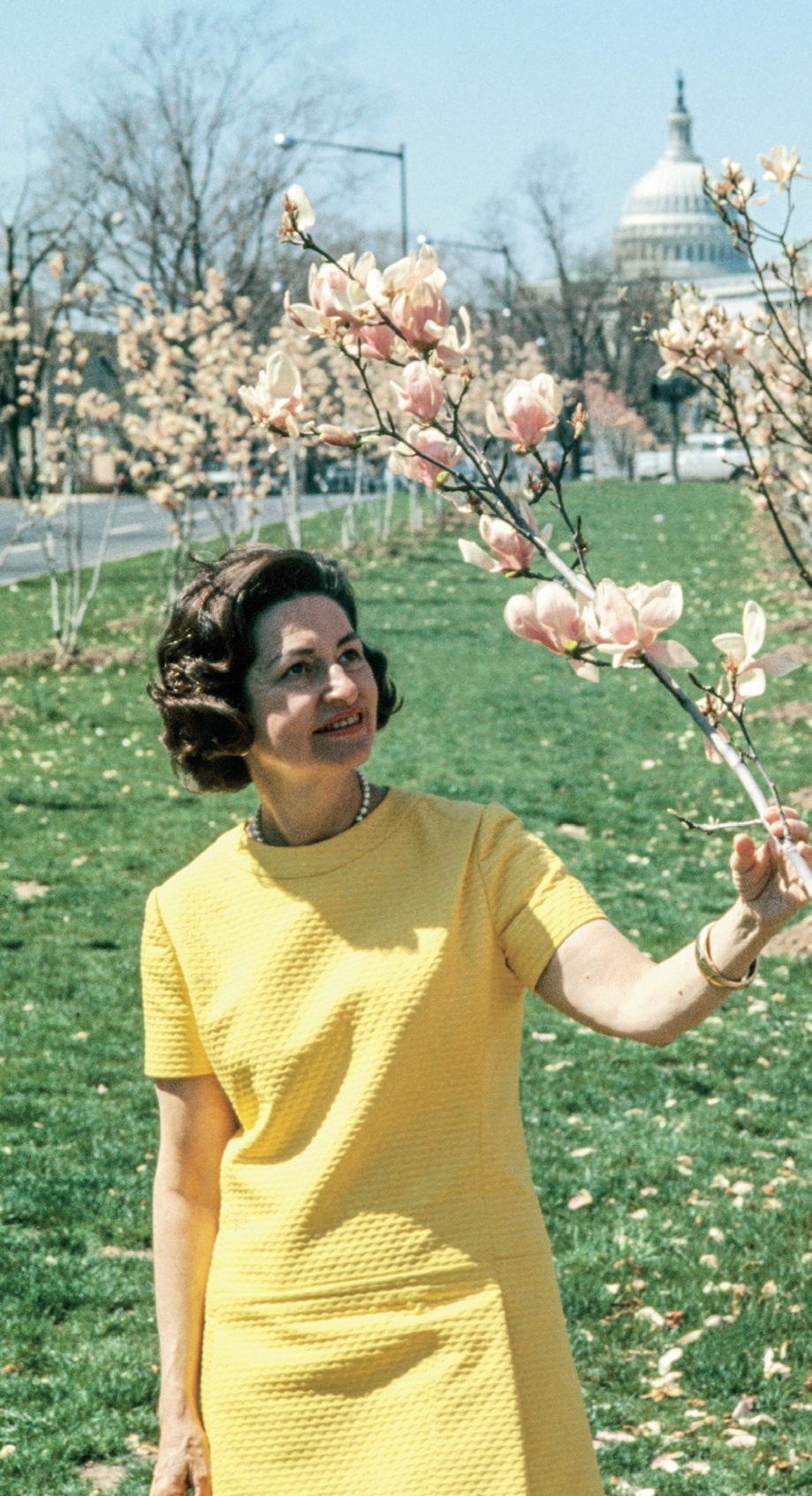
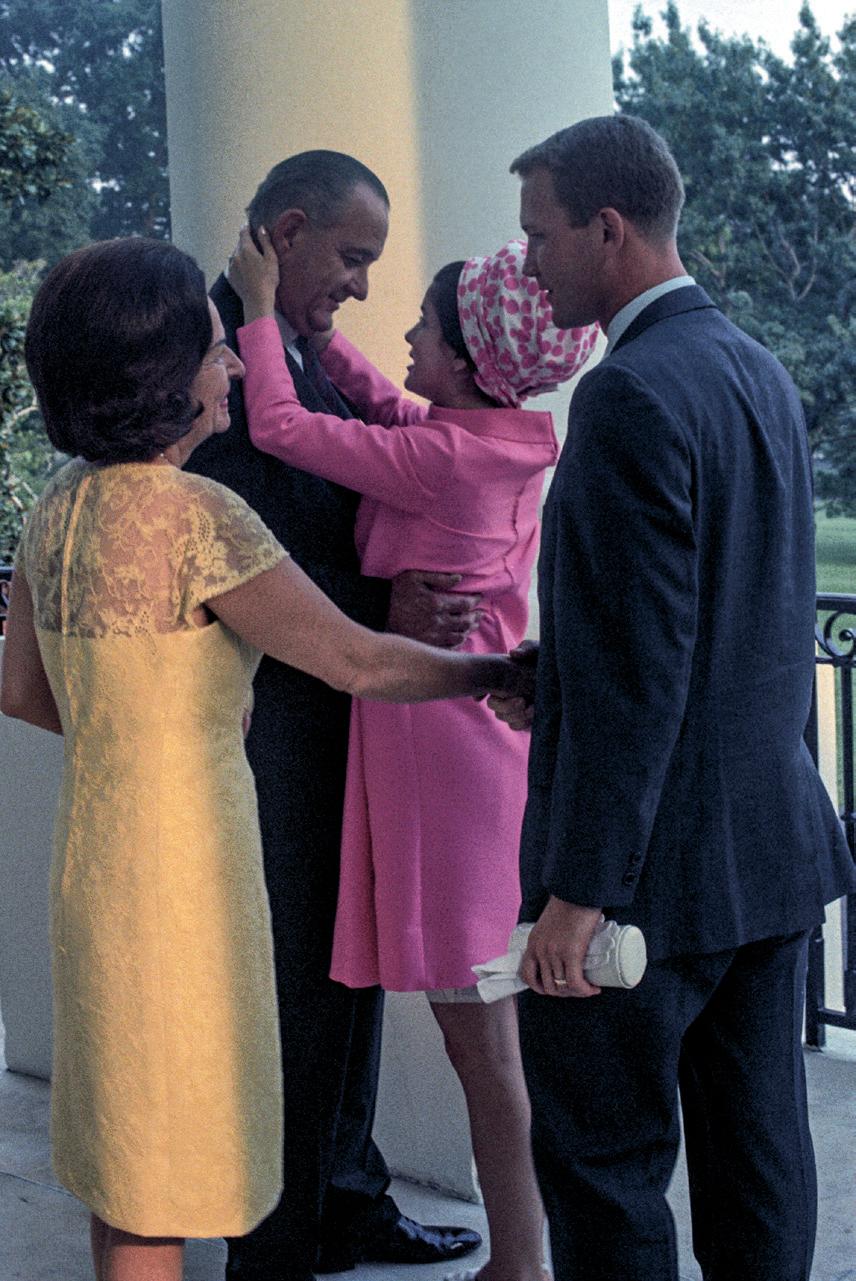
Lady Bird Johnson often chose to wear bright yellow for both formal events and public appearances. She considered yellow a symbol of light and optimism.
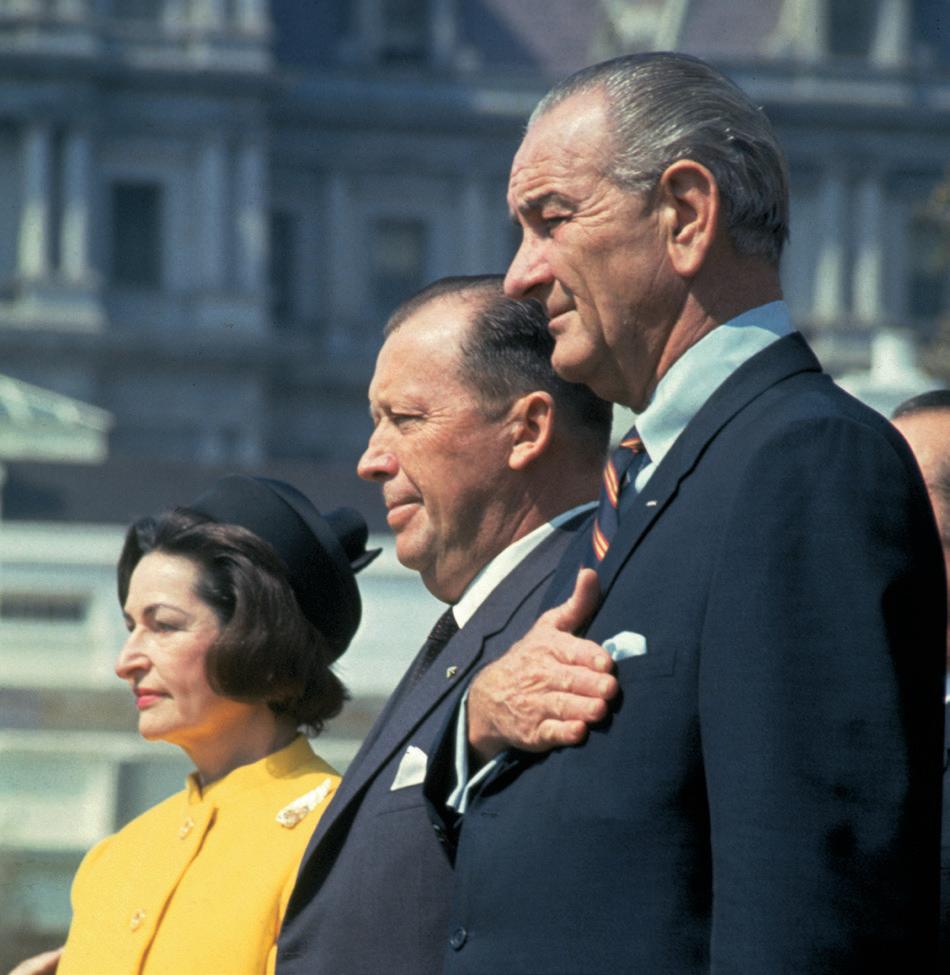
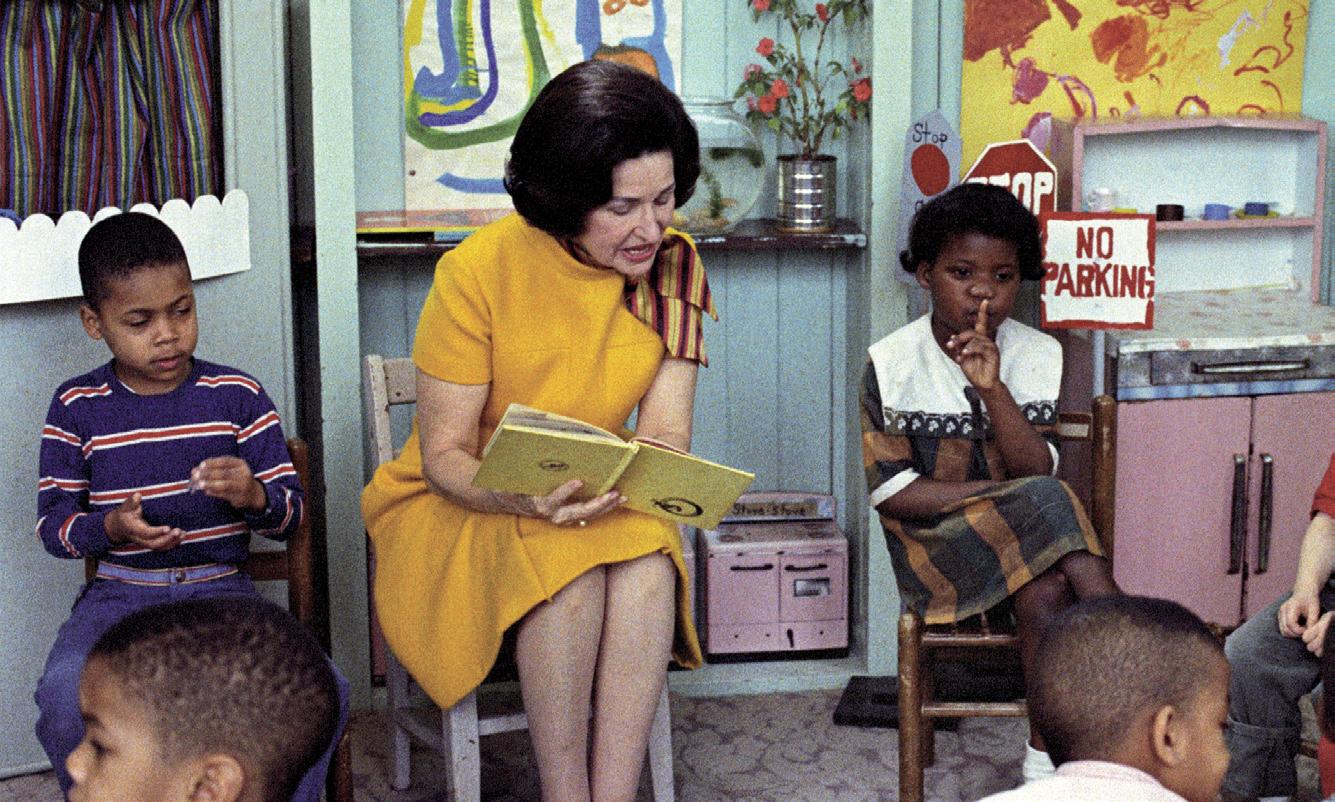
Mrs. Johnson is seen here clockwise from opposite top left: Twirling in her “Botticelli girl” multilayer yellow chiffon evening dress by George Stavropoulos, May 8, 1968; participating in an Arrival Ceremony on the South Lawn for President Alfredo Stroessner of Paraguay, March 1968; wearing an Adele Simpson dress and saying good-bye to daughter Luci and Patrick Nugent as they leave for their honeymoon, following a White House wedding reception, August 6, 1966; posing in the Yellow Oval Room in a John Moore fur-trimmed canary-yellow Inaugural Ball ensemble, January 20, 1996; in a Mollie Parnis dress and scarf reading to children at a Project Head Start program, 1968; admiring spring blooms on Capitol Hill, 1968; and posing with Nash Castro, director of the National Capital Parks, among blooming narcissus on the bank of the Potomac River, 1968.
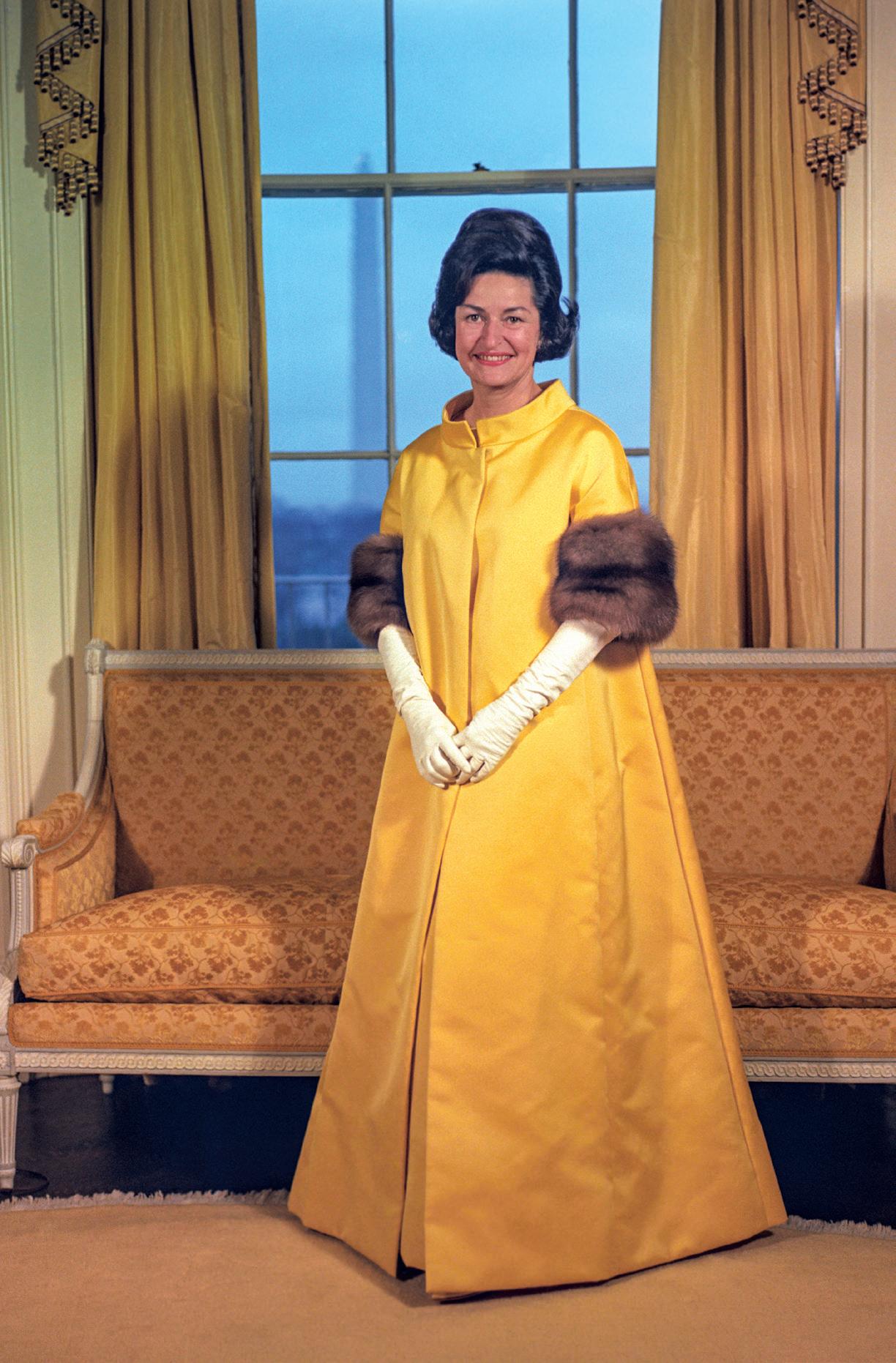
Like many in her position, Lady Bird Johnson dressed for the occasion, considering the color of the room, the makeup of the guest list, the possibility of wearing diplomatic gifts, and the theme of the event, choosing flower-trimmed dresses to support her beautification campaign, for example. Alas, she continually underestimated the sheer volume of clothing she needed. “I never have the nerve to buy enough clothes at once,” she admitted. “It always sounds like so much money.” 45 In consequence, she was forced to augment her biannual shopping excursions with “fill-in” sessions at the White House, and she often came up short at the last minute.46 She once purchased a peach brocade Molly Parnis dress and coat that she ended up wearing that very evening; Parnis hastily shortened the ensemble and lent her matching shoes and a purse.47 After Washington Post publisher Katharine Graham arrived at the White House wearing the same green and gold gown she planned
to wear that night, Mrs. Johnson began to invest in custom-made evening wear.48 “Some guest who had really knocked themselves out getting this pretty dress to wear to the White House dinner didn’t want to walk in and see the hired help wearing the same dress,” she joked.49
As first lady, Mrs. Johnson had several opportunities to develop an appreciation of fashion— not just its superficial appeal but its political and economic significance. The International Ladies’ Garment Workers’ Union (ILGWU) was a powerful lobbying force in Washington, as she discovered when her daughter Luci inadvertently chose a wedding gown from a nonunion manufacturer; the president had to intervene to avoid a scandal. “The world of clothes is quite an important one I am finding out,” Mrs. Johnson remarked after attending a New York party in the company of Parnis, Lambert, and Vogue editor Diana Vreeland.50 It was also an enjoyable one, she could not help noticing.
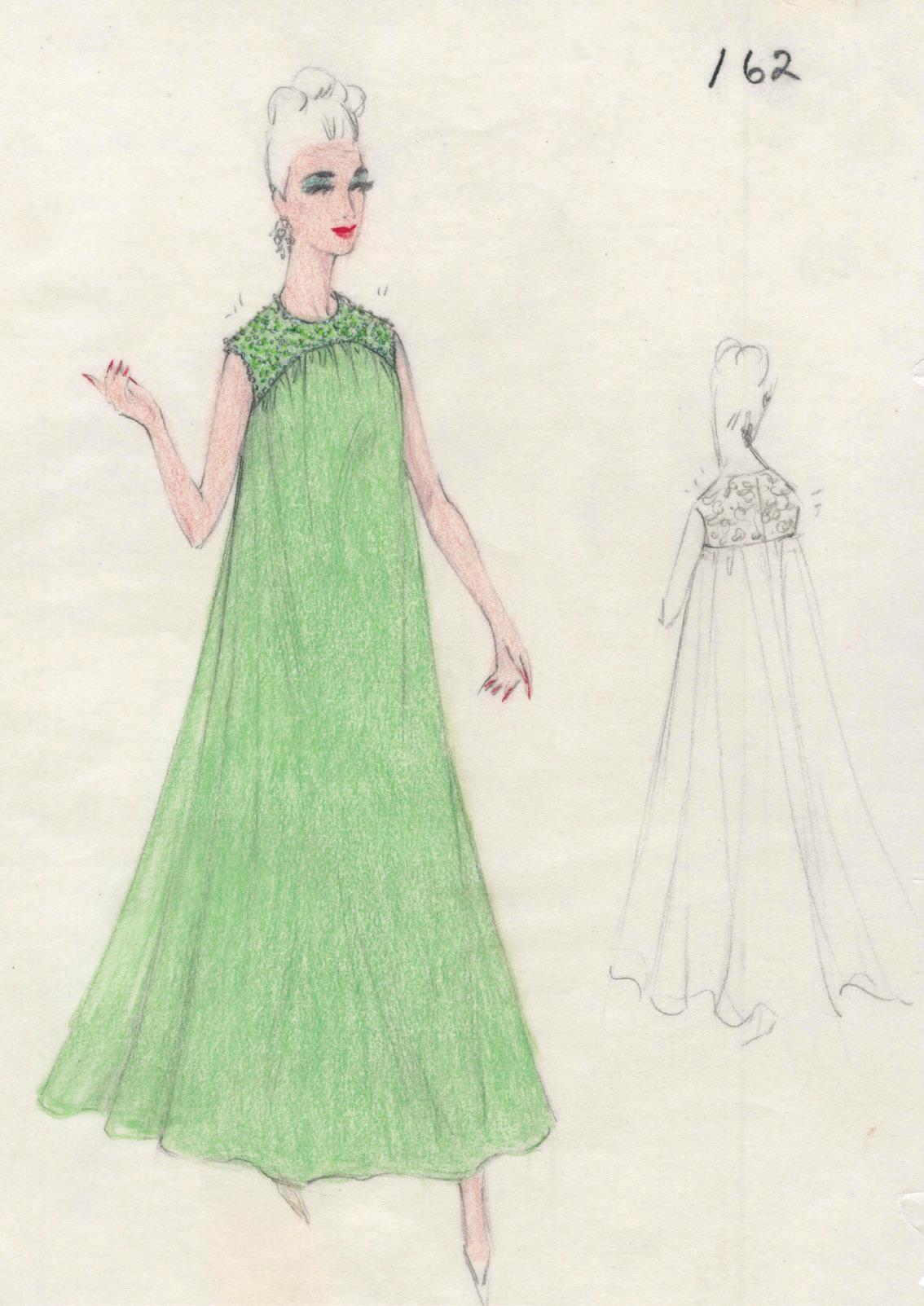
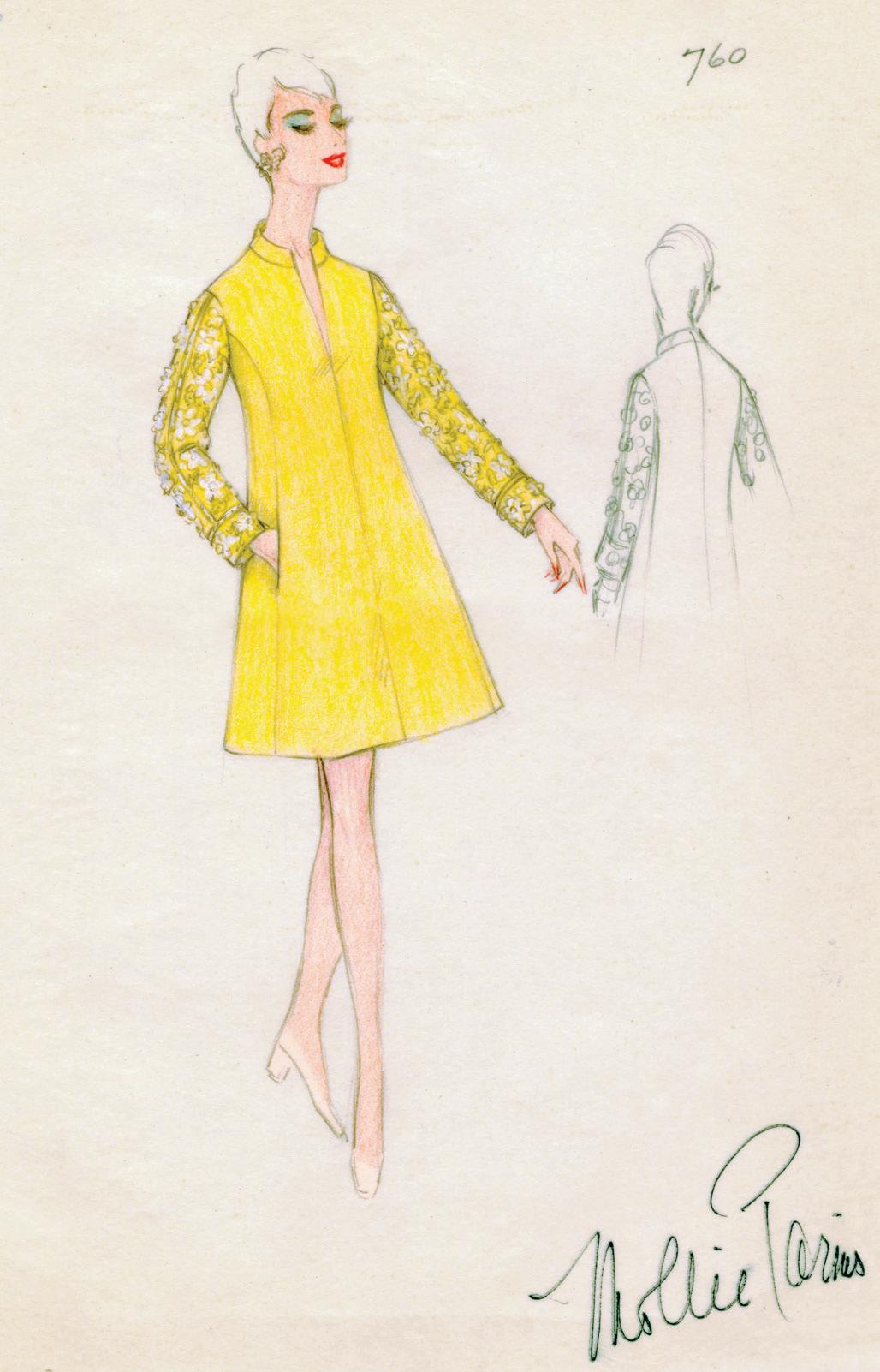
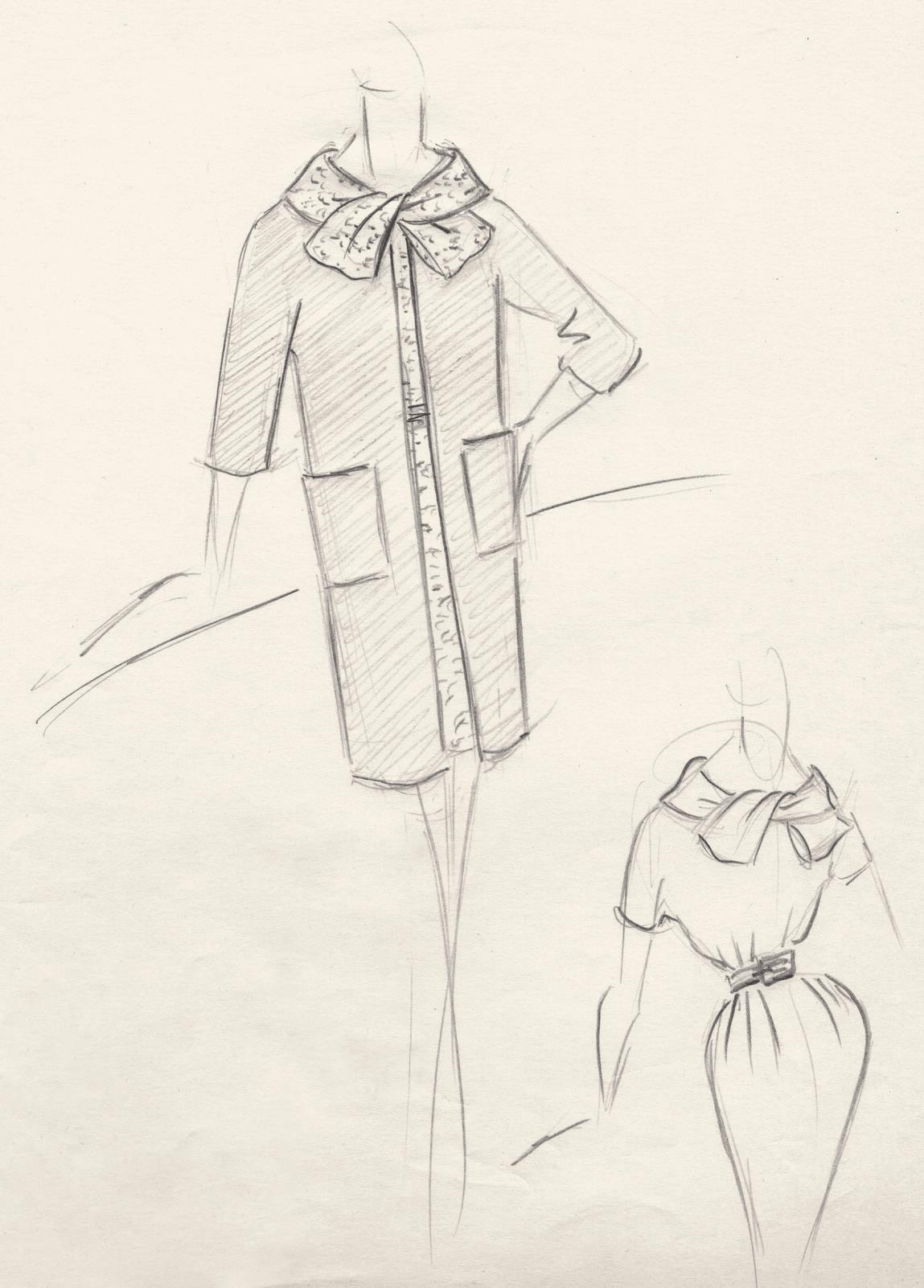
Examples above of designs sketched by Mollie Parnis especially for Mrs. Johnson include a green chiffon gown worn for the State Dinner for Prime Minister Indira Gandhi of India and a yellow rhinestone-sleeved evening dress, sketched as a short dress but made as a full-length gown and worn to the State Dinner for Kuwait.
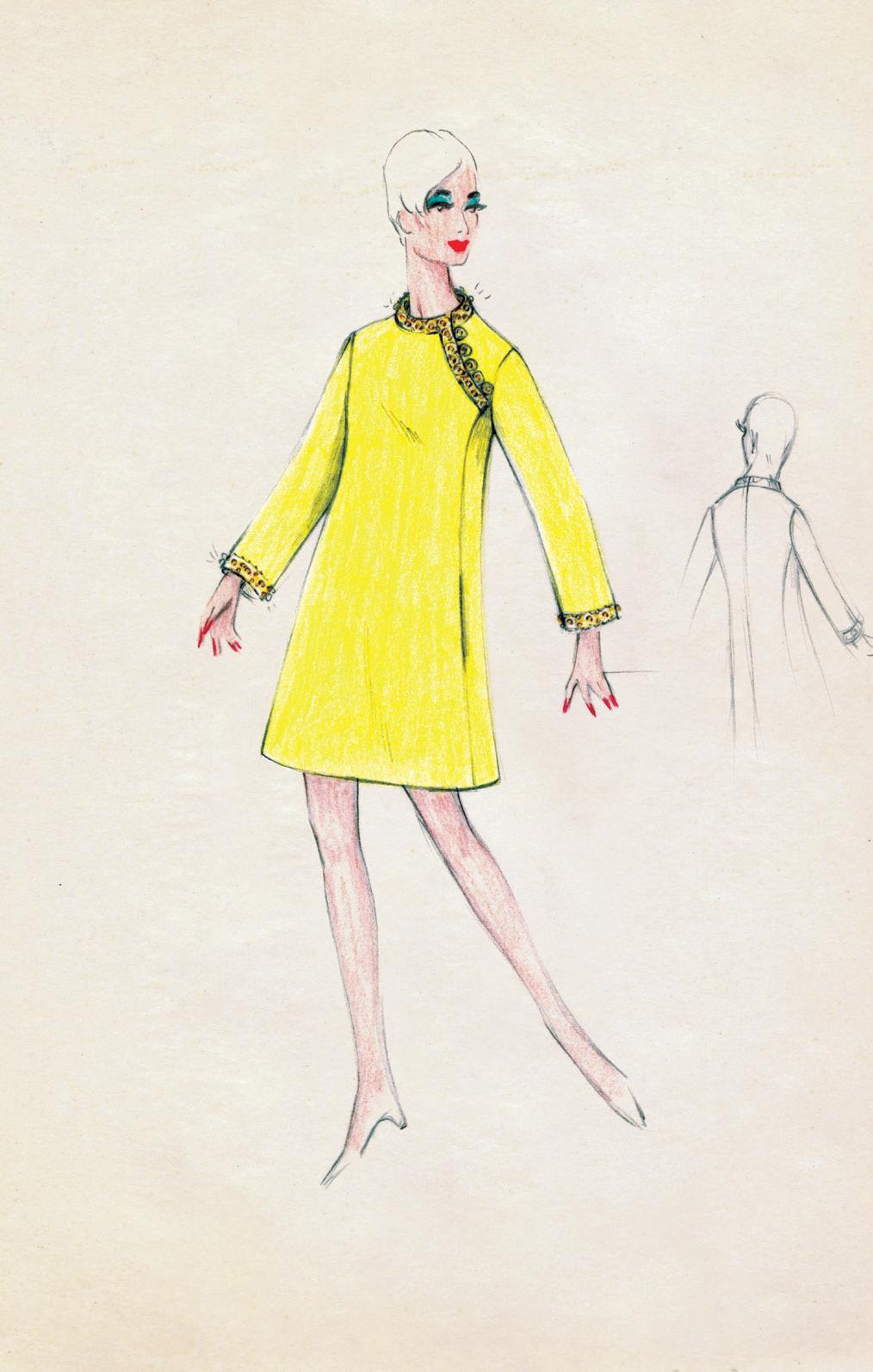
Many of the designs sketched by Mollie Parnis for Lady Bird Johnson are now preserved in the collection of the Lyndon Baines Johnson Presidential Library and Museum.
Examples include a white silk faille heavily beaded gown with a stand-up collar, worn to a State Dinner for Mexico and a matching coat and dress worn for a meeting with Queen Elizabeth II.
“I can’t get over the slightly ridiculous feeling that clothes should take up so much time,” she admitted. “And on the other hand a sort of vain, feminine, increasing delight and thinking I look rather well in them, a bit younger and slimmer than a good many of my contemporaries.” 51
With the support of her husband and advisers, Mrs. Johnson’s sartorial stock continued to rise. Women’s Wear Daily praised the “delightfully adventuresome” clothes Adele Simpson conjured up for the first lady in the spring of 1966, a departure from her usual wardrobe of “tired, safe classics” that took her “beyond the banal to a new fashion level.” Nevertheless, Mrs. Johnson continued to buy “those standard, workaday clothes that fill out every woman’s wardrobe. They are not exciting . . . but they are practical.” 52
The breakthrough came at the end of 1966. “There had been the most amazing news on the ticker,” Mrs. Johnson recorded in her diary. “In the
list of Best-Dressed women I showed up in fifth place.”53 She suspected that Lambert—a presidential appointee to the National Council of the Arts— may have had a hand in her selection. “And I shall strive a bit to live up to it. . . . I have no illusions. . . . I don’t belong there.”54 Lady Bird Johnson’s tenure on the Best-Dressed List did not last long; the following year she was replaced by her eldest daughter, Lynda Bird—who deserved it more, she felt. But the distinction gave her confidence and encouraged her to take pride and pleasure in her wardrobe. By 1967, she confessed, “I am almost bowing these days to the fashion dictate of a new dress for every great occasion.”55 She was conforming to fashion in other ways, as well, raising her hemlines for the first time: “Shorter and shorter they go, and more accustomed does the eye become, and I am doing what I swore I never would, actually wearing them a little above the knees.”56
On February 29, 1968, Lady Bird Johnson
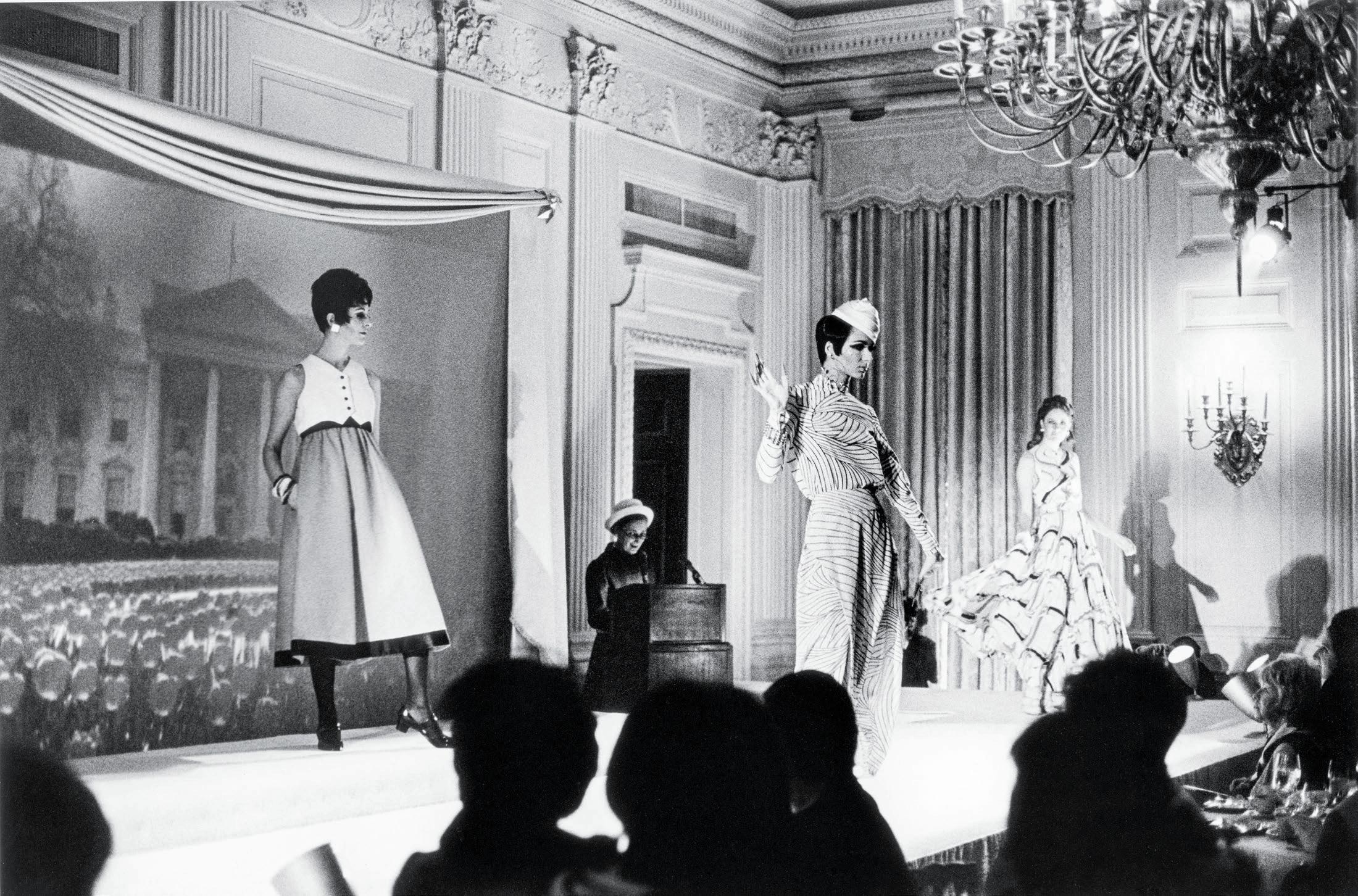
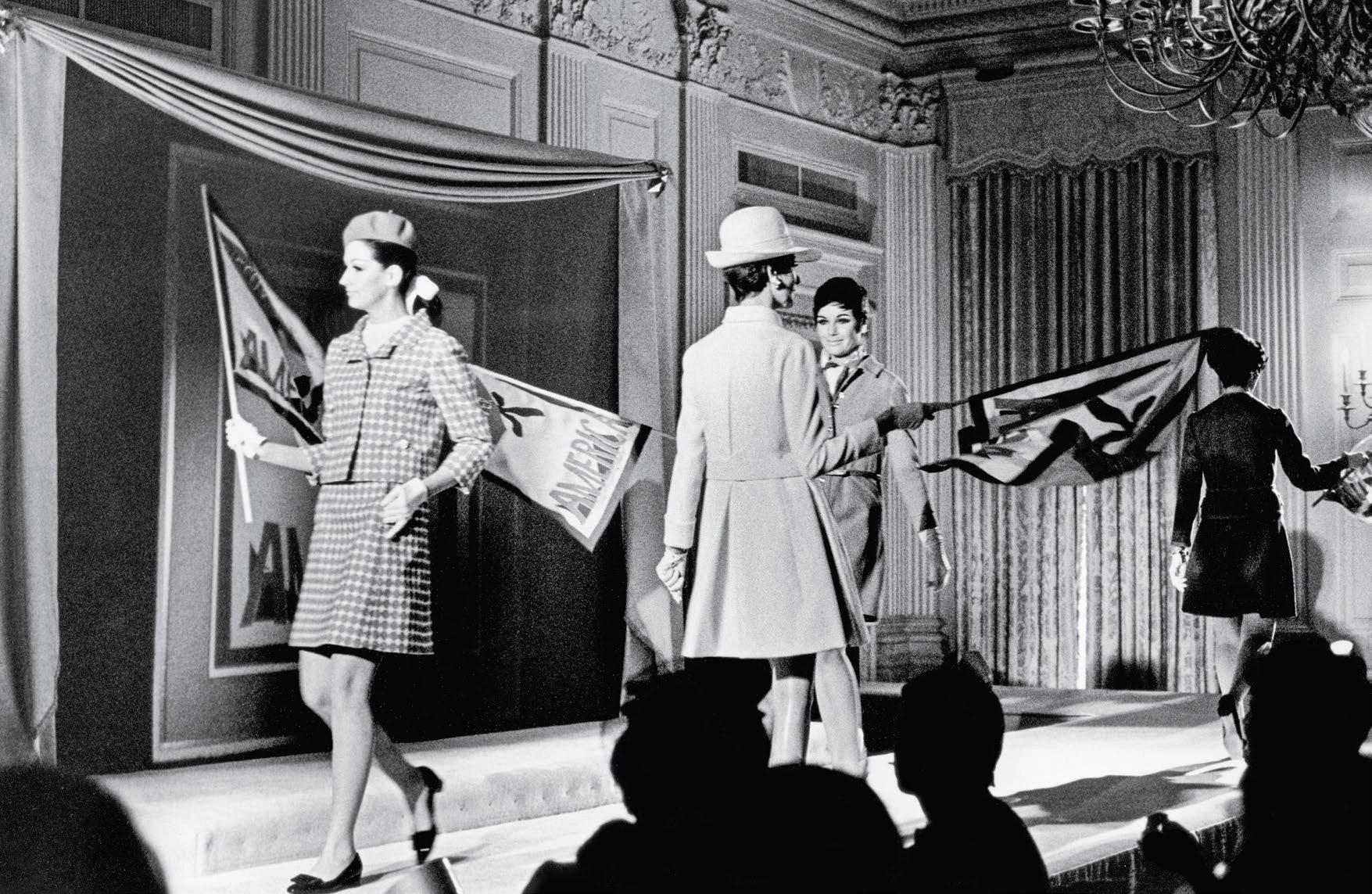
In scenes from the February 1968 lunchtime fashion show hosted by Mrs.
models cross a runway erected in the State Dining Room. Harper’s Bazaar editor Nancy White called the event “one of the greatest things that ever happened to American fashion.”
made history by hosting the only fashion show ever staged in the White House. The lunchtime event in the State Dining Room was conceived as a joint boost to the fashion industry and to Mrs. Johnson’s pet projects—domestic tourism and beautification. The audience consisted of thirty-five governors’ wives, visiting Washington for the midwinter meeting of the White House Governors’ Conference, as well as a who’s who of American fashion designers and journalists. Mrs. Johnson told the audience that life in the White House had taught her how quickly clothes became outdated: “I must say, you ladies and gentlemen of the fashion industry keep the present occupant busy with the hemline.” While the disastrous timing of the show—midway through the Tet Offensive—ultimately overshadowed its good intentions, the fashion press and industry judged it a success, with Harper’s Bazaar editor Nancy White calling it nothing less than “one of the greatest things that ever happened to American fashion.”57
Even Women’s Wear Daily was won over in the end: “You could hardly call Lady Bird a fashion leader, but in those five years in the White House she’s learned her fashion lessons well.”58 Mrs. Johnson admitted she was “spoiled. It’s a real joy to have clothes made especially for me that fit just right by people who care.”59 In November 1968, as she prepared to leave the White House, she reflected on “the world of clothes which I have discovered these last five years. Perhaps actually I’ve been seduced into it.”60
notes
1. Bob Considine, “How Ike Lives,” Washington Post and Times Herald, October 10, 1954, AW18.
2. Fletcher Knebel, “Hopeful’s Wife Runs Empire: Mrs. Johnson,” Los Angeles Times, March 1, 1960, A1.
3. Audio diary and annotated transcript, Lady Bird Johnson, July, 18, 1964 (Saturday), Lady Bird Johnson’s White House Diary Collection, Lyndon B. Johnson Presidential Library, Austin, Tex.
4. Women’s Wear Daily, October 14, 1968, 4.
5. Eugenia Sheppard, “Inside Fashion,” Women’s Wear Daily, October 25, 1968, 12.
6. “Mrs. Lyndon B. Johnson,” Women’s Wear Daily, November 25, 1963, 6.
7. Johnson, audio diary and annotated transcript, October 11, 1967, 2.
8. Quoted in “The Eyes of Fashion Are upon Her,” Women’s Wear Daily, November 27, 1963, 4.
9. “Washington Held Ready for a ‘Little Something,’” Women’s Wear Daily, November 8, 1961, 25; “Mrs. Lyndon B. Johnson,” 6.
10. Transcript Stanley Marcus Oral History Interview, November 3, 1969, by Joe B. Frantz, 4–6, LBJ Presidential Library.
11. Ibid., 3.
12. Quoted in Bess Abell, oral history interview 1, by T. H. Baker, May 28, 1969, transcript, 13, Johnson Library.
13. “Eye,” Women’s Wear Daily, May 22, 1964, 9. Transcript, Nancy Dickerson, Oral History Interview, August 11, 1972, by Joe B. Frantz, 35, LBJ Presidential Library.
14. Abell oral history interview 1, 13.
15. Marcus oral history interview, 5.
16. Ibid., 4.
17. Quoted in “Eyes of Fashion Are upon Her,” 5.
18. “Mrs. Lyndon B. Johnson,” 1963, 6.
19. Quoted in “Eyes of Fashion Are upon Her,” 5.
20. Marcus oral history interview, 19.
21. “People Are Talking About . . . Mrs. Lyndon Baines Johnson, The First Lady,” Vogue, May 1, 1964, 147.
22. Johnson, audio diary and annotated transcript, March 3, 1964, 2.
23. “Eye,” Women’s Wear Daily, January 8, 1964, 1.
24. Quoted in “Eye,” Women’s Wear Daily, December 26, 1963, 9.
25. Johnson, audio diary and annotated transcript, February 22, 1967, 2.
26. Ibid., November 22, 1963, 6.
27. Quoted in Michael L. Gillette, Lady Bird Johnson: An Oral History (New York: Oxford University Press, 2012), 282.
28. Johnson, audio diary and annotated transcript, November 22, 1963, 6.
29. Quoted in “Eye on the D.C. Circuit,” Women’s Wear Daily, February 13, 1961, 4.
30. Johnson, audio diary and annotated transcript, October 31, 1966, 11.
31. Ibid., June 3, 1965, 1.
32. Ibid., November 26, 1963, 2-3.
33. Both quotations in “Eyes of Fashion Are upon Her,” 5.
34. Johnson, audio diary and annotated transcript, September 15, 1965, 2.
35. Ibid., February 15, 1968, 3.
36. Quote in ibid., January 23, 1966, 7.
37. Ibid., October 29, 1966, 9.
38. Ibid., August 22, 1967, 5.
39. Ibid., February 22, 1967, 2.
40. Ibid., May 28, 1964, 2.
41. Abell oral history interview 1, 14.
42. “Eye,” Women’s Wear Daily, November 4, 1963, 6.
43. Johnson, audio diary and annotated transcript, August 3, 1967, 1–2.
44. Quoted in “Eye,” Women’s Wear Daily, December 26, 1963, 9.
45. Johnson, audio diary and annotated transcript, May 11, 1967, 1.
46. Ibid., August 3, 1967, 2; “Eye,” Women’s Wear Daily, May 22, 1964, 1.
47. Johnson, audio diary and annotated transcript, May 7, 1965, 1.
48. Bess Abell, interview by author, November 12, 2014.
49. Quoted in Abell oral history interview 1, 13–14.
50. Johnson, audio diary and annotated transcript, June 2, 1966, 5.
51. Ibid., March 9, 1967, 1–2.
52. “Our Adventuresome First Lady,” Women’s Wear Daily, March 23, 1966, 1, 23.
53. Johnson, audio diary and annotated transcript, December 28, 1966, 5.
54. Ibid., January 6, 1967, 3.
55. Ibid., February 14, 1967, 3.
56. Ibid., October 17, 1967, 1.
57. Mary Strasburg, “See the USA—The Johnson Way,” Washington Post, February 24, 1968, F1.
58. “The Metamorphosis of Lady Bird,” Women’s Wear Daily, October 14, 1968, 4.
59. Johnson, audio diary and annotated transcript, October 11, 1967, 2.
60. Ibid., November 21, 1968, 10.
The First Lady’s Lasting Collaboration with James Galanos
rebecca durgin kerr
first lady nancy reagan collaborated with many top designers to create her famously timeless style. From Europe, Chanel, Yves Saint Laurent, and Valentino were her choice designers; and from America, Adolfo, Carolina Herrera, Geoffrey Beene, Oscar de la Renta, and Bill Blass designed her clothes. But one partnership stands out from the others and continued before, during, and after Mrs. Reagan’s time in the White House. This special collaboration was between Nancy Reagan and James Galanos, who she fondly called “Jimmy.” “I don’t know of any clothes that were made as well as Jimmy’s—you could almost wear them inside out,” she explained. “The fabric was great. Everything about them was so special.”1 Mrs. Reagan turned to Galanos to outfit her for many important occasions throughout her public life.
James Galanos was born on September 20, 1920, in Philadelphia but raised in New Jersey. His parents were born in Greece and had moved to the United States. Galanos recalled his fashion influences: “I never sewed; I just sketched. It was simply instinctive. As a young boy I had no fashion influences around me, but all the while I was dreaming of Paris and New York.” After he graduated from high school, Galanos moved to New York
in 1942 to go to the Traphagen School of Fashion but left school in 1943 to obtain hands-on experience with Hattie Carnegie.2 Following his time in New York, Galanos worked in Los Angeles in 1945 designing costumes at Columbia Pictures, under Jean Louis, and Paris, where he worked as Robert Piguet’s assistant until 1948. Claiming to be an “Easterner who lives in California,”3 he returned to Los Angeles in the early 1950s “because no one would give me a job in New York.”4
Galanos’s fashions were favored for their attention to detail and high quality. Describing his creative process Galanos said, “When I design I design in the abstract and design for an ideal look.”5 His first commercially successful line, “Galanos Originals,” released in 1952, became favored by many prominent women fashion editors and public figures in the United States and around the world.6
Nancy Reagan was Nancy Davis when she was an actress in Hollywood. She characterized her outlook on fashion style in saying, “I’ve never been on the cutting edge of fashion, and I don’t go for the latest look. I try to choose clothes that look good today, but that will also look good tomorrow.” She relied on the timeless nature of her style
previous spread
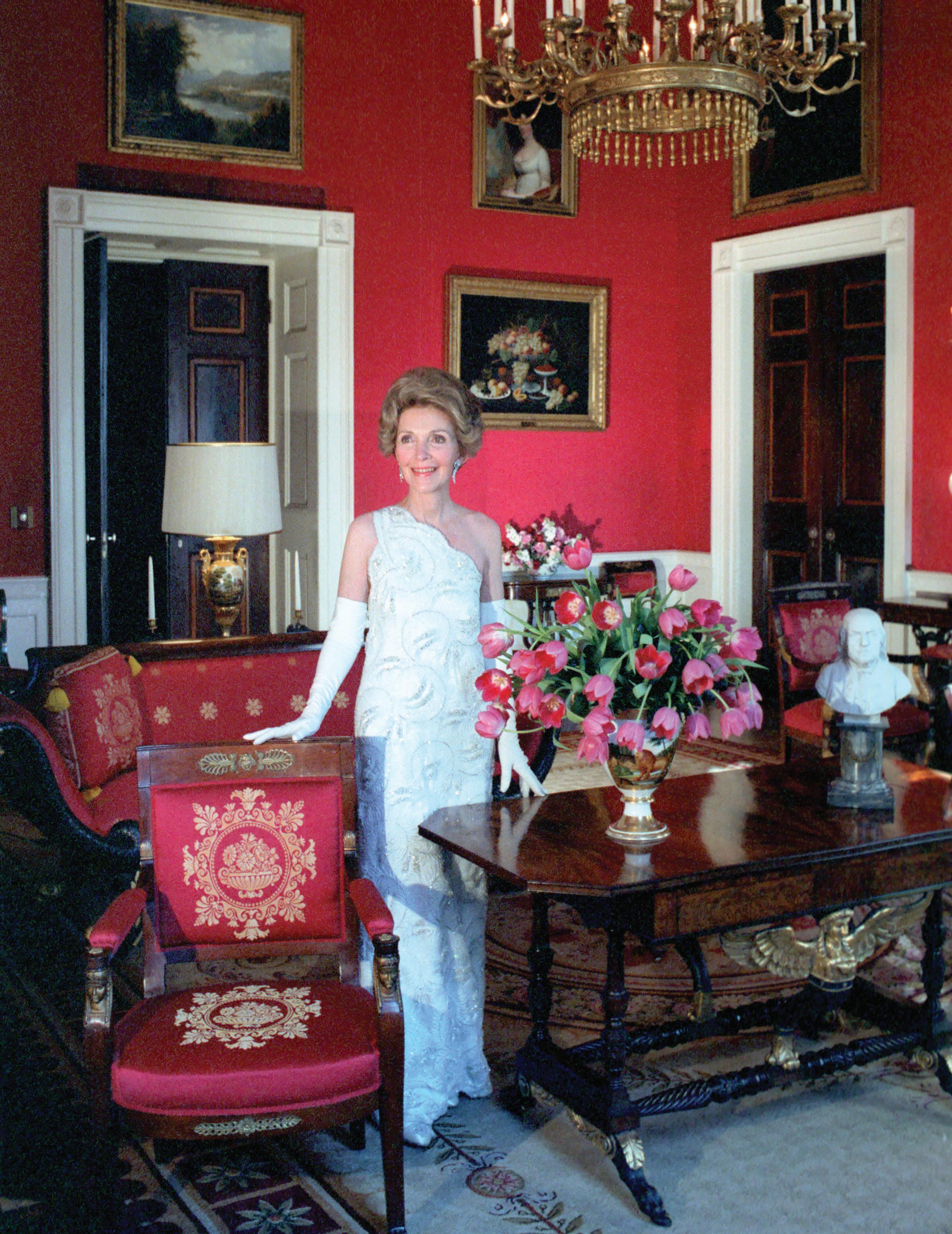
First Lady Nancy Reagan poses for Vogue magazine in the Red Room wearing her Inaugural Gown, a James Galanos design, February 1981.
top left
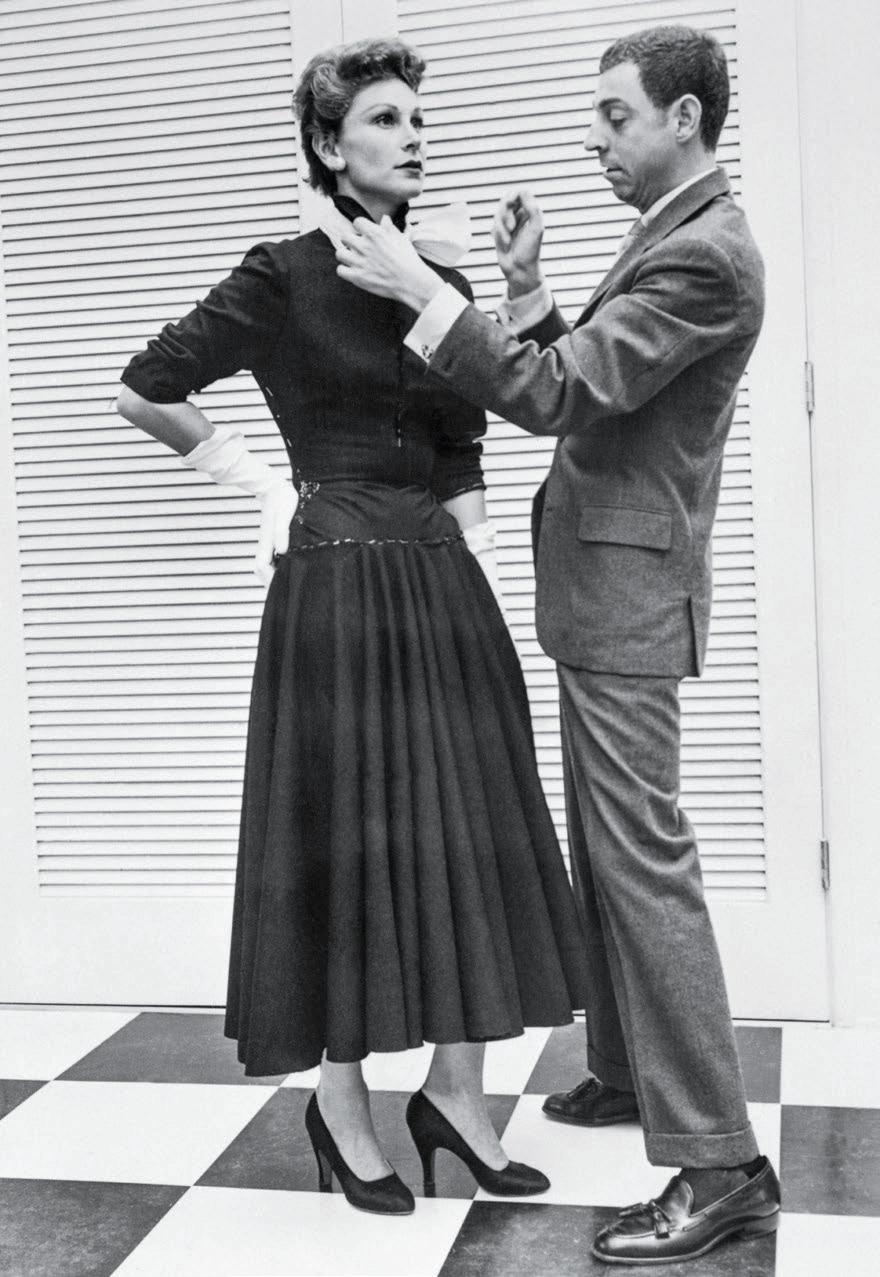
Galanos adjusts a bow on Dorothy Virginia Margaret Juba, a supermodel known as Dovima, 1960.
top right
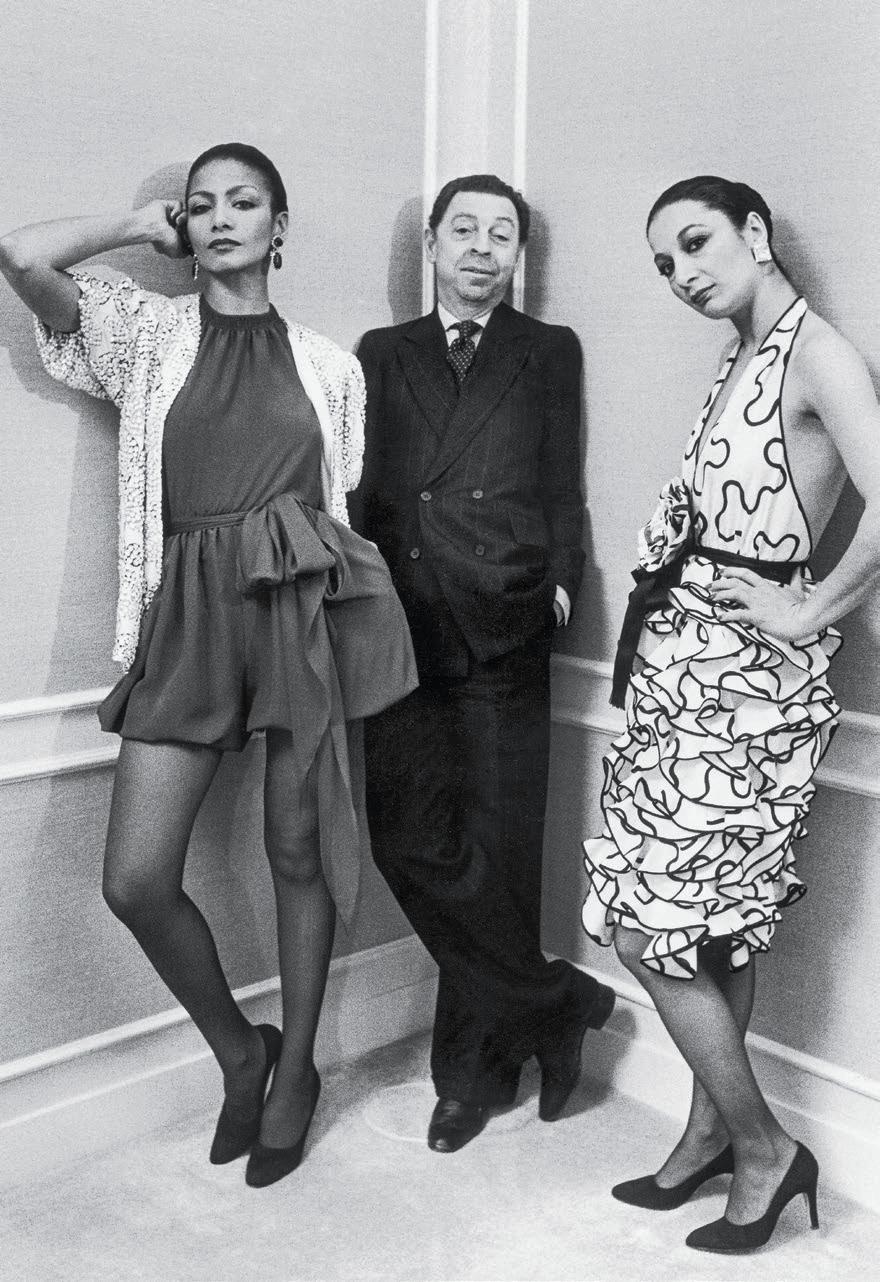
Galanos joins models showing off his designs at Saks Fifth Avenue, 1980.
opposite
Nancy Reagan chose a gold brocade gown with a braided halter designed by Galanos for Ronald Reagan’s second gubernatorial Inaugural Ball in 1971.
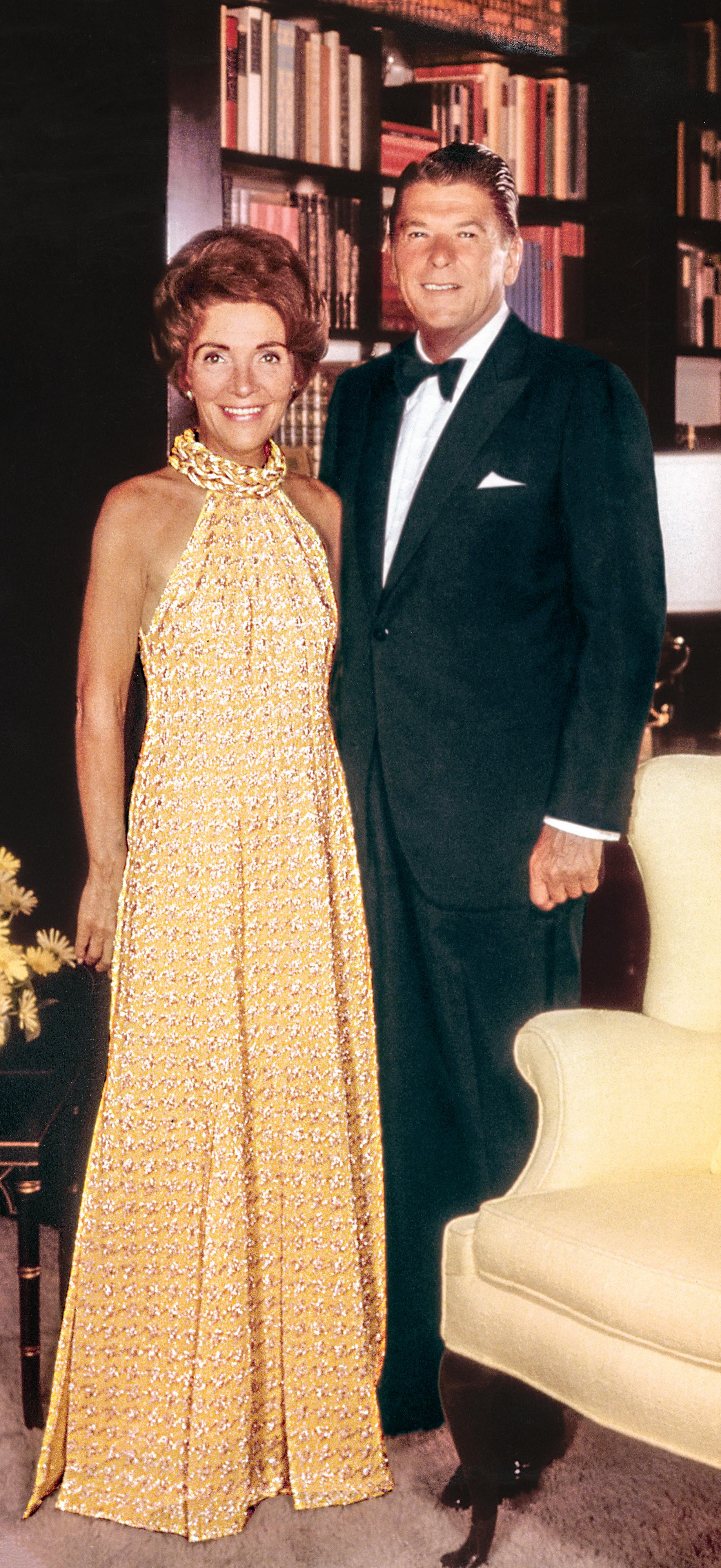
throughout her marriage to the actor and later president, Ronald Reagan. During her Hollywood years and her husband’s political career, she turned to fashion designer James Galanos, who became a longtime friend. Mrs. Reagan explained, “I’ve always liked Jimmy’s creations, I’ve been wearing them for years. In fact, I’ve known Jimmy Galanos longer than I’ve known my husband.” She remembered her early introduction to Galanos’s designs, recounting, “When I first came to Hollywood, a girl in the publicity department of MGM introduced me to Amelia Gray, who had a shop in Beverly Hills. Amelia knew Jimmy, and I bought one of his first designs, a black cocktail dress with a white collar, white cuffs, and a full skirt. The price was $125, which was a lot in those days.”7 Galanos recalled his connection to both Gray and Nancy Reagan: “From there on, there was a nice relationship between the three of us. And so whenever Nancy needed something special, she’d call Amelia or me.” Galanos originally sold his designs only through Amelia Gray’s boutique and even delivered the clothes to clients himself.8 Reflecting on Nancy Reagan’s fashion sense, Galanos stated, “Mrs. Reagan favors a realistic way of dressing.”9
Galanos gained national fashion acclaim in 1953 when he brought his designs from California to New York. There he obtained even more loyal customers, who were known as “The Galanos Girls.” These valued customers were described as “loyal, worldly, assured and meticulously groomed.”10 In addition to satisfying his devoted clients, Galanos made himself available to create memorable outfits for Mrs. Reagan when her husband was elected to public office. James Galanos designed both of Mrs. Reagan’s inaugural gowns when Ronald Reagan was inaugurated as governor of California in 1967 and 1971. For the first gubernatorial ball on January 2, 1967, Mrs. Reagan wore a white one-shouldered gown ornate with daisies. This sensational asymmetrical gown created public interest in Mrs. Reagan’s wardrobe choices. There was much anticipation on what she would wear to her husband’s second gubernatorial ball. On January 4, 1971, Mrs. Reagan selected an ensemble from the Amelia Gray boutique, a braided halter gown made of brocade fabric with a matching coat. This outfit did not disappoint those following Mrs. Reagan’s sense of style.11
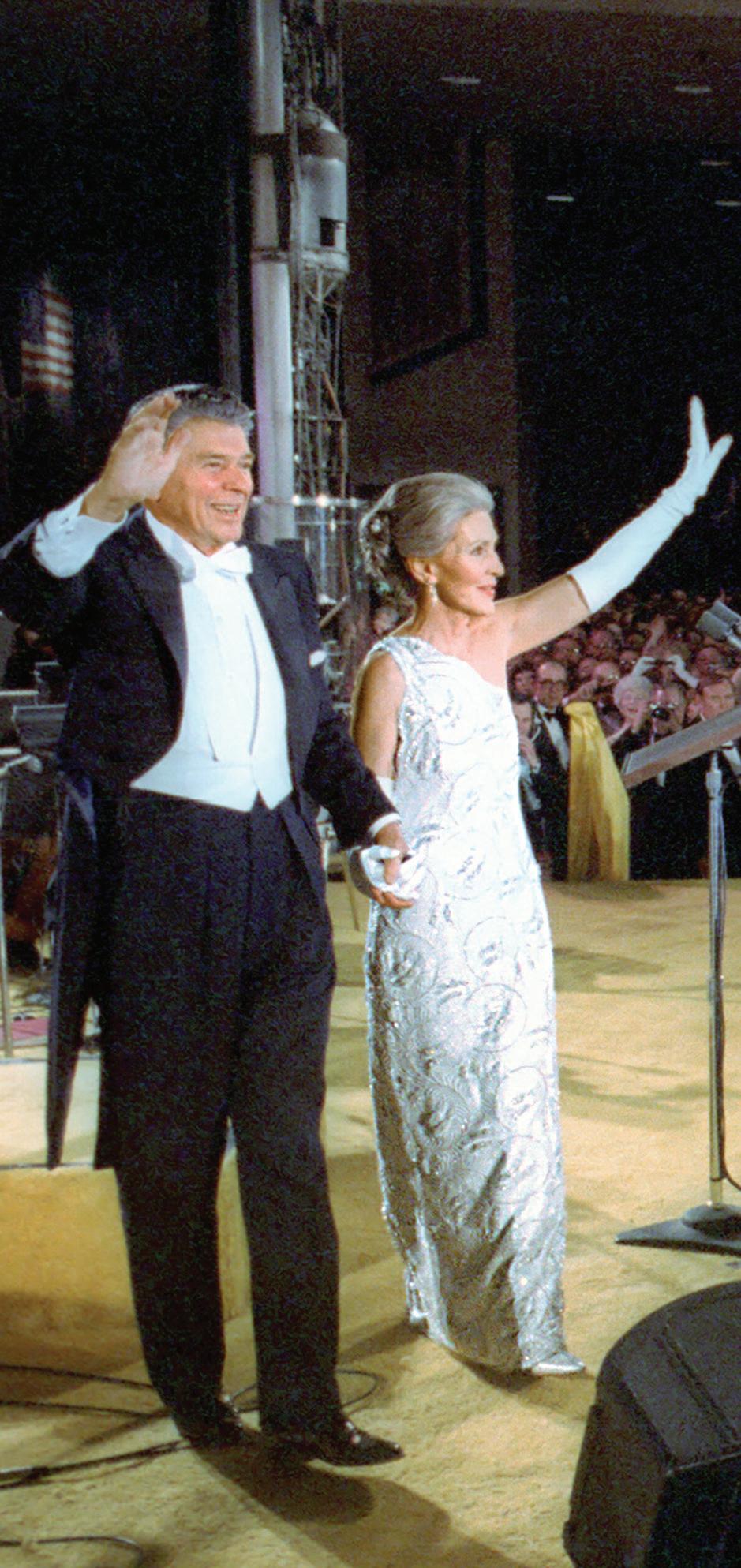
Mrs. Reagan called upon Galanos to design her outfits for the presidential Inauguration activities in 1981. She recalled, “After Ronnie was elected president, I called Jimmy, who was thrilled at the opportunity to design the inaugural gown. He made a few sketches, and together we decided on a white beaded dress. I loved it, and I wore it proudly. And I wore it again a few weeks later to a White House reception for the diplomatic corps.”12 The white satin one-shoulder gown had a hand-embroidered overlay. Its fernlike beaded embroidery took four weeks to accomplish. A white satin cloak completed the ensemble.13 It was important that the sketches for Mrs. Reagan’s inaugural outfits be kept secret before the Inauguration.14 Mrs. Reagan also wore
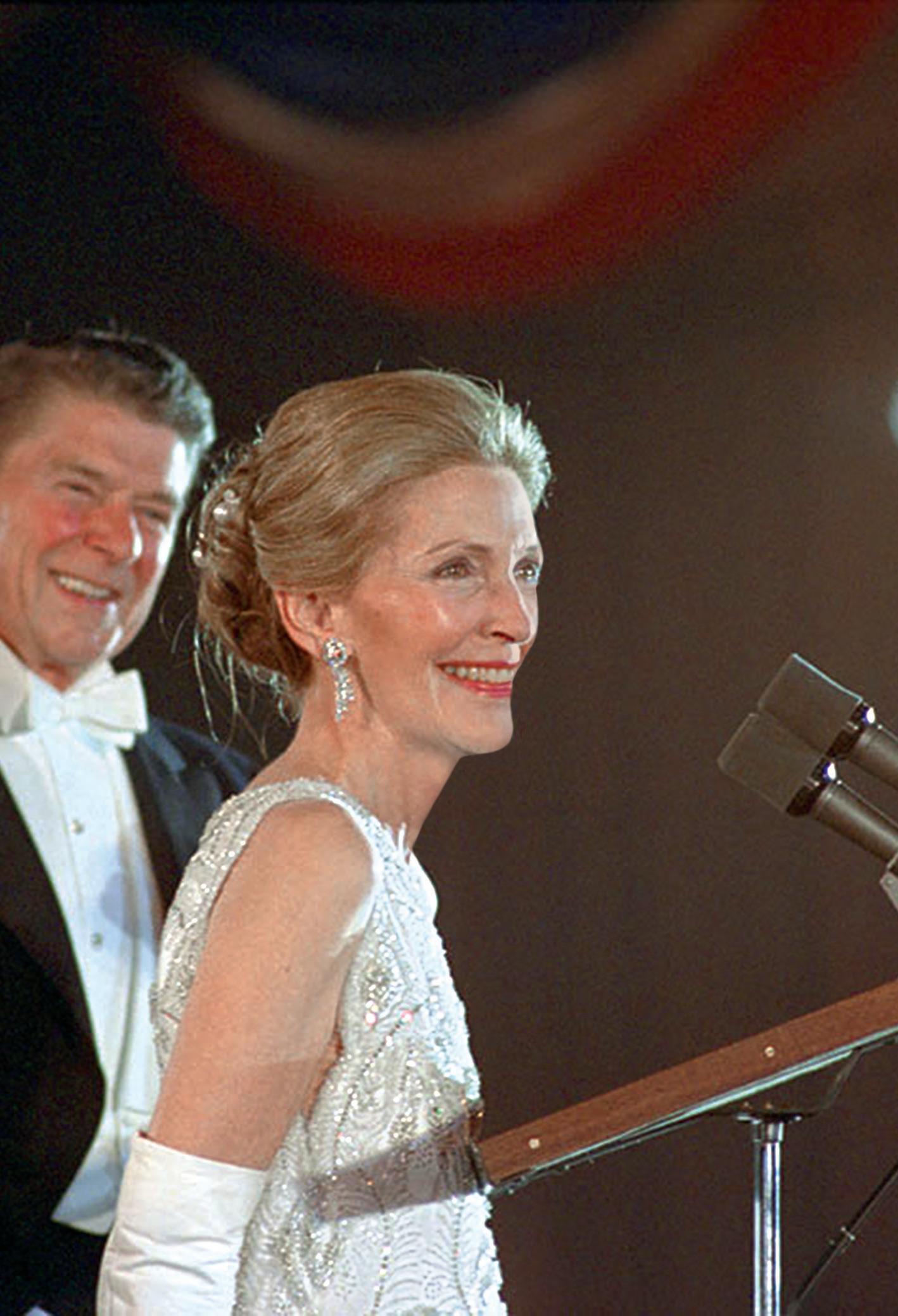
this outfit for a Vogue photo-shoot later in 1981.15
There was great public interest in learning what the first lady would be wearing for the events surrounding the president’s second Inauguration. Breaking from tradition, the sketches for Mrs. Reagan’s inaugural outfits were released prior to the Inauguration in 1985.16 For the second Inaugural Ball on January 21, 1985, Mrs. Reagan wore a fully beaded gown by Galanos. The beadwork was presented in an Art Deco pattern. Mrs. Reagan would wear this gown again on November 9, 1985, when the Prince and Princess of Wales attended a dinner at the White House.17
Entertaining at the White House demanded that Mrs. Reagan possess an extensive wardrobe. She
Nancy Reagan is seen in the white satin one-shoulder gown designed by Galanos for President Reagan’s first Inaugural Ball, January 20, 1981. President and Mrs. Reagan wave to guests at the National Air and Space Museum ball (left) and address the crowd at the Shoreham Hotel ball (right).
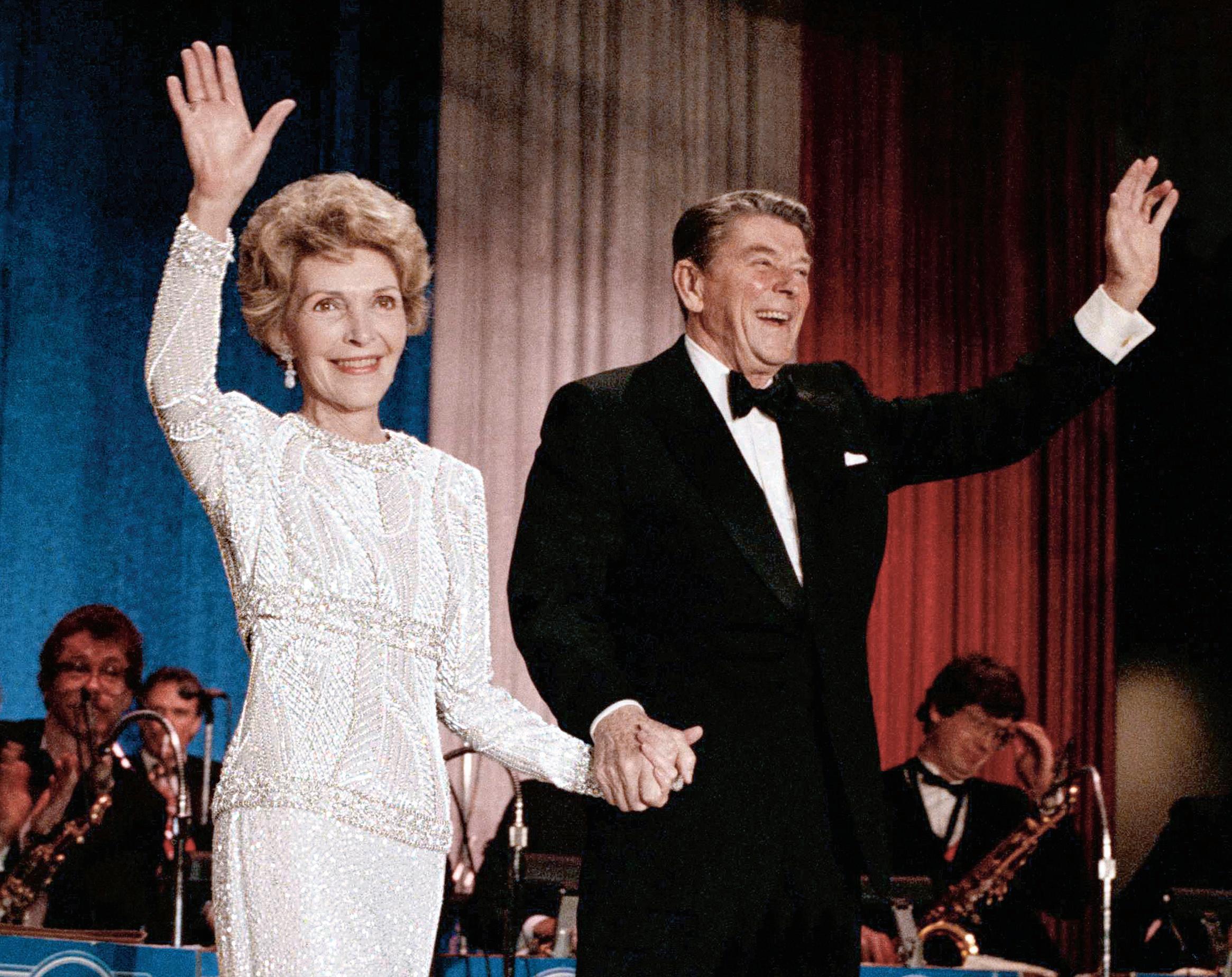
For President Reagan’s second Inaugural Ball, Mrs. Reagan again chose Galanos to design her gown. She is seen (above) in the fully beaded gown waving to guests at the Washington Hilton, January 21, 1985. She wore the dress again on November 9, 1985, for the White House dinner in honor of the Prince and Princess of Wales. She is seen (at right) dancing with Prince Charles as the president dances with Princess Diana.
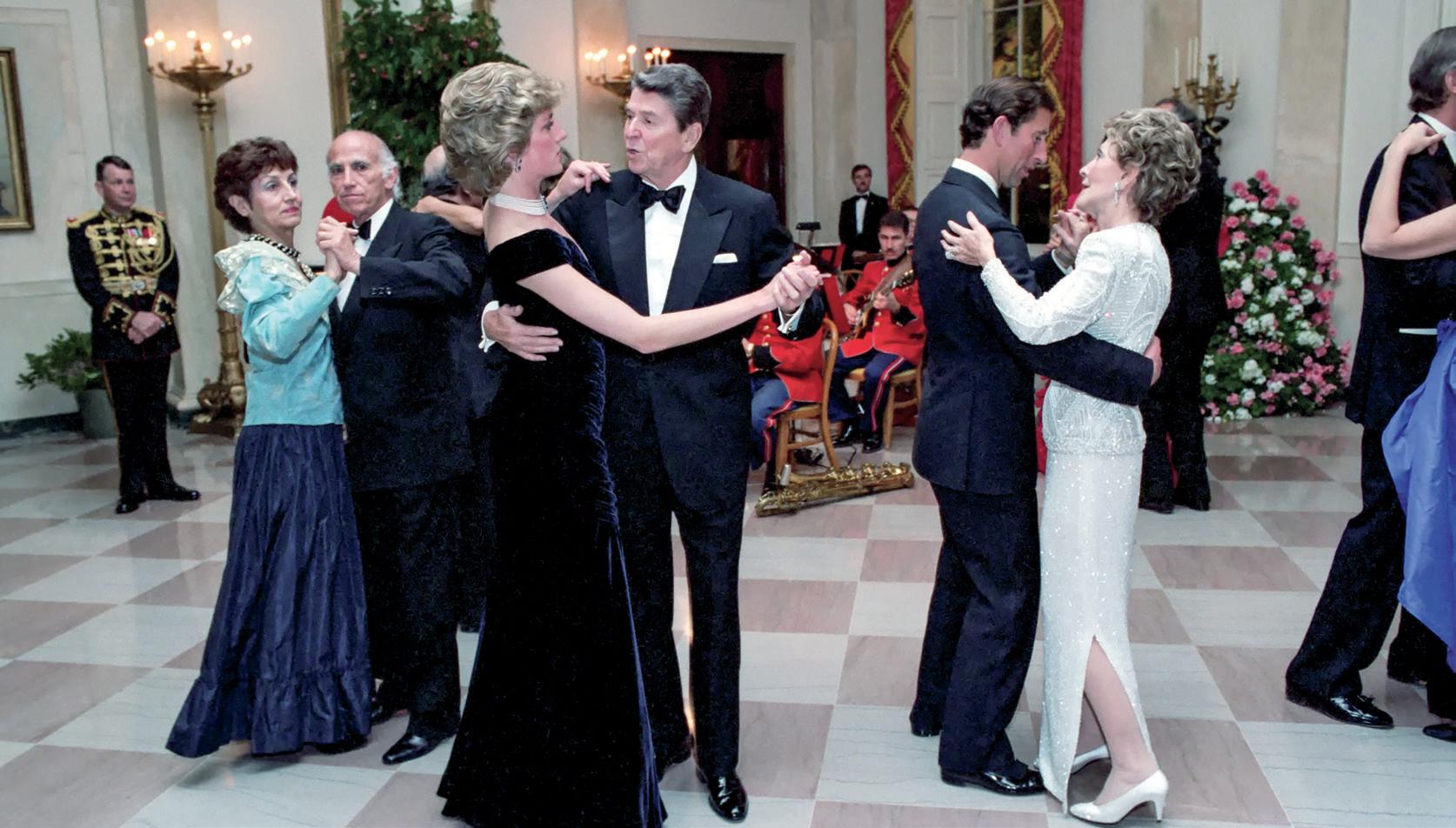
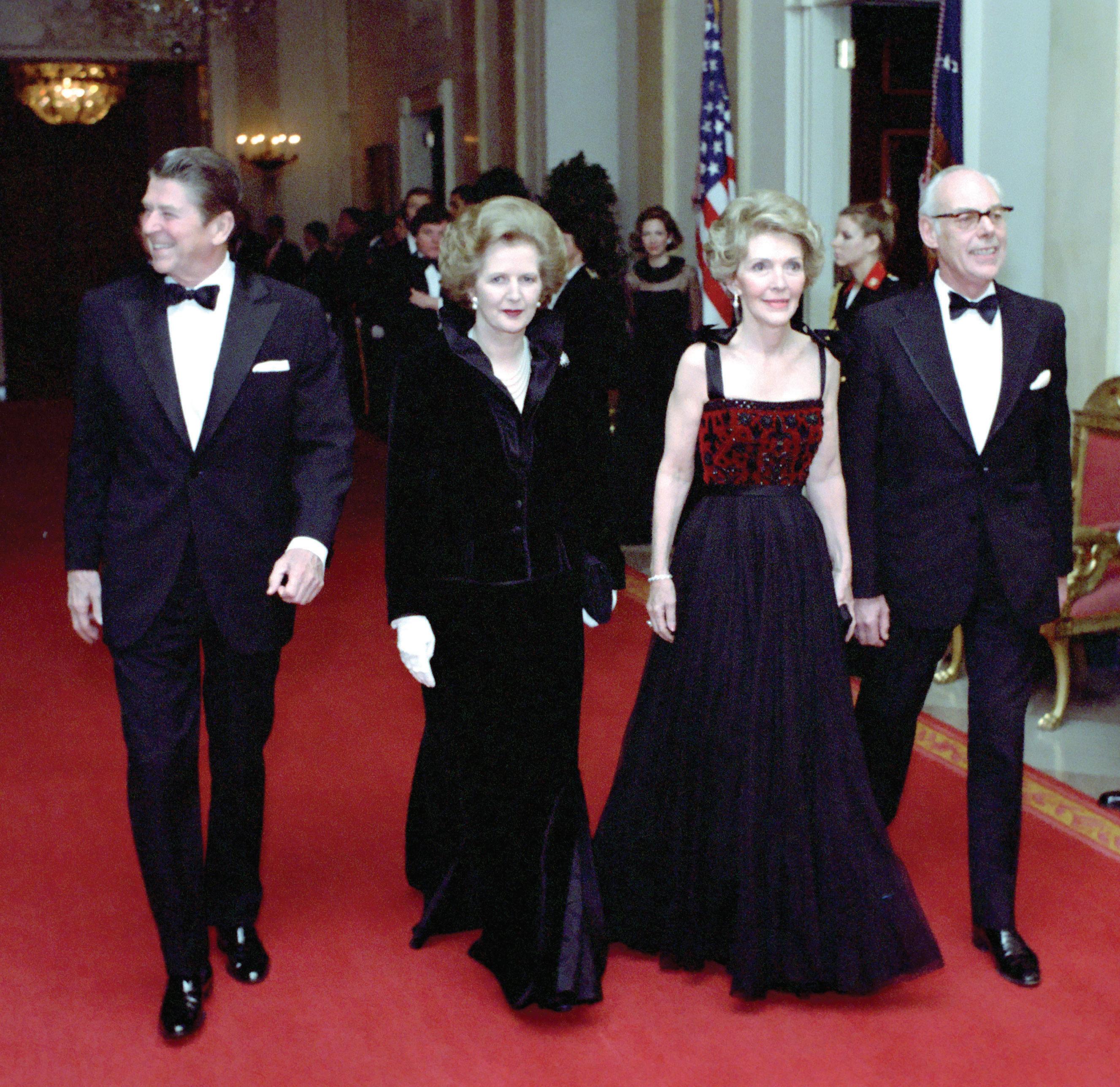
explained, “When I first came to the White House, I brought a lot of dresses from California. At our first state dinner in 1981, I wore a dress by Galanos with a maroon velvet top and a black chiffon skirt. That dress was sixteen years old. I still have it, and I’ll probably wear it again someday.” To bring new life to the garment, Galanos added straps to the dress. Mrs. Reagan wore the updated dress on February 26, 1981, for the State Dinner honoring the United Kingdom’s Prime Minister Margaret Thatcher.18 Mrs. Reagan’s press secretary, Sheila Tate, remembers, “Nancy organized her wardrobe to keep track of when each outfit was worn. Other First Ladies had also found this tactic helpful, but I’d never seen it before and found it amazing. A tag hung from each outfit listing the dates and events to which it had been worn.”19 This organizational device was
essential considering the many occasions for which Mrs. Reagan wished to recycle her favorite looks. Many Galanos gowns and outfits were worn for numerous events at the White House by Mrs. Reagan. Often Galanos was a guest at these formal occasions. Nancy Reagan even danced with Galanos at a State Dinner on March 22, 1984, wearing a purple and pink evening jacket and skirt that he designed. Galanos chose bright colors and intricate designs for Mrs. Reagan’s gowns. He also designed jackets, day dresses, and suits for less formal public events. A green jacket by Galanos was worn by Mrs. Reagan for every Christmas at the White House. Mrs. Reagan wore Galanos designs for diplomatic travel as well. A simple peach silk crepe ensemble was created for her to wear to the wedding of Prince Charles and Lady Diana Spencer
Nancy Reagan chose a favorite Galanos dress from her pre–White House wardrobe for a State Dinner honoring British Prime Minister Margaret Thatcher in February 1981. Galanos added straps to the maroon velvet top to update the dress.
right
James Galanos was a frequent guest at the Reagan White House. He is seen dancing with the first lady as she wears a purple and pink evening jacket and skirt of his design during a State Dinner for Spain, March 22, 1984.
below
Mrs. Reagan wears a green Galanos coat to accept delivery of the White House Christmas Tree at the North Portico, December 4, 1985. She wore this coat every Christmas during her White House years.
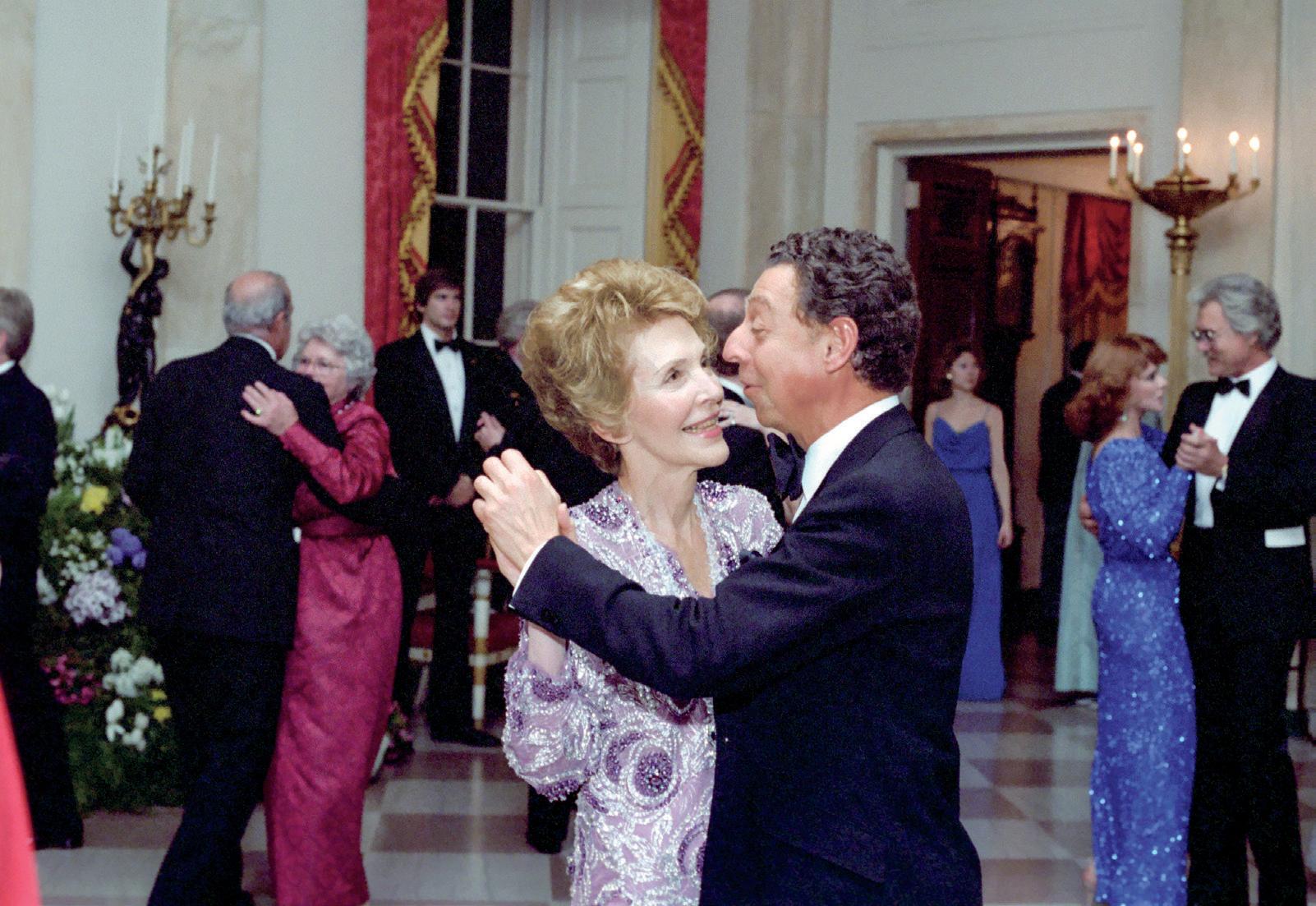
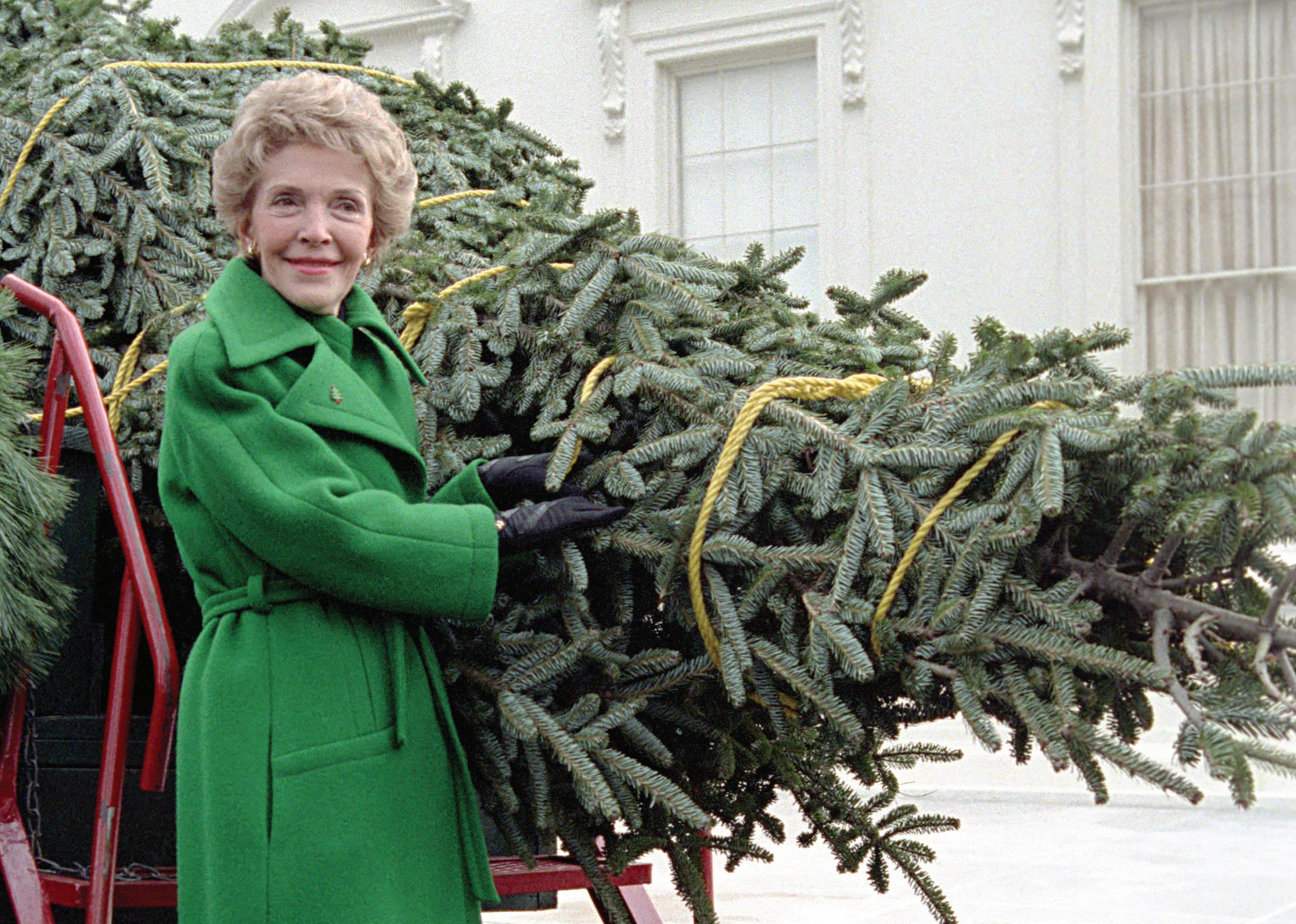
on July 29, 1981. Galanos stated, “When I knew she was going to be in Europe, I’d say, ‘Nancy, let’s do something a little more interesting,’ and she would leave it up to me.” Nancy Reagan wore another Galanos design on her 1985 visit to Spain—a suit with a silk blouse and matching scarf. During the Geneva Summit in 1985, Mrs. Reagan wore a black wool suit designed by Galanos when she had tea with Raisa Gorbachev. The wool jacket was a hounds-tooth pattern, and the silk blouse matched with a larger hounds-tooth print.20
That the first lady wore lavish and expensive Galanos designs was not without controversy. Mrs. Reagan recounted, “The criticism began on Day One, with the inaugural gown.” To squash some of the controversy, she explained that “Jimmy Galanos donated the dress, which was later given to the Smithsonian’s collection of inaugural gowns.” The cost of the gown was estimated at $10,000.21 Mrs. Reagan went on to add, “I can understand that—women are always curious about what other women wear, about the workmanship of their
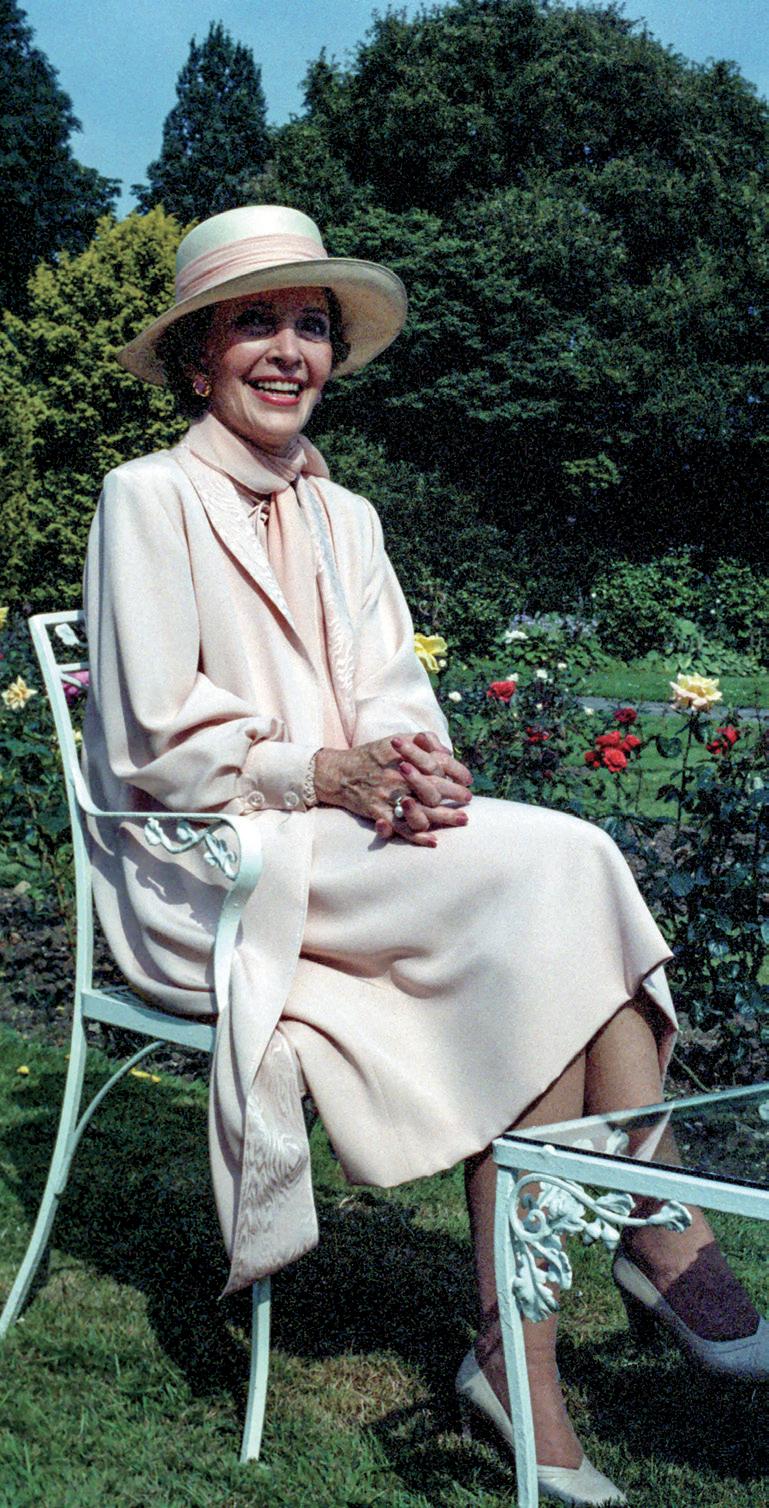
clothes, and about the progress of fashion over the years. The gown Mr. Galanos is donating today is a true example of great craftsmanship as well as a reflection of modern fashion. I am grateful to him not only for the contribution he is making today, but for the contribution he has made to the American fashion industry.”22 In rebuttal to the public perception that she only wore designer clothing, Mrs. Reagan said, “But despite the image that I wore expensive designer fashions twenty-four hours a day, the fact is that whenever I wasn’t on display, I dressed as casually as possible. I always wore jeans at the ranch and at Camp David, and on long trips, the first thing I did on Air Force One was to change into my velour running suit, which was comfortable and warm.”23 Often Nancy Reagan was seen in casual wear along with the president—in matching red sweaters and jeans—at their California ranch, Rancho del Cielo.
below Nancy Reagan gave Galanos freedom to create interesting fashion for her European travels. For the wedding of Lady Diana Spencer to Prince Charles, he designed a peach silk dress with matching coat and hat.
below right
Mrs. Reagan speaks at the unveiling of her inaugural gown at the Smithsonian Institution. The gown was donated by Galanos.
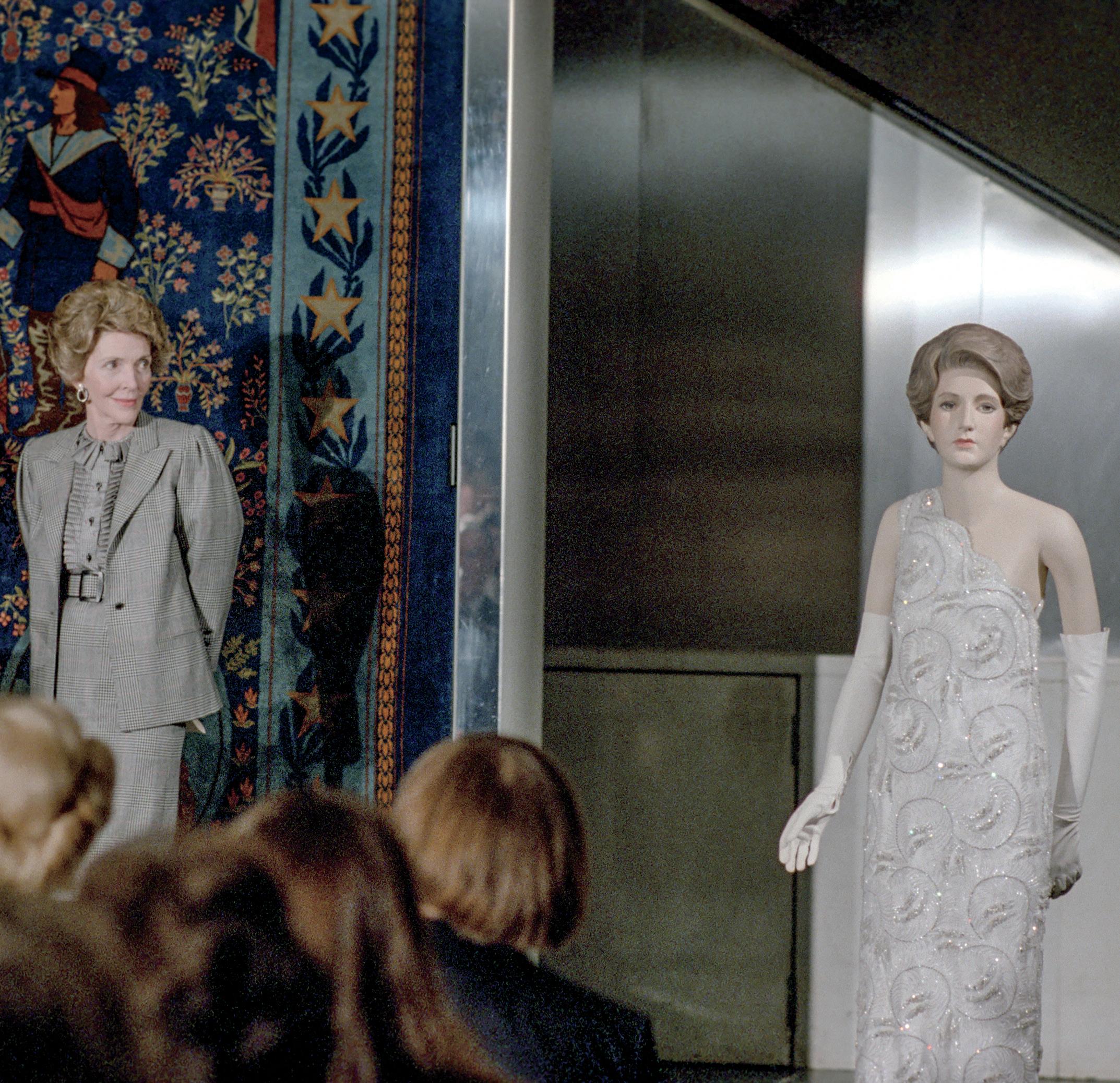
Responding to critics of her expensive designer clothing, Mrs. Reagan explained that she dressed “as casually as possible” when not “on display.” She was often photographed in jeans when relaxing at the Rancho del Cielo with the president, as seen here August 17, 1983.
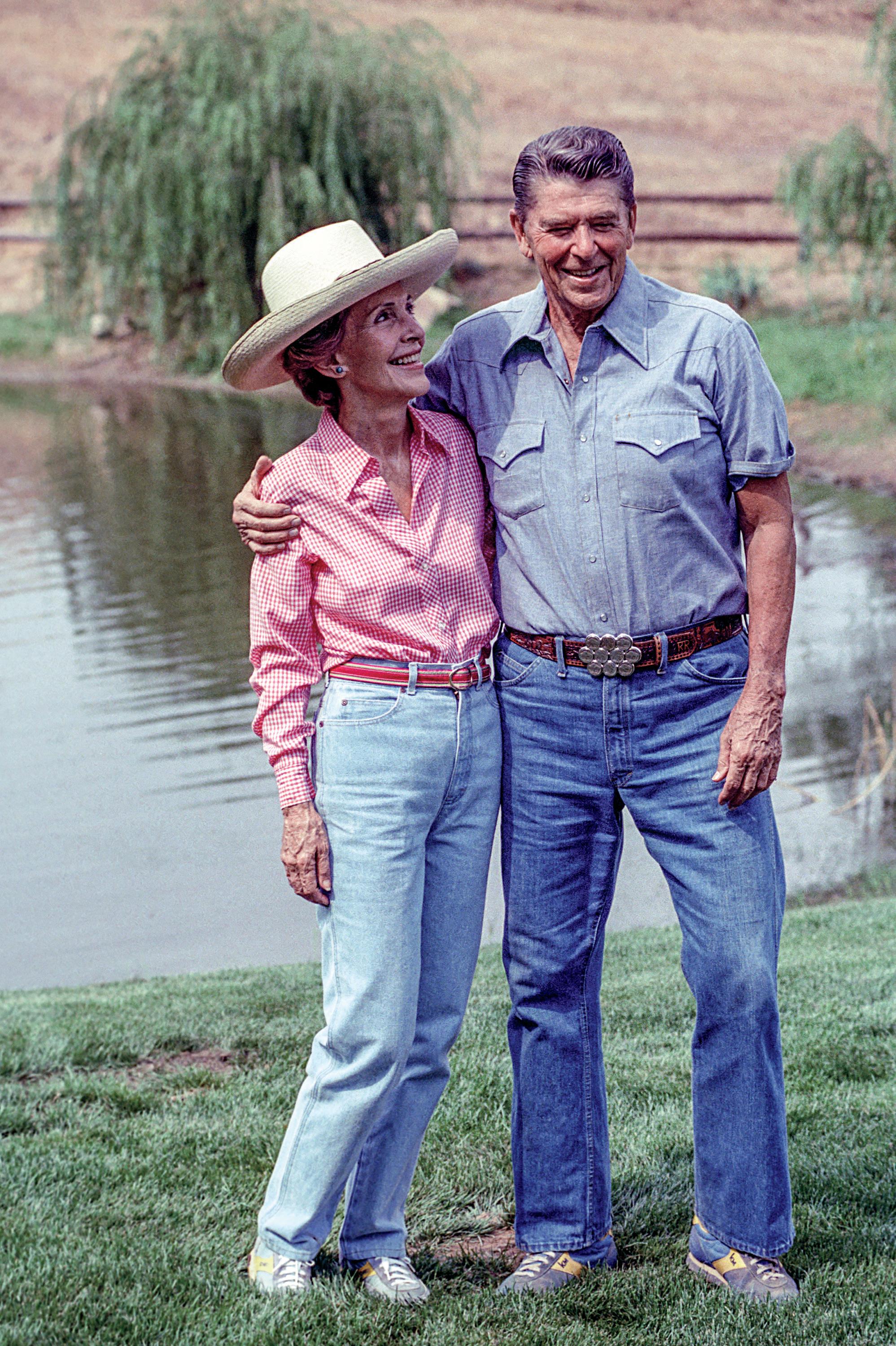
“I always liked red. It’s a picker-upper.”
Mrs. Reagan’s style will forever be associated with the color red, which she explained was a “picker-upper.” Red for every occasion, rain or shine, could be found in her wardrobe.
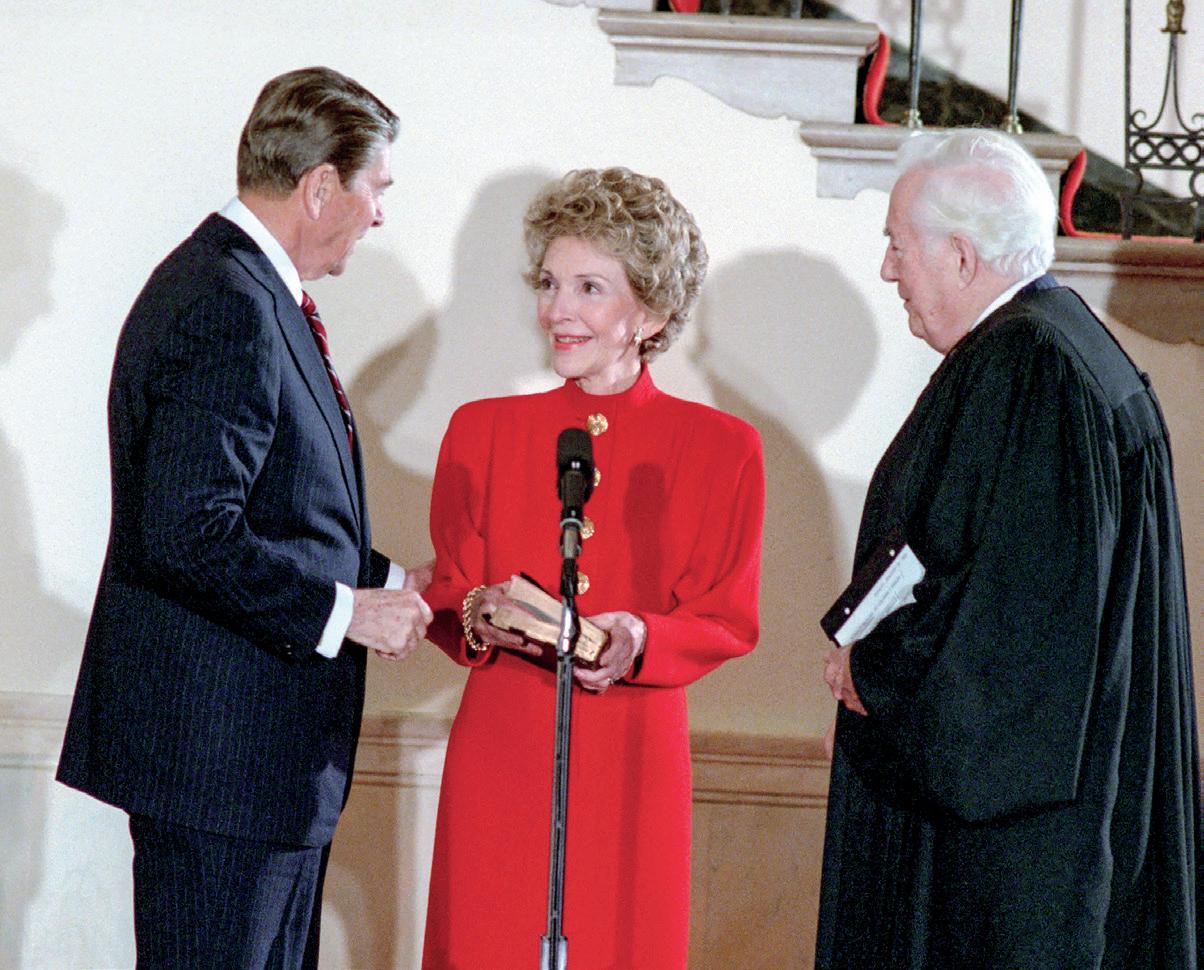
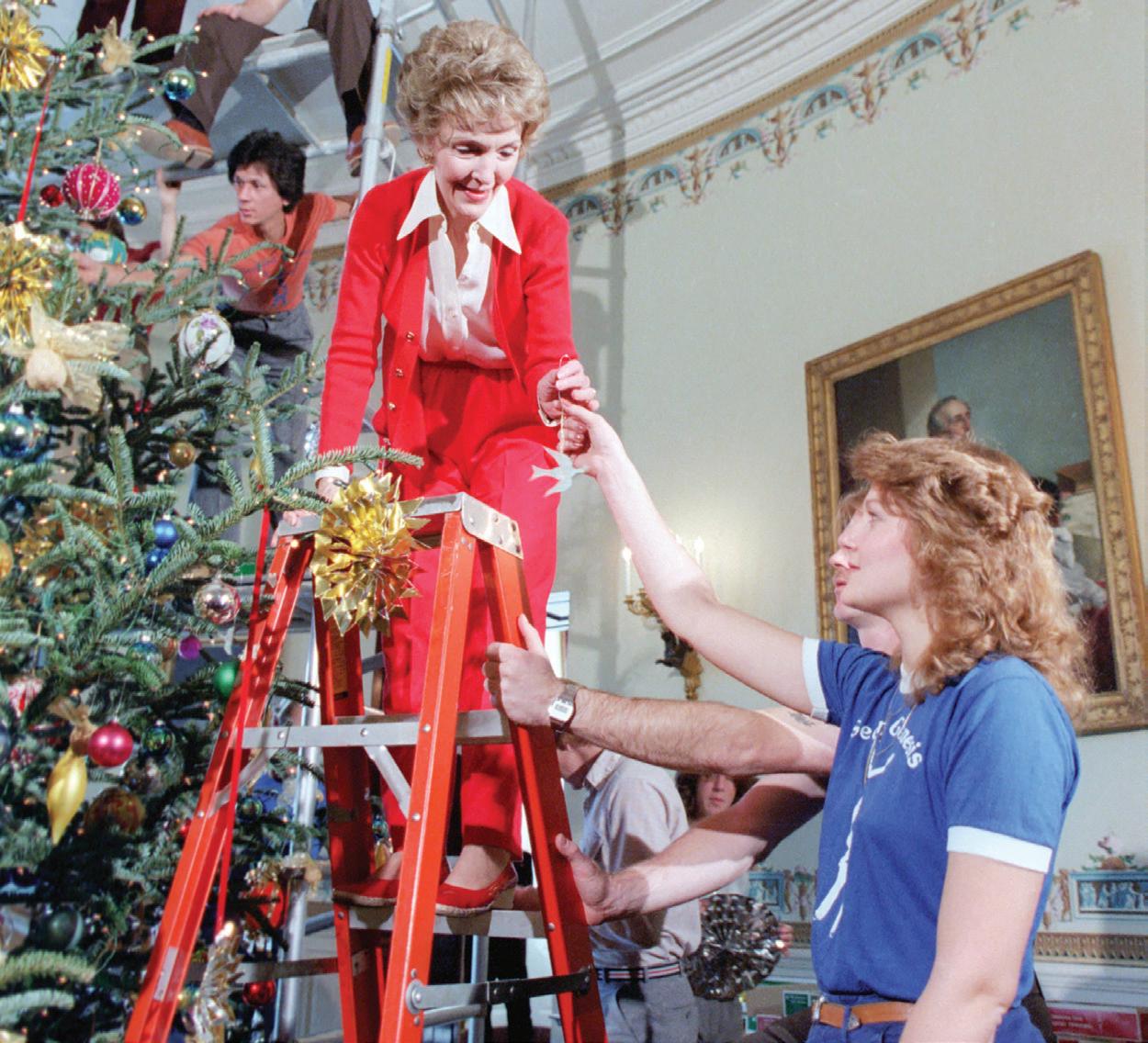
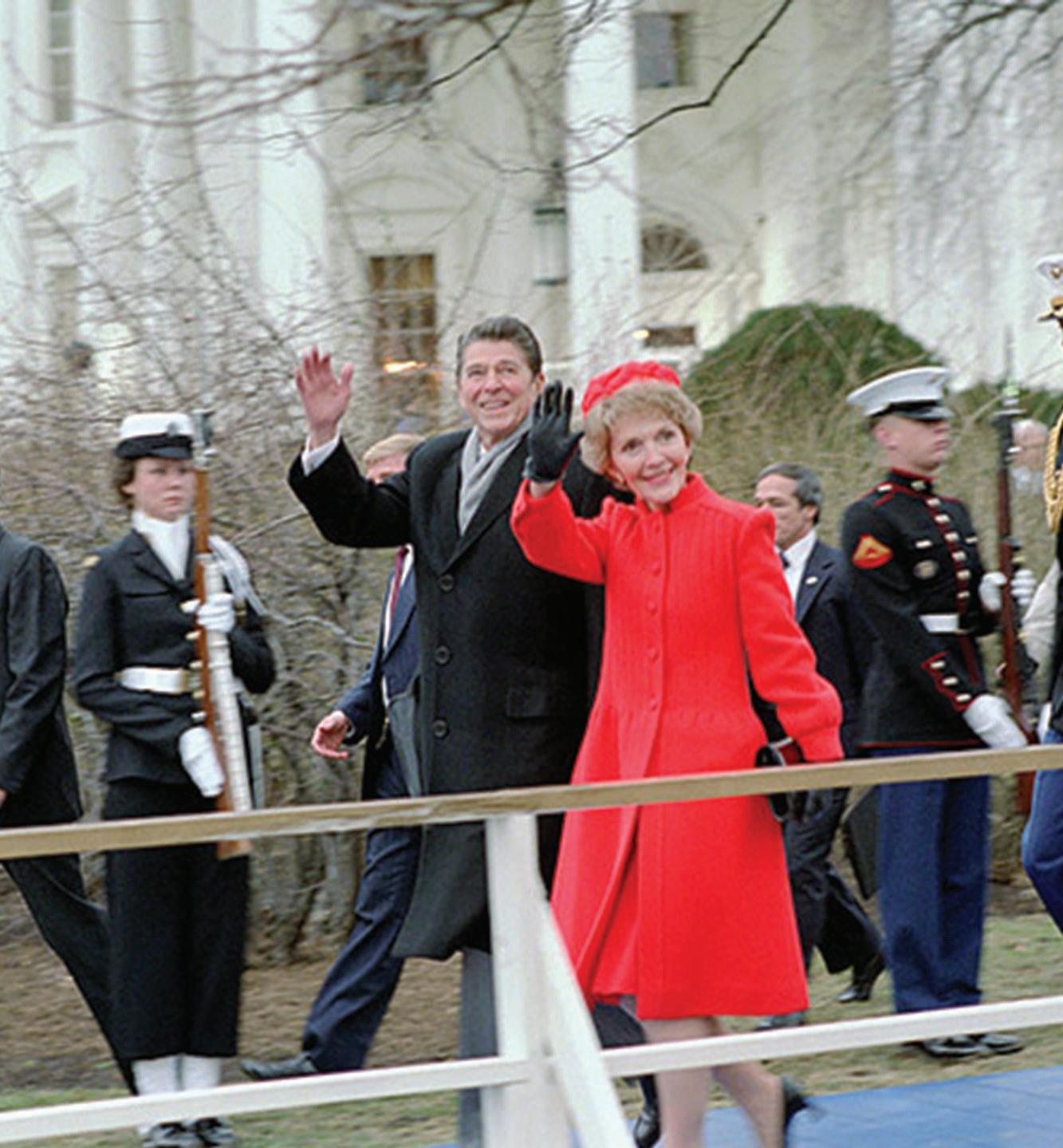
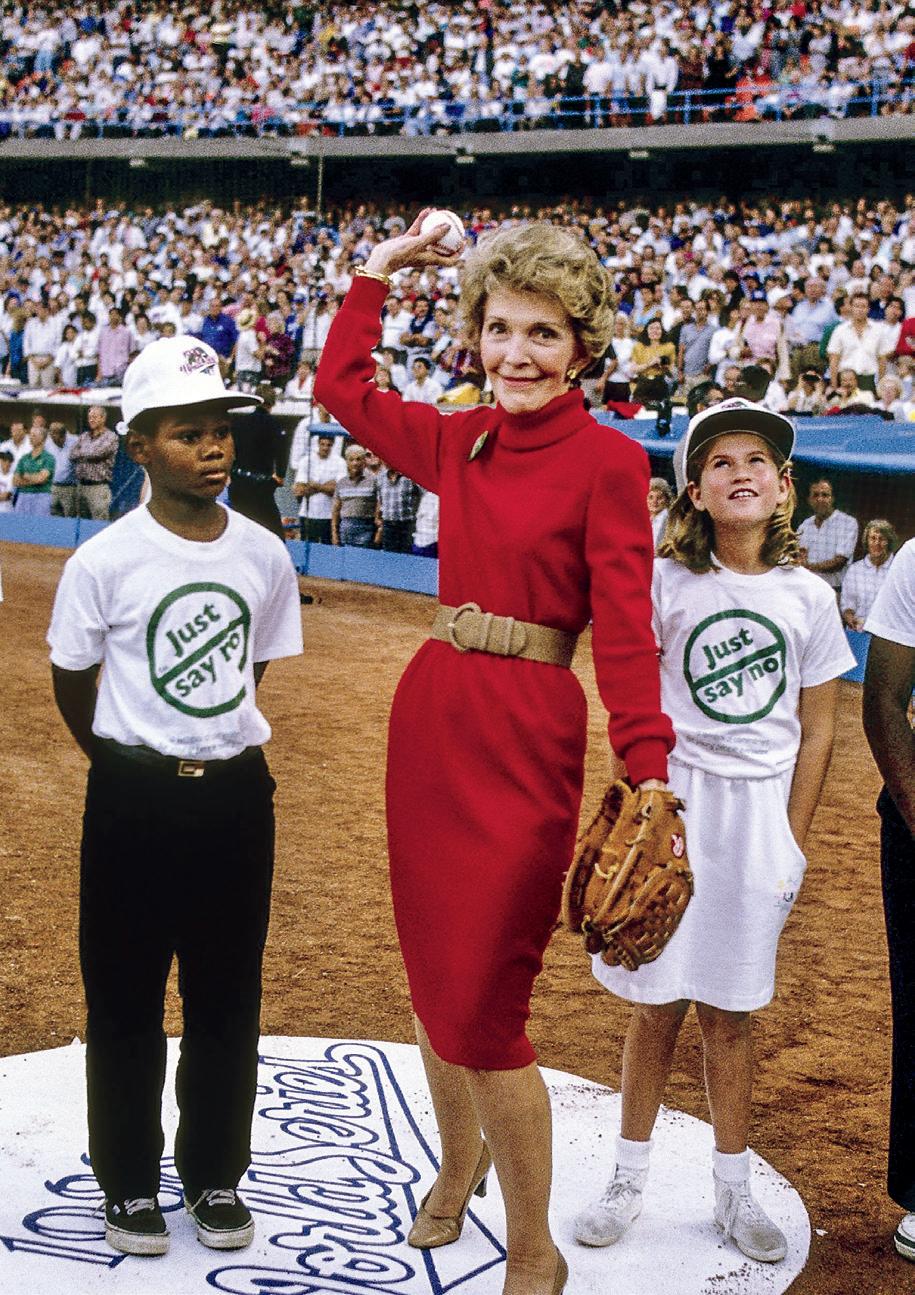
For the Inauguration ceremonies, Mrs. Reagan chose a red Adolfo coat in 1981 (top right) and a red Galanos dress in 1985 (top left). She wears a red turtleneck sweater dress to throw the first pitch before game one of the 1988 World Series (above), and red pants, shoes, and sweater to hang the 1982 official White House Christmas Ornament on the Blue Room Christmas Tree (left).
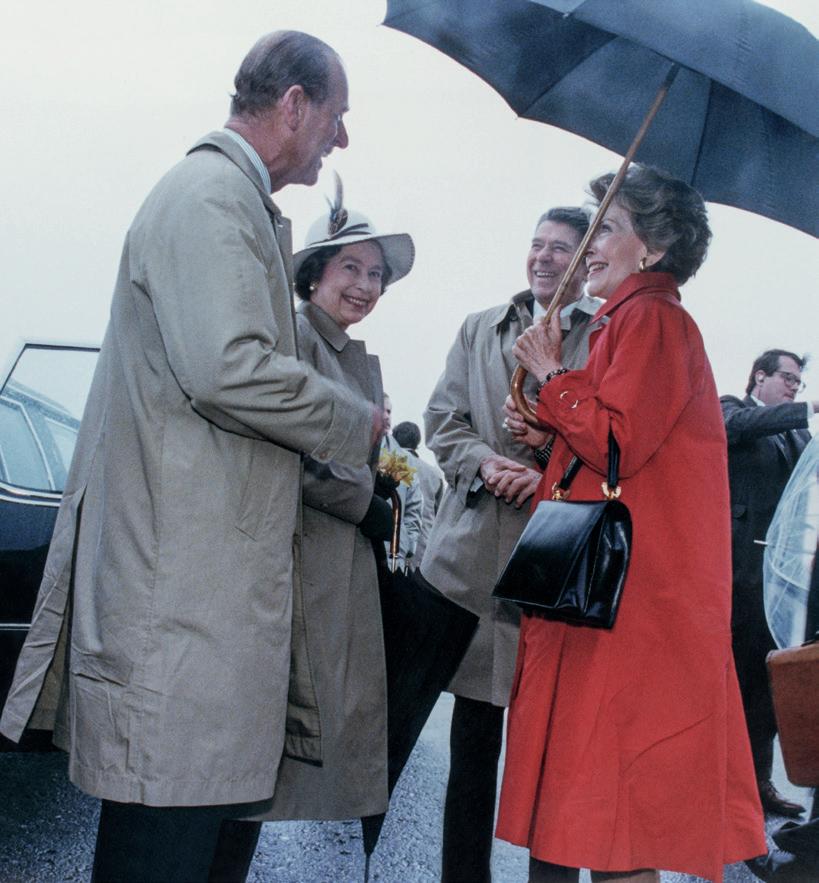
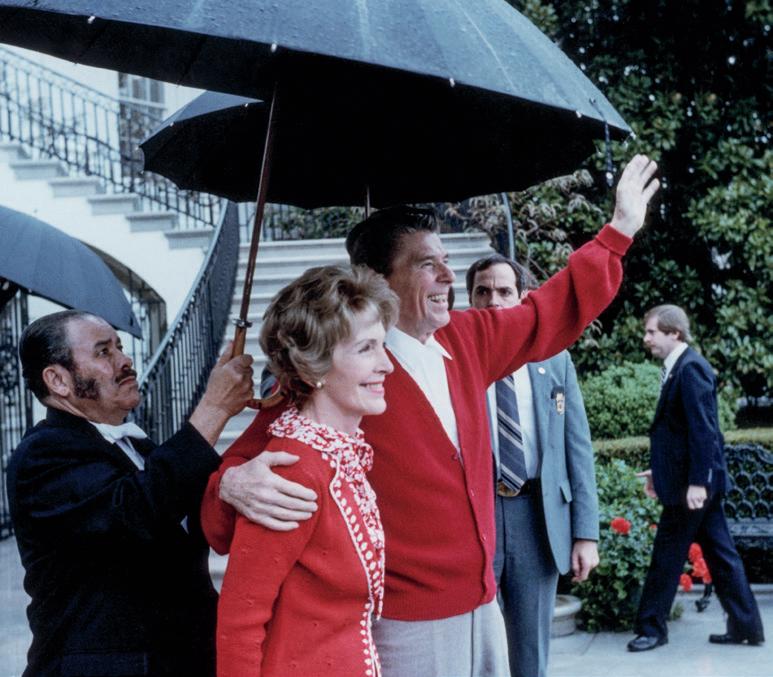
Mrs. Reagan donned a bright red raincoat (top) to welcome Prince Philip and Queen Elizabeth II to California, 1985; and a red sweater and blouse (above) to welcome President Reagan back home to the White House from the hospital following an assassination attempt, 1981.
For a State Dinner in honor of British Prime Minister Margaret Thatcher, Mrs. Reagan chose a red gown by Oscar de la Renta (right), 1988.
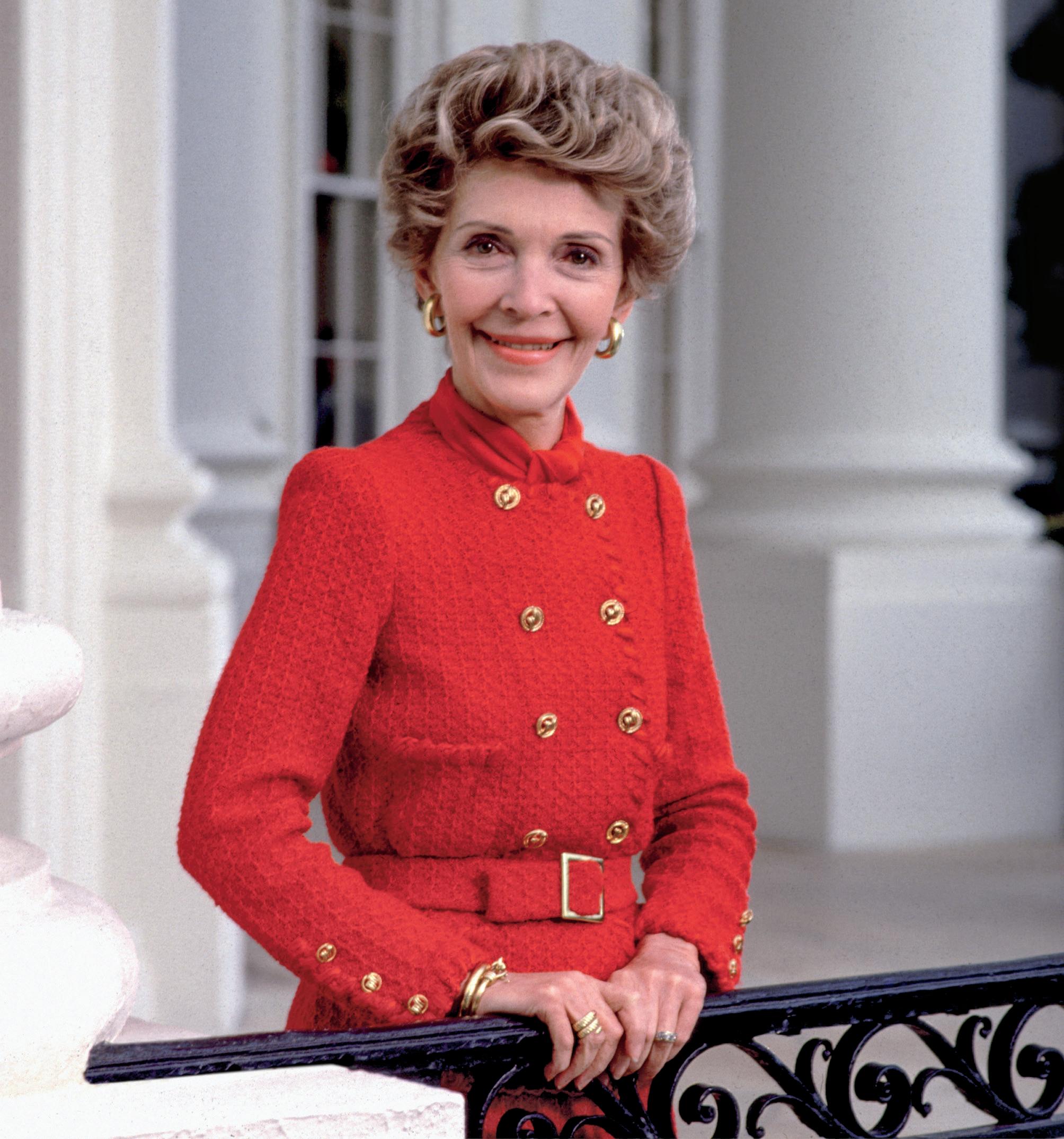
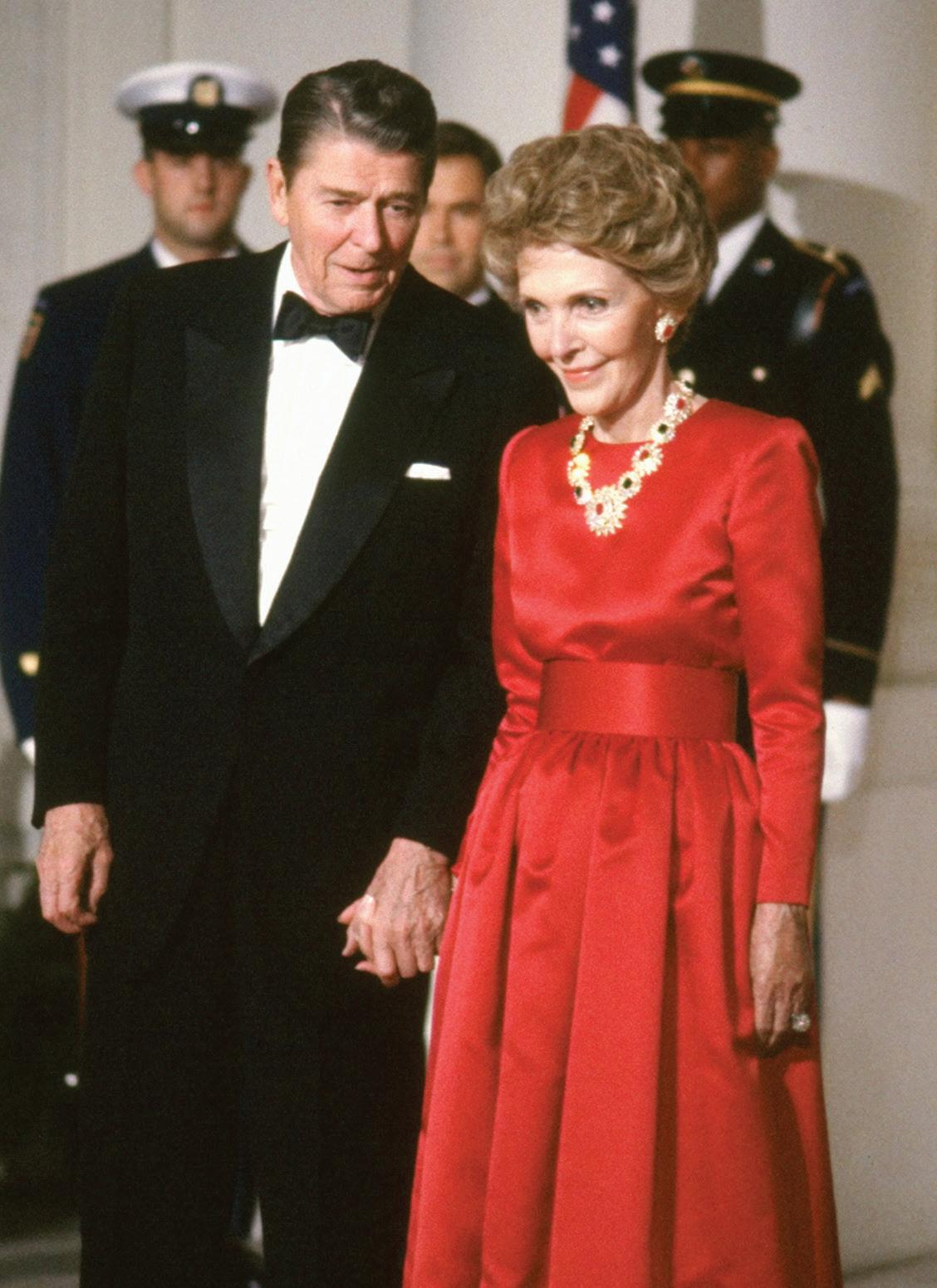
for a
a
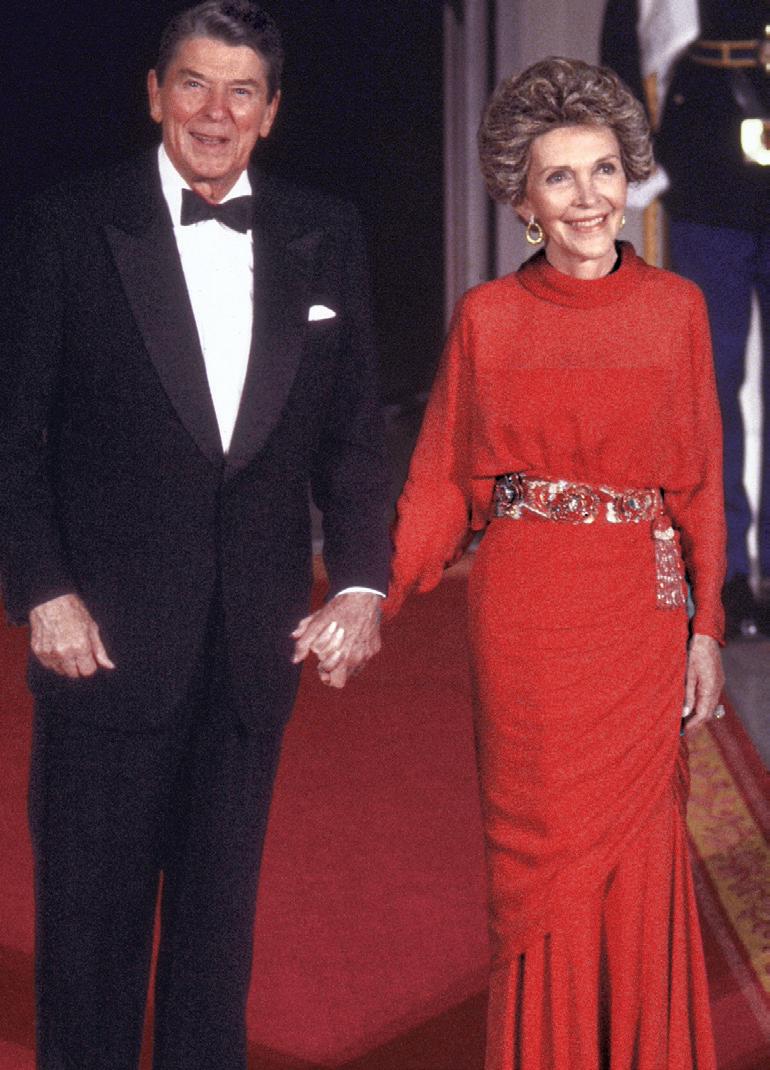
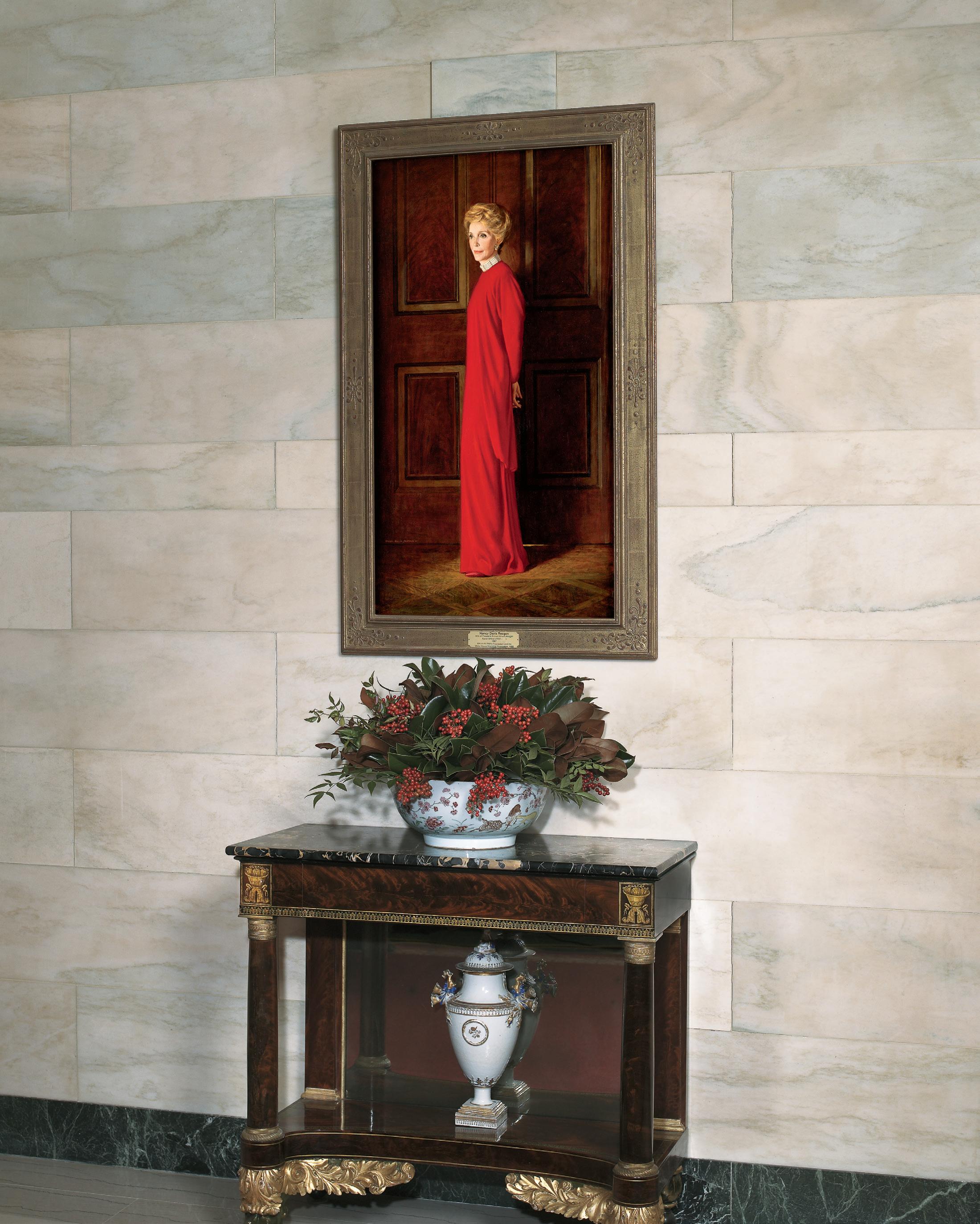
Nancy Reagan chose a red Galanos gown for her official portrait, which was painted for the White House Collection by Aaron Shikler in 1987. True to her style, she dressed in red for a visit to the White House in 2009. She is seen at right passing by the portrait in the Ground Floor Corridor with President Barack Obama. To honor Mrs. Reagan’s legacy, the U.S. Postal Service recently released a postage stamp featuring her official portrait. The stamp was unveiled in a White House ceremony on June 6, 2022, attended by (left to right) First Lady Jill Biden; Anne Peterson, Nancy Reagan’s niece, Frederick J. Ryan, Jr., chairman of the Board of Trustees of the Ronald Reagan Presidential Foundation and Institute; and Louis DeJoy, U.S. Postal Service postmaster general.
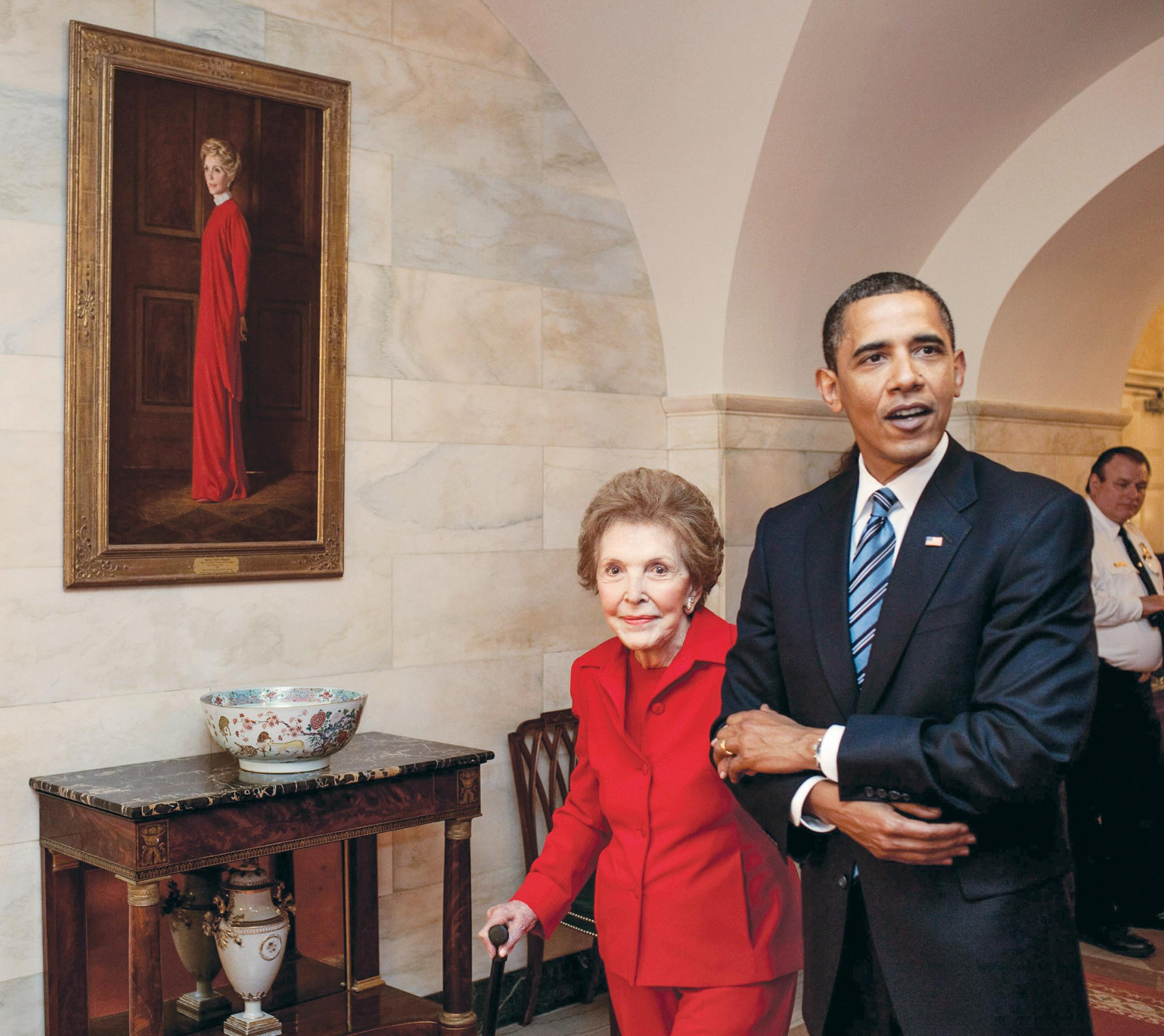
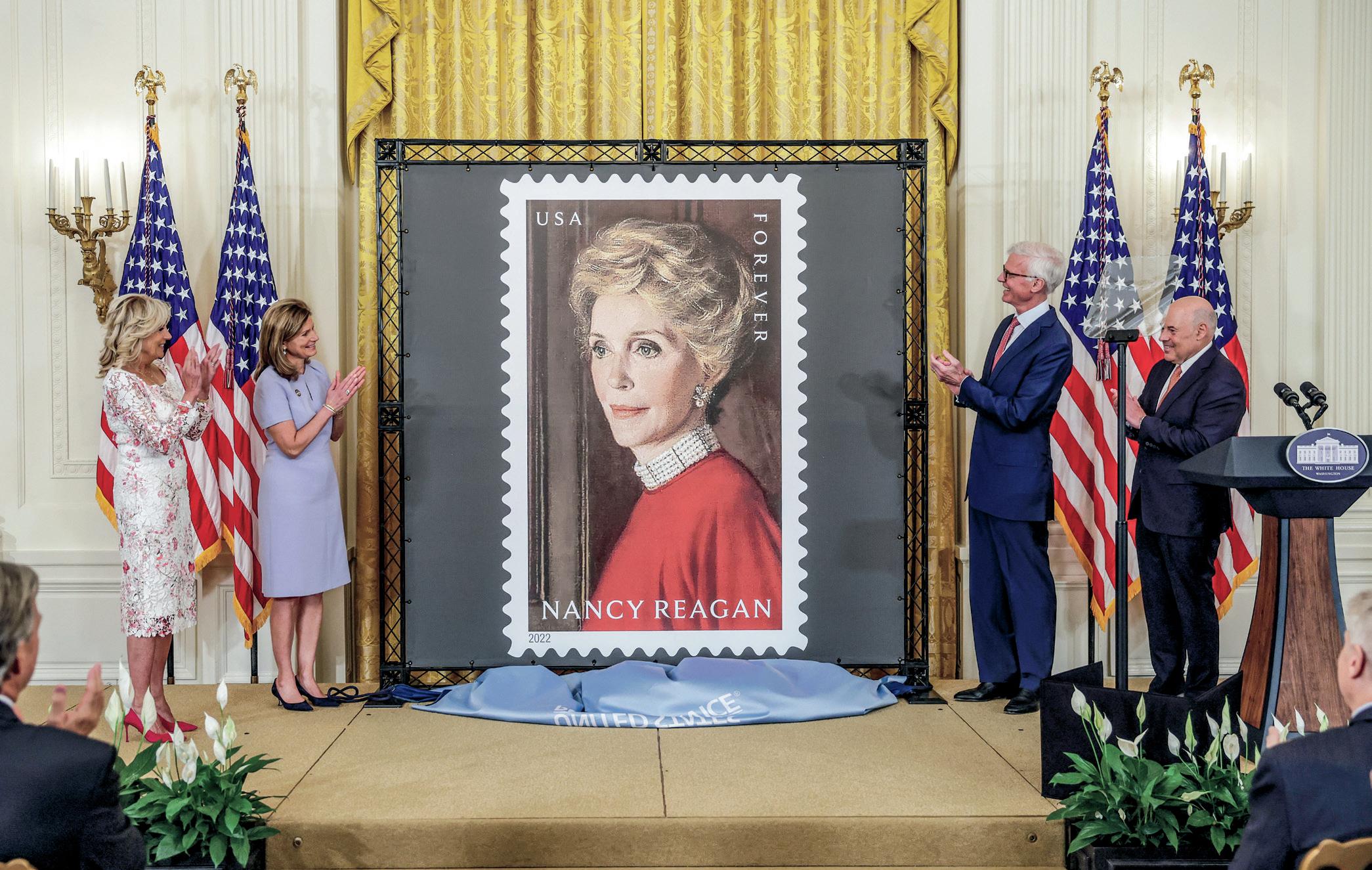
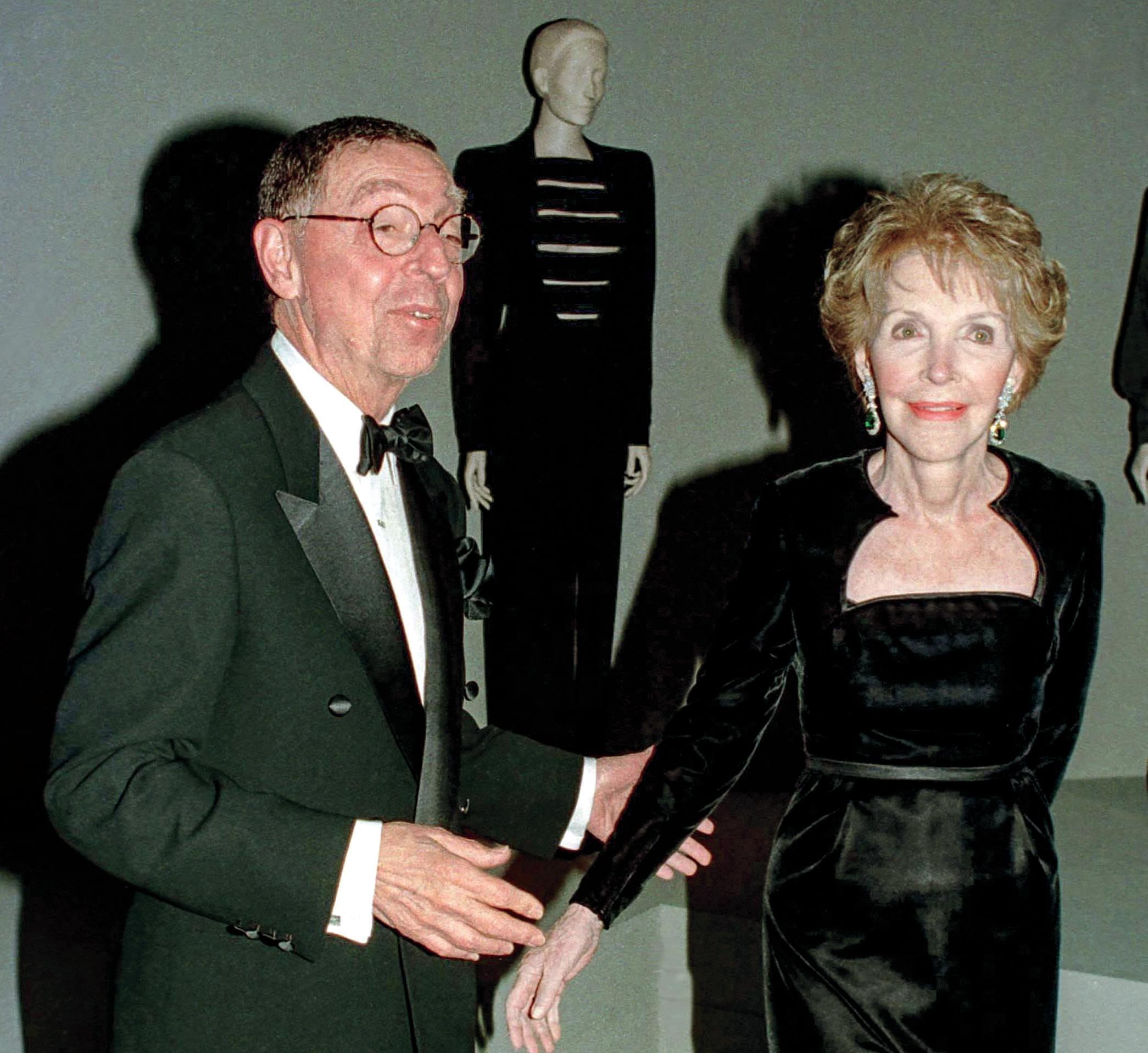
Mrs. Reagan became famous for wearing red as her signature color. This preferred hue began while she was acting in Hollywood before her time at the White House. On February 24, 1972, she wore a Galanos red beaded sheath that dated back to the 1950s and was an exclusive obtained from Amelia Gray’s boutique.24 This favored color choice became known as “Reagan Red.” In 2007, Nancy Reagan told W Magazine, “I always liked red. It’s a picker-upper. I didn’t give it the name of Reagan Red, but that became its name.”25 The Reagan Red designation during the White House years was ushered in when Mrs. Reagan wore the red coat, day dress, and hat by Adolfo for her husband’s first Inauguration, on January 20, 1981. Mrs. Reagan wore a red day dress designed by Galanos for the private oath ceremony on January 20, 1985. She wore a simple, red sheath gown designed by Galanos in 1983 for the State Dinner honoring the sultan of Oman. The same gown was chosen for
official White House portrait, painted by Aaron Shikler, and worn again in 1995 for a Vanity Fair photo-shoot.26
Mrs. Reagan continued to wear Galanos’s designs after her time in the White House. Her correspondence with Galanos continued as well, preserved in the Galanos archive.27 Galanos retired from fashion in 1998 and turned his talents to photography and art.28 Upon her husband’s death, Nancy selected a Galanos suit for the public viewing and ceremony of President Reagan’s lying in state at the Capitol Rotunda on June 10, 2004. It was black wool, trimmed in satin.29
A few years later, in 2007, Galanos was the recipient of the Rodeo Drive Walk of Style Award, the eleventh to receive this honor. Nancy Reagan was a chair for the Walk of Style induction ceremony at which Galanos was memorialized with a plaque.30 On November 8, 2007, Galanos attended the opening of the exhibition Nancy Reagan: A First Lady’s
After the Reagan presidency, James Galanos and Nancy Reagan remained friends for the rest of their lives. They are seen here at a reception to celebrate an exhibition of Galanos designs at the Los Angeles County Museum of Art, March 25, 1997.
Nancy Reagan joins James Galanos during a ceremony to honor him with the Rodeo Drive Walk of Style Award in Beverly Hills, October 2007. A plaque bearing his signature and quotation was added to the Rodeo Drive sidewalk, joining other honorees.
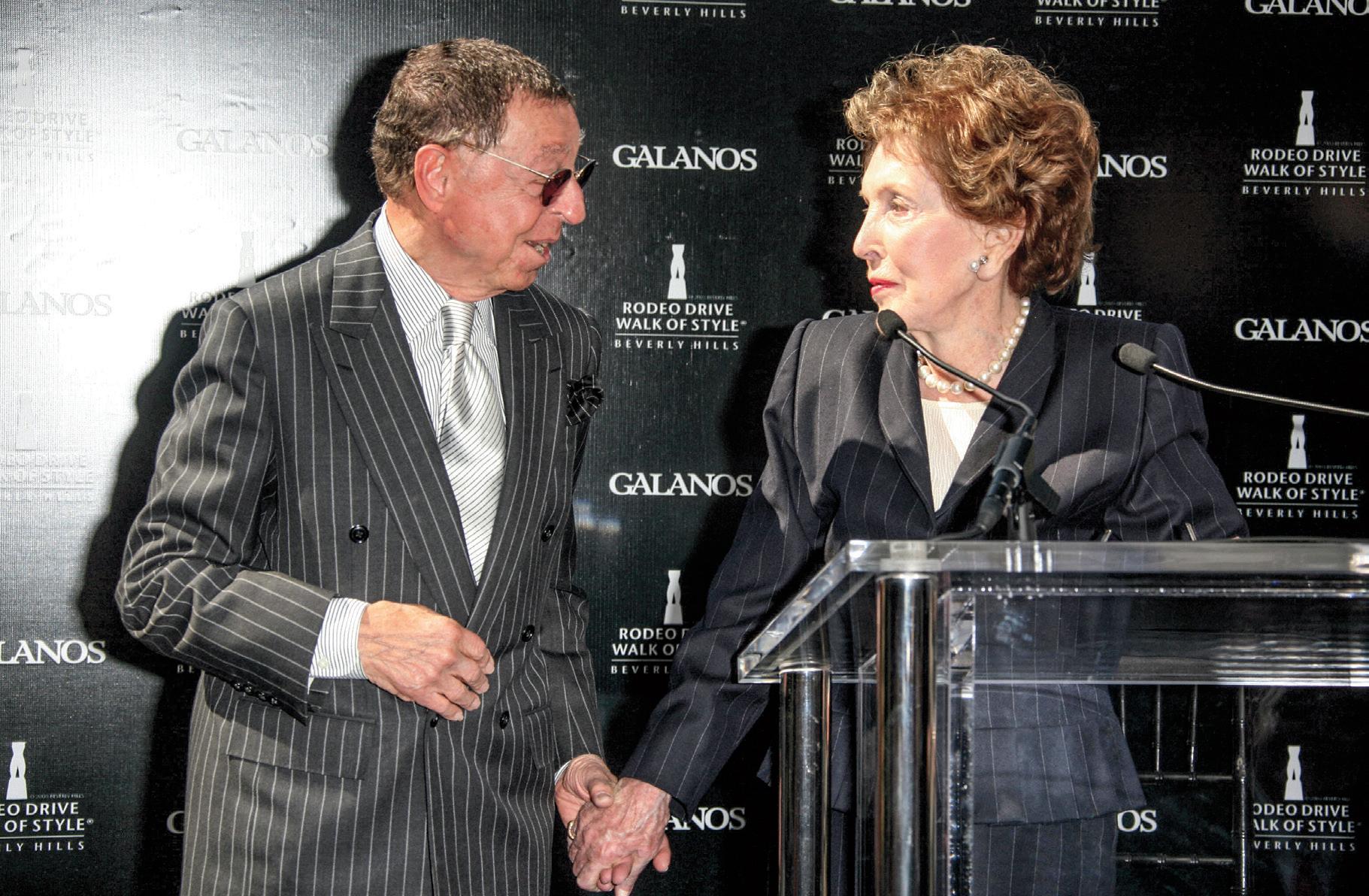
Style at the Ronald Reagan Presidential Library and Museum.31 Nancy Reagan died at the age of 94 on March 6, 2016, and James Galanos died later that year on October 30 at the age of 92.32 The two friends will be remembered for their decades long style collaboration.
notes
1. Quoted in Ronald Reagan Presidential Library Foundation, Nancy Reagan: A First Lady’s Style (Simi Valley, Calif.: Ronald Reagan Presidential Library Foundation, 2007), 14, 19, 39.
2. Quoted in “James Galanos, Nancy Reagan Designer, Dies at 92,” Women’s Wear Daily, October 30, 2016. David Nash, “James Galanos and the Integrity of 20th Century Fashion,” Town & Country, November 6, 2018.
3. Quoted in “A Fashion Exclusive: Designer James Galanos Commutes Coast to Coast,” Washington Evening Star, February 14, 1960, H4. Nash, “James Galanos and the Integrity of 20th Century Fashion.”
4. Quoted in Bernadine Morris, “The Galanos Girls,” New York Times, December 26, 1966, 27.
5. Quoted in Eleni, “Fashion Notebook: What’s Right with U.S. Women Where Fashion’s Concerned?” Washington Evening Star, January 13, 1963, D12.
6. Nash, “James Galanos and the Integrity of 20th Century Fashion.”
7. All quotations in Nancy Reagan with William Novak, My Turn: The Memoirs of Nancy Reagan (New York: Random House, 1989), 29–30.
8. Quoted in Reagan Foundation, Nancy Reagan, 39.
9. Quoted in John Duka, “Notes on Fashion,” New York Times, November 11, 1980, B10.
10. Morris, “Galanos Girls,” 27.
11. Reagan Foundation, Nancy Reagan, 23, 36–37.
12. Reagan with Novak, My Turn, 29–30.
13. Reagan Foundation, Nancy Reagan, 44–45, 54–57.
14. Sheila Tate, Lady in Red: An Intimate Portrait of Nancy Reagan (New York: Crown Forum, 2018), 15.
15. John Powers, “Remembering Nancy Reagan, 1921–2016,” Vogue, March 6, 2016.
16. Bernadine Morris, “For Nancy Reagan, 3 Inaugural Designs,” New York Times, January 14, 1985, C12.
17. Reagan Foundation, Nancy Reagan, 68–71, 96–97.
18. Quoted in ibid., 30, 116–17.
19. Tate, Lady in Red, 15, 18.
20. Reagan Foundation, Nancy Reagan, 90–91, 114–15, 123, 146–47, 160–61, 170–73, quotation on p. 160.
21. Reagan with Novak, My Turn, 29; Marques Harper, “Former First Lady Nancy Reagan Was Known for Her Lavish Style—and Reagan Red,” Los Angeles Times, March 6, 2016.
22. Nancy Reagan, “Gown Presentation,” November 4, 1981, Ronald Reagan Presidential Library and Museum website, www. reaganlibrary.gov.
23. Reagan with Novak, My Turn, 31.
24. Reagan Foundation, Nancy Reagan, 38–39.
25. Quoted in Kevin West, “Nancy’s Closet,” W Magazine, October 1, 2007.
26. Reagan Foundation, Nancy Reagan, 50–53, 62–63, 110–11.
27. Nancy Reagan to James Galanos, date unknown, handwritten notecard, James G. Galanos Archive, Drexel University, Philadelphia, Pa.
28. “James Galanos, Nancy Reagan Designer, Dies at 92.”
29. Reagan Foundation, Nancy Reagan, 241–45; Sean Loughlin, “Reagan’s Body Lies in State,” CNN Washington Bureau, June 10, 2004, CNN website, www.cnn.com.
30. Rachel Brown, “Rodeo Walk to Honor Galanos,” Women’s Wear Daily, September 17, 2007; “James Galanos, Nancy Reagan Designer, Dies at 92.”
31. West, “Nancy’s Closet.”
32. Rosemary Feitelberg and Kristi Ellis, “Nancy Reagan, First Lady of Style, Dies at 94,” Women’s Wear Daily, March 6, 2016; “James Galanos, Nancy Reagan Designer, Dies at 92.”
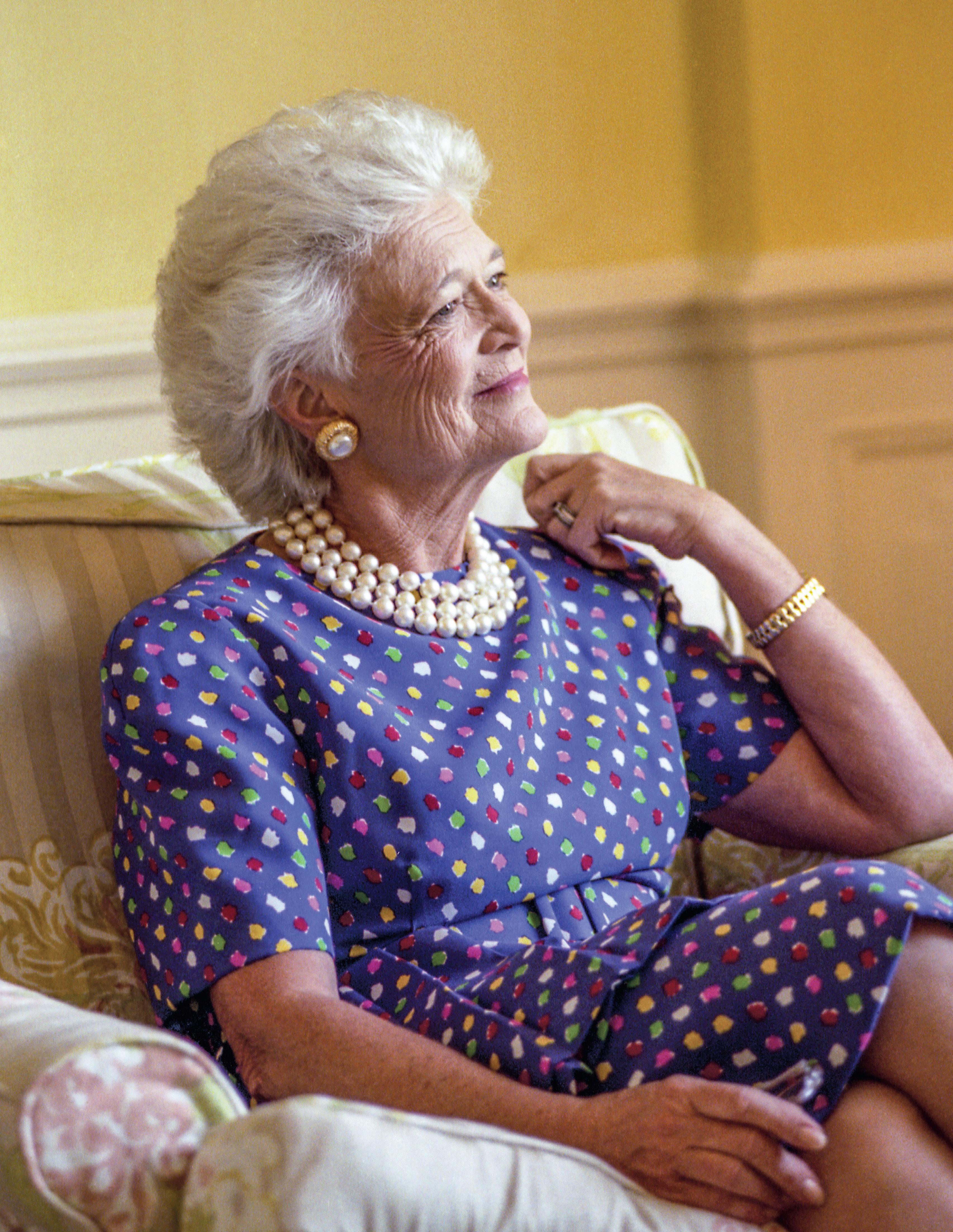
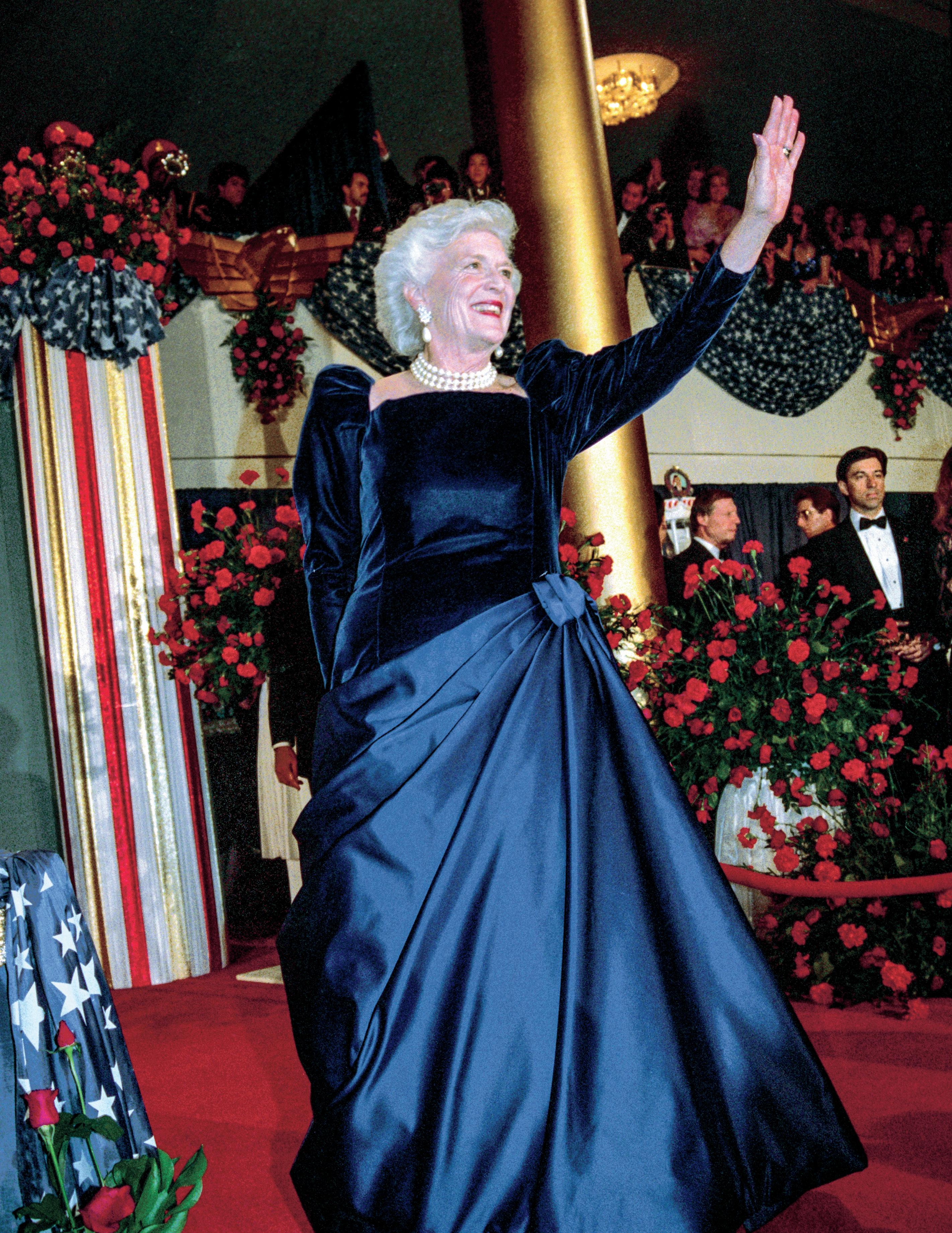
opposite and right
The nation soon embraced its new first lady for her “naturalness” following her fashionable debut in her new role at the Inaugural Balls, January 20, 1989. Arnold Scaasi, who observed that Mrs. Bush was suddenly “the most dazzling, glamorous grandmother” in the United States, designed the royal blue gown with velvet bodice and asymmetrically draped silk satin skirt.
previous spread
Rather than pose in her inaugural gown for Vogue, as previous first ladies had done, Mrs. Bush began a new tradition: “a substantive interview and relaxed photograph.” She is seen here during the interview in a favorite Scaasi design.
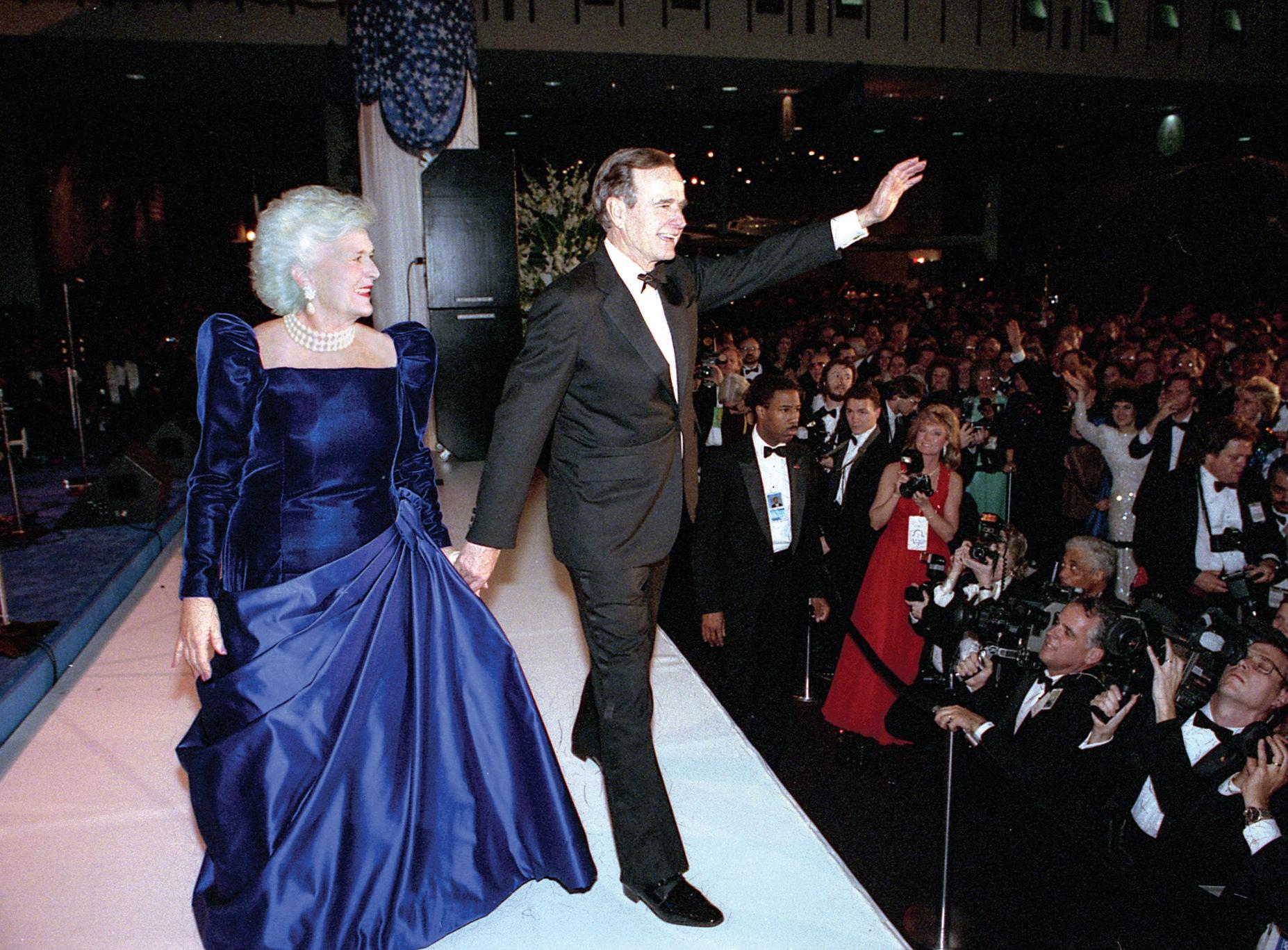
when first lady barbara bush stepped onto the stage at her husband’s Inaugural Ball, the crowds gasped. Wearing a deep sapphire blue dress with a velvet bodice and draped satin skirt and her signature faux pearl necklace, Mrs. Bush looked “radiant—the most dazzling, glamorous grandmother we had ever seen,” according to one observer.1
That night the woman her children called “The Silver Fox” became an instant fashion sensation. Gone was the woman who in her youth had let her mother and sister choose her clothes. Gone was the woman whose in-laws, at the outset of husband’s rise to national political prominence, had debated whether to urge her to update her appearance. In her place was a new style icon. “Barbara Blue” immediately became fashion’s favorite color, and sales of faux pearls skyrocketed.2
With her snow-white hair, ample figure, and handsome, “weathered” face untouched by plastic surgery, Barbara Bush was an unlikely fashionista—and she knew it.3 Yet she took what in other women might be considered flaws and used them as a springboard to create an image
that endeared her to millions of Americans—a woman of a certain age who was not afraid to look it, someone who spoke her mind and sounded like everyone’s mother or grandmother. “Hers was very much an everywoman kind of persona,” said historian Myra Gutin. “People really could relate to her. . . . She just seemed like someone you could talk to.”4 Mrs. Bush described her popularity more succinctly. “I think women like me because they don’t think I’m competitive, just nice.”5
Mrs. Bush’s timing was perfect. After eight years of Nancy Reagan’s glamorous Hollywood style, Americans were ready for a change, and Barbara Bush’s what-you-see-is-what-you-get approach to fashion was seen as fresh and appealing. Fashion writers who had praised Mrs. Reagan’s sophisticated elegance now hailed “the ‘new naturalness’” and “back to basics” approach of the nation’s new first lady.6 “After years in the public eye” and “fan mail filled with helpful hints” about altering her appearance, Barbara Bush “has emerged as a fashion leader with a very strong sense of who she is, how she is perceived and how she likes to look,” noted Women’s Wear Daily, the fashion industry’s
influential trade journal.7 “The fact that she makes no effort to pretend to be otherwise, and, in general, appears to dress to enhance her stature, is what makes her a formidable fashion icon,” wrote New York Times fashion editor Carrie Donovan. “Other women her age can emulate her and certainly relate to her in a comforting way.”8
One clothing manufacturer predicted Mrs. Bush would “be a mentor” to women of a certain age and size: “The first woman in the land is one of them and admirably so.” Another compared her to Jacqueline Kennedy, saying that she would “bring business back to suits. That’s what Jacqueline Kennedy did. You’re going to hear things about the Barbara Bush look.”9
“The Barbara Bush look” was built on the bedrock of a strong, savvy, can-do personality. “Here was a woman who could not only do her own hair and iron her own clothes but also fix a leaky water pipe, rewire an outlet, and make minor car repairs,” wrote Washington Post reporter Donnie Radcliffe, author of an early biography of the first lady. “She played cagey tennis, baby-sat the grandchildren, gave the middle of the bed to the dog, and worried more about her garden than whether she got dirt under her fingernails. She also avoided high society and when she thought she could get away with it, threw protocol to the winds.”10
Barbara Bush’s refusal to take herself or her clothes seriously also contributed substantially to her success. Striking a model-like pose at a pre-inaugural event in 1989. she told the audience, “Notice the hair, the makeup, the designer clothes, and remember. You may never see it again.”11 To spoof reporters’ stories about her hair, she once wore a strawberry blond wig to the annual Gridiron Dinner, confounding some guests and delighting others.12 When her husband gave her twenty-four pairs of her favorite Keds sneakers as a birthday gift, she purposely wore mismatched pairs “just to tease” him.13 Asked once by a fashion reporter what she was adding to her summer wardrobe, the first lady replied, “Inches.”14
Although Mrs. Bush disclaimed an interest in fashion (one reporter described her style as “Yankee no-nonsense”),15 her clothes were as much a part of her image as her white hair and faux pearls. She used her clothing to telegraph approachability, caring, and warmth. For example, she refused to pose in her Inaugural Ball gown for the traditional Vogue magazine profile of a new first lady. Instead, she
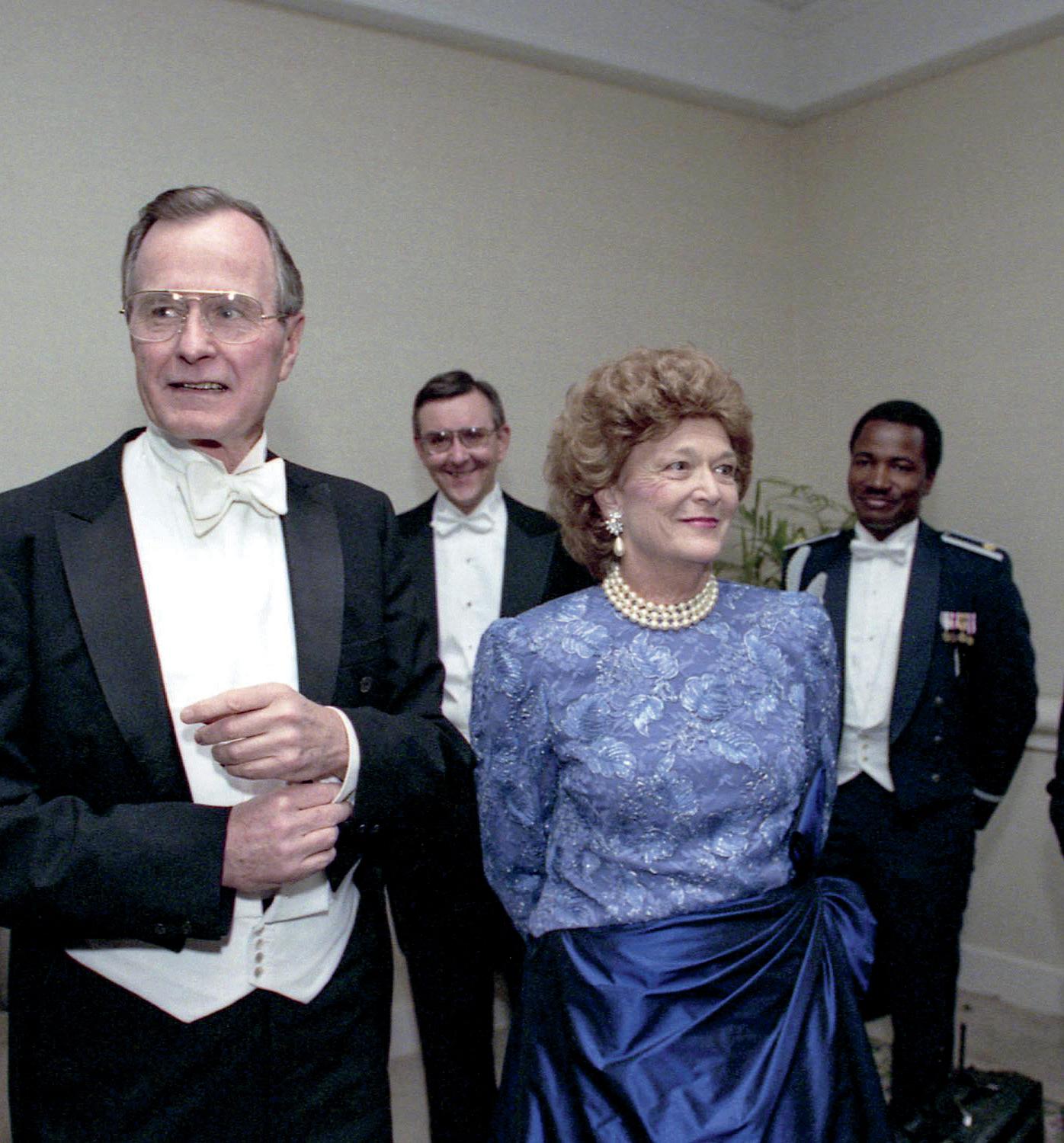
chose to be photographed seated on the Truman Balcony wearing a blue silk day dress and holding the Bushes’ dog, Millie. “Thus was born a new Vogue First Lady tradition,” recalled reporter Julia Reed, who wrote the accompanying article: “that of a substantive interview and relaxed photograph.”16
The photo caption noted that dress was an Arnold Scaasi design17—a tipoff that Mrs. Bush’s apparent lack of interest in fashion was something of an illusion. According to a New York Times article published shortly before her husband’s Inauguration, Mrs. Bush had long patronized New York’s Seventh Avenue designers including Scaasi, Bill Blass, and Adele Simpson.18 However, as Scaasi noted, her approach was decidedly practical: “She wants to look good and then forget about it.”19
Looking good for Mrs. Bush meant “somewhat tailored clothes with jewel necklines” (to showcase her pearls), sleeves (“short or long, but not three-quarter length . . . never sleeveless”), and once in the White House “entrance-making evening gowns.”20 Women’s Wear Daily noted the first lady’s preference for “clothes that stress versatility and comfort . . . that allow her to reach out to shake a hand, wave to a crowd, dance with her husband
above
To head off jokes about her white hair, Mrs. Bush donned a strawberry blond wig at the annual white-tie Gridiron Dinner, April 1989.
right
Mrs. Bush shows off the colorful floral lining of her blue Scaasi jacket during a preinaugural event at the Kennedy Center in January 1989. She cautioned the audience to “Notice the hair, the makeup, the designer clothes, and remember. You may never see it again.”
below Julia Reed conducts an interview for Vogue magazine as the new first lady keeps her dog Millie by her side.
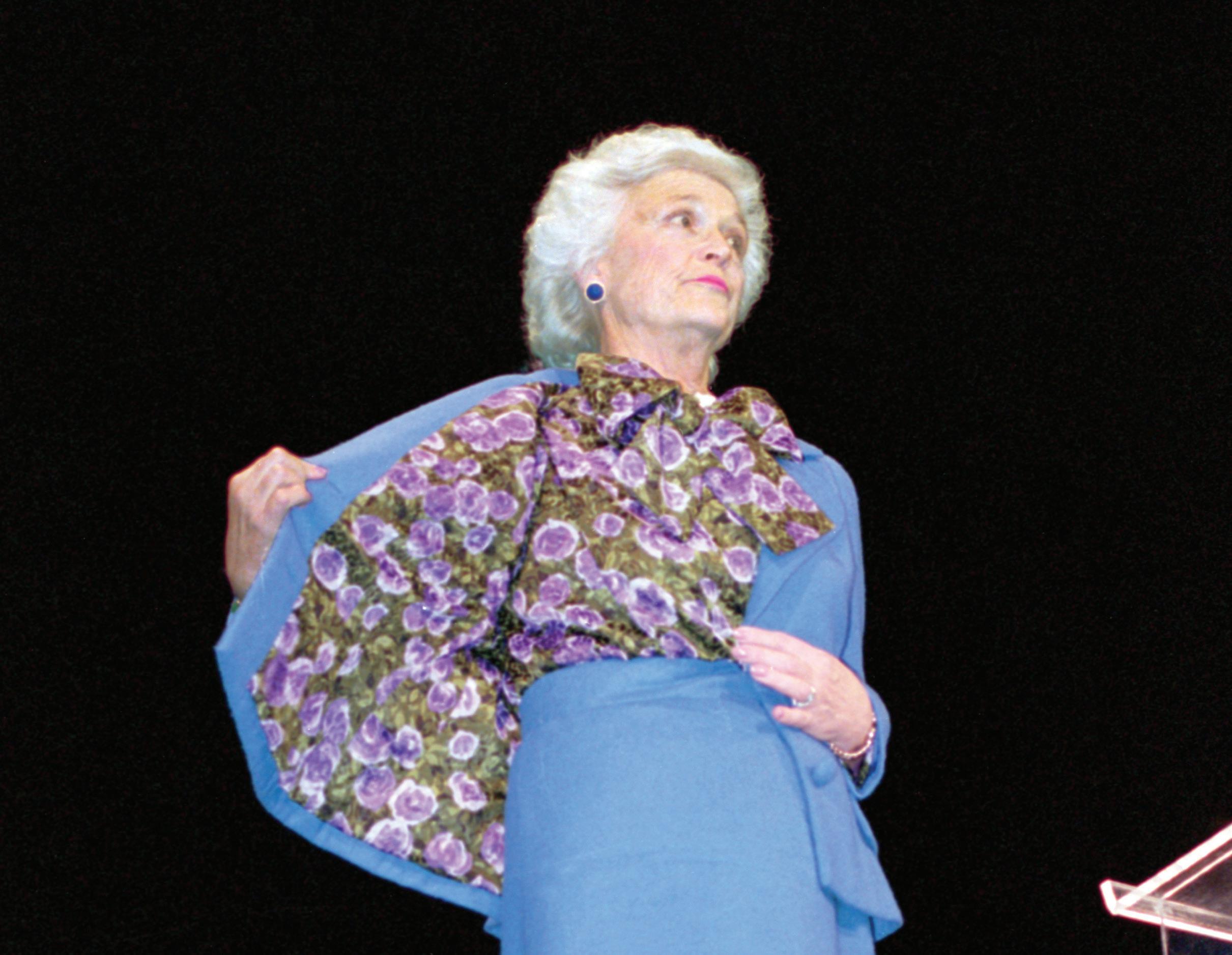
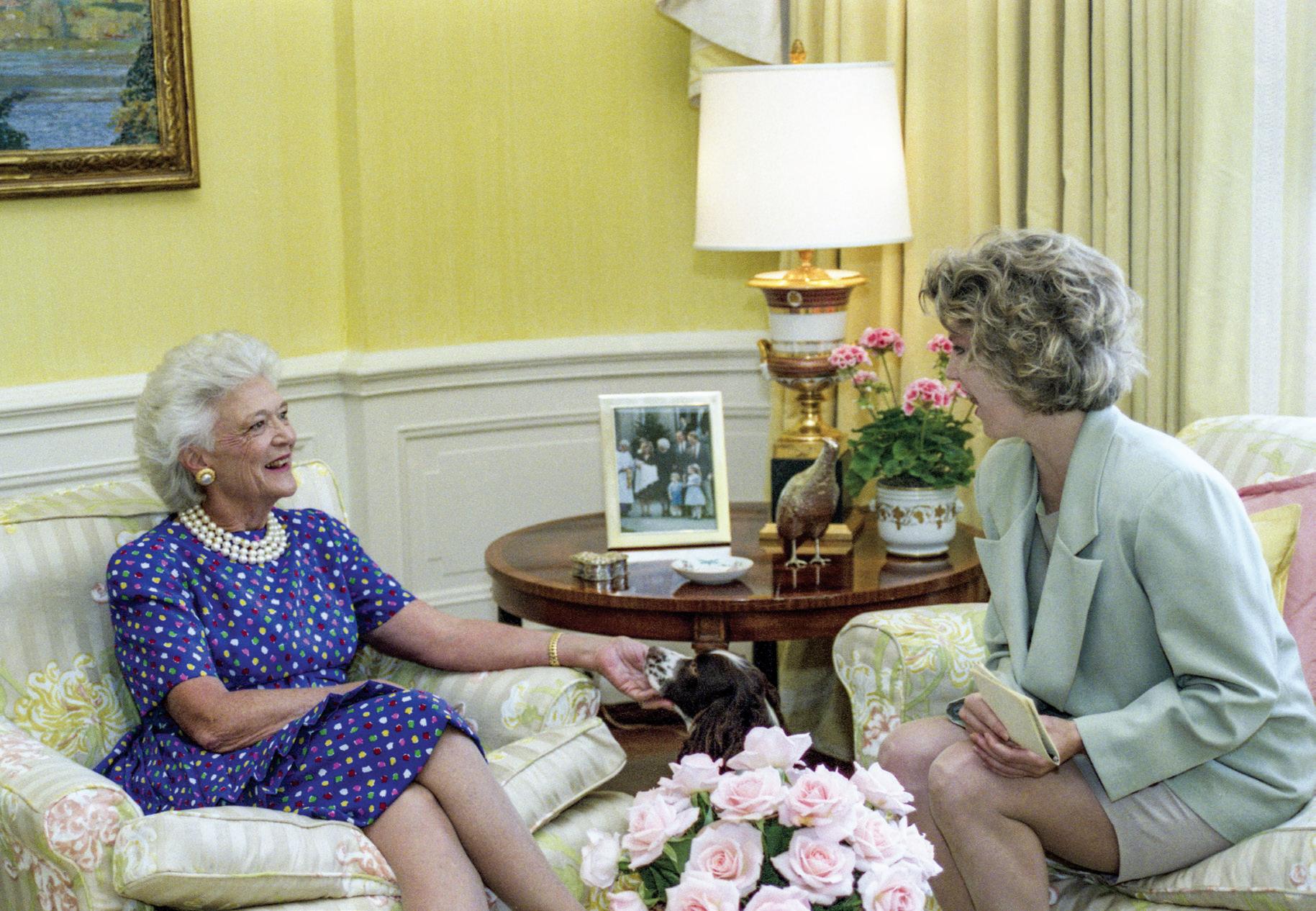
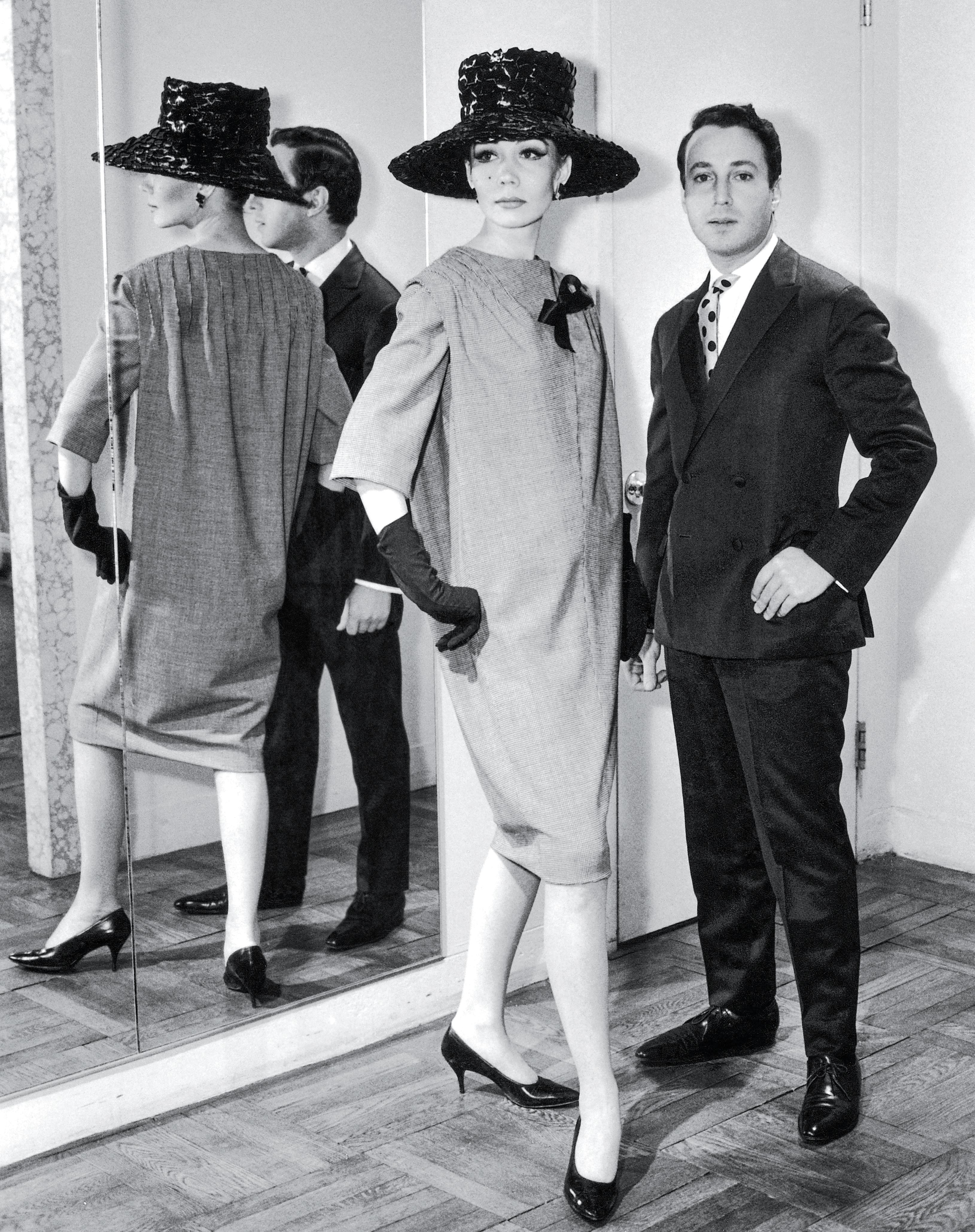
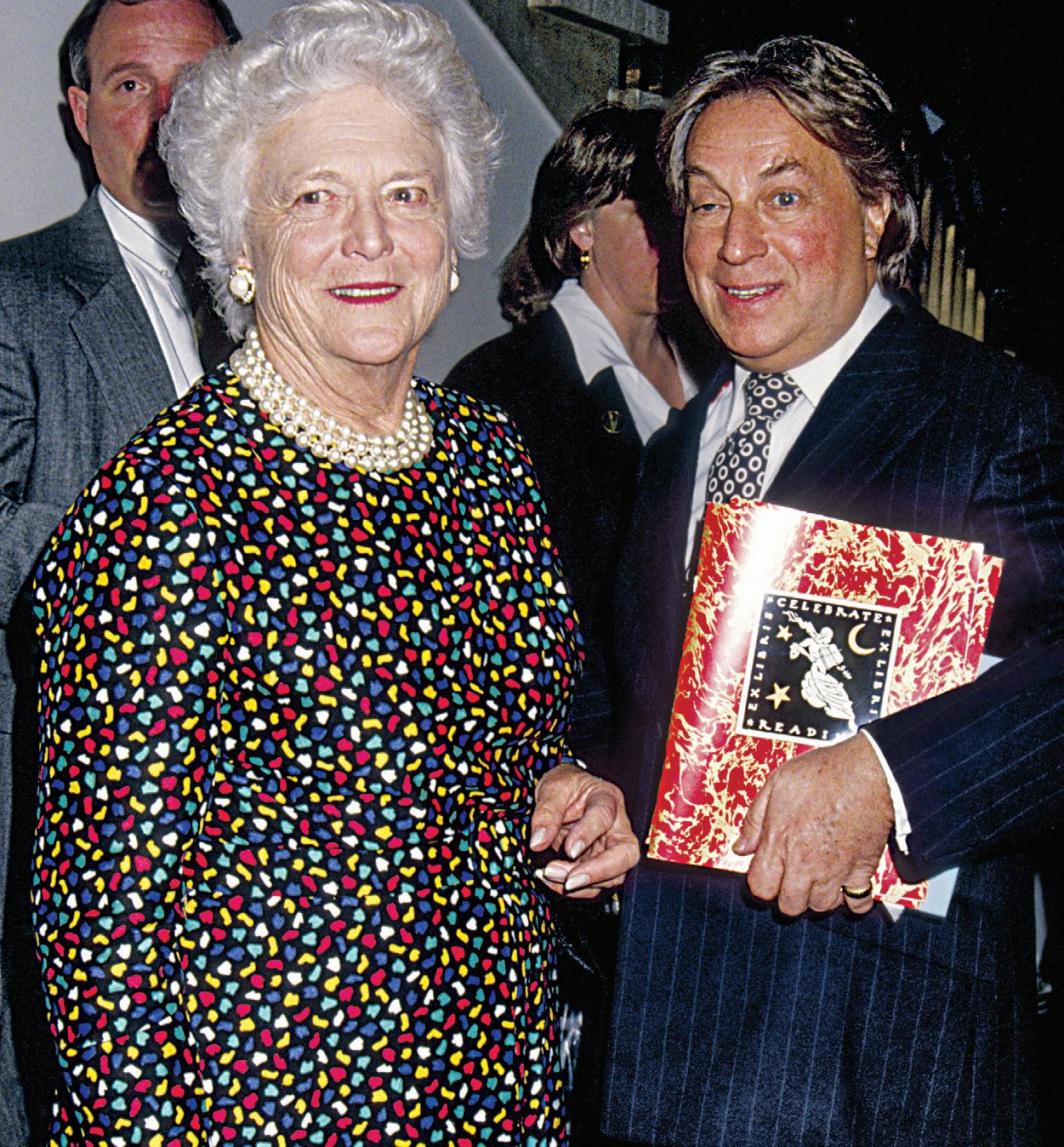
opposite Credited with creating Barbara Bush’s allAmerican look, Arnold Scaasi started his custom design business in 1954. He is seen here with one of his daytime dresses, 1962.
above
Scaasi began designing for Mrs. Bush during her time as Second Lady, and their friendship continued until the end of his life. Here he joins Mrs. Bush for the Literacy Partners Gala in New York, 1993.
or walk the dog.”21 Her overall look, according to Donovan, was “distinctly American,” “simple, attractive but self-effacing,” “no splash or flash and not too much dash.”22 Even her favorite perfume, White Shoulders—“a sweet floral fragrance”—was a classic.23
Ironically, Arnold Scaasi, the man most credited with helping Mrs. Bush craft her all-American fashion image, was Canadian. Born Arnold Isaacs in Montreal in 1930, he studied fashion design there and in Paris and apprenticed briefly at the house of Paquin before returning home in the early 1950s to work for famed American couturier Charles James. He legally changed his name in 1954 after a stylist he worked with on an ad campaign for automobiles reversed the spelling in the credits “to make it sound more glamorous.”24
Scaasi started his own custom-design business in 1954 and was soon designing clothes for actresses such as Joan Crawford, Elizabeth Taylor, and Barbra Streisand (for whom he created the famous see-through pants outfit she wore to the 1968 Oscars) and for opera stars such as Joan Sutherland, as well as for socialites and several first ladies, among them Mamie Eisenhower,
Jacqueline Kennedy (pre–White House), and Lady Bird Johnson. He also designed clothes for the masses, creating dresses sold in high-end department stores such as Henri Bendel in New York and Neiman-Marcus in Texas. In addition, he created costumes for film and theater productions.25
Known for his love of fur, feathers, and colorful, sumptuous fabrics, Scaasi seemed an unlikely choice for a traditionalist like Mrs. Bush. However, his overall design philosophy matched her practical style. He specialized in creating elegant, timeless clothing designed to make women “pretty not trendy.” His clothes were meant “to enhance a woman’s body and to lift her mood; in short to make her feel good about herself.” 26 His secret, according one observer, was his ability to “adopt a youthful style to a fuller figure so that it doesn’t lose anything. He brings all the detail up toward the face which . . . takes attention away from the imperfections of the body.”27 Clothes had to “touch and define some part of the body,” Scaasi believed, and he was famous for his ability to construct clothing that made his clients look younger, taller, and slimmer.28 His years of working with women in the public eye had also given him a good understanding of the kind of clothing that photographed well and the way custom-made outfits could give a woman confidence and help her establish a strong public image.29 Syndicated columnist Liz Smith attested to the success of the designer’s approach when she wrote that wearing a Scaasi creation made her “feel ‘right’ and comfortable and easy. I know then that I look as good as I can, or ever will. It’s incredibly relaxing, that.”30
Besides designing clothes that made his clients feel “‘right’ and comfortable and easy,” Scaasi was also known for paying attention to their needs. He called before an event to warn of the possibility that two or more women might arrive wearing the same dress or outfit. When one New York client on her way to Washington for a White House dinner thought something was wrong with the front of her dress, he told her to “come right over.” She did, and “he grabbed scissors,” cut out the offending fabric “stitched it down,” and sent her on her way.31 Funny, warm, and insightful—he once described himself as “part dressmaker, part psychiatrist”32—Scaasi was also “unabashedly opinionated, quick-witted, and feisty,” particularly in matters of dress.33 His fashion pronouncements were so definitive that one client dubbed him “He Who Must Be Obeyed.”34
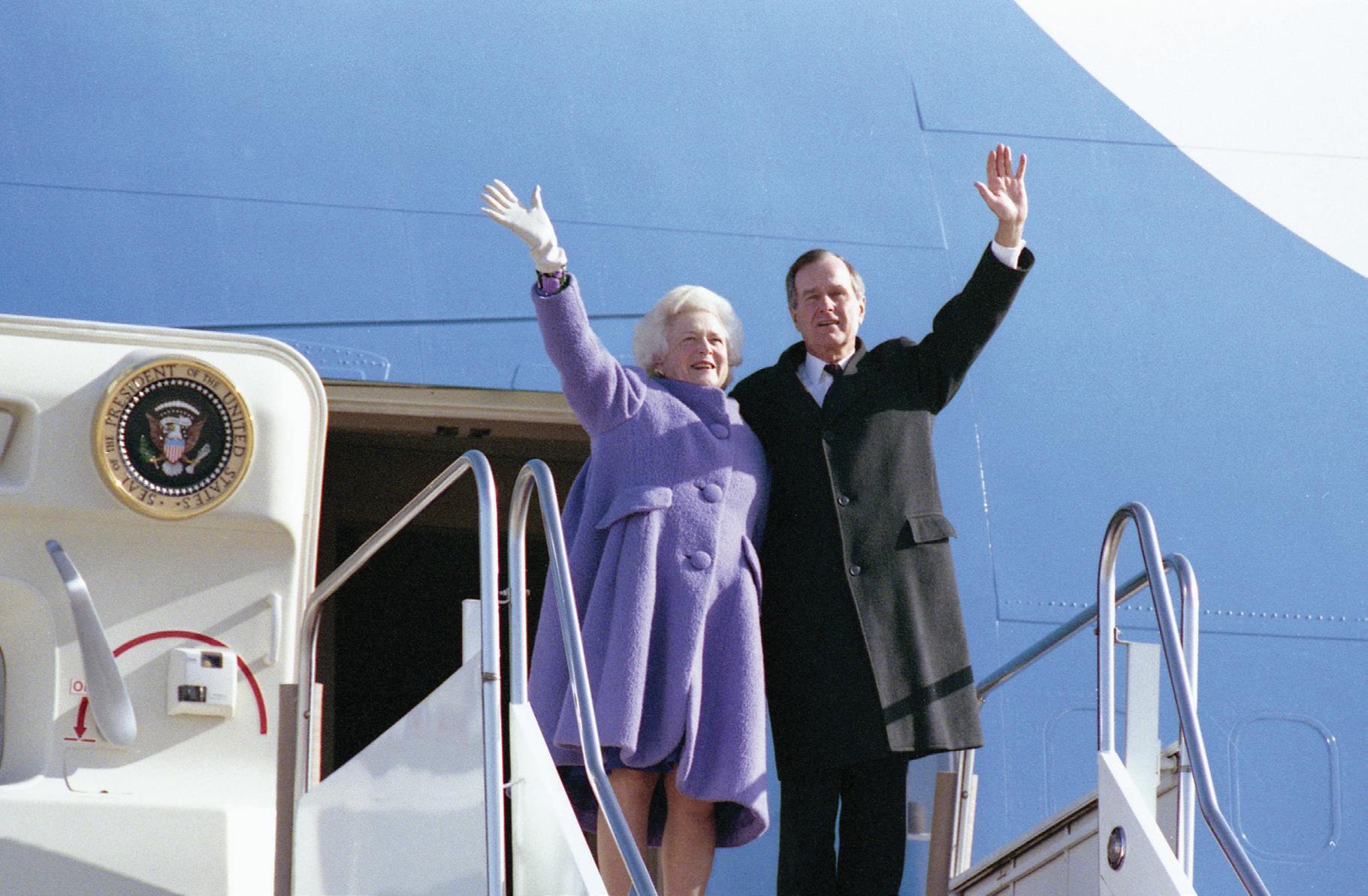
Scaasi first met Barbara Bush at a 1986 White House State Dinner hosted by the Reagans. At that point, glamor was in. It was an era of big hair, big shoulders, big accessories, and extravagant formal wear—in short, a moment tailor-made for a flamboyant designer like Scaasi. The couturier was taking full advantage of it. In addition to his custom design business, he had recently resumed designing ready-to-wear clothing for sale in high-end department stores after a twenty-year hiatus.35 At that point, Mrs. Bush was the wife of the vice president. She was already wearing clothes from several New York designers, but she did not know Scaasi.36 When the two finally connected, he told her that their mutual friends were saying he “should make clothes for” her. Then he handed her his card.37
Barbara Bush called him two weeks later. They were an odd couple, the diminutive designer and the statuesque second lady, but they quickly hit it off. He found her “wonderful to work with” because she was “intelligent and has a sense of humor, even to the point of poking fun at herself.”38 She thought he “could make any woman feel like a princess.”39
Soon Mrs. Bush was visiting Scaasi’s studio to have lunch (chicken sandwiches) and choose clothes. He designed her Inaugural Ball gown, the suit she wore to a pre-inaugural event at the
Kennedy Center, and many other day and evening outfits.40 Although she wore the clothes of other designers, Mrs. Bush and Scaasi became identified in the public mind in much the same way that Jacqueline Kennedy and her designer, Oleg Cassini, had been linked. Like Cassini, Scaasi was more than a designer. He was a friend, visiting the White House for fittings and sleeping in the Lincoln Bedroom on the extra pillows that Mrs. Bush thoughtfully provided.41 He also became a strong supporter of Mrs. Bush’s literacy efforts, co-chairing New York City’s Literacy Partners Gala at Lincoln Center, an adult literacy fund-raiser, for many years.42 While they were fast friends, their relationship had its moments. Mrs. Bush recalled that she and Scaasi fought “a little about colors and styles,” but “he, of course, was always right.”43 At the same time she influenced him. When dyed furs became popular In the 1990s, Scaasi designed a mink coat in a color he called “Barbara Blue” after the first lady’s favorite color.44
Mrs. Bush left the White House the way she came, wearing the same lavender wool Scaasi coat she had worn shortly after she arrived in 1989. By the time she departed, however, her relationship with the designer was firmly cemented, and he continued to create outfits for her.45 Now, instead of
Barbara Bush wore her lavender wool Scaasi coat at the beginning of her husband’s term and also chose it for her departure. She is seen here arriving in Houston with her husband following the Inauguration of Bill Clinton, January 20, 1993.
ball gowns and other formal clothes, he designed silk crepe dresses with jackets or wool crepe suits she could wear when traveling or giving speeches.46
When Scaasi died at age 85 in 2015, the fashion world mourned a great talent, and Mrs. Bush lost “a dear friend.”47 Although he had designed for several first ladies, including Mrs. Bush’s successors, Hillary Clinton and daughter-in-law Laura Bush, as well as socialites, actresses, and celebrities, Scaasi remained best known for his work with Barbara Bush. His obituary in the New York Times included a photograph of the former first lady wearing her “Barbara Blue” inaugural gown. While she typically gave “my precious Mr. Scaasi”48 most of the credit for her look, in fact, their relationship had been a true collaboration. Her down-to-earth personality, coupled with his ability to capture what he called her “quality of glamor,”49 had resulted in the creation of a timeless fashion icon—one that enhanced both their reputations. His designs had made her fashionable. She, in turn, had made him a household name. Together, they made her nickname “The Silver Fox” a part of both White House and fashion history.
1. Quoted in Amy Sullivan, “First Impressions: An Analysis of Media Coverage of First Ladies and Their Inaugural Gowns from Jackie Kennedy in 1961 to Michelle Obama in 2009” (MA thesis, University of Alabama, 2018), 53. Barbara Bush also wore a pair of “uncomfortable” $29 shoes. Barbara Bush, Barbara Bush: A Memoir (New York: St. Martin’s Press), 278.
2. Margaret Carlson, “The Silver Fox,” Time, June 24, 2001; Marty Primeau, “Barbara Bush,” Dallas Morning News, August 19, 1984, E1; Susan Page, The Matriarch: Barbara Bush and the Making of an American Dynasty (New York: Twelve, 2019), 110; Katey Rich and Donald Liebenson, “First Lady Barbara Bush Has Died at 92,” Vanity Fair, April 17, 2018.
3. Carrie Donovan, “‘B.B.’ Style,” New York Times Magazine, July 30, 1989, 38; Jan Galletta, “Still Swearing ‘By George,’” Chattanooga News–Free Press, January 10, 1988, I11.
4. Quoted in “Barbara Pierce Bush,” in Susan Swain and C-SPAN, First Ladies: Presidential Historians on the Lives of 45 Iconic American Women (New York: Public Affairs, 2015), 410.
5. Quoted in Marjorie Williams, “Barbara’s Backlash,” Vanity Fair, August 1992.
6. Donnie Radcliffe, Simply Barbara Bush: A Portrait of America’s Candid First Lady (New York: Warner Books, 1989), 8.
7. Susan Watters, “A Strong Sense of Personal Style,” Women’s Wear Daily/Large Sizes, March 1989, 8.
8. Donovan, “‘B.B.’ Style,” 38.
9. Both quotations in Judy Bloomfield, “The First Lady Factor,” Women’s Wear Daily/Large Sizes, March 1989, 6.
10. Radcliffe, Simply Barbara Bush, 5.
11. Quoted in Page, Matriarch, 168.
12. Martha Sherill, “The Wig and the Wags,” Washington Post, April 3, 1989, D1.
13. Bush, Memoir, 318–19.
14. Quoted in Susan Watters, “Lunch with Babs,” Women’s Wear Daily, June 7, 1991, 16.
15. Martha Sherrill, “The Look That’s Simply Barbara Bush,” Washington Post, January 21, 1989, C1.
16. Julia Reed, “Julia Reed Remembers Barbara Bush,” Garden and Gun, April 18, 2018. This article noted that the first lady gave famed fashion photographer Arthur Elgort just five minutes to make the photograph. See also Julia Reed, “The Natural,” Vogue, August 1989, 312–17.
17. Reed, “Natural,” 312.
18. “Custom-Made Dress for Next First Lady,” New York Times, January 14, 1989, 8. In her memoir Barbara Bush noted that she also bought clothes designed by Diane Dickinson. Bush, Memoir, 171.
19. Quoted in Donovan, “‘B.B.’ Style,” 38.
20. Ibid.
21. Watters, “Strong Sense,” 8.
22. Donovan, “‘B.B.’ Style,” 38.
23. “First Lady’s First Fragrance,” Women’s Wear Daily, January 27, 1989,8. The article described White Shoulders as “one of the oldest American perfumes.”
24. Elizabeth Sporkin, “Scaasi,” People, April 23, 1990, 99.
25. Bernadine Morris, Scaasi: A Cut Above (New York: Rizzoli, 1996), 49, 59.
26. Ibid., 160, 186.
27. Judy Stoffman, “Arnold Scaasi Grand Entrances,” Toronto Star, November 22, 1990, K1; Morris, Scaasi, 184.
28. Morris, Scaasi, 180, 184.
29. Ibid., 72, 73.
30. Liz Smith, introduction to Morris, Scaasi, 9.
31. Ibid.; Sporkin, “Scaasi,” 99.
32. Quoted in Sporkin, “Scaasi,” 99.
33. “Remember: Arnold Scaasi, From the Socials to First Ladies, He Dressed Them All,” Women’s Wear Daily, August 5, 2015, 88.
34. Smith, introduction to Morris, Scaasi, 9.
35. Pamela A. Parmal, Scaasi: American Couturier (Boston: Museum of Fine Arts, 2010), 133, 142; Morris, Scaasi, 160; “Fashion History Timeline, 1980–1989,” Fashion Institute of Technology website, www.fashionhistory.fitnyc.edu.
36. Bush, Memoir, 171.
37. Morris, Scaasi, 162.
38. Quoted in ibid.
39. Quoted in “Remember: Arnold Scaasi,” 88.
40. Morris, Scaasi, 162.
41. Oleg Cassini, In My Own Fashion (New York: Simon & Schuster, 1987), 318–20; Arnold Scaasi, foreword to Morris, Scaasi, 7.
42. Alexandra Jacobs, “Arnold Scaasi, Who Dressed Generations of Prominent Women, Dies at 85,” New York Times, August 5, 2015, B14.
43. Quoted in “Remember: Arnold Scaasi,” 88.
44. Morris, Scaasi, 111.
45. Parmal, Scaasi, 135.
46. Morris, Scaasi, 170.
47. Quoted in “Remember: Arnold Scaasi,” 88.
48. Quoted in Roxanne Roberts, “First Lady Donates Gown,” Washington Post, January 10, 1990, D3.
49. Quoted in Morris, Scaasi, 170.
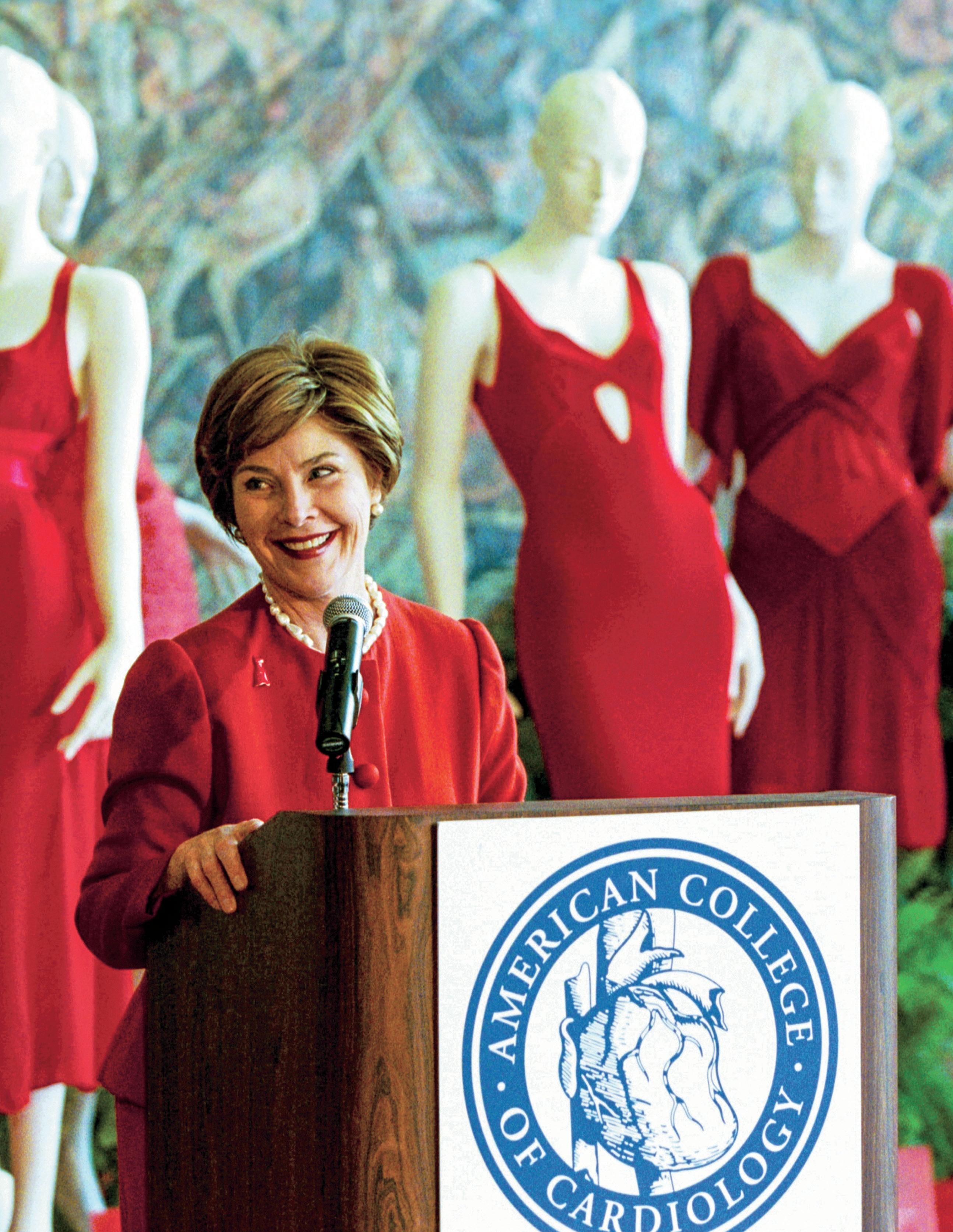

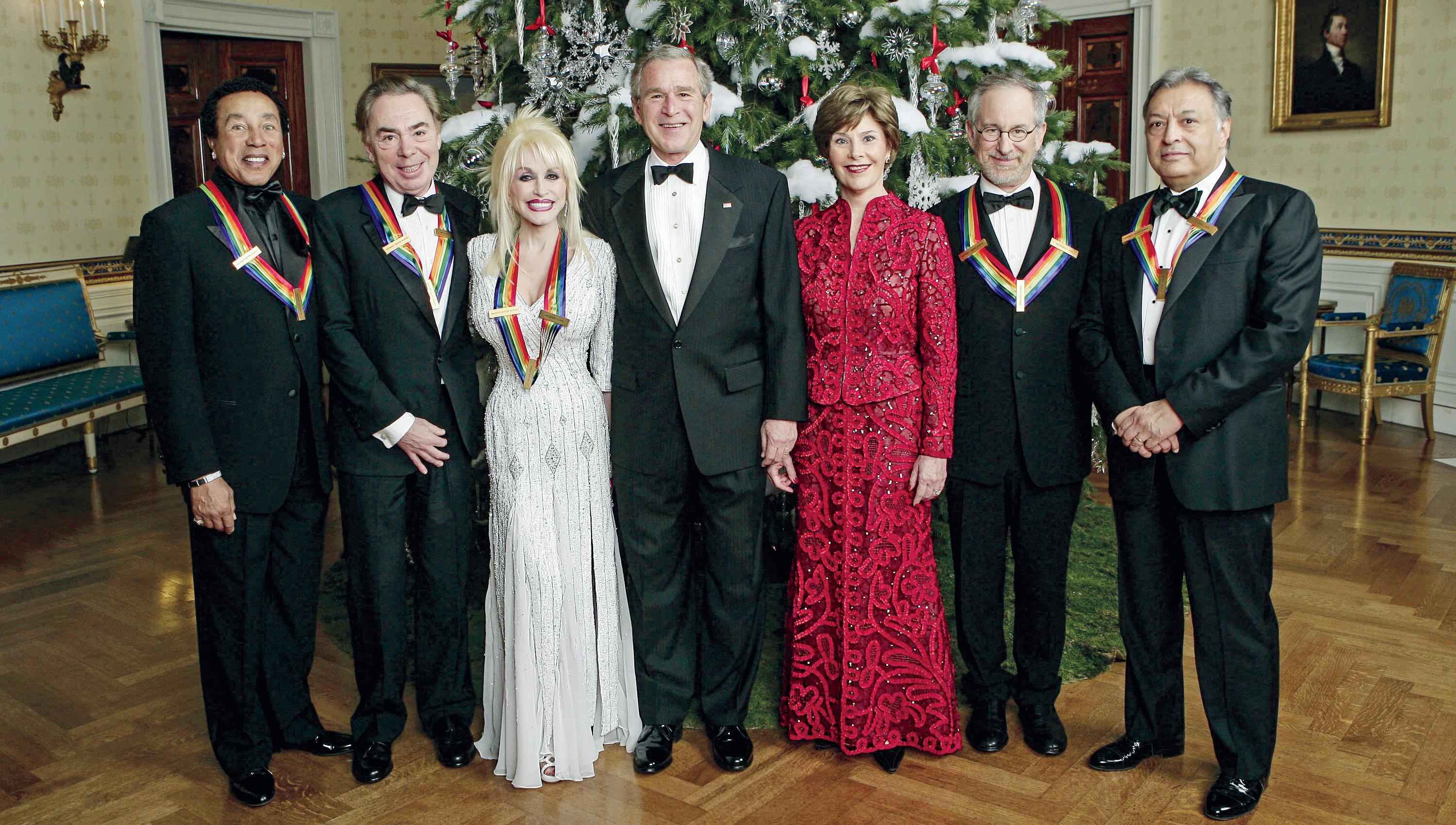
on december 3, 2006, President George W. Bush and First Lady Laura Bush hosted a White House reception in advance of the Kennedy Center Honors. Mrs. Bush selected a brilliant red Oscar de la Renta gown for the occasion, inspired by the dramatic red of the Kennedy Center’s interior. Yet Mrs. Bush was not alone in her good taste. Three other women attending the reception selected the same gown and greeted the first lady as they moved through the receiving line. The women laughed off the faux pas, even posing for a photograph together, but the first lady chose to change before the awards ceremony. Despite its short-lived appearance for the honors ceremony that December evening, Mrs. Bush’s red gown was later featured in the official White House holiday photograph and traveled the country as part of the Heart Truth Red Dress campaign.1
In the beginning months of her tenure as first lady, Laura Bush’s everyday fashion reflected a conservative, subdued style. She adopted a mixture of slim and tailored pantsuits in muted colors and earthy greens or oranges, as well as the occasional wool tweed suit. Dallas fashion designer Michael Faircloth, whose clothes were worn by the first lady on more than one occasion, observed that “she was always very conscientious about not wanting
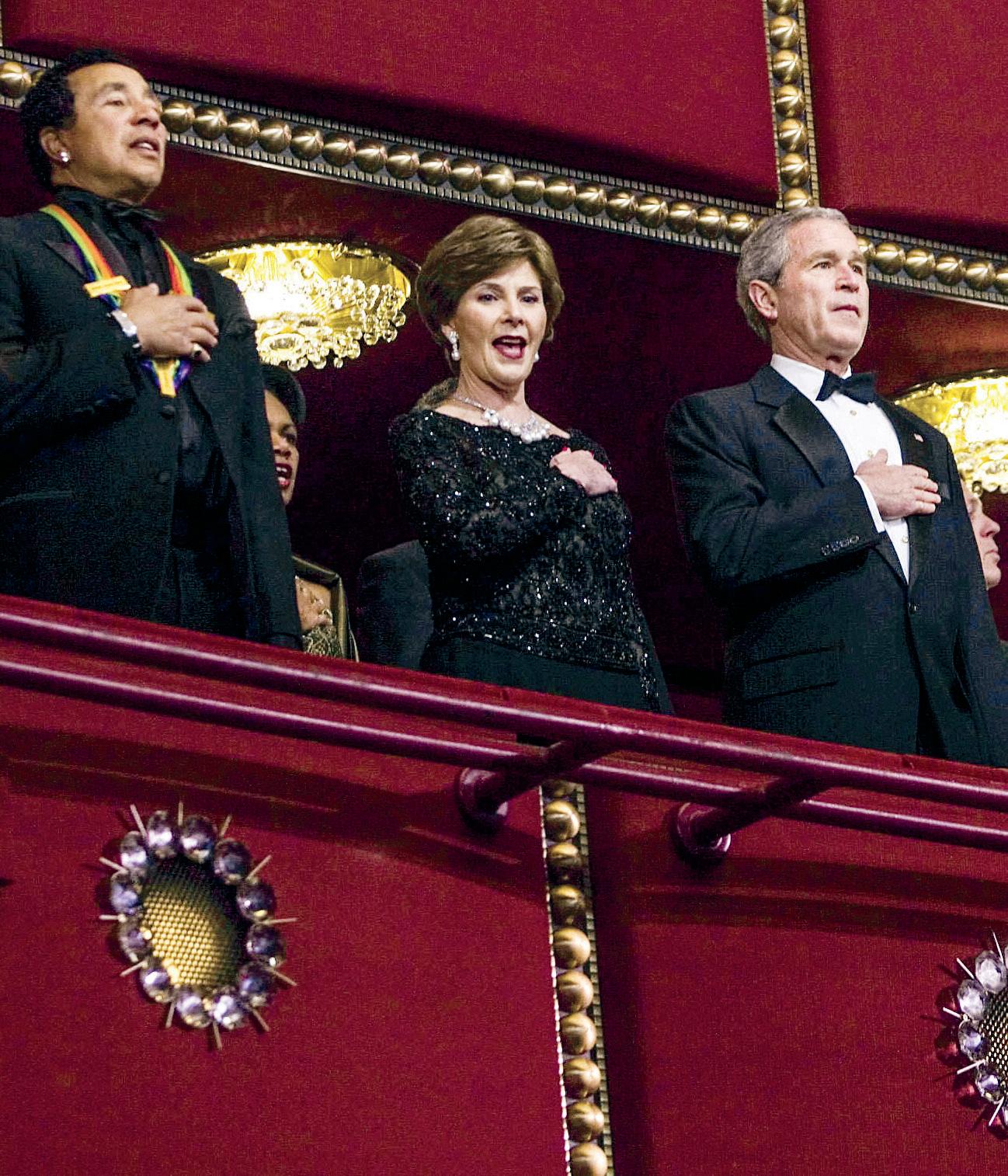
Accepting an honorary fellowship from the American College of Cardiology, First Lady Laura Bush explains that she wears her Red Dress pin to remind women that “heart disease doesn’t care what you wear,” 2004.
opposite
After posing at a White House reception with recipients of the 2006 Kennedy Center Honors, Laura Bush discovered that three guests were wearing the same Oscar de la Renta gown that she had chosen. From left to right, Smokey Robinson, Andrew Lloyd Webber, Dolly Parton, President and Mrs. Bush, Steven Spielberg, and Zubin Meta. She decided to change before the award ceremony (below), but the red dress would later travel in an exhibit to bring attention to the Heart Truth Red Dress campaign.
right
First Lady Laura Bush wears an understated pantsuit as she welcomes the press to the East Garden ahead of the 2004 Spring Garden Tours.
clothes to speak loudly” because she believed there were other things that were “more important.”2 This approach to fashion remained constant throughout her eight years as first lady with two exceptions: fashion for formal occasions and fashion as a tool for advocacy.
When Laura Bush arrived at the White House as first lady, like most Americans she believed cancer was the leading cause of death among women in the United States. This belief was due, in part, to a concerted public health campaign to raise awareness of cancer risks following President Richard Nixon’s 1971 State of the Union Address, in which he asked for $100 million to find a cure for cancer.3
The Breast Cancer Detection and Demonstration Project (BCDDP) launched the next year, followed soon after by the open, national discussion of the diagnosis and treatment of First Lady Betty Ford and Vice President Nelson Rockefeller’s wife, Happy Rockefeller, for breast cancer. Women’s health advocacy organizations sprang into action and grew rapidly throughout the next two decades, raising awareness and funds for research; the Susan G. Komen Breast Cancer Foundation, later renamed the Susan G. Komen for the Cure, became a household name.
Despite success in raising awareness about women’s risk for cancer, the medical profession and previous
the American public still lacked a broader understanding of women’s health risks. In 2000, studies emerged reporting that one in three American women’s deaths were due to heart disease. Not enough women—or their doctors—were sufficiently aware of these emerging statistics about women’s heart health.4 A separate survey conducted by the American Heart Association in 2000 showed that only 34 percent of women knew that heart disease represented their most likely cause of death. Most believed breast cancer was their greatest health concern.5 Heart disease was not something they took seriously or personally; rather, they predominantly viewed it as a “man’s disease.”
In the same historical moment, women who had experienced heart attacks began to share their stories. They learned of one another’s misdiagnoses, inadequate treatment, and social isolation, which motivated them to form a supportive network for women living with heart disease. Brought together by a reporter for MORE magazine, they founded WomenHeart: The National Coalition for Women with Heart Disease in 1999 as the first national patient-centered organization that would focus exclusively on women’s heart disease. The next year Sister to Sister: Everyone Has a Heart Foundation Inc. was founded to increase awareness and encourage healthy lifestyles among women.
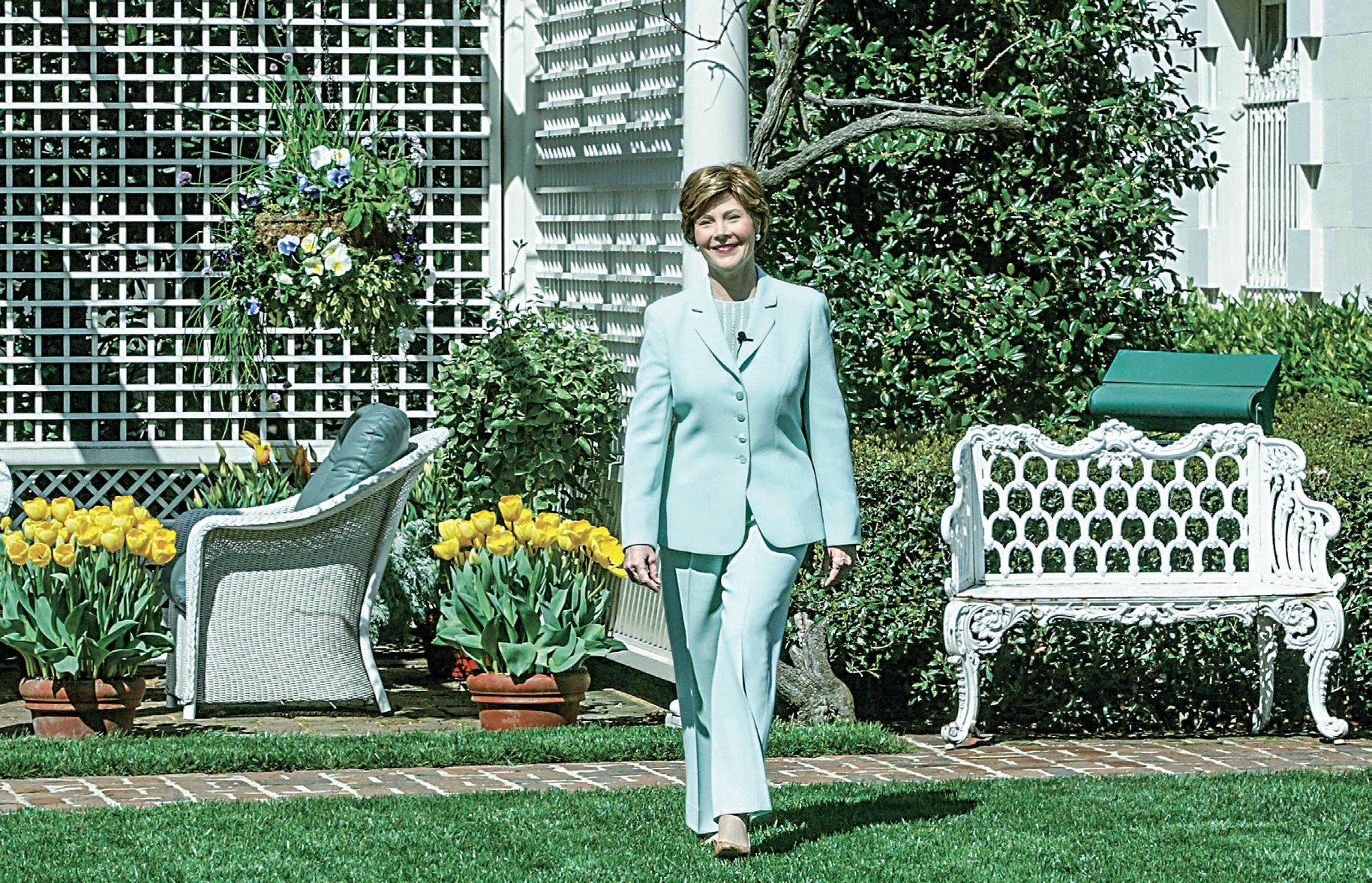
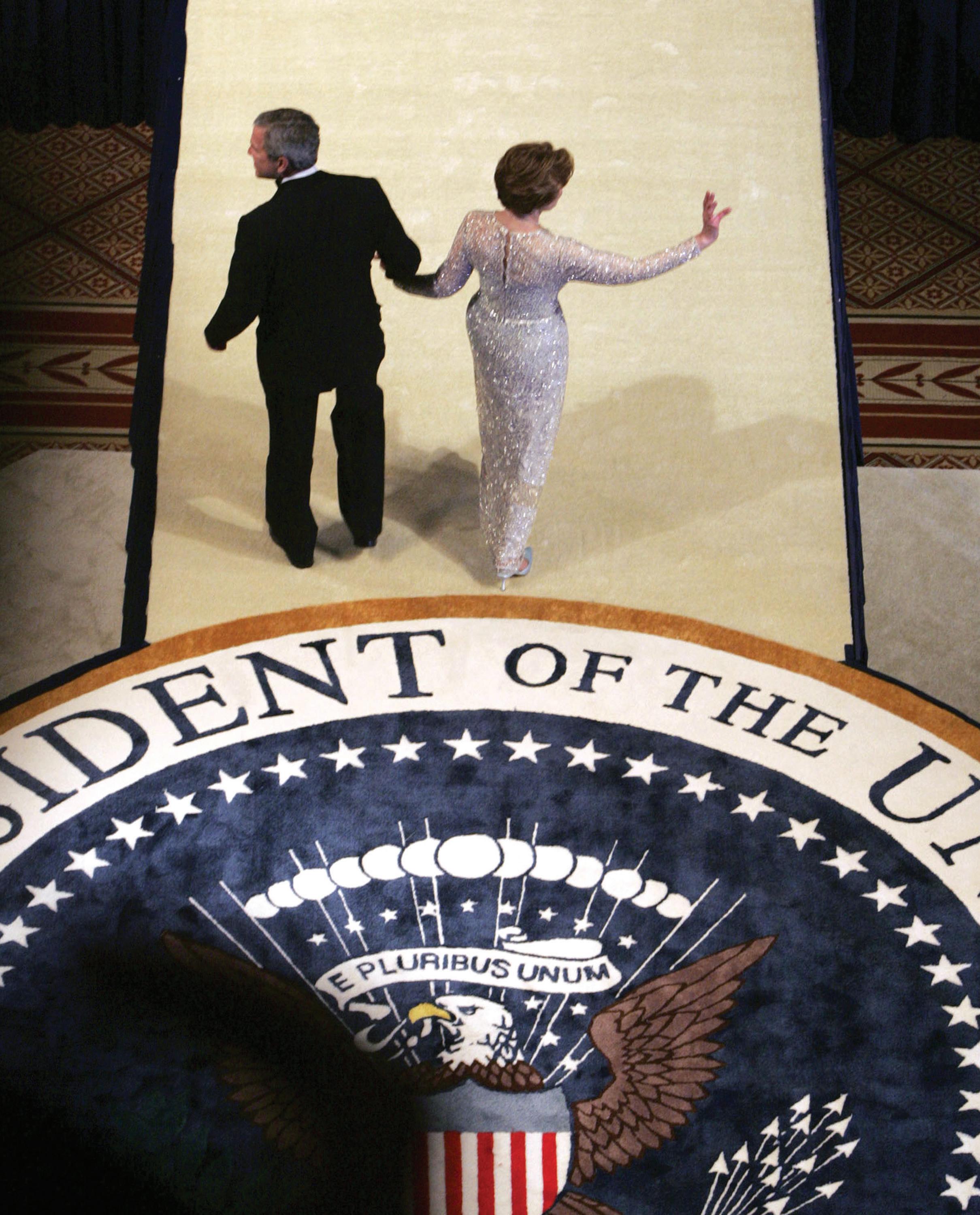
For most official occasions Mrs. Bush chose suits in muted colors, not wanting her fashion choices to speak too loudly. She made exceptions to the this approach for such formal occasions as the Inaugural Balls, seen here, and when fashion could be a tool for advocacy.
President and Mrs. Bush dance at the Ronald Reagan Inaugural Ball
January 20, 2001 (top right) and step onto the dance floor at the Constitution Ball, January 20, 2005 (opposite and bottom right).
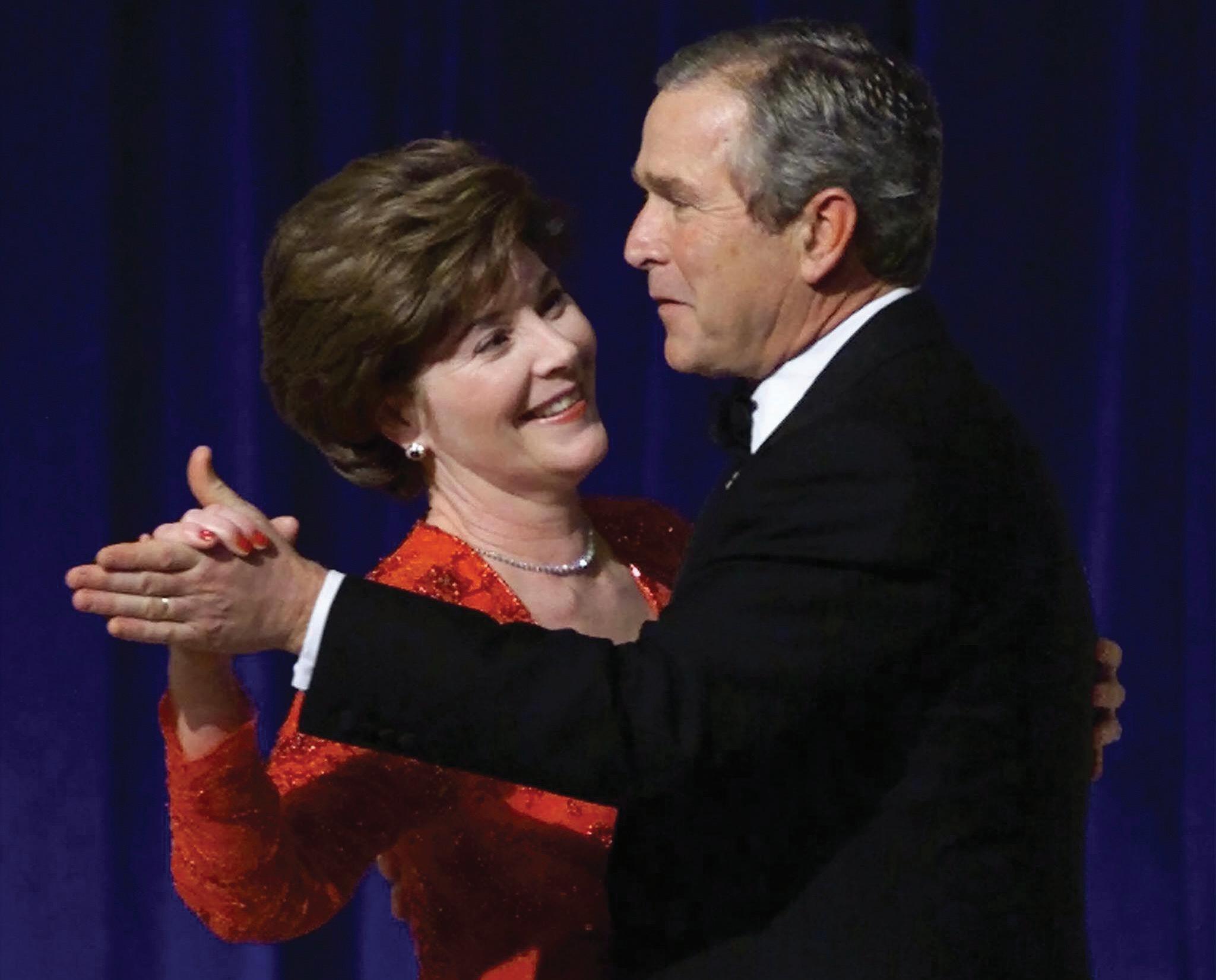
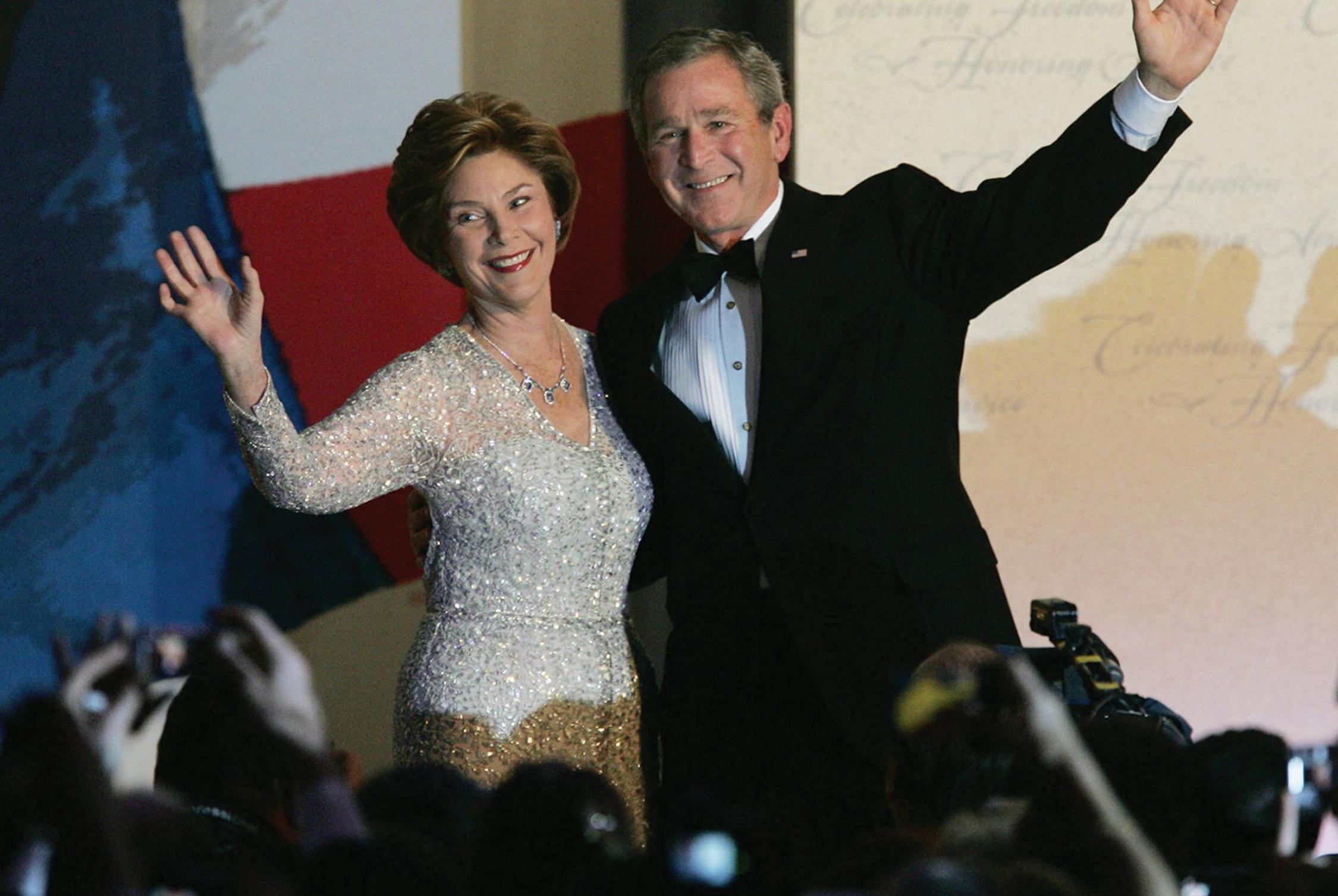
As these movements garnered more support and gained momentum, they turned to public advocacy. WomenHeart was determined to put women’s heart health on the National Heart, Lung, and Blood Institute’s (NHLBI) national agenda. In 2001, the NHLBI, WomenHeart, patients, researchers, public health leaders, health communicators, health care delivery experts, and other women’s health advocates participated in the Women’s Heart Health Education Strategy Development Workshop.6 Their subsequent partnership with Ogilvy Public Relations Worldwide unfurled a blueprint for what would become the Heart Truth campaign and a new powerful symbol for women’s heart disease—the Red Dress.
The Heart Truth, a name designed to acknowledge the “hard truth” and urgency of women’s experience with heart disease, launched in September 2002 in Washington, D.C., officially as a partnership among the U.S. Department of Health and Human Services Offices on Women’s Health, the American Heart Association, and WomenHeart. To increase the visibility of the campaign, advocates believed they needed an ambassador who could connect with American women and speak from a national platform. Dr. Elizabeth Nabel of the NHLBI approached the office of First Lady Laura Bush.
American first ladies have often used their platforms to promote health and disease awareness, research, and treatment. Scholars have documented Eleanor Roosevelt’s advocacy for access to healthcare as part of her broader commitment to universal human rights, the impact of Betty Ford’s candor regarding breast cancer and mental health, Nancy Reagan’s commitment to combating substance abuse and investing in stem cell research, and Hillary Rodham Clinton’s work to expand access to basic health care through policy reform. This work is not simply an extension of their husbands’ agendas but often stems from their own value judgments, personal experiences, and political ambition.7
By the summer of 2002, Laura Bush drew approval ratings consistently above 60 percent. When surveyed, Americans described her as “honest,” “confident,” “intelligent,” and “caring.”8 Even before she became first lady of the United States, she amassed a record of advocating on behalf of women’s and children’s health issues during her time as first lady of Texas and as a member of
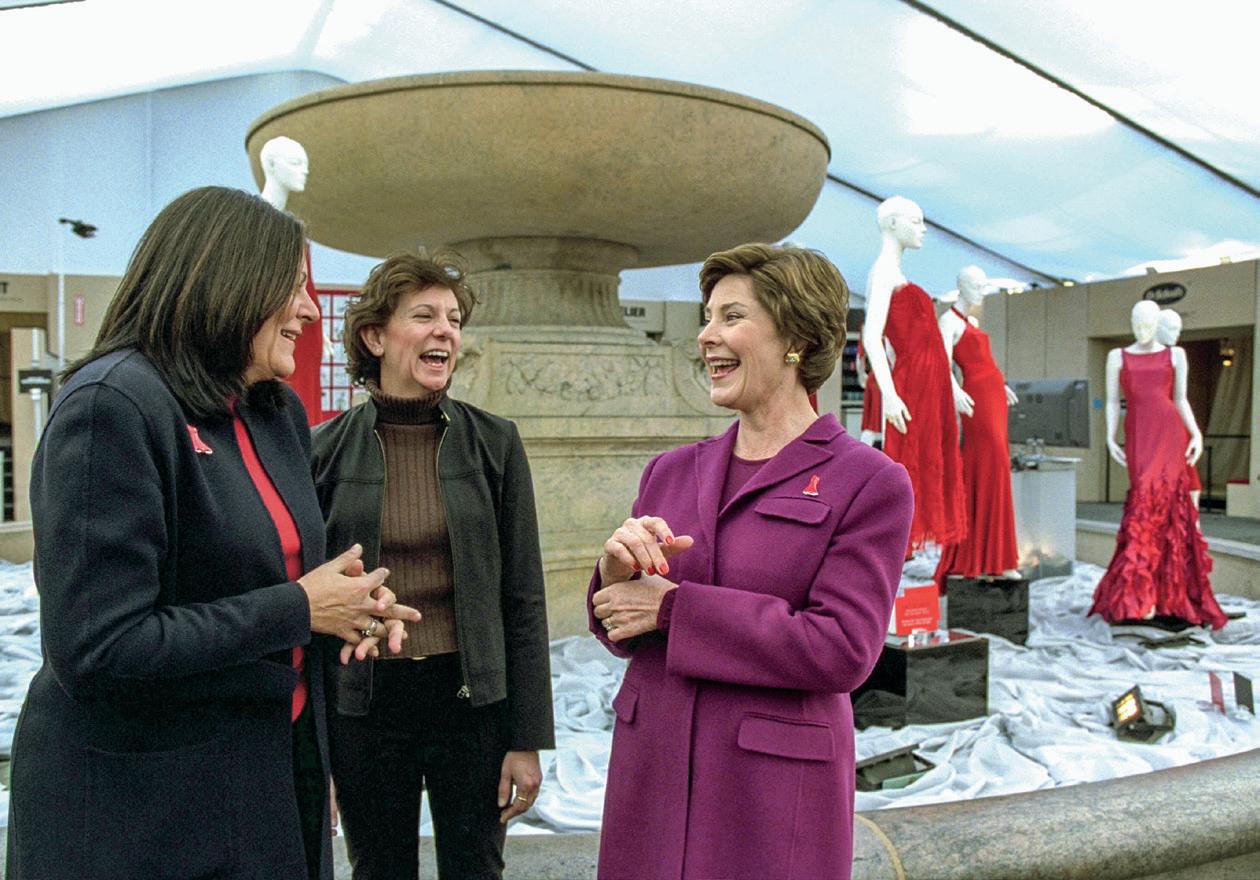
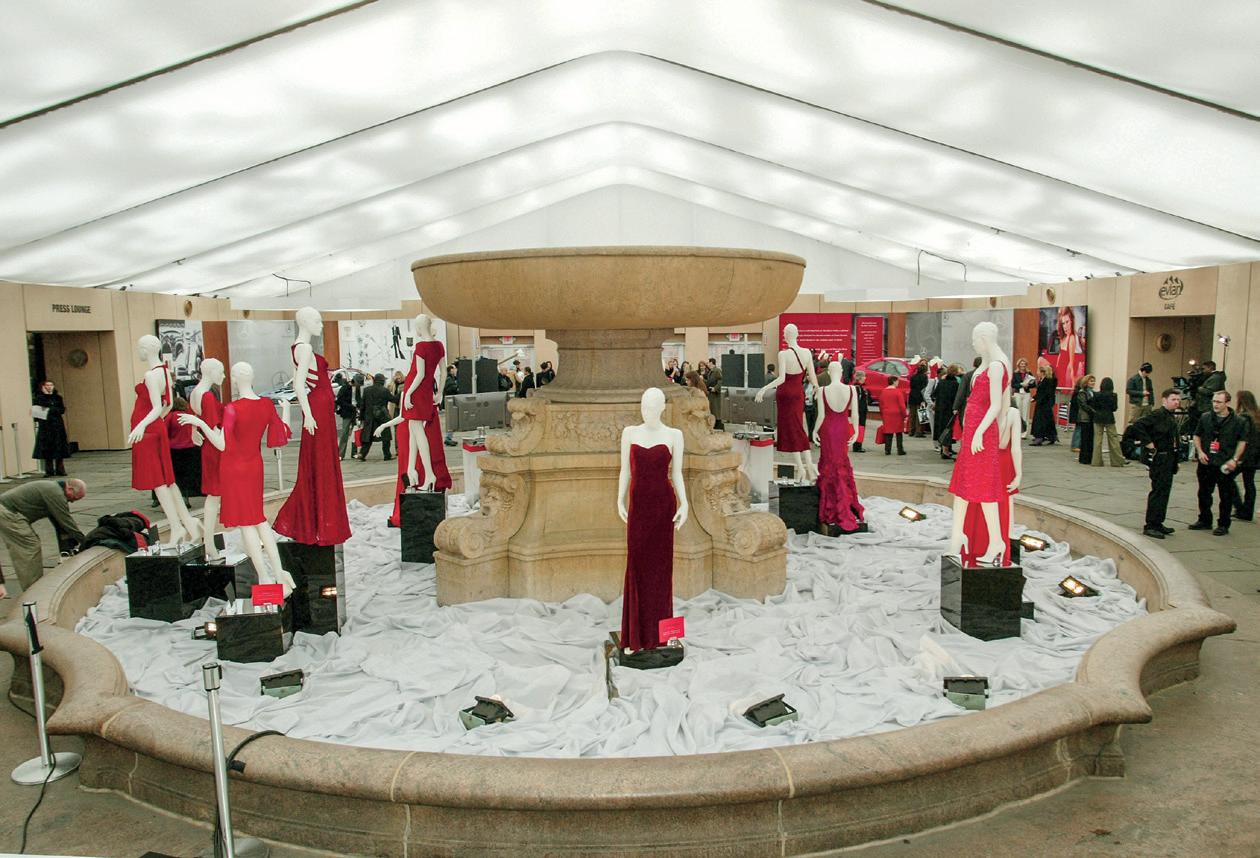
the Governors Spouse Program of the National Governors Association. She consistently supported the Susan G. Komen Foundation because of her family’s personal connections to the fight against breast cancer; both her mother and grandmother were survivors.9 This personal commitment to women’s health and the power of the first lady’s “velvet pulpit” enabled Mrs. Bush to become an effective ambassador for the Heart Truth.10
In January 2003, Laura Bush joined the American Heart Association Valentine Luncheon and Fashion Show as an honored guest. Her remarks emphasized the importance of self-care, the staggering reality of women’s susceptibility to heart disease, and the steps toward prevention advised by medical professionals. She cited compelling statistics amid more personal stories, at one
above
Laura Bush greets event organizers in front of The Red Dress Project exhibit in Bryant Park, during New York Fashion Week, 2003. The dresses on display were later auctioned to benefit the American Heart Association.
right
Mrs. Bush is joined by heart disease survivors (top, near right) as President Bush signs an American Heart Month Proclamation in the East Room, February 2, 2004. In 2006, she looks on (bottom, near right) as President Bush signs the proclamation in the Oval Office.
Laura Bush and Oscar de la Renta pose beside a dress of his design during the 2004 Fashion Week in New York City. Mrs. Bush donated the red dress to The Heart Truth Road Show that toured the country to help inform women about heart disease.
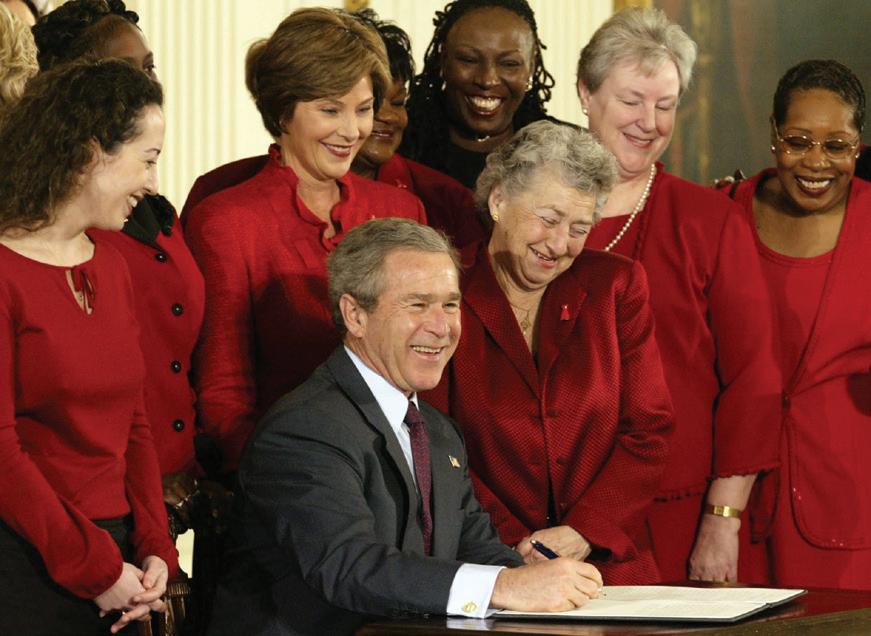
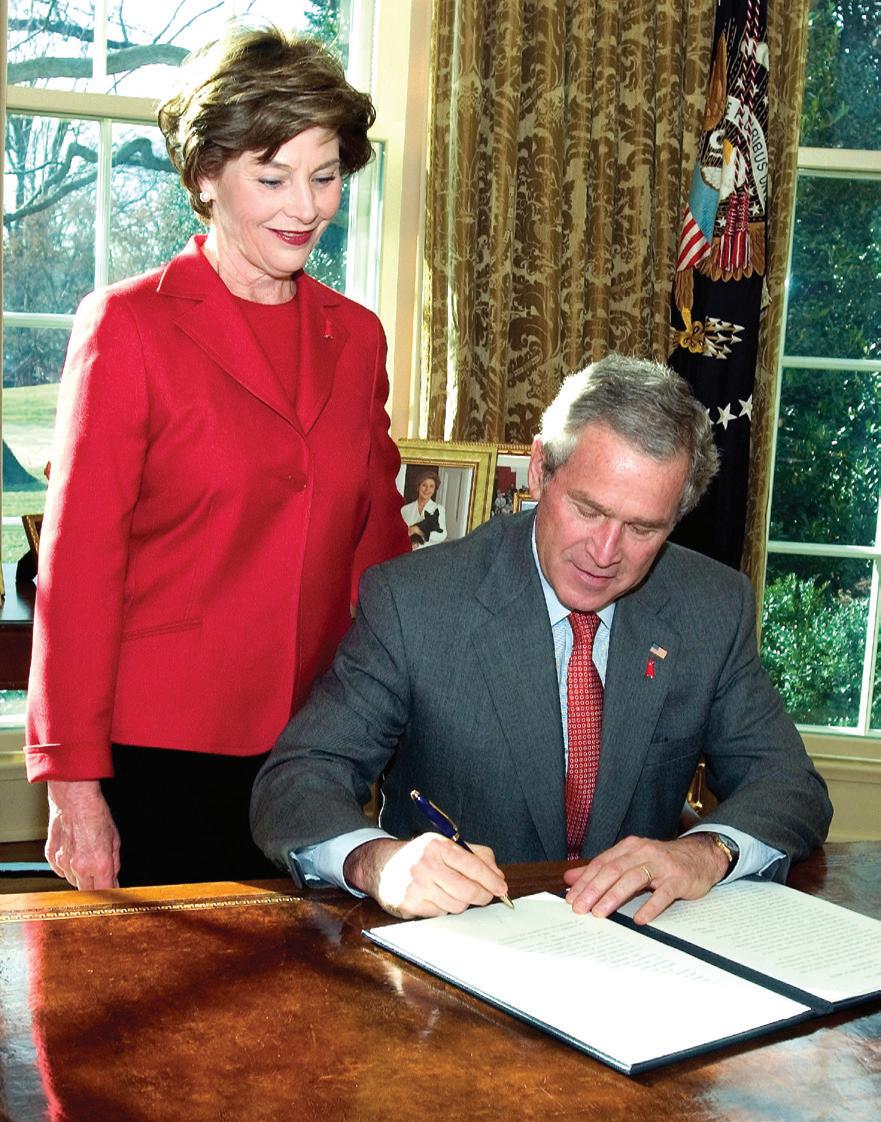
point teasing, “If my mother-in-law Barbara Bush, who is 77, can swim 88 laps at a time, the rest of us can surely walk 30 minutes.”11 Two weeks later, on Valentine’s Day in February 2003, Laura Bush began her role as a national ambassador for the campaign by appearing on all three network morning shows wearing a symbolic Red Dress pin, reiterating the same information about women and heart disease. She continued throughout the year with local awareness-raising events across the country, national press conferences, media interviews, and events at the White House. The Heart Truth campaign team also appealed to leaders in the fashion industry to help promote the Red Dress symbol. Women’s heart disease was integrated as the signature “cause” of Mercedes Benz Fashion Week
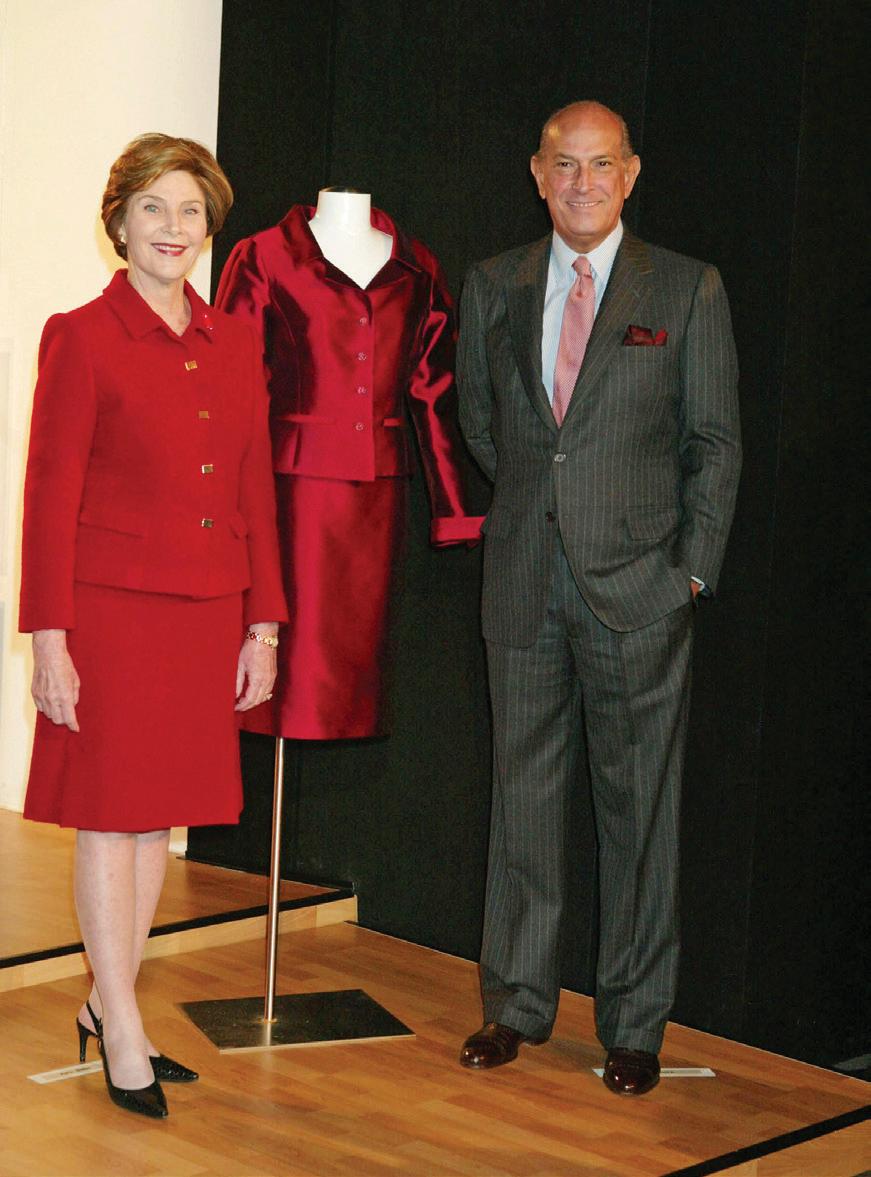
in New York in February 2003. Nineteen leading fashion designers, including Ralph Lauren, Vera Wang, and Oscar de la Renta, contributed dresses to an exhibit displayed at Bryant Park.
The events of February 2003, between the first lady’s media appearances and New York Fashion Week, brought the Red Dress to life and gave the campaign a powerful media platform. The national conversation continued through October of that year with a special issue of Glamour magazine dedicated to reminding readers that “Heart Disease Doesn’t Care What You Wear—It’s the #1 Killer of Women.” The issue included images of twenty-four celebrities wearing red dresses by renowned fashion designers, such as Oscar de la Renta and Vera Wang, many of whom had designs featured in February’s Fashion Week. Swarovski crystal company designed its own version of the Red Dress, the first of which was featured in Glamour’s inaugural partnership issue.12 Editors directed readers to messages provided throughout the magazine and integrated statistics that reinforced the serious impact of heart disease for women:
There’s a disease that kills nearly 1,400 women a day, but you probably don’t think about it, and neither does your doctor. We want to change all that. . . . We think we’re safe because
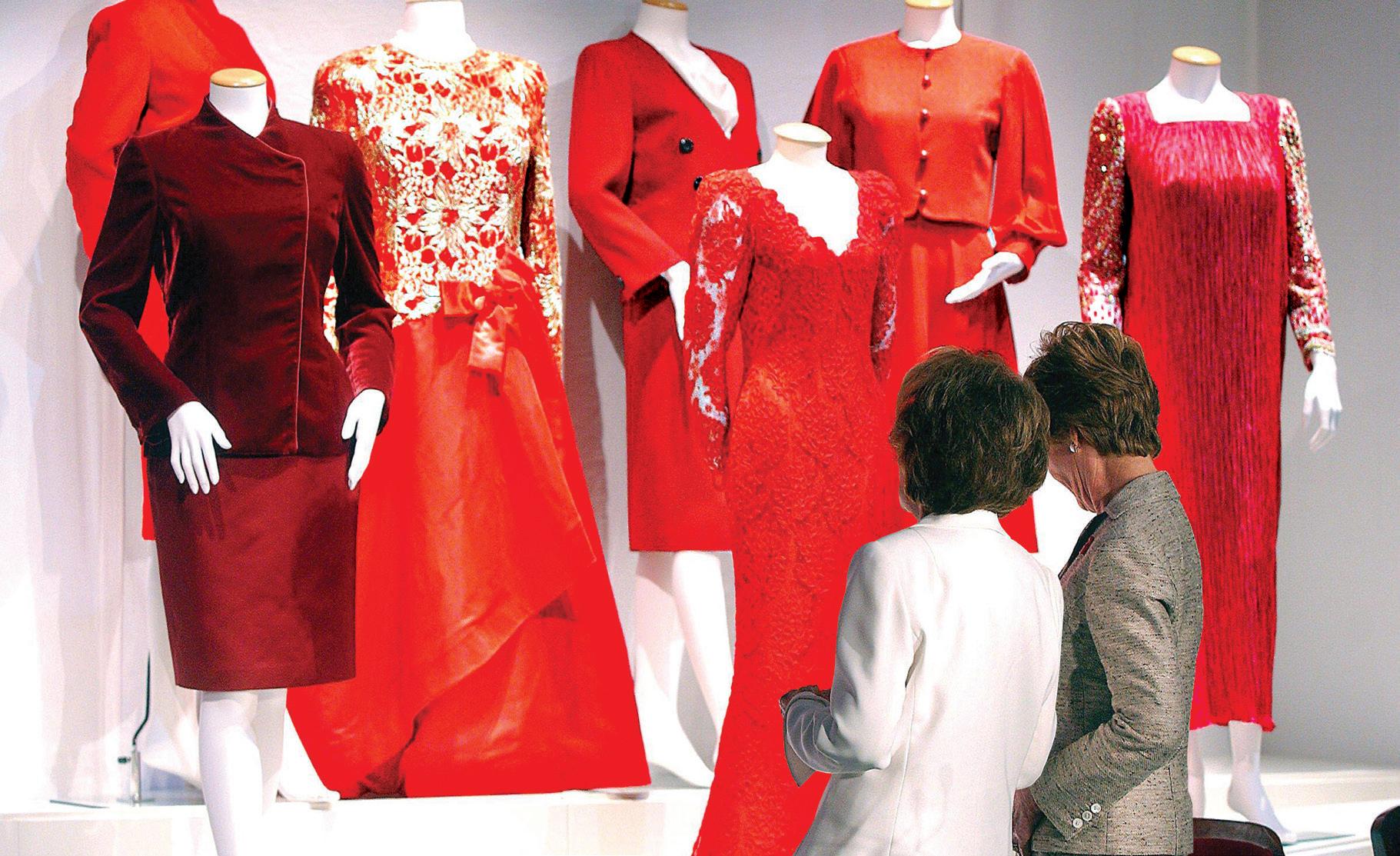
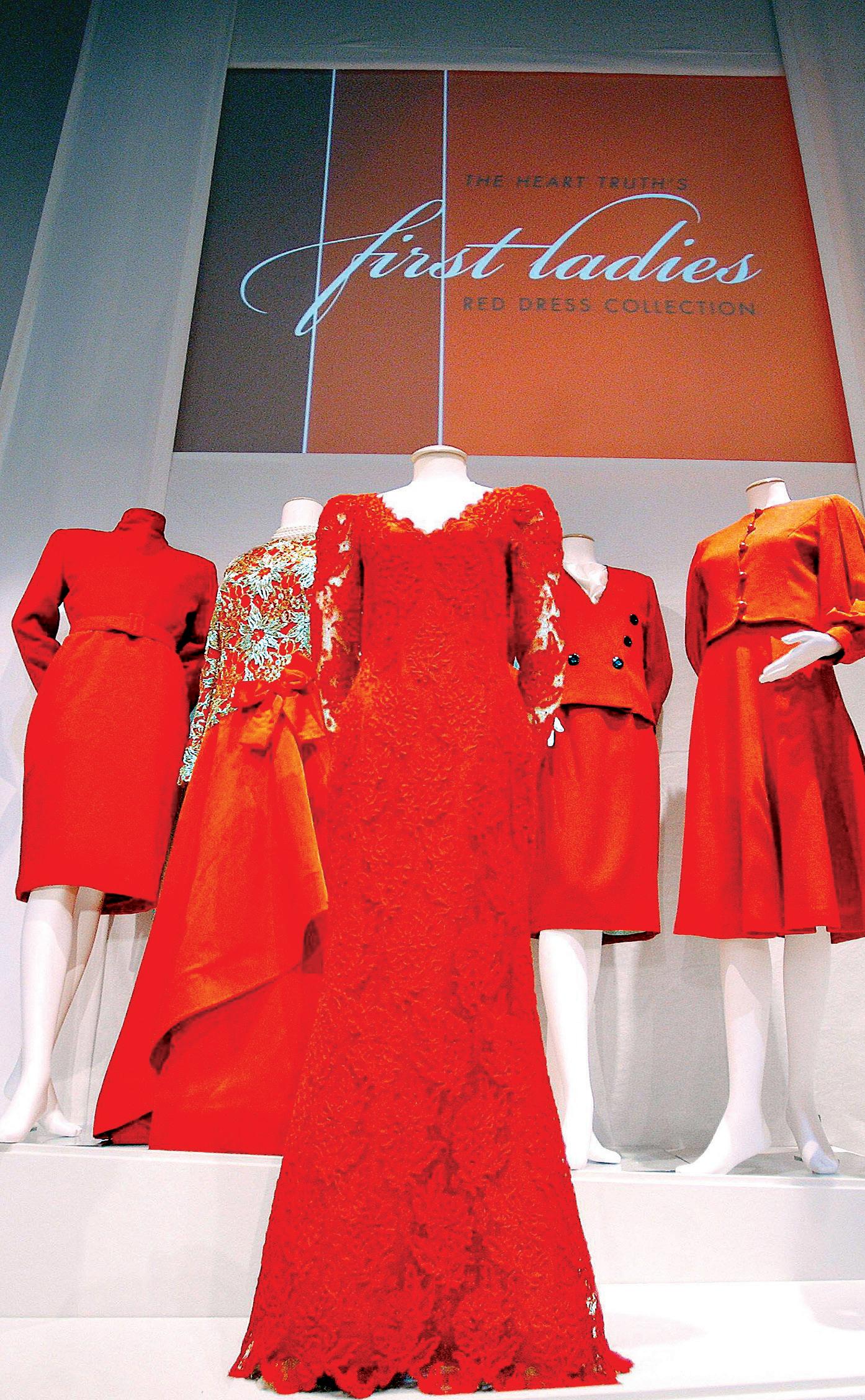
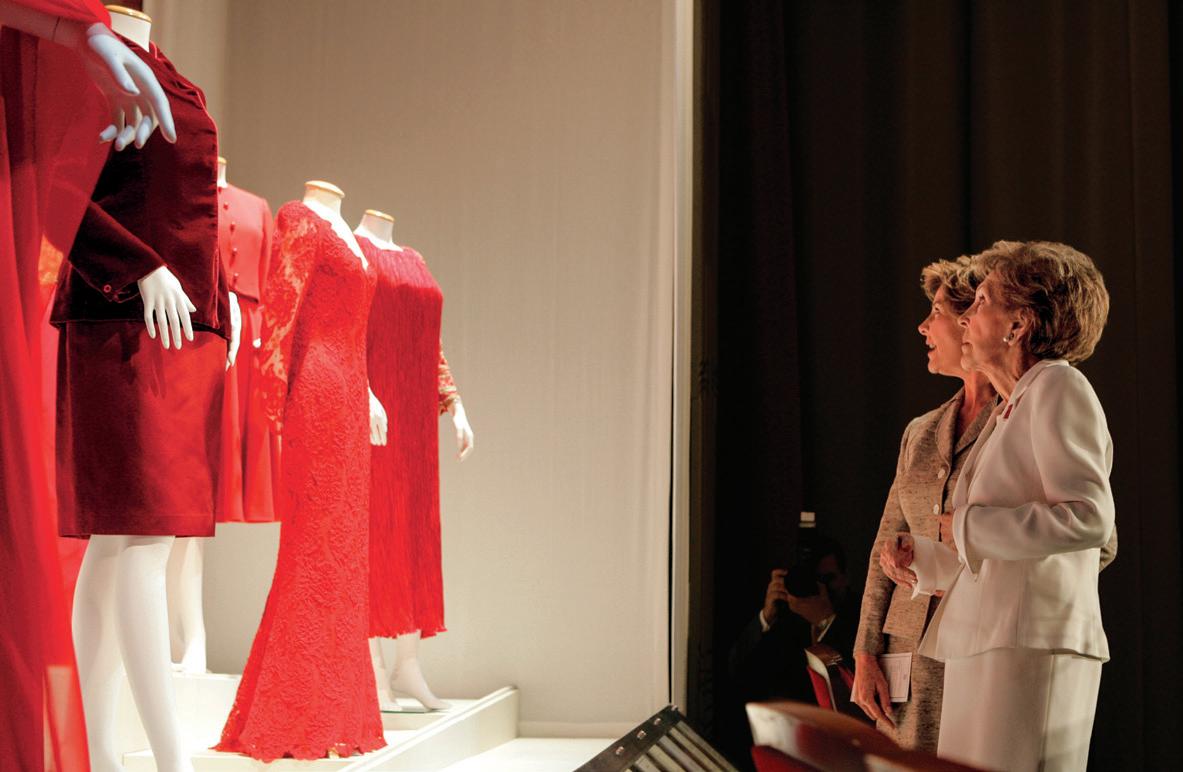
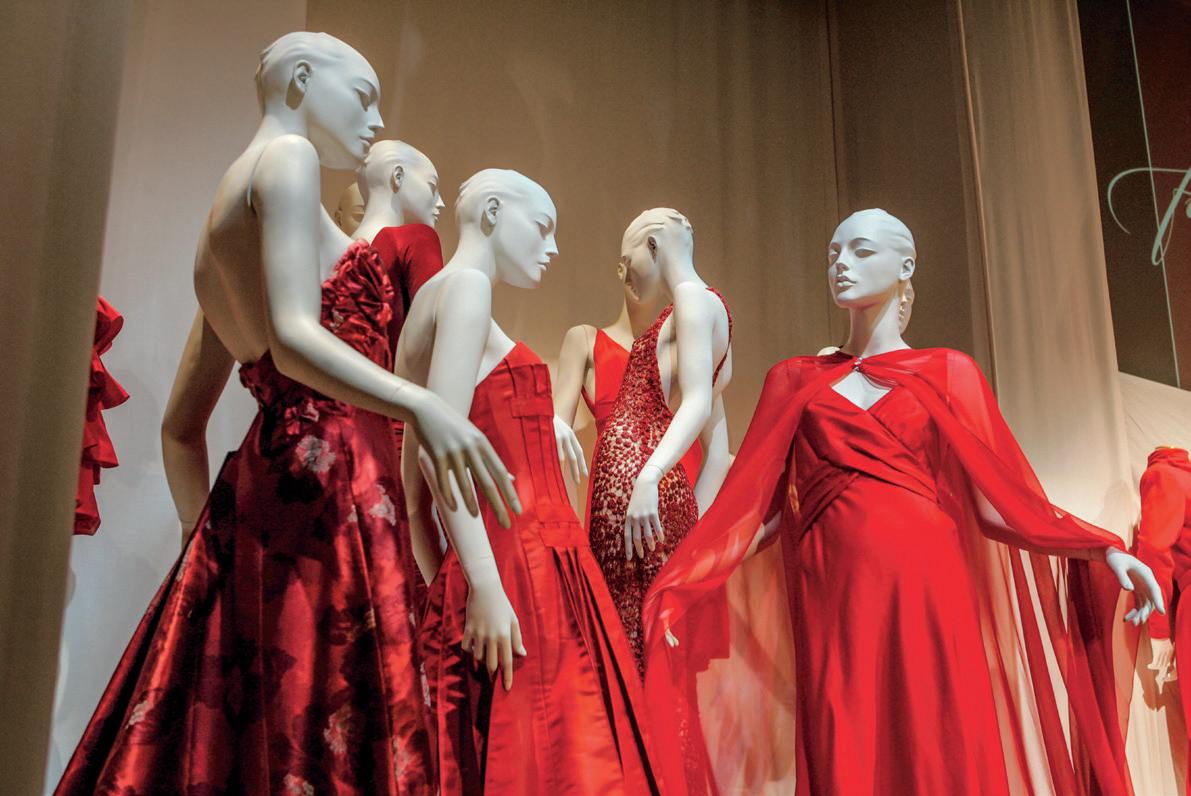
First Lady Laura Bush is joined by heart disease survivor Joyce Cullen during the 2007 Fashion Week in New York. Cullen credited Mrs. Bush’s advocacy with saving her life.
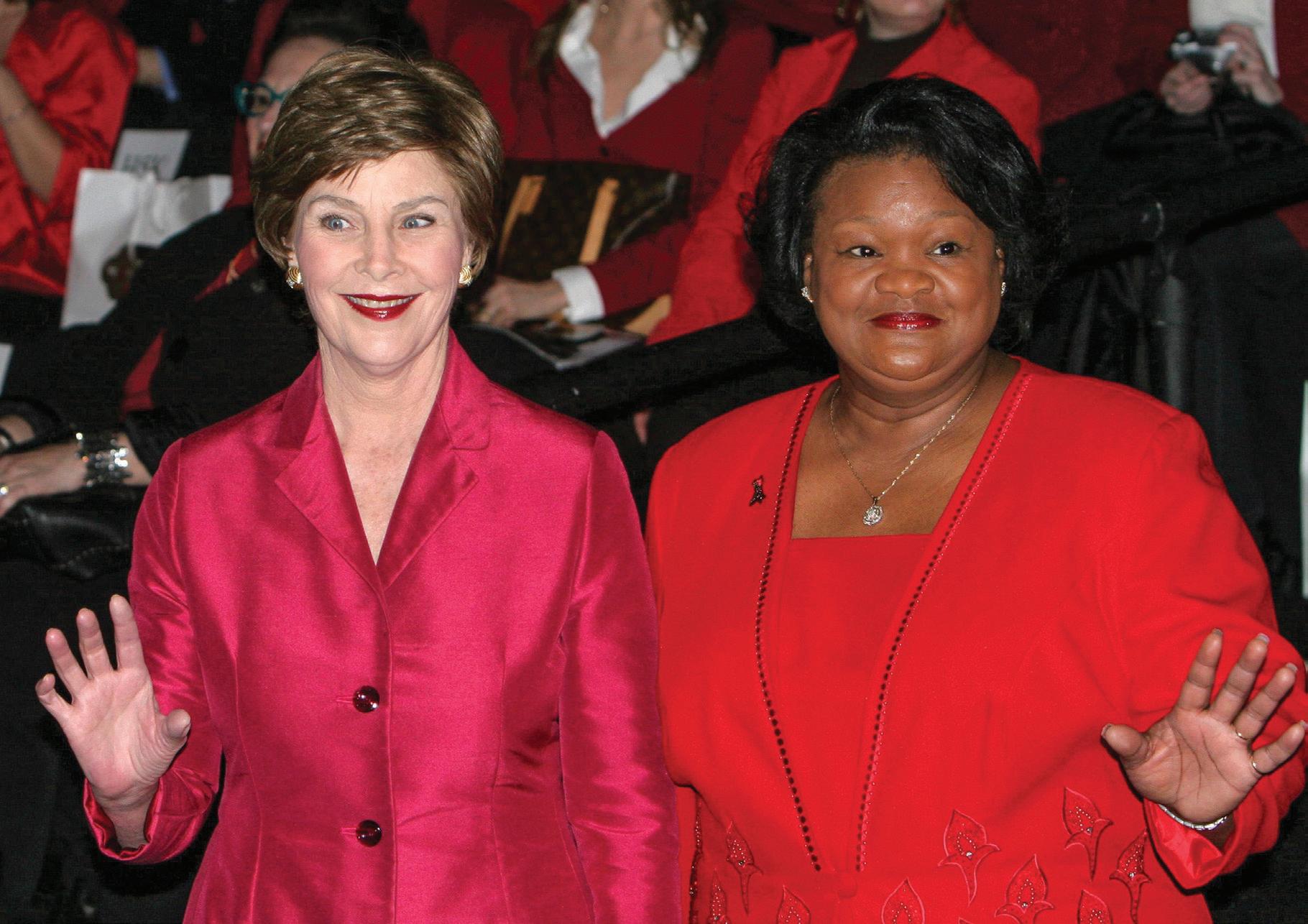
we’re female. We think we’re safe because we’re young. How could so many women be so wrong about heart disease? The facts should be common knowledge by now, but somehow, we’ve failed to grasp that heart disease claims the lives of 500,000 women each year, more than all types of cancer combined.13
Glamour also positioned First Lady Laura Bush as a powerful figure leading a team advocating on behalf of women:
“Take care of yourself!” That’s First Lady Laura Bush speaking, and she’s talking to you. Her new cause is critical to women’s health, and she’s got a powerful team on her side. “I want to thank all the people who are lending their voices to educating American women,” says Mrs. Bush. On the next 10 pages you’ll see who’s joining her in the heart-health crusade and learn what you can do today to save your life tomorrow. 14
The impact of the campaign was felt almost immediately. Women across the United States wrote to the first lady to tell their own stories. One of the very first women to do so was Joyce Cullen, who shared that she watched a Heart Truth event
in Kansas City on television, where she heard Mrs. Bush describe the symptoms of a heart attack, how they differed among women from men. Later that night, Cullen woke up concerned she was experiencing the symptoms of a heart attack and immediately sought medical help. She became a local advocate for women’s heart health following her episode and felt compelled to share that First Lady Laura Bush’s words saved her life.15
The momentum of the Heart Truth Initiative continued through 2004, when President George W. Bush proclaimed February as “American Heart Month” and National Wear Red Day ceremonies were held at the White House. Olympus Fashion Week introduced the 2004 Red Dress Collection, and it became a traveling exhibit throughout the spring of 2004. The Heart Truth Road Show, sponsored by the NHLBI and Johnson & Johnson, traveled to shopping malls on a five-city tour that began in Philadelphia, then toured through Chicago, San Diego, Dallas, and Miami, where it ended in May. The installations, designed by Hargrove Inc., the official general contractor for three presidential Inaugurations prior to 2004, included information about heart health and free screenings. Fifteen custom dresses were displayed atop a central runway,
surrounded by three stations for heart disease risk factor screenings, information stations, and a video wall of presentations.
By 2005, the national Heart Truth campaign inspired local initiatives across the country and beyond. In February, Mrs. Bush shared at an event that Airman First Class Shay Guesnier and women in her unit were wearing Red Dress pins even while deployed to Iraq. In May, Mrs. Bush joined with former First Lady Nancy Reagan to unveil a very special edition of the Red Dress Collection, one that featured dresses worn by seven of America’s first ladies. The First Ladies Red Dress Collection, displayed at the Kennedy Center for the Performing Arts, included Nancy Reagan’s red lace Oscar de la Renta, which she wore when President Ronald Reagan was presented with the Order of the Bath in England 1989; the red evening gown worn by Lady Bird Johnson when celebrating her 80th birthday; favorite gowns worn by Rosalynn Carter and Betty Ford; Barbara Bush’s red dress from a State Dinner; Hillary Clinton’s red Valentine’s Day dress; and Laura Bush’s red dress from her visit to the Bolshoi Ballet in Moscow in 2003. By 2010, the collection grew to include dresses and suits representing fourteen former first ladies and twelve celebrity dresses from the annual New York Fashion Week collections.
As ambassador for the Heart Truth campaign, Laura Bush used the power of her office to continue promoting awareness about women’s risks for cardiovascular disease until her last days in the White House. She continued to make public appearances at health facilities across the country and on morning talk shows, from Rachael Ray to CBS This Morning. In 2007, she once again joined former First Lady Nancy Reagan for a special exhibition of the Red Dress Collection at the Ronald Reagan Presidential Library, where she participated in a panel discussion on women’s health as well. Laura Bush also utilized the presidential Weekly Radio Address in February 2008 to remind listeners about the importance of women’s heart health.
The campaign’s success was measured by the NHLBI and leading health advocates, who noted the number of women dying of heart disease decreased sharply. One report estimated the awareness campaign contributed to reducing the number of women who die each year from heart disease by 17,000, or forty-seven lives saved every
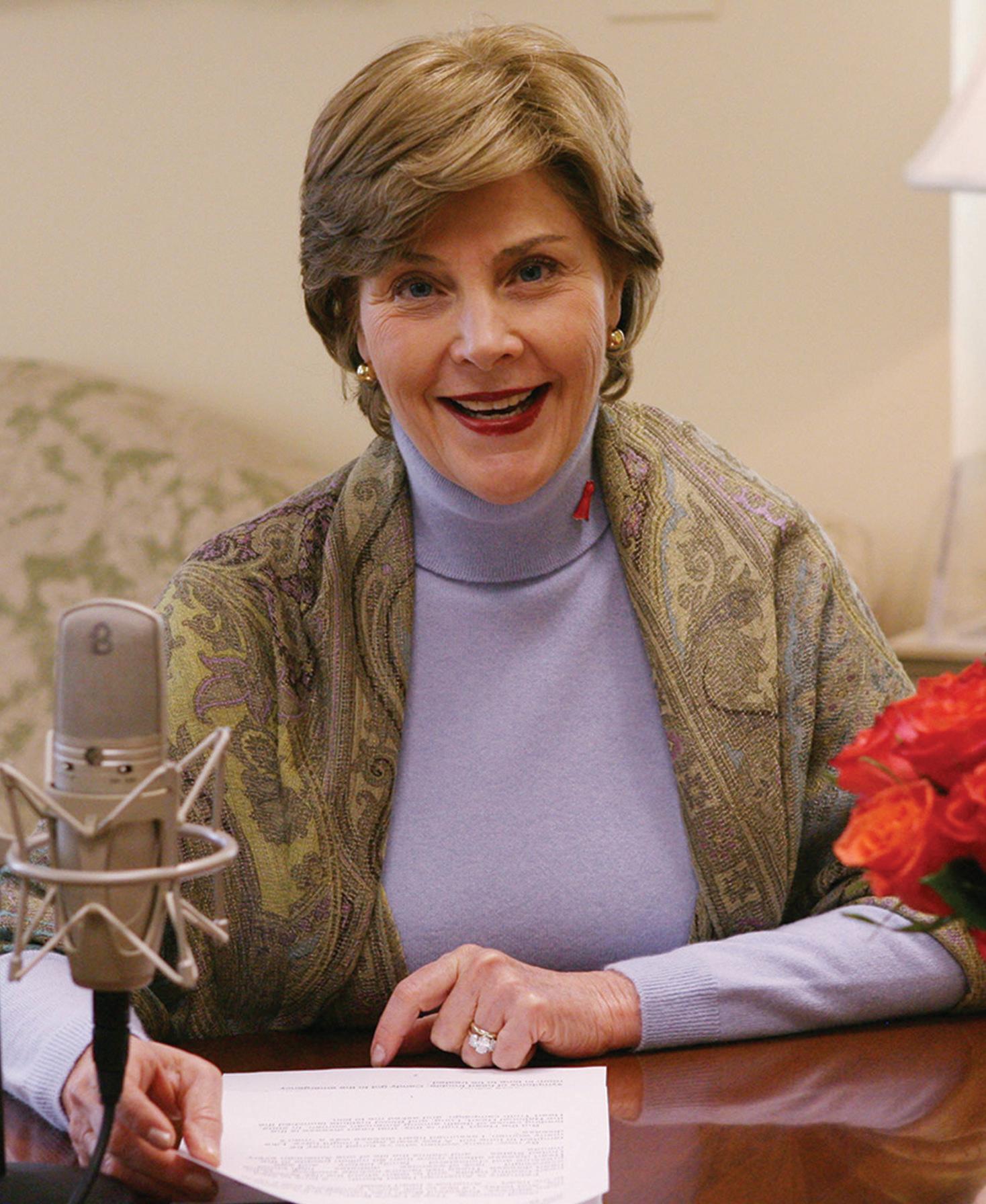
day.16 Kathy Kastan, who served as a past president of WomenHeart, credited the first lady’s ability to reach a national audience: “In spite of what’s going on—the war in Iraq, the administration’s approval ratings—she’s still getting through [to people]. Her impact is from policymakers down to the average woman, and that’s huge.” Medical professionals echoed Kastan’s perspective. “My patients say, I saw the First Lady on TV, and I made an appointment,” confirmed Nieca Goldberg, MD, medical director of New York University’s Women Heart Program. Sharonne Hayes, MD, then director of the Women’s Heart Clinic at the Mayo Clinic in Rochester, Minnesota, added, “She has a way of connecting with her audience: She admits she used to smoke and that it was very hard to quit. I can honestly say [the campaign] would not have been such a success without her stewardship.”17
In his introductory remarks for the unveiling of the First Ladies Red Dress Collection, then Secretary of Health and Human Services Michael
Laura Bush takes the opportunity to speak about American Heart Month during her weekly radio address from the White House, February 1, 2008.
Leavitt shared his belief that “art has the power to teach and the power to change.” By linking the Red Dress, an iconic feminine fashion symbol, to a health campaign that aims to create awareness around the risk of heart disease among women, and amplifying that message with the power of the Office of the First Lady, the Heart Truth initiative saved the lives of thousands of American women. For her part, Laura Bush acknowledged, “I realized the degree to which I had a unique forum as first lady. People would pay attention to what I said.”18
1. Laura Bush, Spoken from the Heart (New York: Scribner, 2010), 378–80.
2. Quoted in Noelle Walker, “Dallas Fashion Designer to First Lady Laura Bush Give Nod to New First Lady Fashion,” published January 20, 2017, NBC Dallas–Ft. Worth, online at www.nbcdfw. com/news.
3. Ulrike Boehmer, “A History of AIDS and Breast Cancer Activism,” in The Personal and the Political: Women’s Activism in Response to the Breast Cancer and AIDS Epidemics, ed. Ulrike Boehmer (Albany: State University of New York Press, 2000), 8–9; Richard M. Nixon, “Annual Message to the Congress on the State of the Union,” January 22, 1971, online at American Presidency Project, www.presidency.ucsb.edu.
4. Terry Long, Ann M. Taubenheim, Jennifer Wayman, Sarah Temple, and Beth Ann Ruoff, “The Heart Truth: Using the Power of Branding and Social Marketing to Increase Awareness of Heart Disease in Women,” Social Marketing Quarterly 14, no. 3 (2008): 3–29.
5. Allison H. Christian, Wayne Rosamond, Anthony R. White, and Lori Mosca, “Nine-Year Trends and Racial and Ethnic Disparities in Women’s Awareness of Heart Disease and Stroke: An American Heart Association National Study,” Journal of Women’s Health 16, no. 1 (2007): 68–81.
6. National Heart, Lung, and Blood Institute, Women’s Heart Health: Developing a National Health Education Action Plan (Bethesda, Md.: U.S. Department of Health and Human Services, National Institutes of Health, 2001).
7. Myra Gutin, “Using All Available Means of Persuasion: The Twentieth Century First Lady as Public Communicator,” Social Science Journal 37, no. 4 (2000): 564–75.
8. Pew Research Center, “Laura Bush’s Changing Image: No Longer Just ‘Nice,’” posted July 2, 2002, U.S. Politics and Policy, Pew Research Center website, pewresearch.org.
9. Cindi Leive, “The First Lady’s Quiet Victory,” Glamour, January 2008.
10. Erika Cornelius Smith, “Speaking from the Velvet Pulpit: The Media Relations of Laura Bush,” in Media Relations and the Modern First Lady, ed. Lisa M. Burns (Lanham, Md.: Lexington Books, 2020), 221–44.
11. “Remarks by Mrs. Bush American Heart Association Lunch and Fashion Show,” January 29, 2003, Office of the First Lady, www. georgewbush-whitehouse.archives.gov
12. Jennifer Wayman, Terry Long, Beth Ann Ruoff, Sarah Temple, and Ann M. Taubenheim, “Creating a Women and Heart Disease Brand: The Heart Truth Campaign’s Red Dress,” Social Marketing Quarterly 14, no. 3 (2008): 40–57.
13. Wendy Naugle and Daryl Chen, “It’s Time to Save Your Life,” Glamour, October 2003, 207–08.
14. Cindi Leive, “Take Care of Yourself,” Glamour, October 2003, 201.
15. “Mrs. Bush’s Remarks in Recognition of American Heart Month,” February 15, 2006, Office of the First Lady. www.georgewbushwhitehouse.archives.gov.
16. Sharonne N. Hayes et al., “Taking a Giant Step Toward Women’s Heart Health: Finding Policy Solutions to Unanswered Research Questions,” Women’s Health Issues 25, no. 2 (2015): 429–32.
17. All quotations in Leive, “First Lady’s Quiet Victory.”
18. Both quotations in Sady Doyle, “The Secret Inner Life of Laura Bush,” Atlantic, May 2010.
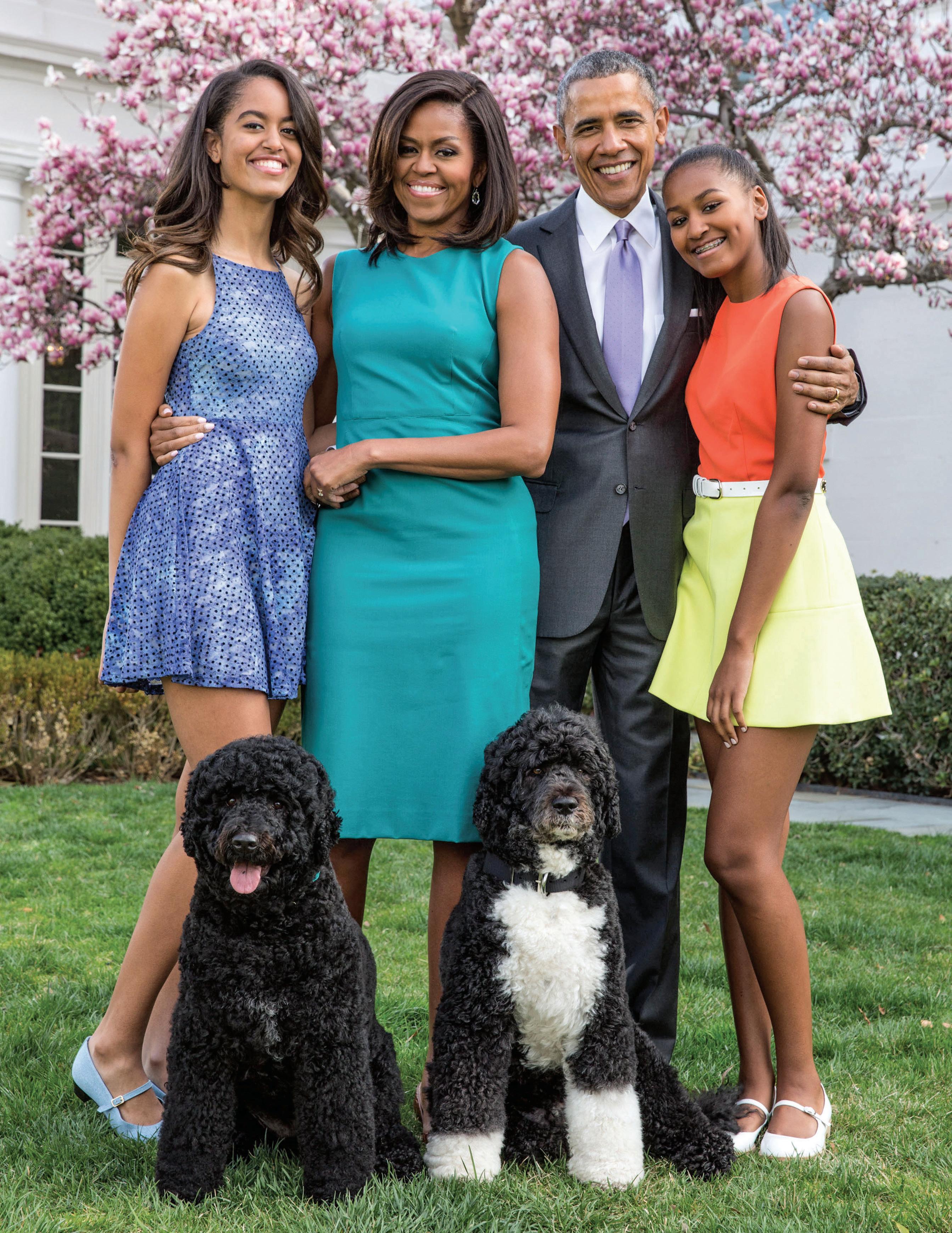
michelle obama became the first african american first lady when her husband Barack Obama became president of the United States on January 20, 2009. During her eight years as first lady, she was an inspirational figure to many Americans, spearheading healthy eating initiatives and championing girls’ education around the world.1 The media covered her activities with great interest but also consistently focused on the one thing that unfailingly captured the public’s attention: her personal style.
Michelle Obama’s use of fashion greatly contributed to the image she portrayed to the American public. During her tenure, she dressed in a way that people found approachable, by mixing highand low-fashion together. She was also extremely conscious about the designers she chose to wear, often selecting young brands as a way to highlight unknown American designers.2 Mrs. Obama understood the power of her clothing and made intentional decisions to create a fashion image that was relatable and message driven. Her image came to embody just what Barack Obama’s historic presidency represented to many people: the American dream.
This approach differed from many first ladies (and first lady hopefuls) in that the style was attainable, not aspirational. In October 2008, Michelle Obama went on Jay Leno’s late night talk show right after news broke that the Republican Party had shelled out $150,000 for vice presidential nominee Sarah Palin’s wardrobe. Mrs. Obama did the appearance wearing J. Crew and appealed to a mass audience when she said, “Ladies, we know J. Crew. You can get some good stuff online!”3 Revealing that she not only bought off the rack like the rest of America, but also shopped online like so many other twenty-first-century women, was a calculated move. By this point in her husband’s first presidential campaign, she had proven herself an extremely effective surrogate, and her clothing was always an important aspect of that image.
So by the time Michelle Obama attended the Inaugural Balls with her husband on the night of January 20, 2009, wearing a white Jason Wu gown, she had already established herself as someone the public admired not just for her fashion choices but for her character. Americans identified with her, a Black woman from a working-class family on the South Side of Chicago who went on to earn degrees from Princeton and Harvard. She and
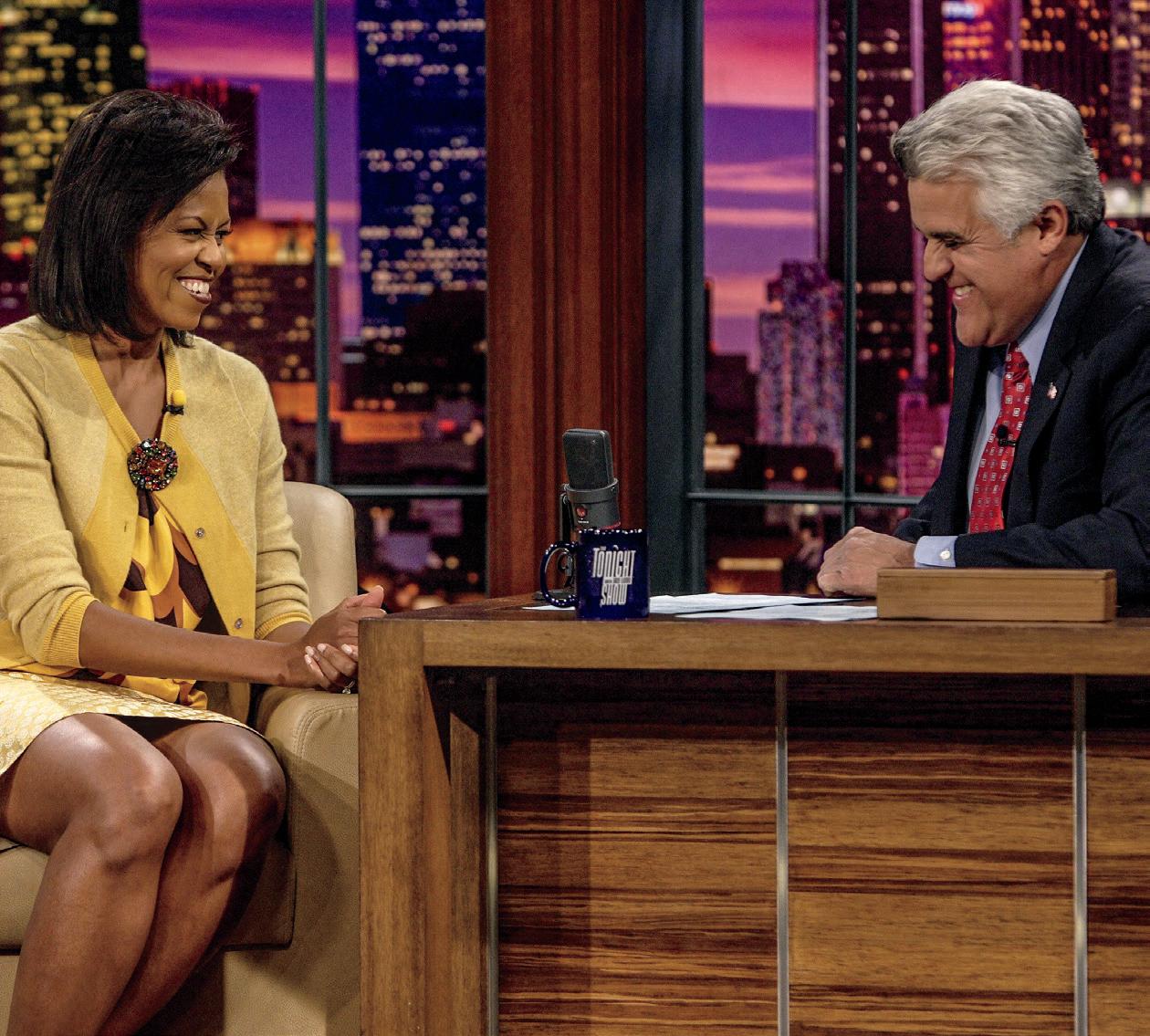
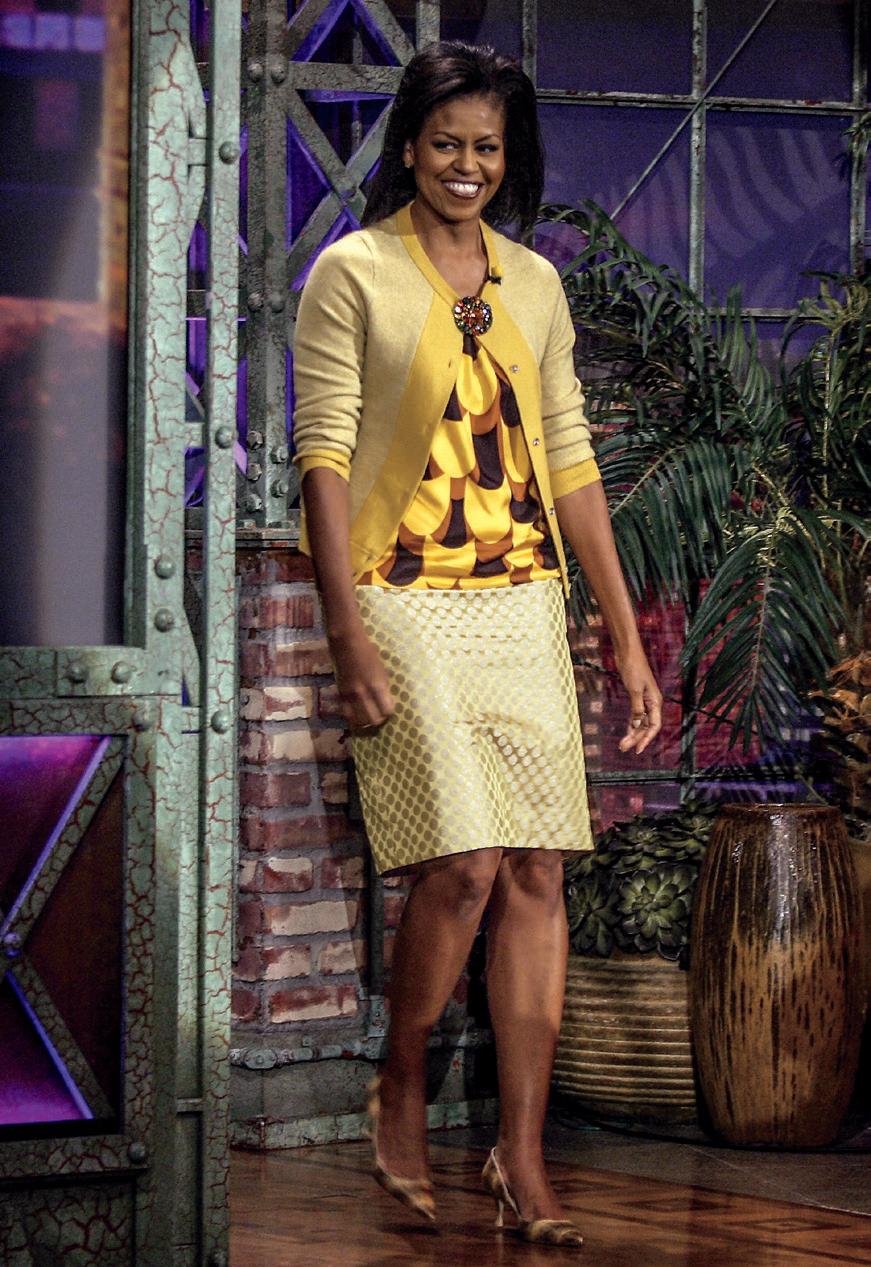
Barack Obama embodied the American dream, and they consistently campaigned on this narrative. In August 2008, when she delivered the keynote address at the Democratic National Convention where Barack Obama was officially introduced as
above and left
Michelle Obama’s decision to highlight attainable over aspirational fashion endeared her to millions of American women who shop online and off the rack. Here she wears J. Crew for an appearance on The Tonight Show in October 2008 at the height of the presidential campaign.
right
For her first inaugural gown, Mrs. Obama chose a dress by 26-yearold Jason Wu and thus made the young designer’s label a household name. She is seen here with President Obama arriving at the the Neighborhood Inaugural Ball at the Washington Convention Center on January 20, 2009, in the oneshouldered white silk chiffon gown embellished with organza flowers and Swarovski crystal centers. Wu did not know that Mrs. Obama had selected his design, which he intended to symbolize hope, until he saw it on television.
previous spread
President and Mrs. Obama and daughters Malia and Sasha pose for a family portrait with Bo and Sunny in the Rose Garden on Easter Sunday, April 5, 2015.
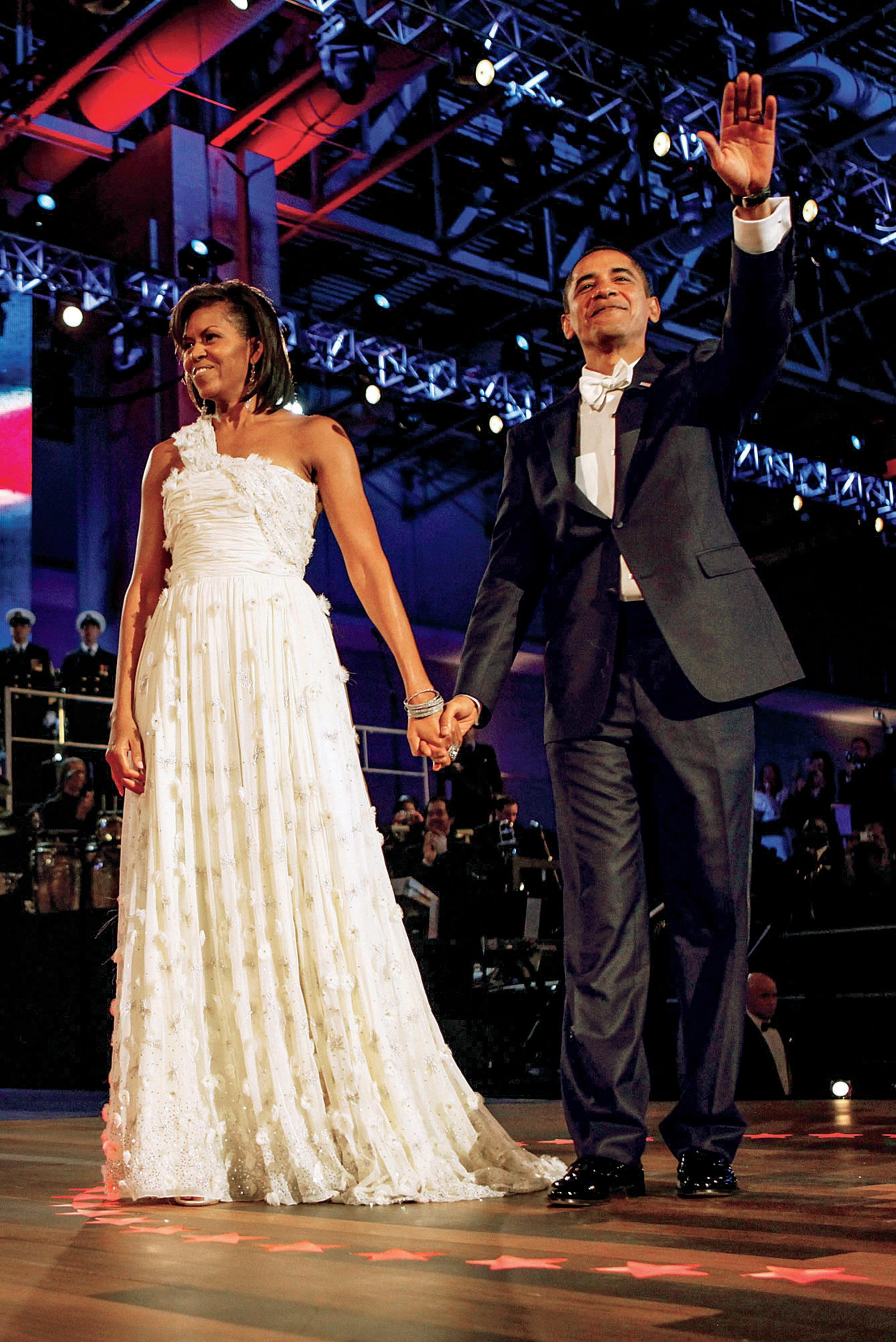
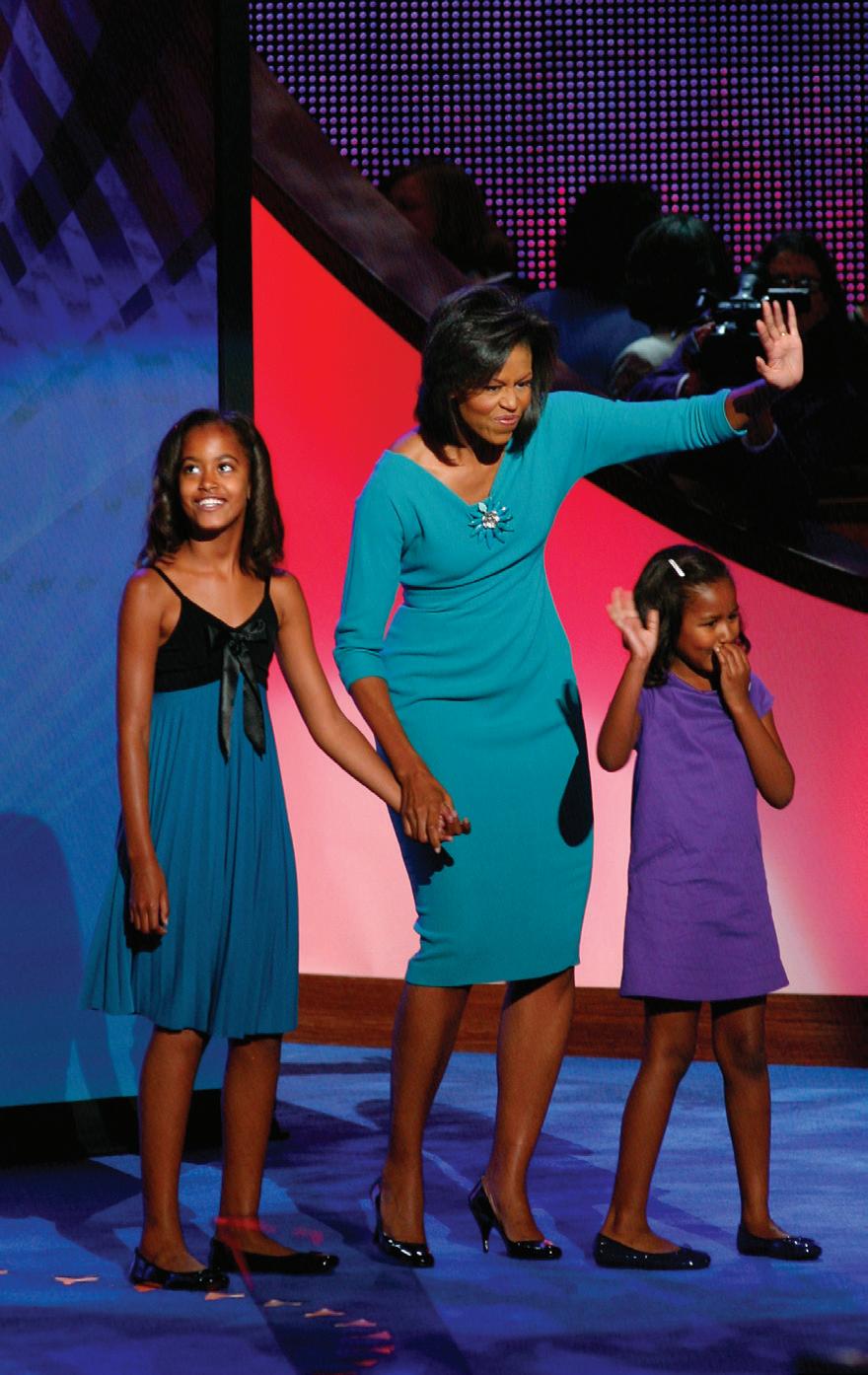
the party’s presidential nominee, she spoke about the hard working, honest, and optimistic ideals both she and her husband had been raised on. 4 These ideals are essentially what got her husband elected and were the basis for her philosophy as first lady, guiding the kind of work she chose to take on while in the role. The causes she championed, the way she dressed, and her appeal to the American public stemmed from these values.
As public interest in Michelle Obama continued to grow, traditional media and fashion blogging, still a relatively new form of disseminating fashion news in 2008, documented her every move. The blog Mrs-O.com was started in September 2008 to follow “the fashion and style of Michelle Obama.”5 The first dress featured on the blog was the teal Maria Pinto dress Mrs, Obama wore to deliver her speech at the 2008 convention. Blog founder Mary Tomer wrote about her reasons for starting her site in its first post, saying, “The inspiration came in late August, half watching the convention, half lost in thought somewhere else—until Michelle Obama stepped on stage. Radiant, poised and impeccably
dressed, she was captivating. . . . We couldn’t be the only one interested, could we?”6
Indeed she was not. Helped along by endless, instant feedback from the internet, Michelle Obama’s fashion choices were documented by the media in real time. She credited the interest in her clothes to the fact that she is “tall and unafraid of bold patterns,”7 but the truth is probably more because the public saw her wardrobe as engaging.
“I mixed it up. I’d match a high-end Michael Kors skirt with a T-shirt from Gap. I wore something from Target one day and Diane von Furstenberg the next,” Michelle Obama wrote.8 The duality of image may seem contradictory to her reputation as “everywoman,” but it was also an essential element of how she projected herself. The public enjoyed seeing her in custom dresses, in clothing that showed off her toned arms. Even decades before, when Vogue was covering the sartorial differences between Jacqueline Kennedy and Pat Nixon during the 1960 election, author Keith Kyle noted:
The public attitude to the White House has traditionally reflected two competing pulls, both of them typically American. On the one hand, Americans do not want their chief of state and his wife to appear, in the eyes of the old world, to be country cousins unable to do the honours in credible style; yet anything suggestive of royal magnificence, especially if it is combined with social aloofness or exclusivity, is liable to strike a false note of alien decadence.9
Michelle Obama recognized this conundrum by saying, “It was a thin line to walk. I was supposed to stand out without overshadowing others, to blend in but not fade away.”10
On top of the pressure to navigate the already difficult role, Michelle Obama had to do so in a way that represented Black Americans. In her autobiography, she wrote, “As a Black woman . . . I knew I’d be criticized if I was perceived as being showy and high end, and I’d be criticized also if I was too casual.”11 She was fully aware of not just the attention that was paid to the clothing she wore but also to the image she was presenting to the public. “It seemed that my clothes mattered more to people than anything I had to say,” she wrote. “I tried to reframe it as an opportunity to learn, to use what power I could find inside a situation I’d never have
left
Mrs. Obama wears a teal Maria Pinto dress to deliver her speech at the 2008 Democratic National Convention.
opposite Michelle Obama suspected that the interest in her clothes was due in part to being “tall and unafraid of bold patterns,” and in fact she did often wear bright colors and strong patterns while traveling.
Clockwise from top left: Michelle Obama greets a student during a Room to Read program in Cambodia, 2015.
Mrs. Obama meets the son of a crew member aboard Air Force One, 2011, and strikes the Heisman pose to help promote the Let’s Move! initiative, 2012.
Mrs. Obama arrives in Copenhagen to support Chicago as the location for the 2016 Olympic Games and speaks at the National Conference on Volunteering and Service in San Francisco, 2009.
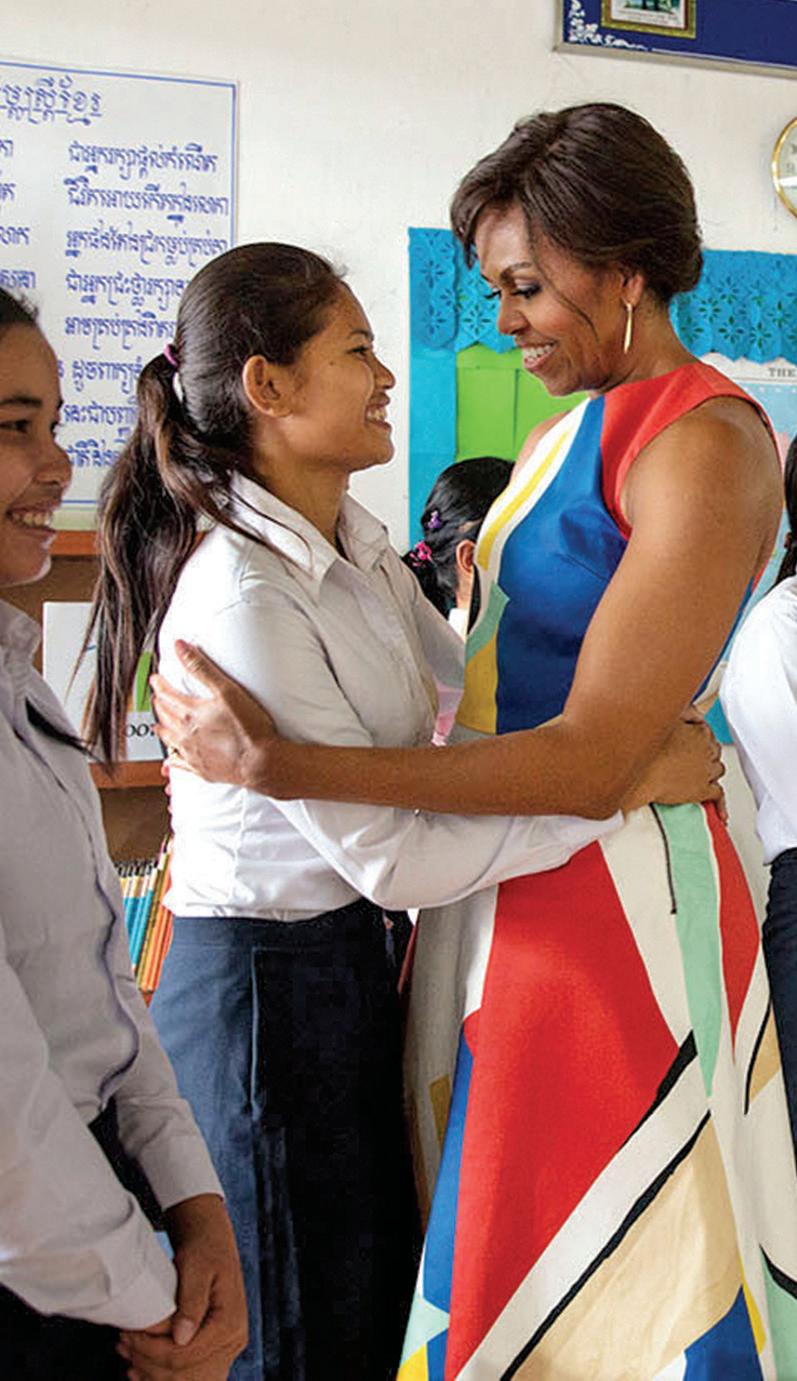
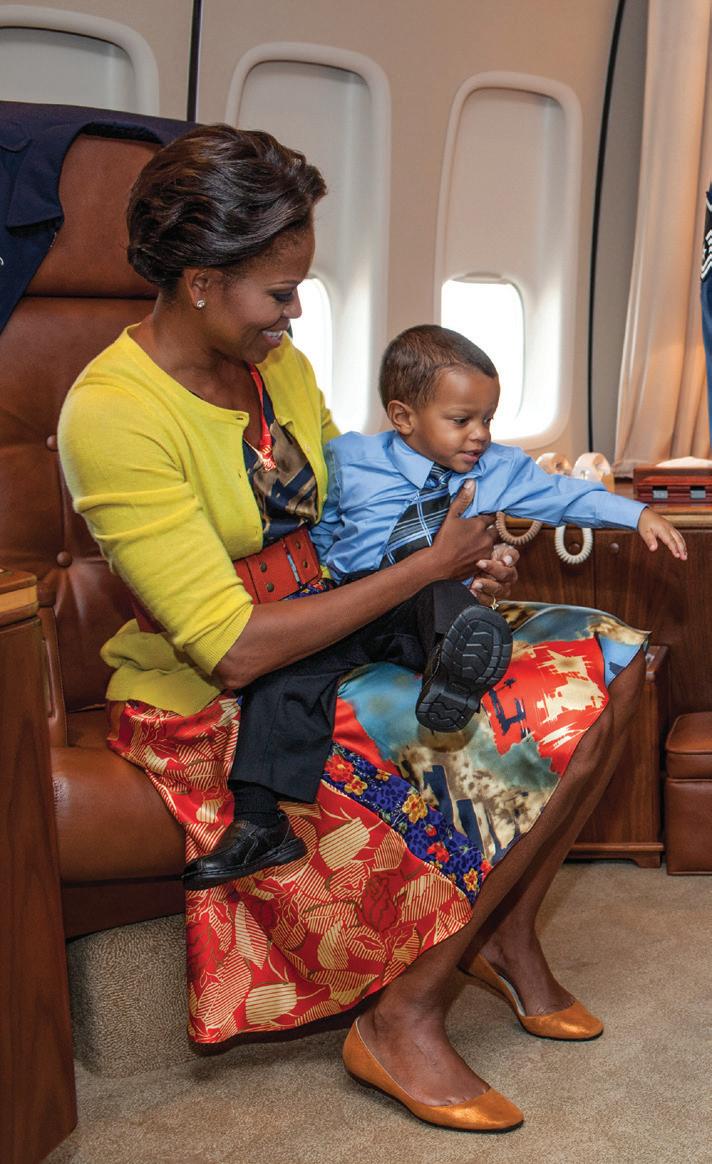
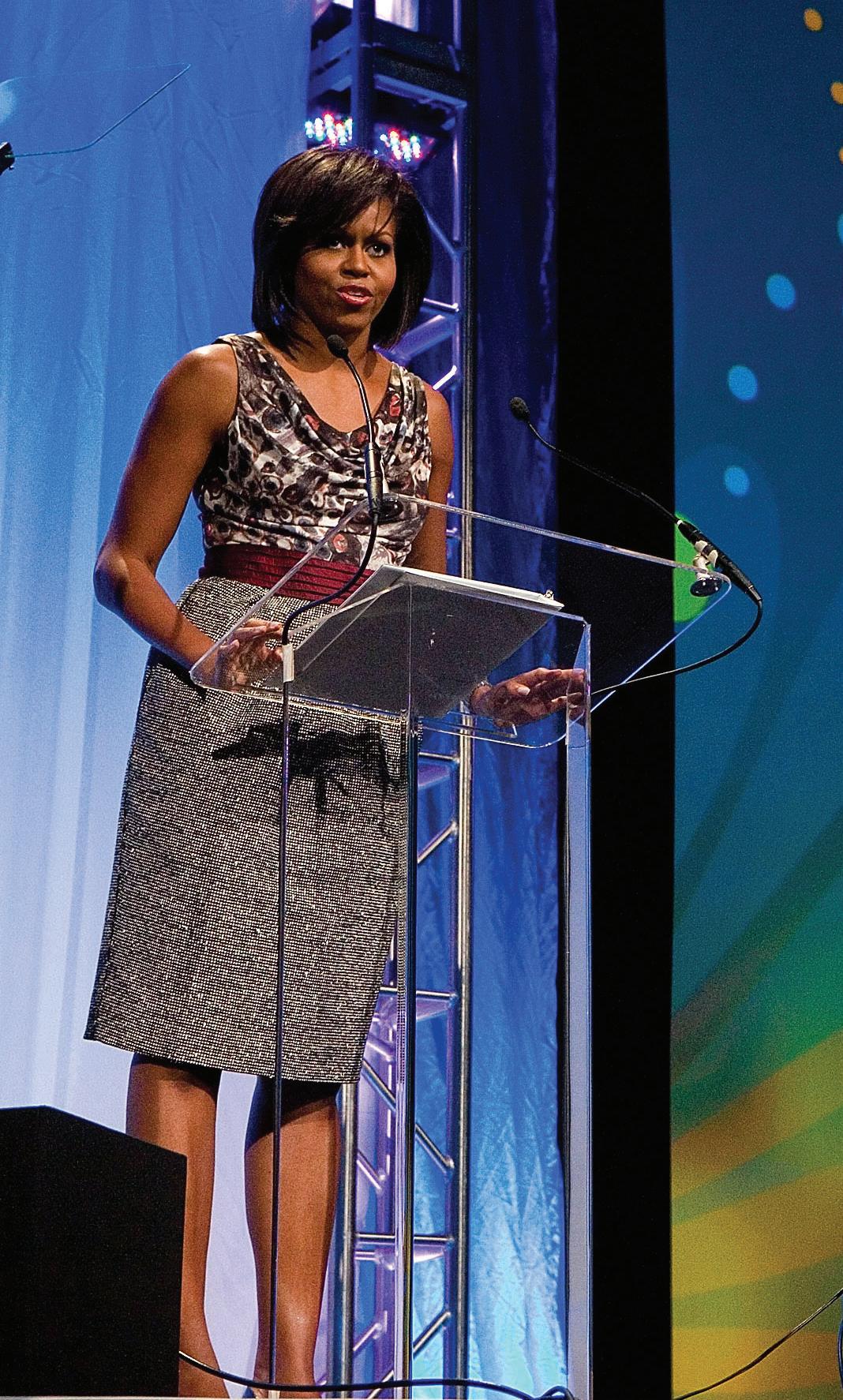
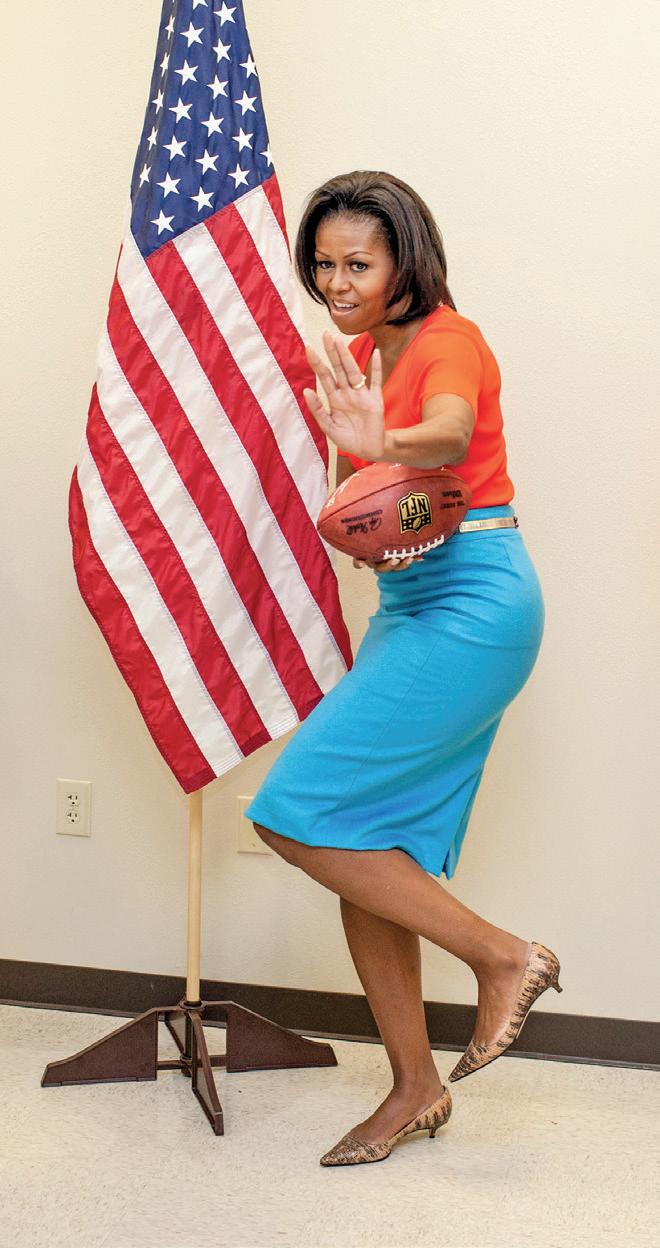
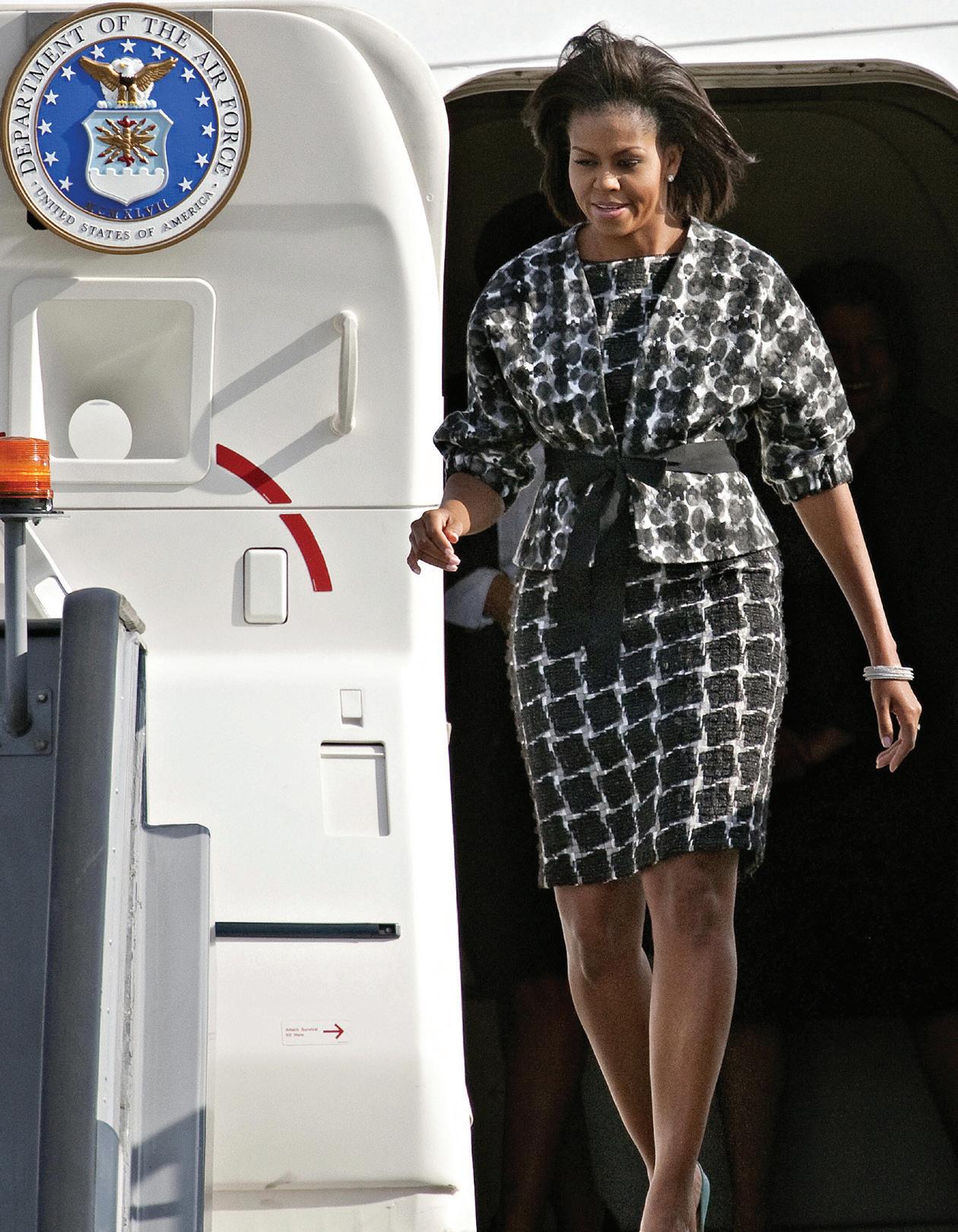
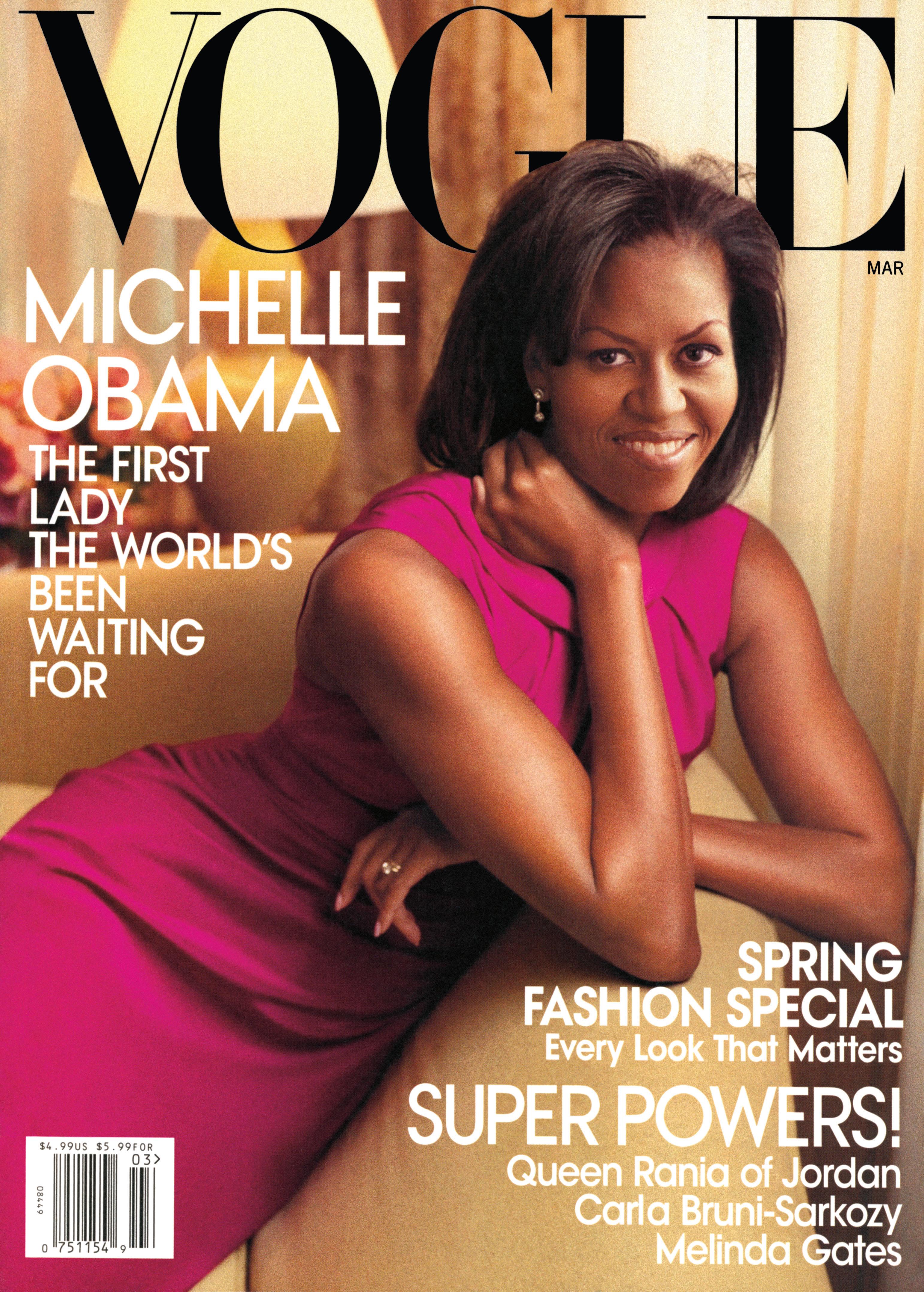
opposite and right
Michelle Obama appeared on three Vogue covers during her time as first lady. Although hesitant to appear on the cover in 2009 during the recession, Mrs. Obama decided that it “mattered every time a woman of color showed up on the cover of a magazine.”
Vogue editor Anna Wintour also praised the first lady for bringing worldwide attention to American designers.
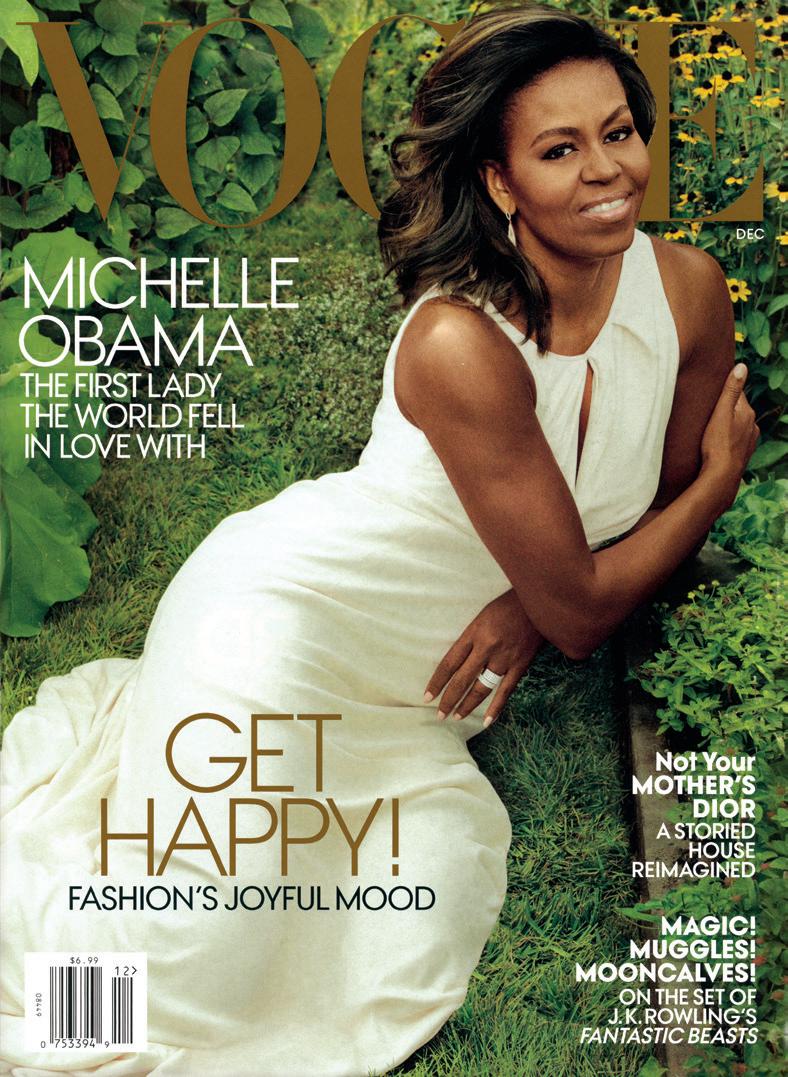
chosen for myself.”12 She carefully considered the way the public gaze dictated her choices, not just when it came to her wardrobe but also as a Black woman in the spotlight. When considering appearing on the cover of Vogue in 2009, she wondered if it was a bad decision as America was still deep in the Great Recession. In the end she agreed to appear, saying, “It mattered every time a woman of color showed up on the cover of a magazine.”13 Michelle Obama would go on to appear on the cover of Vogue twice more during her tenure, in addition to the covers of numerous other publications, such as InStyle, Essence, Ebony, and Good Housekeeping. Michelle Obama’s attention to these matters of representation did not go unnoticed. Filmmaker Ava DuVernay recounted the pride she felt in seeing Michelle Obama become the country’s first Black first lady. She saw Mrs. Obama present herself in a way that was thoughtful and admirable. She wrote, “Michelle infused the image of the first lady with pride, panache and polish. Many of us saw a woman to be admired. A woman to be trusted. Scratch that. Many of us saw a Black woman to be admired. A Black woman to be trusted.”14 Plenty of other people agreed. Singer and songwriter Beyoncé KnowlesCarter wrote about Michelle Obama for the 2019 Time 100 Most Influential People article: “She resembled us and was moving in spaces where, as Black Americans, we weren’t exactly meant to be. . . . The way she looked, walked and spoke, we saw
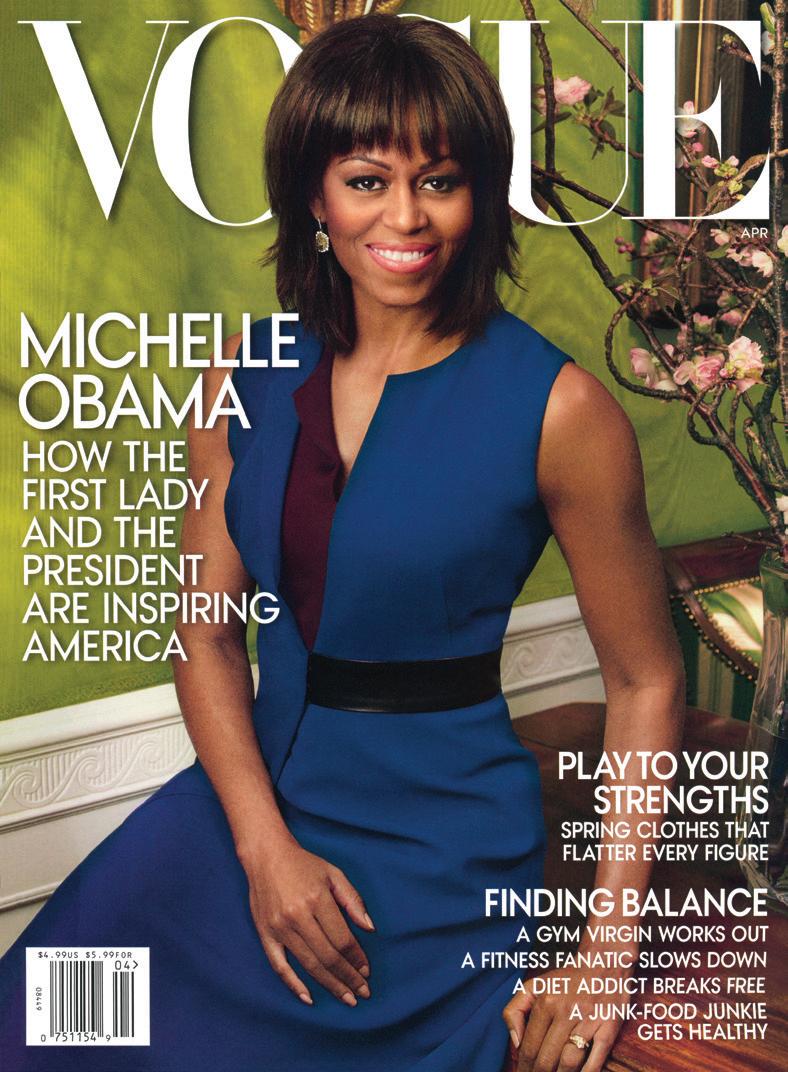
our mothers and sisters.”15 Author Ta-Nehisi Coates wrote a chapter in his book We Were Eight Years in Power on how Michelle Obama’s image helped her husband appeal to a larger audience in America, crediting her strong presentation of self as a way to “connect the heart of Black America to the heart of all America.”16
Even when choosing designers, Michelle Obama considered the idea of representation, at home and abroad. For her March 2009 Vogue cover she insisted on wearing Jason Wu and Narciso Rodriguez, both American designers of color. 17 She is recognized for bringing renewed interest to American fashion. Vogue editor Anna Wintour said, “No other American in the public eye has done so much to raise awareness around the rest of the world of our country’s designers and labels.” 18 Michelle Obama understood that her choices as first lady had consequences, and she used that power to bring attention to American fashion. New York University professor David Yermack published a study entitled “How This First Lady Moves Markets” in 2010, analyzing her positive economic impact on various brands and individuals.19 The designers who dressed her also attested to this boon. Prabal Gurung, a Nepalese American fashion designer, stated in an interview with ABC News’s Juju Chang, “I wouldn’t be here, sitting, talking with you, had it not been for her and her gestures. Like me, there are so many other designers that she’s
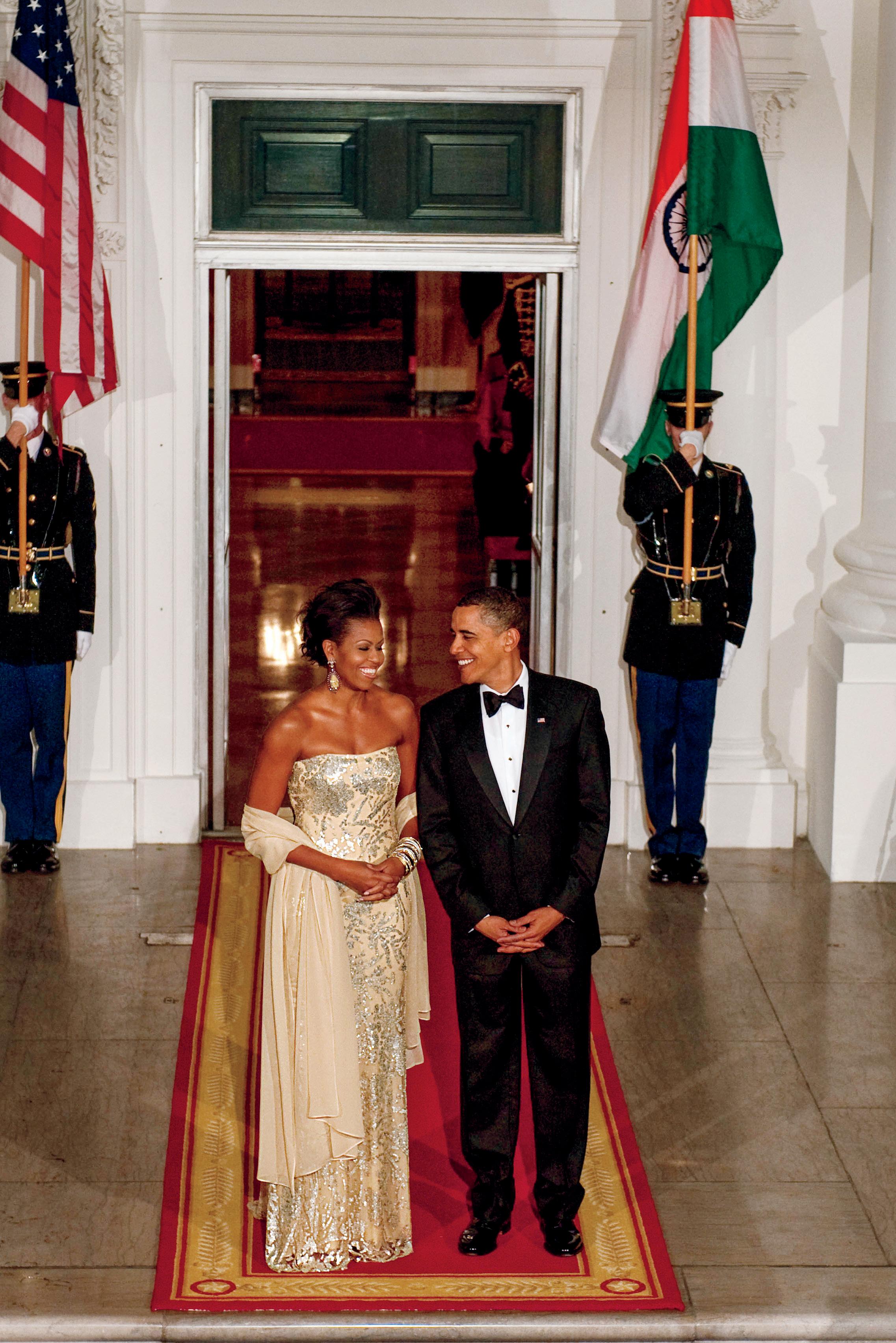
President and Mrs. Obama await the arrival of Indian Prime Minister Manmohan Singh on the North Portico, November 24, 2009. The first lady wears a gold gown by Indian American designer Naeem Khan.
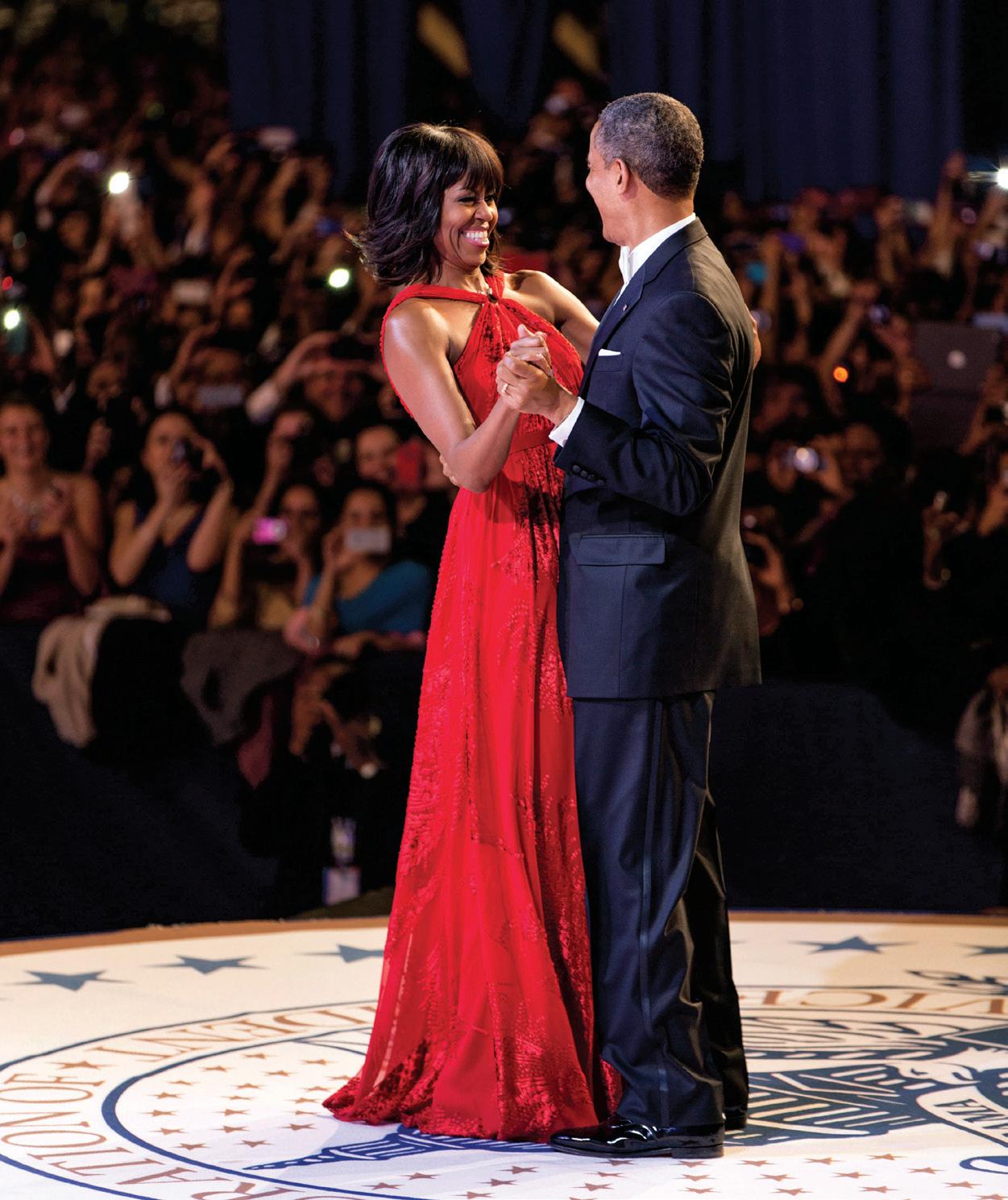
Michelle Obama wore Jason Wu throughout her years as first lady and chose a red gown in his design for the Inaugural Balls in 2013.
decided to wear. It really changed our career.”20
Writing in the Washington Post Magazine , senior critic-at-large Robin Givhan observed:
During her tenure, Obama brought widespread attention to Seventh Avenue. She energized designers, editors and stylists with her fashionforward wardrobe choices. She made industry insiders stand taller both at home and abroad.
She’s been an exemplar of modern, fit and confident middle age. She instilled pride and kinship among countless Black women.
Michelle Obama rejected the idea that first ladies had to trust their wardrobe to a few select designers, as Jacqueline Kennedy did with Oleg Cassini and as so many others had done since. “No one defined her style. In that way it was both uniquely her own and broadly American,” said Givhan.21
For State Dinners with foreign leaders, Michelle Obama often consciously chose the designer based on the country being honored. For her first State Dinner in 2009, she wore a gold gown by Indian
American designer Naeem Khan.22 She consistently made a case for American fashion by putting lesser-known designers’ work on display. In this instance, her choice was a kind of “fashion diplomacy,” meant to highlight both Indian and American fashion talent. For the next eight years, Michelle Obama would continue to wear Khan designs for various formal events, including when she announced the Oscar for Best Picture from the White House in 2013. The designer commented on her patronage by saying, “For her to choose my brand and put me on this world stage and today what has happened to the brand is just crazy. And that’s because of her. It’s important how she has actually cultivated and put the designers in front.”23
When Michelle Obama wore the white Jason Wu gown for the Inaugural Ball in 2009, Wu was a 26-year-old fashion newcomer who had launched his label only two years before.24 After the Inauguration he was catapulted into becoming a household name. Michelle Obama would continue to wear his designs for the following eight years, including in 2013, when she wore a red Wu gown to her husband’s second Inaugural Ball. Yermack estimated in 2010 the average value added by a public appearance of Michelle Obama in a brand’s clothing at $14 million.25 This is quite a significant asset to a young company, especially if she makes more than one appearance in a designer’s clothing. What becomes clear when analyzing Michelle Obama’s actions, fashion-related or not, is that everything is done intentionally. That intentionality is her strength, whether it be carefully chosen words for a speech or a thoughtfully selected ensemble. It is what moves people to identify with her, to care what she does, says, and wears. Though she has support from various staff members to maintain her image, she is fully in control of her own actions. She made the conscious decision to stand out, not just as a Black woman involved in the American political realm but also in the way she used fashion to create an accessible and thoroughly modern first lady look. She is aware of the power her image has, writing, “If people flipped through a magazine primarily to see the clothes I was wearing, I hoped they’d also see the military spouse standing next to me or read what I had to say about children’s health.”26
Much of Michelle Obama’s style was facilitated by her stylist, Meredith Koop, who started as a sales associate at the Chicago boutique Ikram, owned by
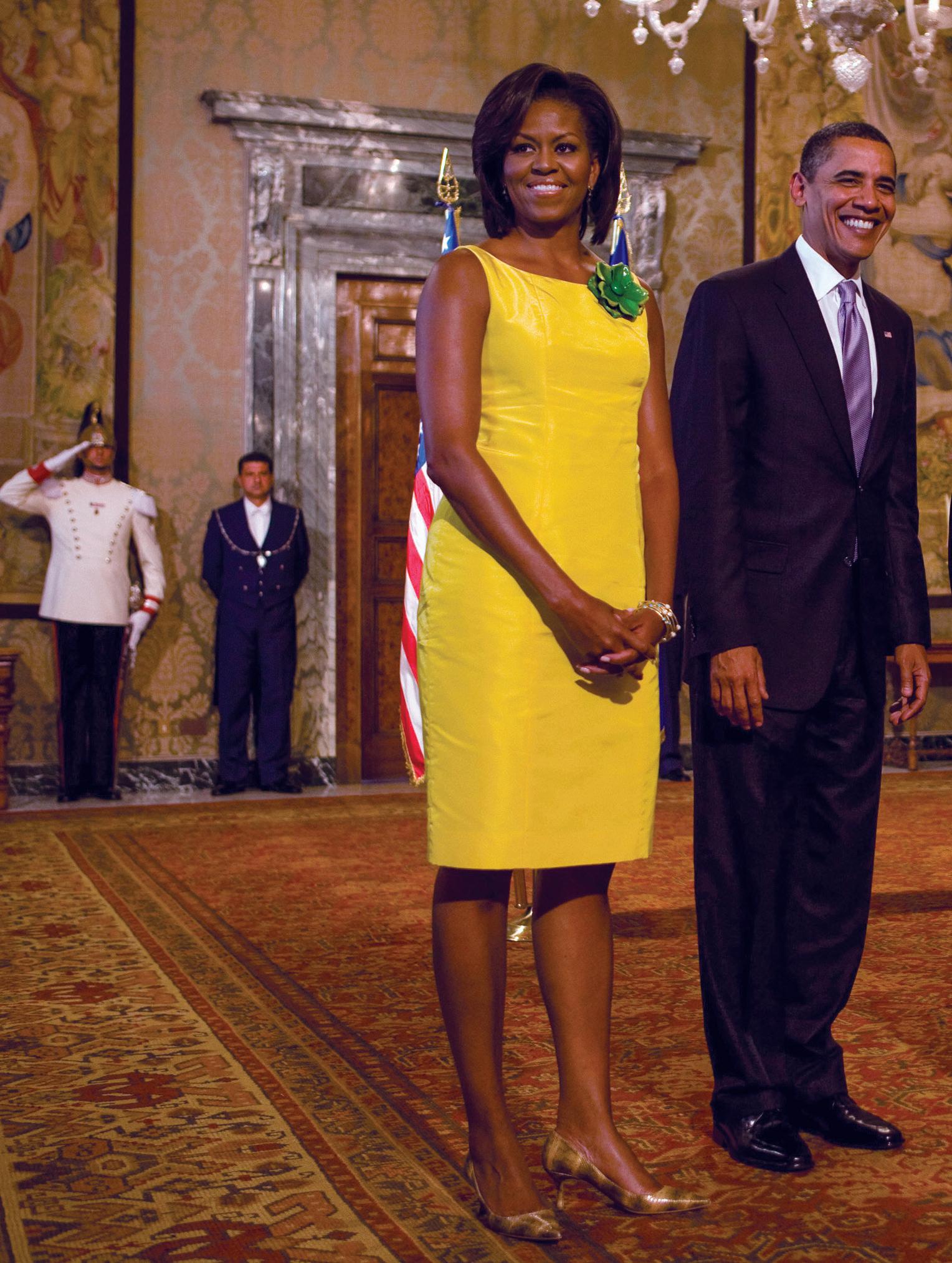
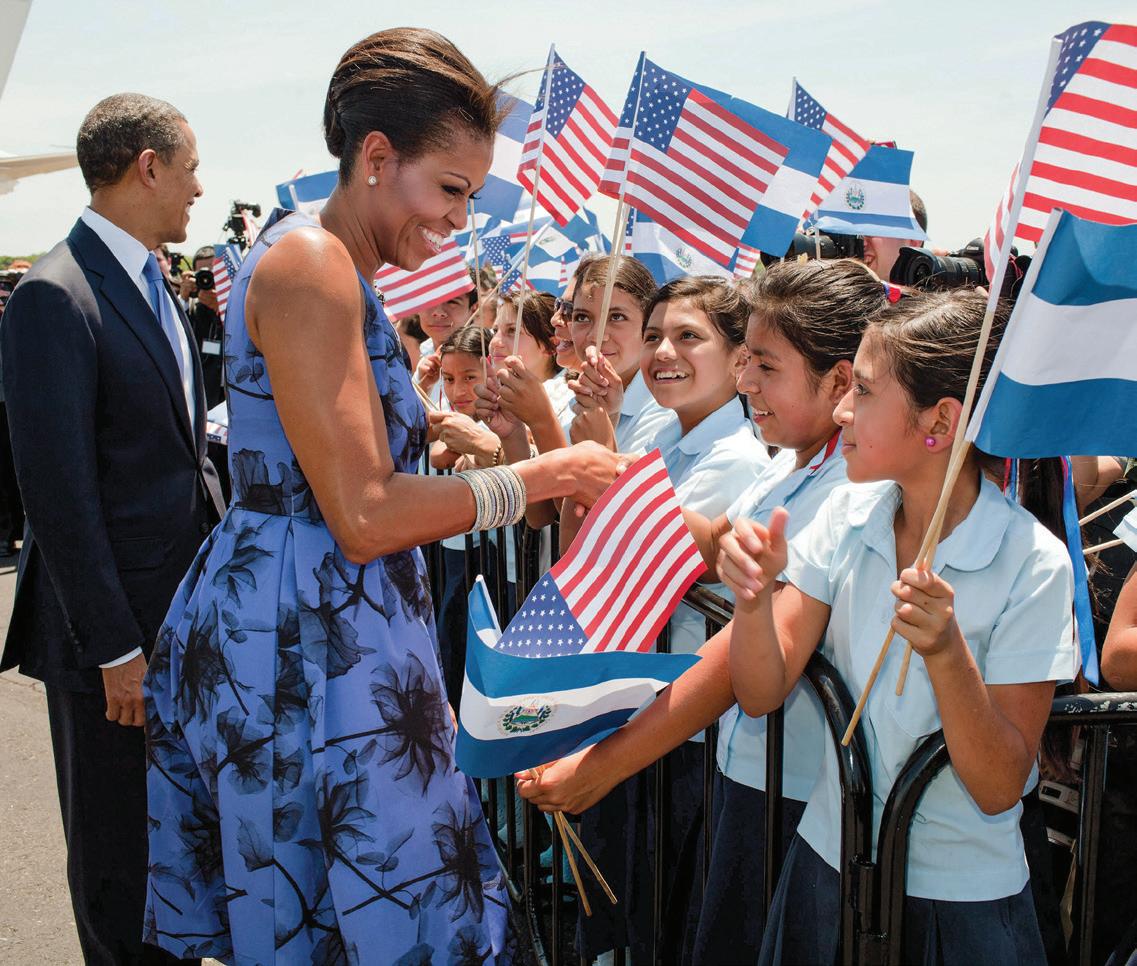
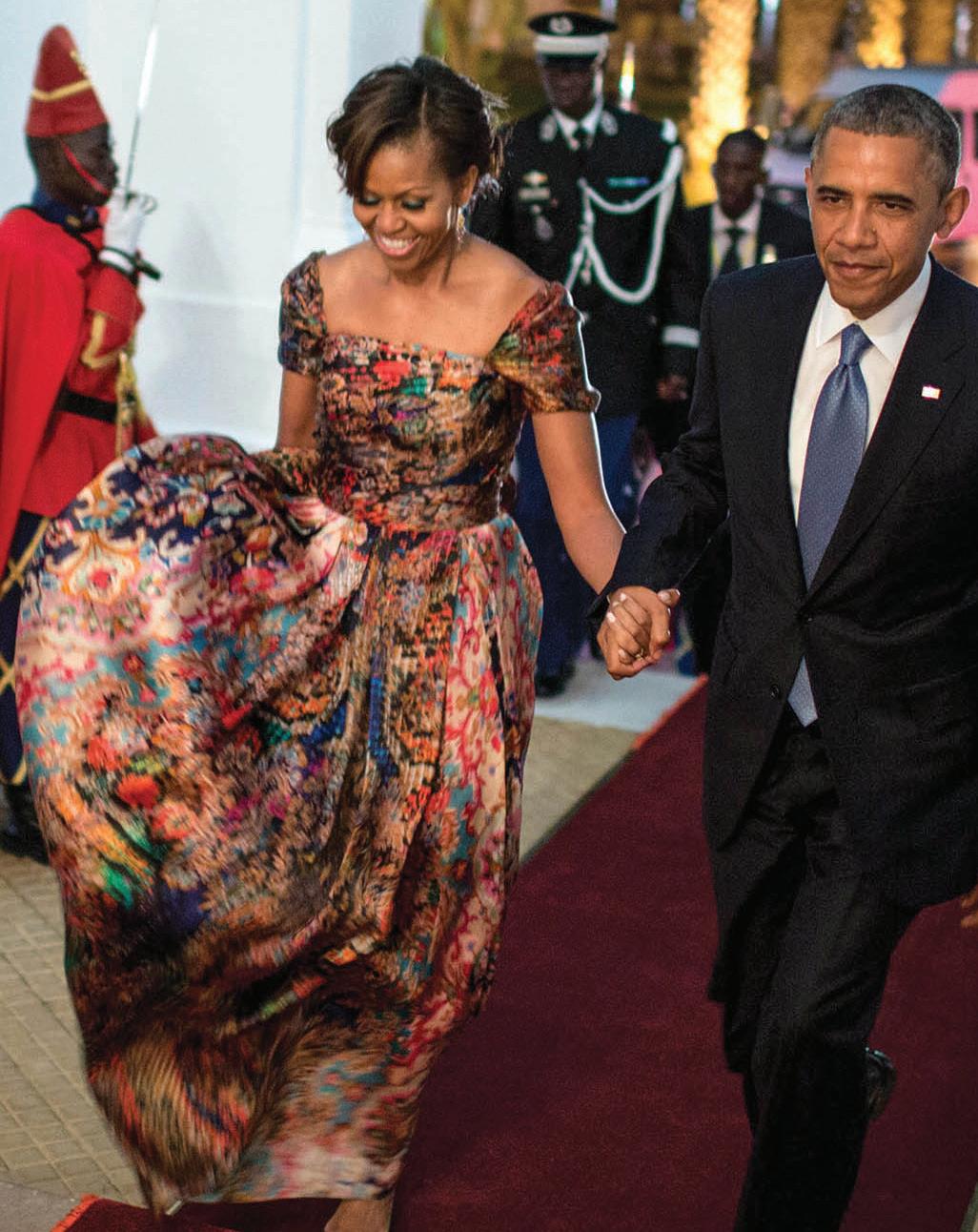
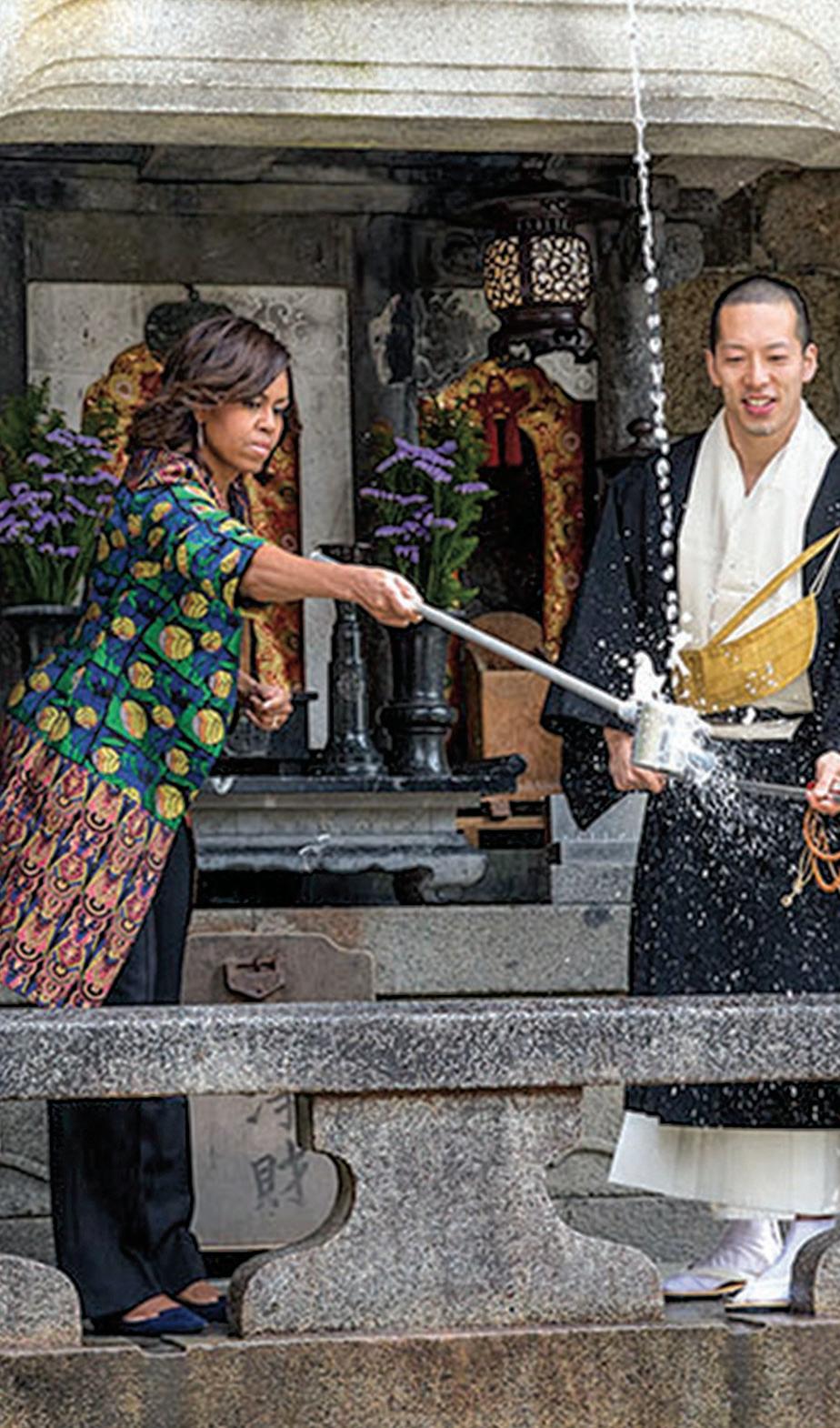
opposite
When planning international travel, Mrs. Obama worked with her stylist Meredith Koop to choose colors and patterns that paid “proper respect” to the people and nations she would be visiting.
Clockwise from top left: Michelle Obama chose a bright yellow shift dress embellished with a green flower for a meeting with Italian President and Mrs. Giorgio Napolitano at the Quirinal Palace in Rome, before departing for the G-8 summit in L’Aquila, 2009.
For an official dinner at the Presidential Palace in Dakar, Senegal, Mrs. Obama chose a colorfully patterned gown, 2013.
Mrs. Obama wears a brightly patterned jacket as she participates in the traditional ritual of drinking from the Otowa Waterfall at the Kiyomizu-dera Buddhist temple in Kyoto, Japan, 2015. To greet children during a visit to San Salvador, the first lady wears a belted sleeveless blue dress with a black floral pattern, 2011.
Ikram Goldman, where Mrs. Obama shopped when her husband first began campaigning. Goldman was first to work with Mrs. Obama, helping guide her through the presidential campaign, and by 2010 Koop had relocated to Washington, D.C., and taken over the job full-time.27
Meredith Koop, like Michelle Obama, understood the power of dressing. The goal was not to have Mrs. Obama’s clothing distract from her. “You have to anticipate every avenue of attack and every possible outcome. You have to celebrate fashion but also be aware of the message people are going to take away. Fashion can bolster communications in the best-case scenario, or be a silent partner, or actually distract,” Koop said.28
Koop is the one who reached out to designers about garments for Michelle Obama’s various events. She took all aspects into consideration, from designer and cut to the practicalities of how Mrs. Obama would be moving that day. When traveling, the two researched to make sure “the designers, colors, and styles we chose paid proper respect to the people and countries we visited.”29 The pair has also always attempted to break the mold when it came to how a first lady dressed. Rather than the understated looks of some of her predecessors, Michelle Obama never shied away from standing out. She used her ability to command focus to bring attention to a moment or cause. The designers who worked with Michelle Obama and Meredith Koop also attest to this. Koop’s “vision for how Mrs. O wants to look for each event is always crystal clear. In spite of all the scheduling and logistics involved, she somehow also manages to keep the process light and collaborative,” said designer Tracy Reese.30
When the Obamas left the White House in January 2017, Michelle Obama left behind a legacy that extended beyond fashion. She was candid, authentic, and relatable. She had used her position as first lady to promote numerous initiatives that made a difference in people’s lives. Her clothing was just one of the tools she used to make a difference. Michelle Obama made a case for the power of fashion, not just as a communicative tool but also as a way to promote a vital American industry. She recognized fashion as an important business sector in the United States and included it in her education initiative Reach Higher, in which she encouraged young adults to continue their education past high school.
In a speech at the first White House Fashion
Education Workshop in October 2014, Michelle Obama said, “Fashion is really about passion and creativity, just like music or dance or poetry. For so many people across the country, it is a calling; it is a career. It’s the way they feed their families.”31 At that workshop, designers such as Jason Wu, Diane von Furstenberg, Jenna Lyons, and other industry professionals spoke to two hundred high school and college students about fashion as a career option. Michelle Obama again underlined her message with sartorial symbolism by wearing a dress designed by Fashion Institute of Technology student Natalya Koval.32 The workshop and her penchant for highlighting young designers were ways that Michelle Obama was able to encourage young people to pursue goals that they might have thought were out of their reach. This was the same message she channeled when giving graduation keynote speeches or speaking to a group of students about her Let Girls Learn initiative.
“She underscored how most fashion companies are entrepreneurial endeavors, not big publicly traded corporations; they are the very definition of small businesses,” wrote Robin Givhan.33 That is why it is so important that Michelle Obama championed up-and-coming designers. She did not just make a difference in a few people’s lives and careers, but she also brought the American gaze to these companies, forcing them to think beyond established luxury brands and consider the people who are making clothes. She humanized her fashion, a tactic that worked so well on the campaign trail but that she proved time and time again was not just a tactic. Her authenticity in everything she did is what made her so engaging in the first place. So when promoting the fashion industry the public valued her passion and interest.
Anna Wintour, editor of Vogue, credits Michelle Obama with making Washington take fashion seriously. “When I used to come to D.C., I represented an industry that was considered decidedly unserious. I was the lady in funny clothes,” she said. “Fashion can be a powerful instrument of social change. . . . It allows us to think about who we are as individuals and as a society.”34
Michelle Obama’s carefully cultivated down-toearth image was successful because of her understanding of the power her choices had. In turn, she used this power to champion important causes and her own initiatives while also engaging in a form of cultural diplomacy. Analyzing her fashion proves a
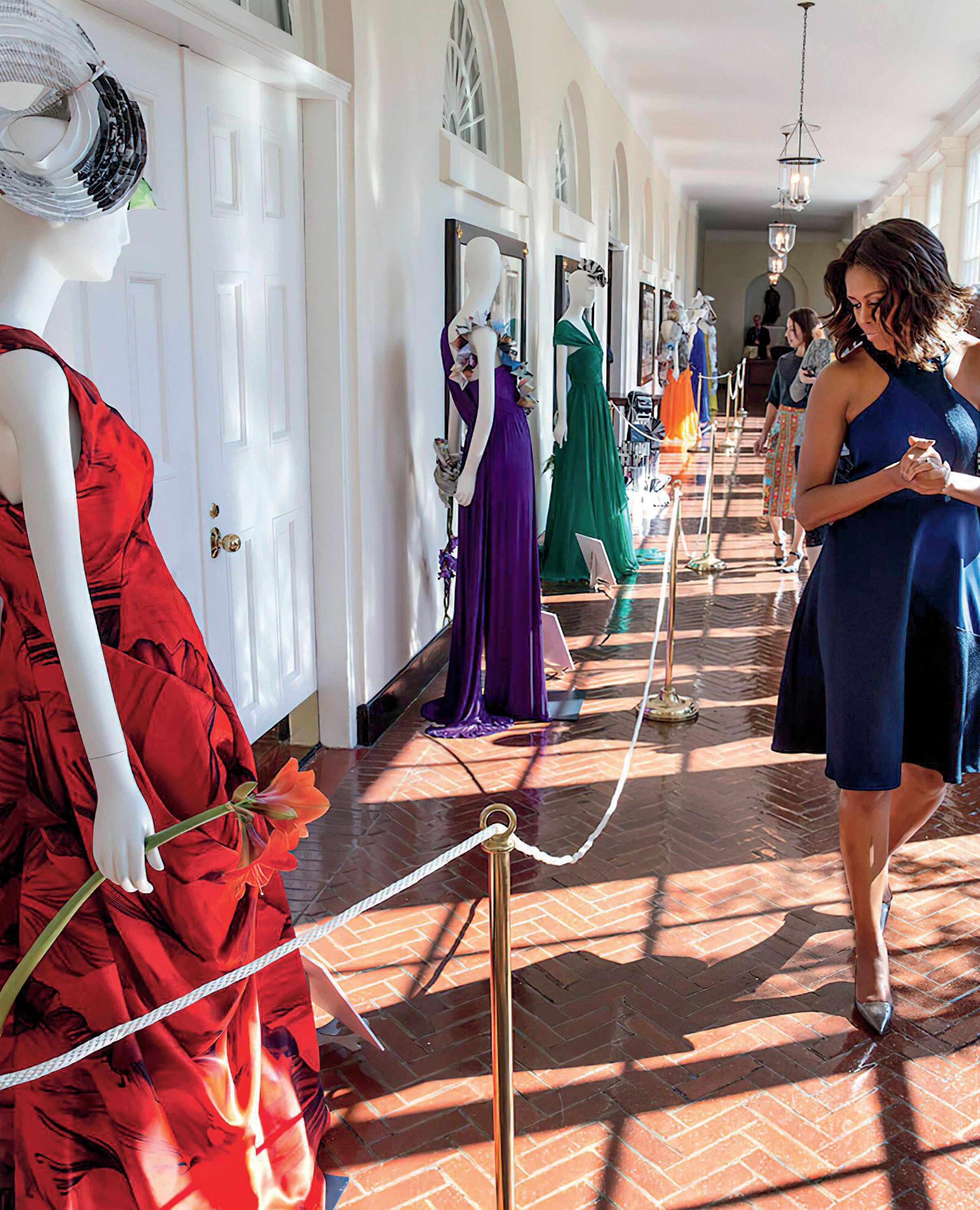
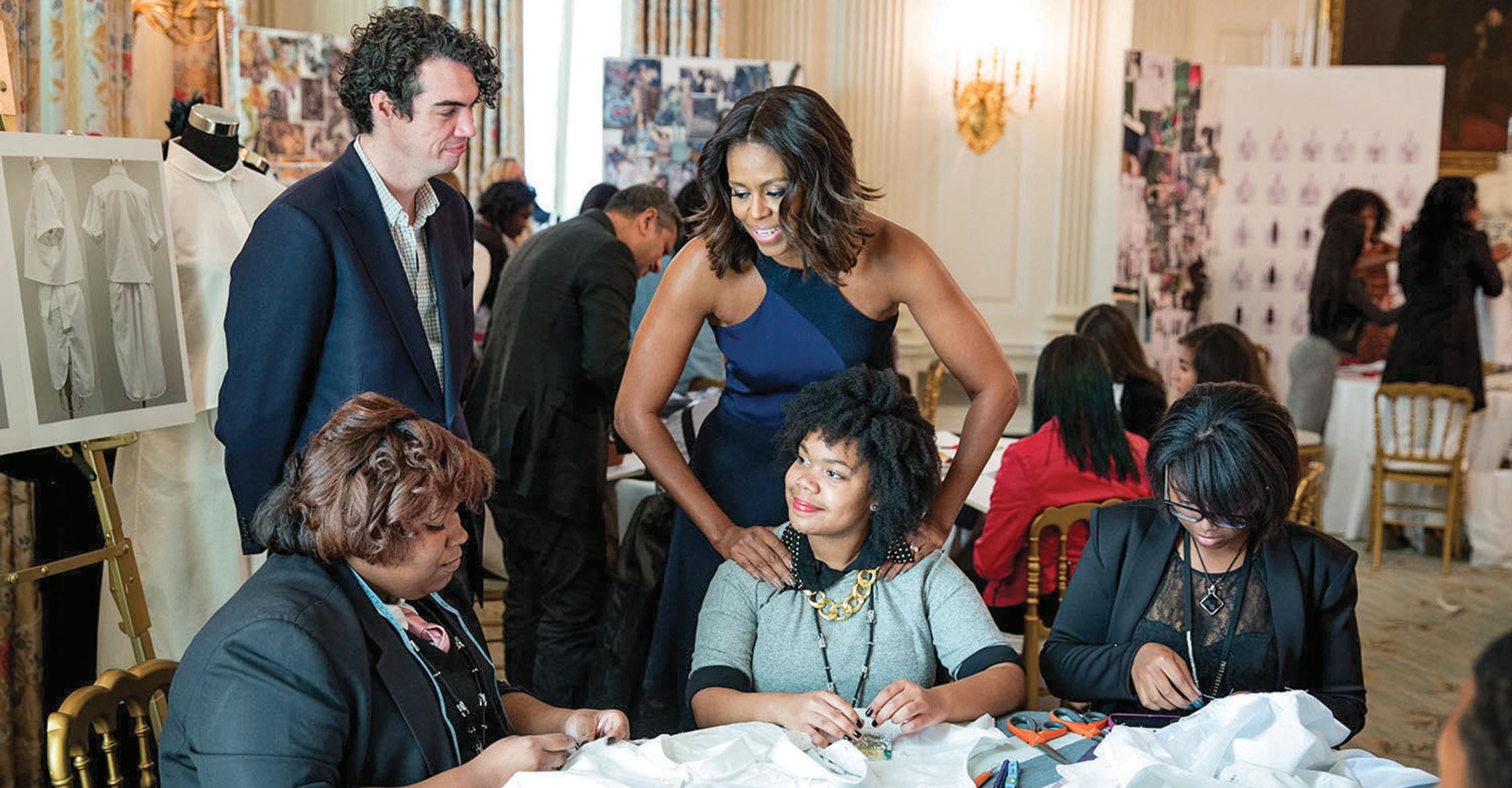
opposite Michelle Obama views a display of her dresses in the East Colonnade during the Fashion Education Workshop, 2014. above Mrs. Obama observes designer Rory Duffy and students at work in the State Dining Room during the Fashion Education Workshop, 2014.
crucial point about the importance of fashion as a communicative tool, especially when it is utilized by someone in the public eye.
notes
1. “Michelle Obama,” The White House website, www.whitehouse. gov.
2. Hilary Stout, “Can Michelle Obama Create a Fashion Star?” New York Times, May 9, 2010, ST1.
3. Quoted in Vanessa Friedman, “What Michelle Obama Wore and Why It Mattered,” New York Times, January 15, 2017, ST1.
4. Michelle Obama, 2008 Convention Keynote Address, August 25, 2008, C-SPAN website, www.c-span.org.
5. Mary Tomer, “About,” Mrs-O.com (blog), http://mrs-o.org.
6. Tomer, “The Inspiration,” posted September 22, 2008, ibid.
7. Michelle Obama, Becoming (New York: Crown, 2018), 333.
8. Ibid.
9. Keith Kyle, “The First Lady,” Harper’s Bazaar, November 1960, 89.
10. Obama, Becoming, 333.
11. Ibid.
12. Ibid., 332.
13. Ibid., 332–33.
14. Ava DuVernay, preface to The Meaning of Michelle: 16 Writers on the Iconic First Lady and How Her Journey Inspires Our Own, ed. Veronica Chambers (New York: Picador, 2018), xvi–xvii.
15. Beyoncé Knowles-Carter, “Michelle Obama,” The Time 100 Most Influential People 2019, posted April 17, 2019, Time website, www.time.com.
16. Ta-Nehisi Coates, We Were Eight Years in Power: An American Tragedy (New York: One World, 2017), 48.
17. Obama, Becoming, 333.
18. Anna Wintour, “First Among Equals,” Vogue, December 1, 2016, 94, 96.
19. David Yermack, “How This First Lady Moves Markets,” Harvard Business Review, November 2010.
20. Juju Chang, “Michelle Obama’s Stunning Outfits as Told by the Designers Who Dressed Her,” filmed December 21, 2016, for ABC News, available on youtube.com.
21. Robin Givhan, “Michelle Obama Didn’t Like to Discuss Her Clothes, But They Spoke Volumes,” Washington Post Magazine, November 23, 2016.
22. Cristina Everett, “Michelle Obama’s State Dinner Dress Designed by Indian-Born Naeem Khan,” New York Daily News, November 25, 2009.
23. Quoted in Annie Gabillet, “One of Michelle Obama’s Favorite Designers Dishes on How She Chose Her Most Iconic Dresses,” posted December 16, 2016, PopSugar website, www.popsugar. com.
24. Stephanie Eckardt, “Michelle Obama Has a Long History of Supporting Emerging Designers, from Teija to Jason Wu,” W Magazine, May 30, 2017.
25. Yermack, “How This First Lady Moves Markets.”
26. Obama, Becoming, 332.
27. Vanessa Friedman, “Dressing Michelle Obama, Then and Now,” New York Times, November 15, 2018, D1.
28. Quoted in ibid.
29. Obama, Becoming, 334.
30. Quoted in Friedman, “Dressing Michelle Obama,” D1.
31. Quoted in Robin Givhan, “Michelle Obama and Fashion Designers Show Students the Grit Behind the Glamour,” Washington Post, October 8, 2014.
32. Lauren Christensen, “The Stylist to First Lady Michelle Obama Finally Opens Up,” Harper’s Bazaar, October, 2016, 268–71.
33. Givhan, “Michelle Obama Didn’t Like to Discuss Her Clothes.”
34. Quoted in Givhan, “Michelle Obama and Fashion Designers.”
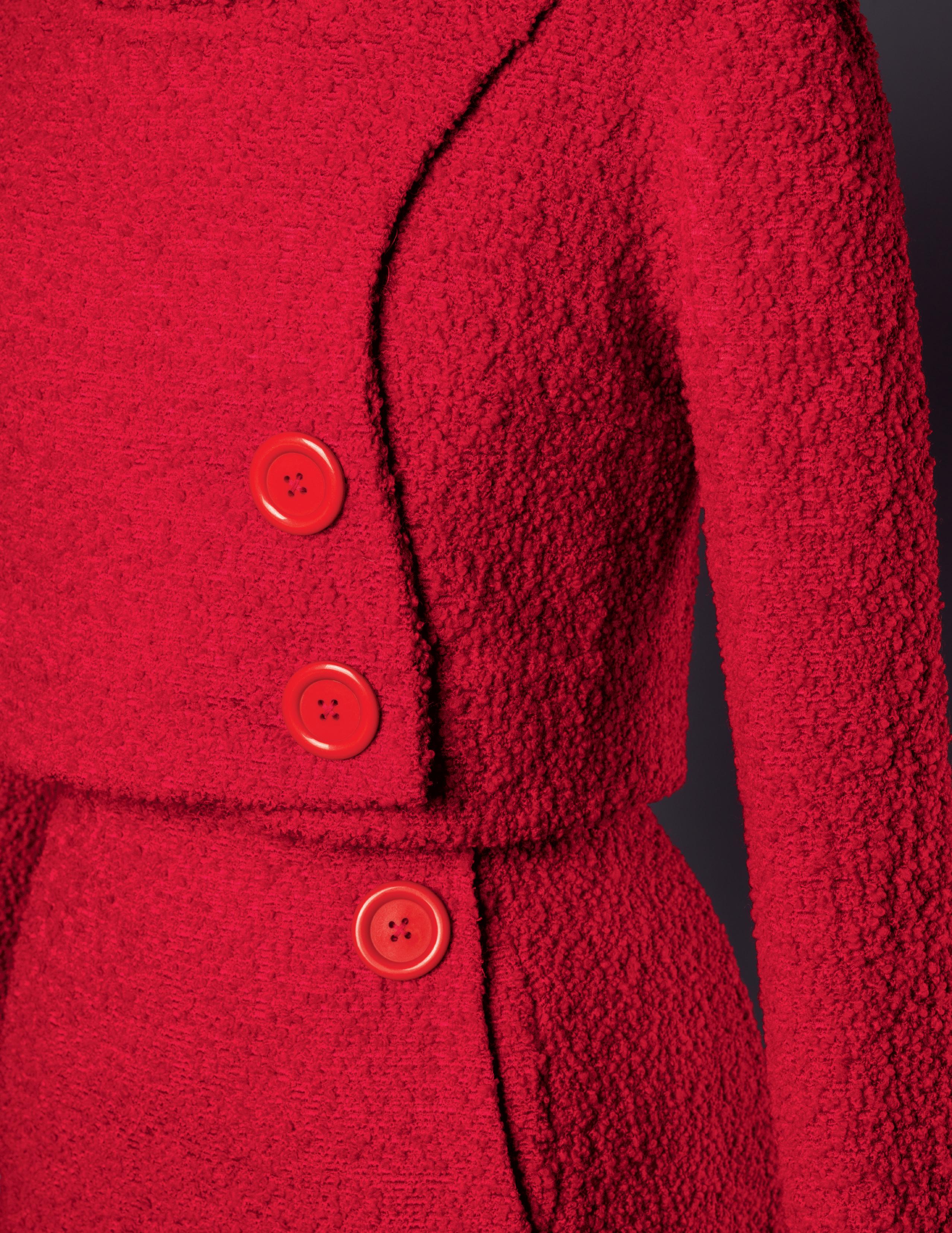
The Exhibition of First Ladies’ Clothing and a Behind-the-Scenes Look at the Process of Re-creating Historical Fashion
CHRISTINA CLARE EWALD
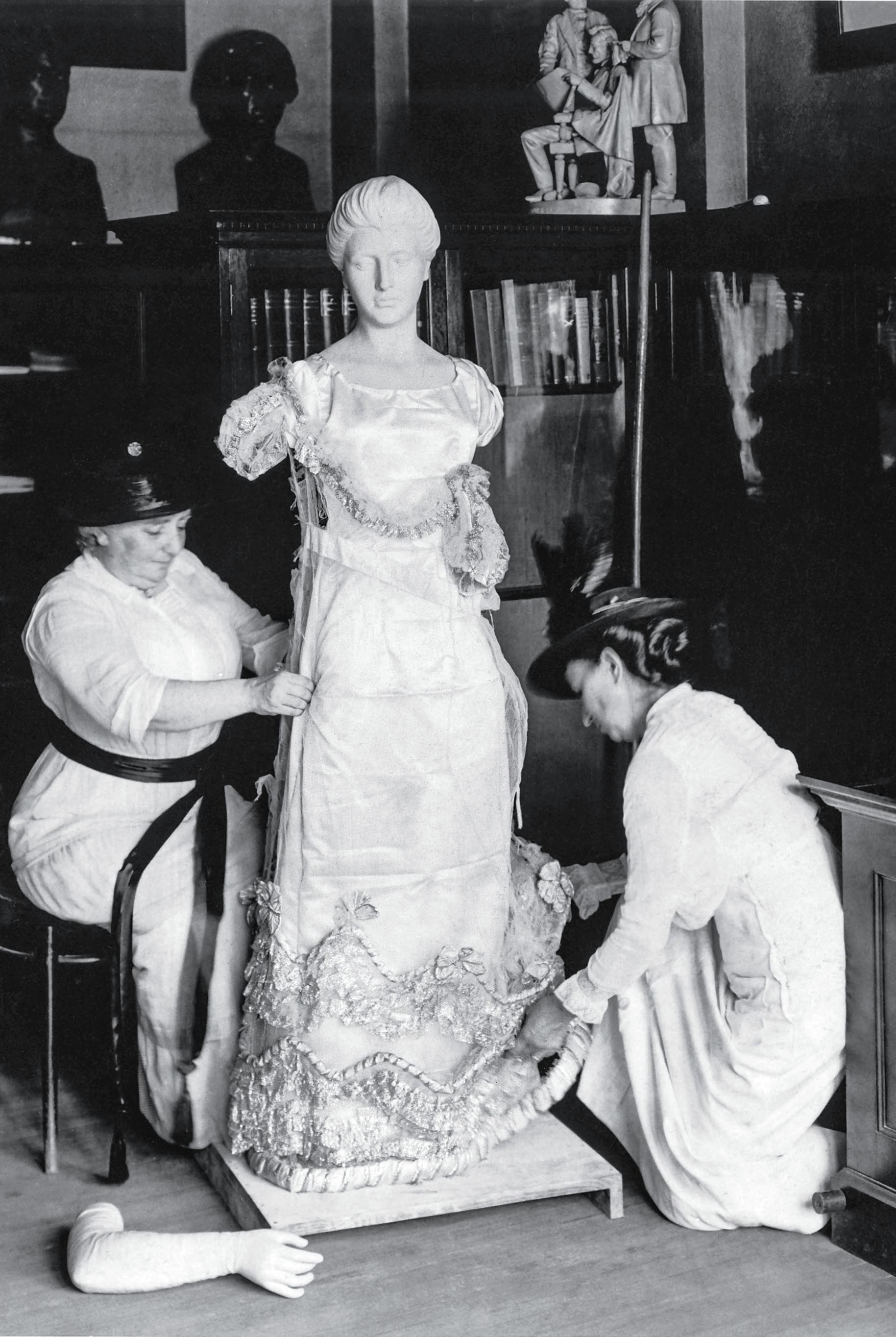
Cassie Mason Myers JulianJames and Rose Gouverneur Hoes, two Washington socialites who conceived the idea of the First Ladies Hall at the Smithsonian Institution, arrange a dress worn by First Lady Louisa Catherine Adams on a plaster figure, 1915. Rose Gouverneur Hoes (right) was the greatgranddaughter of President James Monroe.
previous spread Detail of a completed reproduction of an Oleg Cassini dress famously worn by First Lady Jacqueline Kennedy during her 1962 televised tour of the White House.
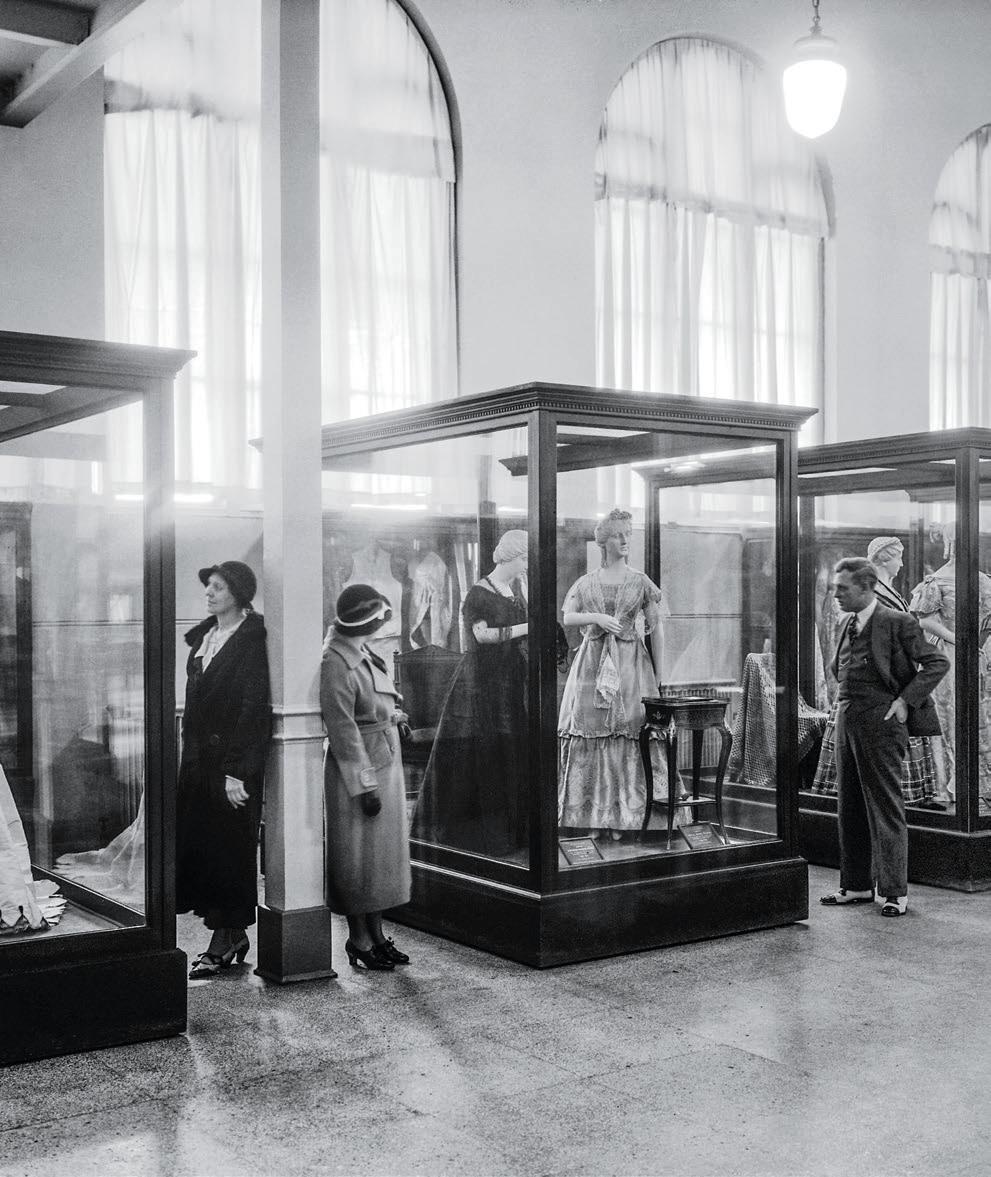
From 1914 to 1955 the gowns in the Smithsonian’s First Ladies Hall were displayed in glass cases, as seen in the top left photograph, c. 1920, of visitors viewing dresses worn by Jane Appleton Pierce and Abigail Powers Fillmore. The popular exhibit even drew visiting royalty to the museum. Queen Elizabeth, the Queen Mother, is seen (top right) with First Lady Mamie Eisenhower enjoying a view of the collection of first ladies’ gowns, 1954.
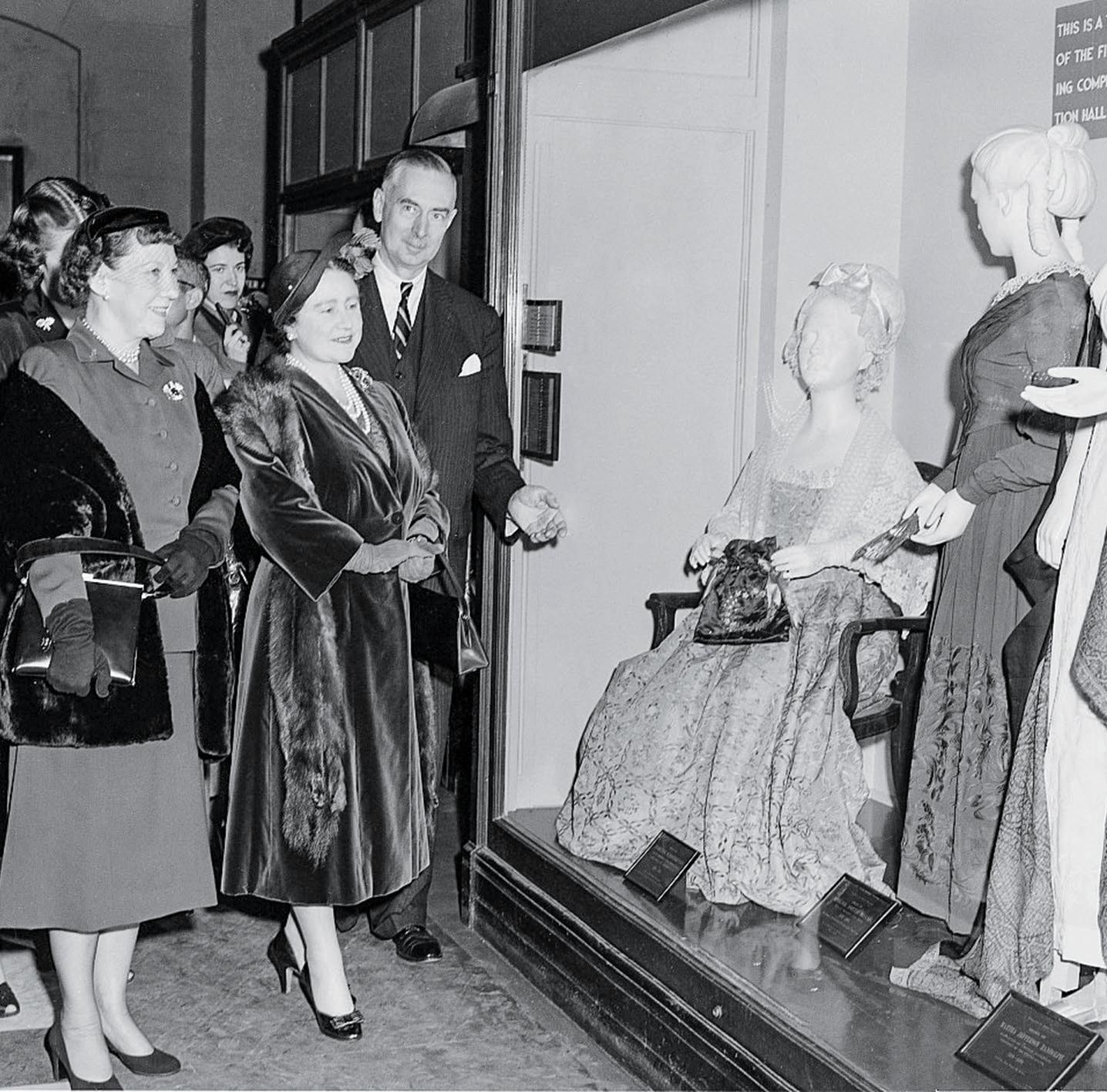
for more than a century, the Smithsonian Institution’s well-known First Ladies Hall has attracted crowds and captivated viewers. The display, which first opened in the Arts and Industries Building on the National Mall in 1914 with a small group of gowns, has grown to fill an exhibition hall at the National Museum of American History. From large blockbuster exhibitions of original clothing to traveling exhibitions of replicas, displays of first ladies’ gowns have since been mounted in varying forms at museums and other venues across the country. No matter the circumstances, the exhibits never fail to generate interest. The growing appeal of such fashion displays recently led designer Giorgio Armani to observe:
Visitors have an opportunity for immersing themselves in the exhibition under their own terms and at their own pace. . . It can be a very profound and personal experience and very different from other forms of storytelling. . . . In our digital era there is undoubtedly growing curiosity about what is concrete, literal and real. There’s an aspiration towards craftsmanship, things made with care and with passion and made to last.1
In recent years Presidential Libraries have also showcased first ladies’ fashion through thematic
exhibitions that go beyond the aesthetic to the meaning and context of fashion choices. The style of one or more first ladies is often featured within the story of their life’s work and official roles. In 2007, the Ronald Reagan Presidential Library and Museum opened Nancy Reagan: A First Lady’s Style, which focused on Mrs. Reagan’s White House roles of hostess, spokesperson, and caring wife by showcasing eighty dresses, suits, and gowns spanning a fifty-year timeframe. At the John F. Kennedy Presidential Library and Museum the permanent First Lady Jacqueline Kennedy exhibit includes examples of Mrs. Kennedy’s clothing as part of a larger exhibition on her life. The George W. Bush Presidential Library and Museum’s First Ladies: Style of Influence, which opened in 2018, focused on the impact first ladies from Martha Washington through Melania Trump have had on the world stage. Examples included in the display were the uniform First Lady Lou Hoover wore as president of the Girl Scouts in the 1920s, and a pantsuit worn by First Lady Laura Bush in Afghanistan. Also showcasing how first ladies have used favorite styles to advance their agendas, Why They Wore It: The Politics & Pop Culture of First Ladies’ Fashion, opened at the Richard M. Nixon Presidential Library and Museum in 2018. This exhibit featured both original and exact replica pieces.
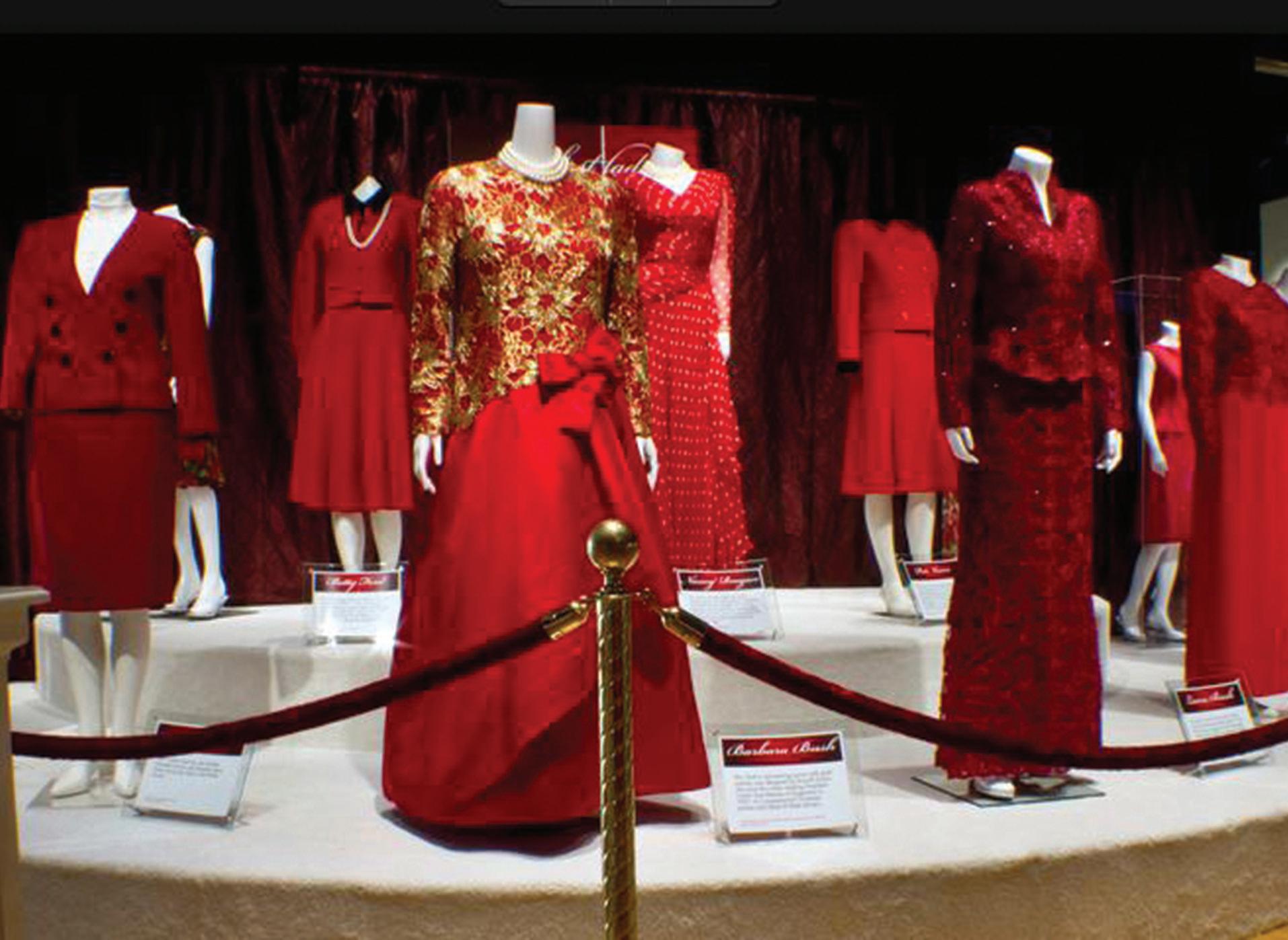
In 2010 the George W. Bush Presidential Library and Museum staged The Heart Truth Red Dress Collection, which included first ladies’ gowns from thirteen presidential libraries.
The red coat First Lady Pat Nixon wore to China in 1972 is displayed at the center of a group of her White House fashions in Why They Wore It: The Politics & Pop Culture of First Ladies’ Fashion at the Richard M. Nixon Presidential Library and Museum, 2018.
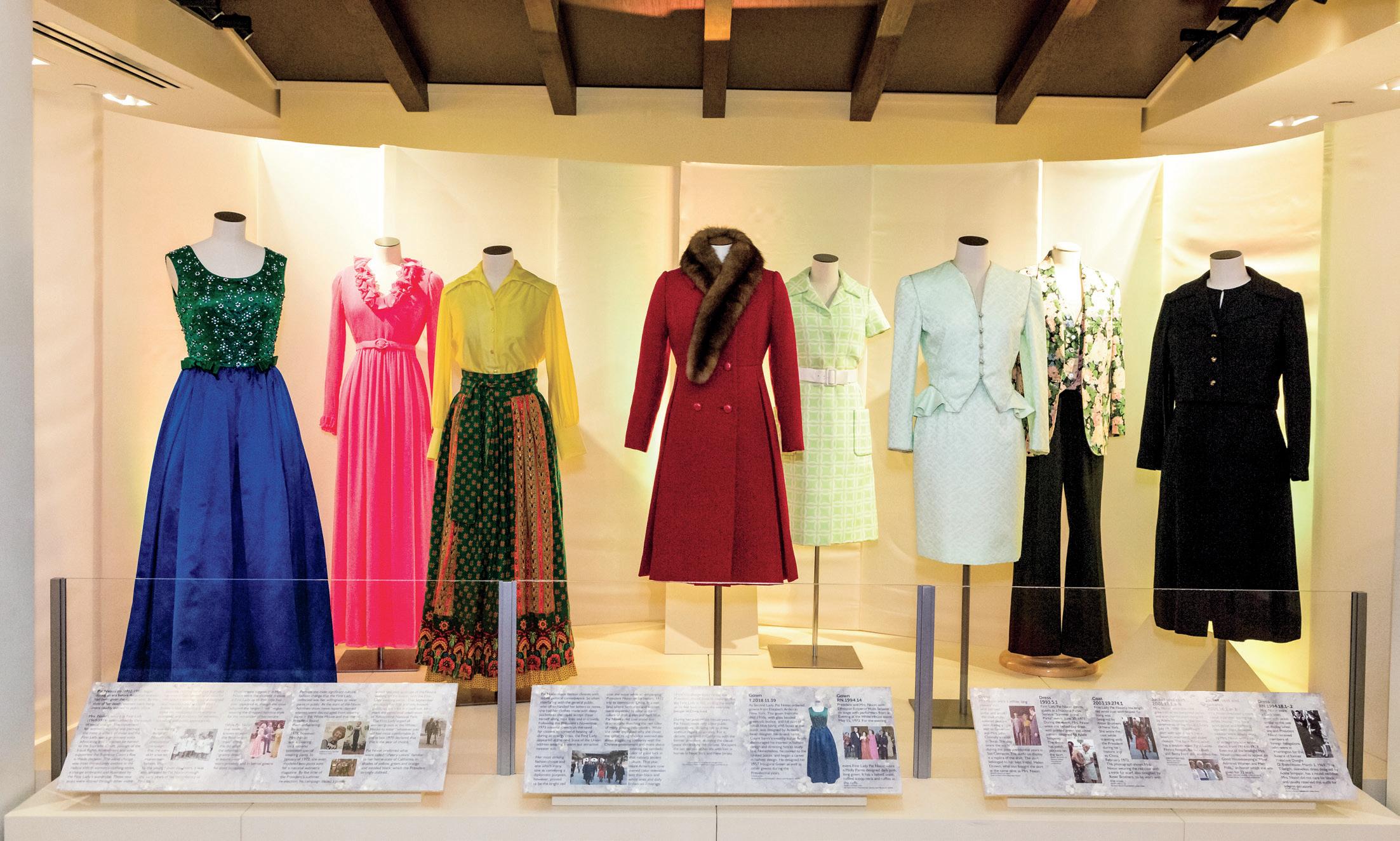
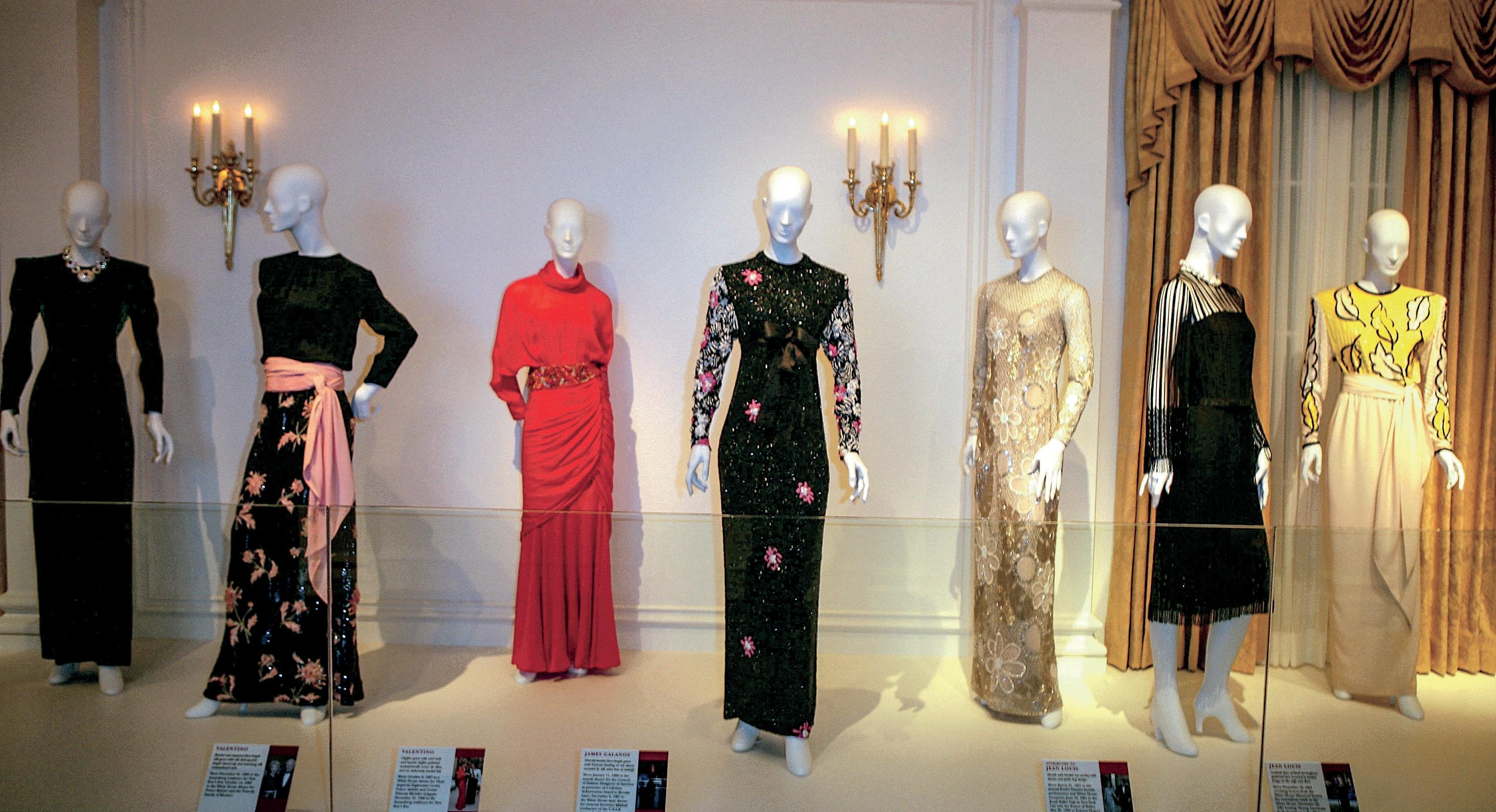
Nancy Reagan: A First Lady’s Style showcased eighty designs worn by First Lady Nancy Reagan in the roles of White House hostess, spokesperson, and caring wife.
Jacqueline Kennedy: The White House Years; Selections from the John F. Kennedy Library and Museum, which opened at the Metropolitan Museum of Art in 2000, explored Mrs. Kennedy’s enduring global influence on style.
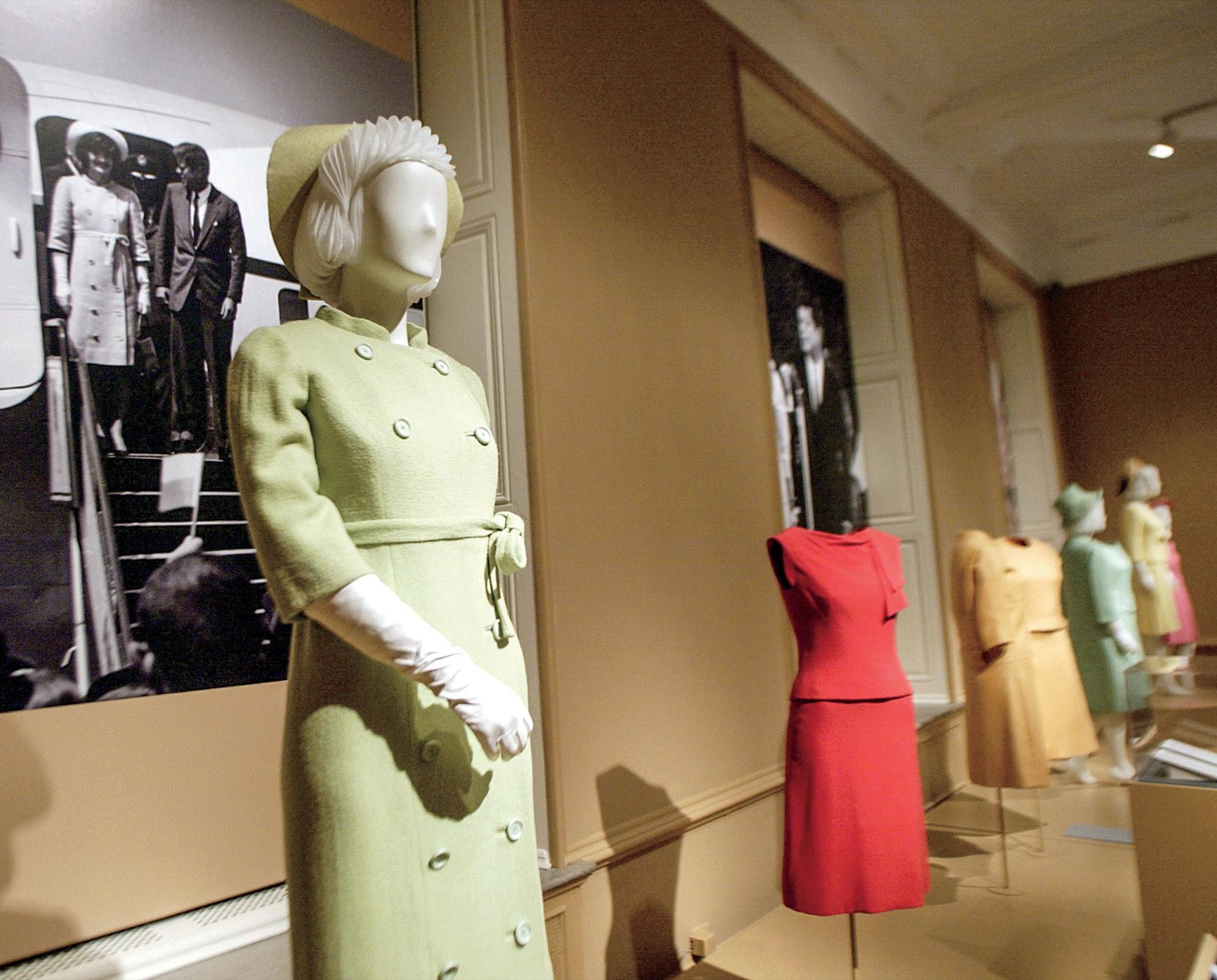
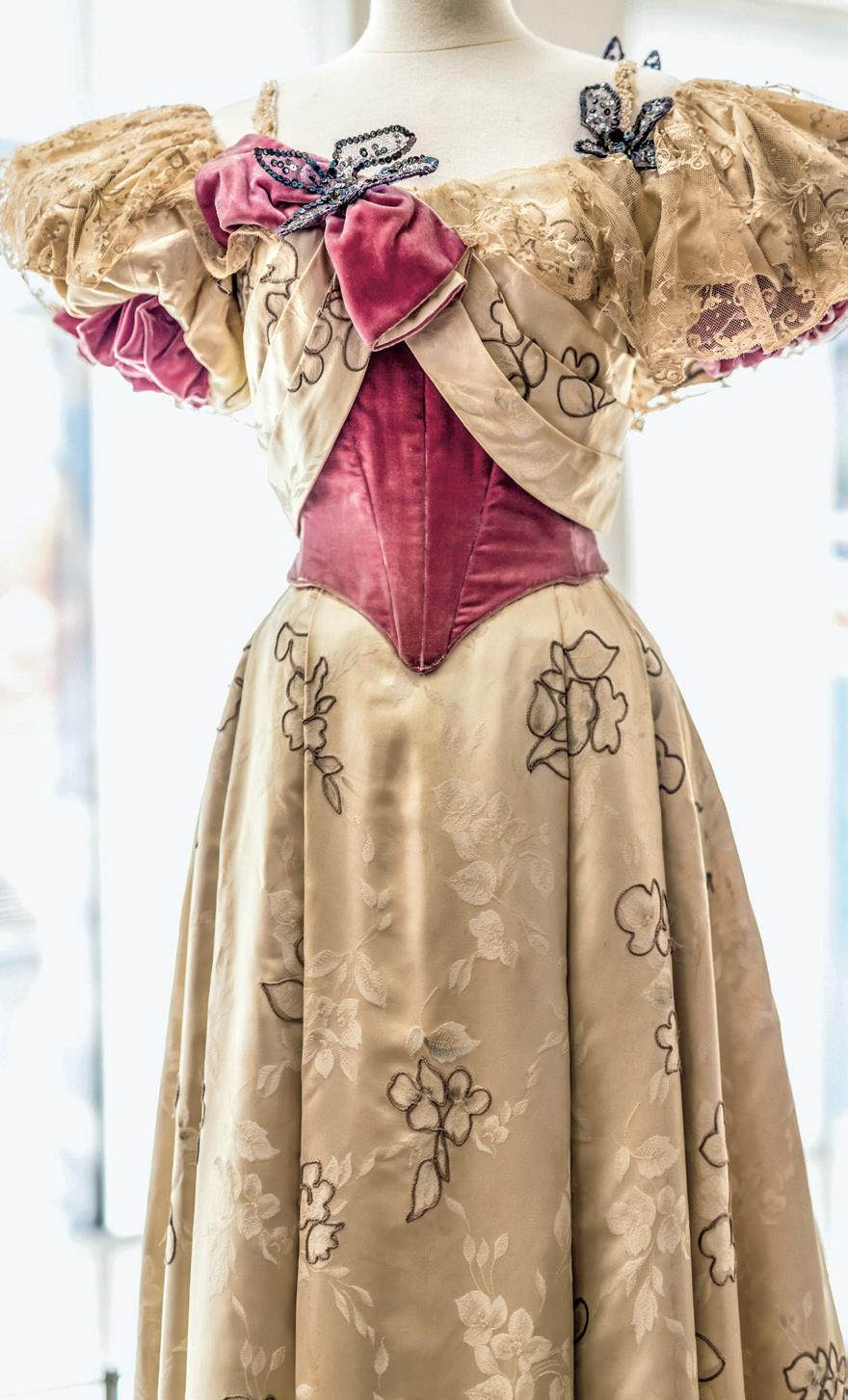
When original costumes are too delicate or not available for display, replicas are often made for exhibition. Re-creating a historical piece accurately involves both artistry and scholarship. It also requires a foundation for display. That is where I come in. As a professional whose work is melding the worlds of fashion, performance, costume, museum, culture, photography, and art, I have been involved in producing many forms of fashion displays. And so when the White House Historical Association asked me to advise on reproducing two iconic dresses, I readily said yes. The Association was preparing for its 2019 annual book festival, and the examples would be used in conjunction with its display of the “Mid-Century Fashion” issue of White House History Quarterly in order to give attendees an opportunity to tangibly experience two dresses featured in the issue.
It was not until a few hours after expressing my confidence that I stopped to think, “Just what have I gotten myself into?” As a freelancer, my number one rule is “always say yes,” when offered a project, but this has caused me many a sleepless night.
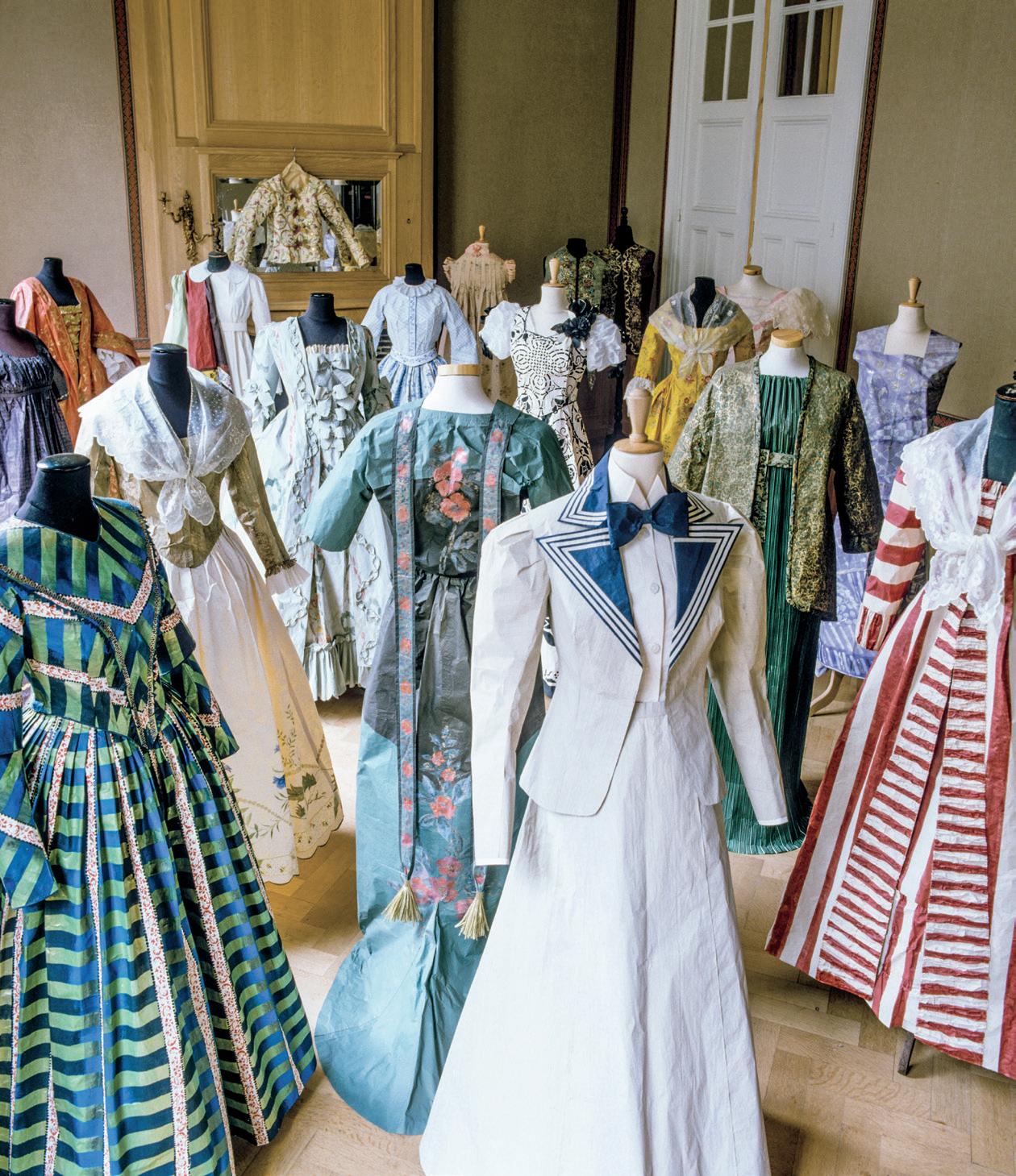
And so by 2:00 a.m. the next morning, I was wide awake contemplating the challenges the project would entail.
The following morning, I called on a friend who I hoped would help me—Camilla Huey, a couturier, artist, designer, and historian who has adorned many celebrities in her bespoke dresses and exquisite handmade corsets. I made my way to 36th Street and 9th Avenue, in New York City’s Garment District, and up to Camilla’s studio on the 14th floor. I filled her in on the scope of the project and the historical significance of the pieces. Without a moment’s hesitation, a broad smile spread across Camilla’s face. We were ready to get to work.
In making any article of clothing from scratch, a dressmaker normally starts with patterns, which are as important to a seamstress as blueprints are to an architect. The correct pattern is imperative in getting the silhouette and sizing of a garment right. Although I would spend the next two days looking high and low for the original patterns, they could not be found. It was a hurdle, but not an impossible one to clear.
A replica of a dress
is seen on display in the exhibit Why They Wore It: The Politics & Pop Culture of First Ladies’ Fashion at the Richard M. Nixon Presidential Library and Museum, 2018. While the Cleveland dress was replicated with sewn fabric, other materials are sometimes used, as well. A group of replica historical dresses (top right) were made of painted and sculpted paper by artist Isabelle de Borchgrave, 2011.
Christina Ewald’s project was to produce replicas of two dresses for display at the White House Historical Association’s Annual Holiday Book Festival: the red dress worn by Mrs. Kennedy on multiple occasions, including her 1962 televised tour of the White House (right), and a white dress (below) worn in San Antonio, Texas, in 1963. The dresses would be displayed alongside the “MidCentury Fashion” issue of White House History Quarterly at the book festival.
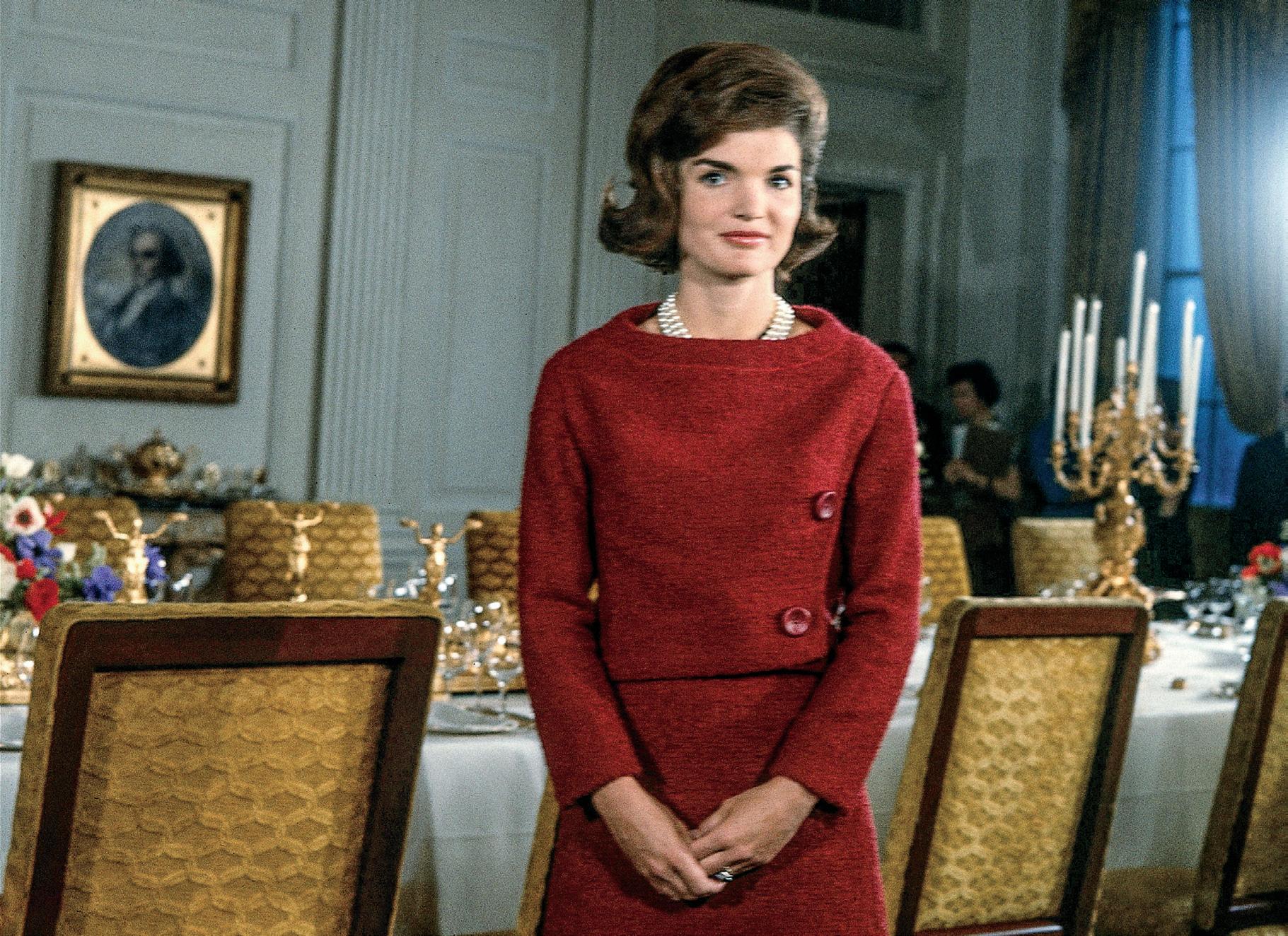
Mid-Century Fashion and The First Ladies: From Ready-to-Wear to Haute Couture


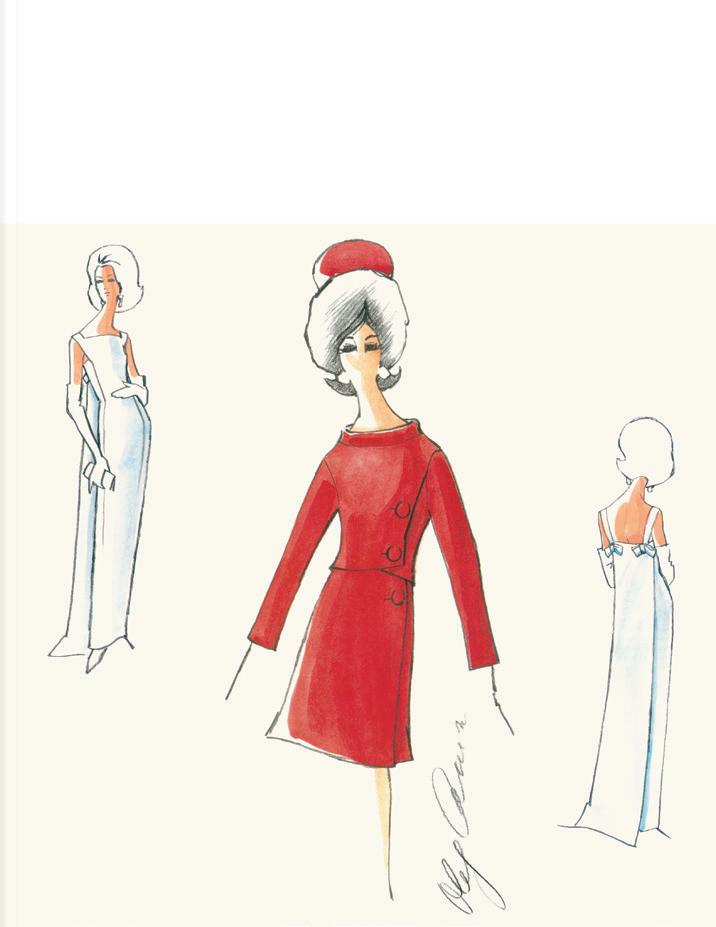

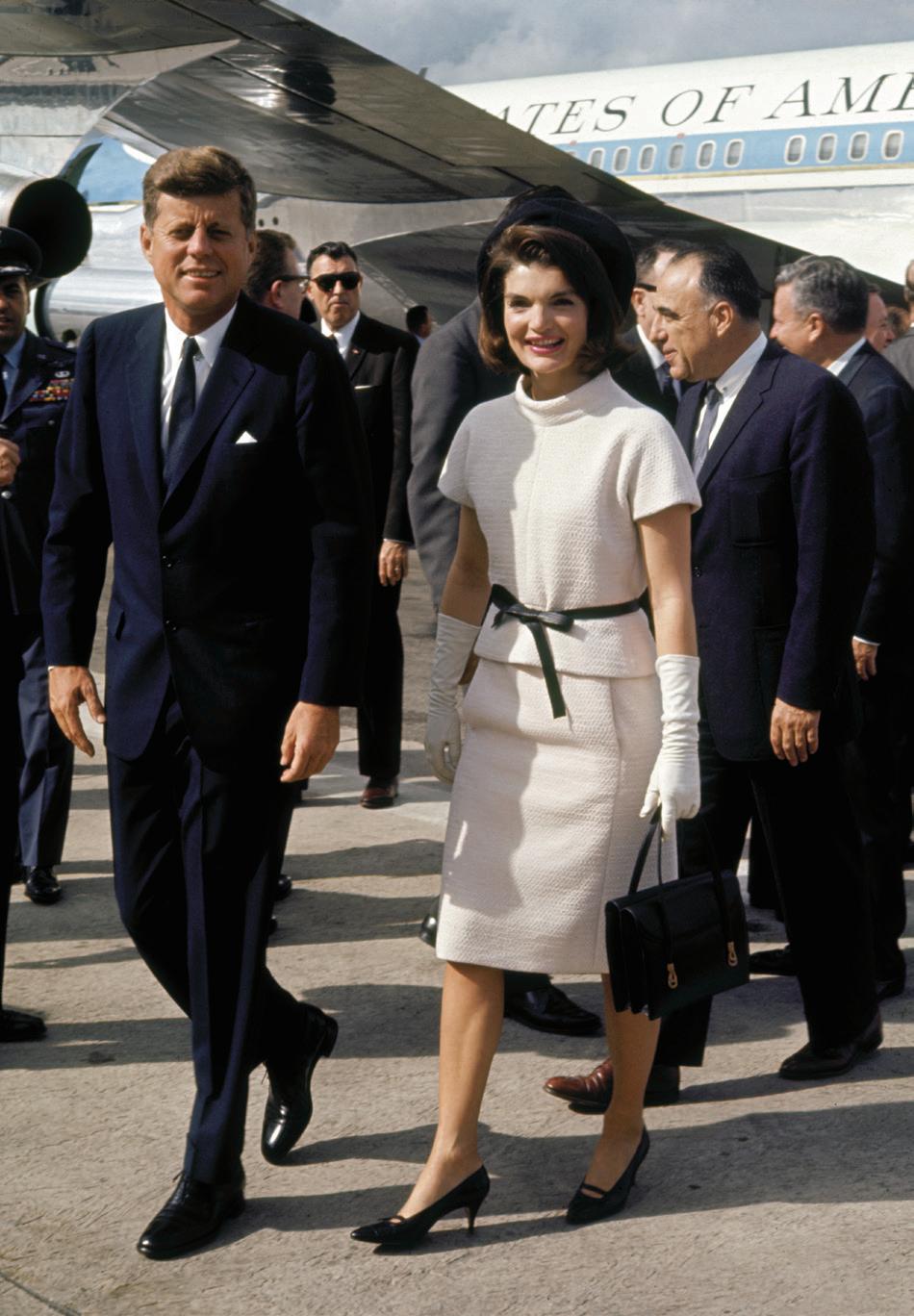
Referencing print material, television clips, and everything we could locate that showed Mrs. Kennedy wearing the two dresses, Camilla began the hard work of making two original patterns. I know how difficult constructing patterns from pictures is, and so as I watched Camilla expertly create the new patterns, I was humbled to be working alongside such a talented artist. While she made the patterns, I started on the construction of the two identical mannequins on which the replica dresses were to be displayed.
Camilla and I met regularly as work progressed, and one visit was spent selecting the fabric. Having worked in the Garment District for twenty-five years, she knew the best stores to shop for fabrics. Camilla picked out five swatches for each dress and we went over the benefits and drawbacks of each. Some were too stretchy, while others were not stretchy enough. One was the perfect color but did not have the correct hand. There are many variables to consider, and quality fabrics are very expensive; once a seamstress makes her choice, there is no going back. After reviewing again the printed references and video footage of Jacqueline Kennedy wearing each dress, we settled on the fabric and then found perfectly matching thread in Camilla’s own extensive collection. The cutting and sewing began.
As the dresses were being constructed using the ideal fabric and thread, I returned to my job of creating the mannequins. I found myself in the Garment District again, this time on 37th Street at a large and unorganized wholesale shop, overflowing with mannequins. There were big, small, clear, baby, and rainbow-colored mannequins. I think I even spotted a unicorn. There were mannequins to suit every taste and window display. Being careful not to trip on the detached heads, arms, stands, and miscellaneous plastic and fiberglass body parts strewn over the floor, I made my way to the very back of the shop. There I found the perfect lifesize female mannequins for me to deconstruct and then reconstruct in Jacqueline Kennedy’s image. Bartering for a discount, as one does in New York City, but still paying full price, I carried one large mannequin under each arm and hailed a cab.
I have been hired by museums, private collections, and institutions across the United States to make bespoke mannequins for everything from
elaborate Victorian gowns in West Texas to mounts for hats and heels made of papier mâché by independent designers in Chicago. The tools I rely on in my studio include an array of razor blades and knives to smooth and shave edges; batting as would be used for the interior of a quilt cut to make hips and backs seem more lifelike and touchable; tulle, which is often inserted to pop out shoulders where they may be a bit flat; bust cups removed from brassieres for achieving a desired look; and nylon legs, cut from nude-colored pantyhose, to hold all these specialized textural components together.
With small, uniform, and precise stitches, many layers of batting, foam, and muslin are removed, replaced, and stacked in just the right places to make the perfect form. Everything is hand-sewn. My stitch of choice is called the herringbone. It is beautiful, and the use of curved needles allows a seamless look to be achieved every time. Despite their role as armatures for the actual showpieces, it is imperative that my bespoke mannequins reflect quality and artisanship. If this base is not flawless, even the most beautiful dress is not given its full opportunity to shine.
Back in my studio, I took out my blade and started cutting here and there; the Jackie Twin mannequins needed a lot of work. Truth be told,
The work of creating bespoke mannequins for the display of two replicas of Mrs. Kennedy’s dresses began with the selection and adaptation of generic dress forms acquired in the Garment District in New York City.
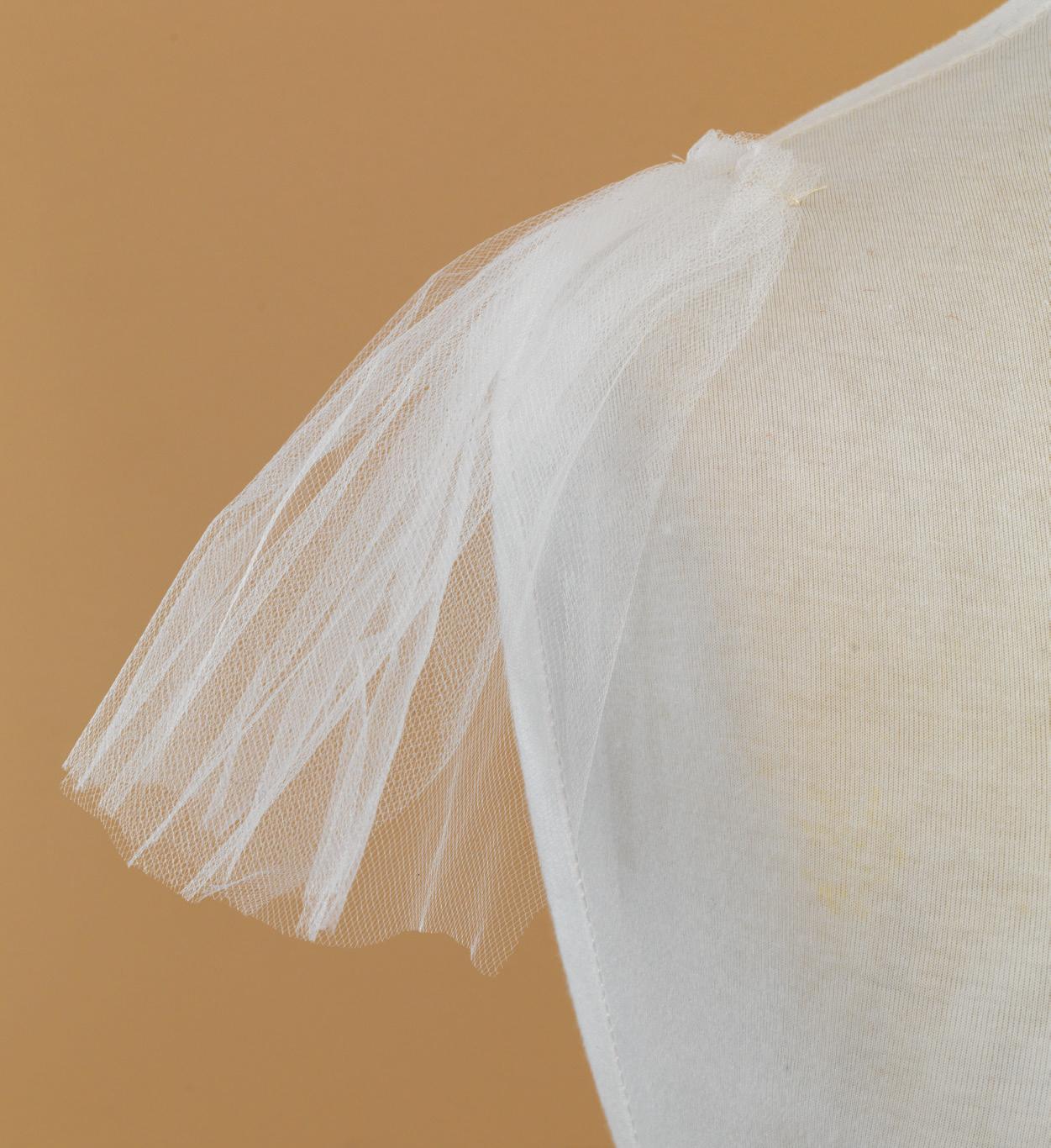
The generic dress forms were deconstructed and reconstructed to make more life like supports for the garments. The straight shoulders were shaped into a natural curve, and tulle was added to prevent flatness (top left). Layers of batting, foam, and muslin were reshaped and hand-sewn using a herringbone stitch (top right) achieved with curved needles. The resulting dress forms (bottom right) mirrored Mrs. Kennedy’s height and shape.
all of my projects need a lot of work. As everything is made by hand, to exact detail, a tremendous amount of time and attention is necessary in every step. In this instance, shoulders needed to be cut and replaced to give the appearance of a more sloped and realistic curve. The height, of course, needed adjusting and readjusting, as the shoulders grew and changed. Two steps forward and one backward, each with enough progress to keep the process interesting and fresh. I precut large lima bean–shaped pieces of batting and used them to build out hips and backs and bottoms, allowing a bit of cushion for the objects to lie upon, all the while continuously checking the measurements to be sure things were not too big or too small on each part of the mannequin. After two solid weeks of work in my studio, I was very satisfied with the mannequins. I bought clear garment bags from a little neighborhood thread shop to protect my work and took the Jackie Twins to Camilla for their first fitting.
It was an unusually bumpy taxi ride. I grasped onto my important cargo as the perfect Jackie Twins were off on their first adventure.
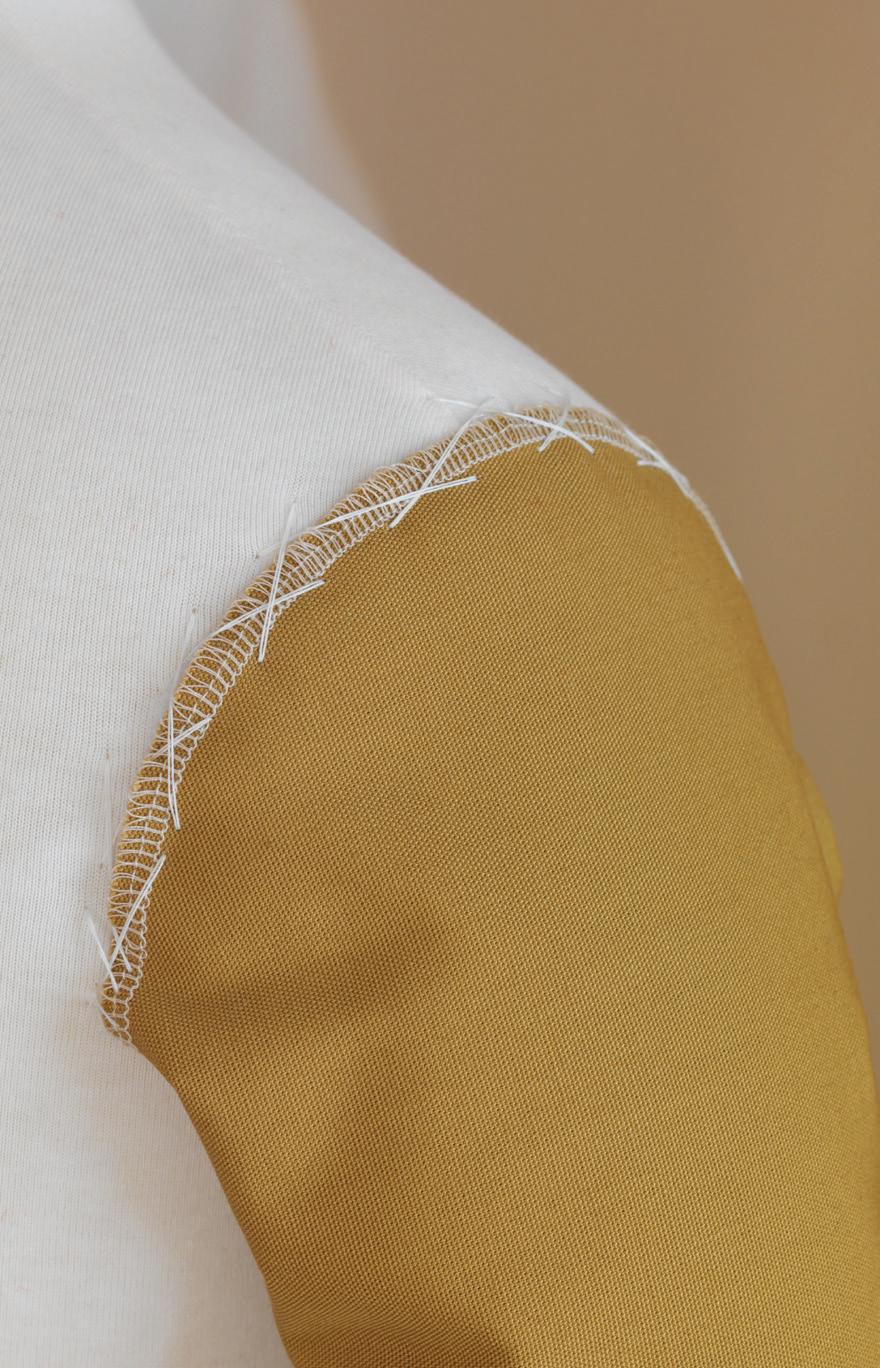
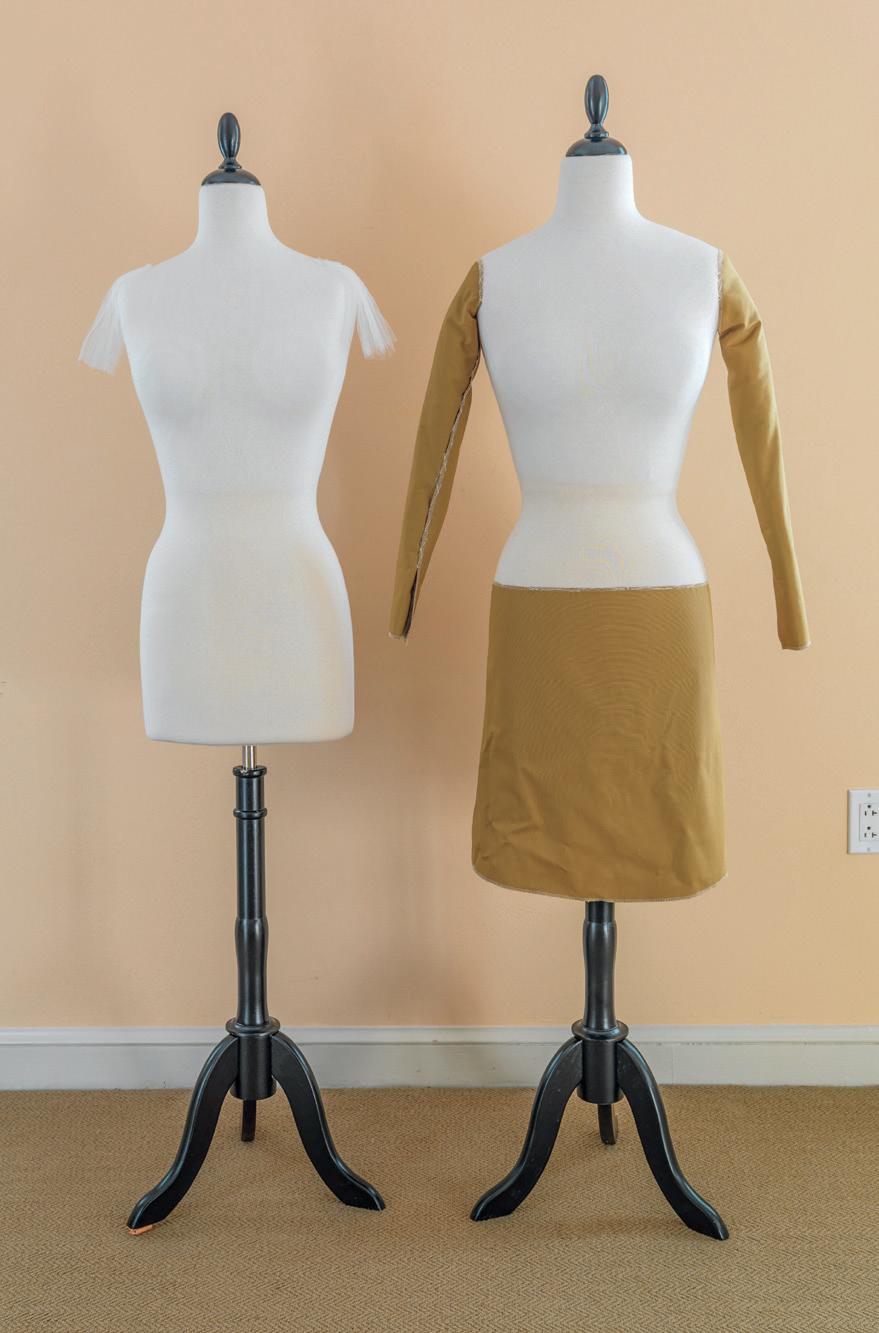
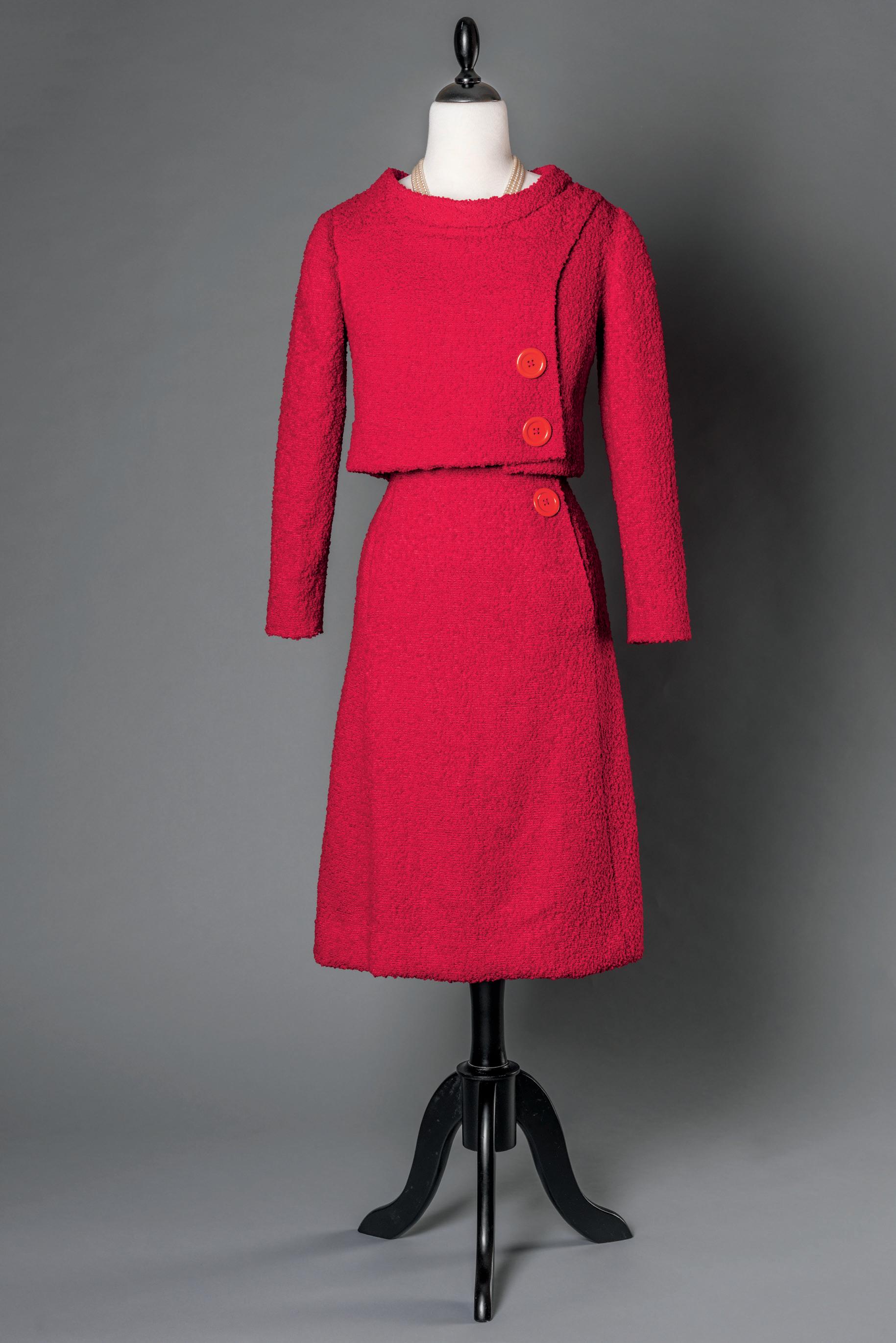
Camilla Huey’s replica of the red dress worn by Mrs. Kennedy during her 1962 televised tour of the White House is seen displayed on the bespoke mannequin fashioned by Christina Ewald (left). Made of boucle wool, fully lined with silk chiffon, handstitched with matching thread, and finished with buttons, hooks, and zipper. Quality construction was a priority, as seen in the intricate details (opposite).
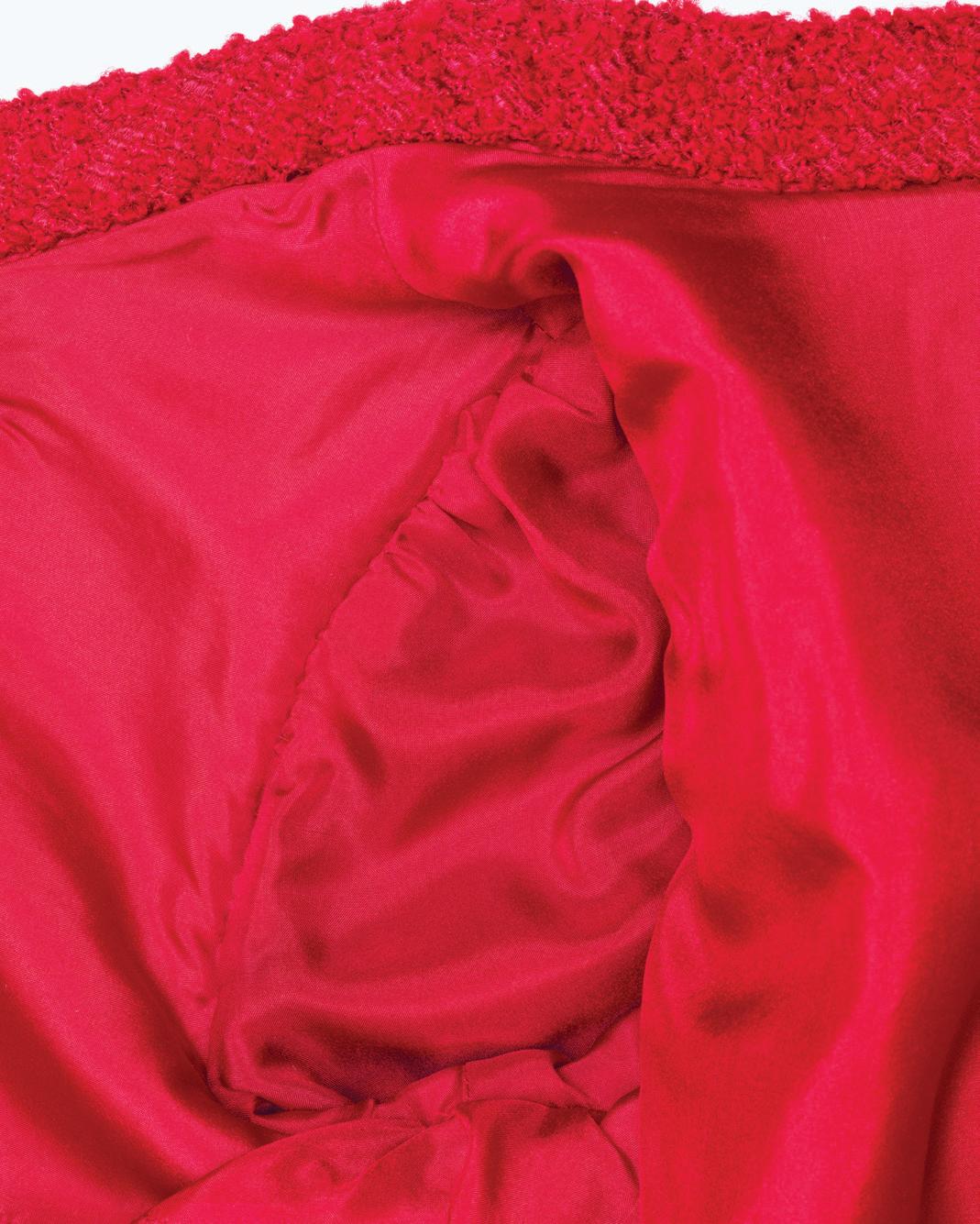
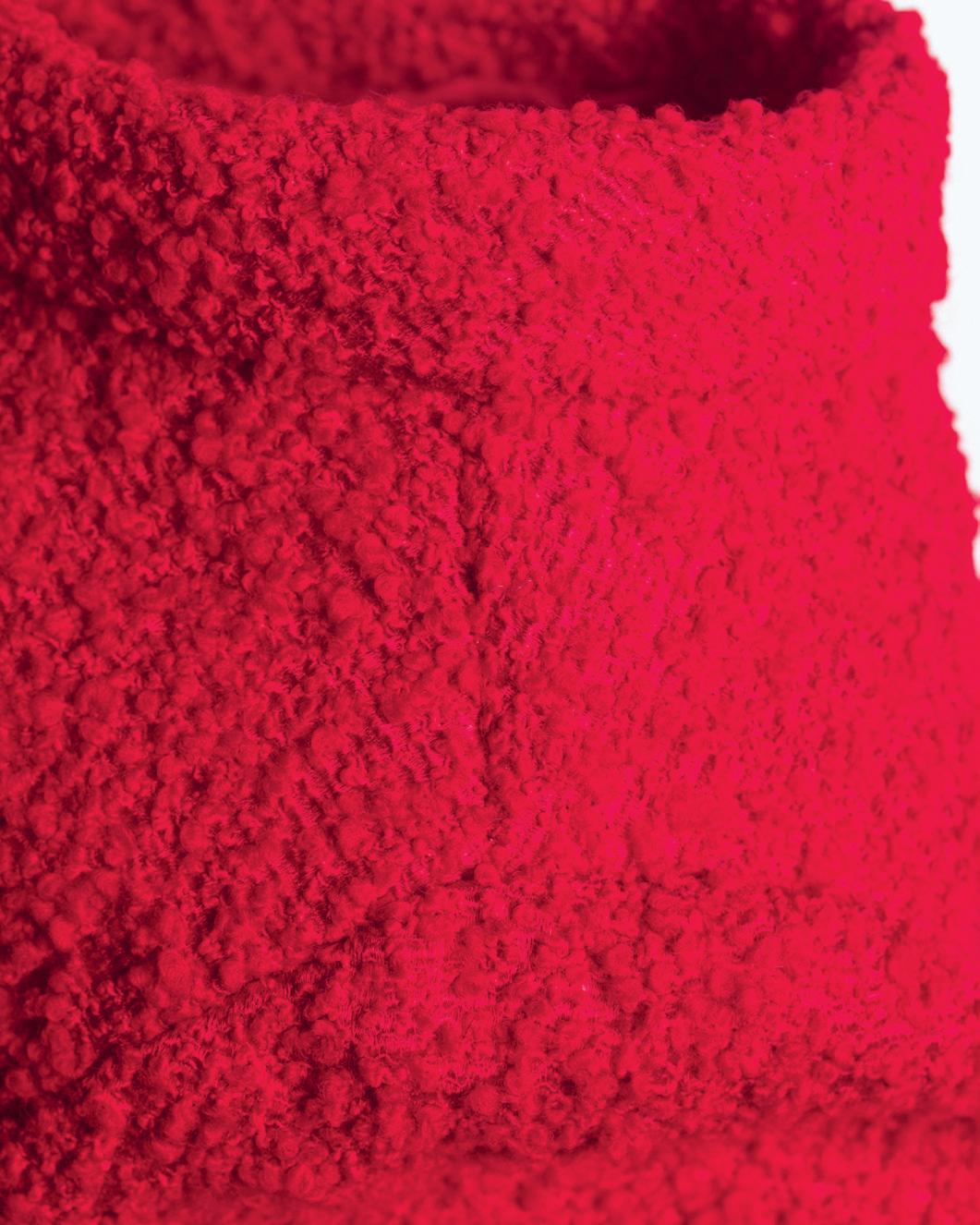
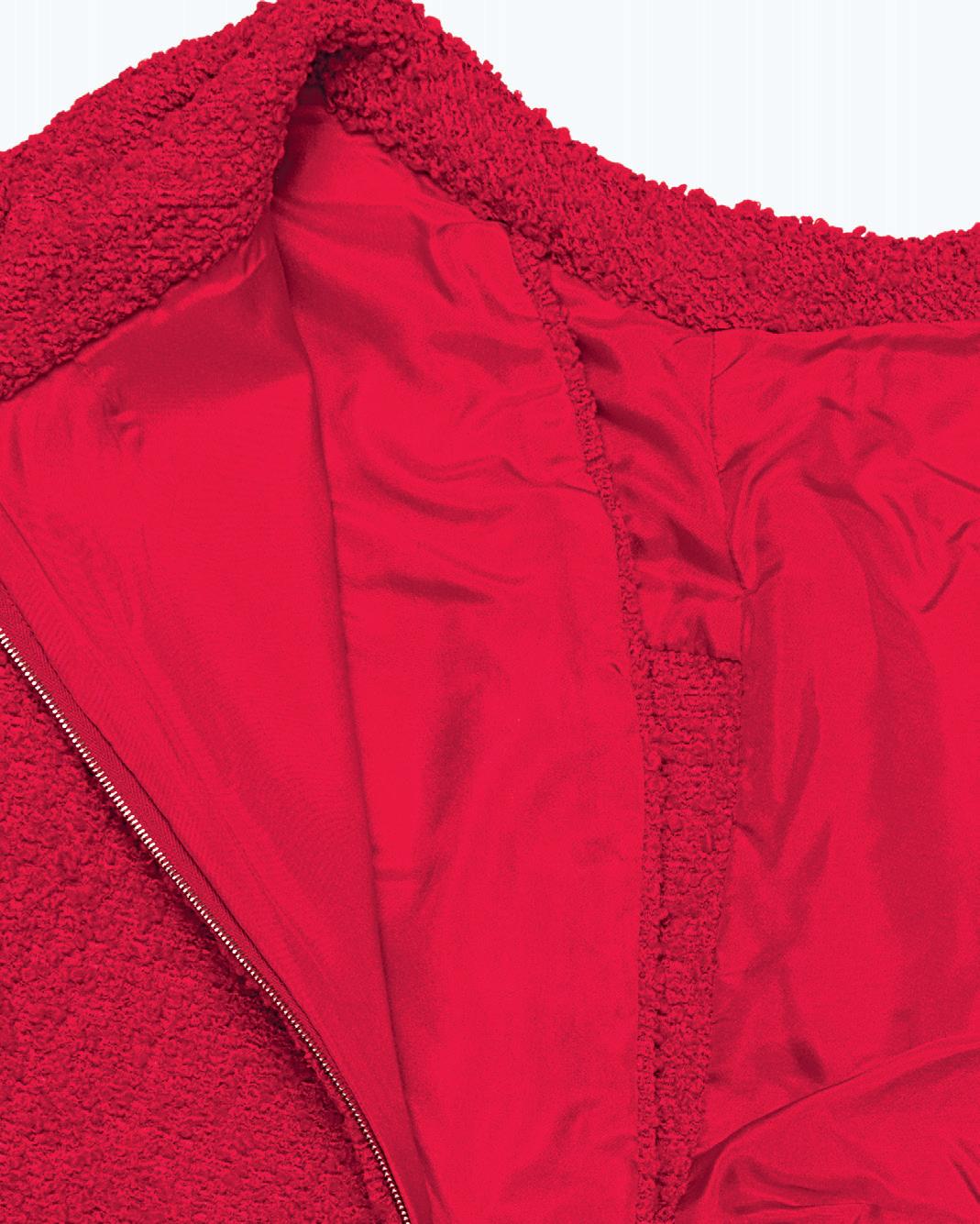
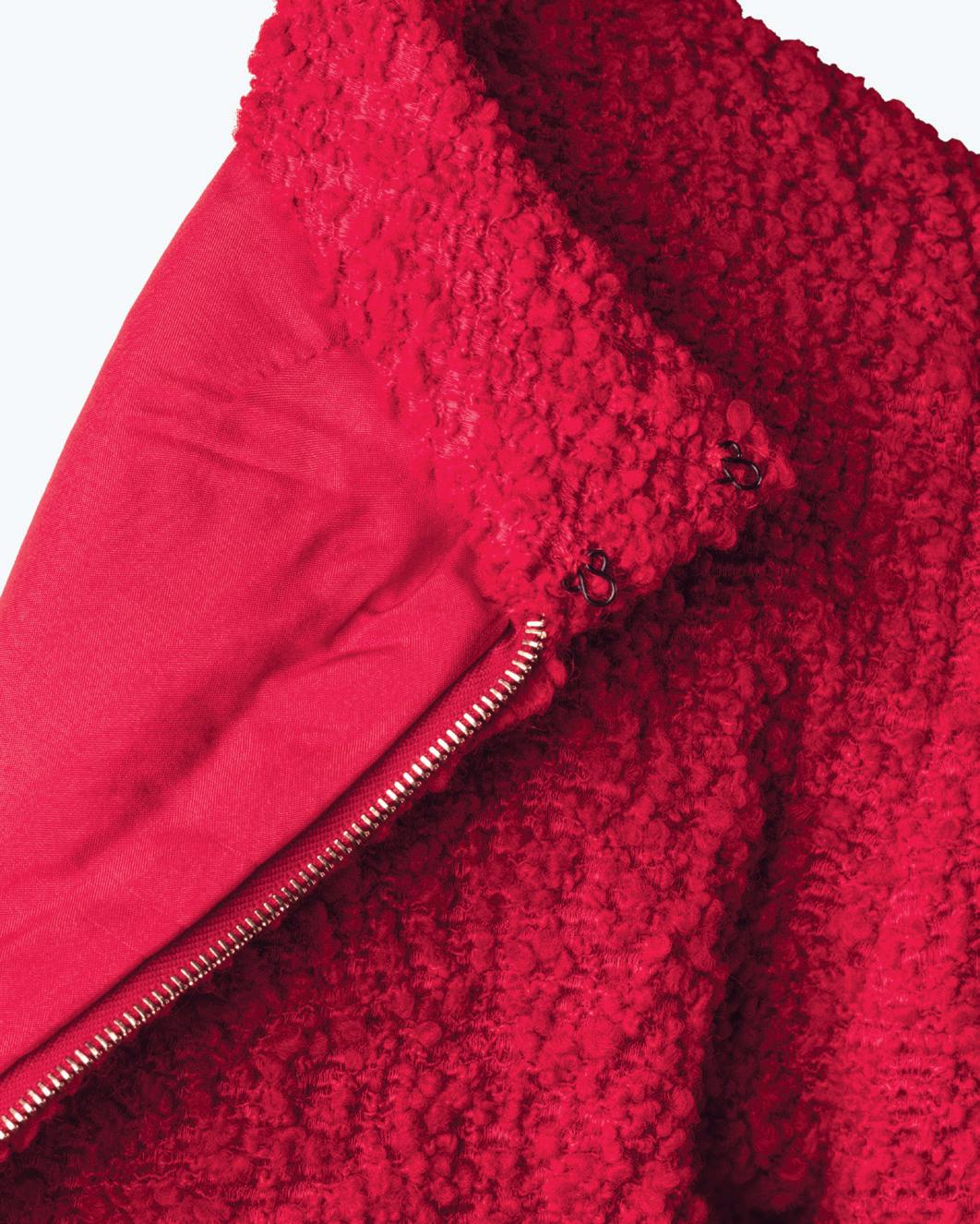
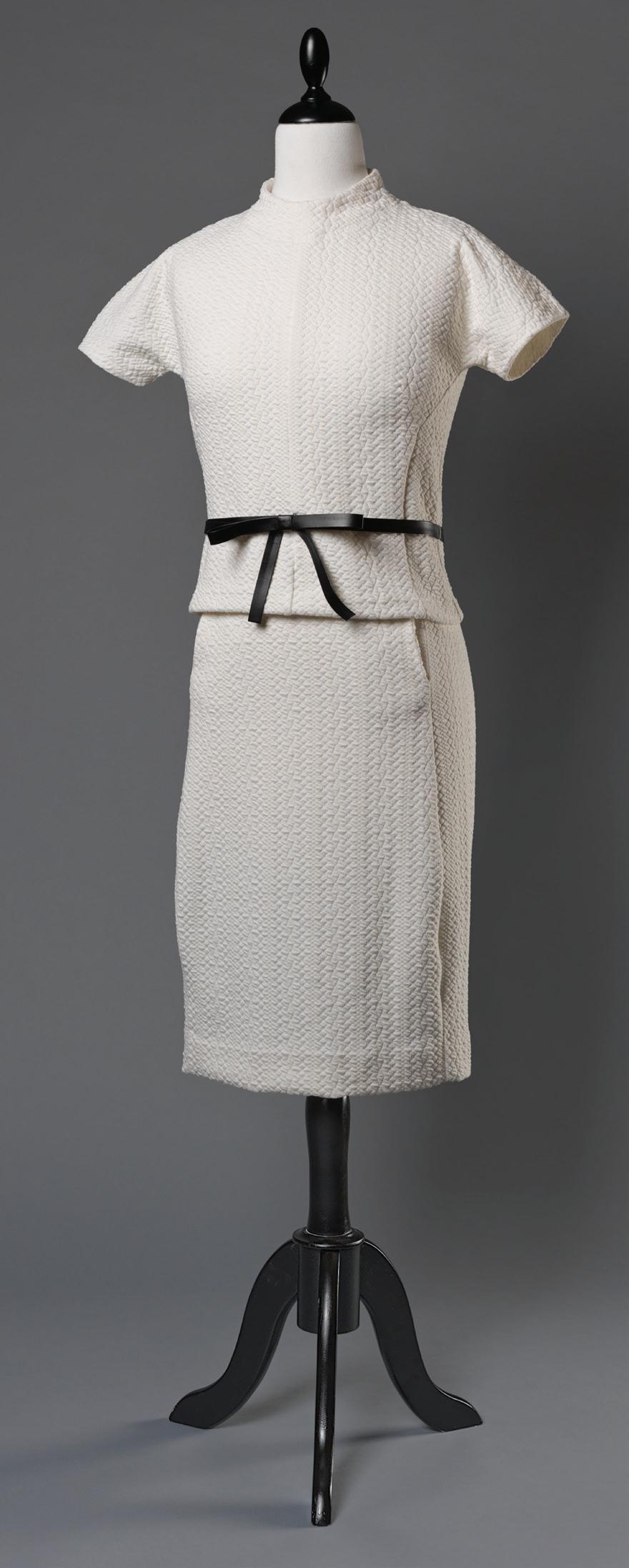
Beautiful afternoon light streamed though Camilla’s atelier windows as we gingerly placed her immaculately constructed dresses onto my precise handmade mannequins. It was an extraordinary sight. As always, little adjustments needed to be made, a small part of fabric let out along the hem of the white skirt and a red thread to attach the woolen bias-cut top, where it was pulling a bit near the large red button.
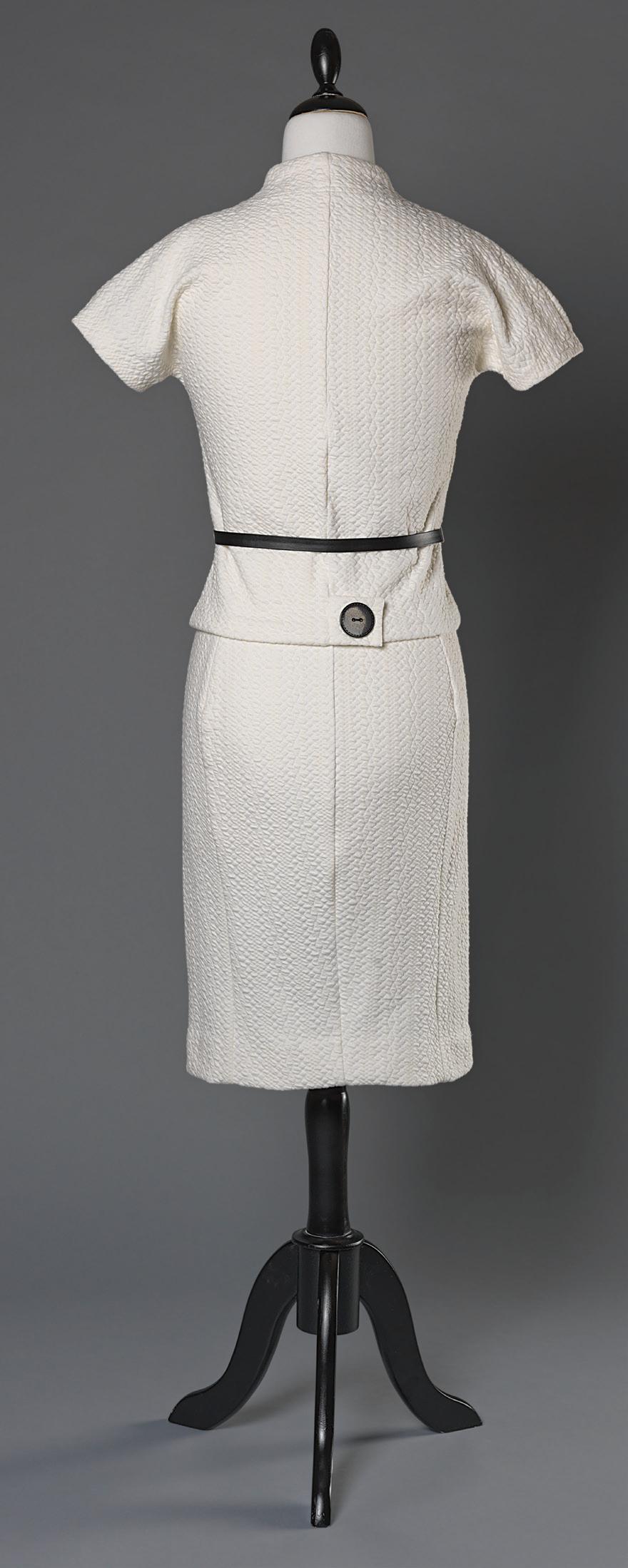
However, as if by some miracle, the second we placed the replica Oleg Cassini dresses on the mannequins, we saw Jacqueline Kennedy come to life. Absolute perfection!
Camilla and I stood there, as artists often do perhaps, admiring our work for longer than really necessary. We agreed with a smile, in that unspoken moment, that these were just right.
Camilla Huey’s replica of the white Oleg Cassini suit worn by Mrs. Kennedy to San Antonio in 1963 is seen displayed on the bespoke mannequin fashioned by Christina Ewald (left). Fully lined and hand-stitched with matching thread, the piece is accessorized to match the original.
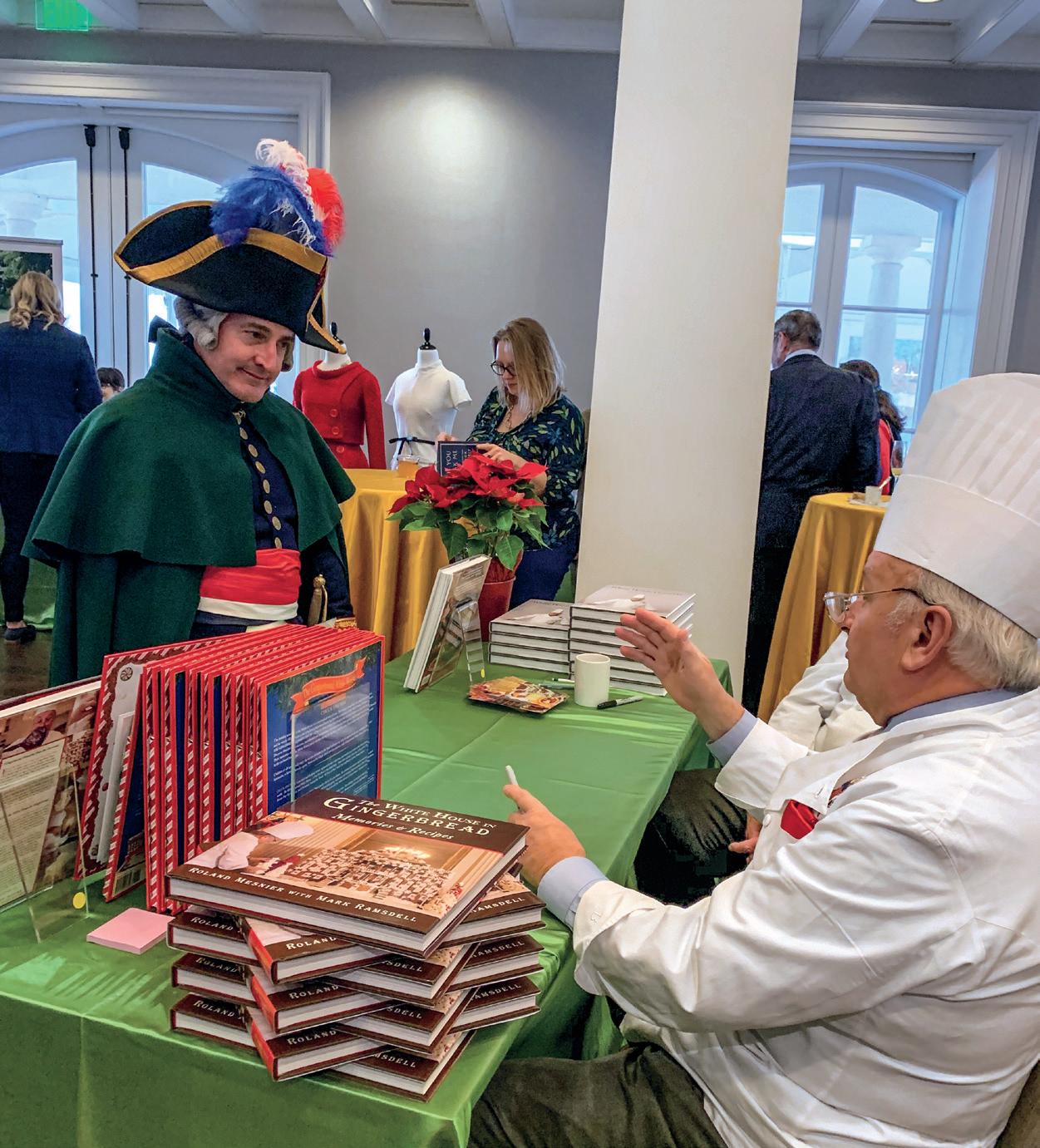
The completed mannequins display the replica dresses at the 2019 White House Historical Association Annual Holiday Book Festival.
It was a peaceful and joyous day, the day of the book festival. On a wintry drive back to Washington from New York, I was eager to share the creations. It is a splendid feeling to be given a job, something specialized and unique, taking thought and consideration, bringing with it challenges and struggle, and ultimately seeing a finished product, a collaborative effort. As I carried the mannequins and garment bags into the Carriage House of the Stephen Decatur House, a part of the Association’s campus on Lafayette Square, I was struck by the sight of another replica on display—a reproduction of the gilded Steinway piano made for the Theodore Roosevelt White House in 1902. The story of the piano is featured in Music at the White House, a book at the festival. Also on exhibit was a sample set of the Barack Obama State Dinner Service positioned near the table where Bill Allman would be signing the book Official White House China. Stacks of art and history books were arranged on tables where their respective authors would sign and converse with the eager attendees of the festival.
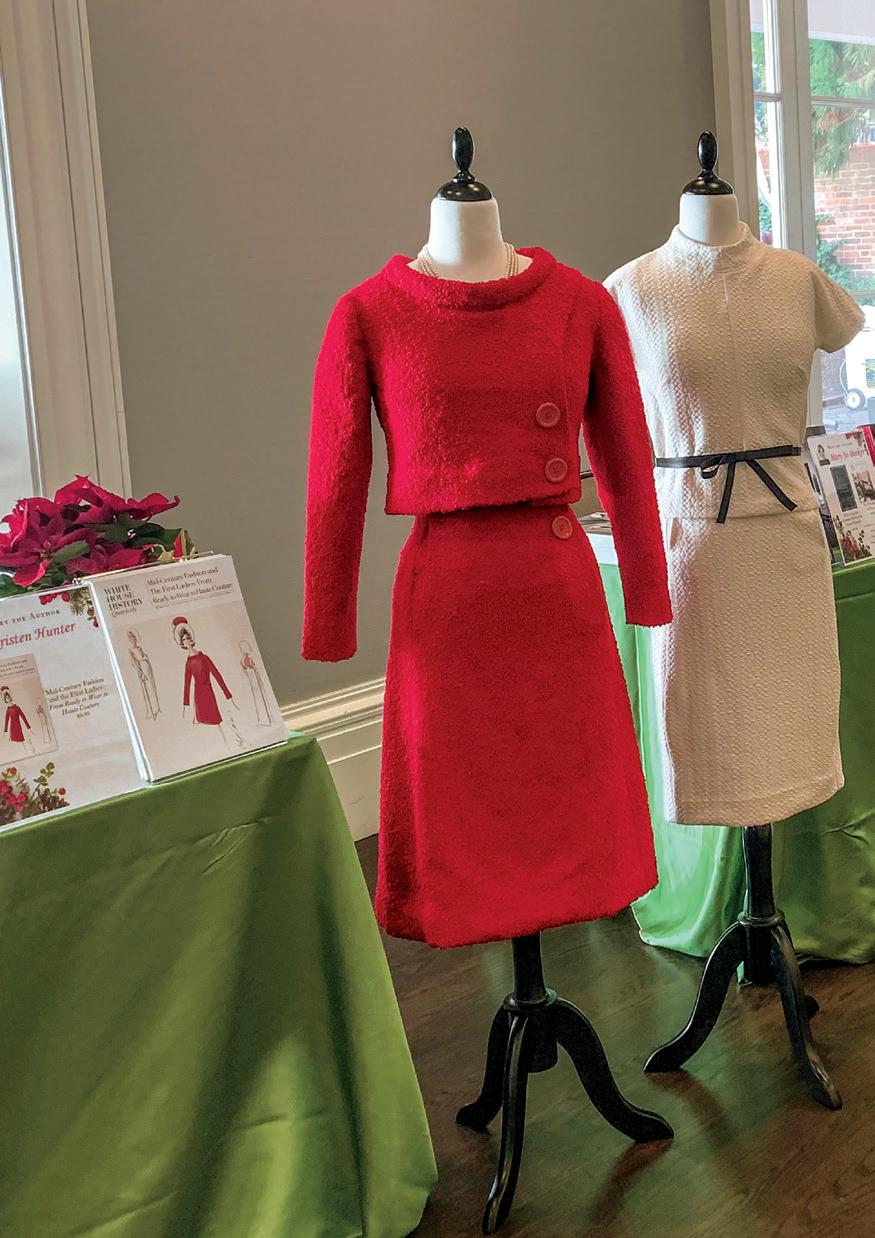
There was a hustle and bustle about me as I unwrapped the mannequin forms and garments. I set up the mannequins and fitted the dresses. Checking the height with a dressmakers’ tape, I took out a small kit I bring with me when I am “on set.” It contains tiny entomology pins for invisible last-minute tacks and matching thread prestrung to needles that stay with the garments in case a stitch is necessary. I made small adjustments. There they were at last! With a sigh of relief, I saw the first few visitors to the book festival coming in through the open doors. It began with a small stream of visitors and grew into an overflowing assembly of laughter, conversation, and thirst for knowledge about the White House, Washington, D.C., and our great country. I was happy, for the Jacqueline Kennedy twin mannequins in their replica dresses stood by adorning the Annual Holiday Book Fair.
note
1. Giorgio Armani, quoted in Olivia Pinnock, “The Growing Popularity of Fashion Exhibitions,” posted March 14, 2019, Forbes, www.forbes.com.
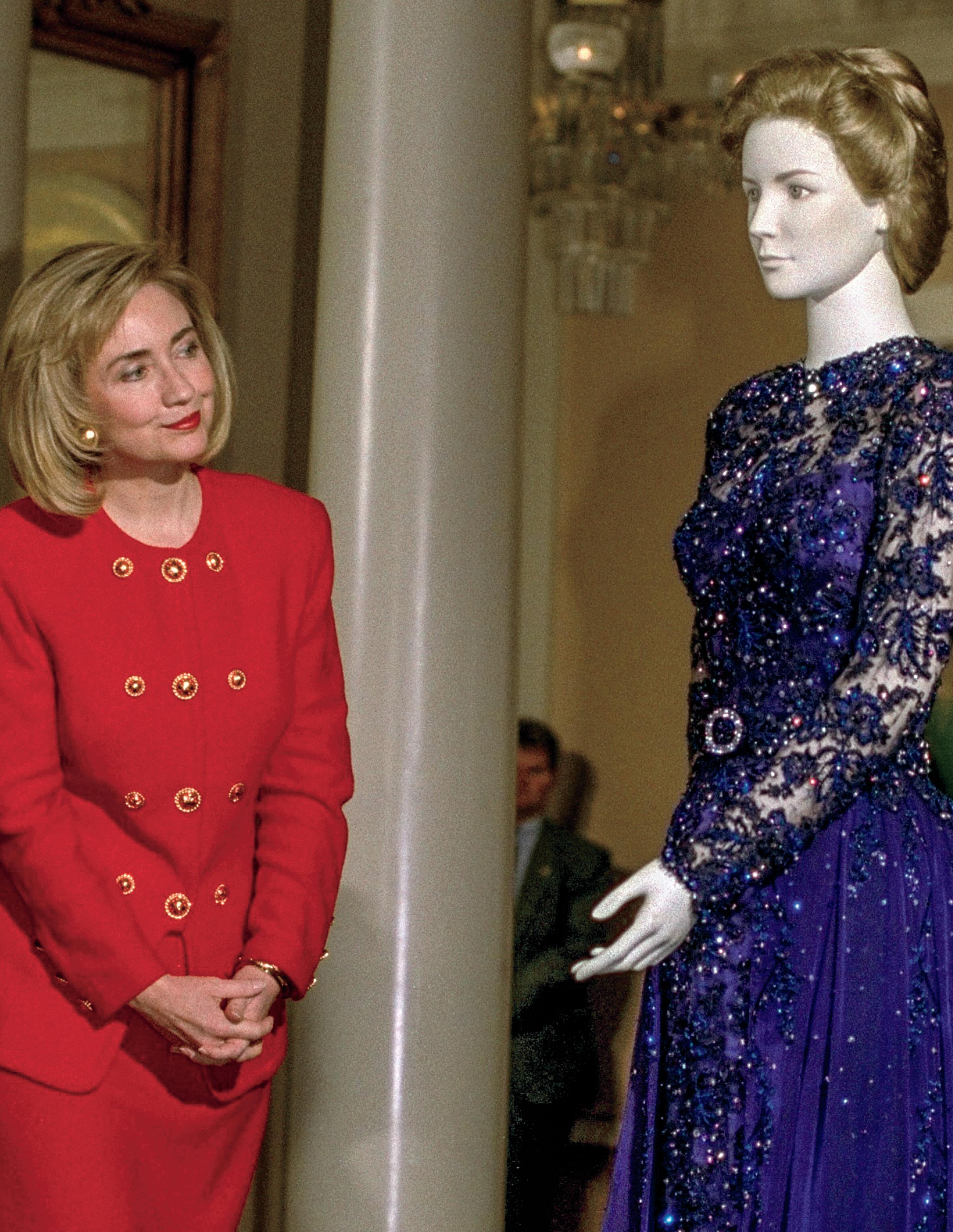
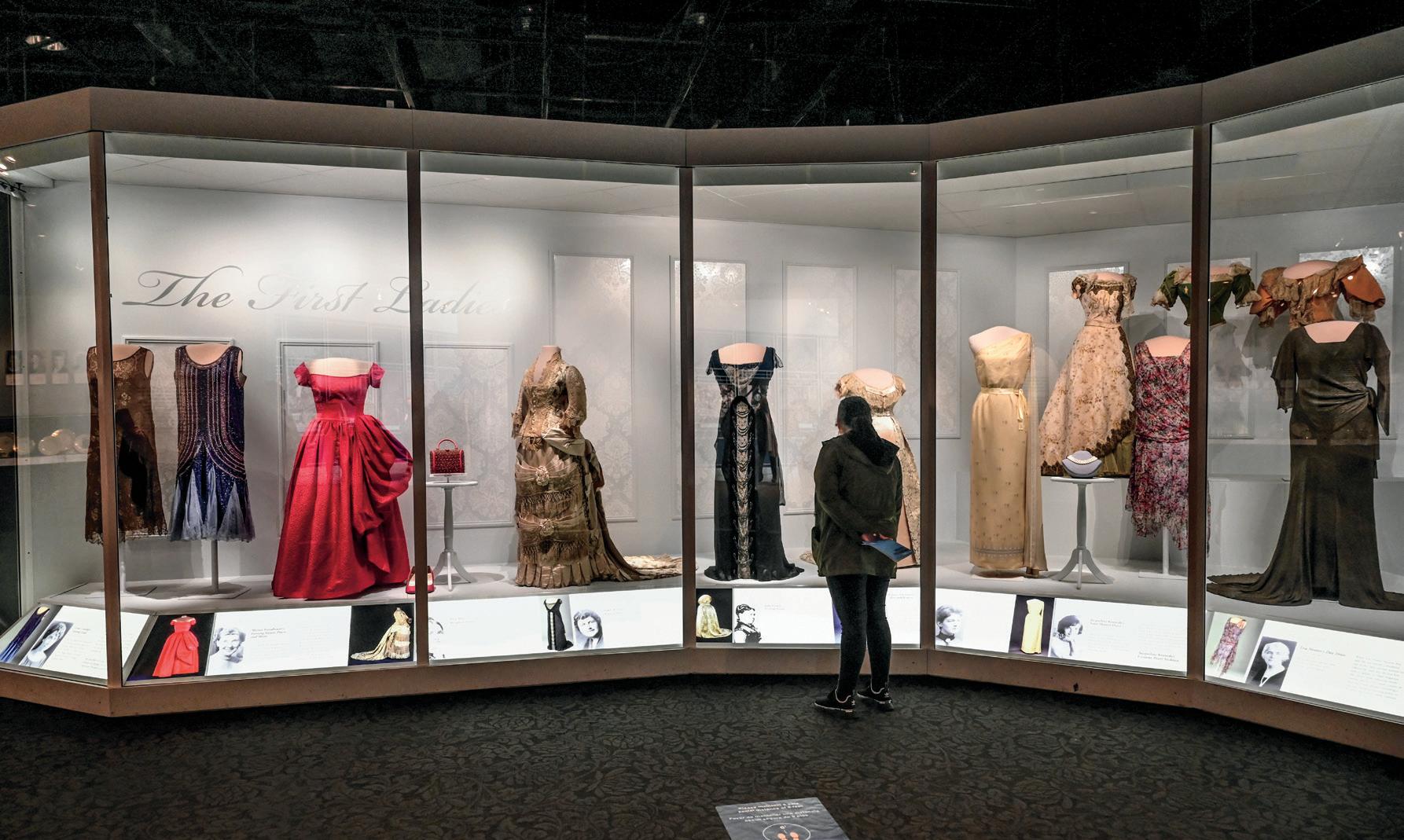
ELYSE M. WERLING
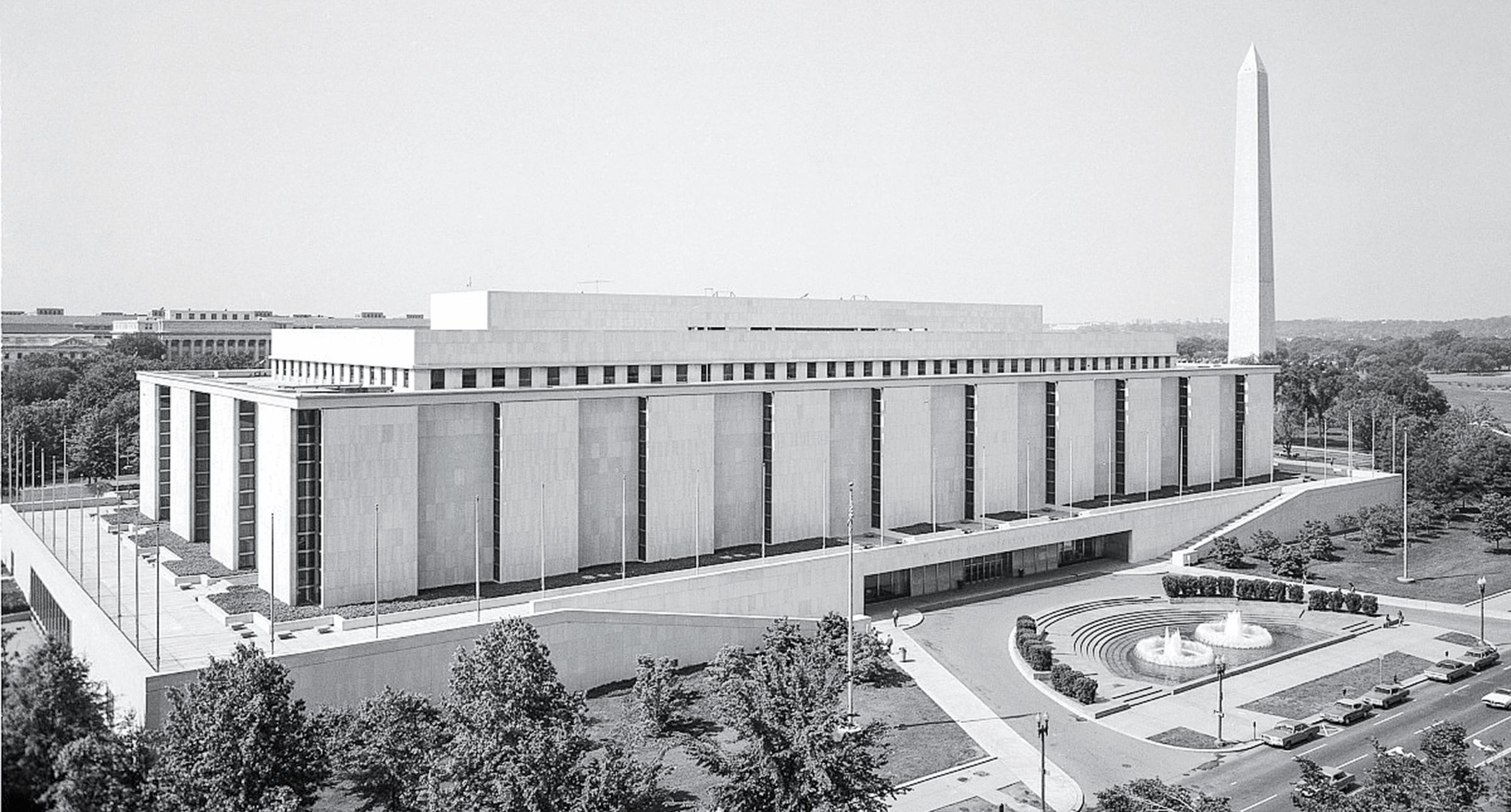
for more than a century, The First Ladies Hall has captivated countless millions of visitors to the Smithsonian Institution. Currently featuring twenty-five dresses, as well as accessories, presidential china, and other objects of relevance,
for more than a century, the First Ladies Hall has captivated countless millions of visitors to the Smithsonian Institution. Currently featuring more than two dozen dresses, as well as accessories, presidential china, and other objects of relevance, the exhibit has been housed at the National Museum of American History since 1964.
collection has grown to include dresses and something from every first lady. In the 1920s it became customary for a first lady to donate a dress to the exhibition after she had left the White House, but in the 1950s, the Smithsonian reconsidered that policy in response to the public’s impatience to see First Lady’s Mamie Eisenhower’s inaugural National Museum of American History, opened in 1964 the first ladies exhibit was broadened
political and social history; rather than limiting one-thousand objects now document the lives and work of America’s first ladies. Today, state-ofthe-art gallery spaces are designed to reduce the
Launched in 1914 with a small display of gowns, the collection has grown to include something from every first lady. In the 1920s it became customary for a first lady to donate a dress to the exhibition after she had left the White House, but in the 1950s, the Smithsonian reconsidered that policy in response to the public’s impatience to see First Lady’s Mamie Eisenhower’s inaugural dress. When Mrs. Eisenhower formally opened a new First Ladies Hall in 1955, her famous pink ball gown was prominently displayed. When the Museum of History and Technology, now the National Museum of American History, opened in 1964 the first ladies exhibition was broadened to include china and furniture. In 1992 curator Edith Mayo began interpreting the exhibit space with political and social history; rather than the limiting the display to “fashion and furnishings,” more than 1,000 objects now document the lives and work of America’s first ladies. Today, state of the art gallery spaces are designed to reduce the damage from
light, dust, and climate and house one of the most popular Smithsonian exhibits open today.
In recent years the designer, style, and color of the first lady’s inaugural gown is a well guarded secret. But following the festivities, the American public eagerly awaits the updating of the Smithsonian’s First Ladies Hall. It was first Lady Helen Taft who first chose to her inaugural gown as the dress to donate to the Smithsonian. Although first ladies are not required to donate their inaugural ball gowns, each first lady who has attended an inaugural ball since Mrs. Taft’s time has embraced the tradition. The presentation of the gown to the Smithsonian is a widely publicized affair. Once a new gown is added to the exhibit, crowds of new and repeat visitors never fail to arrive for a viewing.
damage from light, dust, and climate and house one of the most popular Smithsonian exhibits. recent years the designer, style, and color of the first lady’s inaugural gown is a well guarded secret. But following the festivities, the American public eagerly awaits the updating of the Smithsonian’s First Ladies Hall. It was first Lady Helen Taft who first chose her inaugural gown as the dress donate to the Smithsonian. Although first ladies are not required to donate their Inaugural Ball gowns, each first lady who has attended an Inaugural Ball since Mrs. Taft’s time has embraced the tradition. The presentation of the gown to the Smithsonian is a widely publicized affair. Once a new gown is added to the exhibit, crowds of new and repeat visitors never fail to arrive for a viewing.
the National Museum of American History since 1964. Seen here from Constitution Avenue in 1972, it is one of the last buildings designed by the architectural firm McKim Mead & White.
To complete our visit through fifty years of First Lady style and fashion, we are featuring the inaugural gowns of Pat Nixon, Betty Ford, Rosalynn Carter, and Hillary Clinton. All three gowns are currently on display at the Smithsonian’s National Museum of American History.
complete the Quarterly’s tour through fifty years of First Lady style and fashion, we are featuring the inaugural gowns of Pat Nixon, Rosalynn Carter, and Hillary Clinton. For Betty Ford, whose vice president husband did not enjoy inaugural festivities when he took the presidential Oath of Office, we feature the gown she chose to donate. All four gowns are currently on display at the Smithsonian’s National Museum of American History.
First Lady Hillary Rodham Clinton inspects the Smithsonian’s display of the ball gown she wore during President Clinton’s first Inauguration, 1995. A selection of gowns on exhibit in the First Ladies Hall is seen in 2020.
left
First Lady Helen Taft chose to donate the gown she wore to her husband’s 1909 Inaugural Ball to the Smithsonian. Her choice established a precedent for future first ladies. Mrs. Taft’s gown is seen here as part of a larger display of personal items that document the lives and work of America’s first ladies.
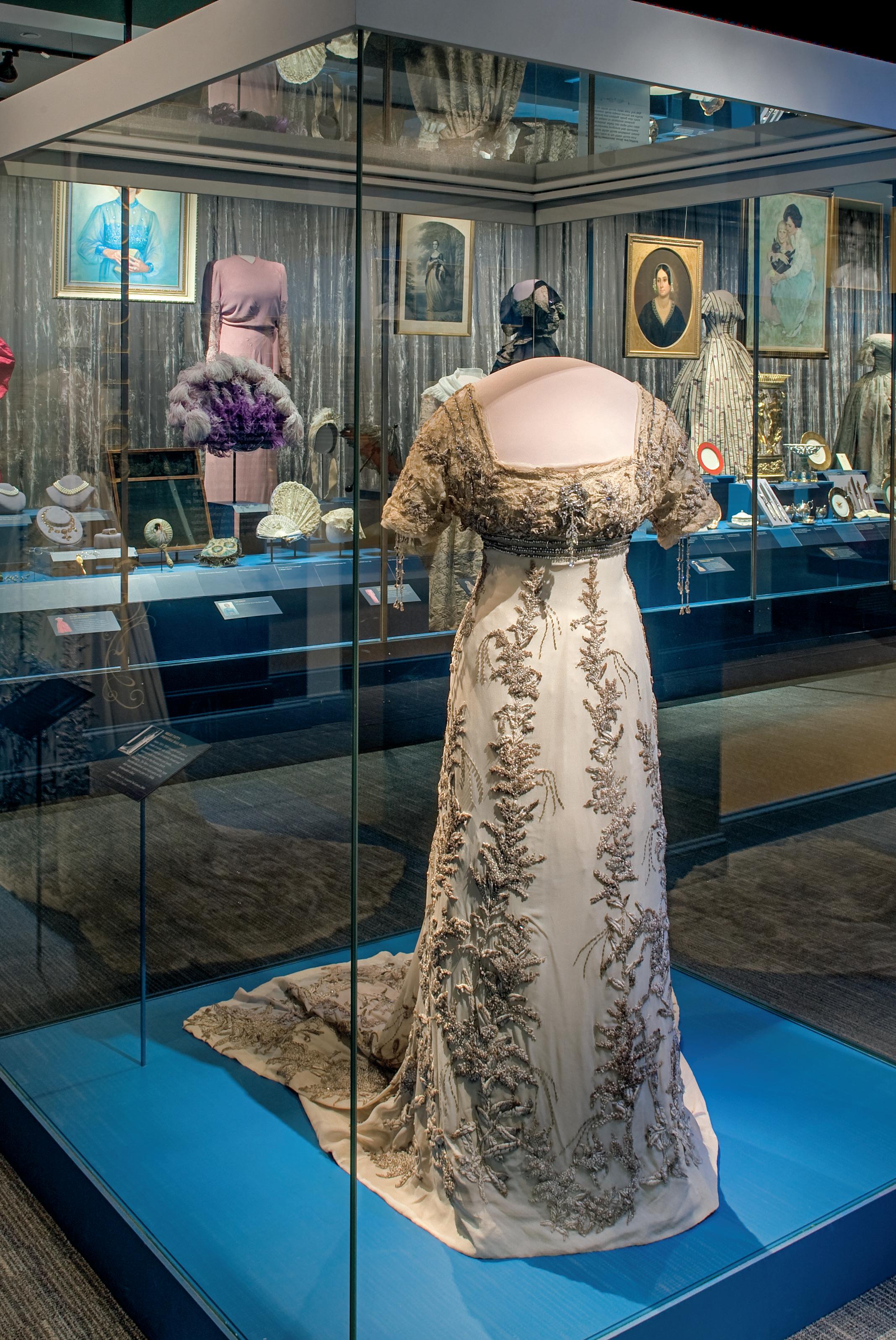
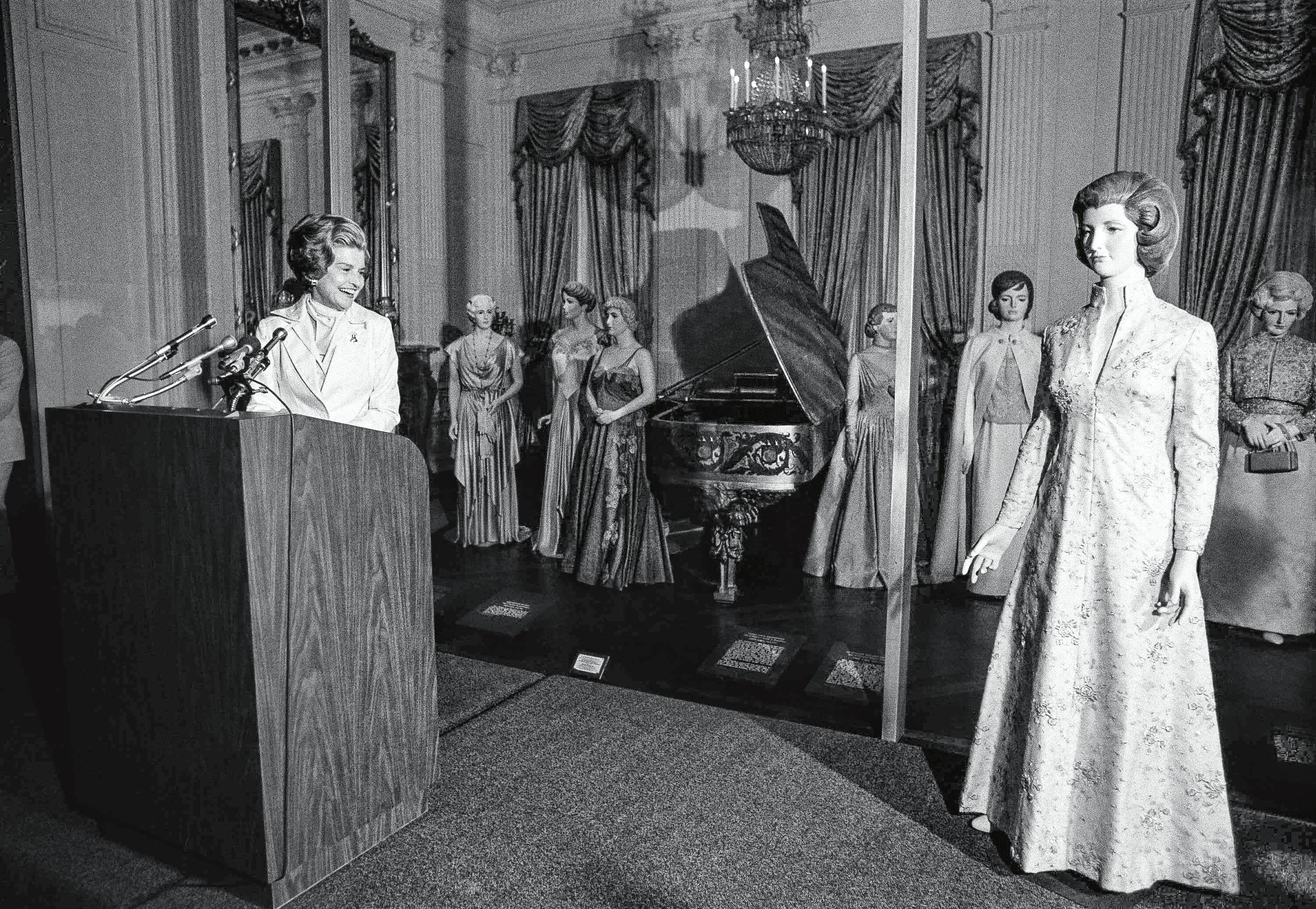
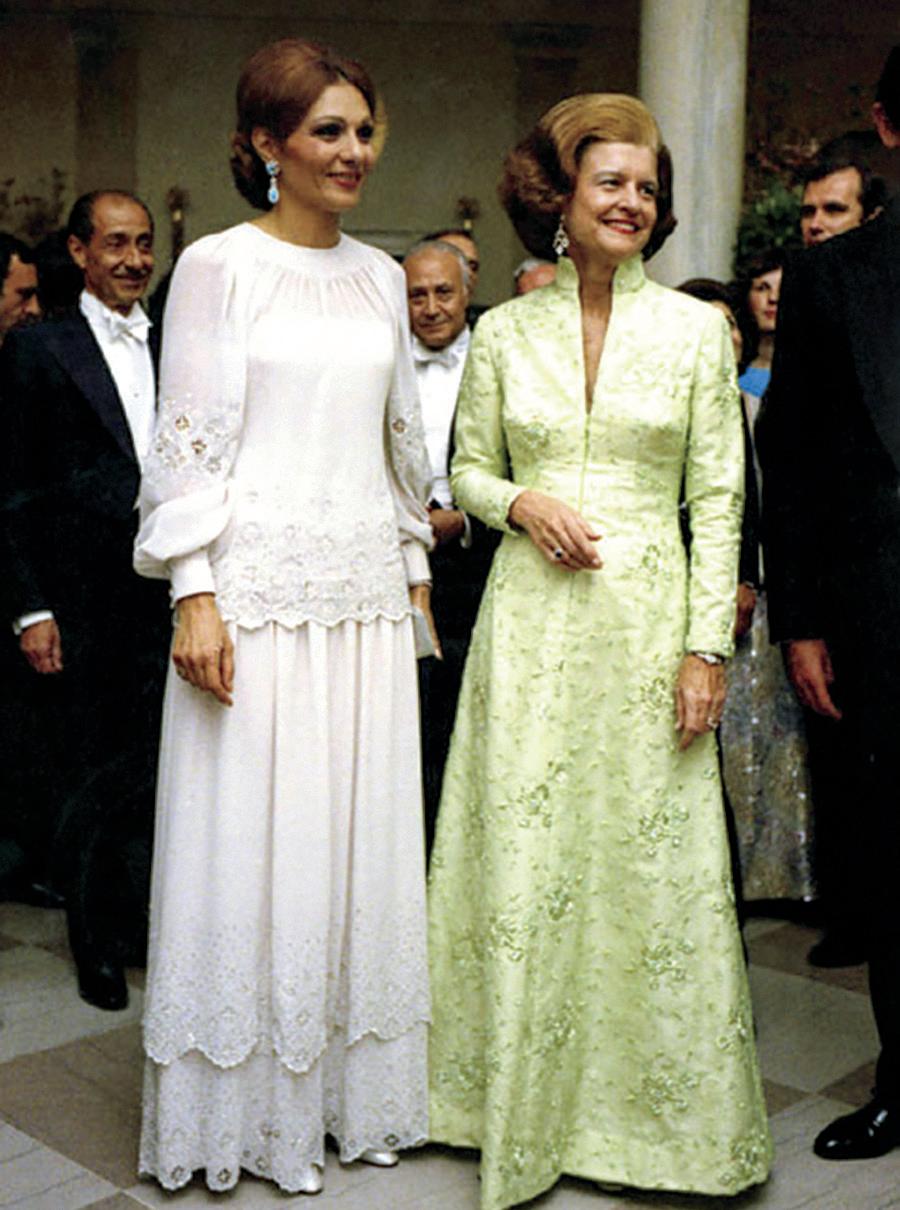
First Lady Betty Ford wore a pale-green sequined chiffon gown embroidered in a chrysanthemum pattern to the White House State Dinners in honor of the shah of Iran in 1975 and King Juan Carlos of Spain in 1976. The dress was created by Frankie Welch, an Alexandria, Virginia, designer. Because there were no formal inaugural celebrations when Gerald Ford became president following the resignation of Richard M. Nixon, Mrs. Ford selected the dress, in her favorite shade of green, to represent her in the Smithsonian Institution’s collection.
First Lady Betty Ford speaks (above) during a ceremony to present one of her State Dinner gowns to the Smithsonian Institution’s First Ladies Hall, June 24, 1976. The princess style gown (opposite) is made of sequined chiffon and is embroidered with chrysanthemums. She is seen wearing the gown (left) with Farah, shabanou of Iran, 1975.
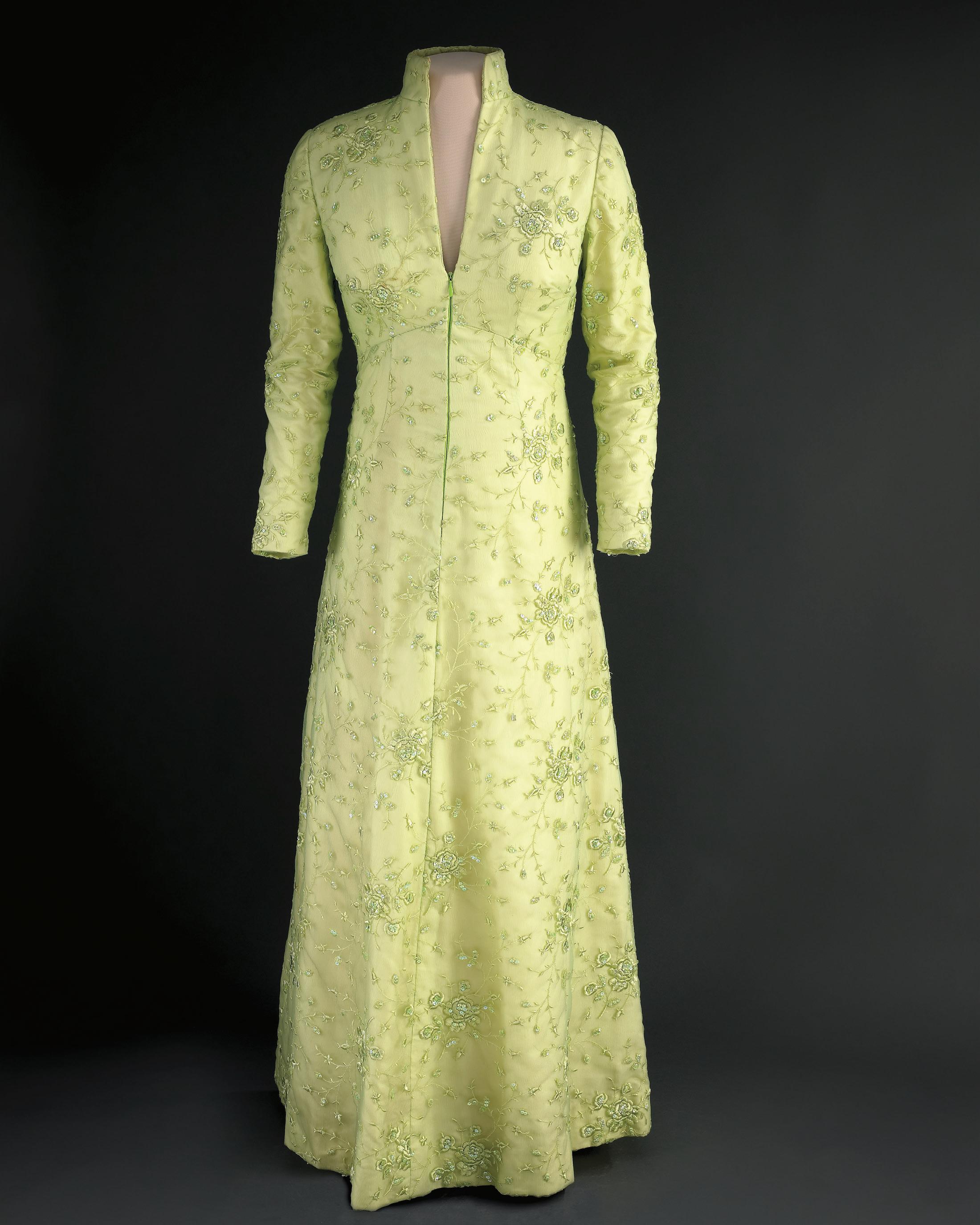
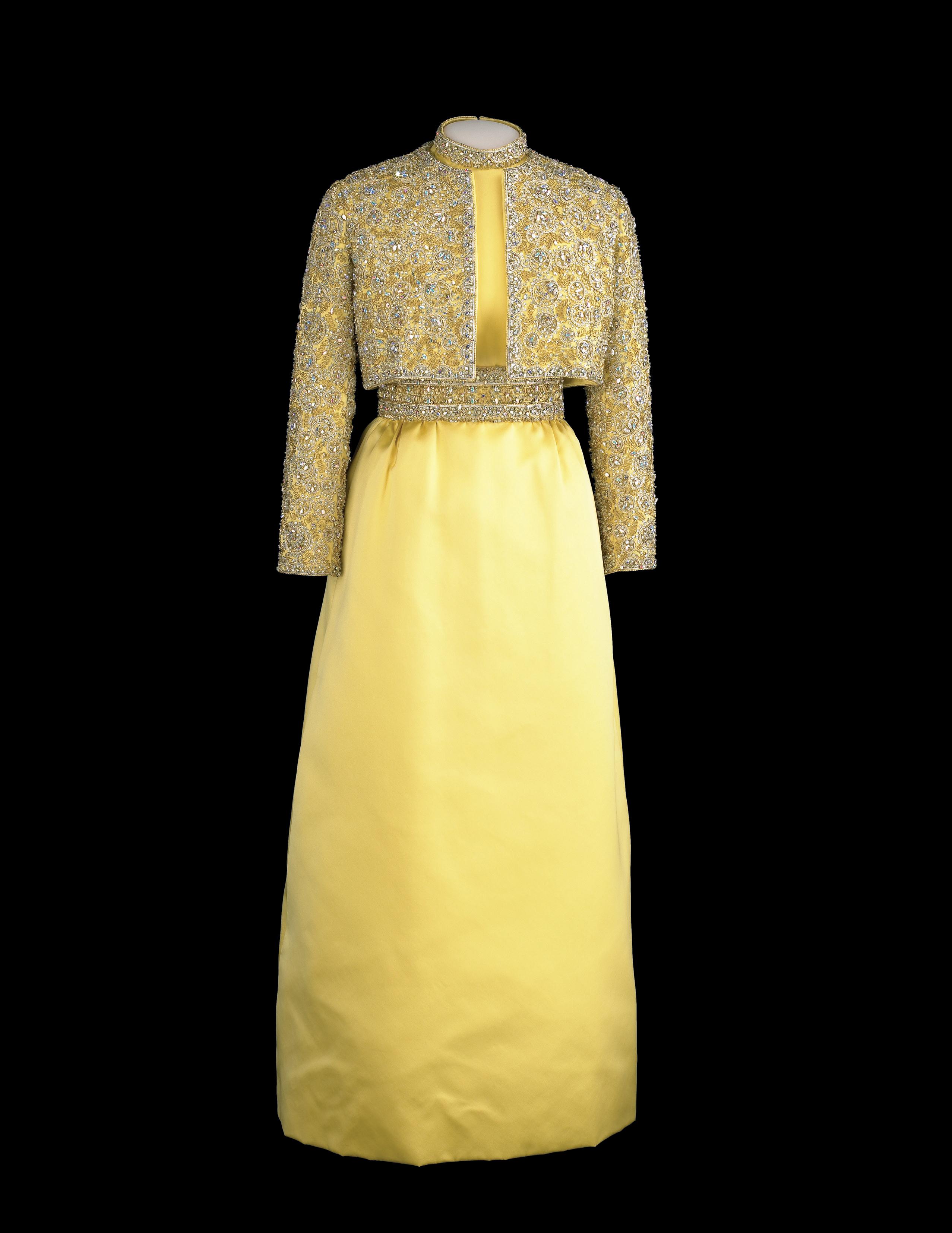
opposite
opposite
First Lady Pat wore satin
First Lady Pat Nixon wore this mimosa silk satin gown to the 1969 Inaugural Balls. Designed by Karen Stark for Harvey Berin, it was embroidered in gold and silver and encrusted with Austrian crystals.
Austrian
First Lady Pat Nixon wore this mimosa silk satin gown to the 1969 Inaugural Balls. Designed by Karen Stark for Harvey Berin, it was embroidered in gold and silver and encrusted with Austrian crystals.
right
right
President and Mrs. Richard M. Nixon greet guests at the Shoreham Hotel Inaugural Ball in Washington, D.C., January 20, 1969. Mrs. Nixon wore her mimosa gown to six Inaugural Balls that evening.
President and Mrs. Richard M. Nixon
greet guests at the Shoreham Hotel Inaugural Ball in Washington, D.C., January 20, 1969. Mrs. Nixon wore her mimosa gown to six Inaugural Balls that evening.
Mrs. Nixon guests in D.C., 20, Inaugural evening.
bottom right
bottom right
Pat’s
At the Inaugural Ball held at the Smithsonian Institution, President Nixon announced, “I like all of Pat’s dresses, particularly this one tonight, and, . . . when she gets finished with it, you’ll get it at the Smithsonian.” Mrs. Nixon kept that promise and presented her gown to the Smithsonian, January 20, 1970. She admires the dress on display as the gowns of Lady Bird Johnson and Mamie Eisenhower can be seen in the background.
nished with it, kept promise gown 20, 1970. admires of and in
At the Inaugural Ball held at the Smithsonian Institution, President Nixon announced, “I like all of Pat’s dresses, particularly this one tonight, and, . . . when she gets nished with it, you’ll get it at the Smithsonian.” Mrs. Nixon kept that promise and presented her gown to the Smithsonian, January 20, 1970. She admires the dress on display as the gowns of Lady Bird Johnson and Mamie Eisenhower can be seen in the background.
described by the Los Angeles Times as intended to “probably outglitter the gowns of every previous First Lady.” Embellished with hundreds of jewels, it took 260 hours to embroider by hand.1 Designed by Karen Stark of Harvey Berin in New York, the gown features silver and gold Byzantine scrolls set with crystals, a petite jacket, and
Mrs.
First Lady Pat Nixon’s 1969 inaugural gown was described by the Los Angeles Times to “probably outglitter the gowns of every previous First Lady.” Embellished with hundreds of jewels, it took 260 hours to embroider by hand.1 Designed by Karen Stark of Harvey Berin in New York, the gown features silver and gold Byzantine scrolls set with Swarovski crystals, a petite jacket and a narrow cumberbund. Mrs. Nixon completed her look with shoes and a handbag made of the same mimosa yellow silk satin.2 Just a year later, on January 14, 1970, Mrs. Nixon presented the gown, shoes, and handbag to the Smithsonian. At the ceremony she stated that she used to take visitors from her husband’s congressional office to the museum and never dreamed she would have a gown on exhibit.3 Interestingly, Mrs. Nixon was one of the last customers of Harvey Berin as he closed his store in March 1970. Upon closing his shop, Mr. Berin paid homage to Mrs. Nixon, stating “People fail to realize that the women in the White House are mixed up with what the President is doing. They have other things on their minds besides fashion. It’s hard work being in government service.”4
First Lady Pat Nixon’s 1969 inaugural gown was described by the Los Angeles Times as intended to “probably outglitter the gowns of every previous First Lady.” Embellished with hundreds of jewels, it took 260 hours to embroider by hand.1 Designed by Karen Stark of Harvey Berin in New York, the gown features silver and gold Byzantine scrolls set with Swarovski crystals, a petite jacket, and a narrow cumberbund. Mrs. Nixon completed her look with shoes and a handbag made of the same mimosa yellow silk satin.2 Just a year later, on January 14, 1970, Mrs. Nixon presented the gown, shoes, and handbag to the Smithsonian. At the ceremony she stated that she used to take visitors from her husband’s congressional office to the museum and never dreamed she would have a gown on exhibit.3 Interestingly, Mrs. Nixon was one of the last customers of Harvey Berin as he closed his store in March 1970. Upon closing his shop, Mr. Berin paid homage to Mrs. Nixon, stating “People fail to realize that the women in the White House are mixed up with what the President is doing. They have other things on their minds besides fashion. It’s hard work being in government service.”4
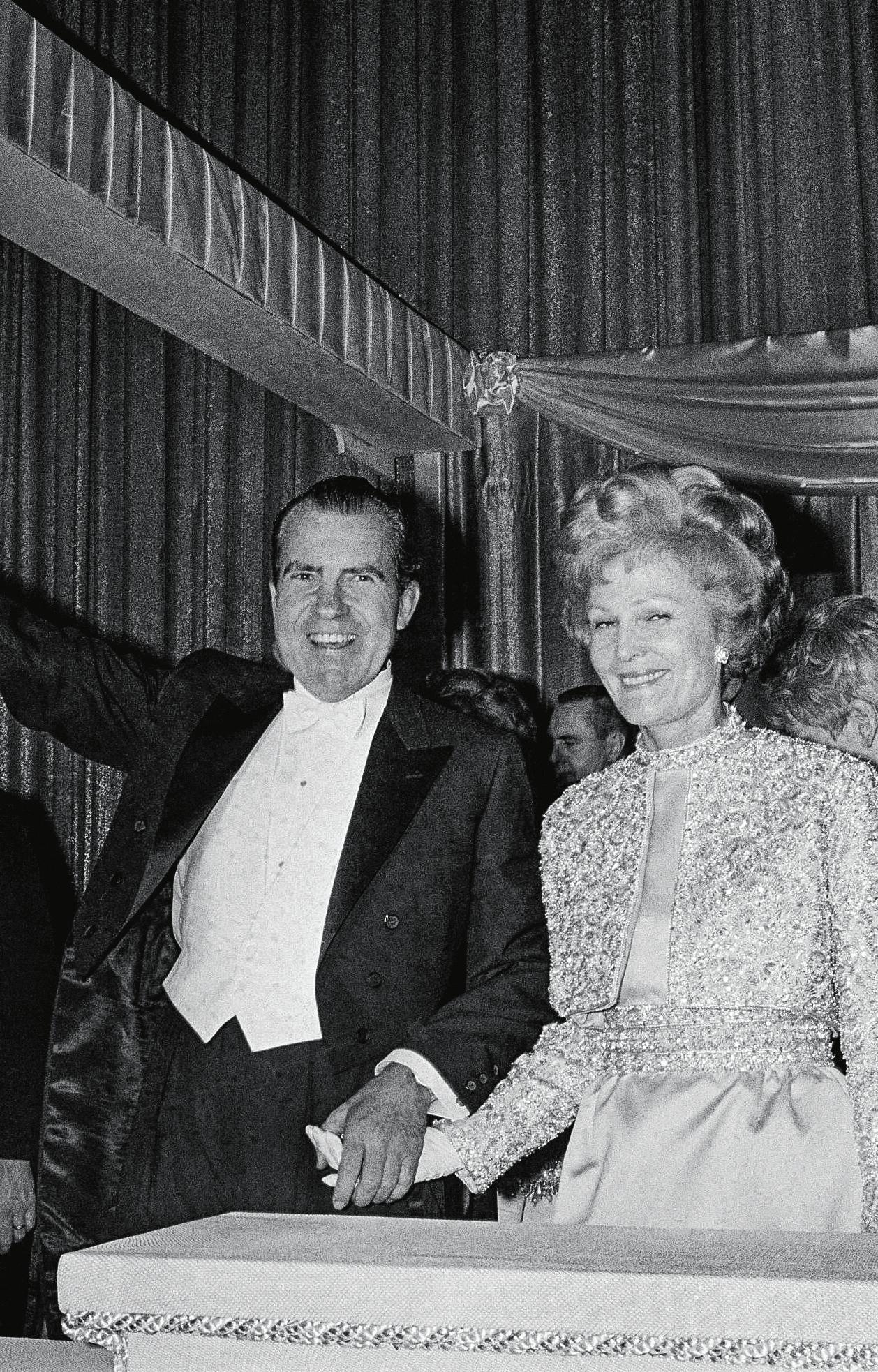
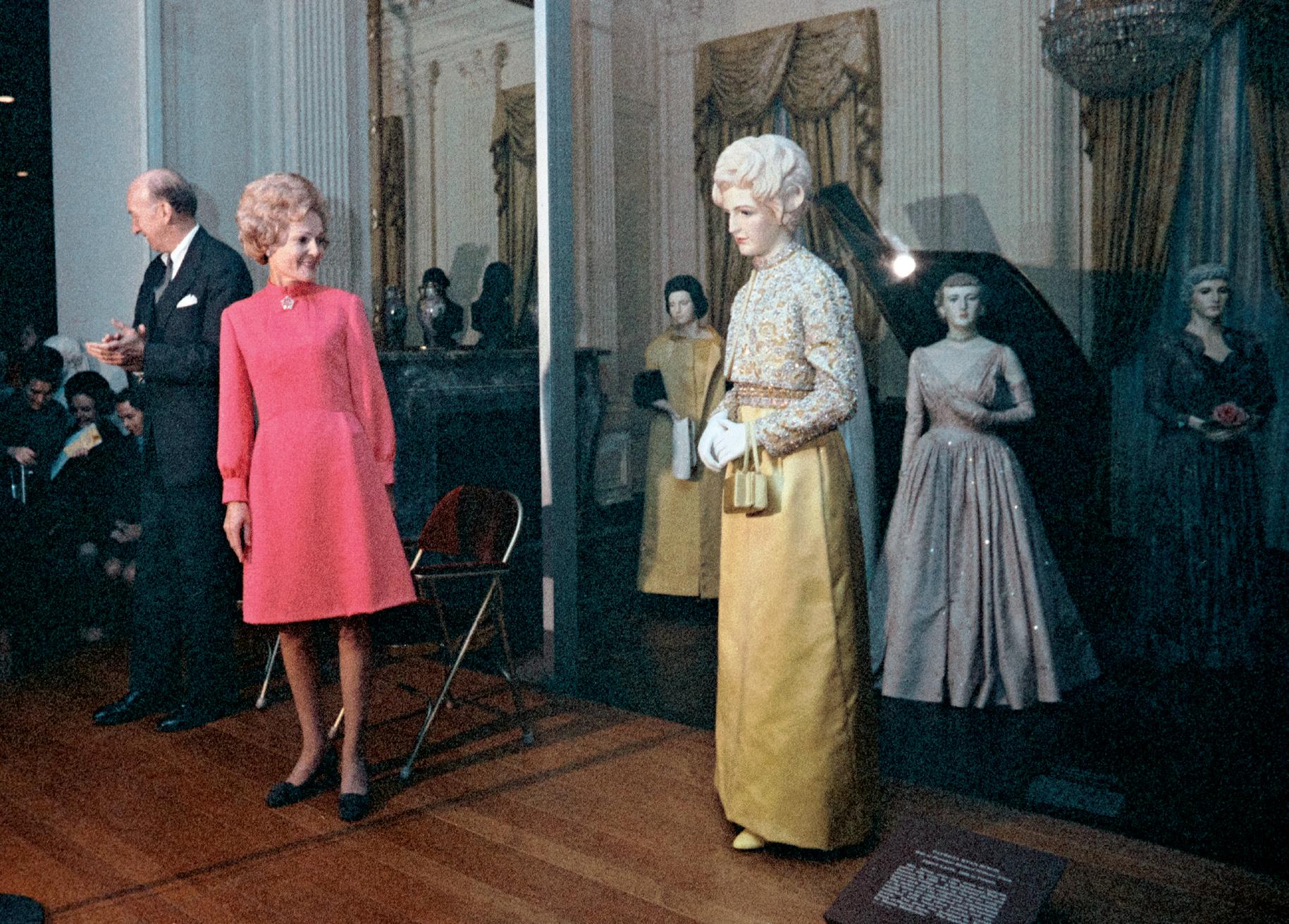

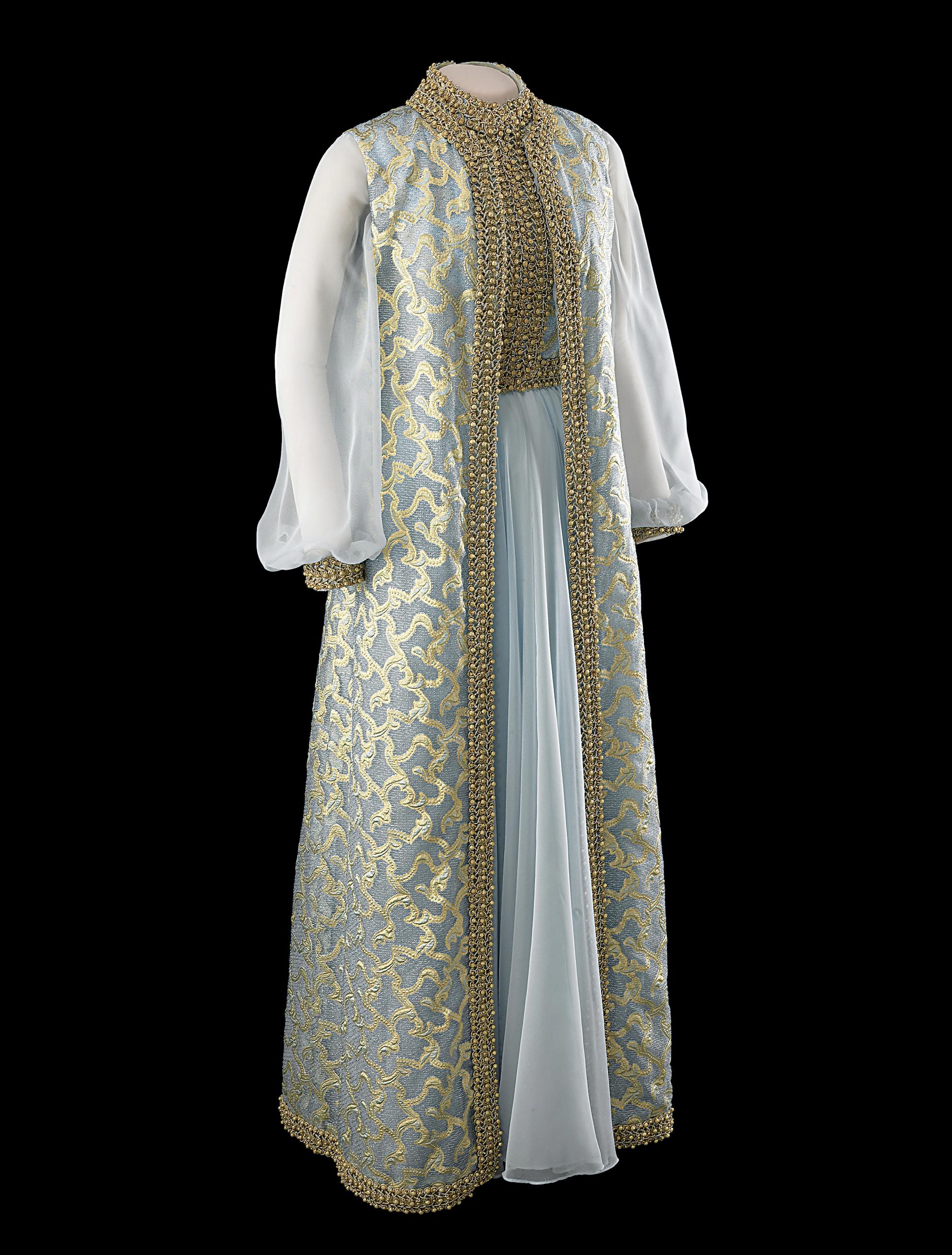
opposite
opposite
First Lady Rosalynn Carter’s inaugural ensemble as displayed in the First Ladies Hall at the Smithsonian Institution. The gold-embroidered sleeveless coat is seen as worn over a gold-trimmed blue chiffon gown.
First Lady Rosalynn Carter’s inaugural ensemble as displayed in the First Ladies Hall at the Smithsonian Institution. The gold-embroidered sleeveless coat is worn over a gold-trimmed blue chi on gown.
right
Mrs. Carter’s choices for her inaugural gown were unique, not only because the gown had been previously worn, but also because she presented to the Smithsonian with a public event. Although such presentations are generally limited to invited guests,Rosalynn Carter opened a portion of the activities to the public when she presented her gown on the Mall terrace of the Smithsonian’s Museum of History and Technology (now the National Museum of American History), 1978.
unique, been it to in a public event. Although such presentations are generally limited to invited guests, Rosalynn Carter opened a portion of the activities to the public when she presented her gown on the Mall terrace of the Smithsonian’s Museum of History and Technology (now the National Museum of American History), 1978.
Mrs. Carter’s choices for her inaugural gown were unique, not only because the gown had been previously worn, but also because she presented it to the Smithsonian in a public event. Although such presentations are generally limited to invited guests, Rosalynn Carter opened a portion of the activities to the public when she presented her gown on the Mall terrace of the Smithsonian’s Museum of History and Technology (now the National Museum of American History), 1978.
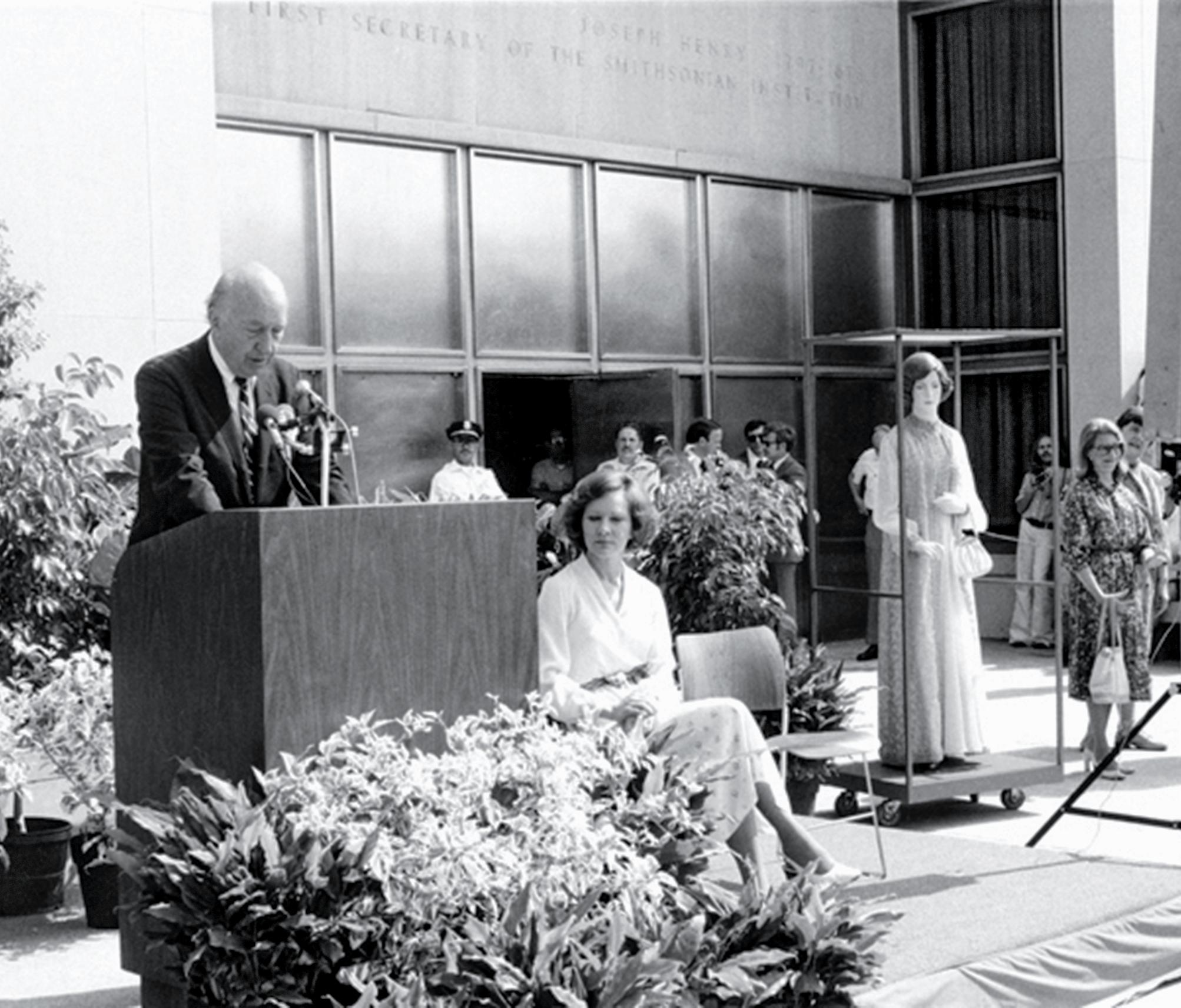
Rosalynn Carter made White House fashion history when she re-wore a five-year-old gown to the January 20, 1977 inaugural ball. The gown, designed by Mary Matisse, a New York based “mother-of-the-bride” fashion firm that was defunct by 1977, was originally worn by Mrs. Carter for the 1971 gubernatorial inaugural balls in Georgia. Rather than purchasing a new gown, she took the Matisse gown to Jack Moses of Jason’s Dress Shop in Americus, Georgia, for a refresh. Mr. Moses collaborated with Mary Matisse when the gown was first designed in 1971.5 He stated, “She is not wearing it to save money—it’s sentiment.”6 When speaking with reporters, he added, “that lady has a mind of her own. She knows what she wants and gets it.”7 It was famously noted that when Mrs. Carter stopped by Jason’s to drop off her gown she also purchased a pair of blue jeans. She later purchased her dress and coat for the inauguration ceremonies at the same shop.
Rosalynn Carter made White House fashion history when she wore a five-year-old gown to the January 20, 1977, Inaugural Balls. The gown, designed by Mary Matise, a New York based “mother-of-thebride” fashion firm that was defunct by 1977, was originally worn by Mrs. Carter for the 1971 gubernatorial inaugural balls in Georgia. Rather than purchasing a new gown, she took the Matise gown to Jack Moses of Jason’s Dress Shop in Americus, Georgia, for a refresh. Mr. Moses collaborated with Mary Matise when the gown was first designed in 1971.5 He stated, “She is not wearing it to save money—it’s sentiment.”6 When speaking with reporters, he added, “that lady has a mind of her own. She knows what she wants and gets it.”7 It was famously noted that when Mrs. Carter stopped by Jason’s to drop off her gown she also purchased a pair of blue jeans. She later purchased her dress and coat for the inauguration ceremonies at the same shop.
Throughout her White House tenure, Mrs. Carter often chose to re-wear fashions for both formal and informal events. Just ten days after the inauguration Nina S. Hyde of the New York Times wrote, “The fashion industry. . . is already pecking away at Mrs. Carter because she is bringing a sewing machine to the White House, because she wore a vintage dress to the Inaugural parties and because her clothes are not up to the minute, fashionwise.” But, she cautioned, “The fashion industry, meanwhile, can probably relax. Carter is the first small businessman to be President since Harry Truman. Rosalynn Carter is a businesswoman who understands the bottom line. It’s unlikely that either one will ignore the fourth largest industry in the country.”8
Throughout her White House tenure, Mrs. Carter often chose to re-wear fashions for both formal and informal events. Just ten days after the Inauguration, Nina S. Hyde of the New York Times wrote, “The fashion industry. . . is already pecking away at Mrs. Carter because she is bringing a sewing machine to the White House, because she wore a vintage dress to the Inaugural parties and because her clothes are not up to the minute, fashionwise.” But, she cautioned, “The fashion industry, meanwhile, can probably relax. Carter is the first small businessman to be President since Harry Truman. Rosalynn Carter is a businesswoman who understands the bottom line. It’s unlikely that either one will ignore the fourth largest industry in the country.”8
Rosalynn Carter made White House fashion history when she wore a five-year-old gown to the January 20, 1977, Inaugural Balls. The gown, designed by Mary Matise, a New York based “mother-of-thebride” fashion firm that was defunct by 1977, was originally worn by Mrs. Carter for the 1971 gubernatorial inaugural balls in Georgia. Rather than purchasing a new gown, she took the Matise gown to Jack Moses of Jason’s Dress Shop in Americus, Georgia, for a refresh. Mr. Moses collaborated with Mary Matise when the gown was first designed in 1971.5 He stated, “She is not wearing it to save money—it’s sentiment.”6 When speaking with reporters, he added, “that lady has a mind of her own. She knows what she wants and gets it.”7 It was famously noted that when Mrs. Carter stopped by Jason’s to drop off her gown she also purchased a pair of blue jeans. She later purchased her dress and coat for the inauguration ceremonies at the same shop. after Inauguration, Nina S. Hyde of the New York bringing she
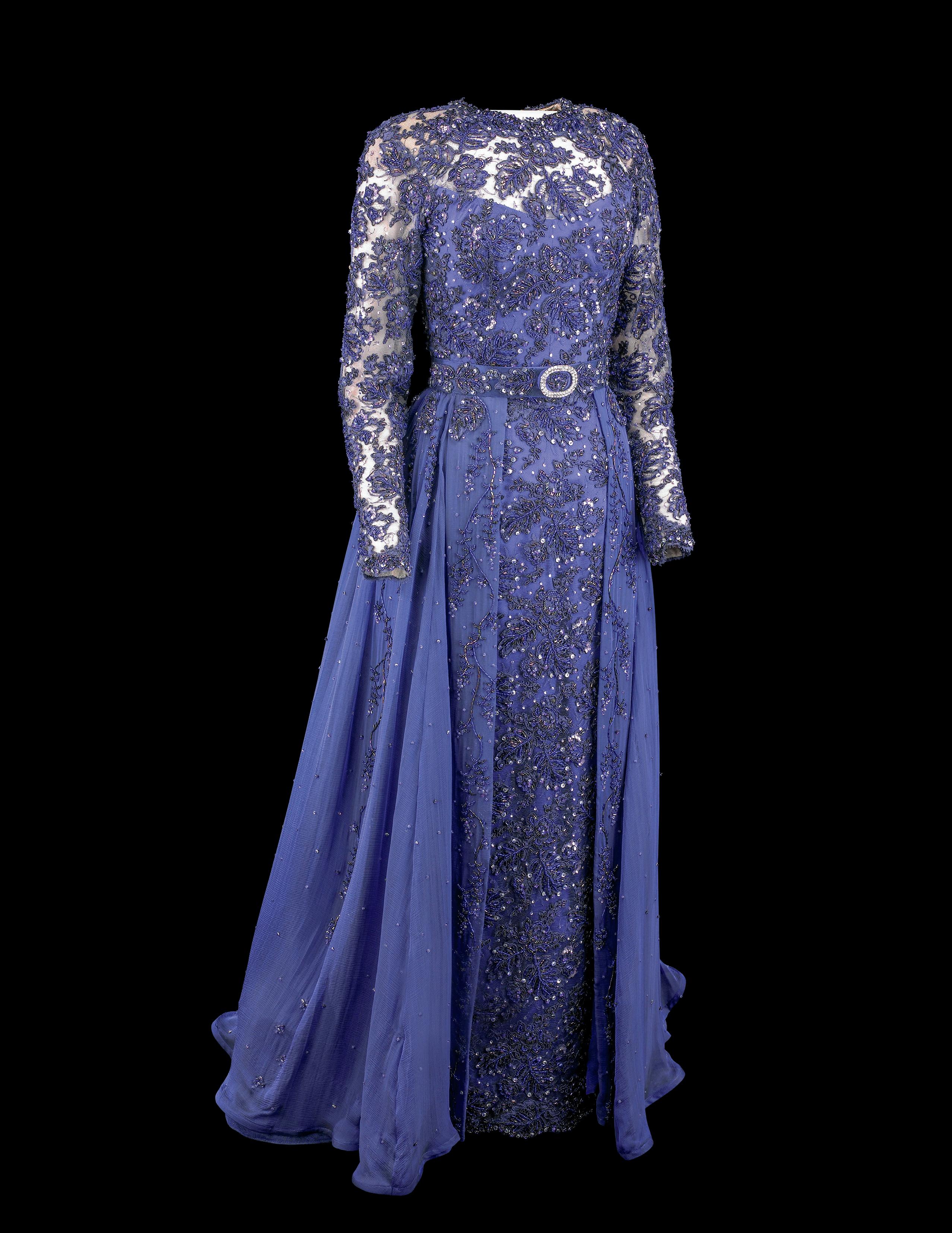
(opposite)
Hillary Clinton wore this violet beaded lace sheath gown (opposite) with iridescent blue velvet silk mousseline overskirt to the 1993 Inaugural Balls (right). The dress was designed by Sarah Phillips and made by Barbara Matera Ltd., a New York theatrical costume maker.
Hillary Clinton wore this violet beaded lace sheath gown (opposite) with iridescent blue velvet silk mousseline overskirt to the 1993 Inaugural Balls (right). The dress was designed by Sarah Phillips and made by Barbara Matera Ltd., a New York theatrical costume maker.
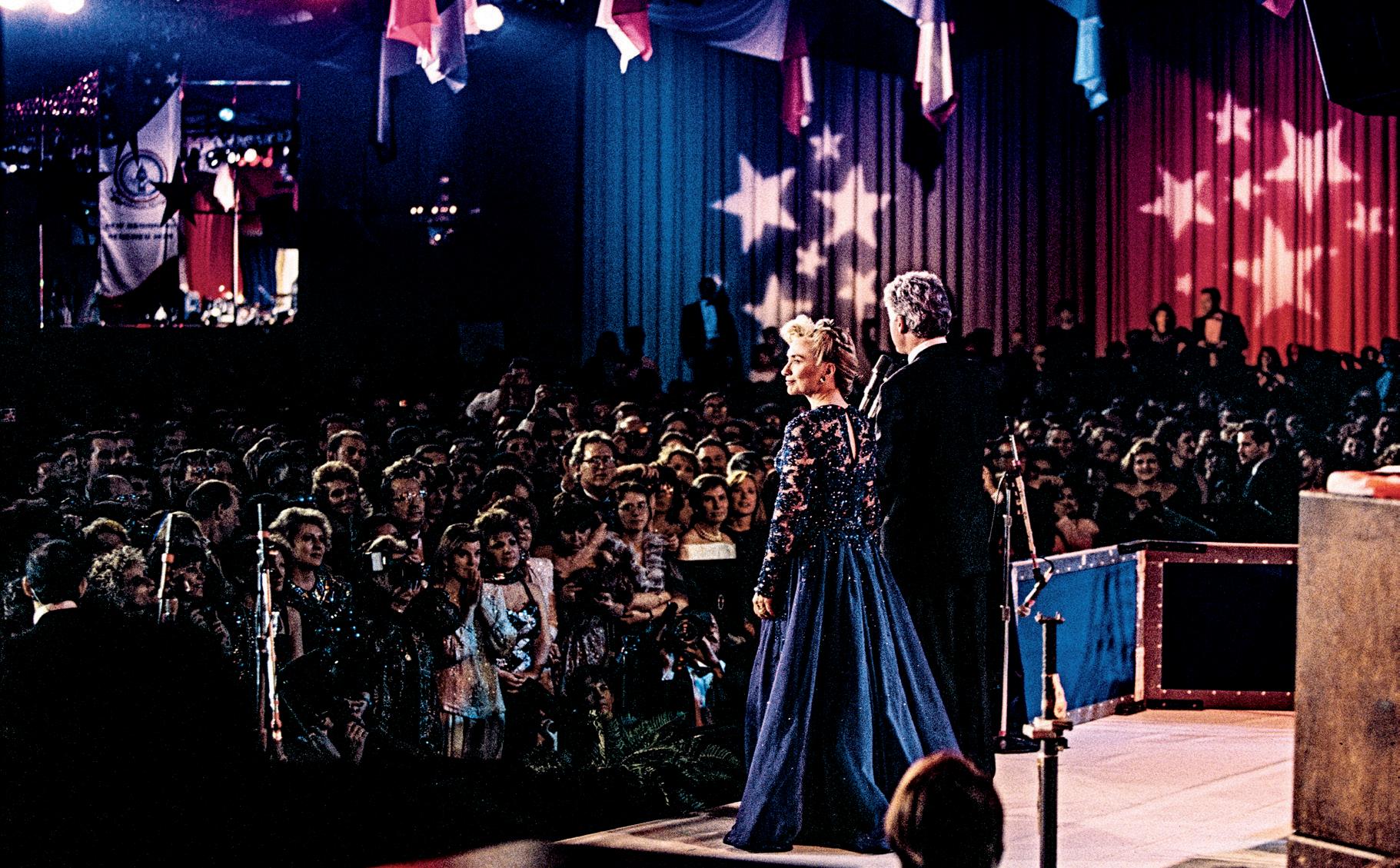
Hillary Clinton made a point to hire a young, unknown fashion designer when she selected a Sarah Phillips to create a gown for 1993 Inaugural Balls. The gown, in rich purple, was sewed and executed by Broadway “theater genius” Barbara Matera. Mrs. Clinton was so pleased with the gown, her first designer dress, that she heralded to the press “I have never been so comfortable in a dress my entire life.” Mrs. Clinton was introduced to Phillips’s designs through a small Little Rock, Arkansas, boutique where she purchased a suit by Phillips that she wore to the Democratic Convention.9 Shortly after the convention Phillips was asked to send designs for an inaugural gown.10 Phillips, who’s line was considered relatively affordable for designer work, was 37 years old at the time of the Inauguration. She was trained at Parsons School of Design and had previously worked for Ralph Lauren, Yves St. Laurent, and Christian Dior before starting her own line in 1991. “I think it’s terrific that Mrs. Clinton would pick someone young and unknown to the public. It shows a certain kind of spirit and open-mindedness,” stated a Saks Fifth Avenue executive.11
unknown fashion designer when she selected Sarah Phillips to create a gown for 1993 Inaugural Balls. The gown, in rich purple, was sewed and executed by Broadway “theater genius” Barbara Matera. Mrs. Clinton was so pleased with the gown, her first designer dress, that she heralded to the press “I have never been so comfortable in a dress my entire life.”9 Mrs. Clinton was introduced to Phillips’s designs through a small Little Rock, Arkansas, boutique where she purchased a suit by Phillips that she wore to the Democratic Convention. 10 Shortly after the convention Phillips was asked to send designs for an inaugural gown.11 Phillips, who’s line was considered relatively affordable for designer work, was 37 years old at the time of the Inauguration. She was trained at Parsons School of Design and had previously worked for Ralph Lauren, Yves St. Laurent, and Christian Dior before starting her own line in 1991. “I think it’s terrific that Mrs. Clinton would pick someone young and unknown to the public. It shows a certain kind of spirit and open-mindedness,” stated a Saks Fifth executive.12
Hillary Clinton made a point to hire a young, unknown fashion designer when she selected Sarah Phillips to create a gown for 1993 Inaugural Balls. The gown, in rich purple, was sewed and executed by Broadway “theater genius” Barbara Matera. Mrs. Clinton was so pleased with the gown, her first designer dress, that she heralded to the press “I have never been so comfortable in a dress my entire life.”9 Mrs. Clinton was introduced to Phillips’s designs through a small Little Rock, Arkansas, boutique where she purchased a suit by Phillips that she wore to the Democratic Convention. 10 Shortly after the convention Phillips was asked to send designs for an inaugural gown.11 Phillips, who’s line was considered relatively affordable for designer work, was 37 years old at the time of the Inauguration. She was trained at Parsons School of Design and had previously worked for Ralph Lauren, Yves St. Laurent, and Christian Dior before starting her own line in 1991. “I think it’s terrific that Mrs. Clinton would pick someone young and unknown to the public. It shows a certain kind of spirit and open-mindedness,” stated a Saks Fifth Avenue executive.12
When Mrs. Clinton donated the gown to the Smithsonian, she said “It is a bittersweet moment to give this dress up. If you’ll notice, we’re in the third year of my husband’s term before I gave
When Mrs. Clinton donated the gown to the Smithsonian, she said “It is a bittersweet moment to give this dress up. If you’ll notice, we’re in the third year of my husband’s term before I gave
it up.” While viewing the other gowns on display, she insightfully noted of past first ladies: “Many would be quite surprised to read what they wrote, to read what they said, and to understand the role they played in influencing their husbands and the course of American politics. I actually take comfort in that.”12
it up.” While viewing the other gowns on display, she insightfully noted of past first ladies: “Many would be quite surprised to read what they wrote, to read what they said, and to understand the role they played in influencing their husbands and the course of American politics. I actually take comfort in that.”13
notes
notes
“Pat Nixon’s Inaugural Angeles January
1. Pat Nixon’s “Inaugural Ball Gown,” Los Angeles Times, January 20, 1969.
1. “Pat Nixon’s Inaugural Ball Gown,” Los Angeles Times, January 20, 1969.
2. Smith, Marie, “Mrs. Richard M. Nixon. . . Mrs. Spiro T. Agnew, The Gowns,” Washington Post, January 19, 1969.
2. Marie Smith, “Mrs. Richard M. Nixon . . . Mrs. Spiro T. Agnew, The Gowns,” Washington Post, January 19, 1969.
Marie Smith, “Mrs. Richard M. Nixon . . . Spiro T. Agnew, Post, 19,
3. Smith, Marie, “Pat Gives Gown to Smithsonian,” Washington Post, January 15, 1970.
Marie Smith,“Pat Gives Gown to Smithsonian,” Washington Post, January 15, 1970.
3. Marie Smith,“Pat Gives Gown to Smithsonian,” Washington Post, January 15, 1970.
4. Graham, Rubye, “Harvey Berin calls it a day after 50 years,” Philadelphia Inquirer, March 18, 1970.
Quoted in Rubye Graham “Harvey Berin calls it a day after 50 years,” Philadelphia Inquirer, March 18, 1970.
4. Quoted in Rubye Graham “Harvey Berin calls it a day after 50 years,” Philadelphia Inquirer, March 18, 1970.
5. Kohler, Saul, “Rosalynn’s Gown Gets a Checkup,” Los Angeles Times, December 26, 1976.
5. Saul Kohler, “Rosalynn’s Gown Gets a Checkup,” Los Angeles Times, December 26, 1976.
Saul Kohler, “Rosalynn’s Gown Gets a Checkup,” Los Angeles Times, 26, 1976.
6. Kunz, Margi, “Rosalynn’s Old Gown Wins Renown,” Boston Globe, December 27, 1976.
Quoted in Margi Kunz, “Rosalynn’s Old Gown Wins Renown,” Boston Globe, December 27, 1976.
6. Quoted in Margi Kunz, “Rosalynn’s Old Gown Wins Renown,” Boston Globe, December 27, 1976.
7. Kohler, “Rosalynn’s Gown Gets a Checkup.”
Quoted in Kohler, “Rosalynn’s Gown Gets a Checkup.”
7. Quoted in Kohler, “Rosalynn’s Gown Gets a Checkup.”
Nina S. Hyde, “Rosalynn Carter’s Fashion,” New York Times,
8. Hyde, Nina S., “Rosalynn Carter’s Fashion,” New York Times, January 30, 1977.
8. Nina S. Hyde, “Rosalynn Carter’s Fashion,” New York Times, January 30, 1977.
Liz Smith, “Hillary Clinton Picks Purple,” The Baltimore Sun, January 14, 1993.
9. Liz Smith, “Hillary Clinton Picks Purple,” The Baltimore Sun, January 14, 1993.
9. Smith, Liz, “Hillary Clinton Picks Purple,” The Sun, January 14, 1993.
10. Ibid.
10. Ibid.
10. Morris, Bernadine, “At the Inaugural Balls, Cinderella’s the Designer,” New York Times, January 15, 1993.
11. Bernadine Morris, “At the Inaugural Balls, Cinderella’s the Designer,” New York Times, January 15, 1993.
11. Bernadine Morris, “At the Inaugural Balls, Cinderella’s the Designer,” New York Times, January 15, 1993.
11. Anderson, Lisa, “Little-known designer sews up Clinton gown,” Chicago Tribune, January 15, 1993.
12. “Send in the Gown,” Washington Post, March 7, 1995.
12. Quoted in Lisa Anderson, “Little-known designer sews up Clinton gown,” Chicago Tribune, January 15, 1993.
12. Quoted in Lisa Anderson, “Little-known designer sews up Clinton gown,” Chicago Tribune, January 15, 1993.
13. Quoted in “Send in the Gown,” Washington Post, March 7, 1995.
13. Quoted in “Send in the Gown,” Washington Post, March 7, 1995.
















































































































































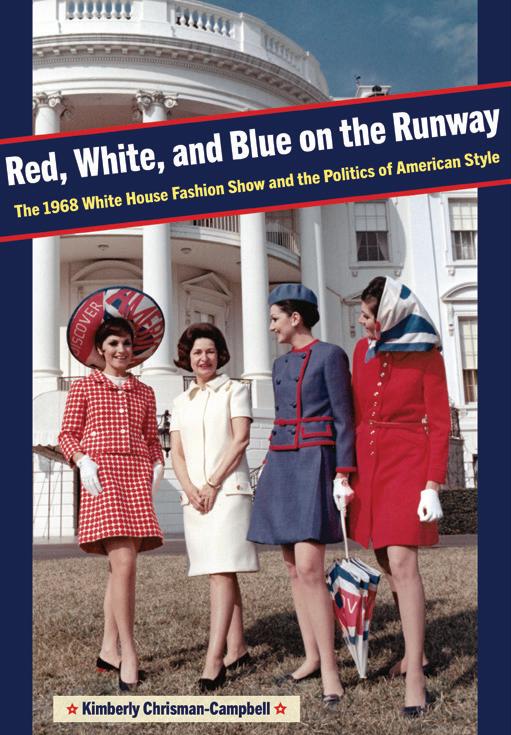


“First Lady Lady Bird Johnson knew the importance of fashion, and with her keen interest she made e orts to bring this conversation directly into the halls of the White House.”

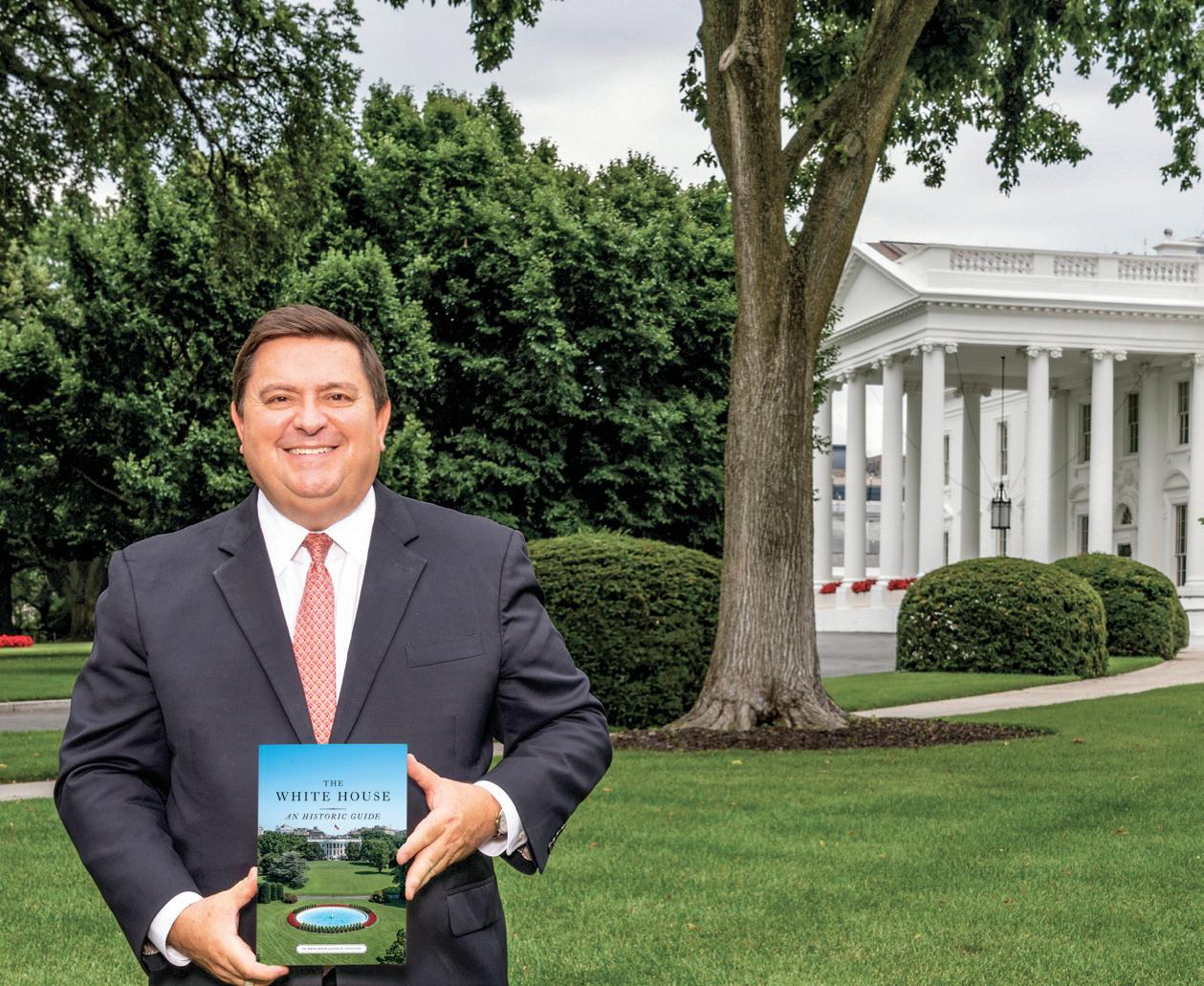
since our founding by First Lady Jacqueline Kennedy in 1961, the White House Historical Association has been privileged to work with eleven presidents and first ladies, carrying on the legacy of Mrs. Kennedy with a public–private partnership to maintain the museum standard of the White House, as she envisioned. During my years as president of the Association, I’ve been honored to work with three of these extraordinary first ladies, Michelle Obama, Melania. Trump, and Jill Biden. Each one contributed significantly in different meaningful ways to preserving and enriching the historic interiors of the people’s house.
with presiand first ladies, carrying on Mrs. Kennedy’s legacy with a public–private partnership to maintain the museum standard of the White House, as she envisioned. During my years as president of the Association, I’ve been honored to work with three of these extraordinary first ladies, Michelle Obama, Melania Trump, and Jill Biden. Their contributions to preserving and sharing the historic interiors of the people’s house continue to enhance the nation’s understanding, appreciation, and enjoyment of the people’s house.
A key part of our mission is to promote accessibility to the White House and to teach and tell the stories of its history. Perhaps there are no better story tellers than those who have had the opportunity to visit the White House and then share their own story through social media postings and widely shared images of their own experience.
A key part of our mission is to promote accessibility to the White House and to teach and tell the stories of its history. Perhaps there are no better storytellers than those who have had the opportunity to visit the White House and then share their own story through social media postings and widely shared images of their own experience.
D. M C LAURIN
PRESIDENT, WHITE HOUSE HISTORICAL ASSOCIATION
STEWART D. M C LAURIN PRESIDENT, WHITE HOUSE HISTORICAL ASSOCIATION
tour each year. All of this takes place in a home that would be considered small in comparison to that of most heads of state around the world. Every first lady who has worked with the Association, and each one of the many professionals devoted to the care and preservation of the fine and decorative arts collection, has helped to enhance and improve magnificent interiors that define the historic White House.
home that is would be considered small in comparison to that of most heads of states, s a great tribute to the career professional staff of the White House as well as every first lady who works collectively with us to enhance and improve each room, each space, and all that fills these magnificent interiors.
As different and diverse as they are the forty-five men who have served as president of the United States are connected by the White House. Only George Washington did not live there, but his vision shaped the design and the building for all who followed him.
As different and diverse as they are, the forty-five men who have served as president of the United States connected by the White House. Only George Washington did not live there, but his vision shaped the design and the building for all who followed him.
Home to the president and his family, the White House is the office of the president and his staff, historic landmark to which the nation’s most important visitors are welcomed, and a museum though which about 500,000 visitors tour. With all that taking place in a
Home to the president and his family, the White House is the office of the president and his staff, an historic landmark to which the nation’s most important visitors are welcomed, and a museum though which about 500,000 visitors
Mrs. Kennedy had every right to expect as first lady that her husband would be president for four or perhaps eight years, giving her plenty of time to complete all that she set in motion in those early years. Tragically, the Kennedy presidency was cut short, but what Mrs. Kennedy had in place continues to be the process and procedures through which conservation, preservation, administration, and acquisition of the permanent White House collection are undertaken
Mrs. Kennedy had every right to expect as first lady that her husband would be president for four or perhaps eight years, giving her plenty of time to complete all that she set in motion in those early years. Tragically, the Kennedy presidency was cut short, but the procedures Mrs. Kennedy set in place continue to ensure the orderly acquisition, conservation, and preservation of the permanent White House Collection.
As the public was welcomed back to the White House this summer to enjoy full schedule of public tours for the first
As the public was welcomed back to the White House this summer to enjoy a full schedule of public tours for the first time since the beginning of COVID, a new edition of the Association’s first
book, The White House: An Historic Guide, awaited them. The Association’s first project, and its flagship publication, the Guide is now sixty years old. Having first seen the need for such a guide during a childhood visit in 1941, it was First Lady Jacqueline Kennedy made the guidebook a reality soon after making the White House a home. The book went on sale July 4, 1962, and very quickly sold out of the first run of 250,000 copies. Today with more than 5 million copies sold, the Guide has evolved with time as it continues to serves its original purpose. A walking tour outside the fence was added after 9/11, when the Guide book was redesigned and expanded to be relevant to those who can tour the White House, as well as armchair tourists at home. With this edition, larger wider photographs allow a comprehensive views of State Rooms than ever before, while a look behind the scenes allow, for the first time, a glimpse of such spaces as the collections storage area. Continuing an unbroken tradition begun in 1962 by Jacqueline Kenned, Dr. Jill Biden opens the book with a welcome to the White House from the first lady. She writes, “Knowledge and learning are at the foundation of our democracy, and that is reflected at the White House where history comes to life.”
time since the beginning of COVID, a new edition of the Association’s first book, The White House: An Historic Guide, awaited them. The Association’s first project, and its flagship publication, the Historic Guide is now sixty years old. Having first seen the need for such a guidebook during childhood visit in 1941, it was First Lady Jacqueline Kennedy who made the book a reality soon after making the White House her family’s home. The book went on sale July 4, 1962, and very quickly sold out of the first run of 250,000 copies. Today with more than 5 million copies sold, the guidebook has evolved with time as it continues to serves its original purpose. A walking tour outside the fence was added after 9/11, when the guidebook was redesigned and expanded to be relevant to those who can tour the White House, as well as armchair tourists at home. With this edition, larger wider photographs allow more comprehensive views of State Rooms than ever before, while a look behind the scenes allows, for the first time, a glimpse of such spaces as the collections storage area. Continuing an unbroken tradition begun in 1962 by Jacqueline Kennedy, Dr. Biden opens the book with a welcome to the White House. She writes, “Knowledge and learning are at the foundation of our democracy, and that is reflected at the White House where history comes to life.”
The White House Historical Association’s Nex-Gen Leaders share in fulfilling the Association’s mission with their energy, enthusiasm, and interest in history. At a summer gathering in Brooklyn, Nex-Gen Leader Emily Bedard, with White House designer Tham Kannalikam and architect Steven Spandle, demonstrated how architectural plaster is made for elements of the beautiful new White House tennis pavilion, a design vision of First Lady Melania Trump. Those present were able to try their hand at making these beautiful design pieces. Stewart McLaurin and Nex-Gen Leader Pendleton Bogache display finished pieces.
The White House Historical Association’s Nex-Gen Leaders share in ful lling the Association’s mission with their energy, enthusiasm, and interest in history. At a summer gathering in Brooklyn, Nex-Gen Leader Emily Bedard, with White House designer Tham Kannalikam and architect Steven Spandle, demonstrated how architectural plaster was made for elements of the beautiful new White House tennis pavilion, a design vision of First Lady Melania Trump. Those present were able to try their hand at making these beautiful design pieces. Stewart McLaurin and Nex-Gen Leader Pendleton Bogache display their nished pieces.
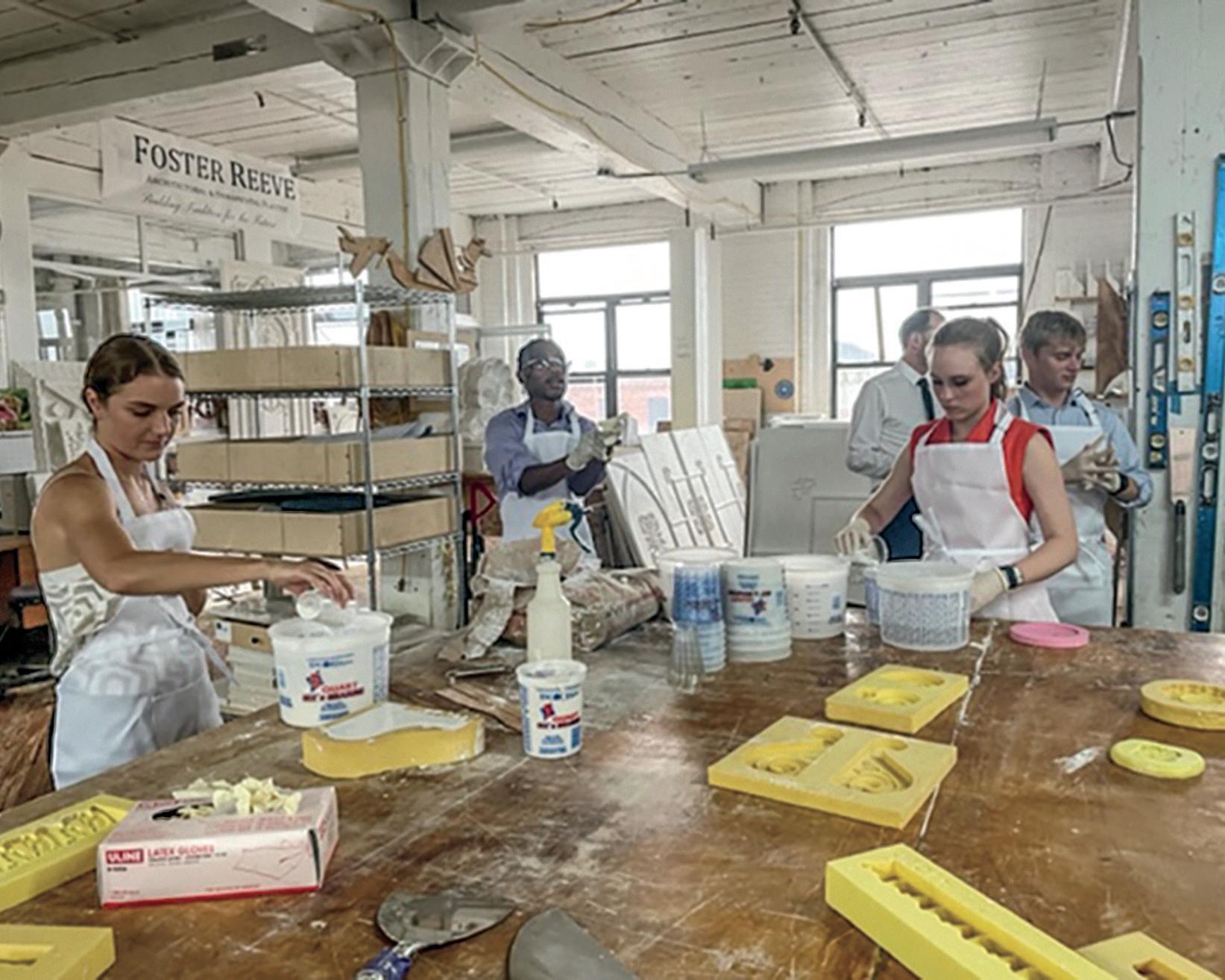
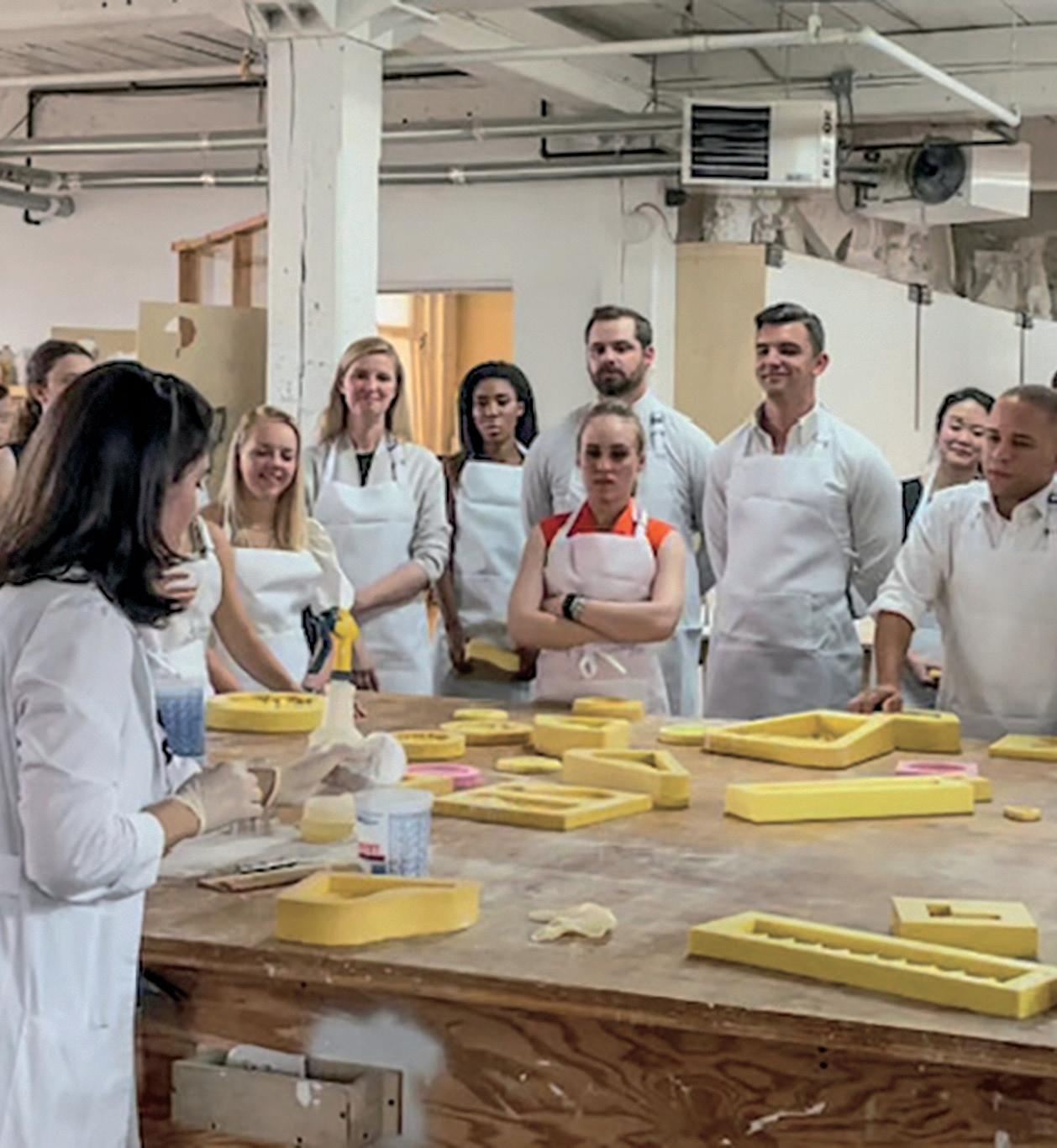
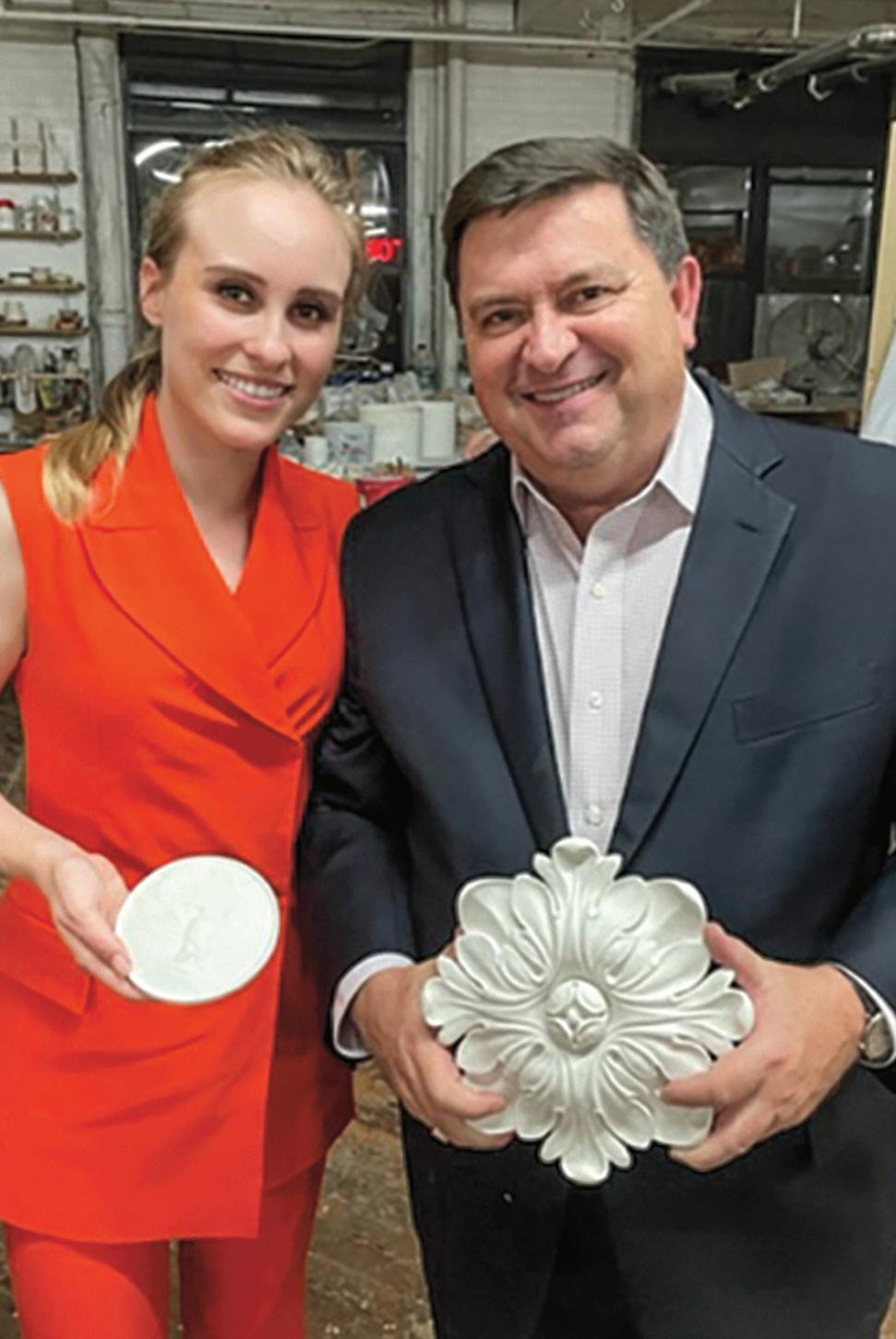
WHITE HOUSE HISTORY QUARTERLY
WHITE HOUSE HISTORY QUARTERLY
features articles on the historic White House, especially relating to the building itself and life as lived there through the years. The views presented by the authors are theirs and do not necessarily reflect the position or policy of the White House Historical Association.
features articles on the historic White House, especially relating to the building itself and life as lived there through the years. The views presented by the authors are theirs and do not necessarily reflect the position or policy of the White House Historical Association.
front cover:
back cover:
front cover: Official portrait of First Lady Michelle Obama by Sharon Sprung, Gift of the White House Historical Association to the White House Collection, 2022. Styled by Meredith Koop, Mrs. Obama wears a custom Jason Wu Collection celestial blue silk chiffon hand-draped gown with cascading skirt. Jason Wu also designed Mrs. Obama’s Inaugural Ball gowns in 2009 and 2013. [white house historical association / white house collection]
the white house historical association was chartered on November 3, 1961, to enhance understanding, appreciation, and enjoyment of the historic White House. Income from the sale of White House History Quarterly and all the Association’s books and guides is returned to the publications program and is used as well to acquire historical furnishings and memorabilia for the White House.
back cover: First Lady Laura Bush is joined by First Lady Nancy Reagan during the unveiling of the Heart Truth’s First Ladies Red Dress Collection exhibit at the John F. Kennedy Center for the Performing Arts, May 2005. [alamy]
address inquiries to:
White House Historical Association P.O. Box 27624 Washington, D.C. 20038 books@whha.org
the white house historical association was chartered on November 3, 1961, to enhance understanding, appreciation, and enjoyment of the historic White House. Income from the sale of White House History Quarterly and all the Association’s books and guides is returned to the publications program and is used as well to acquire historical furnishings and memorabilia for the White House.
address inquiries to:
White House Historical Association
P.O. Box 27624
© Copyright 2022 by the White House Historical Association. All rights reserved. No part of this publication may be reproduced, stored in a retrieval system, or transmitted, in any form or by any means, electronic, mechanical, photocopying, recording, or otherwise, without prior written permission of the White House Historical Association.
Washington, D.C. 20038 books@whha.org
issn: 2639-9822
© Copyright 2022 by the White House Historical Association. All rights reserved. No part of this publication may be reproduced, stored in a retrieval system, or transmitted, in any form or by any means, electronic, mechanical, photocopying, recording, or otherwise, without prior written permission of the White House Historical Association.
issn: 2639-9822