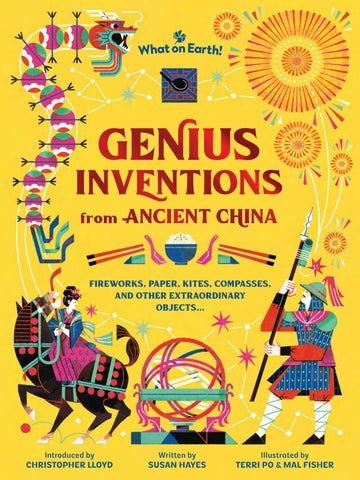
FIREWORKS, PAPER, KITES, COMPASSES, AND OTHER EXTRAORDINARY OBJECTS...
Written by SUSAN HAYES Illustrated by TERRI PO & MAL FISHER
The lodestone compass
The first compass had a spoon-shaped pointer that was carved from lodestone. Its base was crafted from a non-magnetic material such as bronze. The smooth surface ensured that the spoon turned easily on its base and when the spoon settled, the handle always pointed South.
COMPASS
A magnetic pointer that transformed navigation
The very first compasses looked nothing like today’s circular pocket compass with its magnetic needle pointing North for navigation. Instead, these ingenious devices were used to make sure buildings, towns, and tombs pointed in the best direction. But the compass made its greatest impact in the world of travel and trade.
The swivel of the compass to point South might look like magic, but it is science! It relies upon the invisible force of magnetism. All magnets have two ends: a North pole and a South pole. And surrounding every magnet is a magnetic field, which is an area of energy. Magnetic forces either attract or repel (force away) metals or other magnets. The swirling metal of Earth’s outer core creates a magnetic field around our planet, looping between the North and South poles.
The very first compass was invented in the Warring States period (475–225 BCE). The spoon on the compass, made of magnetic lodestone, aligned itself with Earth’s magnetic field and turned so that the handle always pointed South. Geomancers (people who practiced an ancient form of magic focused on the Earth) used the compasses to make sure buildings faced South, the most auspicious direction.
The Earth’s magnetic field
The magnetic North and South poles and the geographic North and South poles are not exactly aligned. Earth’s magnetic poles slightly shift due to the constant movement of the liquid iron in the planet’s core. This slight difference between the geographic poles and the magnetic poles is called magnetic variation.
Magnetizing iron
Before the Liu-Song Dynasty (420–479 CE), the only way to make a compass was by using the magnetic rock, lodestone. But then an exciting discovery was made. If iron is struck with lodestone, it too becomes magnetic! Artisans crafted magnetic iron into thin compass needles for accurate readings. The needles were often kept in a lodestone box to keep them magnetic.
A mariner’s compass
Magnetized compass needles could turn easily in water. Chinese sailors began to use floating wet compasses from at least 1100 CE, in which the compass needle floated in a bowl of water. But the compass would often tip over in stormy seas.
Magnetizing an iron needle for a compass
By the Northern Song Dynasty (960–1127 CE), people had found another way to magnetize iron. By heating an iron needle in a red-hot charcoal fire, then cooling it in water while in a north-south position, it becomes magnetized by the Earth’s magnetic field.
Later, seafarers used the more practical dry compass. The magnetic pointer pivoted on a pin in a closable box, so it was much more reliable and easier to use on a boat than the wet compass.
Boxed dry compass
Floating wet compass
Emperor Huizong sent ships to Korea in 1124 CE as part of a diplomatic mission. A book about the expedition tells how sailors used a wet compass to find their way.
Navigating the oceans
For thousands of years, sailors traveled the high seas using the Sun and the stars as their guide. Migrating birds and ocean currents also showed the way, as did cloud formations, landmarks, and recognized coastlines. But the magnetic compass changed everything! This wafer-thin spinning needle steered fleets of ships further afield to distant lands. It helped to establish seafaring routes for trade and travel all over the world. The Chinese were the first voyagers to use the magnetic compass to plan their routes and keep
their course. Ships’ logs and diaries reveal its use on Chinese vessels from the early 1100s. Trade with foreign lands spread the use of the compass to many other parts of the world. By the end of the 1100s, it was on board European ships and by the beginning of the 1200s, it was available to Arab and Persian sailors, too.
Today, we have many ways of mapping the seas, including satellite navigation and radar. But it is still maritime law for every sea-vessel in the world to carry a magnetic compass.
Playing polo
Using a long-handled mallet, Empress Wu Zetian competes in a game of polo. This fast and dangerous game was very popular in the Tang Dynasty (618–907 CE). Stirrups helped the players to stay on their horses and even stand up.
SADDLE & STIRRUPS
Accessories that brought horseriding into warfare and sports
Galloping across country, charging into battle, and jumping over streams while on horseback is very difficult without support. Even mounting a horse is challenging without a step up. But this is what riders had to do before the invention of the saddle and stirrups. Having a secure seat and a place to put their feet made riders more stable and balanced, which meant soldiers could wear heavy armor without falling off. It also sparked the invention of horseback sports!
People have ridden horses for more than 5,000 years. At first, riders used their legs to grip the horse’s sides, and held on to their manes. This was dangerous for the rider and the horse. Between the 7th and 4th centuries BCE, the saddle was invented. At first this was a simple pad or blanket for the rider to sit on, strapped around the horse’s belly to keep it in place. This stopped the rider from falling off and took pressure off the horse’s spine. Later, leather saddles were made, some with beautiful designs on them. Getting onto the horse’s back remained very difficult without help. Around 200 CE, the stirrup was invented. A ring, attached to the saddle with a strap, acted as a step for the rider to mount the animal. The first stirrups were made from rope, bone, wood, or leather. There was just one stirrup, used for mounting.
Later the Chinese added a second stirrup on the other side to be used while riding the horse. They also used their advanced metal-working skills to cast stronger foot supports in bronze and iron. Iron stirrups could support the full weight of a rider without breaking, which meant people could take their hands off the horse’s mane, lean to one side, and even stand up. This allowed riders to use a bow and arrow while riding, and eventually led to full-scale warfare carried out on horseback.
With the invention of the saddle and stirrups, horseriding became easier and more popular. The horse was ridden for travel, farming, trade, battle, and to compete in sports like polo and showjumping. In the modern day, almost every horse rider uses stirrups. Even children can mount and ride horses, using special stirrups designed for smaller feet.
GENIUS INVENT IONS from ANCIENT CHIN A
Authors: Christopher Lloyd and Susan Hayes
Illustrators: Terri Po and Mal Fisher
Pub date: January 5th, 2027
Price: $27.00
Size: 8.3 x 11 in
Format: Hardcover
Extent: 192 pages
Age: 8+
ISBN: 9781804662113
Journey into Ancient China and discover the inventions that have changed our world!
• Did you know that the first compasses were shaped like spoons?
• Or that gunpowder was discovered by alchemists in search of a potion for eternal life?
• Or that the stories of many items you see around you every day—paper, playing cards, kites, fireworks, and even tea began in Ancient China?
As you travel from neolithic times through the dynasties of imperial China, discover the origins of more than 40 genius inventions that still shape our world today. Journey alongside the magnificent treasure ships that sailed the
AUTHORS
Christopher Lloyd began his career as a journalist with the UK newspaper The Sunday Times. His world history book What on Earth Happened? has sold 500,000 copies globally. He is the author of the children’s nonfiction book Absolutely Everything! and the editor of the bestselling Britannica All New Kids' Encyclopedia.
Susan Hayes writes, edits, and publishes books and magazines for children. She has both won and been shortlisted for various awards, including the Book Trust Storytime Award and the UK’s Week Junior Book Awards.
ILLUSTRATORS
Terri Po is originally from Hong Kong and now lives and works from the Scottish Highlands. Her work was highly commended by the Faber Academy Prize. She is the illustrator of Spies and Flight: From a Balloon to the Moon and Wildlife in the Balance
Mal Fisher is an experienced illustrator based in Sheffield, UK, with two decades of design experience spanning graphic, web, and packaging work.
US. ORDERS
Publishers Group West
Tel: (866) 400-5351 | Fax: (800) 838-1149
ips@ingramcontent.com
Submit orders to your sales representative, or via the IPS Cart on Ingram iPage at ipage.ingramcontent.com
high seas with precious cargo of porcelain and silk to trade with foreign kings and queens. Marvel at the suspension bridges that spanned mountains and deep river gorges. And find out how ancient Chinese scientists made accurate moving models of the skies. Our team of expert consultants who have pored over every detail are featured in interviews at the end of each chapter.
With vivid illustrations by Terri Po and Mal Fisher, as well as photographs and timelines, this book celebrates the awe-inspiring ingenuity of Ancient China, which has transformed the world as we know it.
Key selling points:
• Features more than 40 incredible inventions from well-known creations, such as fireworks, paper, and the compass to those that are lesser-known, such as the magic mirror and the seismometer.
• Spans thousands of years of history, from neolithic times through to the Qing Dynasty (1644–1912).
• Created in collaboration with several expert Chinese consultants, who are interviewed at the end of each chapter.
• Gives fascinating historical context to events that are celebrated the world over today, such as the Spring Festival (Chinese New Year).
• Perfect for inquisitive young minds and those with an interest in STEAM subjects and how things work.
• Brings the forgotten stories of Ancient Chinese inventions back into the minds of a modern audience, helping to establish Ancient China as one of the most influential ancient civilizations of all time.
CANADA ORDERS
The Manda Group Tel: (855) 626-3222 | Fax: (888) 563-8327 info@mandagroup.com