The Echo is a monthly publication of the newspaper staff of Webster Groves High School, 100 Selma Ave., Webster Groves, MO.
To contact staff members, call 314-963-6400 ex. 11157 or write to wgecho@wgmail.org.
Unsigned editorials are the opinion of a majority of staff members; signed articles are the opinion of the writer
Letters to the editor of 300 words or less are welcome; submit letters by the 10th of the month to wgecho@wgmail.org, or room 155. All letters must be signed, although the name may be withheld from publication if requested. The Echo has the right to edit letters for publication as long as intent remains unchanged.
The Echo is a member of JournalismSTL, Quill and Scroll, JEA, MIJA, NSPA and CSPA.
Cover cutline: Cover made in Canva.
theecho
Webster hosts Japanese exchange students
March Madness tournament returns to St. Louis
Women’s soccer team prepares for start of season
Op-Ed: Government decisions threaten women’s rights
Editorial: Organizations offer ways to protest against ICE
Word search
Webster hosts Japanese exchange students
Jasper Winterton Feature/Video Editor
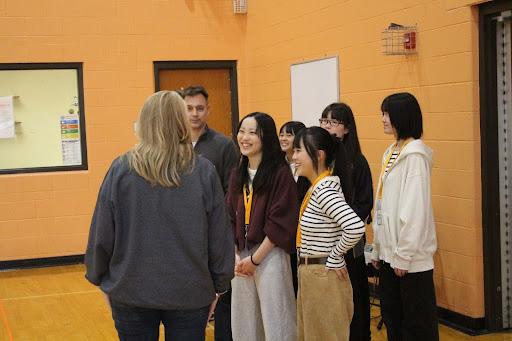
Webster Groves hosted exchange students from Suwa, Japan, March 4-12. The exchange was organized through the St. Louis-Suwa Sister Exchange program, which operates through its committee in St. Louis.
Betty Roberts, social studies department chair, coordinates Webster Groves involvement in the exchange program.
Some of Roberts’ responsibilities include “Reserving meeting spaces for the year leading up to the trip, hosting the delegation from Suwa every other year, coordination with our amazing teachers to set up a course schedule for the students and teachers from Suwa to participate in while they are visiting, and help with many other behind the scenes needs for the committee and the students,” Roberts said via email.
The exchange also includes opportunities for students from Webster and other private and public schools to be a part of the exchange program and travel to Suwa, Japan. Being selected as an exchange student involves an application process, which opens every other year. Only up to 10 students are selected for each exchange period.
According to Roberts, Webster’s involvement with the program started in 2022. Since then, Webster has hosted exchange students from Suwa twice, in 2024 and now in 2026. Suwa has hosted Webster students twice as well, in 2023 and 2025. The next planned exchange will occur in the summer of 2027, with Webster students having the opportunity to join the exchange, which will require an essay and an application.
Roberts said students interested should look out for the morning announcements in September, where more information will be released.
Kate Bruner, senior, is hosting Tsumugi Ota, one of the exchange students. Bruner said she also hosted a student from Japan two years ago, and she went to Japan through the exchange program and wanted to give back by hosting.
“We took my exchange student to the Arch, the zoo, a soccer game, different stores and restaurants,” Bruner said. She added her family wasn’t originally planning to host a student but decided to after the organizers reached out to her and asked if she could.
According to Roberts, host families must provide a private bedroom, meals for the week and transportation to and from school each day. Along with this, they must have one family member who attends Webster Groves High School and must be willing to show the student around St. Louis, including a mandatory visit to the St. Louis Arch.
“We are very excited to bring the exchange to WGHS and to give our students the opportunity to experience Japanese culture, as well. I am a huge advocate of travel and sharing cultural experiences with students. It brings the classroom to life and
opens up career opportunities and options outside of the bubble of St. Louis,” Roberts said.
Betty Roberts, social studies department chair, leads the Japanese exchange students on a tour throughout the high school on Friday, March 6.
Photo by Sam Enlund
March Madness tournament returns to St. Louis
Isaac Choi Junior Sports Editor
One in 9.2 quintillion. Those are the odds of successfully making a perfect March Madness bracket, which has never been done before in the tournament’s 87 year history. It’s known for being a basically impossible feat.
Across the history of the NCAA Division I Basketball Tournament, countless brackets have been busted year after year due to factors such as game- winning shots or top four seeds unexpectedly losing in the first two rounds. Every year millions of Americans create brackets online, most popularly on ESPN Fantasy’s Tournament Challenge, or print them out on paper to compete with their friends and family.
The most common “bracket-busting factor” is top seeds being upset. This is a yearly tradition where typically a smaller mid-major school will upset the high-seed power five school. This leads to not only competitors getting one pick wrong but also possibly several considering top seeds can often be picked to win the entire tournament.
Last year in the 2025 tournament, over four million people made brackets. The tournament was a different one from the others. First, the top four seeds went undefeated in the first round, with the last time that happened being in 2007. Then the final four teams were all one seed creating an “all chalk” final four, which had only occurred in 2008 previously. The final result was Florida won the tournament.
This year’s tournament started on March 15, with Selection Sunday being the day the bracket was announced. Currently the top seeds include Duke, Michigan, Arizona and UConn. The school with the best odds to win, according to ESPN Futures, is Duke with +320 odds.
This year featured games locally in St. Louis at the Enterprise Center, on March 20, and 21 throughout the first and second rounds. Schools within the state have also been featured in the tournament including schools like SLU and Mizzou.
CONSTRUCTION ZONE
Informing
The Purdue University and Queens University coaches shake hands after their March Madness tournament game on March 20, 2026 at the Enterprise Center. Purdue won 104 - 71.
Photo by Isaac Choi
Women’s soccer prepares for start of season
Sam Enlund Sports Editor/Social Media Manager
Women’s soccer started its season on Mon day, March 2, with their tryouts for team placement spanning from that Monday to Thursday, March 5.
Since tryouts, the team has been preparing for the start of its season with the first game on Saturday, March 28, against Ursuline Academy at 12 p.m. Athletes have attended the practices after school every day for two hours, with morning practice on Saturdays. Over spring break the team also held optional practic es Monday through Friday and a practice on the last Saturday of spring break.
This year, the team brought on a new head coach, Brennan Wells, previously an assistant coach for the men’s soccer team. Coaching alongside Wells will be varsity assistant coaches Elizabeth Dwyer and Ryan Guffey. The JV team will be coached by
head coach Annie Bouvatte and assistant coach Elizabeth Birch. About the new coaches, junior Kyndal Richardson said, “I am super excited to have Coach Wells this year because I think he is a great coach and cares about everyone and what he’s doing.”
With the spring sports season being held in a short timespan, teams have to find ways to fit in all of the needed games. This can lead to a number of games all in the same week.
About what she would change in the team’s schedule, junior Beatrice Schwieterman said, “We have some weeks later in the season where we have four games in a school week, and I would just change that to be a little more spread out.”
Graphic from Canva
Op-Ed: Government decisions threaten women’s rights
Arianna Peper Editor-in-Chief
According to the U.S. House of Representatives, the first national movement for women’s rights was led by Elizabeth Cady Stanton in Seneca Falls, New York, in 1848. Nearly 180 years later, women continue to have their rights limited by the government.
In January of 2025, Republican Congressman Chip Roy (Texas) introduced the Safeguard American Voter Eligibility (SAVE) Act. This act would require a passport or certified birth certificate in combination with a photo ID.
According to the Center for American Progress, the original SAVE Act was passed in the House in April of 2025 but stalled in the Senate due to widespread public backlash against the legislation.
A newer version of this act, often referred to as the “SAVE America Act,” increases the difficulties for women and other minority groups in the voting process. After its approval in the House, President Donald Trump has been pushing the Senate to pass the act, mentioning it numerous times within his State of the Union address, according to Delaware Online.
If these acts were put in place, the requirement of a passport, birth certificate, in combination with a photo ID at their election office, would place increased limitations upon multiple groups, especially a large majority of women.
Firstly, the requirement to show documentation in person would effectively “block the voter registration methods that 94 percent of Americans use—methods such as submitting a registration application online, mailing in an application, and registering at a motor vehicle agency such as the DMV,” according to the Center for American Progress.
In addition to this, the 69 million women who have married do not have a birth certificate that matches their legal name; therefore, they would be unable to vote without the presentation of this documentation, which places an extreme limit on their rights.
Along with voting rights at risk of being limited, women’s rights in the workforce are also at risk due to Trump’s involvement in the changes within the Equal Employment Opportunity Commission (EEOC).
The EEOC is an independent federal agency with a bipartisan slate of five commissioners and is at the “frontlines of civil rights enforcement, investigating and remedying employment discrimination charges. In FY 2023 alone, the Commission received more than 81,000 complaints of alleged discrimination, including discrimination by sex, race, religion, and age,” according to the National Partnership for Women & Families.
The EEOC plays a vital role in ensuring that all workers –and women workers in particular– are treated equally. However, in January of 2025, after Trump fired two of the three Democratic commissioners on the five-seat EEOC as well as the general counsel, Jocelyn Samuels, Charlotte Burrows and General Counsel Karla Gilbride, therefore “depriving the agen-
cy of quorum,” according to an article from Littler Mendelson P.C and the National Partnership for Women & Families.
With the deprivation of quorum, the minimum number of members of an assembly that must be present at any of its meetings to make the proceedings of that meeting valid, the EEOC is unable to make significant policy changes and therefore cannot protect the rights of women in the workforce.
As for threats to women’s health, Trump has revoked several of former President Joe Biden’s executive orders, including Executive Order 14076, which outlined that “the United States Constitution’s protection of women’s fundamental right to make reproductive healthcare decisions. These deeply private decisions should not be subject to government interference,” according to the federalregister.gov.
While these government actions of executive orders, acts, impacting agencies continue, women– and many other minority groups – face extreme oppression toward their personal rights.
As democracy is the foundation of the United States, it is critical that individuals take action against certain acts that may threaten that democracy. Some examples of this could include petitions, protesting and voting in elections for certain representatives or policies that protect one’s rights.
Editorial: Organizations offer ways to protest ICE
YouGov polling recently found that half of Americans now “somewhat or strongly” support the abolition of U.S. Immigra tion and Customs Enforcement (ICE).
This data follows the over-390,000 people deported by ICE between January 2025 and January 2026, during which ICE was also granted more than $28 billion in federal funding, according to the American Friends Service Committee (ASFC).
However, despite growing federal support for ICE, public opin ion has lessened. The 50% of Americans who don’t support ICE (according to YouGov) is a 4% increase from the beginning of January 2026. As ICE continues to use bru tality against members of American neighbor hoods and communi ties, the communities are pushing back.
Protesting the over reach of ICE is essential to creating change, and one can speak out in several different ways-even from their own home.
One of the most popular ways to speak out against the actions of ICE is through attending a protest. There are several throughout the St. Louis area.
several different petitions on their websites.
For example, Indivisible St. Louis organizes a protest every Saturday from 1 to 3 p.m. at Ronnie’s Plaza. According to the Indivisible St. Louis website, the purpose of the protest is to “demand action against ICE violence.”
Another method of protesting the brutality of ICE is to contact local members of Congress. Missouri senators and representatives--get this--represent Missourians. Let Senators Josh Hawley and Eric Schmitt know that it is within their best interest--from a political perspective, if not a humanitarian one--that they vote against giving more money and power to ICE. The United States is still a democracy. Voters can still hold the power if they use it effectively.
For those unsure of where to start when contacting their representatives, several sites have pre-written emails. By filling out a form with just a name, address, email and phone number, this message can be sent out to one’s local politicians. It is a quick and easy way to participate in the government, and to use one’s voting power for the better. A few websites with these messages include the National Education Association (NEA), American Civil Liberties Union (ACLU), National Immigration Law Center (NILC), and the Hebrew Immigrant Aid Society (HIAS). (A Google search for “message reps about ICE” can also help to find these sources.)
Registered voters can also sign petitions available online. The ACLU and actionnetwork.org both have
There are also opportunities to get even more involved, through volunteering with organizations that support immigrants (like the International Institute of St. Louis) or donating money Though it is easy to feel discouraged at the lack of checks on President Trump’s power, it will only continue to grow if it is not challenged. Within the first year of Trump’s second term,
Americans have seen politicians afraid to stand up to the president and fight back against him. The lack of restrictions on the powers of ICE are only an extension of this overreach. At this point, the power to make change has turned to the American people. Yes, the powers of ICE and Trump seem to continue growing each day--but without pushback, it is certain this will never change. Even the smallest of actions--signing a petition, sending an email--can be part of a larger movement, a push to strengthen democracy.