Window & Facade Magazine January-March 2026 - Global Edition
INDUSTRY SPEAKS
THE INTELLIGENT SKIN: HOW NEW-GENERATION FAÇADES ARE REDEFINING ARCHITECTURE
Expert insights on the New-Generation Façades presenting a comprehensive
IRINA TADELLO,
Business Development, Priedemann Façade Experts
FACE TO FACE
Interview with HUZEFA ALI, Founder, CladUp Design & Façade Ideas
Preface
The idea of a façade has undergone a remarkable transformation. No longer a static outer skin, it has evolved into a dynamic, intelligent interface between the built environment and its context. In this edition, as we explore the theme of new-generation façades, it becomes evident that we are witnessing not just incremental improvements, but a fundamental shift in how buildings communicate, perform, and endure.
Today’s façades are expected to do far more than protect. They regulate light, optimise thermal performance, respond to climatic variations, and increasingly, contribute to energy generation. With advancements in materials, parametric design tools, and digital fabrication, architects and engineers are now equipped to push boundaries that were once considered impractical. The façade is no longer an afterthought—it is central to both design intent and building performance.
Equally significant is the growing convergence between façade and fenestration systems. Windows and openings are no longer isolated elements; they are seamlessly integrated into the overall envelope strategy, enhancing both aesthetics and functionality. Whether in large-scale public infrastructure or contemporary commercial developments, this integration is redefining how buildings engage with users and their surroundings.
However, with innovation comes responsibility. As the industry embraces complex systems and advanced technologies, the emphasis on execution, quality control, and long-term durability becomes even more critical. A well-designed façade must not only inspire visually but also perform reliably over time, often under challenging environmental conditions.
This issue brings together diverse perspectives—from design philosophies and material innovations to execution challenges and future-forward technologies. It reflects an industry that is both ambitious and introspective, constantly seeking better solutions.
For any suggestions or feedback, please feel free to write to us at editorial@wfmmedia.com
10
The Future of Building Skins in the Age of AI
BIM-Ready Hardware: The Next Leap in Construction
DANIEL MAY, Director, Consort Architectural Hardware
Designing with the Right Glass: Building Safer, Smarter, and More Comfortable Façades
DR. SAMIH YEHIA, Vice President – Sales & Marketing, Emirates Glass
DREW GILBERT, Lead Design Architect & AI Practice Lead, OBMI 13
17 Green Façades: The Future of Sustainable Architecture
24
The Role of Smart Glass in Energy-Efficient Building Design MOHAMMED MUNIR, Design Manager, Khatib & Alami
AHAMED JASIM, Sales Engineer- Energy, Unigulf Group 21
Symbiature (HuGS): A Transformative Design Paradigm for Human Flourishing and Planetary Well-being
ARC. DENIS UCHE AKABOGU, The Founder and Chief Executive Officer, SheltaGroup
Cover Story The Intelligent Skin: How New-Generation Façades Are Redefining Architecture Face to Face Interview with HUZEFA ALI, Founder, CladUp Design & Façade Ideas 50 Industry Speaks
Priedemann Façade Experts: 20 years in Dubai, Built on a 110+ year Legacy of Sustainable Innovation by IRINA TADELLO, Business Development
The Future of Building Skins in the Age of AI
DREW GILBERT
Lead Design Architect & AI Practice Lead, OBMI
ABOUT THE AUTHOR
Drew Gilbert is an award-winning Architect, Urban Designer, and Futurist. He is Lead Design Architect and AI Lead at OBMI. Recognised among the top 100 architects globally and Top 30 Influential Architects in Mena for 5 consecutive years, he has received major honours including the A’Design award for best architecture project, World Architecture Festival Award for best cultural building, and best luxurious private residence for Estelle Villa. His work fuses technology, sustainability, and cultural context, with a pioneering focus on AI in architecture. His dedication to sustainability is evident through accolades such as sustainability champion, and rising star awards. He has been invited to serve as a judge for global and regional awards and actively contributes to international conferences and design talks.
AI-DRIVEN FAÇADE VARIATION WORKFLOWS: FROM CONCEPT TO FEASIBLE ALTERNATIVES
Façades are dynamic interfaces, shaped over time by weather, use, and material aging. Rather than static surfaces, façades behave as adaptive systems shaped by environmental, material, and operational forces.
Façade design is shaped by the interaction of material behaviour, structural logic, environmental performance, proportion, and construction methodology, which must operate as a unified system rather than as parallel tracks. Façades achieve clarity when architectural intent is reinforced by technical and material intelligence, allowing depth, rhythm, and articulation to emerge from the logic of assembly, shading, ventilation, and longterm performance rather than from surface treatment alone.
Because these factors are tightly coupled, small shifts in one area can
produce significant consequences elsewhere. This complexity makes façade design particularly sensitive to early assumptions and limited comparison. Artificial intelligence offers a way to engage this condition more deliberately. By enabling the rapid exploration of multiple
systemic variations rather than isolated visual changes, AI allows designers to test how adjustments in proportion, depth, or material strategy propagate across an entire façade system. Used in this way, AI supports more informed decisionmaking, helping teams identify robust relationships between intent, performance, and constructability before a single approach is committed to development
WHY FAÇADES ARE UNIQUELY SUITED TO AI-DRIVEN EXPLORATION
Among all building elements, façades are especially well suited to AIassisted design exploration. Façades sit at the intersection of architectural intent, environmental performance, structural logic, and fabrication reality. They are both expressive and repetitive, unique in concept yet systematic in execution. This duality makes them ideal candidates for variation-based thinking.
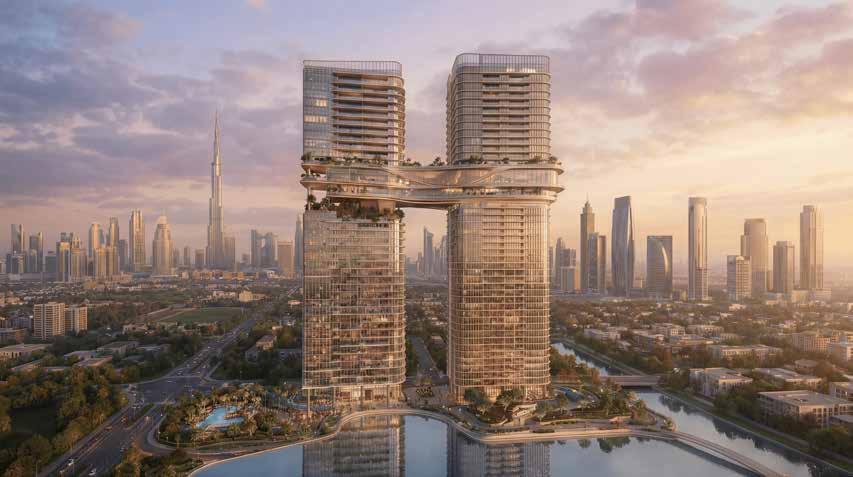
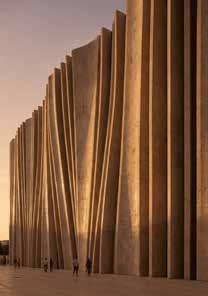
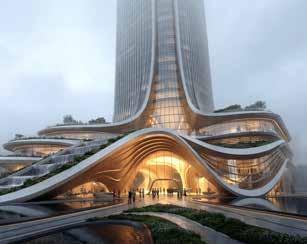
Culture & Fine Arts Center, UAE
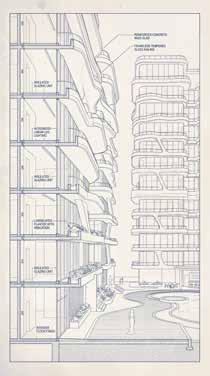
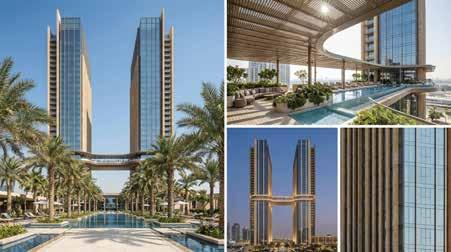
Residential towers, Dubai, UAE
Unlike interior layouts or structural systems, façades operate across large surfaces where pattern, repetition, and proportion matter enormously. Minor shifts in mullion spacing, shading density, or panel depth can dramatically alter both performance and perception. Traditional digital tools can explore these variations, but they often require significant setup time, parametric expertise, or scripting effort. As a result, teams tend to limit exploration to a narrow band of options.
AI excels precisely where these workflows struggle. It allows designers to explore a broad range of formal and systemic variations quickly, without heavy upfront investment. This makes it possible to test multiple directions in parallel rather than committing prematurely to a single approach. Importantly, this exploration happens before engineering, procurement, and detailing constraints harden the design.
THE CAPABILITIES AND LIMITS OF AI IN FAÇADE EXPLORATION
To use AI responsibly in façade design, it is critical to understand its strengths and limitations. AI is
particularly effective at generating large numbers of visual and spatial variations from a defined set of inputs. It can explore shifts in proportion, rhythm, density, layering, and articulation at a speed no human team can match. It is also useful for revealing patterns designers may not intuitively consider, helping teams escape habitual solutions and first idea bias.
The role of artificial intelligence in façade design is most effective when it is clearly situated within the broader process of analysis and validation. AI contributes by expanding the range of options available for consideration and by helping designers identify promising relationships and tendencies early on. However, analytical evaluation, such as assessing structural performance, environmental behavior, detailing implications, and long-term material response, continues to rely on specialised tools and professional expertise. When these roles are clearly distinguished, AI complements rather than competes with established analytical methods, strengthening decision-making by ensuring that technical resolution is informed by a genuinely broad field of exploration. AI helps focus analytical effort where it matters most. Rather than replacing evaluation, it helps prioritise it, narrowing attention to the most promising systems and strategies before they are subjected to rigorous technical testing. In this way, AI strengthens the overall façade development process by improving the quality of decisions that enter analysis, rather than by
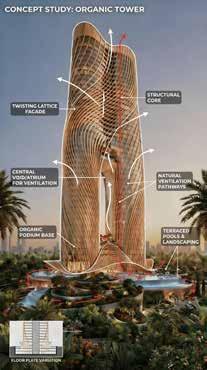
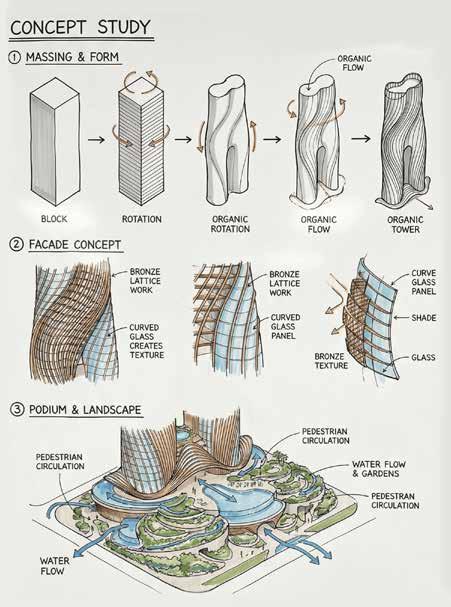
Concept study – Organic Tower
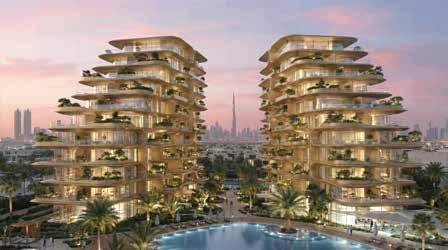
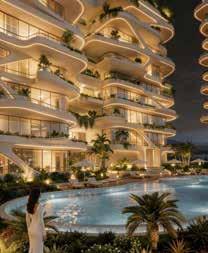
Residential apartments, Dubai, UAE
STAGE 2: GENERATE VARIATIONS
Once the logic is defined, AI can be used to generate families of façade variations rather than isolated images. These variations might explore different shading densities, mullion rhythms, panel sizes, degrees of porosity, or depth strategies. The focus should be on systemic shifts rather than surface styling. At this stage, quantity matters. The goal is to explore the breadth of possibility, not to identify a final solution.
STAGE 3: CURATE AND ELIMINATE
Curation is where authorship truly resides. Designers must aggressively filter the outputs, discarding the majority without hesitation. The aim is not to select a favorite image, but to identify promising patterns and logics worth developing further. This process often reveals unexpected insights, such as which parameters are most influential or which directions consistently fail.
attempting to perform the analysis itself.
A PRACTICAL AI-DRIVEN FAÇADE VARIATION WORKFLOW
The value of AI lies in its capacity to support iterative testing and comparative evaluation across multiple parameters, within a structured workflow that integrates human judgment at every stage. When applied in this way, a practical approach can be broken into four clear phases.
STAGE 1: DEFINE THE DESIGN LOGIC
Before any AI exploration begins, the design intent and constraints must be clearly articulated. This includes architectural goals, climate and orientation assumptions, structural grids, planning constraints, and non-negotiables related to performance or fabrication. AI performs best when it is given a clear framework within which to operate. Vague prompts produce vague results.
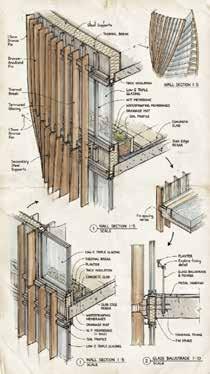
Architecture façade details
Massing and façade diagram
STAGE 4: TRANSLATE TO FEASIBLE SYSTEMS
Once a small number of promising directions have been identified, they must be translated into buildable façade systems. This is where AI’s role ends. Engineers, façade consultants, and material specialists take over, rationalising geometry, defining tolerances, and validating performance. AI does not design the final façade. It helps ensure that the chosen direction is informed by a genuinely broad exploration.
FROM VISUAL VARIATION TO SYSTEM VARIATION
A common misuse of AI in façade design is limiting its application to visual variety alone. While changing patterns or textures may produce visually distinct images, it adds little real value if the underlying system remains unchanged.
The true power of AI emerges when it is used to explore different façade systems and logics. This might include comparing layered shading strategies against deep mullion approaches, testing continuous screens versus modular panels, or exploring different depth
hierarchies across an elevation. These variations have direct implications for performance, cost, and constructability.
By quickly visualising and comparing these systemic differences, AI helps teams make more informed decisions earlier. The question shifts from which
image looks best to which system has the greatest potential to balance intent, performance, and feasibility.
WHEN SYSTEMATIC VARIATION BECOMES ACCESSIBLE
When generating variation becomes fast and inexpensive, the design process itself begins to change. Designers become more selective rather than more indulgent. With a wider field of options available, teams are forced to articulate clearer criteria for success. Discussions around intent, performance, and priorities happen earlier and with greater clarity.
Client engagement also improves. Instead of presenting a single polished image, teams can communicate ranges and tradeoffs, helping clients understand the implications of different directions. This often leads to stronger alignment and fewer disruptive changes later in the process.
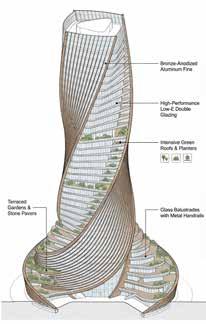
Tower section detail
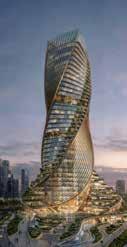
Resort Tower, UAE
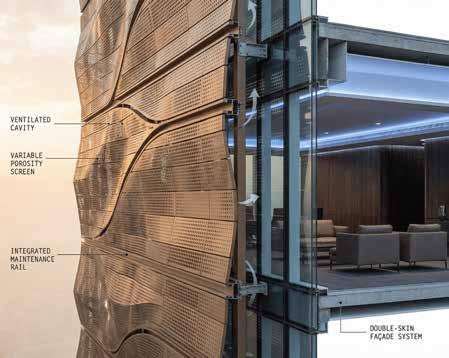
Façade system detail diagram
Perhaps most importantly, latestage value engineering becomes less destructive. When multiple viable options have already been explored, cost driven adjustments are less likely to undermine the core design intent.
RISKS, MISUSE, AND FALSE CONFIDENCE
Alongside its advantages, the use of AI requires discipline and clarity of intent. Despite its benefits, AI introduces new risks if used carelessly. Overproduction of options without intent can overwhelm teams and obscure decision making. Highly polished AI visuals can create false confidence, making early concepts
appear more resolved than they actually are. There is also a risk that younger designers may rely more on AI outputs without developing a deep understanding of façade fundamentals.
Without grounding in materials, structure, and detailing, AII expands the field of possibility
and amplifies creative capacity, but judgment, authorship, and accountability remain essential human contributions. The quality of the outcome continues to depend on how deliberately these tools are employed and how clearly architectural responsibility is retained.
FAÇADE DESIGN AS CURATED POSSIBILITY
AI will not design better façades on its own. What it offers is something subtler and more valuable: the ability to see more, test more, and question assumptions earlier than ever before. In this context, the architect’s role evolves from producing a single solution to curating a field of possibilities and guiding it toward clarity. AI ensures that the chosen direction emerges from informed exploration rather than early fixation. Used thoughtfully, it does not dilute authorship, it reinforces it.
The true power of AI emerges when it is used to explore different façade systems and logics
Residential Plaza, KSA
Façade section
Architectural Hardware
BIM-Ready Hardware: The Next Leap in Construction
DANIEL MAY Director, Consort Architectural Hardware
ABOUT THE AUTHOR
Daniel May has played a fundamental role in supporting product development and commercial growth at Consort. In 2010, Dan had the opportunity to build upon Consort’s international success, relocating to Dubai to serve as Head of Overseas Operations and Regional Director, Middle East. During his tenure there, Dan oversaw a significant expansion of the company’s geographical footprint, including new offices in Qatar, Saudi Arabia, India, the Philippines, the US and Hong Kong. In 2020, Dan returned to the UK to further focus on product innovation, diversification and expansion within the UK and globally. He has prioritised achieving the highest safety and performance certifications to meet today’s stringent industry standards, expanding upon the company’s bespoke specification capabilities.
As digital coordination becomes routine, hardware that is not modelled is considered a specification risk
The future of construction is digital. What was once considered a gradual shift towards greater information management has now become a basic requirement for many. From early-stage design through to compliance, maintenance and product lifecycle management, digital product data is no longer considered added value - it is mandatory.
Since 2016, UK central government clients have required collaborative digital information management on centrally procured projects, commonly known as ‘BIM Level 2’. Today, these requirements are specified through the UK BIM Framework and BS EN ISO 19650 standards, setting a clear expectation that construction partners must provide accurate, structured and accessible digital information across their products.
With this in mind, conscientious manufacturers throughout the
supply chain are enhancing their BIM capabilities, as they look to support architects, specifiers and contractors with detailed product information. Architectural hardware - traditionally overlooked in digital planning - is rapidly entering the spotlight too, with 3D models, certification and performance data now offered across a growing library of products. But how is this movement towards enhanced digital resources impacting projects?
OPTIONAL TO OPERATIONALLY CRITICAL
Only a decade ago, building specifications relied heavily on paper-based resources, where professionals were limited to product brochures, PDF catalogues and basic CAD line drawings. Today, the sector is converging around fully integrated digital workflows, with teams relying on platforms such as Revit and NBS as a way of connecting design, specification, compliance and facilities management.
Digital Product Passports (DPP), soon to become mainstream and mandated by the EU, will only accelerate this trend. However, it is important to recognise that this evolution is not driven by convenience alone. In fact, BIM product data now plays a central role in meeting:
• UK Government mandates for digital construction and the ‘Golden Thread of Information’
• Fire safety regulations, which increasingly require accurate, up-to-date and verifiable data
• Sustainability reporting, where Environmental Product Declarations (EPDs) and lifecycle data must be accessible at the design stage
Consequently, if a product cannot be conceptualised accurately in a digital model, it risks being excluded from a project’s specifications entirely.
BIM IN ARCHITECTURAL HARDWARE
For some, door hardware may seem like a minor component in the grand scheme of building design and, as a result, it is often overlooked due to its relatively small percentage of
Architectural hardware - traditionally overlooked in digital planning - is rapidly entering the spotlight too, with 3D models
the project’s value. In reality, its role in safety, performance, accessibility and compliance is critical.
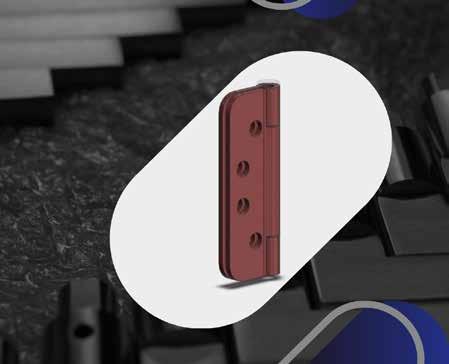
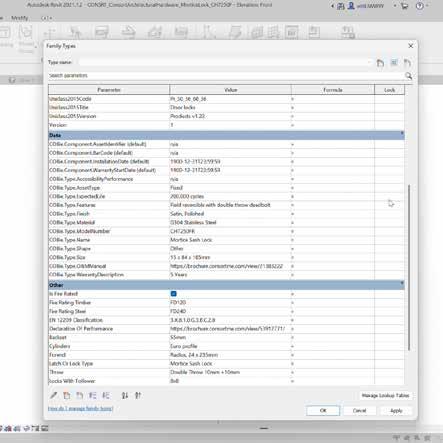
Fire doorsets, for example, are only as effective as the hardware components that secure them. Within BIM, even a single component such as a door closer carries parametric data that can validate fire ratings, confirm accessibility and even identify potential clashes with ceiling details or door frameshelping design teams ensure both functionality and compliance are met early in the coordination process. When it comes to architectural hardware, access to reliable BIM objects enables teams to:
• Fulfil accurate design – using models with the correct Level of Detail (LOD) to ensure integration into project drawings
• Achieve faster specification –architects and contractors can drag and drop products/objects into designs, saving hours of manual work
• Assure compliance – with product certifications, fire ratings, testing evidence and sustainability data embedded within product models
• Reduce on-site errors –accurate digital models decrease the risk of incorrect products being installed
As digital coordination becomes routine, hardware that is not modelled is considered a specification risk.
RESPONDING TO NEW STANDARDS AND DIGITAL REALITIES
Following the tragic events of Grenfell Tower, which reshaped the regulatory and cultural expectations of the construction industry, the sector now faces an accelerated demand for traceable, verified
product information. As new legislation continues to emerge, such as Martyn’s Law, updated guidelines will influence how public spaces are designed and secured, with each new standard placing an integral focus on resilience, traceability and responsibility in the process.
These shifts underscore a clear reality: every hardware component, no
matter how small, must be backed by verifiable data and performance credentials. Conscientious hardware manufacturers therefore play a crucial role in supporting building safety and security by providing architects, specifiers and contractors with the confidence to select hardware that meets the standards of today and tomorrow.
And so, as we move further into a data-driven era where compliance, traceability and efficiency are key, BIM objects have evolved from beneficial to indispensable. Whether delivering a residential high-rise, healthcare facility or commercial development, professionals must be able to rely on trusted suppliers and their digital files as tools that help them design with confidence.
Within BIM, even a single component such as a door closer carries parametric data that can validate fire ratings
Glass & Glazing
Designing with the Right Glass: Building Safer, Smarter, and More Comfortable Façades
DR. SAMIH YEHIA Vice President – Sales & Marketing,
Emirates Glass
ABOUT THE AUTHOR
Dr. Samih Yehia is the Vice President of Sales and Marketing at Emirates Glass, bringing over 15 years of specialised experience in glass technologies and more than 20 years in sustainable building materials. He holds a PhD in Sustainable Business Management and is a recognised author and thought leader in building material sustainability. Dr. Yehia is actively involved in research and development, focusing on innovative materials that enhance façade performance and contribute to the built environment for future generations.
Glass façades have become the hallmark of contemporary architecture, symbolising openness, progress, and sustainability. But behind the aesthetics lies something far more critical—the role of glass in delivering safety, performance, and comfort to the people who live and work within those buildings. In regions like the GCC, where soaring temperatures, blowing sand, strong winds, and intense sunlight are everyday realities, choosing the right glass isn’t just smart—it is essential.
LAMINATED GLASS: A MUSTHAVE FOR SAFETY
When it comes to building envelopes, safety should always come first. Laminated glass— especially when used as the outer layer in a double-glazed unit with SGP interlayers—offers a reliable and high-performance solution. In case of impact or breakage, the interlayer holds the glass fragments in place, significantly reducing the risk of injury.
It is worth noting that while fully tempered single glass is technically considered “safety glass,” in realworld applications—especially on high floors—even the small particles from spontaneous breakage can cause injury. Laminated glass, on the other hand, offers peace of mind, whether you’re designing a school, hospital, or high-rise office tower.
FIRE-RATED GLASS: SAFETY WHERE IT MATTERS MOST
Fire safety can’t be compromised, especially in areas like stairwells,
lift lobbies, and emergency exits. Fire-rated glazing systems provide a vital layer of protection, resisting heat and flame for critical periods (30, 60, 90 minutes or more), giving occupants the time they need to evacuate safely.
The good news is that aesthetics and safety no longer need to conflict. Today’s advanced fire-rated solutions can be seamlessly integrated into façade designs,
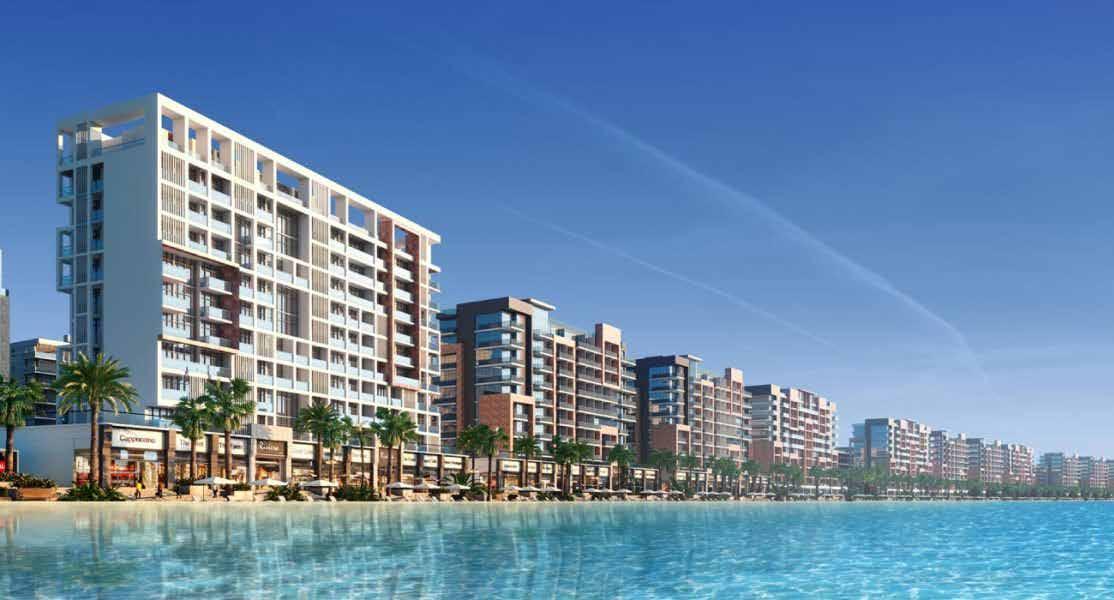
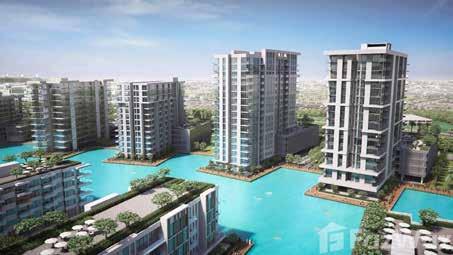
Azizi Riviera, UAE
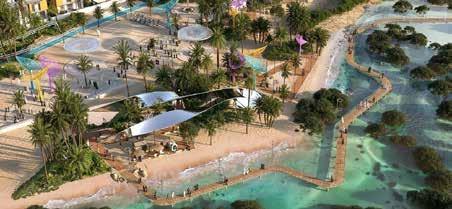
Saadiyat lagoons, UAE
matching the colour and tone of the building envelope to maintain architectural consistency.
WIND LOAD RESISTANCE: ESPECIALLY AT THE CORNERS
Tall buildings in the GCC are no strangers to high wind loads— especially those in coastal cities or open desert locations. The corners of towers typically experience the highest pressures, making glass strength and flexibility even more important. Laminated glass performs exceptionally well here, offering both structural integrity and safety.
If cost is a concern, one recommendation is to prioritise laminated glass at these high-stress areas, even if it is not used across the entire façade. It is a smart way to balance performance with budget without compromising critical zones.
ACOUSTIC COMFORT: A KEY TO URBAN WELL-BEING
As our cities get busier, noise becomes a silent intruder. From traffic and construction to airports and nightlife, sound pollution is increasingly affecting health and productivity. Here, acoustic laminated glass—with its special
sound-dampening interlayers— makes a real difference.
While this solution might increase upfront costs, the long-term benefits are clear: greater tenant satisfaction, increased property value, and enhanced wellness. Investing in exterior laminated glass pays dividends, especially in premium residential and commercial developments.
THERMAL COATINGS MADE FOR THE GCC (NOT EUROPE)
One of the most common and costly mistakes in glass specification is choosing products meant for cooler,
European climates. In the GCC, the priority is not insulation—it is solar control.
Glass designed for our climate must minimise solar heat gain while still allowing natural light. That’s why selecting the right low-e or spectrally selective coating is vital. I often advise clients to focus not just on U-value, but on Solar Heat Gain Coefficient (SHGC). Even a small improvement in SHGC can result in major energy savings—particularly in large buildings.
This is not only about thermal performance; it is also about meeting local expectations for privacy and comfort. While European trends lean toward ultra-clear, colourless glass, many GCC clients prefer glass with a bit more tint or reflection for shading and privacy.
BIRD-FRIENDLY GLASS: A SUSTAINABLE DESIGN RESPONSIBILITY
As sustainability becomes a driving force in architecture, we can’t ignore the impact of glass façades on wildlife—especially birds. Millions of birds die annually from collisions with buildings, primarily due to reflective or transparent glazing.
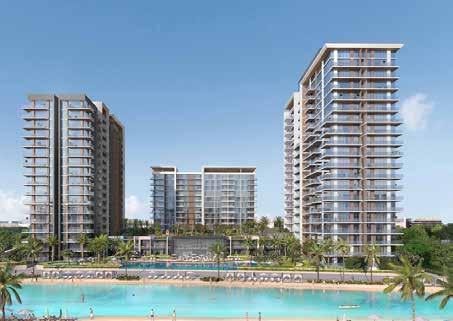
District One, UAE
Opal garden by Nakheel, UAE
Designers today have effective tools to address this. Ceramic frit patterns, UV coatings, and etched glass help birds recognise the façade without affecting the design intent. Not only do these solutions align with LEED and WELL standards, but they also reflect a deeper commitment to ethical and ecological design.
THE BIG PICTURE: INTEGRATING PERFORMANCE, NOT COMPROMISING
Modern glass technology allows us to do more with less. Today’s façades can be fire-resistant, soundproof, wind-resistant, thermally efficient, and birdfriendly—all in one integrated system. There’s no need to sacrifice aesthetics or functionality.
This calls for early collaboration between façade designers, engineers, and glass manufacturers. Through simulations, mock-ups, and testing, we can fine-tune performance while staying true to the design vision.
WHAT ABOUT GLASS COLOURS AND COATINGS?
The good news is that modern sputter-coated glass can deliver nearly any appearance, from subtle greys to more reflective options.
While design trends currently favour neutral and minimal tones, we often face a challenge: designers want clear, colourless glass, but local regulations require low shading coefficients, which usually results in lower visible light transmission— and more noticeable colour.
Striking the right balance between light, shading, and colour requires a careful understanding of both aesthetic goals and energy performance requirements.
THE FUTURE IS SOLAR
Lastly, let’s not forget the opportunity in integrating solar panels into façades. Whether in opaque areas like spandrels or through emerging technologies like semi-transparent solar glass, there are solutions already available today.
These can offer real return on investment, with some paying back in as little as three years. Others may take longer, but the important point is: solar-integrated façades are here, and they’re the future. Developers who invest early in these systems will position their buildings ahead of the curve—technologically and sustainably.
FINAL THOUGHTS: BUILD SMART FOR THE REGION
Today’s buildings must do more than just look good—they need to perform, protect, and endure. In the GCC, where environmental and cultural factors shape every design decision, glass façades must be tailored to local needs. It is a highly demanding and competitive market, yet end users in this region can access the best technology at affordable prices.
By choosing the right glass combinations—laminated safety glass, fire-rated systems, acoustic glazing, bird-safe designs, and region-specific coatings—we create façades that are not only beautiful, but also safe, sustainable, and futureready.
It is time to move beyond one-sizefits-all solutions and start designing façades that truly fit their place— and purpose.
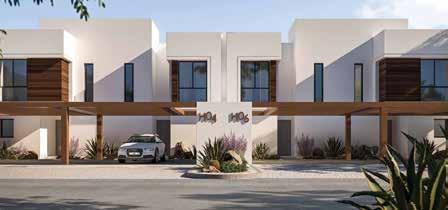
Noya Villas, UAE
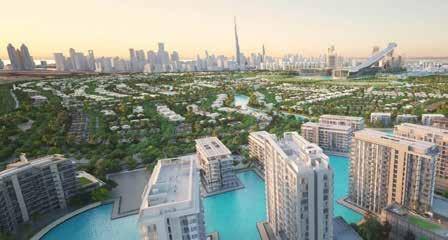
Mohammed Bin Rashid City, UAE
Green Façades: The Future of Sustainable Architecture
AHAMED JASIM Sales Engineer- Energy, Unigulf Group
Ahamed Jasim graduated with a Bachelor of Technology in Automobile Engineering from SCMS Group of Institutions and has most recently worked as a Sales Engineer at Rolling Aluminum. In this role, he specialised in the sales of cold-rolled aluminium products across industrial, automotive, and construction sectors, including pre-painted and laminated coils for specialised applications. He contributed significantly to technical sales initiatives by working closely with clients to deliver tailored solutions, preparing detailed quotations, and coordinating with internal teams to ensure seamless execution of customer requirements. Ahamed has demonstrated strong capabilities in building and maintaining client relationships, offering technical support, and monitoring market trends to identify emerging sales opportunities.
ABOUT THE AUTHOR
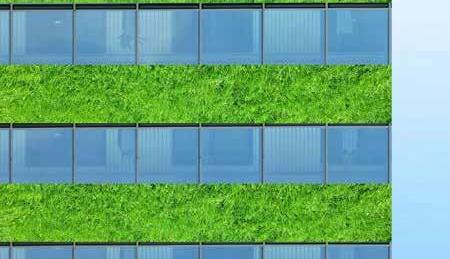
By integrating plants and greenery into building exteriors, they bring significant environmental, economic, and social benefits
As cities continue to grow vertically, the demand for innovative solutions that merge functionality with sustainability has never been greater. One such solution gaining momentum across the world is the green façade.
Green façades are not just an aesthetic choice—they are a strategic approach to urban sustainability. By integrating plants and greenery into building exteriors, they bring significant environmental, economic, and social benefits.
WHY GREEN FAÇADES MATTER
• Space-saving Sustainability: in dense urban areas where open green spaces are limited, vertical greenery transforms otherwise unused wall surfaces into living ecosystems.
• Improved Air Quality: Plants act as natural filters, reducing dust, pollutants, and CO₂ levels, while enriching the air with oxygen.
• Energy Efficiency: Green façades act as insulation— lowering heat absorption in summer and reducing energy demand for cooling. This directly
translates to cost savings and lower carbon footprints.
• Urban Heat Island Mitigation: By reducing surface and ambient temperatures, green façades contribute to creating cooler, healthier cities.
• Enhanced Wellbeing & Aesthetics: Studies show that
greenery promotes mental wellbeing, reduces stress, and increases productivity. For buildings, it elevates design, creating a blend of technology and nature.
BEYOND AESTHETICS: A PROBLEM-SOLVING APPROACH
Green façades solve real-world problems for developers, architects, and city planners:
• Limited land for landscaping.
• Rising energy costs.
• Increased demand for sustainable certifications (LEED, WELL, Estidama).
• Corporate ESG commitments to greener operations.
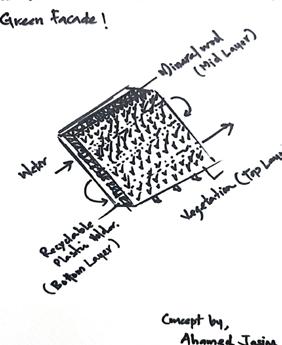
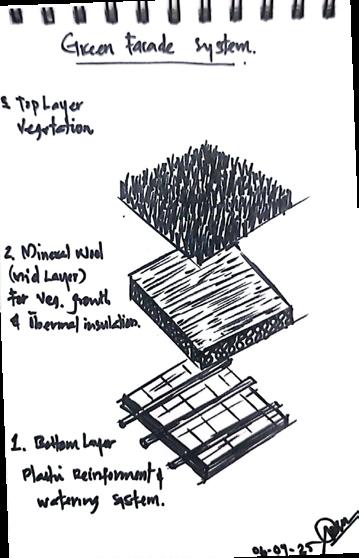
The demand for sustainable and climate-smart construction is reshaping how we design our cities. To meet this challenge, a 3-layer green façade system has been developed that combines engineering, sustainability, and smart resource management.
The demand for sustainable and climate-smart construction is reshaping how we design our cities
A 3-layer green façade system that combines engineering, sustainability, and smart resource management hydration, while recycling minimises waste.
This solution is not just about aesthetics—it is about delivering energy efficiency, biodiversity, and water-smart innovation to urban projects.
THE THREE-LAYER SYSTEM EXPLAINED
BASE LAYER
Plastic mold with water & fertilisation circulation at the foundation lies a customised plastic mold designed to hold an integrated irrigation and fertigation system (water + nutrient supply).
• Water circulation ensures plants receive consistent
• Fertilisation (fertigation) delivers nutrients directly with water flow, promoting healthier and faster plant growth.
• Smart controls can be added for automated monitoring, ensuring efficiency even in large-scale façades.
MID LAYER
Rockwool Insulation The second layer is rockwool, a sustainable growth medium offering:
• High water and nutrient retention.
• Excellent root support and oxygen balance.
• Natural insulation properties to stabilise façade surface temperatures.
This creates a resilient base for vegetation to thrive in diverse climates.
SURFACE LAYER
Vegetation / Plant Growth: The visible outer layer showcases greenery tailored to the environment—from climbers and modular panels to shrubs or flowering plants. This layer provides:
• Urban cooling and air purification.
• Noise reduction and dust filtration.
• Aesthetic value that transforms buildings into living architecture.
WHY THIS SYSTEM IS FUTURESUSTAINABLE
• Smart Irrigation + Fertigation – Reduces water and fertilizer use by up to 50%, supporting resource efficiency.
• Durability & Performance –Plastic molds and aluminium supports extend system life, while rockwool sustains growth.
• Energy Savings – Acts as natural insulation, reducing building cooling demand.
• Modularity & Scalability –Suitable for towers, commercial complexes, and retrofit projects.
This 3-layer green façade system with integrated water and fertilisation circulation is more than an idea—it is a ready-to-implement solution for façade companies aiming to stand out in a competitive, sustainabilitydriven market
Glass & Glazing
The Role of Smart Glass in EnergyEfficient Building Design
MOHAMMED MUNIR Design Manager, Khatib & Alami
ABOUT THE AUTHOR
Mohammed Munir is a Design Manager and BIM-led delivery professional with over 15 years of international experience, delivering complex architectural and construction projects across Saudi Arabia, the UAE, Sudan, and Europe (Italy). His career spans both consultancy and contractor environments, with a strong focus on design governance, construction supervision, and digital delivery. He has led and contributed to mega-scale developments exceeding SAR 35 billion, including luxury hospitality, mixed-use developments, financial districts, and national infrastructure projects. He works closely with clients, consultants, contractors, and authorities to ensure projects are technically sound, code-compliant, buildable, and delivered efficiently. He specialises in BIM implementation and coordination, operating across platforms such as Revit, Navisworks, Solibri, and ACC/BIM 360, within ISO-aligned workflows.
In the ever-evolving world of architecture, the pursuit of sustainability and energy efficiency has become a top priority. Among the many innovations driving this shift, smart glass stands out as a transformative technology. Also known as switchable glass or electrochromic glass, smart glass is redefining how buildings interact with their environment, offering dynamic control over light, heat, and privacy. This technology is not just a futuristic concept—it is already being integrated into cutting-edge projects worldwide, proving its potential to revolutionise energyefficient building design.
WHAT IS SMART GLASS?
Smart glass is a high-performance material that can alter its properties— such as transparency, opacity, or tint—in response to external stimuli like electrical signals, light, or heat. This adaptability allows it to serve multiple functions, from reducing glare and heat to enhancing privacy, all while contributing to energy efficiency. Unlike traditional glass, which is static and passive, smart glass is dynamic and responsive, making it a powerful tool for architects and designers.
HOW DOES SMART GLASS ENHANCE ENERGY EFFICIENCY?
The energy-saving potential of smart glass lies in its ability to optimise natural light and thermal regulation. Here is how it works:
• Dynamic Light Control: Smart glass can automatically adjust its tint to reduce glare and block excess sunlight. This minimises the need for artificial lighting during the day, significantly cutting down on electricity usage. For example, in office buildings, smart glass can create a comfortable working environment by maintaining optimal light levels without over-relying on electric lighting.
• Thermal Regulation: By blocking infrared radiation, smart glass helps regulate indoor temperatures. In summer, it can prevent excessive heat from entering the building, reducing
the load on air-conditioning systems. In winter, it can retain heat, lowering the demand for heating. This dual functionality makes it a year-round solution for energy efficiency.
• Daylight Optimisation: Smart glass maximises the use of natural light while minimising heat gain. This balance not only reduces energy consumption but also enhances occupant comfort and well-being. Studies have shown that access to natural light can improve productivity, mood, and overall health, making smart glass a win-win for both sustainability and human experience.
REAL-WORLD APPLICATIONS OF SMART GLASS
Smart glass is no longer confined to the realm of conceptual design—it is being used in real-world projects across various sectors. Here are some notable examples:
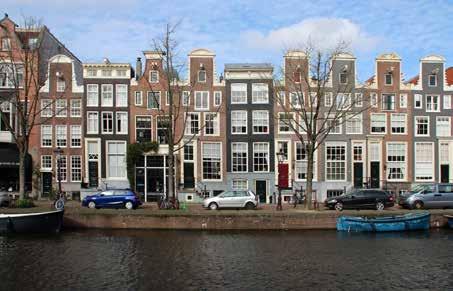
The Edge, Amsterdam
Often hailed as the world’s most sustainable office building, The Edge in Amsterdam is a prime example of smart glass in action. The building’s façade incorporates electrochromic glass that adjusts its tint based on the sun’s position, ensuring optimal light and temperature levels throughout the day. This innovation has helped The Edge achieve a BREEAM score of 98.4%, the highest ever recorded for an office building.
One Vanderbilt, New York City
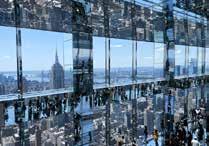
This iconic skyscraper in Manhattan uses smart glass to enhance energy efficiency and occupant comfort. The glass façade reduces heat gain and glare, while still offering breathtaking views of the city. The building’s design has earned it LEED Platinum certification, a testament to its sustainability credentials.
based on the sun’s position
Al Bahar Towers, Abu Dhabi
These towers feature a dynamic façade made of smart glass panels that open and close in response to the sun’s movement
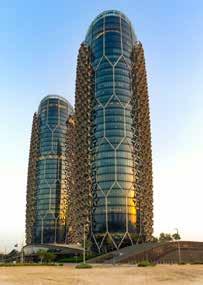
Al Bahar Towers, Abu Dhabi
These towers feature a dynamic façade made of smart glass panels that open and close in response to the sun’s movement. This innovative design reduces solar gain by up to 50%, significantly lowering cooling costs and energy consumption.
THE ENVIRONMENTAL IMPACT OF SMART GLASS
The environmental benefits of smart glass are undeniable. By reducing reliance on HVAC systems and artificial lighting, it significantly lowers energy consumption and greenhouse gas emissions. This aligns with global efforts to combat climate change and achieve net-zero carbon goals. Additionally, smart glass contributes to green building certifications like LEED (Leadership in Energy and Environmental Design) and BREEAM (Building Research Establishment Environmental Assessment Method), making it a key component of sustainable architecture.
CHALLENGES AND FUTURE INNOVATIONS
While smart glass offers immense potential, it is not without its challenges. Here are some of the key drawbacks and opportunities for improvement:
• High Costs
One of the biggest barriers to widespread adoption is the high cost of smart glass. The advanced technology and materials required make it significantly more expensive than traditional glass. However, as production techniques improve and demand increases, prices are expected to decrease.
• Durability and Maintenance
Smart glass systems can be complex, requiring regular maintenance to ensure optimal performance.
Additionally, the durability of these systems over the long term is still being tested, particularly in harsh environmental conditions.
• Energy Consumption of the Glass Itself
While smart glass reduces energy consumption in buildings, it does require electricity to operate. In some cases, the energy used to power the glass can offset its energy-saving benefits. However, advancements in low-power technologies are addressing this issue.
FUTURE INNOVATIONS
Despite these challenges, the future of smart glass is bright. Researchers are exploring new materials and technologies to make smart glass
more affordable, durable, and efficient. For example, photovoltaic smart glass could generate solar energy while regulating light and heat, creating a self-sustaining system. Additionally, the integration of AI and IoT (Internet of Things) could enable smart glass to predict and respond to environmental changes in real time, further enhancing its performance.
WHY ARCHITECTS SHOULD PAY ATTENTION
Smart glass is more than just a material—it is a design philosophy. It empowers architects to create buildings that are not only visually stunning but also environmentally responsible. As the world moves towards a more sustainable future, smart glass will play a pivotal role in shaping the built environment.
For architects, embracing smart glass means staying ahead of the curve and pushing the boundaries of what is possible. It is an opportunity to design spaces that are adaptive, efficient, and human-centric. Whether it is a highrise office building, a cosy home, or a state-of-the-art healthcare facility, smart glass offers endless possibilities for innovation.
The energy-saving potential of smart glass lies in its ability to optimise natural light and thermal regulation
One Vanderbilt, New York City
The glass façade reduces heat gain and glare, while still offering breathtaking views of the city
Sustainability
Symbiature (HuGS): A Transformative Design Paradigm for Human Flourishing and Planetary Well-being
AR. DENIS UCHE AKABOGU
The Founder and Chief Executive Officer, SheltaGroup
ABOUT THE AUTHOR
Denis Uche Akabogu is an architect, construction manager, sustainability advocate, and Founder/CEO of SheltaGroup Limited, Nigeria. He is the originator of Symbiature (HuGS), a design paradigm that integrates humane, green, and smart principles in pursuit of human flourishing and planetary well-being. Denis is also the publisher of Green Thinking Review, a thought leadership platform focused on innovation and best practice in sustainable building. His work spans architecture, construction delivery, sustainability, and design strategy, with a growing interest in how intelligent systems, ecological responsibility, and human-centred thinking can be brought into more meaningful alignment within the built environment.
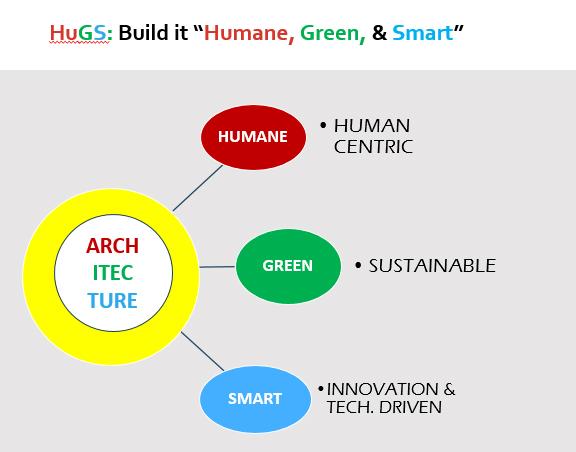
In an era marked by climate stress, rapid urbanisation, technological acceleration, and social fragmentation, the built environment must evolve beyond fragmented responses to interconnected challenges. Symbiature—the study and practice of the Humane, Green, and Smart (HuGS) framework—offers an integrated design paradigm aimed at fostering both human flourishing and planetary wellbeing. Building on architectural wisdom, ecological responsibility, and intelligently governed innovation, this paper presents Symbiature as a holistic approach to design, development, and systems thinking. It clarifies the theoretical foundations of HuGS, deepens the meaning of Smart as wisdom-guided intelligence, outlines practical applications across sectors, and argues for
broader adoption of integrated design thinking in a world that increasingly demands it.
INTRODUCTION
The twenty-first century presents a convergence of crises and opportunities. Climate change, rapid urbanisation, resource pressure, social alienation, and accelerating technological disruption are reshaping the conditions under which we design and build. In this context, the built environment can no longer be approached through isolated lenses.
The scale of the challenge is well established. The buildings and construction sector accounted for 32 per cent of global energy demand and 34 per cent of global CO₂ emissions in 2023, according to the latest global status reporting.¹
The International Energy Agency
also notes that buildings account for about 30 per cent of global final energy consumption, rising to 34 per cent when certain constructionrelated energy use is included.² At the same time, housing and indoor environmental conditions directly affect health, thermal comfort, safety, accessibility, and quality of life.³
Traditional design paradigms, when treated too narrowly, are no longer sufficient. It is within this context that Symbiature emerges as a transformative design paradigm. Symbiature integrates three core pillars—Humane, Green, and Smart (HuGS)—to create environments that are regenerative, resilient, intelligent, and life-giving. It aligns with the global search for sustainability, resilience, equity, and climate responsibility, yet seeks to go further by insisting on a more
Research in biophilic and human-centred design continues to show that access to daylight, nature, well-considered spatial experience, and healthier indoor conditions can reduce stress and improve well-being
symbiotic and integrated design ethic.
THEORETICAL FOUNDATIONS OF SYMBIATURE (HuGS) WHAT IS SYMBIATURE?
Symbiature is the study and practice of the HuGS framework—a holistic design approach that integrates Humane, Green, and Smart principles.
As a study, Symbiature investigates the interdependence of these principles and their potential to reshape the built environment in ways that support human flourishing and planetary wellbeing. As a practice, it translates this framework into buildings, systems, communities, products, and development strategies that are more humane in experience, more
ecologically responsible in impact, and more intelligently guided in operation and governance.
The term itself draws from the logic of symbiosis—mutually beneficial interdependence—while resonating with both nature and architecture. Symbiature therefore points towards a built environment in which human systems, natural systems, and technological systems are brought into a more life-giving relationship.
It is not merely a style. It is not a checklist. It is a way of seeing, thinking, designing, building, and governing with greater wholeness.
HUMANE DESIGN
The Humane principle prioritises human dignity, well-being,
Sustainable design practices such as passive design, efficient envelopes, renewable energy integration, and responsible material use are increasingly necessary rather than optional.
Green design, in this sense, is not simply about reducing harm. It increasingly points towards restoring balance, strengthening resilience, and aligning human development more responsibly with natural systems
comfort, inclusion, and meaningful experience. It asks whether environments support physical health, emotional balance, social interaction, beauty, accessibility, and the deeper quality of everyday life.
Research in biophilic and humancentred design continues to show that access to daylight, nature, well-considered spatial experience, and healthier indoor conditions can reduce stress and improve well-being.⁴ The World Health Organisation similarly links housing and indoor environmental conditions to significant health outcomes, including the effects of low and high indoor temperatures, injury hazards, crowding, and accessibility barriers.³ Symbiature builds on this understanding by insisting that design must not only solve technical problems but also nurture human flourishing.
Humane design is therefore not merely human-centred in a functional sense. It is humancentred in a fuller sense: it seeks to create spaces in which people can live, work, learn, heal, worship, and belong well.
GREEN DESIGN
The Green principle addresses ecological stewardship, climate responsiveness, and regenerative responsibility. It asks whether a project works intelligently with energy, climate, water, materials, biodiversity, and lifecycle impact.
This remains imperative. The environmental burden of buildings is not incidental; it is structural.¹ ² Sustainable design practices such as passive design, efficient envelopes, renewable energy integration, and responsible material use are
increasingly necessary rather than optional.
Symbiature extends this concern by drawing not only on conventional sustainability practice but also on biomimicry, vernacular adaptation, systems ecology, and regenerative thinking.
Green design, in this sense, is not simply about reducing harm. It increasingly points towards restoring balance, strengthening resilience, and aligning human development more responsibly with natural systems.
SMART DESIGN
The Smart principle is central to Symbiature, but it requires a more mature interpretation than is often assumed. Smart certainly includes technology, innovation, digital tools, intelligent systems, data analytics, AI, IoT, automation, and performance optimisation. Such tools can improve efficiency,
responsiveness, and coordination in buildings and cities.⁵
However, Symbiature insists that Smart must be understood more deeply through the lens of sophos and sapientia—wisdom, prudence, and discerning intelligence. In other words, Smart is not technology for its own sake; it is wisdom-governed intelligence.
This is a crucial distinction. Technology can optimise systems, but it cannot by itself determine what is good. Data can inform decision-making, but it cannot replace judgement. Automation can improve efficiency, but it cannot independently guarantee human dignity or ecological responsibility.
In Symbiature, Smart is therefore both a pillar and an enabler. As a pillar, it acknowledges the central role of innovation and intelligent
Poorly conceived buildings intensify heat stress, energy waste, social alienation, and ecological harm. Better-designed environments can improve comfort, reduce energy demand, strengthen resilience, and support human well-being
APPLICATIONS ACROSS INDUSTRIES
While originating in architecture and the built environment, the HuGS framework has relevance across multiple sectors because it addresses systems, relationships, and decision-making more broadly.
Urban Planning: HuGS can support resilient, adaptive cities that integrate green infrastructure, public health, energy systems, and humane public space. UNHabitat’s World Cities Report 2024 reinforces the urgency of climateresponsive and systems-oriented urban action.⁶
systems in contemporary design. As an enabler, it acts as a catalytic meta-system—helping to integrate, coordinate, accelerate, and restrain the Humane and Green dimensions so that the whole remains balanced and beneficial.
Smart, rightly understood, is not merely digital capacity. It is intelligence under wisdom.
SYNTHESIS:
SYMBIATURE AS EVOLUTIONARY INTEGRATION
Symbiature synthesises Humane, Green, and Smart principles into a coherent operational whole that moves beyond fragmented design paradigms. It builds on the wisdom of historical and contemporary design traditions—organic architecture, biophilia, vernacular adaptation, ecological design, systems thinking, and digital innovation— without reducing itself to any one of them. Its distinctiveness lies in integration.
• A humane building that ignores ecology is incomplete.
• A green building that ignores people is deficient.
• A smart building that lacks wisdom can become merely efficient dysfunction.
Symbiature asks how the built environment can embody a mutually beneficial relationship among people, communities, technology, and the Earth. It sees buildings not as isolated objects but as nodes within wider networks of energy, climate, culture, mobility, economy, ecology, and human experience.
These systems view matters. A façade is not merely a surface; it is part of environmental intelligence. A street is not merely circulation space; it is part of civic life. A home is not merely shelter; it is part of human formation. A campus is not merely infrastructure; it is part of memory, culture, and future-making.
Real Estate and Construction: Developers can pursue betterperforming and more responsible projects through passive design, efficient envelopes, low-carbon materials, renewable energy systems, and intelligent building management.¹ ²
Healthcare and Education: Humane, biophilic, and well-coordinated environments can improve recovery, concentration, comfort, and the quality of care and learning.⁴
Manufacturing and Technology: Circular economy principles, ethical innovation, and intelligently governed production systems can align with HuGS by reducing waste and supporting more sustainable forms of development.⁷
Institutional and Community Development: HuGS provides a useful framework for shaping campuses, civic facilities, religious spaces, and community infrastructure that are socially meaningful, environmentally responsible, and intelligently governed.
Symbiature is the study and practice of the HuGS framework—a holistic design approach that integrates Humane, Green, and Smart principles
THE URGENCY FOR GLOBAL ADOPTION
Unchecked urbanisation, climate degradation, resource pressure, and technological acceleration demand a shift towards more integrated design thinking. The case for adoption is not merely philosophical; it is practical.
Poorly conceived buildings intensify heat stress, energy waste, social alienation, and ecological harm. Better-designed environments can improve comfort, reduce energy demand, strengthen resilience, and support human well-being.¹ ² ³ International frameworks such as the 2030 Agenda for Sustainable Development reinforce the need for development approaches that are environmentally responsible, socially inclusive, and systemically coordinated.⁸
This is especially significant for Africa. The continent’s urban future will be shaped by choices made now about housing, infrastructure, public space, energy systems, and institutional development.⁶ Africa does not need borrowed solutions alone. It needs frameworks that are climate-aware, culturally grounded, economically realistic, and intelligently future-facing. Symbiature is relevant because it offers not a single technical solution but a design paradigm capable of holding multiple priorities together.
A CALL TO ACTION
The transformation envisioned by Symbiature requires collective commitment.
Governments and Policymakers: Integrate HuGS principles into building regulations, urban policy, climate strategy, and development standards.
Industry Leaders and Investors: Support research, pilot projects, and scalable innovations that embody humane, green, and smart integration.
Architects, Engineers, and Designers: Move beyond fragmented responses and adopt HuGS as a guiding framework for more integrated practice.
Communities and Institutions: Advocate for developments that support dignity, stewardship, resilience, and long-term flourishing.
The built environment will continue to shape the future. The question is whether it will do so in ways that are extractive and fragmented or in ways that are regenerative and symbiotic.
References
CONCLUSION
Symbiature is not merely a design philosophy. It is an evolving paradigm that seeks to redefine the relationship between humans, nature, and technology. By integrating the Humane, Green, and Smart dimensions of design into one coherent whole, Symbiature offers a path towards environments that are not only efficient or innovative but deeply life-giving. It invites us to design with greater dignity, build with greater responsibility, and innovate with greater wisdom.
If our cities, buildings, campuses, workplaces, homes, and communities are to become places where human flourishing and planetary well-being are not exceptional but normative, then our design thinking must become more integrated, more ethical, and more symbiotic.
1. United Nations Environment Programme and Global Alliance for Buildings and Construction. Global Status Report for Buildings and Construction 2024/2025. Nairobi: UNEP, 2025.
2. International Energy Agency. “Buildings.” Accessed April 2, 2026.
3. World Health Organisation. WHO Housing and Health Guidelines. Geneva: WHO, 2018.
4. Kellert, Stephen R., Judith Heerwagen, and Martin Mador. Biophilic Design: The Theory, Science and Practice of Bringing Buildings to Life. Hoboken, NJ: Wiley, 2008.
5. Ratti, Carlo, and Matthew Claudel. The City of Tomorrow: Sensors, Networks, Hackers, and the Future of Urban Life. New Haven: Yale University Press, 2016.
6. UN-Habitat. World Cities Report 2024: Cities and Climate Action. Nairobi: UN-Habitat, 2024.
7. Ellen MacArthur Foundation. “Built Environment.” Accessed April 2, 2026.
8. United Nations. Transforming Our World: The 2030 Agenda for Sustainable Development. New York: United Nations, 2015.
Façade System
From Analysis to Adaptation: The Future of Façade Design
AMIRA GADOURA Architect, Golden Planner Architects & Engineering Consultants
Amira Gadoura is an architectural designer with over nine years of experience. She has led and contributed to projects across healthcare, religious, residential, and mixeduse developments, totalling more than 600,000 sqm. Her work spans from early programming and concept design through to multidisciplinary coordination and authority submissions, ensuring that projects remain aligned with budgets, codes, and user needs. She believes that architecture should go beyond solving functional requirements to improve lives, nurture inclusivity, and strengthen communities. Her approach combines sustainability, cultural sensitivity, and human-centred design, ensuring that spaces are not only environmentally responsible but also socially meaningful. From hospitals that respond to both the physical and emotional needs of patients to mosques designed with universal accessibility principles, she uses the art and science of architecture to create places that inspire, connect, and endure.
ABOUT THE AUTHOR
In recent years, architecture has been moving towards a more responsive and environmentally aware approach. Architects are no longer focused solely on how a building looks, but also on how it performs, how it interacts with its surroundings, and how it affects the people who use it. Within this shift, two approaches have become especially important in façade design: environmental analysis and parametric design. When used together, they allow architects to create façades that are not only visually compelling but also highly efficient and adaptable.
The façade is often described as the face of a building, but it is much more than that. It acts as a protective layer, a filter between interior and exterior conditions, and a key element in controlling energy performance. Because of this, the way a façade is designed can significantly influence occupant comfort and the overall sustainability of the building. Environmental analysis plays a critical role at the early stage of design. It involves studying the specific conditions of a site and understanding how natural forces interact with the building. These forces include sunlight, wind, temperature variations, humidity, and even air quality. By carefully examining these factors, architects can make informed decisions that enhance performance rather than relying on standard solutions or outdated practices.
One of the most important aspects of environmental analysis is the study of solar exposure. Sunlight can be both beneficial and problematic. On one hand, it provides natural light, reducing the need for artificial lighting and creating more pleasant interior spaces. On the other hand, excessive solar gain, particularly
The façade was developed through environmental analysis, resulting in a performance driven system that optimizes solar shading while maintaining effective daylight penetration
prevalent in Middle Eastern regions, can lead to overheating, especially in warmer climates. Through analysis, architects can understand how the sun moves across a building throughout the day and across different seasons. This allows them to position shading devices, adjust window sizes, and design façade elements that regulate the amount of sunlight entering the space.
Wind is another key factor influencing façade design. Understanding wind patterns can improve natural ventilation, which is essential for maintaining indoor air quality. Instead of relying entirely on mechanical systems, buildings can be designed to allow fresh air to flow naturally through openings in the façade. This not only reduces energy consumption but also supports healthier indoor environments.
Material selection is also closely tied to environmental analysis. Different materials respond differently to heat, moisture, and environmental stress. Choosing appropriate materials ensures that the façade performs well over time and requires less maintenance. It also contributes to thermal efficiency by reducing heat transfer between the interior and exterior of the building.
While environmental analysis provides valuable data, parametric design offers a powerful way to apply that data creatively. It relies on digital tools that enable architects to define relationships between different design elements. Instead of creating a fixed design, architects
The façade demonstrates a gradient of shading informed by environmental analysis, where panel density and degree changes in response to higher solar exposure and decreases in areas requiring greater daylight access
to changing inputs such as light levels, temperature, or structural requirements.
This approach makes it possible to explore a wide range of design options quickly and efficiently. For example, a façade system can be generated where the size or orientation of panels changes based on solar exposure. Areas that receive more sunlight can incorporate deeper shading elements, while shaded areas can remain more open. This results in a façade that is both visually dynamic and functionally optimised.
One of the most interesting applications of parametric design is the development of adaptive kinetic façades. These systems are capable of changing their configuration in response to environmental conditions. Panels may open or close, rotate, or shift throughout the day to control light and heat. While such systems can be complex, they demonstrate how architecture can become more responsive and interactive.
Traditional methods can be generated and tested digitally. This enables architects to balance aesthetics and performance without compromising either.
The real strength of these approaches becomes clear when environmental analysis and parametric design are combined. Environmental data can be directly integrated into parametric models, allowing architects to simulate how different façade options will perform. Architects can test multiple scenarios and refine their designs based on measurable outcomes.
This process supports better decision-making and leads to more efficient solutions. It also encourages innovation, as architects are able to experiment with new ideas while still maintaining control over performance. The result is a façade that is not only visually striking but also carefully tuned to its environment.
In the context of the Middle East, these techniques become even
more valuable. The region is characterised by high temperatures, intense solar radiation, and often limited natural ventilation in some parts due to urban density. In such conditions, the façade plays a crucial role in thermal control and energy efficiency.
By using environmental analysis, architects can understand how to minimise heat gain and reduce the cooling load on buildings. Parametric design can then be used to develop shading systems, screen patterns, and façade layers that respond specifically to these conditions. Traditional elements such as mashrabiya can also be reinterpreted using modern tools, creating designs that are both culturally relevant and technologically advanced.
These strategies help maintain a comfortable indoor environment while reducing reliance on air conditioning, a major contributor to energy consumption in the region. As sustainability becomes a priority, the integration of these methods offers a practical and effective way to address climate challenges.
In conclusion, the integration of environmental analysis and parametric design represents a meaningful evolution in façade architecture. It allows architects to move beyond static designs and create buildings that respond to their surroundings in intelligent ways. By combining data-driven insights with creative exploration, architects can achieve façades that are efficient, adaptable, and visually engaging. As the demands on buildings continue to grow, these approaches will play an increasingly important role in shaping a more sustainable and responsive built environment.
Kinetic façades are capable of changing their configuration in response to environmental conditions
Façade System
The National Art Center, Tokyo: A Journey Through Kisho Kurokawa’s Architecture
Yanlin Chen is a marketing and communications specialist with a strong foundation in architectural design, having transitioned into strategic storytelling for the built environment. Her work spans proposal development, brand communication, and content strategy, underpinned by a deep understanding of design processes and interdisciplinary collaboration. She is particularly interested in how design intent is articulated through narrative, visuals, and positioning, shaping communication that is clear, compelling, and aligned with a firm’s mission and values. Her experience includes supporting both international and Toronto-based studios on complex proposals and design narratives, while developing communication materials that enhance practice identity and effectively connect design ideas with their audiences.
ABOUT THE AUTHOR
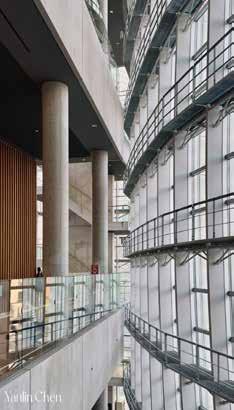
is a journey through architecture, light, and urban context, inviting reflection on the meaning of public space
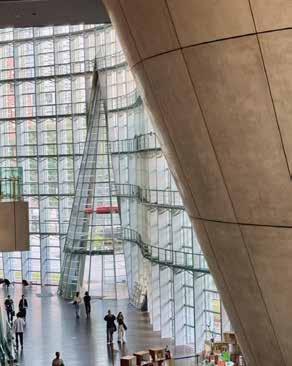
Walking through the bustling streets of Roppongi, where neon lights and high-rise towers set a relentless urban rhythm, I found myself pausing before one building. It does not announce itself with grand signage, nor does it overwhelm visitors with monumental mass. Instead, through the careful orchestration of light, spatial layering, and deliberate moments of emptiness, it engages the city in a subtle, almost conversational dialogue. This is Kisho Kurokawa’s National Art Center, Tokyo (NACT). It is a journey through architecture, light, and urban context, inviting reflection on the meaning of public space.
KISHO
KUROKAWA: FROM METABOLISM TO
SYMBIOTIC ARCHITECTURE
Kisho Kurokawa resists simple categorisation in postwar Japanese architectural history. Early in his career, he was among the most ambitious voices of the Metabolist movement, envisioning cities as living, evolving organisms. Later, his focus shifted from urban expansion
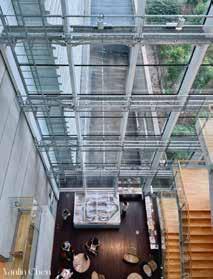
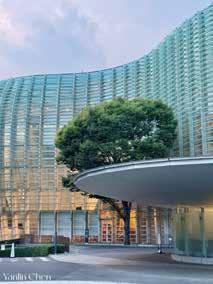
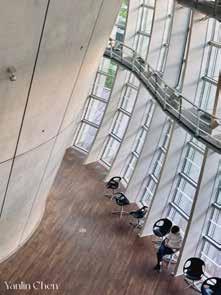
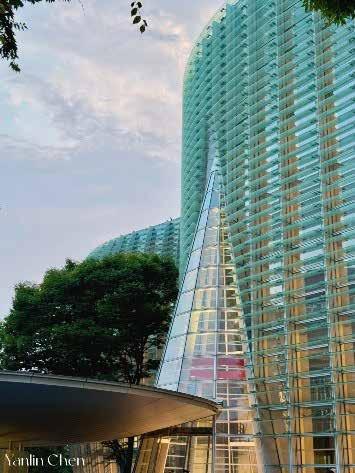
to “symbiosis,” emphasising the softening of boundaries between architecture, nature, and people. Completed in 2007, the National Art Center, Tokyo (NACT) embodies his late-career philosophy: there are no permanent collections, no fixed narratives, only the architecture itself, offering possibilities rather than answers. Walking toward its undulating glass façade along Roppongi, I realised this is not a museum that demands attention, it is a building that “steps aside,” allowing the city and its visitors to occupy the spotlight.
URBAN CONTEXT: ROPPONGI’S DENSITY AND A GENTLE RETREAT
Roppongi is dense with urban activity: art institutions, commercial complexes, and office towers layered atop one another. Yet the National Art Center chooses to step back, using a two-hundred-meter-long curved glass façade to allow the city to speak first. This façade is not about attracting attention but providing a buffer. Standing at the street edge, I felt the building redefine “publicness” in a very Kurokawa way: not by adding more
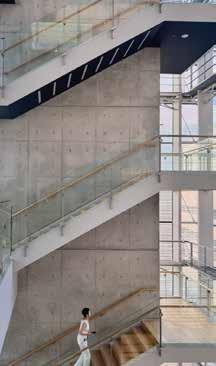
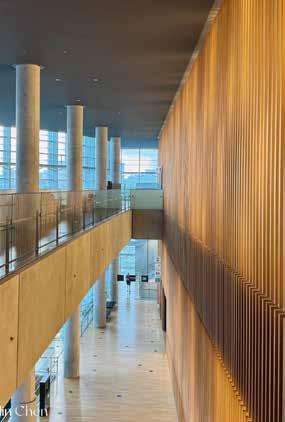
The material palette is restrained yet deliberate: exposed concrete conveys solidity, transparent glass allows the city to flow in, and warm wooden surfaces bring a human scale and tactility
Kisho Kurokawa’s National Art Center, Tokyo (NACT)
functions, but by offering moments of pause. Paradoxically, it is this quiet generosity that makes it so striking in the rapid pace of Tokyo.
SPATIAL EXPERIENCE: LIGHT, GLASS, AND A BLANK COLLECTIVE SPACE
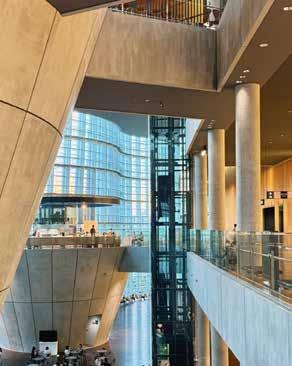
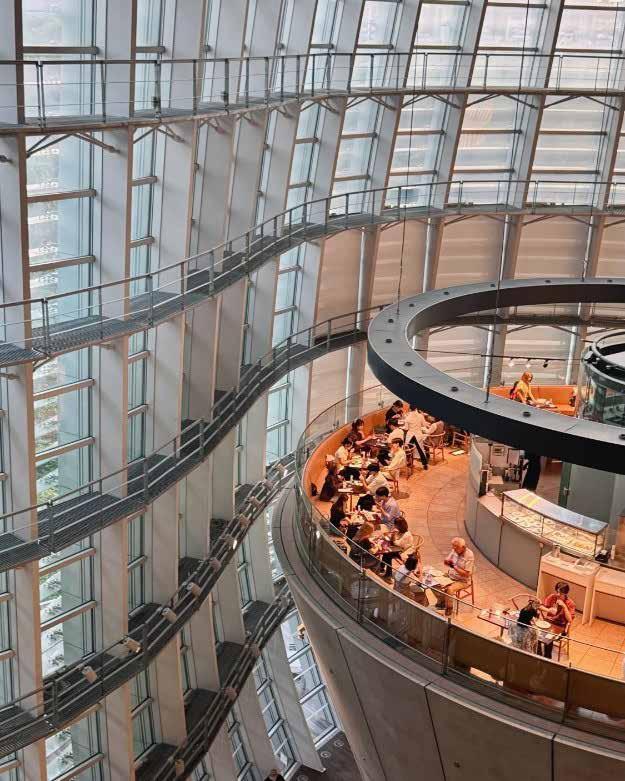
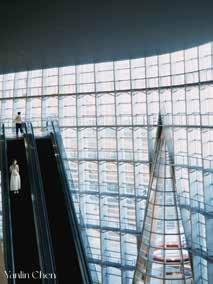
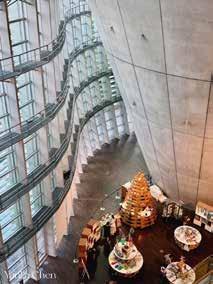
Inside the museum, the main hall stretches up to 21 meters. Two inverted concrete cones anchor the space in light. A smaller one housing a café, a larger one a restaurant, without imposing the heavy solemnity often associated with traditional museums. Walking along the curved glass, I noticed how the light here differs completely from the experience at Kioicho Seido: there, the light is inward and contemplative, here, it flows outward, constantly shifting. The space
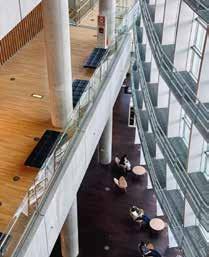
functions more like an intermediary between the city and its visitors than a closed container. One can move freely, pause, and let the architecture gently guide circulation rather than dictate it.
STRUCTURE AND MATERIAL: BALANCING “LIGHT” AND “HEAVY”
Over six hundred slender steel columns support the undulating glass curtain wall, revealing the structure with clarity while preserving a sense of softness and elegance. The material palette is restrained yet deliberate: exposed concrete conveys solidity, transparent glass allows the city to flow in, and warm wooden surfaces bring a human scale and tactility. Kurokawa’s handling of materials
is purposeful, not to impose the traditional “solemnity” of a museum, but to soften boundaries, allowing the external environment to permeate the interior. This strategy recurs throughout his later works, prompting reflection on whether architecture can achieve publicness not by explicit statements but through the careful orchestration of shared space.
No permanent collection:
Choosing to stay “Empty”
Perhaps NACT’s most provocative and conceptually daring feature is its lack of a permanent collection. Every gallery is temporary, shortterm, and interchangeable. To me,
Over six hundred slender steel columns support the undulating glass curtain wall, revealing the structure with clarity while preserving a sense of softness and elegance
The space functions more like an intermediary between the city and its visitors than a closed container
moves at a relentless pace, yet the National Art Center deliberately slows it down, rendering the space more transparent, calm, and contemplative
this presents both liberation and risk. The freedom lies in the fact that no single narrative ever dominates the space, offering visitors an “open beginning” with each visit. The risk, however, is that the architecture itself may overshadow the exhibitions, and the institution’s cultural identity could become less defined. As I walked through the expansive galleries, I found myself reflecting: can a museum without fixed content allow the architecture itself to become the most enduring exhibit?
CRITICAL REFLECTION: A “THIRD STANCE” IN A FASTPACED CITY
Roppongi moves at a relentless pace, yet the National Art Center deliberately slows it down, rendering the space more transparent, calm, and contemplative. The building neither
asserts itself with volume nor relies on drama or monumentality. Instead, it embodies an “active retreat,” a hallmark of Kurokawa’s late-career philosophy.
Experiencing it as an architectural traveler, I found the impression both nuanced and uplifting: it neither dictates how one should navigate the space, as traditional museums often do, nor does it densely fill the urban fabric like commercial streets. It occupies an intermediary role, a buffer within the city. In a metropolis governed by efficiency, density, and narrative clarity, this ambiguous, light, and intentionally open architecture prompted me to reconsider the value of public space. Perhaps architecture does not always “express” itself, sometimes, allowing the city and its inhabitants to slow down is the most profound expression of all.
Roppongi
Glass & Glazing
Driving Existing Façades Towards Change
TOM CALDICOTT Founder, Unity Search Ltd.
ABOUT THE AUTHOR
Tom Caldicott is the Founder of Unity Search Ltd. With a passion for connecting people and businesses, he founded Unity Search in 2023, a bespoke growth consultancy for the Global Façade and Building Envelope industry. His company offers tailored services to Glass + Metal companies and façade professionals across the globe, leveraging my extensive network and industry knowledge. His goal is to create value and impact, by delivering high-quality services that increase sales and hire the best talent in our industry.
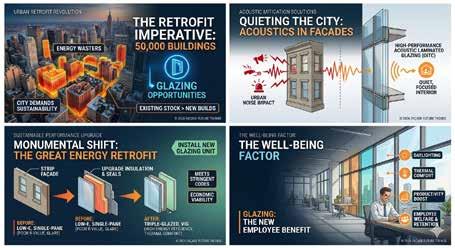
When it comes to commercial glazing projects, there will always be more existing buildings than new builds in construction. As a result, the potential for existing building construction is always greater than that of new builds. With an ever-increasing demand for energy efficiency, a number of cities are beginning to incorporate stringent requirements and energy codes into their framework.
IS THE FAÇADE INDUSTRY EXPERIENCING A MONUMENTAL SHIFT?
Commercial buildings that are deficient in high-performance glazing are often considered to be energy wasters. There are currently over 50,000 buildings that require retrofit solutions or renovation in New York alone. This equates to hundreds of windows per building, which could generate considerable opportunities for the glazing industry.
Ensuring that commercial and residential buildings are
economically viable is now a primary concern for owners, especially when evaluating early post-war buildings that fail to meet their energy code and possess tired façades.
Options include knocking down the building and embarking on a rebuild; stripping the existing façade and replacing it with a new, improved one, or alternatively upgrading the façade without separating it from its foundations. Aesthetics and the health/wellbeing of occupants are essential contributing factors in the decision to renovate.
Fortunately, the global pandemic has encouraged health and wellbeing to hold a superlative focus over considerations, not only where a building’s occupants are concerned, but also for employee retention, recruitment, increased production and engagement. Owners are often pressured to upgrade by the business that occupies their building for the sake of their employee welfare. If
the workspace is dissatisfactory, they will not have the great employees.
Acoustical mitigation is another critical driver and is actually already mandated in New York. Single-glazed, older buildings can be blaring, and many parts of the city have consequently made acoustic attenuation requirements mandatory.
Major cities across the US are also tightening their energy codes. The US building stock as a whole account for 40% of all energy produced in the US. As a result, there is an emphasis on energy performance and renovation within cities that are adopting strict energy codes and regulations as well as those with an old portfolio of buildings.
The concept of ageing building stock in conjunction with increasingly stringent codes and the decline in new construction over the past year indicate that there could be a sizeable increase in work for the glazing industry.
More buildings are demanding custom/uniquely designed solutions and not every company is prepared for this change. Businesses interested in this field must be mindful that design and building trends are constantly evolving, in order to ensure that they can prove their solution.
The same can be said for projects regarding new and original construction: energy and aesthetics are now a primary focus.
Aesthetics and the health/well-being of occupants are essential contributing factors in the decision to renovate
Cover Story The Intelligent Skin: How New-Generation Façades Are Redefining Architecture
One of the most vulnerable aspects of building design is the façade. Because the majority of the populace is unaware of the material’s performance, they frequently misunderstand the importance of façade design, particularly in limiting or spreading fire spread. Fire safety has traditionally been overlooked in favour of beauty, energy efficiency, cost, and other factors. However, in light of current market trends, this has progressed beyond only the aesthetic aspect and now plays a larger role in light conveyance, acoustical execution, and efficacy.
It is about the universal understanding of the reality that any possible fire threats can only be mitigated when façade systems, materials, and testing are given the attention they deserve. The emphasis should be on a comprehensive approach to examining the performance of façade materials, components of façade design for fire safety, fire testing of façade materials, compartmentalization, and much more.
The opinions and ideas of subject-matter experts are featured in this cover story. We sought to collect their thoughts on things like façade fire safety, laws and regulations, appropriate materials, the best approach to build a fire-safe façade, and so on.
The façade has long been architecture's most visible statement—but today, it is so much more than a surface. As buildings face mounting pressure to perform against climate challenges, energy targets, and evolving user expectations, the façade has transformed into an intelligent, responsive system. No longer a passive outer skin, it now actively mediates light, heat, airflow, and identity, sitting
at the intersection of engineering precision and architectural vision. From parametric geometries to energy-generating skins, the new generation of façades is redefining what buildings can achieve and communicate. To explore this transformation in depth, we have interviewed leading subject-matter experts whose insights and perspectives are presented in this edition's csover story.
DR.
DIAAELDIN ALY Chairman, Diaa Architects
A NEW-GENERATION FAÇADE
JEHAD ALKHANDAQ
Facade Technical Manager, Prisma Metal Industry L.L.C.
Today's façades go far beyond simple walls and windows. They are dynamic, intelligent building skins that respond to climate, technology, and aesthetics — redefining how structures interact with their environment and the people who inhabit them.
Dr. Diaaeldin Aly, Chairman, Diaa Architects , describes a new-generation façade as a responsive environmental system rather than a static outer layer. He notes that it acts as a mediator between the building and its surroundings, carefully controlling
Parametric design will become more refined, allowing façades to respond in real time or through highly optimised static configurations
Image courtesy: Diaa Architects
KARAM HAMADEH Managing Director, Technical Product Solutions LLC
light, heat, and airflow. In his approach, the façade is shaped through parametrically driven horizontal, vertical, and curved elements that respond to the sun’s path, functioning as integrated shading devices that allow beneficial daylight while deflecting excessive solar gain. In simple terms, he suggests it is a façade designed to perform in harmony with the movement of the sun.
Jehad Alkhandaq, Facade Technical Manager, Prisma Metal Industry L.L.C. , opines that the new generation of façade is not only an outer skin or building envelope, but a complete system of performance, aesthetic, and dynamic items. He suggests it is the result of incorporating technology, high engineering processes, and climate conditions. According to him, the new generation is a "dynamic and intelligent interface" with all aspects of façade performance, starting from the design phase through to long-term operation.
Karam Hamadeh, Managing Director, Technical Product Solutions LLC, suggests that it’s no longer just cladding—it’s a system. He notes that a façade today controls heat, light, air, and safety, and directly impacts how the building performs. In regions like the GCC, where solar load is high, he mentions this becomes critical. A well-designed façade reduces energy demand while maintaining transparency and comfort. In simple terms, he states that it performs, not just looks good, acting as the point where architecture and engineering come together to define both efficiency and user experience.
FERNANDO MORANTE
Technical Design Director Specialism, Egis Group
RAHUL NIKAM Digital Director, A+B Digital Consultant
Fernando Morante, Technical Design Director Specialism, Egis Group, explains that a new-generation façade is a high-performance building envelope system that integrates architectural expression with environmental control and engineering efficiency. Unlike conventional façades, he notes it is designed as a multifunctional interface that manages heat transfer, daylight penetration, air infiltration, and acoustic performance. These façades often incorporate advanced glazing systems, adaptive shading, and integrated technologies to optimise building performance. In essence, he suggests it acts as a responsive layer between interior and exterior conditions, contributing significantly to energy efficiency, occupant comfort, and lifecycle performance while maintaining architectural intent.
Rahul Nikam, Digital Director, A+B Digital Consultant , says the façade is now an active, living system and a user-oriented interface between the building, environment, and community. He describes the new generation through the "THRIVE" philosophy, where the façade is a direct expression of advanced computational thinking, parametric structure, and integrated digital systems. He suggests that rather than being a static architectural element, it functions as an evolving system that combines environmental, technological, and social roles.
Vin Jirawat Pisitpongsa, Founder & CEO, Design Collaboration , describes it as "The Building That Thinks." He suggests that a new-generation façade is the outer layer of a building that, unlike a traditional wall, is designed to actively respond to its
environment. He notes that it doesn't just sit there; it works. He observes that while most people don't notice a façade, they notice how a building feels— such as finding it cool on a hot afternoon or working near a window that never glares. Furthermore, he opines that the façade is the first thing the city sees, communicating identity through materials, texture, and the way it catches light before anyone even walks through the door.
LATEST TRENDS IN FAÇADE DESIGN
From biophilic patterns to parametric geometries, façade design is evolving rapidly. Architects are embracing bold textures, adaptive shading systems, and expressive materiality to create building exteriors that are as visually compelling as they are functionally sophisticated.
Dr. Aly points to the increasing use of environmental data and parametric design to shape building envelopes. He notes a shift toward parametrically driven geometries, such as horizontal, vertical, and curved elements, which serve as performative shading systems rather than purely decorative gestures. According to him, these designs allow buildings to respond precisely to the sun’s path, creating a unique visual language derived from environmental logic.
Alkhandaq suggests that design is increasingly being carried out in accordance with international sustainability bases. One significant result he observes is the "several skin" façade and the use of smart, high-performance materials. He also notes a rise in
parametric design that optimises both performance and the final aesthetic, creating a balance between metal and non-metal materials like terracotta, marble, GFRC, and stone.
Hamadeh opines that the main trend is "performance-first" design. He notes that better glass, proper shading, and tighter systems have become standard, especially in hot climates. Aesthetically, he suggests projects are moving toward cleaner lines with larger panels and minimal framing. Additionally, he points to increased prefabrication to improve quality and a shift toward integrating façades with fire safety, access, and building systems rather than treating them as standalone packages.
Morante suggests that current trends are centered on performance-driven and climate-responsive solutions. He notes that double-skin façades, ventilated cavities, and kinetic shading systems are being increasingly adopted. He also highlights how parametric and computational design tools enable complex geometries optimised for solar exposure. Furthermore, he observes a strong shift toward prefabrication and modular systems, along with
the growing integration of greenery and biophilic elements in urban environments.
Nikam notes a shift toward modular construction and "plug-and-play" façade components that simplify assembly and maintenance. He suggests a move toward façades that integrate energy systems and ecological functions, emphasising simplicity and community ownership over complexity. According to him, the trend is moving toward façades that act as active, living systems that combine environmental, technological, and social roles.
Jirawat Pisitpongsa identifies three major shifts. First, he notes a correction from "glass boxes" to "considered surfaces," moving away from full-glazed curtain walls toward surfaces with thermal mass and depth. Second, he suggests façades are moving from consuming to generating energy through Building Integrated Photovoltaics (BIPV). Finally, he points to the "honest façade," where aesthetics is driven by how a building actually works, such as using external fins or screens that are clearly designed to manage heat and light.
Façade that is designed to perform in harmony with the movement of the sun Image courtesy: Diaa Architects
MODERN FAÇADES HELPING IMPROVE ENERGY EFFICIENCY AND COMFORT IN BUILDINGS
Modern façades are now central to a building's energy strategy. Through smart glazing, insulated cladding, and passive solar design, they significantly reduce heating and cooling loads while ensuring occupants enjoy consistent thermal and visual comfort year-round.
Dr. Aly explains that by responding precisely to solar angles, façades control heat gain without compromising daylight. This approach reduces the reliance on mechanical cooling and artificial lighting. He notes that the façade acts as an active environmental tool, where the geometry itself is designed to perform, ensuring that the building remains energy-efficient while providing a comfortable interior climate.
Alkhandaq mentions that energy efficiency is achieved by using high-performance materials such as double or triple silver coated glass with a suitable Solar Heat Gain Coefficient (SHGC) based on the building's geolocation. He notes the importance of high insulation capabilities and the use of external shading in cooperation with the outer skin. According to him, paying attention to façade orientation during
the design stage is a main strategy for achieving low operational costs.
Hamadeh asserts that modern façades manage solar gain while maximising daylight. He suggests that high-performance glazing and proper shading reduce the heat entering the building, which is especially critical in the Middle East to lower cooling demand. At the same time, he notes they improve occupant comfort by providing less glare, more consistent indoor temperatures, and better acoustic insulation, meaning the building feels better to live or work in.
Morante suggests that modern façades act as dynamic filters that regulate the building’s microclimate. He notes that through advanced thermal breaks, highperformance coatings, and automated shading, these systems significantly reduce the cooling and heating loads. Furthermore, he points out that smart façades integrated with building management systems (BMS) can adjust to external conditions in real time, optimising daylight while preventing glare and overheating, thus enhancing the overall well-being of the occupants.
By designing façade elements that respond precisely to solar angles from sunrise to sunset, it becomes possible to control heat gain without compromising daylight Image courtesy: Diaa Architects
Nikam proposes that the façade is no longer just a protective shell but a contributor to the building's energy ecosystem. He notes that through the "THRIVE" system, the façade can generate and redistribute energy—including electrical, thermal, and water— through an interconnected grid. He suggests that by utilising biophilic elements and digital monitoring, the façade ensures a self-sustaining environment that balances energy consumption with generation.
Jirawat Pisitpongsa suggests that modern skins handle comfort first, which allows for a smaller HVAC plant and lower energy bills. He notes that when a façade is designed correctly, the interior spaces feel stable rather than "mechanically corrected." He opines that features like solar panels and fins that adjust to block or welcome the sun work quietly and automatically together to create an environment where people feel the comfort the moment they walk in.
NEW MATERIALS’ ROLE IN TODAY’S FAÇADE SYSTEMS
Innovative materials such as ultra-high-performance concrete, aerogel panels, and fiber-reinforced composites are transforming façade construction. These cutting-edge options offer superior strength, lighter weight, and enhanced durability, opening up design possibilities that were previously impossible to achieve.
Dr. Aly says that lightweight metal systems and advanced glazing allow for the precise fabrication of parametrically designed elements. He notes that these materials act as active environmental tools rather than just static finishes, enabling the creation of complex geometries that respond to solar data while maintaining structural integrity.
Alkhandaq believes that new materials open doors for complex geometries, high structural performance, and reduced maintenance. He suggests that the integration of smart and highperformance materials allows for a "several skin" approach, which is essential for meeting international sustainability standards and optimiing the building's thermal envelope.
Hamadeh notes that advanced coatings on glass and better aluminum systems reduce heat transfer and improve fire safety compliance without compromising
aesthetics. He emphasises that the evolution of materials has made performance-first design the standard, allowing for larger panels and minimal framing that still meet rigorous safety and energy regulations.
Morante highlights innovations like ETFE membranes, vacuum glass, and photovoltaic glass that introduce energy generation capabilities into the building skin. He suggests that the development of high-performance glazing with selective coatings continues to evolve, allowing for better control over heat gain and daylight distribution.
Nikam suggests the use of bio-panels to filter air pollution and piezoelectric materials to capture kinetic energy from the environment. According to him, the future of materials lies in their ability to perform ecological functions, such as water storage and air purification, transforming the façade into an active participant in the urban ecosystem.
Jirawat Pisitpongsa opines that material selection is now an engineering decision first, with a focus on behavior. He points to the rise of electrochromic glazing, which tints automatically, and the return to natural performance materials like terracotta and stone for their thermal mass. He notes that we are moving toward an "honest façade" where the choice of material is driven by how it actually handles the environment.
DIGITAL TOOLS AND TECHNOLOGY IN DESIGNING MODERN FAÇADES
Computational design software, building information modeling, and simulation tools have revolutionized façade engineering. Designers can now analyze performance, visualize complex geometries, and optimize every panel before construction begins, reducing errors and unlocking greater precision at every project stage.
Dr. Aly considers digital tools fundamental to his design process, as they allow for the mapping of the sun’s movement and ensure that performance directly informs geometry. He notes that simulation tools further validate daylight, shading, and thermal behavior, while BIM ensures coordination during execution. According to him, achieving the current
level of precision and environmental responsiveness would not be feasible without these technologies.
Alkhandaq states that to perform sufficient design and high-quality façades, it is essential to use good digital tools. He suggests that BIM authoring tools and parametric software modeling provide accurate, sophisticated, and well-performed designs. He also notes that these tools enhance coordination between all disciplines—which is central to façade performance— and that environmental simulation tools for thermal and acoustical design play an important role in supporting sustainability.
Hamadeh opines that digital tools are essential because they allow for early simulation of thermal performance, daylight, and energy use, helping teams make better decisions before construction. He notes that BIM improves coordination and reduces errors during
execution, while digital processes on the fabrication side increase precision and consistency. Ultimately, he suggests technology helps reduce risk and ensures the façade performs as intended, not just as designed.
Morante suggests that digital tools are indispensable in modern façade design. He explains that parametric and computational tools allow for the optimisation of complex geometries for environmental performance. Furthermore, he notes that Building Information Modeling (BIM) facilitates seamless coordination, while digital fabrication technologies—such as CNC machining and robotic assembly—bridge the gap between design intent and physical production, as demonstrated by landmark projects like the Museum of the Future in Dubai.
Nikam says that technology enables the façade to function as an intelligent network. He notes that the
use of BIM and digital twins allows for the monitoring of a building’s health in real-time, while integrated sensors collect data on energy performance and user interaction. According to him, this digital layer allows architectural strengths to reach further, conceiving buildings and systems—like the THRIVE façade—that previous tools simply could not realise.
Jirawat Pisitpongsa suggests that the greatest value of digital tools is "rigor, not complexity." He notes that while it is easy to use software to create a "crazy shape," the real power lies in the ability to test 50 variations of a shading fin in the time it used to take to draw one. He opines that technology allows designers to discard ideas that don't hold up and move forward with the ones that actually work, asserting that digital tools should be used to prove a design's worth, not just to make it look futuristic.
NEW-GENERATION FAÇADES INFLUENCING THE OVERALL LOOK AND IDENTITY OF BUILDINGS
A building's façade is its most visible statement to the world. New-generation designs use form, material, pattern, and light to craft a distinct architectural identity that communicates a structure's purpose, values, and place within its urban context.
Dr. Aly observes that this approach gives façades a distinct identity rooted in performance. He notes that the visual language—whether horizontal lines, vertical fins, or fluid curves—is not arbitrary but derived from environmental logic. As a result, the building expresses how it interacts with the sun and its context, creating a dynamic architectural identity that changes throughout the day as light and shadow shift across the façade, making the building feel more alive and connected to its surroundings.
Alkhandaq suggests that new-generation façades influence buildings by ensuring a visual identity based on both architectural and performance bases. He notes that architects are now, more than ever before, able to make unique and well-working designs. Since the façade is no longer static but reflects the cultural context of the geo-location, he opines that there is a gradual increment in landmark projects. Hamadeh opines that façades are now defining identity. He suggests that the move toward minimal, clean design reflects both aesthetic preference and performance requirements, where large glass areas, slim profiles, and precise
detailing create a more refined look. At the same time, he notes that performance constraints—like shading and thermal control—shape the design, leading to more "honest architecture" where the appearance is closely linked to how the building actually functions.
Morante suggests that new-generation façades significantly influence architectural identity by enabling complex geometries, dynamic systems, and material expression. Through parametric design and advanced fabrication, he notes that façades can achieve intricate patterns and responsive elements that reflect environmental conditions or cultural narratives. According to him, the façade becomes a key medium for storytelling, conveying both functional performance and aesthetic intent, often defining the visual signature of a building and transforming it into a recognisable landmark.
Nikam says the identity of a building is being redefined through the interaction between the façade and its environment. He notes that the appearance of a building is no longer fixed; it changes with the seasons and the growth of integrated vegetation. From the inside, he suggests the façade is no longer a barrier but an accessible layer used for social interaction and gardening. Consequently, he opines that the building's identity is not defined solely by the architect but continues to evolve through community participation and environmental change.
Jirawat Pisitpongsa suggests that the façade is no longer allowed to be neutral. He notes that it is expected to say something about the organisation inside, the neighborhood it faces, and the values the building intends to hold. He concludes that "the wall has become the argument," serving as a public declaration of intent where the way a building looks and how responsibly it performs are no longer separate conversations.
FAÇADES IN THE NEXT FEW YEARS
The coming years will bring façades that generate energy, self-repair, and adapt in real time to changing conditions. As sustainability demands and digital innovation accelerate, the building envelope will become smarter, greener, and more architecturally expressive than ever before.
Dr. Aly predicts that façades will increasingly evolve into adaptive systems shaped by data and environmental
intelligence. He notes that parametric design will become more refined, allowing façades to respond in real time or through highly optimised static configurations. According to him, we will see more integration between shading, energy generation, and material performance, resulting in a future façade that is not only following the sun but is precisely calibrated to it to achieve a balance between efficiency, comfort, and architectural expression.
Alkhandaq suggests that the future of façades is smart, adaptive, and sustainable. He opines that we will see an increment in incorporating automation and using AI tools to ensure the visual look and optimise performance. He notes that materials will become lighter, have lower emissions, and be more environmentally friendly, marking a significant move from passive elements to active systems.
Hamadeh suggests that façades will become more adaptive and more integrated. He notes that they will increasingly respond to environmental conditions, adjusting shading and performance throughout the day. He also expects closer integration with energy systems and smart controls. Visually, he suggests designs will likely become even simpler, with more focus on durability and long-term performance, driven by regulations around energy and safety that continue to push higher standards.
Morante foresees façades in the near future being increasingly adaptive, data-driven, and energygenerating. He notes that the integration of smart materials and sensor-based systems will enable realtime response to environmental conditions to optimise thermal and visual performance. He suggests that Building Integrated Photovoltaics (BIPV) will become more prevalent, turning façades into active energy contributors. Additionally, he opines that advances in digital fabrication will allow for mass customisation, and artificial intelligence may play a role in predictive performance optimisation, resulting in façades that are anticipatory in their behavior.
Nikam says that in the near future, façades will become simpler in construction yet more advanced in performance. He suggests they will be modular, reusable, and designed for a circular, low-carbon lifecycle. According to him, buildings will generate, store, and share energy through integrated façade systems using advanced technologies for electrical and thermal storage. He notes that biodiversity and ecological integration will become standard, and most importantly, façades will be increasingly user-driven, functioning as evolving systems that combine environmental, technological, and social roles.
Jirawat Pisitpongsa opines that the next few years will be characterised by less speculation and more
Solar panels generate energy. Fins adjust to block or welcome the sun. All of it working quietly, automatically, together Image courtesy: Design Collaboration
accountability. He notes that the conversation is shifting from what façades can do to what they must do, driven by net-zero targets and embodied carbon
reporting. He expects to see more rigor around performance outcomes and systems designed with disassembly in mind. Ultimately, he suggests the façade is becoming simultaneously a visual landmark and a public declaration of environmental intent, where how a building looks and how responsibly it performs are no longer separate conversations.
CONCLUSION
The new-generation façade represents architecture's most compelling evolution—from aesthetic wrapper to intelligent performer. As the conversations with our experts reveal, the convergence of parametric design, advanced materials, digital tools, and sustainability imperatives is producing façades that think, adapt, and generate rather than simply enclose. Whether responding to the sun's path, integrating energy systems, or expressing cultural identity through honest materiality, today's façades carry far greater responsibility than ever before. Looking ahead, the trajectory is clear: façades will grow smarter, leaner, and more accountable, shaped by net-zero commitments and community values alike. The wall, as one expert aptly noted, has become the argument—and it is one the built environment can no longer afford to make quietly.
Electrochromic glazing is moving from luxury specification to genuine energy tool, dynamically controlling solar transmission without mechanical parts Image courtesy: Design Collaboration
Industry Speaks
“Priedemann Façade Experts: 20 years in Dubai – from Early Foundations to a Regional Façade Planning Hub”
IRINA TADELLO
Business Development, Priedemann Façade Experts
Irina is a Business Development Manager at Priedemann Façade Experts where she focuses on client engagement and supporting the growth of façade consultancy and engineering services across the region. Prior to joining Priedemann, she spent eight years with the architectural glass manufacturer AGC Obeikan Glass, establishing strong relationships across the architectural and façade sector. Originally from Latvia, Irina holds a degree in Political Science and International Relations and a Master’s in Strategic Marketing from the University of Wollongong in Dubai. She has been based in the UAE since 2012.
In 2026, Priedemann Façade Experts marks 20 years of continuous presence in Dubai - a milestone shaped not by rapid expansion or headline-driven growth, but by expanding and developing a trustful partner network with the realities of building in the Middle East. What began in 2006 as project-based involvement has evolved into a regional hub for façade engineering, supporting complex developments across the GCC. Over two decades, the Dubai office has grown alongside the region itself, shaped by real projects, real challenges, and a culture grounded firmly in delivery.
THE ORIGINS OF PRIEDEMANN AND HOW ITS IDENTITY WAS FORMED
Founded in Berlin in 1993, Priedemann established its reputation at a time when façades were undergoing a fundamental transformation. Post-reunification Berlin became a testing ground for architectural ambition, and façades were increasingly understood not as architectural add-ons, but as highly engineered systems mediating between design intent, climate, and human comfort. This technical and cultural shift formed the basis of Priedemann’s identity.
THE GUIDING PHILOSOPHY BEHIND THE COMPANY’S APPROACH
From the very beginning, company’s approach has been shaped by listening rather than prescribing. As Lars Anders, CEO of Priedemann Façade Experts, explains: “Real value comes from understanding what a project genuinely needs in order to succeed. Context mattersplace, climate, market maturity, construction culture, and delivery strategy are fundamental drivers. That
Qatar Petroleum District in Doha Image courtesy: KEO International Consultants – design by Raj Patel
understanding allows us to close the loop across the entire façade lifecycle - from research and development, through façade consultancy and detailed engineering, to refurbishment and energetic upgrade of existing buildings. We don’t work in isolated phases. Early ideas are tested against buildability and long-term performance, execution is informed by real production logic, and façades are conceived not just for delivery, but for durability and future adaptation.”
This philosophy naturally led Priedemann to establish local teams in key regions around the world. Rather than exporting fixed solutions, the company embedded expertise on the ground, combining regional insight with global experience. A façade solution that performs well in Northern Europe cannot simply be transferred to the Middle East without fundamental adaptation - a principle that became increasingly relevant as Priedemann expanded into hot, arid climates and fast-paced construction environments.
WHY PRIEDEMANN CHOSEN TO REMAIN FOCUSED EXCLUSIVELY ON FAÇADES
As Micha Pawelka, now Chief Operating Officer of Priedemann Holding and formerly Managing Director of the Dubai office, has often noted, this adaptability is inseparable from the firm’s deliberate focus. “We do only façades - no superstructure, no MEP,” he explains. “Many consultancies added façades later as an additional scope. For us, façades have always been the core.” This clarity of purpose allowed Priedemann to develop deep,
execution-driven expertise - particularly valuable in markets where architectural ambition often outpaces practical execution experience.
THE MIDDLE EAST: OPPORTUNITY THROUGH PRODUCTION PLANT DESIGN
When Lars first arrived in Dubai exploring façade consultancy opportunities, the market was not looking for “consultants” in the traditional sense. Fabricators were already operating within trust-based project relationships and under pressure to deliver increasingly complex façades. What they needed were technical partners who could support execution and solve real challenges. This led to Al Ghurair Aluminium, where the task was not advisory, but to design an industrybenchmark aluminium production plant to support a successful bid for the Burj Khalifa. It was during this period that Lars met Anees Backer, then Technical Manager at Al Ghurair Aluminium. More important than titles was the trust built through close technical collaboration, which later led to Anees joining Priedemann and becoming a defining pillar of the Dubai office, carrying employment number one.
This production-led mindset was applied on Al Tijaria project in Kuwait, a highly complex twisted 220-metre tower and one of Priedemann’s earliest regional assignments. While introducing a Schüco unitised curtain wall system with mitre corners and a European drainage
Priedemann FZCO, Dubai - Managing Directors (from left to right): Anees A. Backer, Lars Anders, Micha Pawelka
EXPO 2020 Metro Station in Dubai Image courtesy: Priedemann
Al-Tijaria Tower in Kuwait, Completion 2009 Image courtesy: Schueco
concept to the Middle East, Priedemann’s role extended beyond façade design to engineering the production plant in Kuwait, including tilted assembly tables for efficient and precise manufacturing. In parallel, the team delivered comprehensive shop-drawing, production detailing, and assembly preparation support under tight tolerances.
Together, these execution-driven engagements laid the foundation for Priedemann’s long-term presence in Dubai - rooted in manufacturing logic and evolving naturally into façade consultancy grounded in real delivery.
THE EARLY DAYS OF PRIEDEMANN IN DUBAI
Looking back at Priedemann’s early days in Dubai feels a bit like flipping through an old family albummoments that felt ordinary or even exhausting at the time, yet quietly laid the foundation for everything that followed. In the very beginning, the “Dubai branch” started small: just three people in a two-bedroom apartment, informally using the space as a workspace, meeting area, archive for drawings and samples - and
often as the place where the team shared quick meals between site visits. Mobility came in the form of an old red Volkswagen Golf, which broke down more often than it drove.
Steve Muchowski, who two decades later is based at the Berlin headquarters as Chief Risk Officer of the Priedemann Holding, still recalls those days with humour. He often jokes that a significant portion of Priedemann’s early façade expertise in the Middle East was acquired not behind a desk, but while pushing that Volkswagen out of busy intersections under the unforgiving Gulf sun. Beneath the humour lies a defining truth: those early months were driven by persistence, adaptability, and an unwavering focus on delivery rather than comfort.
EARLY DAYS IN DUBAI: PERSISTENCE OVER COMFORT
One of the projects that supported the establishment of Priedemann’s Dubai presence was the Etisalat Tower in the Al Kifaf area, distinguished by its iconic spherical feature. During construction, the façade contractor engaged Priedemann to provide specialist on-site support. The involvement was intensely hands-on. Steve recalls long
From its early days in a small apartment with a hands-on, execution-first approach, Priedemann’s Dubai office has grown into an R&Ddriven façade engineering hub, defined by practical expertise, adaptability, and long-term performance thinking
days walking unfinished stairwells up and down, followed by repeated drives between the site and ALICO’s factory in Sharjah - all of it taking place in May, with temperatures exceeding 40 degrees Celsius.
THE EXPERIENCES THAT INFLUENCED PRIEDEMANN’S WORKING APPROACH
There was little separation between design, coordination, and execution. Problems were addressed where they occurred, decisions were made quickly, and learning happened in real time. These experiences shaped the character of the Dubai office and embedded an approach that remains central to Priedemann’s work today. Those early challenges defined the DNA of Priedemann’s Dubai team: practical, hands-on, and never afraid to solve problems where they arise.
Anees Backer, Managing Director of Priedemann’s Dubai office, reflects on the journey: “What defined our early years in Dubai - and still defines us todaywas the willingness to stay close to the project and the people delivering it. We learned quickly that façades only succeed when design intent, execution reality and long-term performance are aligned. That mindset has
20 years in Dubai, Priedemann has grown into a trusted façade engineering hub shaped by real-world delivery
carried us through every market cycle and continues to guide how we approach projects across the region today.”
FAÇADE EXPERTISE AS A DELIBERATE CHOICE
As Priedemann’s Middle East presence matured, so did its portfolio. The company contributed façade consultancy and engineering expertise to a wide range of landmark projects across the region, working with architects, developers, and contractors on increasingly ambitious buildings. Despite this growth, Priedemann resisted the temptation to dilute its expertise. Remaining focused exclusively on façades allowed the team to go deeperinto materials, detailing, constructability, performance, and lifecycle behaviour - rather than spreading capability thinly across multiple disciplines. Execution knowledge remains a defining strength. A significant proportion of Priedemann’s project managers come from fabrication and construction backgrounds, enabling the team to understand not only how façades are designed, but how they are built.
FROM FOUNDATIONS TO A REGIONAL HUB
Two decades on, what began with site walks up unfinished stairwells has evolved into a regional hub for R&D-driven façade engineering. Today, Priedemann’s Dubai office supports projects across the GCC, combining regional understanding with global expertise and long-standing execution knowledge. Many people have contributed to this journey - some joining early, some returning later, others adding their expertise at different stages. Together, they built the Team defined not by speed of expansion, but by continuity, experience, and responsibility.
Al-Tijaria Tower in Kuwait, on-site inspection Image courtesy: Priedemann
ICD Brookfield in Dubai Image courtesy: ICD Brookfield Dubai
Face to Face
“A Façade only Succeeds when Design Intent Translates Seamlessly into Construction Reality”
Perry Bar Train Station, Birmingham, UK
HUZEFA ALI Founder, CladUp Design & Facade Ideas
Huzefa Ali has over 14 years of experience in the UK façade industry, with expertise in the detailed design, manufacture, assembly, and project management of façade systems. As Projects Director at CladUp Design, he leads the delivery of façade design and engineering services across RIBA Stages 4 & 5, with a strong focus on buildability, compliance, and coordination. He is also the Society of Façade Engineering (SFE) West Midlands Hub Representative. Huzefa completed his MSc in Façade Engineering from the University of Bath in 2013. Alongside leading CladUp, he founded Facade Ideas in 2018 to share practical façade knowledge and industry insights. He also established the Facade Directory, a platform aimed at connecting façade contractors, suppliers, and consultants, making it easier to navigate the industry. His previous roles include being part of the self-delivery façade team at Laing O’Rourke and the Lendlease façade technical team. Huzefa has contributed to several landmark projects, including the Moorgate & Broadgate Crossrail Stations in London, Google Headquarters, Imperial College London, Cambridge University, and Alder Hey Hospital in Liverpool. He has a particular interest in the design and construction of prefabricated façade systems, focusing on improving safety, quality, and efficiency in project delivery.
If you can design brackets and support systems efficiently, you reduce the need for oversized or overly complex connections
• CladUp Design has built a strong reputation in façade design and engineering since its inception in 2016. What was the founding vision, and how has the company evolved over the years?
When we started CladUp, the idea was simple — we wanted to build a one-stop engineering team for RIBA Stages 4 & 5 (project construction & execution stages) within the building envelope market. A lot of drawings looked good but didn’t translate well on site. We focused on that space. Over time, we’ve optimised workflows, understanding client requirements, ensuring proper technical delivery, and now Gateway 2 coordination.
Alongside that, I started Facade Ideas to share knowledge more openly, and now the Facade Directory to better connect the industry — both came from the same gaps we were seeing on projects.
• Your portfolio spans curtain walling, rainscreen cladding, and window systems. How do you approach design integration across such diverse façade elements?
We don’t look at curtain walling, cladding, and windows separately. It’s one system — one building envelope
— achieving a set of performance criteria holistically. The key is always the interfaces — between systems, between façade & structure, brackets, joints, movement, and construction sequence. If those aren’t resolved early, problems show up later. So, we try to align everything at that level first, along with our experienced clients/project teams.
• With increasing emphasis on precision and reliability in façade engineering, what role do detailed drawings and technical coordination play in project success?
Honestly, this is where repeat clients and projects are won or lost. If the drawings are clear, coordinated, and buildable, the site runs more smoothly.
The technical design, production, and installation pack needs to be prepared with all stakeholders in mind — architect, structural engineer, system suppliers, installation contractors, procurement teams, MEP, fire engineer, client building maintenance team, as well as internal and external finishes. In my opinion, this level of detailed coordination is what defines a fully coordinated drawing.
“We approach the façade as a single, integrated building envelope, where curtain walling, cladding, and window systems work together to meet performance requirements”
If not, everything gets pushed to site and becomes reactive. This is something I’ve also tried to highlight through Facade Ideas — a lot of industry issues come down to a lack of detailed coordination.
• CladUp offers services ranging from concept design to fabrication drawings and site support. How important is this end-to-end involvement in delivering high-performance building envelopes?
It makes a big difference. If you’re only involved at one stage, things get lost between handovers. Staying involved from design through to site helps keep the intent consistent and avoids unnecessary rework.
With the new Gateway requirements in the UK, especially at Gateway 2, the design is effectively locked before construction starts. That means the level of detail and coordination at that stage needs to be very high, and more importantly, clearly understood by the team delivering it.
If a different team picks it up later without being part of that process, there’s a risk of misinterpretation, redesign, or site issues. In our experience, having the same team carry the design through into fabrication and site support ensures continuity. They understand the assumptions, constraints, and coordination decisions that were made earlier, which helps maintain performance and reduces risk during construction.
• Could you share insights into how advanced tools such as BIM, FEA analysis, and thermal modelling are shaping your design and engineering workflows?
We use them as tools to support decisions, not just for the sake of it. BIM helps with coordination, FEA gives
confidence in bracket and support design, and thermal modelling supports compliance. It makes the design more robust, as the construction information on drawings is driven by analysis and results. As we keep challenging our own abilities, we have already moved towards most of the production information being extracted from BIM and Inventor 3D models.
• In your experience, what are the most critical challenges in façade execution today, particularly in terms of coordination between design, fabrication, and installation?
Coordination is still the biggest issue. Structure, façade, and fire are often developed separately and only properly aligned late in Stage 4, usually when the façade package is being pushed forward.
The Gateway process will definitely help narrow this gap by forcing earlier alignment, but we’re still seeing challenges during construction. Changes driven by unstable material rates, procurement pressures, or incomplete design information are where most problems come from.
325 Deansgate, London, UK
INTEGRATING HERITAGE WITH INNOVATION:
THE FUTURE OF DESERT LIVING
18-19 JUNE 2026
Al Habtoor Grand Resort Dubai, UAE
EXPLORE INSIGHTS WITH THE BRIGHTEST MINDS IN DESERT ARCHITECTURE
FEATURED SPEAKERS
SLAWOMIR LEDWO�
DEPUTY HEAD OF DESIGN STUDIES UNIT MINISTRY OF MUNICIPALITY QATAR
VLADIMIR JOVANOVIC DIRECTOR ARCHITECTURE AECOM WILL PLOWMAN PARTNER FOSTER + PARTNERS
ANDREAS KLOK PEDERSON PARTNER AND DESIGN DIRECTOR BIG - BJARKE INGELS GROUP
SPONSORS & PARTNERS
COLOR PARTNER
GLASS PARTNER
SCAN QR TO VISIT WEBSITE
SUSTAINABLE MATERIALS PARTNER
LANDSCAPE SPONSOR ACP SPONSOR
SCAN QR TO BOOK TICKETS
Another challenge is simply finding the right people and suppliers at the right time, which is one of the reasons we’re building the Facade Directory.
• Projects like Kings Cross and 325 Deansgate reflect technically demanding façade solutions. How do you approach bespoke design challenges within tight constraints?
We try to simplify things. Even if the design is complex, it still needs to be repeatable and buildable. And even where full repetition isn’t possible, there’s always an
“In façade engineering, performance is not defined by specification alone, but by the clarity of drawings and the depth of coordination behind them”
opportunity to make the principles of modulation or the design logic repeatable.
A lot of façades appear complex because of multiple bespoke elements coming together, but in reality, if these aren’t detailed properly, those bespoke solutions won’t perform. In many cases, a bespoke façade is actually made up of well-thought-out standard components arranged in a certain way.
Breaking it down into manufacturable components is key — understanding what can be standardised, what needs to be adjustable, and where tolerances sit. That’s where good detailing makes the difference between something that works on paper and something that works on site.
Getting suppliers involved early also helps — it grounds the design in reality and brings in fabrication and installation logic at the right stage.
I remember Stephen Ledbetter from CWCT used to say that the best façades are those which use traditional materials in non-traditional ways, while still satisfying performance requirements. That has always stayed with me — because it’s not about reinventing everything; it’s about using what we already know works, but applying it intelligently.
With the new Gateway requirements in the UK, particularly at Gateway 2, the design is effectively locked before construction begins
• Sustainability and thermal performance are becoming central to façade design. How is CladUp addressing energy efficiency and environmental considerations in its projects?
We look at it in a practical way — improving U-values, reducing thermal bridges, and focusing on junctions. A lot of performance loss happens at interfaces, not the main system.
We carry out detailed condensation risk analysis and thermal modelling on our projects to make sure the façade performs as intended, not just in theory but in real conditions. It also helps justify decisions and gives confidence to the wider team.
Another aspect is structural optimisation. If you can design brackets and support systems efficiently, you reduce the need for oversized or overly complex connections, which in turn reduces material use and thermal bridging.
Last year, we also organised a façade walk in London using thermal cameras. It was quite interesting to see how buildings actually perform in use — you could clearly identify heat loss at junctions, slab edges, and poorly detailed areas. It reinforced a key point for us: performance is not just about specification; it’s about execution.
• What key trends do you see shaping the future of façade design and cladding systems in the UK and globally?
Regulation is definitely pushing things — especially around fire and Gateway 2. There is now a much stronger focus on accountability, buildability, and clearly defined responsibilities, which is a positive shift for the industry.
At the same time, the industry is becoming more connected — both digitally and through conferences and knowledge-sharing across different regions. This
With the new Gateway requirements in the UK, particularly at Gateway 2, the design is effectively locked before construction begins
Connection of main frames
is helping raise standards and align expectations globally.
Outsourcing of façade design has also had a big impact. It brings efficiency, but it also highlights the importance of proper coordination and understanding of local regulations and construction practices.
At CladUp, we work collaboratively with our industry partners to deliver fully coordinated designs. A big part of the value we bring is our detailed understanding of the UK regulatory environment and construction culture. That level of understanding is key to making sure designs are not just technically correct, but also practical and deliverable on site.
• Looking ahead, what are your strategic priorities for CladUp Design, and how do you see the façade industry evolving over the next 5–10 years?
For us, it is about strengthening our role in technical delivery and coordination, especially around Gateway 2. That comes down to investing in training and building high-performing teams that can handle projects requiring specific technical skills. This also supports us in properly documenting competence, which is becoming increasingly important.
Alongside that, we are continuing to grow Facade Ideas as a knowledge platform and scaling the Facade Directory to better connect the industry. Both are aimed at improving awareness and collaboration across the façade sector.
Looking ahead, I think the next 5–10 years will be about continuous upskilling, better coordination, and more transparency across the whole façade process. The teams that perform well will be the ones that understand both design intent and delivery constraints and can bring those together effectively.
Condensation risk analysis and thermal modelling on projects to make sure the façade performs as intended, not just in theory but in real conditions