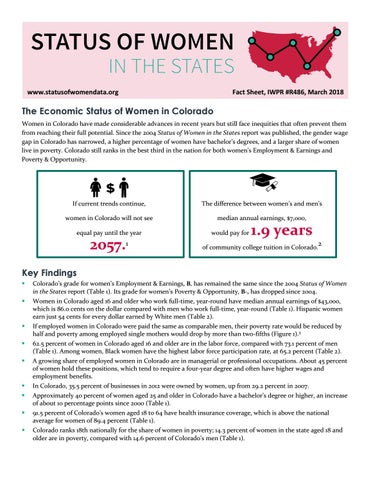
www.statusofwomendata.org
Fact Sheet, IWPR #R486, March 2018
The Economic Status of Women in Colorado Women in Colorado have made considerable advances in recent years but still face inequities that often prevent them from reaching their full potential. Since the 2004 Status of Women in the States report was published, the gender wage gap in Colorado has narrowed, a higher percentage of women have bachelor’s degrees, and a larger share of women live in poverty. Colorado still ranks in the best third in the nation for both women's Employment & Earnings and Poverty & Opportunity.
If current trends continue,
The difference between women’s and men’s
women in Colorado will not see
median annual earnings, $7,000,
equal pay until the year
2057.1
would pay for
1.9 years
2
of community college tuition in Colorado.
Key Findings
Colorado’s grade for women’s Employment & Earnings, B, has remained the same since the 2004 Status of Women in the States report (Table 1). Its grade for women’s Poverty & Opportunity, B-, has dropped since 2004. Women in Colorado aged 16 and older who work full-time, year-round have median annual earnings of $43,000, which is 86.0 cents on the dollar compared with men who work full-time, year-round (Table 1). Hispanic women earn just 54 cents for every dollar earned by White men (Table 2). If employed women in Colorado were paid the same as comparable men, their poverty rate would be reduced by half and poverty among employed single mothers would drop by more than two-fifths (Figure 1).3 62.5 percent of women in Colorado aged 16 and older are in the labor force, compared with 73.1 percent of men (Table 1). Among women, Black women have the highest labor force participation rate, at 65.2 percent (Table 2). A growing share of employed women in Colorado are in managerial or professional occupations. About 45 percent of women hold these positions, which tend to require a four-year degree and often have higher wages and employment benefits. In Colorado, 35.5 percent of businesses in 2012 were owned by women, up from 29.2 percent in 2007. Approximately 40 percent of women aged 25 and older in Colorado have a bachelor’s degree or higher, an increase of about 10 percentage points since 2000 (Table 1). 91.5 percent of Colorado’s women aged 18 to 64 have health insurance coverage, which is above the national average for women of 89.4 percent (Table 1). Colorado ranks 18th nationally for the share of women in poverty; 14.3 percent of women in the state aged 18 and older are in poverty, compared with 14.6 percent of Colorado’s men (Table 1).
Table 1.
Trends and Rankings on Key Indicators of the Economic Status of Women in Colorado
Employment & Earnings Composite Rank Women's Median Annual Earnings for Full-Time, YearRound Workers
2004 Report
New 2016 Data
2016 Rankings and Grades National Rank Grade
Progress since 2004?
$42,958
$43,000
Yes
14
Ratio of Women's to Men's Earnings Women's Labor Force Participation
78.7% 64.4%
86.0% 62.5%
Yes No
14 14
Percent of All Employed Women in Managerial/Professional Occupations
36.4%
44.5%
Yes
11
Percent of Nonelderly Women with Health Insurance Percent of Women with a Bachelor's Degree or Higher
82.4% 30.9%
91.5% 40.4%
Yes Yes
22 3
Percent of Businesses Owned by Women Percent of Women Above Poverty
28.0% 90.4%
35.5% 85.7%
Yes No
22 18
B
Poverty & Opportunity Composite Rank B-
Notes: Except for data on women’s business ownership, which are from the 2012 Survey of Business Owners, data are from the 2016 American Community Survey. Go to https://statusofwomendata.org/explore-the-data/methodology/ for composite methodology. Earnings from the 2004 report are inflation-adjusted to 2016 dollars. All indicators are defined so that a higher rate translates into higher rankings and better letter grades. Calculated by the Institute for Women’s Policy Research.
Figure 1.
Impact of Equal Pay on Working Women’s Poverty in Colorado, 2016: Current Values and Estimates if Working Women Earned the Same as Comparable Men
20%
Current Poverty Rate Poverty Rate After Pay Adjustment
22.0%
25%
12.3%
15%
2.8%
5%
5.6%
10%
0% All Employed Women
Employed Single Mothers
Notes: IWPR calculations based on the Current Population Survey Annual Social and Economic supplements 2014-2016 (for calendar years 20132015). Comparable men and women are of the same age, have the same level of education, work the same number of hours, and have the same urban/rural status. For analysis methodology, see IWPR briefing paper #C455, The Impact of Equal Pay on Poverty and the Economy https:/iwpr.org/wp-content/uploads/2017/04/C455.pdf, by Jessica Milli, Yixuan Huang, Heidi Hartmann, and Jeff Hayes.
Table 2.
Overview of the Economic Status of Women of Color in Colorado, 2016 White
Employment & Earnings Women's Median Annual Earnings for Full-Time, Year-Round Workers Ratio of Women's to White Men's Earnings Women's Labor Force Participation Percent of All Employed Women in Managerial or Professional Occupations
Hispanic
Black
Asian
Native
American
Multiracial
$45,852
$31,455
$37,061
$41,303
$32,943
$37,463
78.0% 62.9%
53.5% 61.0%
63.1% 65.2%
70.3% 59.9%
56.0% 64.6%
63.7% 63.6%
49.2%
27.0%
34.7%
46.4%
34.5%
40.0%
93.5%
77.8%
91.7%
90.8%
84.8%
90.9%
45.4%
16.0%
27.0%
48.0%
22.2%
40.8%
10.0%
20.9%
19.2%
13.4%
21.1%
16.7%
Poverty & Opportunity
Percent of Nonelderly Women with Health Insurance Percent of Women with a Bachelor's Degree or Higher Percent of Women in Poverty
Notes: Median annual earnings use five-year American Community Survey data (2011-2016) downloaded from American Fact Finder. All other indicators are calculated using three years of data (2014-2016) from the American Community Survey. Racial groups are non-Hispanic. For the earnings data, Asian does not include Pacific Islander women and multiracial does not include women of another racial category; for all other indicators, Asian includes Pacific Islander and multiracial includes women of another racial or ethnic category. Calculated by the Institute for Women’s Policy Research.
Figure 2.
Median Annual Earnings for Women and Men in Colorado Working Full-Time, Year-Round, by Race and Ethnicity, 2016 $70,000
$45,060
$33,791
$30,218
$39,396
$58,348
$41,303
$41,258
$37,061
$32,943
$10,000
$36,097
$20,000
$31,455
$30,000
$58,778
$40,000
$45,852
$50,000
$37,463
Women Men
$60,000
$0 White
Hispanic
Black
Asian
Native American
Other Race
Multiracial
Notes: Calculated using three years of data (2014-2016) from the American Community Survey. Racial groups are non-Hispanic. Calculated by the Institute for Women’s Policy Research.
NOTES 1. Linear projection based on rate of progress in closing the gender wage gap since 1959. Projection is based on the ratio of women’s to men’s earnings among full-time, year-round workers aged 16 and older. Calculations are based on the Decennial Censuses from 1960 through 2000, and 2001-2015 American Community Survey microdata. 2. The 2015-16 average undergraduate tuition and required fees for in-state, full-time students in degree-granting public two-year institutions in Colorado is $3,630. 3. Comparable includes women and men of the same age and level of education, who work the same number of hours, and have the same urban/rural status.
About the Institute for Women’s Policy Research The Institute for Women’s Policy Research (IWPR) conducts rigorous research and disseminates its findings to address the needs of women, promote public dialogue, and strengthen families, communities, and societies. The Institute’s research strives to give voice to the needs of women from diverse ethnic and racial backgrounds across the income spectrum and to ensure that their perspectives enter the public debate on ending discrimination and inequality, improving opportunity, and increasing economic security for women and families. The Institute works with policymakers, scholars, and public interest groups to design, execute, and disseminate research and to build a diverse network of individuals and organizations that conduct and use womenoriented policy research. IWPR’s work is supported by foundation grants, government grants and contracts, donations from individuals, and contributions from organizations and corporations. IWPR is a 501(c)(3) taxexempt organization that also works in affiliation with the Program on Gender Analysis in Economics at American University.
About The Status of Women in the States This Fact Sheet is a part of the Institute for Women’s Policy Research’s series on the status of women across the United States, begun in 1996. The Status of Women in the States project uses data from U.S. government and other sources to analyze women’s status in each state and the United States overall, rank and grade states on a set of indicators for six topical areas, and provide additional data on women’s status in states across the nation. The Institute for Women’s Policy Research has published individual reports on the status of women since 1996 in each state and the District of Columbia. The reports have been used to highlight women’s progress and the obstacles they continue to face and to encourage policy and programmatic changes that can improve women’s opportunities.
The Women's Foundation of Colorado The Women’s Foundation of Colorado is the only statewide community foundation dedicated to creating more pathways to prosperity for Colorado women through the power of community, philanthropy, and impact. Since 1987, WFCO has served as an essential partner, resource, voice, and catalyst in strengthening Colorado’s families, communities, and economy through the power of women. In its 30-year history, WFCO has funded more than 30 research reports that identify the systemic barriers that keep women from earning a livable wage, helped pass nearly 40 pieces of legislation that have created economic opportunities, and granted more than $17 million to nonprofits that work with women and families in communities statewide. Visit www.wfco.org for more information.