A project of IWPR
Status of Women
COLORADO SNAPSHOT

Developed in collaboration with The Women’s Foundation of Colorado
Female Population in Colorado by Race/Ethnicity
(2023)
Source: State PAL analysis of data from the American Community Survey (ACS) 1-year estimate for 2023, https://statepolicyactionlab.org/state/colorado/
REPRODUCTIVE JUSTICE AND HEALTH EQUITY
Access to Health Insurance

Women in Colorado were less likely to be uninsured than their national peers—just 8.9% of women aged 19–64 were uninsured between 2019–2023, compared to 10.4% nationally.
In 2023, Medicaid financed more than a third of all births in the state, and roughly 60% of the births for Black (60.8%), Hispanic (58.7%), American Indian and Alaska Native (63.9%), and Native Hawaiian or other Pacific Islander (59.0%) women.
Maternal and Infant Health
There were 50 maternal deaths in Colorado between 2018–2022; this translates to a maternal mortality rate of 16 deaths per 100,000 live births.
In 2022, Colorado had the 13th lowest infant mortality rate in the nation at 4.54 deaths per 1,000 live births. However, there was great variation within the state by race/ethnicity, ranging from the highest infant mortality rate (9.73 deaths per 1,000 live births) among Black infants to the lowest rate (3.39) among white infants.
Black women also experienced the highest rates of preterm (14.2%) and low-birthweight (15.7%) births in 2023.

Nearly 1 in 6 Colorado women relied on Medicaid between 2019–2023.
In this same period, 36.6% of unemployed women aged 19–64 had Medicaid coverage. Coverage rates were highest among unemployed Black (50.5%) and Hispanic (45.6%) women and lowest among unemployed Asian American, Native Hawaiian, and Pacific Islander (21.7%) and white women (31.1%).
Percent of Women Ages 19-64 with Medicaid Coverage by Race/Ethnicity (2019–2023)
Source: State PAL analysis of data from the American Community Survey (ACS) 5-year estimates for 2019–2023, https://statepolicyactionlab.org/state/colorado/
Percent of Preterm and Low-Birthweight Births by Race/Ethnicity (2023)
Source: State PAL analysis of data from the Centers for Disease Control and Prevention WONDER Online Database’s Natality Records from 2016–2023, https://statepolicyactionlab.org/state/colorado/
Note: Preterm is defined as less than 37 completed weeks of gestation as determined by an obstetrician. Low birthweight is defined as less than 2,500 grams (5lbs 8oz).
Title X Family Planning Program
In 2023, Colorado received $4,199,090 in grant funding from the Title X Family Planning Program.
These funds supported the provision of essential family planning and preventive health services to 35,010 female family planning users at 57 health facilities in the state.
Policy
Colorado has some of the most protective reproductive freedom policies in the region.

The state constitution protects the right to abortion, and current law shields patients and providers from out-of-state legal action.
Colorado law also mandates private insurance coverage for and allows state Medicaid funds to cover the cost of abortion care and gender-affirming care. In August 2025, Governor Jared Polis signed SB25B-002, a bill passed by the Colorado legislature during the special session, requiring the use of state funds to reimburse health care providers prohibited from receiving federal Medicaid reimbursements under the “One Big Beautiful Bill,” including Planned Parenthood of the Rocky Mountains.
Colorado policymakers should expand the state’s already strong data privacy protections for patients and providers by strengthening geofencing data privacy protections, which could better protect Coloradans and patients traveling from out of state from the weaponization of health data.
CAREGIVING AND FAMILIES
Single-Headed Households in Poverty
19.0% of households headed by single women lived in poverty between 2019–2023, more than double the proportion of households in poverty headed by single men (9.0%).

More than two-thirds of households headed by single Black and Hispanic mothers with children under 18 were living at or under 200% of the Federal Poverty Threshold between 2019–2023.
Percent of Single-Headed Households Living in Poverty by Gender and Race/Ethnicity, Ages 16+ (2019–2023)

Source: State PAL analysis of data from the American Community Survey (ACS) 5-year estimates for 2019–2023, https://statepolicyactionlab.org/state/colorado/
Notes: Single householders are male or female householders living in family households without a spouse present.
*Sample sizes for American Indian and Alaska Native male-headed households and female-headed households with children under 18 are insufficient to compute the indicator. The sample size for American Indian and Alaska Native female-headed households is insufficient to be representative of the population; these estimates should be interpreted with caution.
Working Parents
More than two-thirds of mothers of children under six (69.8%) were in the Colorado labor force between 2019–2023, but fathers of young children participated at a much higher rate (94.5%).
Child Care Costs
In the same period, employed mothers of children under six were nearly five times as likely (28.4%) to work part-time compared to their male counterparts (6.2%).
In 2023, home-based infant care cost $12,750, and center-based infant care cost $19,573, which is nearly a third of women’s median annual full-time year-round income.
Infant Care Costs as a Share of the Annual Earnings of Colorado Women by Race/Ethnicity, Ages 16+ (2019–2023)
Source: State PAL analysis of data from Child Care Aware of America’s Price of Care report for 2023, https://statepolicyactionlab.org/state/colorado/
Note: Full-time year-round workers are defined by the Bureau of Labor Statistics as those who work 35 or more hours per week for at least 50 weeks per year.
Policy
Colorado law provides critical work benefits that support women—particularly working mothers and families— such as paid sick leave and paid family and medical leave. In 2025, Colorado became the first state in the nation to expand its family and medical leave insurance program to offer additional benefits for parents of infants who require neonatal intensive care.
Colorado law also provides a child tax credit for eligible children under age five for families making up to $87,000 in 2025. The state also offers a family affordability tax credit for families earning up to $96,000 in 2025 with eligible children under age 17. To support families in the event of state budgetary challenges, Colorado policymakers should establish mechanisms to generate local revenue to bolster Colorado’s child tax credit and the family affordability tax credit.

Employment and Earnings
Women working full-time year-round (FTYR) between 2019–2023 made just 80.9 cents for every dollar earned by men.
White women had the highest annual earnings ($62,000 at the median), while Black women ($47,000), American Indian and Alaska Native women ($45,000), and Hispanic women ($43,000) earned the least of any racial or ethnic group in the state.
FTYR women workers experienced a 25% pay gap in managerial and professional jobs despite holding a larger proportion of these roles (53.3%) than their male counterparts (45.8%) in 2023.
Colorado had the 6th highest female labor force participation rate in the nation in 2023 at 64.4%.
Women in Retirement
17.5% of Colorado women were aged 65+ in 2023.
In the same year, women aged 62+ had just 65% of the median annual retirement income earned by men and only 68.6% of the median annual Social Security benefit that men their age received.
10% of women workers were self-employed in Colorado between 2019–2023, ranking the state 7th in the nation for women’s self-employment. Within the state, however, only 4.4% of Black women workers and 7.6% of Hispanic women workers were self-employed, while 11.1% of white women workers were.
While 4.5% of both women and men were unemployed in Colorado between 2019–2023, greater proportions of women of color—ranging from Asian American, Native Hawaiian, and Pacific Islander women at 4.0% to Black women at 7.8%—were unemployed compared to white women (3.9%).
Between 2019–2023, women of color aged 62+ made roughly $10,000–$13,000 less in median annual retirement income than their white male counterparts, who received $24,782.
Women’s Median Annual Retirement Income by Race/Ethnicity (2019–2023)
White men’s median annual retirement income
Source: State PAL analysis of data from the American Community Survey (ACS) 5-year estimates for 2019–2023, https://statepolicyactionlab.org/state/colorado/
Note: Sample size for American Indian and Alaska Native is insufficient to compute the indicator.
Women in Poverty
A greater proportion of women were living in poverty compared to men in 2023: 8.2% of women aged 18–64 vs. 6.7% of men in the same age group, and 10.3% of women 65+ vs. 7.4% of men in the same age group.
Colorado’s Equal Pay for Equal Work Act, which took effect in 2021, secures protections for workers, including salary transparency, workplace antidiscrimination, and a ban on salary history inquiries. Colorado policymakers could strengthen these protections with provisions to assess if, and address how, artificial intelligence in the workplace can be disproportionately discriminatory and harmful to women—particularly women of color.
Colorado is one of five states that has strengthened protections against age discrimination in the workplace by prohibiting employers from asking job applicants for age-related information. State policymakers could advance additional protections for older women in the workplace, such as promoting competency- and skill-based hiring standards and eliminating maximum hiring ages and mandatory retirement ages.
EDUCATION AND CAREER ADVANCEMENT
Women’s Educational Attainment
While roughly the same proportion of women over 25 in Colorado had completed some college or an associate’s degree (28.5%) or a bachelor’s degree (28.3%) as their highest level of education between 2019–2023, completion varied substantially across race and ethnicity. American Indian and Alaska Native, Black, and Hispanic women were considerably more likely to have completed some college or an associate’s degree compared to a bachelor’s degree. The reverse was true for Asian American, Native Hawaiian, and Pacific Islander, white, and multiracial women.
Education and the Wage Gap
Across all levels of education, women earned less than men in Colorado in 2023. For example, women over 25 working full-time year-round (FTYR) with a bachelor’s degree earned a median annual income of $70,000, whereas men over 25 with the same degree level earned $100,000.
This gender wage gap is compounded by the racial wage gap. Among women bachelor’s degree holders over 25, white women working FTYR earned nearly $19,000 more per year than Black women, and $12,000 more than Hispanic women between 2019–2023.

Percent of Women Ages 25+ with Some College/Associate’s Degree or Bachelor’s Degree as Their Highest Level of Education by Race/Ethnicity (2019–2023)
Source: State PAL analysis of data from the American Community Survey (ACS) 5-year estimates for 2019–2023, https://statepolicyactionlab.org/state/colorado/
Median Annual Earnings by Educational Attainment for FTYR Women Workers Ages 25+ by Race/Ethnicity (2019–2023)
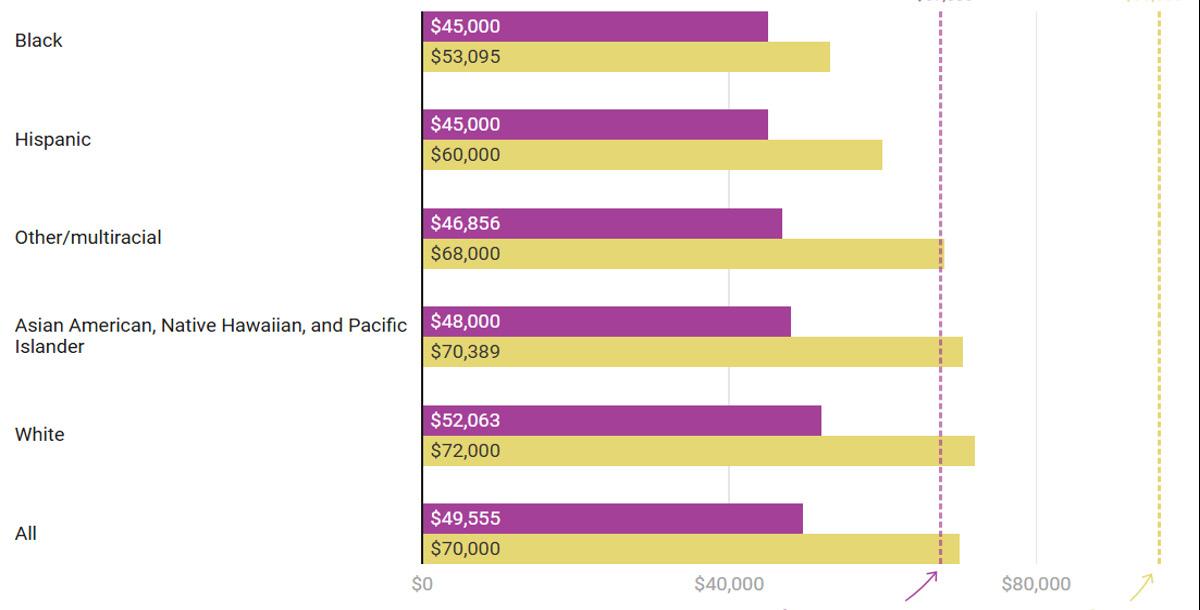
Median earnings of white men with some college or associate’s degree
Median earning of white men with bachelor’s degree
Source: State PAL analysis of data from the American Community Survey (ACS) 5-year estimates for 2019–2023, https:// statepolicyactionlab.org/state/colorado/.
Note: Sample sizes for American Indian and Alaska Native are insufficient to compute the indicator.
Policy
Colorado has several state policies in place, such as tuition-free community college and protections for student loan borrowers, that help ease the financial burden of tuition and promote economic security among women, particularly women of color.
Compounding gender and racial wage gaps across every level of educational attainment exacerbates the burden of financing higher education and paying off student debt for women, particularly women of color. Policymakers in Colorado should increase investment in community colleges to further support connecting women of color to workforce opportunities that create key career pathways and wage growth. For more state-level data and legislative developments related to the status of women, visit IWPR’s State Policy Action Lab (State PAL) at statepolicyactionlab.org.