Rural Route AprMay 2026

Page 1


Rural

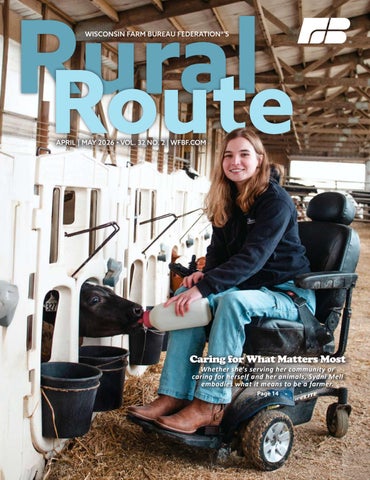
Caring for What Matters Most

Whether she's serving her community or caring for herself and her animals, Sydni Mell embodies what it means to be a farmer.

Page 14

UNLOCK YOUR CARBON POTENTIAL WITH ENDURE CARBON

Endure Carbon helps you maximize your carbon assets, by giving you access to three carbon markets via a single data platform. Earn potential premiums for adopting approved sustainable practices and delivering grain to eligible facilities within designated counties.

Our goal? To empower growers with continuous improvement, tracking environmental and operational metrics that support the long-term adoption of regenerative agriculture. Choose from Land -Based Carbon Offset, Scope 3 Carbon Inset, Biofuels Inset, or Enhanced Rock Weathering markets—all backed by the seamless support of FS and our partner, Indigo Ag.

Talk to your FS Crop Specialist today.

A Unified Voice for Agriculture

As the leading voice for Wisconsin agriculture, WFBF ensures that farmers’ concerns are heard and addressed, allowing you to focus on what you do best — feeding, clothing and fueling our communities.

Shaping Policy

Wisconsin Farm Bureau Federation champions policies that protect farmers’ rights, making sure that agriculture remains a thriving industry through proactive engagement at all levels of government.

Developing Members

Members gain access to leadership development, business resources and networking opportunities designed to help farmers expand their businesses and influence.

Engaging Consumers

Through outreach and education, WFBF bridges the gap between farmers and consumers, promoting a deeper understanding of modern agriculture and its role in everyday life.

FFA FARM FORUM

More than 300 students attend annual event in Rothschild.

CULTIVATE & CONNECT

More than 60 Farm Bureau members connect at educational event in Neenah.

INSTITUTE D.C. TRIP

Leadership Institute graduates advocate for agriculture in the nation's Capital.

WHAT MATTERS MOST

Sydni Mell embodies what it means to be a farmer.

MEMBER BENEFITS

Benefits that support farm and family care plus a new opportunity for savings.

MENTAL HEALTH

Small actions to support your mental health and the wellbeing of others.

VOICES

Hear from Duvall, Olson, Mugnaini and Orge.

GATHER RECIPES

Recipes inspired by flavors of the season to please a crowd.

GRASSROOTS

Activities and projects happening locally across the 61 county Farm Bureaus.

AG IN THE CLASSROOM

Volunteers cultivate the next generation of Ag leaders, consumers and voters.

through auction donations.

Learn about crop insurance to protect your farm.

I’veread a few articles lately stating that as a society we are caring less. That made me stop and think. Are we caring less? I think I’m a bit torn. In some ways, I think we care more than ever as a society, but then in some ways, I do think we care less. It’s an interesting topic and makes you stop and wonder.

As a mom in the midst of a very busy season of life, a full-time employee, a part-time employee of our family’s farm and a side-hustler of many, many things, I am always walking the line of burnout. Like many of you, I am constantly choosing where my time and energy go. But I do my best to show up and give my best to whatever I can. Not everything can have my full attention, but it’s not for a lack of caring. I think when it comes to the concept of caring, we need to consider what the right amount of caring is. Maybe that’s the conversation and the question to ask. Sometimes we do give too much.

In general, people in the agricultural community are givers. We give our time, talents and money to more than one place – our family, our farms, organizations and our communities.

And it’s easy to get stretched thin.

But at the same front our rural communities are relying on that care and will always show up for each other. If we don’t care about the future 4-H and FFA members, the county fair, the dairy breakfast or the other million local events, who is going to?

Farmers care about their land, their animals, their communities and each other. Caring is the center of our lives and most likely part of our DNA.

As you flip through the pages of Rural Route, I know you are going to see that theme throughout this issue. I am especially excited for our feature story about Syndi Mell, a young woman who was forced to focus on caring for herself after a farm accident. What an inspiring lesson we all can learn from: you have to care for yourself first, but that doesn’t stop you from caring for your farm or others.

We have so many great recaps from this busy spring event season. Farm Bureau members were out and about at FFA Farm Forum in Rothschild, Ag Day at the Capitol in Madison and Cultivate and Connect in Neenah.

Our Leadership Institute graduates headed to Washington, D.C. in March amid a snowstorm to advocate for agriculture. If that’s not caring, I don’t know what is!

If you’ve given your time or attention lately to Farm Bureau or another agricultural cause, I want to say thank you. In our society, fewer and fewer people are stepping up to show they care, but not you. You know that caring is what will carry our next generations and the future of agriculture.

As always, thanks for reading,

Amy Eckelberg

Rural Route Editor

Wisconsin Farm Bureau Federation

Address of Publication

Wisconsin Farm Bureau Federation PO Box 5550 1241 John Q. Hammons Dr. Madison, WI 53705-0550

Postmaster: Send address changes to Wisconsin Farm Bureau Federation PO Box 5550 Madison, WI 53705-0550

Contact Information

608.836.5575

800.261.FARM (3276) wfbf.com info@wfbf.com

WFBF Board of Directors

Brad Olson, Frederic (President) Joe Bragger, Independence (Vice President) Jim Renn, Hartland Arch Morton Jr., Janesville

Robert Nigh, Viroqua

Pete Badtke, Ripon Dan Meyer, Kiel Brian Preder, Weyauwega Kim Bremmer, Loyal

Steve Mueller, New Richmond (Promotion and Engagement Committee Chair) Ashley Lisowe, Calumet (Young Farmer and Agriculturist Committee Chair)

Wisconsin Farm Bureau Federation’s Rural Route (ISSN 1082-1368) (USPS 39940), the official publication of the Wisconsin Farm Bureau Federation, is published six times per year in February|March, April|May, June|July, August|September, October|November and December|January. Subscription of $5 is included in Farm Bureau dues. Periodical postage is paid at Madison, Wisconsin. All rights reserved. No portion of this magazine may be reproduced in whole or part without written consent.

For advertising rates and information: National accounts contact Casey McNeal at 800.798.2691 ext. 334 or casey@iafalls.com. For general inquiries, contact Amy Eckelberg at 608.828.5706 or aeckelberg@wfbf.com.

Farmers Need Certainty: Pass the Farm Bill

When it comes to farming, luck is not a strategy. Producing food for our country requires planning, risk management and strong public policy that supports a stable food system.

That is why Congress must finish work on a new farm bill.

Wisconsin agriculture depends heavily on strong commodity and dairy policy. For our state’s farm families — especially dairy farmers — the Farm Bill contains several provisions that directly impact the stability of farms and rural communities.

One important provision extends the Dairy Forward Pricing Program. Forward pricing allows dairy farmers to lock in milk prices and manage the volatility that often comes with global dairy markets. By allowing farmers to secure prices ahead of time, forward pricing helps reduce exposure to unpredictable market swings.

Risk management tools like this help farmers manage challenges through the marketplace rather than relying on government payments. For Wisconsin dairy farmers, that means greater stability and predictability when planning for the future.

The Farm Bill also strengthens domestic markets through a Buy American requirement for school meals. The proposal requires school food authorities to purchase at least 95 percent domestically produced foods within designated categories.

For Wisconsin dairy farmers, this matters. Dairy is a cornerstone of our state’s economy, and school milk programs represent an important and consistent market. Ensuring that milk and other foods served in schools come from Wisconsin farms reinforces domestic demand without creating new subsidy programs.

Another key provision focuses on strengthening the livestock supply chain through grants for new, mobile and expanded meat processing facilities. These grants support both new processors and the expansion of existing facilities, while also helping producers invest in additional processing capacity.

This policy is about improving market access, not creating new payment programs. By expanding infrastructure and workforce capacity in meat processing, farmers will have more options when marketing livestock and greater competition within the packing sector.

Demand for local processing has grown significantly in recent years, and Wisconsin farmers need additional capacity to meet that demand.

Congress has already made progress through the One Big Beautiful Bill Act reconciliation package, which included investments in several farm programs supported by the Wisconsin Farm Bureau. However, additional work remains before the current Farm Bill expires on September 30.

Several dairy priorities are still outstanding. These include allowing greater flexibility in cooperative block voting during Federal Milk Marketing Order referendums so farmers can vote independently and confidentially if they choose. Another priority is eliminating provisions that could eliminate an entire Federal Milk Marketing Order following a “no” vote in a referendum. In addition, dairy risk management programs must better account for negative Producer Price Differentials so farmers actually receive the margin protection they insure.

Beyond dairy policy, Wisconsin Farm Bureau is urging Congress to maintain strong funding for federal conservation programs that protect soil and water while keeping farmland productive. Continued support for the Good Neighbor Authority program will also help improve forest management and rural land stewardship.

Trade remains another critical priority. Wisconsin agriculture depends on export markets, and the Farm Bill should continue to strengthen programs that develop and expand international markets for Wisconsin farm products.

Finally, Congress must ensure that food products produced safely and legally in one state can continue to move freely across state lines. Farmers rely on the interstate commerce protections in the Constitution to prevent conflicting state regulations from disrupting national food markets.

These policies may seem technical, but they have real impacts on farmers, rural communities and consumers.

Farmers cannot control the weather, global markets or geopolitical disruptions. But Congress can provide the certainty farmers need to keep producing food for our country.

We need more certainty. Congress must pass the Farm Bill.

Legislative Session Comes to a Close

The Wisconsin State Legislature has concluded its regular work for the session, though the possibility of a special session remains. Lawmakers passed numerous bills impacting Wisconsin farmers and rural communities, many of which were priorities for Wisconsin Farm Bureau Federation. Throughout the session, WFBF worked closely with legislators and partners in the Wisconsin Ag Coalition to move these measures forward and will continue working with Gov. Tony Evers to secure final passage and deliver meaningful results for Wisconsin agriculture.

As of this writing, the following bills have been sent to Gov. Evers for signature or veto:

• Senate Bill (SB) 7 passed the legislature and would have established a strict ban on land ownership by citizens or businesses from countries designated as foreign adversaries. Unfortunately, Governor Evers vetoed this legislation, halting those protections from being put into law and leaving Wisconsin farmland and our food supply chain vulnerable to foreign adversary control.

• Assembly Bill (AB) 130 and 131 provide access to $125 million in cleanup and drinking water grants for communities impacted by PFAS contamination and creates liability protections for innocent farmers and landowners who unknowingly accepted materials contaminated with PFAS.

• SB 474 allows soy-based firefighting foam to qualify for Department of Natural Resources fire suppression grants, expanding market opportunities for Wisconsin soybean growers and providing a PFAS-free product to firefighters.

• SB 501 creates a veterinary loan repayment program for new veterinarians who commit to large animal practices in rural communities, helping address ongoing workforce shortages.

• AB 554 requires clear labeling of lab-grown meat products to ensure consumer transparency and fair competition for Wisconsin livestock farmers. This bill was recently vetoed by Governor Evers. It is

disappointing that farmers and consumers will not have clear labeling requirements in law that differentiate natural products raised by farmers from these labgrown meat products.

• SB 622 keeps Department of Agriculture, Trade and Consumer Protection program fees flat after proposed increases that would have significantly raised costs for farmers, truckers and livestock dealers.

• AB 679 creates new permits for transporting grain, feed and fertilizer on six-axle, 91,000-pound trucks to improve efficiency and reduce transportation costs.

• SB 783 provides commercial driver’s license (CDL) training grants to help Wisconsin businesses offset the educational costs of employee training.

• AB 956 creates an exemption for certain agricultural warehouses from sprinkler system requirements to prevent potential pollution of surface and groundwater.

Despite strong advocacy from Farm Bureau and other agricultural organizations, SB 323, which would have created a Dairy Cattle Innovation Loan Program to provide no-interest loans for farm modernization, and AB 222 , creating a production tax credit for Sustainable Aviation Fuel (SAF), were not voted on. Creating the loan program to access the $20 million allocated in the state budget for dairy innovation and a tax credit to help attract SAF processors to Wisconsin will remain top priorities when the Legislature reconvenes in January.

Wisconsin Farm Bureau will continue working with policymakers to ensure these proposals become law and to advance policies that strengthen Wisconsin’s farm families and rural economy.

Policy moves fast. Stay ready.

WFBF’s policy webpages break down current local, state and national issues facing agriculture. See the latest at wfbf.com/policy.

Engage in Local Affairs to Show You Care

An expression my high school chemistry teacher used to say was, “you don’t want to be a frog on a log waiting for flies to come by.”

This was just one of the many funny expressions he shared that made you think about a more serious point. What he was trying to say was that it was better to be proactive than to wait for something to come along. That phrase can hold true to anything in life, especially involvement in government.

While state and national government issues tend to land the attention of the news, it is the decisions that are made by a county or town board that will have the most immediate impact on your daily life. These decisions could change the way you farm, support your family and interact with your neighbors. If you are caught standing on the sidelines while these conversations are taking place, there is a good chance the outcome of a vote affecting agriculture will not be in your favor.

So how do you become engaged in local affairs?

Participating in local government is important if you want to protect your rural way of life. There are three key points to starting your involvement in local affairs.

• Build relationships with your elected officials

You have to know who your elected officials are. More importantly, you need to have a relationship with them. It’s not good enough for them to just know your name. Knowing who you are, where you live, what you do for work and how a decision could change your life can all make the personal impact of whatever decision they are preparing to make carry more weight as they cast a vote. Being local government, there is a greater chance that they will see you driving down the road or at a local store, where you can stop and have a conversation with them about the decisions they make. All of this can be the difference between a yes or no vote for agriculture.

One easy way to start that relationship is by making a call or sending an email to your official. Contact information for elected officials is public information that can be found on the local government website or in a local paper. You can start by introducing yourself and ask if you can meet in person for a deeper conversation on the issues important to you.

• Know what is on the agenda for local meetings

Knowledge is power. If you know what is going to be discussed at an upcoming meeting, that will give you time to do your research on how a vote could affect you. This gives you a chance to gather personal stories and look up statistics or other information that you can use to persuade a board. If an issue is so serious that you need reinforcements, you have the time to reach out to your county Farm Bureau and Wisconsin Farm Bureau staff for the extra support.

Many townships and all counties have websites where you can find meeting agendas and minutes from past meetings. If a township does not have a website, it will have meeting information in a local newspaper. If you cannot find what you are looking for, you can contact your representative or clerk and ask if they can share it with you.

• Be prepared to participate if important issues arise

Knowing what is going on isn’t enough. You need to be able to stand up for what you believe in. When you know that an agenda item will have a direct impact on you and your neighbors, you have a responsibility to speak up and share how it will affect your way of life. If you already have a relationship with your elected official, this could be as easy as sending a quick text or call to share your concerns. If you both have the time, you could try connecting in person before the meeting.

County and town board meetings have time for residents to speak about action items on the agenda. While specifics differ from location to location, all meetings allow for public comments to be submitted ahead of time if you can’t attend in person.

Now you know what to do, why should you care?

At the end of the day, any issue that is being voted on by your town or county board will have a direct impact on you. It will affect you more than anyone living in Madison or a different part of the state. One vote could change your whole life.

What I have witnessed as I have traveled across the state to support Farm Bureau members addressing local issues is a harsh reality. Our elected officials, at all levels of government, are not as connected to agriculture as they once were. That said, they don’t know unless someone is telling them what the potential consequences on agriculture are. That is why you need to pay attention and be involved. You are on the frontlines. We need your help to ensure that we can continue to preserve and promote the advancement of agriculture for generations to come.

Remember, there is no one who can better advocate for the issues that will affect you more than you.

More Than 300 Attend Farm Bureau's FFA Farm Forum

More than 300 FFA members, advisors and guests from across Wisconsin attended Wisconsin Farm Bureau’s FFA Farm Forum in Rothschild on Feb. 11.

"FFA Farm Forum is a place for learning and leadership," said WFBF President Brad Olson. "We appreciate FFA members' vision for the future of agriculture and are proud to present an event that supports their leadership paths."

The keynote speaker was Mark Holley, Chief Meteorologist at WSAW. Holley shared how his passion for science, technology and problem-solving turned into a career that has a real impact on agriculture and everyday life.

“I became a meteorologist to communicate with the people who need to know when to bale their hay and plant their crops,” shared Holley. “In my career, it is important to be a good science communicator because the weather impacts everyone.”

During the one-day event, FFA members attended career-based workshops including: 'From Farm to Finance’ with Alison Kepner from Compeer Financial, ‘A Career in Agricultural Engineering’ with Ian Hansen from MSA Professional Services, Inc., ‘Discover Food Science’ with Grace Lewis from UWRiver Falls, ‘Careers in Marketing and Insurance’ with Jenny Martin from Rural Mutual Insurance Company, ‘Career Paths within Agricultural Coops’ with Joe Sikora from Insight FS and ‘Understanding Animal Behavior’ with Beth McIlquham from UW-Madison Extension.

"FFA Farm Forum is a valuable collaboration between Wisconsin Farm Bureau and Wisconsin FFA, fostering leadership development and career exploration in agriculture," said WFBF Director of Young Leader Programs Melissa Jacobson. "We’re proud to support and inspire the next generation of agricultural leaders."

Farm Bureau members Jenny Martin (Rural Mutual Insurance Company), Alison Kepner (Compeer Financial) and Joe Sikora (Insight FS) participated in a career panel moderated by Mark Holley (WSAW Chief Meteorologist).

Students sampled milk and cheese during a food science workshop.

FFA members participated in career exploration workshops during FFA Farm Forum.

FFA members played BINGO to network and make connections with other students.

Seymour FFA members attended FFA Farm Forum.

More Than 60 Attend Farm Bureau's Annual Conference

Wisconsin Farm Bureau’s Promotion and Engagement Committee hosted a one-day Cultivate & Connect Conference on February 21 at the Bridgewood Conference Center in Neenah.

Cultivate & Connect is the Promotion and Engagement Committee’s initiative to inspire, engage and empower Farm Bureau members and agriculture leaders by providing innovative learning experiences, networking opportunities and actionable insights for advancing Wisconsin’s agriculture industry.

More than 60 Farm Bureau members, collegiate Farm Bureau members, committee members and agriculturists attended the event.

“I wanted to come to Cultivate & Connect this year because it is my first year being my county’s Promotion and Engagement chair,” shared Alana Biermeier from Juneau County Farm Bureau. “I love the idea of being able to connect and learn more about the resources we have through Farm Bureau and take home new ideas to implement in our own Promotion and Engagement program.”

The event began with a pre-conference activity on Friday evening at Fox Valley Technical College. Attendees got a behind-the-scenes look at FVTC’s culinary program with Chef Jeff Igel.

The Saturday conference began with a keynote presentation from Marlene Eick from Ohio Farm Bureau. Attendees learned how they can expand their relationships to build authentic influence and leadership. Eick challenged attendees to consider how they are showing up for the audience they are trying to reach.

“If we want to build influence, we need to keep showing up,” shared Eick. “Let them know they can trust you and you are a credible resource.”

Annaliese Wegner, a dairy farmer and digital creator from Wisconsin, delivered the afternoon keynote address. Wegner inspired attendees to be unapologetically themselves when they are sharing their unique story.

"You will never be great at anything until you give yourself the opportunity to start something,” shared Wegner. “Your story matters and you have a unique perspective to share.”

WFBF’s Promotion and Engagement Committee hosted two interactive workshops to inspire fresh approaches to local promotion and engagement efforts. “Explore, Collaborate, Cultivate!” featured learning lab stations with hands-on activities to spark ideas and share practical tips. During the final workshop, “Ready, Set, Connect!”, attendees were encouraged to hone into their unique skillsets and apply those skills to engage with consumers.

“Attendees were able to build confidence, sharpen their messages and left with practical tools they can use right away,” shared WFBF Promotion and Engagement Chair Steve Mueller. “Together, we can cultivate meaningful connections and turn every day interactions into opportunities to share agriculture’s story.”

Save the date

for the next Cultivate & Connect Conference on February 20, 2027 in Rothschild, Wisconsin.

Juneau County Farm Bureau members Alana Biermeier and Elizabeth Kent at Cultivate & Connect.

Wisconsin Farm Bureau's Promotion and Engagement Chair Steve Mueller welcomed attendees to Cultivate & Connect on February 21.

WFBF's P&E Committee collected donations for the Community Clothes Closet during Cultivate & Connect.

Marlene Eick from Ohio Farm Bureau delivered the opening keynote address.

Attendees participated in four learning lab stations to spark ideas and share practical tips to strengthen their own consumer engagement efforts.

Modern-Day Farm Chick Annaliese Wegner delivered the afternoon keynote address.

Farm Bureau Members Advocate for Agriculture in Washington, D.C.

Nearly 20 Farm Bureau members and staff were in Washington, D.C. March 16-20 to advocate for Wisconsin farmers. The trip marked the completion of the WFBF Leadership Institute, a year-long leadership training program available to Wisconsin Farm Bureau members.

Farm Bureau leaders met Wisconsin’s congressional delegation in Washington, D.C. on March 17 and 18. The issues discussed were trade, immigration reform, yearround E-15 and the farm bill.

“This trip was important because it gave us the opportunity to speak with our senators and representatives on policies that support Wisconsin farmers,” said Wood County Farm Bureau member Jason Behrend.

The group heard from experts at American Farm Bureau, several officials from the United States Department of Agriculture and visited the European Union embassy.

Additionally, Farm Bureau members were invited to an exclusive meeting at the White House where they heard updates from ranking officials with the Environmental Protection Agency, National Security Council and the Domestic Policy Council.

“Taking these opportunities allows us to share our stories and experiences to help improve our lives and businesses back home,” said Juneau County Farm Bureau member Alana Biermeier. “This experience has opened my eyes to how my voice can make an impact and how collectively we can support our agricultural community.”

In addition to meeting with Wisconsin’s congressional delegation, Farm Bureau members also toured George Washington’s Mount Vernon, the United States Capitol and enjoyed a night tour of the national monuments.

Leadership Institute graduates who participated in the D.C trip included Alana Biermeier, Juneau County; Allison Gorr, Green County; Amy VanderMark, Juneau County; Ann Brost, Walworth County; Katie Koeppel, Manitowoc County; Mary Fronek, Langlade County; Casey and Collin Weltzien, Buffalo County; David Foerster, Sheboygan County; Eric Harmann, Door County; Grant Buwalda, Fond du Lac County; Jason Behrend, Wood County; and Joe Schlies, Brown County. Accompanying the graduates in D.C. were WFBF board members Jim Renn, District 1; Arch Morton, Jr., District 2; and Brian Preder, District 7.

Applications for Wisconsin Farm Bureau's Leadership Institute are open through June 15 at wfbf.com/ programs/leadership-development/leadership-institute/

Institute graduates joined state Farm Bureau delegations from across the Midwest for briefings at the United States Department of Agriculture on March 18.

Door County Farm Bureau member Eric Harmann advocated for sustainable aviation fuel legislation while meeting with Sen. Tammy Baldwin.
Manitowoc County member Katie Koeppel introduced USDA Chief Economist Dr. Justin Benevidez to members visiting the USDA.
(from left) Amy VanderMark, Allison Gorr, Joe Schlies, Alana Biermeier and Brian Preder were among the Farm Bureau members invited for an exclusive briefing opportunity at the White House on March 17.
WFBF Leadership Institute graduates and board members after meeting with Senators Ron Johnson and Tammy Baldwin.
Brown County member Joe Schlies advocated for the passage of the Farm Bill while meeting with Rep. Pocan on March 17.

Caring for What Matters Most

There are many ways to describe farmers. Dedicated. Resilient. Innovative.

Or maybe stubborn, gruff and fiercely independent.

However you may describe the farmer in your life, many of these traits stem from something that is at the heart of all they do: the simple act of caring.

Look at your school board or volunteers at your local food pantry, and chances are you’ll find a farmer there. Caring for land, animals and neighbors is second nature for those in the agricultural community.

Someone who exemplifies care in all aspects is Sydni Mell.

Sydni works at her family’s registered Holstein farm, Mell-Wood. She is a proud University of Wisconsin-Madison graduate with a degree in dairy science, an alumna of the Association of Women in Agriculture and a showmanship champion.

She is also a farm accident survivor. During Sydni’s freshman year of college, a fall into an empty silage bunker caused a spinal cord and traumatic brain injury.

Whether she’s caring for herself, working on her family’s farm or serving her community, Sydni embodies what it means to be a farmer.

Caring for Yourself

Like many farm families, the Mell family is used to putting the needs of the farm first. But in recent years, Sydni has been learning to balance the demands of life with her own needs.

“I

have to remind myself, you have to take care of yourself,” Sydni said. “It’s been really hard for me, but I’m getting better at it.”

For Sydni, that means allowing herself to slow down and recognize what her body needs in the moment.

“I take time out of the day for a break. I can’t push my body that hard,” Sydni said. “I do physical therapy at home because I need to care for my body. I need to keep my muscle tone and bone density so that’s always a reminder to myself that I need to slow down."

Along with listening to her physical needs, Sydni also takes time for her mental well-being. She meets with friends each week, reads avidly and finds joy in spending time with animals.

Story by Kylie Ver Kuilen | Photos by Raegan Statler and Kylie Ver Kuilen

The Mell family has been home to a variety of animals: horses, goats, rabbits, pigeons, parakeets and even chinchillas. But dogs and calves have always held a special place in Sydni’s heart, especially as she has navigated life since the accident.

“I like that dogs don’t look at you any differently. Maybe the cows do,” she said with a chuckle. “But the calves don’t.”

Being able to return to caring for her dogs and calves has aided Sydni’s recovery. The routines and connections they provide are a reminder that taking time for the things that matter most can also be a powerful way of caring for yourself.

Caring for the Farm

Growing up on a farm, every day looks different and when the nearest help may be miles away, creativity and problem-solving become essential skills.

For Sydni, those lessons shaped how she approached both life and agriculture. As she began thinking about her future, it was hard to imagine a path that didn’t include the farm.

“Growing up on the farm, I thought ‘Is this something that I want to do?’” she said. “And I think once you do it every day, you just get a love for it, and I never really fell out of love for it.”

That passion eventually led her to UW-Madison, where she studied dairy science. The knowledge she gained in the classroom, combined with the skills she developed on the farm, helped shape the way Sydni approaches challenges at Mell-Wood today.

After the accident, that mindset became even more important. Years of learning to adapt and think through problems helped Sydni and her family navigate unexpected challenges and find new ways to keep the farm running.

Together, the Mell family set out to make their calf room more accessible so Sydni could continue caring for the animals she loves. The changes, including ramps, garage doors that keep the space warmer in the winter, ergonomic bucket handles and a spacious layout, have made daily chores easier for everyone on the farm.

For Sydni, caring for the farm has always meant finding ways to keep moving forward, no matter what challenges arise.

Caring for Your Community

Showing up for her community has always been important to Sydni. While it might look different today than it once did, she continues to find meaningful ways to be there for the people in her life.

“If I can’t do the same things I used to do physically for people, I’m finding other ways,” Sydni said. “I’m a big acts of service person.”

One of the ways she has embraced that mindset recently is through baking. Sydni has discovered a love for making bread and cookies and sharing with friends and family.

“I’m finding new ways to show up for them or bring them joy in other ways,” she said. “That’s been really nice for my brain.”

Caring for others isn’t about doing things exactly the way they’ve always been done.

“The mindset of the people around me has helped. They tell me, ‘We’re going to try to find a different way around this,’” Sydni said.

This is a message that Sydni has taken to heart as she continues to honor the values she learned growing up on the farm. Sydni reflects what it truly means to be a farmer: someone who keeps showing up to care for what matters most.

Sydni and her brother, Sam, bring their own passions and strengths to help their family farm succeed.

Caring for the Land: Understanding Phosphorus in Wisconsin Soils

Wisconsin is home to rich natural landscapes made up of freshwater sources, including streams, rivers and lakes. Both rural and urban communities depend on access to clean water for daily use and recreation. Farming with a thoughtful understanding of the relationship between agriculture and water has been shown to improve and protect Wisconsin’s water resources. For farmers, balancing environmental protection with field productivity is a complex challenge that continues to drive innovation and learning opportunities.

UW-Madison Extension has deep-rooted experience in exploring complex challenges, like the connection between agriculture and water quality, through on-farm research alongside farmers. Extension’s Agriculture Water Quality and Discovery Farms Programs provide opportunities for farmers and researchers to work side-by-side to study and test agricultural practices that can improve soil health and water quality.

Understanding Our Impact on Water Quality

Phosphorus, an essential nutrient for crop growth, is one of the leading causes of surface water quality pollution. In Wisconsin, soils can accumulate phosphorus from manure and fertilizer application. When it runs off fields and enters lakes and rivers, it degrades water quality and fuels the growth of harmful algal blooms.

“The phosphorus issue is important because it really controls lake water quality, especially when we think about algal blooms. Phosphorus is what we call the limiting nutrient for algae, so these blooms happen primarily because of excess phosphorus. When people are out on the lake and see that scummy water, that’s predominantly due to phosphorus,” Steven Hall, UWMadison Assistant Professor and Extension Specialist in Plant and Agroecosystems Sciences, says.

Working Together for Practical Change

The Extension Agriculture Water Quality and Discovery Farms Program launched an on-farm soil sampling effort to better understand how phosphorus is distributed through the soil in different farming systems. Program staff sampled over 220 fields from more than 80 farmers across 30 counties.

Results from the sampling efforts indicated that most of the fields are sufficient in phosphorus, so there is a low likelihood (<2% chance) of yield response by adding additional phosphorus through manure or fertilizer. In addition, 75% of fields testing >80 parts per million in the near surface samples were using a combination of synthetic fertilizers and manure.

Farmers and Agriculture Water Quality Program staff discussed the results and worked together to consider the options in order to reduce the phosphorus vulnerable to water movement in the ‘zone of interaction’ near the surface.

Paletta, Extension Ag Water Quality Outreach Specialist, is taking soil samples in eastern Wisconsin to measure phosphorus content in the soil.

One study participant is an agronomist who works with several farmers in his region. He noted that, “As an agronomist, this confirms my thoughts and provides me with more evidence that the first thing we should be doing on a lot of farms is slashing phosphorus inputs. We just don’t need them when we have this much phosphorus in the soil.”

Another farmer participant said, “I am very surprised and disappointed to see the higher levels of P in certain fields. That got me into looking at our nutrient management plan.”

The project has already made an environmental impact at the individual farm level, with farmers asking their co-ops to remove or reduce phosphorus in their fertilizer, adjusting manure applications on certain fields and identifying the fields with the greatest water-quality risk.

For 25 years, Discovery Farms has studied phosphorus loss using edge-of-field research and demonstrated that the first step in controlling phosphorus loss is controlling soil loss. Well-known conservation practices like cover cropping and no-till manage phosphorus bound to soil particles, but dissolved phosphorus moves with water even when no soil is lost. Dissolved phosphorus losses seem to be influenced by the timing of nutrient applications and the concentration of phosphorus in the upper two inches and the upper six inches of soil.

A farmer participant in Eastern Wisconsin stated, “In fields where I see much higher phosphorus levels, and by that I mean anything above 80 parts per million, based on the report I received, that’s excessively high. So, I will simply adjust the fertilizer mixes I get from the co-op. I’ll just take out the phosphorus, and I can do that. I confirmed with them that they can mix my fertilizer that way.”

Extension Ag Water Quality Program Photo
Laura

The Agriculture Water Quality Program staff will continue analyzing new soil test data and field history surveys in 2026, especially looking for trends related to manure and fertilizer use. “For farmers unsure about reducing phosphorus in starter fertilizer, there are options to conduct simple yield and starter trials on their own fields to see what changes they can make without sacrificing yield,” explained Sheri Schwert, Extension Ag Water Quality Outreach Specialist.

Phosphorus accumulation has built up over decades, and reducing surface concentrations will take time. But by working together, Wisconsin farmers and Extension Specialists are making steady progress, moving from controlling soil loss to fine-tuning nutrient management that protects both productivity and water quality for the long term.

Learn More

To learn more about this project and Extension’s Agriculture Water Quality Program, visit agwater.extension.wisc.edu.

“The UW-Madison Extension On Farm Research Network is excited to collaborate with farmers, agronomists and other partners to support farmerdriven research initiatives that promote the adoption of sustainable practices,” says Abby Augarten Extension’s On-Farm Research Coordinator.

Are you interested in on-farm research opportunities? Find us at: go.wisc.edu/OnFarmResearch

The Extension Agriculture Water Quality and Discovery Farms Program sampled over 220 fields from more than 80 farmers across 30 counties.

Soil samples are taken in the fall to measure phosphorus content in the soil, which informs nutrient management decisions for participating farmers.

Extension Ag Water Quality Program Photo
Soil sample cores are sampled and sent to a lab to be measured for phosphorus content.

*WFBF member benefits may be changed or discontinued at any time without notice.* Learn more about your Farm Bureau member benefit savings by scanning the QR code or visiting wfbf.com/membership/member-benefits.

Supporting Farm and Family Care with ScriptSave® WellRx Premier

Alan Heistad has spent his life rooted in agriculture. A third-generation farmer from White Lake in Langlade County, Alan has farmed the same family land for more than 46 years. He began farming with his father in 1978, purchased the farm in 1980 and today works alongside his son raising corn, soybeans, oats and hay across eastern Langlade and western Oconto counties. A lifelong Farm Bureau member, Alan is proud of the organization’s commitment to supporting local farm families and rural communities.

That pride recently extended beyond the farm and into his local pharmacy. While picking up a prescription at Walgreens, Alan asked the pharmacist to check for any available discounts and used the ScriptSave® WellRx Premier prescription savings card, a free Wisconsin Farm Bureau member benefit.

“I simply asked the salesperson to check on any available discounts, and it lowered the cost of my prescription from $13.70 to $3.55,” Alan shared. “Don’t forget to ask about ScriptSave®!”

ScriptSave® WellRx Premier offers average savings of 65% on prescriptions and can be used by the entire family, including pets, at thousands of participating pharmacies nationwide. There is no cost to members, and no enrollment fee is required.

Alan has already shared the benefit with others in his community.

“I have explained this benefit to a number of other people so they can get these savings too,” he said.

Benefits like ScriptSave® WellRx Premier are one more way Wisconsin Farm Bureau provides practical value to members and helps farm families save money so they can continue doing what they do best.

“I am proud to be a Wisconsin Farm Bureau member because of the way Farm Bureau supports the local farming community,” Alan added.

To learn more about ScriptSave® WellRx Premier and other Wisconsin Farm Bureau member benefits, visit, wfbf.com/membership/member-benefits.

Wisconsin Farm Bureau Offers New Hotel Member Benefit

Wisconsin Farm Bureau is excited to announce an agreement with Drury Hotels to offer an exclusive member benefit.

“For many of our members, time away from the farm is limited and hard-earned. When they do travel, they deserve a hotel they can rely on,” said WFBF President Brad Olson. “Drury Hotels provides the comfort, reliability and value our members appreciate, offering a dependable experience Wisconsin Farm Bureau members can feel confident choosing.”

Wisconsin Farm Bureau members save 15% chainwide at all 150+ Drury Hotels in 30 states.

Drury Hotels is recognized for award-winning customer service and its properties offer a variety of complimentary perks such as free hot breakfast and evening snacks through its signature “5:30 Kickback®,” making it popular with both business and leisure travel. Additionally, members can join the Drury Rewards program to earn points to be used toward free nights, gift cards and more.

Benefits are exclusive to Wisconsin Farm Bureau Members – join now at wfbf.com to start saving. For more information about this benefit or to learn more about other discounts and incentives, visit wfbf.com/membership/ member-benefits.

Lightning®. Not available on any other Ford or Lincoln vehicles, or F-150 Raptor®, F-150 Raptor R™, Ranger Raptor or F-650® and F-750® Super Duty. Vehicle eligibility may change at any time. Available to U.S. residents only. Place

with most

private offers. See an authorized Ford Dealer or go to https://www.fordrecognizesu. com, for complete details and eligibility (PGM# 32900). Due to high demand and global supply chain constraints, some models, trims, and features may not be available or may be subject to change. Check with your local dealer for current information. Offer subject to confirmation of eligibility.

2 Available on the purchase of an eligible certified used 2021-2027MY Ford Blue Advantage Gold, EV (F-150 Lightning only), or Blue Certified, Ford Maverick, Ranger, F-150, Super Duty or F-150 Lightning with under 80,000 miles. Not available on any other Ford or Lincoln vehicles, or F-150 Raptor, F-150 Raptor R, Ranger Raptor or F-650 and F-750 Super Duty. Vehicle eligibility may change at any time. Available to U.S. residents only. This offer is not eligible for customers purchasing a vehicle in the state of Texas. Take delivery from an authorized Ford Dealer’s stock by 1/4/2027. Limit of five purchases per household during the program offer (PGM# 32902). Offer subject to dealer participation.

2021-2027MY Ford Blue Advantage Gold, EV (F-150 Lightning only), or Blue Certified, Ford Maverick, Ranger, F-150, Super Duty or F-150 Lightning with under 80,000 miles. Not available on any other Ford or Lincoln vehicles, or F-150 Raptor,

The fast and functional Z400 comes equipped with class-leading speed, simple deck-height adjustment, ergonomically designed controls and seats, and the exclusive Hydro-Gear ZT-3600 transmission for a professional-grade cut every time. Visit your Kubota dealer today for a demo! KubotaUSA.com

Land speed meets landscape.

The fast and functional Z400 comes equipped with class-leading speed, simple deck-height adjustment, ergonomically designed controls and seats, and the exclusive Hydro-Gear ZT-3600 transmission for a professional-grade cut every time.

Z400 SERIES

My

HOLLY LAPLANT

DOOR COUNTY FARM BUREAU

Holly LaPlant’s membership journey started when she joined her county Farm Bureau Board. Learn more about her journey. County Board > P&E > YFA > Fair Food Stand > FB Events

COUNTY FARM BUREAU BOARD

What did you think Farm Bureau was when you first joined, and how has that perception changed?

Honestly, I was a little skeptical about the board’s insistence on bringing in younger members. A lot of times new ideas don’t mesh well with the old ways of doing things. However, I was pleasantly surprised. They allowed the younger generation to run with our ideas and helped us build off of them. I was also under the impression that Farm Bureau was an old boys club, but that perception did change quickly as our board has always been pretty evenly split.

PROMOTION AND ENGAGEMENT

Was there a moment when you realized Farm Bureau felt like “your place”? What happened?

Farm Bureau was my place when I realized I could truly be myself. I was accepted as a confident smart-mouthed young woman in agriculture. My ideas were heard and my opinions mattered and were appreciated. We are kind of a giant family, where we work together with the common goal of making agriculture the most important part of our county.

YOUNG FARMER & AGRICULTURIST

What roles, programs or experiences have shaped you the most? Which have been your favorite?

I’ve enjoyed every part of my Farm Bureau experience so far. I’ve been greatly involved in our Promotion and Engagement committee, our fair stand committee and I’ve been the Young Farmer and Agriculturist chair for five years now. My favorite has been being YFA chair. I enjoy coming up with new, fun ideas for events. I like planning events that are a little different and that encourage people to experience something new. Planning this year’s event, Plant Bingo, has been an absolute blast!

FAIR FOOD STAND

What impact are you most proud of so far, even if it feels small?

I love that the Door County Farm Bureau has become a household name. I’m proud to hear people say that they hear our ads on the radio. We see little kids running around wearing the T-shirts from our Rural Safety Day and parents say that their children had so much fun at our events. I’m honored when people ask what the next YFA event will be, because they had so much fun at the previous one. I’m also very proud that our fair stand malts were voted the best food at our fair.

FARM BUREAU EVENTS

If someone new asked why they should get involved, what would you tell them based your own experience?

I would tell them that if they love agriculture and want to see it thrive, to join. Our Farm Bureau has a place for anyone and everyone who is in any form of agriculture. A great place to start is by attending our Farm Bureau 101: Back to the Basics event. It is a good way to learn what Farm Bureau is and what it can do for you and your community. We are a big family that gets a lot accomplished, but we always have a good time while doing it!

Supplied Photo

Small actions you can take to support your mental health and the wellbeing of others.

In agriculture, we know the importance of looking out for our neighbors. Supporting the mental health of our communities doesn’t only happen during times of crisis. Often, it’s the small, everyday moments that matter most like checking in during a busy season, offering a word of encouragement or simply letting someone know they are seen and valued. These simple acts of connection help strengthen the well-being of our farms, families and rural communities.

Here are a few suggestions to get started:

What you Can Do for Yourself

Take a 10 minute walk outside.

Call or text a friend to visit.

Drink an extra glass of water.

What you Can Do for Others

Get 7-8 hours of sleep at least one night this week.

Write down three things you are grateful for.

Step away from social media for one evening.

Take three slow, deep breaths starting your day.

Learn more about breathing exercises from Farm Bureau member Leslie Svacina at bit.ly/FNC-BreathingExercises.

Do one activity you enjoy (reading, music, playing cards).

Check in with how you're feeling and give yourself grace.

Send a quick 'thinking of you' text

"Just thinking of you today. Hope all is well."

"I know this time of year on the farm can bring a lot – I’m here if you need anything."

"Sending a little encouragement your way today!"

Invite someone to coffee or lunch.

Share a positive message about mental health.

You can use graphics found at wfbf.com/programs/farm-neighbors-care/

Offer to help with a small task.

Encourage someone who may be having a tough season.

Attend a local Farm Bureau or community event.

Share Farm Neighbors Care resources with someone.

Resources can be found at bit.ly/FNC-Resources

Ask someone, 'How are you really doing?'

Thank a neighbor, coworker or volunteer.

Going from A to Z, but What About the In-betweens?

Finding Success in the

Transitions

Change is inevitable, whether changing seasons, weather or markets. Even though these changes are out of our control, we expect them and find ways to adapt year after year. Then there are the changes that pull us out of our normal rhythms and routines, like a planned succession, an unexpected flood or the sale of a family farm.

DATCP’s Wisconsin Farm Center understands that it takes so much more than drawing a straight line to get from A to Z. While change is external, and at times sudden, it’s something we can see and we can focus on its impact. Transition, though, is the internal, psychological and emotional process we go through to adapt to change. Transitions are harder to visualize, and they take time to acclimate to, often long after the change itself has passed.

After a Planned Farm Succession or Exit

Navigating a farm succession or transition can be overwhelming. Planning and executing the transfer of ownership and management to the next generation is a multi-year, highly involved process. Equally, deciding to sell the family farm and exit the business does not happen overnight.

What is not always recognized is the loss felt by the owner through the transition, and after a transfer. Not only do they feel the loss of farm ownership, but also the loss of farming identity amid potential changes to one’s family farming legacy. It’s often said that change is an opportunity for a new beginning. However, the true challenge is not accepting the change itself but rather embracing the transition that comes after. Adapting to a new daily life, as well as the mindset and habits that come with it, takes time and effort.

For anyone navigating transition, we encourage being open and willing to talk about it. Take small steps to establish new routines. As you know, routines (like daily farm chores) provide a sense of normalcy when other parts of life feel chaotic. In time, you may see yourself reframing this transition as a new beginning – one which can be reimagined on your own terms.

After the Unexpected

Change, whether expected through a farm succession or sale or unexpected through a natural disaster or accident, causes us to focus on what comes next. How do we rebuild, pivot or… stop? How do we redefine roles and face new chapters? How do we plan for tomorrow when we feel we are just trying to survive today?

A big challenge that occurs when change forces transition is allowing our emotions to catch up. Feeling overwhelmed by stress and uncertainty that comes with change is normal, as is feeling overwhelmed by grief over what unexpectedly happened. Allow yourself time to process your emotions without selfjudgement as you navigate transitions caused by change. Be patient and focus on making the soundest decisions you can given the circumstances.

Leaning on friends, family and support groups to share experiences is not a sign of weakness, but rather a way to network, build camaraderie and reduce feelings of isolation. Remember, you are not alone in this.

Finding Support

The Wisconsin Farm Center team helps guide farmers through challenges of change and transition. Our staff take pride in assisting farmers, both to prepare for change, as well as react to it, while also helping them find success in transitions that follow. We proudly offer free, confidential farm consulting and planning services. Further, when stress runs high, we connect farmers to mental health professionals and counseling sessions, at no cost.

Spring is Here

A Message from WFBF's Brad Olson

As spring arrives across Wisconsin and planters roll, it is the time of year that we are reminded that agriculture is built on faith. We must have faith in the soil, faith in the weather and faith in the future. Every seed that goes into the ground carries with it hope and anticipation. We hope for timely rains, favorable temperatures and the opportunity to bring in a strong harvest months from now.

Every year planting season is the beginning of a new adventure because no two years are ever the same. Yet, optimism remains constant. That resilience is one of the defining characteristics of farmers.

At the heart of that optimism is a deep commitment to care for our water, our animals but especially our

soil. Healthy soil is the foundation of everything we do. Without it, we cannot produce the food, fuel and fiber that our country and the world rely on. Soil health is not just a talking point; it is a daily priority on farms across our state. From conservation practices and crop rotation to no-till systems and precision nutrient management, farmers are continuously improving the way we care for our land.

You and I both know there are voices that question whether modern agriculture can protect soil health. Yet the facts show that we are producing more food on fewer acres than ever before. Technology, research and innovation have allowed us to increase yields while reducing inputs and improving stewardship. We have to continue to be innovative to keep our promise in feeding our peers.

Consider the scale of the responsibility we carry. The greater New York City metropolitan area alone is home to nearly 20 million people. That is just one urban region depending on the productivity and reliability of American agriculture. Multiply that across cities large and small, and it becomes clear: America runs on the food, fuel and fiber that farmers provide.

But as we focus on caring for our land and livestock, there is another responsibility we must not overlook: caring for ourselves and one another.

Agriculture is a high-stress profession. Weather uncertainty, market volatility, rising input costs, labor challenges and regulatory pressures all weigh heavily on farm families. The demands are constant, and the stakes are high. In the midst of planting, calving, fieldwork and daily chores, it can be easy to put personal well-being last.

This spring, let us remember that people are agriculture’s most valuable resource. Just as we monitor our crop and livestock health, we should check in on our neighbors, friends and ourselves too. A simple phone call, a visit or an offer to lend a hand can make a meaningful difference.

As this year’s seeds take root, may we renew not only our commitment to stewardship and productivity, but also to one another. The future of agriculture depends on all of us — working together, supporting each other and moving forward with hope.

Olson was first elected President of Wisconsin Farm Bureau in 2023. He is a crop farmer near Frederic in Polk County.

Growing Demand for American Grown Agriculture

A Message from AFBF's Zippy Duvall

On my family farm in Georgia, every season begins with the same basic question: will the numbers work? Like farmers across the country, my family looks at the cost of seed, fertilizer, feed, fuel, and labor before we plant a crop or expand the herd. Farming has never been easy, but lately, it’s been harder to make those numbers work.

This week, I had the opportunity to testify before the Senate Agriculture Committee about the challenges farmers and ranchers are facing and what it will take to keep American agriculture strong in the years ahead.

As I shared with lawmakers, the story of today’s farm economy is one of incredible productivity paired with increasingly tight margins. Farmers today are producing more than ever. Innovation and technology have helped us grow more food, fiber, and fuel using fewer resources than ever before. But productivity alone does not pay the bills.

Keeping farmland economically viable is critical for food security, rural

communities, and the future of agriculture.

Across the countryside, farmers are facing a squeeze on their balance sheets. Input costs remain historically high while prices for many commodities have fallen significantly. At the same time, recent disruptions to global fertilizer markets and shipping routes are creating even more uncertainty around one of farmers’ most essential inputs.

All of this is adding to the financial pressure farmers are facing. USDA projects farm income in 2026 to be $48 billion below the highs we saw just a few years ago. Farmers are doing what they have always done. They are working harder, becoming more efficient, and adapting to change. Yet many are still struggling to stay ahead.

This challenge is bigger than a single tough year. It reflects deeper changes in the farm economy. If production continues to rise but demand doesn’t keep up, prices fall and margins shrink. This is why

strengthening demand for American grown agriculture products must be part of the conversation about the future of agriculture.

Strengthening Demand for American Grown Products

Exports will always be critical to American agriculture. Farmers depend on global markets, and we must continue working to expand fair and reliable trade opportunities around the world. But global markets can also be unpredictable. Global competition is increasing, trade relationships can shift quickly, and supply chain disruptions can send ripple effects through the farm economy. That’s why growing demand here at home is so important. When American families choose food, fuel, and fiber produced by our farmers and ranchers, it strengthens rural economies and supports the people who work every day to feed and fuel our nation.

Biofuels are one example of how strong domestic demand can benefit agriculture. Ethanol and biodiesel have created major markets for crops like corn and soybeans while helping strengthen America’s energy security. Expanding year-round access to E15 and supporting new markets like sustainable aviation fuel can help create more demand for farm products while supporting rural economies.

Another way to strengthen domestic demand is by ensuring that American-grown food is prioritized in programs that serve families across the country. Millions of meals are served every day through the National School Lunch Program and meals served to our men and women in uniform. When those meals include food grown by American farmers, they provide dependable markets for farmers while supporting the nutrition of families and service members. Ensuring strong enforcement of Buy American provisions can help make sure these programs support American agriculture whenever possible. That same principle applies beyond food. Policies like the Buying

American Cotton Act are another way Congress can support demand for products grown by American farmers while also supporting domestic manufacturing. When we prioritize American-grown products, we strengthen the entire supply chain.

Preserving Farmland for the Future of American Grown Agriculture

At the same time, we must protect the foundation of American agriculture itself. Farmland is more than just land. It is a strategic national asset. Once farmland is converted to other uses, it rarely comes back into production. According to USDA, we lost 20.1 million acres of farmland between 2017 and 2022, along with more than 175,000 farms since 2017.

Keeping farmland economically viable is critical for food security, rural communities, and the future of agriculture. That’s why getting a new, modernized farm bill across the finish line remains essential. The farm bill provides the risk management tools, conservation programs, and research investments that help farmers navigate uncertainty and keep land in production for the next generation.

Keeping American Grown Products Competitive

Farmers don’t want to rely on short-term assistance. What we want are strong markets and policies that allow us to compete and succeed.

As I said in my testimony this week, farmers are ready to innovate, adapt, and meet the needs of consumers here at home and around the world. But keeping American agriculture strong will require policies that support growing demand, fair trade opportunities, and reliable farm safety net programs.

Farmers and ranchers are producing at historic levels. Now we must ensure strong market opportunities here at home to keep family farms in business.

President of the American Farm Bureau Federation, Duvall raises beef cattle, hay and poultry in Greshamville, Georgia.

Elections Matter: Invest in the Volunteers for Agriculture® PAC

A Message from WFBF's Jason Mugnaini

Wisconsin agriculture is one of the most important economic engines in our state. Farmers produce the food and fuel that support more than $116 billion in economic activity and hundreds of thousands of jobs. From dairy and livestock to grains, vegetables, specialty crops and biofuels, agriculture remains a cornerstone of Wisconsin’s economy and a legacy industry in our state.

But agriculture’s importance to Wisconsin’s economy does not guarantee farmers a voice in Wisconsin’s politics.

Every legislative session, more than two thousand bills are introduced in the Wisconsin Legislature, and any number to them can directly affect farmers and agriculture. This session, in addition to the state budget, we lobbied on more than eighty bills. Decisions made by elected officials influence everything from environmental regulations and tax policy to transportation funding, agricultural markets, workforce policy and rural economic development. These policies directly affect the ability of farmers to operate their businesses and plan for the future.

At the same time, agriculture faces a challenging political reality.

Farmers make up a small share of the population, and while 25 years ago more than a quarter of the legislature came from an agriculture background, today only a handful do. Yet the policies they debate can shape nearly every aspect of modern farming. If agriculture is not actively engaged in the political process, those decisions will still be made but may not reflect the realities of farming.

The

truth is simple: elections determine who writes the laws farmers must live with.

Wisconsin’s political environment has changed. Elections are more competitive, more expensive and increasingly influenced by outside interests that may not share agriculture’s priorities. At a time when legislative majorities and policy control are decided by narrow margins, farmers need to defend our industry from the forward position.

That is why the Volunteers for Agriculture PAC is so important.

The Volunteers for Agriculture PAC is Wisconsin Farm Bureau’s political action committee. It allows members and agricultural supporters to pool voluntary contributions to support candidates who understand agriculture and are willing to work with farmers on the issues that matter most. The PAC is guided by a committee of farmers from across Wisconsin who help direct our support and strengthen agriculture’s voice in the policymaking process.

The Volunteers for Agriculture PAC is agriculture’s vehicle for political success.

In recent election cycles, more than 90% of the candidates supported by the VFA PAC have gone on to win their races, and every dollar raised stays right here in Wisconsin. That success helps ensure agriculture has strong relationships with policymakers and trusted allies when important decisions affecting farmers are being made.

Wisconsin Farm Bureau members now also have an additional way to support these efforts. The Volunteers for Agriculture Advocacy Fund expands the ability for members and agricultural businesses to participate in strengthening agriculture’s voice in the political process. Unlike the traditional PAC structure, this fund allows members to contribute through their farm or business accounts.

Maintaining agriculture’s voice requires continued engagement and stronger investment.

Wisconsin Farm Bureau’s advocacy in Madison is only as strong as the support behind it. The Volunteers for Agriculture PAC helps ensure you have a voice in the conversations and relationships that shape the policies affecting your farm.

That

is why your support

matters.

If you are reading this, you know that agriculture needs a strong voice in Madison. Maintaining that voice requires engagement and investment from farmers like you. I encourage you to invest in the Volunteers for Agriculture PAC and ensure agriculture remains influential in the decisions that shape the future of Wisconsin farming.

Simply put, investing in the Volunteers for Agriculture PAC is not about politics. It is an investment in your farm, your livelihood and keeping the future of Wisconsin agriculture strong.

Mugnaini is WFBF's Executive Director of Government Relations.

Farmers and Food Banks: Partnerships with a Purpose

In Wisconsin, nearly 700,000 people are considered food insecure. Six regional food banks, like Second Harvest Foodbank of Southern Wisconsin, and hundreds of local food pantries and programs work hard to make sure every family, senior, and child has the food resources they need to live a full and productive life.

Over the years, a powerful bond has formed between farmers and food banks. For both, feeding people is more than a job; it’s a way of life rooted in the belief that everyone deserves access to healthy, nourishing food.

Traditionally, farmers have played a crucial role in supporting food banks through their generous donations. These contributions provide essential nourishment to those facing hunger and exemplify the farmers' goodwill toward their community. However, it is important to recognize that, despite these benefits, farmers face the reality of losing the time, labor and materials invested in growing

Today, while it is still critical that Second Harvest receives as much donated food as possible, we are working to make our relationship with farmers more equitable. We do this by purchasing more produce, dairy, eggs and other fresh products from local providers such as Sassy Cow Creamery, Alsum Farms & Produce and Elderberry Hills Farm (to name just a few). 34% of the over 9 million pounds of produce, dairy and eggs that Second Harvest distributed last year were purchased.

Through our Farm to Foodbank Initiative, we set aside funds that are reserved for purchasing locally grown products. It is not just about supporting our neighbors facing hunger; it's also about supporting Wisconsin farm families.

In addition to building and strengthening relationships with individual farm operations, Second Harvest purchases unsold produce from vendors at area farmers’ markets and delivers it directly to local food pantries. The result is the freshest locally-grown produce, potatoes, tomatoes, onions and herbs possible, making it onto the tables of those facing hunger, many times within hours of leaving the market.

Recently, we’ve begun solidifying the connection between the farmer and Second Harvest before a crop is even planted. We collaborate with farmers during crop planning, securing commitments on the types of produce, timing and price. In some cases, we even purchase the very seeds that will grow into the bounty our community enjoys. By working together in the crop planning stage, we are limiting uncertainty on both sides of the equation. Farmers know their efforts to grow the food will not be in vain, as the product will

of food pantries that they will have access to locally grown, nourishing food.

One farmer we work closely with recently shared the following:

"The upfront payment made it possible for us to buy packaging supplies/ materials to prepare for the deliveries; it alleviates financial struggles. As a small-scale farmer, most of the time we are using our personal funds to pay for our farm business-related expenses and usually do not get reimbursed until our farm receives payment. The upfront payment made it possible for the farm to fund its own expenses."

As you can see, the relationship between farmers and food banks has evolved into a mutually beneficial partnership whose true winners are the families and individuals who most need food assistance. It’s a testament to shared values, relentless hard work and a steadfast commitment to ensuring that no harvest and no neighbor is left behind.

When healthy, locally grown food reaches a family’s table, everyone wins.

Orge is President & Executive Director of Second Harvest Foodbank of Southern Wisconsin.

Supplied Photo

SPOTLIGHT ON YFA

Get to know the members who are leading Wisconsin Farm Bureau’s Young Farmer and Agriculturist Program.

Maryann Gudenkauf, District 1

WFBF YFA Committee Representative

FARM BUREAU MEMBER SINCE: 2022

Why do you value your Farm Bureau membership?

I value my Farm Bureau membership because of the networking and personal growth opportunities that are offered.

What has been your favorite Farm Bureau event and why?

The Young Farmer and Agriculturist conference because it allows me to connect with other young members that are in the same or similar points of life as I am. I’ve enjoyed meeting members from across the state and learning about their agricultural backgrounds and farms.

What would you tell YFA members about getting involved in the YFA program?

Just do it! Attend one social event and grow from there. This program is built for you to get as much out of it as you wish. There are many opportunities available and something for everyone.

Best words of advice/words of wisdom.

Say YES to new opportunities! It’s important to get out of the comfort zone and you may someday regret not making the most of these opportunities when they are presented to you.

Maryann has served on the state YFA Committee since 2025 and has been a Jefferson County member since 2022.

IGNITE Conferences Spark Ideas and Collaboration

Farm Bureau members from across the state gathered for three IGNITE conferences, creating opportunities to connect, collaborate and share ideas to strengthen their county Farm Bureaus.

Through small group discussions and peer-to-peer learning, participants exchanged successful strategies, explored solutions to common challenges and gained practical ideas they can bring back home. The conferences highlighted the power of networking and collaboration, leaving members energized and inspired to enhance engagement in their local county Farm Bureaus.

To see other Farm Bureau learning opportunities, visit wfbf.com and find leadership development under the programs tab.

Rooted in Resilience at YF&R Conference

Wisconsin Farm Bureau members and staff participated in the 2026 American Farm Bureau Young Farmers & Ranchers Leadership Conference held in Portland, Oregon at the beginning of March. The conference provides learning opportunities for attendees to increase their knowledge and skills in the areas of leadership development, consumer engagement, innovation and niche marketing, and policy and advocacy while building networks and connecting with industry leaders and experts. The event brought together more than 850 agricultural leaders to learn, share and grow together to build a stronger Farm Bureau.

Members came ready to share and inspire at the Madison IGNITE conference, where Rock County’s Jill Uhe joined Green County’s Amy Austin and Sauk County’s Sarah Hetke for an idea-sharing panel. Each highlighted successful events from their counties, proving that great ideas are meant to be shared and replicated across Farm Bureau.

Collaboration was front and center in Eau Claire as members brainstormed new ways to boost engagement, strengthen annual meetings and welcome new board members. Eau Claire County’s Heidi Sipiorski sparked conversation with practical ideas to help counties build stronger, more connected leadership teams.

District 6 members brainstormed opportunities to enhance county Farm Bureau events at the Denmark IGNITE.

UW-Madison Collegiate Farm Bureau member Jordan Berg represented Wisconsin in the Collegiate Farm Bureau Discussion Meet.

Members had the opportunity to engage in breakout sessions, hear from inspirational speakers, explore Oregon agriculture and tourist destinations, and network with other Farm Bureau members from across the country.

Some of the Wisconsin Farm Bureau members in attendance at the YF&R Conference.

N C A M P U S with Collegiate Farm Bureau

ON CAMPUS WITH DAFNEY YATES

College: University of Wisconsin-River Falls

Year in School: Junior

Major: Agriculture Education

Position: President

Hometown: Merrill, Wisconsin

Why did you join Collegiate Farm Bureau?

I joined Collegiate Farm Bureau because of the networking, leadership and agricultural education opportunities it offers, but my connection to Farm Bureau started long before I came to UW-River Falls.

My parents have been actively involved in the Wisconsin Farm Bureau for more than 15 years. Growing up I tagged along with them to the Young Farmer and Agriculturist Conferences, annual meetings and county board meetings. Those experiences showed me how strong and welcoming the Farm Bureau community is.

When I got to college, I knew right away that I wanted to be part of Collegiate Farm Bureau. I saw the impact Farm Bureau had on my parents, and I wanted to be part of something that would last far beyond my time on campus.

After attending a few meetings, I quickly realized that Collegiate Farm Bureau was different from other clubs because students from any major and any level of agricultural experience come together with one shared mission: preserving and supporting agriculture. That sense of purpose and community is what made me stay.

What has UW-River Falls done on campus this school year?

This year has been full of energy and involvement for the UW-River Falls Collegiate Farm Bureau. We kicked things off with our fall barn dance, which brought in more than 140 students, and spent time volunteering at White Pine Berry Farm during their Family Days.

In October, we hosted the Collegiate Discussion Meet and were proud to send two members to compete at the YFA Conference in December. November’s meeting featured guest speaker Wendy Volkert, who shared the many ways students can get involved in Wisconsin Farm Bureau.

We also took an industry tour of SB&B Foods to learn about their business and soybean production. To wrap up the semester, around 20 members attended the WFBF YFA Conference and Annual Meeting.

As we head into April and May, we’re gearing up for some of our biggest events yet. Ag Day on Campus is April 9 and is centered around this year’s theme, “Rooted in Tradition; Growing for Tomorrow.” The day will feature industry speakers, hands on activities and tables hosted by agriculture clubs from across campus.

We’ll also be hosting our spring barn dance at White Pine Berry Farm, along with a brand new Learn to Line Dance event in partnership with Campus Rec. Members

will take an industry tour of VES Artex to learn about environmental and ventilation systems in agriculture.

To close out the year, we’re introducing an End-of-Year Celebration with awards, prizes and a meal to recognize everything our chapter has accomplished. Our officer team has worked hard to make this a strong year, and we’re excited for everything still ahead.

What additional Farm Bureau opportunities have you experienced as a collegiate member?

Over the past three years, I’ve experienced a wide range of Farm Bureau opportunities, both as a Collegiate Farm Bureau member and as an officer. I’ve attended the YFA Conference each year, including one year as UWRF’s representative in the Collegiate Discussion Meet.

I’ve also participated in Ag Day at the Capitol for two years, which has been one of the most eye-opening experiences for me. Learning more about the policy side of Farm Bureau and how essential it is for protecting and advancing agriculture has really strengthened my appreciation for the organization.

I had the chance to attend the IGNITE Conference as well, where I enjoyed connecting with Farm Bureau members from across the state and hearing about their experiences. Beyond campus, I’ve stayed involved at the county and district levels by attending county board meetings, district meetings and even a summer get together. Each of these opportunities has helped me grow, meet new people and better understand the impact Farm Bureau has at every level.

Supplied Photo

AROUND THE TABLE

Visit gatherwisconsin.com for more recipes.

Asian -Inspired Maple Glazed Salmon

INGREDIENTS

Salmon & Glaze

• 4 fillets

• 2 Tbsp. soy sauce

• 2 Tbsp. hoisin sauce

• 1 Tbsp. maple syrup

• 1 Tbsp. sesame oil

• 1 Tbsp. ginger paste

• 1 tsp. sriracha

INSTRUCTIONS

Cucumber Salad

• 2 cucumbers

• 2 cloves minced garlic

• 4 Tbsp. rice vinegar

• 4 Tbsp. soy sauce

• 2 tsp. sesame oil

• 2 tsp. sriracha

• 1 tsp. granulated sugar

Toppings (optional)

• Green Onions

• Sesame Seeds

Tip: Before brushing salmon with the glaze, add a couple of spoonfuls of the glaze into the cucumber salad for extra flavor.

1. Preheat oven to 400°F and start rice.

2. In a small bowl, mix together glaze until fully combined and brush over salmon. Cook salmon for 12-15 minutes in oven, depending on thickness. Salmon is done once the internal temperature reaches 145°F

3. While salmon is in oven, slice cucumbers and combine dressing ingredients in medium bowl. Mix well so cucumbers are fully coated.

4.Assemble plate with salmon, rice and cucumber salad. Garnish with sesame seeds and green onions.

Crockpot Reuben Dip

INGREDIENTS

• 16 oz. sauerkraut, drained

• 8 oz. cream cheese, softened

• 2 cups Swiss cheese, shredded

• 2 cups cooked deli corned beef, shredded

• ¼ cup Thousand Island dressing

INSTRUCTIONS

1. Combine all ingredients in a crockpot.

2. Cover, cook on high for 45 minutes or on low for 1.5 hours, stirring occasionally.

3. Serve with cocktail rye chips, tortilla chips or Wheat Thin crackers.

SHOW You Care THROUGH SEASONS ON THE FARM

Recently I saw a short video clip. In the background of the video, it shows beef cattle on a snowy day. With the words “This isn’t a trend, it’s our life.” The clip was short, but strong imagery and a few words speak volumes about all of us as farmers.

Throughout the year, each season brings a new set of chores when it comes to taking care of our beef cattle. Wisconsin is home to more than 12,000 beef farmers, with 63% of the beef farms in Wisconsin running around 20 cows each. Which is a lot like our farm. We have 20 Angus-influenced commercial cows and purebred shorthorns in northcentral Wisconsin.

As caretakers for our cows and calves, we think

nothing of going out in below-freezing temperatures to care for our cattle. But we really must take the time to think about all we do to take care of them as the seasons pass us by and how we share that with those who don’t know much about farming.

So what does care for our animals look like through the seasons? Well on our farm it looks like this:

In Fall, we usually bring the cows “home” off of pasture when the grass has started to dwindle and soon the snow will fly. Not only do we take the cows off pasture because their food source is not what it was in the summer but because we are always watching the grass length to ensure that we are leaving the appropriate length of grass to ensure proper growth for the next grazing season. The cows come through the chute one more time and are treated with a deworming product to ensure that they are properly dewormed before the cold season comes. The calves are usually weaned at this time to allow the cows to regain some extra conditioning before the snow falls and the temperature drops.

Then winter comes, truly the most labor-intensive season of all. Making sure all the waterers are working properly and ready to heat the cow’s water through until spring. Hay and corn silage are always available to ensure that our beef cows' bodies are always full and energized to keep them warm in the cold winter weather. Bedding is spread in a shed so our cows can get out of the

wind and have a dry place to lie. We, as beef farmers, work hard to make winter the best it could possibly be for our cows. Why? Because we care about them.

Spring eventually returns, warm sunshine starts to hit everyone's face and it's not so cold anymore. But that means it is mud season; it is a battle to keep everyone clean and dry. Spring also means calving season, when you get to see all of your breeding decisions come to fruition. Calving season brings around-theclock watching and waiting so we can be there in case any of the cows need assistance. Just another way we show we care as beef farmers.

As summer comes and the pastures are thick and lush with grass, our cows go out onto the first pasture where they will be rotated throughout the summer. There is absolutely nothing like seeing cows and calves out on fresh grass. Throughout the summer, we monitor everyone to make sure they are happy and healthy. Our cows are either artificially bred or bull bred. Breeding decisions are big decisions on the farm because there are a lot of factors that go into making a bull selection to ensure that the breeding season and next year's calving season are a success. In summer, it is time to make feed for the next fall, winter and spring. Farmers work hard to make nutritious feed for our cows, working long hours in the hot sun and throughout the night, so that the quality of the hay is superior.

This is just a small snippet of what beef farmers do to ensure that the care of their livestock is a success. We do all these things for our cows and calves because this is not a trend for us; it is our life. Our lives are dedicated to taking care of the animals that help take care of us. It’s important that we share that story. So as the seasons change once again, how will you share that story?

Promotion and Engagement Committee Members Attend National Target Training

Members of Wisconsin Farm Bureau’s Promotion and Engagement committee attended the American Farm Bureau’s Target Training held March 26-28 in Washington, D.C. Those in attendance were Kari Schoenike, Dodge County; Brenda Dowiasch, Eau Claire County; and Clara Hedrich, Calumet County. Lynn Leahy from Waushara County also attended as a representative serving on the AFBF Promotion and Engagement Committee.

Brenda Dowiasch, Kari Schoenike and Clara Hedrich attended Target Training and brought back new ideas and resources to enhance WFBF’s P&E efforts.

Target Training is a premier consumer engagement training hosted by the AFBF Promotion and Engagement Committee for members who are passionate about sharing the story of agriculture with the general public. This year’s training featured keynote speaker Jason Brown, a former NFL athlete who left professional football to pursue a purpose-driven life rooted in service. Participants also gained practical tools for consumer engagement and strengthened their skills in media and social media messaging.

caption
Brenda Dowiasch and Lynn Leahy enjoyed rooftop views of Washington, D.C. during the networking reception.
Photo Supplied by AFBF

GRASSROOTS

Grassroots in Action

F arm Bureau prides itself on being a grassroots organization. Members belong to one of the 61 county Farm Bureaus. Throughout the state, local members advocate for Farm Bureau and agriculture in a variety of ways. Here are some of the activities and projects happening locally.

Jefferson County YFA Winter Party

The Jefferson County Young Farmer and Agriculturist Committee hosted a “Chase the Winter Blues Away” gathering at Rock Lake Activity Center at the end of February. Families were invited to play in the gym, jump in the bounce house and enjoy snacks and pizza. This was the perfect event for YFA members to get together with their families.

Green County Card Game Night

In January, Green County Farm Bureau hosted a night of card games and conversation, inspired by a breakout session at the WFBF Annual Meetin. We had a great turn out and some good laughs despite the sub-zero temperatures outside. We hope to host another one soon.

Buffalo County Farmer Salute

Buffalo County Farm Bureau teamed up with the Alma and Cochrane-Fountain City FFA chapters to host an evening to thank farmers for their hard work. The event, called “Farmer Salute” featured a complimentary dinner and a program with speakers, including author Andy Caygeon and comedian John Deboar. Local elementary students also wrote thank you notes for the farmers that were displayed on the tables for farmers to read. This event was supported by a grant from Farm Neighbors Care.

District 5 YFA Chairs Planning Meeting

Young Farmer and Agriculturist Committee chairs from the seven county Farm Bureaus in District 5 met on February 5 in Montello to discuss recent activities and plan upcoming events for the year. The YFA chairs attending represented the Farm Bureaus in Adams, Fond du Lac, Green Lake, Juneau, Marquette, Waushara and Winnebago counties.

Door County Membership Event

In January, Door County Farm Bureau held a Farm Bureau 101 event to share what Farm Bureau has to offer as well as to recruit new members. The county Farm Bureau met their new voting member goal for the year at the end of January thanks to this terrific event.

Oconto County Remote Control Tractor Competition

Oconto County Farm Bureau sponsored a “first of its kind” event, hosting a remote-control farm equipment competition in six simulated farm operation pits, with rural families engaged in a challenging and fun activity for all. More than 70 participants competed, working their way through a tillage operation, loading a wagon, following a windrow with a tractor and round baler, driving through a free stall with a tractor and mixer, operating out on the road with traffic and a precision obstacle course. Medals for first, second and third place were awarded for various age groups.

Farm Bureau Exhibit at Eau Claire Farm Show

The 62nd Annual Eau Claire Farm Show was held March 3–4 at the Chippewa Valley Expo Center. Several county Farm Bureaus in Districts 4, 8 and 9 came together to co-sponsor and staff the Wisconsin Farm Bureau booth during the event. The show provided a great opportunity to connect with farmers, agricultural professionals and community members from across the region. Volunteers shared information about Farm Bureau programs and membership while engaging in many great conversations about agriculture and the importance of grassroots involvement.

Caring for Classrooms

April is National Volunteer Month. Why do so many people spend time volunteering in local schools and communities? The answer may come from a surprising voice. Audrey Hepburn once said, “To plant a garden is to believe in tomorrow.”

While Wisconsin Farm Bureau Agriculture in the Classroom volunteers may not always be planting gardens with students—though some certainly do—they are planting something just as important. By sharing their time, knowledge and experiences, volunteers grow awareness and understanding of agriculture while cultivating curiosity about food, farming and natural resources.

Across Wisconsin, county Farm Bureaus bring agriculture to life through farm tours, classroom visits and hands-on activities. Sometimes the lesson begins with something simple. A volunteer might ask students where the ingredients for a grilled cheese sandwich come from. Before long, students are connecting bread to wheat fields, cheese to dairy farms and butter to the cows that helped produce it.

County programs reported many success stories in 2025. “Adventures in Dairyland” continued to reach one of the largest numbers of students in Outagamie County, while events like Farm City Day in Dodge County gave fourthgraders the chance to visit farms and see agriculture firsthand.

What do Volunteers do? Volunteers Cultivate the Next Generation of Ag Leaders, Consumers and Voters

Farm tours remain one of the most impactful learning experiences. Many counties reported growing participation, often partnering with local FFA members to help lead activities and even funding transportation so students can visit farms.

Safety education was another highlight. In Green County, hundreds of fifth-grade students participated in Rural Safety Day, rotating through stations on equipment, ATV and grain bin safety while learning from local farmers and emergency responders.

Other counties expanded agricultural literacy through book distribution programs, community events and classroom career presentations.

At its heart, volunteering in schools is an act of care—for agriculture, for communities and for the next generation. The time volunteers spend in classrooms today helps cultivate informed consumers, engaged voters and future agricultural leaders.

And like planting a garden, the seeds they sow today will grow for years to come. Learn how you can volunteer with your county Agriculture in the Classroom program by visiting wisagclassroom.org/get-involved/.

2025 County Ag in the Classroom Activities

St. Mary Teacher Brings Agriculture to Life in the Classroom

For Mary Cooper, agriculture isn’t just a topic she teaches—it’s part of who she is.

Cooper, a middle school science and STEAM teacher at St. Mary School in Richland Center and has been named the 2026 Wisconsin Agriculture in the Classroom Outstanding Teacher. The award recognizes educators who help students understand the vital role agriculture plays in their everyday lives.

Cooper’s passion for agricultural literacy started early. She grew up on a dairy farm in southeast Wisconsin and later studied agriculture at the University of Wisconsin–River Falls. Those experiences shaped her belief that every student should understand where their food, fiber and energy come from.

Today, that belief shows up in creative, hands-on learning throughout her classroom.

One of Cooper’s most meaningful strategies is empowering her middle school students to become teachers themselves. Students in grades 6–8 regularly design lessons and lead activities for younger classes, sharing what they’ve learned about soil health, composting, plant science and food production. The mentoring program not only strengthens agricultural knowledge but also helps students build confidence and leadership skills.

“Watching older students teach younger ones is one of the most rewarding parts of the program,” Cooper said. “They take pride in sharing what they’ve learned.”

Cooper also leads annual all-school STEM challenges built around agriculture-themed books. During these events, students from preschool through eighth grade work together in multi-age teams to solve real-world challenges. One recent project asked students to design bee houses to support solitary bees—important pollinators for fruit trees and other crops.

Agriculture learning continues outside the classroom through the school’s garden. Students grow vegetables and pollinator plants, and the harvest is used in the school lunch program. Taste-testing activities introduce students to new foods while helping them better understand how crops are produced.

Beyond her own classroom, Cooper encourages fellow educators to use agriculture as a teaching tool. As a Wisconsin Agriculture in the Classroom Educator Ambassador, she shares resources, organizes professional learning opportunities and presents at educational conferences.

Through her leadership, agriculture has become part of the culture at St. Mary School—helping students build a deeper understanding of farming, food systems and the role agriculture plays in their communities.

Cooper will be recognized at the 2026 National Agriculture in the Classroom Conference in June 2026, in Providence, Rhode Island. Mary will be the 2027 Wisconsin nominee for the National Agriculture in the Classroom Organization Excellence in Teaching About Agriculture Award.

Mary has presented at multiple state and national educator conferences to inspire educators.

Wisconsin Farm Bureau Foundation Impacts Thousands

The Wisconsin Farm Bureau Foundation has released its 2025 Impact Report, highlighting the organization’s efforts to grow Wisconsin agriculture through agricultural literacy, leadership development and supporting Wisconsin farmers. This comprehensive report showcases the Foundation’s commitment to creating informed consumers, engaged leaders and strong farmers.

“The Wisconsin Farm Bureau Foundation helped me grow as a leader and those skills continue to guide me today,” shared Wisconsin Farm Bureau Board of Trustees Chair Bob Nash. “Each milestone we reach opens the door wider for someone else. This past year’s progress is proof that when we invest in people, the impact multiplies.”

This year’s impact report underscores the Foundation’s role in driving meaningful change, with key accomplishments including:

$462,000 distributed to Wisconsin Farm Bureau Foundation programs.

171,000 students impacted by Wisconsin Agriculture in the Classroom.

400,000 consumers reached through Gather Wisconsin social media channels.

5,500 Farm Neighbors Care stickers distributed in communities statewide.

The Wisconsin Farm Bureau Foundation invites all supporters of agriculture to explore the impact report and see how their contributions are fueling growth across the state. View the report at wfbf.com/foundation/ impact-report.

The Wisconsin Farm Bureau Foundation focuses on agricultural literacy, leadership development and supporting farmers. Through donations and other contributions, the Foundation fuels opportunities for Wisconsin Farm Bureau members, Wisconsin classrooms and consumers and the agricultural community.

To donate or learn more about the Wisconsin Foundation Scan the QR code or visit wfbf.com/ foundation.

Wisconsin Farm Bureau Foundation Recognizes Outstanding Supporters

The Wisconsin Farm Bureau Foundation is honored to formally recognize the inaugural Wisconsin Farm Bureau Foundation Legacy Tree members. Lifetime contributions and planned or estate commitments to the Wisconsin Farm Bureau Foundation qualify supporters to be members of this special recognition society.

“The Wisconsin Farm Bureau Foundation Legacy Tree serves as a lasting way to thank and recognize those who are highly invested in the Foundation’s mission,” said Wisconsin Farm Bureau's CAO Bradley Uken. “Our supporters ensure a bright future for agriculture and we are honored to be part of their legacy.”

Individuals and families whose lifetime cumulative giving totals at least $5,000, or who make any size planned or estate commitment, are welcomed as members. The Wisconsin Farm Bureau Legacy Tree also recognizes county Farm Bureaus and businesses, who are welcomed at $10,000 and $50,000 of lifetime giving, respectively.

The Wisconsin Farm Bureau Foundation Legacy Tree celebrates supporters fueling programs that create informed consumers, engaged leaders and strong farmers. In 2025, over $462,000 was distributed to Wisconsin Farm Bureau Foundation programs thanks to generous supporters.

Thank You

• Door County Community Foundation

• Peter and Terry Ogden

• Bob & Lisa Leege in memory of Mary Sawle

About the

to the Following WFB Foundation Donors: (Donations were made between Jan. 28, 2026, and Mar. 19, 2026)

• Sandra Larson in memory of Tim Franklin

• Jerry Bradley in memory of Jim Holte and Chloe Eckelberg

• Brian Winterle in memory of Kenneth Heeg

• Clark County Farm Bureau in memory of Bob Meyer

The Wisconsin Farm Bureau Foundation was established in 1988 to provide support for agricultural education and leadership programs. Through donations and other contributions, the foundation invests time and resources to support the next generation of agriculturists.

Introducing the T7170 Ag-Bagger

Transforming the Ag-Bag

Experience

Introducing the T7170 Ag-Bagger

Transforming the Ag-Bag Experience

Transforming

the Ag-Bag Experience

The T7170 begins the transformation of Ag-Bag’s New T-Series Models. Based on customer feedback, we have improved the T7170 to increase Ag-Bag capacity, serviceability and transportability. Discover more from your local Ag-Bag Dealer.

The T7170 begins the transformation of Ag-Bag’s New T-Series Models. Based on customer feedback, we have improved the T7170 to increase Ag-Bag capacity, serviceability and transportability. Discover more from your local Ag-Bag Dealer.

www.ag-bag.com 1-800-334-7432

www.ag-bag.com 1-800-334-7432

ARCADIA

BOLAND CUSTOM BAGGING

608-792-6439

LUXEMBURG FORAGE STORAGE SOLUTIONS, LLC 920-371-3973 www.foragestoragesolutions.com

WE PARTNER WITH YOUR TRUSTED ADVISORS

Dominate your residue with the Versatile Fury. Fast and flexible, the Fury is designed to cut, chop, size and mix your residue at speeds of 5-12 mph (7.5-20 km/h).

The Fury has a narrow 12’ transport width and is fully configurable adapting to any field condition with a choice of blade sizes and three rear finishing attachments.

www.versatile-ag.com

LUXEMBURG

LUXEMBURG MOTOR COMPANY

920-845-2011 www.luxemburgmotor.com

As agriculture has evolved, the nature of the industry has become more complex and regulated. At Ruder Ware our attorneys act as legal counsel for producers and businesses providing products and services for the agriculture industry, and partner with a client’s current trusted advisors, such as accountants and lenders. Contact us today to see how our team approach yields the best results for your farm or business. ruderware.com | visit our blogs at blueinklaw.com

Four Tips for Spring Horse Preparation

Spring is a busy time for equine veterinarians as it is a key transition period for horses and their owners. It’s time to move from a less active winter season to a more physical summer routine. Not to mention, it’s also foaling season.

Dr. Howard Ketover, a veterinarian at IronGate Clinic in Madison, serves farms, hobbyists and equine boarding facilities across Dane County and beyond. He shares four things to consider when it comes to spring equine care.

1. Physical Health and Condition

After seeing a fluffier coat of hair on your horse all winter, it might be alarming to see them looking thin without that coat. If you’re concerned about your horse’s weight after observing them in the spring, have a veterinarian look at their dental condition and nutrition plan.

Just like humans exercising, going from zero to 100 for a horse could have physical consequences. Slowly working your horse back into condition after the winter season will pay dividends in the long run. Consider having your veterinarian and farrier stop by the farm on the same day to take a look at your horse’s physical condition.

As you look at your plans for your horse throughout the year, such as going to shows and leaving the farm, make sure your horse’s vaccine program is targeted toward those plans.

2. Transition to Pasture Grazing

When you feed a horse, you nourish the microbes in its digestive system. These microbes allow the horse to digest food. These microbial populations change throughout the year. Microbes are more efficient in the winter, producing more fatty acids and energy from stored hay.

In the spring, owners need to carefully transition the horse from stored hay to pasture grasses so those microbes can adjust. Slowly acclimate horses to green grasses to shift

the microbe population to be less efficient, making it easier on the horse’s GI tract and reducing inflammation in the horse’s feet.

3. Watch for Mud

Mud can cause significant problems in horses.

• Softer hooves or cracks in the hoof can allow mud and bacteria to get inside, causing pain and/or lameness.

• Muddy moisture can also cause thrush in horses. Thrush is a black, foul-smelling infection of the frog – the soft, rubbery part of the hoof. It can erode parts of the foot.

• Mud can create abrasions in the back of the legs, along the pasterns.

• If mud is sticky and deep, the suction can take shoes off the horse. The suction can also make the horse stuck, causing them to injure ligaments or tendons.

4. Prepare for Foaling

When preparing for the foal, talk to your veterinarian beforehand so you know what supplies to have on hand and how to properly administer them.

We get it – baby animals are exciting! But during the foaling season, a common issue is when people intervene during the birthing process too soon. It’s best to let Mother Nature do her thing. During the processing of foaling, don’t go into the stall and disrupt the mare. The active process of foaling usually takes about 30 minutes. Make sure there is forward progress every 10 minutes or so. Set a timer on your phone so you don’t interfere too early. Discuss ‘whatifs’ with your vet beforehand so you know when and how to intervene during a birth.

After the foal is on the ground, you can expect quick progression. A foal is typically on its feet within an hour, nursing within two hours and the placenta usually passes within three hours.

As the number one farm insurer in Wisconsin, we want to provide the knowledge and insight to help you make the best decisions to protect your farm and way of life. That’s why we go beyond the policy by providing educational content on safety and best practices. Reach out to a local agent to learn more.

Supplied Photo

Peace of mind for life.

Rural Mutual Declares 5% Farm Dividend for 10th Straight Year

TheBoard of Directors for Rural Mutual Insurance Company declared a 5% dividend on all eligible farm policies for 2025 farm policyholders. The announcement marks the tenth year in a row a Farm Dividend has been declared.

An estimated $4.4 million will be paid out upon farm policy renewals in 2025. Farmers began receiving dividend checks in late February and early March. Over the past ten years, Rural Mutual has paid a total of $31.9 million to its farm policyholders in Wisconsin.

In 2017, Rural Mutual became the first Wisconsinbased insurance company to offer farm policyholders a dividend. The Farm Dividend Program is just one of many ways Rural Mutual continues to support its farm policyholders. The program also nurtures Rural Mutual’s nearly century-long relationship with the Wisconsin Farm Bureau Federation, which founded the insurance company in 1934.

As a single-state insurer, Rural Mutual’s local agents have unmatched knowledge specific to Wisconsin, helping establish the company as the No. 1 writer of farm insurance in the state. Its farm coverage options include home and personal items, farm buildings, vehicles, farm personal property and workers’ compensation for farm employees. For more information, please reach out to a Rural Mutual Agent.

Crop Insurance to Protect Your Farm

Farmers face volatility when it comes to commodity prices, input costs, weather and policy decisions. Crop insurance is an important risk management tool.

Consider Rural Mutual

Aside from price, service is one of the benefits that makes crop insurance with Rural Mutual unique. Our specialists take the time to understand your farm so yearover-year they can tailor recommendations to make your farm successful. Our local agents and crop insurance specialists work closely together to make the process as smooth as possible for you.

Crop Insurance Coverage Options

Wisconsin weather is unpredictable. Having a risk management tool is a way for farmers to purchase protection and guarantees on a crop, in many cases, before its even in the ground.

Yield Protection

Yield Protection provides protection (for many crops not covered under the APH policy) against a loss in yield. Pricing

is established based on Commodity Exchange Price Provisions (CEPP)-determined prices.

Revenue Protection

This protects against a loss of revenue caused by price increase or decrease, low yields or a combination of both. Pricing is established based on Commodity Exchange Price Provisions (CEPP)-determined prices.

This is also available with a Harvest Price Exclusion (HPE) option.

Annual Reviews are Important

Conditions change every year. That’s why it’s important to sit down with a crop specialist to review your past year and predictions for the upcoming year. You may want to consider additional coverages.

Supplemental Coverage Options (SCO) - An additional coverage that covers a trigger level of about 86%. You must buy it as an endorsement to Yield Protection, Revenue Protection, Revenue Protection with the Harvest Price Exclusion policy or to the Actual Production History policy for crops that don’t have revenue protection available.

Enhanced Coverage Option (ECO) - An additional coverage that covers a trigger level of 90 to 95%. It must be purchased as an endorsement to Yield Protection, Revenue Protection, Revenue Protection with the Harvest Price Exclusion, Actual Production History or Yield-Based Dollar Amount of Insurance policy.

Both of the above options are based off county loss, not directly what loss you see on your farm.

Our crop insurance specialists help you understand the current market and educate you on the best recommendations for your farm. We protect your property, buildings, crops, vehicles and more. Contact an agent to get started.

Supplied Photo

insurance is cheaper than you think.

WHY WAIT?

For less than $1 a day, you can make sure your family will have money to pay for things like a mortgage, tuition and everyday expenses. Don’t wait until it’s too late. Contact your agent today.

Our dividend grows your future

Wisconsin’s strength starts with farmers. We’re returning $4.4 million to farm policyholders this year — and $31.9 million over the past decade through our Farm Dividend Program.

When our farms succeed, Wisconsin stays strong.

Turn static files into dynamic content formats.

Create a flipbook