SEPTEMBER/OCTOBER 2026 VOL.34 NO.4
T E C H N O LO GY & M A N U FACT U R I N G
PP100007395
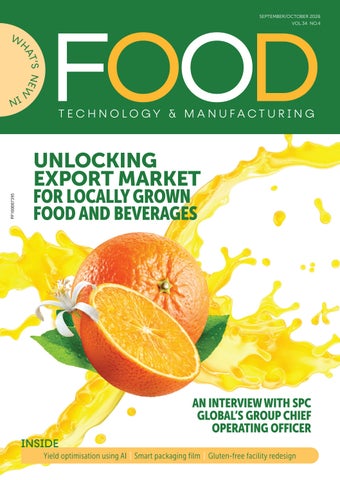
UNLOCKING EXPORT MARKET FOR LOCALLY GROWN FOOD AND BEVERAGES
AN INTERVIEW WITH SPC GLOBAL’S GROUP CHIEF OPERATING OFFICER INSIDE Yield optimisation using AI | Smart packaging film | Gluten-free facility redesign
CONTENTS
SEPTEMBER/OCTOBER 2026
6
31
Food for thought
Bulk handling, storage & logistics 31 Meet Sashimi-Bot — a robot that slices and dices like a sushi chef 34 Integrated bulk handling system boosts gluten-free food production
22
36
Packaging & labelling
Processing
F E AT U R E S
10 Fruit, vegetables and ready-to-eat market 10 SPC Global expands its Aussie-made footprint across North Asia 13 Made in Australia, managed by data: Why food manufacturing needs a digital backbone
16 Sensors and AI 16 AI’s role in F&B yield optimisation 18 Why AI won’t replace food compliance professionals — and why that’s exactly how it should be
36 Gas is becoming a business risk for Australia’s food sector 39 Boosting Australian-grown chocolate 42 From bottleneck to backbone: the changing role of water systems in food & beverage operations 50 Safer alcohol
52 Product development & testing 52 Prices are ‘whey’ up due to shifts in protein demand 54 Six on the shelf
FREE DIGITAL
SUBSCRIPTION! This bimonthly magazine is free for industry professionals in digital format. Subscribe at: www.foodprocessing. com.au/subscribe
SEPTEMBER/OCTOBER 2026 VOL.34 NO.4
T E C H N O LO GY & M A N U FACT U R I N G
UNLOCKING EXPORT MARKET PP100007395
25 ‘Smart’ packaging film developed to confirm food freshness 26 Reinventing food packaging
FOR LOCALLY GROWN FOOD AND BEVERAGES
AN INTERVIEW WITH SPC GLOBAL’S GROUP CHIEF OPERATING OFFICER INSIDE Yield optimisation using AI | Smart packaging film | Gluten-free facility redesign
iStock.com/quantic69
4 Editor’s note 6 News 20 Food manufacturing hub opens on the Central Coast
www.foodprocessing.com.au | September/October 2026
3
editor's
NOTE
Westwick-Farrow Media A.B.N. 22 152 305 336
CAROLYN JACKSON CHIEF EDITOR
F
ood manufacturers are dealing with increasingly expensive raw materials,
energy, labour and logistics. At the same time, the industry is under pressure
www.wfmedia.com.au Head Office Unit 5, 6-8 Byfield Street, North Ryde Locked Bag 2226, North Ryde BC NSW 1670 Ph: +61 2 9168 2500
to produce more food with fewer resources.
Editor: Carolyn Jackson wnift@wfmedia.com.au
In Australia, around 18–22% of fruit and vegetable biomass is lost during
Publishing Director/MD: Janice Williams
the production and processing/packing stages, so improving yield is one of the most important and potentially addressable issues in modern food manufacturing facilities. In this issue, we share an interview with Moataz Ahmad, who has recently been appointed Group Chief Operating Officer, SPC Global. During our discussion, Ahmad talked about how the group is aiming for sustainable growth and expansion throughout Asia with a streamlined production network. He discusses how AI and automation are part of their manufacturing strategy and also how food technology is helping to improve the yield of each piece of Australian-grown fruit or vegetable it uses for its products. When it comes to yield optimisation, AI can have an important role to play — for example, it can analyse where the yield was lost, which raw material
Art Director/Production Manager: Linda Klobusiak Circulation: Alex Dalland circulation@wfmedia.com.au Copy Control: Ashna Mehta copy@wfmedia.com.au Advertising Sales Manager: Kerrie Robinson krobinson@wfmedia.com.au If you have any queries regarding our privacy policy please email privacy@wfmedia.com.au
variability matters, what process settings produce the best yield and much more.
Printed by
In another article, Marcel Koks from Infor explains the nuanced role of AI in the
Ive Group
food and beverage industry. Find out more on page 20.
Print Post Approved PP100007395 ISSN No. 1039-8414
As always, this is just a small snippet of what’s inside this issue. Enjoy the read!
NOTICE: All material published in this magazine is published in good faith and every care is taken to accurately relay information provided to us. Readers are advised by the publishers to ensure that all necessary safety
Want to contribute?
devices and precautions are installed and safe working
We welcome submissions from the food industry across Australia
found or purchased through the information we provide.
and New Zealand that will be considered for possible inclusion in
representative company concerned and any dispute
the bi-monthly print publication and our daily web page. If you
procedures adopted before the use of any equipment Further, all performance criteria was provided by the should be referred to them. Information indicating that products are made in Australia or New Zealand
have a story you think would be of interest, please send an email
is supplied by the source company. Westwick-Farrow
to wnift@wfmedia.com.au.
or the accuracy of the statement made by the source.
4
September/October 2026 | www.foodprocessing.com.au
Pty Ltd does not quantify the amount of local content
ak
gg re lab b t ellin u g during an o
E
The board of Bulla Dairy Foods (Bulla) has appointed Peter Hall as its next Chief Executive Officer (CEO) to lead the Australian family-owned dairy company into its next chapter. With extensive international experience and a strong track record of driving growth and building brands, Hall is returning to Australia after more than 25 years leading food and beverage businesses across North America, Europe, Latin America and the Caribbean. Most recently, he served as Chief Executive Officer of CARIB Brewery and President of Beverage within the ANSA McAL Group of Companies. Prior to this, he held senior leadership roles with Heineken Americas, Dean & DeLuca, Treasury Wine Estates and Diageo. Bulla Chairman Ian Sloan said: “Peter was a standout candidate and we were delighted when he accepted the role. He brings deep experience across fast-moving consumer goods and manufacturing, and an unparalleled understanding of how these industries are evolving. His international background and global perspective give us great confidence in his leadership of Bulla at this exciting time in the company’s history.” Hall said he was honoured to return home to Australia and lead Bulla. “Like so many Australians, Bulla was a much-loved part of my childhood, so returning home to lead the business is a unique career opportunity. “What attracted me most was the unique combination of family ownership and the remarkable achievements the business has delivered for more than a century. “Building brands has been my life’s work, and I’m excited to build on Bulla’s strong foundations and the family values that have made the business and brand so respected for generations.” Sloan also thanked Acting Chief Executive Officer James Downey for his leadership over the past six months alongside the Executive Team and Senior Leadership Team. Downey will continue working closely with Hall to ensure a smooth transition when he joins Bulla in September.
iStock.com/grinvalds
Australian dairy brand Bulla appoints new CEO
The Australian Competition & Consumer Commission (ACCC) has announced that it will take no enforcement action on free range representations when the poultry egg and meat industries are affected by a housing orders relating to avian influenza outbreaks. While there have been recent outbreaks of avian influenza (H5N1) in Australia detected in migratory birds, there are currently no outbreaks in commercial poultry operations across the country. However, it is essential that the poultry sector continues to adopt heightened biosecurity and precautionary measures, which may include housing that restricts flocks from accessing outdoor areas. The ACCC said it will not take enforcement action in relation to free range claims on labels or packaging made by free range producers who are affected by a government housing order during an avian influenza outbreak for a period of up to 90 days, while the housing order is in place. Producers will need to be prepared with alternative labelling and information if affected by a housing order for a time beyond 90 days. They should make it clear that the eggs or meat were produced from housed poultry. The ACCC will continue to monitor and may amend this guidance if circumstances change.
New regulator Safe Food Victoria starts operation
iStock.com/klenova
Victoria’s new streamlined food regulator Safe Food Victoria is designed to help cut the red tape for food businesses in the state. Meredith Dairy is one of the 12,000 regulated food producers in Victoria set to benefit from the new regulator. Victorian Minister for Agriculture Michaela Settle visited the business on 1 July 2026, together with Safe Food Victoria Chair Luke Wilson and CEO Mike Gooey, to mark the start of operations. “Food safety and great food go hand-in-hand — we’re proud of Meredith Dairy’s products and look forward to working with the new regulator,” said Meredith Dairy co-owner Julie Cameron. Safe Food Victoria consolidates multiple regulators including Dairy Safe Food Victoria, Primesafe and other regulators to simplify arrangements for businesses. There will be no redundancies and transferring staff will keep their current employment conditions. Reporting to the Minister for Agriculture, the new regulator brings Victoria in line with other jurisdictions and is designed to create a simpler and more streamlined regulatory system. It will work closely with local government to deliver food safety regulatory services and provide a stronger and more flexible food safety system that mitigates risks. Further work will modernise and streamline laws, and improve the tools and responsibilities to manage food safety. Food safety functions performed by Agriculture Victoria will transition from late 2027. “Safe Food Victoria is a really good example of a collaborative and commonsense approach to managing and regulating food safety,” said Minister for Health Harriet Shing.
6
September/October 2026 | www.foodprocessing.com.au
iStock.com/Christian Rummel
FoodTech Sydney has been launched
Ferrero appoints new GM to lead Australia and NZ
Image: Supplied
Ferrero has appointed Terence Viney as General Manager – Australia and New Zealand, taking over from Massimo D’Ambrosio who moves to a new role within the Ferrero Group in the US. With 15 years’ experience at the Ferrero Group, Viney will lead Ferrero’s Australia and New Zealand business, spanning brands such as Ferrero Rocher, Kinder, Nutella and Tic Tac, while supporting expansion beyond its core confectionery range into ice cream, biscuits and better-for-you categories. Having started his career with the company in Australia, Viney also held senior leadership positions across Europe, Asia and the Middle East, most recently as General Manager of Ferrero Israel. “Returning to Australia is a real privilege, and I’m proud to take on this role at such an important time for the business. We have a strong team with clear momentum, and I look forward to building on that foundation,” Viney said. “We will remain disciplined in our approach to innovation and sustainable growth, with a clear focus on delivering long-term value for our retail partners — and more moments of joy for all those who love our products.” Australia and New Zealand are key growth markets for Ferrero in Asia–Pacific, supported by the Lithgow manufacturing site in New South Wales, which produces Nutella for domestic and export markets across the region.
Diversified Australia has launched the FoodTech Sydney event for advanced food manufacturing, production technology and sustainable operations. It will be held at ICC Sydney, Darling Harbour from 17–18 August 2027. The launch was announced at foodpro 2026, where the likes of Oestegaard, Contech, Gelita and Visy committed to the inaugural event in its opening days. FoodTech Sydney is presented by Diversified Australia and joins its food manufacturing event portfolio alongside foodpro Melbourne (2026 + 2029) and FoodTech Qld Brisbane (2028). “NSW manufacturers told us the same thing consistently: they were ready to act, but there was no event built for where they actually are in the buying cycle. FoodTech Sydney is that event — specialist, held locally, and focused on implementation, not browsing,” said Louise Brooks, Event Director, Diversified Australia. FoodTech Sydney brings together the full picture of what advanced food manufacturing looks like today across five exhibitor segments: Advanced Processing & Automation; Intelligent & Digital Factories; Ingredients & Additives; Food Science, Quality & Testing; and Packaging Technology & Materials. The event connects manufacturers, processors, technologists and R&D teams with the suppliers who can help them optimise performance, integrate new technology and build competitive capability. Exhibitors and sponsors can register their interest at foodtechsydney.com.au or by contacting the FoodTech Sydney team.
Lactalis plans to close dairy factory in Gippsland
www.foodprocessing.com.au | September/October 2026
iStock.com/jack191
Australian Dairy Farmers (ADF) has said the news that dairy business Lactalis plans to close its Longwarry factory in Gippsland, Victoria by the first quarter of 2027 reflects the mounting pressures facing Australia’s dairy industry. During the ACCC’s assessment of Lactalis’s acquisition of Fonterra, ADF raised concerns about increasing consolidation across the dairy industry and the importance of maintaining strong competition and regional processing facilities. ADF President Ben Bennett said the announcement of the dairy factory closure plans reinforces why competition and processing capacity matter. “Every factory that closes undermines dairy communities and makes the industry that little bit smaller,” he said. As part of its restructuring plans, Lactalis indicated that the processing at the Longwarry factory will be consolidated with its Darnum facility and other processing plants. “While this is a commercial decision by Lactalis, it is another reminder that Australia’s dairy industry is operating in an increasingly challenging environment,” Bennett said. “Governments cannot keep saying they support food security, sovereign manufacturing and stronger regional communities while making it harder and more expensive to make food in this country. “Rising energy prices, increasing regulation, growing compliance obligations, escalating input costs and trade settings that expose Australian producers to heavily subsidised imports are steadily eroding Australia’s dairy industry.”
7
iStock.com/fcafotodigital
Specialised gas solutions for a changing food industry
Image: Supplied
Modified atmosphere packaging (MAP) continues to gain momentum across Australia’s food manufacturing sector as producers seek longer shelf life, improved product quality, reduced food waste and greater distribution flexibility. As consumer expectations increase and supply chains become more complex, the atmosphere inside a package has become just as important as the packaging itself. Achieving consistent gas composition, validating package integrity and maintaining process control are now critical quality requirements for many food producers. Recognising this shift, Niche Gas Products has launched Specialised Gas Technologies Australia (SGTA) — a dedicated business focused on controlled gas solutions for the food, medical and agricultural industries. While Niche Gas Products has supported Australian manufacturers for more than two decades, SGTA has been established to provide a dedicated technical focus on gas analysis, leak detection, gas mixing, package integrity testing and process validation. The objective is simple: help manufacturers understand, measure and control the gases that directly influence product quality and shelf life. SGTA continues the longstanding exclusive partnership with German manufacturer WITT Gasetechnik, bringing globally recognised MAP technology and expertise to Australian food processors. From handheld gas analysers and leak detection systems through to advanced gas mixing and monitoring solutions, the focus remains on delivering practical tools backed by local technical support. As MAP adoption continues to expand throughout Australia, SGTA will be helping food manufacturers improve quality assurance, reduce waste and gain greater confidence in every pack they produce.
Saputo to sell its UK operations One of the top 10 dairy processors in the world, Saputo Inc., has signed an agreement to sell its UK dairy division to B.S.A. SAS (Lactalis). The UK dairy division’s five manufacturing facilities and its local brands will be included in the transaction, which is valued at approximately £988 million. “Today’s announcement reflects a disciplined step to refine our global footprint and sharpen our focus on platforms where Saputo competes from a position of strength,” said Carl Colizza, President and CEO at Saputo Inc. “The value to be realised recognises the expertise of the UK team, the quality of the operations, and the market position of these leading brands. This transaction reinforces our strategic focus and enhances our financial flexibility as we continue to create long-term shareholder value through disciplined capital allocation.” “We are profoundly grateful to our colleagues in the United Kingdom for their dedication and contributions to Saputo. We look forward to seeing these strong assets and brands continue to build on their market positions under new ownership.” The transaction is expected to be completed by early 2027, subject to applicable closing conditions and regulatory approvals. Proceeds from the transaction are expected to be used to enhance the company’s flexibility and provide additional capacity to accelerate growth.
Nestlé has launched an Australian packaging pilot to help tackle one of the most common causes of household food waste: date label confusion. The ‘Sniff, Look, Taste’ on-pack logo packaging pilot was developed in collaboration with OzHarvest and informed by its research and expertise. The pilot was also informed by local and global research, including RMIT University and End Food Waste Australia. Date label misinterpretation continues to contribute to Australia’s 7.6 million tonnes of annual food waste, with OzHarvest research showing 58% of high-wasting households discard food due to uncertainty around ‘Use By’ and ‘Best Before’ dates. To help consumers make more confident decisions at home, the new on-pack logo encourages Australians to pause before throwing food away, check the date label and, where a product is past its Best Before date, use their senses, in conjunction with the Best Before date, to determine whether it is still good to eat. The logo is now appearing on selected MAGGI 2 Minute Noodles packs in supermarkets and grocery stores nationwide, bringing a simple reminder into everyday kitchens. Rising food waste puts everyday habits in focus, with Australia’s annual food waste projected to reach 9.2 million tonnes by 2030 if nothing is done to address household food waste. Nestlé Oceania Regulatory, Scientific and Nutrition Manager Kirsten Grinter said: “The simple rule is Use By is about safety, so always follow it. Best Before is about quality, so check it. That difference matters, because it can help people stay safe without throwing away food that may still be perfectly good.”
8
September/October 2026 | www.foodprocessing.com.au
Image: Supplied
Nestlé launches on-pack labelling pilot
FRUIT, VEGETABLES AND READY-TO-EAT MARKET
food talk
SPC Global expands its Aussie-made footprint across North Asia Carolyn Jackson
As Australian food manufacturers look beyond the domestic market for growth, SPC Global is demonstrating how local manufacturing and supply chain optimisation can unlock export opportunities, with recent developments including expanded ranging across Asia and a more streamlined production network.
I
n this exclusive interview, Moataz Ahmad, Group Chief Operating Officer, SPC Global, shares details about how the company has paired a manufacturing transformation in regional Victoria with an expanding international footprint.
10
September/October 2026 | www.foodprocessing.com.au
With a background in process engineering and 20 years of experience in the food industry, Ahmad joined the Australian food and beverage business at an evolutionary time. It was during December 2024, when SPC Global merged four Australian manufacturing food businesses together — SPC, The Original Beverage Co, Nature One Dairy and Natural Ingredients. All the manufacturing for the four merged businesses is now happening here in Australia and “there are very exciting times ahead”, according to Ahmad. “We have fantastic iconic brands so our aim is to continue supporting the domestic market but also open up our amazing Australian-made produce and products to the global market using a demand-led operational model,” Ahmad said. The company has already made some significant achievements, with ranging for The Original Juice Co. in Costco Japan, Emart Traders South Korea and one of Singapore’s largest retail networks, NTUC
The recent manufacturing changes at SPC Global have been designed to support the local production of export-ready beverages and allow for further international expansion.
network. Through a long-term partnership with Griffith-based Fair Dinkum Foods, it is strengthening production capabilities for The Original Juice Co. while improving access to citrus growers and export markets. The Griffith manufacturing partnership is also expected to extend fresh juice shelf life to up to 12 months, improving supply chain efficiency and opening up other international market opportunities. Ahmad said the company has been busy restructuring its manufacturing footprint in Australia to unlock potential, which has also included modernising the bottling lines and securing enough Valencia oranges locally to match the demand for its juice from international markets, and “it’s progressing very well”, he said. “With a demand-led operation model, everything starts with the consumers,” Ahmad said. “What we are also learning is every market has differing consumer perspectives about when and how they eat our product. Regardless of whether it’s food in a can or juice in a bottle, the segmentation of the consumers within each market — from Gen Z up to older generations — all have different product needs. “The good thing about our group is that we are a one-stop shop with a full portfolio, from vegetables, fruits, dairy products and even infant formulas, so that gives confidence to the retailer at each market. We also have the research and development and manufacturing capability to build recipes and pack formats to fit each market. “Consumers worldwide are willing to pay a premium for ‘made in Australia’ products and they love all SPC’s iconic brands built over the last 100 years of manufacturing. This gives us a competitive advantage for exports to international market.” > www.foodprocessing.com.au | September/October 2026
11
FRUIT, VEGETABLES AND READY-TO-EAT MARKET
Images: Supplied
FairPrice. Some other key export highlights achieved to date include: • The Original Juice Co. Black Label Orange Juice generated more than AU$1.2 million in sales within its first 12 weeks in South Korea. • Juice Lab Wellness Shots are set to roll out through both supermarket and convenience channels in Singapore. • SPC Global’s international division, Nature One, has delivered strong growth across China, Indonesia and South Korea. The recent manufacturing changes at SPC Global have been designed to support the local production of these export-ready beverages and allow for further international expansion. The company announced in February this year its plans for consolidating local production at its Shepparton facility and transitioning selected beverage manufacturing from Mill Park, which is set to close in October, to create a more streamlined and scalable manufacturing
“
FRUIT, VEGETABLES AND READY-TO-EAT MARKET
How is automation helping with the expansion plans? Changing the infrastructure to meet the requirements for exportready products and supply chain complexity in every market, requires flexibility and agility, and Ahmad understands the importance of managing these complexities. “Automation and AI is part of everything we do now, even down to the analysis and fast response with consumer feedback,” he said. “The key advantage of AI and automation technology is that it can look at trends and predict a failure before it happens. “It’s not about replacing the decision-making process, it’s about giving direction to the operator and keeping them informed to prevent failure from happening and keep the equipment running.” The company has recently invested in end-of-line automation at its Shepparton site for packaging and “this will also be connected to a bigger platform related to maintenance-responsive management systems, so we can get signals on equipment performance and how we can reduce waste and improve efficiency and the quality of products we produce”. “We will also be rolling out the same approach with our comanufacturing site at Griffith, which will be helping us produce the fresh chilled juice for the Australian market.” The Griffith site is located close to the region where they are sourcing the oranges for the juice, so this is strategic in terms of
“
The company has recently invested in endof-line automation at its Shepparton site for packaging and this will also be connected to a bigger platform related to maintenanceresponsive management systems.
supply chain logistics and also for reducing the group’s emission footprint. “From October onward, we will be sourcing oranges within 10 minutes from our facility.” While the demand for orange juice is significant in the international market, the group is also working on new export opportunities for juice shots and canned food to China, as well as frozen meals from Sydney to Singapore, Ahmad said.
What new food technologies are exciting at the moment? Ahmad explained how the group is also using food technology to help improve the yield of each piece of fruit or vegetable it uses for its products. “When we process fruit, like oranges or apples, you lose almost 50% of it to transform it into juice. So, we have invested in technologies that are being using to improve fruit yield, which will also help us keep up with the demand and availability of the food throughout the year with our cans and jars.” One such example is a different way of peeling, called steam peeling, which is designed to maximise the juice extracted. Ahmad said you can not only get more juice from the fruit but also utilise the skin for other value-add ingredients instead of sending it to waste. “We can re-work it and use it in another product such as juice shots for Juice Lab and powders that can be substituted back into process to improve efficiency and process flow.” With a continued focus on improving operational efficiency by reducing energy, they are developing solutions with its front-line teams that recycle water when possible and eliminate waste right from the beginning of the process. Ahmad is passionate about the success of the expansion plans for the ‘Australian grown and made’ food and beverage business and the positive impacts this can also have on all the collaborators and communities which are also considered to be part of the business. “It’s all about sustainable growth to ensure SPC Global will be here for another 100 years, supporting generation after generation.”
Image credit: SPC’s Shepparton Facility.
Food talk is a regular feature designed to gain new perspectives from industry leaders within the wider food manufacturing industry. To participate, please email wnift@wfmedia.com.au.
12
September/October 2026 | www.foodprocessing.com.au
A u s n i tralia e d a M aged by da , n ta: a m
Graeme Evans, Regional Vice President AU/NZ & Pacific, Epicor
T
he continued global instability of supply chains has meant Made in Australia has become ever more important to local producers in the food and beverage sector. Behind the label, the nation’s food and beverage manufacturers are under unprecedented pressure, and many are reaching a breaking point. Yet across the sector, manufacturers are also showing a remarkable ability to adapt and evolve under pressure. From cocoa and coffee to baked goods and packaging, input costs are surging. Fuel prices have spiked by as much as 40% amid global conflict, driving up freight, refrigeration and energy costs across the supply chain. At the same time, disruptions to global shipping routes and materials, including critical food-grade plastics, are exposing how fragile Australia’s supply chains have become. While these challenges are significant, they are also accelerating a shift towards smarter, more resilient operating models, acting as a catalyst for long-needed transformation. These pressures are colliding with a cost-of-living crisis at home. Consumers are spending less, yet expect more: better value, greater transparency, and demonstrable sustainability credentials. For manufacturers, that means absorbing rising costs while innovating faster than ever before. Encouragingly, many Australian manufacturers are already leaning into this challenge, using innovation to stay competitive. For those that get this balance right, the opportunity to differentiate has never been greater. This is where technology, specifically enterprise resource planning (ERP), is becoming not just a productivity tool, but a strategic and compliance necessity.
Modern ERP platforms enable food and beverage manufacturers to connect every stage of production, from raw ingredient sourcing to final distribution. In an environment where margins are tightening, this visibility allows businesses to identify inefficiencies, reduce waste, report on carbon inputs, and better manage fluctuating input costs in real time. Critically, ERP is also transforming traceability, a growing priority for regulators and consumers alike. With end-to-end data visibility, manufacturers can track ingredients across the entire supply chain, improving food safety, recall readiness and compliance. At a time when geopolitical instability is reshaping global trade flows, this level of control is becoming indispensable. Sustainability is another frontier. As energy prices rise and pressure mounts to decarbonise, ERP systems help manufacturers monitor energy usage, monitor inventory, optimise production runs and support more sustainable sourcing decisions, all while maintaining profitability. The opportunity is clear: while external pressures on Australia’s food and beverage sector are unlikely to ease, digital transformation offers a pathway to resilience. Made in Australia should not only stand for quality, but also for capability. The next chapter of Made in Australia will be defined not just by where products are made, but by how intelligently they are managed. In 2026, that capability will increasingly be shaped by how effectively manufacturers use data, because in an uncertain world, those who harness it best won’t just weather disruption, they will help define the future of Australian manufacturing. www.foodprocessing.com.au | September/October 2026
13
FRUIT, VEGETABLES AND READY-TO-EAT MARKET
iStock.com/inkoly
Why food manufacturing needs a digital backbone
Image: Supplied
FRUIT, VEGETABLES AND READY-TO-EAT MARKET
Blueberry packing house automates sorting after expansion
H&A Farms, a blueberry packing house located on the East Coast of the US, handles fruit year-round for its own operations as well as both domestic and international growers. During peak season, the company packs up to 136,000 kg per day across seven fresh-pack lines that run 24 hours a day, seven days a week. As business expanded, H&A turned to WECO’s advanced optical sorting technology to help deliver high-quality product while navigating labour shortages, tighter margins and evolving harvesting practices. “Over the past several years, the bar for fresh-market blueberry quality has continued to climb, with consumers and retailers expecting more consistency in colour, size and overall appearance,” said Michael Hill, President of H&A Farms. “Achieving those standards comes with its own challenges. For one, we’re handling more machine-harvested fruit each year due to increased labour costs, which brings more leaves, stems and cosmetic defects into the packing house and requires more intensive sorting. Additionally, labour remains difficult to find across the agricultural sector. We needed a way to keep pace with rising quality expectations while doing more with the people we already have.” This combination of pressures led H&A to expand its reliance on optical sorting. Today, all seven of H&A’s fresh-pack lines utilise WECO equipment, including two built around WECO’s modular Sortivator solution. Rather than a single fixed machine, Sortivator is a configurable platform that integrates multiple cleaning and inspection systems tailored to address each packer’s unique application. The lines installed at H&A each include a blower to remove lightweight debris such as leaves and small stems, a BerryTek colour sorter to remove green or discoloured fruit and an Impulse soft sorter that removes soft or overripe berries. Recently, H&A installed a new WECO 360Tek optical sorter at the end of one of its Sortivator lines to identify and remove fine defects and separate jumbo berries into a dedicated stream. The product stream is conveyed over a series of hourglassshaped rollers, presenting a 360-degree view of each berry to the
14
September/October 2026 | www.foodprocessing.com.au
digital colour cameras. Machine-learning algorithms analyse the images and trigger air nozzles to remove defective fruit. “Before upgrading to the 360Tek, we needed as many as six workers per line to manually inspect the stream for fine defects. Even still, the reality is there’s only so much a person can catch when fruit is moving at that speed, no matter how skilled they are,” Hill said. “The 360Tek improved defect removal while more than doubling our throughput. At the same time, it allowed us to eliminate the inspection table on that line and move those employees to other parts of our operation.” The optical sorter has also become an important tool as demand for jumbo blueberries continues to grow. Different retail programs often call for different size grades, and H&A can adjust size specifications digitally on the 360Tek without mechanical modifications or change parts. “One customer may want 18 millimetres and larger while another wants 20 millimetres and larger,” Hill explained. “Being able to quickly change those thresholds through the control system gives us a lot more flexibility and reduces downtime.” Beyond inspection and sizing, H&A also uses data collected by its sorting systems to better understand varietal performance, defect trends and packout characteristics throughout the season. “We can look at how a particular variety performs over time or how fruit from a certain block compares to others,” Hill said. “That helps us better predict packout, identify trends and make more informed decisions for future seasons.” As blueberry growers and packers continue adapting to changing market conditions, Hill believes advanced automation and data-driven insights will play an increasingly important role in maintaining competitiveness. “The industry isn’t getting any simpler,” he said. “Labour availability is always a challenge, customers expect exceptional product quality and everybody is looking for ways to operate more efficiently. Technology that helps us sort more accurately, increase throughput and better understand our fruit has become a very important part of our business.” WECO www.wecotek.com
SENSORS AND AI
AI’s role in F&B yield optimisation Marcel Koks*
Y
ield optimisation is the most powerful lever Australian food and beverage manufacturers have to improve profitability while reducing food loss and waste. Even small percentage gains, turning more raw material into sellable product, compound rapidly, because raw materials are typically the highest cost in production. What makes this challenge uniquely complex is that food manufacturing starts with products of nature. Raw materials vary in quality, grade and potency with every harvest and animal. When yield is lost, it isn’t just margin that disappears — it’s food that never reaches the table. Yield is often described as a simple mass balance — how much weight/volume of finished product you get from the weight/ volume of consumed material. But yield is so much more than that when it comes to food and beverage production: it’s also 16
about the value of what goes in versus the value of what comes out. Lower‑grade crops purchased at a lower price may deliver less yield by weight. But they can still make economic sense when the value of the finished products is taken into account. Seen through this lens, improving yield is not just about efficiency. It’s about making better use of what nature provides and directing as much material as possible into the highest value food.
How AI helps to optimise yield Yield losses rarely have a single cause. They emerge from interactions between material quality, process settings, equipment behaviour and environmental conditions. Global trade dynamics are changing rapidly, potentially shifting demand for a particular crop overnight. Extreme weather events may create volatility in crop supply and demand. Issues often vary from batch
September/October 2026 | www.foodprocessing.com.au
to batch, meaning employees rarely have the capacity to track, let alone act on, the information generated from these interactions. Accelerating technology adoption is critical for this. Organisations need robust digital strategies that incorporate AI, process intelligence, process automation, IoT and Industry 4.0 technologies. Investing in automation also addresses the shortage and high cost of labour. By bringing together data from enterprise resource planning (ERP), manufacturing execution systems (MES), laboratory, scales and Internet of Things (IoT) sensors, manufacturers gain end-to-end visibility into what truly drives yield. ERP provides context on raw material sourcing, lots and cost. Quality control systems add insight into composition and quality attributes. MES captures how each batch is processed across temperatures, times, setpoints and equipment states, while IoT sensors enrich this view with insight into real-time environmental conditions, energy stability and throughput variation. When data is connected at the batch and loT level, patterns emerge. Machine learning reveals which raw material attributes, process settings and environmental
iStock.com/Organic Media
SENSORS AND AI
*Marcel Koks serves as the Director of Industry & Solution Strategy for the food and beverage sector at Infor. With a professional background spanning over three decades, he has been deeply involved in the deployment, solution consultation, sales, marketing and product management of enterprise applications. Throughout his extensive career, he has helped many food and beverage businesses by defining and implementing fit-for-purpose solutions. In his current role, he is charged with shaping and guiding the strategic direction for Infor’s engagements in the food and beverage market.
“ conditions consistently drive yield up or down. Manufacturers can turn large volumes of data into actionable insights and give AI agents a foundation that delivers value-driving recommendations to the process operators. This shifts yield from after-thefact analysis to predictive insights and prescriptive maximisation. As an example, operations teams can quickly review the negative impact of a lower process temperature on yield. AI agents can simulate changes to processing parameters, project the impact, and help operators make real-world adjustments to get the process back on track, so teams can focus on the actions that matter most. And over time, this creates a learning loop where each batch improves the next, reducing waste and converting more of what nature provides into food.
Nuances per sector in food and beverage processing Not all food products are the same, and neither are the factors that influence yield. While the underlying machine learning model may be similar, what matters in practice differs by product. That’s why effective use of AI to optimise yield combines domain expertise with data
Where teams once reviewed a handful of parameters in spreadsheets after the fact, machine learning models can now evaluate more than 60 contributors per batch as production happens, enabling continuous adjustment and sustained yield improvement.
science. Process technologists bring the understanding of how products behave, while machine learning handles what humans cannot: real-time analyses of dozens of interacting variables. Where teams once reviewed a handful of parameters in spreadsheets after the fact, machine learning models can now evaluate more than 60 contributors per batch as production happens, enabling continuous adjustment and sustained yield improvement. Yield loss is often cited as the largest area of value leakage for manufacturers, but that is not the case for all sectors. In bakery, where freshness and forecasting are paramount, waste optimisation is of greater concern when the clock is ruthless. Once again, the machine learning model will be similar, but the data, processes and levers will be slightly different.
How to quantify the financial impact of yield improvements To translate yield improvements into business value, the simplest calculation model is based on raw material savings. If the same production volume can be achieved with less raw material, estimated savings can be calculated as: Reduced raw material spend = spend on critical raw materials x reduction percentage. AI‑driven yield optimisation helps convert more raw materials into sellable food. By combining ERP, MES, quality and IoT data, machine learning exposes the true drivers of yield at the batch level. At the same time, AI agents help process operators quickly adjust parameters to maximise yield from costly raw materials. And when data, systems and intelligence across your entire operation converge into a single connected layer, they stop being separate tools and become something greater. This is the agentic enterprise. It’s where insight and action are no longer separated by time, capacity or human bandwidth. Collecting and integrating highcontext data can unearth otherwise hidden contributors and remove the guesswork from yield improvement. Now is the time to combine the experience of your process technologists and data with purpose-built AI solutions for food and beverage. Now is the time to pull the lever of increased profitability.
www.foodprocessing.com.au | September/October 2026
17
Tali Lederman, CEO of Produxiom
Industry insights
Why AI won’t replace food compliance professionals — and why that’s exactly how it should be
SENSORS AND AI
f there’s one thing the recent attention on Country of Origin claims has reminded the food industry, it’s this: compliance is becoming more visible, more scrutinised and more important than ever. Whether it’s country of origin, allergen declarations, nutrition information, environmental claims or retailer requirements, the expectations placed on food manufacturers continue to grow. At the same time, businesses are under constant pressure to bring products to market faster with leaner technical teams and increasing product complexity. It’s no surprise that AI has become one of the biggest talking points in the industry. The question we’re increasingly asked isn’t “Can AI review my labels?”, it’s “Can AI replace my compliance team?”. The answer is no. And that’s exactly how it should be.
AI is a powerful assistant — not the decision-maker Food compliance isn’t simply about checking whether mandatory information appears on a label. It requires interpretation, judgement and an understanding of context. Regulations evolve. Guidance changes. Retailer requirements differ. Marketing claims depend on how they’re presented. A compliant outcome often relies on understanding the intent behind both the legislation and the product. That’s why the role of experienced quality, regulatory and technical professionals isn’t going away. Instead, AI should allow them to spend less time on repetitive administration and more time applying their expertise where it matters most.
The real problem isn’t compliance — it’s the workflow After more than 20 years advising food businesses, one pattern continues to repeat itself. Product information lives everywhere: • Specifications are in one spreadsheet. • Artwork is in another email chain. • Supplier information arrives in multiple formats. • Approvals happen across disconnected documents. The compliance review itself is often only a small part of the overall process. The biggest challenge is coordinating the people, documents and decisions needed to get a product to market. That’s where AI can make the greatest impact. Rather than replacing technical experts, AI can review structured information, identify potential issues, highlight missing data and automate repetitive tasks before a human ever needs to step in. 18
September/October 2026 | www.foodprocessing.com.au
iStock.com/iStock.com/Alona Hrinchenko
I
Country of Origin is a timely reminder The recent focus on Country of Origin compliance highlights why businesses can’t afford to treat compliance as a final label check before print. Country of Origin claims depend on accurate source information flowing through the product development process. If supplier information changes, or ingredients are substituted, those downstream claims may also need to change. AI can quickly identify inconsistencies and flag potential issues. But determining whether a claim is appropriate still requires the knowledge and accountability of experienced compliance professionals. Technology should help organisations identify risk earlier — not make compliance decisions on their behalf.
Human expertise remains the competitive advantage The businesses that will benefit most from AI won’t necessarily be those that automate the most. They’ll be the organisations that combine technology with experienced people and robust compliance processes. AI can dramatically reduce manual administration, surface potential risks and improve consistency. Humans provide judgement, accountability and confidence. Those aren’t competing strengths — they’re complementary ones. As the food industry continues to embrace AI, success won’t come from replacing compliance professionals. It will come from giving them better tools to do what they do best. Tali Lederman is CEO of Produxiom and Chief Commercial Officer at FoodLegal. Produxiom is an AI-powered compliance and product approval platform built specifically for the food and beverage industry, combining structured workflows with AI-assisted reviews while keeping qualified compliance professionals at the centre of every decision. produxiom.com.au
food facility design
Food manufacturing hub opens on the Central Coast
T
caption
Image credit: CCIC
hree businesses have already signed on to operate at the Central Coast Food Manufacturing Innovation Hub, which was officially opened on 10 July 2026. The purpose-built, shared facility at Ourimbah is designed to provide small- to medium-sized food and beverage businesses on the Central Coast with the equipment, space and expertise to grow production locally — including a pilot plant and dedicated food and beverage manufacturing spaces. The hub is an initiative of Central Coast Industry Connect (CCIC), and is backed by a $17.14 million investment from the Australian Government. It will provide small and medium food and beverage manufacturer with access to shared commercial production facilities and equipment, industry expertise and specialist support to help businesses grow and innovate. By lowering the cost and risk of expansion, it is expected to support the growth of the Central Coast’s food and beverage manufacturing sector. Broader benefits of the hub include: • strengthening links between industry and research by helping businesses develop, test and commercialise new products more efficiently; • supporting workforce development, collaboration and innovation across the sector; • supporting economic development on the NSW Central Coast; and • helping food manufacturers bring new products to market faster and expand into new opportunities. “The Hub represents years of vision, partnership and persistence, and is a major step forward for our $2 billion food and beverage manufacturing sector on the Central Coast,” said Frank Sammut, CCIC Executive Director. Major manufacturers such as Mars Food and Nutrition, Sanitarium and Sara Lee
are all based near the hub, reflecting the strength of manufacturing on the Central Coast. The hub’s shared facilities, programs and expertise are designed to help more businesses innovate, develop their workforce and grow, keeping manufacturing activity, and the jobs that come with it, in the region. Ian Hemphill, CCIC Board Chair, said: “For Central Coast Industry Connect, the Hub is a physical home and the start of a new chapter for our industry partners and other stakeholders. Its success will be built on how well we turn collaboration into
outcomes for the manufacturing sector and our community.” The initiative supports the Australian Government’s Future Made in Australia agenda by: • strengthening domestic manufacturing capability; • building more resilient supply chains; and • helping businesses create greater value from Australian-grown products. CCIC will operate the hub in line with its vision for “a vibrant, connected and innovative manufacturing sector that provides sustained employment and sector growth, now and into the future, for our community”.
Do you have a design story to share? Please email wnift@wfmedia.com.au if you'd like to contribute.
20
September/October 2026 | www.foodprocessing.com.au
When we think about force measurement and its relation to product development, we often consider the aerospace, automotive or industrial industry; however, Interface have provided sensors for industrial automation solutions to thousands of customers using in-stock as well as custom applicationspecific sensors for OEM equipment to the food processing and packaging industries for many years. Many of Interface’s customers use load cells and torque transducers to test and develop machinery used in the consumer packaging industry. Interface are manufacturers of a full range of load cells providing the food processing and packaging industry with sensor technologies that increase efficiency and reduce waste. Like many industrial facilities, organisations are pushing hard to integrate new technology and automation that makes processes faster, more adaptable, and smart. One of the factors critical to creating a smarter factory is by utilising force measurement sensors designed for collecting data in each production phase, as well as monitoring equipment in use for performance optimisation. If you have ever wondered how a pill, a piece of candy or a can of food gets a little logo stamped on it without crushing it or how every bag of chips is nearly filled to the same capacity, chances are a load cell or torque transducer was involved. Interface has a wide variety of precisionbased accurate and reliable sensors used for various applications in food processing and packaging. Our customers are using miniature load cells within the production line to apply the exact force needed to delicately press a logo onto an edible product. We have others using multi-axis sensors from Interface to verify accuracy of intricately machined parts while moving through the manufacturing process. Below are additional examples that highlight uses case of actual applications in food processing and packaging. Additional industrial application highlights can be found in our solutions overview by clicking here.
Commercial food processing A food processing plant wanted accurate results of their in-motion check weigher when food is weighed and processed while moving down the belt. A check weigher is an automated machine for checking the weight of packaged commodities. This included ensuring production line efficiency and food quality, real-time results of their food weighed, and a load cell that can endure the food industry’s soiled environment. Interface offered a solution using multiple SPI High-Capacity Platform Scale Load Cells that could be installed in the customer’s equipment that is used through the production line where product is weighed on the conveyor. The SPI HighCapacity Platform Scale Load Cells delivers precise weighing data. When connected to the 920i Programmable Weight Indicator and Controller, the solution provides the customer real-time results of the weight of the food. The 920i Programmable Weight Indicator and Controller can also read up to four scale channels in real-time. The processing gains in efficiency were visualized and managed during the weighing process to optimize control and production.
Water bottle dispensing and weighing A beverage bottle manufacturer wanted to dispense the right amount of fluid into their bottles, and then weigh their bottles to ensure it is at the labelled weight on their product packaging. This is both to minimise waste, but also to meet the standard requirements noted on the packaging. Interface suggested using the MBP Miniature Beam Load Cell, and attaching it under a plate or platform the water bottle is placed on while it is being filled with fluids. The force weight is measured by the MBP Miniature Beam Load Cell, and connected to the 9870 High-Speed High-Performance TEDS Ready Indicator where results are captured, displayed, and recorded by the customer utilising their water bottle assembly machinery. With this solution,
the water bottle manufacturer received highly accurate results of each water bottle weighed in real-time, using the accuracy to reduce waste and speed processing time.
Snack weighing and packaging machine A snack manufacturing brand wanted to weigh the amount of consumable food product automatically dispersed into the bags during the packaging process. In this case, they needed to weigh their potato chips packaged and ensure the potato chips are at the exact weight needed due to regulatory standards. Interface’s solution was to use multiple SPI Platform Scale Load Cells and install it to the potato multi-head weigher and packaging machine. The SPI Platform Scale Load cells were installed inside of the mount that attaches the head weigher to the packaging machine. Force results from the potato chips bag fill are read by the load cells and sent to the ISG Isolated DIN Rail Mount Signal Conditioner, where the customer was able to control the automated production from their command center. The customer was able to determine the weight of the potato chips distributed into their bags with highly accurate results. They also were able to control the automated production process with the provided instrumentation. They will use this same weighing method for other snacks that need packaging utilizing the same sensor solutions. To learn more about Interface solutions designed for the modern factory, or specifically the food and beverage industry, contact our expert application engineers at AMS Instrumentation & Calibration Pty Ltd.
AMS Instrumentation & Calibration Pty Ltd www.ams-ic.com.au
www.foodprocessing.com.au | September/October 2026
21
SPONSORED CONTENT
iStock.com/Zulkarnieiev Zulkarnieiev
Force measurement for efficiency in food processing and packaging
PACKAGING & LABELLING
Jet Technologies partners with coffee processing specialist Jet Technologies has announced an exclusive partnership with a coffee processing specialist based in Germany — Neuhaus Neotec. Jet Technologies can now provide coffee producers across Australia and New Zealand with access to Neuhaus Neotec’s full portfolio of solutions, including traditional drum roasters from 1 t/h, the NEOROAST air roaster series (pictured here), and complete plant solutions spanning green coffee intake, storage, conveying, roasting, grinding and plant control. Combined with Jet Technologies’ existing packaging capabilities, including the Goglio vertical form fill and seal (VFFS) machine and the company’s ShieldCycle recycle-ready packaging range, the expanded offering enables coffee roasters to access a complete production solution through a single trusted local partner. “Australia and New Zealand are recognised globally for their high standards of coffee quality and their passionate roasting communities,” said Lars Henkel, Director Sales (V1) & Marketing at Neuhaus Neotec. “While Neuhaus Neotec has been active in these markets for many years, partnering with Jet Technologies allows us to strengthen our local presence and get closer to our customers. “Roasters everywhere are facing increasing pressure from rising energy costs, labour shortages, supply chain volatility and tightening environmental requirements. Our technology has been developed to address those challenges, from minimising energy consumption and emissions through to helping customers achieve greater productivity through automation.” According to Daniel Malki, General Manager at Jet Technologies, the partnership fills a notable gap in the market. “By partnering with Neuhaus Neotec, we can now offer customers a complete solution, from roasting through to packaging, backed by local sales, service and technical support. It’s an offering we believe is unmatched in the Australian and New Zealand coffee market.”
22
September/October 2026 | www.foodprocessing.com.au
PACKAGING SYSTEM FOR SNACKFOOD TNA Solutions has introduced its next-generation packaging system, the tna robag Quantum. The system is engineered to help food manufacturers increase throughput, simplify operations and respond faster to changing market demands. As labour shortages, rising costs and increasing product variety continue to reshape snack production, manufacturers are under pressure to do more with less. The growth of smaller bag sizes and multipacks is adding to that challenge, increasing the number of packs that need to be formed, filled and moved — often without additional labour or factory space. The tna robag Quantum has been developed to address these pressures with a different approach to capacity. Rather than simply adding more bagmakers to increase output, it is designed to deliver higher output per tube (up to 300 bags per minute, subject to bag, film and product type), helping manufacturers reduce the number of machines required for the same production target and create a more manageable overall line configuration. For producers, this can translate into operational gains, including higher output per tube, fewer machines for the same output and low product and film waste, depending on the application. By reducing the amount of associated infeed and outfeed equipment, manufacturers can also lower maintenance demands, cleaning requirements and total line complexity. Simplified operation and a cleaner machine architecture help reduce day-to-day intervention and support faster changeovers. The system is also designed to maintain repeatable pack quality at high speed, while on-machine event management and integrated training support faster operator response and long-term performance improvement. The system is designed to perform as part of a complete line. TNA Solutions Pty Ltd www.tnasolutions.com
Where do I find the safety validation documents? Do all the protective measures comply with the standards?
Which checks have already been carried out on the machine?
Are my employees sufficiently qualified?
Always ready for your next audit with MYZEL Manage machinery safety, inspections, validation records and workforce competency in one digital platform.
Validation records Instantly accessible documentation
Inspection management Never miss a statutory inspection
Workforce competency Verify training and qualifications
Secure machine access Allow access only to authorised personnel
With MYZEL, you don’t need to implement everything at once. myCore provides an easy entry point, giving you immediate visibility and control over your machine and employee data. When requirements increase, you can seamlessly expand the platform with dedicated workflows for safe machine design, operation, and access control - exactly when you need them. Digital platform: Available 24/7, anytime, anywhere Structured document storage: Security, traceability, legal compliance and liability protection Digital workflows: Digital checklists ensure error-free documentation
Book a MYZEL Demo
Transparency: Centralised overview of the status of all tasks throughout the machine lifecycle Highest security standard: Data is stored in the EU and the platform is certified in accordance with ISO/IEC 27017 and ISO/IEC 27018
Pilz Australia Head Office Unit 1, 12-14 Miles Street Mulgrave, VIC 3170 Australia
1300 723 334 50 sales@pilz.com.au www.pilz.com.au
Image: Supplied
PACKAGING & LABELLING
From six weeks to three days: Australian software overhauls US manufacturer’s label approvals
Australian-developed, AI-native label management software has cut the label approval cycle at US sports nutrition manufacturer NutraBio Labs from six weeks to three days. The software was used to replace a paper-based sign-off process with a shared digital review and an automated compliance check that scans every label before it reaches the printer.
The problem Label approval at NutraBio previously ran on printouts. Once a design was created, it was printed, carried to each department in turn, circled and annotated by hand, then carried to the next. The process broke down in predictable ways: handwriting was illegible or the wrong change was noted, feedback sat across several marked-up copies and because departments were visited in sequence one person’s backlog held up everyone behind them. “On a single product label, I’ll make the change. But there’s four other departments waiting for me,” said Alex Berrio, Marketing Director at NutraBio Labs. “Just this one edit could take a week to two weeks.” A single label could accumulate dozens of revision rounds before it cleared every sign-off. Compliance checking sat at the end and was manual, so an incorrect QR code, a barcode error or a missing mandatory detail could only be fixed by reprinting.
The solution NutraBio implemented GoVisually, an Australian-developed, AI-native artwork and label management platform named Most Innovative AI Product at Gulfood Dubai 2026. One team member had used it at a previous employer in 2018 and introduced it to replace the paper cycle. Reviewers now mark up the same digital file. Comments are collected against the artwork in one place, and the person responsible works through them in sequence — resolving each, making the fix, re-uploading — without waiting for a printout to be carried between departments.
24
September/October 2026 | www.foodprocessing.com.au
The platform also runs an automated compliance check before a file goes to the printer. For NutraBio, it verifies QR code placement, UPC and barcode accuracy, spelling and formatting, FDA compliance requirements and consistency across label versions. The rules behind those checks are not static. GoVisually runs a regulatory intelligence pipeline monitoring more than 10 markets continuously — among them the United States, the European Union, South Africa, Thailand, and Australia and New Zealand, where it tracks the FSANZ Food Standards Code. Manufacturers can check artwork against a monitored market by loading the relevant standards as rules, so a label is assessed against the regulation as it stands today rather than a version captured at install.
The results NutraBio has measured 80% less label approval time, 90% faster compliance reviews, 41% fewer revision rounds and 59% faster project delivery. Because the compliance check now runs during review rather than as a final manual step, packaging and labelling errors are identified before a file reaches the printer. “That feature has caught a lot of errors for us that we’ve been able to fix before printing,” Berrio said. “It allows us to really make sure we’re on the ball with compliance. I would definitely recommend it.” GoVisually founder and CEO Kiran Kumar said the shift reflects a wider change in how regulated manufacturers will work. “Label compliance has always been a final inspection — someone reads the artwork at the end and hopes they catch it,” he said. “That doesn’t survive the SKU counts and the rate of regulatory change manufacturers now face. First-pass review will become automated and continuous. The question won’t be whether the label was checked, but whether you can prove which rule it was checked against, and on what date.” GoVisually govisually.com
iStock.com/Javi Sanz
K
yushu University researchers have developed a self-healing hydrogel that signals spoilage through colour change while extending food shelf life. By immobilising anthocyanins, a natural plant pigment, onto a metal-organic framework, the team stabilised the pigment against light and heat while preserving its pH sensitivity. Flexible, largely biodegradable, and able to seal its own surface cuts, the soft, flexible film is embedded with a natural plant pigment that shifts colour as food spoils, giving consumers a visible signal without opening the package. The material can also repair its own cuts, which helps to keep bacteria out of the food while it progresses through the supply chain. Freshness has a chemical signature. Meat, for example, starts mildly acidic. As bacteria multiply, they break down proteins and release alkaline compounds, so the meat’s pH climbs steadily before any visible spoilage appears. Anthocyanins — the pigments behind the colour of purple sweet potatoes and red cabbage — track that shift directly. As pH rises, they turn from purple-red to yellow-green. This change is visible to the naked eye, and their natural origin also makes them safe for food contact. However, light and heat can easily disrupt their colour response, causing false readings and making them unreliable as a long-term indicator. To address this challenge, the team sourced their anthocyanins from purple sweet potato, then ground and freeze-dried them into a powder. For stabilisation, they turned to UiO66-NH₂, a metal-organic framework (MOF) known for its thermal and chemical stability. “MOFs have attracted enormous attention because of their unique porous structures and versatile functions, and I became curious whether they could be used for something closer to everyday life, like food preservation,” said Xirui Yan, corresponding author of the study and a JSPS researcher at Kyushu University’s Faculty of Agriculture. “At the HOPE Meetings with Nobel Laureates, I attended Professor
PACKAGING & LABELLING
‘Smart’ packaging film developed to confirm food freshness Susumu Kitagawa’s lecture on the sustainable use of functional porous materials. His perspective inspired me to think more broadly about how MOFs could create value in food systems.” In their design, anthocyanin molecules adsorb onto the MOF’s surface through multiple chemical interactions, anchoring it in place. Fixed and less mobile, the molecules are shielded from the oxygen, light and heat that drive degradation while remaining sensitive to pH. In food tests using pork, the protected pigment was claimed to be consistently responsive: as the meat spoiled and alkaline gases accumulated, the material shifted continuously from purple-red to yellow-green, giving a readable signal at every stage. The team then incorporated the anthocyanin-loaded MOF into a hydrogel, producing a soft, shapeable film that is largely plant-derived and biodegradable. Beyond freshness monitoring, the material also extended the shelf life of pork by about 12 hours compared to untreated samples. “Another interesting thing about this material is that it doesn’t just protect food — it heals itself,” said Fumihiko Tanaka, Professor at Kyushu University’s Faculty of Agriculture. When cut and pressed back together, the damage becomes nearly invisible within minutes, and tensile strength recovers to 99% within two hours. “In conventional packaging, any crack is permanent and becomes an entry point for bacteria. This material bonds back together on its own. The wound heals, and so does its ability to protect what’s inside, which makes it more durable and reliable in practical use.” The team is now exploring a companion smartphone app, providing manufacturers, logistics companies and shoppers with an objective way to assess food quality in real time. “This doesn’t have to stop at food packaging,” Tanaka said. “Smart materials built from natural ingredients and nanotechnology may have uses we haven’t imagined yet. If anyone sees a place where this could work, we’d love to hear about it.” In a study has been published in Chemical Engineering Journal. www.foodprocessing.com.au | September/October 2026
25
iStock.com/Theerawit Jirattawevut
PACKAGING & LABELLING
Reinventing food packaging
Biodegradable food packaging materials offer a sustainable alternative to conventional plastics for food protection, but their applications are often limited by lower oxygen barrier performance and mechanical strength. Now, Professor Andi Dirpan from Hasanuddin University, along with researchers from India and Malaysia, have developed multilayered polylactic acid films reinforced with microcrystalline cellulose and oxygen scavenger butylated hydroxytoluene. The resulting solution combines oxygen-scavenging functionality with enhanced mechanical performance, offering a promising alternative bioplastic for food packaging applications.
P
lant-based biodegradable plastics, such as polylactic acid (PLA), are a promising alternative, but can fall short of conventional plastics as they typically do not block oxygen as well, nor do they hold up mechanically. Researchers have tried introducing additives to improve their strength or make them actively scavenge oxygen. However, these two enhancements are rarely combined and tested together. The real challenge lies in building a biodegradable plastic that actively manages oxygen while maintaining the strength and functionality required for food packaging. With this goal in mind, Professor Andi Dirpan and his team at Hasanuddin University, Indonesia, have developed multilayer PLA-based films reinforced with microcrystalline cellulose (MCC) and enhanced with an oxygen-scavenging compound, butylated hydroxytoluene (BHT). This innovative biodegradable material combines oxygen-scavenging functionality with enhanced mechanical performance, offering a promising alternative to conventional plastics. One notable aspect of their work was the selection of cellulose source. Rather than using cellulose from wood or crops, the researchers produced bacterial cellulose from fermented coconut water, 26
mimicking the process used to make ‘nata de coco’, a jelly-like food produced by fermented coconut water. The reason for this selection was because bacterial cellulose is highly pure and rich in fibre, making it an effective reinforcing component. During fermentation, the bacteria produced a dense cellulose membrane, which the researchers purified and processed into MCC powder for use as an additive. It was then blended into a PLA film built in three thin layers, with the oxygen scavenger BHT placed only in the two inner layers that would face the food. The team tested films made with different amounts of MCC powder and compared their coconut water-derived cellulose (MCC nata de coco) to a common commercial alternative (MCC avicel pH 102). Adding more cellulose made the films mechanically stronger and lowered the amount of oxygen that could pass through. However, it also made the films denser and noticeably stiffer. At a microscopic level, MCC nata de coco produced a more uniform, defect-free structure than the commercial alternative, which the researchers attributed to its higher purity and fibre content. Oxygen permeability tests also showed the resulting film performed better than plain PLA.
September/October 2026 | www.foodprocessing.com.au
Notably, the film broke down quickly and steadily when buried in soil. “The biodegradation rate was found to be 28.86% over 25 days,” Dirpan said. “These results show that the level of biodegradation is in accordance with that of biodegradable plastics made from similar polymers, which is over 25% within a period of 25 days.” Through careful analysis of the relationship between structure, properties and functions, the study highlighted an important trade-off. Although the reinforced film showed improved stiffness and useful oxygen-scavenging properties, it was brittle and did not stretch well before breaking. This matters because packaging materials must protect food while withstanding manufacturing, transport and day-to-day handling. Simply put, the results show that combining reinforcing and oxygenscavenging additives in a multilayer biodegradable system is promising, but the balance between barrier performance and flexibility still needs improvement. Overall, this research provides useful design criteria for creating ecological plastics for food packaging in the future. The study is available online and will be published in Volume 6 of ASEAN Journal for Science and Engineering in Materials on 1 March 2027.
SPONSORED CONTENT
APPEX 2027: The Industry Event Powered by APPMA Returns to Melbourne Australia’s processing and packaging industry will come together in March 2027, as APPEX returns to the Melbourne Convention & Exhibition Centre (MCEC) from 16–19. Owned and presented by the Australian Processing and Packaging Machinery Association (APPMA), APPEX is more than a major industry exhibition. It is a showcase of the people, businesses, technology and expertise driving the future of Australia’s processing and packaging industries. The triennial expo brings together thousands of industry professionals, manufacturers, suppliers, and key decisionmakers for four days of the latest technology, innovation, education and networking.
An event built by the industry, for the industry At the heart of APPEX is APPMA, the peak industry association representing Australia’s processing and packaging machinery sector. APPMA has played an integral role in bringing together the businesses and expertise that make APPEX one of Australia’s most significant processing, packaging and manufacturing events. Its member network spans companies involved in machinery, automation, robotics, components, packaging, processing, coding and labelling, logistics and associated industry services. 28
This strong industry connection is reflected directly on the exhibition floor, with 109 current APPMA member exhibitors booked to be part of APPEX 2027. The presence of so many APPMA members allows visitors a unique opportunity to connect directly with some of the businesses that are helping shape the direction of Australia’s processing and packaging industries. From established industry specialists to companies delivering the next generation of AI, automation and manufacturing technology, APPMA members represent a significant crosssection of the expertise available to Australian manufacturers. Explore the latest in product coding, labelling, and inspection from APPMA Member exhibitors including WIPOTEC Australia, Trimatt Systems, Result Group, Matthews Australasia, MarkemImaje, Inspection Systems and Insignia. Supporting the infrastructure and logistics needs of modern manufacturing, APPEX 2027 will feature APPMA Member exhibitors including WAM Australia, Toyota Material Handling Australia and Kaeser Compressors, Inc., who are set to showcase solutions designed to improve efficiency, material handling and factory operations. From IT solutions to essential business services, APPMA Member exhibitors
September/October 2026 | www.foodprocessing.com.au
including Process Partners, Finlease and Austbrokers AEI Pty Ltd are on board, connecting businesses with the expertise and services they need to operate smoothly. Discover the latest solutions in packaging and materials from APPMA Member exhibitors, including Vacpac Engineering, Signet, Propak Industries, Opal Group, Omni Group, Kuka Robotics, IPE Pack Oceania, INUTRA, HEUFT Oceania, DFC Packaging, Detmold Group, Alligator Automations and ABBE Corrugated. Additionally, visitors can expect to discover the latest packaging equipment from APPMA Member exhibitors including VISY, TRONICS, TNA Solutions, Splatt Engineering Group, Smalte Conveying, Selpak, Select Packaging Systems, Schutz Australia, Robatech Gluing Solutions, Recopak Machinery, PerForm Packaging Solutions, Perfect Automation, Packserv, Optima Weightech, Nordson and Molenaar Australia. The category continues with Minipack International, KHS Pacific, JMP Engineering, Jet Technologies, Intralox, HMPS, FOODMACH, FlexCAM, Fibre King, Diverseco, CPS, Contech, Case Packing Systems, BluePrint Automation, Biotec Solutions, BarryWehmiller Australia and Australian Wrapping Company, showcasing solutions designed to enhance packaging speed, precision and efficiency. From pumps and drives to automation and control systems, APPEX 2027 will feature APPMA Member exhibitors including Tapflo (Oceania), SMC Corporation, SICK, Romheld Automation, Phoenix Mecano Australia, Omnia Technologies, Nord Drivesystems, Matrix Process
Solutions, IFM, Hipex, Festo Corporation, ELGi Equipments Ltd and Axelent Australia, showcasing components and technologies designed to support reliable, efficient processing operations. Visitors can also connect with APPMA Member exhibitors delivering the latest processing technologies and equipment, including Viscofan Globus Australia, ULMA Packaging, Tsukasa Australia, Triton Commercial Systems and Schmalz Australia. They can also discover equipment and solutions built to meet the evolving demands of modern processing environments from Rhima Australia, Reactive Engineering, Pharma Machinery, Oestergaard, Global Machinery, FPE – Food Processing Equipment, Columbit and Busch Vacuum Pumps and Systems. For visitors, this means APPEX provides access to an exceptional concentration of industry knowledge and solutions, all in one location.
Discover the technology shaping Australian manufacturing APPEX 2027 will showcase the latest developments across processing and packaging, from machinery, automation and robotics to materials handling, sustainable packaging, digital technologies and logistics. Advancing processing and packaging technology, APPMA Member exhibitors including Winequip Products, Premier Tech Systems and Automation, Nupac Industries, Multivac Group, LINCO Food Systems, LACO Automation, Krones Pacific, Newton Solutions and J.L Lennard will showcase the latest solutions. Alongside Heat and Control, Haver & Boecker, Esko Australia, Automaint Solutions, Australia HM Pharmachine
Group, ADM Packaging Automation and A&D Weighing & Inspection. See equipment operating live, compare solutions, speak directly with suppliers and discover technologies designed to improve productivity, efficiency and competitiveness. From food and beverage and pharmaceuticals to cosmetics, e-commerce, logistics and consumer goods, APPEX connects manufacturers with solutions relevant to their industry and operational challenges. Go beyond the product to have real conversations about applications, integration, efficiency and what’s possible for your business.
Connecting Australian industry with global innovation As manufacturing continues to evolve, businesses are under increasing pressure to improve efficiency, manage costs, respond to changing consumer expectations and find more sustainable ways of operating. Automation, robotics, AI, smart manufacturing and advanced packaging technologies are playing an increasingly important role in this transformation. Amongst some of the exhibitors paving the way, APPMA Members, including Tynic Automation, Robotic Automation, Pilz Australia Industrial Automation, Bosch Australia Manufacturing Solutions, Beckhoff Automation, Automation Systems and Controls, Automation & Robotic Technologies and ABB Australia, will showcase how the latest technologies are helping manufacturers drive greater efficiency, flexibility and precision. APPEX 2027 provides a valuable opportunity for Australian businesses to see these developments firsthand and understand how they can be applied in realworld manufacturing environments.
With hundreds of exhibitors and thousands of industry professionals expected to attend, the exhibition floor will provide a comprehensive snapshot of where processing and packaging technology is heading, and what that means for Australian manufacturers.
More than an exhibition For APPMA, APPEX represents an important opportunity to bring the industry together. The three-year event cycle creates a rare opportunity for businesses to step away from day-to-day operations, explore what is changing across the industry and have meaningful conversations with suppliers, peers and technology providers. Networking is a major part of that experience. From reconnecting with existing customers and colleagues to meeting new suppliers, discovering emerging technologies and identifying potential partnerships, APPEX 2027 creates an environment where conversations can lead to new ideas and solutions as well as commercial opportunities.
Why APPEX 2027 matters The Australian processing and packaging industries are changing rapidly. Businesses are looking for smarter, more efficient and more sustainable ways to manufacture, while new technologies are creating opportunities to rethink traditional processes. APPEX 2027 brings these developments together in one place. Backed by APPMA and supported by its extensive member network, APPEX 2027 will provide an important meeting point for the people and businesses driving Australia’s processing and packaging industries forward. Whether you’re actively looking to invest in new equipment, investigating automation, exploring sustainable packaging solutions, looking to improve operational efficiency or simply wanting to understand where the industry is heading, APPEX 2027 is the place to see what’s next. Registrations for APPEX 2027 open soon. Scan the QR code to find out more about APPEX 2027.
APPEX 2027 www.appex.com.au www.foodprocessing.com.au | September/October 2026
29
SPONSORED CONTENT
performance and operational costs to strengthen resilience to external pressures. Food and beverage manufacturers can identify inefficiencies, reduce waste and respond quickly to change through an integrated ERP system such as Deacom. By connecting operational and financial information, businesses can analyse where resources are consumed and understand where improvements may be possible.
Balancing Food Safety, Traceability and Growth in a Changing Manufacturing Environment Australian food and beverage manufacturers are operating in an increasingly complex environment. Rising costs, shifting consumer demand, retailer expectations and supply chain volatility are placing pressure on production teams. At the same time, manufacturers are being asked to improve traceability, maintain food safety standards and respond faster to market changes. For many businesses, maintaining visibility and control becomes harder as production volumes grow and product portfolios expand. Through the digitisation and automation of the sector, food manufacturers are now looking at how their systems can operate more efficiently to ensure traceability requirements are adhered to, product waste is minimised through effective production scheduling, and leadership teams can gain clarity over operations and performance.
Why traceability has become a business priority Traceability has always been important in food manufacturing, but it is increasingly a strategic capability, not just a compliance requirement. Consumers, retailers and regulators expect manufacturers to know where ingredients originated, how they were processed and where finished products were distributed — meaning if a food safety issue arises, businesses need access to accurate records, fast. ECI Solution’s Deacom ERP system provides this visibility by connecting production, inventory, quality and traceability processes within a single platform as raw material lots are tracked through production 30
into finished goods, supporting forward and backward traceability.
Managing quality before problems occur As manufacturers face tighter compliance requirements and customer scrutiny, quality control measures need to be embedded throughout the production process at key stages including ingredient receival, production and finished goods release. Deacom allows manufacturers to apply configurable quality controls throughout production, helping teams manage customer-specific requirements and maintain audit records. Quality holds and approvals can be incorporated into workflows, helping ensure products move forward only when checks are complete.
Shelf life, inventory and waste reduction Managing shelf life remains a balancing act — too much inventory increases waste risk, while insufficient stock can create delays or affect service levels. Changing demand patterns and supply chain volatility can also complicate forecasting. Real-time inventory visibility is vital. ECI’s Deacom supports manufacturers by aligning purchasing, production and inventory decisions using real-time operational data. Product ageing and shelf-life management features also help track expiry dates and maintain visibility across inventory throughout the supply chain.
Reducing administrative burden through Practical AI Administrative processes such as invoice processing, document handling and employee onboarding can consume valuable time across manufacturing businesses. Deacom’s Practical AI capabilities are designed to improve day-to-day operations. AI Invoicing helps automate accounts payable by extracting information from invoice documents, while AI Assistant provides contextual guidance within the ERP environment, helping users access information without disrupting workflow.
The growing importance of local infrastructure and support With digital automation central to food and beverage manufacturing, businesses also need to consider how technology impacts operations. Deacom’s cloud environment stores customer data within an Australian data centre, helping manufacturers maintain access to operational information while supporting internal governance and data management requirements. Local technical support is equally important. ECI’s Australian support team gives manufacturers access to people who understand the regional operating environment, local compliance considerations and day-to-day challenges facing Australian food and beverage businesses.
Building resilience for the future As manufacturers adapt to changing market conditions, digital systems can provide the visibility needed to make informed decisions. For food and beverage businesses seeking greater control over production, quality, inventory and compliance, ECI’s integrated Deacom ERP platform offers an opportunity to connect previously disconnected processes and improve operational resilience.
Improving visibility as costs continue to rise As margins tighten, manufacturers need greater visibility into production
September/October 2026 | www.foodprocessing.com.au
ECI Solutions Pty Ltd www.ecisolutions.com/en-au
Image credits: SINTEF
BULK HANDLING, STORAGE & LOGISTICS
Meet Sashimi-Bot — a robot that slices and dices like a sushi chef Sashimi-Bot straightens a loin of salmon on the cutting board, then changes tools to grasp, slice and stabilise the raw fish. Finally, it arranges the sashimi slices on a platter, using three arms that ‘talk to each other’ — this is called physical intelligence in robotics. Sashimi-Bot straightens a loin of salmon on the cutting board, then changes tools to grasp, slice and stabilise the raw fish. Finally, it arranges the sashimi slices on a platter, using three arms that ‘talk to each other’ — this is called physical intelligence in robotics.
G
etting a robot to make sashimi may sound like a mere curiosity. In reality, it involves one of the most difficult challenges in modern robotics. Namely, teaching autonomous robot systems to understand and handle delicate objects without destroying them. A soft, slippery, sticky and deformable salmon loin is wonderful to eat, but it is a nightmarish object for robots to work with. “There are hardly any objects in nature that are more challenging to work with,” said Ekrem Misimi, chief scientist for SINTEF Ocean, who headed the research team behind this work. The study recently published in Nature Magazine and Nature Robotics explains how the Sashimi-Bot combines 3D shape manipulation, tool use, precise cutting and manipulating thin, fragile slices. Sashimi-Bot is a new autonomous tri-manual robot system developed by researchers at SINTEF Ocean, NTNU, QUT, Inria, MIT and NMBU, within the projects GentleMAN (IKTPLUSS) and BIFROST
(FRIPRO), funded by the Research Council of Norway. The system uses three robotic arms that work together to straighten a salmon loin, change tools, grasp and guide a knife, stabilise the fish during cutting and finally, pick up thin sashimi slices and place them on a platter. Humans do not think of these as difficult and complicated tasks, but for robots they are extremely challenging. Salmon is soft, slippery and naturally varies in shape and size. The raw fish can deform, slip, be limp and change behaviour during contact with the robot. “This isn’t just a demonstration of advanced manipulation and sashimi slicing, but of autonomous physical intelligence. Quite simply, this refers to robots that need to see, feel, adapt and act in the face of uncertainty,” Misimi said. Misimi convened some of the world’s leading tactile sensing research groups. They have worked on developing visual control of robots, robot manipulation and autonomous systems to address the most fundamental > challenges in today’s robotics.
www.foodprocessing.com.au | September/October 2026
31
“
iStock.com/Tatyana Berkovich
BULK HANDLING, STORAGE & LOGISTICS
The food industry could apply similar methods for handling meat, fruit, vegetables and other biological raw materials.
The goal was not to create a robot that could slice sashimi, but to demonstrate how robots can develop greater physical intelligence, enabling them to interact with the real world as it actually is: unpredictable and constantly changing. “We’ve managed to create a robot that combines several of the most advanced robotics solutions in one robot,” Misimi said.
How researchers taught the robot to feel The robot first learns how to handle and shape a soft salmon loin in a simulation — much like practising in a virtual training room. It then takes this knowledge straight into reality, without having to retrain. As the robot works, it uses its vision to adjust its movements along the way, so that the fish has the right shape before it is cut. At the same time, a robot hand controls the knife like a tool, almost like a human hand, and makes it possible to cut precisely controlled slices. The robot not only ‘sees’ what it is doing, it also feels it. A sensor on the knife registers how it feels when it cuts, a bit like when we feel the resistance in a knife. This allows the robot to detect when it hits the cutting board and to automatically adjust its movement. Finally, the robot uses its vision to pick up the thin, fragile sashimi slices with chopsticks, even when they are stuck on the knife and difficult to grasp. These individual robotic skills are not the only results of the project. They also include 32
an entire work process where learning, vision, touch and precise control are coordinated from start to finished product. “This has been incredibly fun to work on, perhaps the most fun project I’ve been involved with so far,” said Sverre Herland, a research scientist at SINTEF Ocean. He explained that the project also shows when the robots manage to combine vision, touch, learning and control in a good way — how a lot of the properties needed for advanced manipulation can be achieved using relatively simple tools. “The work not only shows what is possible within robotics, but also highlights the challenges. Only when the robot actually has to grasp, cut and lift a soft and smooth object can we observe where the shoe still pinches,” Herland said.
Future applications Salmon is not the easiest test object and was chosen precisely because it is so demanding to handle. Salmon consists of natural biological materials and varies in its geometry. In addition, seafood has poorly defined material properties and is difficult to hold without damaging it. This is precisely why seafood also makes an excellent test area for future robotics. “If we can develop robots that handle objects like this, it opens up possibilities for far more diverse applications. Robots can contribute to automating tasks that today still have to be done manually because the objects are too variable, deformable or
September/October 2026 | www.foodprocessing.com.au
fragile for traditional robotic technology,” Misimi said. The technology has significance far beyond handling salmon because it addresses a fundamental problem within robotics. How can robots understand and physically interact with objects that are challenging to model? “This is relevant across different robot types and operating environments on land, underwater and in the air, wherever the robot has to combine the skills of perception, contact understanding and action in real time,” Misimi said. In the seafood industry, these methods could contribute to more flexible processing, better raw material utilisation, reduced food waste and less dependence on heavy manual labour. The food industry could apply similar methods for handling meat, fruit, vegetables and other biological raw materials. In the fields of agriculture, health, textiles and recycling, there are similar challenges where robots need to understand and handle objects that do not behave the same way every time. Work on this project has been developed collaboratively by several leading research environments that have been partners in the GentleMAN and BIFROST projects. Among the co-authors are internationally renowned research scientists in the fields of tactile perception, visual servoing and robot manipulation, including Edward H. Adelson from MIT, François Chaumette and Alexandre Krupa from Inria, and Peter Corke from QUT.
BULK HANDLING, STORAGE & LOGISTICS
Integrated bulk handling system
boosts gluten-free food production
G
luten-free, once considered a fad, has now moved mainstream with between 10 and 15% of households globally eating gluten-free foods. More growth is projected, with the global gluten-free market expected to reach between $11.5 billion and $18.6 billion by 2033. One example comes from Bakery On Main, a US producer of gluten-free foods that needed to improve its bulk handling operation to support gluten-free baked goods production. “We were operating at 100% of capacity. Our bulk handling equipment, which consisted largely of inclined conveyor belts, was inefficient and very labourintensive,” said Michael Smulders, owner of Bakery On Main. “It was also an open system, so ingredients were exposed to the atmosphere.” After investigating various ways to upgrade the existing equipment, all of which proved unsatisfactory, Smulders decided to build an entirely new facility with an integrated bulk handling system designed specifically for gluten-free baked goods. He commissioned an independent engineering firm to handle the overall design, which worked closely with Project Engineering Division of Flexicon Corporation to create a fully integrated system based on 34
the company’s FLEXI-DISC Tubular Cable Conveyor (TCC) system.
Tubular Cable Conveyor principle of operation Inside the TCC system, a series of lowfriction polymer discs attached to a stainless steel cable gently slide bulk materials through smooth stainless steel tubing. Because of its gentle conveying action and dust-tight operation, a TCC system is ideally suited for transfer of fragile, contaminationsensitive food products. Regardless of configuration, the lowfriction polymer discs and cable are driven by a rotating wheel at one end of the circuit and maintained under tension by a wheel at the other end.
System integration permits fully automated granola production The Flexicon kit for the granola handling system includes two FLEXI-DISC TCC circuits, a TIP-TITE Box Dump Station, a TWIN-CENTERPOST Bulk Bag Filler and two BULK-OUT Bulk Bag Dischargers. The major granola ingredients are discharged from an extruder into the Bulk Bag Filler, which is equipped with an inflatable seal and a high-level sensor and indicator. Adjustable extension posts accommodate bulk bags as tall as 2300
September/October 2026 | www.foodprocessing.com.au
mm when full — necessary because lowerdensity materials, such as those used to produce granola, occupy more space per pound/kilogram. Palletised bags are then transported by forklift to a Dual Bulk Bag Discharger System which consists of two identical bulk bag dischargers, each with a cantilevered I-beam, electric hoist and trolley for loading and unloading bulk bags. From each Bulk Bag Discharger, major granola ingredients flow onto a vibratory feeder and through an adjustable weir gate into a non-metered inlet adapter on a 150 mm diameter, 30.6 m long Tubular Cable Conveyor having one vertical and two horizontal sections. The weir gate is programmed to adjust the feed rate according to the bulk density of the material. Both dischargers rest on load cells that measure weight loss and signal the vibratory feeders to stop when a pre-programmed weight has been transferred from the discharger to a mixer purchased separately by Bakery On Main. Minor ingredients are manually deposited into a small hopper due to the need for higher accuracy, and introduced to the TCC through a metered inlet adapter. The combined ingredients are then discharged from the TCC through a full flow inline discharge adapter and fed into the mixer.
The granola tubular cable conveyor circuit: major ingredients are metered from two bulk bag dischargers into the tubular cable conveyor that feeds the mixer.
Close cooperation with engineering firm eliminated obstacles Throughout the design, engineering and installation of this totally automated and integrated system, a team of engineers from the Flexicon Project Engineering Division worked closely with the independent engineering firm commissioned by Bakery On Main to handle the overall design. “The Flexicon team were detail oriented,” Smulders said. “They had all the engineering resources needed to tailor the system to our exact needs, including suspending everything except the fillers and dischargers from the ceiling in order to minimise our space requirements. They were responsive and very easy to work with.” Flexicon Corporation (Aust) Pty Ltd www.flexicon.com.au
www.cbsfoodtech.com.au
www.foodprocessing.com.au | September/October 2026
35
BULK HANDLING, STORAGE & LOGISTICS
iStock.com/AnnaPustynnikova
Once thoroughly blended, the ingredients are fed into an oven, which deposits baked material onto a moving conveyor belt. Baked granola then discharges into the surge hopper of a vibratory feeder that delivers the material into a non-metered inlet adapter of a 100
mm diameter, 52 m long TCC. The granola tubular cable conveyor circuit: major ingredients are metered from two bulk bag dischargers into the tubular cable conveyor that feeds the mixer. The TCC discharges finished product through inline tubular discharge valves into two packaging machines equipped with level sensors that signal a PLC to maintain surge hopper fill levels by starting and stopping the conveyor. Any excess granola is discharged through the system’s drive wheel discharge adapter into open boxes, which are transported by fork truck to a Box Dumper positioned at the intake end of the TCC. The boxes are hydraulically raised to create a dust-tight seal against a discharge hood, which is then rotated to mate with a gasketed non-metered inlet adapter of the conveyor, for re-transporting of the material to the packaging machines.
Industry insights
Gas is becoming a business risk for Australia’s food sector
PROCESSING
G
as has long been the manufacturing workhorse of Australia’s food sector, producing the heat for processes including cooking, steaming, drying and sterilisation, but what was once a dependable energy source is becoming the industry’s greatest strategic risk. Gas supplies around 40% of the energy used by Australia’s food and beverage manufacturers. That leaves an industry responsible for almost one-third of national manufacturing output dependent on a volatile commodity, at a time when energy security, operating costs and emissions are receiving unprecedented scrutiny. The industry needs to begin treating gas dependence as a business risk to be progressively reduced. There is an available and more energy-efficient answer to this dilemma: electrification. Pressure on countries and companies to decarbonise and meet emissions targets will only increase. Ahead of November’s COP31, its President of Negotiations, Australian Energy Minister Chris Bowen, has announced a proposed global target to increase electricity’s share of energy demand from 20% today to 35% by 2035. Our food sector should be supported to lead the way. A positive is that much of the heat used in food and beverage production is in the low- to medium-temperature range, so it can be supplied using electric technologies commercially available today. Industrial heat pumps are a prime example. Rather than generating heat by burning fuel, they capture heat from sources such as refrigeration systems, process water or exhaust streams, and raise it to a useful temperature. A well-designed system can deliver three or four units of heat for every unit of electricity consumed. That is not merely fuel switching. It is a fundamental improvement in energy productivity, cutting costs along the way. Other pathways for electrification include mechanical vapour recompression, electrode boilers, electric thermal energy storage and infrared or radiant heating. There is no single solution for every factory, but there are now credible electric solutions for a significant portion of the heat used across the sector. We just need to glance across the Tasman Sea to see Australia is moving too slowly. In New Zealand, between 2019 and 2022 gas consumption in the food and beverage sector fell by 21%, while electricity use increased by only 7%, according to a study by the Institute for Energy Economics and Financial Analysis. That disparity reflects the efficiency of electric heat pumps; businesses were not simply replacing every unit of gas with a unit of electricity, they were reducing the total energy required. Government funding helped businesses manage upfront costs, prove the technology, and build confidence. Australia can learn from that approach. But getting off gas does not begin with ripping out a boiler, it starts with a plan. A sensible roadmap to a net-zero or fully electrified site sequences the work so each step pays for the next. Measure the site’s energy and heat loads first, capture efficiency and heat36
September/October 2026 | www.foodprocessing.com.au
recovery wins, then electrify the loads that stack up commercially before scaling to the rest. Efficiency improvements and heat recovery should generally come before investment in replacement generation. Waste heat from refrigeration, air compressors and other processes may be capable of preheating water or supplying another part of the facility. Once those opportunities have been captured, businesses can electrify the loads with the strongest commercial case and progressively tackle more complex applications. Sequenced properly, each stage can reduce the scale and cost of the next. Electrical capacity must be considered early. Electrification may require upgraded connections, switchboards, or distribution equipment. But manufacturers should also consider how onsite solar, battery or thermal storage, renewable electricity procurement, and intelligent energy-management systems can work together. An electrified facility should not be designed as a collection of isolated assets. Heating, cooling, storage, generation and production schedules should operate as an integrated, digitised energy system. In Australia, the Australian Renewable Energy Agency (ARENA) has begun throwing its support behind some of our largest manufacturers to reduce their emissions, with a trial for low emission technologies for process heat.
Lisa Zembrodt is Principal and Senior Director, Pacific Zone, for Schneider Electric’s SE Advisory Services.
ENVIRONMENTAL PROTECTION SOLUTION Eco-Shield is designed to provide a smarter approach to food production hygiene and sanitation that combines sustainability with practical protection. Food safety is no longer just about cleaning surfaces. Today’s manufacturers face increasingly complex risks from air, water, people and the production environment itself. An effective environmental protection strategy requires a holistic approach that identifies contamination risks before they become costly problems. Eco Shield brings together four complementary pillars: HACCP Protection & Environmental Monitoring; Instant Visual Contamination & Biofilm Detection; Air Protection through
PROCESSING
chemical-free air sanitisation; and Water Protection with sustainable sanitation solutions. Together, these technologies are designed to help businesses strengthen food safety programs, improve operational efficiency and support sustainability goals without compromising productivity. Key Diagnostics Pty Ltd www.keydiagnostics.com.au
iStock.com/Buonaventura1955
Participants include McCain Foods, receiving $7.38 million to implement two interconnected heat recovery systems at its Ballarat potato processing site. One will recover high-temperature heat from condensate to decrease boiler demand, while the second captures fryer exhaust heat to produce hot water. Together they are expected to lower the site’s natural gas boiler load by 22%. Sugar Australia has $4.1 million in funding to significantly reduce emissions at its Yarraville sugar refinery by replacing traditional natural gas evaporators with an electrically driven mechanical vapour recompression system. Our government should increasingly play its part. Many food manufacturers operate on tight margins and cannot easily justify replacing functional equipment. Targeted co-investment can unlock projects, create local capability and bring down costs. Electrification should be understood as a way to improve energy productivity, reduce exposure to gas volatility, strengthen operational resilience and cut emissions at the same time. The technology is ready and the business case is increasingly compelling. The task now is to move from pilots to sector-wide implementation. For Australia’s food and beverage industry, getting off gas is not only a decarbonisation challenge. It is an opportunity to build a more efficient, competitive and resilient manufacturing sector.
Automation Hygiene Specialists Conduits
Connectors
Bearings
Cables
Glands
Sensors
1300 65 75 64 • info@treotham.com.au www.foodprocessing.com.au | September/October 2026
37
GAS FILTER FOR USE IN THE FOOD INDUSTRY The WITT Gas Filter 77 is designed to be suitable for the filtration of process gases used in the food industry. Even with high-purity gases, particle ingress cannot be completely ruled out in practical operation — particles may
EXAIR’s Dual Hazardous
originate, for example, from molecular sieve materials in air
Location Cabinet Cooler
separation plants, from corrosion residues in gas cylinders, and
Systems are designed to
from pipework, valves and fittings that release particles during
protect large electrical
installation or operation.
enclosures in hazardous
Gas Filter 77 is designed to remove such particles from the gas supply and protects downstream components such as valves, pressure regulators and gas mixers from malfunctions and premature wear.
PROCESSING
CABINET COOLER SYSTEMS FOR ELECTRICAL ENCLOSURES
environments — including Class I Div 1, Groups A, B, C, and D; Class II Div 1, Groups E, F, and G; and Class III. The high-capacity cooling systems can prevent overheating of sensitive electronics while eliminating the need for air conditioners or
For use in food industry applications, WITT can provide a
vortex fans. With cooling capacities up to 5600 Btu/h, the systems
declaration of conformity in accordance with EU Framework
are suitable for oversized control panels, motor control centres and
Regulation (EC) No 1935/2004. The gas filters are manufac-
other electrical enclosures exposed to explosive gas or combustible
tured to stringent cleanliness require-
dust atmospheres.
ments and are also subjected to particle
The systems use two engineered cabinet coolers working together
testing. In addition, WITT is certified to
to evenly distribute cold air throughout large enclosures, maintaining
DIN EN ISO 22000 for food safety
safe operating temperatures for critical electrical components. The
management systems.
systems are UL-tested for hazardous locations and preserve the
The gas filter is suitable for a wide
enclosure’s integrity by mounting through standard electrical
range of technical gases and is available
knockouts. Each system includes an automatic drain filter separator
in various versions. All versions are
to prevent moisture from entering the enclosure, while optional
cleaned for O2 service, per EIGA, AIGA
electronic temperature controls are also available.
und CGA requirements. Different filter
Dual Hazardous Location Cabinet Cooler Systems are part of
fineness grades and variants made from
EXAIR’s complete family of Cabinet Cooler Systems, offering solutions
bronze or stainless steel allow the filter
for NEMA 12, 4, 4X and ATEX-rated enclosures ranging from 1000–
to be tailored to specific applications
5600 Btu/h. Whether cooling a small control panel or a large
and requirements.
electrical enclosure in a classified area, EXAIR provides engineered
Niche Gas Products www.nichegas.com.au
38
September/October 2026 | www.foodprocessing.com.au
cooling solutions for virtually any enclosure cooling challenge. Compressed Air Australia Pty Ltd www.caasafety.com.au
PROCESSING
iStock.com/Nathalie Pellenkoft
Boosting Australiangrown chocolate
University of Queensland research explores the driving forces behind the unique flavours of Australian-grown chocolate, which could help to give it an edge on the global market.
C
hemical composition plays a central role in determining flavour potential and provenance-based differentiation of cocoa; however, data for emerging production regions such as Australia remains scarce. Working with growers in Far North Queensland, scientists from the University of Queensland found local microbes and the natural cocoa fermentation process may have a bigger influence on the flavour of chocolate than the cocoa tree itself. Food chemist Dr Marlize Bekker compared the aroma, flavour and composition of crushed cacao beans, called nibs, from Fishery Falls, Mt Etna and Shannonvale. Bekker said in this study the method and location of fermentation played a greater role in the taste of chocolate than the location of the farm or type of cocoa tree. “We had different types of cocoa trees and we thought that would have a big impact on the flavour, but the tree’s genotype had a much smaller role to play than the fermentation process itself,” Bekker said. “Whatever is in the environment drives the natural fermentation — nothing is
introduced — and we know it is critically important for flavour and quality.” Bekker said understanding the driving forces behind unique flavours allowed producers to control flavour. “Cocoa can display a remarkable diversity of flavour characteristics, ranging from classic chocolate and roasted notes to buttery and even tropical aromas,” she said. “By understanding Australia’s unique fermentation environment, we can intervene during the process and start to direct those flavour profiles.” Bekker said the study could help bolster the Australian chocolate industry. “This is a preliminary study, and we are hoping to do more work, so we can position Australia on the world stage and show the unique characteristics Australia has,” she said. “We don’t want to compete with the mass-produced chocolates; it is about positioning Australia as a premium unique market.” CEO of Australian chocolate company Charley’s Chocolate Factory and CACAO President Chris Janke agreed, describing Australia as a “small cottage industry” dependent on ensuring consistent quality. “In Australia we have high labour costs
“
W e don’t want to compete with the massproduced chocolates; it is about positioning Australia as a premium unique market.
compared to where most cocoa is grown in West Africa — $30 an hour compared to $30 a month — so we are focused on an absolute premium product,” Janke said. “In order to have a premium product you must control the processes very tightly and understand the likely outcomes.” Janke said working with UQ researchers had given scientific backing to a long-held belief in the industry about the importance of the fermentation process. “The study confirmed the mix of microflora present at a location influences the fermentation which is a key part of flavour development.” The next step for the project is sensory trials and metagenomic testing to discover what microbes in the environment are driving the flavour profile of chocolate. The research paper is published in ScienceDirect.
www.foodprocessing.com.au | September/October 2026
39
AUTOMATED SPRAY SYSTEM FOR FOOD PRODUCTION APPLICATIONS PNR’s automated spray system, available in Australia via Tecpro, uses Pulse Width Modulation technology to deliver accurate, repeatable liquid application while reducing product waste and overspray. Unlike conventional systems that control flow by adjusting pressure, the PNR system rapidly pulses each nozzle on and off while maintaining consistent pressure. This allows manufacturers to vary the volume applied without affecting spray angle, droplet size or distribution — providing greater control when applying oils, coatings, release agents, preservatives and sanitising solutions. The system combines electrically actuated MJ spray nozzles with a dedicated electronic control panel. By integrating with photoelectric cells, encoders and proximity sensors, it can synchronise liquid application with product presence and conveyor speed. Flow can therefore respond almost immediately to line-speed variations, helping maintain consistent coverage across every product. Multiple nozzles can be operated in parallel for wider production lines, with frequency, duty cycle and operating parameters adjusted and monitored through a touchscreen interface. A single nozzle can also accommodate a broad flow-rate range, reducing the need to change nozzles when production requirements vary.
PROCESSING
For food manufacturers, applications include oiling baking trays and food surfaces, applying egg wash and product coatings, dosing preservative solutions onto pizzas, snacks and baked goods, and spraying disinfectant solutions onto packaging. Manufactured from AISI 316L stainless steel, the compact MJ nozzles are available in food-grade configurations and can be retrofitted to many existing production lines. The result is a more responsive spraying process that improves application consistency, reduces over- and under-application, and supports greater production efficiency. Tecpro Australia www.tecpro.com.au
VACUUM PUMP The Atlas Copco GHS 402 - 902 VSD⁺ screw pump is designed to provide high pumping speeds for the food processing industry and other industries. The process vacuum depends on the flow requirement and is controlled by constant pressure setpoint control in the vacuum, resulting in energy savings and faster pump-down performance for users. Equipped with a next-generation oil-injected screw element, an IE5 motor and advanced HEX@ connectivity, the pumps have been designed to provide good performance, longer maintenance intervals, lower operating costs and an overall lower environmental impact. With a new vertically mounted, fully integrated oil-cooled drivetrain, the series features lower noise levels with a noise-dampening canopy and a compact footprint of less than 1 m2. The optimised oil-separator vessel further enhances oil retention, to help ensure a cleaner exhaust and reduced environmental impact. The pump is suitable for food packing, vacuum cooling of flowers and vegetables, and thermoforming of plastics and white goods. Atlas Copco Compressors Australia www.atlascopco.com/en-au
40
September/October 2026 | www.foodprocessing.com.au
COMPACT DRIVE SOLUTION NORD Drivesystems has launched the NORDAC FUSION drive solution that combines motor and inverter into a compact, ready-to-use, high-performance unit. For logistics projects with a high level of automation, the solution means fewer engineering efforts per drive axle, faster commissioning and high drive quality — from the first conveying point to the last transfer station. The decentralised design allows for direct mounting on the respective unit. Centralised control cabinets are thus no longer required and wiring can be reduced. The solution combines asynchronous motors (IE3) and permanent magnet synchronous motors (IE5+) in ventilated and unventilated versions with a decentralised NORDAC ON frequency inverter. The optimised motor/inverter combinations cover a power range from 0.31–3.7 kW. The decentralised frequency inverters are characterised by their compact design, full plug-in capability and high reliability. Special features include the integrated PLC and a multi-protocol Ethernet interface. PROFINET, EtherNet/IP and EtherCAT can be easily set via parameters. Integrated safety functions enable safe operation of almost all motion sequences in automated production. Apart from STO and SS1, the NORDAC ON series will also feature the motion monitoring function SLS, SMS or SSM for fail-safe control of the rotary movement. They can be integrated via PROFIsafe or FSoE into a fail-safe application within an existing Industrial Ethernet network.
PROCESSING
Standalone use is also possible. The drive solution can be used up to a temperature of -30°C. The combination of IE5+ synchronous motors and NORDAC ON PURE with NXD tupH is, for example, suitable for wash-down applications in the food sector. Ethernet on board, hybrid cables and daisy chain technology enable efficient and hygienic topologies that are more streamlined and easier to clean than conventional decentralised wiring. NORD Drivesystems (Aust) Pty Ltd www.nord.com
www.foodprocessing.com.au | September/October 2026
41
From bottleneck to backbone
A membrane bioreactor system at Nestlé’s facility in Qingdao, China, enabling treated water to be reused across utilities and production processes.
The changing role of water systems in food & beverage operations Veolia
PROCESSING
Image: Supplied
For decades, water systems in food and beverage plants were expected to do one thing well: stay out of the way. As long as production remained uninterrupted and discharge permits were met, few operators gave much thought to what happened between intake and outfall. Water entered the facility, supported production, and left as wastewater to be treated and discharged. Today, that equation is changing Across Asia–Pacific, manufacturers are navigating a convergence of challenges that extend well beyond the treatment plant. Water scarcity is affecting resource availability in many regions, elevating water security from an operational concern to a strategic business issue. Rising energy costs are placing additional pressure on operations. Environmental regulations continue to tighten, and the growing scrutiny from customers, investors and regulators reflects a wider concern for environmental security alongside sustainability performance. In this environment, water is no longer simply a utility. It is becoming a strategic variable that influences production continuity, operational performance and long-term competitiveness. As a result, leading manufacturers are beginning to rethink the role of water systems. Rather than viewing them as isolated assets designed solely for treatment and compliance, they now see them as integrated components of a circular resource strategy where water is treated, recovered and returned to productive use rather than discharged and replaced.
Water quality starts before production begins Many discussions around industrial water management focus on wastewater. Yet for many manufacturers, the challenge begins much earlier, with the quality and consistency of incoming water itself. 42
September/October 2026 | www.foodprocessing.com.au
Variations in source water can affect everything from ingredient consistency and cleaning processes to utility performance and final product quality. As water sources become more vulnerable to environmental and climatic fluctuations, ensuring consistent feedwater quality is becoming a critical consideration for manufacturers seeking predictable production outcomes. A desalination and salt production plant in Serang City, Indonesia, illustrates this challenge. To produce food-grade salt from seawater, the facility employs a treatment train combining ultrafiltration, nanofiltration, reverse osmosis, osmotically assisted reverse osmosis and thermal systems. By progressively conditioning and concentrating the feedwater, the plant maintains consistent performance despite changing seawater conditions, demonstrating the importance of controlling water quality at the intake of critical production processes. Managing water effectively, however, does not end once production begins. Some of the most complex challenges emerge at the other end of the process, where wastewater volumes and contaminant loads continue to rise.
Wastewater is becoming part of the resource equation Historically, wastewater treatment was designed primarily to achieve compliance. Today, manufacturers are asking a different question: how can treatment systems support wider operational objectives while managing more complex waste streams? The challenge is particularly evident in dairy processing, where effluent streams from multiple production lines can vary significantly in quality. At an integrated dairy facility in Australia producing milk powder, butter and lactose, an existing dosing program could not respond quickly enough to these fluctuations, resulting in higher charges for exceeding governmental effluent disposal restrictions and excessive chemical consumption to maintain pH. Veolia’s assessment pointed to pH management itself as the source of a compounding
chemical burden. Switching to a liquid polymeric coagulant capable of operating at near-neutral pH addressed this directly, while an automated control system adjusted dosage dynamically to remove the lag that had caused exceedances. The result: improved effluent quality, reduced sludge disposal costs, and an 18% reduction in effluent disposal charges — a net annual saving of US$122,710. At McCain’s frozen potato processing plant in Gujarat, India, wastewater became part of a broader resource recovery strategy. Through a treatment train incorporating upflow anaerobic sludge blanket (UASB), membrane bioreactor, reverse osmosis and thermal systems, the facility now achieves approximately 98% water recovery while generating biogas to fuel steam production onsite. The significance lies not only in the technologies themselves, but in the shift they represent: water, wastewater and energy are no longer separate operational considerations, but interconnected resource streams capable of generating value across the facility.
Reuse is becoming part of long-term water strategy
From utility to operational advantage Food and beverage manufacturing occupies a unique position in the industrial landscape: it produces what communities depend on daily. That makes water security and environmental security not just business considerations, but conditions of the sector’s social licence to operate. Water systems in food and beverage manufacturing are no longer confined to treatment and compliance, they are becoming integrated with production planning, resource recovery and sustainability strategy. For Veolia, this integrated perspective sits at the heart of ecological transformation: bringing together expertise across water, waste and energy to help customers depollute, decarbonise and regenerate resources, building more resilient operations along the way. Water systems are no longer infrastructure that simply supports production. As they become more closely integrated with operational performance, resource efficiency and resilience, the question for manufacturers is no longer whether water systems can support production, but how much value they can create across the operation — and how reliably they can protect it.
www.foodprocessing.com.au | September/October 2026
43
PROCESSING
As freshwater availability comes under growing pressure in many regions, that mindset is encouraging manufacturers to look beyond recovery alone and consider how treated water can remain in productive use for longer — a shift that is making reuse a core component of long-term water security strategies. Nestlé’s facility in Qingdao, China, demonstrates how this transition is taking shape. Through a multi-barrier treatment process incorporating membrane bioreactors (MBRs), ultrafiltration, reverse osmosis and disinfection technologies, treated water can be reused for utilities and production-related applications. Rather than viewing
wastewater as a stream to be discharged, the project reflects how manufacturers are increasingly looking at how treated water can remain within the operational cycle for longer, reducing freshwater demand while supporting production continuity. As climate variability, regulatory expectations and resource pressures continue to evolve, reuse is likely to play a larger role in long-term water strategies across the food and beverage sector.
PROCESSING
Aged care meal provider invests in X-ray technology as food safety scrutiny intensifies The Pure Food Co is taking food safety for aged care residents to the next level, with its introduction of X-ray technology to protect some of society’s most vulnerable from the risk of choking. The nutrition technology innovator, which provides texture modified meals to more than 600 aged care homes across Australia, has made the six-figure investment as operators’ food service comes in for heightened scrutiny under the sector’s tough new quality standards. The new X-ray inspection system scans all finished meal trays before they leave the company’s manufacturing facility, providing an additional layer of protection against foreign materials such as bone fragments, stone, grit, glass and metal. The Pure Food Co’s Australian Director Chris Deed said the investment comes as aged care providers’ food safety — particularly for residents on texture modified diets — is attracting intense scrutiny from auditors. “Food safety has always been an absolute non-negotiable for us, and this provides an extra layer of assurance for operators who are now really under the microscope. “Recent coronial findings into aged care choking deaths, growing awareness of dysphagia, and the beefed-up quality standards have all reinforced the importance of robust food safety systems.” Choking is the second most common cause of preventable death in residential aged care in Australia, with recent coronial findings and warnings from health authorities highlighting the urgent need for stronger food safety systems to protect residents with swallowing difficulties.
Deed said the introduction of the X-ray technology means every tray in every production run at The Pure Food Co is scanned before it leaves its facility. “This is not sample testing. It is a comprehensive inspection process designed to identify hard foreign materials that may have bypassed earlier controls. “When providers serving our meals are asked by auditors to show evidence they’re safe, they’ll be able to respond with absolute confidence.” The technology can detect contaminants as small as a fragment of bone the size of the tip of a pen, while also supporting product integrity checks and full batch traceability. “With so much consolidation in the sector, there are now fewer operators running more facilities across the country,” Deed said. “That means they need approaches to quality and safety that are consistent, systematic and scalable across their networks. “When it comes to resident safety, you simply can’t leave anything to chance.” The Pure Food Co www.thepurefoodco.com
SANITARY SENSOR FOR ELECTROMAGNETIC FLOW METERS ISOIL Industria manufactures the MS 2420 ISOMAG sanitary sensor for electromagnetic flow meters, engineered for demanding hygienic applications in food, beverage and pharmaceutical industries. Made specifically for sanitary process environments, the sensor is designed to provide reliable flow measurement while supporting easy inspection and maintenance. Its construction allows process connections to be disassembled, enabling users to inspect or replace gaskets as required. This practical design helps operators maintain hygiene standards, reduce downtime and support efficient plant operation. The sensor is suitable for clean-in-place applications and is resistant to vacuum conditions down to 200 mbar absolute at 100°C, making it well suited to CIP cycles and demanding process routines. It is also 3A and FDA certified, supporting its use in regulated industries where cleanability, material compatibility and measurement reliability are essential. Key specifications include AISI 304/316 stainless steel body construction, nominal diameters from DN 25 to 100, flow ranges up to 280 m3/h and nominal pressure rating of PN 16. The sensor is available with PTFE lining and can be supplied in compact or separate versions, giving users flexibility across different installation requirements. ISOIL also offers a wide choice of process connections and electrode materials, allowing the MS 2420 to be configured for specific plant and media requirements. With its hygienic design, robust stainless steel construction and application flexibility, the MS 2420 ISOMAG sanitary sensor provides food and pharmaceutical manufacturers with a solution for accurate electromagnetic flow measurement in critical production processes. AMS Instrumentation & Calibration Pty Ltd www.ams-ic.com.au 44
September/October 2026 | www.foodprocessing.com.au
LINEAR GUIDE WITH EHEDG-CERTIFICATION igus has developed the drylin W linear guide with a polymer carriage that can be removed for cleaning without tools. The system has EHEDG certification, making it officially approved for food technology. Almost every designer of automation solutions for the food industry works with linear guides. For example, they enable the movement of sealing stations in thermoforming packaging machines, the positioning of dosing heads in filling systems and the guiding of knife units in bread slicers. Although indispensable, linear guides present a challenge in applications with stringent hygiene requirements. This is because lubricants, abrasion and dirt can accumulate in gaps, contact surfaces and hard-to-reach areas. igus has designed this new linear guide in such a way that it can be dismantled without tools. The system consists of two stainless steel shafts and a monolithic polymer sliding carriage onto which users can bolt their structures. In the event of a complete system cleaning, the carriage can be simply pulled off the rail and cleaned separately. The rail can be cleaned in place without disassembly. In accordance with EHEDG guidelines, the linear guide has a lubrication-free hygienic design to reduce the risk of contamination. The
PROCESSING
electropolished round shafts have a surface roughness of less than 0.8 micrometres, which facilitates effective cleaning as germs and product residues hardly adhere to the smooth surface. A floor seal made of FDA-certified silicone is also designed to ensure that no dirt or micro-organisms can accumulate between the rail and the surface. Another feature is the carriage made of the blue high-performance polymer iglidur A160. It is PTFE-free and PFAS-tested, and integrated, microscopic solid lubricants are designed to ensure hygienic, lubrication-free dry operation. The material also has a low total moisture absorption, which helps the carriage retain its shape and functionality even after many cleaning cycles. Treotham Automation Pty Ltd www.treotham.com.au
46
September/October 2026 | www.foodprocessing.com.au
Zero emission isoLATion VALVes Bellow Seal Globe valve
AUTOMATED SINGULATION SYSTEM FOR POULTRY
PROCESSING
Whether poultry products have been temporarily stored in bulk bins
Asme sAfeTy VALVes Full Nozzle to API 526
after deboning or purchased in large volumes for retail packing, processors must first separate them into individual pieces before downstream processing such as inspection, grading or portioning can begin. Traditionally, this task requires multiple operators working manually alongside the production line. JBT Marel’s SingleFeed automates this step by converting bulk products into singulated pieces. With automated singulation, poultry processors can reduce labour
conTroL VALVes Straight Through and 3-Way Mixing valves Electric or Pneumatic
requirements by two to six operators, depending on product type, application and line speed. The system places products individually on the conveyor, creating a continuous and predictable flow for downstream equipment such as grading systems, SensorX, RoboOptimizer with I-Cut, RoboPacker and RoboBatcher solutions. Designed for both off-line bulk handling and in-line random product flows, the system can process a wide range of boneless poultry products, including breast fillets, tenderloins, deboned thighs, strips and sandwich fillets. With a compact footprint, it can be integrated into existing facilities without requiring significant floor space. The system uses a dual-lane design with counter-running conveyor belts and vacuum technology to guide products into two continuous streams. It is designed to minimise product wetting while
rupTure discs & expLosion pAneLs
maintaining good performance. Only the conveyor belt is lightly moistened, which the product itself remains largely dry throughout the process. Designed for straightforward daily operation, the system has an intuitive HMI touchscreen which provides operators with direct access to machine settings, production information and system alerts. Adjustments during production, such as product spacing or lane offset, are hardly needed. Setting up the system requires little time, and so does troubleshooting.
Large range of safety and process vaLves in stock for immediate deLivery. austraLian agent & stockist
We handle Pressure ®
By transforming bulk or random product flows into singulated streams, with no manual handling, the system enables processors to create a well-organised infeed for efficient downstream processes.
Tel: (03) 9699 7355 www.pressureandsafetysystems.com.au
www.foodprocessing.com.au | September/October 2026
9524p&ss-Wnift
JBT Marel jbtmarel.com
47
COCOA ROASTER FOR CHOCOLATE PRODUCTION Swiss technology group Bühler has developed Lucent, an industrial cocoa nib roaster that is designed to use at least 20% less energy per tonne of cocoa than its predecessor, the Tornado, and deliver up to 20% higher throughput in the same footprint. The machine combines heat recovery, predictive roasting controls and a fully sealed product chamber. Its heat exchange system uses return air, reducing the load on the gas burner. It also features a redesigned drum geometry and optimised fill levels to reduce gas consumption. A hybrid roasting option, combining convective and conductive heat transfer, is also available. Featuring a fully enclosed roasting chamber, the machine has a new sealing system that
PROCESSING
physically separates the product from combustion air throughout the entire roasting cycle.
ROTATING RETRACTORS FOR CLEANING PROCESSING LINES
Constructed in stainless steel with an easy-clean finish, the machine includes service
In spray-drying applications, including pow-
openings that provide direct access to key components, reducing maintenance time and
der production, within hygienic processing
facilitating inspection.
industries, incomplete cleaning of hard-to-
A self-learning control system is used to continuously monitor key roasting parameters
reach surfaces can lead to contamination risks,
and automatically adjust gas burner temperature, airflow and process speed. An operator
product loss and costly downtime. To address
sets a roasting profile; the algorithm manages execution. Depending on the raw material,
these challenges, Alfa Laval has launched the
roasting cycles run between 40 and 60 min. The system adapts to variation in incoming
Controlled Rotating Retractors, designed to
cocoa to maintain consistent results from batch to batch.
effectively remove residues and contaminants
Manufactured in Switzerland, the roaster is available to industrial cocoa manufacturers worldwide. Buhler Group www.buhlergroup.com
from ducts, pipes, tank and enclosed areas. Expanding Alfa Laval’s tank cleaning portfolio of retractable cleaning device, these CIP cleaning devices are suitable for manufacturers across the dairy, food, beverage, pharmaceutical
IBC CLEANING SYSTEMS
and biotech industries. Designed to optimise cleaning performance in
Cleaning and reconditioning of
hygienic processing lines, the devices are claimed
intermediate bulk containers (IBCs),
to deliver up to twice the cleaning efficiency of
drums and other reusable containers
traditional static spray ball systems, effectively
used throughout food production
reaching shadow zones while reducing water and
and supply chains can help to reduce packaging costs and waste generation, but only when
cleaning media consumption.
containers can be effectively cleaned between uses.
The devices are designed to reduce water and
Manufactured in the UK, Rotajet specialises in equipment designed to clean, dry, test and
cleaning media usage by up to 55% compared
recondition IBCs, drums, pails and other industrial containers. The systems are used across food
to static spray balls. Their extended jet reach
and beverage, chemical, pharmaceutical and industrial sectors. They are designed to improve
allows each unit to cover a larger surface area,
container turnaround times while reducing waste and outsourcing costs.
minimising the number of devices required.
Rotajet’s IBC cleaning systems use high-pressure washing technology and 360-degree rotating
Integrated with the Alfa Laval ThinkTop V70
spray nozzles designed to thoroughly clean internal container surfaces while minimising water
sensing and control unit, the cleaning devices
consumption and operating costs. The systems can be configured for a range of throughput
can provide real-time monitoring and perfor-
requirements, from standalone wash stations through to fully automated reconditioning lines.
mance validation.
For food manufacturers handling ingredients, oils, syrups, flavourings and other bulk products,
During production, the rotating cleaning
maintaining hygiene standards while improving operational efficiency is a constant balancing act.
retractors remain sealed and flush with the vessel
Automated cleaning systems can help to deliver repeatable cleaning performance while reducing
wall, preventing contact with the product area.
manual handling and labour requirements.
During cleaning, the cleaner head extends to
While IBC cleaning is a key focus, the Rotajet range extends beyond bulk containers. The
provide full coverage of product-contact surfaces.
portfolio includes drum washing systems, pail and container washers, drying systems, pressure
Once the cleaning cycle is complete, the cleaner
testing equipment and complete reconditioning lines. Modular designs allow businesses to start
head retracts, leaving the duct, pipe, tank or
with standalone cleaning stations and expand capacity as needed. For food and beverage
enclosed area ready for immediate production.
manufacturers, this flexibility enables solutions to be tailored around specific production requirements, container types and throughput volumes. Tecpro Australia is the Australian distributor for Rotajet’s range of industrial container washing and reconditioning systems. Tecpro Australia www.tecpro.com.au 48
September/October 2026 | www.foodprocessing.com.au
The devices support good manufacturing and hygienic practices and comply with FDA, EU and China regulations. Alfa Laval Pty Ltd www.alfalaval.com.au
iStock.com/alenkadr
PROCESSING
Safer alcohol An optical technique developed by researchers at Adelaide University and the University of St Andrews in the UK provides a proactive approach to testing for methanol in alcoholic spirits without having to open the bottle. The researchers are also exploring other applications for the technology, such as combating fraud in the wine and olive oil industry.
M
ethanol contamination of spirits such as whisky, gin and vodka causes hundreds of deaths each year and can lead to serious physical consequences, such as blindness. Recent high-profile incidents have highlighted the danger: in 2024, six tourists died in Laos after drinking alcohol later found to be contaminated with methanol. It is estimated that methanol poisoning has caused tens of thousands of deaths globally, with incidents documented in nearly 80 countries. Despite these risks, many current methanol detection methods are time-consuming and reactive in nature. However, the new laserbased method can provide a powerful proactive tool for tackling counterfeit alcohol and improving consumer safety worldwide. This non-destructive screening method allows for the detection of methanol in alcoholic spirits without ever opening the bottle, even when the glass is coloured. Published in the Journal of Physics: Photonics, the proposed approach is based on Raman spectroscopy, which allows the unique chemical fingerprint of each spirit to be identified. By carefully shaping the laser beam and tuning its wavelength, the team can suppress unwanted signals from the glass bottle and isolate the chemical signature of the liquid inside. The lead author, Ané Kritzinger from the School of Physics and Astronomy at the University of St Andrews, said: “This work shows that we can look inside a sealed bottle and determine its
methanol content, without needing to open it. By carefully shaping the laser light into a ring, and slightly tuning its colour during the measurement, we can isolate the signature of methanol and suppress the signals from both the bottle and the main spirit. “Crucially, it works across a wide range of real-world bottles, including green, brown and blue glass, where previous methods have struggled. It can be used for both colourless spirits like gin and vodka as well as coloured alcohols like whisky. This allows us to quantify methanol concentrations with a limit of detection of 0.2% — 10 times lower than the human safety limit.” Dr Graham Bruce from the School of Physics and Astronomy, who co-led the research, said: “This technology opens the door to rapid, non-invasive screening for food and chemical safety, or for fighting the illegal trade in counterfeit spirits, pharmaceuticals or perfumes.” The work builds on earlier research from the St Andrews group that demonstrated authentication of spirits through clear glass bottles. By overcoming the challenges posed by coloured glass and fluorescence, the new study represents a significant step towards practical, real-world deployment. As well as improving safety in the beverage industry, the researchers expect the technique to also have wider applications. They are working towards developing a hand-held device that could be used to enable onsite non-destructive quality control and authenticity checks of packaged goods across multiple sectors.
CHOCOLATE MASS PROCESSING Bühler has introduced the next evolution of two of its solutions in chocolate mass processing: the Finer S Edition 26 five-roll refiner and the ELK S Edition 26 single-shaft conche. The updated systems are designed to run more cleanly, smartly and efficiently, with greater transparency. At the heart of this process are refining and conching, the two steps that largely define final product quality. Fineness, taste and aroma, flow behaviour and raw material efficiency are all shaped here. To deliver gains, Bühler harnessed the full potential of digital solutions. Its sensor technology monitors the refining process and automatically fine-tunes roll speed, pressure and temperature — all without manual intervention and independent of operator skills. This real-time optimisation is designed to ensure consistent fineness, increases throughput, and reduces waste. A stable and consistent fineness can help to prevent costly fat overdosing in the conche, saving significant production costs. Conching gives chocolate manufacturers precise control over flavour development, mouthfeel and flow behaviour. Buhler Group www.buhlergroup.com 50
September/October 2026 | www.foodprocessing.com.au
New Zealand’s leading trade exhibition for the food & beverage manufacturing, packaging and supply chain industries
240+
3,500+
Leading exhibitors
Trade buyers
$130M Total buying power
94%
Exhibitor Satisfaction
Apply to exhibit to get face-to face with New Zealand’s F&B Manufacturing Sector
21 – 23 September 2027 | Auckland Showgrounds
Looking to exhibit? Get in contact with us. Deb Haimes / Sales & Event Manager P. +64 9 976 8367 / M. +64 21 487 552 / E. deb@xpo.co.nz
foodtechpacktech.co.nz www.foodprocessing.com.au | September/October 2026
51
Prices are ‘whey’ up due to shifts in protein demand
PRODUCT DEVELOPMENT & TESTING
iStock.com/Olga Yastremska
D
emand for protein is placing significant pressure on global ingredient markets, driving up whey protein costs, tightening supply and increasing the need for more resilient formulation strategies — according to specialist ingredient distributor ACI Group. Demand is being fuelled by GLP-1 weight-loss medications, healthy aging demographics, sports nutrition growth and rising interest in protein-fortified foods and beverages. ACI Group believes current market conditions represent a broader structural shift rather than a temporary period of volatility. Recent market data shows European food-grade whey powder prices have risen more than 50% since January 2026, while 80% whey protein concentrate has reached record highs, exceeding €26,000 per tonne in some European markets. “For years, whey has been one of the
industry’s most trusted and widely used protein ingredients,” said Jack Helm, Account Manager – Beverage, Bakery & Functional Foods, at ACI Group. “What we are seeing now is a convergence of long-term trends that are fundamentally changing protein demand. Manufacturers can no longer assume whey will remain as abundant, predictable or costeffective as it’s been historically.” Manufacturers are increasingly being challenged to balance nutritional performance, product quality, supply security and commercial viability. “This is not simply a pricing challenge,” Helm said. “It is a supply resilience challenge. The companies best positioned for the future will be those building more flexible protein strategies that balance nutritional quality, functionality, sustainability and supply security.” As whey costs rise, manufacturers are increasingly evaluating alternative proteins that
can reduce dependency while maintaining nutritional quality and functionality. Soy proteins are attracting renewed interest due to their amino acid profile, functionality and established supply chains. However, Helm cautions that successful reformulation requires a broader understanding of protein performance than nutritional values alone. “Manufacturers are not simply buying protein percentages, but functionality,” he said. “Any alternative protein must deliver the processing performance, texture, stability and sensory characteristics required by the finished product. “As the protein landscape continues to evolve, manufacturers that take a proactive approach today will be in the strongest position to manage future supply challenges while continuing to deliver the products consumers expect.”
BAKING INGREDIENT The GoodMills Innovation GOOD NatureRelax is a clean-label baking ingredient based on wheat germ that is designed to counteract excessive dough elasticity. Derived from 100% stabilised, finely ground wheat germ, the ingredient has been developed to ensure relaxed dough handling and process stabilisation on mechanical and industrial equipment. It uses two components that occur naturally in wheat germ and act synergistically. Glutathione, a tripeptide with antioxidant properties, breaks down disulfide bonds in the gluten network and is consumed in the process. Meanwhile, the enzyme protease breaks down the protein chains of the gluten, thereby softening the dough, but is not consumed. Both active ingredients complement each other in their mode of action and, together, are designed to support gentle dough softening. In practice, the dough can be shaped more quickly and cleanly without tearing or needing to be corrected by hand. It can also help to reduce waste and save time during handling, as kneading time is claimed to be shortened by up to 15%. Designed for wheat doughs, the ingredient it suitable for pretzels, layered or laminated doughs such as croissants and rolled wheat pastries. Other areas of application include baguettes, pizzas and tray bakes. The optimum dosage may vary depending on the recipe and process parameters. GoodMills Innovation www.goodmillsinnovation.com 52
September/October 2026 | www.foodprocessing.com.au
Startup moves beyond the lab with alt-dairy ingredient Nourish Ingredients has teamed up with Australia’s Food and Beverage Accelerator (FaBA) to bring its latest ingredient, Creamilux, to market. The ingredient serves as an alternative to conventional fat choices for plant-based foods including coconut oil and palm oil.
Solving scale-up challenges
Nourish Ingredients www.nourishingredients.com
www.cbsfoodtech.com.au
www.foodprocessing.com.au | September/October 2026
53
PRODUCT DEVELOPMENT & TESTING
Compared to conventional food oils, Creamilux is unusually rich in phospholipids, which makes it highly viscous and difficult to manufacture using standard industrial processes. Moving from a lab-scale ingredient to one that could be incorporated into dairy products — and be produced in the tonnes needed for commercial volumes — required capabilities and infrastructure beyond Nourish Ingredients’ in-house capacity. FaBA’s co-investment scheme, which provides non-dilutive funding to access capabilities and facilities across three universities, allowed Nourish Ingredients to create a market-ready product more quickly and cost-effectively. Through FaBA’s Premium Food and Beverage Program, Nourish Ingredients partnered with University of Queensland researchers led by Professor Jason Stokes in the UQ School of Chemical Engineering to develop a framework linking structure, viscosity and functionality to measure and predict how Creamilux behaves in different products and formulations. This work revealed that Creamilux’s performance varied across different products. Understanding these interactions at the molecular level, and how they influence flow behaviour,
viscosity, stability and product texture, allowed the researchers to adopt a targeted, data-driven approach to advise Nourish Ingredients on the optimal formulations to trial, alongside suitable processing conditions. The research enabled more predictable processing at scale, resulting in a data package that Nourish Ingredients has used to attract interest from major iStock.com/krisanapong detraphiphat. Australian and international Image for illustrative purposes only. dairy companies. “The original lab-based purification method relied on an approach that was not practical for most manufacturers to implement safely at commercial scale,” said Dr Surinder Singh, Chief Scientist at Nourish Ingredients. “Our Nourish Ingredients and UQ teams developed a water-based purification method; a first for phospholipid production. “We also mapped the temperature and pressure conditions that made the mixture flowable enough to pump through the tanks and reactors used in commercial production.” Dr Chris Downs, FaBA Director, said Nourish Ingredients was selected for investment due to Creamilux’s strong commercial potential and the company’s willingness to co-invest and work closely with FaBA researchers. “Nourish Ingredients presented a compelling investment case and clear company strategy that showed the work we could do together would result in a new ingredient available in Australian and global markets in a short timeframe,” Downs said.
Chocolate with matcha, Japanese-style
Eat, prey, raw Pimlico Food Group’s raw cat food brand, RAWR, comes in three recipes — Ocean Fish, Kangaroo and Chicken. The cat food is made fresh and raw with 100% Aussie meat, nutrientrich organs, egg and functional ingredients, and then snap frozen. It is then thawed in a controlled manner and sold in the fridge aisle. The recipes have been developed with pet nutritionists to mirror a cat’s ancestral prey diet.
The Lindt Tokyo Style Chocolate is a limitededition chocolate block featuring white Lindt chocolate, filled with a refined blend of finely ground matcha green tea, fruity strawberry pieces and crispy Genmai — rice roasted in traditional Japanese style.
lindt.com.au
rawrfoodforcats.com.au
Nuffin
Dip into new flavours Grazing boards come alive with NUFFIN’s new flavour range for its dips, which includes Beetroot, French Onion, Chipotle Mex Hummus, and Roasted Capsicum and Onion. Each dip is designed to deliver a homemade taste using natural ingredients, without added preservatives, and each tub is sustainably packaged and free from plastics.
www.nuffin.co
From fruity protein bars to home-style dips and Japanese tea-flavoured chocolate, here’s a selection of some of the latest food product developments.
Aussie brands mingle in the dip aisle Mingle Seasoning joins forces with Fresh Fodder to launch Fresh Fodder x Mingle Seasoning Dips, now at Coles. The dips are made with clean ingredients, an olive oil base and no highly processed oils, delivering big flavour with no mystery numbers on the back of the tub. They are all-natural, glutenfree and preservative-free.
www.mingleseasoning.com www.freshfodder.com.au
True Protein
Mediterranean alternative to cream cheese
Fruity protein snack
Australian dip brand Tahini Neri has expanded its Mediterranean range of products to include Labneh, which is a spreadable, yoghurt-based cheese dip. Traditionally made by straining yoghurt to create a creamy spread, the product is claimed to have 48% less fat and 55% more protein than cream cheese.
True Protein has launched its fruit-flavoured protein bar range. Like the original, the new fruit-flavoured bars are made with 100% natural whole foods, almonds, dates, chia seeds and Himalayan pink salt, combined with a blend of whey protein concentrate and hydrolysed collagen.
tahinineri.com.au
www.trueprotein.com.au
54
September/October 2026 | www.foodprocessing.com.au
The Pros in Processing & Packaging
AUSTRALASIAN PROCESSING AND PACKAGING EXPO
Take Your Stand. Limited prime positions remaining. 16-19 MARCH 2027 Melbourne Convention Exhibition Centre BOOK YOUR STAND NOW