STRATEGIC PLAN
STRATEGIC PLAN TASKFORCE MEMBERS
Thank you to all contributors whose efforts and perspectives informed the development of this Strategic Plan. Your collaboration was essential in creating a plan that reflects our collective goals.
Contributors: Dr. Angela Tos, Bethany Matos, Bobbi Mahfood, Dr. Kenneth Henry, Matthew Magnunson, Kyle Crider, Alvir Sagha, Daniel Martinez, Monique Soto, and Karina Gonzalez.
COMPRESSION PLANNING PARTICIPANTS
Thank you to all administrators, faculty, and classified professionals who contributed to the comprehensive planning process. Your time, perspectives, and commitment played a vital role in developing this Strategic Plan. We also extend a special thank you to College President, Dr. Carla Tweed, for facilitating the compression planning process.
Administrators
Dr. Sam Aunai
Dr. Angela Tos
April Alexander
Darrien
Alexander
Shaun Bailey
Justin Berna
Sarah Carmichael
Ashley Dove
Jon Endicott
Pedro Garcia
Joe Hash
Bobbi Mahfood
Bethany Matos
Dr. Sarah
Maokosy
Cory Minter
Lissette Padilla
Andrea Hamilton
Zach Soto
Tsu Ya
Dr. Seth Yocum
Faculty Classified
Erin Corea
Dr. Tim Ellsworth
Dr. Hannah Knott
Trista Haggard
Annie Jorgens
Matt Magnuson
Chris Chaney
Mike Cordero
Alix Selim
Dr. Atif El Naggar
Melissa Delaney
Dr. Valeria Hochman Adler
Dr. Ken Henry
Valerie Walker
Mike Miguel
David Pulido
Ken Sowden
Hector Dam-Mikkelson
Rica McGinnis
Dr. Jennifer Marta
Rhonda Mayer
Michael Clarke
Rick Valenzuela
Sarah Shepard
Rob Skaggs
Maria Ceballos
Kevin Wilds
Lynnn Mann
Dr. Jean-Yves Merilus
Heather Evans
Victoria Sigala
Fabian Trevino
Alejandra AmezcuaGarcia
Pilar Pereira
Brenda Martinez
Carlos Flores
David Mann
Elivette Ramirez
Kelly Rouska
Yusef Mohammed
Lacy Scazighini-Escobar
Alfredo Solorio
Karina Gonzalez
Marisol Hernandez
Victora Alfaro
Drew Gobby
Alissa Trevino
Veronica Rosales
Patricia Mendoza
Jennifer Zuniga
MG Swartz
Maria Drappo
Franki Cleveland
Emma Santos
Trevor Brock
Pedro Beltran
David Arias
Carlie McFarlin
INTRODUCTION INTRODUCTION
This Strategic Plan was developed to ensure that students have meaningful opportunities to access Coalinga College, engage fully in the college experience, gain knowledge and skills, earn associate degrees or certificates, successfully transfer to four-year institutions, and enter the workforce well prepared.
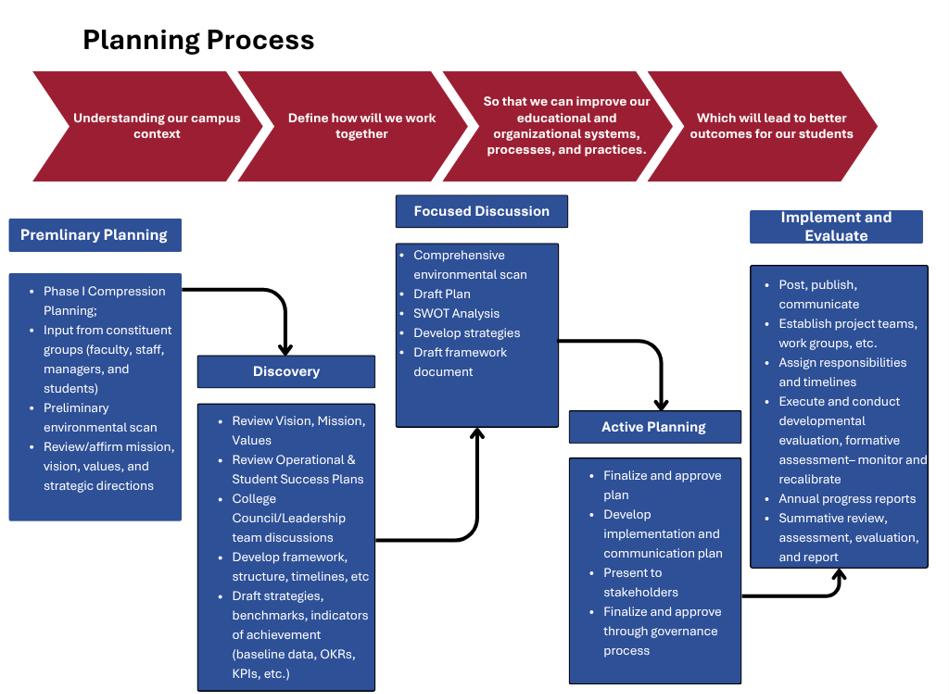
The planning process began with a series of compression planning sessions involving faculty, classified professionals, and managers. These sessions provided an opportunity to reflect on Coalinga College’s Mission, Vision, and Values and to articulate the purpose of the institution, its aspirations, and the core beliefs that guide its work.
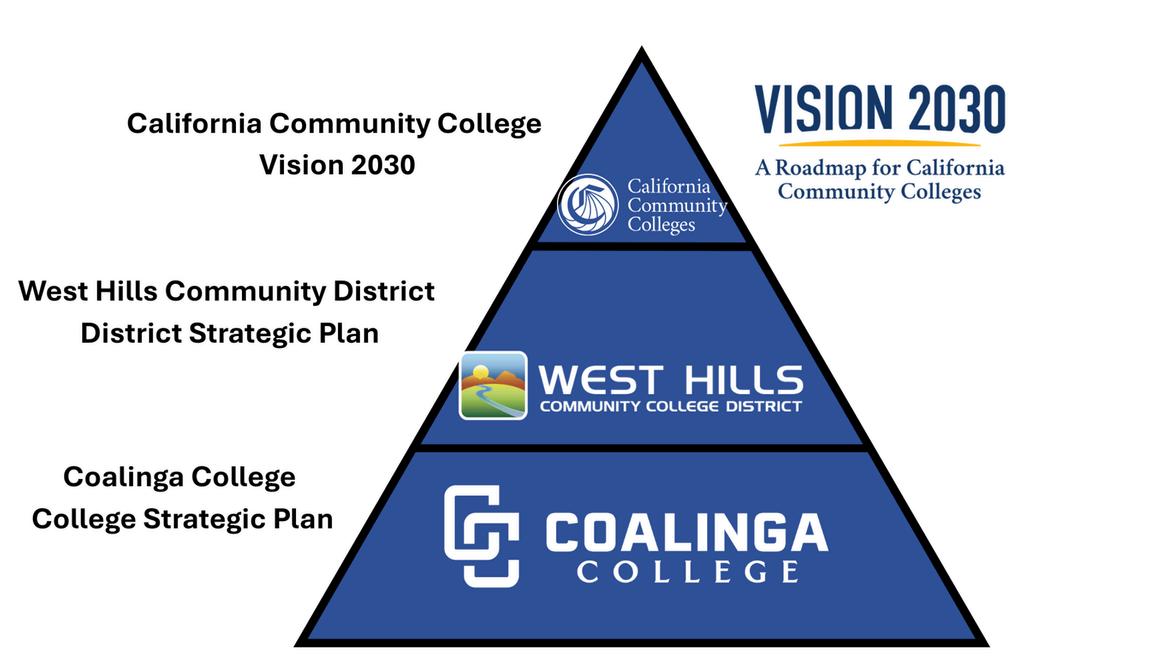
Following this initial phase, a Strategic Planning Taskforce was formed with representative participation from all campus stakeholder groups. The taskforce reviewed key institutional and district planning documents, including the Educational Master Plan, Facilities Master Plan, Strategic Enrollment Plan, Student Equity and Achievement Plan, District Strategic Plan, the President’s Goals, and the California Community Colleges Vision 2030, to ensure strategic alignment. Key themes from the compression planning sessions were also incorporated. As a result of this review, the mission and vision statements were refined, values and strategic objectives were updated, and institutional goals were established.
The draft Strategic Plan was presented to and reviewed by the Academic Senate, Associated Student Body, Student Success Committee, and College Council. The outcome of this collaborative and inclusive process is reflected in the 2026–2030 Strategic Plan, which will guide the college over the next four years in advancing its mission and supporting the needs of the community.
HISTORY
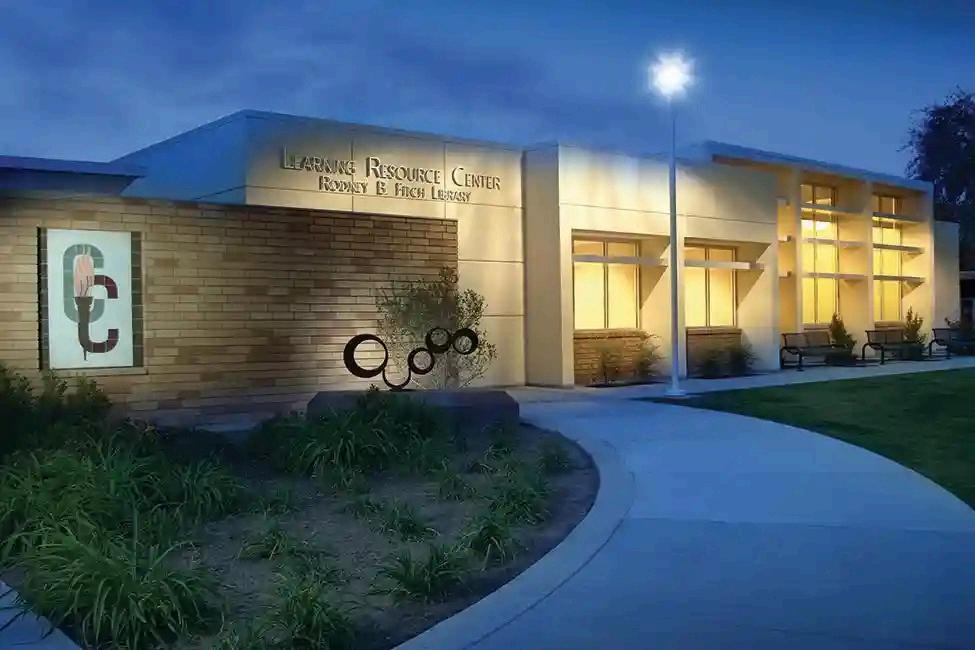
Coalinga College was founded in 1932 as the Coalinga Extension Center of Fresno State College. During the 1940s, it became known as Coalinga College and came under the governance of the Coalinga Union High School District. In 1956, the college relocated to a newly established 40-acre campus on Cherry Lane.
In 1961, the institution separated from the high school district, and in 1969, it was renamed West Hills College. Over the following decades, the college expanded its educational services to surrounding communities. In 2002, the West Hills Community College District grew further with the establishment of West Hills College Lemoore, and this college became West Hills College Coalinga.
In April 2024, the West Hills Community College District implemented a districtwide rebranding to improve clarity and identity. As a result, the institutions were renamed Coalinga College, Firebaugh Center, and Lemoore College. Coalinga College operates the Firebaugh Center.
VISION & MISSION
Vision
Coalinga College will cultivate transformative learning experiences that empower students and fuel our region’s economic engine. Through deep partnerships with community and industry, the college will expand access, inspire innovation, and propel students and communities toward a more prosperous future.
Mission
Through the delivery of high-quality academic instruction, programs, support services, and industry partnerships, Coalinga College inspires all learners to recognize their potential and achieve their goals. The college fosters growth, equity, and economic mobility by providing a student-centered environment to think critically, communicate effectively, and develop skills to support and lead our diverse communities.
VALUES
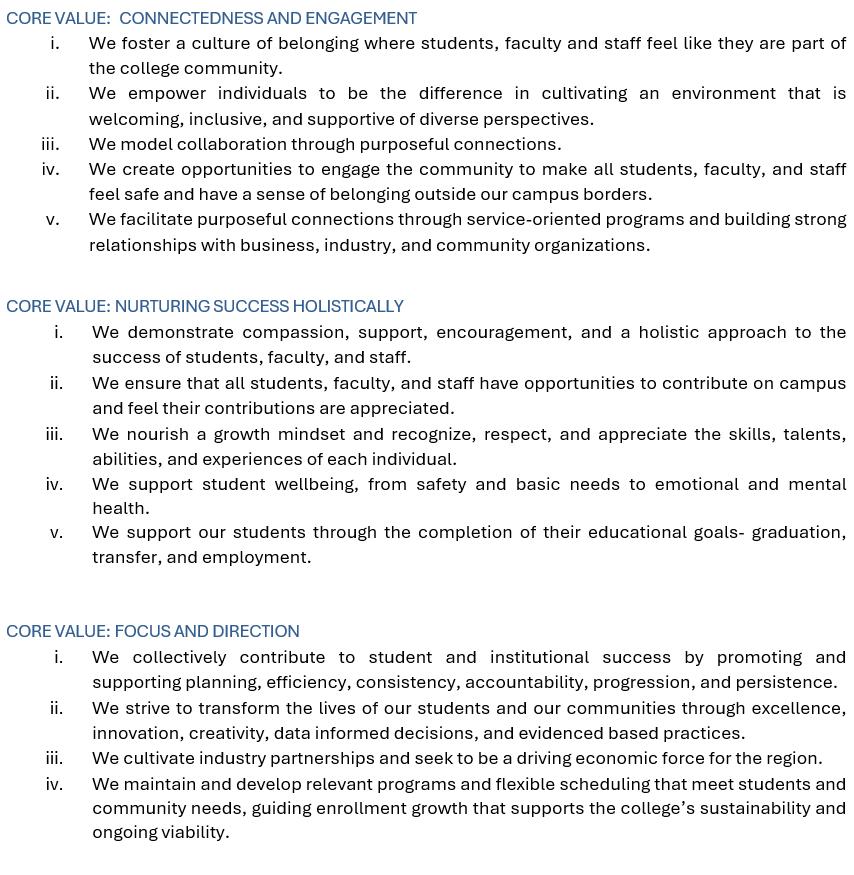
CORE VALUE: CONNECTEDNESS AND ENGAGEMENT
CORE VALUE: NURTURING SUCCESS HOLISTICALLY
part that is staff building
We demonstrate compassion, support, encouragement, and a holistic approach to the success of students, faculty, and staff.
We ensure that all students, faculty, and staff have opportunities to contribute on campus and feel their contributions are appreciated.
We nourish a growth mindset and recognize, respect, and appreciate the skills, talents, abilities, and experiences of each individual.
We support student wellbeing, from safety and basic needs to emotional and mental health.
We support our students through the completion of their educational goals - graduation, transfer, and employment.
CORE VALUE: FOCUS AND DIRECTION
We collectively contribute to student and institutional success by promoting and supporting planning, efficiency, consistency, accountability, progression, and persistence. We strive to transform the lives of our students and our communities through excellence, innovation, creativity, data-informed decisions, and evidence-based practices. We cultivate industry partnerships and seek to be a driving economic force for the region.
We maintain and develop relevant programs and flexible scheduling that meet students' and community needs, guiding enrollment growth that supports the college’s sustainability and ongoing viability.
OBJECTIVES & GOALS
Coalinga College Strategic Objective 1: Provide high-quality teaching and learning opportunities that accelerate success and increase completion.
Goal: 90% of students will have a comprehensive education plan by the end of year one.
Goal: Through the program review cycle, all academic and career education programs will use trend analysis and implement necessary changes to address emerging industry and transfer requirements, ensuring program relevance.
Goal: Coalinga College will achieve the targeted student completion outcomes established in Vision 2030 for certificate, degree, transfer, and living wage.
Goal: 40% of faculty teaching online courses will hold certification in formal online course design training, with 30-35 courses earning Quality Reviewed badges through the Peer Online Course Review (POCR) process as evidence of applied learning.
Coalinga College Strategic Objective 2: Eliminate/Reduce Equity & Achievement Gaps.
Goal: Ensure equitable enrollment outcomes for all students by eliminating disproportionate impact and fully closing equity gaps.
Goal: Eliminate disproportionate impact and fully close equity gaps in student completion of transfer-level math and English.
Goal: Eliminate disproportionate impact and fully close equity gaps in student persistence.
Goal: Eliminate disproportionate impact and fully close equity gaps in student completion.
Goal: Eliminate disproportionate impact and fully close equity gaps in student transfer
Coalinga College Strategic Objective 3: Provide integrated, holistic services that support affordability, student basic needs, student success, and completion.
Goal: 90% of students will have a FAFSA or CADAA application on file by the end of year 1.
Goal: Students with basic-needs insecurities will access available support services and report high levels of satisfaction (90% or higher) with the assistance they receive.
Goal: 25 - 30 degrees, certificates, or pathways coded as Zero Textbook Cost (ZTC) or Low Textbook Cost (LTC).
Goal: Students will report a high level of satisfaction (90% or higher) with the services provided by Coalinga College.
Coalinga College Strategic Objective 4: Foster campus and community engagement that promotes exemplary learning and working environments.
Goal: Foster campus and community engagement by strengthening athletics, expanding extracurricular opportunities, and enhancing cultural vibrancy to promote exemplary, inclusive learning and working environments.
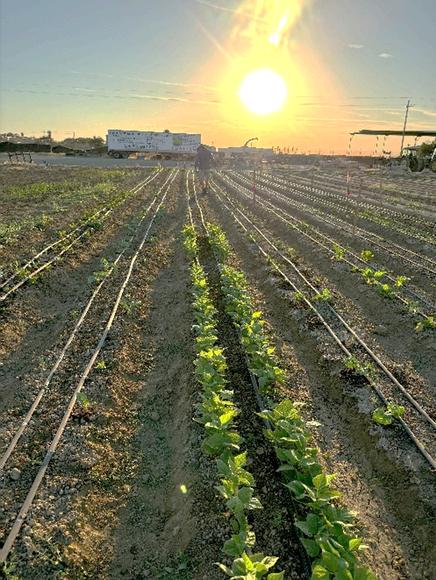
Goal: The Farm of the Future will demonstrate measurable growth in campus and community engagement by increasing event offerings, class offerings, or class participation rates.
Goal: Enhance the Firebaugh Center’s campus life and local community integration by establishing a recurring “Cultural Series,” expanding student-led extracurricular clubs, and increasing participation in wellness and engagement events to foster an inclusive and vibrant learning and work environment
Goal: The residence halls will maintain a 90% or higher annual occupancy rate to strengthen campus engagement, community building, and student connection to learning and co-curricular experiences.
Goal: Students will express satisfaction with campus safety at a rate of 85% or higher, fostering trust, engagement, and exemplary learning and working environments.
Goal: At least 85% of students, employees, and community respondents will report feeling welcomed and a sense of belonging on campus.
Goal: Coalinga College will strengthen university, workforce, and community partnerships by sustaining active advisory groups, and hosting regular career and transfer events throughout the academic year at both the Coalinga Campus and the Firebaugh Center
Coalinga College Strategic Objective 5: Continue to build institutional efficiency and effectiveness.
Goal: Provide culturally relevant professional learning opportunities.
Goal: Strengthen data-informed decision-making.
Goal: Streamline systems and processes to better serve students.
Goal: Foster cross-departmental collaboration and capacity.
Goal: Promote continuous improvement and accountability.
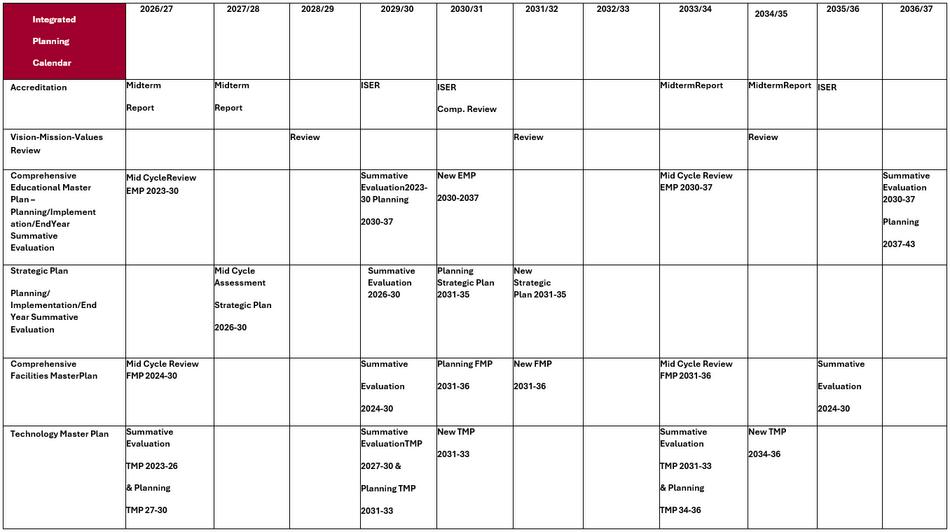
INTEGRATING PLANNING
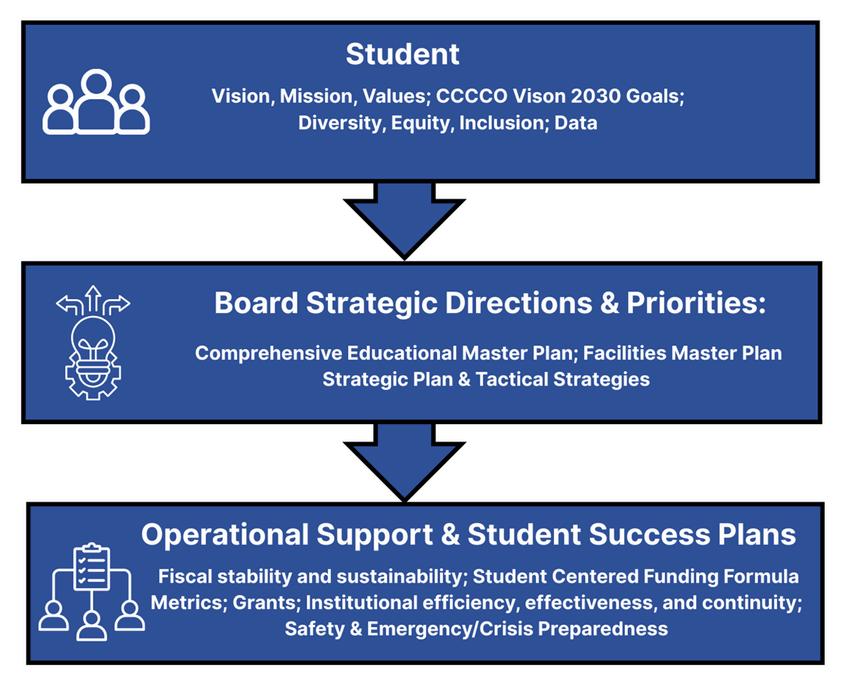
Educational Master Plan and Strategic Plan Development and Implementation Cycle
If you don't know where you're going, you might end up someplace else. - Casey Stengel
EMP long-range planning document -7 years implementation 1 yr assessment & planning
Strategic Plan mid-range planning document -4 years implementation 1 yr assessment & development of next plan
Aligned with the Strategic Directions identified by the college in Educational Master Plan (EMP), District Strategic Plan (DSP), Vision 2030, Student Centered Funding Formula (SCFF),and the Student Equity and Achievement Plan (SEAP).
Framework to guide college planning and decision making and benchmark progress & key results
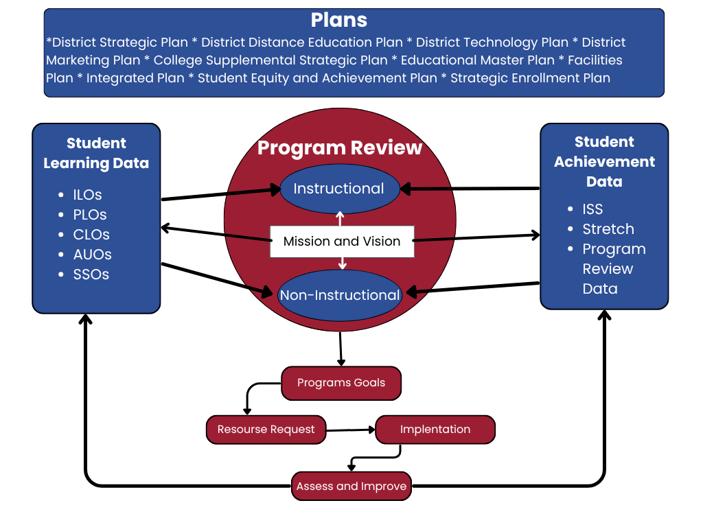
All integrated planning is informed by district and college planning documents.
Instructional and non-instructional program reviews are driven by data on Student Learning and Student Achievement.
Data Metrics and program review processes are aligned to the college mission and vision.
Resource requests originate in program review and are aligned to program goals. Implement changes for improvement.
Repeat the process of assessment, revisions, and implementation, all through program review.
PLANNING PROCESS
STRATEGIC ALIGNMENT
APPENDIX 1