• Whole Roasted Turkey (Minimum 12 pounds - pre-cooked weight) (Larger 18-20 pound turkey available for a $40.00* supplement)
• Choose One Appetizer:
Chopped Chicken Liver
Mini Beef Stuffed Cabbage
Traditional-Style Swedish Meatballs
Mini Vegetarian Stuffed Cabbage
• Choose One Soup:
Traditional Chicken Soup
Butternut Squash Bisque
Mushroom Barley Soup
• Choose Any Combination Of Four Accompaniments:
Apple Fennel Challah Stuffing
Corn Bread Stuffing With Cranberries and Walnuts
Wild Mushroom and Sausage Stuffing
Braised Butternut Squash and Apples
Apricot-Ginger Roasted Sweet Potatoes
Whipped Potatoes
“Retro” Sweet Potato Casserole
Classic Green Bean Casserole
Savory Spinach Kugel
Baked Corn Casserole
Oven Roasted Vegetable Medley
Whipped Turnips & Carrots
Maple Brown Sugar-Glazed Baby Carrots
Parve “Cream”ed Spinach
• Rich Turkey Gravy
• Cranberry Orange Chutney
• 1/2 Dozen Large Dinner Rolls
• Pumpkin Pie
• Gourmet Apple Crisp
Bakery Items, Platters, Grocery & Meat Department items are available for preorder but all orders must be in by 11/18!
Connecticut Deliveries
Delivered To Our Central Locations In The Following Locations:
November 24th
10 - 10:30 AM
- 12:00 - 12:30 AM
Local Home Deliveries Tuesday 11/24 Only
(Entire online store shuts down 11/20 @ 3pm and there will be no further orders accepted for the holiday week. Please bear this in mind when you are getting your order ready.) This is a HARD deadline. Check
INSIDE this week
Last week, Sudan became the third Arab country in the past two months to normalize ties with Israel. In the coming weeks, the two countries will begin to discuss economic and trade relations, with an initial focus on agriculture.
Count Down 8
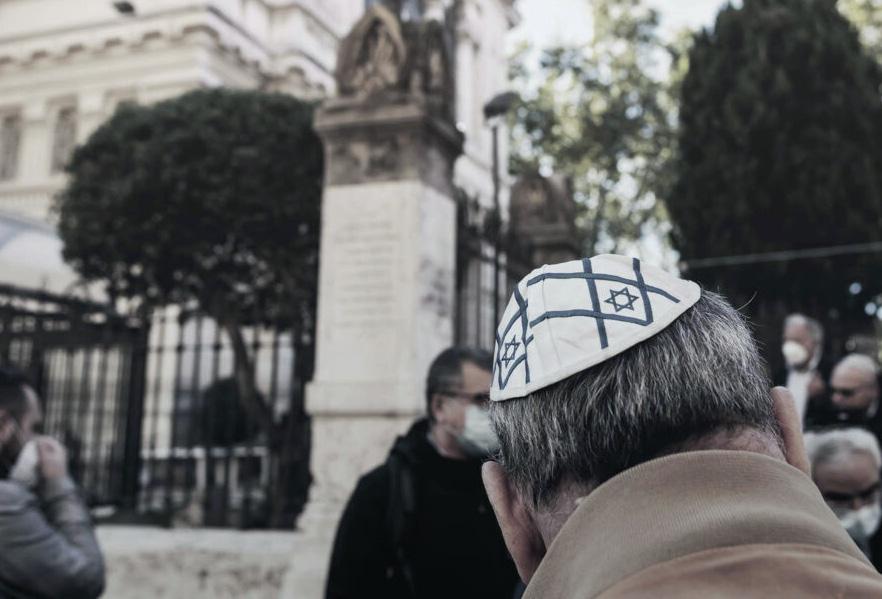
According to a landmark new study, Jews’ share of the population of Europe is as low now as it was 1,000 years ago – and the future doesn’t look good.
is set to garner 75% of the
All the News Unfit to Print 10
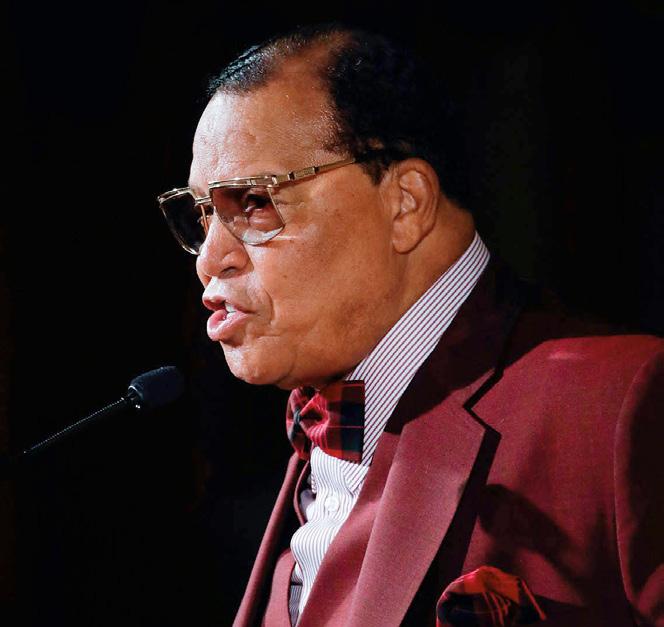
Last week, The New York Times drooled over the notorious anti-semite Rev. Louis Farrakhan in a piece defending him against accusations of sexism. It made no mention of his legacy of anti-Jewish or anti-gay remarks.
the Kitchen
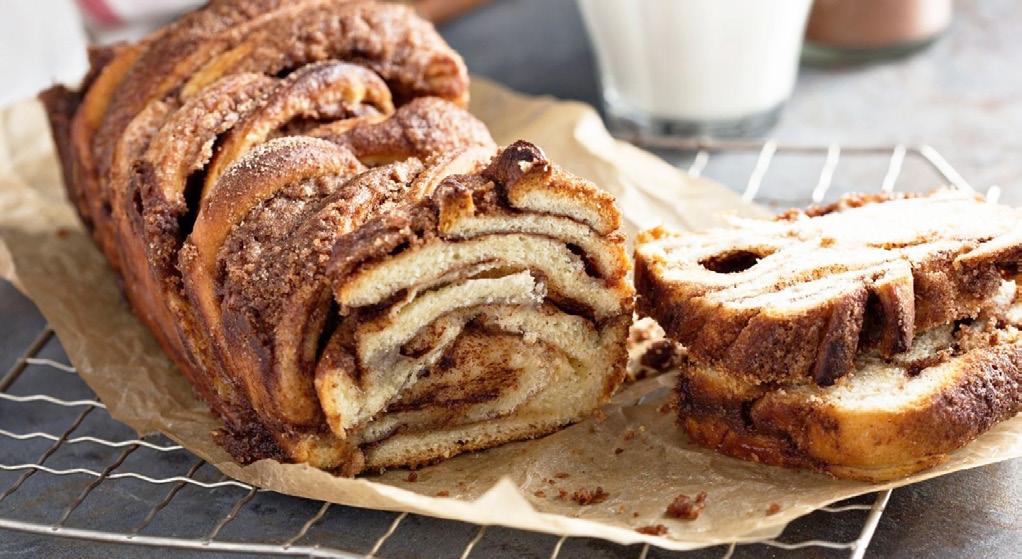
The Great British Baking Show is entertaining and so much fun to watch. But what it doesn’t know about Jewish baked goods could fill a chocolate babka.
In April 2019, a team of local women active in the Jewish Federation of Greater Hartford’s Women’s Philanthropy, launched an initiative aimed at empowering women in need – and thereby changing the trajectory of their lives – by providing them with essential hygiene supplies. The project caught fire with women all across the country. Now, “Dignity Grows” is branching out nationwide – with the help of the Hartford team and the Jewish Federation of North America (JFNA). PAGE 12
SHABBAT FRIDAY, OCT. 30
Hartford: 5:29 p.m.
New Haven: 5:29 p.m.
Bridgeport: 5:30 p.m.
Stamford: 5:30 p.m.
To determine the time for Havdalah, add one hour and 10 minutes (to be safe) to candle lighting time.
ELECTION 2020
Joe Biden
Jewish vote.
IN THE (KOSHER) KITCHEN
‘The
Great British Baking Show’ has a Jewish dessert problem
BY SHANNON SARNA
What is going on with “The Great British Baking Show”?! For the past two weeks of its eighth season, it has featured a Jewish baked good, and I am not complaining. Well, not entirely. Last week: a true abomination in the form of rainbow bagels. And this past week: chocolate babka.
Jewish baked goods have been featured several times on “The Great British Baking Show”: challah in season five, which they called a plaited loaf (outrageous); and bagels last week, which they also didn’t reference as being Jewish, though, of course, they are. So I appreciated that this was the first time they actually referenced that babka is Jewish in origin.
Over here at The Nosher, we are kind of experts in babka. After all (humble brag), I did write a book that featured an entire chapter about how to make babka. But I digress.
A brief recap: Babka is a sweet, enriched, yeasted dough hailing from Eastern Europe. Jews brought it to America, making it popular. Traditionally, American babkas are either chocolate or cinnamon. In fact the chocolate vs. cinnamon babka debate featured prominently on a beloved episode of “Seinfeld.”
Babka has exploded in the U.S. and around the world over the last seven or so years, ever since Breads Bakery revived the yeasted cake, dusting it off for a new generation and helping inspire bakers and bloggers around the world to embrace the cake, adding their own spins. It is a very visual dessert, with a coveted signature swirl that’s basically made for Instagramworthy food porn.
Unlike the bagel challenge, which had some egregious recipe errors, I didn’t take issue with the recipe itself. The challenge was to create a chocolate and hazelnut babka glazed with a sugar syrup at the end (true to a good babka recipe).
But the technique was all wrong. An enriched babka dough should be left to rise before filling and shaping. And since an enriched dough is made with butter, milk, and eggs, it can be on the heavier side, weighed down by all that (delicious) fat. The dough should rise again after being shaped to give it air and ensure it’s not too dense.
I was particularly surprised that none of the bakers were familiar with babka, since it has gained such widespread internet renown; you can see beautiful swirled babka in every flavor variety from around the world with a quick Google or Instagram search.
Consequently, the shaping seemed to challenge them the most, having no visual reference. The #1 mistake: rolling out the dough too long, making it impossible to fit into the pan.
Despite some shaping challenges, most of the bakers’ babka looked pretty good in the end. They may not all have had that perfect swirl, but they were gooey and chocolaty, and that’s the most important part in my book.
Perhaps the most insulting moment of the episode: Prue’s comment that the babka on the show was much better than the variety she had tasted in New York City. Hmm.
One person on Twitter called “The Great British Baking Show” babka “goyishe.” I will neither defend nor support that comment, though I will assert there are just some foods New York City has perfected: pizza, bagels and babka, to name just a few. Paul and Prue, let me officially invite you to come taste the wonders New York City can offer.
And in case you missed it, the best comment of the entire episode came from newish host Matt Lucas, who suggested to one of the bakers that maybe the babka “will get bigger if you stroke it.” I’ll have to try that sometime.
Shannon Sarna is editor of “The Nosher” for MyJewishLearning and author of the cookbook “The Modern Jewish Baker.”
This article originally appeared in The Nosher.
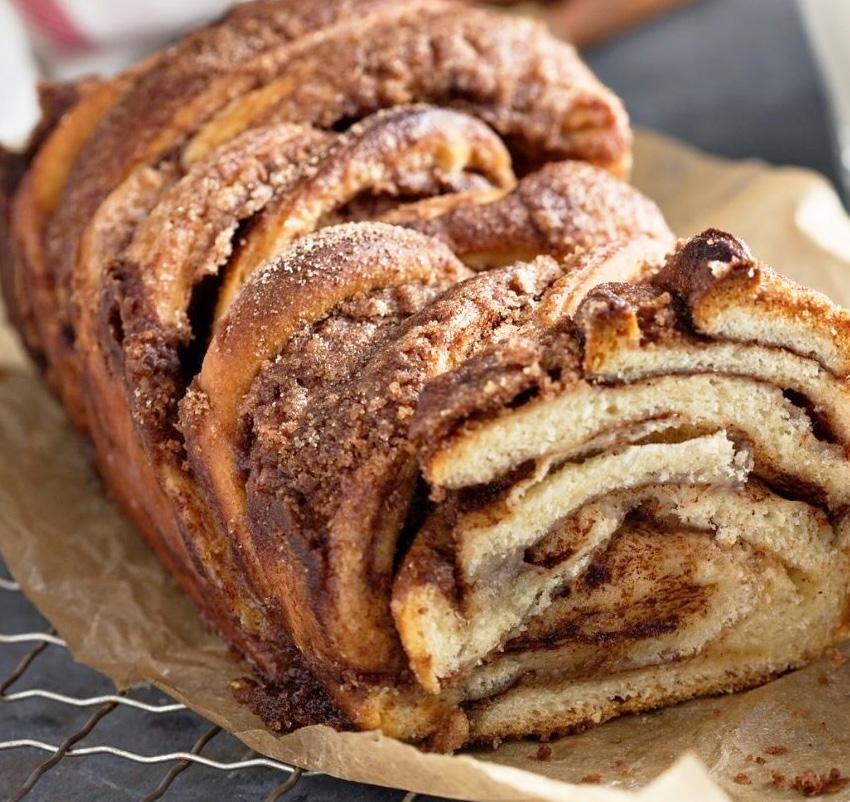
A BABKA, A TRADITIONAL JEWISH ENRICHED BREAD (GETTY IMAGES)
UP FRONT
Sudan will normalize ties with Israel, Trump announces
BY RON KAMPEAS
(JTA) – Sudan will become the third Arab country in the past two months to normalize ties with Israel, continuing the trend of Arab states’ willingness to advance ties with the Jewish state even without a peace agreement with the Palestinians.
President Donald Trump announced the agreement on Friday. According to a joint
statement released by Israel, Sudan and the U.S., the two countries will “end the state of belligerence between their nations.”
The statement also noted that the countries will “begin economic and trade relations, with an initial focus on agriculture.” In the coming weeks, the statement says, they will meet to discuss
“agriculture technology, aviation, migration issues and other areas.”
“The Arab-Israeli conflict is moving towards an end,” said Brian Hook, the top State Department official who helped broker the deal, on Friday at an Oval Office presentation.
Poll finds American Jews set to vote overwhelmingly for Joe Biden
BY RON KAMPEAS
(JTA) – Jewish voters are set to vote 75% to 22% for Joe Biden, according to a poll by the American Jewish Committee.
The poll released Monday, Oct. 19, shows the Democratic nominee expanding his support among Jewish voters from a 67-30 split in a poll last month and it includes other signs that President Donald Trump is faring poorly among Jewish voters.
Trump’s record on bigotry may be the animating factor in his poor performance: Asked which candidate in the Nov. 3 presidential election would better handle antisemitism, respondents produced identical results, with Biden scoring 75% and Trump 22%.
The survey was conducted by SSRS from Sept. 9- Oct. 4, reaching 1,334 American Jews by phone; some respondents would have answered questions after Trump once again equivocated when asked to condemn white supremacists in the Sept. 29 debate with Biden. The poll has a margin of error of 4.2 percent.
Biden, the former vice president, has made Trump’s record on bigotry a central focus of his overall campaign and particularly of his Jewish
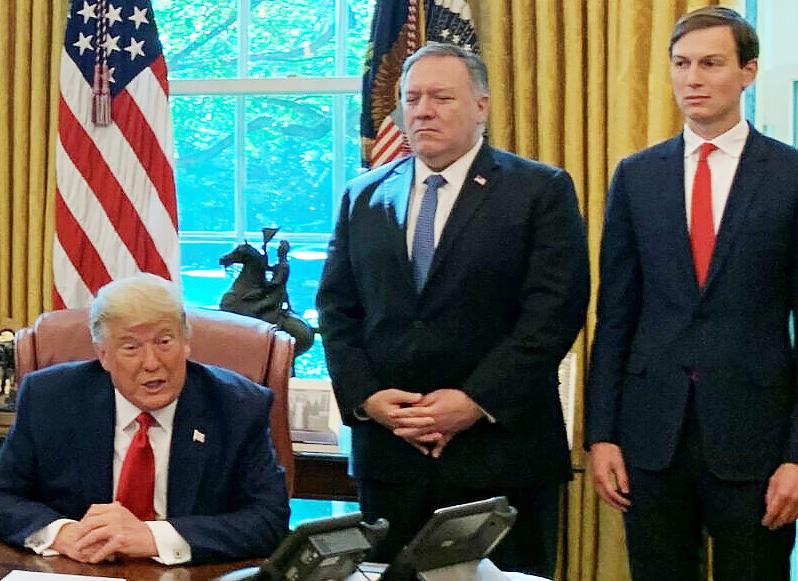
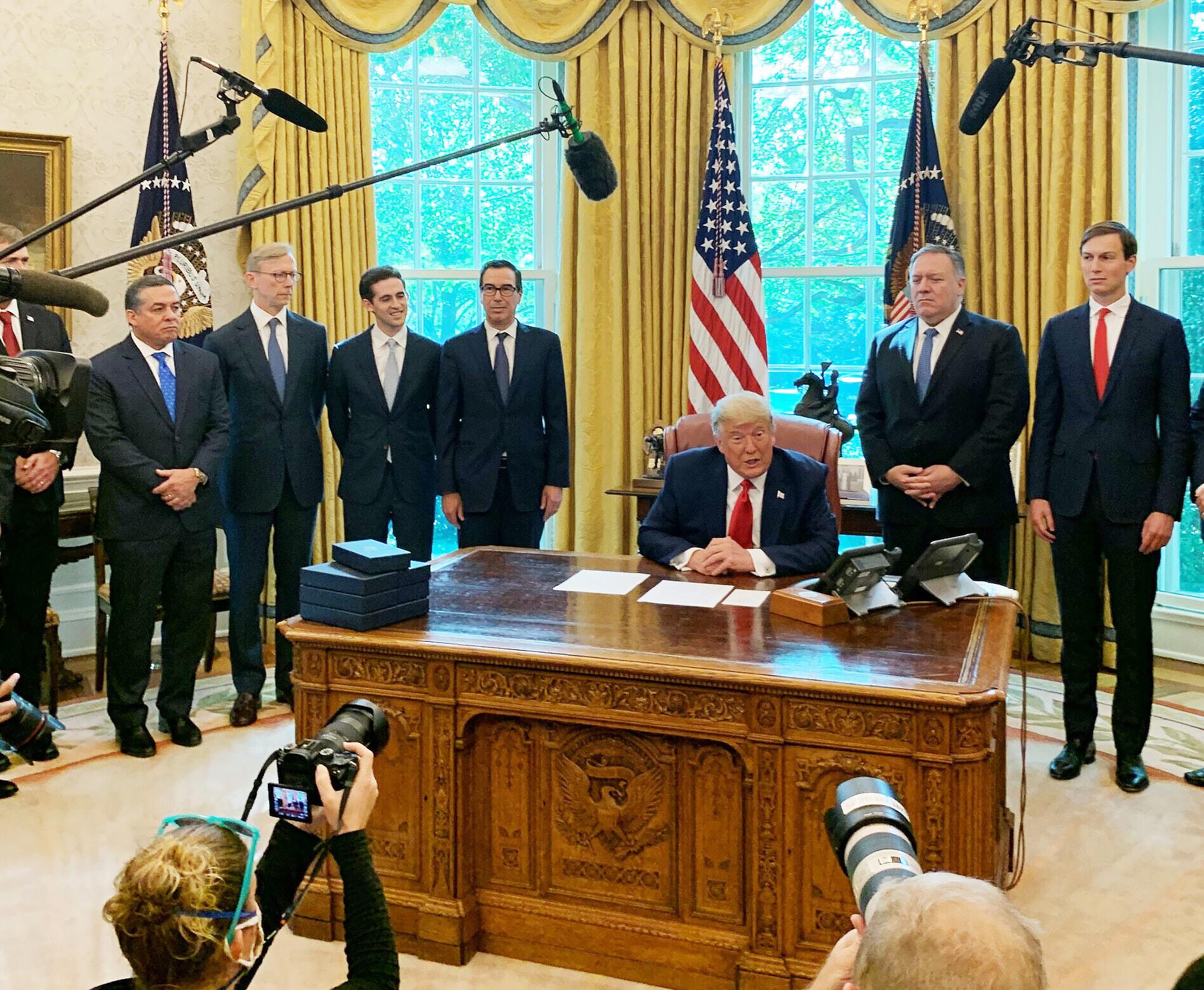
PRESIDENT DONALD TRUMP AND SENIOR MEMBERS OF HIS ADMINISTRATION IN THE WHITE HOUSE OVAL OFFICE AS SUDAN AGREES TO NORMALIZE RELATIONS WITH ISRAEL.
(CREDIT: MICHAEL CROWLEY/THE NEW YORK TIMES FOR WHITE HOUSE/POOL)
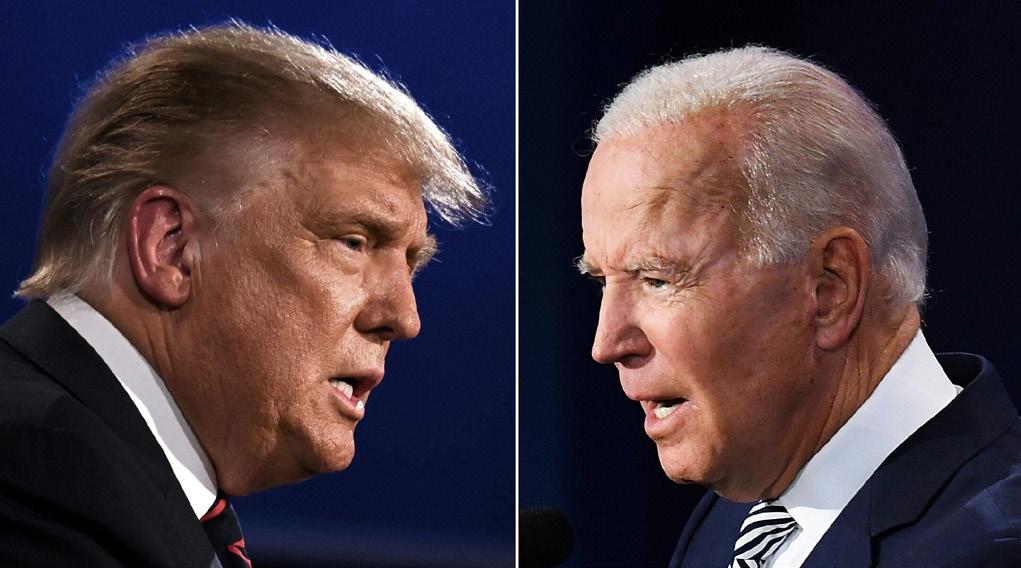
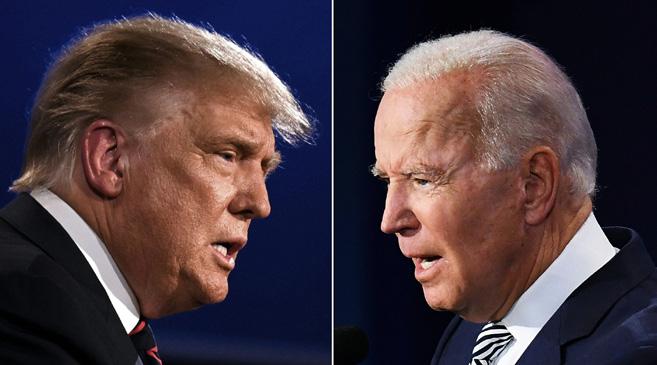
PRESIDENT DONALD TRUMP AND FORMER VICE PRESIDENT JOE BIDEN SQUARE OFF DURING THE FIRST PRESIDENTIAL DEBATE IN OHIO, SEPT. 29. (CREDIT: JIM WATSON/SAUL LOEB)
Sudan has been ruled by a Sovereignty Council, led by military leader Abdel Fattah al-Burhan and prime minister Abdalla Hamdok, since a military coup last year deposed longtime Sudanese President Omar al-Bashir, who was subsequently convicted of corruption. He presided over the country during the Darfur ethnic conflict, which involved what the International Criminal Court has deemed war crimes by the Sudanese government.
Earlier in the day, Trump informed Congress of his intent to remove Sudan’s designation as a state sponsor of terrorism, which reportedly is part of the agreement.
Sudan will get new leadership in 2022, when the state’s agreed-upon transition period ends. The north African country’s state religion was Islam until earlier this year.
The United Arab Emirates and Bahrain have in recent weeks launched fast tracks to open up diplomatic affairs, trade and tourism with Israel, but Sudan is especially significant because it is by far the largest of the three countries, in land mass and in population. It is also symbolically significant because its capital, Khartoum, is where the Arab League met in 1967 after the Six-Day War and issued its “three no’s” to reject any engagement with Israel whatsoever and to continue the state of war.
Like the UAE and Bahrain, Sudan has not been in a war with Israel and has over the years enjoyed a degree of secret ties with the country. In 1984, the Sudanese authorities assisted in an airlift of Ethiopian Jews to Israel. Sudan’s leader Abdel Fattah al-Burhan in February met openly with Israeli Prime Minister Benjamin Netanyahu, in Uganda.
There are also thousands of refugees from Sudan’s military conflicts living in Israel.
Trump also said at the Oval Office event on Friday that the process of solidifying the deals with the UAE and Bahrain “is moving along.” He said he is in talks with the United Arab Emirates to sell the country advanced F-35 stealth combat jets.
Israel objects to the sale, as do Democrats in Congress.
Bahrain signed a number of cooperative agreements with Israel this week and the UAE and Israel agreeing to travel between the countries without a pre-arranged visa. A government-linked Bahraini institute on Thursday signed an agreement with the U.S. State Department to combat antisemitism and delegitimization of Israel.
Could Lebanon’s first negotiations with Israel in decades lead to normalization?
BY ISRAEL KASNETT
(JNS) For the first time in three decades, Israel and Lebanon held the first of what is expected to be a series of negotiations over the next few months regarding the two countries’ shared maritime border. Both countries, Lebanon in 2007 and Israel in 2010, delimited their respective exclusive economic zones (EEZ) in the eastern Mediterranean with Cyprus. But a 330-square-mile section of the Mediterranean Sea between Israel and Lebanon remains in dispute.
U.S. officials mediated the negotiations, which took place at a base belonging to the U.N. Interim Force in Lebanon (UNIFIL) in the Lebanese town of Naqoura. Lebanese officials reportedly refused to speak directly with the Israeli representatives. The meeting lasted only an hour, but both sides agreed to meet again on Oct. 28. The question now is whether or not they can reach a compromise and whether these talks hint of the possibility for broader talks over normalization.
Alan Baker, director of the Institute for Contemporary Affairs at the Jerusalem Center for Public Affairs, told JNS that the talks are significant since the disagreement has lasted for 10 years already, and every time Israel offered to sit and negotiate, Lebanon has refused.
Why all of a sudden has Lebanon relented to negotiating?
“It is connected to the Gulf states and the normalization of relations with Israel,” said Baker. “The Lebanese have realized they have everything to benefit from coming
to an agreement with Israel,” especially when it comes to gas revenues, and possibly “some form of arrangement for cooperating with Israel for utilizing the resources of the sea.”
“The Lebanese government would not be able to do this without getting a green light from Hezbollah,” he added.
What is clear, according to Baker, is that Hezbollah is in dire financial straits, and if Lebanon benefits from this economically, then the terror group will as well.
Israel and Lebanon have had a volatile relationship since both countries were established in the 1940s. While Lebanon did not formally take part in the succession of Arab-Israeli wars in 1948, 1967 and 1973, a more turbulent period of relations began between them during the Lebanese Civil War in the 1970s and ’80s.
Israel has had warmer relations with Lebanon’s Christian community, especially during the civil war, where it openly backed Christian leaders and occupied southern Lebanon as a buffer zone until 2000. However, as the balance of power in Lebanon has shifted in the ensuing decades towards its Shi’ite Muslim community dominated by Hezbollah, relations have become increasingly hostile with the two sides fighting a war in 2006. Hezbollah has continued to threaten Israel with crossborder raids with as many as 150,000 rockets and missiles pointed directly at the Jewish state.
Nevertheless, since the August 4 multiple explosions in the capital city of
Beirut that decimated buildings and led to nearly 200 civilian deaths, the world has increased scrutiny on Lebanon’s government and internal corruption, in addition to Iranian influence through Hezbollah. As such, there may be a shift away from an overtly hostile approach to Israel.
Efraim Inbar, president of the Jerusalem Institute for Strategy and Security, also noted Hezbollah’s relaxed stance regarding negotiations with Israel.
“It’s clear that Hezbollah removed its veto over the talks,” he said. “It tried to flex its muscles and prevent Israeli government officials from partaking in the talks, but it relented. This reflects its reluctance to be seen as not making a contribution to the rebuilding of Lebanon.”
Inbar agreed with Baker that Hezbollah has an ulterior motive for the talks to succeed, as a deal would mean money ending up in its coffers.
Whether this will lead to a broader agreement akin to normalization by the United Arab Emirates and Bahrain, Baker remained skeptical.
“It’s a beginning, and if it works out, it can lead to wider discussions on the land boundary, where the dispute is not so large, but there are points which need to be negotiated and agreed upon,” he said.
“This, of course, depends on what the future government of Lebanon will look like,” he added.
Speaking at the Knesset on Wednesday, Israeli Prime Minister Benjamin Netanyahu hinted at the possibility of broader negotiations when he called on the Lebanese government to continue and conclude talks with Israel regarding mutual maritime borders.
“It might be a first sign for peace that could maybe happen in the future,” Netanyahu said. But he warned that “there will be no peace with Lebanon as long as Hezbollah is in control of it.”
Inbar said he believes that it would be wrong to see the talks as an indication of expanding the normalization process. “It is a Lebanese development, and has to do with the economic and political crisis within Lebanon,” he emphasized.
Inbar said he wouldn’t read too deeply into the talks at this point: “I am a skeptic, and I am waiting. We will see what happens.”
“In the Middle East, talks can go on forever,” he forewarned. “And we shouldn’t forget that even if we have an agreement, there is no assurance that it will be respected.”
THE TEL AVIV MUNICIPALITY ON RABIN SQUARE IS LIT UP WITH THE LEBANESE FLAG ON AUG. 5, IN SOLIDARITY WITH THE CIVILIANS KILLED IN MULTIPLE EXPLOSIONS IN BEIRUT THE DAY BEFORE, ON AUG. 5, 2020. (CREDIT: MIRIAM ALSTER/FLASH90)
campaign. Biden launched his campaign in April 2019 saying that he was coaxed into running by Trump’s failure to unequivocally condemn a deadly white supremacist march in Charlottesville, Virginia in 2017.
The AJC poll shows Biden besting Trump on every other issue including handling the coronavirus pandemic, 78%19%; combatting terrorism, 71%-26%; and uniting the country, 79%-15%.
Trump fares poorly even on those issues he has sought to draw strong contrasts with Biden: dealing with Iran, 71%-27%; handling crime, 72%-24%, and strengthening U.S.-Israel relations, 54%42%.
A central plank of the Trump campaign’s campaign in the Jewish community has been his decision to pull out of the 2015 Iran nuclear, deal, which Trump has repeatedly emphasized was finalized when Biden was serving President Barack Obama as vice president.
Another plank has been Trump’s closeness to Israeli Prime Minister Benjamin Netanyahu. Trump has moved the U.S. embassy to Jerusalem, cut funding to Palestinians, recognized Israel’s claim to the Golan Heights, advanced an Israeli-
Odd Nansen
Palestinian peace formula that would allow Israel to keep chunks of the West Bank, and most recently, brokered a normalization deal between Israel and two Gulf Arab nations.
Trump has expressed frustration that his Israel decisions have not garnered greater support in the Jewish community.
Another sign in the poll that Trump has alienated Jews is that just 16% of respondents admitted to voting for him in 2016; exit polls at the time showed 24% voting for him. The gap suggests that some respondents might have convinced themselves that they never voted for Trump.
The poll showed Jewish voters tend to rank foreign policy low on their list of priorities heading into the voting booth: The top two ranked issues are the pandemic and health care, at 26% and 17% respectively, with foreign policy ranked last among six issues, at 5%. The other issues respondents were asked to rank were the economy at third, 13%; race relations at fourth, 12% and crime at fifth, 6%.
David Harris, the American Jewish Committee CEO, identified a number of
areas of concern for his group, which seeks to achieve a consensus among American Jews to better represent them to overseas governments and in international forums. One was the gap between Orthodox Jews, of whom the poll showed 74 percent favoring Trump, and others in the community.
“For those of us in the Jewish world who want to focus on unity, on outreach, on bridge-building within the Jewish community, I think this is a very compelling reminder of how wide some of the differences are,” he said.
Other concerns, Harris said, included the seeming gap between American and Israeli Jews, who overwhelmingly approve of Trump, and the shrinking interest in foreign policy among American Jews.
Ivanka Trump visits the tomb of the Lubavitcher Rebbe as election nears
BY RON KAMPEAS
Mendel Schneerson, as an election approaches that could oust her father from the presidency or give him another four years.
Smartphone video posted on social media captured President Donald Trump’s daughter emerging, masked, on Thursday night from the “ohel,” a modest structure in Queens where Schneerson is buried with his father-in-law. The structure is adjacent to a cemetery.
Trump had just completed his second debate with Joe Biden, the Democratic nominee, in Tennessee.
Ivanka Trump was praying for her father’s reelection, according to Yeshiva World News, which did not give attribution for the claim. In 2016, she and her husband, Jared Kushner, visited the ohel to pray for her father’s election.
Ivanka Trump and Kushner are Orthodox Jews. Praying adjacent to the tomb of Schneerson, who died in 1994, is considered by many Jews to be especially powerful.
“Odd Nansen not only saved my life. He also enriched it with his philosophy of life”
Please join us for our Annual Community-Wide Kristallnacht Commemoration. This year, we will honor the conscience and heroism of Odd Nansen, who financed and operated an orphanage in Oslo, Norway for Jews and all facing imminent death in Nazi-occupied Europe. Sent to a concentration camp by the Nazi Gestapo, Nansen kept a secret diary there which later became an important testimony to the realities of the Holocaust. In the camp, Nansen risked his life in order to save inmates.
PROGRAM HIGHLIGHTS:
• U.S. Senate Commendation presented by Senator Richard Blumenthal to the Nansen family.
• Comments by Timothy Boyce, Esq., re-publisher of “From Day to Day,” the secret diary of Odd Nansen.
(JTA) – Ivanka Trump visited the tomb of the Lubavitcher rebbe, Rabbi Menachem
Europe is as low as it
down to 295,000 members, the study said. But the community is displaying potential for growth, as 33% of its households have at least four children. (For comparison, that figure is 26% in Germany and France, 25% in Hungary and 21% Denmark.)
The report’s findings on the number of Israelis living in Europe are also surprising, and they contradict estimates that there are tens of thousands of them living in Berlin alone. The survey claims there are only about 70,000 Israel-born individuals living on the entire continent, with more than half residing in the United Kingdom (18,000), Germany (10,000), France (9,000) and the Netherlands (6,000).
Still, Israelis have been a stabilizing
force for the Jewish communities of countries with very small Jewish communities – for example, they account for over 40% of all Jews in Norway, Finland and Slovenia; 20–30% in Spain, Denmark, Austria and the Netherlands; and over 10% in Luxembourg.
Overall, though, the declining trend reshaping European Jewry is not likely to be reversed, according to the study.
“Only under exceptional circumstances do demographic trends radically modify their course,” the authors wrote. But, they added, “such modifications have actually occurred more than once in European Jewish demography during the last hundred years alone.”
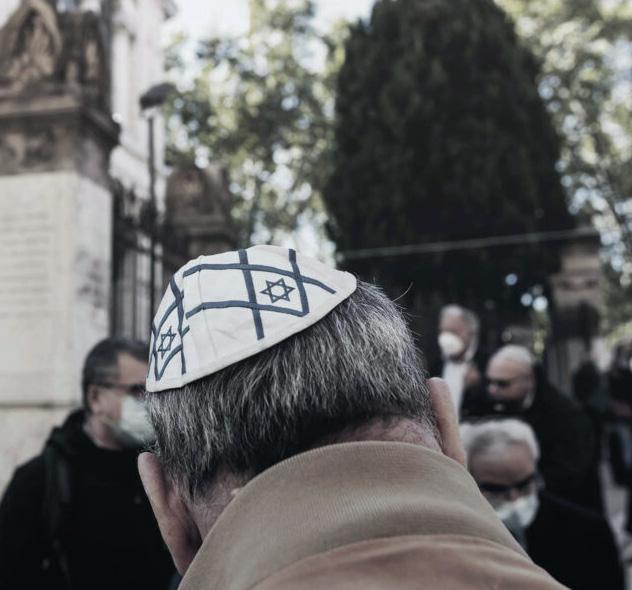
A MAN CELEBRATES SUKKOT IN ROME, ITALY, OCT. 9, 2020. (CREDIT: STEFANO MONTESI/CORBIS/GETTY IMAGES)
“Ppl who have become white” – seemingly a euphemism for Jews – “should not be lecturing Black ppl about oppression.” She urged her critics to focus their ire on President Trump, since after all, “Hitler never had more than 38% of popular vote.”
Funny she should mention Hitler. In 1933, he, too, was the beneficiary of a puff piece in the New York Times
During Hitler’s first months in power, there was extensive coverage in the American press of his anti-Jewish policies, such as the mass firing of Jews from their jobs, public burnings of books by Jewish authors, and sporadic antisemitic mob violence. To counter this negative attention, Hitler in July 1933 granted Anne O’Hare McCormick of the New York Times his first exclusive interview with an American reporter since becoming chancellor of Germany.
McCormick was a Pulitzer Prize recipient (the first woman to win the prize in a major journalism category) with a reputation for landing big-name interviewees. But snagging an interview is not the same as making the best use of it.
There is no evidence that McCormick harbored any sympathy for the Nazi leader’s views. But her choice of questions, nonconfrontational manner, and flattering description of his appearance and demeanor contributed to a generally positive portrayal of Hitler.
“Hitler Seeks Jobs for All Germans” was the headline of McCormick’s page one, top-of-the fold interview. Here’s how she introduced Times readers to the Fuehrer: “At first sight the dictator of Germany seems a rather shy and simple man, younger than one expects, more robust, taller. His sun-browned face is full and is the mobile face of an orator.”
She continued: “His eyes are almost the color the blue larkspur in a vase behind him, curiously childlike and candid. He appears untired and unworried. His voice is as quiet as his black tie and his doublebreasted black suit….Herr Hitler has the sensitive hand of the artist.”
It got worse from there, as McCormick lobbed soft ball question after soft ball question, giving Hitler a platform from which to expound his views in a reasonablesounding tone without any serious challenges.
Just as Natalie Hopkinson portrayed the role of women in Farrakhan’s march in glowing terms, Anne O’Hare McCormick gave Hitler several paragraphs to explain the positive role of women in the Third Reich. “Women have always been among my most sta[u]nchest supporters,” he boasted. “While our aims encourage women to marry and stay home, unmarried women are in free competition with men. Only military service, service on the bench and certain political posts are closed to women.” No follow-up on that from McCormick. Unlike Hopkinson, McCormick did not completely ignore the question of the Jews,
although she badly mishandled it. In her 29th paragraph (out of 41 total), she asked: “How about the Jews? At this stage how do you measure the gains and losses of your antisemitic policies?”
She then gave the Nazi leader four uninterrupted paragraphs in which to explain – in what she called “his extraordinary fluency” – that the reports of his anti-Jewish persecution were all exaggerated, that many other people were enduring hardships, and that the Jews’ suffering was all their own fault anyway.
From there, McCormick pivoted to what she evidently felt was a more pressing question: “What character in history do you admire most, Caesar, Napoleon, or Frederick the Great?”
Although McCormick did not set out to soften the Nazi leader’s image, her interview may have had that effect. Improving Hitler’s reputation in the United States was important to the Nazis. Germany sought to postpone repaying of its World War I wartime debts to the U.S. and its allies. Hitler also hoped to dissuade American companies from joining the growing boycott of German goods. And he was anxious to keep the United States from interfering as he rebuilt the German military. That’s also why Hitler authorized an American publisher, Houghton Mifflin, to omit the most extreme and violent passages from his autobiography, Mein Kampf, when it published English-language editions of the book in the 1930s.
Farrakhan is not another Hitler, although he might like to be. He has praised the Nazi dictator as “a very great man” and asserted that “there’s a similarity” between the two of them in that “he raised Germany up from nothing [and] we are raising our people up from nothing.”
Farrakhan’s Nation of Islam has, according to the Southern Poverty Law Center, “earned a prominent position in the ranks of organized hate,” and its leader is, in the words of the Anti-Defamation League, “the leading anti-semite in America.” Tens of thousands have attended his rallies in recent years; he has more than one million Facebook followers, and nearly half a million followers on Twitter. That makes him a dangerous figure, whose antisemitism should be taken seriously by the most influential newspaper in the world. Natalie Hopkinson was wrong to omit it, and the editors of the New York Times were wrong to let that omission stand.
Dr. Rafael Medoff is director of The David S. Wyman Institute for Holocaust Studies, in Washington DC, and author of more than 20 books about the Holocaust and Jewish history.
This article first appeared in the Los Angeles Jewish Journal (Oct. 20, 2020) and is reprinted with permission of the author.
Now accepting grant applications from Internal Revenue Service qualified 501(C) (3) organizations which seek assistance consistent with the goals of the “B” Foundation to help feed, care, or educate society. The grants will range from $1,000 to $10,000 and will be awarded by the end of the calendar year.
Please submit your written request by November 15, 2020 to: The “B” Foundation P.O. Box 3709 Woodbridge, CT 06525
HOPE in a bag
BY STACEY DRESNER
WEST HARTFORD –
When Jessica Zachs of West Hartford watched the 2018 documentary “Period. End of Sentence” about women in India with no access to monthly menstrual supplies, she was shocked.
“These women in India, literally, were still in the’ Red Tent,’” Zachs says, referring to the tent where women in biblical times were sent during menstruation and childbirth.
“I started Googling and found out in very short order that in America [due to] ‘Period poverty’ – which is a recognized term – 20 percent of women can’t afford personal feminine hygiene products,” Zachs says.
“My reaction was, ‘This is wrong…This just can’t be!’”
Feeling that something had to be done, Zachs, a member of Jewish Federation of Greater Hartford’s Women’s Philanthropy, and fellow Women’s Philanthropy member Linda Levin, founded Dignity Grows, an innovative non-profit effort to provide monthly personal and menstrual hygiene products to women and girls who cannot afford them.
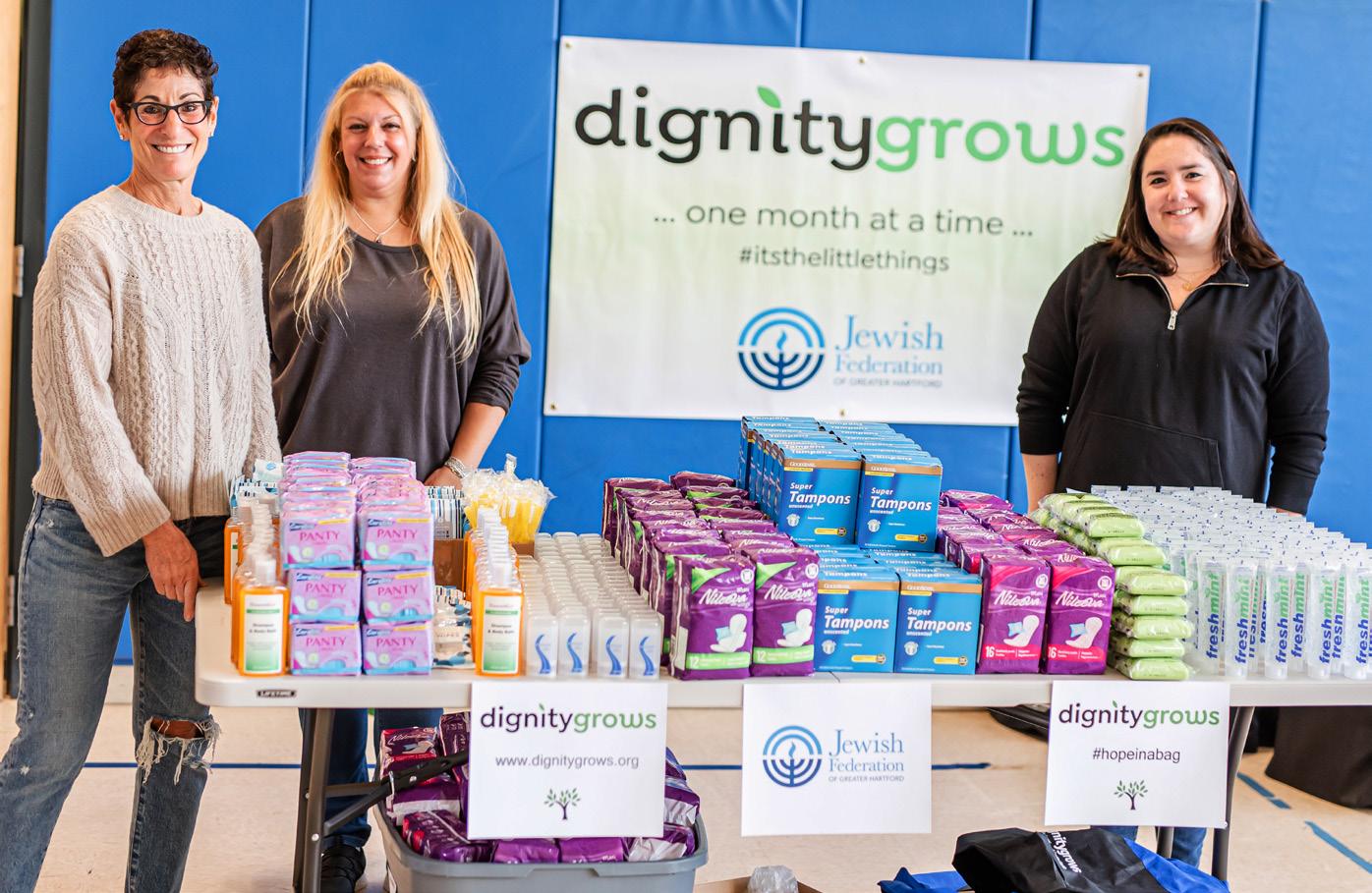
Since its inception some 18 months ago, Dignity Grows has distributed Dignity Totes – filled with menstrual and hygiene products assembled by an army of volunteers – to 14 “Distribution Partners” in the Greater Hartford area, all of them local non-profit organizations. The Distribution Partners, in turn, disseminate the totes to those in need among their constituents.
Earlier this month, after motherdaughter teams of volunteers packed 1,500 totes at socially-distanced packing parties held at Solomon Schechter Day School of Greater Hartford, the number of Dignity Grows totes that have been packed and distributed has grown to 5,000.
Now the effort has the potential to grow even more, given the national launch of Dignity Grows on Wednesday, Oct. 28. The expanded initiative includes the debut of a new website, www.dignitygrows.org, designed to inspire Women’s Philanthropy divisions of Jewish Federations around the country to start their own Dignity Grows chapters.
That, says Zachs, would be a giant step towards lessening the toll “period poverty’ takes on the self-esteem and economic and educational well-being of women and girls.
“Most of the women who can’t afford these products are hourly wage workers. If you can’t go to work because you don’t have menstrual supplies, you don’t get paid
which heightens the cycle of poverty. So you have to then decide if you’re feeding your kids or if you are buying sanitary products. It’s someone’s economic wellbeing and we know that affects everything else,” says Zachs.
A grassroots effort
In 2019, even before watching “Period. End of Sentence,” Zachs and her friend Linda Levin had been seeking an impactful project for women in the Hartford Jewish community to participate in together.
“And we wanted to get women together to do something – not listen to a speaker, not read a book, but do something that would begin a conversation and awareness about an important issue.”
It was not long after that that Zachs and Levin the documentary, which shed light on the lack of hygiene products in India, and also detailed the inspiring grassroots efforts of a group of Indian women who created and distributed sanitary pads with the help of a local cotton farmer.
“This gentleman in their community said, ‘We’re going to get together and we’re going to start making pads that you women can use,” explains Zachs. “And this gentleman, who was a cotton farmer, got women together; they built machinery and created their own sanitary pads. Then they brought them to markets. People were against them, but this grassroots business took off.”
As did Dignity Grows.
Zachs and Levin grassroots effort began when she met with the Jewish Federation of Greater Hartford to discuss the idea of a one-night program in which women from the community would come together to fill bags with feminine hygiene products for those in need.
“We got a small grant of $1,500 through a donor-advised fund to start. Linda Levin used $1,000 to purchase totes at a buck a piece and we were in business,” Zachs said. “The products, at that point, were donated by the women who came to the event. They were incredibly generous. I think 50 people came to Linda’s house to pack these totes. It was wonderful.”
Making connections
Dignity Grow’s first distribution partners were the Jewish Family Services of Greater Hartford and its Anja Rosenberg Kosher Food Pantry, and Mikveh Bess Israel in West Hartford.
“A committee member who goes to the mikveh said the woman in charge knew women who were in need of these products.
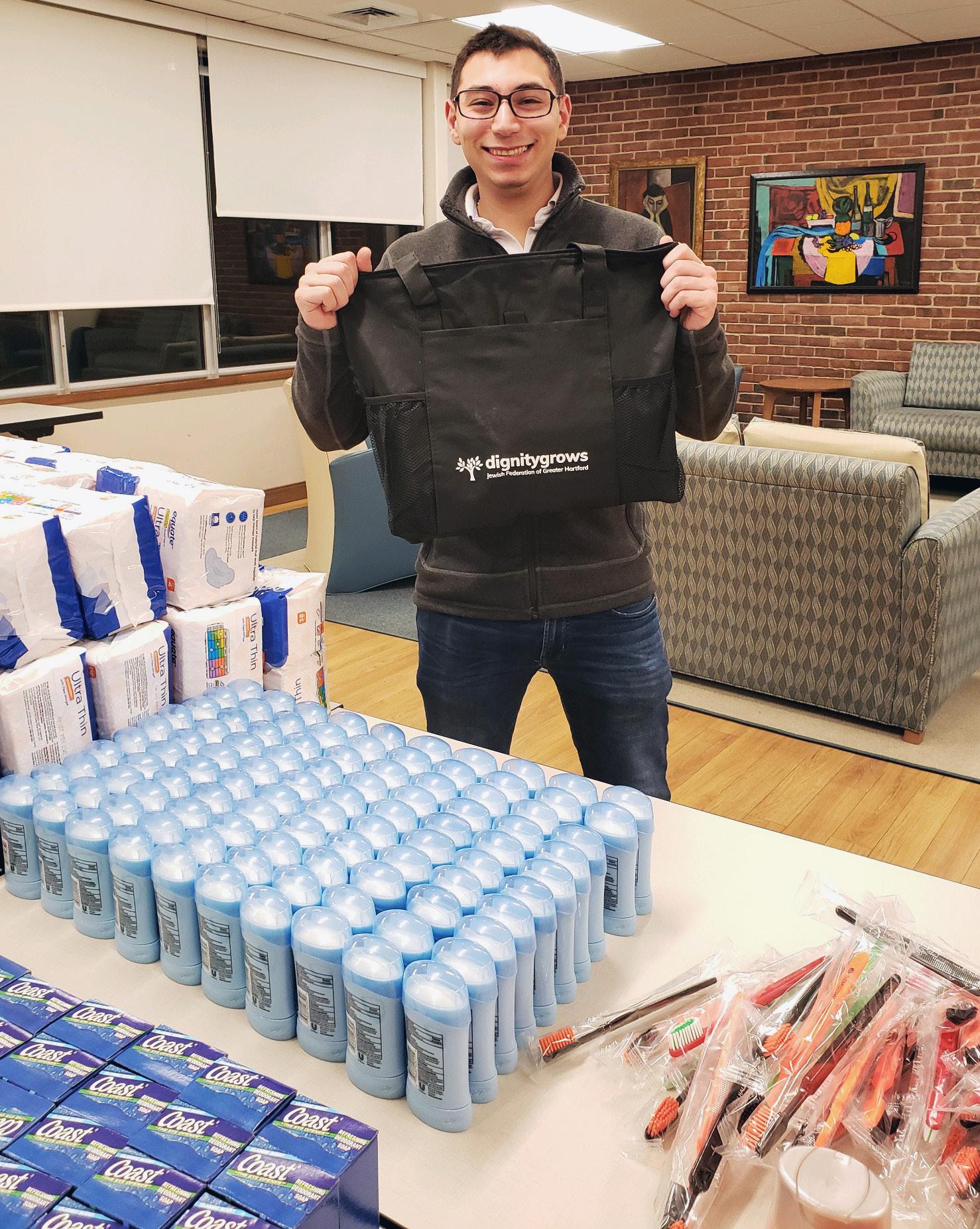
VOLUNTEER TYLER LITTMAN HELPS PACK A DIGNITY GROW TOTE BAG AT A PACKING EVENT.
THE DIGNITY GROWS TEAM (L TO R) JESSICA ZACHS, JENNIFER TOLMAN SCHWARTZMAN AND JESSICA SLATER.