Adherents to Qanon, and the conspiracy theories behind it, claim that the “liberal elite,” including Democratic politicians and Jewish billionaire George Soros, are part of a secret faction to overthrow the president.
Conversation with… .................... 5
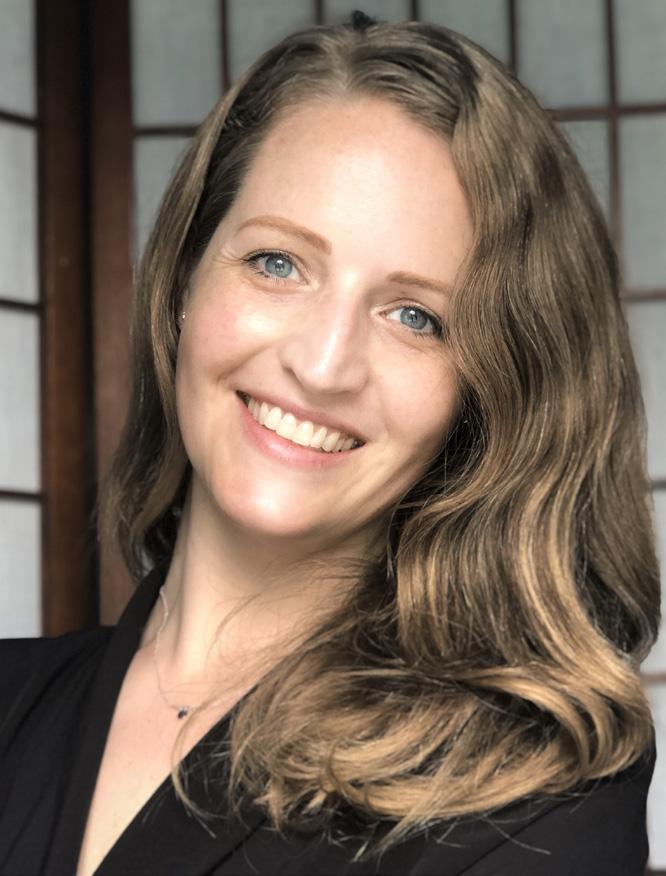
Katie Hanley, the new CEO of Jewish Family Services of Greater Hartford, talks about mental health in the time of Covid-19.
Ancestry has embarked on a initiative that makes 19 million Holocaust records available for free…and a partnership with the Shoah Foundation that indexes thousands of survivor testimonies containing information on more than 600,000 people.
ELECTION 2020 ............................. 15
Kamala Harris talks to Jewish donors; Rabbi Aryeh Spero blesses President Trump; Georgia’s Marjorie Taylor Greene shares antisemitic video; Nikki Haley lauds Trump’s Israel policies.
In the Kitchen 18 Schnitzel didn’t start out as an Israeli staple. But you’d never know it judging from its popularity in the Jewish state today.
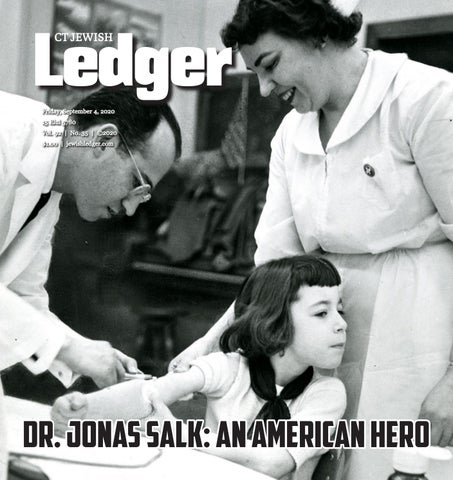
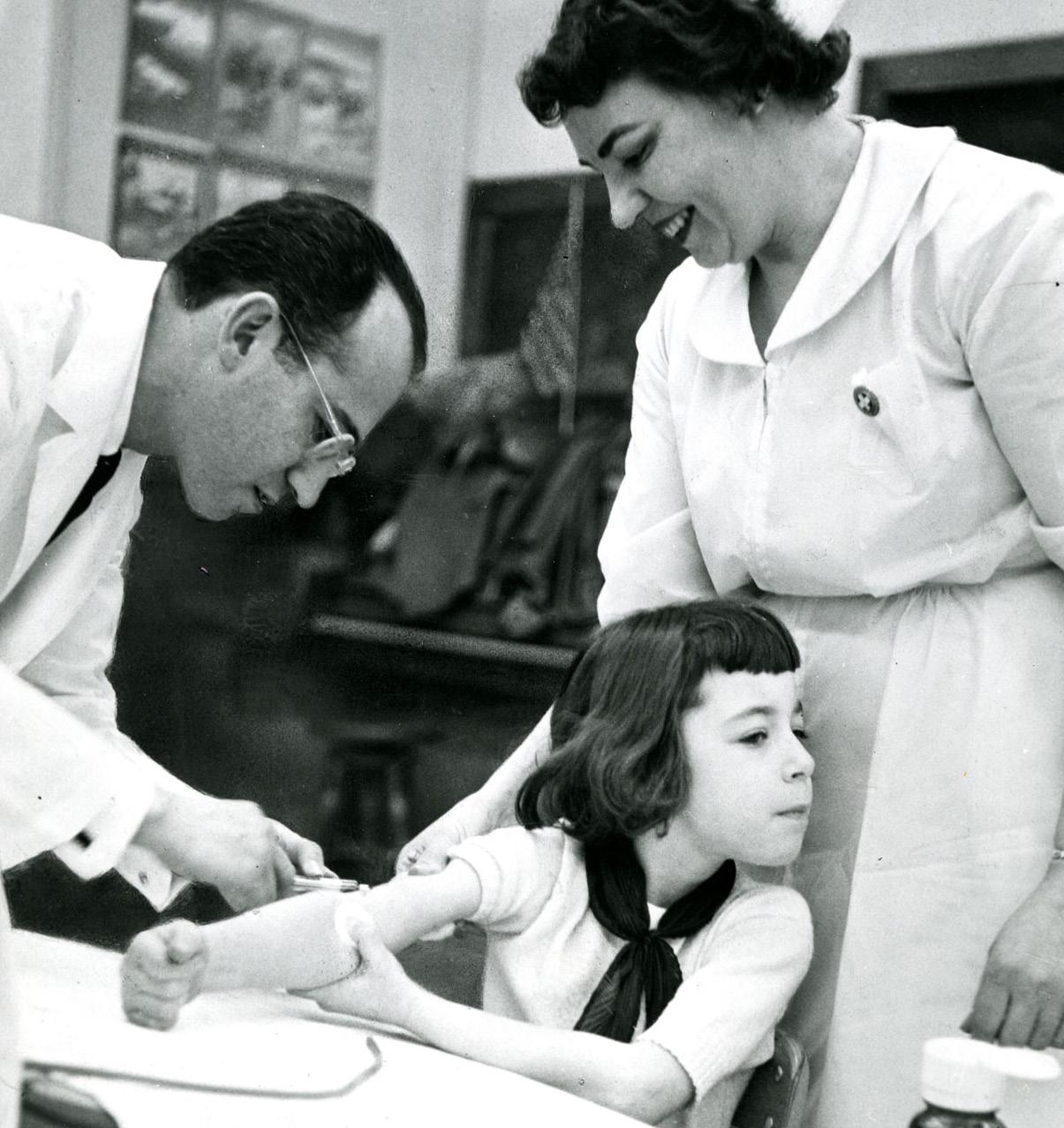
ON THE COVER: Decades ago, in a nation struggling to deal with a disease called polio that preyed on America’s children, a champion emerged in the form of Dr. Jonas Salk, who discovered a vaccine to eradicate this dreaded disease. Can the legacy of this American hero guide modern medicine as it struggles to come up quickly with a vaccine to kill COVID-19? Cover photo: Jonas Salk vaccinating a young girl for polio in 1953. Courtesy of the National Library of Medicine. PAGE 12
FRIDAY, SEPTEMBER 4, 2020
Hartford: 7 p.m.
New Haven: 7 p.m.
Bridgeport: 7:01 p.m.
Stamford: 7:02 p.m.
To determine the time for Havdalah, add one hour and 10 minutes (to be safe) to candle lighting time.
COMFORT Plant Based Comfort Foods
Thursday, October 1 | 7:00 pm
Mandell JCC Facebook LIVE @Mandell JCC Virtual JCC www.virtualjcc.com
The Bitter Prescription:
Engineering Your Diet, Digestion and Hormones After 35
Thursday, October 15 | 7:00 pm
Mandell JCC Facebook LIVE @Mandell JCC Virtual JCC www.virtualjcc.com
For details, please contact Brett Manion, bmanion@mandelljcc.org, or Karen Wyckoff, kwyckoff@mandelljcc.org
UP FRONT
CONNECTICUT JEWISH LEDGER | SINCE 1929 | SEPTEMBER
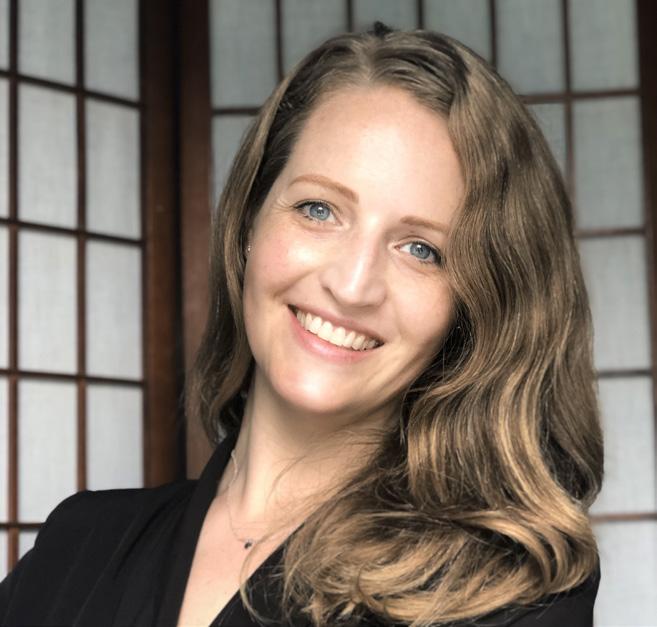
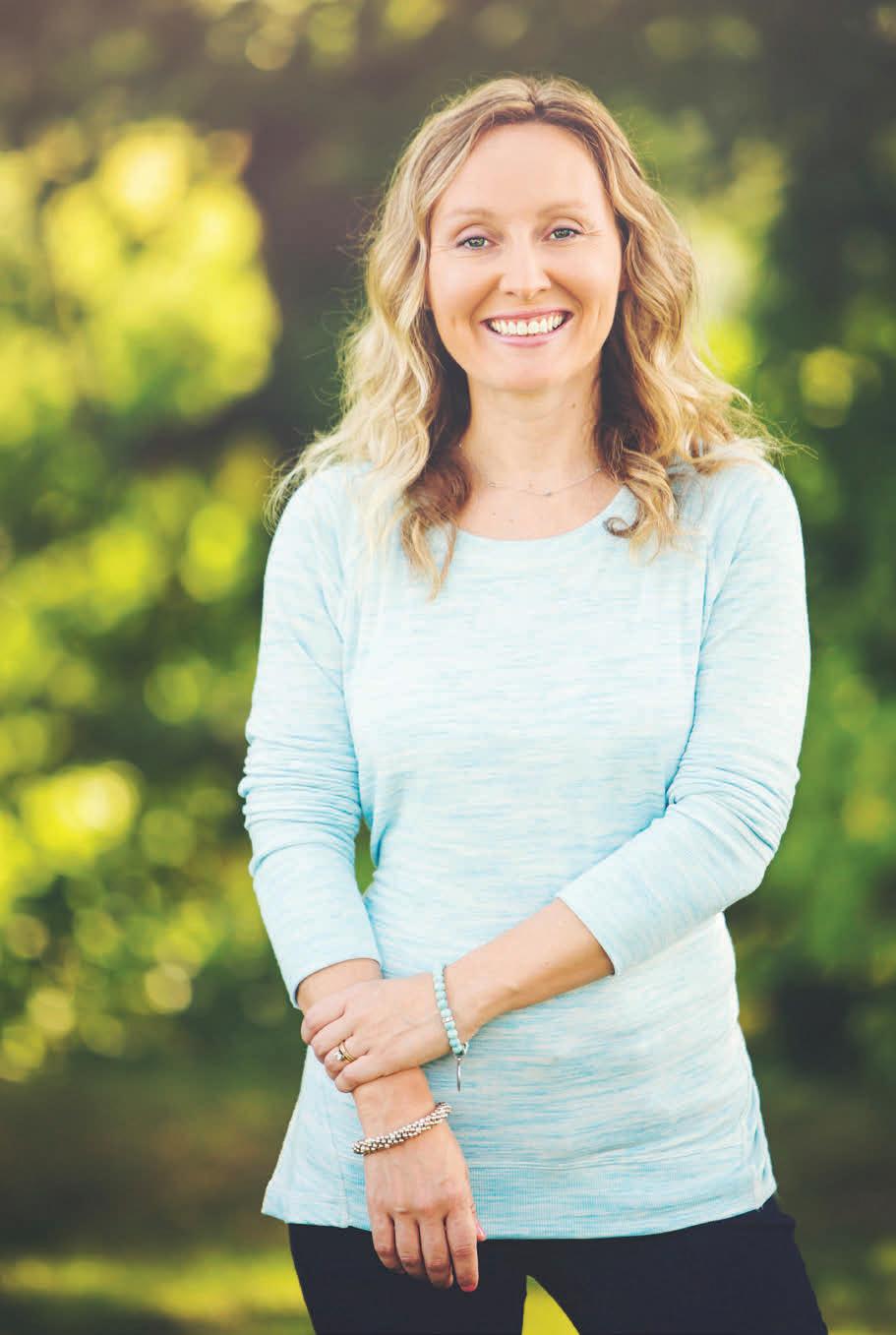
CONVERSATION WITH KATIE HANLEY
The new CEO of Jewish Family Services of Greater Hartford aims to focus on mental health of teens
BY STACEY DRESNER
WEST HARTFORD – Three years ago, while working at Oak Hill, Connecticut’s largest provider of services for people with disabilities, Katie Hanley was introduced to Jewish Family Services (JFS). At the time, Hanley was serving on a committee called Connecticut Health Advocacy for Adults with Disabilities, along with other professionals, including Janice Rothstein, JFS director of clinical services. It was at several meetings held at the West Hartford offices of JFS that Hanley met and got to know longtime JFS CEO Anne Danaher.
Now Hanley has been named chief executive officer of Jewish Family Service of Greater Hartford, succeeding Danaher, who retired in June as the agency’s head after 33 years of service.
Before coming to JFS, Hanley served as the senior director of Oak Hill Centers, where she managed eight of Oak Hill’s specialized community-based programs across five locations. Before that she held several positions at the Charter Oak Cultural Center, where she stewarded nationally recognized arts programs for more than 1,000 inner-city youth.
A native of Worcester, Massachusetts, Hanley received a Bachelor of Arts in philosophy with a minor in women’s studies from the University of Massachusetts at Amherst. She holds a Master’s degree in social work from the University of Connecticut, with a focus on social work administration, as well as a graduate certificate in non-profit management.
Hanley lives in West Hartford with her husband Jeremy, and their three young children. She spoke with the Jewish Ledger about her first two months at the helm of JFS and her plans for the agency’s future.
JEWISH LEDGER: Your predecessor Anne Danaher was a highly respected professional and very successful in her role as JFS head. What is it like stepping into her shoes?
KATIE HANLEY: Frankly, it’s wonderful. I was able to talk with Anne during the
interviewing process and then meet with her extensively when I started and it was wonderful. She just has a very calm, caring compassionate way about her and I think it set the tone for my acclimating to the agency.
Quite frankly, as somebody with young children, I was a little worried about worklife balance, especially at this critical time for all of us during the pandemic. Anne said something which was just really encouraging; she said, “We always say that ‘family’ is our middle name here,” which was really encouraging, and really set the tone about what I was walking into. So it has actually been a pleasure taking over and having her pass the baton on to me.
JL: Tell us about your experience at Oak Hill.
KH: At Oak Hill I was the senior director of a division of an agency. Most people know us as the largest group home provider or as an accredited special education school, but actually we had a lot of other community programs. I oversaw Oak Hill and that included an adaptive sports and fitness program assisted technology program, two camps and a center for relationship and
sexuality education. We had an employment services program; we had a birth-to-three program at one point.
So I was responsible for the oversight of many smaller programs, which was exciting for me because it brought quite a variety [of experience]. I was able to work with an interdisciplinary team of very smart, thoughtful people.
We were a non-profit that really relied on grant support and fundraising to succeed. I loved that job. I loved working with everybody and pulling people together to see how we could integrate our services and determine if a program was sustainable or not. The focus was mostly working towards providing services for people with disabilities, but we defined that very loosely. We served everyone, from students that had learning disabilities all the way to people with significant multiple disabilities.
JL: What are your goals as CEO of JFS?
KH: My goal will forever be to bring in more money, because as the CEO it’s critical for me to consider our sustainability and to make sure we have adequate resources to meet the needs of the community, so that’s certainly at the forefront of my mind.
As far as growth goes, I can only imagine that JFS has room to grow to meet the needs of the community…That being said, that growth has to be done thoughtfully; not growth for growth’s sake, but growth to meet the need. So I’m in the beginning of my time here I’m focusing on learning the landscape, getting to know the community, analyzing the services we have and figuring out how to meet the need. That’s my preliminary goal, but certainly my vision for the future is to find ways to highlight JFS and all the ways that we can meet needs and be a part of the community, in our own unique way.
JFS was built for this point in time. I mean, JFS was created by a bunch of community members who banded together to help those in need. That was over 100 years ago. So, we can look back and
The fight against antisemitism faces a new enemy: QAnon
BY JACKSON RICHMAN
(JNS) The word QAnon – and the conspiracy theories behind it – keep making headlines of late.
Marjorie Taylor Greene, a Republican congressional candidate who touts the ideology, won her run-off in Georgia on August 11 and recently got a shout-out by none other than President Donald Trump, who congratulated her, even calling her a “future Republican star.”
QAnon began in October 2017 with an anonymous user named “Q” on the image-board website 4chan, who claimed to have classified information surrounding the Trump administration and its critics. It is described as a conspiratorial movement that purports that the so-called liberal elite, including Democratic politicians and Jewish billionaire George Soros, are part of a secret political faction to overthrow Trump.
“QAnon conspiracies are centered around the idea of a powerful elite secretly manipulating current events,” Counter Extremism Project senior research analyst Josh Lipowsky told JNS. “QAnon subscribers have politicized the conspiracies around an imagined Democrat-led ‘deep state’ conspiring against Donald Trump, who is heralded as the only one who can defeat this menace.”
Lipowsky labeled QAnon “a modern-day version” of The Protocols of the Elders of Zion, which QAnon echoes in its conspiracy theories, in that “the primary goal is to shift blame.”
“At the center of these conspiracies is a secretive cabal with vast political and financial power,” he explained.
“Certain people want to believe that there is really an all-powerful group controlling things because it removes the onus of personal responsibility for one’s own circumstances and creates
KATIE HANLEY
Hanley
think about what JFS did at the time to get through the flu pandemic in the early 1900s and then the Depression. This is not unknown territory for us in that way. We were built to serve people in times of their greatest need. I feel very energized by that mission.
The pandemic is definitely giving us an opportunity to show people who may not have otherwise seen themselves as needing our services that we are here for them.
JL: In light of the pandemic, how has the need for JFS’s services grown?
KH: From before the pandemic until the time it hit in March, we have had an increase of 108 clients that need our food pantry services. And so… with the food pantry, we quickly switched gears and started delivering meals to people who didn’t feel comfortable leaving their homes. We did that for a long while. Now, two times a month, we do curbside pickup at our offices; so people can apply to be clients of the food pantry. It is a need-based program and we have had an increase there. As for clinical services, there has actually been a little bit of a decrease with engagement because of the switch to tele-therapy, which can be a challenge for people, especially for people whom we serve. We have a very large aging population that we serve and a large population of Russian-speaking clients, so there’s a little bit of a barrier in terms of technology – and the comfort level some people have with the technology which we are trying to address so we can still support clients.
Clients that have stayed on, I’ve been told by our clinical team, want to meet more frequently, and have greater concerns. They are grieving the loss of their normal life and their normal routine.
JL: What about the mental health of younger people? We hear so much about the problems that can come from social media and the increase in teen and young adult suicide.
KH: We do focus on that. One of our programs, Tara’s Closet, was founded by Barbara Roth, and she and I, and the committee, have been talking about what to do for youth who are socially isolated now in a way that they have never have been before; the mental health ramifications and the lack of institutionalized support on a daily basis for them – services and support that they would get at school.
Tara’s Closet is working on awareness, providing education around those issues. Among [their efforts] is an e-newsletter that will be going out this week with a backto-school theme for children and parents, because it’s a very tough time. There is a lot of anxiety about what school is going to look like; there is a lot of excitement [at the prospect of being around] your friends again. But there are also safety concerns. So there is a whole lot wrapped up in that and Tara’s Closet is really focused on supporting the community in that way.
[In prior years,] Tara’s Closet hosted a very large annual in-person mental health event, which we had to postpone this May. We are still working on scheduling a virtual event.
The goal is to raise awareness about mental health and to eliminate the stigma. This pandemic has brought to light issues concerning mental health disorders or having mental health concerns for people who might never otherwise have associated themselves with those sorts of issues. And so I think now is a perfect time to bring the community together to talk about mental health.
I’m very proud to be working right now at an organization that not only does the clinical services for the community but also is trying to do educational outreach and raising awareness.
JFS is pretty phenomenal in that they have a wonderful donor-base and volunteer base that will do anything to get the word out to help the community.
a scapegoat for larger catastrophes. The economy is crashing? A virus is spreading throughout the world? It must be because of X. And historically, X has usually meant the Jews.”
Protocols, an infamous and classic antisemitic text that was shown to be plagiarized from several earlier sources, was first published in Russia in 1903, translated into multiple languages and disseminated internationally in the early part of the 20th century.
Although QAnon conspiracy theories “don’t all target Jews,” said Lipowsky, “they use the same strategy that antisemites have used for centuries.”
Lipowsky cited “the conspiracies QAnon is peddling with the coronavirus, blaming Bill Gates for creating the virus or seeking to implant microchips into vaccines,” in that “it’s all reminiscent of the baseless accusations the Jewish community has faced–from responsibility for the black plague by poisoning the wells of Europe to the Rothschilds’ manipulation of World War I and the Great Depression for financial gain. Like those historic antisemitic conspiracies, some of the QAnon conspiracies target the Rothschilds or other wealthy and powerful Jewish individuals.”
QAnon followers have also been connected to acts of violence, kidnapping, murder and public misconduct, according to the Anti-Defamation League. The suspect behind the April 2019 shooting on the last day of Passover at Chabad of Poway near San Diego, where one person was killed and three others injured, posted his intentions on the imageboard website 8kun, which is used by QAnon adherents.
‘Given us good reason to be alarmed’
As with most, if not all, conspiracy theories, the Jewish community is not immune from QAnon and must be vigilant and combat it,
according to Jewish groups.
“Any group that traffics in conspiracy theories about world domination, or control of banks and the media, is a group we need to be deeply concerned about,” B’nai B’rith International CEO Daniel Mariaschin told JNS. “Our community’s experience in combating these tropes has given us good reason to be alarmed.”
“QAnon is a Jew-hating conspiracy theorists group claiming the Rothschilds, a Jewish banking family, plans to kill nonJews, start a world war and undermine the Trump administration,” Zionist Organization of America president Mort Klein told JNS. “In an era of rising unbridled hatred of Jews and the Jewish state, such insane theories are gaining adherents and must be exposed and fought.”
That said, some find it troubling that the president has declined to condemn the movement.
“Conspiracy theories with tenuous ties to reality very often include Jews in some sinister capacity,” Yaakov Menken of the Coalition of Jewish Values told JNS. “When you know what to look for; you see supporters of both QAnon and [Black Lives Matter] saying the same things, and that should require our attention.”
Rabbi Abraham Cooper of the Simon Wiesenthal Center told JNS that “QAnon is all conspiracies, all the time. Since its inception, the Internet has provided life support for debunked conspiracies, breathing life back into some nefarious stereotypes.”
He added that it echoes The Protocols of the Elders of Zion and its scapegoating of the iconic Jewish philanthropic Rothschild family in what Cooper summarized as the “powerful, manipulative banker.”
Jonathan Sarna, the Joseph H. and Belle R. Braun Professor of American Jewish history at Brandeis University, said
ORDERS MUST BE IN BY 4PM, WEDNESDAY, SEPTEMBER 9TH
LOCAL HOME DELIVERIES FOR HOLIDAY ORDERS
Will be made on only one day: Thursday, September 17th, 2020, we are unable to make any exceptions to this in order to maintain a smooth holiday service for all.
LAST DAY FOR REGULAR GROCERY OR PREPARED FOOD ORDERS: MUST BE IN BY FRIDAY 9/11/2020 FOR PICKUP/DELIVERY SUNDAY 9/13 (NO LATER)
We apologize in advance for any inconvenience this may cause, however due to storage and time limitations as well as our commitment to the best possible service for our customers, this is our policy during these different times. We will be extremely busy cooking and filling all delivery and pickup orders for the holidays!
OUR WEBSITE STORE WILL BE SHUT DOWN COMPLETELY FRIDAY 9/11/2020 AT 5PM.
The website will be back online as of 9/20 and accepting orders for pickup or local home delivery as of 9/21.
Briefs
Fire at University of Delaware Chabad ruled arson
(JTA) – Arson was the cause of a fire at the Chabad center at the University of Delaware, the state’s fire marshal has ruled. Assistant State Fire Marshal Michael Chionchio said Wednesday, August 26, that investigators have found “no indication of a hate crime.” A criminal investigation has been opened. The damage from Tuesday night’s blaze is estimated at $150,000$200,000. It required 45 firefighters to bring the fire under control, according to local reports. Classes at the university are scheduled to start next week.
A group of students calling themselves Students of Chabad UD launched a GoFundMe campaign to help rebuild the campus Chabad. By Thursday morning the students had raised more than $25,000.
“Chabad at UD is a home away from home for many Jewish students at the University of Delaware. Each week they open their doors, for Shabbat dinners and other programs such as holidays, celebrations, and learning opportunities,” the students wrote. “This campaign is being run by the students of Chabad, it is the least we can do to kickstart the larger campaign that will be rolled out shortly.”
“It is heartbreaking to learn the fire at the Chabad Center was set intentionally,” Newark Mayor Jerry Clifton said in a statement. “This is a sickening act of hostility that threatens the safety and security of our inclusive, welcoming neighborhoods. My thoughts are with the Jewish community and those affected by this tragedy.”
The Chabad Jewish Center in Portland, Oregon, caught fire twice last week, though the cause of the blazes is still unknown.
With no mohels available, a New Zealand father circumcises his son (JTA) – A Jewish couple in New Zealand couldn’t get a mohel to perform a bris for their son – so they decided to take on the responsibility themselves. Noam and Elisheva Fogel have been emissaries from the Jewish Agency and Bnei Akiva in New Zealand for the past two years. Their son, Eden, was born some five months ago, two days before the country closed its borders due to the coronavirus pandemic, Ynet reported. There are no mohels in New Zealand, and Jewish families rely on one from Australia to travel to the country to perform brit milah. According to New Zealand law, mohels must be certified
doctors. Last week, the couple decided not to wait any longer and Noam performed the circumcision, supervised by a local doctor and a community rabbi.
They told Ynet that they are looking forward to the day when they can tell their son what it took to give him a brit. About 8,000 Jews live in New Zealand, the majority in Auckland and in the capital, Wellington, as well as a smaller community in Christchurch and other cities.
Bette Midler apologizes for mocking Melania Trump’s accented English
(JTA) – Bette Midler apologized for a series of tweets in which she insulted Melania Trump’s Slovenian-accented English. The Jewish singer-actress wrote the mocking tweets during the first lady’s speech at the Republican National Convention on Tuesday night, August 25. The tweets have been deleted.
“#beBest is back! A UGE bore! She can speak several words in a few languages. Get that illegal alien off the stage!” was Midler’s first tweet, which was saved in screenshots. Another said “Oh, God. She still can’t speak English.”
“Anodyne, anodyne, nothing but simple minded pablum. ‘I have to remind myself that I am very lucky.’ I completely agree! You are one lucky Slovenian! And after all that surgery, you hit a kind of horrible jackpot, chained to a colossal idiot,” she also tweeted.
When other Twitter users called out Midler for her tweets, she tweeted, “Why not? Just giving them a taste of their own immigrant bashing medicine. I guess they’re not keen.”
On Wednesday, she acknowledged that she was wrong to mock the first lady. “Well, all hell has broken loose because I said Melania ‘still can’t speak English’ last night. I was wrong to make fun of her accent. America is made up people who speak with all kinds of accents, and they are all welcomed always,” she tweeted.
Some of Midler’s critics noted that Melania Trump speaks five languages –Slovenian, English, French, Italian and German – and told the actress that she was being unnecessarily mean.
‘Free Palestine’ spraypainted at Kenosha synagogue amid protests (JTA) – “Free Palestine” was spraypainted in the driveway of Kenosha, Wisconsin’s historic synagogue amid the ongoing protests there. A reporter for the conservative news website Townhall said he filmed a protester painting the words in black in the driveway of Beth Hillel Temple on Wednesday night, August 26. Protests have been ongoing in the city since the
police shooting of Jacob Blake, a Black man, on Sunday. The synagogue, which is not in use currently because of the coronavirus pandemic, is located a block away from where shooting during demonstrations on Tuesday night left two dead and one injured.
National
NAACP takes over
Philadelphia
branch after leader’s antisemitic posts
(JNS) The national leadership of the National Association for the Advancement of Colored People (NAACP) plans to replace the entire leadership of its Philadelphia branch, which dissolved on August 20 after its president, Rodney Muhammad, shared an antisemitic last month. By dissolving itself, the Philadelphia chapter yielded full control to the national organization, which will appoint an administrator by early September to guide the transition to new leadership at the branch.
Muhammad, who also goes by “Rodney Carpenter” and has praised Nation of Islam leader Louis Farrakhan, has led the Philadelphia branch since 2014. Farrakhan has an extensive history of antisemitic rhetoric.
In a statement on Wednesday, Muhammad apologized for sharing the meme.
“I apologize for my previous post and the hurt this has caused, and I regret the insult, pain and offense it brought to all, especially those of the Jewish community,” he said. “The coming months are critical for America, and the efforts of both the NAACP and religious communities, working together across the country, are vital for the road ahead of us. I welcome the decision by the executive committee to have the national office assume responsibility for the branch, help us transition to new leadership and seek to make our relationship with faith communities across Philadelphia stronger than ever.”
Steve Rosenberg, CEO of the Jewish Federation of Greater Philadelphia, told The Philadelphia Tribune that the aftermath of Muhammad’s Facebook post was a “painful period in the long-standing and exceptional relationship between the black and Jewish communities.”
Following Federation’s refusal to work with the local NAACP chapter with Muhammad at the helm in the fallout of the post, Rosenberg said his organization looks forward “to working with the NAACP to forge closer bonds with our two communities to address systemic racism and bigotry of all kinds.”
The regional director of the Philadelphia branch of the Anti-Defamation League, Shira Goodman, told the Tribune, “There is much work to be done to eradicate systemic racism, antisemitism and all forms of bigotry from our society. We look forward
to working with the Philadelphia NAACP under its new leadership –and continuing our work with NAACP bran ches across the region and nationwide – as partners in the fight against hate.”
Join RBG and other celebs at DC synagogue for the High Holidays (JTA) – Wanna join Daveed Diggs, Idina Menzel and Justice Ruth Bader Ginsburg for High Holidays worship? The Sixth & I Historic Synagogue in Washington, D.C., has a way – virtually. The synagogue/arts and entertainment center, which has hosted dozens of Jewish celebrities in the past 15 years, has launched its “You In A Pew” fundraiser in which members and others can pay $36 to have a photo of themselves placed next to a cardboard cutout of one of the famous folks, like the trio noted above.
The pews will be shown during livestreams of virtual Rosh Hashanah and Yom Kippur services. Proceeds from the fundraiser will go to pay for the production of the services.
Uber passenger hops out after learning driver is Jewish, and films exchange (JTA) – An Uber passenger in Melbourne, Australia, ordered his driver to pull over and let him out of the vehicle after finding out the driver was Jewish. And he filmed it. “So you’re Jewish?” the passenger asked the driver from the backseat on Tuesday, August 25. “All right. Just stop on the left, man. Just stop here,” he said. “I don’t like Jews. I’m not going to ride with a Jew.” The driver remained calm, telling the passenger to “enjoy himself” as he got out of the car. The passenger responded with a torrent of antisemitic abuse. “See you later you scumbag. F***ing Jewish dog. Get out of here man,” he said.
As the car drives away, the man says in the video that “I’d rather walk.”
Dvir Abramovich, chairman of the Anti-Defamation Commission, spoke with the driver after the incident, according to a post on Facebook. The driver reported the incident to Uber. The Jerusalem Post reported that the driver was wearing a kippah on his Uber app photo and his name is Naftoli.
Progressive scholars release statement supporting Rose Ritch, other Zionist college students
(Jewish Journal via JNS) The Alliance for Academic Freedom (AAF), which describes itself as a group of more than 120 progressive and liberal academic scholars, have announced their support for Rose Ritch, who resigned from her position as USC student vice president earlier this month.
In an Aug. 24 statement titled “Are You Now or Have You Ever Been a Zionist?” the AAF noted that then-student president Truman Fritz faced calls for impeachment in June over allegedly racially insensitive remarks; Ritch also faced calls for impeachment for being silent on the matter. Several social-media users subsequently “attacked Ritch for supporting Israel,” including comments that read, “The president is trash and so is the VP who is a proud Zionist” and “not only is Rose a Zionist who indoctrinated the rest of [the student government] to be Zionists, she is also an above-the-waist-only bisexual.”
The AAF acknowledged that the USC administration did suspend Ritch’s July impeachment hearing after the Louis Brandeis Center sent a letter to the administration highlighting the various social-media comments directed at Ritch over her support for Israel. However, the AAF noted that the online attacks against Ritch still went on and led her to resign.
“When such behavior occurs, faculty and administrators have a duty to intervene. USC’s administration was right to suspend Ritch’s impeachment trial,” the statement read. “It was regrettably not until after her resignation that USC president Carol Folt issued an admirable statement calling the treatment of Ritch ‘unacceptable,’ acknowledging antisemitism at USC, and supporting a university-wide initiative by the USC Shoah Foundation to counter hate.”
However, the AAF argued that the fact that Ritch was driven to resign “shows that the administration and faculty failed to speak out forcefully and early enough to ensure that Ritch could assume the vacated presidency. When political speech crosses over into the harassment of an individual, whether in person or online, universities need to act swiftly. They should have
MILESTONES
procedures in place for reporting incidents of harassment and intimidation and should immediately take steps to end such behavior.”
It added that Ritch is one of many examples of pro-Israel students who have been harassed on college campuses and highlights the need for college campuses to better inform their students about the Israel-Palestinian conflict and about Zionism.
“Whatever one’s view, students who would invoke issues such as Zionism and the Israeli-Palestinian conflict in arguing with one another ought to learn much more about it, so as to avoid falling into the kinds of uninformed caricatures or oversimplified assertions that, in Ritch’s case and others, have led to the demonization of others,” the statement read. “Students, indeed, should wrestle with the competing historical and political claims of the many different parties in the conflict to understand why hatred frequently manifests itself around these issues.”
The statement concluded: “The convergence of hostility to the state of Israel, rising campus intolerance, and social-media harassment campaigns has created a toxic environment on some campuses–leading, as they did here, to violations of academic freedom and fair treatment. It is important that university administrators and faculty nationwide develop policies and the nerve to speak forcefully against the bullying, online or in person, based on political ideologies.”
This article was first published by the Jewish Journal.
ABIGAIL SCHIFF, daughter of Julie and Evan Schiff, will celebrate her bat mitzvah on Saturday, Sept. 5, at The Emanuel Synagogue in West Hartford.
Mitzvah
UNIVERSITY OF SOUTHERN CALIFORNIA (CREDIT: KEN LUND/FLICKR)
Opinion
The soaring price of Jewish day school is a community responsibility
(JTA) – The coronavirus pandemic has made it even more difficult to expect parents alone to bear the huge costs of educating their children.
During the past few months, online instruction has become our new normal. This critical innovation has salvaged our children’s education, but it’s inferior to in-person instruction and requires a higher level of parental involvement. It creates significant stress and challenges for working parents, single parents and parents of multiple school-aged children.
For private schools, including Jewish day schools like those associated with the Orthodox Union, these issues are entwined with challenging economic realities. Some parents, heavily burdened by high tuition in the best of times, are suffering the economic consequences of the pandemic and are concerned about the inevitable weaknesses of the virtual school experience. They may balk at paying the same yeshiva tuition rates for a year of remote learning.
But we need to remember that the schools themselves are in a bind, too. They must invest in the things that will make physical reopening possible: new air filtration systems, increased cleaning costs, personal protective equipment, Plexiglas partitions and other infrastructure changes, as well as more staff to teach smaller classes. They also must be prepared for the real possibility of switching to remote schooling at a moment’s notice – a challenge in other ways.
To weather these challenges, and for the longer term, we must produce more than educational tweaks and expanded scholarship pools. All of us who care about our schools and our families need to create a paradigm shift in education funding.
When you’re paying day school tuition or supporting an individual institution, you’re not just paying for the costs of teacher salaries and the building itself – you’re investing in the future of our communities. So we need to think communally instead of transactionally.
We used to do this more. As Yossi Prager wrote for Jewish Action in 2005, American Orthodoxy’s vast day school system was built and nurtured by countless individuals who understood – in the Talmudic tradition of Joshua ben Gamla – that thriving Jewish day schools are a communal imperative.
The funding model for these institutions was dependent more on communal support and far less on tuition dollars.
The sacrifices and commitment of these builders and funders are reminiscent of the magnificent Talmudic story of the man who planted a carob tree that would not bear fruit for 70 years, by which time he would be long gone. Nevertheless, he happily invested in planting for future generations, who because of his efforts would find their world filled with beautiful fruit trees.
While funding our schools and yeshivas remains a core communal responsibility in practice, many of these institutions have come to depend increasingly on tuition payments. So instead of being communitysupported institutions, many schools rely on the current parent body for funding.
The current system of financing Jewish education is relatively recent, and subsidizing tuition for those who struggle to afford it was viewed as a communal obligation into the 20th century. In his Hatakanot BeYisrael, Rabbi Yisrael Schepansky notes the varied ways in which communities levied taxes to support tuition for those unable to pay: Some communities assessed based on means, others imposed a head tax and at least one community levied a kind of “sales tax” on shechita, or kosher slaughter.
Rabbi Yechiel Michel Epstein, in his Aruch Hashulchan (Yoreh Deah 245:910), wrote that fathers who are able to hire teachers for their children and grandchildren are obliged to do so, and if a parent of means nonetheless wishes to enroll his child in the community yeshiva, he is obliged to contribute “much money” in order to benefit the poorer children of the community.
The conclusion is inescapable: In the
worldview, Jewish education is not a consumer good but a communal obligation.
We must explore the causes of the shift away from this philosophy and what can be done to reverse it for the longer term. But today, with virtual schooling a likely piece of this year’s plan, we must also mobilize to minimize any immediate and lasting damage to our children, families and institutions.
All of us in the community-at-large, whether or not we have school-aged children, must come together to support both schools and parents by shouldering more of the financial burdens of keeping our schools open. We must organize as communities and galvanize support that assists the schools while bringing real and immediate relief to parents.
At the same time, parents should also recognize the challenges all schools face and realize that even if they may not be benefiting as much from the school this year, they must do their part to ensure the school will be around and be equipped to educate their child and others in the future.
And schools should acknowledge the stresses and challenges faced by their parent body, recognizing that in a framework of virtual school – where students are getting less – parents may be less ready to pay the usual fare.
This year, we all need to think beyond what we will be getting for our dollars. We need to keep planting and caring for the carob trees so that they will be there for us, for our children and grandchildren, and for our broader communal future.
Rabbi Moshe Hauer
is the Executive Vice President of the Orthodox Union.
Hillary Sarrasin Digital Media Manager hillaryp@jewishledger.com
EDITORIAL
Stacey Dresner Massachusetts Editor staceyd@jewishledger.com • x3008 Tim Knecht Proofreader
ADVERTISING
Donna Edelstein Senior Account Executive NonProfit
Samuel Neusner, Founder (19291960) Rabbi Abraham J. Feldman, CoFounder and Editor (19291977) Berthold Gaster, Editor (19771992) N. Richard Greenfield, Publisher (19942014)
PUBLISHER’S STATEMENT Periodicals postage paid at Hartford, CT and at additional mailing offices. Jewish Ledger (USPS # 131 150) is published 24 times per year by JHL Ledger LLC from our office at: Jewish Ledger 40 Woodland Street Hartford, CT 06105 Phone (860) 2312424 Fax (860) 2312485 Toll Free 18002866397
Postmaster, send address changes to: Jewish Ledger 40 Woodland Street Hartford, CT 06105
A CLASSROOM AT THE DARCHEI TORAH BOYS SCHOOL IN FAR ROCKAWAY, N.Y., MAY 2018. (CREDIT: ANDREW LICHTENSTEIN/CORBIS VIA GETTY IMAGES)
OPINION
A Jewish prayer for the start of this pandemic school year
RABBI SARI LAUFER
Scrolling through all the open Safari windows on my phone is like a virtual tour through the months of this pandemic. It starts in the early spring with online gardening tips, funny memes about the shift to virtual schooling, and recipes for banana bread, cookies, and Marzipan bakery’s legendary rugelach (though I still haven’t tackled that one). Then there are long-form reads about grief and loss, data-driven pieces about decision making, and funny memes about doomscrolling.
And now, as we face the beginning of a school year that none of us ever wanted to imagine, my more recent windows include a series of think pieces on social inequality and schooling, links to (sold-out) desks suitable for small spaces, and funny memes about virtual schooling.
Like every parent across the land, I never envisioned or wanted the beginning of the school year looking like this. As a rabbi, I love the beginning of school –seeing the faces I have missed over the summer, returning to the rhythms of the academic year, and opening with excitement and words of blessing. As a parent, I have discovered that I love learning new information alongside my kids, and even more, I love learning new facets of who they are as they grow as learners. And, as a working mom, I also love knowing that my kids are safe, loved, and thriving in a place that is not my home, allowing me to work when I am working and parent when I am parenting and not attempt to do it all at the same time, all day, every day…
“Kol hat’chalot kashot”
All beginnings are difficult, our rabbis teach. Starting anew is always a challenge; as humans, we crave familiarity and routine. But this year, these words ring ever more true as we – parents, teachers, administrators, staff, and students – face a school year filled with unknowns. These myriad unknowns also vary from family to family and situation to situation. Some of us are going back to school in person, wearing masks and anxiously taking our temperature daily. Some of us are wholly virtual, trying to carve space and time out of an already cluttered life and home to give our kids the materials and attention they need to thrive – or, at least, survive. Some of us are planning on some sort of hybrid, and still others are waiting to hear how and when they might be going back to school. No matter the method, one thing is for sure: This beginning is
going to be difficult. Even as someone with advantage and privilege – a safe home, space for my kid to learn, the necessary technology, and so on – I expect bumps and hiccups, both technological and emotional.
So, when a Twitter follower asked if there was a blessing for internet connections as his children began their virtual schooling, I sat down and asked myself what blessings we need as this particular school year begins. What blessings do we need, and what should we offer one another? What losses are we grieving, and what opportunities might lie ahead? And how might we find and create connection, meaning, and blessing in a year that is, we pray, unlike any other?
In our liturgy, each new month is introduced with a blessing. The prayer for Rosh Chodesh is a prayer of supplication, expressing our hopes that the month reawaken within us joy and blessing, praying for a life of success and sustenance, a life in which our worthy aspirations will be fulfilled. In that spirit, I offer a blessing for this new school year:
Prayer for the Start of a Pandemic School Year
Mishebeirach doroteinu, may the one who blessed the generations before, bless us –students, parents, teachers, administrators, and staff – as we begin this strange school year.
May we be blessed with fast Internet connections and access to functional technology.
May we be blessed with fast friendships and well-earned learning.
May we be blessed with muscle memory for curiosity and collaboration.
May we be blessed with muscle memory for compassion and cooperation.
May we be blessed with excitement over seeing familiar faces and reconnecting with friends.
May we be blessed with the excitement over meeting new friends and teachers.
May we be blessed with patience, for slow internet speeds, and frozen Zoom screens.
May we be blessed with patience, for teachers, friends, and parents learning new technologies and new concepts.
Above all, may we be blessed with the ability to make connections and community, growing as teachers and learners – no matter our role or title.
This article originally appeared in Kveller.
At the Hebrew Center for Health and Rehabilitation, we understand that comfort and familiarity is a key part of the journey to wellness. We also understand that maintaining your religious beliefs and principles is fundamental in continued enrichment of life. Our Kosher meal services allow residents to maintain their dietary requirements throughout their stay with us. At the Hebrew Center, we ensure we follow all principles of Kosher including purchase, storage, preparation, and service.
At the Hebrew Center for Health and Rehabilitation, we also offer a variety of other services and amenities to ensure your stay is as comfortable as possible.
THESE SERVICES INCLUDE:
• Passport to Rehabilitation Program
• Long-Term Skilled Nursing Care
• Specialized Memory Care
• Respite Care Program
• Palliative Care and Hospice Services Coordination
OUR AMENITIES INCLUDE:
• Barber/Beauty Shop
• Café
• Cultural Menus
• Laundry and housekeeping services
• Patient and Family education
• Life Enrichment
For more information on our Kosher program, please contact: DIRECTOR, PASTORAL SERVICES - (860) 523-3800
Hebrew Center for Health and Rehabilitation One Abrahms Boulevard, West Hartford, CT 06117
AN AMERICAN HERO
As
race
for coronavirus vaccine intensifies,
we think back to Dr. Jonas Salk
BY HEATHER ROBINSON
(JNS) PITTSBURGH, Pennsylvania – Each year in the 1940s and ’50s, more than 15,000 Americans were paralyzed by polio and thousands died. The disease reached its peak in the United States in 1952, leaving 3,145 Americans dead and some 21,269 paralyzed.
As with the country and world at this time struggling to deal with another deadly virus – SARS-CoV-2, more commonly referred to as COVID-19 – methods to combat the contagion included quarantines, prevention efforts and the race for a vaccine.
Decades ago, in a nation struggling to deal with the scourge that came each summer to prey on America’s children, a champion emerged in the form of Dr. Jonas Salk, a soft-spoken American Jewish scientist at the University of Pittsburgh who developed the first, and ultimately most effective, vaccine to eradicate polio, a disease that had plagued humanity for millennia. Known for his dedication, brilliance and altruism, Salk and his work in the field became the stuff of legend. An official announcement of the vaccine’s safety and efficacy on April 12, 1955 catapulted him to international fame and enshrined him as a titan in the history of science and humankind.
It also made him a legend in the American and world Jewish communities.
Jewish Americans and others among Salk’s early vaccine volunteer subjects, one of his former lab workers and his son, Peter Salk, a doctor and part-time professor of infectious diseases at the University of Pittsburgh, spoke with JNS about their recollections of the man and scientist. They also shared their memories of the polio years, thoughts on similarities and differences between the polio and COVID19 eras, and considered what lessons might be applied from that time to the current predicament in the United States and the world.
The polio years
A number of similarities exist between polio and COVID-19 eras. Many people who were infected with polio were asymptomatic and never became sick. Some developed mild, flu-like illness, usually with fever, sore throat and achiness, and recovered. In other cases, however, the disease progressed
DR. JONAS SALK WITH HIS FAMILY SHORTLY AFTER RETURNING FROM THE UNIVERSITY OF MICHIGAN IN ANN ARBOR, WHERE HE ANNOUNCED THE VACCINE’S EFFECTIVENESS.
CREDIT: UNIVERSITY OF PITTSBURGH HISTORIC PHOTOGRAPHS.
to severe symptoms, including very bad muscle cramps, weakness and paralysis within a week.
In the worst cases, polio resulted in death or lifelong paralysis inside an iron lung, a coffin-like respirator that took over breathing for an afflicted individual.
Like COVID-19, polio tended to spread in areas of higher population density. But unlike COVID-19, no one was certain how polio was transmitted. In addition to it potentially being airborne, like the spread of respiratory drops associated with the coronavirus, polio was also waterborne. As such, pools were off-limits for years, as were places like movie theaters.
If anything, anxiety for children was greater in the polio era than in the COVID19 era because while polio could strike adults, it more typically struck young kids –most often those under five. Parents feared letting children swim, go to movies and sometimes even play outside.
As in our time, the competition to produce an effective vaccine was fierce.
While Salk labored at the University of Pittsburgh on a novel idea – a vaccine using killed poliovirus – a more senior researcher, Albert Sabin, also Jewish, raced at the University of Cincinnati to develop a vaccine using a live attenuated virus. Salk announced a viable vaccine first, and volunteer trials preceded a nationwide inoculation campaign. Trials took place in a number of locations across the United States, including Pittsburgh, the city where Salk conducted his research.
Several older Americans spoke about their recollections of taking part in these trials.
Marcia Weiss, now in her 70s, a retired attorney in Pittsburgh, was among the one million American children who participated in Salk’s early vaccine trials in 1954.
She recalled a “series of shots, injections and blood draws” that went on for “many months.”
Weiss’s father, a doctor, had heard about the vaccine trials “through the grapevine” and signed her up for them. It was important to him, she said, for his daughter, an only child, to take part, because he had so much faith in medical science.
Parents were more frightened of polio in the 1940s and ’50s than kids, according to Weiss.
“I don’t remember being scared of polio, but at that time, kids were not allowed to go swimming,” she said. “We were very accepting. If our parents said, ‘You shouldn’t do this,’ we didn’t. It wasn’t scary for us, but I’m sure it was very scary for parents.”
But Weiss remembers seeing pictures of children in iron lungs. “That was scary,” she said.
She remembered Salk coming over to talk with her father while her blood was being drawn, and that he sometimes drew her blood himself. She liked it when he did because he was “very gentle” and adept, she said, whereas technicians typically had trouble locating her veins.
Her father’s faith in the safety of the vaccine was bolstered, Weiss believes, by his awareness that Salk had early on administered the vaccine to himself, his wife and their three sons.
“I can still picture the headline in the paper when the vaccine was announced,” recalled Weiss. “I remember the big type, and thinking, ‘Oh, gee, I was part of this. This is wonderful.’ ”
Working in Salk’s lab
Gloria Rosen, 89, worked in Salk’s lab as part of his research team at the University
of Pittsburgh. At the time, she was pursuing an undergraduate degree in toxicology at the university.
Rosen said she “dealt with [Salk] on a daily basis” in their work together, although she recalled he was “too busy to spend a lot of time with any one person.” She did, however, receive a letter of congratulations from him down the road after she adopted a daughter, Linda.
Later, Rosen adopted another daughter, Nina, who recalled that growing up, her mother stressed to her daughters that working for Salk had been a highlight of her life and career.
Salk was “selfless and completely devoted to what he was doing, and, of course, that’s why it got done,” said the octogenarian.
Rosen said men outnumbered women in the lab, although there were some other women. “I was perfectly happy to be able to do what I was doing and considered myself fortunate,” she recalled. “I didn’t have trouble with sexism. … Salk and his team were very professional.”
She described the work itself as fascinating, adding that “it’s very complicated what goes on in a lab.”
Once, her direct superior, an associate of Salk, told her to get some
clean glassware out of a huge sterilizing machine called an autoclave. At the time, “I didn’t know any more about an autoclave than you do.”
An autoclave was like a tunnel with a tight cap on it that had to be opened under the right conditions (which, in this case, were not met). Fortunately, she said she was “smart enough” to stand behind the door when she opened it, “otherwise, I would’ve been killed when thousands of dollars of glassware shot out,” recounted Rosen.
Someone rushed to get Salk.
“He came running down the hall,” recalled Rosen. “He looked at me and said, ‘Gloria, don’t be upset. This also happened to one of the chimpanzees upstairs.’ I thought, ‘Why is Dr. Salk comparing me to a chimpanzee?’ I was in a daze. But he was making a joke. Thousands of dollars of glassware had been destroyed because I’d been misdirected. But he didn’t fire me.
“That was just one of my adventures.”
Of the polio years and her time with Salk, Rosen said she will never forget her sense that the work was of historic significance.
“It was very important work, and I was a part of it,” she said. “I was a late teenager, early 20’s, and Dr. Salk was very nice to me, so you can imagine how I felt.”
“I guess I was really lucky. … It was my pride and joy to work with Dr. Salk.”
Recollections of his father
Peter Salk, Jonas Salk’s eldest son, a part-time professor in the Department of Infectious Diseases and Microbiology at the University of Pittsburgh’s School of Public Health, and president of the Jonas Salk Legacy Foundation in La Jolla, Calif., revealed some personal memories of his father.
that rare alone time together.
Of the famous May 1953 photo of Salk preparing to administer the vaccine to his family, Peter Salk said his principal memory of the day is that when his father injected him, the needle – sterilized in a pot of boiling water on the kitchen stove – went in painlessly. But, he added, (echoing others interviewed for this piece) his father always had a nimble touch.
father would have viewed the pandemic as an opportunity for everyone to support medical science and vaccine development, and to work on “how we relate to each other in the way we come through this.”
He also shared thoughts on how he believes his father’s legacy can guide modern medicine as it pertains to
Asked if it’s true or apocryphal that his father was so completely focused that he slept in his laboratory to save precious moments in the race to develop the polio vaccine, Peter said, “I don’t think he slept in the lab, but he did stay late.”
While working on the vaccine during the early 1950s, Salk drove Peter each morning to his elementary school in Pittsburgh; the younger Salk said he treasures the memory of
He believes that growing up in a culture, Judaism, that encouraged questioning might have played a role in shaping his father’s personality, which included his inclination to question. In a microbiology course in his first year of medical school, Jonas Salk challenged one of his professors about the established scientific orthodoxy that infection with the live virus is required in order to induce immunity.
“When the professor couldn’t come up with a good answer, my father became committed to exploring the possibility that a killed virus vaccine might, in fact, work,” said his son. “He became committed to exploring that question, and that is what led him to his work on the first influenza vaccine, and later, on the polio vaccine.”
A key difference between the polio era and this one is the unity of purpose, noted Peter Salk.
“In the polio years, the public was united, and all of my father’s work was 100 percent funded by the people of America through the March of Dimes,” he said. “So when the results of field trials came out and the vaccine was effective, it was the people’s victory.”
He stressed that his father was both a scientist and a humanitarian.
Jonas Salk was interested in “the problems that arise from man’s relationship to man,” he said, citing his father’s book,
The younger Salk said he strongly supports public-health measures like social distancing and mask-wearing. He added that ideally, public-health initiatives also allow for the airing of questions and concerns.
Salk echoed American immunologist Dr. Anthony Fauci, who has served as the
director of the National Institute of Allergy and Infectious Diseases since 1984, who stressed the need for unity in how the world approaches this illness. Salk added, “The missing ingredient right now is cooperation and collaboration.”
“So however strong the feelings are –pro- or anti-vaccine, different opinions on masks – the more we can find common ground, the more we can begin to … pull together and harmonize our actions,” the faster he believes the world will succeed in overcoming COVID-19.
The Survival of the Wisest. He believes that his
DR. JONAS SALK WITH PERCIVAL (VAL) BAZELEY, ONE OF THE POLIO TEAM’S SENIOR SCIENTISTS CIRCA 1954/1955.
CREDIT: UNIVERSITY OF PITTSBURGH HISTORIC PHOTOGRAPHS.
CHILDREN IN IRON LUNGS DURING THE 1940S OR 1950S.
SOURCE: RANCHO LOS AMIGOS NATIONAL REHABILITATION CENTER.
of QAnon that “it is clear that many of its members harbor dangerous conspiratorial fantasies drawn from the pages of The Protocols of the Elders of Zion. The notion that a small number of wealthy Jews manipulate governments and control the course of world events has in the past served as a warrant for genocide.”
‘All rooted in the same antisemitic archetype’
Mary Ann Mendoza, a speaker who was scheduled to give an address on Aug. 25 at the Republican National Convention, was taken off the program on Tuesday night after sharing to her more than 40,000 Twitter followers earlier in the day a QAnon thread from an unverified account that included a post that read: “‘The Protocols Of The Elders Of Zion’ Is Not A Fabrication. And, It Certainly Is Not Anti-Semetic [sic] To Point Out This Fact.”
However, Moskowitz cautioned that QAnon is “probably not” inherently antisemitic, though he said he wasn’t “one of those guys who looks for antisemitism under every pebble.”
“With that said,” he emphasized, “we must remain vigilant and defer to organizations that have the capacity to track these things and hope that they continue to do so.”
Regarding Greene, who called Soros a Nazi, the Republican Jewish Coalition instead endorsed her opponent in the run-off, neurosurgeon John Cowan, and fundraised for him.
At least two organizations that combat antisemitism told JNS they are currently assessing the movement.
Grab n’ Go Retail
Fresh cold entrees, soups and chilis • Frozen entrees
Bakery (bagels and rye bread) • Our own ruggalach and cookies
We thank you and are tremendously grateful for your continued support. We are doing everything in our power to keep you safe. Be healthy!
Rabbi Yechezkel Moskowitz, a prominent Trump supporter in the Jewish community, told JNS that QAnon echoing antisemitic tropes is no coincidence.
“From my experience, I’ve observed that when it comes to antisemitism, you won’t be hard-pressed to find it and, in our case, you will definitely find antisemitism within the QAnon movement,” he told JNS.
“Antisemitism is an ancient as the Jews themselves, and there will always be those who utilize it for political gain,” he continued. “As far as the QAnon movement, it was most likely started as a joke. People will always cling to something that explains the logic behind the strange reality which we live in.”
Jewish Council for Public Affairs president and CEO David Bernstein said that his organization “been asking ourselves the same questions, but really haven’t done the research yet,” while StopAntiSemitism. org executive director Liora Rez said, “We honestly do not know enough the movement, who’s behind it, etc. .. to comment on it.”
Nonetheless, “the fight against antisemitism must include fighting against misinformation and these types of conspiracies,” said Lipowsky. “While not all of these conspiracies paint Jews as the shadowy villain, they are all rooted in the same antisemitic archetype and history has shown that eventually these sorts of things usually refocus on the Jewish community.”
A QANON SUPPORTER AT A RALLY FOR PRESIDENT TRUMP. (SOURCE: YOUTUBE)
HIGH HOLY DAY SYNAGOGUE SERVICES IN CT
Temple Beth Sholom in Hamden
In observance of the 5781 High Holidays, Temple Beth Sholom in Hamden is conducting virtual services for Rosh Hashanah, Kol Nidre, and Yom Kippur (Mincha, Yizkor, Ne’ilah). There will be a Virtual Family Service for Rosh Hashanah on Saturday, Sept. 19 at 4:30 pm. Additionally, all services will be live streamed online. For more information, visit www.tbshamden.com or call (203) 2887748.
Temple Sinai in Newington
Temple Sinai, a Reform congregation in Newington, will host all High Holy Day services on Zoom. The congregation as well as the entire community are invited to attend these virtual services at no cost. For information and/or to get schedule of services and log-in details, contact the office at templesinaict@gmail.com). In addition, check out Temple Sinai’s Facebook page for the most up to date information (www.facebook.com/templesinaict).
B’nai Tikvoh-Sholom in Bloomfield
B’nai Tikvoh-Sholom will combine traditional melodies and prayers, along with more creative elements and the congregation’s usual interactive learning and discussions. The theme of this year’s services is “Higher and Higher: Ascending a Ladder of Holiness Together,” which will be held on Zoom for 10 one- to twohour sessions or “steps” over the course of the three days. Some highlights: The first day of Rosh Hashanah will feature a “Deep Dive” text study, entitled “In a Year Like No Other: Who Shall Live and Who Shall Die?” On the second afternoon of Rosh Hashanah, worshippers may participate in the shofar service using their own shofars. Yom Kippur will include a special Yizkor, a challenge from the prophet Isaiah, an exploration of Jonah, prayer, discussion, song and reflection. Services are free; registration is required. For details and/or registration information, contact the office at (860) 2433576.
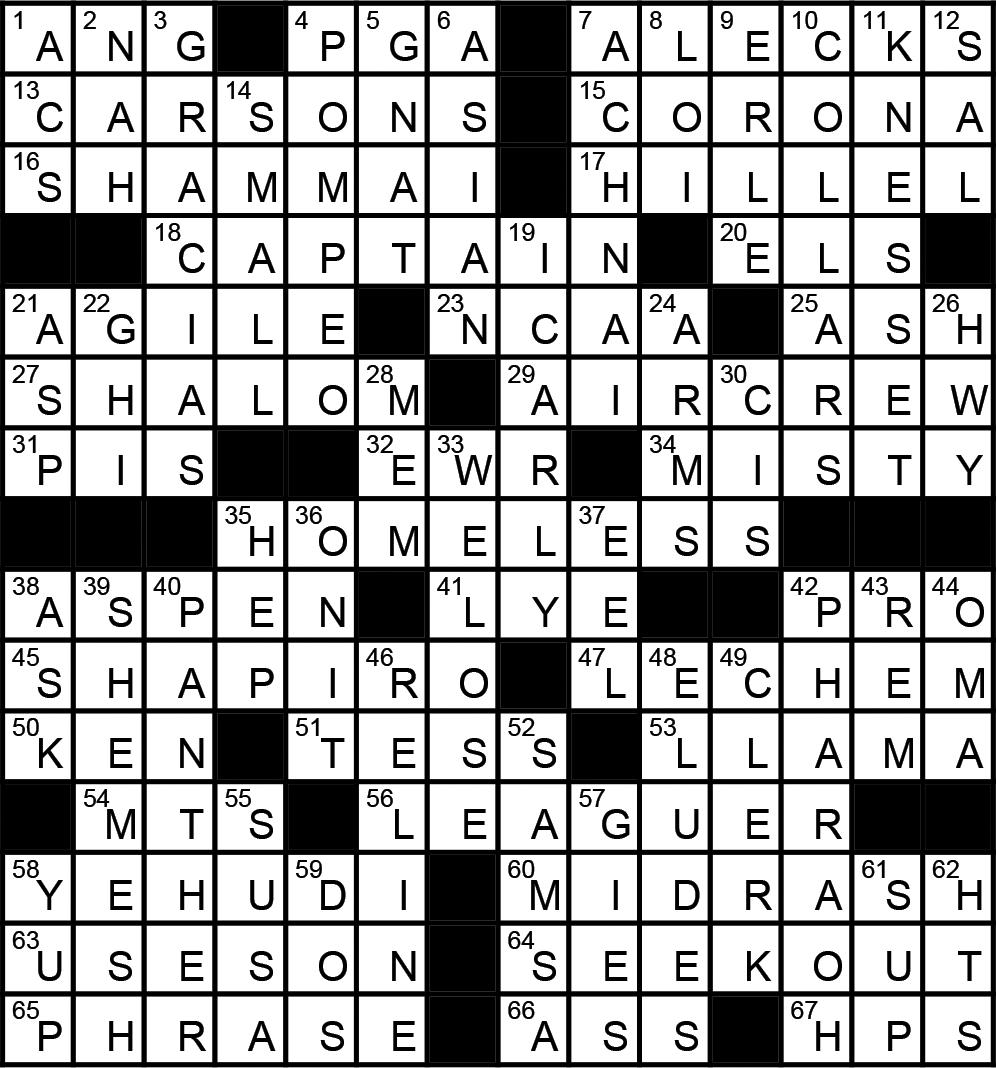
THE KOSHER CROSSWORD SEPT. 4, 2020
“Jew/Non-Jew” By:
Yoni Glatt
Difficulty Level: Easy
Across 1. Motel rollout
4. Flower holder
8. Like citrus fruits
14. Aladdin’s buddy
15. Apple device
16. Docking spot
17. Edward G/ Jackie
19. More bananas?
20. “...from the ___ even to the greatest” (Jer. 42:8)
21. Make fun of
23. “Before,” in old poetry
24. Professor Henry Jones Jr., to friends
26. Doris/ Julia
ANSWERS TO AUGUST 28 CROSSWORD
Down
1. Track legend Lewis
2. Slender instrument
3. Not so slender instrument
4. Winemakers
5. H.S. courses for coll. credit
6. Like a neglected chimney
7. Bart’s teacher Krabappel
8. “Fur Elise” key
9. “Inconceivable!!”
10. Roth acct.
11. Restaurant that probably doesn’t serve cholent
12. Like krypton and some other gases
13. Gives a hoot
28. Arthur/ Reggie
31. Think likewise
32. “As far ___ know...”
33. Drugstore Duane
35. Larry/ Stephen
39. Stan/ Bruce
40. Gene/ Russell
43. Alon/ Charlie
44. Primo/ Zachary
46. Fictional nation in “The Hunger Games”
47. It can be split in a fight
48. “Beyond the Sea” Bobby
51. Joan/ Doc
53. Dustin/ Philip Seymour
56. Merry king of rhyme
18. What Obama called ISIS
22. Cheer for
25. Eins + zwei
27. “Oh my! A mouse!”
28. Malcha or American Dream
29. “Got it”
30. Schreiber in “Spotlight”
31. Male Madison Ave. employee
34. Energizing, with “up”
36. Sitting around doing nothing
37. Neet rival
38. Cons
41. Emperor that converted to Judaism, according to the Talmud
42. Welcomed with a grin
45. Holy Land protector, for short
SHABBAT DINNER
TRADITIONAL DAIRY LUNCHEON
DELI SANDWICH PLATTER DINNER MENU
57. Santa___, California.
58. Seal or signet
60. Owner of Rubber Ducky
64. Parts of Fiji
66. Bill/ Whoopie
68. Apartment dweller
69. Top draft choice?
70. Work at romancing
71. Violates the Eighth Commandment
72. Observes the Sabbath
73. It became Spike TV in 2003
49. Popular brew from Holland
50. Staff rewards
52. Action word
53. Makes like the seventh plague, minus the fire
54. Start
55. Kind of prophet
56. Exact copy
59. Marty, in “Young Frankenstein”
61. Pond amphibian
62. One might be used before getting dressed for synagogue
63. A Ghostbuster
65. “___ Einai”
67. The, to Rashi’s neighbors
IN THE KITCHEN
How schnitzel became an Israeli staple
BY RACHEL MYERSON
Schnitzel in Israel is a big deal. Like, a bigger deal than people realize. Or, at least, a bigger deal than I realized before I moved to Israel from the UK seven years ago.
Straddling the line between street food and fast food, schnitzel is something that many Israelis – especially kids – eat everyday. Be it warmed in the oven from a frozen packet, homemade and shallow fried, picked up in a pita from a streetside stall, or as a reliable choice at almost any restaurant. Gourmet schnitzel sandwiches are fast becoming a country-wide food trend, too.
Schnitzel did not start out as an Israeli dish. It originated as either the Italian cotoletta alla Milanese or the Viennese Weiner schnitzel – both breaded, pan-fried veal cutlets. The Israeli version was adapted from the latter, and was introduced by immigrants from central Europe decades before the country was established.
Veal has always been extremely hard to come by in Israel, but chicken and turkey are plentiful and cheap – a logical substitute.
While the protein pick is the biggest deviation from the original dish, there are other ways that Israel made schnitzel its own. Notably, it’s fried in oil, as opposed to butter, due to Kosher dietary laws, which prohibits the mixing of dairy and meat – so no soaking in milk before frying, like Weiner schnitzels, either.
Israelis also like to mix sesame seeds into the breadcrumb coating. Despite extensive research however, I’ve yet to find a definitive reason why. It isn’t surprising, though, given the widespread culinary use – from sprinkled on challah, mixed into za’atar, or ground into tahini. Plus, they add a good crunch.
Lastly, schnitzel is so damn popular; every butcher in Israel carries the “schnitzel” cut: thinly sliced or pounded boneless chicken breasts, ready for coating. In the Encyclopedia of Jewish Food, Gil Marks attributes this to a program run by the Ministry of Absorption in the 1940s, which taught housewives how to prepare simple recipes with easily accessible, cheap ingredients.
I think the opportunity for customization has something to do with schnitzel’s success, too. Breadcrumbs can be swapped for matzah meal come Passover, spices and seasonings can be added to the coating according to taste. It’s the perfect canvas to experiment.
A quick search on the Nosher brings up multiple exciting variations. You could cut your breadcrumbs with falafel mix for some Middle Eastern spice! Or tenderize your chicken with a pickle juice brine!
You can also make vegetarian schnitzel, like this cabbage schnitzel. Then again, you can always keep it simple with this classic Israeli schnitzel recipe. Because, yes, there is such a thing. Anyway you fry it, it’s classic and delicious Israeli fare.
This article originally appeared in The Nosher (thenosher.com).
TORAHPortion
Ki Tavo
BY RABBI TZVI HERSH WEINREB
“As soon as you have crossed the Jordan into the land that the Lord your God is giving you, you shall set up large stones. Coat them with plaster and inscribe upon them all the words of this Teaching... On those stones you shall inscribe every word of this Teaching most distinctly” (Deuteronomy 27:2-3, and 8).
What does this phrase, ba’er heitev, translated as “most distinctly,” mean? The Babylonian Talmud Tractate Sotah 32b suggests that the inscription of the “Teaching,” that is, the Torah, should be done in 70 languages, in every language known to mankind. Moses himself, speaking on behalf of the Almighty, instructs the people to engage in that “traitorous” task of translation.
Why was it necessary to translate the Torah into languages which were incomprehensible to the people of Israel? Our Sages offer two very different answers to this question.
The Jerusalem Talmud takes a universalistic approach and suggests that these translations were to bring the teachings of the Torah to the entire world.
The Zohar, the basic text of the Kabbalah, notes that the members of the Jewish High Court, the Sanhedrin, knew all 70 languages. But the Zohar does not take this literally. Instead, the Zohar understands the 70 languages to be a metaphor for the 70 facets of Torah; the 70 different avenues of interpretation with which the sacred text is endowed. The members of the Sanhedrin were thus not linguists, according to the Zohar, but experts in probing the depths of the Torah’s meaning. Perhaps, the 70 languages inscribed on the stones in the River Jordan were also not the languages for the peoples of the world, but were 70 codes enabling so many different approaches to the Torah’s interpretation.
I understand the word “language” more broadly. The word need not be restricted to its literal meaning, referring to French, Spanish, Swahili, and Portuguese. Rather, “language” can refer to a cognitive modality, or to a learning style. Thus, some of us prefer the language of humor, while others prefer the language of logic and reason. We speak of angry language, soothing language, and the language of love. Music is a language, play is a language, and there is even the language of war.
Every teacher knows that he/she must use different “languages” for different students. This does not mean that some speak to some students in English and to others in Yiddish. This means that some students will respond to clear and logical explanations. Others will require anecdotes and stories. Still others will require humor, or perhaps visual illustrations of the subject matter being taught.
Because no two individuals learn in the same way, the successful teacher discerns the learning styles of each pupil and develops strategies and modalities that facilitate the learning of every member of the class.
Perhaps this is what the Talmud in Tractate Sotah is really teaching. Inscribed on those stones in the River Jordan were 70 different teaching strategies, 70 pedagogical tools, which would enable every recipient of the Torah to learn its messages in their own idiosyncratic way. Some would learn best by reciting the words by rote until they were memorized. Others would learn by breaking the text down into small phrases and reflecting on them, and still others would learn by using visual imagery to “see” the meaning of the text.
Indeed, the phrase “70 facets of Torah” could be the Zohar’s way of referring to 70 different learning styles, encouraging teachers to identify a “stone in the River Jordan” to match every pupil, even those who on the surface appear unteachable.
In this interpretation of “the 70 languages,” I assert that our Sages were aware of a basic lesson in education: that there is a need for individualized curricula so that diverse populations can all learn well. This lesson is reflected throughout Talmudic literature. Here is one example:
“Observe the excellent advice given to us by the Tanna Rabbi Yehoshua ben Perachya: ‘Make for yourself a teacher, and acquire for yourself a friend...’ If you do this you will find that your teacher will teach you mikrah, mishnah, midrash, halachot, ve’aggadot. Whatever is not conveyed in mikrah (Scripture) will be conveyed in mishnah; whatever is not conveyed in midrash will be conveyed in the halachot; whatever is not conveyed in the halachot will become clear in the study of the aggadot. Thus, the student will sit in place and fill himself with all that is good and blessed.” (Avot DeRabbi Nathan, 8:1)
In this passage our Sages are advocating a richly variegated curriculum. They know that not every student will be fully informed by the study of one subject. The student who fails to gain from the study of mikrah, will gain instead from a very different type of text, mishnah, the early rabbinic codification of the Oral Law. And similarly for midrash, rabbinic lore; halachot, rules and regulations, and aggadot, legends and stories.
Rabbi Tzvi Hersh Weinreb is executive vice president, emeritus of the Orthodox Union.
SCHNITZEL WITH FRIES AND COLESLAW (GETTY IMAGES)
BULLETIN BOARD
Hillel Int’l and Reboot re-imagine “Higher Holidays” experience for students
As Jewish college students confront isolation and uncertainty, Hillel International and Reboot have teamed up to deliver “Higher Holidays,” a dynamic set of unique streamed experiences for Rosh Hashanah and Yom Kippur.
“Higher Holidays: Unbound,” produced by Reboot, presents a twist to the Rosh Hashanah and Yom Kippur traditions through a streamed program with a contemporary take on the most pressing issues captivating the Jewish world today, including:
• A re-conceived Kol Nidre musical piece featuring Adam Kantor, star of the Tony Award-winning Broadway musical The Band’s Visit and other members of the Broadway company;
• Conversations with Michelle Obama speechwriter Sarah Hurwitz, NBC News correspondent Jacob Soboroff, and Adam Mansbach, author of G the F*ck to Sleep;
• A challah baking tutorial with Jake Cohen, Tiffany Shlain, and her #ZoomChallahBake;
• A Neilah melody by Grammynominated indie-folk duo The Milk Carton Kids;
• Reflections on the birth of the world by Jamie Margolin, founder of Zero Hour, a climate justice organization;
• And a “Nervous Jewish Kids” conversation with Cameron Kasky, Marjory Stoneman Douglas High School shooting survivor and Gotham star David Mazouz.
A second channel, “Higher Holidays: In the Book,” will offer a streamed experience structured after traditional Reform services for Rosh Hashanah and Yom Kippur. Students from nearly a dozen campus Hillels will contribute readings and reflection, and Hillel President and CEO Adam Lehman will offer words of blessing for the new year.
“This is such a tumultuous time for thousands of Jewish students. Some are apart from their friends, others apart from their families, and none of them are able to connect and gather in traditional spaces and celebrate our most sacred days together,” said Rabbi Ben Berger, Hillel International vice president for Jewish education. “We’re glad to have partners at Reboot to create this experience for combating physical and spiritual isolation during the High Holidays. There’s never been something like this and we’re excited to bring Jewish students together in the vibrant, powerful, and sacred livestream.”
The live-streamed episodes can also be accessed later so viewers can worship at their own pace.
Those interested in participating in “Higher Holidays” can sign up for access at higherholidays.org.
JTConnect hosts Kickoff Celebration, Sept. 14
JTConnect, a program for Hartford area Jewish teens in grades 8 through 12, will kick-off a new year of programming for teens in grades 8-12 on Monday Sept. 14, 5:30 - 7 p.m., at 158 Auer Farm Road in Bloomfield. The fall celebration will give JTConnect teens the opportunity to reconnect with friends and meet new ones, and hear about JTConnect classes. Highlights of the event will include: Volunteer service projects painting barns; tiedying new JTConnect swag; lawn Games…and more!
JTConnect teens are invited to bring friends. Strict physical distancing protocols will be enforced; masks will be required Admission to the JTConnect Kickoff Celebration is FREE. For more info, contact cara@jtconnect.org or (860) 727-6110. To register, visit jtconnect.org.
Supply Side Education in Hartford
Help children head off to school prepared to learn – with a backpack full of school supplies. JewGood Hartford, a giving circle for young professionals sponsored by the Jewish Community Foundation of Greater Hartford, is collecting supplies that will be given to children through Compass Youth Collaborative. You can still take part in this mitzvah by purchasing supplies through JewGood’s Amazon Wish list.
For more information, contact Elana MacGilpin at emacgilpin@jcfhartford.org.
Sept. 2 webinar will prepare the Jewish community for a safe holiday
With the High Holy Days approaching in a unique and challenging environment, between both the ongoing reality of threats facing the Jewish community and the impacts of COVID-19, the Secure Community Network, (SCN), a program of the Jewish Federations of North America and the Conference of Presidents of Major American Jewish Organizations, will host the webinar Wednesday, Sept. 2, “Safety and Security Considerations for Outdoor Services and Gatherings.” The panel discussion will discuss best practices for outdoor event safety for communities planning outdoor observances. For more information or to register, contact Dena Weiss at dweiss@securecommunitynetwork. org.
The First Annual Stephan Ross ‘Excellence in Holocaust Education’ Award will be presented to survivor Sidney Handler at a virtual tribute dinner to be held Wednesday, Sept. 9 at 7 p.m. Sponsored by New England Friends of March of the Living, the event will benefit the organization’s March of the Living Teen Scholarship Fund. March of living takes teens on a heritage trip to Poland and Israel to retrace roots of the Holocaust and educate them about the dangers of hatred and intolerance.
The tribute dinner’s community partners include New England Holocaust Memorial, American Israel Public Affairs Committee, Magen David Adom, Temple Israel of Sharon, Temple Emanuel, and Combined Jewish Philanthropies.
The event is FREE and open to all. Advance registration is requested. To register and to find out more about sponsorship opportunities and tribute book details, visit motlnewengland.org/tribute/ or email tribute2020@motlnewengland.org.
Events at the JCC in Sherman
All events/programs at the JCC in Sherman are being held outdoors. Reservations are required ; events limited to 40 people. Bring your mask and a chair! For more information, including a list of health and safety rules for outdoor events, visit www.jccinsherman.org or email info@ jccinsherman.org.
Saturday, Sept. 12, 6:30 p.m.
The Four Horseman in Concert Band members David Ray, Mike Latini, Dave Goldenberg and George Mallas are singer-songwriters, each with his own unique style!
Rain date: TBD
Tickets: $20/members; $25/non-members
Thursdays, 6:30 -8:30 p.m. (new time)
Open Mic Night
Music lovers and others are invited take part in this diverse musical event (to perform or simply listen). Jazz, classical, op singers/songwriters, poets, dancers, storytellers are all welcome. Songwriters, Poetry, dance, storytelling, all are welcome. Show starts at 7 p.m. FREE donations welcome.
Saluting the soldiers of the IDF, Sept. 13
The global Friends of Israel Defense Forces family will unite for a night of giving and solidarity on Sunday, Sept. 13 at 7 p.m., when FIDF hosts a national virtual gala
celebrating those who protect and defend the Jewish state. For more information, visit fidf.org.
UJF
of Greater Stamford to kick off annual campaign
Enjoy United Jewish Federation of Greater Stamford’s 2020 campaign kickoff from the safety and comfort of your own car at UJF’s “Drive-in Movie Theater “ event on Wednesday, Sept. 9, 7:30 p.m. Join the community in honoring 600+ donors who have given an annual gift to UJF for 18 years; enjoy live entertainment; enjoy a boxed dinner and refreshments delivered to your car Event details and registration can be found at www.ujf.org/drivein or call (203) 321-1373.
Yeshiva U introduces doctorate in occupational therapy
Yeshiva University’s new entry-level doctorate in occupational therapy (OTD) offered by the university’s Katz School of Science and Health, can be completed in less than three years with just a Bachelor’s degree. Graduates will be eligible to sit for the national certification examination sponsored by the National Board for Certification in Occupational Therapy. Students will be able to apply their knowledge in the program’s state-ofthe-art labs, including a fully functional apartment in the Active Daily Living (ADL) lab, Neurosensory Integration lab, and Modalities lab where students will design assistive technologies to help clients adapt to their environment and improve functional independence. They will also have access to a virtual cadaver lab where students will examine the anatomical and physiological components underlying human motion.
Occupational therapy helps people of all ages gain greater independence and confidence in performing the tasks of everyday living. The number of occupational therapy jobs is expected to grow nationwide by 18% over the next eight years, according to the U.S. Bureau of Labor Statistics, and occupational therapy is listed among the best 20 health care jobs in the nation by U.S. News & World Report. Located at Yeshiva University’s Rousso Building in the Bronx, the program has been granted candidacy status by the Accreditation Council for Occupational Therapy Education.