













UCONN Gold 5
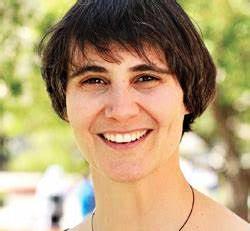
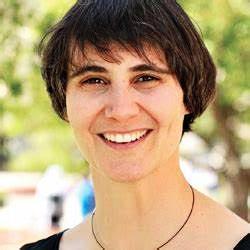
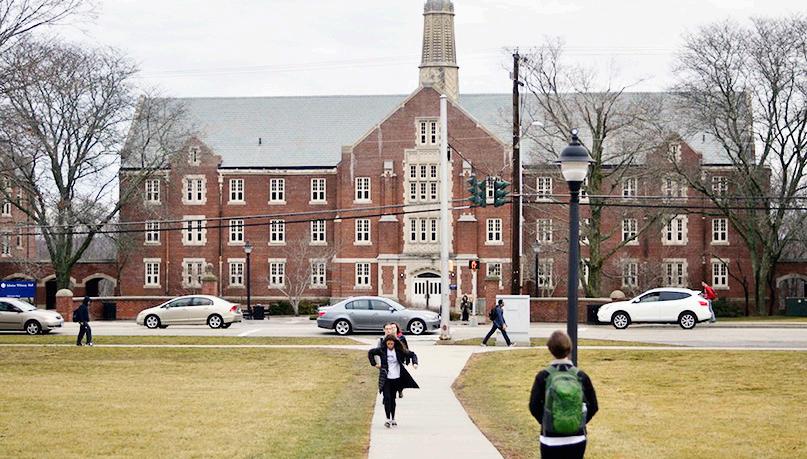
UConn alum Edina Oestreicher loves working with college students and engaging in Jewish life…which is what brings her back to UConn.
Authors Corner ............................ 14
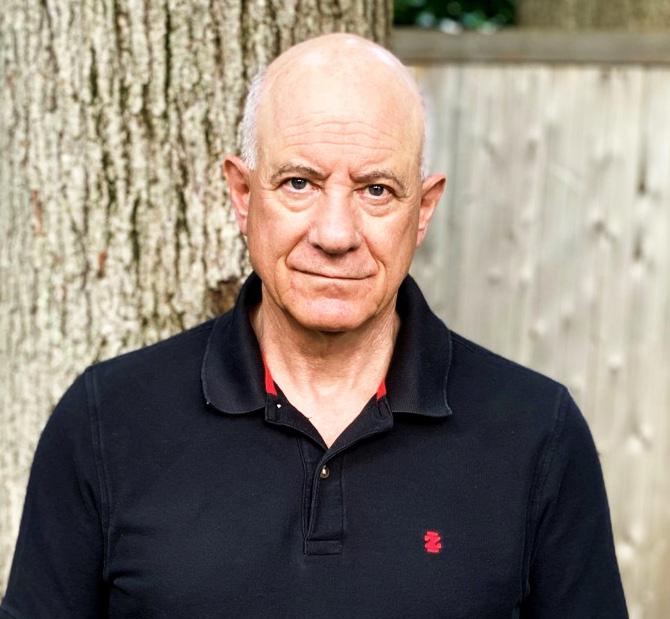
Donna Robinson Divine reviews Baltimore Logic, the debut novel of West Hartford’s Basil Truscott – a book, she says, that is as important for understanding the present as it is for learning about the past.

Class Action..................................... 5
When Jewish students at UConn discovered an attempt in the works to cut UConn study abroad programs in Israel, they decided to take a few proactive steps of their own to make sure the plan fell short of its goal.
Many Jewish groups – political and religious – have aligned on the issue of the right to vote this year and are lobbying for widespread mail-in voting. In so doing, they’re butting heads with the Trump administration – and the president himself, who frequently makes claims, without evidence, that mail-in votes are susceptible to fraud. PAGE 12
Plus…an interview with CNN’s election forecaster Harry Enten, who talks about his bar mitzvah, the Jewish vote and why he says ‘Shalom’ on TV. PAGE 13
Speaking Frankly ........................ 11
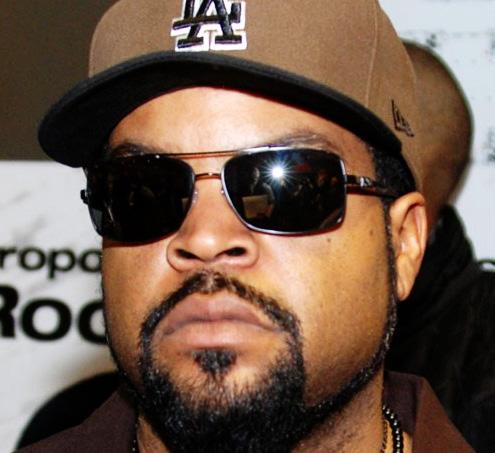
Following his recent antisemitic tweets, rapper Ice Cube sat down with Zionist Organization of America national president Mort Klein for a revealing 2-hour conversation. Arts & Culture

Regardless of its as yet to be announced format in this year of COVID-19, one thing we now know for sure about the 2020 Emmy Awards: Dozens of Jewish actors and creators are well positioned to win big.
FRIDAY, AUGUST 7, 2020
Hartford: 7:43 p.m.
New Haven: 7:43 p.m.
Bridgeport: 7:44 p.m.
Stamford: 7:45 p.m.
To determine the time for Havdalah, add one hour and 10 minutes (to be safe) to candle lighting time.


BY STACEY DRESNER
STORRS – When Edina Oestreicher
was an undergrad at the University of Connecticut at Storrs she often spent time at UConn Hillel, the center for Jewish life on campus.
“Coming from Delaware, I didn’t know a lot of people, in fact, I didn’t know anybody. UConn is a huge place so Hillel was a great place to go that felt like a smaller community, where I could meet people, go for a Friday night service or a bagel brunch or movies or whatever,” she recalled. “It was great just knowing that it was there for me.”
Now 30 years later, Oestreicher has come full circle – on June 1 she was named executive director of UConn Hillel.
After serving for many years as an administrator in higher education, most recently as vice president of student affairs and dean of students at the University of Bridgeport, Oestreicher says the new position is a perfect fit.
“It just felt like such a terrific opportunity me, with my extensive experience in higher education and student affairs along with my involvement for most of my life in Jewish causes,” she says, calling the fact that she is a UConn alum “icing on the cake.”
“Edina has been successful in her career connecting with students and the community at large. She is driven, passionate, articulate and genuine and this helps her bring out the best in all around her,” says Henry Mondschein, UConn Hillel board chair.
Oetreicher admits that starting her new post during the Covid-19 pandemic has been challenging.
“We’ve been spending a lot of time figuring how we are going to be engaging students during this time of Covid-19,” she says. “I just learned from the university that no in-person events or social gatherings are going to be permitted through Sept. 20 at the very earliest. So I’ve been working very closely with our student board and
the UConn community to develop ways to engage both [current students] as well as the 140 incoming students who selfidentify as Jewish. We’re working on our mentoring program, which matches upper class students with incoming students to welcome them and help them feel connected. We are planning a lot of virtual events so they can get to know each other, and we are adapting our scheduled events to make them virtual.”
A native of Wilmington, Delaware, where her family belonged to Beth Shalom, a Conservative shul, Oestreicher had a “traditional Conservative” upbringing.
“I was very involved,” she says. “My parents were very involved and still are. They both were presidents of the congregation; my mother was president of Sisterhood… It inspired my engagement in Jewish life.”
She went on to major in communication sciences at UConn. While a student there, she served as a peer educator for the women’s center on campus, leading programs on sexual harassment, sexual assault, and dating and domestic violence. When she graduated, Oestreicher was asked to become coordinator of what his now
the Violence against Women Prevention program.
After four years, she left that position to teach environmental education at the Connecticut State Museum of Natural History, also based at UConn, followed by a few years at Planned Parenthood in Willimantic working as an HIV counselor and family planning counselor.
When her husband – also a UConn graduate – got a job at the University of Bridgeport as director of residential life, they relocated to that area. Today, Oestreicher lives with her husband David in Orange. They are the parents of two grown daughters.
“We moved down to Bridgeport and were there for maybe a month and then another serendipitous opportunity opened up and I was hired to be director of [the University of Bridgeport’s] campus activities, which was really an awesome job … getting back on a college campus and working with college students and student affairs.”
She spent the next 23 years at the University of Bridgeport in a variety of positions, while also earning a master’s degree in counseling.
“I love working with college students and being part of their lives and their development. It is such a transformative stage in their lives,” she says.
Thirteen years ago, she became a contracted facilitator for the ADL’s “Words to Action” program, traveling around the state working with adolescents, teens and adults.
“It’s working with students to understand what is antisemitism – what are the forms that it can take, and how to respond to it; who are allies in our schools, in our shuls and our communities?” she says. “It’s really for young people who have heard or seen things that they weren’t sure meets the definition [of antisemitism]. It is CONTINUED ON THE NEXT PAGE
Less than a month after Edina Oestreicher joined UConn Hillel as executive director, a petition intended for UConn President Thomas Katsouleas to “Cut and Defund UConn Study Abroad Programs to Israel” was started on change.org.
The petition, drafted by UConn Students for Justice in Palestine, accused Israel of violating “basic Palestinian human rights” among other allegations. It references two study programs at Tel Aviv University, calling them “discriminatory as they bar many students from being able to go on these programs due to Israel’s policies.”
The petition refers to “Law of Entry No. 38 [sic]” which it says “actually bans entry of persons due to their political speech…”
In fact, the petition refers to is actually Amendment No. 28, which prohibits foreigners who publicly call for boycotting Israel to enter the country. The amendment’s defenders say it is necessary to defend Israel’s borders.
The petition, seeking 1,000 signatures had garnered 797 and had not been presented to President Katsouleas at press time.
But late last week, members of the Hillel student board and Husky Students for Israel decided to address the situation head on with a letter to the president’s office.
“This petition, publicized through social media accounts, demands that the administration cancel study abroad programs to Tel Aviv University in Israel,” say the students in the letter. “We found this to be
CONTINUED ON THE NEXT PAGE
about empowering them to have a voice and to stand up and address it in ways that are meaningful for them.”
Oestreicher has certification in case management and intervention from the National Behavioral Intervention Team Association; Civil Rights Investigator Training; Mediator Training Certification from the Connecticut Mediation Center, among other certifications.
Then, in the summer of 2019, the University of Bridgeport went through financial difficulties and following a restructuring, Oestreicher’s position was eliminated.
She heard about the Hillel position through Judy Alperin, executive director of the Jewish Federation of Greater New Haven. A member of Congregation Or Shalom and chair of its adult education committee, Oestreicher had connected with Alperin while helping to organize the community’s Kristallnacht memorial, held at Or Shalom and co-sponsored by Federation.
Over the past month, Oestreicher has been “working with faculty and staff to identify ways we can do joint programming,” she says. “I think that is so important for students when you are able to bring organizations together. It really just creates a vibrancy when you bring students together to learn from each other.”
That collaboration has already begun.
On June 26, UConn Hillel celebrated a Zoom Shabbat with UConn’s African American Cultural Center.
“It was the first of several events that we are going to host with them to start conversations around racial justice and police brutality. We, the Jewish community, need to learn to be more aware and educated and be good allies for our colleagues.”
But with nearly 2,000 Jewish students at UConn, Oestreicher’s commitment is, first and foremost, to provide leadership, vision and strategy for engaging all UConn Jewish students and creating a pluralistic, vibrant community.
“So much of what we emphasize,” she says, “is that Hillel really is a place where –whether you are looking for a service, you keep kosher, or have never been at shul a day in your life, don’t know a word in Hebrew and are not even sure what being Jewish means to you – it’s a place that you would feel welcome and at home, regardless of your past in terms of your Jewish identity.”
CONTINUED FROM PAGE 5
very disturbing as the petition is actively calling for an academic boycott based on the author’s political opinions. We want to ensure that your office is aware of this initiative.
“The history, political intricacies, and complex nature of this region deeply affect both the Israeli and Palestinian people. As a community these are issues that we are consistently grappling with, while finding ways to have nuanced discussions that allow us to think critically on the matter. However, these complexities should not by any means prohibit students from having access to the UConn study abroad programs in Israel. UConn has provided programs like these for years and allowed students the opportunities to immerse themselves in academic discourse on complex issues. As representatives of the Jewish community at UConn, we have a responsibility to ensure that UConn continues to provide these programs so that we, and future students, have the opportunity to live and learn in our ancestral homeland and to deepen a connection with our cultural and historical roots.
“All UConn students seeking opportunities to explore a piece of the Middle East, or specifically looking to access these world-renowned programs – for example, the Summer Brain and Behavior at Tel Aviv University led by UConn Professor Dr. Etan Marcus – should be able to. These programs are life-changing, and have served as steppingstones in many UConn students’
careers.
“Israel is a nation bursting with innovation in the fields of medicine, water technology, entrepreneurship, negotiations, and so much more. We applaud UConn for providing our students with the access to these programs and impactful experiences. As members of a Jewish community that promotes Tikkun Olam, the Jewish value urging us to repair the world around us, we commend any efforts by UConn students to use their voices to make positive change. While we respect the right of Students for Justice in Palestine to circulate this petition, it is our duty to ensure that these calls for action are not misguided by false narratives, creating more harm than good.”
“The letter was signed by Dori Jacobs (’22), president of UConn Hillel,; Gianna Michaelson (’22), president of HuskyPAC; and Hannah Farrell (’21), president of Huskies for Israel; who asked for a virtual meeting with President Katsouleas.
On Tuesday, July 28, Katsouleas and Dan Weiner, UConn’s vice president of Global Affairs, met with the students to discuss the petition and the university’s position on study abroad in Israel.
Oestreicher said that the students “felt heard” at the meeting.
“I was really quite impressed with how quickly the university responded to it…and how incredibly thoughtful the students were in addressing the petition to the institution,” she commented. “They need to know what their rights are and that they have a voice.”
While Katsouleas said he will not make a formal statement about the petition until it has been submitted to him, he told students in a letter last week, “We are very proud of our robust study abroad and research programs in Israel. … The goal of studying abroad and other UConn initiatives, like Global Affairs Abrahamic programs is to bring people together and help build a more peaceful and sustainable world. Boycotts and cancellations of study abroad programs are counterproductive and will only increase divisiveness and hostility.”
Katsoleas added, “It is important for every member of the UConn community to accept and respect that others may see and experience the world in completely different ways. We will not tolerate racism, antisemitism, or hate speech on our campus, and are committed to ensuring that the university is a space for encounters and conversations in which everyone feels respected.”
Oestreicher agreed that hearing different voices is important on the college campus.
“I believe very strongly in the power of dialogue and how important it is for students to hear viewpoints that are different from their own, and to be engaged in conversation that is respectful and civil. But I also believe it is important for our community to know when the line crosses over into anti-Semitism and antiZionism.”

(JTA) – The British rapper Wiley apologized for “generalizing” about Jews in tweets directed at his manager and others in the music industry that were widely panned as antisemitic – and then proceeded to make additional assertions about Jews and Jewish control of the music industry. Wiley made the apology in an interview with Sky News after Twitter permanently banned him from the platform. But in that interview and in an interview with The Voice Newspaper, which bills itself as “Britain’s Favorite Black Newspaper,” Wiley continued his tirade.
“My comments should not have been directed to all Jews or Jewish people. I want to apologize for generalizing, and I want to apologize for comments that were looked at as antisemitic,” Wiley told Sky News in an interview that aired July 29. “I’m not racist, you know. I’m a businessman. My thing should have stayed between me and my manager, I get that.” Wiley’s manager, who is Jewish, following the Twitter tirade by his client announced on Friday that he would no longer represent the rapper.
Later in the Sky News interview, Wiley said British Jews “see us as slaves.” and wondered “why all of these families are rich, or all of these people have heritage, not just England, like, worldwide.”
In an interview with Wiley also published that day, The Voice wrote that “some of the views espoused by Wiley are the great unsaid outside of the black community. … not too many seem prepared to vocalize their consternation for some of the recurring themes Wiley believes is the stranglehold one community seems to have over another in particular relation but not confined to, the music business.”
Wiley told The Voice that the people he is talking about specifically are “the people I work with in the entertainment and music industry, the Jewish community that I have experienced.” Asked about his issues with the Jews he has worked with, Wiley said that they are “rich” and have worldwide “heritage.”
Some of Wiley’s tweets were reported to Britain’s Metropolitan Police, who reportedly are investigating them for incitement to racial hatred. Wiley received an MBE, an Order of the British Empire award, in 2018 for his services to music and there are calls for it to be rescinded.
After being banned by Twitter, Wiley moved his social media rants about Jews to Facebook, where he threatened to come to Golders Green, a largely Jewish populated neighborhood of London, and singled out Jewish public figures who have been critical
of him. Facebook promptly suspended his account on July 28, saying his posts violate its policies. The Voice subsequently took down the interview, but defended its right to publish it to begin with.
Jewish philanthropist Sheldon Adelson said in a letter to his Las Vegas employees that he will maintain pay and benefits through at least Oct. 31. The letter dated July 29 recognized the personal challenges of the employees during the coronavirus crisis, including caring for elderly relatives, spouses who have lost their jobs and uncertainty about whether their children would be returning to school. The company reportedly paid its staff of 10,000 at The Venetian Resort Las Vegas full salaries and benefits during Nevada’s state-mandated closure that began on March 17 and ran for over two months.
Sands owns the Venetian and Palazzo casinos and the Sands Expo & Convention Center on the strip. The resorts reopened in early June but have seen a huge drop in business, with the casinos relying mostly on local gamblers. Twitter users responded to reports of the letter calling Adelson a “mensch” and an “honorable man.” Some commented that they would plan to book vacations at Adelson properties once they begin traveling. Employees also tweeted praise for Adelson, a major giver to Israel causes and Republican candidates.
(JTA) – A member of the private Jewish security patrol group Shomrim was slashed in the leg while intervening to stop a gang assault on an unidentified man in the Brooklyn neighborhood of Borough Park. The volunteer, 33, was transported to a local hospital, where he was treated and released. The victim of the attack ran from the scene and did not receive medical assistance.
Three of the four alleged assailants, aged 18 to 20, were arrested at the scene Wednesday night, July 29, according to the New York Police Department. The fourth person fled the scene. The knife used in the attack was recovered. Meanwhile, a 20-year-old man with special needs was assaulted in the Flatbush section of Brooklyn after he left a Jewish-sponsored group home. The man was approached by an individual after he walked out of a HASC (Hebrew Academy for Special Children) home, who punched him and smashed a rock into his head. The victim was taken to the hospital; the report did not detail the seriousness of the injuries.
(JTA) – Ontario’s education minister ordered a video that a Jewish group said is biased against Israel be removed from an online course. Stephen Lecce tweeted that he is “very concerned that this offensive material was on a learning website” and that “I immediately ordered it to be taken down (it was that day) & investigated to ensure it never happens again. We will not tolerate antisemitism in any form.”
The Friends of Simon Wiesenthal Center said July 27 that it contacted Lecce about the video, part of the curriculum of a Grade 10 online civics course, after an upset parent contacted the group. The Friends group quoted the video as saying: “The current occupation of the Palestinian land by the Zionists have [sic] violated the human rights of the Palestinians. They have deprived the Palestinians of natural resources, such as water, and taking [sic] the majority of it for themselves. The Zionists that are granted these privileges are backed by the military. … This conflict continues to rage on because the Israelis continue to live as occupiers while the Palestinians live under occupation.”
Louise Sirisko, director of education for the York Region District School Board, said in a statement that the Ministry of Education’s E-Learning Ontario initiative created and distributed the video as part of a revised e-Learning curriculum. “The video has been reviewed and removed from the resources available to school boards. … please know that the views expressed are not indicative of the beliefs of the YRDSB school community,” the statement said. The group said it wants the Ministry of Education to explain how such a video ended up in the curriculum and what steps will be taken to prevent the distribution of such a video to Ontario school boards in the future.
(JTA) – Israelis who don’t want to see racy content have a new streaming service that allows them to skip the immodest parts. The Tov TV service, dubbed the “kosher Netflix” by the Israeli daily Haaretz, is geared toward observant Jews who follow the religious laws of modesty. Women prescreen films and television series to identify the problematic content, according to the newspaper report. Viewers can choose their level of censorship, from a warning text that pops up during a scene, allowing the viewer to press a button and skip that part, to shows in which some content is previously erased. Some shows are taboo, including “Game of Thrones,”
according to Haaretz. Tov TV believes its target audience includes about 400,000 Israeli households, according to the report. Its content library now contains about 400 viewing hours with 170 titles, but the company plans to add up to 40 viewing hours a month, according to Haaretz
The newspaper reported that a similar model exists for airlines, which censor some content to make it family-friendly.
(JTA) – Days after a small corner of the internet erupted with criticism of how the Metropolitan Museum of Art labeled a Jewish ritual object in its collection, the New York museum has quietly revised the description. Where its website had previously called tefillin, the leather boxes and straps used in prayer by observant Jews, an “amulet,” it now refers to them by the word “phylactery.” Twitter users had challenged the amulet label after an automated account that shares pictures of items in the museum’s holding posted one of the tefillin, which is part of the Islamic art collection. Some called the museum’s labeling antisemitic because it did not reflect the Jewish nature of the item.
The new label does not indicate that the item, which is not on display publicly, is used by Jews. The museum obtained the item in 1962 and says it likely originated in sixth-century Egypt.
(JTA) – Kenneth Marcus stepped down last week as head of the Education Department’s Office for Civil Rights under the cloud of two complaints that accuse him of promoting cases that further his personal and political agenda.
One of the complaints, filed in May with the department’s inspector general by nine civil rights groups, accuses Marcus of using his position to push through an issue close to him – recognizing Jewishness as a national origin and some forms of pro-Israel activity as protected under civil rights laws including Title VI of the Civil Rights Act. The complaint also claims that Marcus gave preferential treatment to the Zionist Organization of America, to which he has personal ties, when he reopened an investigation into an allegedly antisemitic incident at Rutgers University, The New York Times reported. In reopening the Rutgers probe, Marcus employed the State Department’s definition of antisemitism, which includes some types of anti-Israel activity, including holding Jews collectively responsible for Israel’s actions and likening that country’s actions to the Nazis. The definition, which has sparked controversy, was composed by the International
Holocaust Remembrance Alliance.
In January, a complaint filed by a former lawyer in the Office for Civil Rights said Marcus forced employees to investigate a policy that allowed transgender athletes in Connecticut to compete on female sports teams, despite department lawyers questioning whether the department had jurisdiction. The complaint said Marcus pressured the department to rush through a complaint filed in June 2019 by the conservative Christian group Alliance Defending Freedom against the transgender athletes competing in the gender in which they identified.
Marcus announced earlier this month that he would step down and become chairman of the board of the Louis D. Brandeis Center for Human Rights Under Law, which he founded the center and served as its president before he was approved for the civil rights office position in June 2018.
(JNS) Google, Amazon and Wish have removed neo-Nazi and white-supremacist products from their platforms following an investigation by the BBC. Despite the prohibition of such items on those sites,

the BBC found that they were available for sale. For example, a white-supremacist flag featuring a Celtic Cross was being sold on Amazon. Wish removed Ku Klux Klan-related items, such as a hood and a Celtic Cross, after an inquiry from the BBC. Merchandise related to the far-right Boogaloo movement was taken down from Google, Amazon and Wish.
(JTA) – A meme that compares the requirement to wear masks during the coronavirus to the yellow Stars of David that Jews were forced to wear during the Holocaust appeared on the Facebook page of a Republican organization in Minnesota.
The Facebook page of the Republican Party of Wabasha County, where the meme was posted, was removed. The organization told the state Republican Party that it had been hacked. The meme shows an elderly man wearing a yellow Star of David badge pinned to his chest facing down a Nazi officer. “Just put on the star and quit complaining, it’s really not that hard,” the caption said. “Just put on the mask and stop complaining.”
In response to the meme, the Jewish Community Action organization tweeted a screenshot of the meme and added: “Given that Minnesota rabbis recently spoke out in favor of a mask mandate, comparing that mandate to the Holocaust feels especially disgusting. We ask the @MNGOP to tell Wabasha Republicans to stop using imagery like this. It betrays a total lack of both empathy and education.
Jennifer Carnahan, chairwoman of the Minnesota Republican Party, responded with a tweet on Monday night. “This post was brought to @mngop’s attention today. Immediately we reached out to the Wabasha board. They believe this was a hack and are removing their FB page immediately. Our party does not support/ condone divisive and harmful posts or language of this nature.”
She retweeted the screenshot with the message.
(Israel Hayom via JNS) Hamas leader Ismail Haniyeh said on Monday, July 27, that the terror organization had turned down a large U.S. aid package because it would have had to disarm to receive


the funds. Speaking with a Qatari news outlet, Haniyeh claimed that as part of President Trump’s Middle East peace plan, Washington offered to give Hamas $15 billion in aid if it would agree to lay down its weapons. Hamas “categorically declined” the offer, said Haniyeh. Hamas, designated as a terrorist group by the European Union, the United States, Israel and several other countries, has consistently asserted that it will never give up its arsenal of weapons, rockets and missiles.
The terror group ousted Palestinian Authority leader Mahmoud Abbas’s Fatahled government from the Gaza Strip in a military coup in 2007, effectively splitting the Palestinians into two political entities. Efforts to promote a reconciliation between the rival Palestinian factions – the latest by Egypt – have failed. Haniyeh further claimed that plans to build air and sea ports in Gaza were foiled by the Palestinian Authority and several Arab countries.

BY CAROLINE FLINT
DONCASTER, England (JTA)
– On Monday at 9 a.m., along with thousands of others, I joined a 48-hour boycott of Twitter following the actions of a rapper I must admit never having heard of.
Richard Cowie, aka Wiley, received the Music of Black Origin award for best male artist in 2013 and was awarded the Member of the Order of the British Empire (MBE) medal in 2018. These career landmarks passed me by, but his antisemitism did not.
I don’t know why he would compare Jews to the Ku Klux Klan. I don’t pretend to understand what motivated him to suggest Jews were “at war” with Black people and “would do anything to ruin a black mans [sic] life.”
The tirade spoke volumes; it was a diatribe of Jew hatred. I don’t want to hear his explanation or his apology. But I do expect Twitter to keep him from using its platform to peddle these views to his almost half a million followers.
Instead, I was shocked to see that the tweets remained online for 12 hours. Then Twitter appeared to act, taking his account down for a few hours and removing some of the offending tweets, only for the account to spring back to life to spew forth more hate.
Don’t miss the voices that kept the Jewish world talking and thinking all week long.
Now Twitter has imposed a seven-day ban. Wow! If that is what Twitter thinks makes a measured response to antisemitism or any kind of hate speech, then we are living in parallel universes.
Let’s be clear: Twitter’s 12-hour period of inaction is not a small matter. This company has algorithms that spot trends and red flags dangerous content. It has monitoring teams that should have spotted this and taken action. Given the company’s capabilities, the 12 hours of delay were unacceptable.
So why only a 48-hour boycott? The answer is simple. The #NoSafeSpaceForJewHate campaign has focused huge attention on the responsibility of social media platforms to get their houses in order. We use Twitter because we love it, sharing news, reaction, jokes and gifs with friends and followers, and expect the

company to maintain a space free from the vilest forms of hate.
At times, social media has been vital in exposing abuse and injustice, from human rights violations in Syria to the George Floyd killing. Twitter connects us to the big issues of the day or the humdrum of life during the United Kingdom’s coronavirus lockdown. Millions of voices, angry, funny, opinionated.
We value this small freedom at our fingertips; we like the variety, the free expression. But we draw a line at hate, incitement to violence and racism. And if platforms like Twitter, Instagram or Facebook cannot or do not remove hateful content quickly, then many will lose faith. (Facebook suspended Wiley on Tuesday when he moved his messaging toward Jews there.)
We should not feel forced to remove ourselves. The first course of action should be to remove the preachers of hate. The fact that Twitter does not produce the posts does not absolve the social media network of responsibility to monitor for any that spread hate.
In the U.K. specifically, an Online Harms Bill is long overdue. We must create a regulator, independent of the social media behemoths. This bill should ensure that in the U.K. at least, these sites would
become responsible for their content, just as publishers are. Yes, we know billions of words and videos are posted every day. We also know this content earns the companies billions of dollars each year – so deal with it.
Twitter and other social media companies have a duty of care to have proper policies in place and the mechanisms to act quickly. Indecision or poor systems leave the likes of Wiley to run rampant.
Maybe a 48-hour silence in support of #NoSafeSpaceForJewHate is a modest response from users. Maybe it is not enough. But it is the start of taking a stand, not just against antisemitism but against all hate speech.
If not driven from the mainstream, hate speech affects us all, corrodes relationships and diminishes tolerance and happiness. In the end, hate undermines all of our freedoms.
Social media at its best enables us to share and enjoy our differences, our diversity, our many cultures, religions, loves and pastimes. Perhaps one day soon, Twitter will be a safe space to celebrate those, too.
Caroline Flint is a commentator and former UK Member of Parliament for Don Valley 1997-2019.
Vol. 92 No. 32
JHL Ledger LLC Publisher
Henry M. Zachs Managing Partner
Leslie Iarusso Associate Publisher Judie Jacobson Editor judiej@jewishledger.com • x3024
Hillary Sarrasin Digital Media Manager hillaryp@jewishledger.com
EDITORIAL
Stacey Dresner Massachusetts Editor staceyd@jewishledger.com • x3008 Tim Knecht Proofreader
ADVERTISING
Donna Edelstein Senior Account Executive NonProfit & JHL Ledger LLC Media Marketing donnae@jewishledger.com • x3028
Joyce Cohen Senior Account Executive joycec@jewishledger.com • (860) 8369195
Joan Gaffin Central Mass. Account Executive joang@jewishledger.com • (508) 4146210
Trudy Goldstein Account Executive (860) 5731575
Amy Oved Account Executive amyo@jewishledger.com • (860) 8418607
PRODUCTION
Elisa S. Wagner Creative Director elisaw@jewishledger.com • x3009
Christopher D. Bonito Graphic Designer chrisb@jewishledger.com
ADMINISTRATIVE
Judy Yung Accounting Manager judyy@jewishledger.com • x3016
Howard Meyerowitz Office Manager howardm@jewishledger.com • x3035


Samuel Neusner, Founder (19291960) Rabbi Abraham J. Feldman, CoFounder and Editor (19291977) Berthold Gaster, Editor (19771992) N. Richard Greenfield, Publisher (19942014)
LLC from our office at: Jewish Ledger 40 Woodland Street Hartford, CT 06105 Phone (860) 2312424 Fax (860) 2312485 Toll Free 18002866397 Postmaster, send address changes to: Jewish Ledger 40 Woodland Street Hartford, CT 06105
Subscriptions: $36 yearly, $9 Twelve Issue Institutional subscription. Send name, address, zip code with payment. Editorial deadline: All public and social announcements must be received by Tuesday 5 p.m. 10 days prior to publication. Advertising deadline: Wednesday noon one week prior to issue. Advertisers should check ad on publication. JHL Ledger LLC and Jewish Ledger shall not be liable for failure to publish an ad for typographical error or errors in the publication except to the extent of the cost of the space which the actual error appeared in the first insertion. Publishers reserve the right to refuse advertising for any reason and to alter advertising copy or graphics deemed unacceptable. The publishers cannot warrant, nor assume responsibility for, the legitimacy, reputability or legality of any products or services offered in advertisements in any of its publications. The entire contents of the Jewish Ledger are copyright © 2020. No portion may be reproduced without written permission of the publishers. JHL Ledger LLC also publishes Jewish Ledger MA, All Things Jewish CT, and All Things Jewish MA. www.jewishledger.com
BY JACKSON RICHMAN
(JNS) Ice Cube had an almost-two-hour conversation with Zionist Organization of America national president Mort Klein following recent antisemitic tweets antisemitic tweets by the rapper and film actor.
Klein told JNS on Tuesday, July 28 that a mutual friend, whom Klein declined to specifically name for privacy reasons, told him that Ice Cube (whose real name is O’Shea Jackson) didn’t like being “falsely accused of being antisemitic” as he was by many, including by Klein and ZOA. When
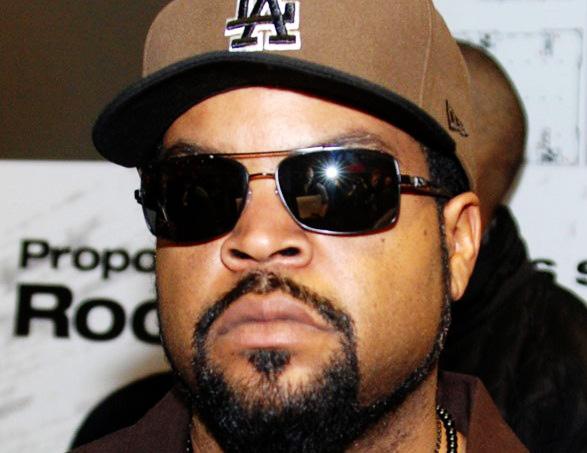
asked by the mutual friend if he would talk to Ice Cube, Klein agreed and Ice Cube called the ZOA leader.
Klein told Ice Cube about growing up with black neighbors and friends, and his civil-rights activism in the 1960s and the mission of the ZOA.
“I, Mort Klein, just had a 2 hour conversation with Ice Cube. We both grew up poor in Black hoods. Cube told me he thanked Jews for starting NAACP, many Black schools&fighting for Black civil rights. Cube told me he supports condemning Black&all antisemitism& I condemned all racism,” tweeted the ZOA leader on Monday, July 27.
“Shout out to Mort Klein who had the courage to seek the truth and speak with me and see for himself I am obviously NOT an anti-Semite or racist. I admire him for the advocacy of his people and look forward to talking more on how Black and Jewish communities can work together…,” tweeted Ice Cube on Tuesday, July 28.
In a July 14 column published by The Hollywood Reporter, Abdul-Jabbar wrote that the antisemitic posts made by Ice Cube and Philadelphia Eagles player DeSean Jackson were a “very troubling omen for the future of the Black Lives Matter movement” and decried the “shrug of meh-rage” in sports and in Hollywood.
In a tweet the following day, Ice Cube wrote, “Shame on the Hollywood Reporter who obviously gave my brother Kareem 30 pieces of silver to cut us down without even a phone call.”
On Monday, when confronted about his tweet slamming Jabbar for calling out the rapper for his antisemitic rhetoric, Ice Cube told Klein in their phone call, “I didn’t write it right,” recalled the ZOA leader, who went on to say that Ice Cube said, “I condemned him for including me with DeSean Jackson, Stephen Jackson and Nick Cannon … as one of the antisemites and I’m not an antisemite.”
Ice Cube said that Abdul-Jabar is a friend, and that he should have called him before writing his column, according to Klein.
“I’m not an anti-Semite. My manager of 25 years is a white Jew. I fired my black manager,” Klein recalled Ice Cube telling him. “I’ve been to Jewish, pro-Israel events.”
Later that day, Ice Cube tweeted, “Just for the record: I still love Kareem Abdul Jabbar definitely had a right to write against Anti-Semitism and racism. I was just hurt to be added into that article without a conversation to tell him that I am neither. But there is no wedge between me and my brother.”
During their phone call, Klein confronted Ice Cube about posting a caricature of a group of white-skinned older men, some with large hooked noses, sitting around a Monopoly-like game board with a fully-bearded man counting dollar bills. The board is on top of bowed, naked backs of a group of mostly black men.
The caricature is identical to “antiSemitic propaganda used by Hitler and the Nazis to whip up hatred that led to the massacre of millions of Jews. This extends to the table these figures are sat at, resting on human bodies, as the Nazis also depicted,” according to journalist and filmmaker Michael Segalov.
Klein said Ice Cube didn’t know that it was an antisemitic picture; he thought they were just “white guys.”
He also said that Ice Cube “wants to be allies” in fighting antisemitism – and even wanted to attend and buy a table at the next ZOA dinner.
“He couldn’t have been friendlier,” said Klein, who added that Ice Cube called again to say “he supports Israel as the Jewish state.”

At the Hebrew Center for Health and Rehabilitation, we understand that comfort and familiarity is a key part of the journey to wellness. We also understand that maintaining your religious beliefs and principles is fundamental in continued enrichment of life.
Our Kosher meal services allow residents to maintain their dietary requirements throughout their stay with us. At the Hebrew Center, we ensure we follow all principles of Kosher including purchase, storage, preparation, and service.
At the Hebrew Center for Health and Rehabilitation, we also offer a variety of other services and amenities to ensure your stay is as comfortable as possible.
THESE SERVICES INCLUDE:
• Passport to Rehabilitation Program
• Long-Term Skilled Nursing Care
• Specialized Memory Care
• Respite Care Program
• Palliative Care and Hospice Services Coordination
OUR AMENITIES INCLUDE:
• Barber/Beauty Shop
• Café
• Cultural Menus
• Laundry and housekeeping services
• Patient and Family education
• Life Enrichment
For more information on our Kosher program, please contact: DIRECTOR, PASTORAL SERVICES - (860) 523-3800
Hebrew Center for Health and Rehabilitation One Abrahms Boulevard, West Hartford, CT 06117




‘A
BY RON KAMPEAS
WASHINGTON (JTA) –Rep. Jamie Raskin’s warning to top Jewish Democratic leaders was stark: The war that President Donald Trump and Republicans have declared on the U.S. Post Office is a threat to American democracy.
“There’s a war on vote by mail, which we call voting from home, and a war on the Post Office,” said the Maryland Democrat, who’s also a constitutional scholar.
“The right wing has been at war with the Post Office for a long time, but especially now,” Raskin added, speaking at an event organized by the Jewish Democratic Council of America. “Because they think that if they can take over the Post Office … they will be able to prevent real balloting and real voting in 2020.”
Raskin is far from alone in calling attention to voting access. Many Jewish groups – political and religious – have aligned on the issue this year and are lobbying for widespread mailin voting. The Anti-Defamation League and the Jewish Council for Public Affairs told Senate leaders this week that they believe the issue is “a matter of life or death.”
They are butting up against the Trump administration, which is seeking to block funding for the Postal Service, and the president himself, who frequently makes claims, without evidence, that mail-in votes are susceptible to fraud. Meanwhile, the federal commission that oversees elections has decreased its oversight, raising concerns that November’s vote could be plagued by a
constellation of challenges.
Here’s a look at what Jewish groups are doing to make sure voting is easy this year.
The ADL and the Jewish Council for Public Affairs, the Jewish public policy umbrella, have mobilized 149 Jewish groups to press Congress to approve $3.6 billion for funding to make mail-in voting easier.
The funding is baked into the Heroes Act, the most recent pandemic funding bill passed in the Democratic-led U.S. House of Representatives. Passed in May, the measure is awaiting action in the Republican-led Senate. Republicans are resistant to advancing the voting rights section because it would override state requirements for voter identification.
In a letter sent this week to Senate leaders, the two groups and their allies cast the funding as a matter of “life and death” during the pandemic.
“Unless you provide emergency election assistance and policy provisions, the decision our communities and so many voters are likely to face about whether or not to wait in crowded lines and rooms to vote may literally be a matter of life or death,” the letter says. “This is especially true for members of marginalized communities most likely to contract and die from the virus.”
The letter follows earlier acts of advocacy for mail-in voting. In May, Missouri rabbis cited the Torah and rabbinical teachings as they encouraged
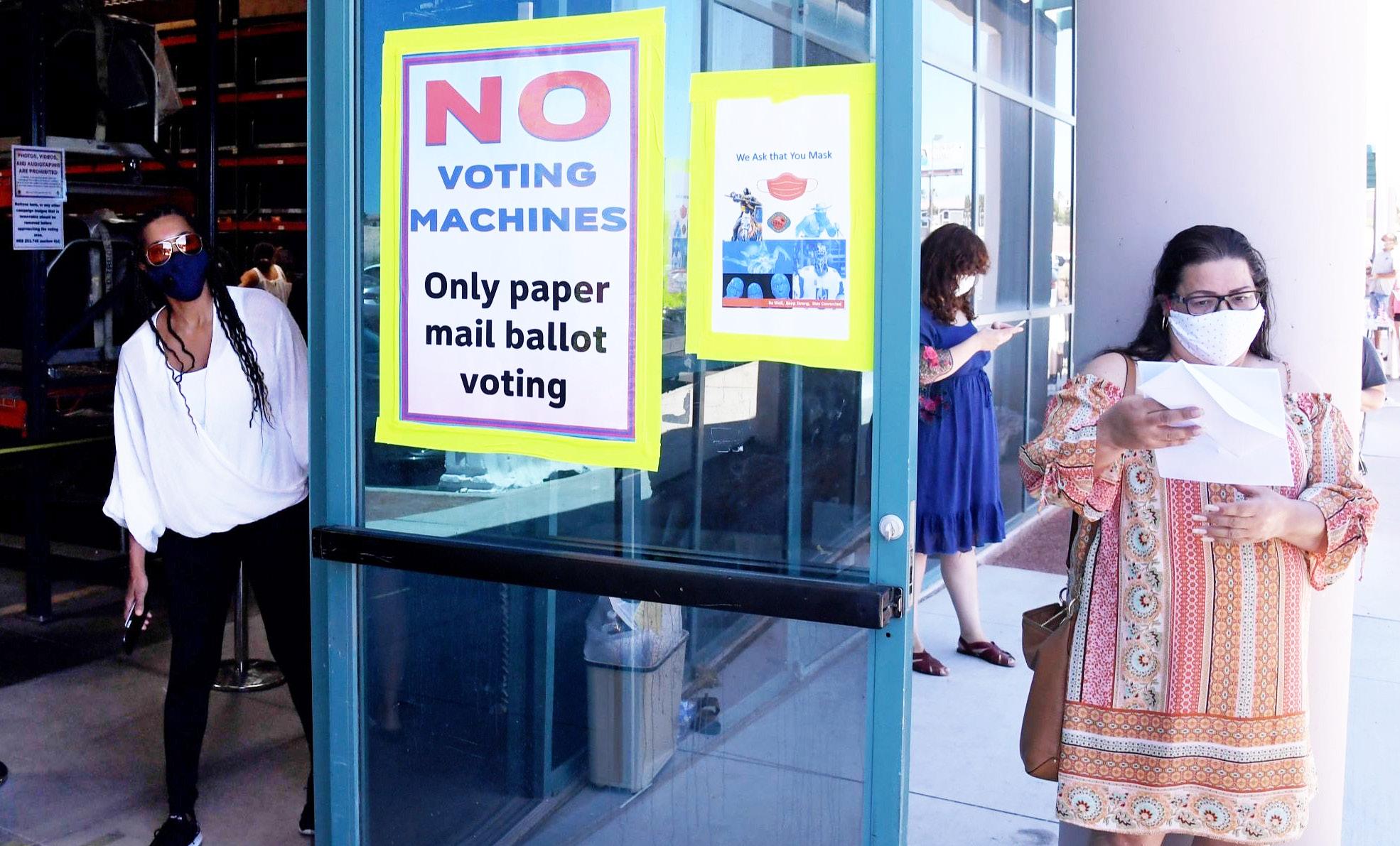
Jews to take advantage of a religious exemption clause in the state’s voting rules to cast ballots by mail. Missouri’s governor is among the Republican state leaders opposed to expanding mail-in voting during the pandemic.
That same month, the Conservative movement’s rabbinical group reiterated its support for unencumbered voting access.
“At this unprecedented time in modern history, the Rabbinical Assembly supports the unencumbered right to participate in local and federal elections with vote-bymail, online, over the Internet, and absentee ballots with no requirement to provide a reason nor so-called valid excuse,” the group said in a statement at the time.
The mechanics of voting, at least pending the passage of the Heroes Act, is a matter for the states, and Jewish groups have been working their legislatures to facilitate voting.
Ohio Jewish Communities, that state’s umbrella for Jewish public policy groups, and the state chapter of the National Council of Jewish Women have asked for changes to an elections preparedness bill in the Republican-led legislature. The groups say the bill includes obstacles to mail-in voting, for instance requiring voters to pay for postage and a 10-day cutoff before Election Day.
“Think of someone who goes into the hospital for an emergency operation five days before the vote who generally votes in person,” Susan Reis, the state policy advocate for NCJW, said in testimony submitted this week.
Steve Freeman, the ADL’s vice president of civil rights, said state chapters also would work on making it easier to vote in person, recalling the long lines for the Wisconsin state Supreme Court election in April that resulted in dozens of coronavirus infections.
A focus would be on ensuring that there are multiple venues open for in-person voting.
“People vote in schools, and it’s not clear that public schools are going to be open” because of the pandemic, Freeman said. “How do you address those kinds of challenges?”
Jewish groups in Florida helped lead advocacy in 2018 for an amendment that would restore the vote to most people who had been released from prison after being convicted of felonies. Republicans in the state subsequently passed a bill that required those convicted of felonies to pay outstanding costs to get the vote, and a number of civil liberties groups have
asked the courts to intervene, saying the requirement amounts to a poll tax.
Most of the estimated 1.4 million felons whose right to vote would be restored are people of color who likely would vote Democratic. The U.S. Supreme Court declined to step in last week, but an appeals court is still considering the lawsuits.
The National Council of Jewish Women has joined efforts to educate formerly incarcerated voters in Florida about their voting rights. A number have expressed fears that if they vote and then find out that they were not eligible, they could face legal consequences.
“A lot of our advocates on the ground are doing the education work to try to make sure everybody knows what their rights are,” Sheila Katz, the group’s CEO, said in an interview.
Rabbi Jonah Pesner, who directs the Reform movement’s Religious Action Center, knows that Jews outvote other Americans. In the presidential election of 2016, 56% of eligible Americans voted, and Pesner says the turnout among Jewish voters is believed to be as much as over 70%.
But it’s not good enough, he said.
“We’re asking every Reform congregation in the movement to guarantee that 100% of their members, particularly those who have more challenges with voting – first-time voters, elderly voters, people in a congregation who may have disabilities and have more challenges – are getting to the polls,” Pesner said in an interview. The initiative is called “100% Voting Congregations.”
Zoe Terner, a University of Florida student who is an activist with the Religious Action Center, said alumni of Reform youth movements were training Jewish college students to inform their peers of their rights at a time when it is not clear whether university students will be staying at home or returning to their campuses in time for the election.
“There’s a really big emphasis placed on where are you voting because maybe it’s different from where you thought you would be this time last year a couple of months ago, making sure you know the dates and deadlines,” Terner said.
Leveraging family relationships is not an unfamiliar Jewish concept. NCJW’s chapter in Michigan has launched a “Let’s Both Vote” program that Katz says gets members “to reach out to their children, grandchildren, children, nieces, nephews
vote by mail CNN election forecaster Harry Enten on his bar mitzvah, the Jewish vote and why he says ‘Shalom’ on TV
or parents, mothers, the other way around, and commit to voting with another family member.”
Jewish groups are not just trying to turn out Jewish voters. The Religious Action Center has joined with the Center for Common Ground, an organization that gets out the vote for underserved communities, in online training, staffing get-out-the-vote phone banks, texting and postcard writing – a pre-digital outreach method that is still the next way to reach minorities, Pesner said.
The Center for Common Ground ran a study, Pesner said, “that showed that a lot of low-income voters or communities of color respond to personalized postcards. So we also have a postcard campaign –already we’ve sent out tens of thousands of postcards that are personalized to individuals.”
Meredith Jacobs, the president of Jewish Women International, was appalled in 2018 to get a question from her elderly parents, who live in the Philadelphia area: Was it true that one could text one’s vote? This year, she said, her organization was “working with young women to push back against disinformation campaigns on social media designed to depress the vote.”
“Our supporters are mostly women of privilege and access, and we’re letting them know this isn’t the case for everyone and making sure they know why it’s important they use their voice,” she said.
Jacobs said her group was preparing to repel the expected onslaught of online misogynist messaging once Joe Biden, the Democratic nominee, names a running mate. Biden has said he will name a woman.
“We’re on the lookout against that and pushing back against that because that’s designed to depress the vote,” she said.
The ADL’s Freeman said his organization was also monitoring extremist disinformation online. The ADL will be “speaking out against appeals to bigotry and racism,” he said, and will be conducting “targeted reporting on extremist efforts to engage.”
BY STEPHEN SILVER
(JTA) – Harry Enten, the CNN Politics election forecaster, demonstrates his Jewish bonafides just about every time he appears on TV.
A native of the Bronx, Enten speaks with a thick New York accent and regularly drops a “Shalom” during his frequent TV appearances. The trademark sign-off feels only natural for Enten, who celebrated his bar mitzvah in Israel and whose late grandmother ran a Catskills resort (where his aunt met her husband, the Jewish singer Neil Sedaka).
Enten is also one of the country’s preeminent voices in sorting through election polling data. He worked for FiveThirtyEight, Nate Silver’s datadriven news site, before he moved to CNN in early 2018. Enten’s popular Twitter account, @ForecasterEnten, got him named to the Jewish Telegraphic Agency’s “50 Jews everyone should follow on Twitter” list last year.
JTA spoke with Enten about his career, his family’s history, the Jewish vote and that “shalom” habit.
Talk about your Jewish childhood growing up in Riverdale, N.Y.
We had a kosher home, separate silverware for meat and dairy, kept kosher for Passover obviously. We did go to shul when I was younger, on the High Holidays, and sometimes on Shabbat. I went to Riverdale Temple Camp, when I was very young, and even did nursery there. I went to Riverdale Country School, where I know the population of the student body was largely Jewish, even though the school itself was obviously not. I went to Hebrew school for a little while, then I had a private tutor, and I had a bar mitzvah in Israel. I still know most of my Torah portion, and I could even do it for you right now, I had pretty much memorized – [chants a couple of verses] – I could go on from there.
I saw my father cry very few times in my life, but that bar mitzvah, as we stood on top of Masada, was one of them. And for me, just generally speaking, I want to be very clear of who I am. And I don’t want to lie to folks, I don’t want to be something that I’m not, but I am Jewish, and proud of the fact that I’m Jewish, and I want people to know that.

On TV, you always say “Shalom.” Where did that come from, and why did you start doing that?
To be perfectly honest with you, the reason is that I’m just me. That is who I am. I think that there is this idea that some have out there, that you’re going to be buttoned up, and you’re going to have a tie on … for some, that’s exactly who they want to be, and it fits them.
To quote a famous Jewish musician, “I gotta be me,” as Sammy Davis Jr. once said. And that is what I have to be. And for me, that means not wearing a tie, and that means saying “shalom,” because that is what I generally do. It really didn’t come from anything except for me being perhaps a little bit more comfortable in being who I am. On the weekends, I wish people “good Shabbos.” It’s just being polite and being me.
Your grandparents ran a Catskills resort?
On my mother’s side, my Nana Esther [Goldstein-Strassberg] ran the Esther Manor in the Catskill Mountains, which was a resort that a lot of Jewish people came up to during the summer. She would run that little hotel, every summer, and I think they sold it 50 years ago, if my memory serves me correctly.
You have written about what you got wrong in 2016. How has the experience of 2016 affected you as you do your job in the 2020 election? It’s a great question, and I think that
there are multiple answers to that. I think there are some people who came away from 2016 not trusting the polling data. And I came away from 2016 actually trusting the polling data more. I think the biggest mistake that any of us made in the 2016 cycle was not in the general election, at least folks who look at the polls daily, but actually in the primary. When Trump entered the race, when he came down that escalator [in June 2015], I think a lot of people, including myself, thought, “This guy is not going to go very far.” His polling is poor. There was no real historical precedent for someone had basically no experience in the modern era going on and winning a party’s nomination. And indeed, the initial polling for him was, you know, sort of poor. But about a month in, it was very clear that he was connecting with folks, and I think that a lot of us couldn’t believe what was in front of us. We were looking at it like, “there’s no historical precedent for this, he doesn’t have any endorsements.”
If we had merely looked at the polling more closely, and seen this is a guy who has a real shot at winning based upon the polling – which actually in primaries, national polling has actually been pretty good at distinguishing folks who flame out versus those who don’t – I think that we would have been much better off. So for 2020, one of the things that I was very keen on doing was making sure that I didn’t underrely on the polling data. And while certainly the former vice president wasn’t in a dominating position



A REVIEW BY DONNA ROBINSON DIVINE
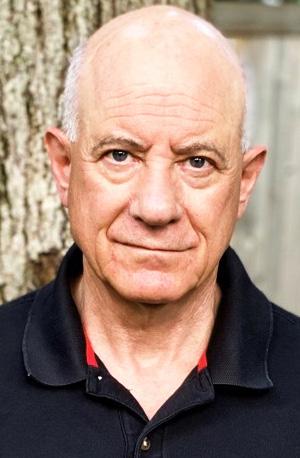
Baltimore Logic is the debut novel of Basil Truscott. A resident of West Hartford since 1982, where he and his wife are longstanding active members of Beth El Temple, Truscott retired from teaching AP Economics at Farmington High School in 2015. Previously, he worked in the legal departments of two major American corporations. Currently, Truscott is conducting research on the sequel to Baltimore Logic
In our post-truth age, where feelings count more than analysis, where policies are reduced to memes, and where a complicated history is boiled down into a series of freeze-dried hashtags, Baltimore Logic challenges a number of contemporary orthodoxies. It is as important a book for understanding the present as it is for learning about the past. The starting point is the title. What kind of logic can be associated with Baltimore? Author Basil Truscott deconstructs the meaning of that logic at several points in this gripping story. A willingness to deploy force is sometimes the only means of fighting against people determined to destroy lives and dismantle the political and social order that sustains our national life. But a force exercised thoughtfully constantly mindful of unanticipated consequences is often evoked more effectively as threat than as punishment. And when an accidental death becomes an outcome of the exercise of state power, Baltimore Logic requires unfettered reckoning with mistakes in both strategy and tactics. What went wrong has to become an opportunity for getting it right the next time.
This is Truscott’s first novel and one might reasonably approach it with hesitation particularly because the title suggests it is filled with nostalgia for a Baltimore that may no longer exist. But the city in Baltimore Logic is more than the sum of its buildings and people; it is a spirit captured in a novel that is neither a sentimental reminiscence nor a neurotic retribution about a segregated city with its enclaves of first generation Americans trying to fulfill the dreams of parents whose ambitions for their children often came without the necessary guidance. The characters we meet in this story are people we know – shaped by their traditions, but also reared on the seeds of discord sown long before they were born. They learn quickly they must choose the values to

define their own actions.
This long, detailed story of a race in 1939 for mastery over a military technology expected to determine the course of a war between Japan and its allies against the United States isn’t like anything else you have ever read. It contains the kind of details about international relations, radar technology, and warfare found only in the best of historical studies. It is an adventure story about networks of spies tripping over one another in a city with a port open to merchants from across the globe that also stood as a center of industrial power and near enough to the nation’s capital to wield significant political leverage.
Japan, not yet at war against the United States, understood America’s heart of darkness and sought to exploit it in order to gain access to the country’s innovative creativity. Because its diplomats knew that African Americans were asked to risk their lives in service of a nation that refused to treat them as full citizens, they also did not hesitate to exploit deep inequities in law and life to recruit their agents. Baltimore Logic thus becomes an argument over history and politics, and its strength is
By Emily Burac
(JTA) – Though much about the 2020 Emmy Awards ceremony is not yet known, one thing is clear: Jewish TV stars are well positioned to clean up.
Dozens of Jewish actors and creators were on the list when this year’s nominations were announced Tuesday. Read through to see who could take home prizes when the awards show airs in Sept. 20 on ABC in a virtual ceremony hosted by Jimmy Kimmel.
One notable show that was shut out: “The Plot Against America,” the HBO miniseries that depicts an alternate history in which isolationist Charles Lindbergh wins the 1940 presidential election and encourages antisemitic attitudes throughout the United States.
“Unorthodox” makes its mark on the drama categories
“Unorthodox,” the hit Netflix drama based on Deborah Feldman’s memoir of the same name, came away with eight nominations, including best limited series. Anna Winger was nominated for writing, and star Shira Haas was nominated for lead actress in a limited series or movie. Haas, an Israeli, learned Yiddish for the role. Playing Esty was “probably one of the most, if not the
to show how the contradictions of an imperfect America can prove a source of inspiration and courage to people whose professionalism overcomes whatever barriers have been erected to deter them from doing their jobs. This is about a time when the FBI could work cooperatively with the Baltimore Police and naval intelligence; it is an era when Federal authority helped unleash industrial energy to provide the weaponry necessary to prepare for war; these are years when what America meant was not about a distilled version of its shameful past but more about its promises for a hopeful future. And thankfully for us in 2020, in the words of Basil Truscott, “that was that.”
Baltimore Logic by Basil Truscott, BookBaby, 2020, 498 Pages, Hardcover $45; Paperback $25; Kindle $9.49.
Donna Robinson Divine is Morningstar Family Professor of Jewish Studies and Professor of Government, Emerita at Smith College in Northampton, Massachusetts.
most, complex characters that I had the chance to play.”
Winger told Kveller that working on “Unorthodox” was the first time she worked with a predominately Jewish cast. “I usually say it takes a village to make a show,” Winger said. “For ‘Unorthodox’? It takes a shtetl.”
Tiffany Haddish’s “Black Mitzvah” is nominated alongside Jerry Seinfeld
Tiffany Haddish’s Netflix special “Black Mitzvah” was nominated for outstanding variety special along with fellow Jewish comedian Jerry Seinfeld, who was tabbed for his “23 Hours To Kill.”
Haddish spoke with Alma about her journey to claiming her Jewish heritage (her dad was an Eritrean Jew) and her decision to study Torah and become a bat mitzvah.
“When I came up with the concept for my special,” Haddish explained, “I was trying to figure out a way to tell my truth, my experiences in life, and also maybe open other people’s eyes to the fact that in African American culture, there is nothing that says, ‘OK, you’re officially a woman,’ or ‘You’re officially a man.’ There’s no ceremony. There’s no rite of passage … Knowing who you are, knowing where you come from, that’s what makes you an adult. And being able to share your story. That’s what I love about Judaism, because it’s all about sharing your stories and questioning and learning from each other.”
“Schitt’s Creek” gets recognized for its final season
“Schitt’s Creek,” created by the Canadian Jewish father-and-son duo of Eugene and Dan Levy, walked away with 15 nominations for its critically acclaimed final season. The show was nominated for best comedy series, and all four stars were recognized: Eugene Levy, for lead actor in a comedy series; Catherine O’Hara, lead actress; Dan Levy, supporting actor; and Annie Murphy, supporting actress. The younger Levy was nominated as well for writing the finale episode, “Happy Ending,” and for his direction of the episode.
“The Marvelous Mrs. Maisel” leads the comedy pack
The third season of the Jewish comedy
“Marvelous Mrs. Maisel” scored 20 nominations, including for outstanding comedy series and lead actress Rachel

Brosnahan in her portrayal of Midge Maisel. Jewish actress Alex Borstein was nominated again in the best supporting actress category – she has won the last two times she was nominated. Borstein will be competing against her follow “Maisel” star Marin Hinkle. Other “Maisel” acting nominations include Sterling K. Brown, Tony Shalhoub, Wanda Sykes and Luke Kirby.
Amy Sherman-Palladino was nominated for directing an episode, as was her husband and co-creator Dan Palladino. As Sherman-Palladino told JTA earlier this year, “I’ve always viewed comedy, especially at this time, as a Jewish creation – like the rhythm, the cadence.”
more Jewish comedy creators are recognized
The vampire mockumentary comedy “What We Do In the Shadows” – co-created by Taika Waititi, a Jewish Māori director, writer and actor, and Jemaine Clement –earned eight nominations, including one for outstanding comedy series. (Waititi was also nominated for his voice-over performance in “The Mandalorian.”)
Jewish showrunner Liz Feldman’s “Dead to Me,” which scored four nominations, is also competing in the outstanding comedy series.
Also in the comedy category: “The Good Place,” which ended this year, helmed by Jewish showrunner Michael Schur. Schur also earned a nomination for writing. “The Good Place” earned a total of seven nominations.
“Big Mouth,” the Netflix animated show about puberty, was nominated three times – including for best outstanding animated program. Season 3 featured a very Jewish episode at a Seder in Florida. The show was co-created by Nick Kroll and Andrew
Goldberg based on their Jewish childhoods in suburban New York’s Westchester County.
“BoJack Horseman,” which wrapped up its sixth and final season this year, also will be competing in the best animated series category. The show’s creator, Raphael BobWaksberg, is Jewish.
Jewish actresses make a mark …
Maya Rudolph is competing against herself in the guest actress in a comedy series role – for her role on “The Good Place” and her guest appearance as Sen. Kamala Harris on “Saturday Night Live.” She was nominated as well for her voice-over work as Connie the Hormone Monstress on the very Jewish animated show “Big Mouth.”
Tracee Ellis Ross received her fourth nomination for lead actress on the ABC sitcom “black-ish.”
Julia Garner was nominated for outstanding supporting actress in a drama series, a category she won last year. And while not portrayed by Jewish actresses, Margo Martindale’s portrayal of the legendary Jewish politician Bella Abzug and Tracey Ullman’s of the Jewish feminist Betty Friedan both received nominations. “Mrs. America,” the FX show about the fight for the Equal Rights Amendment, walked away with 10 nominations.
… As do two shows about cranky old Jews
Larry David’s “Curb Your Enthusiasm” earned four nominations, including outstanding comedy series, but David himself was not nominated.
“The Kominsky Method” earned three, including one for Michael Douglas‘ portrayal of Sandy Kominsky, a Jewish acting teacher, and Alan Arkin‘s Norman Newlander.

Newington
860.333.9032
2280 Berlin Tpk.
Newington, CT
(In the MedCare Express plaza-use side entrance) newington@finefettle.com

860.717.9333
1548 W Main St.
Willimantic, CT
(Across from Papa’s Pizza) hello@finefettle.com
BY RABBI TZVI HERSH WEINREB
Ihave noticed is that many books written on the subject of childrearing fail to include a chapter on one of the most important components of child rearing: discipline. With few exceptions, the most that these books contain on the subject of discipline is a chapter on “setting limits.”
In my opinion, and certainly in my experience, discipline is an essential component of all parenting and teaching relationships. And discipline is not just about “setting limits.” It is also about “setting goals.”
My experience as a parent myself, as a teacher for many years, and as a psychotherapist for much of my adult life, has borne out the wisdom of these two steps: Firstly, lay out the expectations that you have of the child and clearly define the nature of the task at hand. Secondly, when the child has accomplished the task, even if not totally successfully, give him or her feedback and recognition, whether in the form of a verbal compliment or a nonverbal gesture.
Discipline does not just involve “setting limits.” Indeed, saying “no” and issuing restrictive commands may not at all be what discipline is about. Rather, it involves “setting goals.” It is about extending a challenge, with the implicit confidence that sends that child the message, “You can do it!”
This, to me, is the essence of discipline. It is not synonymous with punishment. It is synonymous with learning and personal growth.
And this is what I think is meant by the passage in this week’s Torah reading, Ekev: “Bear in mind that the Lord your God disciplines you just as a man disciplines his son.” (Deuteronomy 8:5)
The Torah has much to say, even if the parenting books don’t, about discipline. It takes for granted that parents will discipline their children, and that teachers will discipline their students. After all, that is why students are called disciples.
The Torah insists, moreover, that the Almighty, too, disciplines us. And

He does so in much the same way as successful parents do. He sets clear expectations for us, and He shows us His favor when we meet those expectations and His disfavor when we fail to do so. The Lord really is a Father in this sense. It is no wonder then, that the book of Proverbs cautions us to “heed the discipline of your father, and do not forsake the instruction of your mother.” Notice: first discipline, and then instruction. First “mussar,” and Torah only afterwards.
As usual, there is an even deeper message in the word that the Torah uses for discipline. The root “YSR” is the root of both “discipline” and “suffering.”
Judaism teaches us that there is a meaning to our suffering. Sometimes that meaning is obvious to us; more typically though, the meaning eludes us, and we desperately search for it.
But one thing is clear. We learn through discipline, and we also learn through suffering.
The words of Victor Frankl, the psychologist and Auschwitz survivor, who certainly knew a thing or two about suffering, are very instructive here:
“ . . . On the biological plane, as we know, pain is a meaningful watcher and warder. In the psycho-spiritual realm it has a similar function. Suffering is intended to guard man from apathy, from psychic rigor mortis. As long as we suffer we remain psychically alive. In fact, we mature in suffering, grow because of it – it makes us richer and stronger.”
It is through the processes of discipline and suffering that we develop and are transformed. Both processes are painful, sometimes profoundly so. But through both, we widen our horizons, enhance our spirits, and attain a deeper understanding of our life’s purpose.
Discipline and suffering: important to us all as individuals, as part of the Jewish people.
Rabbi Tzvi Hersh Weinreb is the Executive Vice President, Emeritus of the Orthodox Union.
[to win the Democratic nomination] until March of 2020, he was in a good position. So this is why I would consistently say, “Look, Joe Biden has the best shot of winning of any of the candidates.”
Second, I think that there was a misunderstanding/a misapplication of what I deem to be the true margin of error. That is how far off the polls are once you take into account time until the election, things that don’t just include sampling error – nonresponse, misappropriation of weights, whatever. And essentially, what I see my job as doing is making sure I’m telling people that. In the weekend before the 2016 election, I was saying, “Look, Donald Trump is just a normal polling error away from winning. It really wouldn’t be that crazy for him to win at this point.”
The final thing I’ll note I think is so important: It’s really easy to tell people what the most likely outcome is going to be. What’s more difficult, and what I’m not sure we necessarily as a statistical community do enough, is explaining to folks, “Okay, what’s the unlikely outcome in this situation? And how do we get to that unlikely outcome?” Donald Trump, at this point, is not the most likely person to win the November election. But how is it that we get to the point where he does win? What needs to occur, and what’s the chance of that occurring?
It seems like every election, Republicans say this is going to be the year they get more Jews to vote for them, and it never really happens. Trump has tried to make inroads – do you think he may succeed?
Not really. I think, obviously, as you hinted it, it’s something that is continuously brought up. But you know, we have basically over the last few decades hit a point where the Democrats win the Jewish vote between somewhere between 45 and 60 points, and I haven’t seen anything that indicates that that will shift significantly. Obviously, we’ll have more data, as we get closer to the election, but at this particular point, I have not seen anything that indicates that we’re going to shift significantly from that.
We have seen a number of polls from 2020 and we know that Jews on the whole overwhelmingly disapprove of Trump’s job performance. I think his net approval is around minus-40 points. We know that the Democrats are much better liked among Jewish voters, and we know that in the polls that were taken before the primary that Biden was up by nearly 40 points among Jewish voters. And my guess is that is even larger now that you know he attained the nomination and he’s obviously also extended his lead. So I have not seen anything to indicate that Trump will get more than 30% of the Jewish vote, and I wouldn’t be surprised if it’s even lower than that.
“Eesy
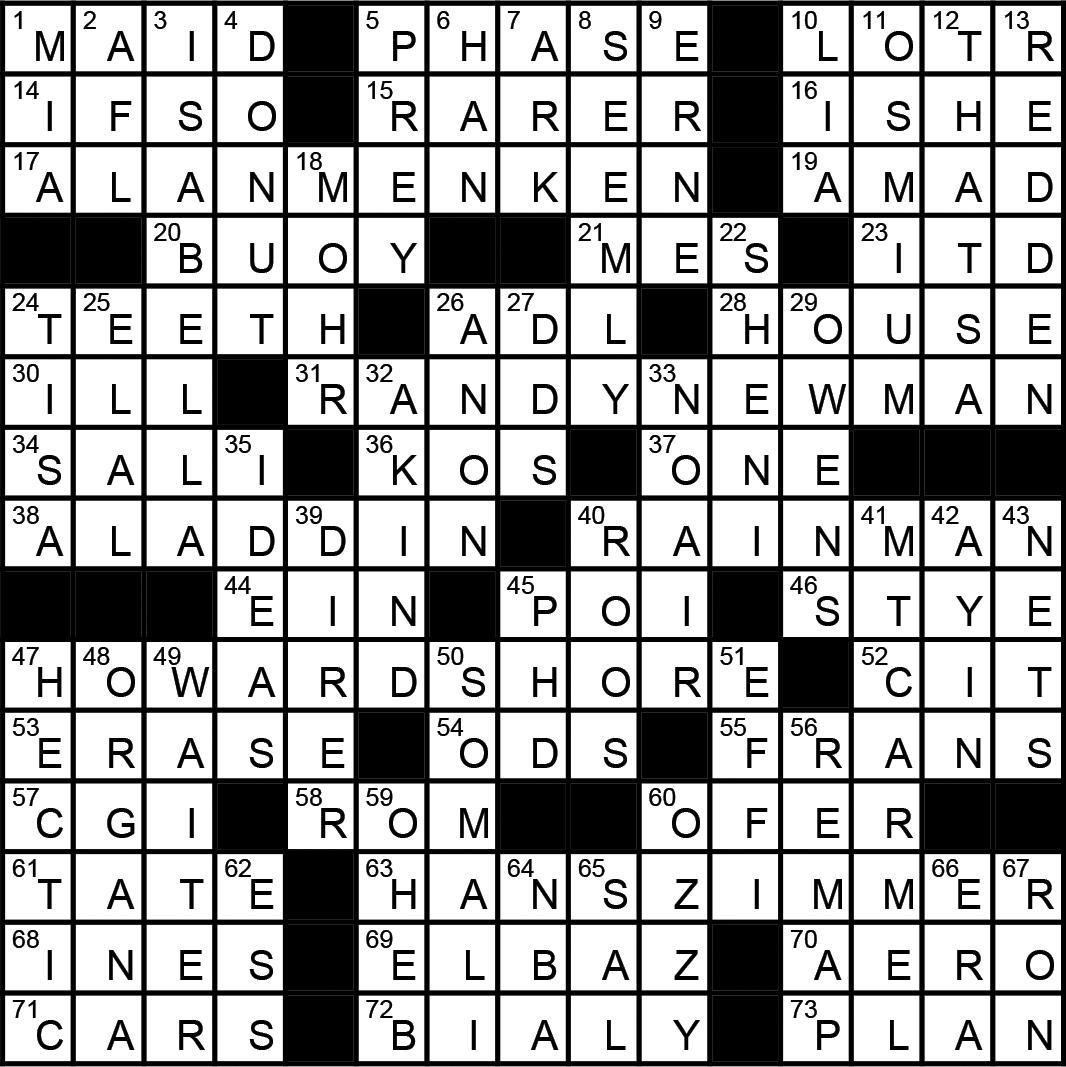

Across 1. Supreme Court Justice Warren
5. Like a postscript
10. PC bookmark
13. Matzo ___
14. Get ready, in golf
15. Biblical woman’s name that becomes a Biblical man’s name with an “h”
16. They take care of the honey in the land of milk and honey
18. Disrespectful part of the face?
19. American capital in a Middle East capital?
20. For 21. Jews
22. “The Matrix” messiah
24. Rabbinic law
Down
1. Abates, like Shabbat
2. Place
3. Item involved in fishing and filming
4. Compared
5. Had some blintzes
6. (Jack) Sparrow portrayer
7. Kosher animal rarely on the
menu
8. Home to majority of the world’s Jews, 100 years ago
9. A 2B often helps turn them
10. Not as much in the cards
11. Rage Barry Bonds was known to have displayed, once
12. Auto race units
17. It’s the truth
21. She gave Sisera a major
26. Jewish period that ran from July 8-July 30, 2020
32. Star part
33. Debt letters
34. Bold bet by a bluffer
35. Suffix with Marx or Lenin
36. How the fortunate are blessed... or a phonetic hint to 16, 26, 43, and
58- Across
38. Give-go connection
39. ___ B’ Tevet (Jewish fast day)
41. Aussie pop star who rarely shows her face
42. Like Tanya or the Mariana Trench
43. They’re brewed in Israel
46. Feeling that proceeds suffering, according to Yoda
headache
23. One consonant state
25. Convince
26. Thompson who appeared in “Avengers: End Game”
27. Ma’arat ___
28. Bring out of slumber
29. Jazz legend Blake
30. Diamonds in the sky?
31. Cereal mascot
32. His only Oscar nomination was playing Oskar
36. Kind of g’neivah
37. Chocolate-colored dogs, for short
40. First U.S. color TVs
42. “A diamond is forever” company
44. Middle East city very few Jews
47. Jews observe it on Sat.
48. Apple program you probably don’t use sitting on the couch
50. Little devil
53. Take out once more
57. Fury
58. It’s a right in America and Israel, but not in the Torah
60. Nada
61. “___ Time” (license plate in an 80’s smash)
62. Bris, for one 63. Mrs. Morgenstern of “Rhoda” 64. AKA Irgun
65. Like Flash’s movements in “Zootopia”
visit
45. Wyatt of the west
48. Cooper car
49. Like Arad (in weather and in spelling)
51. French city that’s a homophone of a baseball team
52. Big player for 51-Across’s homophone team
54. Diamond who wrote “I’m a Believer”
55. ___-1 (license plate in an 80’s smash)
56. “Boy, that was close!”
58. David, from Saul’s point of view (sadly)
59. Mineo of “Exodus”
BY SAM SOKOL
TEL AVIV (JTA) – Noam Ofer might have been an unlikely candidate to join Israel’s burgeoning protest movement. At 76, he is older than most of the people who have taken to the streets in recent weeks to protest the government’s handling of the coronavirus crisis. He also doesn’t share the political views of many of the protesters.
But Ofer was there anyway on Tuesday evening marching outside the Tel Aviv home of Israel’s internal security minister in charge of law enforcement, Amir Ohana, who was caught on tape pressuring a senior police official to ban demonstrations against Prime Minister Benjamin Netanyahu.
“He’s trying to illegally shut down protests,” Ofer said. “I came because the minister said that we’re all on the left. I’m on the right. He said we are anarchists, but the only ones creating anarchy are the ones around Netanyahu.”
Ofer’s perspective reflects the deep and bipartisan frustration that many Israelis are feeling about the country’s leadership nearly six months since Israel recorded its first coronavirus case. Thousands of Israelis have been staging loud protests for weeks, mostly outside the prime minister’s residence in Jerusalem, but also in Tel Aviv and other spots across the country. Some commentators have called it the country’s largest grassroots movement since 2011, when hundreds of thousands of Israelis protested the cost of living.
After drawing international praise for how he efficiently imposed a strict and effective lockdown, Netanyahu acknowledged earlier this month to reopening Israel too soon. Cases have risen sharply, restrictions have been reimposed and unemployment is near its all-time high. Stimulus checks from the government have fallen short of their promised amount.
Meanwhile, Netanyahu’s trial on three corruption charges has been delayed for a second time – after Ohana, in his previous stint as justice minister, shut down courts amid the pandemic in March, effectively postponing legal proceedings against the prime minister. The demonstrations have reenergized those who have been calling out Netanyahu in recent years over his legal problems and what they perceive as his goal to weaken democratic institutions like the judiciary.
The result is a movement made up of Israelis across the political spectrum, whose numbers seem to be growing every

week. Police were bracing for large rallies Thursday night with the end of the Tisha B’Av observance.
As the protests have widened in focus, demonstrators have faced harsh crackdowns by police, who have drawn criticism for using water cannons and tear gas.
Many at Tuesday evening’s protests, which was organized by the anti-Netanyahu Black Flag movement, said they were incensed by Ohana’s statement to Doron Yadid, the commander of the Jerusalem police district – a recording of which was leaked in the media – that he didn’t “understand why we don’t ban” antiNetanyahu protests.
“I want to challenge the ruling of the court,” Ohana said, referring to a recent ruling allowing the protests to go ahead, generating widespread anger and prompting President Reuven Rivlin to issue a public statement declaring that the right to protest “must not be harmed.”
Ohana is “trying to cancel protests and circumvent the law,” complained Maor, a 25-year-old law student from the coastal city of Ashdod who said he had attended a number of demonstrations outside the prime minister’s residence and had been “subject to police violence” for engaging in civil disobedience.
“It was brutal, they used a water cannon against me,” he said, describing how he was
shot with a high pressure water jet while participating in a sit-in. “I bruised my ankle. I couldn’t work for two days.”
Another protester, Eliana Barbel, showed off a large bruise on the back of her leg as she described her experience at a protest last week that ended in violent clashes with police.
“I was arrested on Thursday. I was hit and arrested and spent the night in jail for protesting,” Barbel said. “When I was arrested, the cops were very violent. I was sitting on the ground and three riot policemen picked me up and took me.
“They want to scare us, but this will only bring more people out,” she added, holding up a sign decrying violence against Arabs, haredi Orthodox, Ethiopians and leftists, and promising to continue to protest even “if I’m arrested 10 times.”
Eliana Barbel at the protest in Tel Aviv holding a sign that reads: “Arabs, haredim, Ethiopians, lefties. Ohana, who is next in line?” (Sam Sokol)
Echoing a theme that has emerged in recent American Black Lives Matter protests that have faced police crackdowns, Efrat Safran, a 57-year-old dual American-Israeli citizen from Ramat Hasharon, carried a sign bearing the slogan “Mothers Against Police Violence.”
Safran said she was ready to protect younger protesters from the police with her
own body.
“We’re trying to save democracy,” she said.
While the crowd protesting near Ohana’s apartment was overwhelmingly secular, Pinchas, 30, a haredi attorney from Bnei Brak, a largely ultra-Orthodox city, said he decided to come out because “government corruption is dangerous to all of us, including the haredim.”
Tuesday night’s protest was marked by tense but not violent exchanges with police. (Five protesters reportedly were hospitalized after being attacked, the Black Flag movement said, by individuals not associated with the police.) After several hours, the protesters drifted away from the zone marked out for them by law enforcement and began marching down a nearby road, stopping traffic and eventually running into a line of policemen backed up by mounted officers.
Large groups of protesters eventually began making their way back, trying to circumvent the police and reach Ohana’s apartment building, leading to several clashes during which officers shoved several people, leading to renewed chants of “no to violence.”
As police and protesters faced off, the mounted officers repeatedly rode up to the edge of the crowd trying to force its members back.
Experts in the fields of corporate security and insurance will discuss cyber safety, law and how to protect yourself on Thursday, August 6, 7 p.m. on Zoom. Presented by the United Jewish Federation of Greater Stamford Cardozo Society. This program is free and open to all. Lawyers receive1 CLE credit. Sponsored by Goldberg & Segalla. Zoom link will be provided with registration. To register: ujf.ticketspice.com.
Jewish Agency for Israel (JAFI) invites teens, ages 14-19, to a creative and fun virtual festival and meet other Jewish teens from Israel and around the world, which will be held online Sunday, August 23 at 3 p.m. Teens can move between activities and choose which events to join: interactive conversations, art workshops, study sessions, gaming areas, mingling, plus live performances from youth bands and firstrate artists. For information, email Sharon Franklin at ujf.org.
Actor Jason Alexander, broadcaster Tom Brokaw, Nobel Laureate Professor Aaron Ciechanover, Eugene Levy, Benj Pasek, Bonnie Hunt, and others for the Israel Cancer Research Fund’s (ICRF) Ribbons of Hope Virtual Gala Celebration on August 5 at 8 p.m.
The program will also include the presentation of the Israel Cancer Research Fund’s Tower of Hope Humanitarian Award to Jason Alexander, in recognition of his generous support of cancer research in Israel. It will be presented by actor Steven Weber and will include tributes from Bryan Cranston and Chita Rivera, among others. The evening will combine comedy and song, as well as special presentations by cancer
B’nai Mitzvah
CALEB KATZ, son of Geri and Josh Katz of Fairfield, will celebrate his bar mitzvah on August 8, at Congregation B’nai Torah, Trumbull.
MATTHEW SCHOENFELD, son of Jennifer and Adam Schoenfeld, will celebrate his bar mitzvah on Saturday, August 8, at The Emanuel Synagogue in West Hartford.

survivors and Israeli cancer scientists. Tom Brokaw will share his personal story, followed by an interview with ICRF-funded scientist Professor Aaron Ciechanover, who together with Drs. Avram Hershko and Irwin Rose, received the Nobel Prize for Chemistry, in recognition of their groundbreaking research on the Ubiquitin System, the body’s method of removing damaged proteins. ICRF is currently funding 70 cancer research projects.
Throughout the 50-minute celebration, viewers will be able to make online donations and place bids on an online auction. Participation is FREE; advanced registration is required. For more information or to register for the Gala, visit icrfgala@icrfonline.org.
The Benny Carter Tribute Jazz summer concert, hosted by the JCC of Sherman, returns on Saturday, August 8, 7 p.m., with the sound of Connecticut’s TJ Thompson Trio. Winner of the IMEA Jazz Artist of the Year for their recent album “Take Two: The Sound of Playing,” the popular jazz trio plays a combination of originals along with soul, blues, and jazz.
TJ Thompson, has performed with Betty Carter’s Jazz Ahead at Washington’s Kennedy Center for the Performing Arts, and was a featured artist on Branford Marsalis’ Jazz Set show on NPR. In 1998 he recorded and produced “Thompson Trio Take One,” an album consisting mostly of original works. Thompson has opened for and worked with such artists as Henry Butler, Mel Torme, Ed Thigpen, Dave Liebman, and Koko Taylor as well as being a featured soloist on the Morgan Powell Jazz Album. Since 2002, he has been the director of instrumental music at the Taft School, in Watertown.
Tickets to the concert are limited to allow for social distancing, and must be purchased online in advance, at www. jccinsherman.org, where new safety rules

concerning the JCC’s outdoor events are also posted. Admission is $20/JCC member and $25/non-member. at www. jccinsherman.org. Don’t forget to bring your mask and a chair! Rain date is August 9. The JCC in Sherman is located at 9 Rte. 39 South.
For information on the following Zoom events hosted by Congregation Beth Israel visit cbict.org/calendar.
Learn to Zentangle with Laura Marks Wednesday, August 5, 7 p.m.
Zentangle is a method of creating abstract art using structured patterns. It can be used to decrease anxiety and increase relaxation and creativity. $5/materials fee, $10/family cap. Materials delivered to your door.
Super Tribe Havdalah August 8 & 22 Havdalah followed by a meet-and-greet for those 35 to 50 year old.
The Museum of Jewish Heritage – A Living Memorial to the Holocaust, continues to host virtual programs while the museum remains closed during the COVID-19 crisis. All events take place at 2 p.m. Suggested donation for each event is $10.
For more information or to sign up for the following August Zoom events, visit mjhnyc.org/events.
Trauma Studies, Creativity, And The Second Generation Tuesday, August 4 | 2 PM
Children of Holocaust survivors process and cope with inherited trauma in remarkably diverse ways. In this discussion, clinical psychologist Irit Felsen – a trauma specialist focusing on Holocaust survivors and their children – will be joined by award-winning author and poet Elizabeth Rosner (Survivor Cafe, Speed of Light) for a discussion of how trauma is passed on and manifest from generation to generation.
Survivor Songs: The Amazing Stonehill Recordings
Thursday, August 6 | 2 PM
In the summer of 1948, amateur folklorist Ben Stonehill recorded more than 1,000 songs from Holocaust refugees who were being housed temporarily in the lobby of the Hotel Marseilles on New York’s Upper West Side. Stonehill’s efforts preserved for posterity a rich repertoire of songs in Yiddish as well as Polish, Czech, and Hebrew. The recordings are now being disseminated on the web by Yiddish scholar
Miriam Isaacs through a partnership with the Center for Traditional Music and Dance. In this online multimedia program Isaacs will reveal the inside story of Ben Stonehill’s heroic project, and share some of the remarkable performances Stonehill captured on wire recordings. Special guest musician Vladimir Fridman will perform songs from the Stonehill archive.
Family Papers: A Sephardic Journey Through The Twentieth Century Tuesday, August 11 | 2 PM
For centuries, the Greek port city of Salonica was home to the sprawling Levy family – leading publishers and editors who helped chronicle modernity as it was experienced by Sephardic Jews across the Ottoman Empire. As the wars of the twentieth century redrew borders around them, the Levys were gradually transformed from Ottomans to Greeks. Family members soon moved across boundaries and hemispheres, stretching the familial diaspora from Greece to Western Europe, Israel, Brazil, and India. In time, the Holocaust nearly eviscerated the clan, eradicating whole branches of the family tree.
In Family Papers: A Sephardic Journey Through the Twentieth Century, prizewinning Sephardic historian Sarah Abrevaya Stein uses the Levy family’s correspondence to tell the story of their sprawling journey.
Author and Columbia University Professor of Israel and Jewish Studies Clémence Boulouque will discuss Stein’s book as well as Sephardic experiences during the Holocaust.
“Demagogue: The Life And Long Shadow Of Senator Joe McCarthy” With Author Larry Tye Thursday, August 20 | 2 PM
U.S. Senator Joseph McCarthy was one of the most controversial people in 1950s America, championing an anti-communist movement that often gave way to antisemitism. In Demagogue: The Life and Long Shadow of Senator Joe McCarthy, bestselling author Larry Tye offers a comprehensive portrait of McCarthy based on the first-ever review of his personal and professional papers, medical and military records, and recently unsealed transcripts of his closed-door Congressional hearings. Join Tye for a discussion of his new book and McCarthy’s complex legacy.
Rose Belfer, 98, of West Hartford, died July 22. She was the widow of Fred Belfer. Born in Rovno, Poland, she survived the Holocaustby lost her parents, a brother and a sister. She is survived by her daughters, Elka Belfer Sandler and her husband Steven of Bloomfield, Cynthia Belfer Hoffman and her husband Robert of West Hartford, and Wendy Belfer Tyler and her husband Charles of West Hartford; her grandchildren, Eli Hoffman of New York, Shana Hoffman and her husband Daniel Katzman of New York, Nina Belfer Tyler of Bloomfield, and Shoshana Tyler Armington and her husband Joseph of Simsbury; her great-granddaughter, Winnie Armington; her sister Clara Grossman of West Palm Beach; and several nieces and nephews.
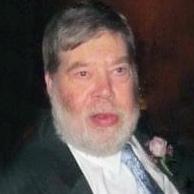
Israel Isaac Gordon, CPA, 75, of Simsbury, beloved husband of Rosalynn Sharon (Greenberg) Gordon, passed
away Wednesday, July 22, 2020. Born in Hartford, son of the late Frederick and Ruth Lillias (Michelman) Gordon, he was raised in West Hartford where he graduated from Conard High School and earned his BA from New England College. He lived in Torrington for many years, moving to Simsbury in 1984. Israel was proud to have been named after his grandfather Israel Isaac Michelman. He owned and operated his own CPA practice for many years and was a member of the CT Society of CPAs, American Institute of CPAs and was proud to have taught accounting at CCSU and was a professional mentor at ECSU. Israel was an avid golfer, enjoyed playing the piano, studying Hebrew, and was known for his great parties. Besides his wife Rosalynn, he leaves a daughter Sarah Pahl and her husband Joseph; two sons Frederick Gordon and his wife Kealy and Benjamin Joel Gordon; a granddaughter Audrey; a Godson Samuel Greenberg; and three cousins Amy and Dr Roger Stegman, Barbara Gordon, and Margo Michelman. Besides his parents he was predeceased by his brother David Saul Gordon, Esq. A


Graveside Funeral Service was held at Beth David Cemetery, Wethersfield. Donations may be made to either Temple Israel, Wilkes-Barre, PA, or the US Holocaust Museum.
Fay (Kleiman) Poles, 103, of Windham, N.H., formerly of West Hartford, Conn. and South Palm Beach, FL, died July 24. She was the widow of Seymour N Poles. Born in Hartford, she was the daughter of the late Louis and Esther (Wolff) Kleiman. She is survived by her children, Barbara Goldsher and her husband Allan of Tewksbury, Mass., and James Poles of Washington, DC; her grandchildren, Melissa Liebenthal and her husband Adam, and Evan Goldsher and his girlfriend Sarah Anderson; and her greatgranddaughter, Sophia Liebenthal.
Ethel (Rosensweig) Roth Ratner, 103, of West Hartford, died July 28. She was the widow of Harold E. Roth and David Ratner. Born in Dunmore, Penn., she was the daughter of the late Charles and Celia (Scheck) Rosensweig. She is survived by her children, David M. Roth and his wife Linda of West Hartford, Amy Roth and her husband Robert Epstein of Berkeley, Calif.; her daughter-in-law Rosalie Roth of West Hartford; her grandchildren, Emily Roth Makar and her husband Drew, Stephen Roth, Rachel Roth, Harris Epstein and his partner Abbie Coburn, Colin Epstein, Todd Ratner and his wife Amy, Tiffany Dacey and her husband Dennis, Trent Hershenson and his wife Karen, and Scott Hershenson and his wife Megan; her great-grandchildren Madeline Jane Makar, Nathaniel, Ruthie and William Epstein-Coburn, Dylan, Jake and Jordan Ratner, Matthew and Drew Dacey, Danielle, Jason, Emma and Carter Hershenson and many nieces and nephews. She was also pre-deceased by her son
Samuel Roth, and her siblings and their spouses William Rosensweig and his wife Lois, Lillian Frankel and her husband Gene, and Perry Rosensweig and his wife Fern.
SCHPERO
Alan K. Schpero, 92, of Fairfield, died July 17. He was the husband of Beverly. He was the son of the late Lewis and Sophie Schpero. In addition to his wife, he is survived by his children, Gary and his wife Pamela, and Wendy; his grandsons, Trevor, Will and his wife Kristine, and Blake; his great-grandchildren, Brooke and Eden; and his sister Lois Gorbach.
Esther Schwartzman, 91, of New Haven, formerly of Greenfield, Mass., died July 26. She was the widow of Rabbi Solomon U. Schwartzman. She was a member of Westville Synagogue. Born in Munkacs, Czechoslovakia (now Mukachevo, Ukraine), she was the daughter of Usher Zelig and Leah (Weingarten) Fried. A Holocaust survivor, she grew up in Munkacs in the heart of the Carpathian Mountain region. She was imprisoned as a teenager along with her family at Auschwitz and subsequent in forced labor camps culminated in the Death March from the Brahnau camp from which she escaped. She and two older sisters were the only survivors of their immediate family, losing their parents and a younger brother and sister. She is survived by her children, Shelley Bulman of New York, N.Y., Sarah Pollack and her husband Yoram of Israel, Hayim Schwartzman and his wife Anne of Portsmouth N.H., Jerry Schwartzman of Charlotte NC, and Judy Ostroff and her husband Dan of Israel; 13 grandchildren, and 39 great-grandchildren.























Caregiver - Willing to care for your loved ones overnight - Excellent local referencesAvoid nursing home or hospital in light of Covid 19. Call 860550-0483.
Tricia’s Cleaning Service
- Residential & CommercialDetailed cleaning for Home & Office - For Free Quote call 860477-8636.
Polish certified nursing assistant. Twenty years experience in hospitals, nursing homes and private home settings looking to help your loved ones. Please call 860-803-6007.
Certified Home Care Aide
- Live-in - HHA CertficateExperience with dementia, stroke, alzheimer’s - Driver’s License - References - Lydia 718864-7600.
Mikael Poreshi - Remodeling & Painting - 860-978-2505 - miki. pori87@gmail.com.
Home Health Aide - Companion available for live in/live out Mon. - Fri. Valid driver’s license. Over 15 years experience. Excellent References. Call 860-796-8468.
CNA - 8 Years ExperienceReliable - Own Car - Live-in 24/7 - Negotiable Rates - Please call Tina 860-461-8692.
Compassionate Elder Companion - Driver & CookBeth: alifeofplantsandart@gmail. com.
P.C.A. - HHA Caregiver - 17 Years Experience - Available Live In or Live Out - Five Days a Week - Car Available - Have References - Please Call K.B. 860-796-8468.
Nurse (LPN, Male). 2 Years Experience in long term care. 4 Years Home Care as CNA and Nurse. Seeks Private duty. Reliable, honest, hardworking. 860-656-8280.
Caregiver for your elderly loved one available Thursday evenings to Sunday evenings. Kosher experience, stellar references. Monica - 347-486-0911.
New England Jewish Academy in Greater Hartford - Preschool aide to assist our two dynamic lead teachers - Wonderful children and supportive environment - Hours are 11:005:00 M-TH, 11:00-4:00 on Friday’s with the exception of winter when Friday hours are 11:00-2:20. We are also looking for an art teacher who can work one full day each week. Please email your resume to zsilver@ sigelacademy.org.
NURSE SEEKING POSITION: GETTING BETTER TOGETHER! Adult care only. Live-in, days or nights and weekends. Responsible and dedicated caregiver with medical education. Leave message: 860-229-2038 No Text Please.
Home Health Aide - Two Years Experience - Reliable - Livein seven days. References available, negotiable rates. Call Kwasi 774-253-5479.
Driver available for shopping & errands in the greater Hartford area. Reasonable rates, senior discount and references available. Call Ira 860-849-0999.
Caregiver looking for full time live-in job - HHA/Precursor CNA - 12 Years experience - Friendly, outgoing, dependable - Please call Janet at 412-527-9285.
CNA with 25 years experience, reliable car, live-in or hourly. References available, and negotiable rates. Call Sandy 860-460-3051.
CHAUFFEUR, WEST HARTFORD will drive you to New York, Boston, New England tristate area. Reasonable rates. References. Call Jeff 860-7124115.


Magnificent Vacation CondoDelray Beach 55+ CommunityFurnished One Bedroom - Meals Available -Monthly - Seasonal Please call 215-740-1165.
For lease- Boca Raton, FL. Fully furnished 2 bedroom, 2 bath condo with kosher kitchen in beautiful Century Village. First floor, parking, pool & club house. Call Mike 561-654-4221.
Third Generation Jeweler - Gold & Diamond Buyer - Is Buying All Gold Jewelry - Sterling Silver Flatware Sets - Diamonds Over 2 Carats - Fast PaymentContact - mitchellrosin@gmail. com.
Collector looking to purchase coins and currency, silver, copper, and gold. No collection is too small. Will travel. Call 860951-5191 paprfred@aol.com.
Accounting & Math TutorRetired College Accounting Teacher Will Tutor at Your Home - Call For Appointment 860-402-1201.
Motorized KD Smart Chairrarely used -




1.99%