


Lessons Learned 5
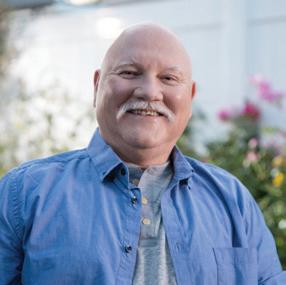
Connecticut’s U.S. Senator Richard Blumenthal was one of four senators to sponsor the Never Again Education Act, which seeks to expand Holocaust education in the United States. The bill passed the Senate on May 13.

Artisans at Work 5
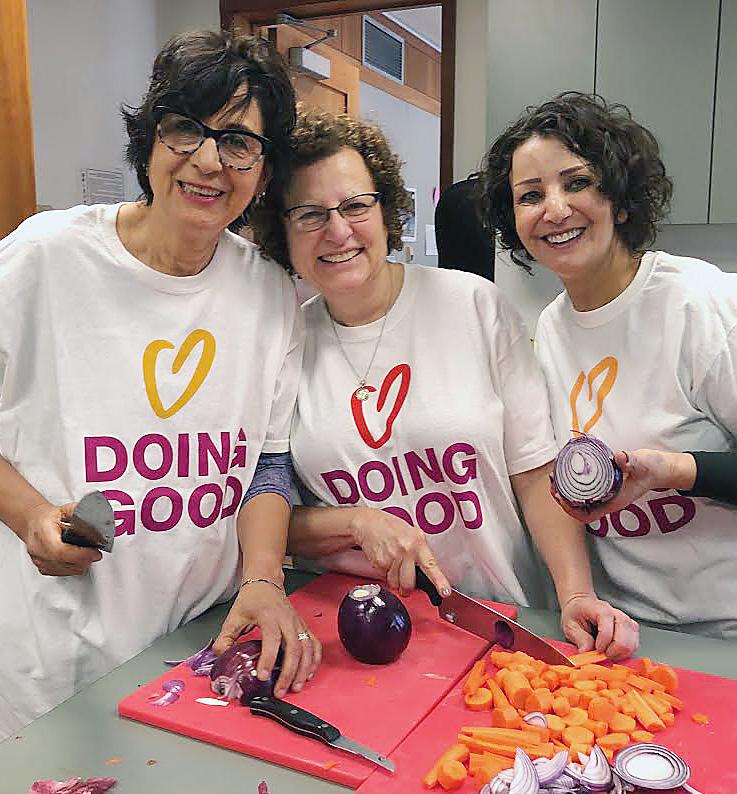
Women who live in The Towers assistedliving apartments in New Haven have ramped up their production of COVID-era masks for first responders low on PPEs – and now added homemade blankets to their repertoire.

Food as a bridge spanning the cultural divide is the premise of the new movie “Abe,” in which a young boy tries to blend the cuisines of his mother’s Jewish family and his father’s Palestinian parents to forge a truce between the two.
Women’s Day 8
After meeting chef/entrepreneur Naseba Alkesh on their “Fresh Perspectives” trip to Israel last summer, Trinity Hillel invites the Druze woman who lives in the Golan Heights lead several International Women’s Day campus events.

Hate by the Numbers
ADL’s newly released annual audit reports antisemitic incidents in the U.S. in 2019 were the most in at least four decades. In Connecticut, the numbers were down, but still represent a 30% increase over the last five years.
ON THE COVER:
Jewish day school all across the country were gearing up for their annual 8th-grade trip to Israel when COVID-19 came along to scuttle their plans. To be sure, there was no program teachers could devise that would substitute for an actual trip to Israel. Still, several Connecticut day schools came up with programs to help soften the blow. PAGE 14
SHABBAT
Hartford: 7:54 p.m.
New Haven: 7:54 p.m.
Bridgeport: 7:55 p.m.
Stamford: 7:56p.m.
To determine the time for Havdalah, add one hour and 10 minutes (to be safe) to candle lighting time.



BY JACKSON RICHMAN
(JNS) Jewish and pro-Israel groups applauded the U.S. Senate passage on Wednesday, May 13, of the Never Again Education Act, which seeks to expand Holocaust education in the United States.
U.S. Senators Richard Blumenthal of Connecticut was one of four senators to introduce the bill. Connecticut’s Senator Christopher Murphy votes in favor.
The legislation, which passed the U.S. House of Representatives in January, now goes to U.S. President Donald Trump for his expected signature into law, would expand the U.S. Holocaust Memorial Museum’s (USHMM) education programming to teachers nationwide, requiring the museum to develop and disseminate resources to improve awareness and understanding of the Holocaust and its lessons.
The Senate version was slightly different from the U.S. House of Representatives one, which the Senate ultimately passed, in that the former had the U.S. Department of Education, not the USHMM, oversee the expansion of Holocaust education in the United States.
Under the passed bill, $2 million would be allocated annually for this year and each of the next four years to the Holocaust Education Assistance Program Fund,
administered by the USHMM’s governing body, the U.S. Holocaust Memorial Council. Private donations for the fund would be permitted.
“Particularly in light of the recent use of Nazi imagery by right-wing protesters praised by President Trump, we are pleased to see that the Never Again Education Act passed the Senate unanimously this week after it was held by at least one Republican senator,” Jewish Democratic Council of America executive director Halie Soifer told JNS, referring to Holocaust imagery and slogans being featured at demonstrations over state and local restrictions to the coronavirus pandemic, and Sen. Mike Lee (R-Utah) placing a hold last week on the bill after it was discharged from the Senate Energy and Natural Resources Committee.
“It’s very rare for a substantive bill to move like this without going through committee,” a Hill aide told Jewish Insider. “[Lee] and his staff wanted to review the text.”
Ultimately, no changes were made to the bill, the Hill aide told the outlet.
“It has become painfully clear that more must be done to educate Americans about the horrors of the Holocaust and the threat posed to the Jewish community through the

use of Nazi hate symbols,” said Soifer.
The Republican Jewish Coalition applauded the bipartisan nature of the passed legislation.
“The men and women of the United States Senate deserve credit for setting aside their differences to clear the way for swift and unanimous passage of this muchneeded legislation,” said RJC executive director Matt Brooks in a statement.
“As survivors pass on, there has never been a more important time for Holocaust education,” tweeted the American Jewish Committee, applauding a few of those who led the effort to get it passed in Congress–Sens. Jacky Rosen (D-Nev.), Kevin Cramer (R-N.D.) and Rep. Carolyn Maloney (D-N.Y.).
In the Senate, Marco Rubio (R-Fla.) and Richard Blumenthal (D-Conn.) introduced the bill along with Rosen and Cramer, while Rep. Elise Stefanik (R-N.Y.) introduced it with Maloney in the House.
“Senator Rosen has been building consensus on the urgency of quality Holocaust education within her caucus and across the aisle since introducing the Never Again Education Act in the Senate,” said Hadassah’s national president, Rhoda Smolow, and its CEO and executive director, Janice Weinman, in a statement.
“Today, her hard work paid off.”
In a statement, Christians United for Israel founder and chairman John Hagee said “if there exists a silver bullet to defeat the spread of bigotry and hatred, it is education. Through this legislation, teachers around the country will have federal support in their efforts to stamp out antisemitism by teaching about its abhorrent consequences.”
Combat Antisemitism movement director Sacha Roytman-Dratwa said in a statement, “By approving this act, members of the United States Senate have transformed the phrase ‘Never Again’ into real and purposeful action. We know that the only way to fight the darkness of antisemitism, hatred and discrimination is to teach the light of tolerance and respect. The Never Again Education Act breathes new life into this struggle at a time when we
BY EMILY HAYS
NEW HAVEN
– Women in The Towers, Jewishaffiliated assisted-living apartments in New Haven, have added homemade blankets to a Covid-era mask-making network.
Doris Zelinsky, who was part of the New Haven-based company that introduced frozen bagels, raises

money and finds materials to turn into masks for first responders and community organizations low on personal protective equipment.
When Linda Schultz, a fellow food executive, drops the masks off with the New Haven and Hamden police departments, she includes blankets made by residents of The Towers high-rise complex off Church Street. The officers keep the blankets in the back of their cars to give to child victims of fires, accidents or domestic violence. The Towers’ blanket-making project has been going on for years.
The roughly 15 knitters and crocheters have ramped up their production during the pandemic,




www.mandelljcc.org/virtualengagement
Mandell JCC of Greater Hartford (@MandellJCC)
Mandell JCC Fitness Friends (FB Group)
Mandell JCC Youth Sports and Rec (FB Group)

Mandell JCC Connecticut mandelljcc_ct
www.mandelljcc.org
CONTINUED FROM PAGE 5
according to Towers Volunteer Coordinator Sarah Moskowitz.
“I’m like a little machine. Once I get started, I don’t want to put it down. I am not the type of person that can just sit and listen to music or watch television. I have to have something to do,” said Towers 59-year-old Julie Annunziata.
Annunziata crochets four to five hours every night, she said. She spends most of her time in her two-bedroom with her fiancé. They only venture out to take out trash or do the laundry wearing face masks, she said.
Marge Hiller, 70, crochets all day. She said that she watches Jeopardy, judge shows and other television to keep herself company. Her loved ones cannot visit her, so she calls them instead.
She likes that the crocheting has a purpose.
“The police departments can have a blanket in their trunk for anyone that has been traumatized by an accident. This is a little bit more than a pat on the shoulder. That makes me feel good,” she said.
Hiller said that she is currently working on her 76th blanket, a black and golden-rod

TOWERS VOLUNTEER
COORDINATOR SARAH MOSKOWITZ WITH THE HANDMADE BLANKETS.
need it the most.
“We applaud the members of the Senate, from both sides of the aisle, who put their political differences aside in order to approve this important legislation,” he continued. “In doing so, they have sent the critical message that antisemitism is not a partisan issue and that people of all religions, faiths and backgrounds must unite around the goal of ending the hatred and bigotry which plagues our society.”
In a statement, the Conference of Presidents of Major American Jewish Organizations lauded that the measure “will spread awareness of the Shoah to the next generation by creating and funding the Holocaust Education Assistance Program with $10 million over five years. These funds would go toward ensuring that
educators have the resources they need to teach these critically important lessons.”
“Antisemitism is an insidious force in our country, as well as globally, and our elected officials have a responsibility to ensure that future generations understand the horrors of the Holocaust to prevent it from ever happening again,” said World Jewish Congress president Ronald S. Lauder in a statement. “I commend Reps. Maloney and Stefanik, and Sens. Rosen, Cramer, Blumenthal and Rubio for working on both sides of the aisle to give our country’s educators the resources they need to teach their students about the darkest era of history. This legislation is a tremendous step forward toward prioritizing and standardizing Holocaust.”
creation. Her favorite blankets so far are those she made from a baby yarn, which required a smaller crochet hook.
“Those are somehow my favorite even though they take forever to make. They’re just different and more delicate,” Hiller said.
The network of 30 “Masked Creator Volunteers” sews around 100 masks a week and has made around 800 so far. Read
about other New Haven mask-making efforts here.
To join the Masked Creator volunteers, call Doris Zelinsky at (203) 787-4991.
This article is reprinted with permission of New Haven Independent (newhavenindependent.org).

BY LEAH STAFFIN AND EMILY WICKES
HARTFORD – Trinity College
Hillel and the Trinity’s Women and Gender Resource Action Center [WGRAC] have been named recipients of the Trinity College Most Innovative Program of the Year Award for their
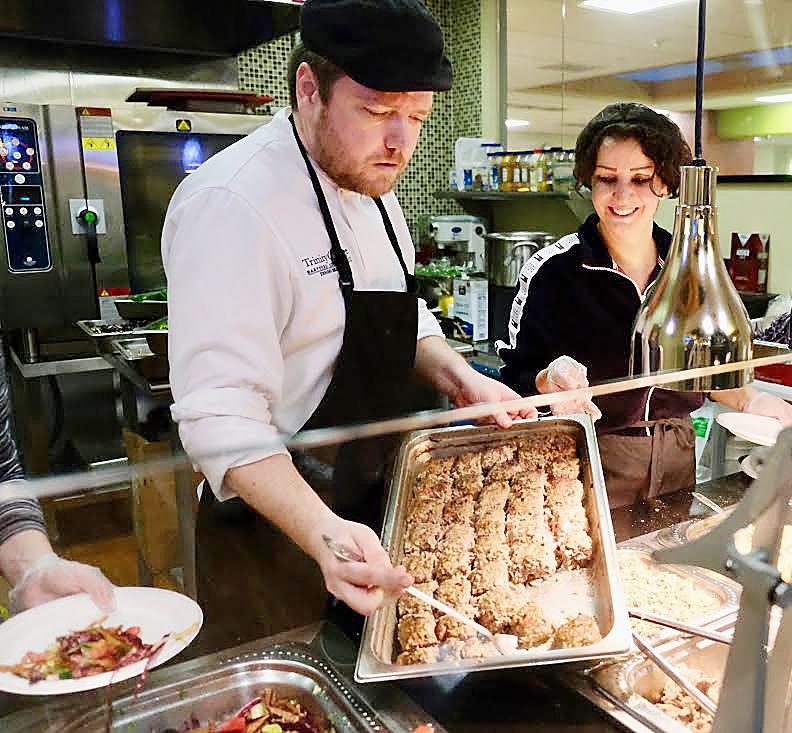
co-sponsorship of a week of International Women’s Day events, with guest chef/ entrepreneur Naseba Alkesh, a Syrian Druze woman from Israel’s Golan Heights.
The two groups brought Alkesh to Trinity’s campus for a week-long program celebrating women’s growth and leadership, and exploring feminism and entrepreneurship, after meeting her in August 2019, when Trinity Hillel, with the support of a private foundation, led a group of 17 Trinity College students on a 10-day “Fresh Perspectives” trip to Israel.
Over the course of the 10-day trip, students explored the multi-ethnic, religious, and cultural diversity of the Old City of Jerusalem, developed an understanding of the geopolitical challenges on both the Gaza-Israel and Syria-Israel borders, and engaged with Israelis and Palestinians from Jewish, Christian, Druze, and Muslim communities.
Lisa Kassow, director of Trinity College Hillel and senior associate chaplain for Jewish life, hoped the students come away from this experience with “a deeper
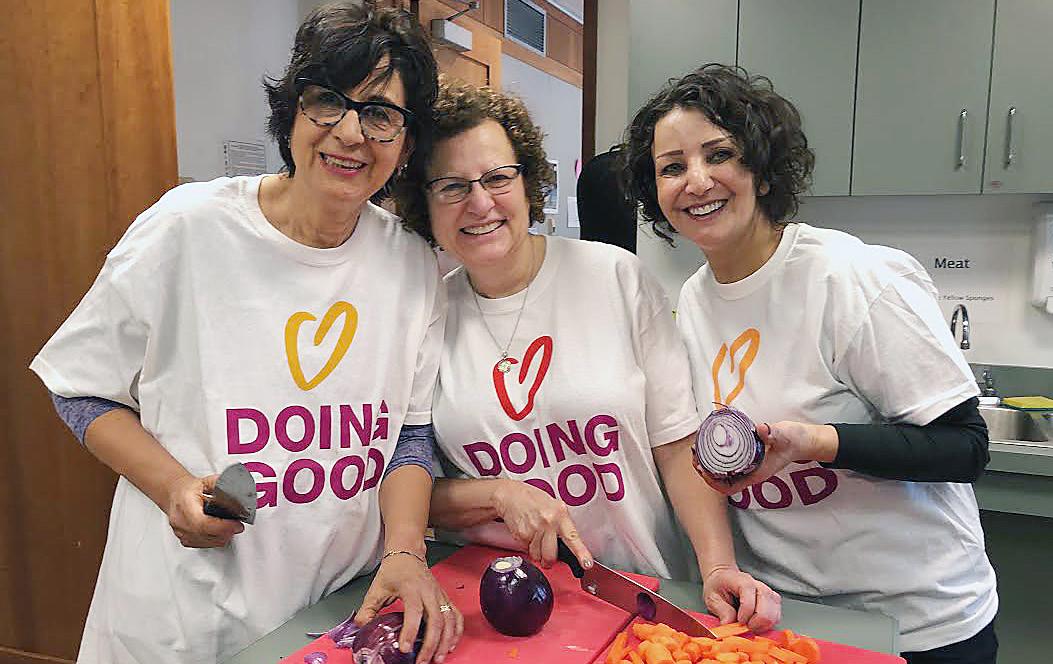
Solomon Schechter donated face masks for volunteers helping out at the Anja Rosenberg Kosher Food Pantry of Jewish Family Services of Greater Hartford, as well as food to help stock the Pantry’s shelves. The need for monetary and food donations to JFS has greatly increased since the pandemic.
Pictured here, (l to r) are Hannah Pliskin and her mother Sherri Pliskin of Solomon Schechter Day School of Greater Hartford, deliver masks and food to JFS president Pia Rosenberg Toro, and Lisa Berman, JFS incoming president.

understanding and appreciation for the complex and compelling cultural, historical, and political realities that exist there for both Israelis and Palestinians.”
Accompanying Kassow and the students on the trip were Laura Lockwood, the director of Trinity’s Women and Gender Resource Action Center (WGRAC), and Leah Staffin, the assistant director of Trinity College Hillel.
Along their journey, students had the opportunity to meet journalists, politicians, artists, intellectuals, activists, and other community members.
Participants were advised to approach the whole experience with open minds. Kinnard Hughes ’22, an economics major, found great personal growth within this experience. “Now that I am back, I am more apt to enter academic and social environments without any strong preconceived notions,” Hughes said.
The group visited Tel Aviv, Jaffa, Haifa, the Golan Heights, the Sea of Galilee, Jerusalem, Bethlehem, Ramallah, and the new Palestinian city of Rawabi. Other highlights of the trip included Yad Vashem – Israel’s official memorial to the victims of the Holocaust – a Rainbow LGBTQ tour of Tel Aviv, and musical Shabbat services on the Tel Aviv pier with hundreds of participants as the sun set on the Mediterranean Sea.
The itinerary also included swimming in the Mediterranean and the Dead Sea, and eating out at restaurants and markets to sample different kinds of Israeli and Palestinian cuisine. Each dining experience exposed students to different social and cultural customs.
“One of the best ways to learn about diverse cultures is to share meals and conversation over communal tables,” said Kassow.
EMMET EMANUEL SPAETH, son of Eliana Tsukroff and Fred Spaeth, will celebrate his Bar Mitzvah on Saturday, May 23, at The Emanuel Synagogue in West Hartford.
That thinking led Kassow to use the creative medium of food to bring people together as part of Naseba Alkesh’s visit to the Trinity campus.
Among the five program Alkesh and her son Amjad led over the course of their week-long visit, were a Druze feast, reminiscent of the meal shared in her home/restaurant in Buq’ata, Israel. She cooked alongside Trinity kosher chef Robert Kalmar, serving dinner to approximately 200 at the Kassow Kosher Eatery.
Alkesh also served as keynote speaker at WGRAC’s International Women’s Day celebration. She shared her story of starting her own business in a deeply patriarchal society in which she exclusively hires elderly women who have little means of support, fostering a sense of strength and pride. At her restaurant, Alkesh teaches classes to international chefs and visitors, and educates diners about the Syrian Druze community. Her son Amjad, a medical resident in Jerusalem, spoke on campus about the Druze culture, history and religion. Rakan Al-zagha ‘22, president of the Muslim Student Association and of Palestinian descent, translated Amjad’s Arabic to English at this event.
Mother and son also met with Hebrew and Arabic professors and students and ended their week’s visit with one of Hillel’s largest Shabbat dinner programs of the year. Trinity students, staff, and faculty assisted Alkesh as she created a feast of nine delicacies in the Hillel kitchen.
The week of cuisine, culture and conversation brought many unlikely partners together to learn about a fascinating and little known aspect of Israeli society.
Emily Wickes and Judie Jacobson contributed to this report.

BY GERRI MILLER
To quote noted Israeli chef Yotam Ottolenghi, “Food can bring people together in a way nothing else could.” That’s the premise of the new movie “Abe,” in which the young title character tries to blend the cuisines of his mother’s Jewish family and his father’s Palestinian parents to forge a truce between these feuding branches of their family tree.
Set in Brooklyn, the story follows the 12-year-old protagonist (played by Noah Schnapp of “Stranger Things”), whose passion for cooking leads him to a street fair and to Chico (Seu Jorge), an Afro-Brazilian chef who takes him under his wing and teaches him the culinary ropes. Abe applies what he learns to get his extended family to stop fighting over Middle East politics.
Brazilian-Jewish director Fernando Grostein Andrade personally related to the crisis of identity that children of interfaith marriages often face. He’s the son of a Catholic father and a Jewish mother of Polish-Russian heritage, and he was raised on latkes, kasha varnishkes, and matzah ball soup. Food provides the backdrop of the film, and the recipes were chosen with just as much care as the actors and their wardrobes. In the film, historically Jewish fare is shown mixing with traditional Middle Eastern flavors, producing such hybrids as hummus tahini challah, yucca latkes, and fattoush salad with garlic matzah.
For research, Andrade and his production designer, Claudia Calabi, traveled to Israel and Palestine to interview chefs, farmers, and people at food markets, documenting it for a forthcoming documentary called Flavors.
“Coming up with the recipes wasn’t easy. The cuisines of both cultures are closer than they might seem,” she said. “We chose the most popular dishes in those cultures and we made very daring interventions with iconic ingredients. For example, the fattoush salad, traditionally served with the pita bread, is modified and served with matzah.” Of all the movie’s recipes, Andrade pronounced it his favorite.
Each recipe was carefully concocted.
“The Thanksgiving lunch scene is Abe’s attempt at integrating both parts of his family. He uses the symbolism of Thanksgiving to support his initiative,” Mortara said. “He sets himself out to deal with family feuds with an intensity that does not give any room for perfectionism. His dishes are charmingly imperfect.”
“Abe” was well received at its premiere at the 2019 Sundance Film Festival, and it
won the audience award at the Washington Jewish Film Festival.
“Food has healing powers, because it activates our memories of once being fed with comfort food by our mothers when we were sick,” Andrade said. “It’s a path to connect people, and connection is crucial in order to reach understanding and agreement.”
“Abe” is available On Demand and for rent on Amazon, GooglePlay and YouTube.
Fattoush salad with matzah was one of the recipes developed for the film.
Ingredients:
For the sauce:
1 tablespoon sumac
1 teaspoon zaatar
2 tablespoons pomegranate molasses salt and olive oil to taste
1 garlic clove macerated with a bit of salt
For salad:
4 firm red tomatoes cut into ¾ inch cubes
2 Japanese cucumbers cut into ¾ inch cubes
½ medium-sized onion cut into ¾ inch cubes
5 semi-peeled radishes cut in quarters
10 hand-torn leaves of iceberg lettuce
½ cup fresh spearmint leaves
3 tablespoons chopped parsley
To serve:
2 rectangles of matzah, hand-broken and lightly oven-toasted
1 cup of pomegranate seeds to drizzle
Directions:
Prepare the sauce mixing the pomegranate molasses, sumac, zaatar, garlic, salt and oil. Separately, mix the salad ingredients and season them with the sauce. Mix it well so that all the ingredients are soaked with the sauce. Finalize the dish with the toasted bread, decorate it with the pomegranate seeds and serve immediately. Serve with 2 rectangles of matzah, hand-broken and lightly oven-toasted; and 1 cup of pomegranate seeds to drizzle. Serves 4.
This story and recipe originally appeared on The Nosher.

At the Hebrew Center for Health and Rehabilitation, we understand that comfort and familiarity is a key part of the journey to wellness. We also understand that maintaining your religious beliefs and principles is fundamental in continued enrichment of life. Our Kosher meal services allow residents to maintain their dietary requirements throughout their stay with us. At the Hebrew Center, we ensure we follow all principles of Kosher including purchase, storage, preparation, and service.
At the Hebrew Center for Health and Rehabilitation, we also offer a variety of other services and amenities to ensure your stay is as comfortable as possible.
THESE SERVICES INCLUDE:
• Passport to Rehabilitation Program
• Long-Term Skilled Nursing Care
• Specialized Memory Care
• Respite Care Program
• Palliative Care and Hospice Services Coordination
OUR AMENITIES INCLUDE:
• Barber/Beauty Shop
• Café
• Cultural Menus
• Laundry and housekeeping services
• Patient and Family education
• Life Enrichment
For more information on our Kosher program, please contact: DIRECTOR, PASTORAL SERVICES - (860) 523-3800
Hebrew Center for Health and Rehabilitation One Abrahms Boulevard, West Hartford, CT 06117




(JNS) Facebook founder and CEO Mark Zuckerberg thinks he’s found a way to avoid further skewering at the hands of those looking for a whipping boy for the failings of the Internet. Actor Sacha Baron Cohen scorched him last fall for running what he called “the greatest propaganda machine in history” because of the site’s willingness to take both ads that some deem either hateful or false. Cohen said the social-media entrepreneur’s refusal to adequately police Facebook was the equivalent of giving Nazis free reign to act as they liked.
Nor was the “Borat” star the only one to attack Zuckerberg for a position that was profitable but allegedly morally questionable. He was hauled before Congress in 2018 to account for questions about the way the privacy of the billions of Facebook users is abused, as well as for the fact that Russian bots purchased ads on it during the 2016 presidential election. The questionable decisions of the 20,000 “content moderators” who seem to be more inclined to take down content posted by conservatives than the ones placed by liberals was also called into question.
Determined to act in a manner that protects his ability to monetize a forum that is, for all intents and purposes, the modern public square, Zuckerberg has sought a way to escape both scrutiny and responsibility. And with the announcement of a new Facebook oversight board, he thinks he’s found the answer.
The question now is whether this board is a solution to the knotty problems of free speech on social media or a committee that may make an already troubling situation far worse.
The board is, in essence, a socialmedia-like Supreme Court that will relieve Zuckerberg of the burden of dealing with complaints about his company’s policies. It will “help Facebook answer some of the most difficult questions around freedom of expression online: what to take down, what to leave up, and why.”
Its statement of purpose claims that its goal will be to “support people’s right to free expression and ensure those rights are being adequately respected.” Zuckerberg has also pledged not only to respect their independence (no one on the board can be fired by him or his corporate board)
BY JONATHAN S. TOBIN
and the decisions they make “to uphold or reverse Facebook’s content decisions will be binding, meaning Facebook will have to implement them, unless doing so could violate the law.”
That gives the 20 individuals who were named to this body enormous power. While Facebook has clearly sought to create as diverse a group as possible – with many from Third World countries, as well as Americans with backgrounds in the law and on free-speech issues – it is hardly surprising that questions would be raised about the worthiness, objectivity and personal agendas of these members.
The first to come under scrutiny is Tawakkol Karman, a Yemeni journalist, politician and activist who has the distinction of being the first Arab woman to win a Nobel Peace Prize. Karman won her Nobel for “non-violent struggle for the safety of women and for women’s rights to full participation in peace-building work,” as a result of her anti-government demonstrations during the Arab Spring protests of 2011.
That sounds laudable, though not everything on her résumé would lead one to think she’s the right person to decide whether any one of us can get “canceled” by Facebook. Karman is a leader of a Yemeni political party that is linked to the Muslim Brotherhood terrorist movement. As such, she is a hardcore Islamist who believes that governments should impose radical Islam on those under their power.
Though Karman claims to be an advocate for freedom in Yemen, it’s hard to believe that she can be counted on to protect the rights of secular persons, especially when Muslim sensibilities are involved. Indeed, it’s impossible to imagine her defending the right of anyone to post articles or pictures – think of the Danish newspaper that published cartoons about the Prophet Muhammad – that would be considered blasphemy in the Muslim world.
Looking beyond Karman, the board also includes one Israeli: Emi Palmor, the former director general of the Jewish state’s Justice Ministry, who was fired from that job by one of Prime Minister Benjamin Netanyahu’s loyalists.
Balancing any defense of Zionism from Palmor will be Nighat Dad of Pakistan. Dad
is a lawyer and an advocate for women’s rights, but also a bitter critic of the Jewish state who criticized Facebook for being insufficiently supportive of the rights of Palestinians to use social media to incite hatred against Jews.
There are a number of distinguished figures from the world of the law and journalism on the board. Among them are left-wingers like Pamela Karlan, a former Obama administration staffer, Stanford University law professor and a bitter opponent of President Donald Trump, as well as former Danish Prime Minister Helle Thorning-Schmidt. John Semples of the Cato Institute will represent the views of libertarians. Former appeals-court judge Michael McConnell is a mainstream conservative and Columbia Law professor Jamal Greene is a member of the Federalist Society, which has helped guide Trump’s judicial nominations.
Were the members of the oversight board all part of a spectrum of belief that embraced mainstream American views about free speech, we might have confidence that its decisions could be just or at least defensible. But there is no bridging the gap between a Muslim Brotherhood sympathizer and someone who thinks that antisemitic incitement is kosher with conventional American liberals and conservatives.
By creating a body that includes opponents of free speech, Facebook has reminded us that all efforts at censorship – even the most well-meaning – are inherently problematic. Zuckerberg may think he has gotten himself off the hook by off-loading decisions to an unaccountable board. But we should tremble for the future of liberty when people like Karman or even more reputable persons are given the power to suppress opinion, whether good or bad, that may run afoul of fashion or political correctness.
Jonathan S. Tobin is editor in chief of JNS–Jewish News Syndicate.
Vol. 92 No. 21
JHL Ledger LLC Publisher
Henry M. Zachs Managing Partner
Leslie Iarusso Associate Publisher Judie Jacobson Editor judiej@jewishledger.com • x3024
Hillary Sarrasin Digital Media Manager hillaryp@jewishledger.com
EDITORIAL
Stacey Dresner Massachusetts Editor staceyd@jewishledger.com • x3008 Tim Knecht Proofreader
ADVERTISING
Donna Edelstein Senior Account Executive Non-Profit & JHL Ledger LLC Media Marketing donnae@jewishledger.com • x3028
Joyce Cohen Senior Account Executive joycec@jewishledger.com • (860) 836-9195 Joan Gaffin Central Mass. Account Executive joang@jewishledger.com • (508) 414-6210 Trudy Goldstein Account Executive (860) 573-1575


Samuel Neusner, Founder (1929-1960) Rabbi Abraham J. Feldman, Co-Founder and Editor (1929-1977) Berthold Gaster, Editor (1977-1992) N. Richard Greenfield, Publisher (1994-2014)
PUBLISHER’S STATEMENT Periodicals postage paid at Hartford, CT and at additional mailing offices.
Jewish Ledger (USPS # 131 - 150) is published 24 times per year by JHL Ledger LLC from our office at: Jewish Ledger
40 Woodland Street Hartford, CT 06105 Phone (860) 231-2424 Fax (860) 231-2485 Toll Free 1-800-286-6397
Postmaster, send address changes to: Jewish Ledger 40 Woodland Street Hartford, CT 06105
Subscriptions: $36 yearly, $9 Twelve Issue Institutional subscription. Send name, address, zip code with payment. Editorial deadline: All public and social announcements must be received by Tuesday 5 p.m. 10 days prior to publication. Advertising deadline: Wednesday noon one week prior to issue. Advertisers should check ad on publication. JHL Ledger LLC and Jewish Ledger shall not be liable for failure to publish an ad for typographical error or errors in the publication except to the extent of the cost of the space which the actual error appeared in the first insertion. Publishers reserve the right to refuse advertising for any reason and to alter advertising copy or graphics deemed unacceptable. The publishers cannot warrant, nor assume responsibility for, the legitimacy, reputability or legality of any products or services offered in advertisements in any of its publications. The entire contents of the Jewish Ledger are copyright © 2020. No portion may be reproduced without written permission of the publishers. JHL Ledger LLC also publishes Jewish Ledger MA, All Things Jewish CT, and All Things Jewish MA. www.jewishledger.com







Bubbie Knows Best – even when it comes to podcasts
LOS ANGELES – Bubbies Know Best, a production of Bubbies of Jewish Life Television, wherein three Jewish grandmothers act as matchmakers, recently concluded its first season. Season 2 was in pre-production until the coronavirus took hold.
Now, not to be deterred, Bubbies Bunny Gibson, S.J. Mendelson and Linda Rich have instead launched “Bubbies Know Best - Podcast Edition” – a weekly audio-visual 30-minute podcast. On each episode of Bubbies Know Best – Podcast Edition, the Bubbies offer words of wisdom, “kibbutz” (chat) with their favorite celebrities, and react to some of the craziest videos from reality shows around the world. Among the celebs the Bubbies have been chatting are Jacob Laval (HBO’s The Plot Against America), Rebecca Metz (FX’s Better Things and Disney Channel’s Coop and Cami Ask the World), Eric Roberts (Runaway Train), Bubbies Know Best – Podcast Edition is available through all podcast platforms (http://bubbies.jltv.tv) and also airs Mondays at 8 p.m. on Jewish Life Television/JLTV (www.jltv.tv/channels) Eli Rosen (Netflix’s Unorthodox) and more. Bubbies Know Best – Podcast Edition is available through all podcast platforms (http://bubbies.jltv.tv) and also airs Mondays at 8 p.m. on Jewish Life Television/JLTV (www.jltv.tv/channels).
Esther Safran Foer launches her new book online
On Thursday, May 21 at 2 p.m, the Museum of Jewish Heritage – A Living Memorial to the Holocaust will host a virtual launch of the new memoir I Want You To Know We’re Still Here: A Post-Holocaust Memoir by Esther Safran Foer. Esther will be joined by her son Jonathan Safran Foer, author of the acclaimed books Everything Is Illuminated, Extremely Loud & Incredibly Close, and Eating Animals
When Esther Safran Foer’s mother casually mentioned an astonishing revelation – that her father had a previous wife and daughter, both killed in the Holocaust – she resolved to find out who they were, and how her father survived. Armed with only a black-and-white photo and a hand-drawn map, she traveled to Ukraine, determined to find the shtetl where her father hid during the war. What she found reshaped her identity and gave her the opportunity to finally mourn. Join us for the launch of the post-Holocaust memoir I Want You to Know We’re Still Here by Esther Safran Foer, who will be joined by her son Jonathan Safran Foer.
The reading and conversation will be followed by an audience Q&A.
For more information, visit www. mjhnyc.org.
The Mandell JCC in West Hartford will host its first #JCCGivingGratitude Day on Tuesday, May 19 . Intended as a means of saying “thank you” to JCC members, donors, staff and neighbors who have supported the JCC during the current shutdown necessitated by the pandemic.
The all-day event will include videos that tell the stories of how the community has come together in new ways and a special treat from JCC Early Childhood Center children.
WASHINGTON, D.C. – Ten thousand Jewish men and women serve in the U.S. mili-tary, stationed across the country and the world with their 15,000 family members. For those with children who are stationed in areas without Jewish life, finding a way to give the next generation a proper Jewish education can pose a challenge. Now, the non-profit organization ShalomLearning is helping to provide cutting-edge online Jewish education and teacher training programs to U.S. military families free of charge.
“Military bases are often located in places without much Jewish life. While chaplains and lay leaders find creative ways to engage their local communities in meaningful ways, organizing and implementing their own Hebrew school is a whole different animal,” says ShalomLearning CEO Josh Troderman.
“We have found that the need is there, but that existing Hebrew schools are often underfunded and lacking time, training and pluralistic inclusive resources. There is a great need for a solution that can connect Jewish children on U.S. military installations worldwide both to Judaism and to one another.”
In partnership with JWB Jewish Chaplain’s Council®, ShalomLearning is offering the use of its programs (now in over 160 synagogues across the U.S.) to Jewish military families in three formats:
1. The traditional classroom: ShalomLearning provided teachers with a selection of materials to plan their lessons, while students now log in at home to augment and reinforce their classroom learning.
2. The virtual classroom: Jewish children in families stationed on Army, Navy and Air Force bases around the country and in other countries are grouped by time zone and meet online for a class facilitated by a ShalomLearning-trained local community leader.
3. The homeschool model: ShalomLearning’s online platform connects military chil-dren to their Jewish roots, history and traditions through ShalomLearning’s Judaics values curricula as well as the Hebrew learning programs. Each family has a desig-nated teacher (usually the at-home parent or a community lay leader) who is trained through ShalomLearning’s virtual webinars and growing mentorship program.
For more information, contact Adina Pollak at adina@redbanyan.com or (202) 839-3527.
Congregation Beth El-Keser Israel (BEKI) will host an online Shavuot Night of Study – known in Hebrew as Tikkun Leil Shavuot – on Wednesday evening, May 27 (one day before the holiday, which begins Thursday evening, May 28 and ends the evening of May 30). Four study sessions lasting 45 minutes each will be conducted on Zoom at 7 p.m., 8 p.m., 9 p.m. and 10 p.m. For more information, email office@beki.org.
The Hebrew University of Jerusalem is taking its summer Ulpan online this summer, July 1-29. This year, Hebrew U’s popular Jerusalem Ulpan will be offered exclusively as an online course, condensed and with reduced tuition. The course will include components: interactive lessons; lectures about Jerusalem tailored to differing Hebrew levels;Virtual trips to a variety of fascinating destinations in Jerusalem with guides who are experienced Hebrew teachers; Sing-a-long with an Israeli musician; Screening of a full-length Israeli film, accompanied by classroom discussion.
For more info: visit https://jmgads. com/ivrit/110520/landing/ivrit-landing. html#learnmore.
Rising Stars, a special Memorial Day Weekend Zoom Concert featuring Holley McCreary and Nick Arne, hosted by the JCC of Sherman, will take pace Saturday, May 23, 7:30 p.m. For Zoom info, send an email to info@jccinsherman.org by May 12, noon, or register at www.jccinsherman.org.
Volunteers are needed to help Masks for CT distribute masks Thursday, May 21, 6 a.m.1 p.m. on Yale’s West Campus 100 West Campus Dr. in Orange).
Masks will be given out on a first-comefirst-served basis to anyone in the general community who wishes to drive by and pick up masks for their personal use.
Social distancing and health guidelines will be strictly enforced.
Masks for CT is an initiative of the Jewish Federation of Greater New Haven and Masks for Heroes.
JERUSALEM – The Jerusalem College of Technology (JCT) has launched a firstof-its-kind online Beit Midrash (house of learning) that focuses on fostering interaction between learners in a virtual environment. The Beit Midrash is the first virtual Torah study initiative that enables both fully interactive and real-time study for its participants. The platform will be available to all who are interested in Torah learning and have the necessary Hebrew proficiency.
While myriad audio- or video-based Torah classes already exist online, such learning is conducted in one direction –from the rabbi, who passes the lesson to listeners and viewers, as opposed to the type of engagement and collaboration which usually occurs in a Beit Midrash setting. With Beit Midrash facilities closed due to social distancing, JCT’s new tool cultivates interactivity by allowing participants to express themselves, ask questions, and develop discussions accordingly.
The new Beit Midrash is hosted on a unique online platform established by Israeli screenwriter Udi Leon. Participants can access traditional Judaic classes as well as courses on other contemporary issues which are at the intersection of Torah and technology. For instance, students will explore the topic of allocation of life-saving resources under crisis conditions. Such questions have gained increased relevance during the pandemic due to the strain on hospitals with limited life saving medical equipment – in principle forcing them to decide who is saved and who is not.
Before the pandemic, JCT’s brick-andmortar Beit Midrash had served over 400 students. While the College expects to resume its in-person Beit Midrash program once the outbreak subsides, the virtual component of the Beit Midrash will also continue post-pandemic.
HAMDEN – The number of antisemitic incidents in the United States in 2019 were the most in at least four decades, according to the annual ADL Audit of Antisemitic Incidents, released on Monday, May 18, by the AntiDefamation League.
Across the United States, ADL counted a total of 2,107 antisemitic incidents in 2019, the highest total ever recorded by ADL, and representing a 12 percent increase from the 1,879 incidents recorded in 2018, with a disturbing 56 percent increase in assaults.
There were incidents reported in every state except Alaska and Hawaii. The audit found there were, on average, as many as six antisemitic incidents in the U.S. for each day in the calendar year – the highest level of antisemitic activity ever recorded by ADL.
Connecticut, however, experienced a five percent decrease in antisemitic incidents over last year. The 2019 audit recorded 37 antisemitic incidents statewide in Connecticut, down from 39 reported incidents in the previous year and an all time high of 49 in 2017.
However, the 2019 numbers still represent a 30 percent increase over the last five years – as in 2015, ADL reported 26 antisemitic incidents in Connecticut.
“While we are encouraged that the overall number of antisemitic incidents in Connecticut fell slightly in 2019, these numbers still represent a historic high water mark for hate in our state,” said Steve Ginsburg, regional director of ADLConnecticut. “Over the last five years, Connecticut has experienced a significant increase in antisemitic incidents of harassment, vandalism, and/or assault.
“In 2020, we have already begun to see some disturbing trends emerging, as conspiracy theories and antisemitic language have permeated the political and public discussion surrounding COVID-19. We will continue to monitor and track these developments, while at the same time relying on our community members to report antisemitism they either experience or witness,” he added.
The ADL Audit includes both criminal and non-criminal acts of harassment and intimidation, including distribution of hate propaganda, threats, and slurs. The Audit classifies incidents into three categories: harassment, vandalism, and assault.
Nationally, the year included five fatalities directly linked to antisemitic violence and another 91 individuals targeted in 61 physical assaults – cases
where individuals were physically targeted with violence accompanied by evidence of antisemitic animus. Antisemitic assaults increased 56 percent from 39 in 2018.
Eleven of the 61 assaults were perpetrated with deadly weapons such as guns or knives. More than half of the assaults nationwide took place in the five boroughs of New York City, including 25 in Brooklyn alone.
Some 1,127 harassment incidents where recorded – cases where one or more Jews reported feeling harassed by the antisemitic language or actions. Acts of harassment increased by six percent from 1,066 in 2018.
A tally of 919 vandalism incidents took place – cases where property was damaged in a manner that harmed or intimidated Jews. Swastikas, which are generally interpreted as symbols of antisemitic hatred, were present in 746 of these incidents. Acts of antisemitic vandalism increased 19 percent from 774 the previous year.
The record number of incidents came as the Jewish community experienced antisemitic attacks in Poway, California; Jersey City, New Jersey; and Monsey, New York; in addition to the spree of violent assaults in Brooklyn, New York.
The ADL’s Center on Extremism identified 234 incidents targeting Jewish synagogues and community centers in 2019. This included the white-supremacist shooting at Chabad of Poway that resulted in the death of a 60-year-old worshipper and injured three others, including the rabbi.
“This was a year of unprecedented antisemitic activity – a time when many Jewish communities across the country had direct encounters with hate,” said ADL CEO and national director Jonathan Greenblatt.
“This contributed to a rising climate of anxiety and fear in our communities. We are committed to fighting back against this rising tide of hate and will double down on our work with elected leaders, schools and communities to end the cycle of hatred.”
The ADL began tracking antisemitic incidents in 1979.
ADL’s Center on Extremism has gathered the complete 2019 data, as well as data from the previous two years, on ADL’s H.E.A.T. Map, an interactive online tool that allows users to geographically chart antisemitic incidents and events nationally and regionally.
The full 2019 ADL Audit of Antisemitic Incidents, can be found at https://www.adl.org/audit2019.

Just as Jewish day schools all across the country were gearing up for their annual eighth-grade trip to Israel, COVID-19 happened – and just like that, the trip of a lifetime turned into no trip at all. Understandably, students were devastated – and school administrators knew there was nothing they could come up with to replace the actual Israel experience. But three Connecticut schools whose trips were among those cancelled came up with creative programs help soften the blow.
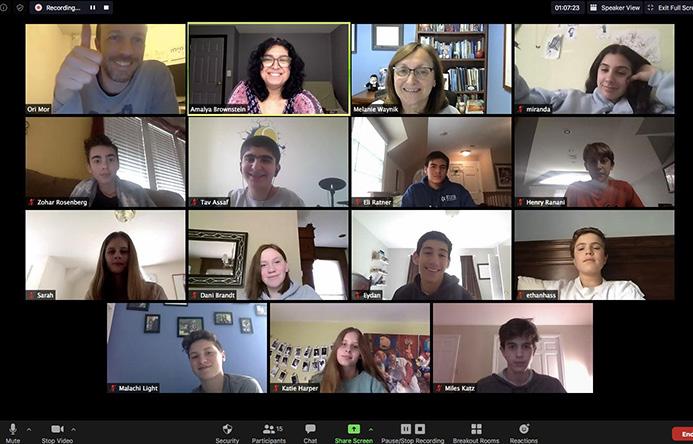
WOODBRIDGE – Ezra Academy’s 12 eighth-grade students would have been nearing the end of their trip to Israel on May 7. Instead, they met virtually with Ori Mor, vice president of research and development at Wi-Charge, a high-tech firm in Rehovot, Israel working on long-range wireless power technology.
“These are not Wi-Charge employees. Not yet at least,” said Mor on Linked-in, posting a photo of his zoom meeting with the Ezra students.
“I had the privilege of helping a few home-isolated kids in Connecticut getting over the boredom kids are experiencing daily due to Covid-19 sanctions,” Mor added. “We spoke about wireless power – how it works and what it is good for… Bright kids. One even guessed correctly – knew how to calculate – how much it costs to charge a phone over an entire year.”
Melanie Waynik, Ezra’s Head of School, said that the meeting between Mor and the 12 eighth-graders tied into both the trip to Israel and the school’s social justice curriculum.
“The eighth-grade social justice curriculum revolves around Israel; what we do is look at innovation and technology and the way that it has been used to make the world a better place,” Waynik said. “We were supposed to go and visit some of those places
The 25 eighth-graders who make up this year’s graduating class at Bi-Cultural Hebrew Academy Lower School in Stamford practically had their bags packed for their trip to Israel, when their plans to spend a month trekking through the Jewish state came to a screeching – and heartbreaking – halt.
Just as the class were ready to embark on what has become for the Lower School’s graduating class an eagerly anticipated rite of passage, it became clear that, owing to the rapidly spreading pandemic, the month-long “Israel Experience” trip would have to be cancelled.
Needless to say, the students were devastated. With good reason. For the Lower School’s graduating class, the “Israel Experience” is the capstone of their years at BCHA; a chance for students to strengthen their bond not only to the
land of Israel – to their heritage and their people they get set to move on to the next stage of life.
BCHA faculty realized that nothing they conjured taking the place of actually setting foot on Israel’s through the land’s ancient cities and along its magnificent were determined to come up with a viable – and, Experience.”
And, so they did.
Conceived and coordinated by BCHA Judaic studies Friedman and Rabbi Tzachi Posner, the “Israel Zoom in early May with a social distancing home visit to Rabbi Ofir and Adi Yarchi, the school’s shlichim bearing Israel-themed gift bags.
Led by tour guide Elli Shashua, the virtual experience Monty Python-like portrayal of a typical encounter stereotypically aggressive bargaining which ensued. unlike the parody, the Torah’s first description of board; indeed, Avraham purchased Maarat Hamachpela Jewish-owned city in Israel, at full price, refusing
Though occasionally addressing heavier topics the Arab-Israeli conflict, the group’s primary goal
and meet people who engaged in doing really revolutionary things that change the lives of people. Now the kids are meeting online with these young entrepreneurs that are doing really interesting things.”
While interesting, activities like this, Waynik admitted, are no substitute for a two-week trip to Israel.
“It’s been rough,” Waynik said. “The reality is that the trip to Israel is sort of the culminating experience of nine years of day school education. And a lot of the curriculum in seventh and eighth grade is geared towards that. In seventh grade they do history of Zionism, starting with the first exile from ancient Israel to Babylonia. Then we study migration patterns of Jews across the world and always this longing for Zion.
“Then we go through modern history… the birth of the Zionist movement, and the creation of the state of Israel. And their eighth-grade curriculum is very much engrained in the Israel experience.”
The Zoom meeting with Mor and Wi-Charge was just one of the pieces of the Israel itinerary that they are now carrying out virtually.
The kids will meet several other Israelis on zoom over the next few weeks, including an Israeli typographer/graphic designer who is working on a typeface combining Hebrew and Arabic, creating a text that all Middle Easterners will be able to use.
“We’re trying to do much as we can to
provide them with a bit of experience,” Waynik said. “What we have been able to do is at least bring a little bit of what we were going to do in Israel to them.”
PHOTOS: EZRA ACADEMY’S EIGHTH GRADE MET VIRTUALLY WITH ORI MOR, OF WICHARGE, AN ISRAELI HIGH-TECH FIRM.

– but also to one another, as conjured up would come close to Israel’s holy ground; of traveling magnificent coastline. Still, they of course, virtual – “Israel
studies teachers, Morah Elana Zoom Experience” kicked off to each 8th-grade student by (Israeli emissaries) who came
experience began with a encounter in an Israeli shuk and the ensued. Elli went on to explain that buying land was all above Hamachpela in Hebron, the first refusing any discount.
topics such as the ins and outs of goal was to engage in entertaining
educational activities that mixed fun with fact. Students participated in a scavenger hunt through the sacred Old City of Jerusalem, a practical demonstration of life-saving army techniques, an exploration of Israel’s world of high tech, a Zoom session connecting students with Israeli teens, and, homemade Israeli iced-coffee in hand, a virtual trek up the steps mountain path to Masada where, in celebration of Lag BaOmer, Elli produced a Go-Pro adventure through ancient caves used during the Bar Kochba revolt.
Other BCHA teachers also got in on the fun and learning. During an examination of Southern Israel, BCHA science teacher Christopher Graseck conducted a science lab on salinization and the Dead Sea that gave them an understanding about the importance of water in Israeli policy. And, Ivrit (Hebrew language) teacher Morah Iris led an Israeli Master Chef level cooking class, recreating the popular mid-eastern break-fast dish, shakshuka.
A highlight of the experience were Zoom visits with BCHA’s Banot Sherut volunteers, both past and present. (Banot Sherut come to America to spend the school year educating students about Israeli life and helping them foster a love and appreciation for Israel.)
“Our trip to Israel may not have been what it was supposed to be; nonetheless, given the circumstances, I’m in awe of Morah Elana [Friedman] and Rabbi Tzachi [Posner] for the way in which they conceived and orchestrated a meaningful program for our eighth-grade graduates,” said BCHA
Rabbi Tzachi and Morah Elana summed up the experience, saying, “We would never attempt to actually replace the Israel trip with a Zoom call; it’s simply not possible! Rather, we sought to find solace through uniting as a class and engaging with the history, culture, and land of our people.”
BY STACEY DRESNER
WEST HARTFORD – Eighth graders at Solomon Schechter Day School of Greater Hartford (SSDS) were supposed to be in Israel from April 20 through May 6 for the “capstone” experience they have prepared for
throughout their day school years.
Instead, due to Covid-19, the seven students spent two weeks at home working solely on “Passion Projects” each delving into a topic that interested them.
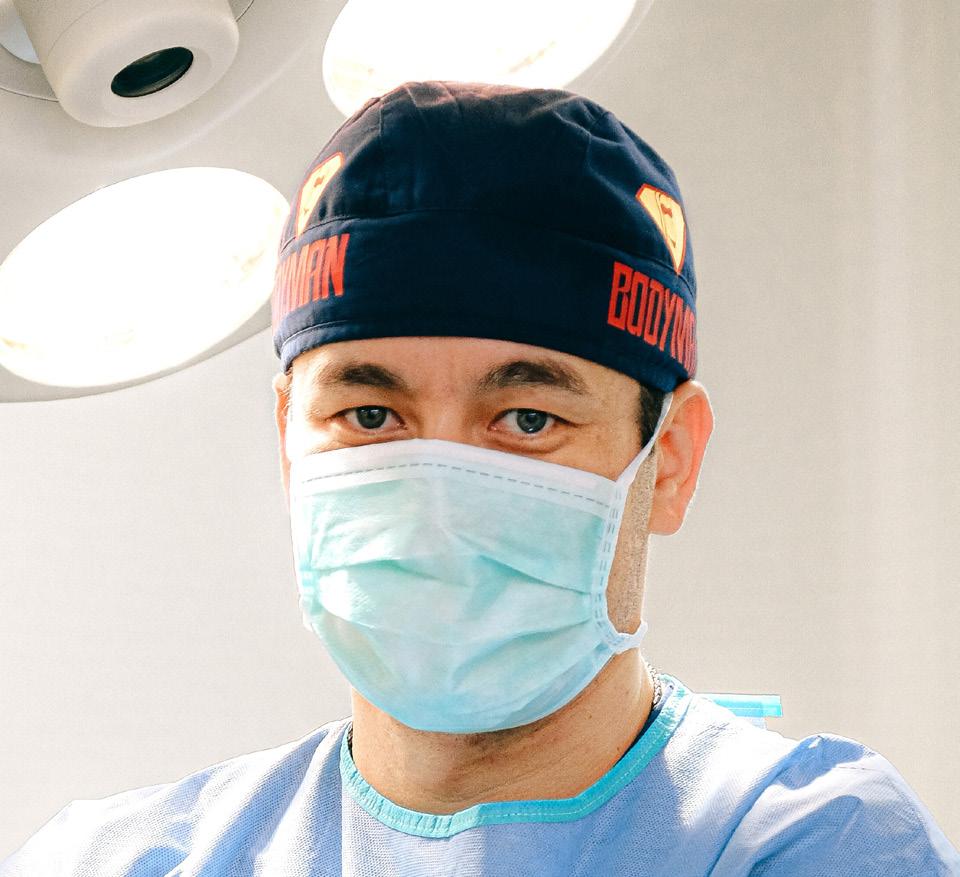
The topics included writing a fantasy novel; sewing and donating face masks to

first-responders; creating a video game through coding; helping one’s father fix and rebuild a 1977 Toyota Chinook; and researching and interviewing four surgeons about their work. Two student projects dealt with food – one student concentrating on nutrition and making vegan and vegetarian meals for her family for the entire two weeks, and the other honing world-class pastry making skills.
“The projects were incredibly varied,” says Andrea Kasper, SSDS Head of School. “I loved it because, I think in this time when they are not together, particularly for this age group when there’s so many different kind of social pressures, it was good for them to be able to totally dive into something that was uniquely them, with the space to explore on their own and not be told what to do.”
Though the projects came about because the students were not able to go to Israel, Kasper doesn’t think they should be considered a replacement for the Israel trip.
“[Working on passion projects] is an idea that I have really been considering for a long time,” Kasper says. “We’ve played with the idea of independent study options and this was a way to bring it all the way to the fore. They had the opportunity to choose absolutely anything that they are interested in or curious about.”
The students met with Kasper to discuss the ideas for their projects; Kasper then matched the students with mentors – faculty
members with skills connected to each project.
Students came up with goals and a work plan, and had to meet – virtually, of course – with their faculty mentors once or twice a week.
“There were guidelines and structure, but it was very loose,” Kasper says. “If we really trust kids and we let them explore their own interests with support, they will do nothing but impress you.”
Kasper says that while the cancellation of the trip to Israel was a disappointment, the goal has been to frame the situation in a more positive light.
“Abrupt changes and disappointments can provide opportunities for new ideas,” she says. “We can hold the disappointments in one hand and find moments of opportunity in the other.”

Presenting the region’s only TASTE OF event. It’s a sampling from the best restaurants and caterers in West Hartford! at
EDENS Crossroads Plaza Rear, 772 North Main Street and Starkel Road, Bishops Corner, West Hartford. Noon - 3pm
Early Bird: $30 per person
General Admission: $40 per person
VIP TIcket (admisssion to VIP Area): $50 per person
A portion of the proceeds to benefit APKCharities (Veteran), Catholic Charities and Jewish Family Services.
BY ABIGAIL KLEIN LEICHMAN
(Israel21c via JNS) An immune system run amok may be responsible for some COVID-19 patients faring worse than others, suggests a new international study led by immunology researchers at Israel’s Weizmann Institute of Science.
In the study, published in the journal Cell on May 7 under the title, “Host-viral infection maps reveal signatures of severe COVID19 patients,” researchers in the lab of professor Ido Amit introduce Viral-Track, a computational method they have validated to systematically detect viruses from multiple models of infection. They applied Viral-Track to lung cell samples from three mild and six severe COVID-19 cases to study how the SARS-CoV-2 virus modifies the lung cellular landscape.
They saw “a dramatic impact of the virus on the immune system of severe patients compared to mild cases,” report the authors, including researchers from the Zheng Lab at Shenzhen Third People’s Hospital in China and from Institut Pasteur in Paris.
In the lungs of patients severely affected by COVID-19, helpful alveolar macrophage immune cells appear to be replaced by a storm of harmful myeloid immune cells that intensify the impact of the virus.
Coauthor Amir Giladi said this immune system malfunction “represents the real mystery of coronavirus.”
“Applying Viral-Track to larger clinical cohorts could provide critical mechanistic understanding of SARS-CoV-2 interactions with its human host and devise new treatment strategies for severe patients,” Amit’s lab tweeted.
This could take the form of a drug to maintain the integrity of the helpful immune cells in the lung.
This article was first published by Israel21c.
“Jacob’s
Tautophrases” By: Yoni Glatt

Across 1. Drains, as energy
5. Classic Art Speigelman graphic novel
9. One-named Irish Grammy winner
13. Shofar, for one
14. Multinational mountain range
15. Dairy farm sounds
16. Tautophrase Jacob might have said after finally deciding to leave his father-in-law’s house
19. Celtics star Walker
20. Muppet who especially enjoys bath time
21. Hardly harsh
Down
1. Israel’s equivalent of a buck

2. Tops
3. Unlikely event for a yeshiva high school to host
4. Didn’t nominate
5. “What?” to Eyal
6. Oscar winner for “Green Book”
7. Shipping giant
8. Netanya to Modi’in dir.
9. Parsha next to Behar
10. It could be proper
11. Yankee who said “It ain’t over til it’s over”
12. Stadium that might not see action this September
17. Lady once known as Stefani Germanotta
18. Oxygen, e.g.
26. Tautophrase Jacob might have said to Laban in frustration after his first wedding
32. Wows
33. It might show your pride
34. Pig food
36. Roles
38. “American Pie” embankment... or “American Pie” star with a similar name
39. Particles that allow the Avengers to time travel
40. Company that makes Monopoly
45. Rabbi Abraham ___ Ezra
46. Tautophrase Jacob might have
22. Legolas or Buddy
23. Nada
24. Org. that might check your pockets
25. Delay
26. Not home
27. Stuffed ___ (aka Kishka)
28. Appraisal: abbr.
29. Modi’in to Jerusalem dir.
30. Animated chipmunk
31. 90’s hit maker Lisa who has released half a dozen albums for children
32. You might tap on one
35. Ink container
37. Kind of guard
38. Last name of The Maharal
41. Strong insect
42. Polite title
SHABBAT DINNER
TRADITIONAL DAIRY LUNCHEON
SANDWICH
said after securing the birthright, but having to run away
49. Encroached (on)
50. King that got quite the headache from Samuel?
53. “It’s not ___ me”
57. Tautophrase Jacob might have said about his son’s initial rough treatment of Joseph
64. What an Aussie calls college
65. Lets up, as a storm
66. “O Henry, ___ thine eyes!” (Shakespeare)
67. Joseph’s half-brothers, total 68. Make like a tautophrase 69. Sleep letters
43. Sch. in Idaho’s capital
44. Nifty
47. Some Jewish women wear them
48. Words when making a knight
50. Adjacent to, as land
51. No longer around
52. ___ Hara
54. Not well off
55. Use a computer, perhaps
56. Big name in Israeli packaged food
58. Yom Kippur, e.g.
59. ‘How could ___ so blind?’
60. Running unit
61. Internet letters on a phone
62. Sitcom portrayer of Maude and Dorothy
63. Approx. fig.
Newington
860.333.9032
2280 Berlin Tpk. Newington, CT
(In the MedCare Express plaza-use side entrance) newington@finefettle.com

Willimantic
860.717.9333
1548 W Main St.
Willimantic, CT
(Across from Papa’s Pizza) hello@finefettle.com
Stop by to speak to one of our pharmacists about Connecticut’s Medical Marijuana Program
No appointment necessary and consultations are always free
Offering:
• Discounts for Senior Citizens, Veterans, and Low-Income Individuals
• Huge Savings through our free Fine Fettle Club
• Online ordering and more at www.finefettle.com
A conversation with a healthcare provider can help you determine whether medical marijuana may be right for you.
or visit

at www.federationhomes.org

BY RABBI TZVI HERSH WEINREB
Since this past Pesach, when we celebrated our freedom from slavery, we have counted the days until Matan Torah, the “giving of the Torah,” on Shavuot. Counting aloud each day, day by day and week by week, instilled in me a sense of going through a transition, a passage of seven weeks, leading to an ultimate destination.
That transitions and destinations are part of life is obvious. What is less obvious, but more fascinating, is that one person’s destination is often another per-son’s transition, and vice versa. How well do I remember my first days of employment after my years of graduate school. I experienced those years of toil as a necessary transition to the beginning of my career as a psychologist. My first day at work was the beginning of my destination.
With this week’s Torah portion, Bamidbar (Numbers 1:1-4:20), we begin a new Chumash, the fourth volume of the Pentateuch. Each of the five volumes of the Chumash is unique. This fourth volume is unique in that it begins as a description of a transition, a passage, from the Exodus from Egypt and the revelation at Sinai through a desert wilderness but towards the Promised Land, the land of milk and honey. But it soon becomes apparent that this desert wilderness will become a destination and, for many, a tragically final destination.
This book, which begins as a parade, a joyous and relatively brief journey to the Promised Land, is soon transformed into a book portraying an era of strife, rebellion, war, betrayal, and disillusionment, enduring for nearly forty years!
My private thoughts of transitions and destinations are painfully relevant this year, 5780/2020, the year of the COVID-19 pandemic. For the past several months, our lives, indeed the lives of the entire human race, have changed drastically.
The question that plagues us, and I deliberately use the word “plagues,” is this: are we in a transition that will last for but a relatively brief time, after which we will come to a destination, a return to “normal”? Or have we reached some new destination, a “new normal,” that will persist well into the future and that will radically alter every aspect of our existence?
Transition or destination?
Was it Yogi Berra who said that it is hard to make predictions, especially

about the future? Truth be told, it is difficult to think of a moment in history at which there was greater uncertainty than at this moment.
In a certain sense, the distinction between transitions and destinations is an existential one. That is, the question can be asked, “Is our life in this world our final destination, or is it a transition, a prelude, into another world, another mode of existence?”
The answer to this question was proclaimed long ago by the rabbis of the Mishnah: “Rabbi Jacob said: this world is like an antechamber before the World to Come. Prepare yourself in the antechamber so that you may enter the banquet hall.” (Pirkei Avot, 4:21) Our very lives, according to Rabbi Jacob, are but transitions into another destination, the World to Come. A very sobering teaching, indeed!
But our rabbis inform us of something even more shocking. Even the World to Come is not a final destination. Even for the righteous, that celestial world is but a passage to a loftier destination.
“Said Rabbi Chiya bar Ashi in the name of Rav: Talmidei Chachamim [pious wise men] have no rest, neither in this world nor in the World to Come, as it is written, ‘They will go from strength to strength, and appear before the Almighty in Zion (Psalms 84:80)” (Berakhot 64a).
One is tempted to assume that it is only the righteous who progress ever upward and know no final destination. But surely the wicked, whose destination is Gehenna, have reached “the end of the line.” The rabbis are quick to assure us, however, that even Gehenna is not the end of the line: “The sentence of the wicked to Gehenna is for but 12 months” (Eduyot 2:10). Even Gehenna itself is but a transition, hopefully to a higher and nobler destination.
In conclusion, permit me to turn my attention to a happier topic. With this week’s Person in the Parasha column, I celebrate the first publication of this weekly series of columns, for Parashat Bamidbar, 2009, exactly 11 years ago. At that time, I had just concluded my tenure as executive vice president of the Orthodox Union, which, until then, had been my “destination.”
I began a new transition in my life which has thankfully continued until now. I already have some tentative notions as to the theme of “transitions and destinations” as it is to be found in this fascinating new book of the Chumash that I hope to share with you, with the help of the Almighty, in the weeks to come.



Tombstones with swastikas will not be changed, VA says
(JTA) – The Veterans Administration will not replace three tombstones inscribed with swastikas in its military cemeteries, calling them “historic resources.” A group that advocates for religious freedom in the military on Monday, May 11 called on the VA to replace two World War II-era POW headstones in Fort Sam Houston National Cemetery in San Antonio, Texas, inscribed with swastikas inside a German cross, and the phrase, “He died far from his home for the Führer, people, and fatherland.” Führer was the title Adolf Hitler assumed for himself.
Replying Tuesday, May 12, to a JTA query, Les A. Melnyk, a VA spokesman, said the agency was aware of the two headstones, as well as a third at Fort Douglas Post Cemetery in Salt Lake City with the same inscription. He described Hitler as a “divisive historical figure.”
“The National Historic Preservation Act of 1966 assigns stewardship responsibilities to federal agencies, including VA and the Army, to protect historic resources, including those that recognize divisive historical figures or events,” Melnyk said. “For this reason, VA will continue to preserve these headstones, like every past administration has.”
The Military Religious Freedom Foundation, which issued the call Monday, after a retired officer alerted the group to the tombstones’ presence in the San Antonio graveyard, said the VA response fell short. Mikey Weinstein, the group’s president, noted in an interview that in recent years Democratic and Republican state and local governments have removed Confederate symbology. “That is a nonreply reply,” Weinstein said, adding that his group was exploring legal action to replace the tombstones.
Facebook names
ex-member of Muslim Brotherhood-linked party to board (JNS) Among the first 20 members Facebook announced recently to its new and independent oversight board is Yemeni Peace Nobel Laureate Tawakkol Karman, a former member of the Muslim Brotherhood-linked Al Islah Party in Yemen. Nicknamed by some as Facebook’s “Supreme Court,” the independent oversight body tasked with making decisions on controversial content issues, including online extremism, hate speech, harassment, and user privacy and security. “We are all
committed to freedom of expression within the framework of international norms of human rights,” wrote the four co-chairs of the board in a May 6 New York Times opinion piece.
However, Karman has a history of praising the Muslim Brotherhood, which is known to be an extremist movement. According to the Middle East Media Research Institute (MEMRI), Karman said in a Sept. 15, 2013, BBC Arabic interview: “The Muslim Brotherhood and its supporters, who oppose the military rule, are engaged in a legendary struggle, which they are waging with their blood, their resolute steadfastness, and their belief that they will restore the revolution to its true path.” When asked if she supports the Muslim Brotherhood, Karman said, “Yes, at this stage, I am partial towards the Muslim Brotherhood … ”
A year ago, Karman posted on Facebook, “The Muslim Brotherhood movement will remain an anti-tyranny and a freedom fighting movement, despite [U.S. President Donald] Trump’s nose and Trump’s agents and it is one of the victims of tyranny and official terrorism in the region, for which Trump provides all support and support.”
In a statement, Facebook said, “The members announced today reflect a wide range of views and experiences. … We expect them to make some decisions that we, at Facebook, will not always agree with – but that’s the point: they are truly autonomous in their exercise of independent judgment.
The board members will serve fixed three-year terms, with a three-term maximum.
“We cannot be removed by Facebook,” they wrote in The New York Times “Facebook’s chief executive, Mark Zuckerberg, has also personally committed to this arrangement.”
New York-based human-rights lawyer and national security analyst Irina Tsukerman tweeted, “Why, out of 1.7 billion Muslims in the world, is FB putting an Islamist on its Supreme Court? 1. Qatar $; 2. They may believe MB represents Muslims or at least US Muslims & is “democratic”; 3. Advantageous political alliance to control information sphere, where the real war is.”
Couple arrested in Brooklyn for accusing Chassidim
(JNS) A couple has been arrested for allegedly shouting at three Chassidic men in Brooklyn, N.Y. blaming Jews for spreading the coronavirus, all while attempting to rip off their face coverings, announced the New York Police Department. Paulo and Clelia Pinho, 35, and 46, respectively, were charged with hate crimes for the incident in the heavily Chassidic neighborhood of Williamsburg on Sunday evening, May
10, said police, which also mentioned that Paulo Pinho allegedly called police to report a large crowd gathering. The two exited their vehicle and “accosted the men, shouting out slurs and attempted to take away their face coverings,” reported ABC News, citing the NYPD. “You’re the reason why we’re getting sick,” one of the suspects allegedly shouted, according to police. The couple added that “the mayor says you Jews are the reason we’re getting sick.” The two were detained by the Shomrim, a volunteer watch group, until NYPD officers arrived and arrested them.
New York City Mayor Bill de Blasio denounced the incident, even though he recently lambasted a sizable gathering at a Jewish funeral for a respected rabbi in Williamsburg. “We don’t accept bias in New York City,” he said during his morning briefing on Monday. “Any act of hate crime, we pursue it.”
Palestinian teen shot to death by IDF amid manhunt to find soldier’s killer
(JTA) – Israeli soldiers shot and killed a Palestinian teen during clashes Wednesday morning, May 13, in a Palestinian refugee camp near Hebron. The troops were conducting a manhunt for the person who dropped a rock from the top of a home on Sgt. Amit Ben-Yigal a day earlier, killing him. Residents of the Al-Fawar refugee camp attacked the soldiers with firebombs and rocks; gunshots were heard during the clashes. The troops responded with live fire and riot dispersal methods, the IDF said.
The Palestinian Wafa news service reported that Zeid Fadel Qeisieh, 15, was shot in the head and killed during the clashes. One Israeli soldier was injured, according to the the IDF has mounted an extensive manhunt for the rock thrower.
Annexation of parts of West Bank should not affect US-Israel ties
(JTA) – AIPAC said it would be a “mistake” to allow Israel’s annexation of parts of the West Bank, should it occur, to affect U.S.Israel ties. The statement last week was the first from the American Israel Public Affairs Committee on Prime Minister Benjamin Netanyahu’s stated plans to annex parts of the West Bank by July 1. A number of groups on the left are mounting a campaign to get presumptive Democratic presidential nominee Joe Biden, as well as Democrats in the Senate, to speak out against the plans.
“Some have proposed reducing our ties with Israel because they object to the potential decision by Israel’s leaders to extend Israeli sovereignty to parts of the West Bank,” the statement said. “Doing anything to weaken this vital relationship would be a mistake.”
The statement cited Israel’s role as a “pillar of America’s regional security framework” and U.S.-Israel cooperation in a number of areas, including scientific research.
AIPAC, a major pro-Israel group, remains committed to the two-state solution. Those warning against annexation say it would undercut and perhaps kill off a two-state outcome.
A letter is circulating among Democratic senators that would caution Netanyahu’s government against annexation. The letter has engendered tussling among Middle East advocacy groups in the Democratic camp: J Street backs the letter, while the Democratic Majority for Israel wants changes that would make it clear that assistance to Israel is not in question. Democratic Majority also has expressed opposition to annexation.
(JTA) – The Central Council of Jews in Germany has launched a “Meet a Jew” project designed to increase contact between Germans and the country’s Jews, who make up 0.2 percent of the population. One of the project’s over 300 Jewish volunteers from different denominational backgrounds are paired with Germans to talk about their lives, usually in a classroom setting. The topics can range from discussions of school life to whether or not they observe the Sabbath, and they often touch on personal experiences with antisemitism. “We realized a lot of people in Germany don’t know Jewish people in person,” project coordinator Mascha Schmerling said. “The knowledge that they have about Jews comes from history books, from school, or it’s connected to the Shoah or current antisemitism or sometimes through the policies of Israel. Our idea is really to introduce modern-day Jewish life, and to give Jewish people a face and a voice.”
The project is supported by the German Ministry of Family Affairs and Women. It’s not affiliated with the “Meet a Jew, Make a Friend” project that debuted in New York earlier this year.
(JTA) – Jewish culinary talents like Michael Solomonov, Joan Nathan and Michael Twitty are coming together to partake in the inaugural Great Big Jewish Food Fest from May 19 to 28. The festival is free for participants and consists of workshops, happy hours and Shabbat dinners led by other well-known Jewish chefs and food writers, including Shannon Sarna, who edits The Nosher
“Not a single person we’ve asked has said a flat out ‘no,’”Jeffrey Yoskowitz told the Forward. “Everyone has said ‘I’m in, I want to be part of it.’” Yoskowitz is on the team helping to produce the festival alongside Liz Alpern, his co-founder of Gefilteria, a Brooklyn-based company whose focus is reimagining Old World Jewish foods. The festival is supported by several foundations, including the Jewish Food Society, Mazon and the American Sephardi Federation, among others.
Leah Koenig, author of The Jewish Cookbook, will lead a cooking class dedicated to Roman cuisine. She told the Forward that she was “heartbroken” to see gigs that she was excited about vanish overnight. “While nothing quite replaces face-to-face interaction,” she said, “I have been consistently amazed at how intimate the virtual events and cooking demos I’ve led over the last few weeks have felt.”
Netanyahu officially announces formation of new government (JNS) Israeli Prime Minister Benjamin Netanyahu officially announced on Wednesday evening, May 11, that he had succeeded in forming a new government, 18 months after the first of three rounds of Knesset elections was held. Netanyahu sent letters to Israeli President Reuven Rivlin and Blue and White chairman Benny Gantz, who assumed the role of defense minister and vice premier when the government was sworn in on Thursday night, May 14. According to the terms of the coalition agreement, Gantz will take over the premiership in a year and a half, at which time Netanyahu will become vice prime minister.
The parties that have joined the coalition are the Likud, headed by Netanyahu; Blue and White, led by Gantz; Shas, led by Aryeh Deri; United Torah Judaism, led by outgoing Health Minister Yaakov Litzman; Labor, under chairman Amir Peretz; Derech Eretz, led by Yoaz Hendel and Tzvi Hauser; and Gesher, headed by Orly Levy-Abekasis.
Efforts to persuade Naftali Bennett’s Yamina Party to join failed. Outgoing Defense Minister Bennett, whose ideology is similar to that of Netanyahu’s but who has had strained relations with him for years, announced that he would become a member of the opposition. Outgoing Education Minister Rafi Peretz – who heads Yamina’s Jewish Home faction – announced that he was splitting from Bennett’s party in order to join the new government as minister for Jerusalem affairs and national projects.
The 35th government will be the largest in Israeli history, with 34 ministers. According to its guidelines, it will focus on economic recovery in the wake of the COVID-19 crisis and on healing the country’s social rifts.
House members introduce bill to enhance US-Israel efforts against COVID-19 (JNS) A bipartisan bill was introduced in the U.S. House of Representatives on Tuesday, May 12, that would authorize a new partnership program to enhance cooperation between the United States and Israel to develop innovative approaches for treating and potentially curing COVID19. Reps. David Kustoff (R-Tenn.), Chris Pappas (D-N.H.), Lance Gooden (R-Texas) and Tom Suozzi (D-N.Y.) introduced the Expanding Medical Partnerships with Israel to Lessen Dependence on China Act.
“The United States and Israel are world leaders in the medical technology industry,” said Kustoff. “It’s long past time we end our dependence on China and enhance our partnership with our great ally Israel to develop innovative medical technologies to treat and cure COVID-19. It’s in the benefit of not only our two countries, but also the rest of the world.”
In addition to the bill, the House members are also pushing for the inclusion of $12 million, which would be matched by Israel, to fund the new research partnership in any future legislation to address the impact of the coronavirus pandemic.
A similar bill was introduced in the Senate last month by Sens. Chris Coons (D-Del.) and Ted Cruz (R-Texas).
Rohr
(JTA) – Benjamin Balint won the 2020 Sami Rohr Prize for Jewish Literature for his book Kafka’s Last Trial: The Case of a Literary Legacy. The nonfiction work is an account of the controversial trial that determined the fate of Kafka’s manuscripts. The $100,000 prize, a program of the Jewish Book Council given to an emerging writer who demonstrates the potential for continued contribution to the world of Jewish literature, was announced on Monday, May 11.
Three finalists also will receive $5,000 each. They are Mikhal Dekel, for Tehran Children: A Holocaust Refugee Odessey; Sarah Hurwitz, for Here All Along: Finding Meaning, Spirituality, and a Deeper Connection to Life – in Judaism (After Finally Choosing to Look There); and Yaakov Katz, for Shadow Strike: Inside Israel’s Secret Mission to Eliminate Syrian Nuclear Power.
The Rohr Prize, which has been awarded annually since 2007, considers works of fiction and nonfiction in alternating years. It was created by the children of the late businessman and philanthropist Sami Rohr.
Under US pressure, Israel to review Chinese bid for desalination plant
(JNS) Following pressure by the United States, Israel will review the bid of a Hong Kong-based company for the construction of what is expected to be the world’s largest desalination plant – worth $1.5 billion. The issue of Chinese influence, which includes CK Hutchison Holdings’ bid for the “Sorek B” desalination plant, in Israel’s economy was thought to be one of the topics discussed when Secretary of State Pompeo visited the Jewish state last week. “…the United States strives for trade and investment on fair and reciprocal terms, with reliable partners, for long-term mutual benefit,” State Department spokesperson Morgan Ortagus told Axios. “China’s business dealings, by contrast, are often opaque, transactional and geared to benefit the Chinese Communist Party. We speak often to our friends in Israel about these risks and stand ready to help.”
In August 2019, Pompeo told JNS, “We want to make sure that Israeli citizens don’t have their private information stolen by the Chinese Communist Party. Using China as an interconnector, as a backbone for a network, puts at risk that network. It makes a likelihood that we will not deem that network trusted, and the United States has a policy of not permitting American information to flow across networks that aren’t trusted.”
Israeli officials told Axios that CK Hutchison Holdings has a good chance of being awarded the government tender for the plant, which is expected to produce 200 billion liters of water annually, or a quarter of Israel’s overall water consumption.
The firm that wins the tender to build the plant would operate it for 25 years.
After U.S. Ambassador to Israel David Friedman asked Israeli Prime Minister Benjamin Netanyahu last week to interfere in the matter, the latter called for a new government committee to monitor foreign investments in Israel.
(JTA) – Rabbi Sergio Bergman, a former Argentine minister of environment and sustainable development, will become the new president of the World Union for Progressive Judaism. The global network of progressive Jewish communities announced the appointment on Monday, May 11. Bergman, who will take over for Rabbi David Saperstein on June 1, is the first Latin American to lead the union. “I am convinced of the enormous potential we have as a global organization to revitalize
and regenerate our peoplehood,” Bergman told JTA.
Born in Buenos Aires in 1962, Bergman served as minister in the government of President Mauricio Macri from 2015 until the end of Macri’s term in 2019. In 2011, he became the first rabbi ever elected to the Buenos Aires city parliament. In 2013, he was elected to represent the city in the national congress. Bergman holds three master’s degrees – in education from The Hebrew University, in Hebrew letters from Hebrew Union College and in Jewish studies from the Jewish Theological Seminary – as well as two rabbinic ordinations, from the Latin American Rabbinical Seminary of Buenos Aires and from Hebrew Union College. He is also the author of seven books.
Established in London in 1926, the union is the international arm of the Reform, Liberal, Progressive and Reconstructionist movements, and has some 1.8 million members in over 50 countries.
(JNS) The Trump re-election campaign hosted a virtual fundraiser on Thursday, May 14, to commemorate the two-year anniversary of the opening of the U.S. embassy in Jerusalem. The fundraiser required a minimum $1,000 contribution to join. The event, held on Zoom, was hosted by Sen. Lindsey Graham (R-S.C.) and Rep. Lee Zeldin (R-N.Y.), along with Donald Trump Jr. and his girlfriend, Kimberly Guilfoyle. It also included American Zionist Movement vice president Martin Oliner; Trump Victory national finance chairman Todd Ricketts; Trump Victory national finance committee co-chair Roy Bailey; campaign manager Brad Parscale; Republican National Committee chairwoman Ronna McDaniel; and RNC co-chairman Tommy Hicks Jr.

Connecticut native Norma Bursack, 92, was “one tough cookie”
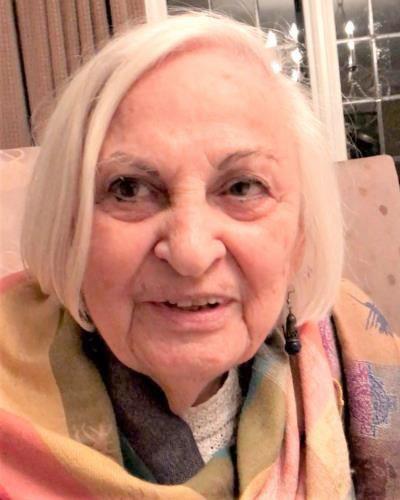
HARTFORD –
Norma Bursack faced her bout COVID-19 with characteristic fortitude and aplomb. “Don’t worry,” she told her family, “I’m a tough cookie.”
Those who knew her would agree. Ultimately, though, this was one battle the feisty 92-year-old could not win. Bursack died of COVID-19 on Thursday, May 7.
Born in Manchester, Conn. on Dec. 18, 1927, Bursack was the devoted daughter of the late Daniel and Sophie (Spector) Bursack. Growing up, she was nicknamed “Sissy.” Infused with the pioneer spirit, Bursack moved to the State of Israel in 1949 to help es-tablish the newly-born country. And later returned to the U.S.
A single, working mother she served as executive secretary at the Jewish Federation of Greater Hartford.
Busack took great pride in her daughters and their accomplishments. Known affectionately as ‘Yammy’ or ‘Grandma’ by her grandchildren, she showered them with love and attention, never missing a school play or a special event.
A creative spirit, she was a published poet – including several poems that appeared in the pages of the CT Jewish Ledger, –who always marked special occasions with personalized poems.
She is survived by her daughters, Ayelet Salant Chozick and her husband Bruce, and Ronet Salant Noe and her husband David; her grandchildren Rebekah, Daniel, and Joshua Chozick, and Alexandra and Jessica Noe; her sister-in-law Elaine Bursack; and many nieces and nephews.
In addition to her parents, she is predeceased by her sisters, Beatrice Bursack Snyder and Ruth Bursack Sachs, and her brother Jack Bursack.
The coronavirus restrictions kept Norma’s family from being by her side while she fought her final battle. But her nurses Tiana and Stacey, held a phone to her ear so her family could speak with her and let her know she was loved at the end.
RIO DE JANEIRO (JTA) – Abraham Palatnik, a famed Brazilian Jewish artist who ex-plored the role of movement in art, died May 9 of COVID-19 in Rio. He was 92.
Palatnik was one the pioneers of kinetic art, a branch of fine arts that explores the vis-ual effects of physical movements and optical illusions. His work has been featured at exhibitions at some of the leading museums in the world, including the Museum of Modern Art and the Met Breuer in New York, and the Museum of Fine Arts in Houston.
“He was one of the great artists of the fine arts. His work is recognized in Brazil and worldwide,” said Fernando Lottenberg, president of the Brazilian Israelite Confederation, Brazil’s umbrella Jewish organization.
The son of Jewish immigrants who left Russia in 1919, Palatnik was born in 1928 in Natal, a city in Brazil’s northeastern corner. The Palatniks were the first Jewish family to settle in Natal and were among the founders of a Jewish cultural center and kindergarten there. They had a significant influence on the development of the city and its suburbs, opening furniture factories and porcelain production plants, as well as teaching locals to run their own businesses.
From 1942 to 1945, Palatnik studied at the Montefiori Technical School in Tel Aviv, specializing in explosion engines. He began his art studies at the studio of the painter Haaron Avni and the sculptor Moshe Sternschuss. He later took art classes at the Municipal Art Institute of Tel Aviv. In 1948, he returned to Brazil.
In 2013, the record price for a Palatnik work was reached when his Sequencia Visual S-51 sold at Christie’s New York for $785,000. In Brazil, retrospective exhibitions of Palatnik’s have been held across the country since 1999.
NEW YORK (JTA) – Deborah Kantor Nagler’s life as a Jewish educator began when she was just a teenager. At 19, she took a group of 14- and 15-year-old students from her synagogue in St. Louis, to Israel for the summer. She would go on to earn two master’s degrees in education – one from the Jewish Theological Seminary and another, in educational technology, from Full Sail University – and become a creative force in the field of Jewish education.
“She was a great educator, a bit ahead of her time,” said David Bryfman, CEO of the Jewish Education Project in New York.
Nagler, who died April 3 of COVID-19 at 66, contributed to a 2014 book Bryfman edited on experiential education. Her chapter dealt with virtual reality and Jewish education.
“As an Orthodox woman in her 60s, she wasn’t the first person you would think to turn to on the subject,” Bryfman said. “But she got the technology a lot quicker than many of us did.”
Nagler held a series of leadership positions in Jewish education over the course of her career, at the Bergen County and Metrowest Jewish federations in New Jersey and later at Hadassah, were she was national director of education and training. After the Bernie Madoff scandal took a big toll on the organization, she decided to retrain to focus on educational technology, said her husband, Fred Nagler.
She went on to serve as director of a program in educational technology at Gratz College and as director of a project developing immersive 3D environments for education. She taught online educational technology courses for graduate students at New Jersey City University and at Gratz. And she served as an instructional designer for an online graduate program at Hebrew Union College in New York. Nagler also earned an honorary doctorate from the Jewish Theological Seminary and a Ed.D. in educational technology from New Jersey City University.
When she filled in as a substitute teacher at the Moriah School in Englewood, she taught a unit on engineering using as an example the eruv, a symbolic boundary used by observant Jews to carry objects in public on the Sabbath. The school’s principal told Fred Nagler she was the only teacher who could seamlessly integrate Judaism into STEM classes.
Nagler is survived by two daughters from her first marriage, Shira Marshall and Chana Rackliff; four stepchildren from her second marriage: Sheryl Solomon, Aviva Mermelstein, Yael Zimerman and Yoni Nagler; two brothers, David Kantor and Mark Kantor; 28 grandchildren and two great-grandchildren.
Saadya Ehrenpreis, 35, defied expectations with determination and joy

(JTA) – When Saadya Ehrenpreis was an infant, a doctor told his mother that he would “never walk, talk or amount to anything.” He wound up doing all three.
Ehrenpreis was born with Down syndrome, but he was intensely determined. With the help of his family, he not only learned to walk and talk, but he graduated high school, spent several years studying in yeshiva in Israel, and attended Yeshiva University. Along the way, he charmed everyone around him with his relentlessly upbeat nature.
After he died of COVID-19 on April 28, at the age of 35, his funeral on Zoom was watched by nearly 1,000 people.
“One of things that made him special was his unwavering optimism,” said Avi Ganz, the program director of Ohr Torah Stone’s Yeshivat Darkaynu, a Israel gap year program for young men with special needs, which Ehrenpreis attended. “People were drawn to him because he saw only beauty in other people.”
In Israel, “he just blossomed,” said his sister, Yael Nechama Meyer.
Ehrenpreis subsequently went on to study at Yeshiva University as part of a special program that allowed him to attend specialized classes at the university’s campus in Manhattan. At YU, Ehrenpreis lived in a supervised group apartment and he studied hard.
Even though his was not a degree program, he was to be included in the university’s upcoming graduation ceremony, which was cancelled due to the coronavirus. In the last picture taken with his family, Ehrenpreis is wearing a cap and gown and smiling broadly.
“Everyone has been coming forward to describe this little spark of light that came into their lives,” Meyer said. “One of my friends said that after she watched the funeral, her ambition is to be more like Saadya, to love more and criticize less, to see more of the positive in others and in life.”
“I never saw him get angry,” his mother, Ahava Ehrenpreis, a writer for the Jewish magazine Mishpacha, told JTA. “In terms of human emotional quotient, he was genius level. He was extremely empathetic and intuitive. If he sensed any tension in someone, he had to fix it.”
COHEN
Marsha Rose (Linker) Cohen, 73, of West Hartford died May 1. She was the wife of Martin Cohen. Born in Brooklyn, NY, she was the daughter of the late Murray L. and Belle (Goldberg) Linker. In addition to her husband, she is survived by her children, Leonard N. Cohen and his wife Hsiao-Ching Chu of Bloomfield, and Laura H. Weinstock and her husband Jeremiah of St. Louis, Mo.; her brother Gary Linker; her sister Elaine Stromquist; and her grandchildren, Ava, Isaac, and Abigail Weinstock.

GINSBERG
Elliot Ginsberg, 73, died May 11. He was the husband of Lorie Ginsberg. Born in Hartford, he was the son of Maurice and Ida Ginsberg of blessed memory. He served as a medic in the U.S. Army Reserves. In addition to his wife, Lorie Sedor, he is survived by his son Matthew Ginsberg of West Hartford; his sister Barbara Jones and her husband, Mark of Florida; and many cousins, nieces and nephews.
LEVINE
Louis Paul Levine, 82, of Stamford, died May 7. He was the husband of Sondra (Dantzker) Levin. Born in Queens, N.Y., he was the son of the late David and Florence (Lipschitz) Levine. He served in the U.S. Naval Reserve in the late 1960s. He was a member of Congregation Agudath Sholom.
In addition to his wife, he is survived by his children, Eric Marc Levine, of Waterford, and Jodi Zev Levine of Stamford; his sister Lucille Towbis of Boca Raton, Fla.; and his three grandchildren, Ryan Benjamin Levine, of New York, N.Y., and Erin Rachel Levine and Lucas Jaden Levine, of Glastonbury.
Dr. Karl-Otto Liebmann, 87, died May 7. He was the husband of Judith Liebmann. Born in Heidelberg, Germany, he was the son Professor Heinrich Liebmann, dean of Heidelberg University and a world renowned Mathematician (cf. The Liebmann Rule), who was one quarter Jewish and was fired by Hitler personally from his position at the University. Dr. Liebmann felt a strong affinity for the Hebrew Bible and the philosophical and ethical world view of Judaism. In 1994, he formally converted to Judaism, guided by his friend, Rabbi James Ponet, founding Rabbi of the Slifka Center at Yale University. In his honor, Dr. Liebmann’s family is inaugurating the Liebmann Family Fund for the study of Jewish Art and Literature at the Slifka Center. In addition to his wife, he is survived by three children, Anya, Theo and his wife Barbara, and Otto and his wife Rebekah; and his grandchildren, Allie, Risa, Ruby, Ava, Tal, and Juniper.

BY BEN HARRIS
(JTA) – Marvin Schick, a longtime advocate for the Orthodox community who conducted several censuses of American Jewish day schools, died April 23 of a heart attack at his home in Brooklyn, his son Avi confirmed to The New York Times. He was 85.
A vocal advocate of Jewish education, Schick conducted a number of comprehensive studies of day schools on behalf of the Avi Chai Foundation, most recently in 2014.
Earlier in his career, he served as an administrative assistant to New York City Mayor John Lindsay. In 1965, he founded the National Jewish Commission on Law and Public Affairs, known as COLPA, which successfully advocated for greater accommodations for observant Jews in American life.
Born in New York in 1934, Schick and his twin brother, Allen, were sent to live in an orphanage after the sudden death of their father, Joseph, an immigrant rabbi who led the West Side Jewish Center. His mother, Renee, moved to Brooklyn with her two other children and opened a bakery, Schick’s, in 1943.
“Marvin loved the day school movement,” his nephew, Jonathan Schick, wrote in a remembrance. “Even more, he loved the day school student. He saw in the eyes of the seven-year-old the pain and hurt he felt at that age, deprived of a Jewish education.”
Schick earned rabbinic ordination from the Rabbi Jacob Joseph School, where he would later serve as president for many years, and a doctorate in political science from New York University.
































The Jewish Ledger assumes no responsibility for the
Polish certified nursing assistant. Twenty years experience in hospitals, nursing homes and private home settings looking to help your loved ones. Please call 860-803-6007.
Certified Home Care Aide - Live-in - HHA CertficateExperience with dementia, stroke, alzheimer’s - Driver’s License - References - Lydia 718864-7600.
Mikael Poreshi - Remodeling & Painting - 860-978-2505 - miki. pori87@gmail.com.
Home Health Aide - Companion available for live in/live out Mon. - Fri. Valid driver’s license. Over 15 years experience. Excellent References. Call 860-796-8468.
CNA - 8 Years ExperienceReliable - Own Car - Live-in 24/7 - Negotiable Rates - Please call Tina 860-461-8692.
Compassionate Elder Companion - Driver & CookBeth: alifeofplantsandart@gmail. com.
P.C.A. - HHA Caregiver - 17 Years Experience - Available Live In or Live Out - Five Days a Week - Car Available - Have References - Please Call K.B. 860-796-8468.
Nurse (LPN, Male). 2 Years Experience in long term care. 4 Years Home Care as CNA and Nurse. Seeks Private duty. Reliable, honest, hardworking. 860-656-8280.
Caregiver for your elderly loved one available Thursday evenings to Sunday evenings. Kosher experience, stellar references. Monica - 347-486-0911.
New England Jewish Academy in Greater Hartford - Preschool aide to assist our two dynamic lead teachers - Wonderful children and supportive environment - Hours are 11:005:00 M-TH, 11:00-4:00 on Friday’s with the exception of winter when Friday hours are 11:00-2:20. We are also looking for an art teacher who can work one full day each week. Please email your resume to zsilver@
NURSE SEEKING POSITION: GETTING BETTER TOGETHER!
Adult care only. Live-in, days or nights and weekends. Responsible and dedicated caregiver with medical education. Leave message: 860-229-2038 No Text Please.
Home Health Aide - Two Years
Experience - Reliable - Livein seven days. References available, negotiable rates. Call Kwasi 774-253-5479.
Driver available for shopping & errands in the greater Hartford area. Reasonable rates, senior discount and references available. Call Ira 860-849-0999.
Caregiver looking for full time live-in job - HHA/Precursor CNA - 12 Years experience - Friendly, outgoing, dependable - Please call Janet at 412-527-9285.
CNA with 25 years experience, reliable car, live-in or hourly. References available, and negotiable rates. Call Sandy 860-460-3051.
CHAUFFEUR, WEST HARTFORD will drive you to New York, Boston, New England tristate area. Reasonable rates. References. Call Jeff 860-7124115.
Magnificent Vacation CondoDelray Beach 55+ CommunityFurnished One Bedroom - Meals Available -Monthly - Seasonal Please call 215-740-1165.
For lease- Boca Raton, FL. Fully furnished 2 bedroom, 2 bath condo with kosher kitchen in beautiful Century Village. First floor, parking, pool & club house. Call Mike 561-654-4221.
Third Generation Jeweler - Gold & Diamond Buyer - Is Buying All Gold Jewelry - Sterling Silver Flatware Sets - Diamonds Over 2 Carats - Fast PaymentContact - mitchellrosin@gmail. com.
Collector looking to purchase coins and currency, silver, copper, and gold. No collection is too small. Will travel. Call 860951-5191 paprfred@aol.com.
Accounting & Math TutorRetired College Accounting Teacher Will Tutor at Your Home - Call For Appointment 860-402-1201.
Motorized KD Smart Chairrarely used - excellent condition - Call or text 203-710-0615.

and pristine second floor, 5
apartment with gleaming hardwood floors, washer/dryer hookups and convenient proximity to I-84, Routes 9/72, WestFarms, Hospital of Central CT and UConn Health. $1,300