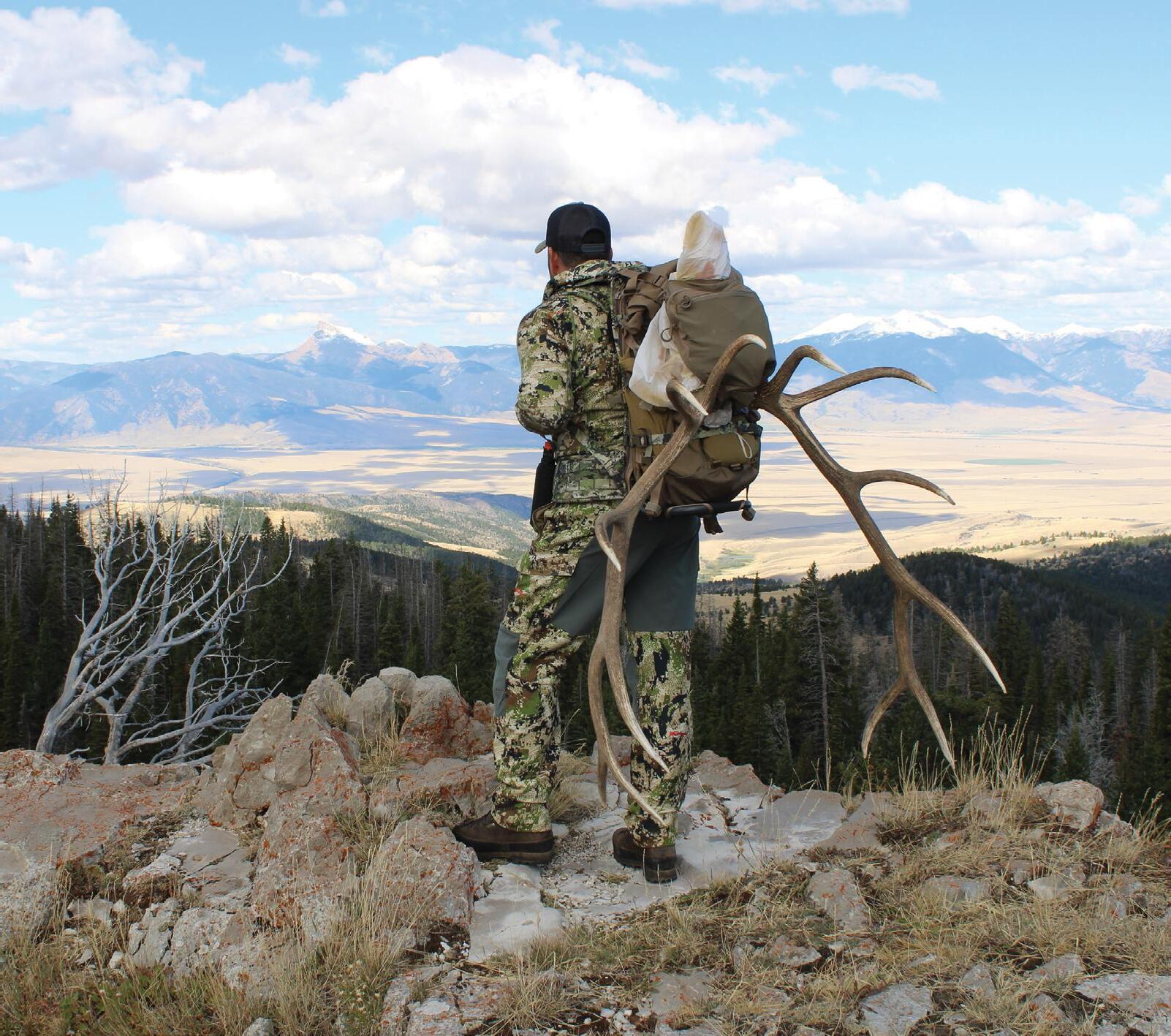

Photo: Joe Mannino
BY CHRIS DENHAM
My career in the hunting industry started in a retail store, selling hunting gear. Before my first day of work, I had owned one rifle, one shotgun, and two compound bows in my life. The boots I wore would not qualify as hunting boots. I had a box of cotton socks and a set of Vietnam-era army fatigues. I had one folding knife (the Buck 110, a few pages from here), a pair of 7x35 binoculars from Sears, and that was about it... no real backpack, no tripod, no GPS, no rangefinder. To make matters even more interesting, my hunting rig was a Chevy Chevette with no AC and a broken heater, with a back window held in place with caulking and duct tape.
Every time a sales rep would show up with something new, I would meet him in the parking lot if that’s what it took to get the first looks and ask questions. I was obsessed with gear, even though I couldn’t afford most of it. But slowly but surely, I was able to buy something new each year. With each addition, I would convince myself that was all I needed; I was set! Of course, that feeling didn’t last; I was always on the prowl for the next cool thing.
The western hunting gear world really began to heat up about 15 years ago. A booming economy, extended vacation policies, and hunting magazines (yes... like Western Hunter) inspired sportsmen to hunt more and apply in other states. With a new commitment in both time and money, we all wanted better gear to improve our chances of success. The gear industry responded to the demand, and better, more technical products were coming fast. Think about all your current hunting kit. How much of it is more than five years old? Maybe your rifle? If it is, I would bet that you are already thinking about replacing it.
Each innovation solves one problem, but then it exposes another. When we started glassing from tripods, we could more easily see the imperfections in those optics, so the optics companies invested in better components and a vast amount of research and development. Twenty years ago, the most expensive 10x42s were about $1000; now, that is an introductory price, and the best are over $3000, and arguably worth it!
I wish I knew where I was going with this; maybe I just needed to vent. Not that I am complaining. I have been in the gear business for my entire adult life and wouldn’t have done it differently. I guess it is the speed of change that has my head spinning. Here is the question I have been asking myself: A product may allow me to be more effective, but does that mean I am a better hunter? Or am I more dependent on technology?
Okay, that might be the strangest introduction ever to our annual Gear Issue... back to the subject at hand.
I can’t tell you how many hours the team has put into this issue. It is by far the most extensive and well-thought-out Gear Issue we have ever done. It has a great balance of products without straying off the reservation that is western hunting. To balance out the gear, we have an incredible display of photographs from Mike Duplan, along with some fantastic reader-submitted stories. If you are a bowhunter, don’t miss James Yates’ article on arrow forgiveness! I personally have been waiting over a year to read the results. Draw results are almost complete, and your fall is mapped out. By the time you read the next issue, the bulls will be bugling. There will always be another product launch, another innovation, and another reason to upgrade our kit. Some of those advancements genuinely make us more effective hunters, and there’s nothing wrong with appreciating great gear. But at some point, we also have to remember that technology should support skill, but it can’t replace it. The best hunters are still built through experience,
Few topics generate more conversation around camp than gear. Hunters debate optics, compare packs, obsess over boots, and constantly search for ways to improve their systems. To find out where Western Hunter readers stand, we asked questions about the gear they trust, the products they buy, and the content they value most.
Optics generated the strongest demand for future gear coverage.
63% have experienced a gear failure during a hunt.
“I never go anywhere without my Swaro binos and Leica rangefinder. Always have a backup of each just in case. Quality footwear is a must.”
Western Hunter readers rated the importance of high-quality gear a 9 out of 10.
9/10
More than two-thirds spend at least $600 annually on hunting equipment.
Upgrades and specific hunting needs drive most gear purchases.
Reviews and real-world testing are the content readers want most.

























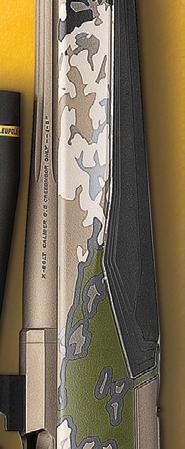











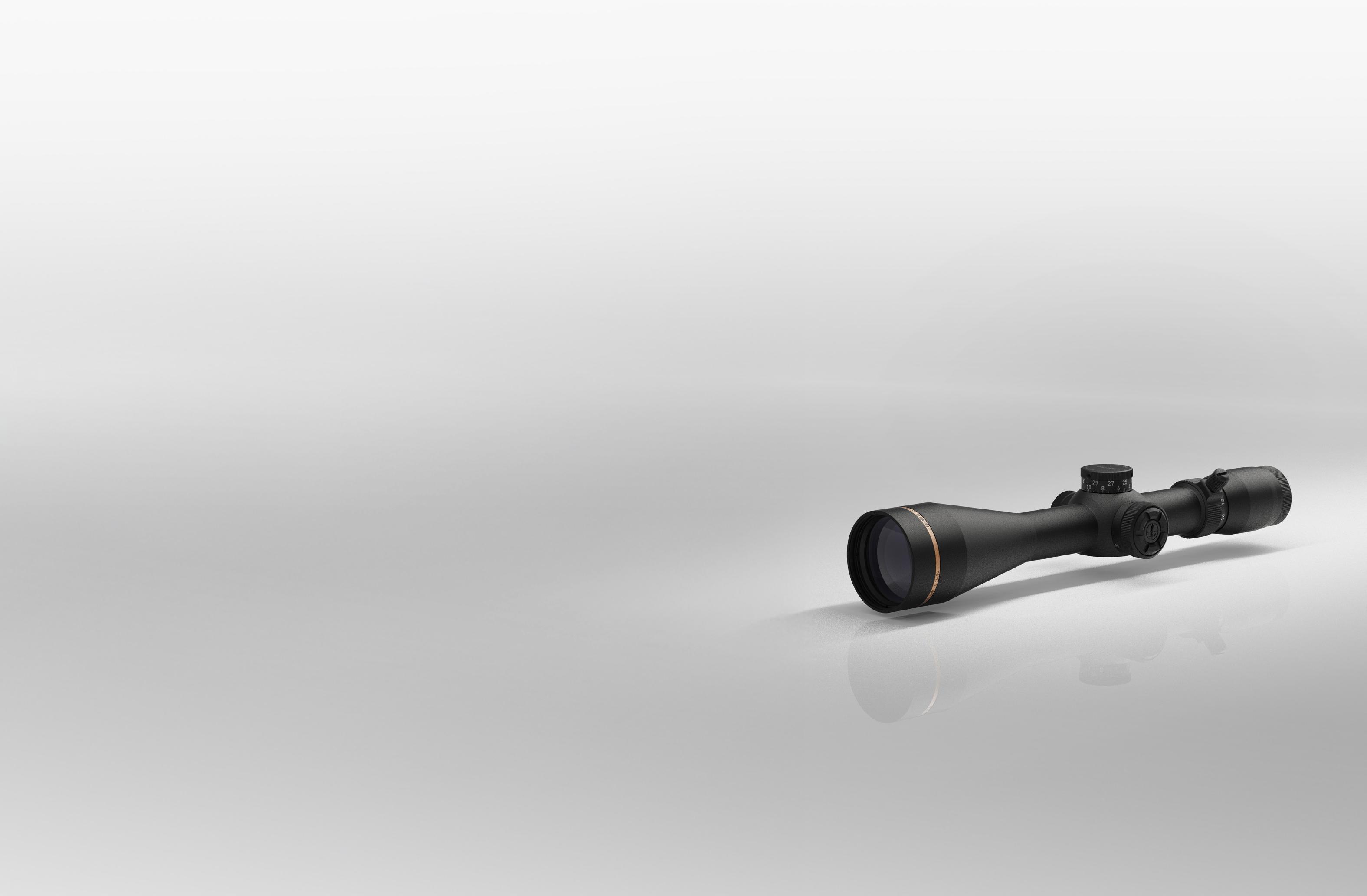
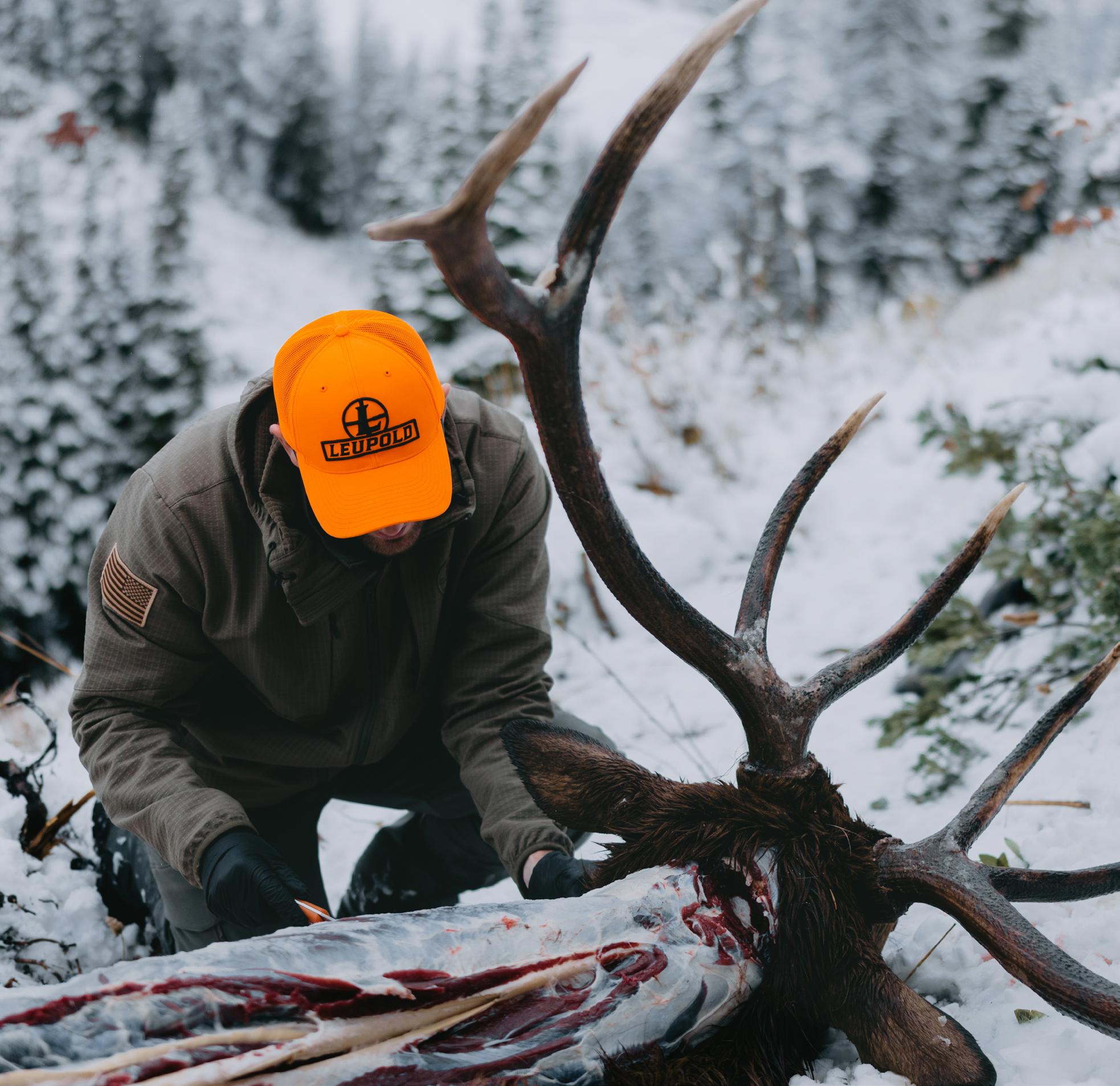
Confidence comes from knowing your gear will deliver. The VX® -4HD delivers edge-to-edge clarity, rock-solid precision, and the rugged reliability you need when conditions go sideways. Designed, machined, and assembled in Oregon, it’s built for those who leave no doubt.
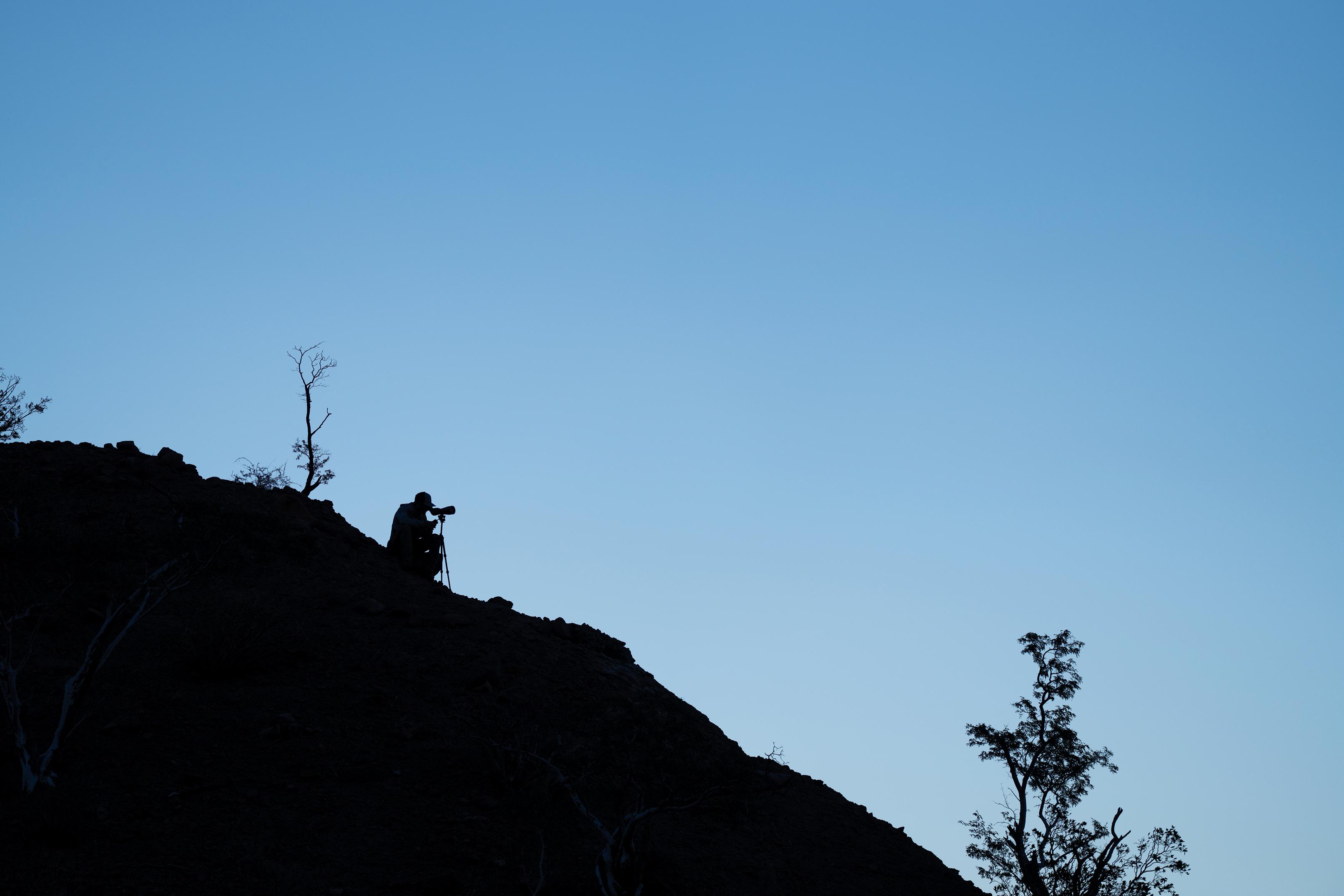
“The most important piece of equipment you own is you.”
~ Mark “Coach P” Paulsen
BY JACKSON REED
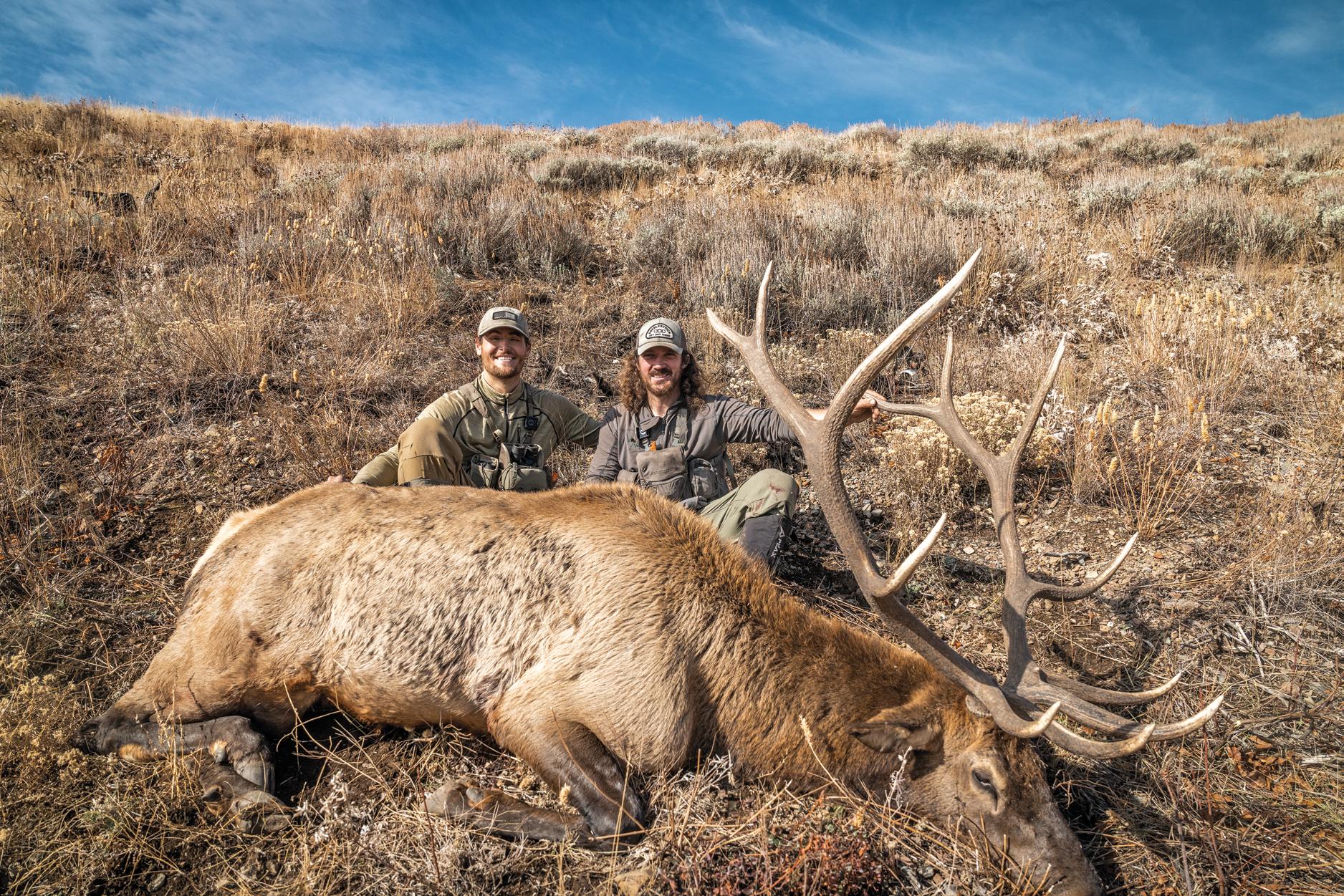
Of all the incredible experiences we’ve shared, shooting two quality backcountry bulls together was something we had only dreamt of.
Seventh grade was the year it all started. Coop and I had gone to different K-6 elementary schools, so it was the first time we’d crossed paths. One day, our math teacher asked if we’d ever hung out outside school... likely his polite way of telling us to quit our jaw-jacking, but there was no mistaking our true potential as friends. We looked at each other, grinned, said no, and that next weekend I biked over to hang out with Coop for the first time.
I was too young to drive or do much on my own, so any person I had hunted with up until then was a person somehow directly connected to my old man. Although only in the seventh grade, I had not yet made a true hunting buddy of my own.
Coop and I were hanging out whenever we could. We played sports together as well, so our friendship grew incredibly strong. It wasn’t long before he joined my dad and me out in the field for our first hunt together.
To this day, my father continues to be the greatest role model in my life. My entire childhood, I tagged along with him on as many adventures as I could. Upland bird hunting was, and still is, his favorite way to spend a fall day. Bird hunting and bird dogs were all I knew for most of my youth, and they are still a huge part of my life today. It was amazing. A kid’s dream, no doubt. Open country, endless adventures, never had to get up before dark, never had to be quiet or sit super still. It was, in my opinion, the greatest introduction to the outdoors and hunting.
My dad had gone on a couple of deer hunts back in college, but it wasn’t until I was old enough to hunt big game that he took an interest in it. That meant general deer hunts, youth doe and cow hunts, figuring it out as we went. We didn’t grow up as seasoned big game hunters. We were learning in real time.
Cooper was in a similar boat. When we met, he didn’t have his hunting license yet, but like me, he had spent plenty of time tagging along with his dad over the years. Coop took his hunter’s education course, and not long after, we were headed out on his first hunt. Of all things, we were headed out chukar hunting.
We stopped at a Walmart on the way out so he could buy his license, and just like any kid would, Cooper grabbed a copy of the hunting regulations as he left the counter. Within ten minutes of being back in the rig, Coop piped up from the back seat, regulations in hand, “Reed, I’m gonna kill a bear!”
My dad and I looked at each other and smiled. I looked back and said, “A bear? You think you are going to shoot a bear, huh, Coop?” It was one of the last things my dad or I would have ever thought about hunting.
Long story short, Cooper made it happen. That spring, he was able to drive. We went out a few times unsuccessfully, but later that fall, he was by himself and ended up shooting his first bear. From a comment in the back seat to a bear on the ground within a year. That moment stuck with both my dad and me, because it told us everything we needed to know about who Cooper was.
We have now been friends for 20 years. Since then, we have had countless first-time experiences together in the field: first turkeys, first bucks, first bulls, you name it. We built more cool first-time memories together than I think is even possible in the world we live in today. Sometimes, I wonder if kids are even doing the cool stuff we were. I sure hope so.
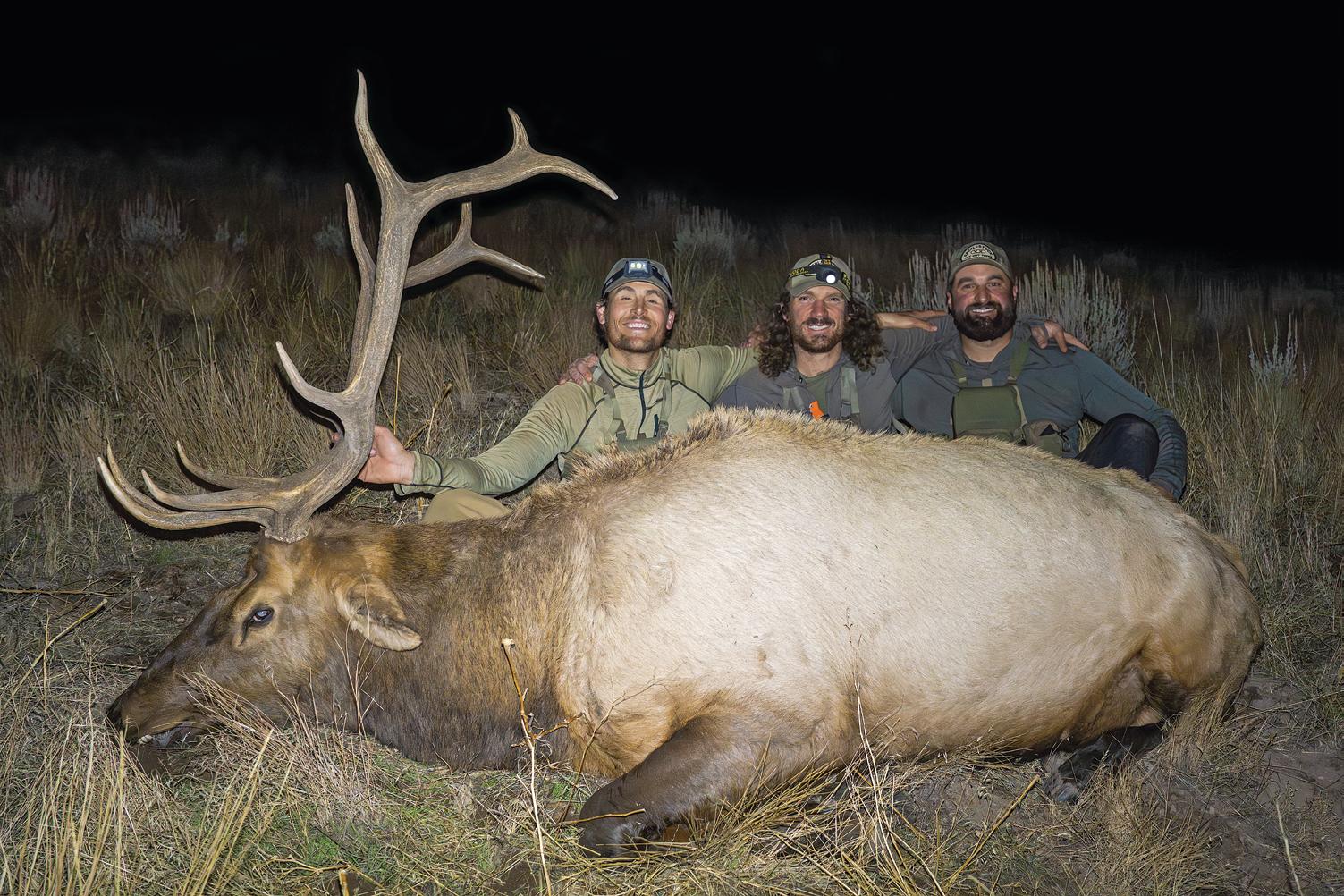
A few years ago, archery elk hunting was not going my way. I’d had early success but recently lost a couple of animals. In 2022, I switched to a general rifle bull tag for the first time and ended up shooting a spike. It was better than nothing, and the freezer was full. The best part? A clean kill.
Meanwhile, Cooper was finding success in archery hunting, but with his guiding schedule, it was tough for us to find time to hunt elk together. I rifle hunted again the next fall, and Coop joined to help. He spotted a great bull the night before opener, and I shot it the next morning. It was my biggest bull yet! We packed it 7.5 miles (2,500 feet up, 2,000 feet down... twice); something I couldn’t have done without him. 2024 played out the same way. Long story short, Cooper spotted another great bull for me that year and helped me pack it out.
By 2025, it had been a couple of years since we both hunted elk with tags at the same time, and I definitely owed Coop. With his wife drawing a great deer tag that took most of his archery season, he decided to rifle hunt. It would be the first time we both had the same rifle bull tag!
All summer, Coop kept saying, “Reed, I’m going to shoot a monster. 340 bull, Reed!” I’d always respond, “I’m happy with just about anything. Especially if it has six points!” Coop and I both knew bulls of that caliber were slim pickings in that country.
On the hunt, we were joined by close friend, Casey Richmond, capturing photographs and video for Eberlestock. It was his second time joining us on this hunt. The year prior, he filmed me and another close friend, Gregg Simonds, tagging out on two beautiful 6x7 bulls. It took us almost 12 hours and 16.4 miles to get both bulls out. Big thanks to Cooper and Casey!
We got to base camp two nights before the opener. The following morning, we woke up before dawn and climbed to a vantage point less than 300 feet above camp. As the sun came up, bulls started bugling. A herd of about 80 elk worked up a ridge 400 yards across from us. In my book, there were definitely a couple of shooter bulls, but Coop was up first. I wasn’t about to shoot first after everything he had done to help me the two seasons prior. None of the bulls we saw that morning were much bigger than 300", and as you know by now, that wasn’t what Coop was after.
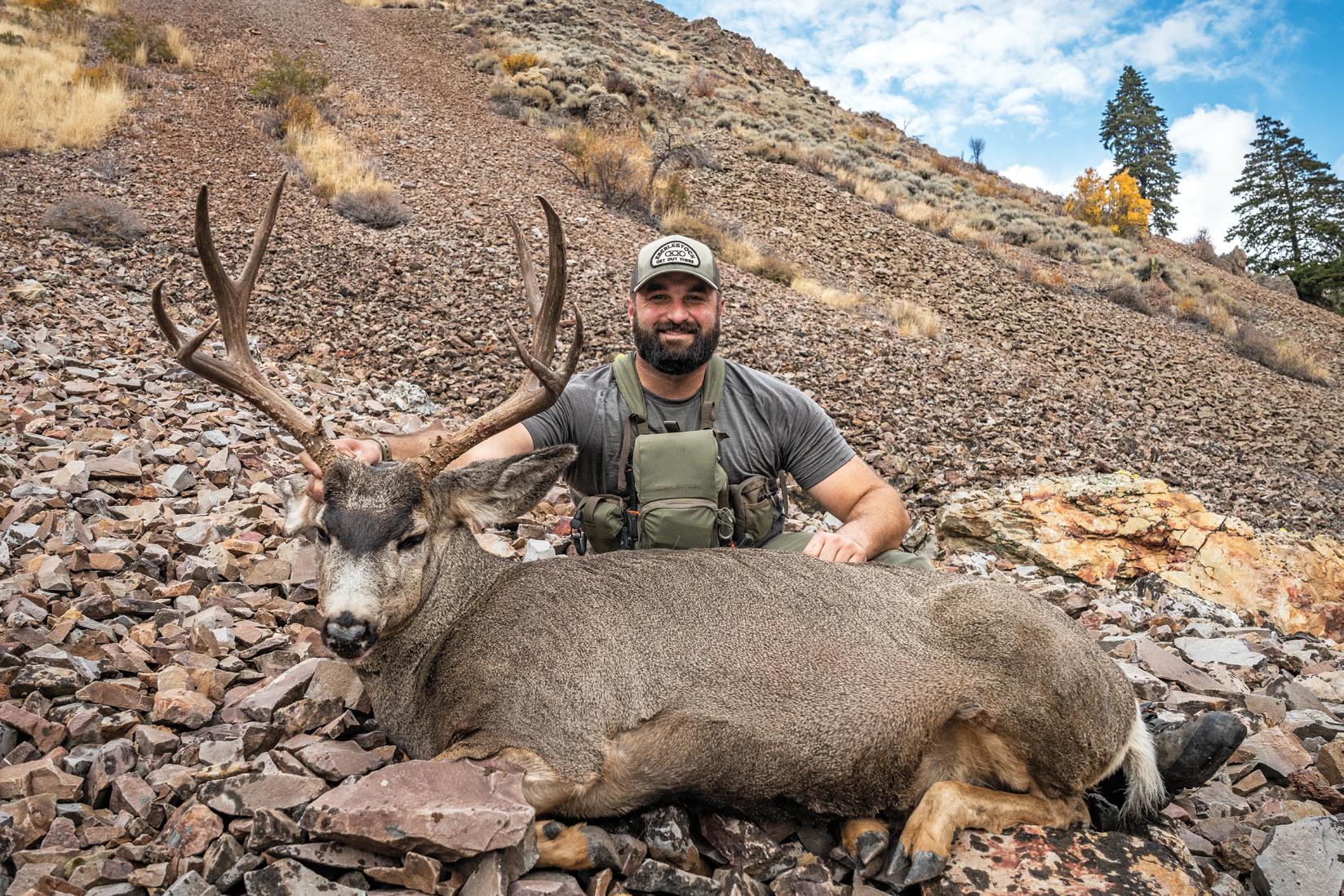
From the same vantage point, we spotted two shooter bucks. It was the perfect opportunity for Casey to get in on a little action since he still had a deer tag. We worked up the drainage to get into position on the more mature buck. It was fantastic. Casey harvested the buck the day before the elk hunt even started. It was well deserved after his help getting those bulls off the mountain the year before.
The next day was opening day. We had a couple of close calls, especially with an old bull we had a stare-off with at 60 yards in the timber. Through the branches, it was too hard to tell what caliber the bull was. I would have shot it either way, but Coop was at bat. The situation would have to be just right if I was going to fill my tag before he did.
We exhausted that area near base camp on opening day, so we loaded up the packs and backpacked into our honey hole, where we’d had lots of prior success. It took most of the day to pack in. Cooper passed on a few more bulls that day while packing into camp. He was living out his dream, but for someone like me who doesn’t see many bulls I don’t like, my stomach was starting to churn.
You just don’t see the caliber of bull Coop was after very often in this country. On top of that, it’s no country for the faint of heart; long days and late nights with elevation gains and losses of over 3,000 feet, every day. For me, they all start looking pretty damn good after a couple of days.
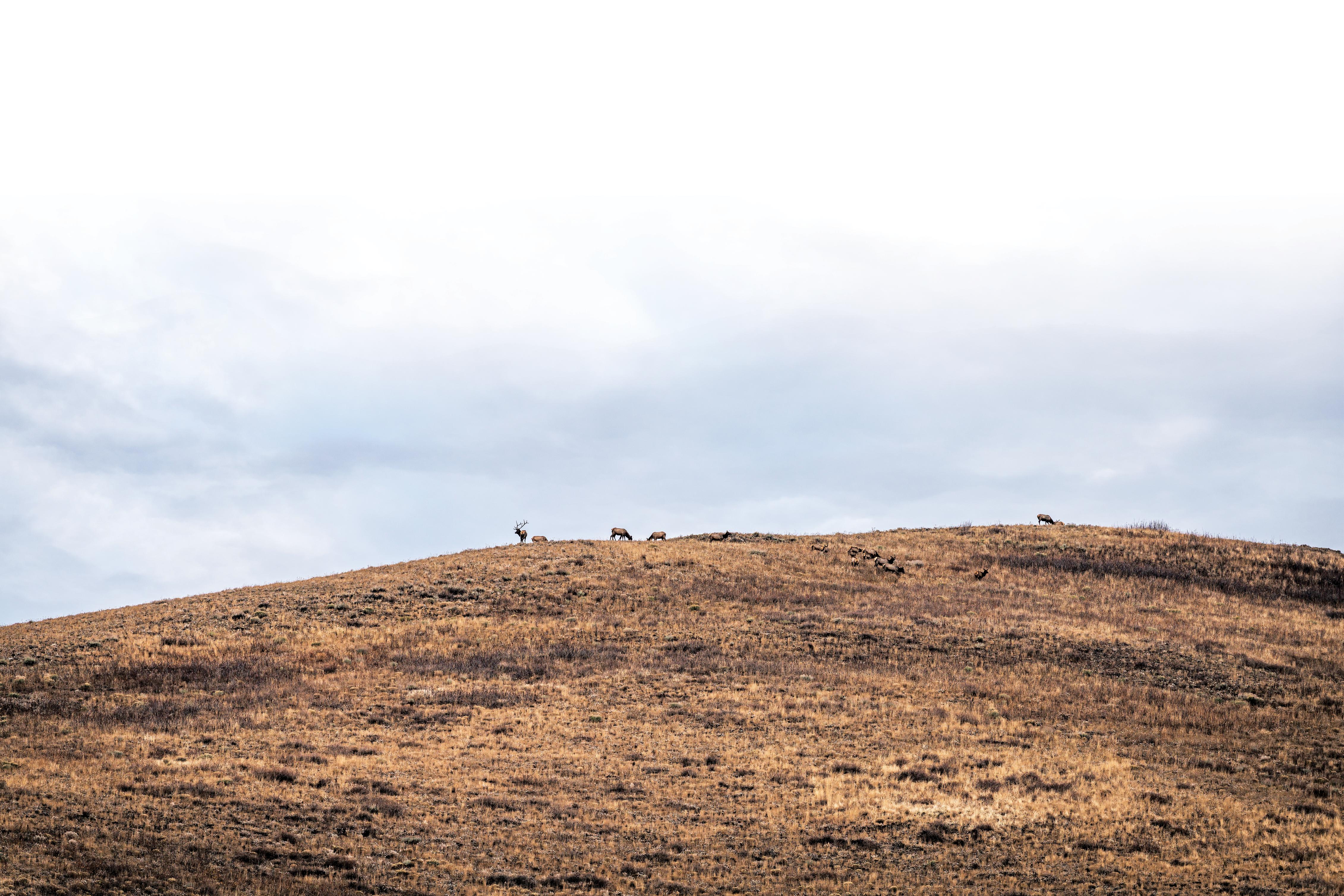
On day three, we climbed our way up a side draw out of our new camp that took us 2,000 feet up out of the bottom to a gorgeous high-country basin with a spring and wallow. The entire climb up, there were a half a dozen cows that were skylined, feeding on top of the highest point at the head of the basin. We stopped and took a break to check a trail camera we had left on the wallow all summer.
I looked back up to check on the cows feeding on the skyline over 1,200 yards away. They were still there. I swear they looked down at us multiple times, though. We weren’t trying to be very discreet because for the last 45 minutes, it remained a half a dozen cows. We made a plan to sidehill out of that drainage and into the next one to the north. As we started climbing again, I looked back up at the cows just one last time. “Holy s***!”
Like a dream, a big bull appeared on the skyline. He was absolutely magnificent. All the years we had spent hunting that area, and we had never laid eyes on a bull quite like this. Seeing him there on the skyline, turning his rack back and forth, bugling with his cows, is something that will be etched into my memory forever.
Cooper decided this was a bull he wanted to go after, so we made a game plan. We used the ridge dividing the two drainages to gain ground on the bull while staying tucked out of sight. The elk were coming across the top now and feeding over to the head of the basin we were now in. This plan was working perfectly. While moving up the back side of that ridge to cut the elk off and get in position, I noticed movement out of the corner of my eye.
Other hunters were moving in on the same bull! They were directly across the drainage we had moved into, which put them in clear sight of the elk. We remained hidden, using the ridge for cover, and kept pushing. We definitely had a leg up, and we were not about to let the other hunters beat us up the mountain. We finally made it to a position to shoot. While we were getting packs laid down and getting set up for the shot, you could tell the herd was spooked. They were looking right at the other hunters.
The lead cow took the herd and started to climb back up and out of the basin. At this point, we knew it was now or never! The elk were on the move, and they weren’t going to stop. The bull had no idea what was going on, though. All he knew was his cows were starting to boogie. He was going back and forth amongst the herd, trying to keep things in line, but it wasn’t happening for him.
With how much the bull was moving, it was going to be hard for Cooper to make a shot. Coop knew what he was there to do, though. Waiting for the shot while I was watching through the glass was painful. Then, BANG! It finally happened. “YOU GOT HIM COOP!” He had done it. Despite still having my own tag to fill, my trip was made!
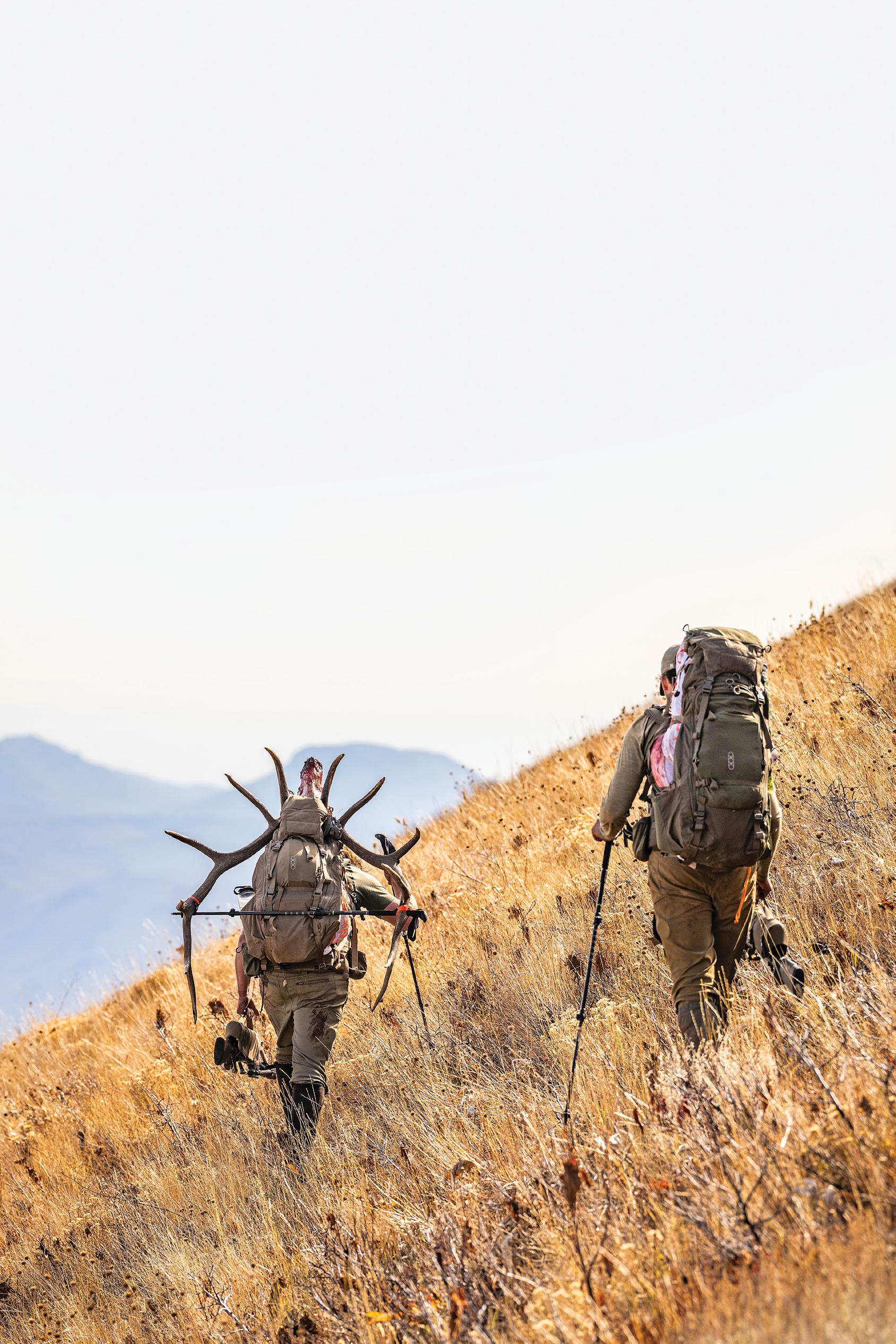
The plan was to pack the bull to a cool patch in some trees much closer to our final destination. When we crested the first saddle of our descent, we could see another herd clear down where we planned to hang the meat. It seemed too good to be true. I figured once we got the meat down close to where we would hang it, I would sneak over and try to put a move on them. It worked out perfectly! We dropped our packs in the bottom of a draw, still loaded with meat, snuck up to the top of the ridge, located a six-point bull, and made it happen.
The best part was my bull was only three-quarters of a mile from the meat trees! All we had to do was get Cooper’s bull the rest of the way there, hang the meat, and go take care of my bull. It was picture perfect. We had two bulls down and all the meat basically out. All we had to do now was hike back in after our camp and get back to the meat where we had plans to be picked up by another good friend. Mission complete; another experience of a lifetime for Cooper and me. WH
You can watch this hunt, Now or Never, on Eberlestock’s YouTube channel.
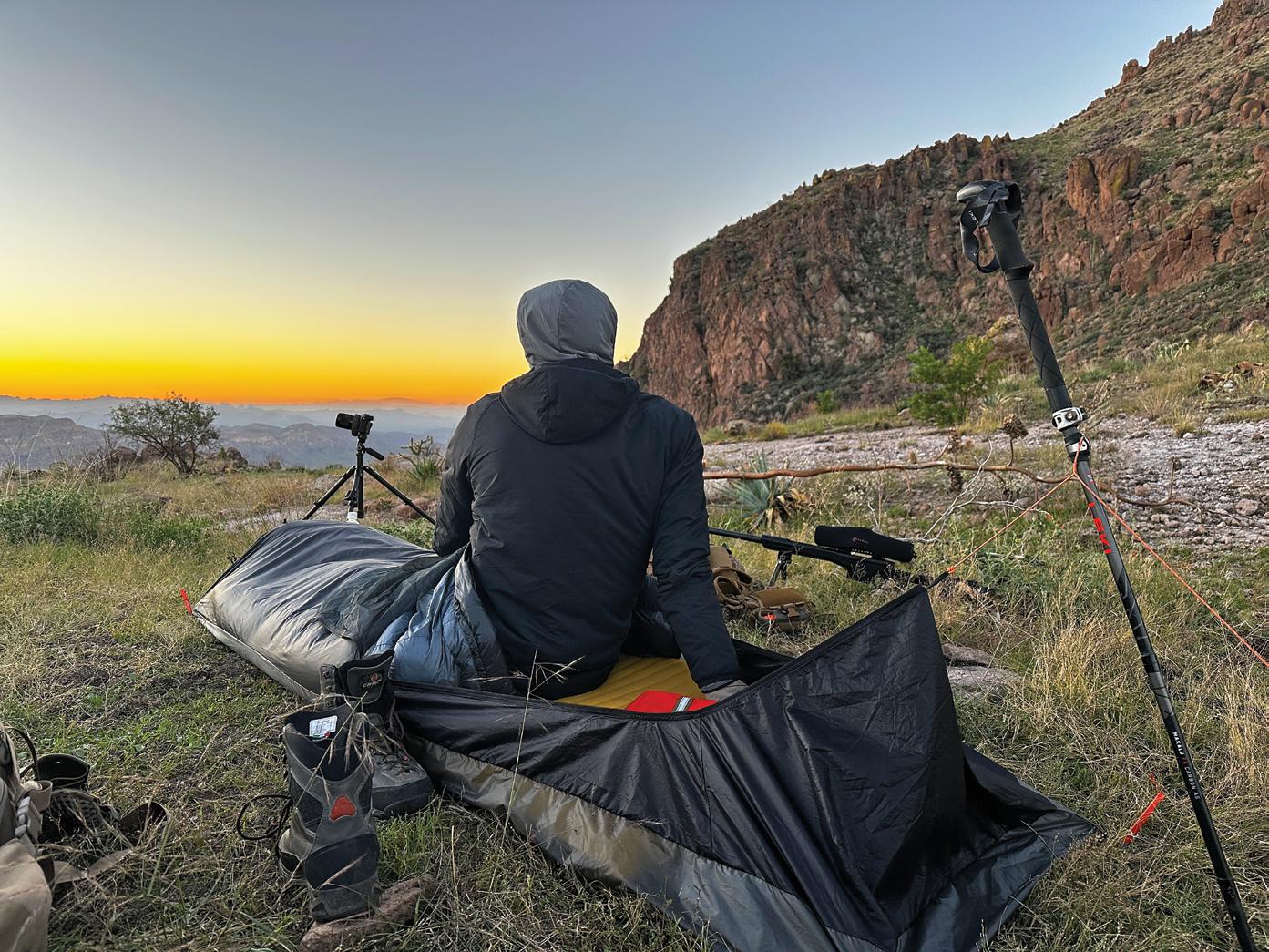
Originally, when we were planning this magazine and brainstorming things that we thought we should have in it, I thought it would be a good idea to share what I carry with me for repairing gear–whether that’s for a bow, rifle, tent, tire, or boot. I wrote all of that down in a note and decided it was very compelling, but the reasoning for it was more important. Ninety percent of it is common sense, and the theory of “what if weighs a lot?” plays a big role in it. I say all of that, though, because it made me think about scenarios where I need to use that stuff and how those experiences shaped what I carry and, almost more importantly, what I don’t carry. Almost every occasion where I have had to repair a piece of gear in the field has come during a short trip where I had deliberately set out to test gear and/or my capabilities.
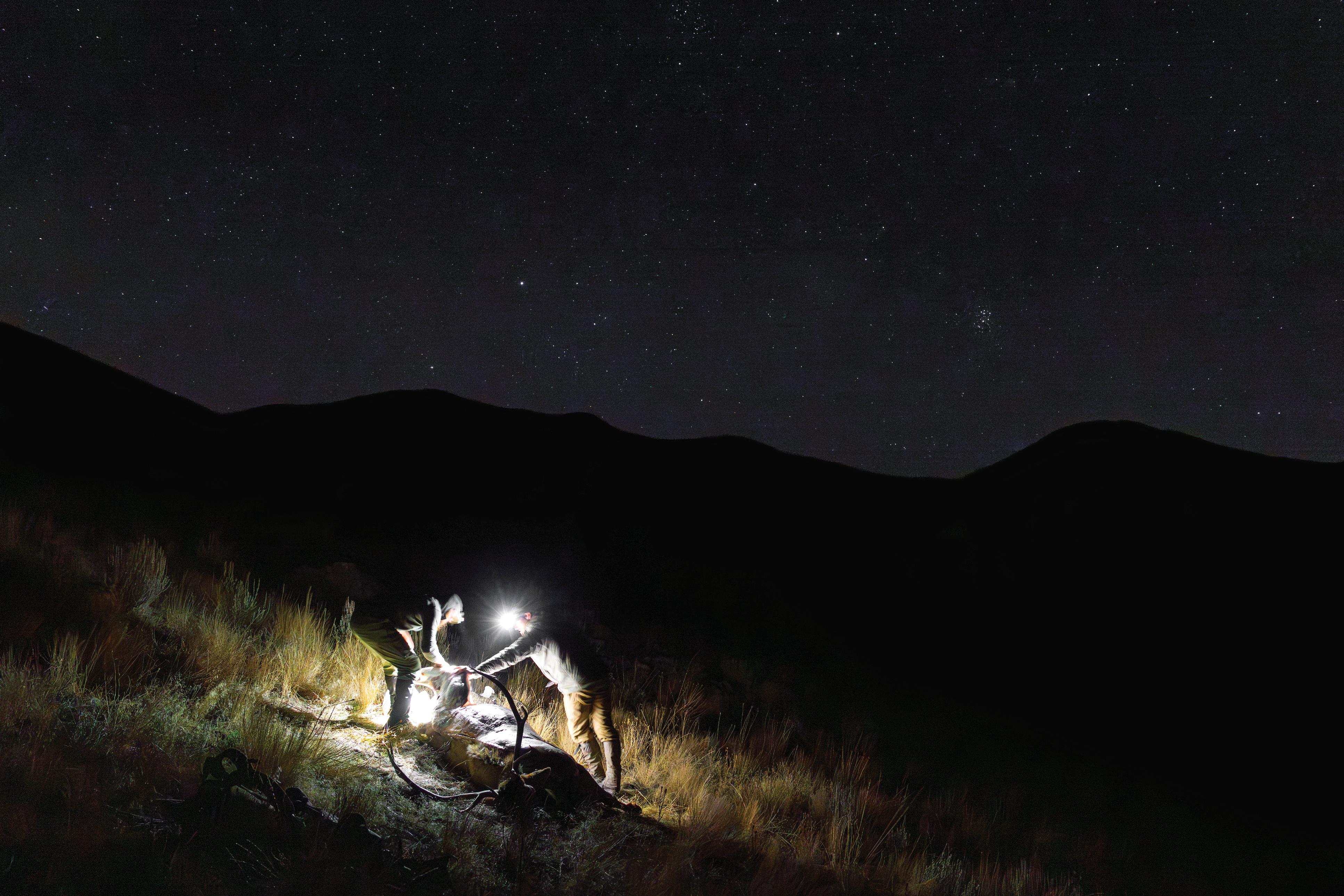
These short trips normally consist of around 24 hours, some of which is usually spent in the car, burning down a washboard road. I start a lot of them after a day of work on Friday and make sure I am home in time to help with dinner by Saturday night. Starting late has taught me a lot about navigating in the dark and how to choose a campsite based on a map and the small illuminated area of a sometimes-fading headlamp, a skill that has paid off during actual hunts many times.
In the past, I have even tried to time these trips with incoming storms to test certain shelters or clothing. This means hiking through a storm, setting up camp, then weathering that storm, either through a properly guyed-out tent and patience or a well-stoked fire in a titanium stove. A few years ago, I took a teepee style tent that I had never used into an area where I knew a storm was going to drop 12-18 inches of snow. I was able to set up the tent in the dark before the storm and secure a good load of firewood within a few hours.
The snow rolled in, and I got to experience firsthand why guying-out a tent is important. The snow pushed in the sides of the tent so much that my livable space shrank by nearly half, and while I was attempting to batten a piece of wood in the tent, I poked a fairly large hole in the tent wall. Luckily, I was carrying Tenacious Tape, which helped me patch up the tent in no time. Now, from that experience, I know that Tenacious Tape works very well when patching medium-sized holes in silnylon.
During a recent trip, I hiked into a recently burned area with only a bug bivy and a lightweight tarp for a shelter. After the sun went down, I found a flat spot with nearly rockless ground to lay the bivy on with my pad and quilt inside. After a long assessment of the building clouds to the northeast, I decided it wasn’t going to rain on me, so I didn’t need to pitch the tarp. My meteorologist skills were right for the most part; I didn’t get rained on, but the wind did kick up well into the 20s and sustained that speed for nearly the entire night.
No big deal, right? There weren’t any trees to fall on me, and I wasn’t going to blow away, but what I didn’t account for was the fine ash and soot that blew right through the mesh of my bivy and into every crevice of my head and neck. When I woke up, I could feel the fine dust covering my sleeping pad, and I noticed my throat was killing me from breathing in the remnants of 200-year-old ponderosa pines. Now, I’ll take that memory into the next hunt on which I find myself deep in a burn, looking for places to camp.
This magazine is filled with the latest and greatest gear, but most of it means nothing if you don’t know how to properly use it. My advice to anyone using this magazine as a reference to buy new gear is also to take the time to go and try it before it’s game time. WH

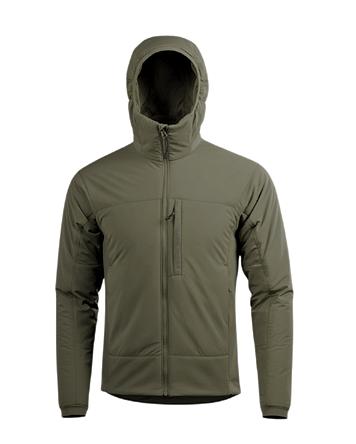
When it comes to my ideal jacket, a synthetic insulated piece with around 100g of insulation is what I reach for every time. I’ll wear this style in almost all conditions except hot weather. I’ve gone through a few jackets in this category, and the Alturas Jacket exceeds expectations. It weighs just over a pound and uses a lightweight nylon fabric that still feels durable enough to handle brush and rough terrain. I’m 6' 1", 220, and the XL fits perfectly, with just enough room for light layers underneath without feeling bulky or restrictive. ~ Ben B.
Eberlestock.com
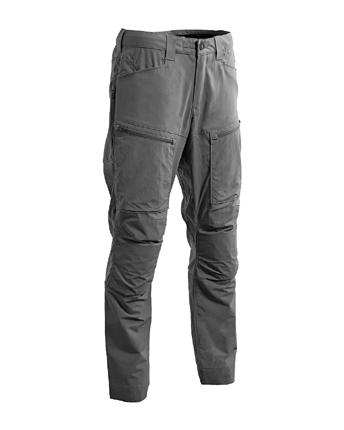
The biggest thing I look for in pants is fit. It’s hard to tell much of a difference between fabrics and features, but the way they fit can make or break the decision to keep them. I’ve even taken pants to a seamstress before, but the Deadwood Pant didn’t need that. The legs aren’t baggy, and there’s plenty of room where it matters. I could feel the seam lines where the reinforced fabric is sewn in, but that’s an easy trade-off for added durability. The knee pads are almost unnoticeable, the zipper pulls stay put, and the pockets are big without feeling saggy. ~ Ben B.
Eberlestock.com
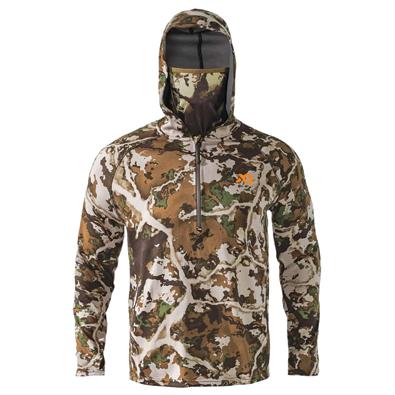
Lord knows I did not need another piece of technical clothing. But with a turkey tag in my pocket, a lightweight, breathable midlayer with an integrated facemask was just too much temptation to bear. I could not be happier with the way the Approach performed. It worked exactly as I wanted it to. I didn’t notice it when hiking in the morning. It kept me comfortable while sitting still and calling, and that facemask and camo pattern proved extremely effective as we called my bird into 20 yards before my 870 Express went to work. ~ Joe M.
FirstLite.com
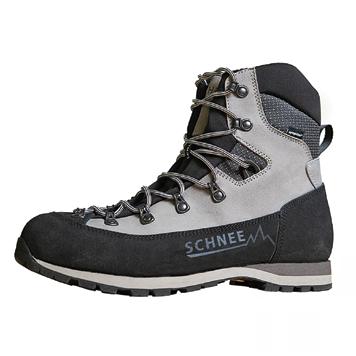
If you like boots that feel like tennis shoes you could scale boulders in, the Torre is your best option. Schnee’s struck gold with this combination of lightweight breathability and enough stability to feel ready for anything. I’ve felt great in these at trade shows, NRL matches, and archery hunts. There’s a reason these are often out of stock. Be the reason. ~ Kevin G. Schnees.com
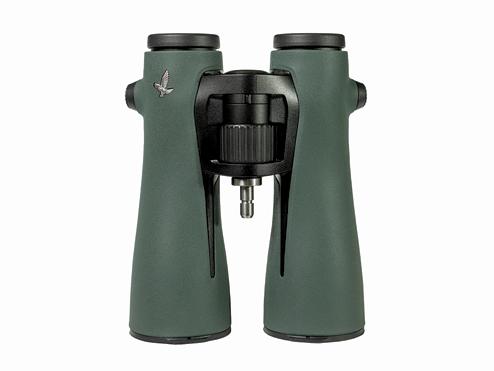
Recently, I took my bow for a walk in the same ol’ stomping grounds that I’ve been stompin’ around in since the ’90s. The biggest difference this time was that my new Swarovski NL 14x52s finally showed up. I can sit here and write out all the specs and talk about edge-to-edge clarity, lens coatings, and field of view, but the bottom line is that these 14s are absolutely incredible and will be a solid addition to anyone’s optics kit. ~ Joe M. Outdoorsmans.com
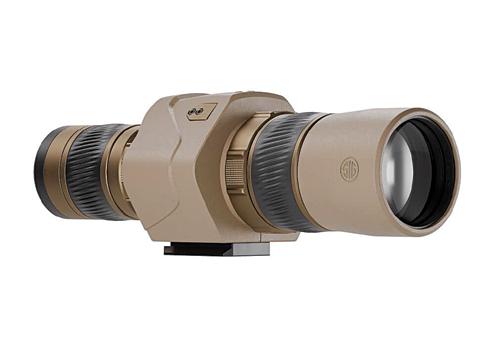
A stabilized handheld image from 16 to 32 power is a wild upgrade in your glassing game, whether you’re shooting steel or hunting. All of my initial impressions were from hand-holding the Oscar 6 and watching bullet trace out to 1,000 yards–impressive on its own. Then, I put it on my tripod and realized how much shake and vibration I was able to remove from my image that I had grown accustomed to tolerating. ~ Kevin G. SigSauer.com
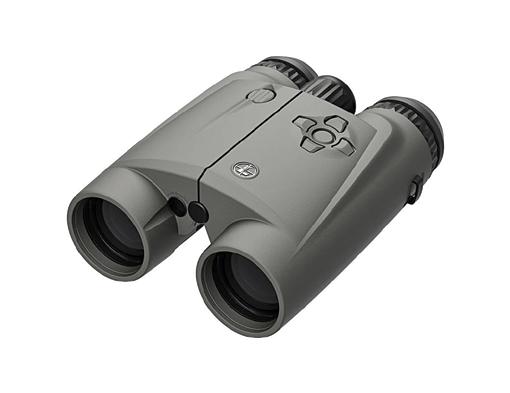
Leupold & Stevens woke up, drank a strong cup of black coffee, and built a rangefinding binocular that has raised the bar for shooters, both on the mountain and competition stage. It’s got the glass, the ballistics, and reticle, the app, and the onboard wind input that takes away all excuses for missing your shot. If the price tag scares you away, you don’t care enough about accuracy when it matters most. ~ Kevin G. Leupold.com
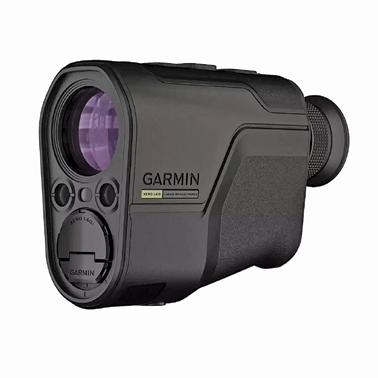
There are very few things that are truly revolutionary these days, but this is one of those things. Full color display, 32mm objective, the ability to range and drop pins ten plus miles away, and true archery ballistics, just to name a few things that no other handheld rangefinder has. Stay tuned for a full in-depth review in the next issue of the magazine. ~ Brody L. Garmin.com
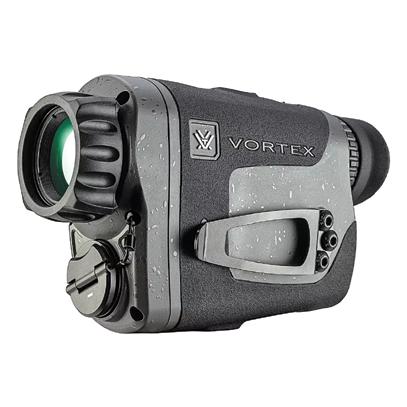
Thermal imaging remains one of the most controversial technologies in hunting because it can reveal animals with incredible ease, day or night, leading many states, including Arizona, to ban its use for hunting, scouting, or even possession in the field. That said, where thermal optics are legal, the Veil stands out by combining solid image quality, practical magnification, and simple operation in a compact package that feels just like a handheld rangefinder. At around $1,500 and backed by Vortex’s lifetime warranty, the Veil 400 delivers a compelling mix of value, reliability, and capability for those who can legally put it to use. ~ Chris D. VortexOptics.com
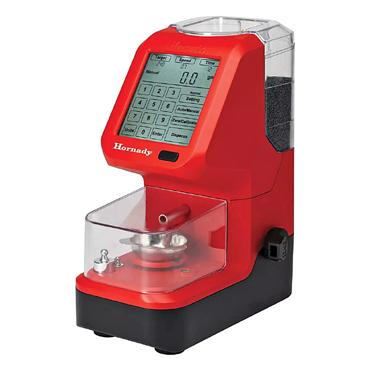
When we added this to the reloading room and got rid of the hand trickler, we dramatically sped up our process. Setting a charge weight to an accuracy of 0.1 grains is simple to program and it’s great at letting you know when the unit occasionally goes over the programmed weight so you can take a kernel or two out. This thing is fast, accurate, and a breeze to operate. ~ Kevin G. Hornady.com
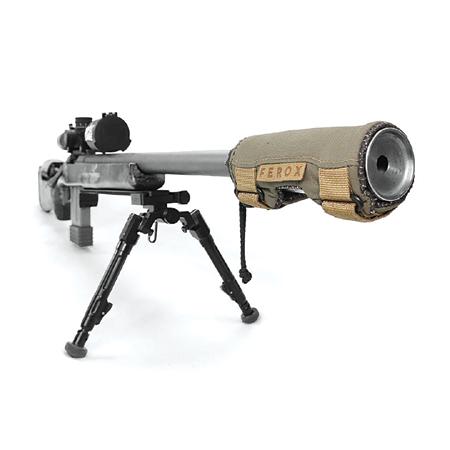
The Aeris is the best suppressor cover I’ve ever used for two reasons: First, you don’t need to lace it up like a boot to cinch it security to your suppressor. The two beefy straps and rear cinch chord do the job and make it easy. Second, the open-bottom design allows a good amount of heat to escape without giving you mirage in your scope and helps both the suppressor and your barrel cool more naturally. This is a thoughtful and durable made-in-America product. ~ Kevin G. FeroxGear.com
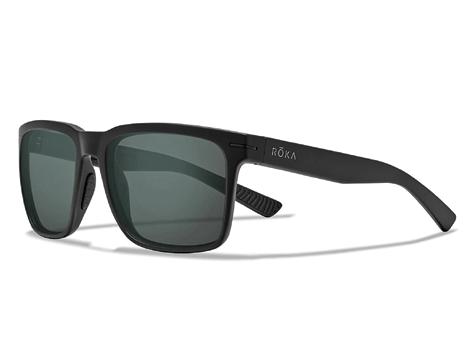
I am an eyeglass wearer, similar to your grandpa. Contacts and I never jived, so I’m a glasses man, which has its challenges in the woods. I wear a pair of clear Oakley Flak Jackets like I’m a pitcher in AAA ball most of the time I’m hunting, but now when the sun comes up, I can switch them out and not skip a beat. ~ Brody L. Roka.com
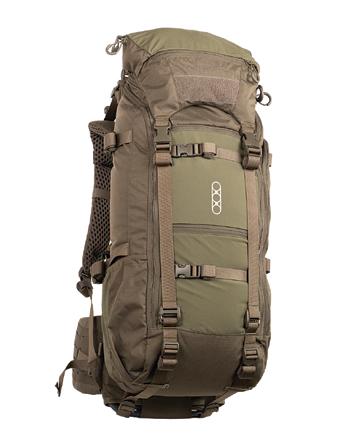
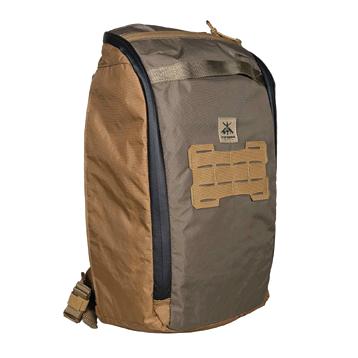
The Brute was specifically designed to be an out-of-the-box pack for the western hunter who is looking for a high-quality all-in-one system. Featuring an internal frame, customizable comfort, an adjustable load shelf, elevated load lifters, and rifle scabbard compatibility (highly recommend). It’s offered in four different sizes and several color options with lots of organization at the ready. Like all of their packs, it will last you forever. ~ Pedram P. Eberlestock.com
This is hands down the nicest backpack I’ve ever used. FHF overbuilt this thing and you can feel it in every zipper and strap. It’s incredibly low profile and still manages to have a bunch of storage capacity with organization. There are several CCW carry options and even an accessory that allows you to attach your holster on the inside of the pack, still hidden while the main compartment is open. I added an additional E4 pouch to the outside that gives me even more storage and gives me a little more versatility, and another place to store my pistol. Simply put, the EDC is a great example of American design and manufacturing doing the simple things unreasonably well. ~ Kevin G. FHFGear.com
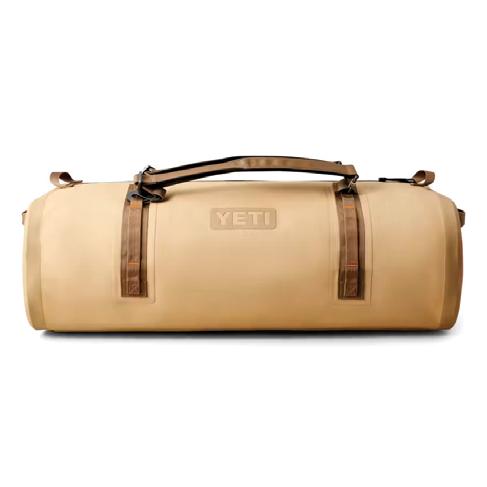
It’s a bag with one big zipper, that’s it, but it’s tougher than boiled oil, and you never have to worry about what’s in it getting wet or being exposed to the elements. Yeti designed these bags so they can be dropped out of planes and not show any signs of wear, so if you think it might not be tough enough for what you’re going to do, you’re probably wrong. Personally, I’ve taken this one all over, and from the meanest baggage handlers to the Yukon River, it hasn’t shown a single sign of giving up. Once, I even put dry ice in it, and it pressured up to the point where it felt like a shaken-up bottle of Coke. I don’t recommend that. ~ Brody L. Yeti.com
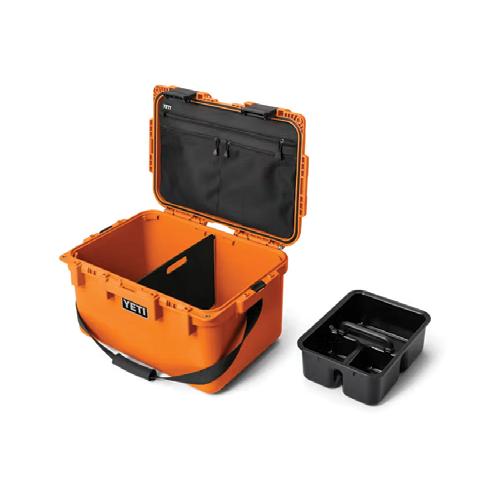
Across all sizes Yeti makes of the Loadout GoBox, the 30 is the one that comes with me the most. It houses everything I need for days at the shooting range, events I’m filming and photographing, weekend hunts or shooting matches, even fishing trips when I need both a tackle box and a dry box back at camp. And while it’s not insulated, from time to time it serves as a great place to store some cold ones while you use it as a seat. ~ Kevin G. Yeti.com
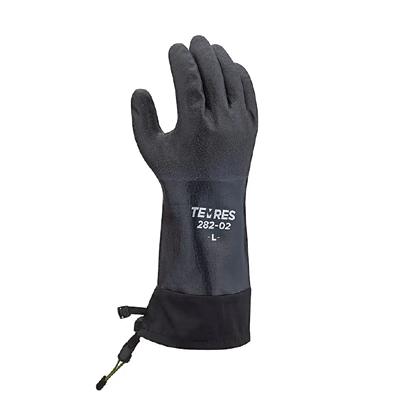
I grew up searching for the perfect waterproof glove. I dealt with pieces of junk that hold out water for a few trips, but would never last a full season. I definitely lost feeling in a few digits because of it. When I heard about these, it was from folks who pack rafts down icy rivers in Alaska, so I figured they were probably pretty good. After two weeks of my own on an Alaskan River, using them for everything from clearing log jams to filling gas tanks. I can confirm they’re the most durable and waterproof gloves I have ever used. Damn cheap, too. ~ Brody L. Amazon.com
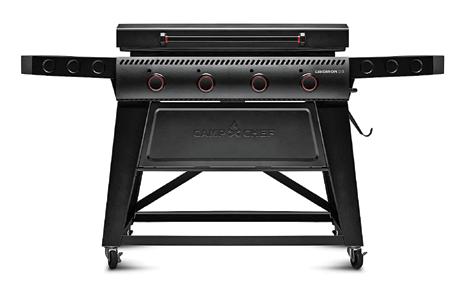
For years, I had a Blackstone flat top grill and fell in love with that method of cooking everything I could think of. After a few years and a few times moving it, things started to break down in a hurry. I replaced it with the Camp Chef Gridiron 36, and I feel the same way I did when I moved from a starter bow kit to the high dollar Mathews I shoot today. Take the shortcut, get a Gridiron, and enjoy endless grilling without fussing with igniters, propane hoses, and all the little things that wear out over time. There’s nothing better than sitting on the patio and grilling anything you want to perfection–from venison steaks to bacon, burgers, pancakes, even sandwiches. ~ Kevin G. CampChef.com
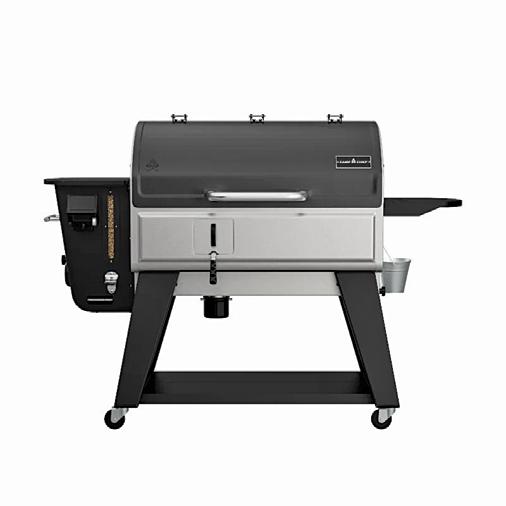
Feeding a family of six is not an easy task. Each kid wants something different, and none of them want what Mom and Dad have. That was the case until I picked up a Camp Chef Woodwind Pro pellet grill. Now, whether it’s brisket, pulled pork, chicken, or tri-tip, the kids are fat and happy, and I’m only cooking one meal. I got the big one because, well... four kids. That subtle flex during lunch at the office isn’t bad either. ~ Joe M. CampChef.com
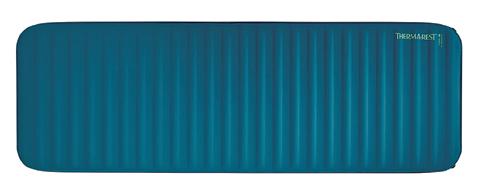
4 25 inches separating you from the elements. That’s all it takes for one of the most comfortable sleeping situations you can find. The “3D” sleeping pad is something I look forward to every time it gets packed into the Tacoma. The pad has a 7 0 R-value which makes it suitable for “extreme cold” according to Therm-a-Rest’s own measurements. I’m no scientist, but I believe they achieve this with the combined foam and air inner construction. It’s not small by any means, so it’s definitely a basecamp type of sleeping pad. Throw it on your favorite cot and you’ll be having a real hard time leaving your comfort in the morning. ~ Douglas M. CascadeDesigns.com




BY ERIC PORTILLO
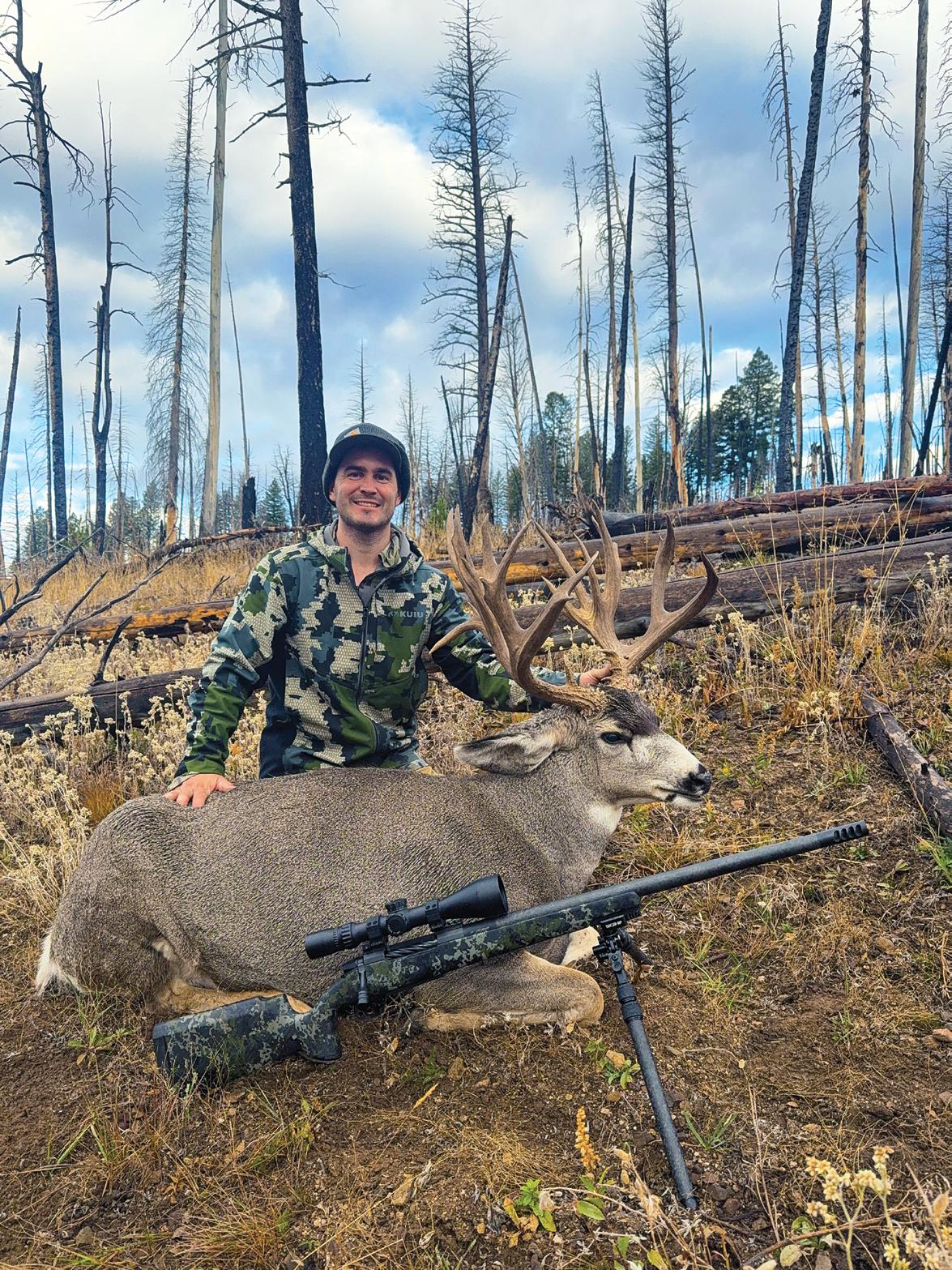
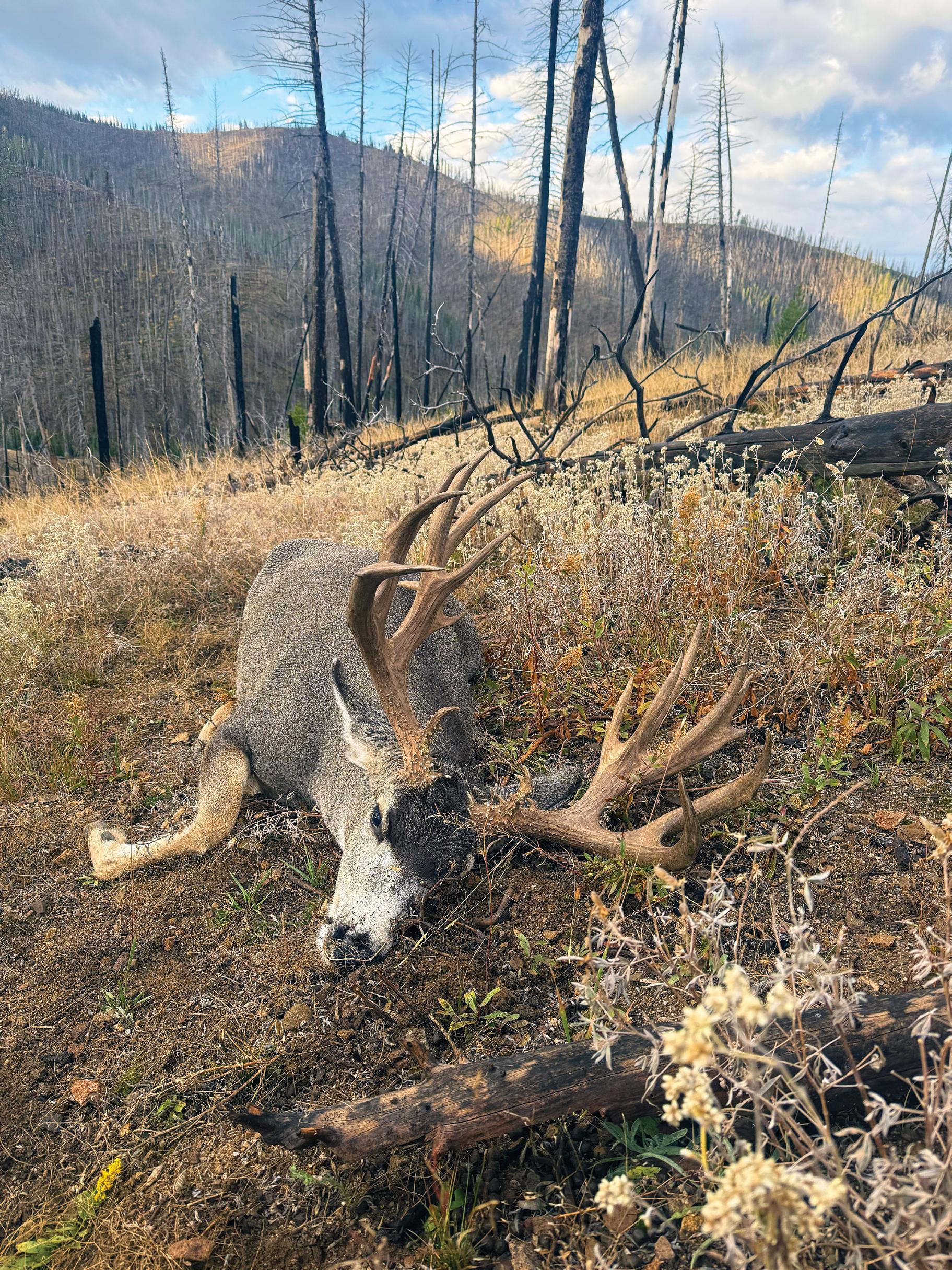
Within a few minutes, I caught a white spot of a deer’s rear end moving in the sunny open of a burn and instantly switched to my spotter to get a better look. At first glance, I couldn’t tell much. He kept his head low to the ground and kept his rack hidden from easy view. But after several minutes, he lifted his head just enough for the sun to catch his rack. That’s when I instantly saw what looked like a trident on his left side and a big kicker on his right side. My jaw dropped, and I was in disbelief. This was the biggest buck I
I texted my buddy right away: “Get back to camp, you need to see this
When he arrived and saw the video, he just looked at me and said, “That’s at least a 180-inch deer. You need to go after him.”
I couldn’t disagree. The tough part to swallow was that it was still the day before the opener, and all I could do was watch him feed for another 30 minutes before he went out of view. My buddy and I talked it over, and the plan was simple: come opening morning, I would drive down the road and hike a trail in the dark to a ridge that would put me within shooting distance of that mountain face we saw him on.
Of course, the rest of that day felt long, and the night felt even longer, just lying there trying to Will the plan work? Do other hunters know about this buck? These thoughts and countless scenarios ran through my head as I tried to sleep. When morning finally came, I quickly got ready, grabbed my pack and rifle, and took off down the road to the trailhead that would take me to the shooting knob. With a little luck, I was the first one at the trailhead, and I hoped parking my truck there would deter other hunters.
I quickly strapped my rifle to my pack, threw it on, and started down the trail with my headlamp on. I was able to hike the couple of miles in the dark quickly, and then hiked the last few hundred yards without my headlamp on to hopefully avoid spooking anything. However, right when I took my last step to set my pack down, my right foot felt the crunch of a dry branch as it snapped ever so “quietly,” and I instantly heard the crashing of a deer bounding away.
“Upon looking at him, all I saw was a mass of antlers. Then, he turned, and I saw the trident. It was him!”
Shoot, I thought. The buck must have bedded on my side, and I just blew him out. Still, I proceeded with the plan, set up my glassing equipment, and had my rifle ready to go as I waited for daylight. As the sun rose, I scanned every inch of that hillside across from me, hoping to glass up that big buck. Within minutes of the first rays of light, I spotted a buck feeding, and my heart began to race.
I quickly got everything adjusted for a shot and waited for the sun to rise further to get a better look. During this time, my heart continued to race, and somehow I lost sight of the buck; it felt like forever trying to relocate him. A few minutes later, I was able to relocate the buck, and, unfortunately, upon a better look, it turned out to be a smaller 3x4. I decided to use this time to practice getting on the buck and making sure I would be ready once I did find the big buck.
The day dragged on as I waited for the big buck to step out from behind a tree, but it was instead filled with wind, rain, and even snow. It was one of those long, cold, mentally taxing days behind the glass, where I started to think that the buck I had spooked was him, and he was now long gone or moved off elsewhere due to hunting pressure.
As darkness began to fall, I finally packed up and headed back to camp. Upon arriving back at camp, I let my buddy know I might have spooked the big buck and just hoped that it wasn’t the case. Like a good hunting buddy, he reassured me to stay the course and stick to the plan: to go back tomorrow morning and grind it out again.
The next morning, I stuck to the plan and was back on the ridge before daylight, all set up again. I started to grid the open hillside again, and about 40 minutes after sunrise, I caught sight of a white face in the open. My first thought was, No way... After that storm, he’s out bedded in the open? To put it in context, it had poured and thundered all night up until the morning. In my mind, the deer probably would have held up in the timber during the storm and then come out to sun themselves in the morning and dry off, but apparently not this buck.
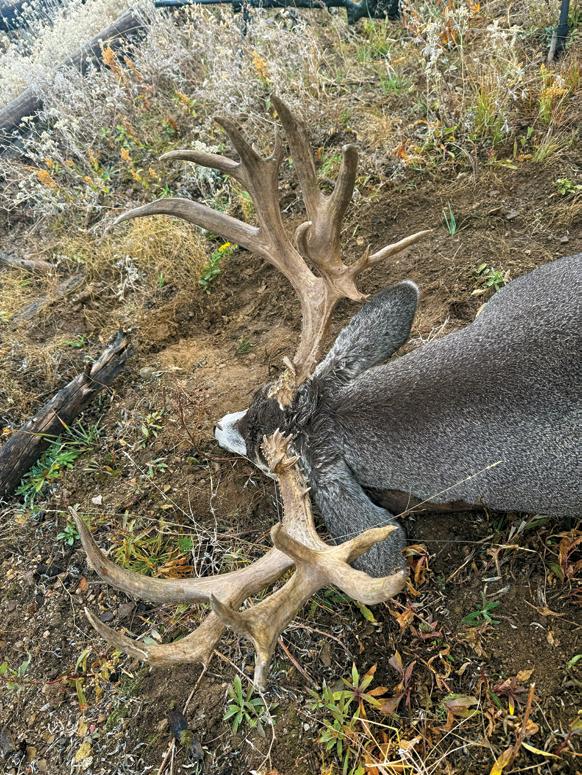
I quickly took my binoculars off the tripod and swapped to my spotter to get a better look. Upon looking at him, all I saw was a mass of antlers. Then, he turned, and I saw the trident. It was him! My heart had begun to race. It was time to put all my lessons learned from last season to work and capitalize on the moment.
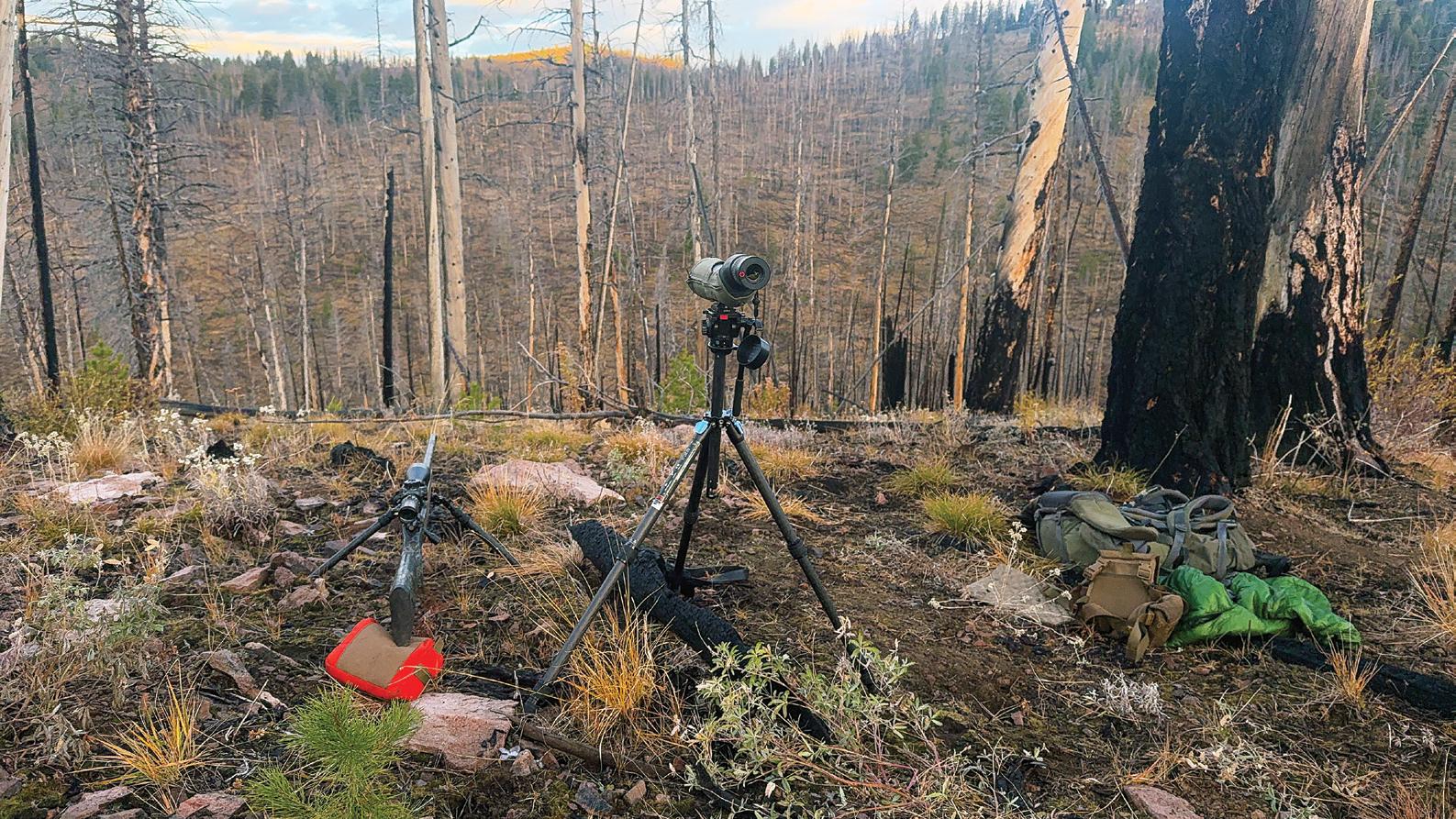
I quickly ranged him, dialed my elevation turret, and started trying to find a clear shooting lane. This was the tough part; he was in the opening of a burn on his hillside, but my hillside also sat in an old burn. The burn was full of twigs and deadfall. Every time I set up, a small branch blocked my shot. Just as I was about to reposition again, he stood up.
I quickly jumped back on the rifle, but where he stood, one branch on my hillside blocked my shot. I needed him to either take a couple steps up or down, and my bullet should miss this branch. Luckily, he headed uphill, clearing the branch that had been blocking my lane. With his head down, feeding, I settled my crosshairs just behind his shoulder, went through my shot sequence, and slowly squeezed the trigger.
Through the scope, I watched his legs buckle, and he dropped to the ground instantly. No tracking, no second shot needed; he was done right there. My hands were shaking as I chambered another round just in case, but he never moved. During all of this, my hands were shaking, and I was in disbelief. I kept looking through my spotter to double, triple, and quadruple-check that he was still down. It was over. I sent my hunting partner a text: “Just slayed the Trident.” The plan had come together perfectly. I had spotted him the day before the opener and killed him the day after the opener, textbook execution.
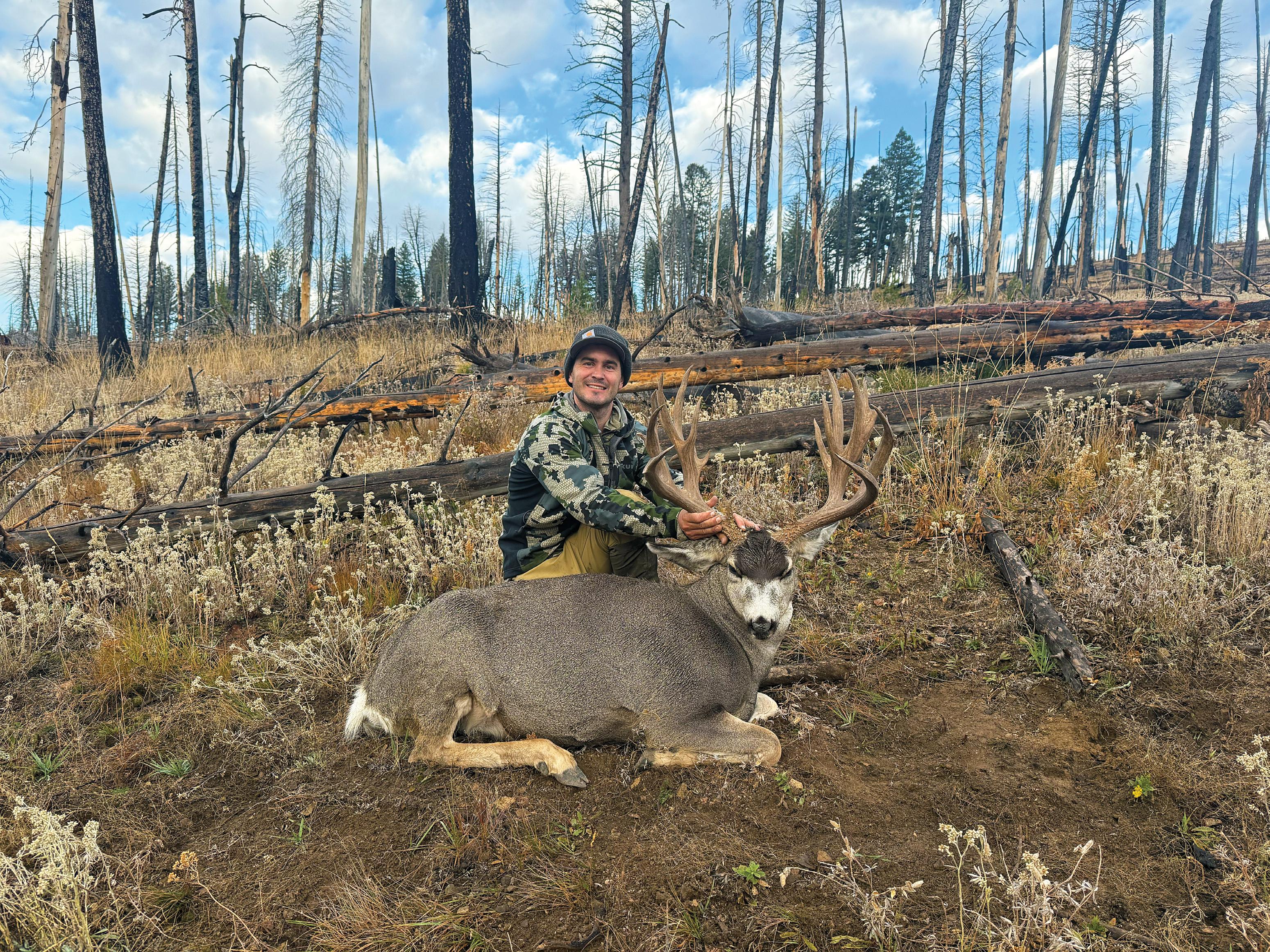
half miles away. He had all of that and so much more; he was an absolute monster. My jaw dropped. This was easily the biggest buck I’d ever put my hands on, and I was speechless.
over, gave me a big hug, and let me know how stoked and happy he was for me. Hearing him say that and having him there made the memory a lot more special. Not only had I killed the biggest buck of my life, but I had my good hunting buddy/mentor to share the moment with.
This hunt was more than just killing a big buck. It represented the years of my mistakes, the gear tuning, the discipline, and the patience it took to put me in the position to make it count when it mattered. WH
BY NATE SIMMONS
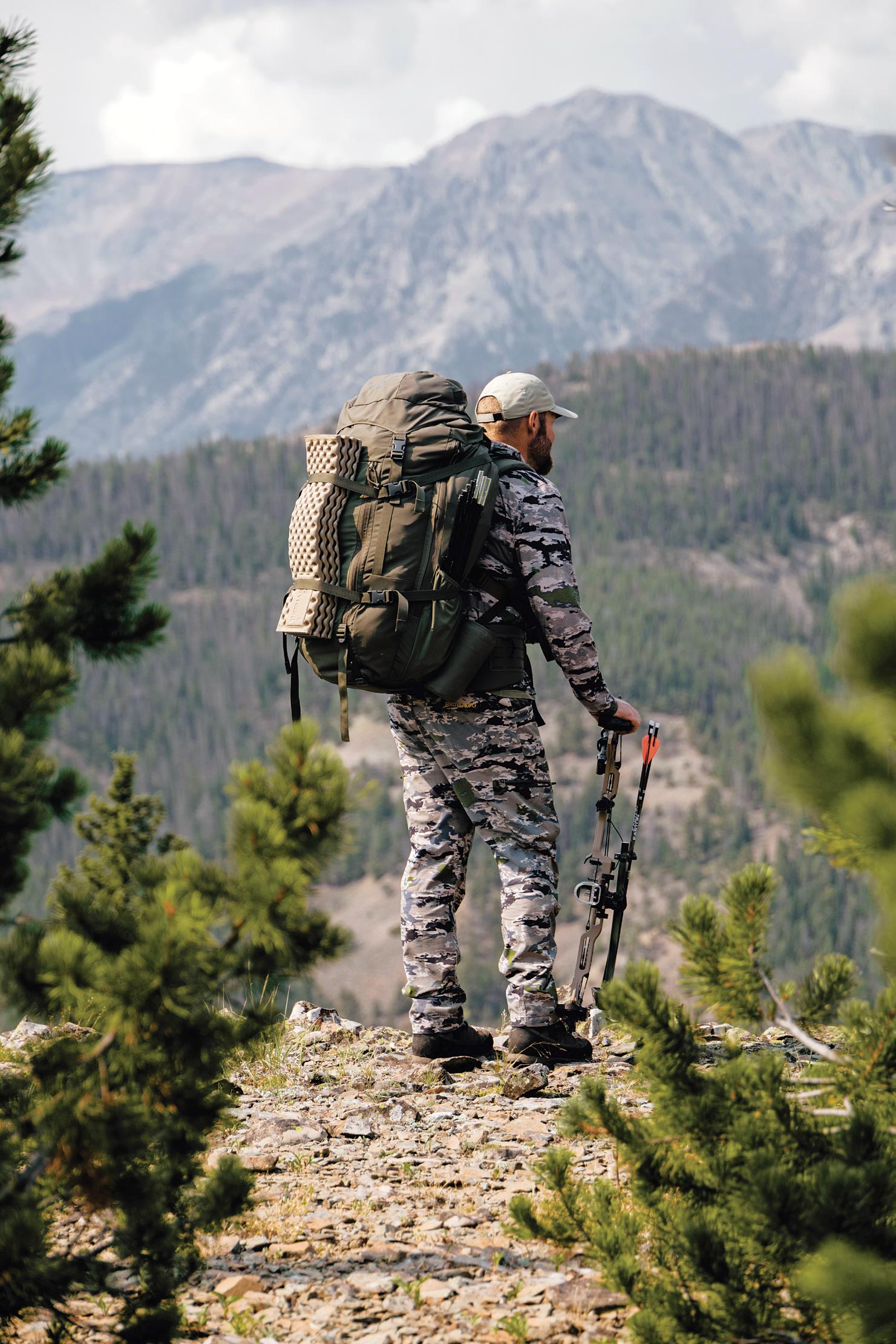
Just because this is a review of a 7200-cubic-inch pack, don’t think this is only useful for extended backpack hunts. While it is great in this department, it’s a great all-around workhorse, and that’s the main reason I decided to order this model vs one of the smallercapacity models. There really isn’t much of a weight penalty when choosing the 7200 vs a smaller 3600. For example, the 7200 weighs 5 lb, 15 oz, and the 3600 comes in at 5 lb, 8 oz, so the 7200 is only seven ounces heavier but provides twice the volume.
When fully loaded, this pack is large but without being obnoxious. It doesn’t get too wide and doesn’t extend too tall. One of the most amazing attributes of this pack is that when I’m out on a short day hunt and don’t have much gear with me, it compresses down nicely and feels like a much smaller, stealthier pack. I’m normally a fan of dropping my pack when I’m closing in the last 100 yards or so on my bowhunts, but this is the first pack I have used that stayed on my back on many of my close encounters over the last couple seasons using it; it’s just that comfortable, stealthy, and quiet.
There is a lot to discuss involving the pack, but the main takeaway, if you read no further, is that if comfort is important to you, the K4 system excels in this area. The hipbelt in particular is a game-changer; it makes 60-pound
loads feel more like 40 to me. The hipbelt stays in place even after miles of hiking, so you’re way less likely to have to stop and make adjustments to your pack along a hike. I have used this pack exclusively over the last two years for everything from turkey and shed hunting in the spring to high country deer and wilderness elk hunts in the fall.
The core of the K4 system is its frame and suspension. This is a modular system that allows you to purchase a packbag and frame together or frames and bags separately. The packbags are completely removable from the frame and interchangeable among the four sizes: 2200, 3600, 5000, and 7200 cubicinch models. One of the reasons this pack is so comfortable is the range of sizes they offer, allowing for a customizable fit.
Exo offers five hipbelt sizes and four frame heights, ensuring an ideal fit. I’m a 34" waist, and the size medium hipbelt fits me perfectly; additionally, I’m six feet tall, and the 25" frame gives me an exact fit. Beyond that, the shoulder straps can be fine-tuned for fit after you receive the pack. Exo’s website has great videos on how to measure yourself for fit, and those helped me get dialed in quickly.
Most high-end packs these days feature removable packbags, but the noteworthy point of Exo’s system is how quickly and easily it removes. There is nothing worse than being cold and exhausted at midnight after field dressing an elk in the steeps and having a wrestling match with your pack to get the bag removed to reveal the meat shelf. This system is user-friendly even with cold fingers. The packbag can be completely removed for tossing in the washing machine or partially removed, hinging at the bottom to unfold, revealing the meat packing straps hidden between the packbag and frame.
Before moving on to other topics, I should mention that the frame’s backbone consists of two carbon stays that provide just the right amount of rigidity for heavy loads while allowing the frame to flex slightly for all-day comfort. The packs are sold in both coyote brown and ranger green.
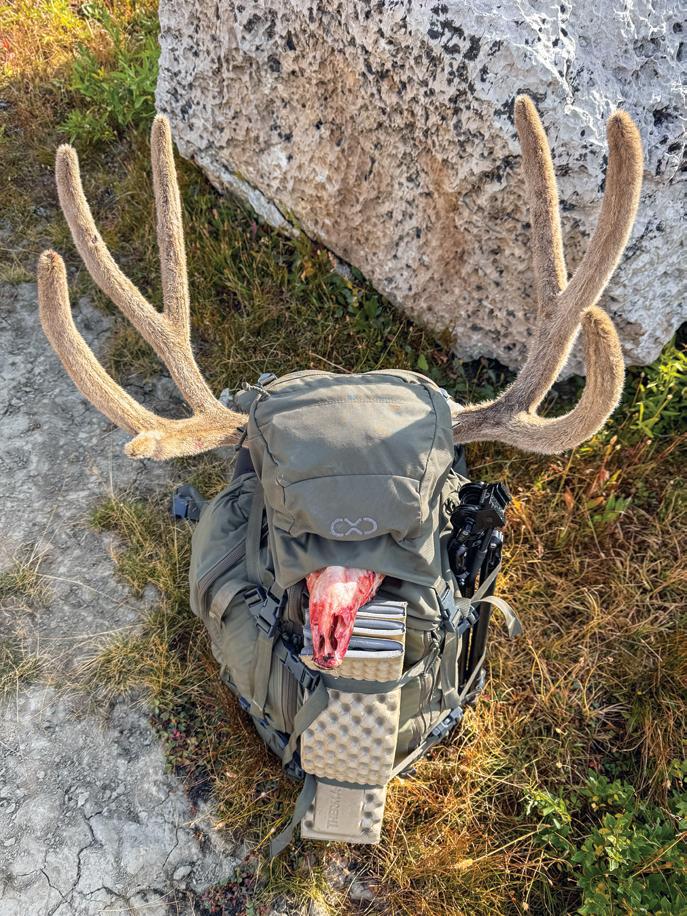
The K4 has a built-in meat packing system that’s sandwiched between the packbag and the frame. This system consists of two compression straps that buckle in the middle. There are two ways you can use this to pack meat. The first is to completely remove the packbag and strap quarters onto the frame via the two compression straps. I have not used it in this way yet, but I could see it being handy if I were shuttling elk quarters, though carrying loose meat and/or a head would be trickier with only two compression straps.
The second way is what I have utilized, and that’s to only partially remove the packbag, unfastening it from the top and sides, leaving the bottom straps attached to the frame. This allows you to unfold the pack like a taco. This method involves laying the pack flat on the ground with the suspension facing down, then hinging the pack bag open and out of the way, allowing you to set quarters and loose meat bags onto the frame and cinching them down tight with the two heavy-duty compression straps.
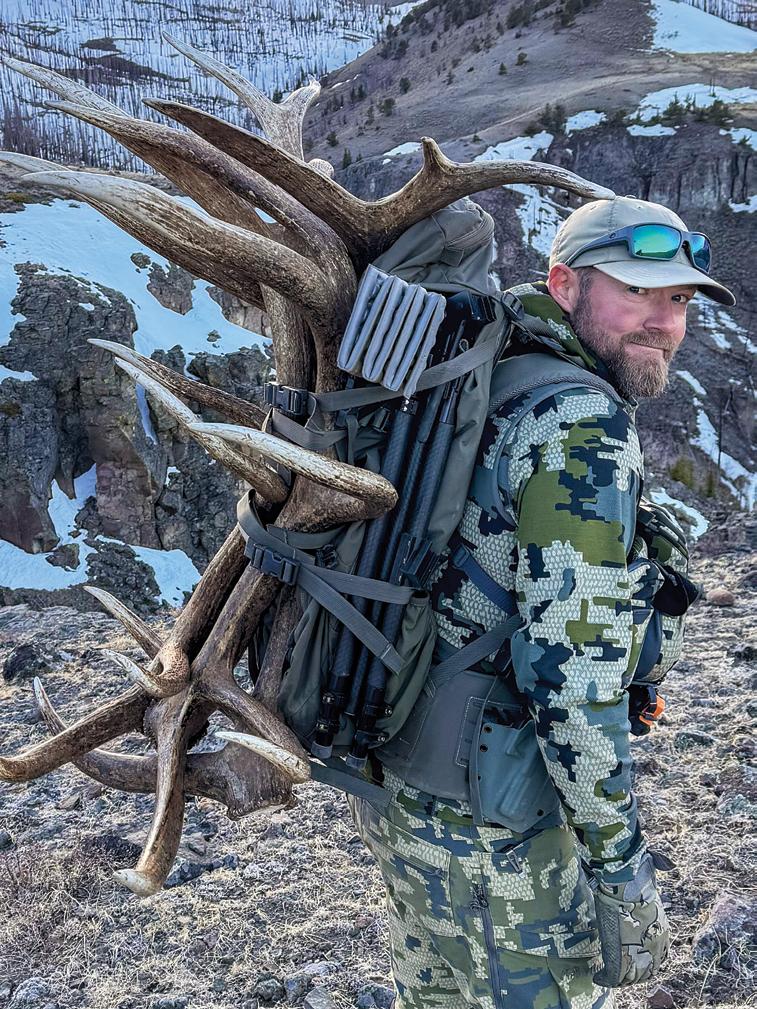
After securing the load, you can reattach the packbag and cinch it down with its compression straps to further secure the meat. This allows you to carry your equipment and meat at the same time and does a good job of keeping your gear from getting bloody. With the packbag reattached, it also offers plenty of options for attaching a deer or elk head, with a multitude of straps and buckles to rig it securely. This feature has come in handy on sev eral occasions, but I really put it to the test last September on a backcountry mule deer hunt where I killed a large-bodied buck in a hell hole, eight miles from the nearest road.
Over half of the packout was off-trail in steep terrain with poor footing. After arrowing the buck, Randy and I discussed our options. We didn’t like the idea of navigating the terrain and distance with insanely heavy packs, but we didn’t like the idea of dividing up the loads and making a second trip, either. We decided to attempt to carry our camp and the buck out in a single trip. We divided the load, both using the technique described above (he also has a 7200), and shouldered it. We never weighed the packs, but we were in the neighborhood of 90-100 pounds each.
The packout sucked because they always do, but the packs did amazing. That was the first extreme load I have carried with this pack, and the hipbelt design really shone. There is much more surface area for this hipbelt to hug your body than with other packs I have used, and it does a fantastic job of conforming to your hips and distributing the weight comfortably. I don’t get any pinch points with this design, and even under heavy loads, it doesn’t loosen after miles on the trail.
A 7200-cubic-inch pack that weighs under six pounds is pretty light; that includes the lid, which brings the pack to over 7800 cu in (the bag alone is 7200). I love the idea of a light pack, and over the years, I have tested some
ultra-light packs, only to be disappointed in their durability and performance under heavy loads. This pack excels in both these areas despite being what I would consider lightweight, given the 7800 cu in capacity.
This pack has seen two years of taking a beating, and I mean a beating. I use it scouting in the summer, fishing trips, big game hunts all fall, duck hunting in the winter, and in the spring shed hunting and turkey hunting. After two years of year-round use, the pack is in nearly perfect condition.
After a recent close inspection, the only signs of wear are on the mesh material inside the shoulder straps, where it touches my back. It’s not a concern at all; it’s just the only place I could find any sign of wear, which is pretty remarkable. I did break a prong off the main buckle on the hipbelt after accidentally stepping on it. Fortunately, this did not prevent the buckle from working; it continued to lock even with one prong for the rest of the hunt. I ordered a replacement buckle from the Exo website for $3.
Overall, I would say that the pack has been designed right in the sweet spot for durability; not overbuilt, adding unwanted weight, and not so light that it compromises durability. The buckles are solid and secure, the zippers all still work just as they did the day I received the pack, and I’ve never had an issue with any of them. This pack outperforms almost every pack I’ve ever owned in terms of durability; the only pack that offered similar durability weighed almost two pounds more. The bottom line is, this pack is extremely durable and lightweight, and that’s a difficult combination to find.
Exo kills it in this department. I don’t usually get too excited about a pack company’s accessories, but a lot of the Exo extras are too good not to touch on. I’ll start with my favorite, their Nalgene Holder. As I have gotten older, I have grown to despise drinking from a hose port on a hydration system. I much prefer to drink from a water bottle, but holsters can be floppy.
The way Exo designed their Nalgene Holder fixed my water dilemma for me. While it technically attaches to the hipbelt, its connection point is further back and angled, so it feels more like it’s attached to the frame than to the belt, yet still allows for easy access. Getting the Nalgene out is quick and easy, but it does take a little practice to get it back in. Since it’s positioned towards the rear of the hipbelt, it’s not as easy to set the bottle back in place, but it’s also why it rides so well and doesn’t flop around. It can be attached to either side. They make two sizes, one for a regular 32-oz bottle and a larger 48-oz version. I have only used the 32-oz holder, which costs $39.99. I should mention that the pack features a hydration compartment with a hose port, so you still have that option.
Another must-have accessory is Exo’s Hipbelt Pouch, which attaches to either side of your hipbelt via an integrated MOLLE attachment. I like to keep my headlamp and beanie inside mine, but it’s large enough that I can also stuff my gloves and/or a protein bar in there if needed. I like it so much I may order a second pouch, one for each side when not wearing a pistol holster on one side. It weighs just a few ounces, has a zippered top that’s easy to open and close with one hand, and goes for $29.99.
The 7200 with lid includes seven zippered compartments and four stuff pockets, so there’s no shortage of options for staying organized, but the Stash Pockets Exo offers are super nice for further organization. These are small, lightweight (less than an ounce) zippered pouches that can be attached to six different connection points within the pack. I could connect up to six, but I just use two in my pack, and they are nice for things I don’t need constant access to, like fire starter, an extra headlamp battery, blister tape, an extra lighter, etc. These are 8" x 6.5" and sell for $19.99 each.
I have not tried their Quick Release Rifle Carrier yet, but I plan on it. It would have come in handy last duck season on days we had to hike into our blind. Chris has one and used it on a couple of his hunts that I filmed. It looked like a great design, and he had good things to say about it.
Another accessory I don’t yet have but plan on getting is the K4 Dry Bag. Exo does not offer a traditional rain fly; instead, they offer a dry bag system
The dry bag for my 7200 weighs 9.5 oz and goes for $99.99. I could see this being a big deal on hunts in Alaska or on the Oregon coast, but I do wish they made a traditional rain fly as a lighter, quicker, less expensive option for the occasional rain or snow here in the Rockies.
For now, I have been using a Stone Glacier rain fly that fits my pack just fine and doesn’t weigh much, but it tears easily, so I have to be careful with it. Although Exo doesn’t sell a pistol holster as an accessory, I feel it’s worth noting how well their MOLLE system on the hipbelt allows holsters to attach securely. In the past, I’ve opted for a chest pistol harness because of floppy hip-belt holsters I’d used. The MOLLE that’s built into the Exo hipbelt provides a super-secure attachment, even for large pistols. Additionally, since the hipbelt does a better job of distributing weight, I felt my pistol’s weight would be better applied here than with another harness worn on my chest. I ordered a Gunfighters Inc. Ronin holster for the 10mm I carry in grizzly country, and it rides nicely connected through the built-in MOLLE system.
Lastly, the K4 Locking Buckles are not technically accessories, since they come standard with all K4 pack systems, but they are sold as accessories if you want more. Exo packs come with a male/female pair that I keep in one of my Stash Pockets. This serves as a backup buckle should any of the others break, but it also comes in handy for securing awkward loads such as shed antlers, a deer skull, or even a bow. These will not work themselves loose, even if they are sitting at an awkward angle on a hard object, where most buckles tend to come loose. When these are needed, you simply remove a set of buckles on the pack and replace them with these. It’s quick and easy to do and can really make life easier for specific situations. At just an ounce, I always leave my set in my pack.
I like to stay organized and have a place for everything in my pack, and the 7200 makes my life easy here. With seven zippered compartments and four stuff pockets, I have a home for just about everything I carry. The bulk of this pack’s volume is in the main compartment, which can be accessed via a zipper running lengthwise or through the rolltop opening. The rolltop opening also makes this pack versatile, allowing it to “unroll” upward for larger loads or roll down when extra space isn’t needed. The rolltop opening is secured by a buckled closure, so it never works its way open accidentally. Between the main compartment and the frame is a thin, waterproof hydration compartment. This features its own zippered entry point on the top of the pack, so you don’t have to open the main compartment to access your bladder. I use this all the time to carry extra water so I can refill my Nalgene. The waterproof liner is a great idea in case you spring a leak; your gear inside the main compartment stays dry.
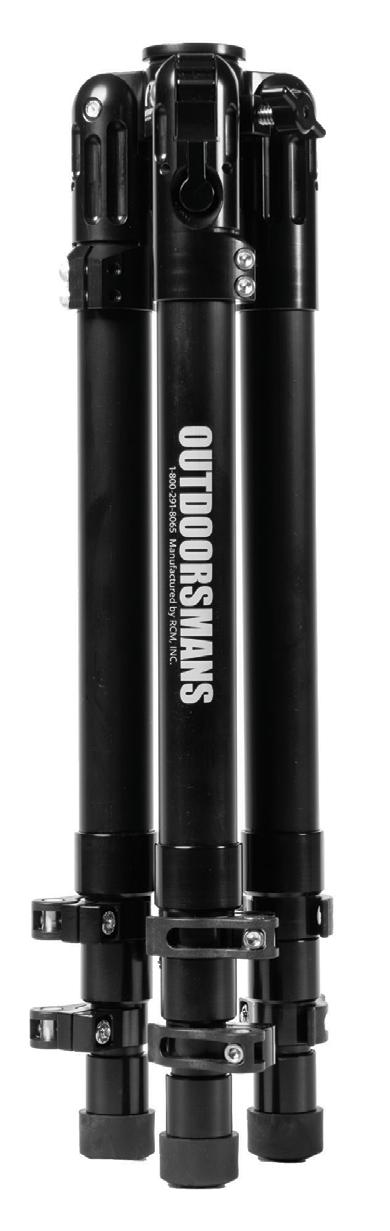
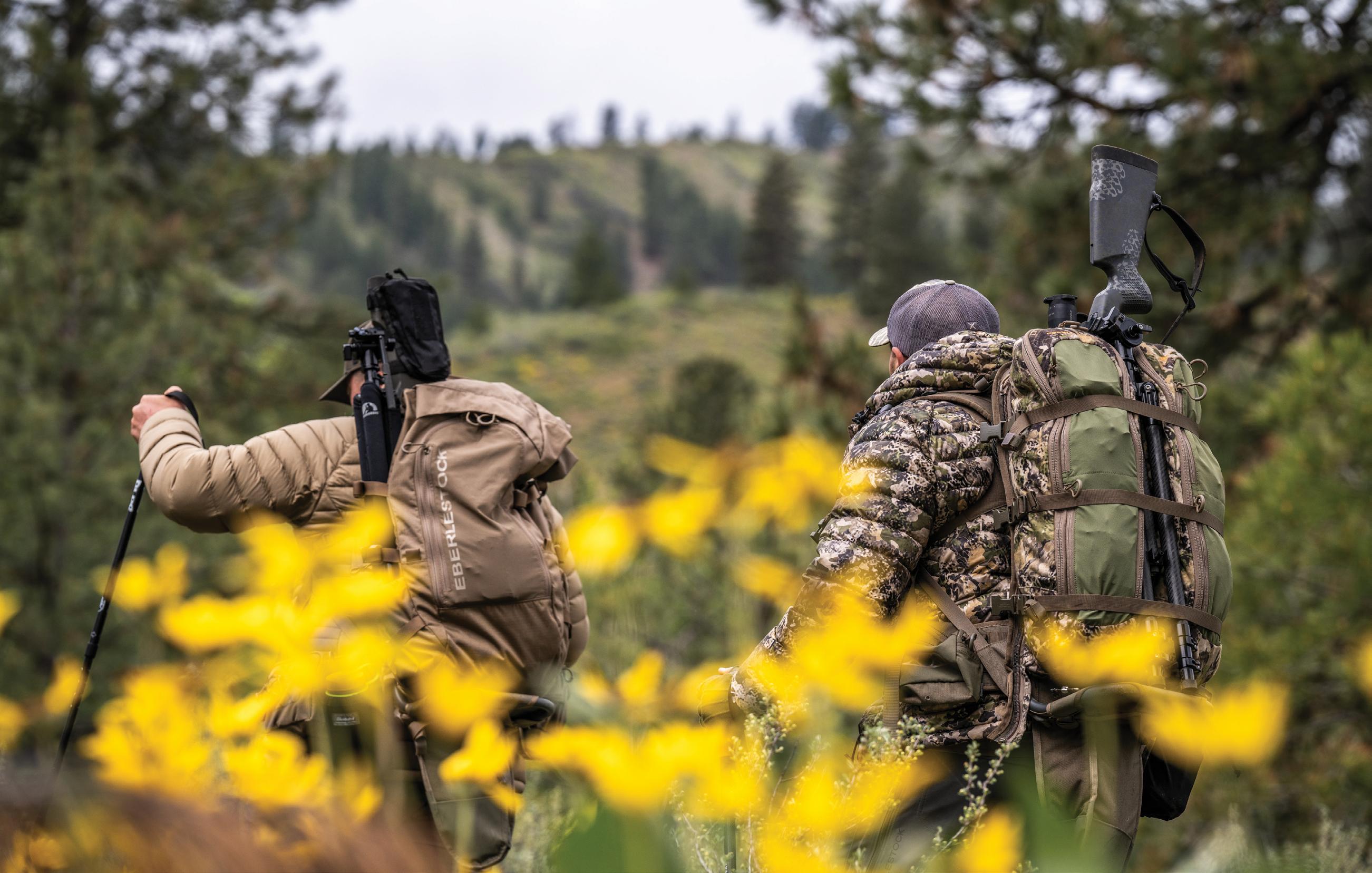
There are two long vertical zippered pockets on each side of the pack, perfect for quick access to a tripod and a spotting scope. My tripod is on the large side, nearly 25" when collapsed, and while it does fit into these side pockets, it’s a snug fit lengthwise, so I attach my tripod in another way, which I will discuss in a minute. These side pockets are roomy; there is plenty of space for items beyond tripods and spotting scopes. I have even fit my one-man tent with rainfly and poles into one of these pockets, and that is where I attach my two Stash Pockets.
On the lower sides of the pack, there are four stuff pockets–two on each side. These are stretchy and can be overstuffed, but stay tight to the pack when not filled with gear. Another great feature is that one of the two openings faces forward towards you as you wear the pack, making it possible to stuff things like gloves into these pockets without taking the pack off. The other pocket that faces upward is where I rest one of my tripod legs to keep it from sliding down, and it is held in place by the two buckled compression straps on each side of the pack.
There is another zippered pocket centered on the back of the pack that is generously sized but shallow. I usually keep my wipes in here. The lid is removable and features two zippered pockets: one main compartment that can fit a lot of gear, and one smaller shallow pocket on top where I keep my knives, InReach, and a pen.
To be honest, this pack has exceeded my expectations and offers features better than I could have ever dreamed up, but if I had to wear my prima donna hat, here is what I would complain about: No traditional rain fly, but they do have a pack-specific dry bag system that is 100% waterproof. The pack has eight sets of buckles on the ends of the compression straps; two on each side, two across the back, and two that secure the lid in the back. The buckles themselves are awesome, and the straps are in the perfect locations, but it would be nice if the buckles could be color-coded so you always know where each buckle connects without having to think about it. I have occasionally buckled the wrong buckles together by accident; no big deal, but remember, this is just nitpicking.
Lastly, since the lid is completely removable, it would be cool if it could be converted into a fanny pack for carrying smaller items. There are times I might utilize this for the last part of a stalk when I don’t need my full-blown pack but would like access to a little water and maybe a light rain jacket. This would add a little weight, but perhaps the buckles used in the fanny pack could serve as a backup set to the main hipbelt buckles, which would help justify the extra ounces.
Maybe at some point down the road, I will get a smaller pack model for days when I don’t need the 7200’s volume, but this pack is wildly versatile. Considering the pack’s compression strap system allows it to be cinched in tight when you don’t have much gear, it makes a great day pack in addition to a multiday. Honestly, the only reason I might ever get another smaller model is that I like nice packs, not because I “need” one.
This pack does everything I need it to. It’s a multiday/expedition workhorse, but the extra space comes in handy on spring turkey hunts as well, when I’m packing a couple of full-body decoys. I have had trouble finding a pack with main compartments large enough to accomplish this, and it’s no issue with the 7200 with gear, to boot. Another element I like is that the extra volume lets me fit everything inside the pack when packing for a multiday trip and prevents me from having to strap things like tents to the outside, where they can come loose, get wet, or be torn.
Coming in at $729.99, this isn’t an inexpensive pack choice. At this price point, it better be good, and after two solid years of use, I can wholeheartedly say that it is. When it comes to the 7200 specifically, I think its versatility makes it particularly attractive as a do-it-all pack. I have owned plenty of multiday packs in the past that I would never have chosen for an easy day hunt, but this pack is different. The other thing to consider with the price tag is durability. After everything this pack has been through so far, I expected to find more wear, even on close inspection.
This pack is going to last, and that makes it a safe investment. Beyond the versatility and durability, this is the most comfortable pack I have used. I already discussed why this is earlier, but beyond the fit, it’s also extremely breathable. I can usually feel a little airflow between the pack’s frame and my lower back, which is a welcome feeling on early-season bowhunts.
I’m not sure I have ever had a pack that squeaked loud enough to spook game, but a squeaky pack gets super annoying after miles on the trail. This pack doesn’t do that... like, ever. It doesn’t matter if my pack material is dusty and hot or wet and cold; it just stays quiet. I don’t know how they accomplished this, but I’m thankful they did. I could not be happier with this pack and look forward to many more adventures with it in tow. WH
TECHNICAL SPECS:
Capacity: 7200-7800 cu in Weight: 5 lb, 15 oz
Cost: $729.99 Contact: Exomtngear.com


BY BRODY LAYHER
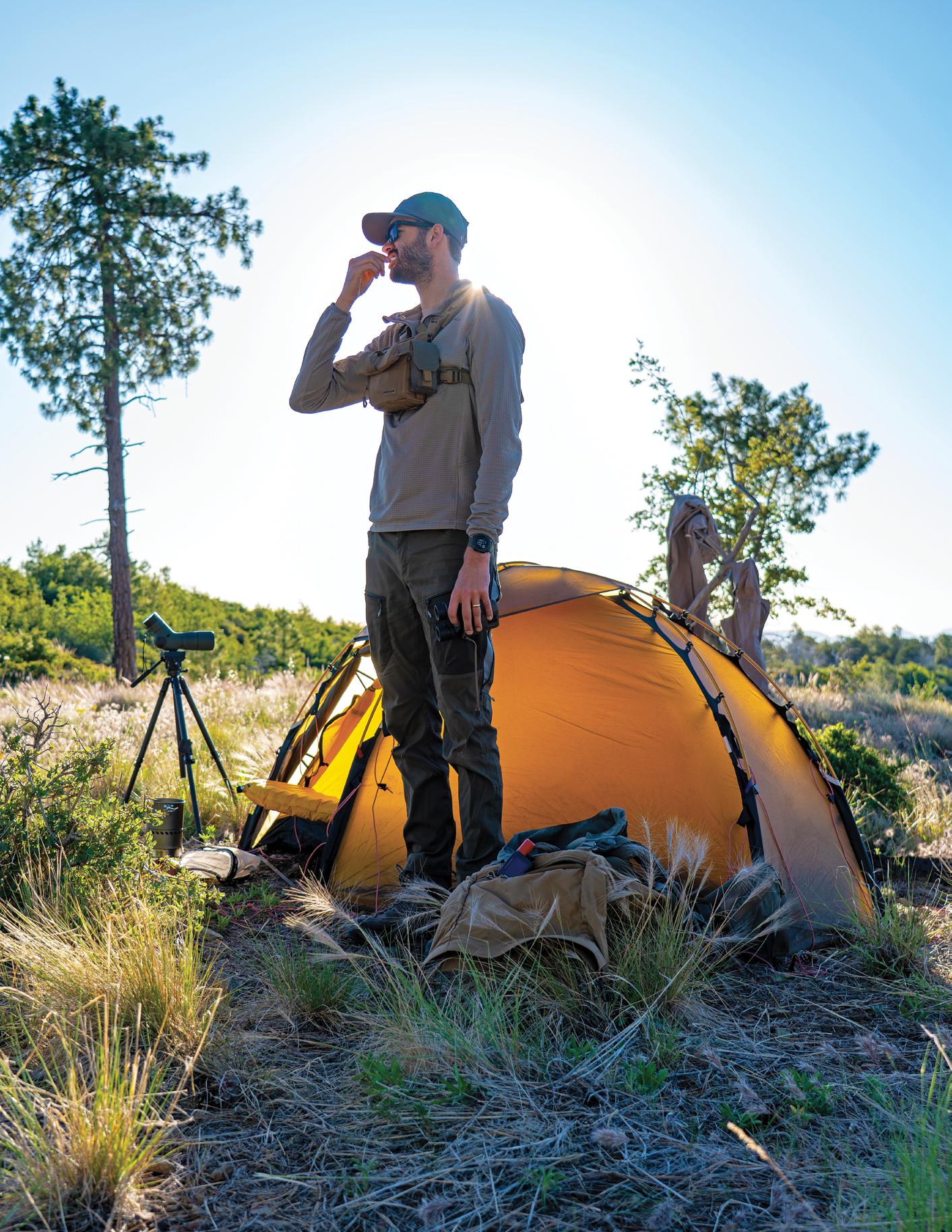
This is the most well thought out piece of equipment that I own. Every single swatch of material has a purpose. It’s hard to convey the sense of security this tent makes me feel, not necessarily from critters, but from any weather. After only a few nights, I can tell why so many guides from Northern BC to Kyrgyzstan choose the Soulo.
These days, a guy has a lot of options when it comes to a pair of huntin’ pants. You can spend upwards of $300, or you can use your old blue jeans. Both will probably get the job done, but the latter will rub your legs raw, and the former might make it so you can’t afford the gas to go on that next scouting trip. The new Vesper pants are a perfect mix; they don’t break the bank, they’re great for all-season use, and they’re durable enough to go season after season. These are the pants most folks have been searching for.
Mid-layers are not all created equal. Most of them are too tightly woven so they don’t breathe well, or they’re so stretchy they’re impossible to take on and off. The guide air and its NexGen Air channels allow the piece to breathe while you’re hiking, but trap enough air to keep you warm while you’re waiting to hear the next bugle. Brad and his team over at Argali may be known for their tents and other hunting accessories, but they’re well on their way to making a dent in the clothing market.
I have been carrying a scratched-up old InReach Mini for several years now. It works, but it’s like sending smoke signals. This latest generation not only sends texts as fast as iMessage, but it also holds a charge for nearly double the time while taking a charge from any battery bank. The Plus also sends photos via satellite now, so now when your wife asks for a picture of the sunset you told her about (she doesn’t actually care), you never have an excuse not to show her.
This seems dumb, right? Maybe it is, but I switched over to these little singleuse toothbrushes for my backcountry hunts, and I am not going back. No fear of running out of toothpaste, they come in with a built-in toothpick for when you’re eating an iron-y backstrap you just cooked on a stick.
I didn’t want to like these. They are small and ugly, and the glass isn’t very good, but I will pick these up (and handhold them) over a pair of NL Pures every day of the week. That may sound sacrilegious, but I promise you it’s true. The stabilization makes up fivefold for the lack of glass quality and field of view.
Making rain gear that doesn’t weigh you down while also doing its intended job is virtually impossible. Most of the time, when you go lightweight, you end up with wet shoulders and a wet ass. When you go heavy, you keep the rain out but the sweat in. The new Borah doesn’t weigh any more than your average backpacking rain gear, but it keeps the wet out better than most of them. It’s a full-featured set that can be worn over your hunting clothing or as a single layer when you know the weather isn’t going to let up. WH
BY BRODY LAYHER
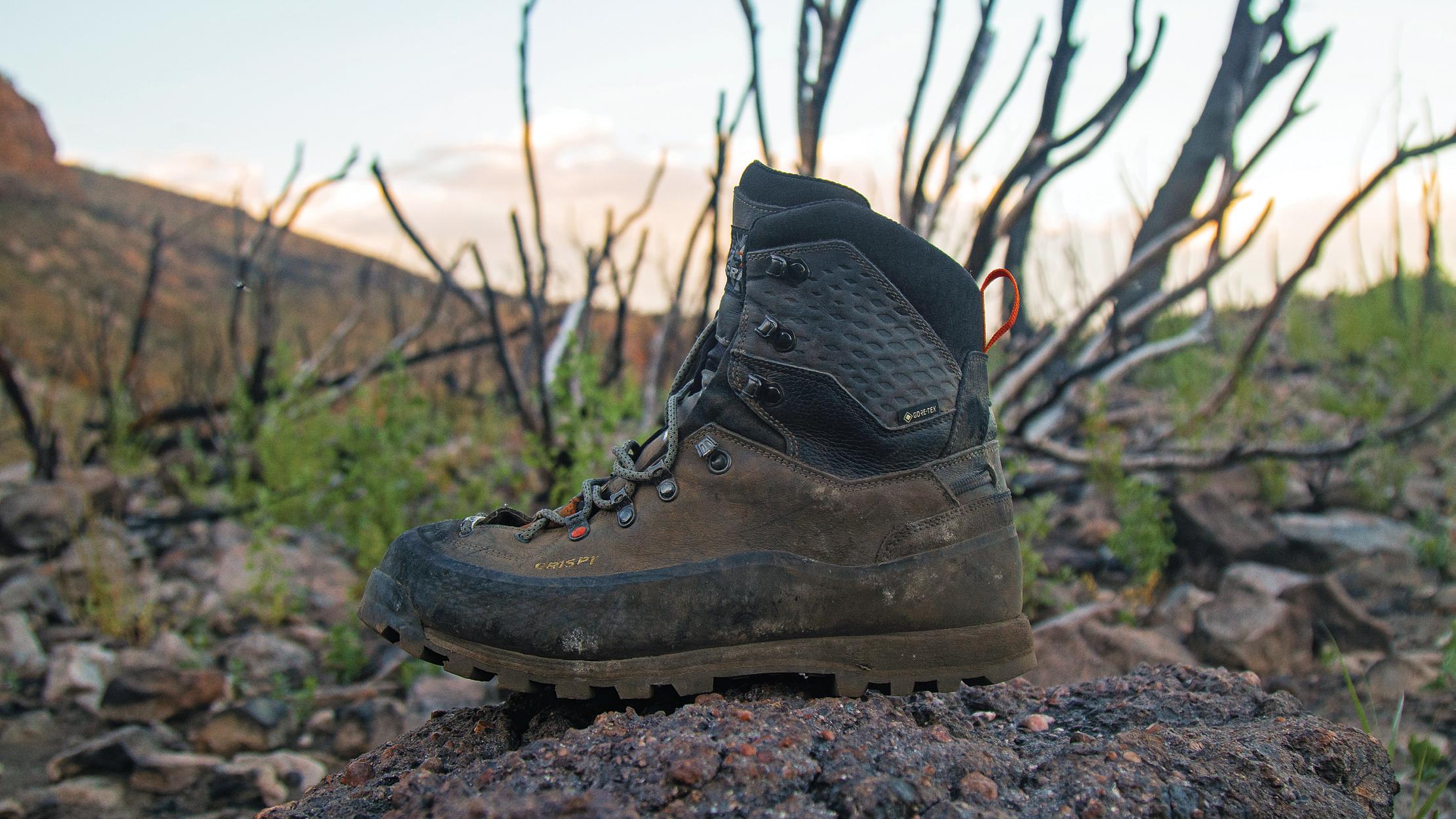
This is the third pair of Crispi boots that I have owned. I have a pair of Briskdals with well over 1,000 miles on them and a pair of Wild Rocks that have a lot fewer miles but have served me well on a few late-season hunts. I say that because I have a pretty good understanding of the quality of a Crispi boot. They only use high-quality materials and build them in a proven way, but the thing that sets them apart is their ability to design a near-perfect boot for almost anyone’s situation. The Lapponia Pro is another great example of this.
They’re built on the classic dual-density EVA foam midsole that a handful of other boots in the line use and feature their full control outsole that offers a slightly more aggressive and taller lug than other boots in its class, but what’s above that is what really makes them great. They’re wrapped in a full rubber rand that provides more protection and durability than a sew-in rand, and they have a full greased nubuck leather upper. The leather is water-resistant, but like most boots in the line, they have a full Gore-Tex lining. When you add all of these things up, you get a boot that weighs 1 lb 6 oz, which is 4 oz lighter than any similar 9-inch boot.
To me, this is a very dynamic boot. Crispi says the Lapponia Pro is for everything from September to November, and so far, I can see how that would be true. It’s a 2.5 on their flex rating, which is right, smack in the middle. On a recent trip through some of the more rugged and steep country that central Arizona has to offer, I had no problems traversing loose rock on steep hillside as well as recently burned timber.
Now, I was packing around 80 lb, and the boot felt really good, but I don’t think this will be the boot I choose to bring to Alaska, where side hilling with 80 lb for five miles is a real possibility. This isn’t because the boot couldn’t handle it–I have no doubts about that–but they’re not quite stiff enough to feel secure in situations like that. With all of that said, I do think this will be the boot I run for nearly everything in the lower 48 until it’s time to bust out the insulated boots.
This boot separates itself in my mind because it offers the protection of a heavy-duty mountain boot at the weight of a more dainty trail boot. Shaving 10 oz (compared to the Briksdal MTN) off my boots while only giving up a small amount of support that’s only needed in extreme conditions makes it an easy decision for me. These boots and I are going to see many, many places over the next couple of years. WH

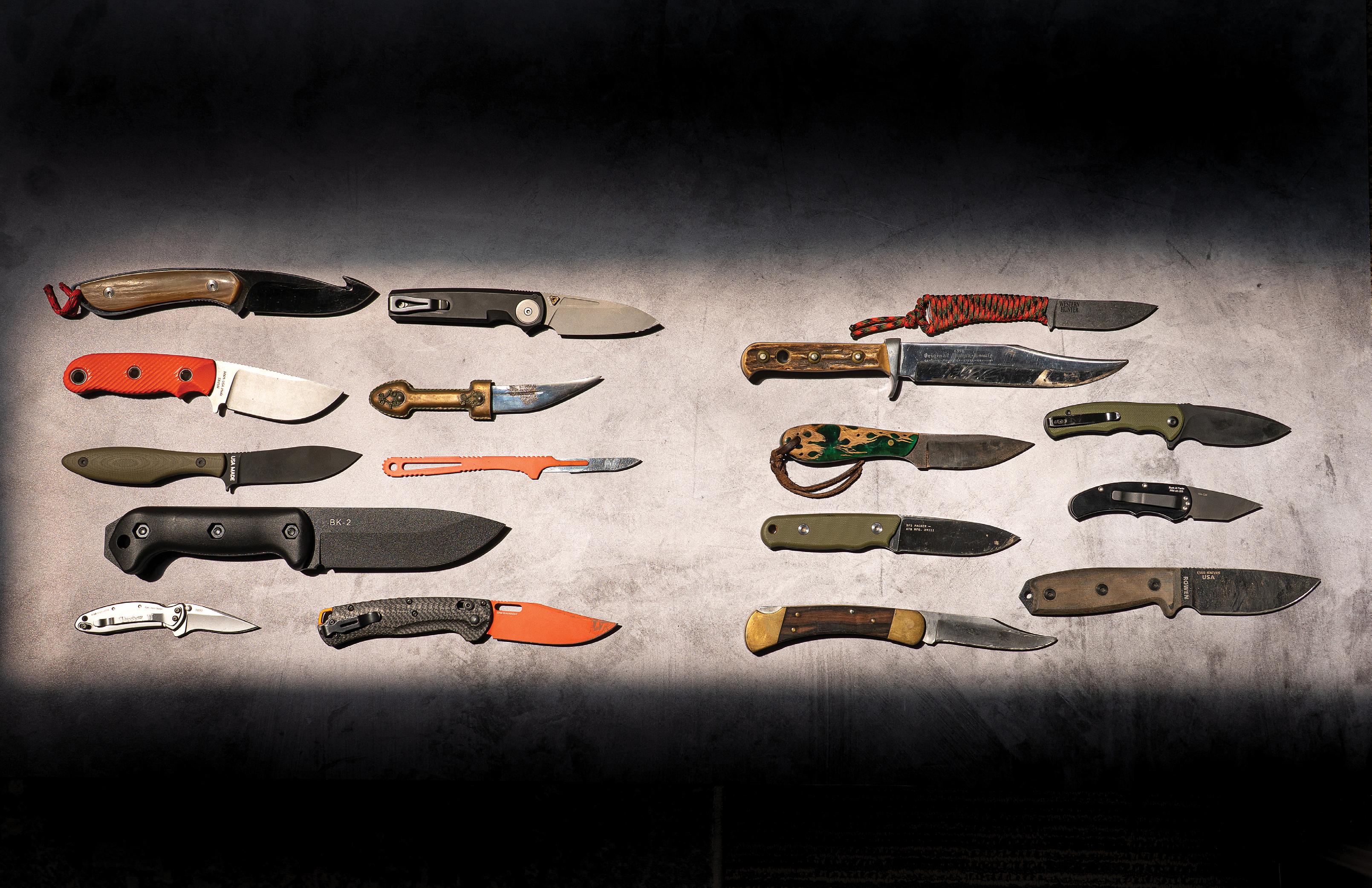
3. MKC Jackstone | There’s just something about a Canadian belt knife design that resonates with me, and always has. When MKC released their take on it I knew I’d eventually pick one up, and once I did I was reluctant to ever put it down. Every once in a while you hold a knife and instantly think to yourself, yup, this is it. Well, for me this was it. The leaf-shaped blade, balanced
and versatile function
8. Kestrel Mountain Scalpel | During the first half of last hunting season, I carried a Havalon-style knife from a different company, and it worked OK, but it was bulky and awkward to handle. After watching the guide I was working with take apart an entire Dall ram with one of these, I knew I had to give one a shot. In the latter half of the year, I got to put my mountain scalpel to work on a buddy’s coues deer, and I was quite impressed. The simple design is easy to grip and doesn’t slip out of your hand like others do. The fact that it completely disappears in the back of a bino harness is pretty nice, too. ~
| Wait... Two MKC knife highlights? Yes. This one is extra special. It’s the stripped-down, lightened-up version of the Stonewall Skinner–an ideal lightweight skinning knife from the cult of cults. But this one comes with a twist. There are fewer than 10 of these out and about in the world right now, and there are only two ways to get one. You have to either 1: work for Western Hunter or 2: write us an article that gets printed–therefore working for us… If we print your work, you’ll get one of these along with a solid haul of
BY DOUGLAS MORALES
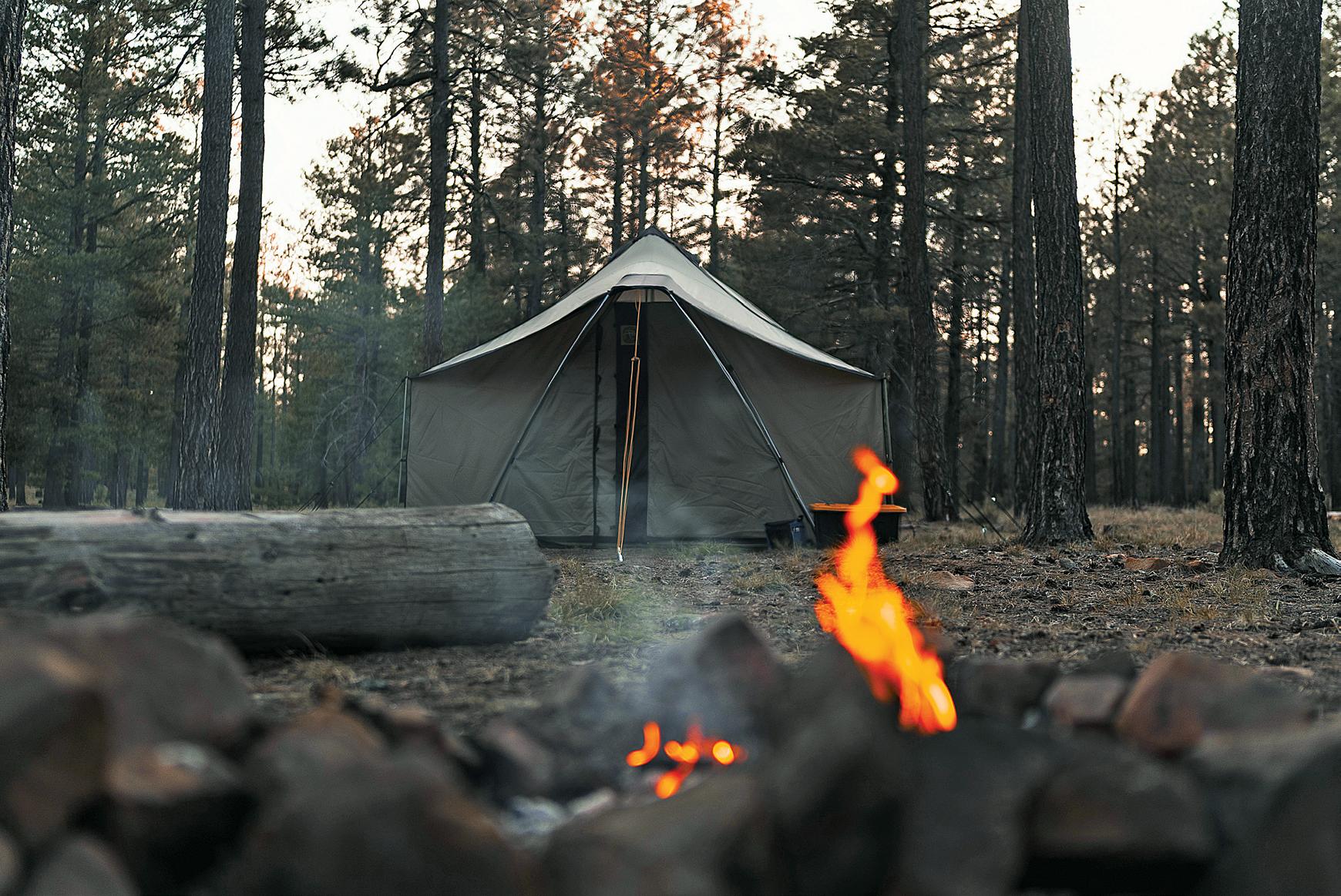
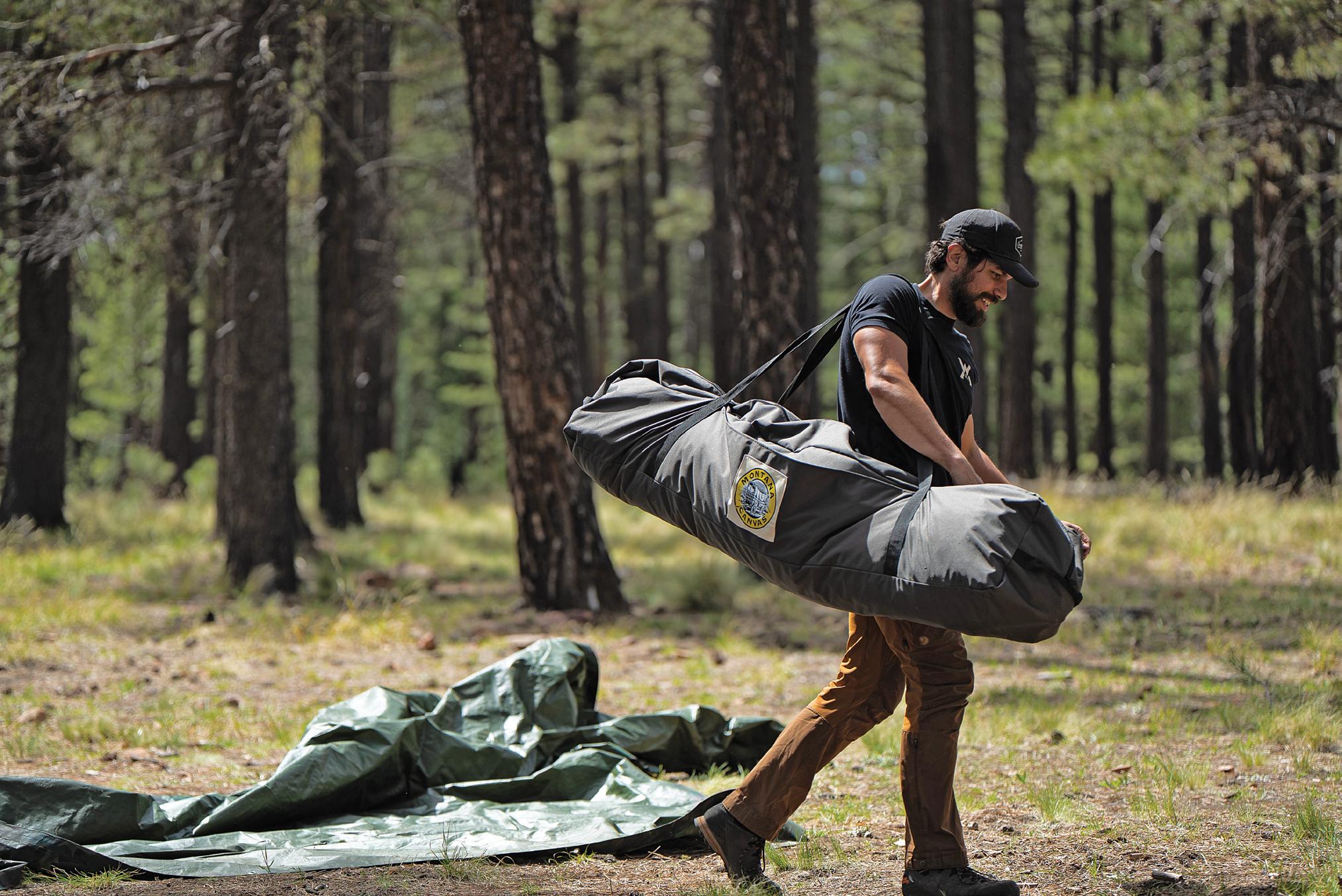
Ihave been using a hand-me-down Montana Canvas for a few years now. Before it was semi-retired to me, the tent had seen adventures across the West following Chris Denham as he filmed dozens of episodes of The Western Hunter. Starting with season 3, all the way through season 10, to be exact. When it came time for me to fully retire the tent, I had done all the first-hand “research” I needed and went straight for another Montana Canvas. The build quality, customer service, and history won me over, and six days later, the Bridger Tent showed up with a knock at the door.
First things first: the materials between my hand-me-down and the Bridger Tent are not the same. It was a conscious decision on my part to go for something lighter than before, since, as much as I’d love to, I don’t venture into the deep-below-freezing cold as Chris would in his tent. The main walls are Relite 250HD with a 1,500mm polyurethane (PU) coating for protection against moisture, UV rays, and abrasion. The floor is a thicker Relite 300HD with twice the PU coating to further protect against ground moisture and foot traffic.
The design of the Bridger Tent leaves no room for criticism. Most people who know me know that I am annoyingly always looking for things that, in my opinion, could have probably been done better with more thought. In this case I’ve failed to come up with a single item I would change, and not for the lack of looking. The 14'x14' tent has three good-sized windows, a giant T-shaped front door, a well-protected stove jack with a zippered floor opening for the stove itself, three ventilation screens at the apex, and one more right above the main opening for airflow. All of the zippers are YKK and have reflective paracord attached to them for easy handling. A footprint of 196 square feet is plenty of room to house a few cots, a kitchen corner, gear totes, and storage, even tables and chairs, depending on whether or not you’re using a tent stove.
The verticality of this tent is incredible. It stands 10 feet at its highest point and comes down to five feet at the walls. This means I can stand fully upright in more than 150 sqare feet of this tent. After long days and early mornings, being able to comfortably stand, stretch, and relax without having to hunch over inside your tent is an absolute luxury.
Standard with the Bridger Tent is an awning that stretches out five feet from the door, tensioned up by two incredibly robust sections of metal tubing. It’s when you’re giving the awning the old “yeah, that’ll hold” test that you’ll notice that embedded throughout the edge of the awning is a quarter to half-inch thick rope of some sort to give it added integrity in the wind. This integrated rope is found throughout the Bridger tent’s entire “fascia,” in fact.
Setting up tents is classically a relationship-testing trope, and for good reason. Many tents offer little to no explanation other than an IKEA sketch they threw in at the last second. The Bridger tent took me 35 minutes to set up for the very first time, and that was with the “help” of children under seven. Realistically, after getting the routine down, I believe I can get the final guy line cinched down at around 20 to 25 minutes.
The setup is routine: stake down the four corners with the provided heavy-duty stakes, add the four corners’ poles and lightly cinch down, then add tension with the 10-foot center pole. It’s a piece of cake. I would argue a stubborn man can absolutely do it solo; however, the extra set of hands would make a noticeable difference. My very first time out with the Bridger, my two “helpers,” my wife, and I spent a weekend up on the Mogollon Rim. We packed in two full-sized cots and a queen-sized air mattress, a “situation” table, and a couple of gear totes with enough room for the helpers to play catch with pinecones. The days were warm and the nights brisk, but never uncomfortable sleeping within the walls.
This is my first experience with the wall poles being set up on the outside rather than inside, and I have to say that this change alone would have been worth the upgrade. The five-foot poles double as your anchor for the guy lines attached to the tent. You don’t think much of it at the moment, but when you’re done with your trip, the advantage becomes obvious.
The lines are quickly removed from the anchors and stored separately, nice and neat. Your tent doesn’t become a kraken of 14 separate lengths of rope jumbled on top of a folded-down tent. I used to consider that a problem for “future me,” but now it’s something I won’t have to think twice about.
Finally, when it’s time to load it up into the truck, you’ll be pleased to find that the oversized duffel accepts the folded materials with ease and then cinches down tight, taking a relatively small berth in your truck bed.
The stove jack is a standard five-inch silicone oval with over-built fireretardant materials. Underneath the stove itself is a 40-inch zippered oval for instant access to safer grounds, although I’ll still put an oversize stove mat underneath just in case a stray ember decides to put a singeing on my day. Unfortunately, I haven’t had a chance to get this tent out during a snowy season, so I’m still left curious about heat retention regarding materials and the ventilation screens.
Montana Canvas perfectly bridged (absolutely intended) the gap between a full-fledged canvas wall tent and your entry-level tent. The entire package only weighs 83 pounds, which sounds like a lot if you have never owned a
last season’s effort won’t carry next seasons’s weight.
BY REMI WARREN

Growing up, hunting gear was not really catered toward me. Camouflage was either old military fatigues or Realtree patterns that looked nothing like the trees out west. Gear was made for sitting, not hiking; binoculars were on straps that were not comfortable, and packs used large metal frames made for backpackers. Western big-game hunting was not yet a market, and the gear reflected that. It was not until I was out of high school that it started to change. Brands started creating purpose-built hunting gear, packs for carrying out heavy loads comfortably, and clothing made for moving, with camo patterns matching the high desert and alpine.
Even when I started filming solo hunter in 2010, time and time again, we were told western big game hunting is not a market. “Whitetails are king.” Yet we kept going and kept seeing a shift in mindset, a shift in gear progression, and a shift in both entertainment and information. That shift gave those of us who love to chase animals across a large expanse of public land access to gear that matched the pursuit.
The pendulum quickly started swinging the other way, toward the building of companies and gear for western hunting. Some great stuff has been made over the years in nearly every category of gear, in my opinion... except one. Every time I put a mechanical broadhead on my arrow, I question it; I think differently about shot placement and the what-ifs of hitting bone on a large animal like an elk.
In the back of my mind, I know none of the options I tried were designed for what I do. They were just marketed to work for the task but not actually made for it. It seemed to be an “it will get by” mentality. It’s the same way I felt wearing my Realtree cotton pants, soaking wet and sweating up the mountain on a backpack hunt with a loud, bright blue Kelty backpacker’s frame pack. It was clearly not made for this.
One of my favorite parts of what I do is to be a part of the development process of new gear, get to field test the new best thing, or maybe help provide a missing piece to the search for the perfect gear. I have had the privilege to work with many companies over the years doing just that. Now, as the owner of Day Six Archery, I get to continue to be a part of that process. As a company, we wanted to tackle a piece of gear we all thought was lacking when it came to western big game hunting: the mechanical broadhead. Armed with an incredible base of knowledge from Bryan, our founder, and Daykota, our resident engineer/elk killer, Day Six set out to tackle the challenge.
After a long week of elk hunting filled with “close but not close enough,” I put the hunt into overtime. Honestly, I should have been on the road already. I had a 16-hour drive and was supposed to be picking my wife and kids up at the airport the next day. I just had to give it one last morning. Knowing a hard cutoff was coming, I was most certainly going to be driving through the night.
As I stopped at my last glassing spot of the trip, I spotted a bull bedded under a cluster of trees I knew well. I had stalked a great bull in the very same trees the year prior. It was going to be a push, but I knew I could make it happen if the bull stayed there. I hiked as fast as possible to the ridge above the bull where I dropped my pack and boots. I decided to go the rest of the way in socks. It was dry and still; there was no room for error.
I crawled within 40 yards of the bull, arrow nocked and tipped with a proto type hybrid mechanical broadhead that was designed for exactly this... elk. I was close, but there was no shot. I pushed the stalk as much as I could, but I was out of cover, out of time, and had no shot. My only option was to wait and hope this bull would stand.
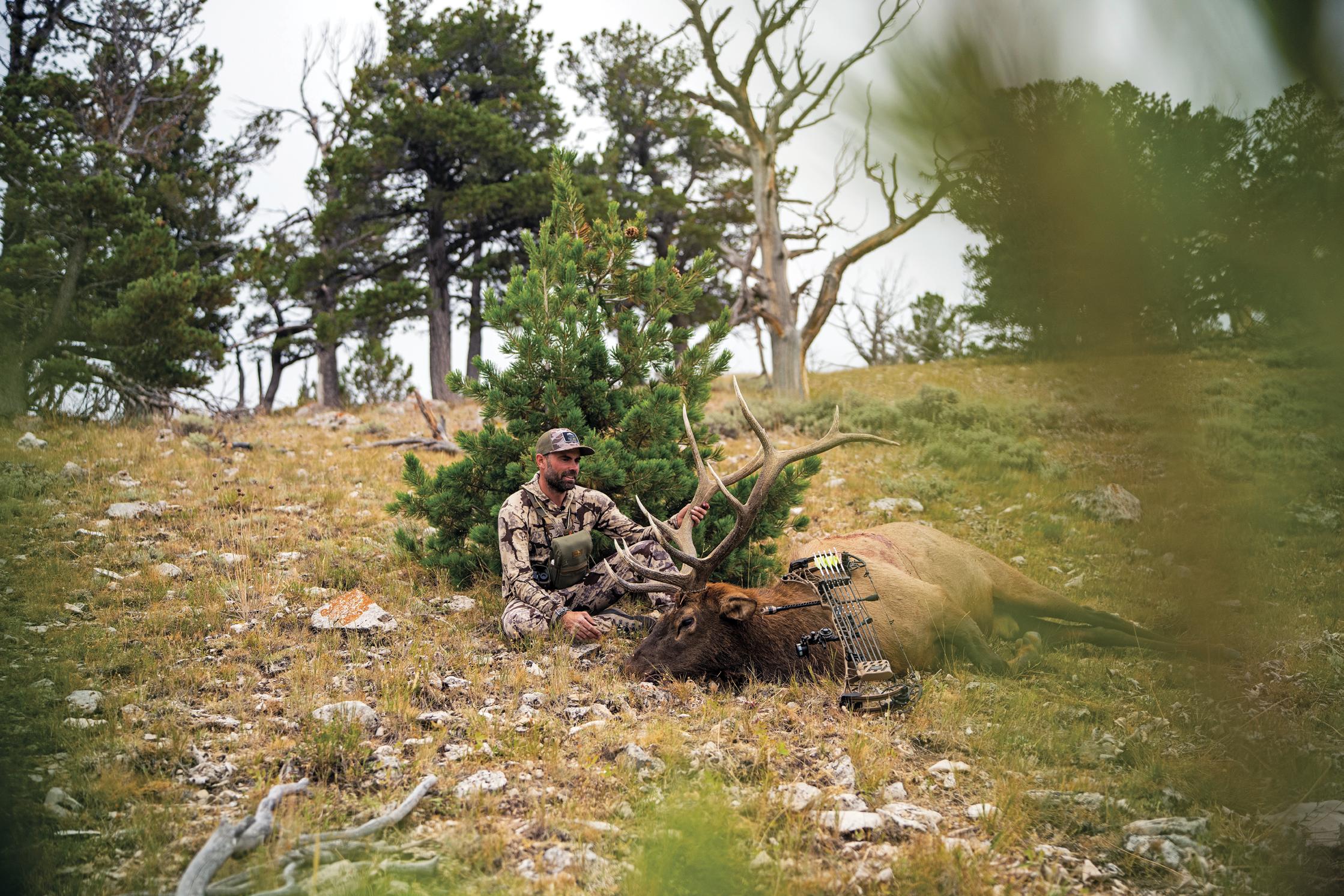
As the minutes ticked away, I knew that I was cutting it close on time. I shifted my knees slightly just as the bull stood and started to walk away. Already at full draw, I called and stopped the bull. I tucked the pin tight behind the shoulder, where I would aim with any fixed-blade broadhead on an elk, and released the arrow. The fletching vanished as the bull ran a mere 30 yards before falling over dead in the time it took him to cover that distance.
When it comes to bowhunting, I think a lot of people would put me in the fixed-blade over mechanical broadhead team, and rightfully so. I talk about the benefits of a fixed-blade head all the time. I really like them for their utility and simplicity. However, I have used plenty of mechanicals on various hunts, and it isn’t that they don’t have their place; it is just that I constantly feel like they were designed for a type of hunting I don’t do a lot of: sitting in a stand, chasing whitetails. Not running through the mountains chasing elk and mule deer.
As I walked up to this bull, I had to smile because in the back of my mind the thought entered my head: the game had changed. I finally pursued an elk with a mechanical broadhead that was built with that intention.
To build a better mousetrap, you can’t just try to build off the status quo. You must start from the ground up with a new objective. The problem with mechanical broadheads and western big game is a lack of durability and penetration. They are not made for large animals like elk; they are not made for hitting thick bones; they are not made to penetrate. So, our team set out to fix that.
The desire to have a better mechanical broadhead was built around the frustration that nothing out there was truly made for those that regularly hunt the West, hunt spot and stalk, hunt big mountains. In my own per sonal testing, I hunted with nearly every mechanical on the market, and through that, I ran into a lot of problems.
Most would pre-deploy while crawling or stalking because they were designed to be hanging in a tree in a stand right next to the hunter. The ones that did stay closed well did not get great penetration, especially on larger animals or a harder quartered shot. The real kicker: if any bone was hit, especially a part of the shoulder, forget about it; the arrow either stopped or the broadhead broke.
Through my testing, I also had one heartbreaker where the deployment of the blades pitchforked on a great mule deer buck only about five yards away, causing the arrow to not penetrate at all. In all honesty, a field tip probably would have killed that buck.
While I will admit plenty of animals have been taken, including elk, with current mechanical broadheads on the market, none of them were really designed for that kind of work, and if something goes slightly awry, like an animal jumping, a shoulder moving back, or a quick turn, a sure shot can quickly turn into a long tracking job or an animal that gets away because the margin for performance is razor thin when using something at its maximum limits.
There are many benefits to having a fixed-blade broadhead when it comes to hunting performance and penetration on large animals. So, what if we took what makes a fixed blade so efficient and morphed that into the benefits of a mechanical: great flight and larger cutting diameter. This is when the hybrid enters the picture; combining the best of each to create one that has both properties and does them well.
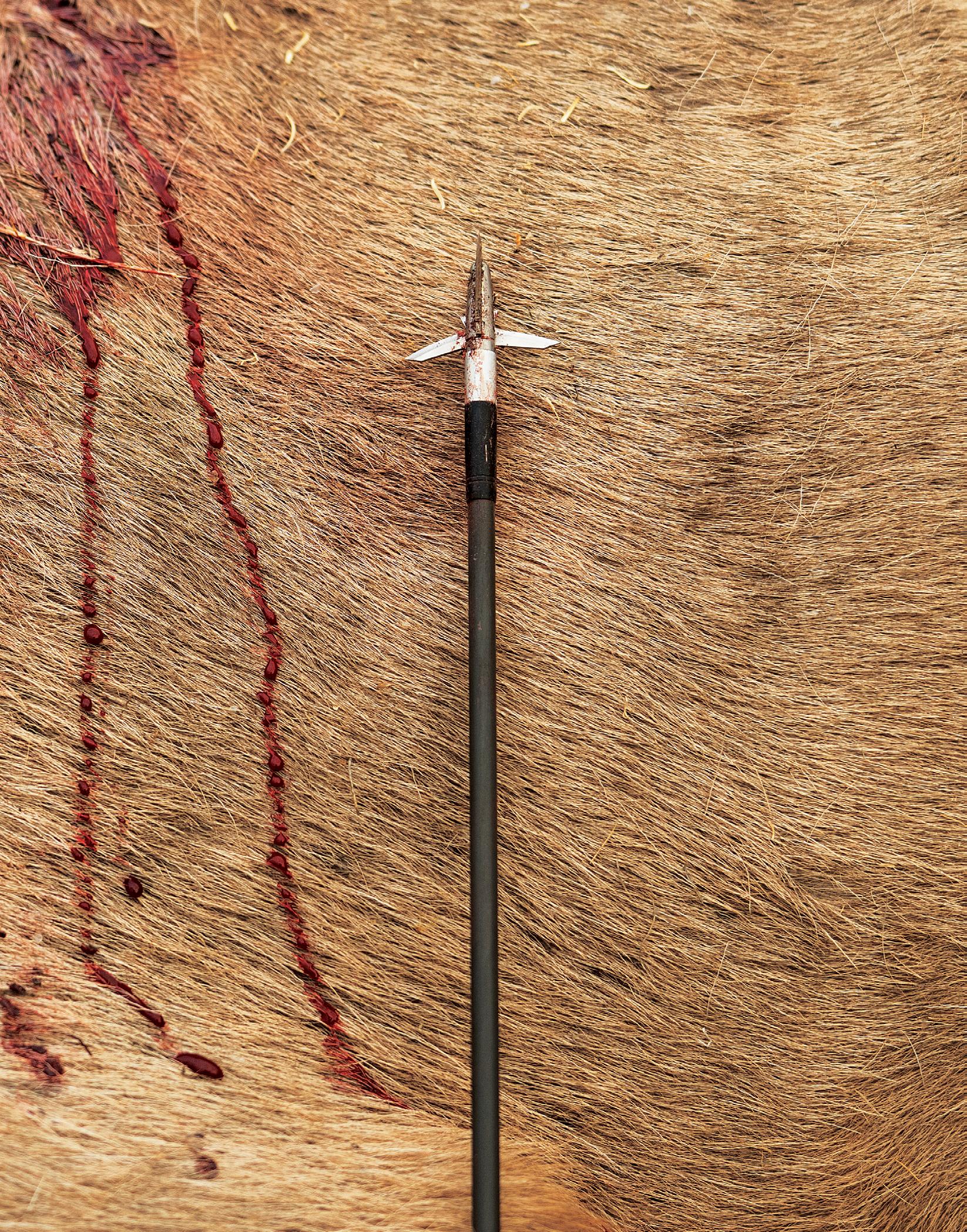
This was the building block for the Day Six Verse.
To build the most durable and highest-quality mechanical, we started by choosing the best materials. We opted to make the blades out of MagnaCut steel. This is actually the first mechanical broadhead ever marketed with MagnaCut steel blades. MagnaCut was specifically designed to solve a longstanding problem: You usually have to choose between edge retention, toughness, or corrosion resistance... never getting all three. MagnaCut entered the picture and balanced all three at a high level.
If you are not familiar with MagnaCut, it is what many of the top-end knife manufacturers are using for blades. MagnaCut maintains a razorsharp edge through hide, bone, and tissue while resisting the chipping or breaking that can occur with harder but more brittle steels. At the same time, its stainless properties help prevent rust and pitting in harsh field conditions, reducing maintenance and increasing reliability. This steel is ideal because of the balance of durability and sharpness, resulting in a blade that performs consistently even when shot angles or impacts aren’t perfect, making it one of the most well-rounded and dependable steels available.
From there, we then chose to increase the blade thickness; a very important factor in durability. To keep the whole broadhead within the weight of 100 grains, the ferrule is machined out of titanium for its strength-to-weight ratio. To keep the broadhead the same size for 125-grain heads, the ferrule uses stainless steel, which is coated for additional rust protection. The ferrule is a single piece, machine-lathed by us in Wyoming to be as tough as possible.
The combination of the thicker blades and a tough single-piece ferrule is the backbone of the bombproof construction that allows the blade to penetrate if given the right design.
up front that runs nearly the length of the broadhead. This allows for bite and cutting without slowing the broadhead down. Second is the swept-back blade angle of the opened head. This angle aids in penetration and keeps the momentum of the arrow when breaking through bone and pushing through muscle and soft tissue.
For western big game, none of that matters if the broadhead does not stay closed or fails to open properly. To address this, our team created the Sixlock retention. This rear capture system holds the blades closed at the back with a customized O-ring designed for high flexibility, ensuring it stays closed while crawling and putting in and out of a quiver, yet simultaneously allowing proper deployment with ease upon contact. The combination of this, the design, and the quality materials means that you get a mechanical that penetrates more similarly to a fixed-blade broadhead.
In the end, by starting from the ground up and building around the idea of durability and penetration for larger western big game animals and mountain hunting, what you get is a hybrid mechanical that flies like a mechanical and penetrates like a fixed-blade broadhead; quite literally the best of both worlds. Once you have constructed something for the top end of hunting pursuits, everything else the broadhead is used for is icing on the cake.
Our philosophy has been designed around elk, and this broadhead works incredibly well on deer or anything else. Through this new approach, I really think the broadhead market has entered a shift with the addition of the Verse, as it finally gives western bowhunters an option of a mechanical broadhead that was designed for their pursuit. WH
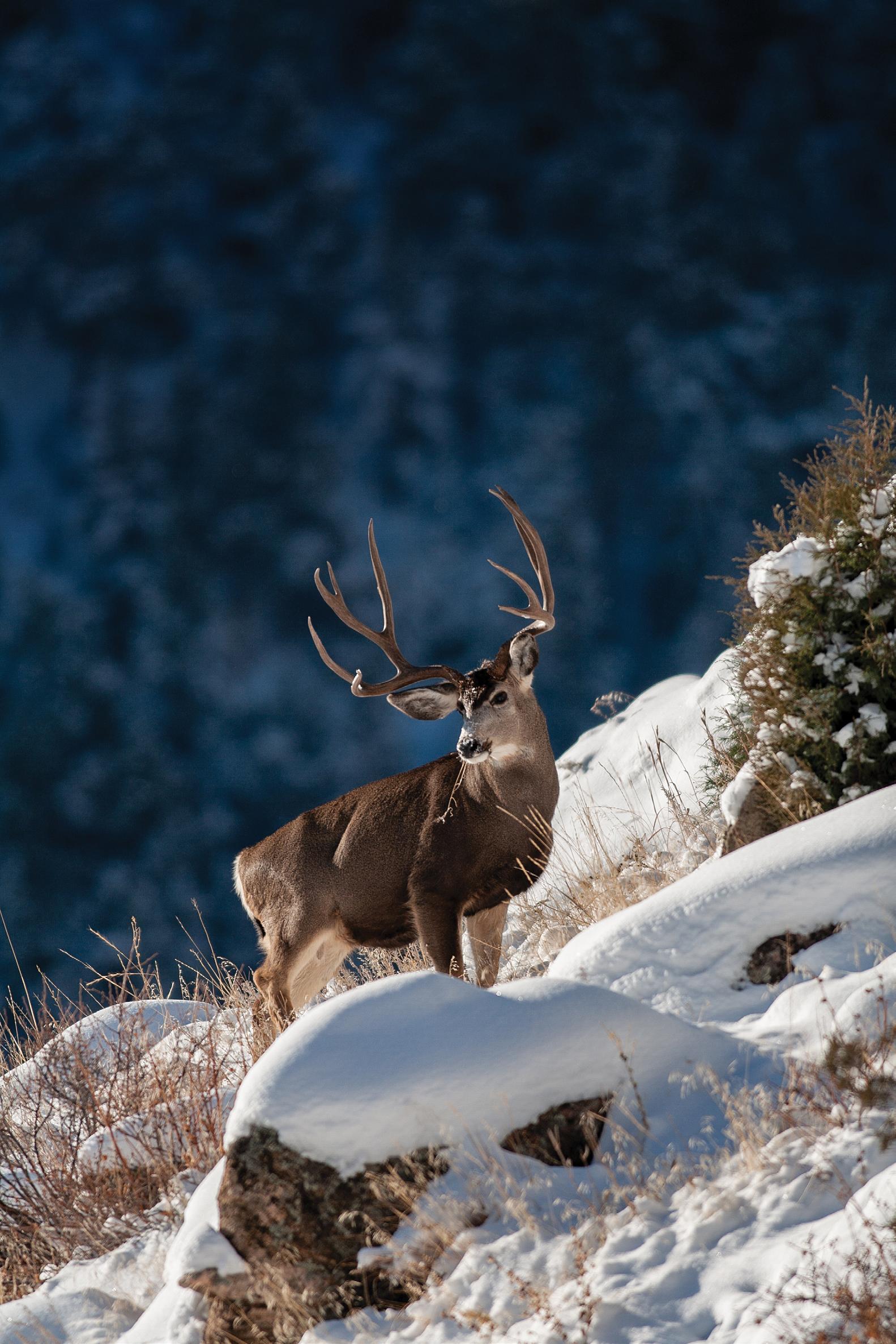
BY MIKE DUPLAN
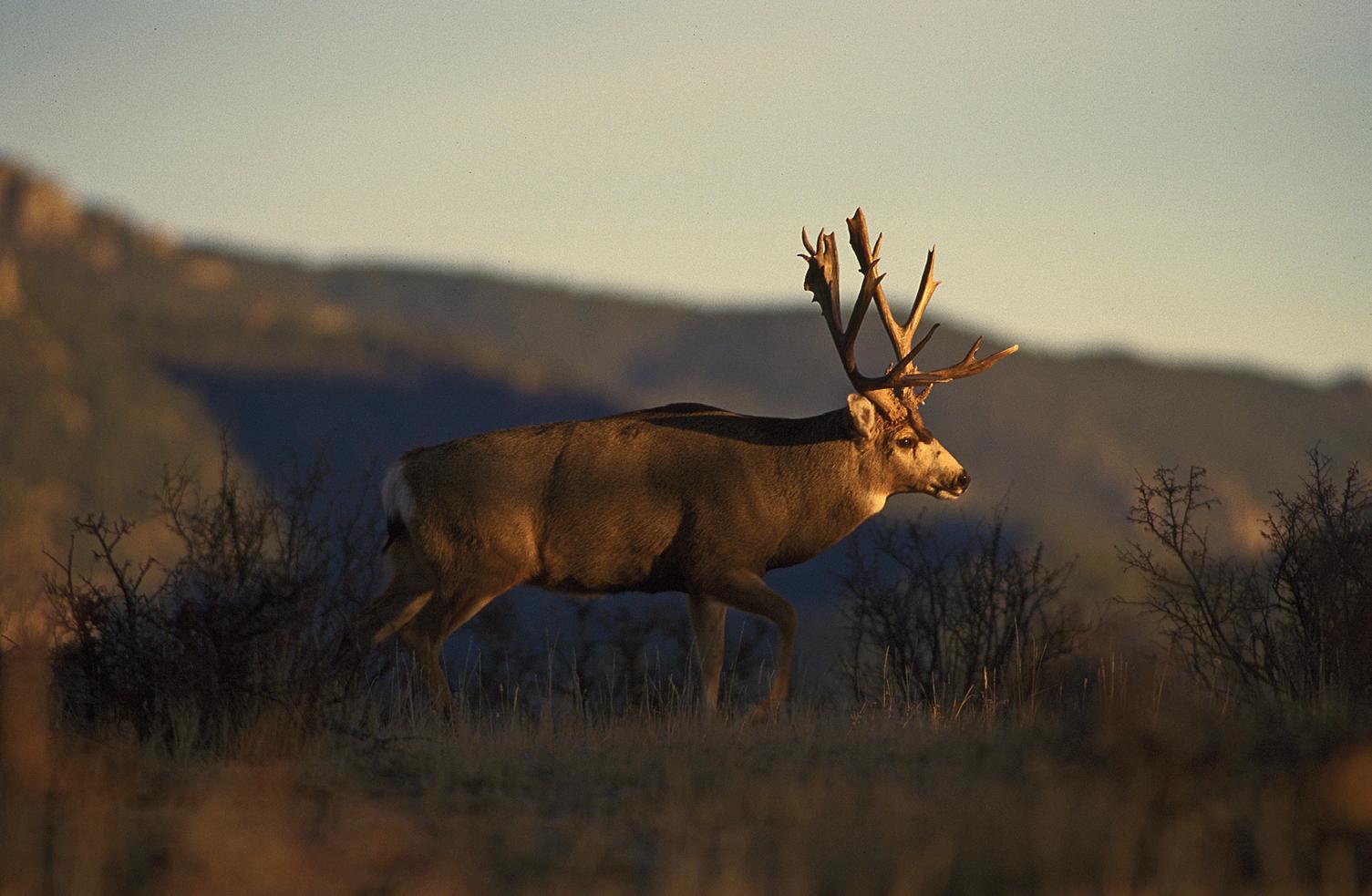
The motivations for hunting are very obvious but can be nuanced and even a tad mysterious as we peel back layers. The act of hunting invites and deserves thought and introspection. What stirs our imagination and motivation is also what creates a great deal of satisfaction when accompanied by our own definition of a successful outcome.
Some hunters are gearheads, some are process-oriented, and some are out to procure incredible organic protein to nourish themselves, friends, and family. The end of the field-to-table experience is ultimately the most defensible and satisfying culmination of hunting time for most people.
Each motive varies as much as the personality of the individual, but there are moments, sometimes bordering on a rapturous experience, that are indelibly carved into our memories. Quite often, it is a moment of immersion in the quiet of the landscape and the absolute awesome grandeur of the wild, but these feelings can also be a fleeting glimpse or sighting of an animal so exceptional that it makes the hunter ache with desire.
I have a movie reel of moments from my decades in the outdoors that bring back memories that are so vivid that they seem like yesterday. A giant 6x6 herd bull in an alpine basin choked with willows that seemed impossible to hunt, a ram bedded on a rock promontory on the rooftop of Colorado in the late afternoon sun after a breaking storm moves on. These are two examples amongst hundreds that I have filed away.
What seem to be ever-present in the movie reel of images in my mind are those of great, big mule deer bucks. This thought dovetails alongside my article in the last issue titled First Love. I know I’m not alone in my feelings about exceptional representations of this great animal because mule deer are what I get the most inquiries, comments, questions, and feedback from readers on and in my social media presence, the photos of which I get the most interactions from.
It’s not a big secret that mule deer populations continue to struggle and be impacted all across the West, but that fact might make them more of a focus for conservation groups and hunters to rally around. Mule deer bucks run the gauntlet in the brief decade, or less, of their existence, and very few of them die of old age. Lions, black bears, coyotes, roadkill, and hunters are all causes of mortality, so when a buck makes it to full maturity, he has been very lucky. He has probably been very fortunate to have escaped many encounters with high-level danger and, in turn, has become hyper-wary.
Realistically, not every hunter will take a big, mature mule deer in their lives, as there simply aren’t enough of those bucks to go around. Even if simply enjoying the hunt and time in the mountains is your priority, filling the freezer is your calling, and having a memorable experience is your goal, there’s no denying that we all have a part of us that dreams of these special animals. To see images of these beautiful bucks that make us pause and fill in the blanks with our own story can be either a fantasy or a memory reflected upon.
Keeping the dream alive through images I want to share with the readers of Western Hunter is an honor and a privilege for me. Look at these images and let them help you foster your hopes and motivations in your personal quest. Without the toil, hardship, effort, and dreaming, the outcome isn’t holding as high a place of value in our hearts. If it was easy, everyone would do it. Keep the dream alive. WH
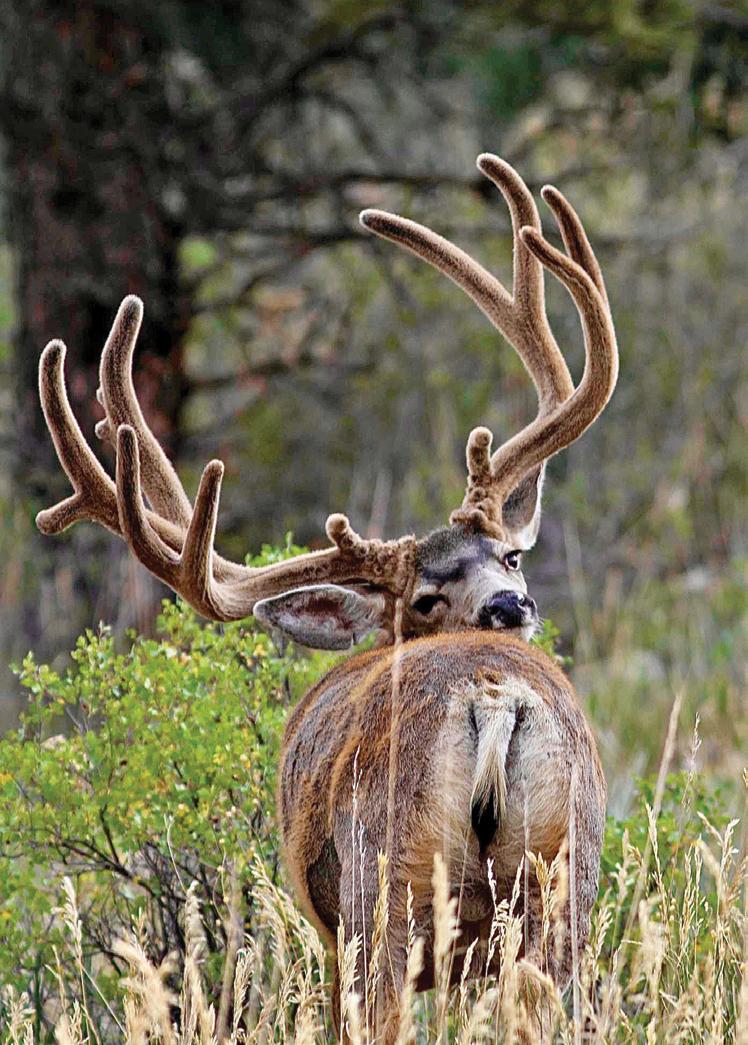
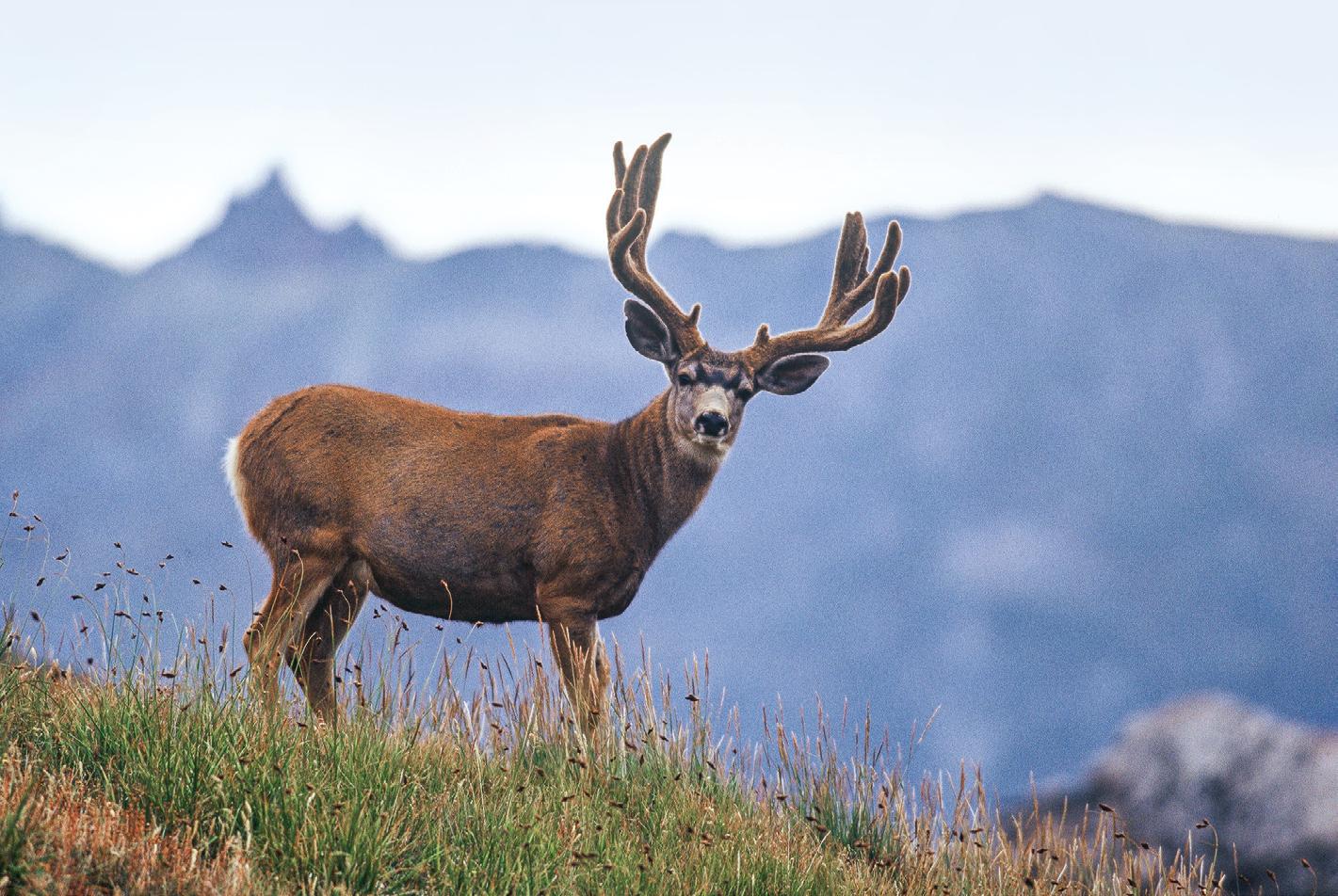
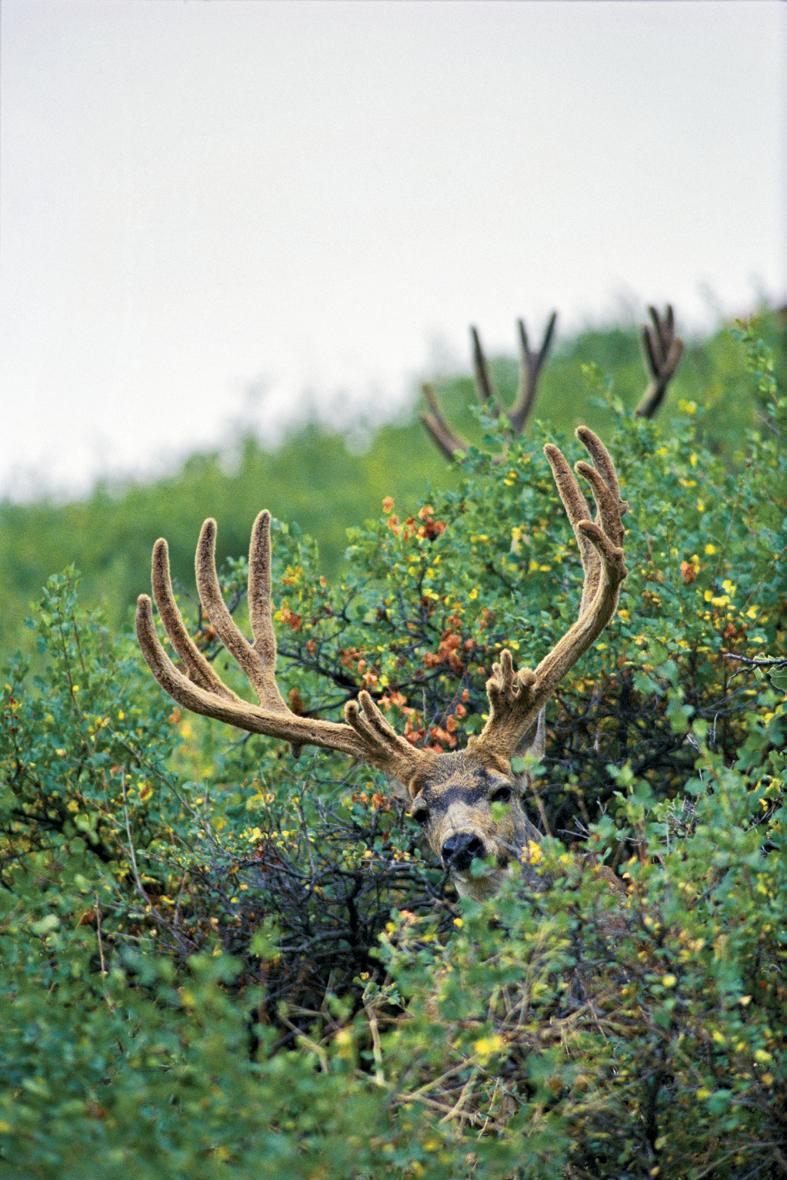
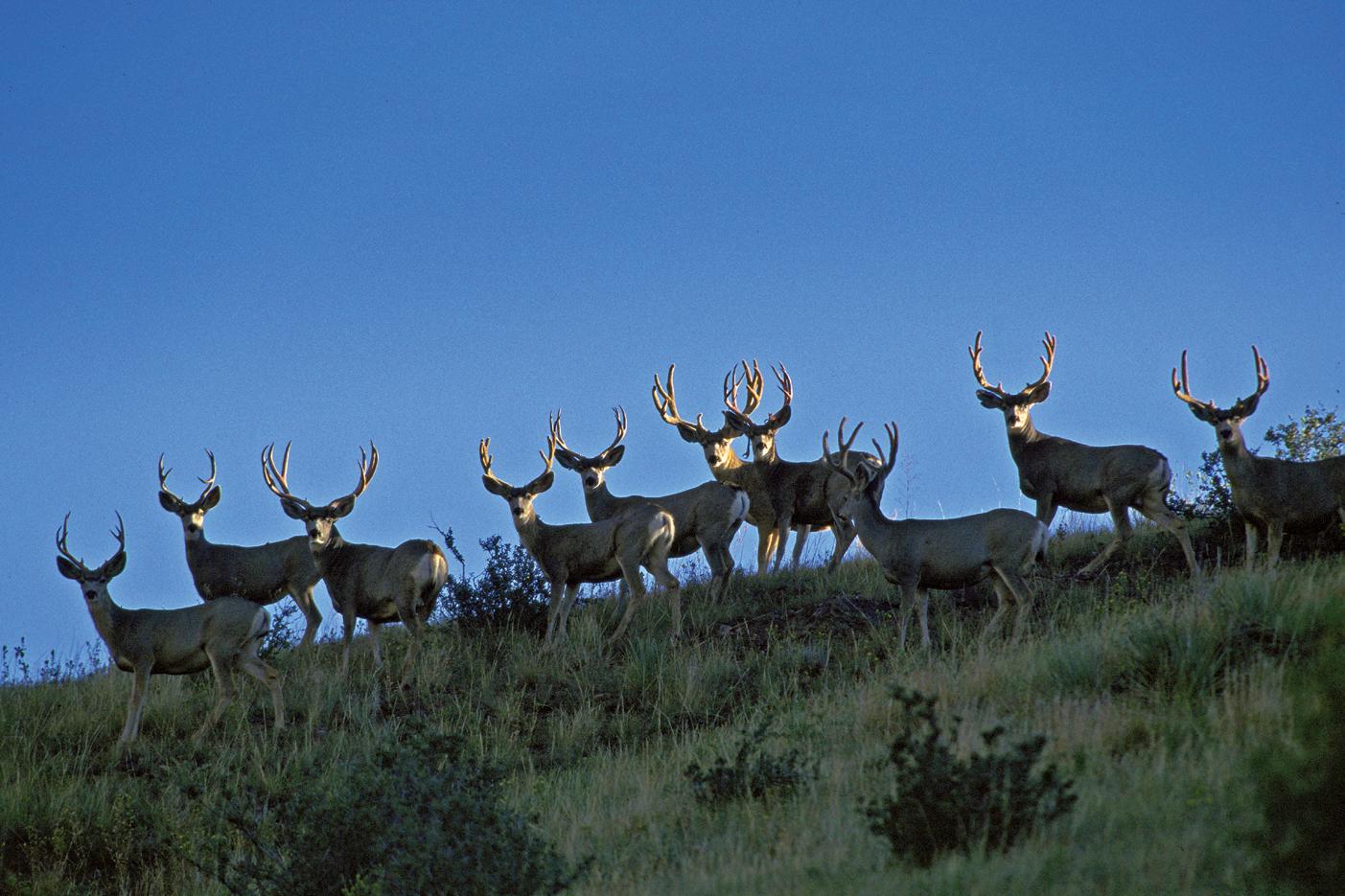
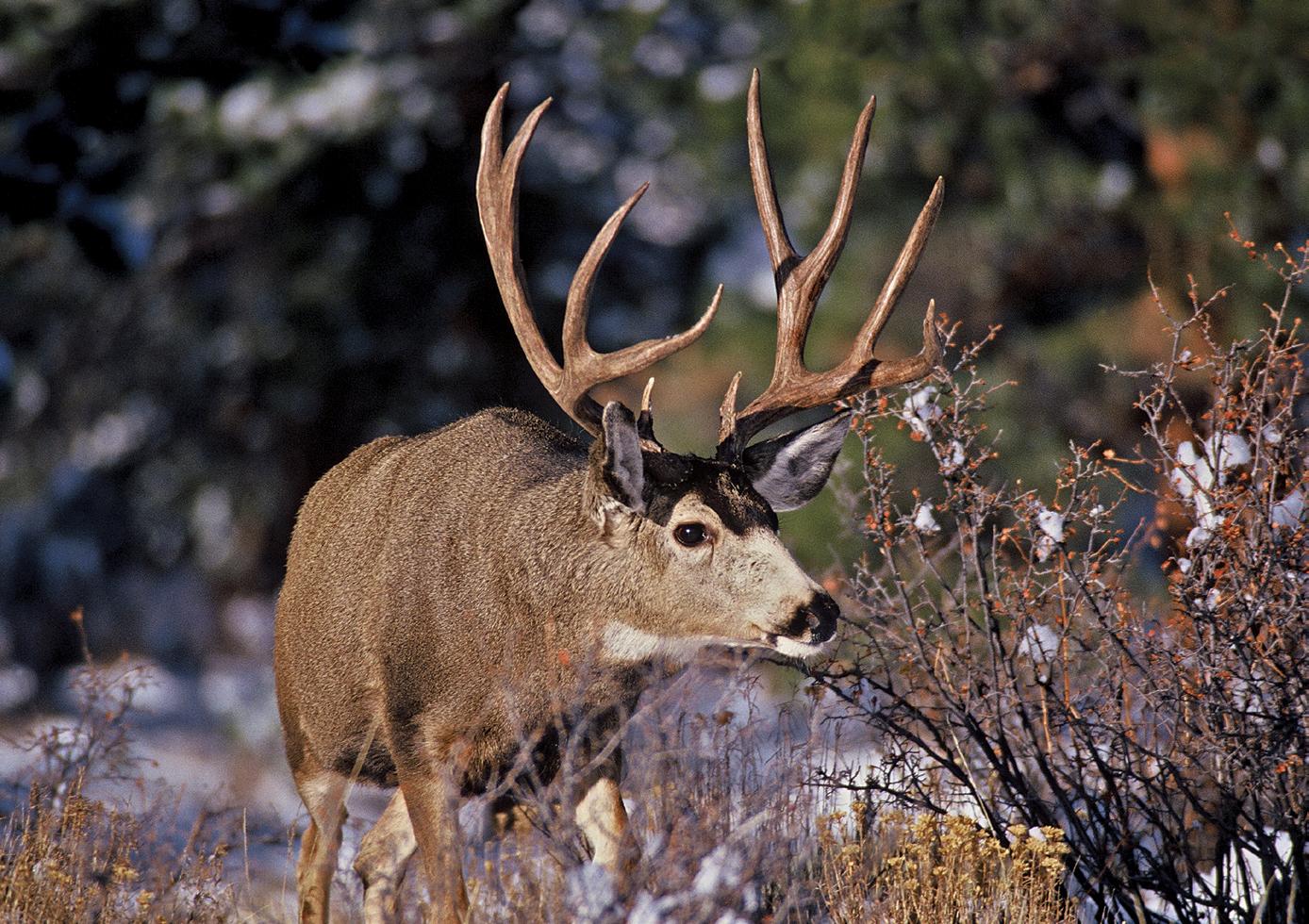
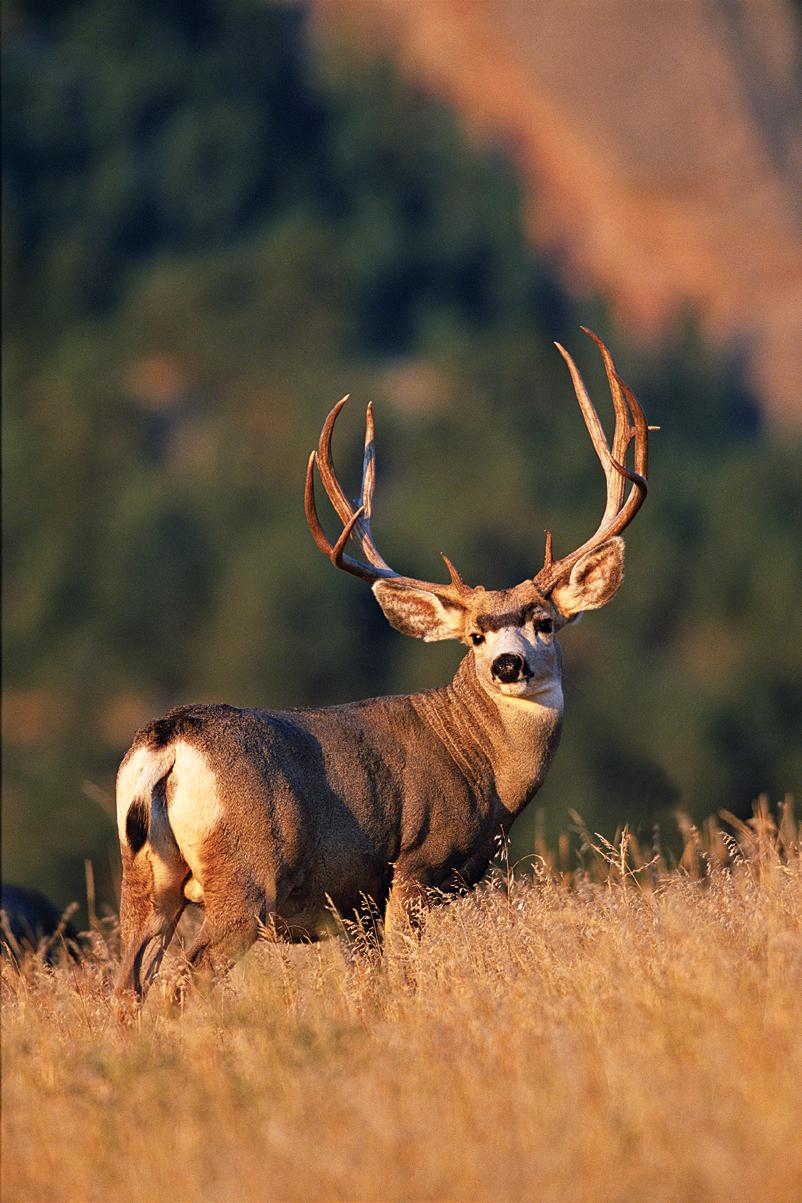
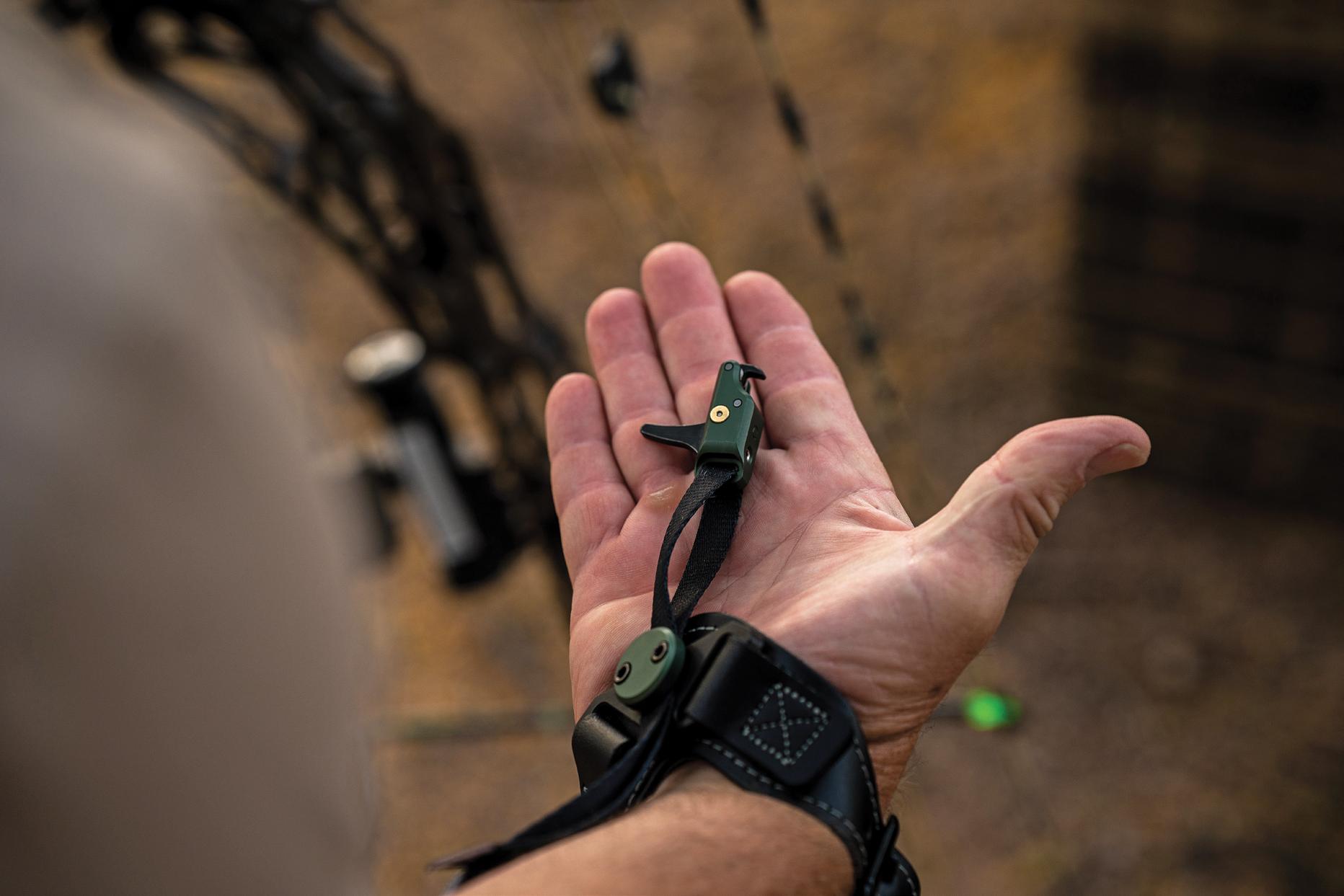
BY CHRIS DENHAM
Istarted bowhunting about the same time the compound bow was invented... seriously. In the ‘70s, I didn’t use sights. Since I shot recurves before, I just pulled her back and let it fly. My first “sight” was a wooden match taped to the front of the riser. No peep sight, no release aid, just a point of reference that was not very durable. Now, I have 15 different releases, blazing fast, easy-to-shoot bows, with state-of-the-art sights, stabilizers, a fall-away rest, and a really bad case of target panic.
Target panic can manifest itself in many ways; for me, it is simply the inability to hold my pin on the bullseye. You know that invisible force that pushes back when you try to force two magnets together the wrong way? That’s what it feels like when I aim at any target with a bullseye. The harder I try to aim, the worse it gets; the bullseye actually looks like it is shrinking sometimes. This is a result of 40 years of bad habits and no coaching.
One trick that has been developed over the years to retrain the brain when shooting a mechanical release is adding an audible click before the release fires. Traditionally, this feature has only been available in handheld releases, but not in an index finger/trigger finger release that most of us bowhunters use. But this year, Stan Releases introduced the Solex Clicker, to thunderous applause.
Developed in conjunction with Joel Turner of Shot-IQ (the guru of shot control), the Solex Clicker delivers an audible and tactile click during the trigger squeeze. It took a few dozen arrows for me to stop slapping the trigger and slow the process down enough to hear the click, then pull through until the release fires. I am still only getting it right about 70% of the time, but that is up from about 10% in just a matter of weeks.
You have the option of an adjustable strap or a rigid connection to a comfortable wrist strap. If you have been cured or never experienced the blight of target panic, the standard Solex is available with no click ($99). If you are struggling with target panic, or maybe you are just stuck and can’t seem to improve, no matter how much you practice, tools like the Solex Clicker can help. We will be covering other tools and practitioners like Joel Turner in Western Hunter, on our YouTube, and on the blog, so make sure and subscribe to our email newsletter. WH
BY JAMES YATES
My main pursuit in The Arrow Ballistics Study is to learn how to make the most forgiving bow-hunting arrow possible. If you have followed me on social media or my articles here in Western Hunter Magazine for any length of time, you’ll know that I am obsessed with building the most forgiving bow and arrow setup possible. What archery forgiveness means is that, despite shooting errors made by you (a human) in the heat of the moment, shooting during an intense hunting encounter, that arrow is still likely to hit in the kill zone of your intended prey.
In other words, there are things that you can do with your setup that will dampen the effects of your mistakes. The Arrow Ballistics Study is essentially a big arrow experiment where we are testing different arrow parameters with a controlled shooting machine and a rigorous testing protocol to determine what those things are. If you are new to The Arrow Ballistics Study, be sure to read up on it at the blog at westernhunter.net.
If you make a bad shot, your arrow is going to come out of your bow a little cockeyed. How quickly that arrow can recover will determine how big or small the miss is downrange. Getting an arrow to recover quickly comes down to two key points about the arrow. One is called the center of mass, and the other is called the center of pressure. Physically, on the arrow, there is a balance point from front to back. It’s easy to find this point by balancing the arrow on your index finger.
This point where the arrow balances is called the center of mass. It falls on the forward half of the arrow. The weight distribution of the arrow is largely based on how many grains per inch the shaft weighs, how heavy the vanes and nock are, and how much front weight (insert, broadhead, etc) there is. Adding point weight moves this balance point forward. This concept is called Front of Center or FOC.
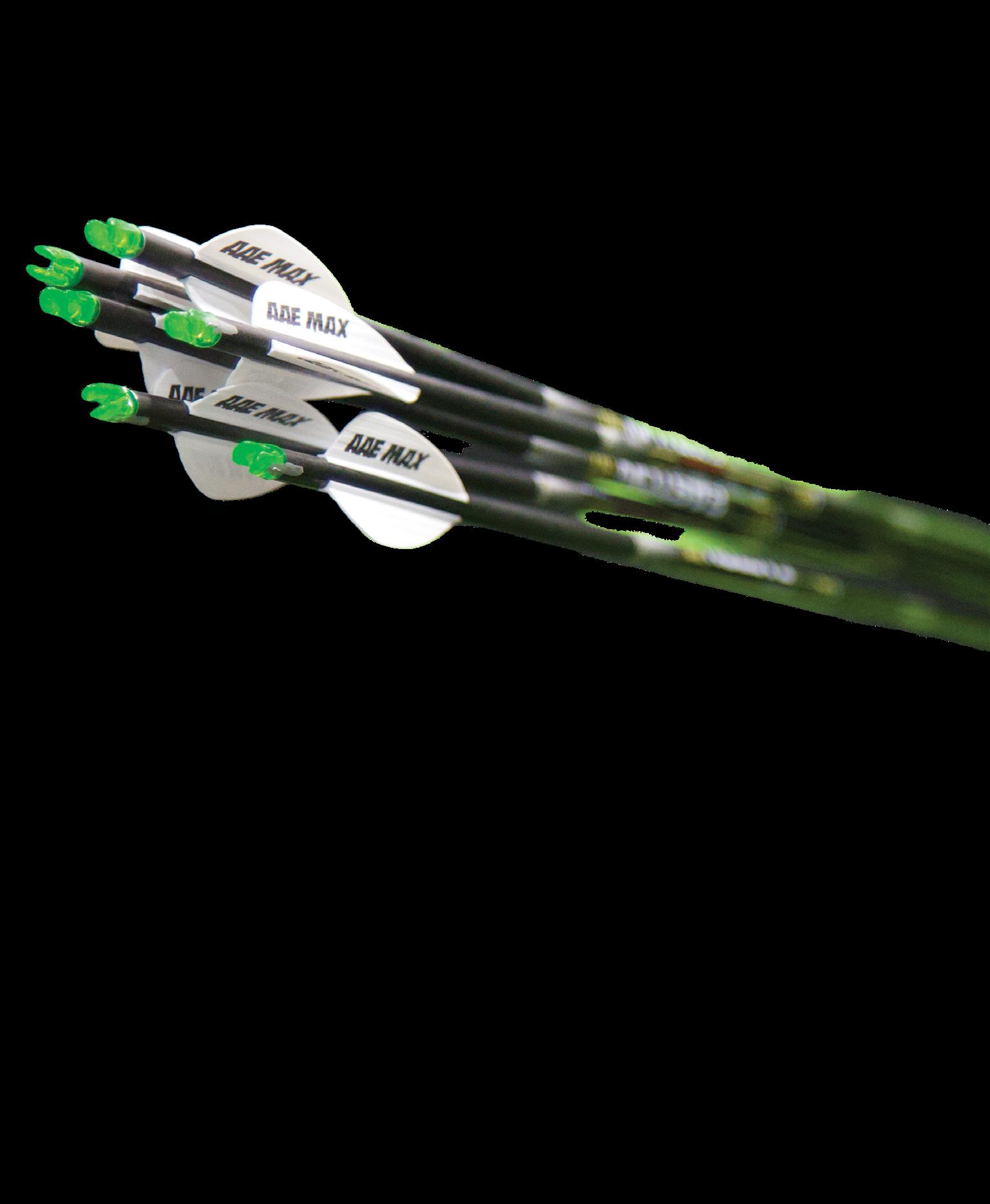
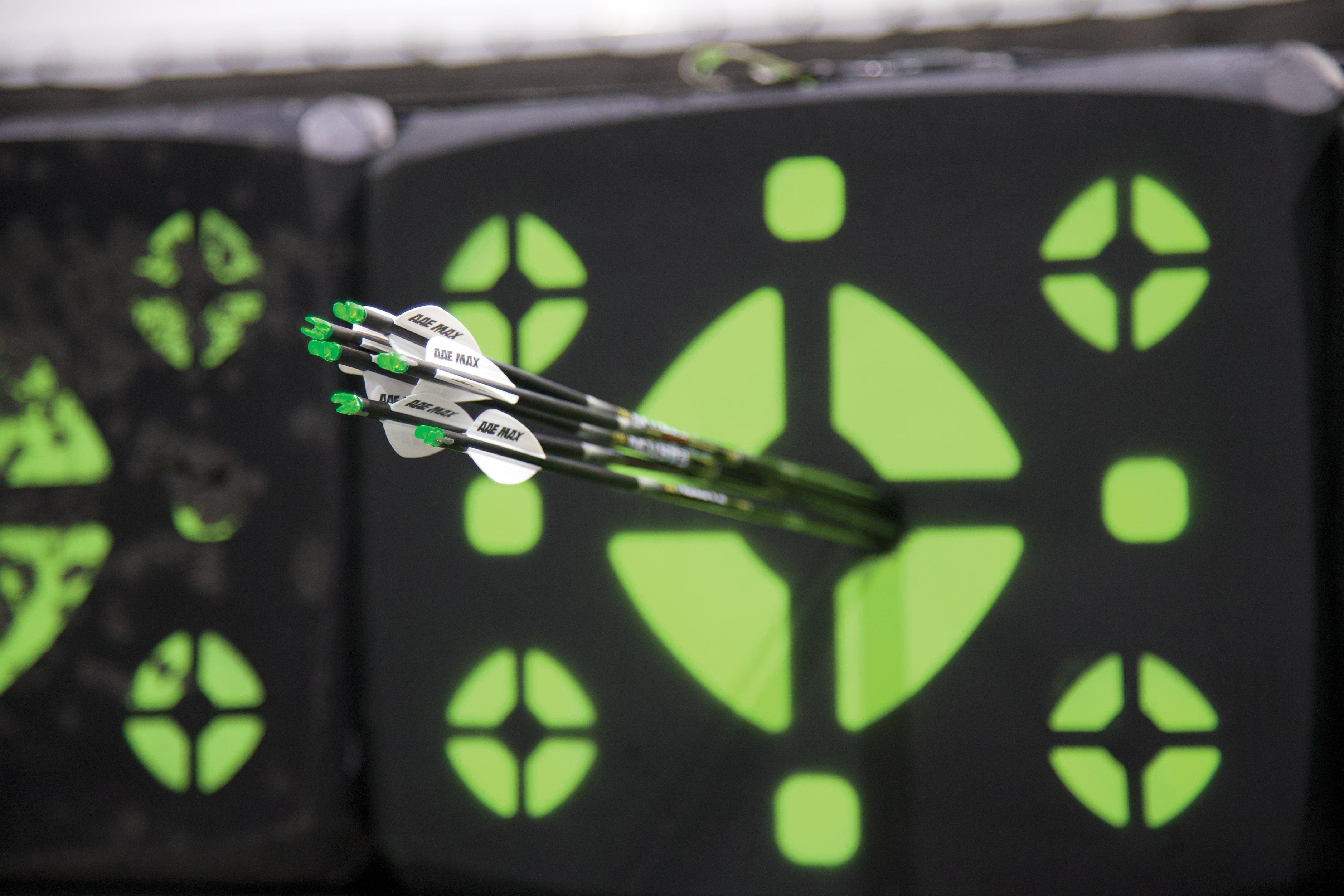
The other point that defines the stability of the arrow is called the center of pressure. The center of pressure is more abstract to think about, but it exists all the same. This point can’t physically be found by balancing the arrow with your finger. Think about sticking your arm out of a fast-moving car and feeling the pressure of the air on your arm. If you point your fingers up or down, you can change how the pressure distributes along your arm. With an arrow, it’s the same thing.
Think about the pressure that the broadhead sees–the shaft and the vanes whizzing through the air. The balance point of that pressure (or center of that pressure) is some point on the shaft between the vanes and the broadhead. This point should fall on the back half of the arrow because the vanes see more pressure than anything else on the arrow.
So, the center of mass is in front of the center of pressure. Now, what really drives the stability of the arrow is the distance between these two points. The center of pressure being behind the center of mass provides the leverage necessary for the arrow (center of mass) to correct itself. The longer the distance between these two points, the more leverage the arrow has to quickly stabilize.
For the FOC testing in The Arrow Ballistics Study, the arrow build remains identical, with the exception of adding insert weight inside the shaft. This effectively holds the center of pressure constant for the arrow iterations in the FOC study (because the outside of the arrow remains identical). With the center of pressure fixed, we examined the effect of adding point weight to pull the center of mass forward (higher FOC).
When we do the vane testing, we are holding everything else constant (technically, the center of mass changes ever so slightly when vanes of different weights are used, but it is a very minor change) and observing how different vanes change the center of pressure. We aren’t physically measuring the center of pressure in the Study, but we are examining its effect on arrow groups downrange. Bigger vanes see more pressure, and this pulls the center of pressure backward. That’s why bigger vanes “steer” better. When you add a broadhead, though, especially a fixed blade broadhead, this pulls the center of pressure forward (because it adds pressure on the front of the arrow), all else being equal.
There is a balance that must be met between adding vane surface area and adding point weight to stabilize the arrow. Too much vane on the back of the arrow can actually pull the center of mass backward and cause unwanted drag on your arrow. Too tall a vane on the back of your arrow can lead to vane contact problems with your face, the cable guard, your arrow rest, and even your bow sight if you are taking a longer shot. Similarly, too much point weight (very high FOC) can reduce the trajectory (slow the arrow down because of overall weight) and potentially weaken the dynamic spine of the arrow, which causes major tuning issues.
Maximizing my trajectory to promote better range forgiveness (a topic I have written about extensively) is very important to me, hunting here in the West. To this end, I don’t want to shoot overly big vanes (causing drag and wind drift) nor do I want to add excessive amounts of point weight (adding arrow weight, reducing trajectory). So, all that being said, how is my personal arrow build going to change after this 2026 Study?
I can’t deny the benefits of higher FOC that we saw during the Study, especially with broadheads. We saw fixed-blade broadhead group sizes literally get cut in half at increased FOC. The FOC sweet spot for minimizing broadhead group size under the controlled protocol of the Study was about 18-21%. That being said, I don’t think high FOC is a one-size-fits-all solution to a forgiving arrow setup.
We actually saw that increasing FOC to the point where the shaft becomes dynamically weak can decrease the forgiveness of your setup, particularly at high FOC if you accidentally torque your bow differently than you normally
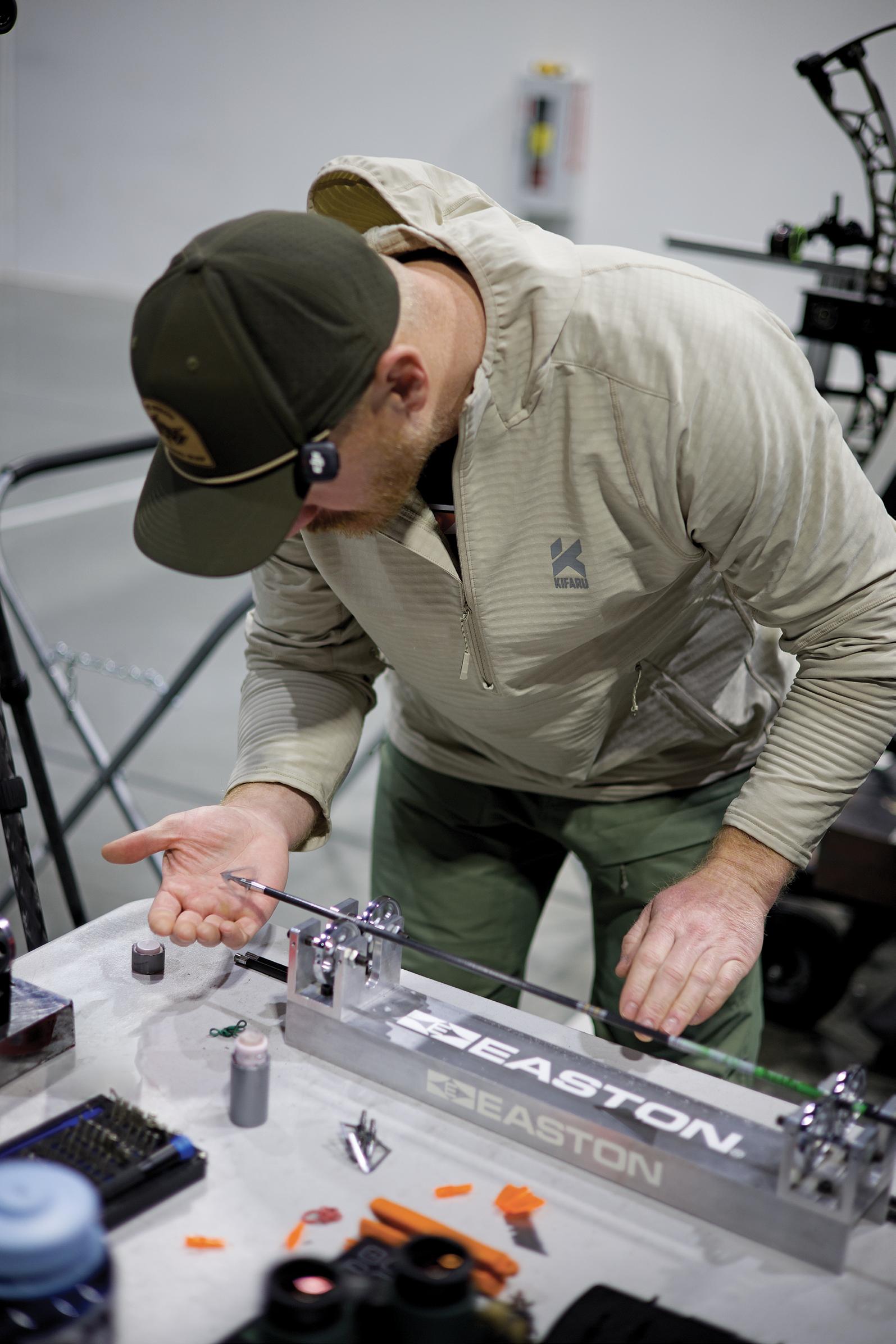
do. The dynamically weak reaction may not even be noticeable during a non-torqued shot, meaning when you execute a good shot, there may not be any indication of a problem. This is a real possibility during a rushed hunting situation. Also, as mentioned above, increasing FOC to the point where your trajectory suffers can be counterproductive for open country western hunting.
My current arrow build is an Easton Parallel Pro 300 spine, 26.25" long, with a 25-grain collar, 20-grain Deep Six HIT insert, 100-grain tip, three Flex Fletch 360X vanes, and a 4mm Microlite nock. This arrow weighs 423 grains and has an FOC of 15%. I’m shooting it at 315 FPS out of my 80-pound Hoyt RX10 at a draw length of 28". I absolutely love the speed and trajectory of this arrow.
I hunt both deer and elk with this arrow in open country with a low-profile mechanical like the Sevr 1.5" Hybrid (which performed very well for accuracy and low sound intensity in the Study). I have been shooting an arrow between 415 grains and 430 grains for over 10 years, and I am not looking at going any heavier, even after this study.
smaller brother of the 360) and the DCA Mini Sabre (the smaller brother of the Super Sabre). Both of these vanes performed very well, nearly identical in terms of lift recovery and drag. The Flex Fletch 300 did, however, perform significantly better in the sound testing.
Despite being smaller, the Flex Fletch 300 did almost as well as its big brother, the 360, for lift recovery, with less drag. Also, the 300 pretty much tied the 360 for quietest vane in the testing; just a reminder that the 360 has been the quietest vane we’ve tested in both 2025 and 2026. Based on these 2026 results, I’m going to switch up my vane for this higher FOC Easton 5.0 build.
“We saw fixed blade broadhead group sizes literally get cut in half at increased FOC.”
However, if I change my shaft from the Parallel Pro to the Easton 5.0 (a lighter shaft by 1.1 grains per inch), I can use the shaft weight difference to increase my point weight by 30 grains and remain at about 420 grains of total arrow weight. This will significantly boost my FOC while maintaining the same total arrow weight. I’ve chosen to shoot the Flex Fletch 360X vane on my mechanical broadhead arrows for many years. It was no surprise to me when those vanes excelled during the 2025 testing. I stuck with that vane last year and have no complaints. However, I have felt that the size of that vane may be overkill for me and my shooting ability (more vane surface area than I need, resulting in more drag), especially for shooting a low-profile mechanical broadhead.
In the 2026 Study, we tested some new vanes, two of which I had high hopes of testing very well. Those two vanes were the Flex Fletch 300 (the
This build will consist of the Easton 5.0 300 spine shaft cut to 26" with a 25-grain collar, a 50-grain steel HIT insert, 100-grain tip, three Flex Fletch 300 vanes, and the 5mm Microlite Nock. The total arrow weight is about 420 grains with 18.7% FOC. That puts me right in the middle of the FOC range I am targeting, while maintaining my arrow speed above 315 FPS. I think this is going to be a very forgiving arrow to hunt with!
I am writing this article so freshly after going through the results of The Arrow Ballistics Study that I have not even had time to extensively test the new arrow build. The purpose of this Study is to give you information from our controlled testing so that you can see what performs well. We are essentially doing the tinkering on a wide range of arrow designs under controlled testing so that you don’t have to tinker with everything yourself.
The intent is that you look through the results and find a couple of options that interest you, and then you do some personal testing with those couple of options. This Study should help narrow the field down for you, so that you don’t feel like you have to test everything yourself. I look forward to testing my new arrow design this spring and summer to see how it shoots for me compared to my tried and true. For a more all-encompassing breakdown of results (including comparative values) from The Arrow Ballistics Study, check out my online article on the Western Hunter blog. WH
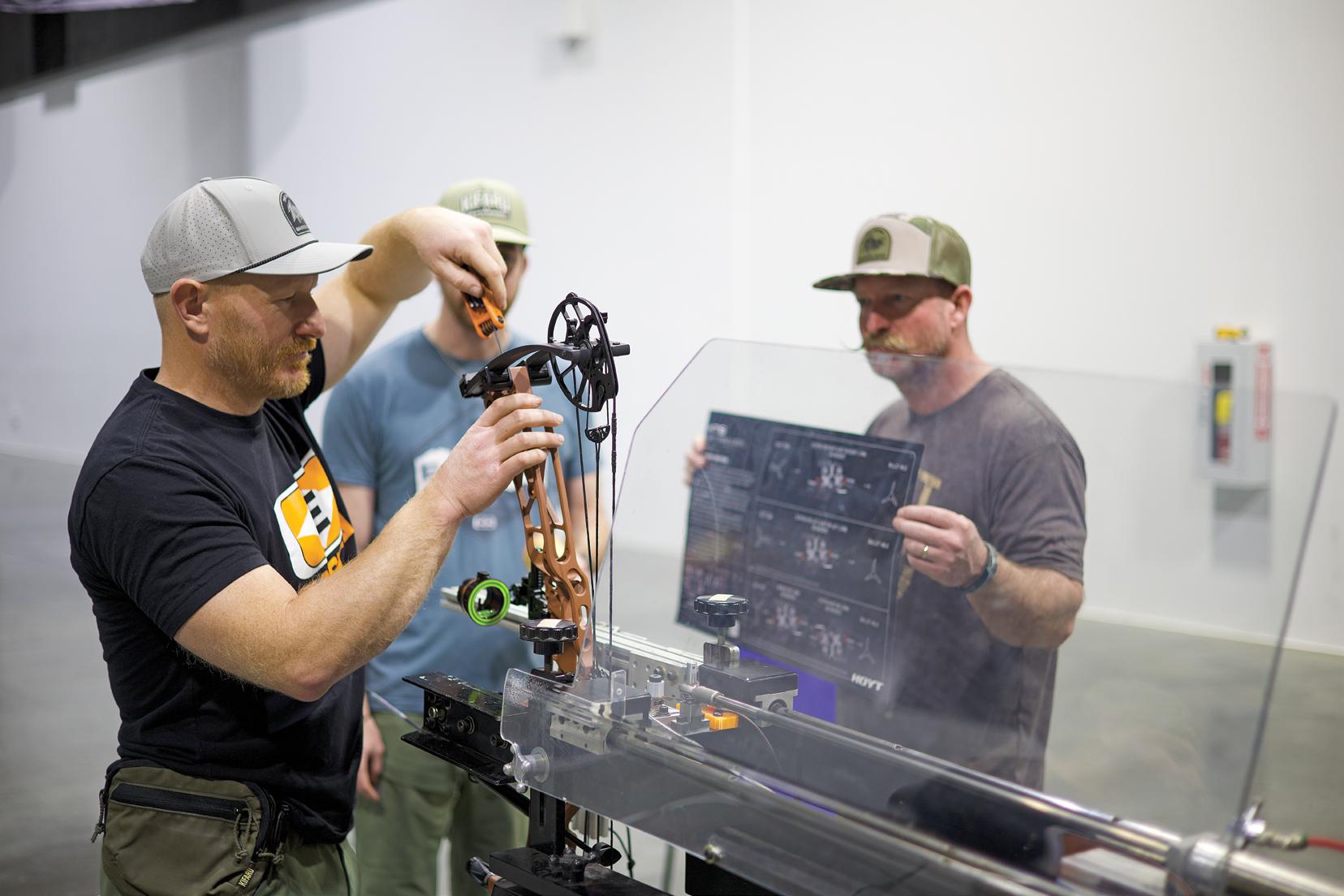
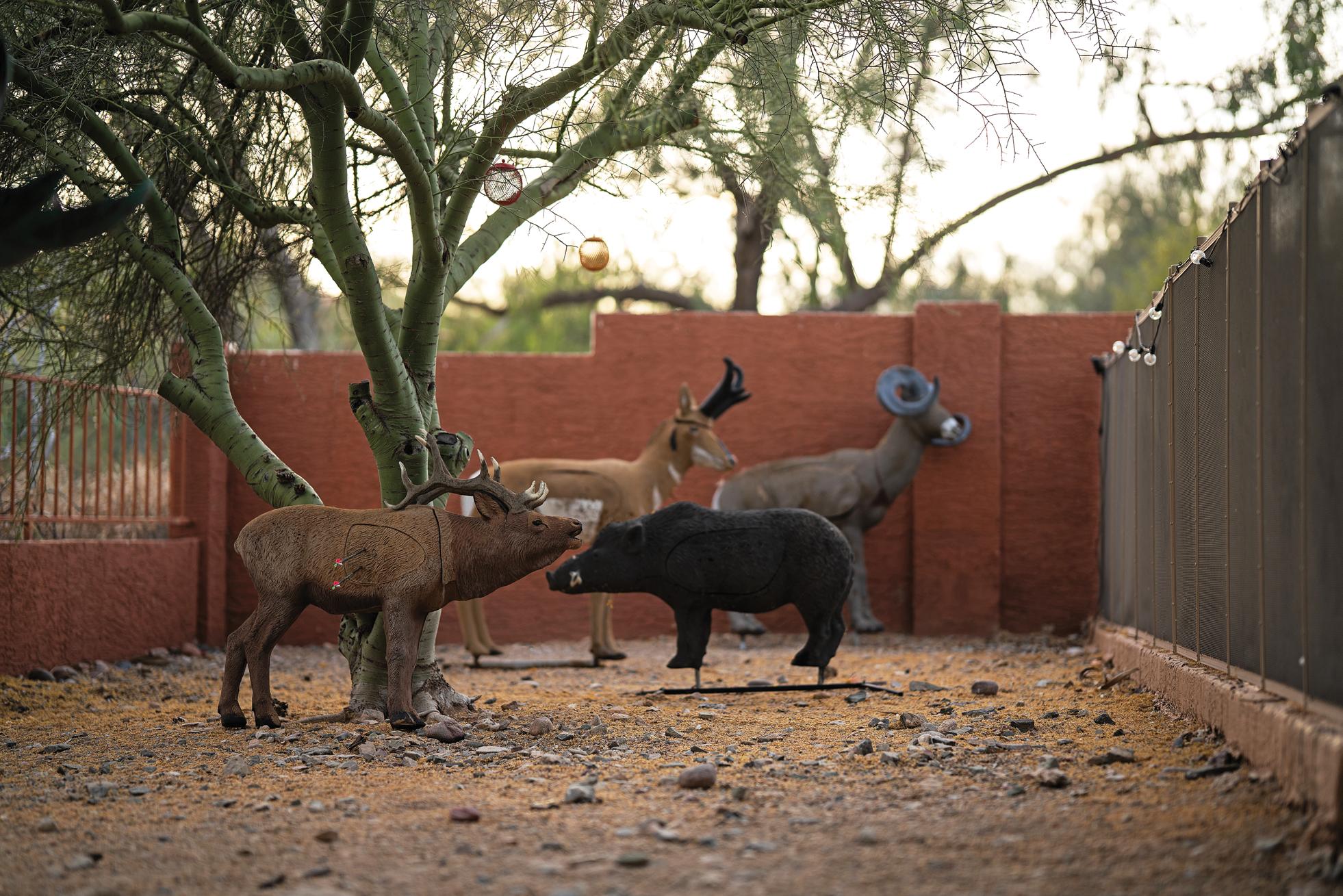
BY CHRIS DENHAM
Mark, Nate, and I have all committed to competing at The Vegas Shoot next year. In preparation, we have been shooting at a threespot target from 20 yards on flat ground with colored scoring rings. I am talking thousands of arrows. Last week, I finally got my Mathews ARC 30 set up the way I want it for hunting season and decided to shoot a few arrows outside at my Rinehart 1/3 elk target at about 26 yards. At full draw, my brain went into full freakout mode. No yellow bullseye? Where the heck am I supposed to aim?
Those thousands of arrows and the thousands more to come have not been a waste of time. I have learned so much about controlling my release and the mental challenge of trying to execute three perfect shots 10 times (a full round in Vegas). But none of that will make me a better bowhunter if I can’t put one shot exactly where it needs to be on a game animal. Nobody would argue that practicing on a realistic 3-D target isn’t the absolute best way to prepare for hunting scenarios. Going to a local shoot is a good way to test your progress, but you usually get to shoot one arrow at a predetermined distance and angle. You are rewarded for hitting a scoring ring, but as the angle of the target increases, that scoring ring is not where you would want to impact on an animal.
If you make a bad shot, you don’t have the opportunity to shoot until you figure out what you did wrong. If you nail it... maybe you got lucky. Who really knows? The best way to perfect your game is to own your own target and shoot it from realistic angles as many times as it takes to get it right.
When it comes to realistic 3-D targets, no company does it better than Rinehart Targets. All of their targets are anatomically correct (including the legendary Velociraptor), so you are not just aiming at a dot; you are training your brain to pick the most lethal angle through the animal.
Rinehart is the predominant target you will see at 3-D shoots because their self-healing foam will take more arrows than any other target. With replaceable cores available, they last even longer. I have had three Rinehart targets for going on 10 years that have lived outside in the Arizona sun, uncovered the entire time. There is some dry cracking and color fade, but they still have many years of life in them.
I bought those targets when I lived close to a range where I could put them out to 60 yards or more. At my new home, I don’t have that luxury. I do have 26 yards, though. So, I bought the Rinehart 1/3 elk for regular practice. As the name implies, this target is one-third the size of a 600-lb bull elk, so at 20 yards it is like shooting at 60 yards. It also weighs one-third as much, and at $330, it costs way less than 1/3 the price of a full-size target. It is a genius idea!
Bowhunting in the West rarely happens on flat ground under perfect conditions. We need to be ready for any eventuality. With a 3-D target, you can practice any shot angle you can dream up: shooting from your knees, sitting in a chair, one foot on a cinder block... you are only limited by your imagination. Practice like you hunt! WH
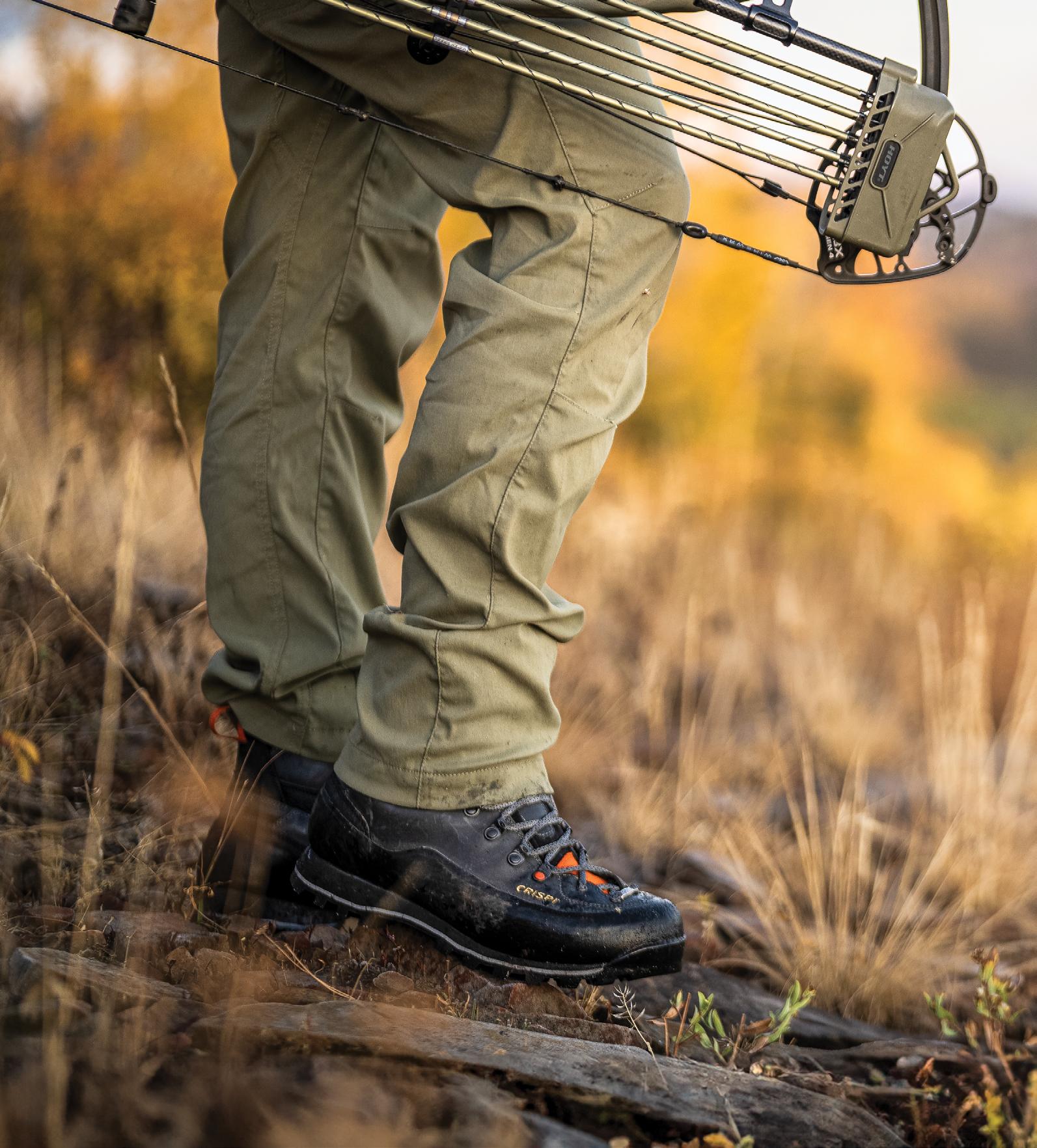

BY JAMES YATES
Broadheads might be the most hotly debated subject among all bowhunters, and for good reason; the entire pursuit of bowhunt ing comes down to piercing an animal’s lungs with a broadhead, so it’s a very important gear choice to consider. Topics of the debate include mechanical versus fixed, accuracy, durability, blood trails, materials of construction, blade quantity, blade angle, blade bevel, chisel tip, cut-on-contact, rear-deploying, front-deploying, and the list goes on. It’s actually mind-numbing the list of things that need to be considered in a broadhead.
Whether it’s just an old-school mentality or dictated by a bad experience, some bowhunters will only use fixed-blades no matter what, while others will only use mechanicals; some hunters are open to either depending on the circumstances. Personally, I think it is undeniable that both mechani cals and fixed-blades have advantages, depending on the circumstances. In this article, I am going to share my thoughts on different broadheads, as well as provide some insights from the Arrow Ballistics Studies that I have been conducting.
First and foremost, I am an accuracy guy. I want to screw on a broadhead on the end of my arrow that has the best chance of hitting where I am aim ing, even if I make a less-than-perfect shot. If you’ve followed me for any length of time, you’ll know that I prioritize forgiveness in my arrow setup. One of the biggest drivers of the Arrow Ballistics Studies is to gain a better understanding of how to maximize the forgiveness of my arrow build.
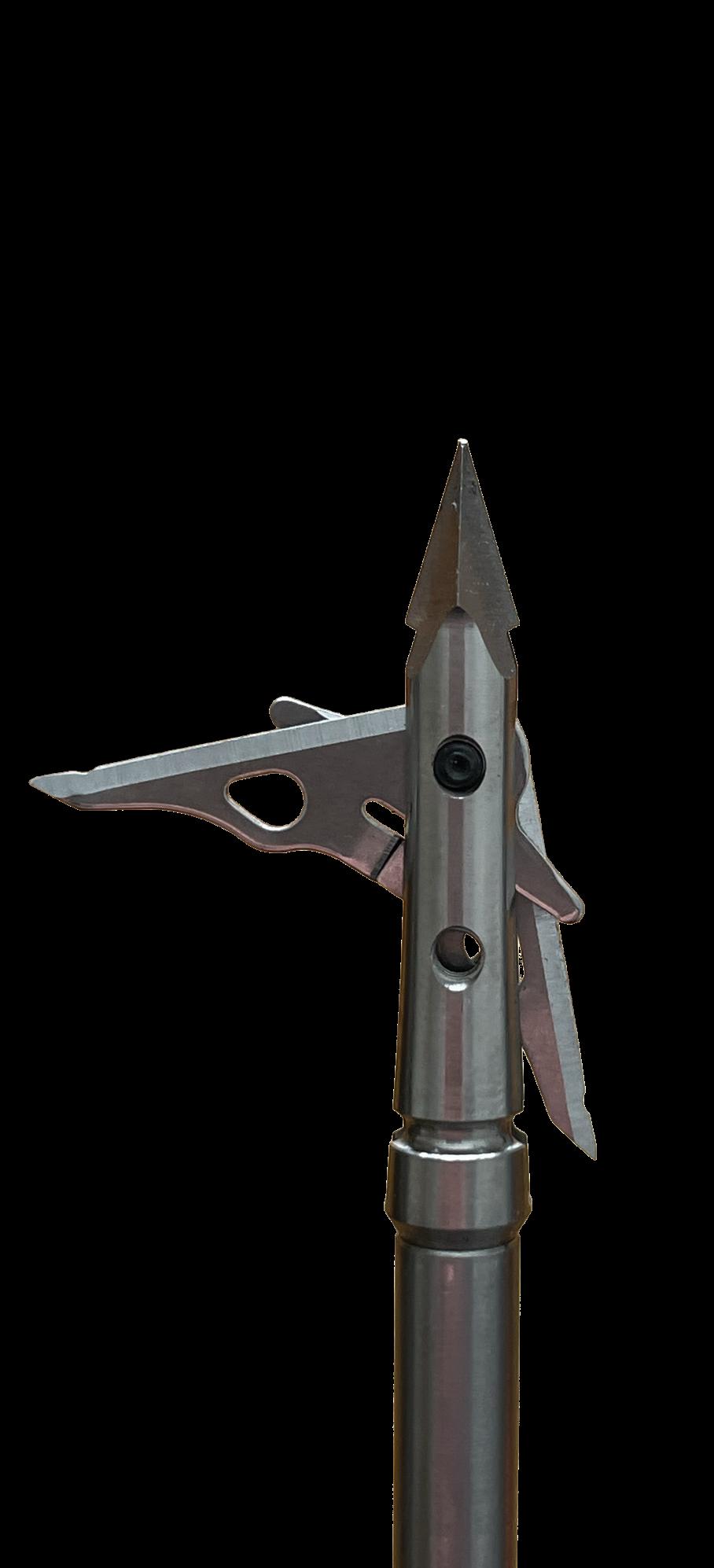

For the most part, mechanical broadheads are more forgiving, and I am not just talking about forgiveness from a bow tuning perspective. Taking a shot on a big game animal is an exciting and stressful experience. Despite how much you train on the practice range, there are things that come up during a shot, in the mountains, on a living animal, that are hard to replicate in practice. During the excitement of a shot on a living animal, you likely won’t follow your exact shooting routine perfectly; you may anchor a little differently, your footing may not be ideal, there may be a breeze, you’ll probably rush the shot, etc.
All of these things can cause the arrow to come out of the bow differently than when you tuned it. Since a mechanical has less surface area on the front of the shaft compared to a fixed-blade, the vanes on the back of the arrow can more quickly correct the flight of the arrow with minimal impact from the broadhead causing the arrow to drift. This means you are more likely to hit closer to your intended aiming point, even if you make a less-thanperfect shot. Similarly, because mechanicals have less surface area on the front of the arrow, you can get away with smaller vanes on the back of the shaft to correct the arrow.
Smaller vanes on the back of the arrow result in less wind drift, especially at long range, and less wind drift means more accuracy. Shorter vanes (height-wise) also help eliminate contact issues with cables, the arrow rest, and the bow sight that may result from higher profile vanes. Lastly, mechanicals are considerably more forgiving than fixed-blades for arrow velocities over 300 FPS.
The other big advantage of mechanical broadheads is the cut diameter. Generally speaking, mechanicals have much larger cut diameters than fixedblades; this means bigger wound channels, better blood trails, and potentially quicker kills. The whole intent of a mechanical broadhead is to minimize surface area while the arrow is in flight and “expand” the cut diameter upon impact with an animal. Because of this, mechanical broadheads can achieve cut diameters that exceed 1.5 inches, and many mechanical broadheads have cut diameters of 2.0 inches or more. If you have sufficient energy in your bow, a 2-inch wound channel has devastating effects on big game animals.
Mechanical broadheads can have a few downsides that revolve around reliability/toughness and penetration. Some mechanical broadhead designs are pretty complicated. In order to make weight with these more complicated mechanical designs, the parts can’t be made as robustly as desired, so some mechanicals are inherently not as tough. Manufactured parts have fabrication tolerances. The stacking of fabrication tolerances for mechanicals is compounded by the fact that the parts of a mechanical broadhead are moving and can get jammed or otherwise fail.
When mechanical broadheads first hit the market, there were lots of reliability issues. Modern-day manufacturing has since greatly improved, so there are far fewer of these issues. It’s important to point out that mechanical broadhead designs have come a long way, as well. I look for and use mechanical broadhead designs that are inherently simple, and because of this, I have never had a mechanical broadhead fail. I also look for mechanicals that are made out of titanium or steel and try to avoid heads made of aluminum.
The other disadvantage of mechanical broadheads can be penetration, depending on the energy output of your bow. Penetration with mechanicals can be a real concern if your bow does not have adequate energy. Upon impact on the animal, mechanical broadheads require energy to expand/ deploy; the amount of energy required to expand varies based on the design. After mechanicals expand, they generally have larger blades and steeper cutting angles that require more force to penetrate compared to fixed-blades.
Unfortunately, it’s very hard to quantify what a minimum recommended kinetic energy requirement is for big game hunting with mechanicals. There are so many variables that will affect the performance of a mechanical broadhead. I’m not saying it’s impossible with less, but I would recommend shooting an arrow with at least 65 foot-pounds of kinetic energy for mechanical broadheads. This is roughly equivalent to a person shooting a 425-grain arrow, out of a 60-pound bow, at a draw length of 26 inches. Most people shooting a 70-pound bow should have no problem getting adequate penetration with mechanical broadheads (non-heavy-bone hits).
Schwacker 261 Slick Trick Standard Toughness
Grim Reaper F. Steel Grim Reaper M Hades Budgest Option
Fixed-blade broadheads have been used in various forms for over 5,000 years. A static, fixed-blade broadhead has stood the test of time. The biggest advantages of a fixed-blade broadhead are toughness, reliability, and penetration. Other than breaking a blade or bending a ferrule, little can go wrong with a fixed-blade design.
As discussed above, fixed-blades are less impacted by fabrication tolerance issues simply because they don’t have any moving parts. Because the designs are generally simpler, the broadhead components (blade and ferrule) can be made more robustly and still make weight. There are some fixed-blade broadheads on the market that are made out of premium materials that are intended to be reused multiple times, whereas most mechanicals are typically used once and discarded.
Fixed-blades are great penetrating heads. This is because they don’t require any energy to expand; they generally have smaller cutting diameters/ reasonable cutting angles, and they can have better edge retention, depending on the steel quality. Although fixed-blade broadheads will out-penetrate mechanicals, they produce smaller holes than mechanicals. This can mean the blood trail and internal hemorrhaging aren’t as good.
As discussed above, fixed-blades are not as forgiving when it comes to accuracy. You also can’t shoot them as fast; I would recommend not shooting a fixed-blade any faster than about 285 FPS. Sure, a guy or gal can get fixedblades to fly great in practice, but when the unexpected happens on a hunt and you make a less-than-perfect shot, a fixed-blade can sail/drift on you. Typically, to get a fixed-blade-tipped arrow to correct itself quickly, you need to have a lot of vane surface area on the back of the arrow. This can increase drag and wind drift. Furthermore, high-profile vanes can have contact issues as previously discussed. High-profile vanes are also a lot noisier than lower-profile vanes. Don’t get me started on animals “jumping the string.” Contrary to mainstream belief, animals are reacting to the sound of the arrow raging/hissing toward them, not to the sound of the bow going off, but that is the subject for a future article.
The Arrow Ballistics Study is the first organized effort to do large-scale arrow ballistics testing using a controlled shooting machine and controlled testing procedures. We are studying how every component of the arrow affects its trajectory, including broadheads. Over the last two years, we have studied the ballistics of about 50 different tips and broadheads. These studies focus on how the arrow flies out of the bow, the trajectory, and accuracy.
This study has not focused on terminal ballistics, like hole size, nor blood trails. From the study, it is very evident that despite all manufacturers claiming their broadheads fly perfectly like field tips, some broadheads are substantially more accurate than others, and as I said above, accuracy/shot forgiveness is my top priority.
During the ballistics testing, each broadhead was shot in groups of six arrows for two rounds with the same baseline arrow build. The broadheads that grouped the tightest out of the shooting machine (executing a perfect shot every time) were the Sevr 1.5, Sevr 1.5 Hybrid, Schwacker 261, Thorn Rift 2.2, Beast 2.0, and Grim Reaper Fatal Steel. All of these broadheads consistently shot 2-3" groups at 70 yards.
The tightest-shooting fixed-blade was the Evolution Jekyll by far. Both groups with the Jekyll were slightly over 3", which was really impressive for a fixed-blade. The next three best flying fixed-blades were the Tooth of the Arrow (TOTA) 4-Blade, Slick Trick Standard, and the Grim Reaper Micro Hades. These fixed-blades shot groups that were 5-6". All the other fixedblade groups were 7-12".
In general, we saw the average field tip group was 2.5", the average mechanical group was 4", and the average fixed-blade group was probably 7-8". It should be noted that the same baseline arrow shafts were rotated through all of the broadheads in this testing (to reduce any arrow bias). This just goes to show how much more forgiving a mechanical broadhead is than a fixedblade broadhead, considering the increase in group size when shooting even from a controlled shooting machine.
It’s pretty clear that mechanicals excel for accuracy, forgiveness, and big wound channels in soft tissue, and fixed-blades excel at toughness and penetration. Based on my focuses (open country, western, spot-and-stalk), I default to mechanical broadheads for most of my hunts. I have to have a specific reason in mind to want to shoot a fixed-blade broadhead.
I almost exclusively use mechanicals on open country hunts for both deer and elk, where I expect my shot encounter to be beyond 50 yards. On these hunts, I believe accuracy is the most important thing to maximize. On long shots, I generally have time to wait for an ideal broadside or quarteringaway shot angle, so I am not as worried about penetration through heavy bone impacts. I want my broadhead to inflict maximum damage in soft tissue, where it’s easy to get a pass-through. On these types of hunts, I typically like a fast, flat-shooting arrow to minimize vertical trajectory and mitigate ranging errors. I highly recommend shooting a mechanical for accuracy forgiveness if you are shooting over 300 FPS.
For mechanicals, I personally like rear-deploying heads more than front (over-the-top) deploying heads. You are more likely to get a fully expanded entrance hole with a rear-deploying head than a front-deploying head. The nature of front-deploying heads can sometimes lead to small entrance holes from the broadhead not fully expanding as it begins to penetrate. Both my personal experiences and those of my friends have shown that rear-deploying heads generate bigger entrance holes.
We all want a complete pass-through with two excellent holes, but sometimes you just don’t get an exit hole for one reason or another. Now, if you are shooting a front-deploying head that inherently may not give you the best entrance hole, and you don’t get an exit hole, you could have a pretty marginal blood trail on your hands. At least with a rear-deploying head, you’ll get a solid entrance hole regardless of the exit hole.
Based on these criteria and knowing how each broadhead performed in The Arrow Ballistics Study, my top choices for mechanicals are the Sevr 1.5, Sevr 1.5 Hybrid, and the Beast Titanium 2.0.
I reach for fixed-blades on hunts where I expect my shot encounters to be close (say 40 yards and in). For me, these types of hunts revolve around ambush hunting, treestands, ground blinds, sitting water, calling in elk in thick timber, etc. In these situations, shot angles can be trickier, and it’s not ideal to wait for the perfect angle because animals can quickly blow out inside close quarters. So, it’s nice having a better penetrating head for these situations.
For fixed-blades, I like them tough and quiet. I like fixed-blades with solid blade construction because they are way quieter and more durable. Vented fixed-blades tend to whistle in flight, which makes them very loud. Though I have never used it on a hunt, the fixed-blade that I am most interested in is the Tooth of the Arrow 4-Blade. It checks all of my boxes and performed well in the Study. The next time I screw on a fixed-blade for a hunt, it’ll be that one. WH
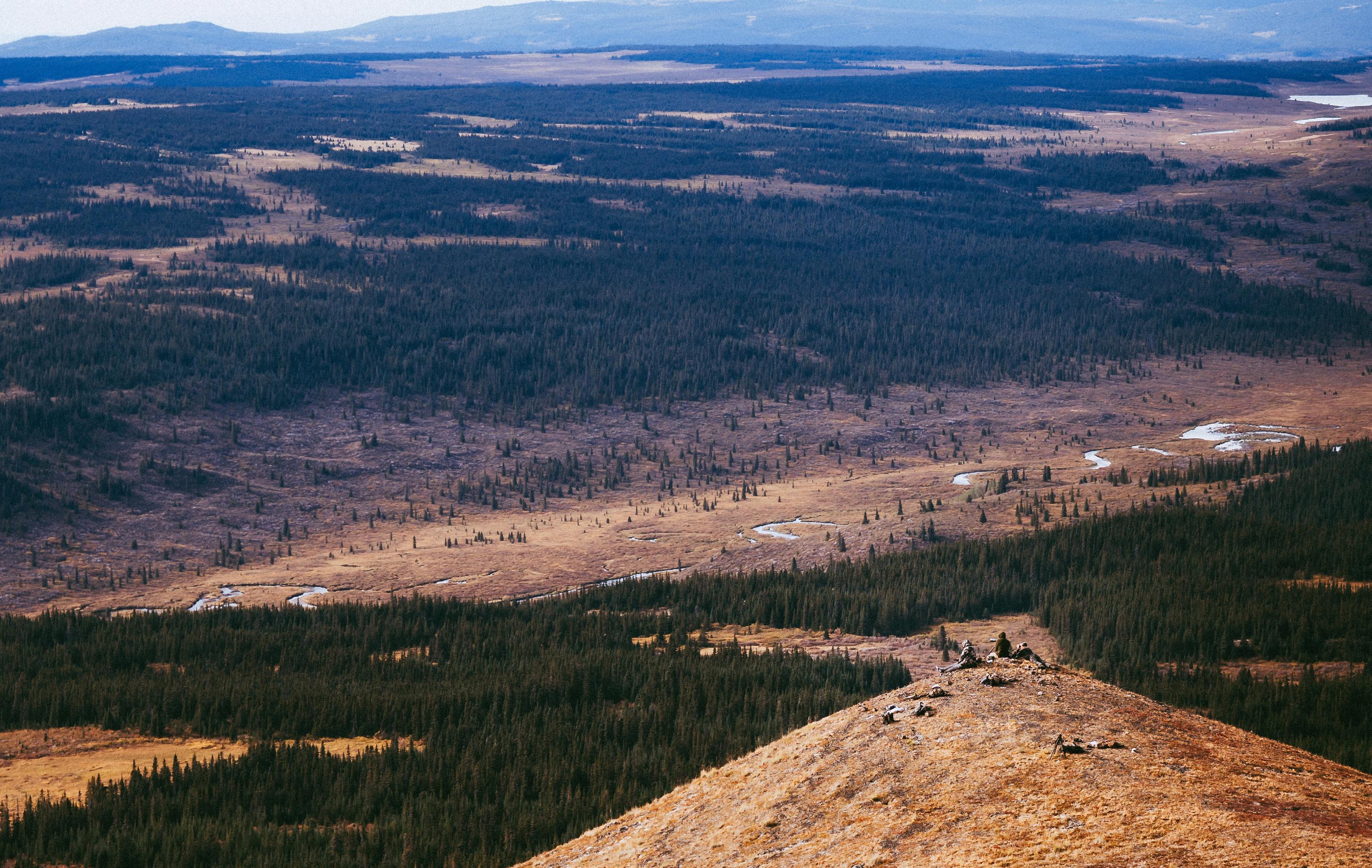
There’s no easy way home from here.
The market for suppressors has exploded (intended) over the past few years. Choosing one is not a simple process, but the main thing to look for is reliability. Some are hearing safe, some are not, but if you’re doing a lot of shooting regularly, the reduction in the concussive impact is the most important feature of a muzzle device. Brakes are great for recoil control, but the damage caused by repetitive pressure waves on the human brain is far from harmless. It’s never been easier to acquire a suppressor, and it’s nearly impossible to go back once you do. This is a small selection of the ones we’re currently using.

LEFT TO RIGHT:
Silencerco Saker 7.62
Gunwerks 6IX
Unknown Reaper
Unknown NHS
Surefire RC2
Gunwerks 8IGHT
Airlock Zero Gravity 6.5
I have never been a suppressor guy. I like big brakes that help reduce recoil, but in recent years, I have changed a few things. I rarely shoot big, giant calibers that need loads of recoil reduction, and I shoot a lot more than the average bear. I noticed after one morning of shooting with a brake that I didn’t feel quite right, similar to smacking my head on the cupboard door while bending down to grab a box of cereal. That doesn’t happen with a suppressor. Not only do you feel better once you’re done shooting, but you also feel better while you’re breaking those shots. So, that said, I have moved into the camp of never shooting without a suppressor. Traditionally, the biggest issues with them, especially for hunting situations, are that they add an annoying amount of length to your gun and they weigh a lot, throwing off the balance of the rifle. The Airlock changes this. It only adds 4.4 inches to your barrel length, and it weighs less than six ounces. Since I switched to 18-inch barrels on most of my hunting rifles, this leaves me with a tidy enough package that I don’t get caught on every branch I walk under, and I don’t even feel the extra three ounces that I wouldn’t have had with a brake. This is my favorite piece of gear so far in 2026.
Suppressors are sooo hot right now, and some of the hottest amongst them are the ones being cranked out by Unknown Suppressors. Everything US makes uses grade 23 titanium via 3D printers, eliminating welds and weak points while enabling internal geometries engineered to shape gas flow and tone. Being the American badasses they are, every suppressor is conceptualized, designed, machined, Cerakoted, failure tested, measured, QC-ed, and packaged all under the same roof in Post Falls Idaho.
I own two of their units–the Reaper and the NHS. The Reaper comes in under 9 ounces and 6 inches long and has a very pleasant, unique, and hearing-safe sound signature. I added a two-port muzzle brake made by Salmon River Solutions that reduces the muzzle jump and recoil impulse to a notable degree, all while maintaining a comfortable sound signature to the ear. You can shoot .30 cal or 6.5 mm through this can and dramatically reduce the concussive slap in the face that comes from a standard brake or naked-barreled rifle. The Reaper is a do-it-all, and do-it-all-well suppressor.
The other model I own is the NHS, which stands for Not Hearing Safe. This little unit is finely tuned for one thing specifically–reducing recoil and concussion for competitive shooters. While it may not meet the 140 decibel threshold for being ’hearing safe,” it still quiets the blast a lot. It reduces felt recoil and concussive blast the shooter feels by a significant margin over a traditional suppressor. The NHS is designed with an integrated/ printed-in muzzle brake and a taper lock attachment so you can perfectly time the brake to your muzzle. When comparing the recoil signature to other suppressors, I noticed a much improved ability to stay on target to see my impacts and misses. Coupled with its ability to eliminate almost all of the concussive blast I feel, the NHS makes shooting a two-day match at well over 150 rounds much less damaging to my noggin (which also contributes to better mental performance on the clock). WH
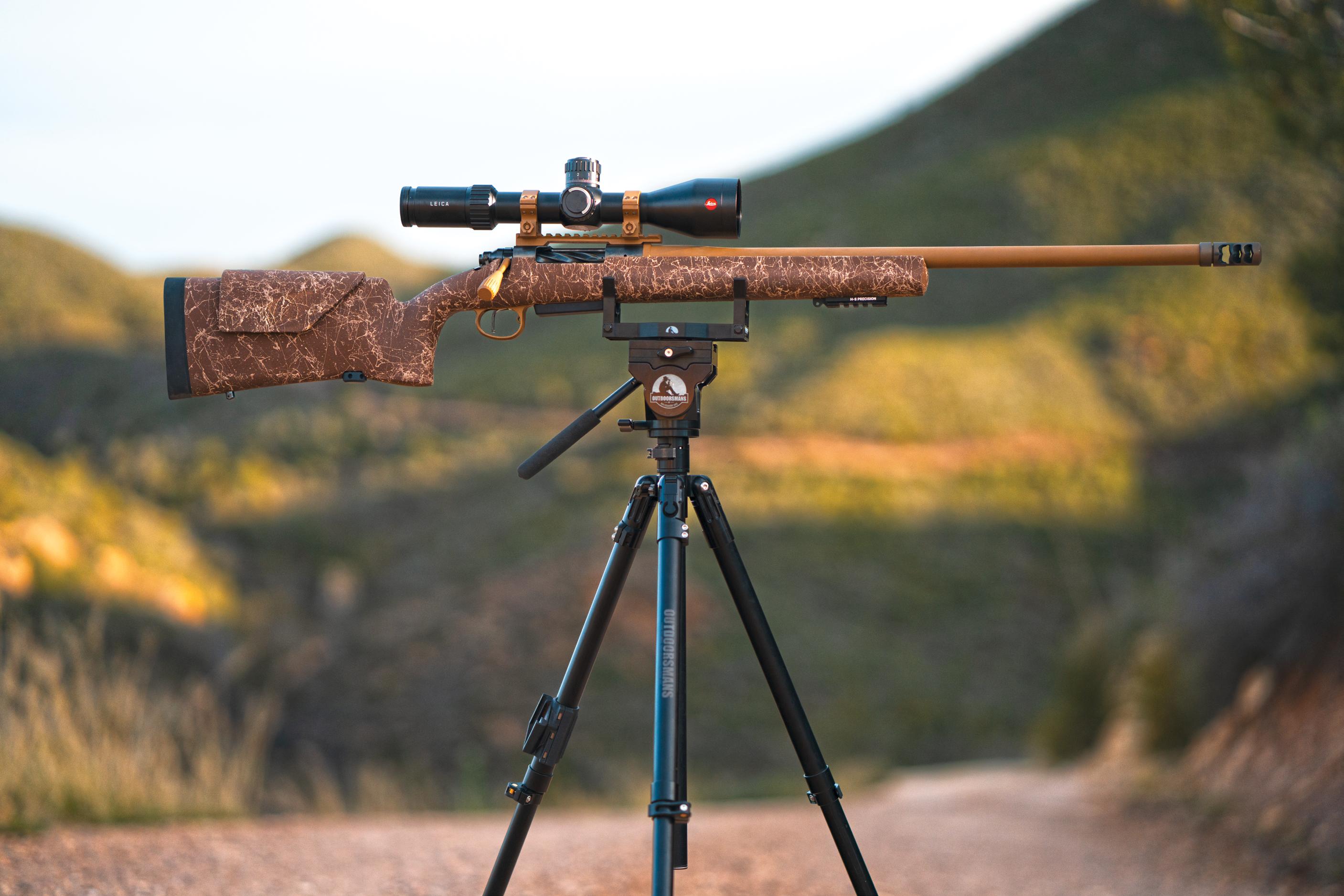
Leica PRS 5-25x56
H-S Precision Gen III Rifle
Outdoorsmans Aluminum Tripod Gen 2
Outdoorsmans Tripod Holster
Outdoorsmans Fluid Head
Outdoorsmans Folding Rifle Saddle
BY CODY BARNES PHOTOGRAPHY BY BRI HELMS
In the distant mountains, warm drafts rise from Sierra Nevada peaks. Billowing clouds spill over uneven ridgelines, drifting into dehydrated flats of Nevada’s Great Basin. Floating in slow motion, they cast dramatic displays of light and shadow. A guttural thunder startles the assembly call of nearby quail. Quietly, I watch as a light patter of rain begins to touch the ground.
Vibrant green vegetation bursts from the mountainside, its color tapering at the edge, as though its creator intended to continue painting but simply let pigment run down the canvas. Surrounding the lush spring is a collage of texture and contrast. Rabbit brush, crisp mule ears, and wheat-colored grasses.
Overcome by the striking beauty of the high desert valley, I almost forget why I’m here. But there’s a purpose to traversing these monsoon-crevassed roads: spot-checking springs for water and locating groups of doe antelope in preparation for my wife’s approaching hunt. Sleek black horns lie hidden somewhere on the periphery, but their absence is no concern. In a few weeks, the rut will overcome their desire to remain on the fringe.
I study the terrain, making note of elevated locations offering clear lines of sight to the valley floor. Subtle folds in the land offer a spot to park and remain hidden from telescopic eyes. Reluctant to leave, I let the engine rest. Allowing myself to be immersed in a living western painting.
Days later, I return to continue my exploration, this time with my two young boys in tow. Our curiosity eventually leads us down a formidable path of volcanic rock, cloaked by a carpet of cheatgrass. Earthy red outcroppings rise in knife-edged formations, each rock holding the potential to gut the sidewall of any tire that dares come too close. Despite my worry, laughter and senseless chatter fill the cab. Each slam of the truck bed echoes with joy from the innocence of youth.
“Within minutes, the downpour slows to a trickle, and the stalk is in motion. Quickly, we close the gap to the buck’s last bedded location.”
Perched among a sea of snack wrappers, my youngest presses binoculars to his eye. Rapidly scanning the area, he calls out antelope in every direction. I play along, despite empty sage flats holding nothing more than a child’s imagination.
Back home, proud young voices recount the outing. A young buck spotted off the road morphs into legend, and is retold as if I were never there. Selfassured descriptions of “antelope country” drift through our home until the two are tucked into bed for the night.
The days that follow are bound by the obligations of daily living. Fortu nately, the tag unit lies close to our home, and the drive from work allows me to steal brief glimpses of the area. As the hunt approaches, we have enough spots to make good use of the 48 hours that Grandma has provided for childcare.
Finally, opening morning light arrives. Spilling over the ridge, the valley below begins to bustle with life–not the four-legged kind. From our van tage point, we begin counting vehicles.
1... 2... 3...
9... 10... 11...
The count continues to climb. Despite the flood of eager rifles, not a single shot is heard.
Unsurprised but disheartened, we shift our glass toward higher elevations with less desirable country. In the soft light of sunrise, a band of antelope is spotted on a ridgeline miles away. Abandoning the main valley, we take off on foot, traversing falling and rising hills to close the gap. As we near, a rambling quad cuts in front of us, the sound of its puttering engine soon muted by a steady volley of shots from its rider.
First light enchantment has passed, replaced by waves of heat radiating from the ground. By mid-morning, temperatures near triple digits as we pass on a small buck and jump does hiding amongst the shadows of junipers.
As we head back toward the truck, we enter an unremarkable pocket of sage. Passing through knee-high brush, the jagged edge of a white stone catches my eye. Protruding from the ground is a tool of the past, a prede cessor of modern-day weaponry.
Arrowheads have crossed my path a number of times over the years, but never a spearhead–so intact, so whole. A mix of skepticism and wonder conjures a backstory in my mind. For a few moments, we let our attention drift into the hands of history. We consider who fabricated such a piece; the hardships they must’ve endured, and the pure simplistic lifestyle they led compared to modern-day living. Hunting to survive. If this stone could speak, I wonder what it would say.
Time ticks forward as we work one location after another, searching not only for the right buck, but the right setup. We cat-and-mouse the edge of agricultural strongholds that contain the occasional buck headed between neighboring properties. We run the gamut until the last flicker of horizon’s light, expectations dwindling as the first 24 hours are put to bed.
Morning silence returns in what feels like minutes of sleep. Down the hall, the crinkling of foil wrapping an afternoon lunch is heard as I get dressed. Loading the truck, I give my wife a squeeze and a good-morning kiss. Her quiet smile assures me there is still some hope left in her tank. As we bump BLM
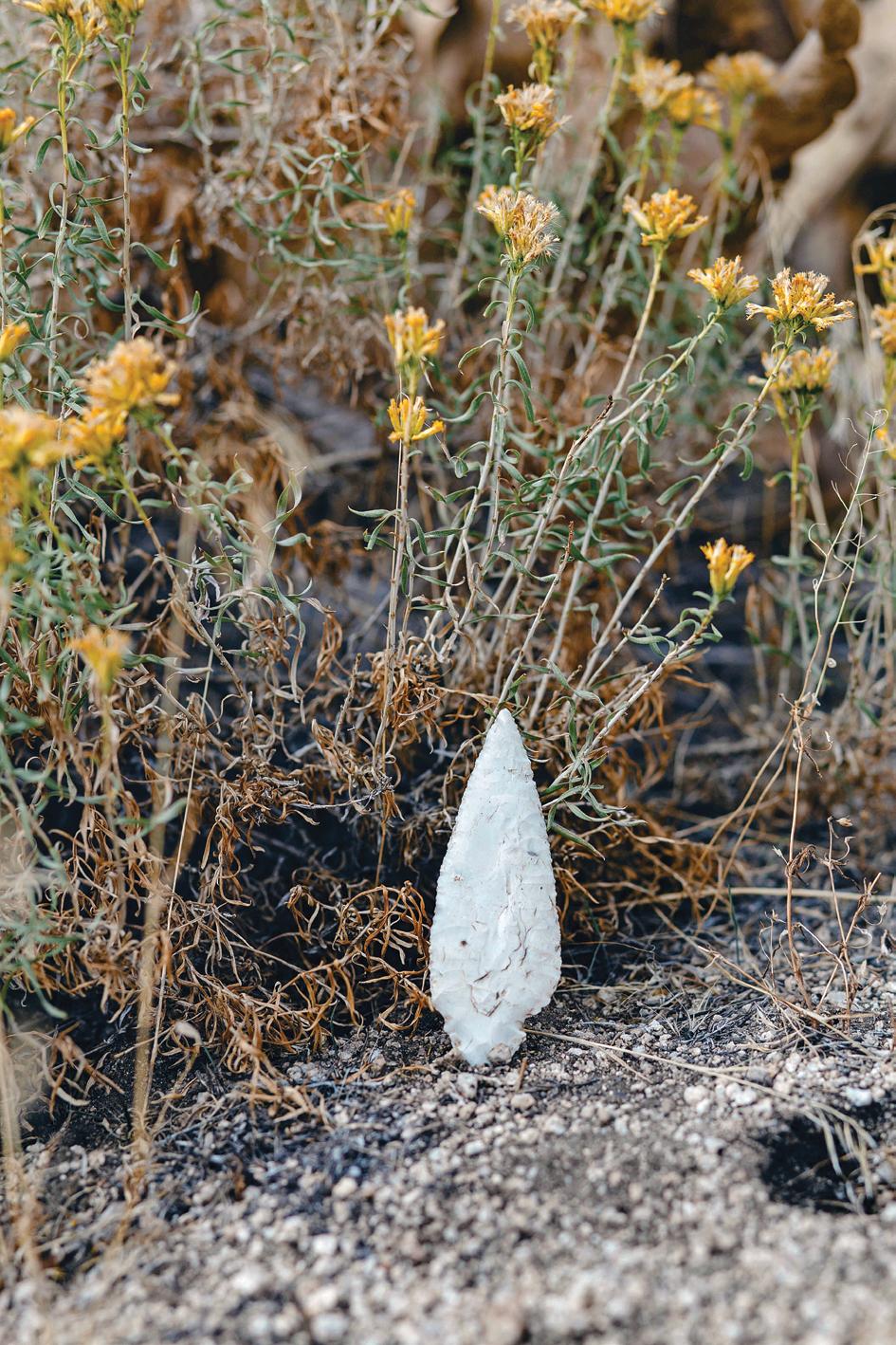
“A break in this weather will have them on their feet. They may feed off. We need to move just as the rain shows signs of letting up.That knoll should give us enough elevation for a clear shot.”
Within minutes, the downpour slows to a trickle, and the stalk is in motion. Quickly, we close the gap to the buck’s last bedded location.
“This is the final rise. When we crest, we’ll be in view,” I whisper. “That tall bush in front of us–stay behind it. It’ll keep us hidden.”
On hand and knee, we slowly inch forward. Every few feet, my wife glances back, giving me a quick smile.
“Set up the rifle and tripod behind this brush.”
Unloaded, she dry-fires on my signal–one last silent rehearsal. At the edge of the brush, she shoulders the rifle and settles into position.
My shadow quickly flashes against her outline as I’m backlit by a strike of lightning. As if orchestrated, another wave of rain begins to fall. Each drop of water hitting the earth releases an aroma of oils and mineral-rich soils into the air. The strong, earthy odor surrounds us. We sit, quite literally, soaking in the moment. As the storm’s encore comes to a close, the buck and his does rise in unison. My wife looks back for an approving nod.
“Take your time. They don’t know we’re here.”
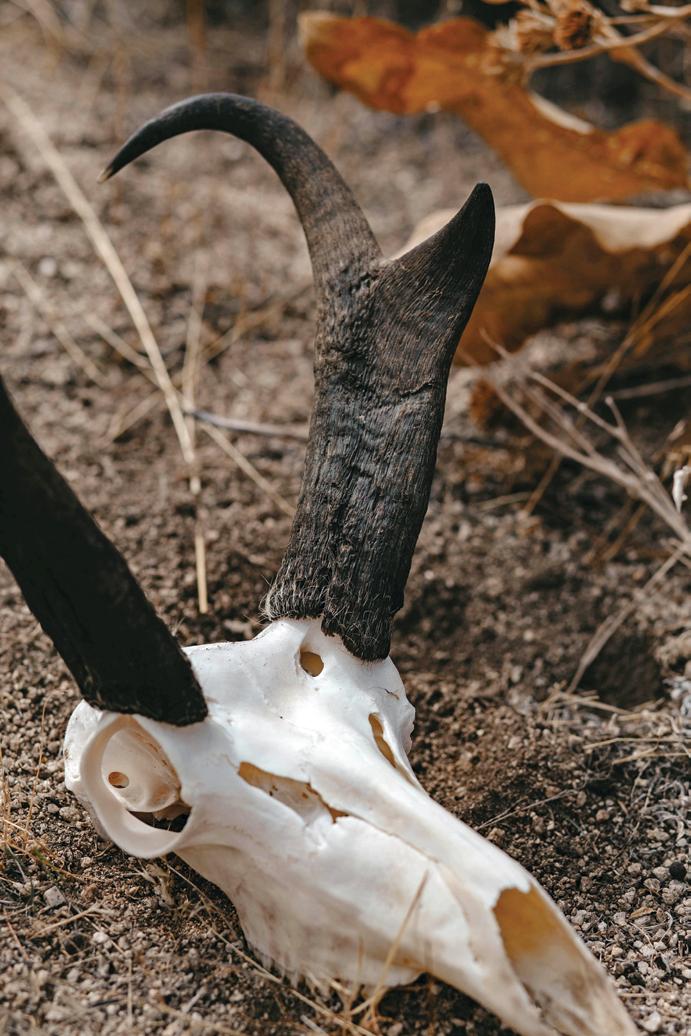
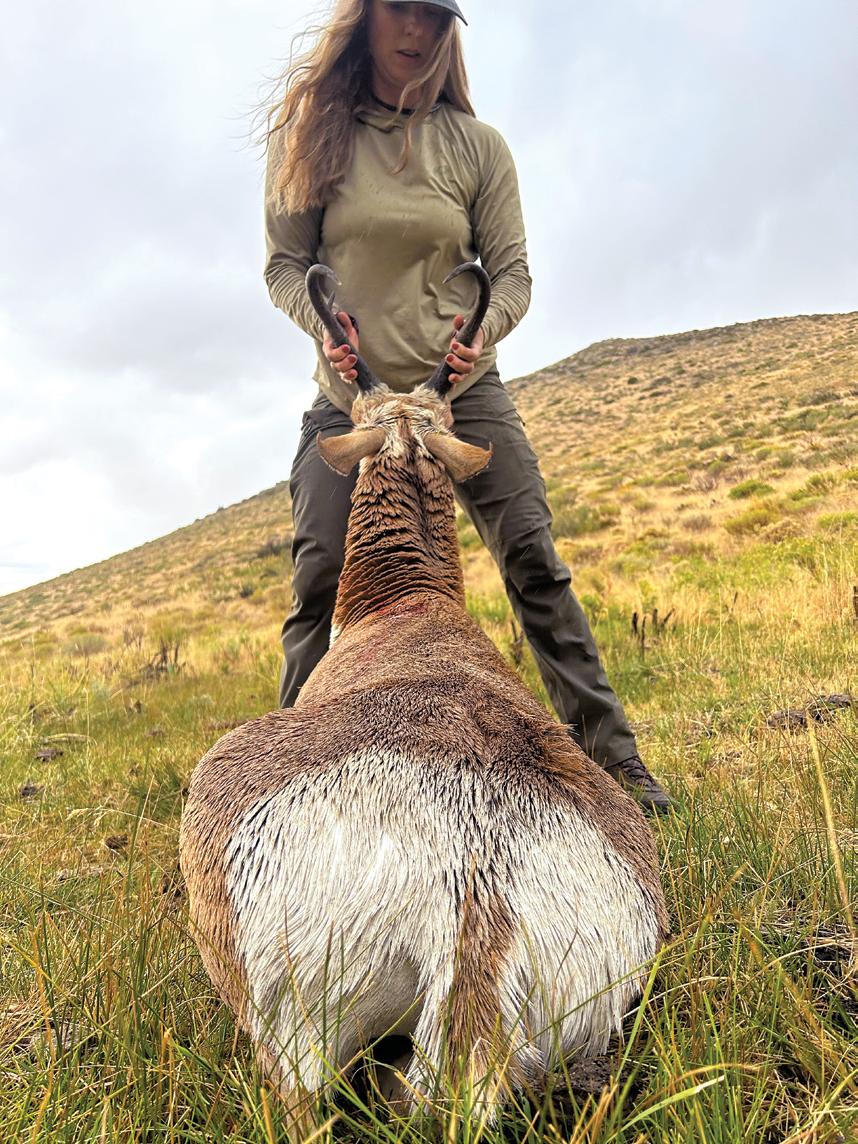
A metallic flick of the safety spikes my heart rate. A dry swallow overcomes my urge to remain steady as I spectate through binoculars. The anticipation is paralyzing. The sound of her repositioning pulls me off the glass. Tilting her head toward the sky, she inhales deeply. Eyes shut, she slowly exhales a visible breath of anxiety. The angst she wrestles with is one familiar to many hunters.
I flash back to the days leading up to her hunt. Providing her with pictures of antelope and previously lived scenarios to test her decision-making. I know she is prepared. Refocused, she returns to the rifle.
The buck slowly feeds in the opposite direction from his pair of does. A momentary pause in his gait exposes a clean, broadsided shot.
“There, hon, that’s it. That’s the shot,” I tell myself.
Before I can reflect any further, I’m jolted by the overpressure of a dropped firing pin. Melting to the ground, the buck lies motionless. The separation of meat and hide is interwoven with the retelling of a successful hunt.
Driving home, my wife reaches over and takes my hand. We reflect on life, our marriage, and raising children–where we’ve struggled, where we’ve succeeded, and where the future may lead. Prayers answered, and those of which we must still keep our faith in.
Baptismal rains continue to fall as the storm-soaked roads fade behind us. I feel thankful–for the meat, for the memories, and for the opportunity to make her part of a community of those who provide for themselves. WH

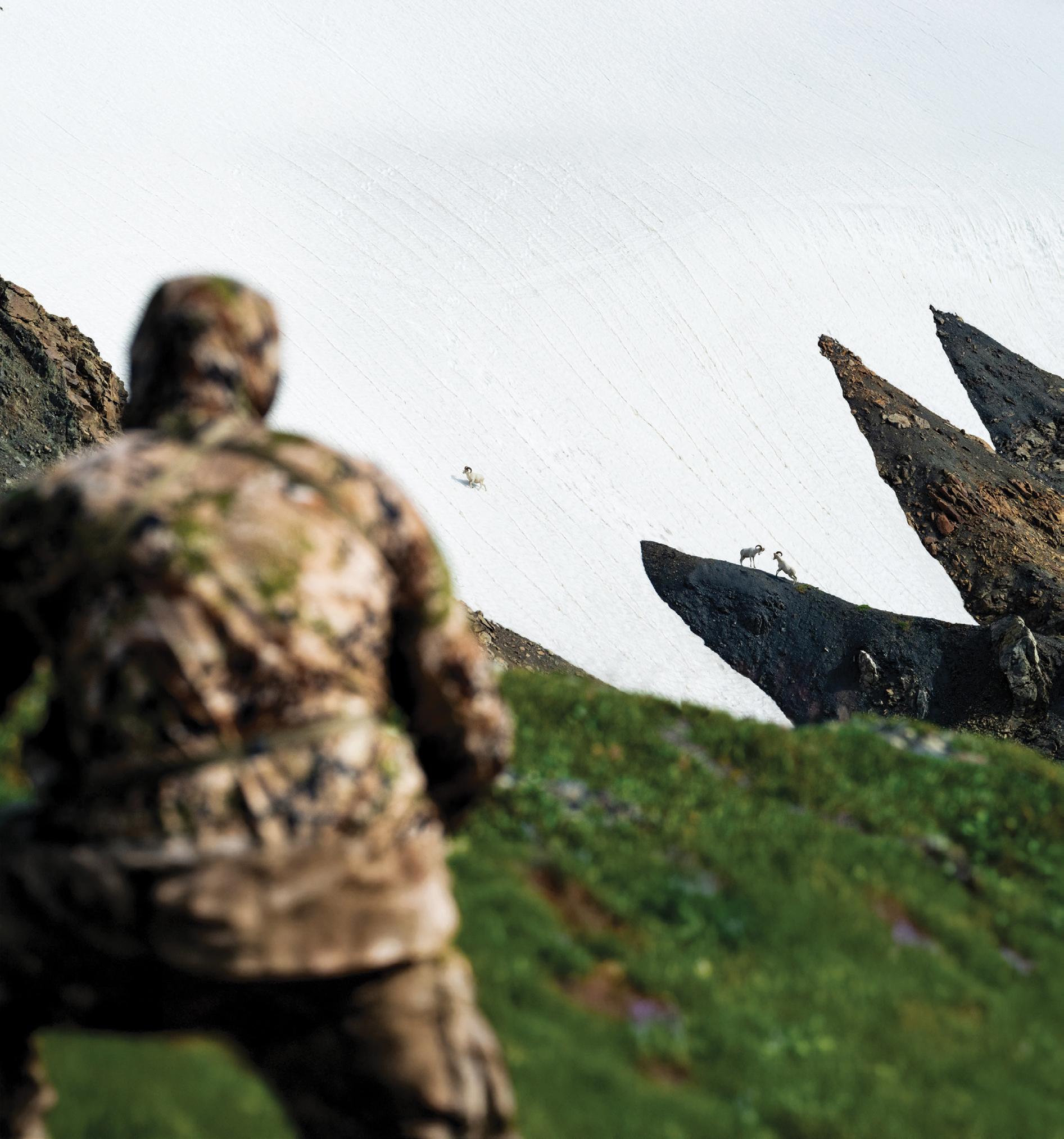
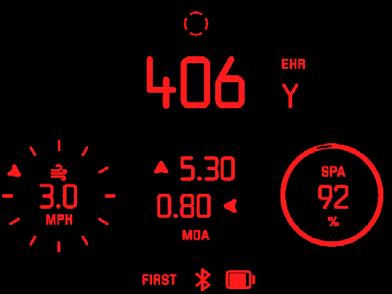
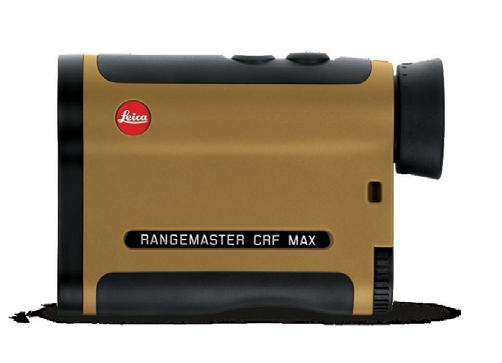
Integrates With

“It's safe to say that Kenetrek has a customer for life; it just might take me a lifetime to kill these boots.”
BY JOE MANNINO
The smell of rubber wafted up when I ripped open that box from Kenetrek. The boots were packaged with the bottoms up, and the sharp, shiny new treads were the first things I saw. I was dangerously stoked, and it wasn’t even a new pair of boots that I was opening. It was my dusty, five-year-old pair of Mountain Extremes that I sent to Kenetrek’s repair department.
Growing up hunting the Arizona desert, our main tactics were walking and glassing. My father stressed the importance of good glass and a good pair of boots. When I was a kid, he outfitted me in Cabela’s boots that were two sizes too big, so he could stretch that small investment over two or three seasons rather than just one.
That emphasis on the investment stayed with me, and when it was time for me to finally upgrade into a premium boot, Kenetrek was really the only option. For me, the biggest deciding factor was their repair service program. I figured if I was going to spend big money on some big boy boots, I better get some years out of them. Their repair program ensures longevity; I just didn’t know how much.
I went with the Mountain Extreme boot, non-insulated. Today, they run $525. That’s a lot of money for a pair of boots. I really was questioning whether they were worth it or not. Then, I put them on and started hiking around in them. Sure, there was a break-in period, but once they started to form around my foot, their worth became clear.
That stiff shank helps you climb, and the one-piece upper keeps water, snow, dirt, and cactus needles out. I no longer had to jump across rocks or balance on downed logs to try to cross the three creeks I needed to pass to get to my favorite spot. I wore those boots everywhere. From baking in the hot sun in low cholla desert, scouting for Coues deer in the summer, to below freezing temps north of Flagstaff chasing elk, my Mountain Extremes have seen everything that Arizona has to offer. And they wore it.
I wasn’t the best at boot care. I put those things on my feet, and I went. In the five years I’ve owned them, I’ve waxed the leather once. The granite and limestone slopes that cover a lot of the Coues country I hunt tore up the outer soles of those boots so much that the treads on the bottom were as bald as a set of slicks fit for the track. Even the rand around the toe was tearing apart. However, even with that level of abuse, they never let water in.
After the last hunt of my ‘25/26 season, I decided it was time to send them to Kenetrek for repair. The process couldn’t have been simpler: Clean the boots up as best you can, fill out and print the form from Kenetrek’s service page, and ship.
It took 30 days from doorstep to doorstep, and I basically have a brand new pair of boots that are already broken in. Kenetrek repaired the rubber rand, replaced the outsole, added performance insoles and new laces, and repaired and reconditioned the leather uppers. The fit and feel of the boot around my foot did not change at all; no additional break-in period needed. All it cost me was $175.
I’ve invested $700 into those boots over five years. First off, the fact that they lasted five years in the first place is impressive to me. That’s $105/year, roughly the cost of a mediocre Bass Pro boot that would probably only last about a year anyway. If we project out, let’s say that I get another three years out of them, $700 for eight years is about $87.50/year. That’s really not a bad deal at all. Also, I always have the option of sending them back in for service as long as the leather uppers aren’t torn to bits.
The question of whether or not that premium price tag is worth it, well, that’s been answered with a resounding yes. Not only have my Mountain Extremes been the most comfortable and capable boots I’ve owned, but they’ve also been the most durable and robust. It’s safe to say that Kenetrek has a customer for life; it just might take me a lifetime to kill these boots. WH
Winchester ® Supreme ® Long Range is purpose-built rifle ammunition for hunting game at even the most extreme ranges. A bullet with a precision drawn, thick-walled jacket for long range terminal performance and match grade accuracy.
+ LONG RANGE FLIGHT STABILITY
Heavy for caliber, extended boattail profile, and heat resistant tip combine for maximum ballistic coefficient
+ DEVASTATING TERMINAL PERFORMANCE
Large-diameter tip ensures positive expansion and maximum energy transfer at even the most extreme distances
+ SUPREME PRECISION
Engineered with next generation bullet assembly equipment to provide industry leading quality and competition level accuracy
+ MATCH GRADE PRIMER
Built to exacting specifications for shot-to-shot consistency
+ BOATTAIL STAKE
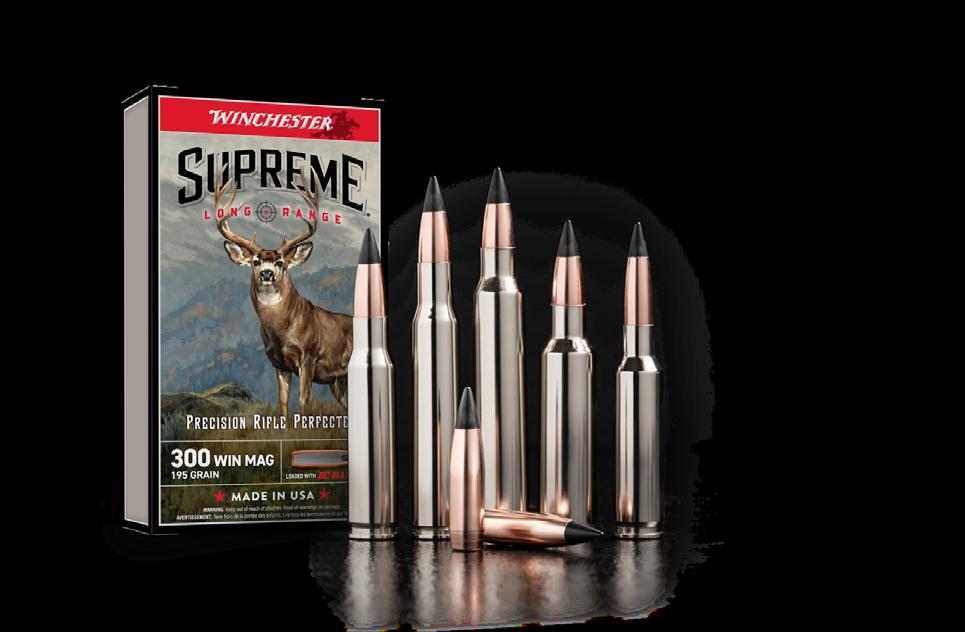
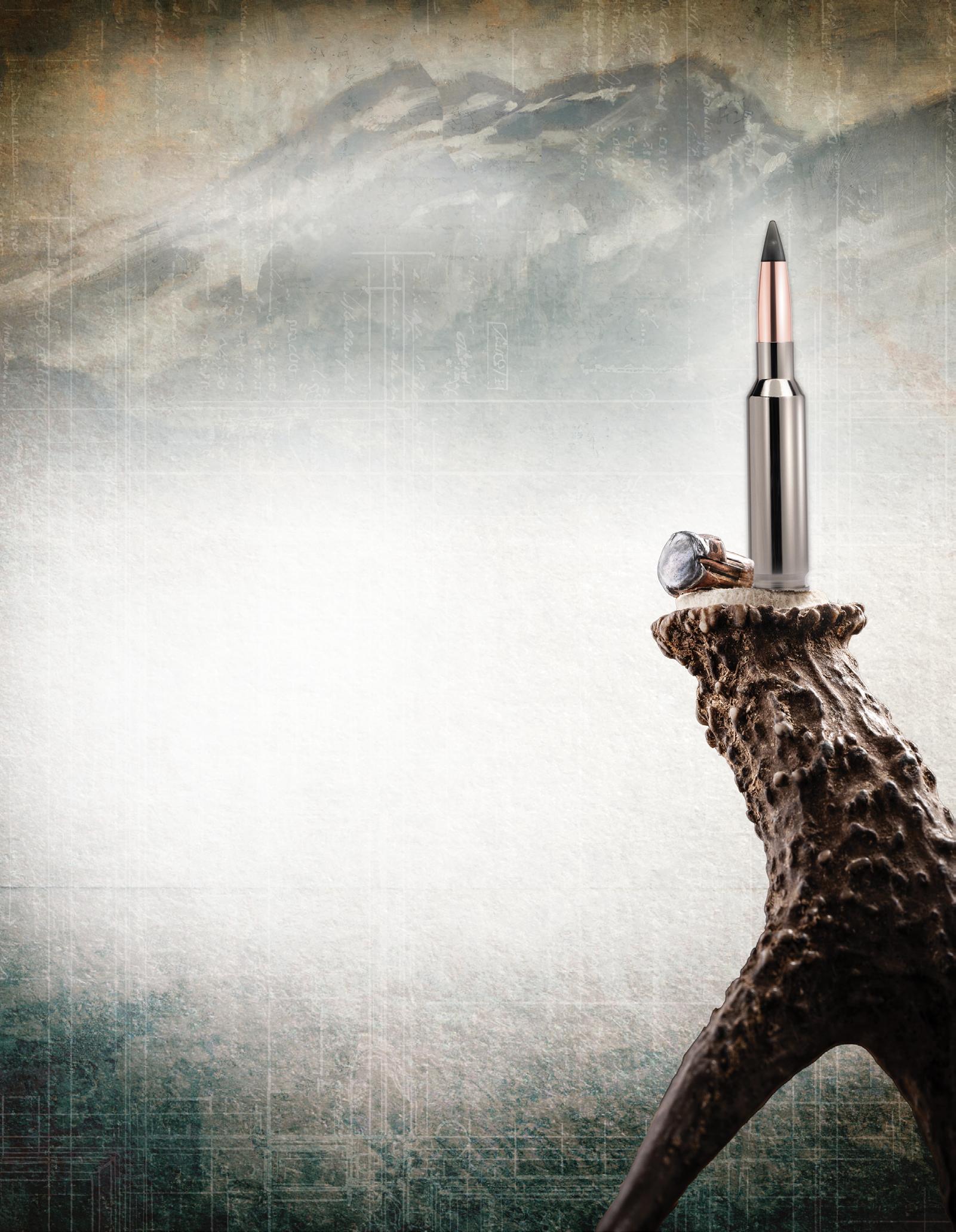
Innovative stake in the boattail aids in core-jacket retention at all ranges
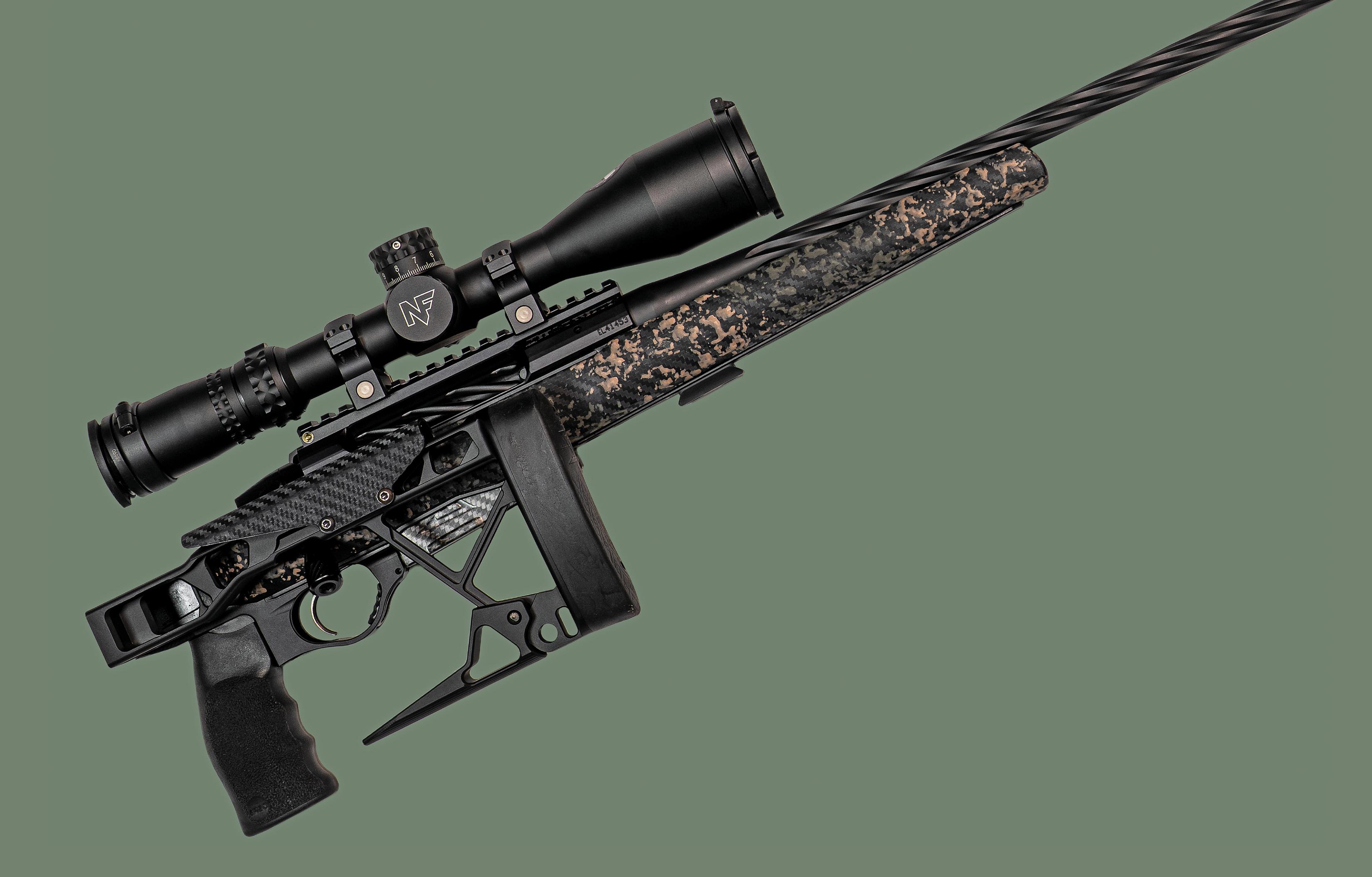
This just might be the most versatile riflescope on the market. This 4-32x50 NX8 is feature packed and has illuminated reticle options (MIL-XT for the win), high quality glass, a choice of FFP/SFP, and NF durability all in a compact 30mm tube making it an ideal candidate for both hunts and matches. There’s a reason NF is highly trusted by both military/LE and hunters alike, and the NX8 certainly upholds that high standard. If you want a scope designed to perform when you need it to, then you’d be doing yourself a disservice if you didn’t consider one of the options in the NX8 family.
Everyone asked for it, and Seekins Precision listened. Customers wanted the ability to take their Seekins rifle and drop it into a standalone chassis, and Seekins delivered with the Hunter Chassis–a lightweight folding chassis that perfectly merges the benefits of a modern chassis with the fit, form, and feel of a traditional hunting rifle. It’s available for your existing SA/LA Seekins Precision rifles, and (get ready for this) they’ve also made them available for Tikka and Remington 700 footprints.
~ Pedram Parvin
BY MIKE DUPLAN
rispi has been a dominant player in boots and footwear for the hunting market for quite a few years now. One of the biggest appeals of the Crispi lineup is the variety of boot builds to accommodate individual wearer preferences and also be compatible with the anticipated use in different terrain types. Crispi accomplishes this through its “Flex Rating System.” This was the brainchild of Crispi USA’s Mark Strickland and other Crispi employees to provide an industry-unique level of information for consumers.
Most boot wearers and purchasers have developed a preference, often through purchase trial and error, for a level of stiffness they like in a boot. For some, a stiffer boot with a mountaineering-type platform is just fine because they can comfortably wear that type of boot in any terrain. Then, there are folks like me. I prefer a more flexible boot, as a stiffer boot tends to give me heel blisters and toe pain because of my high arch, narrow foot, and very prominent heel bone. Every foot is different and unique to that individual, so having a variety of flex ratings and builds in different models allows customers great choices to pick the right boot for themselves.
In a recent discussion with Federico Marcolin, Crispi’s president in Italy, the concept of “Dynamic Construction” was explained in an effort to educate boot purchasers on what exactly is going into the different boots they are considering. Three pillars make up this Dynamic Construction: The Dynamic Frame establishes the base of the flex rating. The upper is constructed of the materials chosen for anticipated use and also contributes to comfort and stiffness. Lastly, the midsole and outsole also work to establish the flex rating.
These three components work together to tailor that boot to its expected use and establish the flex rating that the consumer references when selecting their boot. This purpose-built support is to allow a boot to be built that will absorb some of the stress and pressure of navigating terrain and avoid unnecessary transfer to the wearer.
The materials that make up a Crispi upper are a blend of leather and synthetic construction materials which work together to provide the most optimal combination of durability, comfort and protection. Various combinations offer a different feel to the wearer and can increase or maintain the flex rating established by the dynamic frame. Leather is used extensively because of its unique ability to conform to the wearer’s anatomy without breaking down. Leather boots aren’t just made to “break-in” but should also actively shape themselves to the wearer’s foot over time and use.
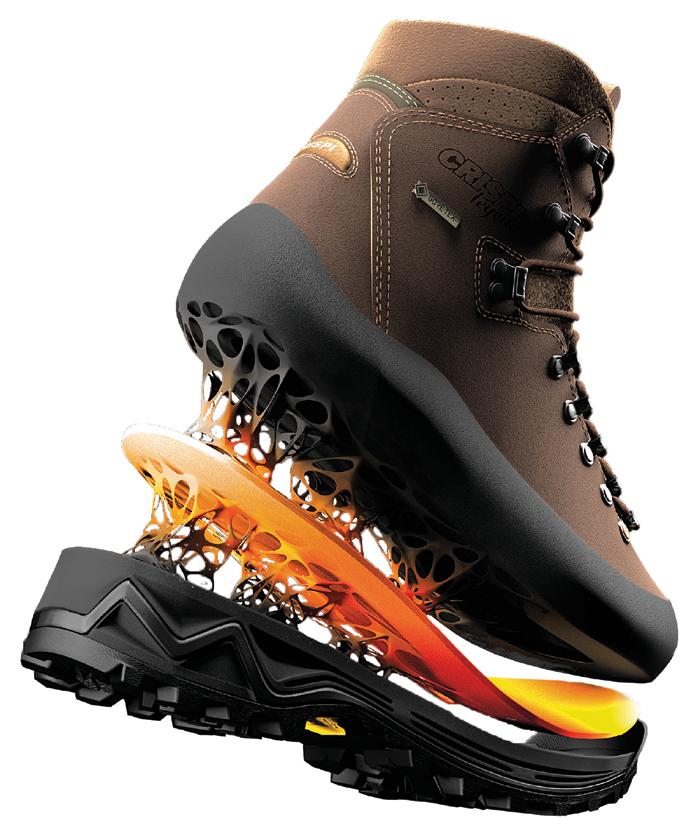
Conversely, synthetic materials in the boot provide a static nature to retain the shape and construction of the boot over time as the leather breaks in and conforms to the wearer. This blend of construction material in a boot is essential to provide comfort and durability as well as confidence that the boot will hold up to use in sometimes unforgiving terrain.
Lastly, the midsole and outsole are selected from a lineup of options in order to compliment the construction and intended use. A one-size-fits-all approach is definitely not what it takes to create a boot with the level of sophistication and variety available to the wearer. Again, material selection can add to or compliment the flex rating and are chosen appropriately. When evaluating the Crispi boot lineup, the consumer is presented with options that are geared towards anticipated use and also wearer preference. Most notable is the Flex Rating System introduced above and on Crispi’s webpage. Each boot is given a flex rating number. This system is a numerical 1 through 5 with 1 being the most flexible in the lineup and 5 being a stiff flex for extreme terrain and altitude.
Every Crispi boot is engineered and developed with intention and careful consideration. While it might not make sense from a profit standpoint to have so many choices, the company is showing that they place the customer and boot wearer in high regard by providing such a wide range. The Dynamic Frame construction is the basis for the Flex Rating System and why Crispi is on the leaderboard for outfitting hunters and outdoorsmen and women with the highest level of boot for the job.
A boot that is safe, comfortable and durable is one of the most important investments a hunter will ever make. Great boots aren’t cheap, and that is for a reason. Do your research and try different Crispi boots for yourself. When you find that perfect boot, buy a second pair and arm yourself with confidence, knowing you won’t have to worry about your feet and the very foundation they work off of. WH
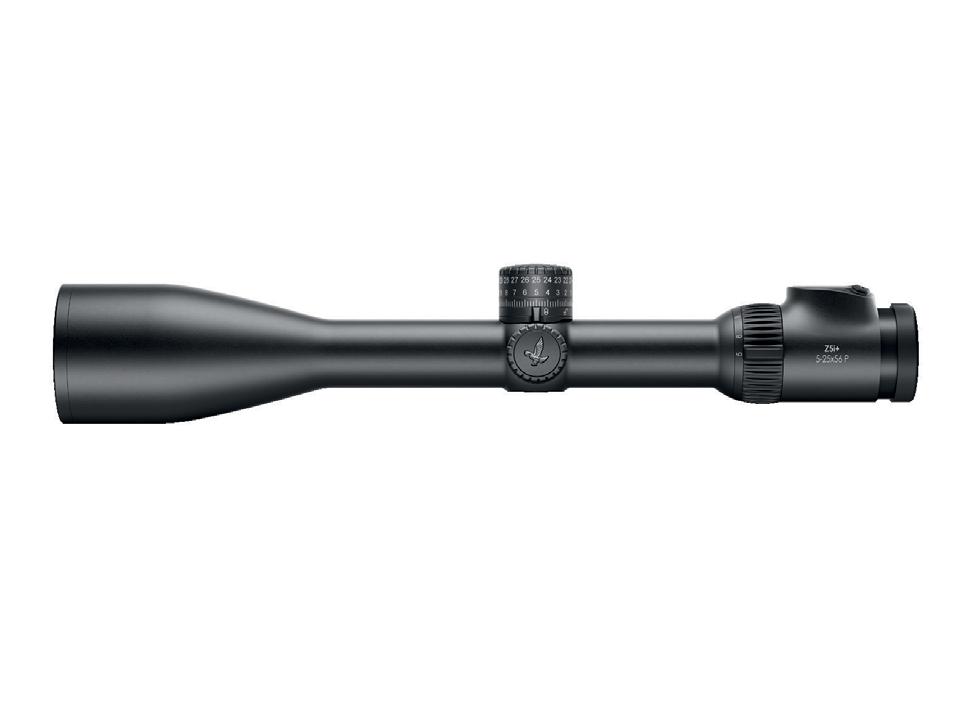
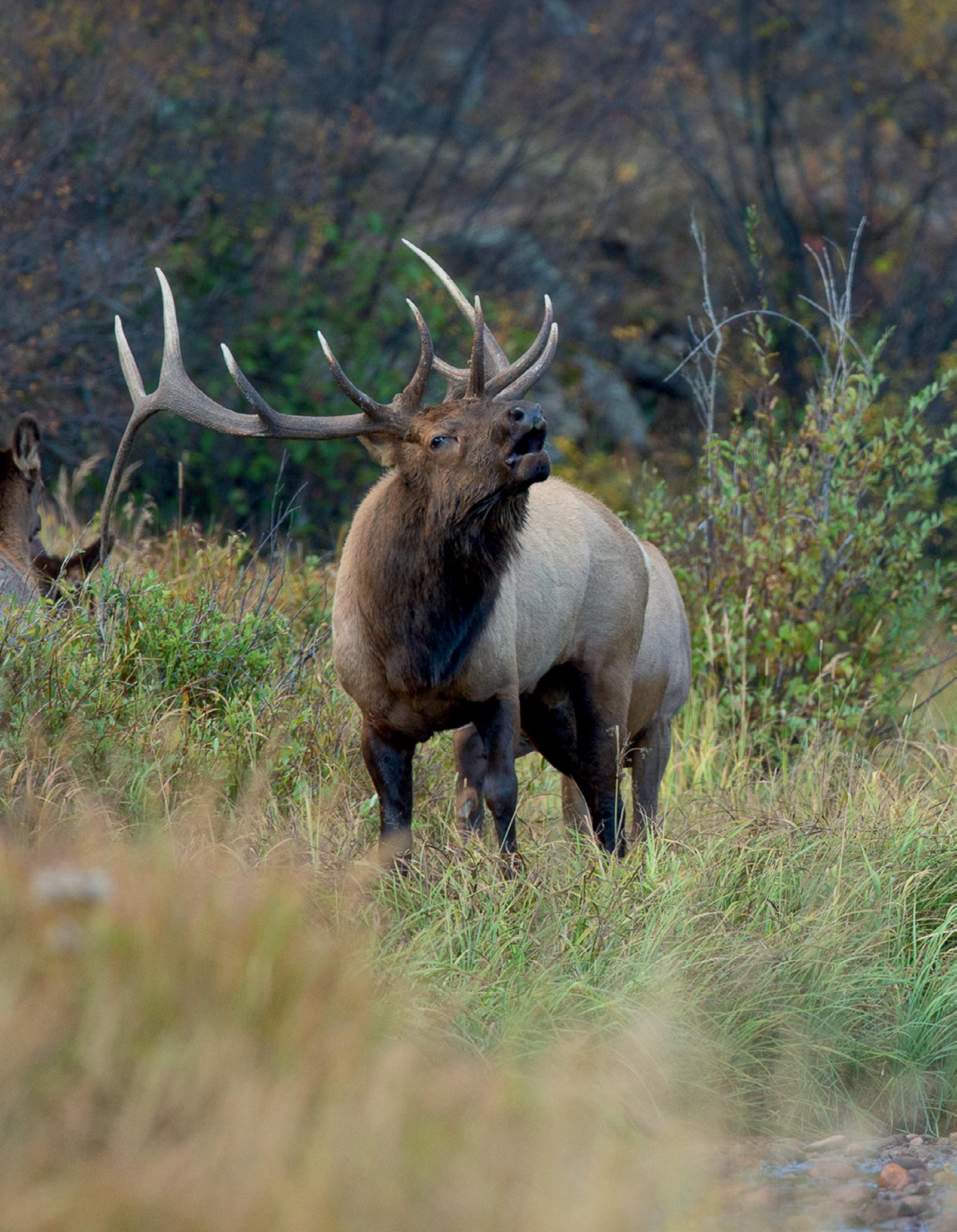
Z5i + 5-25x56
Dad life can get hectic sometimes. One minute, you’re breaking down boxes on Christmas day, then the next thing you know, it’s mid February. Your weekends consist of soccer games, kids parties, and household chores. By the time you get to relax, it’s Sunday evening. During the week, you’re trying to balance kicking ass at work with being present for your family. Add in all the fun changes in a man’s life as he nears 40, and you have a perfect recipe for a lack of motivation.
We all know what we need to do: eat well, get enough sleep, and move around a little bit, at the very least. These are the basic requirements for us to stay around for our families. Unfortunately, for some of us, there simply isn’t enough time in the day to do it all. Sacrifices have to be made. Couple that with little to no motivation and things can get doughy real fast.
I’m not even talking about trying to hit new PRs in the gym or looking chiseled for the wife. We’ve all been there–taking the family to the beach, the state fair, or the gauntlet that is Disneyland. As a dad, you’re not there to have a good time, you’re there to make sure they have a good time. You’re the pack mule, carrying the luggage, the car seats, and everything else while pushing the stroller through the airport.
Then you get to the big show, walking around the theme park all day. Inevitably, a kid starts to melt down because their “legs don’t work anymore” (cue that whiney three-year old voice). Well guess what, Jr, my legs don’t work anymore either, but up you go, onto Dad’s shoulders. Smiles and laughter–crisis averted. But how long can you last?
The average weight of a three-year-old is about 30 pounds. One is fine, but if you have multiple kids, you know what is coming next–
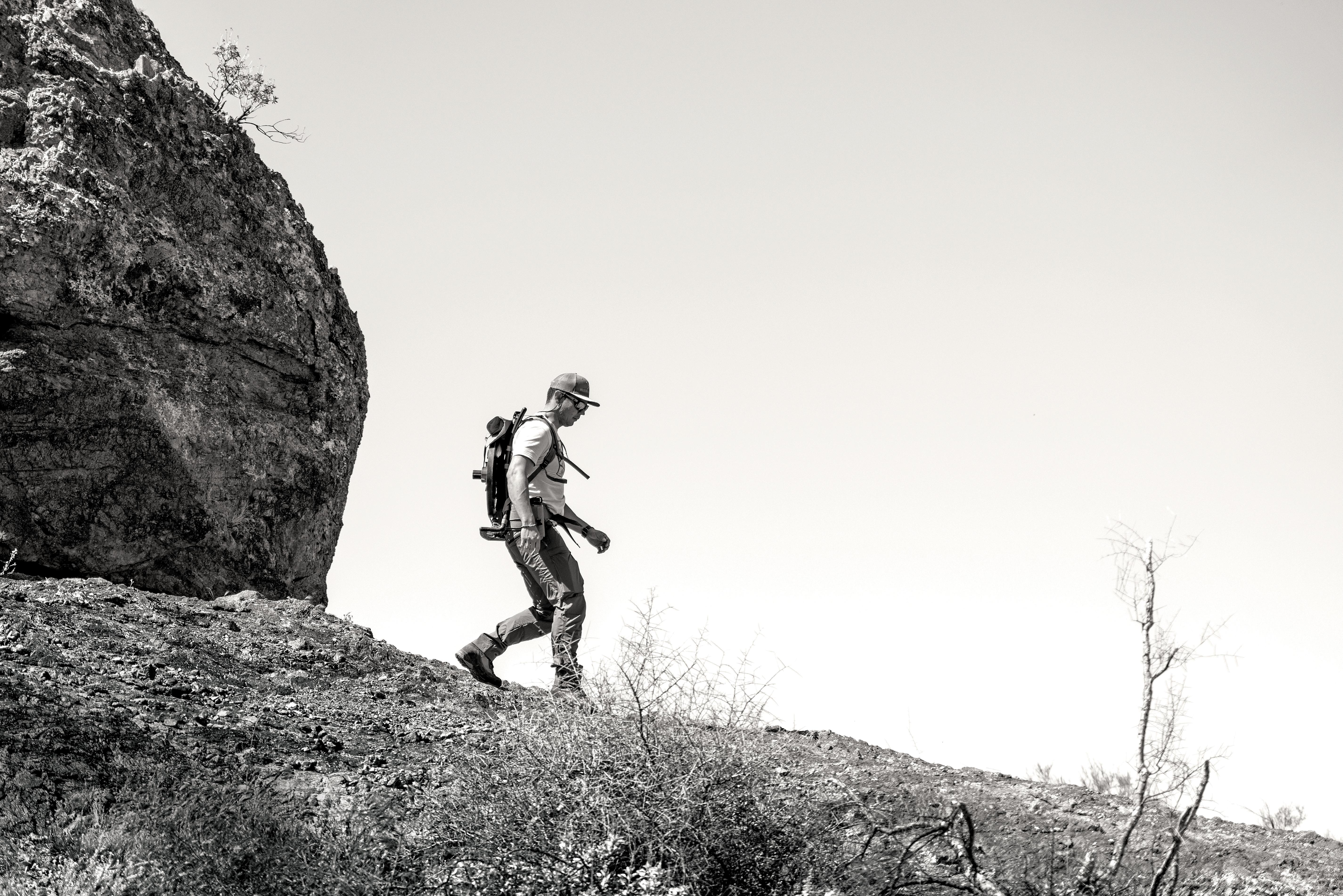
BY JOE MANNINO
they all want to ride, even the nine year old that goes hunting with you, and he’s the whiniest one of them all. Next thing you know, your legs are smoked, your heart rate’s up, your core’s tight, and your shoulders are burning.
But you have to keep going, this is your Super Bowl. You can’t give up, you can’t let your kids down (literally and figuratively) and you certainly can’t show weakness in front of the other dads, or worse, your wife. We all know nothing turns the mother of your kids on more than you being “peak Dad.”
This is the kind of functional fitness that you can’t replicate at the gym. You can with the Atlas Trainer. Throw 45 pounds on the frame and walk around your neighborhood, or better yet, find some trails and go uphill. If you don’t have trails near you, hop on a treadmill with incline. You’ll feel it, no doubt. If 45 is too much, throw 25 on there and go. You will get stronger, you will go longer. It’s as simple as that.
I’ve ditched the gym memberships and the CrossFit classes. I now Atlas walk the neighborhood with my dog a few times a week. Yes, it preps me for hunting season, but it also hits every muscle that real life demands–hips, core, calves, quads, and hamstrings. It fixes posture, burns time efficiently, and honestly, it makes me feel like a stud at 5:30 AM, when I pass the phone zombies on their morning “walks.”
The Atlas Trainer has added functionality back to my week. I have noticed the difference when I hunt, when I run, and especially when I dad. They don’t have a “Dad Machine” at Planet Fitness, but, fortunately, Outdoorsmans does. WH
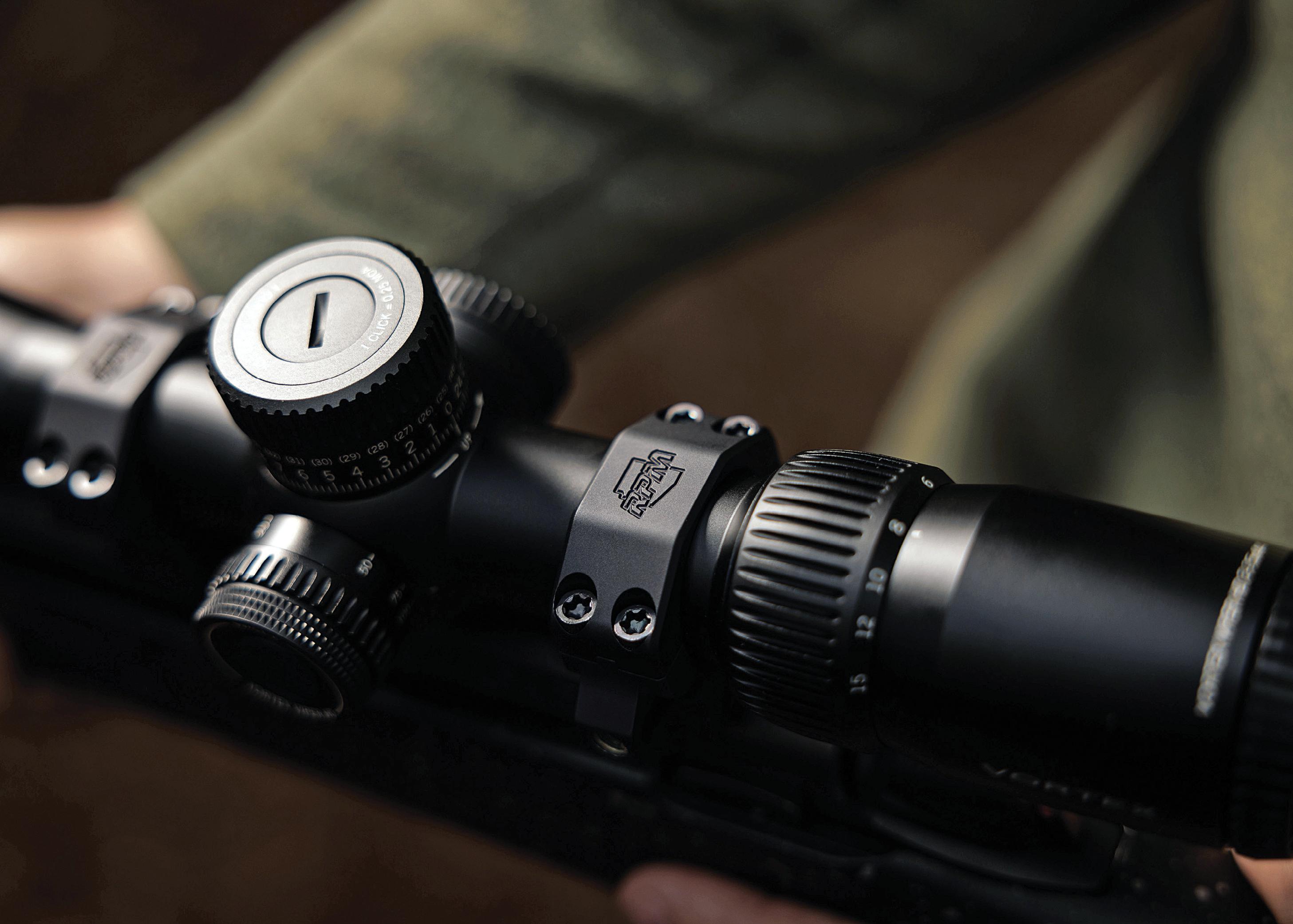
BY KEVIN GUILLEN
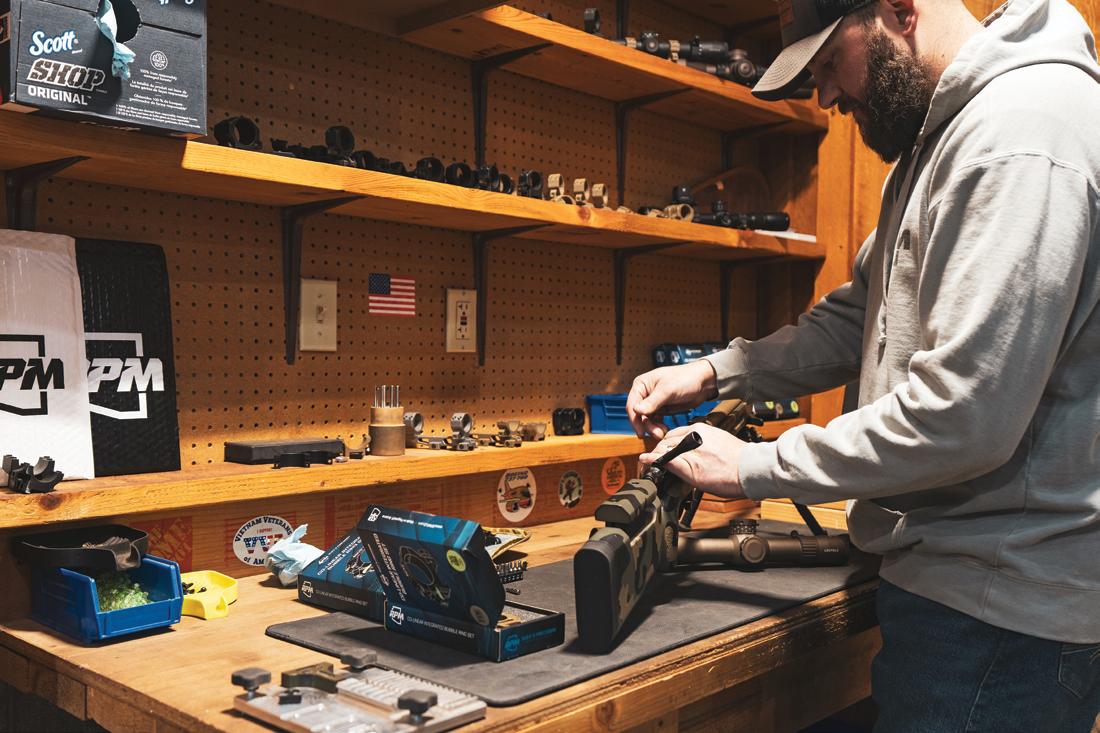
In the small mountain town of Flagstaff, Arizona, a team is machining scope rings that are changing how precision shooters zero their rifles and perform when it counts. The secret? The co-linear bubble and a focus on the customer. Sounds simple enough, right?
What strikes me most as being unique about RPM, aside from their scope rings, is how they’re doing it. Machining products that require a high degree of tolerance, precision, and application to a wide variety of scopes and actions is tough. Doing it in a small mountain town with a limited hiring pool makes it even tougher.
I suppose it should come as no surprise that RPM is producing great products in unfavorable conditions. Two of the three founders are veterans, along with over 60% of their team on the floor. They’re not just creating jobs for people who’ve served our country, or keeping the boost of American manufacturing in our Arizona economy; they’re doing it while building premium products for the shooting community.
Sitting down with owner Jaryd Bernstein, it’s immediately clear what this Made In America business is built on: honesty, passion, and integrity. Cliche, I know. But give them a call, or try a set of their rings,
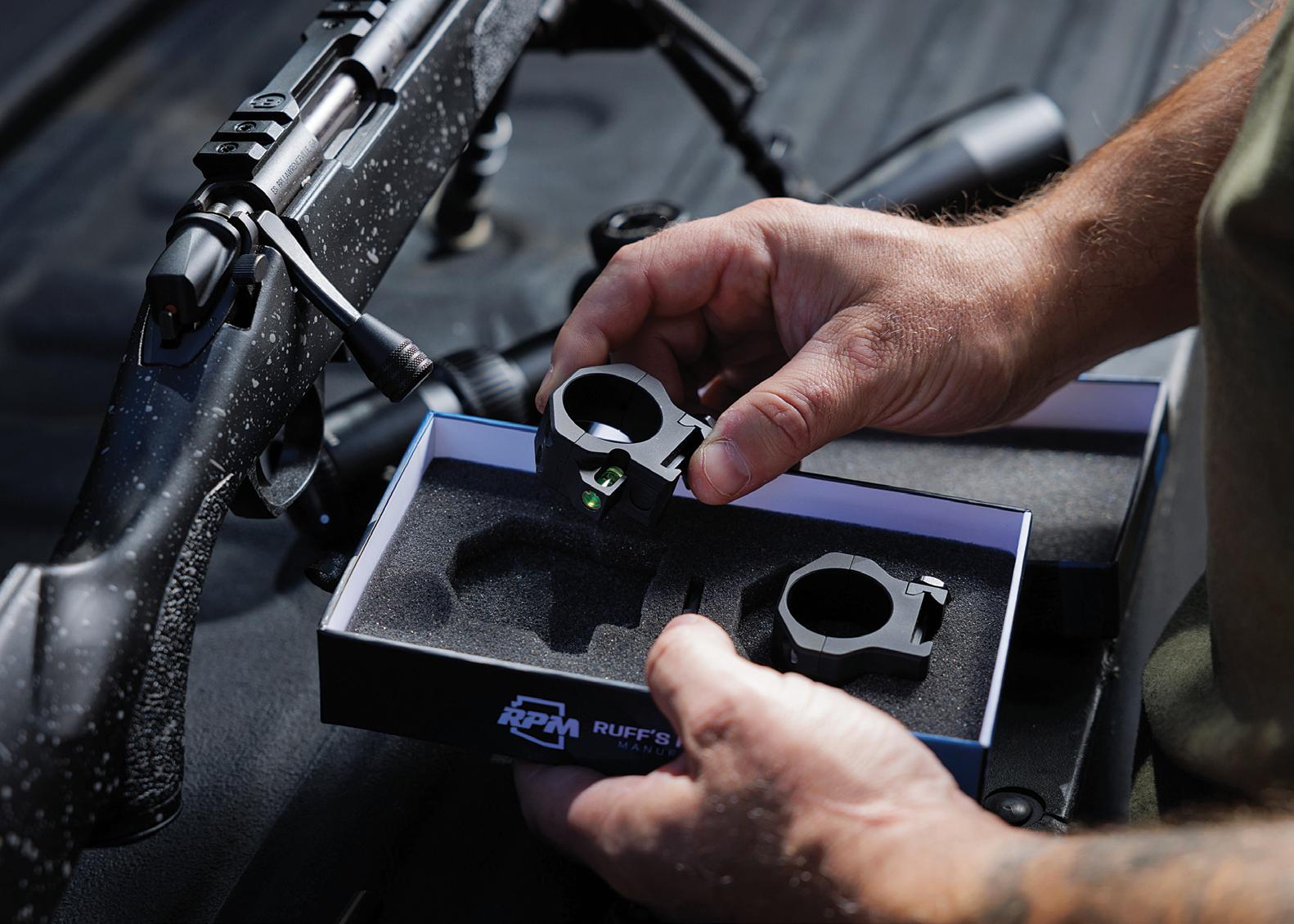
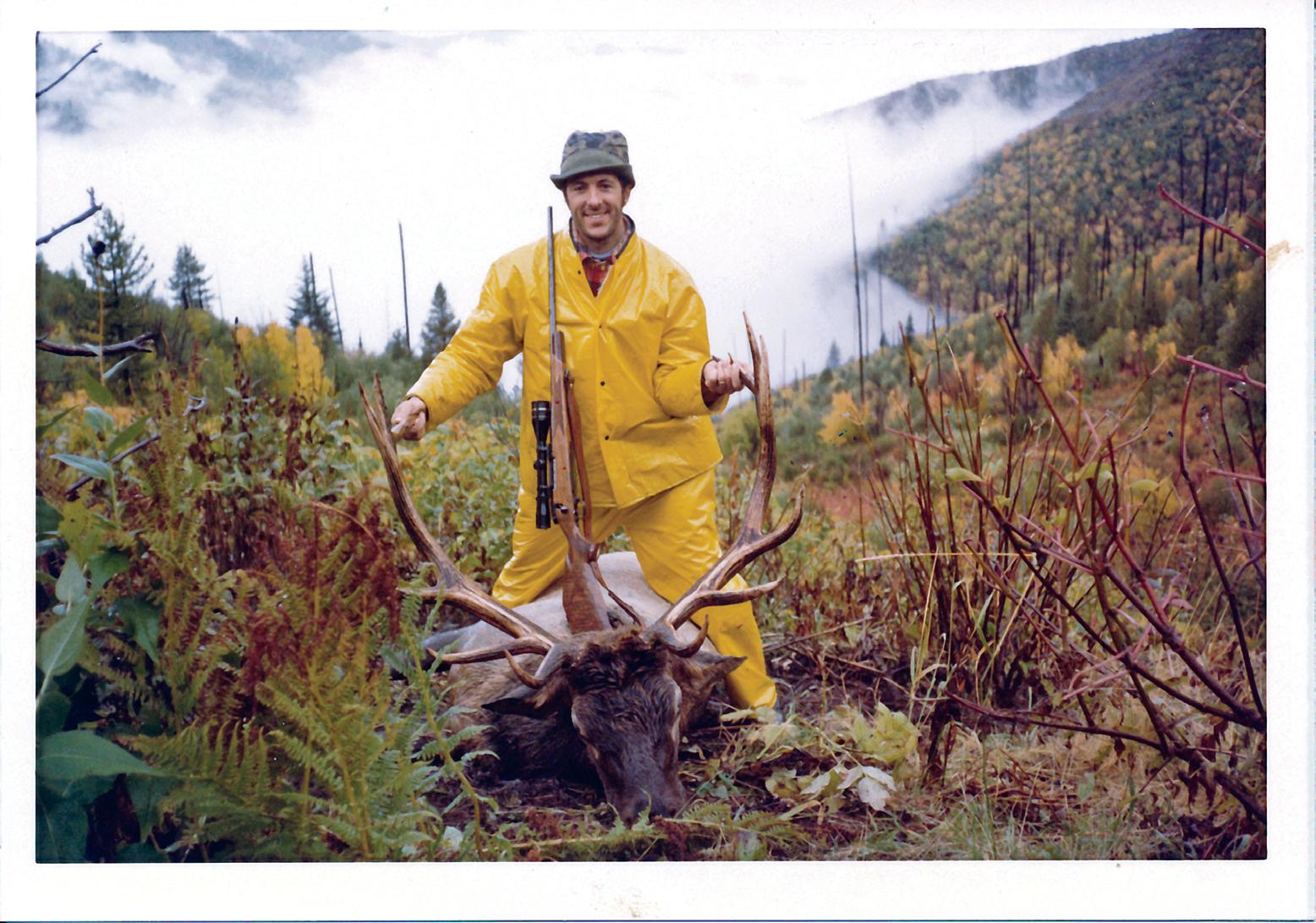
BY GEORGE BETTAS
Since I was a young boy, I had read outdoor magazines with articles by Jack O’Connor and others who had vividly described packing with stock in the backcountry of the West. I dreamed of one day owning my own horses and doing the same. My father had farmed all of his life with horses, and when he bought his first tractor, there was no chance that there could ever be a “hay burner” on our farm.
With military service and graduate school behind me, I dreamed of hunting like my heroes, but with no horses of my own, it was still a dream. For now, it would be a four-day backpacking trip into the Clearwater National Forest along the Montana border, which had a thriving population of elk and a black bear population that was just as good. I selected a remote roadless area where we could make a 16-mile loop from a forest road trailhead at 3,000' elevation, which led over a 6,400' summit, down into a two-mile-wide basin, and back over the summit to the point of origin.
Forest Service “remount” crews had named this area “Wet Ass Creek” because of the great deal of rain and deep snow in the winter. The topography of the area was such that the trail would be snow-covered at the higher elevations, but the basin, which was a thousand feet lower in elevation, would be free of snow in early June in the elk calving area. Despite the name given to the area by Forest Service backcountry work crews, the regional forest’s cartographers changed the name so that Wet Ass Creek appeared as one word, and a final e was added, which was henceforth pronounced, and the a was made in Boston. Now it is pronounced, “We-ta’-se Creek.”
As we loaded our backpacks at the trailhead, we were both excited about what we might discover in this remote roadless area, especially the basin that lay beyond the summit. The first day on the trail went well until we encountered dense fog at the 6,000-foot level while attempting to follow the Forest Service trail over the ridge.
In addition to the fog, we encountered snow, which soon reached a depth of 8 to 10 feet and obliterated the trail. After several attempts to make it to the ridge, we decided to camp on the side of the mountain and hope for better weather the next morning.
Morning of the second day brought more fog at our level and dreary weather below. Another attempt at the ridge failed that morning. Noon found us looking for other options to make the loop, which we had originally planned. As we ate our lunch and talked about alternate plans for the trip, a window opened in the clouds, and a low saddle became evident on the far side of the valley below us.
The sun was shining on the emerald green rolling hills, which could be seen through a low pass visible below the clouds. As we sat there contemplating our next move, we had the same thought: Why not bushwhack down into the valley and climb up through the low pass? Looking at a topographic map, it appeared we could pick up the main trail in the pass and continue on our hunt.
By 4:00 PM that day, we had made our way across the valley and had climbed up to the pass. Once through the pass, we climbed a small knoll from which we could see the entire basin. It had been raining hard, and when we emerged into the saddle, the sun came out. We were amazed at what we saw. Almost everywhere we looked in the basin, we could see cow elk and their newborn calves.
We decided to set up our backpack camp in the saddle, eat our last freezedried dinners, and search in the morning for where the USFS trail returned out of the basin and down the drainage to the trailhead. As darkness approached, we spotted three different black bears out in the basin coursing through the brush and fern-covered meadows, searching for elk calves, just like a pointer coursed through cover, searching for upland birds. We were simply stunned, as we had indeed found paradise!
Morning dawned with a very thick fog and rain. The fog was so thick that one could barely see 50-75 yards, so we packed up our camp. It was daylight at 5:00 AM, and the rain had been continuous during the evening. I opened the tent door to find that the fog was so dense that I couldn’t see more than 20 feet! Breakfast consisted of a candy bar as we bunched the camp and talked of how we would find our way out of this area where neither of us had ever been. A bit of map study indicated that the road was about 10 miles as the crow flies and that the Forest Service trail was about a mile away.
Using my military-style compass and a topo map, Tom and I made our way through the fog, found the trail, and eventually got back to the road. After a couple of bowls of hot soup, I immediately began to think and dream of how we might return to this hunting paradise for elk one fall, but without any pack and riding stock, it was still a dream. It rained all night long, and we awoke to the sound of horses around the camper.
It was the new outfitter for the area wrangling horses at his base camp, which we had not noticed downriver from the trailhead. He came over to see what we were up to. I was still excited about all of the elk we had seen and mentioned it in our conversation. He looked at me and, with a bit of hostility in his voice, he said, “You don’t plan on going in there on foot in the fall without horses.” I don’t recall what I said in reply, but I was thinking the same thing.
After I returned home, my wife and I closed on the purchase of a home on a six-acre parcel not far from the university. The property had a nice home, but there was nothing else on the property. We were moving into the home over the Fourth of July weekend when a pickup truck pulled into our yard. I went out to greet the visitor who got out of his pickup. After traditional greetings, he asked me, “What are you going to do with your pasture grass?” I replied I had no plan until I repaired the fences, which were in disrepair. He then asked if he could pasture his horses on the property if he repaired the fences. It was Alan Feldner, who worked at the university and had owned a farm in North Dakota.
He was familiar with livestock, fences, and all things farming. I asked, “What kind of horses do you have?” He replied that his horses were “mountain horses,” which he used for trail riding and packing in the summer. I couldn’t believe what he said and replied, “You can pasture your horses all summer and fall if you would be interested in packing me and my camp into an area in Idaho where I want to hunt elk. I would need to go into the campsite a few days before the season opens. You drop me off and return to pack me, the camp, and any elk meat out to the trailhead a week later.” He enthusiastically agreed. It was a great opportunity for both of us, but I still didn’t have a horse.
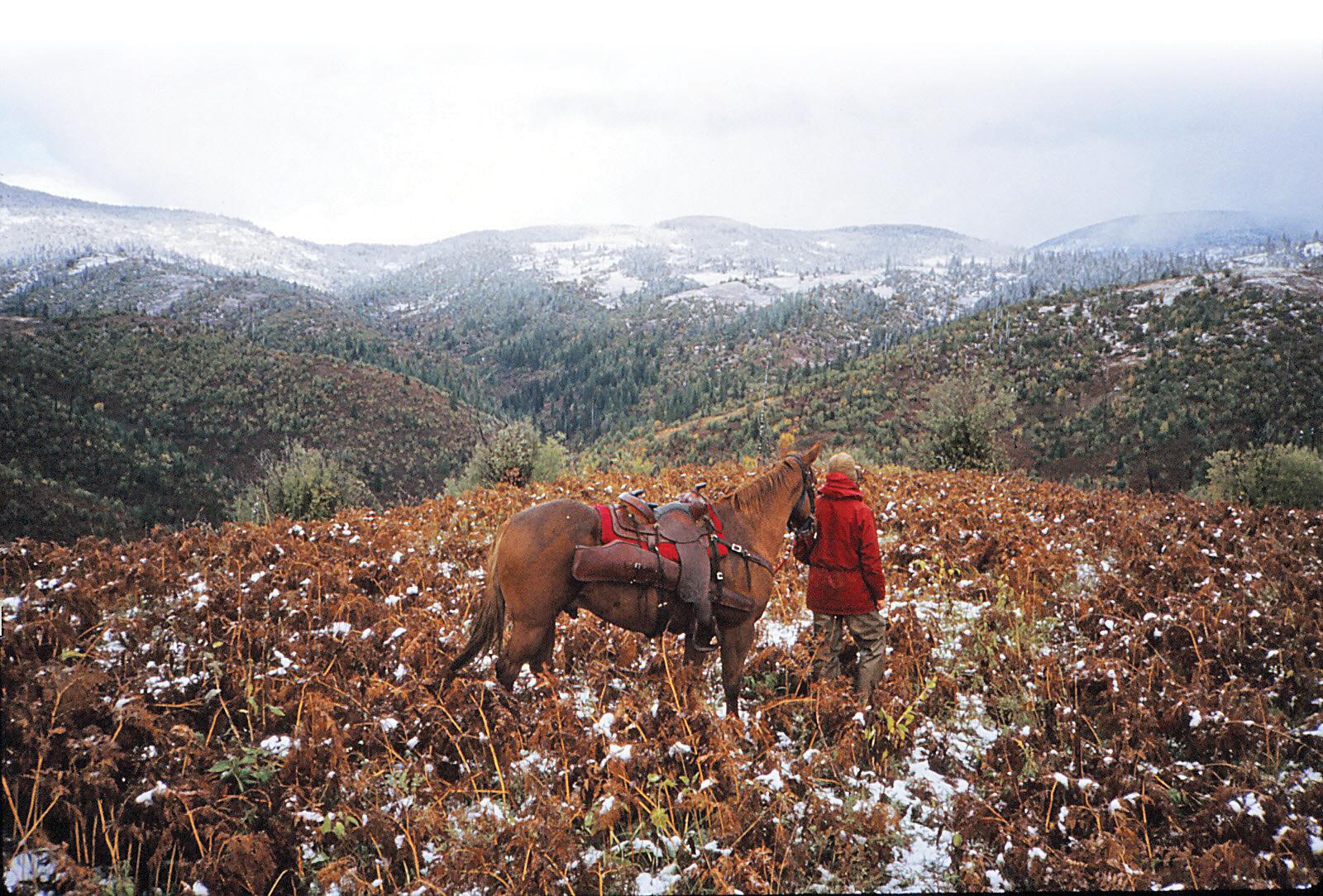
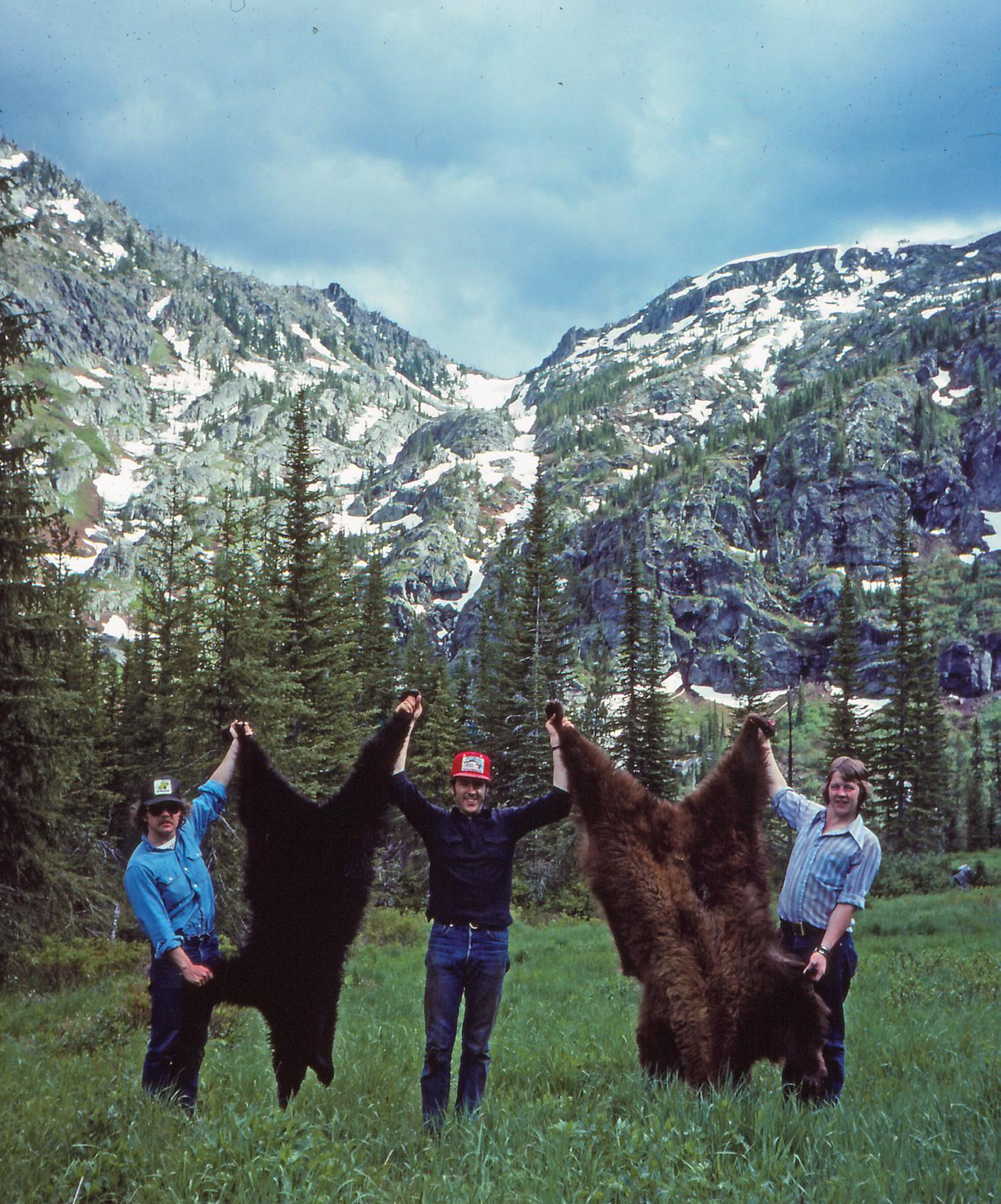
We visited for a while, and he told me about an Appaloosa gelding that a co-worker was selling that was “mountain worthy” and would ride and pack, all for $200. The horse and price were too good to turn down, and since I was planning to build a barn later in the summer, Smokey could be on my pasture all summer and have a barn for tack, hay, and shelter. It seemed too good to be true! Smokey was soon to become my first mountain horse.
The summer passed quickly, and with Smokey in the pasture with Alan’s horses, there was time to have a barn built later that summer. Meanwhile, Tom and I drew Washington goat permits, which made an Idaho backcountry hunt impossible. It would be necessary to delay the Idaho elk hunt until the fall of 1977. I would have a lot of time for research and planning,
with the first goal being to find two more elk hunting partners who owned mountain-wise horses and were willing to take on a new partner. This would be a significant challenge because of all the horsemanship skills required. Most horsemen do not like to add unknown individuals and their stock to their hunting camps.
In 1973, I’d met Andy Rogers at the Alaskan Camper factory in Tukwilla, Washington. It was then that Andy related how he packed into the Wenaha backcountry of Washington and Oregon with Bob Smith, an orthopedic surgeon who had hunted elk throughout Washington, Oregon, and Idaho with his parents since he was a young boy. Bob and Andy’s experience as elk hunters and the fact that they were already hunting partners made them a natural match for rounding out the hunting party.
In addition to his relationship with Andy, Bob had four horses that had proven themselves reliable in the Blue Mountains of Washington. With our common interest in elk hunting, Andy and I soon became good friends. After a few long-distance discussions, we decided that Bob and Andy were interested in joining Tom and me for the October 1977 elk hunt in Idaho. Now all I needed to do was to get back to Paradise and find a suitable campsite that was strategically located and had water and grass for the horses.
In late July of 1977, Alan, Tom, and I packed into Paradise with Alan’s horses to locate a suitable campsite for the fall hunt. The trip went well, and Alan’s horses worked like a charm. Up the trail we went with three riding horses and a pack horse. The gear was held to a minimum, but included a chainsaw, axe, and shovel for cleaning up a campsite, cutting firewood, and cutting tent poles, which would be used in the fall for a wall tent.
We found a very old, well-used campsite that had not been used for decades. It was located between the two outfitter-assigned areas, so it would be a good location to avoid conflicts with either outfitter or their clients. It had a lot of glass bottles, tin cans, boards, and rubble, which needed to be cleaned up and organized in general. While we cleaned the area, I imagined that each bottle, can, and broken board had a story to tell from hunts past. All one could do was imagine what the hunting had been like and who the hunters might have been.
September arrived, and everything was well-planned for our elk hunt. Alan and I arrived at the trailhead on Friday night, as planned. The trip into camp went well, and by early afternoon, Alan was on his way back to the trailhead. I began setting up the tent we had packed into camp. I got to bed early that night and was planning on a good rest before my hunting partners arrived the following morning.
I do not recall what time it was, but it was near midnight when I was awakened by the sound of elk running through camp, literally screaming their bugles into the night as they splashed through the creek which ran past our camp. As soon as one group of elk left, another group showed up with the same bugling and splashing in the creek. This continued all night long, and I lay in my sleeping bag, mesmerized. We had inadvertently set our camp at the intersection of three major elk trails! It was a night that I will never forget!
It was about 2:00 PM the next day when Bob, Tom, and Andy appeared at the far edge of “Paradise Basin,” all wearing their bright yellow rain jackets and pants. It was truly a sight to behold! As soon as my partners arrived, we unloaded the horses and set up the wall tent with poles we had cut in August. It was my first DIY backcountry pack trip, and I marveled at the amount of gear Bob had packed into camp. As it turned out, we had just enough to weather the rain that would come during the following week.
On Monday, it was foggy and rainy all day as we set up our camp, so we stayed in camp all day long. By Tuesday morning, we all set out to scout the area in different directions. Tom and I chose to climb about a ridge near camp that, on the topo map, went about a thousand feet up and into a basin. It was raining hard when we left camp in the morning, and we were soaked from the inside out by the time we reached a point on the ridge where we could see into the basin.
We had worn rubber-coated rain gear in the past, and when we reached a saddle on the ridge of the basin, we changed from our wet cotton T-shirts to the dry ones we had in our daypacks. As we sat in the fog and rain, we could hear intermittent bugles coming from various locations around the basin, enough to know that this was where we wanted to be on opening morning.
Tuesday evening was like a war room as we discussed various scenarios for opening day. Bob was the master planner, and we devised a plan for Tom and me to go back to the basin, which we had named “Field and Stream Basin.” It reminded me of the backcountry areas I had read about in outdoor magazines. Bob and Andy would hunt two different locations in Paradise Basin. There was no sign of anyone at the trailhead, and we didn’t see any horse or hunter tracks on the trails into camp. Were we alone in the wilderness? We certainly hoped so.
Wednesday morning brought more of the same rain and fog and reminded us of why the forest workers had named the area “Wet Ass Creek.” Tom and I reached the saddle where we had been the day before shortly after daylight, got dried out as best as we could, and decided to sit on the edge of the basin where we could spot for elk. Tom smoked, and I chose to spot from a grassy area away from where he decided to sit.
It was raining hard when I sat down to glass into the basin, so to keep out some of the rain, I had a lightweight Eddie Bauer waterproof poncho with a hood in the center that kept my head dry while the remainder of the poncho was draped over me, forming a sort of tent. When I sat down and leaned my .340 Weatherby against a dry snag in front of me, I noticed that I was sitting in a well-used elk trail. About an hour passed, and all I could hear was the steady sound of big raindrops hitting the poncho. When the rain stopped, I could hear the distinctive sound of Tom trying to get his Bic lighter to ignite.
The sound of the lighter distracted me, but at the same time, I heard a distinctive “thump” behind me. The poncho impeded me when I attempted to look behind me to see what had made the sound. I turned around and was very surprised to see a six-point bull elk with his nose about a foot from the ground, staring at me! With the camo parka and favorable wind, he seemed about as astonished as I was.
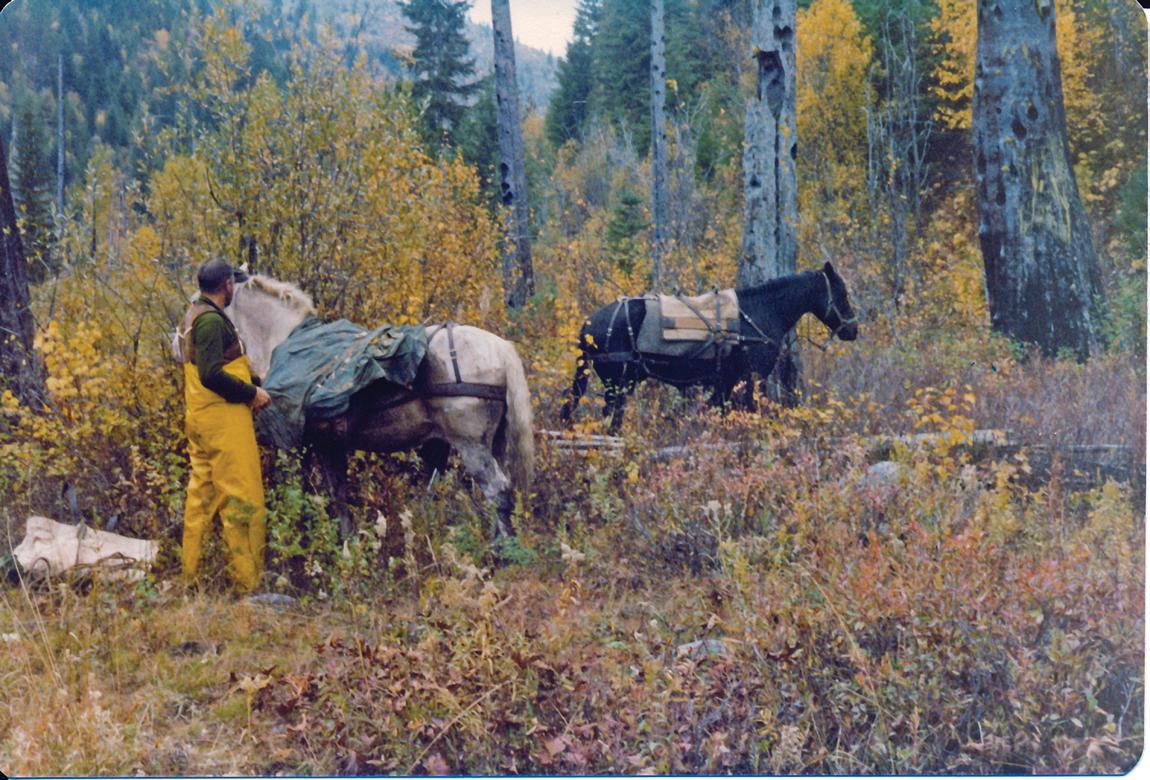
The bull bolted backward and ran past me through the brush, down the draw, and into the basin below. I stood up and attempted to run to the grassy edge of the basin, but my feet got tangled in the poncho, and I fell headlong into the brush as I yelled, “Bull!” to Tom. Tom could see the bull running down the trail into the basin, so he ran down from his perch and began shooting at the running bull. Tom had bought a Weatherby that spring and was still a bit recoil shy. For whatever reason, he had missed all three of his shots.
I regained my senses, picked up my daypack, and moved down the hillside to where I could see into the basin below me. The bull had reached the bottom of the draw as I got to a clear spot for a shot. I threw my daypack on the ground and took a good prone position behind it. The bull stopped and turned broadside about 200 yards below me, and I was ready. One 225grain Nosler partition found its mark, and the bull was mine.
The rain continued the remainder of the day as Tom and I skinned and quartered my bull and carried the quarters, neck meat, and tenderloins to where we hung them on a nearby tree for shelter from the rain. Bob killed a nice six-point in Paradise Basin the same day and was able to pack his bull’s quarters and extra meat to camp that evening. The following morning, we returned to where my bull was located and packed its quarters, rack,
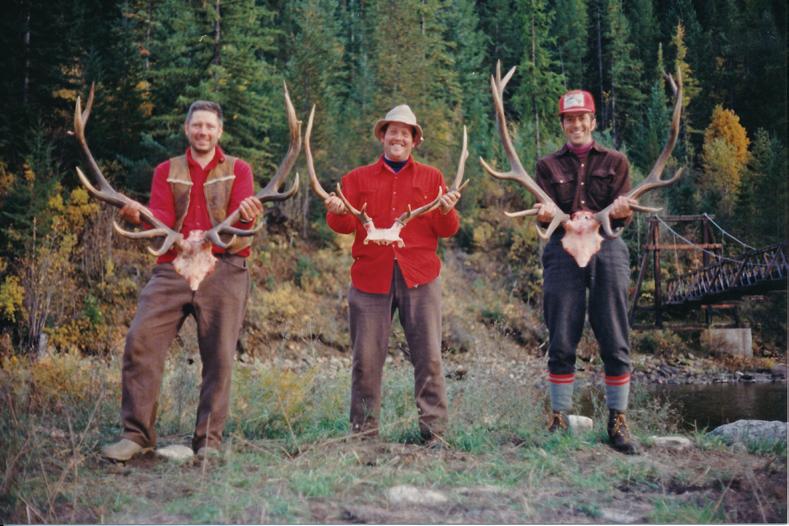
The technique of calling an elk with an artificial bugle had its inception in the Selway-Lochsa regions of central Idaho. During my research in preparation for our hunt, I found an old video that was taken in Max Walker’s guide unit of a big 6x6 bull elk being called to a hunter with a bugle. It was a “curly cue” bugle made of a hollow, corrugated half-inch tube, twisted in the shape of a pig tail. These bugles did not have a reed or insert to make a whistle when blown through, but you could get a lot of high notes up and down the scale, similar to an elk’s bugle.
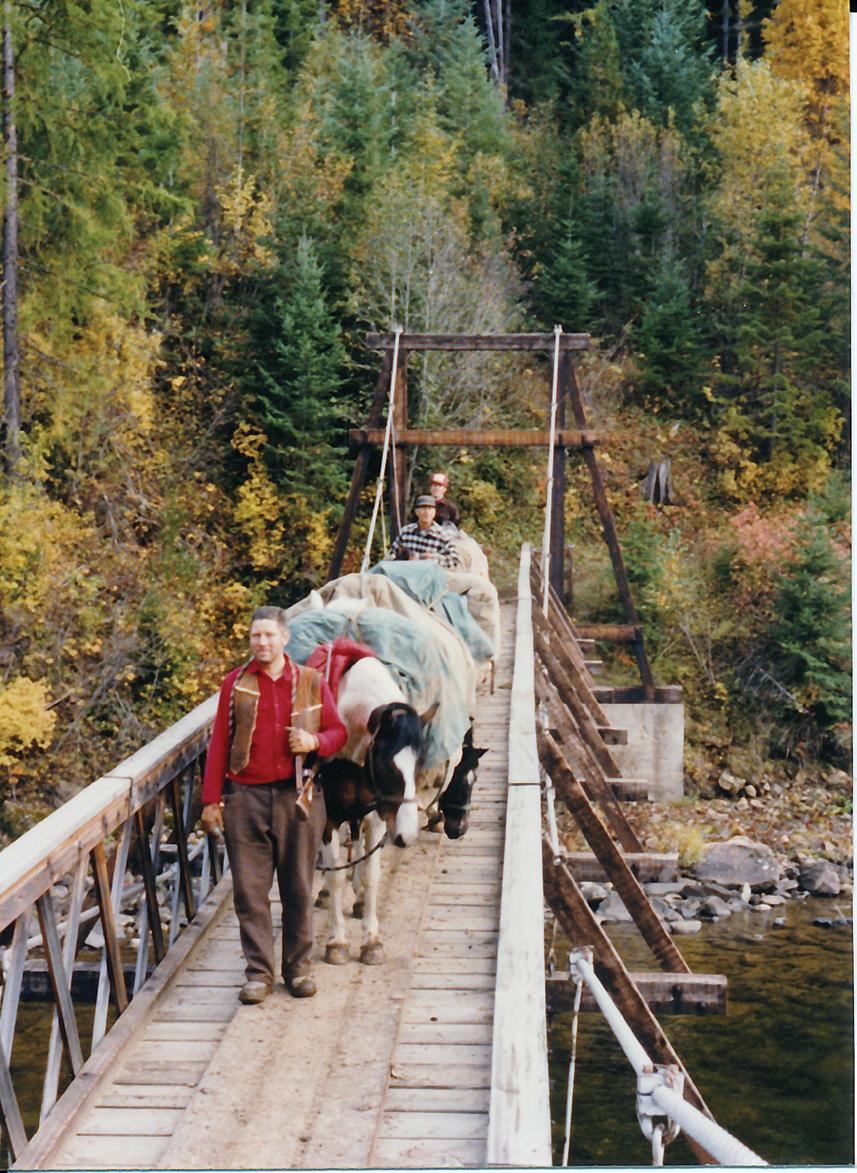
Bob had bought one of these bugles in preparation for our trip and had it with him on opening morning. His chosen hunting route took him across the basin and dropped into a creek bottom. He was blowing his “curly cue” bugle and was surprised to get an answer on the opposite hillside. He spent most of the early morning attempting to call the bull with no success. The bull was not moving from his original location, so Bob decided to climb across the steep draw that comprised the creek bottom and approach the bull, which was making a sound much like Bob’s. After a long stalk, Bob finally spotted the bull lying in his bed, bugling with his harem of cows bedded around him. A single shot from Bob’s .340 Weatherby, and the bull was down.
The rain continued on Friday, and Andy was able to find a bull with a harem of cows in the creek bottom below our camp. A short stalk and a single shot from Andy’s .340 Weatherby, and Andy’s bull was down. Later that afternoon, Andy and Bob returned to Andy’s bull and packed the meat back to camp.
While Bob was packing elk during the days after I got my bull, the rest of us spent our time boning elk meat in camp and preparing for the pack out to the trailhead on Sunday. Tom didn’t get to continue hunting as we had limited pack stock, and even after we bunched our gear, Bob, Andy, and Tom had to walk out to the trailhead. I got to ride one of Alan’s horses and lead Smokey, packed to the hilt, as two weeks before our trip, I had sprained my ankle badly and could not walk the distance to the trailhead.
The trip out of Paradise Camp was as rewarding as the planning and hunt themselves. As we crossed the pack bridge at the trailhead, the sound of eight horses’ hooves striking the wooden planks of the floor of the pack bridge was more than music to our ears. For those who have experienced it, it’s a sound you never forget and reminds one of their special experiences with their horses and mules in the backcountry. Taking three mature bull elk on our first hunt in Paradise was as good as it gets, and it led me to my first horse, which began my journey as a hunting horseman over the next five decades. WH
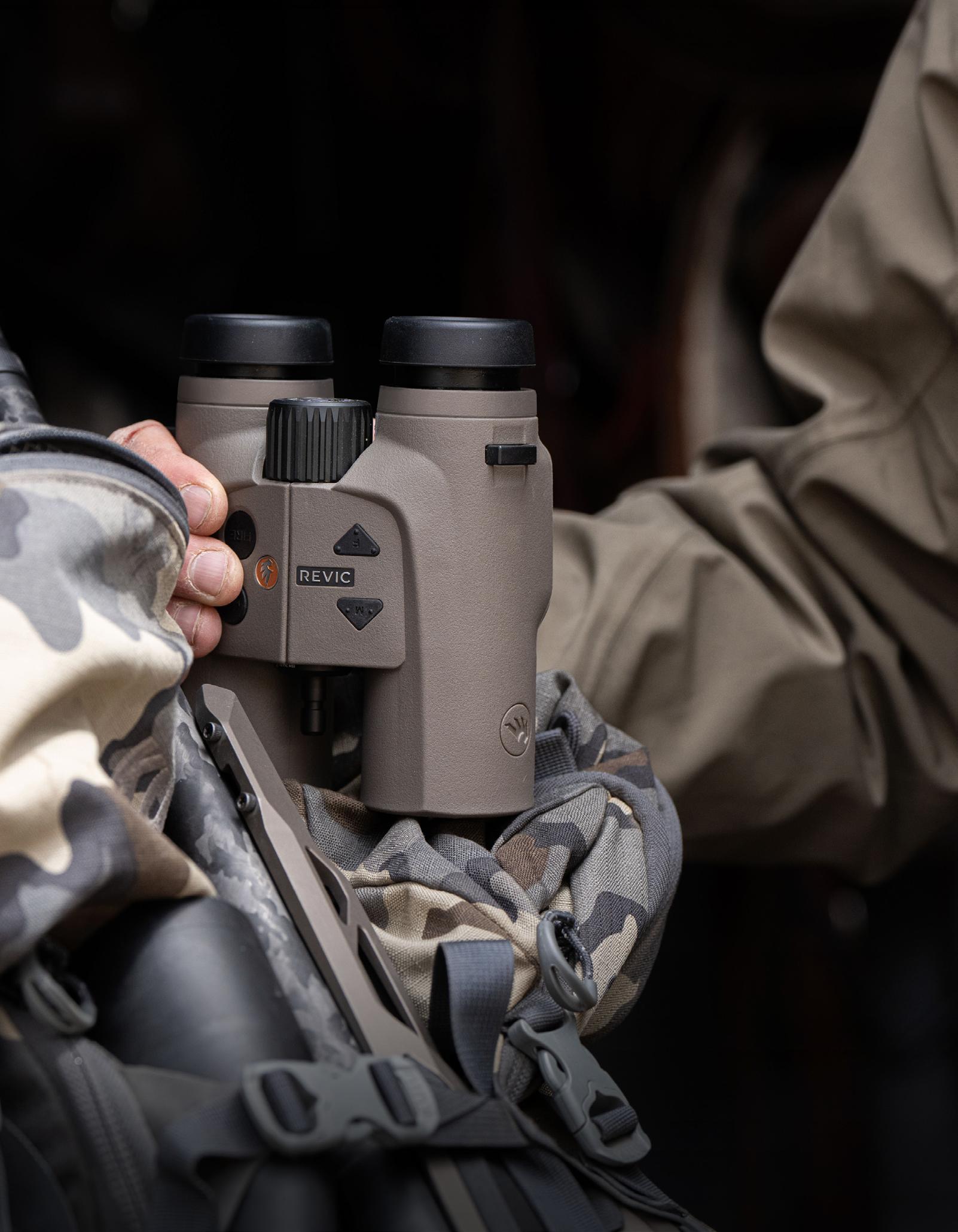
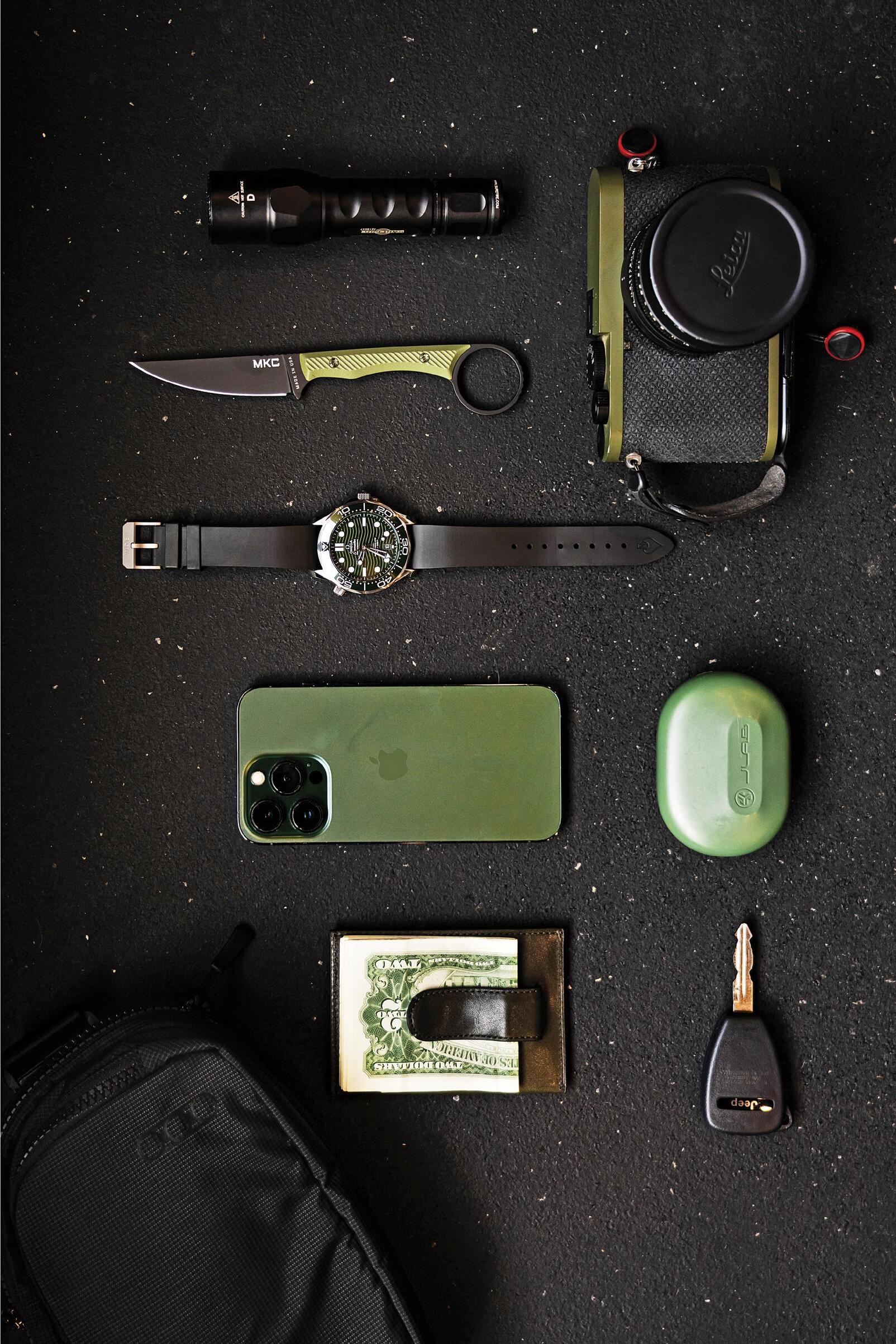
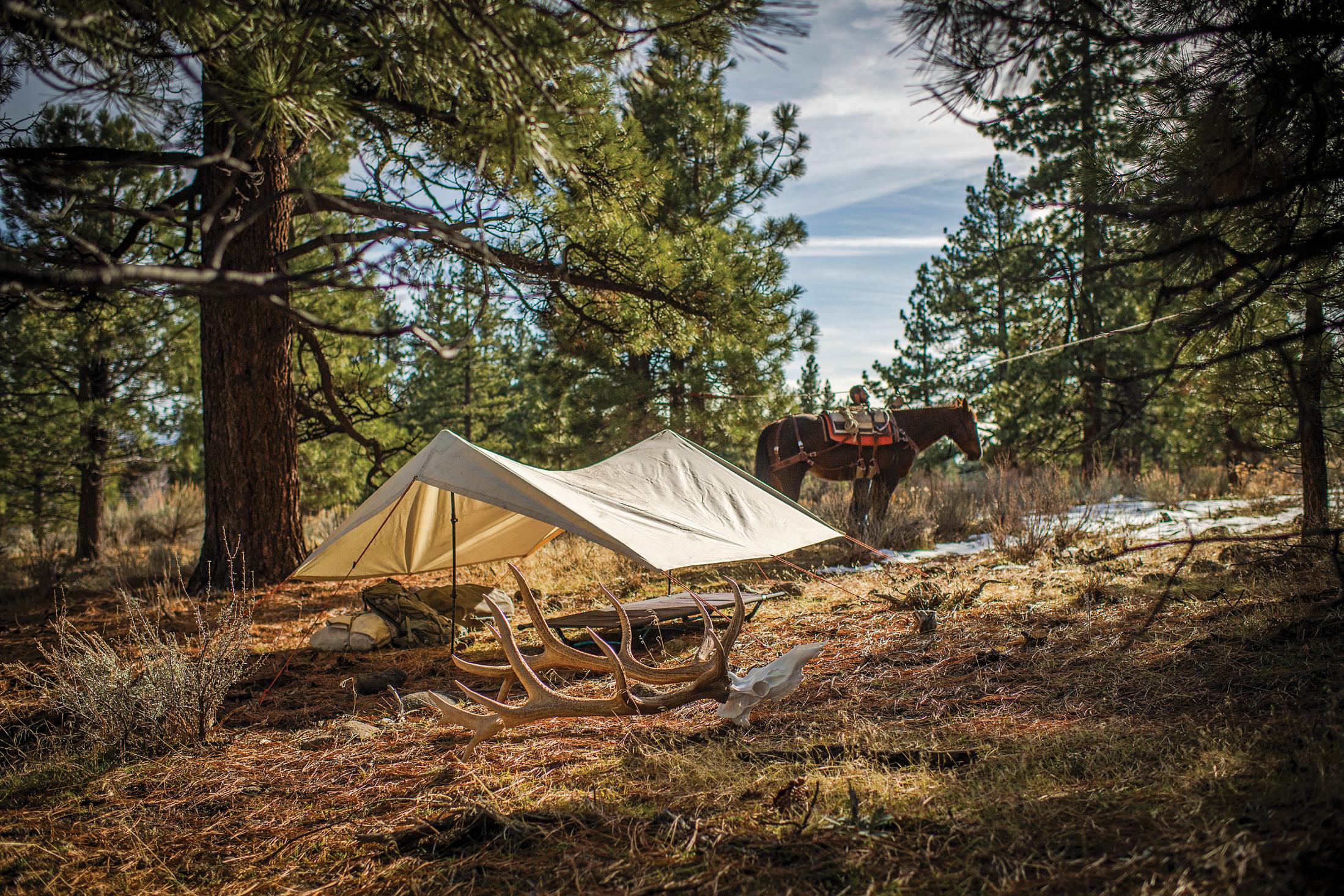
The principles of packing an equine and the geometry of gear strapped to its sides have arguably plateaued. Fortunately, the innovation to this antiquated mode of travel is still alive and well. Some products are intentionally aimed at honing your craft, and others inadvertently fill a void we didn’t know existed. The following is a breakdown of some products that may be worthy of the hunting horseman’s attention:
The Snowtrekker Tarp is designed to be a two-man shelter. It’s constructed of proprietary 7 oz cotton canvas. A sunforged treatment provides water, mold, and mildew repellency just like all other canvas shelters produced by Snowtrekker. Featuring reinforced stress points, double-rolled hems, and fitted with rope and clam/cleat tensioners, the setup allows adjustability in the amount of draft or extra weather coverage you’d prefer.
Tailored with a curved ridge, the taut ceiling is resistant to pooling and flapping. The downward-angled eaves at both ends offer protection from the elements. Its unique 8' x 9' design offers a footprint large enough to shelter two people with a reasonable amount of gear.
BY CODY BARNES
This is where the shelter shines for the hunting horseman. With dimensions close to those of traditional manty tarps, it can be draped over pannier loads or wrap up your gear and be slung to the saddle of your choosing. While these dimensions exceed those of traditional manties (7' x 7' - 7' x 8'), you’ll find that the extra few feet of material doesn’t make wrapping your load overly bulky or cumbersome. This can be attributed to the lighterweight canvas.
Traditional manties come in around 6-7 lb per single tarp (thickness dependent). The Snowtrekker weighs 5.7 lb. The extended dimensions also make this product usable as a ground tarp or makeshift cowboy bedroll in mild weather conditions, where a covered shelter is not a necessity. The Snowtrekker Tarp Shelter fills the void where the hunting horseman may have not even realized there was one. A weight-conscious shelter, tarp, bedroll, and manty all wrapped up into one product. For a tutorial on how to manty a packed load with the Snowtrekker Tarp Shelter, visit the Western Hunter Blog by scanning the QR code on the next page.

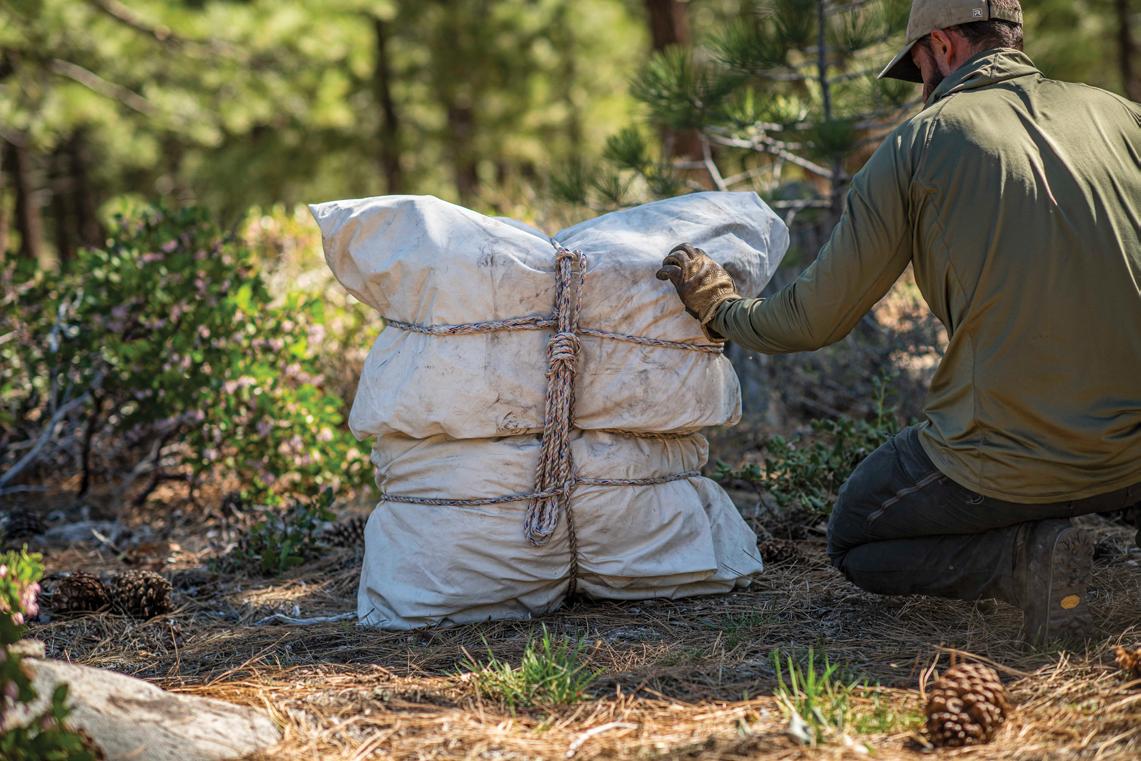
The scraping, poking, and prodding of brush and branches as well as the repetitive cinching of ropes put the material of any product to the test when carried upon the backs of pack stock. The Kuiu® Taku BLSTX 4200 Duffel features a 840-denier ballistic nylon with fully seam-taped construction. Designed for gear storage and protection, it is abrasion-resistant, waterresistant, and dustproof.
This duffel measures 29.5" in length, 18" in width, and 12.5" in height. Those dimensions are well within the parameters of many commonly used panniers; this also makes it suitable to be slung straight to a pack saddle.
At approximately 1.5 lb, I don’t believe there could be a lighter way to protect your gear from the elements and still maintain shape and dimensions sustainable for a slung load or pannier use on a horse or mule.
While my immediate interest in this duffel was related to pack stock, its features exceed the confines of horse travel. Sporting removable shoulder straps and heavy-duty carrying handles, this duffel can be used for gear transportation via any mode of travel. Additionally, the zippered design and handles make this a quick and weather-resistant way to protect gear or hang food in bear country on your hunt.
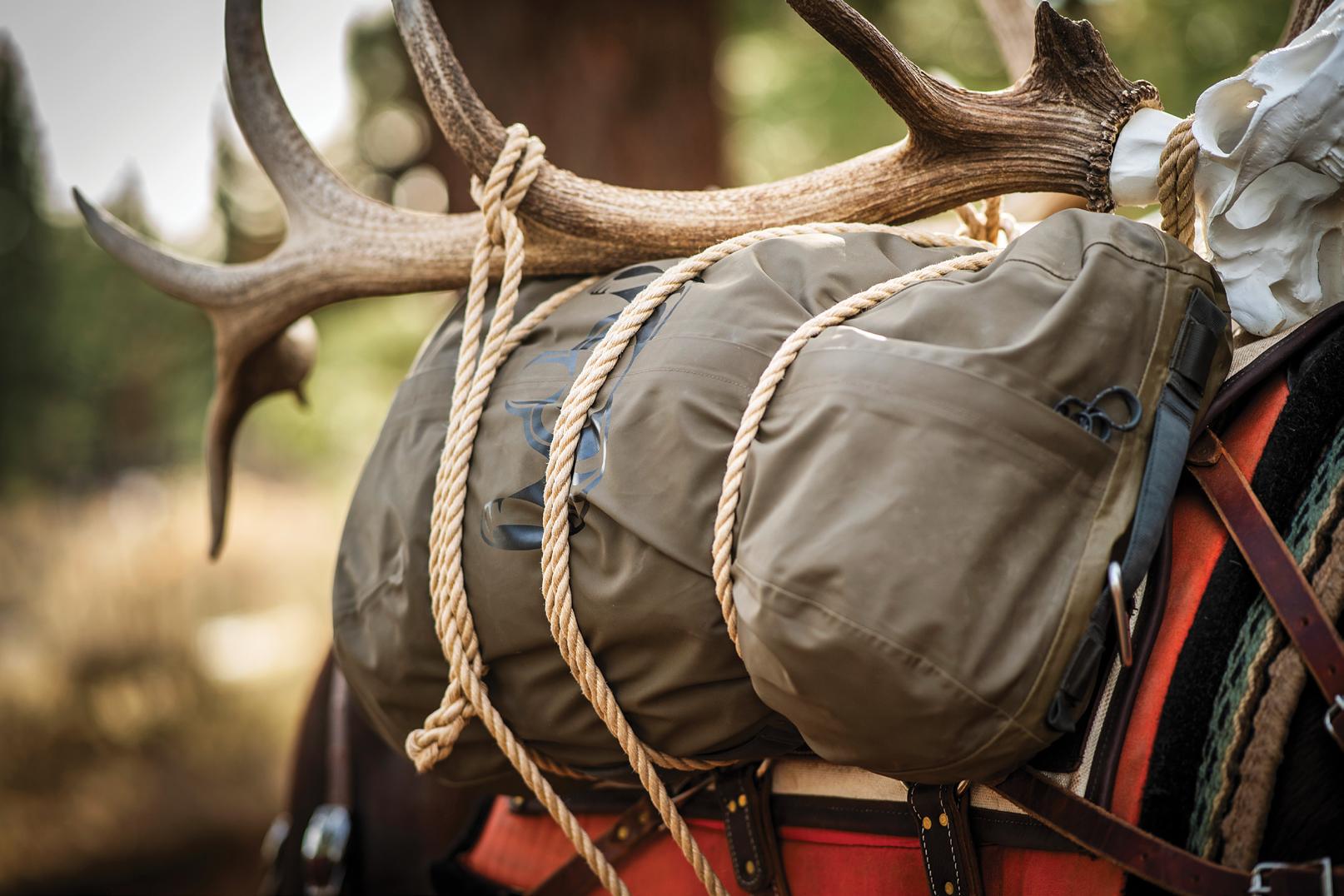
Most horsemen learn to make do with what they have. The cost of purchasing the “answer” to every likely “problem” would leave our tack rooms piled with items used once a year and our pockets empty. For years, I relied on heavy rope saddles that filled a need in the arena but merely sufficed in the mountains. The search for a purpose built mountain saddle–one capable of both riding and packing–eventually led me to the Thompson Pack-Ride Saddle.
Designed and built by Mark Thompson (owner of Thompson Long Range), the saddle draws inspiration from the late 1850s General George McLellan tree, used by the military from the Civil War through World War II. This modern reinterpretation blends a historically proven design with backcountry practicality.
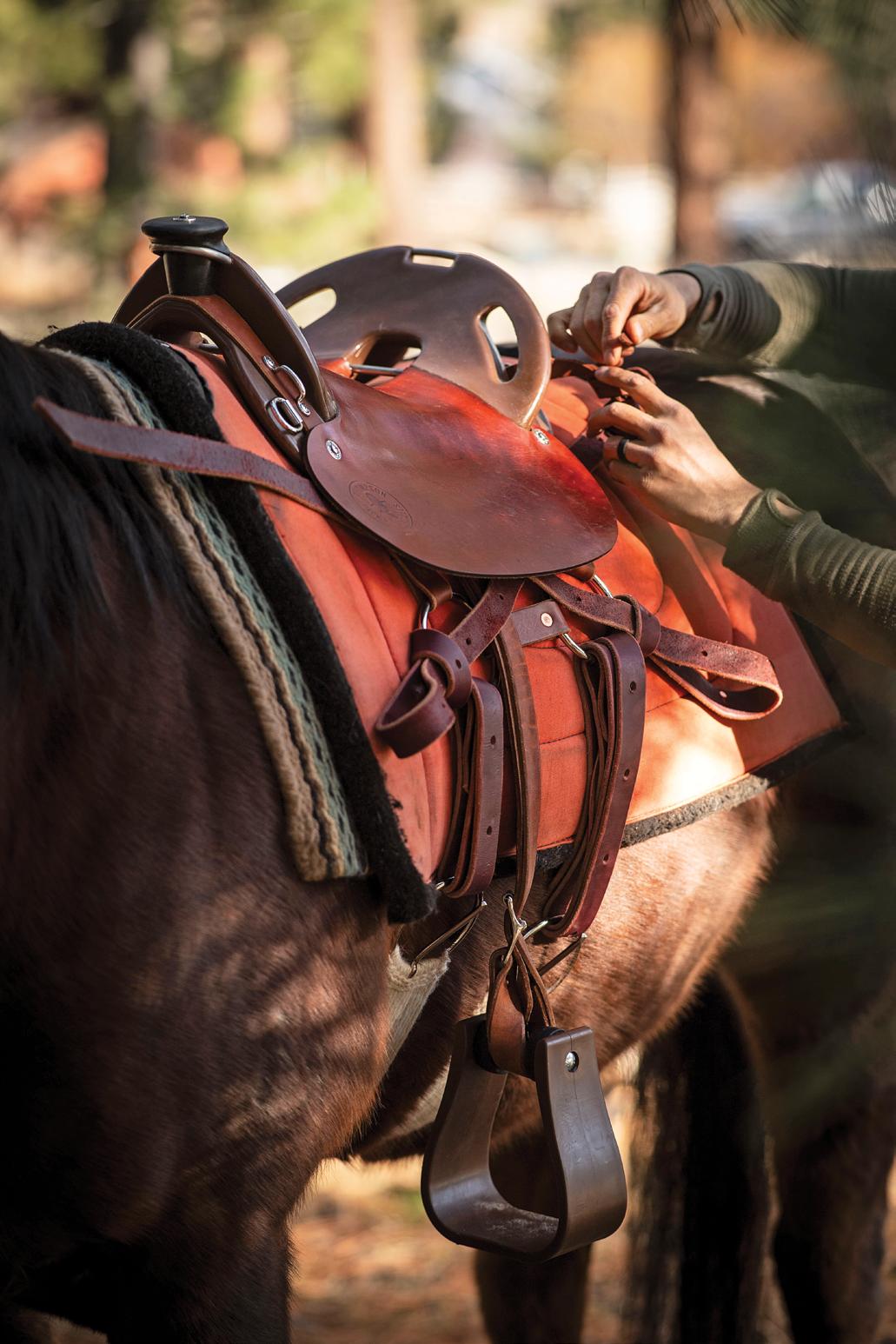
The seat of the saddle is recessed, specifically where the sitz bones (bony bumps at the bottom of your pelvis that support your weight when sitting) normally protrude. Turned leathers keep the stirrup at a fixed 90-degree angle to the animal, reducing rotational stress on your joints and allow you to pick up the stirrup with ease. The absence of traditional large, stiff fenders allows the hip, knee and ankle to hang in natural alignment. The result of those factors is a comfortable ride for extended time periods in
The saddle weighs in at 15.5 lb, roughly 40% less that most traditional trail saddles (25-35 lb). You may initially wonder how it’s possible to reduce such weight and be left with a rideable product that can also support the dead weight of a packed load. Peeling away the functionality of each piece, it becomes quite easy to understand.
Skirting is a major contributor to weight and depending on the discipline, can largely be for aesthetics. Simply put, added leather and pounds equate to how pleasing it is to your eye, not necessarily its utility.
Most saddle trees are constructed of wood. The Thompson Pack-Ride is rotationally molded with medium density polyethylene, creating a hollow product. Internally, a stainless steel frame provides a foundation for a horn, D-Rings (to hang stirrup leathers) and bars running down the middle of the seat for an attached packing rack. The result is further reduction in weight.
Designed with a proprietary bracket and stainless steel attachment point running down the seat, the saddle is quickly transformed into a pack saddle ready for hung panniers. Attachment points accommodate a breast collar, britchen or crupper set up–all of which are critical for maintaining saddle stability in steep terrain.
With no skirting or traditional fenders, exposed rigging closely mirrors the setup of traditional pack saddles (sawbucks/deckers). This allows for cinch adjustments under packed loads or during a wreck. Santa Fe slots cut into the seat of the saddle provide handholds in rough country as well as a convenient spot to tie off sling/lash rope. Cutouts such as these have been sported amongst saddlery for generations.
A feature I quickly became fond of is a slot located at the top of the cantle. Running clove hitched sling rope from the horn to the slot mimics the creation of a basket hitch on a decker. The angle of the rope from the horn to the top of the cantle is nearly 0 degrees, offering a secure way to attach a manty load if desired.
The narrow pommel allows mantied loads and panniers to suck in close to the horse’s body, improving stability/balance while reducing fatigue on your pack stock. A bevel on the horn allows your lead rope to half hitch cleanly without additional wrap. The bars of the saddle are shorter than most, allowing the fit to extend to a broader range of animals.
The Thompson Pack-Ride may very well have solved a number of problems I have looked to remedy in past years! As with all products, there are tradeoffs. There is no single perfect tool. Consider your unique approach to navigating hunts and how some of the highlighted gear might align well with the way you want to get the job done. WH

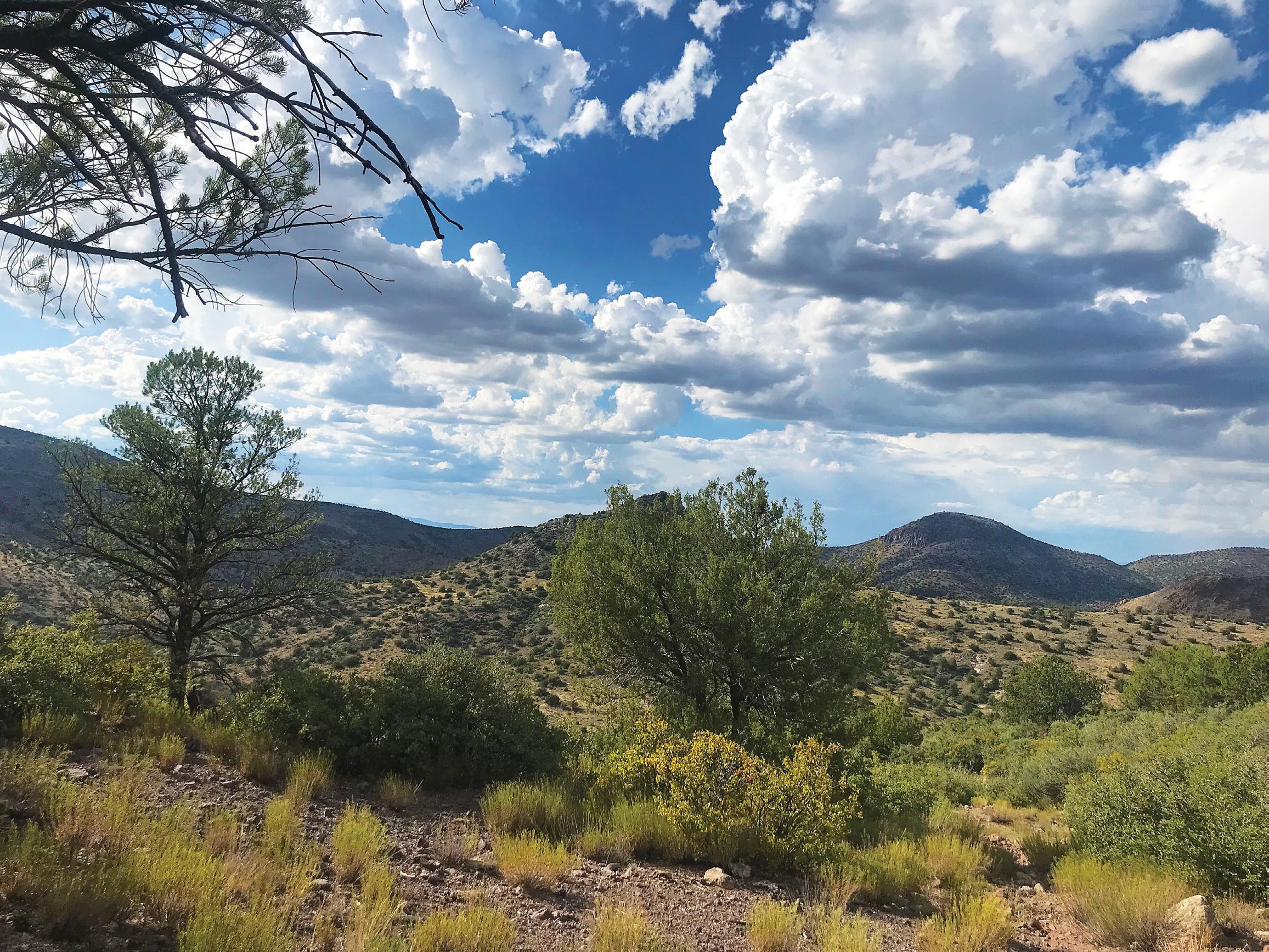
BY BRIAN GOBLE
August marks the beginning of good things for fall hunts in Arizona, offering what I consider to be one of the best hunting opportunities in the state: the OTC archery deer hunt. In 2024, this tag allowed me to once again pursue my passion for hunting Coues deer. Also, each year, I go through the exercise of buying points for and submitting applications in multiple western states for elk. Having applied as Arizona residents for elk with 17 points, my brother-in-law, Tom Alden, and I were excited to learn we had drawn one of the state’s premier archery elk units. I’d had this tag twice before, both in the ‘90s. As fall approached, I found myself in possession of two great archery tags.
Deer season would commence on August 23 and extend for three weeks or until the OTC deer harvest quota was met. The elk hunt would open on September 13–the day after the scheduled end of the deer season. I was looking forward to the deer hunt, but needed to give the elk tag the full attention it deserved. I decided to scout hard for both deer and elk, but limit my deer hunt to no more than seven days. This would give me at least two weeks before the elk opener to make final decisions on areas where we would focus our efforts.
In February, I set to work with E-scouting and contacting past tag holders for our elk unit. As I talked with recent tag holders, the elk hunt sounded as great as what I had experienced three decades ago. We began on-theground scouting in June and looked over an estimated 70+ water sources. My onX map of the area was a maze of waypoints. As summer went on, I also began preparing for the deer hunt.
Although I have a few areas where I concentrate my Coues deer efforts, each year I still need to determine which tanks are holding water and which ones have the greatest deer activity. Yearto-year, even when conditions seem identical, the deer activity may shift from one water source to another without rhyme or reason. Scouting is the key to hunting these deer. As we approached the start of the two hunts, I had devoted twenty full days to on-the-ground scouting.
“Scouting is the key to hunting these deer. As we approached the start of the two hunts, I had devoted twenty full days to on-the-ground scouting.”
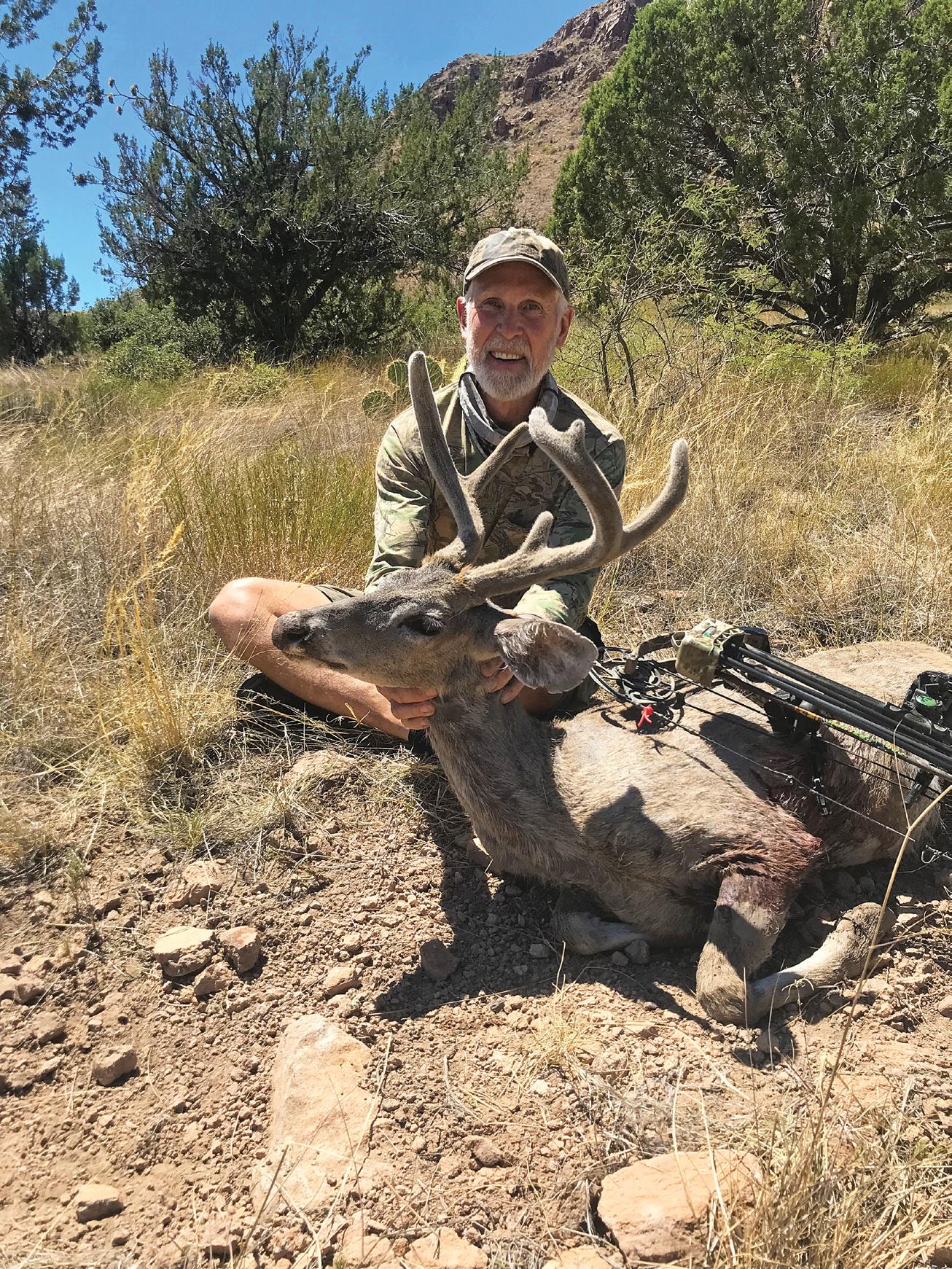
I set up deer camp a couple of days before the opener and was joined by my friend Mark Ovitt, who is an accomplished Coues deer hunter. We hiked into a proven dirt tank where we set up his blind. After passing on five small bucks over the first two days of the season, he pulled out to return to his familiar Coues deer stomping grounds, where he took a nice 4x4 buck. A week prior, I had placed my ground blind on a water tank that is by far my favorite. Over the years, family members and I have let arrows fly at nine Coues bucks at this high-elevation desert tank. Opening day, I had 16 deer in front of me, but no shooters. The morning of day two, I was in the blind at 6:00 AM, and the deer parade got underway at 6:45. By 7:30, I’d had 13 deer in front of me, including a couple of small bucks. Four hours later, a big-framed buck suddenly appeared, standing broadside at 20 yards. Normally, I see deer approaching and have time to prepare for my shot. Not this time. This buck had come around from my right and out of my line of sight.
I shoot out of my blind from my knees, so with this buck only 20 paces away, I needed to get up and move my chair, get my bow out of its stand, and move into position for the shot without getting busted. To my surprise, I pulled it off. After a few moments assessing his surroundings, the buck headed to the water. As he put his head down, I drew and took the 20-yard shot. He ran only 25 yards and was finished in seconds. When I got to the buck, I couldn’t believe what I saw. This buck, officially measured as a 2x3 at 85 7/8", is a great Coues buck.
So, on to elk. Tom and I set up camp three days before the opener. During our summer scouting, one of the tanks that really caught our attention was located on a ridge with steep canyons on both sides, both leading to the adjacent reservation, which was just 240 yards away. I put my tree stand there in a Ponderosa just 20 yards from the water’s edge. Tom put his ground blind on another active tank above a steep canyon about 10 miles away.
Opening morning found Tom, his son Tommy, and our friend Don Heizer calling to some uncooperative bulls. At midday, he moved to his ground blind, where that evening his shot did not find its mark. Discouraged, he pulled it together and hunted hard the remaining 13 days. He had multiple close encounters, called in bulls, hiked into hell-holes, and did all he could, ultimately without filling his tag.
That same morning, I was off on my own, calling in an area about six miles away from Tom and crew. Once I had a response, I approached from downwind of what sounded like a mediocre bugle. The closer I got, the more responsive the bull became. I estimated I was 120 yards from the location of the last bugle and quickly moved forward to put on the pressure. Too quickly. I looked up to see that a cow had me pegged at about 80 yards. As she alerted the rest of the herd, I saw a half dozen cows departing along
At 5:00 that afternoon, the bulls started to light up on the reservation below and were slowly moving up the canyon that would bring them onto public land, but I didn’t see any way they were going to make it to my stand before dark. At about 6:00, I heard more bugles over my left shoulder as another bull slowly came up the back side of the ridge. A short time later, over my right shoulder, a bull ripped off a terrifying screech of a bugle that made me glad I was harnessed to the tree.
I’d not heard the bull approaching; he was just all of a sudden there. The bull bugled about eight times as he headed my way, and I could hear rocks rolling. I was now standing on the platform of my stand and had a clear shot at all but one corner of the tank. As I crouched to look under the limbs of an adjacent ponderosa, he stepped into view, tipped back his rack, and let loose another skeleton-rattling bugle. Oh yeah!
Without hesitation, he walked down to the tank and, of course, to my obstructed-view corner. Fortunately, he took a couple of steps into the water, giving me a partial view of his vitals. By leaning to my left, I was able to get a clear 19-yard shot. On impact, the bull made an enormous leap, landing in the middle of the tank. With two more lunges, he was standing on the opposite side of the small tank where I stopped him with some cow calls. I knew the shot was good and expected him to drop in his tracks, but I was caught off guard as he stepped over the berm towards the hideous canyon below. Suddenly, he disappeared from view, and I feared the worst–that he had just walked down the canyon to the reservation and out of my life. Then, what a relief to hear crashing and brush breaking as he finished up!
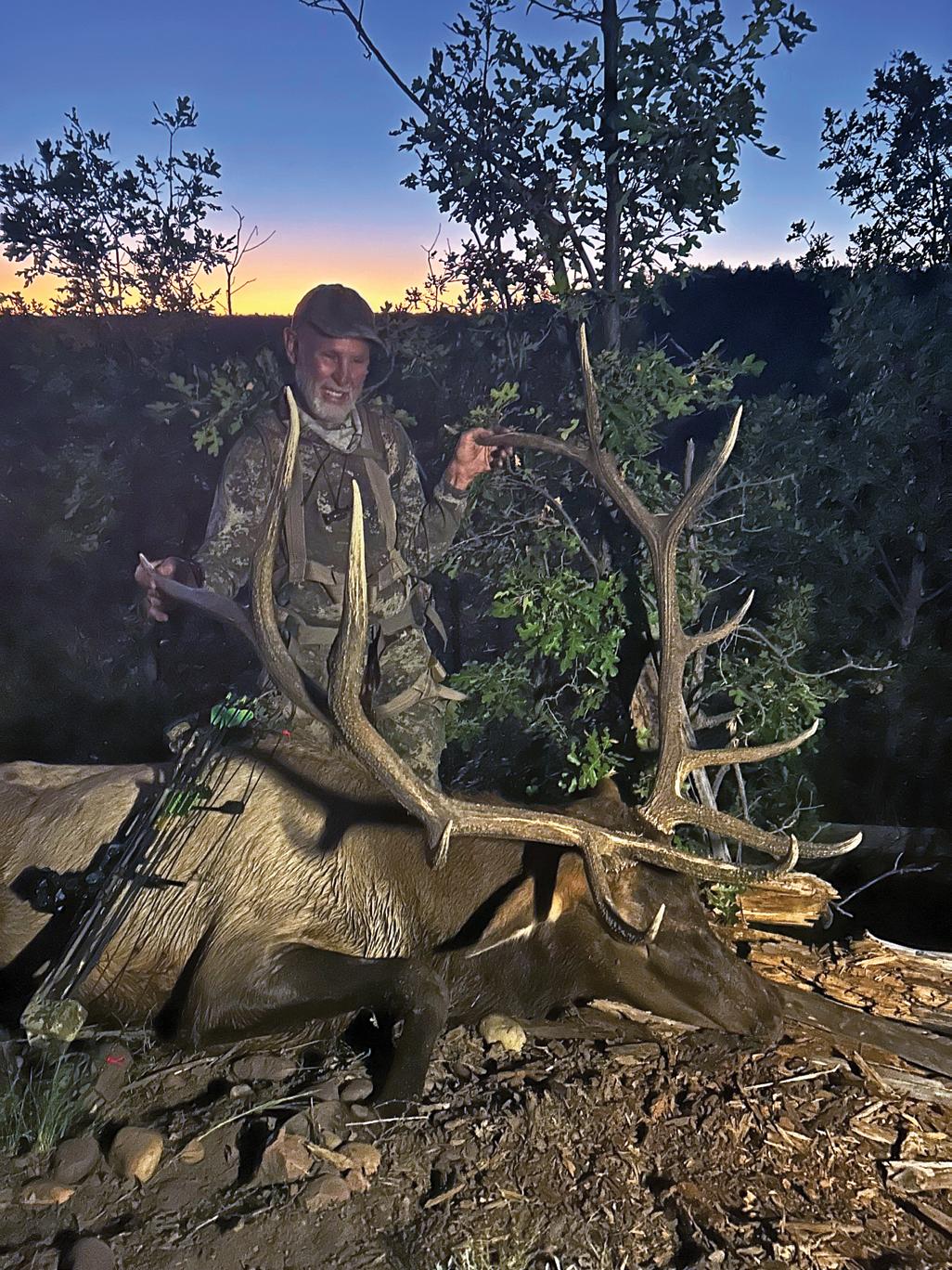
Because the bull had rolled and slid so far down the side of the canyon, I decided to go back to camp to get some help. Just as I arrived, my son-in-law, Derek Shreiner, along with my two grandsons, Jaxon (10) and Gavin (8), pulled into camp to join us for the weekend. We all grabbed something to eat and headed out for the task at hand, which was going to last until 1:00 AM.
The team worked as a well-oiled machine as we used about 250 feet of rope attached to the truck to pull the bull up to flat ground. It was a fun night for Jaxon and Gavin as they both had turns with skinning knives and provided the group with smiles and memories. As Derek said later, it was the first big-boy hunting experience for them both. A month later, ten-year-old Jaxon took his first Coues buck while hunting with his dad and older brother Bryce.
Two tags, 20 days of scouting, 2-1/2 total days of hunting, two Pope & Young / Bowhunting in Arizona record book animals. 2+20+2.5=2. This was special. God’s been good to me. WH
Bow: PSE EVO NXT 33
Arrows: Gold Tip Hunter
Broadheads: Rage 3-blade & SEVR 1.75
Rest: QAD Ultra-Rest HDX
Sight: Axcel Rheotech
Release: Carter Quickie
Binoculars: Swarovski 10X42 SLC
Pack: Badlands Maps: onX Hunt
Elk Calls: Rocky Mountain Calls and Point Blank Grunt Tube
Blind: Primos Double Bull Pen
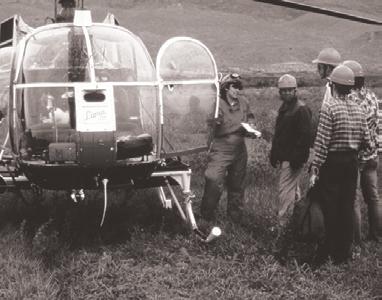
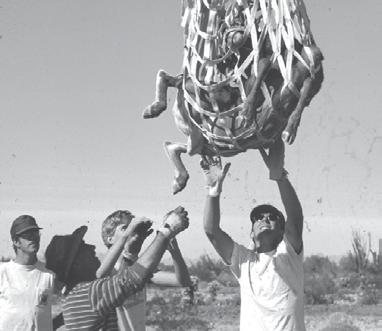
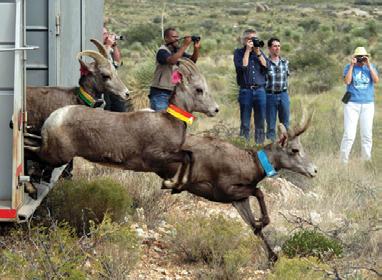
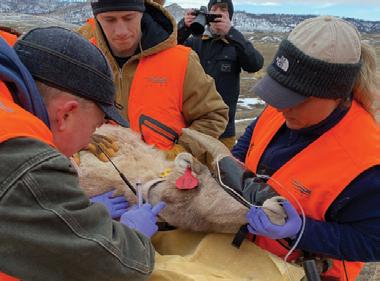
reno, nevada - february 3-6, 2027
Honoring the sportsmen and partners who’ve shaped the future of wild sheep conservation.
An unforgettable gathering of conservation, community, fun, and tradition
Come for the Sheep Stay for the Mission
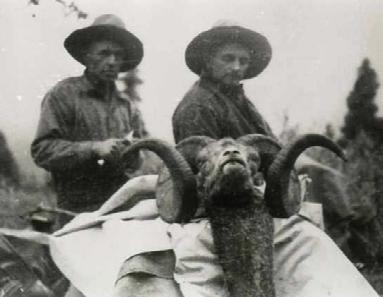
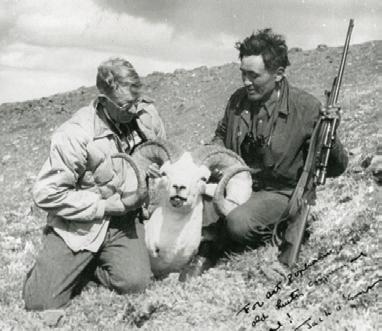
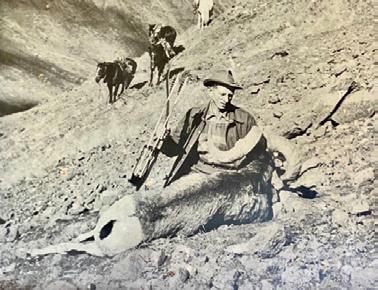
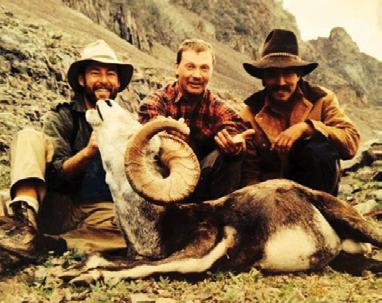
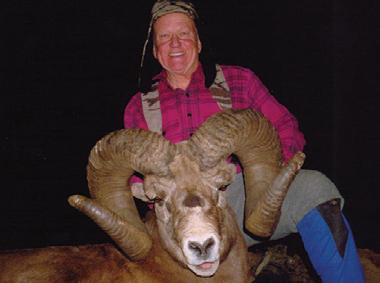
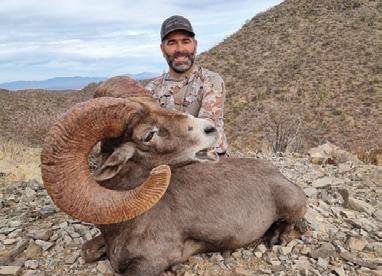

BY FRED EICHLER
Coyotes are found in 49 of our 50 states. My guess is they will be in 50 before long, and I often joke that a few are swimming to Hawaii at any given time. The bad news about that is they are expanding their range, and they eat about anything they can catch. The good news is that calling them in is about as exciting a hunt as one can have, in my opinion. Another plus is that if you are successful, you have saved a myriad of animals and birds, including deer, turkey, antelope, quail, pheasant, rabbits, and others, depending on where you hunt.
The other great thing about hunting coyotes is that it doesn’t cost much. You can buy a mouth call for about 30 bucks, and you don’t need a special firearm or bow to do it; odds are, whatever you have will work just fine. In most states in the West, you can also hunt them year-round, and in doing so, you can find sheds, scout new areas on public land, or often gain access to amazing private land by helping with the owners’ predator problems.
If you aren’t already a fanatic about it like me, these are some basics to get you started. In future articles, I will delve into thermal scopes, night vision, and other tactics like vocalizations for different times of year and other hunting methods, including baiting and water hole hunting. For now, this is the nuts and bolts to get you started on the right track if you want to dip a toe.
Be forewarned, however, coyote hunting is as addictive as elk, deer, turkey, waterfowl, or any other outdoor pursuit that is consuming your thoughts day and night. Once you have a coyote come in as fast as it can for what it thinks is an easy meal, and you’re rewarded with an amazing pelt and the satisfaction of saving some other little critters, well, most just want to keep going, in my experience.
Although there are a lot of options on the market, like expensive e-calls (which are awesome), I started with and still often use a mouth call. You can pick one up at a Bass Pro near you or order one online. Just look up “rabbit call for coyotes,” and you will see all kinds of options ranging from 15 to 30 dollars. These sound like a rabbit in distress, and unlike diaphragm calls, these rabbit squealers are super easy to use and just require you to blow into them. They are not like a duck call, which takes some finesse, which I am terrible at, according to both my son and ducks.
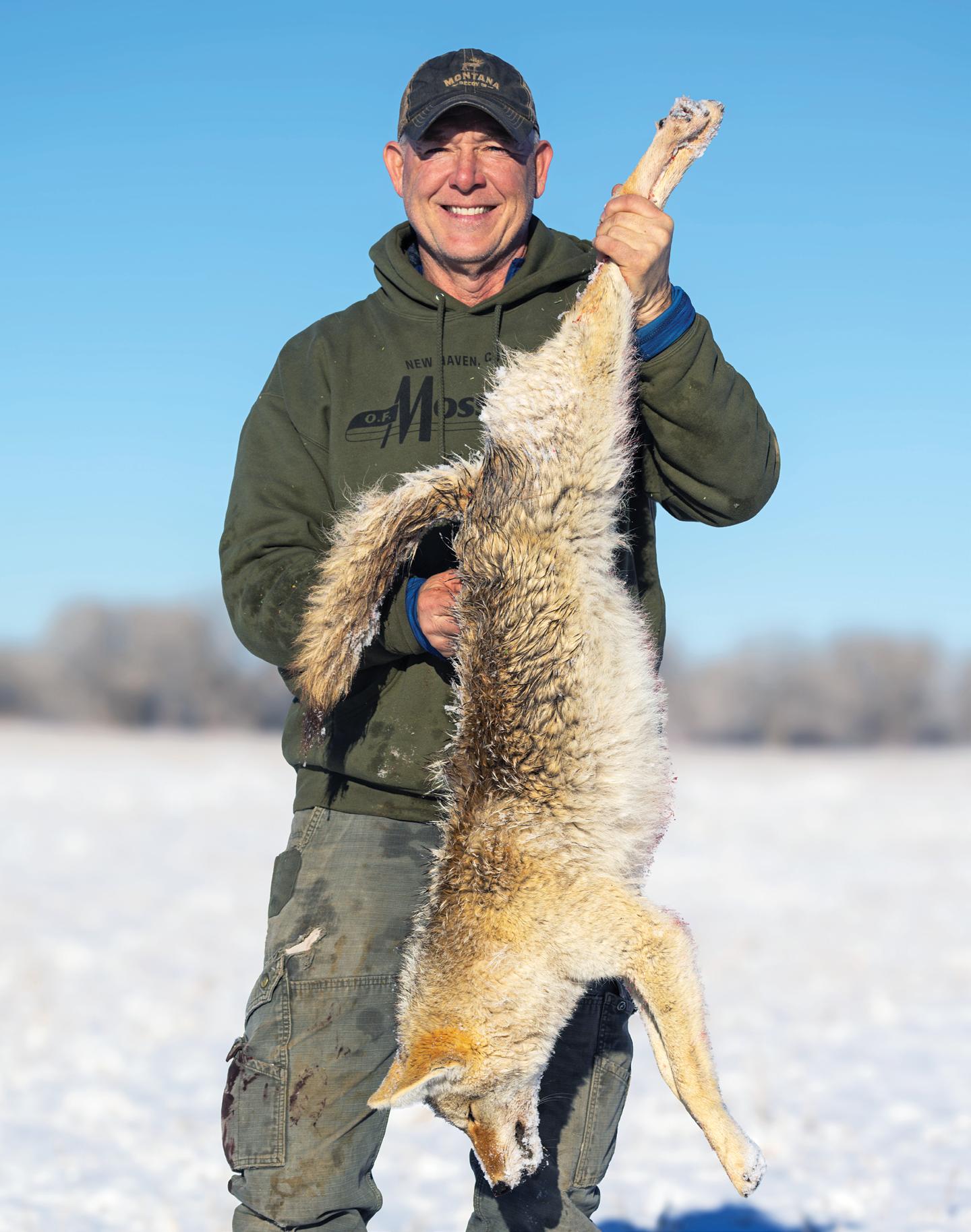
That’s all you need. The goal is to emulate a rabbit in distress. I like blowing in short bursts, 2-4 seconds at a time, until I need a break. Then, I start back up. I will do that for 15-45 minutes. If a coyote hasn’t shown up, I will move to a new location and try again. If I am hunting flat and wide-open terrain like a prairie, I will try to move a mile and a half between sets. If I am in thick-treed areas like Florida, I may only go a half mile as the sound will not carry as far. Don’t be disappointed if you don’t call one in right away. I have been calling for almost 40 years and average one coyote per three sets. The key is calling in areas with coyotes and preferably ones that haven’t had
This may sound obvious, but you will not have any luck if there aren’t any coyotes where you are calling. Coyotes can range over a wide area. Just because you or someone else saw a coyote in a spot last week doesn’t mean they are still around. Like anything else, scouting is the best way to know if coyotes are in the area. Fresh tracks, scat, or even hearing them at night all help let you know where to call. I often rely on intel from farmers or ranchers besides my own scouting.
The setup is the tricky part if you want to have success. It’s like the old real estate saying, “location, location, location.” How and where you set up can mean the difference between success and failure. One of the first things I look for is some back cover to break up my silhouette. Next, I want visibility so I can see a coyote if he comes in. I prefer to be in the shadows if possible, as opposed to having the sun on me.
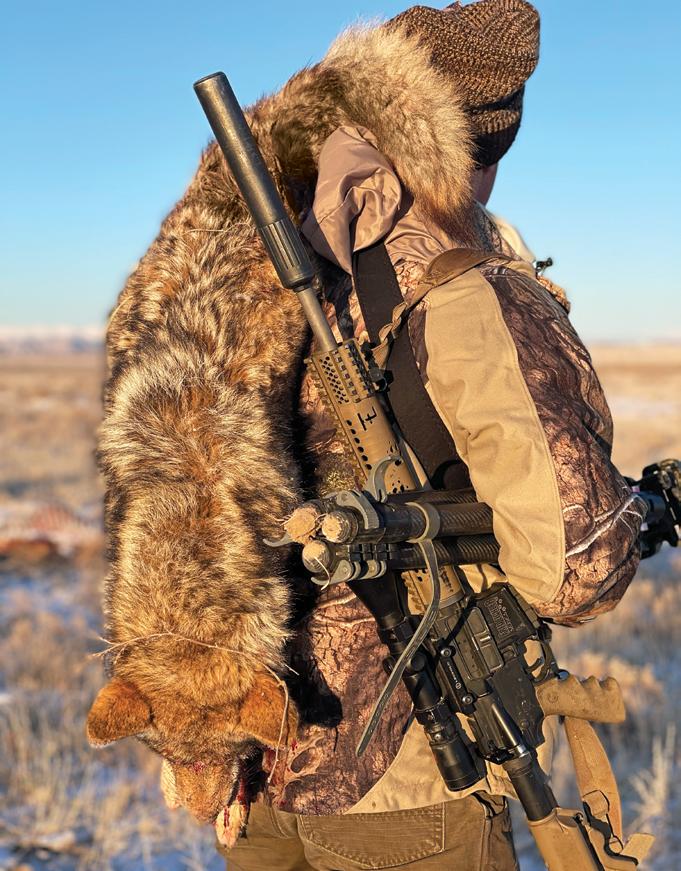
I also prefer to have the sun at my back and the wind either in my face or quartering to me. I will often spend more time trying to find the perfect place to set up than I will calling. I lost a lot of opportunities at coyotes early on because my setup wasn’t good.
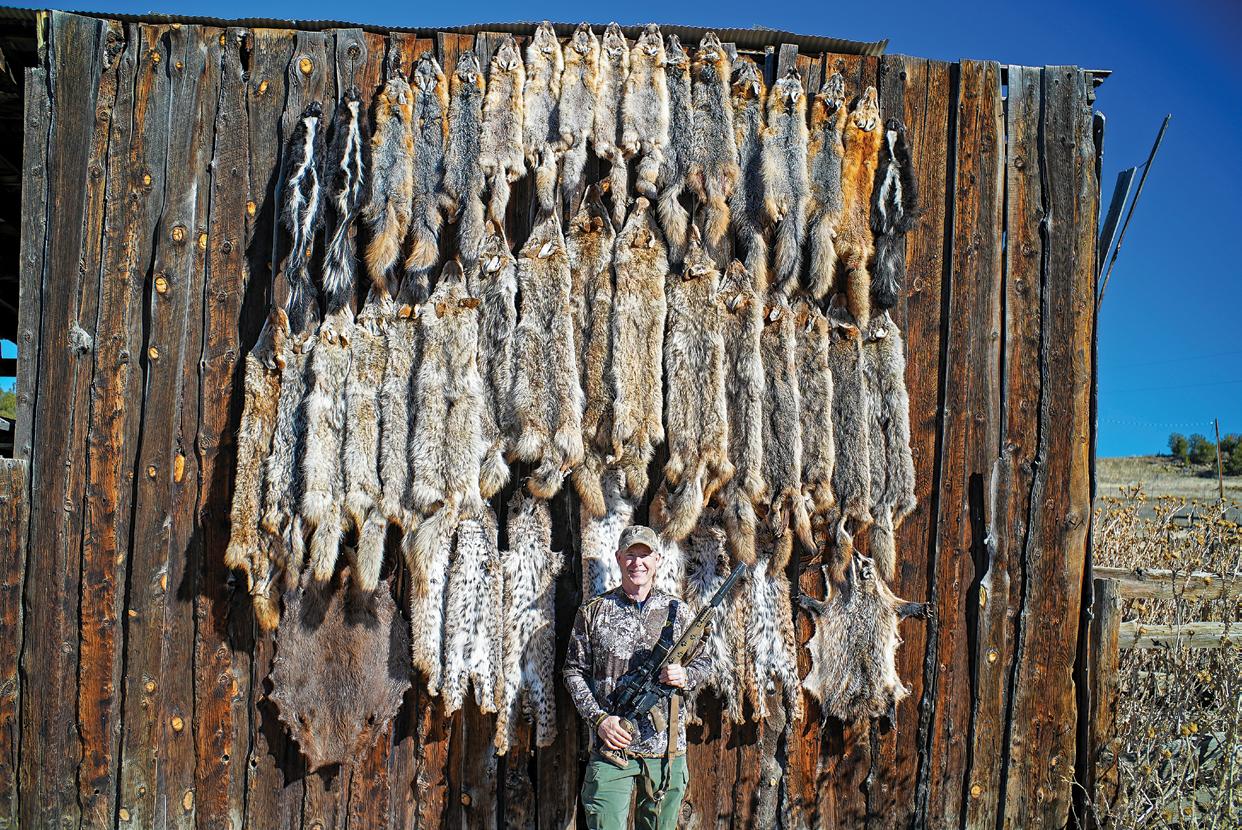
The other great thing about coyote hunting is that, really, almost anything you have can work on coyotes. I have taken coyotes with air guns, muzzleloaders, handguns, rifles, shotguns, and bows. I have also used everything from a .22 rimfire to a 30-06. I will say my favorite is a .223 because it’s relatively inexpensive to shoot, and it doesn’t cause a lot of hide damage. I sell fur to help fund my habit.
I remember back when you could get $100 for a good western pale coyote that was prime, cared for, and stretched correctly. Unfortunately, coyote prices have plummeted, but the hides are still amazing trophies in themselves, and I encourage people trying to recoup some money from pelts to self-tan or send them to be tanned, as you can often sell those and turn a few dollars. They also make great wall decorations, and I am currently working on making a coyote fur bedspread. If you’re already an avid coyote hunter, then you know how addictive it is. If you’re considering giving it a whirl, I hope you will grab your favorite rifle or shotgun and go save some deer. Just know that it can turn into a passion that will keep you out in the field all year! WH
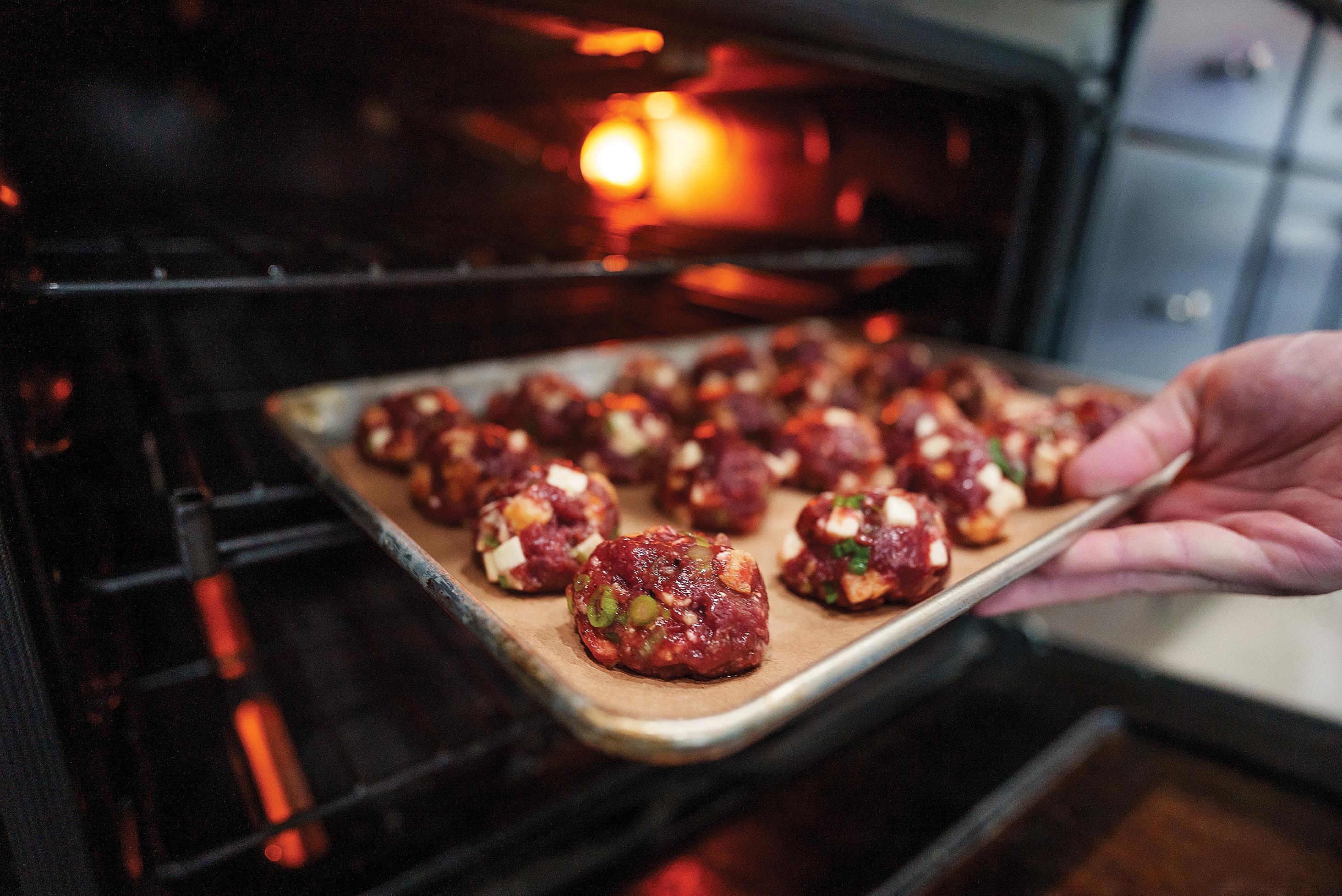
BY BRETT MOSELEY
As I have gotten older, I have realized that training in the gym isn’t enough to keep up in the mountains. Every day, I put in the time to make sure I don’t fall behind and can keep up with guys half my age, ones who walk straight uphill with 100+ pounds on their backs and shrug it off like it’s nothing. All the training is great for your health and mental clarity, but if you’re not focusing on movements that mimic what you’re doing in the mountains, it can be humbling when you take those first few steps on a hunt.
Just like we work on our fitness, we need to work on how and what we eat. I would argue that the biggest challenge is finding the time to feed ourselves. We take time out every day to care for others, work out, manage our jobs, kids, life, etc. And for most of my life, I put food last. That doesn’t mean I was eating poorly; I have always tried to maintain a healthy diet, but it was easy to let my busy life dictate the quality of my diet. Even as a professional chef with limitless amounts of food to work with, I struggled to find the time. Think about this, in the last 15 years, I have worked over 45,000 hours around food and still couldn’t find the time to properly feed myself. Time is a luxury that most of us have to work really hard to manage. Most of us get a small amount of time to hunt each year. The rest of the time, we think about hunting, shooting our bow or rifle, hiking, and cooking the meat that we worked so hard to get. Having a full freezer that I can pull from every day is one of the greatest luxuries I have earned for myself.
A few years ago, I started looking at that freezer full of meat as the key to how I was going to get in the best shape of my life. There is no shortage of recipes that show you awesome ways to cook or preserve wild game. There are not a lot of recipes that take your time into consideration. I want to share quick, easy, and affordable ways for you to turn your freezer full of meat into the cleanest, best-tasting meals that will help you hit your daily macro goals.
For example, I need 220 grams of protein a day, as many cruciferous vegetables as possible, some starchy vegetables, some carbohydrates, and almost a gallon of water. I also need to try and fit this all in between ten o’clock in the morning and six o’clock in the evening. I don’t hit these goals every day. I don’t always have the best workout, I do eat snacks and sweet things, I work at a brewery, and you can imagine how hard it is to pass up on an ice-cold beer after a long day. But I try every day. I try to be the best father, husband, and coworker that I can.
When I fail miserably one day, I get up the next and start over. We will never be perfect, and you need to remember that enjoyment is a nutrient. The key is to not focus on the choices you made and let them derail you completely; you just start over the next day. I imagine that most of you reading this have similar goals and struggles. This recipe is a great way to hit your protein goals throughout the week and can be adjusted based on your needs. WH
1 HR
24
3 lb ground meat
6 whole eggs
1 bunch green onions, sliced
4 oz fresh mozzarella, small dice
6 oz sourdough bread, small dice
2 tbsp fresh ground black pepper
4 X 2
66
20-25
1 Preheat oven to 375°F. Convection works best.
2 Line a sheet tray with parchment paper or spray with oil.
3 In a large mixing bowl, combine the ground meat, eggs, onions, mozzarella, sourdough, salt, and black pepper.
4 Mix by hand until well combined. Do not over-mix.
5 Cover a digital scale with plastic wrap and set to OZ (not FL OZ).

Spoon mixture onto the scale to equal 2 oz. Form into a ball and place on the prepared tray with about 2 inches of space between each.
Place in the oven and cook for 20–25 minutes.
Remove from oven and let cool to room temperature. Store in the refrigerator for up to one week.
• For less fat, reduce mozzarella by half and remove a few egg yolks, leaving the whites as a binder.
• Fresh bread adds moisture and texture that dried breadcrumbs can't match.
• Don't worry about dispersing all ingredients perfectly evenly — just don't over-mix.
• Sierra Sage seasoning from Live Wild Spice Co. is an easy swap for the onion, salt, pepper, and cheese.
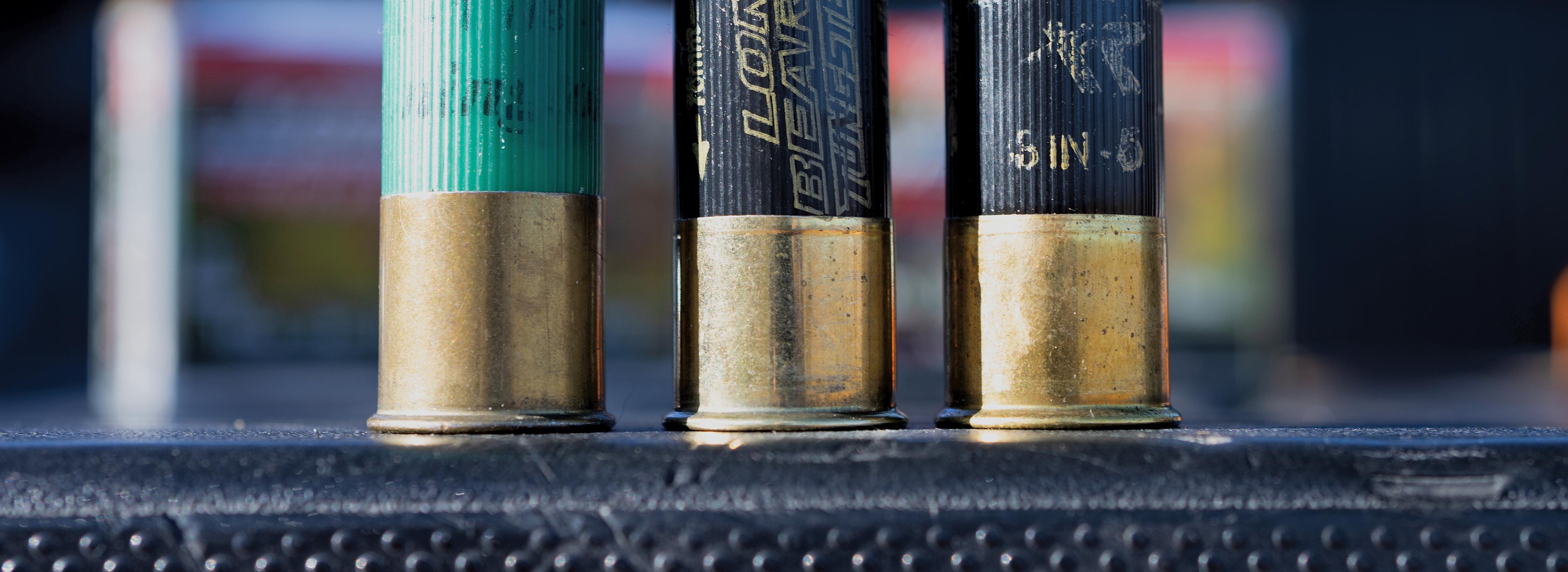
BY JOE MANNINO
I did not grow up turkey hunting. I don’t have a long history with the bird or any springtime traditions. I started chasing turkeys while in graduate school in eastern North Carolina. That first spring in eastern NC, I picked up a cheap TruGlo turkey choke and some Remington Nitro turkey loads for my 870 Express.
I put a found beer can on a stick, walked back 30 yards, aimed, fired, and heard the impact of at least one pellet. I called it good enough and headed afield.
Unfortunately, public land hunting back east is not anywhere near as productive as it is here in the West, and while a massive flock of turkeys on the adjacent property led me to find one of my favorite public gamelands, that season produced just one fleeting glimpse of a turkey’s head darting out of sight.
Once I moved back home to Arizona, I started to get the bug a little more. It helps to have friends and relatives who dig turkey hunting, but it still took a couple of years for me to actually get out and chase these birds.
I really started to cut my teeth on a San Carlos Reservation hunt with my uncle. That’s when I first saw a Tom in full strut. Unfortunately, that trusty 870 and I were never quite able to connect. I then spent a total of six days hunting in central Arizona. Again, we got close, but couldn’t quite seal the deal. Fortunately, when I couldn’t make it out for the last weekend, my good buddy Ryan took that 870, TruGlo choke, and Remington Nitro loads out and dropped a nice Tom.
Now, it’s four years later, and I finally drew another turkey tag, in the same unit as before. I am determined to finally connect. And while my shotgun, choke, and ammo combination has proven lethal, I thought it would be a good time to upgrade my setup.
There are a lot of turkey loads out there, but Winchester Long Beard XR is highly regarded and recommended. I picked up some XR and a Carlson’s Long Beard XR Choke that’s specifically designed for that ammo. Thinking back on my first experience “patterning” my gun for turkey, I left a lot to be desired. So, I went whole hog this year, bought some turkey targets, and set out to really see the difference between where I was and where I am now.
I set the target out to 30 yards. With my 870 equipped with that old TruGlo, I made three shots, one with the Remington Nitro loads, one with Long Beard XR, and one with Winchester’s new Long Beard Tungsten.
Looking at the results, it’s clear that the distribution of the pellets with the Nitro loads and TruGlo choke is pretty wide. While that shot probably would have resulted in a dead bird, it’s really not ideal. The next shot was with the Long Beard XR loads, and it’s easy to see how much more compact and tight that distribution is. It looks to me that the XRs stay together for longer.
Lastly, we have the new Long Beard Tungsten loads. You can really see the difference between the #5 shot and #9 here. Tungsten is heavier and denser than traditional lead shot. This means that a smaller pellet can carry the same impact as a larger lead pellet. Because of this, Winchester is able to pack more shot into the shell and achieve the same level of effectiveness with the tungsten loads.
Next, I replaced the TruGlo choke with my new Carlson’s choke tube and ran the same test. The Carlson choke tube patterned all three loads better than the TruGlo did. It simply put more pellets into that ten-inch target. To me, that makes sense; it’s manufactured specifically for an 870 shooting Long Beard ammo, while the TruGlo is more universally designed and can fit a myriad of different shotguns. But let me be clear here, I am not writing this to drag TruGlo in the dirt; I am simply showing the difference between universality and a more intentional approach.
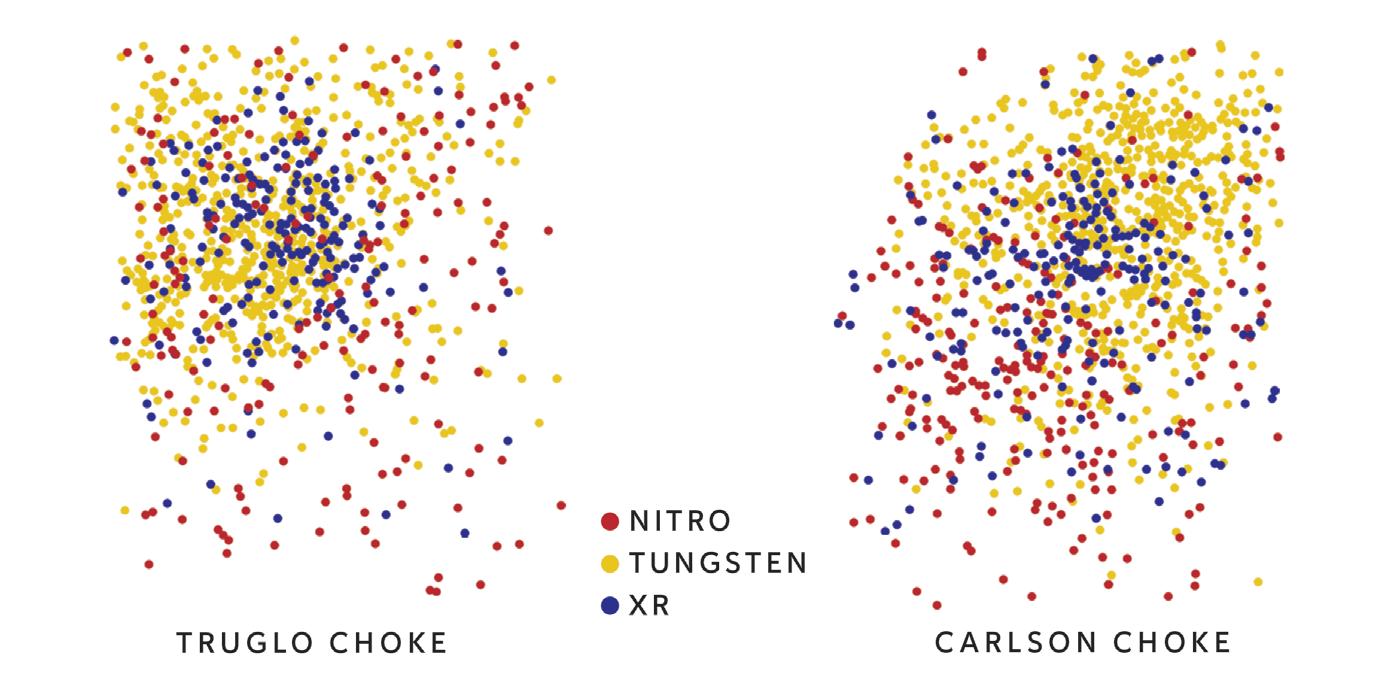
Additionally, while the Remington loads would probably work just fine out to 30 yards, I wouldn’t be comfortable shooting much farther than that. The Winchester rounds showed that they stayed together more tightly and put more pellets into the target area. While I am not comfortable shooting to the advertised distances on the Winchester boxes, it’s nice to feel confident in the ammo out to about 50 yards.
Lastly, I really wanted to like the XRs better than the Tungsten rounds. Those Long Beard Tungstens are very expensive, and I usually find myself picking a happy medium when faced with an economical decision about gear; not too cheap, but not overpriced either. In this case, I really wanted to see if there was a difference between a $2.60 turkey load and a $19.00 turkey load. I wanted to not see a difference, but I did. I wanted to not feel more confident in the tungsten, but I did. So, I chose to load that 870 Express with $57.00 worth of ammo and head into the mountains.
Ryan and his brother Josh got to my house around 2:30 AM on opening day. After packing the coolers and updating InReach subscriptions, we were on the road at about 3:00 AM. We had about a two-and-a-half-hour drive ahead of us. We had a campsite picked out already, and thankfully, it was open when we arrived a little after 5:00 AM.
Ryan had scouted the area the weekend prior, but gusty winds made it impossible to hear anything. We were going in blind and really relying on past experience in the area. Fortunately, as soon as we got out of the truck, we heard a gobble. With limited activity the week before, we knew we had to chase. No sooner than we arrived, the trucks were locked back up, shotguns were loaded, and Ryan and I headed towards that gobbler, while Josh did some recon in different areas.
The problem was that we were in thick chaparral country. Scrub oak and Manzanita aren’t what people typically think of as turkey habitat; that’s exactly why we wanted to hunt there. Sure, there aren’t as many birds as there are further north, in the ponderosas, but there are not a lot of people there, either. We were after some solitude as much as turkeys, and we found both. Luckily, this bird was very responsive. As soon as we called, he answered. We were getting close, but the country was so thick that we had to inch in a bit closer to find a good spot to sit and call. About 50 yards closer, we found a small opening. I dropped my pack and sat with my back against a tree. I had three small lanes: one to my left, one to the right, and one directly in front of me. I maybe had 30 yards at most. If he was going to come in, it would be close.
Ryan started with a couple of hen yelps, and that Tom went nuts. Truthfully, I don’t think it mattered what noise we made with the calls; he was absolutely fired up. At one point, he was gobbling on top of his own gobbles. We let him chill for a couple of minutes, then I made some subtle purrs and yelps with my slate call. His gobble rang out close, in the lane right in front of me. Ryan and I looked at each other with disbelief. I nestled my shotgun onto my shoulder, centered my bead, and aimed at the opening.
Then, his bright red head popped into frame. Ryan said he heard the tom drumming and spitting. I had tunnel vision. I saw his head, beard, and the tops of his wings and fan. He came in full strut.
Center the bead. Breathe. Squeeze.
The shot rang out, the bird disappeared, and I hopped up and ran to him, thinking I needed to chase him down. That was unnecessary; he was down for the count. It was 6:30 AM.
I am so happy that I patterned my shotgun before this hunt. Through two range sessions, I was able to fix the deficiencies in my shooting ability, and I gained a hell of a lot of confidence in the ammo that I was shooting. After sitting with these results and the experience from my hunt, I believe the Long Beard XR would have been just as lethal as the tungsten at distances up to 40-45 yards. I was anticipating a bit of a further shot, and chose the Tungsten because that pellet distribution would stay together, tighter, longer.
I know that Winchester Long Beard Tungsten is expensive, but it is very effective. After testing those rounds, I felt like the tungsten would give me the best chance out to 50 yards. I understand Winchester advertises that those rounds are accurate out to 70 yards, but I know my limitations, and I know what distances I prefer to shoot to, and I wasn’t going to take a shot further than 50.
I like the work that typically comes with a hunt. I want killing an animal to feel earned, I like to have a little struggle, some adversity. This hunt, well, it was easy. But the preparation beforehand and the past failures, those experiences make this one feel earned. I was happy to be tagged out before my kids even woke up for school. WH
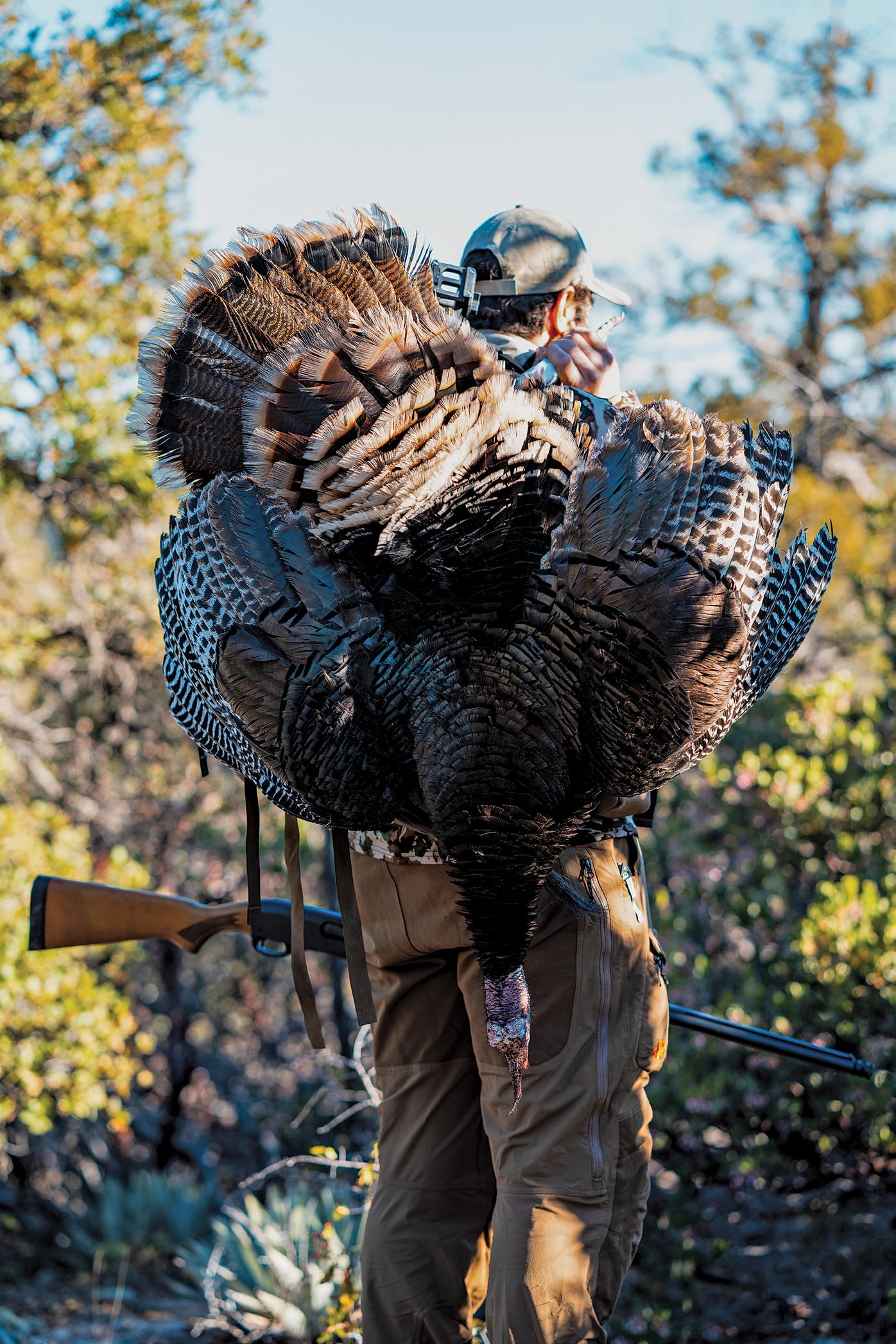
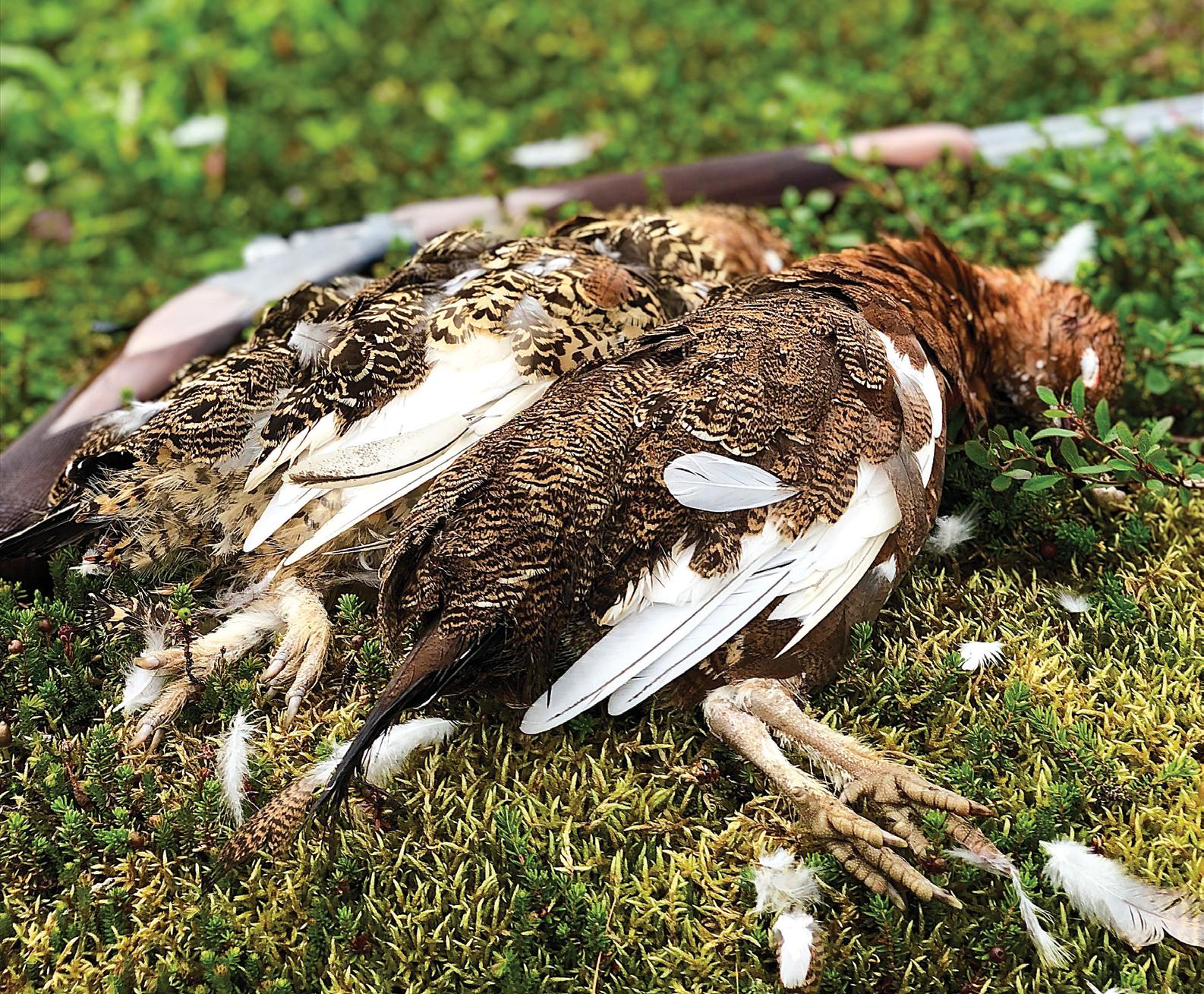
BY EDGAR CASTILLO
When the puddle jumper circled around, I peered out the window and was immediately overwhelmed by the view from the air. The geographical landscape was staggering. From my vantage point, there was an abundance of water, with various-sized lakes in every direction. Winding waterways crisscrossed the earth, with its willow-filled valleys, ground-colored lichen, and treeless tundra biomes scattered about. The endless, rugged wilderness with its dense forests stretched to the horizon. It was both interrupted and surrounded by jagged, snow-capped mountains. Welcome to Alaska, bird hunters.
Hunting The Last Frontier is fundamentally on another level from the lower 48. It’s an immense, almost roadless land mass that is unforgiving in every way imaginable. You must be prepared. Big game hunters already know this. Wingshooters should take heed and follow in their footsteps. It may just keep you alive.
In Alaska, the weather and temperature swing like a pendulum by the nanosecond. They work in tandem with the wildness of the land. Therefore, it’s imperative that bird hunters prepare themselves, as it is much more than a casual stroll across a sage flat for grouse or flushing quail from thickets. It’s being prepared for the unknown in extreme conditions. Besides being physically conditioned and mentally prepared, wingshooters need quality gear–some known, and some not usually carried by bird hunters.
“In Alaska, the weather and temperature swing like a pendulum by the nanosecond. They work in tandem with the wildness of the land. Therefore, it’s imperative that bird hunters prepare themselves.”
The upland vest is but the tip of the spear. It will serve as a fabric Conex box to haul gear, survival essentials, ammo, and dead birds. Therefore, whatever bird vest is chosen, it must be able to accommodate the ability to carry additional items necessary if forced to stay a night, have plenty of storage space, have features that allow MOLLE/PALS attachments/accessories to expand storage, possess external lashing straps and water bottle holders, and transport your shotgun so trekking poles can be used. These are the typical contents of my bird vest when hunting in Alaska.
• Shotgun (20 or 28-gauge suggested, but any lightweight gauge will do)
• Shotgun Scabbard or Gun Sock
• Ammo (one box minimum + six slugs)
• Lightweight Waterproof Tarp / Shelter (5' x 7')
• Trekking Poles (adjustable/collapsible)
• Waterproof Storage Bags (2-3 assorted sizes to pack clothes and gear)
• Bivy
• Headlamp
• Multitool/Knife
• First Aid Kit/Tourniquet
• Survival Kit (firestarter, lighter, compass, 75-100 ft paracord, emergency blanket, lip balm, whistle)
• Handkerchief
• Water Bottles (2)
• Water Filtration & LifeStraw
• Garmin inReach, SPOT
• Jet Stove + Fuel
• Food (Wilderness Athlete Pack-Out Bars, Hydration & Energy Packets, 2-Freeze-Dried Meals)
• Cell Phone (download offline maps) + Battery Bank/Charger
• Waterproof Map of Area
• Roll of Fluorescent Flagging Ribbon
• Dog Supplies (first aid, stapler, collapsible water bowl, vest/backpack, leash/check cord, snacks)
• Bear Spray
• Sidearm (10mm, .44 magnum)
As mentioned, the bird vest must allow for hands-free shotgun carry. With a little ingenuity, most vests can perform this function, as no company or brand (except KUIU, as they sell an attachment) has thought about this feature. Once this is figured out, keeping the shotgun dry is vital. Search for lightweight, water-resistant or waterproof cases. Silicone-treated gun socks offer an alternative protection from Alaska’s moisture-ridden environment. During multiple trips to Alaska, I have worn two distinct brands of bird vests, Hunt Redi and KUIU. Both of these vests exceeded my expectations to comfortably carry a cache of gear during long jaunts in the wilderness, overnight treks, and one-day excursions. Each offered easy adjustability and customizable options that accommodated attachments. Essentials and a few critical extras that would help in situations that required self-reliance were carried with ease.
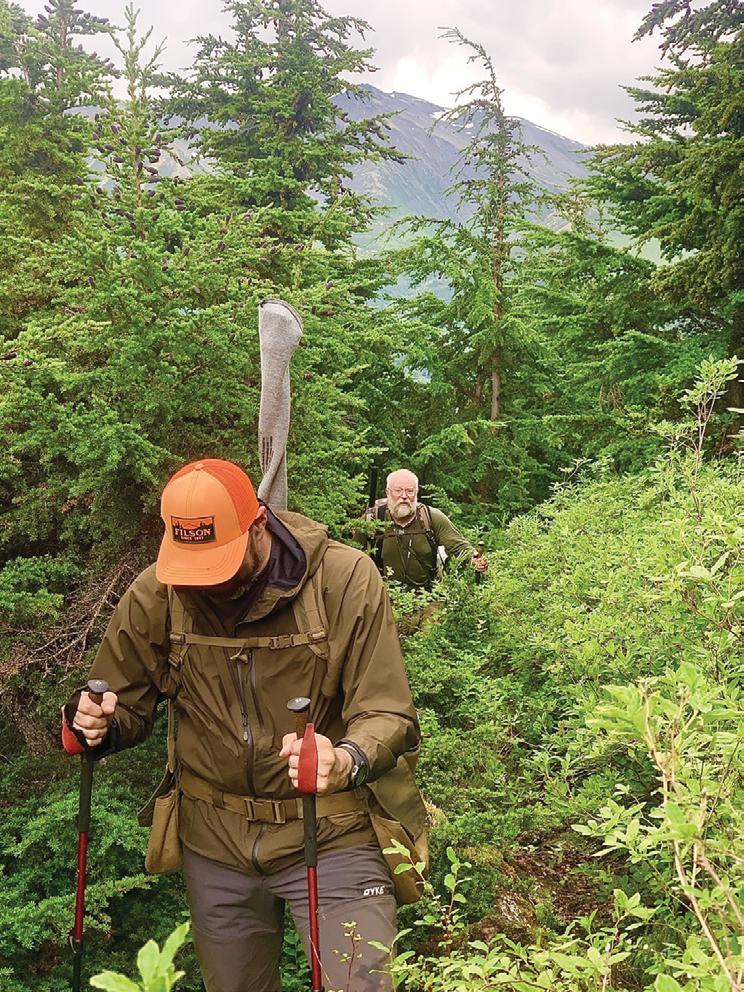
The aerial perspective from the little plane provided me with but a glimpse of what I would experience as I hiked for hours in a wet mist into the backcountry to reach where ptarmigan call home, and the soft, saturated bogs where spruce grouse are perched on branches, unnoticed. Alaska can be cold, wet, and outright dangerous without the proper gear.
There are four core waterproof items that wingshooters should invest in: boots, gaiters, a rain jacket, and rain pants. Well-broken-in footwear is important, as the potential to walk up to eight hours in the backcountry is realistic. Rain, sleet, and snow can show themselves at any moment. Stream crossings of various sizes are bound to happen. Therefore, knee-high waterproof (Gore-Tex) gaiters should be worn in conjunction with boots. The more one can keep dry and comfortable, the greater the chance of having a more enjoyable hunt. Wearing a proven waterproof jacket and pants will make the trip better.
In Alaska, layering is key. Wing hunters should wear base, mid, and outer layers composed of breathable, moisture-wicking, and insulating materials that can manage sweat and regulate body temperature in fluctuating conditions. Merino wool and synthetics are excellent choices. Here are some of the most important pieces I carry:
• Wool Socks (extra pair)
• Extra Base or Mid Layer
• Puffy/Down Jacket (packable)
• Neck Gaiter
• Gloves (two pairs, leather & wool)
• Knit Cap
• Hat
• Extra Boot Laces
hardships.
The willow ptarmigan has the widest range of any upland bird in Alaska. They favor willow-lined waterways that mean potential stream crossings (gaiters & trekking poles), shrubby mountain slopes and valleys, subalpine areas which are sparsely timbered or treeless, or the tundra. These birds choose wetter places (rain gear), so hunters must dress accordingly. Birds can fly short distances before landing again, offering multiple shooting opportunities.
Rock ptarmigan are often found in higher, rockier elevations in hilly or mountainous tundra throughout Alaska. Preferring steep slopes and high valleys where shin-high shrubs form patches of vegetation. Getting there will require the use of trekking poles and careful footing.
The white-tailed ptarmigan is the bird that Dall sheep hunters encounter and flush off high mountain peaks. They are true birds of the Alps, where they live above the timberline. The terrain is rugged, full of boulder and snow fields, glaciers, cliffs, and rockslides. Trekking poles are necessary. Be
are prevalent. Waterproof boots, gaiters, and mud boots are necessary. Sprucies can be found along roadsides, trails, and logging roads.
Ruffed grouse are found throughout most of the interior and southeastern parts of the state. Ruffs are most abundant where dense stands of young aspen or birch have become established after a fire or timber harvest. Hunters can find them frequently along the edges of forests and shrubs, where wild rose, cranberry, and blueberry are available. Old logging roads and trails are good places to focus on. Habitat can be thick.
Sharp-tailed grouse inhabit open, brushy, or grassy areas. The interior valleys and foothills harbor practically all of Alaska’s sharptails. The birds occupy a vast area of primarily forest habitat and often perch in spruce trees or loaf in dense brush. In the subarctic and northern prairie regions, sharptails prefer recent burn areas, open-grass-shrub habitat, agricultural lands, shrub-spruce at timberline, and wet, sedgy, almost treeless areas known as muskegs. Hunters can find them scattered along high, fairly open ridges.
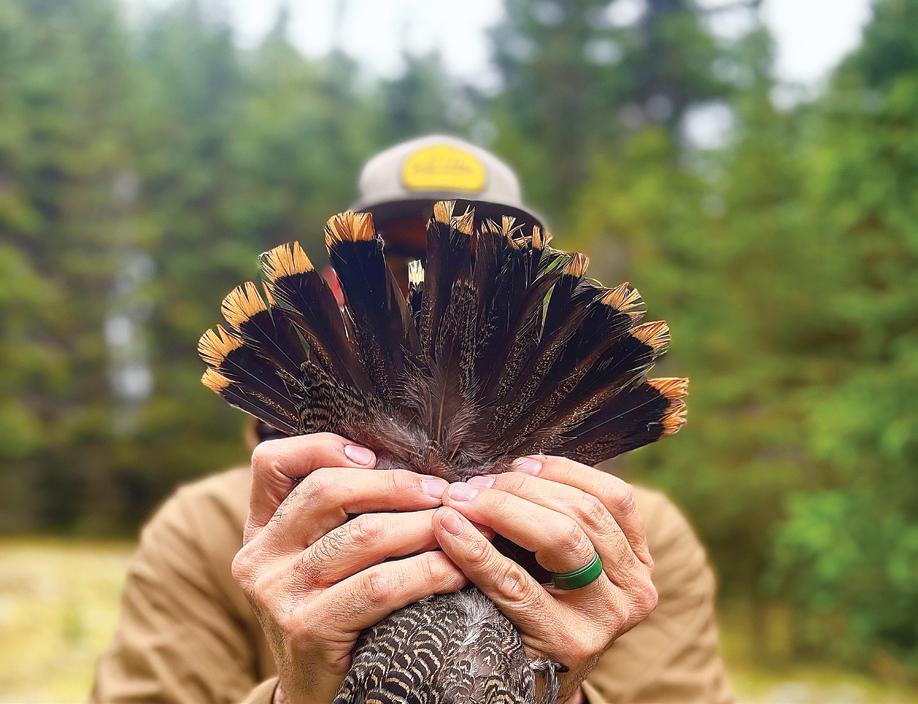
Sooty grouse are found in coastal forests and on practically every island and cape. The environment is wet. Terrain and habitat can be formidable for hiking. The spring (mid-April to mid-May) “hoot” hunt allows hunting during the “hooting” or mating season. Perched birds are located high in conifers, making a deep, booming, ventriloquial call. This unconventional, challenging, and high-altitude hunt is different than the fall’s groundbased hunting.
The aforementioned information offers but a brief description of compiled and suggested gear items that I have packed and carried during multiple Alaskan bird hunts. The important thing to remember when planning a wing hunting excursion is that many aspects are greatly different than hunting the lower 48: grizzly and black bears, wolves, moose, extreme weather, and terrain, to mention a few. Having quality, specialized gear is critical where harsh, unpredictable weather and remote, rugged terrain can create life-threatening conditions while chasing wild birds in wild places.
Wing hunters should check Alaskan regulations for season dates and limits, as regions may differ for species. As for your license, a Nonresident Annual Hunting–Small Game Only option is available for $60. WH
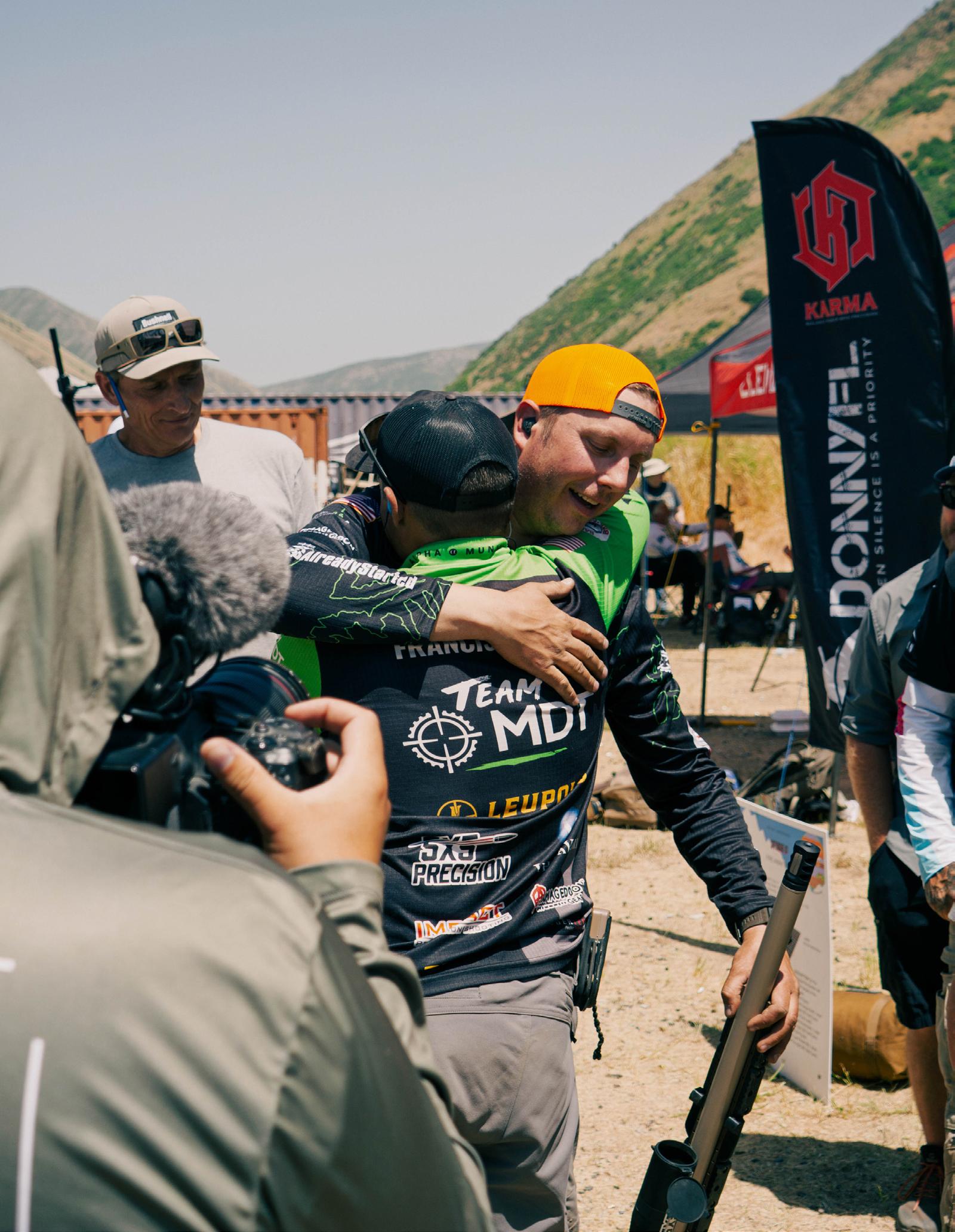
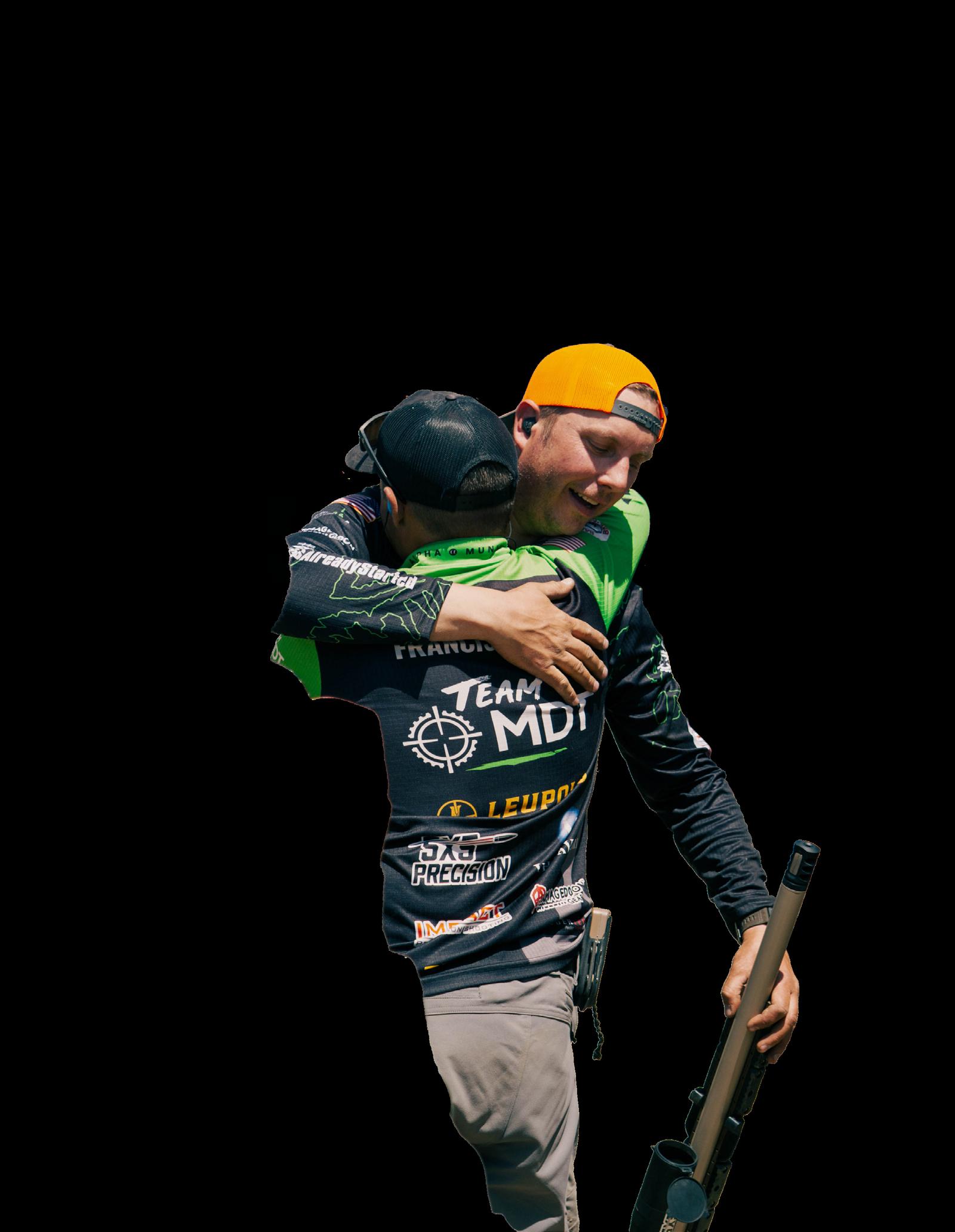
BY HEATH SEINER
Bird hunters tend to identify as lone rangers, wearing their ability to march across the prairie in solitude as a badge of honor. Admiring the sunrise with a steaming cup of coffee, then getting lost in wideopen spaces while the breeze whispers through warm-season grasses, has a certain appeal. Big decisions revolve around which dog to cut loose, which direction we’ll head, and what might be cooked up at camp after sundown. Days like these have their own calming rhythm.
But the longer I spend chasing birds across the land they call home, the more I’m convinced it’s an experience meant to be shared. I’ve grown to prefer windshield time with a good buddy, laughter over stillness, stories shared over camp meals, and the memories that can only be made with a solid crew in wild country.
After years of grinding through muddy sloughs and thick CRP grasses to track down ringnecks and busting old fence rows for coveys of quail, I needed a new challenge. As our annual trip to the plains of South Dakota wound down and discussions shifted toward next season, the West was tugging. I’d been saying, “One of these days I’m going on a sage grouse hunt,” for long enough. Those words began to feel like an excuse. It was time to make it happen.
Good ideas need company. I began calling upland hunters I anticipated would be up for a good road trip, a hard hunt, and a new challenge. Commitments for bird camp began to fall into place. Most of the responses came back the same way: “Hell yeah, I’m in.” The catch was that most of them were guys I’d never actually hunted with before. That added a bit of uncertainty, and with it a bit of responsibility. If I were pitching the crazy idea, I needed to find a location worth the drive somewhere within those millions of acres of Wyoming sagebrush.
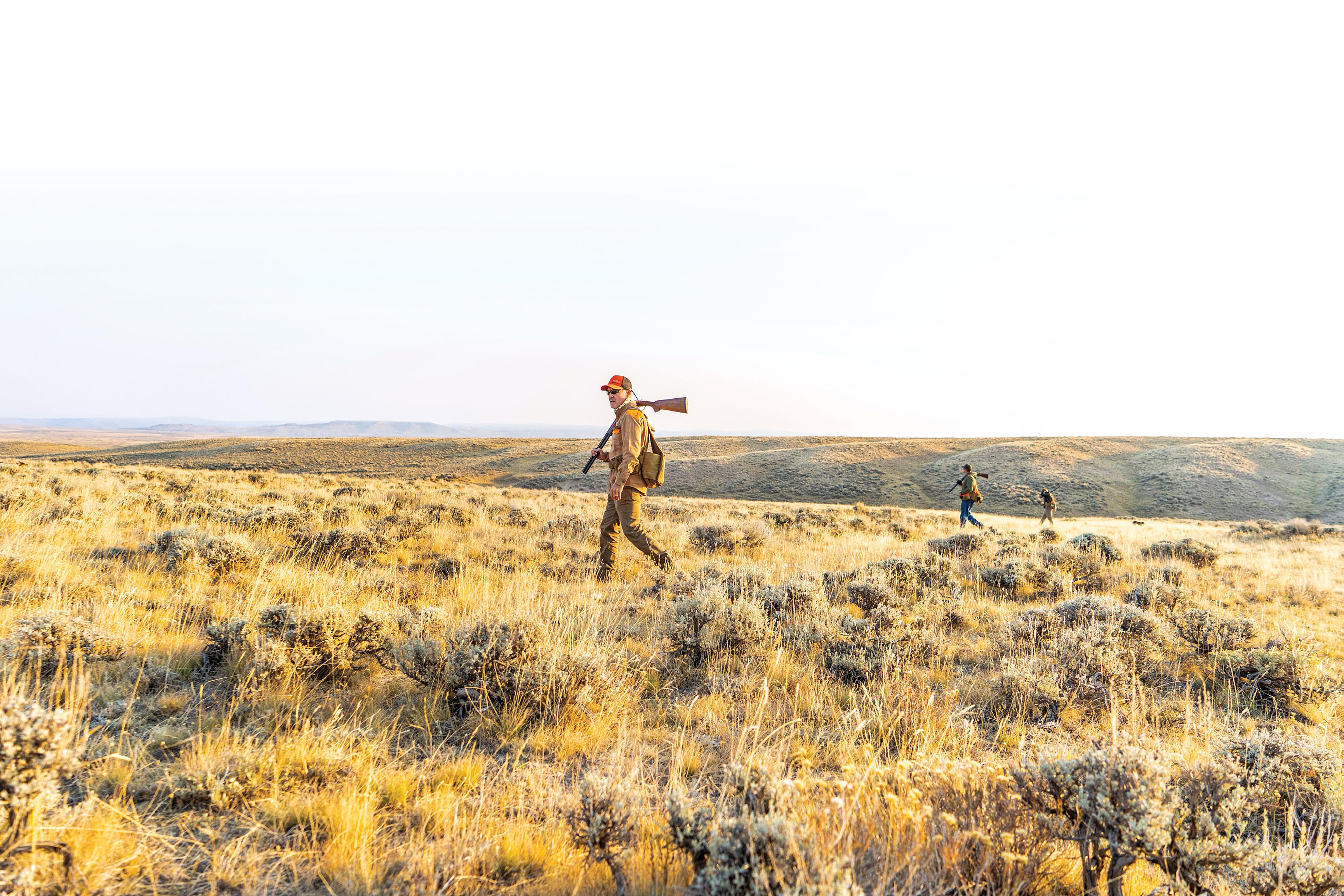
For the first time in a long while, I’d be kicking off the season with a blank slate and steep learning curve. A good friend recommended that I connect with a local Missouri conservation biologist who might have some insight into sage grouse. I’ll admit, I was skeptical. A Missouri biologist didn’t seem like an obvious roadmap for success in the Wyoming sage flats, but that conversation proved invaluable. He walked me through migration patterns, water needs, and the subtle habitat differences that matter more than a man might think when he’s staring across an ocean of sagebrush. He offered tips on camp locations, what to pack, how to prepare the dogs, and the reminder that the hunt is never only about birds.
When September rolled around, my brother Nick and good buddy Isaac Neale jumped in before daybreak, and we pointed the nose west with an optimism only long-planned trips can create. Our goal was simple: arrive in camp with enough daylight to pop tents, cook a meal, and get some rest before morning.
Burnt orange faded to darkness on the horizon, and asphalt gave way to gravel with sagebrush flanking each side. Flashes of pronghorn crossed like ghosts in our headlights. After rattling over one cattle guard crossing after another, the gravel vanished, and our truck rolled to a stop in front of a barbed-wire gate hanging from a weathered post. We studied the map, looked at each other, and determined that the only logical path was ahead. Freezing rain began bouncing off the windshield as the two-track twisted through some rough country until it dumped us at the base of a steep climb. I locked the truck in four-wheel drive, and we made a run for it.
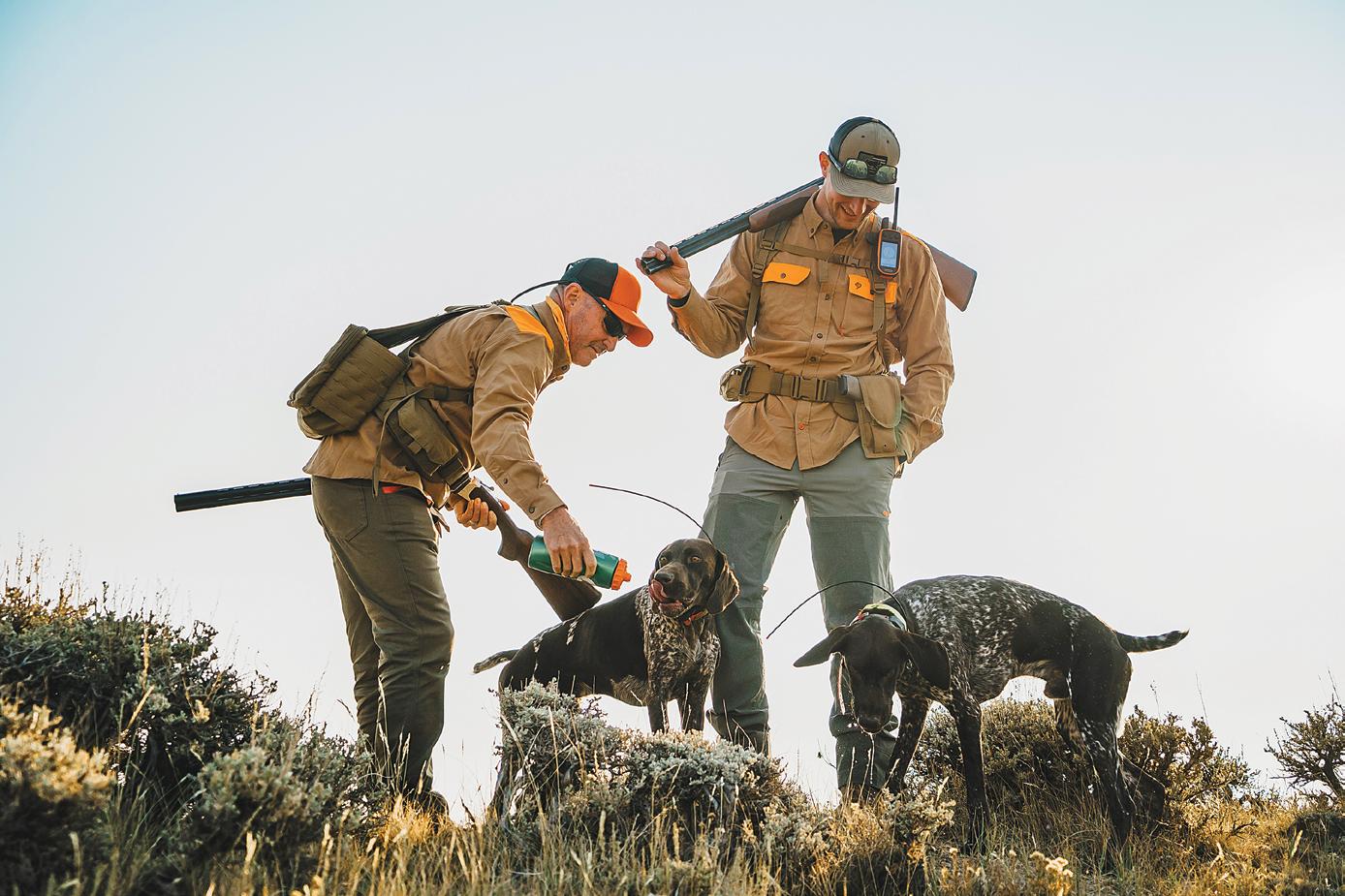
When we finally crested the ridge, the tires gripped gravel. The beams of our headlights caught what appeared to be trucks parked just off the shoulder. We had driven a miserable loop through the dark that landed us back on the gravel road we’d turned off of hours earlier. By the time we arrived in camp, we were late, cold, and a bit humbled. As good buddies do, the group gave us a little grief before jumping in to help pitch the tent and unload supplies. Dogs were fed, sleeping bags were unrolled, and we were zipped into whatever warmth we could muster. It was a rough arrival, but it felt good to finally be in camp.
The warmth of the rising sun brought a new day and melted away the stress of the night before. Shadows gave way to sagebrush that stretched to the horizon in all directions. Tents began to rustle. Jetboils hissed, and the
aroma of coffee began to drift through camp. Bird dogs whined as shotguns were drawn from cases, shells dropped in vest pouches, and e-collars rattled on tailgates.
A quick discussion around tailgates led us north into a gentle cross breeze. Emerging over the first gentle rise, my young Drahthaar, Tig, began working cover with purpose. He sliced through the low-lying brush, drawing in scent with each cautious step. He froze with conviction.
That sight has a way of compressing everything into a single moment. The miles, the planning, the uncertainty, the drive, the weather, the unfamiliar country–none of it mattered now except closing the distance. I eased the safety forward on my over-under and stepped toward him, waiting for my first sage grouse to rise against that wide Wyoming sky.
A lone bird flushed. The gun mounted cleanly. Feathers drifted over the sage. Tig emerged through the dense cover and sat at heel, gently holding my first sage grouse. I gave the command, “Give,” and Tig placed the bird in my hand.
Pausing in that moment, I was struck by how remarkable sage grouse are up close. Feathered down the legs, muted in gray, brown, black, and white, hefty in the hand, and finished with pointed tail feathers, the bird looked perfectly made for that country. Holding that bird in my hands, the scent of sage drifting on the breeze, and Tig steady by my side, I felt gratitude every hunter should know.
Our first morning started strong, but like any honest hunt, it delivered its share of highs and lows. Temperatures climbed quickly under the September sun, and dogs that exploded out of camp at daylight began to labor in the heat. Cover that looked perfect often turned up empty. We canvassed valleys, crossed rolling ridges, followed bird sign, and learned in real time just how much country a man can cover before finding out whether he guessed right. Evenings pulled us back together. We’d return to camp dusty and tired, light the grills, wash down burgers and brats with cold drinks under a sky full of stars, and relive the day one story at a time. Beneath a Milky Way that looked close enough to touch, it was easy to forget the noise waiting back
home. Out there, with dogs bedded down and friends laughing in camp chairs, life felt stripped down to the parts that truly mattered.
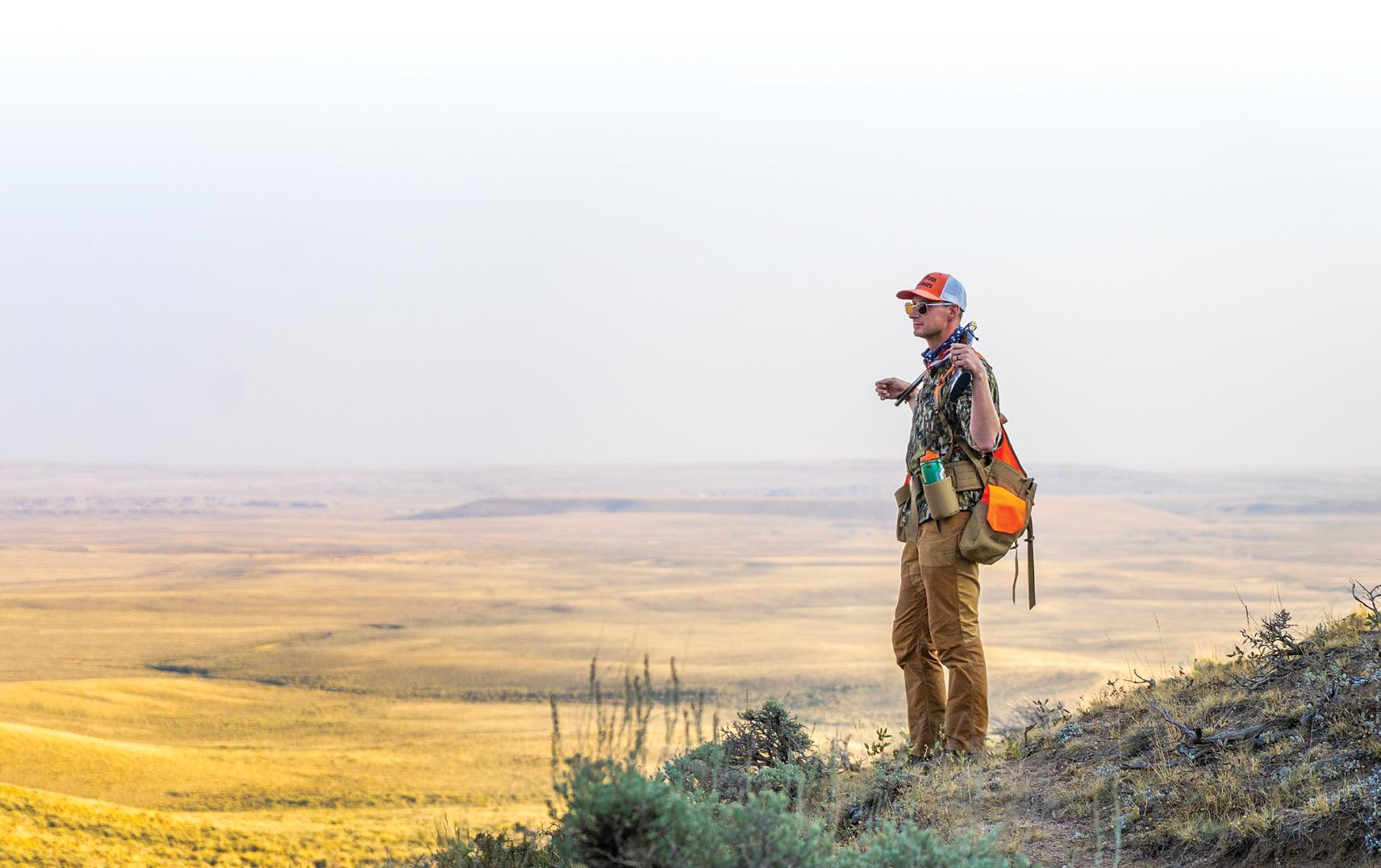
As the week wore on, we found more birds and learned more with every mile. Dogs that had grown up on pheasants adapted to a new kind of country and a new kind of bird. By the time camp finally came down, the trip had given us much more than first sage grouse.
I left Wyoming with a deeper respect for the West, for wild birds that belong to hard country, and for the kind of friendships that can be forged well outside of comfort zones. What began as one more thing I’d always said I wanted to do became something much more lasting. That first trip turned into an annual hunt. New states, new birds, new campfires, but the same kind of people. WH
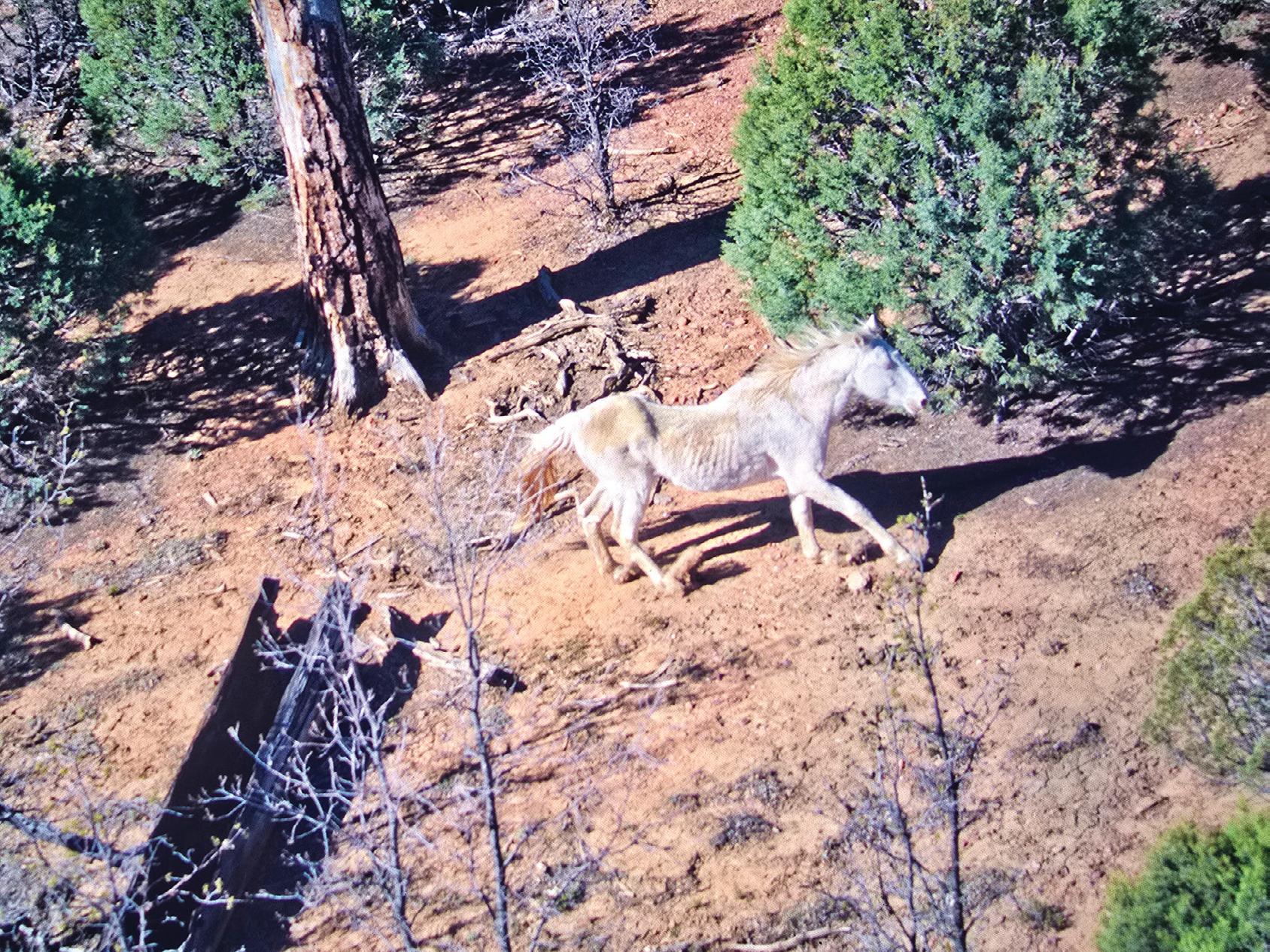
BY JOHN KOLESZAR
At the end of March of this year, the Federal contractor who gathers cattle and horses offered to fly game management unit 3C in Arizona to get a handle on how many horses were now present. Conservation First USA, a 501(c)3, funded the flight and requested a count of elk and horses. The Federal Government had no budget money to fly the area since 2017, and sportsmen were clamoring that the horse numbers were exploding. The result of the survey was as expected. The helicopter flight took over five hours and covered over 400 miles.
While the number of 1,800 horses was appalling, the worst of the news was the bird’s-eye view of the habitat. The photos tell a sad story of overgrazing. With little water and the drought that we have endured in Arizona the past few years, the prognosis is poor for any regeneration. Worse still, the number of elk counted during the flight was 22. What had once been a premier unit for elk hunting has been degraded to literally nothing. Keep in mind that the “Wild Horse Territory” is listed at 19,000 acres. Currently, horses have been seen over an expanse of over 385,000 acres.
Anthropomorphism is defined as the attribution of human characteristics to wild animals. The most blatant example of that is right here in Arizona. The Salt River Wild Horse Management Group has given names to each horse they have identified over the past 10 years. The question most folks would ask is “Why?” The answer is more nuanced than a single word or catch phrase response. With the application of a name, we as humans inevitably lean towards identifying and encompassing that specific animal as “one of us.”
For the horse advocate world, names bring a psychological identity that makes it harder to manage an animal. We could easily dispatch a chicken from a coop for dinner, but if we have named it, we have built a wall of resistance towards dinner and, therefore, death. This leads to questions that no one seems willing to answer. Why do we as a society euthanize over 250,000 of “man’s best friend” each year? Why do we euthanize over 350,000 feral cats each year? The answer is something that rural folks understand a whole lot more than urban dwellers. There are limitations to what we can fit in the proverbial “five-pound can” of habitat.
I have owned horses, boarded them, ridden them, and been around them a lot. I get the admiration that so many have; the nostalgic images of the “Wild West.” The harsh reality of nature, however, is that no single species can ever be allowed to expand with no management. All other species in the United States are managed. Hunting guidelines by the professionals in Game and Fish Departments limit take and methods of take, all with an eye toward the future, so that following generations can enjoy what we do. Cattle ranchers rotate cattle from one pasture to another, monitor their water supplies, and then take them to market. The Forest Service has strict guidelines on how many animals can use the land, how and when to move them, and when to pull them off the land. With horses, there is no management.
In the past 25 years, horse advocates have successfully managed to add riders to budget bills that not only protect horses, but also have wiped out any ability to euthanize a horse or have it become part of a food chain, and now are seeking to prohibit any horse from being exported to another country. The SAFE Act (Save America’s Forgotten Equines), which has not become law but has been introduced a few times, would ban the export of horses to countries that still view horses as livestock and not a deity. The following is a strange example of how convoluted our system has become.
We in the United States enjoy taking our children to zoos to view animals that we normally do not get to see. The big cats in these zoos have to eat what they normally would in their native environment. That would be zebras. We, of course, do not have any Zebras in the United States, so we turn to Canada, which still has a horse meat industry. Horses that have been shipped to Canada (from the United States) are then inspected, run through their system, packaged, and then imported back to the United States as feed for these big cats.
Sadly, because of pressure from the American Wild Horse Conservation and many East Coast politicians, the Canada/United States pipeline of feral horses is now almost non-existent. For a while, though, we were exporting horses to Canada, only to then import them back. If we were to have a decent government-run facility that could handle horses as a food source, we could change the narrative of how to feed zoo animals. While it only represents about 10% of Canada’s exports, the insanity of shipping horses to another country just to bring them back as a food source is obvious.
Many other countries still enjoy horse meat as a food source, and the horse advocates are trying to tell the world what they can or cannot eat, and also not offering solutions to the overpopulation of horses across the United States. I had several conversations with Art Lawson, who is the Director of the Shoshone & Arapaho Fish & Game Department. Their tribal lands had a serious problem with feral horses, and they’ve taken matters into their own hands.
They rounded up over 9,000 feral horses and were told they could not ship to Canada, but instead trucked all 9,000 to Mexico, where they were sold to the Mexican producers. Because of the horse advocates’ pressure on Canada, those poor animals had to endure an additional 2,000 miles of travel. The interesting result from this round-up was that the Tribal lands are recovering.
Lawson indicated that elk, antelope, and deer were coming back in great
but now they are seeing the results. The growth was slow, but in the end, wildlife is coming back–and the habitat can support them.
The marginal good news is that the Sitgreaves National Forest has issued an impound notice for all livestock in the Heber area. What that means to the uninitiated is that ALL of the 1,800 horses can and should be removed. The sad fact is that any attempts to gather these feral horses are met with a lot of resistance. The retiree communities around this area love to take their side-by-side OHVs out in the late morning and take pictures of their beloved (and named) feral horses.
A few years ago, I helped with organizing removals of horses from the Apache National Forest. Conservation organizations (including the Rocky Mountain Elk Foundation) contributed over $120,000 for removal. Horse advocates threw massive tantrums at the removals, opened passive bait traps that had horses already captured, chased horses away from the traps, and even stole the panels that a contractor had set up for horse captures.
The fight for preserving native wildlife in Arizona is only beginning. It requires that sportsmen and women understand the difficult decisions that must be made to preserve wildlife for future generations. Bold decisions by the acting Forest Supervisor, Josh Miller, have opened a window for getting rid of the horses that came over from the Rodeo Chedeski fire, now 25 years ago. I don’t blame the horses. They are only doing what horses and every other animal do, making a living on our public lands.
Less than two weeks ago, while I was shed hunting, I came across a horse that was caught up in barbed wire. It was jumping, trying to get out, and each jump only tangled it more. I filmed my buddy gently moving the wire, and one leg at a time, we got the horse freed from the wire. No animal deserves to die in barbed wire.
What, then, is the problem? The advocates... They are the problem. They have no concept of habitat, carrying capacity, range monitoring, pasture rotation, or maintaining stock tanks. Their anthropomorphism is ruining
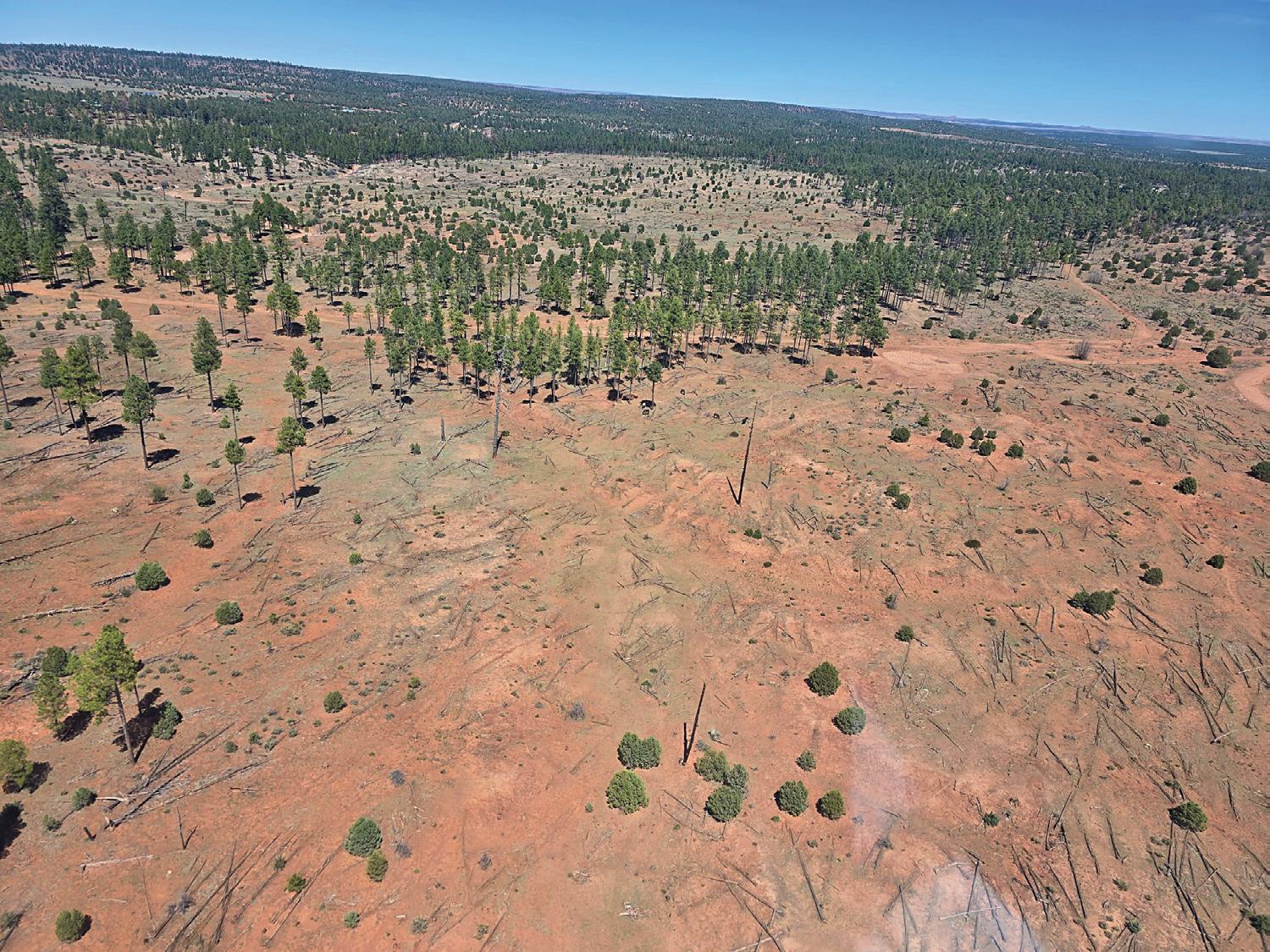
BY CHRIS DENHAM
For 23 years, the subtitle of Western Hunter Magazine was “Gear, Tactics, Information, Adventure.” I always said the “Gear” came first for a reason. Floyd Green founded Western Hunter to provide information about the new wave of top-quality optics, tripods, and their advantages.
Since our inception, we’ve seen a dramatic increase in technology available to hunters.
When Leica introduced the Geovid in the late ‘90s, it was almost a novelty at $3000, but I remember Randy Ulmer telling me that the world of bowhunting was about to change. Now we have economical rangefinders that are 90% smaller, with full ballistic profiles, built-in weather stations, navigation, and cost a fraction of that. Executing a 90-yard shot, with a 30-degree downward angle, at a Total Archery Challenge event, is doable. Banging a steel target at 748 yards, with a 15 mph crosswind, across a canyon, is almost expected at an NRL Hunter event.
I grew up hunting in the desert of SE Arizona. I could see every hill, ridgeline, and peak for 30-50 miles. It was hard to get lost at night, let alone in the daylight. Then, I went on an elk hunt with a friend in the ponderosa forest on the Mogollon Rim. The first morning was completely overcast with near constant rain. I could not have found my way back to camp by the time we made it a half mile!
I had learned to navigate by landscape features and had no “feel” for where I was. When Magellan introduced the first commercial GPS unit, I felt like a prisoner released from a life sentence. Then, along came OnX. Now we can navigate private land issues, research glassing points, camping spots, water sources, etc, before we even lay eyes on a hunt unit.
3. Sitka Gear/KUIU
My friend Anthony Dixon was always ahead of his time. He started a podcast when the iPod was the only way to listen. He started the first extreme 3-D shoot years before TAC existed. Anyways, he called me one day and made the case for starting a clothing company for hunters with features borrowed from the mountaineering brands. We barely had time for the thought experiment before I saw the first advertisement for Sitka clothing. I thought we were a day late and were definitely a few dollars short when Jason Hairston split from Sitka and fired up KUIU. Technical clothing made it possible to not just survive but thrive on a multiple-day backcountry hunt in crappy weather. The ability to stay warm and dry opened up miles and miles of new country.
These are my top three examples, but think about how these things have changed how we hunt:
Backpacking gear: Tents, sleeping bags, freeze-dried meals, butane stoves, and water purifiers all make life way more comfortable.
Trail cameras: Now you don’t even have to be there to know what happened, especially with cellular cameras.
Long-range shooting systems: We now have factory rifles and ammunition, which, when combined with a rangefinder and a ballistic turret scope, can hit targets beyond the terminal performance of the cartridge.
Satellite communication: With Garmin inReach and Starlink, are we ever really “off-the-grid?” We can be in constant communication, get weather updates, and call in a rescue with the press of a button.
Information explosion: Every one of us owns a computer on which we can access draw data, watch how-to videos, research hunt areas, listen to podcasts, and so on. We no longer have a learning curve; it is a straight line if you want it to be.
It is easy to look at all this tech and say, “It is ruining hunting!” But that is a pretty lazy take on the subject. There are many ways these innovations have improved hunting and benefited hunters on a macro scale. This is my opinion, but I was hunting long before any of these products hit the market. I lived it.
First, I do believe tech like rangefinders has reduced wounding loss. The old “just hold at the top of his back” reticle led to lots of blown off legs. I understand that many think they can shoot long distances (bow or rifle), which leads to wounded animals, but the net result is less now.
Secondly, it lowers the barrier of entry and keeps hunters engaged longer. It used to take years of trial and error, or having some very strong mentors, to be successful in the West. Tech has dramatically sped up this process. As hunting season ends, the application season starts with online research and debates in the forums over the best strategy.
At this point, some of you may have just thrown this magazine at the wall. “We have enough hunters!” you scream. We don’t need more competition for fewer tags. With this, I agree, but I also acknowledge that this growth of popularity has a huge upside. The rise of conservation organizations like the Wild Sheep Foundation, SCI, RMEF, SFW, and all of their local affiliates is immensely responsible for the protection of our hunting rights and conservation of both land and game animals. I dare say the anti-hunters could have already won if it weren’t for hunting organizations supported by tens of thousands of hunters willing to do their part with time and finances.
Lastly (even though I am sure I missed some things), technology has made hunting safer and supported better decision-making. Picking safer routes, knowing when dangerous weather approaches, and the ability to navigate even in the dark are all supported by technology. Sure, you could learn this by trial and error, but an error could cost you your life.
The Arizona Game & Fish Department has been keeping hunter success statistics for many decades. Since 1990, hunter success for deer and elk, bow and rifle, has increased 15-20%, but the number of hunter days in the field has increased more than 25%. Back in the day, the standard vacation policy was two weeks. If we took a full week off for a single hunt, we’d better save
one week for the family. Nowadays, that isn’t the case; the serious hunter will hunt the entire season if necessary. So, is it better gear or time spent that’s responsible for this slight increase? Maybe a little bit of both, but it is still just a little bit.
I have grown to despise that overused phrase, but I think it is appropriate for the next evolution of hunting technology: Thermal optics.
A thermal optic detects heat instead of light, like traditional optics, allowing the observer to detect animals even in total darkness. They literally glow in the dark. Thermal scopes and handheld devices are invaluable tools for controlling predators and wild hogs in places where they are legal to use. Their use for big game hunting is illegal in most places, but not all, and the language governing their use is vague almost everywhere. Until recently, their use has been limited by economics; a decent unit cost upwards of $5000 just a few years ago. Today, there are better units than those on sale for $1500-$2500 and dropping fast.
As I mentioned, the use of thermal for big game hunting is illegal in most states, and game departments are moving fast to close the loopholes. The problem is that as prices come down and quality goes up, you might be crazy if you don’t own one! Let me explain.
Vortex recently introduced the Veil 400, a handheld thermal that is fullfeatured and costs about $1500. They sent me one to test, but given that they are illegal for hunting in Arizona, my “testing” was confined to my city limits. Fountain Hills is a “dark sky city,” meaning we have no streetlights, and even school lighting is limited. Plus, we are surrounded by desert and have arroyos and washes that let javelina, coyotes, and bobcats move around all night long. I was absolutely amazed at what I was able to see on a moonless, pitch-black night.
As I was driving around, it occurred to me that any law enforcement or game officer would be nuts not to always have one of these units. You don’t need a flashlight when the bad guys glow in the dark! Then, I got to thinking about camp security and grizzly bear protection. How much safer would we be hiking back to camp after dark if we could see a grizzly before he sees us? How much livestock damage could be reduced if ranchers could see wolves at night... and shoot them? I could go on and on citing positive uses of thermal optics.
But here is my biggest concern: the temptation to use them for hunting is unreal. I have javelina that I can legally hunt knocking over my garbage can, but I cannot find where they are hiding when the sun comes up. The temptation to sneak out there a few hours before daylight, find them, and follow them is substantial. I have never been this tempted to break a game law, lose my hunting privileges, have my name tarnished forever, and flush everything I have worked for down the toilet! I have a hard time believing that, as the prices come down and the quality goes up, there won’t be a significant number of people who will give in to the temptation.
That temptation exists because using thermal would absolutely make me more effective at killing game animals. In my humble opinion, that advantage would be greater than all the other tech I have mentioned, combined. We are predators. While there are many reasons we go afield, the goal is to kill an animal. It is much less expensive to just go hiking, saving thousands of dollars a year, with which we could buy meat. We do everything we can to stack the odds in our favor, but using thermal crosses that line creates some dangerous outcomes.
In general, game populations are not growing. Sure, we have more than we did 100 years ago, but mule deer numbers are declining, and the loss of habitat threatens every species. If hunter success increases, the number of tags offered will have to decrease. This will impact game department revenue, so tag prices will increase, making it even more expensive to draw fewer tags.
The social implications are almost more damaging. Imagine you get back to camp, and instead of making a good dinner and enjoying time around the campfire, you feel compelled to jump in your truck and drive around all night looking for elk. I am a predator, but I am also human, and I really enjoy those aspects of hunting, and I know I make really poor decisions when I am sleep deprived.
For decades, technology has improved how we hunt without fundamentally changing why we hunt. Thermal optics may be the first innovation that truly challenges that balance. I don’t pretend to have the answers, but I do believe ignoring the question would be a mistake. As hunters, we’ve always been responsible for shaping our own future, and this feels like one of those moments where we need to stop, take a hard look, and start talking about where the line should be. WH
BY KYLE WRIGHT
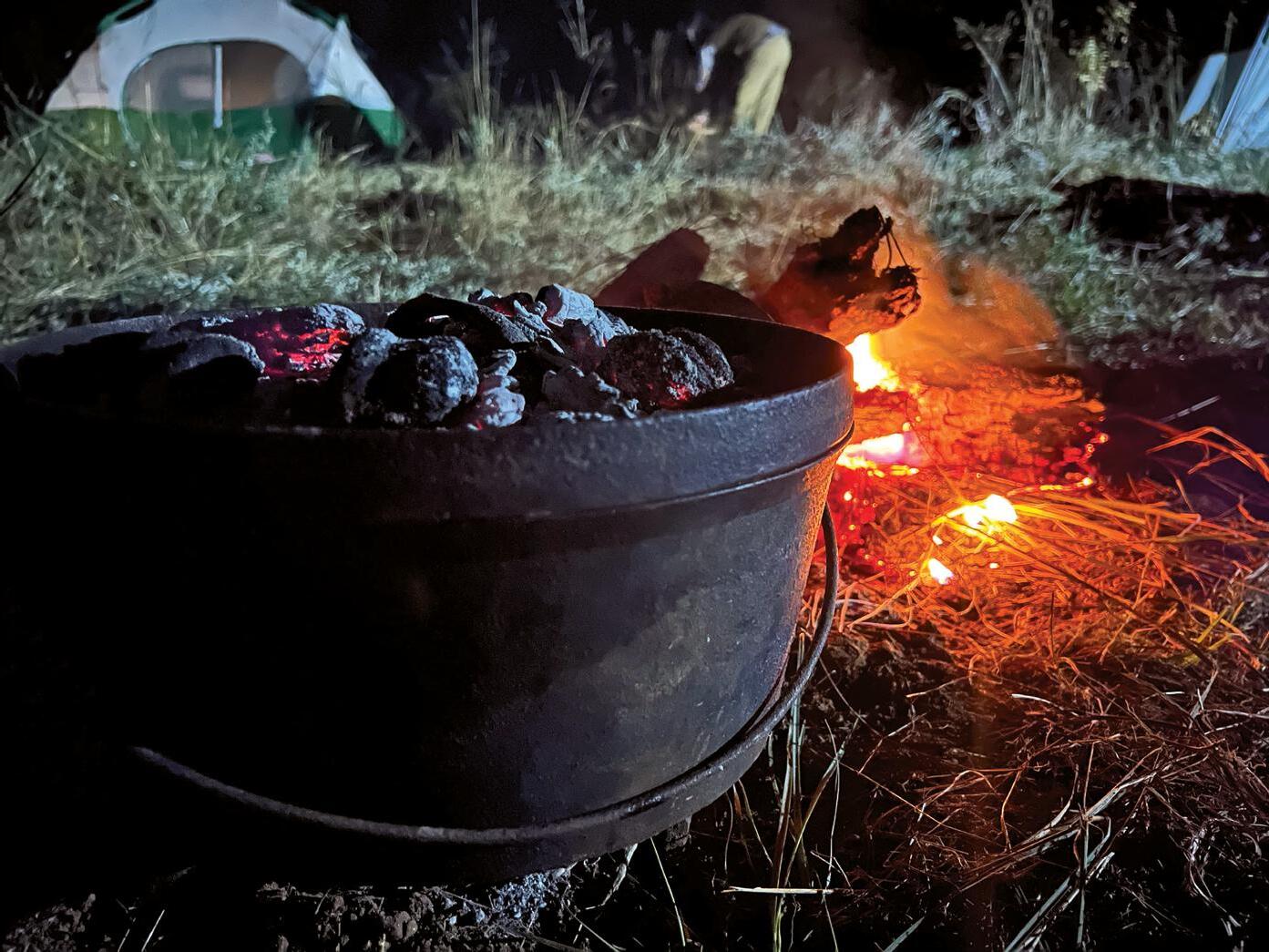
It’s an unfortunate fact of life that the older we get, the fewer friends we make. So, when my dad had the opportunity to befriend what had previously been just a casual, coffee shop acquaintance, a guy named Rick, he took it. And when Rick mentioned one Saturday morning over his biscuits and gravy that he could use some help getting to and from a doctor’s appointment later that week, Dad offered to drive him, refusing Rick’s every offer of compensation. Thus, a friendship was born.
Rick had worked his fingers to the bone as an outfitter in the Colorado Rockies, guiding his clients to bugling bulls and branch-antlered bucks, until he packed out of those mountains for the last time and retired to the gentler slopes of south central Oklahoma, where he met my dad. The code that Rick lived by, the Code of the West, didn’t allow for charity cases, and since Dad refused to take his money, Rick resorted to giving him gifts.
There’s a reloading press in my shop that came from Rick, along with a handful of dies and assorted brass. It’s in my shop because Dad already had a reloading press of his own. That press sits next to a century-old cast-iron Dutch oven, itself a gift from Rick. He gave it to Dad after a long drive to see a doctor in the city, but because my dad has always preferred to let my mom do the cooking, it wasn’t long before the dutch oven found its way to my house. I’d never cooked much with cast iron, myself. After eating a peach cobbler one weekend that a friend made in his own Dutch oven, though, I was determined to figure it out.
“I’ve
Seasoning cast iron means applying oil and heat in equal and copious amounts. Doing so not only creates a smooth cooking surface but it also staves off rust. As a bonus, seasoning cast iron also bakes on layers of oil and fat that enhance a dish’s seasoning. Your Dutch oven doesn’t know the difference between seasoning and cooking, though, so anytime you fry a slab of bacon or put a crust on a peach cobbler, you’re effectively pre-seasoning your next meal because every cook adds flavor to the next, developing a taste that’s distinctive to your dish. That means that, theoretically speaking, the ribeye you finally perfected this year at deer camp could never have been possible had you not burned all the steaks before it.
got hot coals on the cast iron tonight, and I’m wondering whether or not life, and especially a life spent in the woods and on the water, works the same way. Do our failures in the outdoors actually season our future successes?”
It turns out that YouTube can teach a man just about any lesson he needs to learn. Anything from making a peach cobbler in a Dutch oven to swapping out the transmission on a square body Suburban. It only took me watching a couple of tutorials before I understood how important it is to care for cast iron. My Dutch oven was going to have to be kept clean, obviously, but it was also going to have to be seasoned.
I’ve got hot coals on the cast iron tonight, and I’m wondering whether or not life, and especially a life spent in the woods and on the water, works the same way. Do our failures in the outdoors actually season our future successes? Would the hunters in Rick’s camp have had stories to tell whether they filled their tags or not? As they came down off the mountain and hit the road for home, the freezers in their truck beds every bit as empty as the day they’d departed, would they have been able to content themselves with the memory of how brightly the stars had burned or how the herd bull’s bugle had echoed across the canyon? And would a few years’ worth of those stockpiled memories and unpunched tags have made the eventual taking of a buck or a bull that much sweeter?
If that’s the case, and I’m coming to believe that it is, then maybe we shouldn’t be so quick to scrub our own lives clean of failure. It’s human nature, I know, to want to sanitize our existence, to regularly wipe our slates clean, but when we do, when we scrub away the failures of our lives, we can’t help but scrub away, too, some of the successes that those very failures helped to create. And in so doing, we wind up cheating ourselves out of those baked-in experiences that season our lives.
You can search all you want; not even YouTube can teach a man a lesson like that. WH
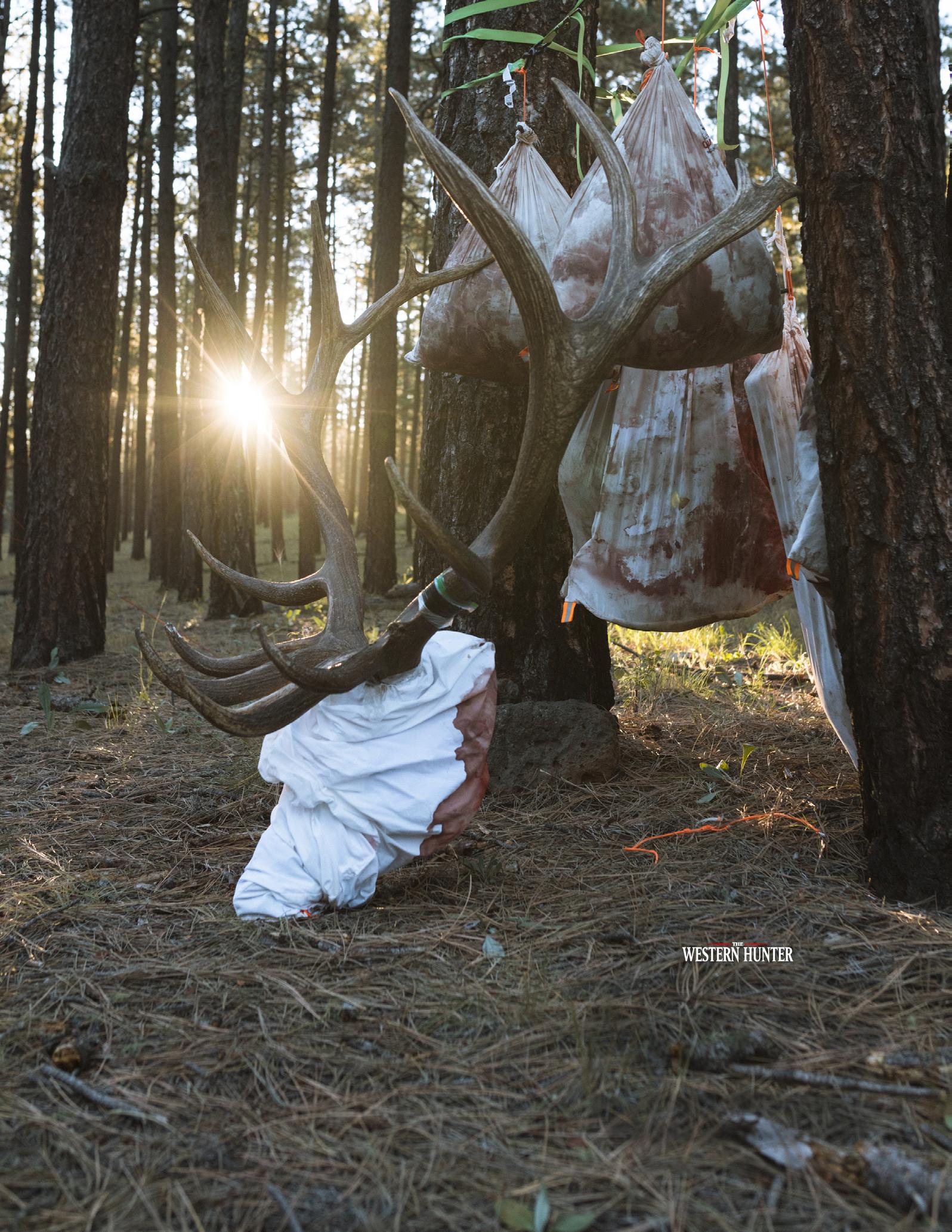


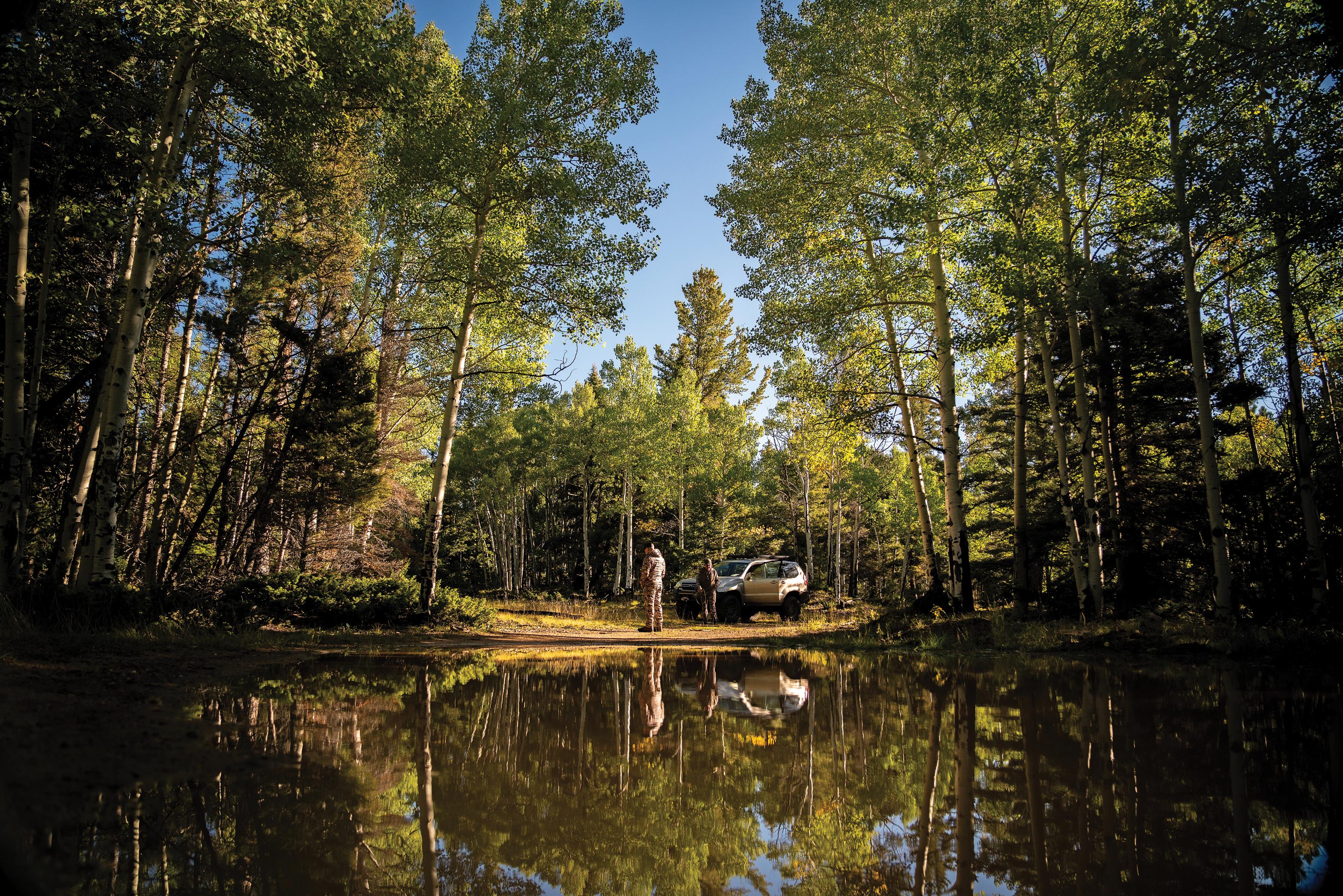
This was one of the most fun issues we’ve made so far. It was a long time coming. We got to do a lot of research (hopefully most of the info is true), take a lot of photos, and test a lot of gear out in the mountains. Thanks for allowing us to do that for a living! We hope you all drew tags, and we hope we get to read about your hunts when the dust settles.
Next up is Issue 5. Joe has been sweating through his shirt daily while making major decisions that will add up to what we hope is a huge one. Issue 5 is slated to land right at the onset of hunting season, so we decided to go big and make it all about hunting. It’s going to be a celebration of the act of finding, bagging, cooking, and eating wild animals. I imagine you’ll be cool with that idea.
Between now and page one of that issue, we highly recommend that you take any new gear you’ve purchased in preparation for this season and USE it. See if you can break it now so that it doesn’t break when you really need it. There is also a NEW season of The Western Hunter airing now on the Sportsman Channel. Don’t miss it! For everything else, check us out on YouTube for lots of episodes, tips, and gear reviews. If you prefer listening, try The Western Hunter Podcast on Spotify and Apple. WH