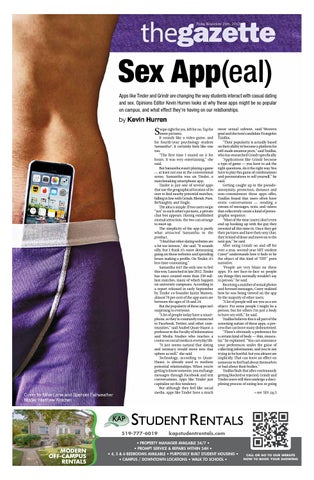
Sex App(eal) Apps like Tinder and Grindr are changing the way students interact with casual dating and sex. Opinions Editor Kevin Hurren looks at why these apps might be so popular on campus, and what effect they’re having on our relationships.
S
wipe right for yes, left for no. Tap for more pictures. It sounds like a video game, and for fourth-year psychology student Samantha*, it certainly feels like one too. “The first time I stayed on it for hours. It was very entertaining,” she said. But Samantha wasn’t playing a game — at least not one in the conventional sense. Samantha was on Tinder, a matchmaking smartphone app. Tinder is just one of several apps that use the geographical location of its user to find nearby potential matches, falling in line with Grindr, Blendr, Pure, BeNaughty, and Tingle. The idea is simple: If two users swipe “yes” to each other’s pictures, a private chat box appears. Having established mutual attraction, the two can arrange to meet up. The simplicity of the app is partly what attracted Samantha to the product. “I find that other dating websites are a bit too intense,” she said. “It sounds silly, but I think it’s more demeaning going on those websites and spending hours making a profile. On Tinder, it’s less time-consuming.” Samantha isn’t the only one to feel this way. Launched in late 2012, Tinder has since created more than 250 million matches, many of which happen on university campuses. According to a report released in early September by Tinder co-founder Justin Mateen, almost 70 per cent of the app users are between the ages of 18 and 24. But the popularity of these apps isn’t surprising to everyone. “A lot of people today have a smartphone, so they’re constantly connected to Facebook, Twitter, and other communities,” said Anabel Quan-Haase, a professor in the Faculty of Information and Media Studies who teaches a course on social media in everyday life. “It just seems natural that dating and intimacy would move into that sphere as well,” she said. Technology, according to QuanHaase, is already used to mediate potential relationships. When you’re getting to know someone, you exchange messages through Facebook and text conversations. Apps like Tinder just capitalize on this tendency. But although they feel like social media, apps like Tinder have a much
519-777-6019
MODERN OFF-CAMPUS RENTALS
more sexual subtext, said Western grad and doctoral candidate Evangelos Tziallas. “Their popularity is actually based on their ability to become a platform for self-made amateur porn,” said Tzaillas, who has researched Grindr specifically. “Applications like Grindr become a type of game — you have to ask the right questions, do it the right way. You have to play this game of combinations and permutations to sell yourself,” he said. Getting caught up in the pseudoanonymity, protection, distance and non-commitment these apps offer, Tzaillas found that users often have erotic conversations — sending a stream of messages, texts, and videos that collectively create a kind of pornographic sequence. “Most of the time [users] don’t even end up hooking up with the guy they invested all this time in. Once they get their pictures and have their sexy chat, they’re kind of done and move on to the next guy,” he said. After using Grindr on and off for over a year, second-year MIT student Corey* understands how it feels to be the object of this kind of “DIY” porn narrative. “People are very blunt on these apps. It’s not face-to-face so people say things they normally wouldn’t say in person,” he said. Receiving a number of sexual photos and forward messages, Corey realized how he was being viewed on the app by the majority of other users. “A lot of people will see you as a sex object. For some people I might be a person, but for others I’m just a body to have sex with,” he said. Tzaillas believes this is all part of the screening nature of these apps, a process that can leave many disheartened. “There’s obviously a preference for a certain kind of body — thin, muscular,” he explained. “You can announce your preferences under the guise of collecting information, and you’re not trying to be hurtful, but you almost are implicitly. That can leave an effect on someone to feel bad about themselves or bad about their bodies.” Tzaillas finds that after continuously getting blocked or rejected, Grindr and Tinder users will then undergo a disciplining process of eating less or going >> see SEX pg.3
kapstudentrentals.com
• PROPERTY MANAGER AVAILABLE 24/7 • • PROMPT SERVICE & REPAIRS WITHIN 24H • • 4, 5 & 6 BEDROOMS AVAILABLE • PURPOSELY BUILT STUDENT HOUSING • • CAMPUS / DOWNTOWN LOCATIONS • WALK TO SCHOOL •
CALL OR GO TO OUR WEBSITE NOW TO BOOK YOUR SHOWING