MARCH 20, 2025 VOLUME 118 ISSUE 9
since 1906
ANGWARA NILANONT GAZETTE
S
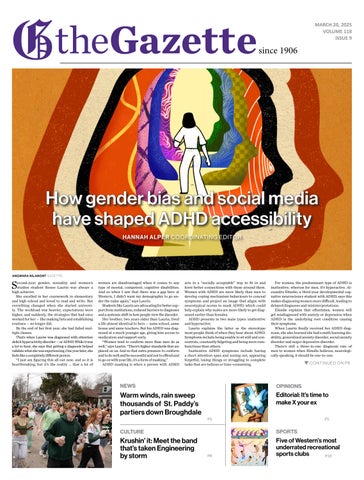
econd-year gender, sexuality and women’s studies student Renee Laurin was always a high achiever. She excelled in her coursework in elementary and high school and loved to read and write. But everything changed when she started university. The workload was heavier, expectations were higher, and suddenly, the strategies that had once worked for her — like making lists and establishing routines — no longer did. By the end of her first year, she had failed multiple classes. That’s when Laurin was diagnosed with attention deficit hyperactivity disorder — or ADHD. While it was a lot to hear, she says that getting a diagnosis helped validate what she was experiencing. One year later, she feels like a completely different person. “I just am figuring this all out now, and so it is heartbreaking, but it’s the reality … that a lot of
women are disadvantaged when it comes to any type of mental, competent, cognitive disabilities. And so when I saw that there was a gap here at Western, I didn’t want my demographic to go under the radar again,” says Laurin. Students like Laurin are advocating for better support from institutions, reduced barriers to diagnoses and a systemic shift in how people view the disorder. Her brother, two years older than Laurin, lived a life almost identical to hers — same school, same house and same teachers. But his ADHD was diagnosed at a much younger age, giving him access to medication and support early. “Women tend to conform more than men do as well,” says Laurin. “There’s higher standards that are placed on us. And so that extra pressure to conform and to do well and be successful and not to offend and to go on with your life, it’s a form of masking.” ADHD masking is when a person with ADHD
acts in a “socially acceptable” way to fit in and form better connections with those around them. Women with ADHD are more likely than men to develop coping mechanism behaviours to conceal symptoms and project an image that aligns with neurotypical norms to mask ADHD, which could help explain why males are more likely to get diagnosed earlier than females. ADHD presents in two main types: inattentive and hyperactive. Laurin explains the latter as the stereotype most people think of when they hear about ADHD. Symptoms include being unable to sit still and concentrate, constantly fidgeting and being more rambunctious than others. Inattentive ADHD symptoms include having a short attention span and zoning out, appearing forgetful, losing things or struggling to complete tasks that are tedious or time-consuming.
For women, the predominant type of ADHD is inattentive, whereas for men, it’s hyperactive. Alexandra Elmslie, a third-year developmental cognative neuroscience student with ADHD, says this makes diagnosing women more difficult, leading to delayed diagnoses and misinterpretations. Elmslie explains that oftentimes, women will get misdiagnosed with anxiety or depression when ADHD is the underlying root condition causing their symptoms. When Laurin finally received her ADHD diagnosis, she also learned she had a math learning disability, generalized anxiety disorder, social anxiety disorder and major depressive disorder. There’s still a three-to-one diagnosis rate of men to women when Elmslie believes, neurologically speaking, it should be one-to-one.
CONTINUED ON P6
NEWS
OPINIONS
Warm winds, rain sweep thousands of St. Paddy’s partiers down Broughdale
Editorial: It’s time to make X your ex P3
P5
CULTURE
SPORTS
Krushin’ it: Meet the band that’s taken Engineering by storm
Five of Western’s most underrated recreational sports clubs P10
P8