
 PERSAUD FEATURES EDITOR
When Western University president Alan Shepard was a 20-something undergraduate student at St. Olaf College in Northfield, Minn., he wrote every one of his essay paragraphs on a typewriter. Then, he’d often scratch them out and start again — over and over.
As Shepard observes today’s students — who have upgraded from typewriters to laptops and touchscreen tablets — he sees a new tool in their arsenal: generative artificial intelligence.
Just over a year ago, ChatGPT was released. Students at Western and across the world have been enthralled by the large language model-based chatbot and its more recent competitors including Google’s Gemini.

Last September, Western appointed computer science professor Mark Daley as its chief AI o cer — a first-of-its-kind role at a Canadian university — to support the community in understanding AI and its applications.
AI can write intelligible essays. It can write functional computer code. It can even write rhyming poetry.
While Shepard is worried that this will hinder student learning, the university does not currently have a policy governing the use of AI — and Shepard is not pushing for one.
“I’m OK with not having some big formal policy at this stage,” says Shepard. “Policy sometimes seems to me to get in the way of really clear think-

ing and innovation. So, we don’t want it to be used, for sure, and we don’t want to do anything to diminish the quality of a Western University degree.”
Daley tells the Gazette the lack of an o cial policy is because Western is empowering individual instructors to make the best decisions for their students, given the university’s broad range of disciplines and course types.
“A core value and principle of our institution is academic freedom, so we trust that instructors are best placed to teach,” says Daley. Shepard agrees.
The Gazette analyzed over 650 course syllabi for undergraduate courses beginning in fall 2023 to see how faculties, departments and individual course instructors are responding to generative AI like ChatGPT in their classrooms.
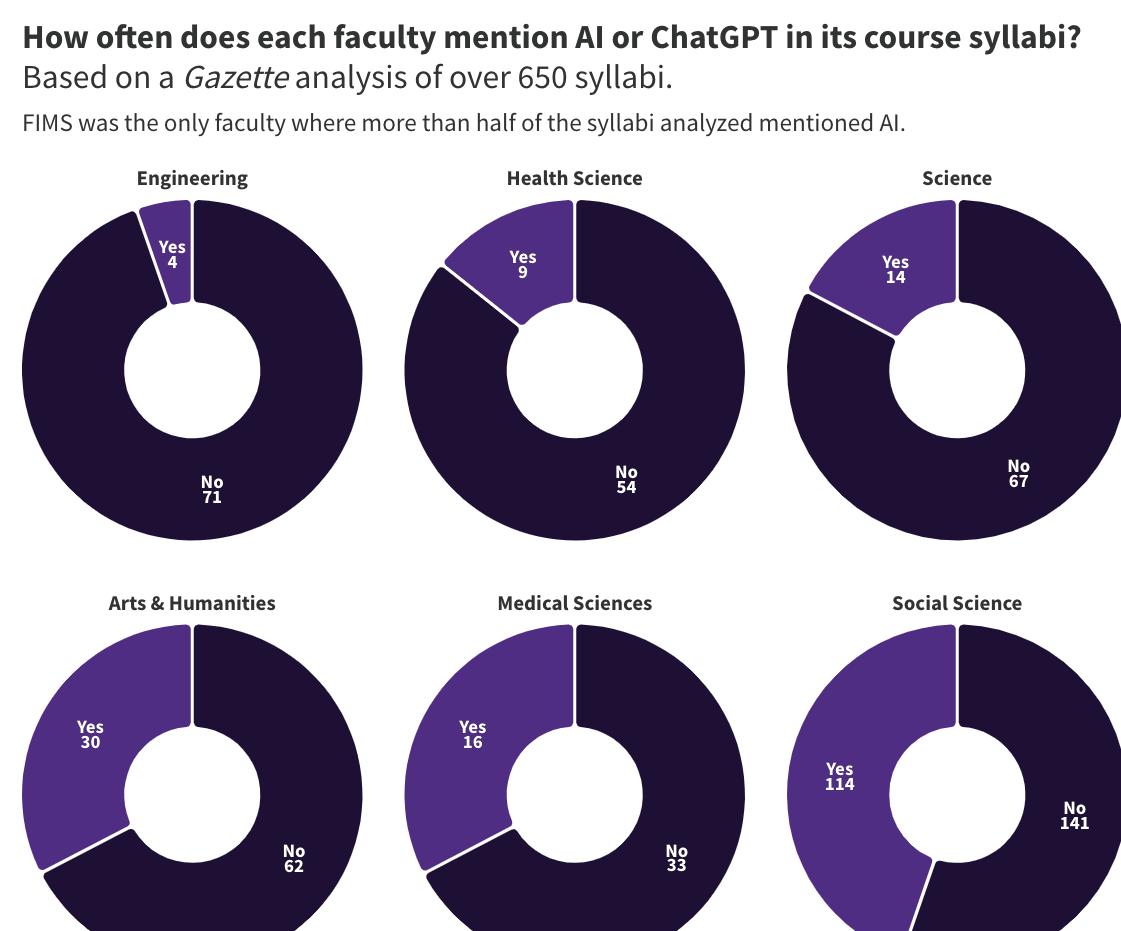
The results show that 34 per cent of the 657 syllabi analyzed by the Gazette included guidelines on how students were to use generative AI in their coursework.
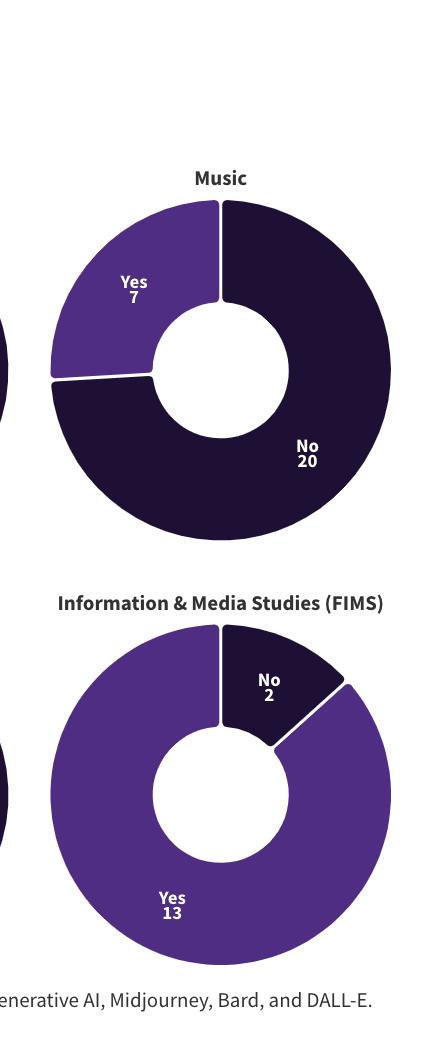
Instructors in the Faculty of Information and Media Studies were the most likely to include an AI policy in their syllabi, with 92 per cent — all but two of the syllabi obtained by the Gazette — discussing how it was to be used. Less than a quarter of syllabi from the faculties of Engineering, Science, Health Science and Music discuss AI use. Engineering is the lowest at just six per cent.
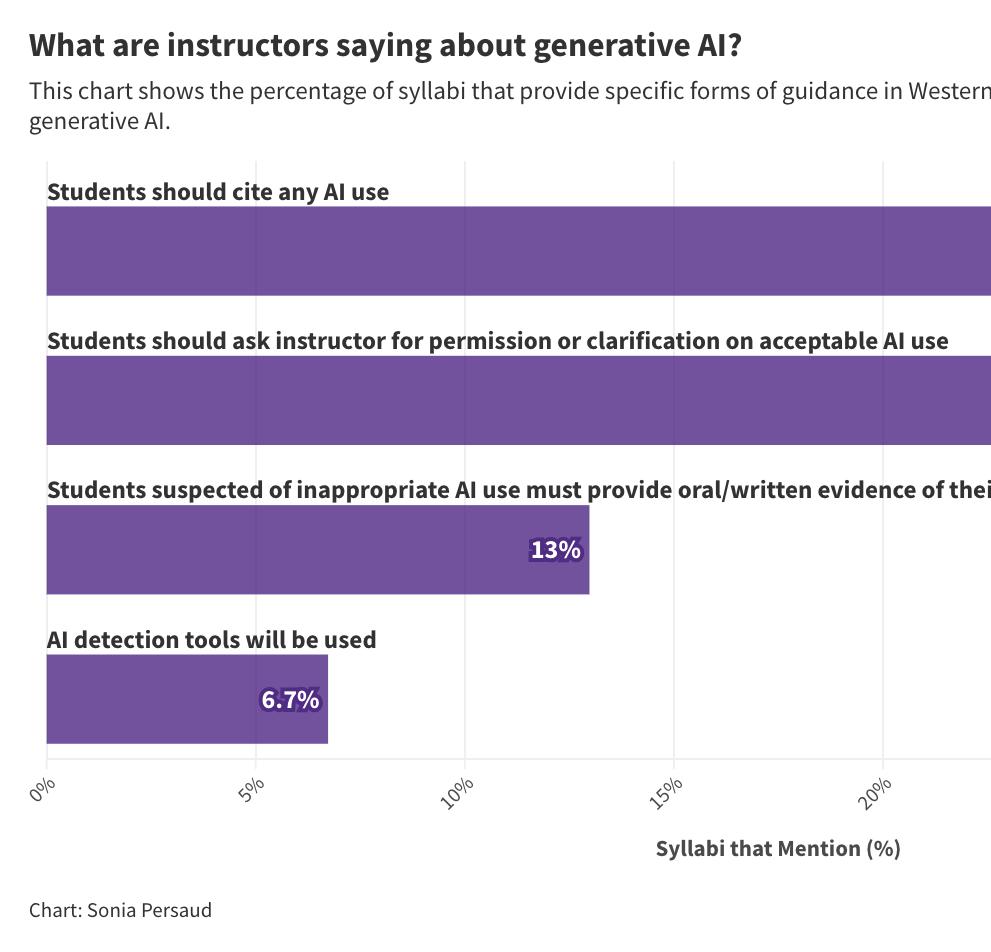
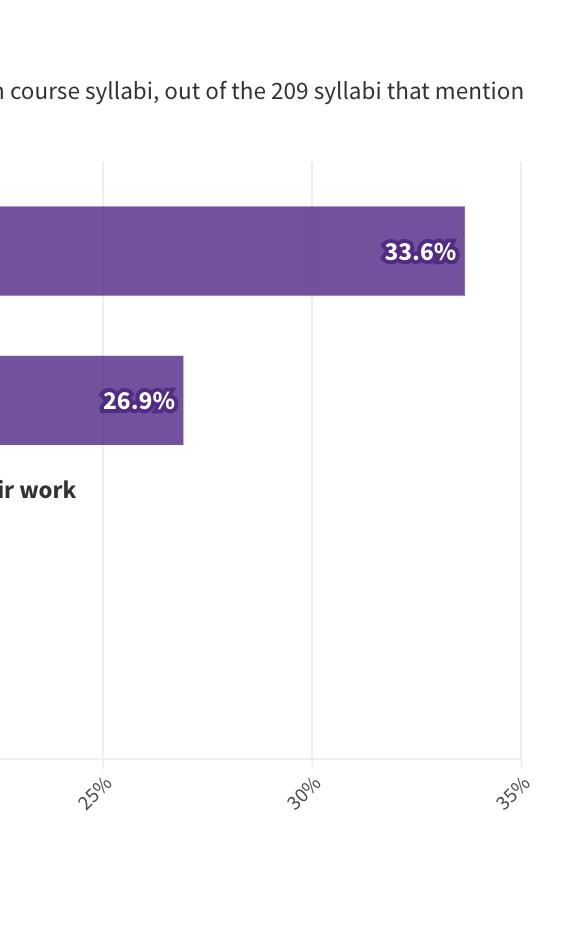
Of the instructors who do mention generative AI in their syllabi, some patterns emerged across faculties. Just over one third specified that students
CONTINUED ON P6




Western research projects remain una ected after the federal government introduced measures to safeguard research material sensitive to national security and prevent leaks to foreign partners.







The federal government announced on Jan. 16 that it will not provide any funding to researchers working on sensitive technology research areas and are in any kind of collaboration with a list of research organizations that are “connected to military, national defence, or state security entities that could pose a risk to Canada’s national security.”
The list of blacklisted research organizations contains 103 institutions, including six Russian military research centers, 12 Iranian institutions, and 85 Chinese research organizations.
Western University president Alan Shepard told the Gazette the list has been carefully reviewed, and the university does not have any research a liations with any institutions on the list. He added that Western has some joint degree programs with some of the institutions on the list which would be put under review.
The university reiterated Shepard’s claims in a statement to the Gazette, noting the policy does not address specific countries but rather academic institutions.
“Western has research partnerships in China and Iran but none that are a ected by the NRO list. We have no partnerships with Russian organizations,” wrote Western.
Researchers seeking federal grants to study in any of the fields from the list of “sensitive research areas” — including robotics, aerospace as well as space and satellite technology — will need to attest they aren’t working with or receiving money from any of the NROs.
The new policy comes at a time of heightened concern about foreign partners stealing Canadian research materials and will take e ect in spring 2024.
In 2020, the CBC reported the Canadian Commons Committee on Canada-China Relations heard allegations in testimony, including the claim that some of the core technology behind China’s surveillance network was developed in Canadian universities. This led to experts and university officials calling on the government to provide more guidance on national security measures.
In May 2022, the government banned China’s Huawei Technologies from involvement in the country’s 5G network after concerns were raised that it would allow China to spy on Canadians.
Even before Huawei was banned from Canada’s 5G network, the Globe and Mail reported
universities were in contact with the Canadian Security Intelligence Service, Canada’s intelligence agency, who shared its concern about Huawei’s development and the risk it poses to Canadian national security.
In a statement to the Gazette on Feb. 17, Western said the remaining projects with Huawei were in a wind-down period, and will come to an end in the next year.
“We have no plans to engage in new research with Huawei,” wrote Western.
In 2017, the Gazette reported a $60,000 award for a telecommunications research project was the only funding Western received from Huawei in the past five years — indicating that Western’s relationship with Huawei was minor in comparison to other universities in Canada.
The University of Waterloo, University of Toronto and McGill University in Montreal are among a few Canadian schools that have recently announced an end to their research partnerships with Huawei to safeguard scientific research. But, Western has not announced any changes until now.
In May 2023, the CBC reported Western was collaborating with China on 16 joint research projects and indicated no plans to end them at the time.
In an interview with the Gazette, Shepard said the recently-announced measures to protect Canadian research have nothing to do with the 16 research projects called into question — which are with private companies, whereas the recent measures blacklist learning institutions.
The federal government’s lists on which research areas will be under scrutiny and which foreign partners to avoid will be updated regularly.
The Bank of Canada is projecting that the inflation rate will decrease in 2024 from 3.4 percent to 2.5 per cent by the end of the year. Economic growth and wage growth will also be slow for the first half of the year.
In its January 2024 Monetary Policy Report, the BoC reported that inflation will continue to decrease from the 3.4 per cent rate in December 2023, stay close to three per cent until the summer and then dip to 2.5 per cent by the latter half of 2024 before returning to the target of two per cent by 2025.
The inflation rate is based on the Consumer Price Index, which measures how the prices of goods change over time. Inflation in Canada hit a 40-year high when it rose to 6.8 per cent in 2022.
The impact of the rising cost of living has been felt by Western University students like Annie Adams, a master’s student in philosophy.
“With the rising prices of everything, it makes me and a lot of people in my social group super nervous about our future, for things such as investing and buying our first home and possibly raising a family,” said Adams.
Adams works as a teaching assistant at Western, but she says that without support from her family, her pay would not be enough to cover her grocery and rent costs.
According to a recent Statistics Canada report, the CPI was 2.9 per cent higher in January 2024 compared to January 2023. The BoC is committed to a CPI inflation target of two per cent to stabilize prices and the economy by ensuring that the demand for goods and services is roughly equal to supply.
The BoC projects that food price inflation, which is currently sitting at five per cent, will see a decrease due to lower global prices for agricultural products. While grocery prices remain elevated, they are increasing at a slower pace, according to a recent Statistics Canada report.

The same report found rent price inflation, which is currently at eight per cent, will likely stay elevated for some time before moderately decreasing due to a slowdown in population growth and an increase in new housing projects.
The BoC also reported that the Canadian economy is not seeing much growth — economic growth is anticipated to remain close to zero through the first quarter of 2024 before increasing 2.5 per cent for the rest of the year. Economic growth has stalled since the middle of 2023.
“Slowdowns in economic activity may mean that fewer jobs available than there would have been a year or two ago and that students entering the labour market may have a bit of a di cult time,” said Western economics professor Audra Bowlus. Adams also said she’s noticed some of her peers are struggling to find well-paying jobs after graduating from university and that she has also encountered di culties when looking for work.

“I tried to apply to a bunch of restaurants and co ee shops to find a job,” she said. “No one was hiring.”
But Bowlus added an unemployment rate of 5.7 per cent — the national average in January 2024 — is not unusual for Canada, so this economic slowdown is not a huge cause for alarm.
The BoC also projects a slowdown in wage growth, or the rise of wages adjusted for inflation, as labour shortages from the pandemic decline.
According to Bowlus, slower wage growth is likely a good thing because it allows businesses to continue hiring workers — since worker’s wages won’t be increasing as fast.
“If inflation starts to come down, then you don’t have these sorts of pressures on wages,” Bowlus explained. “It depends on why wages are not growing, if it’s due to less inflation then it’s not something to really worry about.”
The Ontario government has extended a tuition freeze on colleges and universities for in-province students over the next three years and announced nearly $1.3 billion in funding over three years for post-secondary institutions.
The tuition freeze does not apply to out-ofprovince domestic students, and post-secondary institutions will be able to increase tuition by up to five per cent for these students. Western University increased out-of-province tuition by 10.2 per cent in 2023-24 due to a delay in implementing tuition increase in 2022.
This extension is the fourth consecutive tuition rate freeze for Ontario students since the Progressive Conservative government decreased post-secondary tuition fees by 10 per cent in 2019 to combat a close to $12 billion deficit.
“Today’s funding announcement provides short-term relief for Ontario’s universities but falls short of the government’s blue-ribbon panel recommendations which called for a much needed $1.9 billion in base funding for the university sector over the next three years,” said Western in a statement to the Gazette
Western’s statement also acknowledged that Ontario universities face the lowest per-student funding in Canada and continue to face significant financial pressure. According to the university, an increase in operating grants, tuition
fees and indexation is necessary for the longterm financial sustainability of universities.
“While Western continues to maintain financial sustainability, we know that with a stronger funding model, we will be better positioned to deliver exceptional outcomes for our stu-
London City Council unanimously passed a motion to lift the cap on the number of bedrooms permitted in dwellings across the city to provide more housing options, raising concern among Western students and Londoners.
The motion will remove the previous five-bedroom limit on dwellings in much of the city, with the exception of the residential areas surrounding Western University and Fanshawe College, where the bedroom limit will be raised from three to five per unit. The move aims to increase housing availability amid the city’s housing crisis.
Western’s near-campus neighbourhoods are roughly defined by the area bordered by Adelaide Street and Wonderland Road to the east and west. Windermere Road and York Street are the northern and southern boundaries, respectively.
London’s Planning and Environment Committee proposed the motion near the end of January and approved it at the Feb. 13 city council meeting without any discussion.
According to the Canada Mortgage and Housing Corporation’s annual rent report, London rentals have a historically low vacancy rate of 1.7 per cent. Meanwhile, the average cost of a two-bedroom rental unit has increased by 6.4 per cent on average since last year.
Second-year Western sociology student Leah Rousseau currently lives in a seven-bedroom house in London’s Masonville neighbourhood. In line with the previous bylaw, her landlord limited the number of tenants in the home to five with the remaining two bedrooms used as study spaces. “Five is already a lot of people,” said Rousseau. “It’s chaotic housing.”
“We just don’t have enough space in the kitchen for everybody,” she continued. “We have two really small freezers, and they’re always full. It’s like a game of Tetris.”
In a letter to the PEC, London Neighbourhood Community Association president Don Bartlett expressed concern about the motion. Bartlett’s letter stated that near-campus residential neighbourhoods “have been transformed into ‘for-profit housing businesses’” by absentee landlords.
Bartlett also believes the City of London lacks the proper tools to enforce by-laws on the number of bedrooms permitted in homes. According to Bartlett, these factors are resulting in “a surefire march toward a student ghetto” in London’s residential neighbourhoods.
Bartlett was also concerned that increasing the bedroom cap would worsen the issue of excessive noise, garbage and debris in near-campus neighbourhoods.
North Talbot community member Anna Maria Valastro also wrote to the PEC to share her fears that increasing the permitted number of bedrooms may contribute to undesirable living conditions such as excessive parking.
“If the city doesn’t impose a parking limit, we are just recreating the problems that imposed a bedroom cap in the first place,” wrote Valastro.
Second-year King’s University College social work student and car owner Hailee Schepens echoed Valastro’s concerns.
“We live on a busy road,” says Schepens, whose student rental is located on a major through street. “Nobody would be able to park on the side of the road. We have two parking spots, maybe three max.”
The proposal came into e ect immediately after it was passed on Feb. 13, and is one of several measures undertaken by the city to combat the housing crisis.
The municipality received $74 million from the federal government’s $4 billion Housing Accelerator Fund in September 2023. The funding will be used to accelerate the building of more than 2,000 high-density housing units over the next three years.
dents as they prepare for their careers,” read the statement.
The nearly $1.3 billion in funding will be allocated to a variety of resources including $903 million going towards a new Postsecondary Education Sustainability Fund over three years beginning
in 2024-25. The remainder of the funding will go towards capital funding, STEM program costs, research and innovation as well as mental health support.
The provincial government said this measure would aim to stabilize the funding of universities and colleges throughout the province, while keeping costs lower for Ontarian students and parents.
“It’s never been more important to keep costs down for students and parents,” said Jill Dunlop, Minister of Colleges and Universities in a press release. “Instead of burdening hardworking families with higher tuition, we’re making historic investments to stabilize colleges and universities.”
On Nov. 15, the blue-ribbon panel released a government-commissioned report which found the post-secondary education sector’s financial stability to be at serious risk if the domestic tuition freeze were to continue.
The report called for a five per cent tuition increase in 2024-25 with subsequent increases each year equivalent to the consumer price index or two per cent, whichever was greater.
But, the tuition freeze is predicted to be in place until 2026-27, the year of the next provincial election.
Ontario’s universities and colleges have been reported to use the boom in international students to make up for the revenue loss caused by the frozen domestic tuition. As the federal government introduced a cap on international student permits which will cut the visa numbers by 50 per cent in Ontario, post-secondary institutions expect to see a strain on their budget.
Construction on the new Engineering building is projected to be complete by September 2026 to accommodate for the growing Engineering student population.
The new building will support Western University’s new Artificial Intelligence Systems Engineering program. It will include a new 6,400 square foot student space with club, study and social areas, a multi-faith prayer room as well a floor dedicated to Student Experience.
Construction on the new building is expected to begin in October or November 2024. The proposed building site is located in part of the current Alumni Hall parking lot and adjacent green space.
According to Jack Peplinski, Undergraduate Engineering Society president, the building needs to meet the demand of the rising Engineering student population.
In the 2018-19 academic year, the number of incoming first-year Engineering students was 588. By 2022-23, the number had risen to 893.
The building plan was made in collaboration between architecture firm Perkins and Will and a New Building Committee consisting of students and members of the UES who developed the plans for the student space.
“It’s really nice to see student involvement across like three years come together to build this and I think it’ll be really great to see that going forward as well,” said Peplinkski.
Student priorities identified by the New Building Committee included more bookable rooms for studying and meeting, a new multi-faith prayer room, a new location for the +/- Store and a location for a student-run café.
Peplinksi explained the committee is made up of many students — including second-years who will still attend Western at the time of the estimated completion date and will be able to access the building.
Janik Abdullayev, a second-year Western mechatronics and artificial intelligence systems engineering student appreciated the student involvement in designing the student space and has found other buildings can lack important amenities for students.
“When I go into a building and study and it doesn’t have a microwave, or the seats don’t have outlets, it’s a downside experience. So just having our input on that, even with the small things of having microwaves around is really nice,” said Abdullayev.
Peplinski said the committee is taking inspiration from other Engineering buildings from across Ontario and Canada in the development of the students’ space.
The UES passed a referendum in February 2023 to take a $75 fee per Engineering student to fund the construction of a 6,400 square foot student space in the building.
The referendum required a 25 per cent voter turnout with a 65 per cent majority in favour of the fee to pass. A total of 858 students voted, with 80.7 per cent of students voting in favour of funding the student space.
The student fees collected will create a $2 million fund for the student space, and will be matched with faculty and donor funding to total $6 million.
The fee was added to students’ accounts in fall 2023, and Peplinski believes students remain in favour of funding the student space.
“I think that many students at Western really know that they’ve benefited a lot from the club space that’s been available to them that was paid for from tuition or other things before, like the student rec centre,” said Peplinski. “And so I think a lot of students are kind of excited to pay that forward and give other students that opportunity.”
As a leader herself, Western professor Candace Brunette-Debassige, is putting the voices of Indigenous leaders first in her new book, Tricky Grounds.
Candace is an assistant professor in Western University’s Faculty of Education and released Tricky Grounds in January. The book is based on her PhD research about Indigenous women in leadership roles at Canadian universities who experienced di culties working with university policymakers.
Candace, a Cree woman with French lineage, is the first generation of her family to go to university and has since completed her PhD in education as of 2021 at Western.
Candace interviewed 11 women — who are referred to anonymously in the book — about their experiences enacting policies in Canadian universities in response to the Truth and Reconciliation report’s calls to action in 2015.
She focused on the messiness of developing policy and the process of fighting against di ering political agendas and interpretations. Candace found many of the women struggled to work with uni-

versity policy makers who had opposing political views and also struggled with interpreting policy implementation.
Candace wanted to highlight these women’s voices in a book. She had found that, while Indigenous communities have been researched, Indigenous people themselves “haven’t had a lot of agency in the authoring process.”
“It was really important to me to get to know them and sit with them more than just once,” says Candace. “I wanted to make sure that I did this work ethically.”
She wanted to build a relationship with these women and refers to them as “partners,” rather than subjects or participants.
“This is not just my story, it’s their stories too,” says Candace. “I draw on other Indigenous methodologists, to kind of come to this position.”
Truth and Reconciliation was a class action settlement against the Canadian government in 2007. This resulted in the formation of the Truth and Reconciliation Commission of Canada, which researched the history and e ects of residential schools as well as issued a final report in 2015.
Because of the report, the government listed 94 calls to action. Sections 62 to 65 call on the education system — elementary, secondary and post-secondary schools — to integrate a series of Indigenous initiatives.
For example, Section 62 calls on the “federal, provincial, and territorial governments, in consultation and collaboration with Survivors, Aboriginal peoples, and educators, to … Provide the necessary funding to post-secondary institutions to educate teachers on how to integrate Indigenous knowledge and teaching methods into classrooms.”
Candace’s work is personal. From a very young age, she’s been interested in understanding the
Indigenous issues in her home town of Cochrane, Ont..
Before she completed her PhD, Candace was appointed to a special advisor role at Western. She helped create the O ce of Indigenous Initiatives and worked in Indigenous student a airs. She weaved her own experience in both her PhD research and Tricky Grounds.
“I was part of that movement, it was a collective movement, a national movement,” says Candace. “When we think about the responsibilities of researchers, we have a lot of power in the authoring of our work.”
Along with stories of the 11 women, Candace has also included traditional Indigenous stories around her in Tricky Grounds, for example the stories of her grandmother.
Candace says that she was inspired by her grandmother, a gifted storyteller who encouraged her to see the world di erently. One of Candace’s favorite lines from the book is about her grandmother:
“I have come to understand that my Nokomis’, my grandmother’s, stories were not simply stories,” she writes. “They were powerful acts of surviving an active sense of presence. The continuance of native stories, not a mere reaction, but a spirited resistance, a life force, a force of nature.”
Buying your way to being a girl boss: Western profs
Hey Barbie! If you find empowering activewear or inclusive makeup products in your shopping cart, you may have been exposed to “femvertising.”
Femvertising is a marketing strategy designed to promote a product or service by selling empowering, feminist ideals. While you may think you’re being a “#girlboss,” femvertising has become an engine that drives consumer culture.
“Femvertising is an approach used by corporations or sometimes NGOs that marries advertising with concepts that are pro-feminist, but the subtext is — or the not so obvious part is — really, femvertising is about selling you something,” says Romayne Smith Fullerton, a Faculty of Information and Media Studies professor.
Examples of femvertising include the summer blockbuster Barbie and Dove’s “Real Beauty” campaign. The Real Beauty campaign set a powerful precedent for the future of feminist marketing, with Dove seeing increased sales and notoriety even years after the campaign’s debut.
But it can be di cult to decipher the true intentions behind femvertising campaigns. Kevin Wu, a first-year business management and organizational studies student at Western University, feels that femvertising promotes gender stereotypes.
“In a way, it reinforces [gender stereotypes] because femvertisments also tell women you have to look a certain way, you have to buy these certain products to be a woman,” says Wu.


Although the term femvertising was only coined in 2014 by Samantha Skey in an Adweek panel, companies have always found creative ways to sell products to a female audience.
In 1968, the cigarette brand Virginia Slims exploited the civil rights movement by finding a way to associate smoking with strength, independence and empowerment with their convincing slogan, “You’ve come a long way, baby.”
But how bad is equating lung cancer and liberation?
According to Samantha Hancock, a management and organizational studies assistant professor at Western, these empowerment campaigns can carry harmful and misleading messages.
“[The company] may mean well, but ultimately the goal of advertising is to get the target audience to buy the product or service the company is selling, so who does this really benefit?” explains Hancock.
What if every person on Earth neatly fit into one of 16 personality types? That’s precisely what the popular Myers-Briggs Type Indicator test claims to achieve.
The MBTI is a popular personality test that sorts people into 16 di erent categories based on traits like how extroverted or introverted one is. The test was created during World War II by Katharine Cook Briggs and Isabel Briggs Myers, who based it on Carl Jung’s book Psychological Types.
The Myers-Briggs Company believes that the test can assist people and teams tackle everyday challenges like communication, handling conflict, managing change and making decisions.
Melissa Summer, the public relations manager of The Myers-Briggs Company, says the test “is for helping people better understand themselves, and then better understand how they are similar or different to other people.”
But the assessment has been criticized by the scientific community as being unreliable.
Alex Benson, a psychology professor at Western University, says the main problem with the MBTI test is that it fails to look at a person’s personality holistically.
“It’s very di cult to start putting people into categories, given the continuous and multi-dimensional nature of these psychological constructs,” says Benson.
Personality tests like the Big Five and the HEXACO, which take a more holistic look at people’s personalities, have received more recognition from the science community.
The Big Five analyzes agreeableness, conscientiousness, extraversion and openness, and the HEXACO also evaluates a person’s honesty and humility.
“With these tests we can see how people di er on all five or all seven of those dimensions through a spectrum, and that’s the key point of tension between most of psychological literature and the MBTI,” explains Benson.
Despite the scientific criticism, interest in the MBTI shows no sign of declining, with about two million people taking the o cial test every year, according to the Myers-Briggs website.
Consumers may think they are benefiting from these targeted ads. But in reality, companies are tying an identity to their product or service to increase brand loyalty and consumerism.
The collective identity created from the rise of “Barbiecore,” memes and TikToks after the Barbie movie’s release saw Mattel nearing a $2 billion increase in sales from July to September. Barbiecore — and the rise of internet aesthetics in general — is another form of femvertising, as many businesses create and market products to suit the lifestyle of certain aesthetics.
“If I want to portray myself as a very studious girlie, now I have to buy a MacBook, now I have to buy Muji supplies in order to become this, when in reality, you don’t have to have any of these products to become a very, very successful student,” says Wu.
As a self-proclaimed follower of the “clean girl aesthetic,” Wu finds the flaws in overidentifying with aesthetics on the internet.
“I think for women, you scroll on TikTok and you always see these aesthetics, like, ‘you’re so coquette,’” says Wu. “There’s also that pressure for women to purchase these products as well because they want to keep up with the current trends.”
Hancock explains that it’s important to do a little research before investing in a product or service and think twice before hitting the like, subscribe or share button.
For your mental health and bank account, it’s important to stay vigilant about what and how we consume media in our ad-riddled world.
Namara Morse, a third-year international relations student, says that, even though she knows the test isn’t 100 per cent accurate, she still enjoys taking it.
“I don’t take them seriously, but I have fun seeing what the media associates my MBTI result with,” says Morse. “I like seeing if it actually aligns.”
One of the reasons why the test is so popular, according to Benson, is that people like to think in categories.
“It makes social life much simpler when we can walk through our complex social worlds by categorizing things. And when you give someone a category and you have a nice description, they can see themselves in that,” says Benson.
The Rec Centre has a secret superpower: it’s their sta .
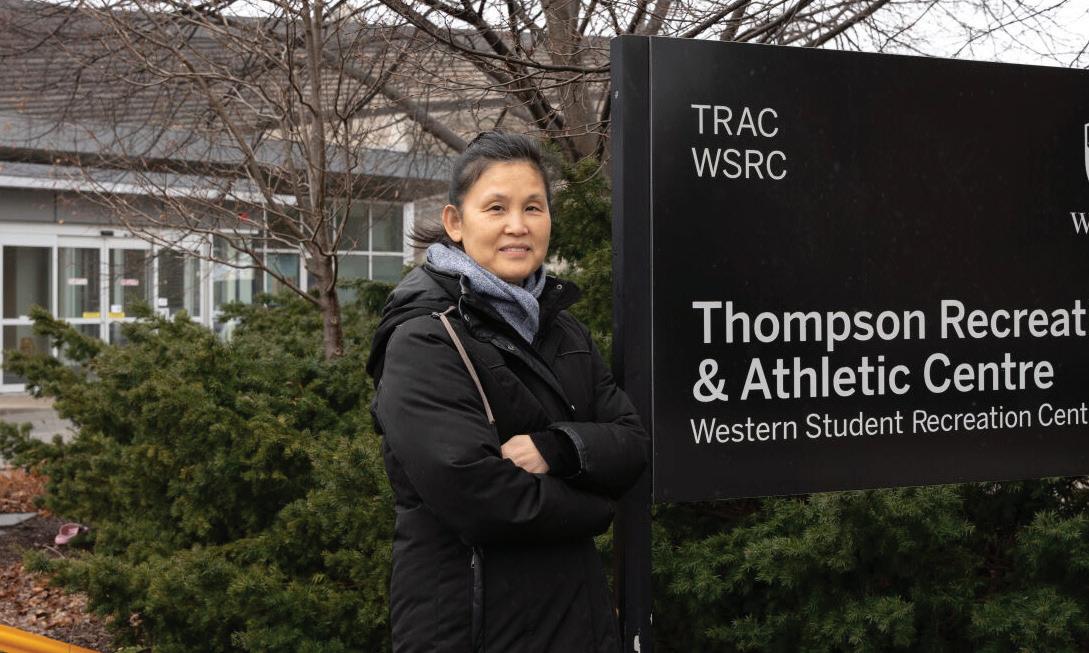
Helen Farndon is one of the group fitness instructors at the Western Student Recreation Centre. Her classes include cycling, yoga and strength training.
If you’re at the Rec Centre, you’ll likely see her there with a smile on her face — whether she’s teaching a 7 a.m. class or a 10 p.m. one.
She is a 60 year-old-woman who is always bouncy, active and filled with energy. In her classes, she uses a rmations while often reminding students to smile and unclench their jaw and whatever stresses they feel.
Helen prides herself on the relationships she’s built with her students and how she can help them develop a healthier and stronger relationship with their bodies and minds.
“I really love teaching, but I think most of all, I really love helping people become stronger,” says Helen.
It’s never too late to start working out — Helen’s fitness journey began about 14 years ago. Prior to becoming a fitness instructor, Helen was an early childhood educator where she worked in a daycare. She also spent a lot of time educating and raising her two children.
Helen didn’t like it when she found herself “hu ng and pu ng” when going on long walks and climbing up hills.
She started her fitness journey by joining a gym, where she took a cycling class and “fell in love with cycle.” She became an avid gym-goer, attending day and night classes and got a teaching certification after two years.
During Helen’s cycle classes, she is constantly cheering on her students and pushing them to do the best they can.
Helen has worked at many gyms and has been a group fitness instructor for nine years. She became an instructor at the Rec Centre in 2019.
Helen’s favourite class to teach is cycle, but she also really enjoys teaching yoga — specifically, candlelight yoga — which was started last year by Michelle Harvey, the program coordinator of fitness and wellness at the Rec Centre.
In her classes, Helen often reminds students that they are capable of anything and that this is their safe space to work out.
Helen’s motivation is to help students feel the most confident in themselves and believe in their abilities. Oftentimes, students struggle with knowing how to use the gym or feel intimidated when going to a gym. Helen hopes to ease that discomfort.
“A lot of students don’t think that they have the ability [to exercise]. When I motivate them and they realize they could do much, much better, they really love that about themselves,” she explains.
She also likes to start many of her yoga classes by reminding students that there is no judgement, no expectation and no competition.
Helen hopes nervous students at the gym know that other people are probably also nervous.
Her mentality is that if others can do it, so can you — everyone just needs to believe in themselves. She’s there to help people on their journey towards confidence and fitness.
Helen understands what fitness is like for aging people, and she hopes she can help motivate older people to stay active and healthy. She’s in the process of getting her certification to be a personal trainer for older people.
“It is something that you cannot know without feeling it yourself,” says Helen. “Having that empathy towards the older people really allows me to approach them and help them — that is my passion.”
Helen’s classes can be found on the online Rec Centre group fitness schedule.
Western’s very own Mindhunter is fighting crime with AI.
Michael Arntfield is a professor in Western University’s Faculty of Arts and Humanities specializing in criminal humanities. He also leads the Cold Case Society — a data-driven Western club that uses the Murder Accountability Project’s serial o ender algorithm to track “clusters” — patterns of murders suspected to be linked, which can be indicators of serial killings.
Michael has had an unorthodox rise in academia. He began his career as a police ocer in London and worked in burglary, robbery, major crimes and a number of intelligencebased task forces.
While he was working for the London Police Services, Michael, motivated by promotional pursuits, enrolled at Western in 2008 to obtain a master’s degree and a PhD in criminal justice.
He hadn’t envisioned a future in academia, but Michael realized that he enjoyed teaching and the academic lifestyle. In 2014, Western o ered him a full-time position as a professor.
Besides leading the data-driven club, Michael serves on the board of directors of the Murder Accountability Project, a non-profit organization that obtains and publishes information on unsolved homicides.
“It’s looking for trends within cities and counties that have eluded law enforcement, either because there’s too many murders to see the forest through the trees, or because they’re in di erent jurisdictions,” says Michael.
The CCS uses AI to look for patterns in murders — gender, cause of death and geographic location — to identify clusters. Once a cluster has been identified, the CCS researches the crimes and notifies local authorities if the data suggest a serial violent o ender could be in the area.
Michael says the CCS has identified clusters that suggest “the work of serial killers” — one in metropolitan Washington, D.C. and one in Chicago.
“We rely entirely on freedom of information requests to get information from those states that, until we came along, were black boxes where all this information was locked up, and they were a

complete blind spot when looking at the national picture of murder rates,” he explains.
Michael and the CCS flagged a pattern of 51 unsolved homicides of women who had been strangled in the Chicago area. They reported these to the Chicago Police Department in March 2019.
The next month, Chicago police set up a task force to investigate, which became the basis for the television show The Hunt for the Chicago Strangler.
While this has yet to be solved, the CCS has helped close a number of cases successfully, including one in Cleveland.
But the response from police isn’t always what Michael hopes. In 2014, the algorithm identified a cluster in Gary, Indiana and the local authorities were notified. This alert wasn’t addressed.
Following this unacknowledged warning, Darren Deon Vann was arrested for the murder of 19-year-old Afrikka Hardy in Hammond, Indiana. Deon Vann proceeded to confess to the cluster of killings identified by the algorithm.
“Since then, people listen,” says Michael.
Three universities — two in the United Kingdom and one in the United States — now have similar programs to the CCS.
Students interested in participating in the CCS can reach out to Michael through his website at the beginning of the academic year to ask about opportunities.
The Roman Empire may have ruled over 2,000 years ago, but it seems that some men are still thinking about it — quite regularly.
A new trend on social media suggests many men regularly contemplate the Roman Empire — with thoughts surrounding the concept of the Empire popping into their heads anywhere from a few times a month to a daily basis.
The trend started when Swedish Instagram user Saskia Cort posed the question of how often men think about the Roman Empire to her male followers on her story, and then later shared their answers in a post.
“#romanempire” became a viral sensation after Cort’s post was reposted to Instagram Reels. The hashtag garnered over 1.3 billion views on TikTok, with users asking their fathers, brothers, boyfriends and other men in their lives how often the Roman Empire crosses their minds.
While there aren’t any quantitative studies proving how often men actually think about the Roman Empire, first-year Western engineering student Hamdi Ebied and third-year Western finance science student Johnny Kay say that they do regularly think about the ancient civilization. Ebied thinks about the Roman Empire at least once a week. Kay, on the other hand, only thinks about it when historical events related to Italy are brought up in conversation.
“It’s a significant moment in history,” says Ebied. “I also think about the Ottoman Empire and their rule for many years. Empires and ruling over and their domination over the world or multiple countries is something I think about.”
To Ebied, these events are meaningful because he values leadership and strives to be the best in his field.
Elleke Boehmer, a world literature professor at the University of Oxford, says men spend time thinking about the Roman Empire because of their desire for a strong male leader figure and movies like Ben-Hur and Gladiator.
“This sort of notion that in the time of the Roman Empire, Europe was strong and the Romans were glamorous and strong rulers,” says Boehmer.
“There’s all these associations of strength and power and unity that I think people have a kind of yearning for, especially men.”
The Roman Empire ruled for almost a millennium, from 27 BC to 476 AD, spanning across Western Asia, Northern Africa and most of Europe. Their influence has carried into the modern day — Latin, the language of the Romans, has become an essential part of Western culture, while developments like oil lamps have taken on more mundane everyday uses.
Kay also believes that a lot of men look to the Roman Empire as a symbol of power, especially Julius Caesar, a victor of the Civil War and a dictator who overthrew Rome’s political order.

According to Boehmer, the Roman Empire is highly associated with peace as the Roman rulers were good at rule of law.
Rome, compared to modern politics and conflicts, is associated with peace and order, enemy-defended borders and a hierarchical society with a strongman leader at the top — an ideal in-
spiration for those who think about the Roman Empire.
“There’s so much if you think about contemporary politics, whether in the United States, Canada or in Europe, everyone’s worried about guarding borders, terrorism and war and so on,” says Boehmer.
CONTINUED FROM P1
should cite AI use, with some providing specific citation styles. Around one quarter encouraged students to talk to their instructors — either to ask for permission to use generative AI on an assignment, or to receive clarification about the specific cases in which it can be used.
Susan Knabe, undergraduate associate professor and associate dean of FIMS, says the faculty started coming across cases of ChatGPT use in student essays late in the fall of 2022 — which she describes as seeing student writing that didn’t feel “right” but wasn’t clearly plagiarized.
A majority of FIMS courses are essay courses. It should be no surprise, then, that FIMS professors are among the most concerned about regulating generative AI use in their classrooms.
Knabe feels that generative AI is more threatening to some disciplines than others, notably faculties like Arts and Humanities and FIMS that are “tied to the importance of writing and argumentation.” Essays — instead of multiple-choice tests — are the gold standard of evaluations in these courses. But this may be changing.
“ChatGPT, which generates text, goes right to the heart of a lot of the ways in which we assess,” says Knabe.
But it’s not just the humanities that have had to adapt. Jennifer Peter, a lecturer in Western’s departments of biology and statistical sciences, teaches the large, second-year Statistics for Science course and prepared an eight-page generative AI policy for her students.
In Peter’s course, students must cite any use of generative AI — the citation format is provided to students — and the contribution from
SONIA PERSAUD FEATURES EDITORgenerative AI must not exceed 25 per cent of the student’s work.
“I think it’s just as relevant in the sciences as it is in humanities and arts. It’s just that the nuance changes,” says Peter.
Peter points to the di erent types of courses that are o ered in the sciences to show how different generative AI responses are needed for each one.
Statistics and math are conceptual, she says. At the higher undergraduate levels, these disciplines have essay courses that require students to justify their approaches — meaning generative AI policies used in the arts might apply here too. But Peter says science disciplines also face their own unique challenges, given that generative AI is improving at writing computer code.
“If part of our course is your proficiency at using a statistical software program, it becomes hard to assess who’s responsible for the work that they’re submitting,” Peter explains. With the rise of generative AI, di erent assessment approaches might be needed for these courses.
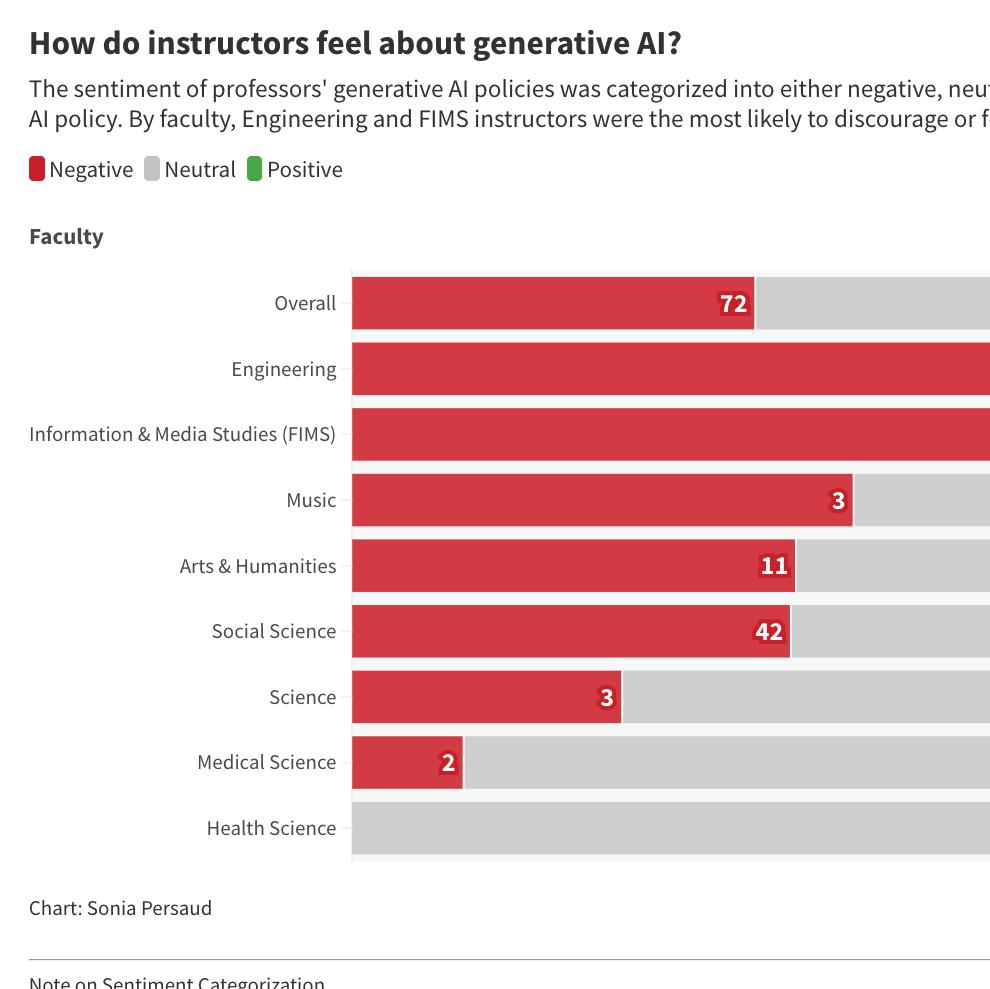
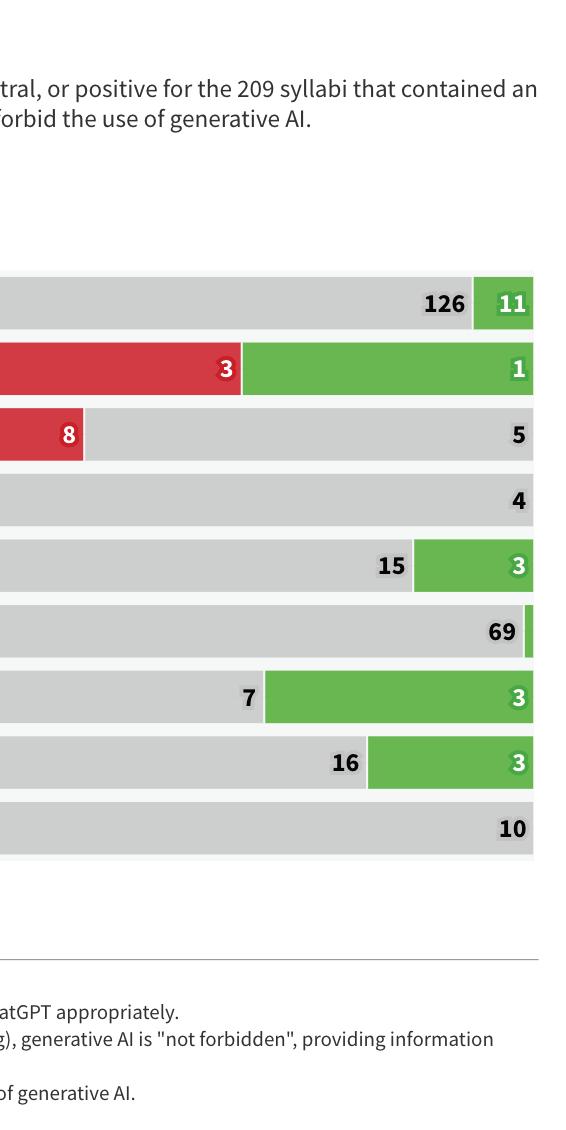
The Gazette also analyzed how professors in di erent programs feel about the use of ChatGPT in the classroom by categorizing professors’ generative AI statements in their syllabi as negative, neutral or positive.
Overall, the data suggest professors are mostly neutral about generative AI, with a significant negative minority and few who feel positively about ChatGPT in their classrooms. The perspectives on generative AI vary by faculty, but as Peter suggests, it doesn’t reflect a neat divide between the arts and sciences.
Whitney Barrett, Western’s acting ombudsper-
son, helps students appeal accusations of scholastic o ences. In her role, Barrett has continued the ongoing conversation about how generative AI fits into the current academic integrity or scholastic o ences policies. For example, there’s debate about whether ChatGPT use should fall under Western’s existing scholastic o ence categories of plagiarism or unauthorized collaboration — or something else entirely.
Scholastic o ences, including plagiarism, have been on the rise overall at Western over the past five years, although the recently released 2022-23 scholastic o ence report shows a slight decline. Last year, plagiarism — which many course syllabi identified the inappropriate use of generative AI to fall under — represented nearly half of the 400 reported scholastic o ence cases.
But even though o cial cases of plagiarism aren’t on the rise, that doesn’t mean students aren’t turning in ChatGPT-generated papers — their professors just don’t have the tools to detect it.
Barrett said she’s seen a few cases of students accused of using generative AI over the past year, but not a significant amount. She attributes this in part to Western not taking a strong policy stance on AI, and the lack of e ective AI-detection tools available.
Fourteen course syllabi for courses beginning in September 2023 obtained by the Gazette said they will use AI detection tools, like Turnitin’s AI detector. At that time, Western discouraged — but did not expressly forbid — the use of generative AI detectors. Many peer schools followed suit, like the University of Toronto and the University of Waterloo.
Western changed its stance in January, an-
nouncing it would stop using Turnitin’s AI software due to reports of inaccurate results on the platform and that it was less e ective with the work of students whose first language is not English.
While the university uses Turnitin to detect traditional plagiarism cases, Knabe says catching student submissions of AI-generated text is challenging since there’s no smoking gun.
“I might feel very confident, but I don’t have clear proof, and that is a really uncomfortable place to be in,” Knabe explains.
Barrett says the students she did speak to who were accused of scholastic o ences in relation to generative AI were mostly able to prove their innocence. For example, some students provided their rough work showing their thought processes.
Perhaps due to detection challenges, Knabe says there’s been more interest from professors about designing syllabi responsive to ChatGPT’s e ects on learning and assessments.
When she spoke with the Gazette in December, Knabe said she saw nearly 30 sign-ups for an upcoming Introduction to Generative AI in Teaching and Learning course syllabi design workshop from Western’s Centre for Teaching and Learning — compared to just four or five when she attended one last August.
Despite the conventional stance in FIMS — avoid ChatGPT or carefully specify acceptable use cases — Knabe’s own belief is that it would be a disservice to get into an “arms race” with generative AI by designing assessments specifically to circumvent it. Knabe says professors should consider that if they ban ChatGPT in their classrooms but continue to use their conventional assessments,

like essays, they won’t be able to reliably detect students who flout those rules.
“Instead, think about what are the places where students could use ChatGPT. How could they use it in a way that actually might potentially be really helpful to them?” she asks.
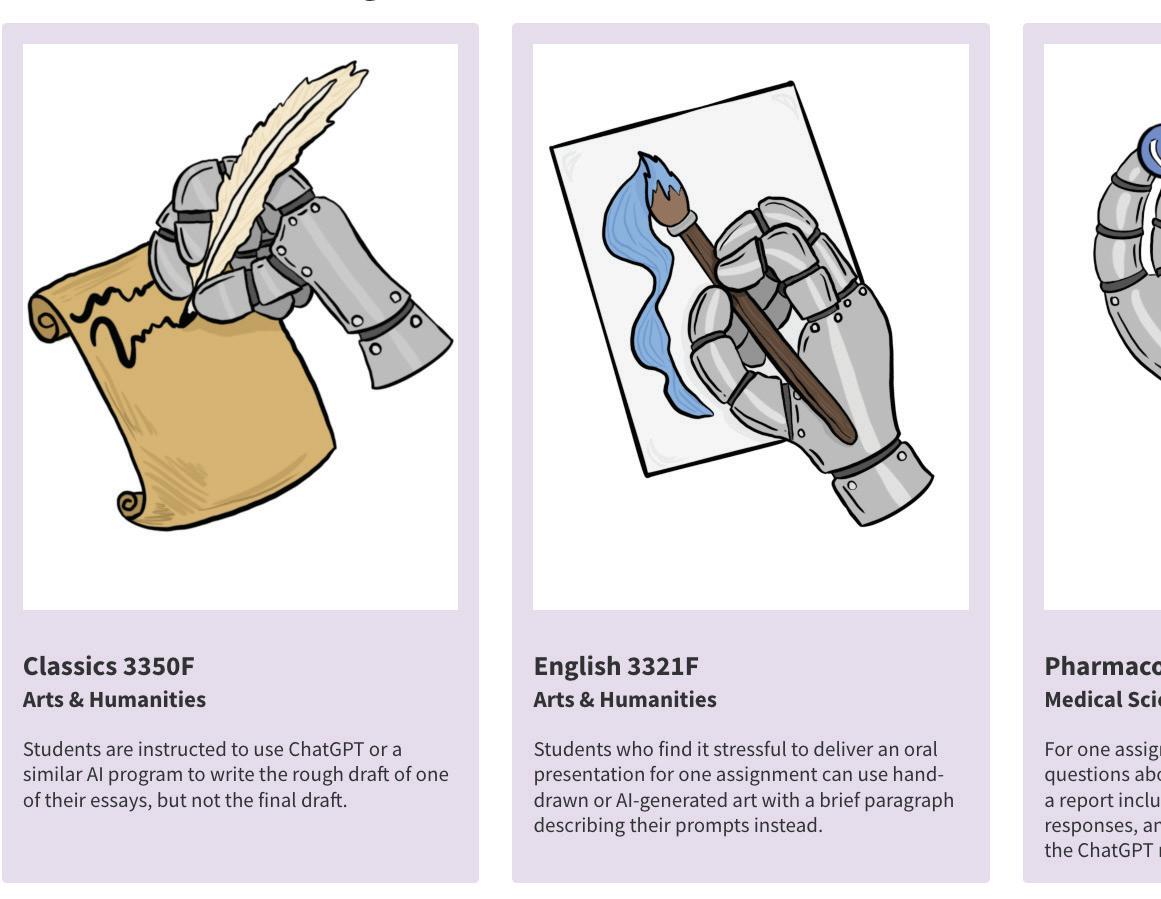
The Gazette’s analysis revealed several courses have already incorporated generative AI in unique ways. One English course accepts AI-generated images as part of an assignment, and a Classics course syllabus states the rough draft of an essay assignment will be written using ChatGPT, but will not be used to create the final version.
Daley thinks professors’ initial fear of ChatGPT’s debut last winter was a natural human response to a brand-new technology. But one year later, he thinks the conversation has changed — and that professors may begin to see how they can use ChatGPT to improve their pedagogy.
“Cheating’s existed forever. It isn’t new with AI, there’s just one new technology, one new opportunity, if people choose to engage with academic dis-
honesty,” says Daley, who is optimistic about the way it can shape education.
While Shepard is still worried generative AI technology could “cost people their own education,” he’s interested in working with experts, like Daley, to help shape what AI use will look like at Western going forward.
“Mark Daley tells me I’m wrong, and that’s fine. That’s perfectly fine. I may be wrong, I’m not saying I’m not. I just think it’s early days, for sure,” Shepard says.
At the end of the day, isn’t the point of university to hear both sides of a debate, and o er a space for these conversations to play out? Shepard thinks so. Knabe adds that generative AI creates an interesting challenge that lies ahead.
“How do we protect those things that we think are most important for students to know, and how do we re-figure those in the world of ChatGPT?” she asks.
— With additional reporting by Veronica MacLean, and files from Sophia Schiefler and Adshayah Sathiaseelan

What’s the perfect place to host a cozy wine night filled with poetry? A frat house, according to the Kappa Alpha Literary Society.
While dedicated safe spaces and celebrating vulnerability don’t fit into the stereotypical image of a fraternity, that’s precisely what defines Kappa Alpha.
Kappa Alpha was originally founded in 1825 in Synecdoche, New York, and the fraternity’s Western University chapter has been operating since 1948. While they are part of the North American Interfraternity Conference — an association that represents a large number of fraternities in North America — Kappa Alpha members do not consider themselves to be represented by the traditional associations of Greek life.
The society’s members are reimagining what a fraternity represents, fostering intellectual conversations and brotherhood in a supportive and inclusive environment.
“When I read about Greek life, it was terrible. As a first-year student, I never thought I would align myself with a fraternity,” says Gabriel Foresta, the chapter’s president and a third-year political science and philosophy student.
Greek life at Western has had a controversial history, marked by concerns over gender based violence, lack of inclusivity and a perceived lack of transparency regarding activities during rush week and other events.
While Kappa Alpha organizes traditional rush events like sports day and taco Tuesday as part of their recruitment activities, joining this fraternity is all about fostering a sense of community. As opposed to a traditional rush week filled with events and socials, occurring over a couple weeks in September and January, membership is seen as more on a rolling basis.
“It’s not like traditional rush,” says Foresta. “Essentially, we’re just trying to bring people together. We’re trying to build community, and if you come around enough, you’re just invited in.”
Foresta describes the society’s core values as merging passions for music and philosophy into their events. Their signature wine and poetry nights invite both members and non-members to share poetry over wine and charcuterie.
Kappa Alpha also hosts open debate nights where participants discuss specific literary pieces — these can be in any form, but members commonly discuss poems, essays or books — over a homecooked dinner.

The wine and poetry nights are what initially attracted Purushoth Megarajah, the literary society’s vice president and a third-year Arts and Humanities student, to the society.
“Someone invited me to wine and poetry, and I thought, ‘I’m not going to a fraternity with you. I do not feel safe.’ But I went, and it was immediately such a welcoming environment,” says Megarajah.
That night, Megarajah shared one of his poems, moving one of the society’s members to tears. It was this moment of emotional vulnerability that made them realize the uniqueness of this space for men. 58 per cent of men aged 18 to 24 do not feel comfortable crying in front of their friends, according to a study cited by the Telegraph Now, Megarajah frequently invites his female and queer friends to the Kappa Alpha house, aiming to share the same sense of safety and acceptance he’s experienced.
“Brotherhood is absolutely a core tenet of what we do, but it’s reframed in a manner that I think is
genuinely supportive and wholesome,” says Megarajah. “There’s no weird hierarchical stu happening; we’re all just friends, and we’re here for each other.”
In addition to these intimate events, the fraternity hosts parties with over 300 attendees to raise money for charity. A recent party raised over $1,200 for Relay for Life. Later this month, they will host their annual St. Patrick’s Day party, with proceeds going to the London Food Bank.
Despite the fraternity’s rich tradition rooted in the local community, Kappa Alpha members are not confined to their local chapter. Foresta and Megarajah frequently communicate with members at other chapters, including those at the University of Toronto, McGill University and the University of Pennsylvania.
Once a year, members visit Synecdoche, the society’s founding city, to have dinner at a private social club owned by UPenn.
“It’s really exciting because, obviously, there’s a core identity of Kappa Alpha, but every single chapter has its own spirit to it,” says Megarajah. “It’s really fun seeing everyone and seeing how those dynamics come together.”
The Kappa Alpha Literary Society ultimately embodies a genuine desire to foster a community and encourage creativity. The bonds Kappa Alpha members form extend far beyond their undergraduate years — alumni from as far back as eight years ago still attend their formal events, according to Megarajah.
“The reason why I believe in it so strongly, and the reason I give it so much of my time, is because it’s so genuine what we try to foster,” says Megarajah. “The idea of connectivity, education, brotherhood, and taking care of our community, that’s the spirit of it. It’s all about people coming together and learning from each other.”









than Hickey uploaded his first video on YouTube when he was eight years old. More than a decade later, he’s an award-winning student filmmaker, a feat he never imagined he’d accomplish.


Ethan, a fifth-year film studies student at Western University and London local, has been honing his craft in filmmaking since his childhood. His released in 2022 and , due out this year. Ethan’s love for filmmaking goes back to his childhood, when his parents exposed him to film at a very young age.
Burden, Ethan’s first professional project, is about a recovering alcoholic whose brother passed away in a drunk driving accident.






One of Ethan’s biggest inspirations is Damien Chazelle, director of La La Land, Babylon and Whiplash. He followed Chazelle’s pitching process that he used to make his first film Whiplash Chazelle only filmed his favourite scene, from that he had planned out for his movie, and pitched it to investors and festivals where it eventually got picked up.
Falsehood is a sci-fi thriller set in a world where people have the ability to access the memories of everyone that’s ever lived. Ethan says his fascination with topics like the John F. Kennedy assassination conspiracy inspired him to produce the film.
He says Falsehood explores the question “how much money would I pay to know something,” referring to the idea that in the film people can purchase memories of other people.


Ethan is the winner of the Forest City Film Fes-
exposed tival’s Audience Choice Award in 2022 for also won Best Feature at the New York International Film Festival.



Burden also won Best Feature at
Ethan focuses his creative process on experimentation and evolution. He also extends this approach to his casting choices.
Ethan employed the same method for his upcoming feature Falsehood, which is currently in production to be developed into a full-length film this summer.
Falsehood is set in London, a choice not born out of convenience, but from Ethan’s sincere admiration for the city’s locales.
Ethan’s personal goal is to champion local filmmaking in his hometown.



His parents are big movie fans. Ethan’s first and middle names are his dad’s favourite movie characters — “Ethan” is from Ethan Hunt, Tom
“Once you know your cast, you can work on the characters and see where they take you,” Ethan says.
While Ethan likes to take his time with storyboarding, he says that “you can’t overplan, especially considering the cost constraints.”
“I raised a couple thousand dollars and shot two short films of my two favourite scenes from the feature,” he says. “I was able to get financing for the feature film version.”
“Find people equally as passionate as you,” says Ethan. “If you have similar goals as a few other people, you can all achieve the goals together. There’s nothing better than winning with other people.”
The Professional Women’s Hockey League has made 2024 one of the most important years for women’s hockey.
With little success from past leagues like The Premier Hockey Federation and The Canadian Women’s Hockey League, the PWHL has already surpassed its predecessors by cementing a path for female hockey players to pursue the sport as a career.
On Aug. 29, 2023, the PWHL was o cially established, with its six founding teams: Toronto, Montreal, Ottawa, Boston, New York and Minnesota.
With a short window between the announcement and the start of the PWHL, the league decided to launch without team names or logos to avoid rushing important decisions.
“The existence of the PWHL serves as a constant inspiration. It fuels the desire to become a better player, pushing that extra 10 per cent, knowing there’s a possibility of reaching even greater heights in the sport I love to play,” says third-year Mustangs forward Alyssa Wouda.
A recent game between Toronto and Montreal saw 19,285 fans shu e into Toronto’s Scotiabank
Arena, setting a new attendance record for women’s hockey and marking an important milestone in sports history.
Janique LaBossiere, a first-year forward on Western University’s women’s hockey team, says the PWHL has created role models for many women hockey players.
“Seeing women compete at the professional level can inspire young players to pursue their dreams and believe in their abilities as athletes,” she says.
The PWHL’s success is especially remarkable compared to previous failed attempts to create a women’s hockey league.
The CWHL was formed in 2007. The league faced financial struggles despite their loyal fanbase and ceased all operations on May 1, 2019. Players in the CWHL did not receive a salary until 2017, when they were only paid between $2,000 to $10,000.
Despite receiving improper or no pay, many female hockey players continued to pour their hearts into the game they loved.
“I vividly remember attending a CWHL game with my dad in 2019, watching the Calgary Inferno clinch the final championship,” said Wouda.
Unfortunately for Wouda, her joy would be short-lived. The CWHL ceased all its all operations on May 1, 2019.
“As an aspiring 17-year-old, it hit hard. You always dream of playing at the highest level, and the CWHL was meant to be that pinnacle,” she says.
The PHF was another unsuccessful attempt to create a women’s hockey league. It was started in 2015 and featured seven teams: the Toronto Six, Montreal Force, Metropolitan Riveters, Boston Pride, Bu alo Beauts, Connecticut Whale and Minnesota Whitecaps.
With the new deal announced in January 2023, players could earn anywhere from $13,500 to $150,000.
The league was heading in the right direction until June 29, 2023, when the league announced that it too would be shutting down forever, after being bought out by billionaires Mark and Kimbra Walter.
With the collapse of the CWHL and PHF, there was no other ways for women to play professionally in North America —- the future of women’s hockey was in jeopardy.
Unbeknownst to many, the Mark Walter Group and Billie Jean King Enterprises had been working with the Professional Women’s Hockey Players’ Association to jumpstart the next era of women’s hockey and create a new league for 2024.
Contrasting the failures of previous leagues, the PWHL o ers player salaries between $35,000 and $80,000 — a value that will rise by three per cent annually over the next eight years.
“Without fair and equitable compensation, it’s a struggle to justify investing all your time, energy, money and resources into pursuing a professional hockey career,” says LaBossiere.
Along with paying their players a larger salary, the PWHL has also partnered with popular hockey brands like CCM and Bauer to provide their players with the top-of-the-line equipment.
The league’s other sponsors include big-name companies like Rogers, Hyundai and Canadian Tire. With this support, the PWHL was ready to take o .
On Jan. 1, the puck dropped in Toronto’s Mattamy Athletic Centre, writing the first page in this next chapter of women’s hockey.
“I see it evolving for the better, not just for current female athletes but also for the promising prospects of future generations,” says Wouda.
The league is now preparing to break its own attendance record with a potential Toronto versus Montreal matchup at the Bell Centre in Montreal — an arena with a capacity of 21,000.
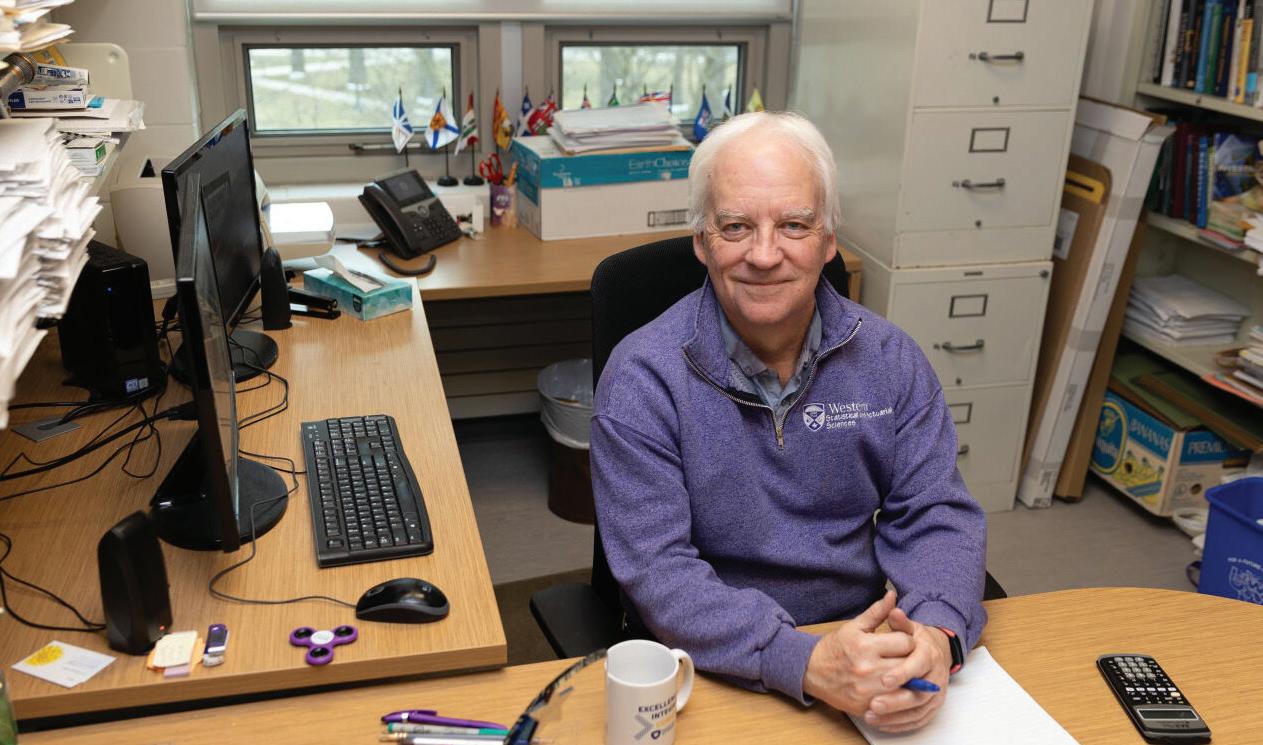
What do sports broadcasting, music radio and Western’s statistics department have in common? Not much, except Steve Kopp.
Almost every Thursday for the last 41 years, Steve has been entertaining Radio Western listeners on all things music and sports. He’s been calling Western University’s hockey games since 1981 and has been one of the voices for Mustangs football since 2011.
“No one said I couldn’t do it. And no one told me, ‘You know, it’s time for you to retire,’” Steve says. “I’ve just continued doing it. I still like it. I love it, actually.”
When he isn’t keeping London up to date on all things Mustangs, he’s a lecturer in Western’s statistical and actuarial sciences department.
Steve studied math and economics when he was undergraduate at Western in the class of 1982 and completed a masters in statistics to enter the actuarial sciences.
It’s safe to say that his career has served him well, especially when he prepares stats for his play-by-play commentary.
Steve began his sports media career as a sports editor at the Western Gazette in his second year of university, where he mainly wrote about hockey. At the time, the Gazette was just his way to get his mind o school.
His first story was published in October 1979. It was about the upcoming NHL season.
“Wayne Gretzky, last year’s all-world rookie of the year, will be entertaining fans in all NHL arenas this season. Players of his talent only come along once every 5-10 years,” the article by Steve read.
The following year, Steve saw a post promoting Radio Western on a bulletin board beside the Gazette o ce that would kick-start his broadcasting career.
Steve had always pictured himself doing radio sports. As a child, he would recite mock “sports
reports” in his sisters’ bedrooms. “And now for the sports!” he’d exclaim.
Now, he saw his chance to do it for real. He decided to go and see what it was about.
On Sept. 17, 1980, Steve walked into Radio Western’s broadcast studio. That day, he attended an information session and joined the station. Radio Western, at the time, was a periodical radio show held on another station and a closed-circuit broadcast that you could only listen in certain areas on campus. They became their own station in 1981.
Almost 43 years later, Steve hasn’t walked out.
Steve soon became the sports director at Radio Western and broadcast the first Mustangs hockey game just a couple of months after he started. To Steve, it never mattered how many people tuned in to the game. He spoke to his audience as if they were at the game
“So we didn’t have a lot of listeners, but who cares, right? You’re sitting there thinking that you’re at a Stanley Cup Final. And I just find it really exciting to do that,” Steve says. “Even though it’s university sports, and not that many people were listening back then.”
A strong competitor of Radio Western is Ontario University Athletics TV which has given people the opportunity to watch games online instead of listening to the radio. While Steve acknowledges that it has diverted some from listening to the games, he still pictures the people listening. He says, this, combined with his his love of university sports, is why he continues to do it.
The Radio Western commentator has interviewed many athletes over the years, from Mustangs student-athletes to professional legends. A couple of his most notable interviewees are hockey hall-of-famers Ken Dryden and Bobby Hull.
Steve has also been hosting his music show, “History Of Us,” since 1983. Last July, he celebrated his 2,000th show.
“History Of Us” played exclusively 1960s hits until 1994, when Steve decided it was enough of the decade. He moved on to playing 1980s alternative music, a theme that continues to this day. The show’s name was inspired by a song from one of his favourite bands, The Indigo Girls.
“It’s my least favourite Indigo Girls song. But I call it the ‘History of Us’ because it was supposed to be kind of the history of us,” says Steve. “‘Us’ being Radio Western.”
Outside of Radio Western and his day job as a professor, Steve volunteers for the Society of Actuaries and sits on several actuarial committees. He’s also a volunteer tour guide at the London Music Hall.
Even with his busy schedule, Steve still finds time in his evenings and weekends to prepare for his broadcasts.
Though he doesn’t get paid, he says, “you do it because you have a love for it.”
While OUA TV has taken a portion of Radio Western’s audience, it isn’t the only obstacle faced by campus media outlets. Steve says that because Radio Western is funded by student fees funnelled through the University Students’ Council — the station’s future is unpredictable.
“Every four or five years, someone comes into the University Students’ Council. And their mandate is like, ‘why are we paying for the station that nobody listens to?’ I’ve heard that every five years.”
With the state of campus media being up in the air at times, Steve often thinks about what would happen if he stopped broadcasting.
“I’d be disappointed because I would no longer be able to do the sports and the music that I do,” he says. “But I’d look back and say, ‘Well, I had 43 years. That’s pretty good.’ I’d miss it. But it wouldn’t be the end of the world.”
Until the future of Radio Western is determined, Steve will continue doing what he loves — playing ‘80s alternative hits every Thursday from 4 to 6 p.m. and commenting on the soundwaves.
“Thank you for spending part of your Thursday night with us,” he’d say.
Vivian Ogor loves to compete, but when she started running, she never would have guessed she would become a titan of the track at Western.
Growing up in the Caribbean, the now-sixthyear 60-metre sprints athlete was exposed to a thriving track culture. She used her natural speed to take sprinting by storm, starting from the age of seven.
“I definitely did not take it seriously in high school at all. I was kind of just there to hang out with my friends and just compete. It was like a way to get out of school sometimes,” Vivian says.
Vivian was just happy to be on the varsity team running the 60-metre dash after coming to Western University to study Kinesiology.
But as someone with a competitive persona, that feeling of just being there wouldn’t be enough.
Through her first three years at Western, Vivian also participated in long jump, but this came with a cost. As she had already su ered from shin splints, Vivian’s second season in London would be cut short due to a stress fracture in her leg.
“It was pretty disappointing because I was looking forward to the season and seeing what I could bring to 60 and long jump when I was doing it,” says Vivan. “I was in a boot for six weeks, and I had to bike for a long time before I could even start running again.”
Being a dual-event athlete came at a cost — Vivian and her coaches decided that she should leave long jump to help her stay healthy and excel in sprinting.
Vivian had a strong support system in her teammates and coaches. They always kept her motivated even when she was at her lowest and helped her back to full strength.
But no one could predict what would happen in Vivian’s third year when she finally returned to the track.
COVID-19 initially postponed, then eventually cancelled the season. Vivian was forced to decide what track meant to her and what she wanted to accomplish with her athletic career.
“I’m getting older, I started taking it more seriously, especially when COVID happened and we didn’t have a season. It made me realize how much track meant to me,” says Vivian.
With this rekindled drive, she pushed harder than ever before. Vivian was ready to win.
With the dedication Vivian has put forth in her sixth season with the Mustangs — practice, physio, meal planning, self-care and goal setting — it’s been a year to remember. She’s done everything she can to ensure that she can compete at the highest level.
“I have my goals written and placed on my door, so whenever I’m feeling unmotivated or discouraged, I look at my goals and remember this is what I want to achieve this season, and I want it bad,” says Vivian.
Her sprinting performances can only be described by one word: dominant.
Vivian blitzed her way to six gold medals over the season. She claimed the 60-metre women’s Western record with a time of 7.37 seconds at the
Windsor Can-Am Classic in early January — a time fast enough to automatically qualify her for the U Sports national championship.
She’s ranked second in the province in the 60-metre dash, but Vivian has her eyes set on a much bigger prize: medalling at the provincial and national track and field championships.
“Definitely not trying to take the gas o the pedal even though I’m ranked,” she says.
This focussed mindset is representative of Vivian’s commitment to herself and her craft.
Vivian’s latest medal of the season came at the tail-end of reading week at the OUA championship, where she helped Western double banner — where both the men’s and women’s teams place first in the province — for the first time in program history.
But her job isn’t finished.
The U Sports championship will take place from March 7 to 9 in Winnipeg — where Vivian has her eyes set on the ultimate accolade: a gold medal at nationals.
As the sun sets on her Mustangs track career, Vivian doesn’t know where her athletic future will take her.
What she does know is that you should never take the little things for granted.
“Make the most of every practice, every race and every moment with your team. One aspect that I’ll always remember is the bus rides back home from meets,” she says. “Because before you know it, you’re in your fourth or fifth year, wondering, where did all the time go?”

a
reality
University should be a safe place for all students. But various incidents of hate crimes against many Muslim students have left an integral community at the university at risk and feeling unprotected.
We, as presidents of the Residents’ Council, are witnessing and experiencing the shift of the campus environment, which drove 10 of us to come together and formulate a statement and letter that addresses the rampant Islamophobia in the “diverse” and “inclusive” Western University community.
The creation of this letter came from a place of us as student leaders demanding the security of all marginalized groups on campus to be guaranteed. We strongly encourage the Western administration to enact measures that guarantee the safety and preservation of the diversity that define and should continue to define the Western environment. To us, signing this letter meant so much more than reputation or taking the “right side of history.” Signing this meant igniting change and standing up for a community to further lead to a safer and more peaceful environment for more communities in the future.
Envision this: you’re a first-year student moving into residence during Orientation Week, and you’re meeting some people from across the hall. Now, imagine that one of these people, who you have never met before immediately acts stando sh and disrespectful, serving cruel looks and snide comments filled with microaggression.
Expand this to the context of your classes, with your supposed peers treating you with this same sense of unjust hatred every day. How would you feel?
Following Oct. 7, 2023, outright violence began to be experienced more and more frequently on campus, making students fear for their own immediate safety. This sense of fear and lack of belonging does not align with Western’s community ideals, and we cannot stand by while our own peers and friends are forced to accept this as their reality.
As with any problem faced in another’s life, unless we have truly experienced their life alongside them, it is impossible to fully comprehend their unique pain and challenges. This remains true with Islamophobia, and any other form of hate.
Unfortunately, it can be hard to resonate with the issue and empathize with the victims without being the victims themselves. To understand this, consider that in 2016, across the country, 28 per cent of Canadians viewed Muslims unfavourably, while this was even higher in Quebec at 48 per cent.
The path to genuine understanding and empathy is self-directed and requires us to be honest with ourselves about how we feel and take steps to better educate both ourselves and others.
This is a path that we must take on campus — we cannot accept hatred and exclusion as the norm.
We hold the belief that a group chat made solely for the purpose of safety emergencies on campus with Arab and Muslim students should not need to exist. When hundreds of students expressed in group chats that they are scared for their safety at their school — and even home for the students on campus — we think there is a fundamental problem with how the administration approaches this issue as a whole.
Various clubs on campus have taken the lead in their attempts to advocate for providing students with the basic human right of being visibly Muslim or Arab — a responsibility that the administration should have done long ago.
We believe that as members of the Western community and sharing a space with marginalized students, it is the responsibility of every person to educate themselves. Using academic resources, students should aim to form an opinion on the global crisis that personally a ects so many Muslim students on campus.
We want to remind students that staying ignorant about this issue is a privilege and urge the student population to unite in their advocacy. Speak up and report instances of Islamophobia, provide resources to students you personally know who have dealt with racist attacks, and use your voice to share your concerns with Western’s administration.
Our hope with writing a letter to Alan Shepard and the administration was to kickstart a movement that brings these issues to the forefront
of Western’s governing bodies. We ask for your support in continuing to share our voice, as well as continue the conversation around this issue with the utmost transparency.
The already positive responses to the letter posted online have shown how powerful our voices as first-year students are, and how we should all use our voices to stand up against all forms of hate.
We want the Western administration and student leaders to address each of our action points in a meaningful and e ective manner. We want accountability and action from everyone, one that ensures that people know Western will not tolerate this behaviour as they have been.
— Zainab Al-Rammahi, first-year medical sciences student and Lambton residence council president; Madhav Satija first-year computer sciences student and Perth residence council president; Gurleen Kaur Rangi, first-year English student and Alumni residence council president and Kamiylah Tynes-McKenzie, first-year medical sciences student, Medway-Sydenham residence council president
Rita Shweihat and Riya Chakraborty helped in the development of this article To submit
As my first year at Western drew to a close, I let it rain in the Essex dining hall — buying everything left and right as if my ONEcard was set to self-destruct on April 30. Looking back on this today, I realize that this definitely would not have been the case had I been a foodinsecure student.
Food insecurity is the inability to acquire or consume a su cient quantity of food or an adequate quality of diet. The uncertainty regarding one’s ability to eat due to financial and social constraints persists.
I want to advocate for the Pay It Forward initiative at Western University, where students can donate ONEcard meal plan dollars, which are in turn reassigned to food-insecure classmates.
In this program, students would face fewer barriers in receiving aid than the traditional food bank model: they face less stigma, are anonymous when accessing aid, have roundthe-clock access and can account for specific cultural/dietary preferences.
The initiative is extremely feasible, as Western already has a comprehensive credit topup and management system built on univer-
sal ONEcards accepted at everything from on-campus grocery stores and eateries, to select o -campus eateries.
Western should implement this initiative as it is one of the most sustainable schools in the world — championing the United Nations sustainable development goal of no hunger.
Across campus, food insecurity is skyrocketing. In 2023, the University Students’ Council’s Food Support Services experienced a 600 per cent increase in demand. With such student demand, they had to cease in-person operations due to supply shortages temporarily.
Also, according to a report by Meal Exchange, around 39 per cent of Canadian post-secondary students experienced food insecurity — a leading cause of stress, anxiety and decreases in well-being and academic performance, as found by Temple University’s Hope Center for College.
Comparable donation models have already seen considerable success at University of Toronto, the University of British Columbia, the University of Michigan and even Queen’s University.
Queens’ “Swipe It Forward” program allows students to donate their unused meal swipe or


dining credits to fellow students who are experiencing food insecurity or financial di culties. The program has served 14,500 meals to over 800 students since its inception in 2018 and serves as a formidable example for students of other post-secondary institutions to advocate for a similar initiative.
With a nearly identical meal plan system, Western should take note of Queens’ success, bolstering our confidence that Pay it Forward can be implemented here.
Altogether, Pay it Forward would provide a much-needed, on-campus alternative to the strained USC food bank, allowing students convenient access to food — all while remaining stigma-free. It’s a logical and expected next step as our university should play a role in addressing food insecurity.
It’s up to universities to help their students who face this issue, and up to students to help each other. When we’ve used up most of our meal plan and have even a few dollars left that can’t even buy a grande latte, we should have the option of giving back and paying it forward.
Academic stakeholders of all walks of life have become more aware of food and its stretching
social impacts. Championing a program that addresses food insecurity will not only set Western on the right path to better serve its community but also help it become an operational and reputational leader in food circularity.
Western prides itself on its student experience. This initiative would be a natural extension of the investments already made in student well-being. To state the obvious, food is required for survival. Thriving is a distant hope when students’ most basic needs are left under-supported. A community that cares and a community that centers care would not leave Pay It Forward unactioned.
It is time for Western to help students, help students. Together, let’s pay it forward.
Show your support by sharing your meal plan statistics and advocating for Pay it Forward today.
— Saanvi Kapoor, third-year Ivey student and founder of the Pay It Forward initiative
To submit a community opinions article, email hannah.alper@westerngazette.ca