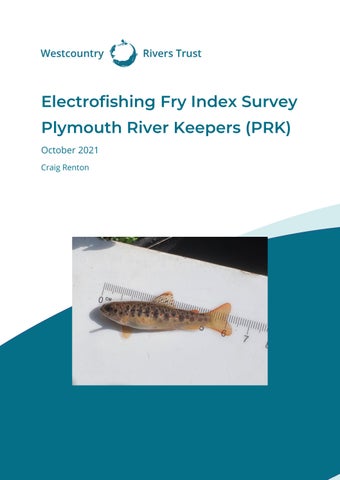
Electrofishing Fry Index Survey Plymouth River Keepers (PRK) October 2021 Craig Renton
016
Westcountry Rivers Trust Electrofishing Survey Report – PRK 2021
Westcountry Rivers Trust is an environmental charity established in 1995 to restore, protect and improve the rivers, streams, and water environments in the region for the benefit of wildlife and people.
This report has been written and prepared by: Craig Renton
Published by:
Westcountry Rivers Trust Rain Charm House, Kyl Cober Parc, Stoke Climsland, Callington, Cornwall, PL17 8PH. Tel: 01579 372140 Email: info@wrt.org.uk Web: www.wrt.org.uk Charity no. 1135007 Company no. 06545646
Document history: Revision
Details of Revision
Prepared by
Checked by
Approved by
Draft
For comment
Craig Renton
Olivia Cresswell
Olivia Cresswell
Date of Issue
© Westcountry Rivers Trust: 2021. All rights reserved. This document may be reproduced with prior permission of the Westcountry Rivers Trust
1
Westcountry Rivers Trust Electrofishing Survey Report – PRK 2021
Executive Summary Westcountry Rivers Trust (WRT) undertook electrofishing (EF) surveys throughout the small streams of the Plymouth River Keepers project area within Northwest of Plymouth during the summer of 2021. The surveys are the first year of a three-year monitoring effort funded as part of the wider Plymouth River Keepers project (PRK). Salmon were absent at all survey sites along with complete absence of any fish species at some of the survey sites. Th only species that were present at some sites were brown trout and European eel. Conservation strategies, such as the Defend/Repair/Attack approach, can be applied on a sub catchment level with recommended fisheries management actions suggested to either improve or maintain salmonid habitat and numbers.
2
Westcountry Rivers Trust Electrofishing Survey Report – PRK 2021
Contents Executive Summary........................................................................................................................... 2 Contents .............................................................................................................................................. 3 1.
Introduction ............................................................................................................................... 4
2.
Methodology............................................................................................................................... 5 2.1
Electric Fishing Protocols............................................................................................................. 5
2.2
Life Cycle and Bottlenecks .......................................................................................................... 6
2.3
Catchment-Based Fisheries Conservation Strategy (Defend/Repair/Attack) ...................... 7
2.4
Site Selection ................................................................................................................................. 7
2.5
Field Sampling and Data Analysis .............................................................................................. 8
3.
Results ......................................................................................................................................... 9
4.
Discussion ................................................................................................................................. 11
5.
Recommendations................................................................................................................... 12
6.
Acknowledgements .....................................................................................................................
3
Westcountry Rivers Trust Electrofishing Survey Report – PRK 2021
1. Introduction The Westcountry Rivers Trust (WRT) undertook 11 semi-quantitative fry index electrofishing surveys on the small streams withing the PRK project area within the Tamar catchment in September 2021 (see Figure 1). The three streams have been named Reach 1, 2, and 3 with in the wider PRK project. This was the first year of fish monitoring undertaken by WRT and forms part of establishing a long-term dataset of semiquantitative fry numbers. Sites were selected based on potential fisheries improvement works that are scheduled be carried out within the project area. Monitoring will aid in understanding if improvements have been effective in increasing fish numbers and/or presence of already absent species. It is hoped that these sites will continue to be surveyed every year to build a strong baseline dataset for the catchment.
Figure 1 Site name and location reach names
4
Westcountry Rivers Trust Electrofishing Survey Report – PRK 2021
2. Methodology 2.1 Electric Fishing Protocols Electrofishing uses a controlled electric current to induce fish to swim toward an anode and into a hand net, and thereby be counted and assessed. When carried out correctly by experienced and qualified surveyors, it is not harmful to fish and the fish are released back to the same location they were caught. In upland streams and shallower sections of rivers, an electrofishing backpack is used and therefore this type of kit was used for all the PRK surveys. There are several approaches to electrofishing assessments in rivers; quantitative, area semi-quantitative and time semi-quantitative methodologies. All three methods have their advantages and disadvantages. Quantitative electrofishing is a thorough methodology that has the highest degree of accuracy of all the methods. The main disadvantages of this approach are it is less mobile than backpack equipment and it takes longer to undertake surveys. It Is therefore more costly than other approaches. With this method, an area of river is netted off and the fish are removed from this defined stretch in multiple passes until sufficient fish are removed to form a very accurate assessment of species and numbers. It is not required to remove all the fish from the area but rather ensure a consistent fishing method that gives a linear decrease in the number of fish caught per pass. The overall catch decline gives an accurate estimate of the total number of fish in the location. This is known as the ‘depletion’ methodology. An area-based semi-quantitative electrofishing methodology follows the same process as quantitative electrofishing but only a single pass is carried out. A lack of multiple passes renders the method only semi quantitative and therefore less accurate, but it has the advantage of being much quicker than the depletion method, and it is suitable for use on all waterbody types. It is able to detect multiple species and is reasonably accurate but is less time efficient and therefore costlier than a time-based methodology (described below). A time-based, semi-quantitative electrofishing methodology differs from both the approaches described above. Instead of limiting the area fished (by use of nets) it limits the amount of time used to fish to assess fish numbers. As no nets are deployed, fish in deeper sections of large rivers can frequently avoid capture using this method. It is therefore only suitable to assess salmonid fry, who are restricted to a shallower section of upland streams and rivers. This method is extremely rapid and therefore costeffective, allowing for deployment across whole river catchments although its major drawback is its lower accuracy than netted approaches. In weighing up the pros and cons of the various approaches it is worth considering what would be required for a truly reliable method. In scientific publications it is usually considered that if an approach is accurate 95% of the time then this is an acceptable 5
Westcountry Rivers Trust Electrofishing Survey Report – PRK 2021 standard. Such an approach would be said to have sufficient statistical power to answer the question asked, for example, ‘has this habitat improvement resulted in more fish in
the area studied?’. For an electrofishing methodology to have sufficient statistical power it requires a large number of sites to be fished in a fully-quantitative depletion methodology over a number of years. As such an effort is rarely practicable and will cost more than the habitat improvements it attempts to measure, this approach is rarely applied in the UK. River managers in the UK have limited budgets and therefore it is the case that an electrofishing programme of insufficient statistical power to achieve 95% confidence is usually accepted as a compromise between accuracy and cost. Bearing in mind the limits of statistical power that these approaches usually have (as practically applied), it is important to consider the aim of a given electrofishing programme. In the case of WRT’s catchment scale electrofishing programme, the aim is to build up historical data on each catchment to provide information as to how to best take action to improve the fish stocks for salmon and trout. To achieve this, the largest number of sites possible for maximum catchment coverage must be fished over several consecutive years to i) guide current/future conservation strategies and ii) identify whether or not the actions taken on the catchment have had a positive effect on fish numbers. Most importantly the electrofishing programme is specified to be carried out at a catchment scale where salmon and trout spawning areas occur. As most rivers have many tributaries or main stems of considerable length, a relatively large number of sites are required for full coverage. This typically equates to between 20 to 100 sites on rivers in southwest England, depending on the river catchment geography. All things considered, a timed semi-quantitative approach was considered most appropriate for the WRT electrofishing programme. This method will indicate the main issues and areas that need addressing on a river catchment including: • •
Upstream barriers to fish-passage Degraded habitat quality
• • •
The upper limit of salmon spawning Successfully/Unsuccessfully enhanced habitat Catchment-scale fry migration due to river levels
•
Point source and diffuse pollution
2.2 Life Cycle and Bottlenecks The aim of the semi-quantitative electrofishing program is to identify issues that prevent salmonids from effectively completing their life-cycle, and then proposing solutions that are proportionate to the issue at hand. It is useful to adopt certain conceptual frameworks to each of these aims, and in this report, we will use two of these frameworks; the ‘habitat bottlenecks’ that describe the causes of issues in salmonid ecology (Figure 2), and the ‘Defend/Repair/Restore’ conservation strategy framework which describes the appropriate habitat action depending on the ecological situation found at the site.
6
Westcountry Rivers Trust Electrofishing Survey Report – PRK 2021
Figure 2 Diagrams defining salmonid habitat bottlenecks (Summers et al, 1996)
2.3 Catchment-Based Fisheries Conservation Strategy (Defend/Repair/Attack) In using the fry index classification, catchment population abundance monitoring and determining the river reach density classification, a series of priority areas can be outlined, and management recommendations made tailored to the particular species. Recommendation actions broadly follow the Defend/Repair/Attack concept, developed by Ronald Campbell of the Tweed Foundation. For every river reach that is classified, a management action can be loosely determined. Whilst this provides a useful structuring framework, the reality of given situations can bring many complexities and lies on a continuum between these extremes. The goal is to move the river reaches of the PRK area up from the unstable point (i.e. poor fish stocks and habitat) to the broad top of a healthy, natural riverine ecosystem. Where the populations are in a very poor state, radical actions may be required to see a change. Conversely, where the stocks are already good, habitat re-engineering and stocking operations would be inappropriate. Actions to achieve these improvements can be divided between ‘fish stock actions’ such as fish translocations or bag limits for anglers and ‘fish habitat actions’ such as removing barriers to migration or coppicing. In many situations, both types of action will be required. This concept helps divide catchment scale management for fisheries into priorities and therefore can help to maximise multiple benefits through targeted work. 2.4 Site Selection Survey sites in the PRK area were selected to provide representative samples from distinct river reaches, characterised by habitat type, proximity to barriers and proximity to targeted restoration works under project. Sites are proposed by WRT and will help to contribute to a longer-term EF survey dataset where trends can be established, and positive or negative patterns of salmonid recruitment inferred based on the findings within a sub catchment. 7
Westcountry Rivers Trust Electrofishing Survey Report – PRK 2021 2.5 Field Sampling and Data Analysis Permission for all sites was established before electro fishing surveys took place and each site was electrofished by a two-person team. The voltage of the unit was set at each site depending on the water conductivity, measured using a handheld conductivity meter. The operatives fished continuously for a standard five minutes over suitable fry habitat without the use of stop nets. The fishing area was variable, and the length of fishing time was fixed. Fish were collected in a net and placed into a holding bucket before processing. All salmonids were identified to species and fork length was measured and recorded. Numbers or density estimates were recorded for all other species captured. Habitat features such as land use, substrate type and shading were recorded at each site. Any fry that were missed or escaped during electrofishing were assigned to either trout or salmon groups depending on the relative percentage of each species already recorded at the site. The results of the electrofishing survey are classified according to the methodology of Crozier and Kennedy (1994), displayed in table 1 with each site being given an equivalent density classification compared to quantitative monitoring. This semi-quantitative methodology was designed by Crozier and Kennedy for both salmon and trout. However, the results for trout need adjustments to consider the difference in the regression line for trout and salmon as described by Crozier and Kennedy. Table 1 Semi-quantitative abundance categories for salmon fry (Crozier & Kennedy, 1994) Density Classification
Semi-quantitative (n 5min fishing)
Quantitative (n 100m2)
A (Excellent)
>23
>114.7
B (Good)
11-23
69.1-114.6
C (Fair)
5-10
41.1-69.0
D (Poor)
1-4
0.1-41.0
E (Absent)
0
0
Based on the lengths of fish captured during the survey, using a length frequency histogram, trout fry were considered to be any individual measuring up to 110mm (Figure 3). Salmon fry were absent from all sites so no frequency distribution was made.
8
Westcountry Rivers Trust Electrofishing Survey Report – PRK 2021
Brown trout frequency distribution 2021 30 25
Frequency
20 15 10
5 <=45 46-50 51-55 56-60 61-65 66-70 71-75 76-80 81-85 86-90 91-95 96-100 101-105 106-110 111-115 116-120 121-125 126-130 131-135 136-140 141-145 146-150 151-155 156-160 161-165 166-170 171-175 176-180 181-185 186-190 191-195 196-200 201=>
0
Size (mm)
Figure 3 Trout fry length frequency distribution, PRK 2021
3. Results WRT surveyed 11 semi-quantitative sites within the PRK area in September. Weather and general survey conditions were mostly favourable, with dry weather and optimal flows. Some rain did occur during some of the surveys which momentarily increased the turbidity of the river effecting the visibility. Surveyors kept a close eye on river water temperatures to ensure surveying did not proceed if water temperatures exceeded 18°C, in accordance with Environment Agency guidance. The 2021 surveys demonstrate that the small streams within the PRK project area have the potential to support excellent salmonid spawning and the importance of these small streams to salmonids. There were two ‘A’ classification sites in 2021, along with two ‘B’ sites. Trout fry were absent from seven of the 11 sites. It appears when trout were present, they were present in relatively good numbers and a total of 151 trout fry were caught across four sites. The DS Whitleigh Wood Bridge site outperformed all other PRK sites this year, achieving an excellent classification with 75 trout fry being recorded within the five minute survey. DS Tamerton Foliot Rd was the only other site to achieve an excellent classification with 29 fry recorded. Both the Thilmere Gardens and US Seven Stars sites both achieved a good classification with 12 and 23 fry recorded, respectively and were the only remaining sites to have trout fry present. In addition, all the sites which had trout fry present also recorded trout parr and European eel. The only site to have eel present as the only species alone was US Estuary.
9
Westcountry Rivers Trust Electrofishing Survey Report – PRK 2021 Table 2 PRK salmon and trout fry classifications including parr/adult life stage and eel presence absence for 2021. Reach ID 1 1 1 1 1 2 2 2 2 2 3
Site Name
Salmon fry classification (no. of fish)
Trout fry classification (no. of fish)
No. salmon parr
No. trout parr
Eel (present/absent)
Bodmin Rd
E (0)
E (0)
0
0
A
Canterbury Dr
E (0)
E (0)
0
0
A
Budshead Rd US Estuary US Pond Between Sluices DS Tamerton Foliot Rd DS Whitleigh Wood Bridge Dunraven Dr Thilmere Gardens US Seven Stars
E (0) E (0) E (0) E (0) E (0)
E (0) E (0) E (0) E (0) A (29)
0 0 0 0 0
0 0 0 0 1
A P A A P
E (0) E (0) E (0) E (0)
A (75) E (0) B (12) B (23)
0 0 0 0
11 0 6 3
P A P P
Figure 4 Trout classifications, PRK 2021
10
Westcountry Rivers Trust Electrofishing Survey Report – PRK 2021
Figure 5 European eel presence and absence map
4. Discussion Overall, the PRK small streams underperformed, and whilst there were trout present in good numbers in Reach 2 and Reach 3, most sites were absent of all species. The same applied for European eel being present in less than half of the sites surveyed. Reach 1 was the worst performing of the small streams, with only eel present in the lowest of sites and no trout caught throughout its entire length. There are two significant barriers in the form of pipe culverts in the lower section of the stream and directly above the lowest site. The data would suggest that these are impacting passage of both trout and eel. This is further strengthened by data already acquired by the PRK project surveys conducted on these structures, which have indicated they likely present a complete obstacle to all fish species and all life stages. Reach 2 performed the best; with trout and eel being recorded at three of the five sites surveyed with the highest number of fish being present at the lowest sites and slightly decreasing the further upstream sites were located. However, there were some good sections of habitat present along this reach with dappled light, tree roots and refuge established along the banks with deeper pool sections present to hold larger numbers of fish. Again, a pipe culvert was present on the more northerly section of the stream as it forked off from the main stream and this is where all fish species were found to be
11
Westcountry Rivers Trust Electrofishing Survey Report – PRK 2021 absent. As with Reach 1 previous structure assessments support that this pipe culvert is a complete obstacle to all fish species and life stages and would support the lack of fish present in this section. Further man-made structures are present along this section further increasing the likelihood of impediment to fish passage. Unfortunately, due to landowner permission not being obtained, only one survey site was conducted at the lower end of Reach 3 but did produce good numbers of trout and eel. Habitat upstream also appears to be of good quality and would suggest the possibility of trout also being present in this section but further investigation into other obstacles that may be present is needed. Apart from the structures limiting the free passage of fish to access better quality habitat and spawning areas, some of the areas of these small streams really lacked quality habitat to support the basic needs of many fish species. Long areas of these streams were completely tunneled and shaded and suffered with high levels of siltation in places. Furthermore, water quality has been an issue in the area with a number of Category 1 fish kills previously taking place due to pollution and run off.
5. Recommendations The WRT EF surveys are undertaken to gain an understanding of year on year recruitment in salmon and trout, but they have slightly different habitat preferences, and one species will often dominate over the other where the other has limited or no presence. There will be natural annual variations in populations, and this is to be expected depending on the success of recruitment of a species. Despite excellent trout fry populations in some areas, it is important that defence strategies are put in place to maintain good recruitment and to restore numbers elsewhere in the PRK project area. In all areas, salmon are absent, then the attack strategy and appropriate actions should be implemented where funding allows. Therefore, management strategies need to be considered for each species, hence a conservation strategy for both salmon and trout. The strategy for restoration and conservation of sites suggested here broadly follows the “Defend, Repair, Attack” (DRA) concept (Table 3) developed by Ronald Campbell of the Tweed Foundation, and has, in the past, been applied locally in the Exe catchment by the River Exe and Tributaries Association project. The fry productivity of the rivers is assessed by a combination of historic semi-quantitative electrofishing results. These results are then applied in context of existing plans (e.g. Salmon Action Plan, habitat walkover surveys and genetic data) to produce assessments and recommendations for each subcatchment of the river. These sub-catchments are classified according to three levels:
Defend, Repair, and Attack. Despite the DRA strategy being a useful tool to identify and prioritise works in catchments, the requirements of waterbodies can rarely be quite so clear cut. The coloured arrow in table 3 represents the continuum of the three strategies and the goal for each waterbody; to move all the PRK sites from their current position to somewhere
12
Westcountry Rivers Trust Electrofishing Survey Report – PRK 2021 in the Defend category, or to ensure they remain in this status if fish stocks are already good. Table 3 Defend/Repair/Attack strategy
Category Defend
Status These areas have good fish stocks and habitat and need safeguarding actions to ensure no decline occurs.
Repair
These areas have moderate fish stocks, and fish habitat in a moderate condition; these areas need assisted habitat recovery to move them into the Defend category.
Attack
These areas have poor fish stocks, and the habitat is significantly degraded. These areas need drastic intervention such as habitat reengineering in order to improve their status.
Action Maintain bag limits Habitat Safeguarding
Catch and release Assisted habitat recovery
Stock action Habitat re-engineering
Table 4 PRK sub catchment classification and DRA strategy Sub-catchment
Reach 1
Average Fry Index Class & Conservation Strategy Salmon Absent
Absent
Attack
Attack
Absent Reach 2
Absent Attack Absent
Reach 3
Trout
Absent Attack
Fair Attack
Good Repair
13
Westcountry Rivers Trust Electrofishing Survey Report – PRK 2021 Sub-catchment
Average Fry Index Class & Conservation Strategy Salmon
Trout
To begin to restore and/or maintain fry habitat in the PRK project area, WRT recommend the following works: •
Coppicing: Targeted selective coppicing of woodland and abandoned riparian coppice adjacent to juvenile habitat riffles should be undertaken. This will increase primary productivity and food source for juvenile fish. Shade should be maintained on deeper pools and runs for water temperature and adult fish habitat cover.
•
Erosion Control: Fencing and effective marginal habitat management will reduce erosion. However, where specific areas of high pressure and vulnerability are identified, erosion protection measures such as woody debris installation, environmentally sensitive revetments, and strategic tree planting would be advantageous.
•
Fish Passage Assessment: Assessment of potential fish migration barriers using the Coarse Resolution Rapid Assessment technique developed by the Scottish and Northern Irish Forum For Environmental Research (SNIFFER). A standardised survey technique to assess porosity of in-channel structures.
•
In-Channel Habitat Restoration: Installation and construction of habitat enhancing features, including woody debris introduction, flow manipulation with groins and kickers, bank reprofiling for marginal zonation, strategic tree planting, gravel introduction and riffle creation, and historic channel restoration. Advanced management usually applied post success of other
•
•
recommended actions. Interpretation: Sensitive spawning sites can be exposed to disturbance at key times of year. Interpretation can be used to inform of salmonid presence and advise on in river site avoidance. Increase monitoring effort: Some sites are very difficult to access and therefore are not surveyed. By increasing survey effort, more information on whole catchment performance can be achieved and allow for increase appropriate action. Increased surveys could include EF surveys red counts, invertebrate monitoring e.g. Riverfly and citizen science programmes that are run by WRT.
14
Westcountry Rivers Trust Electrofishing Survey Report - PRK 2021
Table 5 Recommended DRA actions for PRK sub catchments Action
Sub catchment
Fencing
Coppicing
Erosion Control
Fish Passage Assessment
In-channel Habitat Restoration
Reach 1
✓
✓
✓
✓
Reach 2
✓
✓
✓
✓
✓
✓
Reach 3
Modify Flow Regime
Increase Walkover Surveys
Interpretation
Monitoring Effort
✓
✓
15
6. Acknowledgements Thanks to all landowners involved for their kind permission to undertake the surveys and to the Environment Agency for providing consent for the surveys.
16