WaterGrid_MartinBlackwell_TCPJune2026

Page 1


WaterGrid Project

Westcountry Rivers Trust

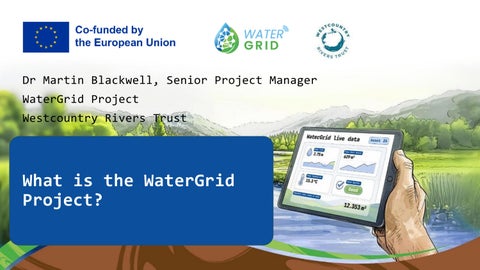
What is the WaterGrid Project?

Project full title: Nature Based Smart Water Grids for Integrated Water and Drought Management

GENERAL:​

Horizon Europe ​Project

September 2025 – August 2029​

Total budget: €7.55 M ​

23 partners​

13 countries​

WRT lead partner

• Across a range of bioclimatic zones • Range of scales • Range of settings (including urban)

Smart Water Grids – the Concept​

Aim 1: Take farms ‘off-grid’ Reduce reliance on mains water Active water batteries

Aim 2: Maintain river baseflows and groundwater tables (for abstraction purposes) Passive water batteries

Nature Based Solutions​

Floodplain restoration and channel creation

Infiltration ponds (groundwater recharge)

Sustainable urban drainage systems (SUDS) and tree pits

• Nature-based solutions (NBS) are actions or measures inspired by, supported by, or copied from nature.

• For drought resilience it focuses on measures that can store water available in times of plenty such as winter and storm rainfall, so it’s available in times of deficit.

Ponds and small lakes
Leaky dams
Wetland restoration

Smart Water Grids​- Why?

Water Supply Options​

Smart Water Grids​

Conflict? Biodiversity vs Water Provision

High biodiversity value

Potential clogging of pipes

Greater need for purification

Drawdown can damage ecology

Cleaner water

Less clogging risk

No damage on drawdown

Little biodiversity benefit

Where and where not to site ponds? ​

• Mapping areas most suitable for locating ponds

• Funding to construct 20 ponds

Upper Tamar and Luckett catchments

Ephemeral ponds Bunds and swales

Inventory of ponds in the Upper Tamar

Partners and Acknowledgements​

Project Coordinator:

Jenny Wytcherley

Holly Pearson

Sarah Wigley

Laurence Couldrick
Sarah Howe
Lucia Grimm

Turn static files into dynamic content formats.

Create a flipbook
WaterGrid_MartinBlackwell_TCPJune2026 by Westcountry Rivers Trust - Issuu