CSI Case Studies: The River Lim Action Group WHO?
WHY?
The River Lim Action group was formed in 2022 to monitor the River Lim in Lyme Regis and improve water quality.
We got started because Dorset Council put up a sign saying the river was polluted and children shouldn’t paddle in it. We found that shocking - how could the water quality be that bad? We have unravelled a litany of problems affecting the water quality and have successfully stopped some of the illegal discharges. Identifying problems and working with South West Water, the Environment Agency, the Town Council and Dorset Council is what motivates us. It has resulted in much better data and improvements.
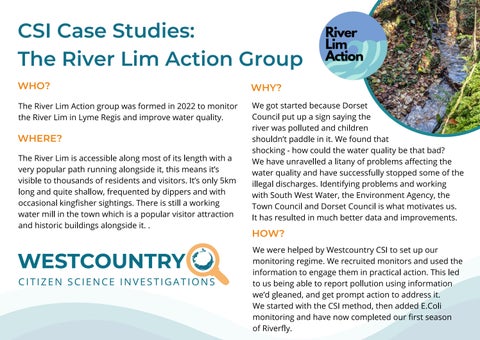
WHERE? The River Lim is accessible along most of its length with a very popular path running alongside it, this means it’s visible to thousands of residents and visitors. It’s only 5km long and quite shallow, frequented by dippers and with occasional kingfisher sightings. There is still a working water mill in the town which is a popular visitor attraction and historic buildings alongside it. .
HOW? We were helped by Westcountry CSI to set up our monitoring regime. We recruited monitors and used the information to engage them in practical action. This led to us being able to report pollution using information we’d gleaned, and get prompt action to address it. We started with the CSI method, then added E.Coli monitoring and have now completed our first season of Riverfly.
WHAT’S NEXT? We hope to get our bathing beach designation application approved by DEFRA. It’s directly affected by the water quality in the river so this is really important in terms of securing monitoring, better information and more resources to improve things. We commissioned a freshwater ecologist to help us identify the baseline information for the river and a set of actions that we aim to tackle next. Here’s a summary: The sewage system needs repair and development, and to be managed to cope with storm influx to reduce sewage discharges to an insignificant level. Farm improvements to be made in water separation systems and waste containment. Also, protection of riverbanks by cattle fencing. Improve fish and eel passes Start strategic Himalayan balsam control. Eradicate Japanese knotweed. Hinge tree limbs into barren river. Carry out some laurel canopy thinning. Continue to monitor invertebrates and improve our methodology and kit for monitoring bacteria, continue with the CSI testing for another year but improve our ammonia/phosphate kit.
CHALLENGES Dealing with South West Water (SWW). Our primary issue is sewage pollution and, for the most part, it’s SWW that can fix it. Communications have been positive at times and at other times less so. They aren’t always as forthcoming as they might be and are keen to put a positive spin where it might not exist. We were particularly shocked by their CSO data in 2022 and the fact there’s no effective regulation to ensure information is correct.