CSI Case Studies: Chardstock Eco Group WHO?
WHY?
We are Chardstock Eco Group. Chardstock is a small, rural community in the very east of East Devon.
All that said, why do we do it? Because it’s fun, it’s exhilarating, it’s about great community relationships, working together, learning and challenge. It’s so much better than vegging out on a sunbed in Benidorm. We live in a special place, and we believe we can make a difference.
WHERE? The Kit Brook is a very special little river. Just six miles long, she rises in the Blackdown Hills, flowing mostly through a protected landscape and rural Westcountry countryside before joining the River Axe at a Special Area of Conservation (SAC) and SSSI. She is a flashy river, rising quickly during storm events, which means flooding. She’s also a national spawning river for seatrout, although numbers have drastically diminished. In winter 2023, a two foot long seatrout was washed out of the river during a storm and died stranded on a ford bridge much to the astonishment of locals who had no idea there are fish in the river of that size.
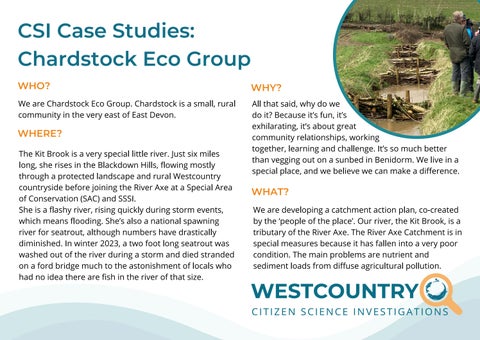
WHAT? We are developing a catchment action plan, co-created by the ‘people of the place’. Our river, the Kit Brook, is a tributary of the River Axe. The River Axe Catchment is in special measures because it has fallen into a very poor condition. The main problems are nutrient and sediment loads from diffuse agricultural pollution.
WHAT’S NEXT?
HOW? We joined Westcountry CSI because our volunteers wanted something to do outdoors that was a bit different. At that time we didn’t know our river was a bit pants. We just wanted to be outdoors. We quickly realised though that while CSI gets you outside learning about the river, and gathering a shed-load of data, we’re doing nearly 120 surveys a year, it doesn’t make the river any better. And the only people who can do that is us.
We have completed phase two of the Kit Brook project, which will ended in March 2024. Now, we are creating the catchment action plan. Our funding is paying for a farm adviser, a river catchment technical expert and a community engagement co-ordinator. We kicked off with the baseline habitat survey 50m either side of the river corridor and a hydromorphological survey. We’re committed to training volunteers to carry out biodiversity surveys to see how feasible it is to use non-professionals for this work. Along the way we hope to get some more natural flood management interventions.
CHALLENGES Keeping volunteers motivated and intrigued is an important challenge to address and for this we must show them the results of what they do, and how it makes a difference. Collecting data for data’s sake can become tedious. Then there is the bureaucratic, complex, slow process that is the funding rounds. And of course there is a constant problem of too much work and not enough resource or boots on the ground. People like mucking about near a river but they are less keen on the computer/desk-based tasks.