
Quarterly Investor Letter
Q2 2026

This letter is intended for institutional investor audiences. Wespath is a general agency of The United Methodist Church, a 501(c)(3) tax-exempt organization. Wespath administers benefit plans, and its affiliates, UMC Benefit Board, Inc. (“UMCBB”) and Wespath Institutional Investments LLC (“WII”), provide investment management services. UMCBB provides investment management services to funds made available to benefit plan participants and beneficiaries, plan sponsors and other institutions controlled by, associated with, or related to The United Methodist Church. WII provides investment management services to funds made available to institutional investors controlled by, associated with, or related to The United Methodist Church. WII may also provide direct investment advisory services to those investors. WII and UMCBB utilize certain shared personnel, including investment professionals. Unless otherwise noted, the firm referenced herein is defined to include Wespath, UMCBB and WII.
Quarterly Investor Letter
Q2 2026
FROM THE CHIEF INVESTMENT OFFICER
Hello, and thank you for taking the time to read our Q2 Quarterly Investor Letter.
As I reflect on the past quarter, what stands out most is the market’s willingness to embrace risk, even against a complex backdrop. Across both equity and fixed income markets, we saw a clear risk-on tone. This was less about a single catalyst and more about a market that, for much of the quarter, was comfortable moving forward despite uncertainty.
That dynamic was especially visible in how investors responded to developments in the Middle East. The June 17 “Memorandum of Understanding” between the U.S. and Iran introduced a pause in hostilities and reopened key energy and shipping channels. While tensions have resurfaced in more limited ways, markets have largely repriced that risk. Oil prices retraced much of their earlier spike, suggesting that investors viewed supply disruptions as manageable.
The macro backdrop also remained mixed but resilient. The Federal Reserve entered a new chapter under Chair Kevin Warsh, whose early approach has emphasized less communication and more action. Expectations for rate cuts have shifted, and markets now appear more prepared for a higher-for-longer rate environment.
Periods like this can invite strong conclusions, but I find it more useful to stay grounded in what markets are signaling today. This was a quarter where risk assets were well supported and where investors showed a willingness to look through near-term uncertainty. That doesn’t remove the need for discipline, but it does reinforce how quickly sentiment can shift.
Within Wespath, our focus remains on meeting the evolving needs of the clients we serve. Recent U.S. equity fund launches in the I Series reflect our goal of giving clients more flexibility in how portfolios are built. We are also continuing to expand access to private markets and mission-aligned strategies, including the planned launch of our standalone PSP Lending Program I Series fund later this year.
The team and I are very excited to share more about all these stories and updates, both in this letter and in upcoming communications! As always, we thank you for your trust and partnership.

Thank you,
Johara Farhadieh Chief Investment Officer & WII Chief Executive Officer
Key Takeaways from the Quarter
• GDP: U.S. GDP growth for the first quarter was revised upward, to 2.1% annualized. The bulk of this growth was due to private sector investments, particularly related to the build-out of AI. Consumer spending growth was revised down to below 1%, highlighting weaker consumption in the first quarter. As of the end of June, consensus estimates for Q2 U.S. GDP called for 2.0% growth, slightly higher than where estimates stood at the end of last year.
• Inflation: May’s inflation data showed an increase of 0.5% over the prior month, which pushed the Consumer Price Index to an annual rate of 4.2%, the highest reading in three years. The primary driver was energy, up 3.9% for the month alone, driven by global supply chain disruptions from the war in Iran. Stripping out volatile food and energy prices, core inflation still rose at 2.9% annually, above the Federal Reserve’s inflation target.
• Jobs: The jobs report in May was surprisingly robust, and the freshly-printed June figures looked solid. The labor market added an estimated 57,000 jobs in June, which was modestly lower than expected. And while the unemployment rate dipped to 4.2%, that was primarily due to a drop in the participation rate. Still, underlying employment trends appear to be concentrated in only a few sectors of the economy, while many industries still see relatively little job growth.
• The Fed: The U.S. Federal Reserve (Fed) saw its last meeting with Chairman Powell in the quarter and its first meeting with Chairman Warsh. Both meetings kept the Fed funds rate at a range between 3.50% and 3.75%. However, inflation expectations shifted again in the quarter, as robust growth and elevated inflation saw Fed participants signal an increased likelihood of higher rates by the end of 2026.
• Stocks: The Russell 3000® Index saw a 15% return for the quarter, with micro-cap (25%) and small-cap (21%) leading the way. Semiconductor companies saw an 81% increase in the quarter, as the shift in the source of returns turned to the suppliers of the AI buildout, rather than the buyers. The semiconductor hype was also felt overseas, with foreign semiconductor companies and other technology hardware manufacturers increasing over 70%. Companies particularly in Taiwan and South Korea were swept up in the euphoria.
• Bonds: The Bloomberg U.S. Aggregate Bond Index was somewhat higher for the quarter (0.7%). While long-term yields remained elevated, shorter-term yields moved higher throughout the quarter, driven by a more hawkish Fed. This caused the yield curve to flatten in the quarter. Corporate bonds, both in the U.S. and overseas, saw healthy returns, driven by a continued reduction in spreads. U.S. commercial and residential mortgage-backed securities roughly moved in line with the index.
Beyond the Headlines
“Risk-On” Environment Punctuated by Capital Markets Activity
The second quarter of the year was characterized by activity that many investors would recognize as features of a “risk-on” environment. Though not without its volatility, the quarter’s strong equity participation, continued demand for credit and meaningful activity in private markets underscored investors’ willingness to move into and be active within higher-risk areas. And that’s during a quarter which began with a relatively new war in the Middle East, and which witnessed high energy prices throughout!
The willingness to deploy capital held up even against that geopolitical backdrop, and nowhere was it more visible than in deal flow and activity within the capital markets. Companies returned to issuing equity and debt at a pace we haven't seen in years, and a noticeable pickup in IPO activity was underscored by the record-setting offering of SpaceX in June. The space and AI company raised more than $85 billion from its public market debut, and if that weren’t enough, it raised another $25 billion from its inaugural bond offering.
Beyond the hype surrounding SpaceX itself, the company’s IPO also underscores the overall financing boom among tech giants. Alphabet announced a roughly $85 billion equity financing plan in June. Oracle intends to raise $40 billion in a mix of equity and bonds. Meta is considering a stock offering. Anthropic and OpenAI are targeting Q4 IPOs, potentially raising $50 billion each. And SK Hynix, a South Korean chip maker, is also raising capital in U.S. markets, showing that capital raising is a global phenomenon right now, too.
All this capital activity has contributed to an at-least temporary interruption to a long-term trend: Goldman Sachs is now projecting that total U.S. share issuance could surpass share buybacks, which would mark the first time in 23 years the U.S. stock market served as a source of capital for companies rather than a returner of capital through buybacks. This certainly reflects strong investor demand and a willingness to fund growth opportunities, particularly tied to large-scale investment themes like artificial intelligence.
As AI Story Shifts to Hardware, War in Iran Continues to Influence Prices
While it’s certainly not a new story for AI to have been a key market driver in the quarter, we did see an interesting shift in focus in Q2. Earlier in the cycle, attention centered on companies investing heavily in AI capabilities, like the Magnificent 7 tech behemoths. This quarter, the impact concentrated among companies supplying AI-related hardware, particularly semiconductors. In fact, the Philadelphia Stock Exchange Semiconductor Index gained more than 81% in the second quarter, while semiconductor companies on average beat consensus first quarter earnings estimates by over 25% (compared to 8% for the broader S&P 500).
Perhaps unsurprisingly, all the AI-related spending we’ve been hearing about from the Magnificent 7 and other so-called “hyperscalers” has directly influenced a boom for the chipmakers. This industry has also witnessed a near-term pricing spike as the war in Iran and the disruption in traffic in the Strait of Hormuz has impacted the shipment of crucial components and raw materials used in semiconductor manufacturing. That pricing dynamic was part of a broader story playing out in commodities. The war in Iran proved difficult to track throughout the quarter, with news swinging between resolution talks and fresh hostilities. By quarter-end, a tentative and delicate ceasefire took hold after the U.S. and Iran exchanged strikes in what looked like differing interpretations of the “Memorandum of Understanding” announced to end the war. Markets welcomed the de-escalation and the prospect of the Strait of Hormuz reopening. WTI crude oil fell 31% on the quarter, and the Bloomberg Commodities Index approached correction territory with an 8% drop.
Narrowing Leadership and Rising Dispersion
Even with commodities cooling, supply chain pressures on computer chips lasted long enough to impact semiconductor companies. This trend resulted in increased concentration, as there is just a small group of chipmakers positioned to capture the value of the AI theme. Interestingly, semiconductors now account for almost 30% of the total earnings of S&P 500 constituents.
This concentration among a relatively small number of tech hardware companies is, of course, a divergence from the concentration story involving the Magnificent 7 that we have been following in recent years. Indeed, the Magnificent 7 have been telling a wholly different story recently one of dispersion with just four out of the seven companies posting positive returns year-to-date.
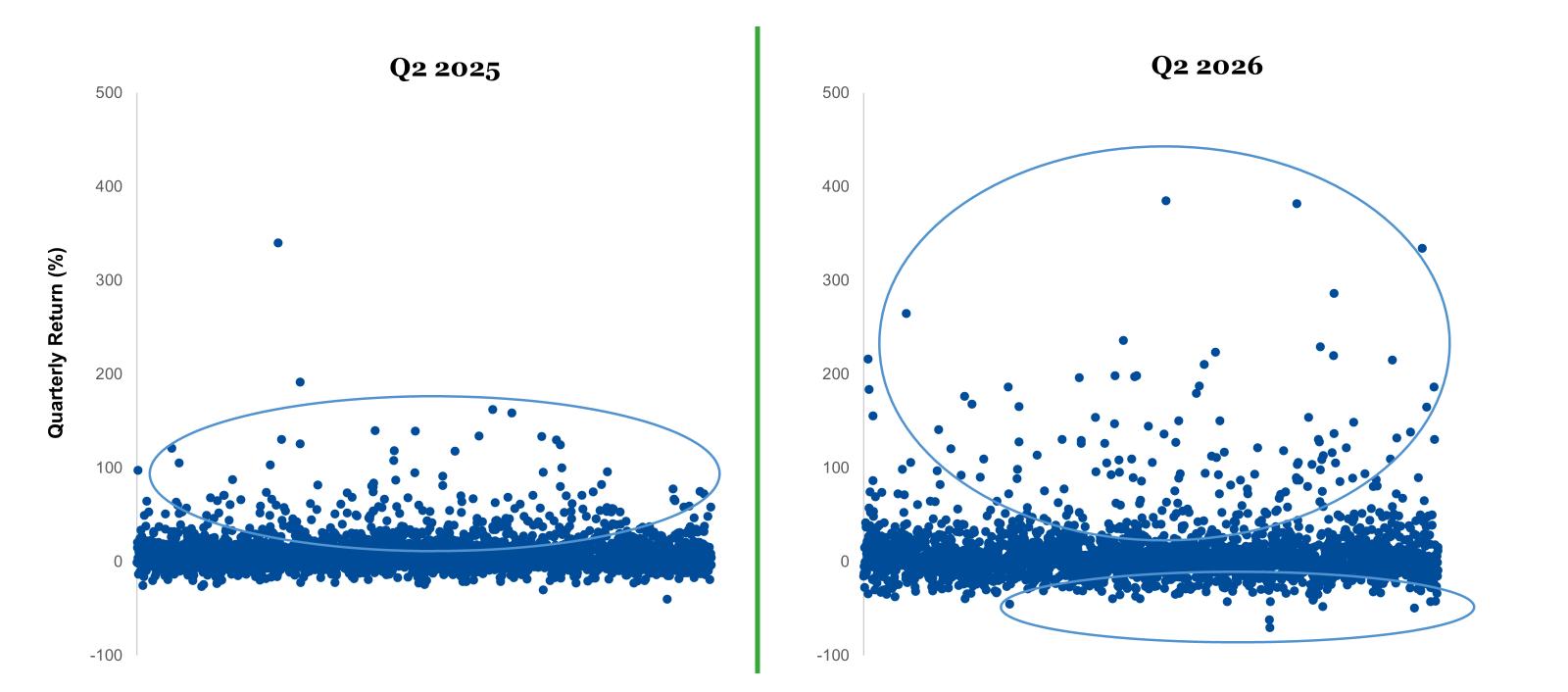
Dispersion also continued to play out beyond the Magnificent 7, with significant variance in returns noticeable across sectors, styles, company sizes and geographies. Below, we compare the dispersion of returns in the MSCI All Country World Index (ACWI) in Q2 2026 with the dispersion of returns from Q2 last year. What we can see clearly is greater dispersion in the data (or, to put it another way, we see fatter tails on either end, representing a greater frequency of large swings).
Figure 1: Dispersion in Returns of ACWI Constituents
(Source: FactSet, Wespath)
Fixed Income: Strong Demand, Less Cushion
Fixed income markets showed resilience against a more challenging backdrop. Yields moved higher, with the 2-year Treasury firming around 4.2% and creating a flatter, higher curve. Issuance was strong, particularly from software and AI-related companies…
Beyond the Headlines
Fixed Income: Strong Demand, Less Cushion (Continued)
Despite the increase in supply, as well as ongoing geopolitical uncertainty, corporate bond spreads have persisted near multi-year lows. In a nod toward the “risk-on” environment we mentioned earlier, high-yield bonds have shown no alarms, and corporate credit quality, in aggregate, has remained healthy.
The outlook for interest rates will, of course, be influenced by the tone from new Fed Chair Kevin Warsh. The Trump appointee took helm in May during a tricky time for central bankers. While the labor market has remained relatively strong, inflation rose throughout the quarter mostly due to the Iran war. Warsh has also signaled a desire to reshape the Fed toward less forward guidance, less public communication and more action on the Fed’s balance sheet. Following his first Federal Open Market Committee (FOMC) meeting, the FOMC statement was cut by more than half, and Warsh did not participate in the Summary of Economic Projections, including the dot plot.
The Warsh-less dot plot highlighted a dramatic shift from where the Fed’s interest rate expectations were just a quarter ago March’s results still largely indicating rate cuts, while June’s dot plot showed a shift to potential rate hikes. Ultimately, the Fed voted unanimously to keep rates stable this time around, but the path forward may still be uncertain.
Wespath Highlight: Read Now!
Take a look at how Wespath partners with institutional investors and faith-based organizations to design customized, values-aligned portfolios that support both today's spending needs and long -term sustainability.
In this resource, we walk through key concepts every institutional investor should understand, including diversification, asset allocation, liquidity, risk tolerance and values alignment. Then, the piece then turns to a conversation with Roland Fernandes, General Secretary of the General Board of Global Ministries (GBGM). Roland shares how GBGM’s disaster-response accounts require very different liquidity than longterm endowment accounts, why the agency pursued values-aligned strategies and what GBGM’s investment relationship with Wespath looks like today.
Read the conversation here!
Looking Ahead
With the first half of 2026 behind us, let's revisit the six "Themes to Watch in 2026" we have reflected on throughout the year:
1. AI-Driven Market Opportunities and Risks
The AI trade held its place at the center of the market this quarter, with a clear shift in where the value showed up. Attention moved from the hyperscalers spending on AI to the chipmakers supplying the hardware. Semiconductor companies beat consensus earnings by over 25%, and hedge funds posted their largest inflows into IT on record. The concentration reinforces the risk we flagged earlier in the year. Valuations are elevated, and a small group of names are doing the heavy lifting. We should expect selectivity to matter even more from here.
2. Geopolitical Tensions and Shifts
The on-again, off-again foreign policy exemplified by attempts to broker an end to the war in Iran has impacted trade, national security and, like all armed conflicts, the safety of civilians in conflict areas in particular If and when the uncertainty in the Strait of Hormuz resolves, we know the logistical complications it has influenced will not go away overnight, just as we know a plethora of other geopolitical events will continue to reshape market conditions, both positively and negatively, in the coming months and years.
3. Global Deficit Spending and Accommodative Financial Conditions
The U.S. debt is quickly approaching the all-time highs hit in the aftermath of World War II, with issuance growing at a 16% annual rate over the past eight years. Additionally, the Fed’s outlook for interest rates has shifted, and overseas, energy-driven inflation from the war in Iran pushed the Bank of Japan and European Central Bank toward tightening. China and India moved the other way, easing on demand concerns and softer inflation. The global picture is fragmenting, and financial conditions no longer point in one direction.
4. Interest Rate Crosscurrents and Central Bank Policy
Kevin Warsh has inherited a more hawkish Fed, as the latest growth and inflation figures have raised the odds of a potential interest rate hike this year. Whether Warsh will be successful in looking past recent energy price shocks to influence policy, and what the impacts of his new communications style will be over the near- and long-term, remain to be seen.
5. Market Concentration and Active vs. Passive Dynamics
The picture shifted again this quarter, and beneath the headline numbers, dispersion widened across sectors, styles and individual names. The Magnificent 7 posted widely different results, with some names down more than 20% and others up double digits. Environments like this reward active managers who can separate winners from laggards, provided risk discipline holds through the swings.
6. Opportunities and Challenges in Private Markets
Private markets data comes with a lag, and the Q1 picture reinforces the case for selectivity. Global private equity deal volume fell 6% quarter over quarter, with weakness concentrated in software and areas exposed to Middle East risk. Capital kept flowing to energy and infrastructure tied to AI and data centers, including the $41 billion take-private of utility giant AES. It’s a good reminder that "private markets" aren't a monolith and that selectivity and discipline continue to be valuable in this space.
Bottom Line
The first half of 2026 gave investors plenty to process. A war in the Middle East, a reopening of capital markets and another leg of the AI trade all played out in a matter of months. The themes tie back to a familiar truth: Concentration, dispersion and shifting leadership all reward a long -term view. Amid it all, we stay focused on helping clients align their portfolios with their missions, so they are built to navigate whatever the second half of 2026 (and well beyond that!) brings them.