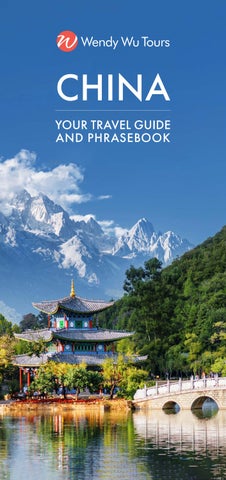
CHINA YOUR TRAVEL GUIDE AND PHRASEBOOK
Li River, Guilin 2
CONTENTS Your China Holiday with Wendy Wu Tours
4
Joining Your Tour
5
Whilst on Tour
6
Tipping
6
Optional Extras
7
Eating in China
7
Transport
9
Yangtze River Cruise
11
Hotel Accommodation
12
Electricity
13
Luggage
13
Climate and Clothing
13
Suggested Packing List
15
Money
15
Shopping
16
Customs and Duty Free
17
Internet Access in China
17
Time Difference
17
Insurance
18
Safety and Security
18
Travel Advice
19
Travel Health
19
Personal Medical Kit
20
Travel with Consideration
20
Sustainable Travel Tips
21
Reading List
22
Customer Health and Safety Information
22
Climate Chart
27
Chinese Phrasebook
32
Wendy Wu Tours NZ | Updated August 2026 3
YOUR CHINA HOLIDAY WITH WENDY WU TOURS China is home to amazing sights and wonders of the world. To explore the Forbidden City, walk on the Great Wall, sail the Yangtze River, see giant pandas or stand face-to-face with the Terracotta Warriors is the fulfilment of a lifelong dream. Yet, these fascinating experiences could be just the start of an amazing journey across one of the world’s largest countries and beyond. Expect lands of contrast, unique and compelling landscapes, incredible history, heritage and culture – all quite unlike anything you might have imagined. Your Wendy Wu Tours experience begins before you travel and we are there every step of the way until you return home. Our customers are our priority, and we will do all we can to ensure your holiday is one to remember. This Travel Guide provides you with practical advice and cultural information to help you prepare for your holiday. We are aware that this can seem like a lot of reading material, but we ask that you take some time to familiarise yourself with this information prior to departure and refer to the contents within throughout your travels. Your Detailed Itinerary (provided with your travel documents) provides a comprehensive description of almost everything to expect in each day’s sightseeing for your itinerary. If there are any particular challenges, from the length of time spent on your feet, the duration of drives and flights, to the standard of remote accommodation for our more adventurous tours; they will be explained there.
4
MORE ABOUT YOUR HOLIDAY Almost everything will be different from what you may be used to. We have found that our passengers who embark with a sense of humour and adventure, who accept that things do not always go to plan, are those who find their experience most rewarding. Although China is developing quickly, please note that health and safety standards overseas can differ greatly from those we enjoy at home, often of a lower standard. However, all of our suppliers meet local and national safety standards as a minimum. A typical day’s sightseeing may include the bustle and noise of a city street, sights and smells of a local market and interacting with the locals. Travelling in China requires patience and potential delays are to be expected due to different standards of service. There is a low level of English spoken throughout China, so your National Escort/Local Guides will be indispensable during your trip. At Wendy Wu Tours we are continually working with our suppliers to maintain and improve safety standards by seeking good practice in health and safety and we will do our best to ensure that your holiday is safe and trouble free. Part of the enjoyment of travelling abroad is experiencing a different way of life and culture, but it may also mean experiencing different safety and hygiene standards than those we are used to at home. We want you to have an enjoyable holiday so we ask that you take extra care, use your common sense as well as refer to notices and follow the advice from your National Escort/Local Guides. Our tours feature a physical rating graded from level 1 to level 5 to help you select the right holiday for you and is shown on the tour page of our brochure, on our website and in the Detailed Itinerary. For more information on the more active aspects of our tours, please refer to your Detailed Itinerary. Our National Escort/Local Guides always endeavour to provide the highest level of service and assistance, however they cannot be expected to cater for passengers who are not fit enough to complete the itinerary.
JOINING YOUR TOUR Check-in information With most airlines, you can check in online 24 hours prior to departure. Make sure you have your passport information and airline reference number handy. Your airline reference number can be found on your e-ticket receipt. You will be able to select your seats and print your boarding pass. At the airport, go to the bag-drop area of your airline to check in your luggage. Please note that some airlines will allow you to pre-book seats more than 24 hours in advance but will usually charge a fee to do this, which needs to be paid to the airline directly by phone or via their website. Please refer to your airline’s website for further information. We recommend you arrive at the airport 3 hours prior to departure, even if you have checked in, to make sure you clear security in good time. 5
If you are unable to check in online, we again recommend that you arrive at the airport 3 hours prior to departure, where you can either use one of the available check-in desks or the self-service kiosks before taking your luggage to the bag-drop area. Baggage information We recommend that you do not exceed 20kgs of checked baggage on your international flights as many of the domestic airlines within China have a luggage allowance of only 20kgs. As a guide, your main baggage should not exceed the following dimensions: 90cm x 75cm x 43cm, including the handle, pockets and wheels. Your cabin baggage should not exceed 55cm x 40cm x 20cm and have a maximum weight of 5kg. For further information please refer to your airline’s website. If your tour involves a lot of train travel, we recommend packing as lightly as possible. Terminal information This is shown on your e-ticket. On arrival in China, you will be met by your National Escort or Local Guide at the arrivals exit.
WHILST ON TOUR Entrance fees are included at all paid attractions on your itinerary. However the order in which you visit each site can change depending on weather, traffic, last minute changes or any other unexpected event that may arise. If you wish to visit places that are not included in the itinerary, you may do so at your own cost. Please check in advance with your National Escort/Local Guide. After a day’s sightseeing, you may sometimes be taken directly to dinner rather than heading to the hotel to shower and rest first. Whilst out sightseeing, western toilets are difficult to find in remote areas. Queuing for major attractions Be prepared for large numbers of other tourists, both foreign and domestic, at many of the attractions you will visit. As the incomes of the Chinese rise, so does their ability and enthusiasm for visiting their own famous sites. The highest number of visitors can be expected at the main attractions in Beijing, Xian, Shanghai, Chengdu, Lijiang, Kunming, Hangzhou and Nine Villages Valley. Your National Escort/Local Guides will queue for your entrance tickets but you may still need to wait to get into some attractions. Public holidays and festivals China has several festival celebrations throughout the year which are public holidays. The most significant of these fall annually between 1-7 May and 1-7 October. During this time, various sites and attractions may be more crowded than usual.
TIPPING Tipping is a firm and expected element in the tourism industry today and China is no exception. We strive to establish trust with our guides who rely on and expect tips from passengers. If the guides are keen to work with our passengers regularly, they become familiar with our itineraries as well as the 6
Wendy Wu Tours’ philosophy and expectations we have of their work. Many passengers are often uncertain of how much to tip so we have established a tipping system whereby every passenger gives a set amount (in RMB in China, HKD in Hong Kong and USD in other destinations) to the National Escort who will distribute the amount appropriately. On multicountry tours, the tipping amount will be paid in stages, on arrival in each country. All group tour passengers are expected to contribute to the tipping kitty. (If there is no National Escort, please give the money directly to your Local Guides and tipping amounts for each city will be shown in your final itinerary.) The amount for the kitty is calculated for each tour depending on the length, group size and services used during the trip. Your final documents and invoice will specify the exact tipping amount for your group. The tipping kitty will cover local guides and drivers in each city/province, local and/or site guides and your National Escort. For independent passengers, or group passengers with pre/post tour arrangements, you should allow USD5-10 per person per day.
OPTIONAL EXTRAS A number of optional extra programmes/activities may be offered by your National Escort/Local Guide whilst on tour, time permitting. These can range from RMB100-RMB600 (approx NZD25-130) per person and involve experiences such as a Kung Fu show in Beijing or a ride on the Maglev Train in Shanghai. Please feel free to ask your National Escort/Local Guide about any optional touring they may be planning over the next few days and the approximate cost so you can ensure you have the appropriate funds. All the optional extras must be paid for in local currency. Our philosophy is that these optional extras are only offered when there is sufficient time available, and they should never compromise the standard sightseeing. It is for this reason that it is difficult to pre-plan the optional extras because they depend on the time available.
EATING IN CHINA The cost of all meals is included in our Classic group tours. For our Go Beyond, Tailormade and Private tours, meal inclusions are listed in the Detailed Itinerary. Breakfast is served in the hotel and usually includes western dishes. As is traditional in China, lunch and dinner consists of small dishes of local cuisine which are placed on a ‘Lazy Susan’ for everyone to share, so you can experience the variety of speciality dishes. The amount served is more than ample for the whole group. We aim to cater to the tastes of the majority of people and so the food is not too spicy or unusual in taste.
7
If you would like to drink beer, wine or soft drinks with your meals, payment is to be made directly to the restaurant staff. Beer is traditionally consumed in small glasses; not the larger glasses that you may be used to. Green tea is sometimes provided complimentary. All other drinks will be at your own expense. Each individual place setting will consist of a bowl of fan (rice), a pair of chopsticks (you may request western cutlery if you prefer), a flat bottomed soup spoon and a saucer. Chinese food is usually served in courses where a typical meal will consist of rice, one to four meat or fish dishes, two vegetable dishes and one soup dish. Almost all food is cut into bite sized pieces. The centre of the meal is the fan or rice. The meats and vegetables that we think of as the focus of the meal are known as ts’ai, which roughly translates as ‘side dishes’. Fish is not always available, particularly outside of the bigger cities. The Chinese are also not big on desserts and meals are normally complemented with fruit to refresh the palate. Sichuan cuisine is distinguished by its use of ginger, chilli and the ‘Sichuan peppercorn’ called the fagara. Each meal will usually have some mild dishes but many of the local speciality dishes will be hot. If your group finds there are not enough mild dishes served, please inform your National Escort/Local Guide so that they may resolve the problem for the next meal. If you have booked a tour that does not include all meals, your local guides will be able to recommend a variety of restaurants to suit your taste and budget. It is possible to buy snacks in supermarkets within major towns or cities. Alternatively, you may also like to bring comforts like cereal, biscuits, muesli bars and tea/coffee from home. Any food/diet requests MUST be specified at the time of booking and you should mention it again to the National Escort/Local Guides when you meet them – they will do their utmost to cater for any special requests, such as vegetarian meals or food to be avoided in case of allergies, however this cannot be guaranteed. People on restricted diets should expect complications in China. Some people have misconceptions about the Chinese diet. The Chinese attitude to food has been shaped by a cuisine and nutrition philosophy with a history over a thousand years and they have great pride in it. Vegetarians should remember that although vegetarian dishes are available, they may be offered meat by restaurant staff who do not understand why anyone who can afford meat would choose not to eat it. In these cases, patience and understanding will go a long way. Whilst travelling away from major cities, it is highly recommended that those passengers with food intolerances take additional food items with them as not all dietary requests will be met due to the limited foods available. 8
Gluten free diets are not well-known in China, which makes it something of a challenge to avoid wheat-containing ingredients which are common in Chinese cooking. It is possible to avoid foods that contain gluten if you are vigilant. If travelling on a group tour, your National Escort/Local Guide will help you with this. Although taken seriously, food allergies are much less common, and therefore less understood in China. Therefore, you are likely to need to explain quite clearly what you cannot eat. For those who do not have all meals included and will be without the help of the National Escort on some occasions, there are plenty of resources online that will help you find the correct wording for your allergy in Mandarin Chinese, so printing out little flash cards with these phrases on could come in very handy. Please be aware that on some days where a lot of sights are covered, dinner times may be early (around 6pm) and your tour group may head directly to the restaurant after sightseeing.
TRANSPORT We use a variety of transportation to operate your itinerary at the best pace and to give you an authentic travel experience so you are not always ‘removed’ from the locals. Domestic flights The flight schedule of domestic airlines in this region changes frequently, hence all domestic flights that appear in your itinerary are always subject to change. Please ensure that all valuables and any medication you may need for the rest of the day are taken on board with you. The luggage limit is 20kg per passenger and all seats are economy class. Airlines currently do not allow liquids (alcohol, spirits, wine, water, perfume etc) or sharp objects to be carried on-board the aircraft and these will be confiscated. Wendy Wu Tours issues all internal domestic flight tickets in China and these will be handled by your National Escort/Local Guide and given to each passenger just prior to their flight.
9
Coaches Our coaches are comfortable, air-conditioned vehicles. Please note – in many parts of the world, seatbelts are not compulsory by law and local people largely choose not to wear them. Where available, we recommend seat belts should be worn at all times while travelling. Some places we travel to, e.g. parts of Sichuan Province, Yunnan, Tibet and Mongolia are quite remote. The coaches used in these areas are not the latest models but the best available in these areas. Day trains A 2nd-class soft seat is booked for the day train journeys including bullet trains and high speed trains. There is limited space for storing luggage. While our guides are there to assist, you will need to load and unload your own luggage on and off the train. Day trains only stop for several minutes at each stop, so you must be ready to leave the train when your guide instructs. Overnight trains All travel will be on first class ‘soft sleeper’ trains, which are the best available in China. Each compartment is shared by four people and is air-conditioned, with lockable doors and four beds which are fixed in place. There is room for passengers to sit on the lower berths. A pillow, clean sheets and a quilt are provided. Your National Escort/Local Guides will try to organise the whole group to be sleeping in the same carriage but in busy periods of travel, this may not be possible. Each group will receive tickets with sequential berth numbers; these may be sharing with people from another tour group/company, or with some of the locals. We regret that it is not possible to arrange private train cabins. There is usually a western style toilet at one end and a squat toilet at the other end of the carriage. Hot drinking water is available from a boiler which is located at the end of the carriage. Packing for the train: We recommend you bring a small overnight bag to carry whatever you need until the following morning as you will not have access to your main luggage which will be stored on a separate carriage of the train. Consider including a face towel, all toiletries, medication you require until midday the next day, a tracksuit or similar outfit to sleep in and toilet paper, as the train supply tends to run out. Keeping valuables safe on the train: Carry all valuables with you at all times. A passenger should remain in the compartment at all times to watch all belongings. Your main luggage must have a lock on it. National Park transportation In certain National Parks, the Chinese government is attempting to protect the natural environment, animals or architecture by forbidding public vehicles access to them by using ‘environmental vehicles’ in places such as Heavenly Lake (Tian Chi) near Urumqi and the Nine Villages Valley. You will therefore 10
need to leave your group coach and transfer onto these vehicles, which will be shared by other tourist groups. Traffic The number of vehicles in China is rapidly increasing. Please keep in mind that major events or holidays and new construction projects create traffic that can interfere with your tour and meal times. Your National Escort/ Local Guides will do their utmost to avoid possible delays, changes or in rare cases, cancellations to sections of your itinerary.
YANGTZE RIVER CRUISE If your tour includes a Yangtze River Cruise, please note that this section of your itinerary is always subject to change. The movement of each vessel along the Yangtze is regulated by the government’s Yangtze River Authority (YRA). The river’s rapid flow, the narrowness of her gorges and a recent increase in passenger numbers means that timetables are pressured. The YRA allocates times for access to mooring points, embarkation/ disembarkation docks and passage through the gorges. This means that the captain of each cruise ship is unable to confirm a final itinerary until shortly before departure (usually 24hrs prior). This can affect both the time and location where you embark/disembark your cruise ship. Your National Escort/Local Guide will explain any such changes to you as soon as they are informed by the cruise operator. The cruise ships themselves have comfortable, western facilities. All cabins are on a standard twin bed basis and are equipped with air conditioning, private western bathroom facilities, television and telephone. However, there are no coffee shops or swimming pools on any of the ships. Accessibility: Steep riverbanks, which make this scenery spectacular, also make some shore excursions physically demanding. Typically a shore excursion requires all passengers to cross between ships and moving pontoons which may be moored together and climb multiple flights of stairs – sometimes without assistance or handrails. Shore excursions are alongside other passengers of the ship who may be from another tour group/company. One of the results of the Three Gorges Dam Project and fluctuating water levels is that the docks and pontoons tend to be temporary and rather makeshift – sometimes without assistance and handrails and it is possible that you may have to disembark down a narrow, wooden gangway (e.g. in Chongqing). If you choose not to participate in a shore excursion then you are welcome to stay onboard the cruise ship and enjoy some free time, however a refund of the shore excursion fee(s) is not possible, as these costs are included in the cruise package. If you are taking one of our Private Tours, shore excursions taken whilst on your Yangtze Cruise will be operated on a shared basis, with the rest of the cruise passengers.If you do not wish to join a shore excursion but wish to leave the cruise ship, you will need to pay a mandatory port tax. 11
HOTEL ACCOMMODATION Group tour hotels are generally of three-four star local standard. Rooms feature heating/air-conditioning, television, telephone and en-suite bathroom. Some hotels, especially those in regional areas may have hot water restrictions, operating for a few hours at a time, usually in the morning/ evenings. Hotels in China are bound by Government laws which mean that air conditioning is switched on nationally in May and central heating is switched on in November. It is not customary for hotels in China to have in-room fridges, tea/coffee making facilities and a safe deposit box. Most hotel rooms do not have irons or boards, but most will offer a laundry service that can launder your clothes (typically in 24hrs). Generally all beds in China have very hard mattresses. Triple rooms in China consist of a normal-sized twin room with a rollaway bed, meaning space is very limited. This is not something we would recommend for three adults. Most hotels throughout China will collect your passports each time you check-in and the hotel will keep them safely for a few hours or overnight to register details. Please keep this in mind if you need to exchange money or get a credit advance at the bank. In China, check-out time is around 12 midday and check-in time is around 2pm. Remember that on the days when you are travelling between cities, it may result in a delay of access to your room or a change of itinerary. Hotels in this region cannot guarantee late check-out. At many hotels, the reception staff speak very little English. If you require help, please contact your National Escort/Local Guide. In China and countries in Asia, you may be approached by ‘ladies of the night’ trying to procure business. A polite ‘no thank you’ and a sense of humour is the best way to handle this, but if in or near your hotel, contact reception staff or your National Escort/Local Guides. Hotel ratings Worldwide star ratings identify the standard of quality for hotels, however not all star rating systems are created equal. Countries throughout the world adopt various classification systems for hotels in accordance with their chain name and the type of hotel. No international classification system exists. Typically, a three-star Chinese rated hotel cannot be compared to a three-star New Zealand rated hotel. Attempts at unifying the classification system have been made so that it becomes an internationally recognised and reliable standard. However, differences do exist in the quality of accommodation which plays an integral part in defining which hotel category the specific accommodation fits into. All hotels used by Wendy Wu Tours are regularly inspected by our staff and our operators so that high standards of quality and safety are maintained. Hotels in remote areas such as Kashgar, are occasionally forcibly re-booked by government officials and are subject to last minute change. Sections of the Xinjiang-Tibet Highway and the Yunnan-Tibet Highway are without any two or three-star accommodation.
12
ELECTRICITY There is an electricity supply of 220 volts throughout China. 240-volt appliances will work safely with this supply. The plugs in China are mainly two-pin (US) plug, or the New Zealand three-pin plug. You can buy adaptors, also known as conversion plugs, from hardware, department and duty free stores, prior to departure.
In remote areas of China and Tibet, the electricity supply is uncertain. Many buildings will only have a few hours each day of electricity from either the town’s supply or a diesel generator. Whenever there is limited electricity supply this will also mean limited hot water supply. Remote and village areas may experience power surges or outages, both of which can make re-charging electrical appliances very difficult.
LUGGAGE All passengers are limited to two items of luggage each: 3 One suitcase or backpack, with a maximum weight of 20kg. Your main luggage must have a lock on it. 3 One piece of hand luggage, with a maximum weight of 5kg. It is advisable that your hand luggage consist of a ‘daypack’ – a small bag which you can access during the day and carry items like your camera, bottled water, toilet paper, hat etc. Luggage on 4WDs must be practical and durable. Please refer to your Detailed Itinerary to see if this information applies to you.
CLIMATE AND CLOTHING We recommend that you check the weather forecast prior to your departure so that you can pack accordingly. We have included a climate chart on page 32 of this travel guide for your reference. Winter January and February fall in the middle and end of winter in China. In northern and eastern China, the weather is cool and dry with occasional days at freezing temperatures. The Yangtze and southern regions have milder temperatures but as it is more humid here, cold days can feel quite damp. During the winter months you will need to bring layers of warm clothes, as well as water/windproof clothing for the possible freezing conditions.
13
Spring In northern and eastern China spring is traditionally marked by cool, comfortable weather with lower rainfall, while the Yangtze and southern regions still experience mild temperatures with higher humidity. Summer In northern and eastern China summer brings warm weather and strong sun, while the Yangtze and southern regions will experience higher levels of humidity. Autumn In northern and eastern China autumn brings warm weather but temperatures definitely get cooler towards the end of the year. By midOctober there are occasional days at freezing temperatures. The Yangtze and southern regions have milder temperatures for longer but can have damp, cool days. During these months you will need to bring clothing suitable for sun exposure and mild temperatures, as well as water/windproof clothing for possible freezing conditions. Loose fitting, lightweight cotton materials are the most comfortable for humid and warm conditions. If you are travelling to the Sichuan Province: Much of the southern regions have a sub-tropical climate, while the mountains of Sichuan (such as the Nine Villages Valley or Mt. Huang) experience cooler temperatures and higher rainfall. If you are travelling to Tibet: The Tibetan plateau experiences a greater range of temperatures than the other regions of China. No matter what time of year, or how warm the average temperature is, sudden and unpredictable drops in temperature, snow or storms can hit on the mountain passes. The sun is also much stronger at high altitude so you will get sunburnt much more quickly. If you are travelling on the Silk Road Explorer: You will be travelling over a vast distance, from temperate areas near the east coast to high mountains and desert; you need to consider your packing carefully. Northwest China has a desert climate – with higher temperatures that drop at night-time. The hottest places are Turpan and Kashgar, which can reach 30˚C during the day. Xiahe is also located at an altitude of 3,100ms, high in the mountains and can be cold and damp at any time of year. At the warmest time of year (August) temperatures can reach 20˚C but can drop to 5˚C in the evening. You will need some warm and waterproof/windproof clothing for the two days in Xiahe. Dress code The dress code throughout all Wendy Wu tours is casual; however, it is important that all passengers dress respectfully when visiting temples. Smart-casual clothes are recommended for evening banquets and shows.
14
SUGGESTED PACKING LIST • Your travel documents and passport - including a photocopy of your passport in case it is lost or stolen while you are abroad. Keep one photocopy at home and take another photocopy on your trip with you • Main luggage & luggage padlocks • ‘Day bag’ – a smaller bag/daypack to carry with you during the day • Money belt to carry passport, cash, credit cards, airline tickets, etc • Trousers (and/or long skirts for women) • Shirts or long-sleeved tops of light cotton material • Walking shoes and socks – it is important to have sturdy and comfortable shoes for sightseeing every day • Sun protection – hat, sunscreen and lip balm • Personal medical kit including insect repellent • Antibacterial wipes and/or hand sanitiser to clean hands before eating • Tracksuit/similar outfit of soft material is recommended for the overnight train journeys • A water/windproof jacket • Light jumpers or thermals are great for layering • A ‘modesty shawl’ or sarong to wear in Muslim or conservative areas (for women) • Torch, conversion plug and spare batteries – batteries available to buy in China tend to be unreliable • Scarf or bandana – useful to protect your face against dusty winds at high altitude • Spare glasses – it is difficult to get any prescription lenses repaired or replaced in China • Small bath towel is useful for overnight train journeys • Toilet paper – not all sightseeing public toilets will provide this • Snacks – teabags/coffee, milk powder or sachets, instant soups or noodles, or anything you can’t go without! • Camera and memory card
MONEY The local currency in China is the Renminbi (RMB), commonly referred to as yuan. It is divided into smaller units called jiao and fen (where 1yuan = 10jiao = 100fen). One hundred yuan can be written as 100RMB or ¥100. Spending money and payment methods in China When travelling, it’s best to have multiple payment options - cash, a credit/ debit card, and a mobile payment app, for flexibility and security. For detailed information about money and payment methods in China, visit our Paying in China webpage www.wendywutours.co.nz/help-and-visas/ travel-money/paying-in-china or scan the following QR code.
15
SHOPPING Shopping can be a fun and entertaining component to any travel adventure, and China has a vast array of shopping opportunities for those who love to seek out a bargain. From hand carved jade to local silk products or pearls from the South China Sea – the variety and choice can seem endless. In keeping with most people’s interests whilst on holiday, your tour will include a reasonable number of opportunities to shop for local goods and souvenirs. We have included visits to establishments that not only provide an opportunity to purchase a locally produced, great-value souvenir; but you’ll witness first-hand how these local products are made, their history and how they support the local economy. We are aware that people like to take home souvenirs, so we endeavour to ensure the shops you visit have a reputation for quality, honesty and authenticity – we do our best to ensure that you don’t get ripped off. Most establishments will also feature a place where you can buy refreshments and take a break. Wendy Wu Tours, our staff, National Escorts and Local Guides are not qualified nor permitted to guarantee the quality or value of any goods purchased during your holiday. All passengers who make purchases during their holiday must accept responsibility for their decision regarding the item’s value and authenticity, as well as the risk and process of credit card purchase and/or shipping. Please note, although some large items may include international shipping with the cost, any customs, handling, import & GST charges may be passed on to you once the item has reached you at home. It is your responsibility to ensure that these costs are covered. Furthermore, delivery to your home from the shipping port may not be included. It is recommended that you double check any items purchased before leaving the store (the item and any credit card receipts) and if you are having a large
16
item shipped, make sure you take a photo of your purchase and the contact details of the store. We encourage all passengers to enjoy their local shopping expeditions but to take care and buy wisely. We cannot assist in returning or refunding goods in any circumstances, including purchases made at shops or factories which you may visit as part of your tour with us. Haggling or bargaining In local shops, markets and street stalls all over China, haggling is the accepted way to agree on a selling price. It can be a great way to save money, as well as a wonderful way to interact with some local people you may not otherwise meet. However, some foreign visitors find it too confronting and prefer to shop in tourist shops or department stores, where prices are set.
CUSTOMS AND DUTY FREE Cultural relics, handicrafts, gold and silver ornaments and any jewellery purchased in China must be declared at exit. All luggage is x-rayed and if any of the above is not declared, customs agents may seize them. You must also declare all food items on exit if carrying them in your luggage. We recommend that passengers consult the www.customs.govt.nz website before departure for up-to-date information on the quantity of alcohol/ cigarettes that can be imported when you arrive home, as well as the amount of cash that may be carried without declaration.
INTERNET ACCESS IN CHINA In China, apps such as Google, Gmail, Facebook, and WhatsApp are blocked due to government internet restrictions. To access these services, many travellers choose to download an eSIM. For more detailed information on internet access & eSIM’s, visit our China Travel Tips page: www.wendywutours.co.nz/help-and-visas/china-traveltips/ or scan the QR codes below. Accessing the internet in China
How to download an Airalo E-Sim
TIME DIFFERENCE China’s timezone is +8GMT meaning they are 4 hours behind New Zealand (5 hours during Daylight Saving).
17
INSURANCE It is a condition of booking a holiday with us that all travellers take out comprehensive travel insurance. Please ensure you have the appropriate cover for your holiday as overseas medical costs are expensive. It is a good idea to check all your policy’s inclusions and conditions in full – including overseas medical expenses. It is essential that you inform your insurance company of all pre-existing conditions. Any undeclared conditions could invalidate your policy. Please inform our office of your relevant policy number and keep details of the policy in your travel documents including policy number, 24-hour emergency number and next of kin details. If you are taking out travel insurance with your credit card company, you need to investigate the policy’s inclusions and conditions fully. You should receive a policy number, an international access phone number to contact them in an emergency, and a copy of full conditions. All travel insurance providers require you to contact them as soon as possible in the event that you need medical treatment, hospitalisation or change travel plans, to inform them of your situation. They will then decide the best course of action in regards to further treatment and/or repatriation and make appropriate booking arrangements. Our staff in China will be able to assist you in contacting your travel insurance company.
SAFETY AND SECURITY All travellers should maintain a high level of personal security. Although China is considered safe for travellers, please keep in mind that cash or wallets in pockets, obvious jewellery, swinging handbags, etc may attract unwanted attention. Keep your belongings with you at all times and beware of pickpockets in market areas and at train stations. Do not leave any valuables unattended in your hotel room. Lock away cash you do not need during the day/evening, credit cards, airline tickets, passports, jewellery, etc either in your room’s safe or at reception; as not all hotels will have an in-room safe deposit box. Wearing a money belt under your clothing is strongly recommended. We advise you not to bring valuable jewellery, etc with you to China and keep a photocopy of your passport and debit/credit card(s). Swapping scam As in any country, it pays to be vigilant. One example of a common ‘swapping scam’ is if someone hands over a ¥100 note to pay for a cheap souvenir (e.g. postcards), they will be given back a note that says ‘50’. However this might turn out to be 50 sum from Kazakhstan, which is worth a fraction of what you were owed. We suggest you familiarise yourself with the Renminbi Chinese yuan notes.
18
TRAVEL ADVICE Before departure, we recommend that you check www.safetravel.govt.nz for up-to-date travel information and advice from the NZ Ministry of Foreign Affairs and Trade for China.
TRAVEL HEALTH A health certificate is not required for entry into China. Visit a doctor before travelling We strongly recommend that you see a doctor for the latest health advice at least six weeks before your holiday to allow time for any necessary vaccinations etc. Remember to take your itinerary with you to the appointment. For detailed travel health advice, please check www.safetravel.govt.nz/before-you-go/general-advice/health before departure. Drinking water We strongly recommend you do not drink the tap water, and avoid ice in your drinks. There will usually be a kettle or flasks of boiled water in your hotel room and onboard trains. Boiled water is suitable for drinking and cleaning teeth. Safe, bottled drinking water is readily available for sale everywhere – from small shops, supermarkets, restaurants and hotels. It is not customary for hotels to provide complimentary bottled drinking water. Always ensure that the seal is unbroken. Toilets Toilet facilities are very basic throughout Asia and it is rare that you will find a ‘western’ style toilet (except in hotels). ‘Squat’ toilets are very common in public places and toilet paper is never supplied. We suggest that you carry toilet paper in your day backpack as well as not turn down the opportunity to use a ‘nice’ toilet when you see one! Altitude Some of our tours reach areas of high altitude. Your Detailed Itinerary will list altitudes reached each day where necessary. Please refer to this information to satisfy yourself that you are physically able to undertake your chosen itinerary. AMS (Acute Mountain Sickness) occurs in some people of varying ages and fitness levels when they travel to altitudes over 3,000m. Symptoms include dizziness, fatigue, nausea or loss of appetite, breathlessness or headache. These usually develop over the first 36 hours at altitude and not immediately on arrival. Usually the symptoms will subside after a day, however; if symptoms worsen you should seek medical advice and descend in altitude immediately. It is recommended to drink more water, non-alcoholic and non-caffeinated drinks and avoid exertion after arriving over 3,000m. Our itineraries ensure you will stay overnight at least 100m below the maximum altitude reached during that day.
19
PERSONAL MEDICAL KIT Take all pharmaceutical products that you may require on your tour; do not rely on being able to purchase these during your holiday. You will see pharmacies all over China, but they stock local traditional medicine and many unregulated brands of western medicine. You are also very unlikely to find anyone who can speak English, nor any products with English writing. Consider taking a ‘personal medical kit’ containing any medication or medical equipment you may need during your time in China: 3 All prescribed medication (with a cover note from your doctor)/ copy of repeat prescription 3 Headache tablets 3 Anti-diarrhoea tablets 3 Cold and flu tablets 3 Travel sickness tablets 3 Lozenges 3 Insect repellent and bite/sting relief 3 Sunscreen 3 Antibacterial hand wipes and/or hand wash 3 Spare pair of glasses/contact lenses If you need to purchase any pharmaceuticals or medical equipment while in China – you may ask your National Escort, Local Guide or hotel staff to help you locate a pharmacy, identify medication or to translate from the local language to English. If you need medical attention they will be able to arrange a call from a doctor, usually one who speaks English. However, the decision to purchase or take any non-prescribed (either western or traditional local medicine) is entirely your own. Please note: the staff at Wendy Wu Tours in New Zealand and our representatives in China are not medically qualified and are neither able, nor allowed, to give any medical advice, recommendations or administer medications.
TRAVEL WITH CONSIDERATION Tourism can impact the natural, economic and social environment. At Wendy Wu Tours we are committed to addressing this impact wherever possible without compromising our customers’ experience. Gifts & Begging Wendy Wu Tours does not condone the practise of giving gifts such as sweets, coins and souvenirs to local people while in China. Taking photos We encourage you to think about how you would like to be treated by camera-wielding tourists – always check that it is ok before taking a photograph of a local person. Simply indicate to your camera to ask and never take the photograph if someone gestures or says that they do not want you to. Cameras are not allowed in some sightseeing spots, particularly temples and government buildings. 20
Dress appropriately The Chinese dress conservatively in more rural areas. Full length cotton trousers or shorts that cover the knees are acceptable and for women, skirts or trousers that reach below the knee are ideal, worn with tops that cover the shoulders. In certain areas in China, the majority of the population is Muslim. Female passengers are advised to wear modest clothes that cover knees and shoulders. A ‘modesty shawl’ – either a large shawl or sarong – can be useful to carry in your daypack while sightseeing, to cover up in these places. Your guide will be able to advise you where and when this may be appropriate. Always leave your shoes outside a temple or anyone’s home.
SUSTAINABLE TRAVEL TIPS Travel is one of life’s great joys and we can all explore the world in a way that’s kinder to the planet and the places we visit. These simple tips can help you reduce environmental impact and support local communities we visit. • Packing only what you need will make your travels more comfortable and help reduce CO2 emissions. (Bringing 1kg of extra luggage on an 8-hour flight creates about as much CO2 as using an electric heater at home for 5 hours.) • If you have a refillable drink bottle and a tote/calico shopping bag, these two simple items can help you avoid single-use plastic while you travel. • Turning off lights and air-conditioning when leaving your hotel rooms can cut around 5kg of CO2 each day, about the same as driving 30km. Not bad for a 2-second habit! • When out enjoying nature on your travels, stick to marked paths for your safety and it’ll also help protect delicate ecosystems. • Whenever you get the chance, consider buying souvenirs directly from local artisans and small local businesses – it helps keep communities thriving. • Visiting a place of spiritual or religious significance? Covering your shoulders and knees is respectful, even if it’s hot. When in doubt, ask your National Escort. Remember, travelling purposefully isn’t about being perfect – it’s about making better choices one step at a time. Enjoy your travels!
21
READING LIST • China: Renaissance of the Middle Kingdom (Odyssey Illustrated Guides, 8th edition) – Chan and Art • Yangtze River: The Yangtze and The Three Gorges (Odyssey Illustrated Guide, 7th edition) – Bonavia, Hayman, et al • Foreign Babes in Beijing: Behind the Scenes of a New China – Rachel DeWoskin • River Town (Two Years on the Yangtze) – Peter Hessler • Balzac and the Little Chinese Seamstress – Dai Sijie • Red China Blues. My march from Mao to now – Jan Wong • Life and Death in Shanghai – Nien Cheng • Riding the Iron Rooster – Paul Theroux • The River’s Tale – Edward A. Gargan • In Search of Old Shanghai – Pan Ling • China Inc. – Ted C. Fishman • Letters from Hankow; The Chinese Revolution of 1911 – The Eyewitness account of Laura Beckingsale – Compiled by Tony Beckingsale • Mao’s Last Dancer – Li Cunxin • The Good Women of China: Hidden Voices – Xinran Xue • Wild Swans (Three Daughters of China) – Jung Chang • From Rice to Riches – Jane Hutcheon • The Silk Road (Odyssey Illustrated Guides, 6th edition) – Bonavia, Lindesay and Qi • Wild West China: The Taming of Xinjiang – Christian Tyler • News from Tartary: A Journey from Peking to Kashmir – Peter Fleming • Foreign Devils on the Silk Road – Peter Hopkirk • Extremes Along the Silk Road – Nick Middleton • In Xanadu – William Dalrymple • Tibet (Odyssey Illustrated Guides, 2nd ed) – Elizabeth Booz • Tibet, Tibet: A Personal History of a Lost Land – Patrick Frenc • The Autobiography of a Tibetan Monk – Palden Gyatso • Seven Years in Tibet – Heinrich Harrer • On Top of the World: Five Women Explorers in Tibet – Luree Miller
CUSTOMER HEALTH AND SAFETY INFORMATION We care At Wendy Wu Tours we are continually working with our suppliers to maintain and improve safety standards by seeking good practice in health and safety and we will do our best to ensure that your holiday is safe and trouble free. Part of the enjoyment of travelling abroad is experiencing a different way of life and cultures, but it may also mean experiencing different safety and hygiene standards than those we are used to at home. We want you to have an enjoyable holiday so we ask that you take extra care, use your common sense as well as refer to notices and follow the advice from your National Escort and/or Local Guide. At Wendy Wu Tours we are continually working with our accommodation and transport providers to endeavour to raise safety standards as much 22
as possible and we will do our best to ensure that your holiday is safe and trouble free, but we do ask that you take that little bit of extra care whilst you are away. Flight safety • Do not place flammable liquids, lighters, matches, gasses or aerosols in your suitcase • Always carry medication in your hand luggage • Keep your passport safe and have a photocopy with you just in case • Pay attention and follow any in flight safety information • To avoid DVT, drink plenty of water and follow simple exercises or occasionally move around the cabin Transport safety • In vehicles always wear a seat belt if one is provided – though it is not compulsory in China to do so. We cannot guarantee that vehicles will be fitted with seat belts. • In minibuses never place luggage in the aisles or footwells • Ensure you know where your nearest emergency exit is. • Check the location of the fire extinguisher, first aid kit and break glass hammer • Follow any safety instructions provided by your driver/guide Road safety • Car hire is also not recommended in most areas • Traffic in most Asian countries travels on the opposite side of the road to New Zealand. Ensure you look both ways before crossing the road. • In many countries vehicles do not automatically stop at crossings • Often paving can be uneven and loose with kerbs higher than you may be used to. Please take more care whilst walking around cities and resort areas • Crash helmets are often not provided with mopeds and motorbikes – we do not recommend you hire these vehicles Fire safety • Ensure you know the location of your nearest fire exit • Check the location of the nearest fire extinguisher • Study the fire instructions in your room • Identify how to raise the alarm if a fire occurs • Do not smoke in bed – many rooms are non smoking • If a fire occurs, leave immediately, do not stop to collect your belongings • Proceed to an assembly point well away from the building Glass safety • Glass doors and windows may not be toughened glass • Take care in bright sunlight, it may not be obvious if doors/windows are closed • Check to see if anti-collision stickers are in place at adult and child height 23
Balcony safety • Never lean over, sit or climb on the balcony • Families with small children should request ground floor rooms whenever possible • Do not climb or stand on balcony furniture • Keep all balcony furniture away from the wall/railings Pool safety • Familiarise yourself with the pool and its layout, deep and shallow ends • Make note of the depth markings and any hazards • Most pools do not have life guards, so please take care • Shower before entering the pool • Do not swim, if suffering from an upset stomach • Observe pool rules and information signs at all times • Do not swim at night, even if it is lit • Do not swim immediately after a meal or when drinking alcohol • Pool surrounds can be slippery, don’t run around them • Observe No Diving signs at all times • Never jump or dive from raised pool features • In the event of an emergency ensure you know how to raise help Food safety In order to avoid the possibility of stomach upsets: • Ensure that you always wash your hands prior to eating • Make sure your food has been thoroughly cooked • Hot food should be hot, cold food should be cold • Avoid any uncooked food, except fruit and vegetables (notably those you
Giant Pandas, Chengdu 24
can peel or shell yourself) • Always drink bottled water and ensure the seal is intact before purchasing • Use boiled or bottled water for brushing your teeth • Avoid ice in drinks as this is generally made from unsafe tap water • Avoid purchasing food from street vendors, we cannot vouch for the health and safety of the food and drinks they provide Personal safety • Avoid walking in poorly lit areas • Be aware, stay away from situations where you do not feel comfortable • Avoid carrying too much money and/or valuables • Use of a money belt is encouraged at all times • Ensure your room is left secure when you go out • Place all valuables in a safety deposit box, where available or with reception (use of these are often a condition of your insurance policy) • Never leave windows or balcony doors open • Ensure your main luggage can be locked when left unattended in rooms, carriages, luggage rooms, etc. • Do not take any valuable jewellery on holiday with you Sun care • Ensure you have adequate protection for your type of skin, high factor sunscreens should be utilised initially • Re-apply sunscreen frequently • Stay out of the sun during the hottest time of the day • Drink plenty of water to avoid dehydration • At the first sign of burning, cover up and get out of the sun • Beware, you can still burn, dehydrate and get sunstroke in the shade or in the water • Take a sunhat, sunglasses and lip salve Insurance • Ensure you have appropriate insurance for your holiday and that it covers any activity you intend to undertake • If participating in any high risk activity, appraise yourself of the safety standards being operated by the supplier • Avoid purchasing activities or excursions from anyone not connected to Wendy Wu Tours; they often lack public liability insurance and have unchecked safety standards • Any accident or injury should be reported immediately to the National Escort or Tour Guide and a report obtained • Wendy Wu Tours can help you to purchase travel insurance. Altitude sickness • High altitudes on some tours can affect customers. Please see your Detailed Itinerary, which will indicate if altitude is relevant to your tour • AMS (Acute Mountain Sickness) can affect people at altitudes above 3,000m • Symptoms include, dizziness, fatigue, nausea, loss of appetite, 25
breathlessness or headache • They usually develop in the first 36hrs and not immediately on arrival • The symptoms can affect people of all ages and levels of fitness • Symptoms will usually subside on their own after 24/48hrs; if they persist you should consult a doctor • Drink lots of water and/or non-alcoholic, non-caffeinated drinks • Avoid any exertion over 3,000m • Our overnight accommodation is generally 100m below the highest level reached in the day, another effective method for combating AMS Online information • For the latest Health & Safety information for travellers visit www.safetravel.govt.nz
26
CLIMATE CHART We recommend you check weather conditions before you depart. With four distinct seasons; the ideal travel periods are spring (Mar to May) and autumn (Sep to Oct). Many people travel at other times of the year, but please bear in mind that the summer months may be very hot and winter months may be very cold. Freak weather conditions could result in delays, changes or in rare cases, cancellations to sections of your itinerary.
Ave. Temp ˚C min/max
Ave. Humidity
Ave. Rain mm
JANUARY BEIJING CHENGDU CHONGQING GUILIN SHANGHAI KUNMING LIJIANG TAIYUAN XIAN ZHONGDIAN
-10/1 3/11 5/12 5/12 1/8 1/14 5/17 -14/2 -4/5 -1/12
BEIJING CHENGDU CHONGQING GUILIN SHANGHAI KUNMING LIJIANG TAIYUAN XIAN ZHONGDIAN
-8/4 4/11 7/13 7/13 1/8 3/17 5/20 -10/4 -3/7 2/13
BEIJING CHENGDU CHONGQING GUILIN SHANGHAI KUNMING LIJIANG TAIYUAN XIAN ZHONGDIAN NINE VILLAGES MT. HUANG XIAHE
-1/11 8/16 10/19 11/17 4/13 6/20 8/24 -4/10 2/14 3/16 -2/14 5/15 -5/11
LOW HIGH MED MED MED LOW LOW LOW LOW LOW
4 10 20 50 48 15 9 <5 5 0.3
LOW HIGH HIGH MED MED LOW LOW LOW LOW LOW
5 15 25 90 58 15 7 <5 15 0.3
LOW MED HIGH MED HIGH MED MED MED LOW LOW MED MED LOW
8 25 45 125 84 20 15 15 30 1.3 5 115 20
FEBRUARY
MARCH
27
Ave. Temp ˚C min/max
Ave. Humidity
Ave. Rain mm
APRIL BEIJING CHENGDU CHONGQING GUILIN SHANGHAI KUNMING LIJIANG TAIYUAN XIAN ZHONGDIAN NINE VILLAGES MT. HUANG LHASA SHIGATSE XIAHE
7/19 12/21 15/22 16/22 11/19 9/23 11/25 5/19 8/20 8/18 6/20 11/21 7/18 2/16 1/11
BEIJING CHENGDU CHONGQING GUILIN SHANGHAI KUNMING LIJIANG TAIYUAN XIAN ZHONGDIAN NINE VILLAGES MT. HUANG LHASA SHIGATSE XIAHE
13/27 17/26 19/26 20/27 16/24 13/25 7/17 10/25 13/25 11/22 11/25 16/26 7/21 2/16 5/21
BEIJING CHENGDU CHONGQING GUILIN SHANGHAI KUNMING LIJIANG TAIYUAN XIAN ZHONGDIAN XIAHE
18/30 20/27 21/28 23/30 20/ 27 16/ 23 16/25 14/28 18/31 15/22 8/24
MED MED HIGH HIGH HIGH MED MED LOW LOW LOW MED HIGH MED LOW LOW
26 47 102 263 102 27 30 24 50 1.8 15 130 25 22 20
MED HIGH HIGH HIGH HIGH MED MED MED MED MED HIGH HIGH MED LOW MED
29 87 159 334 115 91 22 35 65 5.8 30 160 25 22 40
HIGH HIGH HIGH HIGH HIGH HIGH MED MED MED MED MED
71 103 166 320 152 173 185 55 51 17 50
MAY
JUNE
28
Ave. Temp ˚C min/max
Ave. Humidity
Ave. Rain mm
JULY BEIJING CHENGDU CHONGQING GUILIN SHANGHAI KUNMING LIJIANG TAIYUAN XIAN ZHONGDIAN XIAHE
21/31 22/29 24/32 24/32 24/31 16/23 17/ 26 18/29 21/32 15/22 11/26
BEIJING CHENGDU CHONGQING GUILIN SHANGHAI KUNMING LIJIANG TAIYUAN XIAN ZHONGDIAN LHASA XIAHE
20/30 21/29 24/32 24/33 24/31 15/23 17/28 16/27 20/31 14/22 9/21 10/20
BEIJING CHENGDU CHONGQING GUILIN SHANGHAI KUNMING LIJIANG TAIYUAN XIAN ZHONGDIAN NINE VILLAGES MT. HUANG LHASA XIAHE
14/25 18/26 20/26 21/30 20/27 14/22 15/23 10/23 15/24 12/19 18/28 12/24 19/29 6/25
HIGH HIGH HIGH HIGH HIGH HIGH HIGH MED HIGH MED HIGH
176 231 171 206 128 204 213 120 93 24 80
HIGH HIGH HIGH HIGH HIGH HIGH HIGH HIGH HIGH MED HIGH HIGH
182 231 138 168 133 205 180 94 67 21 122 80
MED HIGH HIGH HIGH HIGH HIGH HIGH MED MED MED MED HIGH HIGH MED
49 132 149 72 156 121 155 64 108 15 97 50 180 80
AUGUST
SEPTEMBER
29
Ave. Temp ˚C min /max
Ave. Humidity
Ave. Rain mm
OCTOBER BEIJING CHENGDU CHONGQING GUILIN SHANGHAI KUNMING LIJIANG TAIYUAN XIAN ZHONGDIAN NINE VILLAGES MT. HUANG LHASA SHIGATSE XIAHE
7/19 14/20 16/21 17/25 14/22 11/20 12/21 4/17 9/19 8/18 12/18 13/24 1/16 -5/12 1/15
BEIJING CHENGDU CHONGQING GUILIN SHANGHAI KUNMING LIJIANG TAIYUAN XIAN ZHONGDIAN NINE VILLAGES MT. HUANG LHASA SHIGATSE XIAHE
0/10 9/15 11/15 11/20 8/16 6/17 7/17 -2/9 2/12 1/18 4/15 7/18 -4/11 -5/12 -7/8
MED HIGH HIGH MED HIGH MED MED MED MED MED HIGH HIGH HIGH LOW MED
19 39 96 93 61 88 80 29 66 70 20 70 10 9 20
MED HIGH HIGH MED MED MED MED MED LOW LOW MED MED HIGH LOW LOW
6 17 53 81 51 40 22 12 26 3 5 60 1.7 9 5
NOVEMBER
30
YOUR PHRASEBOOK
CHINA
31
GUIDE TO PRACTICAL CHINESE It is believed that Chinese writing originated almost four thousand years ago and that the spoken language goes back many thousands of years before that, thus Chinese is one of the world’s oldest languages and even today one of the most widely used living languages. Chinese belongs to the Sino-Tibetan family of languages. The standard Chinese language, spoken by almost 95% of the population of China is ‘Hanyu’, literally ‘language of the Han’. Standard Chinese is also known as ‘Putonghua’, its official designation. We know it as “Mandarin”. ‘Putonghua’ is based on the northern dialect, using the dialect of Beijing as the basis for its pronunciation. Learning to speak a small amount of this fascinating language when you are travelling in China will not only be enjoyable and fun for you, but also shows the Chinese people your respect for their local culture and they will warm to you for your efforts. We have tried in this phrase book to stick to the words and phrases that you will most commonly want to use, but with the help of the few verbs we have included here, you could expand your vocabulary and speaking ability much further. We have added space at the back of this book for you to add your own additional words. Ask your National Escort or Local Guide for a word and then write it down in this book and you are set to go. For each word or phrase we have given the English followed by the Anglicised Chinese equivalent or ‘Pinyin’, then a phonetic version that should make it easier for you to pronounce. First though you need to know about the four tones as follows:
- a flat inflection / an upward inflection
v \
a down and up inflection a downward inflection
In the Chinese language the four tones change the meaning of a word. Here are some examples of how the tone can make a huge difference.
shuĭ = water xīn = heart èr = two
32
shuì = to sleep xìn = letter ér = son
Something else to help you is the pronunciation of the ‘initials’ and ‘finals’, try these pronunciation exercises:
Initials: b
= b in boat
zh
= j in juice
p
= p in port
ch
= ch in chase
m
= m in mother
sh
= sh in shoot
n
= n in nut
r
= r in race
l
= l in lean
j
= j in jim
h
= h in heart
q
= ch in chase
d
= d in dopey
x
= sh in shirt
t
= t in turn
z
= ds in heads
g
= g in goal
c
= ts in hats
k
= k in kennel
s
= s in sat
f
= f in fort
Finals: a
= a in father
ian
= yen
e
= ea in heard
iang
= young
i
= ee in peel
uei
= way
o
= a in call
uen
= when
u
= oo in pool
un
= win
ao
= ow in cow
er
= er in her
en
= en in open
iong
= yong
ie
= ye in yes
ua
= wa in wand
in
= in in pin
uan
= one
ing
= ing in ping
uo
= wa in water
uang
= u in mule with ung in dung
ü
= This is a tough letter as we don’t have a similar sound in the English language it is more like a sound in the French or German languages. Try pursing your lips and saying ‘ee’.
ei
= a in late
ou
= ow in sow
an
= an in answer
ang
= ung in dung
eng
= eng in length
iao
= yow
iou
= yo
ai
= i in high
uai ong
= why = ong in long
üe
= ü with ye in yes
ia
= ya in yard
ün
= ü with in in thin 33
GETTING STARTED All phrases throughout this booklet are set out in the following order; Hello or Hi nĭ hăo knee how
ENGLISH PINYIN PHONETIC
The first thing to know are the various forms of greeting: Hello or Hi nĭ hăo knee how How are you? nĭ hăo ma? knee how mar
If you are asked the question “How are you?” then the answer is: I am very good wŏ hĕn hăo war hun how
If you ask the question first and ask “How are you?” the response will probably be: I am very good, and you? wŏ hĕn hăo, nĭ ne? war hun how, knee ner
To which the final response will be: I am also very good yĕ hĕn hăo yer hun how
So the full conversation will be: (you) (them) (you)
knee how mar? war hun how, knee ner? yer hun how
Practice this with your partner or a friend.
34
Here are the words you have learnt: You nĭ knee
Good; well; fine hăo how
add to the end of a word or phrase to pose a question: PINYIN PHONETIC
ma mar
I; me wŏ war
Very hĕn hun
forms an elliptical question: PINYIN PHONETIC
ne ner
Too; also yĕ yer
Here are some more greeting words that you can easily use: Pleased to meet you rènshi nĭ hĕn gaoxìng earn she knee hun gow shing Good morning zăoshàng hăo sow shung how Goodbye zàijiàn sigh shun Good evening wănshàng hăo one shung how You (formal) nín neen
‘nín’ is the polite form of ‘ní’, commonly used to refer to an elderly or senior person during a conversation or to a person of a similar generation when speaking on a formal occasion. It is also a good form to use just to show good manners and respect.
35
Now you have learnt how to greet someone you may like to learn something about them, their name, where they are from or what they do for a living.
The following words and phrases should help you with that. May I ask your name? qĭngwèn, nín guìxìng ching when nin gwee shing
The above form of asking someones name is quite formal and would be answered thus: My family name is Brown, given name John wŏ xìng Brown, jiào John war shing Brown, jow John
A less formal and easier way of asking a name is thus: What’s your name? nĭ jiào shénme míngzi nee jow shenmer minzar Where are you from? What is your country? nĭ shì nă guó rén knee sher nar gorun
If you are asked this question your answer would be: I am
wŏ shì
war sher
Australian Àodàlìyà rén owdarleeyar run
Irish Àiĕrlán rén iairlan run
British Yīnggúo rén eeingor run
Scottish Sūgēlăn rén sir ger larn run
New Zealander Xīnxīlán rén shinshilun run
Welsh Wēi’ěrshì rén way er sher run
South African Nánfēi rén nunfay run
Chinese Zhōngguó rén dzonggur run
36
What do you do? What is your work? nĭ shì nă gongzuò? knee sher na gondzer You have learnt a very important word in this last exercise and that is the verb “to be”.
Actually, in the Chinese language, unlike in English, there is only one word for all the parts of the verb “to be” and that is: To be shì sher Thus: I am wŏ shì war sher You are nĭ shì knee sher He is tā shì ta sher She is tā shì ta sher They are tāmen shì tar mun sher We are wŏmen shì war mun sher
The Chinese word shì is the equivalent of the English verb “to be” and describes a person. This should not be confused with another very useful Chinese word zaì which is “to be in a location” and can be used to express the English equivalent of; here, there, in, on, at.
37
Let us review some more new words you have learnt: May I ask? qĭngwèn ching when
To be shì sher
You/your (formal) nín neen
He tā ta
What shénme shun mer
She tā ta
Name (informal) míngzi mun zer
They tāmen tar mun
Name (family) guìxìng gwee shing
We wŏmen war mun
Name (given) jiào jow
Here are some other words you may find useful: This zhè jer
His/hers tā de tar der
That nà nar
Theirs tāmen de tar mun der
Which nă nar
Both; all dōu der
Who shéi shay
Friend péngyou pung yo
Mine wŏ de war der
Boy friend nán péngyou nun pung yo
Yours nĭ de knee der
Girlfriend nŭ péngyou noo pung yo
38
No; not bù boo Want yào yow
Hence: Do you understand dŏng bù dŏng dong boo dong Today jīntiān jean tea arn
Hence: Don’t want bù yào boo yow
Tomorrow míngtiān mean tea arn
Understand dŏng dong
Tonight jīnwăn jean one
Hence: I don’t understand bù dŏng boo dong
Asking the whereabouts of something or someone: Where is the toilet? qĭngwèn cèsuŏ zài nă? ching wen, zer swore sigh nar Where is John? qĭngwèn John zài nă? ching wen, John sigh nar Where is the dining room? qĭngwèn cāntīng zài nă? ching wen, tan ching sigh nar Where is the market? qĭngwèn shāngchăng zài nă? ching wen, sun shung sigh nar
When asking a question of someone, always start with the Chinese word qingwèn which means literally “may I ask?” You can see from this that with just these few small words you should be able to find directions to most places and things.
39
SHOPPING I would like to buy water wŏ xĭang măi shŭi war shung my shway Do you have water? nĭ yŏu shui mă? knee yo shway mar Just looking wŏ kàn yíxià war carn yeesha How much does this cost? zhèìge dūoshăo qiań? dzersher dwoorshow chian It is too expensive taì guì le tie gway ler Excuse me duìbuqĭ durbuchee Miss xiăojiĕ show share I want wŏ yaò war yow Thank you xièxie share share Very good hĕn hăo hun how Not good bù hăo boo how No thank you bù xièxie boo share share 40
In the dictionary at the end of the phrase book you will find most shopping items listed that you may want to buy and you can substitute in the above phrases.
CAFES AND RESTAURANTS Do you have coffee? nĭ yŏu kāfēi ma? knee yo car fay mar I want coffee wŏ yào kāfēi war yow car fay We all want coffee wŏmen dōu yào kāfēi woo men doo yow car fay No milk thank you bù jiā niúnăi xièxie boo jyar new nigh share share I would like to drink beer wŏ xiăng hē pí jiŭ war shung her pea jo Please bring a knife & fork? qĭng ná chāzi hé dāozi? ching nar shazi her dowzer Waiter! fúwùyuán foowoo yoo arn Do you have an English menu? nĭmén yŏu yīngwén càidān ma? knee men yo yeen gwun ky dun mar The bill please măidān maydarn
41
Let us review some more new words you have learnt: toilet cèsuŏ zer swore
coffee kāfēi car fay
where is zài nă? sigh nar
milk niúnăi new nigh
dining room cāntīng tan ching
Waiter! fúwùyuán foowoo yoo arn
market shāngchăng sun shung
Cold lĕng lung
water shuĭ shway
Beer pí jiŭ pea jo
looking kàn carn
menu càidān ky dun
excuse me duìbuqĭ durbuchee Miss xiăojiĕ show share want yào yow thank you xièxie share share good hăo how
42
NUMBERS Once you have learnt the numbers 1 to 10, you can count easily to 99. ENGLISH
PINYIN
PHONETIC
1 2 3 4 5 6 7 8 9 10 11 12 13
yī èr sān sì wŭ Liù qī bā jiŭ shí shíyī shí’èr shísān
ee are sun sir woo lee oo chee bar jee oo sher sher ee sher are sher sun
and so on to 19 and then: 20 21
èrshí èrshíyī
are sher are sher ee
and so on to 29 then: 30 40
sānshí sìshí
sun sher sir sher
and so on to 99 then: 100
yībăi
ee buy
43
DICTIONARY You may find this dictionary useful when practising your Mandarin skills, or whilst out shopping. If there are any specific words you want to know that are not shown here, simply ask your National Escort or Local Guide to write them down for you in the space provided.
ENGLISH
PINYIN
PHONETIC
A. Accident Ache Adaptor Address Allergic Antibiotics Apple Aspirin ATM
shìgù téng chāzuò dìzhĭ guomin kàngjūnsù píngguŏ āsīpīlín zÌdòng qŭkuăn ji
sher goo tung char sor der sher gwor meen kung joon soo peen gwor arshee peeleen seedung chuchuan gi
B. Bad Bakery Banana Band aid Bank Bar Beer Black Blue Boiled water Bookshop Bread Brown Buy
huài miànbāo diàn xiāngjiāo chuàngkĕtiē yínháng jiŭbā píjiŭ hēi sè lánsè kāishuĭ shūdiàn miànbāo hèsè măi
who eye meeun bow deearn sheeung geeow chooung kertay yeen hung she ooba pee joe hay sher larn sher ky shwai shu dee arn mee arn bow her sir may
C. Cabin Cake Camera Change (money) Cheese Chemist Chilli Chocolate Chopsticks Coffee Cold Cough drops Credit card Cup
kècāng dàn gāo zhàoxiàngjī duìhuàn năilào yàodiàn làjiāo qiăokèlì kuàizi kāfēi lĕng késou táng xìnyòngkă bēizi
cur chung darn gow show shang gee dway one nay lou(d) yow deearn lar gee ow show ker lee kway see car fay lung kay sue tung sheen yerng car bay sir
44
ENGLISH
PINYIN
PHONETIC
D. Damp Dark Deaf Delicious Dentist Diabetes Dirty Doctor Dollar Double bed
cháoshī àn lóng hăochī yáyī tángniàobìng zāng yīshēng yuán shuāngrén chuáng
chow sher arn long how chee eear yee tung knee ow beeng zarng yee shung you arn shoo arn grun choo arng
E. Earache Eat Egg Electricity Elevator Empty Enough Exchange (rate) Excuse me Expensive Eye drops
ĕrduo téng chī jīdàn diàn diàn ti kōngde gòu le duihuanlü duìbùqĭ guì yănyàoshuĭ
er duoor toong chee shee done dee arn dee arn tee koong der gow ler dew one ler doer ber chee gwee yun yow shwee
F. Fan (electric) Far Fast Fever Fire Fish Flower Forget (I forget) Fork Fresh Fruit Fruit Juice Funny
diànshàn yuăn kuài fāshāo huŏzāi yú huā wŏ wàng le chāzi xīnxiān shuĭguŏ guŏzhī hăoxiào
de earn sharn you arn queue eye far show hwores eye eeyou who ar war wung la char zer shin shee arn shooi gwor gwor jer how shee ow
G. Genuine Glass Good Green
zhēnde bēizi hăo lüse
jern der bay sir how loorsa
45
ENGLISH
PINYIN
PHONETIC
H. Hair Hairbrush Hairdresser Handbag Happy Hard (not soft) Headache Heater Heavy Help! Honey Hot Hot water Husband
tóufa fàshuā lĭfàdiàn shŏutíbāo gāoxìng yìng tóuténg qŭnuănqi zhòng Jiùmìng! fēngmì rè rèshuĭ zhàngfu
tal far far shoo are lee far deearn shoo tee bough gow shing eing too turn choo non chee jong Gee oo meeng fern g me r (rolled r) r (rolled r) shway jung foo
I. Ice Ice cream Incorrect Indigestion Insect repellent
bīng bīngqílín búduì xiāohuàbùliáng chúchóngjì
beeng beengkeeleen boo dooee show har boo leeang choo choong gee
J. Jacket Jade Jam Jasmine Tea Juice
duănshàngyī yù guŏjiàng molihuacha zhi
dooarn sharn gyee eeyoo gwo gee arng mall eehooacha jee
K. Key Knife
yàoshi dāozi
yow she dowsi
L. Lamb (meat) Lamp Leader Leather Lemon Lipstick Litre Lose Loud Lunch
yángròu diàndēng lĭngdăo pígé níngméng kŏuhóng shēng diū chăo zhongfàn
yarn growl deearn dung leeng dow pee ger neeng merng cow hong shung dee oo chow jarngfarn
46
ENGLISH
PINYIN
PHONETIC
M. Magazine Mail Male Manager Married Meat Melon Menu Milk Mineral water Music My
zázhì jì nán jīnglĭ yĭhūn zòu guā càidān niúnăi kuàngquánshuĭ yīnyuè wŏde
sarjee gee nun jeenglee yee hoon sow gooa sigh darn new nigh kooarn charn shway yeen yooer war der
N. Name (to) Need Newspaper No None Noodles Notebook
xìngmÍng xūyào bàozhĭ bù wúyī miàntiáo bĭjìbĕn
sheeng meeng shoo yow bowjee boo woo yee meearnteeow beegeebun
O. Okay Old (thing) Orange (fruit) Orange juice Overcoat
hăo jiù júzi júzĭzhī dàyī
how geeoo joosee jooseejee daryee
P. Padlock Pain Paper (writing) Passport Pastry Pastry shop Peach Pen Photo Pillow Plate Police Police station Post office Problem Pure
guàsuŏ tèngtóng xìnzhĭ hùzhào gāodiăn gāodiănpù táozi bĭ zhàopiàn zhĕntóu pánzi jĭngchá pàichūsuŏ yóujú wèntí chúnde
gwoswar tung toong sheenjee hoojow gowdeearn gowdeearnpoo t ow dsee bee jowpeearn jernt ow parn dsee jeeng char pie chew swar yow joo wern tee choonder
47
ENGLISH
PINYIN
PHONETIC
Q. Quick Quiet
kuài ānjìng
koo eye arn jeeng
R. Raining (its) Receipt Red Repair Restaurant Room Room number
xià yŭ le shōujù hóng sè xiū fànguăn fángjiān fángjiān hàomă
she ar you ler show joo horn sir she oo fung ooarn fung jeearn fung jeearn howma
S. Same Scrambled egg Shampoo Shirt Shoe Silk Sorry Spicy Spoon Sugar
yīyàng chăojidàn xĭfàjì chènshān xié sīchóu duìbùqĭ là sháozi táng
yee yung chow ji dun shee fajee chun sharn sheer seeshow doy berchee lar shower zer tung
T. Tailor Tea Telephone That Thirsty This Time Toast Today Toilet Tomorrow Too expensive Too much Toothbrush Toothpaste Towel
cáiféngdiàn chá diànhuà nèige kŏukĕ zhèige shíjiān kăomìanbāo jīntiān cèsuŏ míngtiān taì guì le taì duō le yáshuā yágāo máojīn
ky fung deearn char dee arn hoo ar ner ger cow cur jer ger shee jeearn cow meearn bow jeen tee arn ser swore meeng tee arn tie gwee ler tie door ler yar shoo ar yar gow mow jeen
U. Umbrella
yŭsăn
yoo san
V. Vegetarian (I am a) Vinegar Vitamins
wŏ chī sù cù wéishēngsù
war chee soo tsoo wee shung soo
48
ENGLISH
PINYIN
PHONETIC
W. Waiter Want Warm Wash Water Watermelon Wet White Write Writing paper
fúwùyuán yào nuănhuo xĭ shuĭ xīguā shī báisè xiĕ xìnzhĭ
fwoo yuarn yow nooarn hall shee shway shee gwor sher buysher sha sheen jer
Y. Yellow Yes Yogurt
huángsè duì suannăi
hoo arn sir doer soo are nigh
Z. Zoo
dòngwùyuán
dorng woo yooarn
NOTES We hope that these few words and phrases will help you when communicating with the locals. We have added space below for you to add additional words and phrases.
49
50
51
WENDY WU TOURS NEW ZEALAND OFFICE Unit F2, 4 Orbit Drive, Rosedale, Auckland 0632 Reservations & Operations Tel: (0064) 99758117 Emergency 24hr Tel (after office hours): (0044) 1888 288 288 Email: info@wendywutours.co.nz