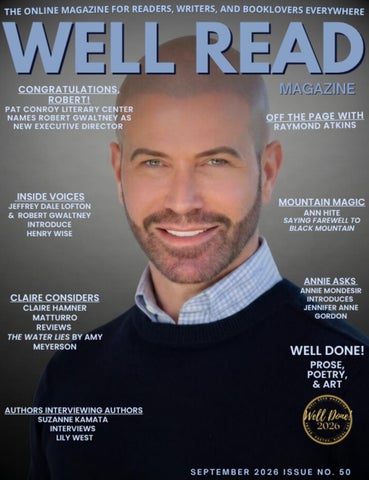
Congratulations, Robert - what an exciting year you’ve had! We are all so proud of you. WELL DONE! Pat Conroy Literary Center Names Robert Gwaltney as New Executive Director Beaufort, S.C. — August 18, 2026 — The Pat Conroy Literary Center is pleased to announce the appointment of Robert Gwaltney as its new Executive Director. A nonprofit executive and critically acclaimed author, Gwaltney brings more than 25 years of mission driven leadership and community service, along with a deep personal connection to the work and legacy of Pat Conroy. A lifelong resident of the American South and a graduate of Florida State University, Gwaltney most recently served in executive leadership with Easterseals North Georgia, where he oversaw one of Georgia's largest nonprofit early childhood education and family service programs. During his nonprofit career, he has developed strategic initiatives, strengthened organizational partnerships, and championed programs designed to improve the lives of children, families, and communities. His leadership has been characterized by a commitment to mission, collaboration, innovation, and service—qualities he now brings to the Literary Center as it looks toward its next chapter. Gwaltney's professional work is complemented by his accomplishments as an author. He has often cited Pat Conroy as one of the
writers who inspired his own literary journey. Conroy's fearless storytelling, profound sense of place, and belief in the transformative power of literature helped shape Gwaltney's understanding of what literary fiction can accomplish. That connection makes his new role at the Literary Center both professionally significant and personally meaningful. “Pat Conroy understood that stories can change the way we see ourselves, our communities, and one another,” Gwaltney said. “I am honored to join an organization that carries that belief forward, and I look forward to working with the staff, board, authors, educators, supporters, and community partners who make the Center such a special place.” As Executive Director, Gwaltney will build upon the Center's established legacy while focusing on expanding educational programming, strengthening community partnerships, growing philanthropic support, and broadening the Center's reach throughout the Lowcountry and beyond. “I want the Literary Center to continue to be a place where readers and writers feel welcomed, where young people discover the power of their own voices, and where Pat's enduring belief in empathy, courage, and the power of story remains at the heart of everything we do,” Gwaltney said. "Robert brings an impressive combination of nonprofit leadership experience, a deep commitment to community, and a real passion for the power of literature. We’re thrilled to welcome him to the Pat Conroy Literary Center. We look forward to seeing him build on the Center’s strong foundation and help take our work to the next level," Sean Scapellato, Board Chair of the Pat Conroy Literary Center added.
WHAT YOU READING?LETTER THE EDITORissue? No7 DidAREyou miss last FROM month’s INSIDE VOICES worries, click here to find it as well as7 Robert Gwaltney & Jeffrey DaLETTER FROM THE EDITOR all the past issues. 4
WELL READ MAGAZINE
HELLO READERS! WHAT ARE YOU READING?
16
WHY YOU SHOULD ADVERTISE IN WELL READ
49
INSIDE VOICES Robert Gwaltney & Jeffrey Dale Lofton introduce Henry Wise
51
MOUNTAIN MAGIC with Ann Hite
59
WELL DONE! PROSE, POETRY, AND ART
NO PILLOW FOR YOUR HEAD by Rita Welty Bourke
67
THE POPE IS DEAD by Mike Ross
73
HOW FREYDA GOT HER NAME — 1876 by Liz Newall
81
EGO SURFING ON A SATURDAY NIGHT by Michael Minassian
91
THE FIRST READING IS ALWAYS WRONG by David Anson Lee
95
A FAMILY PHOTO by Celia Miles
99
A HINT OF OILCLOTH by Nancy Dillingham
103
TIME by Robin Prince Monroe
107
CALL FOR SUBMISSIONS
111
SEPTEMBER 2026 ISSUE NO. 50
5
CLAIRE CONSIDERS The Water Lies by Amy Meyerson
113
ANNIE ASKS Jennifer Anne Gordon
117
AUTHORS INTERVIEWING AUTHORS
125
Cover design, interior formatting, and more
149
WHAT’S YOUR STORY?
159
OFF THE PAGE WITH RAYMOND ATKINS
161
If you enjoy this issue, and would like to support this online literary journal’s dream of keeping it free for readers and no reading fees for submissions, please consider leaving a tip @wellread on Venmo’s site or PayPal-www.wellreadmagazine.com.
LETTER FROM THE EDITOR
SEPTEMBER 2026 ISSUE NO. 50
7
If Bookshop.org is your preferred way to purchase books online check out WELL READ’s bookshop.
You can find books from past issues as well as current books to add to your reading list. Happy reading!
“When I was growing up in the hills of East Tennessee, I knew my dreams would come true. I know there are children in your community with their own dreams. They dream of becoming a doctor or an inventor or a minister. Who knows, maybe there is a little girl whose dream is to be a writer and singer. The seeds of these dreams are often found in books and the seeds you help plant in your community can grow across the world.” Dolly Rebecca Parton (January 19, 1946 – August 25, 2026)
We will always love you Dolly!
10
WELL READ MAGAZINE
Dolly Parton’s Imagination Library is dedicated to inspiring a love of reading by gifting books each month to children from birth to age five, free of charge, through funding shared by Dolly and local community partners in the United States, Canada, United Kingdom, Australia and Republic of Ireland.
If you’d like to support this amazing organization, please consider making a donation.
SEPTEMBER 2026 ISSUE NO. 50
11
Order your copy today!
Order your copy today!
WHAT ARE YOU READING?
In the Best of 2025 Volume One, you’ll find forty-one submissions written by a fantastic mix of awardwinning authors and poets plus new ones to the scene. Five submissions in this volume were nominated for a Pushcart Prize: Why I Said What I Said to the Bartender by Alaina Hammond, The Easter Dress by Dawn Major, Montecito by Leslie Zemeckis, Dream Merchant by Francine Rodriguez, and Stagnation by Rachid Toumi. The cover art is a photograph by author and artist, Malcolm Glass, who had several pieces published in October of 2024. List of Contributors: J. B. Hogan, Steve Putnam, Gregg Norman, Deborah-Zenha Adams, Rita Welty Bourke, B.A. Brittingham, Mike Turner, Leslie Zemeckis, Micah Ward, John Drudge, Jennifer Susan Smith, DeLane Phillips, Julie Green, Ann Hite, Mary Kendall, John M. Williams, Alaina Hammond, Jake Sheff, JoyAnne O'Donnell, Aaron Goodman, Dawn Major, Souad Zakarani, Zoé Mahfouz, Don Edwards, Celia Miles, Malcolm Glass, Neth Williams, Hubert Blair Bonds, Rickie Zayne Ashby, Francine Rodriguez, Rachid Toumi, Mike Ross, James Garrison, Mike Nemeth, and Robin Prince Monroe
16
WELL READ MAGAZINE
ADD TO YOUR TBR LIST
In the Best of 2025 Volume Two, you’ll find forty-three submissions written by a fantastic mix of award-winning authors and poets plus new ones to the scene. One submission in this volume was nominated for a Pushcart Prize: Burtrell’s Pieces by Jeff Clemmons. The cover art is a photograph by artist, Malcolm Glass, who had several pieces published in October of 2024. List of contributors: Janet Clare, Mike Ross, Mike Nemeth, Patricia Feinberg Stoner, Colette Lynch, Karen Miller, Linda C. Rehkopf, Jeff Clemmons, Mike Coleman, Micah Ward, LaVern Spencer McCarthy, J. B. Hogan, Fhen M., Ken Gosse, Celia Miles, Cindy Sams, Robin Prince Monroe, Beverly Fisher, Rickie Zayne Ashby, Maria Mackas, Jim Cherry, Martha Ellen Johnson, Michael Lee Johnson, Donald Edwards, Alex Poppe, Janet Oakley, John M. Williams, Hubert Blair Bonds, Ellen Notbohm, Steve Putnam, Souad Zakarani, Mike Turner, Nancy Dillingham, and Saeed Ibrahim
SEPTEMBER 2026 ISSUE NO. 50
17
BEST BOOK AWARDS FINALIST 2023, a Book All Georgians Should Read 2024, and Nautilus Awards Silver Medalist 2024 Let Me Say This: A Dolly Parton Poetry Anthology offers 54 poets’ takes on often-unsung facets of this diamond in a rhinestone world—calling in Dolly’s impeccable comedic timing, her lyric mastery, her business acumen, and her Dollyverse advocacy. These poems remind us to be better and to do better, to subvert Dolly cliché, and they encourage us to weave Dolly metaphor into our own family lore. Within these pages, Dolly takes the stage and the dinner table; readers see the public Dolly of the silver screen and the private Dolly of identity contemplation. Dolly raises praise and question, and she butterflies into our hearts to unabashedly to claim the mantra In Dolly We Trust.
Let Me Say This: A Dolly Parton Poetry Anthology edited by Julie E. Bloemeke & Dustin Brookshire
WHAT ARE YOU READING?
Death By Mistake: A Josiah Reynolds Mystery 22 by Abigail Keam In a world of oak-cured bourbon, antebellum mansions, and Thoroughbred farms, secrets buried in the deep earth are never hidden long. Josiah has resigned herself to being alone. Her boyfriend, Hunter left her for an old flame, and Josiah vows not to interfere in his life. She cares for the man and wants him to be happy. So, it comes as a shock when Detective Drake informs her that Hunter has been arrested for the murder of his wife, Kathy Wickliffe. Josiah simply can’t believe Hunter would harm another human being. She must uncover the truth— and fast. There’s the law, and there is Josiah’s justice!
20
WELL READ MAGAZINE
ADD TO YOUR TBR LIST
Owls in the Ginza: (and other stories from a life in Japan) by Suzanne Kamata "Suzanne Kamata, an American writer who has made her home in Japan for over twenty years, presents vivid stories of her visits to islands in the Inland Sea, her fears for her children during the tsunami of 2011, and her stress when she's faced with graveyard weed-pulling duties as the only foreign participant in a community where people have known each other for generations. Owls in the Ginza is more than a volume of informative travel essays. It's a collection of thought-provoking and life-affirming tales from this prolific award-winning author." --Miho Kinnas, author of Waiting for Sunset to Bury Red Camellias "Owls In the Ginza is a mesmerizing, unique chronicle of contrasts: discovering remote pockets of Japan with an adventurous, disabled daughter, parenting mixed race children as an American in Japan, as a perpetual insider/ outsider who is alternately vexed and delighted." — Susan Kiyo Ito, author of National Book Critics Circle Award Finalist I Would Meet You Anywhere "Suzanne Kamata is a brilliant observer of people, and these essays and vignettes pulse with humanity. Her prose is infused with empathy, whimsy, and a profound honesty that cannot fail but appeal to readers. Whether in fiction or nonfiction, Kamata's stories have a melancholic warmth that leaves you simultaneously uplifted and deeply moved. "-- Iain Maloney, author of The Japan Lights
SEPTEMBER 2026 ISSUE NO. 50
21
22
WELL READ MAGAZINE
Outside the Lines is a literary novel set in the Deep South during the turbulent summer of 1961. Against the backdrop of the Freedom Riders movement, it explores the fragile boundaries between loyalty and truth, and the ways family bonds can both sustain and divide us.
Outside the Lines A Novel by Kristine F. Anderson
Set to release on November 14th
SEPTEMBER 2026 ISSUE NO. 50
23
COLORFUL CROW PUBLISHING
Publishing with Heart At Colorful Crow Publishing, every story begins with connection—between author and reader, past and present, truth and imagination. Rooted in a legacy of honoring diverse voices and carried forward with a deep commitment to care, we champion books that matter—stories that stay with you long after the final page. From literary fiction to children’s adventures, from heartfelt memoirs to imaginative journeys, our titles reflect the beauty, complexity, and resilience of the human experience.
FEATURED FORTHCOMING TITLES: CROOKED LINES (Historical Fiction) by Kristine Anderson A journalist returns to the Deep South to investigate the disappearance of a childhood friend—only to confront grief, addiction, and the tangled lines of race, loyalty, and truth in 1960s America. SARAH THE SEED (Picture Book) by L.G. Bridges When a strong wind carries Sarah far from everything she knows, she discovers that being lost may be the very thing that helps her grow into something extraordinary. THE ELDDIR CHRONICLES (Middle-Grade Series) by L.G. Bridges In a richly imagined world of mystery and magic, young heroes must discover who they are—and what they’re willing to risk—to protect the future of Elddir.
WORK IS A FOUR-LETTER WORD: MY CRAZY CAREER, COWORKERS, AND CLIENTS (Memoir) by Bobbie Christmas From outrageous clients to unbelievable workplace moments, this candid and often hilarious memoir reveals the hard-earned wisdom—and wild stories—behind a lifetime in the world of work. MORE STORIES TO DISCOVER: THE MOUNTAINS DON’T FORGET (Historical Fiction) by Pat Walker Johnson After escaping an abusive marriage, Pru Massey builds a new life—but love, loss, and a haunting crime force her to reckon with the past she cannot outrun. EXPLORE NATURE (Picture Book Series) by MaKayla Rodriguez Join a curious little snail as he journeys through the natural world, discovering friendship, wonder, and the beauty of exploring one small step at a time. THE FOARK RIVER SALON AND BAIT SHOP (Literary Fiction with Humor) by Barbara G. Tucker When a small-town bait shop becomes the center of a reality TV show, three employees must confront their secrets—and decide whether they’re ready for the truth to come to light. NED FLETCHER AND THE LAST CRACIAN (Sci-Fi Adventure) by Travis Williams A space pilot with the soul of the Old West navigates danger, mystery, and sharpwitted dialogue in a futuristic tale that blends frontier grit with interstellar stakes. AND MORE TO COME… Some stories are still taking shape—but we can’t wait to share them with you. Discover more at Colorful Crow Publishing. Follow along for new releases, author features, and behind-the-scenes glimpses into the stories we’re proud to bring into the world.
WHAT ARE YOU READING?
Los Angeles, Dark Corners by Francine Rodriguez Against the January 6 capitol riots, a young FBI agent, Josh, works undercover to infiltrate neo-Nazi group in Los Angeles. He becomes involved with Novena, the on/off girlfriend of the group’s leader, blurring the lines between investigation and romance, and placing them both in a situation which threatens to explode into violence when a top-ranking official is murdered. Told in dual narration, the novel opens with Novena in prison awaiting sentencing for two murders. Novena’s position in the movement was largely shaped by her perception that she is overlooked and discriminated against by the system of government in the U.S. even though she is white. A few months earlier, after an argument with her boyfriend, Drew, head of the local chapter of the White Knights, she meets Josh at a rally, and the two become close, Josh pressing Novena for information on the Knights’ preparation for January 6 and beyond, and her looking to him for the stability and direction she lacks in her own life as she begins to become distant from Drew and the Knights. But Drew brings Novena back into the fold, convincing her that one of the top men in the organization, Norwood, is a traitor. On January 6, while many of the Knights are away, participating in the insurrection at the capitol, Novena and Drew break into Norwood’s home to find information to use against him so Drew can replace him as head of the Knights. The break in turns violent when the owner unexpectedly returns home, and Novena shoots Norwood, killing him. Lost and alone in the aftermath of the robbery, she turns back to Josh, eventually confessing the murder to him. Blindsided, Josh’s reaction will determine both of their fates.
26
WELL READ MAGAZINE
ADD TO YOUR TBR LIST
SEPTEMBER 2026 ISSUE NO. 50
27
“An author nearing retirement age and consumed with her own family problems, reluctantly agrees to chronicle the life of a cleaning service owner with a horrific story and a desperate need to share it. Although the two women come from vastly different worlds, they develop an unlikely but tender bond once they’re sequestered on beautiful Pawley’s Island to complete the book. With lyrical prose and keen insight into the struggles of two very different women, Susan Zurenda explores the power of story to bring healing and redemption to even the most damaged life. No Way Out but Through will haunt you long after you’ve turned the final page.” – Cassandra King, author of Tell Me a Story: My Life with Pat Conroy
28
WELL READ MAGAZINE
SEPTEMBER 2026 ISSUE NO. 50
29
WHAT ARE YOU READING?
RUNNER-UP FOR THE 2024 ARTHUR SMITH POETRY PRIZE In her debut collection, No Lace Fronts in Iowa City, Meghan Malachi explores how community, desirability, and notions of home influence the journeys by which girls come of age. These poems celebrate a South Bronx childhood and navigate a complicated womanhood in the Midwest through confessional musings on Black Latinx identity and intimate epistolary interludes. Favorite wigs, main character moments, and reimagined anti-heroines are all vessels for exploring girlhood in this love letter to female kinship. No Lace Fronts in Iowa City is ultimately a testament to the desires for belonging and tenderness that we all harbor.
The witchy goddess of rock has been casting a spell on music lovers for more than 50 years as a solo artist and a member of the iconic Fleetwood Mac. In this anthology, poets explore the myth, the music, and the enduring legacy of Stevie Nicks. From haunting ballads of heartache to empowering anthems of liberation, this collection of poems in White Winged Doves embraces the wild spirit and introspective depth synonymous with Nicks’ artistry. Poets channel her iconic imagery and fierce individuality, crafting an homage that resonates with both tribute and innovation. This book invites readers to wander through the witchy realms of dreaming and desiring, exploring the mystical landscapes and emotional depths that continue to define Nicks’ legendary career. Each poem weaves a tapestry of resilience and enchantment that mirrors the timeless muse herself.
30
WELL READ MAGAZINE
ADD TO YOUR TBR LIST
Arts and Sciences is, a unique poetry collection in that all the poems in it deal with figures, works, or events in literature, music, painting, film, or the sciences. Its poems cover a wide range, from Hamlet and Emily Dickinson to Sinatra and Bessie Smith, from Edward Hopper and Invasion of the Body Snatchers to gene therapy and quantum entanglement.
MADVILLE PUBLISHING seeks out and encourages literary writers with unique voices. We look for writers who express complex ideas in simple terms. We look for critical thinkers with a twang, a lilt, or a click in their voices. And patois! We love a good patois. We want to hear those regionalisms in our writers’ voices. We want to preserve the sound of our histories through our voices complete and honest, dialectal features and all. We want to highlight those features that make our cultures special in ways that do not focus on division, but rather shine an appreciative light on our diversity.
SEPTEMBER 2026 ISSUE NO. 50
31
WHAT ARE YOU READING?
Small Town Witch Deborah Z Adams
by
Small Town Witch, a new chapbook from award-winning author Deborah Z Adams, is a collection of spell-binding tales about the witches we meet every day. Written with warmth, humor, and a little bite, Small Town Witch is packed with more substance than meets the eye. “Adams’s witches may inhabit a small town, perhaps your small town, but they are not small women. They are powerful and empowering. You’ll root for these women, these coven leaders and elementary school teachers. Two parts poetry, two parts prose, with a healthy pinch of feminist indignation, Adams’s tales will surely charm you and remind you that you’re “not in this fight alone.’” —Joanna Grisham, author of Phantoms (Finishing Line Press, 2023)
32
WELL READ MAGAZINE
ADD TO YOUR TBR LIST
Available from your favorite bookseller! All proceeds from sales of Small Town Witch are donated to organizations that do good in the world.
You can sample Small Town Witch stories here.
“I’ve lived my life surrounded by women who wield their powers quietly but effectively,” says Adams. “They’re everywhere, but especially prevalent in small towns.” Deborah Z Adams is an awardwinning author of novels, short fiction, CNF, and poetry. She served as executive editor of Oconee Spirit Press for ten years, and is currently a reader for Boomerlit. Her writing has appeared or is forthcoming in Roanoke Review, Litmosphere: a journal of Charlotte Lit, WELL READ Magazine, Dead Mule and other journals.
SEPTEMBER 2026 ISSUE NO. 50
33
WHAT ARE YOU READING?
In the Best of 2024 Volume One, you’ll find fifty-one submissions written by a fantastic mix of awardwinning authors and poets plus new ones to the scene. Three submissions in this volume were nominated for a Pushcart Prize: The Hanging by Doug Gray, Sandy Tells Me About Dead Pine Trees by J.D. Isip, and Wilma by Phyllis Gobbell. The cover art is by artist, Lindsay Carraway, who had several pieces published in February of 2023.
Contributors: Carolyn Haines, Doug Gray, Angela Patera, Kimberly Parish Davis, Michael Spake, Jennifer Smith, Ashley Tunnell, Ken Gosse, Dr. Elizabeth V. Koshy, Ann Hite, Ellen Notbohm, Micah Ward, Malcolm Glass, Katie Crow, Lorraine Cregar, Patricia Feinberg Stoner, John M. Williams, Michael Lee Johnson, J.D. Isip, Casie Bazay, Jacob Strunk, Ann Christine Tabaka, Joan McNerney, Fhen M., Steven Kent, Peter Magliocco, Mark Braught, Rita Welty Bourke, Loretta Fairley, Barbara Anna Gaiardoni, S. Dodge, DeLane Phillips, Candice Marley Conner, Arvilla Fee, J. B. Hogan, Ramey Channell, Hope Kostedt, John Grey, Martha Ellen Johnson, Nancy Chadwick-Burke, Mike Coleman, Margaret Pearce, Nicole Irizawa, Donald Edwards, Janet Lynn Oakley, Mandy Jones, Phyllis Gobbell, and Suzanne Kamata
34
WELL READ MAGAZINE
ADD TO YOUR TBR LIST
In the Best of 2024 Volume Two, you’ll find fifty-two submissions written by a fantastic mix of awardwinning authors and poets plus new ones to the scene. Three submissions in this volume were nominated for a Pushcart Prize: Hanging Pictures by Micah Ward, The Lone and Level Sands by James Wade, and American Chestnut by Candace Connor. The cover art is by artist, Lindsay Carraway, who had several pieces published in February of 2023.
Contributors: Candice Marley Conner, Kaye Wilkinson Barley, Mike Ross, Will Maguire, AJ Concannon, Patricia Feinberg Stoner, Gregg Norman, Robin Prince Monroe, Ramey Channell, April Mae M. Berza, Anne Leigh Parrish, B. A. Brittingham, Mike Austin, Sara Evelyne, Jennifer Smith, Loretta Fairley, J.L. Oakley, Celia Miles, Kris Faatz, Ed Nichols, Linda Imbler, Annie McDonnell, Mike Turner, Micah Ward, James Wade, Ashley Tunnell, John M. Williams, Robb Grindstaff, Stevie Lyon, Laura McHale Holland, Saeed Ibrahim, Nancy Julien Kopp, Julie Green, DeLane Phillips, Shayla Dodge, Edilson Afonso Ferreira, Chris Wood, Jasna Gugić, Fhen M., Hubert Blair Bonds, Ellen Birkett Morris, Margaret Pearce, Ellen Notbohm, Kimberly Parish Davis, J. B. Hogan, and Royal Rhodes
SEPTEMBER 2026 ISSUE NO. 50
35
WHAT ARE YOU READING?
In Volume One, you’ll find thirty-eight submissions written by a fantastic mix of awardwinning authors and poets plus new ones to the scene. Three submissions in this volume were nominated for a Pushcart Prize: Miller’s Cafe by Mike Hilbig, Sleeping on Paul’s Mattress by Brenda Sutton Rose, and A Hard Dog by Will Maguire. The cover art is by artist, Lindsay Carraway, who had several pieces published in February’s issue. Contributors: Jeffrey Dale Lofton, Phyllis Gobbell, Brenda Sutton Rose, T. K. Thorne, Claire Hamner Matturro, Penny Koepsel, Mike Hilbig, Jon Sokol, Rita Welty Bourke, Suzanne Kamata, Annie McDonnell, Will Maguire, Joy Ross Davis, Robb Grindstaff, Tom Shachtman, Micah Ward, Mike Turner, James D. Brewer, Eileen Coe, Susan Cornford, Ana Doina, J. B. Hogan, Carrie Welch, Ashley Holloway, Rebecca Klassen, Robin Prince Monroe, Ellen Notbohm, Scott Thomas Outlar, Fiorella Ruas, Jonathan Pett, DeLane Phillips, Larry F. Sommers, Macy Spevacek, and Richard Stimac
36
WELL READ MAGAZINE
ADD TO YOUR TBR LIST
In Volume Two, you’ll find fortythree submissions written by a fantastic mix of award-winning authors and poets plus new ones to the scene. Three submissions in this volume were nominated for a Pushcart Prize: A Bleeding Heart by Ann Hite, A Few Hours in the Life of a Five-Year-Old Pool Player by Francine Rodriguez, and There Were Red Flags by Mike Turner. The cover art for Volume Two is by artist, DeWitt Lobrano, who had several pieces published in November’s issue. Enjoy!
Contributors: Ann Hite, Malcolm Glass, Dawn Major, John M. Williams, Mandy Haynes, Francine Rodriguez, Mike Turner, Mickey Dubrow, William Walsh, Robb Grindstaff, Deborah Zenha Adams, Mark Braught, B. A. Brittingham, Ramey Channell, Eileen Coe, Marion Cohen, Lorraine Cregar, John Grey, J. B. Hogan, Yana Kane, Philip Kobylarz, Diane Lefer, Will Maguire, David Malone, Ashley Tunnell, Tania Nyman, Jacob Parker, LaVern Spencer McCarthy, K. G. Munro, Angela Patera, Micheal Spake, George Pallas, Marisa Keller, Ken Gosse, and Orlando DeVito
SEPTEMBER 2026 ISSUE NO. 50
37
WHAT ARE YOU READING?
They All Rest in the Boneyard Now by Raymond L. Atkins (Author), Evelyn Mayton (Illustrator) “Raymond Atkins writes with intuitive wisdom, as he channels those from beyond the grave. His poetry gives voice to those who once mattered, those who time wants us to forget. In They All Rest in the Boneyard Now, Atkins wrestles death from the dusty clay and breathes life into dry bones while reminding us that every soul who once had breath is worthy of being remembered. These saints, sinners, socialites, and the socially inept are all victims of time, or circumstance, as we too shall one day be. Atkins offers salvation to all who are tormented, and solace to those who seek eternal rest.” – Renea Winchester, Award-winning author of Outbound Train
38
WELL READ MAGAZINE
ADD TO YOUR TBR LIST
Sing Down the Moon by Robert Gwaltney Sixteen-year-old Leontyne Skye yearns to escape Good Hope, the remote Georgia coastal barrier island where she resides. Leontyne's heritage is bleak. Tasked with tending Damascus, an ancient fig tree beguiling haints across the river with its wind chime song, Leontyne's mother, Eulalee, disintegrates into tufts of hair, teeth, and memory. This affliction befalls all Skye women, a fatal consequence of distilling Redemption, an addictive drug made from the figs of Damascus imbued with the essence of haints. Leontyne also tumbles apart, her memories and hand lost in a life-altering accident suffered two years back during an event known as Tribulation Day. Through unreliable recollections of her trusted friends the Longwood twins, Leontyne stitches a dubious understanding of who she was before she fell "the long-long ways." In the aftermath of Eulalee's death, Leontyne is pressured by the Longwoods to render Redemption, continuing the legacy upon which Good Hope depends.
SEPTEMBER 2026 ISSUE NO. 50
39
WHAT ARE YOU READING?
I Am a Georgia Girl: The Life of Lucille Selig Frank, 18881957 by Ann Hite Twenty-five-year-old Lucille Selig Frank's whole life changed on April 26, 1913, as the Confederate Memorial Parade marched through Atlanta, Georgia. Lucille was attending the opera matinee with her mother. Her husband, Leo Frank, sat in his office in the National Pencil Company, where he was superintendent, working on a financial report. The brutal murder of fourteen-year-old Mary Phagan, an employee of Leo's, took place in the pencil factory that day. Lucille's husband would be the last known person to see Mary alive. While much has been written about Mary Phagan's murder and Leo Frank's subsequent trial over the past 115 years, very little has given voice to Lucille Selig Frank and other women connected to the horrific events that took place between 19131915. Lucille was part of a mission to make Governor John Slaton aware of the antisemitism being shown to Leo during his arrest and trial. She paid a heavy price for her courage. The story of Lucille and the women connected to this case is as timely today as it was in the early 1900s. This book has many diverse characters, including place which influences the outcome. Within this complexity, Hite's telling of Lucille's story will help others see that antisemitism, the marginalization of women, and mobs taking justice into their own hands cannot be tolerated. How many people were complicit in Leo and Lucille's journey? Was justice truly served? This book leaves the reader to answer these questions.
40
WELL READ MAGAZINE
ADD TO YOUR TBR LIST
Red Clay Suzie by Jeffrey Dale Lofton A novel inspired by true events. The coming-of-age story of Philbet, gay and living with a disability, battles bullying, ignorance, and disdain as he makes his way in life as an outsider in the Deep South—before finding acceptance in unlikely places. Fueled by tomato sandwiches and green milkshakes, and obsessed with cars, Philbet struggles with life and love as a gay boy in rural Georgia. He’s happiest when helping Grandaddy dig potatoes from the vegetable garden that connects their houses. But Philbet’s world is shattered and his resilience shaken by events that crush his innocence and sense of security; expose his misshapen chest skillfully hidden behind shirts Mama makes at home; and convince him that he’s not fit to be loved by Knox, the older boy he idolizes to distraction. Over time, Philbet finds refuge in unexpected places and inner strength in unexpected ways, leading to a resolution from beyond the grave.
SEPTEMBER 2026 ISSUE NO. 50
41
WHAT ARE YOU READING?
The Smuggler's Daughter by Claire Matturro Ray Slaverson, a world-weary Florida police detective, has his hands full with the murders of two attorneys and a third suspicious death, all within twenty-four hours. Ray doesn’t believe in coincidences, but he can’t find a single link between the dead men, and he and his partner soon smash into an investigative stonewall. Kate Garcia, Ray’s fiancée, knows more than she should. She helped one of the dead attorneys, just hours before he took a bullet to the head, study an old newspaper in the library where she works. Kate might be the only person still alive who knows what he was digging up— except for his killer. When Kate starts trying to discover what’s behind the murders, she turns up disturbing links between the three dead men that track back to her family’s troubled past. But she has plenty of reasons to keep her mouth shut. Her discovery unleashes a cat-and-mouse game that threatens to sink her and those she loves in a high tide of danger.
42
WELL READ MAGAZINE
ADD TO YOUR TBR LIST
The Bystanders by Dawn Major The quaint town of Lawrenceton, Missouri isn’t sending out the welcoming committee for its newest neighbors from Los Angeles—the Samples’ family. Shannon Lamb’s “Like a Virgin” fashion choices, along with her fortune-telling mother, Wendy Samples, and her no-good, cheating, jobless, stepfather, Dale Samples, result in Shannon finding few fans in L-Town where proud family lines run deep. Only townie, Eddy Bauman, is smitten with Shannon and her Valley Girl ways. The Bystanders is a dark coming-of-age story set in the 1980s when big hair was big, and MTV ruled. In a quiet town of annual picnics and landscapes, the Samples’ rundown trailer and odd behaviors aren’t charming the locals. Shannon and Wendy could really use some friends but must learn to rely upon themselves to claw their way out of poverty and abuse if they want to escape Dale. The Bystanders pays homage to Americana, its small-town eccentricities, and the rural people of the Northern Mississippi Delta region of Southeast Missouri, a unique area of the country where people still speak Paw Paw French and honor Old World traditions.
SEPTEMBER 2026 ISSUE NO. 50
43
WHATWHAT ARE YOU READING? ARE YOU READING?
The Girl from the Red Rose Motel: A Novel by Susan Beckham Zurenda Impoverished high school junior Hazel Smalls and privileged senior Sterling Lovell would never ordinarily meet. But when both are punished with in-school suspension, Sterling finds himself drawn to the gorgeous, studious girl seated nearby, and an unlikely relationship begins. Set in 2012 South Carolina, the novel interlaces the stories of Hazel, living with her homeless family in the rundown Red Rose Motel; Sterling, yearning to break free from his wealthy parents' expectations; and recently widowed Angela Wilmore, their stern but compassionate English teacher. Hazel hides her homelessness from Sterling until he discovers her cleaning the motel's office when he goes with his slumlord father to unfreeze the motel's pipes one morning. With her secret revealed, their relationship deepens. Angela-who has her own struggles in a budding romance with the divorced principal-offers Hazel the support her family can't provide. Navigating between privilege and poverty, vulnerability and strength, all three must confront what they need from themselves and each other as Hazel gains the courage to oppose boundaries and make a bold, life-changing decision at novel's end.
44
WELL READ MAGAZINE
TO ADD ADD TOTO YOUR YOUR TBR TBR LIST LIST
The Best of the Shortest: A Southern Writers Reading Reunion by Suzanne Hudson (Author, Editor), Mandy Haynes (Editor), Joe Formichella (Author, Editor) “Some of the happiest moments of my writing life have been spent in the company of writers whose work is included in these pages. They all brought their A-game to this fabulous collection, and at our house it is going on a shelf next to its honored predecessors. The only thing that saddens me is that the large-hearted William Gay is not around to absorb some of the love that shines through every word.” ―Steve Yarbrough “The Best of the Shortest takes the reader on a fast-paced adventure from familiar back roads to the jungles of Viet Nam; from muddy southern creek banks to the other side of the world, touching on themes as beautiful as love and as harsh as racism. However dark or uplifting, you are guaranteed to enjoy the ride.” --Bob Zellner “I had some of the best times of my life meeting, drinking and chatting with the writers in this book, times matched only by the hours I spent reading their books. This collection showcases a slice of Southern literature in all its complicated, glorious genius. Anyone who likes good writing will love it.” --Clay Risen
SEPTEMBER MARCH 2025 2026ISSUE ISSUENO. NO.3250
45
WHAT ARE YOU READING?
Walking The Wrong Way Home by Mandy Haynes Spanning nearly twenty decades, the struggles and victories these characters face are timeless as they all work towards the same goal. A place to feel safe, a place to call home.
Sharp as a Serpent's Tooth: Eva and other stories by Mandy Haynes Each story features a female protagonist, ranging from ten to ninety-five years of age. Set in the south, you’ll follow these young women and girls as they learn that they’re stronger than they ever thought possible.
46
WELL READ MAGAZINE
ADD TO YOUR TBR LIST
Oliver by Mandy Haynes “Dear God…and Jesus and Mary…” Even though eleven-year old Olivia is raised Southern Baptist, she likes to cover her bases when asking for a favor. Unlike her brother Oliver, she struggles with keeping her temper in check and staying out of trouble. But Oliver is different, and in the summer of ’72 he proves to Olivia there’s magic in everything - it’s up to us to see it.
Mandy Haynes spent hours on barstools and riding in vans listening to great stories from some of the best songwriters and storytellers in Nashville, Tennessee. After her son graduated college, she traded a stressful life as a pediatric cardiac sonographer for a happy one and moved to an island off the east coast. She is a contributing writer for Amelia Islander Magazine, Amelia Weddings, and editor of Encounters with Nature, an anthology created by Amelia Island writers and artists. She is also the author of two short story collections, Walking the Wrong Way Home, Sharp as a Serpent's Tooth Eva and Other Stories, and a novella, Oliver. She is a co-editor of the Southern Writers Reading reunion anthology, The Best of the Shortest. Mandy is the editor-in-chief of WELL READ Magazine and the editor of four WELL READ anthologies. Like the characters in some of her stories, she never misses a chance to jump in a creek to catch crawdads, stand up for the underdog, or the opportunity to make someone laugh. At the end of 2024, Mandy moved back to middle Tennessee and now spends her time writing and enjoying life as much as she can.
SEPTEMBER 2026 ISSUE NO. 50
47
WHY WHY YOU SHOULD YOU SHOULD ADVERTISE ADVERTISE IN WELL IN WELL READREAD
If you’d like to feature your work in the reading recommendation section with live links to your website and purchase link, and have personalized graphics of your ad shared to WELL READ Magazine’s social sites, click here to see examples of the different options and more information. Click here for more information on purchasing a cover. Don’t let the low prices fool you - WELL READ was created by an author who understands how much it costs to get your book in the best shape possible before it’s ready to be queried by agents, small presses, or self-published. Showing off your book and getting it in front of readers shouldn’t break the bank. WELL READ Magazine receives approximately 8,000 views each month on Issuu’s site alone (the world’s largest digital publishing and discovery platform available). Your book will be included with the featured authors, great interviews, submissions, essays, and other fantastic books inside each issue. There is strength in numbers. Let’s get our books seen!
48
WELL READ MAGAZINE
WHY WHY YOU SHOULD YOU SHOULD ADVERTISE ADVERTISE IN WELL IN WELL READREAD
Ad rates for 2026: $50 - One FULL PAGE AD $75 - TWO-PAGE SPREAD $100 - TWO HIGH IMPACT - FULL COLOR PAGES - (this is NOT a standard two page spread) $100 - FOR PUBLISHERS ONLY (limit 3 months of ads)- Advertise up to THREE books with one live link that takes viewers to your website. $75 - BOOKSTORES, PUBLICISTS, AUTHORS - two-page spread to promote book events $450 - FRONT COVER - includes two full color interior pages for book description, author bio, and/or blurbs, plus an additional one page ad in the next three issues. Also included is the Featured Author spot in the issue your book is on the cover. $350 - INTERIOR COVER or BACK COVER - includes TWO additional full color interior pages for book description, author bio, and/or blurbs. *Prices include creating the graphics for the magazine pages and all social sites. Everything is taken care of for you.
SEPTEMBER JANUARY 2025 2026ISSUE ISSUENO. NO.30 50
49
INSIDE VOICES
“…in many cases, memory can feed into what becomes myth. I find that my characters are often in conflict with the myths they feel should define them.”
Robert Gwaltney & Jeffrey Dale Lofton introduce Author Henry Wise 50
WELL READ MAGAZINE
Robert Gwaltney & Jeffrey Dale Lofton introduce Henry Wise
Henry Wise is a graduate of the Virginia Military Institute and the University of Mississippi MFA program. A writer across multiple genres, his poetry has been published in Shenandoah, Radar Poetry, Clackamas, Nixes Mate Review, and elsewhere. His nonfiction and photography have appeared in Southern Cultures. His first novel, Holy City, won the 2025 Edgar Award for Best First Novel. Promised Land is his latest novel. Inside Voices (Jeffrey): The Snakefoot is almost a character in its own right. What drew you to creating this swampland, and how did the landscape shape the story as it evolved? The Snakefoot first appeared in Holy City, and it captivated me enough to want to zoom in and linger there. So that’s what I set out to do in Promised Land. As Buck Tomlin reflects in the novel, nothing that enters the swamp ever leaves it, and this idea became central to the swamp as a place where boundaries are blurred, where it’s difficult to determine what is land and what is water, and where those who escape into it may in fact be trapped by it. Swamps and wetlands are iconic in Southern lore, but I was inspired in part by what I know and don’t know of Virginia’s Great Dismal Swamp, where escaped slaves formed elusive communities, and where “freedom” meant survival in harsh conditions. I wondered about the legacy of those maroons, and about others who might seek a haven there. The Snakefoot is described in Promised Land as having water that never shines, but I see it as a kind of
SEPTEMBER 2026 ISSUE NO. 50
51
Robert Gwaltney & Jeffrey Dale Lofton introduce Henry Wise
mirror of the past, and its reflective qualities also open the possibility of fate, destiny, and even the supernatural. Inside Voices (Robert): Promised Land seems to ask whether the past is ever truly buried. What interested you most about exploring the ways history continues to influence the present? To me this idea is unavoidable. So many books—specifically American books—contain a central optimism—a belief that, no matter what, one can start over, ride off into the sunset, be reborn. And I think, in America, this has long been taken for granted. My work does not share this perspective, and maybe that’s the Southern experience coming through. Promised Land is a book literally and figuratively about excavation. Not of moving on but of digging in. This novel struggles with the past and the doubtful possibility of redemption. Inside Voices (Jeffrey): The novel revolves around a mystery, but it also appears to wrestle with questions of morality, loyalty, and redemption. How do you balance the demands of a page-turning crime story with deeper literary themes? For me, those deeper questions actually make me turn the page. Ultimately, I try to interrogate every scene. Does it move the narrative forward in some way by revealing character, plot, or tension? If the answer is no, I try to take it out. But I also think you can be too formulaic in revision, taking out some of the philosophy of
52
WELL READ MAGAZINE
Robert Gwaltney & Jeffrey Dale Lofton introduce Henry Wise
characters that might seem superfluous but actually might immerse the reader more than action would. Inside Voices (Robert): Deputy Will Seems and Tania Jameson are investigating a disappearance, while Buck Tomlin is searching for answers of his own. What interested you about telling the story through multiple investigations rather than a single point of view? Every time I try to write something straightforward, I fail. The story inevitably deepens, unfolds, and becomes far murkier. When I write, I try to allow the narrative to emerge. To follow it, be a bum, hop that train, and go where it goes. I write for surprise, because that begins to give a book a life of its own. So, the multiple layers of investigation in this novel were organic results of my process. Inside Voices (Jeffrey): Redevelopment of the Snakefoot raises questions about progress versus preservation. Were you intentionally exploring broader conversations about who benefits from "progress" and what communities stand to lose? The theme of redevelopment works for me as a counter to the demolition of the Notting Hills neighborhood in Richmond, which serves as a kind of omen. It seems to me that the very fact that parts of Richmond are in such bad shape that they must be torn down and the people displaced is an unsettling look at what might lie ahead for any place that might be developed. An idea that continues to haunt me is that progress comes at a cost. SEPTEMBER 2026 ISSUE NO. 50
53
Robert Gwaltney & Jeffrey Dale Lofton introduce Henry Wise
Inside Voices (Robert): Honor, promises, and personal codes seem central to the novel. What drew you to those themes? I’m always interested in the idea of honor, and how it often does more harm than good. Especially in a Southern setting, honor takes on a force that can be very hard to resist or reason with. Buck’s sense of honor drives him, and the ideas of living by a rigorous code are central to his self-perception. Will Seems also feels bound by a sense of duty that is tethered to guilt, which is to say the past. Inside Voices (Jeffrey): Southern fiction often explores the tension between memory and myth. In Promised Land, how do family stories, local legends, and hidden truths shape the characters' understanding of themselves? Yes, and, in many cases, memory can feed into what becomes myth. I find that my characters are often in conflict with the myths they feel should define them. Will’s mother’s suicide, and the effect of his actions on the Hathom family, for example, haunt and direct him. Even when he tries to do the right thing, it is proof of the hold the past has on him. He takes on the mantle and tradition of his roots by living in the decrepit manor that symbolizes his family and a South that is long gone. And yet, this seems to be an act of confronting these myths from the inside. Others, also, are aware of their own and their cultural pasts in a way that indicates the grip of history. Without even knowing it, Buck Tomlin is rebelling against his mother, who rebelled by leaving her country upbringing to be-
54
WELL READ MAGAZINE
Robert Gwaltney & Jeffrey Dale Lofton introduce Henry Wise
come a socialite in Richmond. Something in his fate directs him toward his actions, whether he knows it or not. Inside Voices (Jeffrey): Your novels create an atmosphere that's both beautiful and unsettling. How do you approach building suspense through setting and mood rather than relying solely on action or plot twists? I don’t read for plot twists. If they happen, and they work, great, but often, twists feel like gimmicks. I appreciate it when an author takes the risk of finding a deeper force in a book, and that can often be found in the ground itself. I want the reader to feel the humidity, smell the swamp, taste the fear. For me, action rises out of the setting. As Bennico reflects in Holy City, a crime has as much to do with the setting as the crime itself. My characters and their actions are rooted in the place that has forged them. Inside Voices (Robert): After readers finish Promised Land, what conversation do you hope they're still having—about the characters, the mystery, or perhaps the larger questions the novel raises about guilt, forgiveness, and the cost of the choices we inherit? I don’t really write with that in mind, and, in fact, I try not to think about what others will say. I think about it like this: I got lost for a while and a book came out of it. I hope readers finish that book and don’t forget it. Whether it’s the language or the story, I hope something about it haunts them. SEPTEMBER 2026 ISSUE NO. 50
55
“Wise’s vivid evocation of the Southern landscape and nuanced cast of flawed, fully realized characters imbue his sophomore novel with brooding suspense and emotional depth, solidifying him as a formidable voice in literary crime fiction. It’s a home run.”—Publishers Weekly (starred)
Promised Land Henry Wise
MOUNTAIN MAGIC with ANN HITE Saying Farewell To Black Mountain
5858
WELL READ MAGAZINE
MOUNTAIN MAGIC with Ann Hite
Saying Farewell To Black Mountain
I am a writer that always works on two projects at once. One will be nonfiction and one will be fiction. On my writing desk right now are two projects. One is a biography of Corra Harris, one of Georgia’s most famous writers back in the day and the other project is the last Black Mountain novel. For those who don’t know about my Black Mountain series, just pull up a chair and listen. The series consists of four novels, one novella, and a short story collection all set on Black Mountain in North Carolina, the heart of Southern Appalachia. In many cases, characters from my books show up in new books, if only to say hi. These books are full of Appalachian lore, strong women, and plenty of haints. Yet, all good things must come to an end to quote the cliche. My most recent book was nonfiction, a biography of Lucille Selig Frank, wife of Leo Frank, who was lynched in 1915 for murdering a young factory worker, Mary Phagan. Many people believe Leo was innocent; many believe he was guilty. This book took years to write, unearthing my love of creative nonfiction writing. I also began to think about writing fiction set in a different area. Appalachia will always be part of my fiction. It’s part of my deep family roots, but I am ready to do something different. I keep see-
SEPTEMBER 2026 ISSUE NO. 50
59
ing the rolling Appalachian Mountains of Georgia, my home state. There are stories to be told here, and the time has come to write the last Black Mountain book. Yes, you are reading correctly. I have been pondering and writing for almost a year on this last novel. New ideas for historical novels visit my dreams, but their threads are still floating free that need tying up. Characters from the novels make appearances. A story has formed with a couple of new characters. But because I am a pantser when it comes to writing fiction, I didn’t know the end. You notice dear readers I said didn’t in past tense. How in the world could I end the last novel? What would I call it? The title actually came to me when I began to write the book— The Last Haunting Of Black Mountain. Seems final enough. But first I had to know what ending I would honor this cast of characters with. Today while working in my office, the answer came in a flash. There it was shimmering with promise, the finale. Could I do this? I’ve never been much of a happily-ever-after kind of person. My readers don’t expect this. But the choice I am making is huge, massive. Understand I am not giving up fiction. I can’t do that. It’s my heart. There are so many Southern Appalachian stories I won’t lack fodder for a new novel. Stick with me dear readers. I will do my best to give all my beloved Black Mountain characters a proper, satisfying The End. I have it on good authority that some of the favorite and not so favorite characters will come to the last party.
60
WELL READ MAGAZINE
Mountain Magic is hard at work on this project. “You never know what is coming at you and when.” A quote from Shelly Parker—remember her? It’s going to be a big bash and the best ending of all time, or not. Ann
SEPTEMBER 2026 ISSUE NO. 50
61
62
WELL READ MAGAZINE
Click above to go to the BETWEEN THE PAGES YouTube channel, or on one of the links below to listen to the podcast. Please take a second to like and subscribe if you enjoy the channel - we appreciate you!
SEPTEMBER 2026 ISSUE NO. 50
63
WELL DONE! Fiction
66
WELL READ MAGAZINE
NO PILLOW FOR YOUR HEAD by Rita Welty Bourke
No Pillow for Your Head Rita Welty Bourke
My sister’s first husband was a violent man. I could tell you terrible things about him, but they say you should not speak evil of the dead, so I won’t. Besides, there are always two sides to a story, and I never heard his. Maybe he had reasons for some of the things he did. If it’s true that he took my sister’s cat out into the woods and shot him, that would be hard for me to swallow. Just about unforgivable, if it really happened. I don’t know if he cheated on my sister. What the gossips said was that he rediscovered a woman he’d fallen in love with years before he married Katie. I can’t say. One thing I know is that sometimes the flames of love are hard to extinguish. No matter what he did or didn’t do, he pales in comparison to the second man my sister married. His name was Tom. He’s dead now, too. Died in a car accident a few years back. I’m tempted to say good riddance, but that would be unkind. At one point I am certain that he—this second husband—loved my sister. They were married by a justice of the peace somewhere down in Maryland. We’re Catholic, our whole family is Catholic, so of course the marriage was not recognized as legitimate. Worse SEPTEMBER 2026 ISSUE NO. 50
67
NO PILLOW FOR YOUR HEAD by Rita Welty Bourke
than that, they were “living in sin.” I often wondered if, when Katie married Tom, it was in her mind that she could get out of it whenever she wanted. That she was unsure from the very beginning. I was in college at the time, and she didn’t much confide in me. It may be that, after the breakup of her first marriage, she simply didn’t want to be alone. Maybe he swept her off her feet, this gorgeous Navy man who brought her flowers and took her horseback riding and fixed the dripping faucet in her bathroom. Tom was all of those things; tall and handsome, affectionate, and charming, not to mention handy. Less than a year into the marriage, she wanted out. Very much wanted out. If she was ten minutes late coming home from work, he demanded to know where she was and what she had been doing. If she couldn’t prove she’d stopped for gas, or milk, or whatever, he sulked. He accused her of cheating on him. He demanded that she turn her paychecks over to him. She lost a baby that might have lived, had he not knocked her down the basement stairs. The bleeding wouldn’t stop. Tom, all concern and lovey-dovey, took her to the emergency room. They “packed” her womb, kept her overnight, and sent her home the next afternoon. I went to see her that weekend. She looked awful. This was not the glamorous sister who had worked her way up the corporate ladder until she became Production Supervisor at the Gettysburg Shoe Factory. “He’s not the same man I married,” she said, and she was twisting her hands together in a way I’d never seen before. “He was always so affectionate, so kind and considerate, but it’s like he’s a
68
WELL READ MAGAZINE
NO PILLOW FOR YOUR HEAD by Rita Welty Bourke
different person when he’s in one of his ‘black moods.’ That’s what she called them, his ‘black moods.’” She made me promise I wouldn’t tell our parents. “I don’t know what Dad would do, if he knew how bad things are,” she said. But of course, my parents already knew. A nurse’s aide who worked at the hospital told Jennie, my brother Charlie’s wife, that Katie had had a miscarriage. Jennie told my mother and my mother told my father. When Katie learned that Tom was trying to have their marriage legitimized in the Catholic Church, she’d had enough. (There’s a little known procedure that can accomplish that. It’s known as a sanation. Radical Sanation, to be exact. Or maybe it’s a Radical Sanitation. I’m not sure. But it’s for real. You go to a priest, you tell your story, and if the priest believes you, he goes to the bishop, and the bishop grants you a Radical Sanation. Everything is nice and clean again. The marriage is intact. Or sanitized. Or something.) The beauty of it is, the spouse doesn’t have to know. It can be accomplished by just one party to the marriage. Katie didn’t know. Somehow, she found out what Tom was up to. She confronted him. He flew into a rage. Shoved her against a wall, choked her, threatened to kill her. She was able to get away and run to a neighbor’s house. The neighbor called the police, then drove her back to the same hospital. They took pictures of her bruises and stitched up the cut on her forehead. Tom was taken off in a patrol car. He spent the next week in a jail cell. Katie got a restraining order against him and found an apartment. My father gave her the money for the deposit and the
SEPTEMBER 2026 ISSUE NO. 50
69
NO PILLOW FOR YOUR HEAD by Rita Welty Bourke
first month’s rent. She arranged for my parents and my brother to help her move. They were at her house, my mother, my father, and my brother Charlie on the Saturday morning Tom was to be released. They had plenty of time. The warden had assured Katie her husband would not be let out of jail until 4 pm. Charlie brought a trailer to haul her belongings. The four of them loaded up kitchen items, clothing, and what furniture Katie planned to take. They were nearly finished when Katie remembered some clothing she’d left downstairs in the dryer. She opened the basement door, started down the steps, and in that darkened passageway, she met Tom. He had a gun. She screamed. He raised the gun and pointed it at her. She knocked his arm away and raced back up the stairs. Tom came after her. When he reached the door to the kitchen, my father, all five-foot-five, 135 pounds of him, tackled the six-foot-four, 185 pounds of Tom. Tom lost his footing. He went backward. Maybe hit his head against the opposite wall. He fell, and Dad fell. They went down the stairs, the two of them, Dad on top, Tom’s head bouncing against each of those wooden steps. Later, Dad would say, “I rode him like a sled the whole way down.” They ended up on the basement floor, Dad still on top. He looked for the gun. It had gone skittering across the concrete floor. He got up and went for it. Charlie was there by then. Dad picked up the gun. “Let’s finish him off, Charlie, while we got the chance,” he said. Charlie is nothing if not cool-headed. He looked at Tom, saw that he was bleeding from the nose and mouth, but conscious.
70
WELL READ MAGAZINE
NO PILLOW FOR YOUR HEAD by Rita Welty Bourke
Maybe only semi-conscious. For sure he wasn’t dead. “No, Dad, I don’t think we should. Let’s just grab Katie and get the hell out of here.” And as an afterthought, “We’ll take the gun and I’ll toss it into Marsh Creek when we go over the bridge.” Mother had followed Charlie down the stairs. “Shouldn’t we get a pillow to put under his head?” Katie nixed the idea. “No pillow,” she said. “He tried to kill me.” * * * Later, when my father told the story, and he told it often, he always ended it with, “I’ve always been glad I didn’t do it. It would have haunted me.” I was out of college and living in Nashville when Katie married again. She had a child, and this marriage is a happy one. No guns, no violence, only a quiet life together raising their son.
Rita Welty Bourke is the author of A Stone from the River Rhine, Kylie's Ark: The Making of a Veterinarian, and Islomanes of Cumberland Island. Her stories have appeared in numerous literary journals.
SEPTEMBER 2026 ISSUE NO. 50
71
WELL DONE! Essays, Memoirs, and True Stories
72
WELL READ MAGAZINE
THE POPE IS DEAD by Mike Ross
The Pope is Dead Mike Ross
“He’s dead.” Silvio shook his head, his eyes wet and his face ashen. “Last night, late. I’ll miss him so much.” Pope John Paul II had been ill for some time, so this wasn’t a shock. Man may be created equal, but not all deaths are. Most impact a family, maybe a few dozen friends, but some, like this one, affect the world. For my group of art lovers, this was catastrophic. They had come to Rome for one reason: to see the Sistine Chapel, the same room where the new pope would be chosen. According to the newspaper on the hotel desk, it would be closed, along with the entire Vatican. A dashed wish is the bitterest one of all. This was like buying tickets to the New York Symphony playing Mozart, then, once seated, finding out it was Milli Vanilli lipsynching "Girl You Know It's True." Dinner was nearly silent. If disappointment was murderous, I'd be dead. I wasn't responsible for these events but, as their guide, I still wore the stink of failure.
SEPTEMBER 2026 ISSUE NO. 50
73
THE POPE IS DEAD by Mike Ross
Not everything was closed. The next morning, we toured the majestic Basilica of Santa Maria Maggiore, as gilded and opulent as Versailles, and saw Michelangelo's Moses, as compensation for missing the Pietà. They nodded respectfully. The afternoon warmed, and I looked for a bar. We ducked into one on Via Cavour, shady and cool, and I ordered a round of beers. The television in the background blah-blahed soccer scores, weather, and odd bits of news, but after a few minutes my attention wandered, and I lost the thread. Then came a scrap I caught... "...and the Vatican Museums will close today at 6 p.m." I snapped to attention just as the commentator signed off. I must have misheard. This was impossible. The entire Vatican was shut for the funeral preparations. My fingers flew over my phone, scrolling through Vatican websites for information, but all I found was the word "Closed." I asked the bartender and two patrons if they'd heard that news. No, they said. It was all closed. I checked my watch. 1:30 p.m. If I hauled them all across Rome just to see whether the museum was open and found it closed, their dismay would be even deeper. At that point, looking for an outlet for their anger, they'd have every right to throw me into the Tiber River. I stood, motioned toward the door, and everyone followed without question. I've no idea what they thought, but at that point I was in the mode of "Nothing ventured, nothing gained." If it led to
74
WELL READ MAGAZINE
THE POPE IS DEAD by Mike Ross
more disappointment, I'd apologize and buy them dinner and wine at La Costanza. It'd be worth the expense. We jumped on the subway, waited as nine stops went by, and finally arrived at Cipro, our stop. The car was empty. No one was headed to the Vatican. Anxiety sweat smells different from regular sweat, and I stunk. The entrance plaza was empty. My blood pressure dropped to the level of my hope. Useless. A wasted hope. My group was silent. The black glass doors stood closed. Then something flickered on the glass. Movement? My mind was playing tricks, a hallucination born of hope. I had just turned away when I heard a distant squeak and looked back. The door swung open. A guard stepped out, lit a cigarette, and took a long drag. I didn't move. After the second drag, I sprinted across the plaza, slowing just in time so he wouldn't be alarmed, and asked him—begged him—with one word: "Open?" Maddeningly, he took another pull on his cigarette before he looked back at me, smiled, and said, "Si!" None of my group spoke Italian, but they understood what that word meant. We would see the Sistine Chapel.
SEPTEMBER 2026 ISSUE NO. 50
75
THE POPE IS DEAD by Mike Ross
We rushed inside like swimmers toward a rescue ship. The giant, airy entrance hall was cool after the heat of the afternoon. They hugged one another in their glee. We were inside—really, truly, unbelievably inside. That was all that mattered. Another guard brushed away my offer of tickets, saying he didn't care. At speed, we hammered through the other museum halls, admired the exquisite Greek Discus Thrower, the great marble bathtub as big as a swimming pool, the statue of Minerva adorned with bull testicles, the enormous painting of the Polish general defeating the Persians outside Vienna, and hurried on through the darkened tapestry rooms. We sped past the modern art, past the Matisses and Dalís, and up the stairs to the Sistine Chapel. The door was open. The guards were down the hall, enjoying a sandwich and a Coke, unaware that we were even there. We stepped into the great vaulted room, hushed and in awe. We were alone. The only people in this vast expanse, beneath what may be the greatest single work of art on the planet, were my handful of travelers and me. The stillness was so complete I could hear everyone breathing. We craned our necks to look up, but after a few moments, from the exertion of the journey and the stress of the moment, I sat down. Then I lay down, fully prone, and stared upward. I'd seen
76
WELL READ MAGAZINE
THE POPE IS DEAD by Mike Ross
this symphony in fresco as a teen, but this was like seeing it for the first time. The Creation of the world. The creation of Man. A drunken Noah being mocked by his son Ham. And, in the center, God granting the spark of life to Adam. I gazed at the knuckles, the tiny, perfect lines of flex, Adam's innocent, sculpted face, the power and glory of it all, the expression of how we need one another, and humanity's need of salvation from itself. Timeless. Exquisite. Each character rendered in largerthan-life proportions because the theme was life itself. It was as if we were present at the Creation. My people were lying around me, in twos and threes, all staring as I was. We drank in the wonder, the stupendous achievement of it all. I heard a light cough. At the door stood a guard, smiling, saying nothing. I pointed at my watch, and he gave me a dismissive wave. Stay as long as you like. I scanned the side walls and found the da Vincis and the Botticellis, each a masterpiece in its own right but playing second violin to the ceiling. The cool of the marble floor and the panorama above us, kept us entranced, until we had drunk it all in. I rolled to my knees, stood, and we filed out of the room, down the long staircase, and back into the bright sun. No one broke this moment of incandescent joy.
SEPTEMBER 2026 ISSUE NO. 50
77
THE POPE IS DEAD by Mike Ross
The rosy glow of our time in the chapel, which now seemed mythical, almost legendary—something no one would believe— suffused everything afterward. The Colosseum was grander, and the Roman Forum more ancient. Dinners were livelier, and no one minded the heat. I remembered something John Dryden, the English poet, had written, “Sweet is pleasure after pain.”
Michael Ross: He's been a writer for decades, published in newspapers, magazines and guide books, has been everything from a teacher to a tour guide but always a writer. Lives in Michigan with his incredible wife Dianna, his first and foremost editor.
78
WELL READ MAGAZINE
THE POPE IS DEAD by Mike Ross
SEPTEMBER 2026 ISSUE NO. 50
79
WELL DONE! Fiction
80
WELL READ MAGAZINE
HOW FREYDA GOT HER NAME — 1876 by Liz Newall
How Freyda Got Her Name Liz Newall
Leaves lit the mountainside. Orange and scarlet maples. Amber poplars. Purple sourwoods. Glorious sweetgums with their ombre stars. Autumn brought beauty and relief to what had been a hard summer in Dark Corner. A short-lived spring had given way to the heat and drought. An implacable summer had fallen like ashes on Andrew Adam’s farm. Even the creek had slowed to a trickle. The heat had been especially hard on Andrew’s wife, Ella, who’d been sick since late winter. But now with the cool clear air of autumn and light rain, she seemed to be some better. So Andrew thought. He wished Ruth Collins were there to see it all. And more than the Jesus-God fall foliage. The new house he’d built on the rise near the old dogtrot cabin where she’d welcomed him like a son. The well he’d doused and dug the previous year. His beautiful wife, Ella, whom Ruth had known as a child but not as a full-grown woman. And especially on this October day in the uppermost reaches of Greenville County, South Carolina, his new baby girl.
SEPTEMBER 2026 ISSUE NO. 50
81
HOW FREYDA GOT HER NAME — 1876 by Liz Newall
Ella had labored throughout the previous day and night with the help of a woman from up the holler. Mercy the Midwife, a former slave who’d escaped to Dark Corner in the mid-1850s. She’d been delivering babies for mountain folks ever since. In fact, she’d delivered Ella 19 years earlier. Andrew, and his father-in-law, Luther Bauer, were nearby during the birth but of little use. They offered unwanted advice until the midwife had enough. “You be hoverin’ in the corners like cobwebs,” she said. “Now get yourselfs out. I’ll call you when we be done here.” It was Ella’s first baby. And the fact that she’d been raised mostly by her father left her ill-prepared for the ordeal. Her only experience was as a witness to cows and goats on their small farm. Ruth, who’d often kept Ella as a child and taught her to read and write, might have told her about such matters if she’d lived longer. Ella’s contractions intensified just before dawn. Andrew and Luther listened at the door. Andrew’s chest heaved with each wail from his young wife. “Sounds like she’s dying!” He reached for the doorknob. Luther stopped him. “She’s at der peak of pain — gettin’ das baby out. Dangerous to interrupt — ’specially with Mercy der Midwife!” They continued to listen. Finally, Ella’s wailing subsided and out slid a baby girl. The midwife inspected every inch of the newborn, wrapped her in clean cotton cloths, and lay her beside her mother. Then she began the
82
WELL READ MAGAZINE
HOW FREYDA GOT HER NAME — 1876 by Liz Newall
task of pressing on Ella’s belly to deliver the placenta, an unpleasant but necessary task she took pride in completing in all her deliveries. Not one of her mothers had ever gotten childbed fever, she often bragged. Once she’d finished, she bathed Ella, removed the soiled sheets, and replaced them with fresh ones. Then she went to summon the men. She found pressed against the door like children on Christmas morning. They tried to come through the doorway at the same time, bumping shoulders, and stumbling forward. Mercy picked up the newborn and reluctantly handed her to Andrew. “God give you a fine baby girl. Now be careful how you holt her. Not too tight. She ain’t no bag of flour.” Andrew took his daughter into his arms — a tiny, squirming pink doll, making broken mew sounds like a kitten. She was the most beautiful thing he’d ever seen. He looked at Ella. She lay back on the pillow with her hazel eyes half-open. He went to her with the baby. “See what you made? She’s beautiful.” Ella didn’t respond. He kissed her on her forehead. Her eyelids flickered. “Honey, you alright?” She didn’t answer. Andrew looked at the midwife. “Miz Ella’s slap wore out. Laborin’ for 24 hours can do that to a body.” Mercy reclaimed the baby. “Now leave us alone while we get down to the bidness of nursin’.”
SEPTEMBER 2026 ISSUE NO. 50
83
HOW FREYDA GOT HER NAME — 1876 by Liz Newall
Exiled again, the men turned to the next matter at hand. Naming the newborn. The baby’s heritage was something of a stew — stovie, ooo-gah-mah, goulash — Scotch-Irish, Cherokee, and German. Her Scotch-Irish father, Andrew Adams, wanted to name her Ruth, after the woman whose land he’d inherited, and Marie, after his own mother who’d died when he was young. Andrew thought “Ruth Marie Adams” had a pleasing sound, soft but substantial. Her maternal grandfather, Luther Bauer, was German. He’d married a half-Cherokee woman named Ai-yana, who died with a fever when Ella was three. He wanted to name his granddaughter “Freyda Ai-yana” to honor his heritage and his late wife. He said it was melodisch to his ears. Andrew disagreed. “It’s a big ole ‘un-mel-o-disch’ mouthful. Nobody’ll be able to say it without a shitload of practice!” The men, usually in agreement on issues piddly or profound, went back and forth on the name until Luther came up with a solution. A manly solution. A manly German solution — a game of hammer-schlagen. He went to his cart and brought out a smithy hammer, a handful of new wire-cut nails he’d bought on his last trip to Chick Springs, and a jug of corn likker that he was known for, as in Luther the Likker Man. Truth is, he’d rather been known as Luther das Bier Man. He’d often lament, “Hops don’t grow in this here dirt.” Then he’d add, “But corn sure as Hölle does!” Andrew eyed him suspiciously but followed him to a large hickory stump, a tree he’d felled to make way for the new house.
84
WELL READ MAGAZINE
HOW FREYDA GOT HER NAME — 1876 by Liz Newall
Luther stooped and started five nails about two inches apart on top and to one side of the stump. Then he moved to the other side and started five more nails. He explained the rules. Players would pass the hammer back and forth and drive each nail into the trunk while on their knees. Whoever finished with the fewest strikes won the game. The other rule was that each participant would take a drink of whiskey before each strike. Andrew chose a side and dropped to his knees. Luther followed suit on the other side and went first. With a swig from the jug followed by a bang and another swig bang, Luther drove his first nail in. He chuckled with confidence. He passed the hammer and jug to Andrew. Andrew was younger and stronger, but he couldn’t outdrink his father-in-law. His strategy was to take small sips. He managed his first nail with a sip bang, sip bang. He too felt confident. In a sort of primal beat, each man completed the second nail the same as the first. But a bit slower. The third nail took each man three tries. By the fourth nail, the game had slowed considerably. With a swig … bang, swig … bang, swig … bang, swig … bang, Luther drove his fourth nail into the stump. He seemed relieved. Andrew took a light nip and focused on his fourth nail, sensing a chance to pull ahead of Luther if he could drive it in with three strikes. He rocked back on his knees, then sprang forward, throw-
SEPTEMBER 2026 ISSUE NO. 50
85
HOW FREYDA GOT HER NAME — 1876 by Liz Newall
ing his weight into the hammer. Whang! A strategic mistake. The nail bent and took flight landing in the burn pile. Luther doubled over in laughter, confidence returning. He charged Andrew an extra strike for a new nail. Then Andrew took four painstakingly slow, out-of-rhythm strikes to drive in the replacement nail, leaving him two strikes down. Thighs aching, faith failing, he passed the lighter jug and heavier hammer back to Luther. Then came the fifth and what should have been the final nail. Luther took his usual generous pull from the jug and eyed the nail. Or nails. He wasn’t sure. He knew there should be only one left, but it looked to him like two. He realized he was seeing double, but he didn’t know which nail was real and which was an illusion of his boozy brain. He chose one and brought down the hammer. Thud! The wrong one. He missed the nail entirely. Andrew brightened. Hope returned. Luther struck again, this time connecting well. In three more swigs … bangs, he buried his last nail. He ran his hand across his five nail heads and smirked at Andrew. “Smooth as a baby’s arsch.” He passed the jug and hammer. Andrew tried to focus. He whispered, “This is for Ruth and Marie.” Luther strained to hear. “You prayin’? It’s against the rules!” Andrew laughed, took a tiny sip and brought down the hammer, driving the nail halfway in. If he could finish it with one more strike, he would win. He took a sip, gathered what was left of his
86
WELL READ MAGAZINE
HOW FREYDA GOT HER NAME — 1876 by Liz Newall
senses, and clobbered the nail with all his might. It sank into the hickory and appeared fully embedded. But before Andrew could celebrate, Luther insisted on running his hand across the nail head. “It ain’t even,” he pronounced. With relief. Andrew followed with his own hand and nearly drew blood. He took a long pull of whiskey and slammed the hammer onto the unfortunate protruding sliver of metal. The additional strike resulted in a tie. To break the tie, Luther produced another jug and more nails. New grandfather and new father commenced to flailing away until both passed out. If mother or baby protested, the men were unaware. Mercy the Midwife stayed another night. She charged double. When the men sobered up the next morning, they found all manner of nails — twisted, bent, flattened — scattered from the new well to the woodpile to the cart path. The battered hickory trunk smelled sweet and smoky like a barrel. Truth is, they had no idea who’d won. Once their heads and insides settled and they felt well enough to talk without retching, they agreed on a compromise — “Freyda Ruth.” And they vowed never to waste good nails or good whiskey again. As for Ella, if asked, she might have suggested the name “Autumn.” But she evidently had no say-so in the naming of her daughter. Or little else it seemed to her. Maybe that’s why she left. Not right away. But soon.
SEPTEMBER 2026 ISSUE NO. 50
87
HOW FREYDA GOT HER NAME — 1876 by Liz Newall
Liz Newall grew up in a farming town in upcountry South Carolina. She’s been a Teacher, peach picker, freelance writer, and managing editor of a university alumni magazine. Now retired, she lives on a farm in the Wild Hog community of Pendleton. Her latest novel is You Don’t Have to Tell Everything You Know. She recently won the Broad River Prize for Prose in Fall Lines X (The Jasper Project) for her short story “Red Hill Fans.”
88
WELL READ MAGAZINE
HOW FREYDA GOT HER NAME — 1876 by Liz Newall
SEPTEMBER 2026 ISSUE NO. 50
89
WELL DONE! Flash Fiction
90
WELL READ MAGAZINE
EGO SURFING ON A SATURDAY NIGHT by Michael Minassian
Ego Surfing on a Saturday Night Michael Minassian
Late one night, plagued by a feeling of impending doom, I googled myself and discovered others with the same name as my own, among them, a businessman in South Africa, an entrepreneur in Dubai, a race car driver competing in Le Mans, a hotel manager in LA, the boyfriend of a porno star, and strangest of all, an 80year-old man who died in Tampa in 2005. I go to sleep thinking about my brothers, and wonder if they’re aware of me, but it does not end there. At four a.m., I’m roused by a phone call from Pretoria reminding me of a meeting and lunch later that day. After that, I couldn’t get back to sleep. In the shower, the sound of water competes with voices proposing various investments, promises of swift payment, and prayers in Arabic I am too afraid to repeat. In the bedroom, while I was dressing, I hear the rumbling of a formula one engine echo in my garage. Later, I find massive oil stains, newspapers and paper cups printed in French.
SEPTEMBER 2026 ISSUE NO. 50
91
EGO SURFING ON A SATURDAY NIGHT by Michael Minassian
When I go into the kitchen, I find my breakfast waiting for me: tacos, coffee, and dark chocolate served by a sleepy waiter who announces “room service” and tells me breakfast is compliments of the manager, then complains about how early it is on the west coast. Next, my cell rings, and a husky female voice asks me what I’m wearing and when I’m coming back to bed, describing in clinical detail how she will double her lovemaking pleasure with me and my other self. But nothing prepares me for the old man, obviously and disturbingly dead, decked out in a tattered robe who is sitting in my living room and vaguely resembles my grandfather. He shakes his head at me and speaks in a strange mixture of English and Armenian. “Let me tell you,” he complains, “I am not so happy to be here.” Then he says I need to call, fax, email, or text all the others who have been in touch: “If you reach into their lives, they’ll get out of yours,” he says. When I ask about him, he tells me not to worry. He’s dead and can’t come back. Then he tells me not to forget about the Canadian with our same name who’s wanted for stealing a safe full of gold coins in Montreal. “You don’t want the FBI or the Canadian Mounties showing up at your door,” he cackles. “Post something on social media. That should do the trick.” When he leaves, or rather vanishes in a puff of smoke, I write a generic message threatening intervention in each shadow life, my
92
WELL READ MAGAZINE
EGO SURFING ON A SATURDAY NIGHT by Michael Minassian
finger poised and hesitating, before I push the send button, finally stemming the cacophony of cyber siblings cramming my space. I haven’t googled my name since.
MICHAEL MINASSIAN is a Contributing Editor for Verse-Virtual, an online poetry journal. His short stories have appeared recently in Bending Genres, Impspired, Flash Boulevard, Culterate, and 10 by 10. His most recent poetry collection 1000 Pieces of Time was released in October, 2025 by Sheila-Na-Gig, Inc. For more information: https:// michaelminassian.com
JULY 2026 ISSUE NO. 48
WELL DONE! Poetry
94
WELL READ MAGAZINE
THE FIRST READING IS ALWAYS WRONG by David Anson Lee
The First Reading Is Always Wrong David Anson Lee
They weighed me first by what the eye could hold: a verdict rendered clean, without appeal. No ledger kept, no history unrolled, just skin as text and margin made to feel. I learned to speak in calibrations then, to tune the voice depending on the room, to file the sharper edges now and then or let them cut, deciding where to bloom. But time revises every certainty: the strong made strange, the fortunate made frail. A body is a shifting boundary, and every privilege is built to fail. So, what remains is neither given nor revoked: a self that answers only to the wound that spoke.
SEPTEMBER 2026 ISSUE NO. 50
95
THE FIRST READING IS ALWAYS WRONG by David Anson Lee
David Anson Lee is a poet, philosopher, and physician whose work explores identity, resilience, and the human cost of belonging. His poems have appeared in Ink Sweat & Tears, Silver Birch Press, Eunoia Review, and Braided Way, among others. He lives and writes in Texas.
96
WELL READ MAGAZINE
THE FIRST READING IS ALWAYS WRONG by David Anson Lee
SEPTEMBER 2026 ISSUE NO. 50
97
WELL DONE! Poetry
98
WELL READ MAGAZINE
A FAMILY PHOTO by Celia Miles
A Family Photo Celia Miles
Daddy coming home from work Weariness shadowing his camera smile Belly way out over his gray work pants Eat, sleep, home repairs before the next shift In one hand his empty dinner bucket. Daddy with his dinner bucket boloney with mustard sandwiches maybe a greasy egg in a biscuit a hunk of cake, a fried apple pie sometimes a banana going bad. He never got the hang of sidewalks and curbs of rented houses, too few beers, too little money for gas, no car beyond the first few payments of schools with football games and proms and daughters who had to go, who had to have, who wouldn’t listen.
SEPTEMBER 2026 ISSUE NO. 50
99
A FAMILY PHOTO by Celia Miles
The first time I saw him in a suit and tie was at my wedding, the next was at his funeral in between in his late forties he somehow slipped away into complaints and hospitalizations we didn’t know enough to take seriously. So at fifty-one his heart gave it up the day, the three to eleven shift, overtime and all we thought at first was that he was too tired for picnics, bingo games, and us. The picture in the album brings it back Daddy and his dinner bucket.
Celia Miles lives, writes, photographs, and travels from Asheville, NC. A retired community college instructor, she has had several novels, two short story collections, a textbook, and some poetry published. Her website: celiamiles.com
100
WELL READ MAGAZINE
A FAMILY PHOTO by Celia Miles
SEPTEMBER 2026 ISSUE NO. 50
101
WELL DONE! Poetry
102
WELL READ MAGAZINE
A HINT OF OILCLOTH by Nancy Dillingham
A Hint of Oilcloth Nancy Dillingham oilcloth: a durable waterproof fabric of coated cotton, economical, practical, long-lasting
She takes off her glasses places them on the little wooden table covered in bright yellow oilcloth folds up the papers spread on her bed copies of The Grit and The Christian Science Monitor she’s just read stacks them by the family Bible notes the eight mellow strikes of the Grandfather clock on the wall eyes the two framed faces beside it then turns downs the wick of her kerosene lamp drowning the room’s light
SEPTEMBER 2026 ISSUE NO. 50
103
A HINT OF OILCLOTH by Nancy Dillingham
Lying down to rest for the night she sees outside the rough-hewn window the soft rectangle of her garden beneath darkening skies already alive with larkspur and poppies and volunteer potato vines anticipating another day of planting and hoeing savoring the life she has honed from the blue-domed haven of her rugged mountain home
Nancy Dillingham is a sixth-generation Dillingham from the community of Dillingham in the Big Ivy section of WNC. Her poetry collection Home was nominated for a SIBA. Publications include No Time Like the Present: A Memoir in Essays, Curves: Collected Stories, After Helene, On Love: Collected Poems, and On Music: Collected Poems. She lives in Asheville, NC.
104
WELL READ MAGAZINE
A HINT OF OILCLOTH by Nancy Dillingham
SEPTEMBER 2026 ISSUE NO. 50
105
WELL DONE! Poetry
106
WELL READ MAGAZINE
TIME by Robin Prince Monroe
Time Robin Prince Monroe
Time is invisible. It sounds like rushing water or a gusty breeze. It feels like getting pushed down hill with roller skates on….and sometimes…. if we are lucky, or very determined, it can feel like opening a present on Christmas morning. Time tastes like vanilla ice cream all sweet and cold then melted away and suddenly gone. It smells like sweaty boys after a baseball game and looks like home movies on fast forward. Time leaks through our fingers like gold dust on a windy day. We can’t catch it, or retrieve it, but we can clasp bits of it to savor when we can chase it no more.
SEPTEMBER 2026 ISSUE NO. 50
107
TIME by Robin Prince Monroe
Robin Prince Monroe delights in writing for children; and has authored seven picture books, a middle grade novel, and a chapter book. Recently released titles for grownups include, Ridiculously Easy Crockpot Recipes, Ridiculously Easy Creative Problem Solving, Time Trees and Grandpa’s Knees, and Loss of a Loved One. Her work has also appeared in Guideposts, and Money Matters. www.RobinPrinceMonroe.com
108
WELL READ MAGAZINE
TIME by Robin Prince Monroe
SEPTEMBER 2026 ISSUE NO. 50
109
110
WELL READ MAGAZINE
CALL FOR SUBMISSIONS
HELLO WRITERS & ARTISTS CALL FOR SUBMISSIONS IS OPEN! *No prompts or themes - no boundaries*
WELL READ is looking for submissions from writers and artists who have stories to tell – through words and art. We combine new and established voices from diverse backgrounds and celebrate different perspectives. We want people who aren’t afraid to shake things up, speak their mind, and share their humanity. Click here for SUBMISSION GUIDELINES
SEPTEMBER 2026 ISSUE NO. 50
111
LET’S REVIEW!
CLAIRE CONSIDERS The Water Lies by Amy Meyerson 112
WELL READ MAGAZINE
CLAIRE CONSIDERS The Water Lies by Amy Meyerson
“The Water Lies” (Thomas Nelson 2025) by Amy Meyerson is a thoroughly engrossing mystery-thriller, filled with unexpected twists and a thought-provoking subtext that elevates it beyond a conventional suspense novel. The writing is strong, the intricate plot is well paced and increasingly intense, and the mysteries are skillfully layered by an author who deftly handles both her words and her characters. “The Water Lies” is, in short, a compelling and thoroughly satisfying read. The story opens with Tessa, heavily pregnant and with a toddler in tow, waiting at the local coffee shop near the Venice Beach boardwalk and the Pacific Ocean. She wonders why her eighteenmonth-old son cries “Gigi” as he points at a young woman in the shop. Across the continent, in New Jersey, Barb worries when her daughter does not call her on her 70th birthday. These two women don’t have anything obvious in common. Yet they do. Both Tessa and Barb are well-drawn, fascinating characters. Though separated by geography and age, the two will ultimately team up, and by joining forces, they can find their way through a maze of danger, intrigue, and confusing missteps. Their friendship will flourish, and their mutual concern and care for each other will become a tender and important part of the story. The novel takes its time drawing them together but does so in such a way that further builds the tension and the suspense.
SEPTEMBER 2026 ISSUE NO. 50
113
CLAIRE CONSIDERS The Water Lies by Amy Meyerson
When a woman is found dead in a canal near Tessa’s home, at first the police declare it an accidental drowning. The medical examiner agrees. But when Tessa realizes the dead woman is the same person her toddler son had cried out for in the coffee shop, she’s not so sure. When Barb learns the drowned woman is her daughter, she travels to California in search of the truth. After she connects with Tessa, they convince one another that there is a sinister reason the young woman died in that canal. The police, however, aren’t interested in the theories of a pregnant woman and an older woman. Tessa agrees, though, that if Barb “says her daughter didn’t accidentally drown, I believe her.” Even if the police do not. The novel raises some thought-provoking social issues pertaining to fertility that lift this novel out of the ordinary murder mystery. Tessa’s husband, Dr. Gabe Irons, is lauded as a “pioneer in fertility” with a higher success rate than the national average. He never divulges much about his work, and Tessa understands the sensitive nature involved, as his “patients are famous or wealthy enough to seem famous.” Tessa observes there is nothing “shameful about fertility problems,” and yet our culture is “taught to view it as a personal failure when we can’t get pregnant or can’t stay pregnant, a shortcoming that creates more silence.” The novel also recognizes the intensity of motherhood. With rich phrases and lyrical sentences, the author recognizes such things as “In motherhood, worry is a form of love.” And there is also this passage, in which Tessa thinks: “It’s my job to shield [my children.] That’s the heartbreaking truth of parenthood. You fail at
114
WELL READ MAGAZINE
CLAIRE CONSIDERS The Water Lies by Amy Meyerson
your most basic job. The world is cruel. The world is violent. As a mother, I can’t prevent them from encountering the cruelty and violence of the world. I can’t keep them safe. But I have to try.” While “The Water Lies” is a thriller and a mystery, at its heart, it’s a women’s fiction story because of the friendship between the two women. And, you know what, the toddler who knows more than he can rightly explain steals the show in the opening scenes and remains a strong draw throughout the story.
Amy Meyerson is the acclaimed author of the bestselling “The Bookshop of Yesterdays,” “The Imperfects,” and “The Love Scribe.” Meyerson completed her graduate work in creative writing at the University of Southern California, where she now teaches in the writing department. You can keep up with her books and other news by following her on Instagram (@amy.meyerson) or on her website (www.amymeyerson.com SEPTEMBER 2026 ISSUE NO. 50
115
“And we are magic talking to itself, noisy and alone.”
Annie Asks Jennifer Anne Gordon 116
WELL READ MAGAZINE
ANNIE ASKS Jennifer Anne Gordon
Jennifer Anne Gordon is an award-winning author and podcast host. Her debut novel Beautiful, Frightening and Silent won the Kindle Book Award for Best Horror/Suspense for 2020, as well as the Best Horror Novel of the Year from the Authors on The Air Global Radio Network. Her novel Pretty/Ugly won the Helicon Award for Best Horror for 2022, and the Kindle Book Award for Best Novel of the Year 2022 (Reader’s Choice) Her novelette The Japanese Box won the Lit Nastie Award for 2023 for Best Short Story, and her essay Navy Blue Dickies (Glassworks) is a Best of the Net Nominee for 2025. Her mainstream debut, a book club thriller, Perfect Wives, Perfect Lies will be released In September of 2026. For benevolent stalking please visit www.JenniferAnneGordon. com.
1. What is your idea of perfect happiness? Our dog Lord Tubby has somehow traveled on a plane in his own seat, and he didn’t bark and he was never scared. We are in Italy. We stroll through Venice which is not overcrowded and Tubby does not eat anything disgusting off the ground. We go back to our beautiful apartment. It is above where Byron used to live. It is not filled with black mold. We stay up late and sleep late. Tubby doesn’t wake us up too early, but when he does he snoozles between us. We pet him and fall back to sleep. We wake up again and my husband and I keep saying “I can’t believe we are in Italy”. I
SEPTEMBER 2026 ISSUE NO. 50
117
ANNIE ASKS Jennifer Anne Gordon
eat bread and pizza, and I drink limoncello. I am no longer gluten intolerant, and my blood sugar is normal. None of these things make me feel sick. Later in the day my husband plays guitar on the balcony, and I type the words “The End” on a new novel. I say, “This is the novel of my heart” and my husband says “You say that every time.” 2.What is your greatest fear? Long debilitating sickness of someone I love. I watched my father die very slowly, It took years. Truthfully my greatest fear is watching Roman (my husband) get sick and suffer. That is my greatest fear. Though the older I get I find myself having deep existential anxiety about what happens when we die. The idea of nothingness, of just ceasing to be…but that is one of those wake up at 3am fears, and not a fear during the day!!! 3. What is the trait you most deplore in others? Unkindness, and ignorance. 4. What is your greatest extravagance? Though I don’t think of myself as an extravagant person, I would say in the past 10 years my greatest extravagance is travel. I grew up poor and we never went anywhere, never even went overnight on vacation as a family or stayed in a hotel!! The past 15 years we have tried to make up for this…. before travel I would say my
118
WELL READ MAGAZINE
ANNIE ASKS Jennifer Anne Gordon
wardrobe was my biggest extravagance, but now that I don’t work outside the house too much and no longer perform those things do not seem as important. (runner up would be making sure Tubby has the best food and new toys every week) 5. What is your current state of mind? Is terrifying excitement a state of mind? As I type this, I am 21 Days away from the launch of my novel Perfect Wives, Perfect Lies…and 19 days from the start of my very first book tour! 6. What do you consider the most overrated virtue? Conventional beauty. 7. What do you most dislike about your appearance? My skin. I grew up poor (mentioned this before) so I never saw a dermatologist or had expensive face wash or creams. I grew up washing my face with my father’s Irish Spring bar soap…. Eventually my pediatrician put me on Tetracycline (an antibiotic) for a few years…I remember my diagnosis was “disfiguring acne.” Tetracycline is a terrible medication, and I was on it for years. It never helped my skin but did really damage a lot of other parts of me.
SEPTEMBER 2026 ISSUE NO. 50
119
ANNIE ASKS Jennifer Anne Gordon
That being said…I think inside I am still that girl with bad skin…and now I am older and I have scars and I still have acne, AND wrinkles!! 8. Which living person do you most despise? It’s a three-headed monster. Trump-Putin-Netanyahu 9. What or who is the greatest love of your life? Person: Roman Sirotin, and every animal I have ever seen or ever will see. 10. Which talent would you most like to have? I have always wanted to be a confident and strong singer, not opera…but Broadway. Alto, not soprano. 11. What do you consider your greatest achievement? Surviving. 12. What is your favorite occupation? I have been lucky to make my living for the past almost 30 years by doing something in the arts and using my creativity. Nothing is more important to me that being a writer and I have known that since I was small. But my favorite occupation has been all of them…so in no particular order: professional actor, artist model,
120
WELL READ MAGAZINE
ANNIE ASKS Jennifer Anne Gordon
magician’s assistant, gallerina, artist, ballroom dancer, choreographer, burlesque dancer, podcast host…and obviously writer. Reading, napping, cuddling with dogs is not a profession. If it were, all the others would have a run for their (barely any) money. 13. What is your most marked characteristic? I’m a leo, so it’s my curly hair. 14. What do you most value in your friends? Sense of humor and kindness. 15. Who is your hero of fiction? Anne of Green Gables 16. How would you like to die? Let’s go back to that first question…exactly that. Roman, Tubby, and I…we have had the best day of our lives…we are cuddled in bed. We look out our balcony doors just as a giant meteor hit’s. We all think it’s the most beautiful color we have ever seen. And then, it’s quiet.
SEPTEMBER 2026 ISSUE NO. 50
121
"Jennifer Anne Gordon is many things, but if she's one thing: She's funny. Perfect Wives, Perfect Lies is an exquisite balance of rising dread with Gordon's capital wit. You'll find yourself wanting to partake in things you shouldn't, even as the red flags unspool, leaving you worried for the characters while also relating to and laughing at a thousand asides. Just a brilliant book from a brilliant writer." -Josh Malerman, New York Timesbestselling author of Bird Box and Incidents Around the House
Perfect Wives, Perfect Lies Jennifer Anne Gordon
AUTHORS INTERVIEWING AUTHORS
Author Suzanne Kamata Interviews Author Lily West 124
WELL READ MAGAZINE
AUTHORS INTERVIEWING AUTHORS
Overland to India with an American Hippie Named Ed: An Interview with Lily West Suzanne Kamata
In Lily West's travel memoir West Goes East she recounts venturing from her native England overland toward India in the early 1970s with an impulsive American named Ed, a pro-Palestine fellow hippie whom she meets en route, on a shoestring budget. With the brazenness that comes with youth, they become entwined with all sorts of shady characters, finding themselves the guest of a charming conman in Amman, and being mistakenly deposited in a brothel in Cairo. Among other adventures, they rescue a polar bear from heat stroke in a zoo in Khartoum, are arrested twice in Egypt (and not for climbing to the top of a pyramid, which they do), and find themselves spectators at a public hanging in Iraq. Many of the places they visited, such as the West Bank, Sudan and Afghanistan, are even less accessible now. West, by the way, is one of the few people who have traveled to every country on earth recognized by the UN. Although she made these travels as a man, she now lives in Japan as a woman. This award-winning book is a
SEPTEMBER 2026 ISSUE NO. 50
125
AUTHORS INTERVIEWING AUTHORS
wild ride into the treacherous terrain of a bygone era. Lily generously agreed to answer a few questions. Suzanne Kamata: First of all, congratulations on launching this book into the world! It has had a very positive reception, including an award for NomadMania Best Travel Book 2024. In the introduction you write that you hadn’t intended to write a book about traveling with your friend Ed, and that the idea came to you decades later. Can you tell us about the writing process? Also, how did you manage to recreate the scenes so vividly? Lily West: I had often been urged to write a book, but never found the time or energy to do so. Then a friend introduced me to a publishing agent from English Agency Japan, who on hearing some of my travel stories, begged me to write a sample chapter which I eventually did. Then he demanded another and another until somehow after a year the book was finished. I guess the scenes in “West Goes East” had remained vivid in my memory, because I had had some fifty years to remember them. SK: Could you tell us a bit about the road to publication? LW: The road to actual publication was a long one. My agent in six years only came up with two concrete offers from publishers. Lots of offers that turned out to be pie in the sky though! I rejected both, the one because they wanted to edit the book down to half its size, the other because they wanted the chapter about Israel and all mention of Palestine removed. No! So the manuscript continued to sit in my computer. Then Harry Mitsidis, the founder of the No-
126
WELL READ MAGAZINE
AUTHORS INTERVIEWING AUTHORS
madMania extreme travel group, and arguably the world’s most travelled man, came over to Japan to verify that I really had been to the 193 UN member countries and thus was qualified to join the group. He was amazed that I was so easy to verify. Luckily, I had sent a postcard to my parents from every country I had been to. And my parents had kept them all! So we became friends; I mentioned to him that I had written a book and he asked me to send him a couple of chapters. He was so impressed that he said he would write a foreword and get the book published on Amazon. (This was technically beyond my ability!) But he made it a condition that I include an epilogue about Lily’s much harder and longer journey, the journey to be accepted as the woman I knew I was. To be honest, I wasn’t very keen on this, because nowhere in the travel book do I mention or hint that I am a “transgender” woman. In fact, in 1972, the year the events in the book happened, it was still my Big Secret, something which could never be divulged to anyone, so I can understand its absence. However, as requested, I wrote the epilogue, which I have heard has caused some readers to cry. Naturally, Harry also wanted Lily West to be credited on the cover as the author, which was fair, because Lily had written the book! SK: What was the first foreign country you ever visited? What activated your wanderlust? LW: Well, I was brought up in England, but my mother was German, so we went there most summers. But I think you mean the first country visited by myself. I’ll give you two. I HATED the cruelty of school so much that at 17, I ran away and hitchhiked to SEPTEMBER 2026 ISSUE NO. 50
127
AUTHORS INTERVIEWING AUTHORS
Madrid which improved my Spanish enormously. Then that summer the local Education Committee paid for me to spend three months in the Soviet Union studying Russian. My German grandfather collected stamps, interesting enough, but what fascinated me were the names of the countries. Not just looking at the exotic names, I knew I wanted to go and actually see them! So after I graduated, I said goodbye to England and set off on my second overland trip to India, as described in West Goes East, but this time with no intention of returning. SK: Early on in the book it becomes clear that Ed has the potential to get into trouble. You write that you were unlikely traveling companions, with very different personalities, and yet you stuck together. Was there any point in your travels that you at least considered going your own way? LW: Yes, in Baghdad over the Donkey Boy incident! I was so angry with him! But we had gone through so much together that it would have been difficult to split up. Of course I knew we would part in Delhi and I would be going off on my own, which eventually landed me in Japan. (After I had been there just under a year, Ed arrived with his wife and son.) SK: What does it mean to you to be a UN master (one who has visited all 193 countries recognized by the United Nations)? LW: The end of one lifelong journey! This April, I took part in the largest gathering of UN Masters ever. 64 of us in Azerbaijan! Some had taken considerably less time than the 49 years I had
128
WELL READ MAGAZINE
AUTHORS INTERVIEWING AUTHORS
taken, but Harry Mitsidis explained that many more people had been in space or climbed Everest than had visited every country in the world, so we had achieved something very special. Now I do appreciate meeting people from every country and know I can chat about their homeland. 2016 was a significant year for me, as that was when I finally visited No.193, Equatorial Guinea. I was very happy that I had managed this, but to put things into context, something more meaningful for me happened two months later when I was invited to join a 500-strong group of foreign women in Japan. Actually, that was more important for me! SK: You’ve visited every country in the world recognized by the United Nations, but some have changed greatly since you first visited them. Are there any such countries that you would like to return to? And why/why not? LW: There are some countries I don’t want to return to, because war has changed them almost irreparably. It would be too sad to see Syria, Iraq, Palestine, or Afghanistan. Or for that matter my two visits to Israel sufficed for me to see what this country was like. Whereas others such as Vietnam, Cambodia, Uzbekistan or Peru have become too touristed and I would rather remember them as they were. I visited Africa 30 times, but on my final visit in 2017, I survived a bad car accident in the Comoro Islands, in which my head broke the windscreen. Surely the Gods were telling me that’s enough!
SEPTEMBER 2026 ISSUE NO. 50
129
AUTHORS INTERVIEWING AUTHORS
SK: What is Ed up to now? Has he read the book? If so, what was his response? LW: Sorry to say that Ed passed away suddenly in 2022. Yes, he had read the book at the insistence of my agent. I knew he would not be happy, even though his full name and where he came from are never mentioned. He wanted all reference and memories of his hippie past erased. For instance, he destroyed all the photos he had taken as well as his diaries. He never told his wife about my book; in fact she only learned of it from me after his death. She bought the book, read it and then paid me the biggest compliment anyone ever has regarding West Goes East: “Thank you so much, Lily. You brought Ed back to life!” SK: You mention in your epilogue that female Japanese students responded to you differently as a woman; “less daunting,” you wrote. Have you noticed any difference in how you are treated when traveling as a woman versus traveling as a man? LW: Yes and no. Generally, I find people, especially women, are kinder and more friendly to Lily. Of course, it’s always easier to talk to someone of your own gender. Also, I’m more outgoing and confident in myself as a fellow woman in the company of other women. But like any other woman, I find myself much more on my guard, while not being paranoid about men, just more watchful in their presence. Luckily, Japan is safer for women than let’s say the
130
WELL READ MAGAZINE
AUTHORS INTERVIEWING AUTHORS
UK or the US, but as a woman, I can’t take that personal safety for granted as I would if I were a man. SK: I realize that this is a book about your travels with Ed, but you drop tantalizing hints about other episodes in your travels. For example, in the epilogue, you write that you and your Japanese partner were taken hostage on a trip to the Central African Republic. What???? Could you share a bit about that? LW: Very long story from 1996. Fifteen of us were on an overland truck going from East Africa to West Africa. We had budgeted 10 days to go through Congo, but the “roads” were that awful, little but bog holes and mud, that it took us 56 days. During which time three passengers died: snakebite, malaria and cut to pieces by our own tyre chains. However, we felt lucky it had not been more! Within two weeks, there were no more shops and as cook, I had to go into the villages and exchange stuff for food. Luckily, I found they wanted empty bottles in which to store the poison they used for hunting. I was the cook, but I wouldn’t use meat because I am a vegetarian. One evening, the two Australians who did most of the digging came back from a village with some meat, which they barbecued. A couple of days later we ran into the first Westerner we had seen, a Belgian in the lumber business. He invited us to eat with him. One of the Australians started to tell him about the meat they had had. The Belgian asked where the village was, then he raised his hand and asked “Did it have fur?” No. “Did it have a hoof?” No. “I think you ate a baby!” One Australian just vomited, but the other said: “Tasted OK!” SEPTEMBER 2026 ISSUE NO. 50
131
AUTHORS INTERVIEWING AUTHORS
And so, in such a dilapidated state, we finally reached the ferry over the Congo River to Bangui in the Central African Republic. By this time, we were down to 9 or 10 functioning members, for this didn’t really include a French Canadian, our only native French speaker. But he had lost his mind, and would never speak to anyone again during the rest of the trip. So that left me as the only actual French speaker. Anyway, we were at last on the ferry, chattering away about which hotel in Bangui we were going to stay in and really excited about having a shower as opposed to bathing in rivers with crocodiles and snakes. We parked our truck on some waste ground by the river and I went exploring. The town of Bangui seemed eerily quiet as I found my way to the Novotel. Entering the hotel, I knew all was far from well when I saw a cloud of flies buzzing around the dead man at the check-in desk. Back at the truck, I told the others about the hotel and that we had better leave Bangui first thing in the morning. Everyone agreed, but at about 4 o’clock in the morning, soldiers arrived and started to knock down our tents and force us on to our truck. Those who argued or were too slow were jabbed with their rifles. So off we went with two armed soldiers on the truck to guard us, but where were they taking us? Back to Congo or somewhere to shoot us? We hastily formed an escape plan. At a given signal, the two hefty Australian diggers knocked the soldiers to the floor and stood on their guns, while the driver drove like mad overtaking the accompanying jeeps. I had found where the US Embassy was and
132
WELL READ MAGAZINE
AUTHORS INTERVIEWING AUTHORS
it was there we headed. All other embassies were closed, but we had one American in our group, so we figured that was our best chance. At five o’clock in the morning, our English driver smashed into the gates of the US Embassy at full speed. But the gates were so sturdily made that they did not give way! In the shock, the soldiers recovered their guns and were screaming “Tirez-le!”, (Shoot him!). The driver got out of his cab window, flung himself into the embassy grounds and hid behind a wall. The soldiers opened fire and lights came on the Embassy. They forced the co-driver to turn round and we were taken to a large building where we were all herded into an underground cell at gunpoint. To make matters worse, we could hear the screams of someone being tortured. At noon, our driver arrived accompanied by personnel from the US Embassy and the Central African Republic Army as well as government officials. Slowly I pieced things together. The soldiers who had captured us had taken part in a failed coup d’etat and now needed us as human shields to get past the checkpoints and out of Bangui. A deal was struck. They would take us 700km to the Cameroon border where they would set us free. Everyone shook hands and we set off. It took several days to drive, for we had to stop along the way many times as the soldiers constantly tried to intimidate us. Once they lined us up firing-squad style, but shot over our heads. Their idea of a joke, I guess. However, after 500km, we reached the town of Bouar, which was rebel-held territory, so they felt safe and saw no reason to release us. They kept us in the camp under guard with no indication
SEPTEMBER 2026 ISSUE NO. 50
133
AUTHORS INTERVIEWING AUTHORS
as to what might be our fate. After ten days or so, I determined to try to find a way to get out of this camp. Most of the others seemed to sunk into despondency or were just too sick to move. There were 30 soldiers holding us and I tried reaching out to those who seemed a bit more friendly. I persuaded two of them that we were running out of food, so they took me into the market. The next day, I asked them to take me in again, this time with Takako, my partner. Then while they were drinking beer in a bar, she and I ran for it to another bar which I had spotted the day before. Were there any foreigners in Bouar, I asked. Yes, there were two and someone offered to take us to their house. The two foreigners turned out to be French Jehovah’s Witness missionaries! By this time I would have joined! And as I hoped, they had a radio. It was hidden under the floorboards and they let me use it to contact the US Embassy. “You still there”, was the surprised response. “We’ll get you out in the morning,” they promised. Very early in the morning, a helicopter landed and after more bargaining, the rebels finally let us drive to the Cameroon border. We crossed the border and those of us who could still walk were in the very first bar on the Cameroon side celebrating. Suddenly in walked the rebel soldiers still with their guns! Oh, no, surely not, I almost exclaimed! Then, the two I had befriended came up to me and asked me to translate. “Don’t worry! We’re so glad we didn’t have to shoot you and would like to buy a beer for you all.” I answered: “We’re also very glad you didn’t shoot us!” To general laughter, everyone raised their beer bottles: “Salut!”
134
WELL READ MAGAZINE
AUTHORS INTERVIEWING AUTHORS
Three days later we arrived in Yaounde, the capital of Cameroon. With our driver, I went to the British Embassy to report the three deaths, all Commonwealth citizens. The Ambassador listened as we told our story. Then he stood up and shook our hands: “Jolly good show, chaps! Let me get you a drink!” The brandy was welcome. Takako and I were able to contact our families for the first time and reassure them that we were not dead as they feared. We flew to Europe from Cameroon and then on to Japan, arriving three months late. Astonishingly, I was able to keep my job. While I know I went to Africa for adventure, sometimes you can get more adventure than you bargained for! SK: Wow! What a harrowing experience! Thanks for sharing that! Are there any other travel memoirs or travel writers that you admire and would recommend? LW: The Roads To Sata by Alan Booth, In Patagonia by Bruce Chatwin, An African in Greenland by Tete-Michel Kpomassie. SK: What’s next? Will there be another book? LW: I could write another book, yes, but I doubt that I am able to write another book that would be as good as this one. I feel that this is my masterpiece. Every time I look through it, I think, wow, I wrote this! Many travel books nowadays have the author writing about doing many different trips over the years, one chapter per country. I certainly could do one of those too, but I, and others, think that a major strength of West Goes East is that it is a story of
SEPTEMBER 2026 ISSUE NO. 50
135
AUTHORS INTERVIEWING AUTHORS
one continuous journey rather than many short ones. It describes eight months of travelling overland from Syria to India via Afghanistan in 1972 in a world that no sadly longer exists and the people we met along the way, both locals from those countries and other Westerners. SK: Thank you so much! I, for one, am glad you got this book out into the world.
Traveling by boat from Wadi Hafa, Sudan to Aswan, Egypt in 1972
136
WELL READ MAGAZINE
AUTHORS INTERVIEWING AUTHORS
Lily and her Japanese students
Lily in front of Mt. Fuji
SEPTEMBER 2026 ISSUE NO. 50
137
AUTHORS INTERVIEWING AUTHORS
Suzanne Kamata was born and raised in Grand Haven, Michigan. She is most recently from Lexington, South Carolina, and a proud alumni of Kalamazoo College and the University of South Carolina. She earned an MFA in Creative Writing from the University of British Columbia. After college, she came to Japan on the JET Program to help teach English in public schools. She met and married a Japanese high school teacher and baseball coach. Now, having raised twins, she lives in Tokushima Prefecture, Japan, with her husband and two cats. She teaches writing and English Language classes at Naruto University of Education.
138
WELL READ MAGAZINE
AUTHORS INTERVIEWING AUTHORS
Her short stories, essays, articles, poems, and book reviews have appeared in over 100 publications including Real Simple, Brain, Child, Cicada, and The Japan Times. Her work has been nominated for the Pushcart Prize five times, and received a Special Mention in 2006. She is also a two-time winner of the All Nippon Airways/ Wingspan Fiction Contest, winner of the Paris Book Festival, and winner of a SCBWI Magazine Merit Award, an SCBWI Crystal Kite Award, an APALA YA Honor Award, a grant from the Sustainable Arts Foundation, and many others. In her free time, she likes to travel, read (of course!), and watch figure skating.
SEPTEMBER 2026 ISSUE NO. 50
139
It's 1972. Local buses and trains gradually take our two young heroes to India, full of the zany adventures of those halcyon, hippie days. Mostly extremely humorous, but sometimes serious, this book brings to life the two Western travellers, as well as the people of the countries they traversed, and their sometimes strange Western compatriots on the road. We follow them as they make their haphazard way through the then peaceful Middle East, Egypt, Sudan, Iraq, Iran and Afghanistan, before climaxing in India and Nepal. This is the world of only fifty years ago that has now disappeared. Only memories remain of a journey that was to define their future lives.
West Goes East Lily West 140
WELL READ MAGAZINE
SEPTEMBER 2026 ISSUE NO. 50
141
HELLO READERS!
144
WELL READ MAGAZINE
GOOD NEWS GROUP
SEPTEMBER 2026 ISSUE NO. 50
145
SUBSCRIBE TO WELL READ’S YOUTUBE CHANNEL
146
WELL READ MAGAZINE
BETWEEN THE PAGES - INTERVIEWS, READINGS, AND MORE
SEPTEMBER 2026 ISSUE NO. 50
147
Life Support for Authors
I’m an indie author of two short story collections – Walking the Wrong Way Home and Sharp as a Serpent’s Tooth – Eva and Other Stories, and a novella, Oliver. I’m the editor, designer, and publisher of WELL READ Magazine’s Best of 2023, and Best of 2024 anthologies, editor of the Encounters With Nature anthology, and co-editor of The Best of the Shortest: A Southern Writers Reading Reunion. I’m also a freelance writer for Amelia Islander Magazine, and the Editor in Chief and Publisher of WELL READ MAGAZINE. I’ve learned so much about formatting, interior design, cover design, and self-publishing since my first short story collection came out and oddly enough, I’ve had fun doing it! But it can be frustrating and overwhelming trying to figure it all out on your own. I’d like to use what I’ve learned to help you. Whether you’re thinking of self-publishing, querying agents or small presses, I can get your manuscript ready to send out without costing a fortune or waiting for months for a finished product. Cover Design Pricing starts at $250 - Price include covers for both your print and ebook with unlimited tweaks until it’s perfect. See the next page for a few examples of covers I’ve created. Interior formatting for print - $2 per page (for edited manuscript ready to go), $3 per page if photos or images are included in your manuscript. If you’d like to include an epub file there’s an additional $1 charge per page. Professional Critique - $2 per page
For more information, click here, or contact me at mandy@mandyhaynes. com for a free consultation.
148
WELL READ MAGAZINE
Cover design, interior formatting, and more
SEPTEMBER 2026 ISSUE NO. 50
149
The nonprofit Pat Conroy Literary Center will host our 10th annual Lowcountry Book Club Convention on Saturday, September 26. Ideal for book club members, those interested in joining a book club, or anyone who simply loves the joy of reading, the Lowcountry Book Club Convention is presented in partnership with NeverMore Books. This is also a great opportunity to meet Robert Gwaltney, the Executive Director of the Pat Conroy Literary Center.
Learn More + Purchase Tickets 150
WELL READ MAGAZINE
The 11th Annual Conroy Festival will be held on Thursday October 22, through Sunday, October 25, as a series of free and ticketed events in Beaufort, SC, featuring author discussions, writers workshops, a screening of one of a film adaptation of one of Pat’s beloved novels, and more. Held in locations throughout Beaufort and surrounding Lowcountry, this is sure to be an amazing journey. Learn More + Purchase Tickets SEPTEMBER 2026 ISSUE NO. 50
151
Pat Conroy Literary Center 601 Bladen Street Beaufort, SC 29902 843-379-7025 Open to the Public Thursday - Sunday, Noon - 4 pm 152
WELL READ MAGAZINE
T�� Pa� C��r�� Li��r��� C�n���—Tr�nsf����n� L��e� T�r�u�� St���e�
The Pat Conroy Literary Center is a nonprofit organization in Beaufort, South Carolina, dedicated to preserving and advancing the legacy of beloved author Pat Conroy while fostering a vibrant literary community. Through author events, educational programs, writing workshops, outreach initiatives, the annual Pat Conroy Literary Festival, and support for emerging and established writers, the Center celebrates the power of books and storytelling to connect, educate, and inspire. Founded in Conroy's hometown of Beaufort, the Center continues his commitment to literature, education, and the importance of sharing our stories.
SEPTEMBER 2026 ISSUE NO. 50
153
NETWORKING
154
WELL READ MAGAZINE
NETWORKING
SEPTEMBER 2026 ISSUE NO. 50
155
156
WELL READ MAGAZINE
Click here to subscribe to our mailing list and never miss a singe issue!
Follow us on social media
SEPTEMBER 2026 ISSUE NO. 50
157
I’m looking for Authors Interviewing Authors and would love to shine a spotlight on your favorite Independent Bookstores, Book Sellers, Libraries, and Librarians. These pages are a great way to let readers know who you are and they are FREE.
158
WELL READ MAGAZINE
WHAT’S YOUR STORY?
Send orders for ads, interviews, or the stories mentioned above, as well as any questions about the magazine to:
wellreadmagazine@gmail.com
SEPTEMBER 2026 ISSUE NO. 50
159
OFF THE PAGE
A monthly column that takes us off the page and into the life of
Raymond Atkins 160
WELL READ MAGAZINE
OFF THE PAGE WITH RAYMOND ATKINS
School Daze
A former classmate of mine recently shared a picture of my old high school, Valley Head High School in Valley Head, Alabama, a place I have not thought about in years. The main building was constructed in 1925, and remarkably, the building is still in use 101 years later. They built them to last, back then. As I viewed that photo, I was struck by how much the school looked like it did when I first attended in 1969, at least from the outside. Given what I know about modern education, however, I suspect that is where the similarities end. Things were different in the old days. Much different. For starters, there was the office. For a variety of reasons, none of which were my fault, you understand, I spent a fair amount of time there. As I recall, the principal's office was not a place where you went to discuss your feelings or negotiate a behavioral plan. If you were sent to the office back then, you were in deep and abiding trouble. You already knew why you were going, and there was a pretty good chance you were about to find out something else you had done wrong that you didn't even know about. There was no appeal process or administrative hearing. It was just the principal, his desk, and you. Right next to the principal’s office sat the teachers’ lounge. I don't know what went on in there, because students were not perSEPTEMBER 2026 ISSUE NO. 50
161
OFF THE PAGE WITH RAYMOND ATKINS
mitted to enter this sanctum, but I do know that cigarette smoke regularly boiled out from under the door. Teachers were heavy smokers in 1969—I believe it was actually a federal law—and they would adjourn to the lounge every chance they got to commiserate with one another about the state of teenagers in 1969. Given the amount of smoke that came out from under that door, they must have had a lot to commiserate about. I would be remiss if I did not point out another tobacco-related feature of my high school years: smoking behind the gym. Apparently, the administration had to implement this policy after a significant number of students became addicted to cigarette smoke while walking past the teachers’ lounge between classes. Smoking behind the gym was allowed for students over the age of 15 provided that they brought a note from home, which was kept on file in the office. The entire practice was educational, in a manner of speaking, because it taught students from all socioeconomic backgrounds how to forge notes from their mamas. In addition to the usual courses such as math, science, history, and English, every boy took shop, and every girl took home economics. Four years of it. This was not a suggestion, and nobody checked with us about whether we were comfortable with our assigned gender roles. Boys went to shop and learned how to make things out of wood and metal. Girls went to home economics and
162
WELL READ MAGAZINE
OFF THE PAGE WITH RAYMOND ATKINS
learned how to sew and cook. The boys were being prepared to earn a blue-collar living, while the girls were being prepared to marry one of those boys and run his household, and that pretty much tells you everything you need to know about 1969. I told you things were different back then. There were about thirty students in my cohort, and we pretty much stayed together throughout all four years of high school. We grew up together. We knew who had the strict parents, who was good at sports, who could make you laugh, and who was always in trouble. There was no hiding in the crowd because there was no crowd. Everybody knew everybody, and everybody knew everybody’s business. Our teachers knew our parents, our parents knew our teachers, and information traveled between the two groups regularly. If you got into trouble at school, you could pretty much count on your mama knowing about it before you got home. And now, 57 years later, I look at that picture and realize that I wasn't really looking at an old school. I was looking at a piece of my own life. We smoked behind the gym, took four years of shop or home economics, and went to the principal's office when we got ourselves into trouble. We learned how to diagram sentences and solve equations. We had thirty kids in our class, and by the time we graduated, we had spent four years knowing almost everything there was to know about one another. When your class is that small, you don't just graduate with your classmates. You carry a little piece of them with you.
SEPTEMBER 2026 ISSUE NO. 50
163
Mandy Haynes, Editor-in-Chief, Designer, Publisher, & Founder Mandy Haynes is the author of two short story collections, Walking the Wrong Way Home, Sharp as a Serpent's Tooth Eva and Other Stories, and a novella, Oliver. Her stories have appeared in several anthologies and literary journals. She is the editor and designer of Encounters with Nature, a collaboration of Amelia Island Writers and Artists, The WELL READ's Best of 2023 anthologies, and also the co-editor of The Best of the Shortest: A Southern Writers Reading Reunion.
Raymond L. Atkins, Contributing Editor for OFF THE PAGE Raymond L. Atkins resides in Rome, Georgia, on the banks of the Etowah River in an old house with a patient wife and a lazy cat. His hobbies include people-watching, reading, and watching movies that have no hope of ever achieving credibility. His first novel, The Front Porch Prophet, was published in 2008 and was awarded the Georgia Author of the Year Award for First Novel. Camp Redemption, was awarded the Ferrol Sams Award for Fiction and the 2014 Georgia Author of the Year Award for Fiction. Sweetwater Blues was a Townsend Prize nominee, the 2015 Georgia Author of the Year runner-up for fiction, and the 2016 selection for One Book, Many Voices. South of the Etowah, his first creative non-fiction book, was released in 2016. It was nominated for a Push-cart Prize and was the 2016 Georgia Author of the Year Award runner-up for essay. In 2017, he was awarded the Lifetime Achievement Award by the Georgia Writers Association.
Robert Gwaltney, Contributing Editor for INSIDE VOICES Robert Gwaltney, award winning author of southern fiction, is a graduate of Florida State University. He resides in Atlanta Georgia with his partner, where he is an active member of the Atlanta literary community. Robert’s work has appeared in such publications as The Signal Mountain Review and The Dead Mule School of Southern Literature. His debut novel, The Cicada Tree, won the Somerset Award for literary fiction. In 2023, Gwaltney was named Georgia Author of the Year for first novel.
Meet the staff Ann Hite, Contributing Editor for MOUNTAIN MAGIC In September of 2011 Gallery, an imprint of Simon & Schuster, published Ann Hite’s first novel, Ghost on Black Mountain. In 2012 this novel was shortlisted for the Townsend Prize, Georgia’s oldest literary award. In the same year, Ghost on Black Mountain won Hite Georgia Author of the Year. She went on to publish four more novels, a novella, memoir, and most recently Haints On Black Mountain: A Haunted Short Story Collection from Mercer University Press. In December 2022, Haints On Black Mountain was one of ten finalist for the Townsend Prize. The collection was a Bronze Winner in Foreword Indie Award 2023 and Georgia Author of the Year Second Place Winner for Short Stories 2023. Ann received a scholarship to the Appalachian Witers Workshop Hindman Settlement in the summer of 2020 and was invited back in 2021. Her passion for history influences all her work.
Jeffrey Dale Lofton, Contributing Editor for INSIDE VOICES Jeffrey Dale Lofton hails from Warm Springs, Georgia. His years telling the stories of playwrights and scriptwriters as a stage and screen actor taught him the pull of a powerful story arc. Today, he is Senior Advisor at the Library of Congress, surrounded by books and people who love them. Red Clay Suzie is his debut novel, a fictionalized memoir written through his lens—gay and living with a disability—in a conservative family in the Deep South. It was longlisted for the 2023 Center for Fiction First Novel Prize and awarded the Seven Hills Literary Prize for Fiction, among other distinctions.
Dawn Major, Contributing Editor for TRIPLIT with D Major Dawn Major’s debut novel, The Bystanders, was named finalist for 2024 Georgia Author of the Year for Best First Novel. Major is an associate editor at Southern Literary Review and advocates for southern authors via her blog, Southernread. Her literary awards include the following: the Dr. Robert Driscoll Award, Reinhardt University’s Faculty Choice Award, and the James Dickey Review Literary Fellowship. Major is a member of the William Gay Archive and has edited and helped publish the works of the late author. She serves on the board for Broadleaf Writers Association and is also a member of M’ville, an Atlanta-based artist salon. Major lives in the Old Fourth Ward in Atlanta, GA and is working on her next novel, The Dandy Chronicles.
Claire Hamner Matturro , Contributing Editor for CLAIRE CONSIDERS Claire Hamner Matturro is a former attorney, former university writing instructor, avid reader, and the author of seven novels, including four published by HarperCollins. Her poetry appears in various journals including Slant and Lascaux Review. She is an associate editor of The Southern Literary Review and lives happily in Florida with her cross-eyed rescued black cat and her husband.
Annie Mondesir, Contributing Editor for ANNIE ASKS Founder of The Write Review Literary Community, Podcaster, Book Reviewer, Author Consultant and Matchmaker. She also teaches workshops on top of all of this! Annie has been introducing us to books and authors since 2006, when she began reviewing books for Elle Magazine. Proud Stiff Person Syndrome Warrior, and several other illnesses.
Susan Beckham Zurenda, Contributing Editor for THE WRITER’S EYE Susan Beckham Zurenda taught English for 33 years on the college level and at the high school level to AP students. She is author of the award-winning Southern literary novel, Bells for Eli, and the recipient of numerous awards for her short fiction, including the South Carolina Fiction Awards, twice. Her second novel, The Girl From the Red Rose Motel (Mercer University Press, September 2023), was the recipient of the 2024 Patricia Winn Award in Southern Fiction, Gold Medal winner in the 2024 IPPY Awards for Southeast Fiction, a 2024 Pushcart Prize nominee, a Shelf Unbound 2023 Notable 100 books, and a finalist in the American Book Fest Awards. Susan lives in Spartanburg, SC.
Junebug Fischer by Mandy Haynes
Junebug Fischer will be ninety-six come June. She's ready to set the record straight and let you know what really happened the summer she turned fifteen. It’s true, she killed someone, but she never killed nobody on purpose. That was purely accidental. “I don’t know what caused me to shoot the arrow. I didn’t think about it. I just did it. Was it fear or was it pride?”
5.0 out of 5 stars One of the most compelling story/book writers in America. “Outstanding book. Intelligent, and yet creative, in the best sense of the word. The story/book keeps you engaged right up until the final page. Great, great book!!!” 5.0 out of 5 stars Will leave you wanting more! “Junebug Fischer is the kind of strong, feisty young lady hero we love, and Mandy's writing of her story draws you in from the start. You'll feel like you're sitting on that porch with her, and I guarantee you'll want more. Her characters come to life in all of her stories, and I recommend you read everything Mandy has written, and will write! You won't be disappointed.” 5.0 out of 5 stars A Southern Voice to Remember “There's an echo of 'To Kill a Mockingbird' in the voice of the central character here, and I mean that as a high compliment. You'll like her after the first two sentences and root for her the rest of this short but powerful book. I don't want to give anything away. Buy it and read for yourself. 5 stars.”