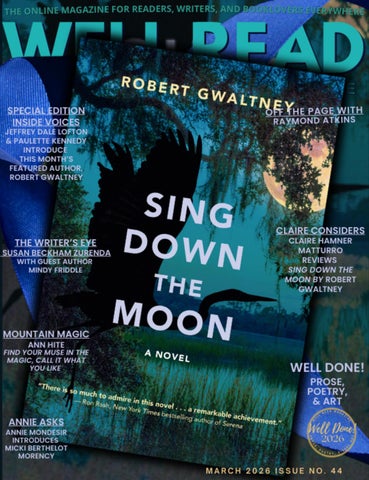
WELL READ Magazine March Issue No. 44

Page 1


Sing Down the Moon

Sixteen-year-old Leontyne Skye yearns to escape Good Hope, the remote Georgia coastal barrier island where she resides. Leontyne's heritage is bleak.

Tasked with tending Damascus, an ancient fig tree beguiling haints across the river with its wind chime song, Leontyne's mother, Eulalee, disintegrates into tufts of hair, teeth, and memory. This affliction befalls all Skye women, a fatal consequence of distilling Redemption, an addictive drug made from the figs of Damascus imbued with the essence of haints.

Leontyne also tumbles apart, her memories and hand lost in a lifealtering accident suffered two years back during an event known as Tribulation Day.

Through unreliable recollections of her trusted friends the Longwood twins, Leontyne stitches a dubious understanding of who she was before she fell "the long-long ways."

In the aftermath of Eulalee's death, Leontyne is pressured by the Longwoods to render Redemption, continuing the legacy upon which Good Hope depends.

“There is so much to admire in Robert Gwaltney’s new novel — how it is both intensely Southern yet also reminiscent of the magical realism of writers such as Gabriel García Márquez… Sing Down the Moon is a remarkable achievement.” — Ron Rash, New York Times bestselling author of Serena and The Caretaker

“Southern Gothic at its finest… Gwaltney’s prose immerses the reader in the beauty and fairy-tale magic of coastal Georgia.” — Karen White, New York Times bestselling author

“Lush, haunting, and completely unforgettable.” — Paulette Kennedy, bestselling author of The Witch of Tin Mountain

Robert Gwaltney is the author of Sing Down the Moon (Mercer University Press, 2026) and The Cicada Tree (Moonshine Cove Publishing, 2022), works of Southern literary fiction that explore inheritance, identity, and the fragile boundary between the living and the dead. Rooted in the landscapes and histories of the American South, his writing blends the gothic tradition with elements of magical realism to illuminate the forces that shape who we become.

Raised in Cairo, Georgia, alongside three younger brothers in the rashinducing subtropical heat of the region, Gwaltney is a lifelong resident of the South — a circumstance that has left an indelible mark on his voice as a writer. Sense of place remains central to his work, where memory, myth, and longing intertwine.

By day, he serves as Vice President of Easterseals North Georgia, championing early childhood literacy and strengthening families at critical stages of development. In all the hours between, he writes.

He lives inAtlanta, Georgia, with his partner.

Did you miss last month’s issue? No worries, click here to find it as well as all the past issues.

If you enjoy this issue, and would like to support this online literary journal, please consider leaving a tip @wellread on Venmo’s site or PayPal-www.wellreadmagazine.com.

INSIDE VOICES - SPECIAL EDITION

“That’s where the beauty within the decay lives—not in denying the darkness, but in letting the light filter through it.”

Jeffrey Dale Lofton and Paulette Kennedy in conversation with this month’s

Robert Gwaltney, a graduate of Florida State University, was named 2023 Georgia Author of the Year for First Novel, and was recipient of the 2022 Pat Conroy Writers Residency. He resides in Atlanta Georgia where he is an active member of the Atlanta literary community serving as a board member for Broadleaf Writers Association. Robert’s work has appeared in such publications as Southbound Magazine, Southern Literary Review,The Blue Mountain Review, and The Dead Mule School of Southern Literature. His forthcoming novel, Sing Down The Moon, will be published by Mercer University Press on March 3, 2026.

Inside Voices/Jeffrey: Will you set up the story, tell us of the world you created for Sing Down the Moon?

Sing Down the Moon is set on the Georgia island of Good Hope, a place where the past is never really past. At the center of the island stands Damascus, an ancient fig tree that feeds the dead and devours the living. It’s both miracle and curse, and it binds sixteenyear-old Leontyne Skye to a legacy that is literally consuming her mother.

Jeffrey Dale Lofton & Paulette Kennedy introduce Robert Gwaltney

Two years before the novel begins, something called Tribulation Day shattered Leontyne’s life—she lost her hand and her memory. When a stranger arrives on the island, those memories begin to return, along with the truth about what Damascus requires of her. The world I created is Southern Gothic at heart—but it’s also about inheritance and choice. Leontyne must decide whether to accept a birthright that will destroy her or break it and risk unraveling the fragile balance between the living and the dead.

Inside Voices/Paulette: The world you create is so lush while, at the same time, it's disintegrating around Leontyne and the others--a character with flowers and berries growing out of her, a severed hand that lives in a can. You manage all of this with mere words. Tell us more about thepoetic, lyrical voice that is a hallmark of your writing--the beauty within the decay.

I’ve always believed beauty and decay live side by side— especially in the South. Things bloom wild here, even as they rot. Kudzu can swallow a house in technicolor green.Astorm can level a town and leave the sky blue and aching come the next morning. That tension feels honest to me.

So when flowers and berries grow from a body, or a severed hand refuses to be still, I don’t see those images as grotesque first—I see them as expressions of a world where life and death are in constant conversation. The lyrical voice comes from that understanding, I think. If I wrote those moments clinically, they’d

feel like horror. But if I lean into rhythm, into image, into the music of the sentence, they begin to feel inevitable—almost sacred to me. For me, lyricism isn’t decoration. It’s a way of honoring the characters. Leontyne’s world is disintegrating, yes, but she is still a girl who loves, who remembers, who hopes. The language has to hold both the splendor and the ruin at the same time. That’s where the beauty within the decay lives—not in denying the darkness, but in letting the light filter through it.

Inside

Voices/Jeffrey: It's the story of Leontyne and the others on Good Hope, but there's a deeper theme, current-day message running throughout. Will you tell us what you intended and how youmade this story that seems to exist on another plane relevant for today?

On its surface, Sing Down the Moon is about an island, a haunted tree, and a girl bound to an inheritance. But underneath that, it’s very much about the world we’re living in now.

Leontyne inherits something she didn’t choose—something beautiful, powerful, and destructive. That felt true to me. All of us inherit histories, beliefs, and wounds we didn’t create. The question isn’t whether we inherit them. The question is: what do we do with them?

Though the novel exists on a mythic plane, its concerns are very current—environmental fragility, generational trauma, the weight placed on young people to repair what they didn’t break. At its

heart, the book asks whether we have the courage to break cycles that have sustained us, even when breaking them feels like tearing apart the world we know. That feels urgent to me right now.

Inside Voices/Paulette: I've heard youtalk about an early, boyhood experience, meeting an actual flesh and blood writer, that indelibly marked you, helped you find your way to being a writer. How did that experience influence how youexist in the literarycommunity where you are continually promoting and lifting up otherwriters?

When I was in the third grade in Cairo, a local writer came to my classroom and talked about her life. I don’t remember everything she said, but I remember how I felt. I was mesmerized. Until that moment, writers were like unicorns to me—surely they existed, but somewhere far away, in cities I’d never seen, living lives I couldn’t imagine belonging to a boy like me.

Seeing a flesh-and-blood writer standing a few feet away changed something fundamental. It made the dream tangible. It told me, without saying it outright, that art wasn’t reserved for other people. It could belong to me, too.

That moment never left me. So when I entered the literary world myself, I carried that third-grade boy with me. I remember what it felt like to need someone visible. To need someone generous. To need someone to say, simply by their presence, You are not foolish for wanting this.

If I spend a lot of time promoting and lifting up other writers, it’s because I understand how powerful proximity can be. Community isn’t just networking—it’s permission. It’s possibility made visible. If I can be for someone else what that writer was for me—a real, reachable example—then I feel like I’m honoring the gift I was given in that classroom all those years ago.

Inside Voices/Jeffrey: I'm eager to hear about the contrast from your freshman novel to your sophomore. How did the journey to publish yourdebut The Cicada Tree differ from the run up to pubday for Sing Down the Moon?

The journey to publish my debut, The Cicada Tree, felt a little like walking into the wilderness without a map. I didn’t know the terrain. I didn’t know the language of publishing. Everything was new and humbling. I was learning how to be an author in public at the same time the book was finding its readers. There’s a kind of beautiful innocence in that first experience. You don’t know what you don’t know. There is still a lot I don’t know.

With Sing Down the Moon, I’m stepping into pub season with clearer eyes. I understand more about the rhythms of publishing— the vulnerability of sending your work into the world. There’s less surprise now, but more intention. I’m more aware of how to advocate for the book, how to connect with readers, and how to steady myself emotionally through the process. I just told a lie. I

don’t think I will ever be able to steady myself emotionally when sailing a book into the world.

Creatively, the sophomore novel carries its own weight. With a debut, you’re simply grateful to be there. With the second book, there’s a deeper desire to grow—to take risks, to stretch your voice, to prove to yourself that the first book wasn’t an accident.

Both journeys have been gifts. The first taught me that I belonged. The second is teaching me endurance—and perhaps a little courage.

Inside Voices/Paulette: When you begin a new project, do the characters come to you first? The setting? Or the plot?

When I begin a new project, it’s usually a voice that comes first. I’ll hear the cadence of a character before I know much about the story, and almost at the same time, I begin to see the place they inhabit—the light, the land, the houses, the air they breathe. For me, character and setting arrive together.

I may have a faint sense of trouble on the horizon, but plot doesn’t fully reveal itself until I understand who these people are— their longings, their wounds, their secrets. Once I know them, the story unfolds naturally from the choices they make.

Inside Voices/Paulette: Which aspect of crafting a novel do you find the most enjoyable? Revision, drafting?And why?

I enjoy both drafting and revision, though in different ways. The initial draft is an adventure—you’re discovering the story as you go, following characters down roads you didn’t quite see at the outset. There’s an energy to that, a sense of risk and surprise.

But I’m partial to revision. By then, there are already words on the page—something tangible to shape and refine. Revision is where the deeper work happens for me. Drafting feels like exploration; revision feels like craftsmanship.

Inside Voices/Jeffrey: So, Sing Down the Moon is out, but you're well into your next novel. What can you tell us about it?

Yes, Sing Down the Moon is stepping into the world, but I’m already deep into the next one. The working title is All the Kingdoms of the World, and it’s Southern Gothic in nature, though it leans more overtly dystopian, with elements of magical realism braided throughout.

What feels new for me is that, for the first time, my protagonist is a young boy. That shift alone has changed the texture of the storytelling. His lens on the world—his confusion, his awakening, his reckoning.

It’s also more firmly rooted as a bildungsroman.At its heart, it’s a coming-of-age story set against a landscape that is unraveling. I’m still drawn to themes of inheritance, moral responsibility, and the cost of survival, but this book explores those ideas through a

Jeffrey Dale Lofton & Paulette Kennedy introduce Robert Gwaltney

boy’s gradual understanding of the world’s fractures—and his place within them.

In many ways, it feels like a departure, but spiritually it’s part of the same conversation I’ve been having all along: how do we grow up inside broken places, and what does it take to imagine something better?

Jeffrey Dale Lofton hails from Warm Springs, Georgia. His years telling the stories of playwrights and scriptwriters as a stage and screen actor taught him the pull of a powerful story arc. Today, he is Senior Advisor at the Library of Congress, surrounded by books and people who love them. Red Clay Suzie is his debut novel, a fictionalized memoir written through his lens—gay and living with a disability—in a conservative family in the Deep South. It was longlisted for the 2023 Center for Fiction First Novel Prize and awarded the Seven Hills Literary Prize for Fiction, among other distinctions.

Jeffrey Dale Lofton & Paulette Kennedy

Paulette Kennedy is the author of The Artist of Blackberry Grange (2025), The Devil and Mrs. Davenport (2024), The Witch of Tin Mountain (2023), and Parting the Veil (2021), which received the HNS Review Editor’s Choice Award. Her work has been featured in People Magazine, The Mary Sue, and BookBub. Originally from the Missouri Ozarks, where as a young girl she could often be found wandering through the gravestones in her neighborhood cemetery, Paulette’s affinity for fog-covered landscapes and haunted heroines only grew, inspiring her to become a writer. She now lives with her family and a menagerie of rescue pets in sunny Southern California, where sometimes, on the very best days, the mountains are wreathed in gothic fog. Paulette’s next release, The Two Deaths of Lillian Carmichael, coming in 2026, is a novel of gothic suspense set in nineteenth-century Charleston, South Carolina.

You can find books from past issues as well as current books to add to your reading list.

Happy reading!

Coming

Coming soon!

The Isolate - The Saga of Nick Grindstaff by Chuck

In the heart of East Tennessee's rugged Iron Mountain lives the legend of Nick Grindstaff, a man who turned his back on a cruel world and carved out a life of fierce independence and raw survival. The Isolate is the unforgettable true story of a soul beaten down by tragedy, betrayal, and loss, and his decision to retreat into the wilderness to find solace, solitude, and meaning.

Born into hardship and orphaned at just three years old, Nick was raised in the secluded Doe Valley. After a rare chance to see the outside world, he set off to St. Louis with dreams of prosperity and a future with his beloved Annabeth. But the world proved merciless-his hard-earned savings were stolen, and his return home brought heartbreak. Shattered and disillusioned, Nick climbed into the mountains, where he vowed never to come down again.

What follows is a riveting tale of self-reliance and grit. Battling bears, panthers, deadly winters, and human cruelty alike, Nick transforms from a heartbroken man into a mythic mountain figure. His only companion?Aloyal stray dog.To outsiders, he was a recluse, the "Hermit of Johnson County," but to those who knew him, he was a quiet soul whose life echoed the struggle between man and nature, hope and despair.

The Isolate is more than a story of survival. It's a haunting journey into a forgotten corner of American history. Lush with Appalachian landscapes and driven by the enduring human spirit, this gripping narrative honors a man who sought freedom in the wild and found peace on his own terms. Readers will be swept away by Nick's heartbreaking resilience and the haunting beauty of the life he left behind.

Finding the Lost County: The Life of

William Gay by

Born in 1939 and raised in the rural south, other than his time in the Navy and a brief sojourn working in the factories in Chicago, he spent his whole life in middle Tennessee. He was raised in a sharecropper's shack with no electricity and no running water. His father never owned a car or a house. Tennessee ranks near the bottom of all the states in the union in terms of education and Lewis County ranks very low among the 92 counties in the state. He graduated from the Lewis County High School but was completely self-educated as both a writer and a painter. He was inspired by the writings of William Faulkner, Thomas Wolfe and Cormac McCarthy. He studied and wrote until he could match the great writers in the Southern literary tradition in the aesthetic power and intensity of their prose. He passed away at the age of 71 in 2012.

William Gay was born to be a writer. For as long as he could remember he was fascinated by the written word and wanted nothing other than to write. He faced incredible odds but there was simply nothing else that he wanted to do and nothing else that he would do. He lived a hardscrabble earthly life, rugged and simple. He served his art and let his art serve him. He was creating something original, something high energy, cut to the bone, coming out of the dark with an element of danger, exploding on the page. He wrote prose that is heartfelt and melancholy, imbued with beauty and concern for all living things. In a world that didn't seem to care, he was an earth angel singing from some imaginary corner of the universe. His life and the books he created are a master class in the art of writing.

Small Town Witch by Deborah ZAdams

Small Town Witch, a new chapbook from awardwinning author Deborah Z Adams, is a collection of spell-binding tales about the witches we meet every day. Written with warmth, humor, and a little bite, Small Town Witch is packed with more substance than meets the eye.

“Adams’s witches may inhabit a small town, perhaps your small town, but they are not small women. They are powerful and empowering. You’ll root for these women, these coven leaders and elementary school teachers. Two parts poetry, two parts prose, with a healthy pinch of feminist indignation, Adams’s tales will surely charm you and remind you that you’re “not in this fight alone.’” —Joanna Grisham, author of Phantoms (Finishing Line Press, 2023)

Available from your favorite bookseller!

All proceeds from sales of Small Town Witch are donated to organizations that do good in the world.

You can sample Small Town Witch stories here.

“I’ve lived my life surrounded by women who wield their powers quietly but effectively,” saysAdams. “They’re everywhere, but especially prevalent in small towns.”

Deborah Z Adams is an awardwinning author of novels, short fiction, CNF, and poetry. She served as executive editor of Oconee Spirit Press for ten years, and is currently a reader for Boomerlit. Her writing has appeared or is forthcoming in Roanoke Review, Litmosphere: a journal of Charlotte Lit, WELL READ Magazine, Dead Mule and other journals.

Someone or something lurks around every corner, but K.P. Davis's characters have come prepared. These are women carrying on their daily struggles in a dangerous world, striving and searching for safety. They include Nell, an antisocial, nomadic, shade-tree mechanic and getaway driver; 'Bula, an odd girl who talks to animals; and a whole host of others who follow lonely paths spreading empathy while kicking ass. The endings aren't always happy, and these women have plenty of reasons to be afraid, but they keep on going.The twenty sharp, poignant, and biting stories in Trust Issues comprise a stunning beacon for hard-headed folk fighting to be heard when nobody listens.

Trust Issues: Stories

K. P. Davis

The Wildes:ANovel in Five Acts by

In this singularly powerful novel, bestselling author Louis Bayard brings Oscar Wilde's wife Constance and two sons out from the shadows of history and creates a vivid and poignant story of secrets, loss, and love.

In September of 1892, Oscar Wilde and his family have retreated to the idyllic Norfolk countryside for a holiday. His wife, Constance, has every reason to be happy: two beautiful sons, her own work as an advocate for feminist causes, and a delightfully charming and affectionate husband and father to her children, who also happens to be the most sought-after author in England. But with the arrival of an unexpected houseguest, the aristocratic young poet Lord Alfred Douglas, Constance gradually--and then all at once--comes to see that her husband's heart is elsewhere and that the growing intensity between the two men threatens the whole foundation of their lives.

"Wonderfully researched, beautifully crafted, movingly told, The Wildes is a treasure to read." --Andrew Sean Greer, Pulitzer Prizewinning author of Less and Less Is Lost

All

the

Deadly Beloved

SOMEONE'S BEEN NURSINGAMURDEROUS GRUDGEAGAINST THE TOWN'S FAVORITE R.N.

Everybody swears that no one would ever lay a hand on Jesus Creek's angel of mercy, nurse Patrice Gentry. But the reality is there for all to see--Patrice's red T-bird in the nursing home parking lot with her dead body inside.

Police Chief Reb Gassler knows that though the victim may have been an angel, Jesus Creek isn't heaven and the charming widower, Dr. Steve Gentry, hasn't sprouted wings. In fact, he's said to be sleeping with more women than seems possible for a doctor with a full-time practice. While Reb hunts for the truth, a killer lurks in the shadows--and Jesus Creek teeters on the ragged edge....

"Jesus Creek, Tennessee, is so vividly drawn that I feel as if I can take a stroll through town....Deborah Adams has created a series rich in provocative themes and artful plots." --Joan Hess

Twenty Years of PoemoftheWeek.com is a compilation of the best of the poems that have been featured by PoemoftheWeek.com over the course of the past twenty years.

PoemoftheWeek.com was founded in 2006 and is updated weekly in the Fall and Spring. PoemoftheWeek.com supports writers of all backgrounds—quietly and without self-congratulation. Each semester they have a “silent theme,” i.e. writers of color, indigenous poets, disabled poets/poets with disabilities, poets we just like, upon whom we shine a spotlight without the bullhorn.We don’t announce what we are doing. We just do it. No tokenizing. No patting ourselves on the back. Over time, our audiences figure it out all on their own and are delighted by the discovery.

Each celebration includes interviews with the poet, reviews of the collection, readings from the book, and other supplementary material that broadens the scope of the conversation between the poet and their work with the general public. PoemoftheWeek.com is an essential resource for writers, teachers, and anyone interested in contemporary American (mostly) arts and letters. For more information, contactAndrew atAndrew@PoemoftheWeek.com.

Set against the lush yet turbulent backdrop of Nepal during the COVID-19 pandemic, Like Water on Leaves of Taro weaves together themes of loss, resilience, identity, and hope. The memoir honors sacred rituals and everyday heartbreaks, from the thirteenth-day death feast to a father's wish to spare his daughter further grief. Through poetry, reflection, and memory, the author invites readers to witness the quiet strength of family, the complexity of Nepali culture, and the universality of sorrow.

This is not just a story of illness and loss-it is a meditation on what it means to be human, to mourn, to endure, and to carry love forward in a world that feels constantly in flux.

For readers of When Breath Becomes Air, The Year of Magical Thinking, and The Long Goodbye, Like Water on Leaves of Taro offers a moving cross-cultural perspective on grief, devotion, and the enduring lessons of death.

In October of 1918, the world, still in the midst of a massive war in Europe, is experiencing a new challenge— a pandemic of what came to be known as the Spanish flu. But Cotella Barlow, living in an isolated county in Appalachian Virginia, has only heard rumors about it. Cotella, known as "Telly," makes her way in the world taking care of the families of new mothers who are "lying in" after their labors and deliveries. She travels home to home, eeking out a living, loved by many but always conscious of the stares and winces caused by her disfiguring condition.

Until she enters the home of her next "momma," who, days before delivery, is dying in a strange new way, her husband missing, and her four other children frightened, uncared for, and hungry. Telly must meet the challenge with no knowledge of the outside world that is shutting down while people suffer, die, and quarantine. Winter is coming, and there is no one to help, or so it seems.

This is a story of devotion, courage, strength, and love with iconic characters readers will come to cherish.

"Freedom's Eve" is a historical fiction children's book that follows Layla, a little mouse living in an antique shop, who is magically transported back to a South Carolina plantation during the Civil War era by the spirit of Hawa, a young enslaved girl.Through Hawa's guidance, Layla witnesses the realities of slavery from New Year's Eve 1862 (when the Emancipation Proclamation took effect) through the eventual freedom that came in 1865. The story explores the daily lives, struggles, and resilience of enslaved people, their rich Gullah culture and language, and their journey to freedom. Written by Dawn Caldwell with illustrations by Bryce Caldwell, the book aims to teach honest history about slavery while honoring the strength and cultural heritage of the Gullah people.

In March 2026, Colorful Crow Publishing will be represented at AWP26 in Baltimore by Tulasi Acharya, Barbara G. Tucker, and Dawn Caldwell. From March 4–7, thousands will gather for the Association of Writers & Writing Programs Conference & Bookfair—the nation’s largest annual meeting of writers, teachers, students, editors, and publishers. We are honored to see these distinctive voices included in such a vibrant national literary community and grateful for the opportunity to champion their work on one of the field’s most dynamic stages.

Acollection of magically real stories and a novella set in theAmerican south.

“Only a poet of Braggs’ talent and sensibility could bring us stories of such lively language and lost-andin-love characters. He tells their truths but tells them at a slant that is joyful to read and heartbreakingly beautiful to apprehend.” —Anthony Grooms, author of Bombingham and The Vain Conversation

The Hummingbird War follows events of Bicycles of the Gods, in which Jesus returns to earth with two celestial pals with a mandate to destroy the earth. In that volume, Jesse (Jesus) and his two friends Xavi (Shiva), and Mikey (as in the Archangel) decide not to destroy the world quite yet. But the battle continues in The Hummingbird War.

Bringing Gills’ Go Love novel sequence to a fiery close, BC1 lays down the Harvell grudge of Mountain Meadows and aims, finally, at healing for all involved. Lara Luce Harvell has been charged with carrying her late father’s prized Martin D-28, handmade in Nazareth, Pennsylvania in 1998, the same year she was born, to Mr. Edgar Paris in Dinnehotso, Arizona. Such is repayment to him for saving Joey’s right index finger when it got bit off in an Arkansas fight. The resulting journey, part dynamite, revenge, and the tenderness of love, wanders into the lands of the woolly-headed Washers, a whole tribe of wandering relatives who “…inhabited the desert, living in trailer parks from Tuba City to Las Vegas, pumping five dollars’worth of regular at a time into jalopies that overheated and ran on threadbare tires.”

MADVILLE PUBLISHING seeks out and encourages literary writers with unique voices. We look for writers who express complex ideas in simple terms. We look for critical thinkers with a twang, a lilt, or a click in their voices. And patois! We love a good patois. We want to hear those regionalisms in our writers’ voices. We want to preserve the sound of our histories through our voices complete and honest, dialectal features and all. We want to highlight those features that make our cultures special in ways that do not focus on division, but rather shine an appreciative light on our diversity.

In the Best of 2024 Volume One, you’ll find fifty-one submissions written by a fantastic mix of awardwinning authors and poets plus new ones to the scene. Three submissions in this volume were nominated for a Pushcart Prize: The Hanging by Doug Gray, Sandy Tells Me About Dead Pine Trees by J.D. Isip, and Wilma by Phyllis Gobbell. The cover art is by artist, Lindsay Carraway, who had several pieces published in February of 2023.

Contributors: Carolyn Haines, Doug Gray, Angela Patera, Kimberly Parish Davis, Michael Spake, Jennifer Smith, Ashley Tunnell, Ken Gosse, Dr. Elizabeth V. Koshy, Ann Hite, Ellen Notbohm, Micah Ward, Malcolm Glass, Katie Crow, Lorraine Cregar, Patricia Feinberg Stoner, John M. Williams, Michael Lee Johnson, J.D. Isip, Casie Bazay, Jacob Strunk, Ann Christine Tabaka, Joan McNerney, Fhen M., Steven Kent, Peter Magliocco, Mark Braught, Rita Welty Bourke, Loretta Fairley, Barbara Anna Gaiardoni, S. Dodge, DeLane Phillips, Candice Marley Conner, Arvilla Fee, J. B. Hogan, Ramey Channell, Hope Kostedt, John Grey, Martha Ellen Johnson, Nancy Chadwick-Burke, Mike Coleman, Margaret Pearce, Nicole Irizawa, Donald Edwards, Janet Lynn Oakley, Mandy Jones, Phyllis Gobbell, and Suzanne Kamata

In the Best of 2024 Volume Two, you’ll find fifty-two submissions written by a fantastic mix of awardwinning authors and poets plus new ones to the scene. Three submissions in this volume were nominated for a Pushcart Prize: Hanging Pictures by Micah Ward, The Lone and Level Sands by James Wade, and American Chestnut by Candace Connor. The cover art is by artist, Lindsay Carraway, who had several pieces published in February of 2023.

Contributors: Candice Marley Conner, Kaye Wilkinson Barley, Mike Ross, Will Maguire, AJ Concannon, Patricia Feinberg Stoner, Gregg Norman, Robin Prince Monroe, Ramey Channell, April Mae M. Berza,Anne Leigh Parrish, B.A. Brittingham, MikeAustin, Sara Evelyne, Jennifer Smith, Loretta Fairley, J.L. Oakley, Celia Miles, Kris Faatz, Ed Nichols, Linda Imbler, Annie McDonnell, Mike Turner, Micah Ward, James Wade, Ashley Tunnell, John M. Williams, Robb Grindstaff, Stevie Lyon, Laura McHale Holland, Saeed Ibrahim, Nancy Julien Kopp, Julie Green, DeLane Phillips, Shayla Dodge, Edilson Afonso Ferreira, Chris Wood, Jasna Gugić, Fhen M., Hubert Blair Bonds, Ellen Birkett Morris, Margaret Pearce, Ellen Notbohm, Kimberly Parish Davis, J. B. Hogan, and Royal Rhodes

In Volume One, you’ll find thirty-eight submissions writtenbyafantasticmixofawardwinning authors and poets plus new ones to the scene. Three submissions in this volume were nominated for a Pushcart Prize: Miller’s Cafe by Mike Hilbig, Sleeping on Paul’s Mattress by Brenda Sutton Rose, andAHard Dog by Will Maguire. The cover art is by artist, Lindsay Carraway, who had several pieces published in February’s issue.

Contributors: Jeffrey Dale Lofton, Phyllis Gobbell, Brenda Sutton Rose, T. K. Thorne, Claire Hamner Matturro, Penny Koepsel, Mike Hilbig, Jon Sokol, Rita Welty Bourke, Suzanne Kamata, Annie McDonnell, Will Maguire, Joy Ross Davis, Robb Grindstaff, Tom Shachtman, Micah Ward, Mike Turner, James D. Brewer, Eileen Coe, Susan Cornford,Ana Doina, J. B. Hogan, Carrie Welch, Ashley Holloway, Rebecca Klassen, Robin Prince Monroe, Ellen Notbohm, Scott Thomas Outlar, Fiorella Ruas, Jonathan Pett, DeLane Phillips, Larry F. Sommers, Macy Spevacek, and Richard Stimac

InVolumeTwo, you’ll find fortythree submissions written by a fantastic mix of award-winning authors and poets plus new ones to the scene. Three submissions in this volume were nominated for a Pushcart Prize: A Bleeding Heart by Ann Hite, A Few Hours in the Life of a Five-Year-Old Pool Player by Francine Rodriguez, and There Were Red Flags by Mike Turner. The cover art for Volume Two is by artist, DeWitt Lobrano, who had several pieces published in November’s issue. Enjoy!

Contributors: Ann Hite, Malcolm Glass, Dawn Major, John M. Williams, Mandy Haynes, Francine Rodriguez, Mike Turner, Mickey Dubrow, William Walsh, Robb Grindstaff, Deborah Zenha Adams, Mark Braught, B. A. Brittingham, Ramey Channell, Eileen Coe, Marion Cohen, Lorraine Cregar, John Grey, J. B. Hogan,Yana Kane, Philip Kobylarz, Diane Lefer, Will Maguire, David Malone, Ashley Tunnell, Tania Nyman, Jacob Parker, LaVern Spencer McCarthy, K. G. Munro, Angela Patera, Micheal Spake, George Pallas, Marisa Keller, Ken Gosse, and Orlando DeVito

TheyAll Rest in the Boneyard Now by

“Raymond Atkins writes with intuitive wisdom, as he channels those from beyond the grave. His poetry gives voice to those who once mattered, those who time wants us to forget. In They All Rest in the Boneyard Now, Atkins wrestles death from the dusty clay and breathes life into dry bones while reminding us that every soul who once had breath is worthy of being remembered. These saints, sinners, socialites, and the socially inept are all victims of time, or circumstance, as we too shall one day be. Atkins offers salvation to all who are tormented, and solace to those who seek eternal rest.”

The Cicada Tree by

The summer of 1956, a brood of cicadas descends upon Providence, Georgia, a natural event with supernatural repercussions, unhinging the life of Analeise Newell, an eleven-year-old piano prodigy. Amidst this emergence, dark obsessions are stirred, uncanny gifts provoked, and secrets unearthed.

During a visit to Mistletoe, a plantation owned by the wealthy Mayfield family, Analeise encounters Cordelia Mayfield and her daughter Marlissa, both of whom possess an otherworldly beauty, a lineal trait regarded as that Mayfield Shine. A whisper and an act of violence perpetrated during this visit by Mrs. Mayfield all converge to kindle Analeise’s fascination with the Mayfields.

Analeise’s burgeoning obsession with the Mayfield family overshadows her own seemingly, ordinary life, culminating in dangerous games and manipulation, setting off a chain of cataclysmic events with life-altering consequences—all of it unfolding to the maddening whir of a cicada song.

IAm a Georgia Girl: The Life of Lucille Selig Frank, 18881957

Twenty-five-year-old Lucille Selig Frank's whole life changed on April 26, 1913, as the Confederate Memorial Parade marched through Atlanta, Georgia. Lucille was attending the opera matinee with her mother. Her husband, Leo Frank, sat in his office in the National Pencil Company, where he was superintendent, working on a financial report. The brutal murder of fourteen-year-old Mary Phagan, an employee of Leo's, took place in the pencil factory that day. Lucille's husband would be the last known person to see Mary alive. While much has been written about Mary Phagan's murder and Leo Frank's subsequent trial over the past 115 years, very little has given voice to Lucille Selig Frank and other women connected to the horrific events that took place between 19131915. Lucille was part of a mission to make Governor John Slaton aware of the antisemitism being shown to Leo during his arrest and trial. She paid a heavy price for her courage. The story of Lucille and the women connected to this case is as timely today as it was in the early 1900s. This book has many diverse characters, including place which influences the outcome. Within this complexity, Hite's telling of Lucille's story will help others see that antisemitism, the marginalization of women, and mobs taking justice into their own hands cannot be tolerated. How many people were complicit in Leo and Lucille's journey? Was justice truly served? This book leaves the reader to answer these questions.

Red Clay Suzie by

A novel inspired by true events.

The coming-of-age story of Philbet, gay and living with a disability, battles bullying, ignorance, and disdain as he makes his way in life as an outsider in the Deep South—before finding acceptance in unlikely places.

Fueled by tomato sandwiches and green milkshakes, and obsessed with cars, Philbet struggles with life and love as a gay boy in rural Georgia. He’s happiest when helping Grandaddy dig potatoes from the vegetable garden that connects their houses. But Philbet’s world is shattered and his resilience shaken by events that crush his innocence and sense of security; expose his misshapen chest skillfully hidden behind shirts Mama makes at home; and convince him that he’s not fit to be loved by Knox, the older boy he idolizes to distraction. Over time, Philbet finds refuge in unexpected places and inner strength in unexpected ways, leading to a resolution from beyond the grave.

The Smuggler's Daughter by

Ray Slaverson, a world-weary Florida police detective, has his hands full with the murders of two attorneys and a third suspicious death, all within twenty-four hours. Ray doesn’t believe in coincidences, but he can’t find a single link between the dead men, and he and his partner soon smash into an investigative stonewall.

Kate Garcia, Ray’s fiancée, knows more than she should. She helped one of the dead attorneys, just hours before he took a bullet to the head, study an old newspaper in the library where she works. Kate might be the only person still alive who knows what he was digging up— except for his killer.

When Kate starts trying to discover what’s behind the murders, she turns up disturbing links between the three dead men that track back to her family’s troubled past. But she has plenty of reasons to keep her mouth shut. Her discovery unleashes a cat-and-mouse game that threatens to sink her and those she loves in a high tide of danger.

The Bystanders by Dawn Major

The quaint town of Lawrenceton, Missouri isn’t sending out the welcoming committee for its newest neighbors from Los Angeles—the Samples’ family. Shannon Lamb’s “Like a Virgin” fashion choices, along with her fortune-telling mother, Wendy Samples, and her no-good, cheating, jobless, stepfather, Dale Samples, result in Shannon finding few fans in L-Town where proud family lines run deep. Only townie, Eddy Bauman, is smitten with Shannon and her Valley Girl ways. The Bystanders is a dark coming-of-age story set in the 1980s when big hair was big, and MTV ruled. In a quiet town of annual picnics and landscapes, the Samples’ rundown trailer and odd behaviors aren’t charming the locals. Shannon and Wendy could really use some friends but must learn to rely upon themselves to claw their way out of poverty and abuse if they want to escape Dale.

The Bystanders pays homage toAmericana, its small-town eccentricities, and the rural people of the Northern Mississippi Delta region of Southeast Missouri, a unique area of the country where people still speak Paw Paw French and honor Old World traditions.

The Girl from the Red Rose Motel:ANovel by Susan Beckham Zurenda

Impoverished high school junior Hazel Smalls and privileged senior Sterling Lovell would never ordinarily meet. But when both are punished with in-school suspension, Sterling finds himself drawn to the gorgeous, studious girl seated nearby, and an unlikely relationship begins. Set in 2012 South Carolina, the novel interlaces the stories of Hazel, living with her homeless family in the rundown Red Rose Motel; Sterling, yearning to break free from his wealthy parents' expectations; and recently widowed Angela Wilmore, their stern but compassionate English teacher. Hazel hides her homelessness from Sterling until he discovers her cleaning the motel's office when he goes with his slumlord father to unfreeze the motel's pipes one morning. With her secret revealed, their relationship deepens. Angela-who has her own struggles in a budding romance with the divorced principal-offers Hazel the support her family can't provide. Navigating between privilege and poverty, vulnerability and strength, all three must confront what they need from themselves and each other as Hazel gains the courage to oppose boundaries and make a bold, life-changing decision at novel's end.

The Best of the Shortest: ASouthern Writers Reading Reunion

“Some of the happiest moments of my writing life have been spent in the company of writers whose work is included in these pages. They all brought their A-game to this fabulous collection, and at our house it is going on a shelf next to its honored predecessors. The only thing that saddens me is that the large-hearted William Gay is not around to absorb some of the love that shines through every word.” ―Steve Yarbrough

“The Best of the Shortest takes the reader on a fast-paced adventure from familiar back roads to the jungles of Viet Nam; from muddy southern creek banks to the other side of the world, touching on themes as beautiful as love and as harsh as racism. However dark or uplifting, you are guaranteed to enjoy the ride.” --Bob Zellner

“I had some of the best times of my life meeting, drinking and chatting with the writers in this book, times matched only by the hours I spent reading their books. This collection showcases a slice of Southern literature in all its complicated, glorious genius. Anyone who likes good writing will love it.” --Clay Risen

Walking The Wrong Way Home by Mandy Haynes

Spanning nearly twenty decades, the struggles and victories these characters face are timeless as they all work towards the same goal.

A place to feel safe, a place to call home.

Sharp as a Serpent's Tooth: Eva and other stories by Mandy Haynes

Each story features a female protagonist, ranging from ten to ninety-five years of age. Set in the south, you’ll follow these young women and girls as they learn that they’re stronger than they ever thought possible.

Oliver by Mandy Haynes

“Dear God…and Jesus and Mary…” Even though eleven-year old Olivia is raised Southern Baptist, she likes to cover her bases when asking for a favor. Unlike her brother Oliver, she struggles with keeping her temper in check and staying out of trouble. But Oliver is different, and in the summer of ’72 he proves to Olivia there’s magic in everything - it’s up to us to see it.

Mandy Haynes spent hours on barstools and riding in vans listening to great stories from some of the best songwriters and storytellers in Nashville, Tennessee. After her son graduated college, she traded a stressful life as a pediatric cardiac sonographer for a happy one and moved to an island off the east coast. She is a contributing writer for Amelia Islander Magazine, Amelia Weddings, and editor of Encounters with Nature, an anthology created by Amelia Island writers and artists. She is also the author of two short story collections, Walking the Wrong Way Home, Sharp as a Serpent's Tooth Eva and Other Stories, and a novella, Oliver. She is a co-editor of the Southern Writers Reading reunion anthology, The Best of the Shortest. Mandy is the editor-in-chief of WELL READ Magazine and the editor of four WELL READ anthologies.

Like the characters in some of her stories, she never misses a chance to jump in a creek to catch crawdads, stand up for the underdog, or the opportunity to make someone laugh. At the end of 2024, Mandy moved back to middle Tennessee and now spends her time writing and enjoying life as much as she can.

If you’d like to feature your work in the reading recommendation section with live links to your website and purchase link, and have personalized graphics of your ad shared to WELL READ Magazine’s social sites, click here to see examples of the different options and moreinformation.

Click here for more information on purchasing a cover.

Don’t let the low prices fool you - WELL READ was created by an author who understands how much it costs to get your book in the best shape possible before it’s ready to be queried by agents, small presses, or self-published. Showing off your book and getting it in front of readers shouldn’t break the bank.

WELL READ Magazine receives approximately 8,000 views each month on Issuu’s site alone (the world’s largest digital publishing and discovery platform available). Your book will be included with the featured authors, great interviews, submissions, essays, and other fantastic books inside each issue. There is strength in numbers. Let’s get our books seen!

Ad rates for 2026:

$50 - One FULL PAGE AD

$75 - TWO-PAGE SPREAD

$100 - TWO HIGH IMPACT - FULL COLOR PAGES - (this is NOT a standard two page spread)

$100 - FOR PUBLISHERS ONLY (limit 3 months of ads)- Advertise up to THREE books with one live link that takes viewers to your website.

$75 - BOOKSTORES, PUBLICISTS, AUTHORS - two-page spread to promote book events

$550 - FRONT COVER - includes two full color interior pages for book description, author bio, and/or blurbs, plus an additional one page ad in the next three issues. Also included is the Featured Author spot in the issue your book is on the cover.

$350 - INTERIOR COVER or BACK COVER - includes TWO additional full color interior pages for book description, author bio, and/or blurbs.

*Prices include creating the graphics for the magazine pages and all social sites. Everything is taken care of for you.

Click above to go to the BETWEEN THE PAGESYouTube channel, or on one of the links below to listen to the podcast. Please take a second to like and subscribe if you enjoy the channel - we appreciate you!

Find Your Muse In The Magic, Call It What You Like

On Wednesday this week, I went to the High Museum of Art in Atlanta. There is something about art that soothes my soul and ignites a passion to create.And of course my art is storytelling.As I entered the modern building with angles and bridges framing views of the city that makes one think of a larger than life painting, my heart was home. The first gallery held the most awe-inspiring canvases, soft colors that put me into the landscape. A familiarity, as if I knew this artist, struck me. I looked at the plaque for the author’s name: Claude Monet. I real Monet. My heart skipped a beat.Yes, it is a cliché, but I could use no other description. I stood within touching distance of the painting. Of course this would have sent alarms blaring had I dared.An original Monet hung in front of me.At my age, I could still have firsts in my life. There is hope! I stood stuck in a dream for what seemed the longest before moving on to see three more Monets and other originals belonging to art masters, only read about in art history. Then I came upon the portrait of a man painted by Matisse in somber colors so unlike his famous vivid pale and vibrant colors. Had his name not been on the painting, I wouldn’t have believed it was created by his hand. This

struck me as encouragement for artists of all kinds to step out of their comfortable boxes to create something that is entirely different.

My latest book, “I Am A Georgia Girl,” made me step into the unknown by a passionate need to write a nonfiction narrative grown out of a passionate need to give Lucille Selig Frank a voice that was never shared during the murder investigation in 1913. Many people know what happened to Lucille’s husband, Leo M. Frank, the superintendent of the National Pencil Factory inAtlanta, Georgia and Mary Phagan, a thirteen year old murdered employee, but Lucille’s voice, like most women in 1913, had been marginalized.

As I write this column days later, I have entered the quiet, peaceful zone of creativity. Precious and rare, a place where writer meets muse and pauses to listen to the voice of mountain magic, warning me to listen in fear the new idea might blow away before I catch the fleeting image so key to the new project. When mountain magic presents itself, a writer must grab onto the kite’s tail before it gets away and finds another artist. There is just a fleeting moment to act. The muse doesn’t find fault. The voice dictates the story, and I accept.

But in all truth most writers don’t encounter the muse often. We treasure the magic as the gift that it is. Most of the time we put our courage and passion on the line and step out on the ledge to create. Trial and error.

This dear readers is what I call Mountain Magic, other writers call it the muse. We trust that voice, that passion, that need to tell the stories that others will gain pleasure, knowledge, or passion from.

Believe in your magic, no matter what you call it, grab hold of the wisp of courage and hold on for the ride. See it to the end, dear readers. The reward is amazing.

Saint Chris, Protect Me

Doug Gray

On a perfect summer day in 1965, I shoplifted a Saint Christopher medal from a Sages department store in Redlands, California. It was a beauty, a silver oval, inset with teal enamel and suspended from a sterling silver chain. I plucked it from a necklace tree on the jewelry counter and slid it from my sweaty palm into the shopping bag hooked on my arm. A decent southern boy, who six months earlier would not have lifted from the floor a nickel that did not belong to him, was now a petty thief.

Five months earlier, I had been whisked away from the green, rolling hills of Tennessee to the arid West Coast when my father’s job transferred him to San Bernardino, dragging me two thousand miles from the comfort zone of good and fast friends that had defined the first sixteen years of my life. When a dust storm forced us to the side of Highway 80 in Big Spring, Texas, I considered fleeing from the car and disappearing into that strange, whirling darkness, hoping to jump an eastbound freight. Twenty-four hours later, wide-eyed awake in a motel outside of Needles, I imagined

escaping into the star struck night to thumb my way back home before my parents woke to sniff out their first cup of coffee.

Instead, I brooded in the cavernous back seat of our 1960 burnished gold Cadillac, a half dollar size hole from a stray cigar ash, courtesy of the previous owner, forming the line of demarcation between my kid brother and me. Gary Lewis and the Playboys’ “Who Wants to Buy This Diamond Ring” blared from the car radio every few hours, becoming my anthem of melancholia on that trip, as I contemplated the end of life as I knew it.

I wasn’t Catholic. I wasn’t even a fit Presbyterian. The pilfered medal wasn’t about protecting travelers or practicing Catholicism. It was coolness within a new gang. Acceptance. A talisman to assuage the misery and angst created when snatched from the world I knew and loved to a place that defined me by the latest episode of “The Beverly Hillbillies.” A consuming desire to be accepted, fueled by my newfound peers’ insistence that it was much more boss to shoplift than to buy.

The deed done, I floated across the parking lot atop an adrenaline surge, sailing between cars, riding a spike of life and youth. The day was bright and airy, the sky the magnetic blue that God gifts exclusively to California, and life was feather light. Halfway between the store and the sidewalk that led safely home, a voice stopped me cold.

“Hold up there a minute, buddy. Did you pay for everything in those bags?”

I turned to find a middle-aged man in khaki pants and a white short-sleeve shirt. A wristwatch sat halfway up his hairy forearm. Thick-rimmed glasses rode the end of his sharp nose. On his belt was a silver badge pinned to a leather sleeve. Blood roared through my head like whitewater rapids.

I asked him what he had said, hoping I’d misheard.

“I asked you if you paid for everything in those bags.”

“These?” I asked, my hands raising the shopping bags from my sides.

He nodded.

“Yes,” I offered, squinting into a bag as if to make sure some strange item had not squirmed in when I wasn’t looking. “At least I think so.”

He led me back inside to the rear of the store, up a flight of stairs and into a room that barely accommodated a desk and two chairs. The two-way glass that fronted that cramped space offered a bird’seye view of the interior of the store.

He settled behind his desk and told me to sit.

“I watched you for over an hour.”

“Yeah?” I said. “Why’d you do that?”

“I don’t know, son.You just had this look about you.You caught my attention.”

He stood and walked to the glass. “I saw you pay for the suntan lotion and the t-shirts. Then kill some time at the magazine rack before going to the jewelry counter.” He nodded toward the bags

at my feet. “I suspect in one of those bags I’ll find a necklace you didn’t pay for.”

“Probably.”

“Probably?”

“No, sir. I mean, yes sir. You would.”

“So, my question is, do you want me to call the police or your parents.”

There was no hesitation. “The police,” I said. He leaned toward me. “Not really,” he said. “You don’t really want me to call the police, do you? They’d just haul you to Juvie and then call your folks anyway.”

I studied my shoes.

“You look like a nice kid. What’s your name?” I told him.

“Why don’t you just give me your parents' number?”

He dialed and waited. It was one of the rare times my father answered. Mr. Calloway, according to his nameplate, pivoted his chair toward the wall and had a quiet conversation.

When he hung up, he turned back. “Your father's on his way.” He squinted at me over his glasses as if assessing someone in bad health. “Would you like a glass of water or something?”

I doubted the water would make it past the softball in my throat. I declined, and Mr. Calloway and I sat in his small office and waited. When my father arrived, he walked directly to Mr. Calloway, ignoring me. He introduced himself and thanked him for the phone call. It appeared that Mr. Calloway had already given my

father a play-by-play of my crime because the next few minutes were filled with a grindingly calm conversation about where we were from, what my father did for a living, the LA Dodgers, and what life in California was like for recent transplants. After the small talk, Mr. Calloway asked me to step out. I stood on the landing and watched as all the non-criminal shoppers reveled in their freedom. Minutes later, he invited me back in.

“You’re free to go, young man. I don’t expect I’ll see you in this office in the future. Is that a good bet?”

“Yessir,” I mumbled.

“Good. You folks enjoy the rest of your day.” My father shook hands with Mr. Calloway, thanked him for his time, and I followed him out the door and down the stairs. I trailed a few steps behind this man who didn’t deserve to suffer a son who was a freshly christened thief.

The walk through the store and to the car was interminable. Outside, the day had been sucked dry of its joy and luster. Now the parking lot was an obstacle course of sunburnt automobiles, and the asphalt that flared up through the soles of my tennis shoes was pocked and crumbling, replete with cigarette butts and trash. The sky, though still cloudless, pulsed leaden and heavy, a burnished tin ceiling hanging low. I sagged under its weight.

I slid into the passenger seat of the Cadillac and glanced at my father. He rested his hands on the steering wheel.They seemed sad. He looked straight ahead, searching the distance. He flipped the ignition and hit the buttons to lower his window and mine,

bringing into the car a snatch of warm breeze and the traffic sounds from the boulevard. He pulled a pack of Pall Malls from his shirt pocket, shook one out, and placed it between his lips. From his pants pocket he dug his Zippo, fired it up, and lit the cigarette. The lighter snapped shut, and my father inhaled deeply. He blew a plume of smoke through the lowered window into the fading day. Acentury limped by. His voice startled me.

“The next time you steal, it had better be because you need to feed your family. Even a loaf of bread.” He turned toward me. “If you ever steal again, you should be starving. Do you understand?”

My clenched hands were bright red. I told him I understood.

“And we won’t be telling your mother about this. Understand?”

“Yes, sir.”

“It’s bad enough that you decided to do what you did, but we’re not going to put your mother through it as well.”

He reached into his pocket and dropped something into my lap. It was the Saint Christopher medal. His voice softened.

“I don’t know why this is important to you, son. But it must be serious. It’s paid for. You take it, and you keep it.”

I couldn’t speak. The tip of his Pall Mall glowed as he took another long drag and released the smoke.

“I know this move has been rough on you. But believe me, these next couple of years are going to be a piece of cake compared to other things you’re going to have to deal with in life. And I’d like to think you’ll handle them much differently.”

It was more a question than a statement. I nodded.

He crushed his cigarette in the ashtray and started the car. I didn’t deserve forgiveness, but I felt it and knew that any future discussion of this day was as dead as that butt. My father hit the buttons to close the windows and flipped on the air conditioner.As the car moved forward, cold air hit my face, and the sky slid from my shoulders.

“Now let’s go home and lie to your mother.”

Doug Gray lives with his wife in Fayetteville, Tennessee, realizing his retirement goal of reading and writing, while attempting to disprove the conjecture that you can’t herd cats. He enjoys pecking away at all genres, including columns for his local newspaper. His ultimate dream as a writer is that someday someone will refer to him as a poet.

Wintering

Autumn reveals the branches. Winter reveals the bones.

Many mysteries have been solved on cold winter days. Others only thought about in passing.

Gentle walks in crisp air. The ground crunching beneath our feet. Deep green pines against gray skies. Half remembered ghosts clinging to icy frost.

Mugs of tea. Candle light on dimly lit days and pitch blue-black nights. Knitting with soft vibrant yarn, the rhythm lulling us into calm. A stack of books, stories at our fingertips, but too mesmerized by the falling snow to pay them any attention. Journaling, pen to paper without worry. Crackling logs in the fireplace. Piano jazz playing softly in another room.

The clang of muffled church bells tolling the hour. Impossibly bright moonlight. Glittering snow.

Cozy blankets. Comfort temporarily replaces the daily grind of chronic pain & illness. Naps. Leaning into rest.

Quiet.

Jo's lifelong passion for reading began before preschool and writing followed suit at after she discovered the novel Little Women at a grade school book fair. Jo is a disabled, stay at home wife of a Marine Veteran. Both are lifelong NJeans. She lives with the autoimmune diseases Rheumatoid Arthritis and Ankylosing Spondylitis, as well as chronic migraine, which unfortunately affect every aspect of daily life, and yet she keeps filling notebook after notebook with her writing because it is a lifeline of hope for her soul. Jo is also fan of all things fiction, yarn, fall and blooms. You can visit her on Instagram at bloomin.chick or on Substack at theeclecticspoonie.

Cake

Mona Mehas

white spongy body thick white sugary frosting square, round, or rectangle not big enough or too big

I am the cake

smother me with extras layers of chopped pecans shredded coconut chocolate coating

I’m still the cake

nothing you do will change me whipped cream on the edges names scrawled across the top candles every year

I remain your everyday white cake

underneath the decorations lies the same cake you grew up with unadulterated, unashamed no matter how hard you try cake is cake

I am the cake imperfect from the beginning but you cannot have your cake exactly how you want it especially if you plan to eat it too

Mona Mehas (she/her) is a retired disabled teacher in Indiana USA. Twice nominated for a Pushcart Prize (Paddler Press 2023, TV-63 Project, 2025) and Best New Poet (Lucky Jefferson 2024). She helps edit a small press, and an online Star Trek fan magazine. Mona is editing her second novel while perpetually distracted by her next chapbook.

Sunflower Field

Thousand eyes of empowered beauty in the yellow dance of petal ecstasy in marked pollen powder clouds tagged in summer nuances of field fireworks field of golden mandalas with encoded sun secrets endless collection of wheels of the sun fire chariot surrendered devotees of the top master star paying obeisances with heads waving in a picturesque dream depicting the sun's love and warmth message sent to terrestrial mirrors multiplying it as a divine echo of blissful joy and a sweet summer cocktail of heat zeal in the deep love thrill with the sun exchange of gifts, correspondence of dreams silent gazing, entering alchemic unity burning impressions into colorful obsession summarizing summer in ecstatic sunflower field dream whirl

Irena Jovanović, bilingual poet and artist from Serbia, writes poetry in Serbian and English. She was named one of the 100 most influential international poets in the world in 2025 by The Barcelona Literary Magazine. She has more than 200 poems published in over 50 curated literary journals/sites and anthologies; Irena’s poetry collection, Let It Be, published by Inner Child Press, is available on Amazon.

They Come When You Least Expect It

(after reading Close Encounters of the Fourth Kind: Alien Abduction, UFOs, and the Conference at M.I.T. by C.D.B. Bryan)

They come when you’re dreaming of cowboys. They come when you have the cramps. They come when you’re sipping a drink. They come when you’re planting tulip bulbs. They come in the dark.

They come when you’re making popcorn. They come when you’re driving your car.

They come when bats are dive-bombing. They come when you’re listening to opera. They come on Tuesday. They come with undecoded messages. They come when you’re watching CNN.

They come when you’re doing yoga. They come in cigar-shaped vessels.

They come when you’re getting divorced. They come when you have no money. They come from far away.

Suzanne Kamata's poems appear in the recent anthology Signed, Sealed, Delivered: The Motown Poetry Revue (Madville Publishing, 2025) as well as in the online journals noon and The Zest of the Lemon. She is also the author of Waiting (Kelsay Books, 2022), a story-in-verse inspired by a true crime in South Carolina; the novel, Cinnamon Beach (Wyatt- Mackenzie Publishing, 2024) named a Deep South Magazine Reading List selection; and River of Dolls and Other Stories (Penguin Random House SEA, 2025), winner of the Paris Book Festival Award for best short story collection.

My Polyglot Companion John Grey

He speaks French, Spanish, Portuguese, even a little German. Yet when I ask him, “How’s your Russian?” he seems embarrassed. “Nyet” is about the extent of it. The only string I have in my language bow is a little high school Francais, just enough to embarrass myself when I try to buy tickets for the Metro. He says he’s working on his Italian, and may add Greek if he can spare the time. I don’t stoop to shame him some more by asking after his Swahili.

Luckily, my polyglot friend is considerate of me. He responds to my English,

asks nothing more of my tongue. What does it matter anyhow as long as we have one language in common. It’s not my fault that he’s put in many hours of work just to say “Hello” to me. My voice has built up over the years, It had no competition.

He once spoke for both of us on a two-twenty-somethings tour of Europe He chatted fluently with any Frenchman, Spaniard or Portuguese. By being with him, so did I.

John Grey is an Australian poet, US resident, recently published in Shift, Trampoline and Flights. Latest books, Bittersweet, Subject Matters, and Between Two Fires are available through Amazon. Work upcoming in Levitate, Writer’s Block and Willow Review.

HELLO

WRITERS &ARTISTS

CALLFOR SUBMISSIONS IS OPEN!

*No prompts or themes - no boundaries*

WELL READ is looking for submissions from writers and artists who have stories to tell – through words and art. We combine new and established voices from diverse backgrounds and celebrate different perspectives. We want people who aren’t afraid to shake things up, speak their mind, and share their humanity.

Click here for SUBMISSION GUIDELINES

CLAIRE CONSIDERS

Sing Down the Moon

Claire Considers Sing Down the Moon by

Robert Gwaltney’s second novel, “Sing Down the Moon” (Mercer University Press 2026), is a beguiling and imaginative piece of literature. This is the rare novel that disproves the old cliché that “there is nothing new under the sun” as “Sing Down the Moon” proves uniqueness can still be found in fiction. Rich, lush, mysterious, written with a brilliant blend of lyrical language and southern colloquialisms, filled with captivating characters (including haints, a “witch of a tree,” and things not of this world), the novel is classic Southern Gothic. Yet the story is also rich with thick veins of page-turning thriller, the longings inherent in a powerful coming-of-age story, the charm of finely tuned magical realism, and edge-of-your-seat dark grit-lit. To top it all off, there are mysteries upon mysteries, replete with jealousy, betrayal, anger, addiction, desire, treachery, and sexual tension.

All in all, “Sing Down the Moon” is one wild ride of a riveting story that sometimes reads like a nightmarish fever dream. In short, it’s wild, weird, and wonderful. And it might leave readers exhausted and exhilarated in equal amounts, with characters that will continue to take up space in their own imaginations.

The plot line in “Sing Down the Moon” is so complex, twisty, and magical that it defies any easy summary in a short review. When asked to summarize his novel, Robert Gwaltney first joked that he’d rather write a whole novel than a synopsis. Yet, being the charming gentleman he is, he then explained: “Sixteen-year-old Leontyne Skye is bound by blood and legacy to Damascus, an ancient fig tree that grows on the Georgia island of Good Hope, a tree that feeds the dead and devours the living.”

Having partially lost her memory and her right hand two years before on “Tribulation Day,” Leontyne yearns to regain her memory and to escape the island and the dire fate of her mother, yet she is faced with conflicts and hard choices. As Robert further explains, “When a mysterious stranger arrives upon Good Hope, Leontyne’s memories slowly resurface, and with those memories, the discovery of a chilling truth. Rejecting her legacy will shatter the fragile balance between the living and the dead, forcing Leontyne to choose: save the island and those she loves, or save herself.”

Into these scenes of fray and longing, the handsome, mysterious stranger Robert mentions arrives on the island and claims to be the brother of a missing tutor of two of Leontyne’s companions,Avery and Rebecca Longwood. While on the barrier island, this tutor had provoked jealousy and treachery among the Longwood twins as each vied to be his favorite. But what happened on “Tribulation Day,” when Leontyne lost her right hand, and the Longwood twins lost their mother and baby sister, remains an overriding mystery.

The characters alone make this a must-read book. While protagonist Leontyne Skye commands the stage with her idiosyncratic voice, her torn loyalties, and her deep yearnings, the enigmatic Rebecca and Avery Longwood also demand their fair share of attention. Leontyne views Rebecca and Avery as her dear friends and believes they would never harm her. Whether that is true or not remains to be seen. Even Leontyne recognizes the risk in these friendships and observes that “Avery lies there appearing more angel than demon. Rebecca says Avery is selfish and a liar, and I do not disagree. Though he is not all bad, and none of us here are every bit good.”

As fascinating as Leontyne and the Longwood twins are, Willadeene the haint might well be the most captivating of characters with her evergreen skin and the way flowers and berries grow out of her. Robert describes her in the novel as “beautiful to every sort of eye” and “there is not another one like her. She is near abouts a human creature. A womanly form with arms, legs, and bosom. Evergreen skin and flowers for hair.” For Willadeene, “It is a burden being dead and more alive than the living.”

When asked where such a unique character came from, Robert answered that Willadeene “came out of my love for folklore and for the way stories are passed along in the South—halfremembered, half-believed, and very rooted in place.” He further observed that while growing up in Southwest Georgia, he had heard “talk of haints and spirits not as abstractions, but as presences. They belonged to the land and the people who worked

it, to the trees, the swamps, the backyards and graveyards.” The term “haint” is a variation of the word “haunt” and is believed to have come from the Gullah language. Robert adds, “In Gullah, Geechee, and Appalachian traditions especially, a haint isn’t just something you fear; it’s something you live alongside. We all live alongside ghosts. With memories. With the past.”

Robert proved his talent and abundant imagination with his debut book, “The Cicada Tree,” which won this small-town Georgia man the prestigious Georgia Writer of the Year Award for a First Novel. Robert says, “I would not be the person or writer I am today had I not been raised up in Cairo, Georgia.” Yet he adds, “A small Southern town can be both a cradle and a cage—full of generosity, humor, and decency, but also a place where everyone knows who and what they think you’re supposed to be before you’ve had a chance to figure it out for yourself.” He admits “those early years taught me how to pay attention, how to listen, how to sit with solitude. In the end, I think that quiet watching—those fringes and corners—gave me the raw material for the stories I tell now.”

Of “Sing Down the Moon,” Robert says, “In short, I would say this about the book. It is a Southern Gothic tale of generational trauma, exploring inheritance, addiction, and identity. It’s a story about the legacies we carry, the ghosts we inherit, and the costs of breaking free.”

Robert currently lives inAtlanta, where in addition to writing, he is the vice president of Easter Seals North Georgia, Inc, and is a Contributing Editor for WELL READ Magazine.

As for his many fans, we can only hope he is hard at work on a third book.

Finding Inspiration in Unexpected Places

THE WRITER’S EYE

with Susan Beckham Zurenda and guest author, Mindy Friddle

Finding Inspiration:AWriter's Survival Guide

Way before I met Mindy Friddle and we became friends, she was a novelist I had long admired.When her latest novel, Her Best Self, came out in 2024, I devoured it right away. I love the mystery and gothic overtones embedded in the circumstances of a woman trying to figure out who she is. The Charleston Post and Courier calls Her Best Self a “twisty contemporary mystery and a compelling character study.” Hope you’ll have a chance to enjoy this novel as well as Mindy’s earlier works, Secret Keepers and The Garden Angel. Mindy has some terrific suggestions and insights this month about inspiration:

When people ask where I find inspiration for my fiction, I want to tell them the truth: sometimes it arrives like grace—a hummingbird at the feeder, an overheard conversation, the scent of rosemary from my herb garden. But mostly? I hunt it down like a birder chasing a rare species, armed with colored pencils, flip charts, and an ungodly amount of coffee.

The secret weapon in my arsenal is my working journal. Not the pretty, leather-bound kind you give as gifts—I'm talking about a working journal, the novelist in conversation with herself about

what works and what doesn't. Sue Grafton called it "the most valuable tool" she employed while writing a novel, and she was right. Mine is a repository of audacious ideas and disappointing dead-ends, a space for unfiltered musings, a rich, loamy soil for the subconscious to bloom.

I start my mornings freewriting in this journal, taking deep dives into characters, fleshing out scenes, before jumping to the actual draft. After each writing session, I note progress, missteps, and discouraging impasses. Then I walk my dog, mull over these problems until solutions bubble up, and add an addendum so I know what to tackle the next day. Some mornings, to remind myself why novels matter, I read a few pages of Louise Erdrich, Carol Shields, Toni Morrison, Margaret Atwood, Tolstoy (any masterful work that makes my heart sing) and jot down notes about the transcendent beauty of their words. The journal keeps me on track, holds me accountable, and allows me to witness the architecture of a novel as it's built sentence by sentence.

But inspiration doesn't just come from staring at the page. Guard your attention ruthlessly. Our brains construct our worldview based on what we pay attention to, so I've learned to be strategic about protecting my creative time. I silence my phone, let friends and family know the "door" is closed, and resist the siren call of social media. As Johann Hari writes in Stolen Focus, "Flow requires all of your brainpower, deployed toward one mission." I've also discovered that being genre-curious feeds the work. When I feel stuck, I don't force it—I sketch or read poetry. I have

a writer friend who sings, another who took up pottery. Anything to bring fun into the creative process to quash your inhibitions. Curiosity and playfulness are essential. When I wanted to juice up dialogue or leaven dark scenes with humor, I'd read a few pages of Elmore Leonard or Richard Russo for a hit of inspiration. When I craved condensed, lyrical language for my protagonist as she struggled to find words for troubling memories, I turned to poetry. For plotting novels, I embrace tactile tasks. I've spread timelines across flip charts, used color-coded markers and index cards, used sticky notes to arrange scenes on the wall.There's something about engaging your hands that helps you see your work with fresh eyes. It's creative play disguised as work—or maybe work disguised as play.

Each year, I make what Cal Newport, author of Deep Work: Rules for Focused Success in a Distracted World, calls a "grand gesture"—a radical change to my normal environment coupled with significant investment of effort or money, all dedicated to one writing goal. This can include attending a writing conference or planning a week-long retreat. It’s important to be specific and note this grand gesture on your calendar. For example: I will take a week of vacation from June 15 to June 22 to focus solely on revising my manuscript at a writer’s retreat [or rented apartment, hotel, friend’s cabin, etc.] for eight to ten hours each day. Last year, my writing friends’ grand gestures included hiring a developmental editor, querying agents, and attending a writing conference in

THE WRITER’S EYE with guest author, Mindy

Chicago. These audacious challenges push you outside your comfort zone and spark innovation.

Inspiration ebbs and flows like the tides. Your writing practice, discipline, and daily commitment welcome a visit from the muse, even if she’s fickle. It’s all about showing up to the page even when the words won't come, trusting that the working journal will catch you, that the rituals will hold you, that the next sentence will lead somewhere worth going.

Some days, inspiration arrives like grace, and you can see the vast landscape of your work. Other days, you play, explore, and walk the path. Either way, you show up with your journal, your curiosity, and your willingness to be surprised by where the work takes you.

Mindy Friddle is the author of The Garden Angel (St. Martin's Press), a SIBA bestseller, and a Barnes and Noble's Discover Great New Writers program selection. Her second novel, Secret Keepers (St. Martin's Press), won the Willie Morris Award for Southern Fiction. Regal House published her third novel, Her Best Self, May 21, 2024. Her short stories have appeared in LitMag, Hayden’s Ferry Review, Southern Humanities Review, Hard to Find: An Anthology of New Southern Gothic, Orca, storySouth, Sinking City, The Gateway Review, Steel Toe Review, phoebe, and more. She has worked as a newspaper reporter, a columnist and book reviewer. She taught journalism at Furman University. She lives on gorgeous Edisto Island in South Carolina.

“HER BEST SELF is a heart-thumping, witty, and deeply layered novel about the things that matter, a can’t-put-down thriller with a literary voice. This thrill ride of a novel revolves around the manipulation of memory and the ever-present question at the heart of being human — 'Who am I and what do I believe?' With a seductive landscape and a wide cast of fascinating characters, Friddle’s enthralling prose takes us on an addictive, wild, and keep-you-guessing journey. A do not miss.”

Patti Callahan Henry, NYT Bestselling author of THE SECRET BOOK OF FLORALEA.

Her Best Self Mindy Friddle

“I

keep my words and honor my commitment. Sometimes it’s hard, but that’s how I was raised.”

Annie Mondesir Asks

Micki Berthelot Morency

Micki Berthelot Morency is the middle child of a Haitian family of seven and grew up making up stories to be seen and heard. She is a storyteller. Micki immigrated to the US many years ago and her dual identity as a Haitian-American appears in her writings to add color, texture and culture and take her readers on a journey of adventure and excitement.

Micki writes in English, which is her third language, but somehow has become her favorite storytelling tool. She is a graduate of Northeastern University and The Institute for Writers. After a career in banking and social services, she merged both experiences into a consulting business while mentoring, advocating and empowering women to find their voices. Micki found her own voice by channeling all the strong women who have raised her. She is a mother of daughters and lives in Florida with her husband.

1. What is your idea of perfect happiness?

Anytime that I can share space with my daughters. Now that I have a 3 year-old granddaughter who lives locally, spending a day with her is like Christmas every time.

2. What is your current state of mind?

Troubled. The world seems angry. As an extrovert, I’m hesitant to approach people I don’t know for casual conversation anymore, because I can no longer trust my instinct about their reaction to me.

3. If you were to die and come back as a person or a thing, what would it be?

A man. They have the upper hand in everything! The patriarchy is alive and well TODAY!

4. Where would you most like to live?

I’d love to go back home to Haiti to live if it was safe. I missed the simple life.

5. Which talent would you most like to have?

I’d love to be able to see the future.Wouldn’t that be cool, but short of that, I’d like the ability to let go of the past.

6. What is your greatest fear?

That I would outlive my children.

7. What is the trait you most deplore in others?

Lying

8. What is it that you most dislike?

Mistreatment of the powerless from those in control and in power. Abuse in any form makes me very angry.

9. What is your greatest extravagance?

Buying books. I love to own books. I visit them like old friends.

10. What do you most value in your friends?

Loyalty. Trust. I have childhood friends that are priceless

11. What is the quality you most like in a woman?

Self-confidence. I like a woman who knows her worth. Something I write about a lot.

12. Who are your favorite writers?

Toni Morrisson. Zora Neale Hurston. Jodi Picoult. Frieda McFadden. I read a lot, so I have favorite authors for various genres.

13. What is your favorite occupation?

Teaching. I believe it is a calling and as a society we need to value teachers more by paying them for the importance of the role they play in teaching the next generation. Teachers have positively impacted my life back home in Haiti and in the US.

14. What is your most marked characteristic?

I keep my words and honor my commitment. Sometimes it’s hard, but that’s how I was raised.

15.Who are your heroes in real life?

Hands down my late mother and grandmother, frankly all the Haitian women from the “village” who played a role in my upbringing. I appreciate how hard life was and how strong they were. They taught me the art of : Overcoming.

This dual timeline novel is told in the points of view of the mother who gave away her child for her protection and the daughter whose search for her identity requires her to travel to Haiti to find her roots. Both main characters are sympathetic as they overcome many challenges. Themes include class, race, and family love.

FIVE STAR Reader Review

I Shall Find You Micki Berthelot Morency

I’m an indie author of two short story collections – Walking the Wrong Way Home and Sharp as a Serpent’s Tooth – Eva and Other Stories, and a novella, Oliver. I’m the editor, designer, and publisher of WELL READ Magazine’s Best of 2023, and Best of 2024 anthologies, editor of the Encounters With Nature anthology, and co-editor of The Best of the Shortest: A Southern Writers Reading Reunion. I’m also a freelance writer for Amelia Islander Magazine, and the Editor in Chief and Publisher of WELL READ MAGAZINE.

I’ve learned so much about formatting, interior design, cover design, and self-publishing since my first short story collection came out and oddly enough, I’ve had fun doing it! But it can be frustrating and overwhelming trying to figure it all out on your own. I’d like to use what I’ve learned to help you.

Whether you’re thinking of self-publishing, querying agents or small presses, I can get your manuscript ready to send out without costing a fortune or waiting for months for a finished product.

Cover Design Pricing starts at $250 - Price include covers for both your print and ebook with unlimited tweaks until it’s perfect. See the next page for a few examples of covers I’ve created.

Interior formatting for print - $2 per page (for edited manuscript ready to go), $3 per page if photos and/or images are included in your manuscript.If you’d like to include an epub file there’s an additional $1 charge for page. If you need help with minor edits let’s talk.

Professional Critique - $2 per page

For more information, click here, or contact me at mandy@mandyhaynes.

I’m looking for Authors Interviewing Authors and would love to shine a spotlight on your favorite Independent Bookstores, Book Sellers, Libraries, and Librarians.

These pages are a great way to let readers know who you are and they are FREE.

Send orders for ads, interviews, or the stories mentioned above, as well as any questions about the magazine to:

A monthly column that takes us off the page and into the life of

Flipping Us the Bird

Hola, everyone! I am writing this month’s column from the terrace of my rented hacienda in San Miguel de Allende, Mexico. At this point you might be wondering if I have been deported, but I haven’t, at least not yet. Then again, I have not yet tried to come back into the good old US ofA, so I suppose that we shall see what we see. Mandy told me I could take some time off as long as I didn’t tell anyone, and if there is one thing you and she can rely upon, it is my ability to keep a secret. Oops. Anyway, San Miguel is nothing short of awesome, and next month I intend to tell you all about it, but this month I want to talk about drugs. No, not the cartel kind. The other ones. This topic has been on my mind since I walked into a random farmacia down here the other day and thirty minutes later walked out with a three-month supply of all the medications both my wife and I take—literally for pennies on the dollar. This pleasant surprise reminded me once again of the extent to which all things health related are stacked against the average American. It is a rigged game in our country, a game that needs to change.

This introduction leads me to TrumpRx, but before I talk about it, I need—in the name of full disclosure—to state my biases on this subject. This government website seems to be yet another

Trumpian scam brought to you by the same man who inflicted upon the electorate Trumpcoin, Trump Mobile, Trump University, Trump Bibles, Trump Airlines, and so many other ill-conceived and failed ventures. Basically, if you like your money, don’t give it to a Trump, and if you like being alive, don’t rely upon a Trump to keep your life-saving drugs flowing your way.

What fascinates me about TrumpRx isn’t the gilded eagle perched on every page looking like it was ripped from the wall of the Oval Office with a claw hammer and nailed up quickly in the night with little electronic eight-penny nails. It’s the way the whole enterprise tries to look like a revolution in drug pricing while in fact it mostly just repackages manufacturer discounts that already existed. It is GoodRx with lots of gold filagree, and I hope the folks over at GoodRx received a nice fat envelope when the government snatched their idea and claimed it as their own. The administration talks about 500 percent discounts the way a used‑car lot talks about slashing MSRP, which is convenient, because nobody pays MSRP, and nobody pays list price for drugs either. It’s math as performance art, and the audience is supposed to clap. I am not clapping.

Speaking of math, let’s do some. I am not necessarily a math person, you understand, which explains the whole English degree thing, but this stuff is pretty simple, so stay with me. If a drug costs $100, and you receive a 100% discount on that drug, then it is free. 100% of anything is all there is. 100% of a brick is the whole brick. 100% of a tree includes everything from the roots to the leaves. So,

if you receive a 500% discount on that same $100 drug, then you are now being PAID $400 to take it. That is a really good deal, but it is a deal you won’t get at TrumpRx. Okay, that is the extent of my math skill, and now I have a headache as a result, so let us move along.

If you look at the actual drugs on offer, you realize that half of them already have generics that cost a fraction of the TrumpRx discounted price. Pristiq is $200, while the generic version is $16–30. Chantix is $106, while the generic brand is $36. Cleocin is $94, while the generic alternative is under $20. STAT News counted eighteen brand‑name drugs on the site that are already cheaper elsewhere. It’s like being invited to a grand re-opening of a Dollar General only to discover the store is stocked with the same old stuff they had in there last week, but someone left a stack of coupons by the front door.

TrumpRx isn’t a pharmacy. It is what is known as a coupon aggregator. It refers clients to already-existing discounts on other sites. Patients get bounced from site to site, filling out telehealth forms for companies they may never have even heard of while handing over sensitive medical information with both hands. I admit that this is not the problem it would have once been before Trump allowed Elon Musk and his boys to wander barefooted through everyone’s private information, but it is still an issue. Meanwhile, none of these cash purchases count toward your insurance deductible, so the savings can boomerang back around later in the year when you actually need your coverage to kick in.

It’s the healthcare equivalent of saving five dollars on a new toaster but later losing fifty on the warranty.

The platform also disrupts continuity. When patients hopscotch around manufacturer portals, their regular pharmacy loses sight of what they’re taking. This is how drug interactions get missed, how duplications slip through, and how someone ends up on two versions of the same medication because one came from a telehealth doctor who prescribes the manufacturer’s drug to every single patient who logs in. It’s not a system; it’s a scavenger hunt, one in which the occasional winner might get to live, but that outcome is not guaranteed.

The drug list itself reads like someone raided the back room of a specialty pharmacy. There are plenty of fertility injections, growth hormone, antifungals for rare infections, weight-loss drugs, and older HIV meds. These are important drugs, but they are not the everyday medications that keep mostAmericans alive, and solvent. The average drug on the platform is twenty‑six years old, long past its patent, and long since surrounded by generics. It’s hard to actually lower prices on something that is already cheap unless you pretend the cheap version does not exist.

Every drug comes with a MAHA group number (“Make America Healthy Again”) printed right on the coupon. No, really. The whole thing feels less like healthcare reform and more like a taxpayer‑funded marketing campaign. Critics warn it may even undermine Medicare’s ability to negotiate drug prices, a process which is already kind of a joke. We live in an age where

manufacturers keep list prices sky‑high and toss out coupons like parade candy to keep the crowd happy—the old bread and circuses ploy—and TrumpRx does nothing about this, the actual root of the drug-cost problem inAmerica.

This all brings me back to that gilded eagle. TrumpRx, for all its gaudy shine, behaves less like a solution and more like a distraction—we are all familiar with those from this administration. Every day we are encouraged to look over THERE so we won’t notice what is going on over HERE. It is a way to gesture at the problem of drug costs without touching any of the machinery that drives them. Real reform is slow, unglamorous, deeply unphotogenic, and apparently beyond this government’s ability to bring about. It does not come with a gold bird.

If you wish to rebut any of my points, I would like to hear from you. So please, pick up your phone and text me. Unless you threw away your money on Trump Mobile. In that case, just send me a letter while there is still a Post Office.

Mandy Haynes, Editor-in-Chief, Designer, Publisher, & Founder

Mandy Haynes is the author of two short story collections, Walking the Wrong Way Home, Sharp as a Serpent's Tooth Eva and Other Stories, and a novella, Oliver. Her stories have appeared in several anthologies and literary journals. She is the editor and designer of Encounters with Nature, a collaboration ofAmelia Island Writers and Artists, The WELL READ's Best of 2023 anthologies, and also the co-editor of The Best of the Shortest: A Southern Writers Reading Reunion.

Raymond L.Atkins, Contributing Editor for OFF THE PAGE

Raymond L. Atkins resides in Rome, Georgia, on the banks of the Etowah River in an old house with a patient wife and a lazy cat. His hobbies include people-watching, reading, and watching movies that have no hope of ever achieving credibility. His first novel, The Front Porch Prophet, was published in 2008 and was awarded the Georgia Author of the Year Award for First Novel. Camp Redemption, was awarded the Ferrol Sams Award for Fiction and the 2014 Georgia Author of the Year Award for Fiction. Sweetwater Blues was a Townsend Prize nominee, the 2015 GeorgiaAuthor of the Year runner-up for fiction, and the 2016 selection for One Book, Many Voices. South of the Etowah, his first creative non-fiction book, was released in 2016. It was nominated for a Push-cart Prize and was the 2016 GeorgiaAuthor of theYearAward runner-up for essay. In 2017, he was awarded the Lifetime Achievement Award by the Georgia Writers Association.

Robert Gwaltney, Contributing Editor for INSIDE VOICES

Robert Gwaltney, award winning author of southern fiction, is a graduate of Florida State University. He resides in Atlanta Georgia with his partner, where he is an active member of the Atlanta literary community. Robert’s work has appeared in such publications as The Signal Mountain Review and The Dead Mule School of Southern Literature. His debut novel, The Cicada Tree, won the Somerset Award for literary fiction. In 2023, Gwaltney was named Georgia Author of the Year for first novel.

Meet the staff

Ann Hite, Contributing Editor for MOUNTAIN MAGIC

In September of 2011 Gallery, an imprint of Simon & Schuster, published Ann Hite’s first novel, Ghost on Black Mountain. In 2012 this novel was shortlisted for the Townsend Prize, Georgia’s oldest literary award. In the same year, Ghost on Black Mountain won Hite Georgia Author of the Year. She went on to publish four more novels, a novella, memoir, and most recently Haints On Black Mountain: A Haunted Short Story Collection from Mercer University Press. In December 2022, Haints On Black Mountain was one of ten finalist for the Townsend Prize. The collection was a Bronze Winner in Foreword IndieAward 2023 and GeorgiaAuthor of the Year Second Place Winner for Short Stories 2023. Ann received a scholarship to the Appalachian Witers Workshop Hindman Settlement in the summer of 2020 and was invited back in 2021. Her passion for history influences all her work.

Jeffrey Dale Lofton, Contributing Editor for INSIDE VOICES

Jeffrey Dale Lofton hails from Warm Springs, Georgia. His years telling the stories of playwrights and scriptwriters as a stage and screen actor taught him the pull of a powerful story arc. Today, he is Senior Advisor at the Library of Congress, surrounded by books and people who love them. Red Clay Suzie is his debut novel, a fictionalized memoir written through his lens—gay and living with a disability—in a conservative family in the Deep South. It was longlisted for the 2023 Center for Fiction First Novel Prize and awarded the Seven Hills Literary Prize for Fiction, among other distinctions.

Dawn Major, Contributing Editor for TRIPLIT with D Major

Dawn Major’s debut novel, The Bystanders, was named finalist for 2024 GeorgiaAuthor of the Year for Best First Novel. Major is an associate editor at Southern Literary Review and advocates for southern authors via her blog, Southernread. Her literary awards include the following: the Dr. Robert Driscoll Award, Reinhardt University’s Faculty ChoiceAward, and the James Dickey Review Literary Fellowship. Major is a member of the William Gay Archive and has edited and helped publish the works of the late author. She serves on the board for Broadleaf Writers Association and is also a member of M’ville, anAtlanta-based artist salon. Major lives in the Old Fourth Ward inAtlanta, GA and is working on her next novel, The Dandy Chronicles.

Claire Hamner Matturro , Contributing Editor for CLAIRE CONSIDERS

Claire Hamner Matturro is a former attorney, former university writing instructor, avid reader, and the author of seven novels, including four published by HarperCollins. Her poetry appears in various journals including Slant and Lascaux Review. She is an associate editor ofThe Southern LiteraryReview and lives happily in Florida with her cross-eyed rescued black cat and her husband.

Annie

Mondesir,

Contributing Editor forANNIEASKS

Founder of The Write Review Literary Community, Podcaster, Book Reviewer, Author Consultant and Matchmaker. She also teaches workshops on top of all of this!Annie has been introducing us to books and authors since 2006, when she began reviewing books for Elle Magazine. Proud Stiff Person Syndrome Warrior, and several other illnesses.

Susan Beckham Zurenda, Contributing Editor for THE WRITER’S EYE

Susan Beckham Zurenda taught English for 33 years on the college level and at the high school level toAP students. She is author of the award-winning Southern literary novel, Bells for Eli, and the recipient of numerous awards for her short fiction, including the South Carolina Fiction Awards, twice. Her second novel, The Girl From the Red Rose Motel (Mercer University Press, September 2023), was the recipient of the 2024 Patricia Winn Award in Southern Fiction, Gold Medal winner in the 2024 IPPY Awards for Southeast Fiction, a 2024 Pushcart Prize nominee, a Shelf Unbound 2023 Notable 100 books, and a finalist in theAmerican Book FestAwards. Susan lives in Spartanburg, SC.

Junebug Fischer by

Junebug Fischer will be ninety-six come June. She's ready to set the record straight and let you know what really happened the summer she turned fifteen. It’s true, she killed someone, but she never killed nobody on purpose. That was purely accidental.

“I don’t know what caused me to shoot the arrow. I didn’t think about it. I just did it. Was it fear or was it pride?”

5.0 out of 5 stars One of the most compelling story/book writers in America.

“Outstanding book. Intelligent, and yet creative, in the best sense of the word. The story/book keeps you engaged right up until the final page. Great, great book!!!”

5.0 out of 5 stars Will leave you wanting more!

“Junebug Fischer is the kind of strong, feisty young lady hero we love, and Mandy's writing of her story draws you in from the start. You'll feel like you're sitting on that porch with her, and I guarantee you'll want more. Her characters come to life in all of her stories, and I recommend you read everything Mandy has written, and will write! You won't be disappointed.”

5.0 out of 5 stars A Southern Voice to Remember

“There's an echo of 'To Kill a Mockingbird' in the voice of the central character here, and I mean that as a high compliment. You'll like her after the first two sentences and root for her the rest of this short but powerful book. I don't want to give anything away. Buy it and read for yourself. 5 stars.”

Turn static files into dynamic content formats.

Create a flipbook