WELLINGTON COLLEGE INTERNATIONAL SCHOOL BANGKOK
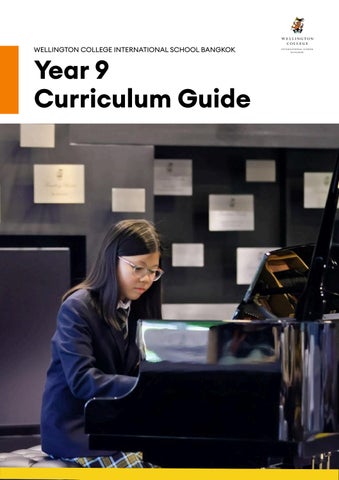
Year 9 Curriculum Guide
KINDNESS COURAGE INTEGRITY RESPONSIBILITY RESPECT At Wellington, values shape everything that we do, every day. They are part of every lesson, every conversation, every game. They provide continuity from year to year, and we are proud to walk in the footsteps of Wellingtonians before us. The pioneering Wellington education, steeped in these values, prepares students to serve, and help shape the world of tomorrow.
Table of Contents Art
04
Biology
07
Chemistry
10
Computing
13
Design Technology
16
Drama
19
English
22
French
25
Geography
28
History
34
Mandarin
37
Maths
40
Music
43
Physical Education
46
Physics
49
Spanish
52
Thai
55
Art
Michaelmas Term
Topic Self-portraiture
Work Covered An overview of portraiture throughout history. Photography: lighting, composition and post-production software. Face proportions, drawing features and creating a sense of 3D form when drawing and painting a self-portrait. Research to explore the work of portrait artists and produce personal responses. Written analysis of artists’ work. Transcription of chosen artist’s work: colour matching and blending techniques. Self-portrait painting.
Key Skills Understanding of the formal elements of Art. Experimenting with media. Drawing and painting. Increasing proficiency in the handling of different tools. Describing in depth, critically artists’ work, using specialist vocabulary. Producing personal and creative work in response to references.
Assessment Students' work is assessed on an ongoing basis using the success criteria specified for each task. Assessment is informed by practical outcomes, teacher observation and feedback, and self-assessment. Overall grades are holistic and take into consideration all work produced throughout the year.
4
Art
Lent Term Topic Ceramics
Work Covered Drawing skills and generating ideas through sketching. Various hand building techniques. Creative uses of glazes. Research and analysis on the work of ceramic artists as a way of finding inspiration, developing ideas and producing creative and personal responses.
Key Skills Understanding of the formal elements of Art. Hand building techniques. Increasing proficiency in the handling of different clay tools. Using glazes. Developing ideas through personal research, investigation, experimentation, evaluation and refinement of work. Translating 2D into 3D and vice versa. Attention to detail, patience and perseverance.
Assessment Students' work is assessed on an ongoing basis using the success criteria specified for each task. Assessment is informed by practical outcomes, teacher observation and feedback, and self-assessment. Overall grades are holistic and take into consideration all work produced throughout the year.
5
Art
Summer Term Topic Preparation for IGCSE
Work Covered A series of workshop-based mini projects to experiment with new media and explore mixed media practices. Learning about Art History, movements and the work of artists.
Key Skills A series of workshop-based mini projects to experiment with new media and explore mixed media practices. Learning about Art History, movements and the work of artists.
Assessment Students’ work is assessed in an ongoing basis, using the success criteria specified for each task. Students are assessed based on acquiring the skills required to access IGCSE. Overall grades are holistic, taking into consideration all the work produced throughout the year.
6
Biology
Michaelmas Term Topic Health and Disease Plant growth
Work Covered Health and disease is a large topic in Biology which covers content on different kingdoms as well as cell structure and microbiology. The unit gives students the opportunity to explore this fascinating area of Biology. Plant Growth – reactions in plants, plant adaptations, plant products and growing crops. Protecting wild plants (STEM), farming problems and solutions and organic farming.
Key Skills Students will perform key investigations related to the topics taught, focusing on their use of investigative technique, method writing, data collection, concluding and evaluating the evidence. Accuracy and precision in science – what do they mean and why are they important? Graph drawing – the use of lines of best fit, correlation vs causation. Calculation of probability – how do we use statistics and probability? Understanding bias and validity, medians and quartiles.
Assessment Students will perform key investigations related to the topics taught, focusing on their use of investigative technique, method writing, data collection, concluding and evaluating the evidence. Accuracy and precision in science – what do they mean and why are they important? Graph drawing – the use of lines of best fit, correlation vs causation. Calculation of probability – how do we use statistics and probability? Understanding bias and validity, medians and quartiles.
7
Biology Lent Term Topic Genetics and Evolution Coordination and Nervous System
Work Covered Basic inheritance patterns and natural selection. Nervous coordination within the body including reflexes.
Key Skills Investigative skills, following the scientific method to produce valid data and draw valid conclusions. Students will complete a full investigation and scientific report. Critical thinking, debate and discussion.
Assessment End of Topic assessments. Continuous assessment for learning during class time.
8
Biology
Summer Term Topic Ecology Brine Shrimp Investigations
Work Covered We will look at the basics of Ecology as well as sampling techniques. We will complete a project looking at Brine Shrimp Ecology.
Key Skills Communication skills, collaboration, independence, enquiry-based learning. The Scientific Method – designing experiments, risk assessing protocols, minimizing error, drawing conclusions and evaluating validity and reliability. Lab work – the safe use of laboratory equipment as an individual as well as part of a group. Graph Drawing – understanding the different types of data representation, drawing graphs and interpreting data.
Assessment End of year exam covering all content from Year 9.
9
Chemistry Michaelmas Term Topic States of Matter Separation Techniques Atomic Structure and The Periodic Table Ionic Bonding
Work Covered States of Matter - the particle model, solubility, heating and cooling curves, diffusion Separation Techniques - mixtures and filtration, distillation, chromatography, crystallisation Atomic Structure and The Periodic Table - atomic structure, groups of the periodic table Ionic Bonding - ionic properties, ionic formulae, dot and cross diagrams
Key Skills Understanding and applying scientific models - Use particle and atomic models to explain the behaviour and properties of substances. Practical laboratory and investigative skills - Carry out separation techniques safely, use scientific equipment accurately, and collect reliable data. Analysis and problem-solving - Interpret graphs, experimental results, and patterns in the Periodic Table to draw conclusions and make predictions. Scientific communication and representation - Use scientific vocabulary, formulae, symbols, and diagrams (e.g., dot-and-cross diagrams) to explain ideas clearly.
Assessment Students will be assessed through end-of-topic assessments, ongoing assessment for learning during lessons, and an extended response task for each topic. Regular prep will be set to develop students' scientific literacy and numeracy skills.
10
Chemistry Lent Term Topic Metallic Bonding Covalent Bonding
Work Covered Metallic Bonding - properties of metals, bonding in metals Covalent Bonding - covalent formulae, properties of covalent compounds, dot and cross diagrams, giant covalent compounds
Key Skills Understanding and applying bonding models - Explain how metallic and covalent bonding affect the structure and properties of different substances. Using scientific representations - Write covalent formulae and draw and interpret dot-and-cross diagrams to represent bonding. Analysis and problem-solving - Compare the properties of metals, simple covalent compounds and giant covalent structures, using bonding theories to explain observations and predict behaviour.
Assessment Students will be assessed through end-of-topic assessments, ongoing assessment for learning during lessons, and an extended response task for each topic. Regular prep will be set to develop students' scientific literacy and numeracy skills.
11
Chemistry Summer Term Topic Chemical Reactions Chemistry Project
Work Covered Chemical Reactions - endo and exo-thermic reactions, combustion, neutralisation, thermal decomposition Chemistry Research Project - on an area of interest
Key Skills Scientific inquiry and analysis - Investigate chemical reactions, interpret results, evaluate evidence, and draw conclusions from experimental and research-based activities. Research and application of scientific concepts - Apply knowledge of chemical reactions to explain real-world phenomena and independently research and communicate scientific ideas using appropriate evidence and terminology.
Assessment End of year exam covering all content from Year 9.
12
Computing Michaelmas Term Topic Inside Computer Systems Cybersecurity Python Coding
Work Covered Inside Computer Systems: Understanding the internal parts of a computer and their roles in making the computer work, including the physical components of a computer, the binary system and binary addition. Cybersecurity: Understanding the online dangers such protecting personal data, social engineering, hacking and brute force attacks, malicious software, protecting networks and preventing cyber attacks. Python Coding: Understanding the use of variables, input, selection, iteration, and creating small programs.
Key Skills Understanding computer systems Digital citizenship and safety Programming logic and creativity
Assessment Ongoing assignments in all topics End of unit tests in all topics
13
Computing Lent Term Topic Data Representation with Images and Sound Using Data Science
Work Covered Data representation with images and sound: Understanding how binary is used to create digital images and sound. Image and sound editing. Using data science: Understanding how data is used to support decision making.
Key Skills Computer science theory Understanding images and sound Data Science
Assessment Ongoing assessment in all topics End of unit tests in all topics
14
Computing Summer Term Topic UGOT AI – Space Exploration Robotics Project
Work Covered Building and programming UGOT AI robots for simulated space exploration tasks. Exploring AI-driven robotics, sensors, and automation in problem-solving contexts.
Key Skills Robotics engineering and coding AI in robotics applications Problem solving and teamwork Creative project development
Assessment Practical robotics project challenges Ongoing assessment of programming and teamwork skills
15
Design Technology Michaelmas Term
In Year 9, students focus on advanced digital design, complex mechanical/3D CAD modelling, and hands-on workshop manufacturing techniques. Over the academic year, students complete two major projects lasting approximately half an academic year each. Depending on workshop schedules and specialist tool access, the delivery sequence may vary between classes.
Project Lamp Build Project
Topic This project is a practical, workshop-based manufacturing build where students create their own customized desk light. While centered on hands-on workshop construction, assembly, and practical fabrication skills, students still navigate the design process to personalize and refine their working lighting solution.
Work Covered & Skills Learnt Creating the Solution: Workshop tool safety protocols; material cutting, shaping, and joining; surface preparation and protective oil or varnish finishing. Evaluation: Functional testing of light output, and physical stability; selfevaluating build precision, joint tightness, and overall craftmanship.
Assessment Students document their design process, step-by-step construction photos, and final testing in a slide deck portfolio. Assessment is based on the continuous design deck alongside the fully working physical desk light.
16
Design Technology Lent & Summer Term Project Lamp Build Project
Topic Students act as product designers to investigate how a sensory desktop fidget board can help individuals who struggle with concentration, ADHD, or anxiety during study time. Students design a customized wooden base board combined with custom 3D-modeled mechanical fidget components (e.g., gears, clickers, sliders).
Work Covered & Skills Learnt Inquiring & Analysing: Researching psychological/scientific causes of fidgeting and sensory stimulation; constructing prioritized primary and secondary research plans; conducting ACCESSFM analysis on existing commercial sensory tools; formulating a detailed design brief and research summary. Developing Ideas: Writing SMART design specifications; sketching initial concepts for both the base board and fidget mechanisms; advanced 3D CAD modelling in Autodesk Fusion 360 (applying tight engineering clearances for fit like 0.3mm tolerances, screw holes, and mechanical gear threads); generating formal 2D CAD layouts and 3D orthographic planning drawings with exact dimensions. Creating the Solution: Operating 3D printers using PLA or flexible TPU materials; using 2D Design software to operate laser cutters or CAM highspeed routers for the birch plywood base board; timber shaping using jigsaws, palm sanders, and belt sanders; applying natural Osmo oil finishes. Evaluation: Conducting user focus testing during study sessions; evaluating overall performance, ergonomics, and sensory feedback against SMART specifications; documenting design refinements and technical iterations.
17
Design Technology Lent & Summer Term
Assessment Students submit a comprehensive PowerPoint portfolio (including Fusion 360 models, 2D vector files, research documentation, and evaluation) alongside their fully functional physical fidget board and 3D-printed mechanisms.
18
Drama
Michaelmas Term Topic Little Sister and Mockumentaries
Work Covered Students study and practically explore the reality tv show Big Brother (that we call Little Sister), considering character, relationships and social issues. Students then move on to mockumentaries, exploring how documentary conventions can be used within Drama to create both realistic and comedic performances.
Key Skills Developing characterisation and relationships Using naturalistic acting techniques Exploring social issues through Drama Understanding the difference between naturalistic and non-naturalistic performance Using direct address and interview techniques Developing comedic timing Using improvisation and devising skills Understanding how documentary conventions can be adapted for performance
Assessment Final performance of a Little Sister ‘live final’ followed by a devised mockumentary film
19
Drama Lent Term Topic Devising and Physical Theatre (Macbeth)
Work Covered Students explore Macbeth through physical theatre and devising techniques. They investigate key characters, themes and moments from the play and experiment with different ways of communicating Shakespearean ideas without relying solely on the original language. Students develop their own physical theatre sequences based on key scenes and themes.
Key Skills Using physical theatre to communicate ideas and narrative Exploring Shakespearean characters and themes Developing ensemble performance skills Using levels, space and proxemics Creating symbolism through movement Using chorus and synchronised movement Developing transitions between scenes Devising original material from a stimulus Using voice and movement together to create meaning
Assessment Final devised physical theatre performance based on Macbeth
20
Drama
Summer Term Topic Theatre Design
Work Covered Students are introduced to the different areas of theatre design and explore how design choices can communicate character, atmosphere, setting and meaning to an audience. Students investigate set, costume, lighting, sound and prop design before developing and presenting their own design ideas for a performance.
Key Skills Understanding the role of a theatre designer Introduction to set design Introduction to costume and make-up design Introduction to lighting design Introduction to sound design Using colour, shape, texture and space to communicate meaning Creating design concepts from a stimulus Understanding how technical choices influence an audience Developing and presenting a design idea
Assessment Final individual or group theatre design project and presentation
21
English Michaelmas Term Topic Engaging Openings Non-Fiction: Writing to Persuade/Argue
Work Covered Engaging Openings This unit is an exploration of the conventions of narrative writing such as the creation of atmosphere and setting; foreshadowing; pathetic fallacy. Students will examine extracts from many famous novels and will use these as inspiration for their own writing. Speeches Building on their rhetoric study in previous years, students will learn the following: conventions of speeches; structure of speeches; literary and persuasive devices; exploration of topics; delivery of speeches.
Key Skills Writing to describe Writing to narrate Technical accuracy Comprehension Inference Analysis Evaluation Essay writing skills Writing to argue Writing to persuade Technical accuracy Speaking and Listening for Harkness discussion/ delivery of speeches
Assessment Reading: analysis of characterisation. Writing: an argumentative/ persuasive speech; S&L: speech presentation.
22
English Lent Term Topic Drama Study: Macbeth by William Shakespeare Conflict Poetry
Work Covered Macbeth Students will build on their drama study from previous years and will examine the conventions of Shakespearean tragedy and the role of the tragic hero in literature. They will also examine the role of powerful, persuasive and manipulative language in the play as well as analysing the rich figurative devices used by Shakespeare. Poetry Building on their study of poetry from year 8, students will examine a range of poems written during and about conflict and war, such as the poems of Wilfred Owen. The students will deepen their understanding of poetic method and will develop the skills to make thoughtful contextual links between the poetic devices used and the text’s contexts. Students will continue to build on their essay writing skills.
Key Skills Comprehension Inference Analysis Evaluation Dealing with unseen texts Essay writing
Assessment Reading essay on one selected extract from the play or a character study. Reading: an analytical essay on a studied poem and creative writing inspired by poetry
23
English Summer Term Topic Fiction: Animal Farm by George Orwell Directed Writing And/or Media project
Work Covered Students will build on their prior study of prose fiction from earlier years by exploring John Steinbeck’s Of Mice and Men. They will examine how Steinbeck uses characterisation, dialogue, and symbolism to present themes such as loneliness, friendship, the American Dream, and social inequality. Students will also consider the author’s intent, paying close attention to the influence of the social and historical context of 1930s America, including the Great Depression and migrant worker experience. Alongside this, they will develop their ability to analyse how attitudes and values are communicated in the text, while refining their essay writing skills through structured PEAR paragraphs. An introduction to directed writing skills.
Key Skills Synthesis of information from texts Comprehension Summarising skills Inference Analysis Evaluation Writing; persuasive method; paragraphing and structure; synthesis; evaluation Essay Writing Revision skills
Assessment EOY test- Examining the presentation of a character in an extract from the text
24
French
Michaelmas Term Topic Ma vie sociale d’ado (My social life) Bien dans sa peau (Healthy)
Work Covered Facebook: online activities, present tense How do you find…: opinions, direct object pronouns Going out: making plans, near future How was it?: describe a date, passé composé Loving music: describe a music event, 3 tenses Hit: vocabulary of body parts, à + definite article Sport and fitness: vocabulary of sports, il faut + infinitive
Key Skills 4 main skills: listening, speaking, reading and writing – revise and develop vocabulary - revise and develop knowledge of tenses
Assessment Continuous assessment of progress through the work done in class and Prep. Summative assessments at the end of each module.
25
French Lent Term Topic Bien dans sa peau (Healthy) A l’horizon (Now and then)
Work Covered Healthy eating: resolutions, future tense In good shape: making plans, future tense Are you fit?: describe levels of fitness, 3 tenses Jobs: vocab of jobs, say why you do that job When I was younger…: vocabulary of jobs, compare before and now, imperfect tense
Key Skills 4 main skills: listening, speaking, reading and writing – Deepen mastery of the different tenses
Assessment Continuous assessment of progress through the work done in class and Prep. Summative assessments at the end of each module.
26
French
Summer Term Topic Spécial vacances (holiday special) Moi dans le monde (My place in the world)
Work Covered Holiday questions: discuss holidays, ask questions thrills: adventure holidays, conditional Indispensable: vocab of accessories, reflexive verbs Holiday videos: describe a holiday, combine different tenses At the holiday camp: visit a tourist attraction, emphatic pronouns My rights: discuss what you are allowed to do, expressions with avoir My priorities: explain what’s important, direct object pronouns
Key Skills 4 main skills: listening, speaking, reading and writing – discuss a wide variety of studied topics
Assessment Continuous assessment of progress through the work done in class and Prep. Summative assessments at the end of each module.
27
Geography Michaelmas Term
Year 9 Geography encourages students to think critically about the challenges and opportunities created by an increasingly interconnected world. Through the study of globalisation, risks and hazards, and coastal environments, students develop a deeper understanding of how physical and human processes interact across local, national and global scales. Students continue to build key geographical skills, including data analysis, decision-making, map interpretation and geographical enquiry.
Topic Globalisation
Work Covered This unit explores how advances in technology, transport and communication have created an increasingly interconnected world. Using the global production of the Apple iPhone as a case study, students investigate the role of multinational companies, governments and international trade in driving globalisation. They consider the economic, social and environmental impacts of globalisation and evaluate whether modern supply chains can become more sustainable. Students will study: The importance of mobile technology in the modern world. The meaning and causes of globalisation. Global supply chains and international trade. The role of transnational corporations (TNCs). Offshoring and outsourcing. Government policies that encourage globalisation. China's role in global manufacturing. The impacts of manufacturing on people, economies and environments. Sustainable production and consumption. Comparing Apple and Fairphone as global products.
28
Geography Michaelmas Term Key Skills Students will develop: Interpretation of global trade and development data. Analysis of economic, social and environmental impacts. Evaluation of sustainability issues. Understanding of global interdependence. Use of case studies to support geographical arguments. Decision-making and evaluative skills.
Assessment Summative Assessment One 20-minute written assessment midway through the topic to assess students' understanding of key knowledge and concepts. One lesson-long end-of-topic assessment designed to assess students' geographical knowledge, understanding and skills developed throughout the unit. Formative Assessment Continuous monitoring of students' written work, data analysis, class discussion and oral responses using a variety of assessment techniques.
29
Geography Lent Term Topic Geographies of Risk
Work Covered This enquiry-based unit explores how risks affect people and places and investigates why some communities are more vulnerable than others. Students examine a wide range of natural, environmental, health and geopolitical risks, considering how governments, organisations and individuals seek to reduce vulnerability and improve resilience. Students also undertake their own enquiry into risk perception and evaluate how decisions are made about managing risks at local, national and global scales. Students will study: What risk is and how it is measured. Factors that influence vulnerability to risk. Natural and environmental hazards. Human, animal and plant diseases. Conflict, instability and geopolitical risks. The role of governments in managing risk. Risk mitigation and preparedness. How people perceive and respond to risks. Methods of collecting and analysing risk data. Differences in risk perception between groups. Comparing levels of risk within the UK and globally. Decision-making in risk management.
30
Geography Lent Term Key Skills Students will develop: Interpretation and analysis of quantitative and qualitative data. Collection of primary data through questionnaires. Understanding of sampling techniques. Evaluation of evidence from different sources. Geographical enquiry and investigation skills. Decision-making and problem-solving. Evaluation of the effectiveness of risk management strategies.
Assessment Summative Assessment One 20-minute written assessment midway through the topic to assess students' understanding of key knowledge and concepts. One lesson-long end-of-topic assessment designed to assess students' geographical knowledge, understanding and skills developed throughout the unit. Formative Assessment Continuous monitoring of students' written work, enquiry activities, data interpretation and oral responses using a variety of assessment techniques.
31
Geography Summer Term Topic Coasts
Work Covered This unit investigates the dynamic processes that shape coastal landscapes and examines how people interact with coastal environments. Students explore how waves, erosion, transportation and deposition create distinctive coastal landforms and consider the challenges of managing coastlines in the face of rising sea levels and increasing coastal development. Through a range of case studies, students evaluate different approaches to coastal management and sustainability. Students will study: Coastal processes and systems. Waves and coastal energy. Weathering, erosion and mass movement. Transportation and deposition. Headlands, bays and wave-cut platforms. Coastal landforms created by erosion. Beaches, spits and other depositional landforms. Human use of coastal environments. Coastal flooding and erosion risks. Hard and soft engineering strategies. The impacts of climate change on coastlines. Sustainable coastal management.
32
Geography Summer Term Key Skills Students will develop: Interpretation of maps, aerial photographs and coastal diagrams. Analysis of coastal processes and landform formation. Use of geographical evidence to explain environmental change. Evaluation of management strategies. Understanding of interactions between physical and human environments. Investigation and presentation of geographical information.
Assessment Summative Assessment One 20-minute written assessment midway through the topic to assess students' understanding of key knowledge and concepts. One lesson-long end-of-topic assessment designed to assess students' geographical knowledge, understanding and skills developed throughout the unit. Formative Assessment Continuous monitoring of students' written work, fieldwork-style investigation activities, class discussions and oral responses using a variety of assessment techniques.
33
History
Michaelmas Term Topic The creation of modern South-East Asia
Work Covered Colonisation of South East Asia Thai independence and modernisation Singapore- from British colony to modern nation city state Cambodia under French rule The Cambodian genocide Vietnam war Independence movements Regional cooperation and ASEAN- focus on Thailand
Key Skills Source evaluation, analysis and interpretation, recall of information, interpreting an extended piece of writing, video analysis.
Assessment Summative assessment: Two 30-minute written assessments in the middle and at the end of each unit that are designed to test their understanding of historical figures, events and the skills we have developed. Formative assessment: Continuous tracking of student written work and oral responses in lessons using a variety of techniques.
34
History Lent Term Topic World War Two
Work Covered The Causes of World War Two, Blitzkrieg to Phoney War, Fall of France (Dunkirk), War in the Sky (Battle of Britain and the Blitz), Germany attacks the USSR – Operation Barbarossa, Breaking the Enigma Code (Alan Turing), War in Asia: Japan, War at Sea (Battle of the Atlantic), the U-Boat, the Home Front, Total War - Concentration Camps, the Final Solution and the Holocaust. Germany in Retreat, D Day and the Liberation of Paris, Berlin Falls and Hitler’s Suicide, Victory in Asia & Hiroshima and Nagasaki. Trip to Kanchanaburi – Hellfire Pass, Death Railway Museum & Chung Kai Cemetery.
Key Skills Source evaluation, analysis and interpretation, recall of information, interpreting an extended piece of writing, video analysis.
Assessment Summative assessment: Two 30-minute written assessments in the middle and at the end of each unit that are designed to test their understanding of historical figures, events and the skills we have developed. Formative assessment: Continuous tracking of student written work and oral responses in lessons using a variety of techniques.
35
History
Summer Term Topic Apartheid South Africa
Work Covered Apartheid in South Africa: Origins, Segregation, Implementation, Resistance, Prominent Players & Ending Apartheid
Key Skills Source evaluation, analysis and interpretation, recall of information, interpreting an extended piece of writing, video analysis.
Assessment Summative assessment: Two 30-minute written assessments in the middle and at the end of each unit that are designed to test their understanding of historical figures, events and the skills we have developed. Formative assessment: Continuous tracking of student written work and oral responses in lessons using a variety of techniques.
36
Mandarin
Michaelmas Term Topic Mandarin as Foreign Language Group: Occupations and job applications Mandarin as First Language Group: News and biographies
Work Covered Mandarin as Foreign Language Occupations Job applications Doctor Interview Mandarin as First Language News Biographies
Key Skills Mandarin as Foreign Language Listening: identify and note the main points and specific details about the world of work. Speaking: take part in conversations, using a variety of structures and producing more detailed or extended responses about jobs and future plans. Reading: understand the main points and some of the details in a variety of written texts related to work. Writing: write a variety of texts, conveying opinions and points of view. Mandarin as First Language Understanding of explicit meanings and viewpoints in news and biographies. Synthesise information, structure text to make sequence and development of ideas clear to the reader.
Assessment Formative assessment: Quizzes & Prep Summative assessment: End of unit assessment
37
Mandarin Lent Term Topic Mandarin Foreign Language Group: Shopping Mandarin First Language Group: Scenery and emotions
Work Covered Mandarin as Foreign Language Shopping in the Supermarket Shopping in the Mall Shopping online Mandarin as First Language The articles describing scenery
Key Skills Mandarin as Foreign Language Listening: Understand the main points and specific information about shopping in different contexts. Speaking: Ask for and give information about products, prices and preferences when shopping. Reading: Understand key information in texts related to shopping in supermarkets, malls and online. Writing: Write short texts to describe shopping experiences, products and preferences. Mandarin as First Language Analyse and interpret articles describing scenery, identifying key ideas, descriptive language and the writer’s perspective. Use appropriate vocabulary and language structures to describe scenery and express personal responses.
Assessment Formative assessment: Quizzes & Prep Summative assessment: End of Unit Assessment
38
Mandarin Summer Term Topic Mandarin as Foreign Language Group: Nature and world Mandarin as First Language Group: Poetry and Literature
Work Covered Mandarin as Foreign Language Group: Continents Nature and weather Protect the environment Mandarin as First Language Group: Poetry and Literature
Key Skills Mandarin as Foreign Language Group: Listening: understand longer passages and recognise people’s points of view. Speaking: answer unprepared questions. They initiate and develop conversations and discuss matters of the international world. Reading: understand longer texts and recognize people’s points of view. Writing: write texts to express and justify ideas, opinions or personal points of view and seek the views of others. Mandarin as First Language Group: Demonstrate understanding of implicit meanings and viewpoints in poetry and literature. Write in paragraphs using varied sentence structures, demonstrating control of syntax and grammar.
Assessment Formative assessment: Quizzes & Prep Summative assessment: End of Year Examination
39
Maths
Michaelmas Term Topic Number, Geometry, Algebra
Work Covered Number: Significant figures, powers of 10, indices, standard form, estimation and rounding Geometry: Surface area and volume of prisms, circles, cylinders; Pythagoras’ theorem Algebra: Sequences (arithmetic, quadratic, geometric), expanding and factorising, solving quadratic equations, inequalities, substitution, rearranging formulae Geometry (Constructions): Constructing shapes, bisectors, accurate drawings
Key Skills Use standard form and indices in calculations Apply Pythagoras’ theorem to 2D problems Work confidently with quadratic sequences and equations Use inequalities and rearrange formulae accurately Construct accurate diagrams using geometrical tools
Assessment Constant formative and end of topic assessments
40
Maths Lent Term Topic Statistics, Proportion, Geometry, Measures
Work Covered Statistics: Planning and collecting data, averages and range, displaying and interpreting data Proportion: Direct proportion, enlargements, scale factors, percentage change Geometry: Scale drawings, maps, bearings, congruence, similarity Measures: Rates of change, density, pressure, bounds
Key Skills Plan and conduct surveys and experiments Use proportional reasoning in enlargement and similarity problems Solve geometrical problems involving congruence and similarity Apply compound measures in practical contexts Estimate solutions using bounds
Assessment Constant formative and end of topic assessments
41
Maths
Summer Term Topic Algebra, Geometry, Probability
Work Covered Algebra: Graphical solutions of linear, quadratic, and simultaneous equations; using y=mx+c; quadratic graphs Geometry: Trigonometry (sine, cosine, tangent), solving right-angled triangles, angle of elevation and depression Probability: Set notation, Venn diagrams, tree diagrams, experimental and theoretical probability
Key Skills Solve equations graphically, including quadratic and simultaneous systems Sketch and interpret quadratic and linear graphs Apply trigonometric ratios to calculate sides and angles in triangles Use probability diagrams (Venn, trees) to calculate and justify results
Assessment Constant formative and end of topic assessments
42
Music
Michaelmas Term Topic Djembe
Work Covered Students are inspired to learn about advanced African djembe performance techniques, rhythmic patterns and ensemble skills. They develop confidence through practical performance before composing and performing their own djembe piece.
Key Skills • Correct djembe playing techniques • Performing steady rhythmic patterns • Developing coordination and timing • Playing confidently as part of an ensemble • Using repetition, contrast and rhythmic development • Creating and organising original rhythmic ideas • Composing and performing an original djembe piece
Assessment Continuous assessment of instrumental skills- one solo performance of own choice. Topic- Continuous assessment of verbal and written responses. Final composition project. End of unit performance assessment.
43
Music Lent Term Topic Dance Music
Work Covered Students will explore how Dance Music spans cultures, centuries, and technologies, evolving with social trends and innovations. They will study the traditional Latin styles such as Salsa, with its Afro-Cuban rhythms and Tango, with its dramatic phrasing and minor tonality. In the 20th century, jazz, swing, and disco paved the way for global popular dance music. The digital age revolutionized the scene with Electronic Dance Music (EDM), using synthesizers, sampling, and powerful beats to create immersive soundscapes for clubs, festivals, and global audiences. Students will use sequencing programs to create their own stylistic works.
Key Skills Understand how instruments, structures and textures are used in Salsa Perform as part of a larger ensemble understanding key roles of performers and different instruments and the relationship between these and the effect this has on the music Use rhythmic features such as ostinato, cyclic rhythms, polyrhythms, call and response and syncopation when performing and improvising Learn sequencing skills when composing EDM pieces.
Assessment Continuous assessment of instrumental skills- one solo performance of own choice. Topic- Continuous assessment of verbal and written responses. EDM Composition. End of unit theory assessment.
44
Music
Summer Term Topic Song Writing
Work Covered Students begin by exploring ‘What Makes a Good Song?’ through practical musical investigation of two ‘good’ songs as case studies. Students explore Hooks/Riffs, Structure, Melody and Lyrics through listening and analysis and performing parts of each song as short musical arrangements. Pupils learn about the importance of Hooks and Riffs, Popular Song Structure and the various difference components/sections within, Melodic Motion (Conjunct and Disjunct Motion) and Lyrics within both these case studies and a range of other popular songs. Students are encouraged to confidently navigate around lead sheets evaluating what musical information is, and is not, included in this form of notation. Students will create their own musical arrangement of a popular song from a Lead Sheet in their chosen style/genre. This concept of “cover version” is explored by listening and examining a range of different musical arrangements of the same song for stylistic and elemental changes. Students are encouraged to explore the resources available to them, the musical information included (and not included) on their lead sheet and to manipulate, refine and adapt existing (and include new) musical material to create their final arrangement.
Key Skills Understand the different textural and structural elements of a song/popular song. Understand and use the different musical information given on a lead sheet in creating a Musical Arrangement of a Popular Song.
Assessment Continuous assessment of instrumental skills- one solo performance of own choice in a recital afternoon. Topic- Continuous assessment of verbal and written responses. Final group arrangement and performance. End of Year exam.
45
Physical Education Michaelmas Term Topic Sport Education: Touch Rugby Pathway 1: Play and Perform
Work Covered Sport Education Specialisation in Touch Rugby Strategic planning and coaching within the chosen sport. Teams engage in an engineered Touch Rugby season. Reflection on personal and team performance, including goal setting Play and Perform: Students develop tactical awareness, technical skills, and teamwork through selected activities from invasion games, net/wall, and striking/fielding sports.
Key Skills Sport Education: Touch Rugby Advanced sport-specific skills and techniques Analysis and evaluation of individual and team performance Effective communication and cooperation within the team Adaptation and adjustment of game plans based on opponents' strategies Play and Perform Tactical decision-making Technical skill development Teamwork and communication Resilience and adaptability Self and peer evaluation
Assessment Sport Education: Head: Analysing and evaluating performance, identifying strengths and areas for improvement Heart: Demonstrating leadership, teamwork, and displaying positive attitudes towards teammates and opponents Hands: Applying advanced skills, executing game strategies, and contributing to team success Play and Perform Head: Demonstrates tactical understanding and decision-making Heart: Shows commitment, teamwork, and positive attitude Hands: Executes skills with control and consistency
46
Physical Education Lent Term Topic Pathway 3: Lead and Learn
Work Covered Students discover how to lead through their chosen bespoke pathway: choreography, sports leadership or workout programme design.
Key Skills Planning and organisation Communication and leadership Creativity and problem-solving Self-management and reflection
Assessment Head: Applies knowledge to lead or create effectively Heart: Shows initiative, collaboration, and commitment Hands: Delivers tasks with clarity, control, and purpose
47
Physical Education Summer Term Topic Pathway 4: Challenge and Create
Work Covered Students develop physical and creative confidence through activities such as personal survival, game design, and gymnastics.
Key Skills Problem-solving and creativity Physical control and coordination Resilience and independence Planning and evaluation
Assessment Head: Applies creative thinking and problem-solving in practical tasks Heart: Shows determination, focus, and willingness to take risks Hands: Demonstrates control, fluency, and precision in movement
48
Physics
Michaelmas Term Topic 9I Forces and Motion
Work Covered Naming forces, Balanced and unbalanced forces, Energy stores and transfers, Calculating speed, Turning Forces, Work done by a force
Key Skills Descriptions Modelling Explaining Planning investigations Harkness Discussion Drawing and interpreting graphs
Assessment Classwork, prep-work and Harkness though the term as well as one small test
49
Physics Lent Term Topic 9J Force fields and Electromagnets
Work Covered Magnetic and Gravitational fields, Electrostatics, Current Electricity Resistance Electromagnets
Key Skills Drawing field diagrams Constructing Circuits Substituting in equations Using Significant figures Descriptions and Explanations
Assessment Classwork, prep-work and Harkness though the term as well as a small test
50
Physics
Summer Term Topic Investigative Approaches
Work Covered Identifying variables Handling data Precision and accuracy
Key Skills Identifying and controlling variables Graph drawing Calculation and rounding Describing trends in data
Assessment Classwork, prep-work and Harkness though the term. An end of year test.
51
Spanish
Michaelmas Term Topic Travel and tourism
Work Covered Means of transport and advantages/ disadvantages on using each; what transport you use and used last week, linked to the environment. Tourism in Bangkok/Thailand: what there is to do in Bangkok and what Bangkok used to be like.
Key Skills Grammar: Present Tense (revisiting) Preterite Tense (revisiting) Imperfect Tense Immediate future Tense (revisiting) • Question words (understanding questions and making them) Comparative and Superlative Impersonal expressions Verb QUERER in the Present Tense
Assessment Project (poster or virtual tour) of Bangkok using topic vocabulary and grammar. November translation and reading exam.
52
Spanish Lent Term Topic Media
Work Covered Types of TV programmes and description of a particular TV programme. 1st half-term. Studying Coco leading to a film project. 2nd half-term (This will include revisiting the topic of family and learn about relationships and clothes as well as how to describe the plot of Coco. It will also include the future: What will happen to Miguel next?)
Key Skills Revising Present, preterite, imperfect Revising Comparatives and superlatives Future tense • Question words (understanding questions and making them) Extension:Object direct pronouns
Assessment Writing about your favourite film/tv show. Poster about dia de los muertos (following Coco)
53
Spanish
Summer Term Topic Healthy living and sports
Work Covered To talk about food and express opinions To talk about what to eat to be healthy Healthy living activities: se debería/se debe no fumar/ beber (revisiting hobbies) Sports (revisiting) Daily routine (revisiting)
Key Skills Direct object pronouns Present, Preterite, Future and Imperfect tenses (Revisiting) Boot verbs in the Present tense (Revisiting) Reflexive verbs (Revisiting) Question words (understanding questions and making them) Taste of fluency
Assessment End of year exam listening and speaking exam
54
Thai
Michaelmas Term Topic Thai วรรณกรรม ลูกแม่น้ำโขง ประพันธ์โดย เขมชาติ การอ่านวิเคราะห์บทความและการตอบคำถาม ปลายเปิด การเขียนแสดงความคิดเห็นเชิงวิเคราะห์อย่างมี โครงสร้าง การเขียนอธิบายเหตุผลและแนวคิด การใช้ภาษาโน้มน้าวทังการเขียนและการพู ด
Work Covered Thai ฝึกอ่านวรรณร่วมสมัย วิเคราะห์แนวคิดหลักและ เจตนาผู้เขียน พร้อมตีควาาม ตอบคำถามเชิงลึก อย่างมีเหตุผล ฝึกเขียนตามโครงสร้าง OREO (แสดงความคิด เห็น → เหตุผล → ตัวอย่าง → สรุป) เพื่อสื่อสาร ชัดเจนและน่าเชือถือ เขียนย่อหน้าอธิบายที่มีประโยคหัวข้อ เหตุผล และตัวอย่าง ใช้คำเชื่อมเพื่อความต่อเนื่อง ถ่ายทอดข้อมูลชัดเจน เรียนรู้การใช้คำ น้ำเสียง และโครงสร้างเพื่อ ชักจูง ฝึกเขียนบทความโน้มน้าวและพูดเสนอ ความคิดเห็น
Non-Thai Pronouns Countries & Nationalities Thai Royal Family Shopping & Bargaining Important Places in Thailand Describing Places History: Ayutthaya Period Health & Visiting the Doctor Non-Thai Research on Thai cultural topics Describing places worksheets Listening to short Thai passages, stories, and articles Group discussions and idea sharing Project Presentation: Royal Families Around the World
Key Skills Thai การอ่านวิเคราะห์เชิงเหตุผล: จับแนวคิดหลัก/ เจตนา อ้างอิงหลักฐาน ตอบคําถามเชิงลึก การเขียนตามโครงสร้าง OREO: ความเห็น– เหตุผล–ตัวอย่าง–สรุป สือสารชัดเจน น่าเชือถือ การเขียนย่อหน้าอธิบาย: ประโยคหัวข้อ + เหตุผล + ตัวอย่าง ใช้คําเชือมให้ต่อเนือง การโน้มน้าวใจ: ใช้คำ น้ำเสียง และโครงสร้างเพื่อ ชักจูง เขียนบทความโน้มน้าว/พู ดเสนอความเห็น
Non-Thai Understanding Thai culture and study topics Presenting and discussing knowledge in Thai Using Thai vocabulary for bargaining Understanding the Ayutthaya period
Assessment Thai ผลงานในชั้นเรียน ประเมินท้ายบทเรียน การนำเสนอผลงาน
Non-Thai Ongoing formative assessments Topic-based quizzes Q&A sessions Listening and speaking tests
55
Thai
Lent Term Topic Thai ผลงานในชั้นเรียน ประเมินท้ายบทเรียน การนำเสนอผลงาน
Non-Thai Ongoing formative assessments Topic-based quizzes Q&A sessions Listening and speaking tests
Work Covered Thai อ่านข่าว บทบรรณาธิการ และโฆษณา เพื่อ แยกแยะ “ข้อเท็จจริง” “ความคิดเห็น” และ “อคติ” ประเมินความน่าเชือถือของข้อมูล ศึกษาโวหาร (อุปมา อุปลักษณ์ เสียดสี ฯลฯ) และ น้ำเสียง (จริงจัง เห็นใจ เสียดสี ฯลฯ) วิเคราะห์ ผลที่เกิดขึนกับผูอ ้ ่าน เขียนตอบสนองต่อบทความ โดยอ้างอิง ข้อความต้นทาง แสดงเหตุผลสนับสนุน และมุม มองของตนเองอย่างมีมารยาท เปรียบเทียบข้อความหรือแนวคิดจาก 2 แหล่ง ใช้โครงสร้างที่เหมาะสม วิเคราะห์ความเหมือน และความแตกต่างอย่างมีเหตุผล
Non-Thai Topic-related worksheets Group work and role play for speaking practice Research on Thai cultural topics Classroom discussion on Thai songs
Assessment Thai ผลงานในชั้นเรียน ประเมินท้ายบทเรียน การนำเสนอผลงาน
Non-Thai Ongoing formative assessments Topic-based quizzes Q&A sessions Listening and speaking tests
56
Thai
Summer Term Topic Thai การตีความสำนวนไทยและการใช้ภาษาที่มีนัย แฝง การเขียนวิเคราะห์ถ้อยคำ สำนวน และเจตนา ของผู้เขียน
Non-Thai Making Plans: Future Tense Thailand Geography School Life: Favourite Subjects Thai Borders and Neighbours
Work Covered Thai ศึกษาสำนวนไทยที่พบบ่อยในงานเขียนและ บทความร่วมสมัย วิเคราะห์ความหมายและผลที่ เกิดขึนต่อผูอ ้ ่าน ระบุถ้อยคำหรือสำนวน อธิบายความหมาย วิเคราะห์ผลต่ออารมณ์และความเข้าใจของผู้อ่าน พร้อมสรุปความคิดเห็น
Non-Thai Topic-related worksheets Group work and role play for speaking practice Research on Thai provinces
Key Skills Thai การวิเคราะห์สำนวน: ศึกษาสำนวนไทยในงานเขียน และบทความร่วมสมัย การตีความถ้อยคำ: อธิบายความหมาย วิเคราะห์ ผลต่ออารมณ์และความเข้าใจ การเขียนสรุปเชิงวิเคราะห์: แสดงความคิดเห็น อย่างมีเหตุผลและชัดเจน
Non-Thai Understanding Thai culture and study topics Presenting and discussing knowledge in Thai Discussing Thailand’s neighboring countries Making Thai garlands
Assessment Thai ผลงานในชั้นเรียน ประเมินท้ายบทเรียน การนำเสนอผลงาน
Non-Thai Ongoing formative assessments Topic-based quizzes Q&A sessions Listening and speaking tests
57
Wellington College International School Bangkok 18 Krungthep Kreetha Road, Thap Chang, Saphan Sung, Bangkok info@wellingtoncollege.ac.th 02 087 8888 wellingtoncollege.ac.th #WeAreWellington