WELLINGTON COLLEGE INTERNATIONAL SCHOOL BANGKOK
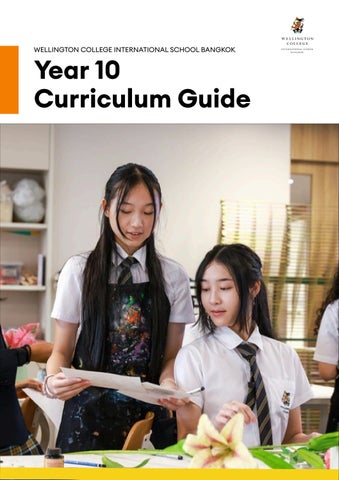
Year 10 Curriculum Guide
KINDNESS COURAGE INTEGRITY RESPONSIBILITY RESPECT At Wellington, values shape everything that we do, every day. They are part of every lesson, every conversation, every game. They provide continuity from year to year, and we are proud to walk in the footsteps of Wellingtonians before us. The pioneering Wellington education, steeped in these values, prepares students to serve, and help shape the world of tomorrow.
Table of Contents Art
04
Biology
07
Business Studies
10
Chemistry
13
Computer Science
16
Design Technology
19
Drama
22
Economics
25
English
28
ESL
31
French
34
Geography
37
History
42
Mandarin Foreign Language
45
Mandarin First Language
48
Maths
51
Accelerated Maths
54
Music
60
Physical Education
63
Physics
66
Spanish
69
Thai
75
Art
Michaelmas Term
Exam board specification: Pearson Edexcel International GCSE Art & Design (Fine Art)
Topic Natural Forms: Drawing and Photography
Work Covered Observational drawing from natural forms using a range of media, techniques, styles, and surfaces. Photography from primary sources, exploring composition, lighting, and viewpoint. Investigation of artists, art movements, and contextual sources. Development of ideas through research, experimentation, and annotation. Analysis and evaluation of artists' work.
Key Skills Recording from first-hand sources through drawing and photography. Developing proficiency with a range of materials, techniques, and processes. Exploring and developing ideas through investigation and experimentation. Analysing artists' work using specialist art vocabulary. Demonstrating critical understanding through written and visual responses. Presenting and refining personal work.
Assessment Students' work is assessed on an ongoing basis using the success criteria specified for each task. Assessment is informed by practical outcomes, teacher observation and feedback, and self-assessment. Overall grades are holistic and take into consideration all work produced throughout the term.
4
Art
Lent Term
Topic Man-Made Forms: Printmaking and Painting
Work Covered Observational drawing, painting, and photography from primary and secondary sources. Exploration of printmaking processes including monoprinting, lino printing, collagraph, screen printing, and etching. Artist and art movement research to support idea development. Thumbnail studies, experimentation, and development pieces. Painting techniques with a range of media. Refinement of personal responses through review and evaluation.
Key Skills Recording accurately from observation and photographic sources. Developing painting and printmaking techniques using a range of media and processes. Experimenting confidently with materials, techniques, and mixed media approaches. Developing and refining ideas through research, experimentation, and reflection. Analysing artists' work and contextual influences using specialist vocabulary. Producing increasingly personal and informed outcomes.
Assessment Students' work is assessed on an ongoing basis using the success criteria specified for each task. Assessment is informed by practical outcomes, teacher observation and feedback, and self-assessment. Overall grades are holistic and take into consideration all work produced throughout the year.
5
Art
Summer Term
Topic Coursework Unit: Personal Portfolio
Work Covered Development of a personal coursework theme. Observational drawing and photography from primary and secondary sources. Artist research and contextual investigation. Experimentation with a wide range of media, techniques, and processes, including drawing, painting, printmaking, and sculpture. Development studies, annotation, and refinement of ideas. Production of personal responses that contribute to the Personal Portfolio.
Key Skills Developing and sustaining a personal investigation. Recording observations and ideas through a range of visual studies. Exploring, selecting, and refining materials, techniques, and processes. Developing ideas through research, experimentation, evaluation, and refinement. Analysing artists' work and making informed personal connections. Presenting a coherent body of work.
Assessment Students' work is assessed on an ongoing basis using Pearson Edexcel's assessment objectives. Assessment considers the development of ideas, experimentation, recording, and analysis. The Personal Portfolio contributes 50% of the final IGCSE grade.
6
Biology
Michaelmas Term
Exam board specification: International Pearson Edexcel
Topic Unit 1 – The nature and variety of living organisms Unit 2 – Structures and functions of living organisms
Work Covered Topic 1.1 Characteristics of living organisms Topic 1.2 Variety of living organisms Topic 2.1 Cell structure and organisation Topic 2.2 Movement of substances into cells Topic 2.3 Biological molecules (biochemistry) Topic 2.5 Nutrition in humans
Key Skills Students will reflect on their prior understanding of key concepts and use this foundation knowledge to build a deeper understanding of life, the cell and key biological processes. We will continue to work on our investigative skills, designing and developing experimental work to answer questions related to our learning. Core practicals will include the investigation of diffusion and osmosis, testing of biological molecules, investigating the effect of temperature and pH on enzyme activity, the energy content of food and photosynthesis.
Assessment Students will receive regular formative assessment during class and for set prep pieces. They will sit more formal end of topic assessments for Topics 1.1-1.2, Topics 2.12.2 and Topics 2.3-2.5 and core practical work will be marked with regular feedback provided.
7
Biology Lent Term
Topic Unit 2 – Structures and functions of living organisms
Work Covered Topic 2.4 Nutrition in plants Topic 2.6 - Respiration Topic 2.7 - Gas Exchange in Plants Topic 2.8 - Gas Exchange in Humans
Key Skills Laboratory skills – various practical activities interspersed throughout the topics. Graph drawing and interpretation. Drawing conclusions from data and evaluating scientific investigations. Balancing word and symbol equations. Exam skills – question interpretation and practice answers with self and peer marking.
Assessment End of Topic Tests for topics 2.6, 2.8 and 2.9 as well as regular marking and feedback of class work and independent work.
8
Biology
Summer Term
Topic Unit 2 – Structures and functions of living organisms
Work Covered Topic 2.9 - Transport in Humans Topic 4.1- Organisms in the Environment 4.12-4.18 – Human Influences on the Environment
Key Skills Investigation skills – lab work, data interpretation, evaluating investigations and suggesting improvements Group and individual work with laboratory equipment Maths skills in biology Exam technique – using command terms and understanding questions in test papers
Assessment End of topic tests for 2.11, 2.12 and 2.13 End of year exam covering all content from Year 10
9
Business Studies Michaelmas Term
Exam board specification: International Pearson Edexcel
Topic Unit 1: Business activity and influences on business
Work Covered Business objectives Types of organisations Classification of businesses Decisions on location Business and the international economy Government objectives and policies External factors What makes a business successful?
Key Skills Recall, select and communicate knowledge and understanding of business terms, concepts and issues. Apply knowledge and understanding using appropriate business terms, concepts, theories and calculations effectively in specific contexts. Select, organise and interpret business information from sources to investigate and analyse issues.
Assessment Mid and end-of-unit assessment.
10
Business Studies Lent Term
Topic Unit 2: People in business
Work Covered Internal and external communication Recruitment and selection process, training Motivation and rewards Organisation structure and employees
Key Skills Recall, select and communicate knowledge and understanding of business terms, concepts and issues. Apply knowledge and understanding using appropriate business terms, concepts, theories and calculations effectively in specific contexts. Select, organise and interpret business information from sources to investigate and analyse issues.
Assessment Mid- and end-of-unit assessment
11
Business Studies Summer Term
Topic Unit 3: Business finance
Work Covered This section identifies the different sources of finance available to businesses and looks at the importance of cash flow and how cash flow forecasts are interpreted. The nature and calculation of costs and revenue are addressed, along with how cost and revenue functions are used in break-even analysis. Finally, the section looks at the two main types of accounts produced by businesses and how they are used to analyse its financial position and performance.
Key Skills AO1: recall, select and communicate knowledge and understanding of business terms, concepts and issues. AO2: apply knowledge and understanding using appropriate business terms, concepts, theories and calculations effectively in specific contexts. AO3: select, organise and interpret business information from sources to investigate and analyse issues. AO4: evaluate business information to make reasoned judgements and draw conclusions.
Assessment End-of-year exam
12
Chemistry Michaelmas Term
Exam board specification: International Pearson Edexcel
Topic Unit 1 – Principles of Chemistry
Work Covered States of matter Elements, compounds and mixtures Atomic structure / The Periodic Table Chemical formulae, equations and calculations Ionic bonding Covalent bonding Metallic bonding
Key Skills Analytical Skills - classifying and comparing substances, identifying patterns in the Periodic Table, and interpreting particle and atomic models. Students learn to analyse how the structure of atoms and different types of bonding influence the properties and behaviour of materials. Problem-Solving and Mathematical Skills - applying chemical knowledge to new situations. Through chemical formulae, equations, and calculations, students develop logical thinking, quantitative reasoning, and the ability to solve scientific problems using a systematic approach. Scientific Reasoning and Modelling Skills - using particle, atomic, and bonding models to explain chemical phenomena. Students learn to make predictions, justify conclusions with evidence, and communicate scientific ideas accurately.
Assessment Students will be assessed through end-of-topic assessments, ongoing assessment for learning during lessons, and an extended response task for each topic. Regular prep will be set to develop students' scientific literacy and numeracy skills.
13
Chemistry Lent Term
Topic Unit 2 – Inorganic Chemistry Unit 3 – Physical Chemistry
Work Covered Group 1 (alkali metals) – lithium, sodium and potassium Group 7 (halogens) – chlorine, bromine and iodine Gases in the atmosphere Energetics Rates of reaction Reversible reactions and equilibria
Key Skills Pattern Recognition and Interpretation - students identify and interpret trends in reactivity, as well as patterns in reaction behaviour and atmospheric processes. Investigation and Evaluation Skills - students explore how changing conditions affect reaction rates, energy transfers, and chemical equilibria. They interpret data, evaluate evidence, and draw conclusions from experimental results. Prediction and Decision-Making Skills - students use their understanding of chemical principles to predict the behaviour of substances, the effects of changing conditions, and the outcomes of chemical reactions.
Assessment Students will be assessed through end-of-topic assessments, ongoing assessment for learning during lessons, and an extended response task for each topic. Regular prep will be set to develop students' scientific literacy and numeracy skills.
14
Chemistry Summer Term
Topic Unit 2 – Inorganic Chemistry
Work Covered Chemical Tests
Key Skills Practical Laboratory Skills - Students develop practical laboratory skills by carrying out a range of qualitative tests to identify gases, ions, and pure substances. They learn to use laboratory equipment safely and accurately, make careful observations, follow experimental procedures, and interpret results to determine the identity of unknown substances.
Assessment End of year exam covering all content from Year 10.
15
Computer Science Michaelmas Term
Exam board specification: Cambridge International Education
Topic Data representation Data transmission Principles of Computer Programming
Work Covered Number systems Text, sound & images Data storage & file compression Types & methods of transmission Methods of error detection Symmetric & asymmetric encryption Introduction to Python & Key Programming Concepts
Key Skills Recognise the use of binary numbers in computer systems Understand hexadecimal notation and convert hexadecimal integers to and from binary and denary Understand that sound (music), pictures, video, text and numbers are stored in different formats Distinguish between serial and parallel data transmission Understand the use of input, processing and output in computer programming as well as the use of variables Understand the 3 coding constructs of sequence, selection and iteration Understand the use of string manipulation and nested structures in programming
Assessment On-going assessment throughout the topic & end-of-unit test.
16
Computer Science Lent Term
Topic Hardware Part 1 Principles of Computer Programming
Work Covered Computer architecture Data Storage Algorithm Design & Problem Solving
Key Skills Understand the role of the CPU & the purpose of the components in a CPU Understand the components and function of the von Neumann architecture Understand the difference between primary, secondary and off-line storage Understand the use of pseudocode, flowcharts and trace tables in representing algorithms
Assessment • On-going assessment throughout the topic & end-of-unit tests
17
Computer Science Summer Term
Topic Hardware Part 2 Principles of Computer Programming
Work Covered Input & Output Devices Network Hardware Functions & Procedures Arrays & Lists Random Numbers
Key Skills Describe the principles of operation of a range of input devices and output devices Understand the key roles and functions of operation of network hardware Understand the use of functions and procedures and input validation in computer programming Understand the use of arrays and lists in computer programming Understand the use of random numbers in computer programming
Assessment On-going assessment throughout the topic & end-of-unit test.
18
Design Technology Michaelmas Term
Exam board specification: Cambridge International Education Year 10 GCSE Design & Technology (2028–2030 Specification) Welcome to Year 10 GCSE Design & Technology! This year focuses on building handson workshop confidence and digital design skills before launching into the official GCSE Coursework project and theory content. The course consists of a Coursework Project (50%) and two Written Theory Papers (50%) taken at the end of Year 11. Throughout Year 10, theory content is taught fluidly and assessed using short mini tests to build foundational knowledge. Please note that the order of theory areas is flexible and will adapt based on the learning pace and needs of the students.
Topic Practical Foundations & Digital CAD/CAM Skills
Work Covered Project 1: Hands-on Woodwork Skills Project focused on material properties, jointing, hand tools, and workshop safety. Project 2: Fusion 360 & 3D Printing Project exploring 3D digital modelling and computer-aided manufacturing. Key Skills: Timber jointing, marking out, hand tool precision, 3D CAD modelling, and 3D print preparation. Assessment: Verbal feedback and learning discussion reviewing finished physical woodwork and 3D printed components.
19
Design Technology Lent Term
Topic Coursework Launch (Investigating Phase) & Core Theory
Work Covered Launch of the official GCSE Coursework Project: Identifying a design problem, researching user needs, and writing a design specification. Integrated Theory: Core design principles, user-centred design, and sustainability concepts (e.g., environmental impact, recycling, and energy usage). Key Skills: User research, primary/secondary data analysis, precise specification writing, and critical evaluation. Assessment: Verbal discussion reviewing user research, design briefs, and specification points. Theory Mini Tests
20
Design Technology Summer Term
Topic Coursework Ideation (Designing Phase) & Year 10 Mini Exam
Work Covered Coursework: Generating creative design ideas, concept sketching, quick physical modelling, and initial idea testing. Integrated Theory: General material categories, physical properties, and commercial application areas. End-of-year theory revision. Key Skills: Freehand concept sketching, rapid card/3D modelling, design communication, and reflective evaluation. Assessment: Verbal design review discussing concept sketches, physical card models, and progress. Theory Mini Tests Year 10 Mini Exam: Written paper covering Year 10 theory content to assess exam readiness.
21
Drama
Michaelmas Term
Exam board specification: Pearson Edexcel
Topic Devised Piece and Monologues
Work Covered Students are introduced to a range of influential theatre practitioners and explore how their ideas have shaped modern theatre. Students practically experiment with different practitioner techniques before applying them to short performance pieces.
Key Skills Understanding the ideas and intentions of key theatre practitioners Applying practitioner techniques practically Developing physical and vocal performance skills Exploring non-naturalistic performance Making deliberate performance choices Analysing the impact of practitioner techniques on an audience Developing ensemble skills Evaluating and refining performance work
Assessment Final practitioner-based performance and written evaluation
22
Drama Lent Term
Topic Scripted and Devised Pieces
Work Covered Students develop their ability to work from both scripted and stimulus-based material. They explore characterisation, interpretation and directorial choices before creating and rehearsing a devised performance. Students develop an understanding of how to take a performance from an initial idea through to a polished final piece.
Key Skills Script analysis and interpretation Developing characterisation Devising from a stimulus Developing an initial idea into a performance Using rehearsal techniques effectively Making directorial and performance choices Developing vocal and physical skills Responding to feedback and refining performance Understanding the relationship between performer and audience
Assessment Mock scripted performance followed by a mock devised performance and evaluation
23
Drama
Summer Term
Topic Scripted and Devised Pieces
Work Covered Students select and prepare scripted material for a formal assessed performance. They explore the intentions of the playwright, develop their interpretation of the characters and rehearse towards a polished final performance. Students are expected to respond to feedback throughout the rehearsal process and demonstrate increasing independence.
Key Skills Detailed script analysis Developing sustained and convincing characterisation Understanding playwright’s intentions Making informed performance choices Vocal and physical control Working effectively as an ensemble Independent rehearsal skills Responding constructively to feedback Performing confidently to an audience
Assessment Final assessed scripted performance
24
Economics Michaelmas Term
Exam board specification: International Pearson Edexcel
Topic Unit 1.1: The Market System
Work Covered 1.1.1 The economic problem 1.1.2 Economic assumptions 1.1.3 Demand, supply and market equilibrium 1.1.4 Elasticity 1.1.5 The mixed economy 1.1.6 Externalities
Key Skills AO1: Recall, select and communicate knowledge of economic terms, concepts and issues AO2: Demonstrate understanding and apply economic knowledge using appropriate terms, concepts, theories and calculations effectively in specific contexts AO3: Select, organise, and interpret information from sources to investigate and analyse economic issues AO4: Evaluate economic information to make reasoned judgements and draw conclusions
Assessment Mid-term assessment, end of term assessment
25
Economics Lent Term
Topic 2.1: Government and the Economy
Work Covered 2.1.1 Macroeconomic objectives 2.1.2 Government policies 2.1.3 Relationships between objectives and policies
Key Skills AO1: Recall, select and communicate knowledge of economic terms, concepts and issues. AO2: Demonstrate understanding and apply economic knowledge using appropriate terms, concepts, theories and calculations effectively in specific contexts. AO3: Select, organise, and interpret information from sources to investigate and analyse economic issues. AO4: Evaluate economic information to make reasoned judgements and draw conclusions.
Assessment Mid-term assessment, end of term assessment
26
Economics Summer Term
Topic Unit 1.2: Business Economics
Work Covered 1.2.1 Production 1.2.2 Productivity and division of labour 1.2.3 Business costs, revenues and profit 1.2.4 Business competition 1.2.5 The labour market 1.2.6 Government intervention
Key Skills AO1: Recall, select and communicate knowledge of economic terms, concepts and issues. AO2: Demonstrate understanding and apply economic knowledge using appropriate terms, concepts, theories and calculations effectively in specific contexts. AO3: Select, organise, and interpret information from sources to investigate and analyse economic issues. AO4: Evaluate economic information to make reasoned judgements and draw conclusions.
Assessment Week 7 assessment
27
English
Michaelmas Term
Exam board specification: Cambridge International Education
Topic Language Paper 1 (Reading) skills; Literature (Poetry Anthology)
Work Covered For Literature, students will begin studying 15 anthology poems for their IGCSE Literature course. They will cover poetic forms, language and structural features, contextual links and authorial intent. They will learn how to make useful annotations for revision in the future and will consolidate and strengthen their essay writing skills. For Language, students will begin to practise the skills required for their Language Paper 1 exam, including comprehension, understanding implicit meanings, selecting relevant information from texts, evaluating what has been read, summarising information, analysing language and writing for a range of different text types and audiences.
Key Skills Comprehension Summarising Vocabulary Inference Synthesising information
Annotation Analysis Writing to advise, entertain, inform, persuade, recount Evaluation
Assessment Paper 1 questions 1-3 One essay on a set poem
28
English Lent Term
Topic IGCSE Prose text study: To Kill A Mockingbird Language: Paper 2 Skills – tion
Work Covered In Literature, students will begin reading the prose text: To Kill A Mockingbird and will focus on character development; plot; narrative structure; figurative devices; contextual influences; and how to write an effective prose essay. In Language, students will begin to prepare for the Paper 2 IGCSE questions, specifically composition. They will learn the components of descriptive and narrative writing and will explore a range of methods to create engaging and effective answers.
Key Skills Comprehension Technical accuracy Structuring writing effectively Evaluation
Analysis Inference Essay writing Working under timed conditions
Assessment Language: Paper 2 Question 2 response Literature: One prose exam essay
29
English
Summer Term
Topic Language: Paper 2 Directed Writing and Paper 1 Revision Literature: Poetry Revision and Consolidation
Work Covered In Language, students will learn how to approach the directed writing task for their IGCSE exam and will read a range of non-fiction texts in preparation. They will learn the conventions of different writing forms such as formal letters, speeches, journal entries and articles. They will also review and refine paper 1 (reading) skills. In Literature, students will review the poems from the start of the year and consolidate their knowledge and understanding of them. They will further refine their exam and essay writing skills under timed conditions.
Key Skills Inference Synthesising information Comprehension Analysis Evaluation
Written accuracy Research Essay writing skills Revision strategies Annotation skills
Assessment Modified Paper combining P1 and P2 Skills One Literature essay based on the poems
30
ESL
Michaelmas Term
Exam board specification: Cambridge International Education
Topic Travel and Tourism Shopping and the consumer society
Work Covered Students develop a greater understanding of the issues around travel and tourism, including relating holiday experiences, discussing risk and adventure, exploring the pros and cons of tourism. Students explore the commercial world through topics such as shopping, consumerism, globalisation, fast fashion, and ethical choices. Language focus: Second conditional structure, Reported speech
Key Skills Reading and listening comprehension Writing: Informal email, article and report Speaking and listening for Harkness discussion Presentation skills.
Assessment Formal assessment of speaking Listening, reading Writing takes place every half term
31
ESL
Lent Term
Topic Science and Nature Health, fitness and sport
Work Covered Students develop a greater understanding of zoos and the role they play in modern society, the issue of animal extinction, the ethics of science and how animals communicate. Students explore key health and lifestyle topics, including nutrition, the risks of smoking, less common sports, and the role of physical activity in staying fit. Language focus: Passive voice
Key Skills Reading and listening comprehension Writing: Informal email, article, essay and report Speaking and listening for Harkness discussion Speaking: exam-style speaking practice
Assessment Formal assessments of speaking, listening, reading and writing take place every half term.
32
ESL
Summer Term
Topic Family and lifestyles Media and Films
Work Covered Students explore family and lifestyle issues, including freedom for young people, the importance of appearance, and modern challenges such as stress and noise pollution. Students explore the influence of media through reporting, the pros and cons of television, and their social media footprint. They also engage with filmrelated activities, including discussing film appeal and seasons, writing reviews, and designing posters to promote their new film club. Language focus: prefixes and suffixes, modals for advice and suggestions; imperative verb forms, ‘alternative’ conditional structures
Key Skills Reading and listening comprehension Writing: Informal email, article, essay, report, review and note-making Speaking: exam-style speaking practice
Assessment Formal assessments of speaking, listening, reading and writing take place every half term.
33
French
Michaelmas Term Exam board specification: Cambridge International Education
Topic 1. Ma région et moi 2. Mes études et ma vie d’adulte
Work Covered Personal description Family Daily routine Jobs around the house Your home Your neighbourhood School and part-time jobs
School subjects School day Extra-curricular activities Describing friends and comparing schools Part-time jobs
Key Skills DELF type exercises (Listening, Reading, Writing and Speaking) DELF Oral production DELF Monologue suivi Express the aim Formal and informal letters
Grammar Present tense Articles, adjectives Present tense reflexive verbs Negative expressions Interrogative adjectives Pouvoir and vouloir in present tense Adjectives
Expressing opinions Venir de + infinitive, être en train de + infinitive, near future with aller Conjunctions Comparative and superlative adjectives Perfect tense with avoir and être
Assessment Diagnostic assessments Continuous formative assessments End of module assessments
34
French Lent Term Topic 3. Comment prendre bien soin de soi 4. On se retrouve où
Work Covered Food and drinks, parts of body, family relationships Meals, eating healthy Illnesses and symptoms Healthy lifestyles Daily routine, teenagers’ lifestyles Teenage problems and solutions Places and things to do in town Invitations Plans for going out Eating out Festivals and cooking Greeting people
Key Skills DELF Oral comprehension DELF entretien dirigé DELF Exercice en interaction DELF monologue suivi Write a newspaper article How to give advice
Grammar Partitive articles Adverbs ending in -ment Expressions with avoir Imperfect tense Demonstrative adjectives, indefinite adjectives present participle Asking and answering questions Comparative and superlative, modal verbs Future tense, y and en Direct object pronouns Indirect object pronouns, the imperative Demonstrative adjectives
Assessment Diagnostic assessments Continuous formative assessments End of module assessments
35
French
Summer Term Topic 5. Les loisirs 6. Voyager autour du monde
Work Covered Sports, hobbies, online activities Shopping for clothes Describing a busy schedule Entertainment and culture Pros and cons of technology and the internet Holiday activities and problems, transport Ideal holidays Holidays descriptions and problems Family holidays Means of transport Holiday disasters
Assessment Continuous formative assessments End of module assessments End of year exam (4 skills)
Key Skills Read the news and write a short report Express a point of view Express agreement or disagreement DELF: Oral comprehension at B2 level How to defend a point of view (argumenter)
Grammar Using faire and jouer Present and perfect tenses Different ways of asking questions Prepositions Relative and emphatic pronouns Quantifiers and intensifiers Expressing opinions Conditional Perfect infinitive Venir de + infinitive Using depuis Imperfect tense (revision)
36
Geography Michaelmas Term
Exam board specification: International Pearson Edexcel Throughout Year 10, students develop their understanding of both physical and human geography through classroom learning, enquiry-based investigations and fieldwork. They build geographical knowledge, analytical skills and confidence in interpreting a wide range of data sources.
Topic 1 River Environments
Work Covered Students investigate how rivers shape the landscape through erosion, transportation and deposition. They explore the characteristics of river channels and drainage basins, and examine how river features change from source to mouth. Integrated Skills Interpret maps, photographs and satellite imagery. Analyse river profiles and drainage basin characteristics. Use graphical and numerical data to identify patterns in river processes. Investigate the relationship between physical processes and landscape formation. Assessment Continuous assessment in class. Regular exam-style practice. Formal assessments throughout the unit.
37
Geography Michaelmas Term Topic 2 Hazardous Environments
Work Covered Students study a range of natural hazards, including tectonic and atmospheric hazards. They explore the causes, impacts and management of hazardous events and consider how people respond to risk. Integrated Skills Interpret maps showing the global distribution of hazards. Analyse case study information. Examine patterns of risk and vulnerability. Evaluate strategies used to reduce hazard impacts. Key Skills Understanding physical processes that create hazards. Interpreting and analysing data from hazard events. Evaluating the effectiveness of management strategies. Assessment Continuous assessment in class. Regular exam-style questions and extended writing. Formal assessments throughout the unit.
38
Geography Michaelmas Term Topic 3 Physical Geography Fieldwork – River Environments
Work Covered Students undertake fieldwork to investigate river processes and channel characteristics through the collection and analysis of primary and secondary data.
Evidence Collected Primary Quantitative Data Channel width, depth and velocity measurements. River gradient measurements. Sediment size and shape analysis. Primary Qualitative Data Annotated field sketches. Photographs of river features and downstream changes. Secondary Data GIS and topographic mapping (e.g. ArcGIS Online, Google Earth). Local river flow and environmental data. Assessment Monitoring and evaluation of fieldwork investigations. Analysis of collected data. Examination practice using fieldwork evidence.
39
Geography Lent Term Topic Urban Environments
Work Covered Students examine the growth of cities and the challenges created by urbanisation. They investigate social, economic and environmental issues and explore sustainable approaches to urban development. Specification Content A growing percentage of the world's population lives in urban areas. Cities face a range of social and environmental challenges resulting from rapid growth and resource demands. Different strategies can be used to manage these challenges sustainably. Integrated Skills Use world maps to investigate trends in urbanisation. Interpret photographs and maps to examine urban change. Analyse satellite imagery to identify land use patterns. Use socio-economic data to investigate urban issues. Evaluate variations in environmental quality. Assessment Continuous assessment in class. Regular examination practice. Two formal assessments per term.
40
Geography Summer Term Topic Human Geography Fieldwork – Urban Environments
Work Covered Students conduct fieldwork investigations within an urban area, applying classroom knowledge to real-world geographical enquiry.
Evidence Collected Primary Quantitative Data Environmental quality surveys. Pedestrian and traffic counts. Land-use surveys. Primary Qualitative Data Field sketches. Annotated photographs. Observational notes. Secondary Data Census and socio-economic datasets. GIS mapping and local authority information. Key Skills Designing and carrying out geographical investigations. Collecting, presenting and evaluating data. Drawing conclusions and making evidence-based judgements. Applying urban geography concepts to real places. Assessment Completion and evaluation of fieldwork enquiries. Analysis of primary and secondary data. Examination questions using fieldwork evidence.
41
History
Michaelmas Term
Exam board specification: International Pearson Edexcel
Topic Weimar and Nazi Germany, 1918-45
Work Covered The establishment of the Weimar Republic and its early problems The recovery of Germany 1924-29 The Rise of Hitler and the Nazis to January 1933 Nazi Germany 1933-39 Germany and the Occupied territories during WW2
Key Skills In this Paper 1 topic pupils will: Gain knowledge and understanding of the key features and characteristics of historical periods Develop skills to analyse and evaluate historical interpretations in the context of historical events studied Develop skills to explain, analyse and make judgements about historical events and periods studied, using second-order historical concepts
Assessment Continuous assessment in class and regular exam practice Two formal assessments per term
42
History Lent Term
Topic • Russia and the Soviet Union, 1905–24
Work Covered Tsarist rule in Russia, 1905–14 Opposition to Tsarist rule 1914–17: the impact of war and the February Revolution Provisional Government and the Bolshevik Revolution The Bolshevik consolidation of power and the Civil War War Communism and the New Economic Policy (NEP)
Key Skills In this Paper 2 topic pupils will: Gain knowledge and understanding of the key features and characteristics of historical periods Develop skills to explain, analyse and make judgements about historical events and periods studied, using second-order historical concepts Learn how to use a range of source material to comprehend, interpret and cross-reference sources Develop skills to analyse and evaluate historical interpretations in the context of historical events studied
Assessment Continuous assessment in class and regular exam practice. Two formal assessments per term.
43
History
Summer Term
Topic • Russia and the Soviet Union, 1905–24 (continued)
Work Covered Tsarist rule in Russia, 1905–14 Opposition to Tsarist rule 1914–17: the impact of war and the February Revolution Provisional Government and the Bolshevik Revolution The Bolshevik consolidation of power and the Civil War War Communism and the New Economic Policy (NEP)
Key Skills In this Paper 2 topic pupils will: Gain knowledge and understanding of the key features and characteristics of historical periods Develop skills to explain, analyse and make judgements about historical events and periods studied, using second-order historical concepts Learn how to use a range of source material to comprehend, interpret and cross-reference sources Develop skills to analyse and evaluate historical interpretations in the context of historical events studied
Assessment Continuous assessment in class and regular exam practice. Two formal assessments per term.
44
Mandarin Foreign Language Michaelmas Term
Exam board specification: Cambridge International Education
Topic Home and Abroad
Work Covered Life in the town and rural life Holidays, tourist information and directions Services Customs Everyday life, traditions and communities
Key Skills Listening: Understand main points, specific information and details on topic of Home and Abroad. Speaking: Participate in unprepared conversations on topics of Home and Abroad. Reading: Understand authentic texts on education and work and be able to answer related questions. Writing: Write longer texts to describe school and career ambition using past, present and future tenses correctly.
Assessment End of Unit Assessment
45
Mandarin Foreign Language Lent Term
Topic Education and Employment
Work Covered School life and routine School rules and pressures School trips, events and exchanges Work, careers and volunteering Future plans
Key Skills Listening: Understand main points, specific information and details on topics of Education and Employment. Speaking: Participate in unprepared conversations on topics of Education and Employment. Reading: Understand authentic texts about the world around us and be able to answer related questions. Writing: Write longer texts to justify opinions regarding Education and Employment.
Assessment End of Unit Assessment
46
Mandarin Foreign Language Summer Term
Topic Personal life and relationships
Work Covered House and home Daily routines and helping at home Role models Relationship with family and friends Childhood
Key Skills Listening: Understand main points, specific information and details on topic of Personal life and relationships. Speaking: Participate in unprepared conversations on topic of Personal life and relationships. Reading: Understand authentic texts about personal and social life and be able to answer related questions. Writing: Write longer texts to describe personal and social life and be able to justify opinions.
Assessment End of Year Assessment
47
Mandarin First Language Michaelmas Term
Exam board specification: Cambridge International Education
Topic Social relationships and Home town
谁言⼨草⼼ & 此⼼安处是吾乡
Work Covered
《背影》《目送》《⽔是故乡甜》 《朋友四型》《论友谊》 《我理想的家庭》《选择的负担》 《患难见真情》 《管宁割席》《孟母三迁》
Narrative Argumentative Directed writing Classical Chinese
Key Skills
:
Reading Identify and interpret explicit information and attitudes Analyse and evaluate facts, ideas and opinions. Writing: Communicate clearly, effectively and imaginatively
Assessment End of Unit Assessment
48
Mandarin First Language Lent Term Topic Historical and heroic figures
千古风流人物
Work Covered
《平民总统孙中⼭》《⾼⽊⽼师》 《让自己成为平民英雄》《英雄与时势》 《英雄》 《草船借箭》
Narrative Argumentative Directed writing Classical Chinese
Key Skills Reading: Identify and interpret implicit information and attitudes. Demonstrate understanding of how writers use language and structure to achieve effects and influence readers Writing: Produce clear and coherent texts that communicate effectively, sustaining the reader’s interest
Assessment End of Unit Assessment
49
Mandarin First Language Summer Term Topic Natural landscapes and travelling
只缘身在此山中
Work Covered
《海滨仲夏夜》 《山阴道上》 《生物的睡眠》《动物游戏之谜》 《黄昏中的校园》 《三峡》
Narrative • Argumentative • Directed writing • Classical Chinese
Key Skills Reading: Identify and comment on specific ways in which writers use language, form and structure for effect Writing: Write in paragraphs using varied sentence structures, demonstrating control of syntax and grammar and using accurate character formation and punctuation
Assessment End of Year Assessment
50
Maths Michaelmas Term Exam board specification: Pearson Edexcel International GCSE Mathematics A, Higher Tier, 4MA1
Topic Number Ratio and Proportion Algebra Graphs Sequences
Work Covered Rounding, estimation, calculator skills, prime factors, HCF and LCM Fractions, recurring decimals, standard form and accuracy Percentages, compound change, reverse percentages and bounds Applied number, including costs, taxation, salaries and currency Ratio, direct and inverse proportion, and compound measures Algebraic manipulation, factorising, equations and inequalities Simultaneous equations Coordinates, gradients and straight-line graphs Parallel and perpendicular lines and real-life graphs Arithmetic and quadratic sequences, nth term and arithmetic series Introduction to factorising quadratics
Key Skills Applying accurate number methods in multi-step problems Working confidently with percentages, bounds and proportional reasoning Manipulating algebraic expressions and solving equations Interpreting and constructing straight-line graphs Recognising and generalising numerical sequences Selecting efficient methods for exam-style problems
Assessment Baseline diagnostic at the start of Year 10 Checkpoint and end-of-unit assessments across Number, Ratio, Algebra, Graphs and Sequences Ongoing formative assessment, retrieval practice and correction tasks
51
Maths Lent Term Topic Algebra Geometry Transformations Trigonometry
Work Covered Factorising and solving quadratic equations Quadratic formula, completing the square and quadratic graphs Formulae, substitution and changing the subject Simplifying and calculating with algebraic fractions Quadratic inequalities and inequality regions Angles, polygons, symmetry and bearings Circle properties and geometric reasoning Constructions, perpendicular and angle bisectors, loci and scale drawings Reflection, rotation, translation and enlargement Combined transformations Pythagoras' theorem Right-angled trigonometry Bearings, elevation and depression problems
Key Skills Solving quadratic equations using different methods Rearranging formulae and manipulating algebraic fractions Solving and representing inequalities Applying geometric facts with clear reasoning Constructing accurate diagrams Describing and performing transformations Applying Pythagoras and trigonometry to contextual problems
Assessment End-of-unit assessments across Quadratics, Advanced Algebra and Geometry Checkpoint assessment on Pythagoras and Trigonometry Ongoing formative assessment, homework and retrieval practice
52
Maths Summer Term Topic Geometry Mensuration Similarity Statistics
Work Covered Area and perimeter, including circles Arc length and sectors Volume and surface area of prisms and cylinders Properties of 3D shapes Cones and spheres Similarity using length, area and volume scale factors Pythagoras and trigonometry in 3D Charts and statistical diagrams Averages, range and grouped data Estimated mean Scatter graphs and correlation Histograms with unequal class widths Cumulative frequency Quartiles, interquartile range and box plots Mixed revision across Year 10 content
Key Skills Applying mensuration formulae accurately Solving problems involving similarity and scale factors Extending Pythagoras and trigonometry to three dimensions Selecting suitable statistical representations Analysing distributions and interpreting statistical information Connecting knowledge across different areas of the IGCSE course
Assessment Year 10 Summer Examination End-of-unit assessments for Mensuration, 3D Geometry, Similarity and Statistics Examination review and question-level analysis Year 11 readiness and consolidation
53
Accelerated Maths Michaelmas Term Exam board specification: Pearson Edexcel International GCSE Mathematics A, Higher Tier, 4MA1 Pearson Edexcel International GCSE Further Pure Mathematics, 4PM1
Topic Coordinate Geometry Surds and Indices Functions Exponentials and Logarithms Quadratics Probability and Statistics Polynomials Graphs
Work Covered Distance, midpoint and dividing a line in a given ratio Gradients and equations of straight lines Parallel and perpendicular lines Simplifying surds and rationalising denominators Function notation, domain and range Composite and inverse functions Exponential functions and graphs Logarithms, logarithmic laws and logarithmic equations Expanding, factorising and completing the square Quadratic formula and discriminant Probability, sets, Venn diagrams and tree diagrams Statistical measures, histograms and cumulative frequency Algebraic fractions and algebraic proof Polynomial division, factor theorem and remainder theorem Solving cubic equations Simultaneous linear and quadratic equations Quadratic, cubic, reciprocal and rational graphs
54
Accelerated Maths Michaelmas Term Key Skills Manipulating surds, indices and algebraic expressions accurately Working confidently with functions and logarithms Solving advanced quadratic and polynomial problems Applying coordinate geometry to unfamiliar problems Using formal algebraic proof and reasoning Connecting equations with their graphical representations Working with probability and statistical representations
Assessment Assessment on Coordinate Geometry, Surds, Indices, Functions, Logarithms and Quadratics Assessment on Probability, Sets and Statistics Check-up, strengthen and extend tasks before major assessments Ongoing formative assessment and exam-style practice
55
Accelerated Maths Lent Term Topic
ART
Inequalities Sequences and Series Ratio and Proportion Binomial Series Trigonometry Circle Geometry
Work Covered Linear and quadratic inequalities Regions and linear programming Arithmetic sequences and series Geometric sequences and series Sum to infinity Ratio, direct and inverse proportion Percentages, reverse percentages and financial mathematics Constructions, loci, bearings and scale drawings Angle and polygon properties Pascal's triangle and combinations Binomial expansion for positive integer powers Particular terms and coefficients Binomial series for rational powers and validity conditions Right-angled trigonometry and exact values Trigonometric graphs Sine rule and cosine rule Area of a triangle using trigonometry Radian measure, arcs and sectors 3D Pythagoras and trigonometry Circle theorems, tangents, chords and geometric proof
56
Accelerated Maths Lent Term Key Skills
ART
Solving and interpreting inequalities and regions Applying arithmetic and geometric series formulae Using the binomial theorem for integer and rational powers Solving advanced trigonometric problems Working confidently with radians Constructing logical geometric arguments and proofs Connecting algebraic, graphical and geometric methods
Assessment Assessment on Inequalities, Linear Programming, Series, Proportion and Geometric Reasoning Binomial Series assessment Assessment on Trigonometry, Radians and Circle Geometry Ongoing check-up, strengthen and extend tasks
57
Accelerated Maths Summer Term Topic
ART
Transformations Vectors Mensuration and Similarity Accuracy and Compound Measures Calculus IGCSE Higher Consolidation
Work Covered Translation, reflection, rotation and enlargement Combined transformations Vector notation, components and arithmetic Magnitude and unit vectors Position vectors and vector proof Perimeter, area, surface area and volume Cones, spheres and compound solids Similarity and area and volume ratios Rounding, accuracy and bounds Standard form and compound measures Introduction to differentiation Gradients, tangents and normals Stationary points Optimisation and linear kinematics Introduction to integration Full IGCSE Higher revision across number, algebra, graphs, geometry, statistics and probability
58
Accelerated Maths Summer Term Key Skills
ART
Using vectors to solve geometric problems and construct proofs Applying similarity and mensuration to multi-step problems Calculating accurately with bounds and compound measures Differentiating functions and interpreting gradients Finding and interpreting stationary points Applying introductory calculus to optimisation and motion Combining Higher IGCSE and Further Mathematics techniques in unfamiliar problems
Assessment Assessment on Transformations, Vectors, Mensuration and Similarity Year 10 IGCSE Higher mock examinations Question-level analysis and targeted correction Preparation for the Year 11 accelerated pathway
59
Music Michaelmas Term Exam board specification: Cambridge International Education
Topic Western Classical Art Music
Work Covered Students will study the most common musical features, characteristics, composers and changing instrumentation of the Baroque, Classical and Romantic eras. They will also look in depth and the most common forms and structures of the eras including Minuet and Trio and Theme and Variation.
Key Skills Performing Composing Listening Theory Responding
Assessment 1 solo 1 Ensemble Composition exercises End of unit quizzes
60
Music Lent Term Topic Repeating Patterns
Work Covered Students will explore the musical features of Jazz along with links to the Baroque period and Ground Bass. Keeping to the theme of repetition, students will finish the term studying the music of Sub-Saharan African
Key Skills Performing Composing Listening Theory Responding
Assessment 1 solo 1 Ensemble Composition exercises End of unit quizzes
61
Music Summer Term Topic World Music
Work Covered Students finish their exploration of the World Music element of the syllabus by focusing on Latin American, Arabic and Indonesian musical traditions.
Key Skills Performing Composing Listening Theory Responding
Assessment 1 solo 1 Ensemble Composition exercises End of unit quizzes End of year exam
62
Physical Education Michaelmas Term Exam board specification: Pearson Edexcel GCSE (9–1) Physical Education (1PE0)
Topic Health, Fitness and Wellbeing / Applied Anatomy and Physiology
Work Covered Theory: Physical, emotional and social health and wellbeing The impact of lifestyle choices on health and fitness Sedentary lifestyles, diet, smoking, alcohol and drugs The relationship between health, fitness, exercise and performance The skeletal system The muscular system Movement analysis
Practical: Independent development of performance in selected practical activities Identification of appropriate activities for GCSE practical assessment
Key Skills Demonstrate knowledge and understanding of key physical education concepts (AO1) Apply knowledge and understanding to sporting and physical activity contexts (AO2) Analyse and evaluate factors affecting health, fitness and sporting performance (AO3) Develop effective practical performance in selected physical activities
Assessment Topic/unit assessments GCSE-style examination questions Ongoing assessment of knowledge, application and analysis
63
Physical Education Lent Term Topic Applied Anatomy and Physiology / Physical Training
Work Covered Theory: The cardiovascular system The respiratory system Aerobic and anaerobic exercise Short- and long-term effects of exercise Components of fitness Fitness testing and interpretation of fitness data Principles of training Methods of training Optimising training and preventing injury Effective warm-ups and cool-downs
Practical: Continued development of selected practical activities Application of fitness and training principles to sporting performance
Key Skills Demonstrate knowledge and understanding of theoretical principles (AO1) Apply knowledge to sporting performers and practical situations (AO2) Analyse and evaluate performance, fitness and training information (AO3) Interpret and use fitness data to make informed judgements Develop effective practical performance
Assessment Topic/unit assessments GCSE-style examination questions Application and data-analysis tasks Ongoing practical assessment
64
Physical Education Summer Term Topic Movement Analysis / Consolidation and Examination Preparation
Work Covered Theory: Levers and mechanical advantage Planes and axes of movement Application of movement analysis to sporting actions Consolidation of Year 10 course content Development of GCSE examination technique Preparation and revision for the Year 10 End of Year Examination Practical: Continued development of performance in selected practical activities Collection and review of practical performance evidence where appropriate
Key Skills Recall and consolidate knowledge from across Year 10 (AO1) Apply theoretical knowledge accurately to sporting examples (AO2) Analyse and evaluate sporting performance and examination scenarios (AO3) Develop extended GCSE examination responses Demonstrate effective practical performance in selected activities
Assessment Topic/unit assessments GCSE-style examination practice Year 10 End of Year Examination Review and feedback following the End of Year Examination
65
Physics Michaelmas Term Exam board specification: International Pearson Edexcel
Topic Forces and Motion Energy Resources and Energy Transfers Electricity
Work Covered Movement and Position Forces and Movement Forces and Shape Energy Transfers Work and Power Mains Electricity Energy and Voltage in Circuits
Key Skills Sketching and plotting graphs Procedure to problem solve with calculation Finding gradient and area of graphs Interpretation of graphs Energy Diagrams Mathematical Substitution Rounding to the correct precision Investigation Planning in familiar and unfamiliar contexts Interpreting, evaluating and displaying data in graphs and tables Interpretation of graphs Drawing Conclusions Harkness – Energy Solutions – Global Citizenship – Providing solutions for remote and poor communities
Assessment Classwork, prep-work assessed to exam criteria, Harkness Performance, Controlled tests with Edexcel Examination Questions.
66
Physics Lent Term Topic Electricity Waves Solids Liquids and Gases
Work Covered Energy and Voltage in Circuits Properties of Waves The Electromagnetic Spectrum Light Density and Pressure
Key Skills Ray diagrams Mathematical Substitution Trigonometric functions Rounding to the correct precision Investigation Planning in familiar and unfamiliar contexts Interpreting, evaluating and displaying data in graphs and tables Interpretation of graphs Drawing Conclusions
Assessment Classwork, prep-work assessed to exam criteria, Controlled tests with Edexcel Examination Questions.
67
Physics Summer Term Topic Solids, Liquids and gases Radioactivity and Particles
Work Covered Changes of state Ideal Gases Radioactivity
Key Skills Description to explanation Application of principles to real world situations Investigation Planning in familiar and unfamiliar contexts Interpreting, evaluating and displaying data in graphs and tables Interpretation of graphs Drawing Conclusions
Assessment Classwork, prep-work assessed to exam criteria, Controlled tests with Edexcel Examination Questions. End of Year Test
68
Spanish Michaelmas Term Exam board specification: Cambridge International Education
Topic Introduce myself
Work Covered My home My school My eating habits My body and health
Key Skills Listening: Understand short recordings dealing with everyday needs Understand factual information and ideas from a range of sources Understand descriptions of events, opinions, emotions, hopes and ambitions in simple texts Identify main points, specific information and details on everyday topics Identify main points, themes, opinions, ideas, emotions and attitudes in predictable texts Deduce the meaning of occasional unknown words and expressions from the context. Reading: Understand short, simple texts Understand authentic texts on familiar topics and situations Understand descriptions of events, opinions, emotions, hopes and ambitions in simple texts Identify main points, specific information and details in predictable texts Identify main points, themes, opinions, ideas, emotions and attitudes in predictable texts Deduce the meaning of occasional unknown words and expressions from the context
69
Spanish Michaelmas Term Speaking: Participate in short social exchanges and communicate on familiar topics to meet simple needs Participate in unprepared conversations on familiar topics of personal interest or relevant to everyday life Describe past events and experiences, hopes and ambitions and give brief reasons for opinions and plans. Communicate with reasonable accuracy, using a range of structures, tenses and vocabulary relevant to the given situation. Use simple connectors (e.g. and, but, because, then) to link a series of shorter discrete elements into a connected sequence of points. Use appropriate strategies to maintain interaction. Use features of pronunciation and intonation to convey meaning and attitude. Writing: Fill in forms providing simple details. Communicate simple factual information in writing using everyday vocabulary and expressions. Write a series of simple phrases and sentences linked with simple connectors, relating to personal life, immediate environment and everyday topics (e.g. writing about a holiday). Write simple connected texts on familiar topics Describe past events and experiences, opinions, hopes and ambitions and give brief reasons for opinions and plans. Communicate with reasonable accuracy, using a range of structures, tenses/time frames and vocabulary.
Assessment End of topic assessment
70
Spanish Lent Term Topic My family and my friends, at home and abroad
Work Covered Self, family, pets, personal relationships Life at home Leisure, entertainments, invitations Eating out Special occasions Going on holiday Family and friends abroad
Key Skills Listening: Understand short recordings dealing with everyday needs Understand factual information and ideas from a range of sources Understand descriptions of events, opinions, emotions, hopes and ambitions in simple texts Identify main points, specific information and details on everyday topics Identify main points, themes, opinions, ideas, emotions and attitudes in predictable texts Deduce the meaning of occasional unknown words and expressions from the context Reading: Understand short, simple texts Understand authentic texts on familiar topics and situations Understand descriptions of events, opinions, emotions, hopes and ambitions in simple texts Identify main points, specific information and details in predictable texts Identify main points, themes, opinions, ideas, emotions and attitudes in predictable texts Deduce the meaning of occasional unknown words and expressions from the context.
71
Spanish Lent Term Key Skills Speaking: Participate in short social exchanges and communicate on familiar topics to meet simple needs Participate in unprepared conversations on familiar topics of personal interest or relevant to everyday life Describe past events and experiences, hopes and ambitions and give brief reasons for opinions and plans Communicate with reasonable accuracy, using a range of structures, tenses and vocabulary relevant to the given situation Use simple connectors (e.g. and, but, because, then) to link a series of shorter discrete elements into a connected sequence of points Use appropriate strategies to maintain interaction Use features of pronunciation and intonation to convey meaning and attitude Writing: Fill in forms providing simple details Communicate simple factual information in writing using everyday vocabulary and expressions Write a series of simple phrases and sentences linked with simple connectors, relating to personal life, immediate environment and everyday topics (e.g. writing about a holiday) Write simple connected texts on familiar topics Describe past events and experiences, opinions, hopes and ambitions and give brief reasons for opinions and plans Communicate with reasonable accuracy, using a range of structures, tenses/time frames and vocabulary
Assessment End of topic assessment, including previous topic.
72
Spanish Summer Term Topic Where I live and what it’s like
Work Covered
Home town and geographical surroundings Shopping Public services Natural environment Weather Finding the way Travel and transport
Key Skills Listening: Understand short recordings dealing with everyday needs Understand factual information and ideas from a range of sources Understand descriptions of events, opinions, emotions, hopes and ambitions in simple texts Identify main points, specific information and details on everyday topics Identify main points, themes, opinions, ideas, emotions and attitudes in predictable texts Deduce the meaning of occasional unknown words and expressions from the context Reading: Understand short, simple texts Understand authentic texts on familiar topics and situations Understand descriptions of events, opinions, emotions, hopes and ambitions in simple texts Identify main points, specific information and details in predictable texts Identify main points, themes, opinions, ideas, emotions and attitudes in predictable texts Deduce the meaning of occasional unknown words and expressions from the context
73
Spanish Summer Term Key Skills Speaking: Participate in short social exchanges communicate on familiar topics to meet simple needs Participate in unprepared conversations on familiar topics of personal interest or relevant to everyday life Describe past events and experiences, hopes and ambitions and give brief reasons for opinions and plans Communicate with reasonable accuracy, using a range of structures, tenses and vocabulary relevant to the given situation Use simple connectors (e.g. and, but, because, then) to link a series of shorter discrete elements into a connected sequence of points Use appropriate strategies to maintain interaction Use features of pronunciation and intonation to convey meaning and attitude Writing: Fill in forms providing simple details Communicate simple factual information in writing using everyday vocabulary and expressions Write a series of simple phrases and sentences linked with simple connectors, relating to personal life, immediate environment and everyday topics (e.g. writing about a holiday) Write simple connected texts on familiar topics Describe past events and experiences, opinions, hopes and ambitions and give brief reasons for opinions and plans Communicate with reasonable accuracy, using a range of structures, tenses/time frames and vocabulary
Assessment End of year test covering all topics (mock)
74
Thai Michaelmas Term Exam board specification: Cambridge International Education
Topic Thai: การอ่านวิเคราะห์ ใจความ เจตนา โวหาร และนํ้าเสียง การเขียนตอบเชิงวิเคราะห์ (Analytical Paragraph) การเขียนบทความจดหมายรายงานและ บทความเชิญชวน การใช้ภาษาโน้มน้าวในงานเขียนและการพู ด
Non-Thai Personality & Identity Have/How questions Chaki Dynasty Shopping & Services (purchase, returning/exchange) Thai Political System (basic) Weathers History Rattan Kosin Describing People
Work Covered Thai ฝึกอ่านบทความ/ข้อความเพื่อตีความใจความหลัก วิเคราะห์เจตนา โวหาร และนํ้าเสียงของผู้เขียน พร้อมอธิบายผลทีเกิดกับผูอ ้ ่ าน ฝึกเขียนย่อหน้าเชิงวิเคราะห์ โดยใช้ โครงสร้าง OREO / PEEL / TEXAS มีการอ้างอิงหลักฐานและ อธิบายเหตุผลอย่างชัดเจน เรียนรู้รูปแบบการเขียนที่แตกต่างกัน (Article, Letter, Report, Leaflet) โดยเน้นการใช้ภาษาและ โครงสร้างให้เหมาะสมกับวัตถุประสงค์ ฝึกการเขียนเชิงโต้แย้ง (Argumentative Writing) ระบุจุดยืน ชีเหตุผล ้ และเขียนอย่างมีมารยาท ทางภาษา Non-Thai Research Thai study topics Thai language project presentations Listening short Thai passage, story and article Group work discussion and sharing idea
75
Thai Michaelmas Term Key Skills Thai Reading: หาใจความหลัก วิเคราะห์เจตนา โวหาร นําเสียง Analytical Writing: ใช้ OREO/PEEL/TEXAS อ้างอิงหลักฐาน + เหตุผล Genre Awareness: เขียน Article/Letter/Report/Leaflet ให้เหมาะกับวัตถุประสงค์ Argumentative Writing: ระบุจุดยืน ให้เหตุผล ใช้ภาษาสุภาพ Critical Thinking: ตั้งคําถาม เปรียบเทียบมุมมอง สร้างสรรค์งานเขียน Non-Thai Understanding Thai study topics in different contexts Be able to present and talk about their knowledge in Thai language
Assessment Thai ผลงานในชั้นเรียน ประเมินท้ายบทเรียน การนําเสนอผลงาน Non-Thai Ongoing formative assessment Quiz after finished the topics Questions and Answers
76
Thai Lent Term Topic Thai: การเปรียบเทียบแนวคิด ทัศนคติและนําเสียงจากข้อความ 2 แหล่ง การเขียนเปรียบเทียบความคิดเห็นจากหลายมุมมอง (Discursive Writing) การฝึกทําข้อสอบ Paper 1 เต็มชุด (Mock Exam) การฝึกทําข้อสอบ Paper 2 เต็มชุด (Mock Exam Non-Thai: Present and communicate their knowledge and ideas in Thai Participate in role-play using appropriate Thai language in real-life situations Ask and answer questions in Thai with increasing confidence and accuracy Read and understand short Thai texts and identify key information Write simple sentences and short texts using appropriate vocabulary and sentence structures Apply Thai language skills through hands-on activities and practical tasks
Work Covered Thai: ฝึกวิเคราะห์และเปรียบเทียบข้อความ 2 ชิ้น เน้นการอ้างอิงถ้อยคําและการใช้คําเชื่อมเพื่อเขียนตอบ เชิงวิเคราะห์ ฝึกการเขียนแบบเปดกว้าง แสดงหลายมุมมองอย่างสมดุล ไม่ Bias และสรุปอย่างสร้างสรรค์ ฝึกอ่าน ตีความ และเขียนตอบข้อสอบ Paper 1 (Reading & Analysis) ภายใต้เวลาจํากัด พร้อม ประเมินและปรับปรุงงาน ฝึกเขียนงานตามรูปแบบที่กําหนด (Article, Report, Letter, Argumentative, Discursive Essay) ภายใต้เงือนไขเวลาข้อสอบจริง Non-Thai Research and comparing their own culture with Thai culture Listening short Thai passage, story and article Group work discussion and sharing idea
77
Thai Lent Term Key Skills Thai การวิเคราะห์เชิงเปรียบเทียบ: วิเคราะห์–เปรียบเทียบข้อความ อ้างอิงถ้อยคํา ใช้คําเชือม การเขียนอย่างสมดุล: นําเสนอหลายมุมมอง ไม่ลําเอียง สรุปอย่างสร้างสรรค์ ทักษะการอ่านข้อสอบ: อ่าน–ตีความ Paper 1 ภายใต้เวลาจํากัด ประเมินและปรับปรุงงาน การเขียนตามรูปแบบ: เขียน Article, Report, Letter, Argumentative, Discursive Essay ภายใต้เงือนไขเวลาสอบ Non-Thai Be able to present and talk about their knowledge in Thai language Role play and use proper Thai language Asking questions and answering in Thai language Hand-on Activities
Assessment Thai ผลงานในชันเรียน ประเมินท้ายบทเรียน การนําเสนอผลงาน Non-Thai Ongoing formative assessments Listening and speaking test
78
Thai Summer Term Topic Thai: การวิเคราะห์ถ้อยคํา โวหาร สํานวน และผลต่อผูอ ้ ่าน (Writer’s Effect) การอ่านและวิเคราะห์วรรณกรรมไทย Non-Thai: News Thai Royal Projects Environment Cross-cultural communication
Work Covered Thai: ฝกการตีความถ้อยคําและโวหารทีมีผลต่ออารมณ์และความเข้าใจของผูอ ้ ่าน พร้อมเขียนตอบแบบ ข้อสอบจริง ศึกษาวรรณกรรมไทย วิเคราะห์ถ้อยคําและเจตนาผูเ้ ขียน พร้อมเขียนตอบเชิงวิเคราะห์ตามแนว IGCSE Non-Thai Read news, group or class discussion Research and sharing Presentations
79
Thai Summer Term Key Skills Thai การตีความถ้อยคําและโวหาร: วิเคราะห์ผลต่ออารมณ์และความเข้าใจของผูอ ้ ่ าน การวิเคราะห์วรรณกรรมไทย: เจตนาผูเ้ ขียน ถ้อยคํา และแนวคิดหลัก การเขียนเชิงวิเคราะห์: ตอบแบบข้อสอบจริงตามแนว IGCSE อย่างมี โครงสร้าง Non-Thai Be able to present and talk about what they learnt Asking questions and answering in Thai language Hand-on Activities
Assessment Thai ผลงานในชั้นเรียน ประเมินท้ายบทเรียน การนําเสนอผลงาน Non-Thai Ongoing formative assessment Listening and speaking test
80
81
Wellington College International School Bangkok 18 Krungthep Kreetha Road, Thap Chang, Saphan Sung, Bangkok info@wellingtoncollege.ac.th 02 087 8888 wellingtoncollege.ac.th #WeAreWellington 82