November 11 Lest We Forget
REMEMBRANCE DAY
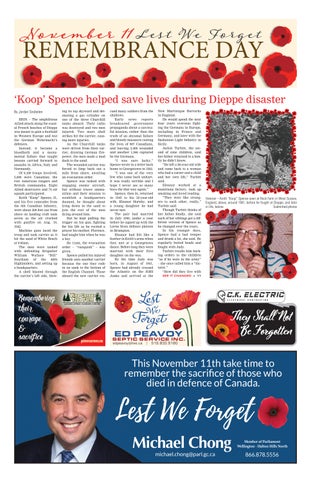
‘Koop’ Spence helped save lives during Dieppe disaster By Jordan Snobelen ERIN – The amphibious Allied attack along the coastal French beaches of Dieppe was meant to gain a foothold in Western Europe and test the German Wehrmacht’s defences. Instead, it became a bloodbath and a monumental failure that taught lessons carried forward to assaults in Africa, Italy and Normandy. Of 6,100 troops involved, 5,000 were Canadian; the rest American rangers and British commandos. Eight Allied destroyers and 74 air squads participated. Keith “Koop” Spence, 21, and his five comrades from the 6th Canadian Infantry, were about 300 feet out from shore on landing craft tank seven as the air cracked with gunfire on Aug. 19, 1942. Machine guns laced the troop and tank carrier as it hit the sand of White Beach at 6:05am. The men were tasked with defending Brigadier William Wallace “Bill” Southam of the 48th Highlanders, and setting up a headquarters. A shell blasted through the carrier’s left side, blow-
Remem!ring "e# $%age & sacrifice
ing its top skyward and detonating a gas cylinder on one of the three Churchill tanks aboard. Their radio was destroyed and two men injured. Two more shell strikes hit the carrier, causing more injuries. As the Churchill tanks were driven from their carrier, drawing German firepower, the men made a mad dash to the sand. The wounded carrier was forced to limp back out a mile from shore, awaiting an evacuation order. Spence was tasked with engaging enemy aircraft, but without tracer ammunition and their mission to establish a headquarters doomed, he thought about lying down in the sand to join the rest of the men dying around him. But he kept pulling the trigger on his gun, fighting for his life as he recited a prayer his mother, Florence, had taught him when he was a boy. By 11am, the evacuation order – “vanquish” – was given. Spence pulled his injured friends onto another carrier because the one they rode in on sank to the bottom of the English Channel. Those aboard the new carrier res-
pinecorner.ca
cued many soldiers from the shallows. Early news reports broadcasted government propaganda about a successful mission, rather than the truth of an abysmal failure and bloody massacre costing the lives of 907 Canadians, and leaving 2,460 wounded and another 1,946 captured be the Germans. “I was sure lucky,” Spence wrote in a letter back home to Georgetown in 1942. “I was one of the very few who came back unhurt. It was really terrible and I hope I never see so many boys die that way again.” Spence, then 24, returned in 1945 to his 23-year-old wife, Eleanor Hornby, and a young daughter he had never met. The pair had married in July 1940, under a year before he signed up with the Lorne Scots defence platoon in Brampton. Eleanor had felt like a feather in Keith’s arms when they met at a Georgetown dance. Before long they were married with their first daughter on the way. By the time Judy was born, in August of 1941, Spence had already crossed the Atlantic on the RMS Andes and arrived at the
edpeavoy@live.ca
|
New Martinique Barracks in England. He would spend the next four years overseas fighting the Germans in Europe, including in France and Germany, and later with the Saskatoon Light Infantry in Sicily. Jackie Turbitt, the second of nine children, said her father returned to a family he didn’t know. “He left a 20-year-old wife and came back to a woman who had a career and a child and her own life,” Turbitt said. Eleanor worked at a munitions factory, took up smoking and loved reading. “They were like strangers to each other, really,” Turbitt said. Though Turbitt thinks of her father fondly, she said each of her siblings got a different version of Spence as he changed over the years. In his younger days, Spence had a bad temper and drank a lot, she said. He regularly butted heads and fought with Judy. Turbitt recalls him barking orders to the children “as if he were in the army” – she once called him a “dictator.” “How did they live with
Veteran – Keith “Koop” Spence seen at Rock Farm in West Sussex, England, above, around 1941, before he fought at Dieppe; and later in life, below. Submitted photos
SEE IT CHANGED » 11
519.833.9180
They Shall Not Be F%go&en
This November 11th take time to remember the sacrifice of those who died in defence of Canada.
Lest We Forget Member of Parliament Wellington - Halton Hills North
michael.chong@parl.gc.ca
866.878.5556
2 | T H E W E L L I N G TON A DV E RT I SE R | N OV E M B E R 6 , 2 0 2 5
REMEMBRANCE DAY
Lest We Forget Ecclestone Financial Group 245 St. David St. N.,Fergus 519.843.5110 • efginc.ca
Lest W
e
Forget
519.843.7500
205 Breadalbane St., Fergus www.almostanythingwood.com
THEY GAVE THEIR LIVES, SO YOU COULD LIVE YOURS November 11th REMEMBER THEM
GILES
519.843.2741 540 Blair St. Fergus
HENRY RENNIE, ELORA
ROSS PRIEST, PUSLINCH
DOUGLAS WHEELER, BELWOOD
RALPH BRADY, ERIN
Remembering Wellington men killed during Second World War By Robin George WELLINGTON COUNTY – Many Wellington County residents died while fighting for the Canadian military during the Second World War. Those soldiers left loved ones behind and some have family members still residing in the county. Information about the following fallen soldiers from was complied from information on Veteran Affairs Canada’s Canadian Virtual War Memorial. William Kay Private William James Kay was the son of Adam Kay from Elora, who was a First World War veteran. Kay was born in Georgetown and moved to Elora when he was a young child. He went to school in
They have our thoughts and prayers. War is a terrible thing, but it reminds us how fortunate we are when our loved ones are at home safe and sound. We join the rest of the community in wishing our troops safe deployment and we thank those veterans who have gone before us to ensure our freedom.
519.843.3100 | 519.846.5352
Salem and Elora. He then attended and graduated from the School of Practical Science in Calgary. Before enlisting in the military Kay worked as a mechanic at the Ford Garage in Elora and Elora and Fergus Motors. He enlisted in Elora in April 1942 with the Kitchener-Waterloo Regiment. His brother Ronald Kay also served overseas. William Kay served in England, France, Belgium and Holland. He was mentioned in dispatches “due to his brave action during the battle of Nieudrop.” He was part of a group commanded by Captain Ron Goodenough that captured 70 German prisoners. Kay died of wounds in Belgium on Feb. 20, 1945. He is buried in the Groesbeek Canadian War Cemetery in the Netherlands and his name is engraved on the Elora cenotaph. Henry Rennie Pilot Officer (PO) Henry Thompson Rennie served in the Royal Canadian Air Force. He died on March 22, 1943, at age 21, after two years of service. After Rennie’s death he was awarded a United States Distinguished Flying Cross, which was presented to his mother, Clara Rennie of Elora. A citation with the award stated, “For extraordinary achievement while participating in aerial flight against the enemy while on duty with the 9th [United States Army Air Forces] in the Middle East as a radio man and gunner on a bomber.
“PO Rennie participated in 25 combat missions, each over one hour’s duration, against the enemy since August 1942,” the citation continues. “Through his initiative, ability and unswerving devotion to duty, PO Rennie reflected great credit on both himself and the RCAF.” Rennie is buried in the Fort Scott National Cemetery in Kansas, U.S. and his name is engraved on the Elora cenotaph. George Ware Gunner George Ware was born on May 8, 1917 to Albert and Alice Ware of Rockwood. Ware was raised in Rockwood and attended Eramosa S.S. #9. He had four siblings: Albert, Alice, Evelyn and Peace. He worked as a farmer and operated farm tractors and equipment before enlisting in Guelph on June 1, 1940. Prior to enlisting for overseas service, he was a militia member of the 43rd Battalion of the Royal Canadian Regiment headquartered in London, Ontario. Ware completed basic training in March 1940 and then went to Camp Sussex in New Brunswick for further training as a tank driver and mechanic. He completed this course on Feb. 17, 1941. Ware travelled to Liverpool, England on July 30, 1941. He was stationed with his regiment in England until they landed at Juno Beach, Normandy on D-Day (June 6, 1944). Ware was 28 when he died on Aug. 15, 1944. He is buried in the Bayeux War Cemetery in Calvados,
France and his name is engraved on the Rockwood cenotaph. S. Verdun Woyce Flight Sergeant Stanley Verdun Woyce grew up in Palmerston. His parents were James and Annie Woyce and his aunt was Jos. Woyce. He enlisted in February 1941. Woyce trained at Manning Pool and then graduated from Guelph Wireless School in 1942, making him a qualified wireless operator. He graduated from Jarvis in March 1942. He served in the Royal Canadian Air Force and went overseas in April 1942. He was reported missing on Jan. 8, 1943, after a Lancaster bomber he was on failed to return to its base after a raid on Ruhr Valley in Germany. Woyce was 26 years old when he went missing. He is buried in the Runnymede Memorial cemetery in Surrey, England and his name is engraved on the Palmerston cenotaph. Ralph Brady Corporal Ralph Poston Brady operated his stepfather John Maxwell’s farm in Erin before enlisting in 1940. He served in the Royal Canadian Air Force and was posted as an armorer at Trenton in 1943. Brady died suddenly at the Royal Canadian Air Force hospital on June 16, 1944. Maxwell stated in a newspaper clipping that Brady “was to have undergone a minor operation and we were informed he died under the anesthetic before the operation could be performed.” SEE LOCAL » 3
Lest We Forget REMEMBRANCE DAY
John Nater, MP PERTH—WELLINGTON
JOHN.NATER@PARL.GC.CA JOHNNATER.CA • ------ -
Lest We Forget
N OV E M B E R 6 , 2 0 2 5 | T H E W E L L I N G TON A DV E RT I SE R | 3
We Will Remember Them Joseph Racinsky, MPP
Wellington-Halton Hills 1-800-265-2366 joseph.racinsky@pc.ola.org
GEORGE WARE, ROCKWOOD
WILLIAM KAY, ELORA
EVERETT BESSEY, HILLSBURGH
ALVIN CAMPBELL, FERGUS
Thank you Veterans
Local soldiers paid ultimate sacrifice » FROM PAGE 2
Brady was born in Toronto to Charles and Ita Brady. Ita changed her last name to Maxwell after remarrying. He had four brothers: Ernest, Jack, Donald and William. Ernest and Jack were both leading aircraftmen, and William was a sergeant who was killed over Germany in 1941. Brady is buried at Toronto Westminster Memorial Park and his name is engraved on the Erin cenotaph. Priest brothers Brothers Private David Lorne Priest and Lance Corporal Ross Elmer Priest both died while serving in the Canadian military during the Second World War. Their parents were David and Annie Priest of Puslinch. Ross was married to Verna Priest of Palmerston. David died on July 8, 1944 while serving with the Highland Light Infantry of Canada. He was 19 years old. Ross died on Nov. 11, 1946 while serving with the Royal Canadian Army Service Corps. He was 27 years old. David is buried in France in the Beny-sur-Mer Canadian War Cemetery. His name is engraved on the Aberfoyle cenotaph. Ross is buried in the Puslinch Crown Cemetery (Section H, Row 5, Grave 3). Douglas Wheeler Trooper Douglas Walter Wheeler was born on May 15, 1923 in Belwood. His parents were Walter and Elizabeth Wheeler. Douglas was raised on the Wheeler’s family farm with his four brothers and six sisters: George, David, William, Arthur, Gladys, Myrtle, Maggie, Mary, Ida and Wilma.
He worked as a farmer before enlisting in Fergus on Nov. 5, 1942 at 19 years old, under the National Resources Mobilization Act. Wheeler died two years later, at age 21, on Aug. 9, 1944. He is buried in the Beny-sur-Mer Canadian War Cemetery and his name is engraved on the Rockwood cenotaph. Wilfred Wolf Pilot Officer Wilfred Lawrence Wolf was from Palmerston. His parents were Jacob and Margaret Wolf. Jacob died in 1926, when Wilfred was about four years old. Wilfred was the youngest of six children. His siblings were John, Robert, Stewart, Mary and Fanny Wolf. Fanny died in 1918, before Wilfred was born. Wolf was flying on the Lancaster bomber of 432 Squadron, Royal Canadian Air Force, based at East Moor in Yorkshire, England when it crashed near Aldborough on Feb. 2, 1944. According to a plaque in Aldborough honouring Wolf and the six other people on the plane, “Their aircraft, on a cross-country training flight, had caught fire and was losing height when the pilot, with great skill, managed to avoid the village and instead came down on Studforth Hill, a short distance to the south.” Wolf was 20 years old when he died. The others were all between 20 and 24 years old. He is buried in the Harrogate Stonefall Cemetery in Yorkshire, England and his name is engraved on the Palmerston cenotaph. Robert Caldwell Little Flight Sergeant Robert Caldwell Little was a wireless air gunner in the Royal
Pause to remember all those who have given up so much for the freedoms we have today.
Canadian Air Force who went to elementary and high school in Arthur. He was born on a farm near Caledon and had five brothers and two sisters. Before joining the military Little worked for the Royal Bank in Arthur, St. Thomas, Chatham and Strathroy.
Little trained for the Air Force at Jarvis and his wireless badge in Quebec. He joined the Royal Canadian Air Force in 1941 and went overseas in May of 1942. “In recent letters home, he told of visiting interesting places in many parts of the British Isles,” stated an article in the Toronto Telegram. According to an article in the Toronto Star, Little’s mother believed the flight on which he died was his first operational flight, “as his last letter stated that he had just arrived in the Mediterranean and until then had not been on operational duty.” Little is buried in the Malta Memorial cemetery in Malta and his name is engraved on the Arthur cenotaph. Everett Bessey Private Everett Bessey was the son of Wesley and Isabel Bessey of Hillsburgh. He was born on Dec. 12, 1923 in Guelph and enlisted on April 15, 1941 at age 17. Bessey died at age 21 on April 20, 1945 while serv-
ing in the Essex Scottish Regiment of the Royal Canadian Infantry Corps. Everett’s name is engraved on the Erin cenotaph and he is buried in the Netherlands at the Groesbeek Canadian War Cemetery. Alvin Campbell Sapper Cyril Alvin Campbell served in the 10th Canadian Field Party Company of the Royal Canadian Engineers. He was born on April 26, 1921 and his parents were William John and Henrietta Campbell of Fergus. He enlisted on Sept. 29, 1942 in Barrie at age 21. Campbell was killed in France on Aug. 8, 1944 when he was 23. He is buried in the Bretteville-sur-Laize Canadian War Cemetery in Cintheaux, France and his name is engraved on the Fergus cenotaph.
thegorge.ca | 519-846-2636
“Though they sink through the sea they shall rise again; though lovers be lost love shall not, and death shall have no dominion” - Dylan Thomas
0342 Gerrie Road, Elora | 519.846.5315 105 Silvercreek Pkwy N Unit 106, Guelph | 519.822.7670
Lest We Forget Remembering those who served
Specializing in the Personalization of Cemetery Monuments & Markers Call us for an appointment to speak with a Memorial Counsellor
www.superiormemorials.com
100 CHARLES ST. ARTHUR
519•964•0492
www.lifetimelumberproducts.com
FARNWORTH SUPERIOR MEMORIALS Guelph 519.763.4567
STRATFORD MEMORIALS Listowel 519.291.5353
4 | T H E W E L L I N G TON A DV E RT I SE R | N OV E M B E R 6 , 2 0 2 5
For those brave who gave their lives so we could live ours
We Will Remember
Thank You to our Veterans
Marco, Luisa, Paula, Sebastian
Lest We Forget 727 Woolwich Street Guelph | 519-824-6920 info@luisasdraperies.com | www.luisasdraperies.com
REMEMBRANCE DAY
Veteran Dave Goetz shares experience as UN Peacekeeper in Croatia By Georgia York CENTRE WELLINGTON – The Croatian War of Independence was a fouryear conflict that may slip the mind of the average person. But many Canadian, including Fergus veteran Dave Goetz, do not have the luxury of forgetting. This is the story of a United Nations (UN) Peacekeeper who, for six months, put his life on the line in Croatia. “I started off in the army reserves in Windsor, Ontario with a unit called Essex and Kent Scottish,” Goetz told the Advertiser. He joined in his early 20s after being an army cadet in his youth. “It’s something that’s been a part of me and my family for a long time,” Goetz said. “The call to service was just always there.” After serving in the army for almost four years, he earned the title of master corporal in the Canadian Armed Forces. Asked why he wanted to be a peacekeeper, Goetz said, “It was getting to a point where I wasn’t sure what my career in the military would be.” His opportunity arose when the Royal Canadian Regiment (RCR), out of Petawawa, was tasked with the next peacekeeping rotation in Croatia, formerly part of Yugoslavia. Around 1,800 Ontarian reservists were called up by
the RCR. “They only took 300 or 400 of us to fill their ranks so that all the jobs were full,” DAVE he added. GOETZ T h e s e l e c t i o n process narrowed down the possible peacekeepers and “I got selected along with 11 other guys from Windsor in 1994,” Goetz said. In October 1994 the 12 soldiers were sent overseas.
“
Seeing little kids playing in the street with nothing ... it’s just a lot of hardships that way - DAVE GOETZ
“I was in the administrative company and what helped my position was I had an electronics background from college,” he said. During his six-month rotation Goetz maintained TVs, radios, VCRs, performed his guard duty, rebuilt schools and “the biggest job I had was I drove for the padre; the Roman Catholic priest,” he said. If the padre had to perform a welfare check or conduct a service, it was Goetz’s job to provide him security. The job of a peacekeeper may seem tame and peaceful to the uneducated, but for 30 years Goetz has been carry-
We Will Remember Them
sits at the Canadian War Museum in Ottawa depicting the evidence of an attack on Canadian peacekeepers in Croatia on New Year’s Eve in 1994. The incident occurred during Goetz’s rotation. “The passenger was hit six times and the driver four. They both lived,” he said. According to Goetz, wounded twice himself, Private Philip Badani is credited with saving the life of Master Corporal John Tescione who was shot in the head and arms. The ambush was a result of a confrontation that occurred days earlier “when one of our officers confronted one of the combatant officers and it was a bit of a back and fourth,” Goetz said. “I’ll remember you,” were the three words the combatant officer said before leaving the argument. “It turns out the Jeep that was shot is the same Jeep ... that officer normally would have been in,” said Goetz. He returned home in April 1995 and was released from the army in 2011. He then moved to Fergus with his wife and daughter. “I’m glad I went. I think I represented myself, my unit and Canada very well on the global stage,” he said. Goetz hopes more people will understand the sacrifice thousands of people made during this period of time. “Everybody talks about World War I, World War II, they mention Korea and then they skip to Afghanistan,” he said. “From 1956 when Korea ended until Afghanistan ... there was a lot of peacekeeping going on.”
ing the trauma of his time in Croatia. “I’ve recently been diagnosed with post-traumatic stress disorder ... and what prompted me to finally get help was my wife and kids asking me why I was always so angry,” he said. “Normally peacekeeping is when two parties have decided the only way they’re going to settle their difference is to sit back, exhale and the UN would go in and keep the two sides apart,” Goetz explained. Peace was not established upon Goetz’s arrival
”
– “There was actual, active combat,” he said. He noted seeing dirt “splashes” from enemy bullets around the base and having to prepare for incoming raids. “There’s that threat all the time ... and it’s just the constant imageries of the hate that was happening there,” Goetz said. Schools were shot up with hints of executions, churches were destroyed and cemeteries were defiled. “Seeing little kids playing in the street with nothing ... it’s just a lot of hardships that way,” he added. “You see that every day for six months and you really get numb to it.” Although no one from his unit died, many were injured. A white jeep with approximately 104 bullet holes
Lest we forget.
Remembering our veterans
On Remembrance Da y, we honour the memb ers of our armed forces who served and ma de the ultimate sacrifice. Their courage and dedication will always be remembered.
Owners Jon & Emily Macklin, Darlene McClellan, Lynn McClellan- Royal Canadian Legion, Ontario Provincial Command President
259 Woodlawn Rd. W., Guelph | www.originalhomefurniture.com | 519-822-1251
600 Whites Rd. Palmerston
www.royalterrace.ca
519.343.2611
We Will Always Remember
t e g r o F LEST WE
NOV. 11 // Remembrance Day Elora
Home
hardware
6458 Wellington Road 7, Elora
FALLIS, MCMILLAN & FERRIER Barristers & Solicitors E R N E S T J. M C M I L L A N * B.A., LL.B.
519.510.3571
150 MAIN ST. S. MOUNT FOREST 519-323-2800 233 MAIN ST. PALMERSTON 519-343-3527
Lest We Forget
N OV E M B E R 6 , 2 0 2 5 | T H E W E L L I N G TON A DV E RT I SE R | 5
Remembering Canada’s Black soldiers By Ellouise Thompson WELLINGTON COUNTY – Beneath tattered flags and echoes of gunfire, among the wounded and the dead, Black Canadian soldiers marched the battlefield with unwavering courage. And when the cannons fell silent they returned home, not to parades or fanfare, but to an eerie silence that many people say has since stolen their recognition. “There’s a hidden military history that is largely overlooked,” Centre Wellington Black Committee founder and chair Millicent Gordon told the Advertiser. She studied history and noted none of her professors mentioned Black military service in Canada. Exact numbers are not known, but about 1,300 to 1,500 Black Canadians served during the First World War and several thousand more served in the Second World War. But from textbooks to media coverage, the stories and sacrifices of Black soldiers in Canada are often left unheard and unrecognized. “The Canadian military is completely integrated now and everyone can enlist and get promotions to different posts,” said Gordon. But it wasn’t until the 1950s, the Canadian military was largely segregated. During the First World War, the military did not actively seek to recruit Black soldiers and the Black soldiers that applied were either turned away or assigned to a segregated unit. Canada’s main segregated First World War unit was the No. 2 Construction
JAMES GRANT
JEREMIAH JONES
Battalion, also known as the “Black Battalion,” the country’s only all-Black military unit. This unit was tasked with the construction of roads and railways as the Canadian military refused to send them into combat. The Canadian government issued a formal apology for segregating the No. 2 Construction Battalion in 2022, Gordon noted. During the Second World War, Black Canadians were initially turned away, but after protests they were allowed to serve and see combat. There were no segregated units during WWII but Black soldiers still faced extreme racism and prejudice. Black soldiers also helped in the construction of roads and railways in the Second World War. Gordon said the erasure of Black soldiers from history can most likely be accredited to systematic racism. Canadian history books educate Canadians on names such as Sam Hughes, John McCrae and Billy Bishop but rarely include names such as Jeremiah Jones, James Grant and Lancelot Bertrand. Jeremiah Jones Jeremiah Alvin Jones was a Black Canadian soldier who served in the First World War. Jones was recommended for a Distinguished Conduct Medal but there is no record of him having received it. Jones was born in Nova
LANCELOT BERTRAND
Scotia and died at 92 years old in 1950. He enlisted when he was 58. James Grant Grant was born in 1897 in St. Catharines, Ontario. He enlisted in 1916 and arrived in France in March 1917. First a gunner, Grant later became a driver and most experts believe he served at Vimy with the Canadian Field Artillery’s 23rd Howitzer Battery. Grant received the Military Medal for bravery at the Battle of Passchendaele in 1917. He was the first Black man to receive the award. Lancelot Bertrand Born Nov. 18, 1892 in St. Georges, Grenada, Bertrand served in the Canadian Infantry, British Columbia Regiment. Bertrand has been credited as the first Black officer in the Canadian Expeditionary Force. Bertrand went to France with the 7th Battalion, where he was badly wounded in the right shoulder in 1915. After recovering he was promoted to a lieutenant and returned to France in 1916 to rejoin the 7th Battalion. His first major battle was the Battle of Vimy Ridge. Bertrand was awarded the Military Cross for his extraordinary courage leading his soldiers into battle after all other officers had
been killed or injured. Henry Braithwaite Diana Braithwaite is a descendant of Wellington County’s first Black settlers and her father, Henry, served in the Second World War. “In 1942 the war beckoned my father and many of his generation,” she told the Advertiser. “My dad clearly remembered the terrifying drone of V2 bombs zooming overhead while serving across England, France, Belgium and Holland,” she added. “Dad also recalled the confrontations and challenges he experienced during his service as a soldier fighting in the war, when he and other Black soldiers that had enlisted, repeatedly encountered discrimination.” She added the men “found themselves the recipient of racial slurs on various occasions, from within their own regiment, during their time in the Canadian Army.” Diana said this was “a painful reality shared by many African-Canadian veterans who had enlisted to fight for freedom abroad.” Gordon says it is important to remember the sacrifices of Black soldiers. “These were the people that broke down these barriers, these racial barriers,” said Gordon. “From the War of 1812 to World War II, they fought for a country that didn’t always fight for them. “On Remembrance Day, we remember not just their sacrifice, but their insistence on dignity, belonging, and justice.”
LEST WE FORGET
Marymount Cemetery St. Mary Immaculate & St. Joseph Cemetery Office: 5400 Highway 6 North, Guelph 519-836-8814 | www.thecatholiccemeteries.ca
K YO N A U H T VETERANS
Lest We Forget
ELORA 289-259-0116
Remember
their service and sacrifice
RC
LIMITED
REEVES
519.323.1241
CONSTRUCTION LIMITED MOUNT FOREST
NOV. 11
155 Geddes St., Elora · gregoakes@execulink.com Tel: 519-846-5555 · www.eloralaw.ca
“Building our future for over 80 years” Never Forget Always Remember 11-11-2025 Keith Lang Water Well Drilling Inc.
LEST WE FORGET
HONOURING OUR
VETERANS PAST & PRESENT
6 | T H E W E L L I N G TON A DV E RT I SE R | N OV E M B E R 6 , 2 0 2 5
Honouring those who served.
Wear a poppy
519.848.2107
arthur
Lest We Forget Please pause for a moment of silence on November 11th to honour those who have served.
Morris-Shannon Law Office Barrister / Solicitor / Notary Public
SARAH E. SHANNON B.A., LL.B. Barrister, Solicitor & Notary
149 Geddes Street, Elora
O: 519.846.5366 | F: 519.846.8170 | E: sarah@morris-shannon.ca
REMEMBRANCE DAY
Weapons change over time but soldiers still need courage By Joanne Shuttleworth FERGUS – While the locations, cultures and weapons of war have changed since the First World War, the courage of soldiers has remained the same, said Bob Stubbings, historian for the Fergus Legion Branch 275. Stubbings was up against it on Oct. 29 as his talk at the Legion was during Game 5 of the World Series and only a handful of people came out. Still, during his hourlong talk entitled “A Century of Courage: 1914 to 2014,” Stubbings brought his listeners to the trenches of the First and Second World Wars, the terrifying night patrols of the Korean War and the completely new improvised explosive devices (IEDs) used by the Taliban in Afghanistan. And up until fairly recently, the stories we heard about these wars were from a military perspective, Stubbings said – the strategies, the famous battles, the generals and the numbers of soldiers who died. “But now we trace the personal history of soldiers and the character qualities
Thank you for your service for your courage for your sacrifice...
for our freedom RELIABLE FORD 990 Tower St S, Fergus 519.843.3060
of these individuals,” he said. Stubbings offered a bird’s-eye view of the wars and looked at the changes on the battlefield and advancement of weaponry over those 100 years, from the First World War in 2014 to Canada pulling out of Afghanistan in 2014. His research also brought him to letters written by soldiers, which shed more light on the notions of courage, valour and honour. Snippets of letters written by soldiers were peppered throughout his talk. Canadian soldiers who signed up for the First World War did it out of a sense of duty and obligation to Britain and a sense of honour for Canada, the fledgling new nation. Soldiers were trained to advance on the ground with bayonets, to carry out orders and to act with discipline and honour. They were fighting for a just cause and it was believed that fire power, not will power, would bring victory. But the war turned out to be brutal. Soldiers lay in trenches within earshot of their enemy in abysmal conditions. After Vimy Ridge, “they had not the same enthusiasm,” Stubbings read from a soldier’s letters. And after Passchendaele, “It was only discipline orders that took them there,” Stubbings said. But within each regiment, there was a camaraderie and a sense of duty and responsibility for each other that took hold. The band of brothers became the motivator and reason to keep going. While at home the war was portrayed as romantic – the war to end all wars – returning soldiers were disillusioned, disenchanted and many carried to their graves the horrors of what they saw and what they did. When Adolf Hitler started to gain power in Germany, Europe didn’t want to see
LEST WE FORGET On November 11 please remember our fallen
MATTHEW RAE MPP – Perth-Wellington
519-272-0660 • matthewrae.ca matthew.rae@pc.ola.org
Thank you Veterans. Lest We Forget Brad & Alyssa | Paul & Judy | The Culp Family
519-323-7443 | 519-323-6830 8186 Line 8, Kenilworth, Ontario
BOB STUBBINGS what was happening. “In Canada there was little enthusiasm for this fight,” Stubbings added. But when Britain was in, Canada followed and many First World War vets signed up again for the Second World War. Younger men and women did too, some to escape the lives they were living here, some for adventure, “but most came because of honour and pride,” Stubbing said. The First World War was largely fought on the ground. By the Second World War, there were new weapons, submarines and planes. “If you ruled the skies, you ruled the battle below,” Stubbings said. But for the foot soldier, “it was as tedious and treacherous as ever.” The Italian campaign is overshadowed by the Normandy campaign and D-Day, but in Italy, the Battle of Ortona was a “slug fest” for soldiers on the ground. This house-to-house fighting was new, and soldiers didn’t have the training for it. But they persevered, eventually winning the town. The liberation of Holland proved to be a similar, “piecemeal, waterslogging barrage of shells,” Stubbings said. Canadian forces proved to be tenacious but paid a big price in lives lost. Some 66,000 soldiers died in the First World War; 45,000 in the Second. Sandwiched between the Second World War and the Cold War is the Korean War, from 1950 to 1953, often called “the forgotten war,” Stubbings said. It was called a “police action” and not a war and was a battle between communism and capitalism. Canada had downsized its army by then but formed the Canadian Army Special Force – naval and air forces only – and sent them to Korea. “It should have been an easy fight,” Stubbings said as Canada had a strong air force. But the Chinese made night attacks on the ground, and so began the deadly hideand-seek night patrols. The deadly Battle of Kapyong is perhaps the best known. “Like the First World War, soldiers dug deep trenches and at night would search for the enemy,” said Stubbings, who noted the constant fear and danger became a burden for soldiers. The war didn’t garner much attention in Canada and the soldiers, isolated in a strange land, formed strong bonds with each other.
Once home, they wondered if they and their service would ever be remembered by Canadians. More than 500 soldiers were killed in Korea. Canada was involved in the Afghanistan war from 2001 to 2014 and deployed 40,000 troops. This was also framed as a just war – a fight against terrorism. But once there, many soldiers became disillusioned and felt betrayed by the government. This was warfare like never before, with the enemy mingling with local residents soldiers were sent to protect. And the Jihad, or Holy war, had soldiers for the Taliban fighting without concern for their own survival. “You could not tell the enemy from the general population,” Stubbings said. “There was no clear front or rear zone. Canadian soldiers were subject to attack, IEDs, and suicide bombings. After 13 deadly years, Canadian troops were withdrawn from Afghanistan. The government was embarrassed, and the war didn’t impact Canadians at home. “They (soldiers) did what was asked of them but there was no celebration at home. The soldiers cared but the nation didn’t. They weren’t respected or honoured,” said Stubbings. He noted 158 Canadian soldiers died in Afghanistan, but 1,800 were wounded and a great number died by suicide or became homeless after returning home. The words “bravery,” “valour” and “courage” will be spoken on Remembrance Day and are often used interchangeably. But Stubbings sees them as different. Bravery, he said, is a spontaneous, instinctive reaction to a life-or-death situation and valour is great bravery. That is, doing remarkable acts in the face of danger. But courage is acting for a cause or value despite your fears. It’s making a conscious choice to fight when death or defeat are imminent. During the First and Second World Wars, ordinary people stepped up to fight. Korea and Afghanistan sent career soldiers to battle. They all displayed courage though, fighting for a cause, fighting for their country and fighting for their comrades in arms. No matter how mighty the weapons or how clever the strategy, soldiers still need courage, Stubbing said. So on Remembrance Day, it’s important to acknowledge and appreciate the courage of these soldiers – men and women who overcame their fears and found the inner strength to carry on. Taking pride in our armed forces and respecting the courage it takes to do their job helps restore a soldier’s own courage and commitment to the job – even if we don’t support the cause or the war ourselves. “The sources of fear have changed but the sources of courage are loyalty in battle,” Stubbings said.
Lest We Forget
N OV E M B E R 6 , 2 0 2 5 | T H E W E L L I N G TON A DV E RT I SE R | 7
Elora recognized WWII vets in 1946
Revisited
THORNING by Stephen Thorning 1949-2015 The following is a reprint of a past column by former Advertiser columnist Stephen Thorning, who passed away on Feb. 23, 2015. Some text has been updated to reflect changes since the original publication and any images used may not be the same as those that accompanied the original publication. As the Second World War came to an end, no one wanted to see a repetition of what had occurred in the aftermath of the previous war. In 1918 the troops had returned to see others occupying their peace time jobs, the country suffering from the combined woes of price inflation and economic turndown, and virtually nothing in the way of support or assistance for discharged soldiers. Higher levels of government spent much time in 1945 and 1946 to ensure that the economy shifted as smoothly as possible from a war to a peace time basis. At the local level, municipal councils and various service clubs did all they could to welcome the men and women home, and to help them to become integrated quickly into the community. A major factor that had not existed after the First World War was the Royal Canadian Legion. Branches braced themselves for a deluge of new members a generation younger than the existing membership. Elora’s actions were typical of small communities in this respect. Early in 1946 council appointed a Civic Reception Committee, consisting of Jim Cameron, V. E. Waters and J.K. MacDonald. The latter two were members of Elora council, and MacDonald had been an officer in WWI. To provide working funds to the new committee council transferred a surplus of $1,566 in its Victory Loan Fund. Council later topped off the fund with a further $1,000 grant. The Civic Reception Committee performed some informal tasks to help returning veterans, but its main task was arranging public ceremonies. Most of those were planned for November 1946, to coincide with Remembrance Day. The committee cooperated with other groups in town, and particularly Branch 229 of the Legion. The Legion in Elora had established a supporting relationship with the Boy Scout and Girl Guide movement in the 1930s, and that association would last for decades. On Nov. 9 of 1946, Elora’s Scouts spent the day selling poppies on the main street and door-to-door. In the evening Legion members treated the boys to a film show at the Armory Hall (now Elora’s liquor store), followed by a supper of hot dogs.
Remembrance Day fell on a Monday in 1946. A rain fell steadily through the morning. Legion members from both wars paraded from the Legion’s rooms to the cenotaph for a brief ceremony. Chaplain Rev. C.J. Loat, assisted by Rev. T.J. Rees, conducted a brief service that included the laying of seven wreaths. Lois Ruller played The Last Post. Public interest in the Nov. 11 service was almost nil in Elora, as was the case in most places in the late 1940s. Bank branches and government offices closed, but otherwise it was business as usual. Perhaps a dozen people stopped to observe the Elora ceremony. During the following two weeks, various organizations held events for veterans and their wives. The Women’s Association of Elora United Church put on an entertainment for servicemen’s wives, some of whom were war brides and totally unfamiliar with small town Ontario life. Mrs. C.A. Burt acted as chairman for the evening of music and games, assisted by Eva Gofton, Dorothy Hosking and Mrs. E.K. Wilson. All the guests received gifts of cups and saucers. Elora’s Women’s Institute also took a special interest in the war brides, with speakers and demonstrations to help them get established in running their households, and to make them feel welcome in the community. On the Sunday after Remembrance Day, Nov. 17, there were special church services for veterans at 3:30 in the afternoon, dedicated to honour the memories of those who had died in the recent hostilities. Led by the Fergus Pipe Band, the veterans marched in formation from the Legion rooms to St. Mary’s Church. Catholics fell out of the march there, which continued on to Knox Presbyterian Church for a simultaneous service for Protestants. Rev. H.G. Lowry officiated at Knox. He had been a squadron leader during the war. Rev. C.J. Loat of St. John’s Anglican delivered the memorial address, followed by the playing of The Last Post. The highlight of the service was the presentation of inscribed silver rose bowls to the mothers of deceased veterans, on behalf of the Civic Reception Committee. Rev. Theo Rees of Elora’s United Church followed with a message of Rededication. The voices of the choirs of all three churches joined to make the musical selections particularly memorable. They were joined on two selections by William La Penotiere, scion of an old Elora family. At the same time as the Knox proceedings, Father Shea conducted a Holy Hour service at St. Mary’s Church.
Veterans occupied the front rows. His address praised the sacrifices of those who had served overseas. Rose bowls were presented as part of the program. The Civic Reception Committee had identified 10 deceased soldiers as Elora natives. There was some discussion within the committee concerning who should or should be included as an Elora native, but there was nothing like the animosity that had been generated in producing a similar list 20 years earlier for WWI. Both churches turned over the collections at the services, about $40 at each church, to the Legion. The Civic Reception Committee intended the Sunday services to be in memory of those who had died during the war. For surviving veterans the committee scheduled its big event, a banquet and dance, for Nov. 20, a Wednesday. Work on the event had been under way for several months. It was not a public event; rather, it was for veterans, their partners, nextof-kin of deceased soldiers, and invited guests only. Elora’s Boys and Girls Band led a parade from the Legion to the Armory Hall, which was suitably decorated for the occasion. They were warmly welcomed by Reeve Harry Walser. The Amoury Hall was the obvious choice for the dinner and ceremony. It had been the scene of other ceremonies for returning soldiers three times in the 80 years since it had been built. The structure was brand new the first time in 1866, when the village honoured the Elora Rifles on their return from the Fenian campaign. And there had been ceremonies in the building for veterans of the South African War and WWI. The crowd of about 135 sat down to an ample turkey dinner, prepared by the Legion’s Ladies Auxiliary, and organized by Janet Boyd and Luella Figg. The Boys and Girls Band provid-
ed musical selections during the meal. Afterward they enjoyed a variety show, led by impersonator Len Burt of London, with three other performers. All had been active in entertaining soldiers overseas. Several veterans had seen them in Europe. Following The Last Post and a few moments of silence, Squadron Leader Rev. H.G. Lowry delivered the main address, aimed specifically at the veterans. He skillfully used humour in his talk about what the men would remember and what they would forget about their war experiences. The Civic Reception Committee gave each of the veterans a specially commissioned ring. Reeve Walser made the presentations on behalf of the people of Elora. There were 104 names on the list, and subsequently the committee added three more. Only two were women: Agnes Cowe and Margaret Cameron. The rings came from a Toronto jeweller who prepared a special die for striking the crest on the rings. Speaking for his fellow veterans, SEE NOV. 11 » 10
11-11-25
We remember and thank those who have served
Please observe a moment of silence on November 11th to honour those who have served. SERVING YOU SINCE
1965 FARM | INDUSTRIAL | RECREATIONAL | HOME
www.deboersequipment.com
We Will Not Forget Those Who Fought For Us
LEST WE FORGET REMEMBRANCE DAY
t e g r o f r e v e n l l i w We edom. e fr r u o r fo t h g u fo o all those wh
J-K
Industrial & Commercial Painting
Jeff Kunkel (519) 343-3737 jeff@jkindustrialpainting.com
8 | T H E W E L L I N G TON A DV E RT I SE R | N OV E M B E R 6 , 2 0 2 5
Thank You Veterans
226-384-1100 www.eloraphysiotherapy.com
Lest We Forget Senator Rob Black www.robblack.ca
Robert.Black@sen.parl.gc.ca
Thank You to our veterans for their sacrifice. This November 11th remember the fallen. We are grateful for our freedom.
www.erin.ca | 519.855.4407 customerservice@erin.ca
REMEMBRANCE DAY
OPINION: We must value living free By Dave Adsett OSWIECIM, POLAND – At around 5am three parties exited the shuttle van after a long drive from Krakow. Our host left us to relax as he began the long wait in line for tickets to the Auschwitz-Birkenau memorial museum. It was a very cool morning. Native birds had started their day, busily gathering up some breakfast and frolicking about. Their chirps and caws broke the silence much like home when the sun starts to rise and nighttime ends. Approaching 8am, the line up was way down the street and circling the corner. Our guide and a handful of others who also came very early shepherded their charges into the yard of the facility. Surprised by the crowds, we were told Constitution Day in Poland is officially May 3, but the country honours it over the course of a weekend. During that time, the Poles celebrate their independence, commitment to reform and the power of democracy. Remembering the past is part of that. Our driver made a point, numerous times, that the early departure, wait-times and so on were no doubt inconvenient, but after spending hours learning more about what happened there, he often found guests had a different sense of perspective on the ride home. In the end he was right. After AuschwitzBirkenau had been liber-
Right or left – An SS officer in 1944 motions with his thumb (evident in the shadow behind him) whether newly arrived Hungarian Jews will be sent to work in the camp or meet their premature demise. The Auschwitz II /Birkenau camp was toured recently by a Canadian delegation attending the News Congress in nearby Krakow, Poland. Photo by Drew Mochrie ated, survivors, fellow Jews of various sects and the community had different views on its future. An option to raze it to the ground, or at least portions that were already partially destroyed by retreating Germans was considered. Historians estimate over 1.1 million people were killed at these two sites, with some victims buried in mass graves and the ashes of corpses processed through the crematorium spread across the countryside. Respect for those lost souls and the need to remember that history resulted in the museum’s ultimate format. It provides a place to mourn, to reflect and for some an opportunity to dedicate effort into educating a public that cannot fathom such monstrous activities. Auschwitz itself is surrounded by a village, akin
to larger centres here that over time have enveloped a cemetery or natural landscape. This location, fenced in to control the prison population, featured brick row housing with each building having a purpose. The interpreter who toured people through the facility explained the history and provided context to the exhibits and displays. The most striking commentary, in our view, was the depths of the apparatus for locals. He assigned blame to not just the Nazi element, but also academics, engineers, logistics firms, the businesses community and so on. The scale of the operation required many hands to complete. The only exhibit that didn’t allow any photographs was a sizeable mound of human hair. By a rough guess it would have been
25 feet long and 5 feet deep. This represents a fraction of the volume, shorn from prisoners and then repurposed in mattresses, pillows and textiles. This atrocity symbolizes the obvious disregard captors had for their victims. Other exhibits featured thousands of shoes and luggage sets (some with handpainted names on the exterior) as further examples of the contemptuous plundering inflicted on the population involved. Although the tour moved at a steady pace, there was a moment to reflect on how humans could enact such injustices against other humans. We will never know, for example, what bright mind or talent the world has missed due to this extermination plot. What a waste of humanity. SEE MUSEUM » 10
“ They shall not grow old, as we that are left grow old: of forever happiness is freedom. “We are grateful. ” Age shall not weary them, “The secret In appreciation of our brave nor the years condemn. Veterans who served our country. At the going down of the sun From the Board of Directors, and in the morning Staff & our Agency Volunteers. We will remember them. - Laurence Binyon
“
Cres., Fergus Pryde 535 Glengarry 519.843.3500 TRUCK SERVICE LTD
HELP LOCALLY – GIVE LOCALLY
We Remember Them with Our Thoughts, Gratitude and Respect REMEMBRANCE DAY November 11, 2025
Brokerage
Independently Owned & Operated
519.323.3022
519.323.1140
Lest We Forget
N OV E M B E R 6 , 2 0 2 5 | T H E W E L L I N G TON A DV E RT I SE R | 9
Fergus Legion invites veterans Triton LestEngineering We – WA Remem Engineering –– WA RemembranceDay Da to join Buddy Check program Triton Triton TritonEngineering Engineering –WA WARemembrance Remembrance Day
Forget
Triton Engineering Remembrance Business Card– WA Size -- ColourDay -- In$
By Georgia York
FERGUS – Three Fergus Legion members have taken up the task of supporting veterans by hosting a social gathering called the Buddy Check program. It was initially discussed at a Royal Canadian Legion convention and has seen success in other clubs. “The idea is that it’s hosted by veterans for veterans,” said Bob Fisher, veterans service officer at the Fergus Legion. The idea is to create an atmosphere that allows veterans to socialize with fellow members and to learn about available benefits. The program began in April but was paused until September due to a lack of interest. “We’ve opened it up because initially the program was for the benefit of veterans but [officials] have also recognized that first responders in our community need help as well,” Fisher explained. The gatherings are hosted by veterans Rob Fleming and Jack Griffiths. Fleming has served in the armed forces for 37 years and is still active as he works with cadets. He joined in 1987 at age 20 and served 20 years in the regular force, five years in primary reserve and five in the supplementary reserve “and that’s basically where they can call you up again,” Fleming said. “I was originally infantry but it was only for three years and then the rest of my career I was fixing airplanes (aviation technician).” Fleming worked on the Hercules aircraft used for troop transport, tactical air-
Business 145.54++HST HS BusinessCard CardSize Size --- Colour Colour ----$$145.54
Business Card Size -- Colour $ 145.54 + HS Business Card Size -- Colour -- $-- 145.54 + HST 519-787-4344 info@hollowfordfencing.ca
etgtteot rget LLLeL seeLtssetetW FFFeoooFrrerggogeerF tteW eeW ssWW Our Freedom Our Freedom Our Freedom Our Freedom ...their Sacrifice Our Freedom ...their Sacrifice ...their Sacrifice ...their Sacrifice
...their Sacrifice
Veterans – From left: Jack Griffiths, Bob Fisher and Rob Fleming at the Fergus Legion on Oct. 29. Photo by Georgia York lift, search and rescue, and aircrew training. Griffiths’ military journey began in 1959, when he joined the regular force, and ended in 1971. “I was in the armoured corps [and] spent time in Egypt and Germany,” he said. Griffiths served three years in Germany and a year “in the Gaza strip” as a peacekeeper, he said. “I enjoyed the 12 years but it was time to get out when I got married and then I went back to school,” Griffiths added. Both veterans shared similar reasons for being passionate about the new Buddy Check program. “I read the email about the opportunity to join the group and I thought it would be a good thing ... to help those if they needed it,” Griffiths said, noting that during his time serving, support was hard to come by. “[There] was no other support other than a padre for the soldiers,” he said,
referring to ordained officials soldiers could speak to for guidance and direction. Griffiths recalled the time when two soldiers from his regiment drove over a mine and died. Along with other soldiers, he had to check for other mines while his friends laid dead and “you went on the next day like hardly anything happened,” he said. “You bit the bullet and moved on.” Fleming’s passion stems from not only his time serving but his life experiences. “I had friends commit suicide ... lots of them struggled after they got out,” he said. “People who had either a strong religion, philosophy or even just a strong family life; we all seemed to come through things all right. “The guys that came in that didn’t have any of that, they were the sufferers,” Fleming said. “They were the ones that had a much harder time dealing with whatever they came
Lest We Forget
Never Forget – Always Remember We pause at the eleventh hour, on the eleventh day, of the eleventh month to reflect on the memory of our brave servicemen and women. Observe a moment of silence on November 11 to mark the sacrifice of the many who have fallen in the service of our country, and to acknowledge the courage of those who still serve.
up against and turned to a bottle.” As veterans tend to endure heavy and emotional experiences, Fleming and Griffiths had to complete training in order to host the Buddy Check program. The pair learned about awareness, signs that someone is struggling and where to refer veterans. “An awful lot of it is people become withdrawn and they turn themselves off,” Fleming said. He explained the program is meant to work in small groups so people don’t feel intimidated. “A lot of people already have a preconceived notion of what a Legion is and they think it’s a bunch of old, beer-drinking, cigarettesmoking vets ... well it’s not. It’s a community gathering,” Fleming said. “The most important thing is just letting [veterans] know we are here.” The next meeting is slated for Nov. 22 from 9:30 to 10:30am at the Fergus Legion.
Established 1964 Established 1964 Established 1964 Established 1964 ORANGEVILLE • FERGUS • HARRISTON ORANGEVILLE • FERGUS • HARRISTON ORANGEVILLE • FERGUS • HARRISTON
ORANGEVILLE • FERGUS • HARRISTON
Established 1964 ORANGEVILLE • FERGUS • HARRISTON
TO ALL OUR VETER ANS
u o Y k n a h T
DIXON
We say a heartfelt thank you as we “remember”.
We remember those who sacrificed so we could live in freedom.
Lest We Forget
1 0 | T H E W E L L I N G TON A DV E RT I SE R | N OV E M B E R 6 , 2 0 2 5
REMEMBRANCE DAY
Nov. 11 dinner in Elora began in late 1930s » FROM PAGE 7
We are blessed to live in Canada. Thanks to our current and fallen veterans. Jeff Duncan, County of Wellington Town of Erin (Ward 9)
Lest We Forget
GOD BLESS
OUR VETERANS Celebrating Gerry Kowalsky Our WWII Vet 995 Woodlawn Rd, W. Guelph
519-836-0640 olympichonda.ca
"And they who for their country die shall fill an honored grave, for glory lights the soldier's tomb, and beauty weeps the brave." —Joseph Drake
Lest We Forget
Corporal Doug Brown briefly expressed appreciation for the gifts, the entertainment and the welcome. He concluded by saying the soldiers were “once more at peace in their home town.” Elora people always have had an intense dislike of long-winded speeches. A.A. Badley (representing Victory Bond salesmen), J.K. MacDonald (for the Legion), Jim Cameron (for the Civic Reception Committee) and Bandmaster Robinson all addressed the assembly, but their comments were over in a few minutes. By then everyone wanted to get up and stretch. Willing hands cleared away the tables and the crowd, augmented by non-veterans, got ready to end the evening with a dance, to music provided by the Bob Martin Orchestra of Guelph. The committee went to the trouble of securing a liquor permit for
the event. Imbibers did not have much choice: the Liquor Control Board allowed them to purchase two cases of rye whiskey for the event. The final task of the Civic Reception Committee was the engraving of the names of the fallen soldiers on the Elora cenotaph. At the same time, the committee reset the monument, originally dedicated in 1928, and cleaned two decades worth of soot and grime from it. With that work complete, the committee dissolved in 1947. The Elora Legion put on a Remembrance Day dinner in the late 1930s, but it was discontinued during the war. Branch 229 revived the event for 1947, and it has been a major annual event in the village ever since, prepared invariably by the Ladies Auxiliary. *This column was originally published in the Advertiser on Nov. 4, 2005.
Museum visit offers ‘sombre reflection’ » FROM PAGE 8
The Birkenau facility is located a short bus ride from town. The main entry point, immortalized in Steven Spielberg’s epic film Schindler’s List, still stands tall and true. It is a large imposing brick structure, with a tower in the middle atop large doors where trains would enter and exit. The prisoner barracks, fashioned like horse stables, dot the landscape, and brick chimneys are all that remains of some wood buildings long ago repurposed elsewhere. The buildings where captives were processed lay in heaps of twisted concrete slabs and brick. The Germans tried to eliminate evidence by bombing facilities where prisoners were gassed and cremated.
That precise spot, at the end of the line, was where our tour concluded, which seemed odd, but in hindsight, a purpose unfolded. The sun by this time was high in the sky and the heat beat down for the long walk back to the entrance. It allowed for some sombre reflection. Those very paths where men, women and children had marched to their fate are now walked by survivors, their families and people seeking to understand a horrific period in history. Depravity is something that can’t be explained away or rationalized. It just can’t. The challenge for us, in a free society remains being aware and mindful. And we must value living free.
The proper way to wear a poppy OTTAWA – Wearing a poppy at Remembrance Day is a way to show respect and gratitude to war veterans both living and dead. According to the Royal Canadian Legion Dominion Headquarters, there’s a right way and wrong way to do it. From its website: “The poppy should be worn with respect on the left side, over the heart. “The Legion’s lapel poppy is a sacred symbol of Remembrance and should not be affixed with any pin that obstructs the poppy. Also available through some branches is the Legion’s reusable black centre poppy pin to affix your lapel poppy. “The lapel poppy should be worn during the Remembrance period, from the last Friday in October until November 11. “The Legion encourages the wearing of poppies at funerals of veterans, and for any commemorative event such as a memorial service, or the anniversary of the Battle of Vimy Ridge.”
Lest We F rget SERVICE CENTRE
Chris White 7452 Wellington Rd. 7, Alma
Remembrance Day
OUR GRATITUDE TO VETERANS WHO HAVE SERVED TO ENSURE OUR FREEDOM
Community Support Services
Adult Day Program | Meals on Wheels Transportation | S.M.A.R.T Let’s Go Home (LEGHO) | Senior Supportive Living
Call VON
Mayor, Guelph-Eramosa Warden, Wellington County
We Shall Not Forget.
55 Minto Rd., Palmerston (519) 343-5888 grantsservicecentre.ca TIRES - SERVICE - DIAGNOSTICS - ALIGNMENTS
LEST WE FORGET
Remember & Honour Our Heroes
We can return the support to you and your family.
519-323-4019
www.ronwilkinjewellers.com
For more info dial toll free 1.888.506.6353
109 St. Andrew St. W., FERGUS | 519.843.1225 48 West Mill St., ELORA | 226.384.1225
www.birminghamretirement.ca 356A Birmingham Street. E, Mount Forest, ON
Lest We Forget
N OV E M B E R 6 , 2 0 2 5 | T H E W E L L I N G TON A DV E RT I SE R | 1 1
‘It changed everyone’s life’: Spence’s daughter » FROM PAGE 1
what they had seen and then come back and they were supposed to pick up at the factory and be a good father and learn how to be a husband?” Turbitt said. “It changed everyone’s life.” Spence was born on Jan. 11, 1921 in Georgetown to Wilfred Spence and Florence Ayling. He was the youngest of five, and his sisters teased him for his curly hair, nicknaming him “Koop,” after the Kewpie dolls of the time. When Spence was 15, his father was badly burned at a paper mill. Spence dropped out of secondary school to work as a clay pressman at Smith and Stone in Georgetown to earn money for the family. After the war, he returned to the electrical fixture manufacturer. It closed in 1992. The Spences moved to Hillsburgh from Georgetown in 1955, when Florence was pregnant with their fifth child. For $5,000, they bought a brick home on George Street, fully furnished, along with a barn on the property where Spence kept horses. Spence loved to rest in the hay mounds and listen to rain patter against the barn roof, Turbitt said. He played the cornet, trumpet and bugle; coached baseball and hockey; sang in the Hillsburgh United Church choir; was a member of the Odd Fellows; and
liked to hunt with his beagles, Jack and Tubs. “He wasn’t a killer, he was a hunter,” Turbitt said. To this day, she has a hard time reconciling the man she knew later in life with someone who shot and killed people. Spence didn’t talk much about the war throughout his life, according to Turbitt. His military record is pocked with unexplained “absent without leave” entries during lulls in fighting, along with an Army Act charge for his conduct against military standards. Turbitt recited a story of her “mischievous” father’s time in France, when he borrowed a Bren Gun carrier for a road trip. “They weren’t fighting at the time, but the guys, they were fairly close to Paris, and a bunch decided, ‘We’re not going to be in France and not see Paris,’” she said. “I think alcohol was involved more than you like to think.” Nearer to the end of his time, Spence was using a mobility scooter to get around. “He had a horn put on the scooter, and the joy of his life was to go up silently behind somebody and honk,” Turbitt said. In 1994, he died of a heart attack while sitting in a sofa chair at the age of 73. Pipers from the Erin Legion played at Spence’s funeral, and a since-closed restaurant served a special meal in his honour.
To All Our Veterans...
Thank You
103 Geddes St. ELORA | 519.846.1880
We Remember & honour the brave men and women who served, and continue to serve our country.
Memories – TOP: Keith “Koop” Spence, left, in Hillsburgh with his wife Eleanor and neighbour Bruce Harley, in 1940. Spence would have been about 20 years old. ABOVE: Spence’s medals from his time at Dieppe as well as Italy, France and Germany. From left to right on the top row: Canadian Volunteer Service Medal with Dieppe Clasp, France and Germany Star, Defence Medal and 193945 War Medal. On the bottom row are the 1939-45 Star and the Italy Star. The medals are kept in the archives of the Regimental Museum of the Lorne Scots in Brampton. Submitted photos Spence is buried at Huxley Cemetery in a casket with a metal top, intentional by Eleanor, so he can
– Holly & Kirk Jordan –
hear the rain pattering on the earth as he once did in life, inside the old George Street barn.
FOR ALL THE FREEDOMS WE ENJOY TODAY
On this Remembrance Day,
Thank Y u
Their dedication allows us the freedom to live, work, and care for our community in peace.
519.323.2631 www.englandfuneralhome.com
THANK YOU to those who serve and have served. We remember the fallen and are grateful for our freedom.
we pause to honour the courage and sacrifice of Canadian soldiers — past and present.
Lest wte. For,e
COCOON INTERIORS Tr a n s f o r m Yo u r S p a c e
Main St N, Mount Forest 1-888-323-4240
180 St. Andrew St. W., Fergus cocooninteriors.ca
Home of Canada’s Most Patriotic Village
519.848.3620 | wellington-north.com
Lest We Forget
Lest we forget
H.W. NEFF
519.846.5350 25 Wellington Drive, Elora
www.heritageriver.ca
I’d like to take this opportunity to thank all those who have and who continue to serve our country and defend our freedom. Please know your bravery and sacrifice have not gone unnoticed today or any day.
DIED 5TH OF MARCH, 1945 AGE 20
Thank you for your service.
29TH ARMD
Steve Lund, Agent 198 St Andrew St W Fergus ON 519-843-5131 fergusinsurance.com
RECONNAISSANCE REGT.
67 Watson Rd. (at Taggart), Guelph
226.706.8922
1920914CN
We continue to honour, to respect and remember our veterans. We will never forget the sacrifices they made. Lest we forget.
Desjardins, Desjardins Insurance and related trademarks are trademarks of the Fédération des caisses Desjardins du Québec, used under licence.
1 2 | T H E W E L L I N G TON A DV E RT I SE R | N OV E M B E R 6 , 2 0 2 5
REMEMBRANCE DAY
REMEMBRANCE DAY Services
REMEMBRANCE DAY SERVICES Sunday, November 9th, 2025 Tuesday, November 11th, 2025 at the Erin Cenotaph at 10:55am
Ecumenical Church Service at the Erin Cenotaph during Sundays service and we will parade back to the Erin Legion for light refreshments in the downstairs lounge. All are welcome. 242 Ross Ferguson Cadet Squadron will be holding a Vigil at the Erin Cenotaph from 8:00pm Nov 10th until 8:00am Nov 11th , 2025. Please take a moment to stop by and witness this beautiful tribute to our Veterans.
Erin Legion Br. 442 All wreaths 519.833.2212
12 Dundas St. E., Erin
will be pre-placed. pre-placed.
Fergus Legion Br. 275
Remembrance Day Activities Tuesday, November 11, 2025 Remembrance Day Service at 10:45AM at the Fergus Cenotaph The parade leaves the Legion at 10:30 for those wishing to join parade to cenotaph. All wreaths will be at the Cenotaph prior to the service. The names of the Veterans will be read out as usual and the Fergus Bell from Branch 275 will sound following each name. Remembrance Dinner - November 10th Limited tickets are $30 each and available at The Legion.
Br. 275 Fergus
Remembrance Day Service, Tuesday, November 11th, 2025
The Township of Guelph/Eramosa invites our community to come together for a special day of remembrance as we honour the courage and sacrifices of those who have served and continue to serve our country. This year, we will hold one unified service with the participation of students from Rockwood Centennial Public School, making it a heartfelt tribute to our veterans. Date: Tuesday, November 11, 2025 Time: 10:55 a.m. Location: Rockwood Cenotaph (Main St. South & Guelph St.) Parade Information: Participants will gather at the Rockwood Post Office on Guelph Street between 10:30 a.m. and 10:40 a.m. The parade will proceed to the Cenotaph, where the service will take place. After the ceremony, everyone is warmly invited to join the Rockwood Fire Department for refreshments at St. John’s Anglican Church Hall. Please Note: Temporary road closures, including a portion of Highway No. 7, will be in effect during the service. We thank you for your understanding and support as we gather in gratitude and reflection. We remember all of those who risked – and lost – their lives fighting for the freedoms we enjoy today.
Lest we Forget.
Aberfoyle The Optimist Club of Puslinch is hosting its Remembrance Day service at the Puslinch Community Centre and cenotaph in Aberfoyle on Nov. 11 at 10:30am. Students from Aberfoyle Public School and local cadets will have an active role in the service. The club also holds a dinner each year to honour area veterans. Arthur Arthur Legion events kick off with a roast beef dinner on Nov. 8. Tickets are $25 per person, and the Legion requests people pre-order by contacting Linda Tremble at 519-848-2662. The Legion holds its annual parade on Nov. 11, leaving the branch at 10:40am for an 11am service at the Arthur cenotaph. Lunch follows. Belwood The Fergus Legion is assisting with a Nov. 9 service at the Belwood cenotaph. Wreaths will be set at 11:30am and the Grand Celtic Pipe Band will march the colour guard on and off cenotaph grounds. Service begins at 11:45am. Clifford The Harriston Legion is hosting a Nov. 9 service at the Clifford cenotaph at 2pm. Drayton Drayton’s Nov. 11 service begins with a 2pm parade at the Legion and culminates at the cenotaph for a service at 2:15pm.
Anyone can attend the Legion for snacks following. Elora The service begins at 10:45am at the Elora cenotaph on Nov. 11. The Legion is hosting dinner in the Maple Leaf room. Wellington County Museum archivist Karen Wagner is speaking. Tickets are $25 per person, available at the Legion. Veterans are free. The Legion is also involved with the Grand River Mustangs’ memorial tournament at the Jefferson Elora Community Arena on Nov. 8, two services at Centre Wellington District High School on Nov. 10, and a service at Wellington Terrace on the same day in the afternoon. Erin The Erin Legion is hosting two services, one on Nov. 9 and another on Remembrance Day. The Sunday service begins at 10:45am at the Erin cenotaph. A parade back to the Legion follows with lunch. A second service-only event is on Nov. 11, also at the Erin cenotaph, at 10:55am. A Remembrance Dinner on Nov. 8 at the Legion is $25. Call 519-833-7467. Fergus A parade assembly begins at the Fergus Legion at 10:30am for a Nov. 11 service at the Fergus cenotaph. Light refreshments at the Legion follow. The Legion also takes part in two Remembrance services
at Centre Wellington District High School on Nov. 10, as well as at the Grand River Mustangs’ memorial tournament Nov. 7 to 9 at the Centre Wellington Community Sportsplex. The Fergus Legion’s Nov. 10 Remembrance dinner is $30 at the door. Grand Valley A Nov. 11 service begins at 10:50am at the Grand Valley cenotaph. The service will move to the community centre if it rains. Refreshments served at the community centre following. Guelph The Guelph Legion will host a Nov. 11 service at McCrae Gardens at 8:55am. At 10:15am there is a large service at the Sleeman Centre. A parade begins at 12:10pm. Harriston The Harriston Legion is hosting a Nov. 11 service at 11am at the Harriston cenotaph. Minto-Clifford Public School students will be marching. All are welcome at the Legion following for social time and food for purchase. Holstein The Mount Forest Legion hosts a Nov. 9 parade in Holstein at 2pm. Meet at the Holstein General Store at 1:40pm to walk to the cenotaph. Mount Forest Mount Forest’s Nov. 11 service starts with a 10:40am parade culminating at the
cenotaph. All are welcome at the Legion following. In the afternoon, Legion members will visit Strathcona Long-Term Care for a small service. Palmerston A march to the cenotaph starts at 10:30am and the service is at 10:45am on Nov. 11. Light lunch will be served by donation at the Legion following. A dinner is at 6pm the same day. Tickets are $20. Pat McNich, a retired Cadet Instructors Cadre Officer, is speaking about housing for homeless veterans. Rockwood Guelph/Eramosa’s Nov. 11 ceremony is at 10:55am at the Rockwood cenotaph. A parade leaves the Rockwood Post Office at around 10:40am. All are welcome at St. John’s Anglican Church Hall following for refreshments. Highway 7 and some local streets will be closed for the service: – Main St. South/Hwy 7 (Alma St. to before Harris St.); – Pasmore St. (Mary St. to Balaclava St.); – Balaclava St. (Pasmore St. to Richardson St.); – Richardson St. (Balaclava St. to Guelph St.); – Guelph St. (Inkerman St. to Main St./Hwy 7); and – Church St. (Alma St. to Guelph St.). Salem The Elora Legion hosts a Nov. 11 service at the Salem cenotaph at 9:30am.
Wellington County museum services ABOYNE – The Wellington County Museum and Archives is hosting two events to commemorate those who have fallen in battle, from the First World War to Afghanistan. The first event was set for Nov. 5 at the museum from 10:30am to 12:30pm. “It is basically a partnership with all of the Legions and it’s kind of the official Wellington County Remembrance ceremony,” museum programmer Mike McGill told the Advertiser. Every year museum staff place memorial markers on the front lawn of the museum. “We have markers based for each township for each of the young men historically who passed away in any of
the wars,” McGill said. The markers include
“There are hundreds of candles and eventually the front lawn for the whole night is lit”
the soldier’s name, age and where they were from. Typically the ceremony takes place in front of the museum building, but it may be moved indoors due to
Remembrance Day Services November 11, 2025 9:30am Salem Cenotaph | 10:45am Elora Cenotaph Light refreshment at the branch after Elora service
Remembrance Day Dinner
in the Maple Leaf Room Everyone Welcome Social 5:00pm | Dinner 6:00pm Speaker: Karen Wagner B.A., M.L.S., Archivist, Wellington County Museum and Archives.
Tickets $25 Elora Legion Branch 229 519.846.9611 | eloralegion.ca 110 Metcalfe Street Elora bookings@eloralegion.ca
weather, noted McGill. “Each Legion for each township will read off the roll call for the names of each individual and then we have the bugler do the official call,” he said. County officials are also slated to share remarks. “Afterwards there is a reception that’s open to the public ... it’s just finger foods and that will be indoors,” McGill added. The annual candle lighting event is slated for Nov. 10 at 5:30 to 6:30pm. The event is “essentially a continuation a few days later and it physically involves those markers on the front lawn,” said McGill. He noted many visitors tend to find family members who served and place a candle
at the base of their marker. “There are hundreds of candles and eventually the front lawn for the whole night is lit,” he said. The event will run rain or shine due to the candles being electric. “It’s not long, it’s just solemn and quiet but it’s a beautiful event we have,” McGill added. “This period of time was so significant on a global scale and still affects us today. We never want anything like that to happen again ... and that’s why is it important to remember.” He added, “When the community can come together and hear the names, I think it humanizes it and makes it tangible.”
CORPORATION OF
The Town of Grand Valley
REMEMBRANCE DAY
Remembrance Day Service at the Grand Valley Cenotaph November 11, 2025 at 10:50 A.M. In the event of inclement weather the service will be held in the Grand River Room at the Grand Valley & District Community Centre, 90 Main St. N. REFRESHMENTS WILL BE SERVED AT THE COMMUNITY CENTRE FOLLOWING THE SERVICE.