We’re just connecting the dots
WINTER TEXAN Volume 10 • Issue 4 November 6, 2024
Your Connection to the Rio Grande Valley
hello
from Kristi
Happy Veterans Day! It’s a special day to honor and thank our veterans for their service, but honestly, every day should be Veterans Day. We are able to do all the things we love because of you. My aunt recently passed away, and as the executor of her estate and only living heir, I found her military service quite unbelievable. She didn’t really speak of her service, other than how much she loved the Navy. It wasn’t until after she died that I learned of her remarkable history and how she moved through the ranks to become an officer at a time when that was almost unheard of. She then went on to work at the Pentagon, which none of us ever knew. I encourage you, whether you served in the military or not, to share your stories with others and help preserve your piece of history. Write it down, have your grandchildren record your stories when they come to visit, and remind them that one of these days they will cherish these stories. ~We’re just connecting the dots.
Thank You
SEASON SPONSORS 2024-2025
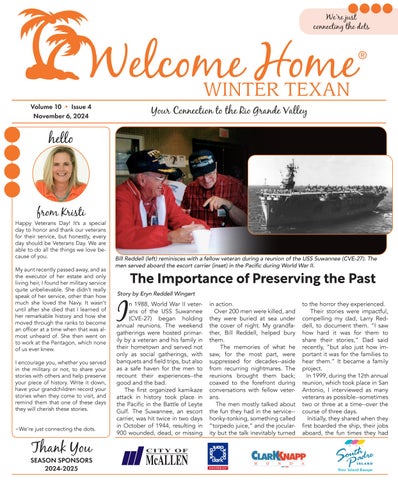
Bill Reddell (left) reminisces with a fellow veteran during a reunion of the USS Suwannee (CVE-27). The men served aboard the escort carrier (inset) in the Pacific during World War II.
The Importance of Preserving the Past
Story by Eryn Reddell Wingert
I
n 1988, World War II veterans of the USS Suwannee (CVE-27) began holding annual reunions. The weekend gatherings were hosted primarily by a veteran and his family in their hometown and served not only as social gatherings, with banquets and field trips, but also as a safe haven for the men to recount their experiences--the good and the bad. The first organized kamikaze attack in history took place in the Pacific in the Battle of Leyte Gulf. The Suwannee, an escort carrier, was hit twice in two days in October of 1944, resulting in 900 wounded, dead, or missing
in action. Over 200 men were killed, and they were buried at sea under the cover of night. My grandfather, Bill Reddell, helped bury them. The memories of what he saw, for the most part, were suppressed for decades--aside from recurring nightmares. The reunions brought them back; coaxed to the forefront during conversations with fellow veterans. The men mostly talked about the fun they had in the service-honky-tonking, something called “torpedo juice,” and the jocularity but the talk inevitably turned
to the horror they experienced. Their stories were impactful, compelling my dad, Larry Reddell, to document them. “I saw how hard it was for them to share their stories,” Dad said recently, “but also just how important it was for the families to hear them.” It became a family project. In 1999, during the 12th annual reunion, which took place in San Antonio, I interviewed as many veterans as possible--sometimes two or three at a time--over the course of three days. Initially, they shared when they first boarded the ship, their jobs aboard, the fun times they had