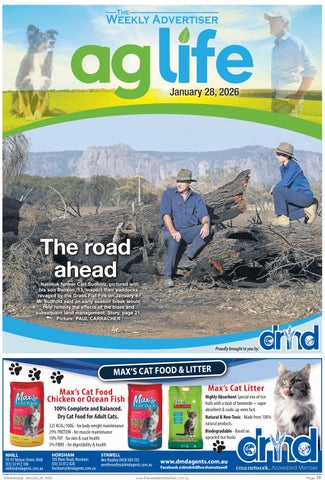
Natimuk farmer Carl Sudholz, pictured with his son Benson, 13, inspect their paddocks ravaged by the Grass Flat Fire on January 9. Mr Sudholz said an early season break would help remedy the effects of the blaze and subsequent land management. Story, page 21.
Picture: PAUL CARRACHER
To everyone in Natimuk, Quantong and Vectis affected by the recent Grass Flat fire — our thoughts are with you. We recognise the strength and resilience these communities continue to show, and we understand that the impact of an event like this doesn’t end once the fire is out. In the days and weeks ahead, please know you’re not alone, and that we’re thinking of you all during this challenging time.
Looking for the rain cloud’s silver lining
BY BRONWYN HASTINGS
Natimuk farmer Carl Sudholz
is focusing on autumn rains, which he hopes will remedy the damage caused to his paddocks by January 9’s Grass Flat fire.
Mr Sudholz said the 8372-hectare fire crossed about 500 hectares of his land at both Grass Flat and Natimuk.
“The first thing to do is to try and stop the paddock from blowing –you don’t want to lose any more of that fragile topsoil,” he said.
“We’ve had to cultivate the soil, which does create some issues for the next season in weed control.
We’re burying seeds at different depths, which can create problems with pre-emerging chemicals.
“We’ve all come through the cultivation phase and moved into the no-till farming, but having to turn the soil over is not new to farming.”
Mr Sudholz said the uneven emergence of weeds would reduce the efficacy of pre-emergent herbicides he would apply.
“An early break in about mid-April
to get the weeds up before we sow would be the ideal scenario,” he said.
“But if we don’t get that opportunity, well then it’ll be just that one shot at them with the pre-emergence.”
Burning stubble has some advantages and remains a common farming practice.
“Burning reduces weed seeds and pests in the stubble, so we certainly don’t mind burning off occasionally,” Mr Sudholz said.
“But the difference was just the heat that this fire produced, it left absolutely nothing on the soil surface, it has just taken everything with it.”
But Mr Sudholz said he would not change any cropping plans for the next season.
“It will be business as usual,” he said.
“But if we can get the early rain, that would be the best-case scenario, to emerge those weeds and help to hold things in place. Cultivating does create more work, but it’s not all negative – there can be some benefits, in mixing up and distributing nutrients throughout the profile.
“And there will be no long-term negative effect. There’s perfectly good opportunities to get a good season, if we get the rain at the right time.”
Agriculture Victoria livestock extension officer Fiona Baker said while soil’s phosphorus levels did not change much after a fire, pH levels could.
“The soil’s pH levels – the acidity or alkalinity of the soil – can actually improve, because ash is actually alkaline, so the burnt plant material becomes alkaline,” she said.
“Often we can actually see a bit of an increase in the pH of the soil, which is a bonus, if we have to take good news stories out of fires.”
Ms Baker said the next step for farmers was to wait for the season’s break.
“There’s really nothing they can do until we get those rainfall events,” she said.
“So until the autumn break comes, it’s really hard to sit and wait. It’s a real challenge.”
Advice to monitor fire-affected dams
Farmers in fire-affected areas are encouraged to monitor their dams and remove floating debris as soon as possible following heavy or prolonged rain.
Agriculture Victoria advised farmers to consider installing sediment traps upstream of their bigger dams.
Following fires, many dams became unusable due to pollution from decomposing organic matter or after being filled with soil, sand, and gravel.
While little can be done in the short-term to remove the heavier materials, quick action to remove floating materials can be effective in maintaining water quality.
Typically, the floating materials consist of ash, charcoal, straw, grass, leaves and manure. The materials can cause issues for the water supply if they are not quickly removed.
Within a couple of days, debris will sink and begin
to break down causing the water to become putrid and potentially unusable for livestock.
While upstream sediment traps will reduce the risk of pollution, it is inevitable that some dams will become contaminated. When time permits, sediment traps can be installed to prevent debris from entering dams.
For more information on organic pollution in farm dams people can visit the Agriculture Victoria website at agriculture.vic.gov.au/farm-management/water/ managing-dams/organic-pollution-in-farm dams.
For more information on managing stock water impacted by bushfire, ash and debris visit the Agriculture Victoria website at agriculture.vic.gov.au/farm-management/ emergency management/bushfires/what-to-do-after-abushfire/stock-water-impacted-by-bushfire-ash-anddebris or call 136 186.
New round of farm gate funding
A new round of applications for the Look Over the Farm Gate community events program has opened in response to the bushfires and ongoing drought.
The Look Over the Farm Gate program offers grants of up to $5000 for events and activities that support mental health and wellbeing of farmers and farming communities.
Since June 2025, funding has been provided to more than 160 events, with more than 130 Look Over the Farm Gate-supported events held. The program is part of the State
Government’s drought-support package of $146.5-million and is administered by the National Centre for Farmer Health. Applications for the new round of funding will remain open until the allocated funding has been exhausted or until June 30.
People can find out more and apply via the National Centre for Farmer Heath website.
Find more information about available drought support, people can visit www.agriculture.vic.gov.au/ drought or call 136 186.
OʼBrien & Smith Lawyers are expanding appointment availability in Stawell. Rachel now attends Tuesdays, with Patrick continuing on Thursdays. Our Stawell office is now open Monday to Friday, 10am–4pm. To book an appointment, call our dedicated Stawell number: (03) 5381 2220.
BUSINESS AS USUAL: Natimuk farmer Carl Sudholz and his son Benson, 13, plan for the season ahead. Picture: PAUL CARRACHER
Harvest exceeding expectations
BY BRONWYN HASTINGS
L
ate season rains and a cooler spring gave farmers a betterthan-expected finish to harvest, with records broken at some receival sites.
GrainCorp national grains operations head Jason Shanley said tens of thousands of tons of grain was routinely received across the Wimmera.
“Carpolac, west of Horsham, reached a receivable record, a bit over 46,000 tons,” he said.
“To do that, we had to keep grain moving out of that site, to keep making space available for growers there.
“We saw some pretty strong tons, mainly across the Wimmera and what we call our central Victoria area, which kind of feeds down into the southwestern areas, about 30,000 to 40,000 tons a day coming in, which was pleasing.”
Mr Shanley said he had heard reports of yields exceeding expectations.
“The rainfall leading up to harvest, then those cool temperatures through October and November certainly helped the crops get the most out of that moisture,” he said.
“Barley has also been successful, particularly a new malt variety Neo coming in, which has definitely delivered on yields and certainly quality as well.”
Marnoo farmer Trent Carter said his harvest results across most of his paddocks exceeded his expectations.
“With the way the year started off –
and certainly ended with a very late break – a lot of things were up in the air,” he said.
“And then there were those crucial couple of weeks in October when things were really drying off, and a bit of a salvage right at the end.”
Mr Carter said it was a very difficult year for a number of reasons.
“One, to get a decent weed kill and be on the front foot there for the growing season ahead,” he said.
“Canola really struggled. We were looking for ideal plant density numbers and we still had canola plants germinating throughout the whole winter period, so it was a very unknown year, the way it panned out.”
Mr Carter said varying soil types, rainfall and barley varieties also contributed to the unknowns.
“In our farming enterprise, we had roughly 250mm of rain during the growing season,” he said.
“Then back close to Marnoo, it was probably down 30mm to 40mm, to the area south towards Wallaloo, where there were a few more southerly showers, and there could have been a flip of probably 60mm to 70mm there throughout the growing season.
“Obviously rainfall is number one, and soil type, and then there were barley varieties which stood out. We had Neo and Cyclops, and Neo certainly stood out in front with its hands up.”
Mr Carter said while barley’s average
Office efficiencies
Farm office efficiencies workshop – DEECA Centre, 110 Natimuk Road, Horsham, February 11, 9am-3pm.
Delivered by Agri Focused’s Carmen Quade, the free workshop is family farms focused and includes batch payment, reconciling, tracking inventory, reporting, managing receipts, dealing with paper records, cloud base storage, and strategies for keeping up-to-date.
Improving soil
Soil constraints, nutrition – online, February 18, 7.30pm-8.30pm.
A free session with Dr Cass Schefe, it is designed to equip farmers with practical strategies to improve soil health, boost crop performance and make more informed input decisions.
Farm emissions
Picture: PAUL CARRACHER
HAPPY: Goroke farmer Darren Walter delivered above average wheat and canola to GrainCorp at Carpolac and said his barley average was ‘really good too’.
yield was generally in the fives and sixes, wheat was high fours to low sixes.
“We had three different wheat varieties – Shotgun, Ponsford and Ballista – that we’ve been growing for quite a few years, which have been very good to us,” he said.
“Oats were a different one – quite disappointing to a degree. In a nutshell, they were certainly very low in yield quality.”
Mr Carter said he would welcome an early break.
“I’d love an early break, as we always would, it would put us on the front foot,” he said.
“We have a hot, dry summer, so hopefully that’ll break at some point and away we’ll go. But for now, in our cropping program, we’ll stick to rotations – heads down, tails up and keep steaming ahead.”
Calculate your farm emissions workshop – Wimmera CMA, Darlot Street, Horsham, February 24, 10am-2pm.
Agriculture Victoria’s Adam Buzza will lead the free workshop, giving people the opportunity to apply their own data into an emissions calculator with guidance and support. To register or find out more about these and other workshops, people can visit agriculture.vic. gov.au/support-and-resources/ event-listing.
Advocating for positive policy change
Riverside’s Emelia Sudholz is among three new representatives to join GrainGrowers’ National Policy Group, after members in the southern region elected their five representatives last month.
Broadacre dryland cropping near Rupanyup with her husband for 25 years, Ms Sudholz has a degree in agricultural science and has worked in the fertiliser industry, natural-resource management, and with the Murray-Darling Basin Authority, MDBA, community committee.
Ms Sudholz said she was passionate about sustainability and climate resilience, and would like to see GrainGrowers continue its efforts to ensure research and policy align grain production with environmental responsibility and global competitiveness.
“Through my involvement with the MDBA, I have had the opportunity to represent the interests of regional communities affected by water-policy decisions and provide advice around basin plan issues,” she said.
“This experience has demonstrated to me the value of collaborative problem solving, respectful advocacy and evidence-based dialogue to achieve balanced outcomes, and I wish to bring those principles to the national policy group.”
Ms Sudholz said being elected to the NPG was an opportunity to be part of progress and to advocate for policy on
issues that impacted how people farm.
“With our industry facing challenges such as soil conservation, water scarcity, land use and climate change, developing practical, workable policies is a key step in sustaining our global competitiveness,” she said.
“I am looking forward to getting involved and playing a part in this process.”
Narrandera’s Jack Langley and Forbes’ Bruce Watson are the other two new representatives, joining two previous members, Telangatuk’s Amity Dunstan and Junee’s Martin Honner.
Ms Dunstan said she had contributed to NPG’s discussions on key issues including transport, competition, social licence, farm safety, innovation gaps and labour.
“I have worked to ensure that challenges such as increased taxation, the loss of AgVic staff, mining developments and transmission line proposals – and the resulting stress on Victorian and Wimmera farmers – are recognised at the national level,” she said.
“People are at the heart of agriculture, and we must look after everyone involved.”
Ms Dunstan balances farming, community, and family through participation in her local football and tennis clubs, and advocates for collaborative decision-making.
“I advocate for diverse perspectives and believe that well-informed policy–
shaped by both local and international insights – creates the foundation for compromise and better outcomes,” she said.
“I bring a collaborative, honest, and practical mindset to continue representing grower interests on the NPG.”
GrainGrowers chief executive Shona Gawel welcomed the elected national policy group members.
“On behalf of GrainGrowers, I would like to thank all the growers who stood for the national policy group for stepping forward for this essential part of our policy development,” she said.
“I am very confident that every one of the elected members will represent the southern region effectively, contributing actively to the policy discussions at GrainGrowers.”
The NPG determines GrainGrowers’ policy positions and represents growers’ views on national issues affecting the grains sector.
It is made up of 15 representatives, five from each of the GrainGrowers’ regions: the southern region, of southern New South Wales, Victoria and Tasmania; the western region, of South Australia and Western Australia; and the northern region, Queensland and northern New South Wales.
During the past 12 months, the group has contributed to deliberations about proposed superannuation changes, the ‘right-to-repair’ changes and grains research and development.
PROACTIVE:
Emelia Sudholz, of Riverside, left, joins Telangatuk’s Amity Dunstan, above, on the GrainGrowers National Policy Group.
SPIRAFLEX AIR SEEDER HOSE
Goodyear’s Spiraflex Air Seeder hose is designed for use in Air Seeding applications where there is a requirement to view the product being conveyed.
This hose is specially formulated with a Clear Thermosplastic Urethane Liner offering superior wear resistance in not only seeding applications, but many other dry bulk material delivery applications.
In stock ready for the 2026 season
Review to inform New BCG board member
BCG will host growers, advisers and researchers at its annual trials review day on February 20, to inform attendees about this year’s on-farm growing season decisions.
The event has been repositioned to focus less on trial results in isolation and more on how the results stack up when tested against risk, profitability and long-term business strength.
Despite decile-one rainfall in parts of the region, many areas still recorded above-average yields, reinforcing the importance of sound decision making, timing and system design.
In this type of season, access to credible, locally generated research and the ability to interpret it critically can be the difference between stabilising performance and compounding losses.
BCG Trials Review Day coordinator Louisa Ferrier said the 2025 program reflected a deliberate shift.
“Farming systems today are carrying more cost, more complexity and more risk than they did a decade ago,” she said.
“That means growers need to
be confident not just in what they do, but why they are doing it.”
This year’s program will feature agricultural economist Professor Bill Malcolm, who will question common assumptions around costcontrol, scale and efficiency while examining whether the agronomic themes discussed across the day deliver economic return.
Professor Richard Eckard will speak on the carbon conversation, focusing on what emissions reporting and sustainability expectations could mean for farm businesses and their balance books.
Birchip-born agricultural analyst Joe Boyle, from Bendigo and Adelaide Bank, will provide a market outlook, unpacking the key drivers shaping 2026 after a volatile 2025. Together, the three speakers will frame trial results in a way that reflects the complexity of modern farm decision making, helping growers assess not just what works agronomically, but what holds up when margins tighten and risk increases.
Ms Ferrier said independent research and critical thinking were more important than ever
“There is no shortage of advice available to growers, but not all of it is grounded in local evidence,” she said.
“Trials Review Day gives growers the chance to step away from sales pressure and focus on what the data is really telling them.”
The event is expected to resonate with younger and mid-career growers who are refining their systems while carrying greater financial exposure and responsibility.
Trials Review Day forms a key part of the organisation’s research and extension calendar.
The event is supported by the Federal Government’s Future Drought Fund through the Victoria Drought Resilience Adoption and Innovation Hub.
People can register for membership to access the event, which is on Friday, February 20 at Birchip Leisure Centre. For full program details, people can visit bcg.org.au/ events.
People can submit questions for the guest speakers at www. bcg.org.au/bcg-will-host-itsannual-members-only-trialsreview-day-on-friday-20-atthe-birchip-lesuire-centre.
Wilkur farmer Holly Hinkley has been appointed to BCG’s board, reinforcing its focus of balancing practical farming experience with high-level professional skills.
Ms Hinkley farms about 10,000 hectares with her husband, two young children and extended family, producing wheat, barley, lentils, and occasionally canola.
BCG chair John Ferrier said Ms Hinkley, filling a casual vacancy, would be an asset to the board and BCG members.
“Holly understands farming because she lives it, but she also brings valuable experience from outside the sector,” he said.
“That combination of practical insight and governance and investment expertise will be a real asset to the board and to BCG members.”
Ms Hinkley grew up on a mixed farming enterprise in Gnowangerup, Western Australia, where her family continues to operate a large cropping and Merino sheep business.
She completed an early-career internship with an agricultural investment firm in Brisbane, gaining exposure to large-scale investment and water trading.
Prior to returning to full-time farming, Ms Hinkley worked with Deloitte Consulting from 2019 to 2023 within the investment and wealth management team, supporting superannuation funds to strengthen governance frameworks, advice models and overall member outcomes.
Ms Hinkley said organisations like BCG played a critical role in supporting resilient and profitable farming systems.
“BCG has had such a real and lasting impact across north-west Victoria because they are grounded in farmer needs and focused on practical outcomes,” she said.
“BCG’s work supports better decisions on farm and strengthens the long-term viability of farming families and rural communities.”
BCG chief executive Fiona Best said Ms Hinkley’s appointment aligned with the organisation’s purpose.
“Holly brings both a deep connection to farming and the external skills needed to support a modern, forward-looking research and extension organisation,” she said.
“Her perspective will be valuable as BCG continues to focus on farmer profitability, innovation and long-term resilience across our region.”
FRESH PERSPECTIVE: Holly Hinkley is the BCG’s newest board member .
Fire recovery help on hand
Resilience is a word that is bandied around far too much these days.
It has even crept in to the corporate vernacular around company values and the attributes businesses would like their employees to embody in their day-to-day work.
Why on earth you would want your employees to have to draw on their reserves of resilience on a day-to-day basis just to get through their workday is beyond me.
Being well trained, displaying stoicism, having a strong work ethic and good depth of character, yes; relying on people’s resilience, I’m not so sure.
You need to be resilient when you need to be resilient, which comes into sharp focus when the real things in life happen.
There is no better example of this than the recent fires many of our local farmers and residents have had to endure.
After a better-than-expected growing season due to a kind spring, to be immediately thrust into a situation where paddocks are bare and blowing, livestock and livestock feed have been lost, machinery, infrastructure, or even
worse, your home has been destroyed, requires a level of resilience to come back from that is far beyond what the modern meaning of the word would suggest.
Insurance or no insurance, attempting to recover, even long after the initial impact of the event passes, is perhaps the hardest part of it all for those affected.
In a world that seemingly stops for no one, it is especially difficult and possibly why the word is flirted with so much in the modern day, as often there is little room left available for when the real requirement for resilience calls.
I know I would speak on behalf of our competing agencies as well as AWN that ongoing assistance is available and willing to be provided for anyone in need of contacts or assistance in coordinating freight, fodder, livestock, or simply an ear and-or a conversation.
Machinery built to last
A family-owned tractor and header purchased mid-last century was used in novelty to harvest about half an acre of wheat on Schillings’ Katyil property this season.
Paul Schilling said his father Otto bought the 1938 Big E harvester, while Otto’s brother Ernie bought the model D John Deere tractor.
“I’ve got the receipts for both the header and the tractor – they
were both bought brand new. Dad bought the header in 1938 for about £100, and it was delivered by train to Dimboola or Antwerp,” he said.
“The tractor – it was a 1949 model but it was 1951 by the time it got here – was about £1500.”
The tractor and header have always been kept in a shed and are still brought out occasionally.
“Every now and then we get it out,
just to show the young people what happens,” Mr Schilling said.
“Dad was actually going to pull it out of the shed permanently, but I think it’s too good to pull out, and I’m glad we never did – the paintwork on it is all pretty good.
“And this season we used it to harvest a little patch of wheat for chook feed.”
HISTORIC: Lorna Schilling, right, on her dad’s 1949 model D John Deere tractor, Paul Schilling on his dad’s 1938 Big E harvester, with Gary Greig at the back.
Increase your 2026 Crop Program Dimboola East...
A/c W.R. & D.J. McKenzie
Off Katyil-Wail Road – Approx. 15km north-east of Dimboola
Marchbanks 319ac
Crop history – wheat, vetch, canola, barley, lentils
Good level loam soils – one paddock
The 2025 harvest ‘long-game’ is finally finished
Expressions of interest close on February 28, 2026
Possession – March 2026
The chance to buy a well-managed parcel of quality soils doesn’t come up every day!!
For full property details and inspection contact:
Graham Gerlach – 0418 504 333 Licensed Estate Agent 15 Clark Street, Horsham graham@wimmvals.com.au
Have you considered the impact these issues will have on you, your family and community?
REGISTER TODAY
Join the AVA, political leaders and a range of experts (researchers, farmers, policy makers) to discuss the important issues impacting Victorian communities.