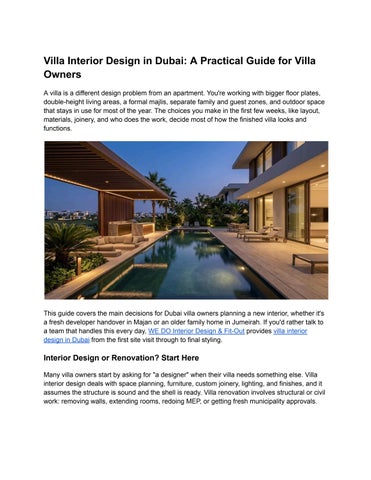
Villa Interior Design in Dubai: A Practical Guide for Villa Owners A villa is a different design problem from an apartment. You're working with bigger floor plates, double-height living areas, a formal majlis, separate family and guest zones, and outdoor space that stays in use for most of the year. The choices you make in the first few weeks, like layout, materials, joinery, and who does the work, decide most of how the finished villa looks and functions.
This guide covers the main decisions for Dubai villa owners planning a new interior, whether it's a fresh developer handover in Majan or an older family home in Jumeirah. If you'd rather talk to a team that handles this every day, WE DO Interior Design & Fit-Out provides villa interior design in Dubai from the first site visit through to final styling.
Interior Design or Renovation? Start Here Many villa owners start by asking for "a designer" when their villa needs something else. Villa interior design deals with space planning, furniture, custom joinery, lighting, and finishes, and it assumes the structure is sound and the shell is ready. Villa renovation involves structural or civil work: removing walls, extending rooms, redoing MEP, or getting fresh municipality approvals.
If your villa needs both, the structural work comes first. Getting the order right saves you from paying twice for the same room. For projects that start with civil work, it's worth reading about villa renovation in Dubai before you brief a designer.
How Each Space in a Villa Gets Designed Majlis and living areas. In most Dubai villas, the majlis for receiving guests is designed separately from the everyday family living room. It usually gets more formal seating, richer textiles, and its own entrance sequence. Contemporary villas often interpret it with low, linear seating and timber panelling in place of traditional ornament. Master suite. The master bedroom works best when the sitting area, walk-in wardrobe, and ensuite are planned as one connected route, not as three separate rooms. Children's and guest bedrooms need tougher finishes and more flexible storage.
Kitchen. More villa owners now want two kitchens: a show kitchen open to the dining area and a working kitchen behind it for heavy cooking. Cabinetry, appliance placement, and ventilation all depend on that split.
Bathrooms. Waterproofing, slope-to-drain detailing, and stone selection need to be settled early, because they're expensive to change once tiling starts.
Outdoor living. Dubai's climate makes shaded terraces, pool decks, and outdoor kitchens usable for about nine months a year, so plan them as part of the interior, not as an extra.
Smart home. Automated lighting, climate, and security are standard now. The current approach hides wiring and control panels inside joinery so the technology doesn't show. You can see many of these ideas together in this contemporary District One villa in MBR City, which has a walnut-panelled majlis, a travertine master bathroom, and a shaded pool terrace.
Villa Type and Size Change the Brief A standalone villa with garden on all sides gives you the most freedom, since there are no shared walls to plan around. Twin villas and townhouse-style units need more attention to acoustics and privacy, especially where bedrooms sit against a shared wall. Size matters as much as type. In a 2–4 bedroom villa, every room has to earn its space, so a guest room often doubles as a home office. In a 6–7+ bedroom property, the priority shifts to clear zoning between family, guest, and staff areas.
Choosing a Style and Material Palette Most Dubai villas fall into one of four style directions: modern and contemporary, Arabic or majlis-inspired, Moroccan, and classic luxury. Most successful projects blend two of them rather than follow one strictly. On materials, large-format marble and porcelain are still the standard for living areas, and bookmatched marble feature walls have become a common request. Ceilings are now treated as a design surface in their own right, with coffers, cove lighting, or flush plaster with concealed
linear lights. Layered lighting on separate circuits (ambient, task, and accent) should be the baseline in every room. Custom joinery has the biggest effect on the final quality. Wardrobes, kitchens, TV walls, and wall panelling are where outsourced work usually lets a villa down. A company with its own joinery factory in Dubai can keep design, production, and installation on one timeline and one warranty.
What Villa Interior Design Costs in Dubai Costs depend on villa size, finish level, and scope, but typical ranges look like this: ● Partial design (selected rooms): roughly AED 80,000–150,000 ● Full design and fit-out, 3–5 bedroom villa: roughly AED 250,000–1,000,000+ ● Ultra-luxury fit-outs at Emirates Hills or Palm Jumeirah level finishes: AED 3,000,000+ Be wary of per-square-foot quotes on their own. A fixed, itemised quote after a site visit is the only figure you can actually plan a budget around.
The Process From Concept to Handover A well-run villa project usually goes through three stages: 1. Consultation and site visit. This covers your lifestyle, style preferences, and budget, followed by an in-person assessment of the villa. 2. Design proposal. This typically takes 2–4 weeks. You get concepts, mood boards, 3D visuals, material samples, and ideally a VR walkthrough before anything is built. 3. Execution and handover. This includes civil works, joinery, installation, and final styling. For post-handover fit-outs on off-plan villas, approvals are often the hidden delay. Pick a team that already works directly with Dubai Civil Defence, Dubai Municipality, and developers such as Emaar and Damac.
Recent Villa Interior Projects in Dubai Real projects show better than any description how a villa brief turns into a finished home. A few examples from different communities: ● Al Manara luxury villa. The layout, material palette, and custom furniture were all developed specifically for the property. ● Majan villa design. The villa went from a bare developer handover to a fully furnished, move-in-ready interior. ● District One, MBR City. The 2-bedroom and 3-bedroom contemporary villas range from light oak and pale stone to dark walnut, travertine, and brushed bronze.
● Emirates Hills. Formal majlis spaces, bespoke furniture, and refined detailing throughout.
How to Choose a Villa Interior Design Company in Dubai Check three things before you sign: 1. One contract or two. A separate designer and contractor means you manage the handover between them. A design-and-build company keeps everything under one roof. 2. Verifiable credentials. Look for DED registration and ISO certification, not just marketing claims. 3. Relevant portfolio. Ask to see completed villas similar in size and style to yours, not just apartments or renders. WE DO meets all three: 11+ years in Dubai, 250+ completed projects, ISO 9001, 14001, and 45001 certification, an in-house joinery factory, and a 2026 Luxury Lifestyle Award. The team works across Emirates Hills, MBR City, Majan, and Al Manara, and takes on projects in Dubai Hills Estate, Arabian Ranches, Palm Jumeirah, Jumeirah, and Al Barsha on request. Browse the full project gallery to see completed villa work. Tags: #VillaInteriorDesign #VillaInteriorDesignDubai #LuxuryVillaDubai #InteriorDesignDubai #DubaiVillas