OAKPARK.COM | RIVERFOREST.COM
CONNECTS
B1
Wednesday Journal, October 23, 2019
A YEAR-LONG SERIES FOCUSING ON COMMUNICATING OUR PRIORITIES FOR CHILDREN
How does a school culture change? At D97, slowly but steadily
New climate coaches, peace circles and code of conduct policies lead transition to restorative justice BY MICHAEL ROMAIN Staff Reporter
ALEX ROGALS/STAFF PHOTOGRAPHER
O
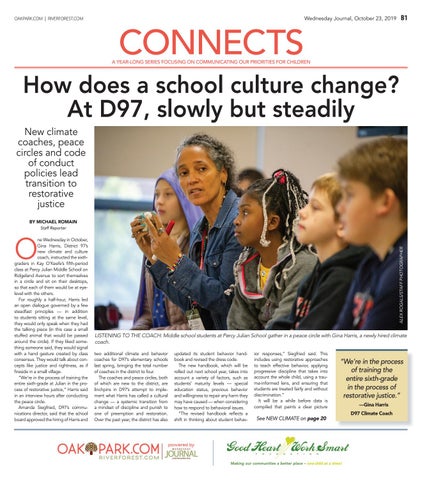
ne Wednesday in October, Gina Harris, District 97’s new climate and culture coach, instructed the sixthgraders in Kay O’Keefe’s fifth-period class at Percy Julian Middle School on Ridgeland Avenue to sort themselves in a circle and sit on their desktops, so that each of them would be at eyelevel with the others. For roughly a half-hour, Harris led an open dialogue governed by a few steadfast principles — in addition to students sitting at the same level, they would only speak when they had the talking piece (in this case a small stuffed animal that would be passed around the circle). If they liked something someone said, they would signal with a hand gesture created by class consensus. They would talk about concepts like justice and rightness, as if fireside in a small village. “We’re in the process of training the entire sixth-grade at Julian in the process of restorative justice,” Harris said in an interview hours after conducting the peace circle. Amanda Siegfried, D97’s communications director, said that the school board approved the hiring of Harris and
LISTENING TO THE COACH: Middle school students at Percy Julian School gather in a peace circle with Gina Harris, a newly hired climate coach. two additional climate and behavior coaches for D97’s elementary schools last spring, bringing the total number of coaches in the district to four. The coaches and peace circles, both of which are new to the district, are linchpins in D97’s attempt to implement what Harris has called a cultural change — a systemic transition from a mindset of discipline and punish to one of preemption and restoration. Over the past year, the district has also
updated its student behavior handbook and revised the dress code. The new handbook, which will be rolled out next school year, takes into account a variety of factors, such as students’ maturity levels — special education status, previous behavior and willingness to repair any harm they may have caused — when considering how to respond to behavioral issues. “The revised handbook reflects a shift in thinking about student behav-
ior responses,” Siegfried said. This includes using restorative approaches to teach effective behavior, applying progressive discipline that takes into account the whole child, using a trauma-informed lens, and ensuring that students are treated fairly and without discrimination.” It will be a while before data is compiled that paints a clear picture
See NEW CLIMATE on page 20
“We’re in the process of training the entire sixth-grade in the process of restorative justice.” —Gina Harris D97 Climate Coach
B2
Wednesday Journal, October 23, 2019
OAKPARK.COM | RIVERFOREST.COM
Schools start by acknowledging implicit bias is real
Schools in River Forest, Oak Park layer on training for all staff to move toward equity, inclusion BY LACEY SIKORA
Contributing Reporter
ALEX ROGALS/STAFF PHOTOGRAPHER
T
he past five years have brought a renewed awareness of equity issues to local schools and renewed commitment to addressing inequities through training programs for teachers, staff, employees and local school boards. Districts 90, 97 and 200 speak to their efforts to address implicit bias. LeVar Ammons, OPRF’s new Executive Director of Equity and Student Success, hit the ground running and says that the issue of implicit bias can’t be underestimated. “It’s really all around us, in media, in advertising, in our culture.” Ammons says the high school is combatting the issue with the Collaborative Action Research for Equity (CARE) initiative which supports teachers in studying professional practices and improving those practices in ways that address racial bias. CARE is based on participating in authentic racial selfreflection, developing critical race consciousness, engaging in healthy racial discourse, and conducting racial investigation of educator practice. CARE was instituted in the 201718 school year, and 45 teachers were trained to be CARE leaders. “These teachers along with our two racial equity coaches provide training for teachers during professional development days. Our teachers are looking at themselves in a sense; they’re looking into how structures of institutional racism show up in all of us,” he says. At the high school, racial equity professional development occurs eight times throughout the school year, and Ammons says the goal is to increase that frequency. “We want to consolidate so that it’s interwoven in everything we do. Folks here are already doing this work, and the number one goal is to develop procedures to implement the racial equity policy that
TOUGH WORK AHEAD: LeVar Ammons, OPRF’s new director of equity and student success, says the issue of implicit bias can’t be underestimated. we just passed.” Beyond faculty and classrooms, Ammons says the training will encompass all adults at the school. “We are working on bringing this to our building and grounds staff, our safety security team and our food service employees. These folks have direct contact with and an impact on students as well.” Ammons recently attended the Beyond Diversity Conference along with school board president Jackie Moore and says the school board is committed to training on equity and implicit bias. “We are pushing to make this a systematic training. It has to be from the top down, all the way through. The ultimate goal is to no longer have academic outcome predicted by race.” Carrie Kamm, chief of equity issues in the District 97 Oak Park elementary schools, says during the 2018-19 school year, the schools facilitated two trainings focused on implicit bias for school-based and certified staff. “The first session focused on developing a foundational understanding of implicit bias, connecting that understanding to student and staff lived experiences,
and engaging in circle discussions to share reflections and learning. The second session focused on staff gaining a better understanding of their specific biases by completing the implicit bias test, understanding how to navigate system 1/system 2 thinking, and using classroom tools/strategies to address how bias impacts student experience.” Kamm says this year, “Our new hire class will participate in a professional learning session on exploring bias on Oct. 29. The Diversity Council, in collaboration with our Culture and Climate Coaches, PBIS internal coaches, will design our third session on exploring how bias impacts student discipline.” On Oct. 15, the District 97 board approved the professional development plan for the 2019-20 year. This year, they will receive training from the National Equity Project and C-ROAR (Chicago Regional Organizing for Anti-Racism). The goals of the C-ROAR training are to create a shared language and understanding of racism, to explore and unpack a framework of systemic racism, to analyze how systemic power operates in our society and in our insti-
“Too many students at the middle school felt like they didn’t have a relationship with an adult. So we pulled together a student advisory group.” Dawne Simmons D90 communications director
tution, and to determine next steps for the school district. Kamm says these objectives will support the school board in its understanding of the complexity of system changes necessary to address matters of racial, socioeconomic and cultural diversity within the community and district. At River Forest’s District 90 elementary schools, Dawne Simmons, head
of communications and community outreach, says implicit bias training is folded into all of the district’s equity initiatives. “Implicit Bias training has been part of our equity initiative since we formed our Inclusiveness Advisory Board in 2014.” Simmons says everyone goes through equity training in the district. “All of our staff, our board and even the community takes part in our training. New teachers are trained as part of new teacher orientation. The inclusiveness training goes beyond race and ethnicity. That’s a big part of it, but it also includes gender identification and students with special needs.” Christine Gerges, assistant principal at Lincoln and Willard schools, previously worked as a teacher at Willard and says that the district employs a few methods for addressing implicit bias in the classroom. “We use the Universal Design for Learning program, which addresses implicit bias, and the Second Step program which is a social-emotional learning program. It helps us to look at our perspective and consider the perspectives of others,” says Gerges. Gerges says the training is ongoing throughout the year, and that the teachers are constantly working with a goal of eliminating bias in the classroom, through training with the National Equity Project and through activities such as the One District, One Book s initiative in which administrators, educators and community members delve c deeply into issues by reading a book. d Simmons says since the implementation of the Inclusiveness Advisory t Board, the district conducts a survey every other year to see how students e and families feel they are welcomed a at a local schools. She points to one issue s identified in the 2015 survey: “Too many students at the middle school m felt f like they didn’t have a relationship with w an adult. So, we pulled together a student advisory group model. Students participate in the same group d from fifth to eighth grades and in their f groups they deal with social-emotional g learning and building relationships. It helps them form relationships outside of their social circles.” Simmons also says that through the district’s partnership with the National Equity Project, they recently joined the Minority Equity Network and expect this initiative will keep the district on the path of always working towards equity.
B3
Wednesday Journal, October 23, 2019
OAKPARK.COM | RIVERFOREST.COM
Thinking deeply about student conflicts At Roosevelt in River Forest, restorative justice is about more than an alternative to punishment BY MICHAEL ROMAIN Staff Reporter
ALEX ROGALS/STAFF PHOTOGRAPHER
D
uring a recent interview, Tina Steketee, the assistant principal of Roosevelt Middle School in River Forest, succinctly described an enduring truth of restorative justice practices. “All humans need problem-solving guidance,” she said, before explaining how the implementation of restorative practices at the school has changed how students — minority and nonminority — process conflict. “Before, when we would have situations, we might just do consequences, but they might spark up again,” said Larry Garstki, the school’s principal. “We’ve seen lots of progress with relationships. If an issue isn’t mended, at least there are agreements to act civil and to seek out help from an adult before anything escalates again.” Garstki and Steketee said restorative practices aren’t alternatives to consequences, they’re tools for helping students think through their emotions and the various relationships that inform their lives. “The consequence itself doesn’t help the situation,” Garstki said. “Processing with that other person [who the student is in conflict with], usually with an adult facilitator present, does help. The students can make agreements with each other and figure out where everything went sideways, how to avoid the situation in the future, set norms for moving forward and problem-solve.” Steketee said Roosevelt’s conflict resolution process usually involves restorative conversations between students that are facilitated by social workers (the school has three on staff). Social workers also inform parents and guardians about the conflict and the process of resolving it. Social workers usually put a series of questions to students — among them, “How have I contributed to this issue/ matter?” and “Who else has been impacted?”
ASKING QUESTIONS: Tara Zinger, a Roosevelt Middle School teacher, focuses on conversations in her class. Steketee said that all social workers have the same questions. “We want the protocol to always be consistent, so kids know what to expect,” she said. “We have the questions read and we ask parents to review them with their children.” The point of the questions, Steketee said, is to force students to think beyond themselves. “We try to get to that root and to get the students to take control of what their part is in the situation,” she said. “It doesn’t always lead to an apology or even a rehash of the issue. The last question asked is, ‘What do I need to do to move on?’” For the last three years, Roosevelt has convened a school advisory program that facilitates targeted social and emotional learning in collaboration with a similar program at Oak Park and River Forest High School called Project Snowball. The advisory program is one aspect in the District 90’s effort to strengthen relationships between students and adults at the middle school. “We put a lot of energy, time and training into the relationship piece,” Steketee said. “Many of [the restor-
ative conversations] don’t end with formal consequences. That’s generally not the end result if we’re going to restore this process. It’s a mind-
set shift. Sometimes, parties involved want to know what is the tangible consequence, but we’re really clear about what the process is. We want
students to own their own behavior and understand what they need to do differently.” CONTACT: michael@oakpark.com
B4
Wednesday Journal, October 23, 2019
OAKPARK.COM | RIVERFOREST.COM
Circle work, or Umoja, or honest talk BY LACEY SIKORA
Contributing Reporter
I
n Swahili, the word Umoja means unity. In the Chicago area, the Umoja model is a practice meant to transform school culture, reduce violence and suspensions and build students’ social-emotional skills for success in school, the workplace, college and in life. Lynda Parker, Oak Park and River Forest High school’s director of student services, says last year, OPRF began a pilot practice of the Umoja model in which 25 faculty, staff and administrators worked in a year-long community of practice training to deepen their skills and practices. Khalida Himes, a school social worker, and Kris Johnson, a counselor/student advocate, took part in the pilot program and now
are leaders in expanding the reach of Umoja training to others at the school. Johnson says the Umoja model is a restorative justice practice that addresses the heart of a lot of student conflict at the high school level. “What I love about the restorative justice movement is that it puts a name and a face on it. I love the word restorative. There’s nothing more powerful than helping students repair harm.” In her work as a counselor and student advocate, Johnson says she often encounters issues of conflict between two students, and these issues can include sexual harassment situations. She sees conflict arising over social media, and the Umoja practice of circle work, which involves sitting face-to-face and talking, can be a part of the healing process. “Social media is so often the medium of conflict. It’s happening over the phones. When I sit the kids in front of each other, together and face-to-face, it is powerful. It helps them realize that it’s a person they’ve impacted. Having restorative conversations is the adult thing to do, and using these practices helps kids repair any harm they have caused.” Himes says while the practice of giv-
ing voice to issues and solving them face-to-face is particularly helpful in discipline practices, it goes beyond the sphere of discipline and is useful in a much wider context. “It can be used by teachers in managing a group versus addressing a specific problem. Circle work is about cultivating community. The whole idea behind Umoja is building relationships,” says Himes. Johnson adds, “We are starting to see it as the regular way we manage classrooms and work as groups. When restorative practices are in place and students experience conflict, the language and the expectations to deal with the conflict are already in place.” One place that Umoja practice is already in use is in the high school’s new 15-minute advisory period at the start of each school day. Johnson uses that time period to visit some of her senior classes and says at least one teacher has embraced Umoja practices during that period. “He’s got the room in small circles of four or five kids each during the advisory period. He’s given them discussion topics, and they use the white board desks to brainstorm. They follow the cir-
cle keeper rules, and the kids are super engaged. The circle practice is a great modality for having conversations.” She also sees the language of Umoja trickling into her counselor practice at the school as well. Johnson recalls a recent experience. “We had some drama with a young lady who was being very loud and lashing out. She asked for a peace circle. The language is out there. She knows that this is a space where she can talk about what she needs to talk about in a way that is restorative without causing further harm.” Himes sees that students are also becoming familiar with the Umoja circle concept. “I see a lot of students now asking to talk to the person who harmed them. Again, I see that as something that is happening in the building, where there’s a way to have a mediated space. There’s a cultural shift going on in the building.” Parker says being able to talk and having a safe space to do so benefits everyone. “Nothing changes if we don’t have the conversation. Having a neutral zone, where everyone can have a conversation and be heard is important. An important part of restorative
work is that the person who has been harmed gets a say in how it’s resolved.” Johnson says this point is particularly important, and it can take time for resolution. “The harmer might be ready right away, but the person harmed is not yet. It can take months. To have a kid be reflective enough to come back months later and work on resolution is really great.” Parker says that as teachers learn the language of Umoja from leaders such as Himes and Johnson, the practices spread. “Of our original 25 trainees, 15 are returning to be advanced circle leaders. This year, we’re expanding the training to the entire English Department, in addition to 28 of our TCT (Teacher Collaborative Teams) leaders. These TCT leaders, representative of every division in the school, are learning how to bring circle work back to their meetings, students and classrooms.” The long-term plan is to roll out Umoja practices by training as many adult staff, faculty and administrators as possible, so that they will utilize the practice throughout their interactions at the school. Parker says, “From adults to students, it seems to be universal in terms of effectiveness.”
larly, relationships are being built in the classroom and it’s actually leading to improved behaviors,” said Harris, who said she often observes multiple classrooms throughout the day. But the longtime Oak Park resident, who is also an elected member of the District 200 Oak Park and River Forest High School board, had a word of caution for anyone who thinks that cultural change will happen overnight. She said that in her experience as an
educator and restorative justice trainer, deep change could take several years. The wait — and the work of getting there — is well worth it, she said. “I’m a community member, so I’m highly invested in this community realizing what we hope and expect to be,” Harris said. “For me, this is about ensuring that our students have what they need, first and foremost, but it’s also about us developing community and being who we really want to be.”
Distribution of information by a community group in accordance with District 97 policy does not imply, directly or indirectly, that the group’s program(s), event(s) and/or service(s) is sanctioned, sponsored or endorsed by the district, the Board of Education or the superintendent.
ALEX ROGALS/STAFF PHOTOGRAPHER
Restorative justice practice shifting school’s culture
DOING THE WORK: Students learn about restorative justice practices n a classroom at Julian Middle School in Oak Park. NEW CLIMATE continued from page B1 of how the recent changes have impacted students’ experiences in Oak Park schools. There’s only a month of discipline data on hand for this school year and the district, citing that since there are so few infractions releasing the information could violate student privacy, has not made it public. A survey on student discipline in the middle schools conducted last year by
the Oak Park Teachers Association reported high levels of angst among faculty over what most saw as a decline in student behavior. Siegfried said anecdotal response to this fall’s efforts are encouraging though. “We have heard from teachers and students that the updated dress code has decreased the number of negative interactions between staff and students, resulting in a more positive school environment,” she said. “By doing the circle process regu-